Cambridge IGCSE Spanish - Foreign Language 0530 — 2021 Oct/Nov Paper 2 · Variant 3
0530/23/O/N/21 · 45 marks · ≈51 min
The question paper and its mark scheme, free to read here and free to download. This is Cambridge’s own paper, exactly as it was sat.
Question paper12 pages

Mark scheme10 pages
Answers below. Sit the paper first if you are practising.
Paper as text
Question paper, page 1
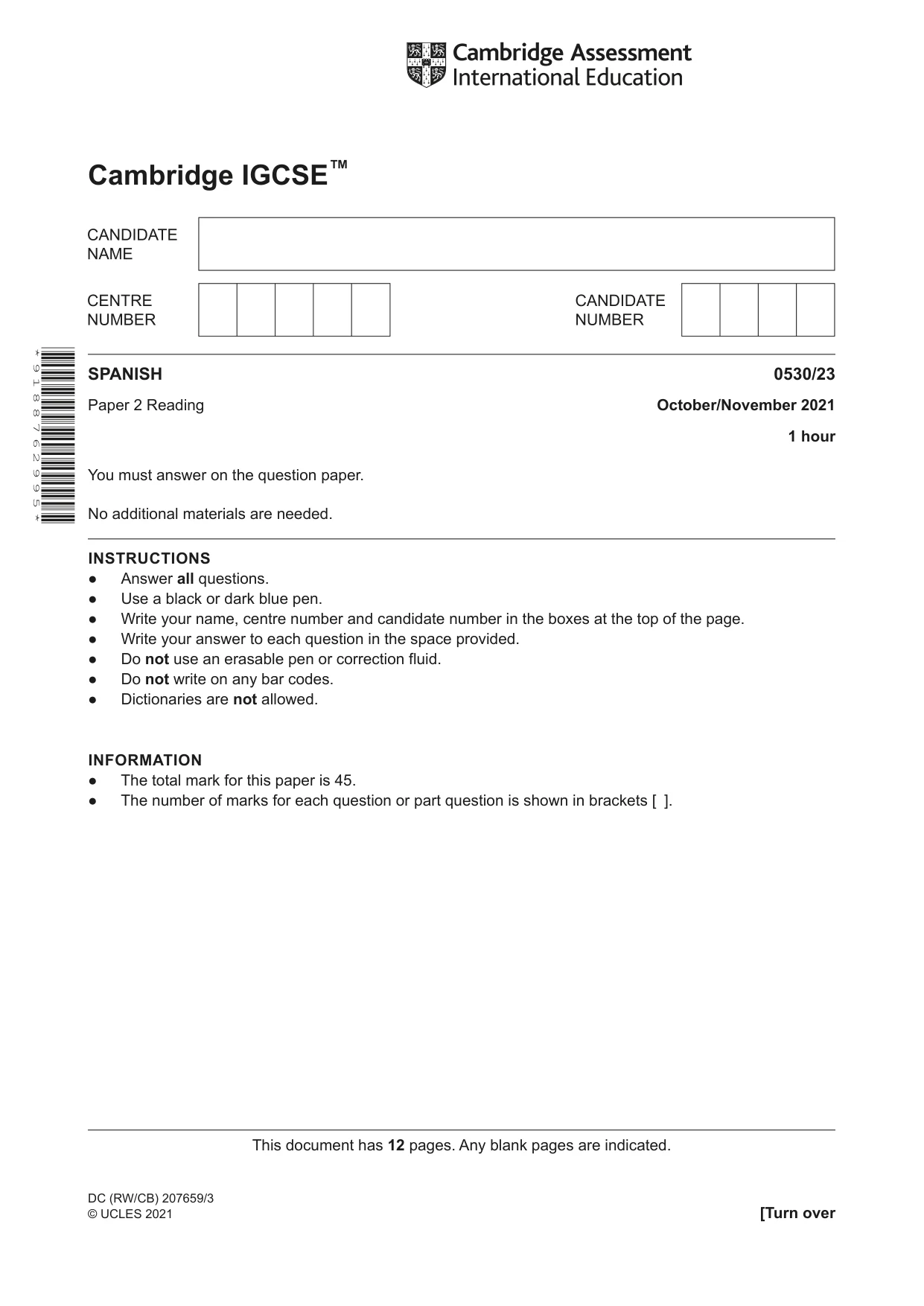
This document has 12 pages. Any blank pages are indicated. DC (RW/CB) 207659/3 © UCLES 2021 [Turn over * 9 1 8 8 7 6 2 9 9 5 * SPANISH 0530/23 Paper 2 Reading October/November 2021 1 hour You must answer on the question paper. No additional materials are needed. INSTRUCTIONS ● Answer all questions. ● Use a black or dark blue pen. ● Write your name, centre number and candidate number in the boxes at the top of the page. ● Write your answer to each question in the space provided. ● Do not use an erasable pen or correction fluid. ● Do not write on any bar codes. ● Dictionaries are not allowed. INFORMATION ● The total mark for this paper is 45. ● The number of marks for each question or part question is shown in brackets [ ]. Cambridge IGCSE™
Question paper, page 2
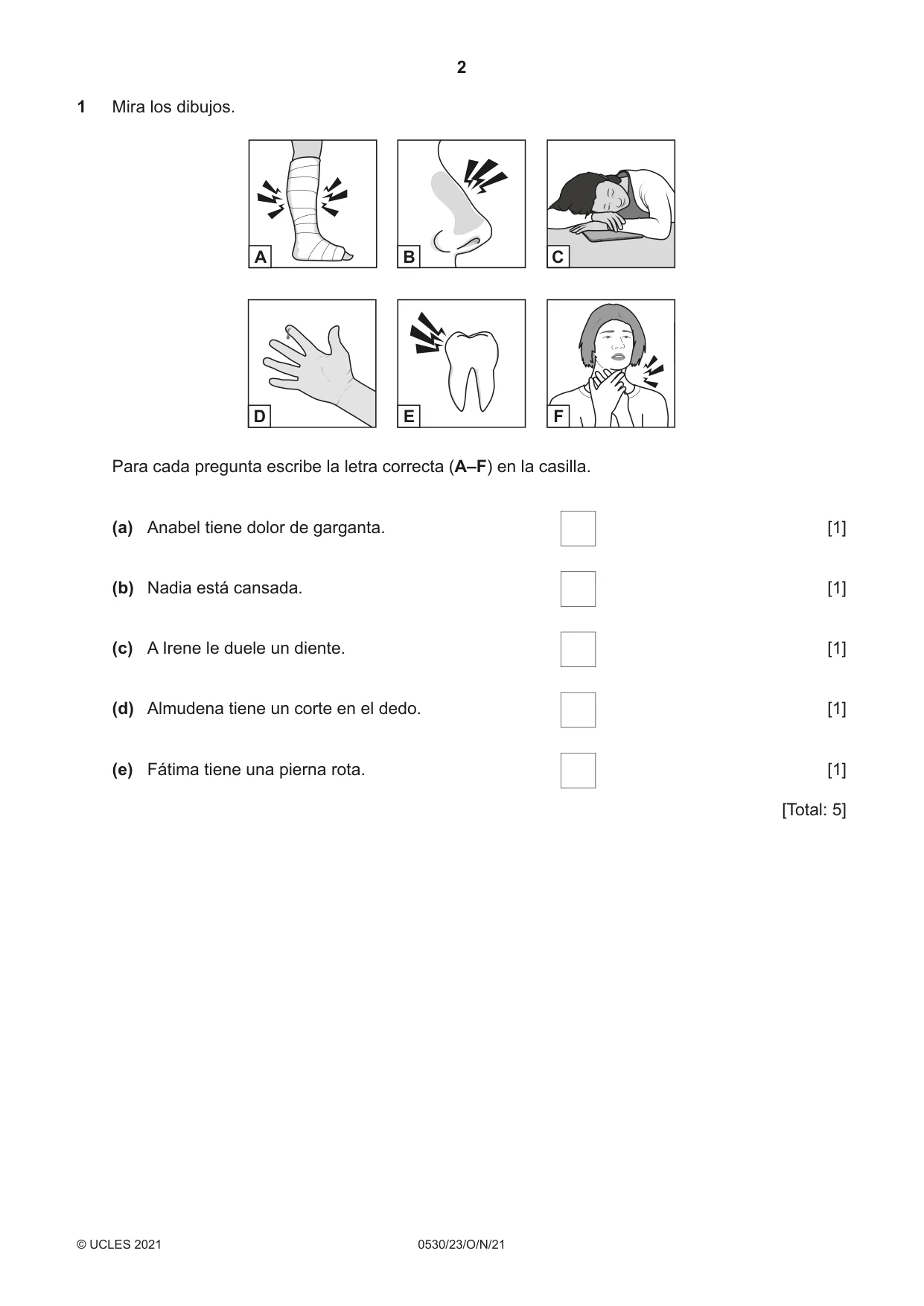
2 0530/23/O/N/21 © UCLES 2021 1 Mira los dibujos. C B A E D F Para cada pregunta escribe la letra correcta (A–F) en la casilla. (a) Anabel tiene dolor de garganta. [1] (b) Nadia está cansada. [1] (c) A Irene le duele un diente. [1] (d) Almudena tiene un corte en el dedo. [1] (e) Fátima tiene una pierna rota. [1] [Total: 5]
Question paper, page 3
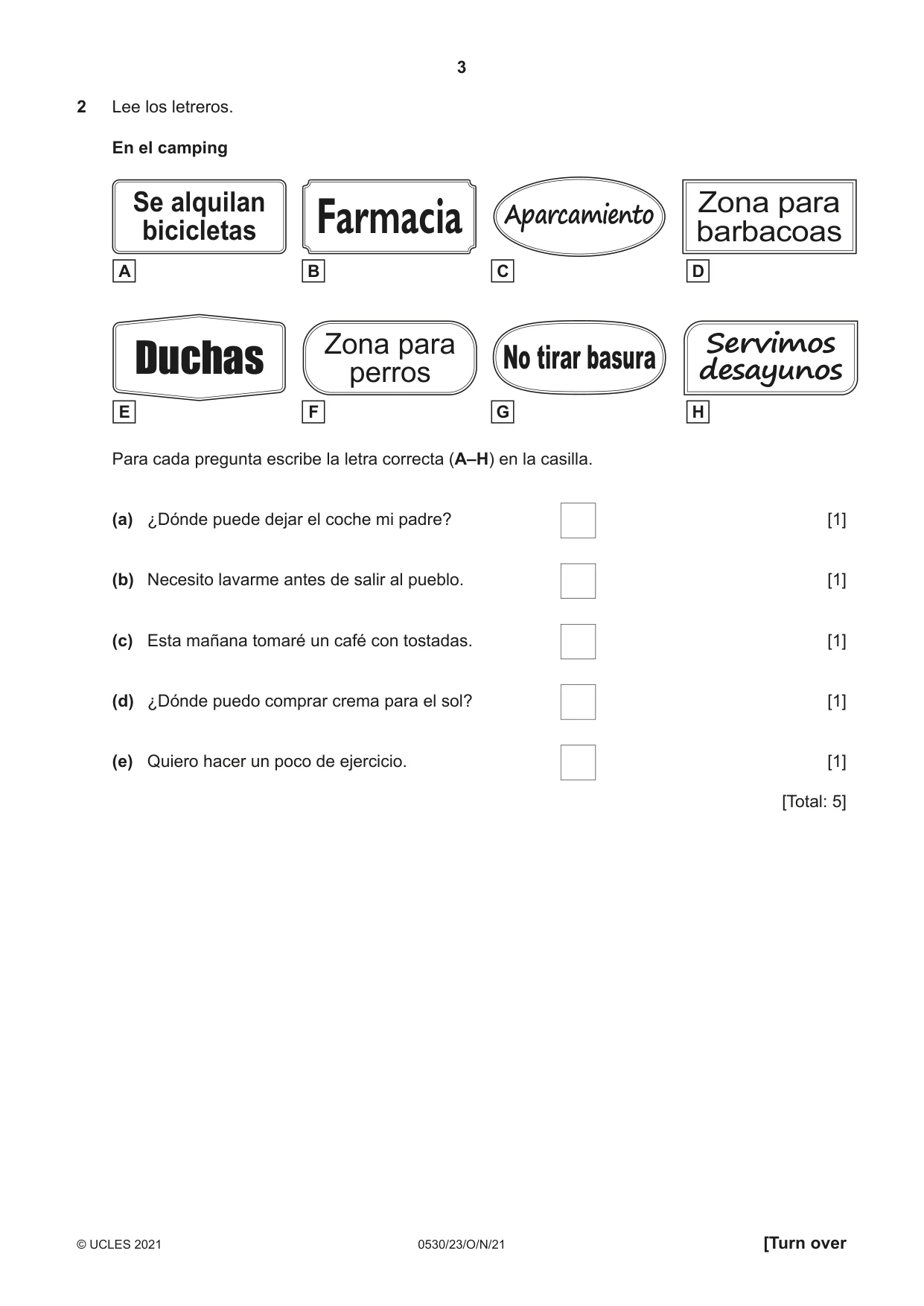
3 0530/23/O/N/21 © UCLES 2021 [Turn over 2 Lee los letreros. En el camping Se alquilan bicicletas Duchas Zona para perros No tirar basura Farmacia Aparcamiento Zona para barbacoas Servimos desayunos A B C D E F G H Para cada pregunta escribe la letra correcta (A–H) en la casilla. (a) ¿Dónde puede dejar el coche mi padre? [1] (b) Necesito lavarme antes de salir al pueblo. [1] (c) Esta mañana tomaré un café con tostadas. [1] (d) ¿Dónde puedo comprar crema para el sol? [1] (e) Quiero hacer un poco de ejercicio. [1] [Total: 5]
Question paper, page 4
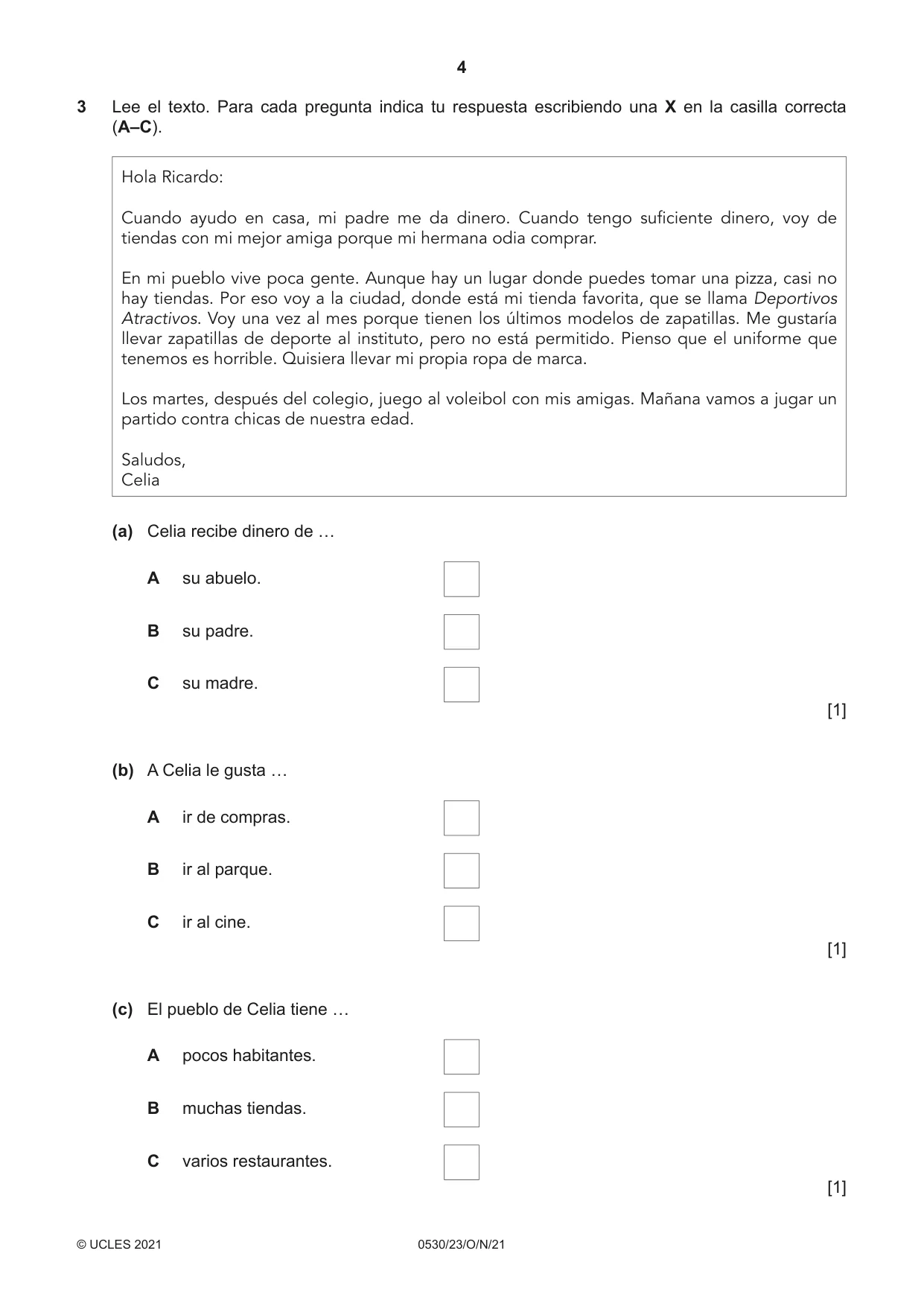
4 0530/23/O/N/21 © UCLES 2021 3 Lee el texto. Para cada pregunta indica tu respuesta escribiendo una X en la casilla correcta (A–C). Hola Ricardo: Cuando ayudo en casa, mi padre me da dinero. Cuando tengo suficiente dinero, voy de tiendas con mi mejor amiga porque mi hermana odia comprar. En mi pueblo vive poca gente. Aunque hay un lugar donde puedes tomar una pizza, casi no hay tiendas. Por eso voy a la ciudad, donde está mi tienda favorita, que se llama Deportivos Atractivos. Voy una vez al mes porque tienen los últimos modelos de zapatillas. Me gustaría llevar zapatillas de deporte al instituto, pero no está permitido. Pienso que el uniforme que tenemos es horrible. Quisiera llevar mi propia ropa de marca. Los martes, después del colegio, juego al voleibol con mis amigas. Mañana vamos a jugar un partido contra chicas de nuestra edad. Saludos, Celia (a) Celia recibe dinero de … A su abuelo. B su padre. C su madre. [1] (b) A Celia le gusta … A ir de compras. B ir al parque. C ir al cine. [1] (c) El pueblo de Celia tiene … A pocos habitantes. B muchas tiendas. C varios restaurantes. [1]
Question paper, page 5
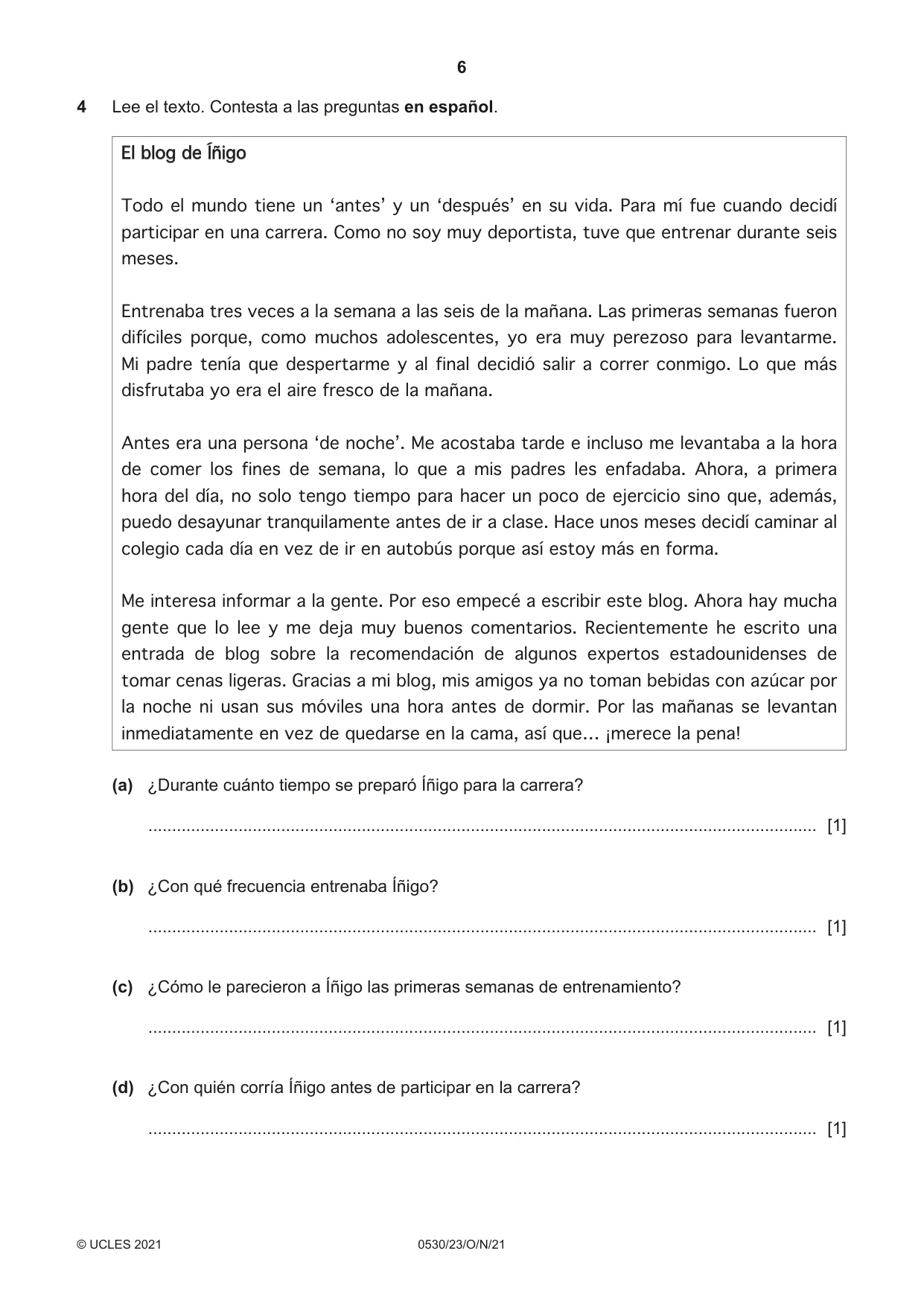
5 0530/23/O/N/21 © UCLES 2021 [Turn over (d) Celia va a su tienda favorita … A tres veces al año. B cada semana. C todos los meses. [1] (e) Para ir a clase, Celia lleva … A ropa de marca. B zapatillas de deporte. C un uniforme feo. [1] (f) Los martes, Celia juega al voleibol … A en el recreo. B después de clase. C por la mañana. [1] (g) Mañana, Celia y sus amigas jugarán contra … A chicos más jóvenes. B chicas de mayor edad. C chicas de su edad. [1] [Total: 7]
Question paper, page 6
6 0530/23/O/N/21 © UCLES 2021 4 Lee el texto. Contesta a las preguntas en español. El blog de Íñigo Todo el mundo tiene un ‘antes’ y un ‘después’ en su vida. Para mí fue cuando decidí participar en una carrera. Como no soy muy deportista, tuve que entrenar durante seis meses. Entrenaba tres veces a la semana a las seis de la mañana. Las primeras semanas fueron difíciles porque, como muchos adolescentes, yo era muy perezoso para levantarme. Mi padre tenía que despertarme y al final decidió salir a correr conmigo. Lo que más disfrutaba yo era el aire fresco de la mañana. Antes era una persona ‘de noche’. Me acostaba tarde e incluso me levantaba a la hora de comer los fines de semana, lo que a mis padres les enfadaba. Ahora, a primera hora del día, no solo tengo tiempo para hacer un poco de ejercicio sino que, además, puedo desayunar tranquilamente antes de ir a clase. Hace unos meses decidí caminar al colegio cada día en vez de ir en autobús porque así estoy más en forma. Me interesa informar a la gente. Por eso empecé a escribir este blog. Ahora hay mucha gente que lo lee y me deja muy buenos comentarios. Recientemente he escrito una entrada de blog sobre la recomendación de algunos expertos estadounidenses de tomar cenas ligeras. Gracias a mi blog, mis amigos ya no toman bebidas con azúcar por la noche ni usan sus móviles una hora antes de dormir. Por las mañanas se levantan inmediatamente en vez de quedarse en la cama, así que… ¡merece la pena! (a) ¿Durante cuánto tiempo se preparó Íñigo para la carrera? … [1] (b) ¿Con qué frecuencia entrenaba Íñigo? … [1] (c) ¿Cómo le parecieron a Íñigo las primeras semanas de entrenamiento? … [1] (d) ¿Con quién corría Íñigo antes de participar en la carrera? … [1]
Question paper, page 7
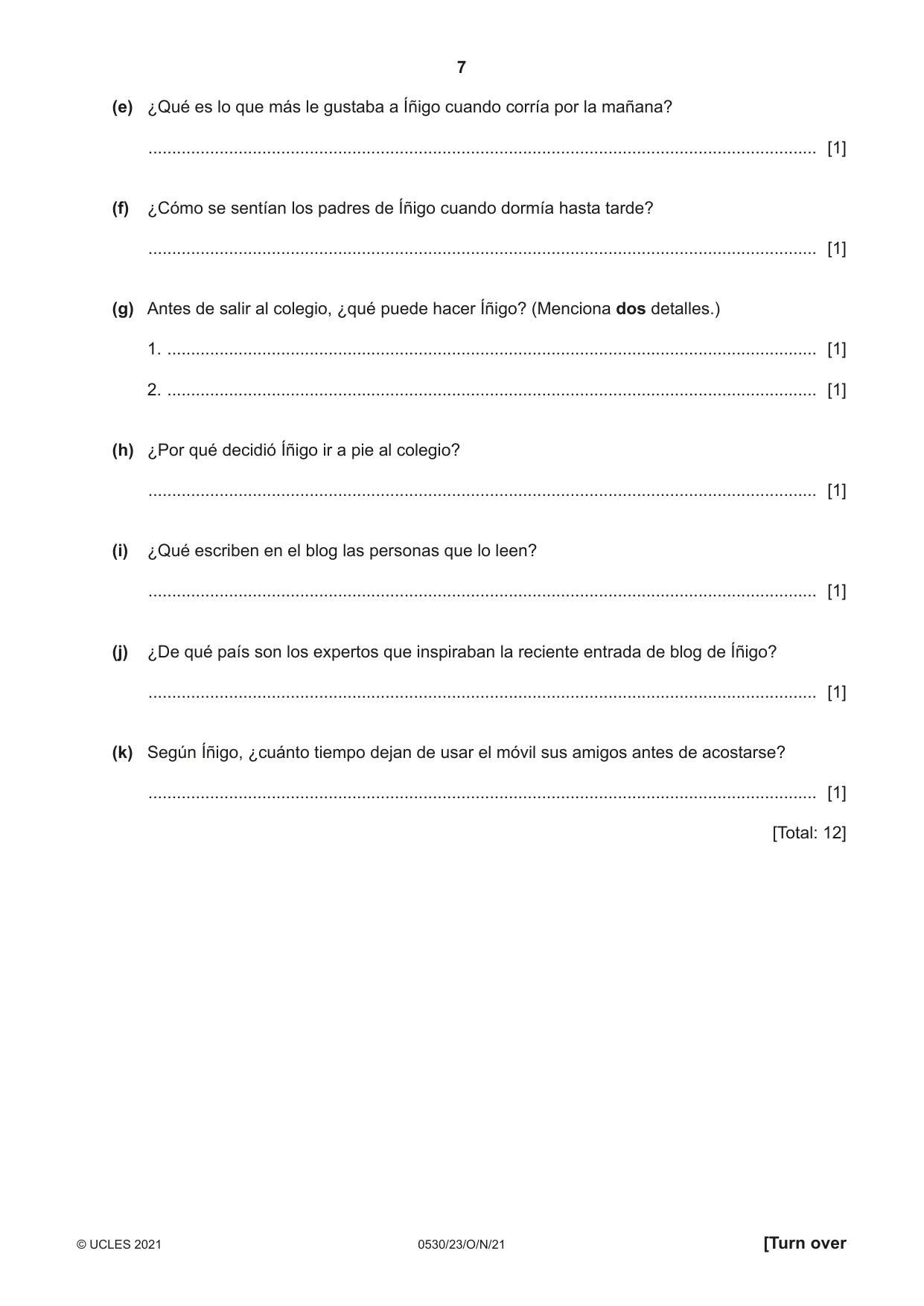
7 0530/23/O/N/21 © UCLES 2021 [Turn over (e) ¿Qué es lo que más le gustaba a Íñigo cuando corría por la mañana? … [1] (f) ¿Cómo se sentían los padres de Íñigo cuando dormía hasta tarde? … [1] (g) Antes de salir al colegio, ¿qué puede hacer Íñigo? (Menciona dos detalles.) 1. … [1] 2. … [1] (h) ¿Por qué decidió Íñigo ir a pie al colegio? … [1] (i) ¿Qué escriben en el blog las personas que lo leen? … [1] (j) ¿De qué país son los expertos que inspiraban la reciente entrada de blog de Íñigo? … [1] (k) Según Íñigo, ¿cuánto tiempo dejan de usar el móvil sus amigos antes de acostarse? … [1] [Total: 12]
Question paper, page 8
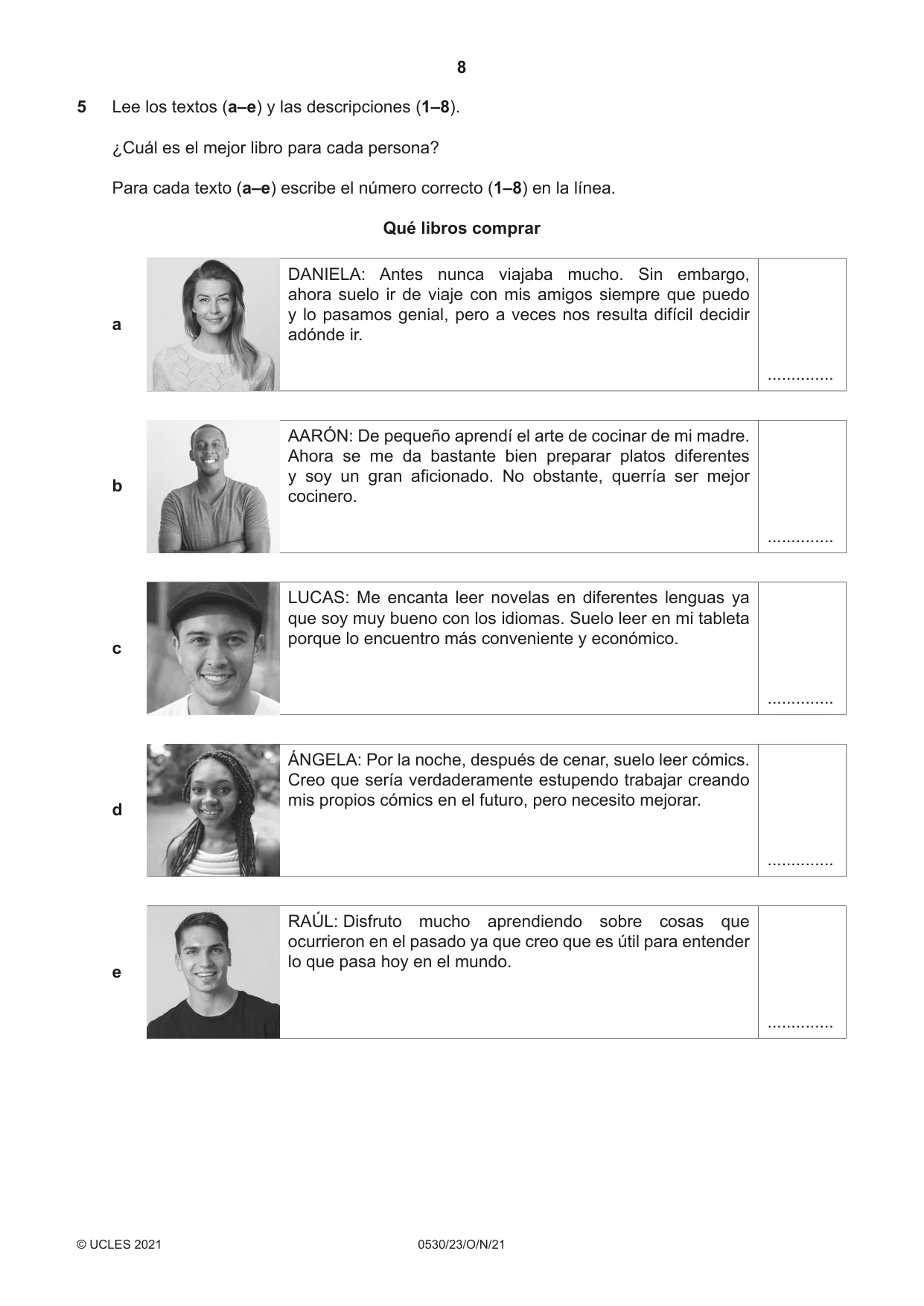
8 0530/23/O/N/21 © UCLES 2021 5 Lee los textos (a–e) y las descripciones (1–8). ¿Cuál es el mejor libro para cada persona? Para cada texto (a–e) escribe el número correcto (1–8) en la línea. Qué libros comprar a DANIELA: Antes nunca viajaba mucho. Sin embargo, ahora suelo ir de viaje con mis amigos siempre que puedo y lo pasamos genial, pero a veces nos resulta difícil decidir adónde ir. … b AARÓN: De pequeño aprendí el arte de cocinar de mi madre. Ahora se me da bastante bien preparar platos diferentes y soy un gran aficionado. No obstante, querría ser mejor cocinero. … c LUCAS: Me encanta leer novelas en diferentes lenguas ya que soy muy bueno con los idiomas. Suelo leer en mi tableta porque lo encuentro más conveniente y económico. … d ÁNGELA: Por la noche, después de cenar, suelo leer cómics. Creo que sería verdaderamente estupendo trabajar creando mis propios cómics en el futuro, pero necesito mejorar. … e RAÚL: Disfruto mucho aprendiendo sobre cosas que ocurrieron en el pasado ya que creo que es útil para entender lo que pasa hoy en el mundo. …
Question paper, page 9
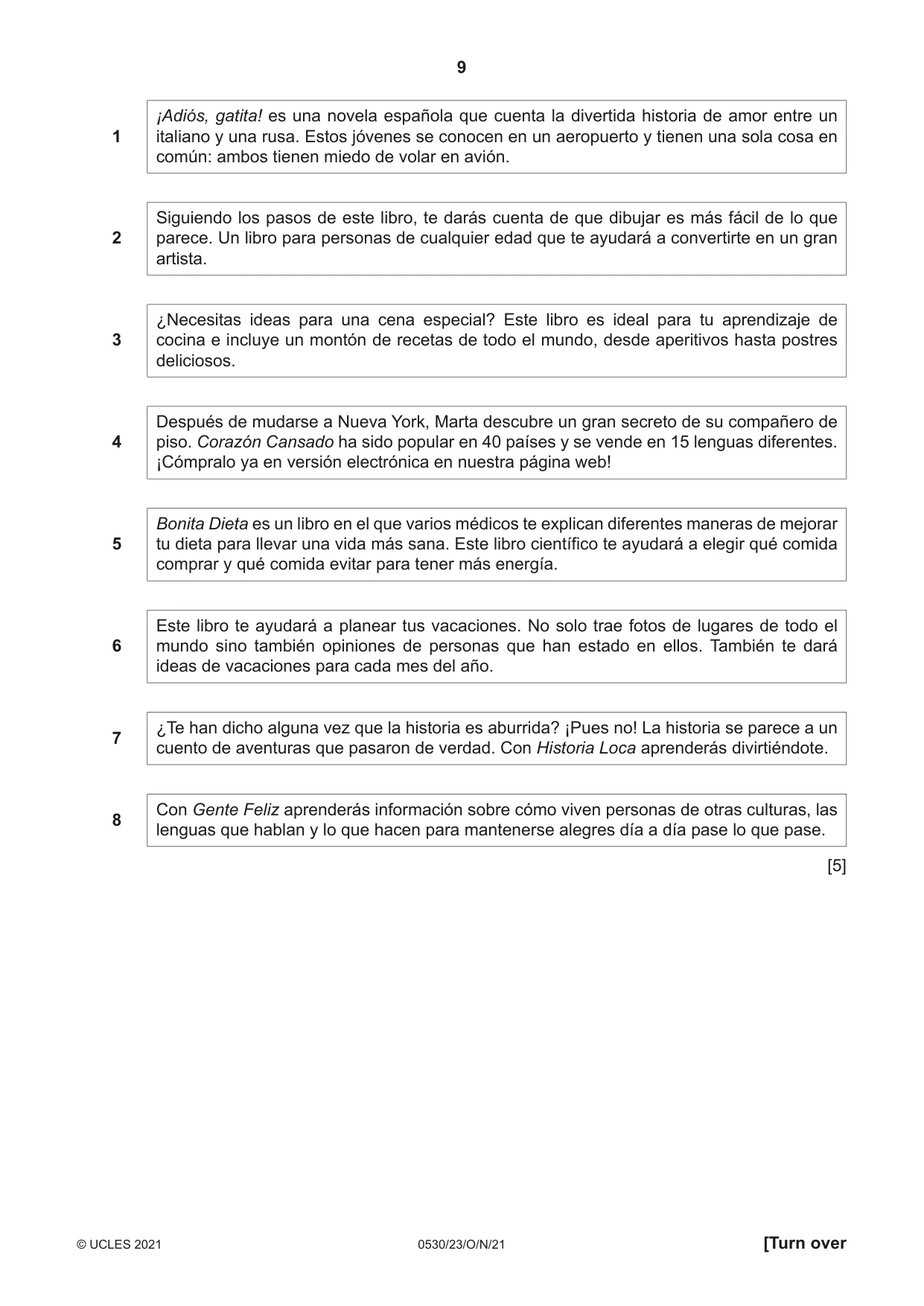
9 0530/23/O/N/21 © UCLES 2021 [Turn over 1 ¡Adiós, gatita! es una novela española que cuenta la divertida historia de amor entre un italiano y una rusa. Estos jóvenes se conocen en un aeropuerto y tienen una sola cosa en común: ambos tienen miedo de volar en avión. 2 Siguiendo los pasos de este libro, te darás cuenta de que dibujar es más fácil de lo que parece. Un libro para personas de cualquier edad que te ayudará a convertirte en un gran artista. 3 ¿Necesitas ideas para una cena especial? Este libro es ideal para tu aprendizaje de cocina e incluye un montón de recetas de todo el mundo, desde aperitivos hasta postres deliciosos. 4 Después de mudarse a Nueva York, Marta descubre un gran secreto de su compañero de piso. Corazón Cansado ha sido popular en 40 países y se vende en 15 lenguas diferentes. ¡Cómpralo ya en versión electrónica en nuestra página web! 5 Bonita Dieta es un libro en el que varios médicos te explican diferentes maneras de mejorar tu dieta para llevar una vida más sana. Este libro científico te ayudará a elegir qué comida comprar y qué comida evitar para tener más energía. 6 Este libro te ayudará a planear tus vacaciones. No solo trae fotos de lugares de todo el mundo sino también opiniones de personas que han estado en ellos. También te dará ideas de vacaciones para cada mes del año. 7 ¿Te han dicho alguna vez que la historia es aburrida? ¡Pues no! La historia se parece a un cuento de aventuras que pasaron de verdad. Con Historia Loca aprenderás divirtiéndote. 8 Con Gente Feliz aprenderás información sobre cómo viven personas de otras culturas, las lenguas que hablan y lo que hacen para mantenerse alegres día a día pase lo que pase. [5]
Question paper, page 10
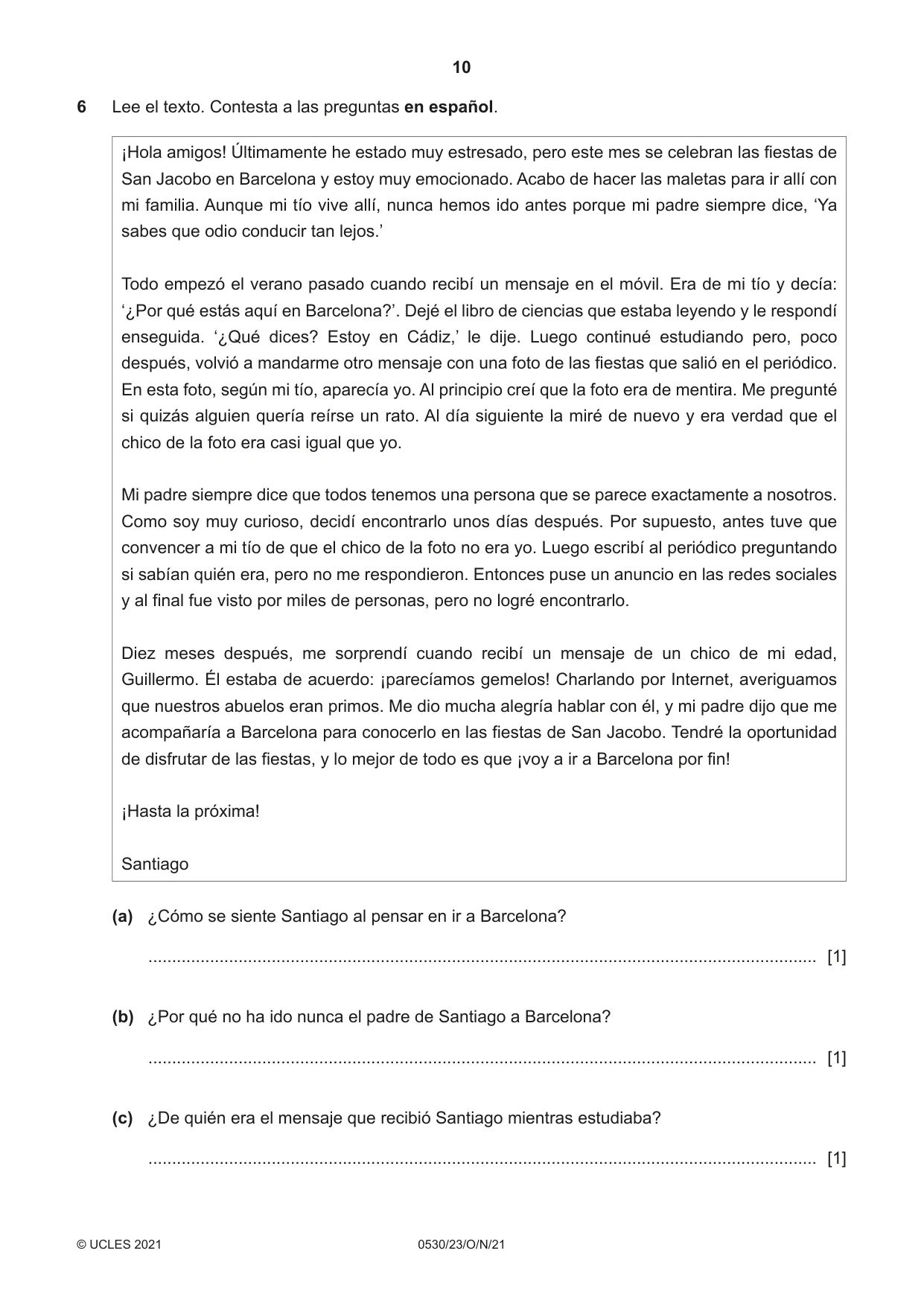
10 0530/23/O/N/21 © UCLES 2021 6 Lee el texto. Contesta a las preguntas en español. ¡Hola amigos! Últimamente he estado muy estresado, pero este mes se celebran las fiestas de San Jacobo en Barcelona y estoy muy emocionado. Acabo de hacer las maletas para ir allí con mi familia. Aunque mi tío vive allí, nunca hemos ido antes porque mi padre siempre dice, ‘Ya sabes que odio conducir tan lejos.’ Todo empezó el verano pasado cuando recibí un mensaje en el móvil. Era de mi tío y decía: ‘¿Por qué estás aquí en Barcelona?’. Dejé el libro de ciencias que estaba leyendo y le respondí enseguida. ‘¿Qué dices? Estoy en Cádiz,’ le dije. Luego continué estudiando pero, poco después, volvió a mandarme otro mensaje con una foto de las fiestas que salió en el periódico. En esta foto, según mi tío, aparecía yo. Al principio creí que la foto era de mentira. Me pregunté si quizás alguien quería reírse un rato. Al día siguiente la miré de nuevo y era verdad que el chico de la foto era casi igual que yo. Mi padre siempre dice que todos tenemos una persona que se parece exactamente a nosotros. Como soy muy curioso, decidí encontrarlo unos días después. Por supuesto, antes tuve que convencer a mi tío de que el chico de la foto no era yo. Luego escribí al periódico preguntando si sabían quién era, pero no me respondieron. Entonces puse un anuncio en las redes sociales y al final fue visto por miles de personas, pero no logré encontrarlo. Diez meses después, me sorprendí cuando recibí un mensaje de un chico de mi edad, Guillermo. Él estaba de acuerdo: ¡parecíamos gemelos! Charlando por Internet, averiguamos que nuestros abuelos eran primos. Me dio mucha alegría hablar con él, y mi padre dijo que me acompañaría a Barcelona para conocerlo en las fiestas de San Jacobo. Tendré la oportunidad de disfrutar de las fiestas, y lo mejor de todo es que ¡voy a ir a Barcelona por fin! ¡Hasta la próxima! Santiago (a) ¿Cómo se siente Santiago al pensar en ir a Barcelona? … [1] (b) ¿Por qué no ha ido nunca el padre de Santiago a Barcelona? … [1] (c) ¿De quién era el mensaje que recibió Santiago mientras estudiaba? … [1]
Question paper, page 11
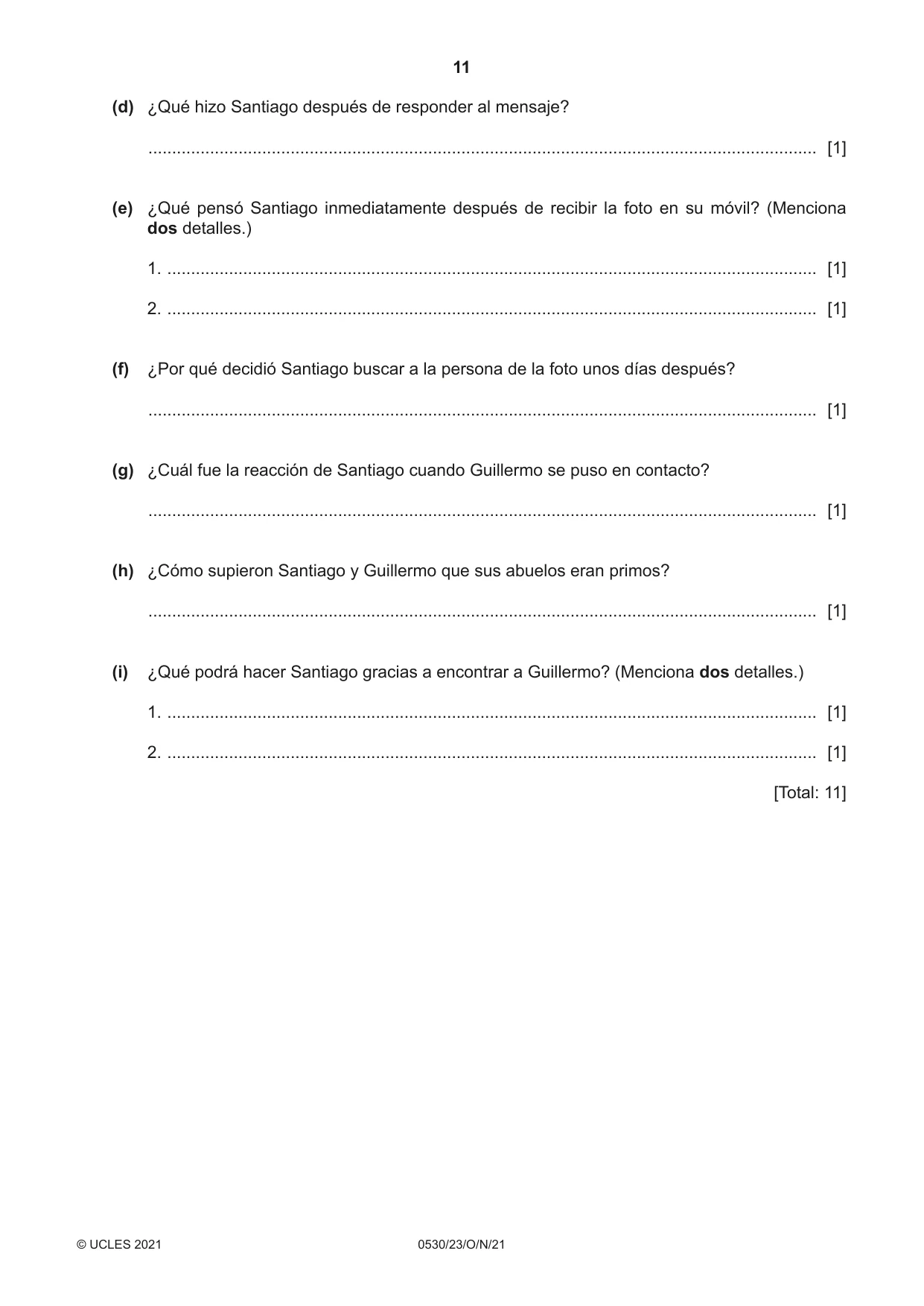
11 0530/23/O/N/21 © UCLES 2021 (d) ¿Qué hizo Santiago después de responder al mensaje? … [1] (e) ¿Qué pensó Santiago inmediatamente después de recibir la foto en su móvil? (Menciona dos detalles.) 1. … [1] 2. … [1] (f) ¿Por qué decidió Santiago buscar a la persona de la foto unos días después? … [1] (g) ¿Cuál fue la reacción de Santiago cuando Guillermo se puso en contacto? … [1] (h) ¿Cómo supieron Santiago y Guillermo que sus abuelos eran primos? … [1] (i) ¿Qué podrá hacer Santiago gracias a encontrar a Guillermo? (Menciona dos detalles.) 1. … [1] 2. … [1] [Total: 11]
Question paper, page 12
12 0530/23/O/N/21 © UCLES 2021 Permission to reproduce items where third-party owned material protected by copyright is included has been sought and cleared where possible. Every reasonable effort has been made by the publisher (UCLES) to trace copyright holders, but if any items requiring clearance have unwittingly been included, the publisher will be pleased to make amends at the earliest possible opportunity. To avoid the issue of disclosure of answer-related information to candidates, all copyright acknowledgements are reproduced online in the Cambridge Assessment International Education Copyright Acknowledgements Booklet. This is produced for each series of examinations and is freely available to download at www.cambridgeinternational.org after the live examination series. Cambridge Assessment International Education is part of the Cambridge Assessment Group. Cambridge Assessment is the brand name of the University of Cambridge Local Examinations Syndicate (UCLES), which itself is a department of the University of Cambridge. BLANK PAGE
Mark scheme, page 1
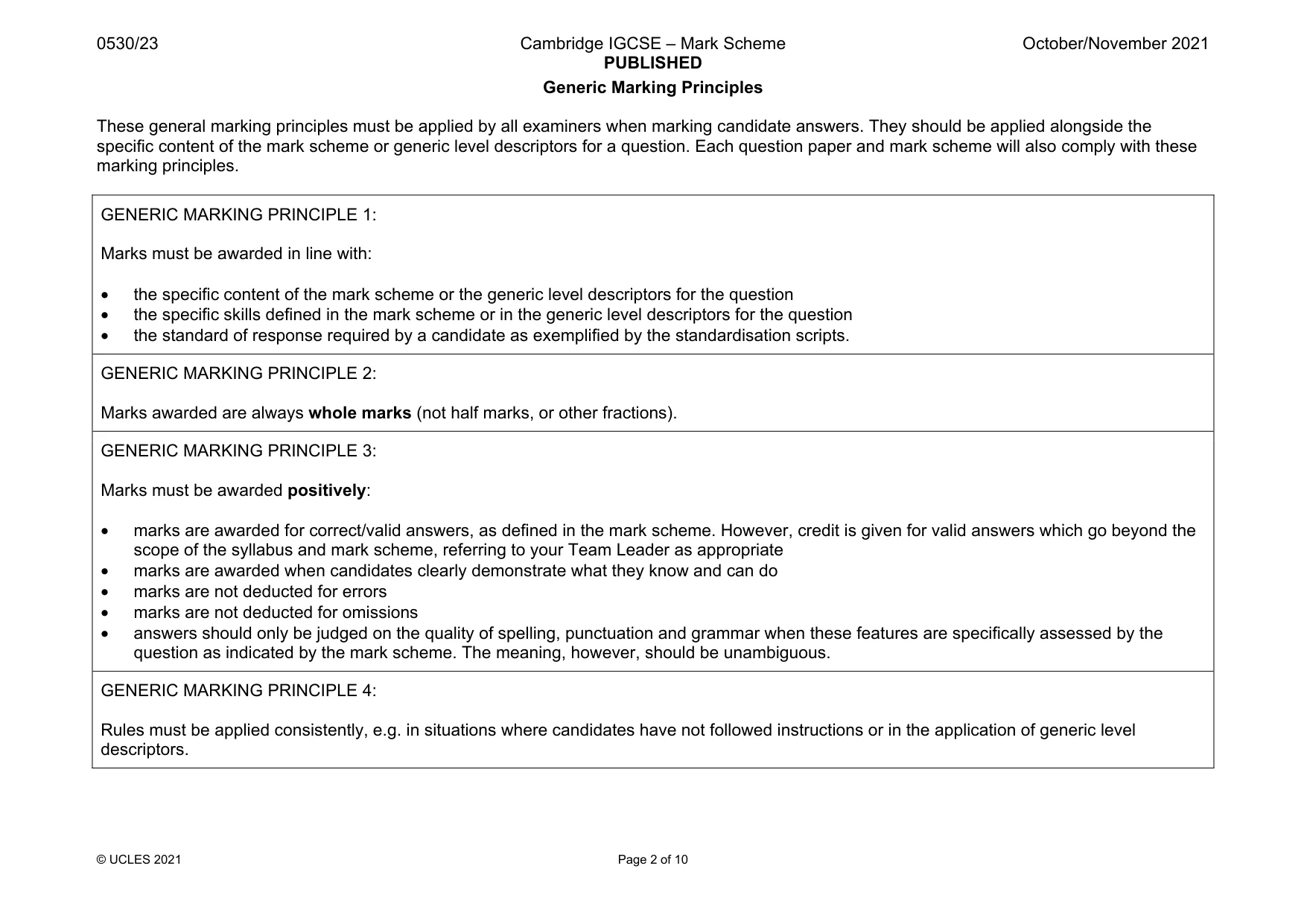
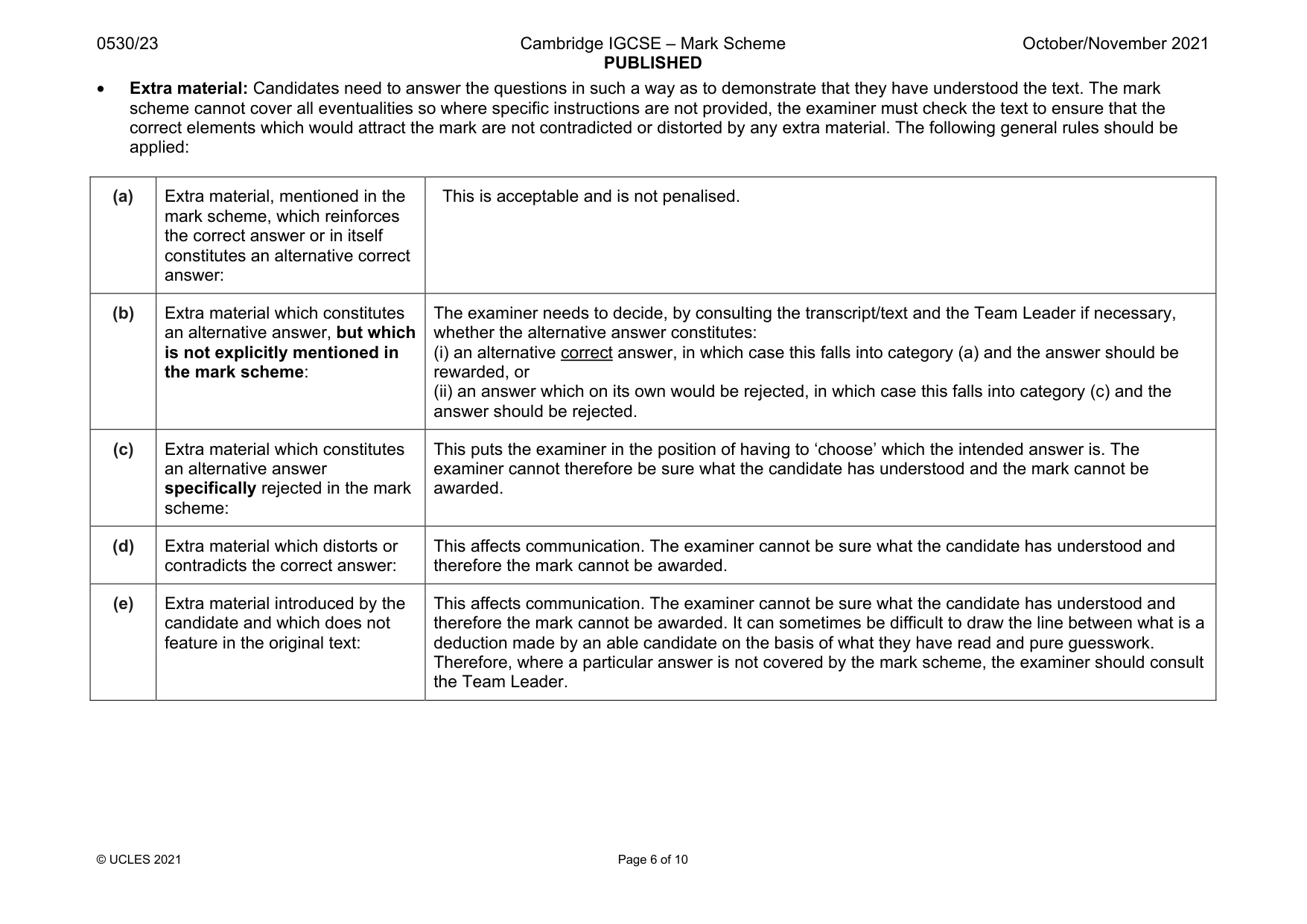
This document consists of 10 printed pages. © UCLES 2021 [Turn over Cambridge IGCSE™ SPANISH 0530/23 Paper 2 Reading October/November 2021 MARK SCHEME Maximum Mark: 45 Published This mark scheme is published as an aid to teachers and candidates, to indicate the requirements of the examination. It shows the basis on which Examiners were instructed to award marks. It does not indicate the details of the discussions that took place at an Examiners’ meeting before marking began, which would have considered the acceptability of alternative answers. Mark schemes should be read in conjunction with the question paper and the Principal Examiner Report for Teachers. Cambridge International will not enter into discussions about these mark schemes. Cambridge International is publishing the mark schemes for the October/November 2021 series for most Cambridge IGCSE™, Cambridge International A and AS Level components and some Cambridge O Level components.
Mark scheme, page 2
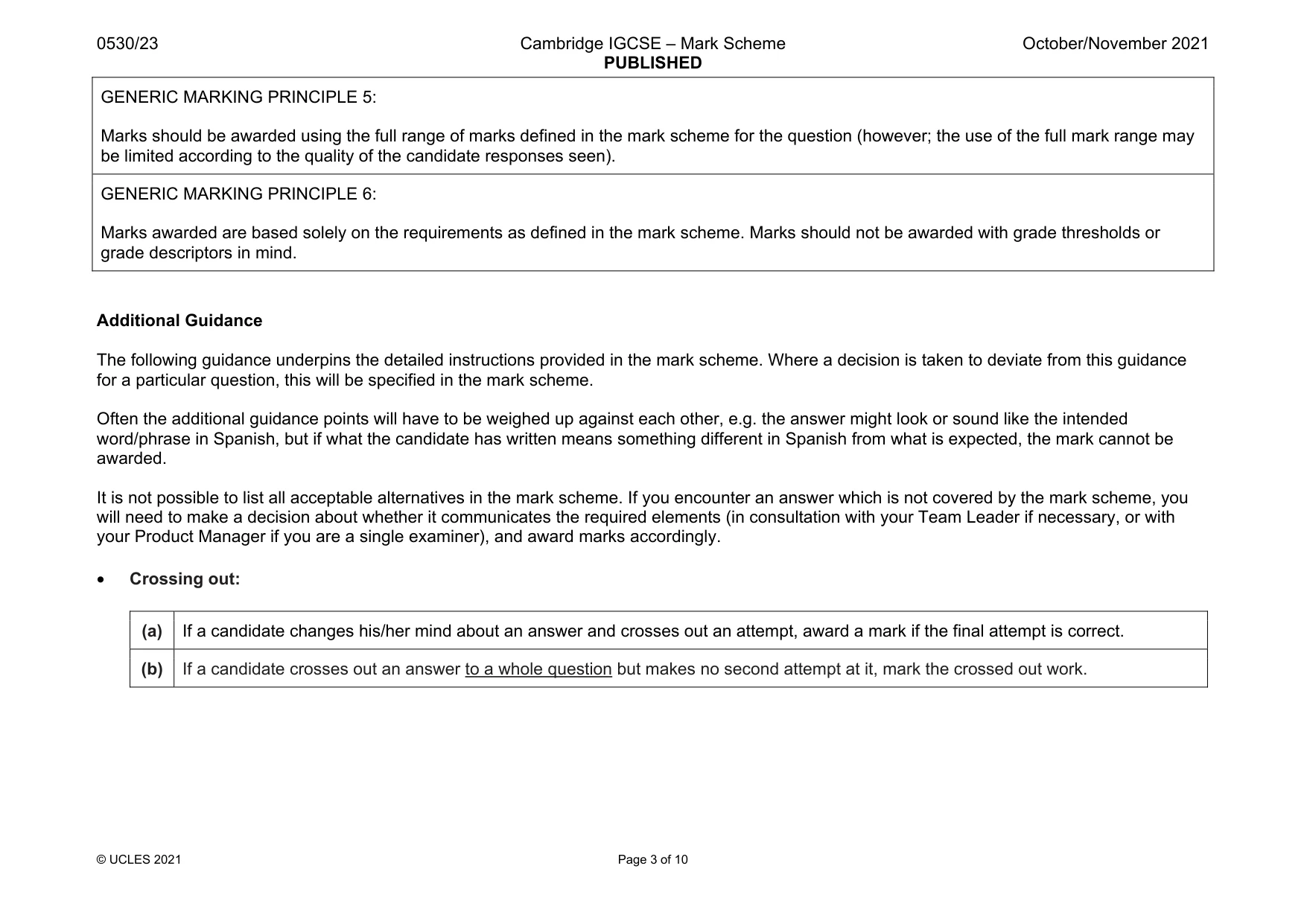
0530/23 Cambridge IGCSE – Mark Scheme PUBLISHED October/November 2021 © UCLES 2021 Page 2 of 10 Generic Marking Principles These general marking principles must be applied by all examiners when marking candidate answers. They should be applied alongside the specific content of the mark scheme or generic level descriptors for a question. Each question paper and mark scheme will also comply with these marking principles. GENERIC MARKING PRINCIPLE 1: Marks must be awarded in line with: • the specific content of the mark scheme or the generic level descriptors for the question • the specific skills defined in the mark scheme or in the generic level descriptors for the question • the standard of response required by a candidate as exemplified by the standardisation scripts. GENERIC MARKING PRINCIPLE 2: Marks awarded are always whole marks (not half marks, or other fractions). GENERIC MARKING PRINCIPLE 3: Marks must be awarded positively: • marks are awarded for correct/valid answers, as defined in the mark scheme. However, credit is given for valid answers which go beyond the scope of the syllabus and mark scheme, referring to your Team Leader as appropriate • marks are awarded when candidates clearly demonstrate what they know and can do • marks are not deducted for errors • marks are not deducted for omissions • answers should only be judged on the quality of spelling, punctuation and grammar when these features are specifically assessed by the question as indicated by the mark scheme. The meaning, however, should be unambiguous. GENERIC MARKING PRINCIPLE 4: Rules must be applied consistently, e.g. in situations where candidates have not followed instructions or in the application of generic level descriptors.
Mark scheme, page 3
0530/23 Cambridge IGCSE – Mark Scheme PUBLISHED October/November 2021 © UCLES 2021 Page 3 of 10 GENERIC MARKING PRINCIPLE 5: Marks should be awarded using the full range of marks defined in the mark scheme for the question (however; the use of the full mark range may be limited according to the quality of the candidate responses seen). GENERIC MARKING PRINCIPLE 6: Marks awarded are based solely on the requirements as defined in the mark scheme. Marks should not be awarded with grade thresholds or grade descriptors in mind. Additional Guidance The following guidance underpins the detailed instructions provided in the mark scheme. Where a decision is taken to deviate from this guidance for a particular question, this will be specified in the mark scheme. Often the additional guidance points will have to be weighed up against each other, e.g. the answer might look or sound like the intended word/phrase in Spanish, but if what the candidate has written means something different in Spanish from what is expected, the mark cannot be awarded. It is not possible to list all acceptable alternatives in the mark scheme. If you encounter an answer which is not covered by the mark scheme, you will need to make a decision about whether it communicates the required elements (in consultation with your Team Leader if necessary, or with your Product Manager if you are a single examiner), and award marks accordingly. • Crossing out: (a) If a candidate changes his/her mind about an answer and crosses out an attempt, award a mark if the final attempt is correct. (b) If a candidate crosses out an answer to a whole question but makes no second attempt at it, mark the crossed out work.
Mark scheme, page 4
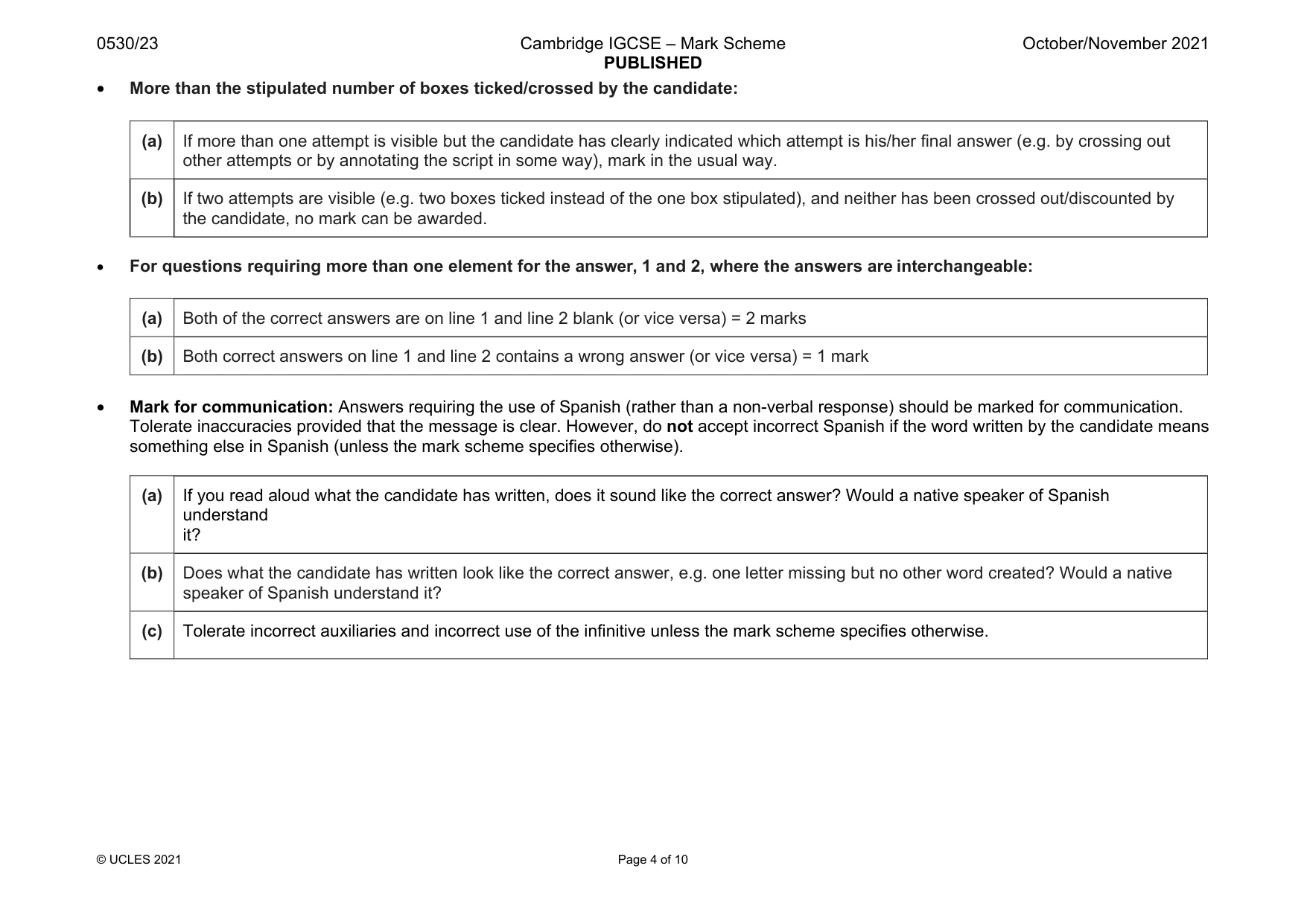
0530/23 Cambridge IGCSE – Mark Scheme PUBLISHED October/November 2021 © UCLES 2021 Page 4 of 10 • More than the stipulated number of boxes ticked/crossed by the candidate: (a) If more than one attempt is visible but the candidate has clearly indicated which attempt is his/her final answer (e.g. by crossing out other attempts or by annotating the script in some way), mark in the usual way. (b) If two attempts are visible (e.g. two boxes ticked instead of the one box stipulated), and neither has been crossed out/discounted by the candidate, no mark can be awarded. • For questions requiring more than one element for the answer, 1 and 2, where the answers are interchangeable: (a) Both of the correct answers are on line 1 and line 2 blank (or vice versa) = 2 marks (b) Both correct answers on line 1 and line 2 contains a wrong answer (or vice versa) = 1 mark • Mark for communication: Answers requiring the use of Spanish (rather than a non-verbal response) should be marked for communication. Tolerate inaccuracies provided that the message is clear. However, do not accept incorrect Spanish if the word written by the candidate means something else in Spanish (unless the mark scheme specifies otherwise). (a) If you read aloud what the candidate has written, does it sound like the correct answer? Would a native speaker of Spanish understand it? (b) Does what the candidate has written look like the correct answer, e.g. one letter missing but no other word created? Would a native speaker of Spanish understand it? (c) Tolerate incorrect auxiliaries and incorrect use of the infinitive unless the mark scheme specifies otherwise.
Mark scheme, page 5
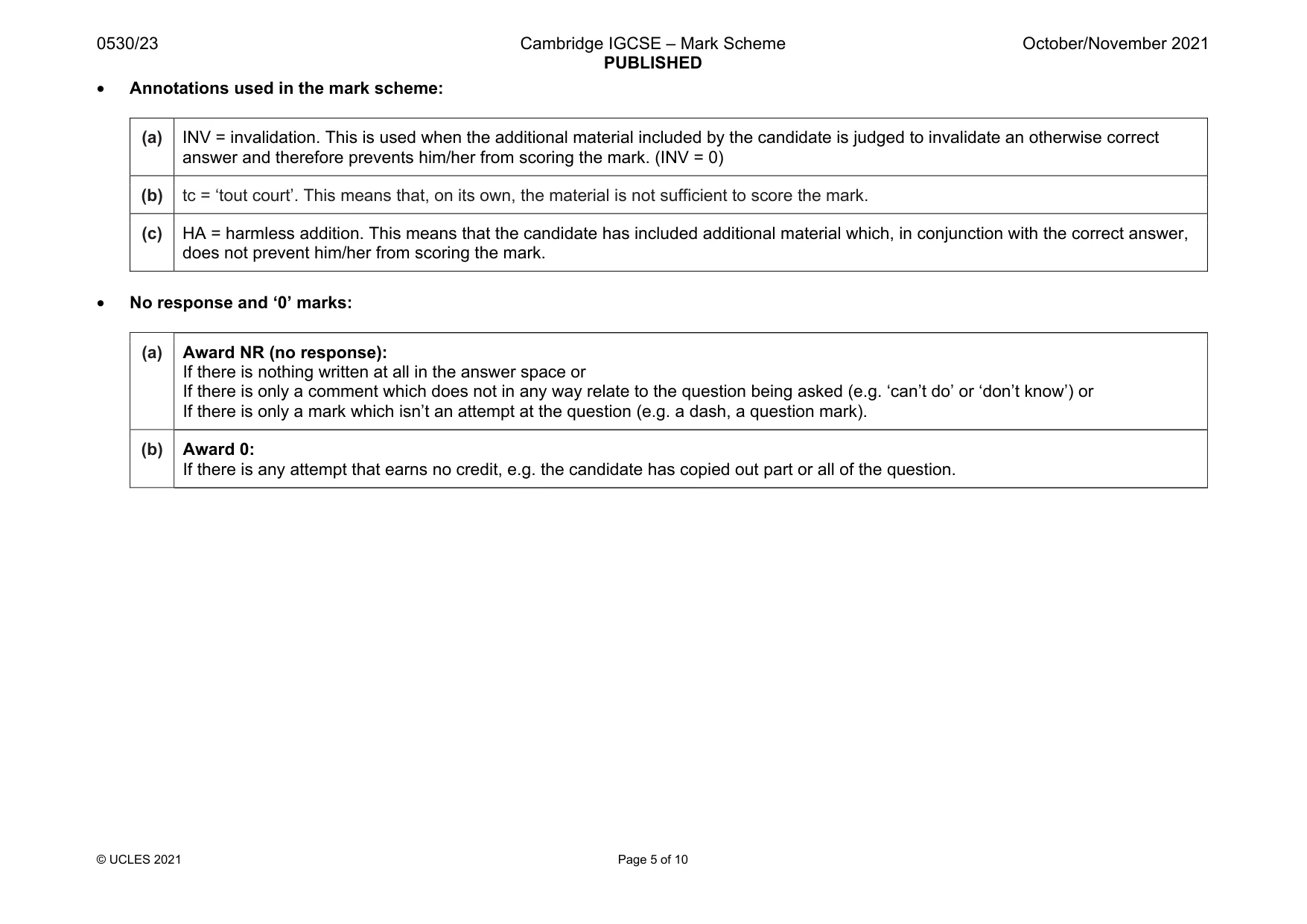
0530/23 Cambridge IGCSE – Mark Scheme PUBLISHED October/November 2021 © UCLES 2021 Page 5 of 10 • Annotations used in the mark scheme: (a) INV = invalidation. This is used when the additional material included by the candidate is judged to invalidate an otherwise correct answer and therefore prevents him/her from scoring the mark. (INV = 0) (b) tc = ‘tout court’. This means that, on its own, the material is not sufficient to score the mark. (c) HA = harmless addition. This means that the candidate has included additional material which, in conjunction with the correct answer, does not prevent him/her from scoring the mark. • No response and ‘0’ marks: (a) Award NR (no response): If there is nothing written at all in the answer space or If there is only a comment which does not in any way relate to the question being asked (e.g. ‘can’t do’ or ‘don’t know’) or If there is only a mark which isn’t an attempt at the question (e.g. a dash, a question mark). (b) Award 0: If there is any attempt that earns no credit, e.g. the candidate has copied out part or all of the question.
Mark scheme, page 6
0530/23 Cambridge IGCSE – Mark Scheme PUBLISHED October/November 2021 © UCLES 2021 Page 6 of 10 • Extra material: Candidates need to answer the questions in such a way as to demonstrate that they have understood the text. The mark scheme cannot cover all eventualities so where specific instructions are not provided, the examiner must check the text to ensure that the correct elements which would attract the mark are not contradicted or distorted by any extra material. The following general rules should be applied: (a) Extra material, mentioned in the mark scheme, which reinforces the correct answer or in itself constitutes an alternative correct answer: This is acceptable and is not penalised. (b) Extra material which constitutes an alternative answer, but which is not explicitly mentioned in the mark scheme: The examiner needs to decide, by consulting the transcript/text and the Team Leader if necessary, whether the alternative answer constitutes: (i) an alternative correct answer, in which case this falls into category (a) and the answer should be rewarded, or (ii) an answer which on its own would be rejected, in which case this falls into category (c) and the answer should be rejected. (c) Extra material which constitutes an alternative answer specifically rejected in the mark scheme: This puts the examiner in the position of having to ‘choose’ which the intended answer is. The examiner cannot therefore be sure what the candidate has understood and the mark cannot be awarded. (d) Extra material which distorts or contradicts the correct answer: This affects communication. The examiner cannot be sure what the candidate has understood and therefore the mark cannot be awarded. (e) Extra material introduced by the candidate and which does not feature in the original text: This affects communication. The examiner cannot be sure what the candidate has understood and therefore the mark cannot be awarded. It can sometimes be difficult to draw the line between what is a deduction made by an able candidate on the basis of what they have read and pure guesswork. Therefore, where a particular answer is not covered by the mark scheme, the examiner should consult the Team Leader.
Mark scheme, page 7
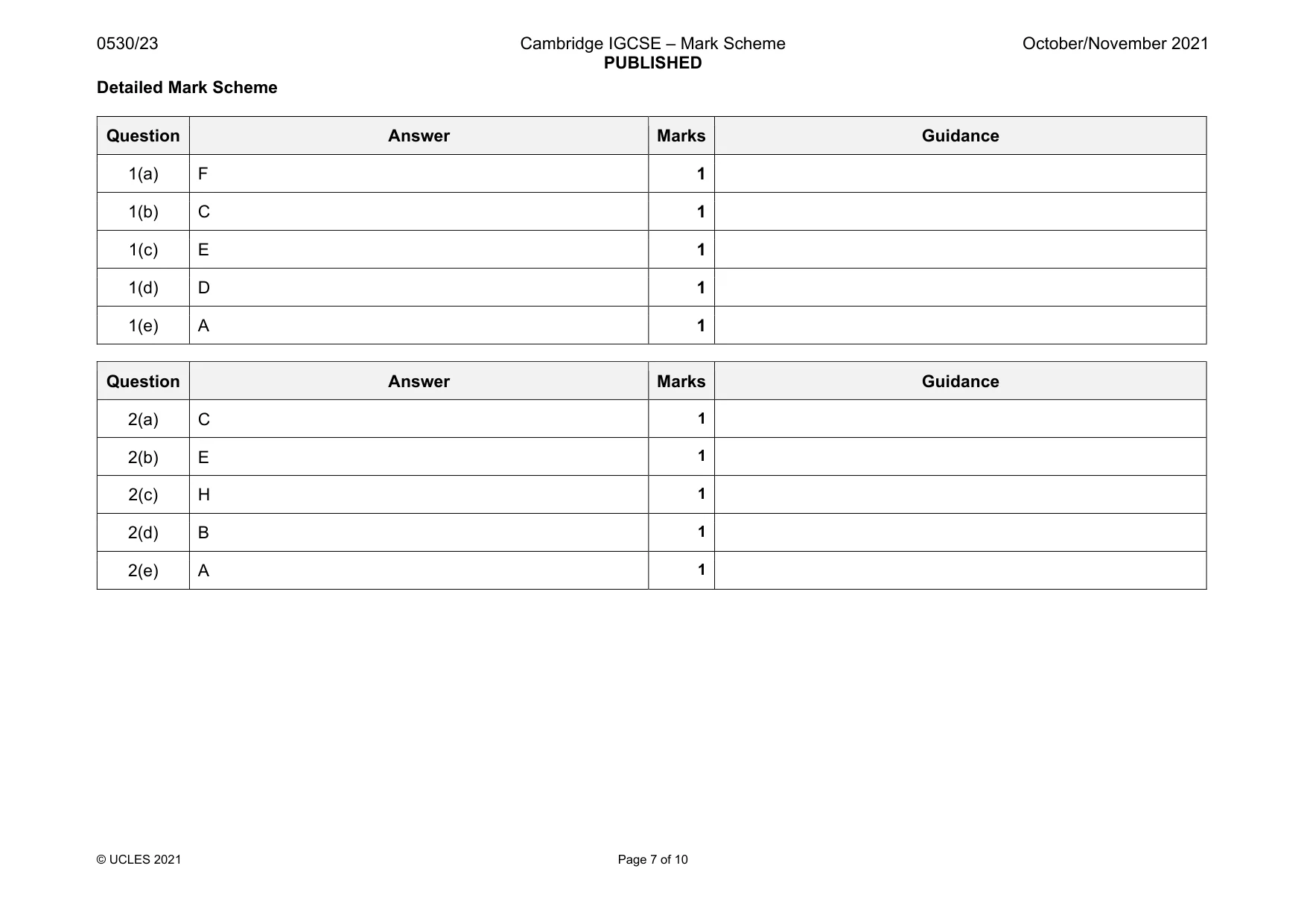
0530/23 Cambridge IGCSE – Mark Scheme PUBLISHED October/November 2021 © UCLES 2021 Page 7 of 10 Detailed Mark Scheme Question Answer Marks Guidance 1(a) F 1 1(b) C 1 1(c) E 1 1(d) D 1 1(e) A 1 Question Answer Marks Guidance 2(a) C 1 2(b) E 1 2(c) H 1 2(d) B 1 2(e) A 1
Mark scheme, page 8
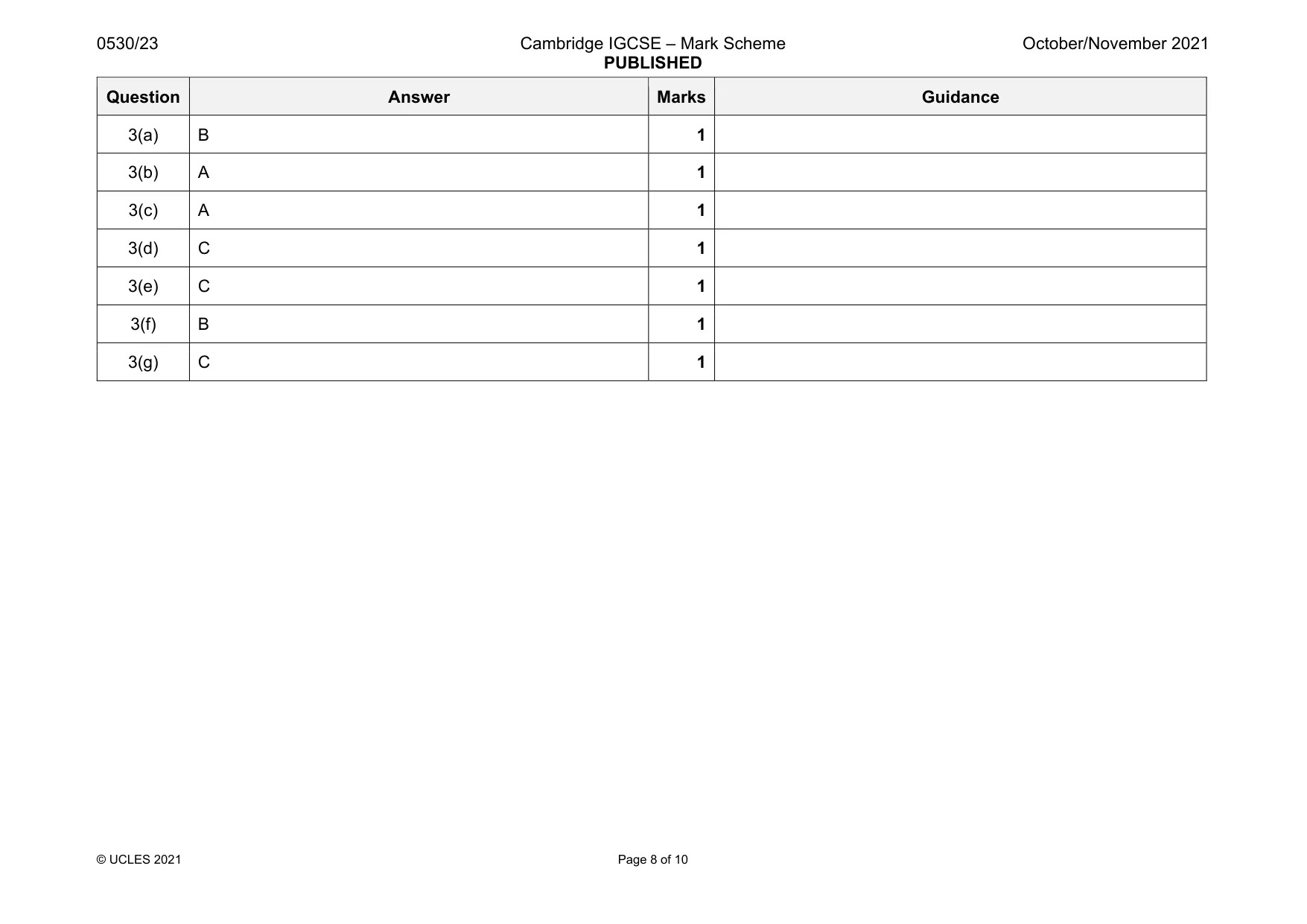
0530/23 Cambridge IGCSE – Mark Scheme PUBLISHED October/November 2021 © UCLES 2021 Page 8 of 10 Question Answer Marks Guidance 3(a) B 1 3(b) A 1 3(c) A 1 3(d) C 1 3(e) C 1 3(f) B 1 3(g) C 1
Mark scheme, page 9
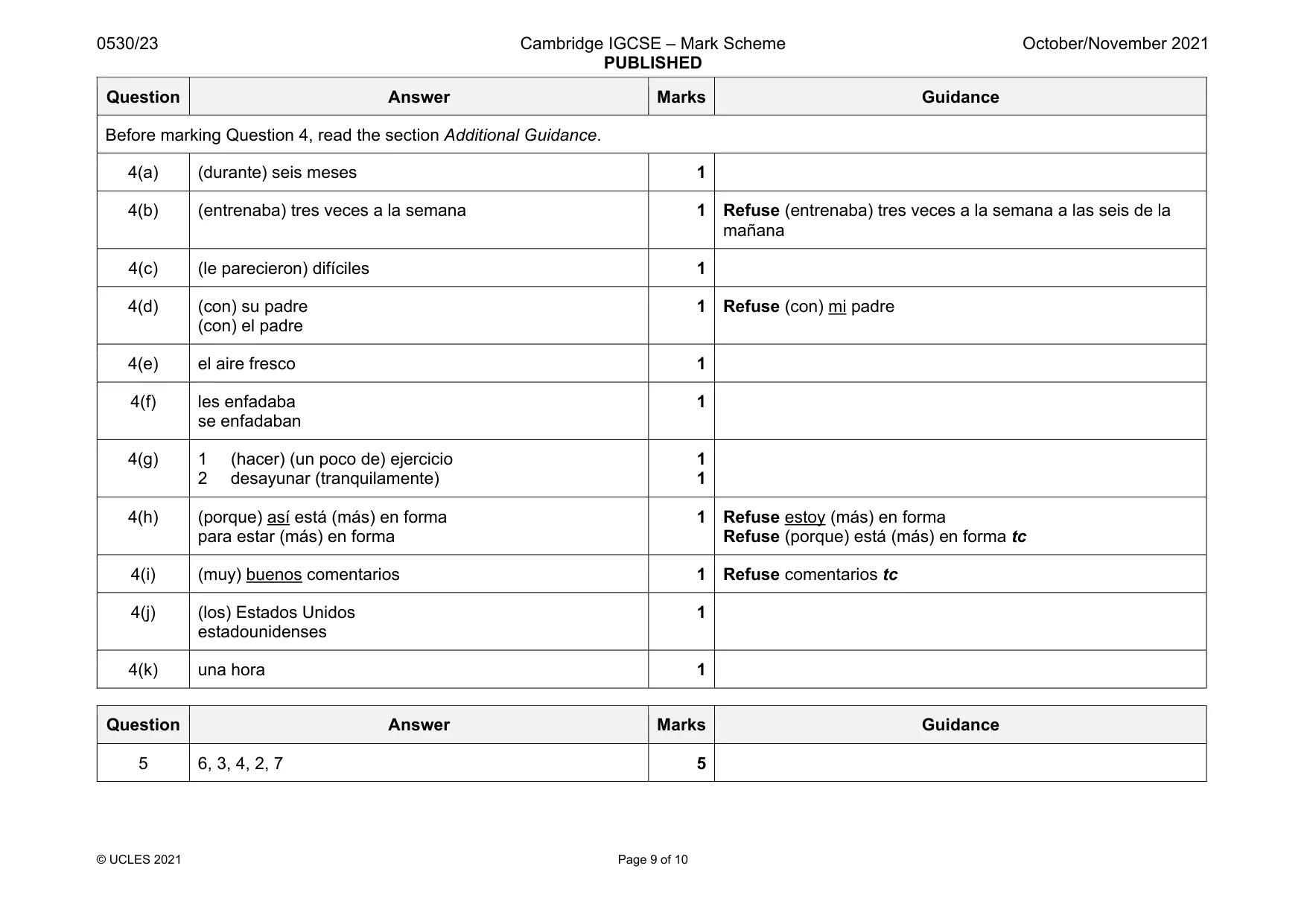
0530/23 Cambridge IGCSE – Mark Scheme PUBLISHED October/November 2021 © UCLES 2021 Page 9 of 10 Question Answer Marks Guidance Before marking Question 4, read the section Additional Guidance. 4(a) (durante) seis meses 1 4(b) (entrenaba) tres veces a la semana 1 Refuse (entrenaba) tres veces a la semana a las seis de la mañana 4(c) (le parecieron) difíciles 1 4(d) (con) su padre (con) el padre 1 Refuse (con) mi padre 4(e) el aire fresco 1 4(f) les enfadaba se enfadaban 1 4(g) 1 (hacer) (un poco de) ejercicio 2 desayunar (tranquilamente) 1 1 4(h) (porque) así está (más) en forma para estar (más) en forma 1 Refuse estoy (más) en forma Refuse (porque) está (más) en forma tc 4(i) (muy) buenos comentarios 1 Refuse comentarios tc 4(j) (los) Estados Unidos estadounidenses 1 4(k) una hora 1 Question Answer Marks Guidance 5 6, 3, 4, 2, 7 5
Mark scheme, page 10
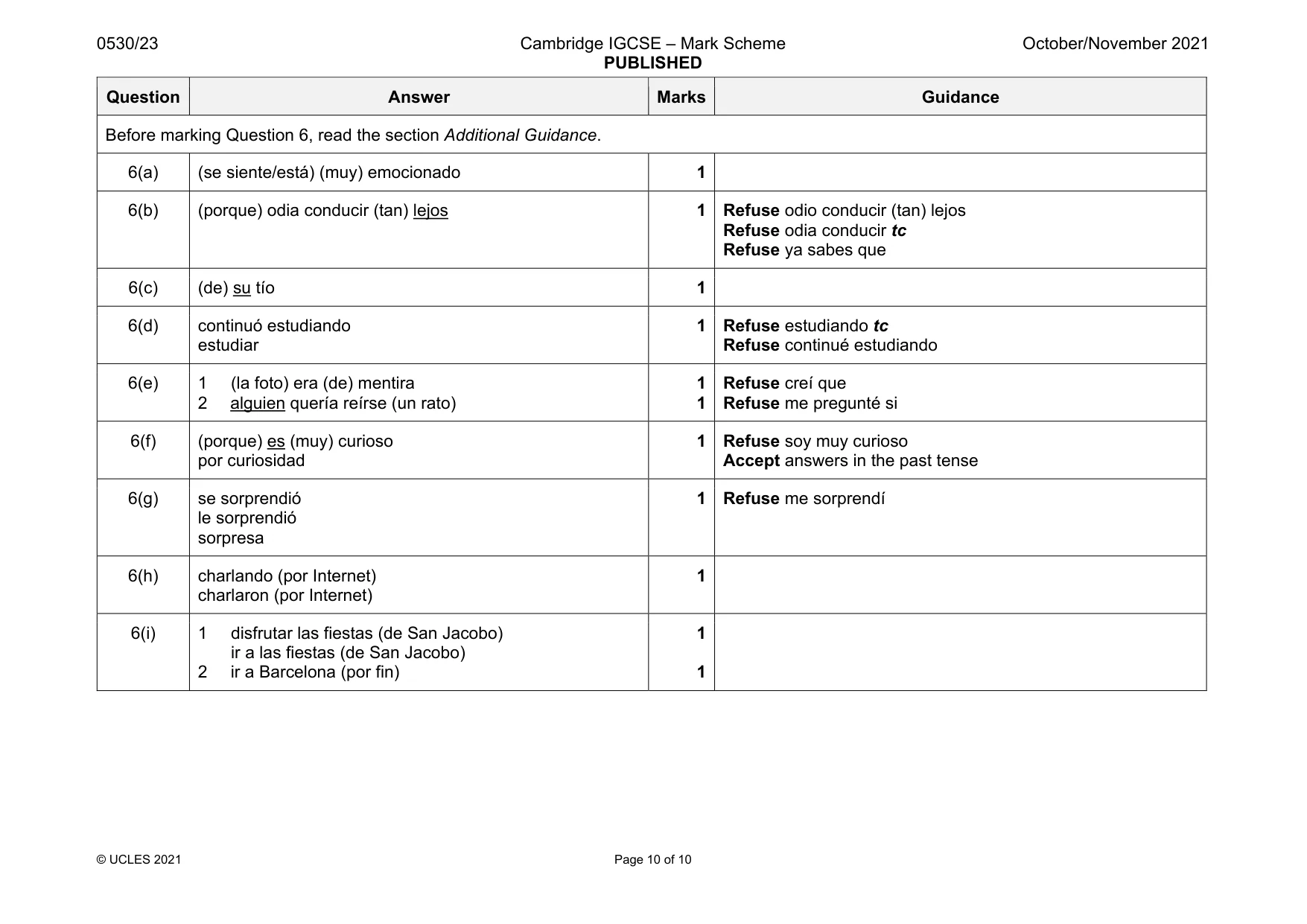
0530/23 Cambridge IGCSE – Mark Scheme PUBLISHED October/November 2021 © UCLES 2021 Page 10 of 10 Question Answer Marks Guidance Before marking Question 6, read the section Additional Guidance. 6(a) (se siente/está) (muy) emocionado 1 6(b) (porque) odia conducir (tan) lejos 1 Refuse odio conducir (tan) lejos Refuse odia conducir tc Refuse ya sabes que 6(c) (de) su tío 1 6(d) continuó estudiando estudiar 1 Refuse estudiando tc Refuse continué estudiando 6(e) 1 (la foto) era (de) mentira 2 alguien quería reírse (un rato) 1 1 Refuse creí que Refuse me pregunté si 6(f) (porque) es (muy) curioso por curiosidad 1 Refuse soy muy curioso Accept answers in the past tense 6(g) se sorprendió le sorprendió sorpresa 1 Refuse me sorprendí 6(h) charlando (por Internet) charlaron (por Internet) 1 6(i) 1 disfrutar las fiestas (de San Jacobo) ir a las fiestas (de San Jacobo) 2 ir a Barcelona (por fin) 1 1
What you needed in this session
Cambridge’s own grade thresholds for 2021 Oct/Nov, Paper 2 · Variant 3. A higher threshold means an easier paper — the bar moves with how the cohort did.