Cambridge IGCSE Spanish - Foreign Language 0530 — 2021 Oct/Nov Paper 2 · Variant 2
0530/22/O/N/21 · 45 marks · ≈51 min
The question paper and its mark scheme, free to read here and free to download. This is Cambridge’s own paper, exactly as it was sat.
Question paper12 pages

Mark scheme10 pages
Answers below. Sit the paper first if you are practising.
Paper as text
Question paper, page 1
This document has 12 pages. Any blank pages are indicated. DC (PQ/CT) 207658/2 © UCLES 2021 [Turn over * 4 8 7 1 7 8 6 4 3 1 * SPANISH 0530/22 Paper 2 Reading October/November 2021 1 hour You must answer on the question paper. No additional materials are needed. INSTRUCTIONS ● Answer all questions. ● Use a black or dark blue pen. ● Write your name, centre number and candidate number in the boxes at the top of the page. ● Write your answer to each question in the space provided. ● Do not use an erasable pen or correction fluid. ● Do not write on any bar codes. ● Dictionaries are not allowed. INFORMATION ● The total mark for this paper is 45. ● The number of marks for each question or part question is shown in brackets [ ]. Cambridge IGCSE™
Question paper, page 2
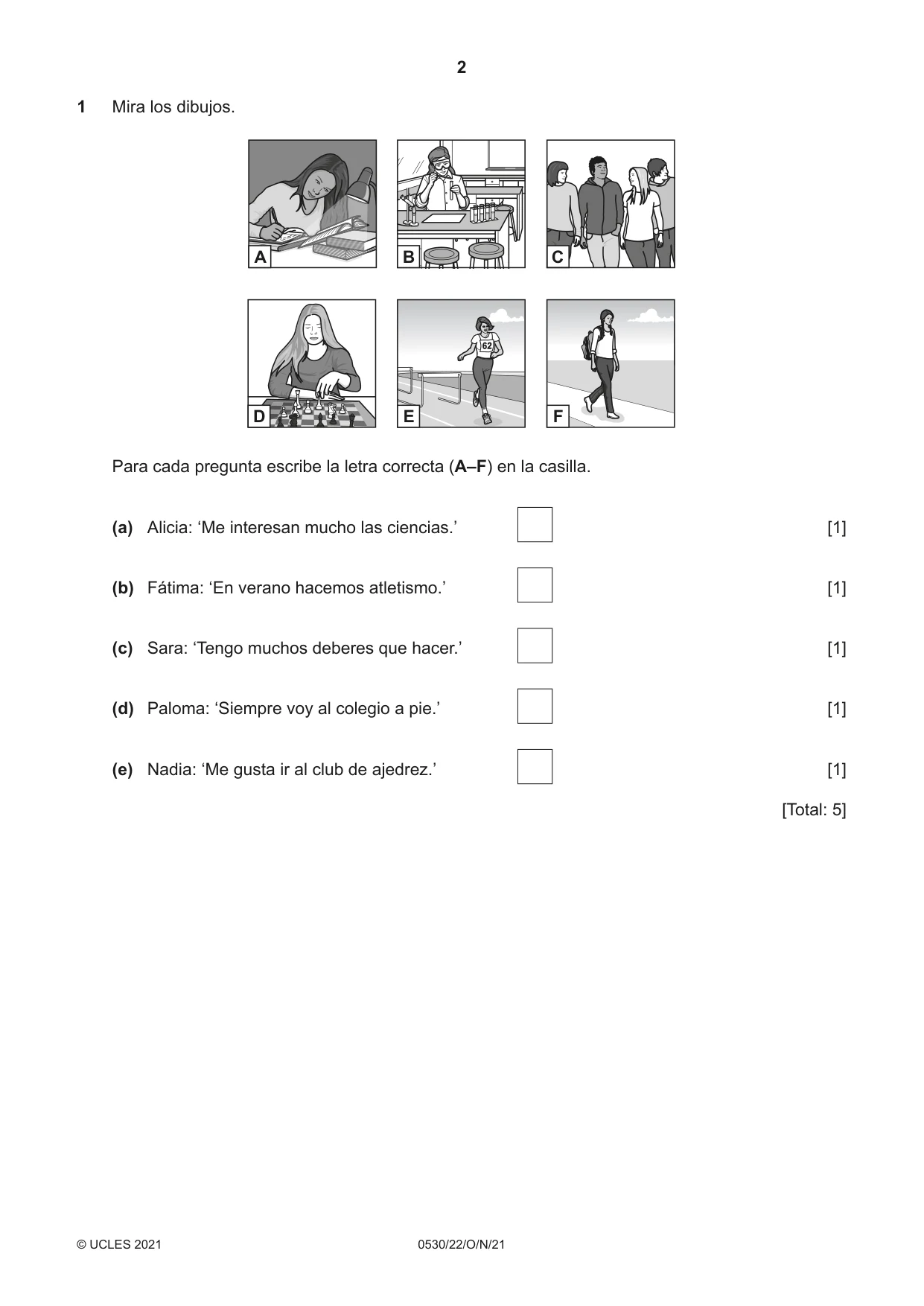
2 0530/22/ O/ N/21 © UCLES 2021 1 Mira los dibujos. C B A E D F Para cada pregunta escribe la letra correcta (A–F) en la casilla. (a) Alicia: ‘Me interesan mucho las ciencias.’ [1] (b) Fátima: ‘En verano hacemos atletismo.’ [1] (c) Sara: ‘Tengo muchos deberes que hacer.’ [1] (d) Paloma: ‘Siempre voy al colegio a pie.’ [1] (e) Nadia: ‘Me gusta ir al club de ajedrez.’ [1] [Total: 5]
Question paper, page 3
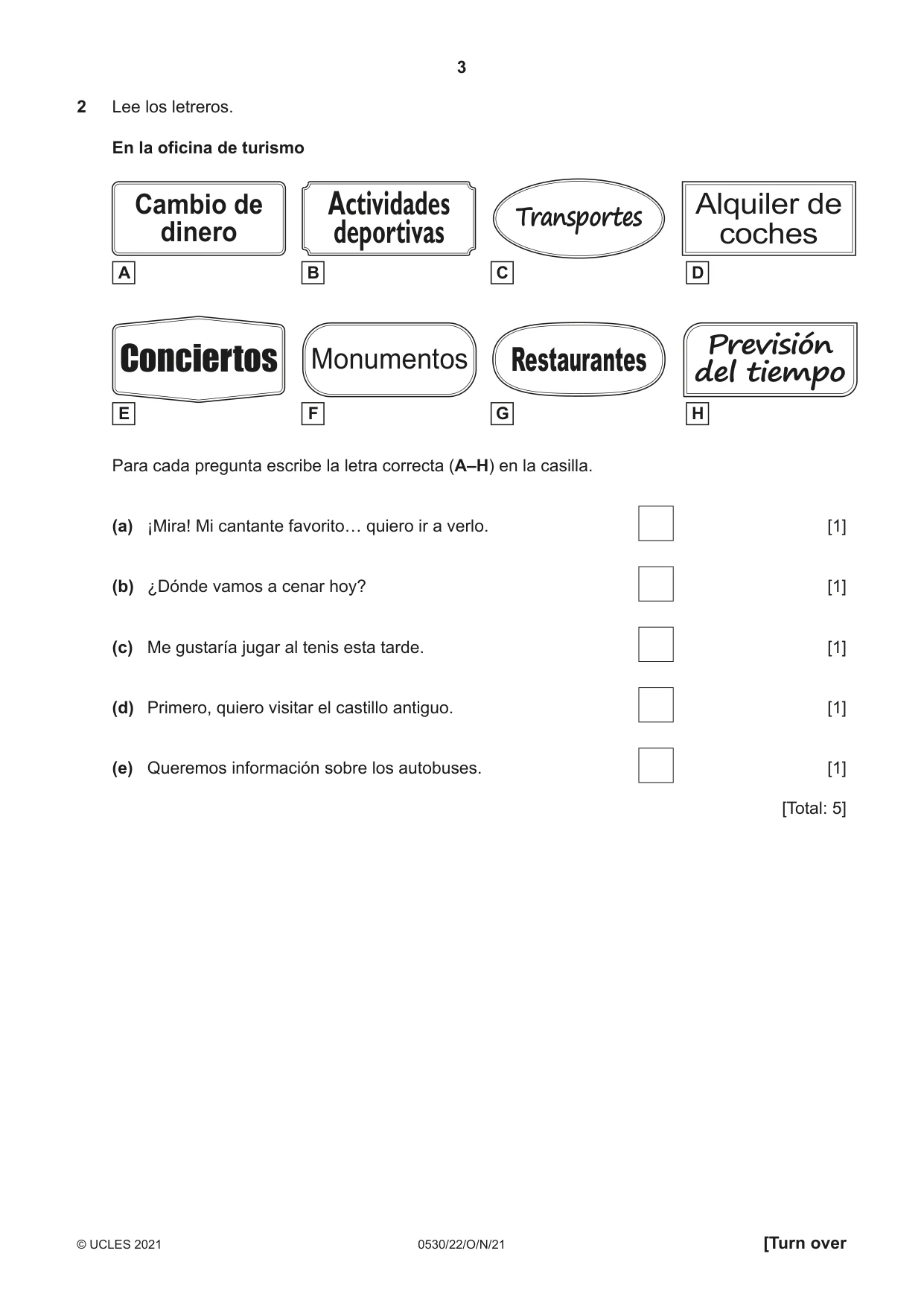
3 0530/22/O/N/21 © UCLES 2021 [Turn over 2 Lee los letreros. En la oficina de turismo Cambio de dinero Conciertos Monumentos Restaurantes Actividades deportivas Transportes Alquiler de coches Previsión del tiempo A B C D E F G H Para cada pregunta escribe la letra correcta (A–H) en la casilla. (a) ¡Mira! Mi cantante favorito… quiero ir a verlo. [1] (b) ¿Dónde vamos a cenar hoy? [1] (c) Me gustaría jugar al tenis esta tarde. [1] (d) Primero, quiero visitar el castillo antiguo. [1] (e) Queremos información sobre los autobuses. [1] [Total: 5]
Question paper, page 4
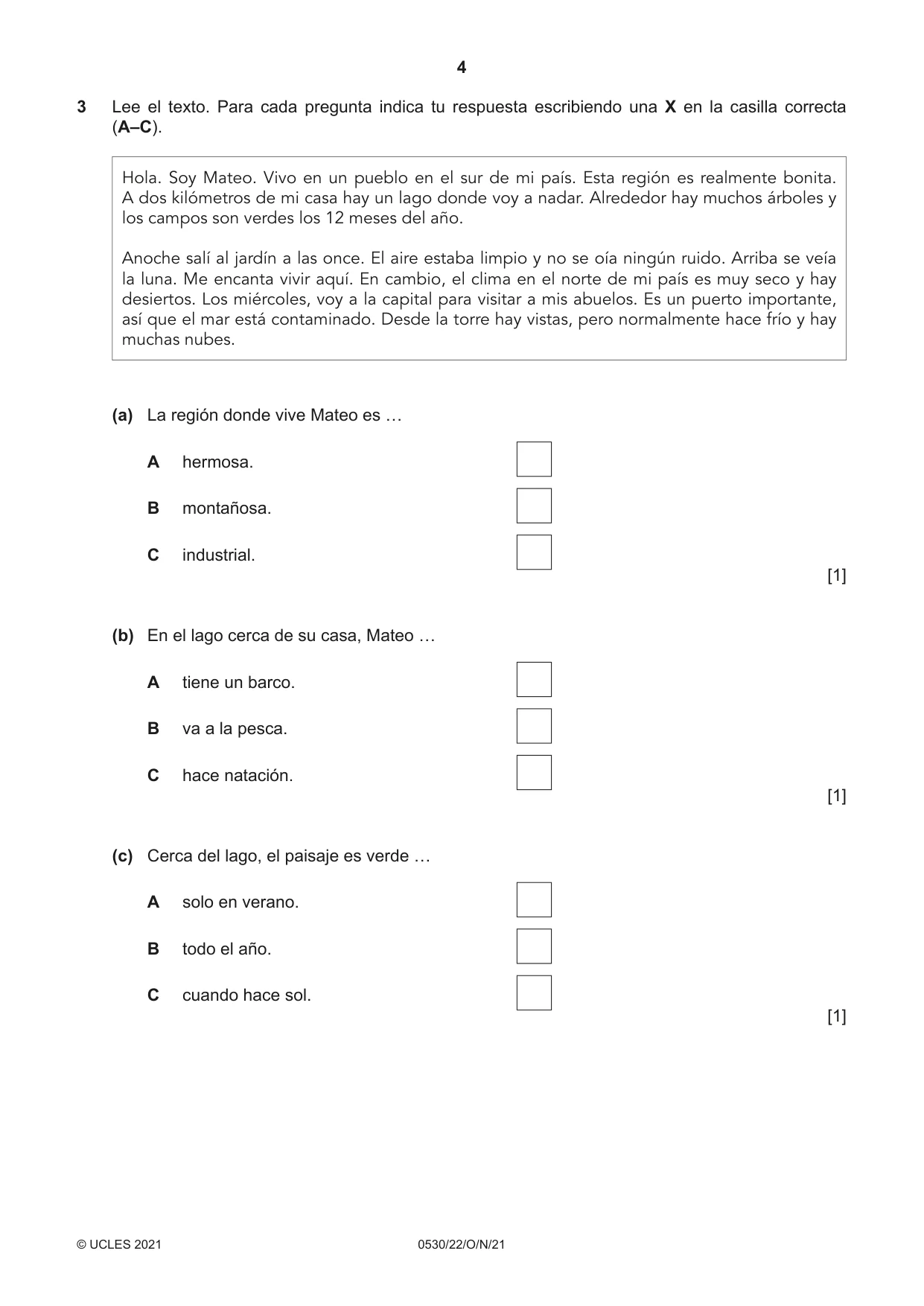
4 0530/22/O/N/21 © UCLES 2021 3 Lee el texto. Para cada pregunta indica tu respuesta escribiendo una X en la casilla correcta (A–C). Hola. Soy Mateo. Vivo en un pueblo en el sur de mi país. Esta región es realmente bonita. A dos kilómetros de mi casa hay un lago donde voy a nadar. Alrededor hay muchos árboles y los campos son verdes los 12 meses del año. Anoche salí al jardín a las once. El aire estaba limpio y no se oía ningún ruido. Arriba se veía la luna. Me encanta vivir aquí. En cambio, el clima en el norte de mi país es muy seco y hay desiertos. Los miércoles, voy a la capital para visitar a mis abuelos. Es un puerto importante, así que el mar está contaminado. Desde la torre hay vistas, pero normalmente hace frío y hay muchas nubes. (a) La región donde vive Mateo es … A hermosa. B montañosa. C industrial. [1] (b) En el lago cerca de su casa, Mateo … A tiene un barco. B va a la pesca. C hace natación. [1] (c) Cerca del lago, el paisaje es verde … A solo en verano. B todo el año. C cuando hace sol. [1]
Question paper, page 5
5 0530/22/O/N/21 © UCLES 2021 [Turn over (d) Ayer, Mateo … A limpió su dormitorio. B salió de noche. C leyó tranquilamente. [1] (e) En el norte del país, llueve … A poco. B bastante. C frecuentemente. [1] (f) Mateo va a la capital … A cada fin de semana. B una vez al mes. C todas las semanas. [1] (g) La capital … A tiene muchos museos. B es una ciudad turística. C está en la costa. [1] [Total: 7]
Question paper, page 6
6 0530/22/O/N/21 © UCLES 2021 4 Lee el texto. Contesta a las preguntas en español. El blog de Silvia Ayer estaba charlando con unos compañeros sobre el trabajo que hacen nuestros padres. Cuando me tocó a mí, les dije: “Mi madre es gimnasta internacional y, aunque tiene ya 39 años, todavía compite en el equipo de gimnasia de España.” No me creían. Gritaron: “¡Mentira!”, pero ¡sí! es verdad. Claro, esto no ocurre con frecuencia. Mi madre es una mujer muy especial. La verdad es que muchas gimnastas son más jóvenes que yo. ¡Dice que está acostumbrada a competir contra chicas de 14 años que llevan mucho maquillaje! Ella sigue entrenando, aunque dice: “Mi cuerpo ya no soporta las seis horas de ejercicio diarias que yo solía hacer en mi juventud.” Sin embargo, sabe utilizar toda su experiencia para ganar. De hecho, el año pasado ganó su tercera medalla en el Campeonato Mundial. También les expliqué a mis amigos que yo no nací en España porque mi madre es de Paraguay. A la edad de tres años, yo estaba muy enferma y mis padres se mudaron a España en busca de ayuda médica para mí. Muchos gimnastas españoles contribuyeron con dinero para pagar la cuenta del hospital, y ahora estoy bien. Mis amigos no se sorprendieron cuando les dije que estoy muy orgullosa de mi madre. “¿Cuánto tiempo podrá continuar?” me preguntó una amiga. No lo sé, pero en enero va a representar a España en otra competición, y con suerte podré volar a la India para ver a mi madre competir. (a) ¿Cuándo habló Silvia con sus amigos? … [1] (b) ¿Qué deporte practica la madre de Silvia? … [1] (c) ¿Cuál fue la reacción de los amigos de Silvia al saber en qué trabaja su madre? (Menciona dos detalles.) 1. … [1] 2. … [1]
Question paper, page 7
7 0530/22/O/N/21 © UCLES 2021 [Turn over (d) Según Silvia, ¿qué tipo de persona es su madre? … [1] (e) ¿Qué piensa la madre de Silvia de competir contra chicas jóvenes? … [1] (f) ¿Qué no puede hacer la madre de Silvia ahora? … [1] (g) ¿Cuántas medallas ha ganado la madre de Silvia? … [1] (h) ¿Qué le pasaba a Silvia antes de irse a otro país? … [1] (i) ¿Quién les dio ayuda económica a los padres de Silvia? … [1] (j) A Silvia ¿cómo le hace sentir su madre? … [1] (k) ¿Por qué espera Silvia viajar al extranjero en el año nuevo? … [1] [Total: 12]
Question paper, page 8
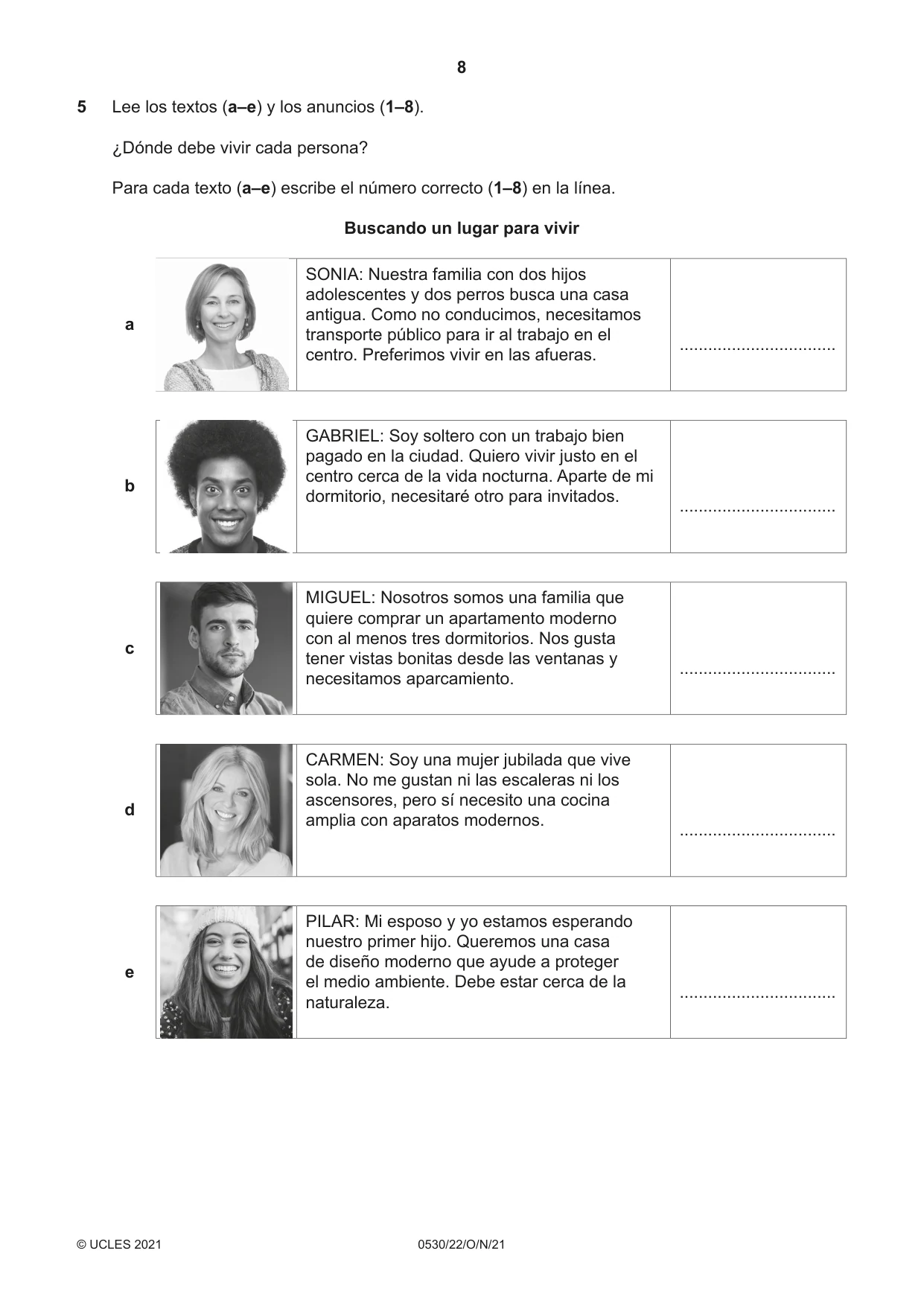
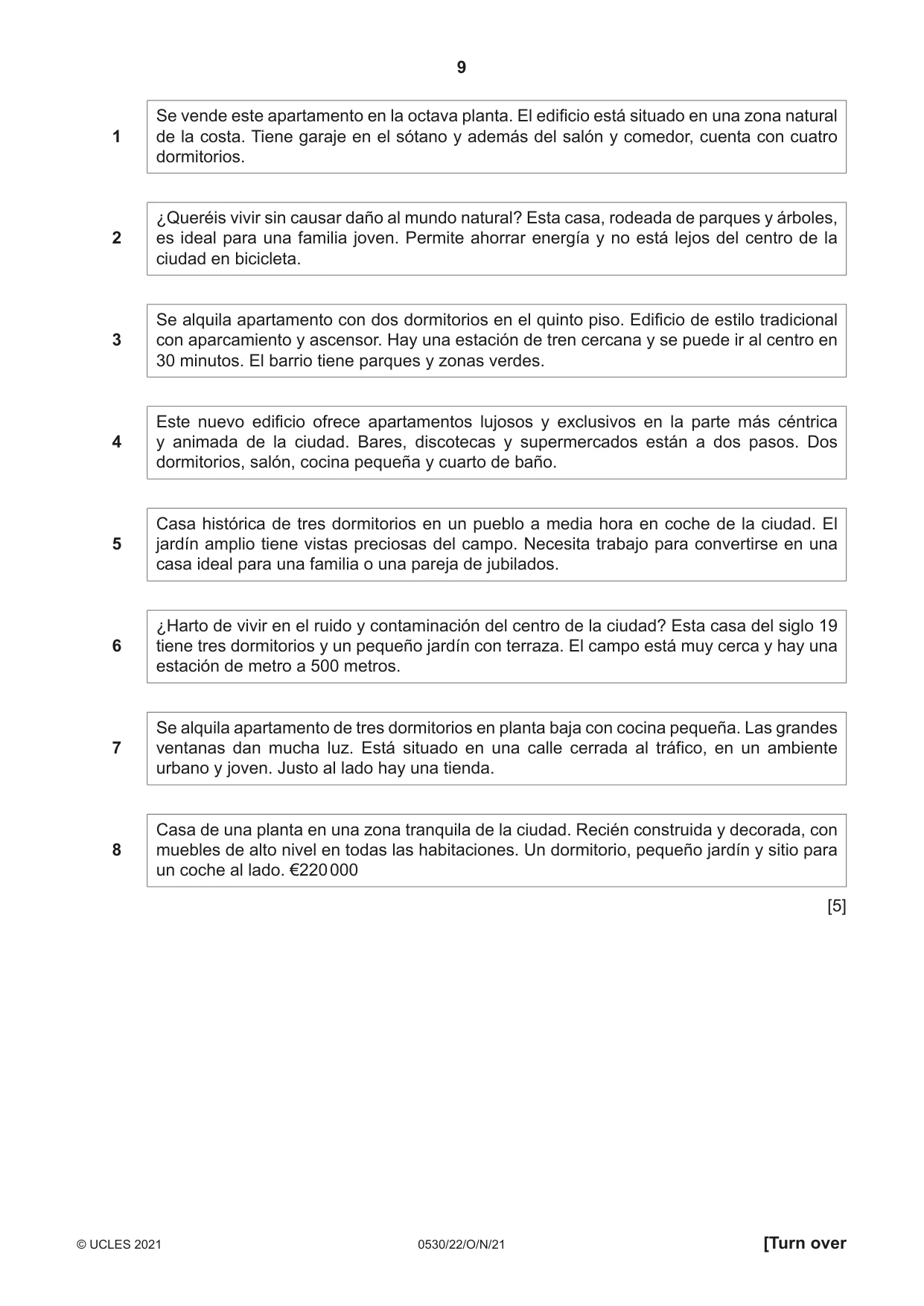
8 0530/22/O/N/21 © UCLES 2021 5 Lee los textos (a–e) y los anuncios (1–8). ¿Dónde debe vivir cada persona? Para cada texto (a–e) escribe el número correcto (1–8) en la línea. Buscando un lugar para vivir a SONIA: Nuestra familia con dos hijos adolescentes y dos perros busca una casa antigua. Como no conducimos, necesitamos transporte público para ir al trabajo en el centro. Preferimos vivir en las afueras. … b GABRIEL: Soy soltero con un trabajo bien pagado en la ciudad. Quiero vivir justo en el centro cerca de la vida nocturna. Aparte de mi dormitorio, necesitaré otro para invitados. … c MIGUEL: Nosotros somos una familia que quiere comprar un apartamento moderno con al menos tres dormitorios. Nos gusta tener vistas bonitas desde las ventanas y necesitamos aparcamiento. … d CARMEN: Soy una mujer jubilada que vive sola. No me gustan ni las escaleras ni los ascensores, pero sí necesito una cocina amplia con aparatos modernos. … e PILAR: Mi esposo y yo estamos esperando nuestro primer hijo. Queremos una casa de diseño moderno que ayude a proteger el medio ambiente. Debe estar cerca de la naturaleza. …
Question paper, page 9
9 0530/22/O/N/21 © UCLES 2021 [Turn over 1 Se vende este apartamento en la octava planta. El edificio está situado en una zona natural de la costa. Tiene garaje en el sótano y además del salón y comedor, cuenta con cuatro dormitorios. 2 ¿Queréis vivir sin causar daño al mundo natural? Esta casa, rodeada de parques y árboles, es ideal para una familia joven. Permite ahorrar energía y no está lejos del centro de la ciudad en bicicleta. 3 Se alquila apartamento con dos dormitorios en el quinto piso. Edificio de estilo tradicional con aparcamiento y ascensor. Hay una estación de tren cercana y se puede ir al centro en 30 minutos. El barrio tiene parques y zonas verdes. 4 Este nuevo edificio ofrece apartamentos lujosos y exclusivos en la parte más céntrica y animada de la ciudad. Bares, discotecas y supermercados están a dos pasos. Dos dormitorios, salón, cocina pequeña y cuarto de baño. 5 Casa histórica de tres dormitorios en un pueblo a media hora en coche de la ciudad. El jardín amplio tiene vistas preciosas del campo. Necesita trabajo para convertirse en una casa ideal para una familia o una pareja de jubilados. 6 ¿Harto de vivir en el ruido y contaminación del centro de la ciudad? Esta casa del siglo 19 tiene tres dormitorios y un pequeño jardín con terraza. El campo está muy cerca y hay una estación de metro a 500 metros. 7 Se alquila apartamento de tres dormitorios en planta baja con cocina pequeña. Las grandes ventanas dan mucha luz. Está situado en una calle cerrada al tráfico, en un ambiente urbano y joven. Justo al lado hay una tienda. 8 Casa de una planta en una zona tranquila de la ciudad. Recién construida y decorada, con muebles de alto nivel en todas las habitaciones. Un dormitorio, pequeño jardín y sitio para un coche al lado. €220 000 [5]
Question paper, page 10
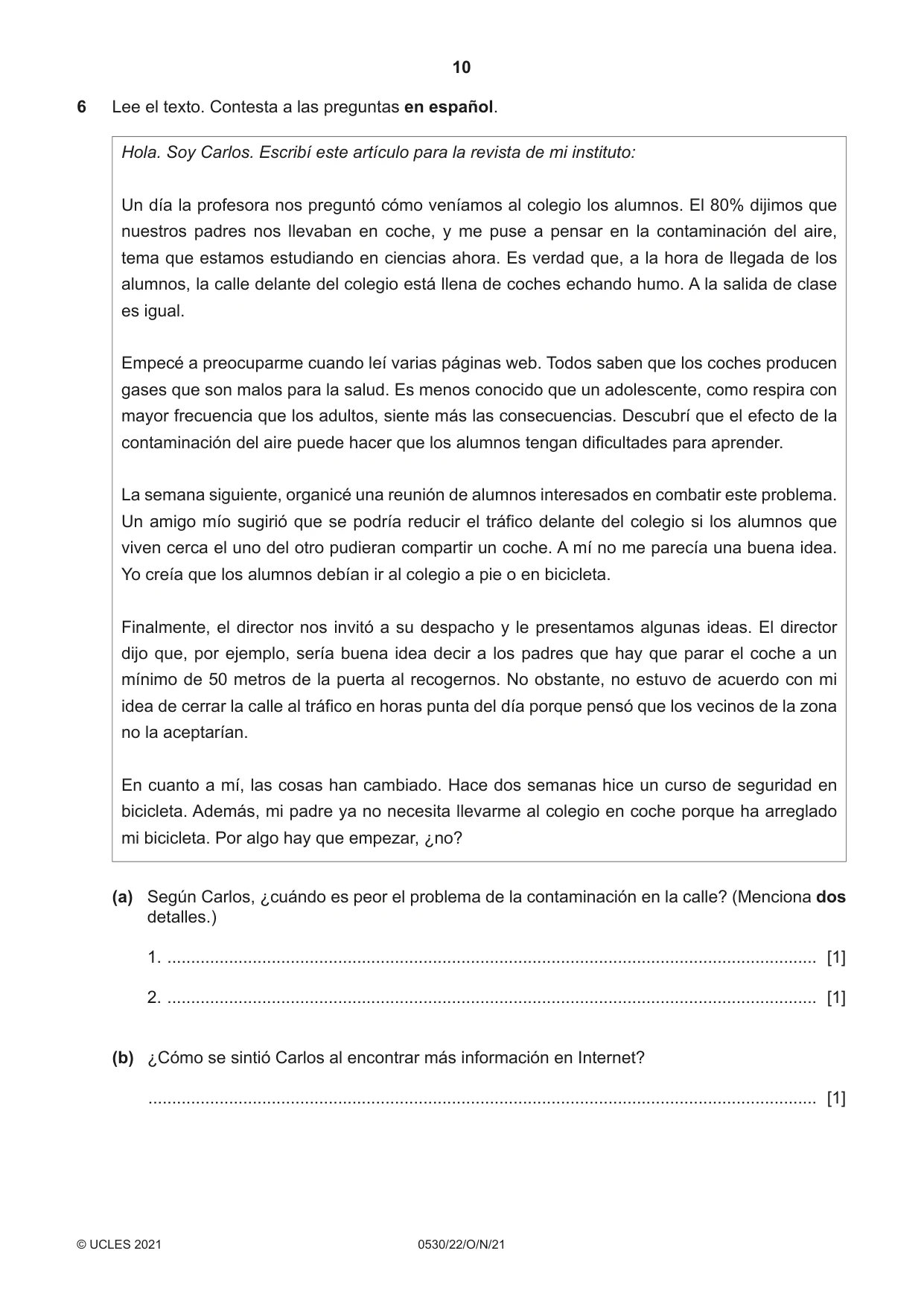
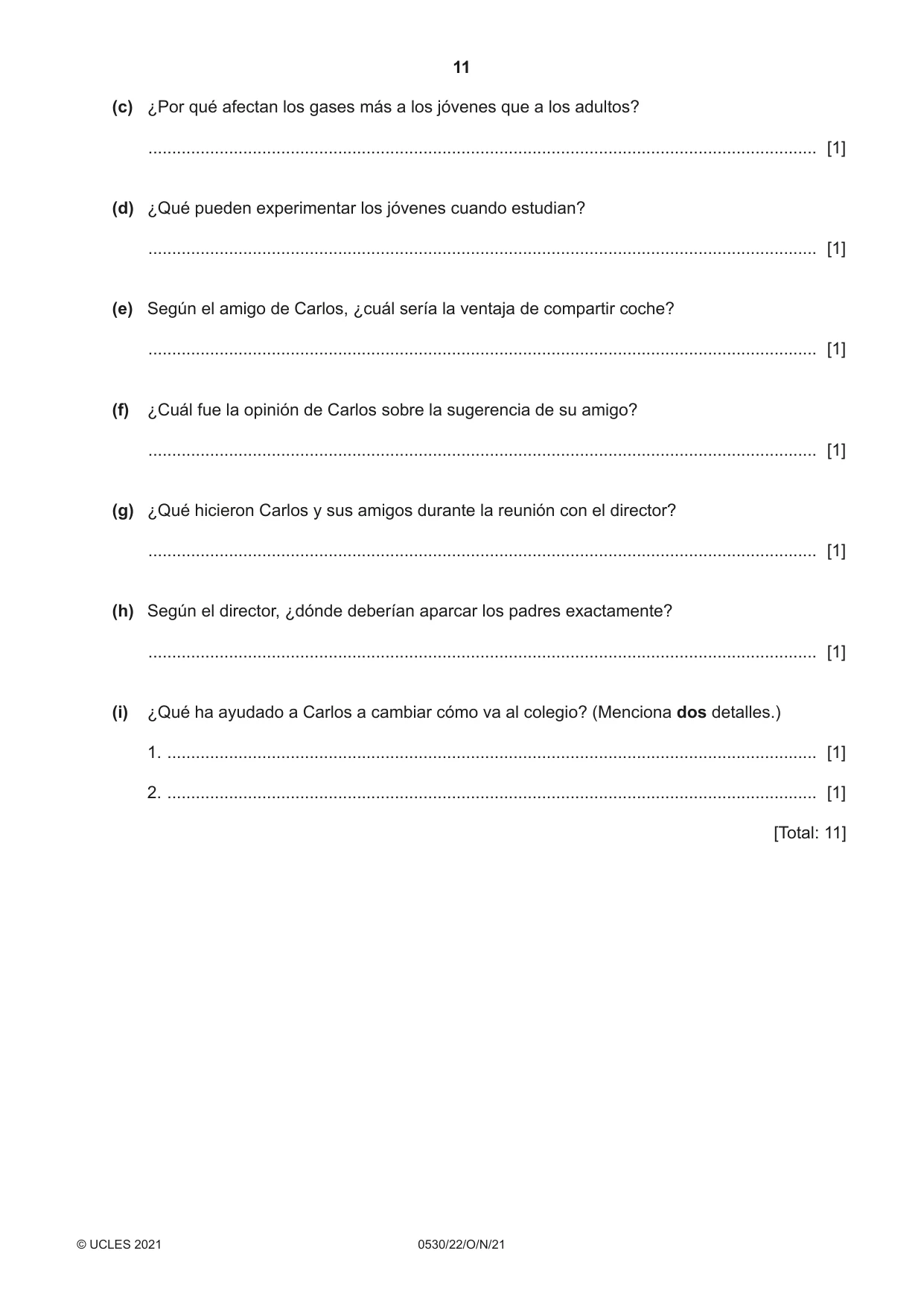
10 0530/22/O/N/21 © UCLES 2021 6 Lee el texto. Contesta a las preguntas en español. Hola. Soy Carlos. Escribí este artículo para la revista de mi instituto: Un día la profesora nos preguntó cómo veníamos al colegio los alumnos. El 80% dijimos que nuestros padres nos llevaban en coche, y me puse a pensar en la contaminación del aire, tema que estamos estudiando en ciencias ahora. Es verdad que, a la hora de llegada de los alumnos, la calle delante del colegio está llena de coches echando humo. A la salida de clase es igual. Empecé a preocuparme cuando leí varias páginas web. Todos saben que los coches producen gases que son malos para la salud. Es menos conocido que un adolescente, como respira con mayor frecuencia que los adultos, siente más las consecuencias. Descubrí que el efecto de la contaminación del aire puede hacer que los alumnos tengan dificultades para aprender. La semana siguiente, organicé una reunión de alumnos interesados en combatir este problema. Un amigo mío sugirió que se podría reducir el tráfico delante del colegio si los alumnos que viven cerca el uno del otro pudieran compartir un coche. A mí no me parecía una buena idea. Yo creía que los alumnos debían ir al colegio a pie o en bicicleta. Finalmente, el director nos invitó a su despacho y le presentamos algunas ideas. El director dijo que, por ejemplo, sería buena idea decir a los padres que hay que parar el coche a un mínimo de 50 metros de la puerta al recogernos. No obstante, no estuvo de acuerdo con mi idea de cerrar la calle al tráfico en horas punta del día porque pensó que los vecinos de la zona no la aceptarían. En cuanto a mí, las cosas han cambiado. Hace dos semanas hice un curso de seguridad en bicicleta. Además, mi padre ya no necesita llevarme al colegio en coche porque ha arreglado mi bicicleta. Por algo hay que empezar, ¿no? (a) Según Carlos, ¿cuándo es peor el problema de la contaminación en la calle? (Menciona dos detalles.) 1. … [1] 2. … [1] (b) ¿Cómo se sintió Carlos al encontrar más información en Internet? … [1]
Question paper, page 11
11 0530/22/O/N/21 © UCLES 2021 (c) ¿Por qué afectan los gases más a los jóvenes que a los adultos? … [1] (d) ¿Qué pueden experimentar los jóvenes cuando estudian? … [1] (e) Según el amigo de Carlos, ¿cuál sería la ventaja de compartir coche? … [1] (f) ¿Cuál fue la opinión de Carlos sobre la sugerencia de su amigo? … [1] (g) ¿Qué hicieron Carlos y sus amigos durante la reunión con el director? … [1] (h) Según el director, ¿dónde deberían aparcar los padres exactamente? … [1] (i) ¿Qué ha ayudado a Carlos a cambiar cómo va al colegio? (Menciona dos detalles.) 1. … [1] 2. … [1] [Total: 11]
Question paper, page 12
12 0530/22/O/N/21 © UCLES 2021 Permission to reproduce items where third-party owned material protected by copyright is included has been sought and cleared where possible. Every reasonable effort has been made by the publisher (UCLES) to trace copyright holders, but if any items requiring clearance have unwittingly been included, the publisher will be pleased to make amends at the earliest possible opportunity. To avoid the issue of disclosure of answer-related information to candidates, all copyright acknowledgements are reproduced online in the Cambridge Assessment International Education Copyright Acknowledgements Booklet. This is produced for each series of examinations and is freely available to download at www.cambridgeinternational.org after the live examination series. Cambridge Assessment International Education is part of the Cambridge Assessment Group. Cambridge Assessment is the brand name of the University of Cambridge Local Examinations Syndicate (UCLES), which itself is a department of the University of Cambridge. BLANK PAGE
Mark scheme, page 1
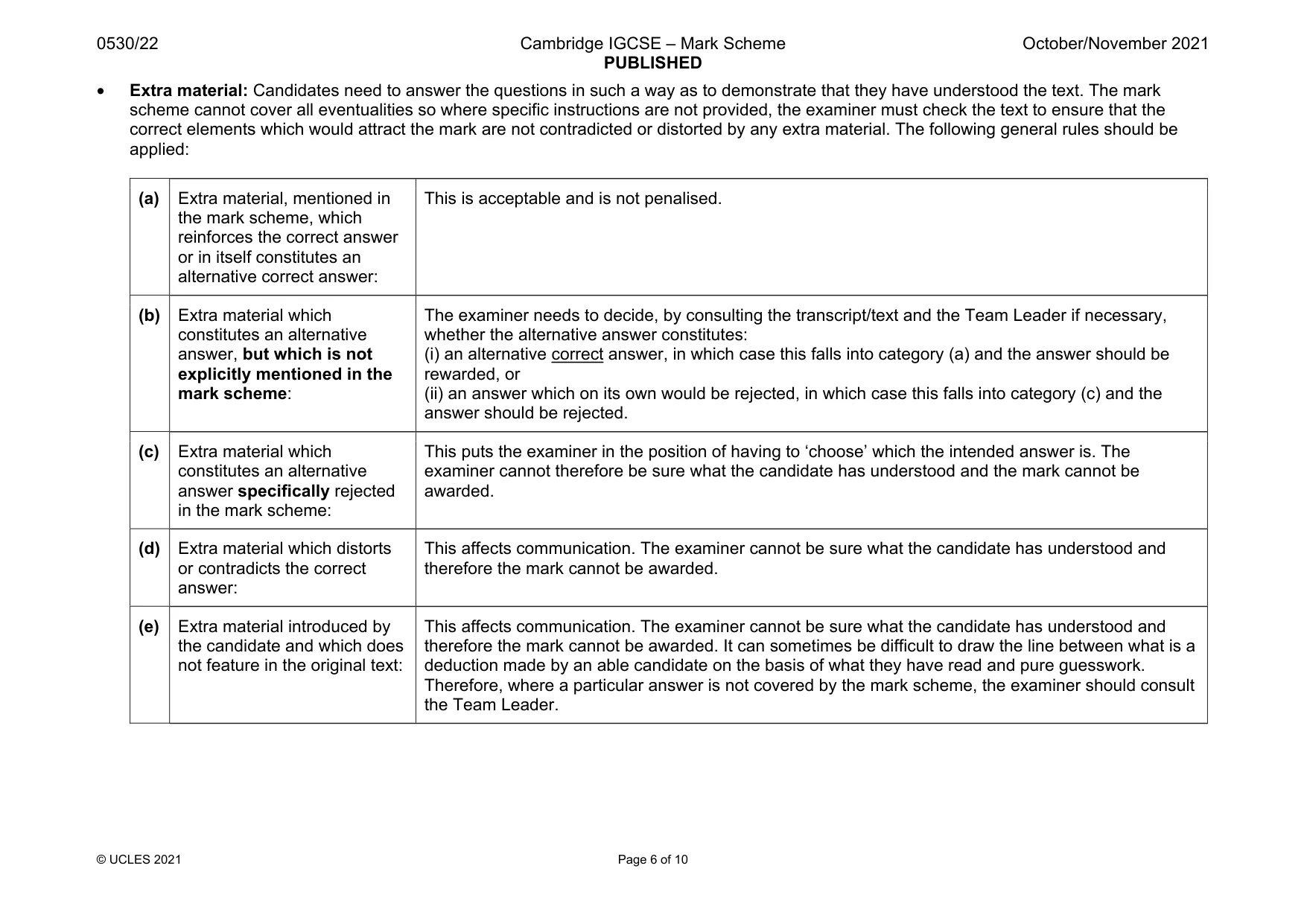
This document consists of 10 printed pages. © UCLES 2021 [Turn over Cambridge IGCSE™ SPANISH 0530/22 Paper 2 Reading October/November 2021 MARK SCHEME Maximum Mark: 45 Published This mark scheme is published as an aid to teachers and candidates, to indicate the requirements of the examination. It shows the basis on which Examiners were instructed to award marks. It does not indicate the details of the discussions that took place at an Examiners’ meeting before marking began, which would have considered the acceptability of alternative answers. Mark schemes should be read in conjunction with the question paper and the Principal Examiner Report for Teachers. Cambridge International will not enter into discussions about these mark schemes. Cambridge International is publishing the mark schemes for the October/November 2021 series for most Cambridge IGCSE™, Cambridge International A and AS Level components and some Cambridge O Level components.
Mark scheme, page 2
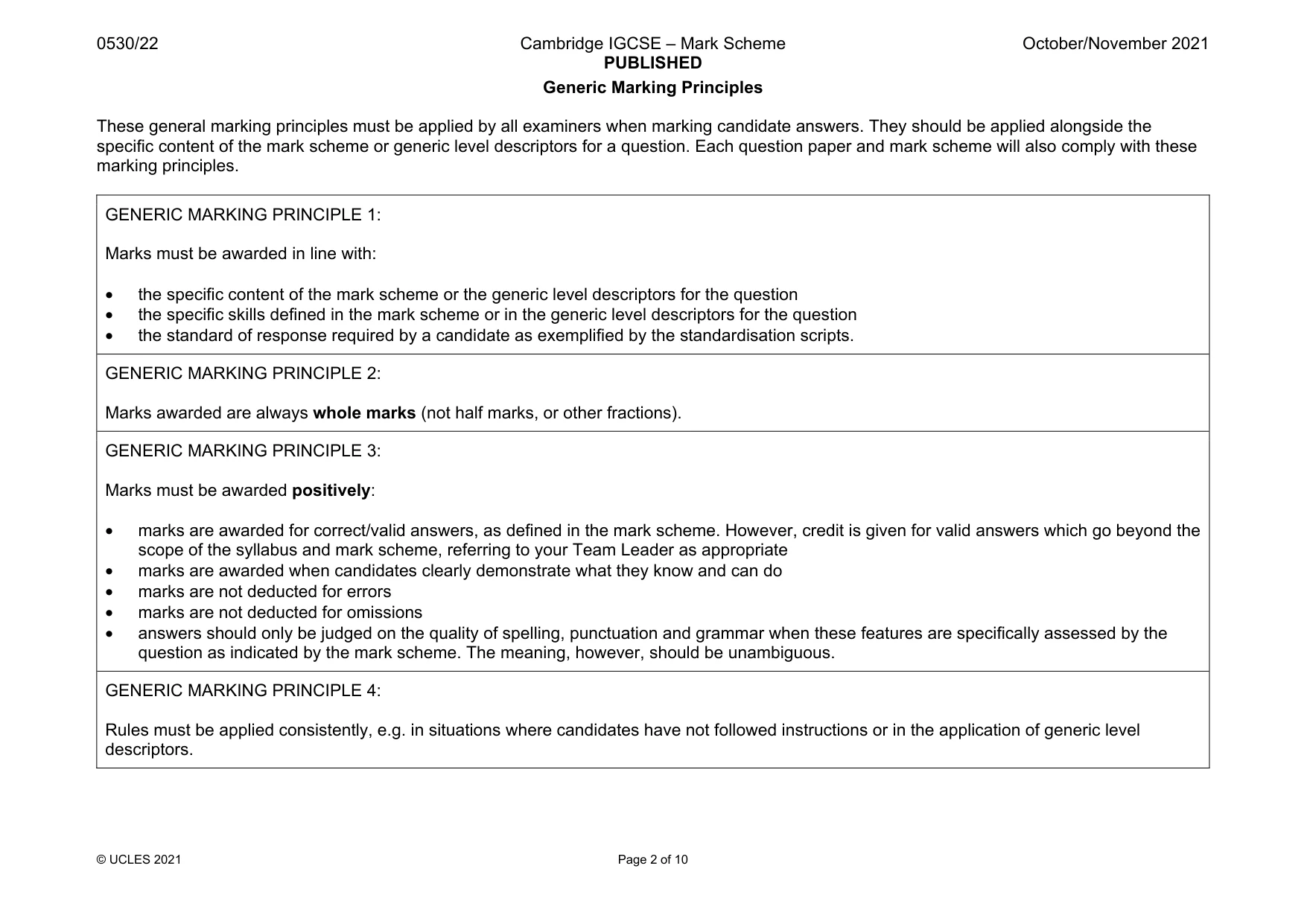
0530/22 Cambridge IGCSE – Mark Scheme PUBLISHED October/November 2021 © UCLES 2021 Page 2 of 10 Generic Marking Principles These general marking principles must be applied by all examiners when marking candidate answers. They should be applied alongside the specific content of the mark scheme or generic level descriptors for a question. Each question paper and mark scheme will also comply with these marking principles. GENERIC MARKING PRINCIPLE 1: Marks must be awarded in line with: • the specific content of the mark scheme or the generic level descriptors for the question • the specific skills defined in the mark scheme or in the generic level descriptors for the question • the standard of response required by a candidate as exemplified by the standardisation scripts. GENERIC MARKING PRINCIPLE 2: Marks awarded are always whole marks (not half marks, or other fractions). GENERIC MARKING PRINCIPLE 3: Marks must be awarded positively: • marks are awarded for correct/valid answers, as defined in the mark scheme. However, credit is given for valid answers which go beyond the scope of the syllabus and mark scheme, referring to your Team Leader as appropriate • marks are awarded when candidates clearly demonstrate what they know and can do • marks are not deducted for errors • marks are not deducted for omissions • answers should only be judged on the quality of spelling, punctuation and grammar when these features are specifically assessed by the question as indicated by the mark scheme. The meaning, however, should be unambiguous. GENERIC MARKING PRINCIPLE 4: Rules must be applied consistently, e.g. in situations where candidates have not followed instructions or in the application of generic level descriptors.
Mark scheme, page 3
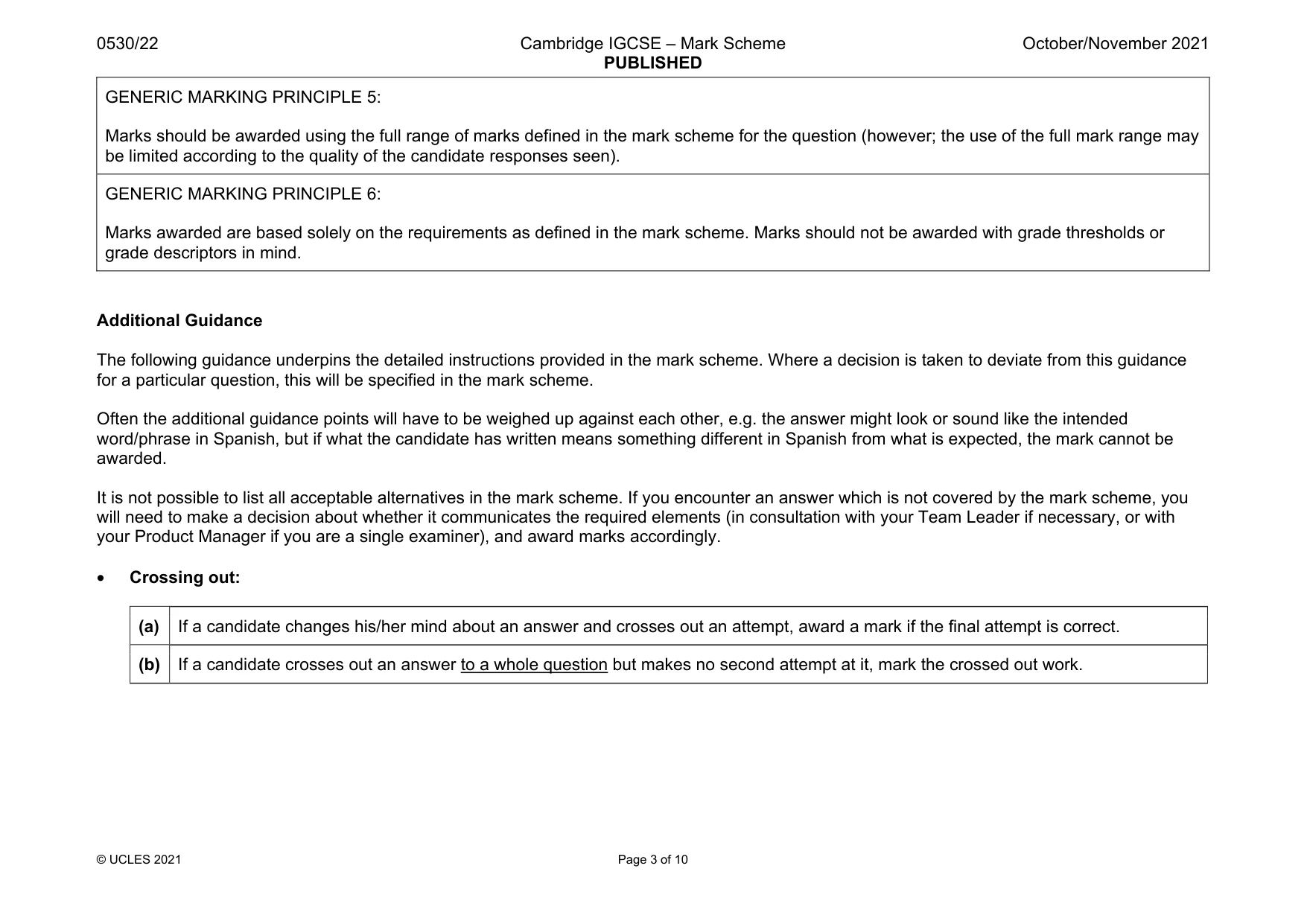
0530/22 Cambridge IGCSE – Mark Scheme PUBLISHED October/November 2021 © UCLES 2021 Page 3 of 10 GENERIC MARKING PRINCIPLE 5: Marks should be awarded using the full range of marks defined in the mark scheme for the question (however; the use of the full mark range may be limited according to the quality of the candidate responses seen). GENERIC MARKING PRINCIPLE 6: Marks awarded are based solely on the requirements as defined in the mark scheme. Marks should not be awarded with grade thresholds or grade descriptors in mind. Additional Guidance The following guidance underpins the detailed instructions provided in the mark scheme. Where a decision is taken to deviate from this guidance for a particular question, this will be specified in the mark scheme. Often the additional guidance points will have to be weighed up against each other, e.g. the answer might look or sound like the intended word/phrase in Spanish, but if what the candidate has written means something different in Spanish from what is expected, the mark cannot be awarded. It is not possible to list all acceptable alternatives in the mark scheme. If you encounter an answer which is not covered by the mark scheme, you will need to make a decision about whether it communicates the required elements (in consultation with your Team Leader if necessary, or with your Product Manager if you are a single examiner), and award marks accordingly. • Crossing out: (a) If a candidate changes his/her mind about an answer and crosses out an attempt, award a mark if the final attempt is correct. (b) If a candidate crosses out an answer to a whole question but makes no second attempt at it, mark the crossed out work.
Mark scheme, page 4
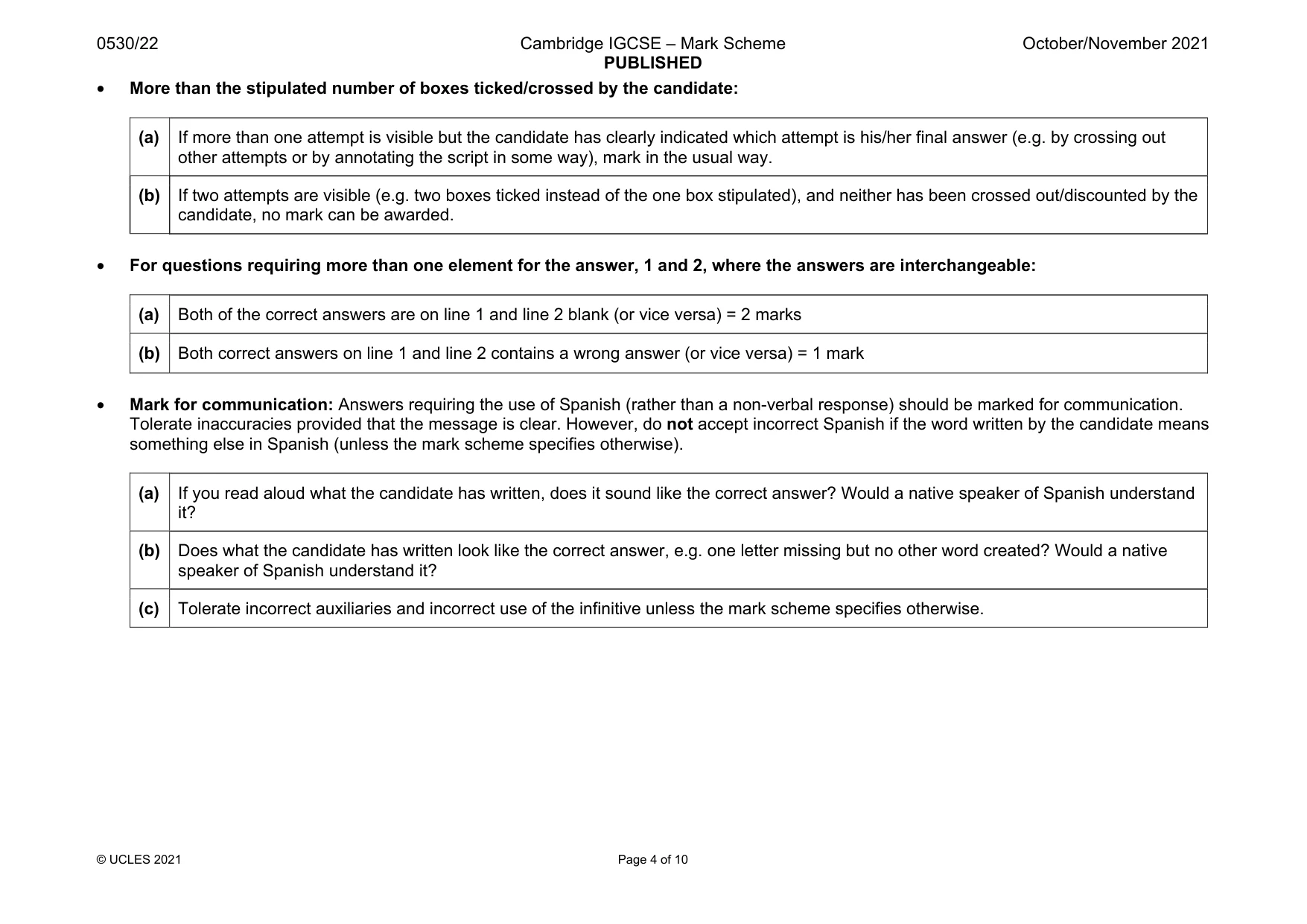
0530/22 Cambridge IGCSE – Mark Scheme PUBLISHED October/November 2021 © UCLES 2021 Page 4 of 10 • More than the stipulated number of boxes ticked/crossed by the candidate: (a) If more than one attempt is visible but the candidate has clearly indicated which attempt is his/her final answer (e.g. by crossing out other attempts or by annotating the script in some way), mark in the usual way. (b) If two attempts are visible (e.g. two boxes ticked instead of the one box stipulated), and neither has been crossed out/discounted by the candidate, no mark can be awarded. • For questions requiring more than one element for the answer, 1 and 2, where the answers are interchangeable: (a) Both of the correct answers are on line 1 and line 2 blank (or vice versa) = 2 marks (b) Both correct answers on line 1 and line 2 contains a wrong answer (or vice versa) = 1 mark • Mark for communication: Answers requiring the use of Spanish (rather than a non-verbal response) should be marked for communication. Tolerate inaccuracies provided that the message is clear. However, do not accept incorrect Spanish if the word written by the candidate means something else in Spanish (unless the mark scheme specifies otherwise). (a) If you read aloud what the candidate has written, does it sound like the correct answer? Would a native speaker of Spanish understand it? (b) Does what the candidate has written look like the correct answer, e.g. one letter missing but no other word created? Would a native speaker of Spanish understand it? (c) Tolerate incorrect auxiliaries and incorrect use of the infinitive unless the mark scheme specifies otherwise.
Mark scheme, page 5
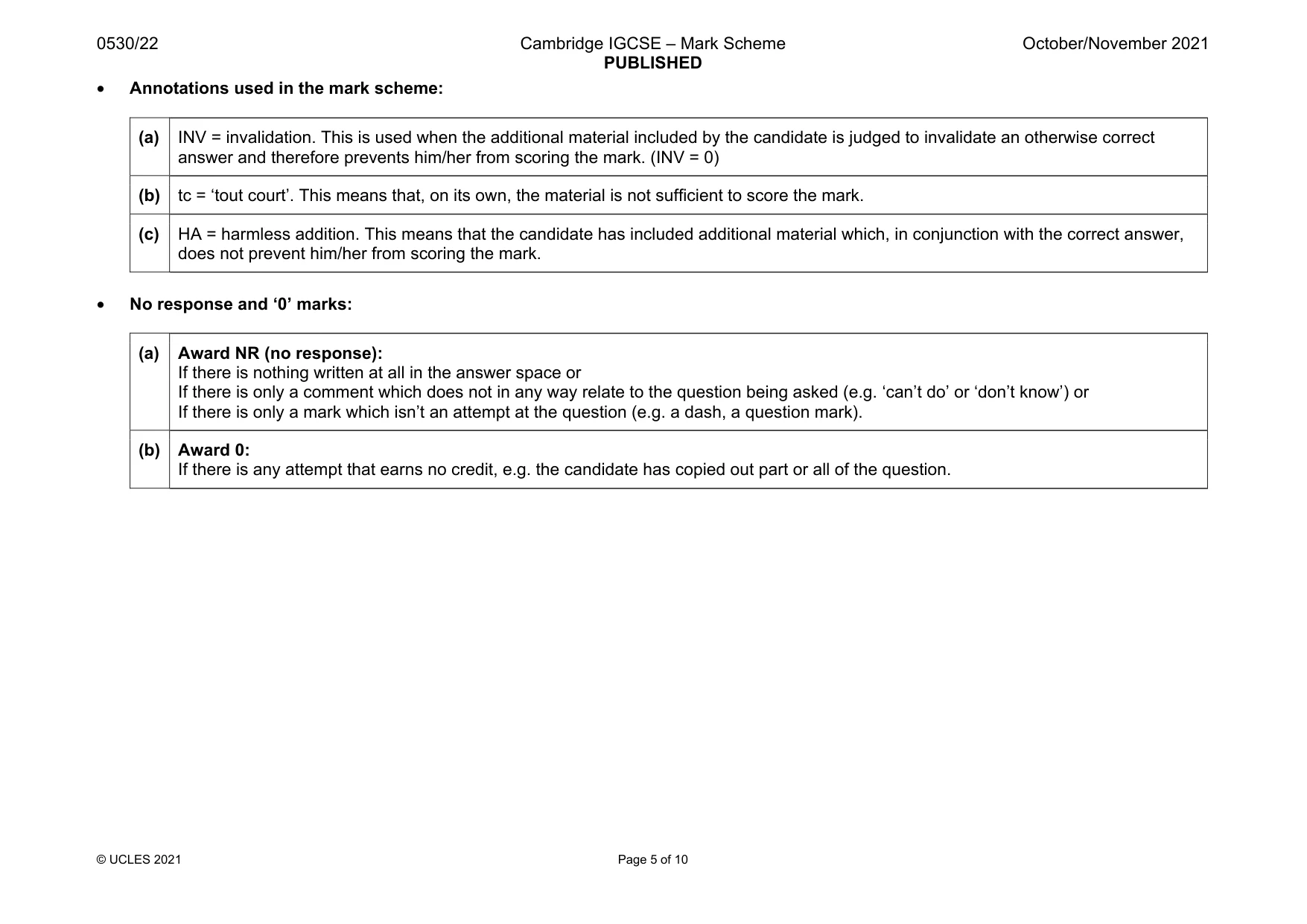
0530/22 Cambridge IGCSE – Mark Scheme PUBLISHED October/November 2021 © UCLES 2021 Page 5 of 10 • Annotations used in the mark scheme: (a) INV = invalidation. This is used when the additional material included by the candidate is judged to invalidate an otherwise correct answer and therefore prevents him/her from scoring the mark. (INV = 0) (b) tc = ‘tout court’. This means that, on its own, the material is not sufficient to score the mark. (c) HA = harmless addition. This means that the candidate has included additional material which, in conjunction with the correct answer, does not prevent him/her from scoring the mark. • No response and ‘0’ marks: (a) Award NR (no response): If there is nothing written at all in the answer space or If there is only a comment which does not in any way relate to the question being asked (e.g. ‘can’t do’ or ‘don’t know’) or If there is only a mark which isn’t an attempt at the question (e.g. a dash, a question mark). (b) Award 0: If there is any attempt that earns no credit, e.g. the candidate has copied out part or all of the question.
Mark scheme, page 6
0530/22 Cambridge IGCSE – Mark Scheme PUBLISHED October/November 2021 © UCLES 2021 Page 6 of 10 • Extra material: Candidates need to answer the questions in such a way as to demonstrate that they have understood the text. The mark scheme cannot cover all eventualities so where specific instructions are not provided, the examiner must check the text to ensure that the correct elements which would attract the mark are not contradicted or distorted by any extra material. The following general rules should be applied: (a) Extra material, mentioned in the mark scheme, which reinforces the correct answer or in itself constitutes an alternative correct answer: This is acceptable and is not penalised. (b) Extra material which constitutes an alternative answer, but which is not explicitly mentioned in the mark scheme: The examiner needs to decide, by consulting the transcript/text and the Team Leader if necessary, whether the alternative answer constitutes: (i) an alternative correct answer, in which case this falls into category (a) and the answer should be rewarded, or (ii) an answer which on its own would be rejected, in which case this falls into category (c) and the answer should be rejected. (c) Extra material which constitutes an alternative answer specifically rejected in the mark scheme: This puts the examiner in the position of having to ‘choose’ which the intended answer is. The examiner cannot therefore be sure what the candidate has understood and the mark cannot be awarded. (d) Extra material which distorts or contradicts the correct answer: This affects communication. The examiner cannot be sure what the candidate has understood and therefore the mark cannot be awarded. (e) Extra material introduced by the candidate and which does not feature in the original text: This affects communication. The examiner cannot be sure what the candidate has understood and therefore the mark cannot be awarded. It can sometimes be difficult to draw the line between what is a deduction made by an able candidate on the basis of what they have read and pure guesswork. Therefore, where a particular answer is not covered by the mark scheme, the examiner should consult the Team Leader.
Mark scheme, page 7
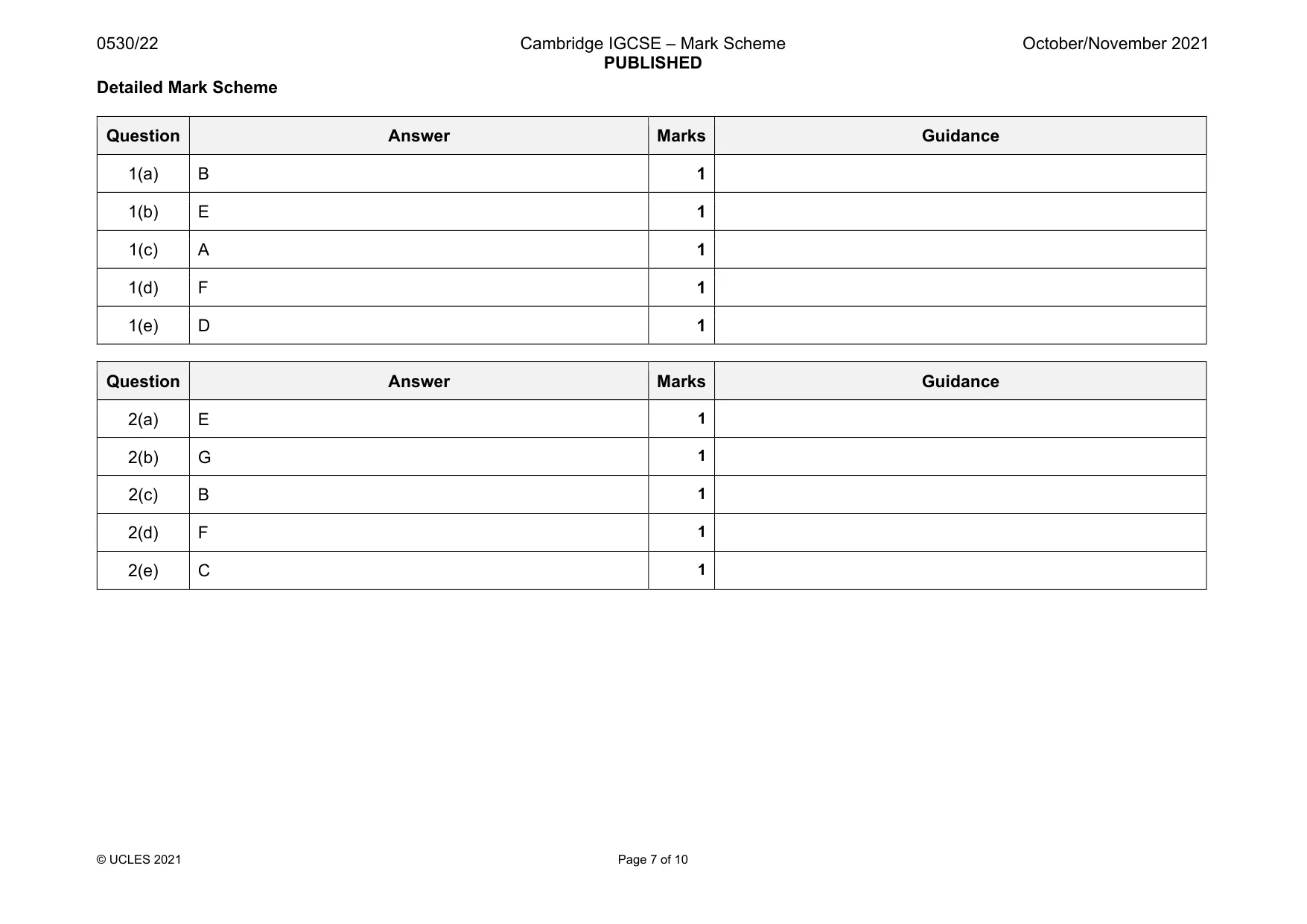
0530/22 Cambridge IGCSE – Mark Scheme PUBLISHED October/November 2021 © UCLES 2021 Page 7 of 10 Detailed Mark Scheme Question Answer Marks Guidance 1(a) B 1 1(b) E 1 1(c) A 1 1(d) F 1 1(e) D 1 Question Answer Marks Guidance 2(a) E 1 2(b) G 1 2(c) B 1 2(d) F 1 2(e) C 1
Mark scheme, page 8
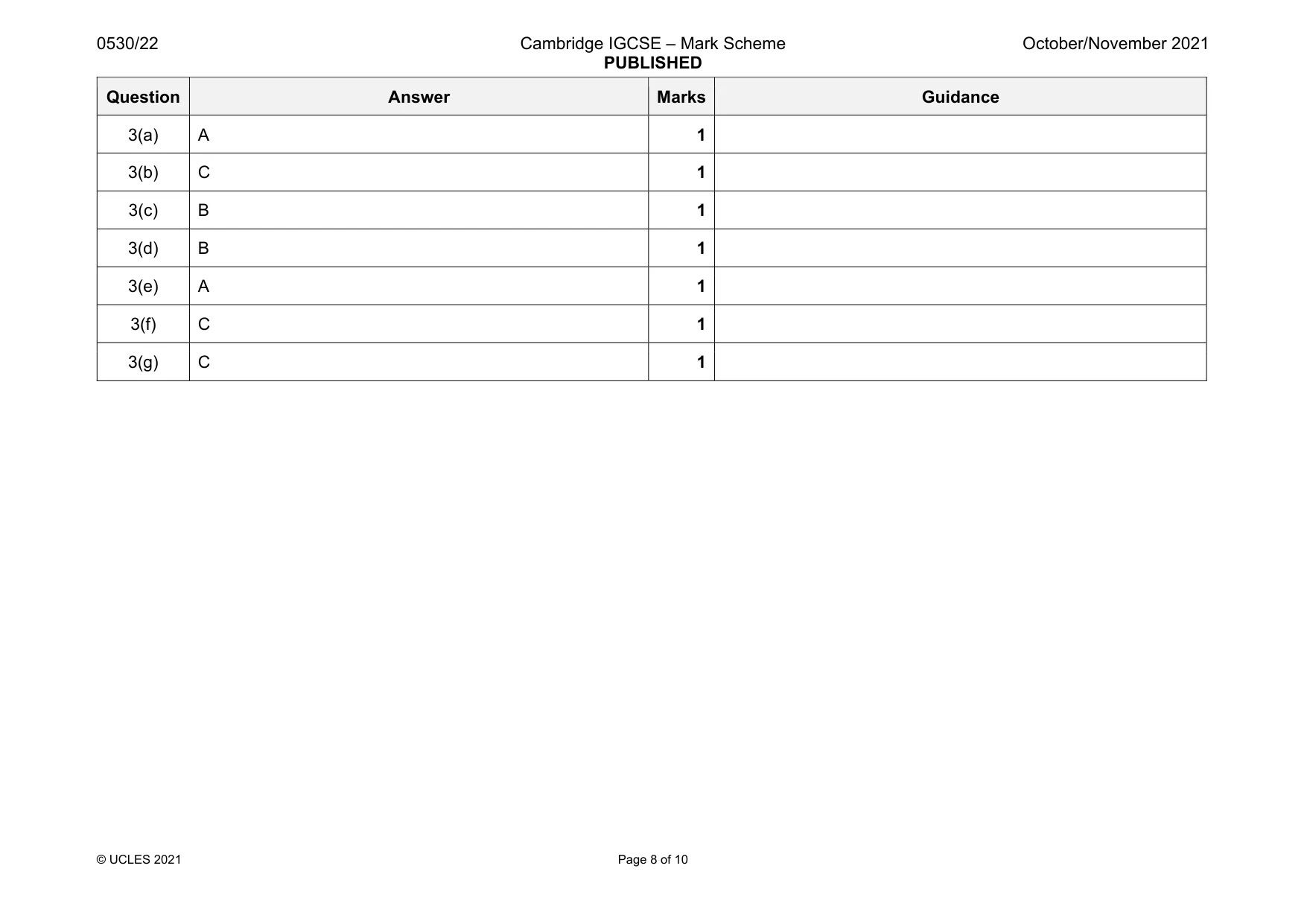
0530/22 Cambridge IGCSE – Mark Scheme PUBLISHED October/November 2021 © UCLES 2021 Page 8 of 10 Question Answer Marks Guidance 3(a) A 1 3(b) C 1 3(c) B 1 3(d) B 1 3(e) A 1 3(f) C 1 3(g) C 1
Mark scheme, page 9
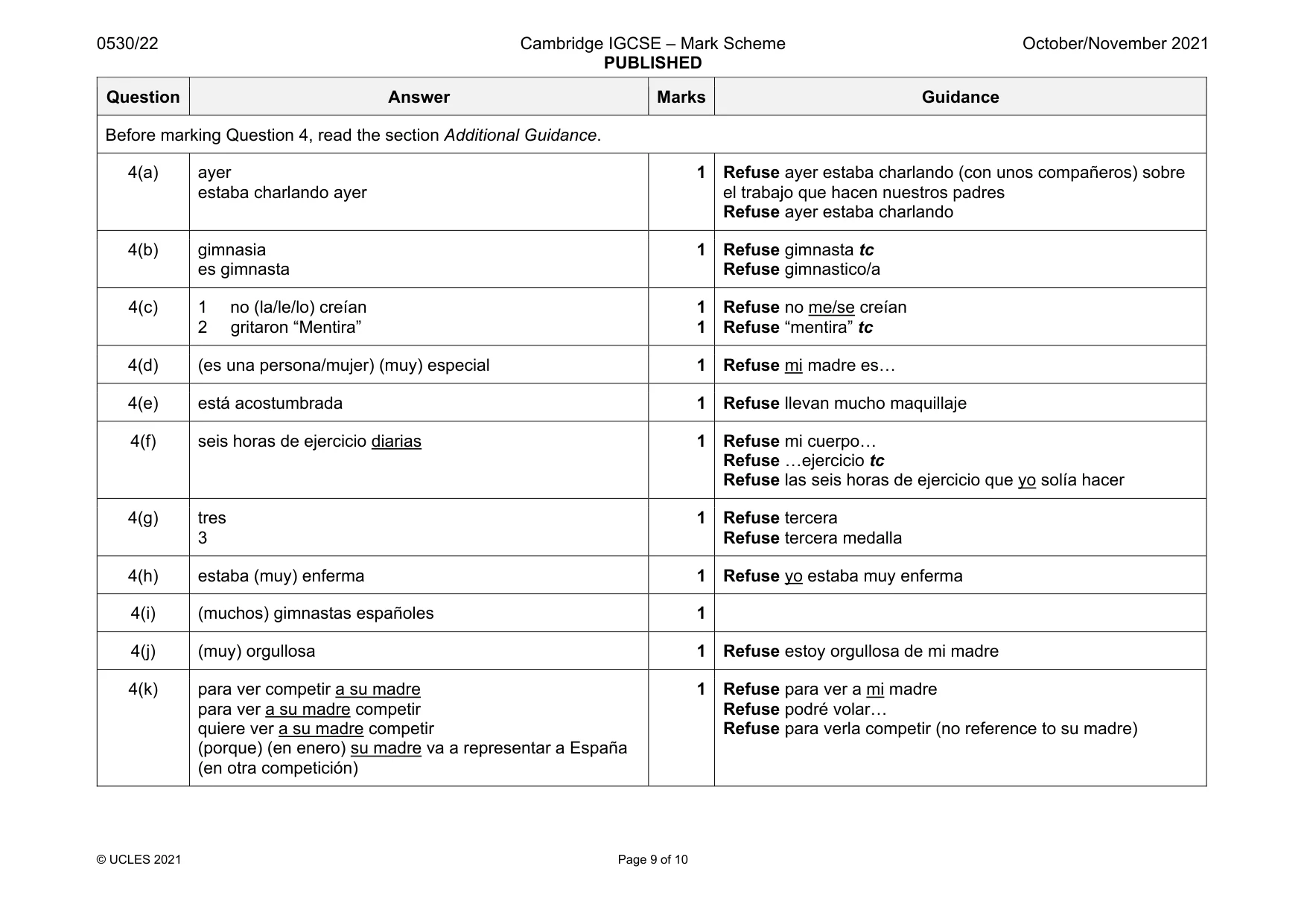
0530/22 Cambridge IGCSE – Mark Scheme PUBLISHED October/November 2021 © UCLES 2021 Page 9 of 10 Question Answer Marks Guidance Before marking Question 4, read the section Additional Guidance. 4(a) ayer estaba charlando ayer 1 Refuse ayer estaba charlando (con unos compañeros) sobre el trabajo que hacen nuestros padres Refuse ayer estaba charlando 4(b) gimnasia es gimnasta 1 Refuse gimnasta tc Refuse gimnastico/a 4(c) 1 no (la/le/lo) creían 2 gritaron “Mentira” 1 1 Refuse no me/se creían Refuse “mentira” tc 4(d) (es una persona/mujer) (muy) especial 1 Refuse mi madre es… 4(e) está acostumbrada 1 Refuse llevan mucho maquillaje 4(f) seis horas de ejercicio diarias 1 Refuse mi cuerpo… Refuse …ejercicio tc Refuse las seis horas de ejercicio que yo solía hacer 4(g) tres 3 1 Refuse tercera Refuse tercera medalla 4(h) estaba (muy) enferma 1 Refuse yo estaba muy enferma 4(i) (muchos) gimnastas españoles 1 4(j) (muy) orgullosa 1 Refuse estoy orgullosa de mi madre 4(k) para ver competir a su madre para ver a su madre competir quiere ver a su madre competir (porque) (en enero) su madre va a representar a España (en otra competición) 1 Refuse para ver a mi madre Refuse podré volar… Refuse para verla competir (no reference to su madre)
Mark scheme, page 10
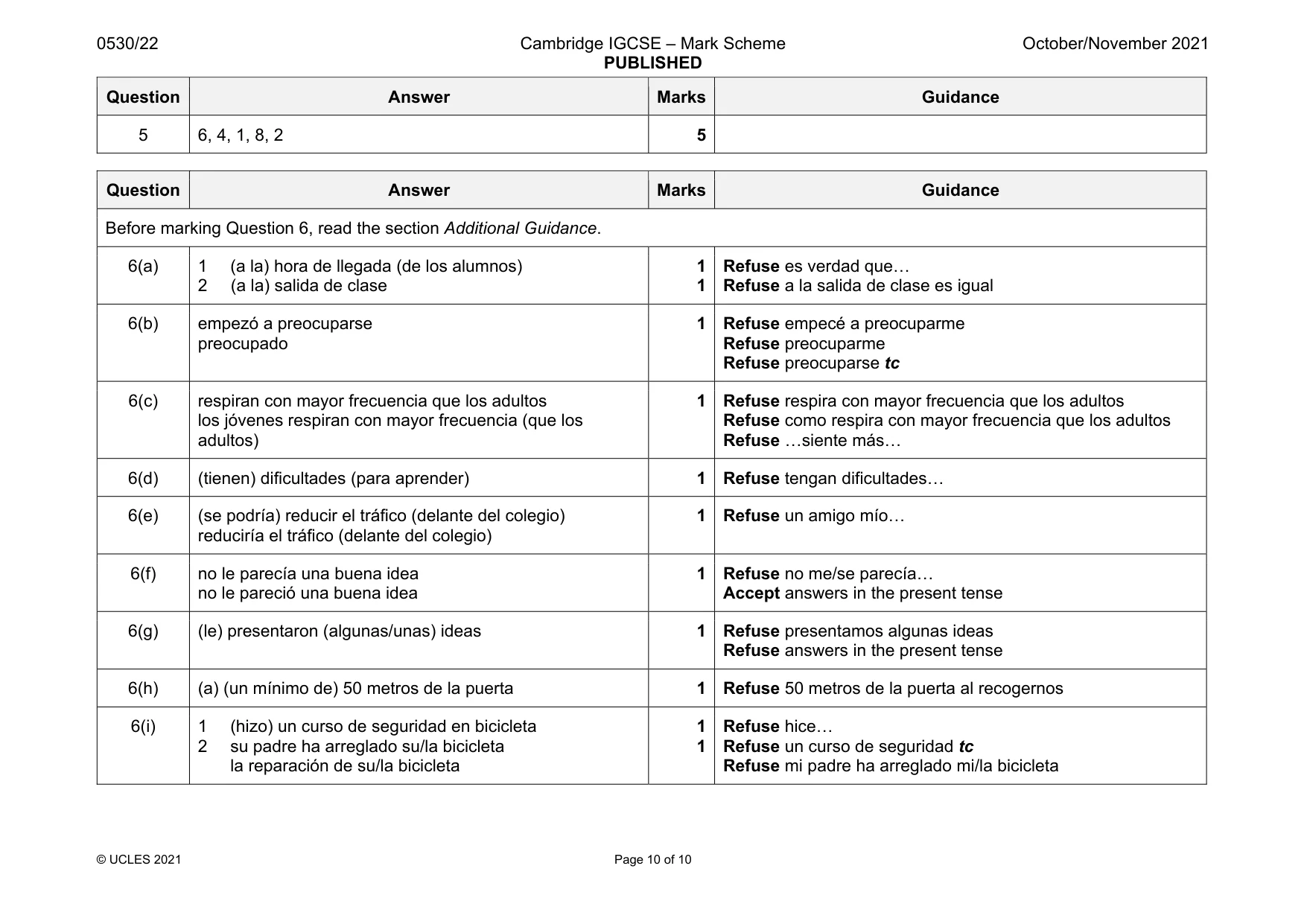
0530/22 Cambridge IGCSE – Mark Scheme PUBLISHED October/November 2021 © UCLES 2021 Page 10 of 10 Question Answer Marks Guidance 5 6, 4, 1, 8, 2 5 Question Answer Marks Guidance Before marking Question 6, read the section Additional Guidance. 6(a) 1 (a la) hora de llegada (de los alumnos) 2 (a la) salida de clase 1 1 Refuse es verdad que… Refuse a la salida de clase es igual 6(b) empezó a preocuparse preocupado 1 Refuse empecé a preocuparme Refuse preocuparme Refuse preocuparse tc 6(c) respiran con mayor frecuencia que los adultos los jóvenes respiran con mayor frecuencia (que los adultos) 1 Refuse respira con mayor frecuencia que los adultos Refuse como respira con mayor frecuencia que los adultos Refuse …siente más… 6(d) (tienen) dificultades (para aprender) 1 Refuse tengan dificultades… 6(e) (se podría) reducir el tráfico (delante del colegio) reduciría el tráfico (delante del colegio) 1 Refuse un amigo mío… 6(f) no le parecía una buena idea no le pareció una buena idea 1 Refuse no me/se parecía… Accept answers in the present tense 6(g) (le) presentaron (algunas/unas) ideas 1 Refuse presentamos algunas ideas Refuse answers in the present tense 6(h) (a) (un mínimo de) 50 metros de la puerta 1 Refuse 50 metros de la puerta al recogernos 6(i) 1 (hizo) un curso de seguridad en bicicleta 2 su padre ha arreglado su/la bicicleta la reparación de su/la bicicleta 1 1 Refuse hice… Refuse un curso de seguridad tc Refuse mi padre ha arreglado mi/la bicicleta
What you needed in this session
Cambridge’s own grade thresholds for 2021 Oct/Nov, Paper 2 · Variant 2. A higher threshold means an easier paper — the bar moves with how the cohort did.