Cambridge IGCSE Spanish - Foreign Language 0530 — 2021 May/June Paper 2 · Variant 3
0530/23/M/J/21 · 45 marks · ≈51 min
The question paper and its mark scheme, free to read here and free to download. This is Cambridge’s own paper, exactly as it was sat.
Question paper12 pages

Mark scheme10 pages
Answers below. Sit the paper first if you are practising.
Paper as text
Question paper, page 1
This document has 12 pages. Any blank pages are indicated. Cambridge IGCSE™ SPANISH 0530/23 Paper 2 Reading May/June 2021 1 hour You must answer on the question paper. No additional materials are needed. INSTRUCTIONS ● Answer all questions. ● Use a black or dark blue pen. ● Write your name, centre number and candidate number in the boxes at the top of the page. ● Write your answer to each question in the space provided. ● Do not use an erasable pen or correction fluid. ● Do not write on any bar codes. ● Dictionaries are not allowed. INFORMATION ● The total mark for this paper is 45. ● The number of marks for each question or part question is shown in brackets [ ]. DC (MB/SW) 207454/3 © UCLES 2021 [Turn over * 7 5 8 7 2 0 2 7 4 1 *
Question paper, page 2
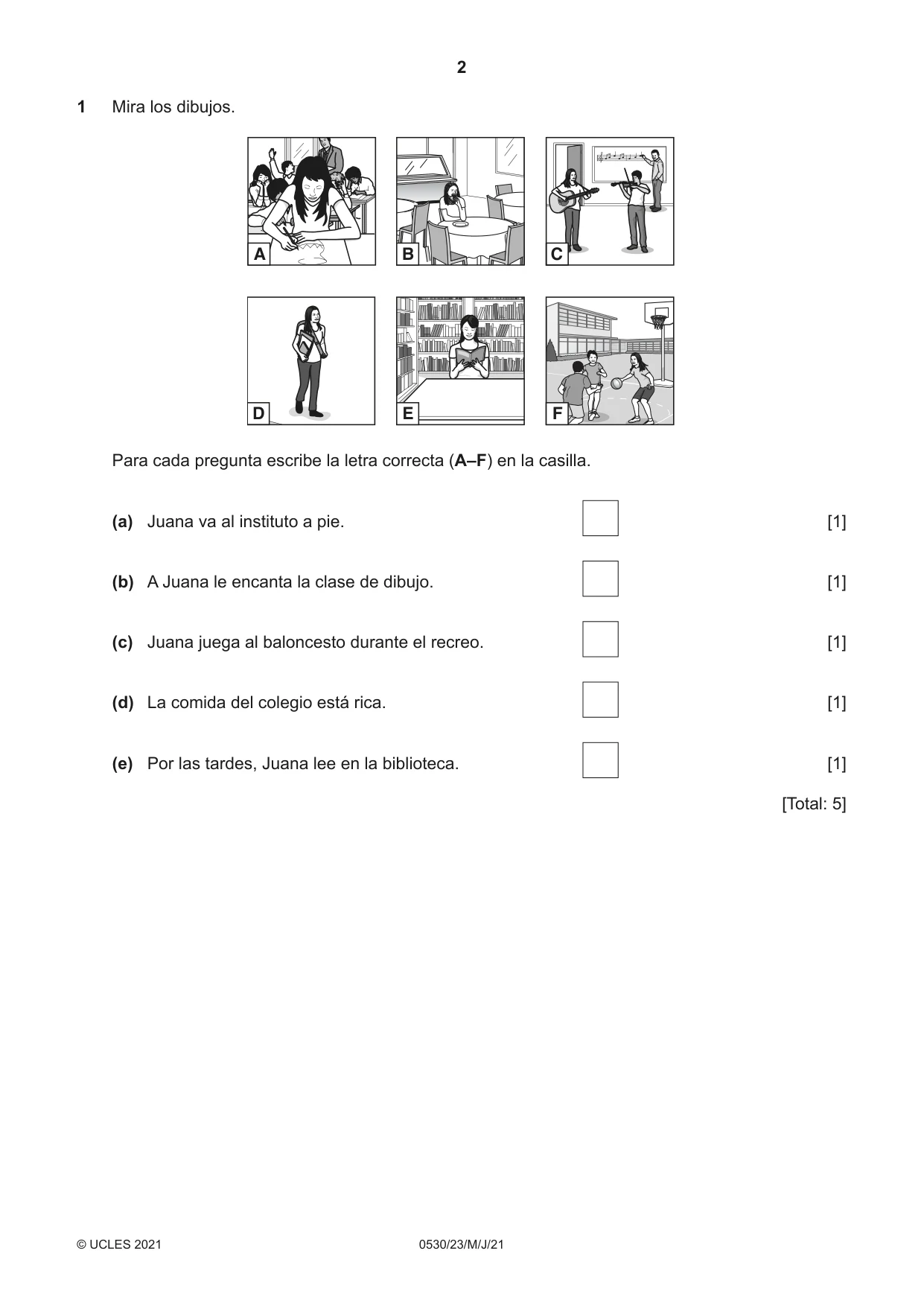
2 0530/23/M/J/21 © UCLES 2021 1 Mira los dibujos. C B A E D F Para cada pregunta escribe la letra correcta (A–F) en la casilla. (a) Juana va al instituto a pie. [1] (b) A Juana le encanta la clase de dibujo. [1] (c) Juana juega al baloncesto durante el recreo. [1] (d) La comida del colegio está rica. [1] (e) Por las tardes, Juana lee en la biblioteca. [1] [Total: 5]
Question paper, page 3
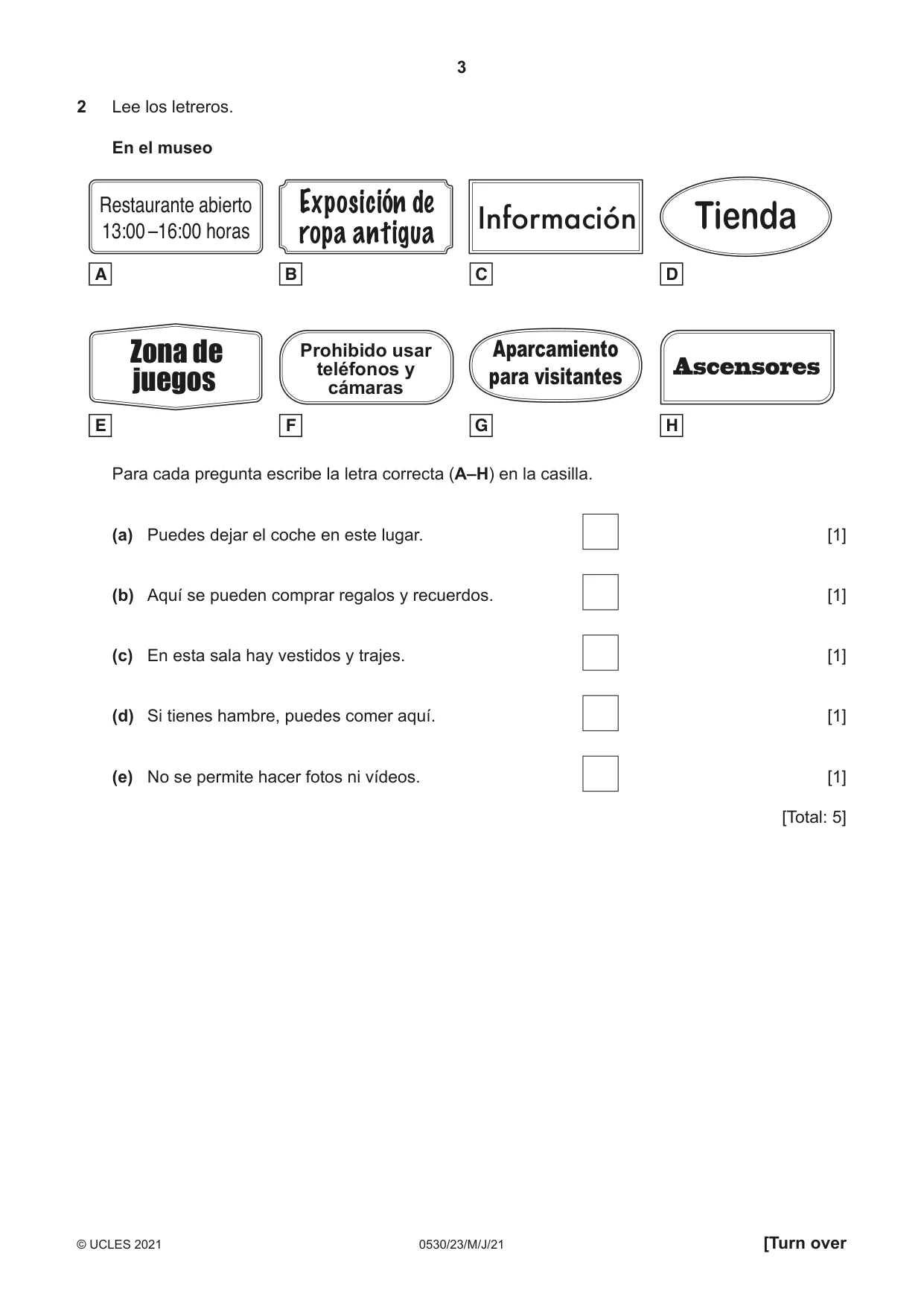
3 0530/23/M/J/21 © UCLES 2021 [Turn over 2 Lee los letreros. En el museo Restaurante abierto 13:00 –16:00 horas Zona de juegos Prohibido usar teléfonos y cámaras Aparcamiento para visitantes Exposición de ropa antigua Información Tienda Ascensores A B C D E F G H Para cada pregunta escribe la letra correcta (A–H) en la casilla. (a) Puedes dejar el coche en este lugar. [1] (b) Aquí se pueden comprar regalos y recuerdos. [1] (c) En esta sala hay vestidos y trajes. [1] (d) Si tienes hambre, puedes comer aquí. [1] (e) No se permite hacer fotos ni vídeos. [1] [Total: 5]
Question paper, page 4
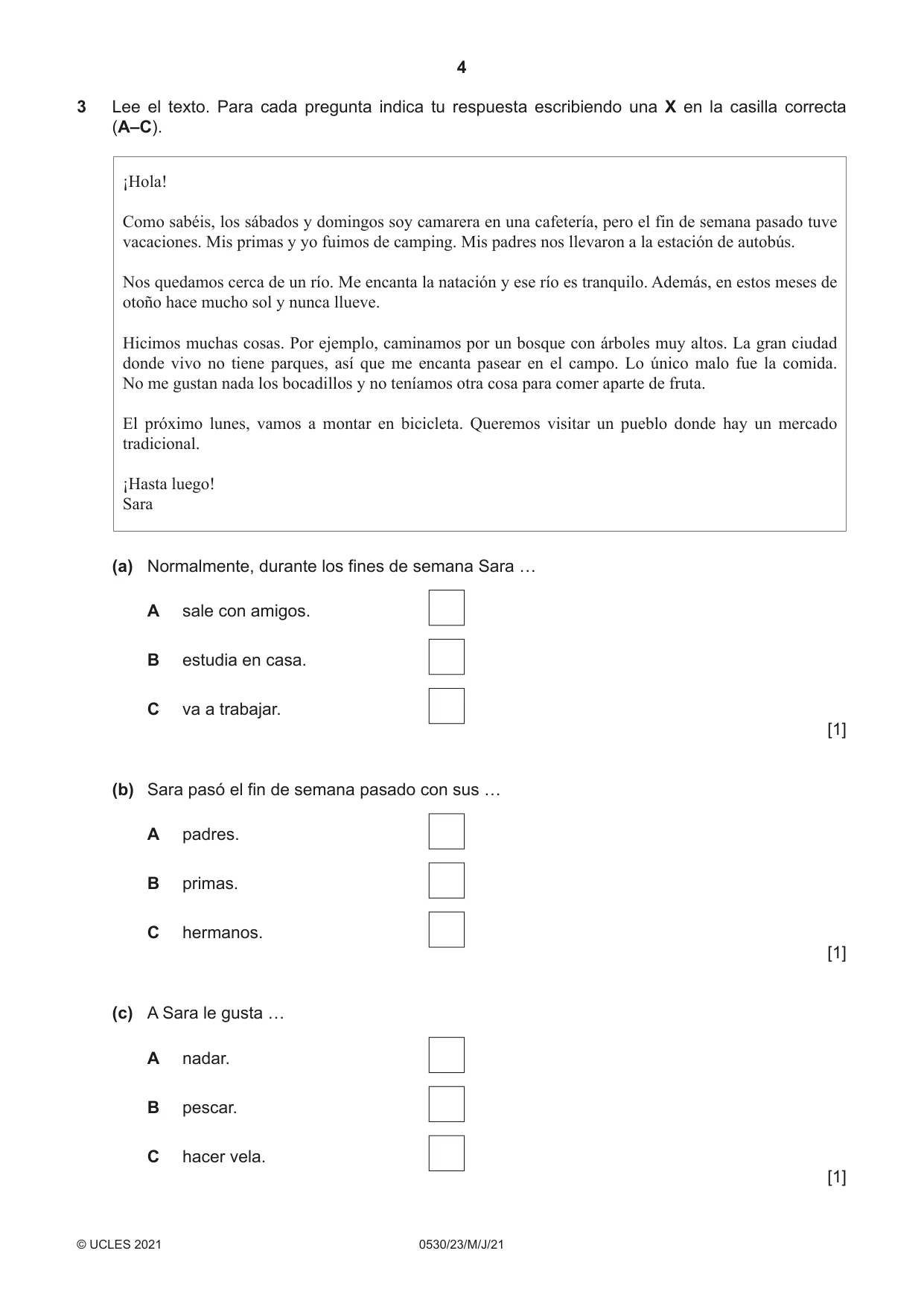
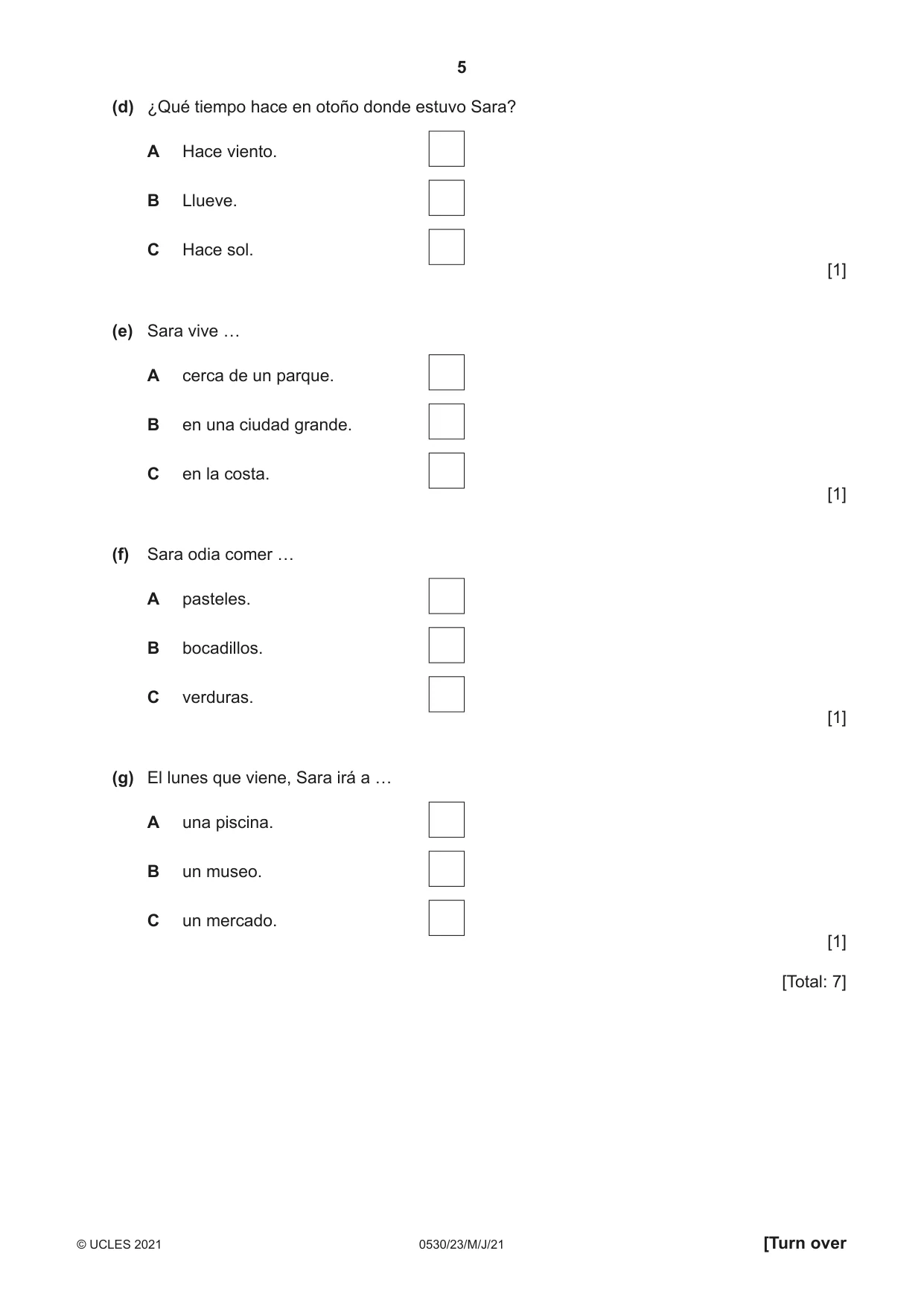
4 0530/23/M/J/21 © UCLES 2021 3 Lee el texto. Para cada pregunta indica tu respuesta escribiendo una X en la casilla correcta (A–C). ¡Hola! Como sabéis, los sábados y domingos soy camarera en una cafetería, pero el fin de semana pasado tuve vacaciones. Mis primas y yo fuimos de camping. Mis padres nos llevaron a la estación de autobús. Nos quedamos cerca de un río. Me encanta la natación y ese río es tranquilo. Además, en estos meses de otoño hace mucho sol y nunca llueve. Hicimos muchas cosas. Por ejemplo, caminamos por un bosque con árboles muy altos. La gran ciudad donde vivo no tiene parques, así que me encanta pasear en el campo. Lo único malo fue la comida. No me gustan nada los bocadillos y no teníamos otra cosa para comer aparte de fruta. El próximo lunes, vamos a montar en bicicleta. Queremos visitar un pueblo donde hay un mercado tradicional. ¡Hasta luego! Sara (a) Normalmente, durante los fines de semana Sara … A sale con amigos. B estudia en casa. C va a trabajar. [1] (b) Sara pasó el fin de semana pasado con sus … A padres. B primas. C hermanos. [1] (c) A Sara le gusta … A nadar. B pescar. C hacer vela. [1]
Question paper, page 5
5 0530/23/M/J/21 © UCLES 2021 [Turn over (d) ¿Qué tiempo hace en otoño donde estuvo Sara? A Hace viento. B Llueve. C Hace sol. [1] (e) Sara vive … A cerca de un parque. B en una ciudad grande. C en la costa. [1] (f) Sara odia comer … A pasteles. B bocadillos. C verduras. [1] (g) El lunes que viene, Sara irá a … A una piscina. B un museo. C un mercado. [1] [Total: 7]
Question paper, page 6
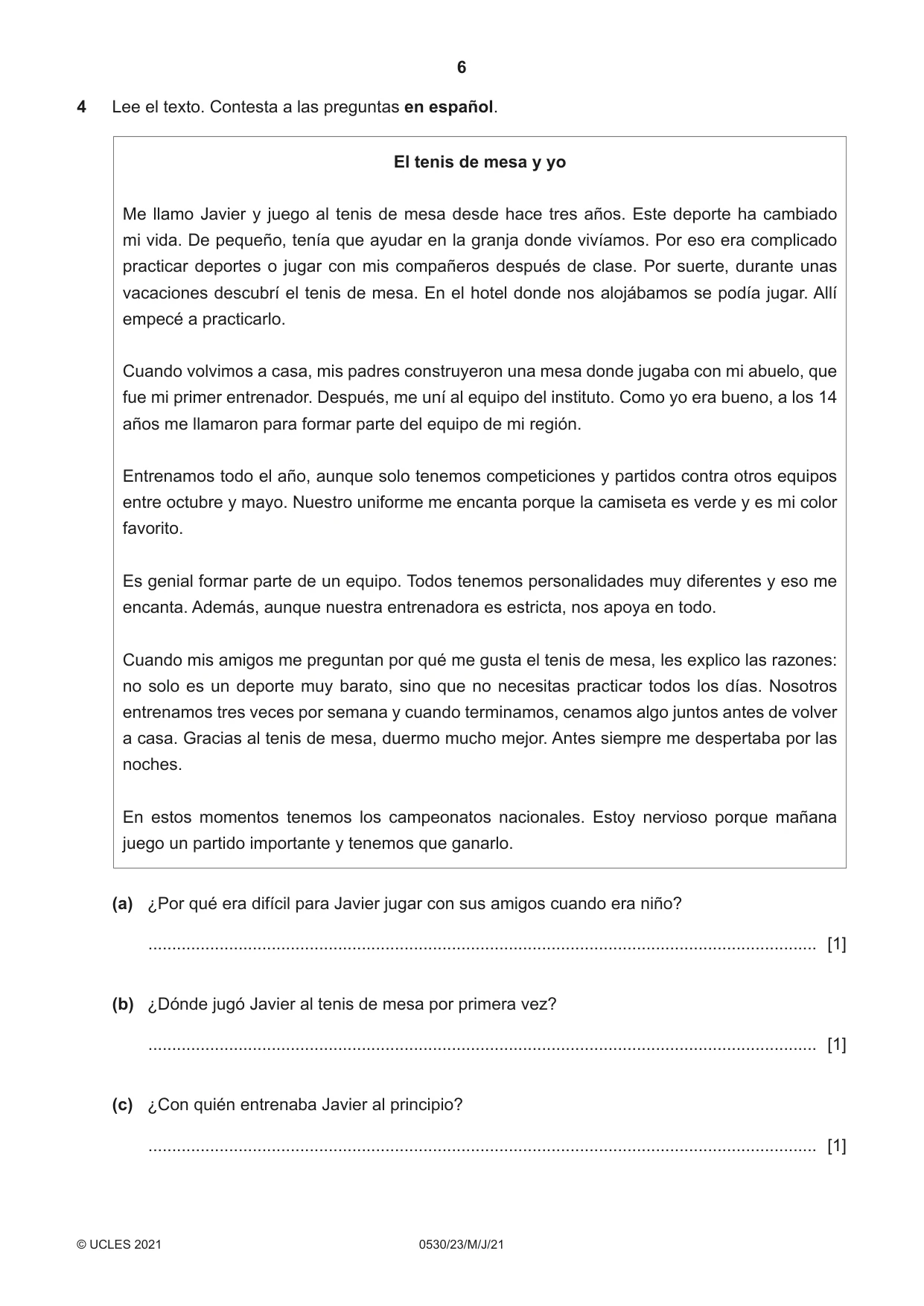
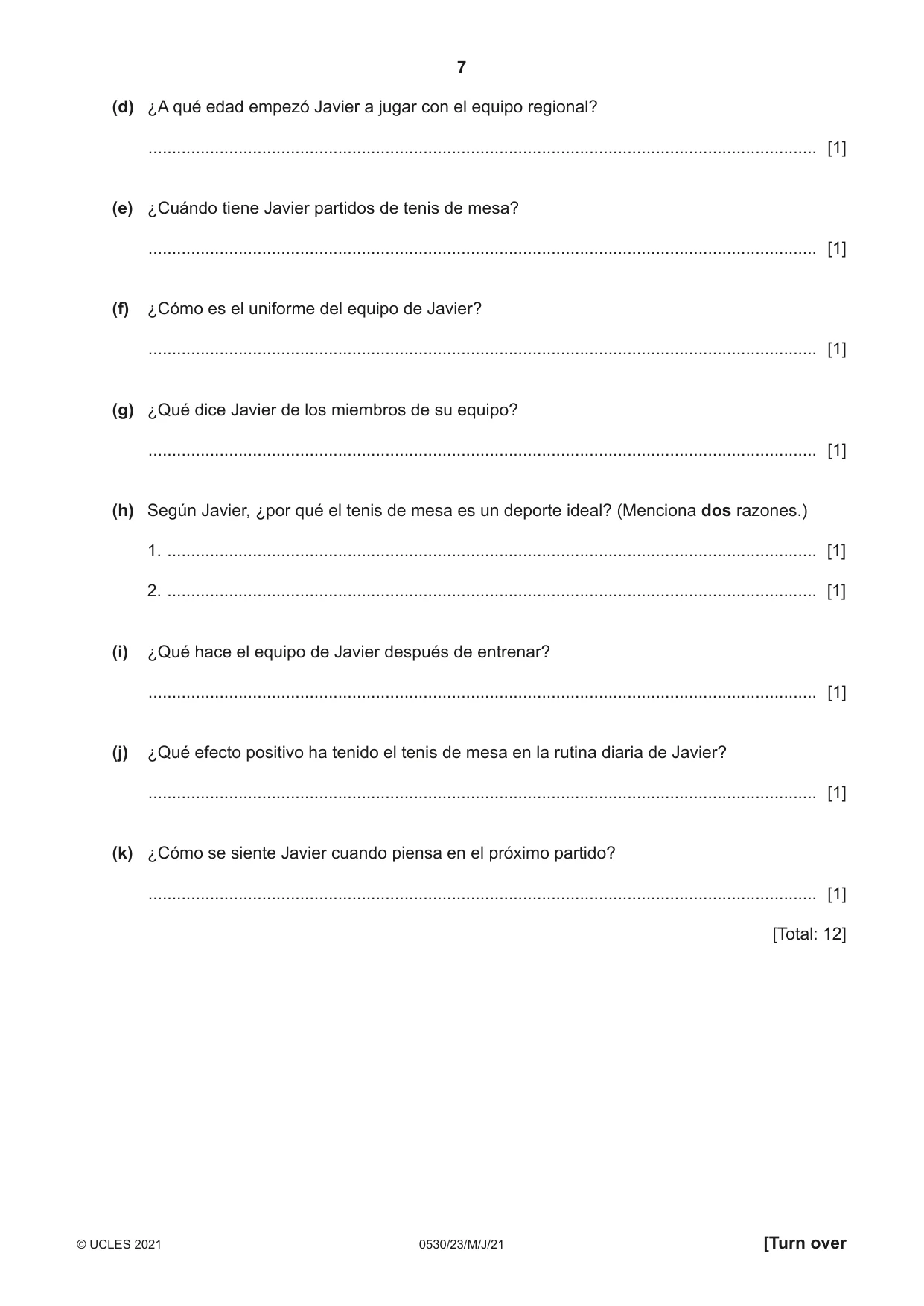
6 0530/23/M/J/21 © UCLES 2021 4 Lee el texto. Contesta a las preguntas en español. El tenis de mesa y yo Me llamo Javier y juego al tenis de mesa desde hace tres años. Este deporte ha cambiado mi vida. De pequeño, tenía que ayudar en la granja donde vivíamos. Por eso era complicado practicar deportes o jugar con mis compañeros después de clase. Por suerte, durante unas vacaciones descubrí el tenis de mesa. En el hotel donde nos alojábamos se podía jugar. Allí empecé a practicarlo. Cuando volvimos a casa, mis padres construyeron una mesa donde jugaba con mi abuelo, que fue mi primer entrenador. Después, me uní al equipo del instituto. Como yo era bueno, a los 14 años me llamaron para formar parte del equipo de mi región. Entrenamos todo el año, aunque solo tenemos competiciones y partidos contra otros equipos entre octubre y mayo. Nuestro uniforme me encanta porque la camiseta es verde y es mi color favorito. Es genial formar parte de un equipo. Todos tenemos personalidades muy diferentes y eso me encanta. Además, aunque nuestra entrenadora es estricta, nos apoya en todo. Cuando mis amigos me preguntan por qué me gusta el tenis de mesa, les explico las razones: no solo es un deporte muy barato, sino que no necesitas practicar todos los días. Nosotros entrenamos tres veces por semana y cuando terminamos, cenamos algo juntos antes de volver a casa. Gracias al tenis de mesa, duermo mucho mejor. Antes siempre me despertaba por las noches. En estos momentos tenemos los campeonatos nacionales. Estoy nervioso porque mañana juego un partido importante y tenemos que ganarlo. (a) ¿Por qué era difícil para Javier jugar con sus amigos cuando era niño? … [1] (b) ¿Dónde jugó Javier al tenis de mesa por primera vez? … [1] (c) ¿Con quién entrenaba Javier al principio? … [1]
Question paper, page 7
7 0530/23/M/J/21 © UCLES 2021 [Turn over (d) ¿A qué edad empezó Javier a jugar con el equipo regional? … [1] (e) ¿Cuándo tiene Javier partidos de tenis de mesa? … [1] (f) ¿Cómo es el uniforme del equipo de Javier? … [1] (g) ¿Qué dice Javier de los miembros de su equipo? … [1] (h) Según Javier, ¿por qué el tenis de mesa es un deporte ideal? (Menciona dos razones.) 1. … [1] 2. … [1] (i) ¿Qué hace el equipo de Javier después de entrenar? … [1] (j) ¿Qué efecto positivo ha tenido el tenis de mesa en la rutina diaria de Javier? … [1] (k) ¿Cómo se siente Javier cuando piensa en el próximo partido? … [1] [Total: 12]
Question paper, page 8
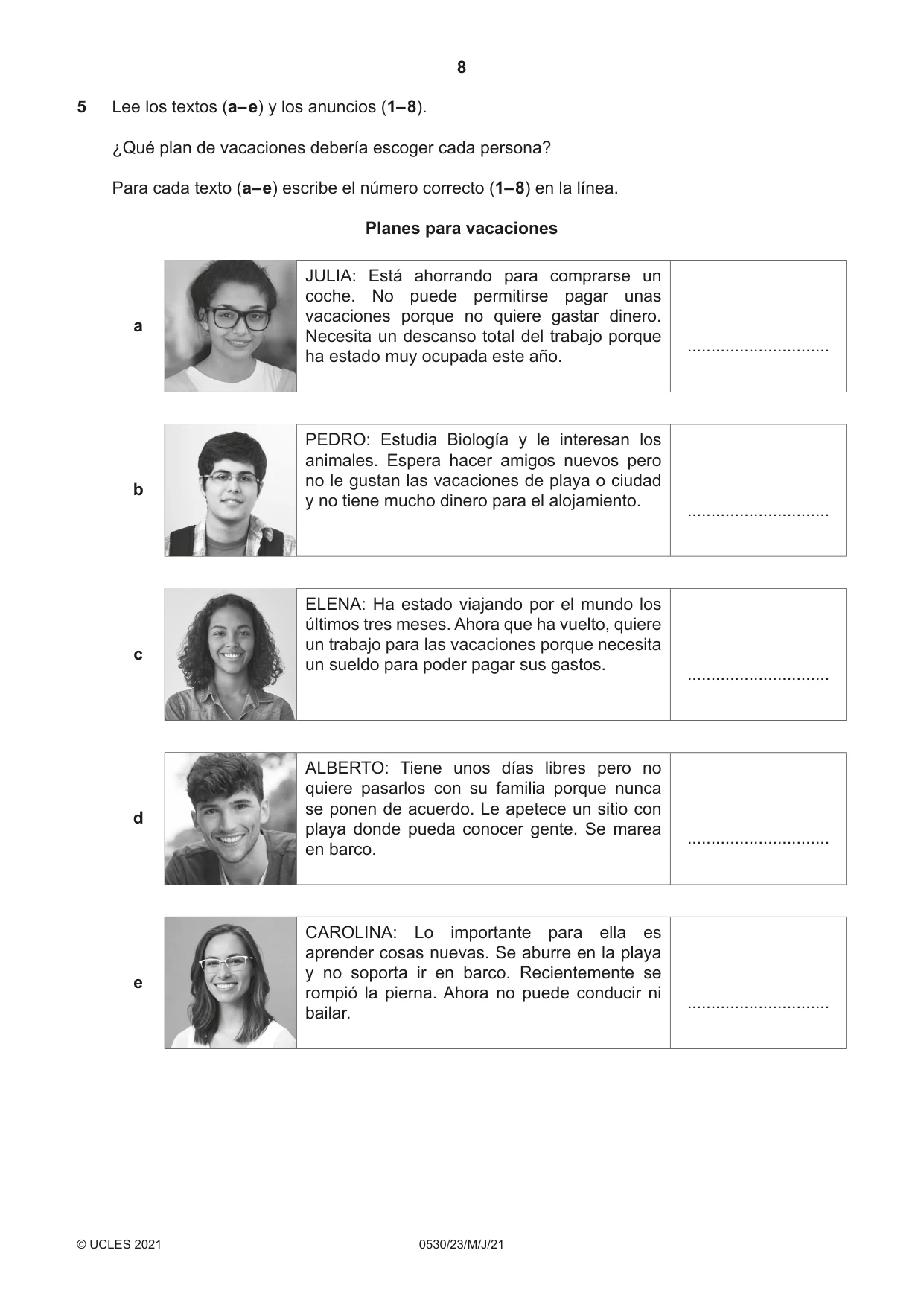
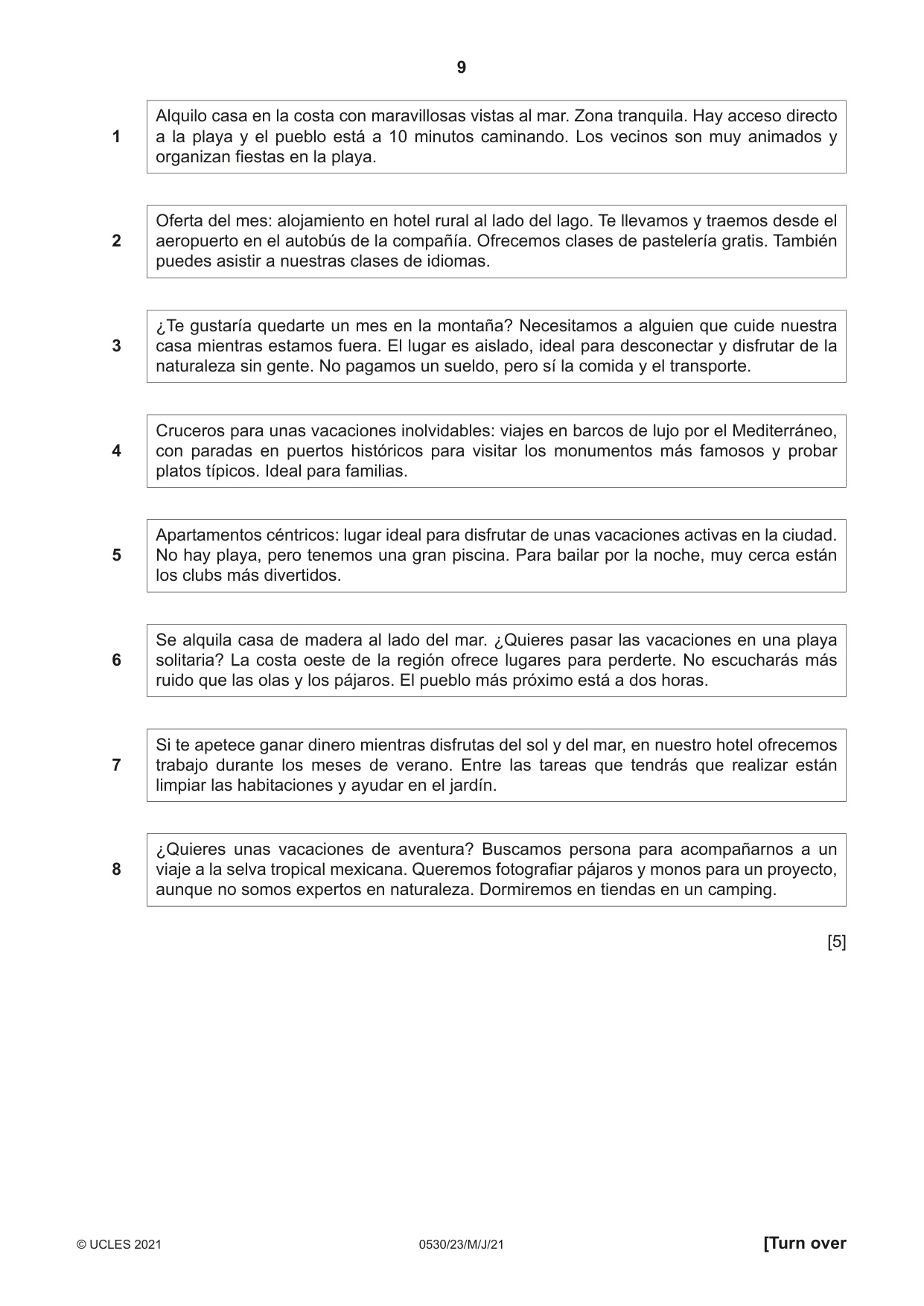
8 0530/23/M/J/21 © UCLES 2021 5 Lee los textos (a– e) y los anuncios (1– 8). ¿Qué plan de vacaciones debería escoger cada persona? Para cada texto (a– e) escribe el número correcto (1– 8) en la línea. Planes para vacaciones a JULIA: Está ahorrando para comprarse un coche. No puede permitirse pagar unas vacaciones porque no quiere gastar dinero. Necesita un descanso total del trabajo porque ha estado muy ocupada este año. … b PEDRO: Estudia Biología y le interesan los animales. Espera hacer amigos nuevos pero no le gustan las vacaciones de playa o ciudad y no tiene mucho dinero para el alojamiento. … c ELENA: Ha estado viajando por el mundo los últimos tres meses. Ahora que ha vuelto, quiere un trabajo para las vacaciones porque necesita un sueldo para poder pagar sus gastos. … d ALBERTO: Tiene unos días libres pero no quiere pasarlos con su familia porque nunca se ponen de acuerdo. Le apetece un sitio con playa donde pueda conocer gente. Se marea en barco. … e CAROLINA: Lo importante para ella es aprender cosas nuevas. Se aburre en la playa y no soporta ir en barco. Recientemente se rompió la pierna. Ahora no puede conducir ni bailar. …
Question paper, page 9
9 0530/23/M/J/21 © UCLES 2021 [Turn over 1 Alquilo casa en la costa con maravillosas vistas al mar. Zona tranquila. Hay acceso directo a la playa y el pueblo está a 10 minutos caminando. Los vecinos son muy animados y organizan fiestas en la playa. 2 Oferta del mes: alojamiento en hotel rural al lado del lago. Te llevamos y traemos desde el aeropuerto en el autobús de la compañía. Ofrecemos clases de pastelería gratis. También puedes asistir a nuestras clases de idiomas. 3 ¿Te gustaría quedarte un mes en la montaña? Necesitamos a alguien que cuide nuestra casa mientras estamos fuera. El lugar es aislado, ideal para desconectar y disfrutar de la naturaleza sin gente. No pagamos un sueldo, pero sí la comida y el transporte. 4 Cruceros para unas vacaciones inolvidables: viajes en barcos de lujo por el Mediterráneo, con paradas en puertos históricos para visitar los monumentos más famosos y probar platos típicos. Ideal para familias. 5 Apartamentos céntricos: lugar ideal para disfrutar de unas vacaciones activas en la ciudad. No hay playa, pero tenemos una gran piscina. Para bailar por la noche, muy cerca están los clubs más divertidos. 6 Se alquila casa de madera al lado del mar. ¿Quieres pasar las vacaciones en una playa solitaria? La costa oeste de la región ofrece lugares para perderte. No escucharás más ruido que las olas y los pájaros. El pueblo más próximo está a dos horas. 7 Si te apetece ganar dinero mientras disfrutas del sol y del mar, en nuestro hotel ofrecemos trabajo durante los meses de verano. Entre las tareas que tendrás que realizar están limpiar las habitaciones y ayudar en el jardín. 8 ¿Quieres unas vacaciones de aventura? Buscamos persona para acompañarnos a un viaje a la selva tropical mexicana. Queremos fotografiar pájaros y monos para un proyecto, aunque no somos expertos en naturaleza. Dormiremos en tiendas en un camping. [5]
Question paper, page 10
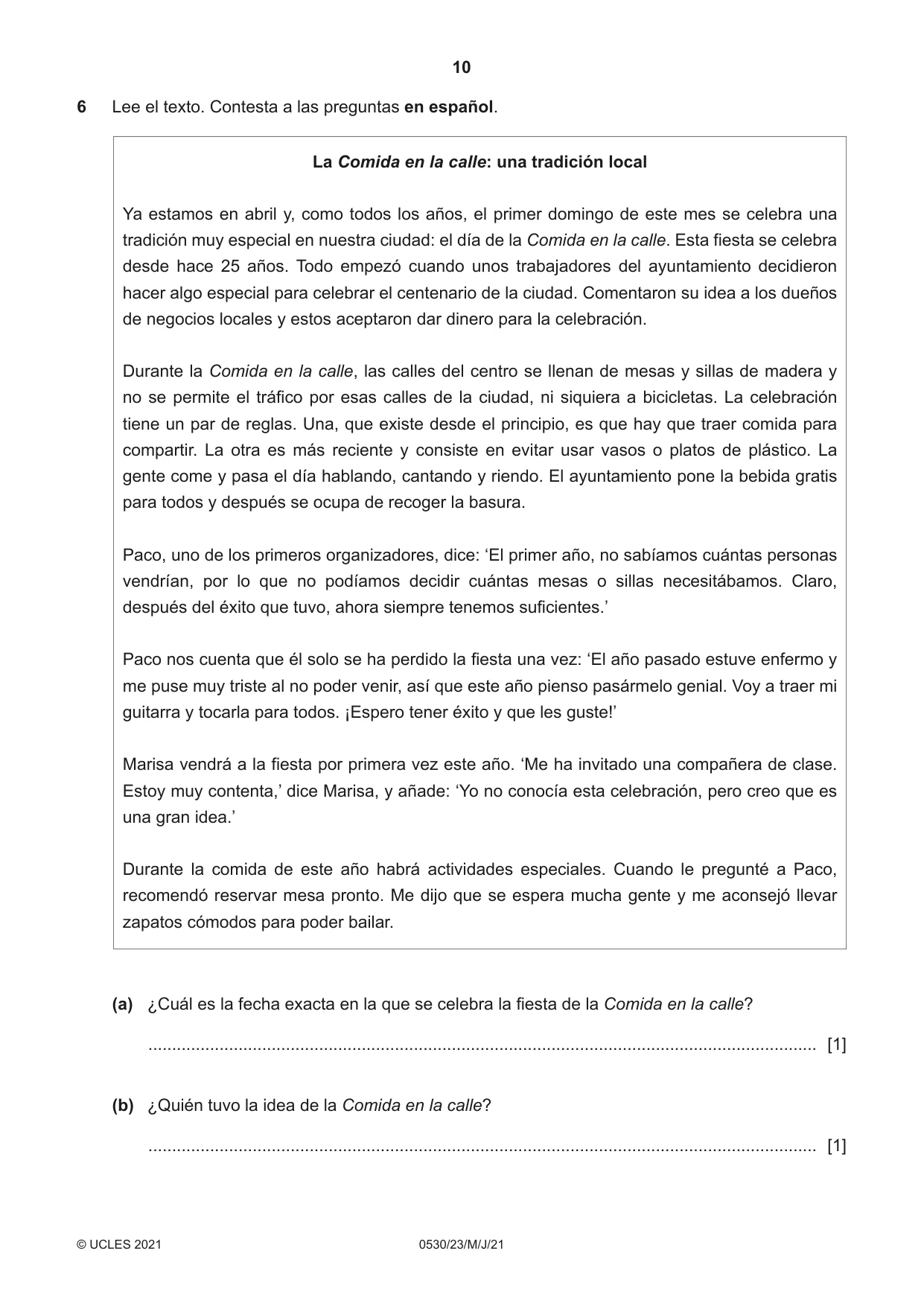
10 0530/23/M/J/21 © UCLES 2021 6 Lee el texto. Contesta a las preguntas en español. La Comida en la calle: una tradición local Ya estamos en abril y, como todos los años, el primer domingo de este mes se celebra una tradición muy especial en nuestra ciudad: el día de la Comida en la calle. Esta fiesta se celebra desde hace 25 años. Todo empezó cuando unos trabajadores del ayuntamiento decidieron hacer algo especial para celebrar el centenario de la ciudad. Comentaron su idea a los dueños de negocios locales y estos aceptaron dar dinero para la celebración. Durante la Comida en la calle, las calles del centro se llenan de mesas y sillas de madera y no se permite el tráfico por esas calles de la ciudad, ni siquiera a bicicletas. La celebración tiene un par de reglas. Una, que existe desde el principio, es que hay que traer comida para compartir. La otra es más reciente y consiste en evitar usar vasos o platos de plástico. La gente come y pasa el día hablando, cantando y riendo. El ayuntamiento pone la bebida gratis para todos y después se ocupa de recoger la basura. Paco, uno de los primeros organizadores, dice: ‘El primer año, no sabíamos cuántas personas vendrían, por lo que no podíamos decidir cuántas mesas o sillas necesitábamos. Claro, después del éxito que tuvo, ahora siempre tenemos suficientes.’ Paco nos cuenta que él solo se ha perdido la fiesta una vez: ‘El año pasado estuve enfermo y me puse muy triste al no poder venir, así que este año pienso pasármelo genial. Voy a traer mi guitarra y tocarla para todos. ¡Espero tener éxito y que les guste!’ Marisa vendrá a la fiesta por primera vez este año. ‘Me ha invitado una compañera de clase. Estoy muy contenta,’ dice Marisa, y añade: ‘Yo no conocía esta celebración, pero creo que es una gran idea.’ Durante la comida de este año habrá actividades especiales. Cuando le pregunté a Paco, recomendó reservar mesa pronto. Me dijo que se espera mucha gente y me aconsejó llevar zapatos cómodos para poder bailar. (a) ¿Cuál es la fecha exacta en la que se celebra la fiesta de la Comida en la calle? … [1] (b) ¿Quién tuvo la idea de la Comida en la calle? … [1]
Question paper, page 11
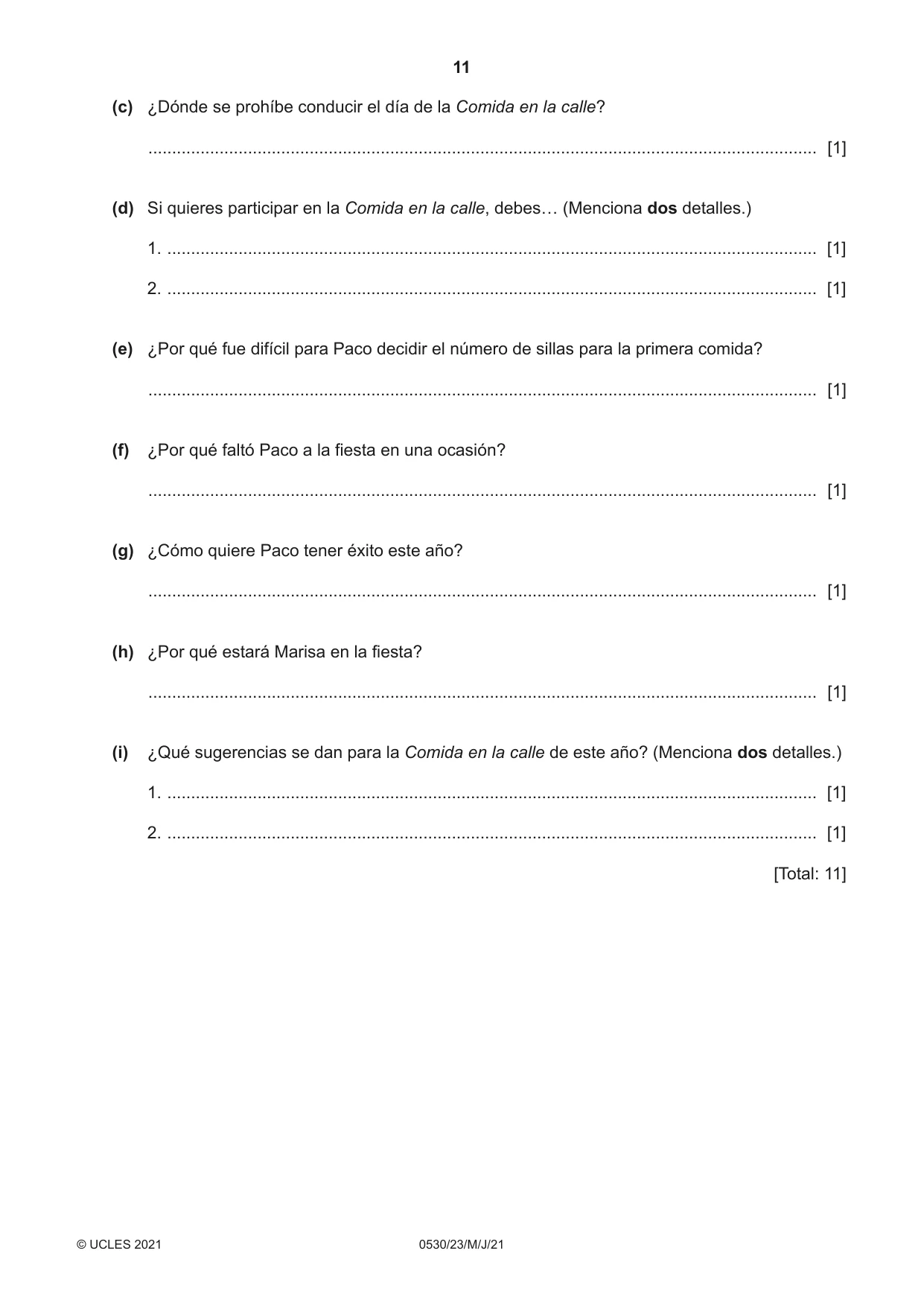
11 0530/23/M/J/21 © UCLES 2021 (c) ¿Dónde se prohíbe conducir el día de la Comida en la calle? … [1] (d) Si quieres participar en la Comida en la calle, debes… (Menciona dos detalles.) 1. … [1] 2. … [1] (e) ¿Por qué fue difícil para Paco decidir el número de sillas para la primera comida? … [1] (f) ¿Por qué faltó Paco a la fiesta en una ocasión? … [1] (g) ¿Cómo quiere Paco tener éxito este año? … [1] (h) ¿Por qué estará Marisa en la fiesta? … [1] (i) ¿Qué sugerencias se dan para la Comida en la calle de este año? (Menciona dos detalles.) 1. … [1] 2. … [1] [Total: 11]
Question paper, page 12
12 0530/23/M/J/21 © UCLES 2021 Permission to reproduce items where third-party owned material protected by copyright is included has been sought and cleared where possible. Every reasonable effort has been made by the publisher (UCLES) to trace copyright holders, but if any items requiring clearance have unwittingly been included, the publisher will be pleased to make amends at the earliest possible opportunity. To avoid the issue of disclosure of answer-related information to candidates, all copyright acknowledgements are reproduced online in the Cambridge Assessment International Education Copyright Acknowledgements Booklet. This is produced for each series of examinations and is freely available to download at www.cambridgeinternational.org after the live examination series. Cambridge Assessment International Education is part of the Cambridge Assessment Group. Cambridge Assessment is the brand name of the University of Cambridge Local Examinations Syndicate (UCLES), which itself is a department of the University of Cambridge. BLANK PAGE
Mark scheme, page 1
This document consists of 10 printed pages. © UCLES 2021 [Turn over Cambridge IGCSE™ SPANISH 0530/23 Paper 2 Reading May/June 2021 MARK SCHEME Maximum Mark: 45 Published This mark scheme is published as an aid to teachers and candidates, to indicate the requirements of the examination. It shows the basis on which Examiners were instructed to award marks. It does not indicate the details of the discussions that took place at an Examiners’ meeting before marking began, which would have considered the acceptability of alternative answers. Mark schemes should be read in conjunction with the question paper and the Principal Examiner Report for Teachers. Cambridge International will not enter into discussions about these mark schemes. Cambridge International is publishing the mark schemes for the May/June 2021 series for most Cambridge IGCSE™, Cambridge International A and AS Level components and some Cambridge O Level components.
Mark scheme, page 2
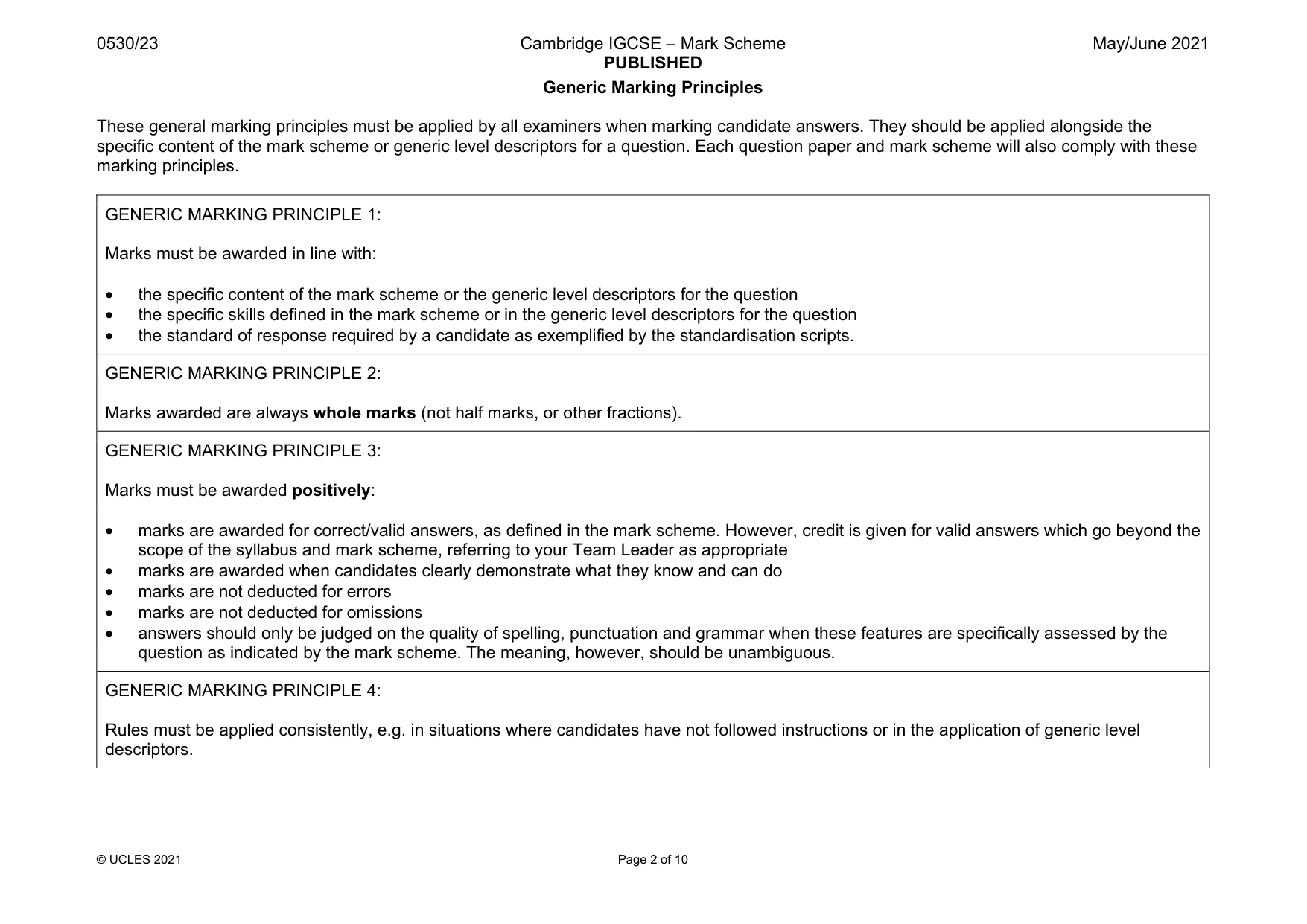
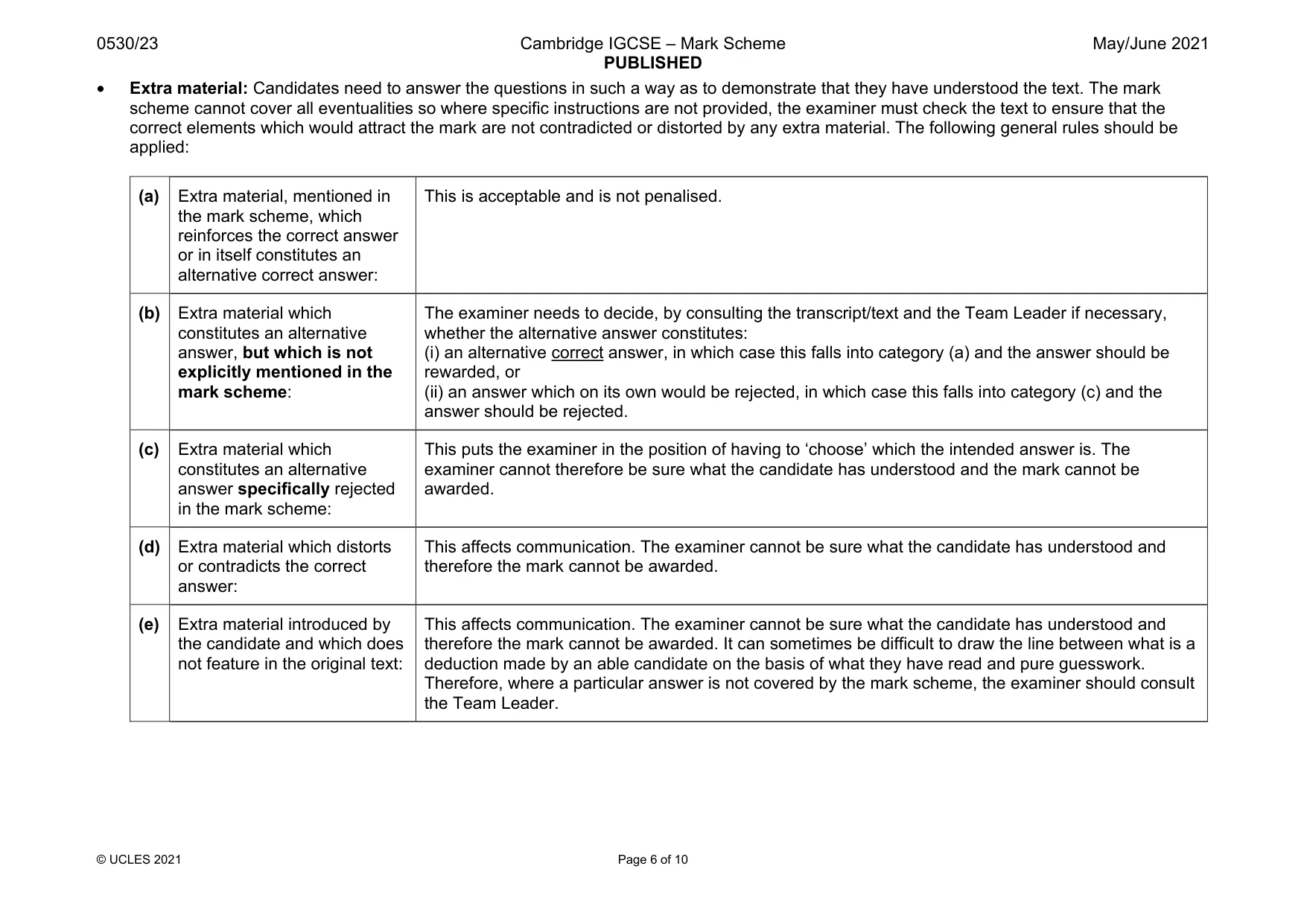
0530/23 Cambridge IGCSE – Mark Scheme PUBLISHED May/June 2021 © UCLES 2021 Page 2 of 10 Generic Marking Principles These general marking principles must be applied by all examiners when marking candidate answers. They should be applied alongside the specific content of the mark scheme or generic level descriptors for a question. Each question paper and mark scheme will also comply with these marking principles. GENERIC MARKING PRINCIPLE 1: Marks must be awarded in line with: • the specific content of the mark scheme or the generic level descriptors for the question • the specific skills defined in the mark scheme or in the generic level descriptors for the question • the standard of response required by a candidate as exemplified by the standardisation scripts. GENERIC MARKING PRINCIPLE 2: Marks awarded are always whole marks (not half marks, or other fractions). GENERIC MARKING PRINCIPLE 3: Marks must be awarded positively: • marks are awarded for correct/valid answers, as defined in the mark scheme. However, credit is given for valid answers which go beyond the scope of the syllabus and mark scheme, referring to your Team Leader as appropriate • marks are awarded when candidates clearly demonstrate what they know and can do • marks are not deducted for errors • marks are not deducted for omissions • answers should only be judged on the quality of spelling, punctuation and grammar when these features are specifically assessed by the question as indicated by the mark scheme. The meaning, however, should be unambiguous. GENERIC MARKING PRINCIPLE 4: Rules must be applied consistently, e.g. in situations where candidates have not followed instructions or in the application of generic level descriptors.
Mark scheme, page 3
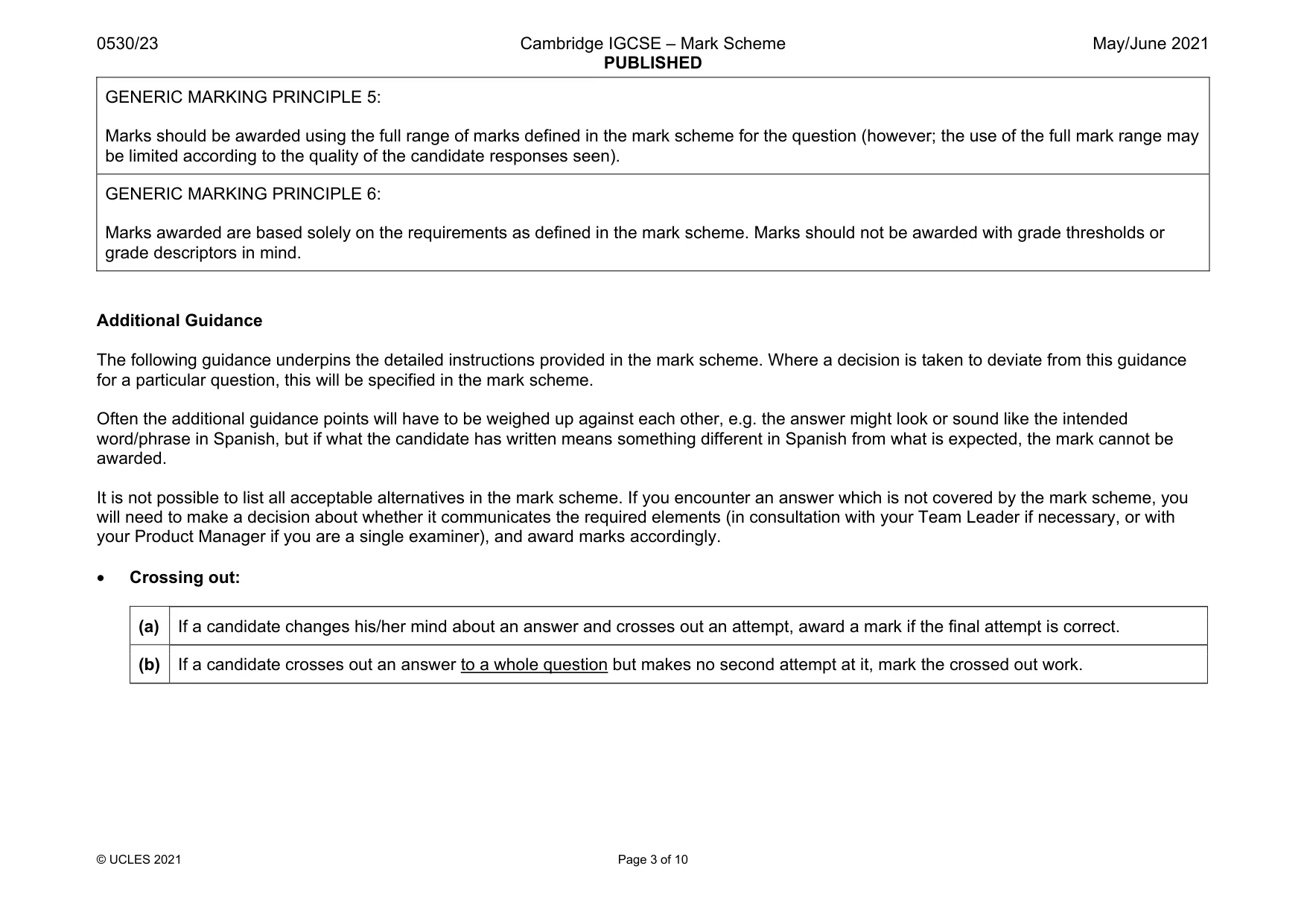
0530/23 Cambridge IGCSE – Mark Scheme PUBLISHED May/June 2021 © UCLES 2021 Page 3 of 10 GENERIC MARKING PRINCIPLE 5: Marks should be awarded using the full range of marks defined in the mark scheme for the question (however; the use of the full mark range may be limited according to the quality of the candidate responses seen). GENERIC MARKING PRINCIPLE 6: Marks awarded are based solely on the requirements as defined in the mark scheme. Marks should not be awarded with grade thresholds or grade descriptors in mind. Additional Guidance The following guidance underpins the detailed instructions provided in the mark scheme. Where a decision is taken to deviate from this guidance for a particular question, this will be specified in the mark scheme. Often the additional guidance points will have to be weighed up against each other, e.g. the answer might look or sound like the intended word/phrase in Spanish, but if what the candidate has written means something different in Spanish from what is expected, the mark cannot be awarded. It is not possible to list all acceptable alternatives in the mark scheme. If you encounter an answer which is not covered by the mark scheme, you will need to make a decision about whether it communicates the required elements (in consultation with your Team Leader if necessary, or with your Product Manager if you are a single examiner), and award marks accordingly. • Crossing out: (a) If a candidate changes his/her mind about an answer and crosses out an attempt, award a mark if the final attempt is correct. (b) If a candidate crosses out an answer to a whole question but makes no second attempt at it, mark the crossed out work.
Mark scheme, page 4
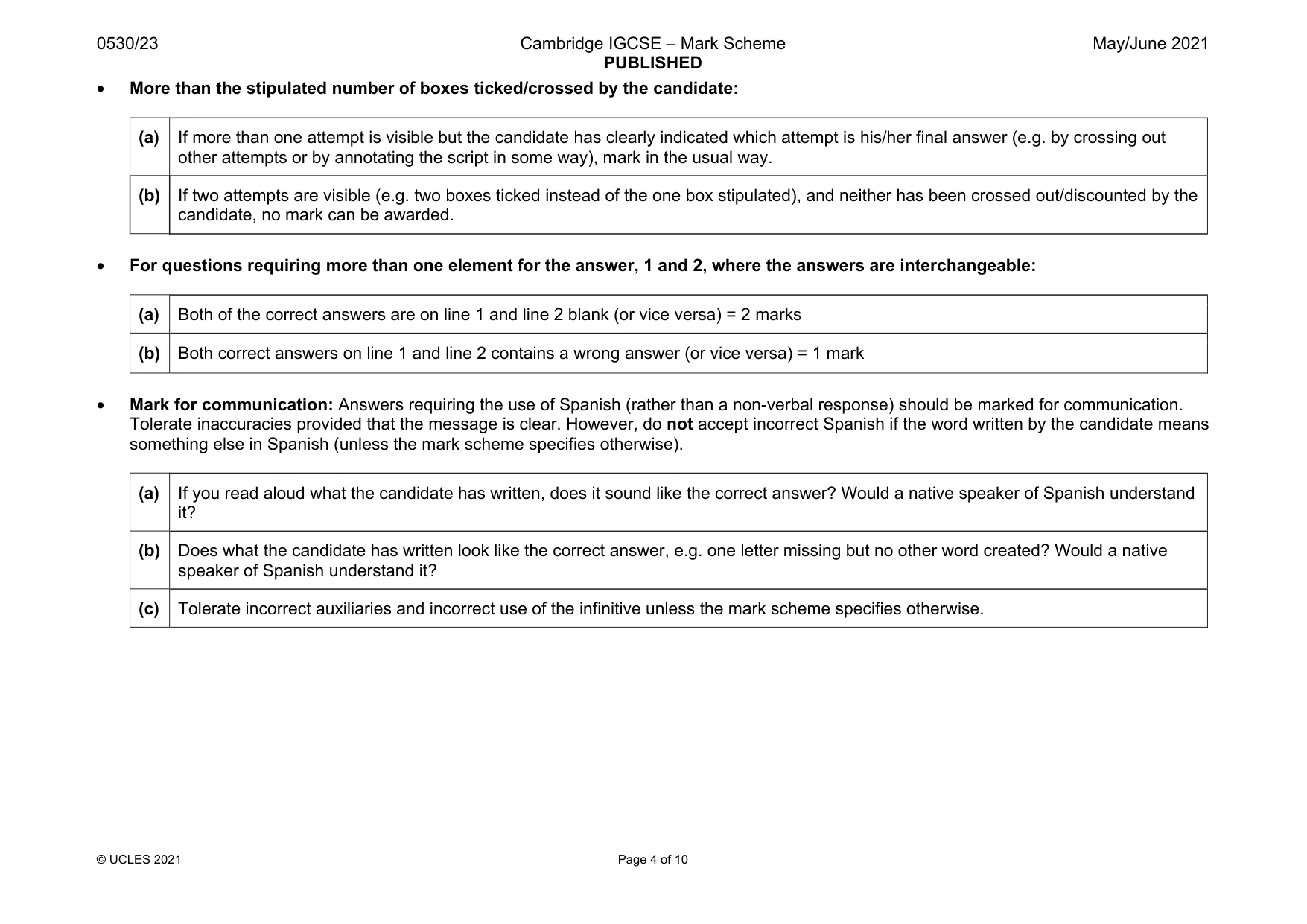
0530/23 Cambridge IGCSE – Mark Scheme PUBLISHED May/June 2021 © UCLES 2021 Page 4 of 10 • More than the stipulated number of boxes ticked/crossed by the candidate: (a) If more than one attempt is visible but the candidate has clearly indicated which attempt is his/her final answer (e.g. by crossing out other attempts or by annotating the script in some way), mark in the usual way. (b) If two attempts are visible (e.g. two boxes ticked instead of the one box stipulated), and neither has been crossed out/discounted by the candidate, no mark can be awarded. • For questions requiring more than one element for the answer, 1 and 2, where the answers are interchangeable: (a) Both of the correct answers are on line 1 and line 2 blank (or vice versa) = 2 marks (b) Both correct answers on line 1 and line 2 contains a wrong answer (or vice versa) = 1 mark • Mark for communication: Answers requiring the use of Spanish (rather than a non-verbal response) should be marked for communication. Tolerate inaccuracies provided that the message is clear. However, do not accept incorrect Spanish if the word written by the candidate means something else in Spanish (unless the mark scheme specifies otherwise). (a) If you read aloud what the candidate has written, does it sound like the correct answer? Would a native speaker of Spanish understand it? (b) Does what the candidate has written look like the correct answer, e.g. one letter missing but no other word created? Would a native speaker of Spanish understand it? (c) Tolerate incorrect auxiliaries and incorrect use of the infinitive unless the mark scheme specifies otherwise.
Mark scheme, page 5
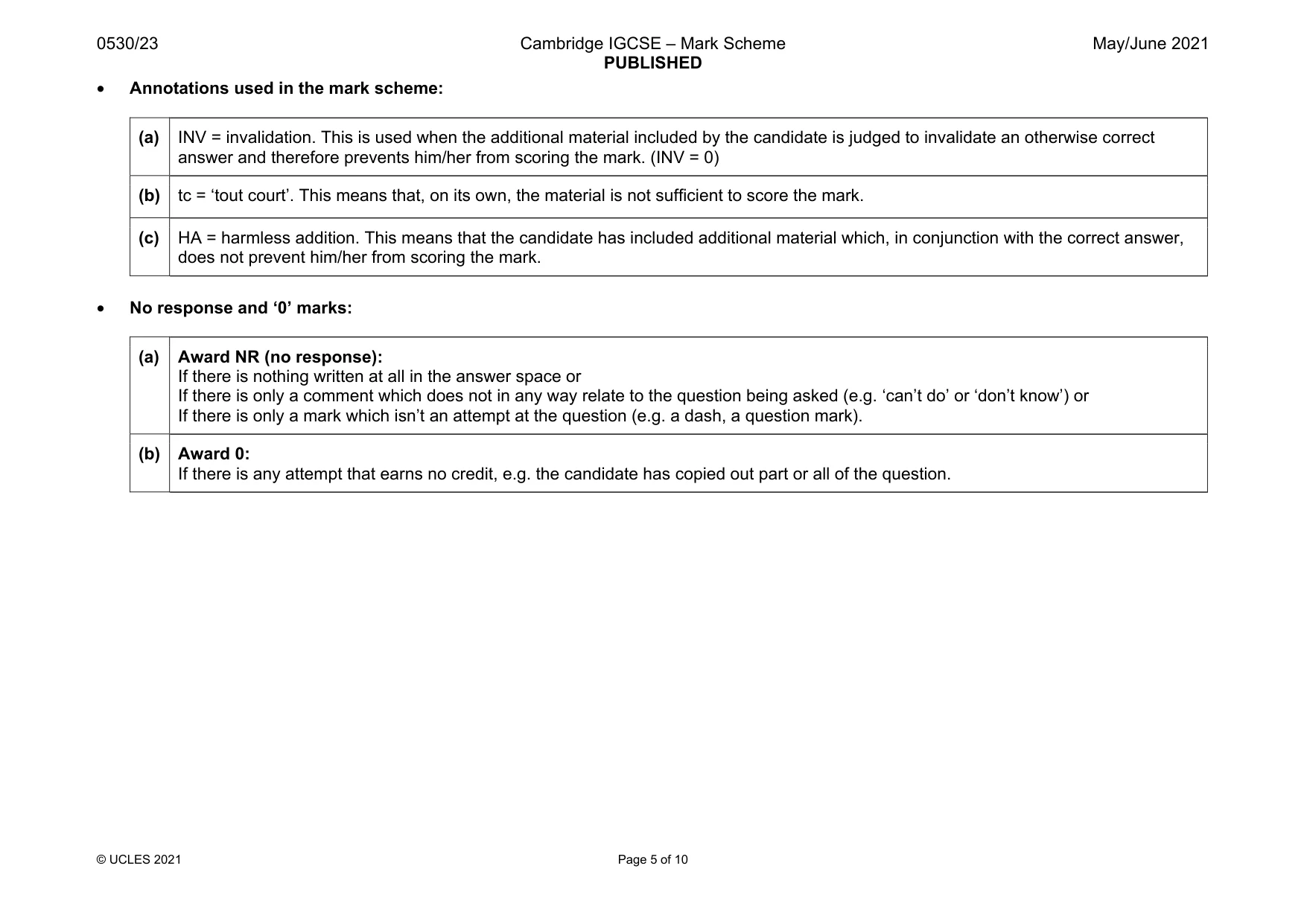
0530/23 Cambridge IGCSE – Mark Scheme PUBLISHED May/June 2021 © UCLES 2021 Page 5 of 10 • Annotations used in the mark scheme: (a) INV = invalidation. This is used when the additional material included by the candidate is judged to invalidate an otherwise correct answer and therefore prevents him/her from scoring the mark. (INV = 0) (b) tc = ‘tout court’. This means that, on its own, the material is not sufficient to score the mark. (c) HA = harmless addition. This means that the candidate has included additional material which, in conjunction with the correct answer, does not prevent him/her from scoring the mark. • No response and ‘0’ marks: (a) Award NR (no response): If there is nothing written at all in the answer space or If there is only a comment which does not in any way relate to the question being asked (e.g. ‘can’t do’ or ‘don’t know’) or If there is only a mark which isn’t an attempt at the question (e.g. a dash, a question mark). (b) Award 0: If there is any attempt that earns no credit, e.g. the candidate has copied out part or all of the question.
Mark scheme, page 6
0530/23 Cambridge IGCSE – Mark Scheme PUBLISHED May/June 2021 © UCLES 2021 Page 6 of 10 • Extra material: Candidates need to answer the questions in such a way as to demonstrate that they have understood the text. The mark scheme cannot cover all eventualities so where specific instructions are not provided, the examiner must check the text to ensure that the correct elements which would attract the mark are not contradicted or distorted by any extra material. The following general rules should be applied: (a) Extra material, mentioned in the mark scheme, which reinforces the correct answer or in itself constitutes an alternative correct answer: This is acceptable and is not penalised. (b) Extra material which constitutes an alternative answer, but which is not explicitly mentioned in the mark scheme: The examiner needs to decide, by consulting the transcript/text and the Team Leader if necessary, whether the alternative answer constitutes: (i) an alternative correct answer, in which case this falls into category (a) and the answer should be rewarded, or (ii) an answer which on its own would be rejected, in which case this falls into category (c) and the answer should be rejected. (c) Extra material which constitutes an alternative answer specifically rejected in the mark scheme: This puts the examiner in the position of having to ‘choose’ which the intended answer is. The examiner cannot therefore be sure what the candidate has understood and the mark cannot be awarded. (d) Extra material which distorts or contradicts the correct answer: This affects communication. The examiner cannot be sure what the candidate has understood and therefore the mark cannot be awarded. (e) Extra material introduced by the candidate and which does not feature in the original text: This affects communication. The examiner cannot be sure what the candidate has understood and therefore the mark cannot be awarded. It can sometimes be difficult to draw the line between what is a deduction made by an able candidate on the basis of what they have read and pure guesswork. Therefore, where a particular answer is not covered by the mark scheme, the examiner should consult the Team Leader.
Mark scheme, page 7
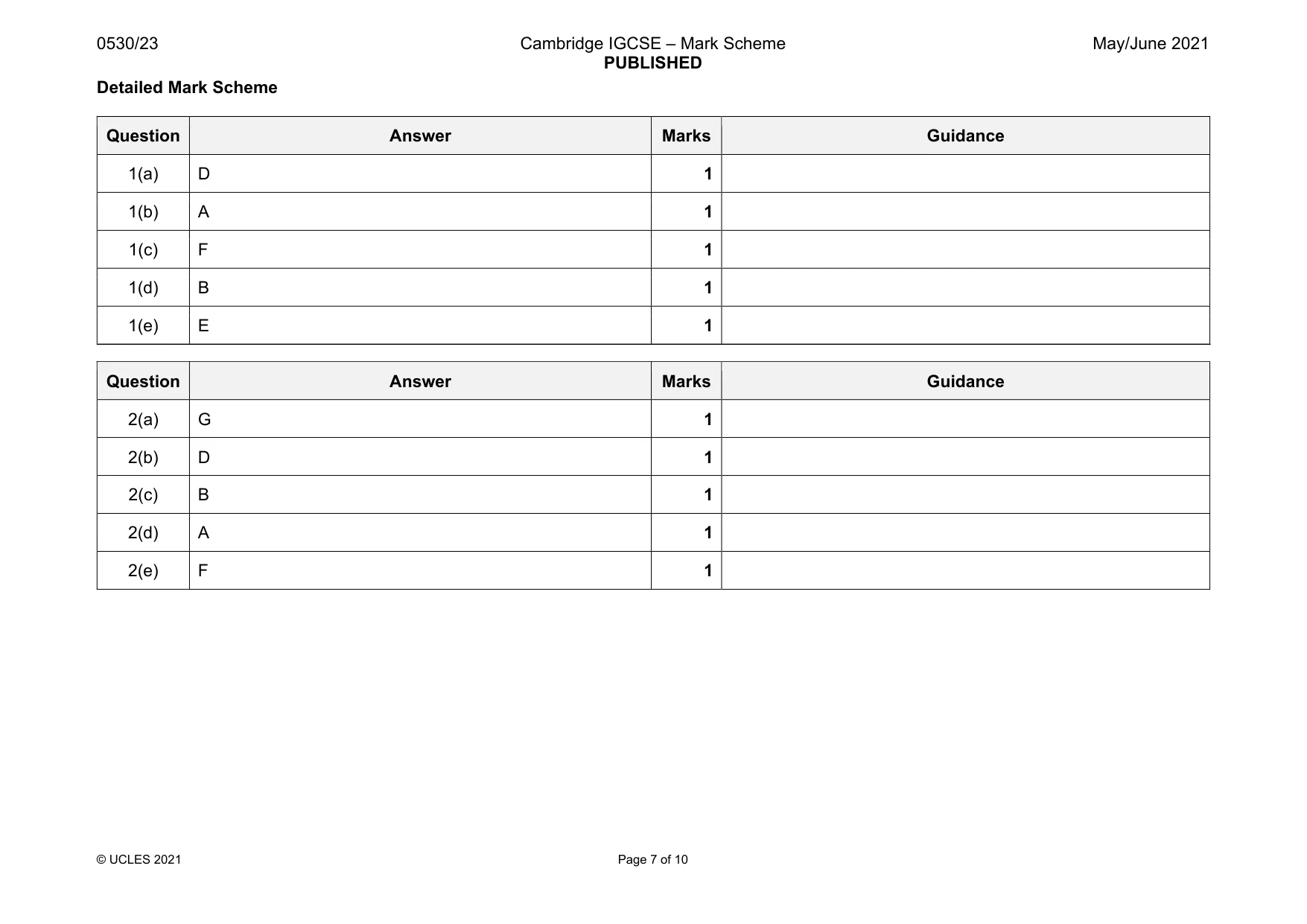
0530/23 Cambridge IGCSE – Mark Scheme PUBLISHED May/June 2021 © UCLES 2021 Page 7 of 10 Detailed Mark Scheme Question Answer Marks Guidance 1(a) D 1 1(b) A 1 1(c) F 1 1(d) B 1 1(e) E 1 Question Answer Marks Guidance 2(a) G 1 2(b) D 1 2(c) B 1 2(d) A 1 2(e) F 1
Mark scheme, page 8
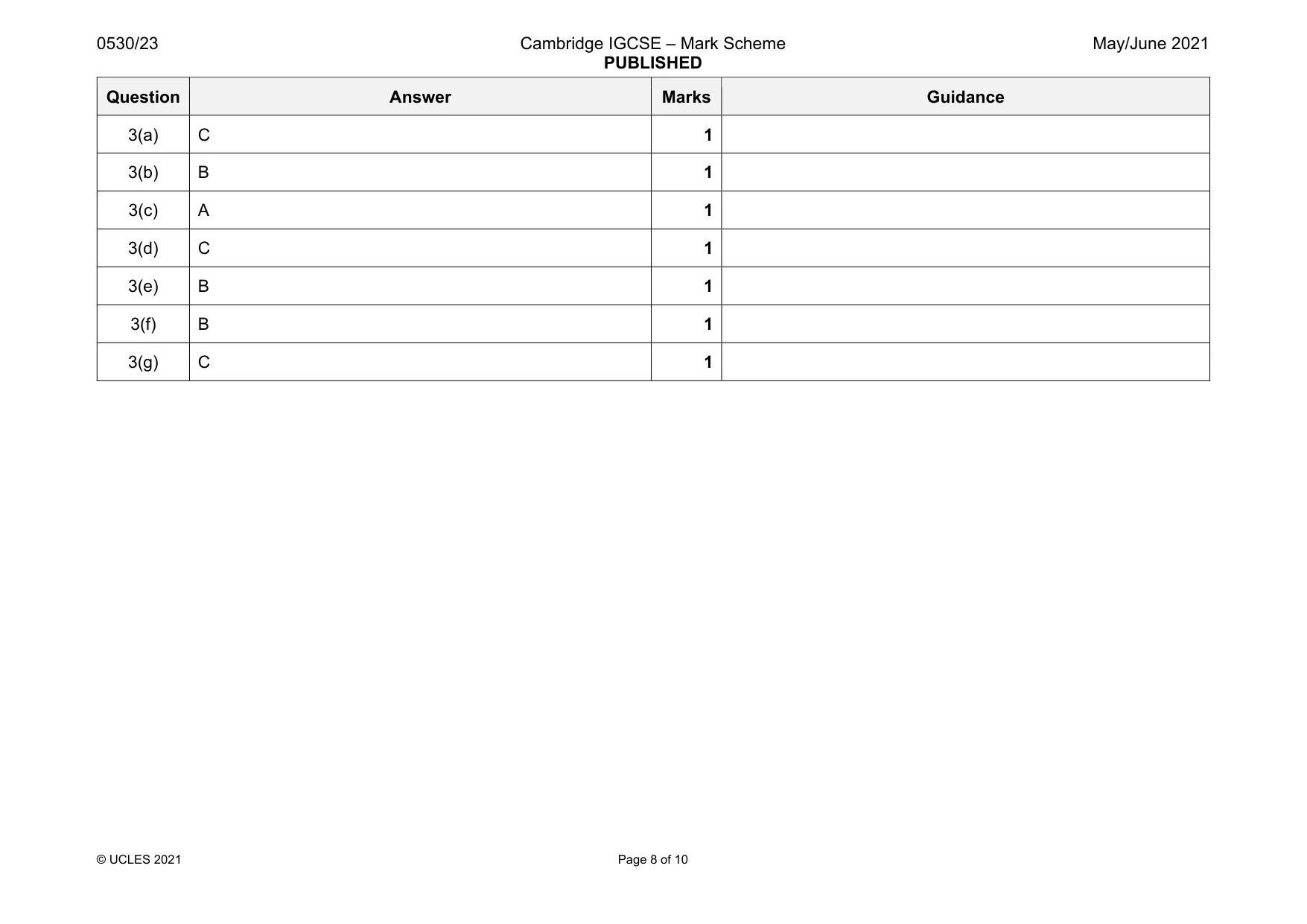
0530/23 Cambridge IGCSE – Mark Scheme PUBLISHED May/June 2021 © UCLES 2021 Page 8 of 10 Question Answer Marks Guidance 3(a) C 1 3(b) B 1 3(c) A 1 3(d) C 1 3(e) B 1 3(f) B 1 3(g) C 1
Mark scheme, page 9
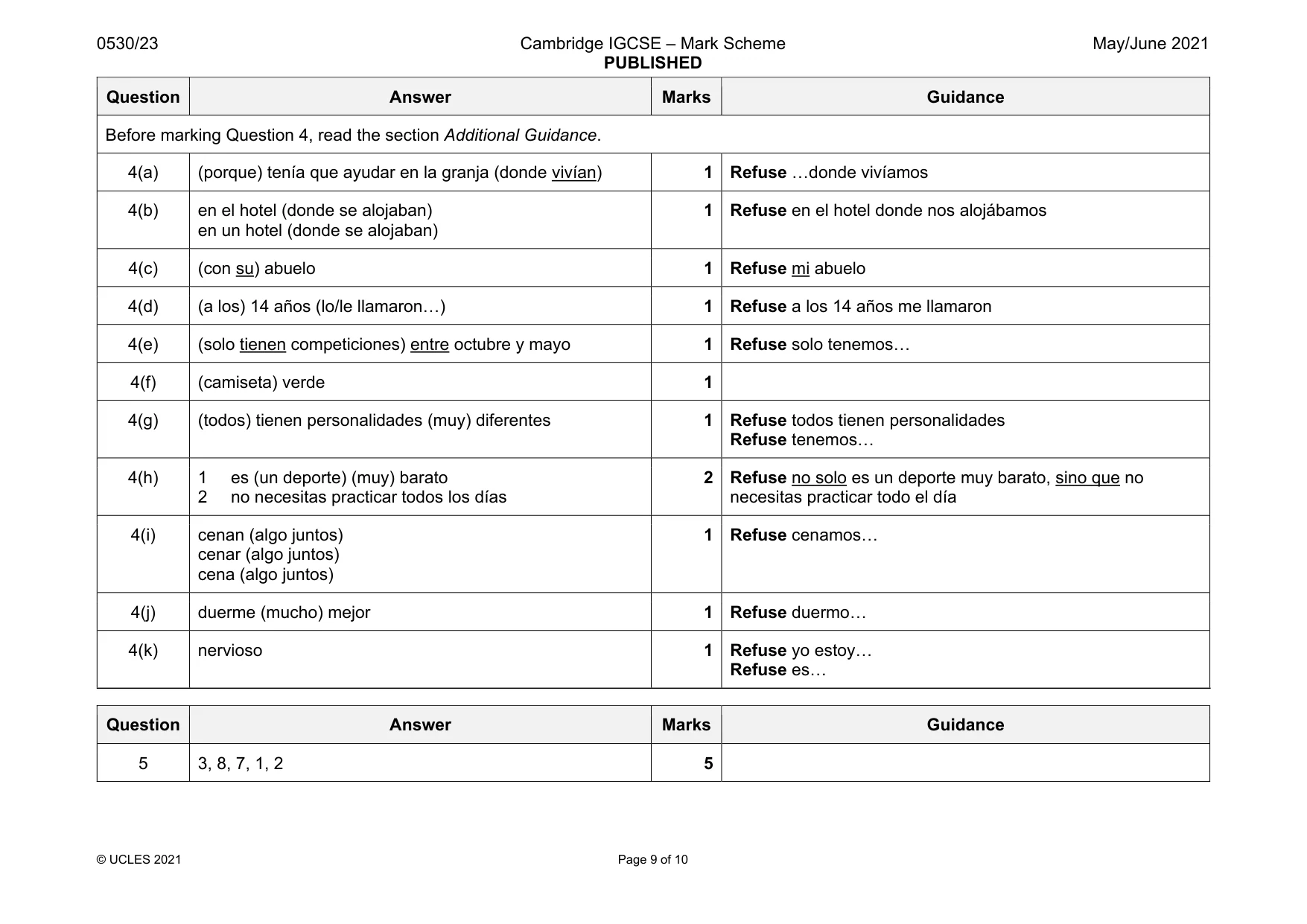
0530/23 Cambridge IGCSE – Mark Scheme PUBLISHED May/June 2021 © UCLES 2021 Page 9 of 10 Question Answer Marks Guidance Before marking Question 4, read the section Additional Guidance. 4(a) (porque) tenía que ayudar en la granja (donde vivían) 1 Refuse …donde vivíamos 4(b) en el hotel (donde se alojaban) en un hotel (donde se alojaban) 1 Refuse en el hotel donde nos alojábamos 4(c) (con su) abuelo 1 Refuse mi abuelo 4(d) (a los) 14 años (lo/le llamaron…) 1 Refuse a los 14 años me llamaron 4(e) (solo tienen competiciones) entre octubre y mayo 1 Refuse solo tenemos… 4(f) (camiseta) verde 1 4(g) (todos) tienen personalidades (muy) diferentes 1 Refuse todos tienen personalidades Refuse tenemos… 4(h) 1 es (un deporte) (muy) barato 2 no necesitas practicar todos los días 2 Refuse no solo es un deporte muy barato, sino que no necesitas practicar todo el día 4(i) cenan (algo juntos) cenar (algo juntos) cena (algo juntos) 1 Refuse cenamos… 4(j) duerme (mucho) mejor 1 Refuse duermo… 4(k) nervioso 1 Refuse yo estoy… Refuse es… Question Answer Marks Guidance 5 3, 8, 7, 1, 2 5
Mark scheme, page 10
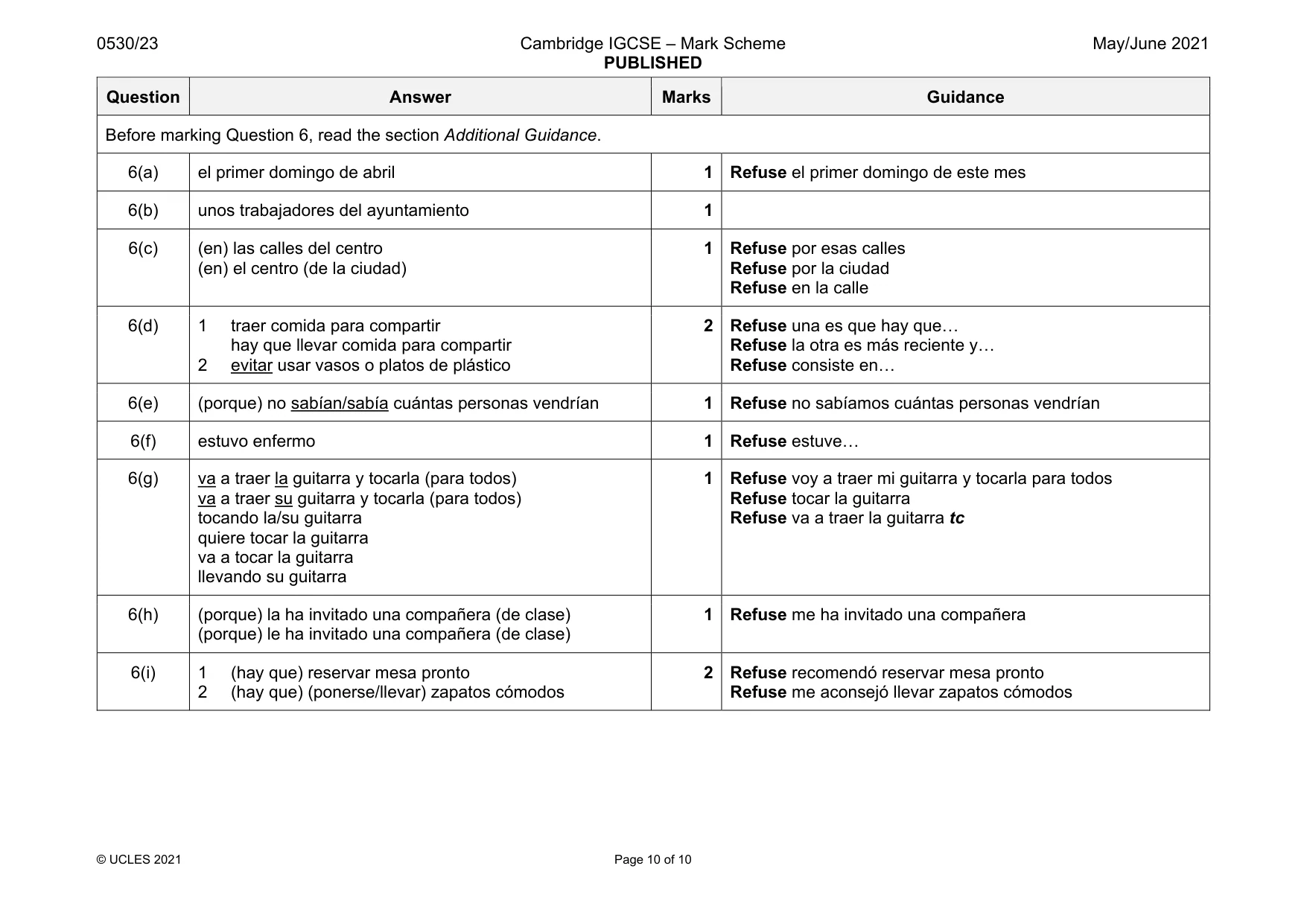
0530/23 Cambridge IGCSE – Mark Scheme PUBLISHED May/June 2021 © UCLES 2021 Page 10 of 10 Question Answer Marks Guidance Before marking Question 6, read the section Additional Guidance. 6(a) el primer domingo de abril 1 Refuse el primer domingo de este mes 6(b) unos trabajadores del ayuntamiento 1 6(c) (en) las calles del centro (en) el centro (de la ciudad) 1 Refuse por esas calles Refuse por la ciudad Refuse en la calle 6(d) 1 traer comida para compartir hay que llevar comida para compartir 2 evitar usar vasos o platos de plástico 2 Refuse una es que hay que… Refuse la otra es más reciente y… Refuse consiste en… 6(e) (porque) no sabían/sabía cuántas personas vendrían 1 Refuse no sabíamos cuántas personas vendrían 6(f) estuvo enfermo 1 Refuse estuve… 6(g) va a traer la guitarra y tocarla (para todos) va a traer su guitarra y tocarla (para todos) tocando la/su guitarra quiere tocar la guitarra va a tocar la guitarra llevando su guitarra 1 Refuse voy a traer mi guitarra y tocarla para todos Refuse tocar la guitarra Refuse va a traer la guitarra tc 6(h) (porque) la ha invitado una compañera (de clase) (porque) le ha invitado una compañera (de clase) 1 Refuse me ha invitado una compañera 6(i) 1 (hay que) reservar mesa pronto 2 (hay que) (ponerse/llevar) zapatos cómodos 2 Refuse recomendó reservar mesa pronto Refuse me aconsejó llevar zapatos cómodos
What you needed in this session
Cambridge’s own grade thresholds for 2021 May/June, Paper 2 · Variant 3. A higher threshold means an easier paper — the bar moves with how the cohort did.