Cambridge IGCSE Spanish - Foreign Language 0530 — 2021 May/June Paper 2 · Variant 1
0530/21/M/J/21 · 45 marks · ≈51 min
The question paper and its mark scheme, free to read here and free to download. This is Cambridge’s own paper, exactly as it was sat.
Question paper12 pages

Mark scheme10 pages
Answers below. Sit the paper first if you are practising.
Paper as text
Question paper, page 1
This document has 12 pages. Any blank pages are indicated. Cambridge IGCSE™ SPANISH 0530/21 Paper 2 Reading May/June 2021 1 hour You must answer on the question paper. No additional materials are needed. INSTRUCTIONS ● Answer all questions. ● Use a black or dark blue pen. ● Write your name, centre number and candidate number in the boxes at the top of the page. ● Write your answer to each question in the space provided. ● Do not use an erasable pen or correction fluid. ● Do not write on any bar codes. ● Dictionaries are not allowed. INFORMATION ● The total mark for this paper is 45. ● The number of marks for each question or part question is shown in brackets [ ]. DC (LK/CT) 207452/3 © UCLES 2021 [Turn over * 4 0 1 0 5 9 6 3 9 8 *
Question paper, page 2
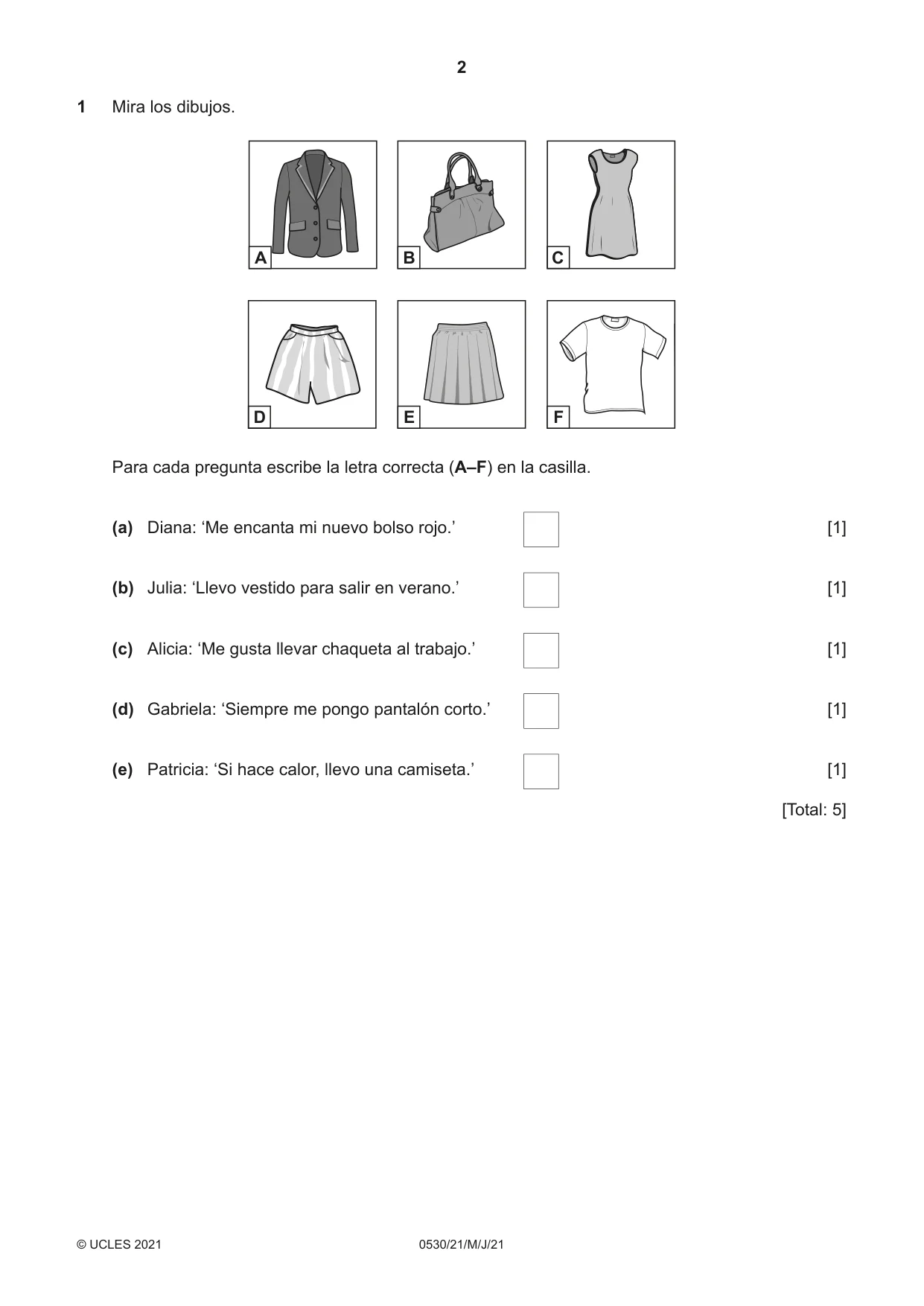
2 0530/21/M/J/21 © UCLES 2021 1 Mira los dibujos. C B A E D F Para cada pregunta escribe la letra correcta (A–F) en la casilla. (a) Diana: ‘Me encanta mi nuevo bolso rojo.’ [1] (b) Julia: ‘Llevo vestido para salir en verano.’ [1] (c) Alicia: ‘Me gusta llevar chaqueta al trabajo.’ [1] (d) Gabriela: ‘Siempre me pongo pantalón corto.’ [1] (e) Patricia: ‘Si hace calor, llevo una camiseta.’ [1] [Total: 5]
Question paper, page 3
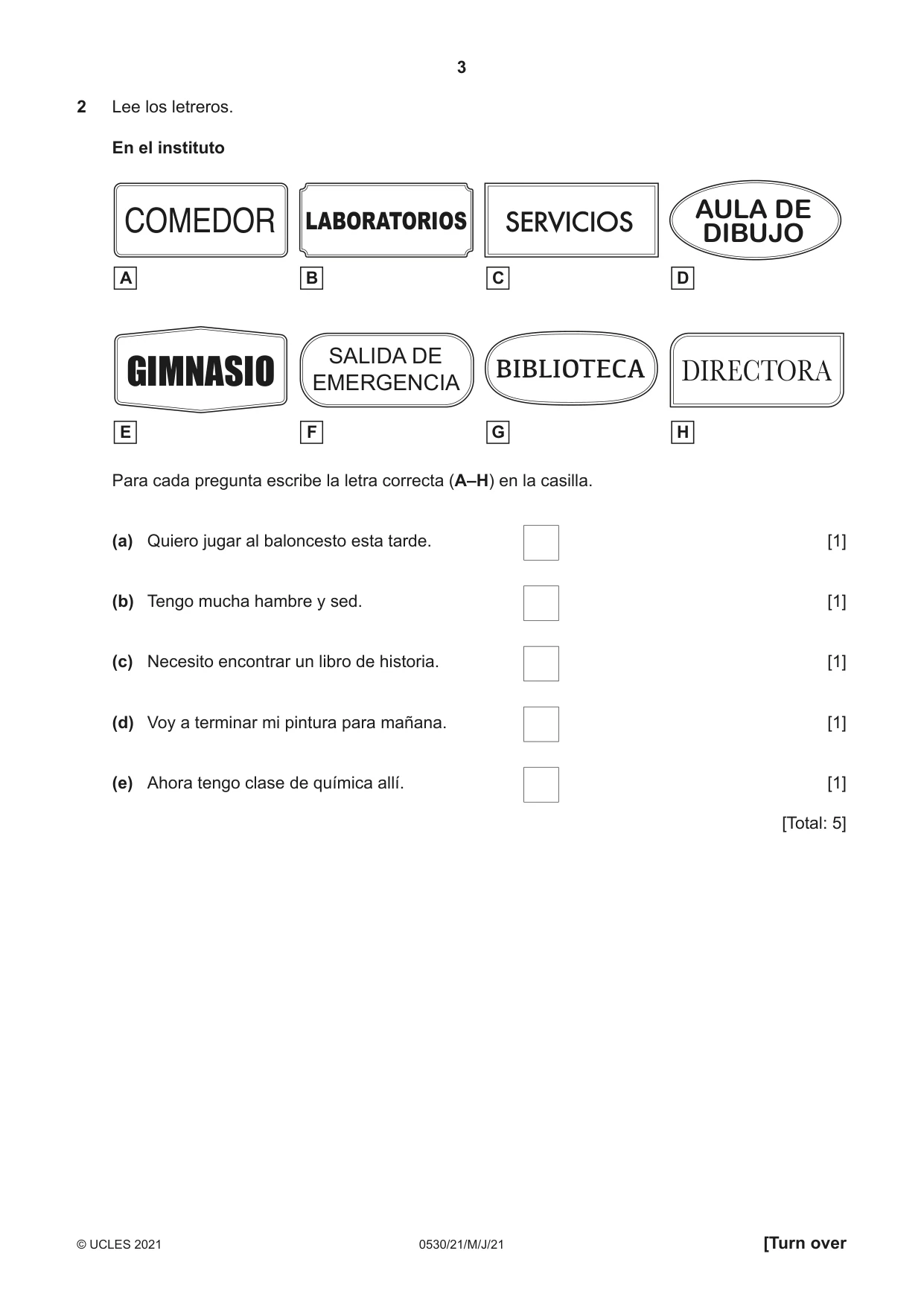
3 0530/21/M/J/21 © UCLES 2021 [Turn over 2 Lee los letreros. En el instituto COMEDOR GIMNASIO SALIDA DE EMERGENCIA BIBLIOTECA LABORATORIOS SERVICIOS AULA DE DIBUJO DIRECTORA A B C D E F G H Para cada pregunta escribe la letra correcta (A–H) en la casilla. (a) Quiero jugar al baloncesto esta tarde. [1] (b) Tengo mucha hambre y sed. [1] (c) Necesito encontrar un libro de historia. [1] (d) Voy a terminar mi pintura para mañana. [1] (e) Ahora tengo clase de química allí. [1] [Total: 5]
Question paper, page 4
4 0530/21/M/J/21 © UCLES 2021 3 Lee el texto. Para cada pregunta indica tu respuesta escribiendo una X en la casilla correcta (A–C). Me llamo Alberto y tengo 15 años. Aunque para mí nadar es horrible, me encantan los otros deportes. Lo que más me gusta es jugar al rugby. Empecé a jugar cuando tenía cuatro años. Ahora estoy en un equipo y tengo que entrenar los sábados en un campo que hay cerca de mi casa, pero me encantaría hacerlo a diario. En mi equipo todos somos muy distintos, pero nos entendemos estupendamente y nunca discutimos. Hay gente que piensa que, jugando al rugby, puedes hacerte daño en un brazo o una pierna, pero yo no lo creo. Para mí, ¡es muy entretenido! La próxima semana vamos a jugar contra un equipo en un pueblo a tres horas de aquí. Si ganamos el partido, vamos a celebrarlo con pizza en casa del capitán del equipo. (a) Alberto es ... A un adolescente. B un adulto. C un niño. [1] (b) La actividad que Alberto odia es ... A la natación. B el atletismo. C el tenis. [1] (c) Alberto entrena ... A todos los días. B los fines de semana. C cada viernes. [1]
Question paper, page 5
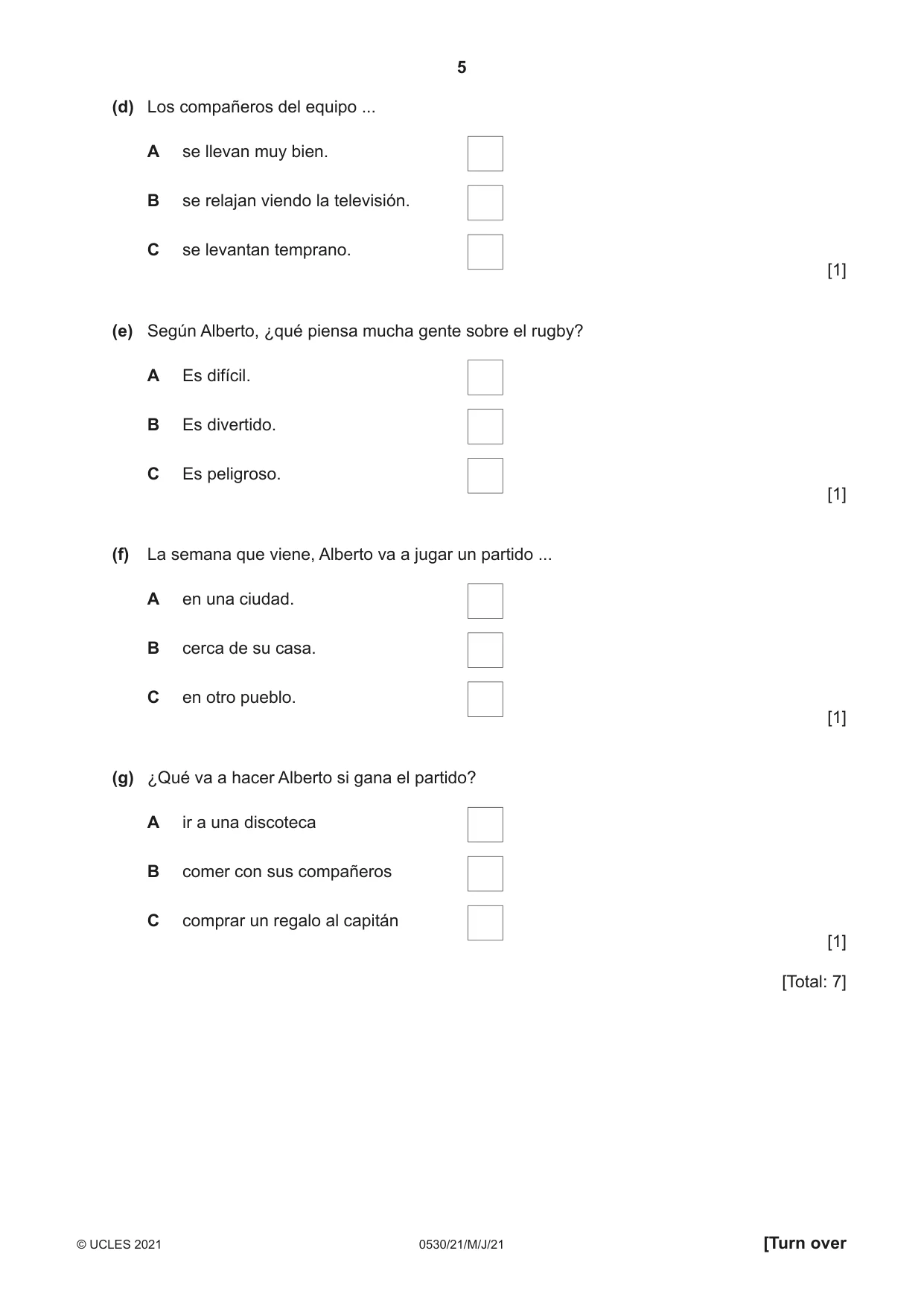
5 0530/21/M/J/21 © UCLES 2021 [Turn over (d) Los compañeros del equipo ... A se llevan muy bien. B se relajan viendo la televisión. C se levantan temprano. [1] (e) Según Alberto, ¿qué piensa mucha gente sobre el rugby? A Es difícil. B Es divertido. C Es peligroso. [1] (f) La semana que viene, Alberto va a jugar un partido ... A en una ciudad. B cerca de su casa. C en otro pueblo. [1] (g) ¿Qué va a hacer Alberto si gana el partido? A ir a una discoteca B comer con sus compañeros C comprar un regalo al capitán [1] [Total: 7]
Question paper, page 6
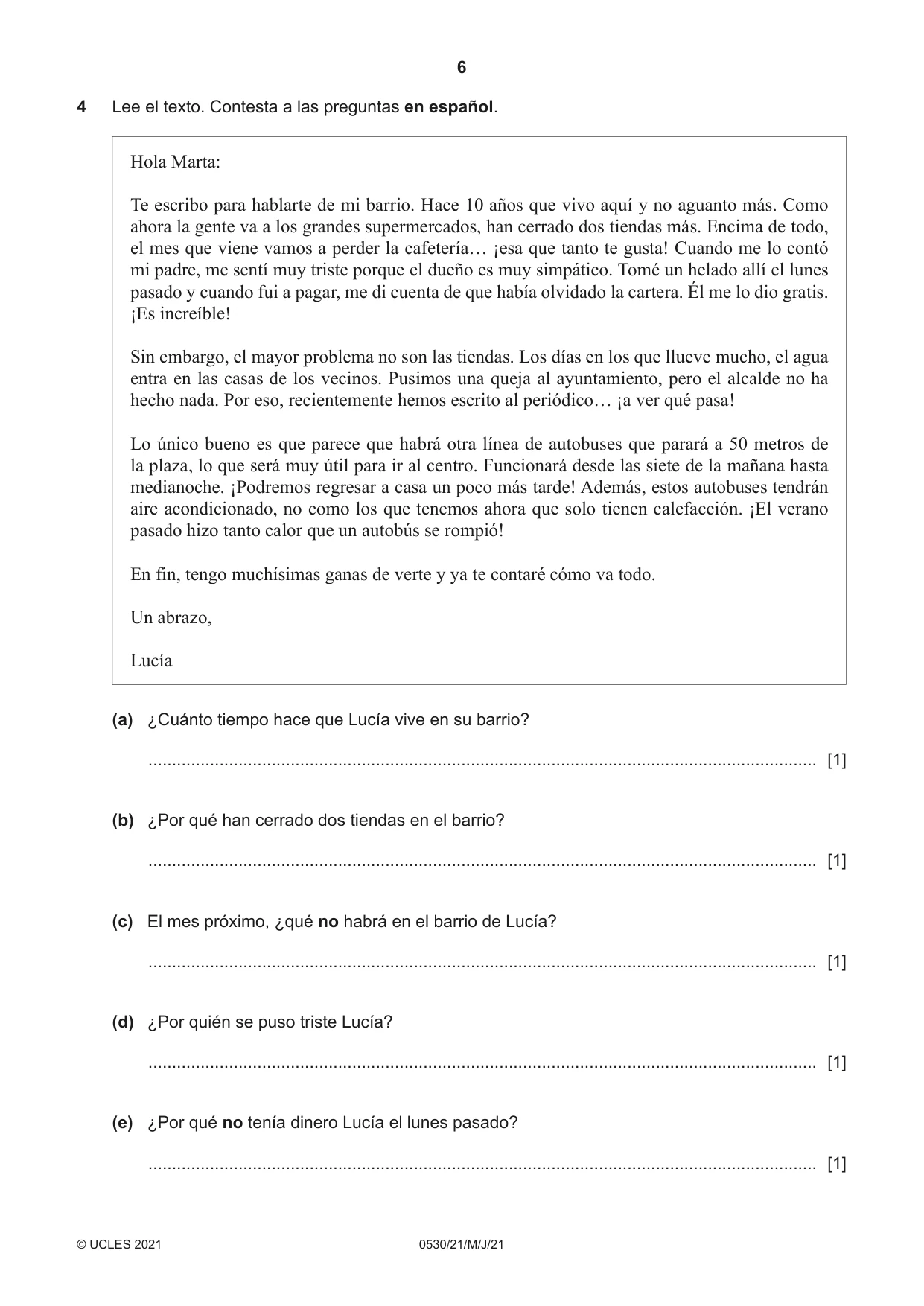
6 0530/21/M/J/21 © UCLES 2021 4 Lee el texto. Contesta a las preguntas en español. Hola Marta: Te escribo para hablarte de mi barrio. Hace 10 años que vivo aquí y no aguanto más. Como ahora la gente va a los grandes supermercados, han cerrado dos tiendas más. Encima de todo, el mes que viene vamos a perder la cafetería… ¡esa que tanto te gusta! Cuando me lo contó mi padre, me sentí muy triste porque el dueño es muy simpático. Tomé un helado allí el lunes pasado y cuando fui a pagar, me di cuenta de que había olvidado la cartera. Él me lo dio gratis. ¡Es increíble! Sin embargo, el mayor problema no son las tiendas. Los días en los que llueve mucho, el agua entra en las casas de los vecinos. Pusimos una queja al ayuntamiento, pero el alcalde no ha hecho nada. Por eso, recientemente hemos escrito al periódico… ¡a ver qué pasa! Lo único bueno es que parece que habrá otra línea de autobuses que parará a 50 metros de la plaza, lo que será muy útil para ir al centro. Funcionará desde las siete de la mañana hasta medianoche. ¡Podremos regresar a casa un poco más tarde! Además, estos autobuses tendrán aire acondicionado, no como los que tenemos ahora que solo tienen calefacción. ¡El verano pasado hizo tanto calor que un autobús se rompió! En fin, tengo muchísimas ganas de verte y ya te contaré cómo va todo. Un abrazo, Lucía (a) ¿Cuánto tiempo hace que Lucía vive en su barrio? … [1] (b) ¿Por qué han cerrado dos tiendas en el barrio? … [1] (c) El mes próximo, ¿qué no habrá en el barrio de Lucía? … [1] (d) ¿Por quién se puso triste Lucía? … [1] (e) ¿Por qué no tenía dinero Lucía el lunes pasado? … [1]
Question paper, page 7
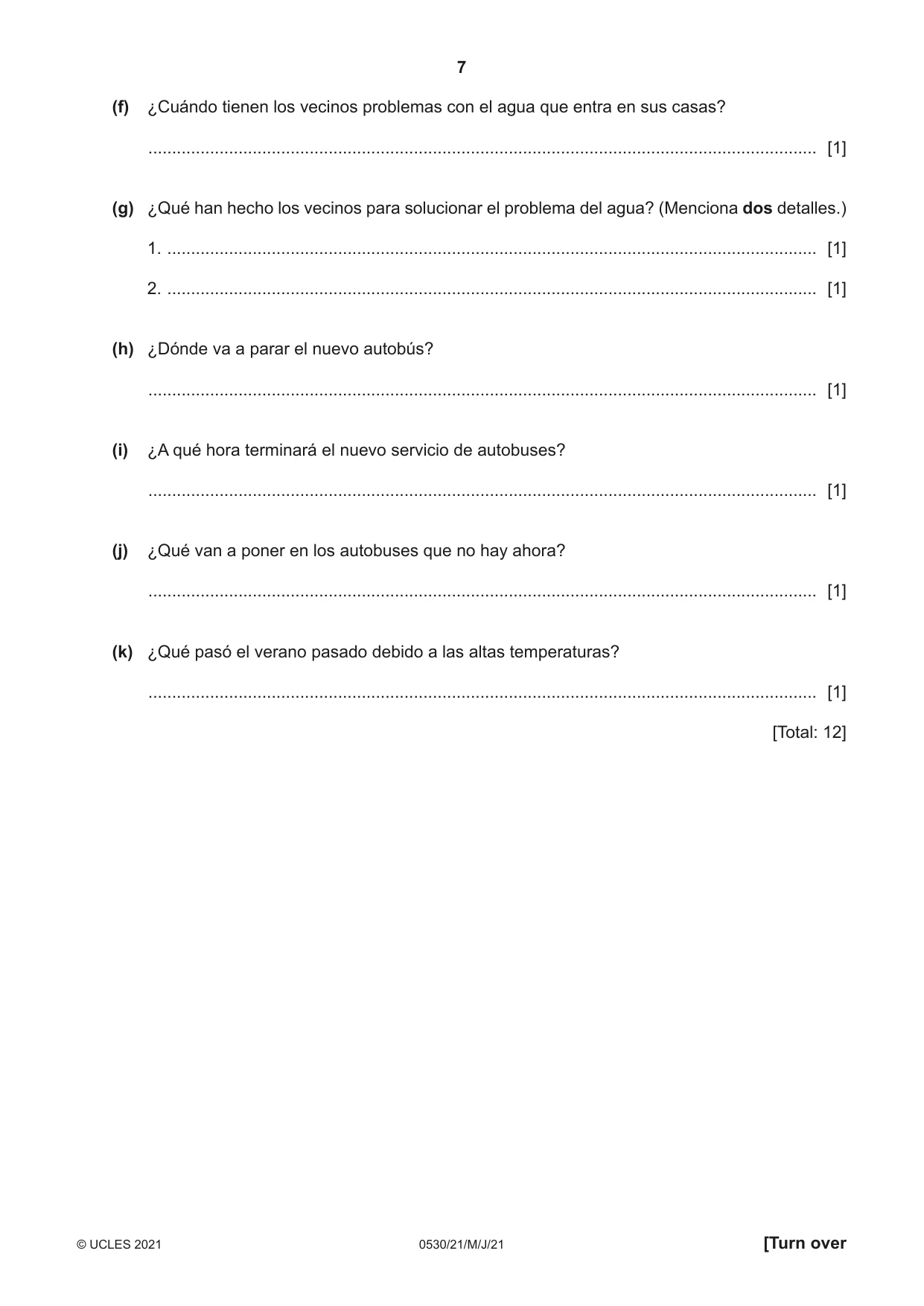
7 0530/21/M/J/21 © UCLES 2021 [Turn over (f) ¿Cuándo tienen los vecinos problemas con el agua que entra en sus casas? … [1] (g) ¿Qué han hecho los vecinos para solucionar el problema del agua? (Menciona dos detalles.) 1. … [1] 2. … [1] (h) ¿Dónde va a parar el nuevo autobús? … [1] (i) ¿A qué hora terminará el nuevo servicio de autobuses? … [1] (j) ¿Qué van a poner en los autobuses que no hay ahora? … [1] (k) ¿Qué pasó el verano pasado debido a las altas temperaturas? … [1] [Total: 12]
Question paper, page 8
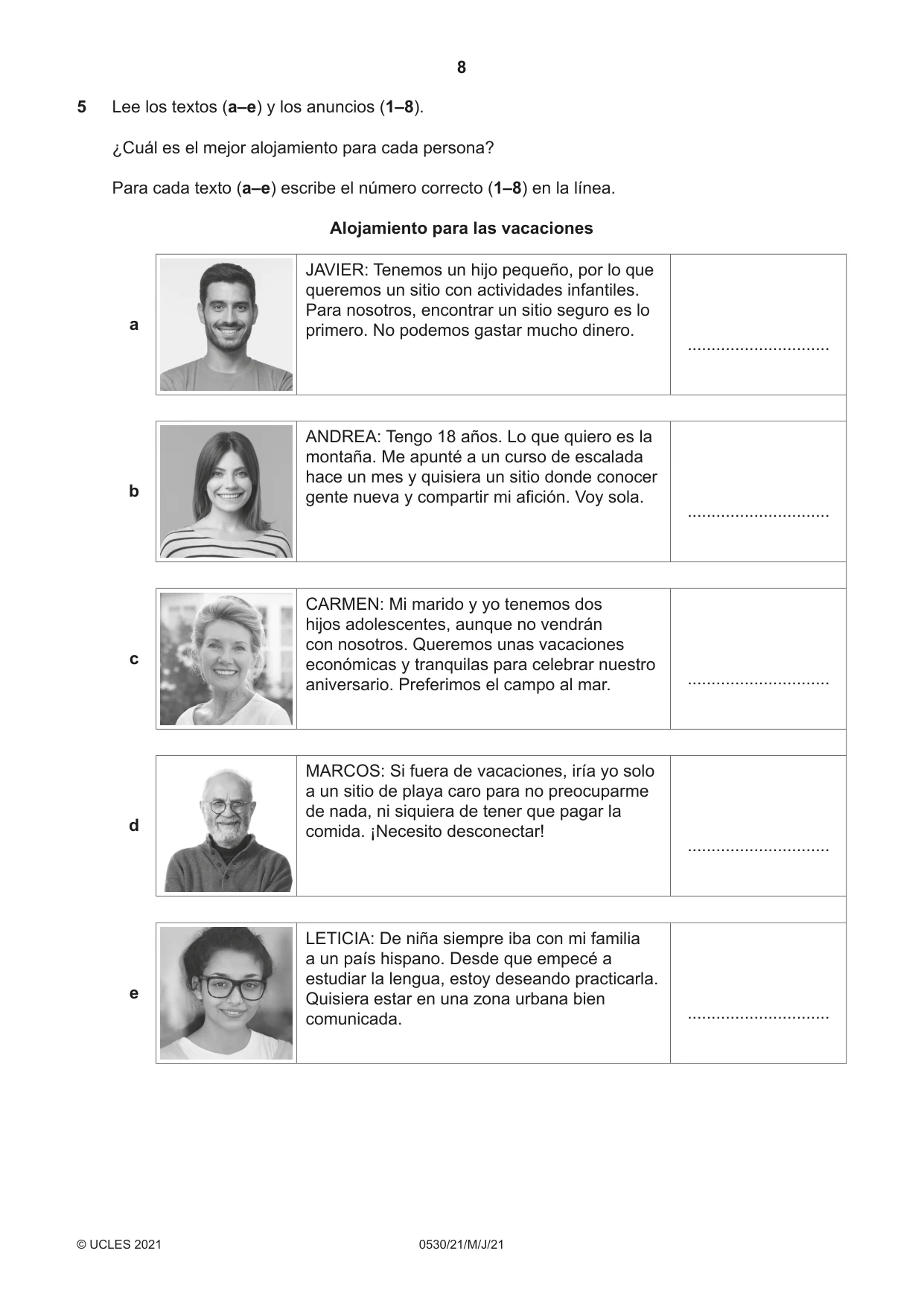
8 0530/21/M/J/21 © UCLES 2021 5 Lee los textos (a–e) y los anuncios (1–8). ¿Cuál es el mejor alojamiento para cada persona? Para cada texto (a–e) escribe el número correcto (1–8) en la línea. Alojamiento para las vacaciones a JAVIER: Tenemos un hijo pequeño, por lo que queremos un sitio con actividades infantiles. Para nosotros, encontrar un sitio seguro es lo primero. No podemos gastar mucho dinero. … b ANDREA: Tengo 18 años. Lo que quiero es la montaña. Me apunté a un curso de escalada hace un mes y quisiera un sitio donde conocer gente nueva y compartir mi afición. Voy sola. … c CARMEN: Mi marido y yo tenemos dos hijos adolescentes, aunque no vendrán con nosotros. Queremos unas vacaciones económicas y tranquilas para celebrar nuestro aniversario. Preferimos el campo al mar. … d MARCOS: Si fuera de vacaciones, iría yo solo a un sitio de playa caro para no preocuparme de nada, ni siquiera de tener que pagar la comida. ¡Necesito desconectar! … e LETICIA: De niña siempre iba con mi familia a un país hispano. Desde que empecé a estudiar la lengua, estoy deseando practicarla. Quisiera estar en una zona urbana bien comunicada. …
Question paper, page 9
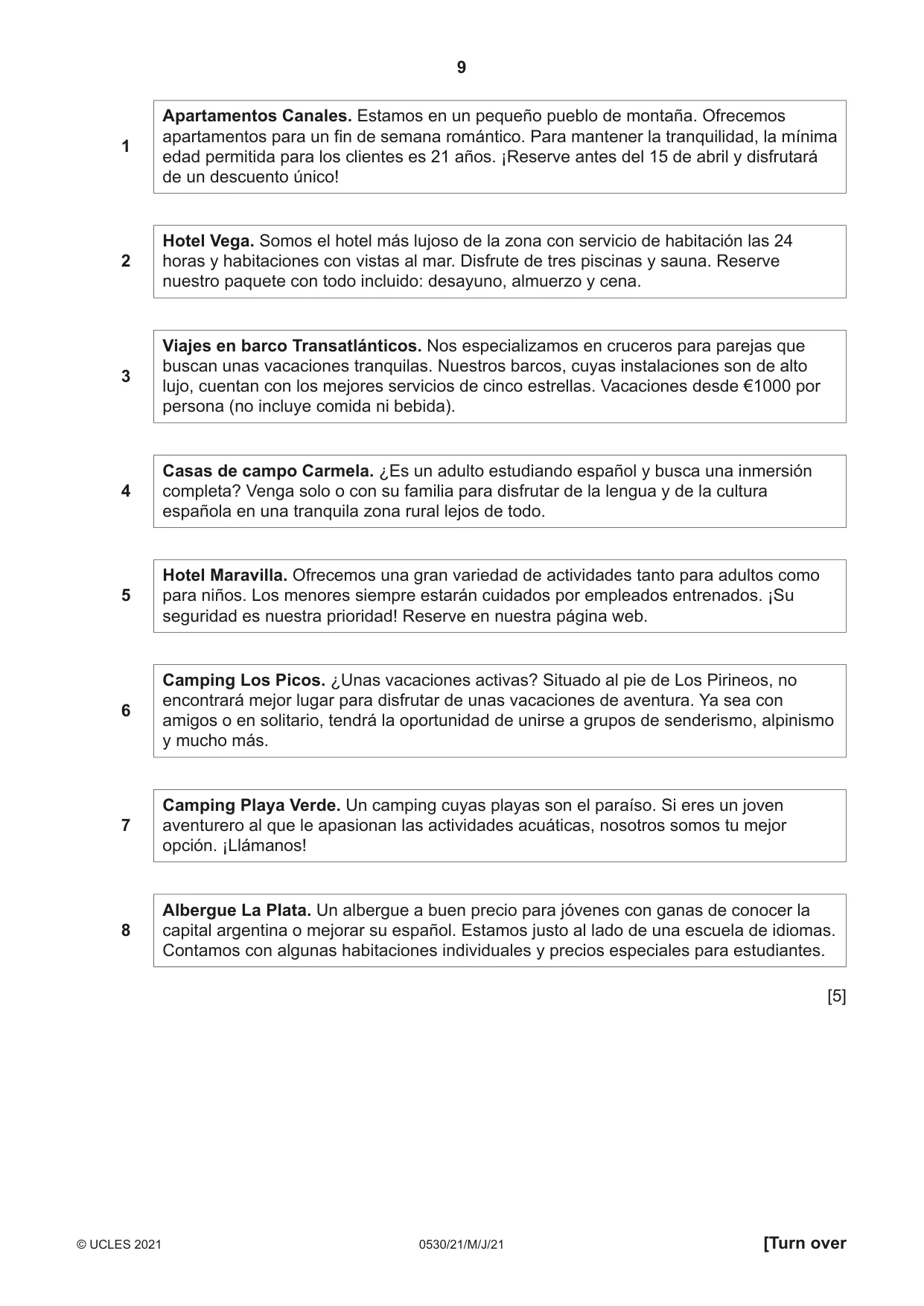
9 0530/21/M/J/21 © UCLES 2021 [Turn over 1 Apartamentos Canales. Estamos en un pequeño pueblo de montaña. Ofrecemos apartamentos para un fin de semana romántico. Para mantener la tranquilidad, la mínima edad permitida para los clientes es 21 años. ¡Reserve antes del 15 de abril y disfrutará de un descuento único! 2 Hotel Vega. Somos el hotel más lujoso de la zona con servicio de habitación las 24 horas y habitaciones con vistas al mar. Disfrute de tres piscinas y sauna. Reserve nuestro paquete con todo incluido: desayuno, almuerzo y cena. 3 Viajes en barco Transatlánticos. Nos especializamos en cruceros para parejas que buscan unas vacaciones tranquilas. Nuestros barcos, cuyas instalaciones son de alto lujo, cuentan con los mejores servicios de cinco estrellas. Vacaciones desde €1000 por persona (no incluye comida ni bebida). 4 Casas de campo Carmela. ¿Es un adulto estudiando español y busca una inmersión completa? Venga solo o con su familia para disfrutar de la lengua y de la cultura española en una tranquila zona rural lejos de todo. 5 Hotel Maravilla. Ofrecemos una gran variedad de actividades tanto para adultos como para niños. Los menores siempre estarán cuidados por empleados entrenados. ¡Su seguridad es nuestra prioridad! Reserve en nuestra página web. 6 Camping Los Picos. ¿Unas vacaciones activas? Situado al pie de Los Pirineos, no encontrará mejor lugar para disfrutar de unas vacaciones de aventura. Ya sea con amigos o en solitario, tendrá la oportunidad de unirse a grupos de senderismo, alpinismo y mucho más. 7 Camping Playa Verde. Un camping cuyas playas son el paraíso. Si eres un joven aventurero al que le apasionan las actividades acuáticas, nosotros somos tu mejor opción. ¡Llámanos! 8 Albergue La Plata. Un albergue a buen precio para jóvenes con ganas de conocer la capital argentina o mejorar su español. Estamos justo al lado de una escuela de idiomas. Contamos con algunas habitaciones individuales y precios especiales para estudiantes. [5]
Question paper, page 10
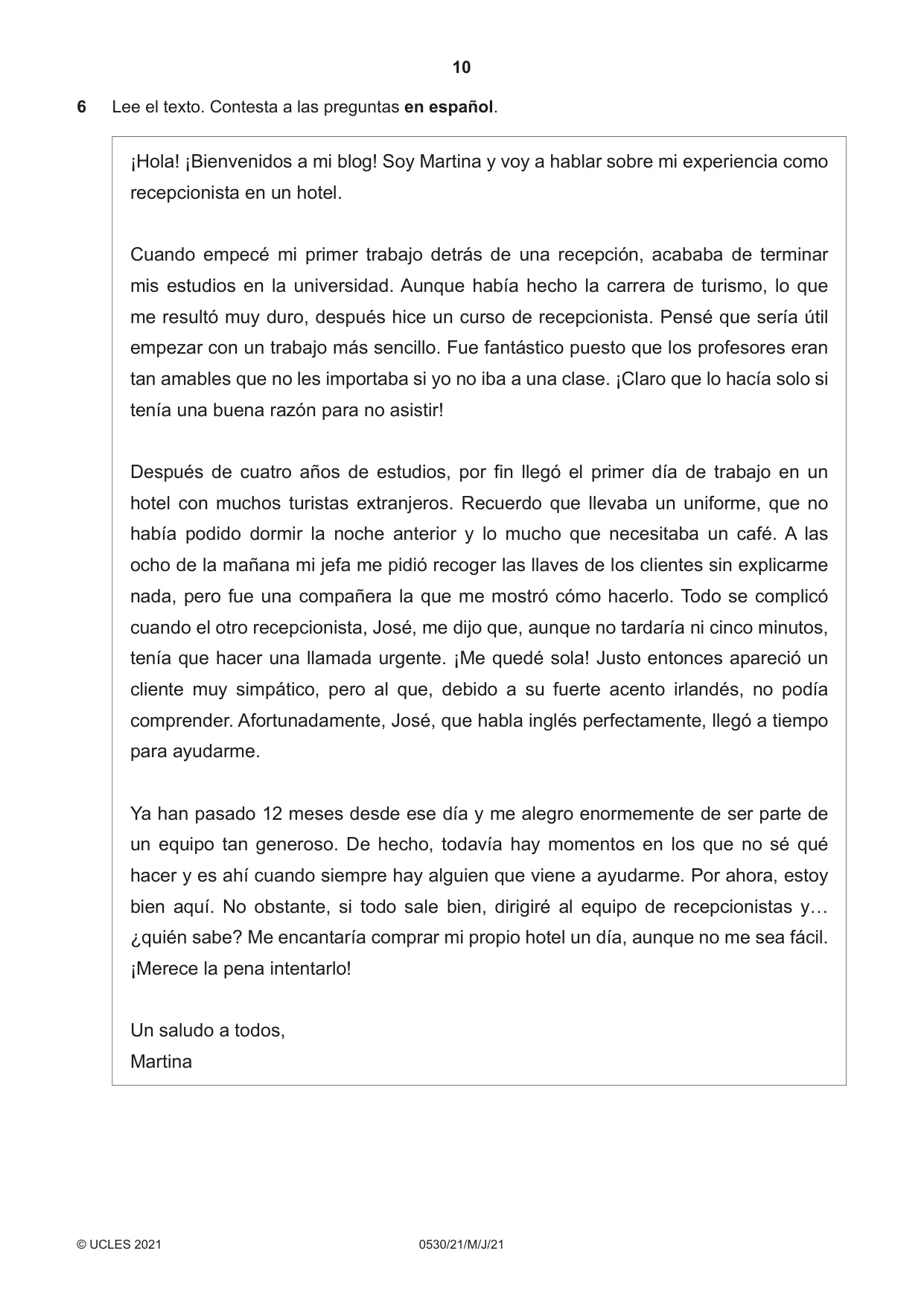
10 0530/21/M/J/21 © UCLES 2021 6 Lee el texto. Contesta a las preguntas en español. ¡Hola! ¡Bienvenidos a mi blog! Soy Martina y voy a hablar sobre mi experiencia como recepcionista en un hotel. Cuando empecé mi primer trabajo detrás de una recepción, acababa de terminar mis estudios en la universidad. Aunque había hecho la carrera de turismo, lo que me resultó muy duro, después hice un curso de recepcionista. Pensé que sería útil empezar con un trabajo más sencillo. Fue fantástico puesto que los profesores eran tan amables que no les importaba si yo no iba a una clase. ¡Claro que lo hacía solo si tenía una buena razón para no asistir! Después de cuatro años de estudios, por fin llegó el primer día de trabajo en un hotel con muchos turistas extranjeros. Recuerdo que llevaba un uniforme, que no había podido dormir la noche anterior y lo mucho que necesitaba un café. A las ocho de la mañana mi jefa me pidió recoger las llaves de los clientes sin explicarme nada, pero fue una compañera la que me mostró cómo hacerlo. Todo se complicó cuando el otro recepcionista, José, me dijo que, aunque no tardaría ni cinco minutos, tenía que hacer una llamada urgente. ¡Me quedé sola! Justo entonces apareció un cliente muy simpático, pero al que, debido a su fuerte acento irlandés, no podía comprender. Afortunadamente, José, que habla inglés perfectamente, llegó a tiempo para ayudarme. Ya han pasado 12 meses desde ese día y me alegro enormemente de ser parte de un equipo tan generoso. De hecho, todavía hay momentos en los que no sé qué hacer y es ahí cuando siempre hay alguien que viene a ayudarme. Por ahora, estoy bien aquí. No obstante, si todo sale bien, dirigiré al equipo de recepcionistas y… ¿quién sabe? Me encantaría comprar mi propio hotel un día, aunque no me sea fácil. ¡Merece la pena intentarlo! Un saludo a todos, Martina
Question paper, page 11
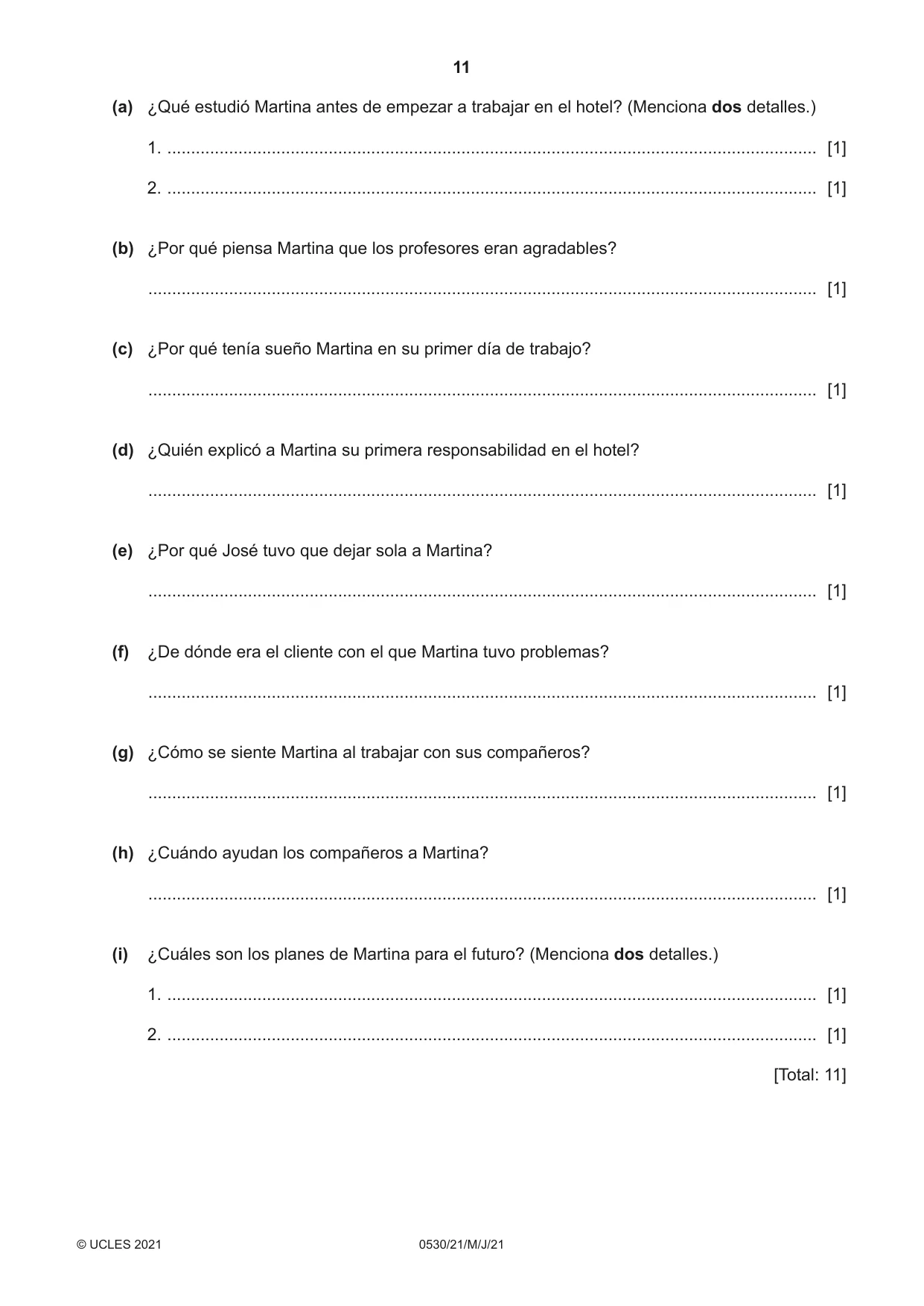
11 0530/21/M/J/21 © UCLES 2021 (a) ¿Qué estudió Martina antes de empezar a trabajar en el hotel? (Menciona dos detalles.) 1. … [1] 2. … [1] (b) ¿Por qué piensa Martina que los profesores eran agradables? … [1] (c) ¿Por qué tenía sueño Martina en su primer día de trabajo? … [1] (d) ¿Quién explicó a Martina su primera responsabilidad en el hotel? … [1] (e) ¿Por qué José tuvo que dejar sola a Martina? … [1] (f) ¿De dónde era el cliente con el que Martina tuvo problemas? … [1] (g) ¿Cómo se siente Martina al trabajar con sus compañeros? … [1] (h) ¿Cuándo ayudan los compañeros a Martina? … [1] (i) ¿Cuáles son los planes de Martina para el futuro? (Menciona dos detalles.) 1. … [1] 2. … [1] [Total: 11]
Question paper, page 12
12 0530/21/M/J/21 © UCLES 2021 Permission to reproduce items where third-party owned material protected by copyright is included has been sought and cleared where possible. Every reasonable effort has been made by the publisher (UCLES) to trace copyright holders, but if any items requiring clearance have unwittingly been included, the publisher will be pleased to make amends at the earliest possible opportunity. To avoid the issue of disclosure of answer-related information to candidates, all copyright acknowledgements are reproduced online in the Cambridge Assessment International Education Copyright Acknowledgements Booklet. This is produced for each series of examinations and is freely available to download at www.cambridgeinternational.org after the live examination series. Cambridge Assessment International Education is part of the Cambridge Assessment Group. Cambridge Assessment is the brand name of the University of Cambridge Local Examinations Syndicate (UCLES), which itself is a department of the University of Cambridge. BLANK PAGE
Mark scheme, page 1
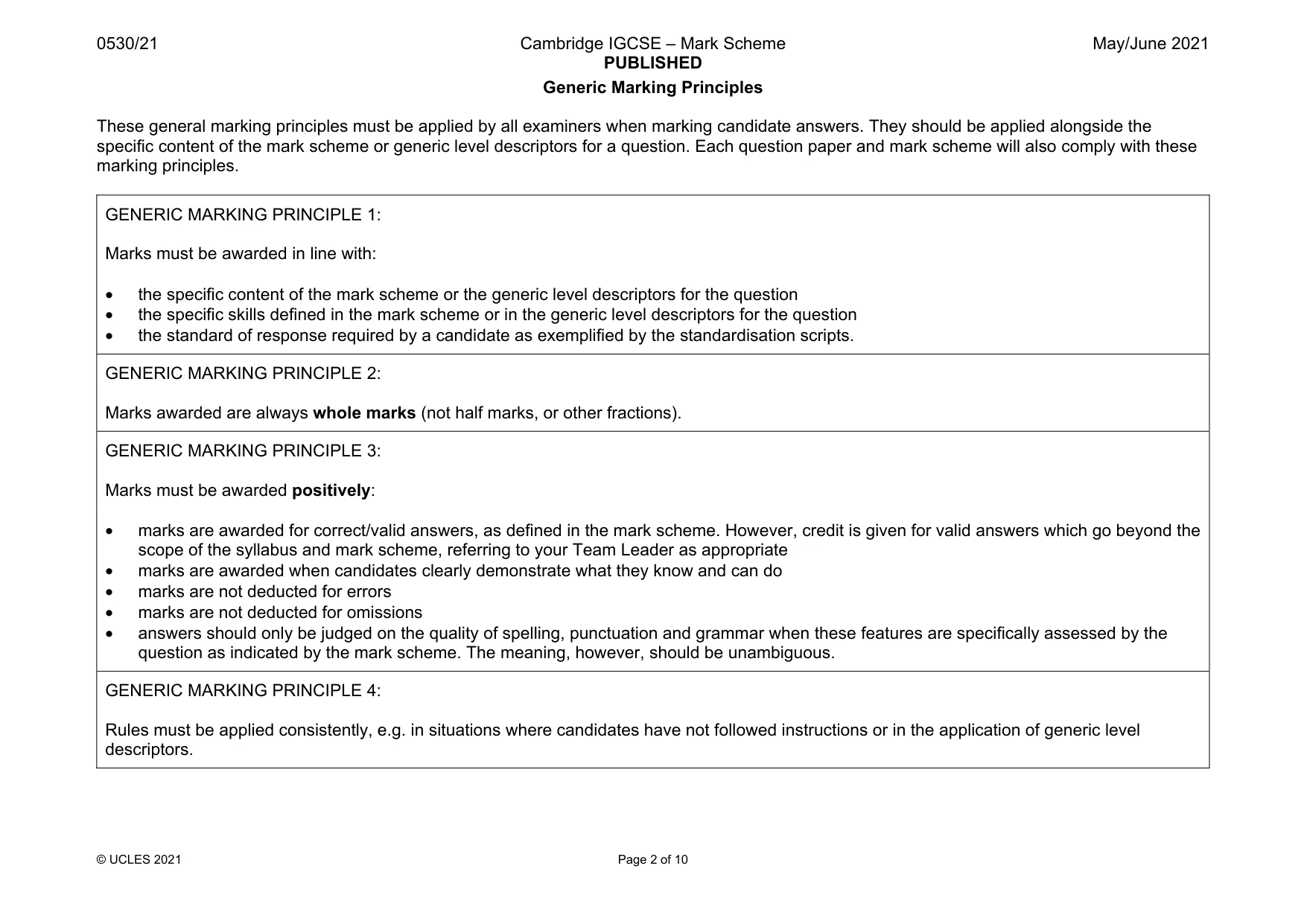
This document consists of 10 printed pages. © UCLES 2021 [Turn over Cambridge IGCSE™ SPANISH 0530/21 Paper 2 Reading May/June 2021 MARK SCHEME Maximum Mark: 45 Published This mark scheme is published as an aid to teachers and candidates, to indicate the requirements of the examination. It shows the basis on which Examiners were instructed to award marks. It does not indicate the details of the discussions that took place at an Examiners’ meeting before marking began, which would have considered the acceptability of alternative answers. Mark schemes should be read in conjunction with the question paper and the Principal Examiner Report for Teachers. Cambridge International will not enter into discussions about these mark schemes. Cambridge International is publishing the mark schemes for the May/June 2021 series for most Cambridge IGCSE™, Cambridge International A and AS Level components and some Cambridge O Level components.
Mark scheme, page 2
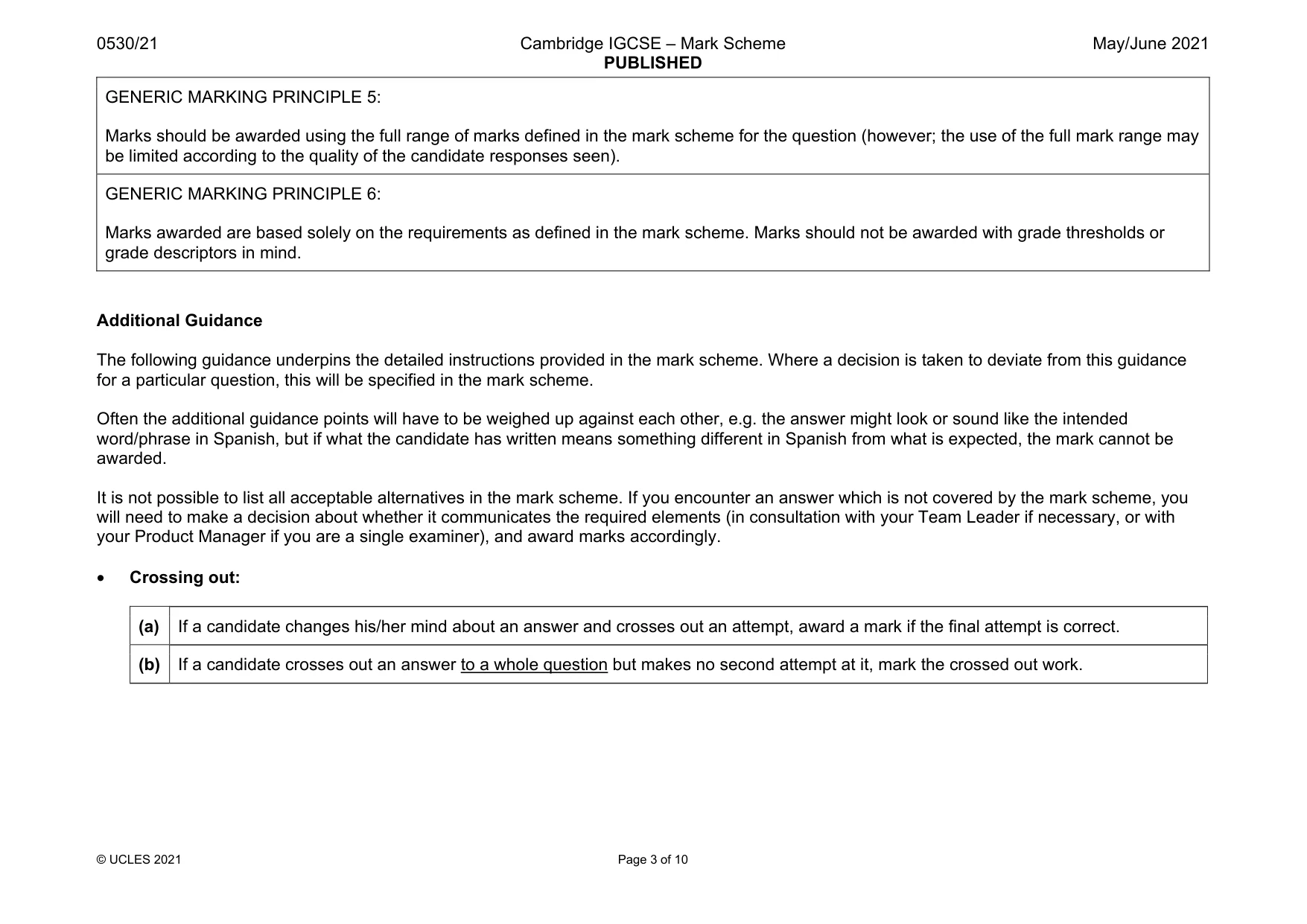
0530/21 Cambridge IGCSE – Mark Scheme PUBLISHED May/June 2021 © UCLES 2021 Page 2 of 10 Generic Marking Principles These general marking principles must be applied by all examiners when marking candidate answers. They should be applied alongside the specific content of the mark scheme or generic level descriptors for a question. Each question paper and mark scheme will also comply with these marking principles. GENERIC MARKING PRINCIPLE 1: Marks must be awarded in line with: • the specific content of the mark scheme or the generic level descriptors for the question • the specific skills defined in the mark scheme or in the generic level descriptors for the question • the standard of response required by a candidate as exemplified by the standardisation scripts. GENERIC MARKING PRINCIPLE 2: Marks awarded are always whole marks (not half marks, or other fractions). GENERIC MARKING PRINCIPLE 3: Marks must be awarded positively: • marks are awarded for correct/valid answers, as defined in the mark scheme. However, credit is given for valid answers which go beyond the scope of the syllabus and mark scheme, referring to your Team Leader as appropriate • marks are awarded when candidates clearly demonstrate what they know and can do • marks are not deducted for errors • marks are not deducted for omissions • answers should only be judged on the quality of spelling, punctuation and grammar when these features are specifically assessed by the question as indicated by the mark scheme. The meaning, however, should be unambiguous. GENERIC MARKING PRINCIPLE 4: Rules must be applied consistently, e.g. in situations where candidates have not followed instructions or in the application of generic level descriptors.
Mark scheme, page 3
0530/21 Cambridge IGCSE – Mark Scheme PUBLISHED May/June 2021 © UCLES 2021 Page 3 of 10 GENERIC MARKING PRINCIPLE 5: Marks should be awarded using the full range of marks defined in the mark scheme for the question (however; the use of the full mark range may be limited according to the quality of the candidate responses seen). GENERIC MARKING PRINCIPLE 6: Marks awarded are based solely on the requirements as defined in the mark scheme. Marks should not be awarded with grade thresholds or grade descriptors in mind. Additional Guidance The following guidance underpins the detailed instructions provided in the mark scheme. Where a decision is taken to deviate from this guidance for a particular question, this will be specified in the mark scheme. Often the additional guidance points will have to be weighed up against each other, e.g. the answer might look or sound like the intended word/phrase in Spanish, but if what the candidate has written means something different in Spanish from what is expected, the mark cannot be awarded. It is not possible to list all acceptable alternatives in the mark scheme. If you encounter an answer which is not covered by the mark scheme, you will need to make a decision about whether it communicates the required elements (in consultation with your Team Leader if necessary, or with your Product Manager if you are a single examiner), and award marks accordingly. • Crossing out: (a) If a candidate changes his/her mind about an answer and crosses out an attempt, award a mark if the final attempt is correct. (b) If a candidate crosses out an answer to a whole question but makes no second attempt at it, mark the crossed out work.
Mark scheme, page 4
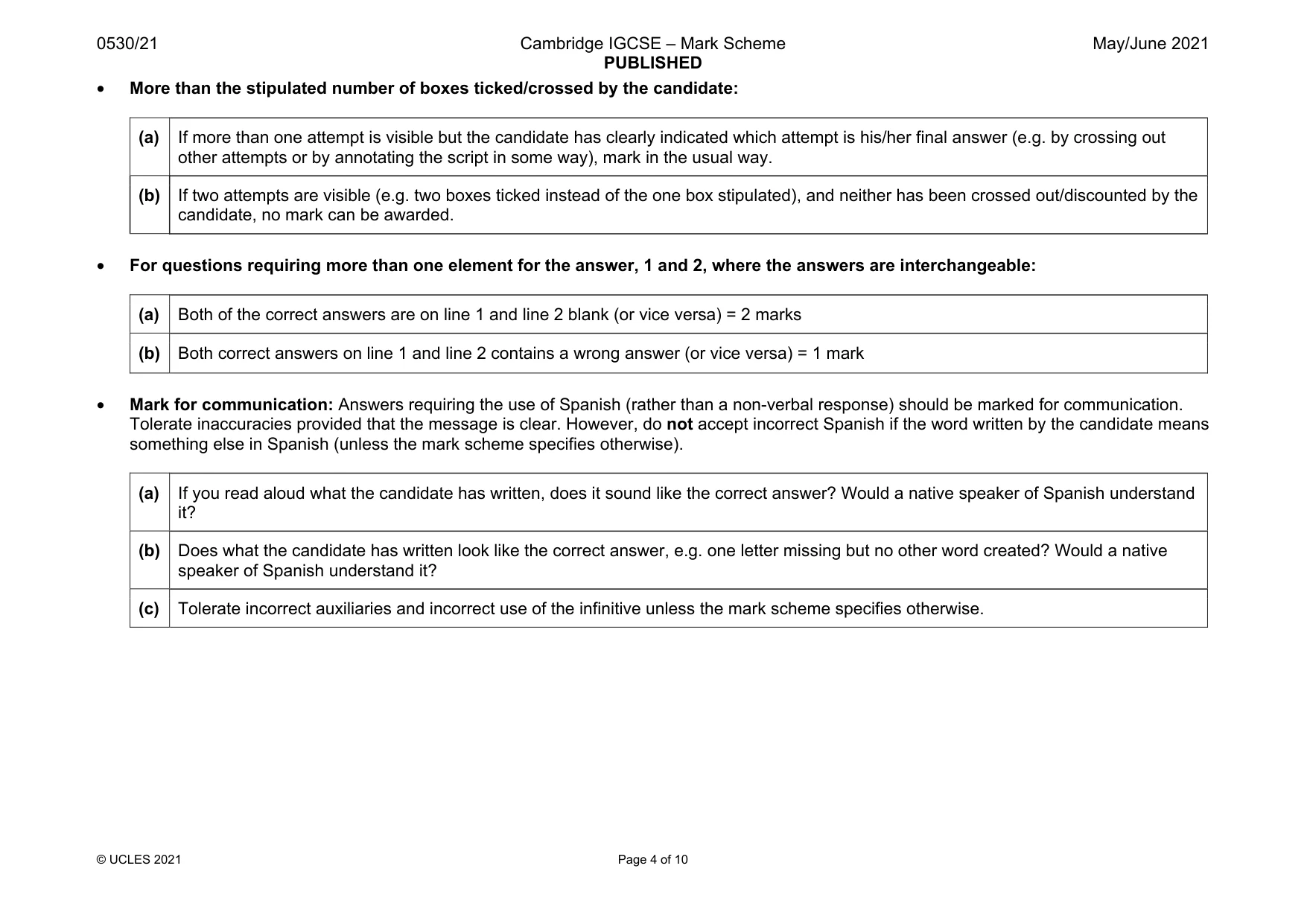
0530/21 Cambridge IGCSE – Mark Scheme PUBLISHED May/June 2021 © UCLES 2021 Page 4 of 10 • More than the stipulated number of boxes ticked/crossed by the candidate: (a) If more than one attempt is visible but the candidate has clearly indicated which attempt is his/her final answer (e.g. by crossing out other attempts or by annotating the script in some way), mark in the usual way. (b) If two attempts are visible (e.g. two boxes ticked instead of the one box stipulated), and neither has been crossed out/discounted by the candidate, no mark can be awarded. • For questions requiring more than one element for the answer, 1 and 2, where the answers are interchangeable: (a) Both of the correct answers are on line 1 and line 2 blank (or vice versa) = 2 marks (b) Both correct answers on line 1 and line 2 contains a wrong answer (or vice versa) = 1 mark • Mark for communication: Answers requiring the use of Spanish (rather than a non-verbal response) should be marked for communication. Tolerate inaccuracies provided that the message is clear. However, do not accept incorrect Spanish if the word written by the candidate means something else in Spanish (unless the mark scheme specifies otherwise). (a) If you read aloud what the candidate has written, does it sound like the correct answer? Would a native speaker of Spanish understand it? (b) Does what the candidate has written look like the correct answer, e.g. one letter missing but no other word created? Would a native speaker of Spanish understand it? (c) Tolerate incorrect auxiliaries and incorrect use of the infinitive unless the mark scheme specifies otherwise.
Mark scheme, page 5
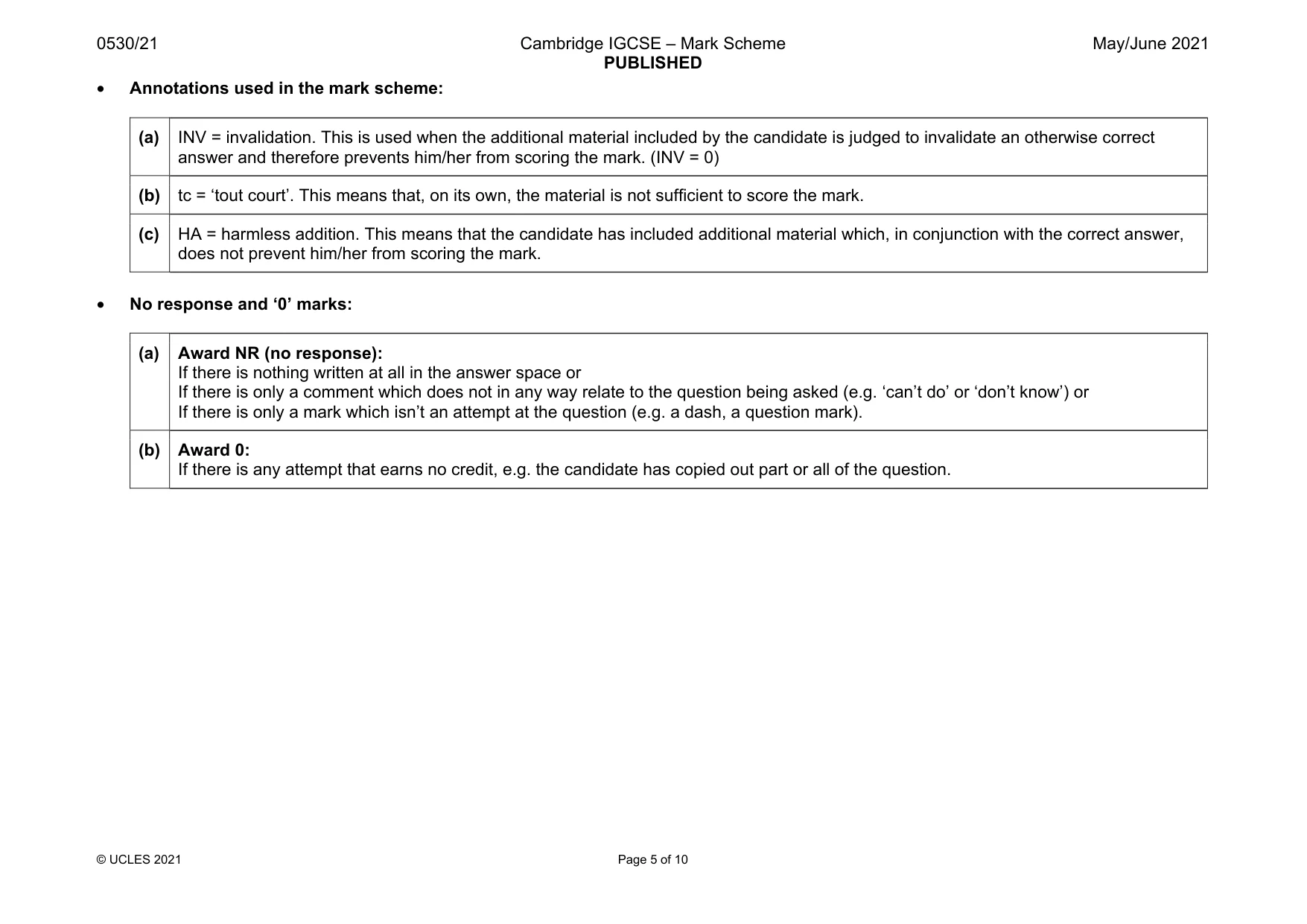
0530/21 Cambridge IGCSE – Mark Scheme PUBLISHED May/June 2021 © UCLES 2021 Page 5 of 10 • Annotations used in the mark scheme: (a) INV = invalidation. This is used when the additional material included by the candidate is judged to invalidate an otherwise correct answer and therefore prevents him/her from scoring the mark. (INV = 0) (b) tc = ‘tout court’. This means that, on its own, the material is not sufficient to score the mark. (c) HA = harmless addition. This means that the candidate has included additional material which, in conjunction with the correct answer, does not prevent him/her from scoring the mark. • No response and ‘0’ marks: (a) Award NR (no response): If there is nothing written at all in the answer space or If there is only a comment which does not in any way relate to the question being asked (e.g. ‘can’t do’ or ‘don’t know’) or If there is only a mark which isn’t an attempt at the question (e.g. a dash, a question mark). (b) Award 0: If there is any attempt that earns no credit, e.g. the candidate has copied out part or all of the question.
Mark scheme, page 6
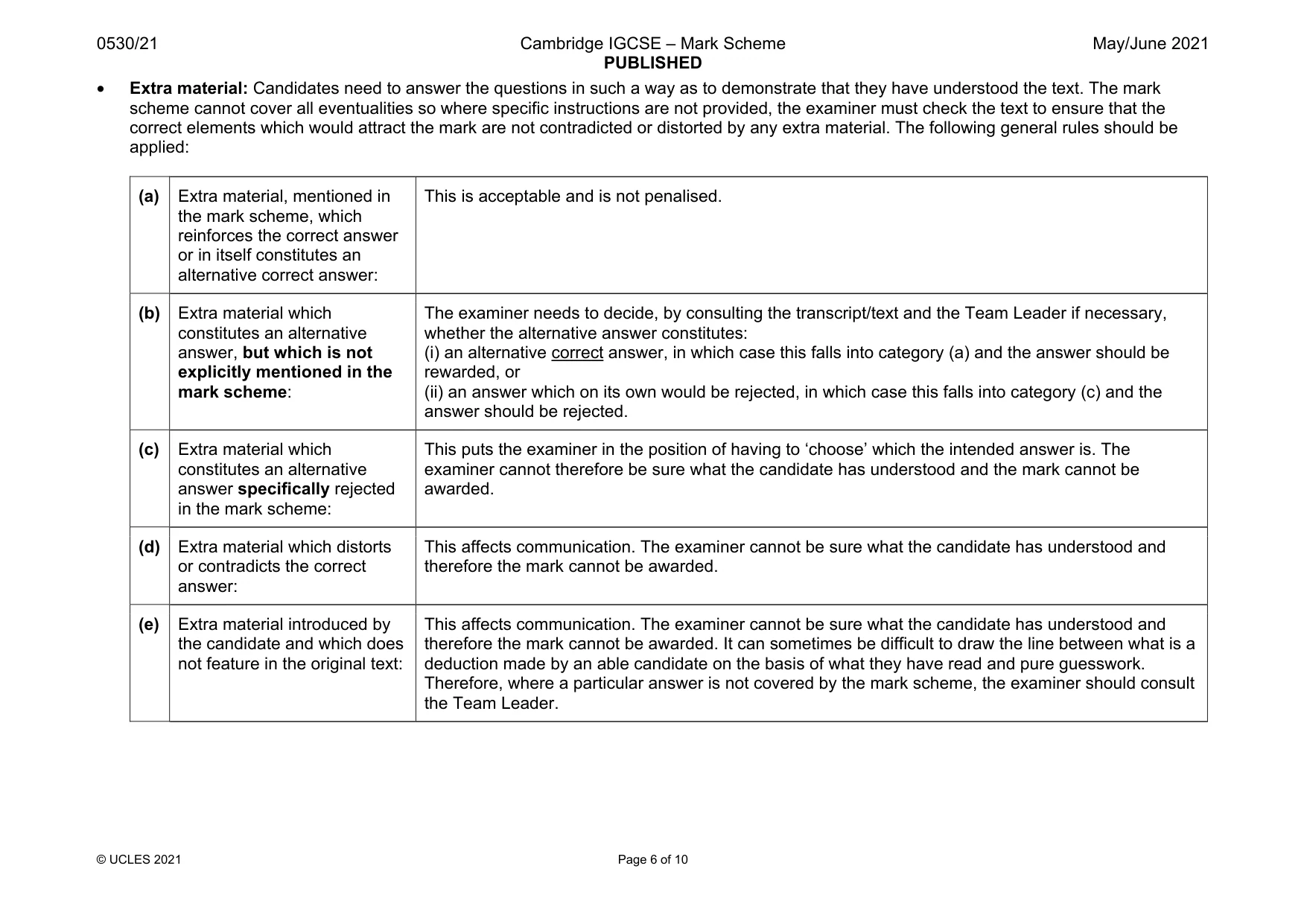
0530/21 Cambridge IGCSE – Mark Scheme PUBLISHED May/June 2021 © UCLES 2021 Page 6 of 10 • Extra material: Candidates need to answer the questions in such a way as to demonstrate that they have understood the text. The mark scheme cannot cover all eventualities so where specific instructions are not provided, the examiner must check the text to ensure that the correct elements which would attract the mark are not contradicted or distorted by any extra material. The following general rules should be applied: (a) Extra material, mentioned in the mark scheme, which reinforces the correct answer or in itself constitutes an alternative correct answer: This is acceptable and is not penalised. (b) Extra material which constitutes an alternative answer, but which is not explicitly mentioned in the mark scheme: The examiner needs to decide, by consulting the transcript/text and the Team Leader if necessary, whether the alternative answer constitutes: (i) an alternative correct answer, in which case this falls into category (a) and the answer should be rewarded, or (ii) an answer which on its own would be rejected, in which case this falls into category (c) and the answer should be rejected. (c) Extra material which constitutes an alternative answer specifically rejected in the mark scheme: This puts the examiner in the position of having to ‘choose’ which the intended answer is. The examiner cannot therefore be sure what the candidate has understood and the mark cannot be awarded. (d) Extra material which distorts or contradicts the correct answer: This affects communication. The examiner cannot be sure what the candidate has understood and therefore the mark cannot be awarded. (e) Extra material introduced by the candidate and which does not feature in the original text: This affects communication. The examiner cannot be sure what the candidate has understood and therefore the mark cannot be awarded. It can sometimes be difficult to draw the line between what is a deduction made by an able candidate on the basis of what they have read and pure guesswork. Therefore, where a particular answer is not covered by the mark scheme, the examiner should consult the Team Leader.
Mark scheme, page 7
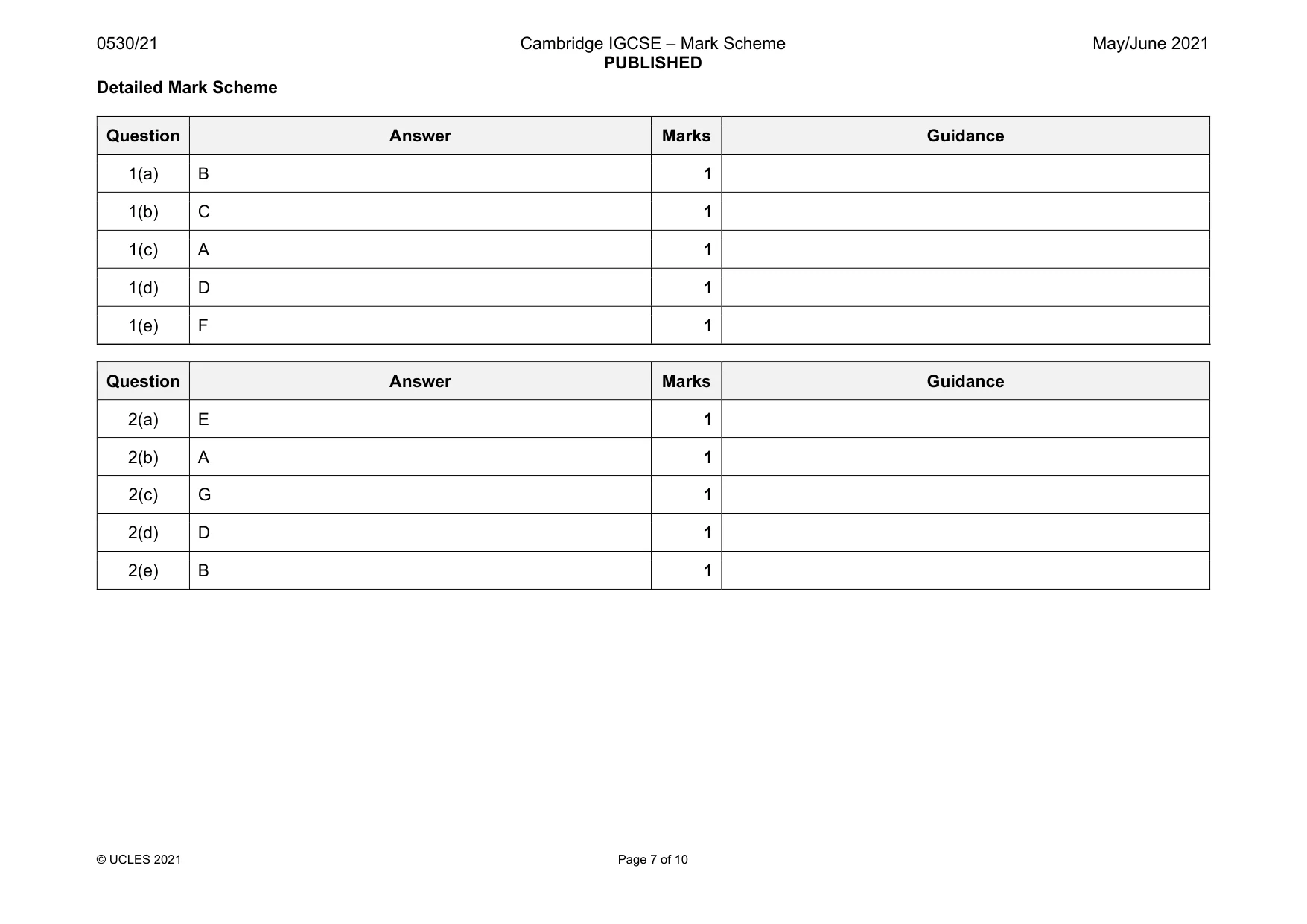
0530/21 Cambridge IGCSE – Mark Scheme PUBLISHED May/June 2021 © UCLES 2021 Page 7 of 10 Detailed Mark Scheme Question Answer Marks Guidance 1(a) B 1 1(b) C 1 1(c) A 1 1(d) D 1 1(e) F 1 Question Answer Marks Guidance 2(a) E 1 2(b) A 1 2(c) G 1 2(d) D 1 2(e) B 1
Mark scheme, page 8
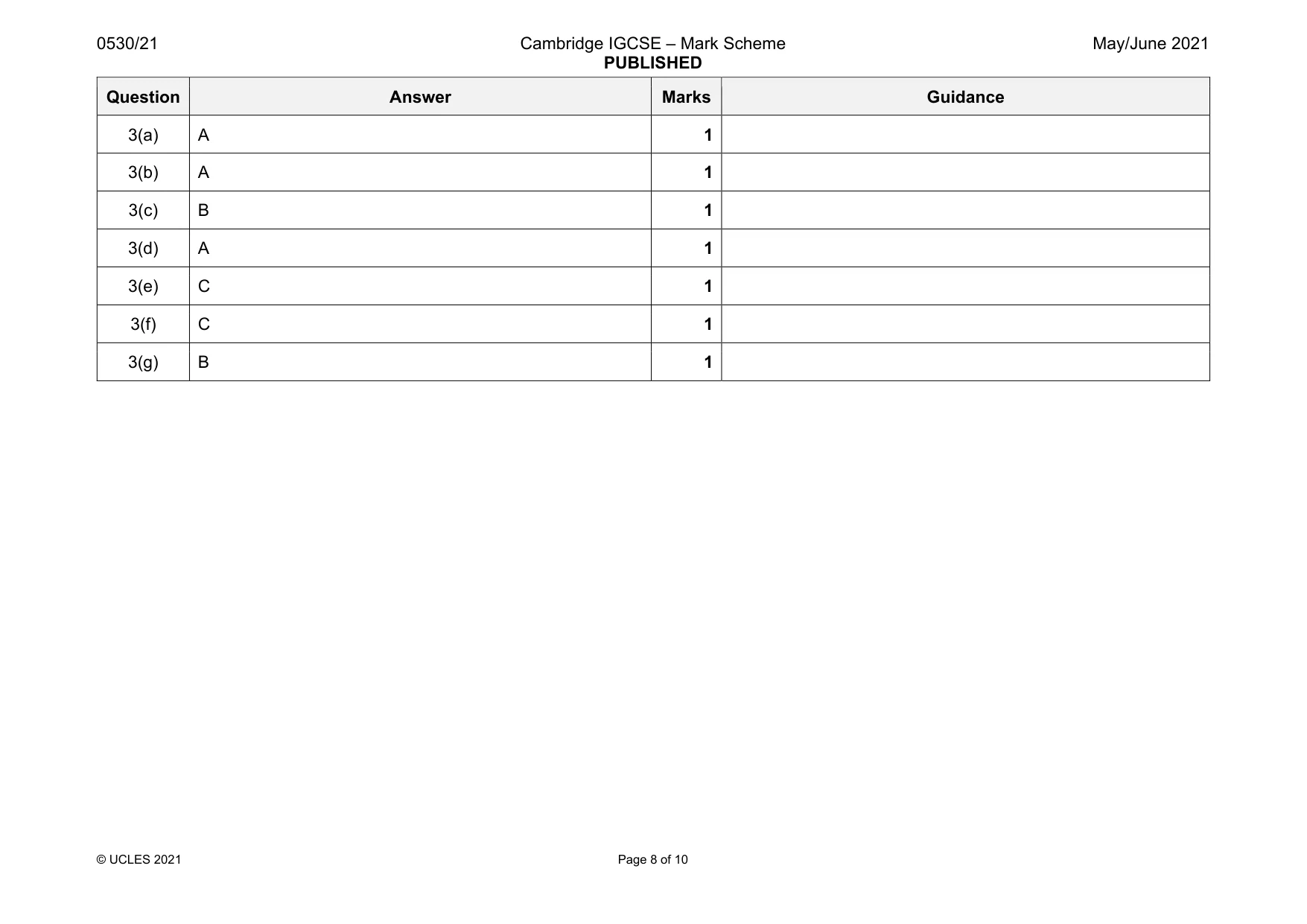
0530/21 Cambridge IGCSE – Mark Scheme PUBLISHED May/June 2021 © UCLES 2021 Page 8 of 10 Question Answer Marks Guidance 3(a) A 1 3(b) A 1 3(c) B 1 3(d) A 1 3(e) C 1 3(f) C 1 3(g) B 1
Mark scheme, page 9
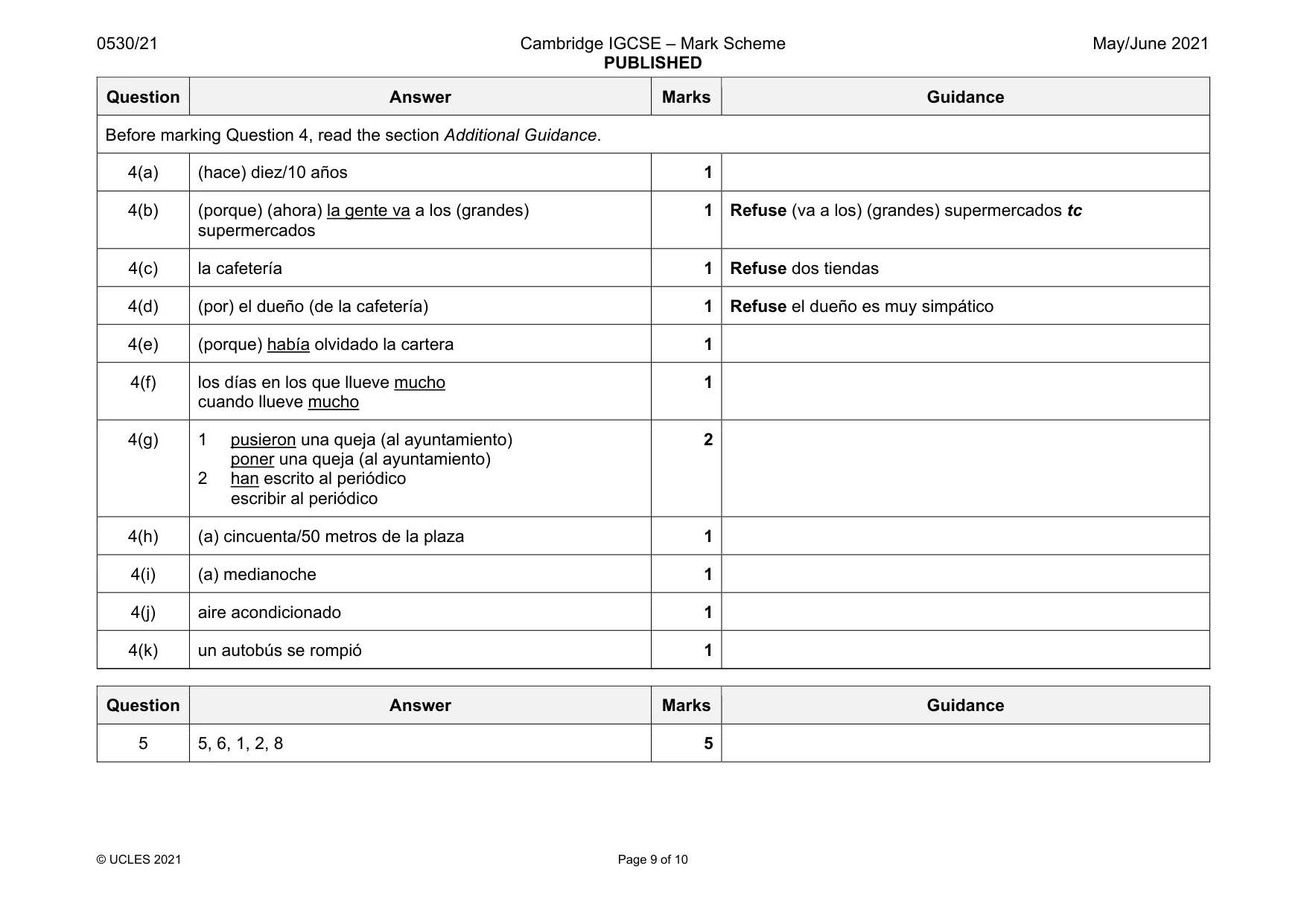
0530/21 Cambridge IGCSE – Mark Scheme PUBLISHED May/June 2021 © UCLES 2021 Page 9 of 10 Question Answer Marks Guidance Before marking Question 4, read the section Additional Guidance. 4(a) (hace) diez/10 años 1 4(b) (porque) (ahora) la gente va a los (grandes) supermercados 1 Refuse (va a los) (grandes) supermercados tc 4(c) la cafetería 1 Refuse dos tiendas 4(d) (por) el dueño (de la cafetería) 1 Refuse el dueño es muy simpático 4(e) (porque) había olvidado la cartera 1 4(f) los días en los que llueve mucho cuando llueve mucho 1 4(g) 1 pusieron una queja (al ayuntamiento) poner una queja (al ayuntamiento) 2 han escrito al periódico escribir al periódico 2 4(h) (a) cincuenta/50 metros de la plaza 1 4(i) (a) medianoche 1 4(j) aire acondicionado 1 4(k) un autobús se rompió 1 Question Answer Marks Guidance 5 5, 6, 1, 2, 8 5
Mark scheme, page 10
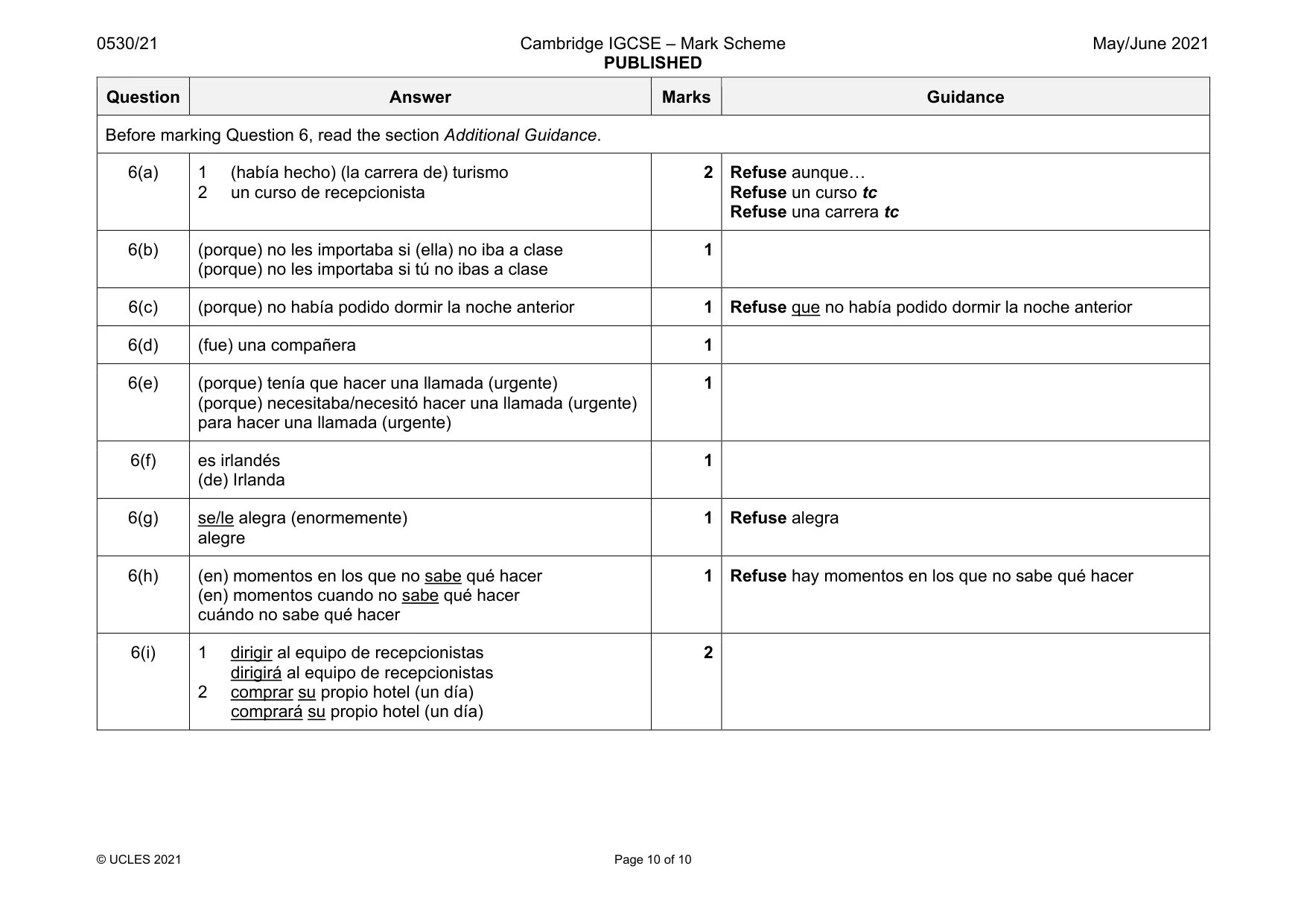
0530/21 Cambridge IGCSE – Mark Scheme PUBLISHED May/June 2021 © UCLES 2021 Page 10 of 10 Question Answer Marks Guidance Before marking Question 6, read the section Additional Guidance. 6(a) 1 (había hecho) (la carrera de) turismo 2 un curso de recepcionista 2 Refuse aunque… Refuse un curso tc Refuse una carrera tc 6(b) (porque) no les importaba si (ella) no iba a clase (porque) no les importaba si tú no ibas a clase 1 6(c) (porque) no había podido dormir la noche anterior 1 Refuse que no había podido dormir la noche anterior 6(d) (fue) una compañera 1 6(e) (porque) tenía que hacer una llamada (urgente) (porque) necesitaba/necesitó hacer una llamada (urgente) para hacer una llamada (urgente) 1 6(f) es irlandés (de) Irlanda 1 6(g) se/le alegra (enormemente) alegre 1 Refuse alegra 6(h) (en) momentos en los que no sabe qué hacer (en) momentos cuando no sabe qué hacer cuándo no sabe qué hacer 1 Refuse hay momentos en los que no sabe qué hacer 6(i) 1 dirigir al equipo de recepcionistas dirigirá al equipo de recepcionistas 2 comprar su propio hotel (un día) comprará su propio hotel (un día) 2
What you needed in this session
Cambridge’s own grade thresholds for 2021 May/June, Paper 2 · Variant 1. A higher threshold means an easier paper — the bar moves with how the cohort did.