Cambridge IGCSE Spanish - Foreign Language 0530 — 2020 Oct/Nov Paper 2 · Variant 2
0530/22/O/N/20 · 45 marks · ≈51 min
The question paper and its mark scheme, free to read here and free to download. This is Cambridge’s own paper, exactly as it was sat.
Question paper16 pages



Mark scheme14 pages
Answers below. Sit the paper first if you are practising.
Paper as text
Question paper, page 1
Cambridge IGCSE™ DC (PQ/SW) 183141/3 © UCLES 2020 [Turn over This document has 16 pages. Blank pages are indicated. * 2 7 7 1 5 5 0 4 1 7 * SPANISH 0530/22 Paper 2 Reading October/November 2020 1 hour You must answer on the question paper. No additional materials are needed. INSTRUCTIONS ● Answer all questions. ● Use a black or dark blue pen. ● Write your name, centre number and candidate number in the boxes at the top of the page. ● Write your answer to each question in the space provided. ● Do not use an erasable pen or correction fluid. ● Do not write on any bar codes. INFORMATION ● The total mark for this paper is 45. ● The number of marks for each question or part question is shown in brackets [ ].
Question paper, page 2
2 0530/22/O/N/20 © UCLES 2020 BLANK PAGE
Question paper, page 3
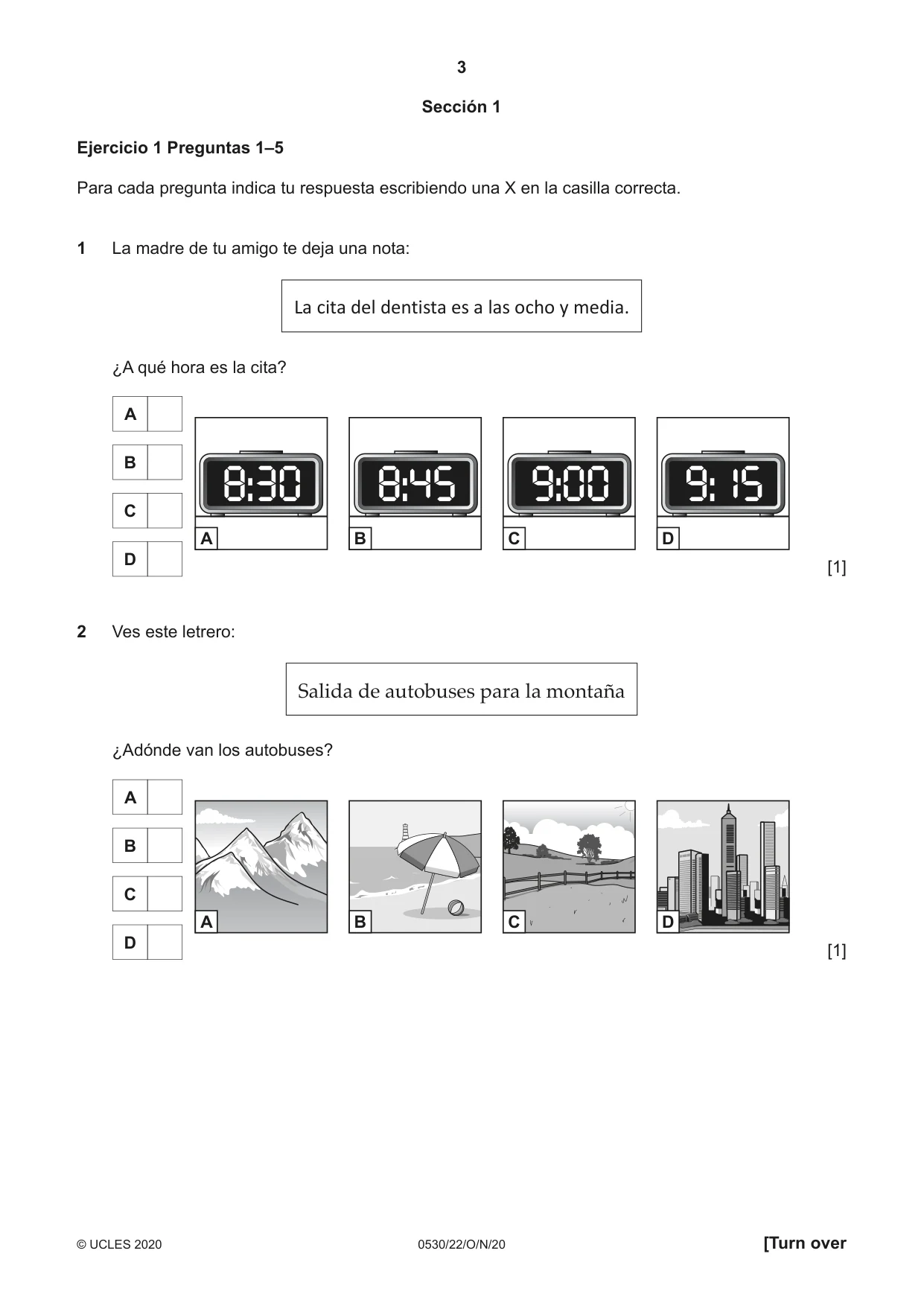
3 0530/22/O/N/20 © UCLES 2020 [Turn over Sección 1 Ejercicio 1 Preguntas 1–5 Para cada pregunta indica tu respuesta escribiendo una X en la casilla correcta. 1 La madre de tu amigo te deja una nota: La cita del dentista es a las ocho y media. ¿A qué hora es la cita? A B C D A B C D [1] 2 Ves este letrero: Salida de autobuses para la montaña ¿Adónde van los autobuses? A B C D A B C D [1]
Question paper, page 4
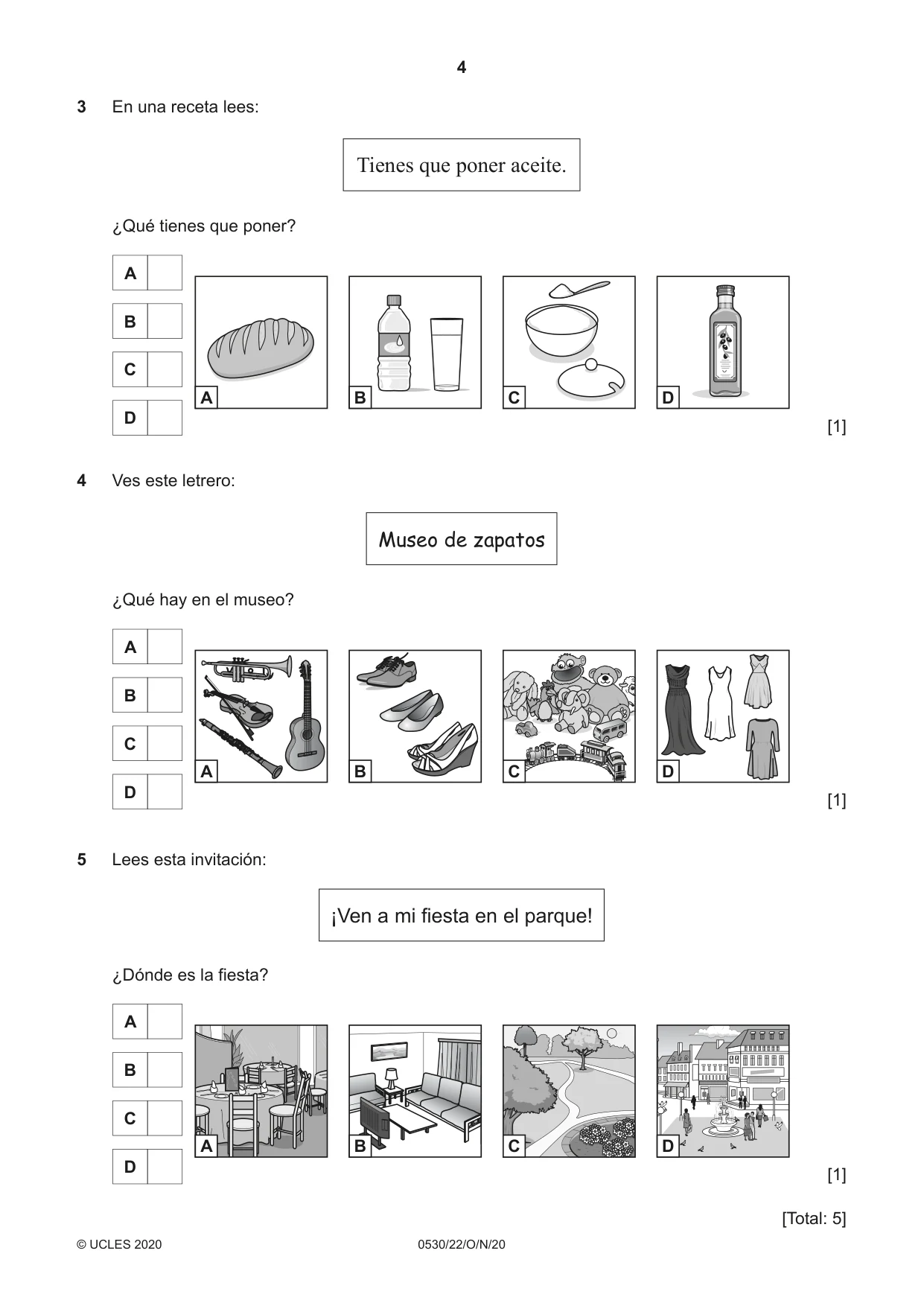
4 0530/22/O/N/20 © UCLES 2020 3 En una receta lees: Tienes que poner aceite. ¿Qué tienes que poner? A B C D A B C D [1] 4 Ves este letrero: Museo de zapatos ¿Qué hay en el museo? A B C D A B C D [1] 5 Lees esta invitación: ¡Ven a mi fiesta en el parque! ¿Dónde es la fiesta? A B C D A B C D [1] [Tot al: 5]
Question paper, page 5
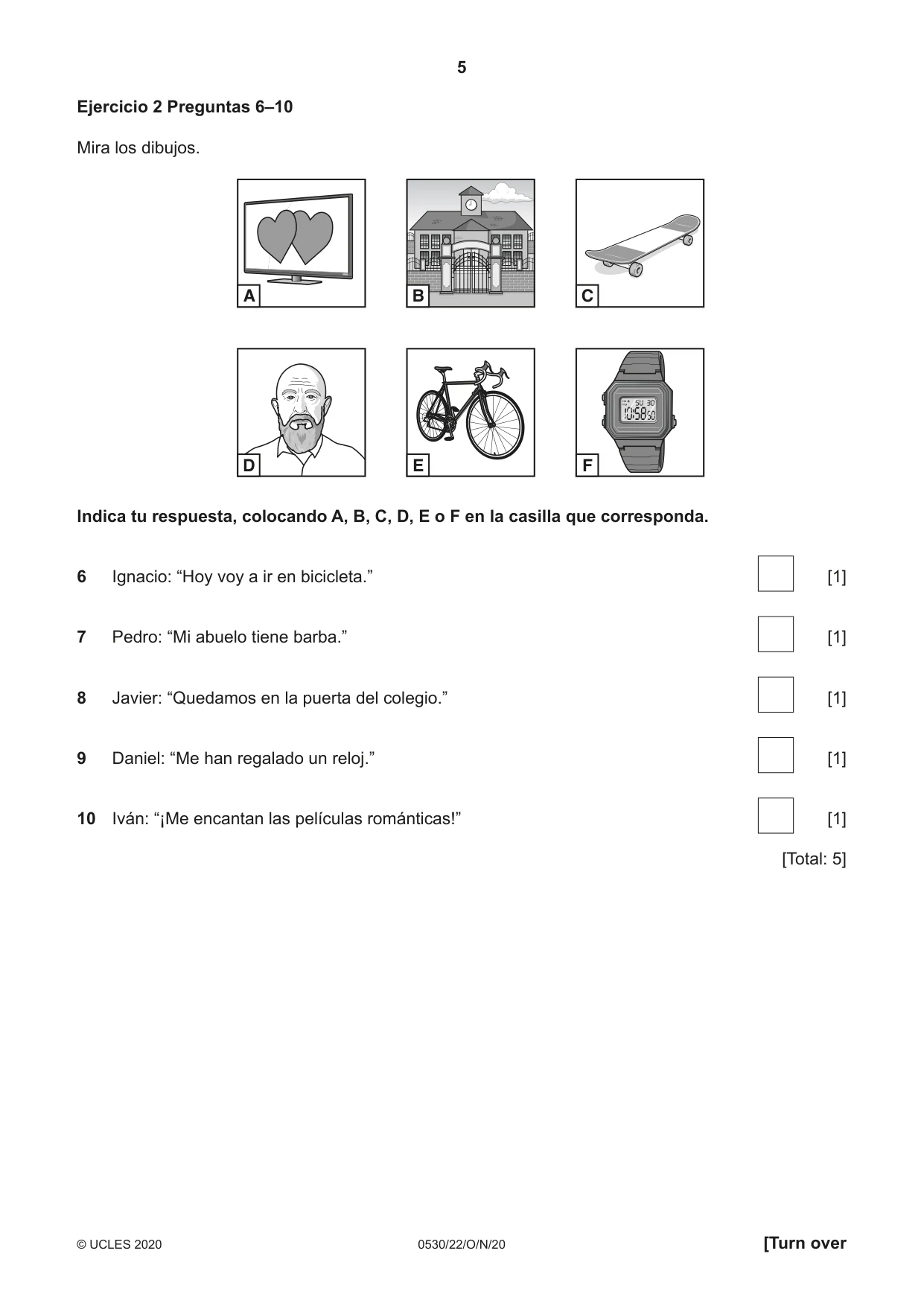
5 0530/22/O/N/20 © UCLES 2020 [Turn over Ejercicio 2 Preguntas 6–10 Mira los dibujos. A B C D E F Indica tu respuesta, colocando A, B, C, D, E o F en la casilla que corresponda. 6 Ignacio: “Hoy voy a ir en bicicleta.” [1] 7 Pedro: “Mi abuelo tiene barba.” [1] 8 Javier: “Quedamos en la puerta del colegio.” [1] 9 Daniel: “Me han regalado un reloj.” [1] 10 Iván: “¡Me encantan las películas románticas!” [1] [Total: 5]
Question paper, page 6
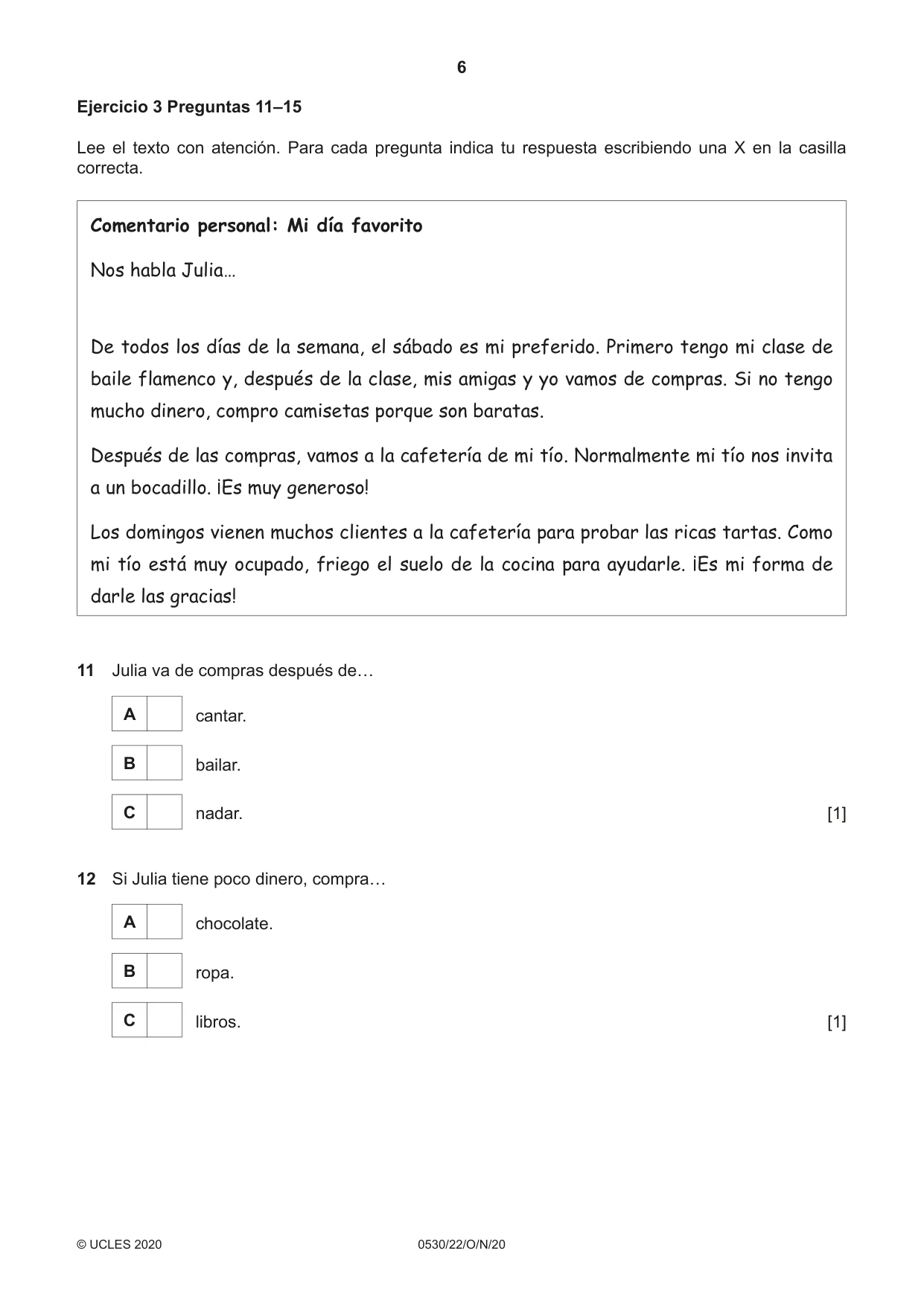
6 0530/22/O/N/20 © UCLES 2020 Ejercicio 3 Preguntas 11–15 Lee el texto con atención. Para cada pregunta indica tu respuesta escribiendo una X en la casilla correcta. Comentario personal: Mi día favorito Nos habla Julia… De todos los días de la semana, el sábado es mi preferido. Primero tengo mi clase de baile flamenco y, después de la clase, mis amigas y yo vamos de compras. Si no tengo mucho dinero, compro camisetas porque son baratas. Después de las compras, vamos a la cafetería de mi tío. Normalmente mi tío nos invita a un bocadillo. ¡Es muy generoso! Los domingos vienen muchos clientes a la cafetería para probar las ricas tartas. Como mi tío está muy ocupado, friego el suelo de la cocina para ayudarle. ¡Es mi forma de darle las gracias! 11 Julia va de compras después de… A cantar. B bailar. C nadar. [1] 12 Si Julia tiene poco dinero, compra… A chocolate. B ropa. C libros. [1]
Question paper, page 7
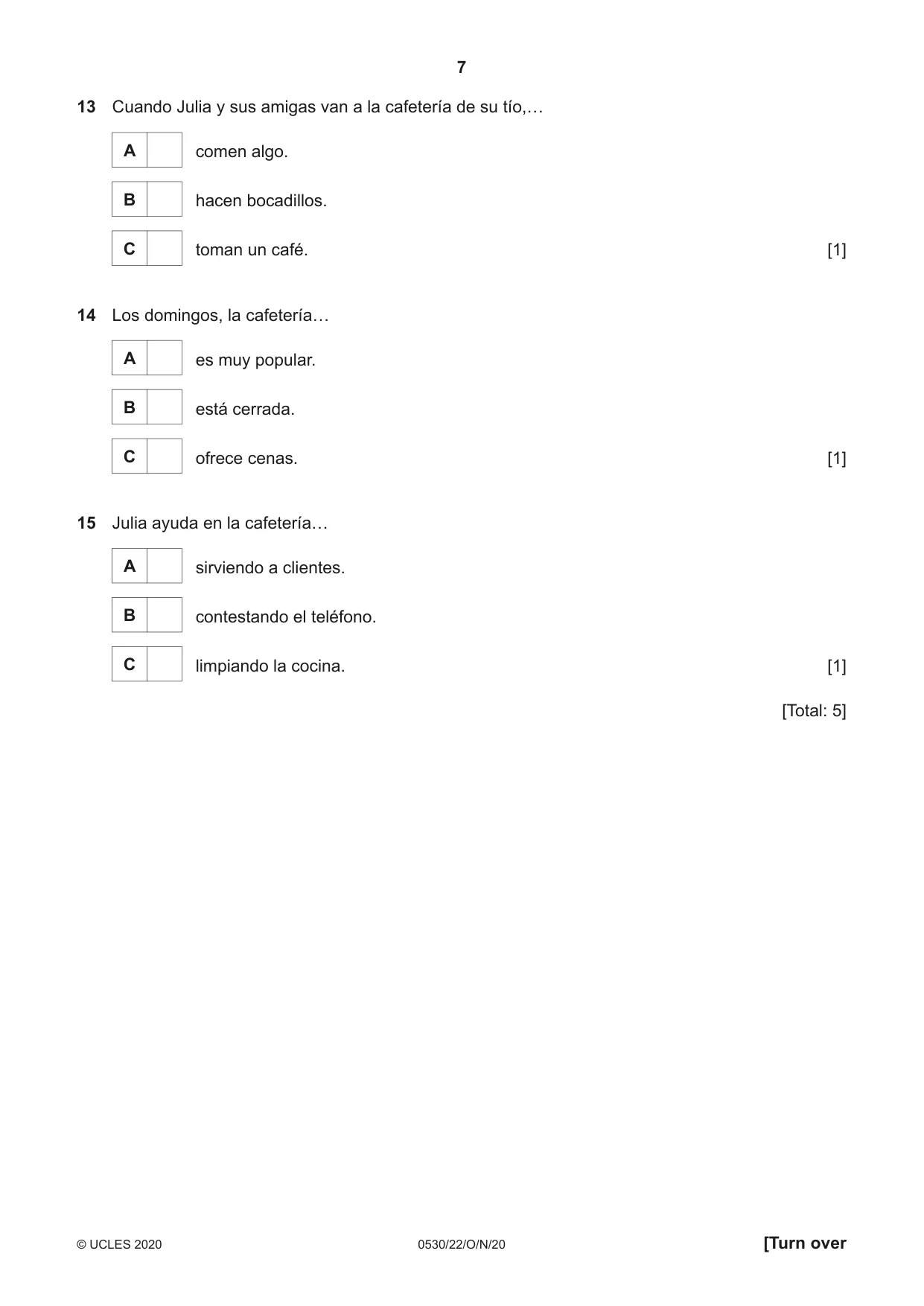
7 0530/22/O/N/20 © UCLES 2020 [Turn over 13 Cuando Julia y sus amigas van a la cafetería de su tío,… A comen algo. B hacen bocadillos. C toman un café. [1] 14 Los domingos, la cafetería… A es muy popular. B está cerrada. C ofrece cenas. [1] 15 Julia ayuda en la cafetería… A sirviendo a clientes. B contestando el teléfono. C limpiando la cocina. [1] [Total: 5]
Question paper, page 8
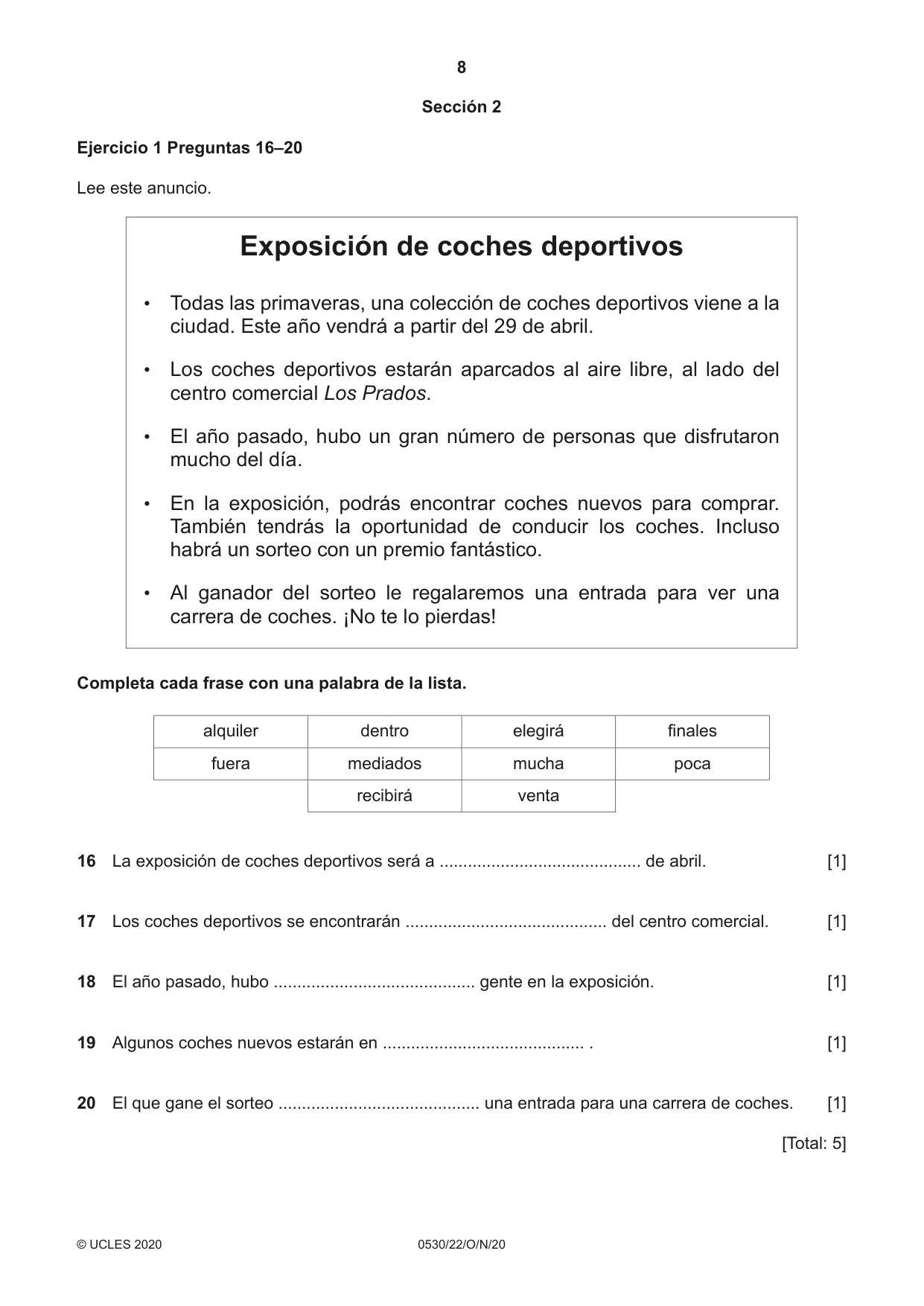
8 0530/22/O/N/20 © UCLES 2020 Sección 2 Ejercicio 1 Preguntas 16–20 Lee este anuncio. Exposición de coches deportivos • Todas las primaveras, una colección de coches deportivos viene a la ciudad. Este año vendrá a partir del 29 de abril. • Los coches deportivos estarán aparcados al aire libre, al lado del centro comercial Los Prados. • El año pasado, hubo un gran número de personas que disfrutaron mucho del día. • En la exposición, podrás encontrar coches nuevos para comprar. También tendrás la oportunidad de conducir los coches. Incluso habrá un sorteo con un premio fantástico. • Al ganador del sorteo le regalaremos una entrada para ver una carrera de coches. ¡No te lo pierdas! Completa cada frase con una palabra de la lista. alquiler dentro elegirá finales fuera mediados mucha poca recibirá venta 16 La exposición de coches deportivos será a … de abril. [1] 17 Los coches deportivos se encontrarán … del centro comercial. [1] 18 El año pasado, hubo … gente en la exposición. [1] 19 Algunos coches nuevos estarán en … . [1] 20 El que gane el sorteo … una entrada para una carrera de coches. [1] [Total: 5]
Question paper, page 9
9 0530/22/O/N/20 © UCLES 2020 [Turn over Dar la vuelta para el Ejercicio 2.
Question paper, page 10
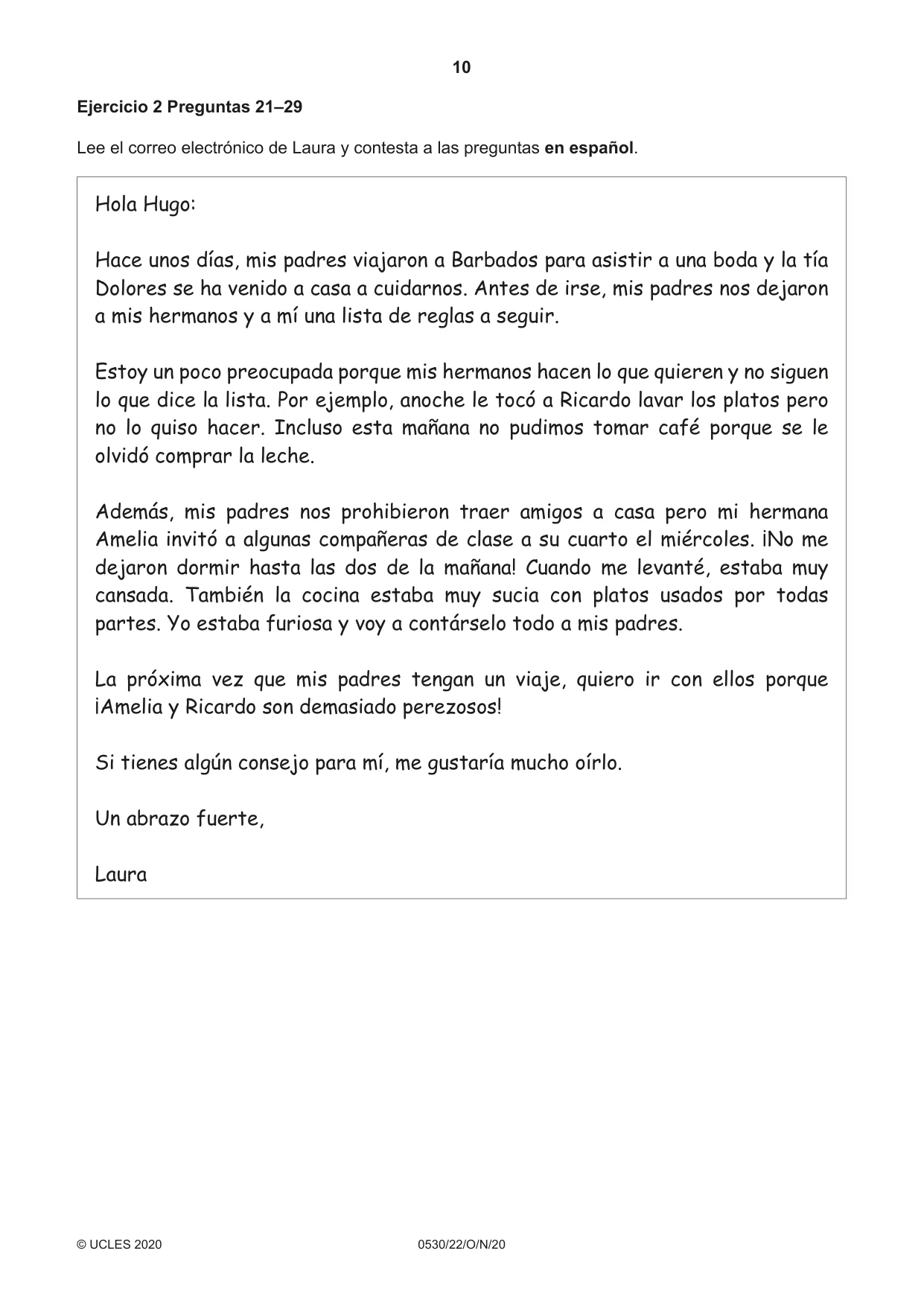
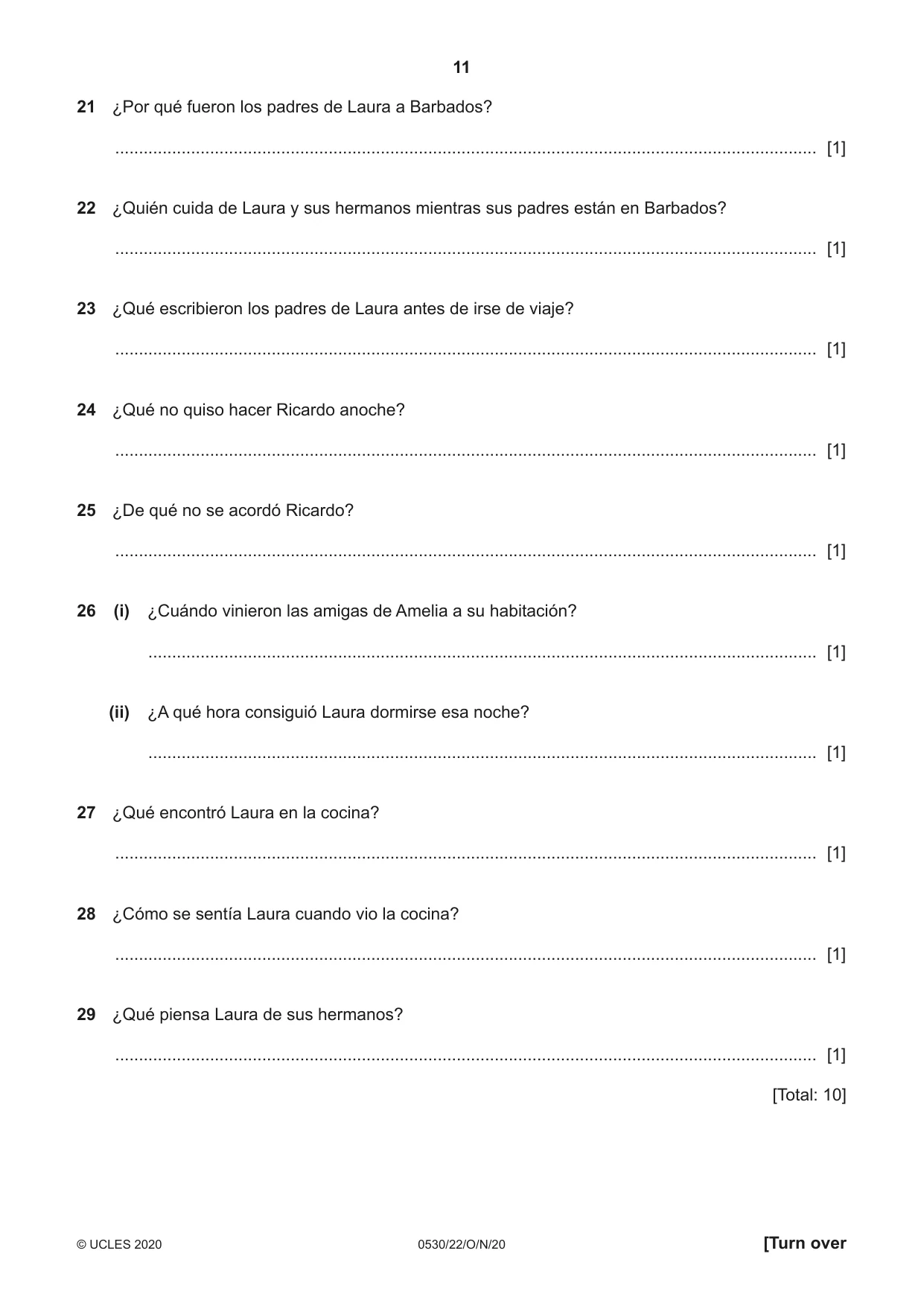
10 0530/22/O/N/20 © UCLES 2020 Ejercicio 2 Preguntas 21–29 Lee el correo electrónico de Laura y contesta a las preguntas en español. Hola Hugo: Hace unos días, mis padres viajaron a Barbados para asistir a una boda y la tía Dolores se ha venido a casa a cuidarnos. Antes de irse, mis padres nos dejaron a mis hermanos y a mí una lista de reglas a seguir. Estoy un poco preocupada porque mis hermanos hacen lo que quieren y no siguen lo que dice la lista. Por ejemplo, anoche le tocó a Ricardo lavar los platos pero no lo quiso hacer. Incluso esta mañana no pudimos tomar café porque se le olvidó comprar la leche. Además, mis padres nos prohibieron traer amigos a casa pero mi hermana Amelia invitó a algunas compañeras de clase a su cuarto el miércoles. ¡No me dejaron dormir hasta las dos de la mañana! Cuando me levanté, estaba muy cansada. También la cocina estaba muy sucia con platos usados por todas partes. Yo estaba furiosa y voy a contárselo todo a mis padres. La próxima vez que mis padres tengan un viaje, quiero ir con ellos porque ¡Amelia y Ricardo son demasiado perezosos! Si tienes algún consejo para mí, me gustaría mucho oírlo. Un abrazo fuerte, Laura
Question paper, page 11
11 0530/22/O/N/20 © UCLES 2020 [Turn over 21 ¿Por qué fueron los padres de Laura a Barbados? … [1] 22 ¿Quién cuida de Laura y sus hermanos mientras sus padres están en Barbados? … [1] 23 ¿Qué escribieron los padres de Laura antes de irse de viaje? … [1] 24 ¿Qué no quiso hacer Ricardo anoche? … [1] 25 ¿De qué no se acordó Ricardo? … [1] 26 (i) ¿Cuándo vinieron las amigas de Amelia a su habitación? … [1] (ii) ¿A qué hora consiguió Laura dormirse esa noche? … [1] 27 ¿Qué encontró Laura en la cocina? … [1] 28 ¿Cómo se sentía Laura cuando vio la cocina? … [1] 29 ¿Qué piensa Laura de sus hermanos? … [1] [Total: 10]
Question paper, page 12
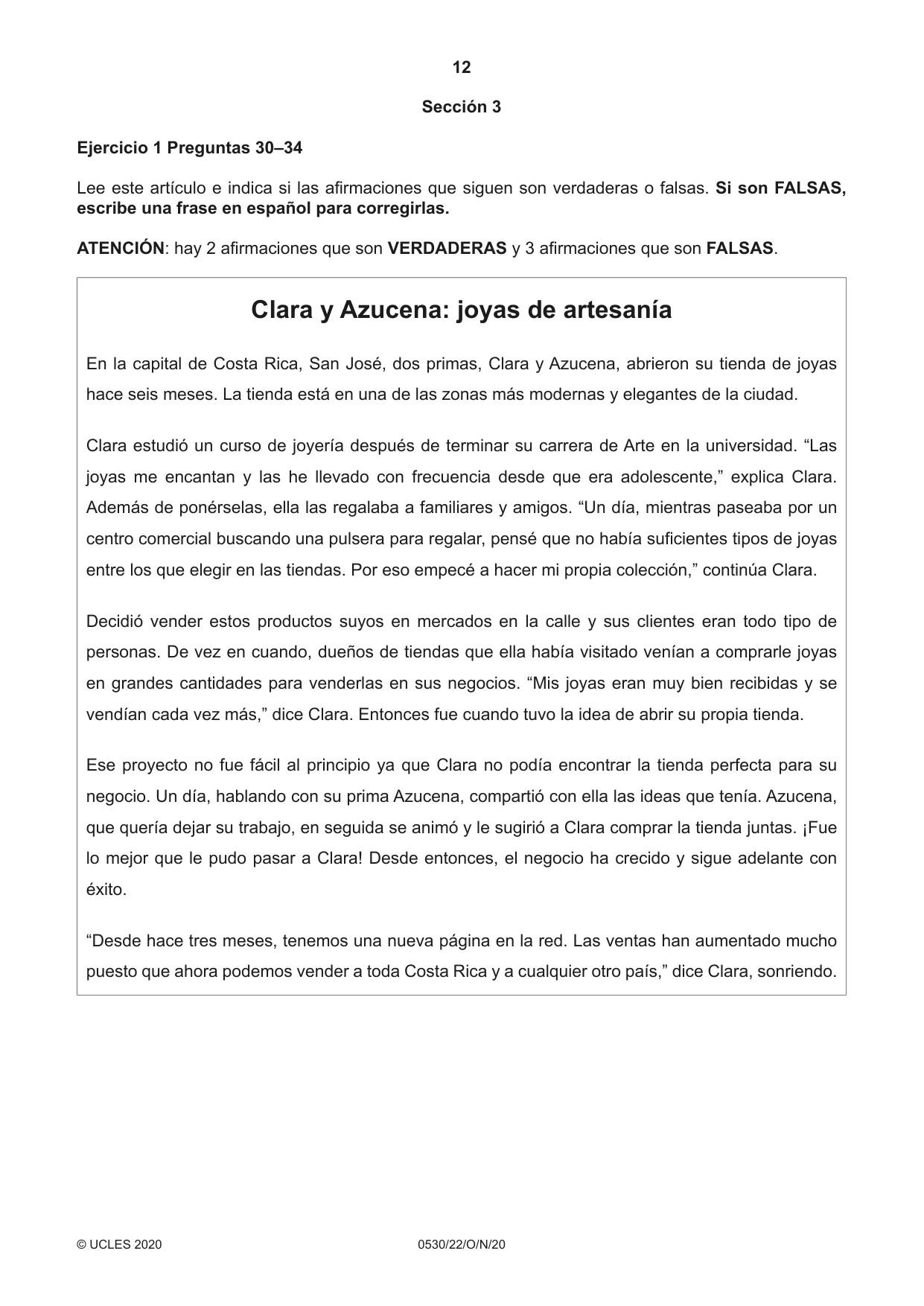
12 0530/22/O/N/20 © UCLES 2020 Sección 3 Ejercicio 1 Preguntas 30–34 Lee este artículo e indica si las afirmaciones que siguen son verdaderas o falsas. Si son FALSAS, escribe una frase en español para corregirlas. ATENCIÓN: hay 2 afirmaciones que son VERDADERAS y 3 afirmaciones que son FALSAS. Clara y Azucena: joyas de artesanía En la capital de Costa Rica, San José, dos primas, Clara y Azucena, abrieron su tienda de joyas hace seis meses. La tienda está en una de las zonas más modernas y elegantes de la ciudad. Clara estudió un curso de joyería después de terminar su carrera de Arte en la universidad. “Las joyas me encantan y las he llevado con frecuencia desde que era adolescente,” explica Clara. Además de ponérselas, ella las regalaba a familiares y amigos. “Un día, mientras paseaba por un centro comercial buscando una pulsera para regalar, pensé que no había suficientes tipos de joyas entre los que elegir en las tiendas. Por eso empecé a hacer mi propia colección,” continúa Clara. Decidió vender estos productos suyos en mercados en la calle y sus clientes eran todo tipo de personas. De vez en cuando, dueños de tiendas que ella había visitado venían a comprarle joyas en grandes cantidades para venderlas en sus negocios. “Mis joyas eran muy bien recibidas y se vendían cada vez más,” dice Clara. Entonces fue cuando tuvo la idea de abrir su propia tienda. Ese proyecto no fue fácil al principio ya que Clara no podía encontrar la tienda perfecta para su negocio. Un día, hablando con su prima Azucena, compartió con ella las ideas que tenía. Azucena, que quería dejar su trabajo, en seguida se animó y le sugirió a Clara comprar la tienda juntas. ¡Fue lo mejor que le pudo pasar a Clara! Desde entonces, el negocio ha crecido y sigue adelante con éxito. “Desde hace tres meses, tenemos una nueva página en la red. Las ventas han aumentado mucho puesto que ahora podemos vender a toda Costa Rica y a cualquier otro país,” dice Clara, sonriendo.
Question paper, page 13
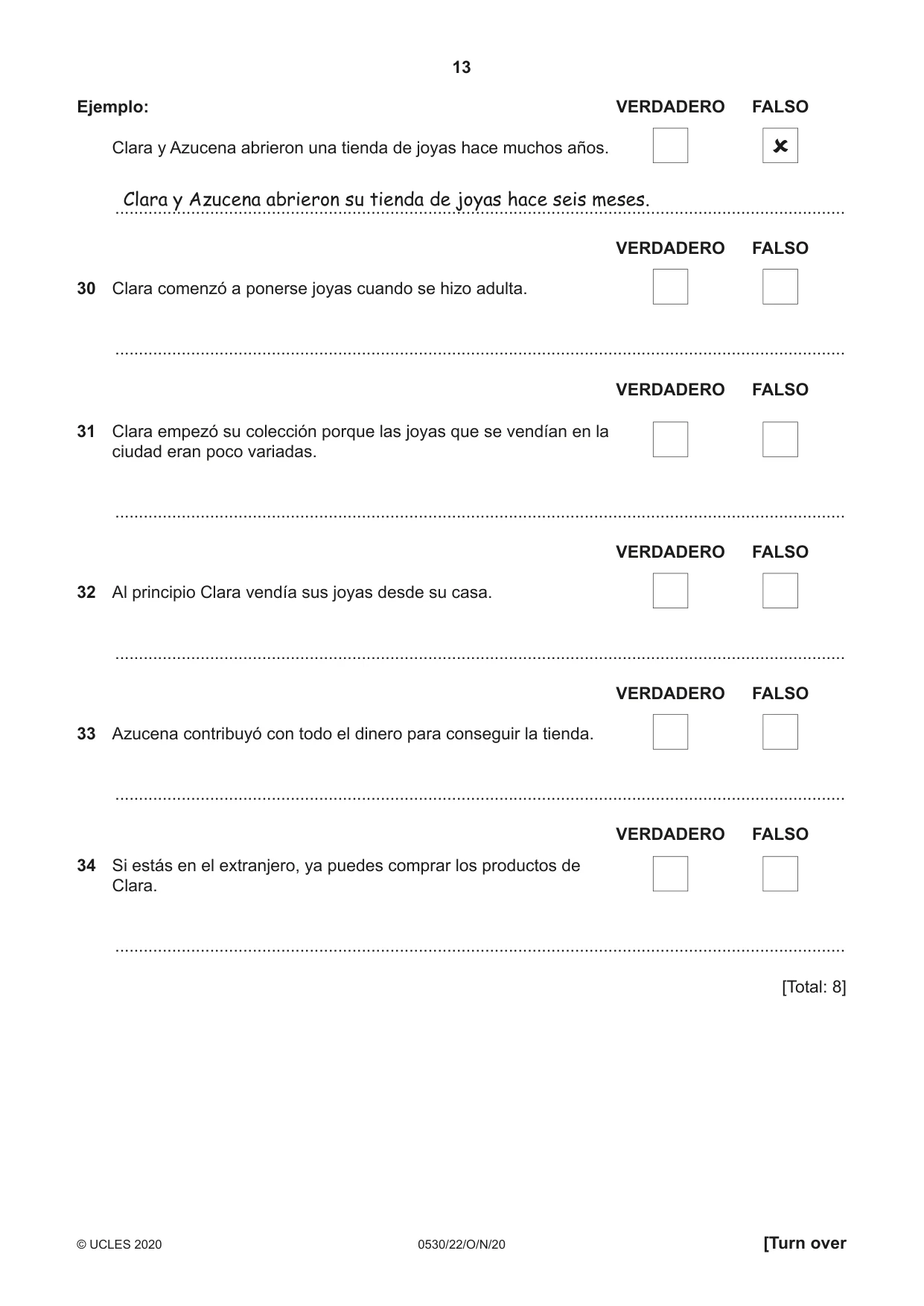
13 0530/22/O/N/20 © UCLES 2020 [Turn over Ejemplo: VERDADERO FALSO Clara y Azucena abrieron una tienda de joyas hace muchos años. û Clara y Azucena abrieron su tienda de joyas hace seis meses. … VERDADERO FALSO 30 Clara comenzó a ponerse joyas cuando se hizo adulta. … VERDADERO FALSO 31 Clara empezó su colección porque las joyas que se vendían en la ciudad eran poco variadas. … VERDADERO FALSO 32 Al principio Clara vendía sus joyas desde su casa. … VERDADERO FALSO 33 Azucena contribuyó con todo el dinero para conseguir la tienda. … VERDADERO FALSO 34 Si estás en el extranjero, ya puedes comprar los productos de Clara. … [Total: 8]
Question paper, page 14
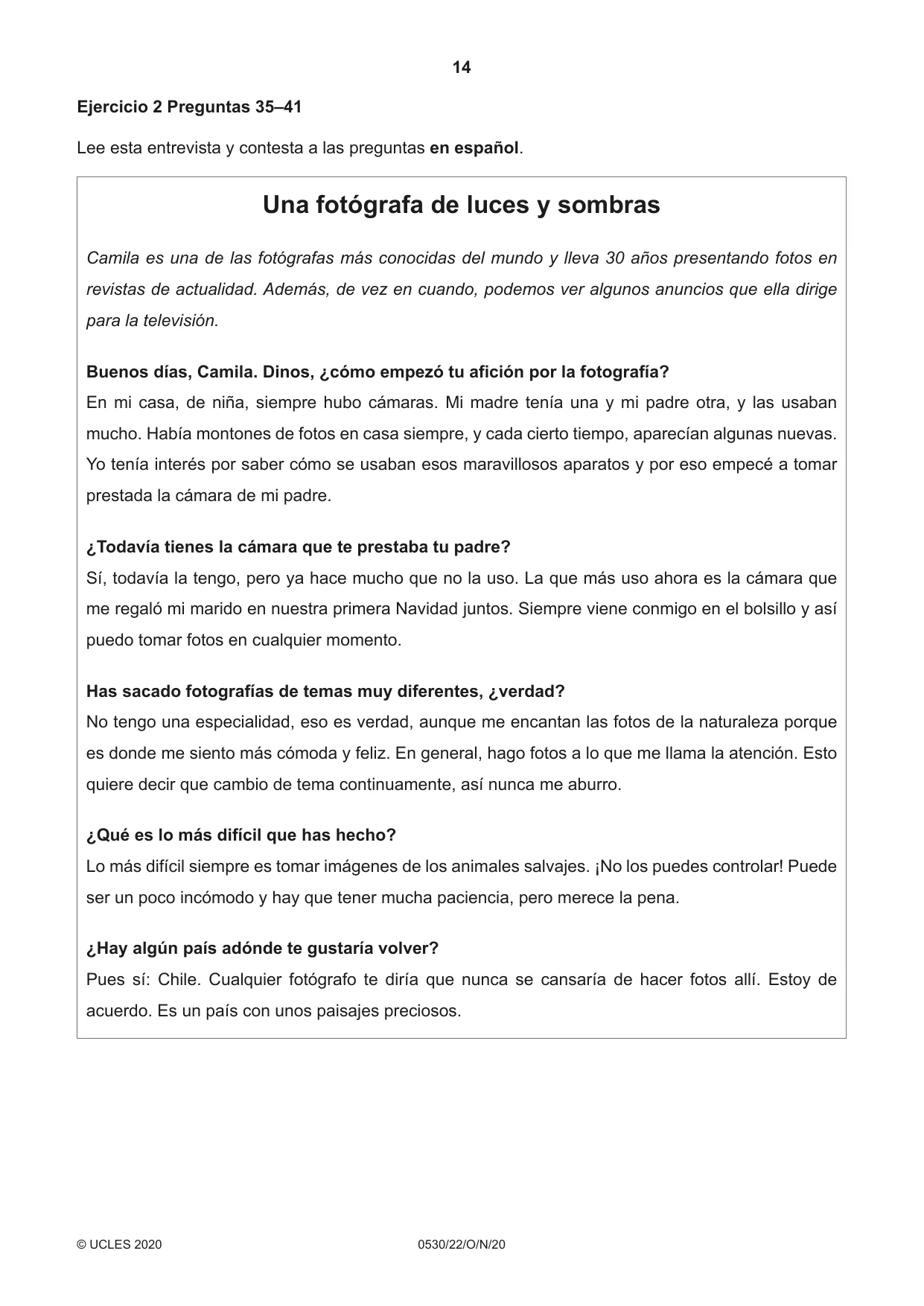
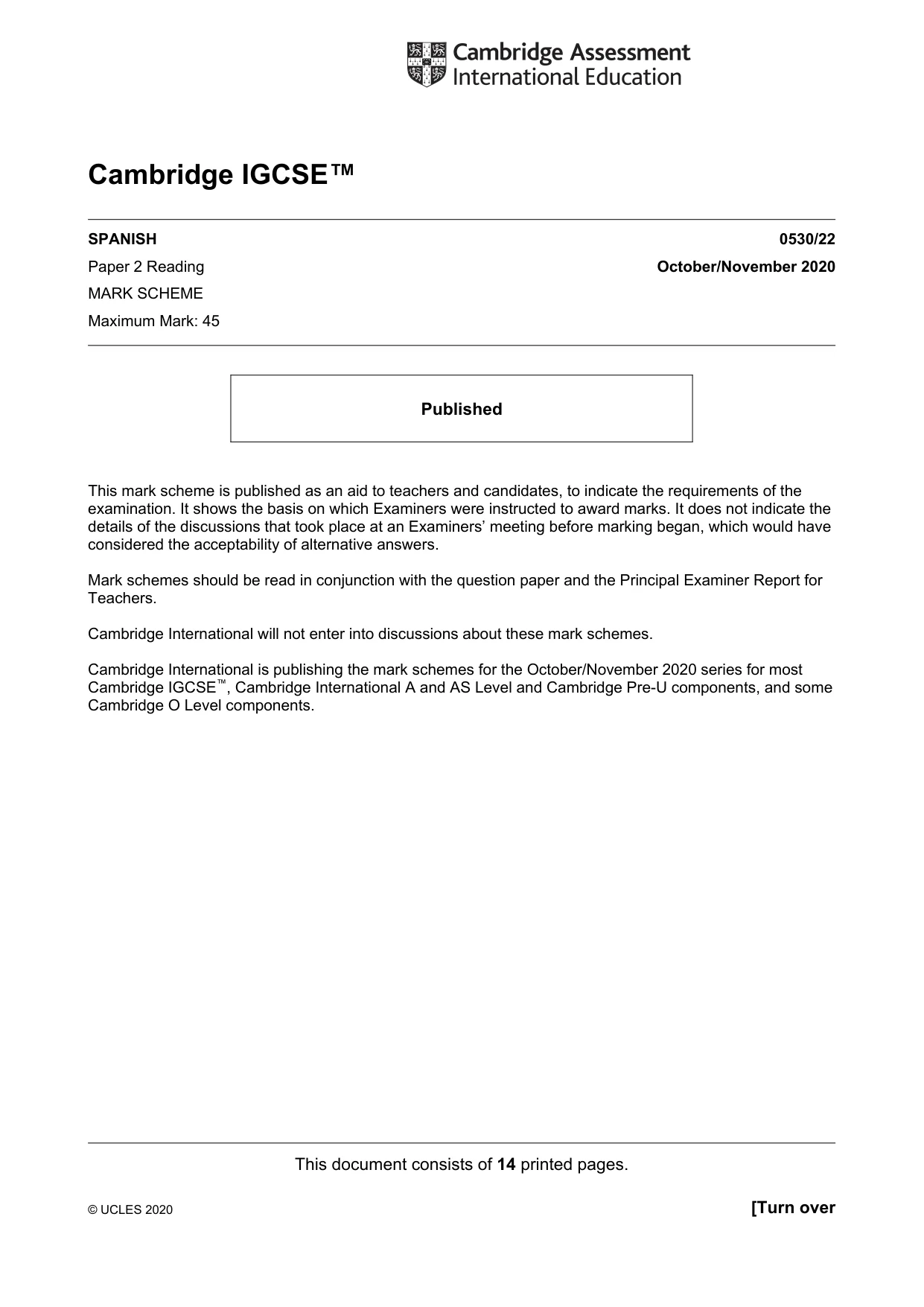
14 0530/22/O/N/20 © UCLES 2020 Ejercicio 2 Preguntas 35–41 Lee esta entrevista y contesta a las preguntas en español. Una fotógrafa de luces y sombras Camila es una de las fotógrafas más conocidas del mundo y lleva 30 años presentando fotos en revistas de actualidad. Además, de vez en cuando, podemos ver algunos anuncios que ella dirige para la televisión. Buenos días, Camila. Dinos, ¿cómo empezó tu afición por la fotografía? En mi casa, de niña, siempre hubo cámaras. Mi madre tenía una y mi padre otra, y las usaban mucho. Había montones de fotos en casa siempre, y cada cierto tiempo, aparecían algunas nuevas. Yo tenía interés por saber cómo se usaban esos maravillosos aparatos y por eso empecé a tomar prestada la cámara de mi padre. ¿Todavía tienes la cámara que te prestaba tu padre? Sí, todavía la tengo, pero ya hace mucho que no la uso. La que más uso ahora es la cámara que me regaló mi marido en nuestra primera Navidad juntos. Siempre viene conmigo en el bolsillo y así puedo tomar fotos en cualquier momento. Has sacado fotografías de temas muy diferentes, ¿verdad? No tengo una especialidad, eso es verdad, aunque me encantan las fotos de la naturaleza porque es donde me siento más cómoda y feliz. En general, hago fotos a lo que me llama la atención. Esto quiere decir que cambio de tema continuamente, así nunca me aburro. ¿Qué es lo más difícil que has hecho? Lo más difícil siempre es tomar imágenes de los animales salvajes. ¡No los puedes controlar! Puede ser un poco incómodo y hay que tener mucha paciencia, pero merece la pena. ¿Hay algún país adónde te gustaría volver? Pues sí: Chile. Cualquier fotógrafo te diría que nunca se cansaría de hacer fotos allí. Estoy de acuerdo. Es un país con unos paisajes preciosos.
Question paper, page 15
15 0530/22/O/N/20 © UCLES 2020 35 ¿Dónde se pueden encontrar las fotos de Camila? … [1] 36 ¿Qué trabajo hace Camila para la televisión? … [1] 37 ¿Qué quería aprender Camila con la cámara de su padre? … [1] 38 ¿Dónde lleva Camila siempre la cámara que le dio su esposo? … [1] 39 Para Camila, ¿cuál es la ventaja de fotografiar distintas cosas? … [1] 40 ¿Qué cualidad se necesita para hacer fotos a animales salvajes? … [1] 41 ¿Qué siente Camila sobre sacar fotos en Chile? … [1] [Total: 7]
Question paper, page 16
16 0530/22/O/N/20 © UCLES 2020 BLANK PAGE Permission to reproduce items where third-party owned material protected by copyright is included has been sought and cleared where possible. Every reasonable effort has been made by the publisher (UCLES) to trace copyright holders, but if any items requiring clearance have unwittingly been included, the publisher will be pleased to make amends at the earliest possible opportunity. To avoid the issue of disclosure of answer-related information to candidates, all copyright acknowledgements are reproduced online in the Cambridge Assessment International Education Copyright Acknowledgements Booklet. This is produced for each series of examinations and is freely available to download at www.cambridgeinternational.org after the live examination series. Cambridge Assessment International Education is part of the Cambridge Assessment Group. Cambridge Assessment is the brand name of the University of Cambridge Local Examinations Syndicate (UCLES), which itself is a department of the University of Cambridge.
Mark scheme, page 1
This document consists of 14 printed pages. © UCLES 2020 [Turn over Cambridge IGCSE™ SPANISH 0530/22 Paper 2 Reading October/November 2020 MARK SCHEME Maximum Mark: 45 Published This mark scheme is published as an aid to teachers and candidates, to indicate the requirements of the examination. It shows the basis on which Examiners were instructed to award marks. It does not indicate the details of the discussions that took place at an Examiners’ meeting before marking began, which would have considered the acceptability of alternative answers. Mark schemes should be read in conjunction with the question paper and the Principal Examiner Report for Teachers. Cambridge International will not enter into discussions about these mark schemes. Cambridge International is publishing the mark schemes for the October/November 2020 series for most Cambridge IGCSE™, Cambridge International A and AS Level and Cambridge Pre-U components, and some Cambridge O Level components.
Mark scheme, page 2
0530/22 Cambridge IGCSE – Mark Scheme PUBLISHED October/November 2020 © UCLES 2020 Page 2 of 14 Generic Marking Principles These general marking principles must be applied by all examiners when marking candidate answers. They should be applied alongside the specific content of the mark scheme or generic level descriptors for a question. Each question paper and mark scheme will also comply with these marking principles. GENERIC MARKING PRINCIPLE 1: Marks must be awarded in line with: • the specific content of the mark scheme or the generic level descriptors for the question • the specific skills defined in the mark scheme or in the generic level descriptors for the question • the standard of response required by a candidate as exemplified by the standardisation scripts. GENERIC MARKING PRINCIPLE 2: Marks awarded are always whole marks (not half marks, or other fractions). GENERIC MARKING PRINCIPLE 3: Marks must be awarded positively: • marks are awarded for correct/valid answers, as defined in the mark scheme. However, credit is given for valid answers which go beyond the scope of the syllabus and mark scheme, referring to your Team Leader as appropriate • marks are awarded when candidates clearly demonstrate what they know and can do • marks are not deducted for errors • marks are not deducted for omissions • answers should only be judged on the quality of spelling, punctuation and grammar when these features are specifically assessed by the question as indicated by the mark scheme. The meaning, however, should be unambiguous. GENERIC MARKING PRINCIPLE 4: Rules must be applied consistently, e.g. in situations where candidates have not followed instructions or in the application of generic level descriptors.
Mark scheme, page 3
0530/22 Cambridge IGCSE – Mark Scheme PUBLISHED October/November 2020 © UCLES 2020 Page 3 of 14 GENERIC MARKING PRINCIPLE 5: Marks should be awarded using the full range of marks defined in the mark scheme for the question (however; the use of the full mark range may be limited according to the quality of the candidate responses seen). GENERIC MARKING PRINCIPLE 6: Marks awarded are based solely on the requirements as defined in the mark scheme. Marks should not be awarded with grade thresholds or grade descriptors in mind.
Mark scheme, page 4
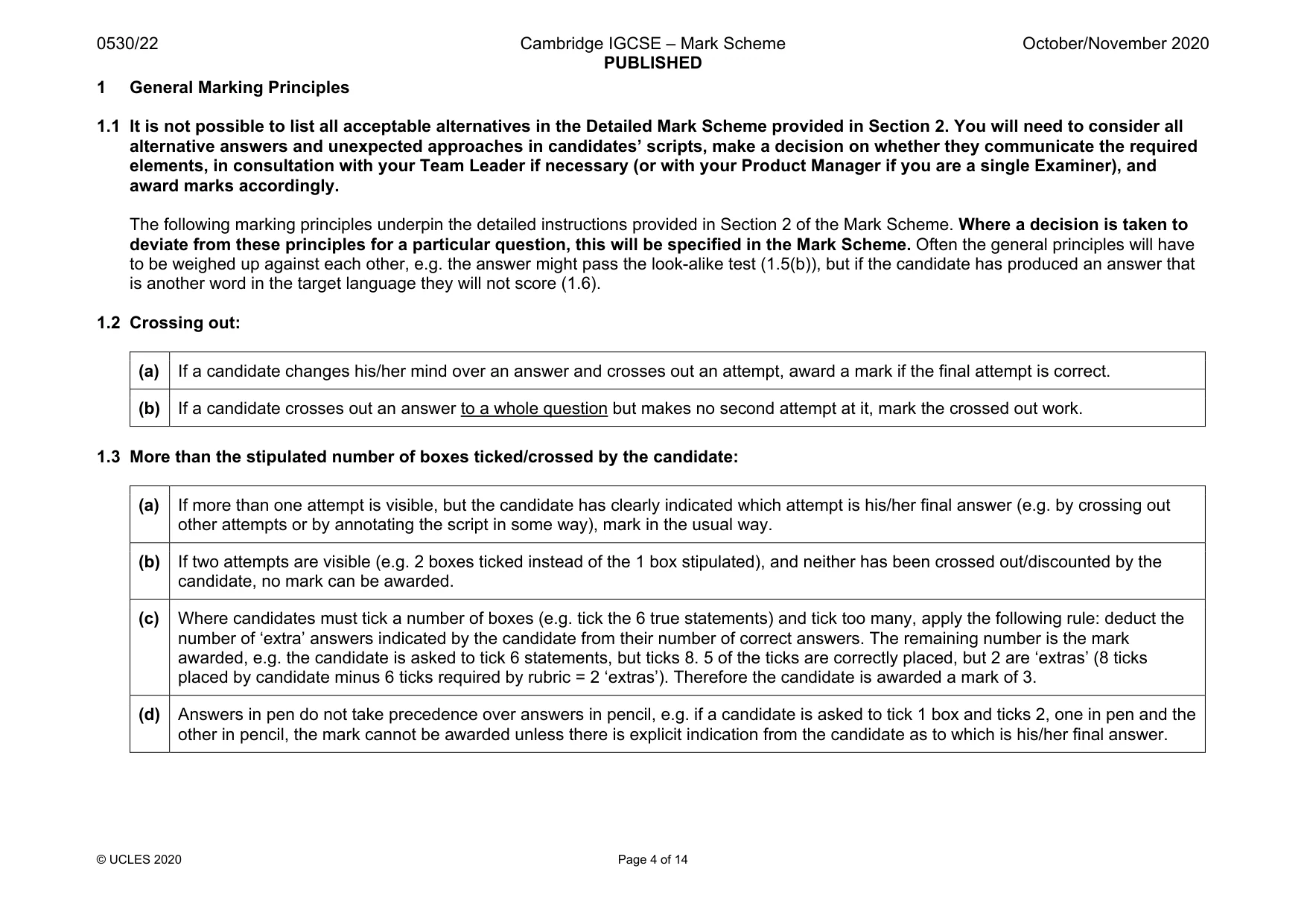
0530/22 Cambridge IGCSE – Mark Scheme PUBLISHED October/November 2020 © UCLES 2020 Page 4 of 14 1 General Marking Principles 1.1 It is not possible to list all acceptable alternatives in the Detailed Mark Scheme provided in Section 2. You will need to consider all alternative answers and unexpected approaches in candidates’ scripts, make a decision on whether they communicate the required elements, in consultation with your Team Leader if necessary (or with your Product Manager if you are a single Examiner), and award marks accordingly. The following marking principles underpin the detailed instructions provided in Section 2 of the Mark Scheme. Where a decision is taken to deviate from these principles for a particular question, this will be specified in the Mark Scheme. Often the general principles will have to be weighed up against each other, e.g. the answer might pass the look-alike test (1.5(b)), but if the candidate has produced an answer that is another word in the target language they will not score (1.6). 1.2 Crossing out: (a) If a candidate changes his/her mind over an answer and crosses out an attempt, award a mark if the final attempt is correct. (b) If a candidate crosses out an answer to a whole question but makes no second attempt at it, mark the crossed out work. 1.3 More than the stipulated number of boxes ticked/crossed by the candidate: (a) If more than one attempt is visible, but the candidate has clearly indicated which attempt is his/her final answer (e.g. by crossing out other attempts or by annotating the script in some way), mark in the usual way. (b) If two attempts are visible (e.g. 2 boxes ticked instead of the 1 box stipulated), and neither has been crossed out/discounted by the candidate, no mark can be awarded. (c) Where candidates must tick a number of boxes (e.g. tick the 6 true statements) and tick too many, apply the following rule: deduct the number of ‘extra’ answers indicated by the candidate from their number of correct answers. The remaining number is the mark awarded, e.g. the candidate is asked to tick 6 statements, but ticks 8. 5 of the ticks are correctly placed, but 2 are ‘extras’ (8 ticks placed by candidate minus 6 ticks required by rubric = 2 ‘extras’). Therefore the candidate is awarded a mark of 3. (d) Answers in pen do not take precedence over answers in pencil, e.g. if a candidate is asked to tick 1 box and ticks 2, one in pen and the other in pencil, the mark cannot be awarded unless there is explicit indication from the candidate as to which is his/her final answer.
Mark scheme, page 5
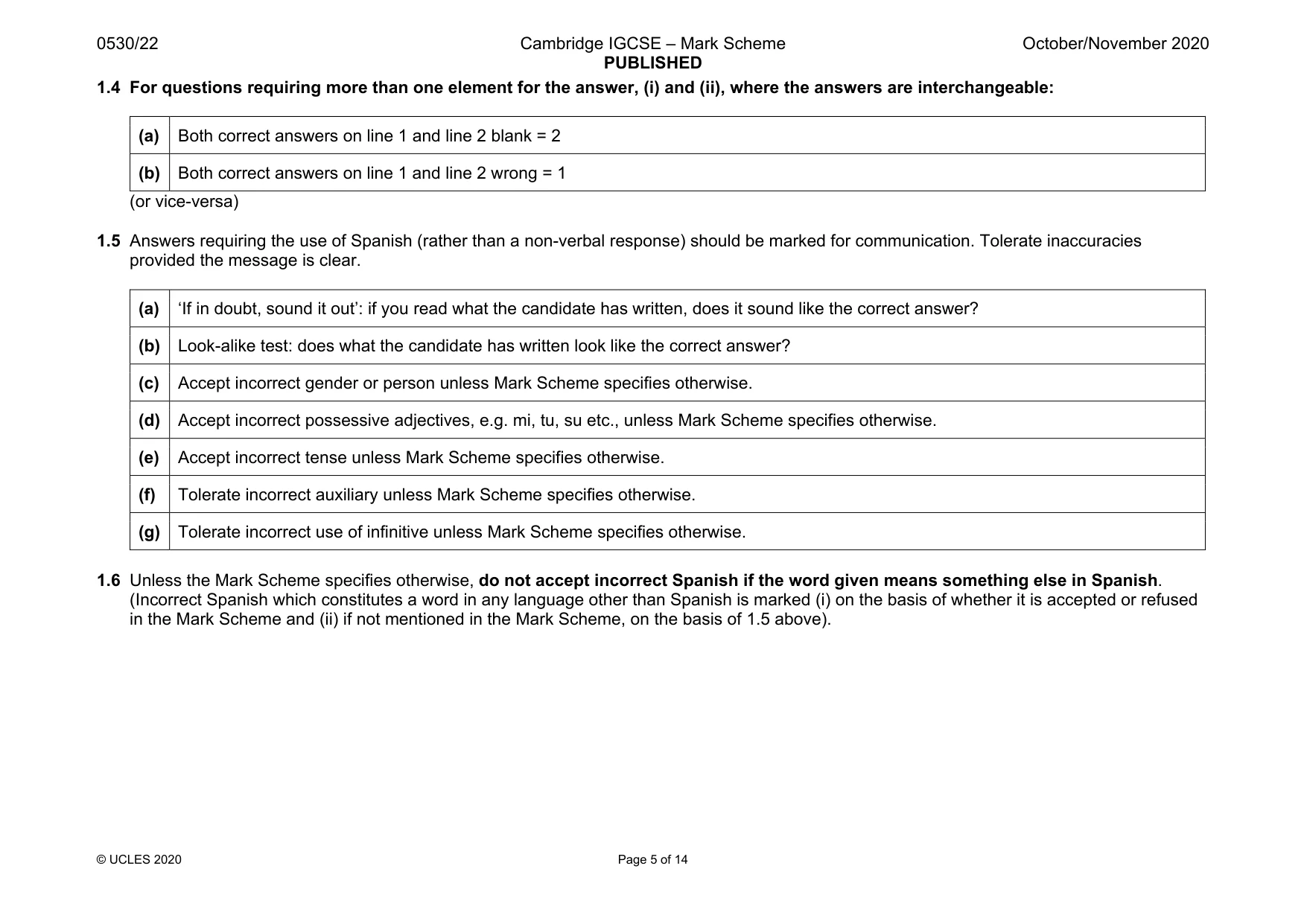
0530/22 Cambridge IGCSE – Mark Scheme PUBLISHED October/November 2020 © UCLES 2020 Page 5 of 14 1.4 For questions requiring more than one element for the answer, (i) and (ii), where the answers are interchangeable: (a) Both correct answers on line 1 and line 2 blank = 2 (b) Both correct answers on line 1 and line 2 wrong = 1 (or vice-versa) 1.5 Answers requiring the use of Spanish (rather than a non-verbal response) should be marked for communication. Tolerate inaccuracies provided the message is clear. (a) ‘If in doubt, sound it out’: if you read what the candidate has written, does it sound like the correct answer? (b) Look-alike test: does what the candidate has written look like the correct answer? (c) Accept incorrect gender or person unless Mark Scheme specifies otherwise. (d) Accept incorrect possessive adjectives, e.g. mi, tu, su etc., unless Mark Scheme specifies otherwise. (e) Accept incorrect tense unless Mark Scheme specifies otherwise. (f) Tolerate incorrect auxiliary unless Mark Scheme specifies otherwise. (g) Tolerate incorrect use of infinitive unless Mark Scheme specifies otherwise. 1.6 Unless the Mark Scheme specifies otherwise, do not accept incorrect Spanish if the word given means something else in Spanish. (Incorrect Spanish which constitutes a word in any language other than Spanish is marked (i) on the basis of whether it is accepted or refused in the Mark Scheme and (ii) if not mentioned in the Mark Scheme, on the basis of 1.5 above).
Mark scheme, page 6
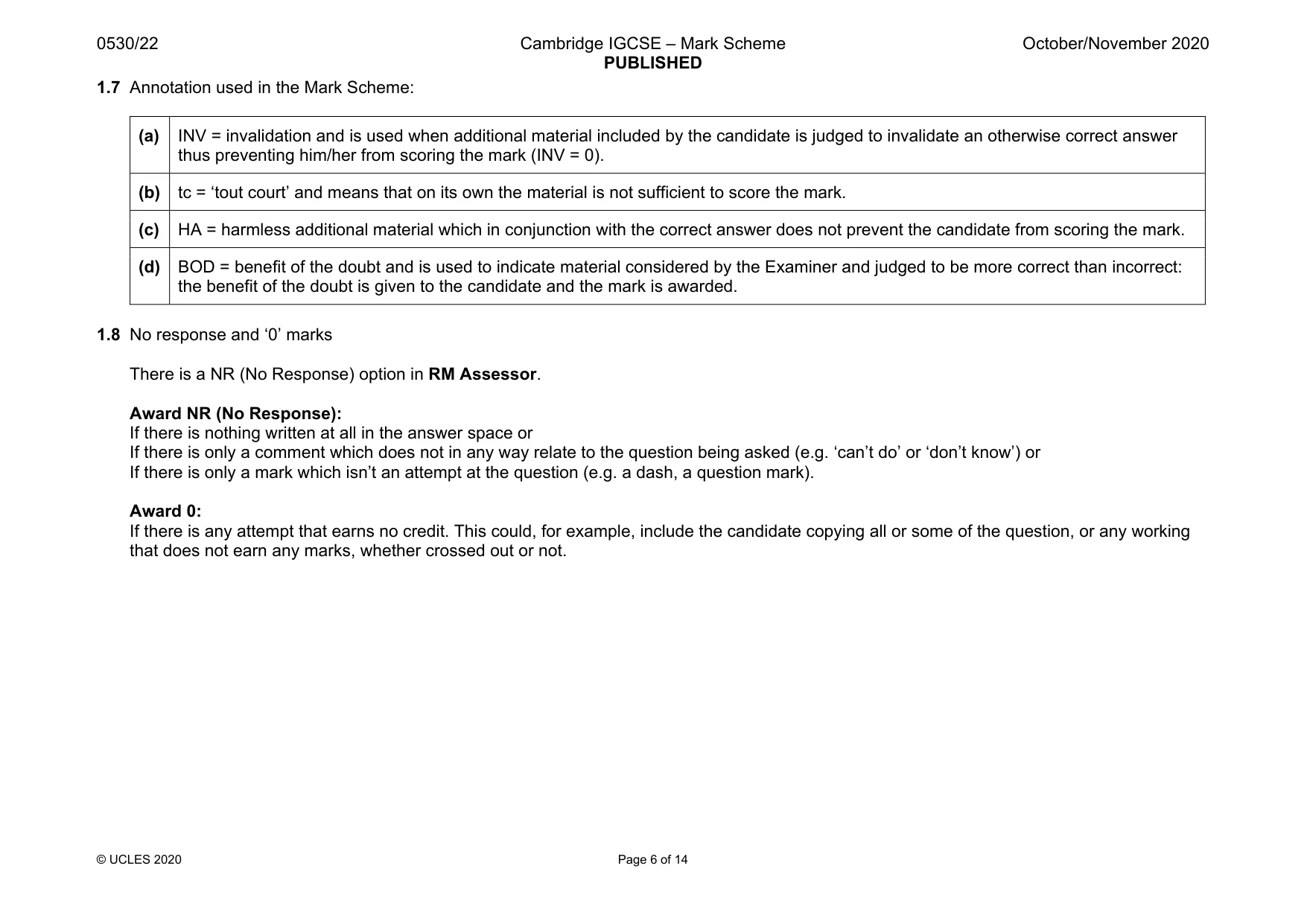
0530/22 Cambridge IGCSE – Mark Scheme PUBLISHED October/November 2020 © UCLES 2020 Page 6 of 14 1.7 Annotation used in the Mark Scheme: (a) INV = invalidation and is used when additional material included by the candidate is judged to invalidate an otherwise correct answer thus preventing him/her from scoring the mark (INV = 0). (b) tc = ‘tout court’ and means that on its own the material is not sufficient to score the mark. (c) HA = harmless additional material which in conjunction with the correct answer does not prevent the candidate from scoring the mark. (d) BOD = benefit of the doubt and is used to indicate material considered by the Examiner and judged to be more correct than incorrect: the benefit of the doubt is given to the candidate and the mark is awarded. 1.8 No response and ‘0’ marks There is a NR (No Response) option in RM Assessor. Award NR (No Response): If there is nothing written at all in the answer space or If there is only a comment which does not in any way relate to the question being asked (e.g. ‘can’t do’ or ‘don’t know’) or If there is only a mark which isn’t an attempt at the question (e.g. a dash, a question mark). Award 0: If there is any attempt that earns no credit. This could, for example, include the candidate copying all or some of the question, or any working that does not earn any marks, whether crossed out or not.
Mark scheme, page 7
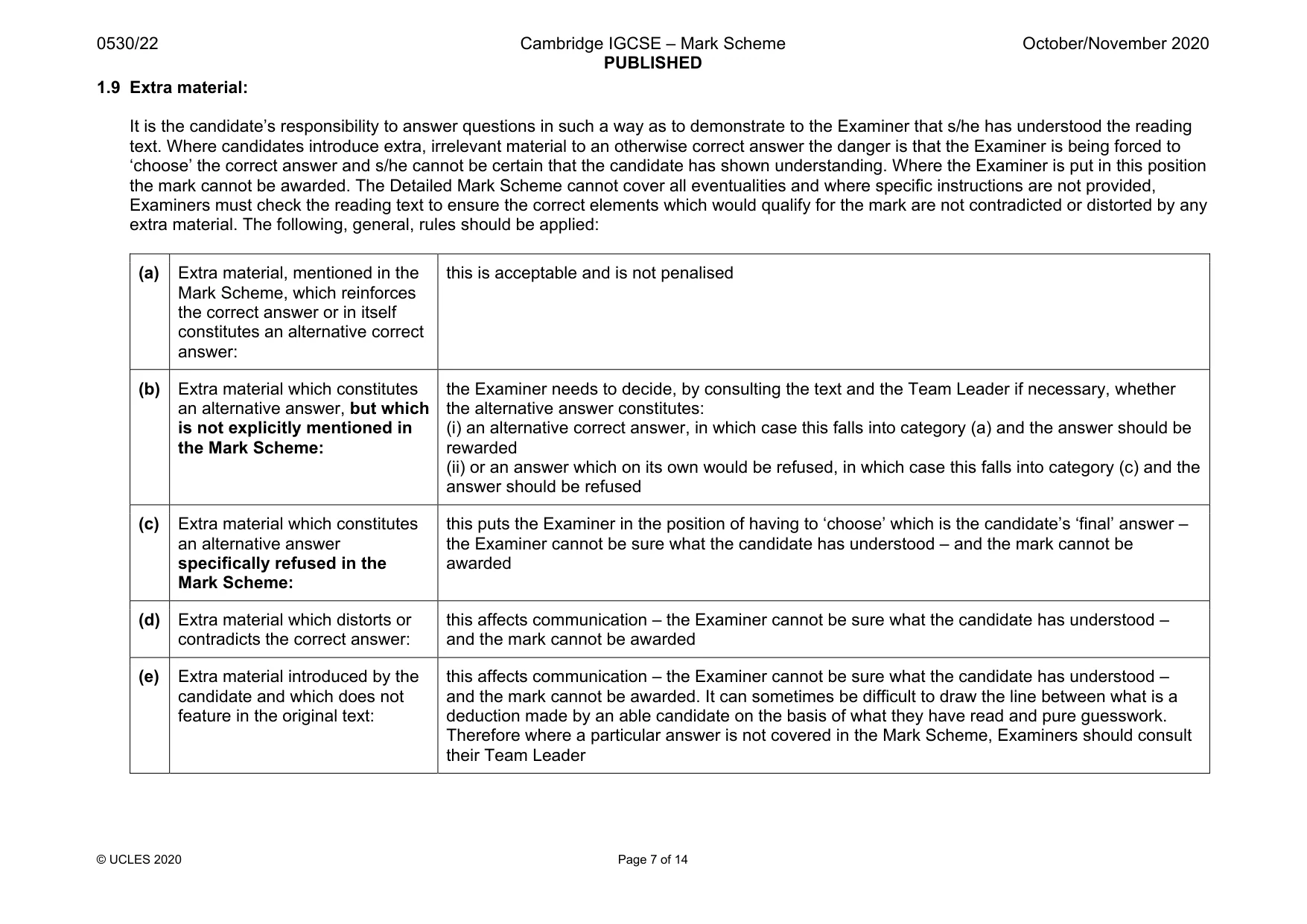
0530/22 Cambridge IGCSE – Mark Scheme PUBLISHED October/November 2020 © UCLES 2020 Page 7 of 14 1.9 Extra material: It is the candidate’s responsibility to answer questions in such a way as to demonstrate to the Examiner that s/he has understood the reading text. Where candidates introduce extra, irrelevant material to an otherwise correct answer the danger is that the Examiner is being forced to ‘choose’ the correct answer and s/he cannot be certain that the candidate has shown understanding. Where the Examiner is put in this position the mark cannot be awarded. The Detailed Mark Scheme cannot cover all eventualities and where specific instructions are not provided, Examiners must check the reading text to ensure the correct elements which would qualify for the mark are not contradicted or distorted by any extra material. The following, general, rules should be applied: (a) Extra material, mentioned in the Mark Scheme, which reinforces the correct answer or in itself constitutes an alternative correct answer: this is acceptable and is not penalised (b) Extra material which constitutes an alternative answer, but which is not explicitly mentioned in the Mark Scheme: the Examiner needs to decide, by consulting the text and the Team Leader if necessary, whether the alternative answer constitutes: (i) an alternative correct answer, in which case this falls into category (a) and the answer should be rewarded (ii) or an answer which on its own would be refused, in which case this falls into category (c) and the answer should be refused (c) Extra material which constitutes an alternative answer specifically refused in the Mark Scheme: this puts the Examiner in the position of having to ‘choose’ which is the candidate’s ‘final’ answer – the Examiner cannot be sure what the candidate has understood – and the mark cannot be awarded (d) Extra material which distorts or contradicts the correct answer: this affects communication – the Examiner cannot be sure what the candidate has understood – and the mark cannot be awarded (e) Extra material introduced by the candidate and which does not feature in the original text: this affects communication – the Examiner cannot be sure what the candidate has understood – and the mark cannot be awarded. It can sometimes be difficult to draw the line between what is a deduction made by an able candidate on the basis of what they have read and pure guesswork. Therefore where a particular answer is not covered in the Mark Scheme, Examiners should consult their Team Leader
Mark scheme, page 8
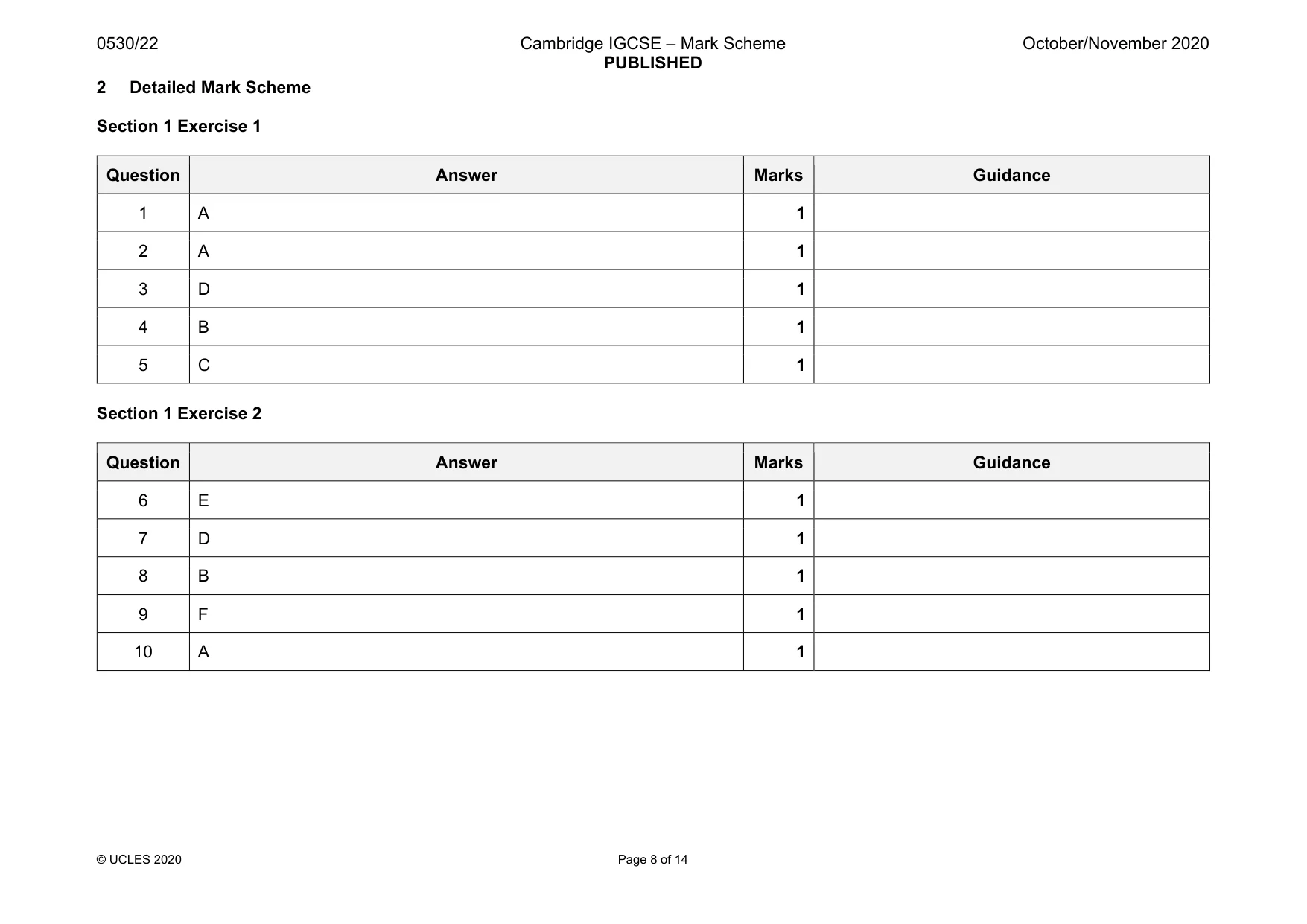
0530/22 Cambridge IGCSE – Mark Scheme PUBLISHED October/November 2020 © UCLES 2020 Page 8 of 14 2 Detailed Mark Scheme Section 1 Exercise 1 Question Answer Marks Guidance 1 A 1 2 A 1 3 D 1 4 B 1 5 C 1 Section 1 Exercise 2 Question Answer Marks Guidance 6 E 1 7 D 1 8 B 1 9 F 1 10 A 1
Mark scheme, page 9
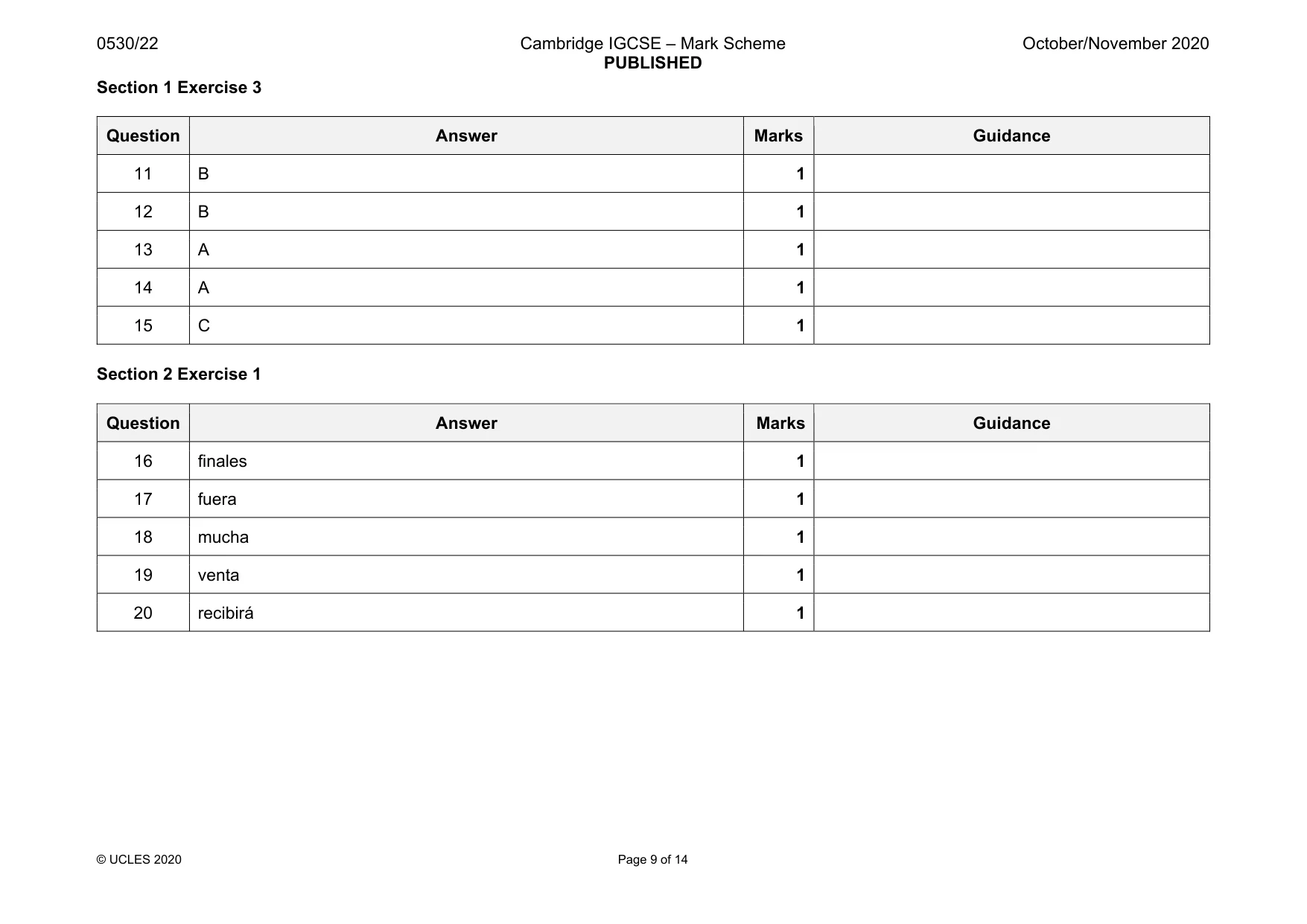
0530/22 Cambridge IGCSE – Mark Scheme PUBLISHED October/November 2020 © UCLES 2020 Page 9 of 14 Section 1 Exercise 3 Question Answer Marks Guidance 11 B 1 12 B 1 13 A 1 14 A 1 15 C 1 Section 2 Exercise 1 Question Answer Marks Guidance 16 finales 1 17 fuera 1 18 mucha 1 19 venta 1 20 recibirá 1
Mark scheme, page 10
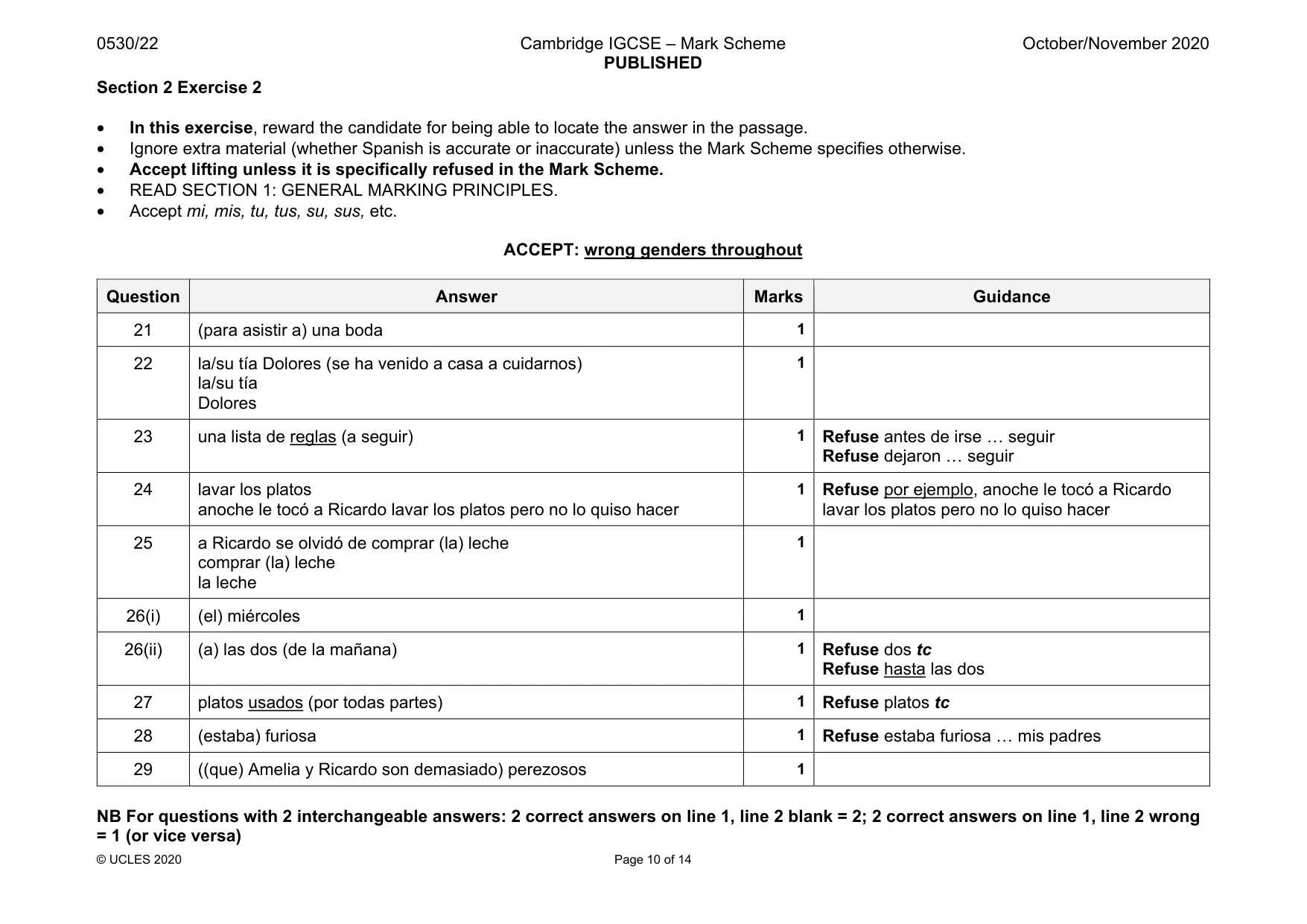
0530/22 Cambridge IGCSE – Mark Scheme PUBLISHED October/November 2020 © UCLES 2020 Page 10 of 14 Section 2 Exercise 2 • In this exercise, reward the candidate for being able to locate the answer in the passage. • Ignore extra material (whether Spanish is accurate or inaccurate) unless the Mark Scheme specifies otherwise. • Accept lifting unless it is specifically refused in the Mark Scheme. • READ SECTION 1: GENERAL MARKING PRINCIPLES. • Accept mi, mis, tu, tus, su, sus, etc. ACCEPT: wrong genders throughout Question Answer Marks Guidance 21 (para asistir a) una boda 1 22 la/su tía Dolores (se ha venido a casa a cuidarnos) la/su tía Dolores 1 23 una lista de reglas (a seguir) 1 Refuse antes de irse … seguir Refuse dejaron … seguir 24 lavar los platos anoche le tocó a Ricardo lavar los platos pero no lo quiso hacer 1 Refuse por ejemplo, anoche le tocó a Ricardo lavar los platos pero no lo quiso hacer 25 a Ricardo se olvidó de comprar (la) leche comprar (la) leche la leche 1 26(i) (el) miércoles 1 26(ii) (a) las dos (de la mañana) 1 Refuse dos tc Refuse hasta las dos 27 platos usados (por todas partes) 1 Refuse platos tc 28 (estaba) furiosa 1 Refuse estaba furiosa … mis padres 29 ((que) Amelia y Ricardo son demasiado) perezosos 1 NB For questions with 2 interchangeable answers: 2 correct answers on line 1, line 2 blank = 2; 2 correct answers on line 1, line 2 wrong = 1 (or vice versa)
Mark scheme, page 11
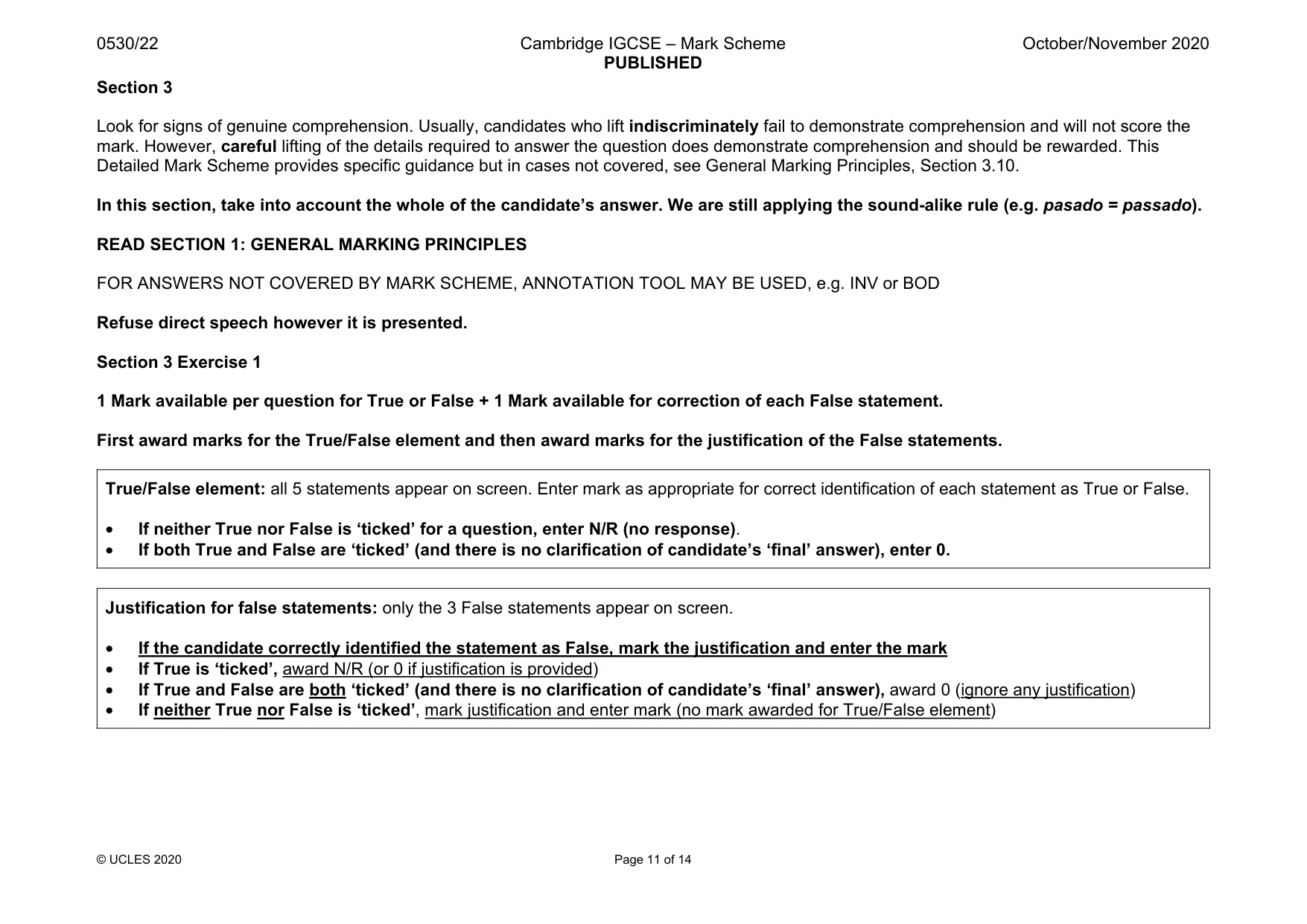
0530/22 Cambridge IGCSE – Mark Scheme PUBLISHED October/November 2020 © UCLES 2020 Page 11 of 14 Section 3 Look for signs of genuine comprehension. Usually, candidates who lift indiscriminately fail to demonstrate comprehension and will not score the mark. However, careful lifting of the details required to answer the question does demonstrate comprehension and should be rewarded. This Detailed Mark Scheme provides specific guidance but in cases not covered, see General Marking Principles, Section 3.10. In this section, take into account the whole of the candidate’s answer. We are still applying the sound-alike rule (e.g. pasado = passado). READ SECTION 1: GENERAL MARKING PRINCIPLES FOR ANSWERS NOT COVERED BY MARK SCHEME, ANNOTATION TOOL MAY BE USED, e.g. INV or BOD Refuse direct speech however it is presented. Section 3 Exercise 1 1 Mark available per question for True or False + 1 Mark available for correction of each False statement. First award marks for the True/False element and then award marks for the justification of the False statements. True/False element: all 5 statements appear on screen. Enter mark as appropriate for correct identification of each statement as True or False. • If neither True nor False is ‘ticked’ for a question, enter N/R (no response). • If both True and False are ‘ticked’ (and there is no clarification of candidate’s ‘final’ answer), enter 0. Justification for false statements: only the 3 False statements appear on screen. • If the candidate correctly identified the statement as False, mark the justification and enter the mark • If True is ‘ticked’, award N/R (or 0 if justification is provided) • If True and False are both ‘ticked’ (and there is no clarification of candidate’s ‘final’ answer), award 0 (ignore any justification) • If neither True nor False is ‘ticked’, mark justification and enter mark (no mark awarded for True/False element)
Mark scheme, page 12
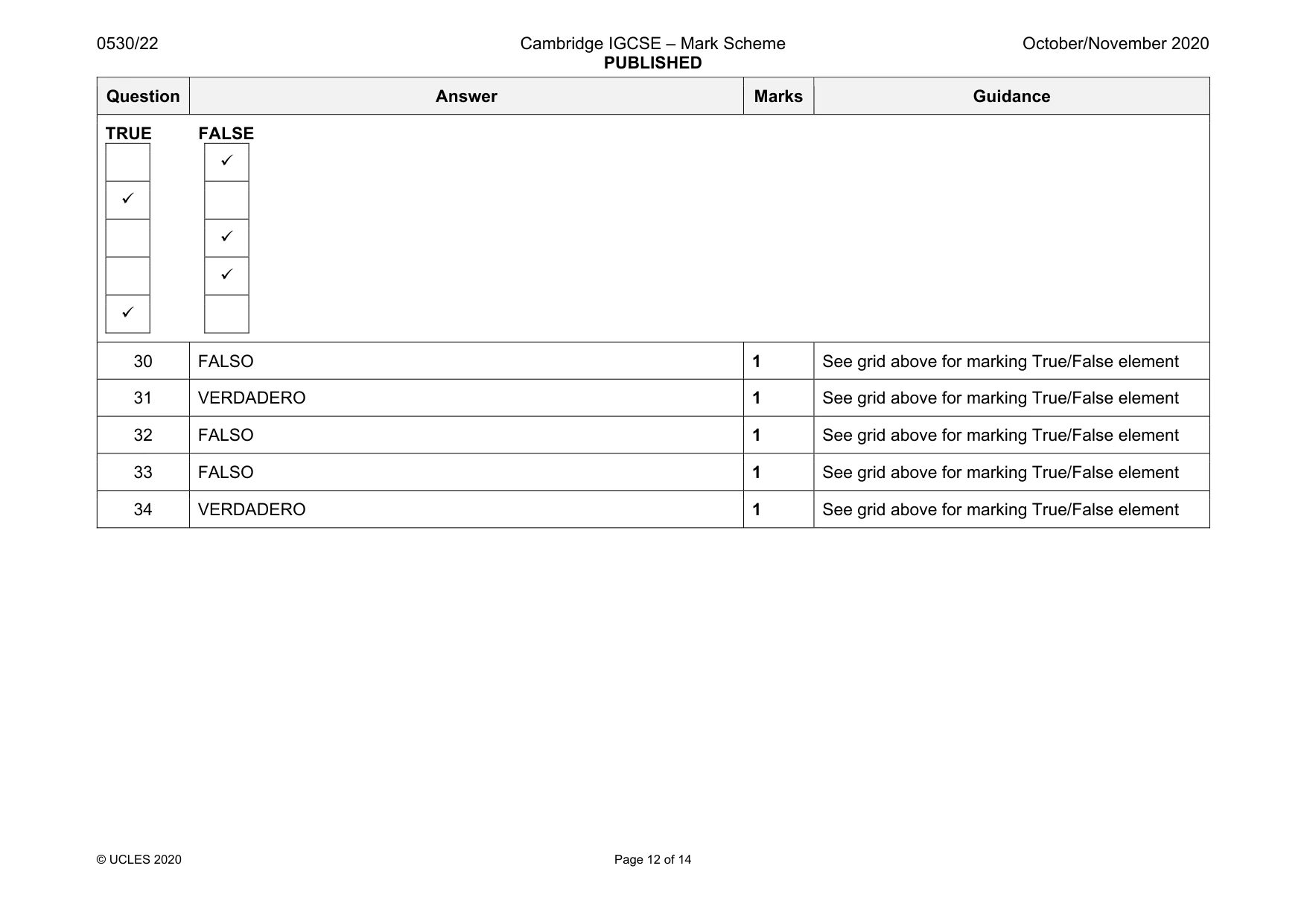
0530/22 Cambridge IGCSE – Mark Scheme PUBLISHED October/November 2020 © UCLES 2020 Page 12 of 14 Question Answer Marks Guidance TRUE FALSE 30 FALSO 1 See grid above for marking True/False element 31 VERDADERO 1 See grid above for marking True/False element 32 FALSO 1 See grid above for marking True/False element 33 FALSO 1 See grid above for marking True/False element 34 VERDADERO 1 See grid above for marking True/False element
Mark scheme, page 13
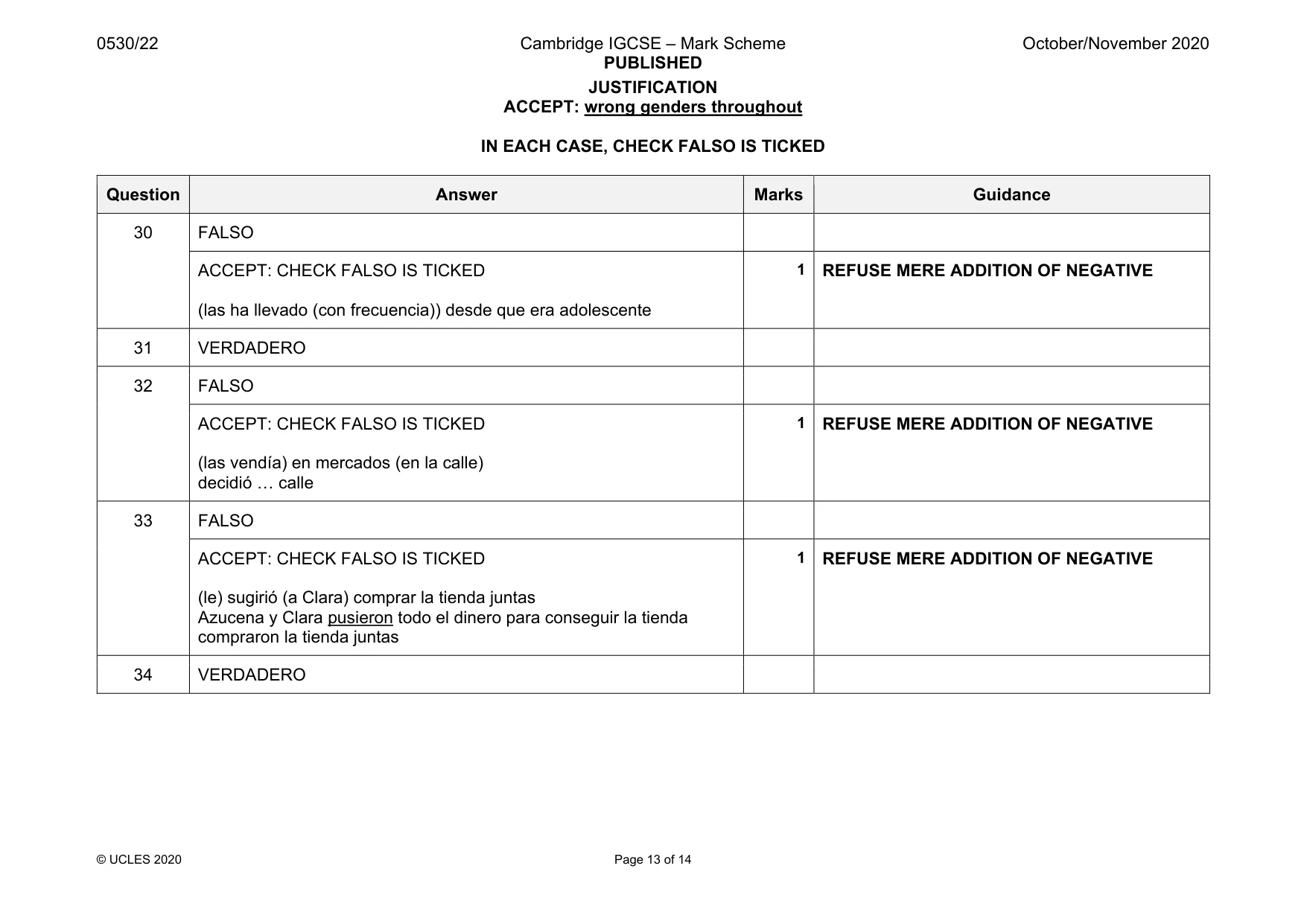
0530/22 Cambridge IGCSE – Mark Scheme PUBLISHED October/November 2020 © UCLES 2020 Page 13 of 14 JUSTIFICATION ACCEPT: wrong genders throughout IN EACH CASE, CHECK FALSO IS TICKED Question Answer Marks Guidance 30 FALSO ACCEPT: CHECK FALSO IS TICKED (las ha llevado (con frecuencia)) desde que era adolescente 1 REFUSE MERE ADDITION OF NEGATIVE 31 VERDADERO 32 FALSO ACCEPT: CHECK FALSO IS TICKED (las vendía) en mercados (en la calle) decidió … calle 1 REFUSE MERE ADDITION OF NEGATIVE 33 FALSO ACCEPT: CHECK FALSO IS TICKED (le) sugirió (a Clara) comprar la tienda juntas Azucena y Clara pusieron todo el dinero para conseguir la tienda compraron la tienda juntas 1 REFUSE MERE ADDITION OF NEGATIVE 34 VERDADERO
Mark scheme, page 14
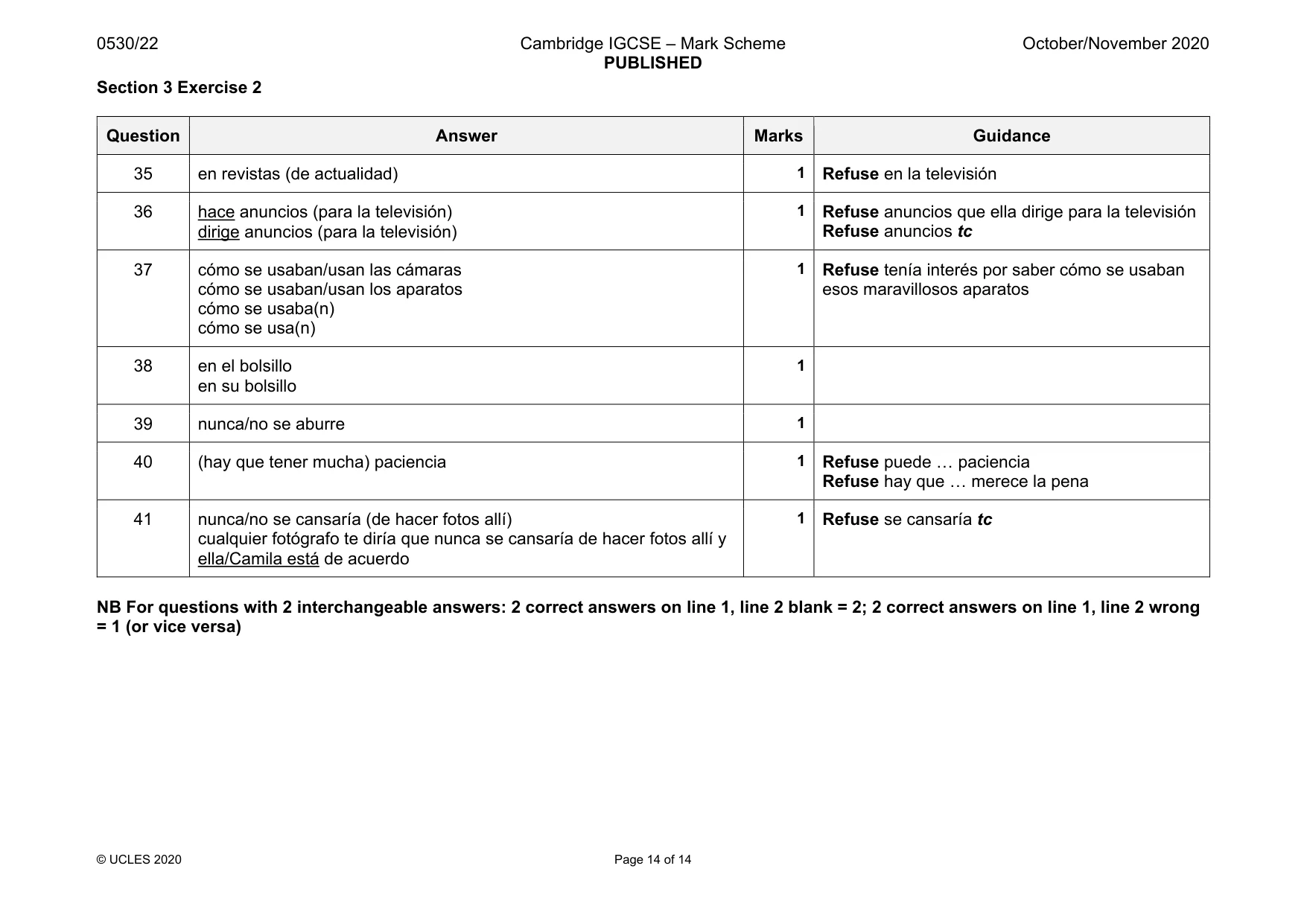
0530/22 Cambridge IGCSE – Mark Scheme PUBLISHED October/November 2020 © UCLES 2020 Page 14 of 14 Section 3 Exercise 2 Question Answer Marks Guidance 35 en revistas (de actualidad) 1 Refuse en la televisión 36 hace anuncios (para la televisión) dirige anuncios (para la televisión) 1 Refuse anuncios que ella dirige para la televisión Refuse anuncios tc 37 cómo se usaban/usan las cámaras cómo se usaban/usan los aparatos cómo se usaba(n) cómo se usa(n) 1 Refuse tenía interés por saber cómo se usaban esos maravillosos aparatos 38 en el bolsillo en su bolsillo 1 39 nunca/no se aburre 1 40 (hay que tener mucha) paciencia 1 Refuse puede … paciencia Refuse hay que … merece la pena 41 nunca/no se cansaría (de hacer fotos allí) cualquier fotógrafo te diría que nunca se cansaría de hacer fotos allí y ella/Camila está de acuerdo 1 Refuse se cansaría tc NB For questions with 2 interchangeable answers: 2 correct answers on line 1, line 2 blank = 2; 2 correct answers on line 1, line 2 wrong = 1 (or vice versa)
What you needed in this session
Cambridge’s own grade thresholds for 2020 Oct/Nov, Paper 2 · Variant 2. A higher threshold means an easier paper — the bar moves with how the cohort did.