Cambridge IGCSE Spanish - Foreign Language 0530 — 2020 Oct/Nov Paper 2 · Variant 1
0530/21/O/N/20 · 45 marks · ≈51 min
The question paper and its mark scheme, free to read here and free to download. This is Cambridge’s own paper, exactly as it was sat.
Question paper16 pages



Mark scheme15 pages
Answers below. Sit the paper first if you are practising.
Paper as text
Question paper, page 1
Cambridge IGCSE™ DC (PQ/SW) 183140/4 © UCLES 2020 [Turn over This document has 16 pages. Blank pages are indicated. * 1 1 4 4 0 4 1 5 4 7 * SPANISH 0530/21 Paper 2 Reading October/November 2020 1 hour You must answer on the question paper. No additional materials are needed. INSTRUCTIONS ● Answer all questions. ● Use a black or dark blue pen. ● Write your name, centre number and candidate number in the boxes at the top of the page. ● Write your answer to each question in the space provided. ● Do not use an erasable pen or correction fluid. ● Do not write on any bar codes. INFORMATION ● The total mark for this paper is 45. ● The number of marks for each question or part question is shown in brackets [ ].
Question paper, page 2
2 0530/21/O/N/20 © UCLES 2020 BLANK PAGE
Question paper, page 3
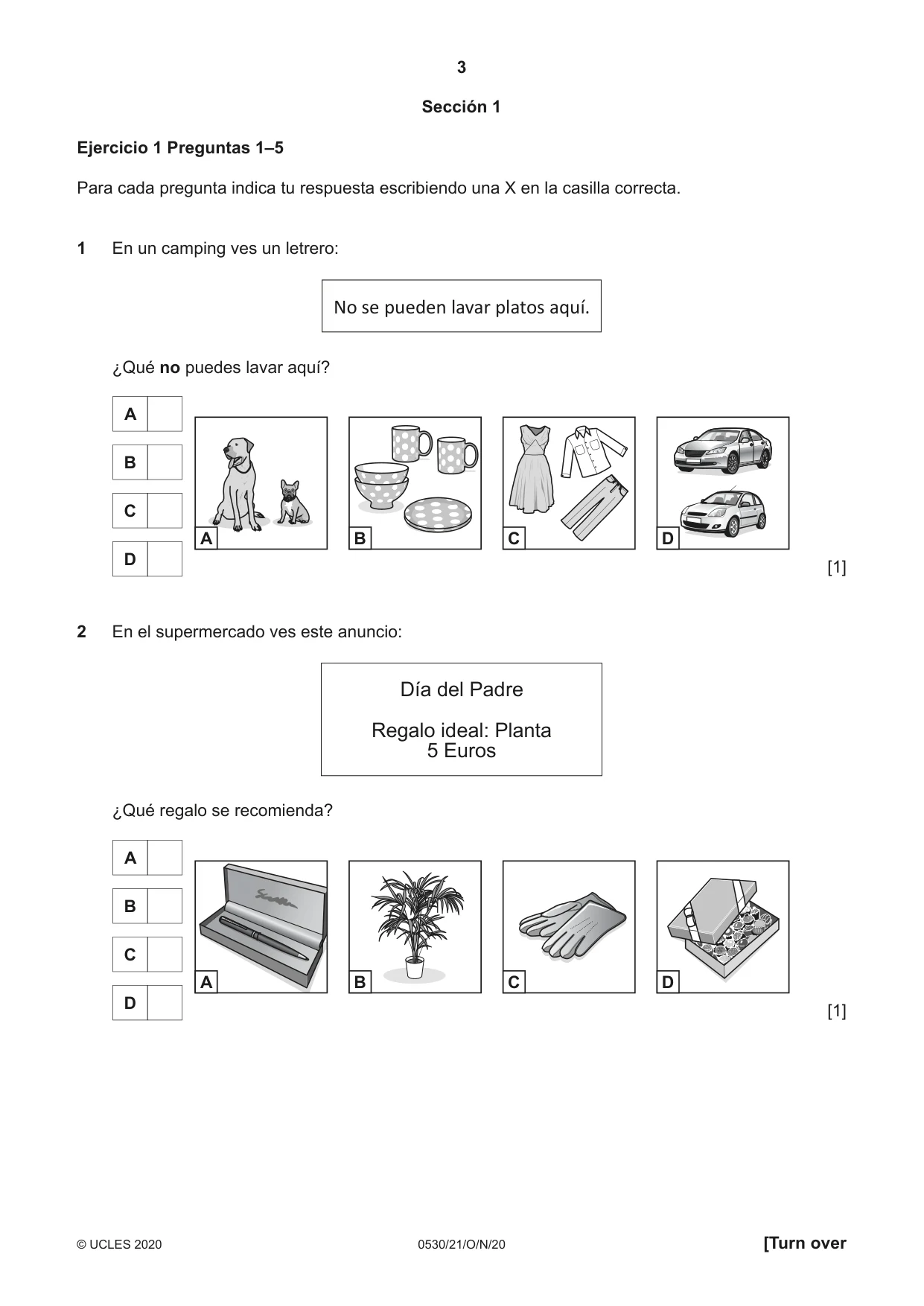
3 0530/21/O/N/20 © UCLES 2020 [Turn over Sección 1 Ejercicio 1 Preguntas 1–5 Para cada pregunta indica tu respuesta escribiendo una X en la casilla correcta. 1 En un camping ves un letrero: No se pueden lavar platos aquí. ¿Qué no puedes lavar aquí? A B C D A B C D [1] 2 En el supermercado ves este anuncio: Día del Padre Regalo ideal: Planta 5 Euros ¿Qué regalo se recomienda? A B C D A B C D [1]
Question paper, page 4
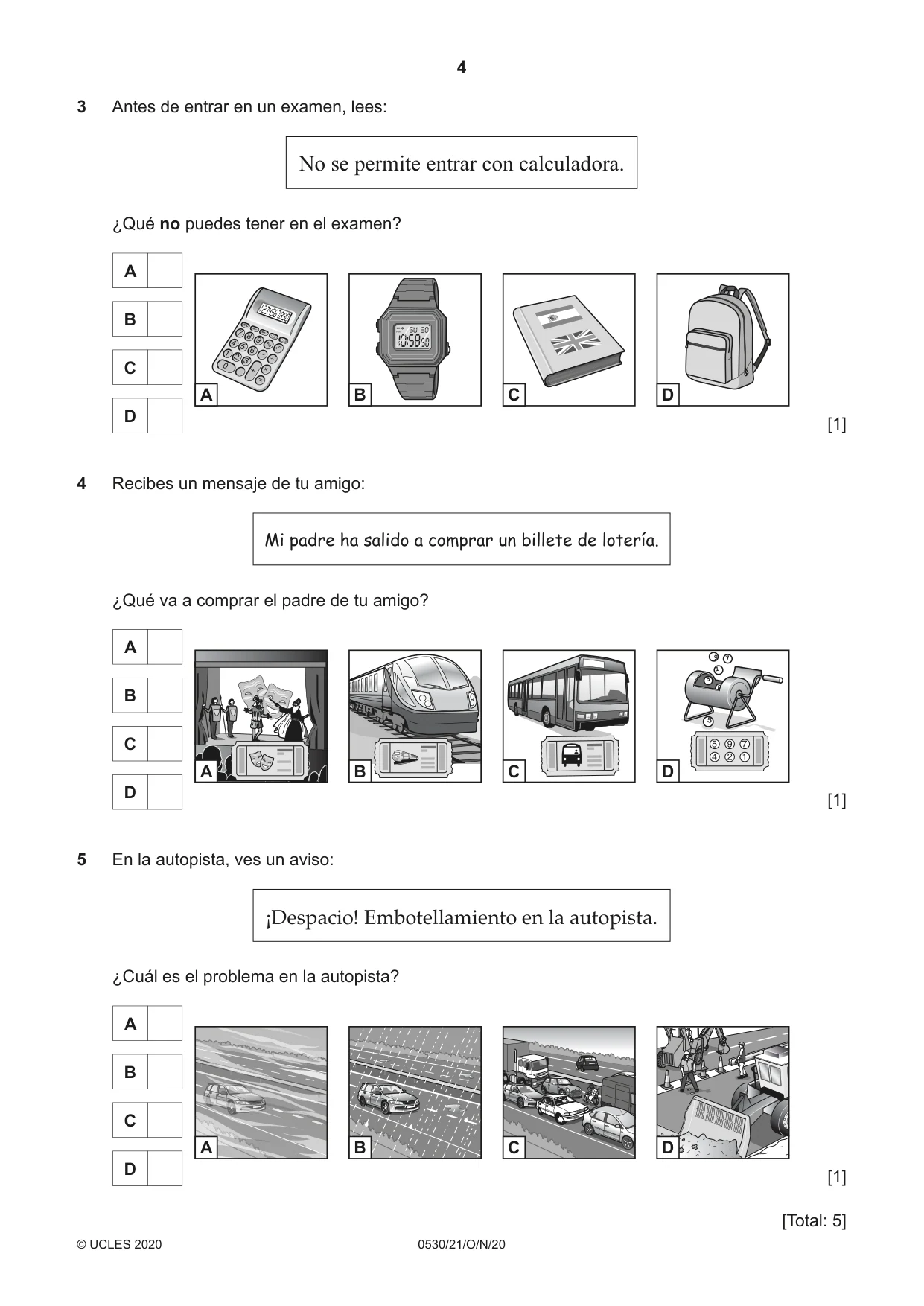
4 0530/21/O/N/20 © UCLES 2020 3 Antes de entrar en un examen, lees: No se permite entrar con calculadora. ¿Qué no puedes tener en el examen? A B C D A B C D [1] 4 Recibes un mensaje de tu amigo: Mi padre ha salido a comprar un billete de lotería. ¿Qué va a comprar el padre de tu amigo? A B C D A B C D [1] 5 En la autopista, ves un aviso: ¡Despacio! Embotellamiento en la autopista. ¿Cuál es el problema en la autopista? A B C D A B C D [1] [Total: 5]
Question paper, page 5
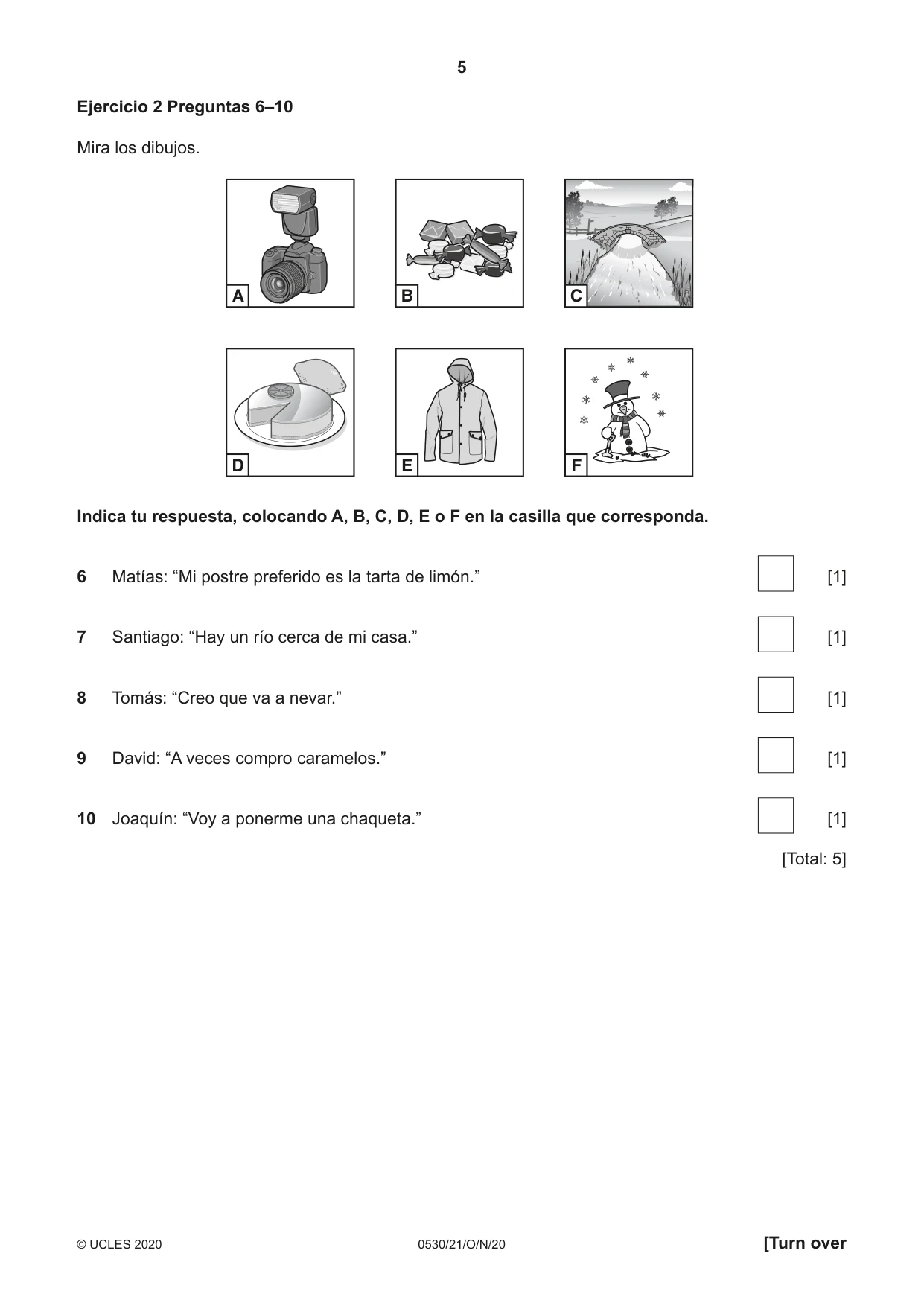
5 0530/21/O/N/20 © UCLES 2020 [Turn over Ejercicio 2 Preguntas 6–10 Mira los dibujos. A B C D E F Indica tu respuesta, colocando A, B, C, D, E o F en la casilla que corresponda. 6 Matías: “Mi postre preferido es la tarta de limón.” [1] 7 Santiago: “Hay un río cerca de mi casa.” [1] 8 Tomás: “Creo que va a nevar.” [1] 9 David: “A veces compro caramelos.” [1] 10 Joaquín: “Voy a ponerme una chaqueta.” [1] [Total: 5]
Question paper, page 6
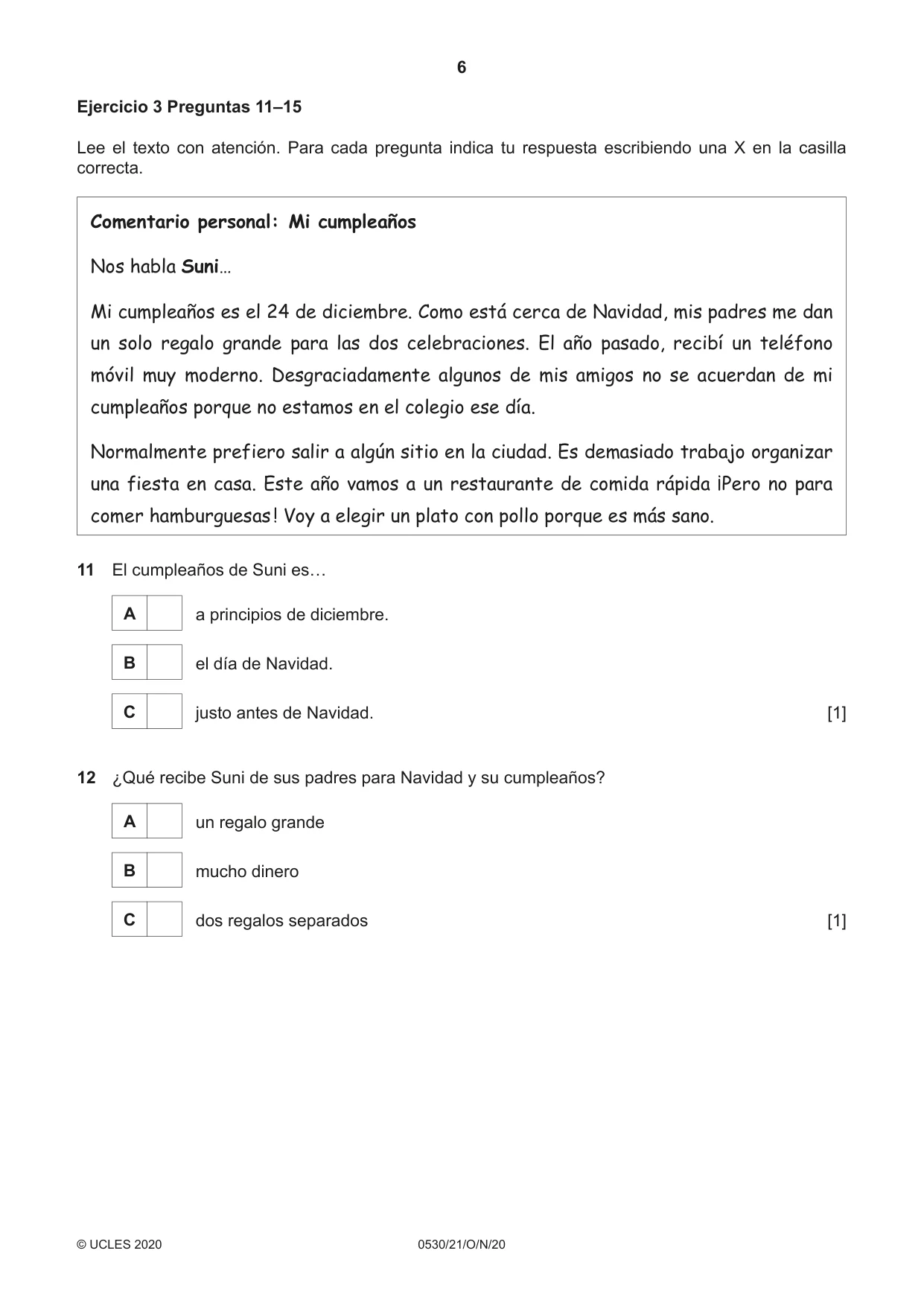
6 0530/21/O/N/20 © UCLES 2020 Ejercicio 3 Preguntas 11–15 Lee el texto con atención. Para cada pregunta indica tu respuesta escribiendo una X en la casilla correcta. Comentario personal: Mi cumpleaños Nos habla Suni… Mi cumpleaños es el 24 de diciembre. Como está cerca de Navidad, mis padres me dan un solo regalo grande para las dos celebraciones. El año pasado, recibí un teléfono móvil muy moderno. Desgraciadamente algunos de mis amigos no se acuerdan de mi cumpleaños porque no estamos en el colegio ese día. Normalmente prefiero salir a algún sitio en la ciudad. Es demasiado trabajo organizar una fiesta en casa. Este año vamos a un restaurante de comida rápida ¡Pero no para comer hamburguesas ! Voy a elegir un plato con pollo porque es más sano. 11 El cumpleaños de Suni es… A a principios de diciembre. B el día de Navidad. C justo antes de Navidad. [1] 12 ¿Qué recibe Suni de sus padres para Navidad y su cumpleaños? A un regalo grande B mucho dinero C dos regalos separados [1]
Question paper, page 7
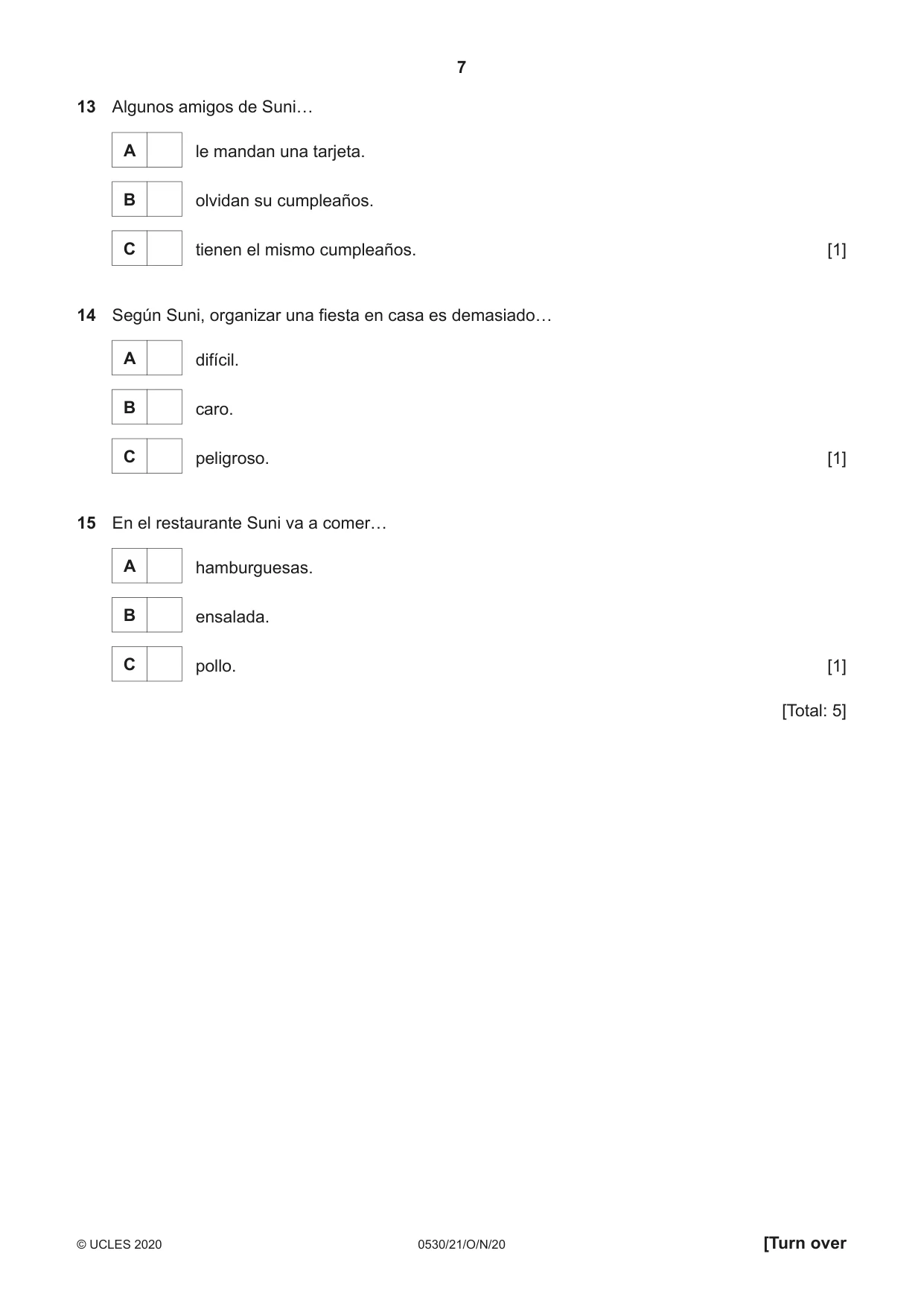
7 0530/21/O/N/20 © UCLES 2020 [Turn over 13 Algunos amigos de Suni… A le mandan una tarjeta. B olvidan su cumpleaños. C tienen el mismo cumpleaños. [1] 14 Según Suni, organizar una fiesta en casa es demasiado… A difícil. B caro. C peligroso. [1] 15 En el restaurante Suni va a comer… A hamburguesas. B ensalada. C pollo. [1] [Total: 5]
Question paper, page 8
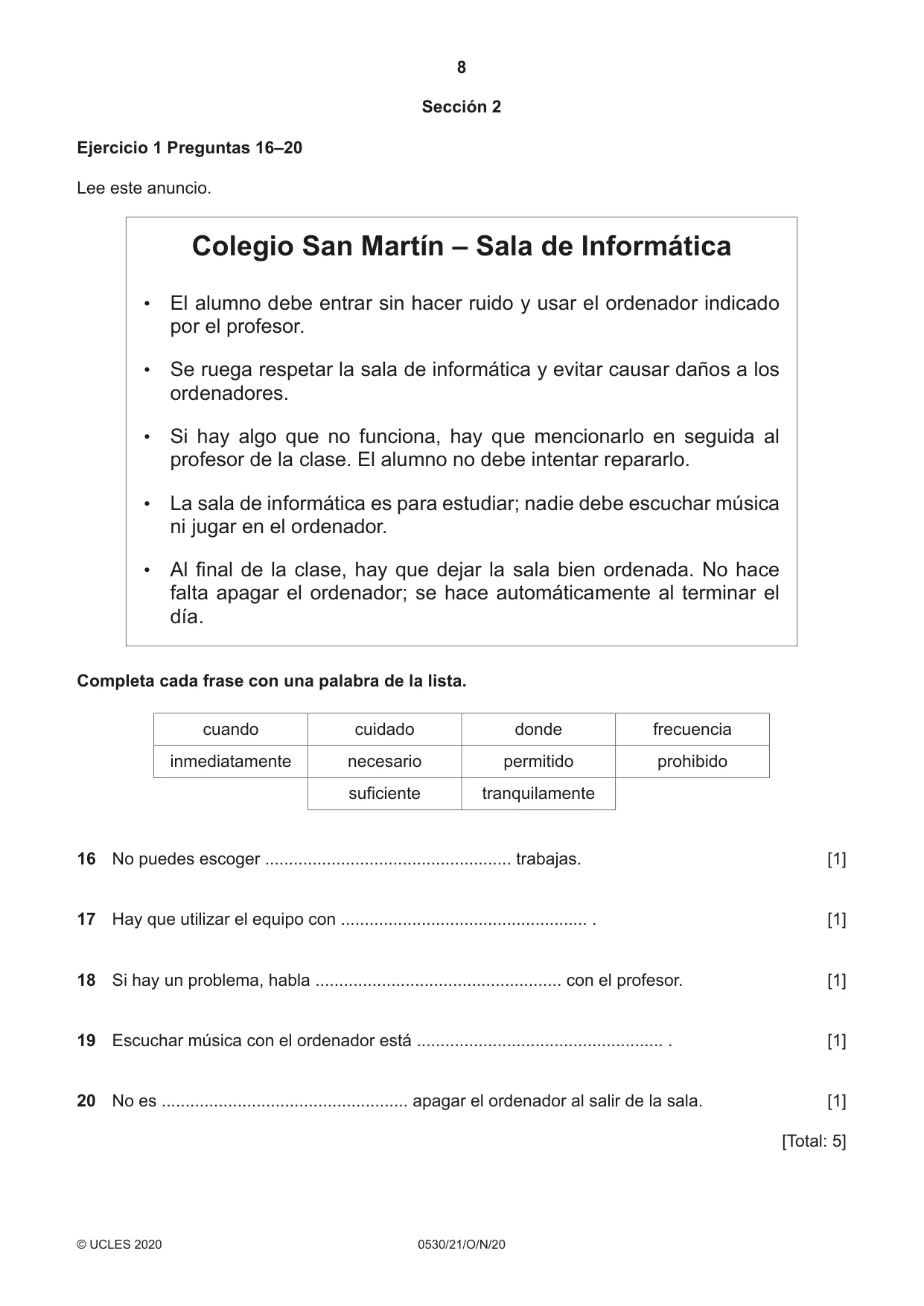
8 0530/21/O/N/20 © UCLES 2020 Sección 2 Ejercicio 1 Preguntas 16–20 Lee este anuncio. Colegio San Martín – Sala de Informática • El alumno debe entrar sin hacer ruido y usar el ordenador indicado por el profesor. • Se ruega respetar la sala de informática y evitar causar daños a los ordenadores. • Si hay algo que no funciona, hay que mencionarlo en seguida al profesor de la clase. El alumno no debe intentar repararlo. • La sala de informática es para estudiar; nadie debe escuchar música ni jugar en el ordenador. • Al final de la clase, hay que dejar la sala bien ordenada. No hace falta apagar el ordenador; se hace automáticamente al terminar el día. Completa cada frase con una palabra de la lista. cuando cuidado donde frecuencia inmediatamente necesario permitido prohibido suficiente tranquilamente 16 No puedes escoger … trabajas. [1] 17 Hay que utilizar el equipo con … . [1] 18 Si hay un problema, habla … con el profesor. [1] 19 Escuchar música con el ordenador está … . [1] 20 No es … apagar el ordenador al salir de la sala. [1] [Total: 5]
Question paper, page 9
9 0530/21/O/N/20 © UCLES 2020 [Turn over Dar la vuelta para el Ejercicio 2.
Question paper, page 10
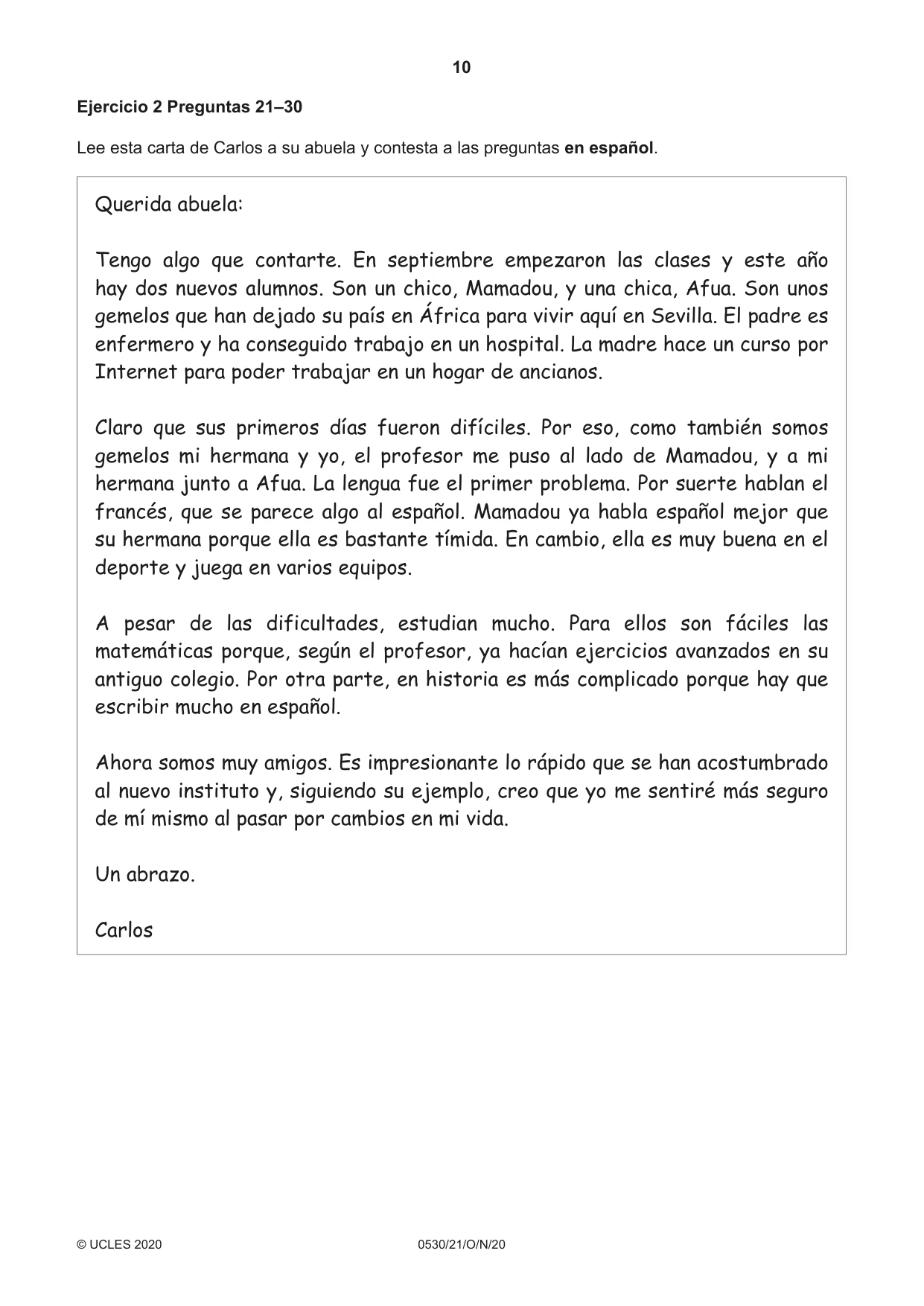
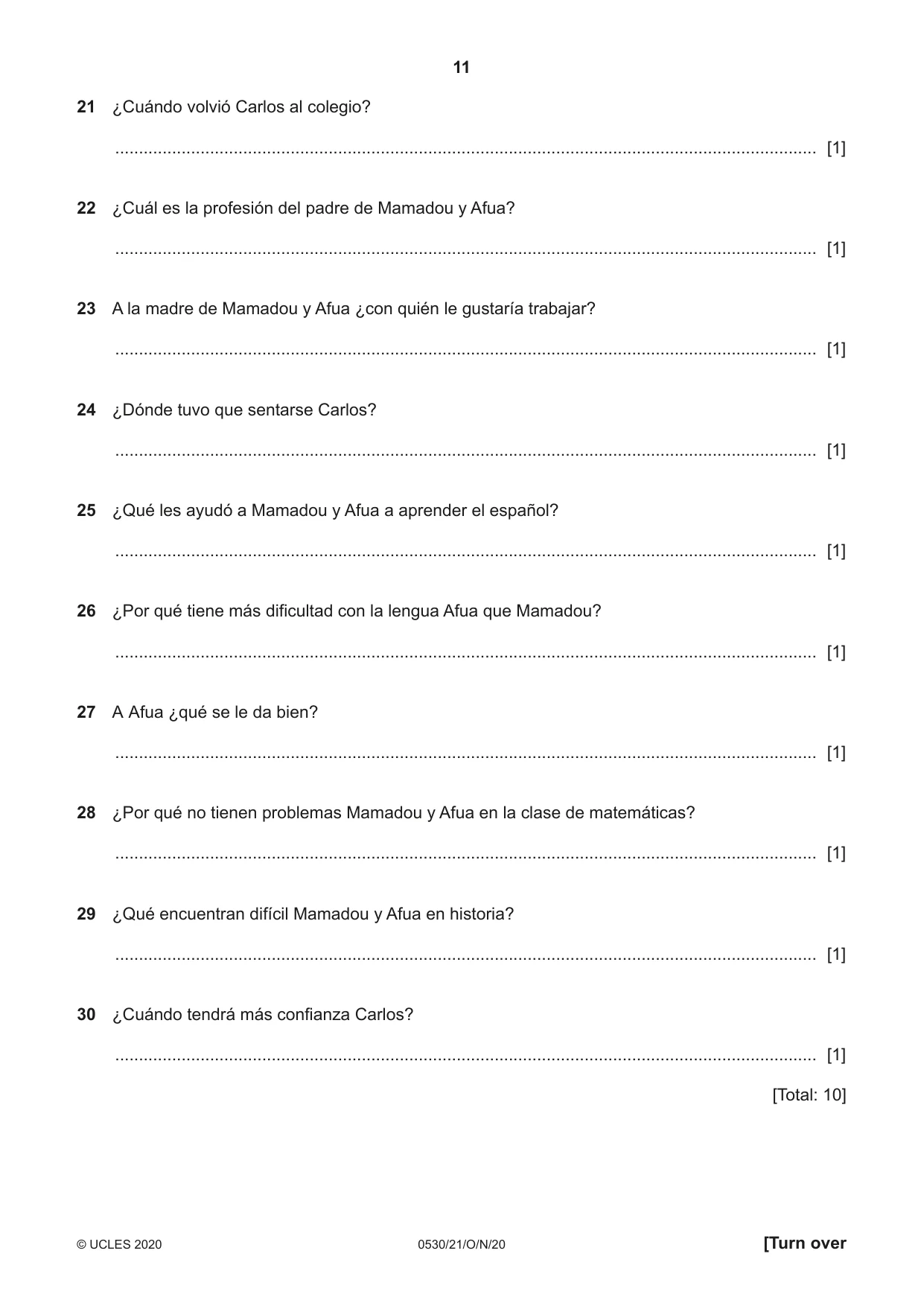
10 0530/21/O/N/20 © UCLES 2020 Ejercicio 2 Preguntas 21–30 Lee esta carta de Carlos a su abuela y contesta a las preguntas en español. Querida abuela: Tengo algo que contarte. En septiembre empezaron las clases y este año hay dos nuevos alumnos. Son un chico, Mamadou, y una chica, Afua. Son unos gemelos que han dejado su país en África para vivir aquí en Sevilla. El padre es enfermero y ha conseguido trabajo en un hospital. La madre hace un curso por Internet para poder trabajar en un hogar de ancianos. Claro que sus primeros días fueron difíciles. Por eso, como también somos gemelos mi hermana y yo, el profesor me puso al lado de Mamadou, y a mi hermana junto a Afua. La lengua fue el primer problema. Por suerte hablan el francés, que se parece algo al español. Mamadou ya habla español mejor que su hermana porque ella es bastante tímida. En cambio, ella es muy buena en el deporte y juega en varios equipos. A pesar de las dificultades, estudian mucho. Para ellos son fáciles las matemáticas porque, según el profesor, ya hacían ejercicios avanzados en su antiguo colegio. Por otra parte, en historia es más complicado porque hay que escribir mucho en español. Ahora somos muy amigos. Es impresionante lo rápido que se han acostumbrado al nuevo instituto y, siguiendo su ejemplo, creo que yo me sentiré más seguro de mí mismo al pasar por cambios en mi vida. Un abrazo. Carlos
Question paper, page 11
11 0530/21/O/N/20 © UCLES 2020 [Turn over 21 ¿Cuándo volvió Carlos al colegio? … [1] 22 ¿Cuál es la profesión del padre de Mamadou y Afua? … [1] 23 A la madre de Mamadou y Afua ¿con quién le gustaría trabajar? … [1] 24 ¿Dónde tuvo que sentarse Carlos? … [1] 25 ¿Qué les ayudó a Mamadou y Afua a aprender el español? … [1] 26 ¿Por qué tiene más dificultad con la lengua Afua que Mamadou? … [1] 27 A Afua ¿qué se le da bien? … [1] 28 ¿Por qué no tienen problemas Mamadou y Afua en la clase de matemáticas? … [1] 29 ¿Qué encuentran difícil Mamadou y Afua en historia? … [1] 30 ¿Cuándo tendrá más confianza Carlos? … [1] [Total: 10]
Question paper, page 12
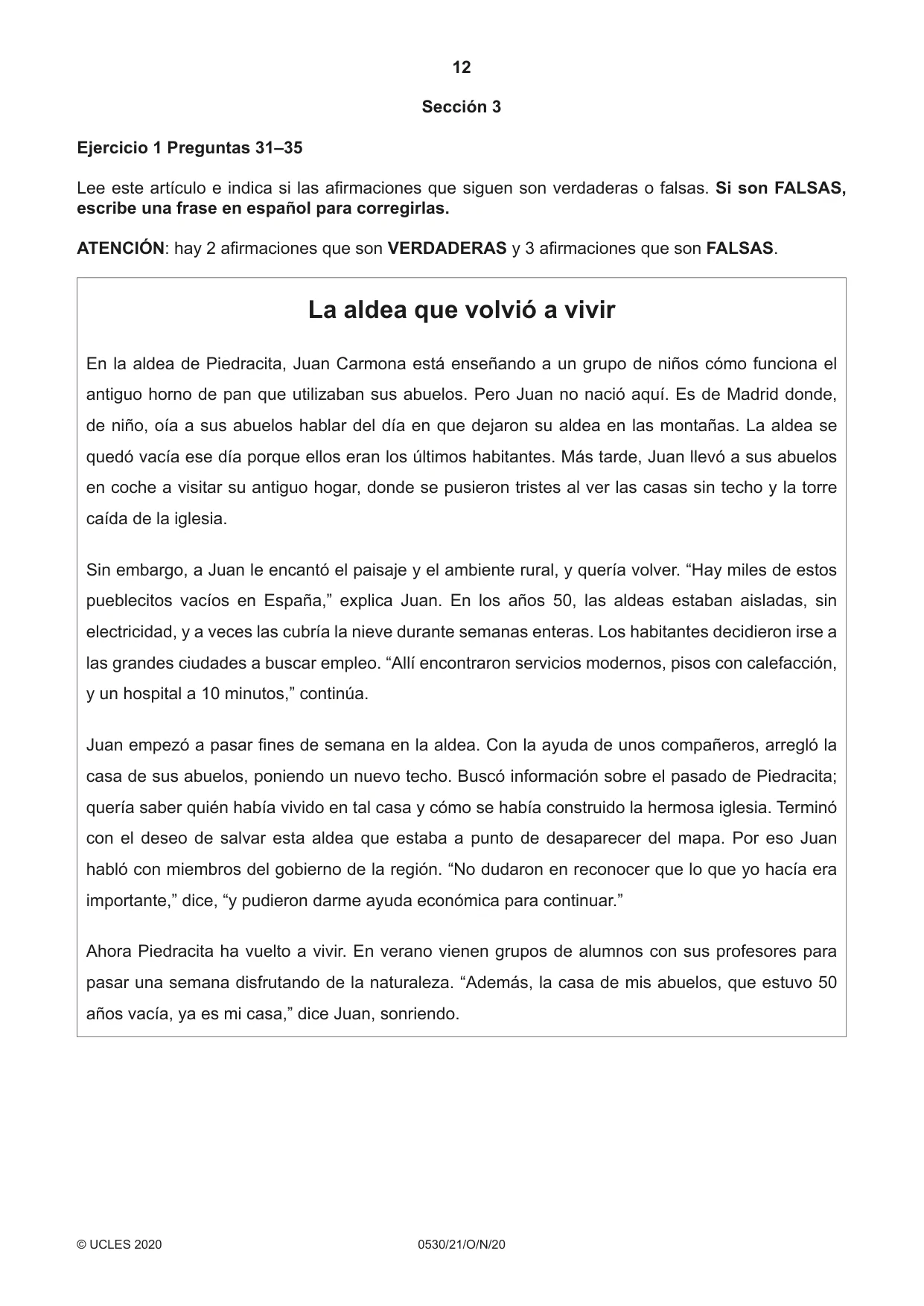
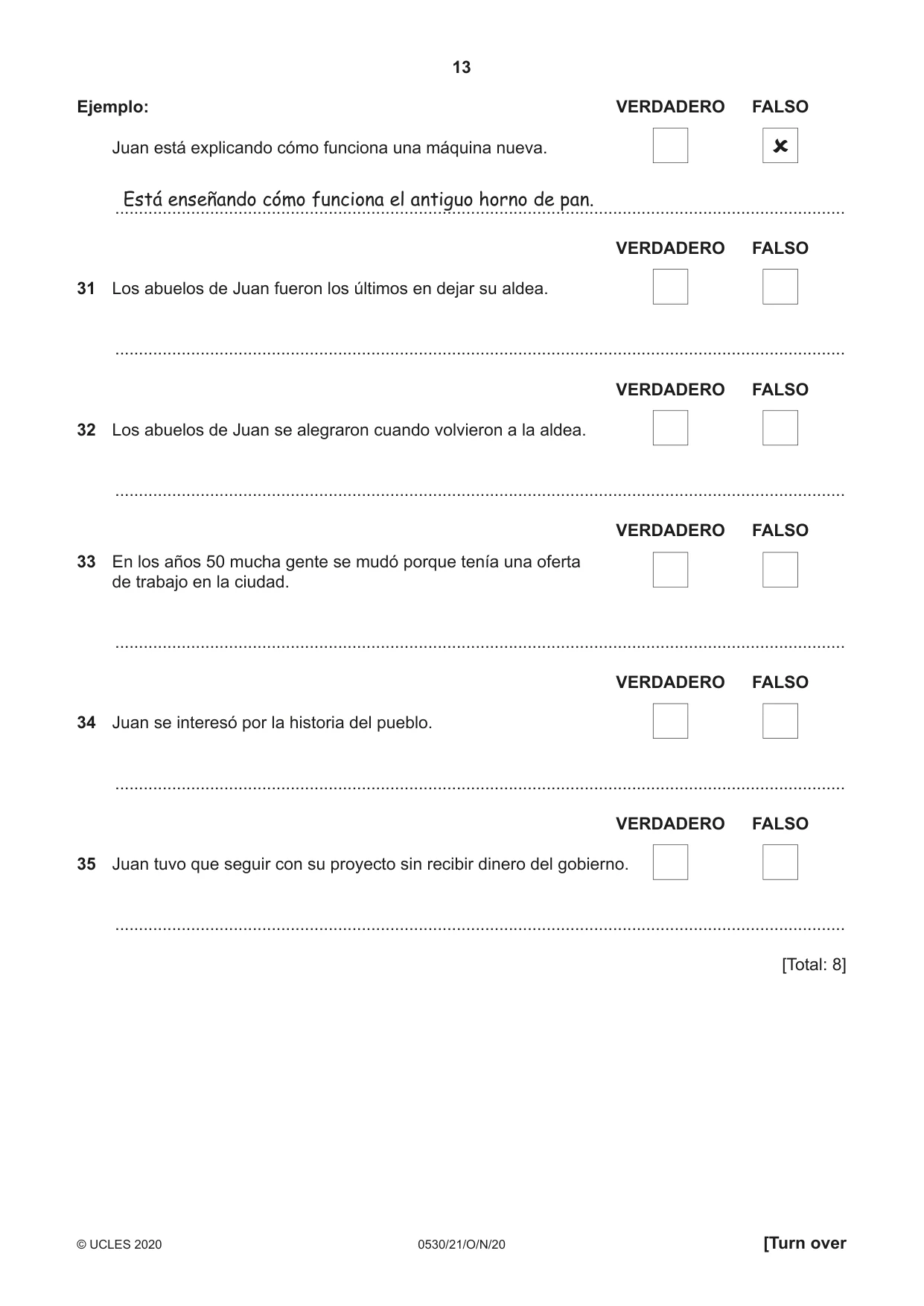
12 0530/21/O/N/20 © UCLES 2020 Sección 3 Ejercicio 1 Preguntas 31–35 Lee este artículo e indica si las afirmaciones que siguen son verdaderas o falsas. Si son FALSAS, escribe una frase en español para corregirlas. ATENCIÓN: hay 2 afirmaciones que son VERDADERAS y 3 afirmaciones que son FALSAS. La aldea que volvió a vivir En la aldea de Piedracita, Juan Carmona está enseñando a un grupo de niños cómo funciona el antiguo horno de pan que utilizaban sus abuelos. Pero Juan no nació aquí. Es de Madrid donde, de niño, oía a sus abuelos hablar del día en que dejaron su aldea en las montañas. La aldea se quedó vacía ese día porque ellos eran los últimos habitantes. Más tarde, Juan llevó a sus abuelos en coche a visitar su antiguo hogar, donde se pusieron tristes al ver las casas sin techo y la torre caída de la iglesia. Sin embargo, a Juan le encantó el paisaje y el ambiente rural, y quería volver. “Hay miles de estos pueblecitos vacíos en España,” explica Juan. En los años 50, las aldeas estaban aisladas, sin electricidad, y a veces las cubría la nieve durante semanas enteras. Los habitantes decidieron irse a las grandes ciudades a buscar empleo. “Allí encontraron servicios modernos, pisos con calefacción, y un hospital a 10 minutos,” continúa. Juan empezó a pasar fines de semana en la aldea. Con la ayuda de unos compañeros, arregló la casa de sus abuelos, poniendo un nuevo techo. Buscó información sobre el pasado de Piedracita; quería saber quién había vivido en tal casa y cómo se había construido la hermosa iglesia. Terminó con el deseo de salvar esta aldea que estaba a punto de desaparecer del mapa. Por eso Juan habló con miembros del gobierno de la región. “No dudaron en reconocer que lo que yo hacía era importante,” dice, “y pudieron darme ayuda económica para continuar.” Ahora Piedracita ha vuelto a vivir. En verano vienen grupos de alumnos con sus profesores para pasar una semana disfrutando de la naturaleza. “Además, la casa de mis abuelos, que estuvo 50 años vacía, ya es mi casa,” dice Juan, sonriendo.
Question paper, page 13
13 0530/21/O/N/20 © UCLES 2020 [Turn over Ejemplo: VERDADERO FALSO Juan está explicando cómo funciona una máquina nueva. û Está enseñando cómo funciona el antiguo horno de pan. … VERDADERO FALSO 31 Los abuelos de Juan fueron los últimos en dejar su aldea. … VERDADERO FALSO 32 Los abuelos de Juan se alegraron cuando volvieron a la aldea. … VERDADERO FALSO 33 En los años 50 mucha gente se mudó porque tenía una oferta de trabajo en la ciudad. … VERDADERO FALSO 34 Juan se interesó por la historia del pueblo. … VERDADERO FALSO 35 Juan tuvo que seguir con su proyecto sin recibir dinero del gobierno. … [Total: 8]
Question paper, page 14
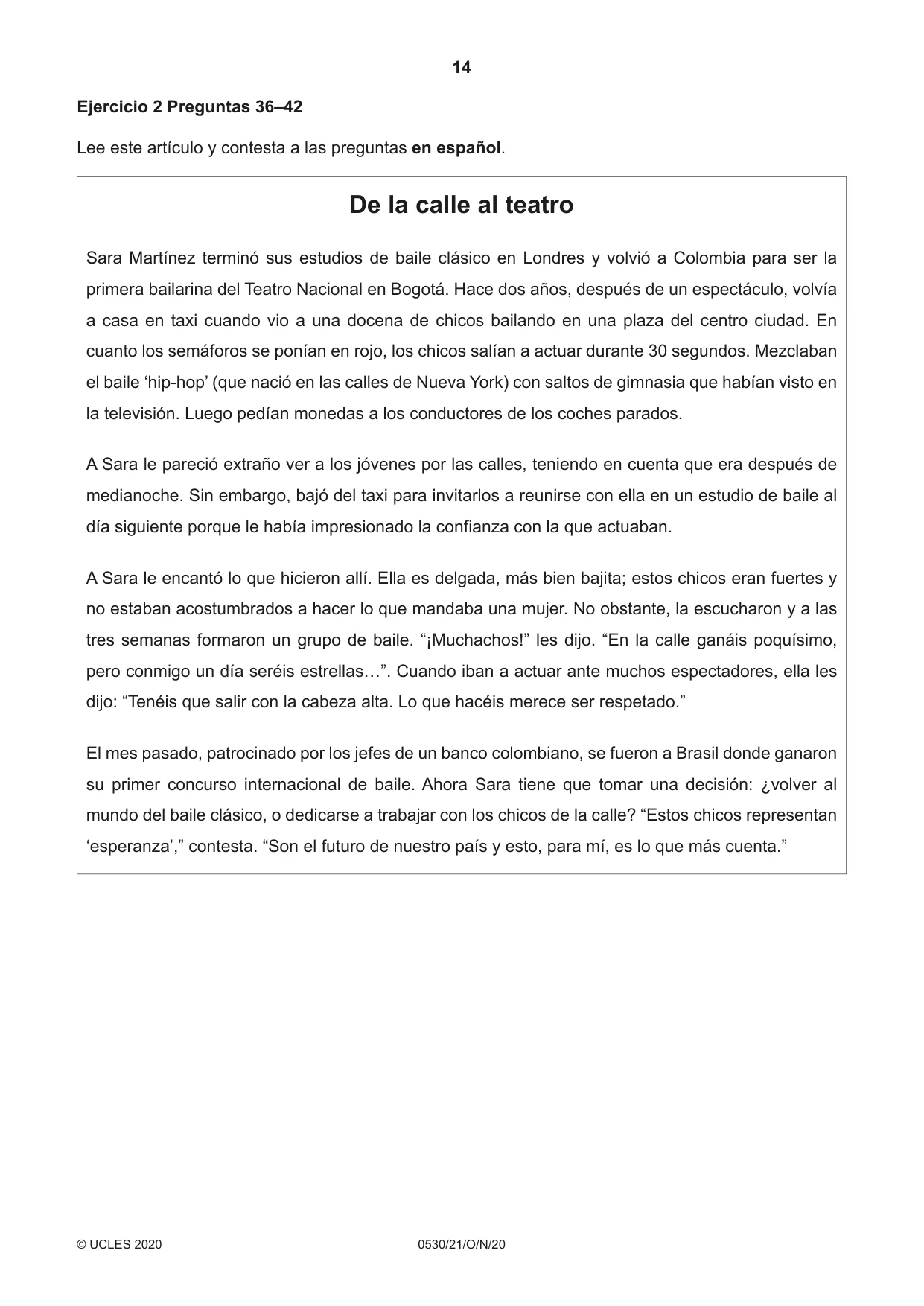
14 0530/21/O/N/20 © UCLES 2020 Ejercicio 2 Preguntas 36–42 Lee este artículo y contesta a las preguntas en español. De la calle al teatro Sara Martínez terminó sus estudios de baile clásico en Londres y volvió a Colombia para ser la primera bailarina del Teatro Nacional en Bogotá. Hace dos años, después de un espectáculo, volvía a casa en taxi cuando vio a una docena de chicos bailando en una plaza del centro ciudad. En cuanto los semáforos se ponían en rojo, los chicos salían a actuar durante 30 segundos. Mezclaban el baile ‘hip-hop’ (que nació en las calles de Nueva York) con saltos de gimnasia que habían visto en la televisión. Luego pedían monedas a los conductores de los coches parados. A Sara le pareció extraño ver a los jóvenes por las calles, teniendo en cuenta que era después de medianoche. Sin embargo, bajó del taxi para invitarlos a reunirse con ella en un estudio de baile al día siguiente porque le había impresionado la confianza con la que actuaban. A Sara le encantó lo que hicieron allí. Ella es delgada, más bien bajita; estos chicos eran fuertes y no estaban acostumbrados a hacer lo que mandaba una mujer. No obstante, la escucharon y a las tres semanas formaron un grupo de baile. “¡Muchachos!” les dijo. “En la calle ganáis poquísimo, pero conmigo un día seréis estrellas…”. Cuando iban a actuar ante muchos espectadores, ella les dijo: “Tenéis que salir con la cabeza alta. Lo que hacéis merece ser respetado.” El mes pasado, patrocinado por los jefes de un banco colombiano, se fueron a Brasil donde ganaron su primer concurso internacional de baile. Ahora Sara tiene que tomar una decisión: ¿volver al mundo del baile clásico, o dedicarse a trabajar con los chicos de la calle? “Estos chicos representan ‘esperanza’,” contesta. “Son el futuro de nuestro país y esto, para mí, es lo que más cuenta.”
Question paper, page 15
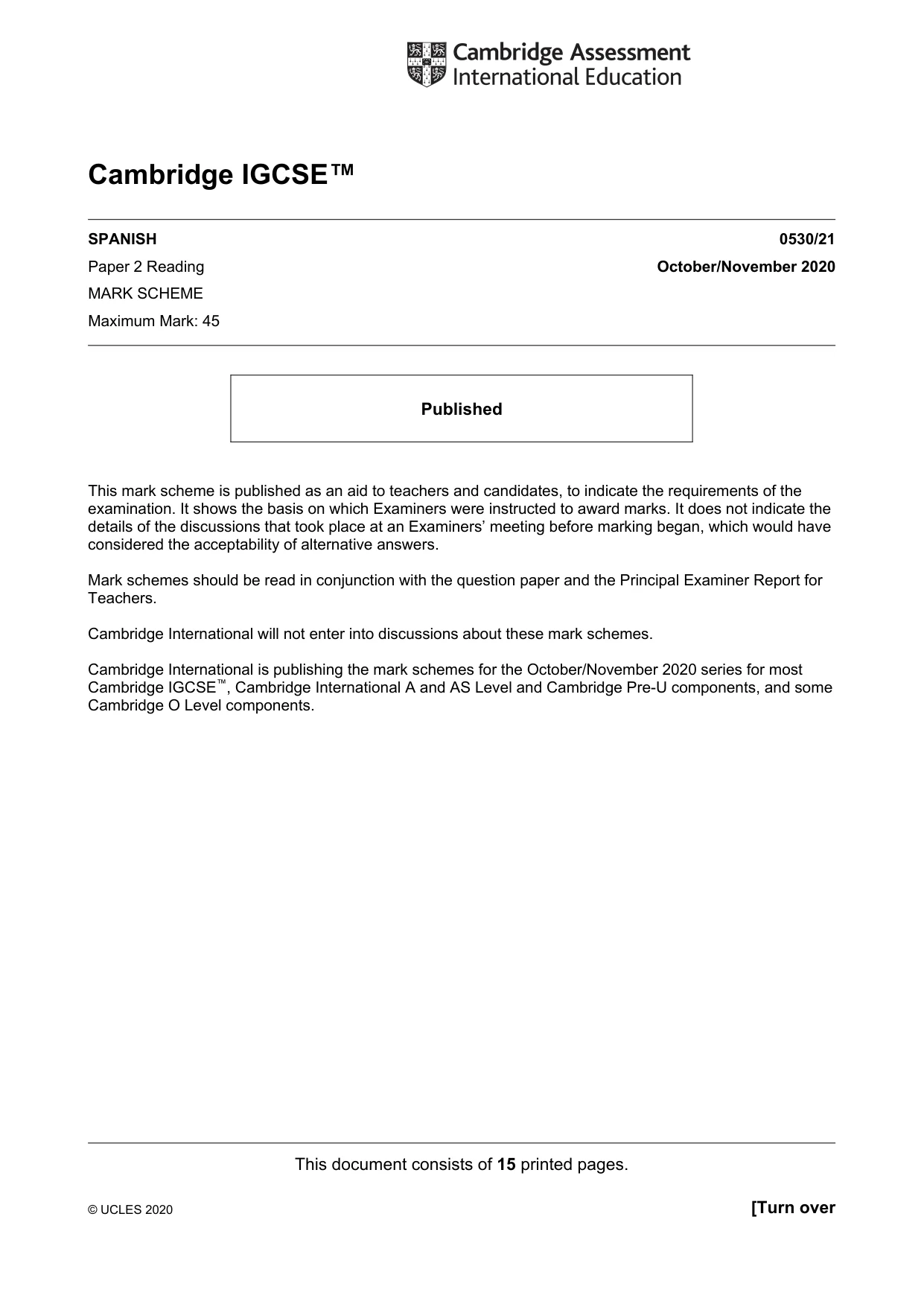
15 0530/21/O/N/20 © UCLES 2020 36 ¿Cuándo empezaban su baile los chicos en la plaza? … [1] 37 ¿Qué entregaban los espectadores en los coches? … [1] 38 ¿Por qué le sorprendió a Sara ver a los chicos a esa hora? … [1] 39 ¿Qué le gustó a Sara de la manera de bailar de los chicos? … [1] 40 ¿Qué promesa les hizo Sara a los chicos? … [1] 41 Según Sara, ¿cómo debían caminar los chicos en los espectáculos? … [1] 42 ¿Quién le pagó al grupo su primera salida del país? … [1] [Total: 7]
Question paper, page 16
16 0530/21/O/N/20 © UCLES 2020 Permission to reproduce items where third-party owned material protected by copyright is included has been sought and cleared where possible. Every reasonable effort has been made by the publisher (UCLES) to trace copyright holders, but if any items requiring clearance have unwittingly been included, the publisher will be pleased to make amends at the earliest possible opportunity. To avoid the issue of disclosure of answer-related information to candidates, all copyright acknowledgements are reproduced online in the Cambridge Assessment International Education Copyright Acknowledgements Booklet. This is produced for each series of examinations and is freely available to download at www.cambridgeinternational.org after the live examination series. Cambridge Assessment International Education is part of the Cambridge Assessment Group. Cambridge Assessment is the brand name of the University of Cambridge Local Examinations Syndicate (UCLES), which itself is a department of the University of Cambridge. BLANK PAGE
Mark scheme, page 1
This document consists of 15 printed pages. © UCLES 2020 [Turn over Cambridge IGCSE™ SPANISH 0530/21 Paper 2 Reading October/November 2020 MARK SCHEME Maximum Mark: 45 Published This mark scheme is published as an aid to teachers and candidates, to indicate the requirements of the examination. It shows the basis on which Examiners were instructed to award marks. It does not indicate the details of the discussions that took place at an Examiners’ meeting before marking began, which would have considered the acceptability of alternative answers. Mark schemes should be read in conjunction with the question paper and the Principal Examiner Report for Teachers. Cambridge International will not enter into discussions about these mark schemes. Cambridge International is publishing the mark schemes for the October/November 2020 series for most Cambridge IGCSE™, Cambridge International A and AS Level and Cambridge Pre-U components, and some Cambridge O Level components.
Mark scheme, page 2
0530/21 Cambridge IGCSE – Mark Scheme PUBLISHED October/November 2020 © UCLES 2020 Page 2 of 15 Generic Marking Principles These general marking principles must be applied by all examiners when marking candidate answers. They should be applied alongside the specific content of the mark scheme or generic level descriptors for a question. Each question paper and mark scheme will also comply with these marking principles. GENERIC MARKING PRINCIPLE 1: Marks must be awarded in line with: • the specific content of the mark scheme or the generic level descriptors for the question • the specific skills defined in the mark scheme or in the generic level descriptors for the question • the standard of response required by a candidate as exemplified by the standardisation scripts. GENERIC MARKING PRINCIPLE 2: Marks awarded are always whole marks (not half marks, or other fractions). GENERIC MARKING PRINCIPLE 3: Marks must be awarded positively: • marks are awarded for correct/valid answers, as defined in the mark scheme. However, credit is given for valid answers which go beyond the scope of the syllabus and mark scheme, referring to your Team Leader as appropriate • marks are awarded when candidates clearly demonstrate what they know and can do • marks are not deducted for errors • marks are not deducted for omissions • answers should only be judged on the quality of spelling, punctuation and grammar when these features are specifically assessed by the question as indicated by the mark scheme. The meaning, however, should be unambiguous. GENERIC MARKING PRINCIPLE 4: Rules must be applied consistently, e.g. in situations where candidates have not followed instructions or in the application of generic level descriptors.
Mark scheme, page 3
0530/21 Cambridge IGCSE – Mark Scheme PUBLISHED October/November 2020 © UCLES 2020 Page 3 of 15 GENERIC MARKING PRINCIPLE 5: Marks should be awarded using the full range of marks defined in the mark scheme for the question (however; the use of the full mark range may be limited according to the quality of the candidate responses seen). GENERIC MARKING PRINCIPLE 6: Marks awarded are based solely on the requirements as defined in the mark scheme. Marks should not be awarded with grade thresholds or grade descriptors in mind.
Mark scheme, page 4
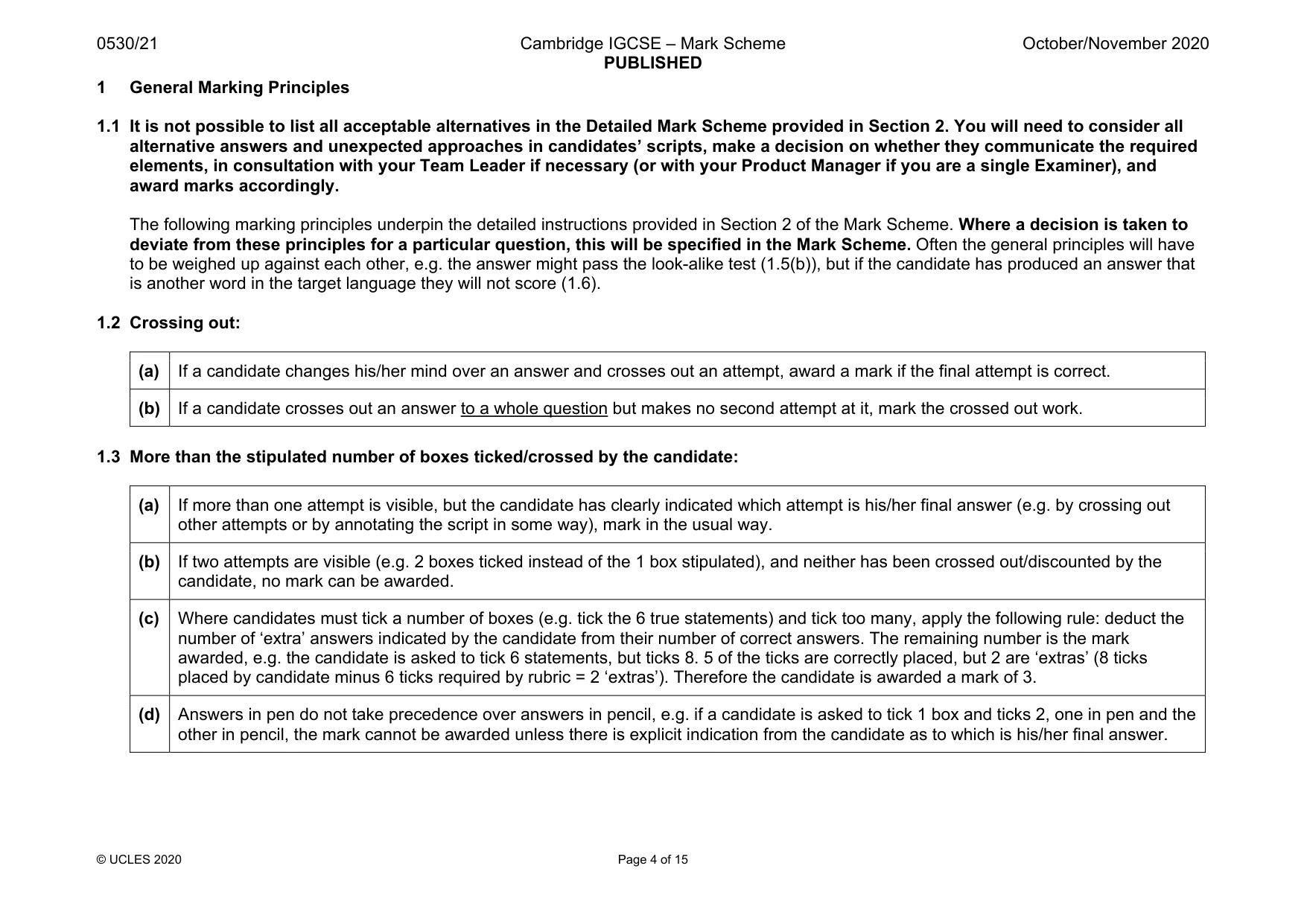
0530/21 Cambridge IGCSE – Mark Scheme PUBLISHED October/November 2020 © UCLES 2020 Page 4 of 15 1 General Marking Principles 1.1 It is not possible to list all acceptable alternatives in the Detailed Mark Scheme provided in Section 2. You will need to consider all alternative answers and unexpected approaches in candidates’ scripts, make a decision on whether they communicate the required elements, in consultation with your Team Leader if necessary (or with your Product Manager if you are a single Examiner), and award marks accordingly. The following marking principles underpin the detailed instructions provided in Section 2 of the Mark Scheme. Where a decision is taken to deviate from these principles for a particular question, this will be specified in the Mark Scheme. Often the general principles will have to be weighed up against each other, e.g. the answer might pass the look-alike test (1.5(b)), but if the candidate has produced an answer that is another word in the target language they will not score (1.6). 1.2 Crossing out: (a) If a candidate changes his/her mind over an answer and crosses out an attempt, award a mark if the final attempt is correct. (b) If a candidate crosses out an answer to a whole question but makes no second attempt at it, mark the crossed out work. 1.3 More than the stipulated number of boxes ticked/crossed by the candidate: (a) If more than one attempt is visible, but the candidate has clearly indicated which attempt is his/her final answer (e.g. by crossing out other attempts or by annotating the script in some way), mark in the usual way. (b) If two attempts are visible (e.g. 2 boxes ticked instead of the 1 box stipulated), and neither has been crossed out/discounted by the candidate, no mark can be awarded. (c) Where candidates must tick a number of boxes (e.g. tick the 6 true statements) and tick too many, apply the following rule: deduct the number of ‘extra’ answers indicated by the candidate from their number of correct answers. The remaining number is the mark awarded, e.g. the candidate is asked to tick 6 statements, but ticks 8. 5 of the ticks are correctly placed, but 2 are ‘extras’ (8 ticks placed by candidate minus 6 ticks required by rubric = 2 ‘extras’). Therefore the candidate is awarded a mark of 3. (d) Answers in pen do not take precedence over answers in pencil, e.g. if a candidate is asked to tick 1 box and ticks 2, one in pen and the other in pencil, the mark cannot be awarded unless there is explicit indication from the candidate as to which is his/her final answer.
Mark scheme, page 5
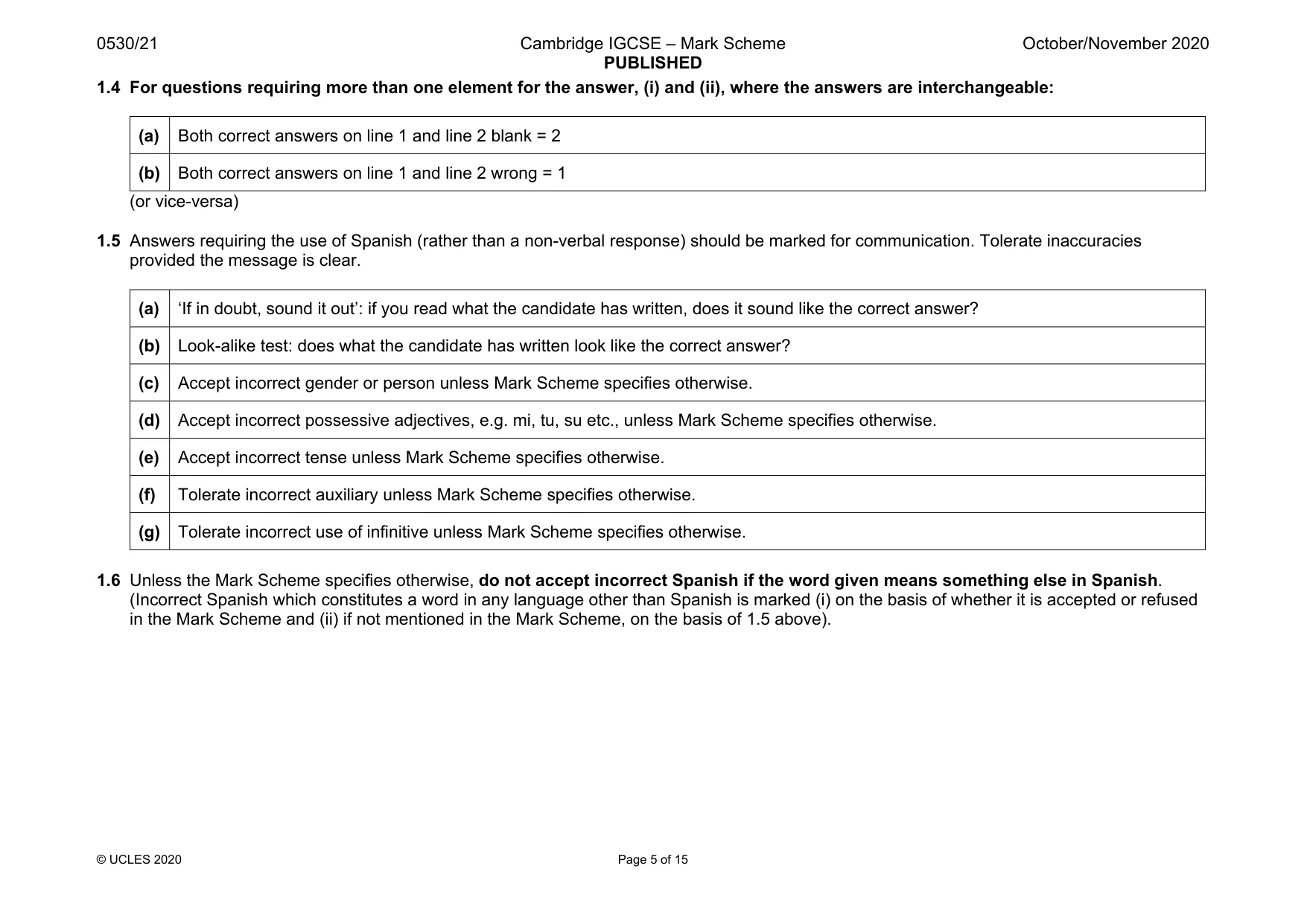
0530/21 Cambridge IGCSE – Mark Scheme PUBLISHED October/November 2020 © UCLES 2020 Page 5 of 15 1.4 For questions requiring more than one element for the answer, (i) and (ii), where the answers are interchangeable: (a) Both correct answers on line 1 and line 2 blank = 2 (b) Both correct answers on line 1 and line 2 wrong = 1 (or vice-versa) 1.5 Answers requiring the use of Spanish (rather than a non-verbal response) should be marked for communication. Tolerate inaccuracies provided the message is clear. (a) ‘If in doubt, sound it out’: if you read what the candidate has written, does it sound like the correct answer? (b) Look-alike test: does what the candidate has written look like the correct answer? (c) Accept incorrect gender or person unless Mark Scheme specifies otherwise. (d) Accept incorrect possessive adjectives, e.g. mi, tu, su etc., unless Mark Scheme specifies otherwise. (e) Accept incorrect tense unless Mark Scheme specifies otherwise. (f) Tolerate incorrect auxiliary unless Mark Scheme specifies otherwise. (g) Tolerate incorrect use of infinitive unless Mark Scheme specifies otherwise. 1.6 Unless the Mark Scheme specifies otherwise, do not accept incorrect Spanish if the word given means something else in Spanish. (Incorrect Spanish which constitutes a word in any language other than Spanish is marked (i) on the basis of whether it is accepted or refused in the Mark Scheme and (ii) if not mentioned in the Mark Scheme, on the basis of 1.5 above).
Mark scheme, page 6
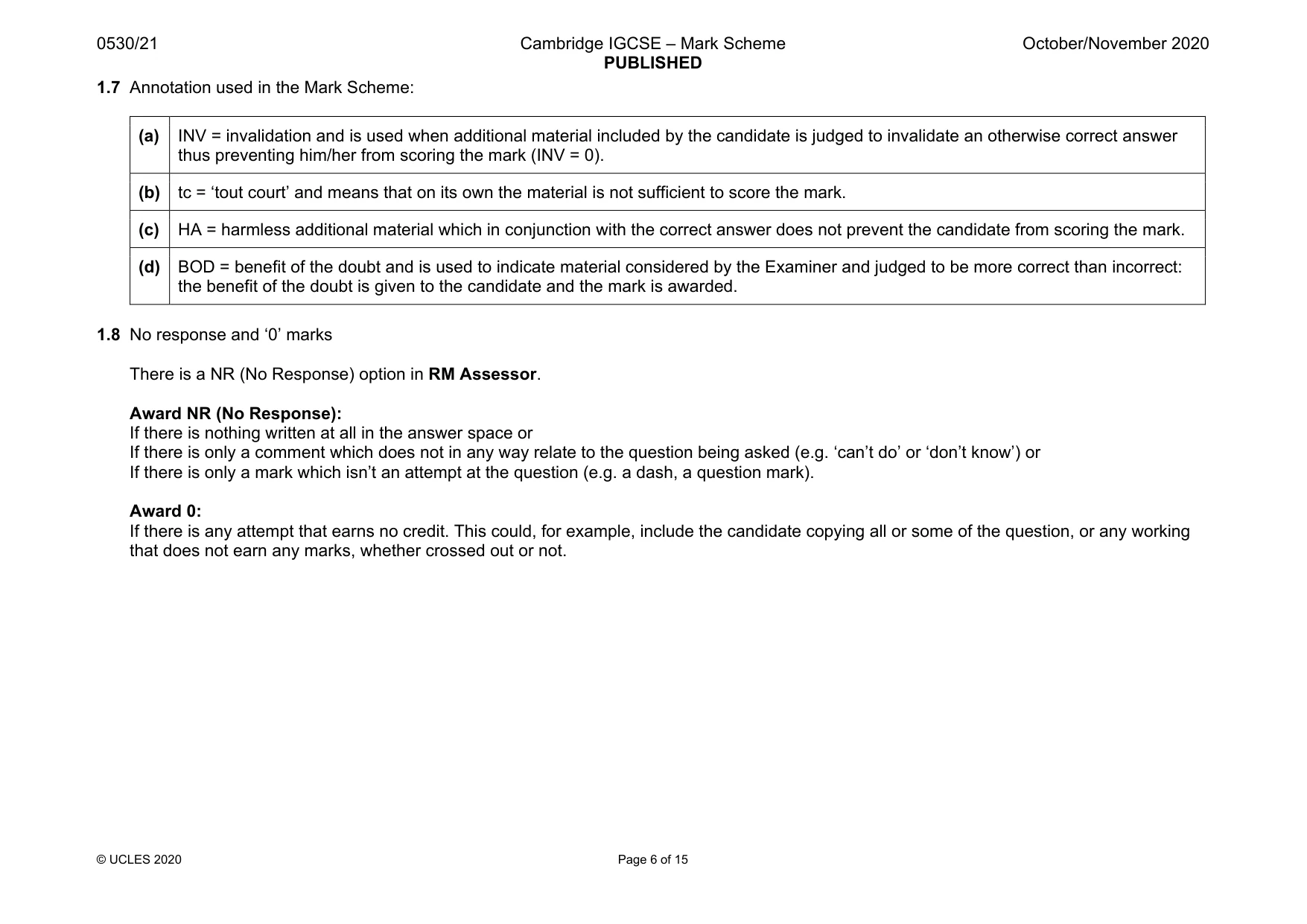
0530/21 Cambridge IGCSE – Mark Scheme PUBLISHED October/November 2020 © UCLES 2020 Page 6 of 15 1.7 Annotation used in the Mark Scheme: (a) INV = invalidation and is used when additional material included by the candidate is judged to invalidate an otherwise correct answer thus preventing him/her from scoring the mark (INV = 0). (b) tc = ‘tout court’ and means that on its own the material is not sufficient to score the mark. (c) HA = harmless additional material which in conjunction with the correct answer does not prevent the candidate from scoring the mark. (d) BOD = benefit of the doubt and is used to indicate material considered by the Examiner and judged to be more correct than incorrect: the benefit of the doubt is given to the candidate and the mark is awarded. 1.8 No response and ‘0’ marks There is a NR (No Response) option in RM Assessor. Award NR (No Response): If there is nothing written at all in the answer space or If there is only a comment which does not in any way relate to the question being asked (e.g. ‘can’t do’ or ‘don’t know’) or If there is only a mark which isn’t an attempt at the question (e.g. a dash, a question mark). Award 0: If there is any attempt that earns no credit. This could, for example, include the candidate copying all or some of the question, or any working that does not earn any marks, whether crossed out or not.
Mark scheme, page 7
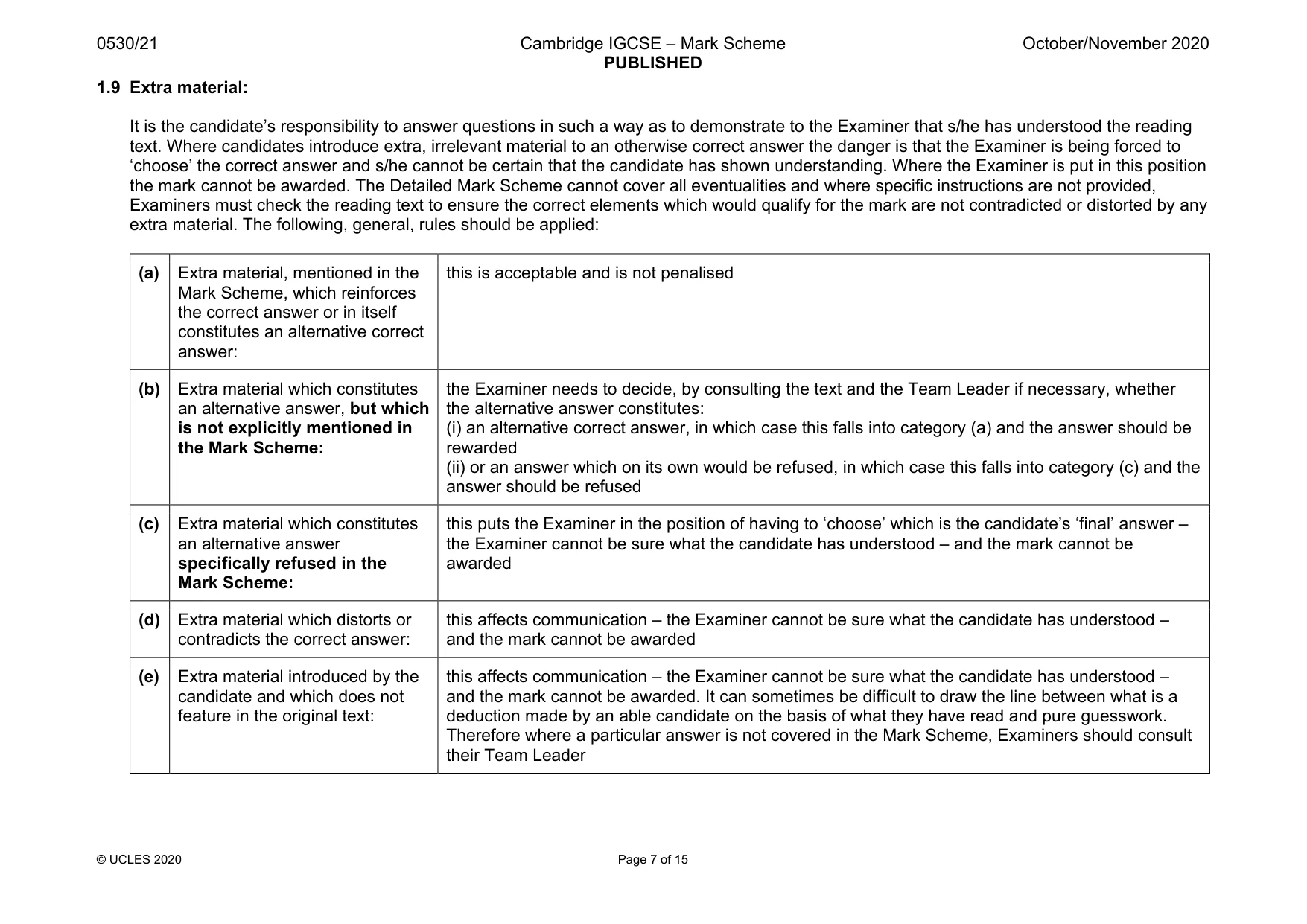
0530/21 Cambridge IGCSE – Mark Scheme PUBLISHED October/November 2020 © UCLES 2020 Page 7 of 15 1.9 Extra material: It is the candidate’s responsibility to answer questions in such a way as to demonstrate to the Examiner that s/he has understood the reading text. Where candidates introduce extra, irrelevant material to an otherwise correct answer the danger is that the Examiner is being forced to ‘choose’ the correct answer and s/he cannot be certain that the candidate has shown understanding. Where the Examiner is put in this position the mark cannot be awarded. The Detailed Mark Scheme cannot cover all eventualities and where specific instructions are not provided, Examiners must check the reading text to ensure the correct elements which would qualify for the mark are not contradicted or distorted by any extra material. The following, general, rules should be applied: (a) Extra material, mentioned in the Mark Scheme, which reinforces the correct answer or in itself constitutes an alternative correct answer: this is acceptable and is not penalised (b) Extra material which constitutes an alternative answer, but which is not explicitly mentioned in the Mark Scheme: the Examiner needs to decide, by consulting the text and the Team Leader if necessary, whether the alternative answer constitutes: (i) an alternative correct answer, in which case this falls into category (a) and the answer should be rewarded (ii) or an answer which on its own would be refused, in which case this falls into category (c) and the answer should be refused (c) Extra material which constitutes an alternative answer specifically refused in the Mark Scheme: this puts the Examiner in the position of having to ‘choose’ which is the candidate’s ‘final’ answer – the Examiner cannot be sure what the candidate has understood – and the mark cannot be awarded (d) Extra material which distorts or contradicts the correct answer: this affects communication – the Examiner cannot be sure what the candidate has understood – and the mark cannot be awarded (e) Extra material introduced by the candidate and which does not feature in the original text: this affects communication – the Examiner cannot be sure what the candidate has understood – and the mark cannot be awarded. It can sometimes be difficult to draw the line between what is a deduction made by an able candidate on the basis of what they have read and pure guesswork. Therefore where a particular answer is not covered in the Mark Scheme, Examiners should consult their Team Leader
Mark scheme, page 8
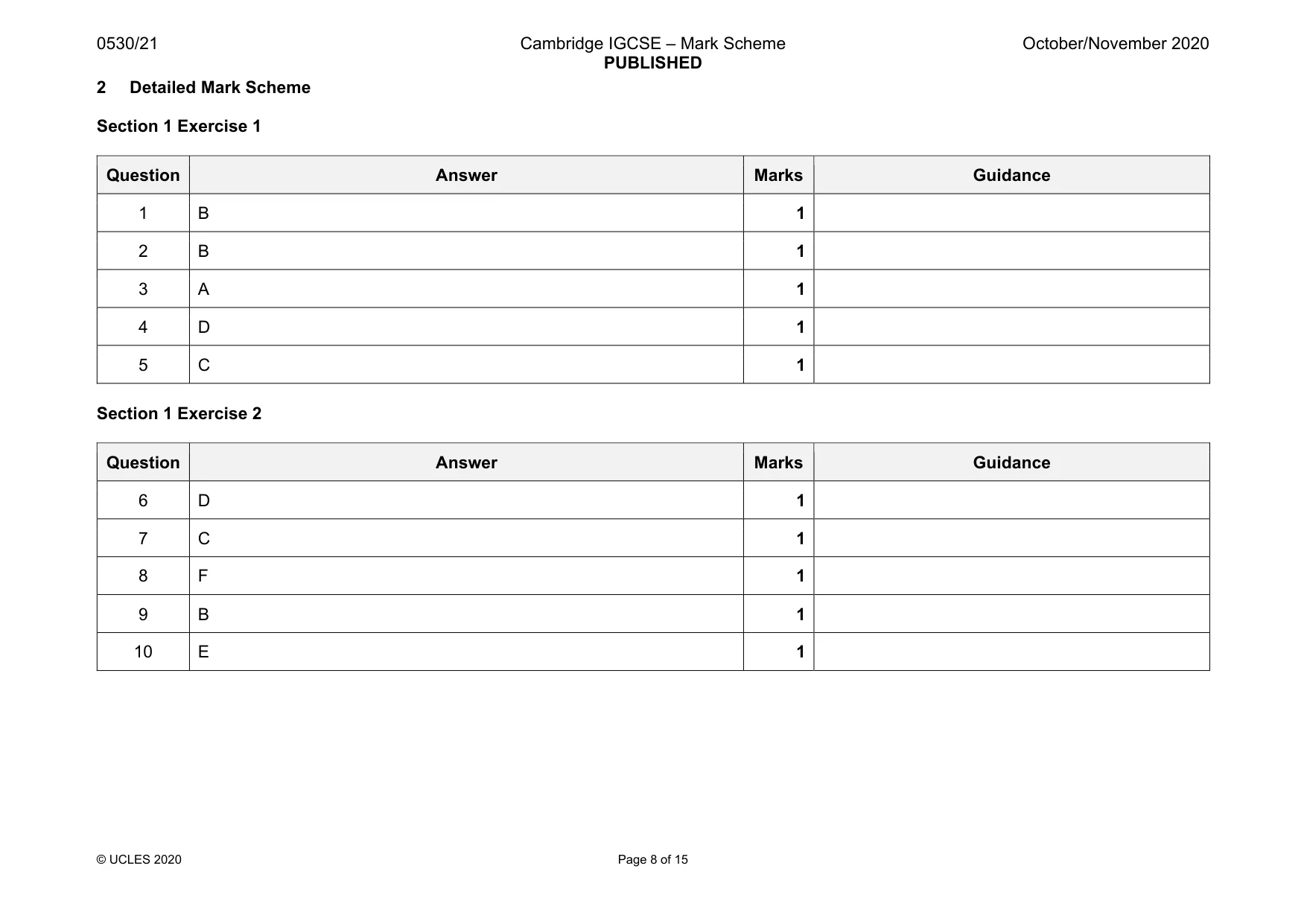
0530/21 Cambridge IGCSE – Mark Scheme PUBLISHED October/November 2020 © UCLES 2020 Page 8 of 15 2 Detailed Mark Scheme Section 1 Exercise 1 Question Answer Marks Guidance 1 B 1 2 B 1 3 A 1 4 D 1 5 C 1 Section 1 Exercise 2 Question Answer Marks Guidance 6 D 1 7 C 1 8 F 1 9 B 1 10 E 1
Mark scheme, page 9
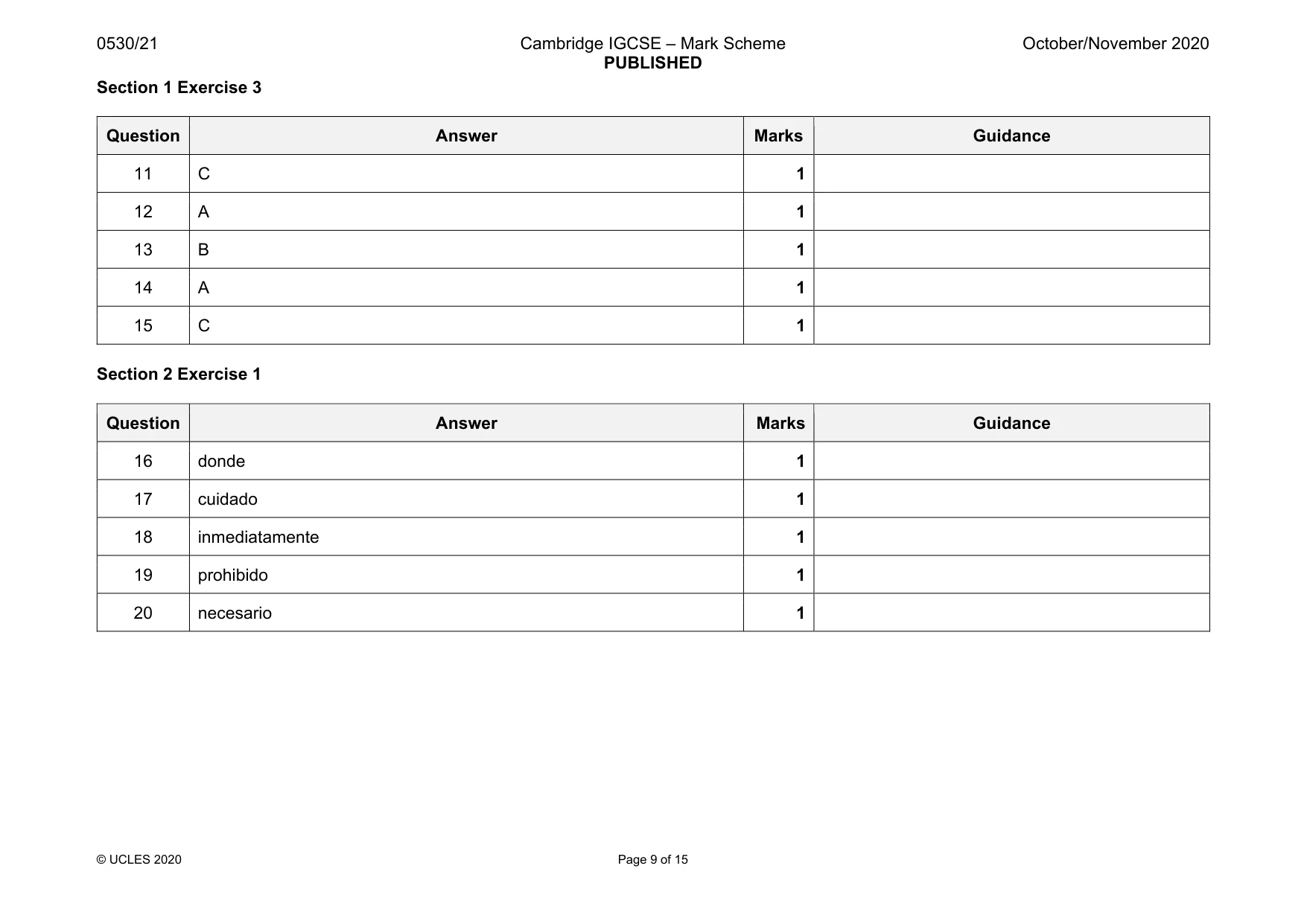
0530/21 Cambridge IGCSE – Mark Scheme PUBLISHED October/November 2020 © UCLES 2020 Page 9 of 15 Section 1 Exercise 3 Question Answer Marks Guidance 11 C 1 12 A 1 13 B 1 14 A 1 15 C 1 Section 2 Exercise 1 Question Answer Marks Guidance 16 donde 1 17 cuidado 1 18 inmediatamente 1 19 prohibido 1 20 necesario 1
Mark scheme, page 10
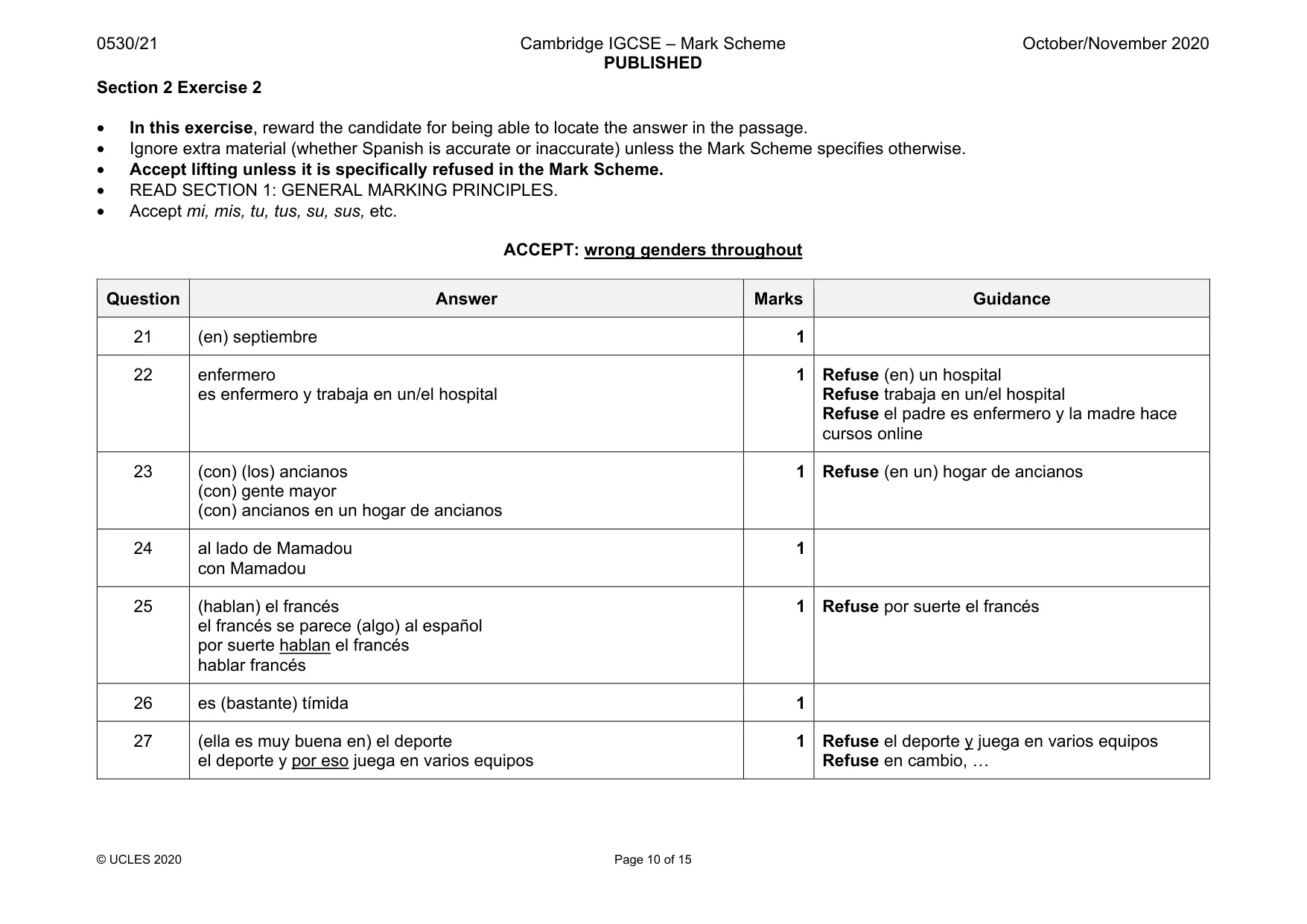
0530/21 Cambridge IGCSE – Mark Scheme PUBLISHED October/November 2020 © UCLES 2020 Page 10 of 15 Section 2 Exercise 2 • In this exercise, reward the candidate for being able to locate the answer in the passage. • Ignore extra material (whether Spanish is accurate or inaccurate) unless the Mark Scheme specifies otherwise. • Accept lifting unless it is specifically refused in the Mark Scheme. • READ SECTION 1: GENERAL MARKING PRINCIPLES. • Accept mi, mis, tu, tus, su, sus, etc. ACCEPT: wrong genders throughout Question Answer Marks Guidance 21 (en) septiembre 1 22 enfermero es enfermero y trabaja en un/el hospital 1 Refuse (en) un hospital Refuse trabaja en un/el hospital Refuse el padre es enfermero y la madre hace cursos online 23 (con) (los) ancianos (con) gente mayor (con) ancianos en un hogar de ancianos 1 Refuse (en un) hogar de ancianos 24 al lado de Mamadou con Mamadou 1 25 (hablan) el francés el francés se parece (algo) al español por suerte hablan el francés hablar francés 1 Refuse por suerte el francés 26 es (bastante) tímida 1 27 (ella es muy buena en) el deporte el deporte y por eso juega en varios equipos 1 Refuse el deporte y juega en varios equipos Refuse en cambio, …
Mark scheme, page 11
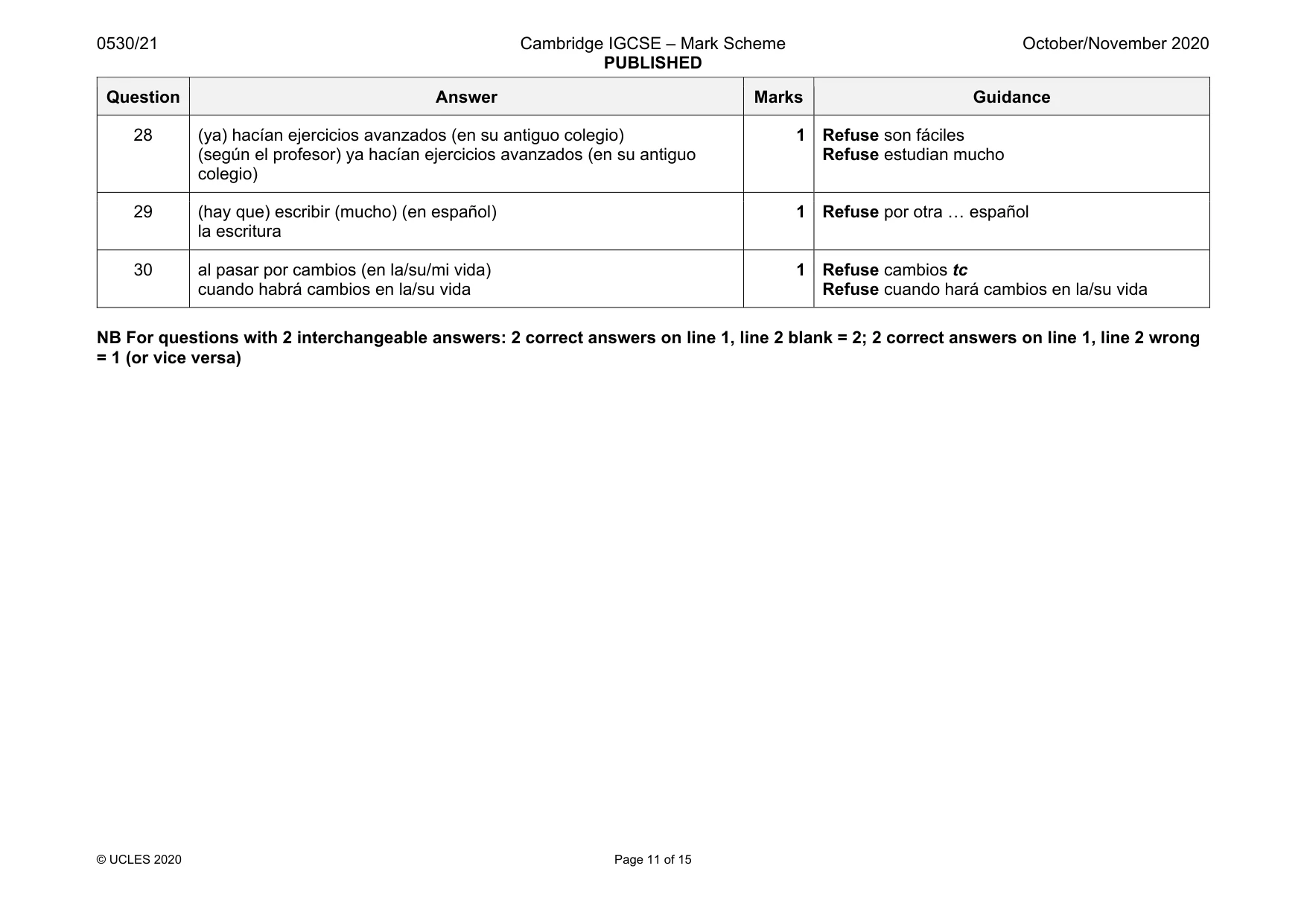
0530/21 Cambridge IGCSE – Mark Scheme PUBLISHED October/November 2020 © UCLES 2020 Page 11 of 15 Question Answer Marks Guidance 28 (ya) hacían ejercicios avanzados (en su antiguo colegio) (según el profesor) ya hacían ejercicios avanzados (en su antiguo colegio) 1 Refuse son fáciles Refuse estudian mucho 29 (hay que) escribir (mucho) (en español) la escritura 1 Refuse por otra … español 30 al pasar por cambios (en la/su/mi vida) cuando habrá cambios en la/su vida 1 Refuse cambios tc Refuse cuando hará cambios en la/su vida NB For questions with 2 interchangeable answers: 2 correct answers on line 1, line 2 blank = 2; 2 correct answers on line 1, line 2 wrong = 1 (or vice versa)
Mark scheme, page 12
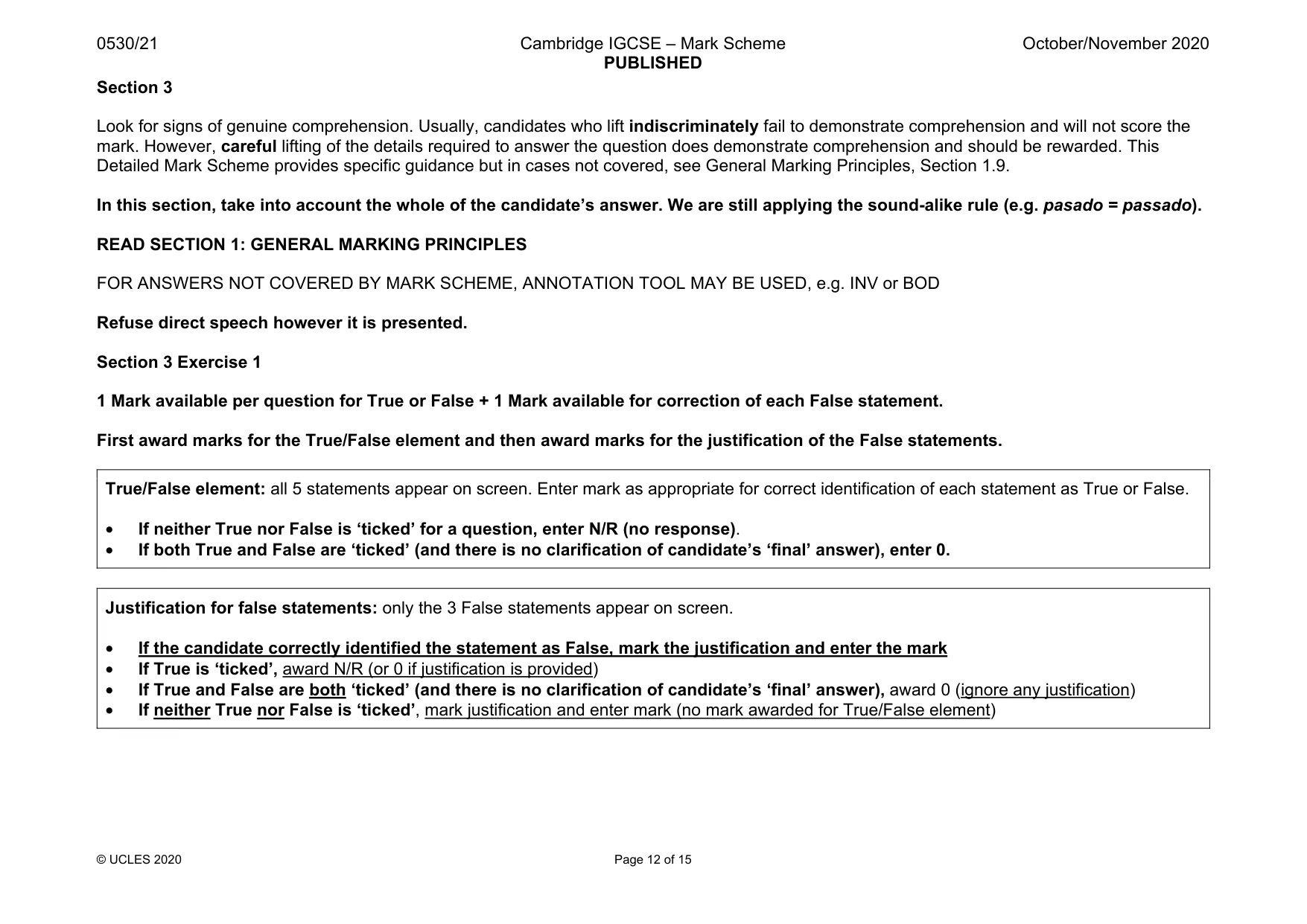
0530/21 Cambridge IGCSE – Mark Scheme PUBLISHED October/November 2020 © UCLES 2020 Page 12 of 15 Section 3 Look for signs of genuine comprehension. Usually, candidates who lift indiscriminately fail to demonstrate comprehension and will not score the mark. However, careful lifting of the details required to answer the question does demonstrate comprehension and should be rewarded. This Detailed Mark Scheme provides specific guidance but in cases not covered, see General Marking Principles, Section 1.9. In this section, take into account the whole of the candidate’s answer. We are still applying the sound-alike rule (e.g. pasado = passado). READ SECTION 1: GENERAL MARKING PRINCIPLES FOR ANSWERS NOT COVERED BY MARK SCHEME, ANNOTATION TOOL MAY BE USED, e.g. INV or BOD Refuse direct speech however it is presented. Section 3 Exercise 1 1 Mark available per question for True or False + 1 Mark available for correction of each False statement. First award marks for the True/False element and then award marks for the justification of the False statements. True/False element: all 5 statements appear on screen. Enter mark as appropriate for correct identification of each statement as True or False. • If neither True nor False is ‘ticked’ for a question, enter N/R (no response). • If both True and False are ‘ticked’ (and there is no clarification of candidate’s ‘final’ answer), enter 0. Justification for false statements: only the 3 False statements appear on screen. • If the candidate correctly identified the statement as False, mark the justification and enter the mark • If True is ‘ticked’, award N/R (or 0 if justification is provided) • If True and False are both ‘ticked’ (and there is no clarification of candidate’s ‘final’ answer), award 0 (ignore any justification) • If neither True nor False is ‘ticked’, mark justification and enter mark (no mark awarded for True/False element)
Mark scheme, page 13
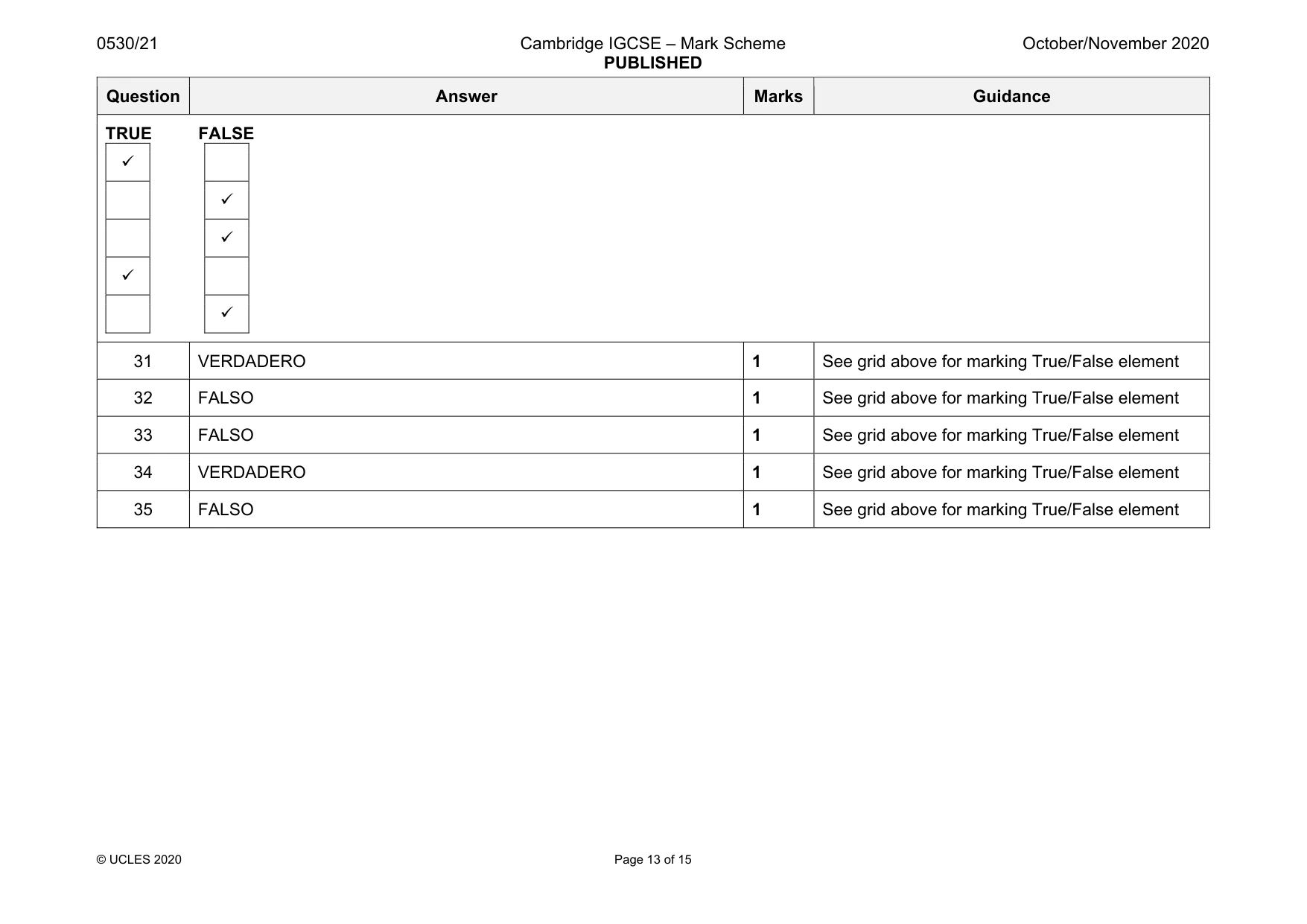
0530/21 Cambridge IGCSE – Mark Scheme PUBLISHED October/November 2020 © UCLES 2020 Page 13 of 15 Question Answer Marks Guidance TRUE FALSE 31 VERDADERO 1 See grid above for marking True/False element 32 FALSO 1 See grid above for marking True/False element 33 FALSO 1 See grid above for marking True/False element 34 VERDADERO 1 See grid above for marking True/False element 35 FALSO 1 See grid above for marking True/False element
Mark scheme, page 14
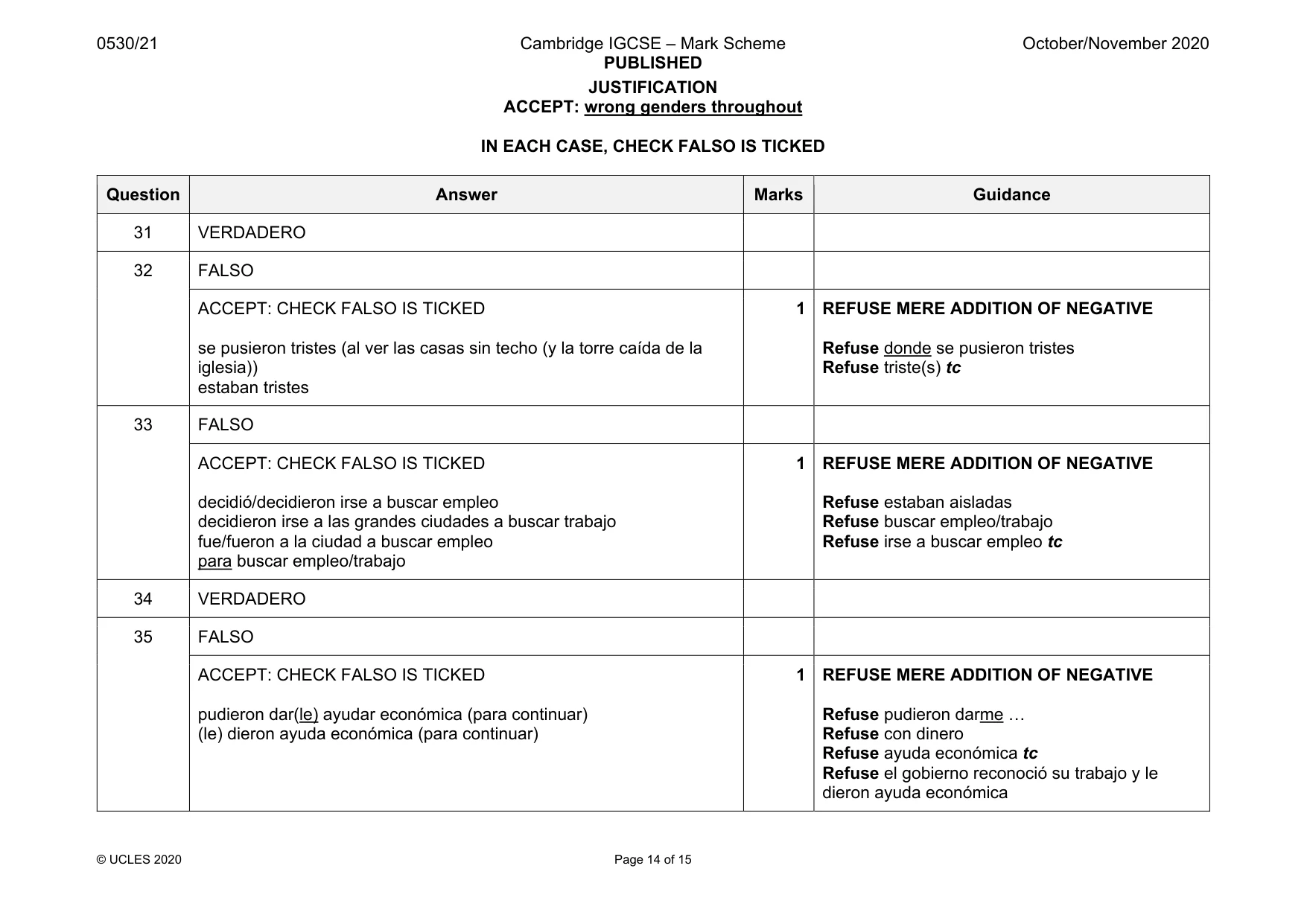
0530/21 Cambridge IGCSE – Mark Scheme PUBLISHED October/November 2020 © UCLES 2020 Page 14 of 15 JUSTIFICATION ACCEPT: wrong genders throughout IN EACH CASE, CHECK FALSO IS TICKED Question Answer Marks Guidance 31 VERDADERO 32 FALSO ACCEPT: CHECK FALSO IS TICKED se pusieron tristes (al ver las casas sin techo (y la torre caída de la iglesia)) estaban tristes 1 REFUSE MERE ADDITION OF NEGATIVE Refuse donde se pusieron tristes Refuse triste(s) tc 33 FALSO ACCEPT: CHECK FALSO IS TICKED decidió/decidieron irse a buscar empleo decidieron irse a las grandes ciudades a buscar trabajo fue/fueron a la ciudad a buscar empleo para buscar empleo/trabajo 1 REFUSE MERE ADDITION OF NEGATIVE Refuse estaban aisladas Refuse buscar empleo/trabajo Refuse irse a buscar empleo tc 34 VERDADERO 35 FALSO ACCEPT: CHECK FALSO IS TICKED pudieron dar(le) ayudar económica (para continuar) (le) dieron ayuda económica (para continuar) 1 REFUSE MERE ADDITION OF NEGATIVE Refuse pudieron darme … Refuse con dinero Refuse ayuda económica tc Refuse el gobierno reconoció su trabajo y le dieron ayuda económica
Mark scheme, page 15
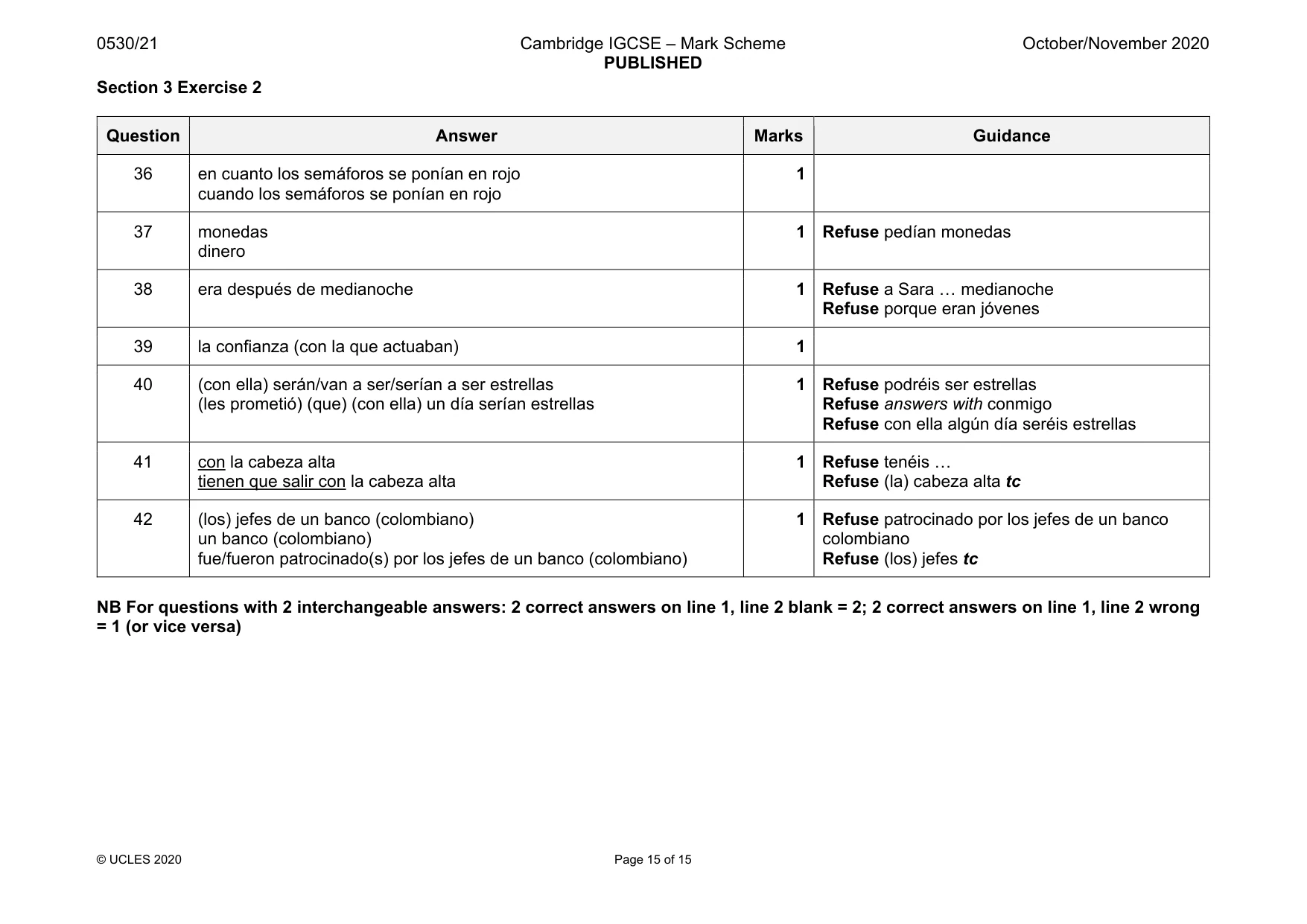
0530/21 Cambridge IGCSE – Mark Scheme PUBLISHED October/November 2020 © UCLES 2020 Page 15 of 15 Section 3 Exercise 2 Question Answer Marks Guidance 36 en cuanto los semáforos se ponían en rojo cuando los semáforos se ponían en rojo 1 37 monedas dinero 1 Refuse pedían monedas 38 era después de medianoche 1 Refuse a Sara … medianoche Refuse porque eran jóvenes 39 la confianza (con la que actuaban) 1 40 (con ella) serán/van a ser/serían a ser estrellas (les prometió) (que) (con ella) un día serían estrellas 1 Refuse podréis ser estrellas Refuse answers with conmigo Refuse con ella algún día seréis estrellas 41 con la cabeza alta tienen que salir con la cabeza alta 1 Refuse tenéis … Refuse (la) cabeza alta tc 42 (los) jefes de un banco (colombiano) un banco (colombiano) fue/fueron patrocinado(s) por los jefes de un banco (colombiano) 1 Refuse patrocinado por los jefes de un banco colombiano Refuse (los) jefes tc NB For questions with 2 interchangeable answers: 2 correct answers on line 1, line 2 blank = 2; 2 correct answers on line 1, line 2 wrong = 1 (or vice versa)
What you needed in this session
Cambridge’s own grade thresholds for 2020 Oct/Nov, Paper 2 · Variant 1. A higher threshold means an easier paper — the bar moves with how the cohort did.