Cambridge IGCSE Spanish - Foreign Language 0530 — 2019 Oct/Nov Paper 2 · Variant 2
0530/22/O/N/19 · 45 marks · ≈51 min
The question paper and its mark scheme, free to read here and free to download. This is Cambridge’s own paper, exactly as it was sat.
Question paper16 pages



Mark scheme14 pages
Answers below. Sit the paper first if you are practising.
Paper as text
Question paper, page 1
This document consists of 14 printed pages and 2 blank pages. DC (ST/JG) 169059/2 © UCLES 2019 [Turn over * 1 6 9 3 3 1 1 0 2 6 * SPANISH 0530/22 Paper 2 Reading October/November 2019 1 hour Candidates answer on the Question Paper. No Additional Materials are required. READ THESE INSTRUCTIONS FIRST Write your centre number, candidate number and name in the spaces at the top of this page. Write in dark blue or black pen. Do not use staples, paper clips, glue or correction fluid. DO NOT WRITE IN ANY BARCODES. Answer all questions. The number of marks is given in brackets [ ] at the end of each question or part question. Cambridge Assessment International Education Cambridge International General Certificate of Secondary Education This syllabus is regulated for use in England, Wales and Northern Ireland as a Cambridge International Level 1/Level 2 Certificate.
Question paper, page 2
2 0530/22/O/N/19 © UCLES 2019 BLANK PAGE
Question paper, page 3
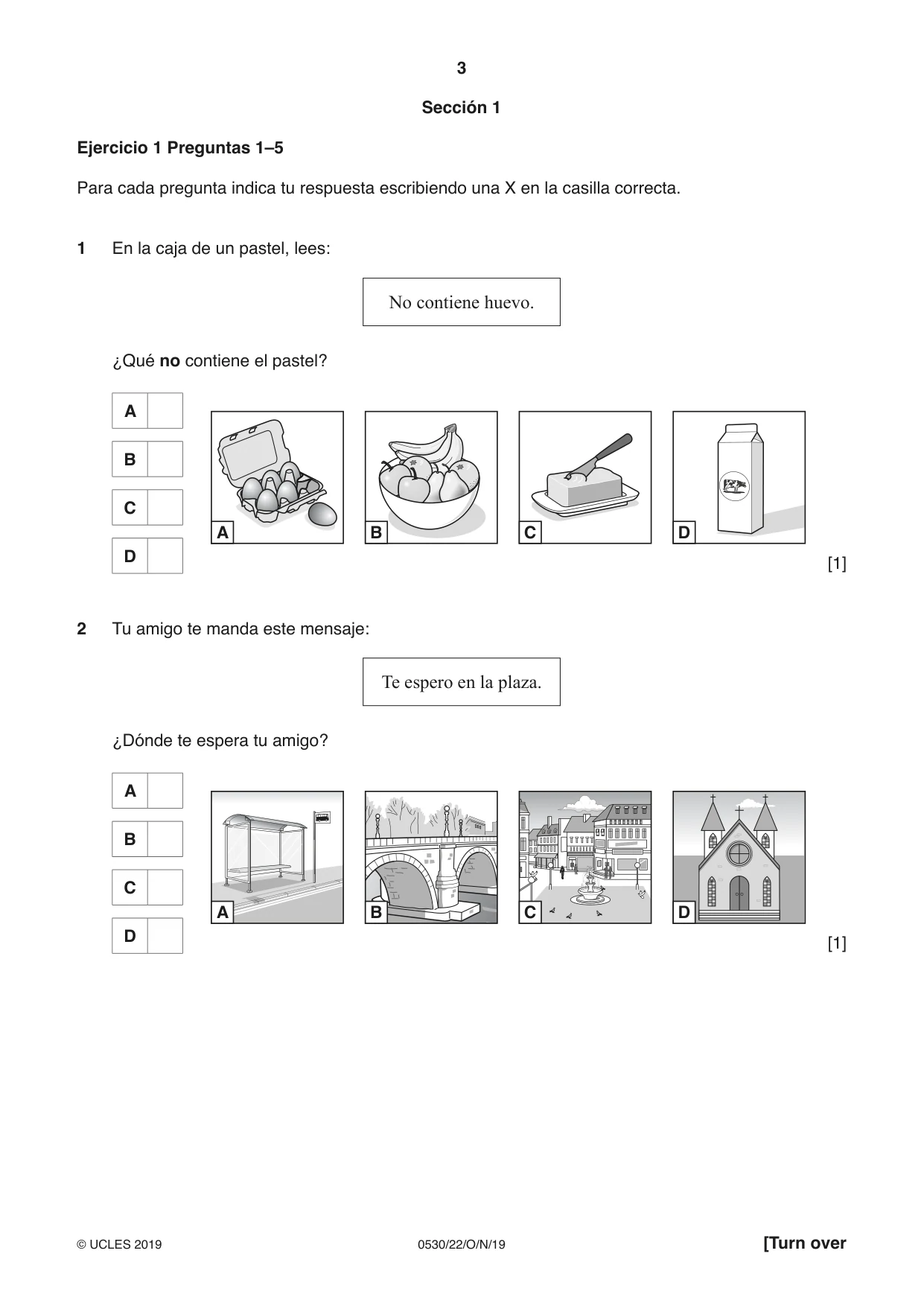
3 0530/22/O/N/19 © UCLES 2019 [Turn over Sección 1 Ejercicio 1 Preguntas 1–5 Para cada pregunta indica tu respuesta escribiendo una X en la casilla correcta. 1 En la caja de un pastel, lees: No contiene huevo. ¿Qué no contiene el pastel? A A B C D [1] B C D 2 Tu amigo te manda este mensaje: Te espero en la plaza. ¿Dónde te espera tu amigo? A A B C D [1] B C D
Question paper, page 4
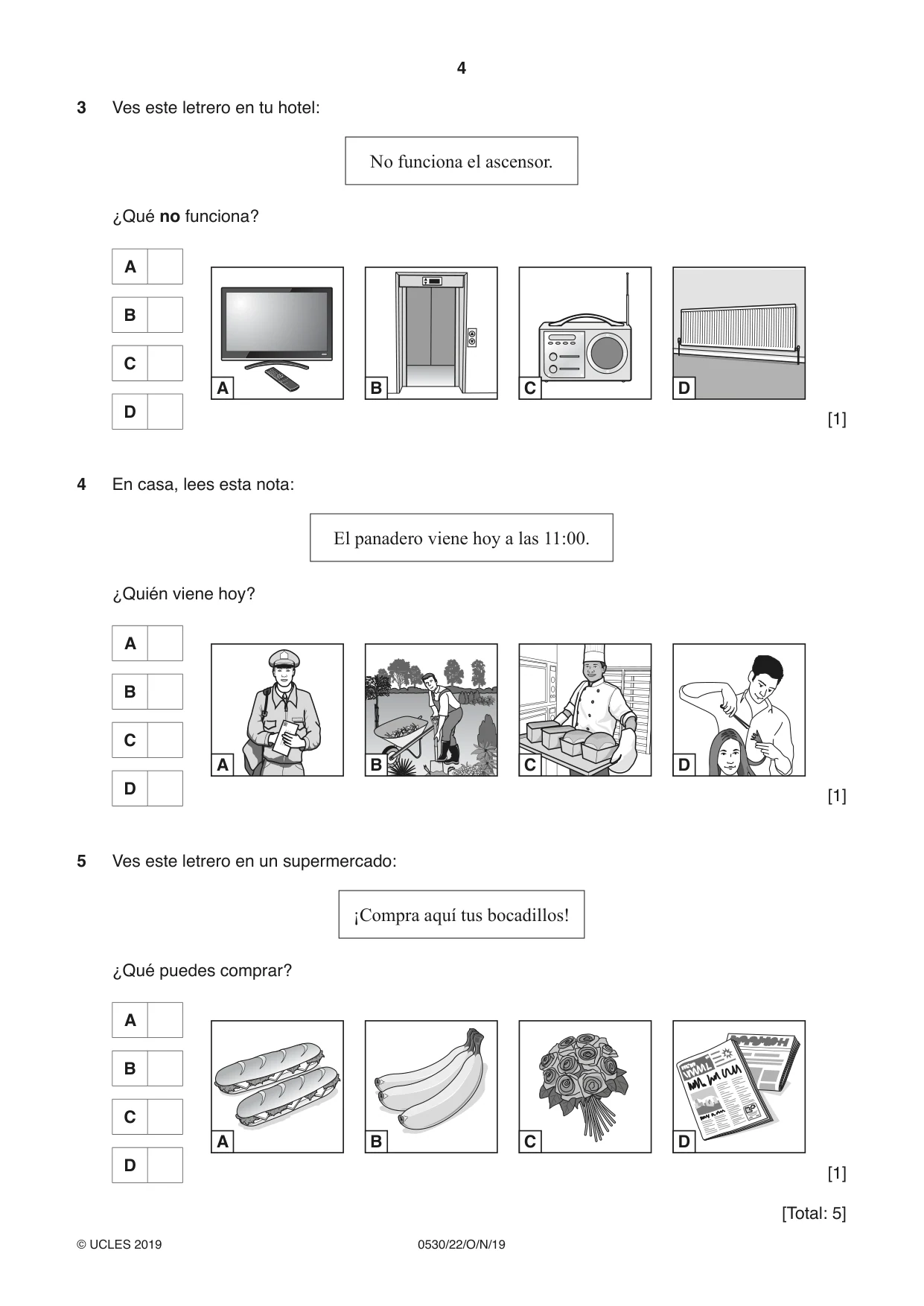
4 0530/22/O/N/19 © UCLES 2019 3 Ves este letrero en tu hotel: No funciona el ascensor. ¿Qué no funciona? A A B C D [1] B C D 4 En casa, lees esta nota: El panadero viene hoy a las 11:00. ¿Quién viene hoy? A A B C D [1] B C D 5 Ves este letrero en un supermercado: ¡Compra aquí tus bocadillos! ¿Qué puedes comprar? A A B C D [1] B C D [Total: 5]
Question paper, page 5
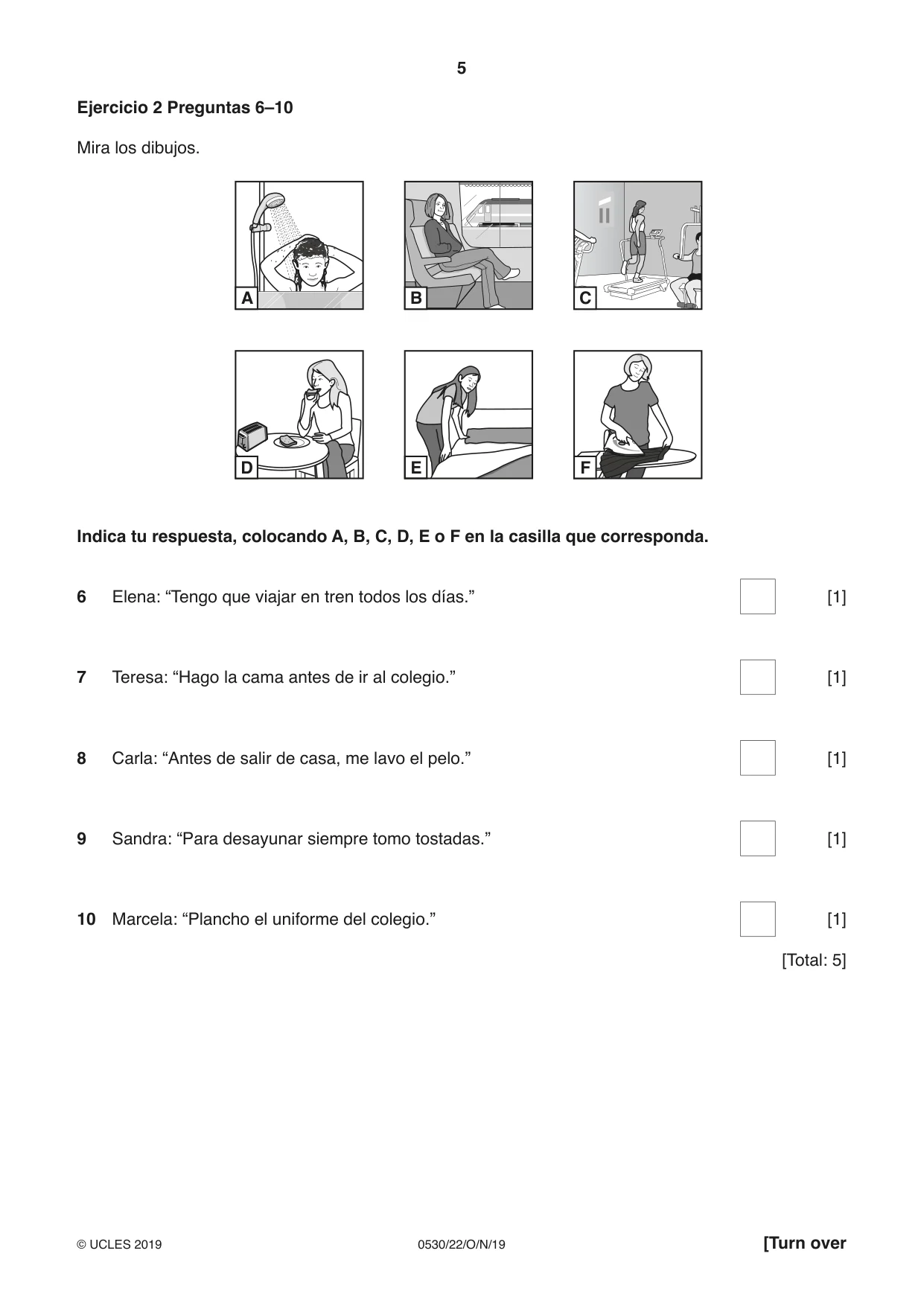
5 0530/22/O/N/19 © UCLES 2019 [Turn over Ejercicio 2 Preguntas 6–10 Mira los dibujos. A B C D E F Indica tu respuesta, colocando A, B, C, D, E o F en la casilla que corresponda. 6 Elena: “Tengo que viajar en tren todos los días.” [1] 7 Teresa: “Hago la cama antes de ir al colegio.” [1] 8 Carla: “Antes de salir de casa, me lavo el pelo.” [1] 9 Sandra: “Para desayunar siempre tomo tostadas.” [1] 10 Marcela: “Plancho el uniforme del colegio.” [1] [Total: 5]
Question paper, page 6
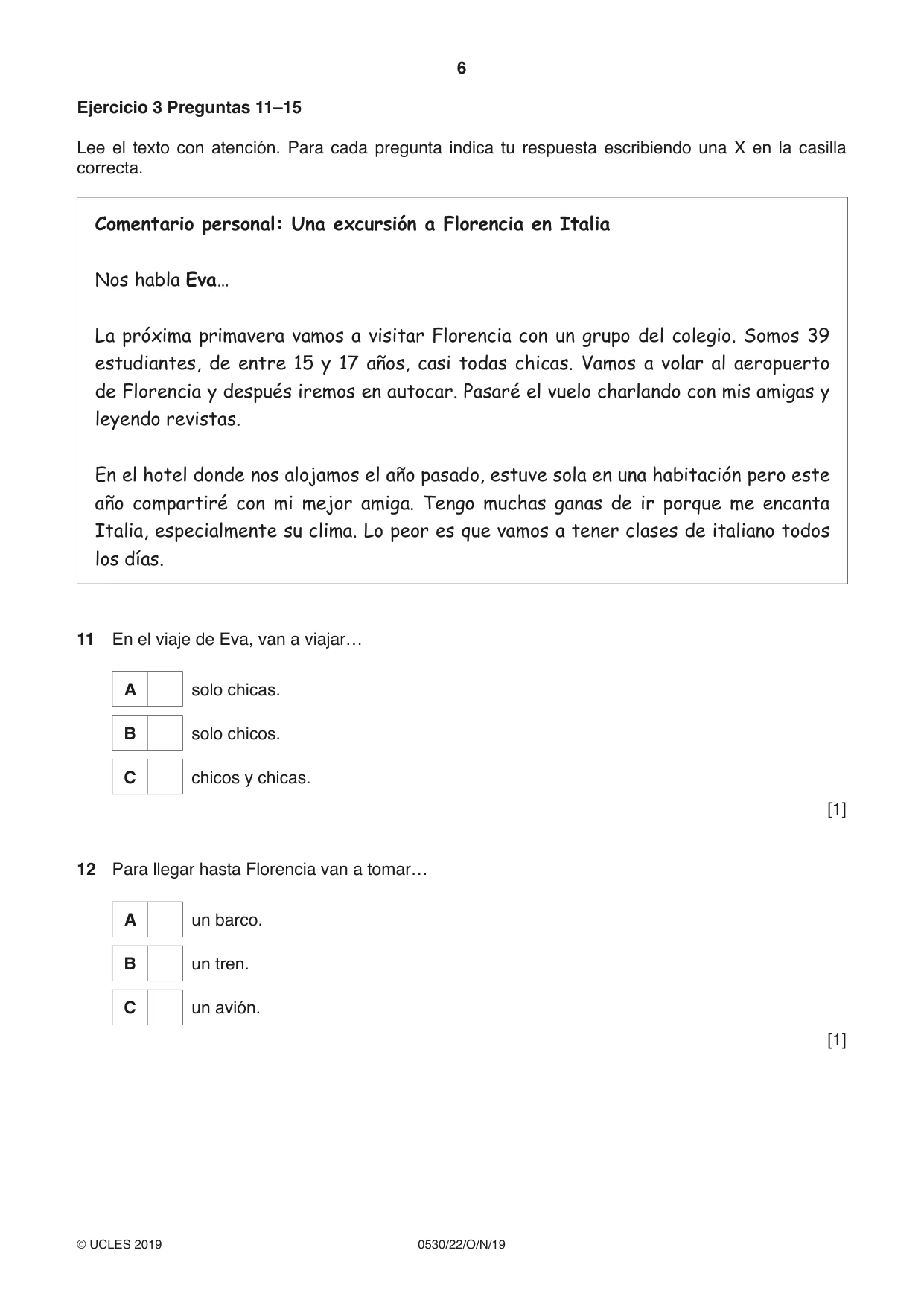
6 0530/22/O/N/19 © UCLES 2019 Ejercicio 3 Preguntas 11–15 Lee el texto con atención. Para cada pregunta indica tu respuesta escribiendo una X en la casilla correcta. Comentario personal: Una excursión a Florencia en Italia Nos habla Eva… La próxima primavera vamos a visitar Florencia con un grupo del colegio. Somos 39 estudiantes, de entre 15 y 17 años, casi todas chicas. Vamos a volar al aeropuerto de Florencia y después iremos en autocar. Pasaré el vuelo charlando con mis amigas y leyendo revistas. En el hotel donde nos alojamos el año pasado, estuve sola en una habitación pero este año compartiré con mi mejor amiga. Tengo muchas ganas de ir porque me encanta Italia, especialmente su clima. Lo peor es que vamos a tener clases de italiano todos los días. 11 En el viaje de Eva, van a viajar… A solo chicas. B solo chicos. C chicos y chicas. [1] 12 Para llegar hasta Florencia van a tomar… A un barco. B un tren. C un avión. [1]
Question paper, page 7
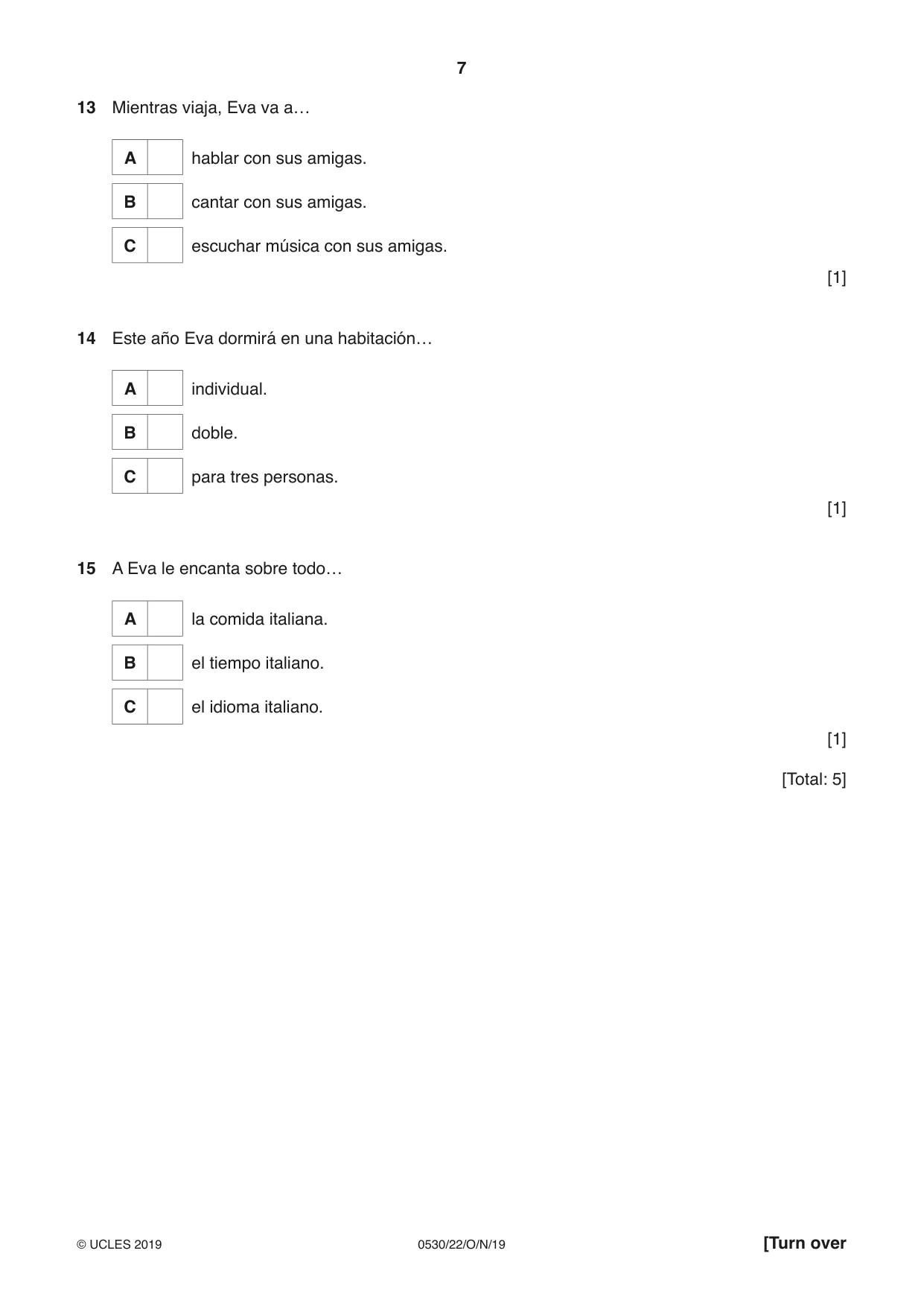
7 0530/22/O/N/19 © UCLES 2019 [Turn over 13 Mientras viaja, Eva va a… A hablar con sus amigas. B cantar con sus amigas. C escuchar música con sus amigas. [1] 14 Este año Eva dormirá en una habitación… A individual. B doble. C para tres personas. [1] 15 A Eva le encanta sobre todo… A la comida italiana. B el tiempo italiano. C el idioma italiano. [1] [Total: 5]
Question paper, page 8
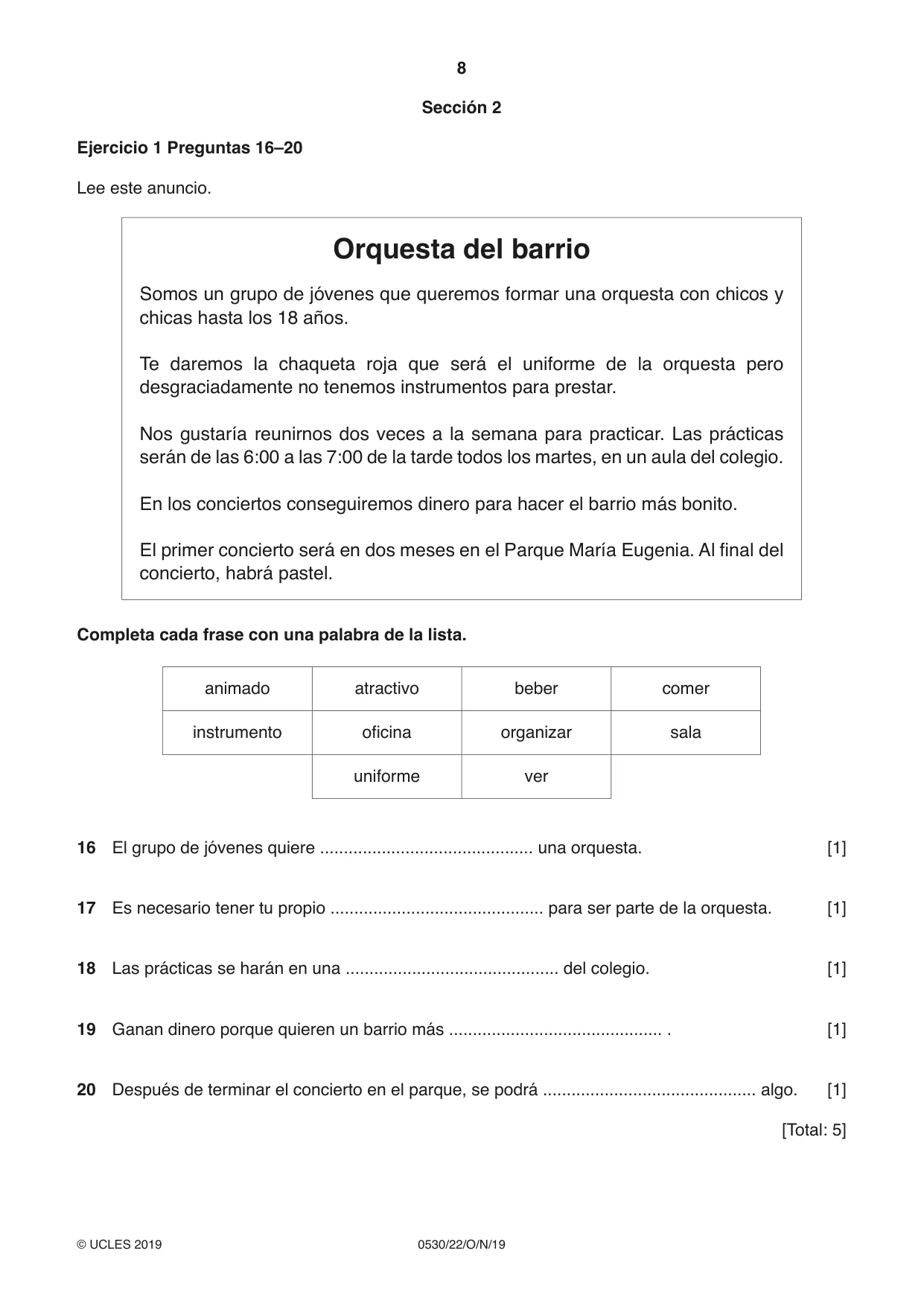
8 0530/22/O/N/19 © UCLES 2019 Sección 2 Ejercicio 1 Preguntas 16–20 Lee este anuncio. Orquesta del barrio Somos un grupo de jóvenes que queremos formar una orquesta con chicos y chicas hasta los 18 años. Te daremos la chaqueta roja que será el uniforme de la orquesta pero desgraciadamente no tenemos instrumentos para prestar. Nos gustaría reunirnos dos veces a la semana para practicar. Las prácticas serán de las 6:00 a las 7:00 de la tarde todos los martes, en un aula del colegio. En los conciertos conseguiremos dinero para hacer el barrio más bonito. El primer concierto será en dos meses en el Parque María Eugenia. Al final del concierto, habrá pastel. Completa cada frase con una palabra de la lista. animado atractivo beber comer instrumento oficina organizar sala uniforme ver 16 El grupo de jóvenes quiere … una orquesta. [1] 17 Es necesario tener tu propio … para ser parte de la orquesta. [1] 18 Las prácticas se harán en una … del colegio. [1] 19 Ganan dinero porque quieren un barrio más … . [1] 20 Después de terminar el concierto en el parque, se podrá … algo. [1] [Total: 5]
Question paper, page 9
9 0530/22/O/N/19 © UCLES 2019 [Turn over Dar la vuelta para el Ejercicio 2.
Question paper, page 10
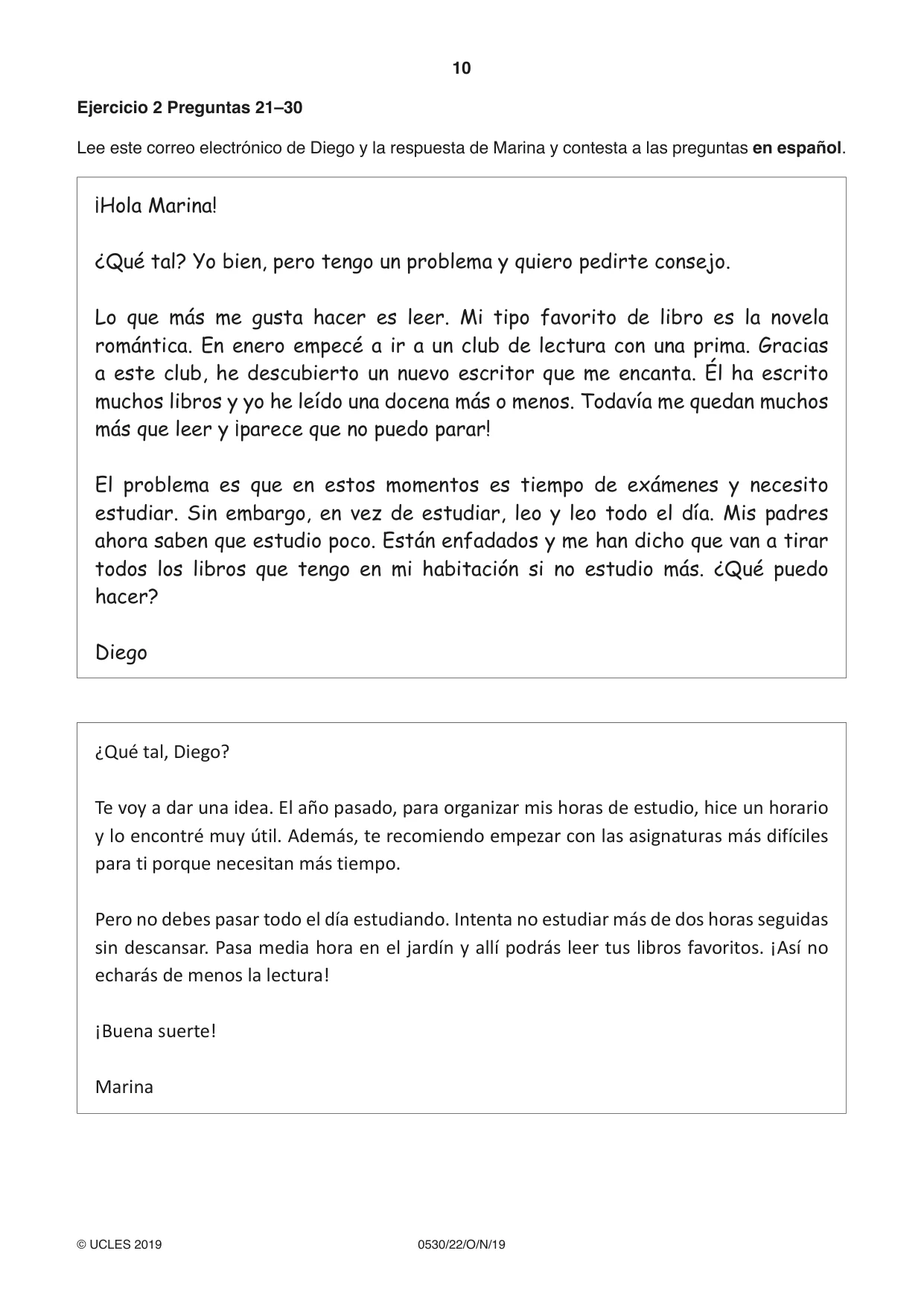
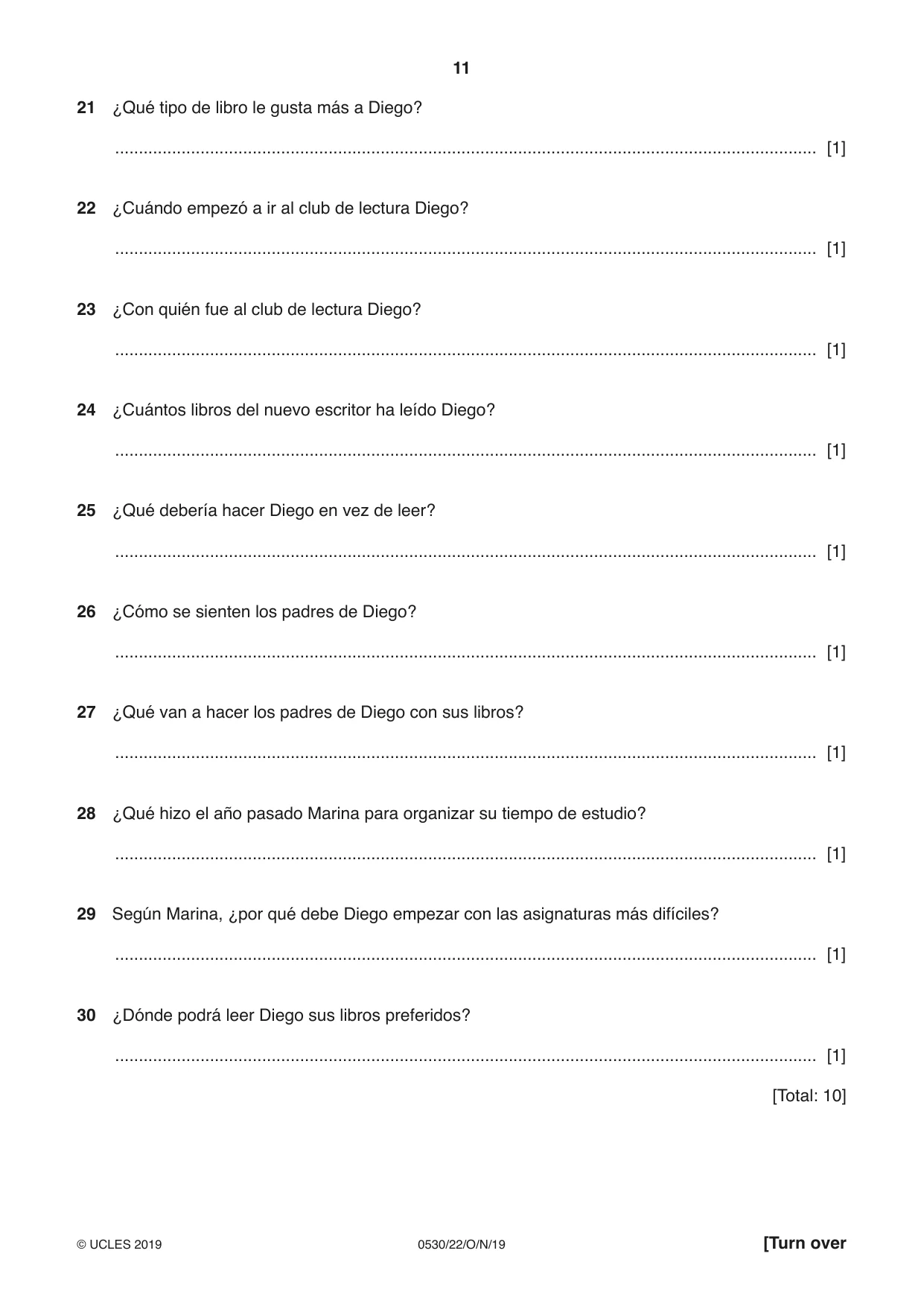
10 0530/22/O/N/19 © UCLES 2019 Ejercicio 2 Preguntas 21–30 Lee este correo electrónico de Diego y la respuesta de Marina y contesta a las preguntas en español. ¡Hola Marina! ¿Qué tal? Yo bien, pero tengo un problema y quiero pedirte consejo. Lo que más me gusta hacer es leer. Mi tipo favorito de libro es la novela romántica. En enero empecé a ir a un club de lectura con una prima. Gracias a este club, he descubierto un nuevo escritor que me encanta. Él ha escrito muchos libros y yo he leído una docena más o menos. Todavía me quedan muchos más que leer y ¡parece que no puedo parar! El problema es que en estos momentos es tiempo de exámenes y necesito estudiar. Sin embargo, en vez de estudiar, leo y leo todo el día. Mis padres ahora saben que estudio poco. Están enfadados y me han dicho que van a tirar todos los libros que tengo en mi habitación si no estudio más. ¿Qué puedo hacer? Diego ¿Qué tal, Diego? Te voy a dar una idea. El año pasado, para organizar mis horas de estudio, hice un horario y lo encontré muy útil. Además, te recomiendo empezar con las asignaturas más difíciles para ti porque necesitan más tiempo. Pero no debes pasar todo el día estudiando. Intenta no estudiar más de dos horas seguidas sin descansar. Pasa media hora en el jardín y allí podrás leer tus libros favoritos. ¡Así no echarás de menos la lectura! ¡Buena suerte! Marina
Question paper, page 11
11 0530/22/O/N/19 © UCLES 2019 [Turn over 21 ¿Qué tipo de libro le gusta más a Diego? … [1] 22 ¿Cuándo empezó a ir al club de lectura Diego? … [1] 23 ¿Con quién fue al club de lectura Diego? … [1] 24 ¿Cuántos libros del nuevo escritor ha leído Diego? … [1] 25 ¿Qué debería hacer Diego en vez de leer? … [1] 26 ¿Cómo se sienten los padres de Diego? … [1] 27 ¿Qué van a hacer los padres de Diego con sus libros? … [1] 28 ¿Qué hizo el año pasado Marina para organizar su tiempo de estudio? … [1] 29 Según Marina, ¿por qué debe Diego empezar con las asignaturas más difíciles? … [1] 30 ¿Dónde podrá leer Diego sus libros preferidos? … [1] [Total: 10]
Question paper, page 12
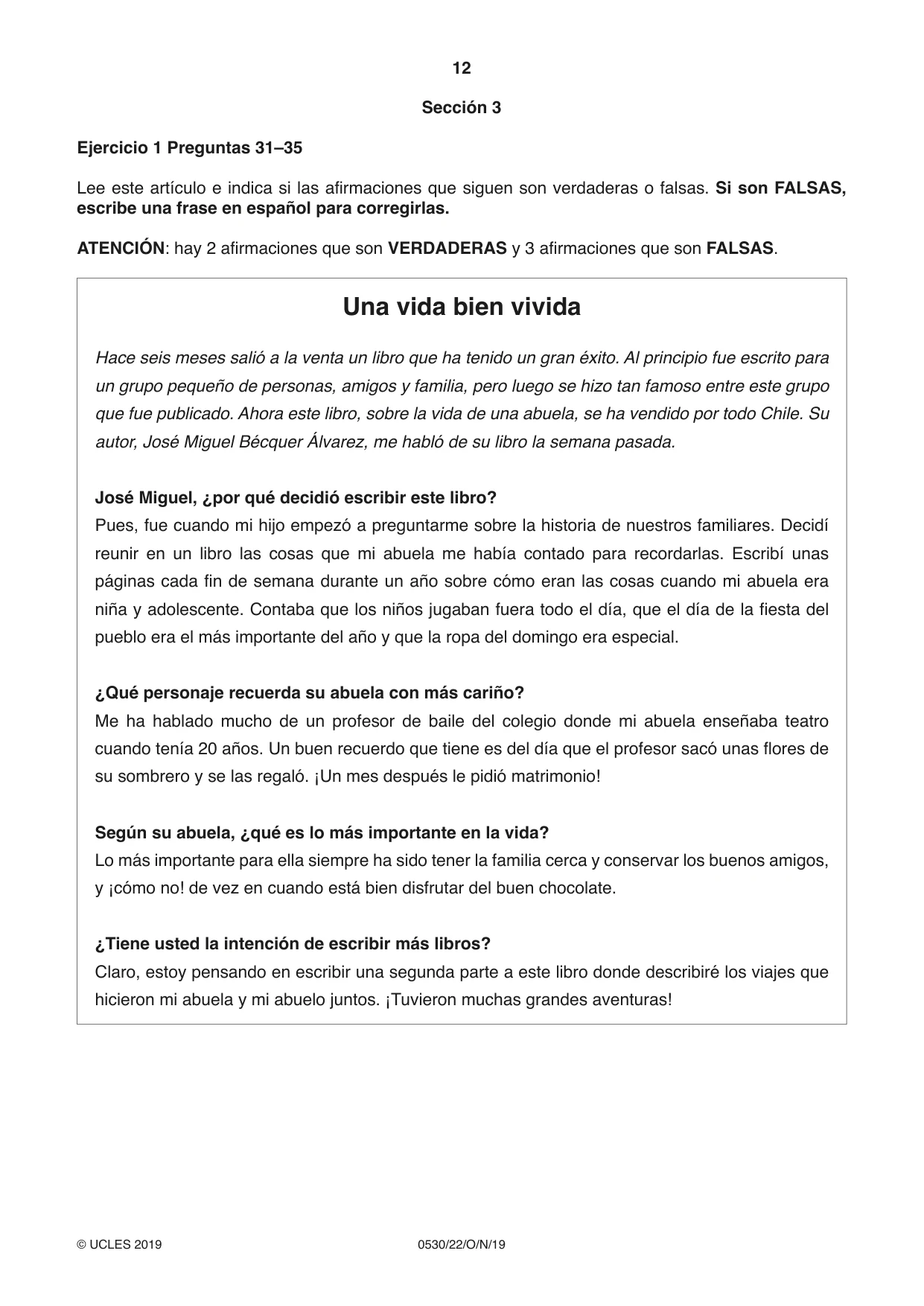
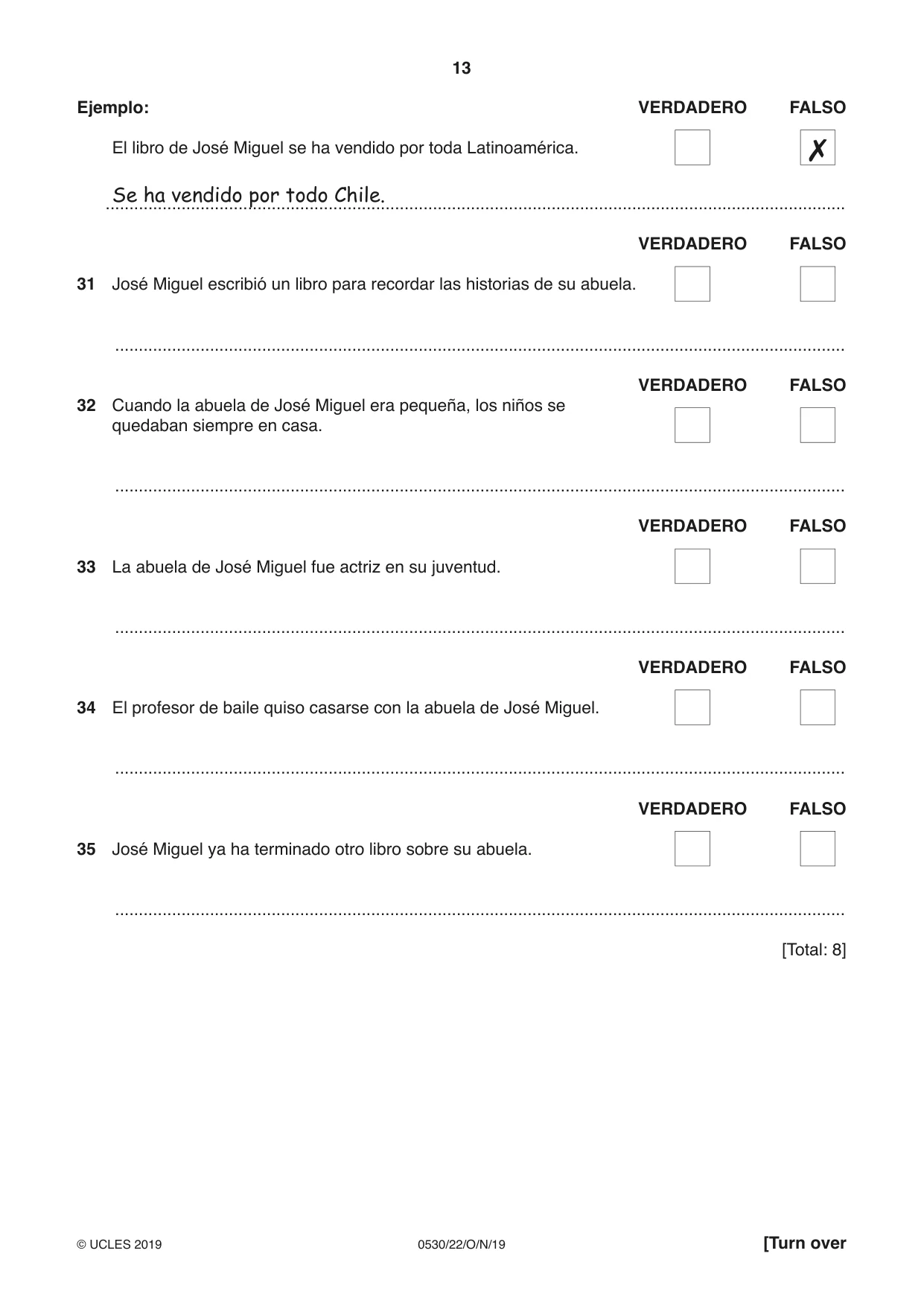
12 0530/22/O/N/19 © UCLES 2019 Sección 3 Ejercicio 1 Preguntas 31–35 Lee este artículo e indica si las afirmaciones que siguen son verdaderas o falsas. Si son FALSAS, escribe una frase en español para corregirlas. ATENCIÓN: hay 2 afirmaciones que son VERDADERAS y 3 afirmaciones que son FALSAS. Una vida bien vivida Hace seis meses salió a la venta un libro que ha tenido un gran éxito. Al principio fue escrito para un grupo pequeño de personas, amigos y familia, pero luego se hizo tan famoso entre este grupo que fue publicado. Ahora este libro, sobre la vida de una abuela, se ha vendido por todo Chile. Su autor, José Miguel Bécquer Álvarez, me habló de su libro la semana pasada. José Miguel, ¿por qué decidió escribir este libro? Pues, fue cuando mi hijo empezó a preguntarme sobre la historia de nuestros familiares. Decidí reunir en un libro las cosas que mi abuela me había contado para recordarlas. Escribí unas páginas cada fin de semana durante un año sobre cómo eran las cosas cuando mi abuela era niña y adolescente. Contaba que los niños jugaban fuera todo el día, que el día de la fiesta del pueblo era el más importante del año y que la ropa del domingo era especial. ¿Qué personaje recuerda su abuela con más cariño? Me ha hablado mucho de un profesor de baile del colegio donde mi abuela enseñaba teatro cuando tenía 20 años. Un buen recuerdo que tiene es del día que el profesor sacó unas flores de su sombrero y se las regaló. ¡Un mes después le pidió matrimonio! Según su abuela, ¿qué es lo más importante en la vida? Lo más importante para ella siempre ha sido tener la familia cerca y conservar los buenos amigos, y ¡cómo no! de vez en cuando está bien disfrutar del buen chocolate. ¿Tiene usted la intención de escribir más libros? Claro, estoy pensando en escribir una segunda parte a este libro donde describiré los viajes que hicieron mi abuela y mi abuelo juntos. ¡Tuvieron muchas grandes aventuras!
Question paper, page 13
13 0530/22/O/N/19 © UCLES 2019 [Turn over Ejemplo: VERDADERO FALSO El libro de José Miguel se ha vendido por toda Latinoamérica. ✗ Se ha vendido por todo Chile. … VERDADERO FALSO 31 José Miguel escribió un libro para recordar las historias de su abuela. … VERDADERO FALSO 32 Cuando la abuela de José Miguel era pequeña, los niños se quedaban siempre en casa. … VERDADERO FALSO 33 La abuela de José Miguel fue actriz en su juventud. … VERDADERO FALSO 34 El profesor de baile quiso casarse con la abuela de José Miguel. … VERDADERO FALSO 35 José Miguel ya ha terminado otro libro sobre su abuela. … [Total: 8]
Question paper, page 14
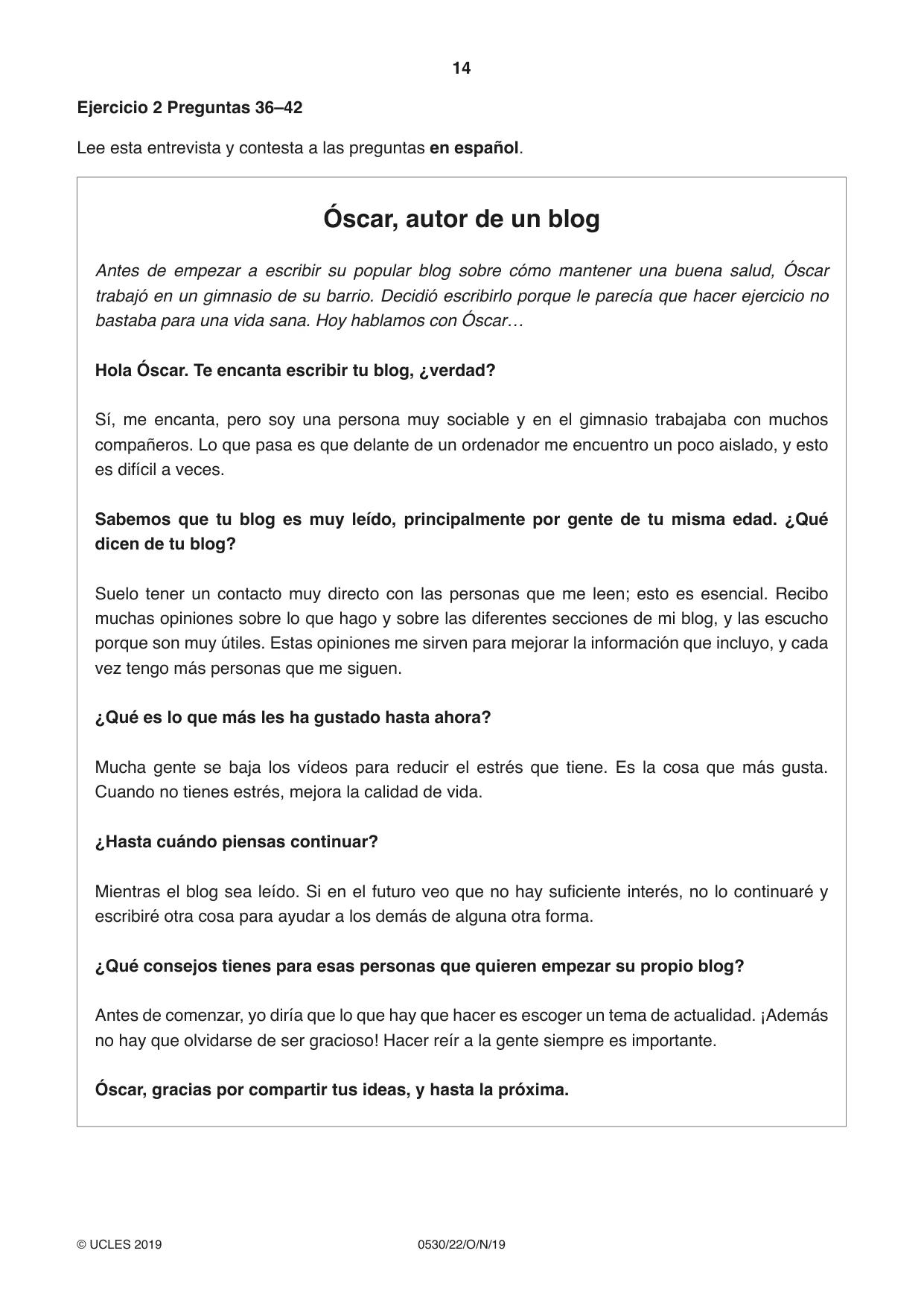
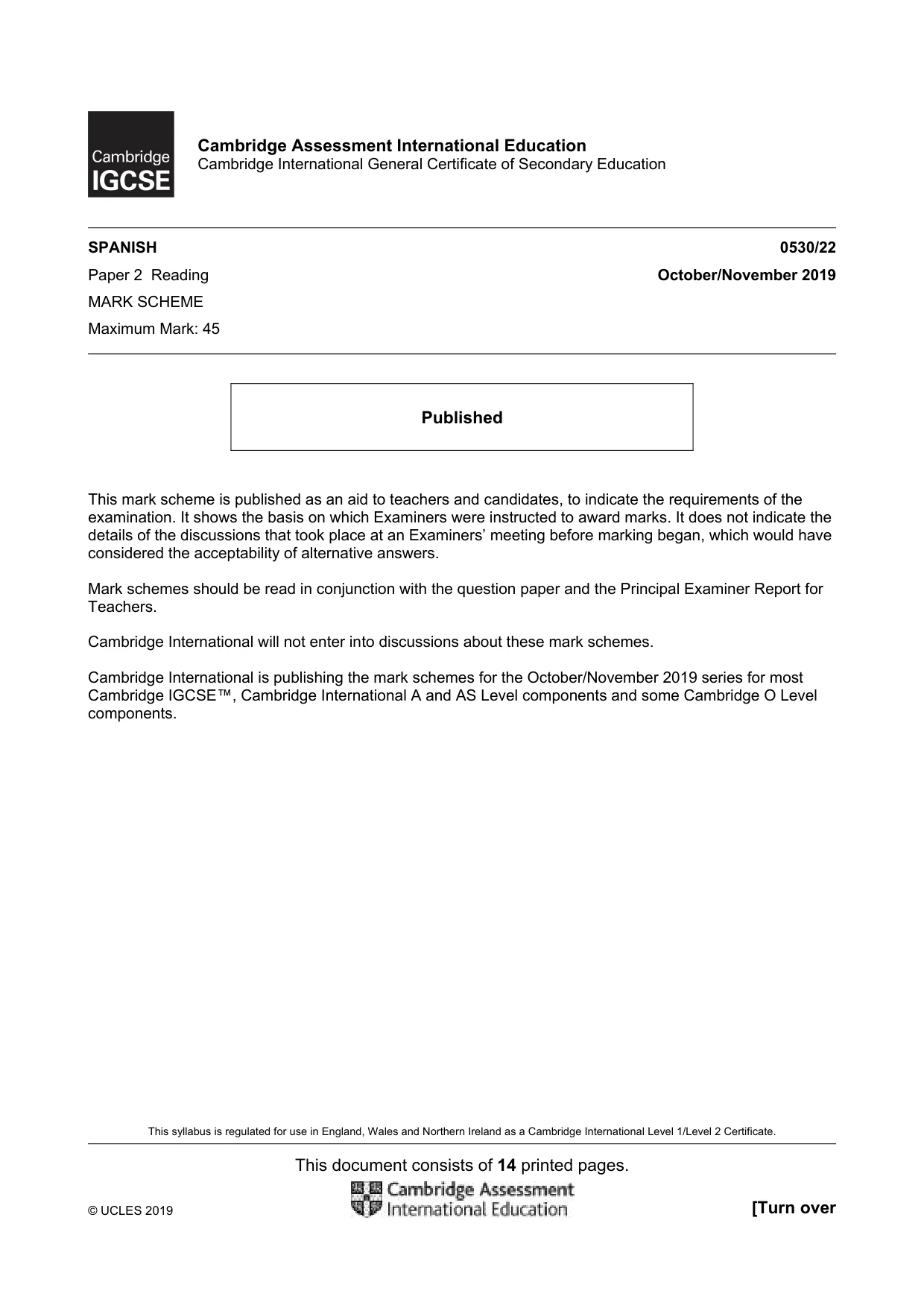
14 0530/22/O/N/19 © UCLES 2019 Ejercicio 2 Preguntas 36–42 Lee esta entrevista y contesta a las preguntas en español. Óscar, autor de un blog Antes de empezar a escribir su popular blog sobre cómo mantener una buena salud, Óscar trabajó en un gimnasio de su barrio. Decidió escribirlo porque le parecía que hacer ejercicio no bastaba para una vida sana. Hoy hablamos con Óscar… Hola Óscar. Te encanta escribir tu blog, ¿verdad? Sí, me encanta, pero soy una persona muy sociable y en el gimnasio trabajaba con muchos compañeros. Lo que pasa es que delante de un ordenador me encuentro un poco aislado, y esto es difícil a veces. Sabemos que tu blog es muy leído, principalmente por gente de tu misma edad. ¿Qué dicen de tu blog? Suelo tener un contacto muy directo con las personas que me leen; esto es esencial. Recibo muchas opiniones sobre lo que hago y sobre las diferentes secciones de mi blog, y las escucho porque son muy útiles. Estas opiniones me sirven para mejorar la información que incluyo, y cada vez tengo más personas que me siguen. ¿Qué es lo que más les ha gustado hasta ahora? Mucha gente se baja los vídeos para reducir el estrés que tiene. Es la cosa que más gusta. Cuando no tienes estrés, mejora la calidad de vida. ¿Hasta cuándo piensas continuar? Mientras el blog sea leído. Si en el futuro veo que no hay suficiente interés, no lo continuaré y escribiré otra cosa para ayudar a los demás de alguna otra forma. ¿Qué consejos tienes para esas personas que quieren empezar su propio blog? Antes de comenzar, yo diría que lo que hay que hacer es escoger un tema de actualidad. ¡Además no hay que olvidarse de ser gracioso! Hacer reír a la gente siempre es importante. Óscar, gracias por compartir tus ideas, y hasta la próxima.
Question paper, page 15
15 0530/22/O/N/19 © UCLES 2019 36 ¿Por qué creyó Óscar que sus consejos podrían ser útiles? … [1] 37 ¿Cómo se siente Óscar cuando escribe su blog? … [1] 38 ¿Para qué usa Óscar las opiniones de la gente que sigue su blog? … [1] 39 ¿Qué es lo más popular de entre las cosas que ofrece Óscar en su blog? … [1] 40 Según Óscar, ¿qué efecto tiene reducir el estrés? … [1] 41 ¿Por qué dejaría Óscar de escribir su blog? … [1] 42 Si quieres escribir un blog, ¿qué debes hacer primero, según Óscar? … [1] [Total: 7]
Question paper, page 16
16 0530/22/O/N/19 © UCLES 2019 Permission to reproduce items where third-party owned material protected by copyright is included has been sought and cleared where possible. Every reasonable effort has been made by the publisher (UCLES) to trace copyright holders, but if any items requiring clearance have unwittingly been included, the publisher will be pleased to make amends at the earliest possible opportunity. To avoid the issue of disclosure of answer-related information to candidates, all copyright acknowledgements are reproduced online in the Cambridge Assessment International Education Copyright Acknowledgements Booklet. This is produced for each series of examinations and is freely available to download at www.cambridgeinternational.org after the live examination series. Cambridge Assessment International Education is part of the Cambridge Assessment Group. Cambridge Assessment is the brand name of the University of Cambridge Local Examinations Syndicate (UCLES), which itself is a department of the University of Cambridge. BLANK PAGE
Mark scheme, page 1
This syllabus is regulated for use in England, Wales and Northern Ireland as a Cambridge International Level 1/Level 2 Certificate. This document consists of 14 printed pages. © UCLES 2019 [Turn over Cambridge Assessment International Education Cambridge International General Certificate of Secondary Education SPANISH 0530/22 Paper 2 Reading October/November 2019 MARK SCHEME Maximum Mark: 45 Published This mark scheme is published as an aid to teachers and candidates, to indicate the requirements of the examination. It shows the basis on which Examiners were instructed to award marks. It does not indicate the details of the discussions that took place at an Examiners’ meeting before marking began, which would have considered the acceptability of alternative answers. Mark schemes should be read in conjunction with the question paper and the Principal Examiner Report for Teachers. Cambridge International will not enter into discussions about these mark schemes. Cambridge International is publishing the mark schemes for the October/November 2019 series for most Cambridge IGCSE™, Cambridge International A and AS Level components and some Cambridge O Level components.
Mark scheme, page 2
0530/22 Cambridge IGCSE – Mark Scheme PUBLISHED October/November 2019 © UCLES 2019 Page 2 of 14 Generic Marking Principles These general marking principles must be applied by all examiners when marking candidate answers. They should be applied alongside the specific content of the mark scheme or generic level descriptors for a question. Each question paper and mark scheme will also comply with these marking principles. GENERIC MARKING PRINCIPLE 1: Marks must be awarded in line with: • the specific content of the mark scheme or the generic level descriptors for the question • the specific skills defined in the mark scheme or in the generic level descriptors for the question • the standard of response required by a candidate as exemplified by the standardisation scripts. GENERIC MARKING PRINCIPLE 2: Marks awarded are always whole marks (not half marks, or other fractions). GENERIC MARKING PRINCIPLE 3: Marks must be awarded positively: • marks are awarded for correct/valid answers, as defined in the mark scheme. However, credit is given for valid answers which go beyond the scope of the syllabus and mark scheme, referring to your Team Leader as appropriate • marks are awarded when candidates clearly demonstrate what they know and can do • marks are not deducted for errors • marks are not deducted for omissions • answers should only be judged on the quality of spelling, punctuation and grammar when these features are specifically assessed by the question as indicated by the mark scheme. The meaning, however, should be unambiguous. GENERIC MARKING PRINCIPLE 4: Rules must be applied consistently e.g. in situations where candidates have not followed instructions or in the application of generic level descriptors.
Mark scheme, page 3
0530/22 Cambridge IGCSE – Mark Scheme PUBLISHED October/November 2019 © UCLES 2019 Page 3 of 14 GENERIC MARKING PRINCIPLE 5: Marks should be awarded using the full range of marks defined in the mark scheme for the question (however; the use of the full mark range may be limited according to the quality of the candidate responses seen). GENERIC MARKING PRINCIPLE 6: Marks awarded are based solely on the requirements as defined in the mark scheme. Marks should not be awarded with grade thresholds or grade descriptors in mind.
Mark scheme, page 4
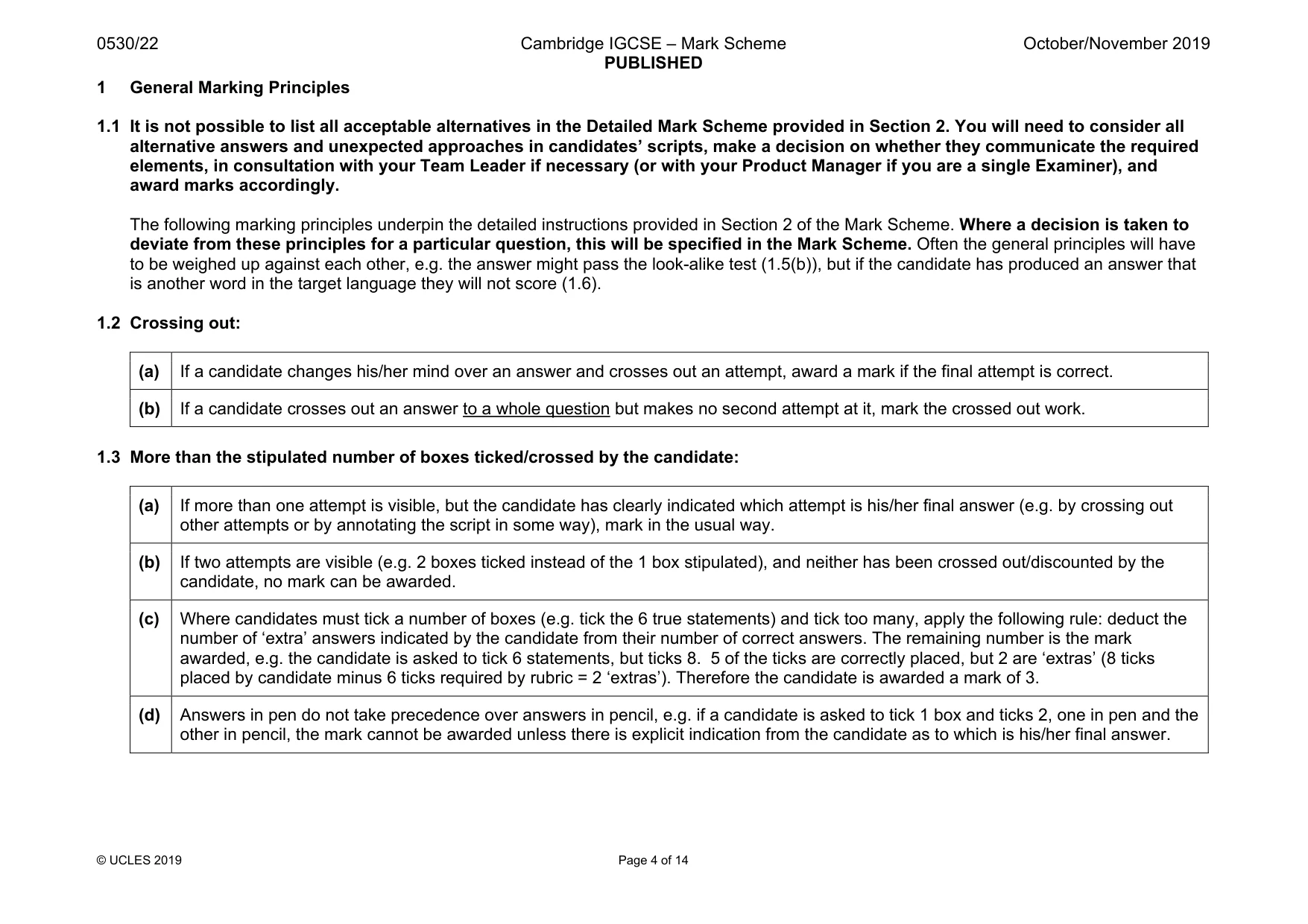
0530/22 Cambridge IGCSE – Mark Scheme PUBLISHED October/November 2019 © UCLES 2019 Page 4 of 14 1 General Marking Principles 1.1 It is not possible to list all acceptable alternatives in the Detailed Mark Scheme provided in Section 2. You will need to consider all alternative answers and unexpected approaches in candidates’ scripts, make a decision on whether they communicate the required elements, in consultation with your Team Leader if necessary (or with your Product Manager if you are a single Examiner), and award marks accordingly. The following marking principles underpin the detailed instructions provided in Section 2 of the Mark Scheme. Where a decision is taken to deviate from these principles for a particular question, this will be specified in the Mark Scheme. Often the general principles will have to be weighed up against each other, e.g. the answer might pass the look-alike test (1.5(b)), but if the candidate has produced an answer that is another word in the target language they will not score (1.6). 1.2 Crossing out: (a) If a candidate changes his/her mind over an answer and crosses out an attempt, award a mark if the final attempt is correct. (b) If a candidate crosses out an answer to a whole question but makes no second attempt at it, mark the crossed out work. 1.3 More than the stipulated number of boxes ticked/crossed by the candidate: (a) If more than one attempt is visible, but the candidate has clearly indicated which attempt is his/her final answer (e.g. by crossing out other attempts or by annotating the script in some way), mark in the usual way. (b) If two attempts are visible (e.g. 2 boxes ticked instead of the 1 box stipulated), and neither has been crossed out/discounted by the candidate, no mark can be awarded. (c) Where candidates must tick a number of boxes (e.g. tick the 6 true statements) and tick too many, apply the following rule: deduct the number of ‘extra’ answers indicated by the candidate from their number of correct answers. The remaining number is the mark awarded, e.g. the candidate is asked to tick 6 statements, but ticks 8. 5 of the ticks are correctly placed, but 2 are ‘extras’ (8 ticks placed by candidate minus 6 ticks required by rubric = 2 ‘extras’). Therefore the candidate is awarded a mark of 3. (d) Answers in pen do not take precedence over answers in pencil, e.g. if a candidate is asked to tick 1 box and ticks 2, one in pen and the other in pencil, the mark cannot be awarded unless there is explicit indication from the candidate as to which is his/her final answer.
Mark scheme, page 5
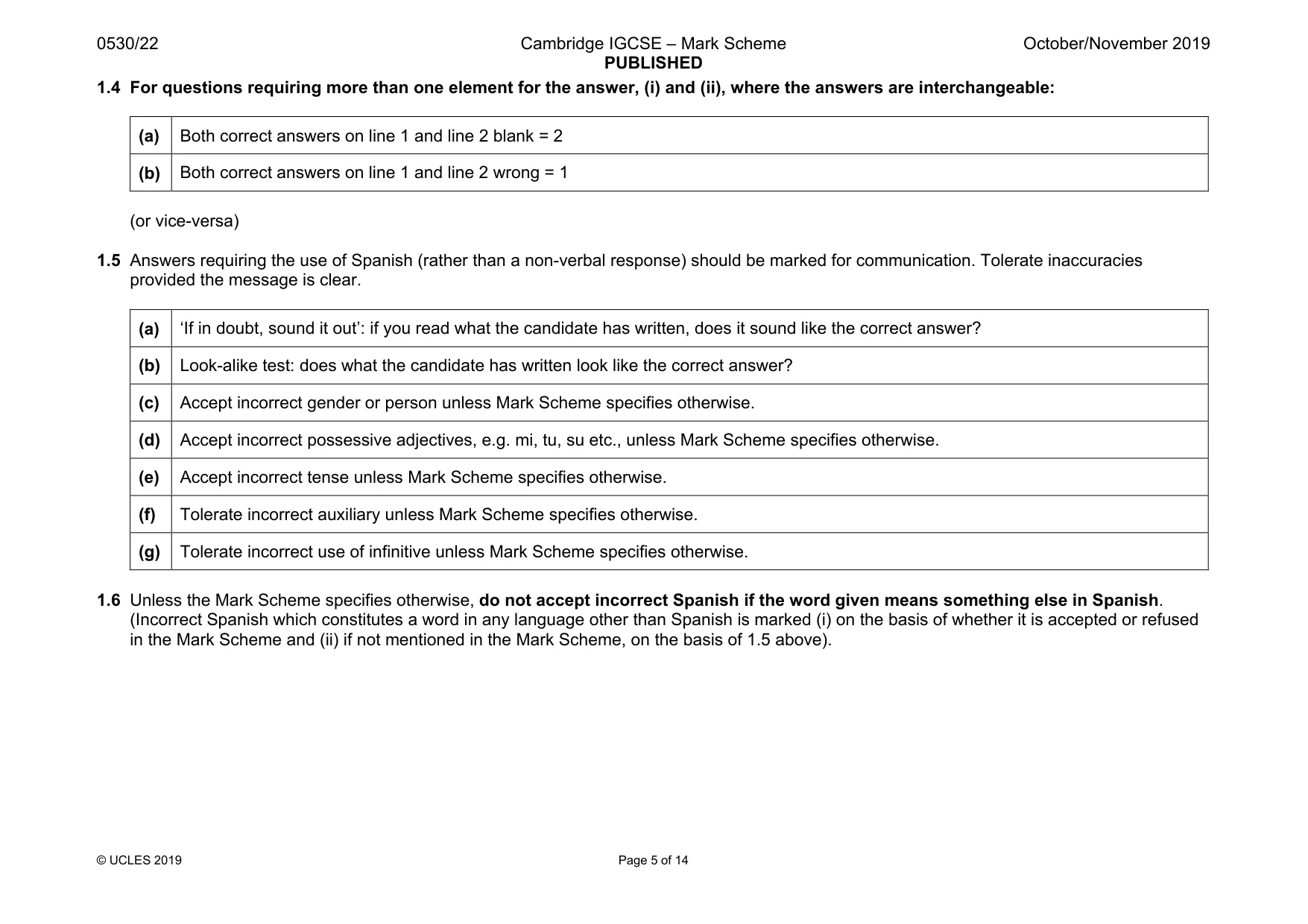
0530/22 Cambridge IGCSE – Mark Scheme PUBLISHED October/November 2019 © UCLES 2019 Page 5 of 14 1.4 For questions requiring more than one element for the answer, (i) and (ii), where the answers are interchangeable: (a) Both correct answers on line 1 and line 2 blank = 2 (b) Both correct answers on line 1 and line 2 wrong = 1 (or vice-versa) 1.5 Answers requiring the use of Spanish (rather than a non-verbal response) should be marked for communication. Tolerate inaccuracies provided the message is clear. (a) ‘If in doubt, sound it out’: if you read what the candidate has written, does it sound like the correct answer? (b) Look-alike test: does what the candidate has written look like the correct answer? (c) Accept incorrect gender or person unless Mark Scheme specifies otherwise. (d) Accept incorrect possessive adjectives, e.g. mi, tu, su etc., unless Mark Scheme specifies otherwise. (e) Accept incorrect tense unless Mark Scheme specifies otherwise. (f) Tolerate incorrect auxiliary unless Mark Scheme specifies otherwise. (g) Tolerate incorrect use of infinitive unless Mark Scheme specifies otherwise. 1.6 Unless the Mark Scheme specifies otherwise, do not accept incorrect Spanish if the word given means something else in Spanish. (Incorrect Spanish which constitutes a word in any language other than Spanish is marked (i) on the basis of whether it is accepted or refused in the Mark Scheme and (ii) if not mentioned in the Mark Scheme, on the basis of 1.5 above).
Mark scheme, page 6
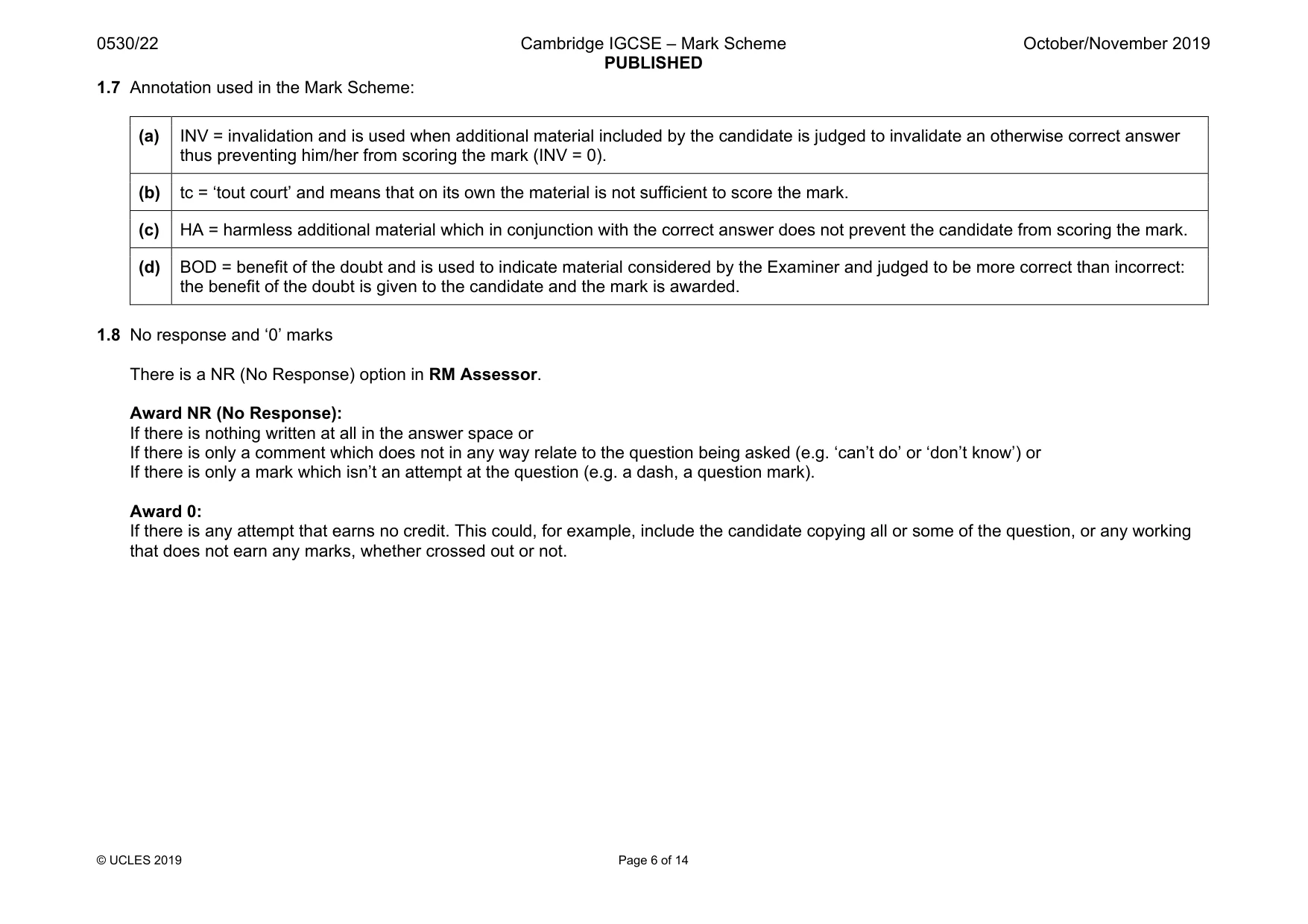
0530/22 Cambridge IGCSE – Mark Scheme PUBLISHED October/November 2019 © UCLES 2019 Page 6 of 14 1.7 Annotation used in the Mark Scheme: (a) INV = invalidation and is used when additional material included by the candidate is judged to invalidate an otherwise correct answer thus preventing him/her from scoring the mark (INV = 0). (b) tc = ‘tout court’ and means that on its own the material is not sufficient to score the mark. (c) HA = harmless additional material which in conjunction with the correct answer does not prevent the candidate from scoring the mark. (d) BOD = benefit of the doubt and is used to indicate material considered by the Examiner and judged to be more correct than incorrect: the benefit of the doubt is given to the candidate and the mark is awarded. 1.8 No response and ‘0’ marks There is a NR (No Response) option in RM Assessor. Award NR (No Response): If there is nothing written at all in the answer space or If there is only a comment which does not in any way relate to the question being asked (e.g. ‘can’t do’ or ‘don’t know’) or If there is only a mark which isn’t an attempt at the question (e.g. a dash, a question mark). Award 0: If there is any attempt that earns no credit. This could, for example, include the candidate copying all or some of the question, or any working that does not earn any marks, whether crossed out or not.
Mark scheme, page 7
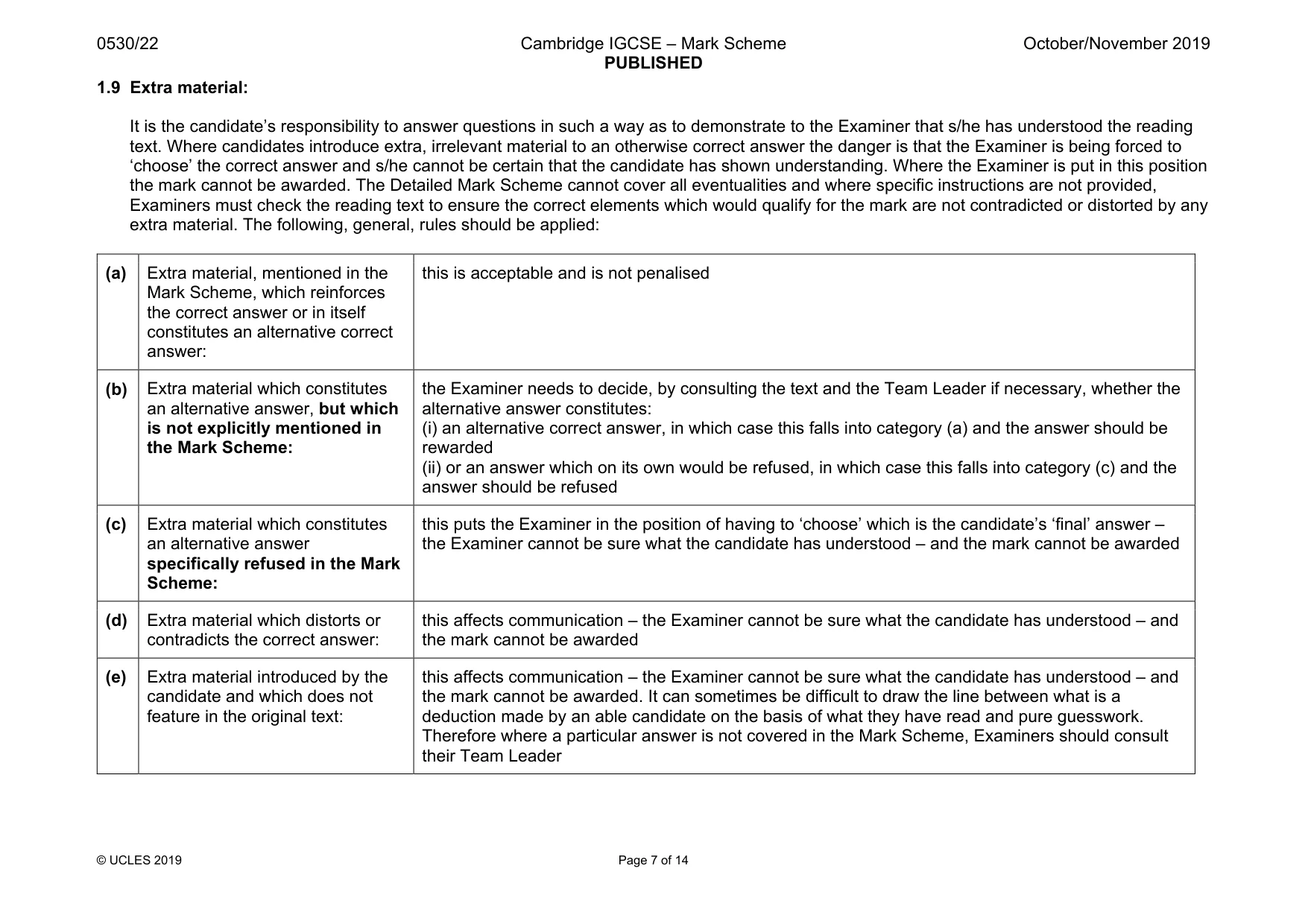
0530/22 Cambridge IGCSE – Mark Scheme PUBLISHED October/November 2019 © UCLES 2019 Page 7 of 14 1.9 Extra material: It is the candidate’s responsibility to answer questions in such a way as to demonstrate to the Examiner that s/he has understood the reading text. Where candidates introduce extra, irrelevant material to an otherwise correct answer the danger is that the Examiner is being forced to ‘choose’ the correct answer and s/he cannot be certain that the candidate has shown understanding. Where the Examiner is put in this position the mark cannot be awarded. The Detailed Mark Scheme cannot cover all eventualities and where specific instructions are not provided, Examiners must check the reading text to ensure the correct elements which would qualify for the mark are not contradicted or distorted by any extra material. The following, general, rules should be applied: (a) Extra material, mentioned in the Mark Scheme, which reinforces the correct answer or in itself constitutes an alternative correct answer: this is acceptable and is not penalised (b) Extra material which constitutes an alternative answer, but which is not explicitly mentioned in the Mark Scheme: the Examiner needs to decide, by consulting the text and the Team Leader if necessary, whether the alternative answer constitutes: (i) an alternative correct answer, in which case this falls into category (a) and the answer should be rewarded (ii) or an answer which on its own would be refused, in which case this falls into category (c) and the answer should be refused (c) Extra material which constitutes an alternative answer specifically refused in the Mark Scheme: this puts the Examiner in the position of having to ‘choose’ which is the candidate’s ‘final’ answer – the Examiner cannot be sure what the candidate has understood – and the mark cannot be awarded (d) Extra material which distorts or contradicts the correct answer: this affects communication – the Examiner cannot be sure what the candidate has understood – and the mark cannot be awarded (e) Extra material introduced by the candidate and which does not feature in the original text: this affects communication – the Examiner cannot be sure what the candidate has understood – and the mark cannot be awarded. It can sometimes be difficult to draw the line between what is a deduction made by an able candidate on the basis of what they have read and pure guesswork. Therefore where a particular answer is not covered in the Mark Scheme, Examiners should consult their Team Leader
Mark scheme, page 8
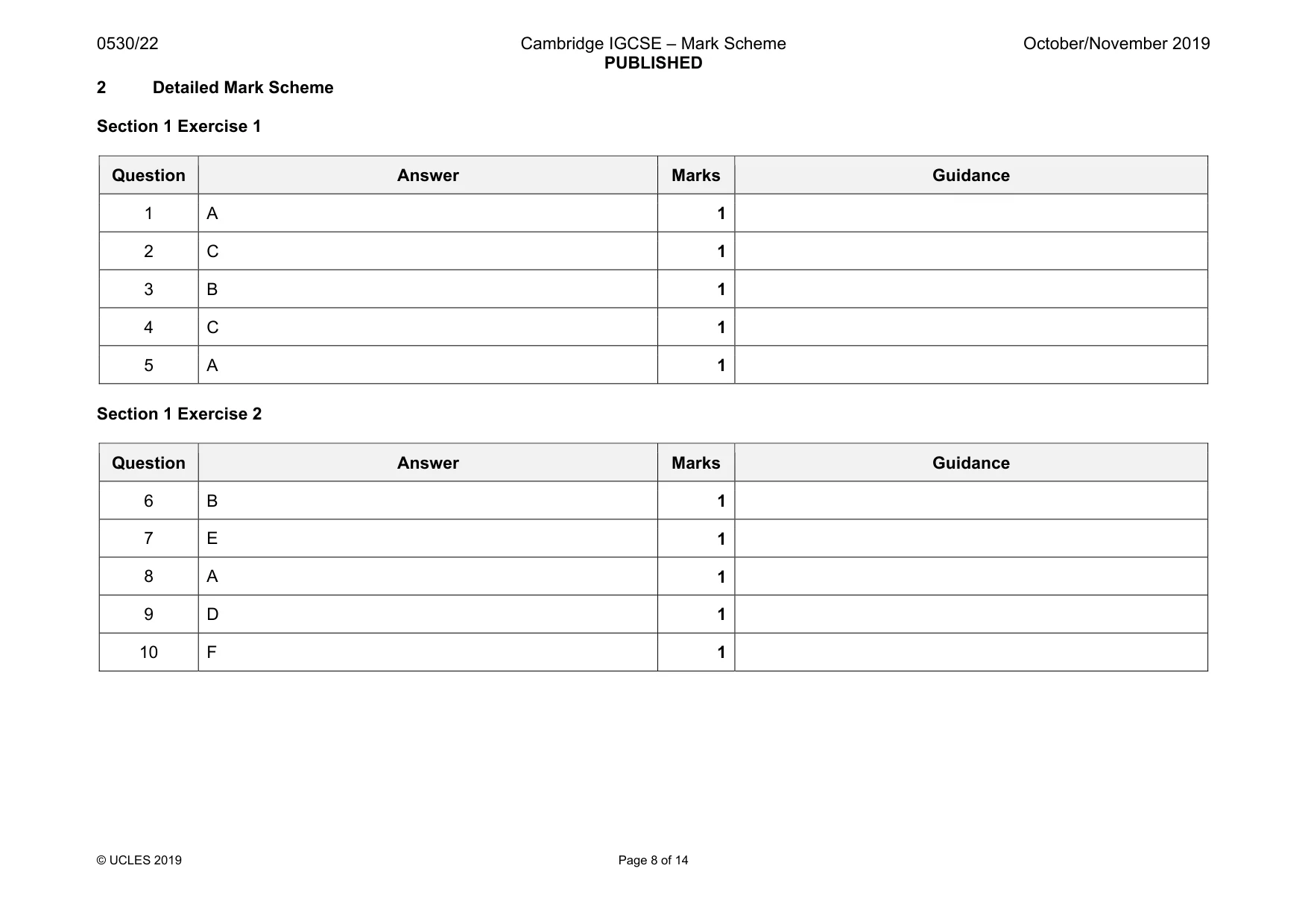
0530/22 Cambridge IGCSE – Mark Scheme PUBLISHED October/November 2019 © UCLES 2019 Page 8 of 14 2 Detailed Mark Scheme Section 1 Exercise 1 Question Answer Marks Guidance 1 A 1 2 C 1 3 B 1 4 C 1 5 A 1 Section 1 Exercise 2 Question Answer Marks Guidance 6 B 1 7 E 1 8 A 1 9 D 1 10 F 1
Mark scheme, page 9
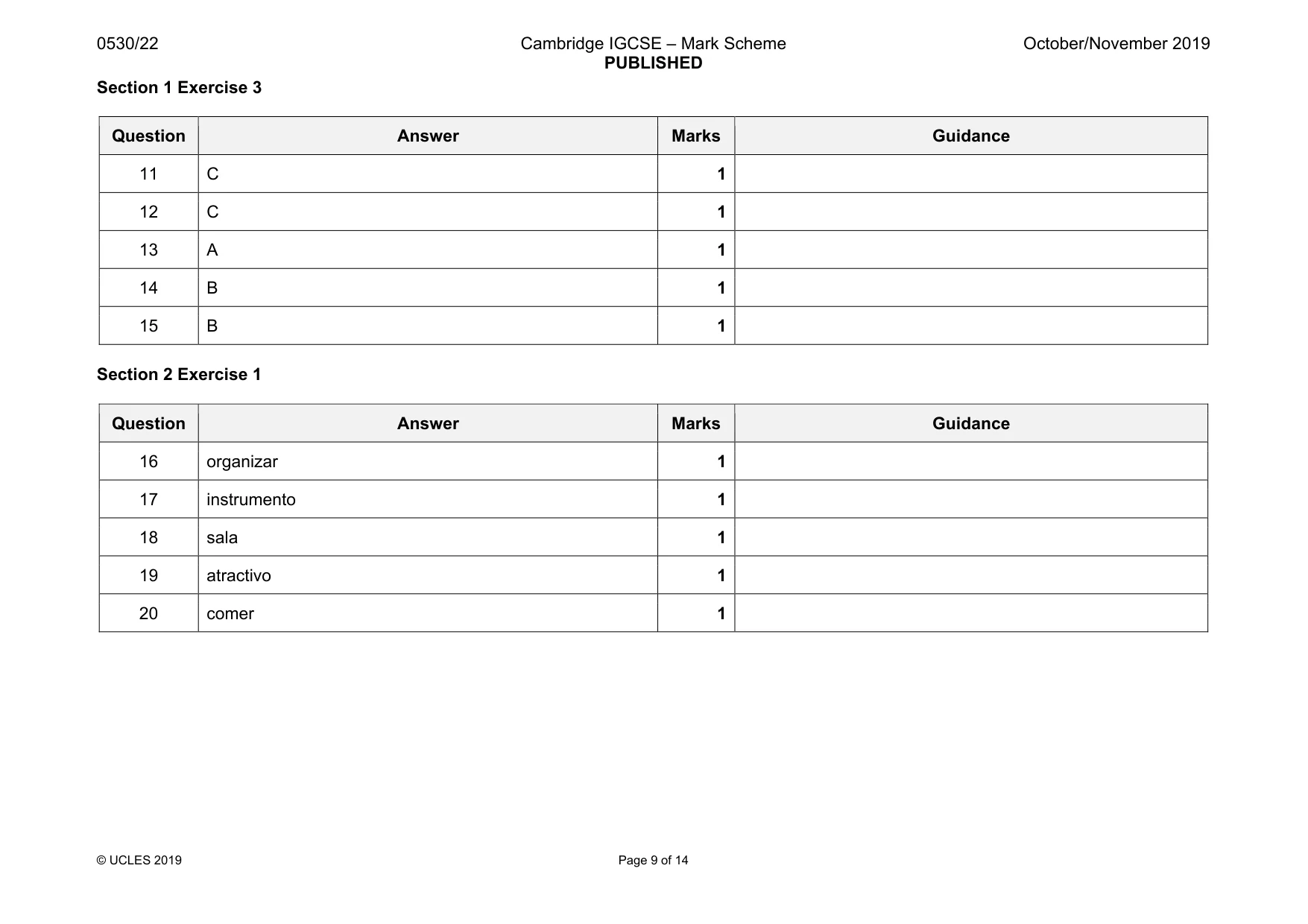
0530/22 Cambridge IGCSE – Mark Scheme PUBLISHED October/November 2019 © UCLES 2019 Page 9 of 14 Section 1 Exercise 3 Question Answer Marks Guidance 11 C 1 12 C 1 13 A 1 14 B 1 15 B 1 Section 2 Exercise 1 Question Answer Marks Guidance 16 organizar 1 17 instrumento 1 18 sala 1 19 atractivo 1 20 comer 1
Mark scheme, page 10
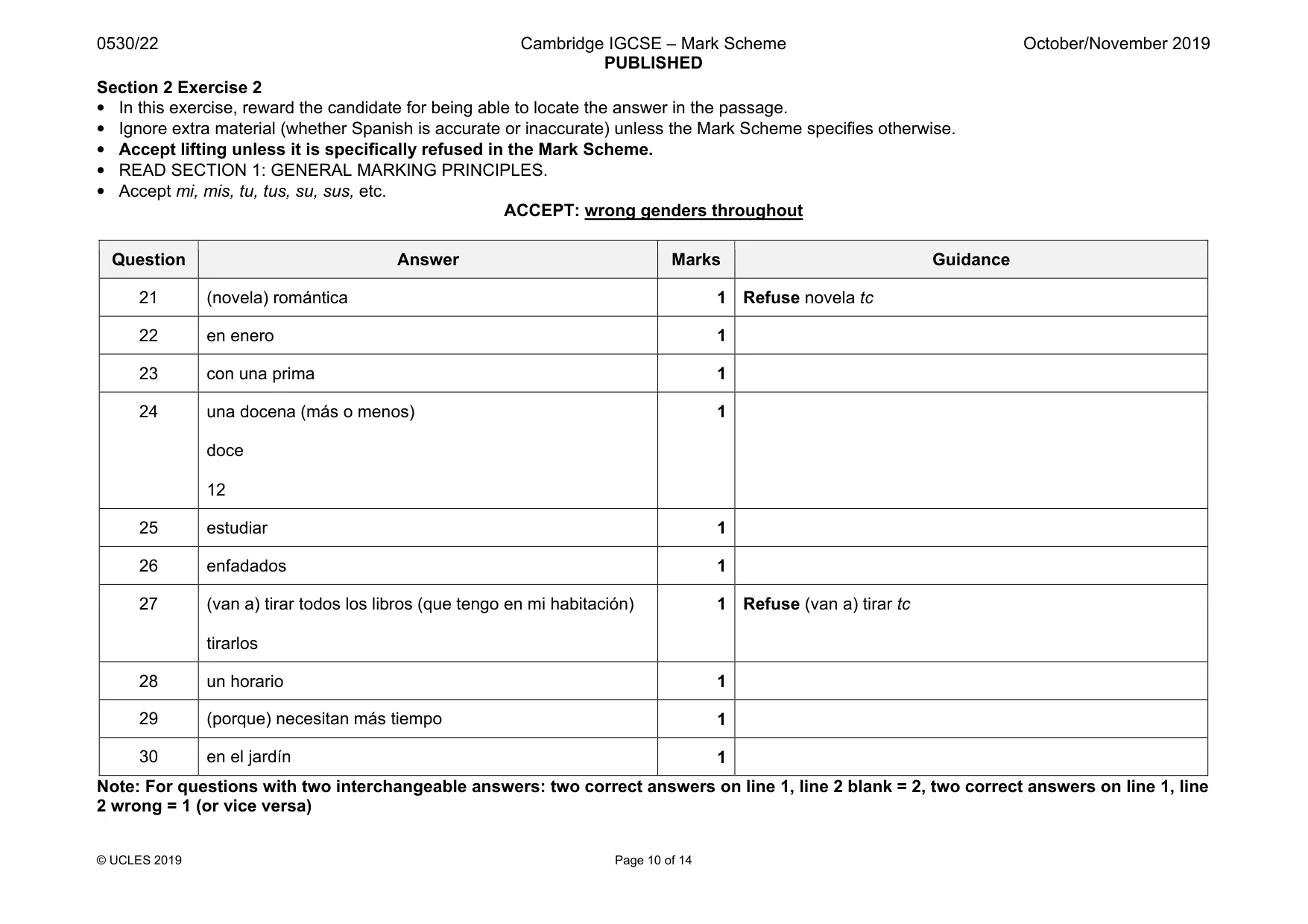
0530/22 Cambridge IGCSE – Mark Scheme PUBLISHED October/November 2019 © UCLES 2019 Page 10 of 14 Section 2 Exercise 2 • In this exercise, reward the candidate for being able to locate the answer in the passage. • Ignore extra material (whether Spanish is accurate or inaccurate) unless the Mark Scheme specifies otherwise. • Accept lifting unless it is specifically refused in the Mark Scheme. • READ SECTION 1: GENERAL MARKING PRINCIPLES. • Accept mi, mis, tu, tus, su, sus, etc. ACCEPT: wrong genders throughout Question Answer Marks Guidance 21 (novela) romántica 1 Refuse novela tc 22 en enero 1 23 con una prima 1 24 una docena (más o menos) doce 12 1 25 estudiar 1 26 enfadados 1 27 (van a) tirar todos los libros (que tengo en mi habitación) tirarlos 1 Refuse (van a) tirar tc 28 un horario 1 29 (porque) necesitan más tiempo 1 30 en el jardín 1 Note: For questions with two interchangeable answers: two correct answers on line 1, line 2 blank = 2, two correct answers on line 1, line 2 wrong = 1 (or vice versa)
Mark scheme, page 11
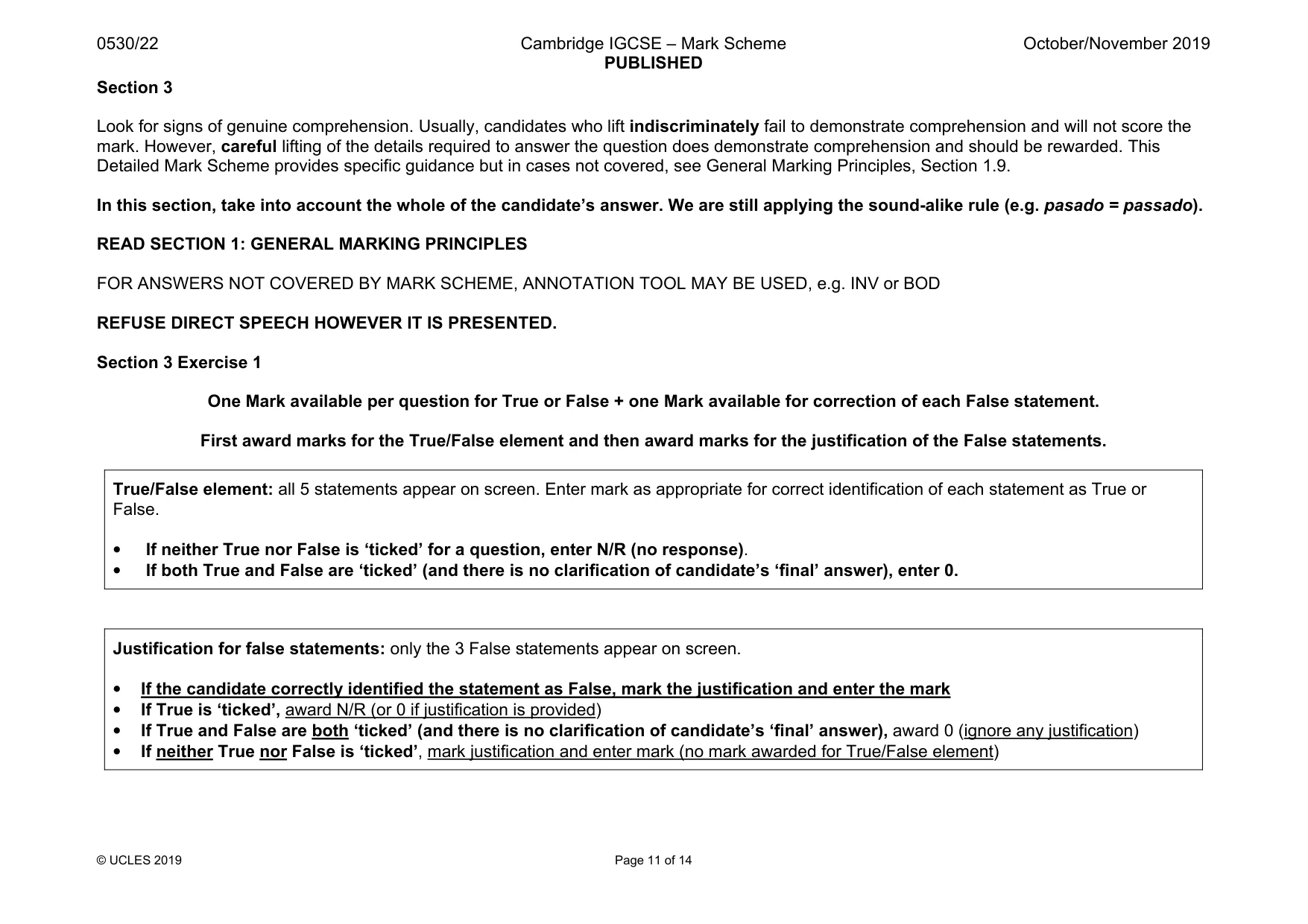
0530/22 Cambridge IGCSE – Mark Scheme PUBLISHED October/November 2019 © UCLES 2019 Page 11 of 14 Section 3 Look for signs of genuine comprehension. Usually, candidates who lift indiscriminately fail to demonstrate comprehension and will not score the mark. However, careful lifting of the details required to answer the question does demonstrate comprehension and should be rewarded. This Detailed Mark Scheme provides specific guidance but in cases not covered, see General Marking Principles, Section 1.9. In this section, take into account the whole of the candidate’s answer. We are still applying the sound-alike rule (e.g. pasado = passado). READ SECTION 1: GENERAL MARKING PRINCIPLES FOR ANSWERS NOT COVERED BY MARK SCHEME, ANNOTATION TOOL MAY BE USED, e.g. INV or BOD REFUSE DIRECT SPEECH HOWEVER IT IS PRESENTED. Section 3 Exercise 1 One Mark available per question for True or False + one Mark available for correction of each False statement. First award marks for the True/False element and then award marks for the justification of the False statements. True/False element: all 5 statements appear on screen. Enter mark as appropriate for correct identification of each statement as True or False. • If neither True nor False is ‘ticked’ for a question, enter N/R (no response). • If both True and False are ‘ticked’ (and there is no clarification of candidate’s ‘final’ answer), enter 0. Justification for false statements: only the 3 False statements appear on screen. • If the candidate correctly identified the statement as False, mark the justification and enter the mark • If True is ‘ticked’, award N/R (or 0 if justification is provided) • If True and False are both ‘ticked’ (and there is no clarification of candidate’s ‘final’ answer), award 0 (ignore any justification) • If neither True nor False is ‘ticked’, mark justification and enter mark (no mark awarded for True/False element)
Mark scheme, page 12
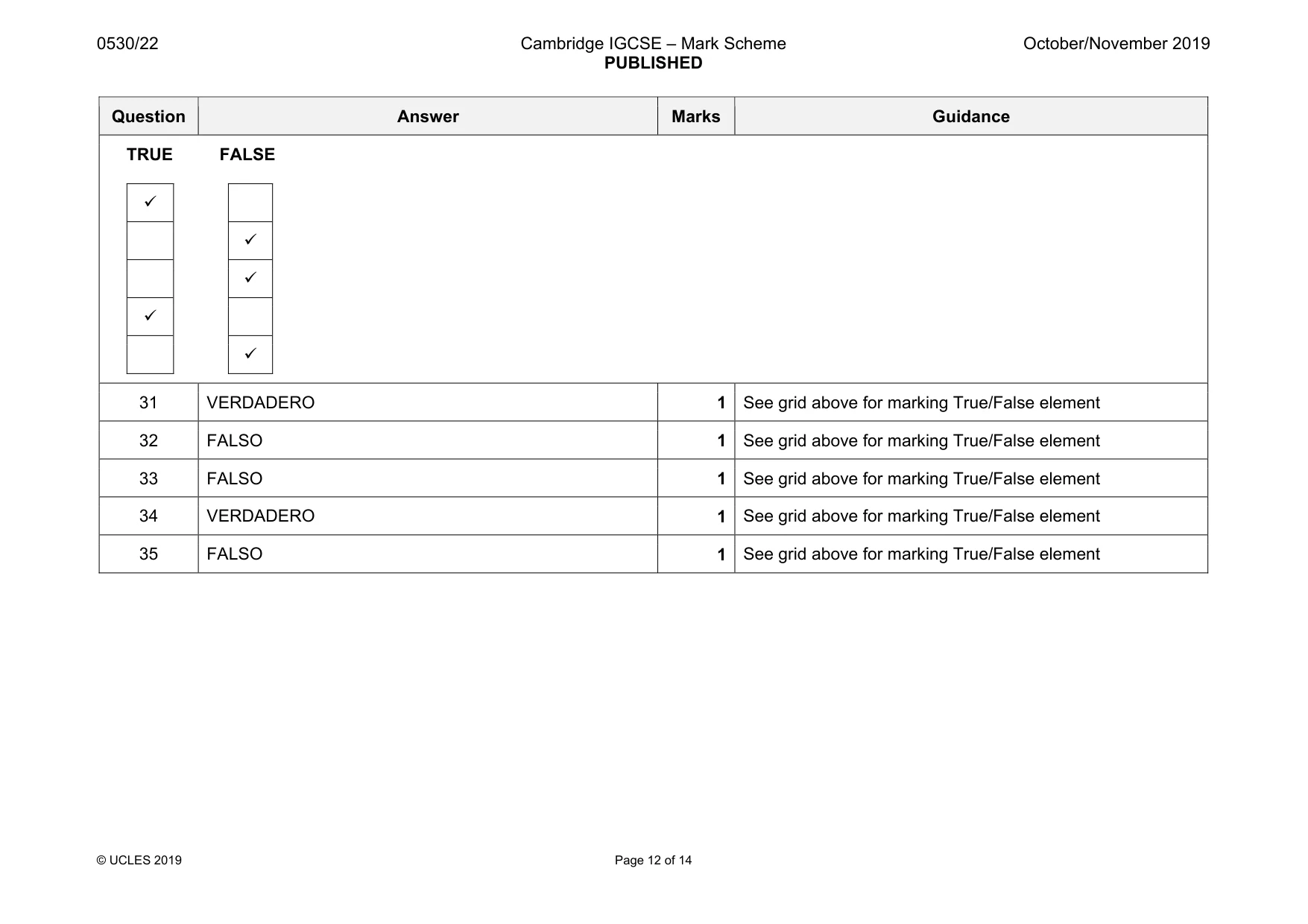
0530/22 Cambridge IGCSE – Mark Scheme PUBLISHED October/November 2019 © UCLES 2019 Page 12 of 14 Question Answer Marks Guidance TRUE FALSE 9 9 9 9 9 31 VERDADERO 1 See grid above for marking True/False element 32 FALSO 1 See grid above for marking True/False element 33 FALSO 1 See grid above for marking True/False element 34 VERDADERO 1 See grid above for marking True/False element 35 FALSO 1 See grid above for marking True/False element
Mark scheme, page 13
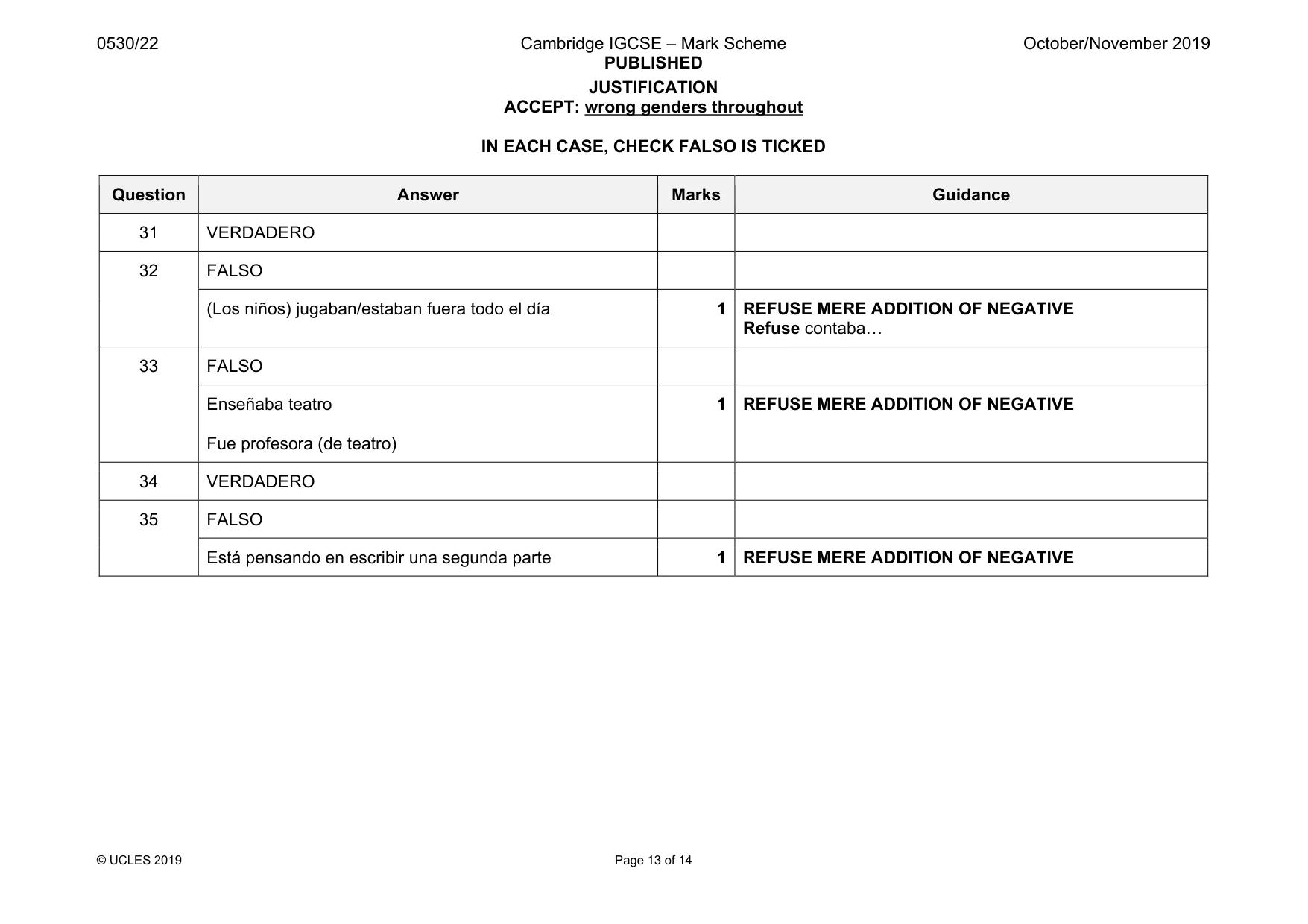
0530/22 Cambridge IGCSE – Mark Scheme PUBLISHED October/November 2019 © UCLES 2019 Page 13 of 14 JUSTIFICATION ACCEPT: wrong genders throughout IN EACH CASE, CHECK FALSO IS TICKED Question Answer Marks Guidance 31 VERDADERO 32 FALSO (Los niños) jugaban/estaban fuera todo el día 1 REFUSE MERE ADDITION OF NEGATIVE Refuse contaba« 33 FALSO Enseñaba teatro Fue profesora (de teatro) 1 REFUSE MERE ADDITION OF NEGATIVE 34 VERDADERO 35 FALSO Está pensando en escribir una segunda parte 1 REFUSE MERE ADDITION OF NEGATIVE
Mark scheme, page 14
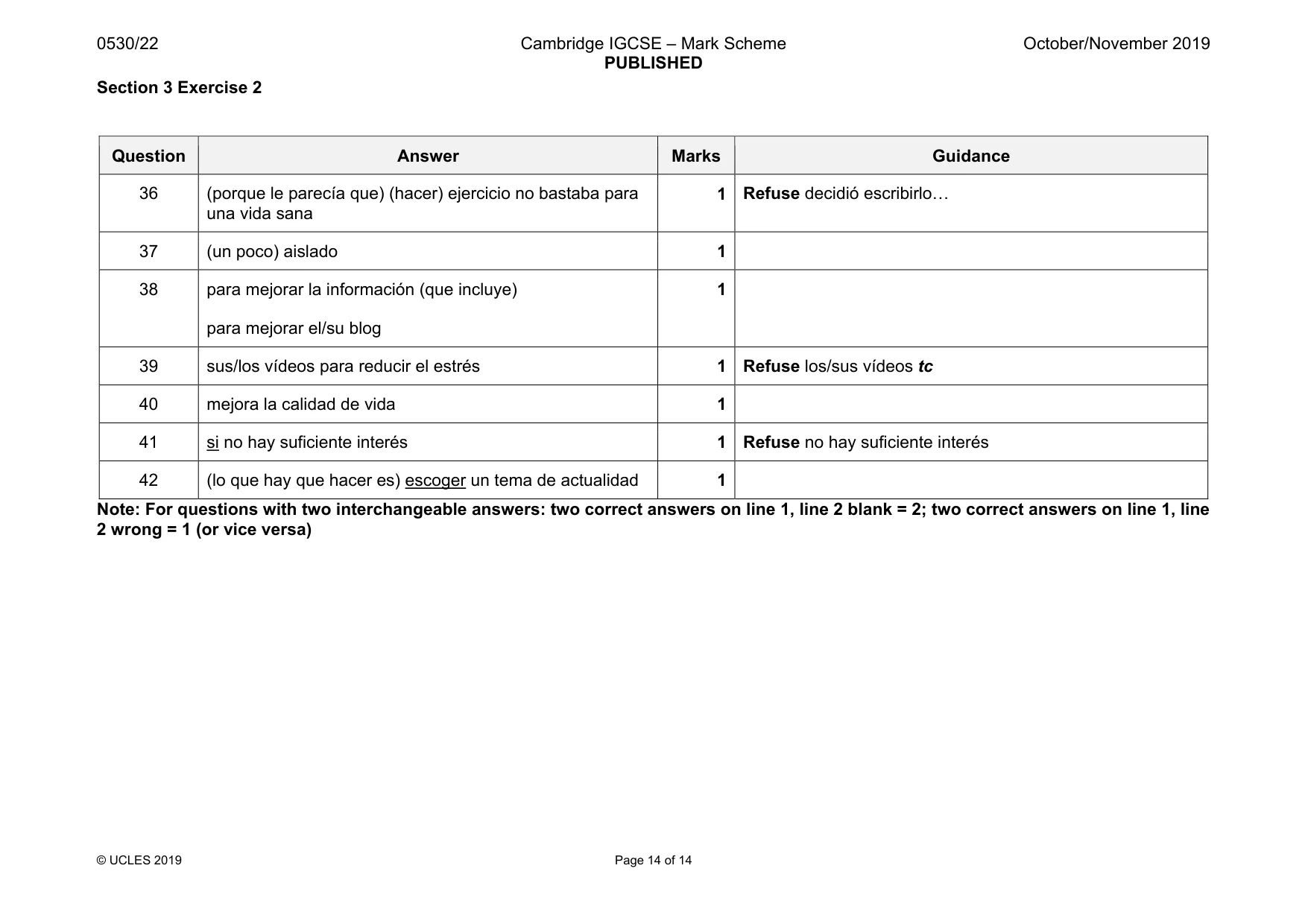
0530/22 Cambridge IGCSE – Mark Scheme PUBLISHED October/November 2019 © UCLES 2019 Page 14 of 14 Section 3 Exercise 2 Question Answer Marks Guidance 36 (porque le parecía que) (hacer) ejercicio no bastaba para una vida sana 1 Refuse decidió escribirlo« 37 (un poco) aislado 1 38 para mejorar la información (que incluye) para mejorar el/su blog 1 39 sus/los vídeos para reducir el estrés 1 Refuse los/sus vídeos tc 40 mejora la calidad de vida 1 41 si no hay suficiente interés 1 Refuse no hay suficiente interés 42 (lo que hay que hacer es) escoger un tema de actualidad 1 Note: For questions with two interchangeable answers: two correct answers on line 1, line 2 blank = 2; two correct answers on line 1, line 2 wrong = 1 (or vice versa)
What you needed in this session
Cambridge’s own grade thresholds for 2019 Oct/Nov, Paper 2 · Variant 2. A higher threshold means an easier paper — the bar moves with how the cohort did.