Cambridge IGCSE Spanish - Foreign Language 0530 — 2019 Oct/Nov Paper 2 · Variant 1
0530/21/O/N/19 · 45 marks · ≈51 min
The question paper and its mark scheme, free to read here and free to download. This is Cambridge’s own paper, exactly as it was sat.
Question paper16 pages



Mark scheme14 pages
Answers below. Sit the paper first if you are practising.
Paper as text
Question paper, page 1
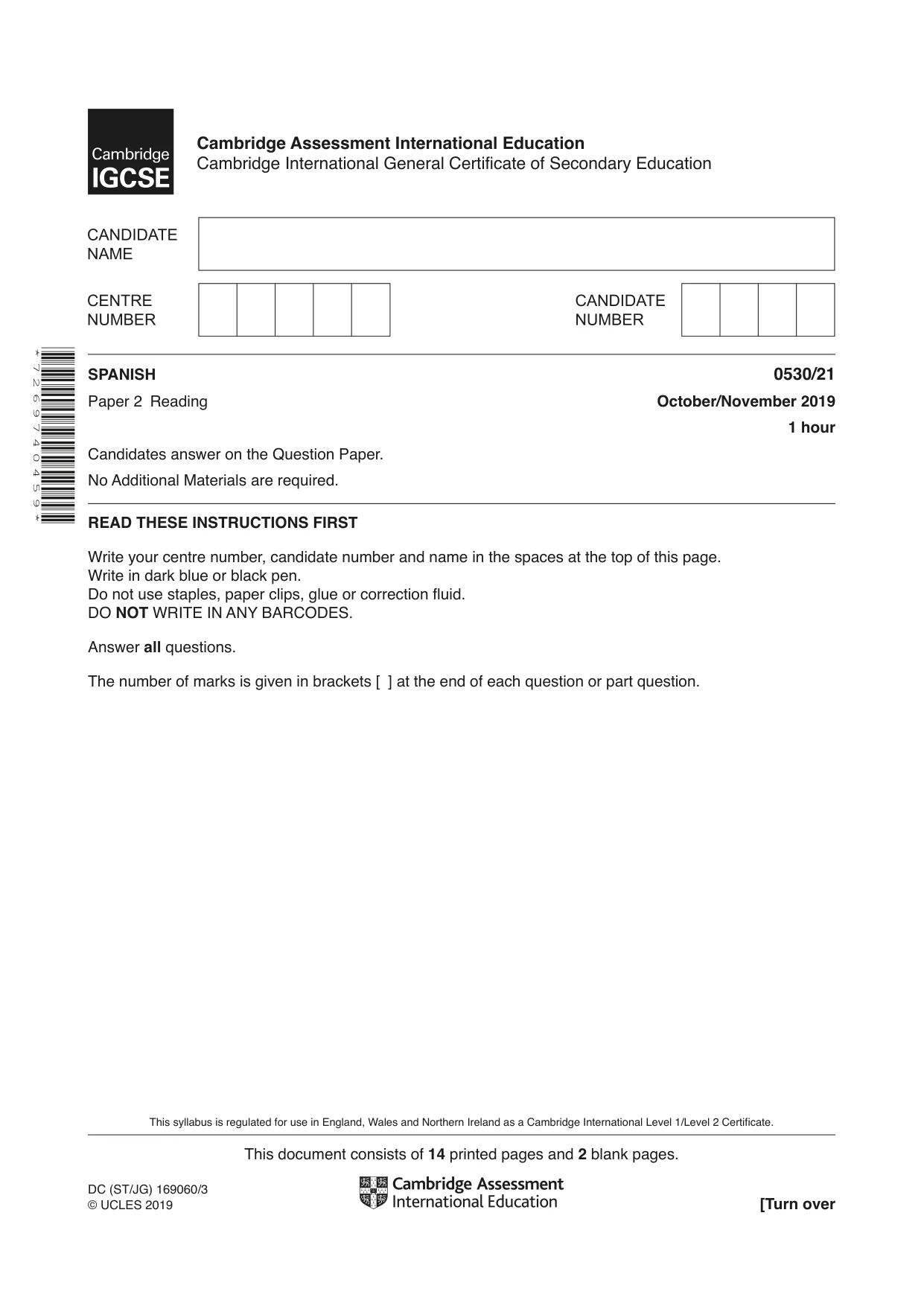
This document consists of 14 printed pages and 2 blank pages. DC (ST/JG) 169060/3 © UCLES 2019 [Turn over * 7 2 6 9 7 4 0 4 5 9 * SPANISH 0530/21 Paper 2 Reading October/November 2019 1 hour Candidates answer on the Question Paper. No Additional Materials are required. READ THESE INSTRUCTIONS FIRST Write your centre number, candidate number and name in the spaces at the top of this page. Write in dark blue or black pen. Do not use staples, paper clips, glue or correction fluid. DO NOT WRITE IN ANY BARCODES. Answer all questions. The number of marks is given in brackets [ ] at the end of each question or part question. Cambridge Assessment International Education Cambridge International General Certificate of Secondary Education This syllabus is regulated for use in England, Wales and Northern Ireland as a Cambridge International Level 1/Level 2 Certificate.
Question paper, page 2
2 0530/21/O/N/19 © UCLES 2019 BLANK PAGE
Question paper, page 3
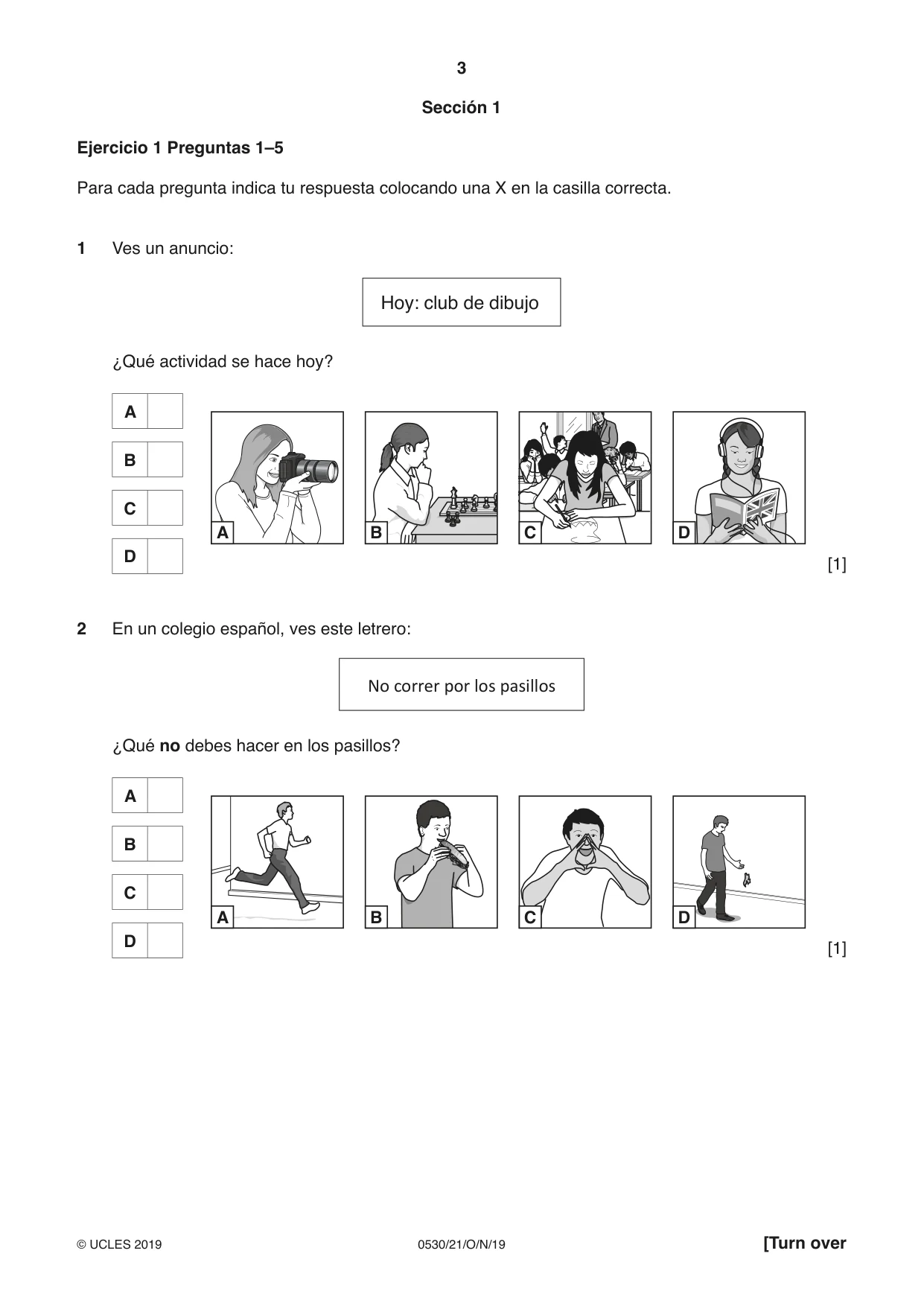
3 0530/21/O/N/19 © UCLES 2019 [Turn over Sección 1 Ejercicio 1 Preguntas 1–5 Para cada pregunta indica tu respuesta colocando una X en la casilla correcta. 1 Ves un anuncio: Hoy: club de dibujo ¿Qué actividad se hace hoy? A A B C D [1] B C D 2 En un colegio español, ves este letrero: No correr por los pasillos ¿Qué no debes hacer en los pasillos? A A B C D [1] B C D
Question paper, page 4
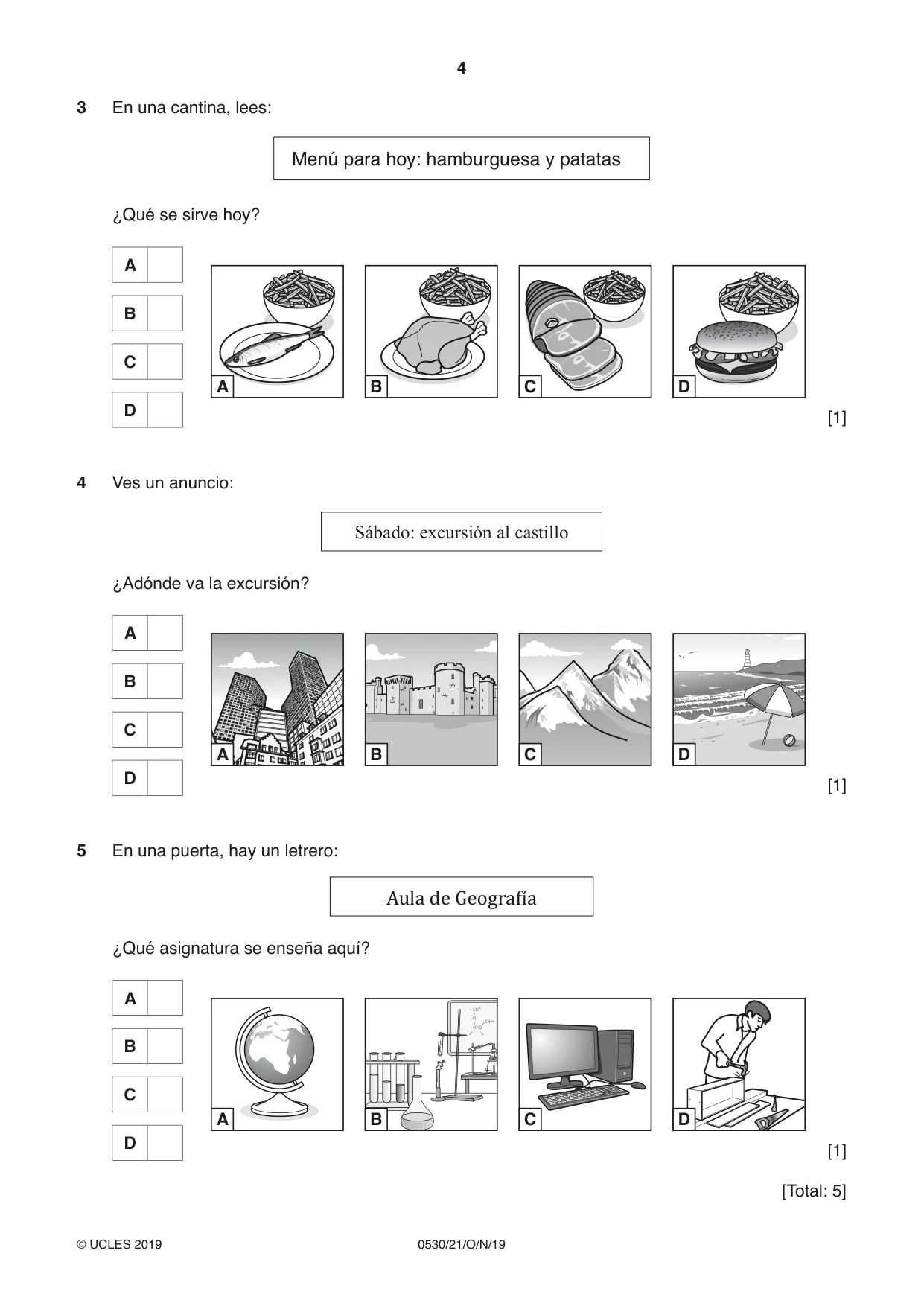
4 0530/21/O/N/19 © UCLES 2019 3 En una cantina, lees: Menú para hoy: hamburguesa y patatas ¿Qué se sirve hoy? A A B C D [1] B C D 4 Ves un anuncio: Sábado: excursión al castillo ¿Adónde va la excursión? A A B C D [1] B C D 5 En una puerta, hay un letrero: Aula de Geografía ¿Qué asignatura se enseña aquí? A A B C D [1] B C D [Total: 5]
Question paper, page 5
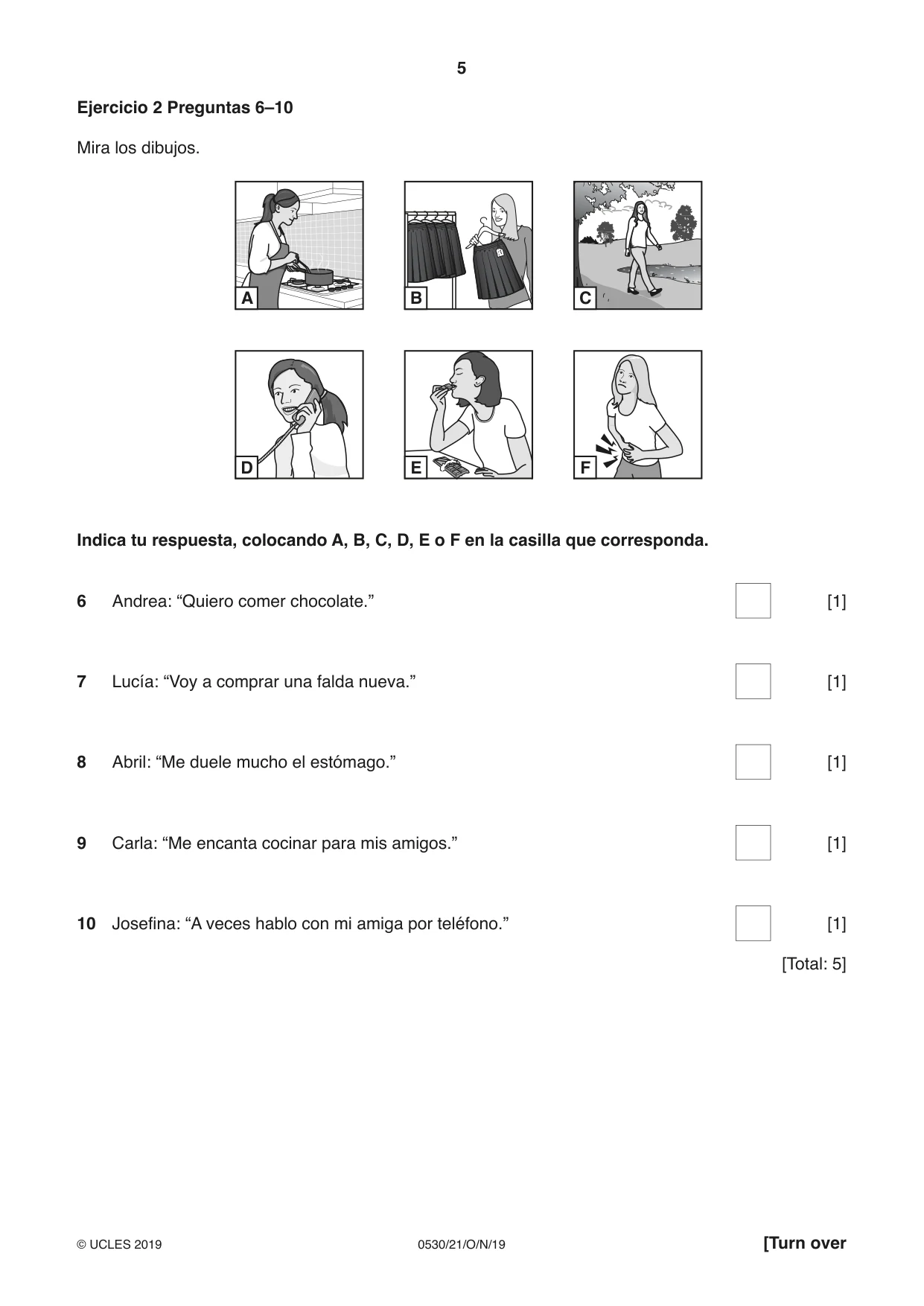
5 0530/21/O/N/19 © UCLES 2019 [Turn over Ejercicio 2 Preguntas 6–10 Mira los dibujos. A B C D E F Indica tu respuesta, colocando A, B, C, D, E o F en la casilla que corresponda. 6 Andrea: “Quiero comer chocolate.” [1] 7 Lucía: “Voy a comprar una falda nueva.” [1] 8 Abril: “Me duele mucho el estómago.” [1] 9 Carla: “Me encanta cocinar para mis amigos.” [1] 10 Josefina: “A veces hablo con mi amiga por teléfono.” [1] [Total: 5]
Question paper, page 6
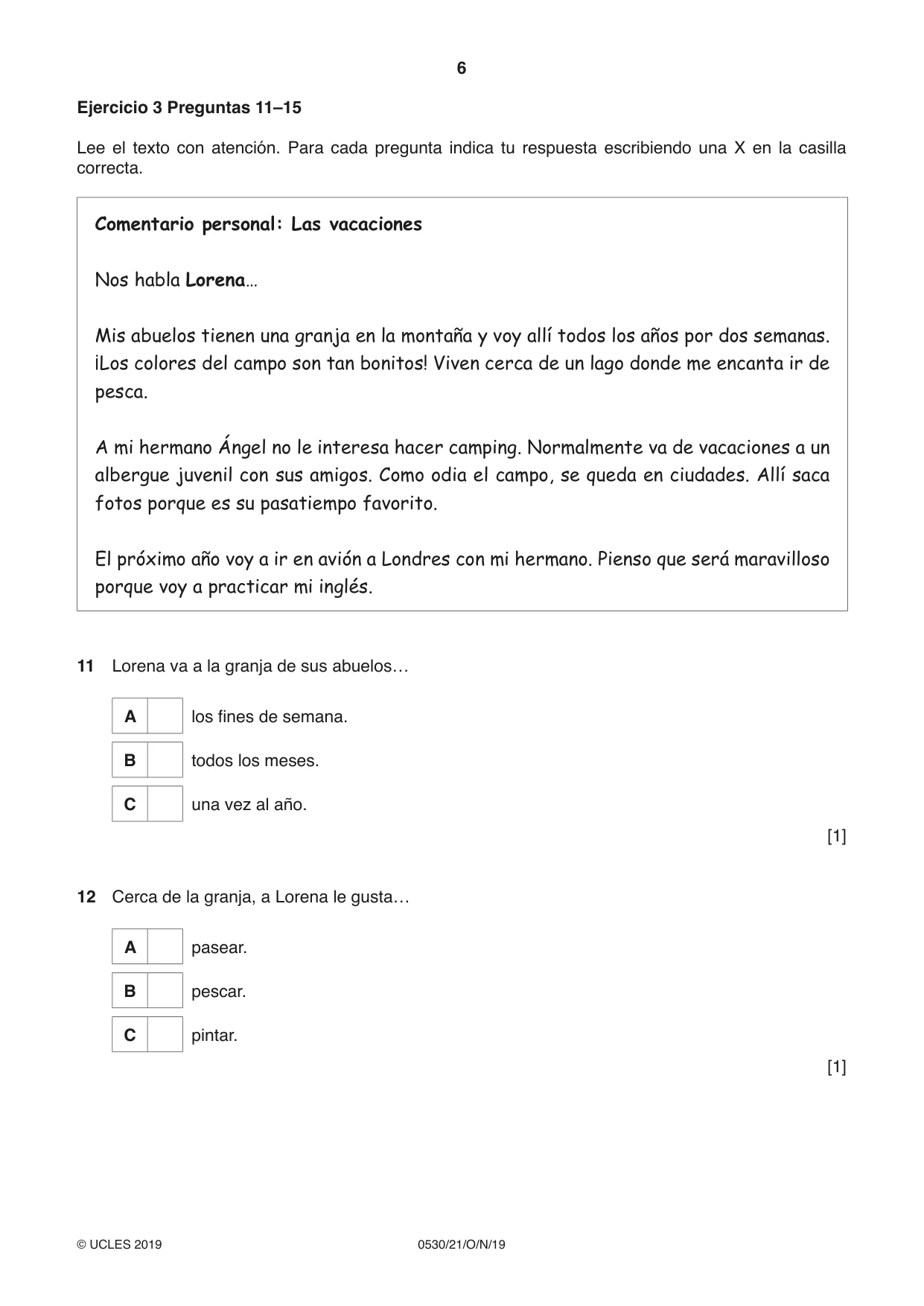
6 0530/21/O/N/19 © UCLES 2019 Ejercicio 3 Preguntas 11–15 Lee el texto con atención. Para cada pregunta indica tu respuesta escribiendo una X en la casilla correcta. Comentario personal: Las vacaciones Nos habla Lorena… Mis abuelos tienen una granja en la montaña y voy allí todos los años por dos semanas. ¡Los colores del campo son tan bonitos! Viven cerca de un lago donde me encanta ir de pesca. A mi hermano Ángel no le interesa hacer camping. Normalmente va de vacaciones a un albergue juvenil con sus amigos. Como odia el campo, se queda en ciudades. Allí saca fotos porque es su pasatiempo favorito. El próximo año voy a ir en avión a Londres con mi hermano. Pienso que será maravilloso porque voy a practicar mi inglés. 11 Lorena va a la granja de sus abuelos… A los fines de semana. B todos los meses. C una vez al año. [1] 12 Cerca de la granja, a Lorena le gusta… A pasear. B pescar. C pintar. [1]
Question paper, page 7
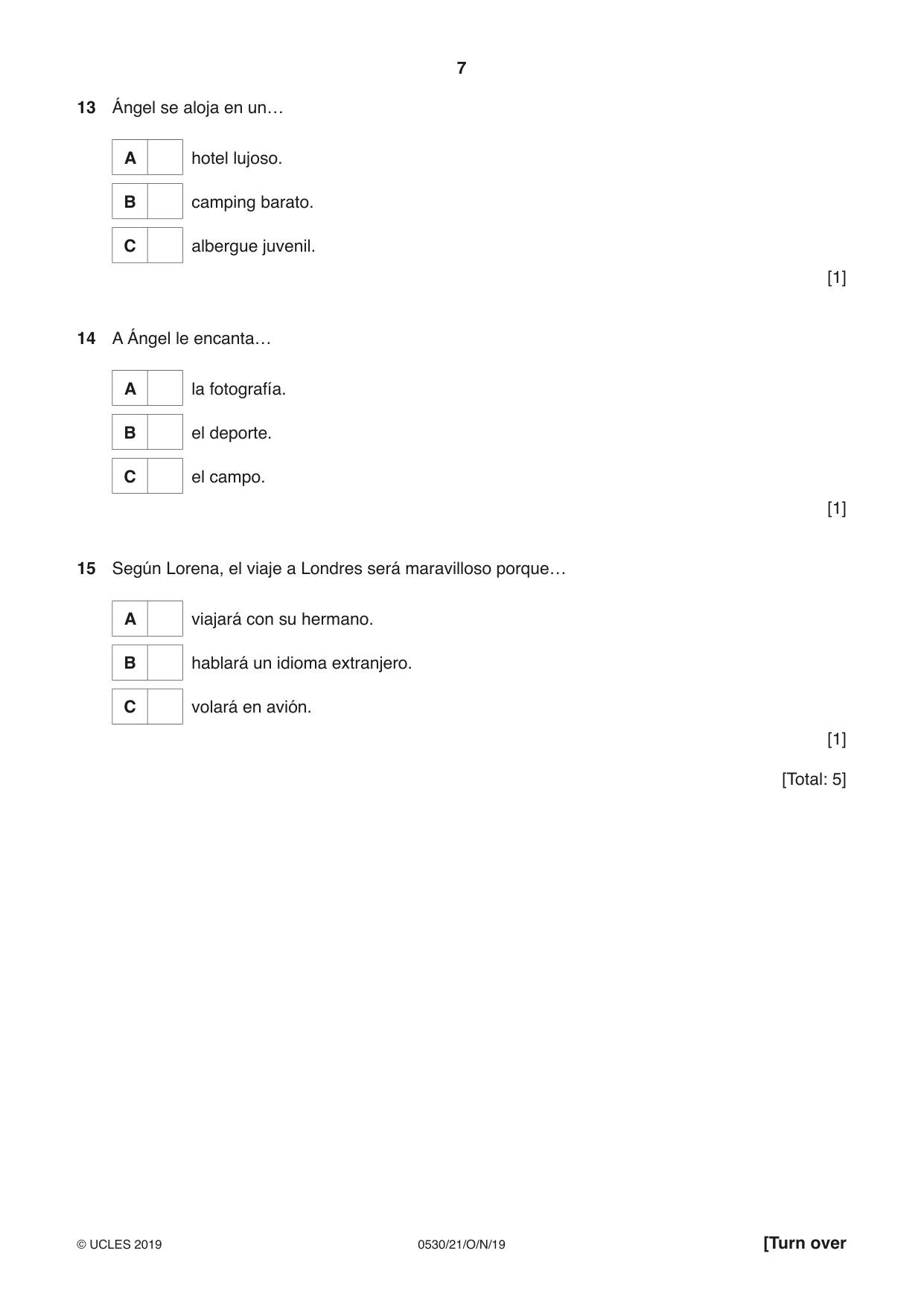
7 0530/21/O/N/19 © UCLES 2019 [Turn over 13 Ángel se aloja en un… A hotel lujoso. B camping barato. C albergue juvenil. [1] 14 A Ángel le encanta… A la fotografía. B el deporte. C el campo. [1] 15 Según Lorena, el viaje a Londres será maravilloso porque… A viajará con su hermano. B hablará un idioma extranjero. C volará en avión. [1] [Total: 5]
Question paper, page 8
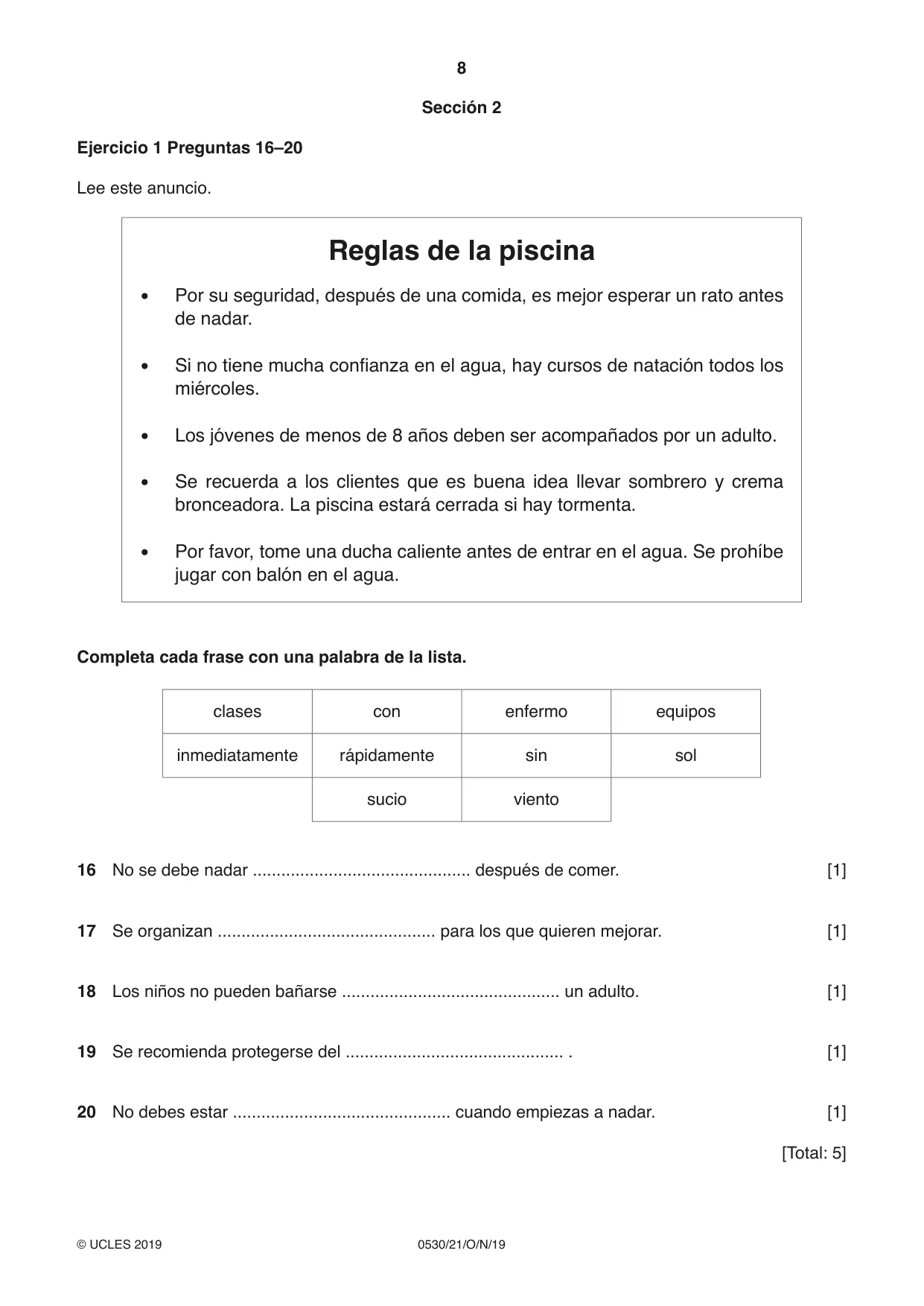
8 0530/21/O/N/19 © UCLES 2019 Sección 2 Ejercicio 1 Preguntas 16–20 Lee este anuncio. Reglas de la piscina • Por su seguridad, después de una comida, es mejor esperar un rato antes de nadar. • Si no tiene mucha confianza en el agua, hay cursos de natación todos los miércoles. • Los jóvenes de menos de 8 años deben ser acompañados por un adulto. • Se recuerda a los clientes que es buena idea llevar sombrero y crema bronceadora. La piscina estará cerrada si hay tormenta. • Por favor, tome una ducha caliente antes de entrar en el agua. Se prohíbe jugar con balón en el agua. Completa cada frase con una palabra de la lista. clases con enfermo equipos inmediatamente rápidamente sin sol sucio viento 16 No se debe nadar … después de comer. [1] 17 Se organizan … para los que quieren mejorar. [1] 18 Los niños no pueden bañarse … un adulto. [1] 19 Se recomienda protegerse del … . [1] 20 No debes estar … cuando empiezas a nadar. [1] [Total: 5]
Question paper, page 9
9 0530/21/O/N/19 © UCLES 2019 [Turn over Dar la vuelta para el Ejercicio 2.
Question paper, page 10
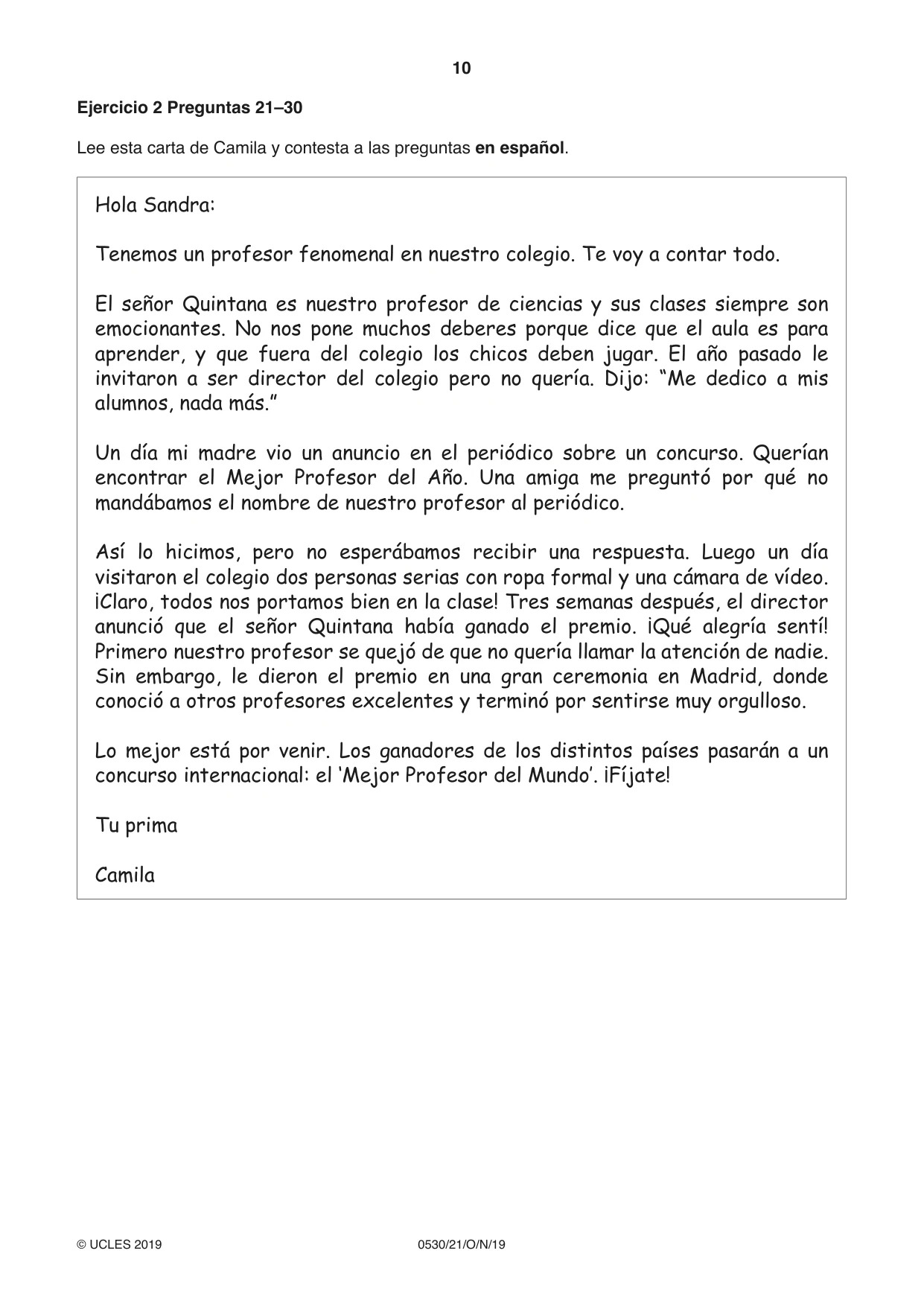
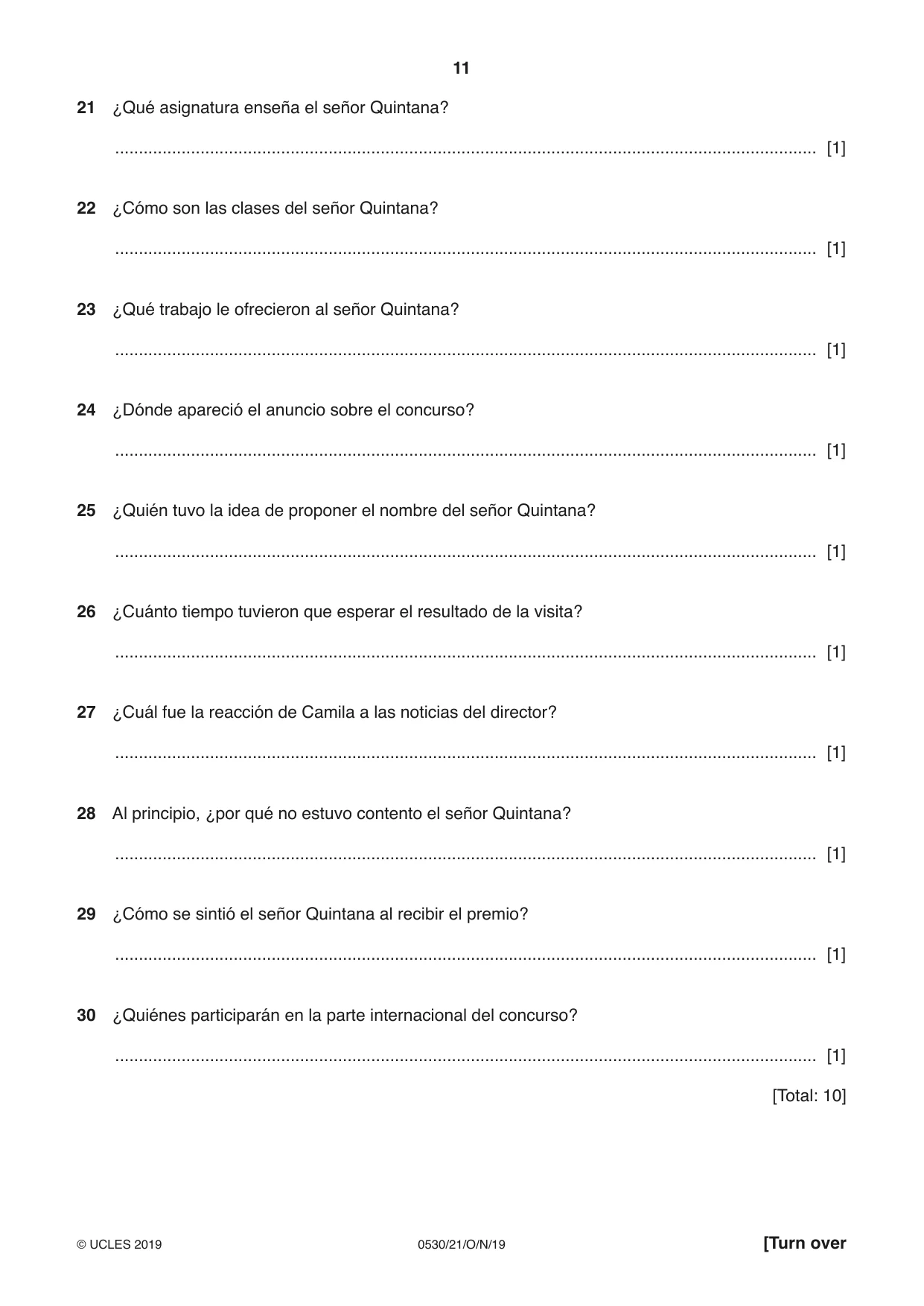
10 0530/21/O/N/19 © UCLES 2019 Ejercicio 2 Preguntas 21–30 Lee esta carta de Camila y contesta a las preguntas en español. Hola Sandra: Tenemos un profesor fenomenal en nuestro colegio. Te voy a contar todo. El señor Quintana es nuestro profesor de ciencias y sus clases siempre son emocionantes. No nos pone muchos deberes porque dice que el aula es para aprender, y que fuera del colegio los chicos deben jugar. El año pasado le invitaron a ser director del colegio pero no quería. Dijo: “Me dedico a mis alumnos, nada más.” Un día mi madre vio un anuncio en el periódico sobre un concurso. Querían encontrar el Mejor Profesor del Año. Una amiga me preguntó por qué no mandábamos el nombre de nuestro profesor al periódico. Así lo hicimos, pero no esperábamos recibir una respuesta. Luego un día visitaron el colegio dos personas serias con ropa formal y una cámara de vídeo. ¡Claro, todos nos portamos bien en la clase! Tres semanas después, el director anunció que el señor Quintana había ganado el premio. ¡Qué alegría sentí! Primero nuestro profesor se quejó de que no quería llamar la atención de nadie. Sin embargo, le dieron el premio en una gran ceremonia en Madrid, donde conoció a otros profesores excelentes y terminó por sentirse muy orgulloso. Lo mejor está por venir. Los ganadores de los distintos países pasarán a un concurso internacional: el ‘Mejor Profesor del Mundo’. ¡Fíjate! Tu prima Camila
Question paper, page 11
11 0530/21/O/N/19 © UCLES 2019 [Turn over 21 ¿Qué asignatura enseña el señor Quintana? … [1] 22 ¿Cómo son las clases del señor Quintana? … [1] 23 ¿Qué trabajo le ofrecieron al señor Quintana? … [1] 24 ¿Dónde apareció el anuncio sobre el concurso? … [1] 25 ¿Quién tuvo la idea de proponer el nombre del señor Quintana? … [1] 26 ¿Cuánto tiempo tuvieron que esperar el resultado de la visita? … [1] 27 ¿Cuál fue la reacción de Camila a las noticias del director? … [1] 28 Al principio, ¿por qué no estuvo contento el señor Quintana? … [1] 29 ¿Cómo se sintió el señor Quintana al recibir el premio? … [1] 30 ¿Quiénes participarán en la parte internacional del concurso? … [1] [Total: 10]
Question paper, page 12
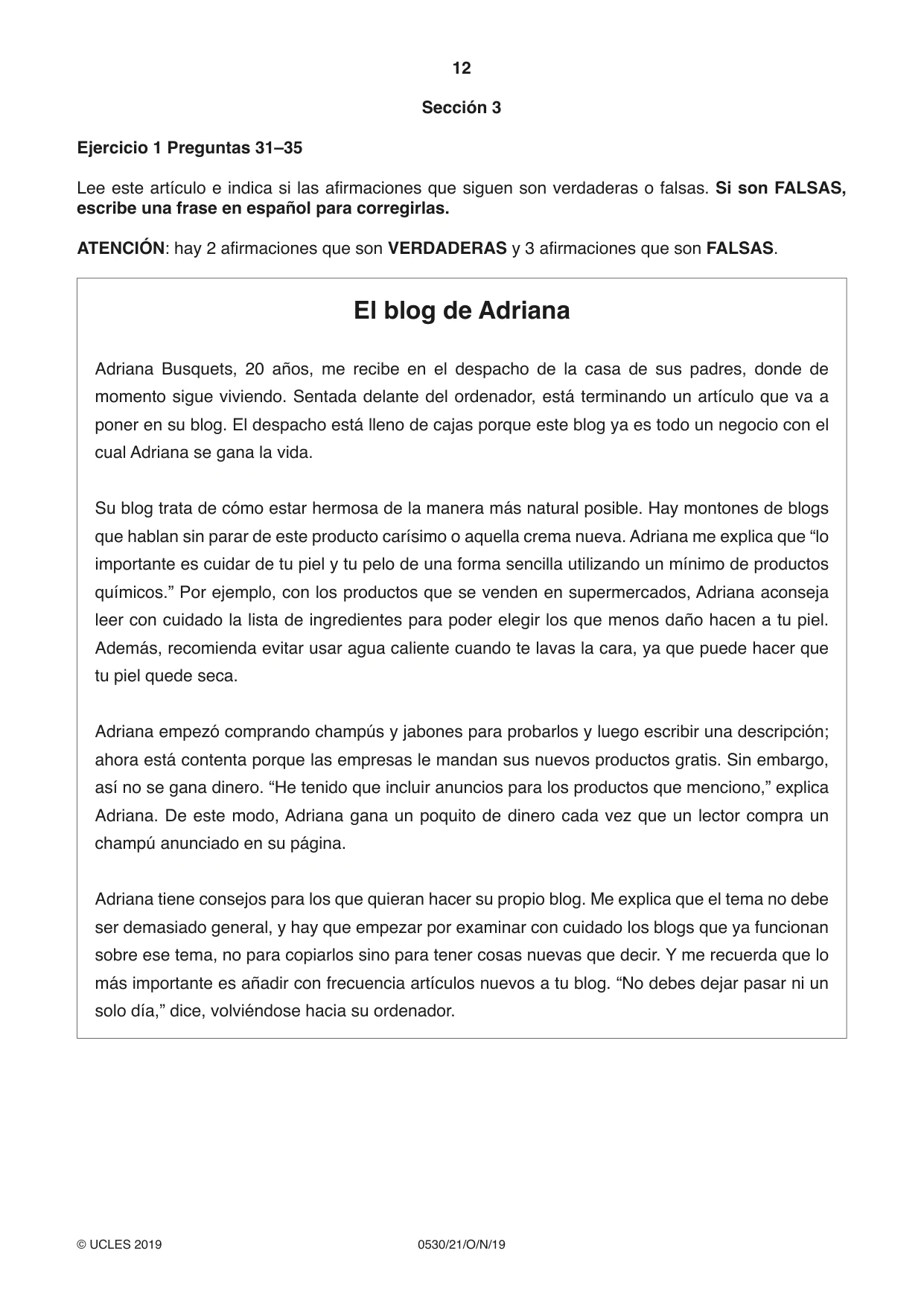
12 0530/21/O/N/19 © UCLES 2019 Sección 3 Ejercicio 1 Preguntas 31–35 Lee este artículo e indica si las afirmaciones que siguen son verdaderas o falsas. Si son FALSAS, escribe una frase en español para corregirlas. ATENCIÓN: hay 2 afirmaciones que son VERDADERAS y 3 afirmaciones que son FALSAS. El blog de Adriana Adriana Busquets, 20 años, me recibe en el despacho de la casa de sus padres, donde de momento sigue viviendo. Sentada delante del ordenador, está terminando un artículo que va a poner en su blog. El despacho está lleno de cajas porque este blog ya es todo un negocio con el cual Adriana se gana la vida. Su blog trata de cómo estar hermosa de la manera más natural posible. Hay montones de blogs que hablan sin parar de este producto carísimo o aquella crema nueva. Adriana me explica que “lo importante es cuidar de tu piel y tu pelo de una forma sencilla utilizando un mínimo de productos químicos.” Por ejemplo, con los productos que se venden en supermercados, Adriana aconseja leer con cuidado la lista de ingredientes para poder elegir los que menos daño hacen a tu piel. Además, recomienda evitar usar agua caliente cuando te lavas la cara, ya que puede hacer que tu piel quede seca. Adriana empezó comprando champús y jabones para probarlos y luego escribir una descripción; ahora está contenta porque las empresas le mandan sus nuevos productos gratis. Sin embargo, así no se gana dinero. “He tenido que incluir anuncios para los productos que menciono,” explica Adriana. De este modo, Adriana gana un poquito de dinero cada vez que un lector compra un champú anunciado en su página. Adriana tiene consejos para los que quieran hacer su propio blog. Me explica que el tema no debe ser demasiado general, y hay que empezar por examinar con cuidado los blogs que ya funcionan sobre ese tema, no para copiarlos sino para tener cosas nuevas que decir. Y me recuerda que lo más importante es añadir con frecuencia artículos nuevos a tu blog. “No debes dejar pasar ni un solo día,” dice, volviéndose hacia su ordenador.
Question paper, page 13
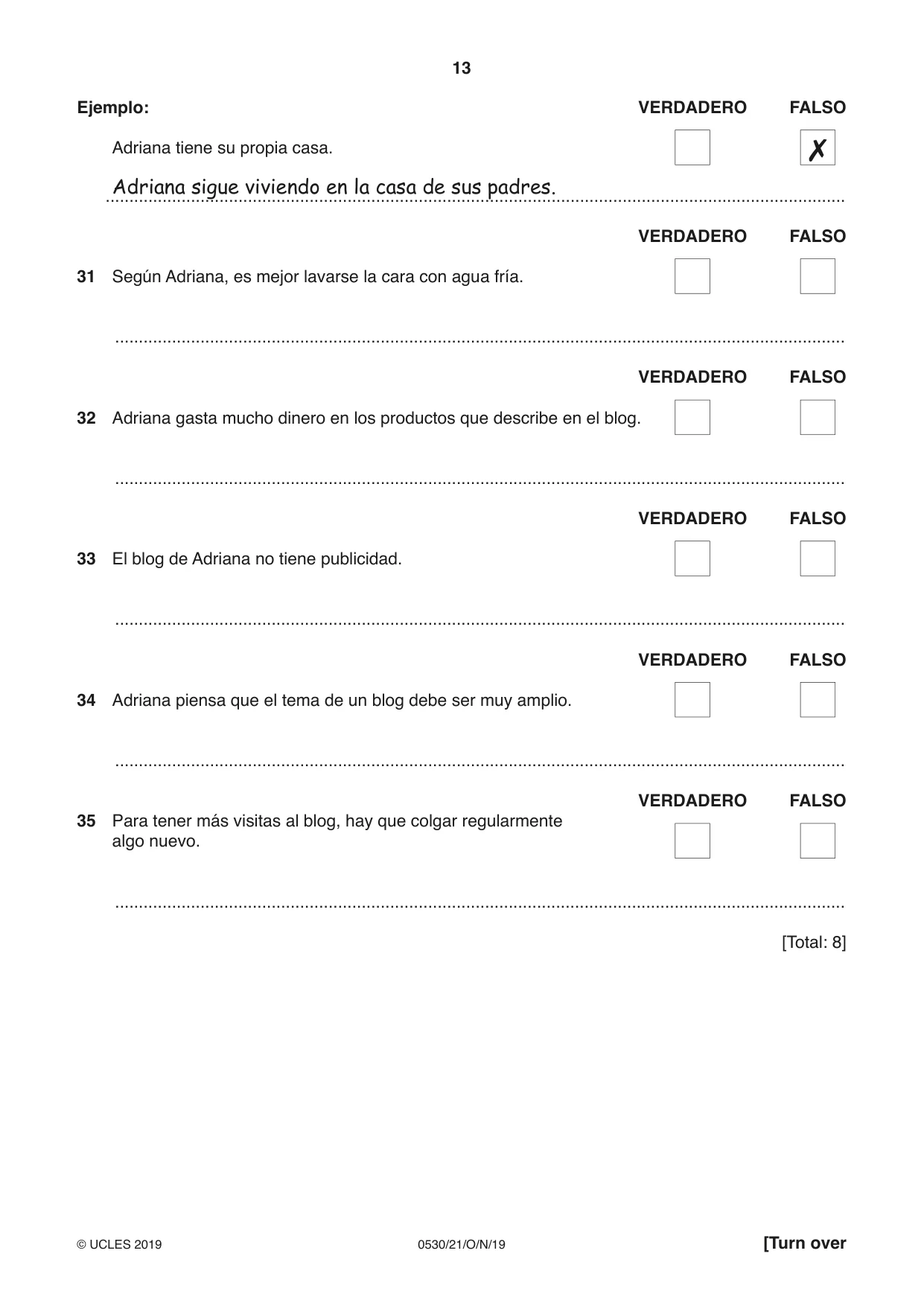
13 0530/21/O/N/19 © UCLES 2019 [Turn over Ejemplo: VERDADERO FALSO Adriana tiene su propia casa. ✗ Adriana sigue viviendo en la casa de sus padres. … VERDADERO FALSO 31 Según Adriana, es mejor lavarse la cara con agua fría. … VERDADERO FALSO 32 Adriana gasta mucho dinero en los productos que describe en el blog. … VERDADERO FALSO 33 El blog de Adriana no tiene publicidad. … VERDADERO FALSO 34 Adriana piensa que el tema de un blog debe ser muy amplio. … VERDADERO FALSO 35 Para tener más visitas al blog, hay que colgar regularmente algo nuevo. … [Total: 8]
Question paper, page 14
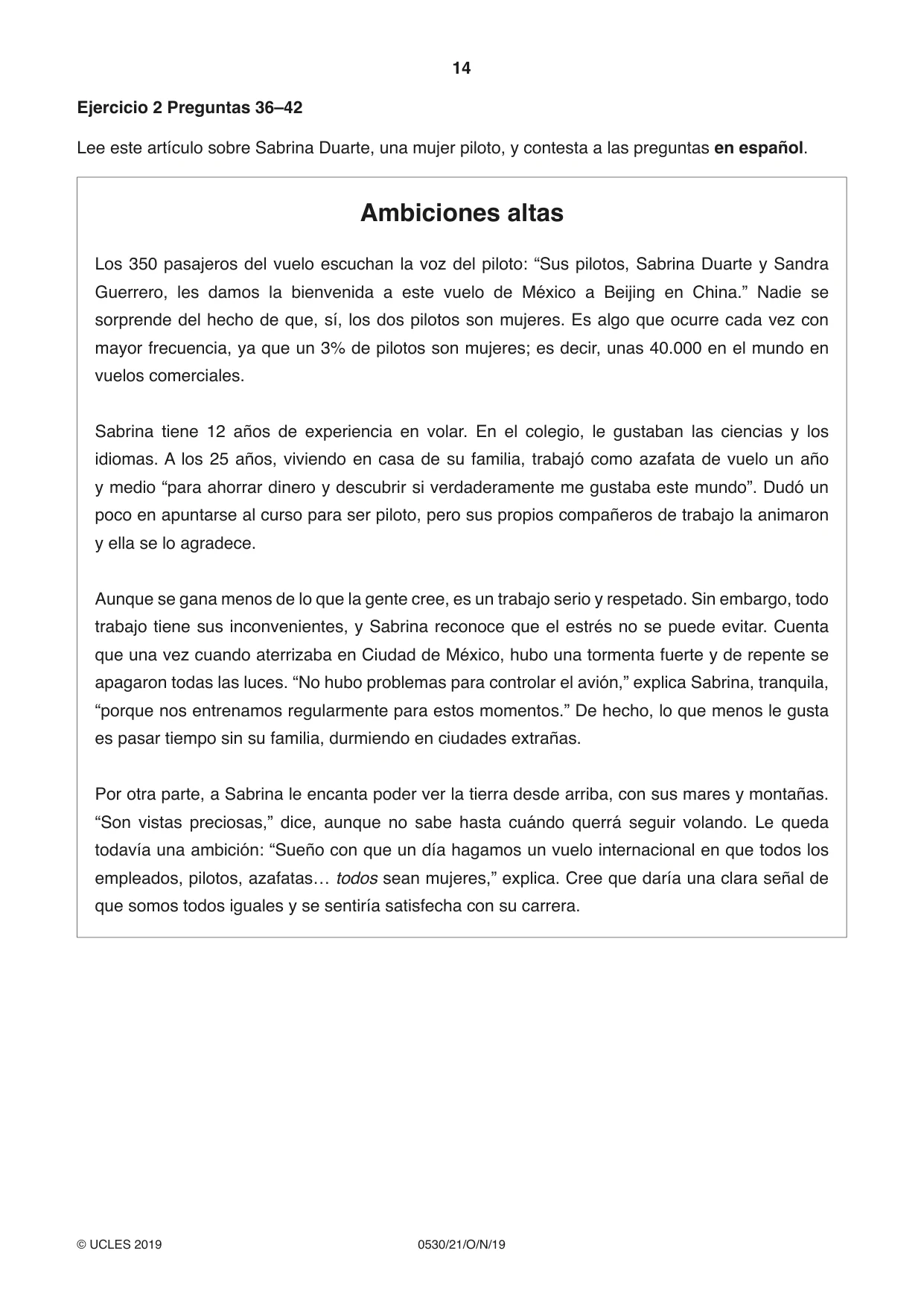
14 0530/21/O/N/19 © UCLES 2019 Ejercicio 2 Preguntas 36–42 Lee este artículo sobre Sabrina Duarte, una mujer piloto, y contesta a las preguntas en español. Ambiciones altas Los 350 pasajeros del vuelo escuchan la voz del piloto: “Sus pilotos, Sabrina Duarte y Sandra Guerrero, les damos la bienvenida a este vuelo de México a Beijing en China.” Nadie se sorprende del hecho de que, sí, los dos pilotos son mujeres. Es algo que ocurre cada vez con mayor frecuencia, ya que un 3% de pilotos son mujeres; es decir, unas 40.000 en el mundo en vuelos comerciales. Sabrina tiene 12 años de experiencia en volar. En el colegio, le gustaban las ciencias y los idiomas. A los 25 años, viviendo en casa de su familia, trabajó como azafata de vuelo un año y medio “para ahorrar dinero y descubrir si verdaderamente me gustaba este mundo”. Dudó un poco en apuntarse al curso para ser piloto, pero sus propios compañeros de trabajo la animaron y ella se lo agradece. Aunque se gana menos de lo que la gente cree, es un trabajo serio y respetado. Sin embargo, todo trabajo tiene sus inconvenientes, y Sabrina reconoce que el estrés no se puede evitar. Cuenta que una vez cuando aterrizaba en Ciudad de México, hubo una tormenta fuerte y de repente se apagaron todas las luces. “No hubo problemas para controlar el avión,” explica Sabrina, tranquila, “porque nos entrenamos regularmente para estos momentos.” De hecho, lo que menos le gusta es pasar tiempo sin su familia, durmiendo en ciudades extrañas. Por otra parte, a Sabrina le encanta poder ver la tierra desde arriba, con sus mares y montañas. “Son vistas preciosas,” dice, aunque no sabe hasta cuándo querrá seguir volando. Le queda todavía una ambición: “Sueño con que un día hagamos un vuelo internacional en que todos los empleados, pilotos, azafatas… todos sean mujeres,” explica. Cree que daría una clara señal de que somos todos iguales y se sentiría satisfecha con su carrera.
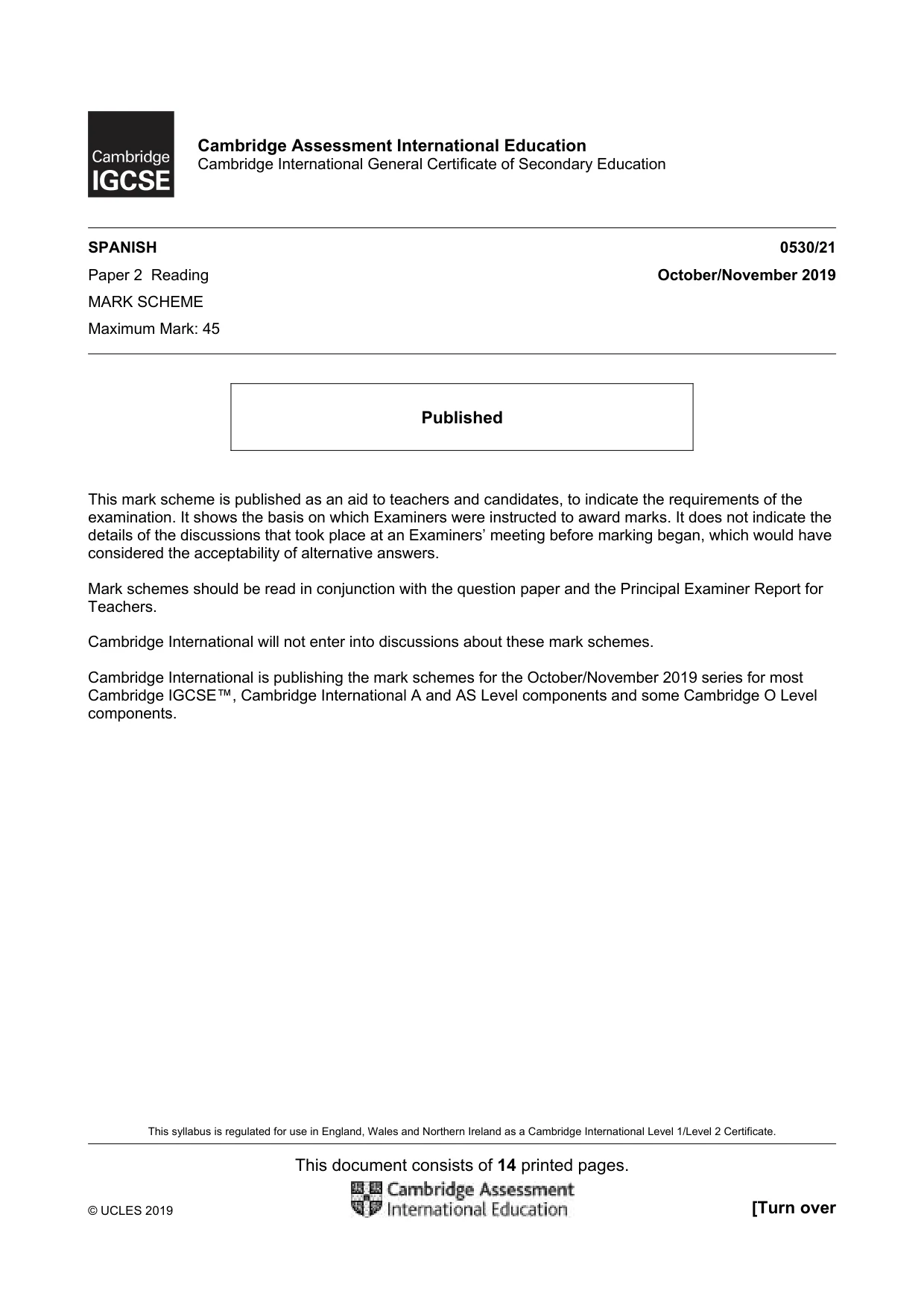
Question paper, page 15
15 0530/21/O/N/19 © UCLES 2019 36 ¿Cómo reaccionan los pasajeros al saber quiénes son los pilotos del vuelo? … [1] 37 ¿Durante cuánto tiempo hizo Sabrina otro trabajo? … [1] 38 ¿Quiénes la animaron a Sabrina a cambiar de trabajo? … [1] 39 ¿Qué acepta Sabrina como parte del trabajo? … [1] 40 ¿Por qué no le preocupó a Sabrina el problema causado por la tormenta? … [1] 41 ¿Dónde no le gusta a Sabrina pasar la noche? … [1] 42 ¿Cuál es el mensaje que mandaría Sabrina al cumplir su sueño? … [1] [Total: 7]
Question paper, page 16
16 0530/21/O/N/19 © UCLES 2019 Permission to reproduce items where third-party owned material protected by copyright is included has been sought and cleared where possible. Every reasonable effort has been made by the publisher (UCLES) to trace copyright holders, but if any items requiring clearance have unwittingly been included, the publisher will be pleased to make amends at the earliest possible opportunity. To avoid the issue of disclosure of answer-related information to candidates, all copyright acknowledgements are reproduced online in the Cambridge Assessment International Education Copyright Acknowledgements Booklet. This is produced for each series of examinations and is freely available to download at www.cambridgeinternational.org after the live examination series. Cambridge Assessment International Education is part of the Cambridge Assessment Group. Cambridge Assessment is the brand name of the University of Cambridge Local Examinations Syndicate (UCLES), which itself is a department of the University of Cambridge. BLANK PAGE
Mark scheme, page 1
This syllabus is regulated for use in England, Wales and Northern Ireland as a Cambridge International Level 1/Level 2 Certificate. This document consists of 14 printed pages. © UCLES 2019 [Turn over Cambridge Assessment International Education Cambridge International General Certificate of Secondary Education SPANISH 0530/21 Paper 2 Reading October/November 2019 MARK SCHEME Maximum Mark: 45 Published This mark scheme is published as an aid to teachers and candidates, to indicate the requirements of the examination. It shows the basis on which Examiners were instructed to award marks. It does not indicate the details of the discussions that took place at an Examiners’ meeting before marking began, which would have considered the acceptability of alternative answers. Mark schemes should be read in conjunction with the question paper and the Principal Examiner Report for Teachers. Cambridge International will not enter into discussions about these mark schemes. Cambridge International is publishing the mark schemes for the October/November 2019 series for most Cambridge IGCSE™, Cambridge International A and AS Level components and some Cambridge O Level components.
Mark scheme, page 2
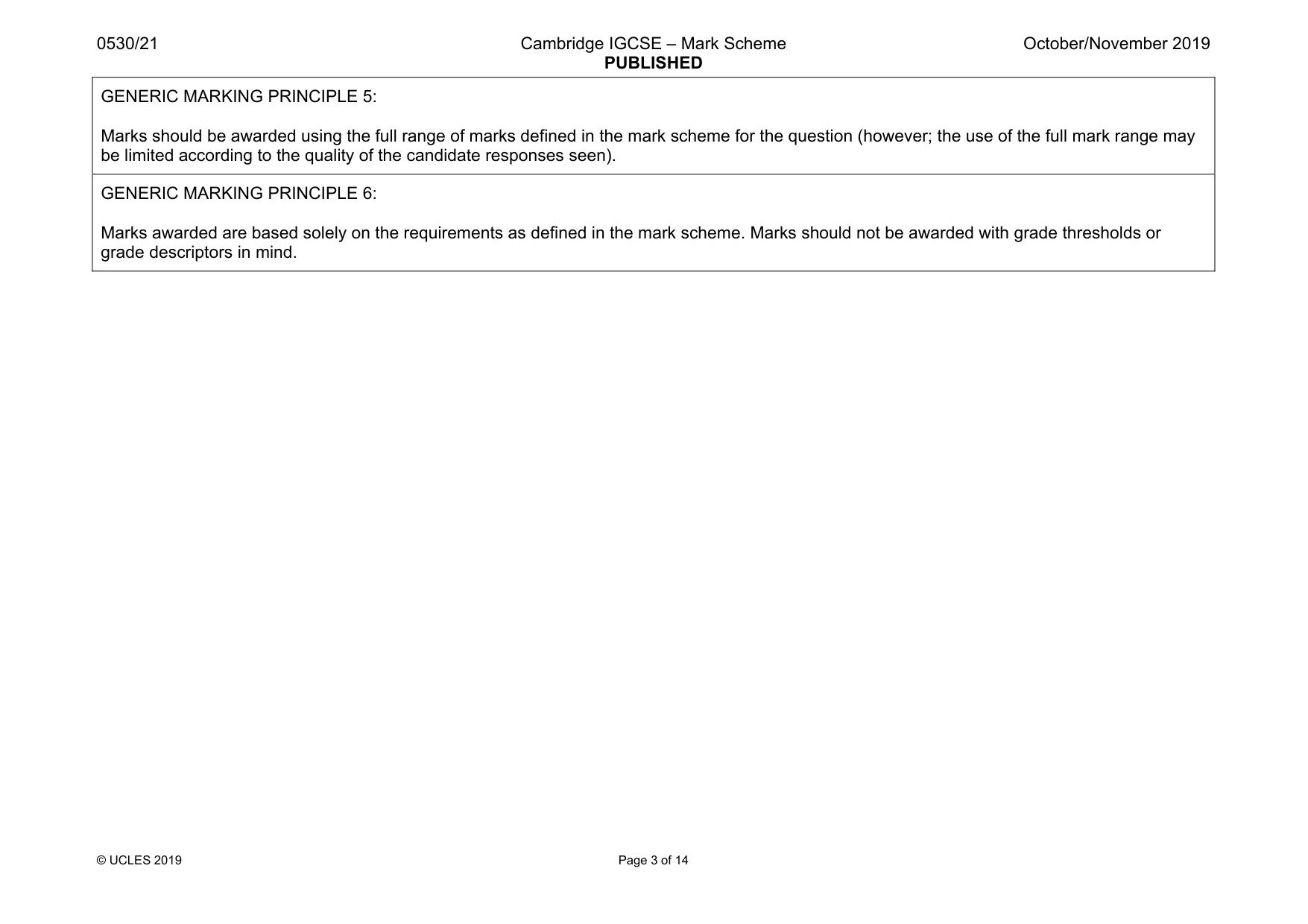
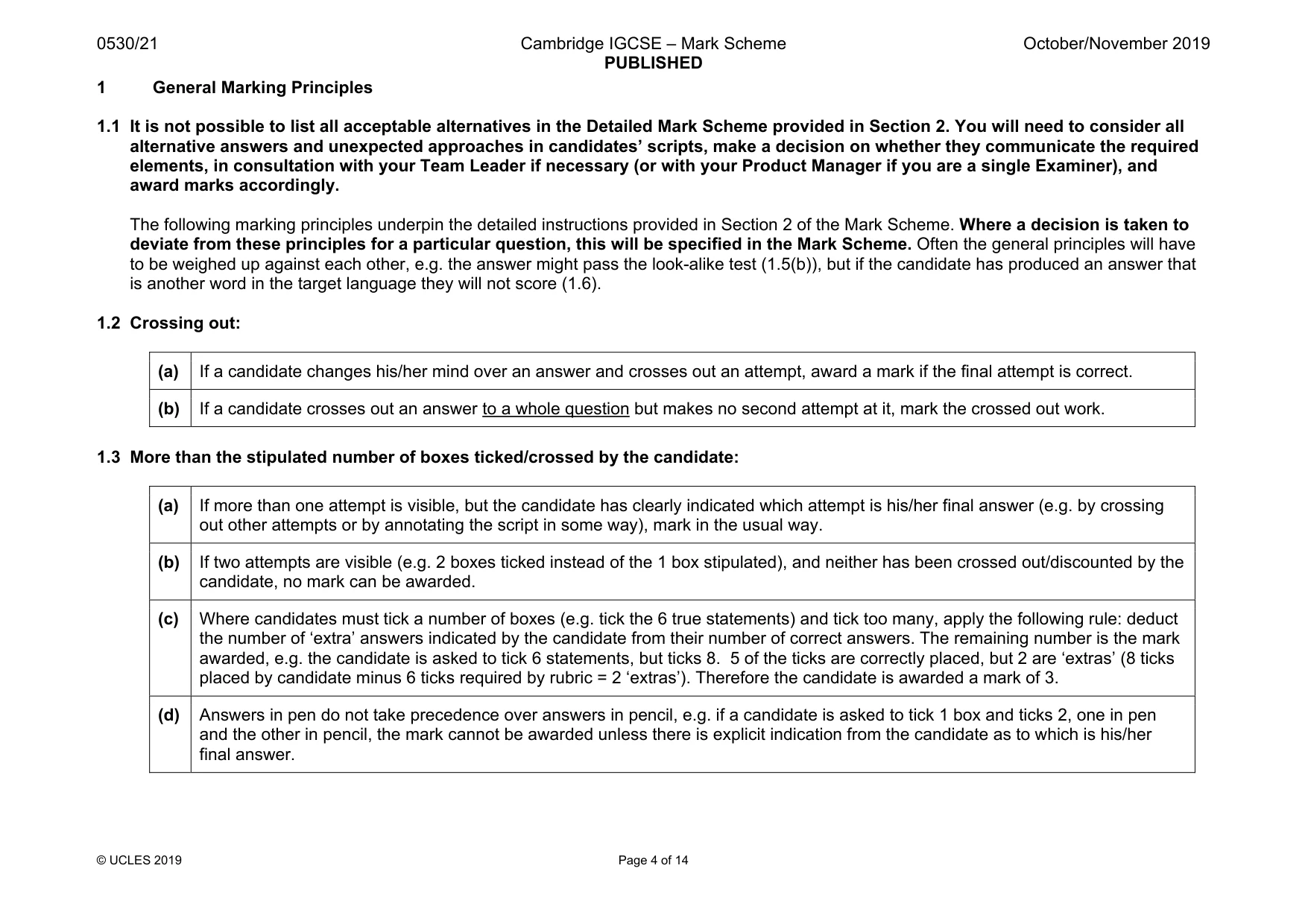
0530/21 Cambridge IGCSE – Mark Scheme PUBLISHED October/November 2019 © UCLES 2019 Page 2 of 14 Generic Marking Principles These general marking principles must be applied by all examiners when marking candidate answers. They should be applied alongside the specific content of the mark scheme or generic level descriptors for a question. Each question paper and mark scheme will also comply with these marking principles. GENERIC MARKING PRINCIPLE 1: Marks must be awarded in line with: • the specific content of the mark scheme or the generic level descriptors for the question • the specific skills defined in the mark scheme or in the generic level descriptors for the question • the standard of response required by a candidate as exemplified by the standardisation scripts. GENERIC MARKING PRINCIPLE 2: Marks awarded are always whole marks (not half marks, or other fractions). GENERIC MARKING PRINCIPLE 3: Marks must be awarded positively: • marks are awarded for correct/valid answers, as defined in the mark scheme. However, credit is given for valid answers which go beyond the scope of the syllabus and mark scheme, referring to your Team Leader as appropriate • marks are awarded when candidates clearly demonstrate what they know and can do • marks are not deducted for errors • marks are not deducted for omissions • answers should only be judged on the quality of spelling, punctuation and grammar when these features are specifically assessed by the question as indicated by the mark scheme. The meaning, however, should be unambiguous. GENERIC MARKING PRINCIPLE 4: Rules must be applied consistently e.g. in situations where candidates have not followed instructions or in the application of generic level descriptors.
Mark scheme, page 3
0530/21 Cambridge IGCSE – Mark Scheme PUBLISHED October/November 2019 © UCLES 2019 Page 3 of 14 GENERIC MARKING PRINCIPLE 5: Marks should be awarded using the full range of marks defined in the mark scheme for the question (however; the use of the full mark range may be limited according to the quality of the candidate responses seen). GENERIC MARKING PRINCIPLE 6: Marks awarded are based solely on the requirements as defined in the mark scheme. Marks should not be awarded with grade thresholds or grade descriptors in mind.
Mark scheme, page 4
0530/21 Cambridge IGCSE – Mark Scheme PUBLISHED October/November 2019 © UCLES 2019 Page 4 of 14 1 General Marking Principles 1.1 It is not possible to list all acceptable alternatives in the Detailed Mark Scheme provided in Section 2. You will need to consider all alternative answers and unexpected approaches in candidates’ scripts, make a decision on whether they communicate the required elements, in consultation with your Team Leader if necessary (or with your Product Manager if you are a single Examiner), and award marks accordingly. The following marking principles underpin the detailed instructions provided in Section 2 of the Mark Scheme. Where a decision is taken to deviate from these principles for a particular question, this will be specified in the Mark Scheme. Often the general principles will have to be weighed up against each other, e.g. the answer might pass the look-alike test (1.5(b)), but if the candidate has produced an answer that is another word in the target language they will not score (1.6). 1.2 Crossing out: (a) If a candidate changes his/her mind over an answer and crosses out an attempt, award a mark if the final attempt is correct. (b) If a candidate crosses out an answer to a whole question but makes no second attempt at it, mark the crossed out work. 1.3 More than the stipulated number of boxes ticked/crossed by the candidate: (a) If more than one attempt is visible, but the candidate has clearly indicated which attempt is his/her final answer (e.g. by crossing out other attempts or by annotating the script in some way), mark in the usual way. (b) If two attempts are visible (e.g. 2 boxes ticked instead of the 1 box stipulated), and neither has been crossed out/discounted by the candidate, no mark can be awarded. (c) Where candidates must tick a number of boxes (e.g. tick the 6 true statements) and tick too many, apply the following rule: deduct the number of ‘extra’ answers indicated by the candidate from their number of correct answers. The remaining number is the mark awarded, e.g. the candidate is asked to tick 6 statements, but ticks 8. 5 of the ticks are correctly placed, but 2 are ‘extras’ (8 ticks placed by candidate minus 6 ticks required by rubric = 2 ‘extras’). Therefore the candidate is awarded a mark of 3. (d) Answers in pen do not take precedence over answers in pencil, e.g. if a candidate is asked to tick 1 box and ticks 2, one in pen and the other in pencil, the mark cannot be awarded unless there is explicit indication from the candidate as to which is his/her final answer.
Mark scheme, page 5
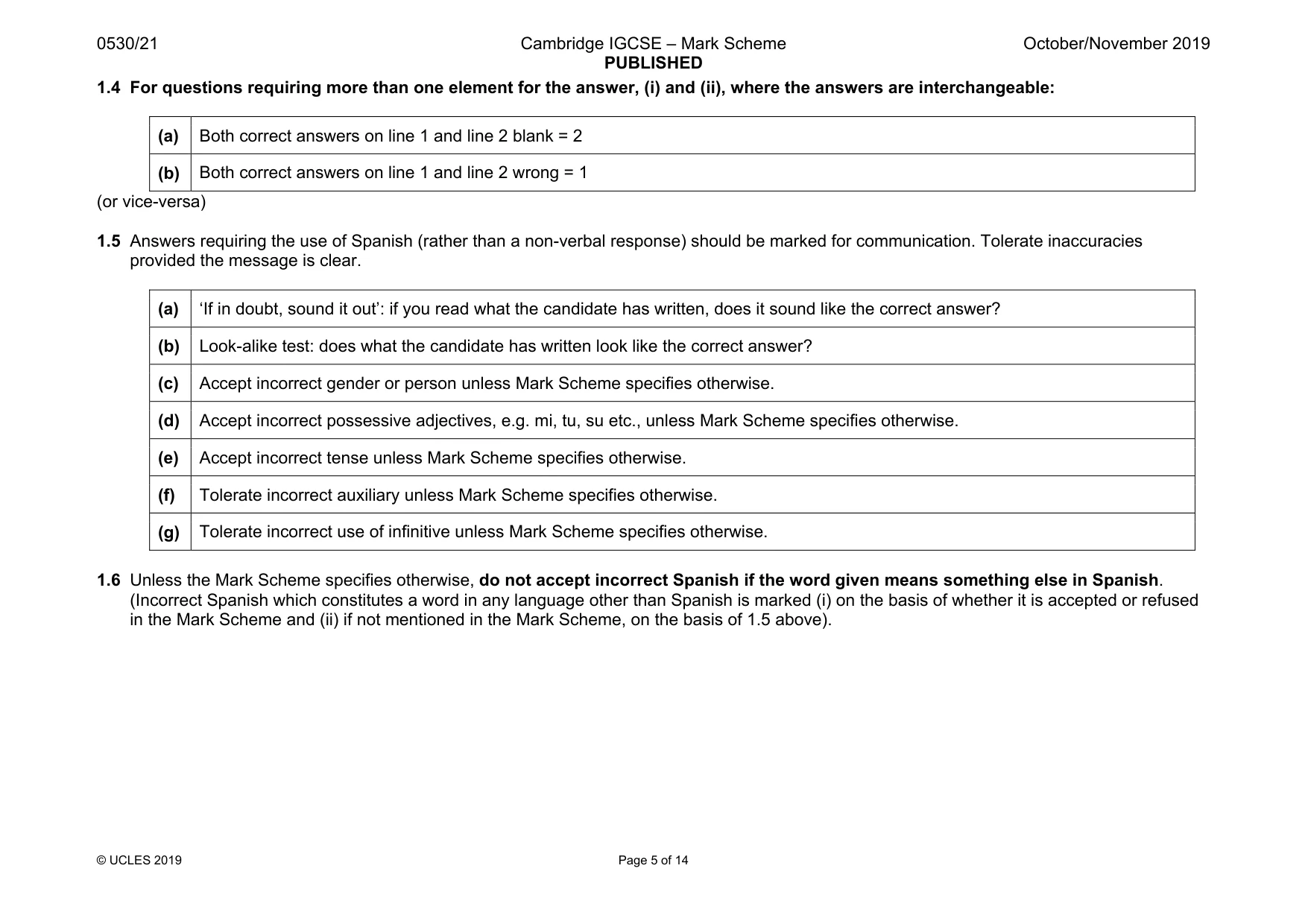
0530/21 Cambridge IGCSE – Mark Scheme PUBLISHED October/November 2019 © UCLES 2019 Page 5 of 14 1.4 For questions requiring more than one element for the answer, (i) and (ii), where the answers are interchangeable: (a) Both correct answers on line 1 and line 2 blank = 2 (b) Both correct answers on line 1 and line 2 wrong = 1 (or vice-versa) 1.5 Answers requiring the use of Spanish (rather than a non-verbal response) should be marked for communication. Tolerate inaccuracies provided the message is clear. (a) ‘If in doubt, sound it out’: if you read what the candidate has written, does it sound like the correct answer? (b) Look-alike test: does what the candidate has written look like the correct answer? (c) Accept incorrect gender or person unless Mark Scheme specifies otherwise. (d) Accept incorrect possessive adjectives, e.g. mi, tu, su etc., unless Mark Scheme specifies otherwise. (e) Accept incorrect tense unless Mark Scheme specifies otherwise. (f) Tolerate incorrect auxiliary unless Mark Scheme specifies otherwise. (g) Tolerate incorrect use of infinitive unless Mark Scheme specifies otherwise. 1.6 Unless the Mark Scheme specifies otherwise, do not accept incorrect Spanish if the word given means something else in Spanish. (Incorrect Spanish which constitutes a word in any language other than Spanish is marked (i) on the basis of whether it is accepted or refused in the Mark Scheme and (ii) if not mentioned in the Mark Scheme, on the basis of 1.5 above).
Mark scheme, page 6
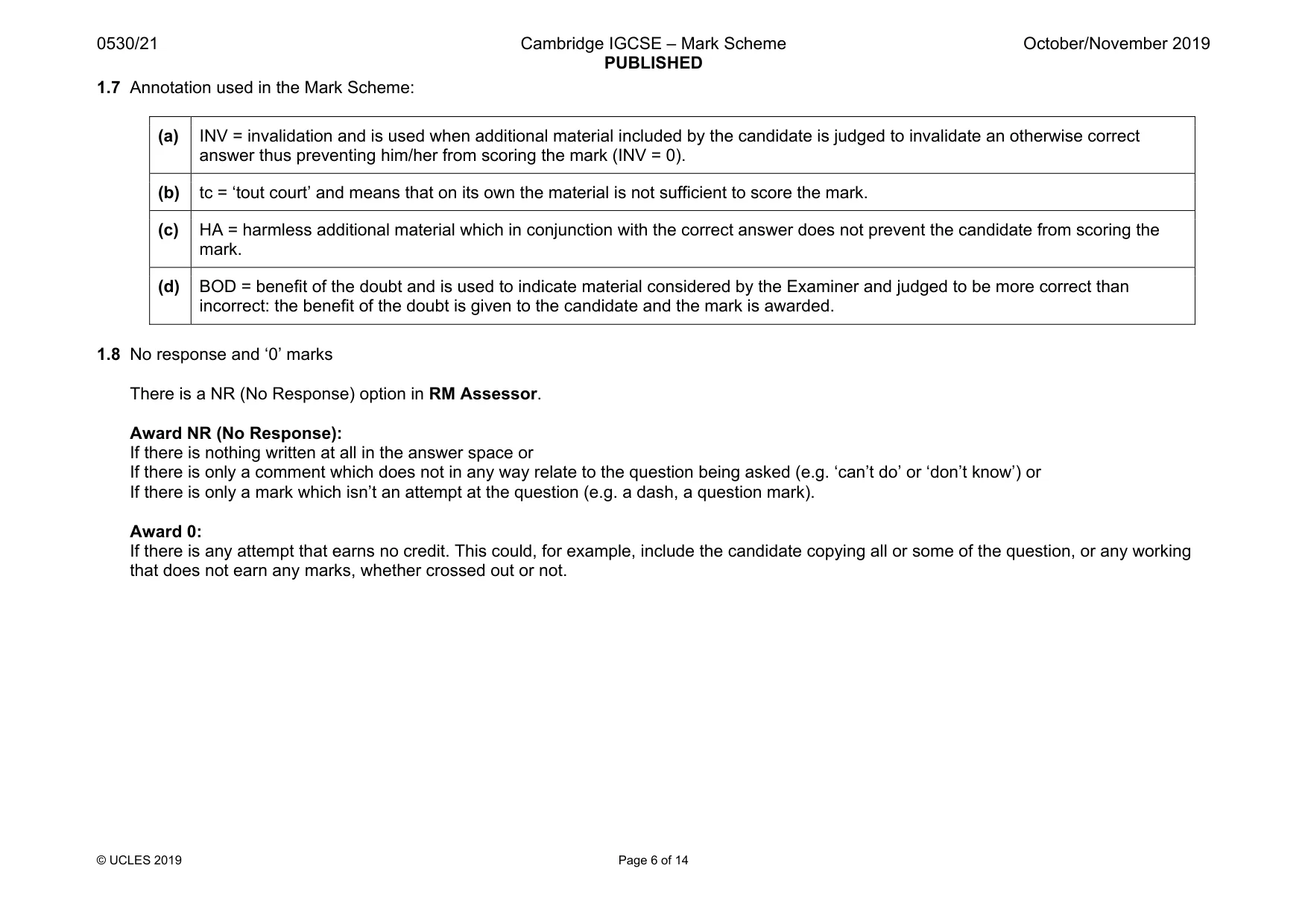
0530/21 Cambridge IGCSE – Mark Scheme PUBLISHED October/November 2019 © UCLES 2019 Page 6 of 14 1.7 Annotation used in the Mark Scheme: (a) INV = invalidation and is used when additional material included by the candidate is judged to invalidate an otherwise correct answer thus preventing him/her from scoring the mark (INV = 0). (b) tc = ‘tout court’ and means that on its own the material is not sufficient to score the mark. (c) HA = harmless additional material which in conjunction with the correct answer does not prevent the candidate from scoring the mark. (d) BOD = benefit of the doubt and is used to indicate material considered by the Examiner and judged to be more correct than incorrect: the benefit of the doubt is given to the candidate and the mark is awarded. 1.8 No response and ‘0’ marks There is a NR (No Response) option in RM Assessor. Award NR (No Response): If there is nothing written at all in the answer space or If there is only a comment which does not in any way relate to the question being asked (e.g. ‘can’t do’ or ‘don’t know’) or If there is only a mark which isn’t an attempt at the question (e.g. a dash, a question mark). Award 0: If there is any attempt that earns no credit. This could, for example, include the candidate copying all or some of the question, or any working that does not earn any marks, whether crossed out or not.
Mark scheme, page 7
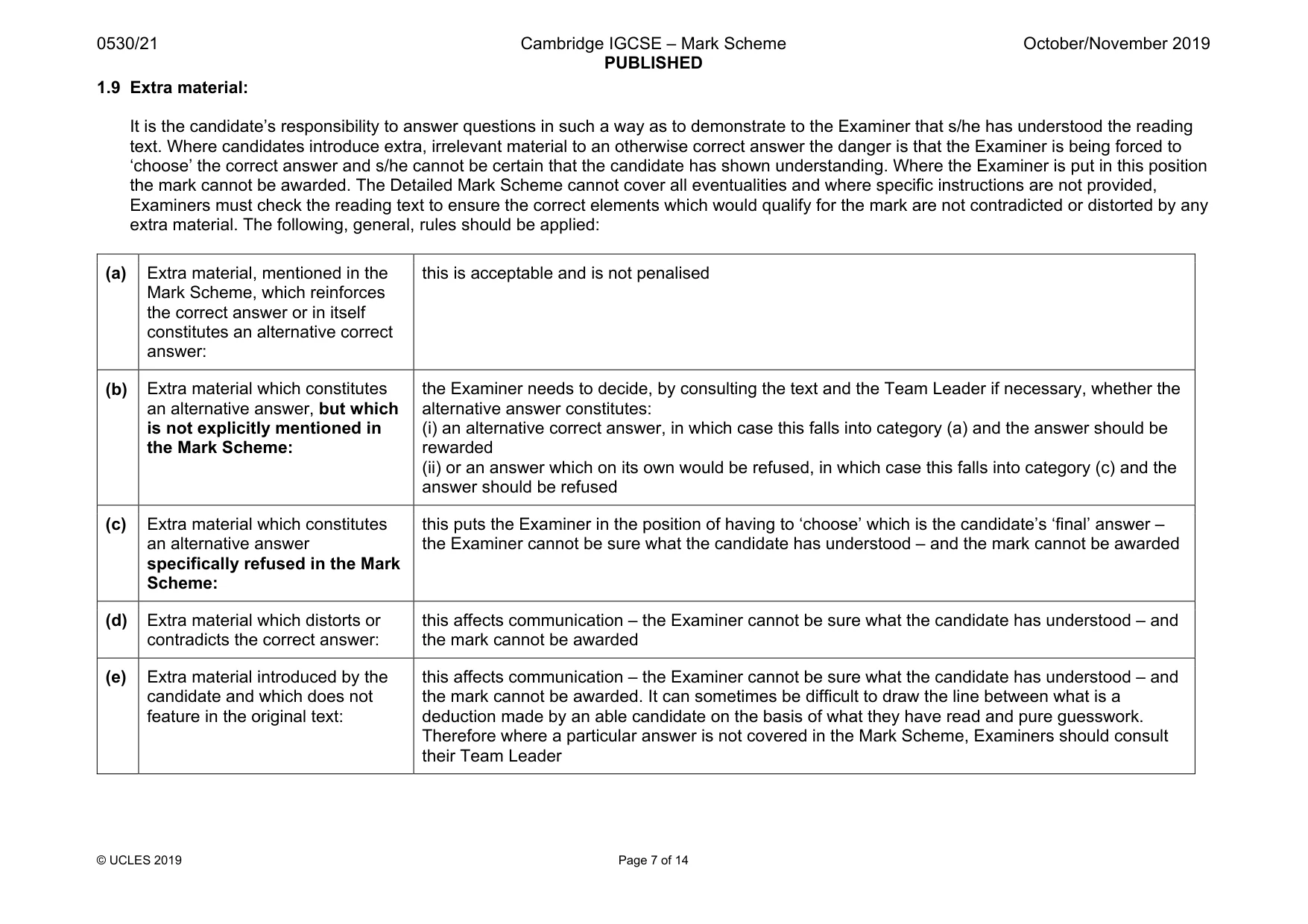
0530/21 Cambridge IGCSE – Mark Scheme PUBLISHED October/November 2019 © UCLES 2019 Page 7 of 14 1.9 Extra material: It is the candidate’s responsibility to answer questions in such a way as to demonstrate to the Examiner that s/he has understood the reading text. Where candidates introduce extra, irrelevant material to an otherwise correct answer the danger is that the Examiner is being forced to ‘choose’ the correct answer and s/he cannot be certain that the candidate has shown understanding. Where the Examiner is put in this position the mark cannot be awarded. The Detailed Mark Scheme cannot cover all eventualities and where specific instructions are not provided, Examiners must check the reading text to ensure the correct elements which would qualify for the mark are not contradicted or distorted by any extra material. The following, general, rules should be applied: (a) Extra material, mentioned in the Mark Scheme, which reinforces the correct answer or in itself constitutes an alternative correct answer: this is acceptable and is not penalised (b) Extra material which constitutes an alternative answer, but which is not explicitly mentioned in the Mark Scheme: the Examiner needs to decide, by consulting the text and the Team Leader if necessary, whether the alternative answer constitutes: (i) an alternative correct answer, in which case this falls into category (a) and the answer should be rewarded (ii) or an answer which on its own would be refused, in which case this falls into category (c) and the answer should be refused (c) Extra material which constitutes an alternative answer specifically refused in the Mark Scheme: this puts the Examiner in the position of having to ‘choose’ which is the candidate’s ‘final’ answer – the Examiner cannot be sure what the candidate has understood – and the mark cannot be awarded (d) Extra material which distorts or contradicts the correct answer: this affects communication – the Examiner cannot be sure what the candidate has understood – and the mark cannot be awarded (e) Extra material introduced by the candidate and which does not feature in the original text: this affects communication – the Examiner cannot be sure what the candidate has understood – and the mark cannot be awarded. It can sometimes be difficult to draw the line between what is a deduction made by an able candidate on the basis of what they have read and pure guesswork. Therefore where a particular answer is not covered in the Mark Scheme, Examiners should consult their Team Leader
Mark scheme, page 8
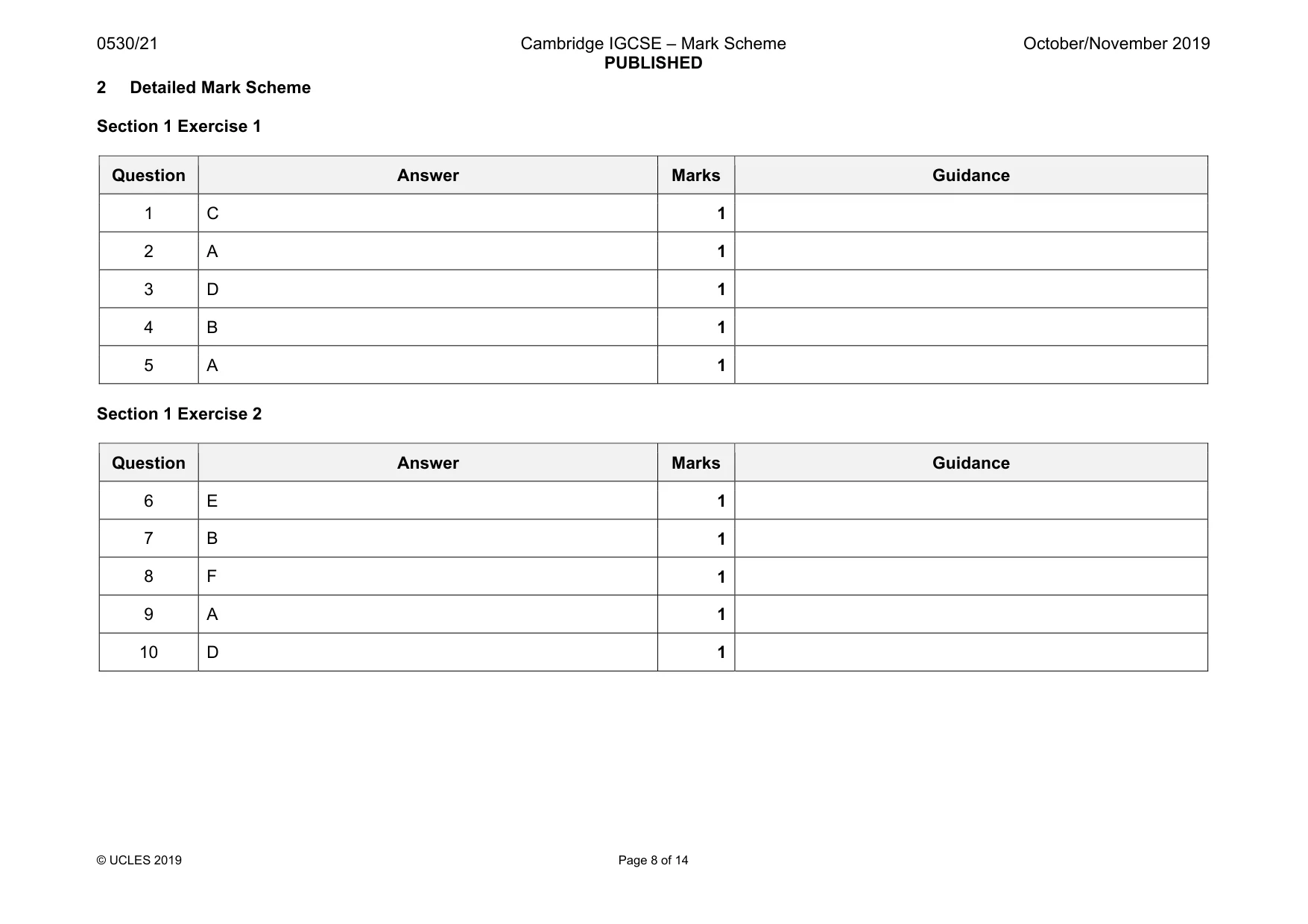
0530/21 Cambridge IGCSE – Mark Scheme PUBLISHED October/November 2019 © UCLES 2019 Page 8 of 14 2 Detailed Mark Scheme Section 1 Exercise 1 Question Answer Marks Guidance 1 C 1 2 A 1 3 D 1 4 B 1 5 A 1 Section 1 Exercise 2 Question Answer Marks Guidance 6 E 1 7 B 1 8 F 1 9 A 1 10 D 1
Mark scheme, page 9
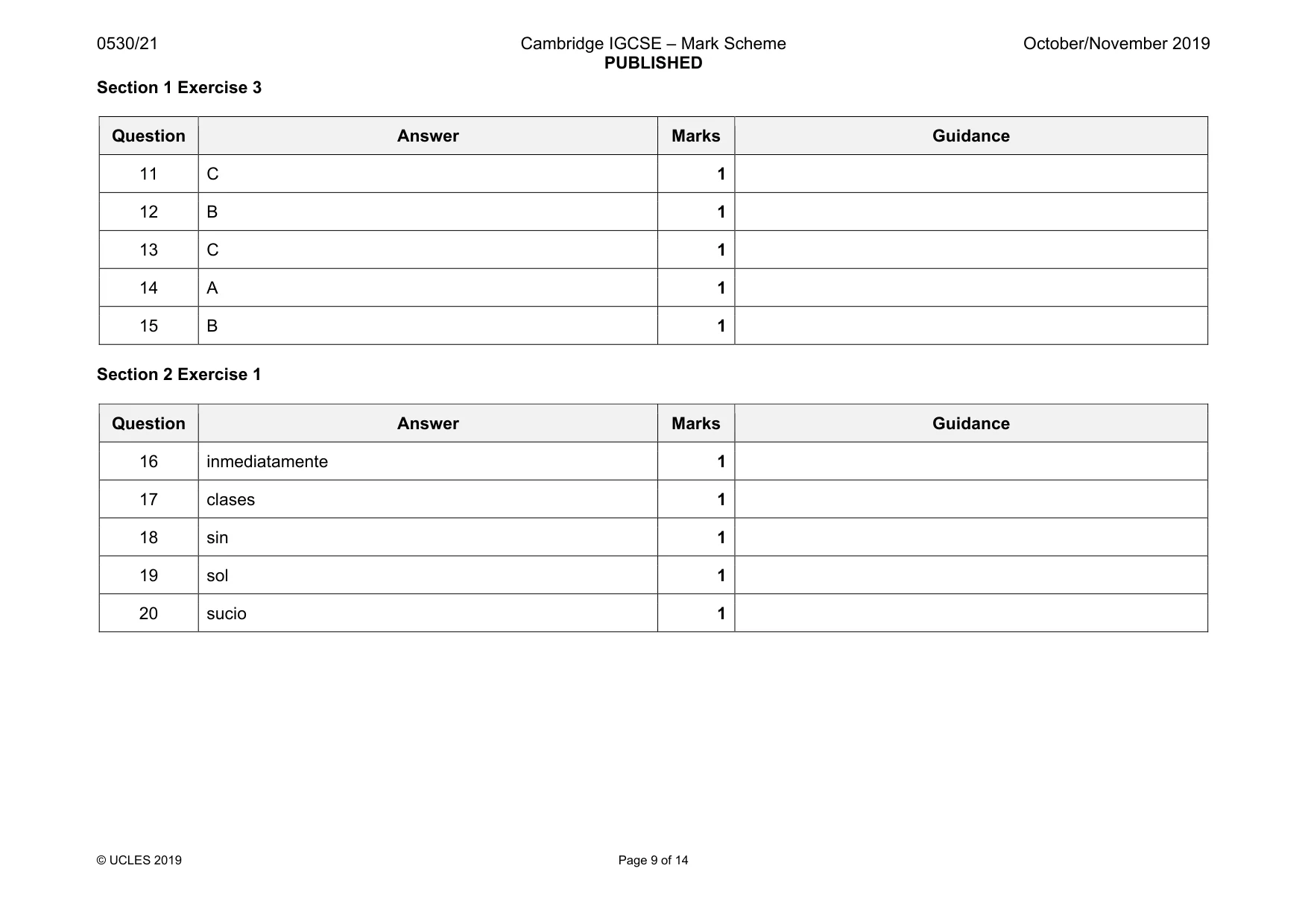
0530/21 Cambridge IGCSE – Mark Scheme PUBLISHED October/November 2019 © UCLES 2019 Page 9 of 14 Section 1 Exercise 3 Question Answer Marks Guidance 11 C 1 12 B 1 13 C 1 14 A 1 15 B 1 Section 2 Exercise 1 Question Answer Marks Guidance 16 inmediatamente 1 17 clases 1 18 sin 1 19 sol 1 20 sucio 1
Mark scheme, page 10
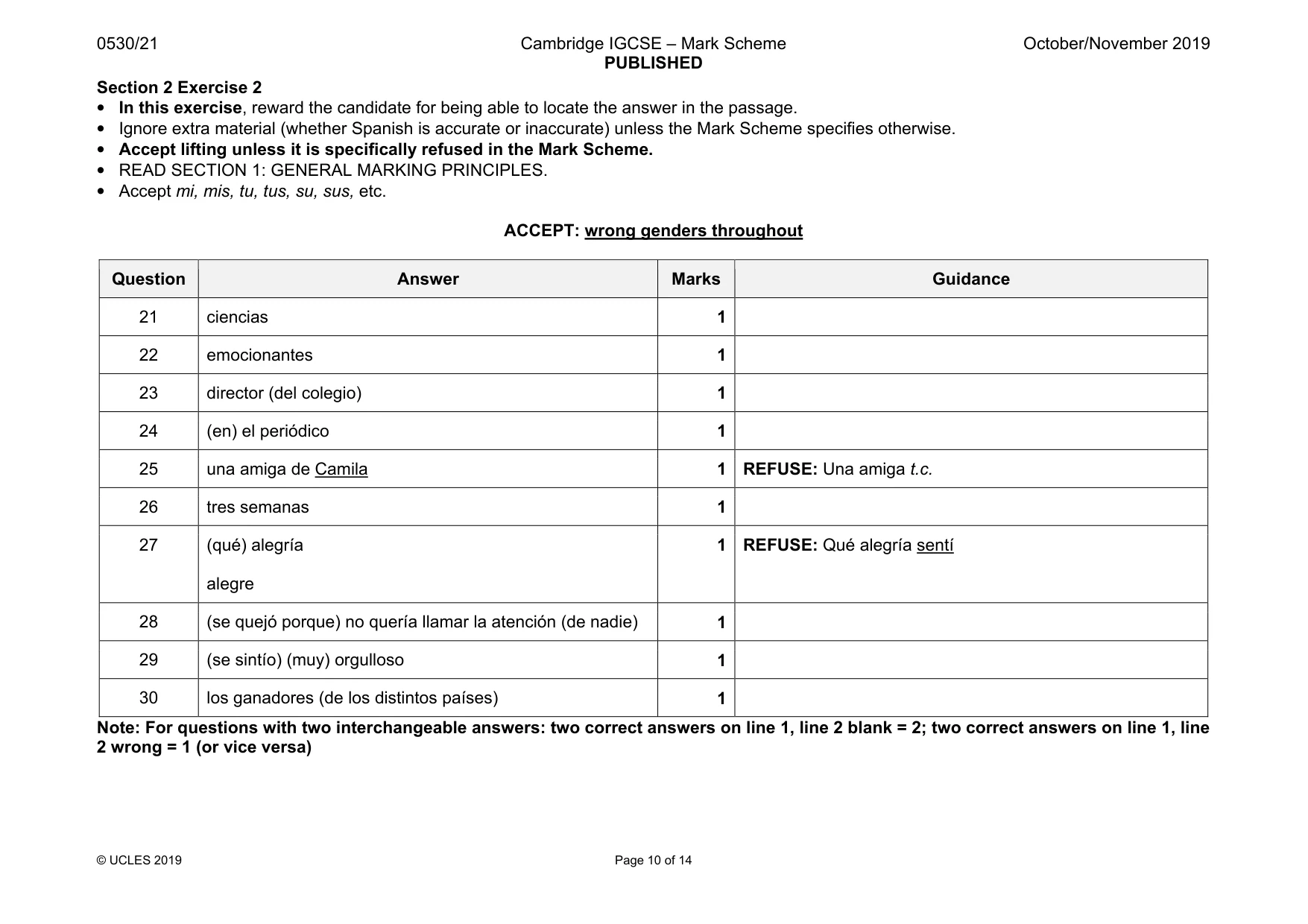
0530/21 Cambridge IGCSE – Mark Scheme PUBLISHED October/November 2019 © UCLES 2019 Page 10 of 14 Section 2 Exercise 2 • In this exercise, reward the candidate for being able to locate the answer in the passage. • Ignore extra material (whether Spanish is accurate or inaccurate) unless the Mark Scheme specifies otherwise. • Accept lifting unless it is specifically refused in the Mark Scheme. • READ SECTION 1: GENERAL MARKING PRINCIPLES. • Accept mi, mis, tu, tus, su, sus, etc. ACCEPT: wrong genders throughout Question Answer Marks Guidance 21 ciencias 1 22 emocionantes 1 23 director (del colegio) 1 24 (en) el periódico 1 25 una amiga de Camila 1 REFUSE: Una amiga t.c. 26 tres semanas 1 27 (qué) alegría alegre 1 REFUSE: Qué alegría sentí 28 (se quejó porque) no quería llamar la atención (de nadie) 1 29 (se sintío) (muy) orgulloso 1 30 los ganadores (de los distintos países) 1 Note: For questions with two interchangeable answers: two correct answers on line 1, line 2 blank = 2; two correct answers on line 1, line 2 wrong = 1 (or vice versa)
Mark scheme, page 11
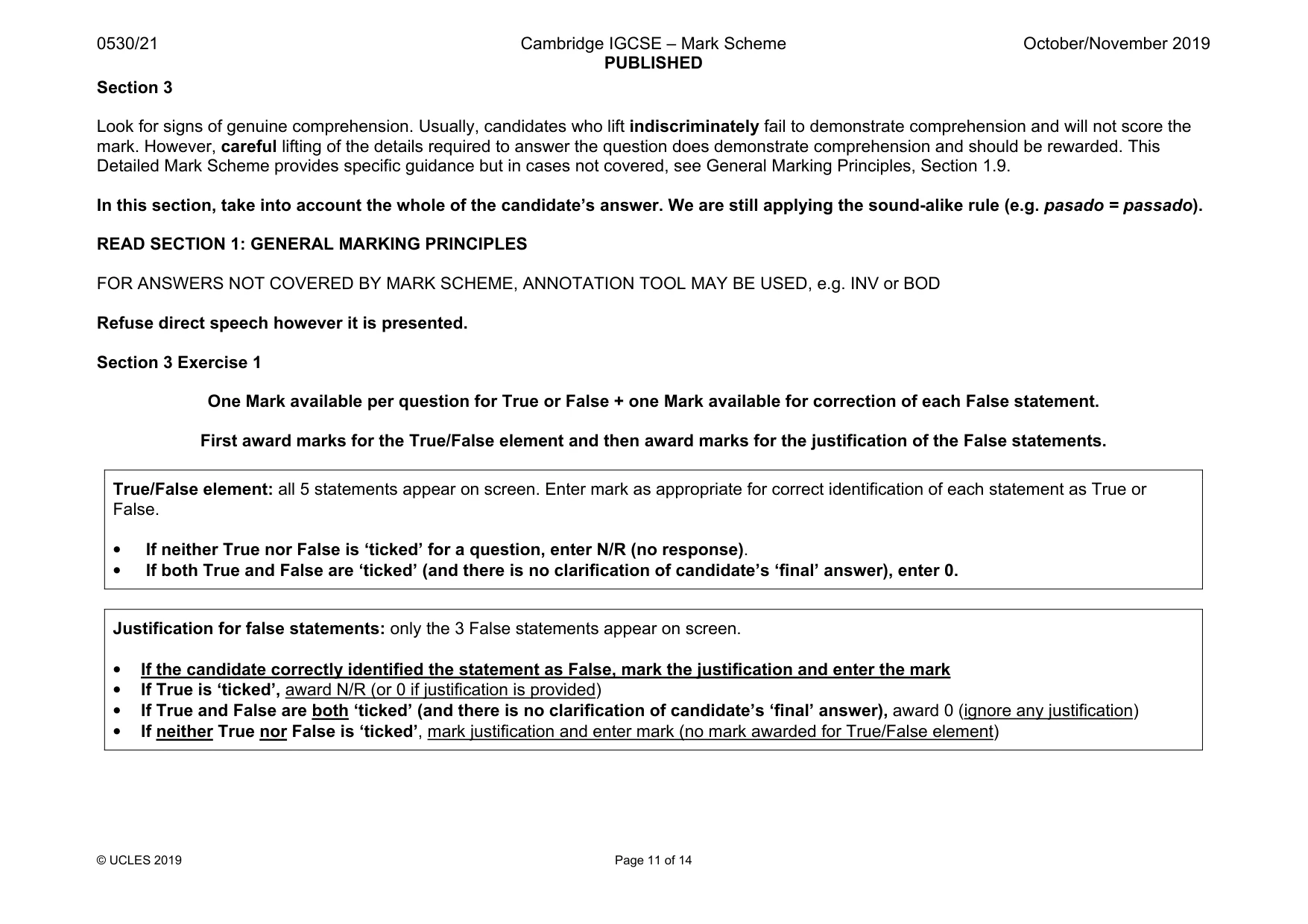
0530/21 Cambridge IGCSE – Mark Scheme PUBLISHED October/November 2019 © UCLES 2019 Page 11 of 14 Section 3 Look for signs of genuine comprehension. Usually, candidates who lift indiscriminately fail to demonstrate comprehension and will not score the mark. However, careful lifting of the details required to answer the question does demonstrate comprehension and should be rewarded. This Detailed Mark Scheme provides specific guidance but in cases not covered, see General Marking Principles, Section 1.9. In this section, take into account the whole of the candidate’s answer. We are still applying the sound-alike rule (e.g. pasado = passado). READ SECTION 1: GENERAL MARKING PRINCIPLES FOR ANSWERS NOT COVERED BY MARK SCHEME, ANNOTATION TOOL MAY BE USED, e.g. INV or BOD Refuse direct speech however it is presented. Section 3 Exercise 1 One Mark available per question for True or False + one Mark available for correction of each False statement. First award marks for the True/False element and then award marks for the justification of the False statements. True/False element: all 5 statements appear on screen. Enter mark as appropriate for correct identification of each statement as True or False. • If neither True nor False is ‘ticked’ for a question, enter N/R (no response). • If both True and False are ‘ticked’ (and there is no clarification of candidate’s ‘final’ answer), enter 0. Justification for false statements: only the 3 False statements appear on screen. • If the candidate correctly identified the statement as False, mark the justification and enter the mark • If True is ‘ticked’, award N/R (or 0 if justification is provided) • If True and False are both ‘ticked’ (and there is no clarification of candidate’s ‘final’ answer), award 0 (ignore any justification) • If neither True nor False is ‘ticked’, mark justification and enter mark (no mark awarded for True/False element)
Mark scheme, page 12
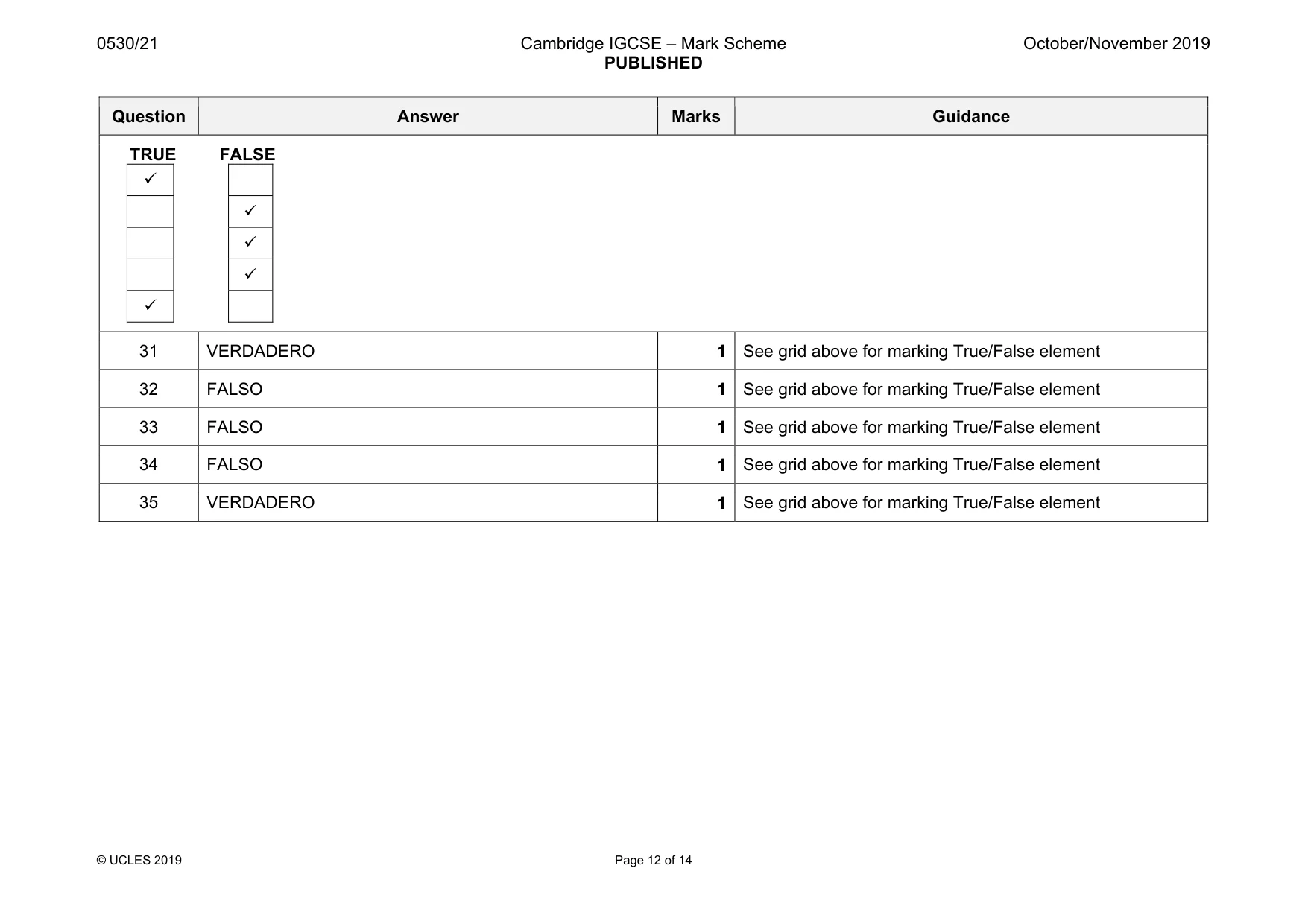
0530/21 Cambridge IGCSE – Mark Scheme PUBLISHED October/November 2019 © UCLES 2019 Page 12 of 14 Question Answer Marks Guidance TRUE FALSE 9 9 9 9 9 31 VERDADERO 1 See grid above for marking True/False element 32 FALSO 1 See grid above for marking True/False element 33 FALSO 1 See grid above for marking True/False element 34 FALSO 1 See grid above for marking True/False element 35 VERDADERO 1 See grid above for marking True/False element
Mark scheme, page 13
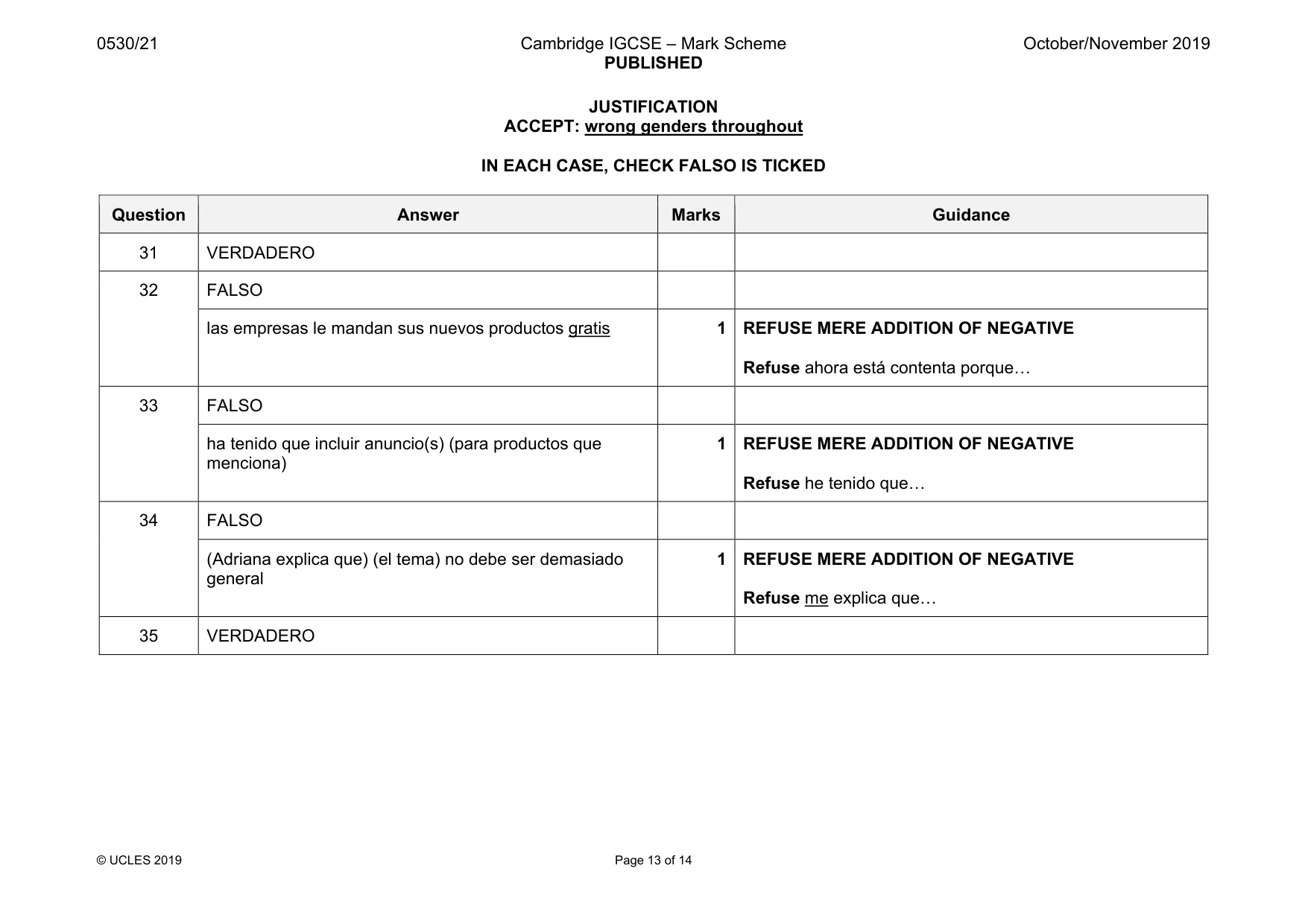
0530/21 Cambridge IGCSE – Mark Scheme PUBLISHED October/November 2019 © UCLES 2019 Page 13 of 14 JUSTIFICATION ACCEPT: wrong genders throughout IN EACH CASE, CHECK FALSO IS TICKED Question Answer Marks Guidance 31 VERDADERO 32 FALSO las empresas le mandan sus nuevos productos gratis 1 REFUSE MERE ADDITION OF NEGATIVE Refuse ahora está contenta porque« 33 FALSO ha tenido que incluir anuncio(s) (para productos que menciona) 1 REFUSE MERE ADDITION OF NEGATIVE Refuse he tenido que« 34 FALSO (Adriana explica que) (el tema) no debe ser demasiado general 1 REFUSE MERE ADDITION OF NEGATIVE Refuse me explica que« 35 VERDADERO
Mark scheme, page 14
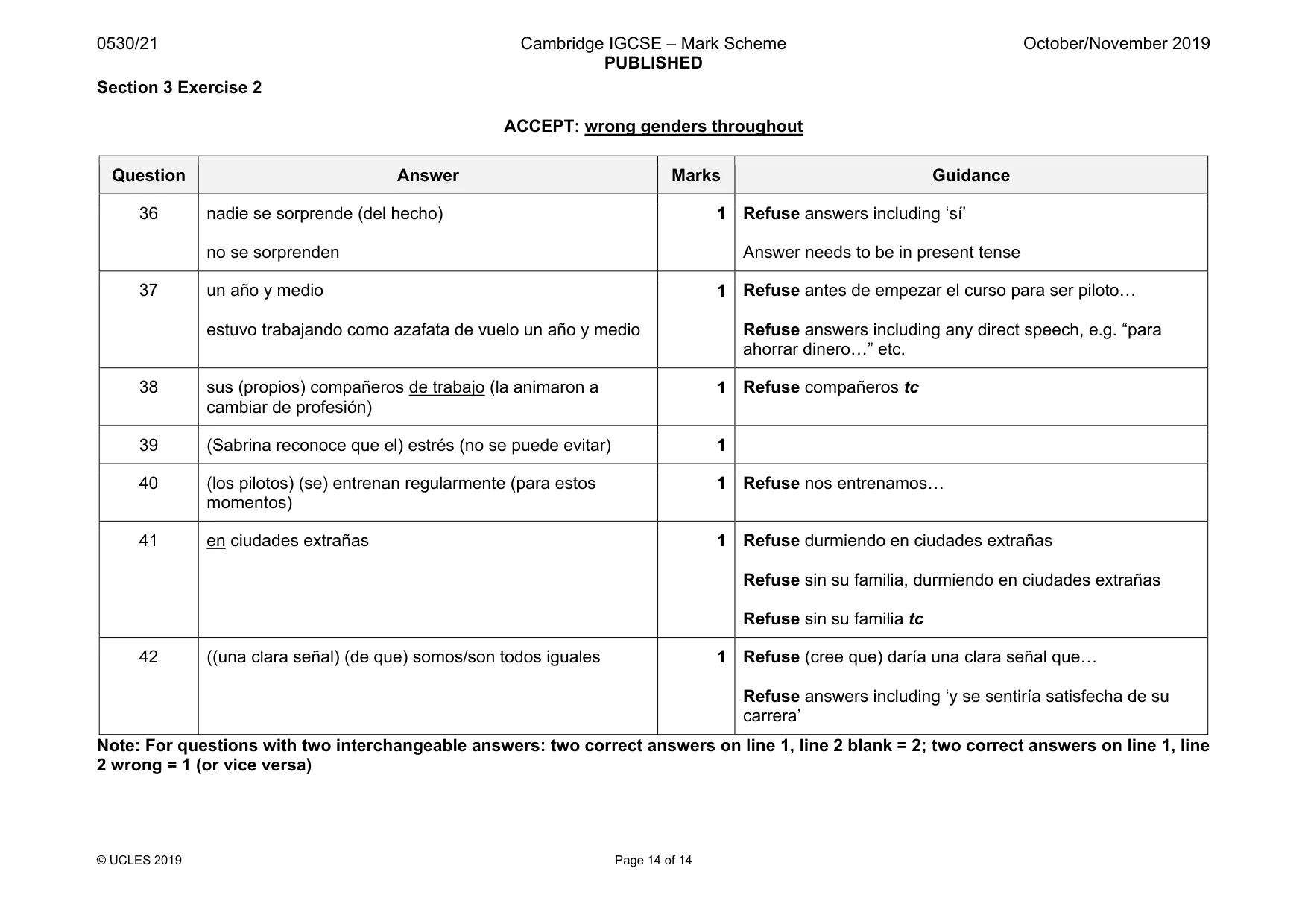
0530/21 Cambridge IGCSE – Mark Scheme PUBLISHED October/November 2019 © UCLES 2019 Page 14 of 14 Section 3 Exercise 2 ACCEPT: wrong genders throughout Question Answer Marks Guidance 36 nadie se sorprende (del hecho) no se sorprenden 1 Refuse answers including ‘sí’ Answer needs to be in present tense 37 un año y medio estuvo trabajando como azafata de vuelo un año y medio 1 Refuse antes de empezar el curso para ser piloto« Refuse answers including any direct speech, e.g. “para ahorrar dinero«” etc. 38 sus (propios) compañeros de trabajo (la animaron a cambiar de profesión) 1 Refuse compañeros tc 39 (Sabrina reconoce que el) estrés (no se puede evitar) 1 40 (los pilotos) (se) entrenan regularmente (para estos momentos) 1 Refuse nos entrenamos« 41 en ciudades extrañas 1 Refuse durmiendo en ciudades extrañas Refuse sin su familia, durmiendo en ciudades extrañas Refuse sin su familia tc 42 ((una clara señal) (de que) somos/son todos iguales 1 Refuse (cree que) daría una clara señal que« Refuse answers including ‘y se sentiría satisfecha de su carrera’ Note: For questions with two interchangeable answers: two correct answers on line 1, line 2 blank = 2; two correct answers on line 1, line 2 wrong = 1 (or vice versa)
What you needed in this session
Cambridge’s own grade thresholds for 2019 Oct/Nov, Paper 2 · Variant 1. A higher threshold means an easier paper — the bar moves with how the cohort did.