Cambridge IGCSE Spanish - Foreign Language 0530 — 2010 Oct/Nov Paper 2 · Variant 3
0530/23/O/N/10 · 65 marks · ≈73 min
The question paper and its mark scheme, free to read here and free to download. This is Cambridge’s own paper, exactly as it was sat.
Question paper16 pages


Mark scheme11 pages
Answers below. Sit the paper first if you are practising.
Paper as text
Question paper, page 1
This document consists of 13 printed pages and 3 blank pages. DC (LEO/SW) 25497/5 © UCLES 2010 [Turn over UNIVERSITY OF CAMBRIDGE INTERNATIONAL EXAMINATIONS International General Certificate of Secondary Education * 6 4 4 9 5 4 5 7 6 8 * SPANISH 0530/23 Paper 2 Reading and Directed Writing October/November 2010 1 hour 30 minutes Candidates answer on the Question Paper. No Additional Materials are required. READ THESE INSTRUCTIONS FIRST Write your Centre number, candidate number and name on all the work you hand in. Write in dark blue or black pen. Do not use staples, paper clips, highlighters, glue or correction fluid. DO NOT WRITE IN ANY BARCODES. Answer all questions in Section 1, Section 2 and Section 3. At the end of the examination, fasten all your work securely together. The number of marks is given in brackets [ ] at the end of each question or part question. For Examiner’s Use Section 1 Section 2 Section 3 Total www.theallpapers.com
Question paper, page 2
2 0530/23/O/N/10 © UCLES 2010 BLANK PAGE www.theallpapers.com
Question paper, page 3
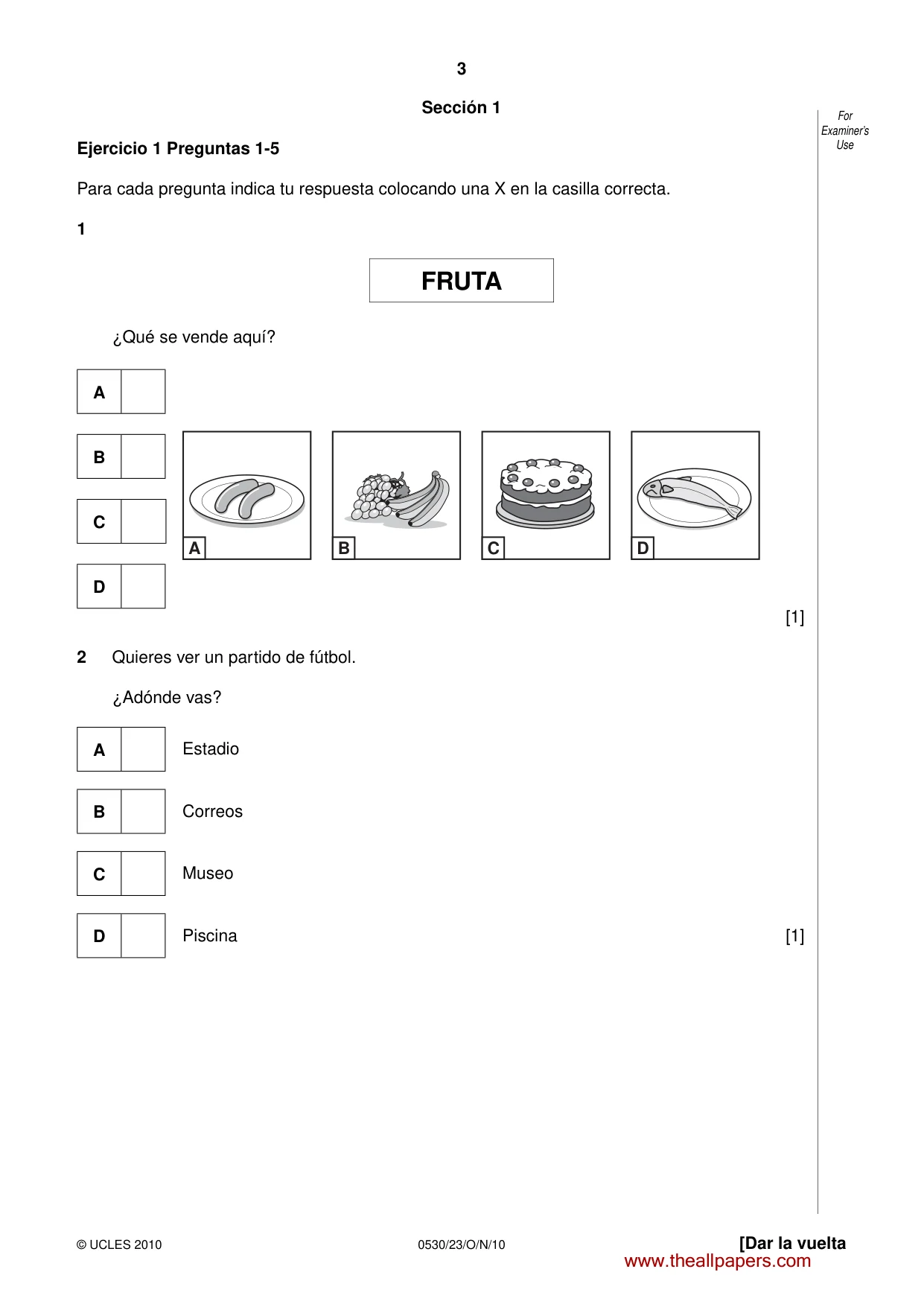
3 0530/23/O/N/10 © UCLES 2010 [Dar la vuelta For Examiner’s Use Sección 1 Ejercicio 1 Preguntas 1-5 Para cada pregunta indica tu respuesta colocando una X en la casilla correcta. 1 FRUTA ¿Qué se vende aquí? A B A B C D C D [1] 2 Quieres ver un partido de fútbol. ¿Adónde vas? A Estadio B Correos C Museo D Piscina [1] www.theallpapers.com
Question paper, page 4
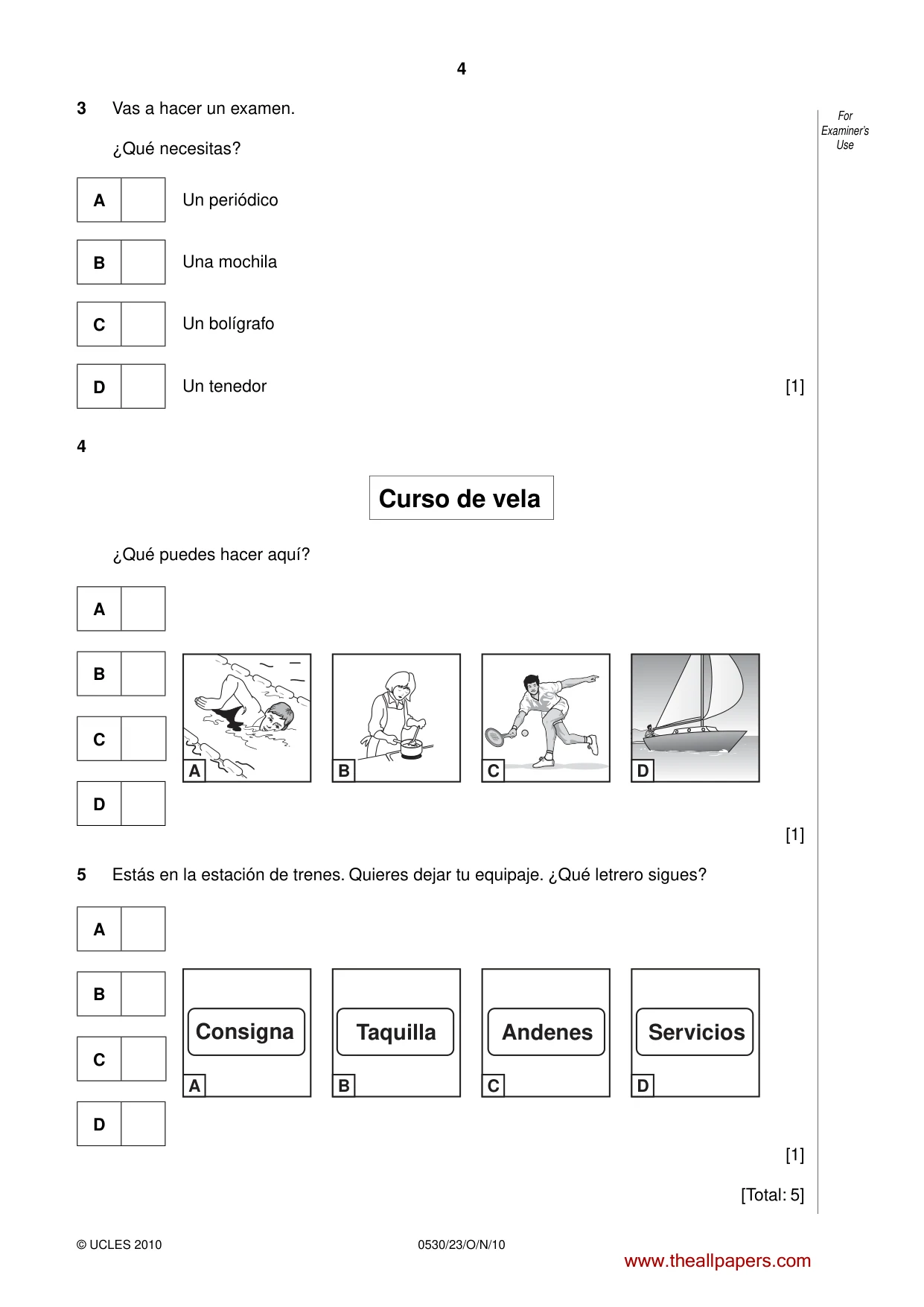
4 0530/23/O/N/10 © UCLES 2010 For Examiner’s Use 3 Vas a hacer un examen. ¿Qué necesitas? A Un periódico B Una mochila C Un bolígrafo D Un tenedor [1] 4 Curso de vela ¿Qué puedes hacer aquí? A B A B C D C D [1] 5 Estás en la estación de trenes. Quieres dejar tu equipaje. ¿Qué letrero sigues? A B Consigna Taquilla Andenes Servicios A B C D C D [1] [Total: 5] www.theallpapers.com
Question paper, page 5
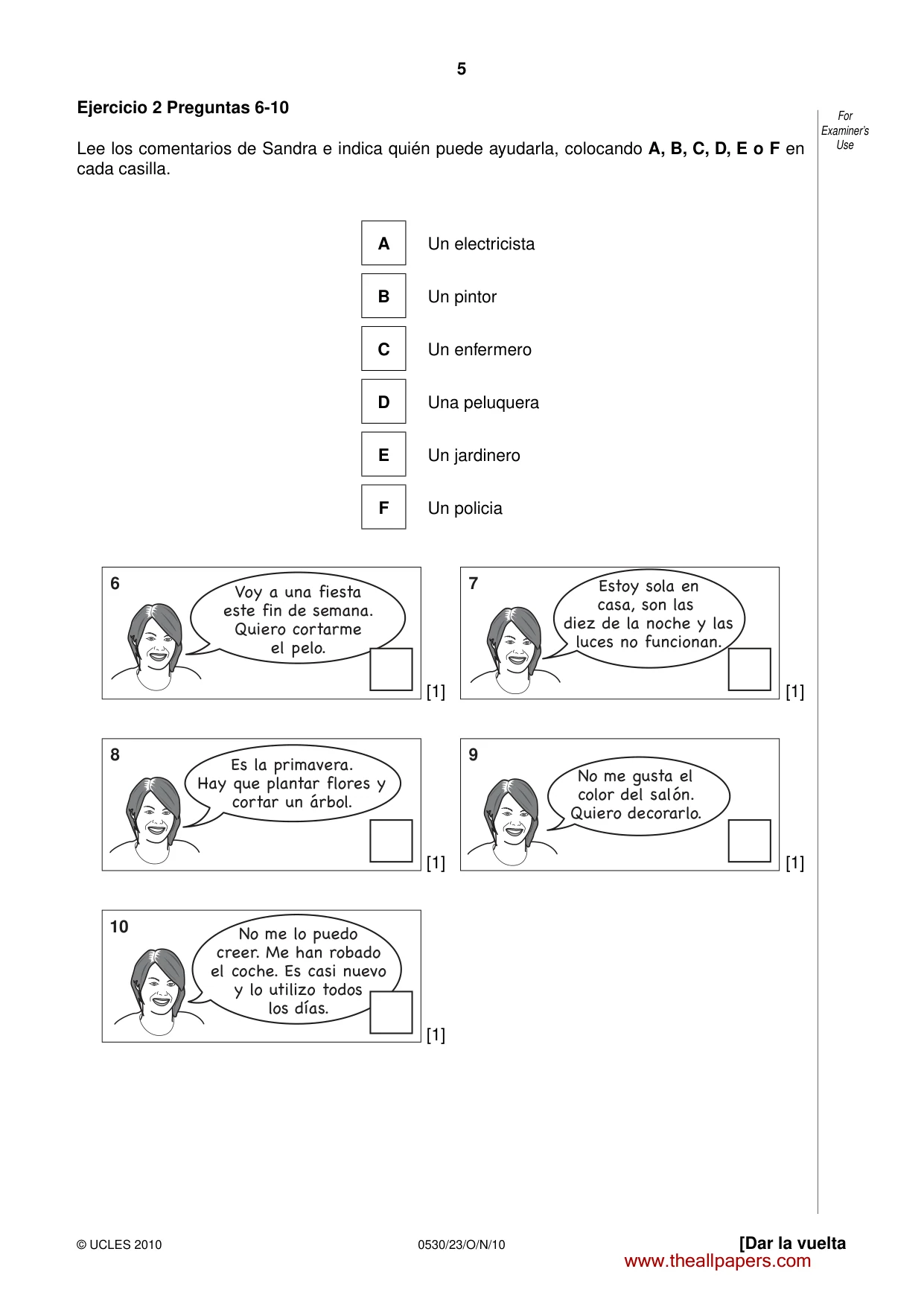
5 0530/23/O/N/10 © UCLES 2010 [Dar la vuelta For Examiner’s Use Ejercicio 2 Preguntas 6-10 Lee los comentarios de Sandra e indica quién puede ayudarla, colocando A, B, C, D, E o F en cada casilla. A Un electricista B Un pintor C Un enfermero D Una peluquera E Un jardinero F Un policia Voy a una fiesta este fin de semana. Quiero cortarme el pelo. Estoy sola en casa, son las diez de la noche y las luces no funcionan. Es la primavera. Hay que plantar flores y cortar un árbol. No me gusta el color del salón. Quiero decorarlo. No me lo puedo creer. Me han robado el coche. Es casi nuevo y lo utilizo todos los días. 6 7 8 9 10 [1] [1] [1] [1] [1] www.theallpapers.com
Question paper, page 6
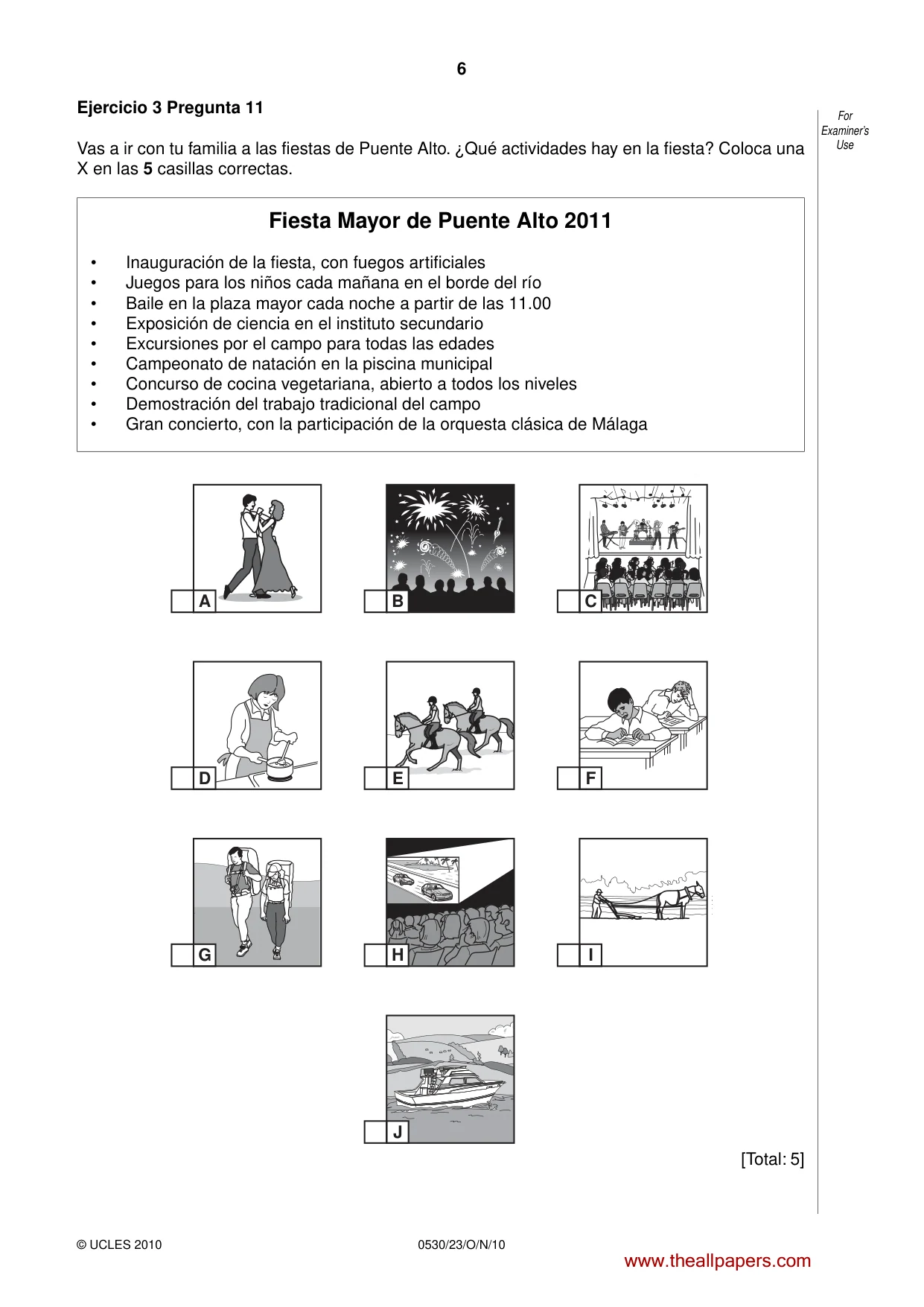
6 0530/23/O/N/10 © UCLES 2010 For Examiner’s Use Ejercicio 3 Pregunta 11 Vas a ir con tu familia a las fiestas de Puente Alto. ¿Qué actividades hay en la fiesta? Coloca una X en las 5 casillas correctas. Fiesta Mayor de Puente Alto 2011 • Inauguración de la fiesta, con fuegos artificiales • Juegos para los niños cada mañana en el borde del río • Baile en la plaza mayor cada noche a partir de las 11.00 • Exposición de ciencia en el instituto secundario • Excursiones por el campo para todas las edades • Campeonato de natación en la piscina municipal • Concurso de cocina vegetariana, abierto a todos los niveles • Demostración del trabajo tradicional del campo • Gran concierto, con la participación de la orquesta clásica de Málaga A B C D E F G H I J [Total: 5] www.theallpapers.com
Question paper, page 7
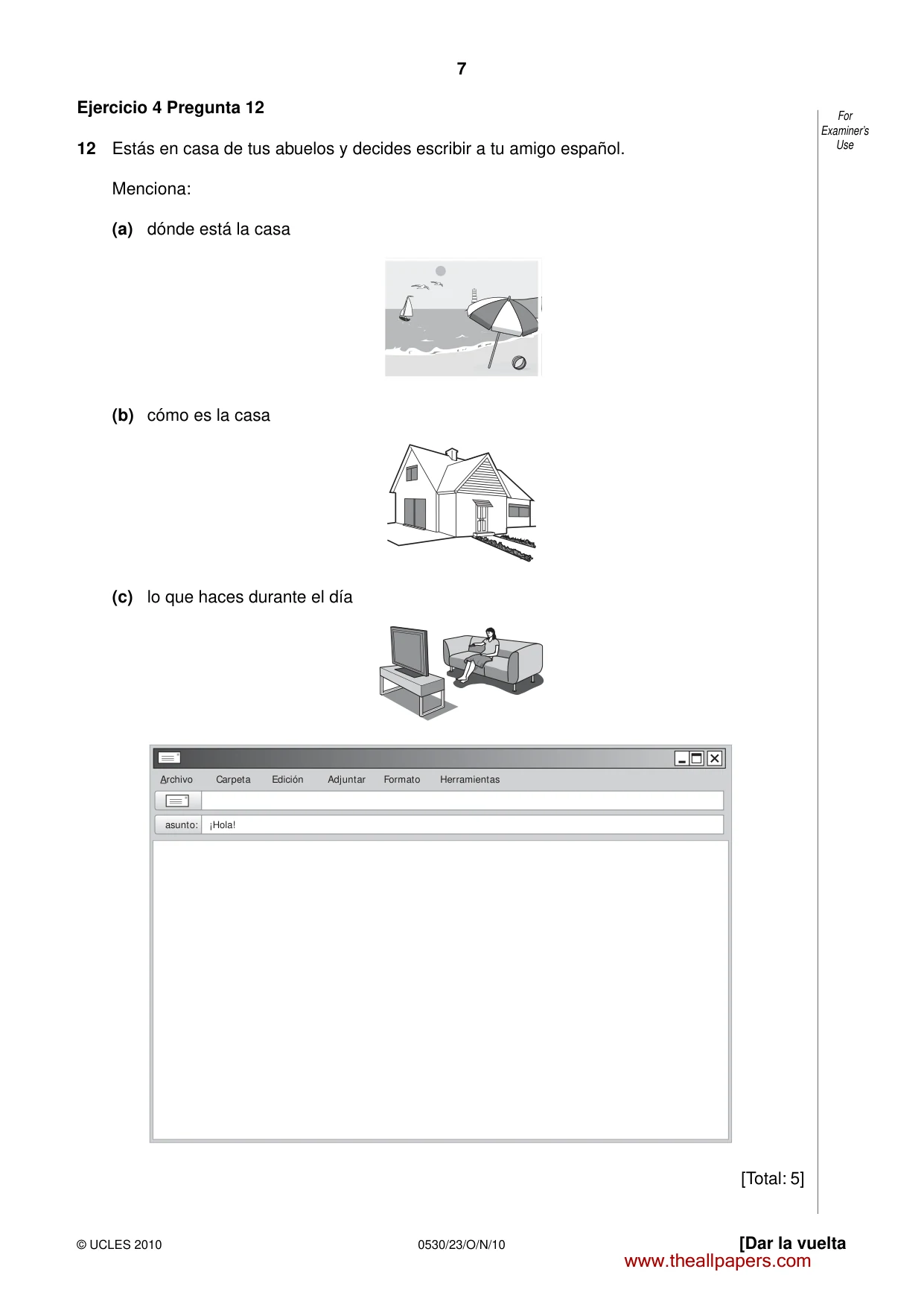
7 0530/23/O/N/10 © UCLES 2010 [Dar la vuelta For Examiner’s Use Ejercicio 4 Pregunta 12 12 Estás en casa de tus abuelos y decides escribir a tu amigo español. Menciona: (a) dónde está la casa (b) cómo es la casa (c) lo que haces durante el día asunto: ¡Hola! Archivo Carpeta Edición Adjuntar Formato Herramientas [Total: 5] www.theallpapers.com
Question paper, page 8
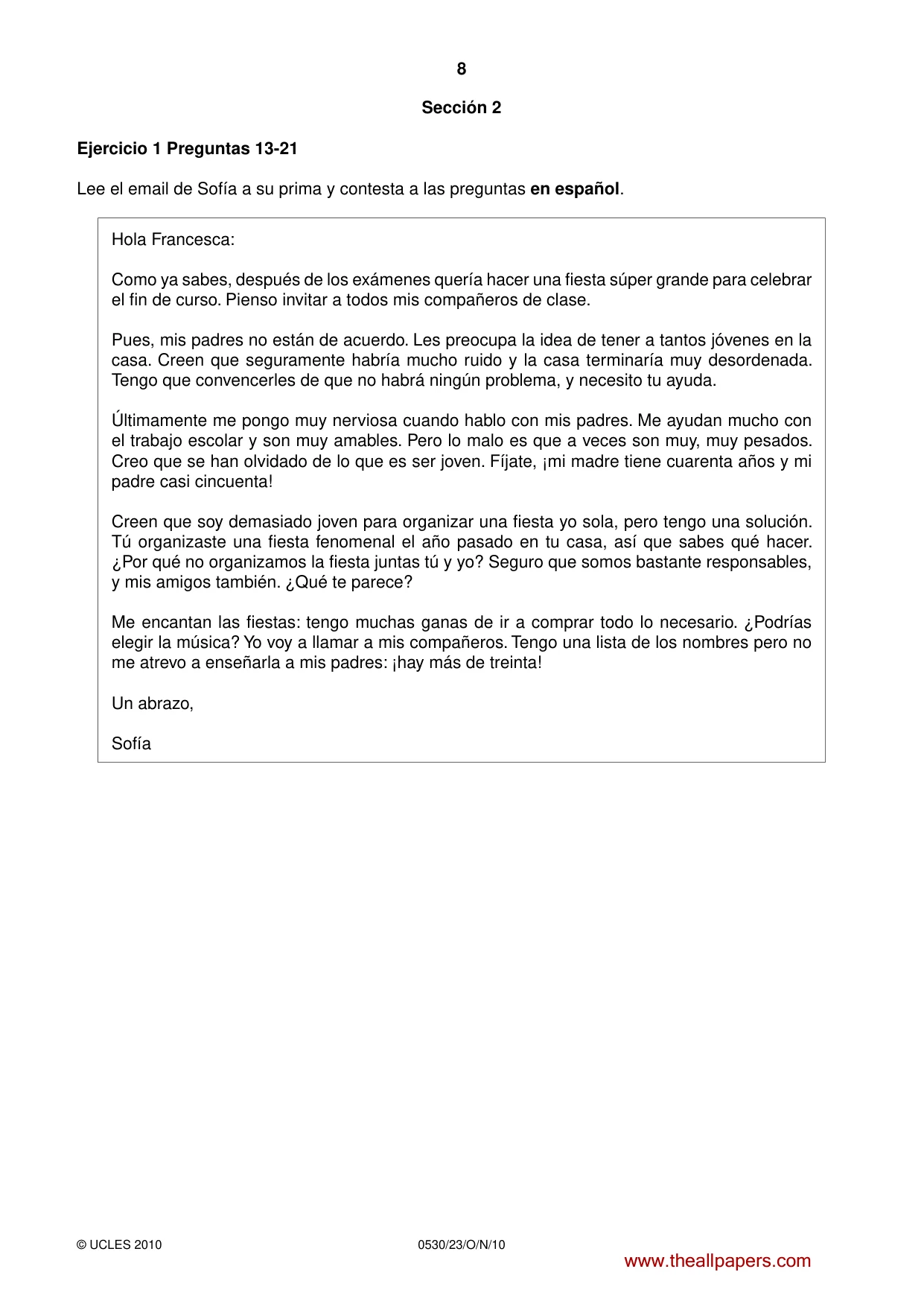
8 0530/23/O/N/10 © UCLES 2010 Sección 2 Ejercicio 1 Preguntas 13-21 Lee el email de Sofía a su prima y contesta a las preguntas en español. Hola Francesca: Como ya sabes, después de los exámenes quería hacer una fiesta súper grande para celebrar el fin de curso. Pienso invitar a todos mis compañeros de clase. Pues, mis padres no están de acuerdo. Les preocupa la idea de tener a tantos jóvenes en la casa. Creen que seguramente habría mucho ruido y la casa terminaría muy desordenada. Tengo que convencerles de que no habrá ningún problema, y necesito tu ayuda. Últimamente me pongo muy nerviosa cuando hablo con mis padres. Me ayudan mucho con el trabajo escolar y son muy amables. Pero lo malo es que a veces son muy, muy pesados. Creo que se han olvidado de lo que es ser joven. Fíjate, ¡mi madre tiene cuarenta años y mi padre casi cincuenta! Creen que soy demasiado joven para organizar una fiesta yo sola, pero tengo una solución. Tú organizaste una fiesta fenomenal el año pasado en tu casa, así que sabes qué hacer. ¿Por qué no organizamos la fiesta juntas tú y yo? Seguro que somos bastante responsables, y mis amigos también. ¿Qué te parece? Me encantan las fiestas: tengo muchas ganas de ir a comprar todo lo necesario. ¿Podrías elegir la música? Yo voy a llamar a mis compañeros. Tengo una lista de los nombres pero no me atrevo a enseñarla a mis padres: ¡hay más de treinta! Un abrazo, Sofía www.theallpapers.com
Question paper, page 9
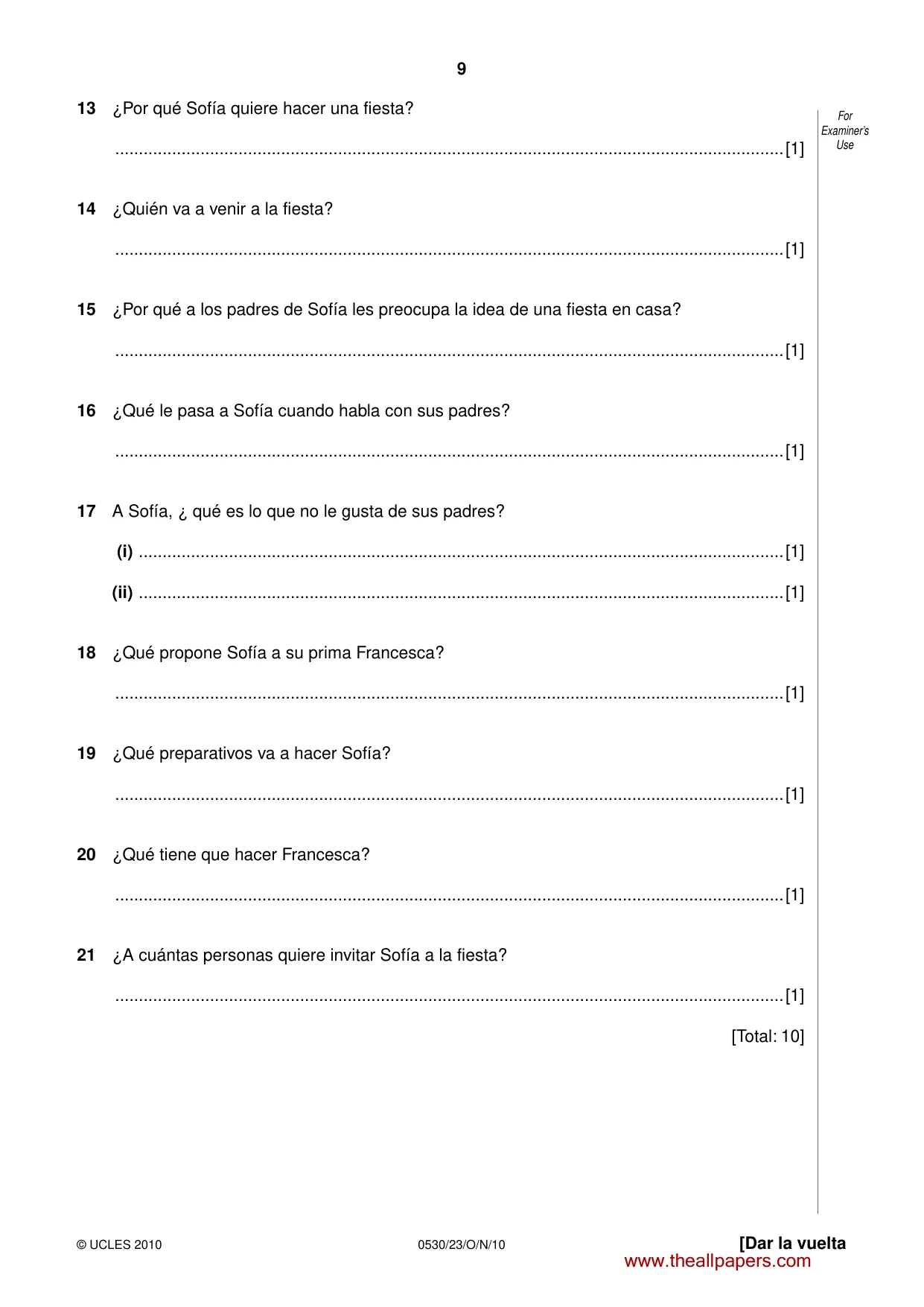
9 0530/23/O/N/10 © UCLES 2010 [Dar la vuelta For Examiner’s Use 13 ¿Por qué Sofía quiere hacer una fiesta? …[1] 14 ¿Quién va a venir a la fiesta? …[1] 15 ¿Por qué a los padres de Sofía les preocupa la idea de una fiesta en casa? …[1] 16 ¿Qué le pasa a Sofía cuando habla con sus padres? …[1] 17 A Sofía, ¿ qué es lo que no le gusta de sus padres? (i) …[1] (ii) …[1] 18 ¿Qué propone Sofía a su prima Francesca? …[1] 19 ¿Qué preparativos va a hacer Sofía? …[1] 20 ¿Qué tiene que hacer Francesca? …[1] 21 ¿A cuántas personas quiere invitar Sofía a la fiesta? …[1] [Total: 10] www.theallpapers.com
Question paper, page 10
10 0530/23/O/N/10 © UCLES 2010 For Examiner’s Use Ejercicio 2 Pregunta 22 22 Pasaste el verano trabajando en un hotel. Escribe una carta a tu amigo/amiga. (a) Describe el hotel. (b) Describe el trabajo. (c) Explica por qué te gustó o no te gustó. (d) Explica lo que te gustaría hacer como trabajo en el futuro. Debes escribir 80-100 palabras en español. … … … … … … … … … … … … … … [Total: 15] www.theallpapers.com
Question paper, page 11
11 0530/23/O/N/10 © UCLES 2010 [Dar la vuelta BLANK PAGE DAR LA VUELTA PARA LA SECCIÓN 3. www.theallpapers.com
Question paper, page 12
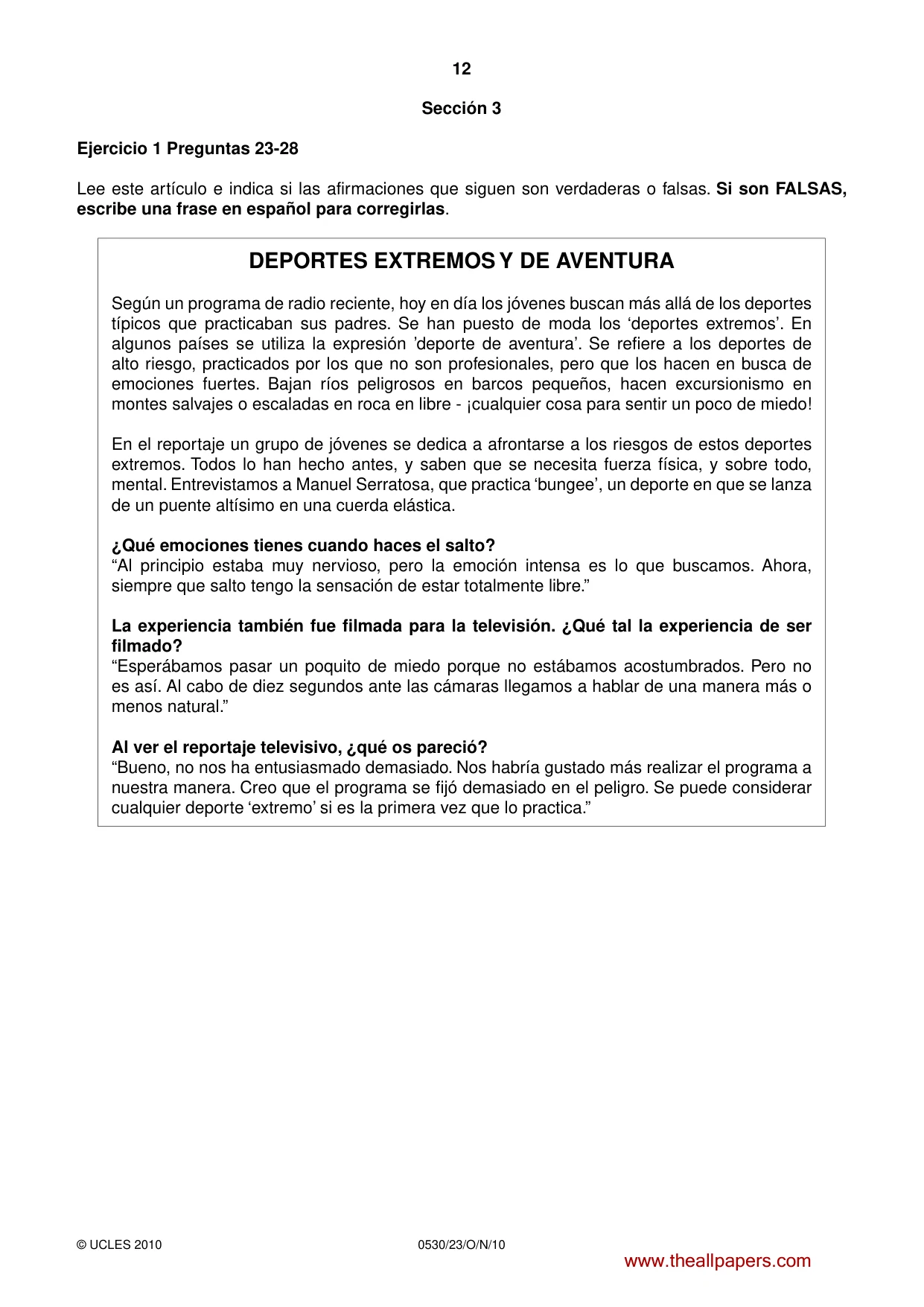
12 0530/23/O/N/10 © UCLES 2010 Sección 3 Ejercicio 1 Preguntas 23-28 Lee este artículo e indica si las afirmaciones que siguen son verdaderas o falsas. Si son FALSAS, escribe una frase en español para corregirlas. DEPORTES EXTREMOS Y DE AVENTURA Según un programa de radio reciente, hoy en día los jóvenes buscan más allá de los deportes típicos que practicaban sus padres. Se han puesto de moda los ‘deportes extremos’. En algunos países se utiliza la expresión ’deporte de aventura’. Se refiere a los deportes de alto riesgo, practicados por los que no son profesionales, pero que los hacen en busca de emociones fuertes. Bajan ríos peligrosos en barcos pequeños, hacen excursionismo en montes salvajes o escaladas en roca en libre - ¡cualquier cosa para sentir un poco de miedo! En el reportaje un grupo de jóvenes se dedica a afrontarse a los riesgos de estos deportes extremos. Todos lo han hecho antes, y saben que se necesita fuerza física, y sobre todo, mental. Entrevistamos a Manuel Serratosa, que practica ‘bungee’, un deporte en que se lanza de un puente altísimo en una cuerda elástica. ¿Qué emociones tienes cuando haces el salto? “Al principio estaba muy nervioso, pero la emoción intensa es lo que buscamos. Ahora, siempre que salto tengo la sensación de estar totalmente libre.” La experiencia también fue filmada para la televisión. ¿Qué tal la experiencia de ser filmado? “Esperábamos pasar un poquito de miedo porque no estábamos acostumbrados. Pero no es así. Al cabo de diez segundos ante las cámaras llegamos a hablar de una manera más o menos natural.” Al ver el reportaje televisivo, ¿qué os pareció? “Bueno, no nos ha entusiasmado demasiado. Nos habría gustado más realizar el programa a nuestra manera. Creo que el programa se fijó demasiado en el peligro. Se puede considerar cualquier deporte ‘extremo’ si es la primera vez que lo practica.” www.theallpapers.com
Question paper, page 13
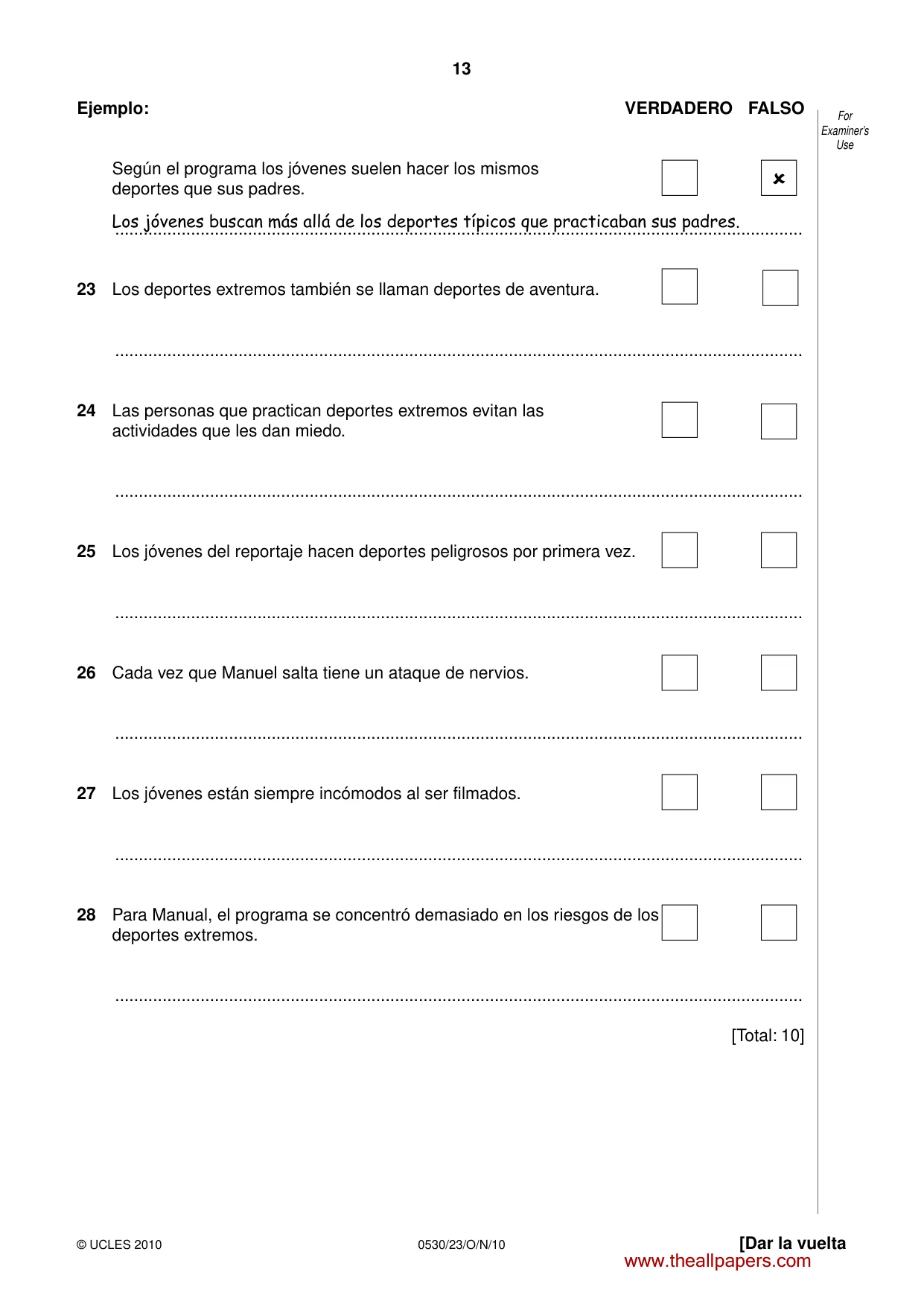
13 0530/23/O/N/10 © UCLES 2010 [Dar la vuelta For Examiner’s Use Ejemplo: VERDADERO FALSO Según el programa los jóvenes suelen hacer los mismos deportes que sus padres. 8 … Los jóvenes buscan más allá de los deportes típicos que practicaban sus padres. 23 Los deportes extremos también se llaman deportes de aventura. … 24 Las personas que practican deportes extremos evitan las actividades que les dan miedo. … 25 Los jóvenes del reportaje hacen deportes peligrosos por primera vez. … 26 Cada vez que Manuel salta tiene un ataque de nervios. … 27 Los jóvenes están siempre incómodos al ser filmados. … 28 Para Manual, el programa se concentró demasiado en los riesgos de los deportes extremos. … [Total: 10] www.theallpapers.com
Question paper, page 14
14 0530/23/O/N/10 © UCLES 2010 For Examiner’s Use Ejercicio 2 Preguntas 29-37 Lee este artículo sobre los ovnis y contesta a las preguntas en español. Los OVNIS – ficción y realidad El gobierno estadounidense ha publicado recientemente documentos de sus archivos sobre los ovnis. Parece que gran parte de las visiones de objetos voladores no identificados resultaron de la serie televisiva ‘The X Files’ (Expediente X). A mediados de los años 90, el número de informes sobre la observación de ovnis aumentó considerablemente, justo cuando la serie llegaba a su época de mayor popularidad. Otra época popular para las visiones de ovnis fue 1978, año en que salió la película ‘Encuentros en la Tercera Fase’. “Es evidente que hay una conexión entre las películas sobre visitantes extraterrestres y el número de ovnis”, comentó el investigador John Krakenberger, “Pero incluso mayor influencia tienen los numerosos reportajes en los periódicos que sólo reflejan el interés de los lectores”. Sin embargo, los investigadores americanos concluyen que detrás de algunos de los casos había una razón lógica. Krakenberger, investigador desde hace veinte años de las “visitas extraterrestres”, afirmó que la aparición de un ovni en San Diego (sur de Estados Unidos) en 1993 fue atribuida a una nave espacial rusa. “Lo que la gente vio fue un fragmento de un cohete Cosmos que volvía a entrar en la atmósfera. La NASA (la agencia espacial estadounidense) recreó el evento y quedó claro que sucedió así”, aseguró Krakenberger. En uno de los incidentes registrados en 1995, dos adolescentes de Idaho explicaron a la Policía que habían visto un hombre muy alto con cabeza de forma de limón salir de un ovni. Señalándoles hacia la puerta de un platillo volante les dijo: “Deben venir con nosotros”. Los aterrorizados jóvenes afirmaron que el objeto era tan alto como cuatro casas y se encontraba a unos diez metros de distancia de ellos. Los agentes enviados al lugar sólo encontraron a un agricultor trabajando en el campo que dijo no haber notado nada anormal, lo que no les sorprendió en absoluto. 29 Según el artículo, ¿por qué subió el número de observaciones de ovnis en la década de los 90? …[1] 30 ¿Según John Krakenberger, por qué se escribe mucho sobre los ovnis en los periódicos? …[1] www.theallpapers.com
Question paper, page 15
15 0530/23/O/N/10 © UCLES 2010 For Examiner’s Use 31 ¿Cómo se puede suponer que John Krakenberger es un experto en el tema de los ovnis? …[1] 32 ¿Cómo se explicó la observación de un ovni en San Diego? …[1] 33 ¿Qué se hizo para aclarar lo que pasó en San Diego? …[1] 34 ¿Por qué se supone que el hombre alto que se vio en 1995 era un extraterrestre? Da dos razones. (i) …[1] (ii) …[1] 35 ¿A qué les invitó el hombre alto a los dos adolescentes? …[1] 36 ¿Cómo era el platillo volante que apareció en Idaho? …[1] 37 ¿Cómo se sentían los agentes que fueron a buscar el ovni en Idaho? Indica tu respuesta colocando una X en la casilla correcta. A tenían mucho miedo B se extrañaron mucho C esperaban encontrar evidencias D no creían la historia de los jóvenes [1] [Total: 10] www.theallpapers.com
Question paper, page 16
16 0530/23/O/N/10 © UCLES 2010 Permission to reproduce items where third-party owned material protected by copyright is included has been sought and cleared where possible. Every reasonable effort has been made by the publisher (UCLES) to trace copyright holders, but if any items requiring clearance have unwittingly been included, the publisher will be pleased to make amends at the earliest possible opportunity. University of Cambridge International Examinations is part of the Cambridge Assessment Group. Cambridge Assessment is the brand name of University of Cambridge Local Examinations Syndicate (UCLES), which is itself a department of the University of Cambridge. BLANK PAGE www.theallpapers.com
Mark scheme, page 1
UNIVERSITY OF CAMBRIDGE INTERNATIONAL EXAMINATIONS International General Certificate of Secondary Education MARK SCHEME for the October/November 2010 question paper for the guidance of teachers 0530 SPANISH (FOREIGN LANGUAGE) 0530/23 Paper 2 (Reading and Directed Writing), maximum raw mark 65 This mark scheme is published as an aid to teachers and candidates, to indicate the requirements of the examination. It shows the basis on which Examiners were instructed to award marks. It does not indicate the details of the discussions that took place at an Examiners’ meeting before marking began, which would have considered the acceptability of alternative answers. Mark schemes must be read in conjunction with the question papers and the report on the examination. • CIE will not enter into discussions or correspondence in connection with these mark schemes. CIE is publishing the mark schemes for the October/November 2010 question papers for most IGCSE, GCE Advanced Level and Advanced Subsidiary Level syllabuses and some Ordinary Level syllabuses. www.theallpapers.com
Mark scheme, page 2
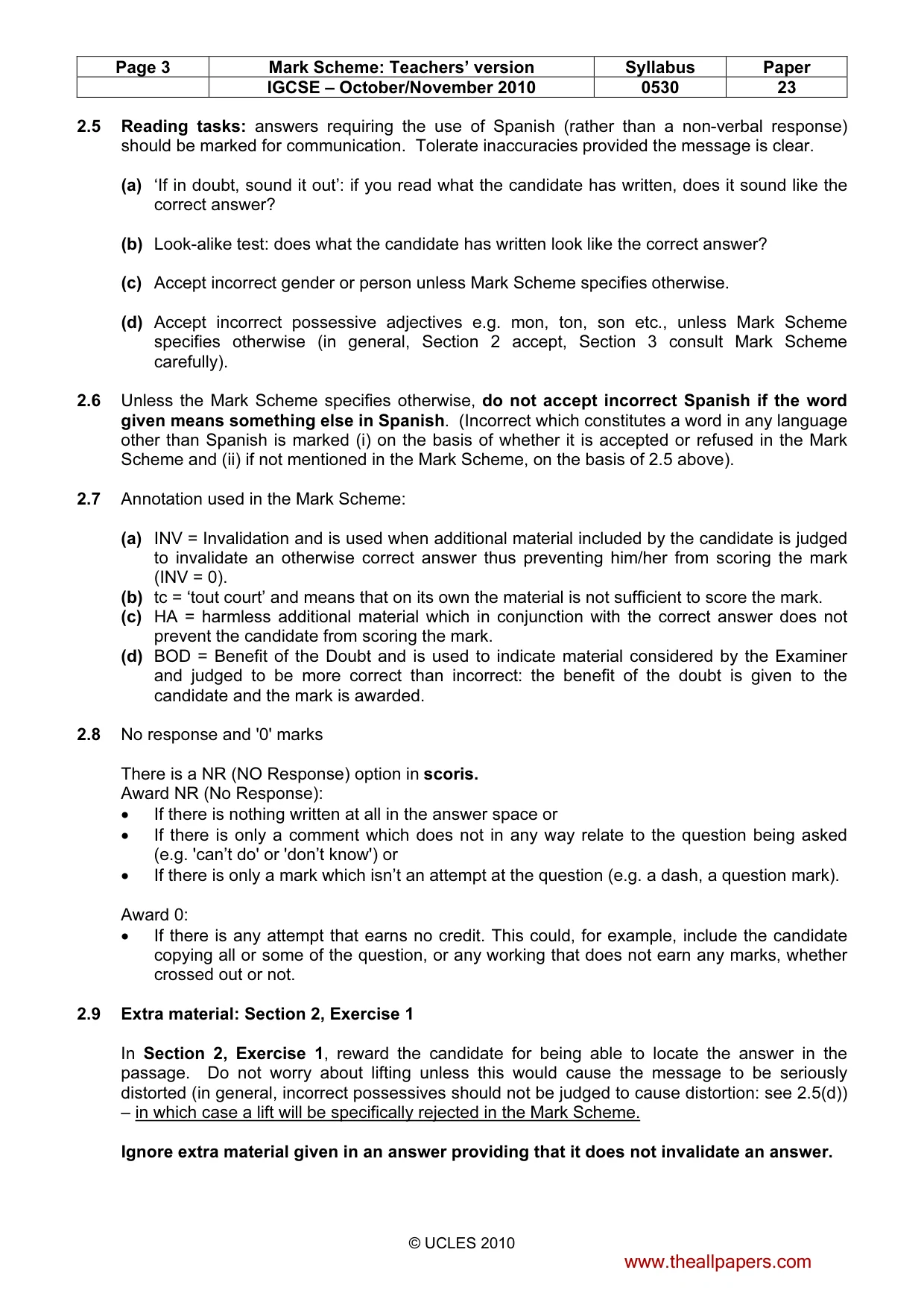
Page 2 Mark Scheme: Teachers’ version Syllabus Paper IGCSE – October/November 2010 0530 23 © UCLES 2010 1 General Marking Notes 2 General Marking Principles 2.1 Please note that it is not possible to list all acceptable alternatives in the Detailed Mark Scheme provided in Section 3. You will need to consider all alternative answers and unexpected approaches in candidates' scripts, make a decision on whether they communicate the required elements, in consultation with your Team Leader if necessary (or with your Product Manager if you are a single Examiner), and award marks accordingly. The following marking principles underpin the detailed instructions provided in Section 3 of the Mark Scheme. Where a decision is taken to deviate from these principles for a particular question, this will be specified in the Mark Scheme. 2.2 Crossing out: (a) If a candidate changes his/her mind over an answer and crosses out an attempt, award a mark if the final attempt is correct. (b) If a candidate crosses out an answer to a whole question but makes no second attempt at it, mark the crossed out work. 2.3 Reading tasks: more than the stipulated number of boxes ticked/crossed by the candidate: (a) If more than one attempt is visible, but the candidate has clearly indicated which attempt is his/her final answer (e.g. by crossing out other attempts or by annotating the script in some way), mark in the usual way. (b) If two attempts are visible (e.g. two boxes ticked instead of the 1 box stipulated), and neither has been crossed out/discounted by the candidate, no mark can be awarded. (c) In questions where candidates are required to tick a number of boxes (e.g. tick the 6 true statements) the general rule to be applied is as follows: the number of 'extra' answers indicated by the candidate is deducted from the number of correct answers and the remaining number is the mark awarded, e.g. the candidate is required to tick 6 true statements, but instead ticks 8 statements. 5 of the 6 ticks are correctly placed, but 2 of the ticks are ‘extras’ (8 ticks placed by candidate minus 6 ticks required by rubric = 2). Therefore the candidate is awarded a mark of 3 5 number of correct ticks –2 minus number of extra ticks = 3 (d) Answers in pen do not take precedence over answers in pencil, e.g. if a candidate is asked to tick 1 box and ticks two, one in pen and the other in pencil, the mark cannot be awarded unless there is some explicit indication from the candidate as to which is his/her final answer. 2.4 Reading tasks: for questions requiring more than one element for the answer, (i) and (ii), where the answers are interchangeable: Both correct answers on line 1 and line 2 blank = 2 Both correct answers on line 1, but another answer on line 2 wrong = 1 (or vice-versa) www.theallpapers.com
Mark scheme, page 3
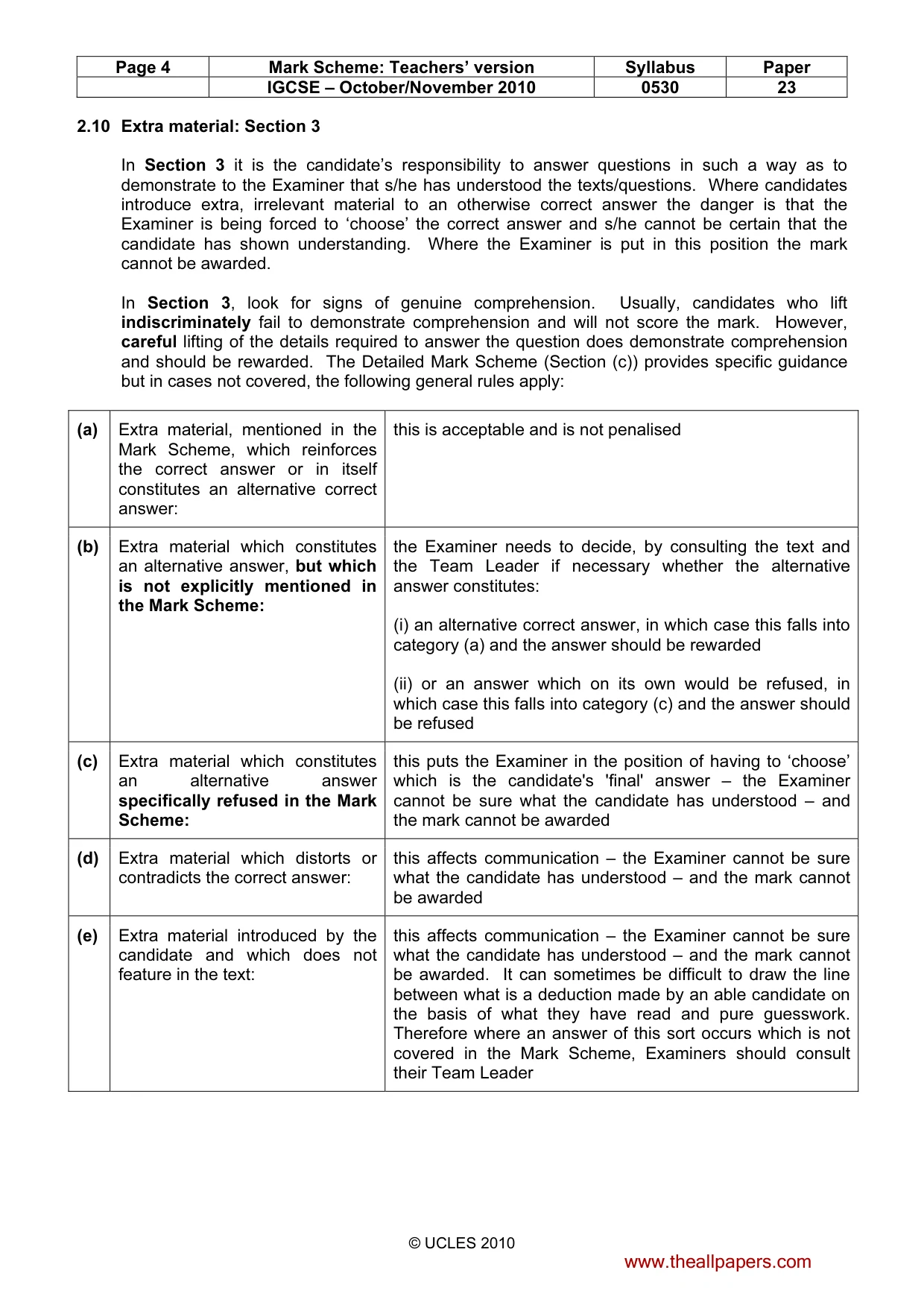
Page 3 Mark Scheme: Teachers’ version Syllabus Paper IGCSE – October/November 2010 0530 23 © UCLES 2010 2.5 Reading tasks: answers requiring the use of Spanish (rather than a non-verbal response) should be marked for communication. Tolerate inaccuracies provided the message is clear. (a) ‘If in doubt, sound it out’: if you read what the candidate has written, does it sound like the correct answer? (b) Look-alike test: does what the candidate has written look like the correct answer? (c) Accept incorrect gender or person unless Mark Scheme specifies otherwise. (d) Accept incorrect possessive adjectives e.g. mon, ton, son etc., unless Mark Scheme specifies otherwise (in general, Section 2 accept, Section 3 consult Mark Scheme carefully). 2.6 Unless the Mark Scheme specifies otherwise, do not accept incorrect Spanish if the word given means something else in Spanish. (Incorrect which constitutes a word in any language other than Spanish is marked (i) on the basis of whether it is accepted or refused in the Mark Scheme and (ii) if not mentioned in the Mark Scheme, on the basis of 2.5 above). 2.7 Annotation used in the Mark Scheme: (a) INV = Invalidation and is used when additional material included by the candidate is judged to invalidate an otherwise correct answer thus preventing him/her from scoring the mark (INV = 0). (b) tc = ‘tout court’ and means that on its own the material is not sufficient to score the mark. (c) HA = harmless additional material which in conjunction with the correct answer does not prevent the candidate from scoring the mark. (d) BOD = Benefit of the Doubt and is used to indicate material considered by the Examiner and judged to be more correct than incorrect: the benefit of the doubt is given to the candidate and the mark is awarded. 2.8 No response and '0' marks There is a NR (NO Response) option in scoris. Award NR (No Response): • If there is nothing written at all in the answer space or • If there is only a comment which does not in any way relate to the question being asked (e.g. 'can’t do' or 'don’t know') or • If there is only a mark which isn’t an attempt at the question (e.g. a dash, a question mark). Award 0: • If there is any attempt that earns no credit. This could, for example, include the candidate copying all or some of the question, or any working that does not earn any marks, whether crossed out or not. 2.9 Extra material: Section 2, Exercise 1 In Section 2, Exercise 1, reward the candidate for being able to locate the answer in the passage. Do not worry about lifting unless this would cause the message to be seriously distorted (in general, incorrect possessives should not be judged to cause distortion: see 2.5(d)) – in which case a lift will be specifically rejected in the Mark Scheme. Ignore extra material given in an answer providing that it does not invalidate an answer. www.theallpapers.com
Mark scheme, page 4
Page 4 Mark Scheme: Teachers’ version Syllabus Paper IGCSE – October/November 2010 0530 23 © UCLES 2010 2.10 Extra material: Section 3 In Section 3 it is the candidate’s responsibility to answer questions in such a way as to demonstrate to the Examiner that s/he has understood the texts/questions. Where candidates introduce extra, irrelevant material to an otherwise correct answer the danger is that the Examiner is being forced to ‘choose’ the correct answer and s/he cannot be certain that the candidate has shown understanding. Where the Examiner is put in this position the mark cannot be awarded. In Section 3, look for signs of genuine comprehension. Usually, candidates who lift indiscriminately fail to demonstrate comprehension and will not score the mark. However, careful lifting of the details required to answer the question does demonstrate comprehension and should be rewarded. The Detailed Mark Scheme (Section (c)) provides specific guidance but in cases not covered, the following general rules apply: (a) Extra material, mentioned in the Mark Scheme, which reinforces the correct answer or in itself constitutes an alternative correct answer: this is acceptable and is not penalised (b) Extra material which constitutes an alternative answer, but which is not explicitly mentioned in the Mark Scheme: the Examiner needs to decide, by consulting the text and the Team Leader if necessary whether the alternative answer constitutes: (i) an alternative correct answer, in which case this falls into category (a) and the answer should be rewarded (ii) or an answer which on its own would be refused, in which case this falls into category (c) and the answer should be refused (c) Extra material which constitutes an alternative answer specifically refused in the Mark Scheme: this puts the Examiner in the position of having to ‘choose’ which is the candidate's 'final' answer – the Examiner cannot be sure what the candidate has understood – and the mark cannot be awarded (d) Extra material which distorts or contradicts the correct answer: this affects communication – the Examiner cannot be sure what the candidate has understood – and the mark cannot be awarded (e) Extra material introduced by the candidate and which does not feature in the text: this affects communication – the Examiner cannot be sure what the candidate has understood – and the mark cannot be awarded. It can sometimes be difficult to draw the line between what is a deduction made by an able candidate on the basis of what they have read and pure guesswork. Therefore where an answer of this sort occurs which is not covered in the Mark Scheme, Examiners should consult their Team Leader www.theallpapers.com
Mark scheme, page 5
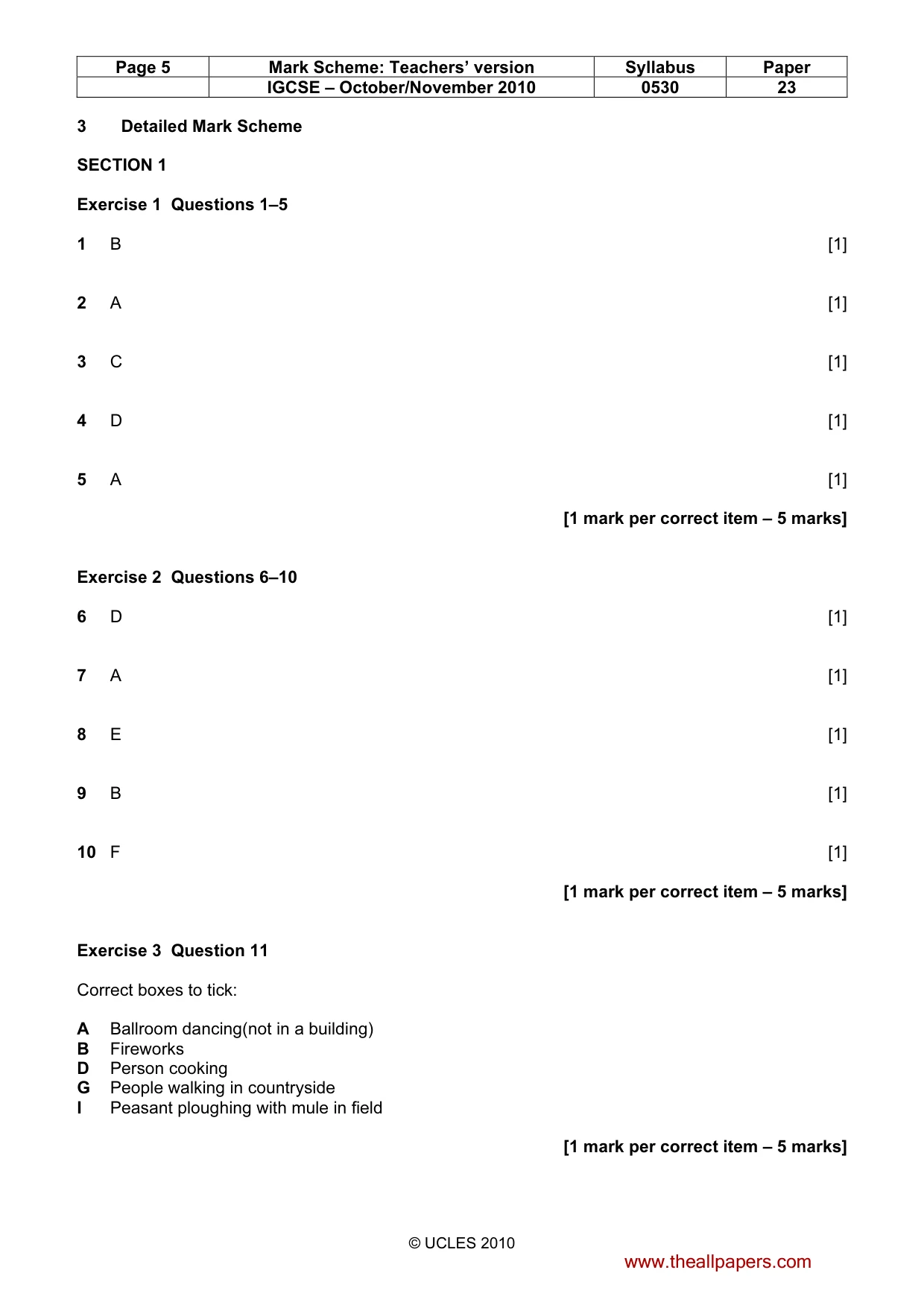
Page 5 Mark Scheme: Teachers’ version Syllabus Paper IGCSE – October/November 2010 0530 23 © UCLES 2010 3 Detailed Mark Scheme SECTION 1 Exercise 1 Questions 1–5 1 B [1] 2 A [1] 3 C [1] 4 D [1] 5 A [1] [1 mark per correct item – 5 marks] Exercise 2 Questions 6–10 6 D [1] 7 A [1] 8 E [1] 9 B [1] 10 F [1] [1 mark per correct item – 5 marks] Exercise 3 Question 11 Correct boxes to tick: A Ballroom dancing(not in a building) B Fireworks D Person cooking G People walking in countryside I Peasant ploughing with mule in field [1 mark per correct item – 5 marks] www.theallpapers.com
Mark scheme, page 6
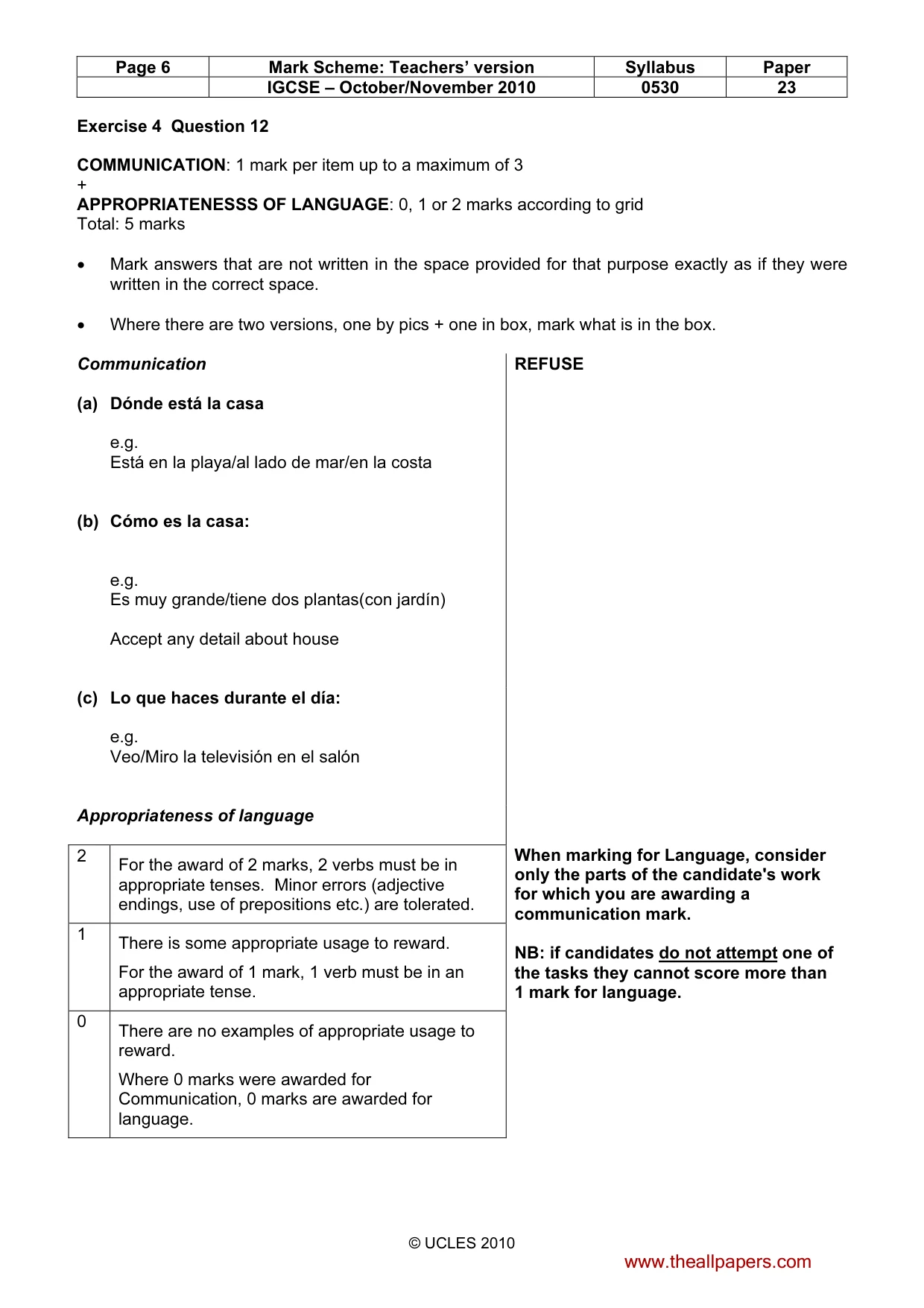
Page 6 Mark Scheme: Teachers’ version Syllabus Paper IGCSE – October/November 2010 0530 23 © UCLES 2010 Exercise 4 Question 12 COMMUNICATION: 1 mark per item up to a maximum of 3 + APPROPRIATENESSS OF LANGUAGE: 0, 1 or 2 marks according to grid Total: 5 marks • Mark answers that are not written in the space provided for that purpose exactly as if they were written in the correct space. • Where there are two versions, one by pics + one in box, mark what is in the box. Communication REFUSE (a) Dónde está la casa e.g. Está en la playa/al lado de mar/en la costa (b) Cómo es la casa: e.g. Es muy grande/tiene dos plantas(con jardín) Accept any detail about house (c) Lo que haces durante el día: e.g. Veo/Miro la televisión en el salón Appropriateness of language 2 For the award of 2 marks, 2 verbs must be in appropriate tenses. Minor errors (adjective endings, use of prepositions etc.) are tolerated. 1 There is some appropriate usage to reward. For the award of 1 mark, 1 verb must be in an appropriate tense. 0 There are no examples of appropriate usage to reward. Where 0 marks were awarded for Communication, 0 marks are awarded for language. When marking for Language, consider only the parts of the candidate's work for which you are awarding a communication mark. NB: if candidates do not attempt one of the tasks they cannot score more than 1 mark for language. www.theallpapers.com
Mark scheme, page 7
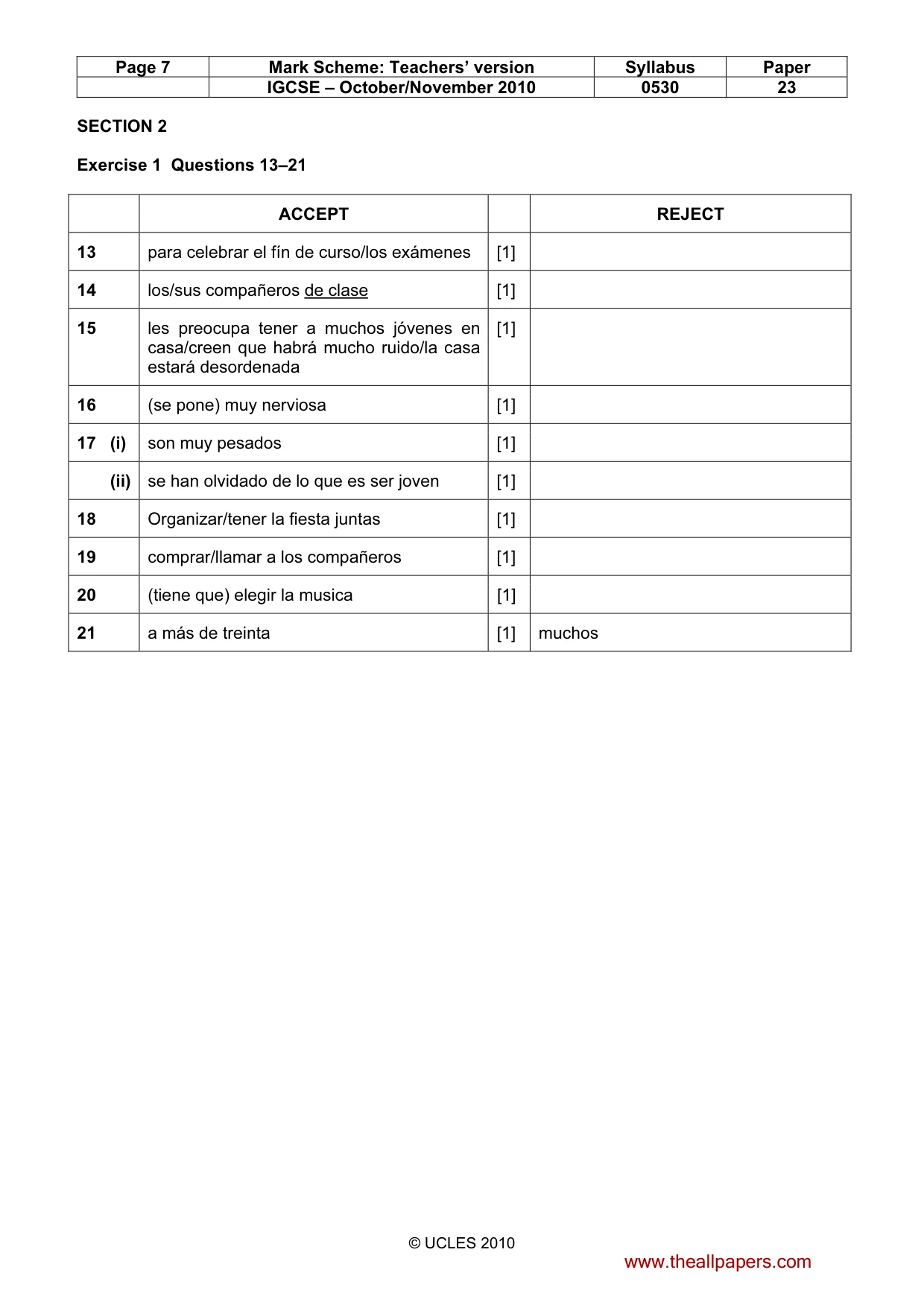
Page 7 Mark Scheme: Teachers’ version Syllabus Paper IGCSE – October/November 2010 0530 23 © UCLES 2010 SECTION 2 Exercise 1 Questions 13–21 ACCEPT REJECT 13 para celebrar el fín de curso/los exámenes [1] 14 los/sus compañeros de clase [1] 15 les preocupa tener a muchos jóvenes en casa/creen que habrá mucho ruido/la casa estará desordenada [1] 16 (se pone) muy nerviosa [1] 17 (i) son muy pesados [1] (ii) se han olvidado de lo que es ser joven [1] 18 Organizar/tener la fiesta juntas [1] 19 comprar/llamar a los compañeros [1] 20 (tiene que) elegir la musica [1] 21 a más de treinta [1] muchos www.theallpapers.com
Mark scheme, page 8
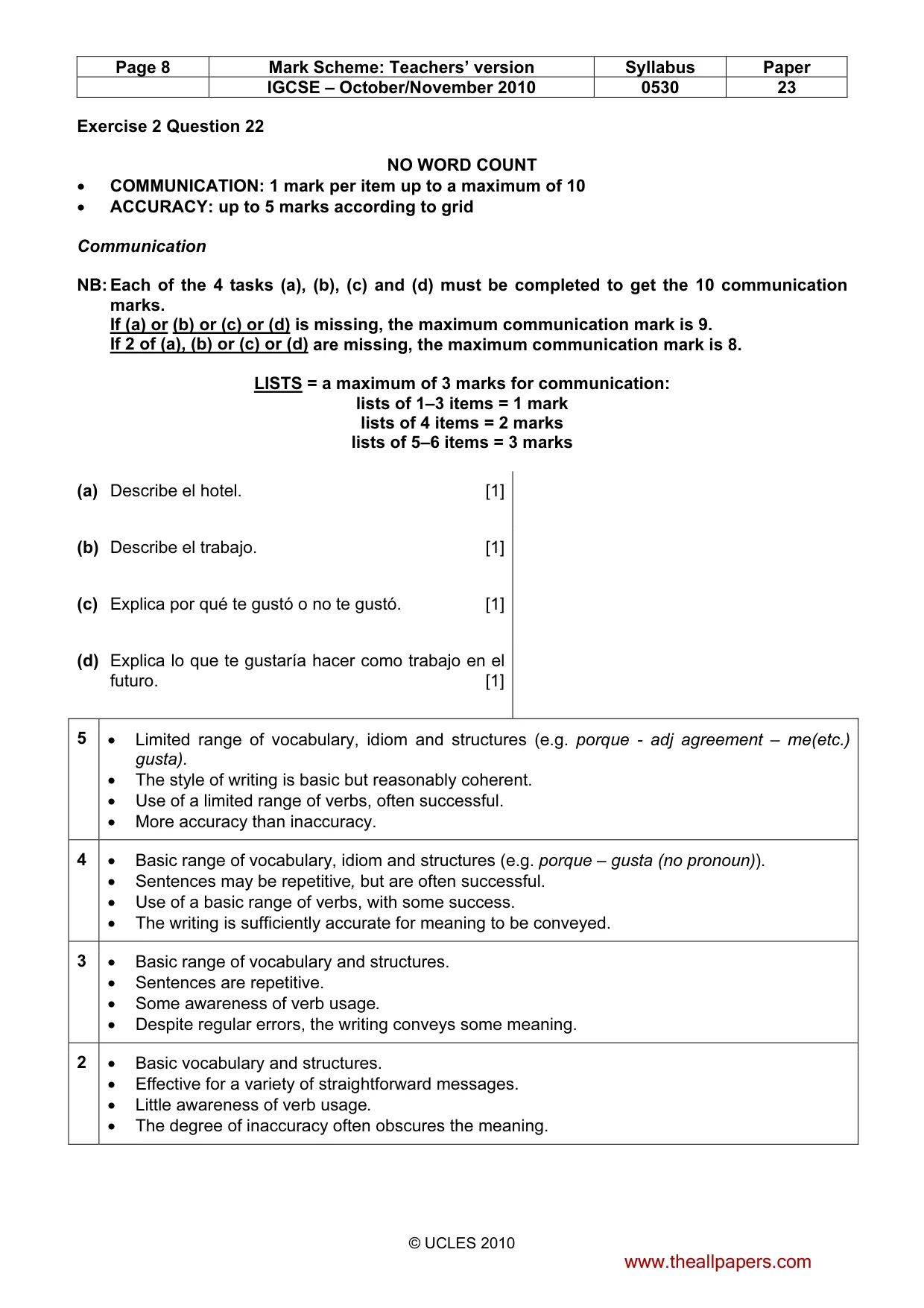
Page 8 Mark Scheme: Teachers’ version Syllabus Paper IGCSE – October/November 2010 0530 23 © UCLES 2010 Exercise 2 Question 22 NO WORD COUNT • COMMUNICATION: 1 mark per item up to a maximum of 10 • ACCURACY: up to 5 marks according to grid Communication NB: Each of the 4 tasks (a), (b), (c) and (d) must be completed to get the 10 communication marks. If (a) or (b) or (c) or (d) is missing, the maximum communication mark is 9. If 2 of (a), (b) or (c) or (d) are missing, the maximum communication mark is 8. LISTS = a maximum of 3 marks for communication: lists of 1–3 items = 1 mark lists of 4 items = 2 marks lists of 5–6 items = 3 marks (a) Describe el hotel. [1] (b) Describe el trabajo. [1] (c) Explica por qué te gustó o no te gustó. [1] (d) Explica lo que te gustaría hacer como trabajo en el futuro. [1] 5 • Limited range of vocabulary, idiom and structures (e.g. porque - adj agreement – me(etc.) gusta). • The style of writing is basic but reasonably coherent. • Use of a limited range of verbs, often successful. • More accuracy than inaccuracy. 4 • Basic range of vocabulary, idiom and structures (e.g. porque – gusta (no pronoun)). • Sentences may be repetitive, but are often successful. • Use of a basic range of verbs, with some success. • The writing is sufficiently accurate for meaning to be conveyed. 3 • Basic range of vocabulary and structures. • Sentences are repetitive. • Some awareness of verb usage. • Despite regular errors, the writing conveys some meaning. 2 • Basic vocabulary and structures. • Effective for a variety of straightforward messages. • Little awareness of verb usage. • The degree of inaccuracy often obscures the meaning. www.theallpapers.com
Mark scheme, page 9
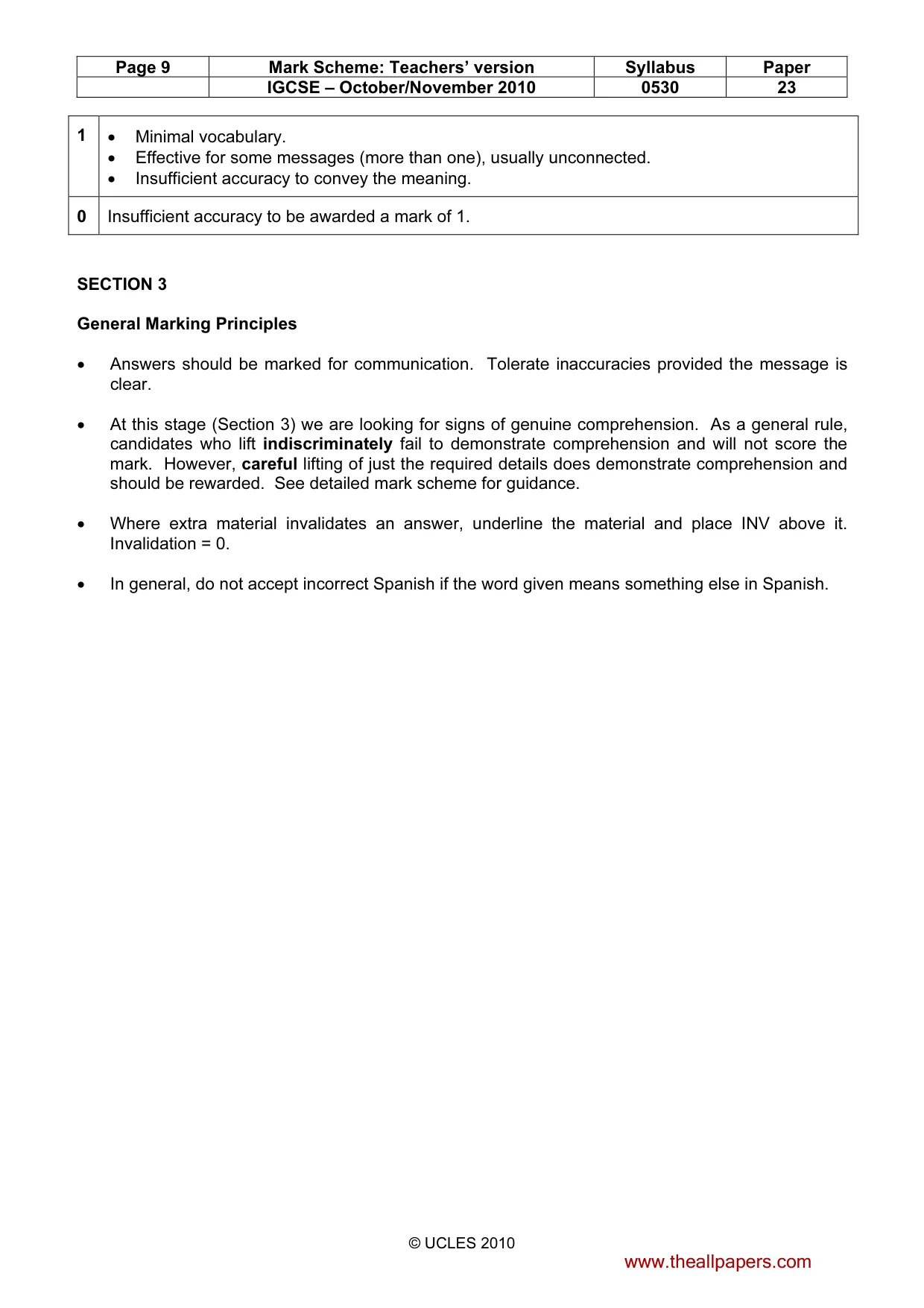
Page 9 Mark Scheme: Teachers’ version Syllabus Paper IGCSE – October/November 2010 0530 23 © UCLES 2010 1 • Minimal vocabulary. • Effective for some messages (more than one), usually unconnected. • Insufficient accuracy to convey the meaning. 0 Insufficient accuracy to be awarded a mark of 1. SECTION 3 General Marking Principles • Answers should be marked for communication. Tolerate inaccuracies provided the message is clear. • At this stage (Section 3) we are looking for signs of genuine comprehension. As a general rule, candidates who lift indiscriminately fail to demonstrate comprehension and will not score the mark. However, careful lifting of just the required details does demonstrate comprehension and should be rewarded. See detailed mark scheme for guidance. • Where extra material invalidates an answer, underline the material and place INV above it. Invalidation = 0. • In general, do not accept incorrect Spanish if the word given means something else in Spanish. www.theallpapers.com
Mark scheme, page 10
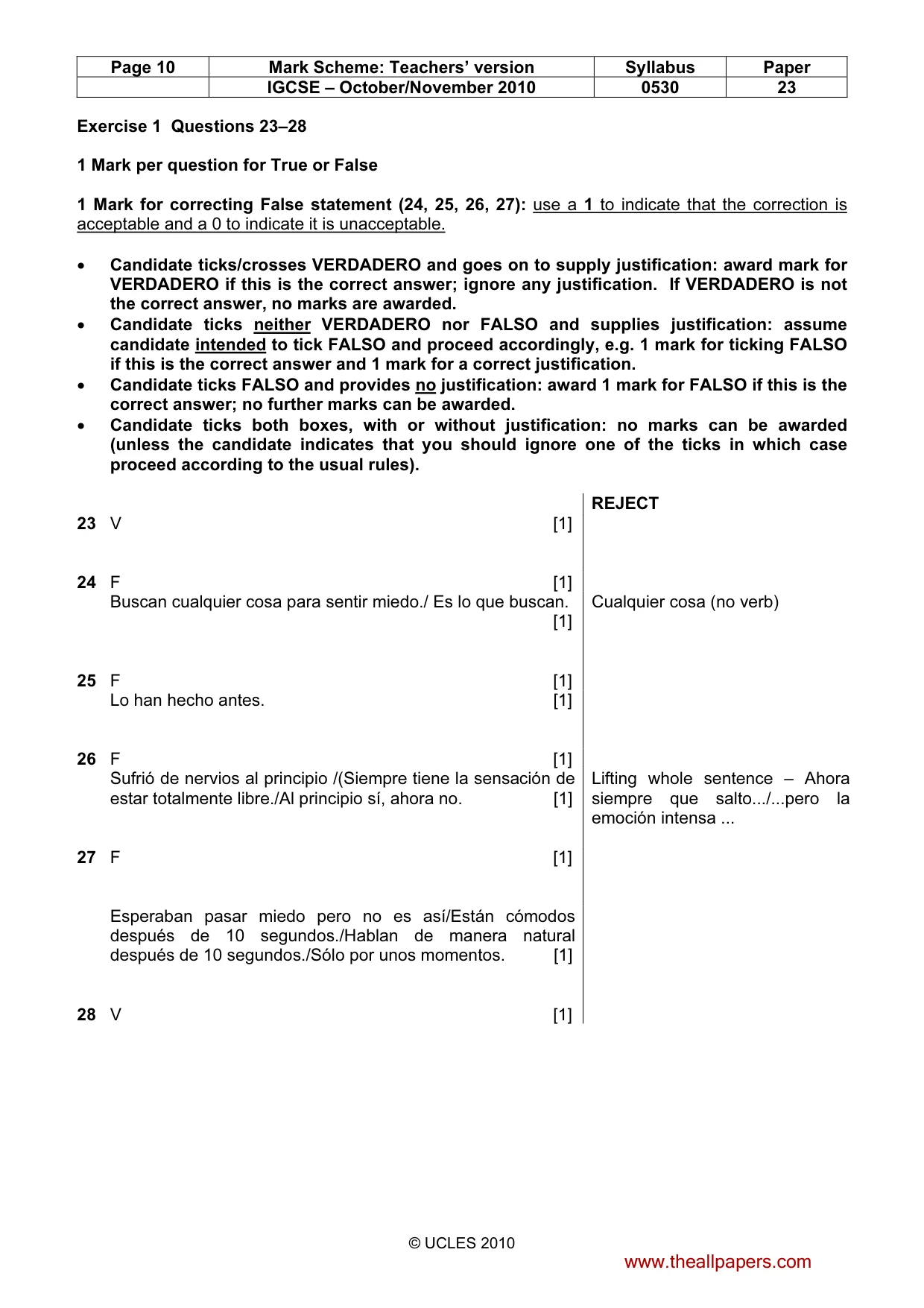
Page 10 Mark Scheme: Teachers’ version Syllabus Paper IGCSE – October/November 2010 0530 23 © UCLES 2010 Exercise 1 Questions 23–28 1 Mark per question for True or False 1 Mark for correcting False statement (24, 25, 26, 27): use a 1 to indicate that the correction is acceptable and a 0 to indicate it is unacceptable. • Candidate ticks/crosses VERDADERO and goes on to supply justification: award mark for VERDADERO if this is the correct answer; ignore any justification. If VERDADERO is not the correct answer, no marks are awarded. • Candidate ticks neither VERDADERO nor FALSO and supplies justification: assume candidate intended to tick FALSO and proceed accordingly, e.g. 1 mark for ticking FALSO if this is the correct answer and 1 mark for a correct justification. • Candidate ticks FALSO and provides no justification: award 1 mark for FALSO if this is the correct answer; no further marks can be awarded. • Candidate ticks both boxes, with or without justification: no marks can be awarded (unless the candidate indicates that you should ignore one of the ticks in which case proceed according to the usual rules). REJECT 23 V [1] 24 F [1] Buscan cualquier cosa para sentir miedo./ Es lo que buscan. [1] Cualquier cosa (no verb) 25 F [1] Lo han hecho antes. [1] 26 F [1] Sufrió de nervios al principio /(Siempre tiene la sensación de estar totalmente libre./Al principio sí, ahora no. [1] Lifting whole sentence – Ahora siempre que salto.../...pero la emoción intensa ... 27 F [1] Esperaban pasar miedo pero no es así/Están cómodos después de 10 segundos./Hablan de manera natural después de 10 segundos./Sólo por unos momentos. [1] 28 V [1] www.theallpapers.com
Mark scheme, page 11
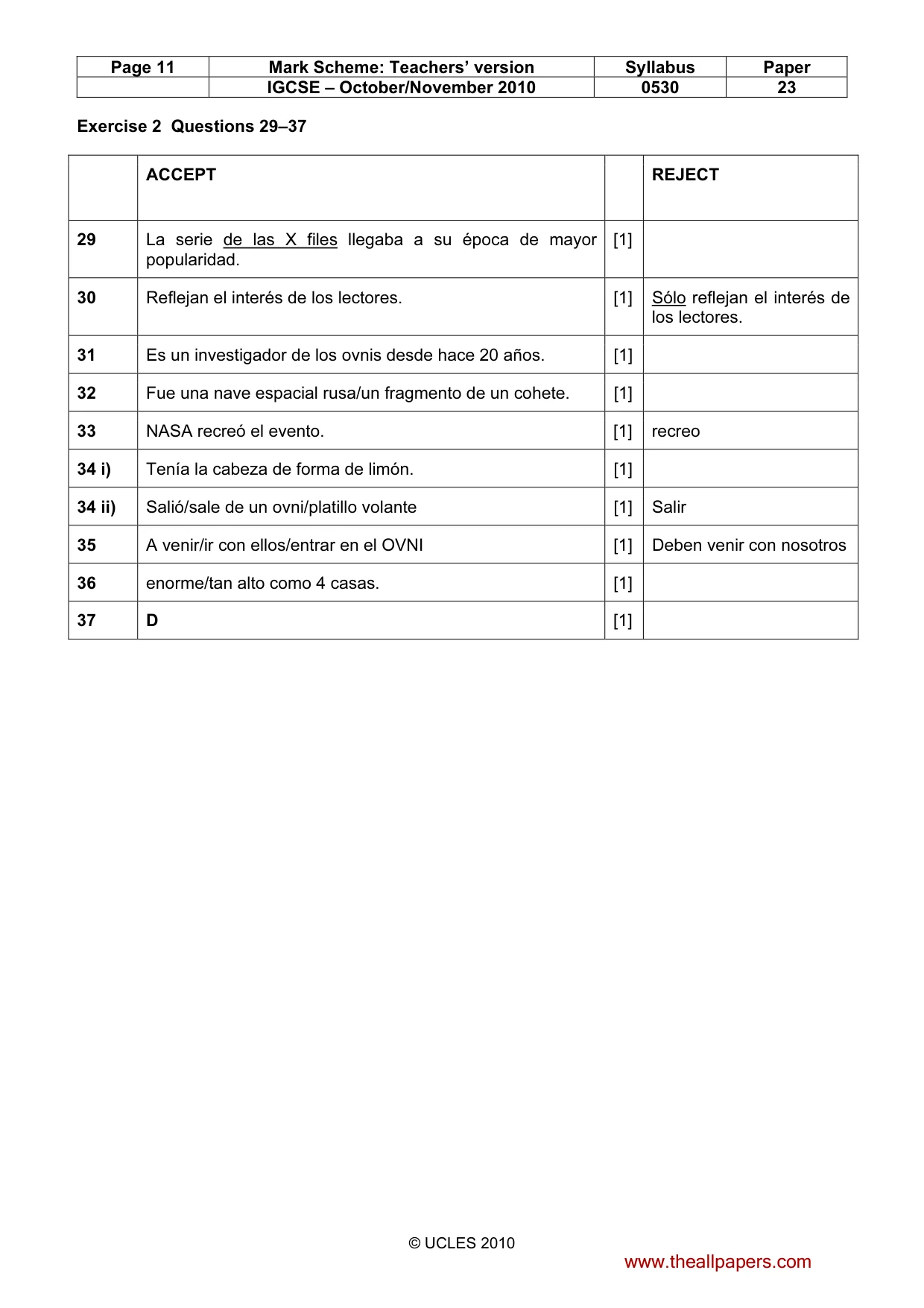
Page 11 Mark Scheme: Teachers’ version Syllabus Paper IGCSE – October/November 2010 0530 23 © UCLES 2010 Exercise 2 Questions 29–37 ACCEPT REJECT 29 La serie de las X files llegaba a su época de mayor popularidad. [1] 30 Reflejan el interés de los lectores. [1] Sólo reflejan el interés de los lectores. 31 Es un investigador de los ovnis desde hace 20 años. [1] 32 Fue una nave espacial rusa/un fragmento de un cohete. [1] 33 NASA recreó el evento. [1] recreo 34 i) Tenía la cabeza de forma de limón. [1] 34 ii) Salió/sale de un ovni/platillo volante [1] Salir 35 A venir/ir con ellos/entrar en el OVNI [1] Deben venir con nosotros 36 enorme/tan alto como 4 casas. [1] 37 D [1] www.theallpapers.com
What you needed in this session
Cambridge’s own grade thresholds for 2010 Oct/Nov, Paper 2 · Variant 3. A higher threshold means an easier paper — the bar moves with how the cohort did.