Cambridge IGCSE Spanish - Foreign Language 0530 — 2010 Oct/Nov Paper 2 · Variant 2
0530/22/O/N/10 · 65 marks · ≈73 min
The question paper and its mark scheme, free to read here and free to download. This is Cambridge’s own paper, exactly as it was sat.
Question paper16 pages

Mark scheme11 pages
Answers below. Sit the paper first if you are practising.
Paper as text
Question paper, page 1
This document consists of 14 printed pages and 2 blank pages. DC (AC/SW) 34794 © UCLES 2010 [Turn over UNIVERSITY OF CAMBRIDGE INTERNATIONAL EXAMINATIONS International General Certificate of Secondary Education * 0 5 4 6 8 3 0 2 2 8 * SPANISH 0530/22 Paper 2 Reading and Directed Writing October/November 2010 1 hour 30 minutes Candidates answer on the Question Paper. No Additional Materials are required. READ THESE INSTRUCTIONS FIRST Write your Centre number, candidate number and name on all the work you hand in. Write in dark blue or black pen. Do not use staples, paper clips, highlighters, glue or correction fluid. DO NOT WRITE IN ANY BARCODES. Answer all questions in Section 1, Section 2 and Section 3. At the end of the examination, fasten all your work securely together. The number of marks is given in brackets [ ] at the end of each question or part question. For Examiner’s Use Section 1 Section 2 Section 3 Total www.theallpapers.com
Question paper, page 2
2 0530/22/O/N/10 © UCLES 2010 For Examiner’s Use Sección 1 Ejercicio 1 Preguntas 1-5 Para cada pregunta indica tu respuesta colocando una X en la casilla correcta. 1 PANADERIA ¿Qué se puede comprar aquí? A B A B C D C D [1] 2 Quieres reservar tus vacaciones. ¿Adónde vas? A Agencia de viajes B Ayuntamiento C Comisaría D Mercado [1] www.theallpapers.com
Question paper, page 3
3 0530/22/O/N/10 © UCLES 2010 [Dar la vuelta For Examiner’s Use 3 Tu amigo te deja una nota. No tenemos azucar. ¿Puedes ir a comprarlo? ¿Qué tienes que comprar? A B A B C D C D [1] 4 Vas a comprar un ordenador. ¿Qué sección lees en los anuncios del periódico? A Pisos B Informática C Coches D Idiomas [1] www.theallpapers.com
Question paper, page 4
4 0530/22/O/N/10 © UCLES 2010 For Examiner’s Use 5 Cursos de equitación Tfno: 952 321892 ¿Qué puedes hacer aquí? A B A B C D C D [1] [Total: 5] www.theallpapers.com
Question paper, page 5
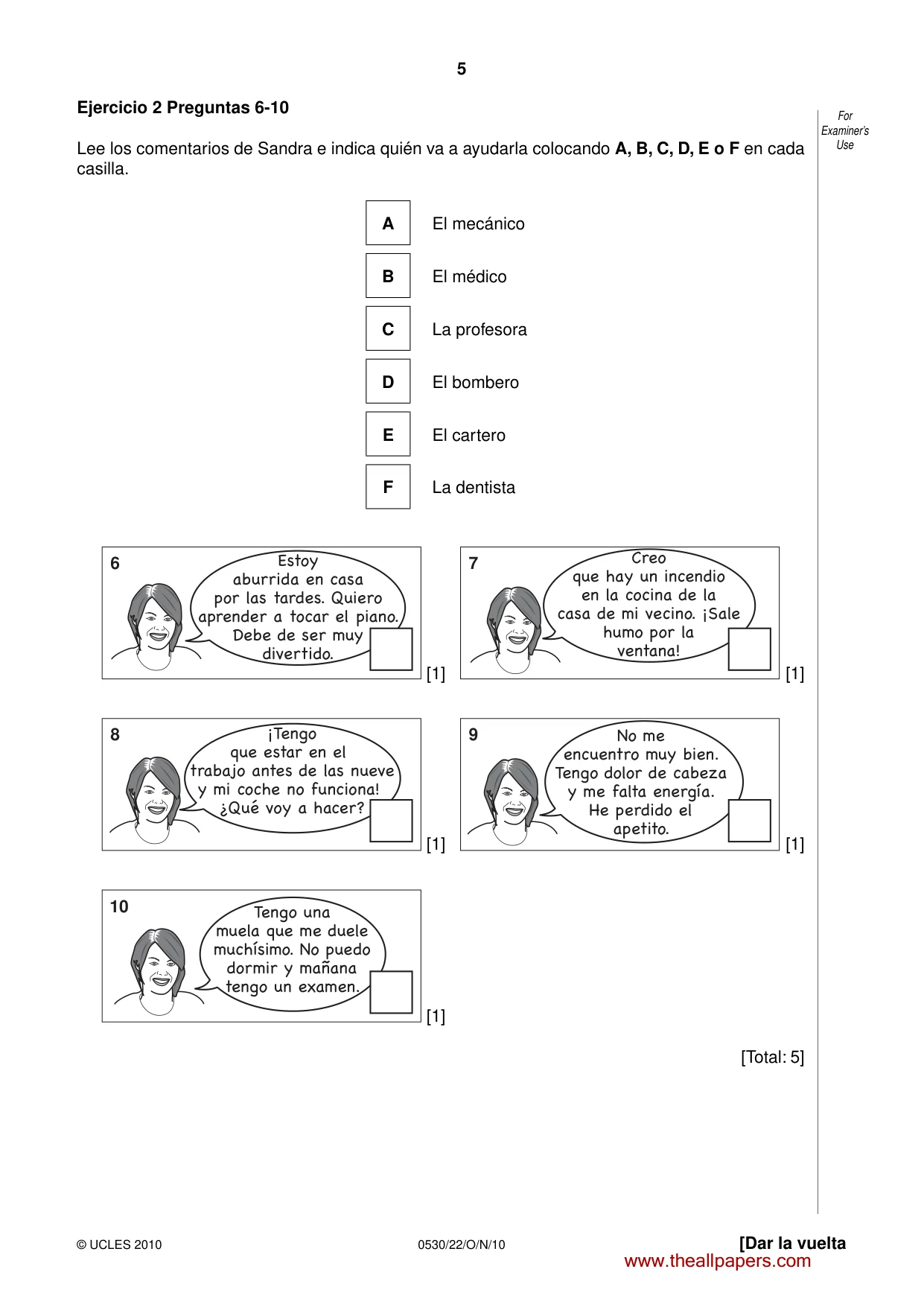
5 0530/22/O/N/10 © UCLES 2010 [Dar la vuelta For Examiner’s Use Ejercicio 2 Preguntas 6-10 Lee los comentarios de Sandra e indica quién va a ayudarla colocando A, B, C, D, E o F en cada casilla. A El mecánico B El médico C La profesora D El bombero E El cartero F La dentista Estoy aburrida en casa por las tardes. Quiero aprender a tocar el piano. Debe de ser muy divertido. Creo que hay un incendio en la cocina de la casa de mi vecino. ¡Sale humo por la ventana! ¡Tengo que estar en el trabajo antes de las nueve y mi coche no funciona! ¿Qué voy a hacer? No me encuentro muy bien. Tengo dolor de cabeza y me falta energía. He perdido el apetito. Tengo una muela que me duele muchísimo. No puedo dormir y mañana tengo un examen. 6 7 8 9 10 [Total: 5] [1] [1] [1] [1] [1] www.theallpapers.com
Question paper, page 6
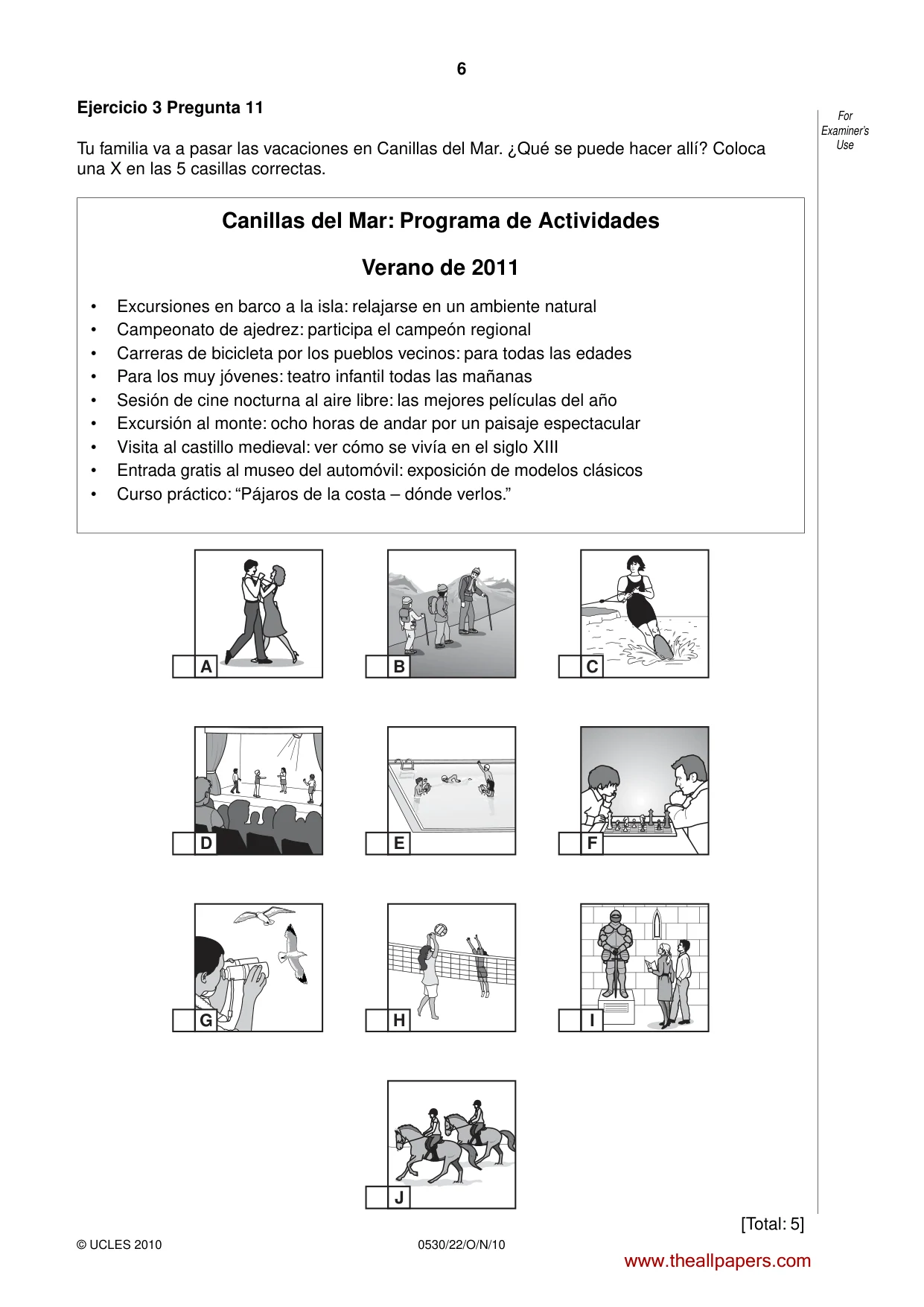
6 0530/22/O/N/10 © UCLES 2010 For Examiner’s Use Ejercicio 3 Pregunta 11 Tu familia va a pasar las vacaciones en Canillas del Mar. ¿Qué se puede hacer allí? Coloca una X en las 5 casillas correctas. Canillas del Mar: Programa de Actividades Verano de 2011 • Excursiones en barco a la isla: relajarse en un ambiente natural • Campeonato de ajedrez: participa el campeón regional • Carreras de bicicleta por los pueblos vecinos: para todas las edades • Para los muy jóvenes: teatro infantil todas las mañanas • Sesión de cine nocturna al aire libre: las mejores películas del año • Excursión al monte: ocho horas de andar por un paisaje espectacular • Visita al castillo medieval: ver cómo se vivía en el siglo XIII • Entrada gratis al museo del automóvil: exposición de modelos clásicos • Curso práctico: “Pájaros de la costa – dónde verlos.” A B C D E F G H I J [Total: 5] www.theallpapers.com
Question paper, page 7
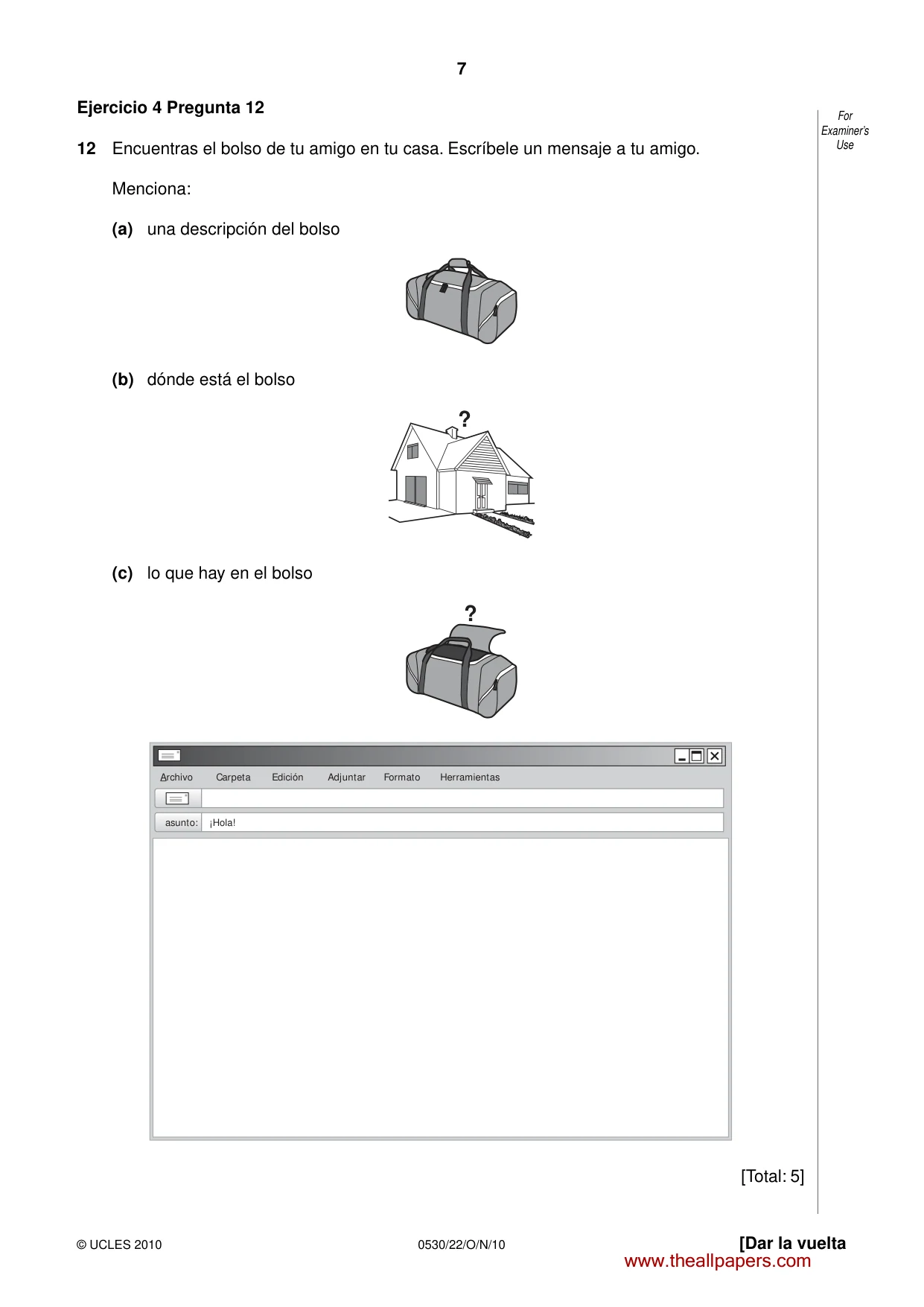
7 0530/22/O/N/10 © UCLES 2010 [Dar la vuelta For Examiner’s Use Ejercicio 4 Pregunta 12 12 Encuentras el bolso de tu amigo en tu casa. Escríbele un mensaje a tu amigo. Menciona: (a) una descripción del bolso (b) dónde está el bolso ? (c) lo que hay en el bolso ? asunto: ¡Hola! Archivo Carpeta Edición Adjuntar Formato Herramientas [Total: 5] www.theallpapers.com
Question paper, page 8
8 0530/22/O/N/10 © UCLES 2010 Sección 2 Ejercicio 1 Preguntas 13-20 Lee la carta que Elena le escribió a su amiga Marta en la que cuenta un problema que tiene. Contesta a las preguntas en español. Hola Marta: Te escribo en confianza porque tengo un problema y no sé qué hacer. Tú siempre tienes muy buenas ideas - ¿me puedes dar tu opinión? Te explico. Hace tres meses llegó un chico nuevo a mi clase. Es de Francia y se quedará aquí para estudiar tres años porque su padre trabaja en una compañía multinacional. Se llama David, es muy alto y tiene el pelo castaño y los ojos verdes. Es un poco tímido y no habla muy bien el español, pero como es súper-simpático se hace entender. Está sentado en clase al lado mío, y nos llevamos muy bien y hace una semana en la clase de biología me invitó a salir al cine con él. No sabía qué decirle. ¡Ahora cada vez que lo veo me pongo roja y no puedo hablar! Me ha dado su número de teléfono y de verdad me gustaría salir con él. El problema es que mi mejor amiga Sonia está enamorada de él. Sueña con salir con él y hasta dice que quiere casarse con él algún día. Tengo tantas ganas de salir con David pero seguramente Sonia se enfadaría mucho conmigo. La verdad es que no quiero perder a mi mejor amiga. ¿Qué puedo hacer? Tu amiga, Elena. www.theallpapers.com
Question paper, page 9
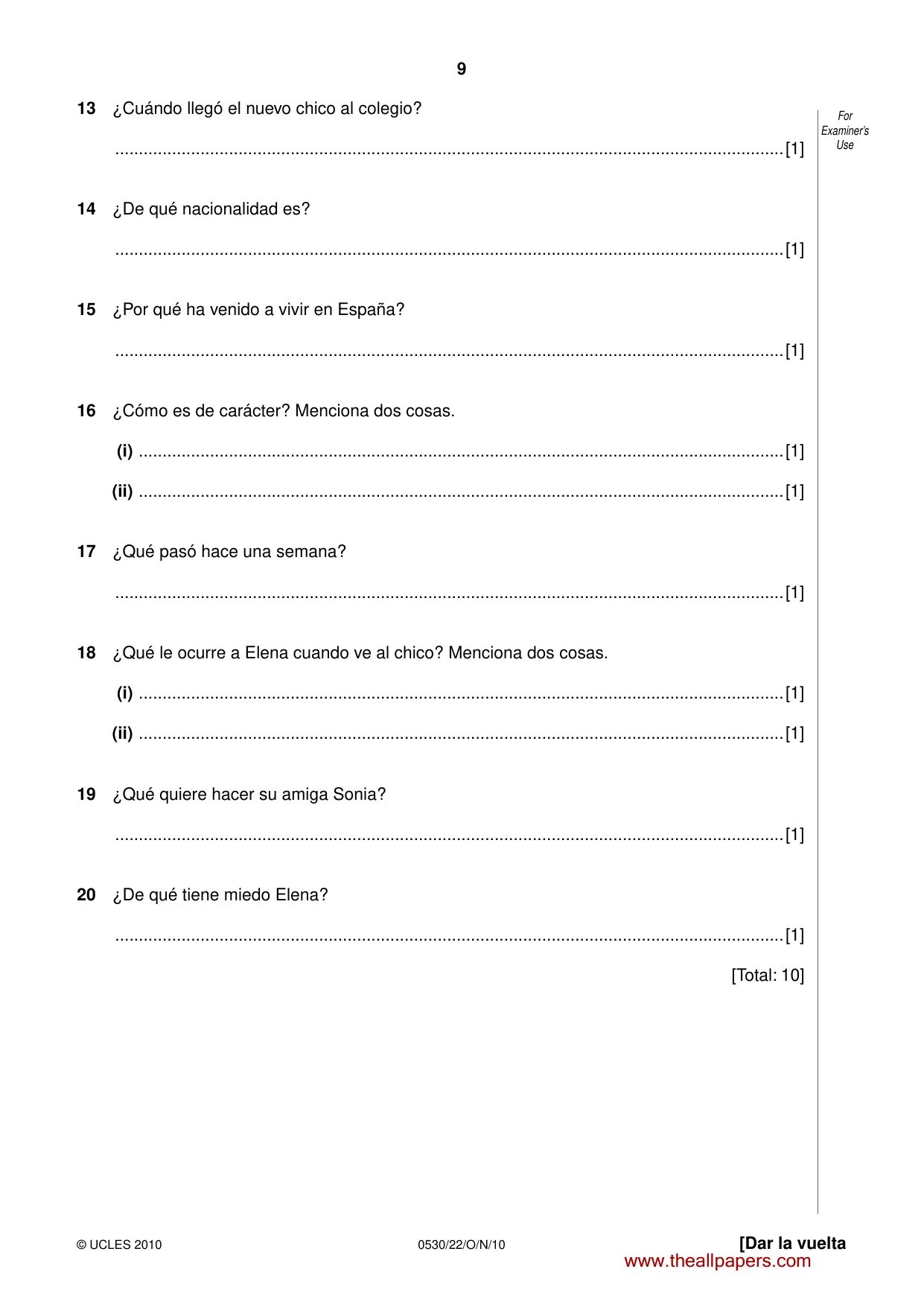
9 0530/22/O/N/10 © UCLES 2010 [Dar la vuelta For Examiner’s Use 13 ¿Cuándo llegó el nuevo chico al colegio? …[1] 14 ¿De qué nacionalidad es? …[1] 15 ¿Por qué ha venido a vivir en España? …[1] 16 ¿Cómo es de carácter? Menciona dos cosas. (i) …[1] (ii) …[1] 17 ¿Qué pasó hace una semana? …[1] 18 ¿Qué le ocurre a Elena cuando ve al chico? Menciona dos cosas. (i) …[1] (ii) …[1] 19 ¿Qué quiere hacer su amiga Sonia? …[1] 20 ¿De qué tiene miedo Elena? …[1] [Total: 10] www.theallpapers.com
Question paper, page 10
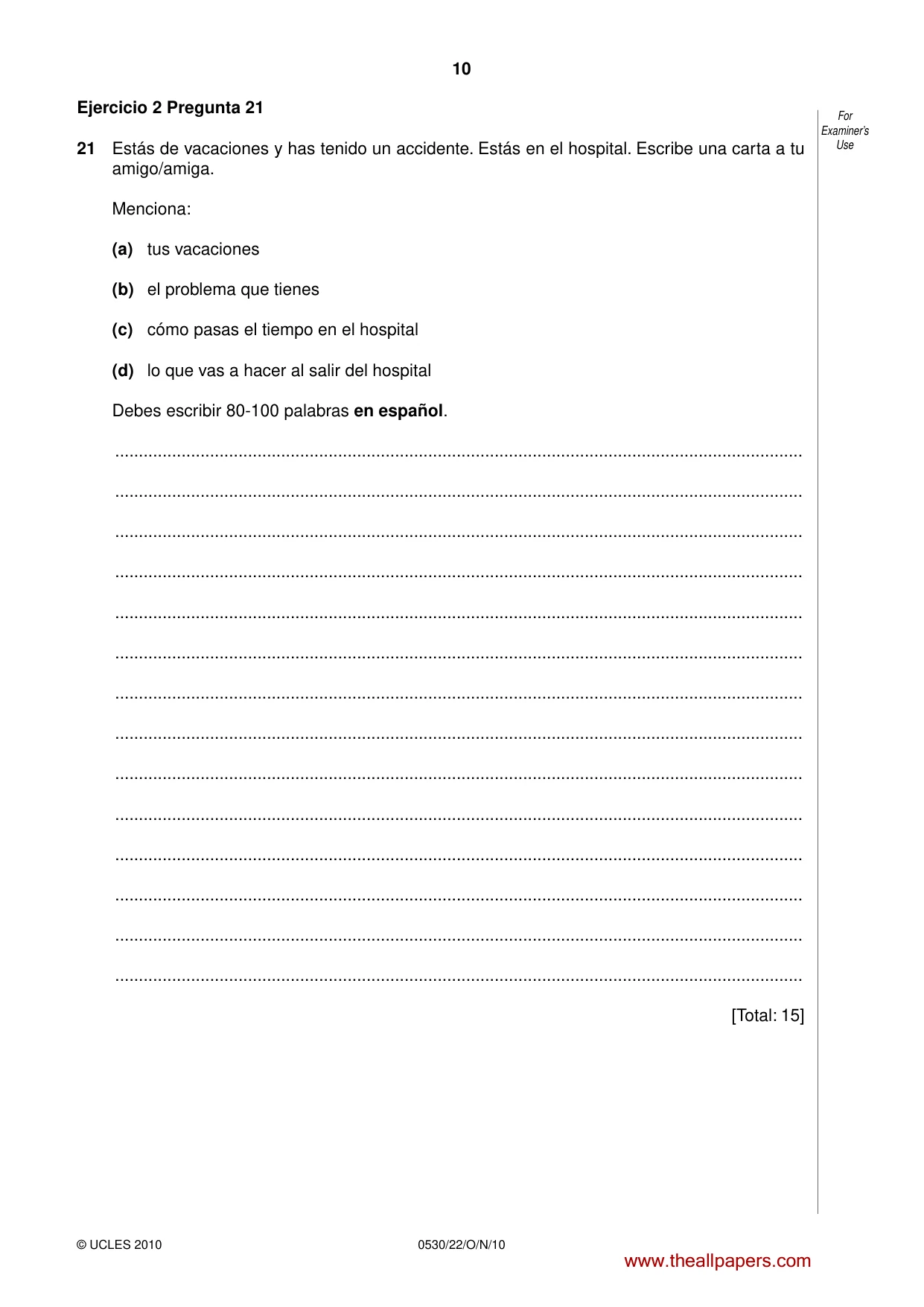
10 0530/22/O/N/10 © UCLES 2010 For Examiner’s Use Ejercicio 2 Pregunta 21 21 Estás de vacaciones y has tenido un accidente. Estás en el hospital. Escribe una carta a tu amigo/amiga. Menciona: (a) tus vacaciones (b) el problema que tienes (c) cómo pasas el tiempo en el hospital (d) lo que vas a hacer al salir del hospital Debes escribir 80-100 palabras en español. … … … … … … … … … … … … … … [Total: 15] www.theallpapers.com
Question paper, page 11
11 0530/22/O/N/10 © UCLES 2010 [Dar la vuelta BLANK PAGE DAR LA VUELTA PARA LA SECCIÓN 3. www.theallpapers.com
Question paper, page 12
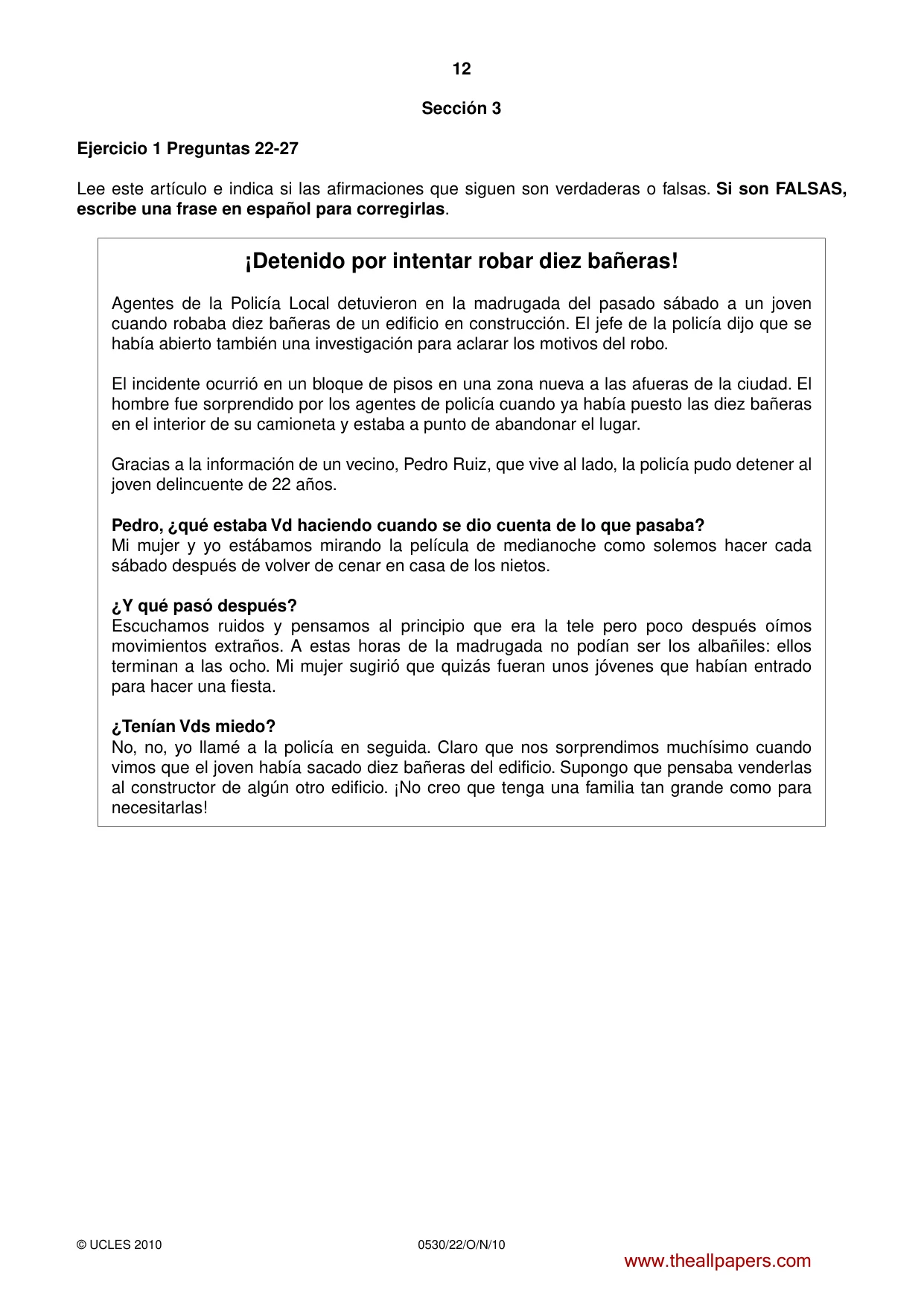
12 0530/22/O/N/10 © UCLES 2010 Sección 3 Ejercicio 1 Preguntas 22-27 Lee este artículo e indica si las afirmaciones que siguen son verdaderas o falsas. Si son FALSAS, escribe una frase en español para corregirlas. ¡Detenido por intentar robar diez bañeras! Agentes de la Policía Local detuvieron en la madrugada del pasado sábado a un joven cuando robaba diez bañeras de un edificio en construcción. El jefe de la policía dijo que se había abierto también una investigación para aclarar los motivos del robo. El incidente ocurrió en un bloque de pisos en una zona nueva a las afueras de la ciudad. El hombre fue sorprendido por los agentes de policía cuando ya había puesto las diez bañeras en el interior de su camioneta y estaba a punto de abandonar el lugar. Gracias a la información de un vecino, Pedro Ruiz, que vive al lado, la policía pudo detener al joven delincuente de 22 años. Pedro, ¿qué estaba Vd haciendo cuando se dio cuenta de lo que pasaba? Mi mujer y yo estábamos mirando la película de medianoche como solemos hacer cada sábado después de volver de cenar en casa de los nietos. ¿Y qué pasó después? Escuchamos ruidos y pensamos al principio que era la tele pero poco después oímos movimientos extraños. A estas horas de la madrugada no podían ser los albañiles: ellos terminan a las ocho. Mi mujer sugirió que quizás fueran unos jóvenes que habían entrado para hacer una fiesta. ¿Tenían Vds miedo? No, no, yo llamé a la policía en seguida. Claro que nos sorprendimos muchísimo cuando vimos que el joven había sacado diez bañeras del edificio. Supongo que pensaba venderlas al constructor de algún otro edificio. ¡No creo que tenga una familia tan grande como para necesitarlas! www.theallpapers.com
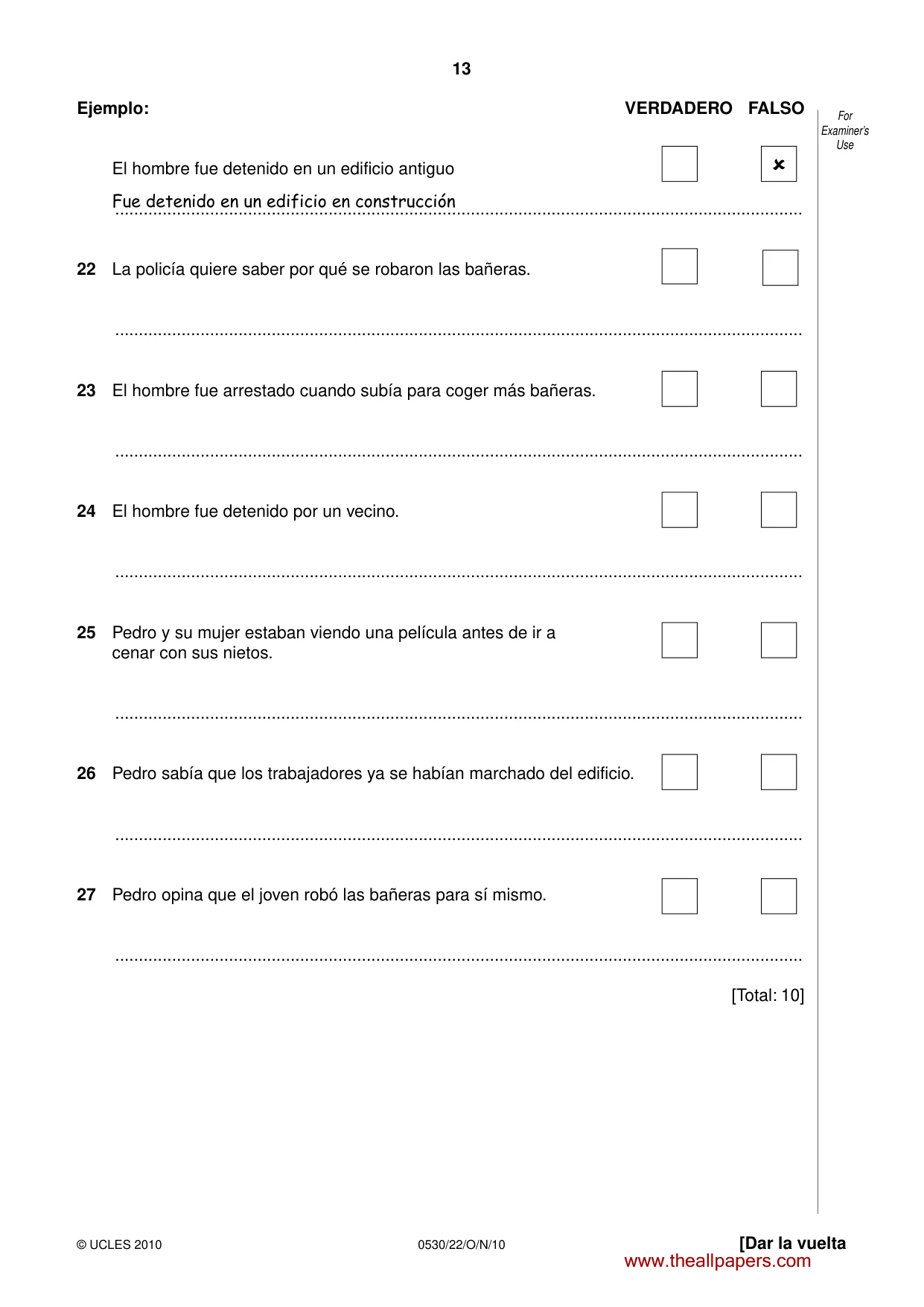
Question paper, page 13
13 0530/22/O/N/10 © UCLES 2010 [Dar la vuelta For Examiner’s Use Ejemplo: VERDADERO FALSO El hombre fue detenido en un edificio antiguo 8 … Fue detenido en un edificio en construcción 22 La policía quiere saber por qué se robaron las bañeras. … 23 El hombre fue arrestado cuando subía para coger más bañeras. … 24 El hombre fue detenido por un vecino. … 25 Pedro y su mujer estaban viendo una película antes de ir a cenar con sus nietos. … 26 Pedro sabía que los trabajadores ya se habían marchado del edificio. … 27 Pedro opina que el joven robó las bañeras para sí mismo. … [Total: 10] www.theallpapers.com
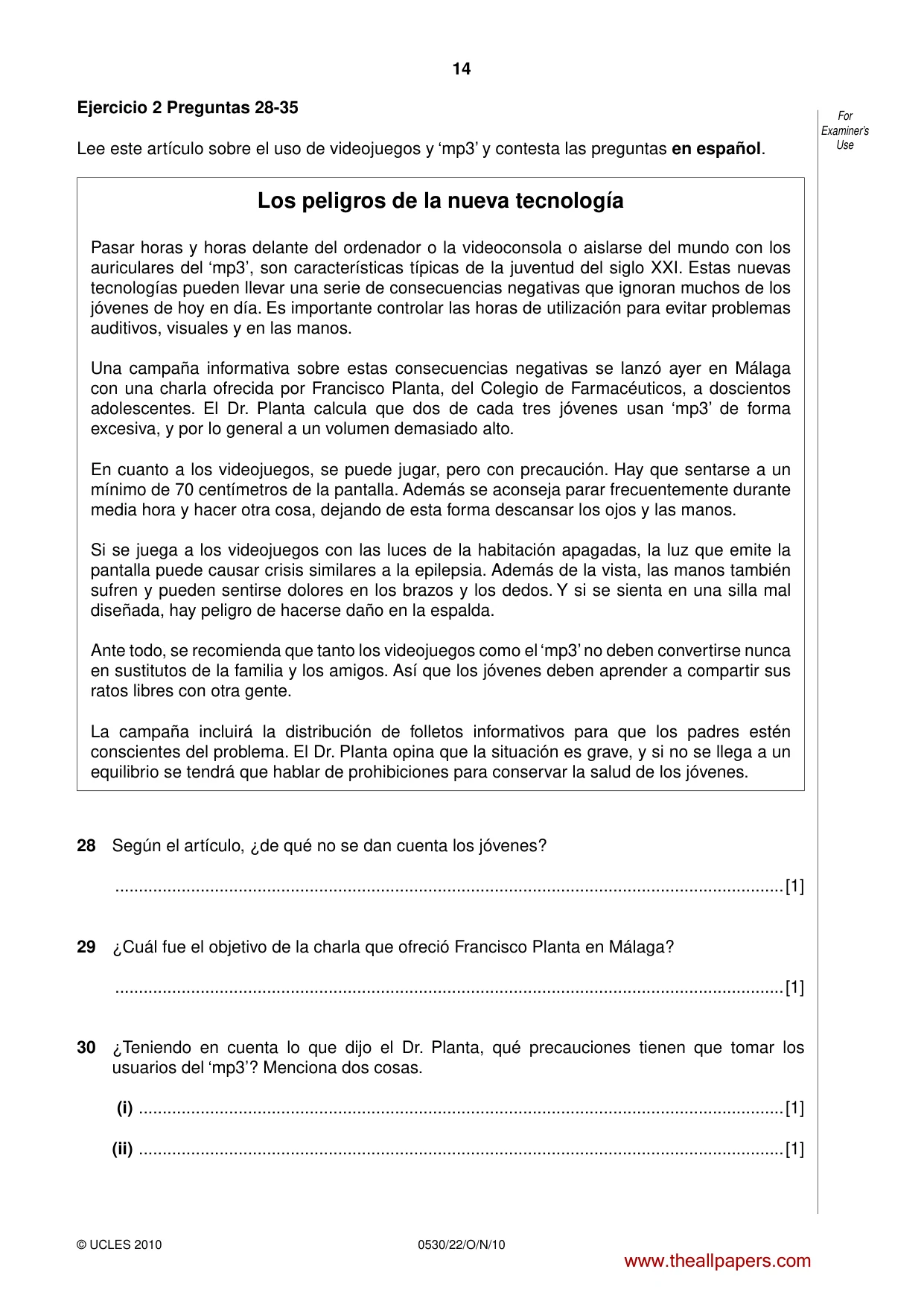
Question paper, page 14
14 0530/22/O/N/10 © UCLES 2010 For Examiner’s Use Ejercicio 2 Preguntas 28-35 Lee este artículo sobre el uso de videojuegos y ‘mp3’ y contesta las preguntas en español. Los peligros de la nueva tecnología Pasar horas y horas delante del ordenador o la videoconsola o aislarse del mundo con los auriculares del ‘mp3’, son características típicas de la juventud del siglo XXI. Estas nuevas tecnologías pueden llevar una serie de consecuencias negativas que ignoran muchos de los jóvenes de hoy en día. Es importante controlar las horas de utilización para evitar problemas auditivos, visuales y en las manos. Una campaña informativa sobre estas consecuencias negativas se lanzó ayer en Málaga con una charla ofrecida por Francisco Planta, del Colegio de Farmacéuticos, a doscientos adolescentes. El Dr. Planta calcula que dos de cada tres jóvenes usan ‘mp3’ de forma excesiva, y por lo general a un volumen demasiado alto. En cuanto a los videojuegos, se puede jugar, pero con precaución. Hay que sentarse a un mínimo de 70 centímetros de la pantalla. Además se aconseja parar frecuentemente durante media hora y hacer otra cosa, dejando de esta forma descansar los ojos y las manos. Si se juega a los videojuegos con las luces de la habitación apagadas, la luz que emite la pantalla puede causar crisis similares a la epilepsia. Además de la vista, las manos también sufren y pueden sentirse dolores en los brazos y los dedos. Y si se sienta en una silla mal diseñada, hay peligro de hacerse daño en la espalda. Ante todo, se recomienda que tanto los videojuegos como el ‘mp3’ no deben convertirse nunca en sustitutos de la familia y los amigos. Así que los jóvenes deben aprender a compartir sus ratos libres con otra gente. La campaña incluirá la distribución de folletos informativos para que los padres estén conscientes del problema. El Dr. Planta opina que la situación es grave, y si no se llega a un equilibrio se tendrá que hablar de prohibiciones para conservar la salud de los jóvenes. 28 Según el artículo, ¿de qué no se dan cuenta los jóvenes? …[1] 29 ¿Cuál fue el objetivo de la charla que ofreció Francisco Planta en Málaga? …[1] 30 ¿Teniendo en cuenta lo que dijo el Dr. Planta, qué precauciones tienen que tomar los usuarios del ‘mp3’? Menciona dos cosas. (i) …[1] (ii) …[1] www.theallpapers.com
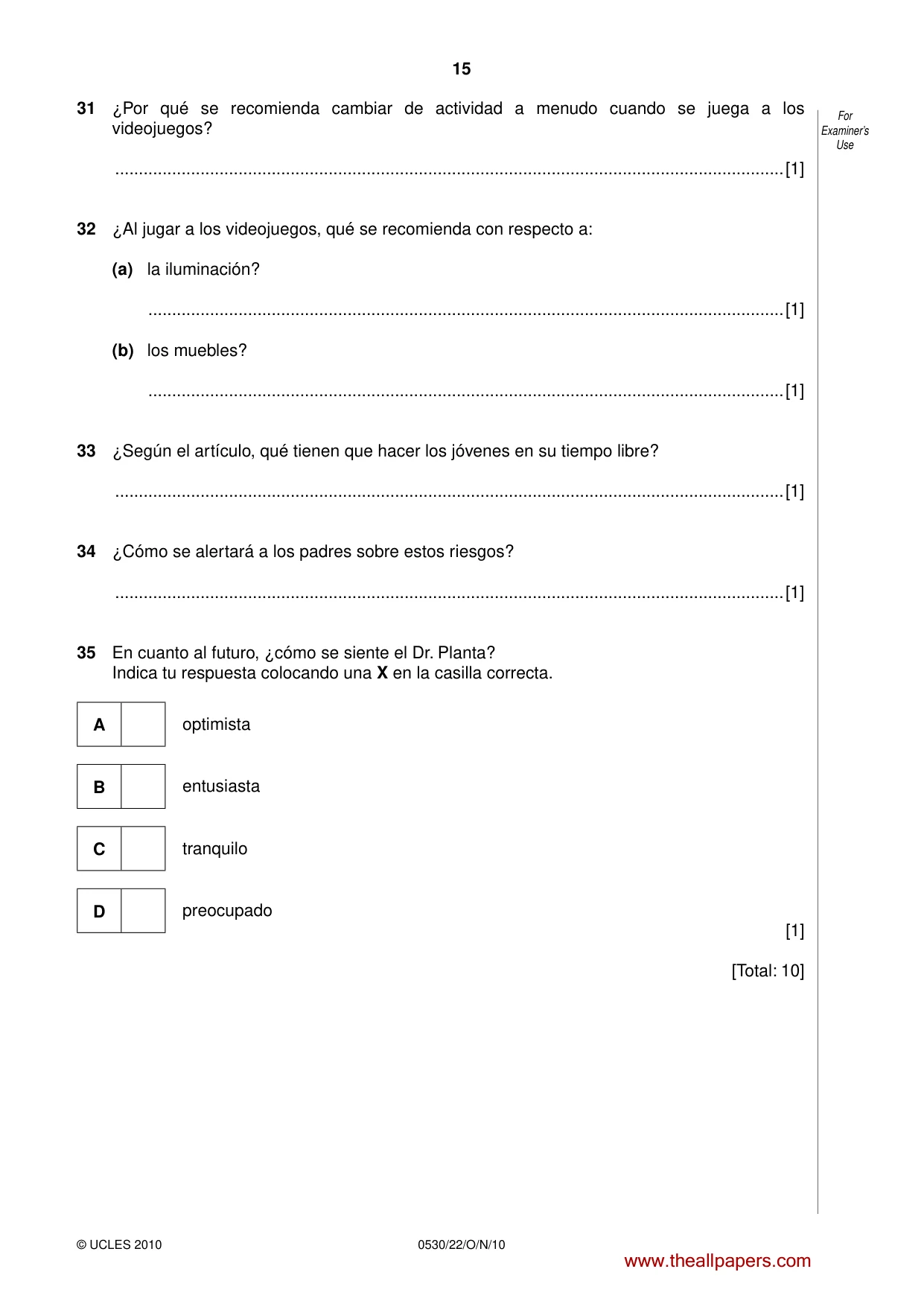
Question paper, page 15
15 0530/22/O/N/10 © UCLES 2010 For Examiner’s Use 31 ¿Por qué se recomienda cambiar de actividad a menudo cuando se juega a los videojuegos? …[1] 32 ¿Al jugar a los videojuegos, qué se recomienda con respecto a: (a) la iluminación? …[1] (b) los muebles? …[1] 33 ¿Según el artículo, qué tienen que hacer los jóvenes en su tiempo libre? …[1] 34 ¿Cómo se alertará a los padres sobre estos riesgos? …[1] 35 En cuanto al futuro, ¿cómo se siente el Dr. Planta? Indica tu respuesta colocando una X en la casilla correcta. A optimista B entusiasta C tranquilo D preocupado [1] [Total: 10] www.theallpapers.com
Question paper, page 16
16 0530/22/O/N/10 © UCLES 2010 Permission to reproduce items where third-party owned material protected by copyright is included has been sought and cleared where possible. Every reasonable effort has been made by the publisher (UCLES) to trace copyright holders, but if any items requiring clearance have unwittingly been included, the publisher will be pleased to make amends at the earliest possible opportunity. University of Cambridge International Examinations is part of the Cambridge Assessment Group. Cambridge Assessment is the brand name of University of Cambridge Local Examinations Syndicate (UCLES), which is itself a department of the University of Cambridge. BLANK PAGE www.theallpapers.com
Mark scheme, page 1
UNIVERSITY OF CAMBRIDGE INTERNATIONAL EXAMINATIONS International General Certificate of Secondary Education MARK SCHEME for the October/November 2010 question paper for the guidance of teachers 0530 SPANISH (FOREIGN LANGUAGE) 0530/22 Paper 2 (Reading and Directed Writing), maximum raw mark 65 This mark scheme is published as an aid to teachers and candidates, to indicate the requirements of the examination. It shows the basis on which Examiners were instructed to award marks. It does not indicate the details of the discussions that took place at an Examiners’ meeting before marking began, which would have considered the acceptability of alternative answers. Mark schemes must be read in conjunction with the question papers and the report on the examination. • CIE will not enter into discussions or correspondence in connection with these mark schemes. CIE is publishing the mark schemes for the October/November 2010 question papers for most IGCSE, GCE Advanced Level and Advanced Subsidiary Level syllabuses and some Ordinary Level syllabuses. www.theallpapers.com
Mark scheme, page 2
Page 2 Mark Scheme: Teachers’ version Syllabus Paper IGCSE – October/November 2010 0530 22 © UCLES 2010 1 General Marking Notes 2 General Marking Principles 2.1 Please note that it is not possible to list all acceptable alternatives in the Detailed Mark Scheme provided in Section 3. You will need to consider all alternative answers and unexpected approaches in candidates' scripts, make a decision on whether they communicate the required elements, in consultation with your Team Leader if necessary (or with your Product Manager if you are a single Examiner), and award marks accordingly. The following marking principles underpin the detailed instructions provided in Section 3 of the Mark Scheme. Where a decision is taken to deviate from these principles for a particular question, this will be specified in the Mark Scheme. 2.2 Crossing out: (a) If a candidate changes his/her mind over an answer and crosses out an attempt, award a mark if the final attempt is correct. (b) If a candidate crosses out an answer to a whole question but makes no second attempt at it, mark the crossed out work. 2.3 Reading tasks: more than the stipulated number of boxes ticked/crossed by the candidate: (a) If more than one attempt is visible, but the candidate has clearly indicated which attempt is his/her final answer (e.g. by crossing out other attempts or by annotating the script in some way), mark in the usual way. (b) If two attempts are visible (e.g. two boxes ticked instead of the 1 box stipulated), and neither has been crossed out/discounted by the candidate, no mark can be awarded. (c) In questions where candidates are required to tick a number of boxes (e.g. tick the 6 true statements) the general rule to be applied is as follows: the number of 'extra' answers indicated by the candidate is deducted from the number of correct answers and the remaining number is the mark awarded, e.g. the candidate is required to tick 6 true statements, but instead ticks 8 statements. 5 of the 6 ticks are correctly placed, but 2 of the ticks are ‘extras’ (8 ticks placed by candidate minus 6 ticks required by rubric = 2). Therefore the candidate is awarded a mark of 3 5 number of correct ticks –2 minus number of extra ticks = 3 (d) Answers in pen do not take precedence over answers in pencil, e.g. if a candidate is asked to tick 1 box and ticks two, one in pen and the other in pencil, the mark cannot be awarded unless there is some explicit indication from the candidate as to which is his/her final answer. 2.4 Reading tasks: for questions requiring more than one element for the answer, (i) and (ii), where the answers are interchangeable: Both correct answers on line 1 and line 2 blank = 2 Both correct answers on line 1, but another answer on line 2 wrong = 1 (or vice-versa) www.theallpapers.com
Mark scheme, page 3
Page 3 Mark Scheme: Teachers’ version Syllabus Paper IGCSE – October/November 2010 0530 22 © UCLES 2010 2.5 Reading tasks: answers requiring the use of Spanish (rather than a non-verbal response) should be marked for communication. Tolerate inaccuracies provided the message is clear. (a) ‘If in doubt, sound it out’: if you read what the candidate has written, does it sound like the correct answer? (b) Look-alike test: does what the candidate has written look like the correct answer? (c) Accept incorrect gender or person unless Mark Scheme specifies otherwise. (d) Accept incorrect possessive adjectives e.g. mon, ton, son etc., unless Mark Scheme specifies otherwise (in general, Section 2 accept, Section 3 consult Mark Scheme carefully). 2.6 Unless the Mark Scheme specifies otherwise, do not accept incorrect Spanish if the word given means something else in Spanish. (Incorrect which constitutes a word in any language other than Spanish is marked (i) on the basis of whether it is accepted or refused in the Mark Scheme and (ii) if not mentioned in the Mark Scheme, on the basis of 2.5 above). 2.7 Annotation used in the Mark Scheme: (a) INV = Invalidation and is used when additional material included by the candidate is judged to invalidate an otherwise correct answer thus preventing him/her from scoring the mark (INV = 0). (b) tc = ‘tout court’ and means that on its own the material is not sufficient to score the mark. (c) HA = harmless additional material which in conjunction with the correct answer does not prevent the candidate from scoring the mark. (d) BOD = Benefit of the Doubt and is used to indicate material considered by the Examiner and judged to be more correct than incorrect: the benefit of the doubt is given to the candidate and the mark is awarded. 2.8 No response and '0' marks There is a NR (NO Response) option in scoris. Award NR (No Response): • If there is nothing written at all in the answer space or • If there is only a comment which does not in any way relate to the question being asked (e.g. 'can’t do' or 'don’t know') or • If there is only a mark which isn’t an attempt at the question (e.g. a dash, a question mark). Award 0: • If there is any attempt that earns no credit. This could, for example, include the candidate copying all or some of the question, or any working that does not earn any marks, whether crossed out or not. 2.9 Extra material: Section 2, Exercise 1 In Section 2, Exercise 1, reward the candidate for being able to locate the answer in the passage. Do not worry about lifting unless this would cause the message to be seriously distorted (in general, incorrect possessives should not be judged to cause distortion: see 2.5(d)) – in which case a lift will be specifically rejected in the Mark Scheme. Ignore extra material given in an answer providing that it does not invalidate an answer. www.theallpapers.com
Mark scheme, page 4
Page 4 Mark Scheme: Teachers’ version Syllabus Paper IGCSE – October/November 2010 0530 22 © UCLES 2010 2.10 Extra material: Section 3 In Section 3 it is the candidate’s responsibility to answer questions in such a way as to demonstrate to the Examiner that s/he has understood the texts/questions. Where candidates introduce extra, irrelevant material to an otherwise correct answer the danger is that the Examiner is being forced to ‘choose’ the correct answer and s/he cannot be certain that the candidate has shown understanding. Where the Examiner is put in this position the mark cannot be awarded. In Section 3, look for signs of genuine comprehension. Usually, candidates who lift indiscriminately fail to demonstrate comprehension and will not score the mark. However, careful lifting of the details required to answer the question does demonstrate comprehension and should be rewarded. The Detailed Mark Scheme (Section (c)) provides specific guidance but in cases not covered, the following general rules apply: (a) Extra material, mentioned in the Mark Scheme, which reinforces the correct answer or in itself constitutes an alternative correct answer: this is acceptable and is not penalised (b) Extra material which constitutes an alternative answer, but which is not explicitly mentioned in the Mark Scheme: the Examiner needs to decide, by consulting the text and the Team Leader if necessary whether the alternative answer constitutes: (i) an alternative correct answer, in which case this falls into category (a) and the answer should be rewarded (ii) or an answer which on its own would be refused, in which case this falls into category (c) and the answer should be refused (c) Extra material which constitutes an alternative answer specifically refused in the Mark Scheme: this puts the Examiner in the position of having to ‘choose’ which is the candidate's 'final' answer – the Examiner cannot be sure what the candidate has understood – and the mark cannot be awarded (d) Extra material which distorts or contradicts the correct answer: this affects communication – the Examiner cannot be sure what the candidate has understood – and the mark cannot be awarded (e) Extra material introduced by the candidate and which does not feature in the text: this affects communication – the Examiner cannot be sure what the candidate has understood – and the mark cannot be awarded. It can sometimes be difficult to draw the line between what is a deduction made by an able candidate on the basis of what they have read and pure guesswork. Therefore where an answer of this sort occurs which is not covered in the Mark Scheme, Examiners should consult their Team Leader www.theallpapers.com
Mark scheme, page 5
Page 5 Mark Scheme: Teachers’ version Syllabus Paper IGCSE – October/November 2010 0530 22 © UCLES 2010 3 Detailed Mark Scheme SECTION 1 Exercise 1 Questions 1–5 1 D [1] 2 A [1] 3 D [1] 4 B [1] 5 D [1] [1 mark per item = 5 marks] Exercise 2 Questions 6–10 6 C [1] 7 D [1] 8 A [1] 9 B [1] 10 F [1] [1 mark per item = 5 marks] Exercise 3 Question 11 Correct boxes to tick: B Mountain walking D Theatre with small children watching F People playing chess G People bird watching I People looking at man in suit of armour, inside castle [1 mark per correct item – 5 marks] www.theallpapers.com
Mark scheme, page 6
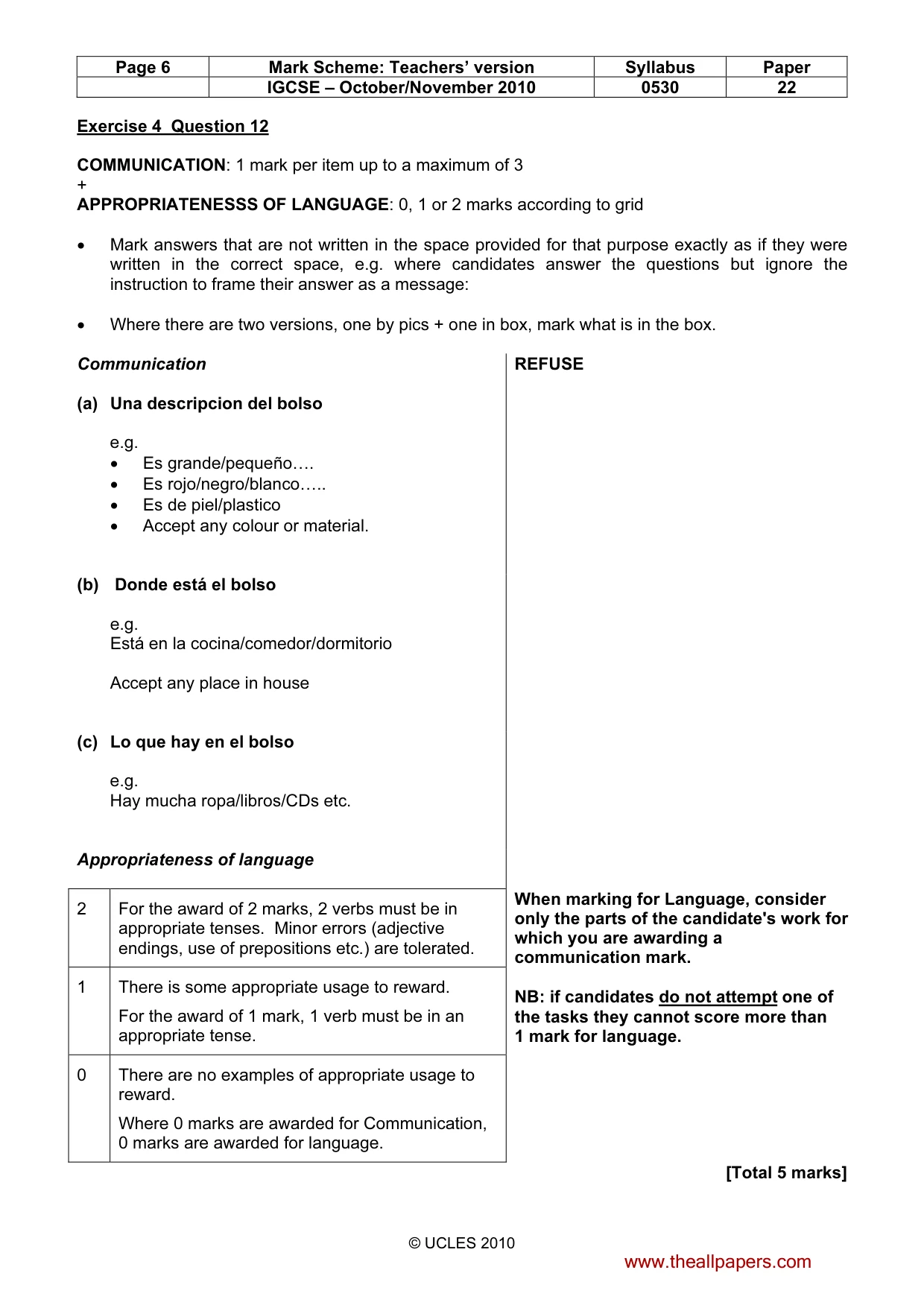
Page 6 Mark Scheme: Teachers’ version Syllabus Paper IGCSE – October/November 2010 0530 22 © UCLES 2010 Exercise 4 Question 12 COMMUNICATION: 1 mark per item up to a maximum of 3 + APPROPRIATENESSS OF LANGUAGE: 0, 1 or 2 marks according to grid • Mark answers that are not written in the space provided for that purpose exactly as if they were written in the correct space, e.g. where candidates answer the questions but ignore the instruction to frame their answer as a message: • Where there are two versions, one by pics + one in box, mark what is in the box. Communication REFUSE (a) Una descripcion del bolso e.g. • Es grande/pequeño…. • Es rojo/negro/blanco….. • Es de piel/plastico • Accept any colour or material. (b) Donde está el bolso e.g. Está en la cocina/comedor/dormitorio Accept any place in house (c) Lo que hay en el bolso e.g. Hay mucha ropa/libros/CDs etc. Appropriateness of language 2 For the award of 2 marks, 2 verbs must be in appropriate tenses. Minor errors (adjective endings, use of prepositions etc.) are tolerated. 1 There is some appropriate usage to reward. For the award of 1 mark, 1 verb must be in an appropriate tense. 0 There are no examples of appropriate usage to reward. Where 0 marks are awarded for Communication, 0 marks are awarded for language. When marking for Language, consider only the parts of the candidate's work for which you are awarding a communication mark. NB: if candidates do not attempt one of the tasks they cannot score more than 1 mark for language. [Total 5 marks] www.theallpapers.com
Mark scheme, page 7
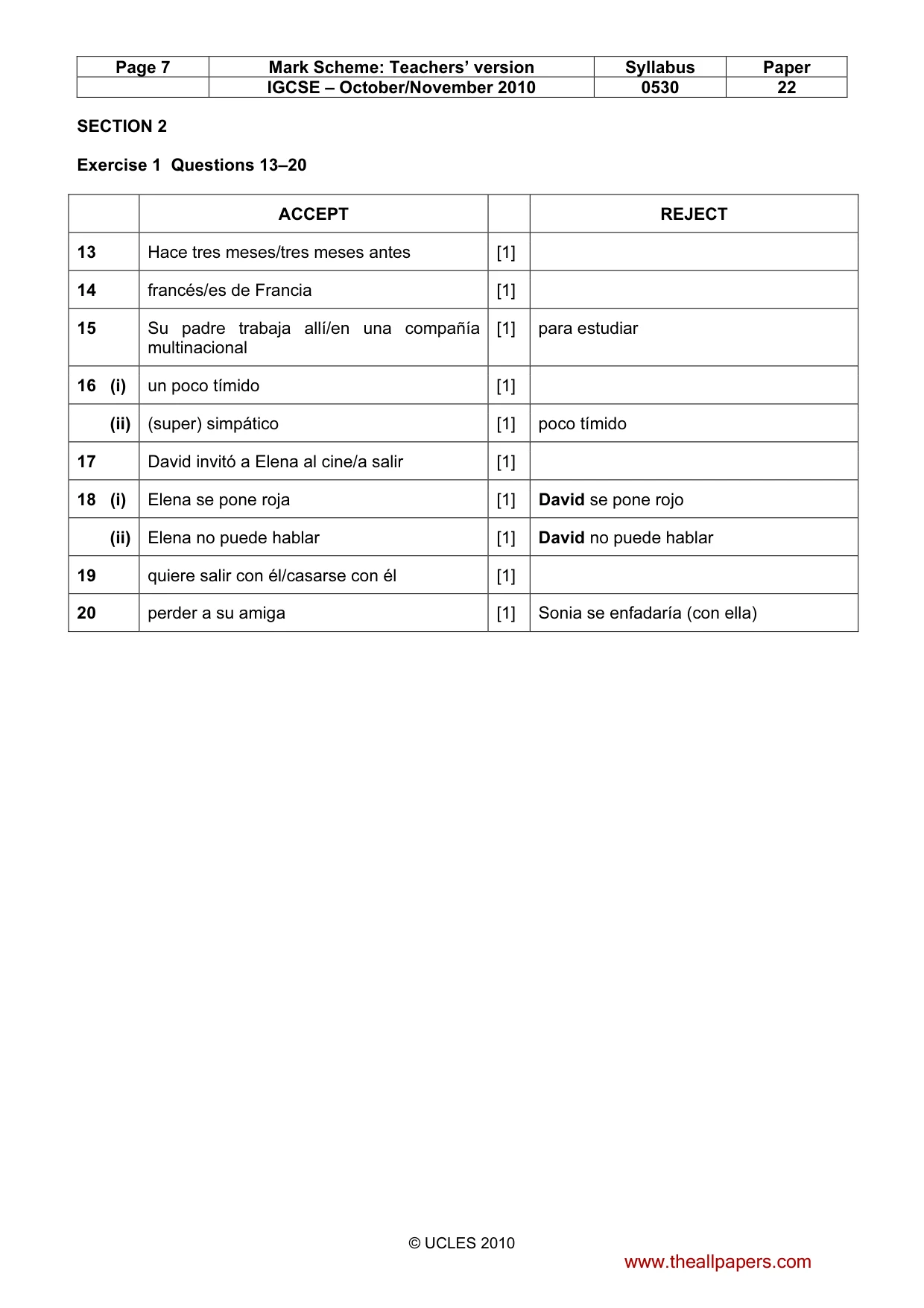
Page 7 Mark Scheme: Teachers’ version Syllabus Paper IGCSE – October/November 2010 0530 22 © UCLES 2010 SECTION 2 Exercise 1 Questions 13–20 ACCEPT REJECT 13 Hace tres meses/tres meses antes [1] 14 francés/es de Francia [1] 15 Su padre trabaja allí/en una compañía multinacional [1] para estudiar 16 (i) un poco tímido [1] (ii) (super) simpático [1] poco tímido 17 David invitó a Elena al cine/a salir [1] 18 (i) Elena se pone roja [1] David se pone rojo (ii) Elena no puede hablar [1] David no puede hablar 19 quiere salir con él/casarse con él [1] 20 perder a su amiga [1] Sonia se enfadaría (con ella) www.theallpapers.com
Mark scheme, page 8
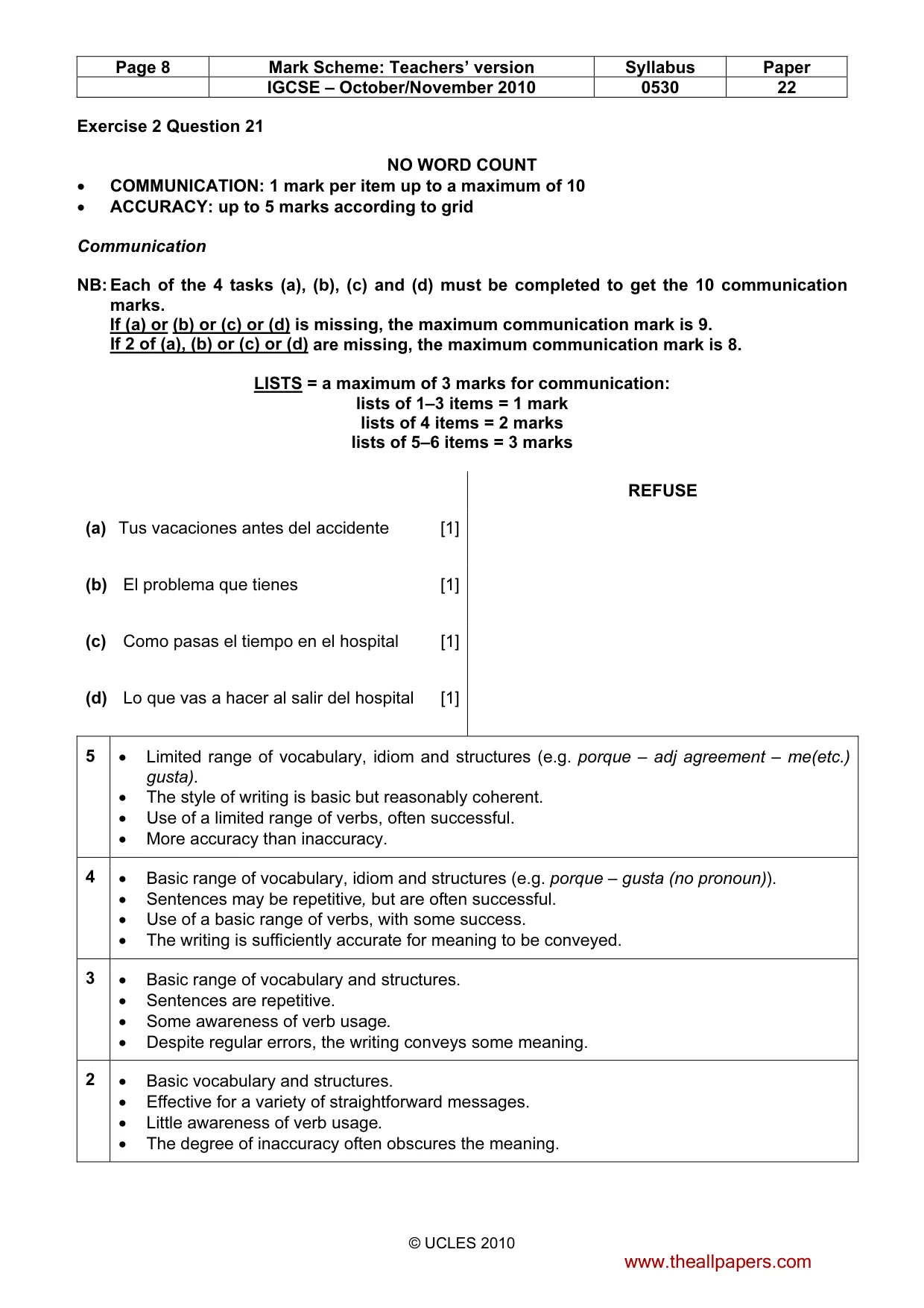
Page 8 Mark Scheme: Teachers’ version Syllabus Paper IGCSE – October/November 2010 0530 22 © UCLES 2010 Exercise 2 Question 21 NO WORD COUNT • COMMUNICATION: 1 mark per item up to a maximum of 10 • ACCURACY: up to 5 marks according to grid Communication NB: Each of the 4 tasks (a), (b), (c) and (d) must be completed to get the 10 communication marks. If (a) or (b) or (c) or (d) is missing, the maximum communication mark is 9. If 2 of (a), (b) or (c) or (d) are missing, the maximum communication mark is 8. LISTS = a maximum of 3 marks for communication: lists of 1–3 items = 1 mark lists of 4 items = 2 marks lists of 5–6 items = 3 marks REFUSE (a) Tus vacaciones antes del accidente [1] (b) El problema que tienes [1] (c) Como pasas el tiempo en el hospital [1] (d) Lo que vas a hacer al salir del hospital [1] 5 • Limited range of vocabulary, idiom and structures (e.g. porque – adj agreement – me(etc.) gusta). • The style of writing is basic but reasonably coherent. • Use of a limited range of verbs, often successful. • More accuracy than inaccuracy. 4 • Basic range of vocabulary, idiom and structures (e.g. porque – gusta (no pronoun)). • Sentences may be repetitive, but are often successful. • Use of a basic range of verbs, with some success. • The writing is sufficiently accurate for meaning to be conveyed. 3 • Basic range of vocabulary and structures. • Sentences are repetitive. • Some awareness of verb usage. • Despite regular errors, the writing conveys some meaning. 2 • Basic vocabulary and structures. • Effective for a variety of straightforward messages. • Little awareness of verb usage. • The degree of inaccuracy often obscures the meaning. www.theallpapers.com
Mark scheme, page 9
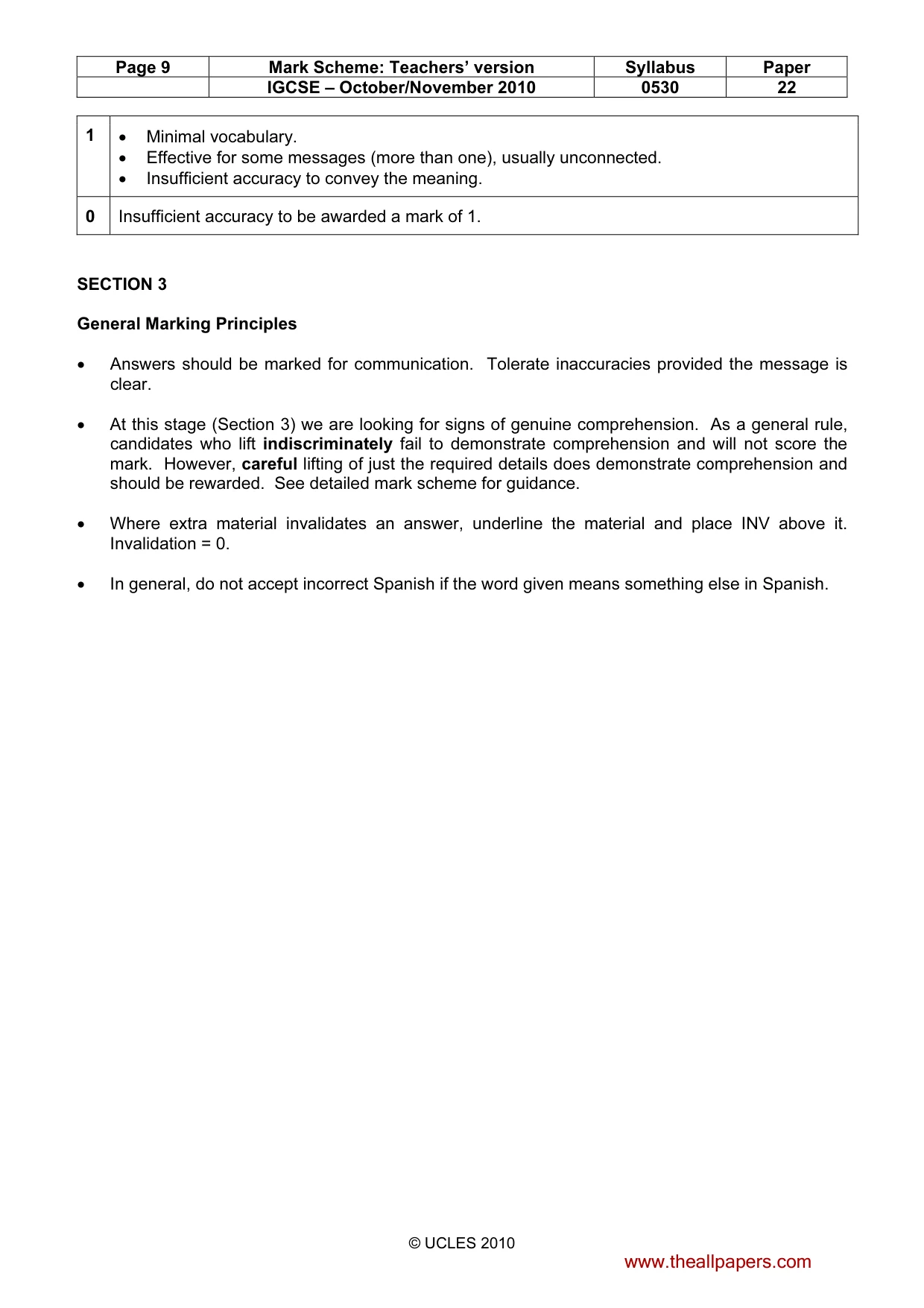
Page 9 Mark Scheme: Teachers’ version Syllabus Paper IGCSE – October/November 2010 0530 22 © UCLES 2010 1 • Minimal vocabulary. • Effective for some messages (more than one), usually unconnected. • Insufficient accuracy to convey the meaning. 0 Insufficient accuracy to be awarded a mark of 1. SECTION 3 General Marking Principles • Answers should be marked for communication. Tolerate inaccuracies provided the message is clear. • At this stage (Section 3) we are looking for signs of genuine comprehension. As a general rule, candidates who lift indiscriminately fail to demonstrate comprehension and will not score the mark. However, careful lifting of just the required details does demonstrate comprehension and should be rewarded. See detailed mark scheme for guidance. • Where extra material invalidates an answer, underline the material and place INV above it. Invalidation = 0. • In general, do not accept incorrect Spanish if the word given means something else in Spanish. www.theallpapers.com
Mark scheme, page 10
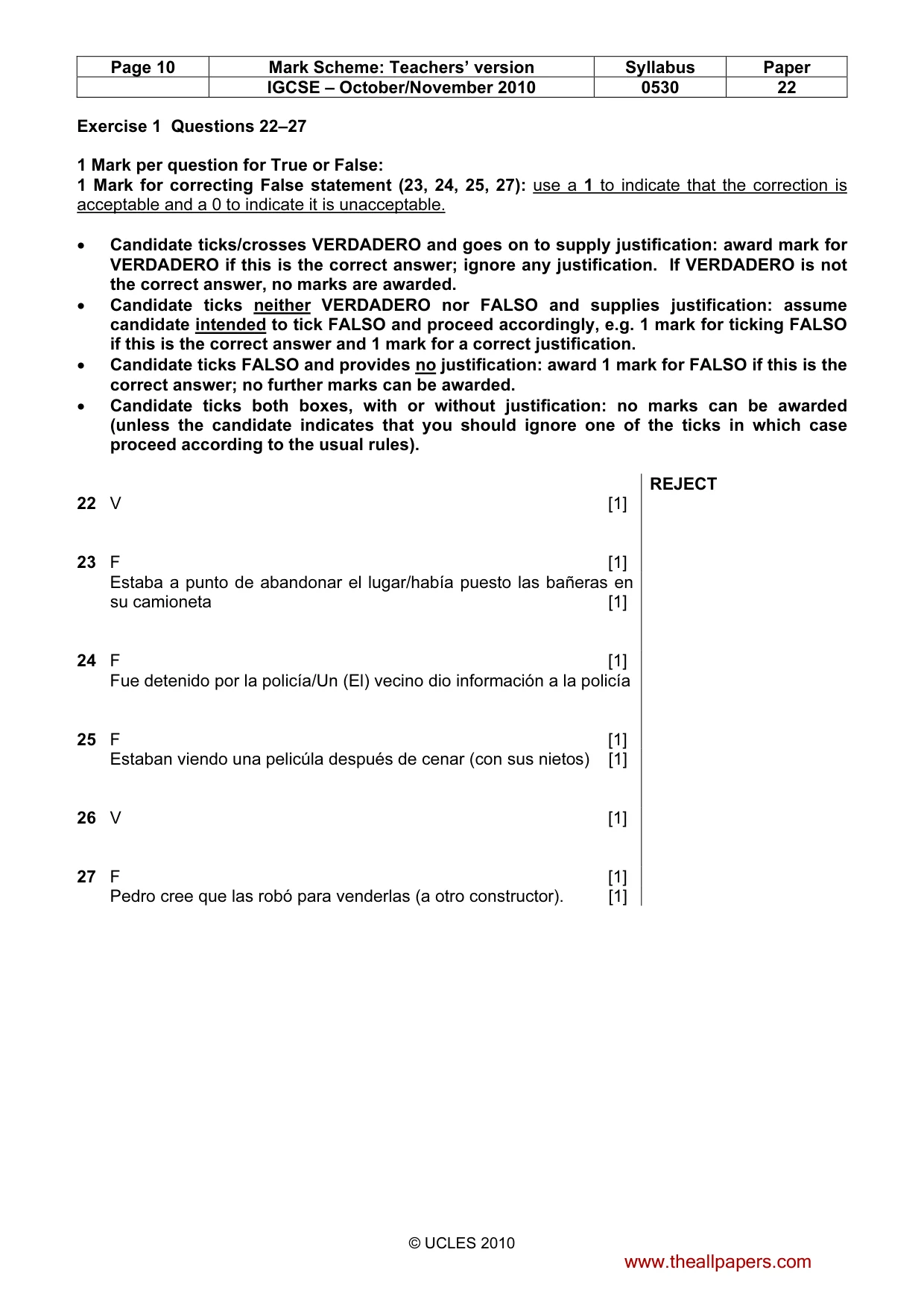
Page 10 Mark Scheme: Teachers’ version Syllabus Paper IGCSE – October/November 2010 0530 22 © UCLES 2010 Exercise 1 Questions 22–27 1 Mark per question for True or False: 1 Mark for correcting False statement (23, 24, 25, 27): use a 1 to indicate that the correction is acceptable and a 0 to indicate it is unacceptable. • Candidate ticks/crosses VERDADERO and goes on to supply justification: award mark for VERDADERO if this is the correct answer; ignore any justification. If VERDADERO is not the correct answer, no marks are awarded. • Candidate ticks neither VERDADERO nor FALSO and supplies justification: assume candidate intended to tick FALSO and proceed accordingly, e.g. 1 mark for ticking FALSO if this is the correct answer and 1 mark for a correct justification. • Candidate ticks FALSO and provides no justification: award 1 mark for FALSO if this is the correct answer; no further marks can be awarded. • Candidate ticks both boxes, with or without justification: no marks can be awarded (unless the candidate indicates that you should ignore one of the ticks in which case proceed according to the usual rules). REJECT 22 V [1] 23 F [1] Estaba a punto de abandonar el lugar/había puesto las bañeras en su camioneta [1] 24 F [1] Fue detenido por la policía/Un (El) vecino dio información a la policía 25 F [1] Estaban viendo una pelicúla después de cenar (con sus nietos) [1] 26 V [1] 27 F [1] Pedro cree que las robó para venderlas (a otro constructor). [1] www.theallpapers.com
Mark scheme, page 11
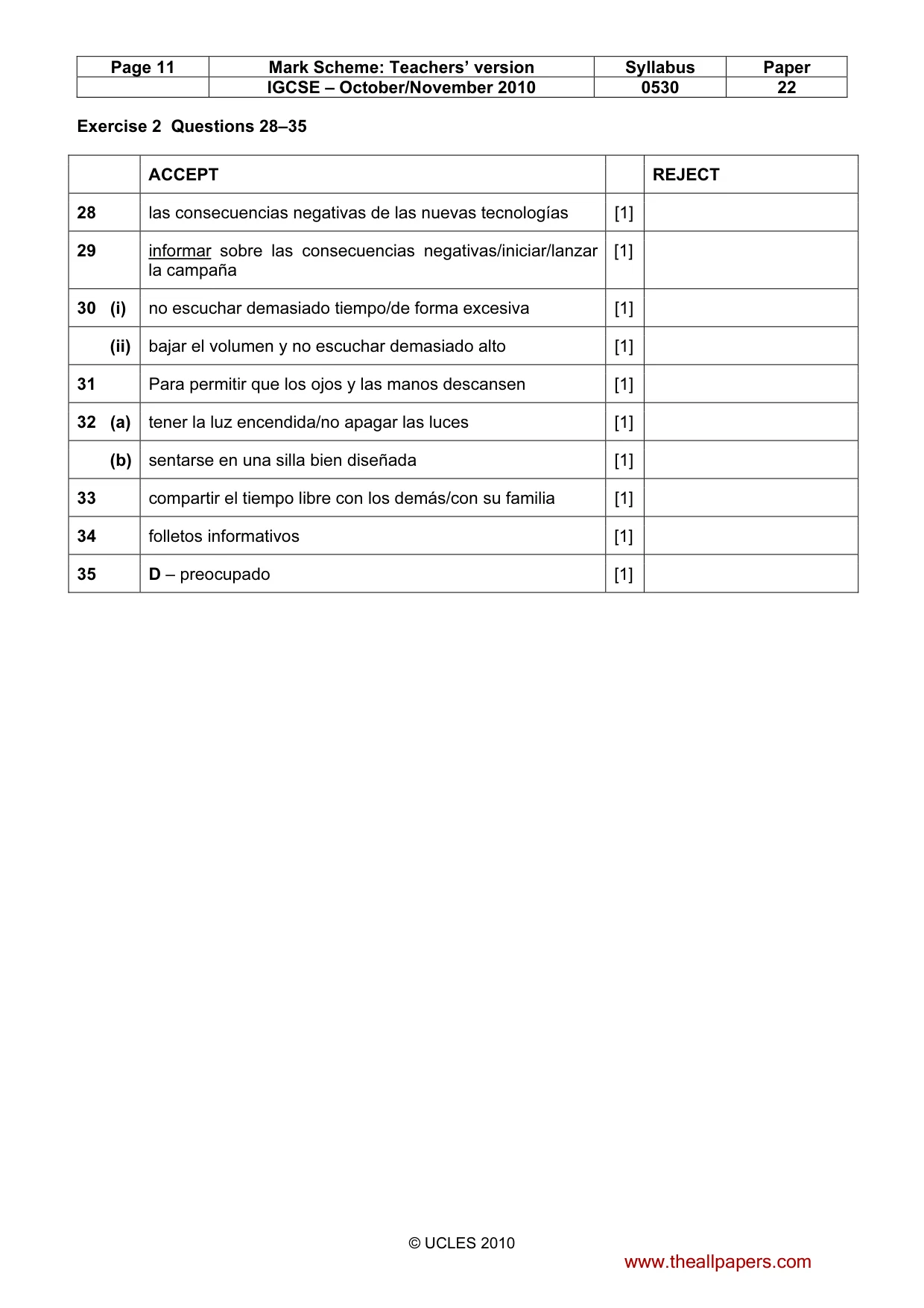
Page 11 Mark Scheme: Teachers’ version Syllabus Paper IGCSE – October/November 2010 0530 22 © UCLES 2010 Exercise 2 Questions 28–35 ACCEPT REJECT 28 las consecuencias negativas de las nuevas tecnologías [1] 29 informar sobre las consecuencias negativas/iniciar/lanzar la campaña [1] 30 (i) no escuchar demasiado tiempo/de forma excesiva [1] (ii) bajar el volumen y no escuchar demasiado alto [1] 31 Para permitir que los ojos y las manos descansen [1] 32 (a) tener la luz encendida/no apagar las luces [1] (b) sentarse en una silla bien diseñada [1] 33 compartir el tiempo libre con los demás/con su familia [1] 34 folletos informativos [1] 35 D – preocupado [1] www.theallpapers.com
What you needed in this session
Cambridge’s own grade thresholds for 2010 Oct/Nov, Paper 2 · Variant 2. A higher threshold means an easier paper — the bar moves with how the cohort did.