Cambridge IGCSE Sociology 0495 — 2021 Oct/Nov Paper 1 · Variant 3
0495/13/O/N/21 · 80 marks · ≈90 min
The question paper and its mark scheme, free to read here and free to download. This is Cambridge’s own paper, exactly as it was sat.
Question paper4 pages
Mark scheme20 pages
Answers below. Sit the paper first if you are practising.

Paper as text
Question paper, page 1
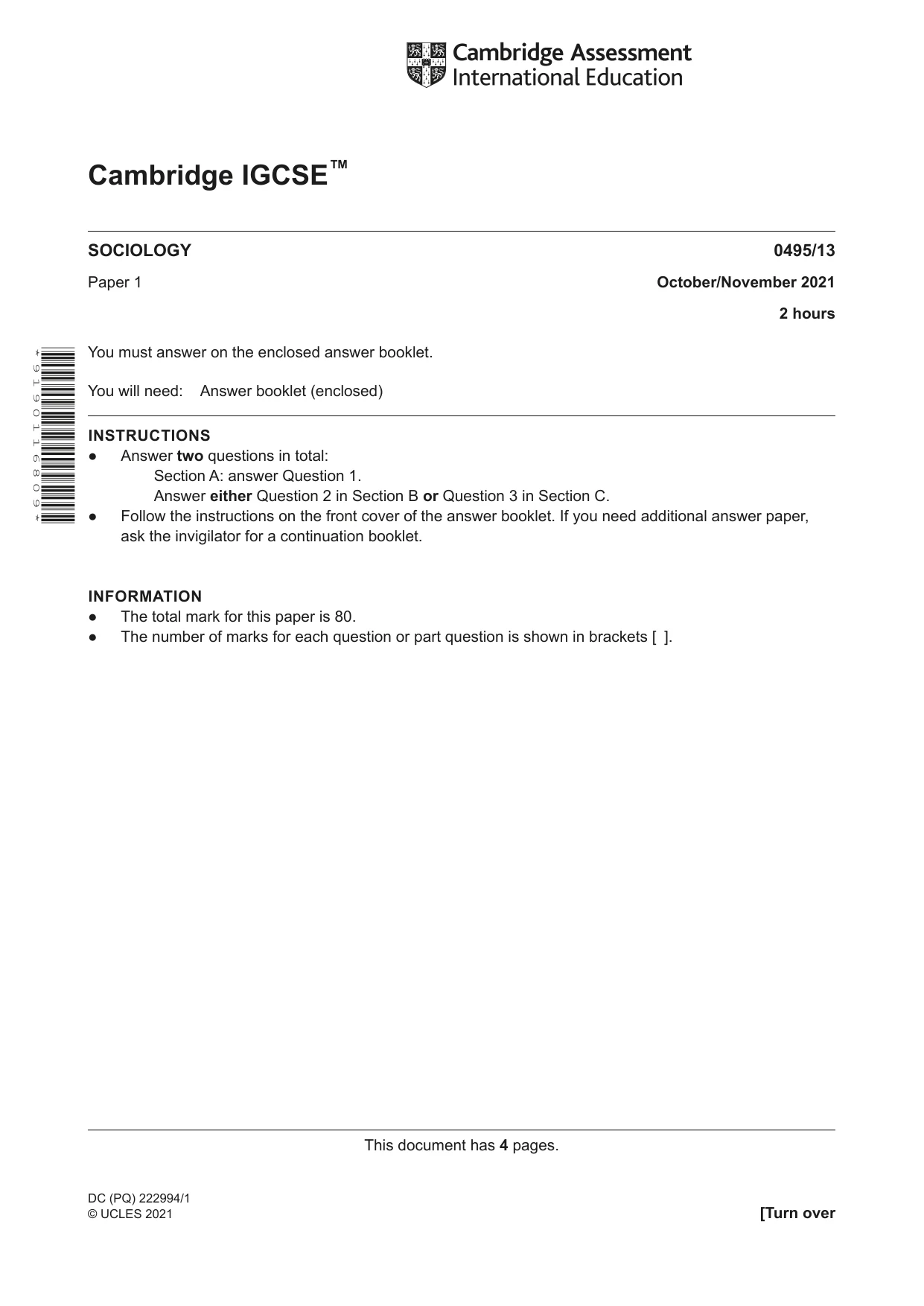
This document has 4 pages. Cambridge IGCSE™ DC (PQ) 222994/1 © UCLES 2021 [Turn over * 9 1 9 0 1 1 6 8 0 9 * SOCIOLOGY 0495/13 Paper 1 October/November 2021 2 hours You must answer on the enclosed answer booklet. You will need: Answer booklet (enclosed) INSTRUCTIONS ● Answer two questions in total: Section A: answer Question 1. Answer either Question 2 in Section B or Question 3 in Section C. ● Follow the instructions on the front cover of the answer booklet. If you need additional answer paper, ask the invigilator for a continuation booklet. INFORMATION ● The total mark for this paper is 80. ● The number of marks for each question or part question is shown in brackets [ ].
Question paper, page 2
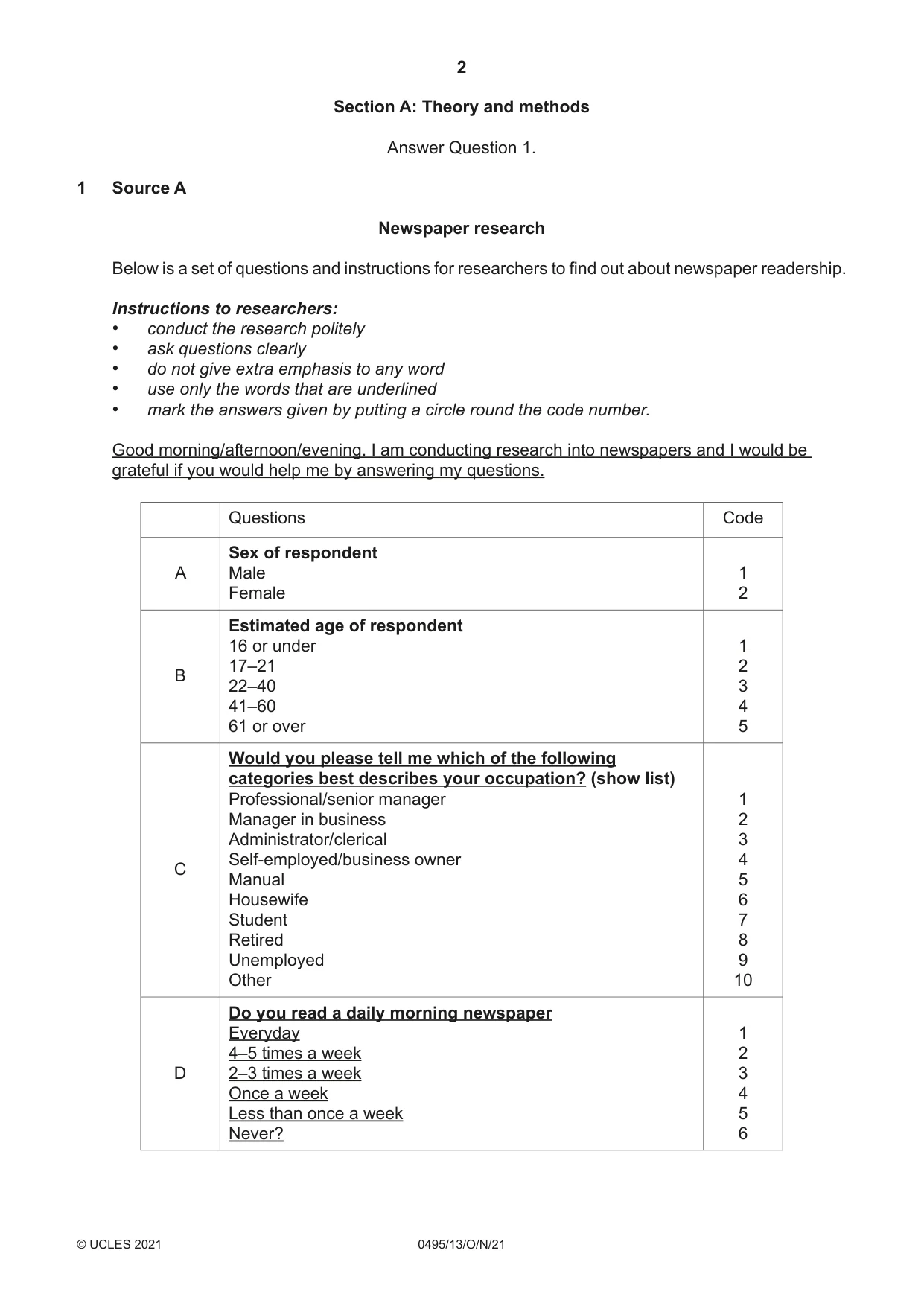
2 0495/13/O/N/21 © UCLES 2021 Section A: Theory and methods Answer Question 1. 1 Source A Newspaper research Below is a set of questions and instructions for researchers to find out about newspaper readership. Instructions to researchers: • conduct the research politely • ask questions clearly • do not give extra emphasis to any word • use only the words that are underlined • mark the answers given by putting a circle round the code number. Good morning/afternoon/evening. I am conducting research into newspapers and I would be grateful if you would help me by answering my questions. Questions Code A Sex of respondent Male Female 1 2 B Estimated age of respondent 16 or under 17–21 22–40 41–60 61 or over 1 2 3 4 5 C Would you please tell me which of the following categories best describes your occupation? (show list) Professional/senior manager Manager in business Administrator/clerical Self-employed/business owner Manual Housewife Student Retired Unemployed Other 1 2 3 4 5 6 7 8 9 10 D Do you read a daily morning newspaper Everyday 4–5 times a week 2–3 times a week Once a week Less than once a week Never? 1 2 3 4 5 6
Question paper, page 3
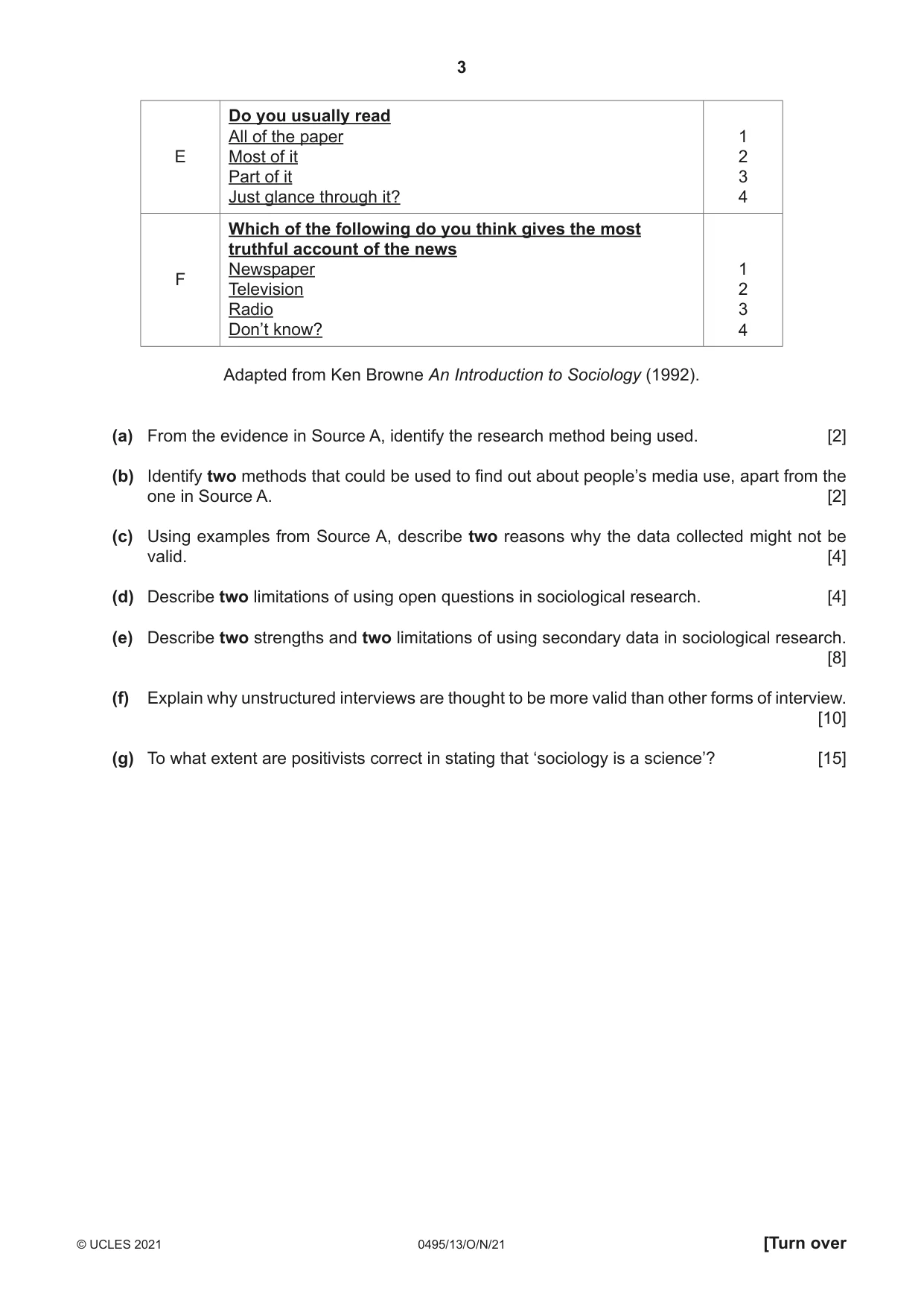
3 0495/13/O/N/21 © UCLES 2021 [Turn over E Do you usually read All of the paper Most of it Part of it Just glance through it? 1 2 3 4 F Which of the following do you think gives the most truthful account of the news Newspaper Television Radio Don’t know? 1 2 3 4 Adapted from Ken Browne An Introduction to Sociology (1992). (a) From the evidence in Source A, identify the research method being used. [2] (b) Identify two methods that could be used to find out about people’s media use, apart from the one in Source A. [2] (c) Using examples from Source A, describe two reasons why the data collected might not be valid. [4] (d) Describe two limitations of using open questions in sociological research. [4] (e) Describe two strengths and two limitations of using secondary data in sociological research. [8] (f) Explain why unstructured interviews are thought to be more valid than other forms of interview. [10] (g) To what extent are positivists correct in stating that ‘sociology is a science’? [15]
Question paper, page 4
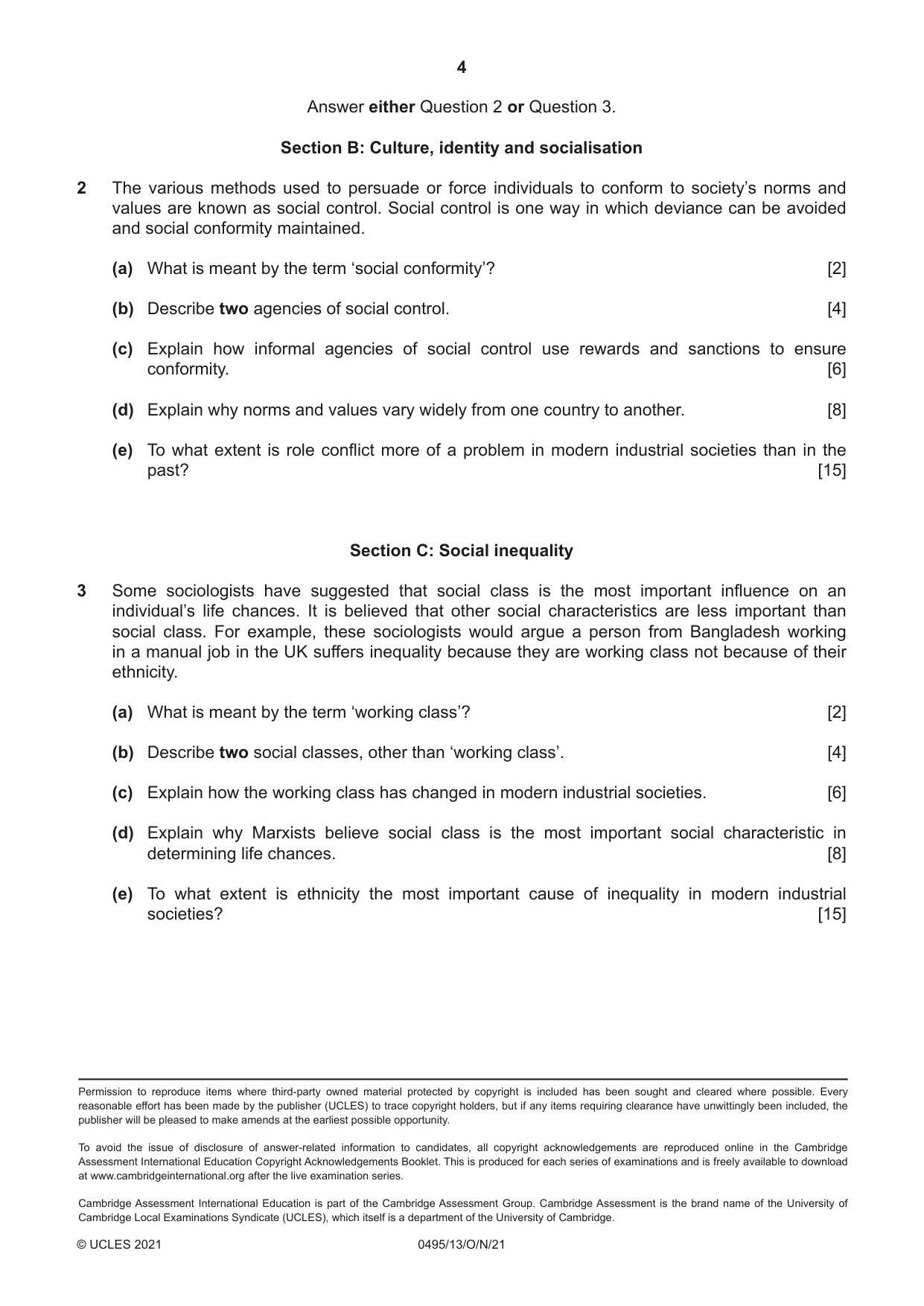
4 0495/13/O/N/21 © UCLES 2021 Permission to reproduce items where third-party owned material protected by copyright is included has been sought and cleared where possible. Every reasonable effort has been made by the publisher (UCLES) to trace copyright holders, but if any items requiring clearance have unwittingly been included, the publisher will be pleased to make amends at the earliest possible opportunity. To avoid the issue of disclosure of answer-related information to candidates, all copyright acknowledgements are reproduced online in the Cambridge Assessment International Education Copyright Acknowledgements Booklet. This is produced for each series of examinations and is freely available to download at www.cambridgeinternational.org after the live examination series. Cambridge Assessment International Education is part of the Cambridge Assessment Group. Cambridge Assessment is the brand name of the University of Cambridge Local Examinations Syndicate (UCLES), which itself is a department of the University of Cambridge. Answer either Question 2 or Question 3. Section B: Culture, identity and socialisation 2 The various methods used to persuade or force individuals to conform to society’s norms and values are known as social control. Social control is one way in which deviance can be avoided and social conformity maintained. (a) What is meant by the term ‘social conformity’? [2] (b) Describe two agencies of social control. [4] (c) Explain how informal agencies of social control use rewards and sanctions to ensure conformity. [6] (d) Explain why norms and values vary widely from one country to another. [8] (e) To what extent is role conflict more of a problem in modern industrial societies than in the past? [15] Section C: Social inequality 3 Some sociologists have suggested that social class is the most important influence on an individual’s life chances. It is believed that other social characteristics are less important than social class. For example, these sociologists would argue a person from Bangladesh working in a manual job in the UK suffers inequality because they are working class not because of their ethnicity. (a) What is meant by the term ‘working class’? [2] (b) Describe two social classes, other than ‘working class’. [4] (c) Explain how the working class has changed in modern industrial societies. [6] (d) Explain why Marxists believe social class is the most important social characteristic in determining life chances. [8] (e) To what extent is ethnicity the most important cause of inequality in modern industrial societies? [15]
Mark scheme, page 1
This document consists of 20 printed pages. © UCLES 2021 [Turn over Cambridge IGCSE™ SOCIOLOGY 0495/13 Paper 1 October/November 2021 MARK SCHEME Maximum Mark: 80 Published This mark scheme is published as an aid to teachers and candidates, to indicate the requirements of the examination. It shows the basis on which Examiners were instructed to award marks. It does not indicate the details of the discussions that took place at an Examiners’ meeting before marking began, which would have considered the acceptability of alternative answers. Mark schemes should be read in conjunction with the question paper and the Principal Examiner Report for Teachers. Cambridge International will not enter into discussions about these mark schemes. Cambridge International is publishing the mark schemes for the October/November 2021 series for most Cambridge IGCSE™, Cambridge International A and AS Level components and some Cambridge O Level components.
Mark scheme, page 2
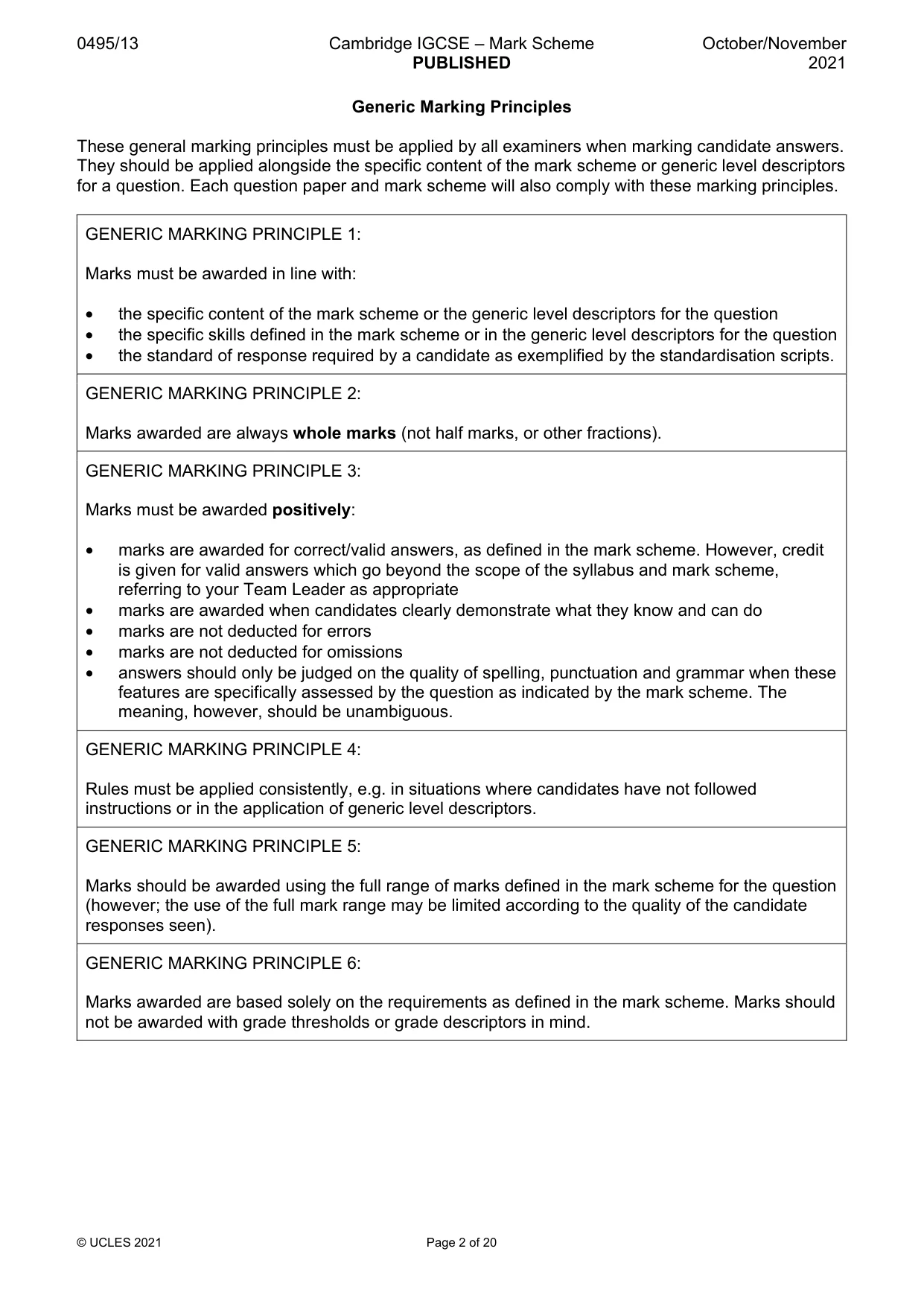
0495/13 Cambridge IGCSE – Mark Scheme PUBLISHED October/November 2021 © UCLES 2021 Page 2 of 20 Generic Marking Principles These general marking principles must be applied by all examiners when marking candidate answers. They should be applied alongside the specific content of the mark scheme or generic level descriptors for a question. Each question paper and mark scheme will also comply with these marking principles. GENERIC MARKING PRINCIPLE 1: Marks must be awarded in line with: • the specific content of the mark scheme or the generic level descriptors for the question • the specific skills defined in the mark scheme or in the generic level descriptors for the question • the standard of response required by a candidate as exemplified by the standardisation scripts. GENERIC MARKING PRINCIPLE 2: Marks awarded are always whole marks (not half marks, or other fractions). GENERIC MARKING PRINCIPLE 3: Marks must be awarded positively: • marks are awarded for correct/valid answers, as defined in the mark scheme. However, credit is given for valid answers which go beyond the scope of the syllabus and mark scheme, referring to your Team Leader as appropriate • marks are awarded when candidates clearly demonstrate what they know and can do • marks are not deducted for errors • marks are not deducted for omissions • answers should only be judged on the quality of spelling, punctuation and grammar when these features are specifically assessed by the question as indicated by the mark scheme. The meaning, however, should be unambiguous. GENERIC MARKING PRINCIPLE 4: Rules must be applied consistently, e.g. in situations where candidates have not followed instructions or in the application of generic level descriptors. GENERIC MARKING PRINCIPLE 5: Marks should be awarded using the full range of marks defined in the mark scheme for the question (however; the use of the full mark range may be limited according to the quality of the candidate responses seen). GENERIC MARKING PRINCIPLE 6: Marks awarded are based solely on the requirements as defined in the mark scheme. Marks should not be awarded with grade thresholds or grade descriptors in mind.
Mark scheme, page 3
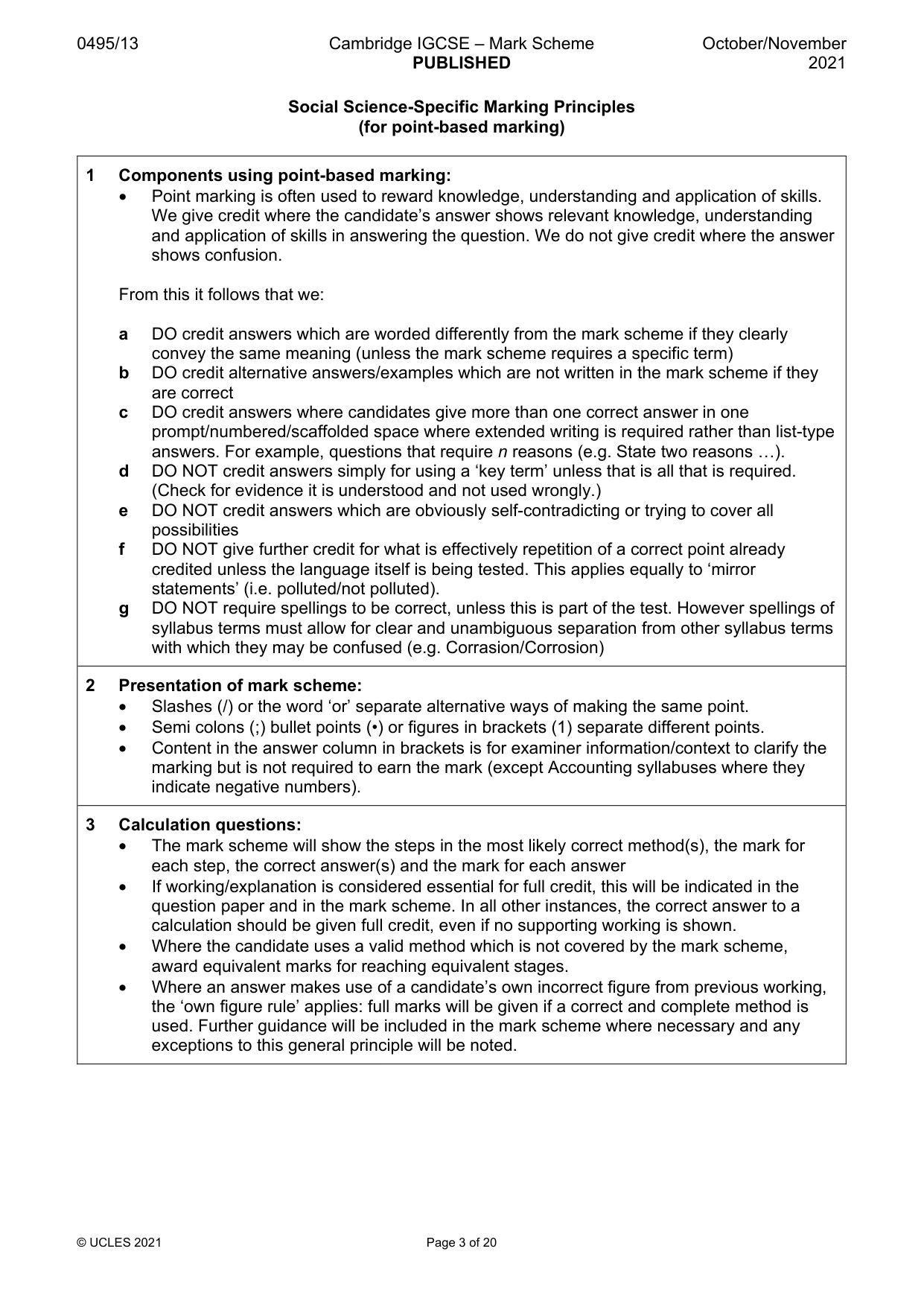
0495/13 Cambridge IGCSE – Mark Scheme PUBLISHED October/November 2021 © UCLES 2021 Page 3 of 20 Social Science-Specific Marking Principles (for point-based marking) 1 Components using point-based marking: • Point marking is often used to reward knowledge, understanding and application of skills. We give credit where the candidate’s answer shows relevant knowledge, understanding and application of skills in answering the question. We do not give credit where the answer shows confusion. From this it follows that we: a DO credit answers which are worded differently from the mark scheme if they clearly convey the same meaning (unless the mark scheme requires a specific term) b DO credit alternative answers/examples which are not written in the mark scheme if they are correct c DO credit answers where candidates give more than one correct answer in one prompt/numbered/scaffolded space where extended writing is required rather than list-type answers. For example, questions that require n reasons (e.g. State two reasons …). d DO NOT credit answers simply for using a ‘key term’ unless that is all that is required. (Check for evidence it is understood and not used wrongly.) e DO NOT credit answers which are obviously self-contradicting or trying to cover all possibilities f DO NOT give further credit for what is effectively repetition of a correct point already credited unless the language itself is being tested. This applies equally to ‘mirror statements’ (i.e. polluted/not polluted). g DO NOT require spellings to be correct, unless this is part of the test. However spellings of syllabus terms must allow for clear and unambiguous separation from other syllabus terms with which they may be confused (e.g. Corrasion/Corrosion) 2 Presentation of mark scheme: • Slashes (/) or the word ‘or’ separate alternative ways of making the same point. • Semi colons (;) bullet points (•) or figures in brackets (1) separate different points. • Content in the answer column in brackets is for examiner information/context to clarify the marking but is not required to earn the mark (except Accounting syllabuses where they indicate negative numbers). 3 Calculation questions: • The mark scheme will show the steps in the most likely correct method(s), the mark for each step, the correct answer(s) and the mark for each answer • If working/explanation is considered essential for full credit, this will be indicated in the question paper and in the mark scheme. In all other instances, the correct answer to a calculation should be given full credit, even if no supporting working is shown. • Where the candidate uses a valid method which is not covered by the mark scheme, award equivalent marks for reaching equivalent stages. • Where an answer makes use of a candidate’s own incorrect figure from previous working, the ‘own figure rule’ applies: full marks will be given if a correct and complete method is used. Further guidance will be included in the mark scheme where necessary and any exceptions to this general principle will be noted.
Mark scheme, page 4
0495/13 Cambridge IGCSE – Mark Scheme PUBLISHED October/November 2021 © UCLES 2021 Page 4 of 20 4 Annotation: • For point marking, ticks can be used to indicate correct answers and crosses can be used to indicate wrong answers. There is no direct relationship between ticks and marks. Ticks have no defined meaning for levels of response marking. • For levels of response marking, the level awarded should be annotated on the script. • Other annotations will be used by examiners as agreed during standardisation, and the meaning will be understood by all examiners who marked that paper.
Mark scheme, page 5
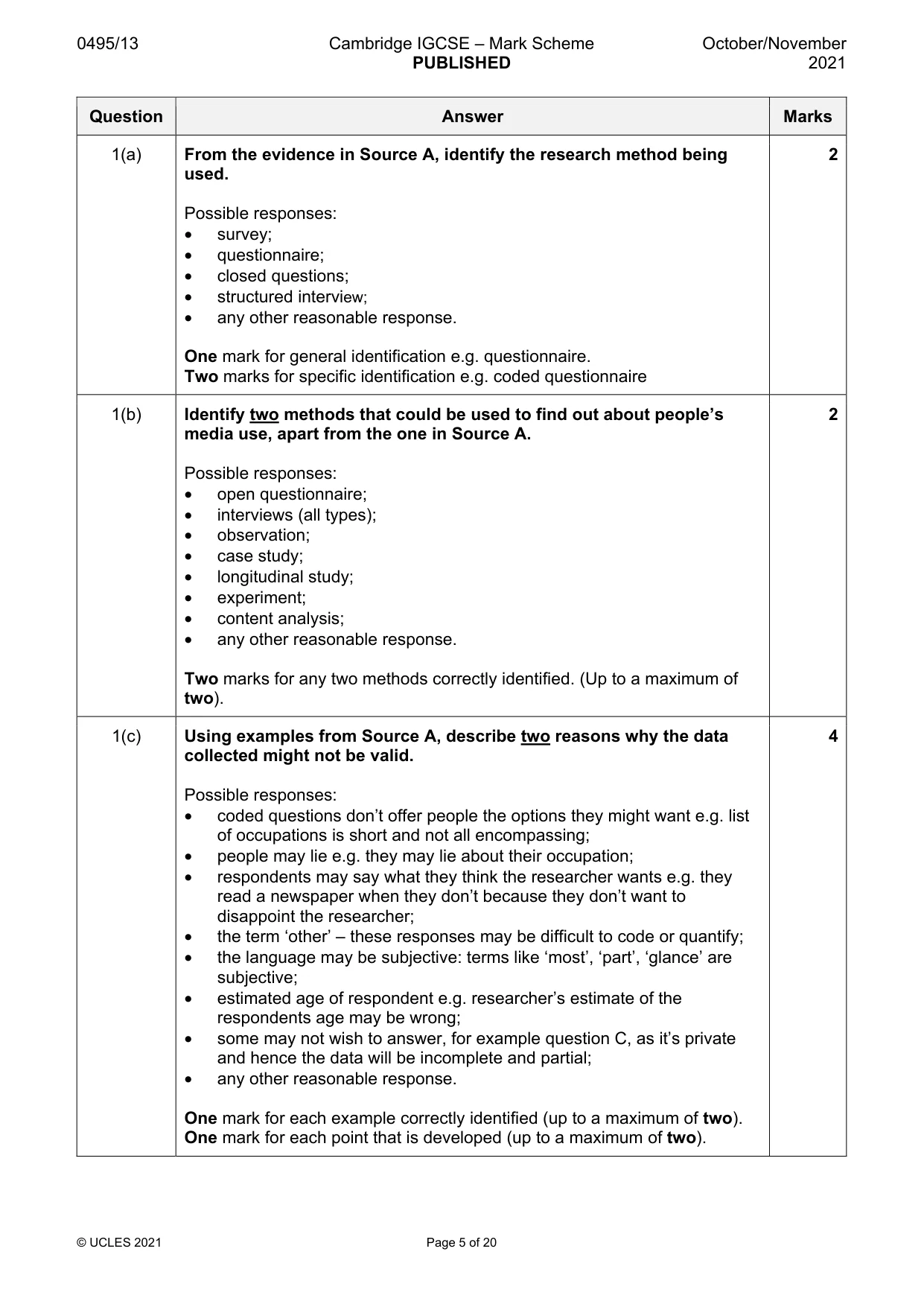
0495/13 Cambridge IGCSE – Mark Scheme PUBLISHED October/November 2021 © UCLES 2021 Page 5 of 20 Question Answer Marks 1(a) From the evidence in Source A, identify the research method being used. Possible responses: • survey; • questionnaire; • closed questions; • structured interview; • any other reasonable response. One mark for general identification e.g. questionnaire. Two marks for specific identification e.g. coded questionnaire 2 1(b) Identify two methods that could be used to find out about people’s media use, apart from the one in Source A. Possible responses: • open questionnaire; • interviews (all types); • observation; • case study; • longitudinal study; • experiment; • content analysis; • any other reasonable response. Two marks for any two methods correctly identified. (Up to a maximum of two). 2 1(c) Using examples from Source A, describe two reasons why the data collected might not be valid. Possible responses: • coded questions don’t offer people the options they might want e.g. list of occupations is short and not all encompassing; • people may lie e.g. they may lie about their occupation; • respondents may say what they think the researcher wants e.g. they read a newspaper when they don’t because they don’t want to disappoint the researcher; • the term ‘other’ – these responses may be difficult to code or quantify; • the language may be subjective: terms like ‘most’, ‘part’, ‘glance’ are subjective; • estimated age of respondent e.g. researcher’s estimate of the respondents age may be wrong; • some may not wish to answer, for example question C, as it’s private and hence the data will be incomplete and partial; • any other reasonable response. One mark for each example correctly identified (up to a maximum of two). One mark for each point that is developed (up to a maximum of two). 4
Mark scheme, page 6
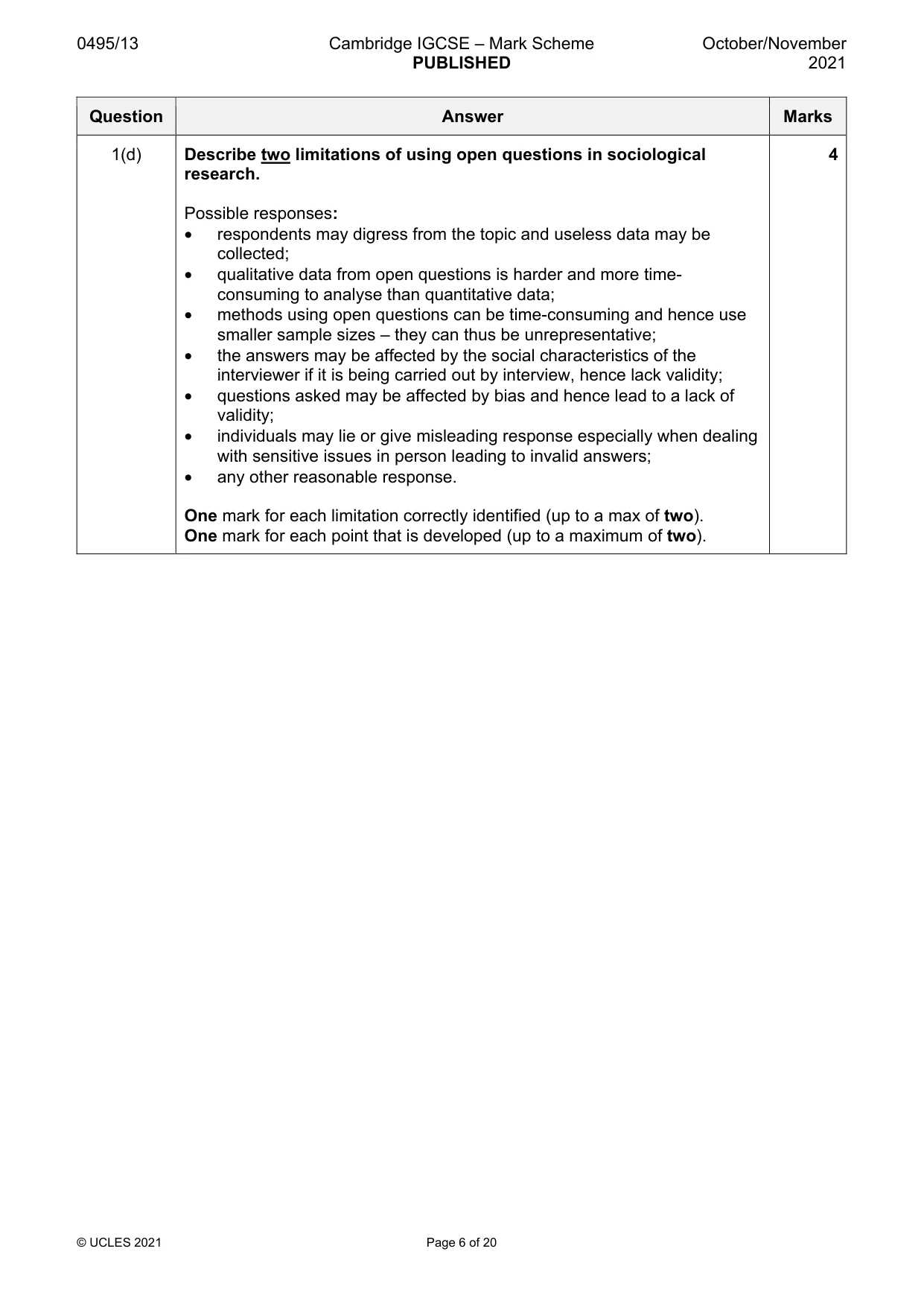
0495/13 Cambridge IGCSE – Mark Scheme PUBLISHED October/November 2021 © UCLES 2021 Page 6 of 20 Question Answer Marks 1(d) Describe two limitations of using open questions in sociological research. Possible responses: • respondents may digress from the topic and useless data may be collected; • qualitative data from open questions is harder and more time- consuming to analyse than quantitative data; • methods using open questions can be time-consuming and hence use smaller sample sizes – they can thus be unrepresentative; • the answers may be affected by the social characteristics of the interviewer if it is being carried out by interview, hence lack validity; • questions asked may be affected by bias and hence lead to a lack of validity; • individuals may lie or give misleading response especially when dealing with sensitive issues in person leading to invalid answers; • any other reasonable response. One mark for each limitation correctly identified (up to a max of two). One mark for each point that is developed (up to a maximum of two). 4
Mark scheme, page 7
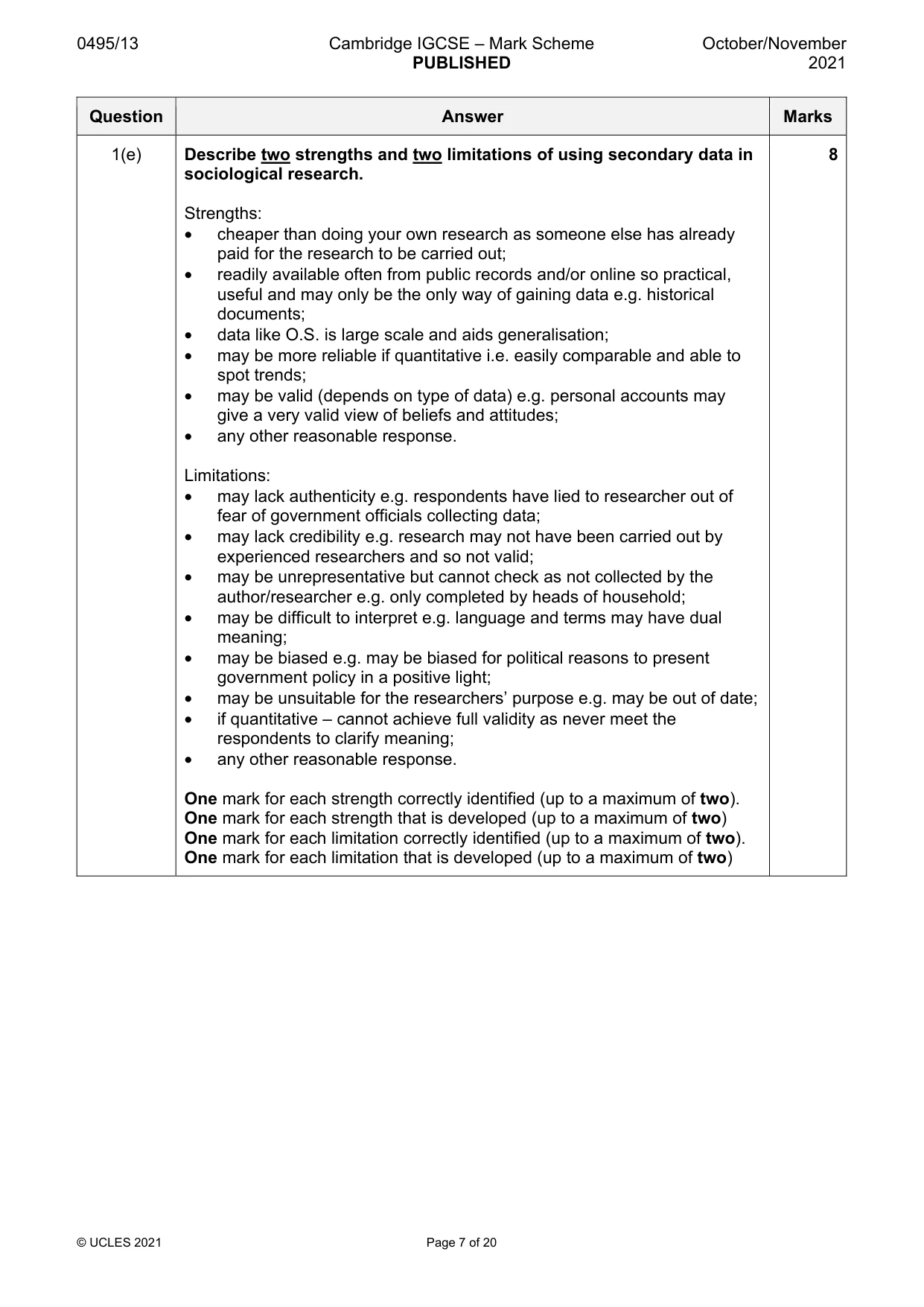
0495/13 Cambridge IGCSE – Mark Scheme PUBLISHED October/November 2021 © UCLES 2021 Page 7 of 20 Question Answer Marks 1(e) Describe two strengths and two limitations of using secondary data in sociological research. Strengths: • cheaper than doing your own research as someone else has already paid for the research to be carried out; • readily available often from public records and/or online so practical, useful and may only be the only way of gaining data e.g. historical documents; • data like O.S. is large scale and aids generalisation; • may be more reliable if quantitative i.e. easily comparable and able to spot trends; • may be valid (depends on type of data) e.g. personal accounts may give a very valid view of beliefs and attitudes; • any other reasonable response. Limitations: • may lack authenticity e.g. respondents have lied to researcher out of fear of government officials collecting data; • may lack credibility e.g. research may not have been carried out by experienced researchers and so not valid; • may be unrepresentative but cannot check as not collected by the author/researcher e.g. only completed by heads of household; • may be difficult to interpret e.g. language and terms may have dual meaning; • may be biased e.g. may be biased for political reasons to present government policy in a positive light; • may be unsuitable for the researchers’ purpose e.g. may be out of date; • if quantitative – cannot achieve full validity as never meet the respondents to clarify meaning; • any other reasonable response. One mark for each strength correctly identified (up to a maximum of two). One mark for each strength that is developed (up to a maximum of two) One mark for each limitation correctly identified (up to a maximum of two). One mark for each limitation that is developed (up to a maximum of two) 8
Mark scheme, page 8
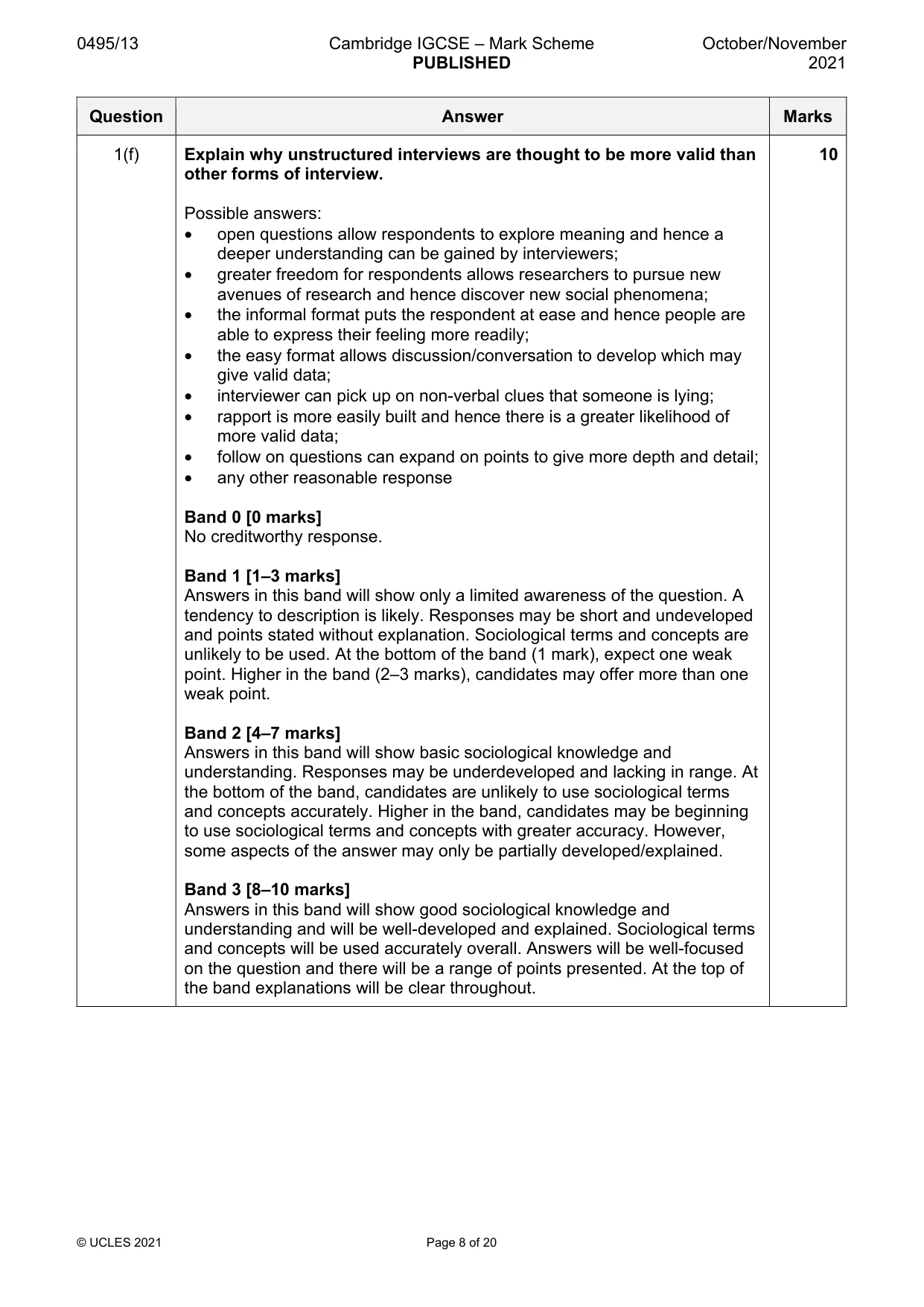
0495/13 Cambridge IGCSE – Mark Scheme PUBLISHED October/November 2021 © UCLES 2021 Page 8 of 20 Question Answer Marks 1(f) Explain why unstructured interviews are thought to be more valid than other forms of interview. Possible answers: • open questions allow respondents to explore meaning and hence a deeper understanding can be gained by interviewers; • greater freedom for respondents allows researchers to pursue new avenues of research and hence discover new social phenomena; • the informal format puts the respondent at ease and hence people are able to express their feeling more readily; • the easy format allows discussion/conversation to develop which may give valid data; • interviewer can pick up on non-verbal clues that someone is lying; • rapport is more easily built and hence there is a greater likelihood of more valid data; • follow on questions can expand on points to give more depth and detail; • any other reasonable response Band 0 [0 marks] No creditworthy response. Band 1 [1–3 marks] Answers in this band will show only a limited awareness of the question. A tendency to description is likely. Responses may be short and undeveloped and points stated without explanation. Sociological terms and concepts are unlikely to be used. At the bottom of the band (1 mark), expect one weak point. Higher in the band (2–3 marks), candidates may offer more than one weak point. Band 2 [4–7 marks] Answers in this band will show basic sociological knowledge and understanding. Responses may be underdeveloped and lacking in range. At the bottom of the band, candidates are unlikely to use sociological terms and concepts accurately. Higher in the band, candidates may be beginning to use sociological terms and concepts with greater accuracy. However, some aspects of the answer may only be partially developed/explained. Band 3 [8–10 marks] Answers in this band will show good sociological knowledge and understanding and will be well-developed and explained. Sociological terms and concepts will be used accurately overall. Answers will be well-focused on the question and there will be a range of points presented. At the top of the band explanations will be clear throughout. 10
Mark scheme, page 9
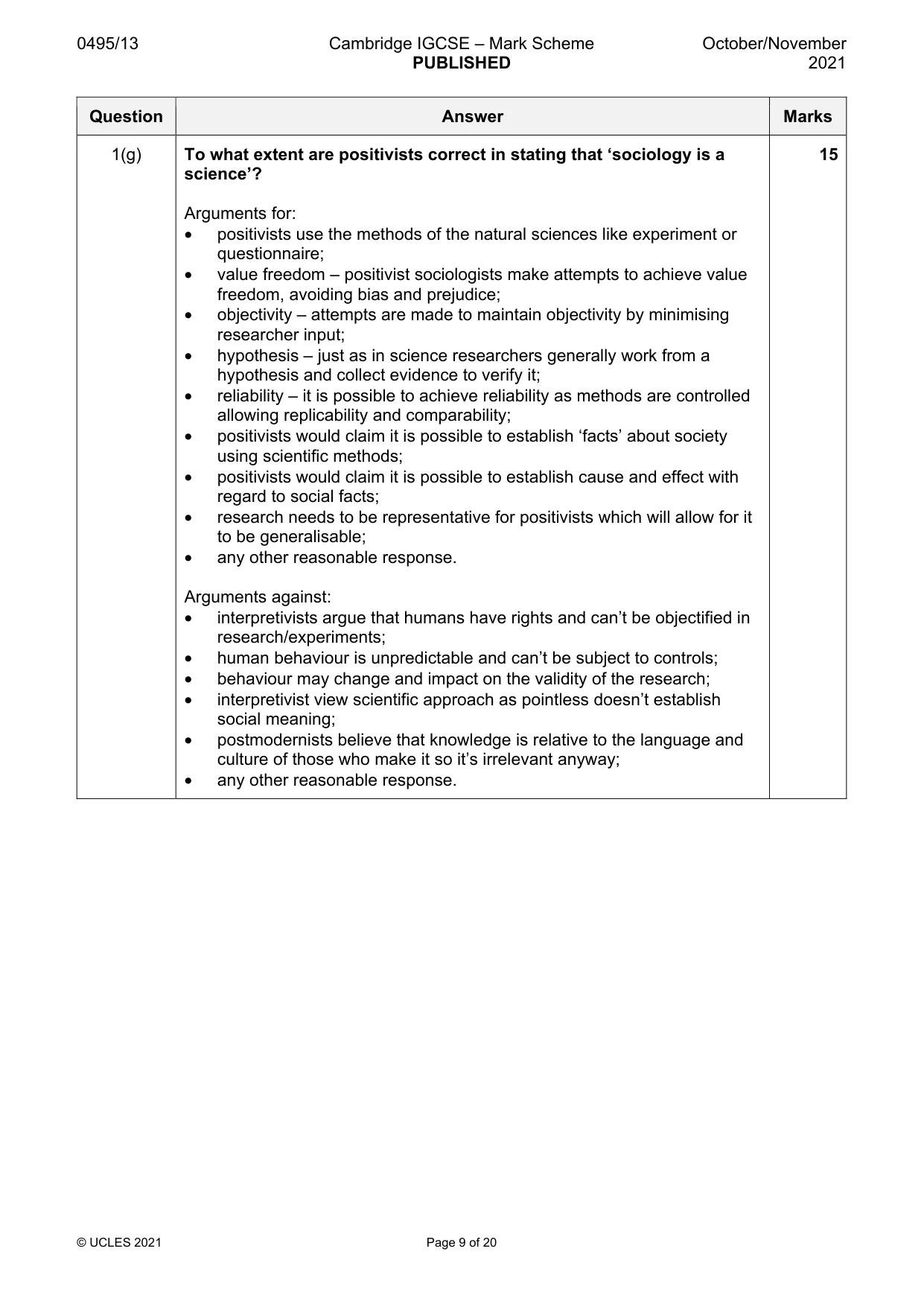
0495/13 Cambridge IGCSE – Mark Scheme PUBLISHED October/November 2021 © UCLES 2021 Page 9 of 20 Question Answer Marks 1(g) To what extent are positivists correct in stating that ‘sociology is a science’? Arguments for: • positivists use the methods of the natural sciences like experiment or questionnaire; • value freedom – positivist sociologists make attempts to achieve value freedom, avoiding bias and prejudice; • objectivity – attempts are made to maintain objectivity by minimising researcher input; • hypothesis – just as in science researchers generally work from a hypothesis and collect evidence to verify it; • reliability – it is possible to achieve reliability as methods are controlled allowing replicability and comparability; • positivists would claim it is possible to establish ‘facts’ about society using scientific methods; • positivists would claim it is possible to establish cause and effect with regard to social facts; • research needs to be representative for positivists which will allow for it to be generalisable; • any other reasonable response. Arguments against: • interpretivists argue that humans have rights and can’t be objectified in research/experiments; • human behaviour is unpredictable and can’t be subject to controls; • behaviour may change and impact on the validity of the research; • interpretivist view scientific approach as pointless doesn’t establish social meaning; • postmodernists believe that knowledge is relative to the language and culture of those who make it so it’s irrelevant anyway; • any other reasonable response. 15
Mark scheme, page 10
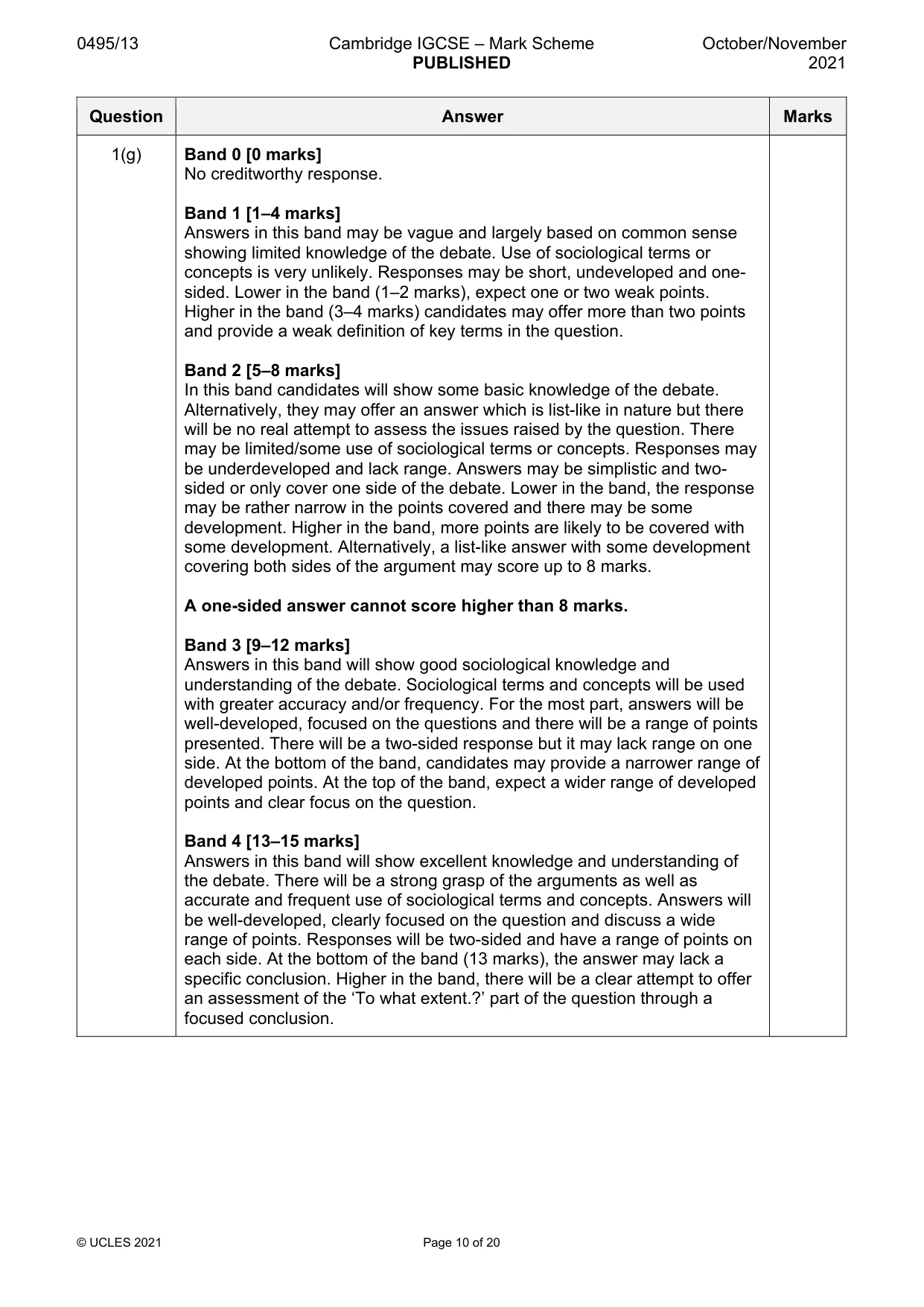
0495/13 Cambridge IGCSE – Mark Scheme PUBLISHED October/November 2021 © UCLES 2021 Page 10 of 20 Question Answer Marks 1(g) Band 0 [0 marks] No creditworthy response. Band 1 [1–4 marks] Answers in this band may be vague and largely based on common sense showing limited knowledge of the debate. Use of sociological terms or concepts is very unlikely. Responses may be short, undeveloped and one- sided. Lower in the band (1–2 marks), expect one or two weak points. Higher in the band (3–4 marks) candidates may offer more than two points and provide a weak definition of key terms in the question. Band 2 [5–8 marks] In this band candidates will show some basic knowledge of the debate. Alternatively, they may offer an answer which is list-like in nature but there will be no real attempt to assess the issues raised by the question. There may be limited/some use of sociological terms or concepts. Responses may be underdeveloped and lack range. Answers may be simplistic and two- sided or only cover one side of the debate. Lower in the band, the response may be rather narrow in the points covered and there may be some development. Higher in the band, more points are likely to be covered with some development. Alternatively, a list-like answer with some development covering both sides of the argument may score up to 8 marks. A one-sided answer cannot score higher than 8 marks. Band 3 [9–12 marks] Answers in this band will show good sociological knowledge and understanding of the debate. Sociological terms and concepts will be used with greater accuracy and/or frequency. For the most part, answers will be well-developed, focused on the questions and there will be a range of points presented. There will be a two-sided response but it may lack range on one side. At the bottom of the band, candidates may provide a narrower range of developed points. At the top of the band, expect a wider range of developed points and clear focus on the question. Band 4 [13–15 marks] Answers in this band will show excellent knowledge and understanding of the debate. There will be a strong grasp of the arguments as well as accurate and frequent use of sociological terms and concepts. Answers will be well-developed, clearly focused on the question and discuss a wide range of points. Responses will be two-sided and have a range of points on each side. At the bottom of the band (13 marks), the answer may lack a specific conclusion. Higher in the band, there will be a clear attempt to offer an assessment of the ‘To what extent.?’ part of the question through a focused conclusion.
Mark scheme, page 11
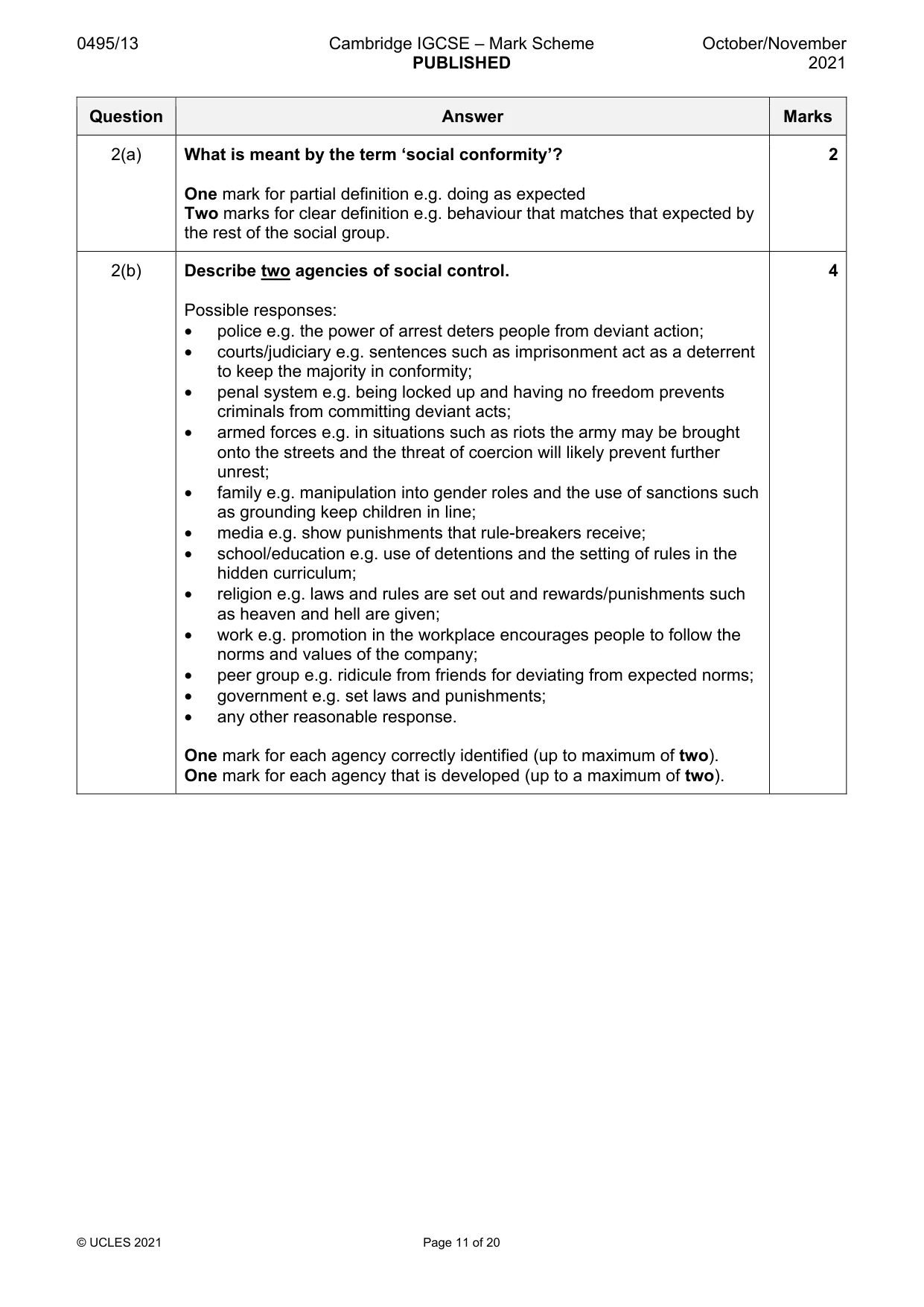
0495/13 Cambridge IGCSE – Mark Scheme PUBLISHED October/November 2021 © UCLES 2021 Page 11 of 20 Question Answer Marks 2(a) What is meant by the term ‘social conformity’? One mark for partial definition e.g. doing as expected Two marks for clear definition e.g. behaviour that matches that expected by the rest of the social group. 2 2(b) Describe two agencies of social control. Possible responses: • police e.g. the power of arrest deters people from deviant action; • courts/judiciary e.g. sentences such as imprisonment act as a deterrent to keep the majority in conformity; • penal system e.g. being locked up and having no freedom prevents criminals from committing deviant acts; • armed forces e.g. in situations such as riots the army may be brought onto the streets and the threat of coercion will likely prevent further unrest; • family e.g. manipulation into gender roles and the use of sanctions such as grounding keep children in line; • media e.g. show punishments that rule-breakers receive; • school/education e.g. use of detentions and the setting of rules in the hidden curriculum; • religion e.g. laws and rules are set out and rewards/punishments such as heaven and hell are given; • work e.g. promotion in the workplace encourages people to follow the norms and values of the company; • peer group e.g. ridicule from friends for deviating from expected norms; • government e.g. set laws and punishments; • any other reasonable response. One mark for each agency correctly identified (up to maximum of two). One mark for each agency that is developed (up to a maximum of two). 4
Mark scheme, page 12
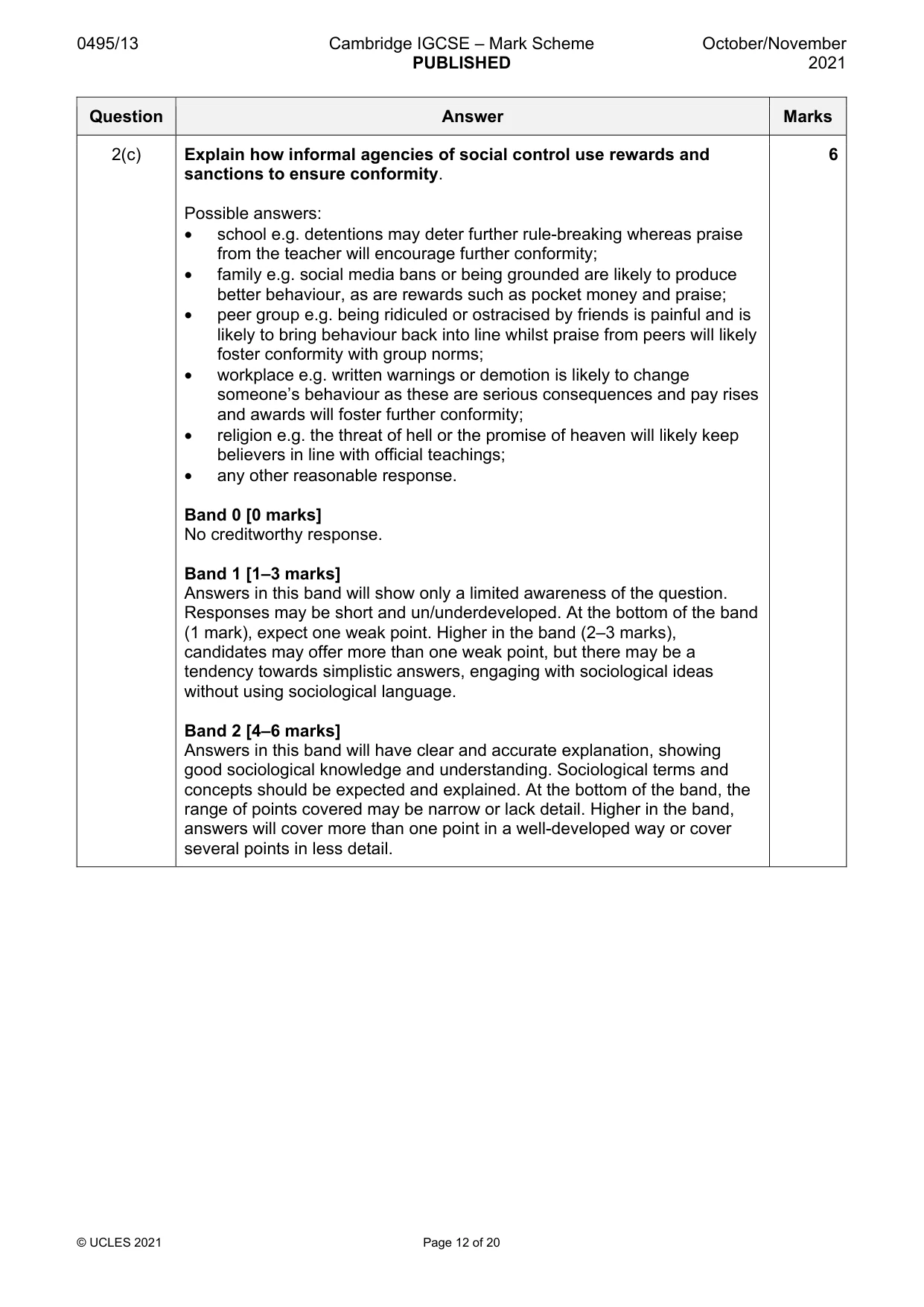
0495/13 Cambridge IGCSE – Mark Scheme PUBLISHED October/November 2021 © UCLES 2021 Page 12 of 20 Question Answer Marks 2(c) Explain how informal agencies of social control use rewards and sanctions to ensure conformity. Possible answers: • school e.g. detentions may deter further rule-breaking whereas praise from the teacher will encourage further conformity; • family e.g. social media bans or being grounded are likely to produce better behaviour, as are rewards such as pocket money and praise; • peer group e.g. being ridiculed or ostracised by friends is painful and is likely to bring behaviour back into line whilst praise from peers will likely foster conformity with group norms; • workplace e.g. written warnings or demotion is likely to change someone’s behaviour as these are serious consequences and pay rises and awards will foster further conformity; • religion e.g. the threat of hell or the promise of heaven will likely keep believers in line with official teachings; • any other reasonable response. Band 0 [0 marks] No creditworthy response. Band 1 [1–3 marks] Answers in this band will show only a limited awareness of the question. Responses may be short and un/underdeveloped. At the bottom of the band (1 mark), expect one weak point. Higher in the band (2–3 marks), candidates may offer more than one weak point, but there may be a tendency towards simplistic answers, engaging with sociological ideas without using sociological language. Band 2 [4–6 marks] Answers in this band will have clear and accurate explanation, showing good sociological knowledge and understanding. Sociological terms and concepts should be expected and explained. At the bottom of the band, the range of points covered may be narrow or lack detail. Higher in the band, answers will cover more than one point in a well-developed way or cover several points in less detail. 6
Mark scheme, page 13
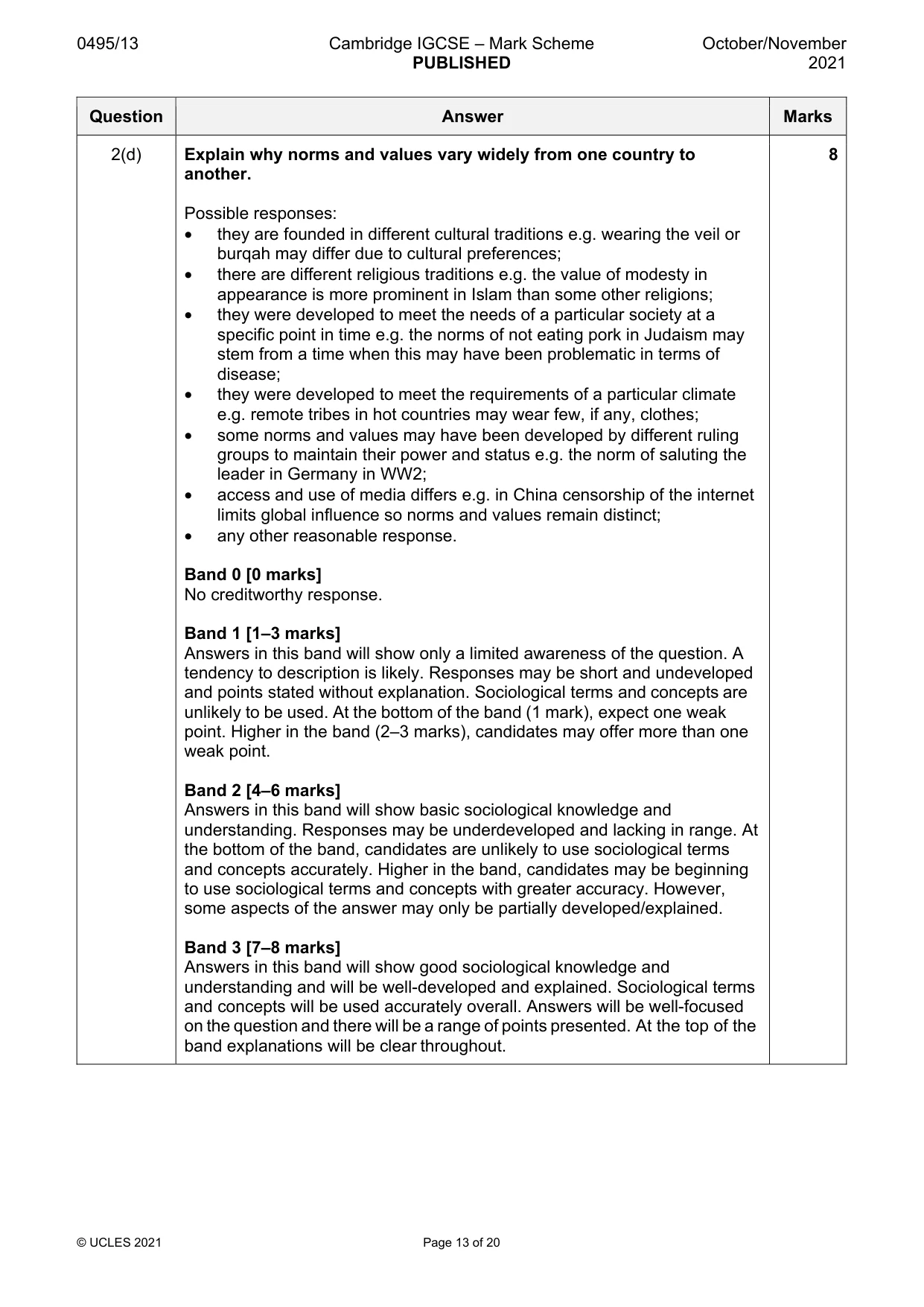
0495/13 Cambridge IGCSE – Mark Scheme PUBLISHED October/November 2021 © UCLES 2021 Page 13 of 20 Question Answer Marks 2(d) Explain why norms and values vary widely from one country to another. Possible responses: • they are founded in different cultural traditions e.g. wearing the veil or burqah may differ due to cultural preferences; • there are different religious traditions e.g. the value of modesty in appearance is more prominent in Islam than some other religions; • they were developed to meet the needs of a particular society at a specific point in time e.g. the norms of not eating pork in Judaism may stem from a time when this may have been problematic in terms of disease; • they were developed to meet the requirements of a particular climate e.g. remote tribes in hot countries may wear few, if any, clothes; • some norms and values may have been developed by different ruling groups to maintain their power and status e.g. the norm of saluting the leader in Germany in WW2; • access and use of media differs e.g. in China censorship of the internet limits global influence so norms and values remain distinct; • any other reasonable response. Band 0 [0 marks] No creditworthy response. Band 1 [1–3 marks] Answers in this band will show only a limited awareness of the question. A tendency to description is likely. Responses may be short and undeveloped and points stated without explanation. Sociological terms and concepts are unlikely to be used. At the bottom of the band (1 mark), expect one weak point. Higher in the band (2–3 marks), candidates may offer more than one weak point. Band 2 [4–6 marks] Answers in this band will show basic sociological knowledge and understanding. Responses may be underdeveloped and lacking in range. At the bottom of the band, candidates are unlikely to use sociological terms and concepts accurately. Higher in the band, candidates may be beginning to use sociological terms and concepts with greater accuracy. However, some aspects of the answer may only be partially developed/explained. Band 3 [7–8 marks] Answers in this band will show good sociological knowledge and understanding and will be well-developed and explained. Sociological terms and concepts will be used accurately overall. Answers will be well-focused on the question and there will be a range of points presented. At the top of the band explanations will be clear throughout. 8
Mark scheme, page 14
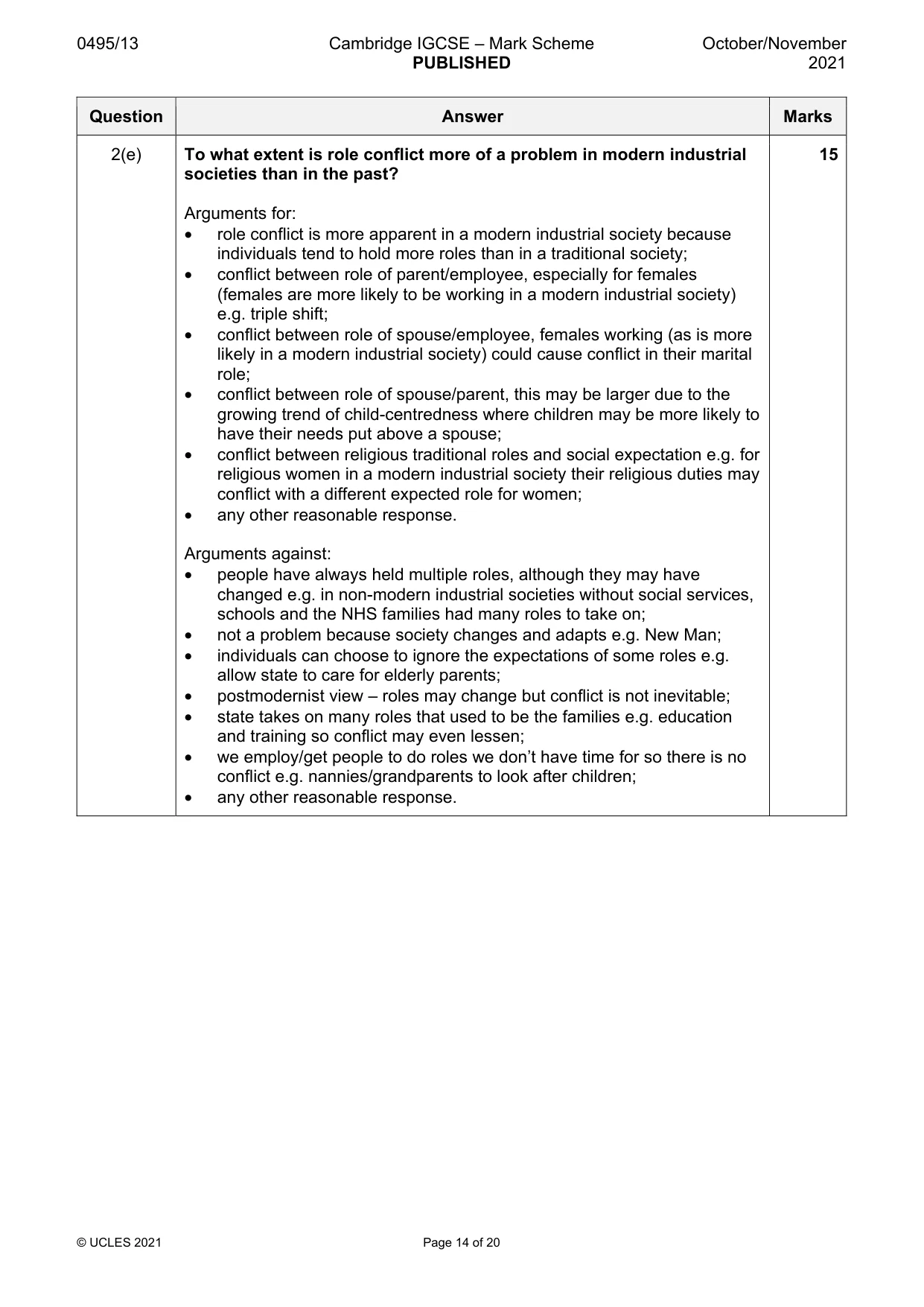
0495/13 Cambridge IGCSE – Mark Scheme PUBLISHED October/November 2021 © UCLES 2021 Page 14 of 20 Question Answer Marks 2(e) To what extent is role conflict more of a problem in modern industrial societies than in the past? Arguments for: • role conflict is more apparent in a modern industrial society because individuals tend to hold more roles than in a traditional society; • conflict between role of parent/employee, especially for females (females are more likely to be working in a modern industrial society) e.g. triple shift; • conflict between role of spouse/employee, females working (as is more likely in a modern industrial society) could cause conflict in their marital role; • conflict between role of spouse/parent, this may be larger due to the growing trend of child-centredness where children may be more likely to have their needs put above a spouse; • conflict between religious traditional roles and social expectation e.g. for religious women in a modern industrial society their religious duties may conflict with a different expected role for women; • any other reasonable response. Arguments against: • people have always held multiple roles, although they may have changed e.g. in non-modern industrial societies without social services, schools and the NHS families had many roles to take on; • not a problem because society changes and adapts e.g. New Man; • individuals can choose to ignore the expectations of some roles e.g. allow state to care for elderly parents; • postmodernist view – roles may change but conflict is not inevitable; • state takes on many roles that used to be the families e.g. education and training so conflict may even lessen; • we employ/get people to do roles we don’t have time for so there is no conflict e.g. nannies/grandparents to look after children; • any other reasonable response. 15
Mark scheme, page 15
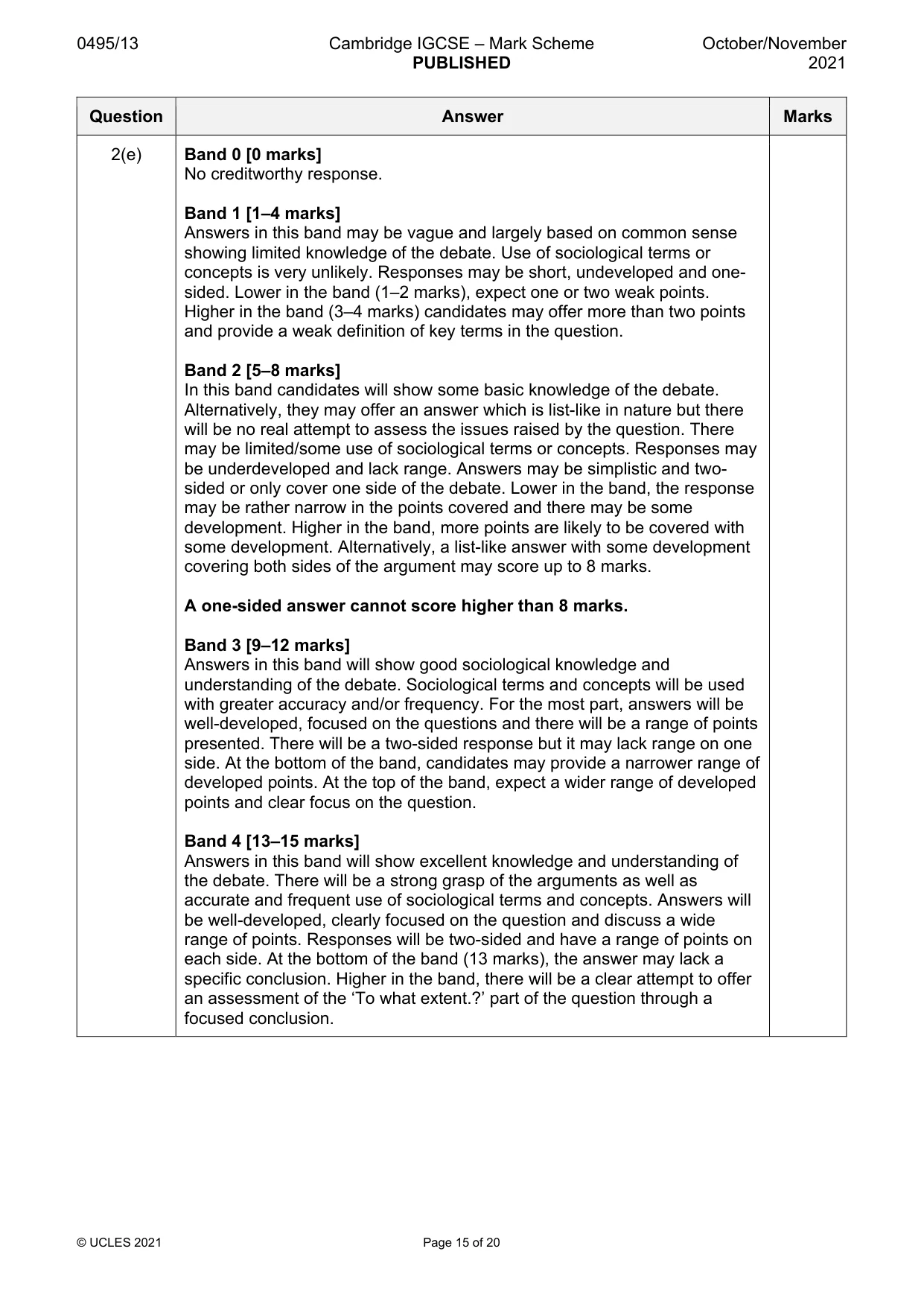
0495/13 Cambridge IGCSE – Mark Scheme PUBLISHED October/November 2021 © UCLES 2021 Page 15 of 20 Question Answer Marks 2(e) Band 0 [0 marks] No creditworthy response. Band 1 [1–4 marks] Answers in this band may be vague and largely based on common sense showing limited knowledge of the debate. Use of sociological terms or concepts is very unlikely. Responses may be short, undeveloped and one- sided. Lower in the band (1–2 marks), expect one or two weak points. Higher in the band (3–4 marks) candidates may offer more than two points and provide a weak definition of key terms in the question. Band 2 [5–8 marks] In this band candidates will show some basic knowledge of the debate. Alternatively, they may offer an answer which is list-like in nature but there will be no real attempt to assess the issues raised by the question. There may be limited/some use of sociological terms or concepts. Responses may be underdeveloped and lack range. Answers may be simplistic and two- sided or only cover one side of the debate. Lower in the band, the response may be rather narrow in the points covered and there may be some development. Higher in the band, more points are likely to be covered with some development. Alternatively, a list-like answer with some development covering both sides of the argument may score up to 8 marks. A one-sided answer cannot score higher than 8 marks. Band 3 [9–12 marks] Answers in this band will show good sociological knowledge and understanding of the debate. Sociological terms and concepts will be used with greater accuracy and/or frequency. For the most part, answers will be well-developed, focused on the questions and there will be a range of points presented. There will be a two-sided response but it may lack range on one side. At the bottom of the band, candidates may provide a narrower range of developed points. At the top of the band, expect a wider range of developed points and clear focus on the question. Band 4 [13–15 marks] Answers in this band will show excellent knowledge and understanding of the debate. There will be a strong grasp of the arguments as well as accurate and frequent use of sociological terms and concepts. Answers will be well-developed, clearly focused on the question and discuss a wide range of points. Responses will be two-sided and have a range of points on each side. At the bottom of the band (13 marks), the answer may lack a specific conclusion. Higher in the band, there will be a clear attempt to offer an assessment of the ‘To what extent.?’ part of the question through a focused conclusion.
Mark scheme, page 16
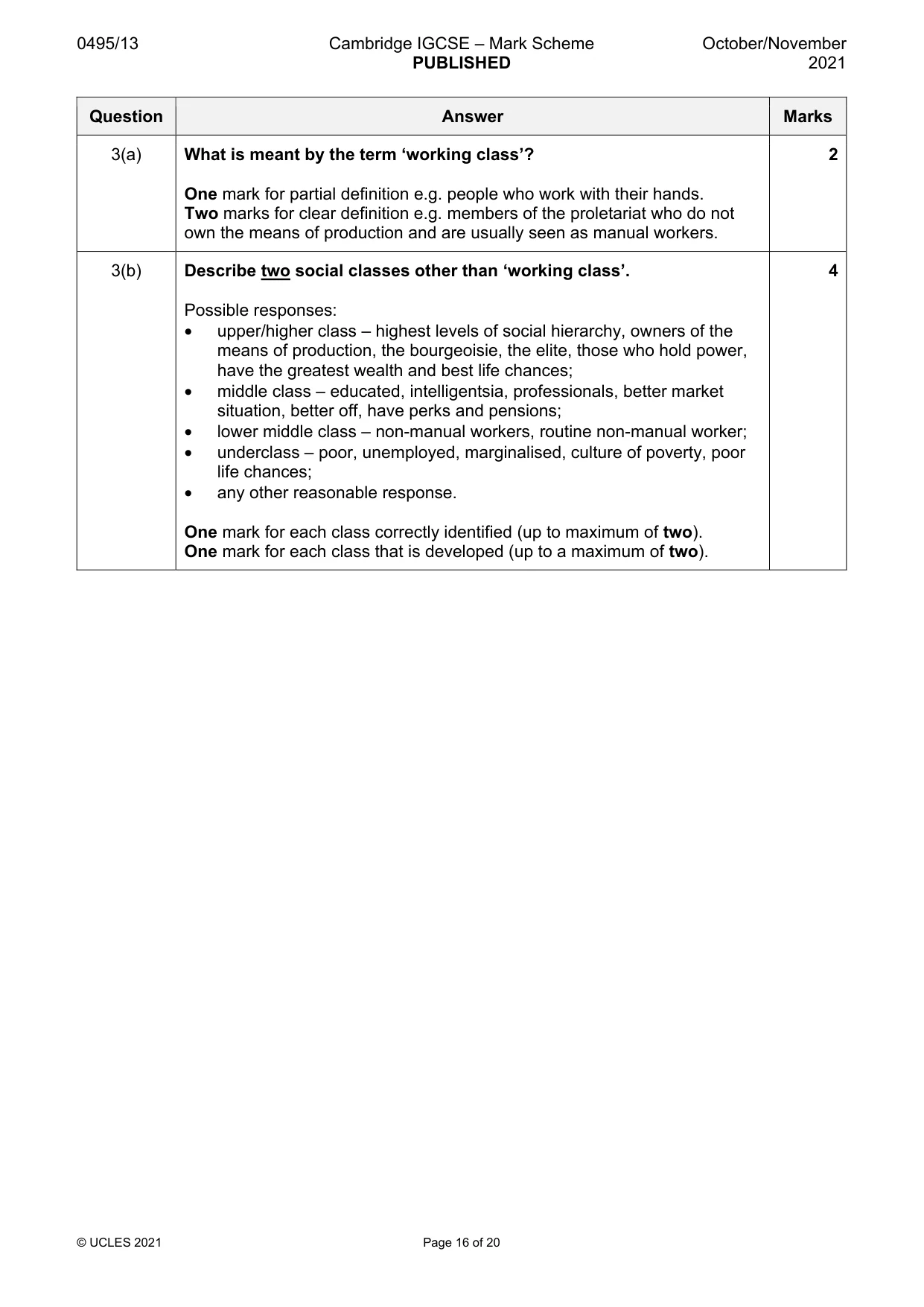
0495/13 Cambridge IGCSE – Mark Scheme PUBLISHED October/November 2021 © UCLES 2021 Page 16 of 20 Question Answer Marks 3(a) What is meant by the term ‘working class’? One mark for partial definition e.g. people who work with their hands. Two marks for clear definition e.g. members of the proletariat who do not own the means of production and are usually seen as manual workers. 2 3(b) Describe two social classes other than ‘working class’. Possible responses: • upper/higher class – highest levels of social hierarchy, owners of the means of production, the bourgeoisie, the elite, those who hold power, have the greatest wealth and best life chances; • middle class – educated, intelligentsia, professionals, better market situation, better off, have perks and pensions; • lower middle class – non-manual workers, routine non-manual worker; • underclass – poor, unemployed, marginalised, culture of poverty, poor life chances; • any other reasonable response. One mark for each class correctly identified (up to maximum of two). One mark for each class that is developed (up to a maximum of two). 4
Mark scheme, page 17
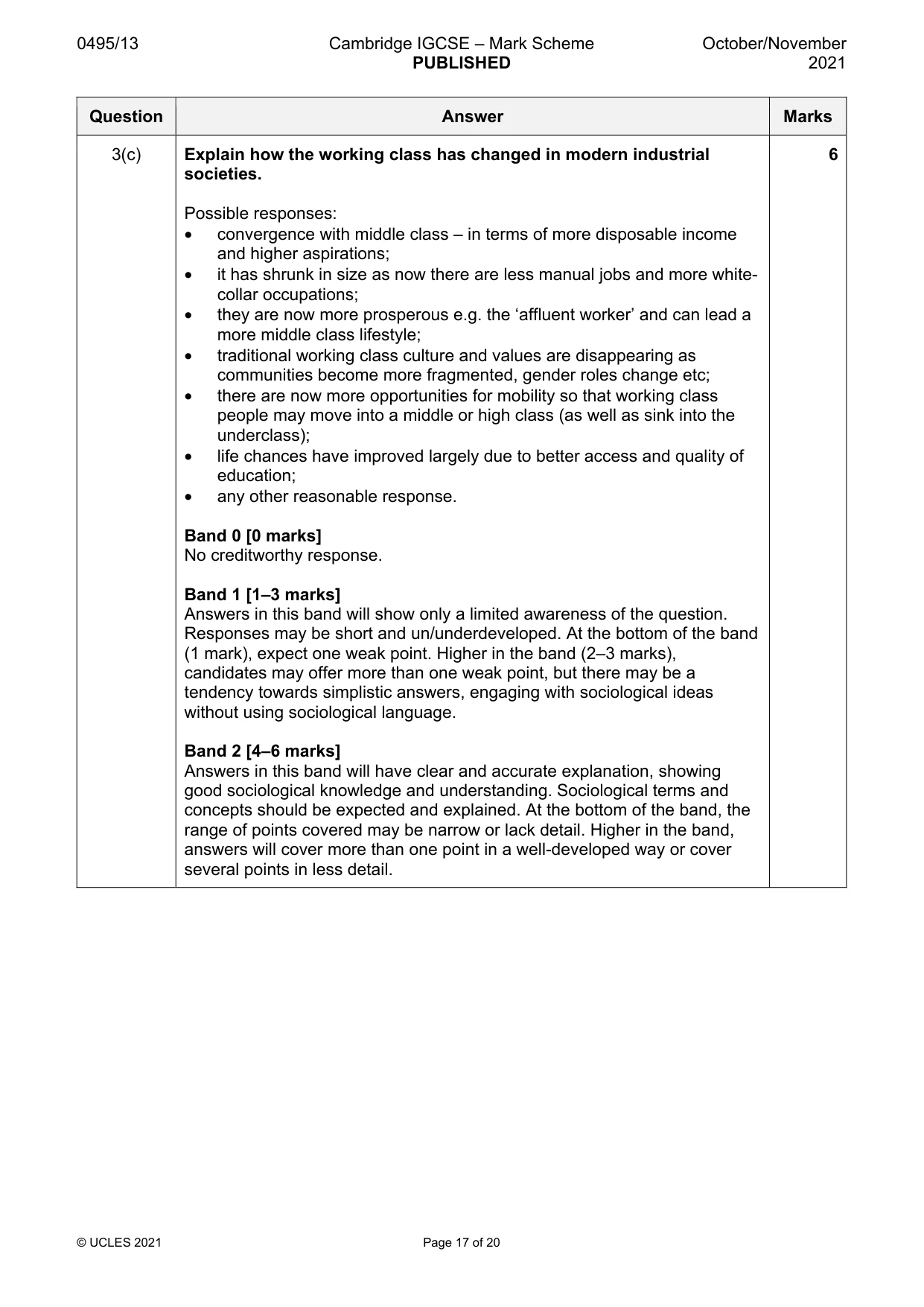
0495/13 Cambridge IGCSE – Mark Scheme PUBLISHED October/November 2021 © UCLES 2021 Page 17 of 20 Question Answer Marks 3(c) Explain how the working class has changed in modern industrial societies. Possible responses: • convergence with middle class – in terms of more disposable income and higher aspirations; • it has shrunk in size as now there are less manual jobs and more white- collar occupations; • they are now more prosperous e.g. the ‘affluent worker’ and can lead a more middle class lifestyle; • traditional working class culture and values are disappearing as communities become more fragmented, gender roles change etc; • there are now more opportunities for mobility so that working class people may move into a middle or high class (as well as sink into the underclass); • life chances have improved largely due to better access and quality of education; • any other reasonable response. Band 0 [0 marks] No creditworthy response. Band 1 [1–3 marks] Answers in this band will show only a limited awareness of the question. Responses may be short and un/underdeveloped. At the bottom of the band (1 mark), expect one weak point. Higher in the band (2–3 marks), candidates may offer more than one weak point, but there may be a tendency towards simplistic answers, engaging with sociological ideas without using sociological language. Band 2 [4–6 marks] Answers in this band will have clear and accurate explanation, showing good sociological knowledge and understanding. Sociological terms and concepts should be expected and explained. At the bottom of the band, the range of points covered may be narrow or lack detail. Higher in the band, answers will cover more than one point in a well-developed way or cover several points in less detail. 6
Mark scheme, page 18
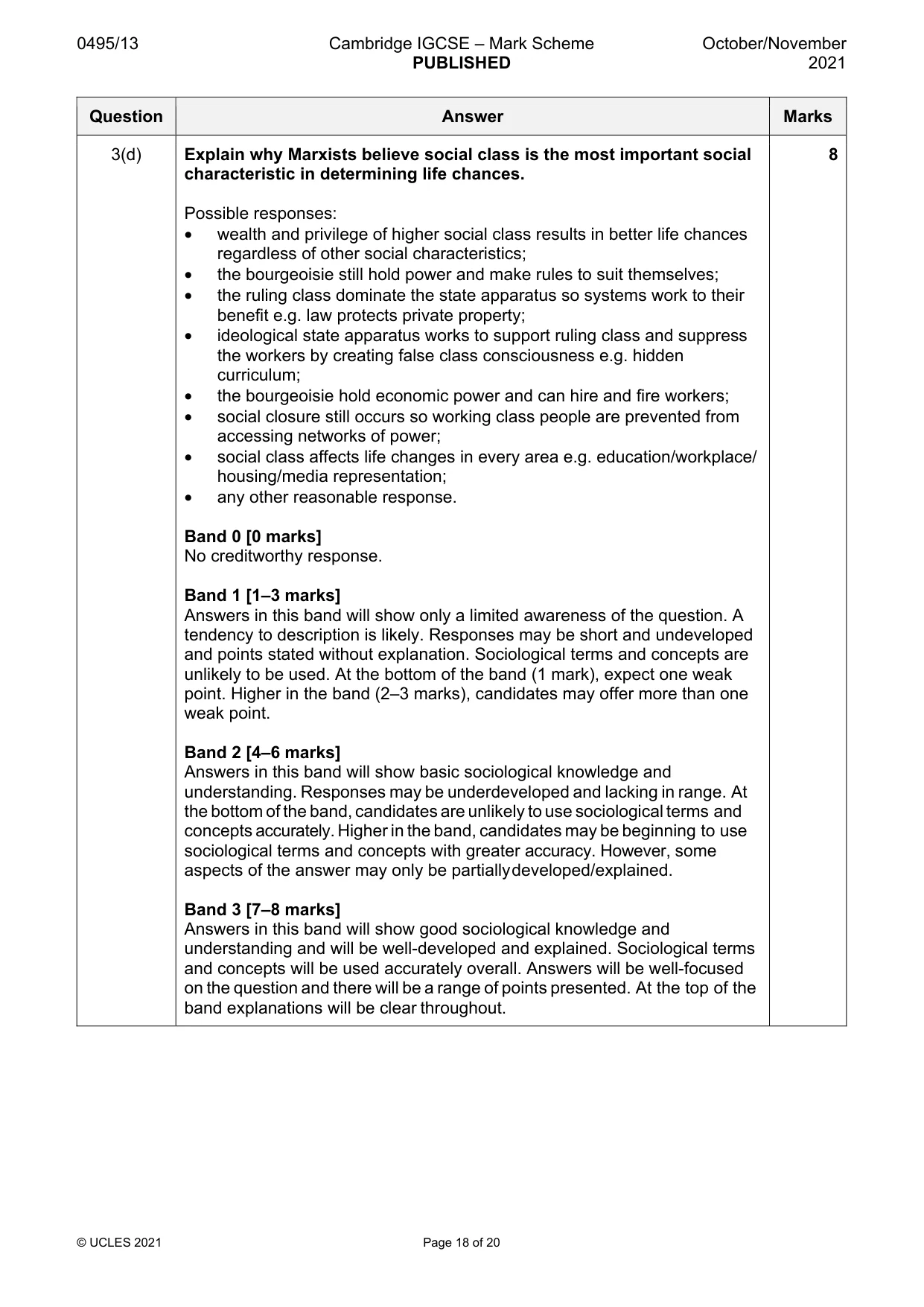
0495/13 Cambridge IGCSE – Mark Scheme PUBLISHED October/November 2021 © UCLES 2021 Page 18 of 20 Question Answer Marks 3(d) Explain why Marxists believe social class is the most important social characteristic in determining life chances. Possible responses: • wealth and privilege of higher social class results in better life chances regardless of other social characteristics; • the bourgeoisie still hold power and make rules to suit themselves; • the ruling class dominate the state apparatus so systems work to their benefit e.g. law protects private property; • ideological state apparatus works to support ruling class and suppress the workers by creating false class consciousness e.g. hidden curriculum; • the bourgeoisie hold economic power and can hire and fire workers; • social closure still occurs so working class people are prevented from accessing networks of power; • social class affects life changes in every area e.g. education/workplace/ housing/media representation; • any other reasonable response. Band 0 [0 marks] No creditworthy response. Band 1 [1–3 marks] Answers in this band will show only a limited awareness of the question. A tendency to description is likely. Responses may be short and undeveloped and points stated without explanation. Sociological terms and concepts are unlikely to be used. At the bottom of the band (1 mark), expect one weak point. Higher in the band (2–3 marks), candidates may offer more than one weak point. Band 2 [4–6 marks] Answers in this band will show basic sociological knowledge and understanding. Responses may be underdeveloped and lacking in range. At the bottom of the band, candidates are unlikely to use sociological terms and concepts accurately. Higher in the band, candidates may be beginning to use sociological terms and concepts with greater accuracy. However, some aspects of the answer may only be partially developed/explained. Band 3 [7–8 marks] Answers in this band will show good sociological knowledge and understanding and will be well-developed and explained. Sociological terms and concepts will be used accurately overall. Answers will be well-focused on the question and there will be a range of points presented. At the top of the band explanations will be clear throughout. 8
Mark scheme, page 19
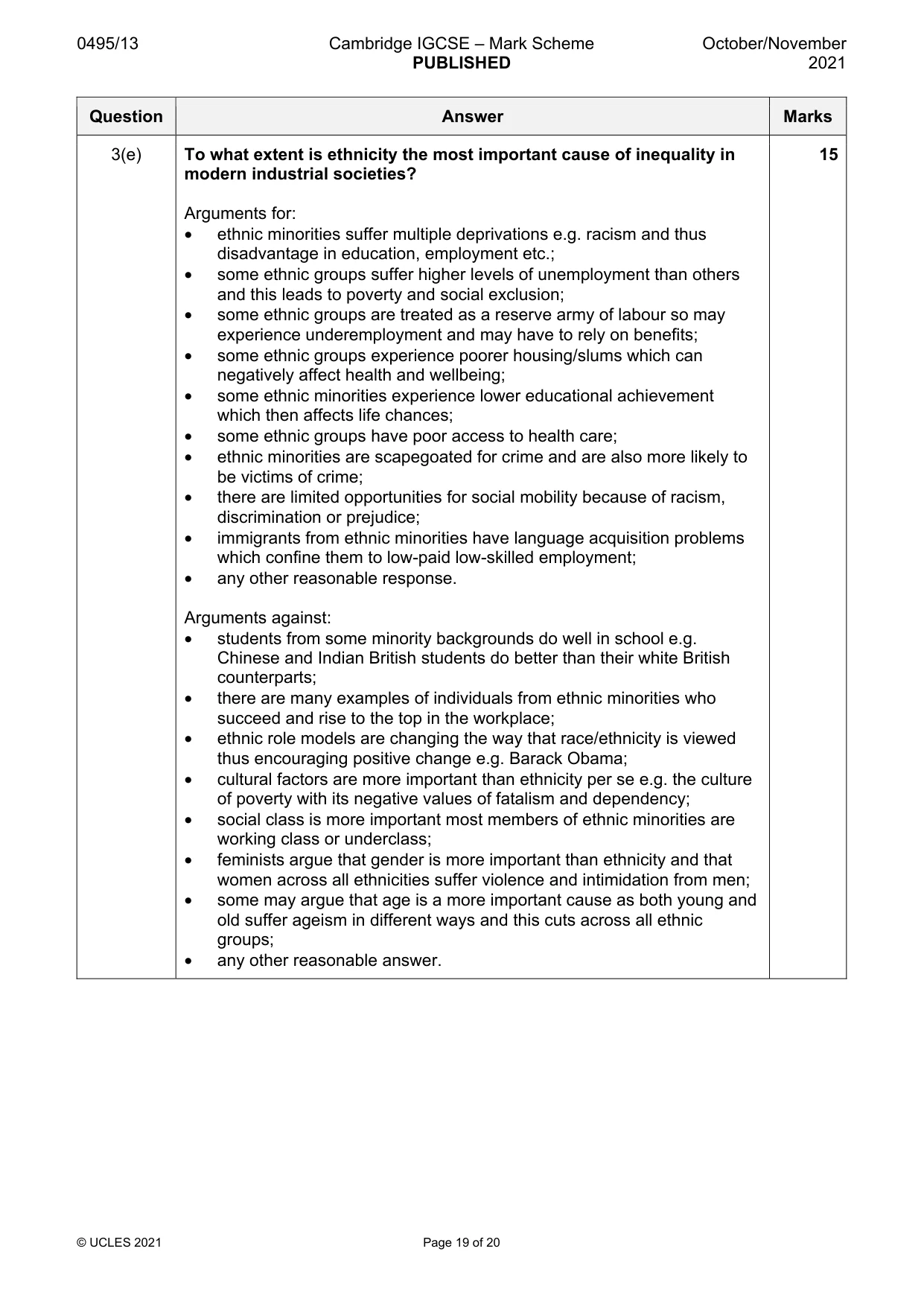
0495/13 Cambridge IGCSE – Mark Scheme PUBLISHED October/November 2021 © UCLES 2021 Page 19 of 20 Question Answer Marks 3(e) To what extent is ethnicity the most important cause of inequality in modern industrial societies? Arguments for: • ethnic minorities suffer multiple deprivations e.g. racism and thus disadvantage in education, employment etc.; • some ethnic groups suffer higher levels of unemployment than others and this leads to poverty and social exclusion; • some ethnic groups are treated as a reserve army of labour so may experience underemployment and may have to rely on benefits; • some ethnic groups experience poorer housing/slums which can negatively affect health and wellbeing; • some ethnic minorities experience lower educational achievement which then affects life chances; • some ethnic groups have poor access to health care; • ethnic minorities are scapegoated for crime and are also more likely to be victims of crime; • there are limited opportunities for social mobility because of racism, discrimination or prejudice; • immigrants from ethnic minorities have language acquisition problems which confine them to low-paid low-skilled employment; • any other reasonable response. Arguments against: • students from some minority backgrounds do well in school e.g. Chinese and Indian British students do better than their white British counterparts; • there are many examples of individuals from ethnic minorities who succeed and rise to the top in the workplace; • ethnic role models are changing the way that race/ethnicity is viewed thus encouraging positive change e.g. Barack Obama; • cultural factors are more important than ethnicity per se e.g. the culture of poverty with its negative values of fatalism and dependency; • social class is more important most members of ethnic minorities are working class or underclass; • feminists argue that gender is more important than ethnicity and that women across all ethnicities suffer violence and intimidation from men; • some may argue that age is a more important cause as both young and old suffer ageism in different ways and this cuts across all ethnic groups; • any other reasonable answer. 15
Mark scheme, page 20
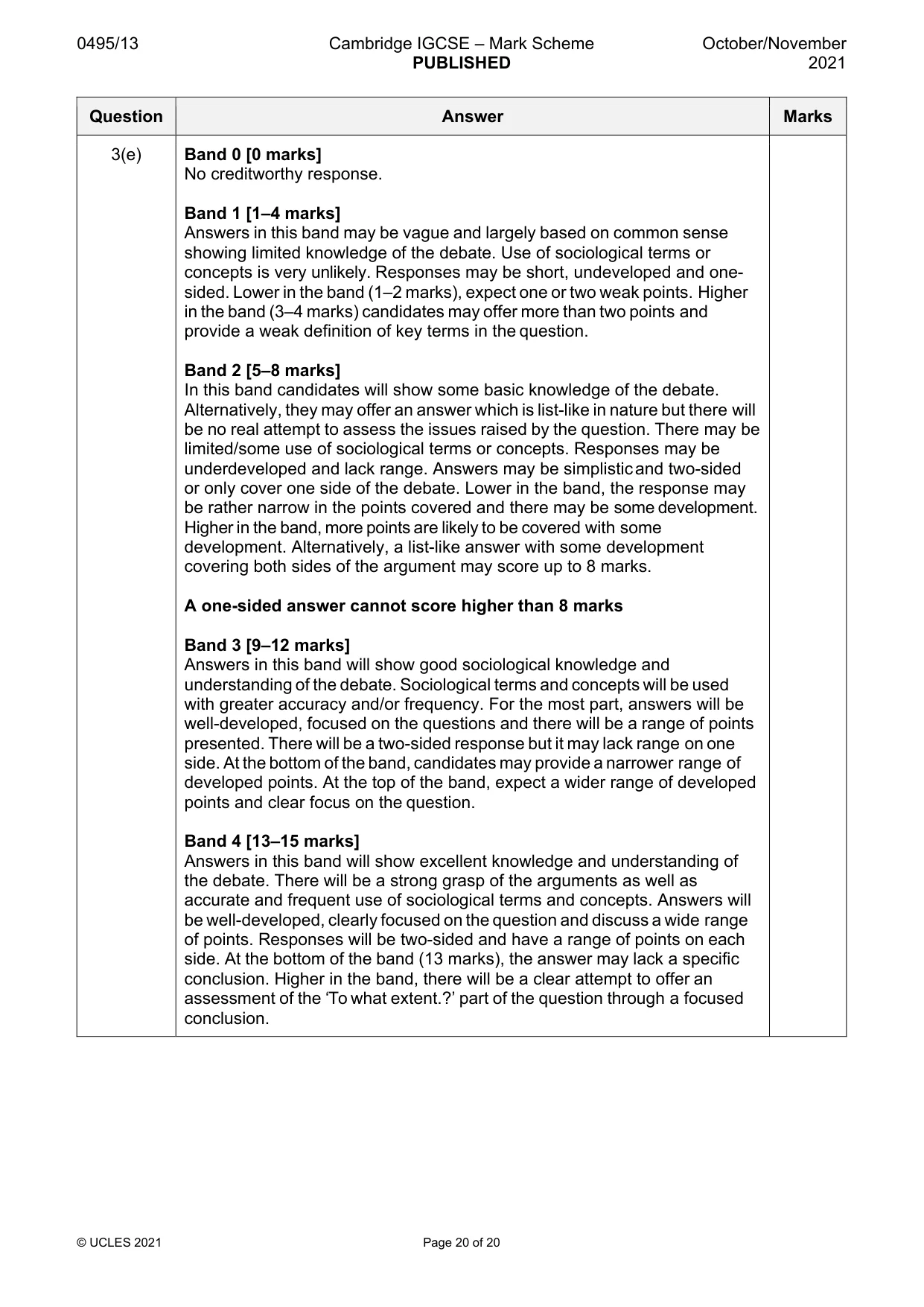
0495/13 Cambridge IGCSE – Mark Scheme PUBLISHED October/November 2021 © UCLES 2021 Page 20 of 20 Question Answer Marks 3(e) Band 0 [0 marks] No creditworthy response. Band 1 [1–4 marks] Answers in this band may be vague and largely based on common sense showing limited knowledge of the debate. Use of sociological terms or concepts is very unlikely. Responses may be short, undeveloped and one- sided. Lower in the band (1–2 marks), expect one or two weak points. Higher in the band (3–4 marks) candidates may offer more than two points and provide a weak definition of key terms in the question. Band 2 [5–8 marks] In this band candidates will show some basic knowledge of the debate. Alternatively, they may offer an answer which is list-like in nature but there will be no real attempt to assess the issues raised by the question. There may be limited/some use of sociological terms or concepts. Responses may be underdeveloped and lack range. Answers may be simplistic and two-sided or only cover one side of the debate. Lower in the band, the response may be rather narrow in the points covered and there may be some development. Higher in the band, more points are likely to be covered with some development. Alternatively, a list-like answer with some development covering both sides of the argument may score up to 8 marks. A one-sided answer cannot score higher than 8 marks Band 3 [9–12 marks] Answers in this band will show good sociological knowledge and understanding of the debate. Sociological terms and concepts will be used with greater accuracy and/or frequency. For the most part, answers will be well-developed, focused on the questions and there will be a range of points presented. There will be a two-sided response but it may lack range on one side. At the bottom of the band, candidates may provide a narrower range of developed points. At the top of the band, expect a wider range of developed points and clear focus on the question. Band 4 [13–15 marks] Answers in this band will show excellent knowledge and understanding of the debate. There will be a strong grasp of the arguments as well as accurate and frequent use of sociological terms and concepts. Answers will be well-developed, clearly focused on the question and discuss a wide range of points. Responses will be two-sided and have a range of points on each side. At the bottom of the band (13 marks), the answer may lack a specific conclusion. Higher in the band, there will be a clear attempt to offer an assessment of the ‘To what extent.?’ part of the question through a focused conclusion.
What you needed in this session
Cambridge’s own grade thresholds for 2021 Oct/Nov, Paper 1 · Variant 3. A higher threshold means an easier paper — the bar moves with how the cohort did.