Cambridge IGCSE Sociology 0495 — 2021 Oct/Nov Paper 1 · Variant 1
0495/11/O/N/21 · 80 marks · ≈90 min
The question paper and its mark scheme, free to read here and free to download. This is Cambridge’s own paper, exactly as it was sat.
Question paper4 pages

Mark scheme19 pages
Answers below. Sit the paper first if you are practising.

Paper as text
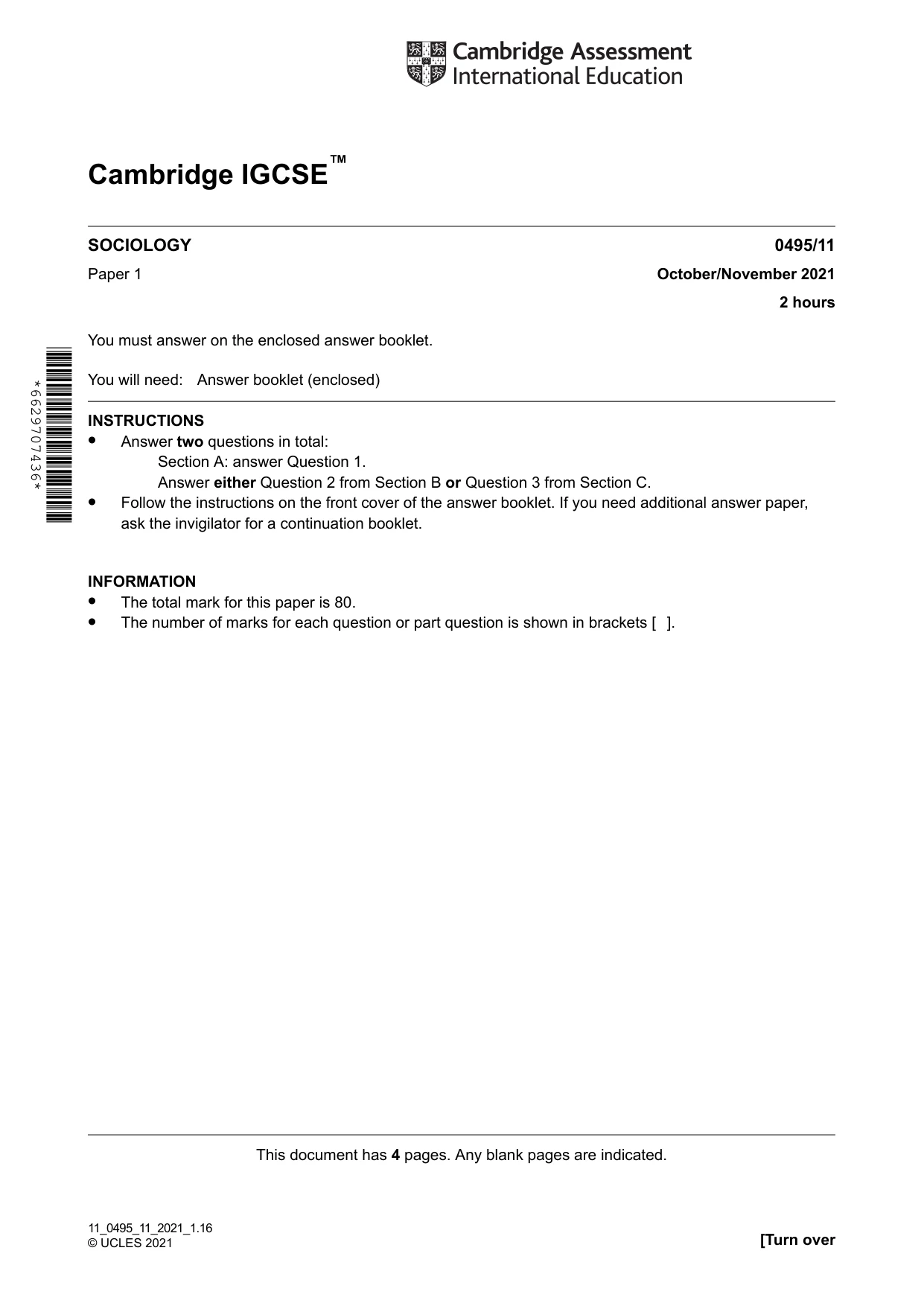
Question paper, page 1
Cambridge IGCSE™ 0495/11 October/November 2021 2 hours SOCIOLOGY Paper 1 You must answer on the enclosed answer booklet. You will need: Answer booklet (enclosed) INSTRUCTIONS • Answer two questions in total: Section A: answer Question 1. Answer either Question 2 from Section B or Question 3 from Section C. • Follow the instructions on the front cover of the answer booklet. If you need additional answer paper, ask the invigilator for a continuation booklet. INFORMATION • The total mark for this paper is 80. • The number of marks for each question or part question is shown in brackets [ ]. This document has 4 pages. Any blank pages are indicated. [Turn over 11_0495_11_2021_1.16 © UCLES 2021 *6629707436*
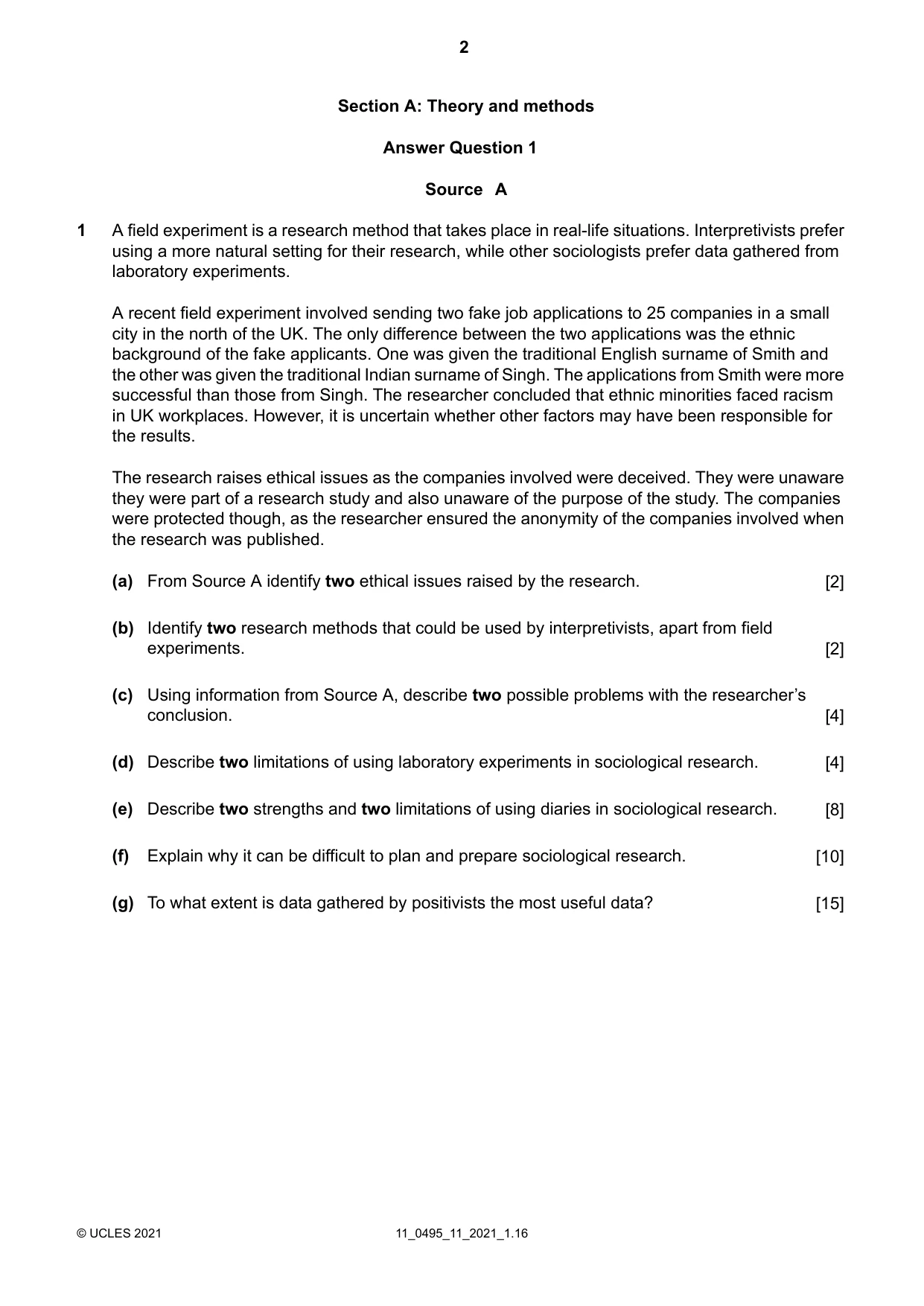
Question paper, page 2
Section A: Theory and methods Answer Question 1 Source A A field experiment is a research method that takes place in real-life situations. Interpretivists prefer using a more natural setting for their research, while other sociologists prefer data gathered from laboratory experiments. 1 A recent field experiment involved sending two fake job applications to 25 companies in a small city in the north of the UK. The only difference between the two applications was the ethnic background of the fake applicants. One was given the traditional English surname of Smith and the other was given the traditional Indian surname of Singh. The applications from Smith were more successful than those from Singh. The researcher concluded that ethnic minorities faced racism in UK workplaces. However, it is uncertain whether other factors may have been responsible for the results. The research raises ethical issues as the companies involved were deceived. They were unaware they were part of a research study and also unaware of the purpose of the study. The companies were protected though, as the researcher ensured the anonymity of the companies involved when the research was published. From Source A identify two ethical issues raised by the research. [2] (a) Identify two research methods that could be used by interpretivists, apart from field experiments. [2] (b) Using information from Source A, describe two possible problems with the researcher’s conclusion. [4] (c) Describe two limitations of using laboratory experiments in sociological research. [4] (d) Describe two strengths and two limitations of using diaries in sociological research. [8] (e) Explain why it can be difficult to plan and prepare sociological research. [10] (f) To what extent is data gathered by positivists the most useful data? [15] (g) 11_0495_11_2021_1.16 © UCLES 2021 2
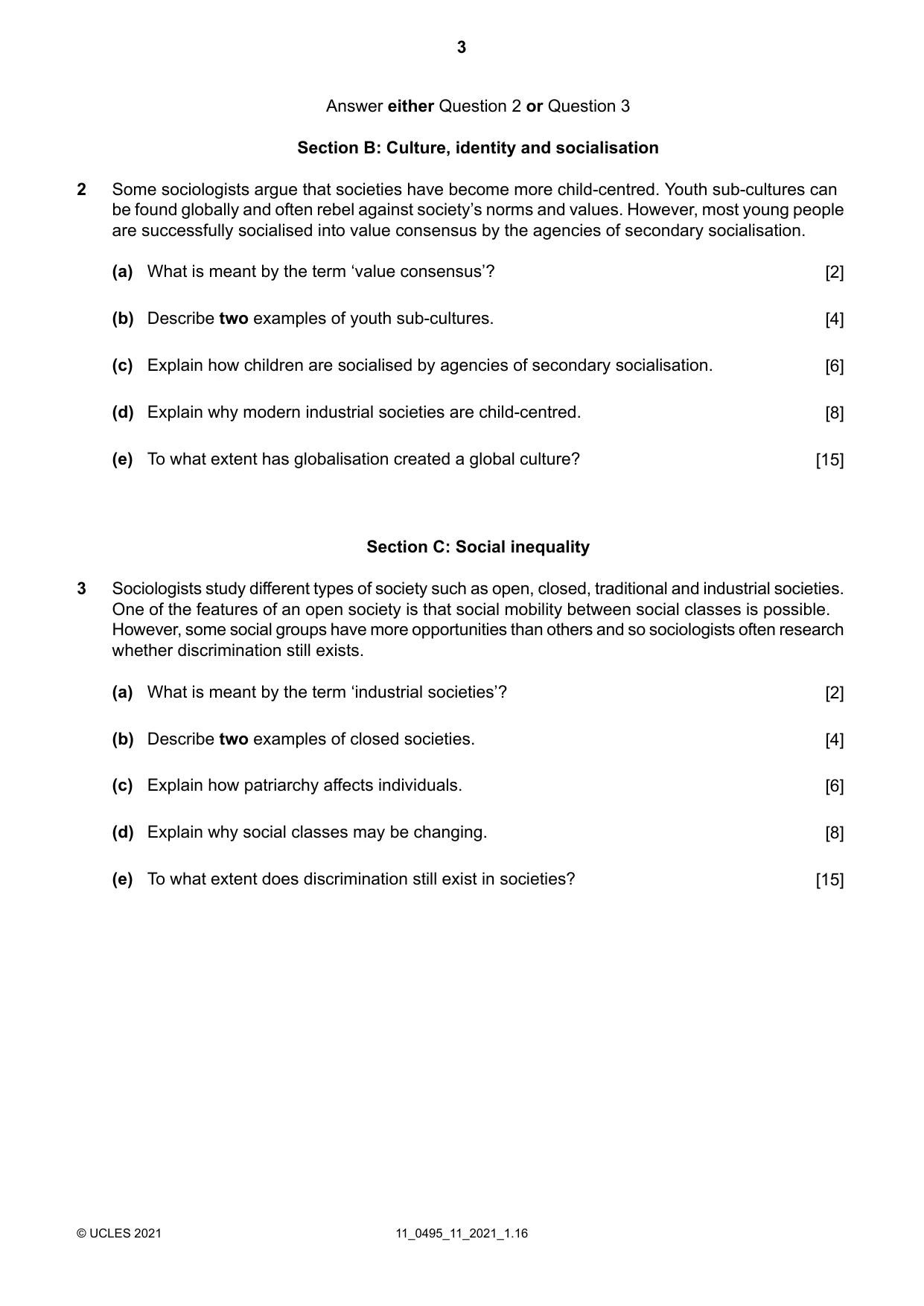
Question paper, page 3
Answer either Question 2 or Question 3 Section B: Culture, identity and socialisation Some sociologists argue that societies have become more child-centred. Youth sub-cultures can be found globally and often rebel against society’s norms and values. However, most young people are successfully socialised into value consensus by the agencies of secondary socialisation. 2 What is meant by the term ‘value consensus’? [2] (a) Describe two examples of youth sub-cultures. [4] (b) Explain how children are socialised by agencies of secondary socialisation. [6] (c) Explain why modern industrial societies are child-centred. [8] (d) To what extent has globalisation created a global culture? [15] (e) Section C: Social inequality Sociologists study different types of society such as open, closed, traditional and industrial societies. One of the features of an open society is that social mobility between social classes is possible. 3 However, some social groups have more opportunities than others and so sociologists often research whether discrimination still exists. What is meant by the term ‘industrial societies’? [2] (a) Describe two examples of closed societies. [4] (b) Explain how patriarchy affects individuals. [6] (c) Explain why social classes may be changing. [8] (d) To what extent does discrimination still exist in societies? [15] (e) 11_0495_11_2021_1.16 © UCLES 2021 3
Question paper, page 4
BLANK PAGE Permission to reproduce items where third-party owned material protected by copyright is included has been sought and cleared where possible. Every reasonable effort has been made by the publisher (UCLES) to trace copyright holders, but if any items requiring clearance have unwittingly been included, the publisher will be pleased to make amends at the earliest possible opportunity. To avoid the issue of disclosure of answer-related information to candidates, all copyright acknowledgements are reproduced online in the Cambridge Assessment International Education Copyright Acknowledgements Booklet. This is produced for each series of examinations and is freely available to download at www.cambridgeinternational.org after the live examination series. Cambridge Assessment International Education is part of the Cambridge Assessment Group. Cambridge Assessment is the brand name of the University of Cambridge Local Examinations Syndicate (UCLES), which itself is a department of the University of Cambridge. 11_0495_11_2021_1.16 © UCLES 2021 4
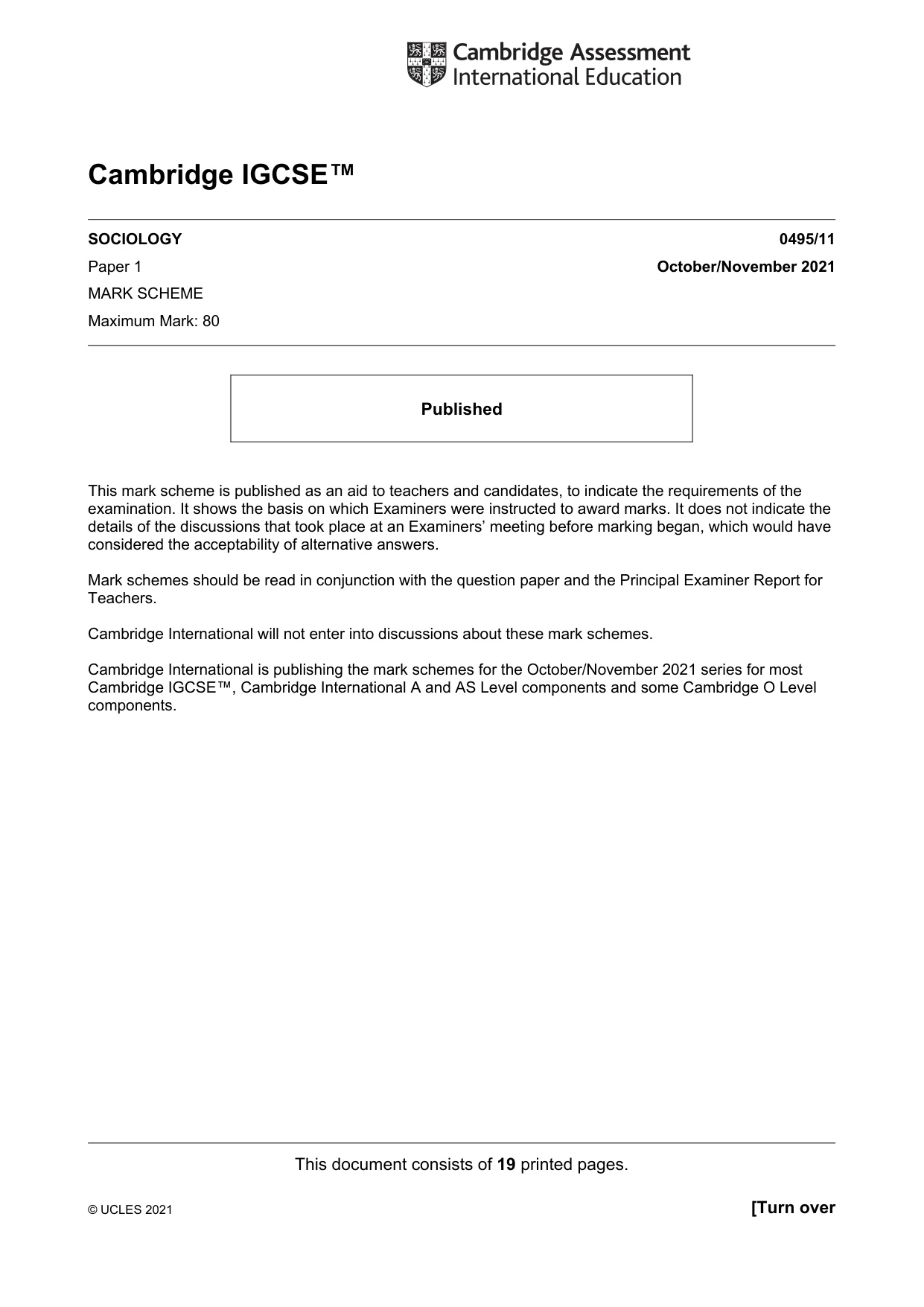
Mark scheme, page 1
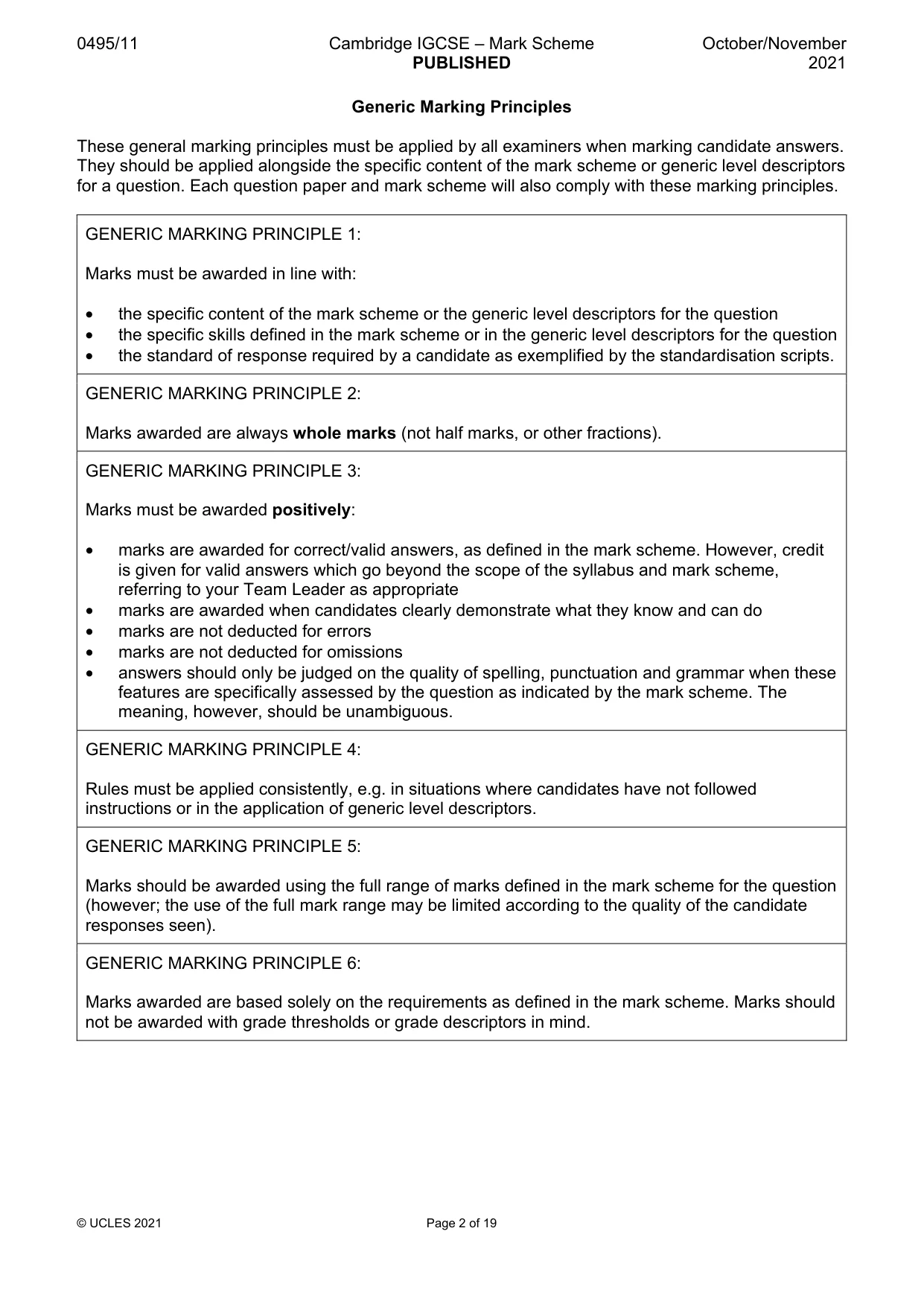
This document consists of 19 printed pages. © UCLES 2021 [Turn over Cambridge IGCSE™ SOCIOLOGY 0495/11 Paper 1 October/November 2021 MARK SCHEME Maximum Mark: 80 Published This mark scheme is published as an aid to teachers and candidates, to indicate the requirements of the examination. It shows the basis on which Examiners were instructed to award marks. It does not indicate the details of the discussions that took place at an Examiners’ meeting before marking began, which would have considered the acceptability of alternative answers. Mark schemes should be read in conjunction with the question paper and the Principal Examiner Report for Teachers. Cambridge International will not enter into discussions about these mark schemes. Cambridge International is publishing the mark schemes for the October/November 2021 series for most Cambridge IGCSE™, Cambridge International A and AS Level components and some Cambridge O Level components.
Mark scheme, page 2
0495/11 Cambridge IGCSE – Mark Scheme PUBLISHED October/November 2021 © UCLES 2021 Page 2 of 19 Generic Marking Principles These general marking principles must be applied by all examiners when marking candidate answers. They should be applied alongside the specific content of the mark scheme or generic level descriptors for a question. Each question paper and mark scheme will also comply with these marking principles. GENERIC MARKING PRINCIPLE 1: Marks must be awarded in line with: • the specific content of the mark scheme or the generic level descriptors for the question • the specific skills defined in the mark scheme or in the generic level descriptors for the question • the standard of response required by a candidate as exemplified by the standardisation scripts. GENERIC MARKING PRINCIPLE 2: Marks awarded are always whole marks (not half marks, or other fractions). GENERIC MARKING PRINCIPLE 3: Marks must be awarded positively: • marks are awarded for correct/valid answers, as defined in the mark scheme. However, credit is given for valid answers which go beyond the scope of the syllabus and mark scheme, referring to your Team Leader as appropriate • marks are awarded when candidates clearly demonstrate what they know and can do • marks are not deducted for errors • marks are not deducted for omissions • answers should only be judged on the quality of spelling, punctuation and grammar when these features are specifically assessed by the question as indicated by the mark scheme. The meaning, however, should be unambiguous. GENERIC MARKING PRINCIPLE 4: Rules must be applied consistently, e.g. in situations where candidates have not followed instructions or in the application of generic level descriptors. GENERIC MARKING PRINCIPLE 5: Marks should be awarded using the full range of marks defined in the mark scheme for the question (however; the use of the full mark range may be limited according to the quality of the candidate responses seen). GENERIC MARKING PRINCIPLE 6: Marks awarded are based solely on the requirements as defined in the mark scheme. Marks should not be awarded with grade thresholds or grade descriptors in mind.
Mark scheme, page 3
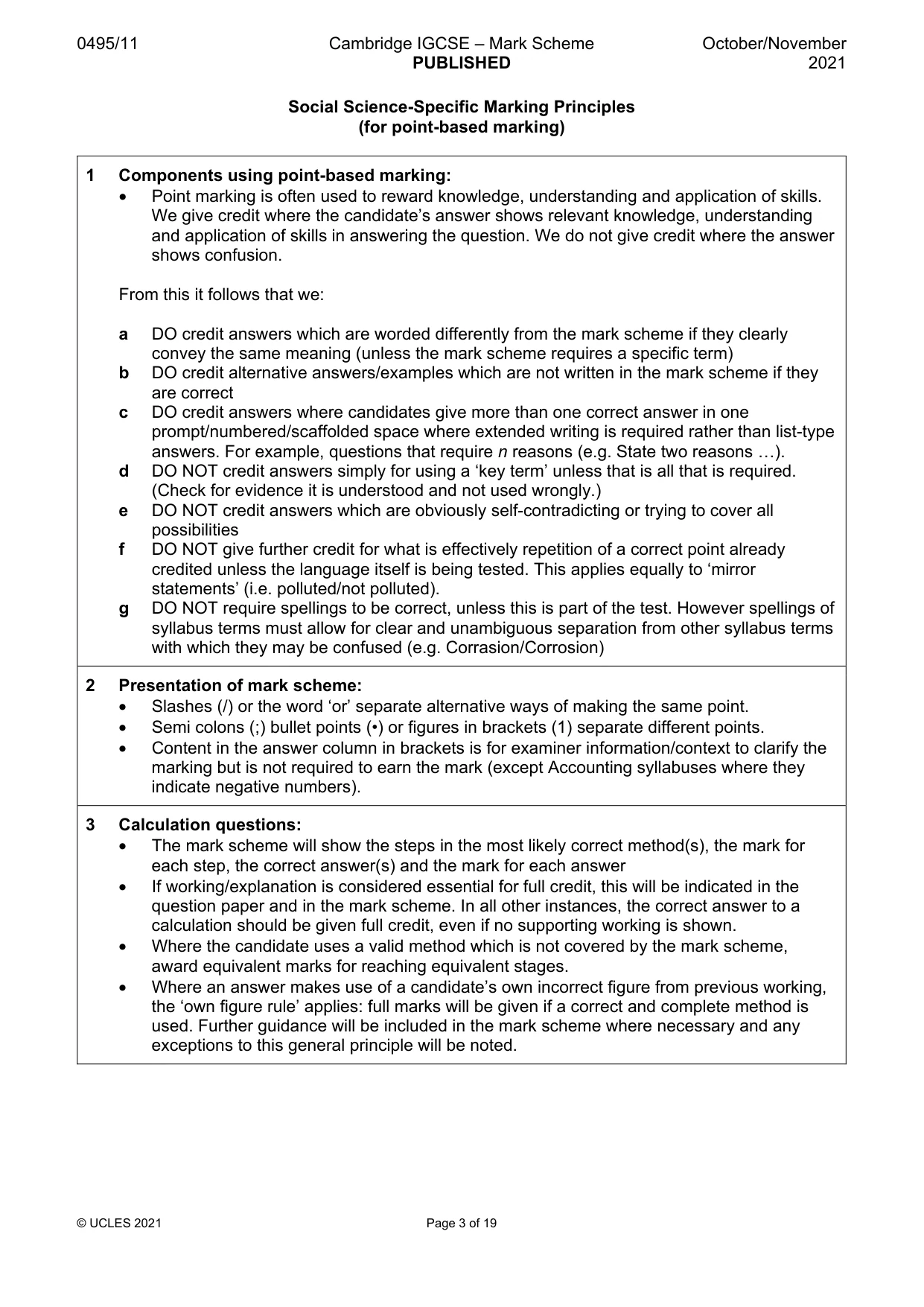
0495/11 Cambridge IGCSE – Mark Scheme PUBLISHED October/November 2021 © UCLES 2021 Page 3 of 19 Social Science-Specific Marking Principles (for point-based marking) 1 Components using point-based marking: • Point marking is often used to reward knowledge, understanding and application of skills. We give credit where the candidate’s answer shows relevant knowledge, understanding and application of skills in answering the question. We do not give credit where the answer shows confusion. From this it follows that we: a DO credit answers which are worded differently from the mark scheme if they clearly convey the same meaning (unless the mark scheme requires a specific term) b DO credit alternative answers/examples which are not written in the mark scheme if they are correct c DO credit answers where candidates give more than one correct answer in one prompt/numbered/scaffolded space where extended writing is required rather than list-type answers. For example, questions that require n reasons (e.g. State two reasons …). d DO NOT credit answers simply for using a ‘key term’ unless that is all that is required. (Check for evidence it is understood and not used wrongly.) e DO NOT credit answers which are obviously self-contradicting or trying to cover all possibilities f DO NOT give further credit for what is effectively repetition of a correct point already credited unless the language itself is being tested. This applies equally to ‘mirror statements’ (i.e. polluted/not polluted). g DO NOT require spellings to be correct, unless this is part of the test. However spellings of syllabus terms must allow for clear and unambiguous separation from other syllabus terms with which they may be confused (e.g. Corrasion/Corrosion) 2 Presentation of mark scheme: • Slashes (/) or the word ‘or’ separate alternative ways of making the same point. • Semi colons (;) bullet points (•) or figures in brackets (1) separate different points. • Content in the answer column in brackets is for examiner information/context to clarify the marking but is not required to earn the mark (except Accounting syllabuses where they indicate negative numbers). 3 Calculation questions: • The mark scheme will show the steps in the most likely correct method(s), the mark for each step, the correct answer(s) and the mark for each answer • If working/explanation is considered essential for full credit, this will be indicated in the question paper and in the mark scheme. In all other instances, the correct answer to a calculation should be given full credit, even if no supporting working is shown. • Where the candidate uses a valid method which is not covered by the mark scheme, award equivalent marks for reaching equivalent stages. • Where an answer makes use of a candidate’s own incorrect figure from previous working, the ‘own figure rule’ applies: full marks will be given if a correct and complete method is used. Further guidance will be included in the mark scheme where necessary and any exceptions to this general principle will be noted.
Mark scheme, page 4
0495/11 Cambridge IGCSE – Mark Scheme PUBLISHED October/November 2021 © UCLES 2021 Page 4 of 19 4 Annotation: • For point marking, ticks can be used to indicate correct answers and crosses can be used to indicate wrong answers. There is no direct relationship between ticks and marks. Ticks have no defined meaning for levels of response marking. • For levels of response marking, the level awarded should be annotated on the script. • Other annotations will be used by examiners as agreed during standardisation, and the meaning will be understood by all examiners who marked that paper.
Mark scheme, page 5
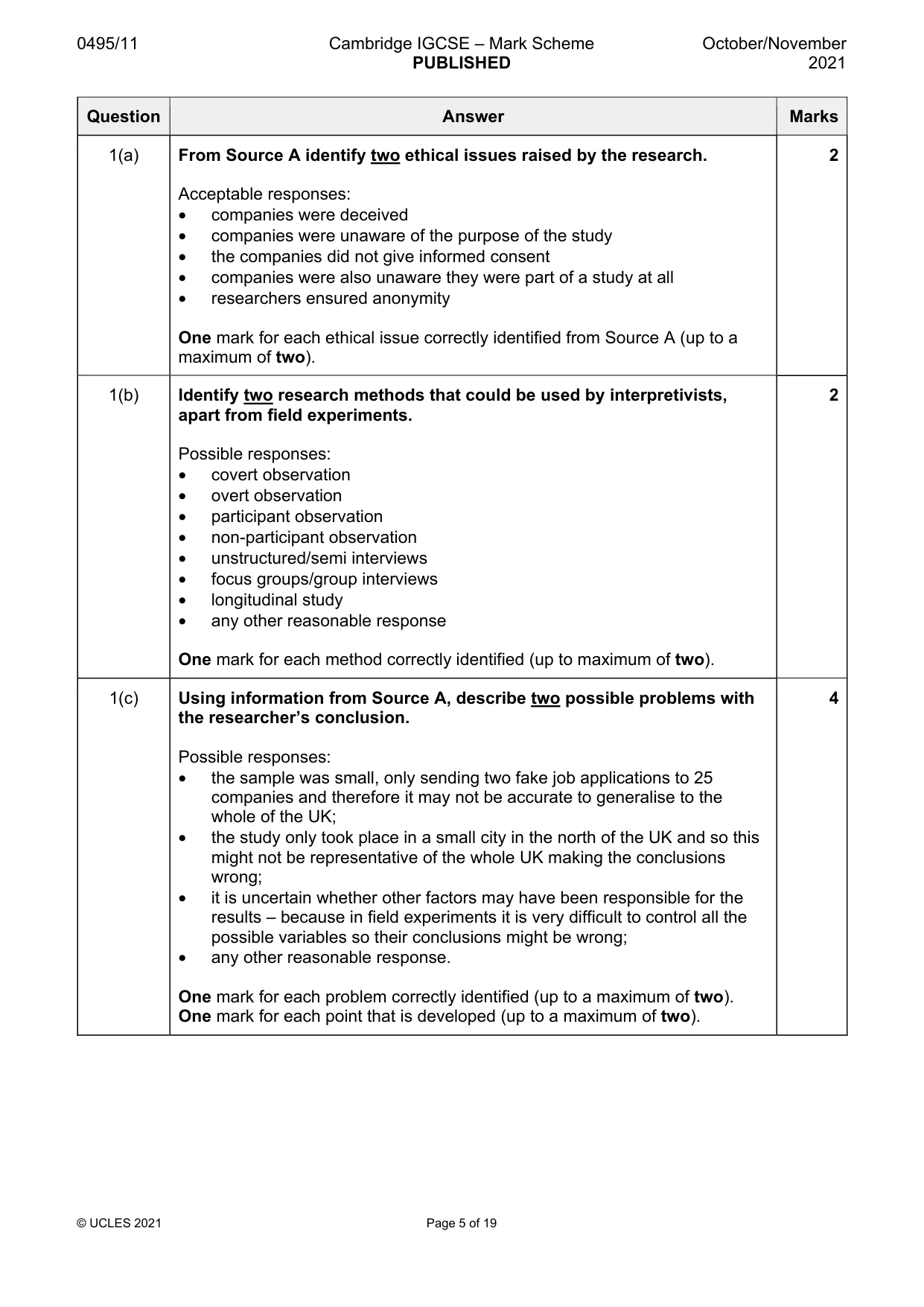
0495/11 Cambridge IGCSE – Mark Scheme PUBLISHED October/November 2021 © UCLES 2021 Page 5 of 19 Question Answer Marks 1(a) From Source A identify two ethical issues raised by the research. Acceptable responses: • companies were deceived • companies were unaware of the purpose of the study • the companies did not give informed consent • companies were also unaware they were part of a study at all • researchers ensured anonymity One mark for each ethical issue correctly identified from Source A (up to a maximum of two). 2 1(b) Identify two research methods that could be used by interpretivists, apart from field experiments. Possible responses: • covert observation • overt observation • participant observation • non-participant observation • unstructured/semi interviews • focus groups/group interviews • longitudinal study • any other reasonable response One mark for each method correctly identified (up to maximum of two). 2 1(c) Using information from Source A, describe two possible problems with the researcher’s conclusion. Possible responses: • the sample was small, only sending two fake job applications to 25 companies and therefore it may not be accurate to generalise to the whole of the UK; • the study only took place in a small city in the north of the UK and so this might not be representative of the whole UK making the conclusions wrong; • it is uncertain whether other factors may have been responsible for the results – because in field experiments it is very difficult to control all the possible variables so their conclusions might be wrong; • any other reasonable response. One mark for each problem correctly identified (up to a maximum of two). One mark for each point that is developed (up to a maximum of two). 4
Mark scheme, page 6
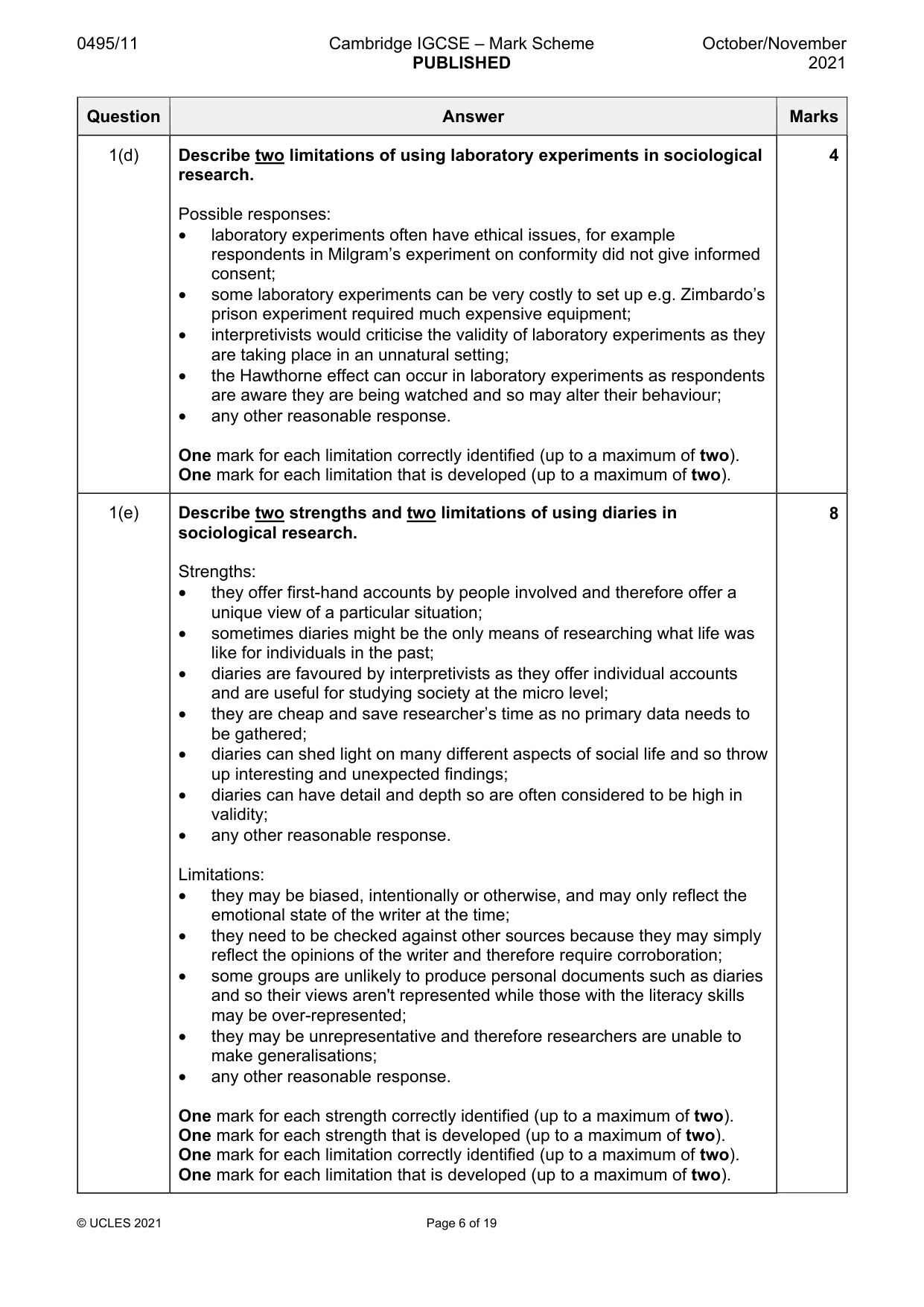
0495/11 Cambridge IGCSE – Mark Scheme PUBLISHED October/November 2021 © UCLES 2021 Page 6 of 19 Question Answer Marks 1(d) Describe two limitations of using laboratory experiments in sociological research. Possible responses: • laboratory experiments often have ethical issues, for example respondents in Milgram’s experiment on conformity did not give informed consent; • some laboratory experiments can be very costly to set up e.g. Zimbardo’s prison experiment required much expensive equipment; • interpretivists would criticise the validity of laboratory experiments as they are taking place in an unnatural setting; • the Hawthorne effect can occur in laboratory experiments as respondents are aware they are being watched and so may alter their behaviour; • any other reasonable response. One mark for each limitation correctly identified (up to a maximum of two). One mark for each limitation that is developed (up to a maximum of two). 4 1(e) Describe two strengths and two limitations of using diaries in sociological research. Strengths: • they offer first-hand accounts by people involved and therefore offer a unique view of a particular situation; • sometimes diaries might be the only means of researching what life was like for individuals in the past; • diaries are favoured by interpretivists as they offer individual accounts and are useful for studying society at the micro level; • they are cheap and save researcher’s time as no primary data needs to be gathered; • diaries can shed light on many different aspects of social life and so throw up interesting and unexpected findings; • diaries can have detail and depth so are often considered to be high in validity; • any other reasonable response. Limitations: • they may be biased, intentionally or otherwise, and may only reflect the emotional state of the writer at the time; • they need to be checked against other sources because they may simply reflect the opinions of the writer and therefore require corroboration; • some groups are unlikely to produce personal documents such as diaries and so their views aren't represented while those with the literacy skills may be over-represented; • they may be unrepresentative and therefore researchers are unable to make generalisations; • any other reasonable response. One mark for each strength correctly identified (up to a maximum of two). One mark for each strength that is developed (up to a maximum of two). One mark for each limitation correctly identified (up to a maximum of two). One mark for each limitation that is developed (up to a maximum of two). 8
Mark scheme, page 7
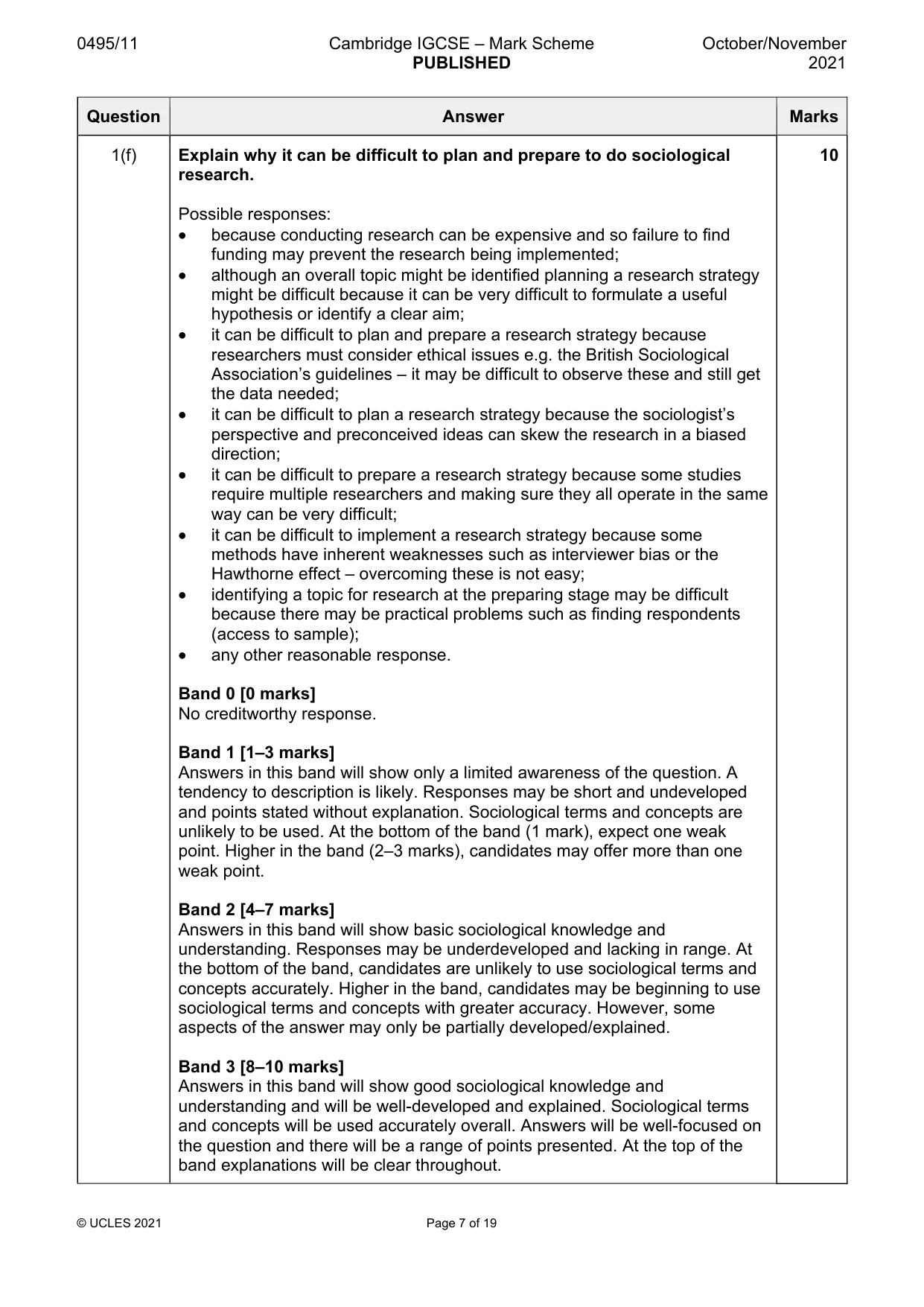
0495/11 Cambridge IGCSE – Mark Scheme PUBLISHED October/November 2021 © UCLES 2021 Page 7 of 19 Question Answer Marks 1(f) Explain why it can be difficult to plan and prepare to do sociological research. Possible responses: • because conducting research can be expensive and so failure to find funding may prevent the research being implemented; • although an overall topic might be identified planning a research strategy might be difficult because it can be very difficult to formulate a useful hypothesis or identify a clear aim; • it can be difficult to plan and prepare a research strategy because researchers must consider ethical issues e.g. the British Sociological Association’s guidelines – it may be difficult to observe these and still get the data needed; • it can be difficult to plan a research strategy because the sociologist’s perspective and preconceived ideas can skew the research in a biased direction; • it can be difficult to prepare a research strategy because some studies require multiple researchers and making sure they all operate in the same way can be very difficult; • it can be difficult to implement a research strategy because some methods have inherent weaknesses such as interviewer bias or the Hawthorne effect – overcoming these is not easy; • identifying a topic for research at the preparing stage may be difficult because there may be practical problems such as finding respondents (access to sample); • any other reasonable response. Band 0 [0 marks] No creditworthy response. Band 1 [1–3 marks] Answers in this band will show only a limited awareness of the question. A tendency to description is likely. Responses may be short and undeveloped and points stated without explanation. Sociological terms and concepts are unlikely to be used. At the bottom of the band (1 mark), expect one weak point. Higher in the band (2–3 marks), candidates may offer more than one weak point. Band 2 [4–7 marks] Answers in this band will show basic sociological knowledge and understanding. Responses may be underdeveloped and lacking in range. At the bottom of the band, candidates are unlikely to use sociological terms and concepts accurately. Higher in the band, candidates may be beginning to use sociological terms and concepts with greater accuracy. However, some aspects of the answer may only be partially developed/explained. Band 3 [8–10 marks] Answers in this band will show good sociological knowledge and understanding and will be well-developed and explained. Sociological terms and concepts will be used accurately overall. Answers will be well-focused on the question and there will be a range of points presented. At the top of the band explanations will be clear throughout. 10
Mark scheme, page 8
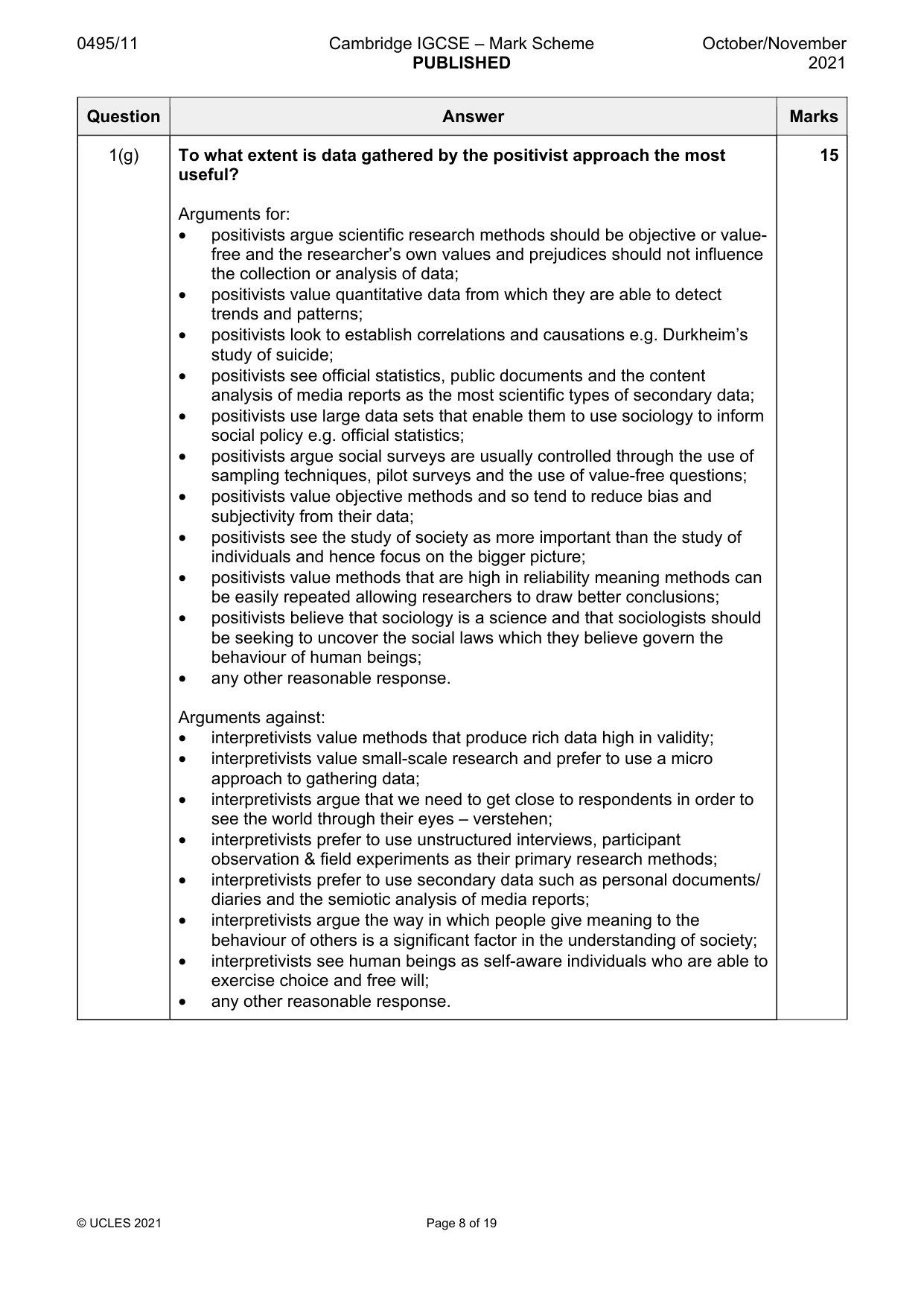
0495/11 Cambridge IGCSE – Mark Scheme PUBLISHED October/November 2021 © UCLES 2021 Page 8 of 19 Question Answer Marks 1(g) To what extent is data gathered by the positivist approach the most useful? Arguments for: • positivists argue scientific research methods should be objective or value- free and the researcher’s own values and prejudices should not influence the collection or analysis of data; • positivists value quantitative data from which they are able to detect trends and patterns; • positivists look to establish correlations and causations e.g. Durkheim’s study of suicide; • positivists see official statistics, public documents and the content analysis of media reports as the most scientific types of secondary data; • positivists use large data sets that enable them to use sociology to inform social policy e.g. official statistics; • positivists argue social surveys are usually controlled through the use of sampling techniques, pilot surveys and the use of value-free questions; • positivists value objective methods and so tend to reduce bias and subjectivity from their data; • positivists see the study of society as more important than the study of individuals and hence focus on the bigger picture; • positivists value methods that are high in reliability meaning methods can be easily repeated allowing researchers to draw better conclusions; • positivists believe that sociology is a science and that sociologists should be seeking to uncover the social laws which they believe govern the behaviour of human beings; • any other reasonable response. Arguments against: • interpretivists value methods that produce rich data high in validity; • interpretivists value small-scale research and prefer to use a micro approach to gathering data; • interpretivists argue that we need to get close to respondents in order to see the world through their eyes – verstehen; • interpretivists prefer to use unstructured interviews, participant observation & field experiments as their primary research methods; • interpretivists prefer to use secondary data such as personal documents/ diaries and the semiotic analysis of media reports; • interpretivists argue the way in which people give meaning to the behaviour of others is a significant factor in the understanding of society; • interpretivists see human beings as self-aware individuals who are able to exercise choice and free will; • any other reasonable response. 15
Mark scheme, page 9
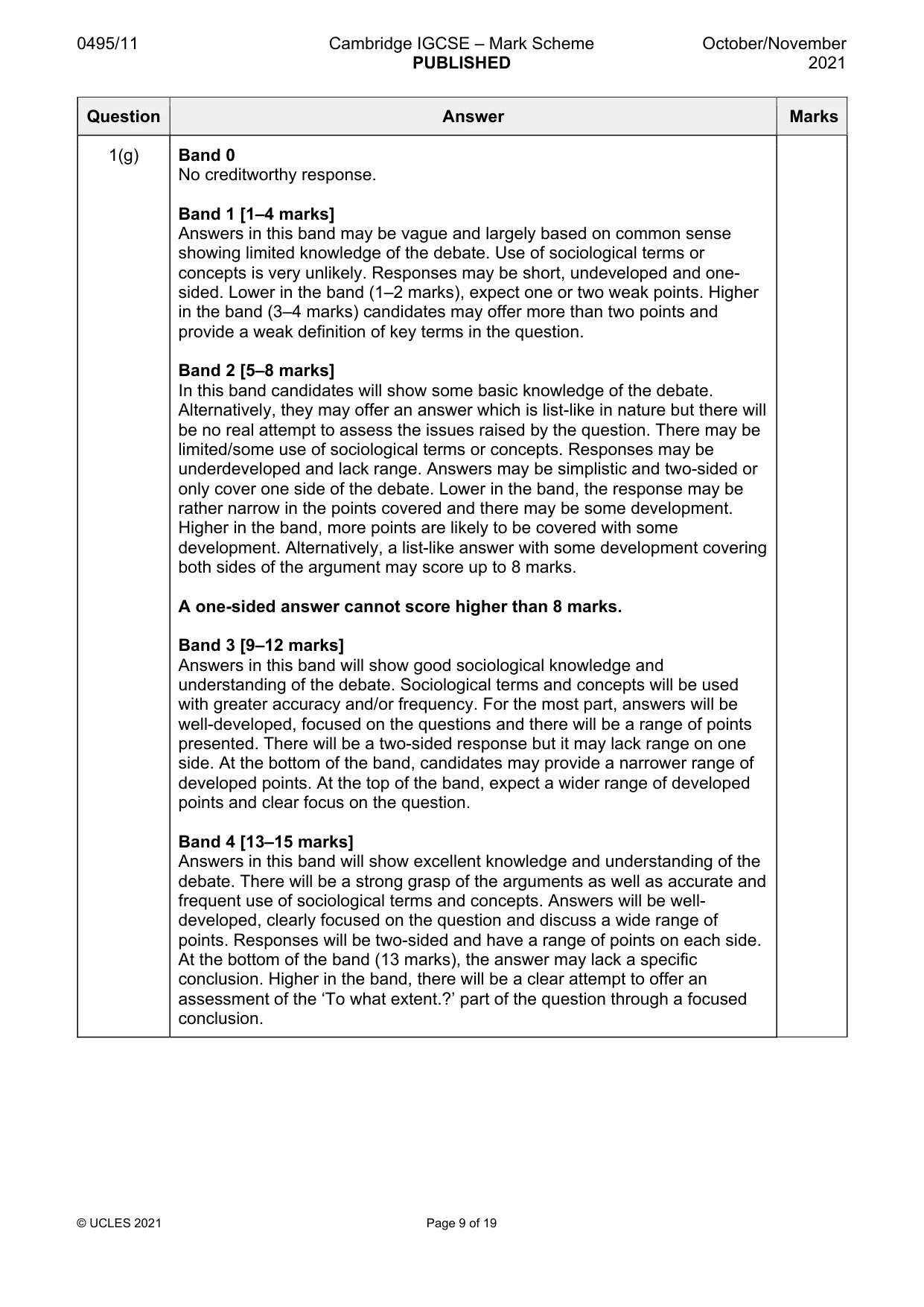
0495/11 Cambridge IGCSE – Mark Scheme PUBLISHED October/November 2021 © UCLES 2021 Page 9 of 19 Question Answer Marks 1(g) Band 0 No creditworthy response. Band 1 [1–4 marks] Answers in this band may be vague and largely based on common sense showing limited knowledge of the debate. Use of sociological terms or concepts is very unlikely. Responses may be short, undeveloped and one- sided. Lower in the band (1–2 marks), expect one or two weak points. Higher in the band (3–4 marks) candidates may offer more than two points and provide a weak definition of key terms in the question. Band 2 [5–8 marks] In this band candidates will show some basic knowledge of the debate. Alternatively, they may offer an answer which is list-like in nature but there will be no real attempt to assess the issues raised by the question. There may be limited/some use of sociological terms or concepts. Responses may be underdeveloped and lack range. Answers may be simplistic and two-sided or only cover one side of the debate. Lower in the band, the response may be rather narrow in the points covered and there may be some development. Higher in the band, more points are likely to be covered with some development. Alternatively, a list-like answer with some development covering both sides of the argument may score up to 8 marks. A one-sided answer cannot score higher than 8 marks. Band 3 [9–12 marks] Answers in this band will show good sociological knowledge and understanding of the debate. Sociological terms and concepts will be used with greater accuracy and/or frequency. For the most part, answers will be well-developed, focused on the questions and there will be a range of points presented. There will be a two-sided response but it may lack range on one side. At the bottom of the band, candidates may provide a narrower range of developed points. At the top of the band, expect a wider range of developed points and clear focus on the question. Band 4 [13–15 marks] Answers in this band will show excellent knowledge and understanding of the debate. There will be a strong grasp of the arguments as well as accurate and frequent use of sociological terms and concepts. Answers will be well- developed, clearly focused on the question and discuss a wide range of points. Responses will be two-sided and have a range of points on each side. At the bottom of the band (13 marks), the answer may lack a specific conclusion. Higher in the band, there will be a clear attempt to offer an assessment of the ‘To what extent.?’ part of the question through a focused conclusion.
Mark scheme, page 10
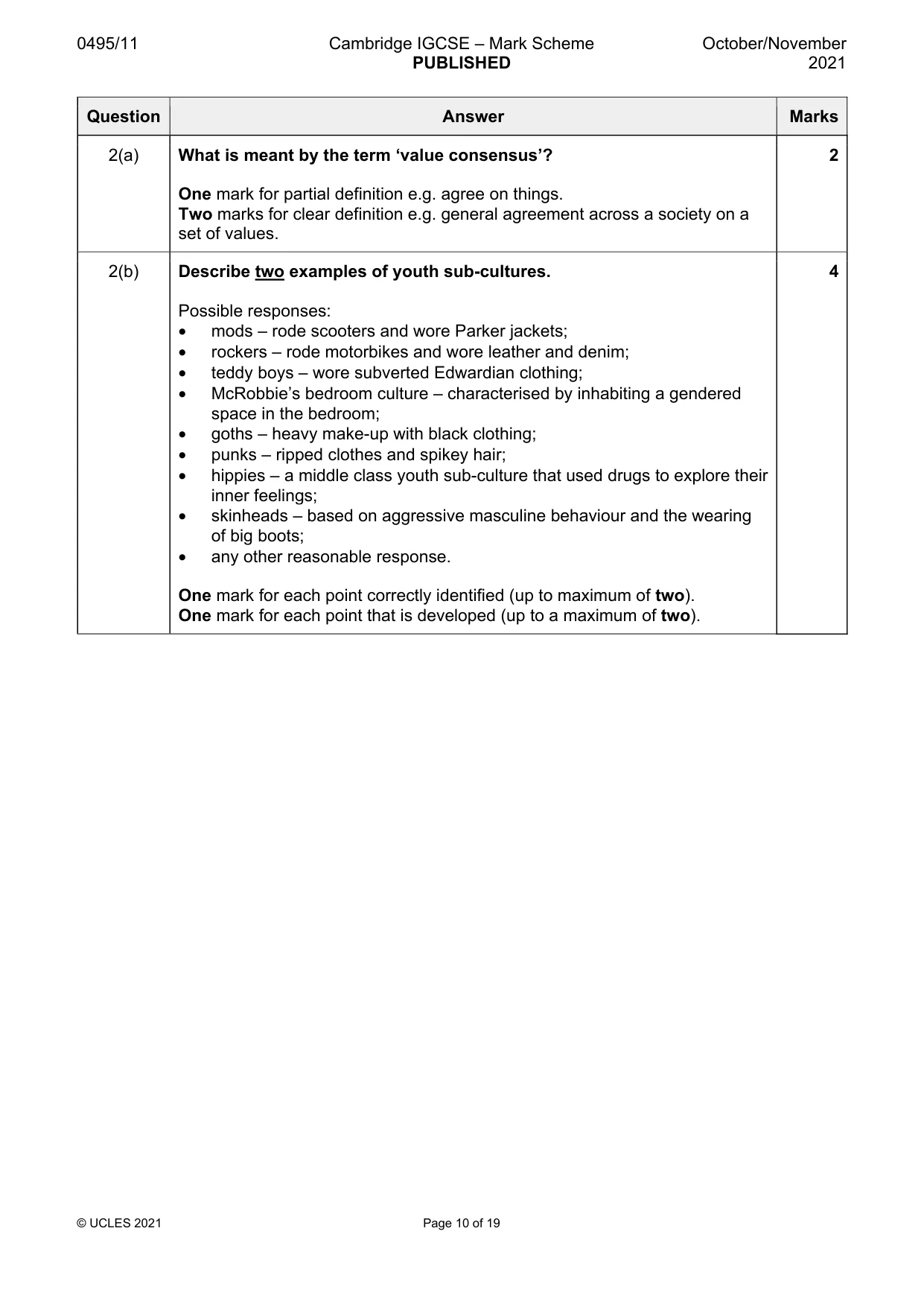
0495/11 Cambridge IGCSE – Mark Scheme PUBLISHED October/November 2021 © UCLES 2021 Page 10 of 19 Question Answer Marks 2(a) What is meant by the term ‘value consensus’? One mark for partial definition e.g. agree on things. Two marks for clear definition e.g. general agreement across a society on a set of values. 2 2(b) Describe two examples of youth sub-cultures. Possible responses: • mods – rode scooters and wore Parker jackets; • rockers – rode motorbikes and wore leather and denim; • teddy boys – wore subverted Edwardian clothing; • McRobbie’s bedroom culture – characterised by inhabiting a gendered space in the bedroom; • goths – heavy make-up with black clothing; • punks – ripped clothes and spikey hair; • hippies – a middle class youth sub-culture that used drugs to explore their inner feelings; • skinheads – based on aggressive masculine behaviour and the wearing of big boots; • any other reasonable response. One mark for each point correctly identified (up to maximum of two). One mark for each point that is developed (up to a maximum of two). 4
Mark scheme, page 11
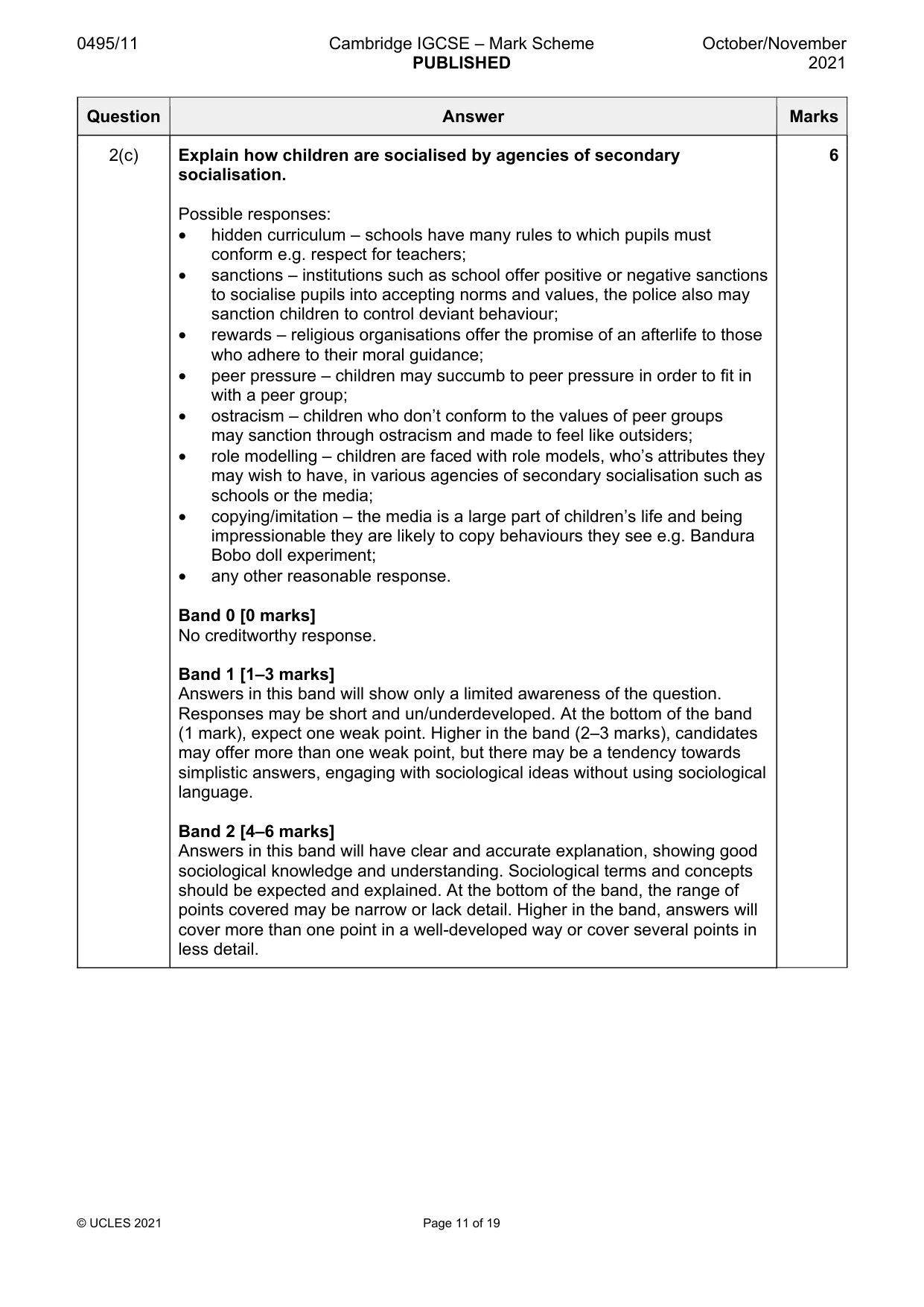
0495/11 Cambridge IGCSE – Mark Scheme PUBLISHED October/November 2021 © UCLES 2021 Page 11 of 19 Question Answer Marks 2(c) Explain how children are socialised by agencies of secondary socialisation. Possible responses: • hidden curriculum – schools have many rules to which pupils must conform e.g. respect for teachers; • sanctions – institutions such as school offer positive or negative sanctions to socialise pupils into accepting norms and values, the police also may sanction children to control deviant behaviour; • rewards – religious organisations offer the promise of an afterlife to those who adhere to their moral guidance; • peer pressure – children may succumb to peer pressure in order to fit in with a peer group; • ostracism – children who don’t conform to the values of peer groups may sanction through ostracism and made to feel like outsiders; • role modelling – children are faced with role models, who’s attributes they may wish to have, in various agencies of secondary socialisation such as schools or the media; • copying/imitation – the media is a large part of children’s life and being impressionable they are likely to copy behaviours they see e.g. Bandura Bobo doll experiment; • any other reasonable response. Band 0 [0 marks] No creditworthy response. Band 1 [1–3 marks] Answers in this band will show only a limited awareness of the question. Responses may be short and un/underdeveloped. At the bottom of the band (1 mark), expect one weak point. Higher in the band (2–3 marks), candidates may offer more than one weak point, but there may be a tendency towards simplistic answers, engaging with sociological ideas without using sociological language. Band 2 [4–6 marks] Answers in this band will have clear and accurate explanation, showing good sociological knowledge and understanding. Sociological terms and concepts should be expected and explained. At the bottom of the band, the range of points covered may be narrow or lack detail. Higher in the band, answers will cover more than one point in a well-developed way or cover several points in less detail. 6
Mark scheme, page 12
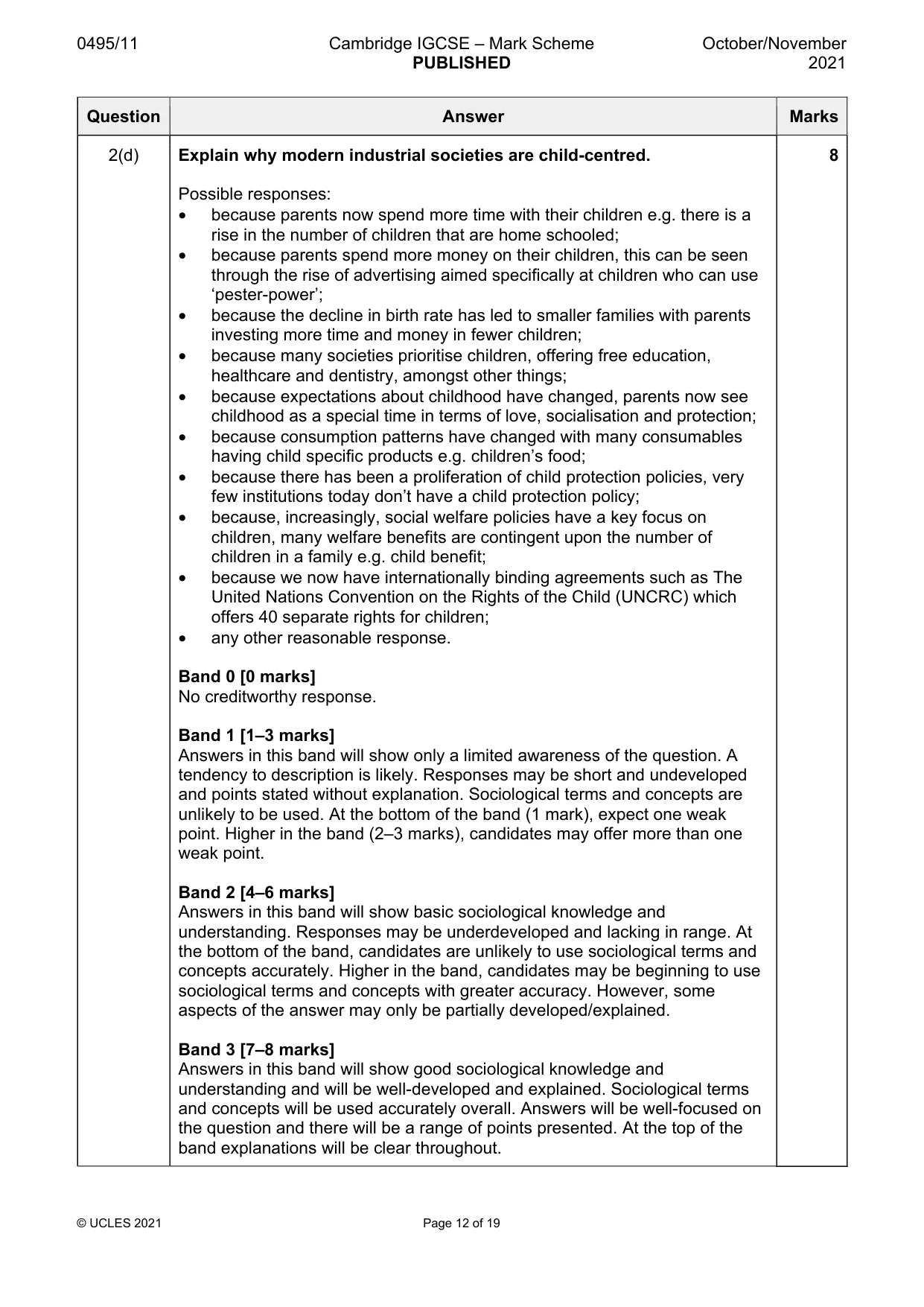
0495/11 Cambridge IGCSE – Mark Scheme PUBLISHED October/November 2021 © UCLES 2021 Page 12 of 19 Question Answer Marks 2(d) Explain why modern industrial societies are child-centred. Possible responses: • because parents now spend more time with their children e.g. there is a rise in the number of children that are home schooled; • because parents spend more money on their children, this can be seen through the rise of advertising aimed specifically at children who can use ‘pester-power’; • because the decline in birth rate has led to smaller families with parents investing more time and money in fewer children; • because many societies prioritise children, offering free education, healthcare and dentistry, amongst other things; • because expectations about childhood have changed, parents now see childhood as a special time in terms of love, socialisation and protection; • because consumption patterns have changed with many consumables having child specific products e.g. children’s food; • because there has been a proliferation of child protection policies, very few institutions today don’t have a child protection policy; • because, increasingly, social welfare policies have a key focus on children, many welfare benefits are contingent upon the number of children in a family e.g. child benefit; • because we now have internationally binding agreements such as The United Nations Convention on the Rights of the Child (UNCRC) which offers 40 separate rights for children; • any other reasonable response. Band 0 [0 marks] No creditworthy response. Band 1 [1–3 marks] Answers in this band will show only a limited awareness of the question. A tendency to description is likely. Responses may be short and undeveloped and points stated without explanation. Sociological terms and concepts are unlikely to be used. At the bottom of the band (1 mark), expect one weak point. Higher in the band (2–3 marks), candidates may offer more than one weak point. Band 2 [4–6 marks] Answers in this band will show basic sociological knowledge and understanding. Responses may be underdeveloped and lacking in range. At the bottom of the band, candidates are unlikely to use sociological terms and concepts accurately. Higher in the band, candidates may be beginning to use sociological terms and concepts with greater accuracy. However, some aspects of the answer may only be partially developed/explained. Band 3 [7–8 marks] Answers in this band will show good sociological knowledge and understanding and will be well-developed and explained. Sociological terms and concepts will be used accurately overall. Answers will be well-focused on the question and there will be a range of points presented. At the top of the band explanations will be clear throughout. 8
Mark scheme, page 13
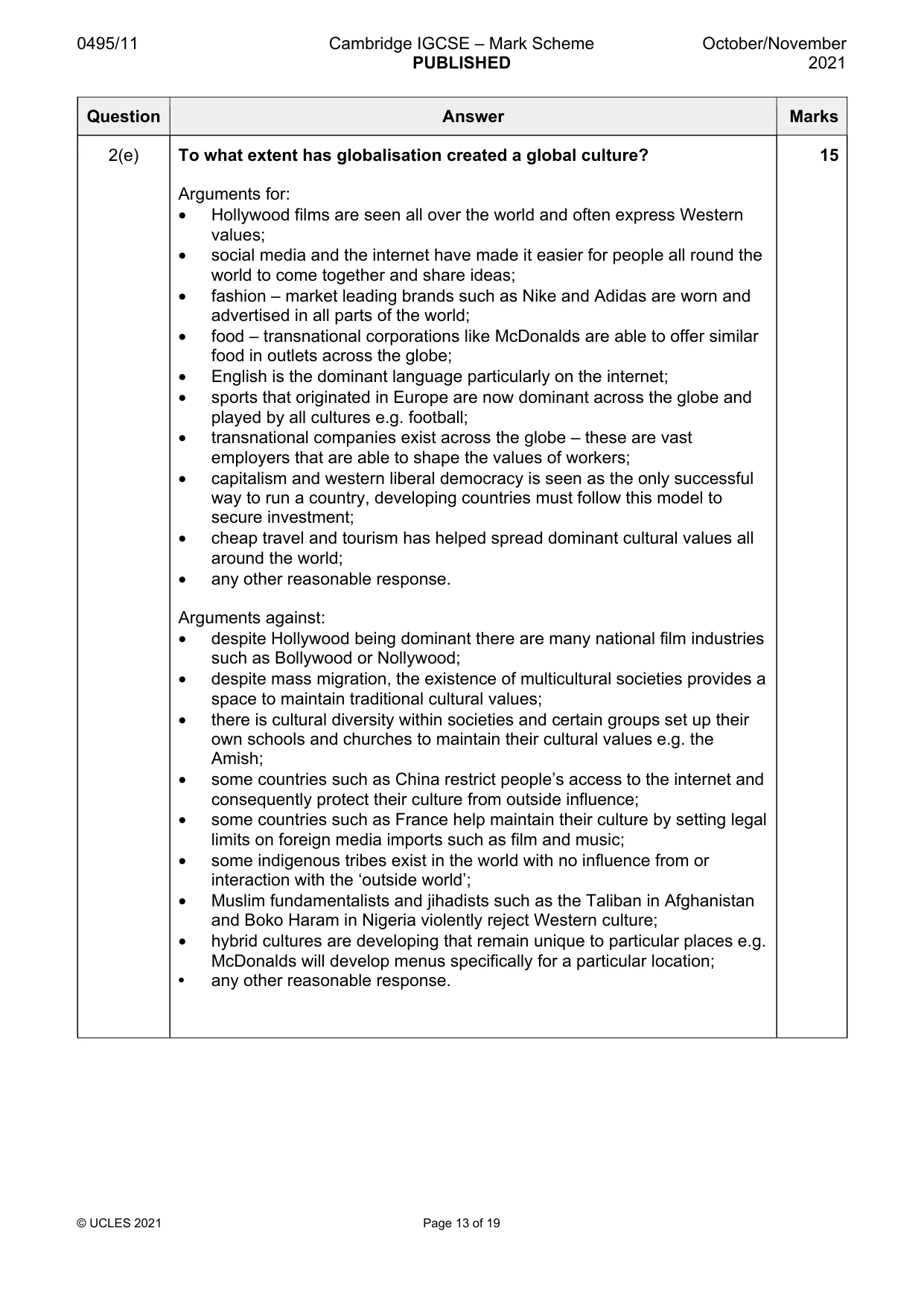
0495/11 Cambridge IGCSE – Mark Scheme PUBLISHED October/November 2021 © UCLES 2021 Page 13 of 19 Question Answer Marks 2(e) To what extent has globalisation created a global culture? Arguments for: • Hollywood films are seen all over the world and often express Western values; • social media and the internet have made it easier for people all round the world to come together and share ideas; • fashion – market leading brands such as Nike and Adidas are worn and advertised in all parts of the world; • food – transnational corporations like McDonalds are able to offer similar food in outlets across the globe; • English is the dominant language particularly on the internet; • sports that originated in Europe are now dominant across the globe and played by all cultures e.g. football; • transnational companies exist across the globe – these are vast employers that are able to shape the values of workers; • capitalism and western liberal democracy is seen as the only successful way to run a country, developing countries must follow this model to secure investment; • cheap travel and tourism has helped spread dominant cultural values all around the world; • any other reasonable response. Arguments against: • despite Hollywood being dominant there are many national film industries such as Bollywood or Nollywood; • despite mass migration, the existence of multicultural societies provides a space to maintain traditional cultural values; • there is cultural diversity within societies and certain groups set up their own schools and churches to maintain their cultural values e.g. the Amish; • some countries such as China restrict people’s access to the internet and consequently protect their culture from outside influence; • some countries such as France help maintain their culture by setting legal limits on foreign media imports such as film and music; • some indigenous tribes exist in the world with no influence from or interaction with the ‘outside world’; • Muslim fundamentalists and jihadists such as the Taliban in Afghanistan and Boko Haram in Nigeria violently reject Western culture; • hybrid cultures are developing that remain unique to particular places e.g. McDonalds will develop menus specifically for a particular location; • any other reasonable response. 15
Mark scheme, page 14
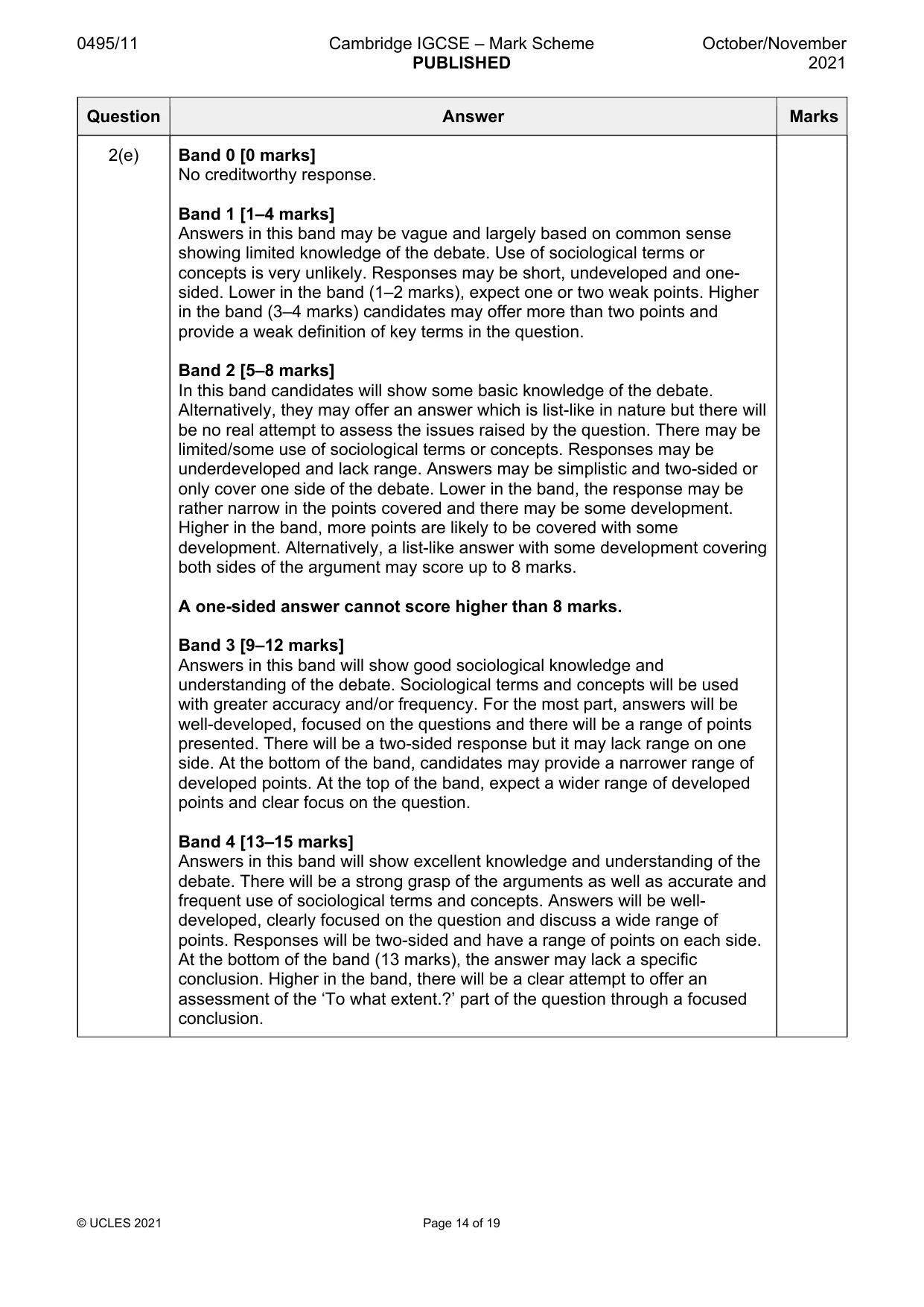
0495/11 Cambridge IGCSE – Mark Scheme PUBLISHED October/November 2021 © UCLES 2021 Page 14 of 19 Question Answer Marks 2(e) Band 0 [0 marks] No creditworthy response. Band 1 [1–4 marks] Answers in this band may be vague and largely based on common sense showing limited knowledge of the debate. Use of sociological terms or concepts is very unlikely. Responses may be short, undeveloped and one- sided. Lower in the band (1–2 marks), expect one or two weak points. Higher in the band (3–4 marks) candidates may offer more than two points and provide a weak definition of key terms in the question. Band 2 [5–8 marks] In this band candidates will show some basic knowledge of the debate. Alternatively, they may offer an answer which is list-like in nature but there will be no real attempt to assess the issues raised by the question. There may be limited/some use of sociological terms or concepts. Responses may be underdeveloped and lack range. Answers may be simplistic and two-sided or only cover one side of the debate. Lower in the band, the response may be rather narrow in the points covered and there may be some development. Higher in the band, more points are likely to be covered with some development. Alternatively, a list-like answer with some development covering both sides of the argument may score up to 8 marks. A one-sided answer cannot score higher than 8 marks. Band 3 [9–12 marks] Answers in this band will show good sociological knowledge and understanding of the debate. Sociological terms and concepts will be used with greater accuracy and/or frequency. For the most part, answers will be well-developed, focused on the questions and there will be a range of points presented. There will be a two-sided response but it may lack range on one side. At the bottom of the band, candidates may provide a narrower range of developed points. At the top of the band, expect a wider range of developed points and clear focus on the question. Band 4 [13–15 marks] Answers in this band will show excellent knowledge and understanding of the debate. There will be a strong grasp of the arguments as well as accurate and frequent use of sociological terms and concepts. Answers will be well- developed, clearly focused on the question and discuss a wide range of points. Responses will be two-sided and have a range of points on each side. At the bottom of the band (13 marks), the answer may lack a specific conclusion. Higher in the band, there will be a clear attempt to offer an assessment of the ‘To what extent.?’ part of the question through a focused conclusion.
Mark scheme, page 15
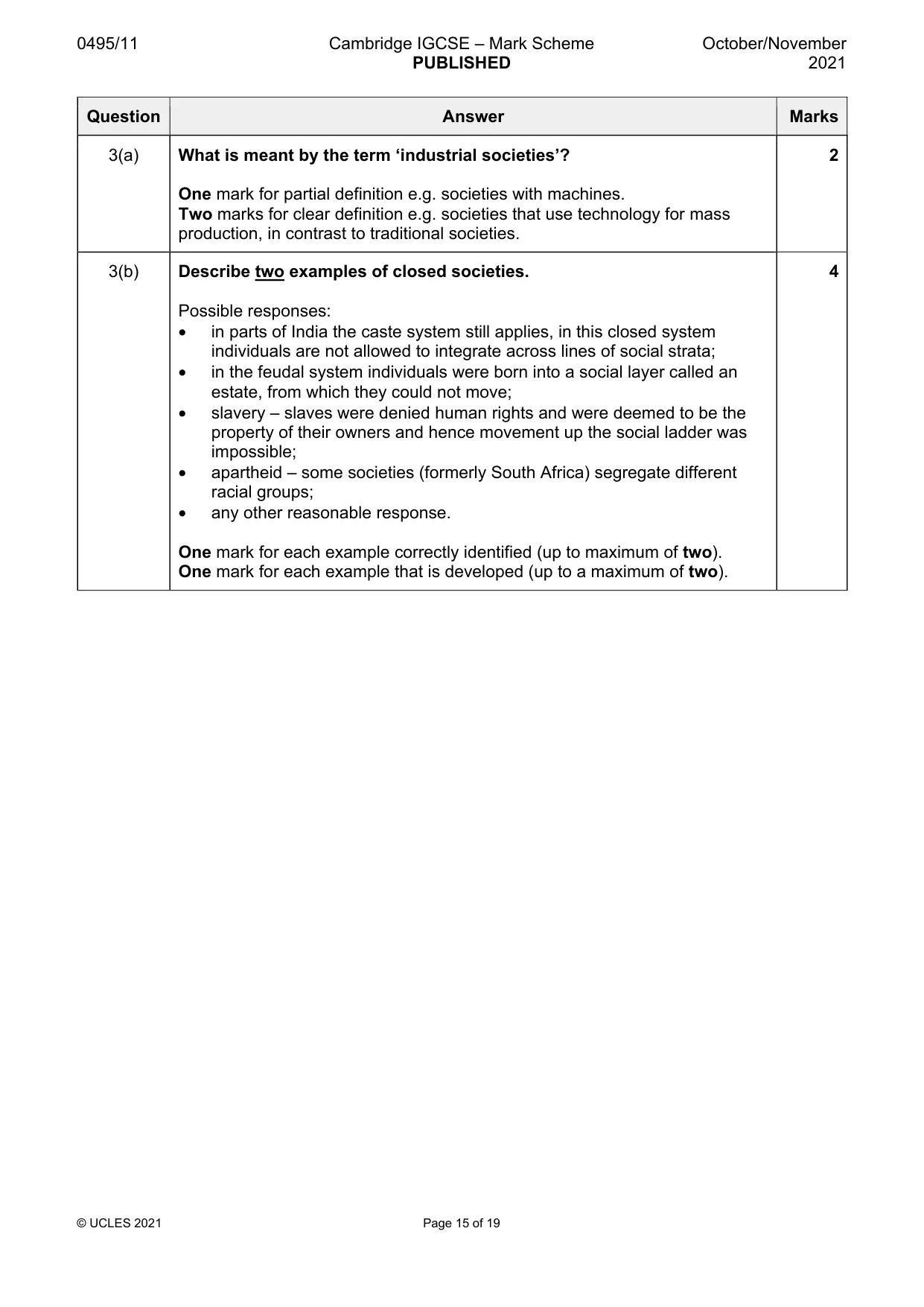
0495/11 Cambridge IGCSE – Mark Scheme PUBLISHED October/November 2021 © UCLES 2021 Page 15 of 19 Question Answer Marks 3(a) What is meant by the term ‘industrial societies’? One mark for partial definition e.g. societies with machines. Two marks for clear definition e.g. societies that use technology for mass production, in contrast to traditional societies. 2 3(b) Describe two examples of closed societies. Possible responses: • in parts of India the caste system still applies, in this closed system individuals are not allowed to integrate across lines of social strata; • in the feudal system individuals were born into a social layer called an estate, from which they could not move; • slavery – slaves were denied human rights and were deemed to be the property of their owners and hence movement up the social ladder was impossible; • apartheid – some societies (formerly South Africa) segregate different racial groups; • any other reasonable response. One mark for each example correctly identified (up to maximum of two). One mark for each example that is developed (up to a maximum of two). 4
Mark scheme, page 16
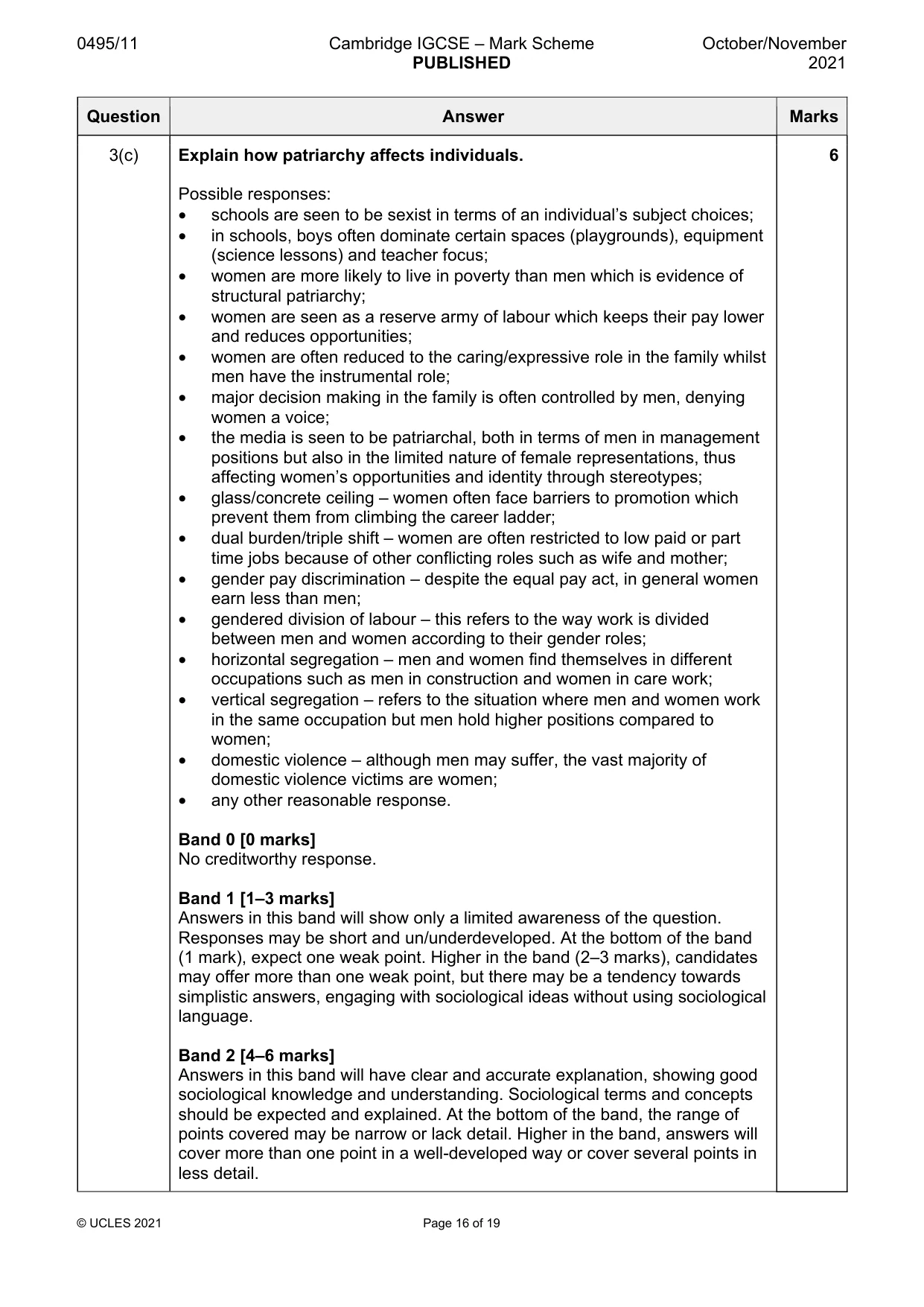
0495/11 Cambridge IGCSE – Mark Scheme PUBLISHED October/November 2021 © UCLES 2021 Page 16 of 19 Question Answer Marks 3(c) Explain how patriarchy affects individuals. Possible responses: • schools are seen to be sexist in terms of an individual’s subject choices; • in schools, boys often dominate certain spaces (playgrounds), equipment (science lessons) and teacher focus; • women are more likely to live in poverty than men which is evidence of structural patriarchy; • women are seen as a reserve army of labour which keeps their pay lower and reduces opportunities; • women are often reduced to the caring/expressive role in the family whilst men have the instrumental role; • major decision making in the family is often controlled by men, denying women a voice; • the media is seen to be patriarchal, both in terms of men in management positions but also in the limited nature of female representations, thus affecting women’s opportunities and identity through stereotypes; • glass/concrete ceiling – women often face barriers to promotion which prevent them from climbing the career ladder; • dual burden/triple shift – women are often restricted to low paid or part time jobs because of other conflicting roles such as wife and mother; • gender pay discrimination – despite the equal pay act, in general women earn less than men; • gendered division of labour – this refers to the way work is divided between men and women according to their gender roles; • horizontal segregation – men and women find themselves in different occupations such as men in construction and women in care work; • vertical segregation – refers to the situation where men and women work in the same occupation but men hold higher positions compared to women; • domestic violence – although men may suffer, the vast majority of domestic violence victims are women; • any other reasonable response. Band 0 [0 marks] No creditworthy response. Band 1 [1–3 marks] Answers in this band will show only a limited awareness of the question. Responses may be short and un/underdeveloped. At the bottom of the band (1 mark), expect one weak point. Higher in the band (2–3 marks), candidates may offer more than one weak point, but there may be a tendency towards simplistic answers, engaging with sociological ideas without using sociological language. Band 2 [4–6 marks] Answers in this band will have clear and accurate explanation, showing good sociological knowledge and understanding. Sociological terms and concepts should be expected and explained. At the bottom of the band, the range of points covered may be narrow or lack detail. Higher in the band, answers will cover more than one point in a well-developed way or cover several points in less detail. 6
Mark scheme, page 17
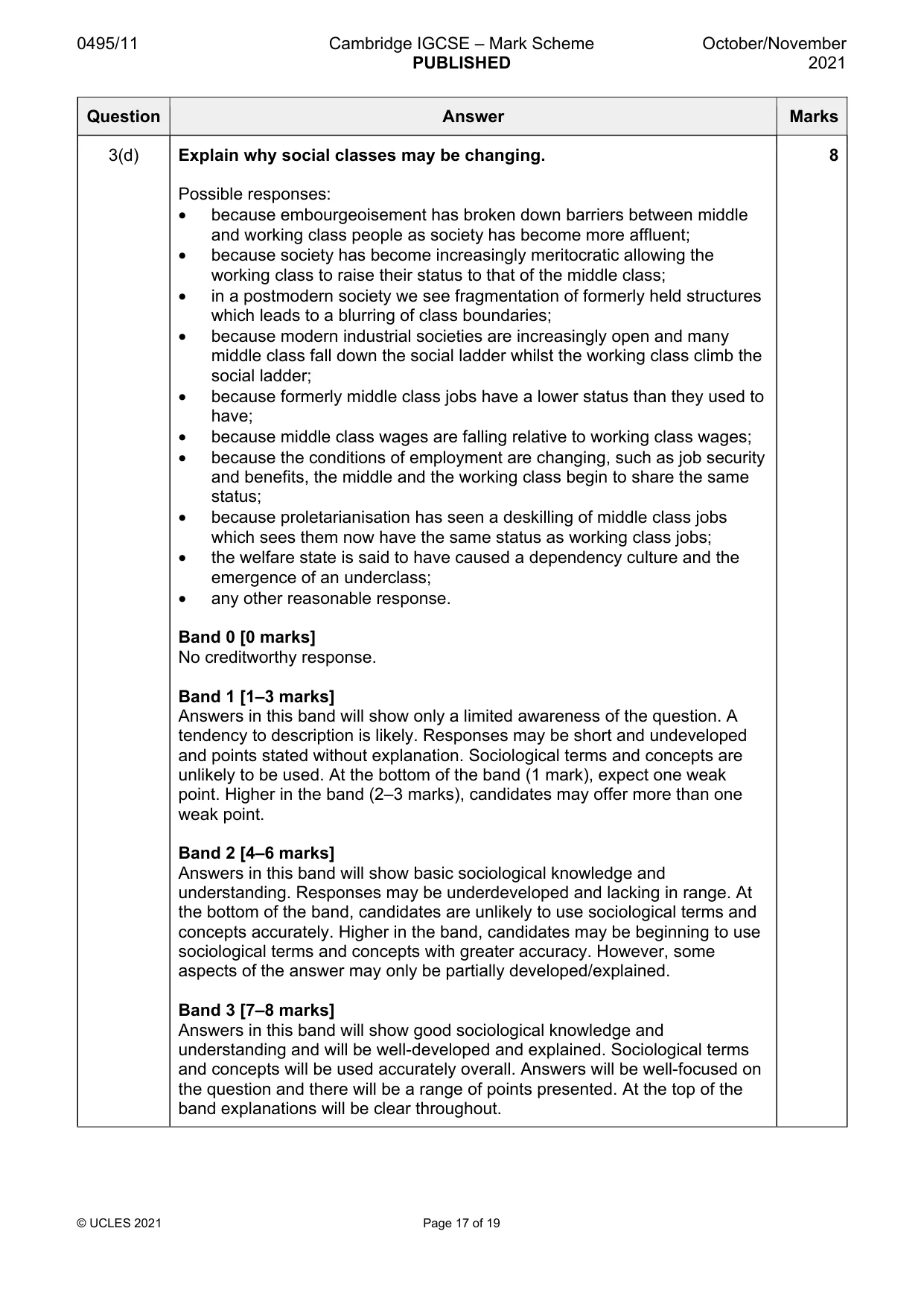
0495/11 Cambridge IGCSE – Mark Scheme PUBLISHED October/November 2021 © UCLES 2021 Page 17 of 19 Question Answer Marks 3(d) Explain why social classes may be changing. Possible responses: • because embourgeoisement has broken down barriers between middle and working class people as society has become more affluent; • because society has become increasingly meritocratic allowing the working class to raise their status to that of the middle class; • in a postmodern society we see fragmentation of formerly held structures which leads to a blurring of class boundaries; • because modern industrial societies are increasingly open and many middle class fall down the social ladder whilst the working class climb the social ladder; • because formerly middle class jobs have a lower status than they used to have; • because middle class wages are falling relative to working class wages; • because the conditions of employment are changing, such as job security and benefits, the middle and the working class begin to share the same status; • because proletarianisation has seen a deskilling of middle class jobs which sees them now have the same status as working class jobs; • the welfare state is said to have caused a dependency culture and the emergence of an underclass; • any other reasonable response. Band 0 [0 marks] No creditworthy response. Band 1 [1–3 marks] Answers in this band will show only a limited awareness of the question. A tendency to description is likely. Responses may be short and undeveloped and points stated without explanation. Sociological terms and concepts are unlikely to be used. At the bottom of the band (1 mark), expect one weak point. Higher in the band (2–3 marks), candidates may offer more than one weak point. Band 2 [4–6 marks] Answers in this band will show basic sociological knowledge and understanding. Responses may be underdeveloped and lacking in range. At the bottom of the band, candidates are unlikely to use sociological terms and concepts accurately. Higher in the band, candidates may be beginning to use sociological terms and concepts with greater accuracy. However, some aspects of the answer may only be partially developed/explained. Band 3 [7–8 marks] Answers in this band will show good sociological knowledge and understanding and will be well-developed and explained. Sociological terms and concepts will be used accurately overall. Answers will be well-focused on the question and there will be a range of points presented. At the top of the band explanations will be clear throughout. 8
Mark scheme, page 18
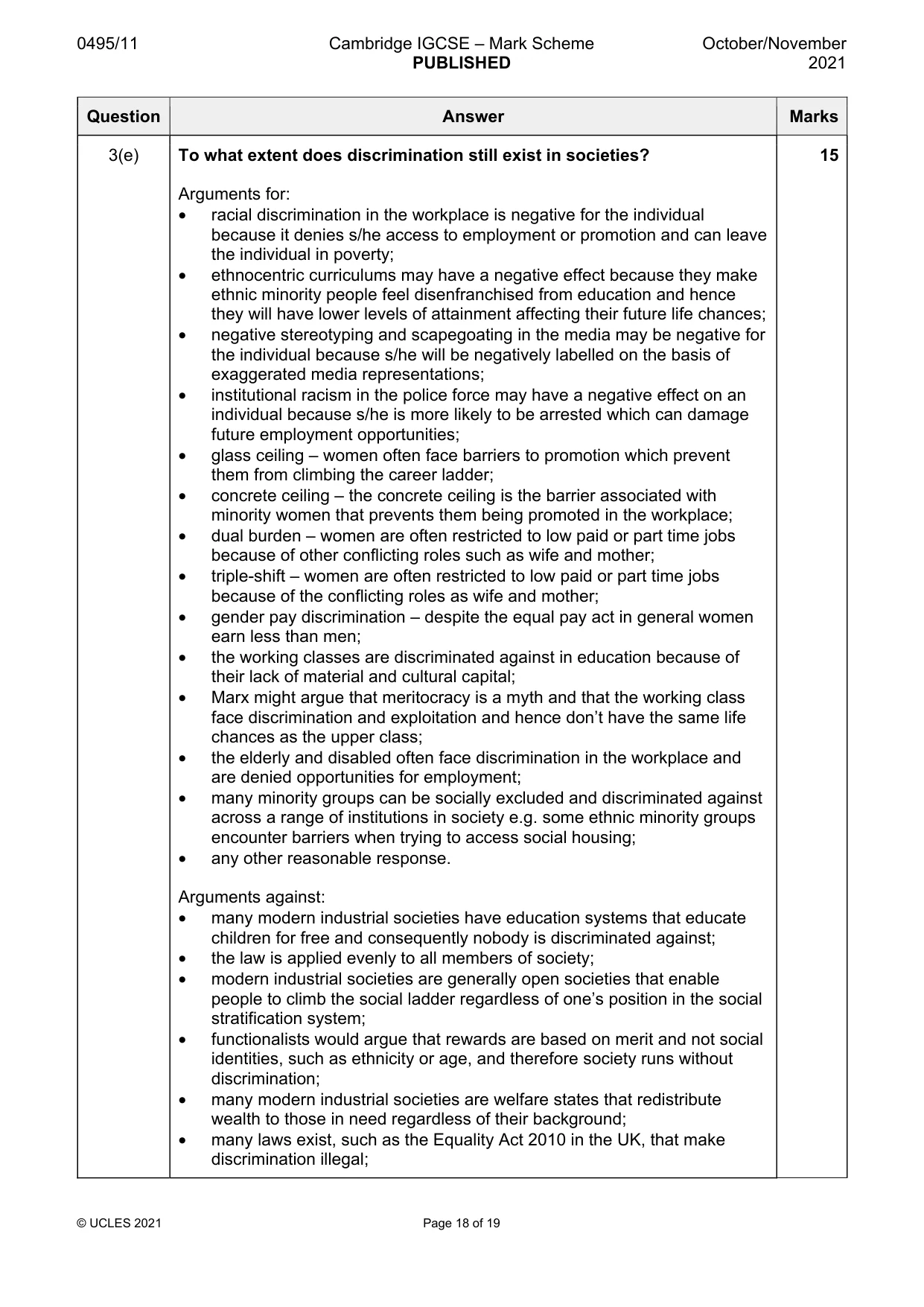
0495/11 Cambridge IGCSE – Mark Scheme PUBLISHED October/November 2021 © UCLES 2021 Page 18 of 19 Question Answer Marks 3(e) To what extent does discrimination still exist in societies? Arguments for: • racial discrimination in the workplace is negative for the individual because it denies s/he access to employment or promotion and can leave the individual in poverty; • ethnocentric curriculums may have a negative effect because they make ethnic minority people feel disenfranchised from education and hence they will have lower levels of attainment affecting their future life chances; • negative stereotyping and scapegoating in the media may be negative for the individual because s/he will be negatively labelled on the basis of exaggerated media representations; • institutional racism in the police force may have a negative effect on an individual because s/he is more likely to be arrested which can damage future employment opportunities; • glass ceiling – women often face barriers to promotion which prevent them from climbing the career ladder; • concrete ceiling – the concrete ceiling is the barrier associated with minority women that prevents them being promoted in the workplace; • dual burden – women are often restricted to low paid or part time jobs because of other conflicting roles such as wife and mother; • triple-shift – women are often restricted to low paid or part time jobs because of the conflicting roles as wife and mother; • gender pay discrimination – despite the equal pay act in general women earn less than men; • the working classes are discriminated against in education because of their lack of material and cultural capital; • Marx might argue that meritocracy is a myth and that the working class face discrimination and exploitation and hence don’t have the same life chances as the upper class; • the elderly and disabled often face discrimination in the workplace and are denied opportunities for employment; • many minority groups can be socially excluded and discriminated against across a range of institutions in society e.g. some ethnic minority groups encounter barriers when trying to access social housing; • any other reasonable response. Arguments against: • many modern industrial societies have education systems that educate children for free and consequently nobody is discriminated against; • the law is applied evenly to all members of society; • modern industrial societies are generally open societies that enable people to climb the social ladder regardless of one’s position in the social stratification system; • functionalists would argue that rewards are based on merit and not social identities, such as ethnicity or age, and therefore society runs without discrimination; • many modern industrial societies are welfare states that redistribute wealth to those in need regardless of their background; • many laws exist, such as the Equality Act 2010 in the UK, that make discrimination illegal; 15
Mark scheme, page 19
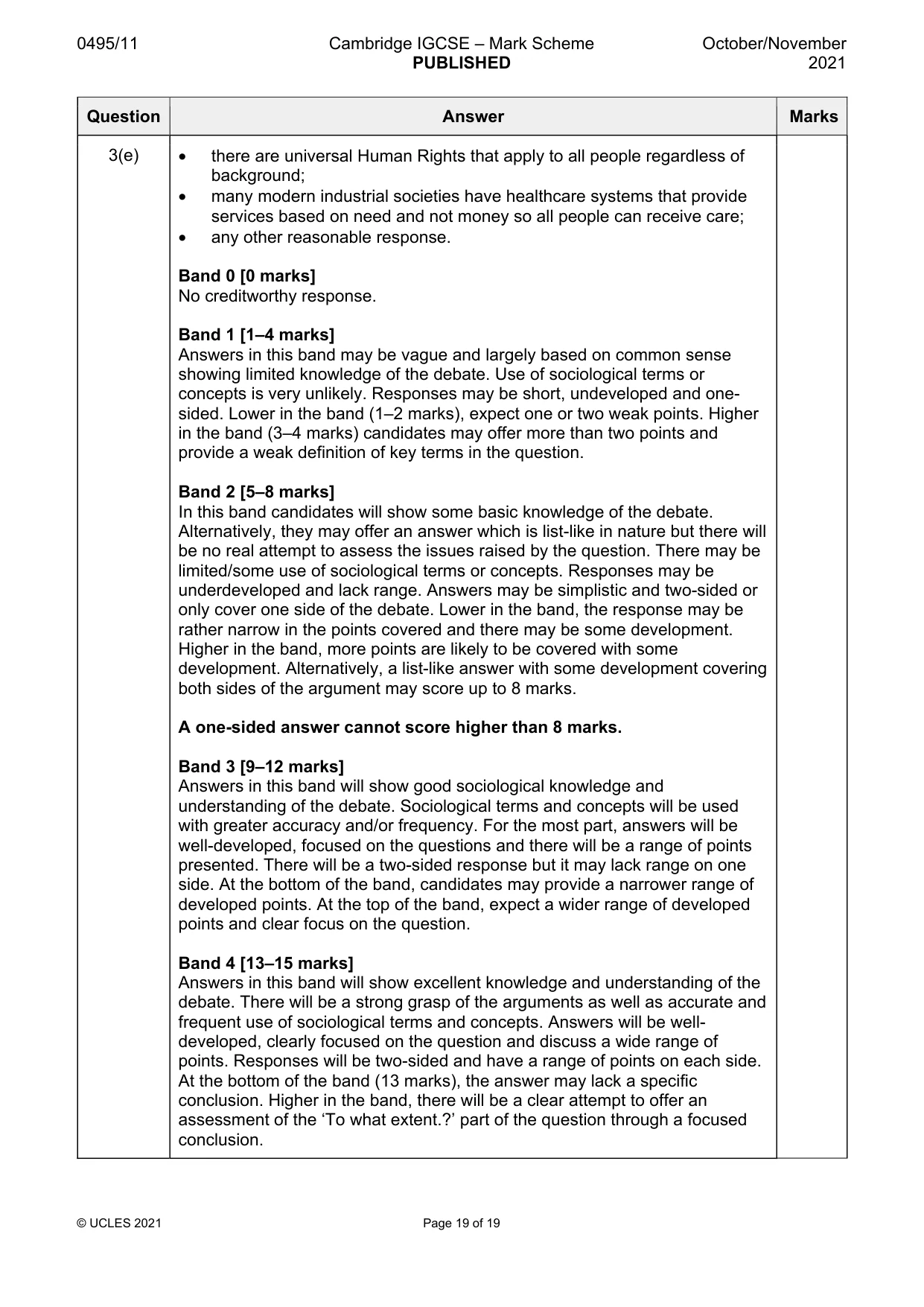
0495/11 Cambridge IGCSE – Mark Scheme PUBLISHED October/November 2021 © UCLES 2021 Page 19 of 19 Question Answer Marks 3(e) • there are universal Human Rights that apply to all people regardless of background; • many modern industrial societies have healthcare systems that provide services based on need and not money so all people can receive care; • any other reasonable response. Band 0 [0 marks] No creditworthy response. Band 1 [1–4 marks] Answers in this band may be vague and largely based on common sense showing limited knowledge of the debate. Use of sociological terms or concepts is very unlikely. Responses may be short, undeveloped and one- sided. Lower in the band (1–2 marks), expect one or two weak points. Higher in the band (3–4 marks) candidates may offer more than two points and provide a weak definition of key terms in the question. Band 2 [5–8 marks] In this band candidates will show some basic knowledge of the debate. Alternatively, they may offer an answer which is list-like in nature but there will be no real attempt to assess the issues raised by the question. There may be limited/some use of sociological terms or concepts. Responses may be underdeveloped and lack range. Answers may be simplistic and two-sided or only cover one side of the debate. Lower in the band, the response may be rather narrow in the points covered and there may be some development. Higher in the band, more points are likely to be covered with some development. Alternatively, a list-like answer with some development covering both sides of the argument may score up to 8 marks. A one-sided answer cannot score higher than 8 marks. Band 3 [9–12 marks] Answers in this band will show good sociological knowledge and understanding of the debate. Sociological terms and concepts will be used with greater accuracy and/or frequency. For the most part, answers will be well-developed, focused on the questions and there will be a range of points presented. There will be a two-sided response but it may lack range on one side. At the bottom of the band, candidates may provide a narrower range of developed points. At the top of the band, expect a wider range of developed points and clear focus on the question. Band 4 [13–15 marks] Answers in this band will show excellent knowledge and understanding of the debate. There will be a strong grasp of the arguments as well as accurate and frequent use of sociological terms and concepts. Answers will be well- developed, clearly focused on the question and discuss a wide range of points. Responses will be two-sided and have a range of points on each side. At the bottom of the band (13 marks), the answer may lack a specific conclusion. Higher in the band, there will be a clear attempt to offer an assessment of the ‘To what extent.?’ part of the question through a focused conclusion.
What you needed in this session
Cambridge’s own grade thresholds for 2021 Oct/Nov, Paper 1 · Variant 1. A higher threshold means an easier paper — the bar moves with how the cohort did.