Cambridge IGCSE Sociology 0495 — 2021 May/June Paper 2 · Variant 1
0495/21/M/J/21 · 4 questions · 70 marks · ≈79 min
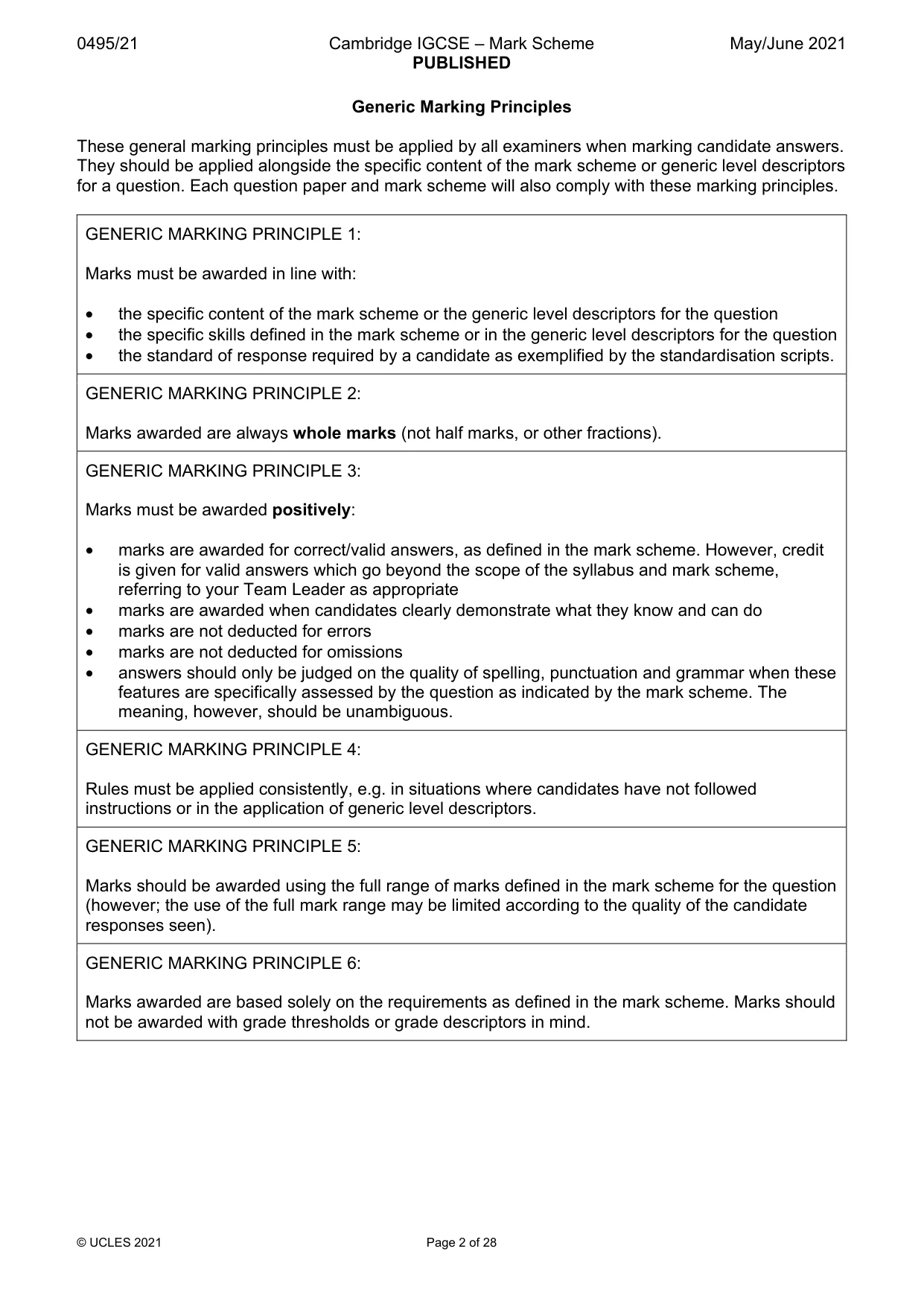
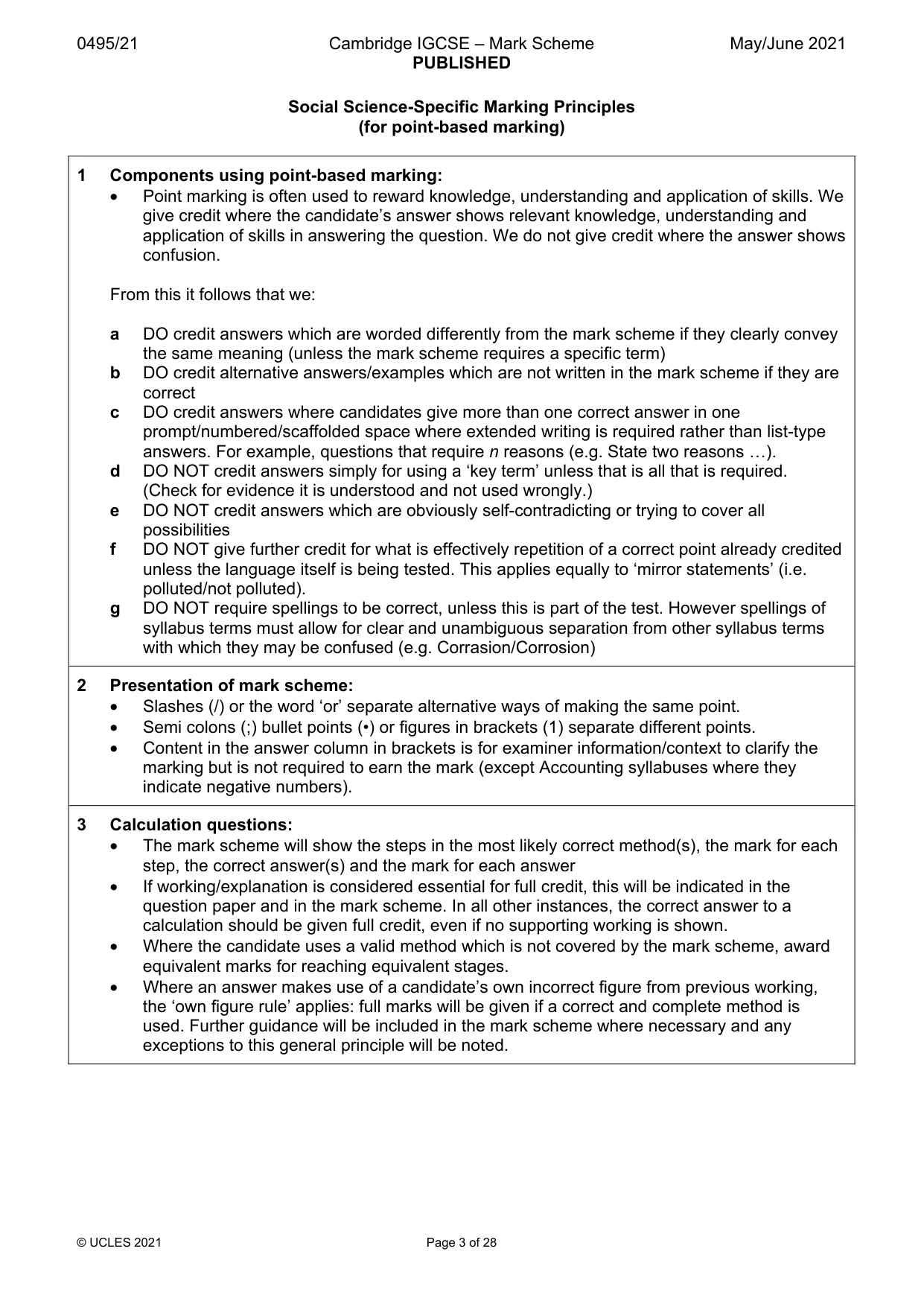
The question paper and its mark scheme, free to read here and free to download. This is Cambridge’s own paper, exactly as it was sat.
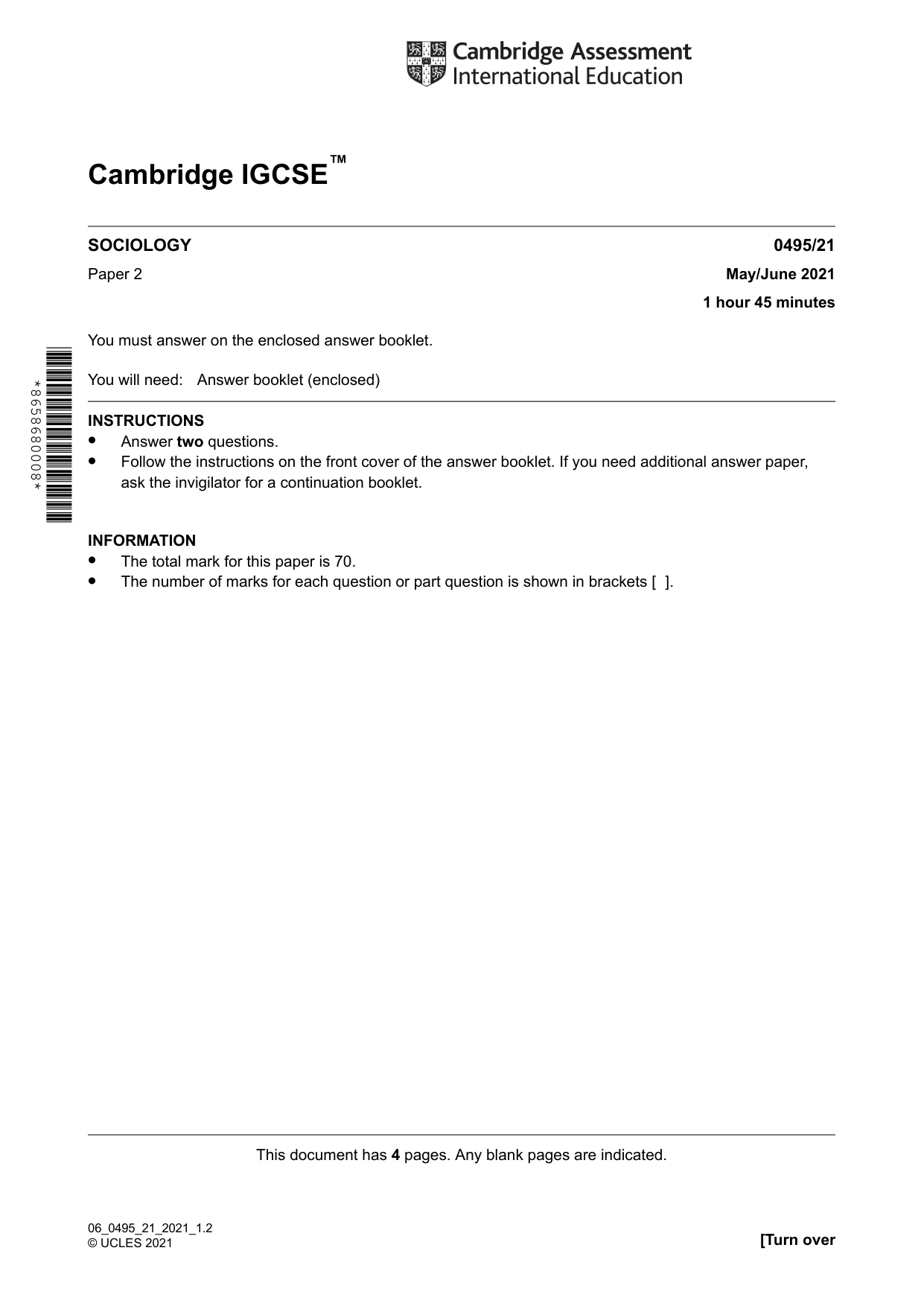
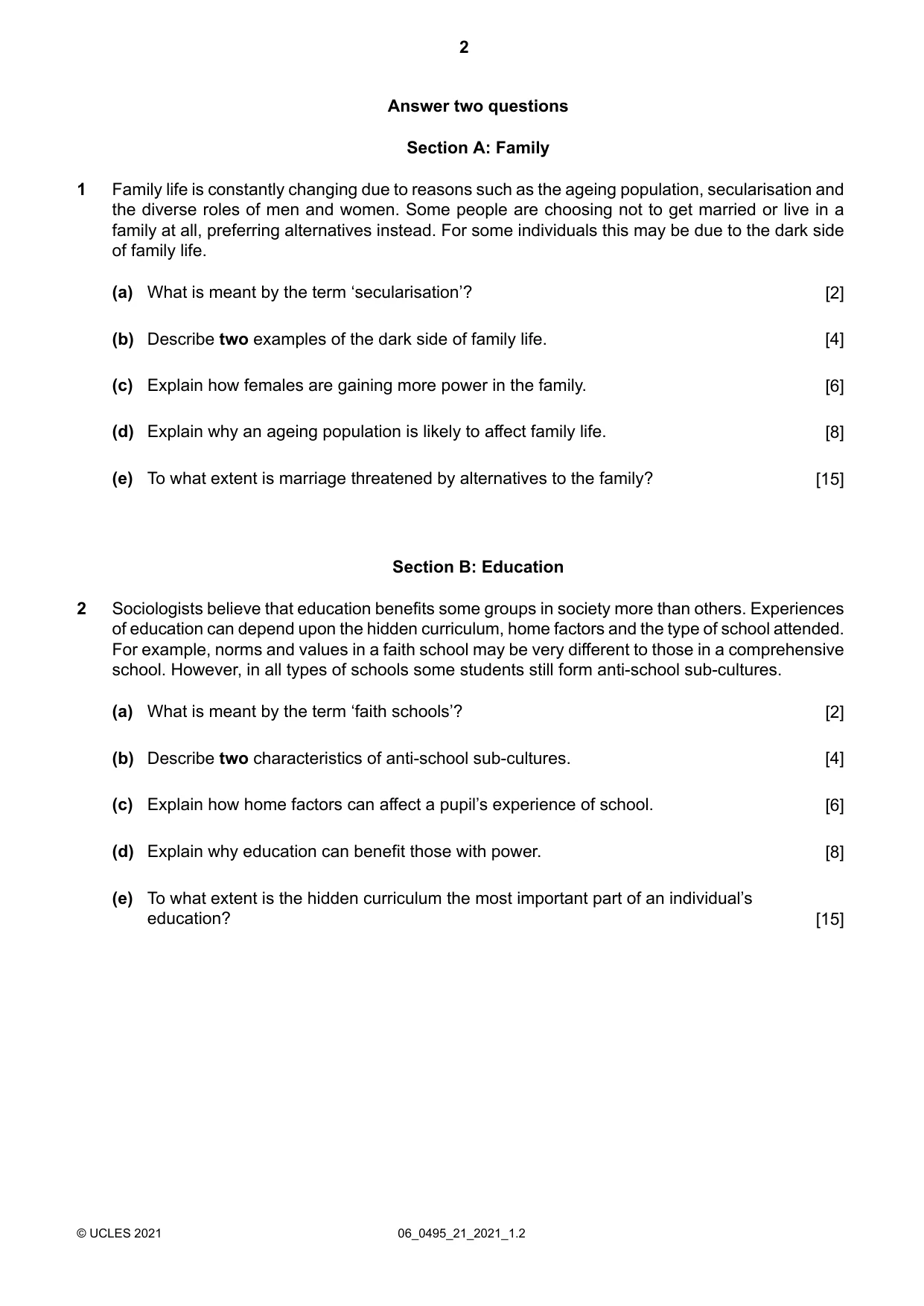
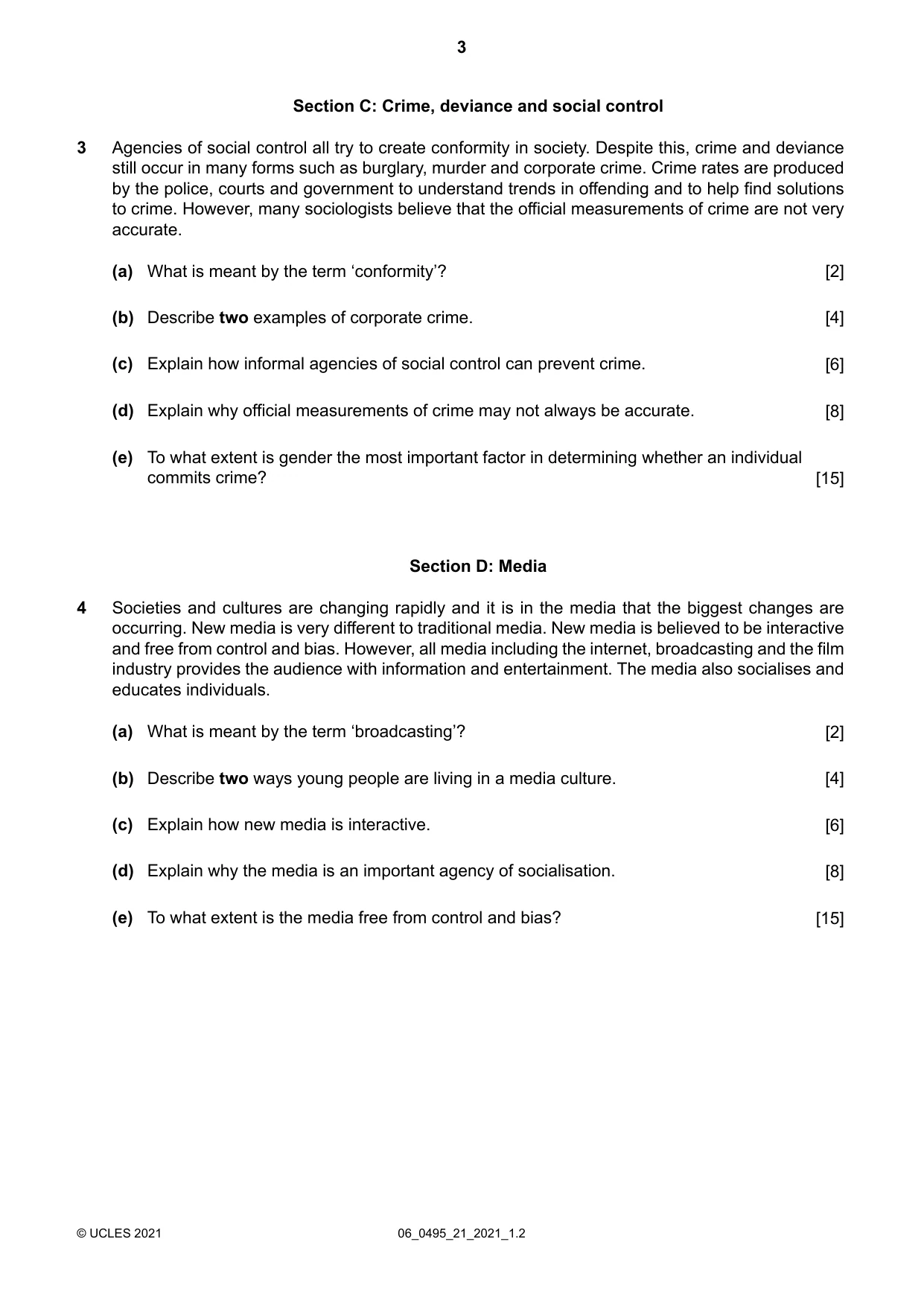
Question paper4 pages

Mark scheme28 pages
Answers below. Sit the paper first if you are practising.

Questions as text
Q1 · Family life is constantly changing due to reasons such as the ageing population…
1 Family life is constantly changing due to reasons such as the ageing population, secularisation and the diverse roles of men and women. Some people are choosing not to get married or live in a family at all, preferring alternatives instead. For some individuals this may be due to the dark side of family life. (a) What is meant by the term ‘secularisation’? [2] (b) Describe two examples of the dark side of family life. [4] (c) Explain how females are gaining more power in the family. [6] (d) Explain why an ageing population is likely to affect family life. [8] (e) To what extent is marriage threatened by alternatives to the family? [15]
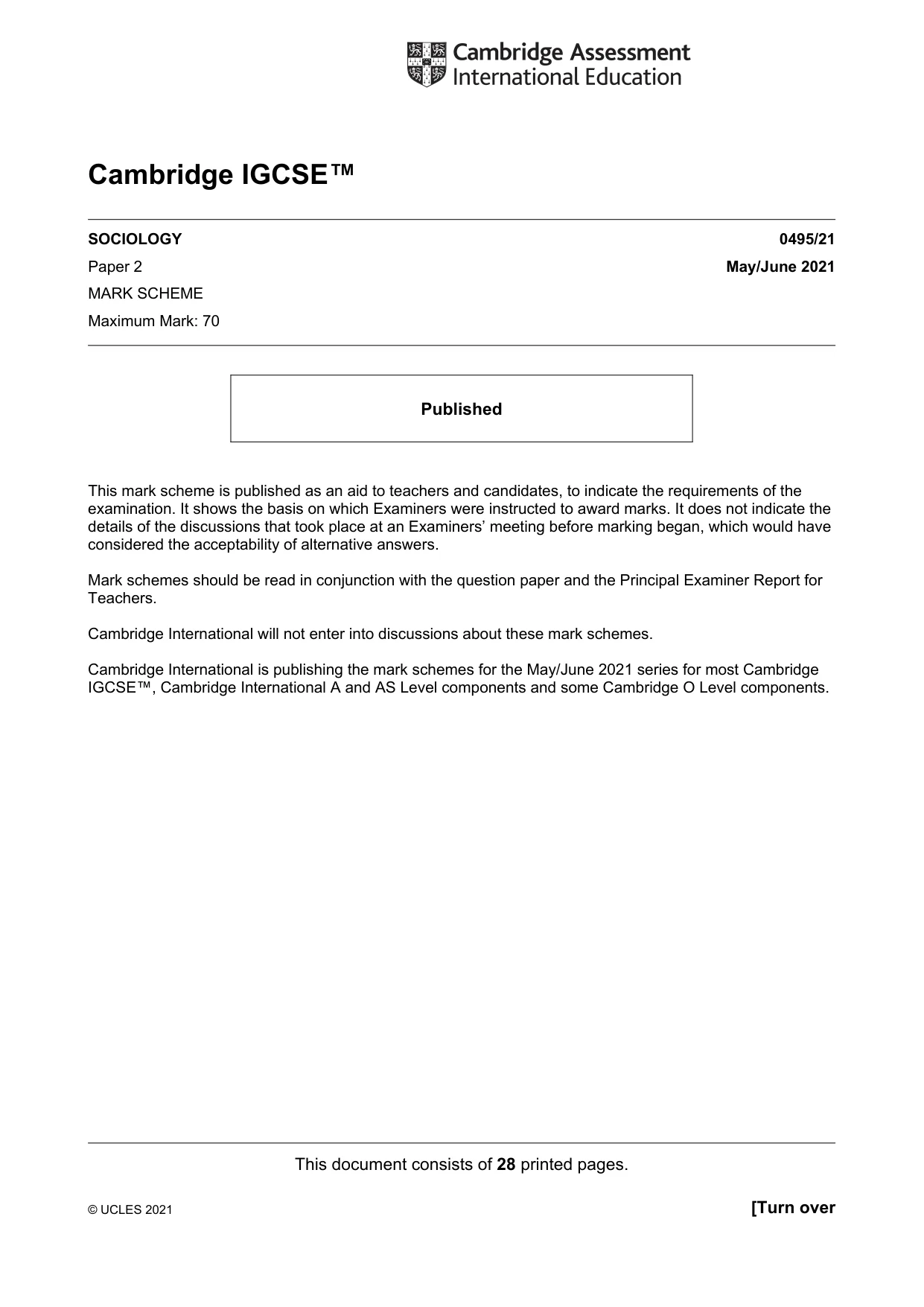
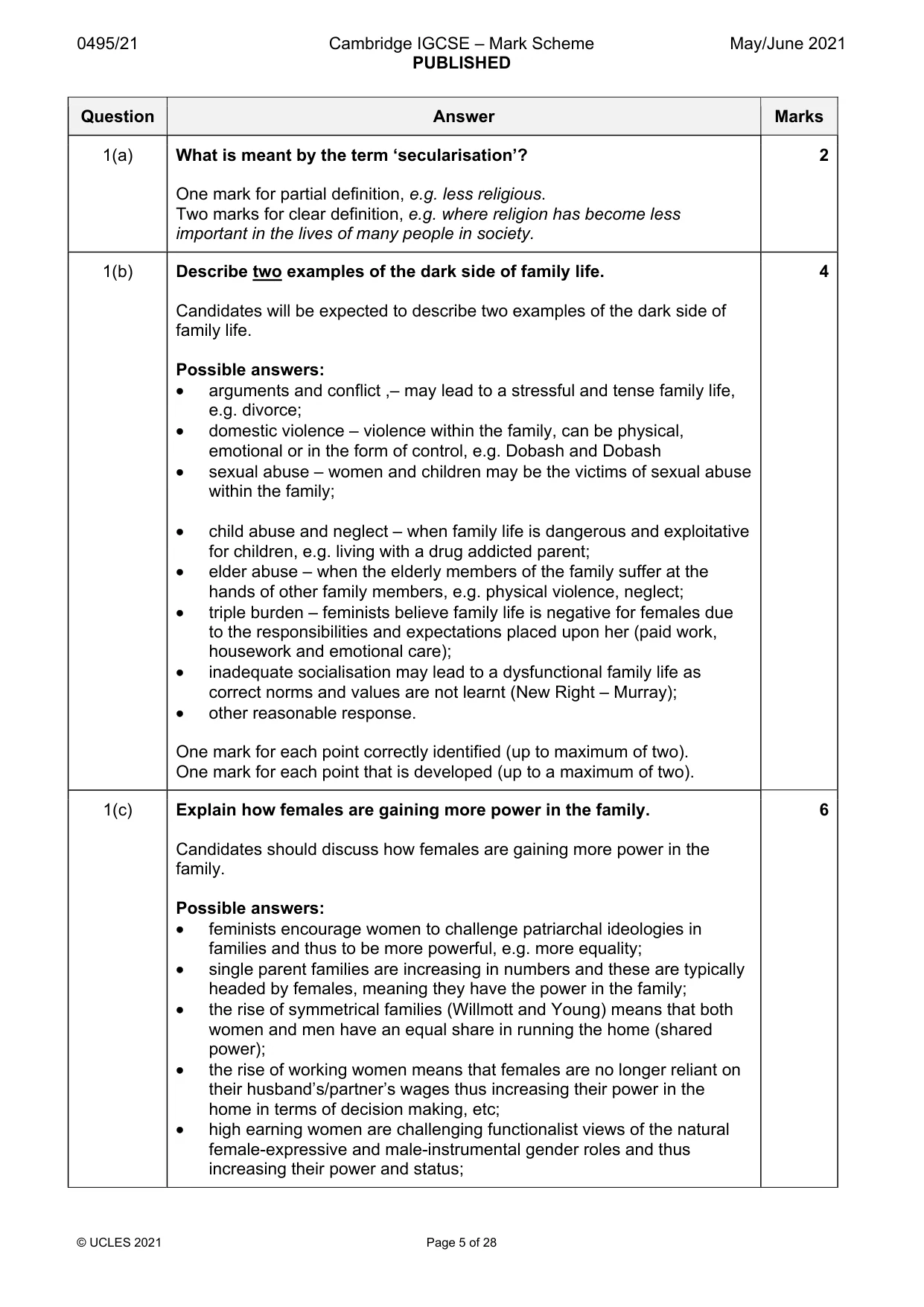
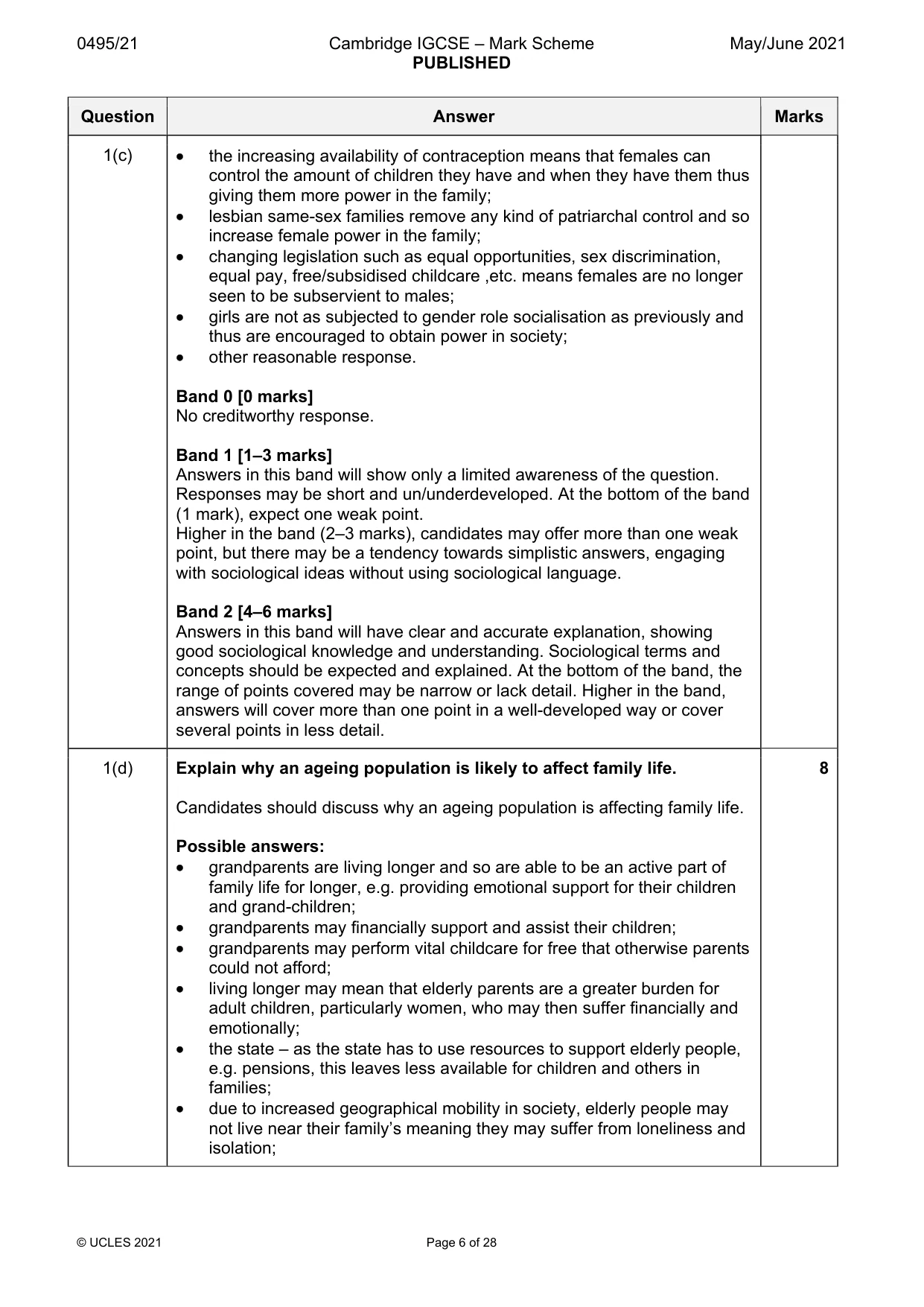
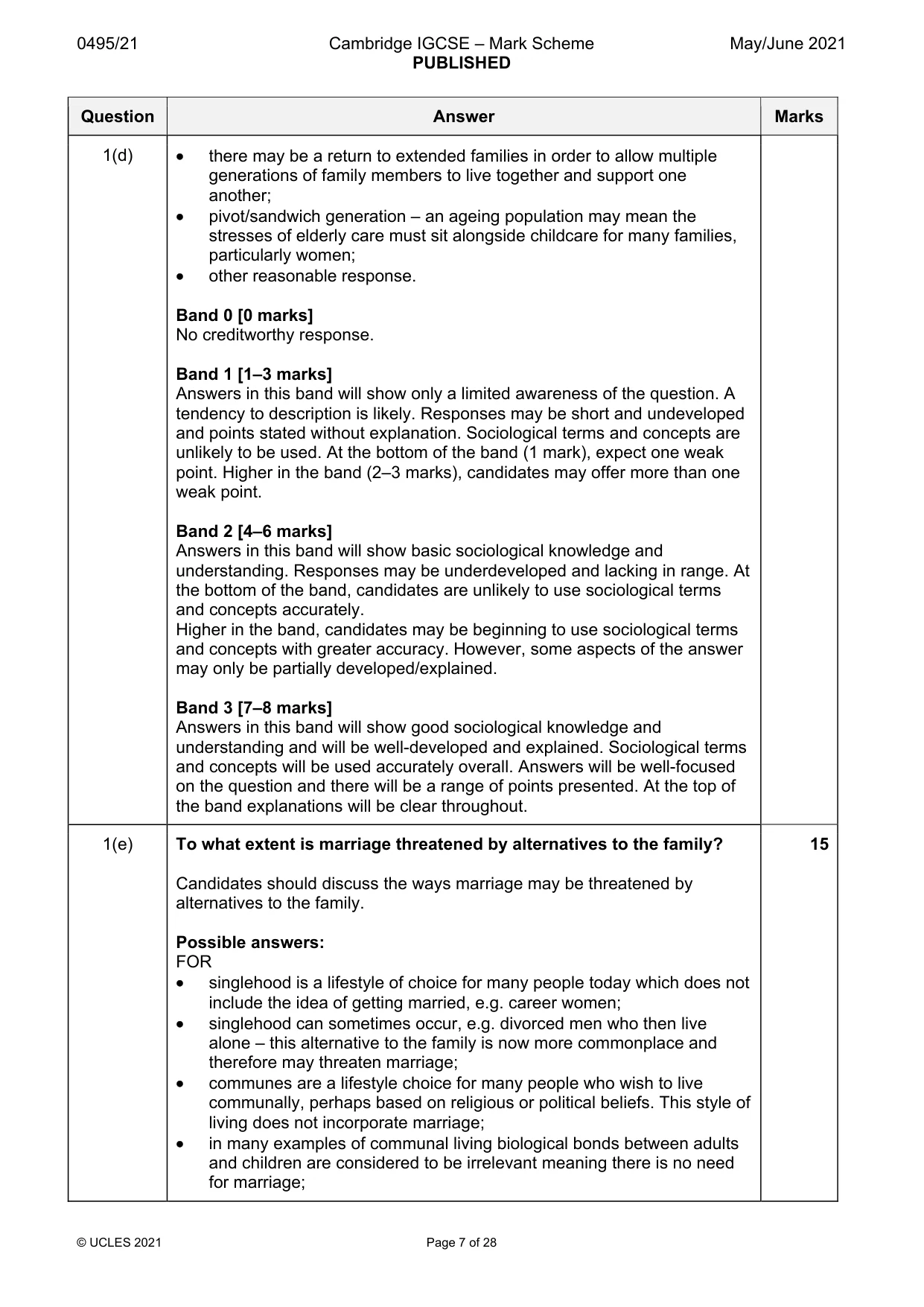
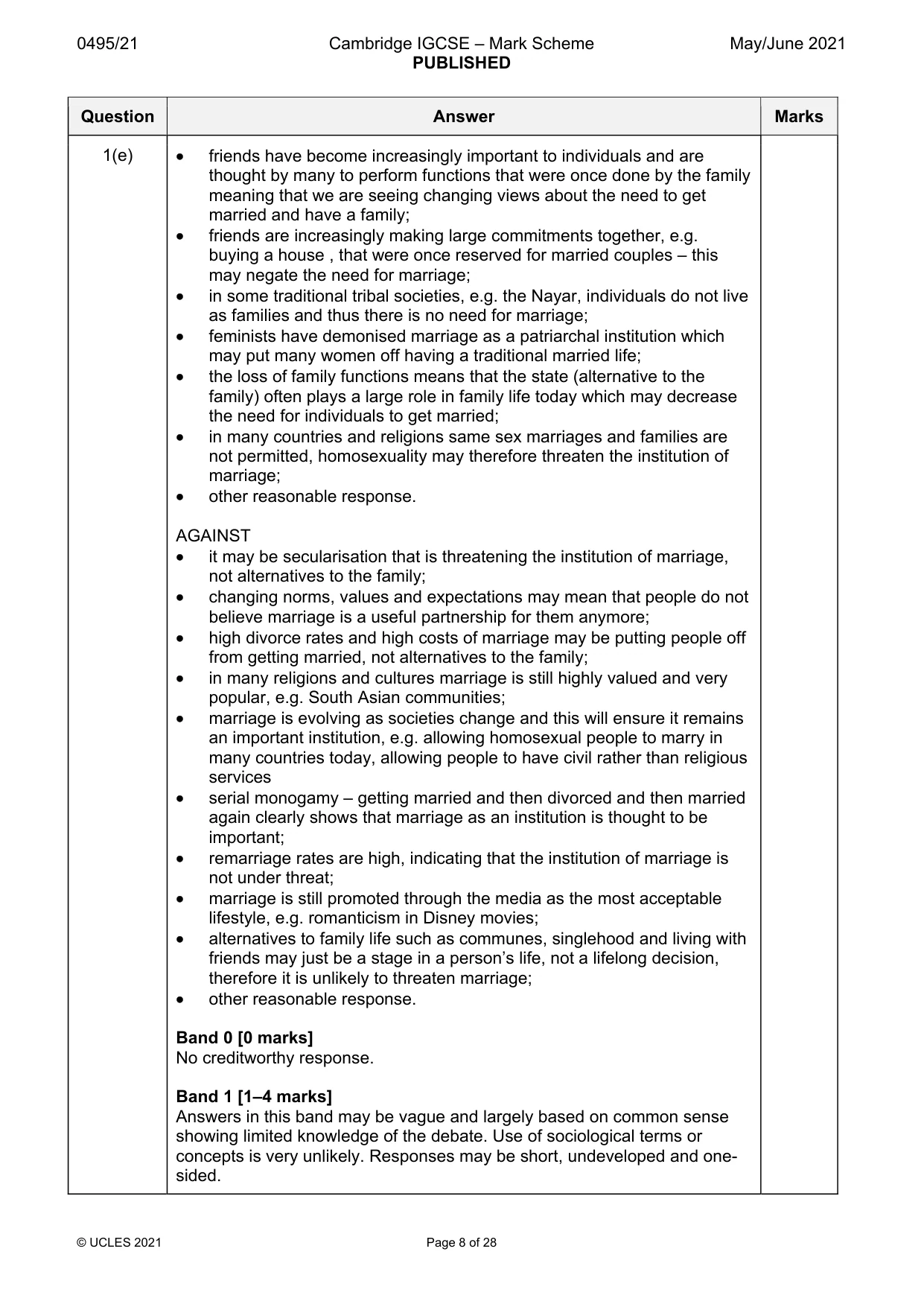
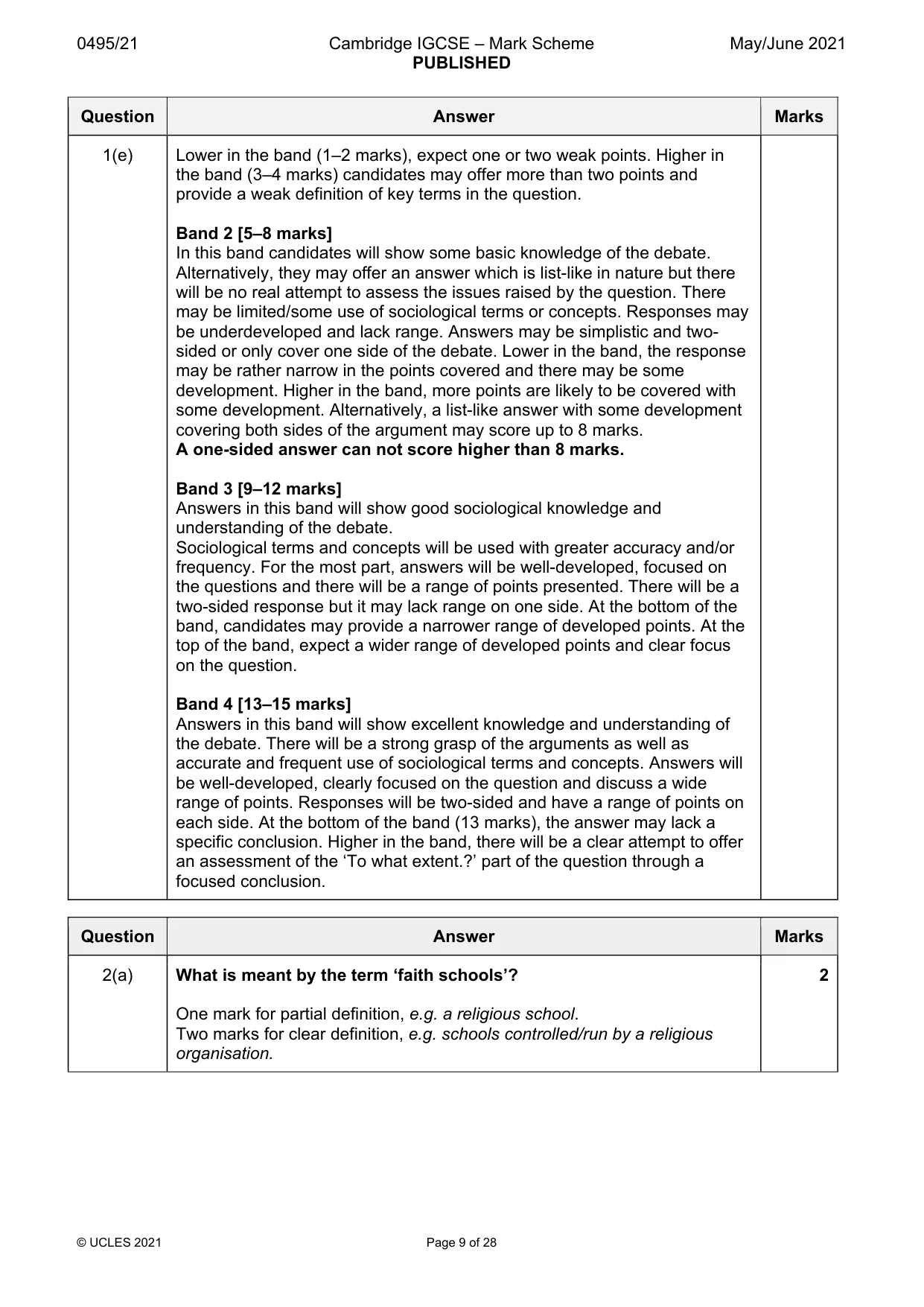
Mark scheme: Question Answer Marks 1(a) What is meant by the term ‘secularisation’? 2 One mark for partial definition, e.g. less religious. Two marks for clear definition, e.g. where religion has become less important in the lives of many people in society. 1(b) Describe two examples of the dark side of family life. 4 Candidates will be expected to describe two examples of the dark side of family life. Possible answers: • arguments and conflict ,– may lead to a stressful and tense family life, e.g. divorce; • domestic violence – violence within the family, can be physical, emotional or in the form of control, e.g. Dobash and Dobash • sexual abuse – women and children may be the victims of sexual abuse within the family; • child abuse and neglect – when family life is dangerous and exploitative for children, e.g. living with a drug addicted parent; • elder abuse – when the elderly members of the family suffer at the hands of other family members, e.g. physical violence, neglect; • triple burden – feminists believe family life is negative for females due to the responsibilities and expectations placed upon her (paid work, housework and emotional care); • inadequate socialisation may lead to a dysfunctional family life as correct norms and values are not learnt (New Right – Murray); • other reasonable response. One mark for each point correctly identified (up to maximum of two). One mark for each point that is developed (up to a maximum of two). 1(c) Explain how females are gaining more power in the family. 6 Candidates should discuss how females are gaining more power in the family. Possible answers: • feminists encourage women to challenge patriarchal ideologies in families and thus to be more powerful, e.g. more equality; • single parent families are increasing in numbers and these are typically headed by females, meaning they have the power in the family; • the rise of symmetrical families (Willmott and Young) means that both women and men have an equal share in running the home (shared power); • the rise of working women means that females are no longer reliant on their husband’s/partner’s wages thus increasing their power in the home in terms of decision making, etc; • high earning women are challenging functionalist views of the natural female-expressive and male-instrumental gender roles and thus increasing their power and status; 1(c) • the increasing availability of contraception means that females can control the amount of children they have and when they have them thus giving them more power in the family; • lesbian same-sex families remove any kind of patriarchal control and so increase female power in the family; • changing legislation such as equal opportunities, sex discrimination, equal pay, free/subsidised childcare ,etc. means females are no longer seen to be subservient to males; • girls are not as subjected to gender role socialisation as previously and thus are encouraged to obtain power in society; • other reasonable response. Band 0 [0 marks] No creditworthy response. Band 1 [1–3 marks] Answers in this band will show only a limited awareness of the question. Responses may be short and un/underdeveloped. At the bottom of the band (1 mark), expect one weak point. Higher in the band (2–3 marks), candidates may offer more than one weak point, but there may be a tendency towards simplistic answers, engaging with sociological ideas without using sociological language. Band 2 [4–6 marks] Answers in this band will have clear and accurate explanation, showing good sociological knowledge and understanding. Sociological terms and concepts should be expected and explained. At the bottom of the band, the range of points covered may be narrow or lack detail. Higher in the band, answers will cover more than one point in a well-developed way or cover several points in less detail. 1(d) Explain why an ageing population is likely to affect family life. 8 Candidates should discuss why an ageing population is affecting family life. Possible answers: • grandparents are living longer and so are able to be an active part of family life for longer, e.g. providing emotional support for their children and grand-children; • grandparents may financially support and assist their children; • grandparents may perform vital childcare for free that otherwise parents could not afford; • living longer may mean that elderly parents are a greater burden for adult children, particularly women, who may then suffer financially and emotionally; • the state – as the state has to use resources to support elderly people, e.g. pensions, this leaves less available for children and others in families; • due to increased geographical mobility in society, elderly people may not live near their family’s meaning they may suffer from loneliness and isolation; 1(d) • there may be a return to extended families in order to allow multiple generations of family members to live together and support one another; • pivot/sandwich generation – an ageing population may mean the stresses of elderly care must sit alongside childcare for many families, particularly women; • other reasonable response. Band 0 [0 marks] No creditworthy response. Band 1 [1–3 marks] Answers in this band will show only a limited awareness of the question. A tendency to description is likely. Responses may be short and undeveloped and points stated without explanation. Sociological terms and concepts are unlikely to be used. At the bottom of the band (1 mark), expect one weak point. Higher in the band (2–3 marks), candidates may offer more than one weak point. Band 2 [4–6 marks] Answers in this band will show basic sociological knowledge and understanding. Responses may be underdeveloped and lacking in range. At the bottom of the band, candidates are unlikely to use sociological terms and concepts accurately. Higher in the band, candidates may be beginning to use sociological terms and concepts with greater accuracy. However, some aspects of the answer may only be partially developed/explained. Band 3 [7–8 marks] Answers in this band will show good sociological knowledge and understanding and will be well-developed and explained. Sociological terms and concepts will be used accurately overall. Answers will be well-focused on the question and there will be a range of points presented. At the top of the band explanations will be clear throughout. 1(e) To what extent is marriage threatened by alternatives to the family? 15 Candidates should discuss the ways marriage may be threatened by alternatives to the family. Possible answers: FOR • singlehood is a lifestyle of choice for many people today which does not include the idea of getting married, e.g. career women; • singlehood can sometimes occur, e.g. divorced men who then live alone – this alternative to the family is now more commonplace and therefore may threaten marriage; • communes are a lifestyle choice for many people who wish to live communally, perhaps based on religious or political beliefs. This style of living does not incorporate marriage; • in many examples of communal living biological bonds between adults and children are considered to be irrelevant meaning there is no need for marriage; 1(e) • friends have become increasingly important to individuals and are thought by many to perform functions that were once done by the family meaning that we are seeing changing views about the need to get married and have a family; • friends are increasingly making large commitments together, e.g. buying a house , that were once reserved for married couples – this may negate the need for marriage; • in some traditional tribal societies, e.g. the Nayar, individuals do not live as families and thus there is no need for marriage; • feminists have demonised marriage as a patriarchal institution which may put many women off having a traditional married life; • the loss of family functions means that the state (alternative to the family) often plays a large role in family life today which may decrease the need for individuals to get married; • in many countries and religions same sex marriages and families are not permitted, homosexuality may therefore threaten the institution of marriage; • other reasonable response. AGAINST • it may be secularisation that is threatening the institution of marriage, not alternatives to the family; • changing norms, values and expectations may mean that people do not believe marriage is a useful partnership for them anymore; • high divorce rates and high costs of marriage may be putting people off from getting married, not alternatives to the family; • in many religions and cultures marriage is still highly valued and very popular, e.g. South Asian communities; • marriage is evolving as societies change and this will ensure it remains an important institution, e.g. allowing homosexual people to marry in many countries today, allowing people to have civil rather than religious services • serial monogamy – getting married and then divorced and then married again clearly shows that marriage as an institution is thought to be important; • remarriage rates are high, indicating that the institution of marriage is not under threat; • marriage is still promoted through the media as the most acceptable lifestyle, e.g. romanticism in Disney movies; • alternatives to family life such as communes, singlehood and living with friends may just be a stage in a person’s life, not a lifelong decision, therefore it is unlikely to threaten marriage; • other reasonable response. Band 0 [0 marks] No creditworthy response. Band 1 [1–4 marks] Answers in this band may be vague and largely based on common sense showing limited knowledge of the debate. Use of sociological terms or concepts is very unlikely. Responses may be short, undeveloped and one- sided. 1(e) Lower in the band (1–2 marks), expect one or two weak points. Higher in the band (3–4 marks) candidates may offer more than two points and provide a weak definition of key terms in the question. Band 2 [5–8 marks] In this band candidates will show some basic knowledge of the debate. Alternatively, they may offer an answer which is list-like in nature but there will be no real attempt to assess the issues raised by the question. There may be limited/some use of sociological terms or concepts. Responses may be underdeveloped and lack range. Answers may be simplistic and two- sided or only cover one side of the debate. Lower in the band, the response may be rather narrow in the points covered and there may be some development. Higher in the band, more points are likely to be covered with some development. Alternatively, a list-like answer with some development covering both sides of the argument may score up to 8 marks. A one-sided answer can not score higher than 8 marks. Band 3 [9–12 marks] Answers in this band will show good sociological knowledge and understanding of the debate. Sociological terms and concepts will be used with greater accuracy and/or frequency. For the most part, answers will be well-developed, focused on the questions and there will be a range of points presented. There will be a two-sided response but it may lack range on one side. At the bottom of the band, candidates may provide a narrower range of developed points. At the top of the band, expect a wider range of developed points and clear focus on the question. Band 4 [13–15 marks] Answers in this band will show excellent knowledge and understanding of the debate. There will be a strong grasp of the arguments as well as accurate and frequent use of sociological terms and concepts. Answers will be well-developed, clearly focused on the question and discuss a wide range of points. Responses will be two-sided and have a range of points on each side. At the bottom of the band (13 marks), the answer may lack a specific conclusion. Higher in the band, there will be a clear attempt to offer an assessment of the ‘To what extent.?’ part of the question through a focused conclusion.
More questions on How do sociologists approach the study of society?
Q2 · Sociologists believe that education benefits some groups in society more than others
2 Sociologists believe that education benefits some groups in society more than others. Experiences of education can depend upon the hidden curriculum, home factors and the type of school attended. For example, norms and values in a faith school may be very different to those in a comprehensive school. However, in all types of schools some students still form anti-school sub-cultures. (a) What is meant by the term ‘faith schools’? [2] (b) Describe two characteristics of anti-school sub-cultures. [4] (c) Explain how home factors can affect a pupil’s experience of school. [6] (d) Explain why education can benefit those with power. [8] (e) To what extent is the hidden curriculum the most important part of an individual’s education? [15] Section C: Crime, deviance and social control
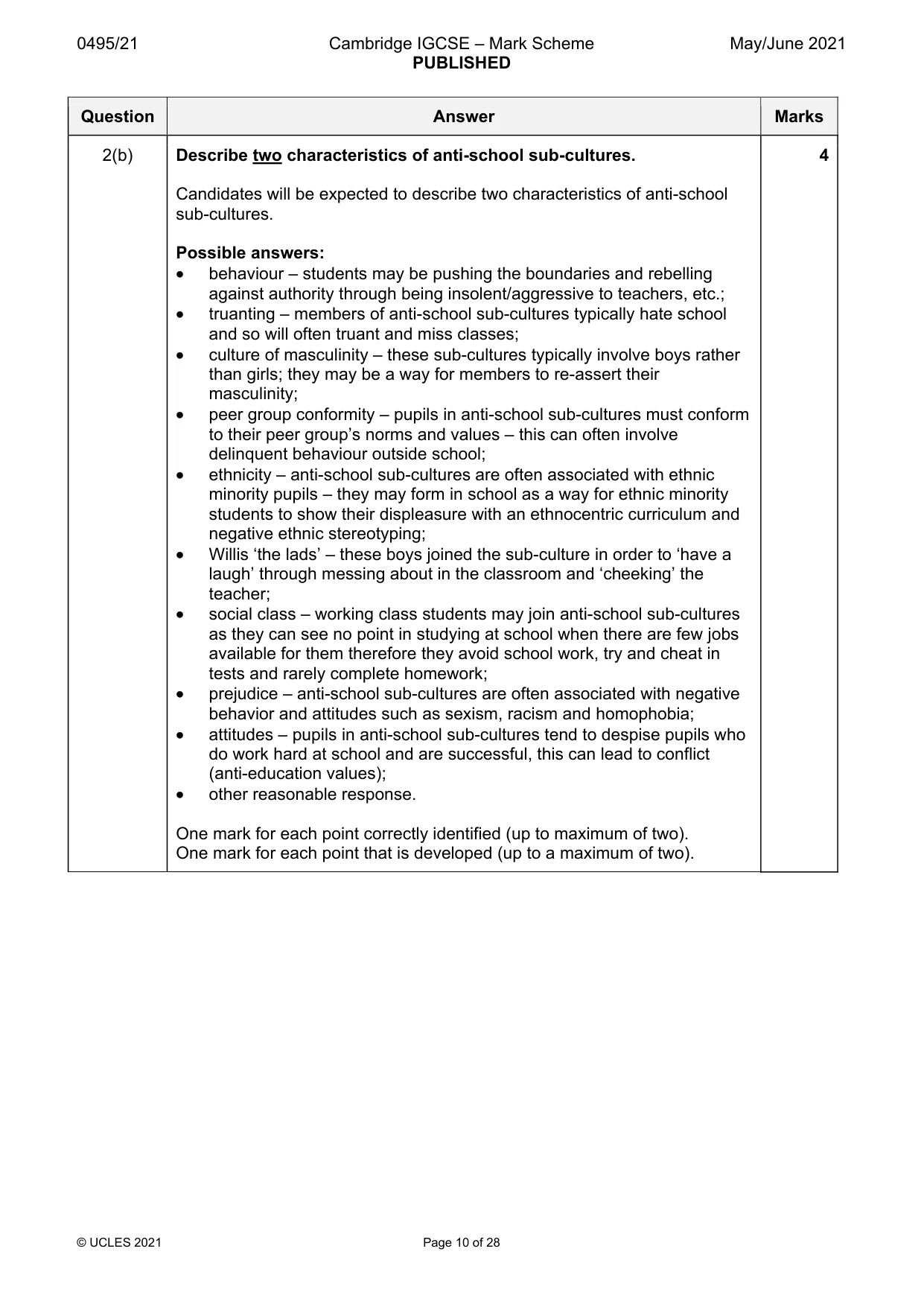
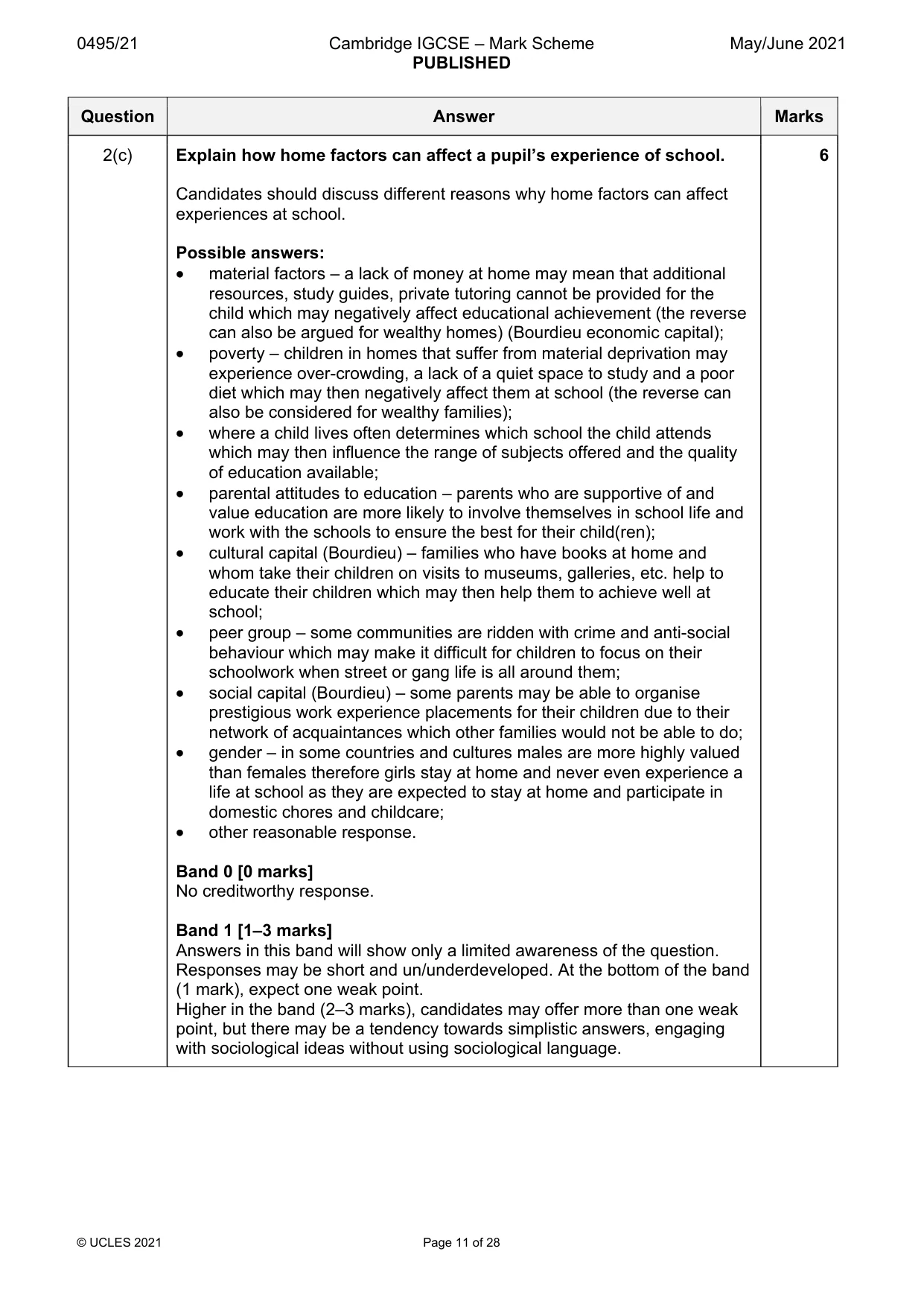
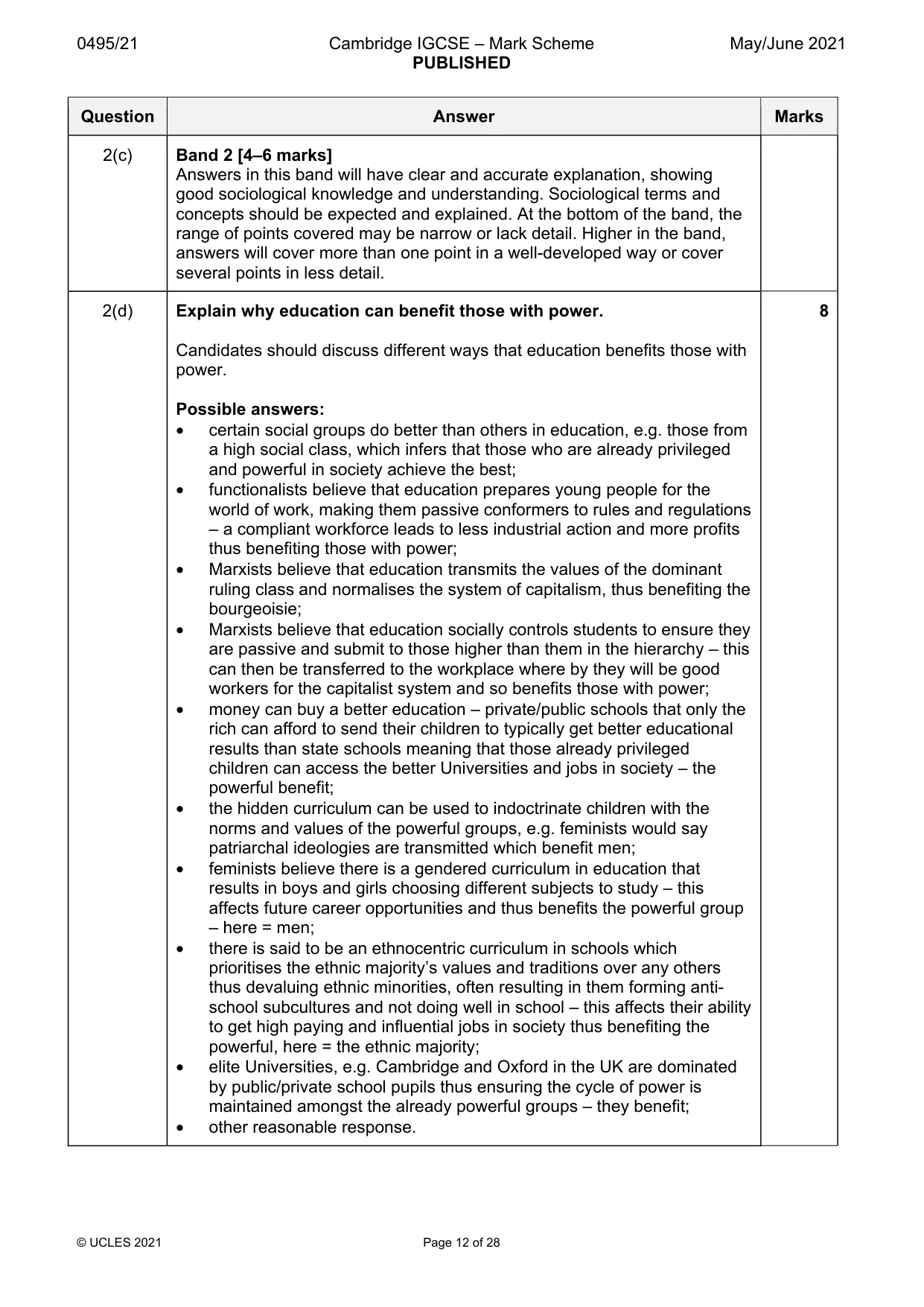
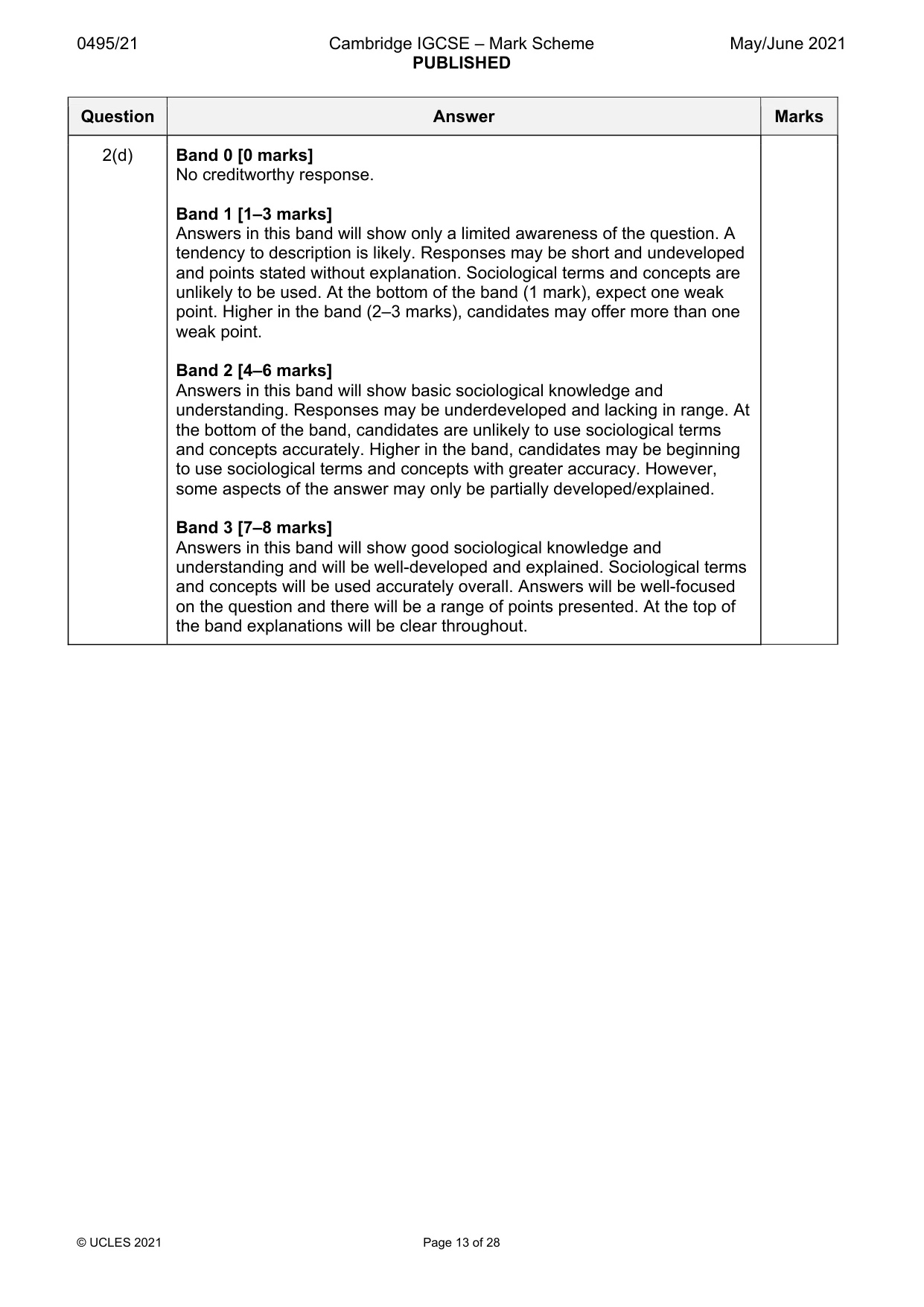
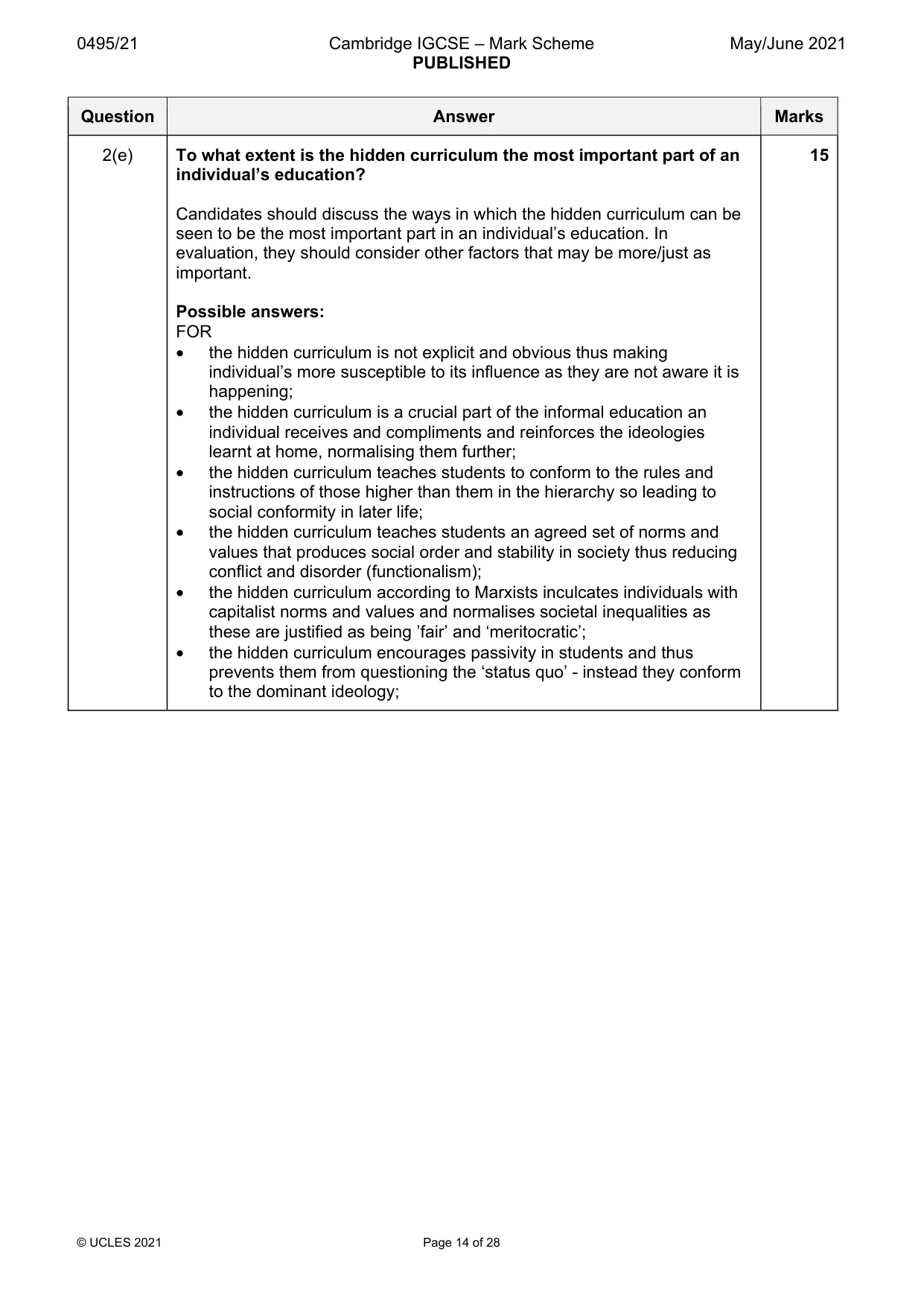
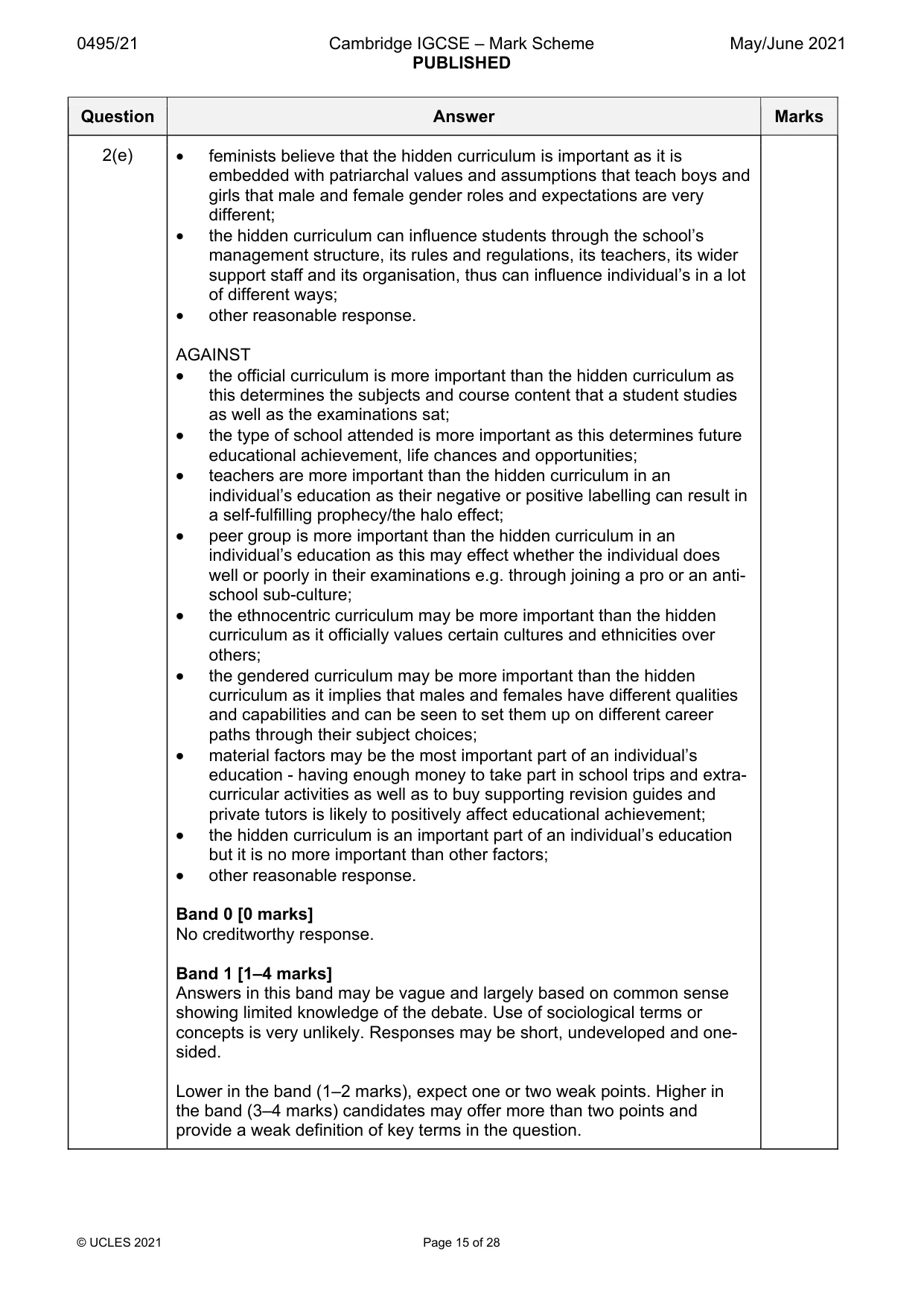
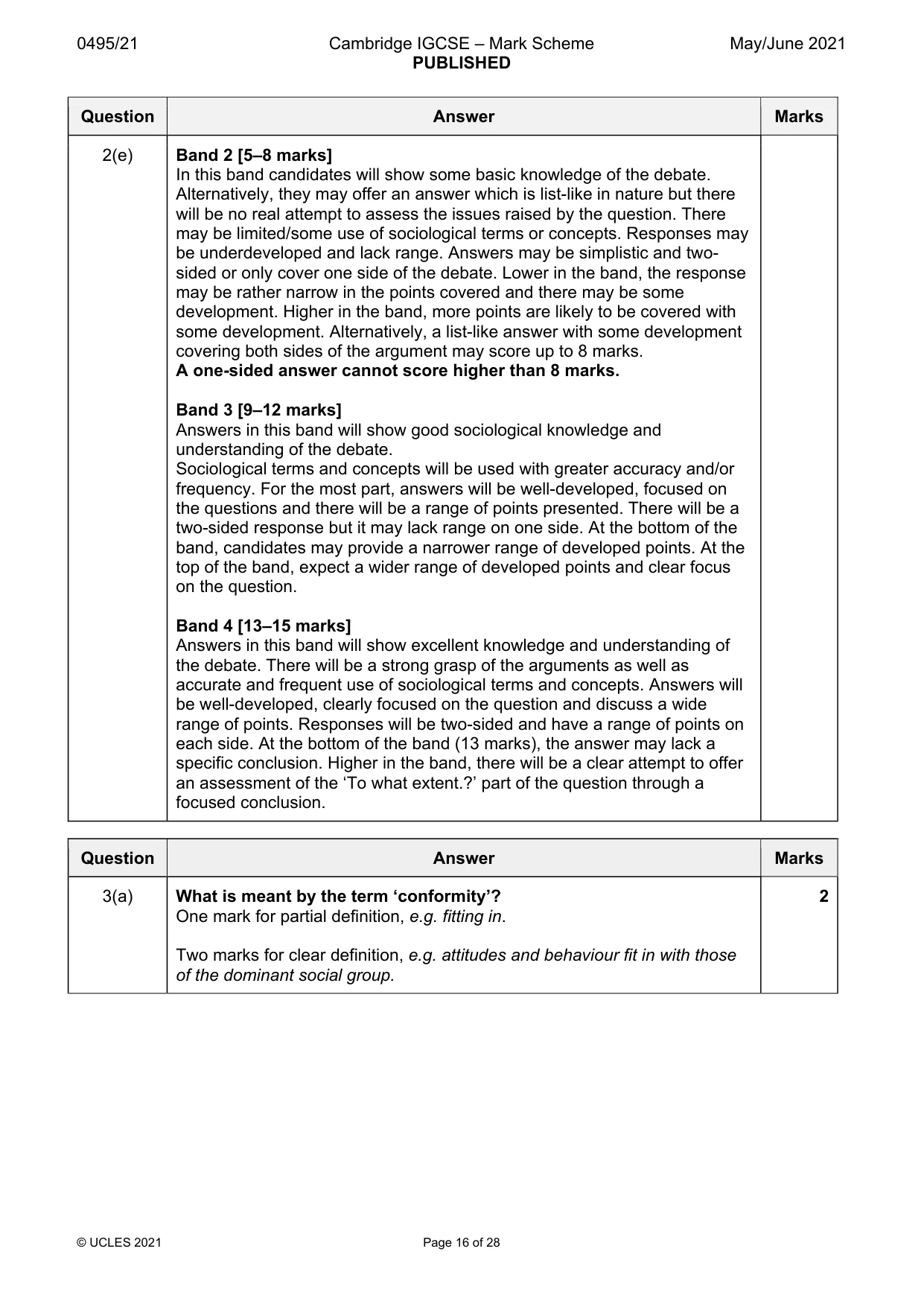
Mark scheme: 2(a) What is meant by the term ‘faith schools’? 2 One mark for partial definition, e.g. a religious school. Two marks for clear definition, e.g. schools controlled/run by a religious organisation. 2(b) Describe two characteristics of anti-school sub-cultures. 4 Candidates will be expected to describe two characteristics of anti-school sub-cultures. Possible answers: • behaviour – students may be pushing the boundaries and rebelling against authority through being insolent/aggressive to teachers, etc.; • truanting – members of anti-school sub-cultures typically hate school and so will often truant and miss classes; • culture of masculinity – these sub-cultures typically involve boys rather than girls; they may be a way for members to re-assert their masculinity; • peer group conformity – pupils in anti-school sub-cultures must conform to their peer group’s norms and values – this can often involve delinquent behaviour outside school; • ethnicity – anti-school sub-cultures are often associated with ethnic minority pupils – they may form in school as a way for ethnic minority students to show their displeasure with an ethnocentric curriculum and negative ethnic stereotyping; • Willis ‘the lads’ – these boys joined the sub-culture in order to ‘have a laugh’ through messing about in the classroom and ‘cheeking’ the teacher; • social class – working class students may join anti-school sub-cultures as they can see no point in studying at school when there are few jobs available for them therefore they avoid school work, try and cheat in tests and rarely complete homework; • prejudice – anti-school sub-cultures are often associated with negative behavior and attitudes such as sexism, racism and homophobia; • attitudes – pupils in anti-school sub-cultures tend to despise pupils who do work hard at school and are successful, this can lead to conflict (anti-education values); • other reasonable response. One mark for each point correctly identified (up to maximum of two). One mark for each point that is developed (up to a maximum of two). 2(c) Explain how home factors can affect a pupil’s experience of school. 6 Candidates should discuss different reasons why home factors can affect experiences at school. Possible answers: • material factors – a lack of money at home may mean that additional resources, study guides, private tutoring cannot be provided for the child which may negatively affect educational achievement (the reverse can also be argued for wealthy homes) (Bourdieu economic capital); • poverty – children in homes that suffer from material deprivation may experience over-crowding, a lack of a quiet space to study and a poor diet which may then negatively affect them at school (the reverse can also be considered for wealthy families); • where a child lives often determines which school the child attends which may then influence the range of subjects offered and the quality of education available; • parental attitudes to education – parents who are supportive of and value education are more likely to involve themselves in school life and work with the schools to ensure the best for their child(ren); • cultural capital (Bourdieu) – families who have books at home and whom take their children on visits to museums, galleries, etc. help to educate their children which may then help them to achieve well at school; • peer group – some communities are ridden with crime and anti-social behaviour which may make it difficult for children to focus on their schoolwork when street or gang life is all around them; • social capital (Bourdieu) – some parents may be able to organise prestigious work experience placements for their children due to their network of acquaintances which other families would not be able to do; • gender – in some countries and cultures males are more highly valued than females therefore girls stay at home and never even experience a life at school as they are expected to stay at home and participate in domestic chores and childcare; • other reasonable response. Band 0 [0 marks] No creditworthy response. Band 1 [1–3 marks] Answers in this band will show only a limited awareness of the question. Responses may be short and un/underdeveloped. At the bottom of the band (1 mark), expect one weak point. Higher in the band (2–3 marks), candidates may offer more than one weak point, but there may be a tendency towards simplistic answers, engaging with sociological ideas without using sociological language. 2(c) Band 2 [4–6 marks] Answers in this band will have clear and accurate explanation, showing good sociological knowledge and understanding. Sociological terms and concepts should be expected and explained. At the bottom of the band, the range of points covered may be narrow or lack detail. Higher in the band, answers will cover more than one point in a well-developed way or cover several points in less detail. 2(d) Explain why education can benefit those with power. 8 Candidates should discuss different ways that education benefits those with power. Possible answers: • certain social groups do better than others in education, e.g. those from a high social class, which infers that those who are already privileged and powerful in society achieve the best; • functionalists believe that education prepares young people for the world of work, making them passive conformers to rules and regulations – a compliant workforce leads to less industrial action and more profits thus benefiting those with power; • Marxists believe that education transmits the values of the dominant ruling class and normalises the system of capitalism, thus benefiting the bourgeoisie; • Marxists believe that education socially controls students to ensure they are passive and submit to those higher than them in the hierarchy – this can then be transferred to the workplace where by they will be good workers for the capitalist system and so benefits those with power; • money can buy a better education – private/public schools that only the rich can afford to send their children to typically get better educational results than state schools meaning that those already privileged children can access the better Universities and jobs in society – the powerful benefit; • the hidden curriculum can be used to indoctrinate children with the norms and values of the powerful groups, e.g. feminists would say patriarchal ideologies are transmitted which benefit men; • feminists believe there is a gendered curriculum in education that results in boys and girls choosing different subjects to study – this affects future career opportunities and thus benefits the powerful group – here = men; • there is said to be an ethnocentric curriculum in schools which prioritises the ethnic majority’s values and traditions over any others thus devaluing ethnic minorities, often resulting in them forming anti- school subcultures and not doing well in school – this affects their ability to get high paying and influential jobs in society thus benefiting the powerful, here = the ethnic majority; • elite Universities, e.g. Cambridge and Oxford in the UK are dominated by public/private school pupils thus ensuring the cycle of power is maintained amongst the already powerful groups – they benefit; • other reasonable response. 2(d) Band 0 [0 marks] No creditworthy response. Band 1 [1–3 marks] Answers in this band will show only a limited awareness of the question. A tendency to description is likely. Responses may be short and undeveloped and points stated without explanation. Sociological terms and concepts are unlikely to be used. At the bottom of the band (1 mark), expect one weak point. Higher in the band (2–3 marks), candidates may offer more than one weak point. Band 2 [4–6 marks] Answers in this band will show basic sociological knowledge and understanding. Responses may be underdeveloped and lacking in range. At the bottom of the band, candidates are unlikely to use sociological terms and concepts accurately. Higher in the band, candidates may be beginning to use sociological terms and concepts with greater accuracy. However, some aspects of the answer may only be partially developed/explained. Band 3 [7–8 marks] Answers in this band will show good sociological knowledge and understanding and will be well-developed and explained. Sociological terms and concepts will be used accurately overall. Answers will be well-focused on the question and there will be a range of points presented. At the top of the band explanations will be clear throughout. 2(e) To what extent is the hidden curriculum the most important part of an 15 individual’s education? Candidates should discuss the ways in which the hidden curriculum can be seen to be the most important part in an individual’s education. In evaluation, they should consider other factors that may be more/just as important. Possible answers: FOR • the hidden curriculum is not explicit and obvious thus making individual’s more susceptible to its influence as they are not aware it is happening; • the hidden curriculum is a crucial part of the informal education an individual receives and compliments and reinforces the ideologies learnt at home, normalising them further; • the hidden curriculum teaches students to conform to the rules and instructions of those higher than them in the hierarchy so leading to social conformity in later life; • the hidden curriculum teaches students an agreed set of norms and values that produces social order and stability in society thus reducing conflict and disorder (functionalism); • the hidden curriculum according to Marxists inculcates individuals with capitalist norms and values and normalises societal inequalities as these are justified as being ’fair’ and ‘meritocratic’; • the hidden curriculum encourages passivity in students and thus prevents them from questioning the ‘status quo’ - instead they conform to the dominant ideology; 2(e) • feminists believe that the hidden curriculum is important as it is embedded with patriarchal values and assumptions that teach boys and girls that male and female gender roles and expectations are very different; • the hidden curriculum can influence students through the school’s management structure, its rules and regulations, its teachers, its wider support staff and its organisation, thus can influence individual’s in a lot of different ways; • other reasonable response. AGAINST • the official curriculum is more important than the hidden curriculum as this determines the subjects and course content that a student studies as well as the examinations sat; • the type of school attended is more important as this determines future educational achievement, life chances and opportunities; • teachers are more important than the hidden curriculum in an individual’s education as their negative or positive labelling can result in a self-fulfilling prophecy/the halo effect; • peer group is more important than the hidden curriculum in an individual’s education as this may effect whether the individual does well or poorly in their examinations e.g. through joining a pro or an anti- school sub-culture; • the ethnocentric curriculum may be more important than the hidden curriculum as it officially values certain cultures and ethnicities over others; • the gendered curriculum may be more important than the hidden curriculum as it implies that males and females have different qualities and capabilities and can be seen to set them up on different career paths through their subject choices; • material factors may be the most important part of an individual’s education - having enough money to take part in school trips and extra- curricular activities as well as to buy supporting revision guides and private tutors is likely to positively affect educational achievement; • the hidden curriculum is an important part of an individual’s education but it is no more important than other factors; • other reasonable response. Band 0 [0 marks] No creditworthy response. Band 1 [1–4 marks] Answers in this band may be vague and largely based on common sense showing limited knowledge of the debate. Use of sociological terms or concepts is very unlikely. Responses may be short, undeveloped and one- sided. Lower in the band (1–2 marks), expect one or two weak points. Higher in the band (3–4 marks) candidates may offer more than two points and provide a weak definition of key terms in the question. 2(e) Band 2 [5–8 marks] In this band candidates will show some basic knowledge of the debate. Alternatively, they may offer an answer which is list-like in nature but there will be no real attempt to assess the issues raised by the question. There may be limited/some use of sociological terms or concepts. Responses may be underdeveloped and lack range. Answers may be simplistic and two- sided or only cover one side of the debate. Lower in the band, the response may be rather narrow in the points covered and there may be some development. Higher in the band, more points are likely to be covered with some development. Alternatively, a list-like answer with some development covering both sides of the argument may score up to 8 marks. A one-sided answer cannot score higher than 8 marks. Band 3 [9–12 marks] Answers in this band will show good sociological knowledge and understanding of the debate. Sociological terms and concepts will be used with greater accuracy and/or frequency. For the most part, answers will be well-developed, focused on the questions and there will be a range of points presented. There will be a two-sided response but it may lack range on one side. At the bottom of the band, candidates may provide a narrower range of developed points. At the top of the band, expect a wider range of developed points and clear focus on the question. Band 4 [13–15 marks] Answers in this band will show excellent knowledge and understanding of the debate. There will be a strong grasp of the arguments as well as accurate and frequent use of sociological terms and concepts. Answers will be well-developed, clearly focused on the question and discuss a wide range of points. Responses will be two-sided and have a range of points on each side. At the bottom of the band (13 marks), the answer may lack a specific conclusion. Higher in the band, there will be a clear attempt to offer an assessment of the ‘To what extent.?’ part of the question through a focused conclusion.
Q3 · Agencies of social control all try to create conformity in society
3 Agencies of social control all try to create conformity in society. Despite this, crime and deviance still occur in many forms such as burglary, murder and corporate crime. Crime rates are produced by the police, courts and government to understand trends in offending and to help find solutions to crime. However, many sociologists believe that the official measurements of crime are not very accurate. (a) What is meant by the term ‘conformity’? [2] (b) Describe two examples of corporate crime. [4] (c) Explain how informal agencies of social control can prevent crime. [6] (d) Explain why official measurements of crime may not always be accurate. [8] (e) To what extent is gender the most important factor in determining whether an individual commits crime? [15] Section D: Media
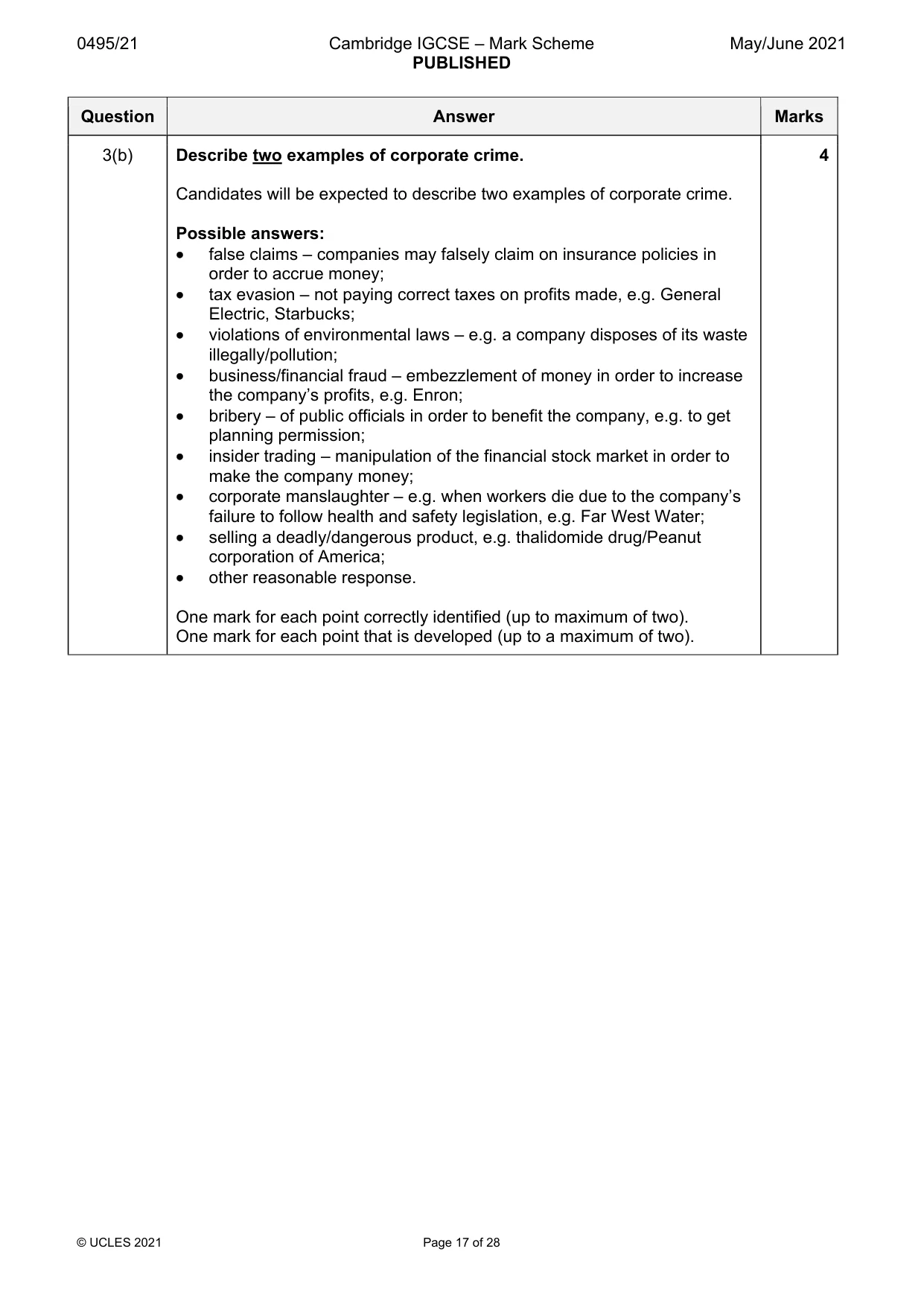
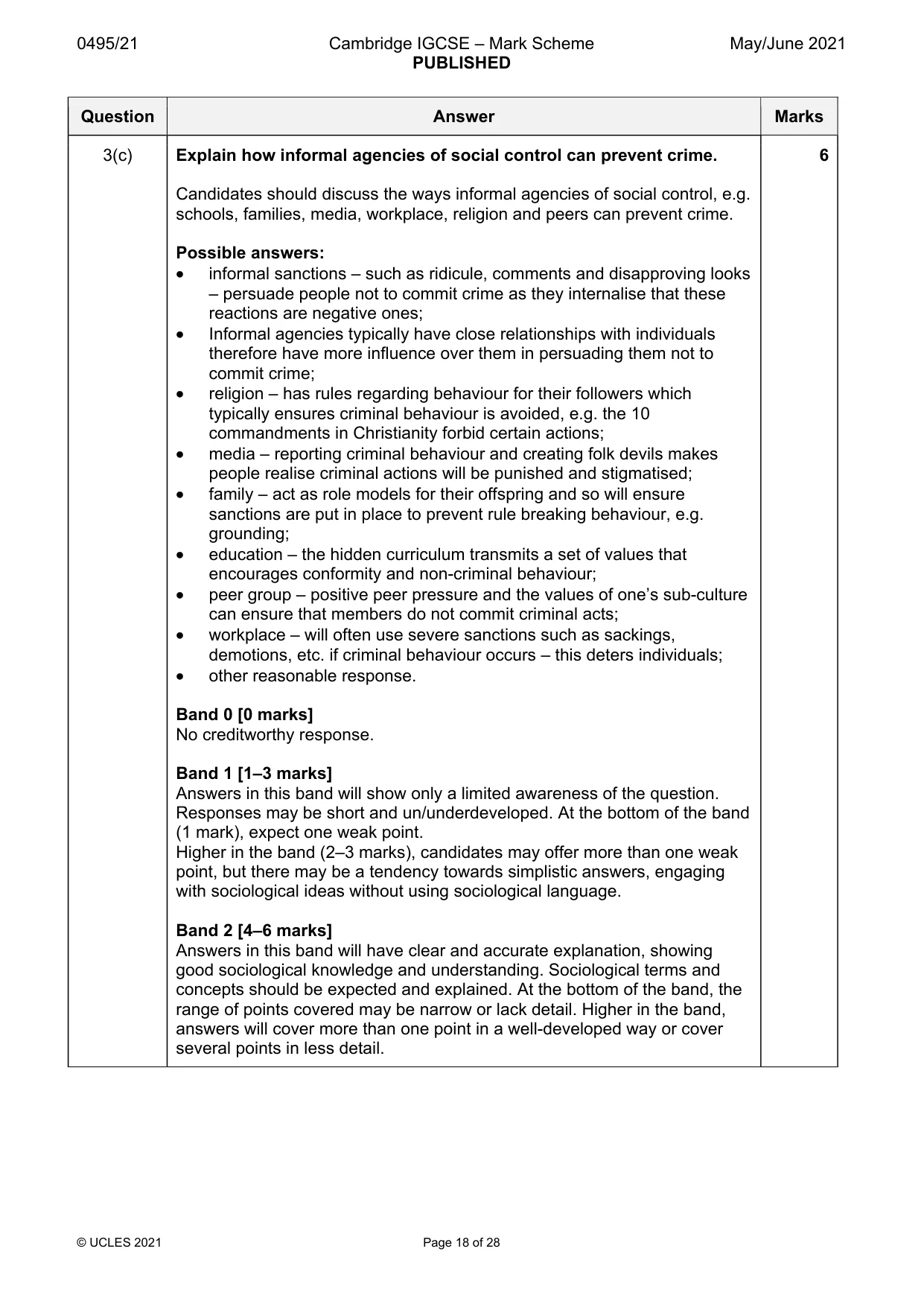
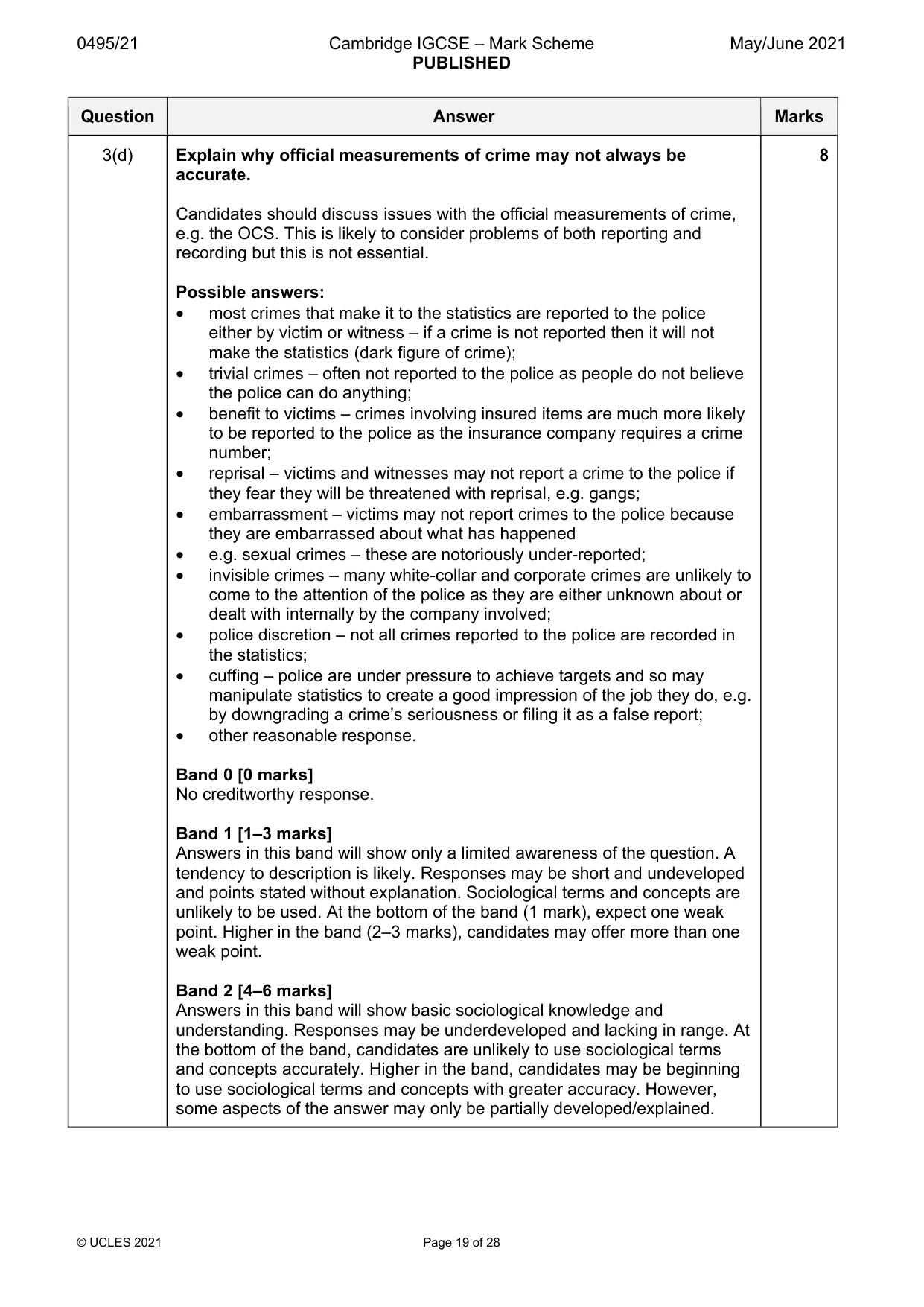
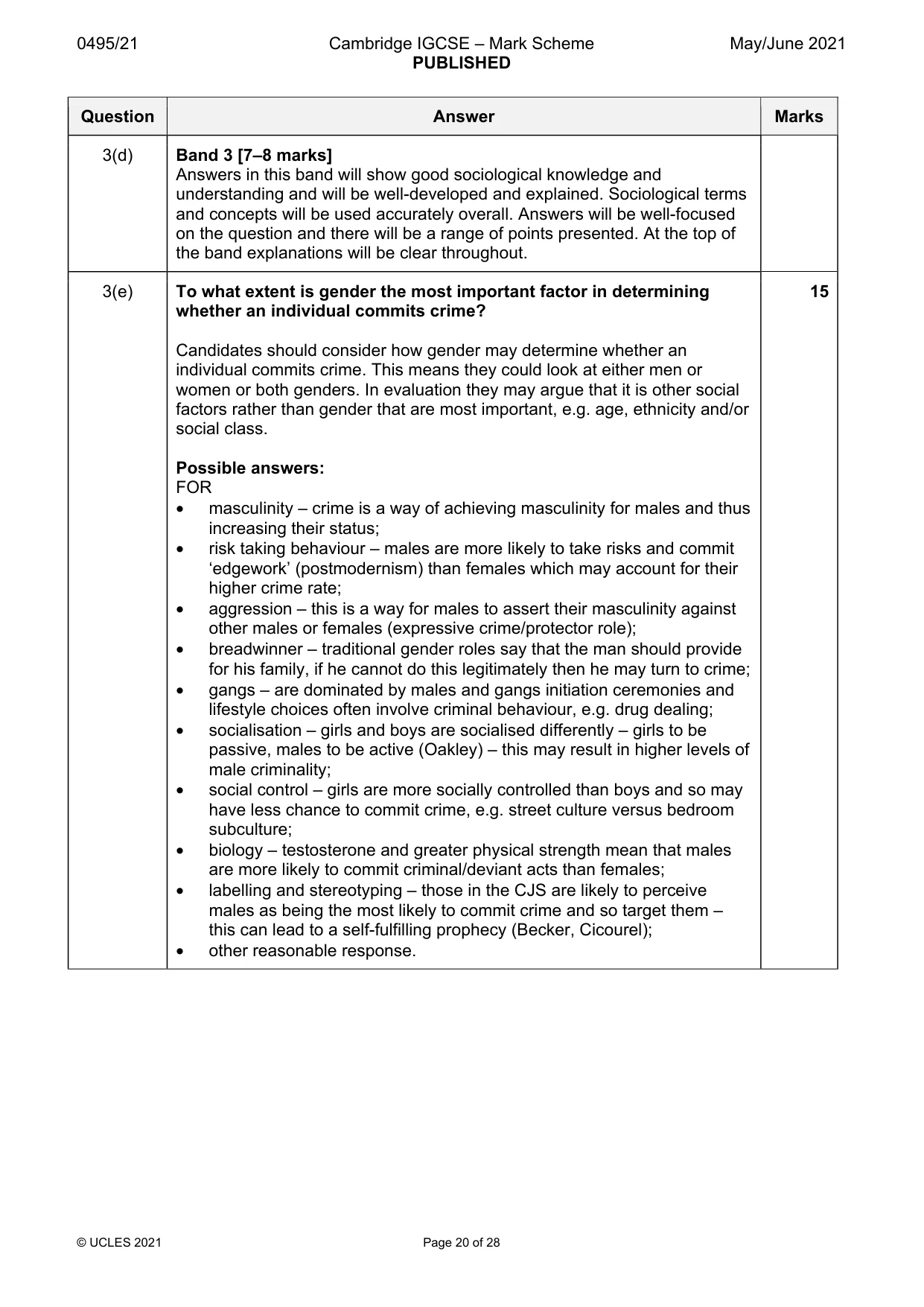
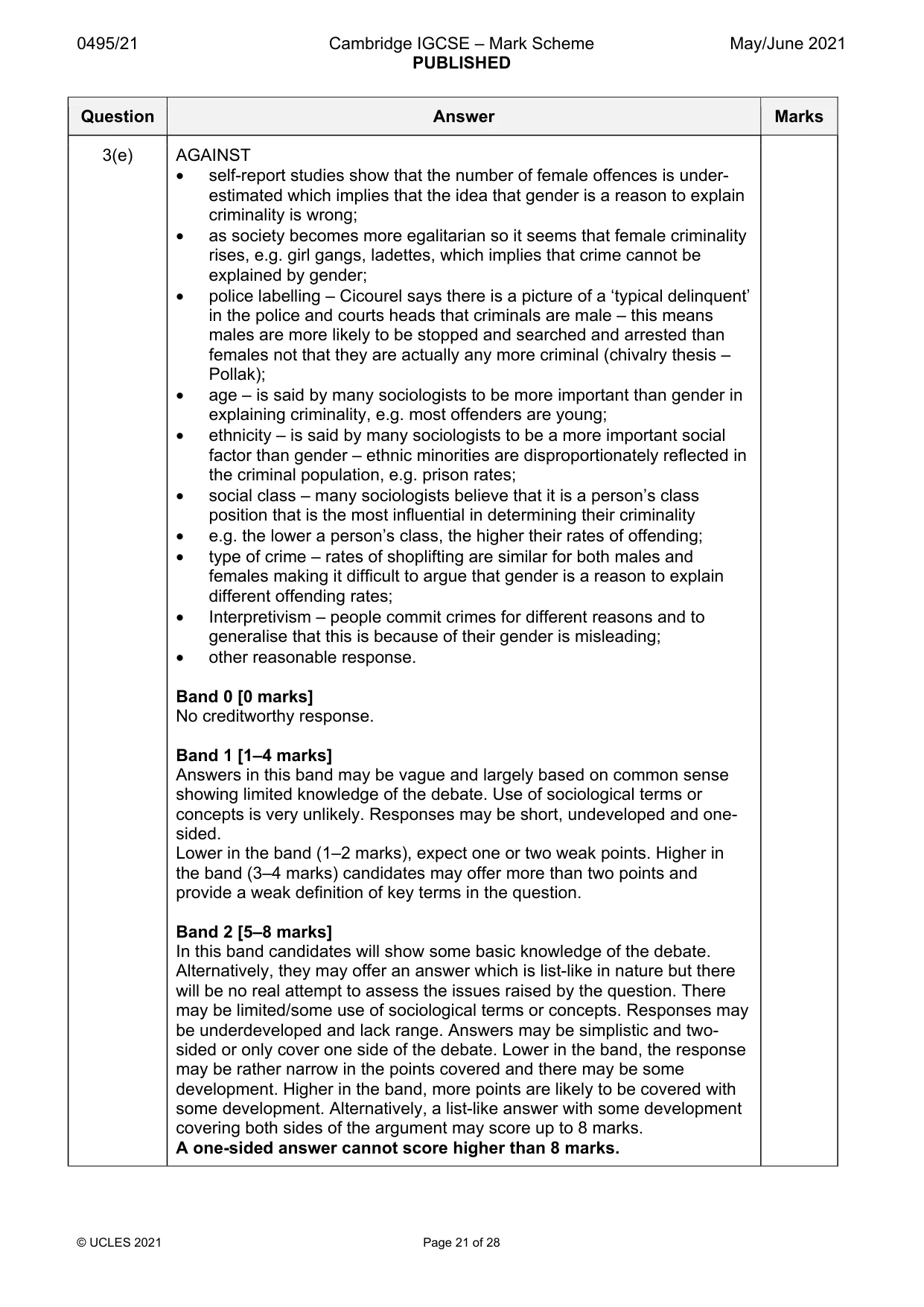
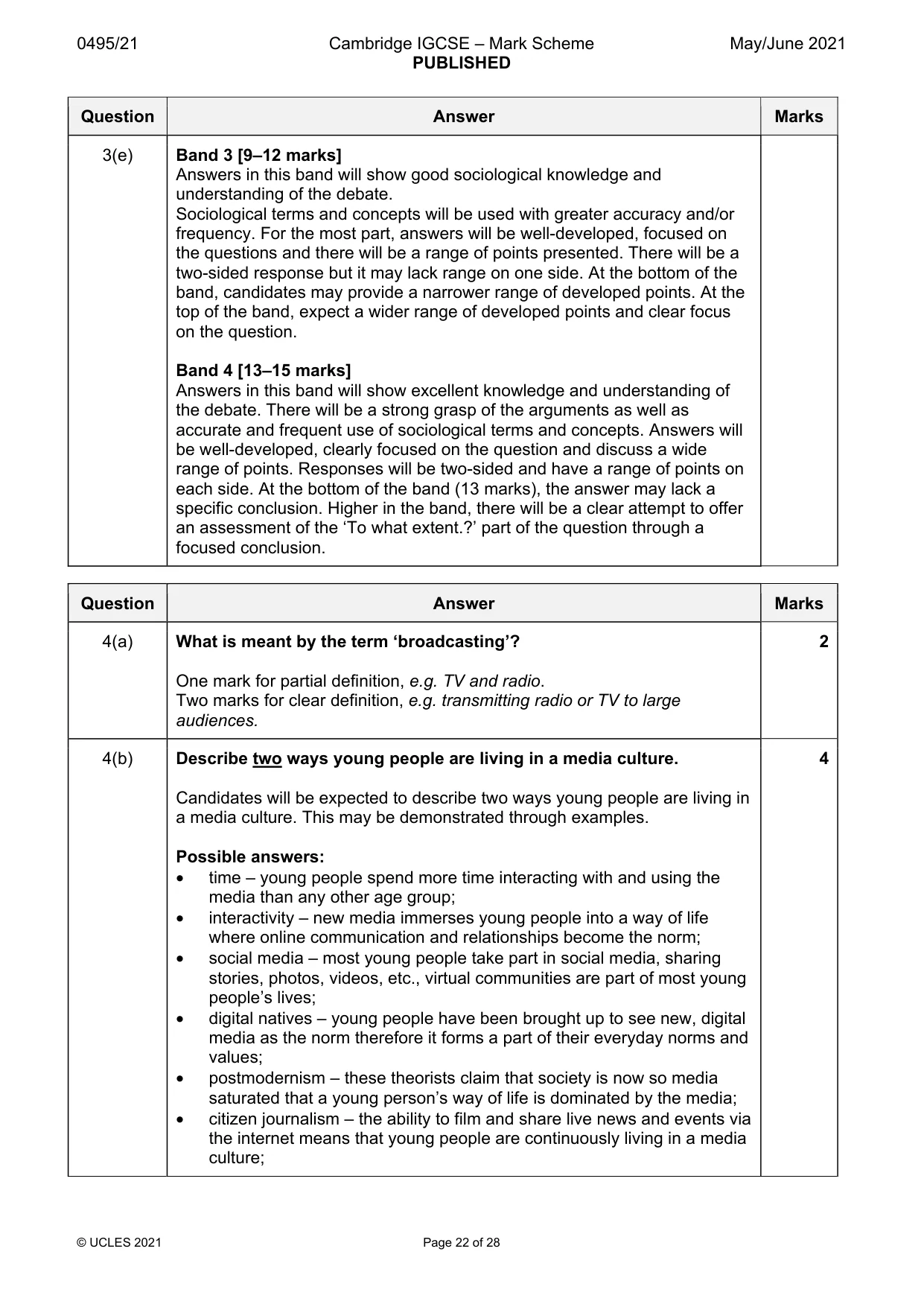
Mark scheme: 3(a) What is meant by the term ‘conformity’? 2 One mark for partial definition, e.g. fitting in. Two marks for clear definition, e.g. attitudes and behaviour fit in with those of the dominant social group. 3(b) Describe two examples of corporate crime. 4 Candidates will be expected to describe two examples of corporate crime. Possible answers: • false claims – companies may falsely claim on insurance policies in order to accrue money; • tax evasion – not paying correct taxes on profits made, e.g. General Electric, Starbucks; • violations of environmental laws – e.g. a company disposes of its waste illegally/pollution; • business/financial fraud – embezzlement of money in order to increase the company’s profits, e.g. Enron; • bribery – of public officials in order to benefit the company, e.g. to get planning permission; • insider trading – manipulation of the financial stock market in order to make the company money; • corporate manslaughter – e.g. when workers die due to the company’s failure to follow health and safety legislation, e.g. Far West Water; • selling a deadly/dangerous product, e.g. thalidomide drug/Peanut corporation of America; • other reasonable response. One mark for each point correctly identified (up to maximum of two). One mark for each point that is developed (up to a maximum of two). 3(c) Explain how informal agencies of social control can prevent crime. 6 Candidates should discuss the ways informal agencies of social control, e.g. schools, families, media, workplace, religion and peers can prevent crime. Possible answers: • informal sanctions – such as ridicule, comments and disapproving looks – persuade people not to commit crime as they internalise that these reactions are negative ones; • Informal agencies typically have close relationships with individuals therefore have more influence over them in persuading them not to commit crime; • religion – has rules regarding behaviour for their followers which typically ensures criminal behaviour is avoided, e.g. the 10 commandments in Christianity forbid certain actions; • media – reporting criminal behaviour and creating folk devils makes people realise criminal actions will be punished and stigmatised; • family – act as role models for their offspring and so will ensure sanctions are put in place to prevent rule breaking behaviour, e.g. grounding; • education – the hidden curriculum transmits a set of values that encourages conformity and non-criminal behaviour; • peer group – positive peer pressure and the values of one’s sub-culture can ensure that members do not commit criminal acts; • workplace – will often use severe sanctions such as sackings, demotions, etc. if criminal behaviour occurs – this deters individuals; • other reasonable response. Band 0 [0 marks] No creditworthy response. Band 1 [1–3 marks] Answers in this band will show only a limited awareness of the question. Responses may be short and un/underdeveloped. At the bottom of the band (1 mark), expect one weak point. Higher in the band (2–3 marks), candidates may offer more than one weak point, but there may be a tendency towards simplistic answers, engaging with sociological ideas without using sociological language. Band 2 [4–6 marks] Answers in this band will have clear and accurate explanation, showing good sociological knowledge and understanding. Sociological terms and concepts should be expected and explained. At the bottom of the band, the range of points covered may be narrow or lack detail. Higher in the band, answers will cover more than one point in a well-developed way or cover several points in less detail. 3(d) Explain why official measurements of crime may not always be 8 accurate. Candidates should discuss issues with the official measurements of crime, e.g. the OCS. This is likely to consider problems of both reporting and recording but this is not essential. Possible answers: • most crimes that make it to the statistics are reported to the police either by victim or witness – if a crime is not reported then it will not make the statistics (dark figure of crime); • trivial crimes – often not reported to the police as people do not believe the police can do anything; • benefit to victims – crimes involving insured items are much more likely to be reported to the police as the insurance company requires a crime number; • reprisal – victims and witnesses may not report a crime to the police if they fear they will be threatened with reprisal, e.g. gangs; • embarrassment – victims may not report crimes to the police because they are embarrassed about what has happened • e.g. sexual crimes – these are notoriously under-reported; • invisible crimes – many white-collar and corporate crimes are unlikely to come to the attention of the police as they are either unknown about or dealt with internally by the company involved; • police discretion – not all crimes reported to the police are recorded in the statistics; • cuffing – police are under pressure to achieve targets and so may manipulate statistics to create a good impression of the job they do, e.g. by downgrading a crime’s seriousness or filing it as a false report; • other reasonable response. Band 0 [0 marks] No creditworthy response. Band 1 [1–3 marks] Answers in this band will show only a limited awareness of the question. A tendency to description is likely. Responses may be short and undeveloped and points stated without explanation. Sociological terms and concepts are unlikely to be used. At the bottom of the band (1 mark), expect one weak point. Higher in the band (2–3 marks), candidates may offer more than one weak point. Band 2 [4–6 marks] Answers in this band will show basic sociological knowledge and understanding. Responses may be underdeveloped and lacking in range. At the bottom of the band, candidates are unlikely to use sociological terms and concepts accurately. Higher in the band, candidates may be beginning to use sociological terms and concepts with greater accuracy. However, some aspects of the answer may only be partially developed/explained. 3(d) Band 3 [7–8 marks] Answers in this band will show good sociological knowledge and understanding and will be well-developed and explained. Sociological terms and concepts will be used accurately overall. Answers will be well-focused on the question and there will be a range of points presented. At the top of the band explanations will be clear throughout. 3(e) To what extent is gender the most important factor in determining 15 whether an individual commits crime? Candidates should consider how gender may determine whether an individual commits crime. This means they could look at either men or women or both genders. In evaluation they may argue that it is other social factors rather than gender that are most important, e.g. age, ethnicity and/or social class. Possible answers: FOR • masculinity – crime is a way of achieving masculinity for males and thus increasing their status; • risk taking behaviour – males are more likely to take risks and commit ‘edgework’ (postmodernism) than females which may account for their higher crime rate; • aggression – this is a way for males to assert their masculinity against other males or females (expressive crime/protector role); • breadwinner – traditional gender roles say that the man should provide for his family, if he cannot do this legitimately then he may turn to crime; • gangs – are dominated by males and gangs initiation ceremonies and lifestyle choices often involve criminal behaviour, e.g. drug dealing; • socialisation – girls and boys are socialised differently – girls to be passive, males to be active (Oakley) – this may result in higher levels of male criminality; • social control – girls are more socially controlled than boys and so may have less chance to commit crime, e.g. street culture versus bedroom subculture; • biology – testosterone and greater physical strength mean that males are more likely to commit criminal/deviant acts than females; • labelling and stereotyping – those in the CJS are likely to perceive males as being the most likely to commit crime and so target them – this can lead to a self-fulfilling prophecy (Becker, Cicourel); • other reasonable response. 3(e) AGAINST • self-report studies show that the number of female offences is under- estimated which implies that the idea that gender is a reason to explain criminality is wrong; • as society becomes more egalitarian so it seems that female criminality rises, e.g. girl gangs, ladettes, which implies that crime cannot be explained by gender; • police labelling – Cicourel says there is a picture of a ‘typical delinquent’ in the police and courts heads that criminals are male – this means males are more likely to be stopped and searched and arrested than females not that they are actually any more criminal (chivalry thesis – Pollak); • age – is said by many sociologists to be more important than gender in explaining criminality, e.g. most offenders are young; • ethnicity – is said by many sociologists to be a more important social factor than gender – ethnic minorities are disproportionately reflected in the criminal population, e.g. prison rates; • social class – many sociologists believe that it is a person’s class position that is the most influential in determining their criminality • e.g. the lower a person’s class, the higher their rates of offending; • type of crime – rates of shoplifting are similar for both males and females making it difficult to argue that gender is a reason to explain different offending rates; • Interpretivism – people commit crimes for different reasons and to generalise that this is because of their gender is misleading; • other reasonable response. Band 0 [0 marks] No creditworthy response. Band 1 [1–4 marks] Answers in this band may be vague and largely based on common sense showing limited knowledge of the debate. Use of sociological terms or concepts is very unlikely. Responses may be short, undeveloped and one- sided. Lower in the band (1–2 marks), expect one or two weak points. Higher in the band (3–4 marks) candidates may offer more than two points and provide a weak definition of key terms in the question. Band 2 [5–8 marks] In this band candidates will show some basic knowledge of the debate. Alternatively, they may offer an answer which is list-like in nature but there will be no real attempt to assess the issues raised by the question. There may be limited/some use of sociological terms or concepts. Responses may be underdeveloped and lack range. Answers may be simplistic and two- sided or only cover one side of the debate. Lower in the band, the response may be rather narrow in the points covered and there may be some development. Higher in the band, more points are likely to be covered with some development. Alternatively, a list-like answer with some development covering both sides of the argument may score up to 8 marks. A one-sided answer cannot score higher than 8 marks. 3(e) Band 3 [9–12 marks] Answers in this band will show good sociological knowledge and understanding of the debate. Sociological terms and concepts will be used with greater accuracy and/or frequency. For the most part, answers will be well-developed, focused on the questions and there will be a range of points presented. There will be a two-sided response but it may lack range on one side. At the bottom of the band, candidates may provide a narrower range of developed points. At the top of the band, expect a wider range of developed points and clear focus on the question. Band 4 [13–15 marks] Answers in this band will show excellent knowledge and understanding of the debate. There will be a strong grasp of the arguments as well as accurate and frequent use of sociological terms and concepts. Answers will be well-developed, clearly focused on the question and discuss a wide range of points. Responses will be two-sided and have a range of points on each side. At the bottom of the band (13 marks), the answer may lack a specific conclusion. Higher in the band, there will be a clear attempt to offer an assessment of the ‘To what extent.?’ part of the question through a focused conclusion.
Q4 · Societies and cultures are changing rapidly and it is in the media that the biggest…
4 Societies and cultures are changing rapidly and it is in the media that the biggest changes are occurring. New media is very different to traditional media. New media is believed to be interactive and free from control and bias. However, all media including the internet, broadcasting and the film industry provides the audience with information and entertainment. The media also socialises and educates individuals. (a) What is meant by the term ‘broadcasting’? [2] (b) Describe two ways young people are living in a media culture. [4] (c) Explain how new media is interactive. [6] (d) Explain why the media is an important agency of socialisation. [8] (e) To what extent is the media free from control and bias? [15]
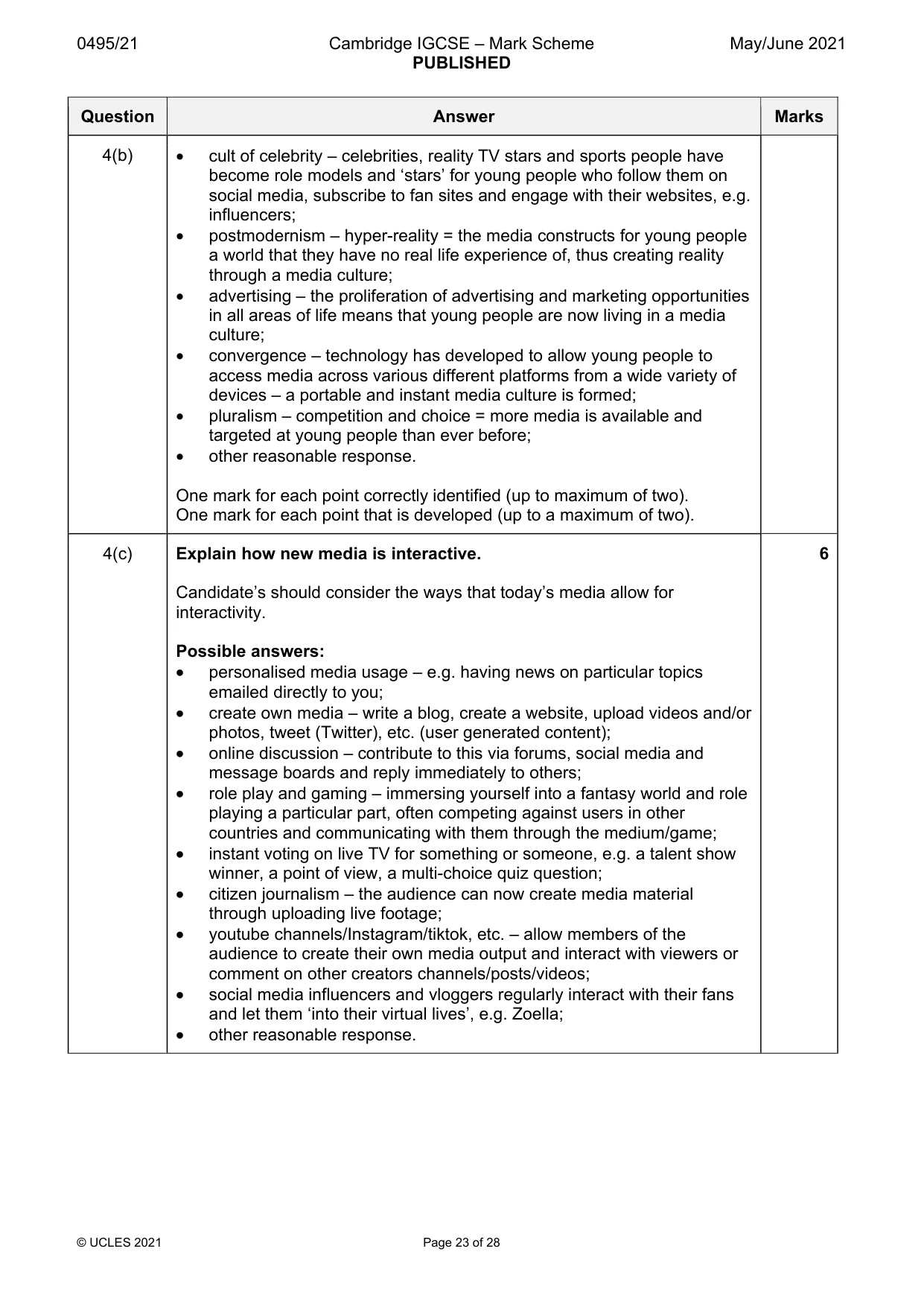
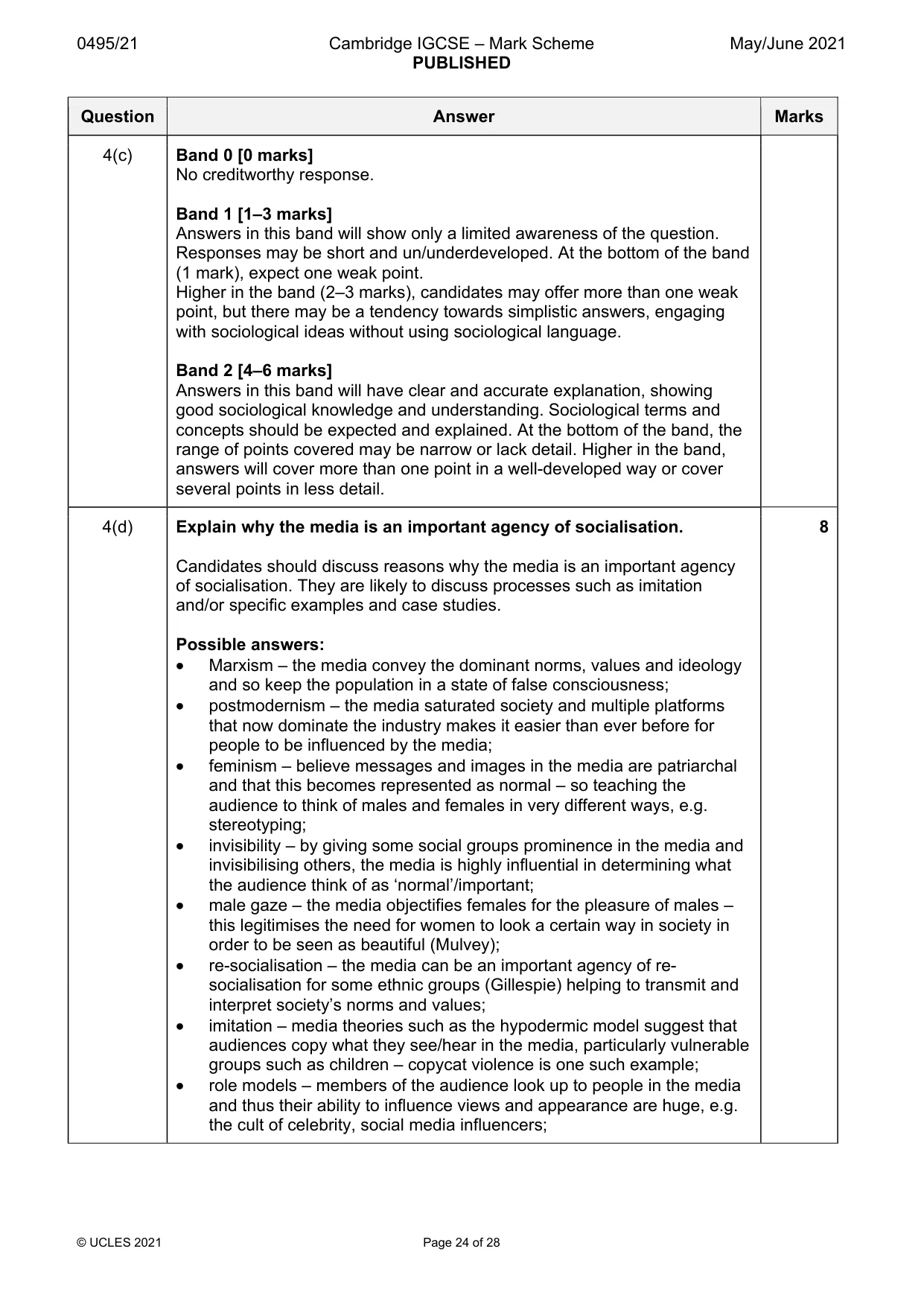
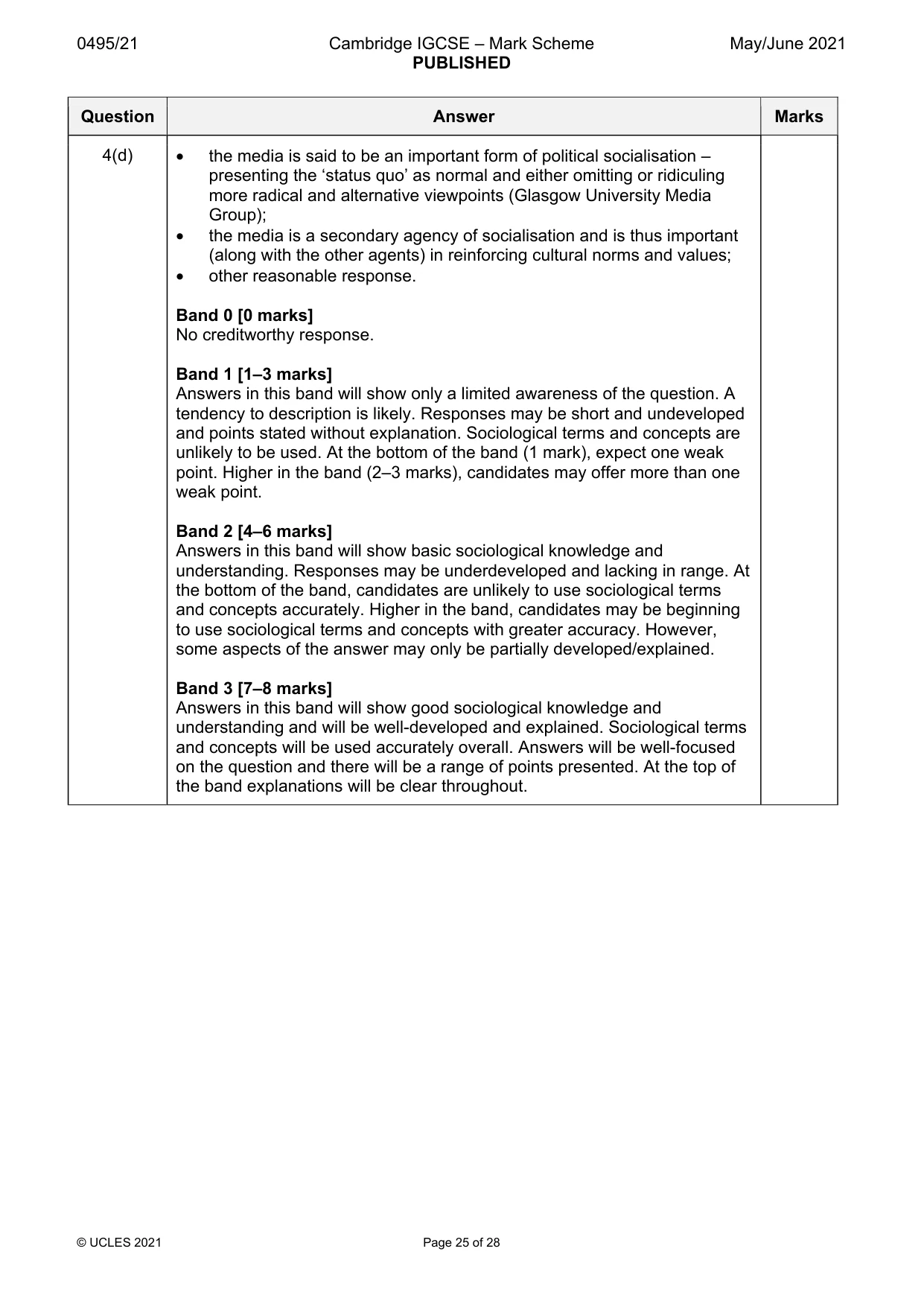
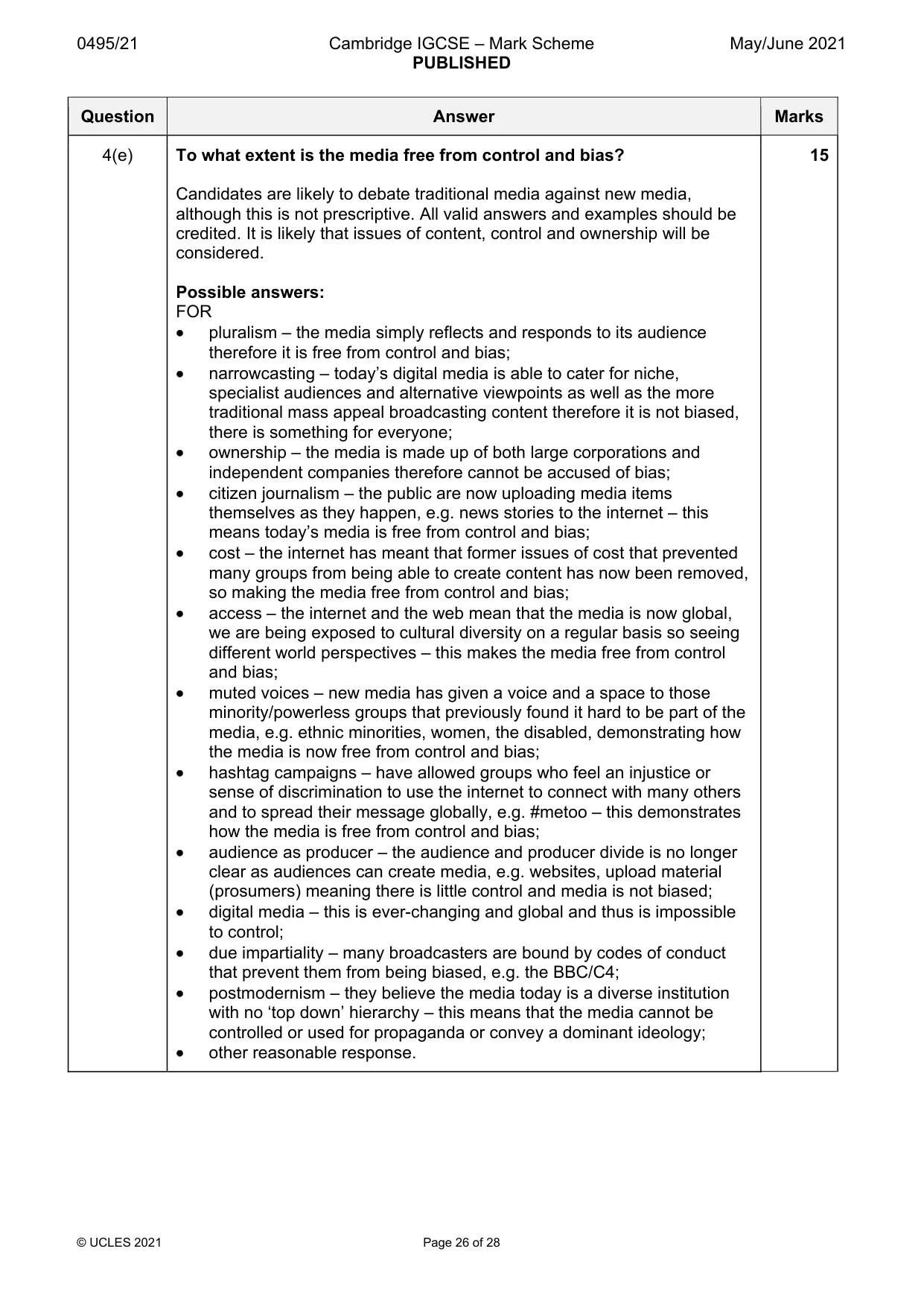
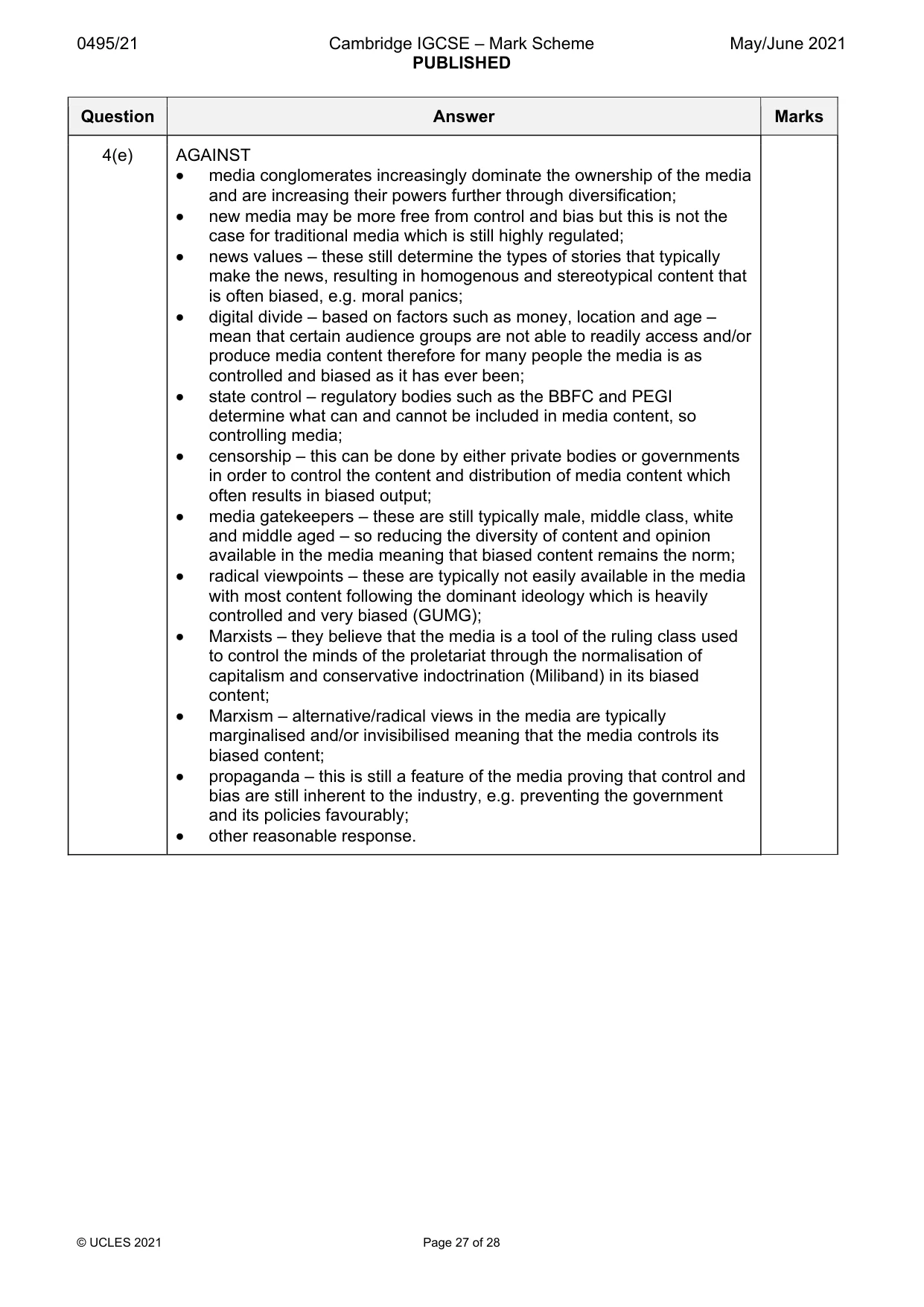
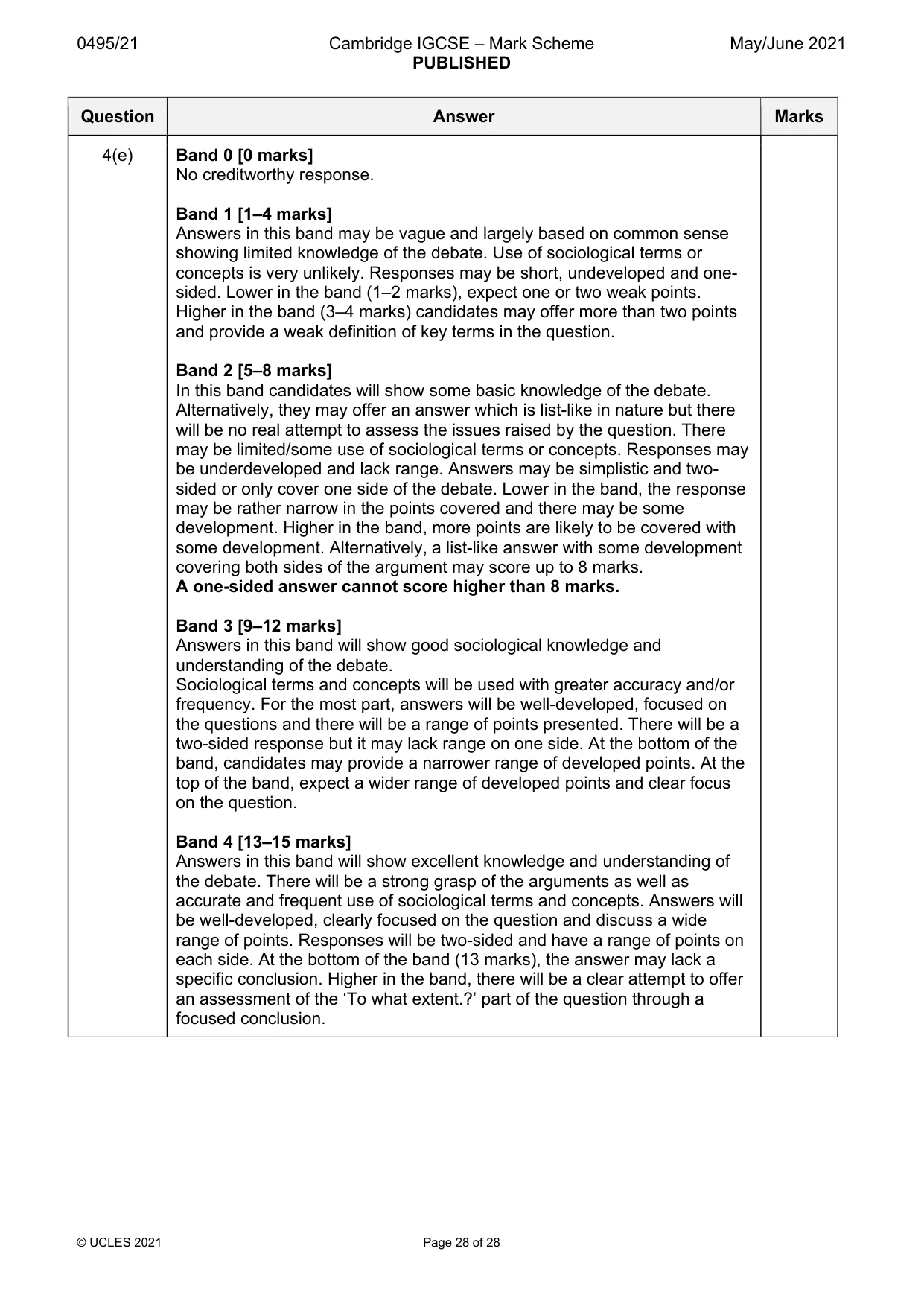
Mark scheme: 4(a) What is meant by the term ‘broadcasting’? 2 One mark for partial definition, e.g. TV and radio. Two marks for clear definition, e.g. transmitting radio or TV to large audiences. 4(b) Describe two ways young people are living in a media culture. 4 Candidates will be expected to describe two ways young people are living in a media culture. This may be demonstrated through examples. Possible answers: • time – young people spend more time interacting with and using the media than any other age group; • interactivity – new media immerses young people into a way of life where online communication and relationships become the norm; • social media – most young people take part in social media, sharing stories, photos, videos, etc., virtual communities are part of most young people’s lives; • digital natives – young people have been brought up to see new, digital media as the norm therefore it forms a part of their everyday norms and values; • postmodernism – these theorists claim that society is now so media saturated that a young person’s way of life is dominated by the media; • citizen journalism – the ability to film and share live news and events via the internet means that young people are continuously living in a media culture; 4(b) • cult of celebrity – celebrities, reality TV stars and sports people have become role models and ‘stars’ for young people who follow them on social media, subscribe to fan sites and engage with their websites, e.g. influencers; • postmodernism – hyper-reality = the media constructs for young people a world that they have no real life experience of, thus creating reality through a media culture; • advertising – the proliferation of advertising and marketing opportunities in all areas of life means that young people are now living in a media culture; • convergence – technology has developed to allow young people to access media across various different platforms from a wide variety of devices – a portable and instant media culture is formed; • pluralism – competition and choice = more media is available and targeted at young people than ever before; • other reasonable response. One mark for each point correctly identified (up to maximum of two). One mark for each point that is developed (up to a maximum of two). 4(c) Explain how new media is interactive. 6 Candidate’s should consider the ways that today’s media allow for interactivity. Possible answers: • personalised media usage – e.g. having news on particular topics emailed directly to you; • create own media – write a blog, create a website, upload videos and/or photos, tweet (Twitter), etc. (user generated content); • online discussion – contribute to this via forums, social media and message boards and reply immediately to others; • role play and gaming – immersing yourself into a fantasy world and role playing a particular part, often competing against users in other countries and communicating with them through the medium/game; • instant voting on live TV for something or someone, e.g. a talent show winner, a point of view, a multi-choice quiz question; • citizen journalism – the audience can now create media material through uploading live footage; • youtube channels/Instagram/tiktok, etc. – allow members of the audience to create their own media output and interact with viewers or comment on other creators channels/posts/videos; • social media influencers and vloggers regularly interact with their fans and let them ‘into their virtual lives’, e.g. Zoella; • other reasonable response. 4(c) Band 0 [0 marks] No creditworthy response. Band 1 [1–3 marks] Answers in this band will show only a limited awareness of the question. Responses may be short and un/underdeveloped. At the bottom of the band (1 mark), expect one weak point. Higher in the band (2–3 marks), candidates may offer more than one weak point, but there may be a tendency towards simplistic answers, engaging with sociological ideas without using sociological language. Band 2 [4–6 marks] Answers in this band will have clear and accurate explanation, showing good sociological knowledge and understanding. Sociological terms and concepts should be expected and explained. At the bottom of the band, the range of points covered may be narrow or lack detail. Higher in the band, answers will cover more than one point in a well-developed way or cover several points in less detail. 4(d) Explain why the media is an important agency of socialisation. 8 Candidates should discuss reasons why the media is an important agency of socialisation. They are likely to discuss processes such as imitation and/or specific examples and case studies. Possible answers: • Marxism – the media convey the dominant norms, values and ideology and so keep the population in a state of false consciousness; • postmodernism – the media saturated society and multiple platforms that now dominate the industry makes it easier than ever before for people to be influenced by the media; • feminism – believe messages and images in the media are patriarchal and that this becomes represented as normal – so teaching the audience to think of males and females in very different ways, e.g. stereotyping; • invisibility – by giving some social groups prominence in the media and invisibilising others, the media is highly influential in determining what the audience think of as ‘normal’/important; • male gaze – the media objectifies females for the pleasure of males – this legitimises the need for women to look a certain way in society in order to be seen as beautiful (Mulvey); • re-socialisation – the media can be an important agency of re- socialisation for some ethnic groups (Gillespie) helping to transmit and interpret society’s norms and values; • imitation – media theories such as the hypodermic model suggest that audiences copy what they see/hear in the media, particularly vulnerable groups such as children – copycat violence is one such example; • role models – members of the audience look up to people in the media and thus their ability to influence views and appearance are huge, e.g. the cult of celebrity, social media influencers; 4(d) • the media is said to be an important form of political socialisation – presenting the ‘status quo’ as normal and either omitting or ridiculing more radical and alternative viewpoints (Glasgow University Media Group); • the media is a secondary agency of socialisation and is thus important (along with the other agents) in reinforcing cultural norms and values; • other reasonable response. Band 0 [0 marks] No creditworthy response. Band 1 [1–3 marks] Answers in this band will show only a limited awareness of the question. A tendency to description is likely. Responses may be short and undeveloped and points stated without explanation. Sociological terms and concepts are unlikely to be used. At the bottom of the band (1 mark), expect one weak point. Higher in the band (2–3 marks), candidates may offer more than one weak point. Band 2 [4–6 marks] Answers in this band will show basic sociological knowledge and understanding. Responses may be underdeveloped and lacking in range. At the bottom of the band, candidates are unlikely to use sociological terms and concepts accurately. Higher in the band, candidates may be beginning to use sociological terms and concepts with greater accuracy. However, some aspects of the answer may only be partially developed/explained. Band 3 [7–8 marks] Answers in this band will show good sociological knowledge and understanding and will be well-developed and explained. Sociological terms and concepts will be used accurately overall. Answers will be well-focused on the question and there will be a range of points presented. At the top of the band explanations will be clear throughout. 4(e) To what extent is the media free from control and bias? 15 Candidates are likely to debate traditional media against new media, although this is not prescriptive. All valid answers and examples should be credited. It is likely that issues of content, control and ownership will be considered. Possible answers: FOR • pluralism – the media simply reflects and responds to its audience therefore it is free from control and bias; • narrowcasting – today’s digital media is able to cater for niche, specialist audiences and alternative viewpoints as well as the more traditional mass appeal broadcasting content therefore it is not biased, there is something for everyone; • ownership – the media is made up of both large corporations and independent companies therefore cannot be accused of bias; • citizen journalism – the public are now uploading media items themselves as they happen, e.g. news stories to the internet – this means today’s media is free from control and bias; • cost – the internet has meant that former issues of cost that prevented many groups from being able to create content has now been removed, so making the media free from control and bias; • access – the internet and the web mean that the media is now global, we are being exposed to cultural diversity on a regular basis so seeing different world perspectives – this makes the media free from control and bias; • muted voices – new media has given a voice and a space to those minority/powerless groups that previously found it hard to be part of the media, e.g. ethnic minorities, women, the disabled, demonstrating how the media is now free from control and bias; • hashtag campaigns – have allowed groups who feel an injustice or sense of discrimination to use the internet to connect with many others and to spread their message globally, e.g. #metoo – this demonstrates how the media is free from control and bias; • audience as producer – the audience and producer divide is no longer clear as audiences can create media, e.g. websites, upload material (prosumers) meaning there is little control and media is not biased; • digital media – this is ever-changing and global and thus is impossible to control; • due impartiality – many broadcasters are bound by codes of conduct that prevent them from being biased, e.g. the BBC/C4; • postmodernism – they believe the media today is a diverse institution with no ‘top down’ hierarchy – this means that the media cannot be controlled or used for propaganda or convey a dominant ideology; • other reasonable response. 4(e) AGAINST • media conglomerates increasingly dominate the ownership of the media and are increasing their powers further through diversification; • new media may be more free from control and bias but this is not the case for traditional media which is still highly regulated; • news values – these still determine the types of stories that typically make the news, resulting in homogenous and stereotypical content that is often biased, e.g. moral panics; • digital divide – based on factors such as money, location and age – mean that certain audience groups are not able to readily access and/or produce media content therefore for many people the media is as controlled and biased as it has ever been; • state control – regulatory bodies such as the BBFC and PEGI determine what can and cannot be included in media content, so controlling media; • censorship – this can be done by either private bodies or governments in order to control the content and distribution of media content which often results in biased output; • media gatekeepers – these are still typically male, middle class, white and middle aged – so reducing the diversity of content and opinion available in the media meaning that biased content remains the norm; • radical viewpoints – these are typically not easily available in the media with most content following the dominant ideology which is heavily controlled and very biased (GUMG); • Marxists – they believe that the media is a tool of the ruling class used to control the minds of the proletariat through the normalisation of capitalism and conservative indoctrination (Miliband) in its biased content; • Marxism – alternative/radical views in the media are typically marginalised and/or invisibilised meaning that the media controls its biased content; • propaganda – this is still a feature of the media proving that control and bias are still inherent to the industry, e.g. preventing the government and its policies favourably; • other reasonable response. 4(e) Band 0 [0 marks] No creditworthy response. Band 1 [1–4 marks] Answers in this band may be vague and largely based on common sense showing limited knowledge of the debate. Use of sociological terms or concepts is very unlikely. Responses may be short, undeveloped and one- sided. Lower in the band (1–2 marks), expect one or two weak points. Higher in the band (3–4 marks) candidates may offer more than two points and provide a weak definition of key terms in the question. Band 2 [5–8 marks] In this band candidates will show some basic knowledge of the debate. Alternatively, they may offer an answer which is list-like in nature but there will be no real attempt to assess the issues raised by the question. There may be limited/some use of sociological terms or concepts. Responses may be underdeveloped and lack range. Answers may be simplistic and two- sided or only cover one side of the debate. Lower in the band, the response may be rather narrow in the points covered and there may be some development. Higher in the band, more points are likely to be covered with some development. Alternatively, a list-like answer with some development covering both sides of the argument may score up to 8 marks. A one-sided answer cannot score higher than 8 marks. Band 3 [9–12 marks] Answers in this band will show good sociological knowledge and understanding of the debate. Sociological terms and concepts will be used with greater accuracy and/or frequency. For the most part, answers will be well-developed, focused on the questions and there will be a range of points presented. There will be a two-sided response but it may lack range on one side. At the bottom of the band, candidates may provide a narrower range of developed points. At the top of the band, expect a wider range of developed points and clear focus on the question. Band 4 [13–15 marks] Answers in this band will show excellent knowledge and understanding of the debate. There will be a strong grasp of the arguments as well as accurate and frequent use of sociological terms and concepts. Answers will be well-developed, clearly focused on the question and discuss a wide range of points. Responses will be two-sided and have a range of points on each side. At the bottom of the band (13 marks), the answer may lack a specific conclusion. Higher in the band, there will be a clear attempt to offer an assessment of the ‘To what extent.?’ part of the question through a focused conclusion.
What was in this paper
The subtopics covered by these 4 questions, and how many questions each got. Open one in a new tab to see every Cambridge question on it.
What you needed in this session
Cambridge’s own grade thresholds for 2021 May/June, Paper 2 · Variant 1. A higher threshold means an easier paper — the bar moves with how the cohort did.