Cambridge IGCSE Sociology 0495 — 2020 Oct/Nov Paper 1 · Variant 3
0495/13/O/N/20 · 80 marks · ≈90 min
The question paper and its mark scheme, free to read here and free to download. This is Cambridge’s own paper, exactly as it was sat.
Question paper4 pages

Mark scheme28 pages
Answers below. Sit the paper first if you are practising.
Paper as text
Question paper, page 1
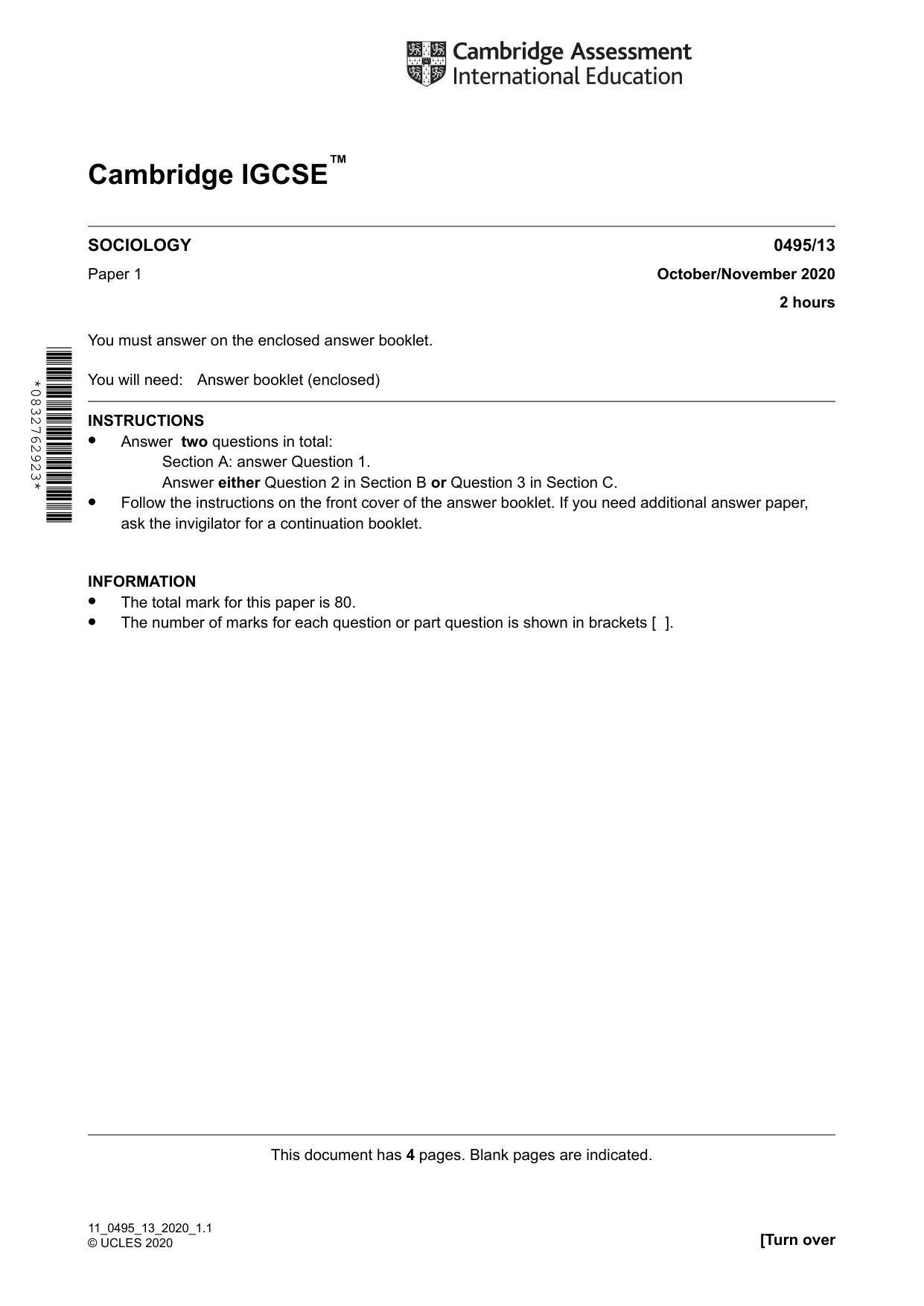
Cambridge IGCSE™ 0495/13 October/November 2020 2 hours SOCIOLOGY Paper 1 You must answer on the enclosed answer booklet. You will need: Answer booklet (enclosed) INSTRUCTIONS • Answer two questions in total: Section A: answer Question 1. Answer either Question 2 in Section B or Question 3 in Section C. • Follow the instructions on the front cover of the answer booklet. If you need additional answer paper, ask the invigilator for a continuation booklet. INFORMATION • The total mark for this paper is 80. • The number of marks for each question or part question is shown in brackets [ ]. This document has 4 pages. Blank pages are indicated. [Turn over 11_0495_13_2020_1.1 © UCLES 2020 *0832762923*
Question paper, page 2
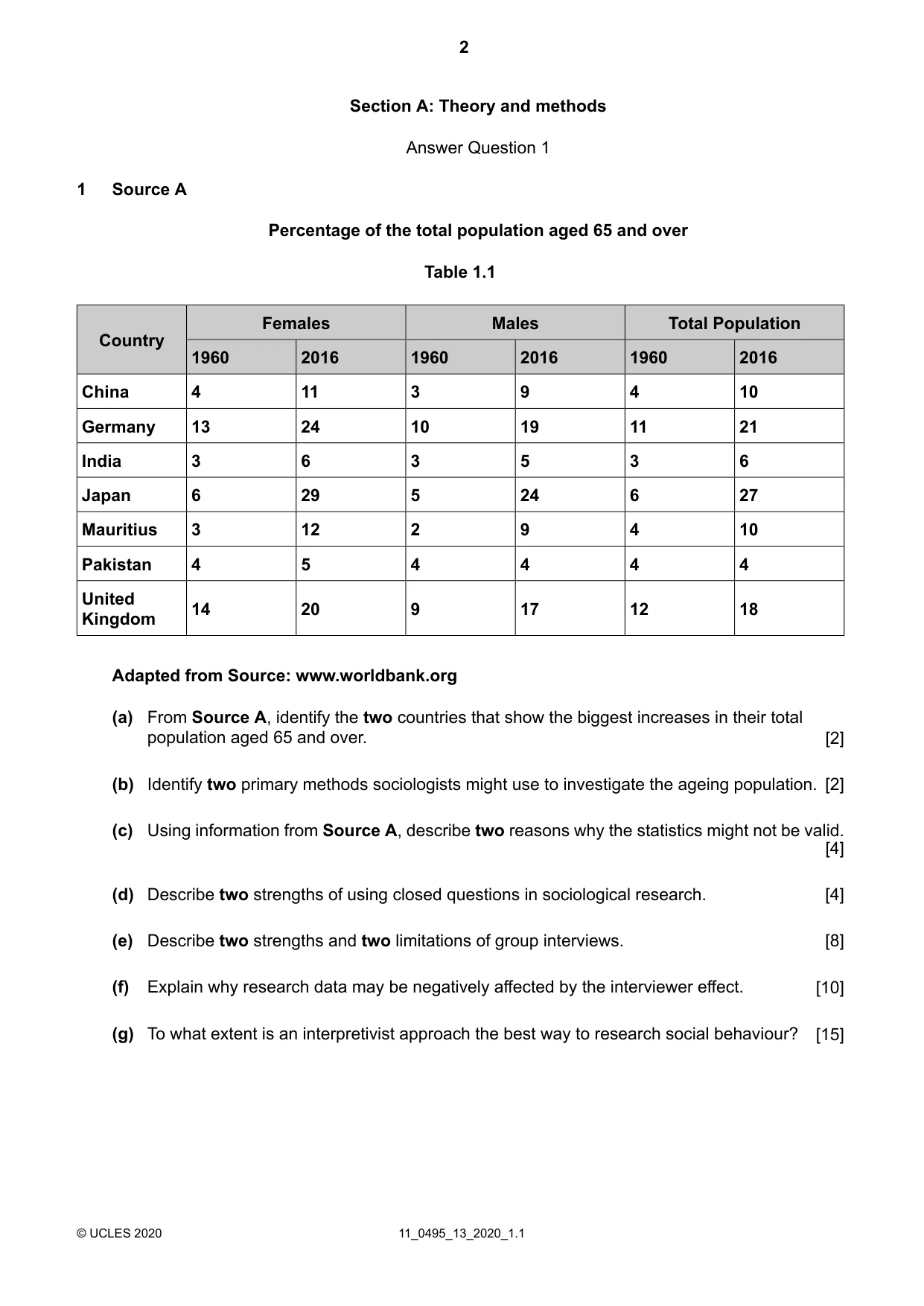
Section A: Theory and methods Answer Question 1 Source A 1 Percentage of the total population aged 65 and over Table 1.1 Total Population Males Females Country 2016 1960 2016 1960 2016 1960 10 4 9 3 11 4 China 21 11 19 10 24 13 Germany 6 3 5 3 6 3 India 27 6 24 5 29 6 Japan 10 4 9 2 12 3 Mauritius 4 4 4 4 5 4 Pakistan 18 12 17 9 20 14 United Kingdom Adapted from Source: www.worldbank.org From Source A, identify the two countries that show the biggest increases in their total population aged 65 and over. [2] (a) Identify two primary methods sociologists might use to investigate the ageing population. [2] (b) Using information from Source A, describe two reasons why the statistics might not be valid. [4] (c) Describe two strengths of using closed questions in sociological research. [4] (d) Describe two strengths and two limitations of group interviews. [8] (e) Explain why research data may be negatively affected by the interviewer effect. [10] (f) To what extent is an interpretivist approach the best way to research social behaviour? [15] (g) 11_0495_13_2020_1.1 © UCLES 2020 2
Question paper, page 3
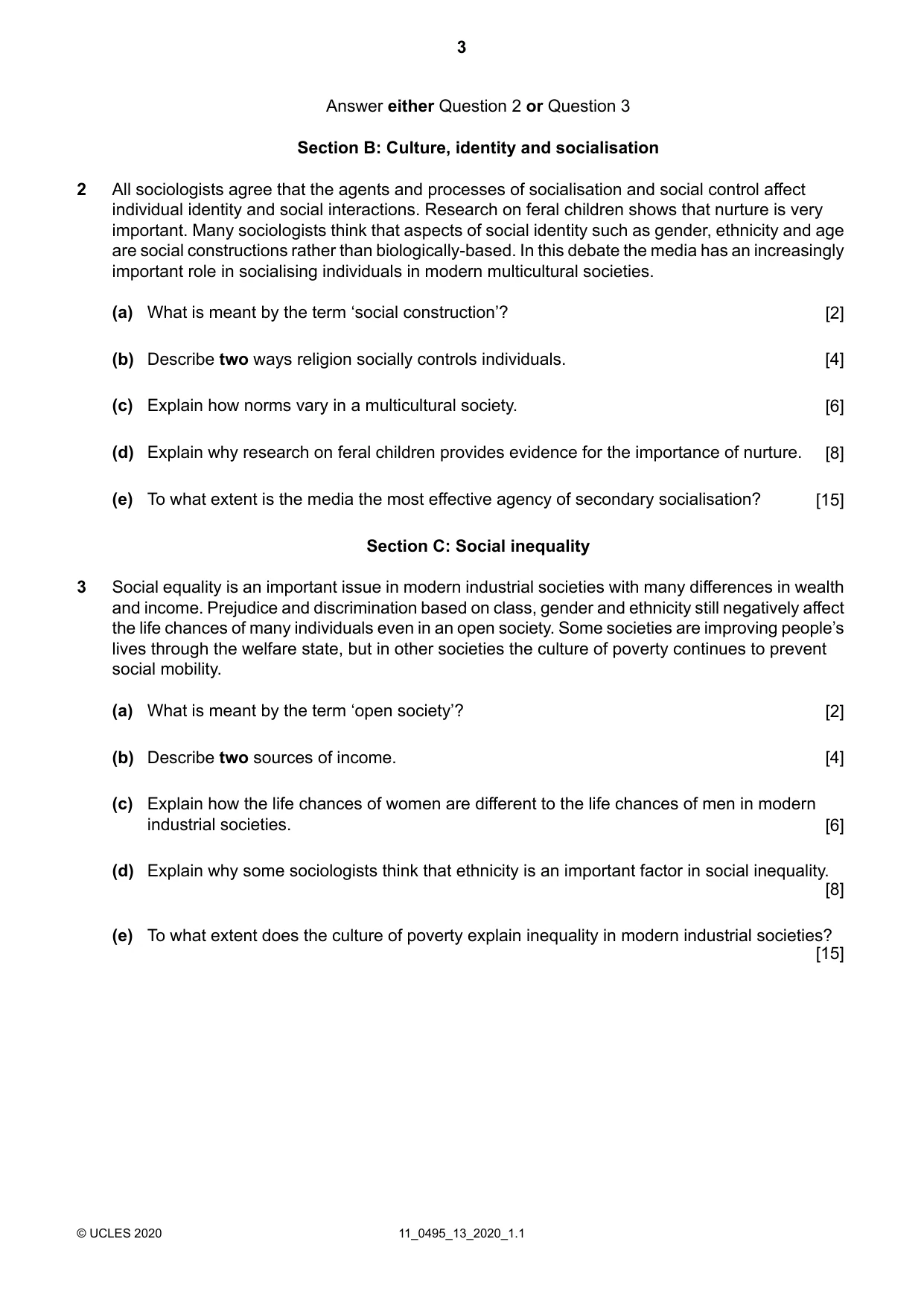
Answer either Question 2 or Question 3 Section B: Culture, identity and socialisation All sociologists agree that the agents and processes of socialisation and social control affect individual identity and social interactions. Research on feral children shows that nurture is very 2 important. Many sociologists think that aspects of social identity such as gender, ethnicity and age are social constructions rather than biologically-based. In this debate the media has an increasingly important role in socialising individuals in modern multicultural societies. What is meant by the term ‘social construction’? [2] (a) Describe two ways religion socially controls individuals. [4] (b) Explain how norms vary in a multicultural society. [6] (c) Explain why research on feral children provides evidence for the importance of nurture. [8] (d) To what extent is the media the most effective agency of secondary socialisation? [15] (e) Section C: Social inequality Social equality is an important issue in modern industrial societies with many differences in wealth and income. Prejudice and discrimination based on class, gender and ethnicity still negatively affect 3 the life chances of many individuals even in an open society. Some societies are improving people’s lives through the welfare state, but in other societies the culture of poverty continues to prevent social mobility. What is meant by the term ‘open society’? [2] (a) Describe two sources of income. [4] (b) Explain how the life chances of women are different to the life chances of men in modern industrial societies. [6] (c) Explain why some sociologists think that ethnicity is an important factor in social inequality. [8] (d) To what extent does the culture of poverty explain inequality in modern industrial societies? [15] (e) 11_0495_13_2020_1.1 © UCLES 2020 3
Question paper, page 4
BLANK PAGE Permission to reproduce items where third-party owned material protected by copyright is included has been sought and cleared where possible. Every reasonable effort has been made by the publisher (UCLES) to trace copyright holders, but if any items requiring clearance have unwittingly been included, the publisher will be pleased to make amends at the earliest possible opportunity. To avoid the issue of disclosure of answer-related information to candidates, all copyright acknowledgements are reproduced online in the Cambridge Assessment International Education Copyright Acknowledgements Booklet. This is produced for each series of examinations and is freely available to download at www.cambridgeinternational.org after the live examination series. Cambridge Assessment International Education is part of the Cambridge Assessment Group. Cambridge Assessment is the brand name of the University of Cambridge Local Examinations Syndicate (UCLES), which itself is a department of the University of Cambridge. 11_0495_13_2020_1.1 © UCLES 2020 4
Mark scheme, page 1
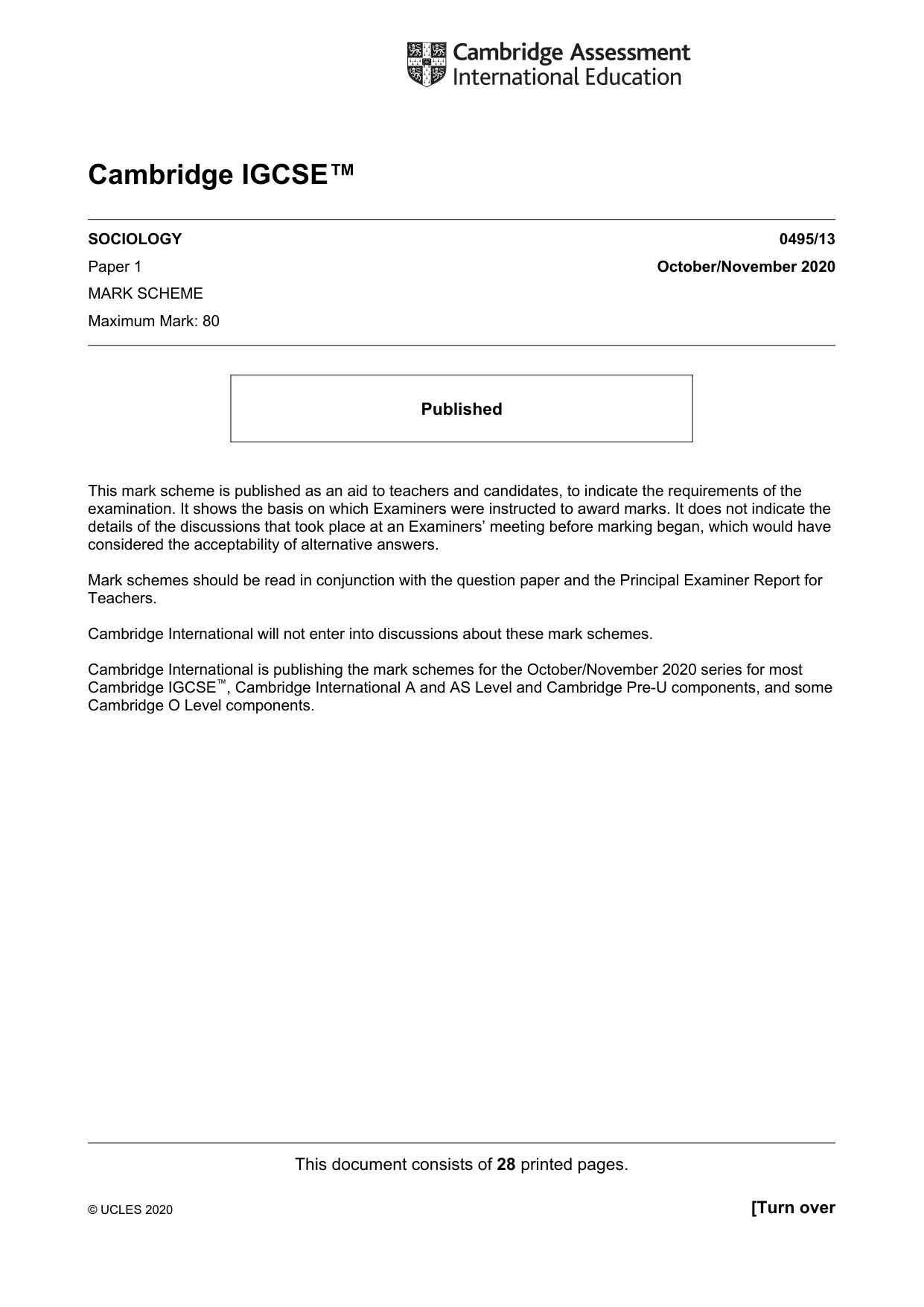
This document consists of 28 printed pages. © UCLES 2020 [Turn over Cambridge IGCSE™ SOCIOLOGY 0495/13 Paper 1 October/November 2020 MARK SCHEME Maximum Mark: 80 Published This mark scheme is published as an aid to teachers and candidates, to indicate the requirements of the examination. It shows the basis on which Examiners were instructed to award marks. It does not indicate the details of the discussions that took place at an Examiners’ meeting before marking began, which would have considered the acceptability of alternative answers. Mark schemes should be read in conjunction with the question paper and the Principal Examiner Report for Teachers. Cambridge International will not enter into discussions about these mark schemes. Cambridge International is publishing the mark schemes for the October/November 2020 series for most Cambridge IGCSE™, Cambridge International A and AS Level and Cambridge Pre-U components, and some Cambridge O Level components.
Mark scheme, page 2
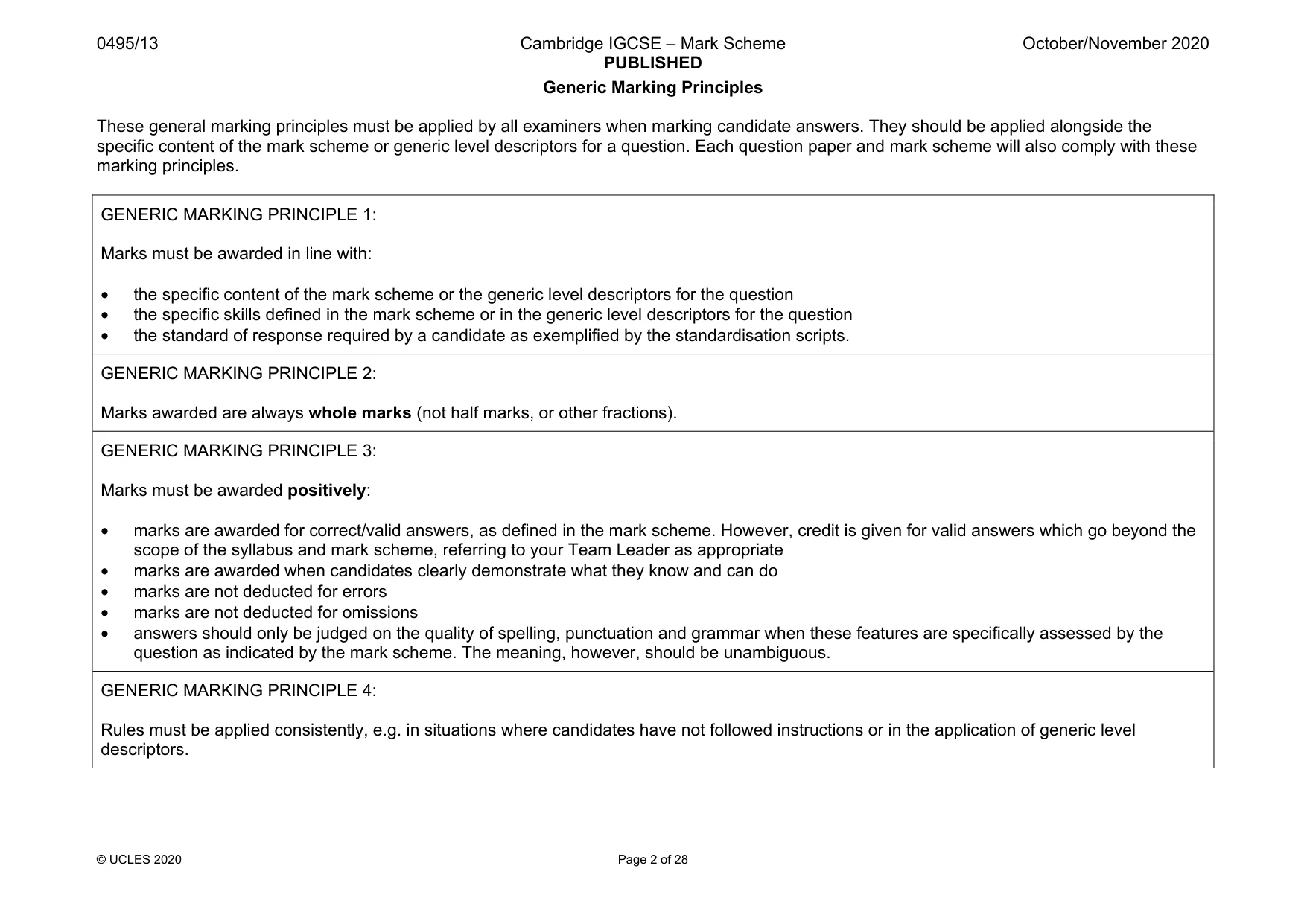
0495/13 Cambridge IGCSE – Mark Scheme PUBLISHED October/November 2020 © UCLES 2020 Page 2 of 28 Generic Marking Principles These general marking principles must be applied by all examiners when marking candidate answers. They should be applied alongside the specific content of the mark scheme or generic level descriptors for a question. Each question paper and mark scheme will also comply with these marking principles. GENERIC MARKING PRINCIPLE 1: Marks must be awarded in line with: • the specific content of the mark scheme or the generic level descriptors for the question • the specific skills defined in the mark scheme or in the generic level descriptors for the question • the standard of response required by a candidate as exemplified by the standardisation scripts. GENERIC MARKING PRINCIPLE 2: Marks awarded are always whole marks (not half marks, or other fractions). GENERIC MARKING PRINCIPLE 3: Marks must be awarded positively: • marks are awarded for correct/valid answers, as defined in the mark scheme. However, credit is given for valid answers which go beyond the scope of the syllabus and mark scheme, referring to your Team Leader as appropriate • marks are awarded when candidates clearly demonstrate what they know and can do • marks are not deducted for errors • marks are not deducted for omissions • answers should only be judged on the quality of spelling, punctuation and grammar when these features are specifically assessed by the question as indicated by the mark scheme. The meaning, however, should be unambiguous. GENERIC MARKING PRINCIPLE 4: Rules must be applied consistently, e.g. in situations where candidates have not followed instructions or in the application of generic level descriptors.
Mark scheme, page 3
0495/13 Cambridge IGCSE – Mark Scheme PUBLISHED October/November 2020 © UCLES 2020 Page 3 of 28 GENERIC MARKING PRINCIPLE 5: Marks should be awarded using the full range of marks defined in the mark scheme for the question (however; the use of the full mark range may be limited according to the quality of the candidate responses seen). GENERIC MARKING PRINCIPLE 6: Marks awarded are based solely on the requirements as defined in the mark scheme. Marks should not be awarded with grade thresholds or grade descriptors in mind.
Mark scheme, page 4
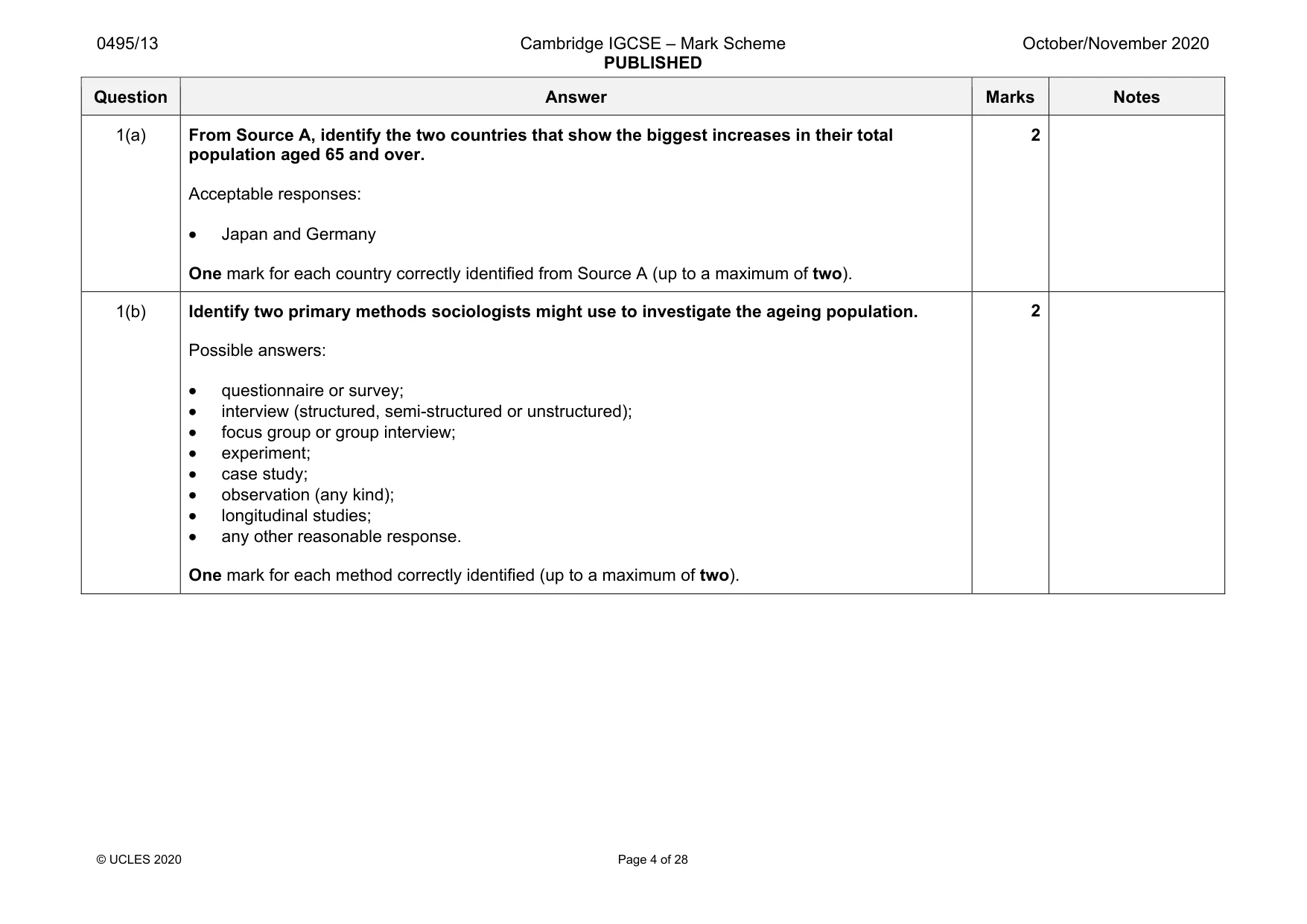
0495/13 Cambridge IGCSE – Mark Scheme PUBLISHED October/November 2020 © UCLES 2020 Page 4 of 28 Question Answer Marks Notes 1(a) From Source A, identify the two countries that show the biggest increases in their total population aged 65 and over. Acceptable responses: • Japan and Germany One mark for each country correctly identified from Source A (up to a maximum of two). 2 1(b) Identify two primary methods sociologists might use to investigate the ageing population. Possible answers: • questionnaire or survey; • interview (structured, semi-structured or unstructured); • focus group or group interview; • experiment; • case study; • observation (any kind); • longitudinal studies; • any other reasonable response. One mark for each method correctly identified (up to a maximum of two). 2
Mark scheme, page 5
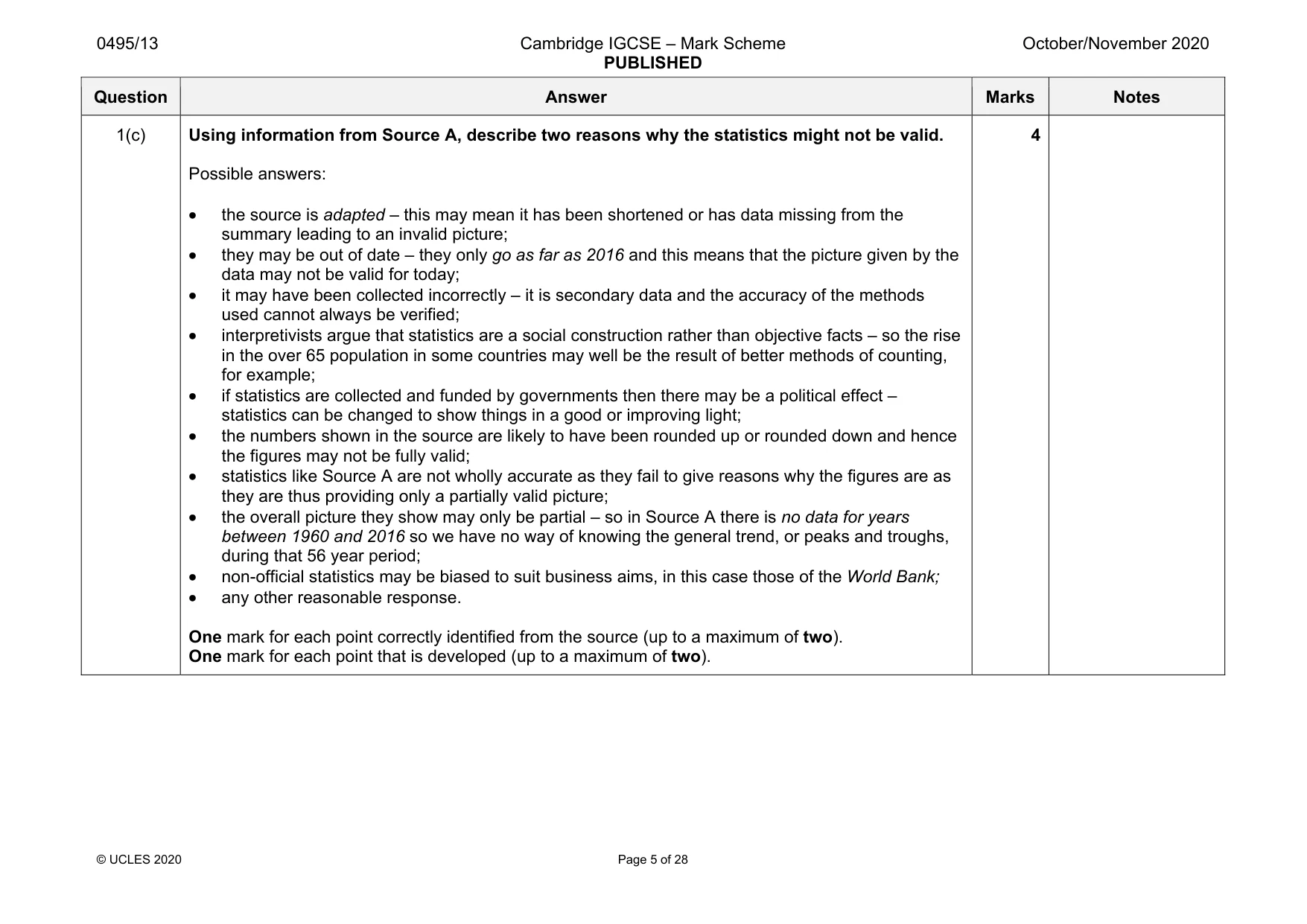
0495/13 Cambridge IGCSE – Mark Scheme PUBLISHED October/November 2020 © UCLES 2020 Page 5 of 28 Question Answer Marks Notes 1(c) Using information from Source A, describe two reasons why the statistics might not be valid. Possible answers: • the source is adapted – this may mean it has been shortened or has data missing from the summary leading to an invalid picture; • they may be out of date – they only go as far as 2016 and this means that the picture given by the data may not be valid for today; • it may have been collected incorrectly – it is secondary data and the accuracy of the methods used cannot always be verified; • interpretivists argue that statistics are a social construction rather than objective facts – so the rise in the over 65 population in some countries may well be the result of better methods of counting, for example; • if statistics are collected and funded by governments then there may be a political effect – statistics can be changed to show things in a good or improving light; • the numbers shown in the source are likely to have been rounded up or rounded down and hence the figures may not be fully valid; • statistics like Source A are not wholly accurate as they fail to give reasons why the figures are as they are thus providing only a partially valid picture; • the overall picture they show may only be partial – so in Source A there is no data for years between 1960 and 2016 so we have no way of knowing the general trend, or peaks and troughs, during that 56 year period; • non-official statistics may be biased to suit business aims, in this case those of the World Bank; • any other reasonable response. One mark for each point correctly identified from the source (up to a maximum of two). One mark for each point that is developed (up to a maximum of two). 4
Mark scheme, page 6
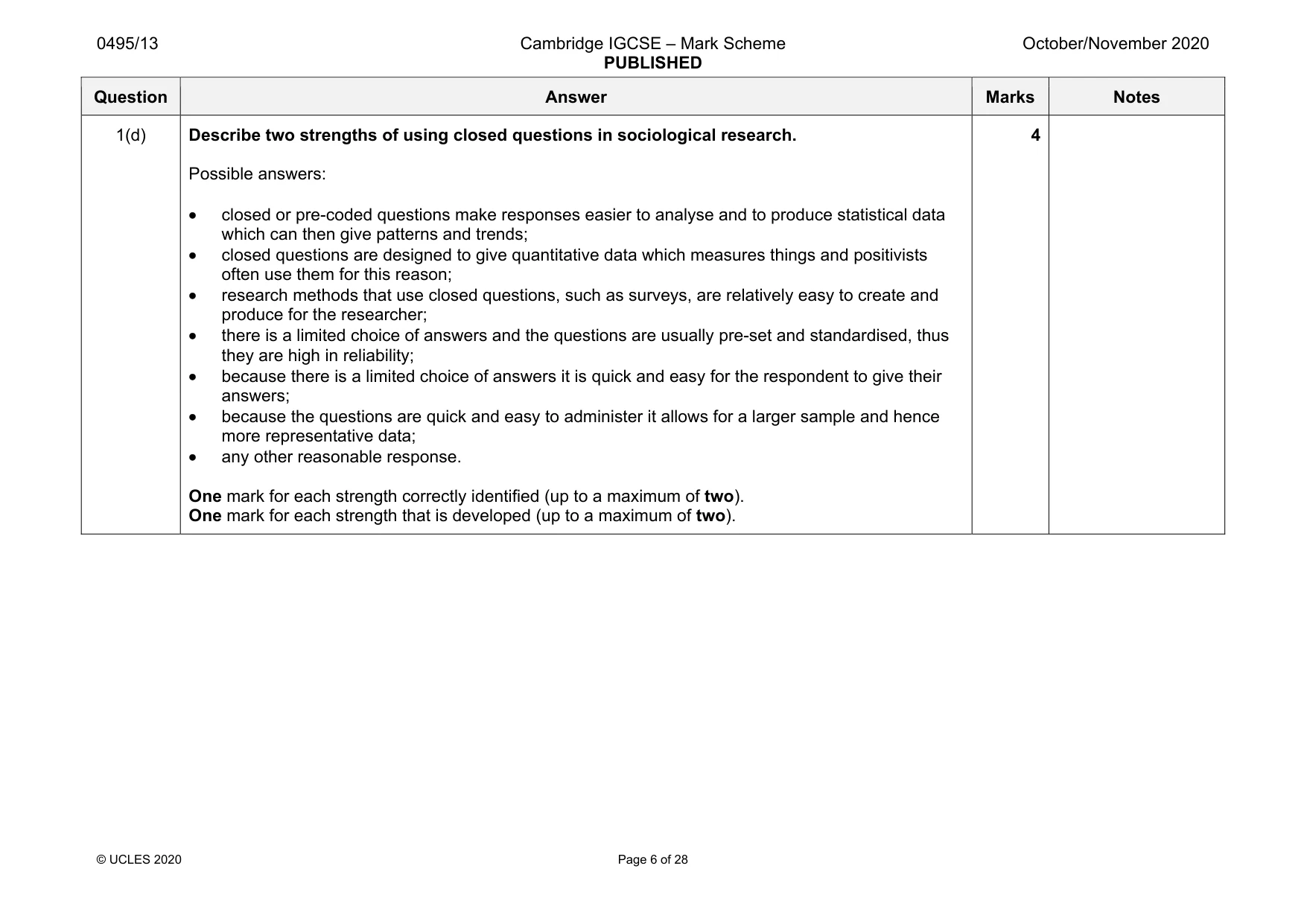
0495/13 Cambridge IGCSE – Mark Scheme PUBLISHED October/November 2020 © UCLES 2020 Page 6 of 28 Question Answer Marks Notes 1(d) Describe two strengths of using closed questions in sociological research. Possible answers: • closed or pre-coded questions make responses easier to analyse and to produce statistical data which can then give patterns and trends; • closed questions are designed to give quantitative data which measures things and positivists often use them for this reason; • research methods that use closed questions, such as surveys, are relatively easy to create and produce for the researcher; • there is a limited choice of answers and the questions are usually pre-set and standardised, thus they are high in reliability; • because there is a limited choice of answers it is quick and easy for the respondent to give their answers; • because the questions are quick and easy to administer it allows for a larger sample and hence more representative data; • any other reasonable response. One mark for each strength correctly identified (up to a maximum of two). One mark for each strength that is developed (up to a maximum of two). 4
Mark scheme, page 7
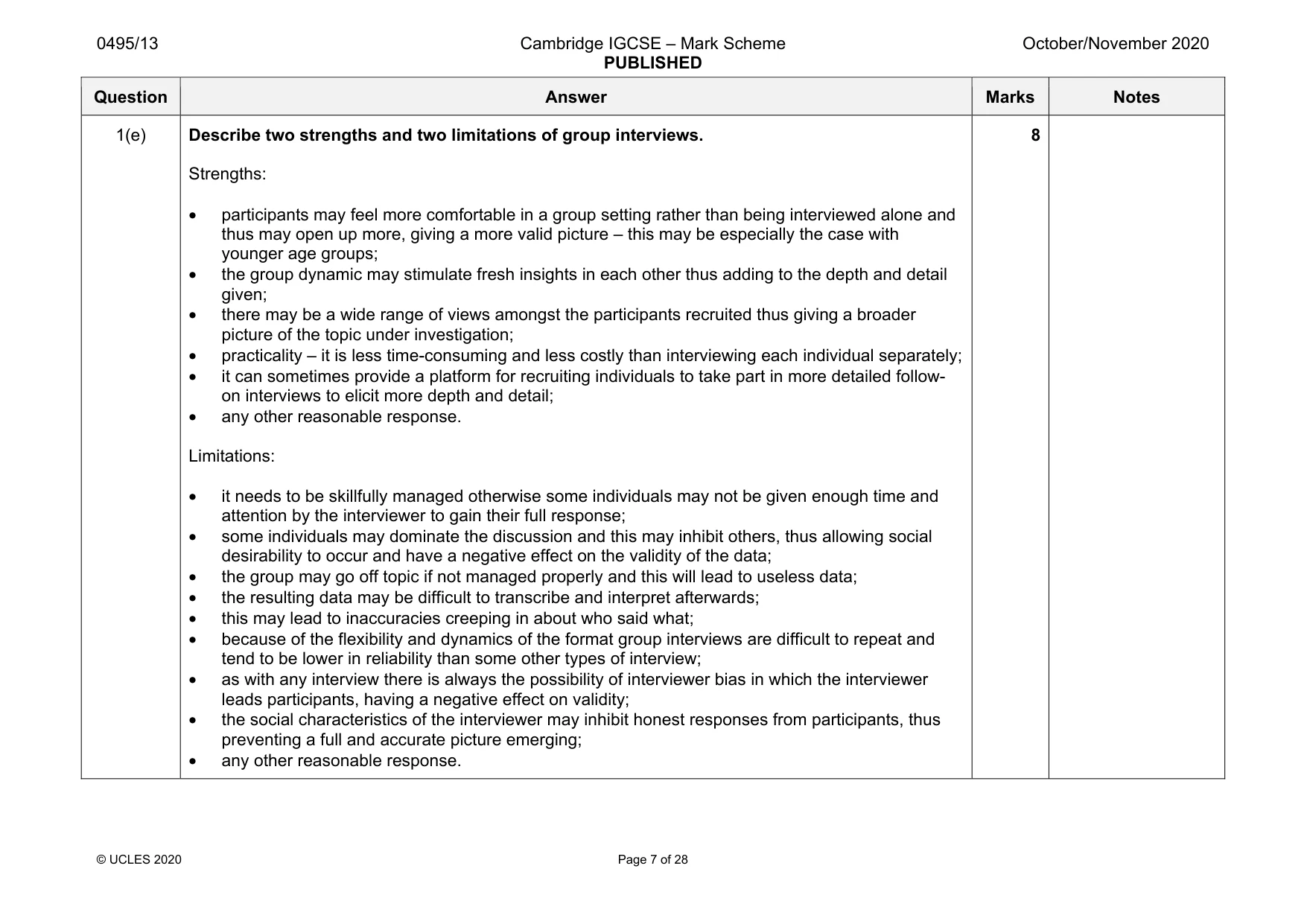
0495/13 Cambridge IGCSE – Mark Scheme PUBLISHED October/November 2020 © UCLES 2020 Page 7 of 28 Question Answer Marks Notes 1(e) Describe two strengths and two limitations of group interviews. Strengths: • participants may feel more comfortable in a group setting rather than being interviewed alone and thus may open up more, giving a more valid picture – this may be especially the case with younger age groups; • the group dynamic may stimulate fresh insights in each other thus adding to the depth and detail given; • there may be a wide range of views amongst the participants recruited thus giving a broader picture of the topic under investigation; • practicality – it is less time-consuming and less costly than interviewing each individual separately; • it can sometimes provide a platform for recruiting individuals to take part in more detailed follow- on interviews to elicit more depth and detail; • any other reasonable response. Limitations: • it needs to be skillfully managed otherwise some individuals may not be given enough time and attention by the interviewer to gain their full response; • some individuals may dominate the discussion and this may inhibit others, thus allowing social desirability to occur and have a negative effect on the validity of the data; • the group may go off topic if not managed properly and this will lead to useless data; • the resulting data may be difficult to transcribe and interpret afterwards; • this may lead to inaccuracies creeping in about who said what; • because of the flexibility and dynamics of the format group interviews are difficult to repeat and tend to be lower in reliability than some other types of interview; • as with any interview there is always the possibility of interviewer bias in which the interviewer leads participants, having a negative effect on validity; • the social characteristics of the interviewer may inhibit honest responses from participants, thus preventing a full and accurate picture emerging; • any other reasonable response. 8
Mark scheme, page 8
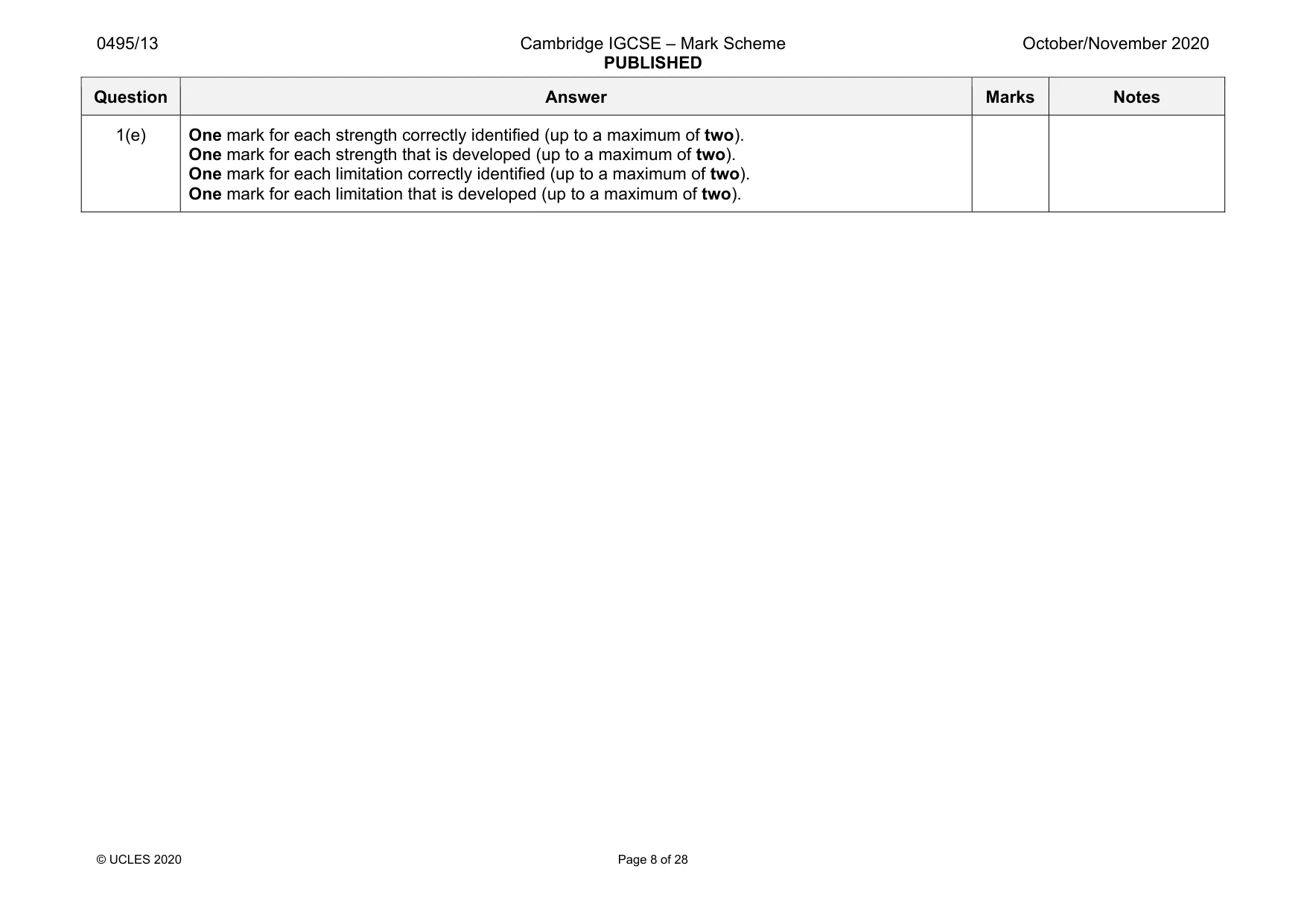
0495/13 Cambridge IGCSE – Mark Scheme PUBLISHED October/November 2020 © UCLES 2020 Page 8 of 28 Question Answer Marks Notes 1(e) One mark for each strength correctly identified (up to a maximum of two). One mark for each strength that is developed (up to a maximum of two). One mark for each limitation correctly identified (up to a maximum of two). One mark for each limitation that is developed (up to a maximum of two).
Mark scheme, page 9
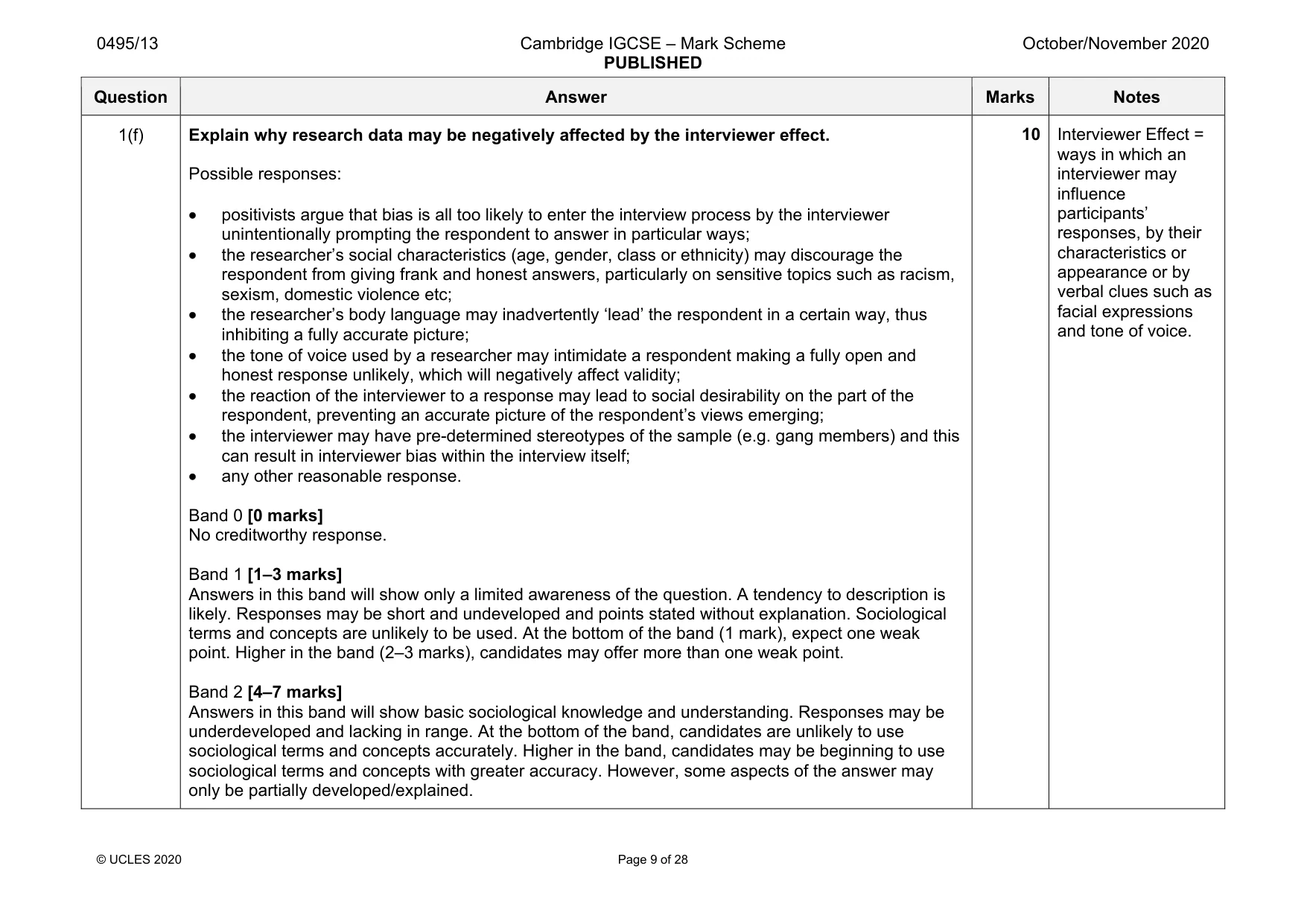
0495/13 Cambridge IGCSE – Mark Scheme PUBLISHED October/November 2020 © UCLES 2020 Page 9 of 28 Question Answer Marks Notes 1(f) Explain why research data may be negatively affected by the interviewer effect. Possible responses: • positivists argue that bias is all too likely to enter the interview process by the interviewer unintentionally prompting the respondent to answer in particular ways; • the researcher’s social characteristics (age, gender, class or ethnicity) may discourage the respondent from giving frank and honest answers, particularly on sensitive topics such as racism, sexism, domestic violence etc; • the researcher’s body language may inadvertently ‘lead’ the respondent in a certain way, thus inhibiting a fully accurate picture; • the tone of voice used by a researcher may intimidate a respondent making a fully open and honest response unlikely, which will negatively affect validity; • the reaction of the interviewer to a response may lead to social desirability on the part of the respondent, preventing an accurate picture of the respondent’s views emerging; • the interviewer may have pre-determined stereotypes of the sample (e.g. gang members) and this can result in interviewer bias within the interview itself; • any other reasonable response. Band 0 [0 marks] No creditworthy response. Band 1 [1–3 marks] Answers in this band will show only a limited awareness of the question. A tendency to description is likely. Responses may be short and undeveloped and points stated without explanation. Sociological terms and concepts are unlikely to be used. At the bottom of the band (1 mark), expect one weak point. Higher in the band (2–3 marks), candidates may offer more than one weak point. Band 2 [4–7 marks] Answers in this band will show basic sociological knowledge and understanding. Responses may be underdeveloped and lacking in range. At the bottom of the band, candidates are unlikely to use sociological terms and concepts accurately. Higher in the band, candidates may be beginning to use sociological terms and concepts with greater accuracy. However, some aspects of the answer may only be partially developed/explained. 10 Interviewer Effect = ways in which an interviewer may influence participants’ responses, by their characteristics or appearance or by verbal clues such as facial expressions and tone of voice.
Mark scheme, page 10
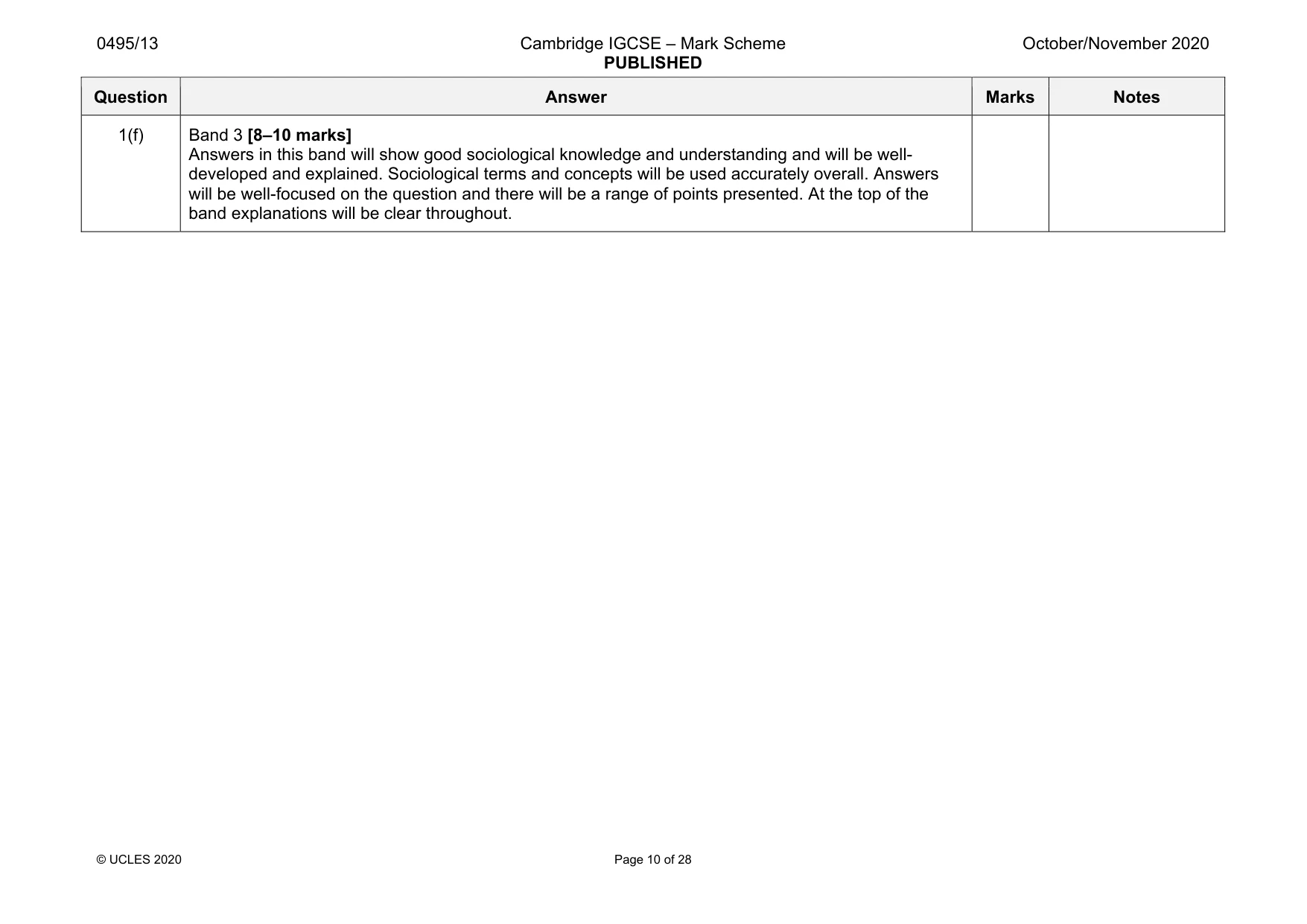
0495/13 Cambridge IGCSE – Mark Scheme PUBLISHED October/November 2020 © UCLES 2020 Page 10 of 28 Question Answer Marks Notes 1(f) Band 3 [8–10 marks] Answers in this band will show good sociological knowledge and understanding and will be well- developed and explained. Sociological terms and concepts will be used accurately overall. Answers will be well-focused on the question and there will be a range of points presented. At the top of the band explanations will be clear throughout.
Mark scheme, page 11
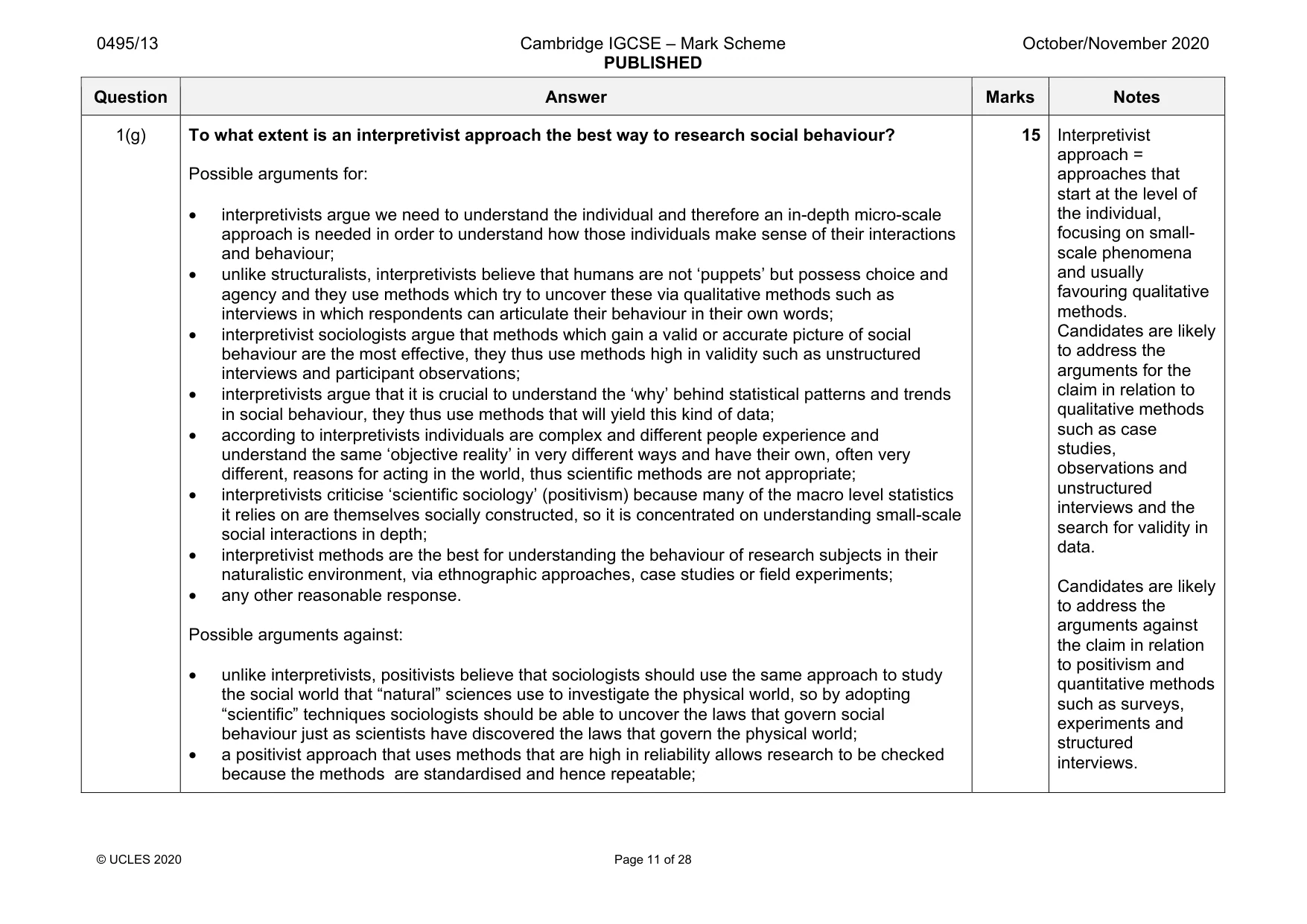
0495/13 Cambridge IGCSE – Mark Scheme PUBLISHED October/November 2020 © UCLES 2020 Page 11 of 28 Question Answer Marks Notes 1(g) To what extent is an interpretivist approach the best way to research social behaviour? Possible arguments for: • interpretivists argue we need to understand the individual and therefore an in-depth micro-scale approach is needed in order to understand how those individuals make sense of their interactions and behaviour; • unlike structuralists, interpretivists believe that humans are not ‘puppets’ but possess choice and agency and they use methods which try to uncover these via qualitative methods such as interviews in which respondents can articulate their behaviour in their own words; • interpretivist sociologists argue that methods which gain a valid or accurate picture of social behaviour are the most effective, they thus use methods high in validity such as unstructured interviews and participant observations; • interpretivists argue that it is crucial to understand the ‘why’ behind statistical patterns and trends in social behaviour, they thus use methods that will yield this kind of data; • according to interpretivists individuals are complex and different people experience and understand the same ‘objective reality’ in very different ways and have their own, often very different, reasons for acting in the world, thus scientific methods are not appropriate; • interpretivists criticise ‘scientific sociology’ (positivism) because many of the macro level statistics it relies on are themselves socially constructed, so it is concentrated on understanding small-scale social interactions in depth; • interpretivist methods are the best for understanding the behaviour of research subjects in their naturalistic environment, via ethnographic approaches, case studies or field experiments; • any other reasonable response. Possible arguments against: • unlike interpretivists, positivists believe that sociologists should use the same approach to study the social world that “natural” sciences use to investigate the physical world, so by adopting “scientific” techniques sociologists should be able to uncover the laws that govern social behaviour just as scientists have discovered the laws that govern the physical world; • a positivist approach that uses methods that are high in reliability allows research to be checked because the methods are standardised and hence repeatable; 15 Interpretivist approach = approaches that start at the level of the individual, focusing on small- scale phenomena and usually favouring qualitative methods. Candidates are likely to address the arguments for the claim in relation to qualitative methods such as case studies, observations and unstructured interviews and the search for validity in data. Candidates are likely to address the arguments against the claim in relation to positivism and quantitative methods such as surveys, experiments and structured interviews.
Mark scheme, page 12
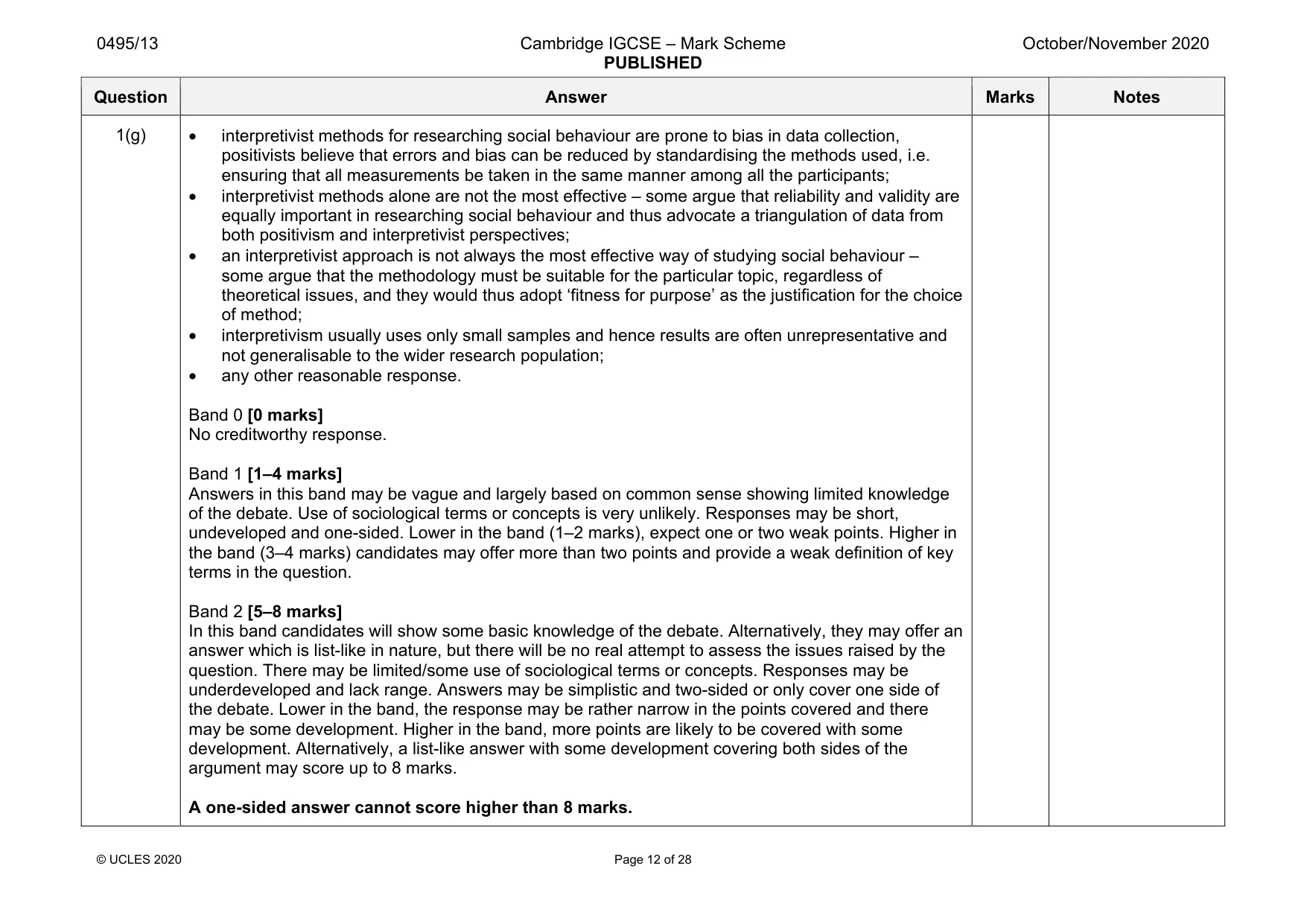
0495/13 Cambridge IGCSE – Mark Scheme PUBLISHED October/November 2020 © UCLES 2020 Page 12 of 28 Question Answer Marks Notes 1(g) • interpretivist methods for researching social behaviour are prone to bias in data collection, positivists believe that errors and bias can be reduced by standardising the methods used, i.e. ensuring that all measurements be taken in the same manner among all the participants; • interpretivist methods alone are not the most effective – some argue that reliability and validity are equally important in researching social behaviour and thus advocate a triangulation of data from both positivism and interpretivist perspectives; • an interpretivist approach is not always the most effective way of studying social behaviour – some argue that the methodology must be suitable for the particular topic, regardless of theoretical issues, and they would thus adopt ‘fitness for purpose’ as the justification for the choice of method; • interpretivism usually uses only small samples and hence results are often unrepresentative and not generalisable to the wider research population; • any other reasonable response. Band 0 [0 marks] No creditworthy response. Band 1 [1–4 marks] Answers in this band may be vague and largely based on common sense showing limited knowledge of the debate. Use of sociological terms or concepts is very unlikely. Responses may be short, undeveloped and one-sided. Lower in the band (1–2 marks), expect one or two weak points. Higher in the band (3–4 marks) candidates may offer more than two points and provide a weak definition of key terms in the question. Band 2 [5–8 marks] In this band candidates will show some basic knowledge of the debate. Alternatively, they may offer an answer which is list-like in nature, but there will be no real attempt to assess the issues raised by the question. There may be limited/some use of sociological terms or concepts. Responses may be underdeveloped and lack range. Answers may be simplistic and two-sided or only cover one side of the debate. Lower in the band, the response may be rather narrow in the points covered and there may be some development. Higher in the band, more points are likely to be covered with some development. Alternatively, a list-like answer with some development covering both sides of the argument may score up to 8 marks. A one-sided answer cannot score higher than 8 marks.
Mark scheme, page 13
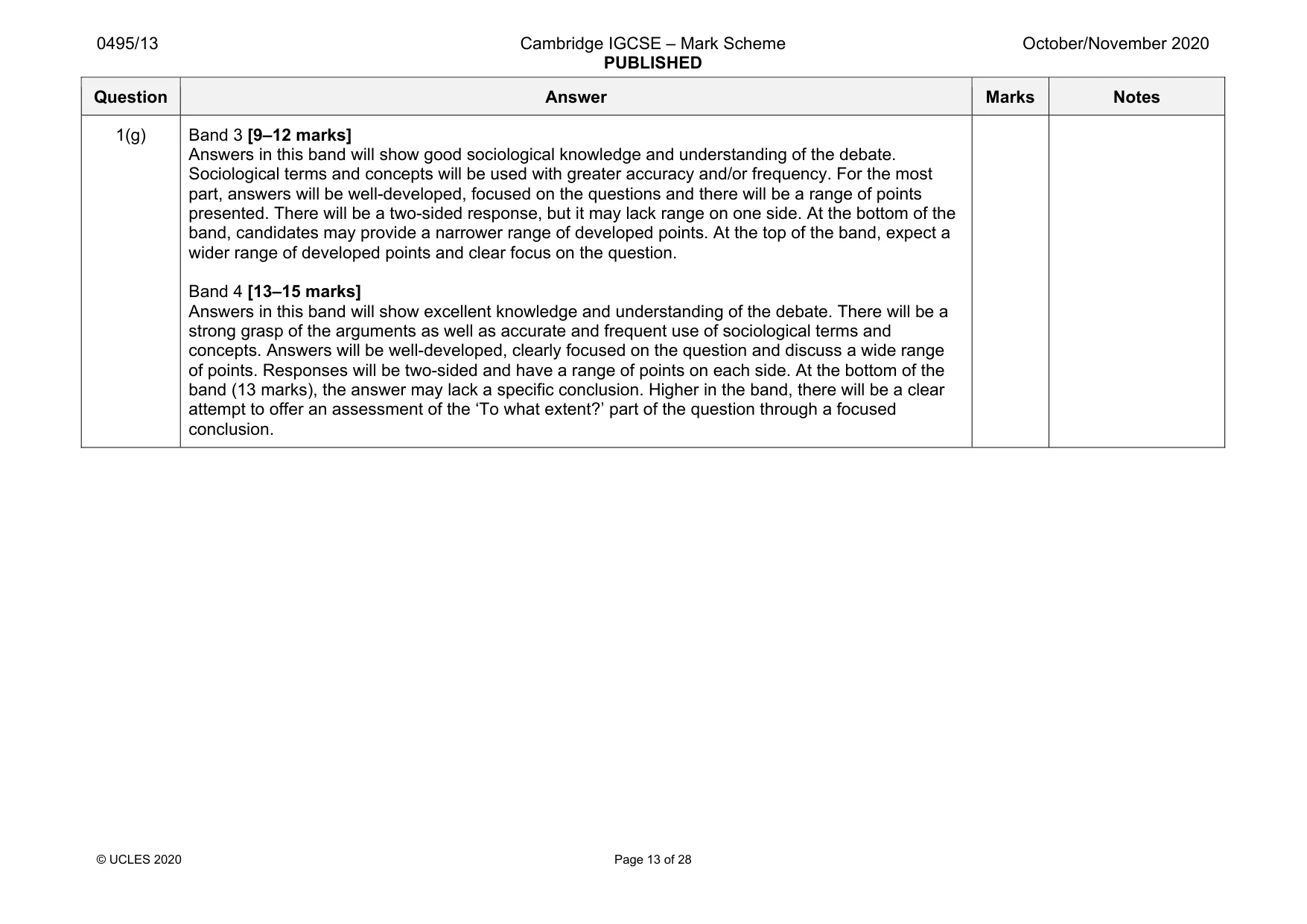
0495/13 Cambridge IGCSE – Mark Scheme PUBLISHED October/November 2020 © UCLES 2020 Page 13 of 28 Question Answer Marks Notes 1(g) Band 3 [9–12 marks] Answers in this band will show good sociological knowledge and understanding of the debate. Sociological terms and concepts will be used with greater accuracy and/or frequency. For the most part, answers will be well-developed, focused on the questions and there will be a range of points presented. There will be a two-sided response, but it may lack range on one side. At the bottom of the band, candidates may provide a narrower range of developed points. At the top of the band, expect a wider range of developed points and clear focus on the question. Band 4 [13–15 marks] Answers in this band will show excellent knowledge and understanding of the debate. There will be a strong grasp of the arguments as well as accurate and frequent use of sociological terms and concepts. Answers will be well-developed, clearly focused on the question and discuss a wide range of points. Responses will be two-sided and have a range of points on each side. At the bottom of the band (13 marks), the answer may lack a specific conclusion. Higher in the band, there will be a clear attempt to offer an assessment of the ‘To what extent?’ part of the question through a focused conclusion.
Mark scheme, page 14
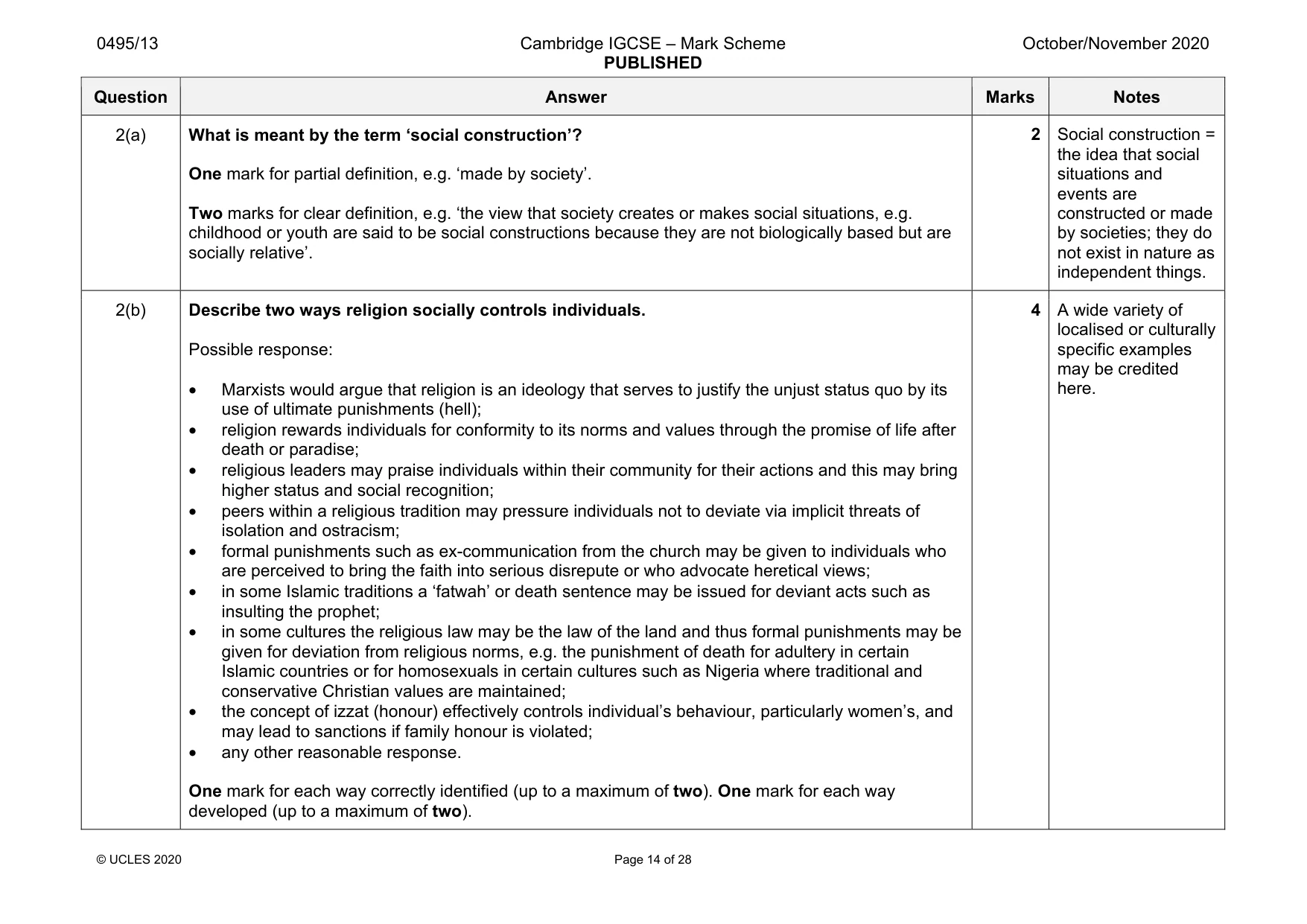
0495/13 Cambridge IGCSE – Mark Scheme PUBLISHED October/November 2020 © UCLES 2020 Page 14 of 28 Question Answer Marks Notes 2(a) What is meant by the term ‘social construction’? One mark for partial definition, e.g. ‘made by society’. Two marks for clear definition, e.g. ‘the view that society creates or makes social situations, e.g. childhood or youth are said to be social constructions because they are not biologically based but are socially relative’. 2 Social construction = the idea that social situations and events are constructed or made by societies; they do not exist in nature as independent things. 2(b) Describe two ways religion socially controls individuals. Possible response: • Marxists would argue that religion is an ideology that serves to justify the unjust status quo by its use of ultimate punishments (hell); • religion rewards individuals for conformity to its norms and values through the promise of life after death or paradise; • religious leaders may praise individuals within their community for their actions and this may bring higher status and social recognition; • peers within a religious tradition may pressure individuals not to deviate via implicit threats of isolation and ostracism; • formal punishments such as ex-communication from the church may be given to individuals who are perceived to bring the faith into serious disrepute or who advocate heretical views; • in some Islamic traditions a ‘fatwah’ or death sentence may be issued for deviant acts such as insulting the prophet; • in some cultures the religious law may be the law of the land and thus formal punishments may be given for deviation from religious norms, e.g. the punishment of death for adultery in certain Islamic countries or for homosexuals in certain cultures such as Nigeria where traditional and conservative Christian values are maintained; • the concept of izzat (honour) effectively controls individual’s behaviour, particularly women’s, and may lead to sanctions if family honour is violated; • any other reasonable response. One mark for each way correctly identified (up to a maximum of two). One mark for each way developed (up to a maximum of two). 4 A wide variety of localised or culturally specific examples may be credited here.
Mark scheme, page 15
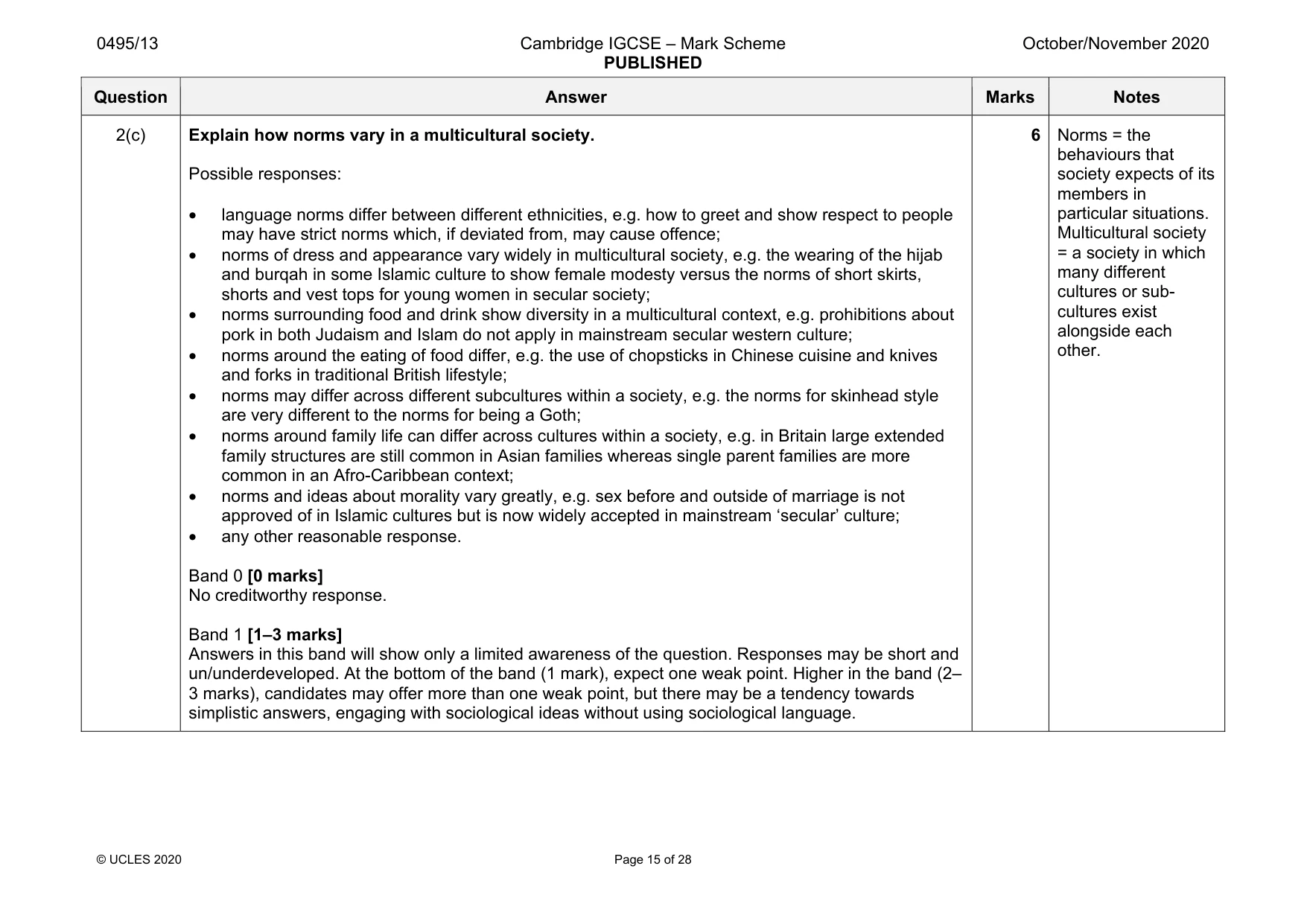
0495/13 Cambridge IGCSE – Mark Scheme PUBLISHED October/November 2020 © UCLES 2020 Page 15 of 28 Question Answer Marks Notes 2(c) Explain how norms vary in a multicultural society. Possible responses: • language norms differ between different ethnicities, e.g. how to greet and show respect to people may have strict norms which, if deviated from, may cause offence; • norms of dress and appearance vary widely in multicultural society, e.g. the wearing of the hijab and burqah in some Islamic culture to show female modesty versus the norms of short skirts, shorts and vest tops for young women in secular society; • norms surrounding food and drink show diversity in a multicultural context, e.g. prohibitions about pork in both Judaism and Islam do not apply in mainstream secular western culture; • norms around the eating of food differ, e.g. the use of chopsticks in Chinese cuisine and knives and forks in traditional British lifestyle; • norms may differ across different subcultures within a society, e.g. the norms for skinhead style are very different to the norms for being a Goth; • norms around family life can differ across cultures within a society, e.g. in Britain large extended family structures are still common in Asian families whereas single parent families are more common in an Afro-Caribbean context; • norms and ideas about morality vary greatly, e.g. sex before and outside of marriage is not approved of in Islamic cultures but is now widely accepted in mainstream ‘secular’ culture; • any other reasonable response. Band 0 [0 marks] No creditworthy response. Band 1 [1–3 marks] Answers in this band will show only a limited awareness of the question. Responses may be short and un/underdeveloped. At the bottom of the band (1 mark), expect one weak point. Higher in the band (2– 3 marks), candidates may offer more than one weak point, but there may be a tendency towards simplistic answers, engaging with sociological ideas without using sociological language. 6 Norms = the behaviours that society expects of its members in particular situations. Multicultural society = a society in which many different cultures or sub- cultures exist alongside each other.
Mark scheme, page 16
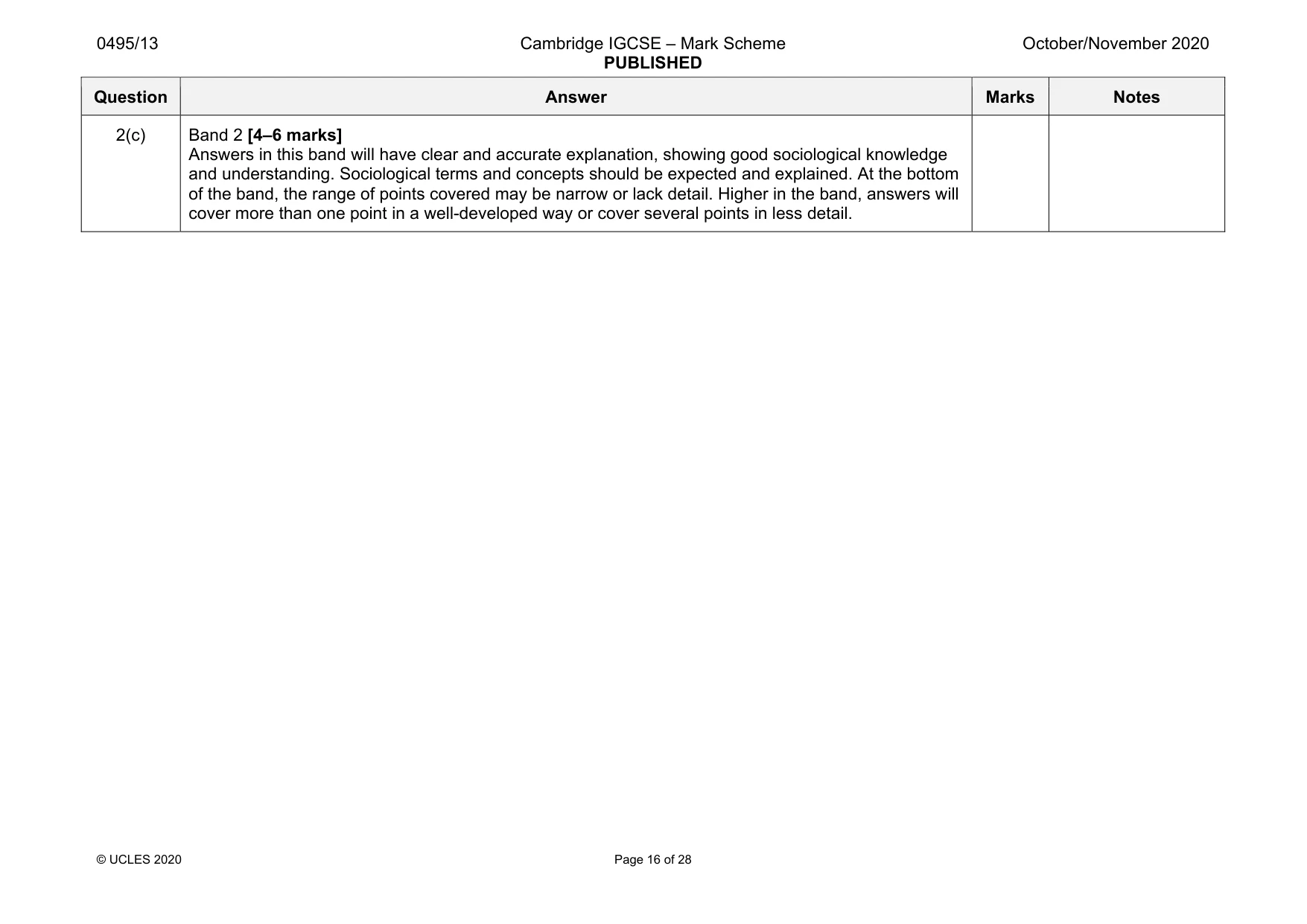
0495/13 Cambridge IGCSE – Mark Scheme PUBLISHED October/November 2020 © UCLES 2020 Page 16 of 28 Question Answer Marks Notes 2(c) Band 2 [4–6 marks] Answers in this band will have clear and accurate explanation, showing good sociological knowledge and understanding. Sociological terms and concepts should be expected and explained. At the bottom of the band, the range of points covered may be narrow or lack detail. Higher in the band, answers will cover more than one point in a well-developed way or cover several points in less detail.
Mark scheme, page 17
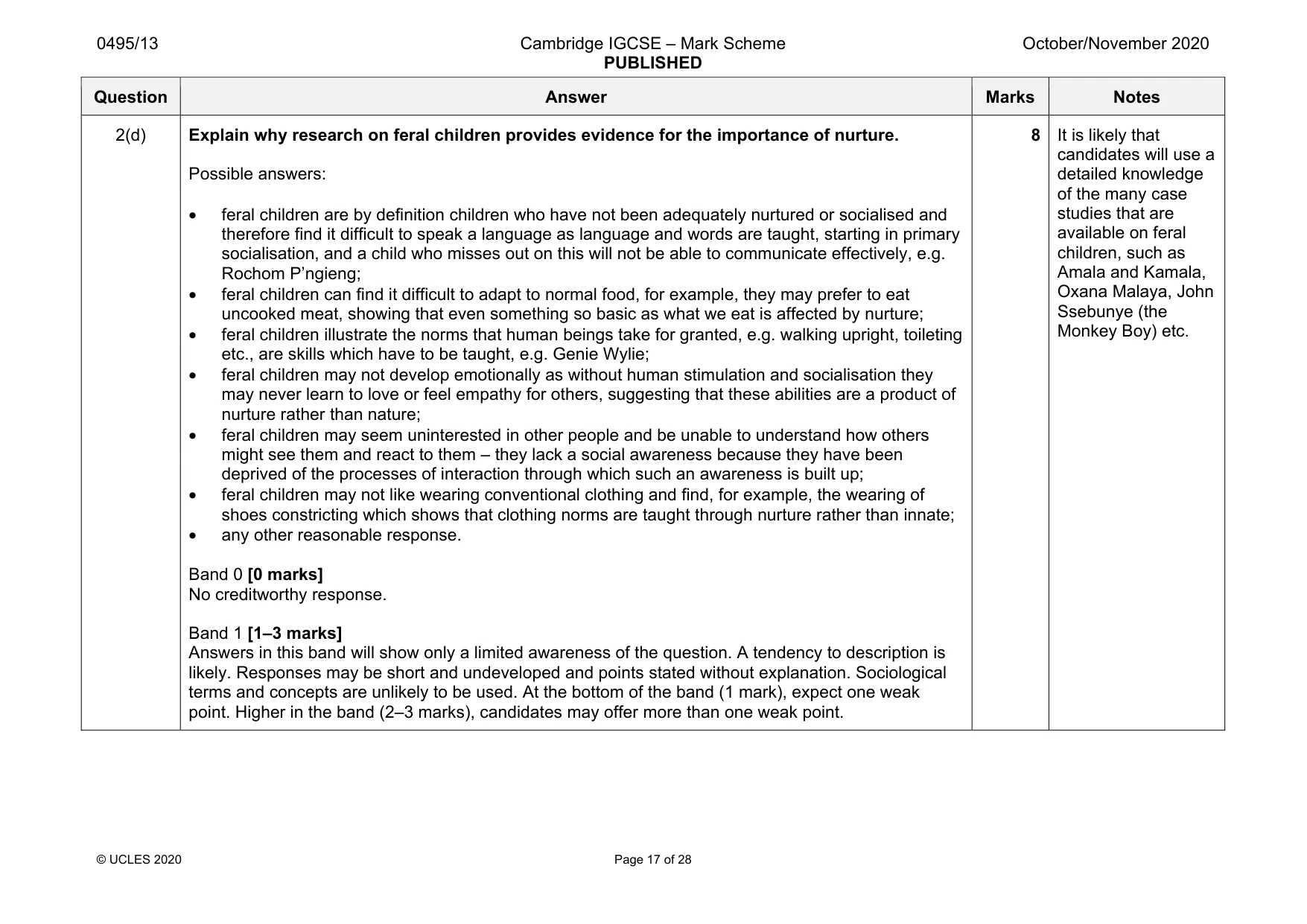
0495/13 Cambridge IGCSE – Mark Scheme PUBLISHED October/November 2020 © UCLES 2020 Page 17 of 28 Question Answer Marks Notes 2(d) Explain why research on feral children provides evidence for the importance of nurture. Possible answers: • feral children are by definition children who have not been adequately nurtured or socialised and therefore find it difficult to speak a language as language and words are taught, starting in primary socialisation, and a child who misses out on this will not be able to communicate effectively, e.g. Rochom P’ngieng; • feral children can find it difficult to adapt to normal food, for example, they may prefer to eat uncooked meat, showing that even something so basic as what we eat is affected by nurture; • feral children illustrate the norms that human beings take for granted, e.g. walking upright, toileting etc., are skills which have to be taught, e.g. Genie Wylie; • feral children may not develop emotionally as without human stimulation and socialisation they may never learn to love or feel empathy for others, suggesting that these abilities are a product of nurture rather than nature; • feral children may seem uninterested in other people and be unable to understand how others might see them and react to them – they lack a social awareness because they have been deprived of the processes of interaction through which such an awareness is built up; • feral children may not like wearing conventional clothing and find, for example, the wearing of shoes constricting which shows that clothing norms are taught through nurture rather than innate; • any other reasonable response. Band 0 [0 marks] No creditworthy response. Band 1 [1–3 marks] Answers in this band will show only a limited awareness of the question. A tendency to description is likely. Responses may be short and undeveloped and points stated without explanation. Sociological terms and concepts are unlikely to be used. At the bottom of the band (1 mark), expect one weak point. Higher in the band (2–3 marks), candidates may offer more than one weak point. 8 It is likely that candidates will use a detailed knowledge of the many case studies that are available on feral children, such as Amala and Kamala, Oxana Malaya, John Ssebunye (the Monkey Boy) etc.
Mark scheme, page 18
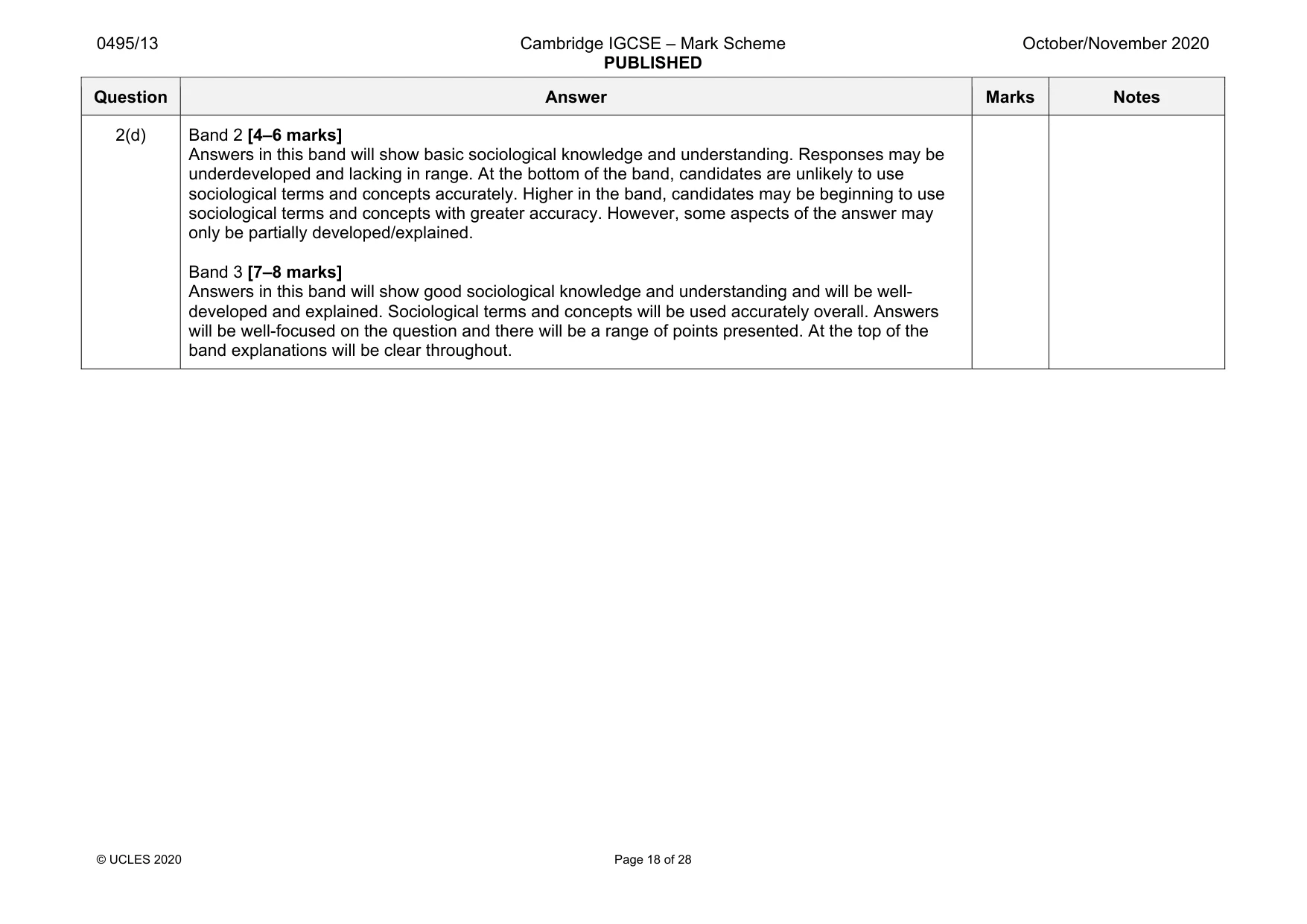
0495/13 Cambridge IGCSE – Mark Scheme PUBLISHED October/November 2020 © UCLES 2020 Page 18 of 28 Question Answer Marks Notes 2(d) Band 2 [4–6 marks] Answers in this band will show basic sociological knowledge and understanding. Responses may be underdeveloped and lacking in range. At the bottom of the band, candidates are unlikely to use sociological terms and concepts accurately. Higher in the band, candidates may be beginning to use sociological terms and concepts with greater accuracy. However, some aspects of the answer may only be partially developed/explained. Band 3 [7–8 marks] Answers in this band will show good sociological knowledge and understanding and will be well- developed and explained. Sociological terms and concepts will be used accurately overall. Answers will be well-focused on the question and there will be a range of points presented. At the top of the band explanations will be clear throughout.
Mark scheme, page 19
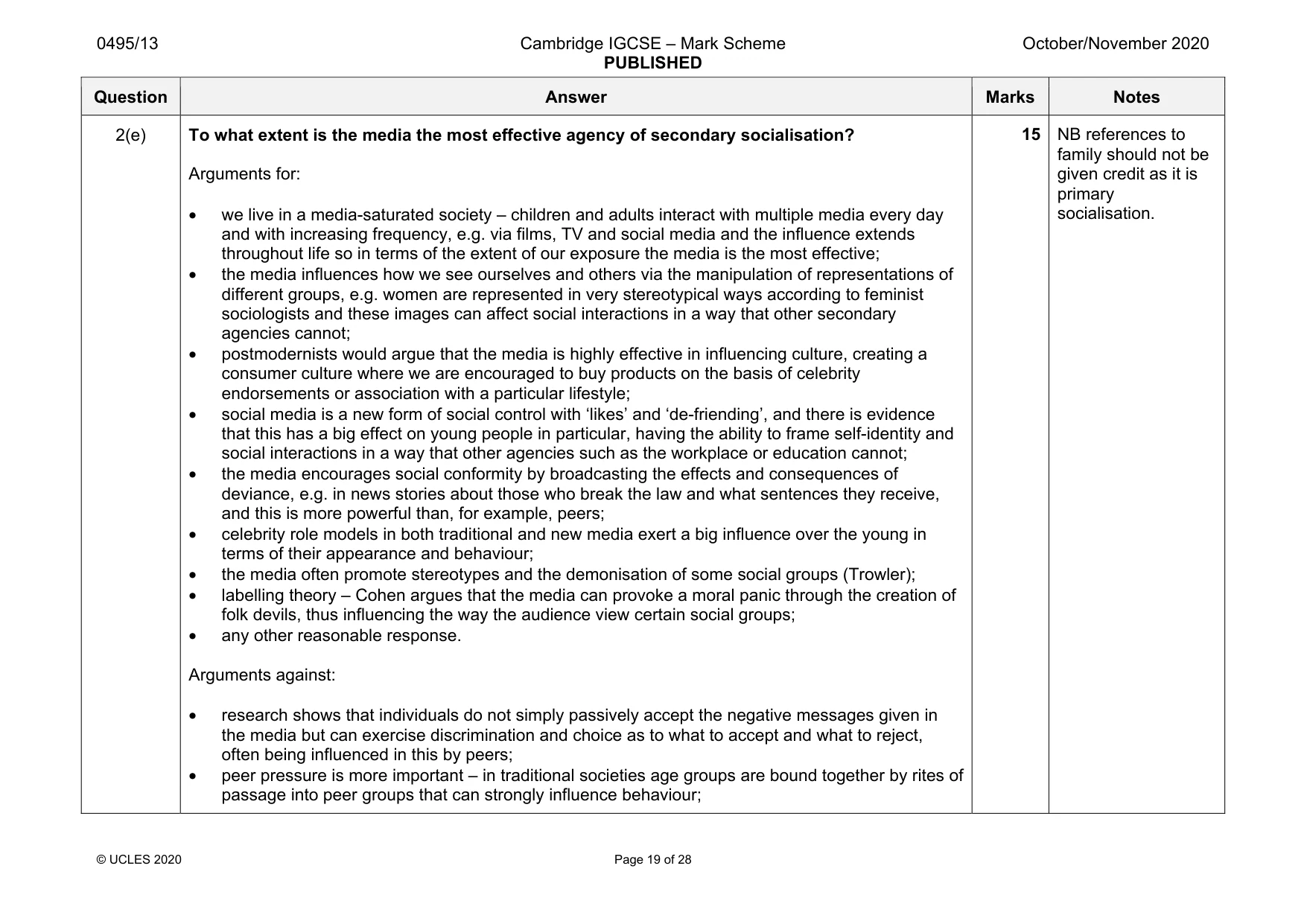
0495/13 Cambridge IGCSE – Mark Scheme PUBLISHED October/November 2020 © UCLES 2020 Page 19 of 28 Question Answer Marks Notes 2(e) To what extent is the media the most effective agency of secondary socialisation? Arguments for: • we live in a media-saturated society – children and adults interact with multiple media every day and with increasing frequency, e.g. via films, TV and social media and the influence extends throughout life so in terms of the extent of our exposure the media is the most effective; • the media influences how we see ourselves and others via the manipulation of representations of different groups, e.g. women are represented in very stereotypical ways according to feminist sociologists and these images can affect social interactions in a way that other secondary agencies cannot; • postmodernists would argue that the media is highly effective in influencing culture, creating a consumer culture where we are encouraged to buy products on the basis of celebrity endorsements or association with a particular lifestyle; • social media is a new form of social control with ‘likes’ and ‘de-friending’, and there is evidence that this has a big effect on young people in particular, having the ability to frame self-identity and social interactions in a way that other agencies such as the workplace or education cannot; • the media encourages social conformity by broadcasting the effects and consequences of deviance, e.g. in news stories about those who break the law and what sentences they receive, and this is more powerful than, for example, peers; • celebrity role models in both traditional and new media exert a big influence over the young in terms of their appearance and behaviour; • the media often promote stereotypes and the demonisation of some social groups (Trowler); • labelling theory – Cohen argues that the media can provoke a moral panic through the creation of folk devils, thus influencing the way the audience view certain social groups; • any other reasonable response. Arguments against: • research shows that individuals do not simply passively accept the negative messages given in the media but can exercise discrimination and choice as to what to accept and what to reject, often being influenced in this by peers; • peer pressure is more important – in traditional societies age groups are bound together by rites of passage into peer groups that can strongly influence behaviour; 15 NB references to family should not be given credit as it is primary socialisation.
Mark scheme, page 20
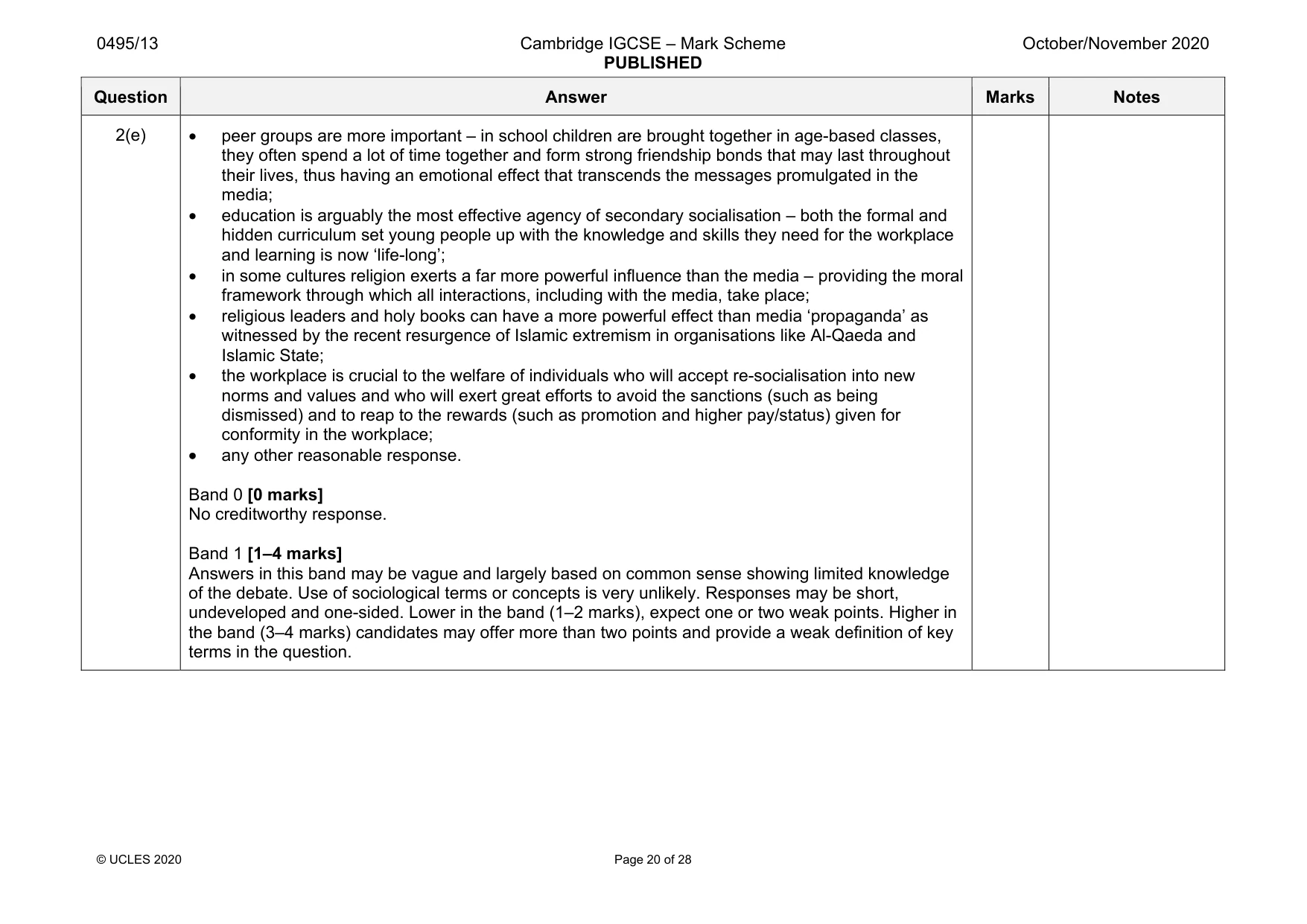
0495/13 Cambridge IGCSE – Mark Scheme PUBLISHED October/November 2020 © UCLES 2020 Page 20 of 28 Question Answer Marks Notes 2(e) • peer groups are more important – in school children are brought together in age-based classes, they often spend a lot of time together and form strong friendship bonds that may last throughout their lives, thus having an emotional effect that transcends the messages promulgated in the media; • education is arguably the most effective agency of secondary socialisation – both the formal and hidden curriculum set young people up with the knowledge and skills they need for the workplace and learning is now ‘life-long’; • in some cultures religion exerts a far more powerful influence than the media – providing the moral framework through which all interactions, including with the media, take place; • religious leaders and holy books can have a more powerful effect than media ‘propaganda’ as witnessed by the recent resurgence of Islamic extremism in organisations like Al-Qaeda and Islamic State; • the workplace is crucial to the welfare of individuals who will accept re-socialisation into new norms and values and who will exert great efforts to avoid the sanctions (such as being dismissed) and to reap to the rewards (such as promotion and higher pay/status) given for conformity in the workplace; • any other reasonable response. Band 0 [0 marks] No creditworthy response. Band 1 [1–4 marks] Answers in this band may be vague and largely based on common sense showing limited knowledge of the debate. Use of sociological terms or concepts is very unlikely. Responses may be short, undeveloped and one-sided. Lower in the band (1–2 marks), expect one or two weak points. Higher in the band (3–4 marks) candidates may offer more than two points and provide a weak definition of key terms in the question.
Mark scheme, page 21
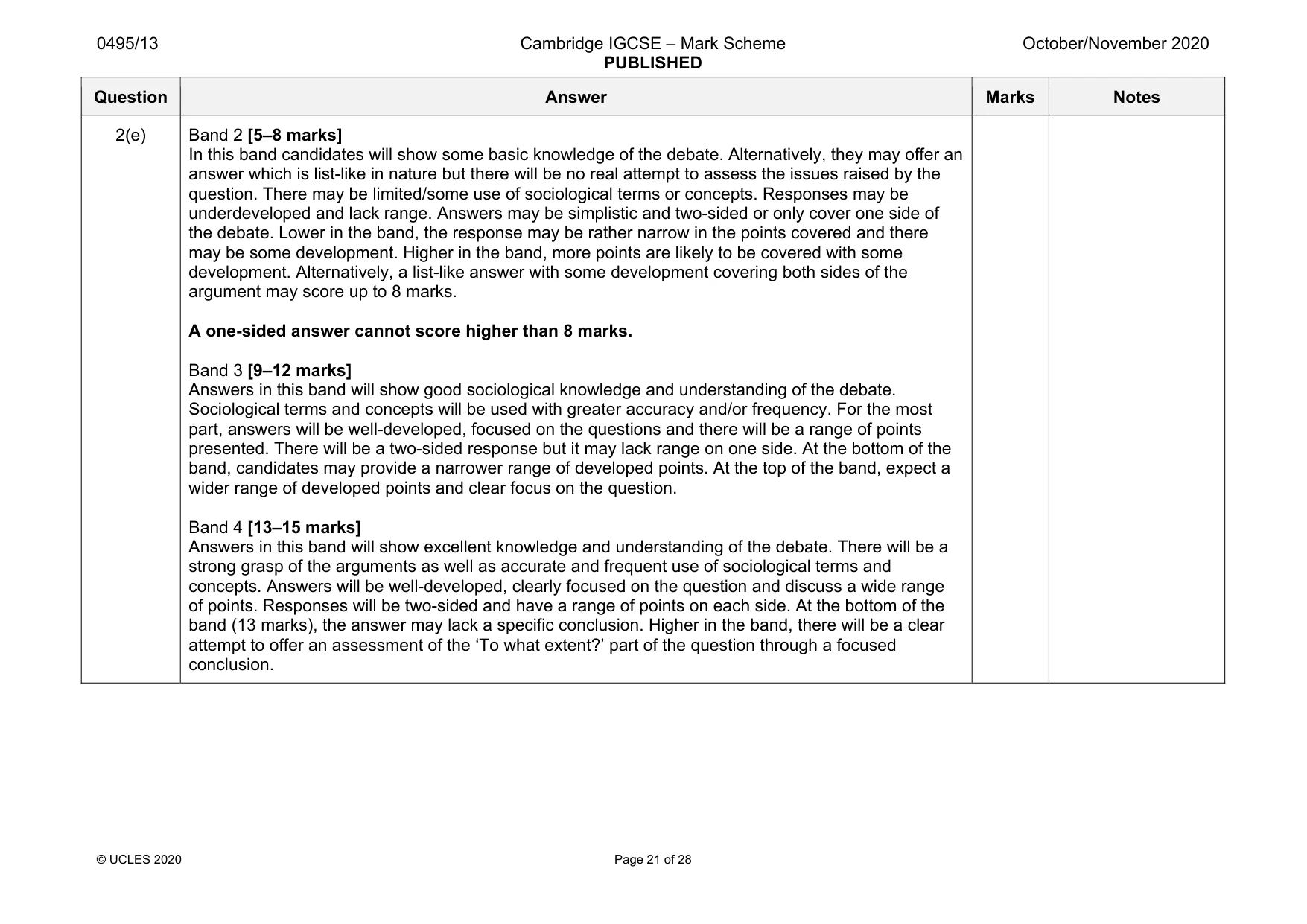
0495/13 Cambridge IGCSE – Mark Scheme PUBLISHED October/November 2020 © UCLES 2020 Page 21 of 28 Question Answer Marks Notes 2(e) Band 2 [5–8 marks] In this band candidates will show some basic knowledge of the debate. Alternatively, they may offer an answer which is list-like in nature but there will be no real attempt to assess the issues raised by the question. There may be limited/some use of sociological terms or concepts. Responses may be underdeveloped and lack range. Answers may be simplistic and two-sided or only cover one side of the debate. Lower in the band, the response may be rather narrow in the points covered and there may be some development. Higher in the band, more points are likely to be covered with some development. Alternatively, a list-like answer with some development covering both sides of the argument may score up to 8 marks. A one-sided answer cannot score higher than 8 marks. Band 3 [9–12 marks] Answers in this band will show good sociological knowledge and understanding of the debate. Sociological terms and concepts will be used with greater accuracy and/or frequency. For the most part, answers will be well-developed, focused on the questions and there will be a range of points presented. There will be a two-sided response but it may lack range on one side. At the bottom of the band, candidates may provide a narrower range of developed points. At the top of the band, expect a wider range of developed points and clear focus on the question. Band 4 [13–15 marks] Answers in this band will show excellent knowledge and understanding of the debate. There will be a strong grasp of the arguments as well as accurate and frequent use of sociological terms and concepts. Answers will be well-developed, clearly focused on the question and discuss a wide range of points. Responses will be two-sided and have a range of points on each side. At the bottom of the band (13 marks), the answer may lack a specific conclusion. Higher in the band, there will be a clear attempt to offer an assessment of the ‘To what extent?’ part of the question through a focused conclusion.
Mark scheme, page 22
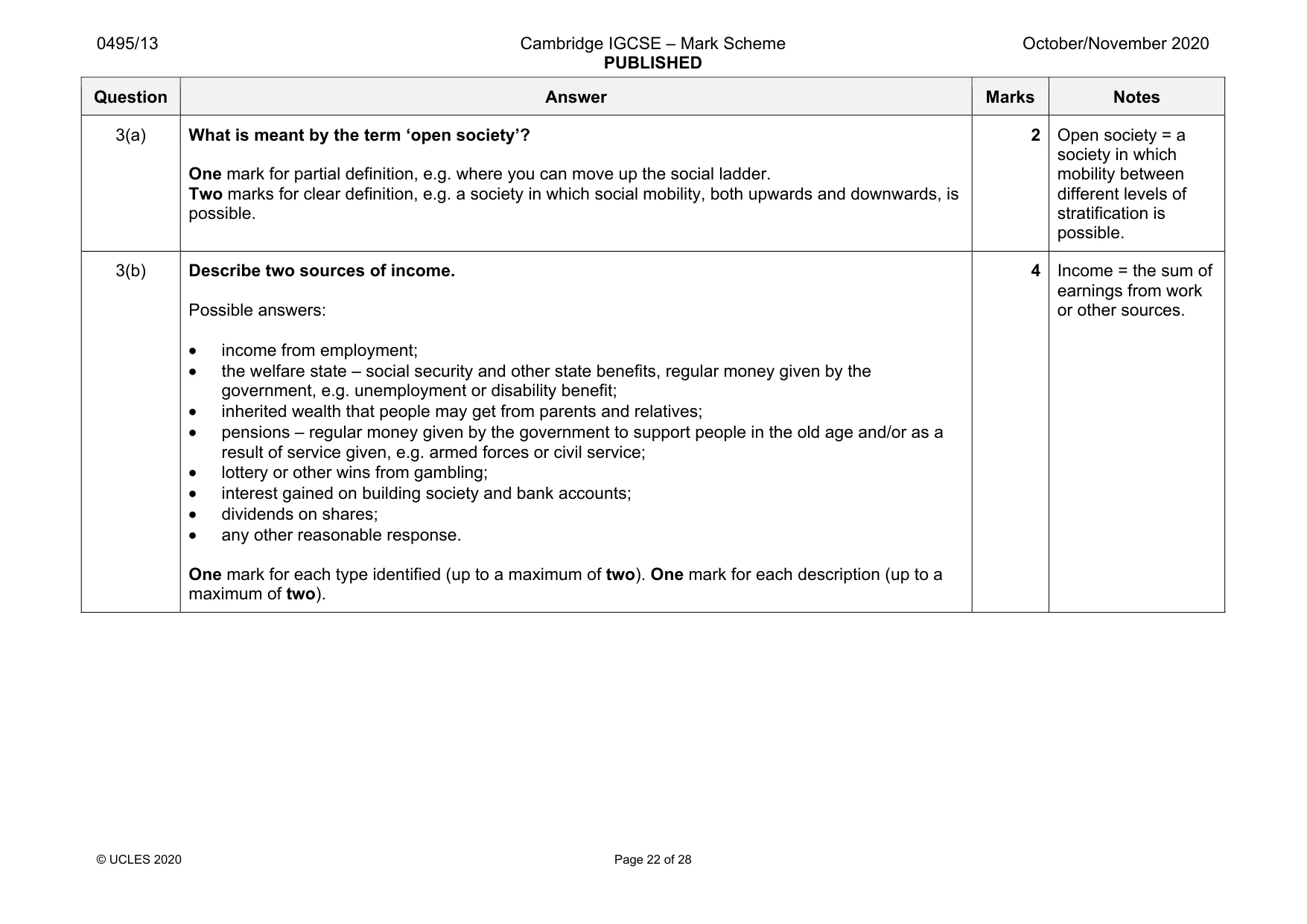
0495/13 Cambridge IGCSE – Mark Scheme PUBLISHED October/November 2020 © UCLES 2020 Page 22 of 28 Question Answer Marks Notes 3(a) What is meant by the term ‘open society’? One mark for partial definition, e.g. where you can move up the social ladder. Two marks for clear definition, e.g. a society in which social mobility, both upwards and downwards, is possible. 2 Open society = a society in which mobility between different levels of stratification is possible. 3(b) Describe two sources of income. Possible answers: • income from employment; • the welfare state – social security and other state benefits, regular money given by the government, e.g. unemployment or disability benefit; • inherited wealth that people may get from parents and relatives; • pensions – regular money given by the government to support people in the old age and/or as a result of service given, e.g. armed forces or civil service; • lottery or other wins from gambling; • interest gained on building society and bank accounts; • dividends on shares; • any other reasonable response. One mark for each type identified (up to a maximum of two). One mark for each description (up to a maximum of two). 4 Income = the sum of earnings from work or other sources.
Mark scheme, page 23
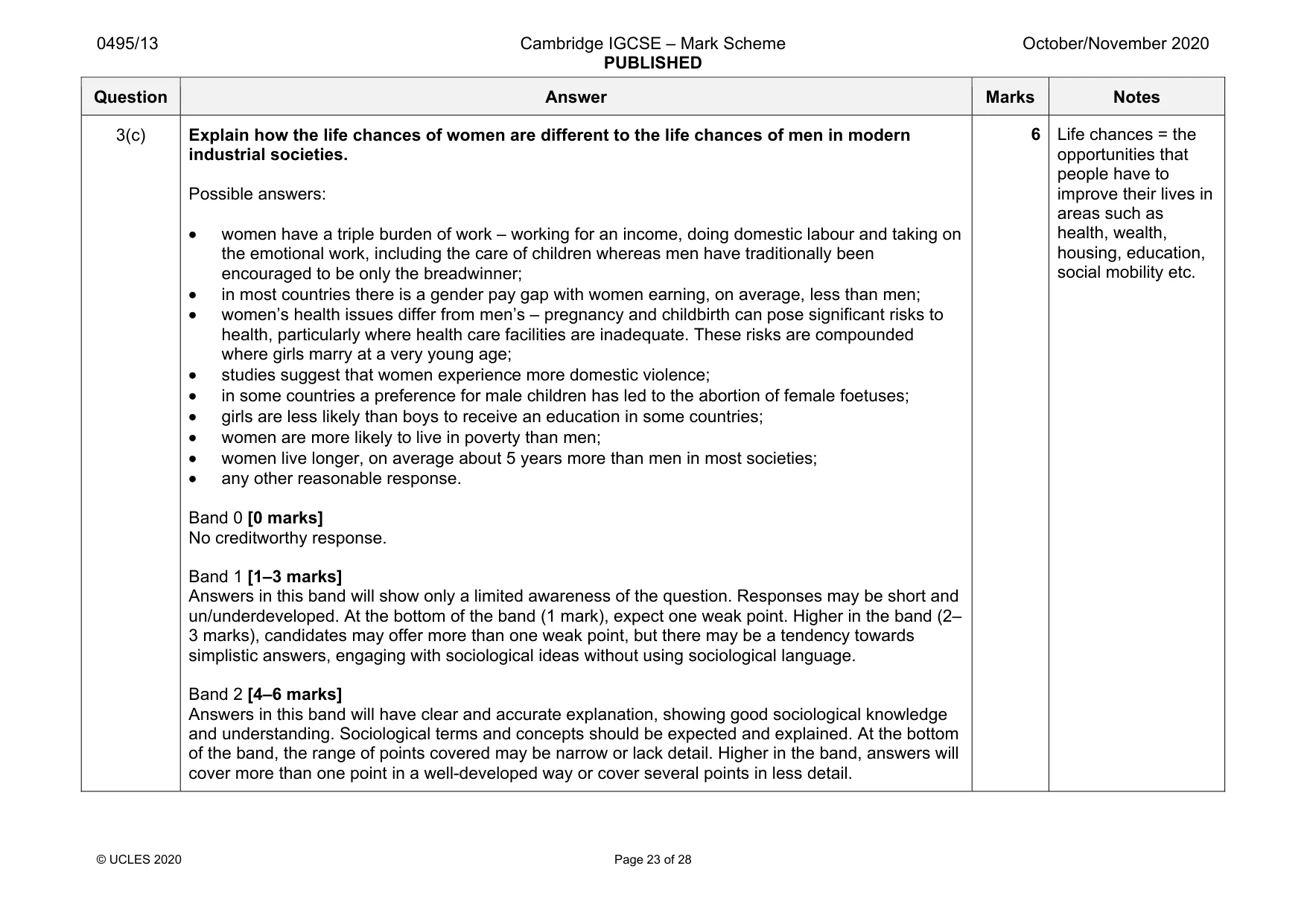
0495/13 Cambridge IGCSE – Mark Scheme PUBLISHED October/November 2020 © UCLES 2020 Page 23 of 28 Question Answer Marks Notes 3(c) Explain how the life chances of women are different to the life chances of men in modern industrial societies. Possible answers: • women have a triple burden of work – working for an income, doing domestic labour and taking on the emotional work, including the care of children whereas men have traditionally been encouraged to be only the breadwinner; • in most countries there is a gender pay gap with women earning, on average, less than men; • women’s health issues differ from men’s – pregnancy and childbirth can pose significant risks to health, particularly where health care facilities are inadequate. These risks are compounded where girls marry at a very young age; • studies suggest that women experience more domestic violence; • in some countries a preference for male children has led to the abortion of female foetuses; • girls are less likely than boys to receive an education in some countries; • women are more likely to live in poverty than men; • women live longer, on average about 5 years more than men in most societies; • any other reasonable response. Band 0 [0 marks] No creditworthy response. Band 1 [1–3 marks] Answers in this band will show only a limited awareness of the question. Responses may be short and un/underdeveloped. At the bottom of the band (1 mark), expect one weak point. Higher in the band (2– 3 marks), candidates may offer more than one weak point, but there may be a tendency towards simplistic answers, engaging with sociological ideas without using sociological language. Band 2 [4–6 marks] Answers in this band will have clear and accurate explanation, showing good sociological knowledge and understanding. Sociological terms and concepts should be expected and explained. At the bottom of the band, the range of points covered may be narrow or lack detail. Higher in the band, answers will cover more than one point in a well-developed way or cover several points in less detail. 6 Life chances = the opportunities that people have to improve their lives in areas such as health, wealth, housing, education, social mobility etc.
Mark scheme, page 24
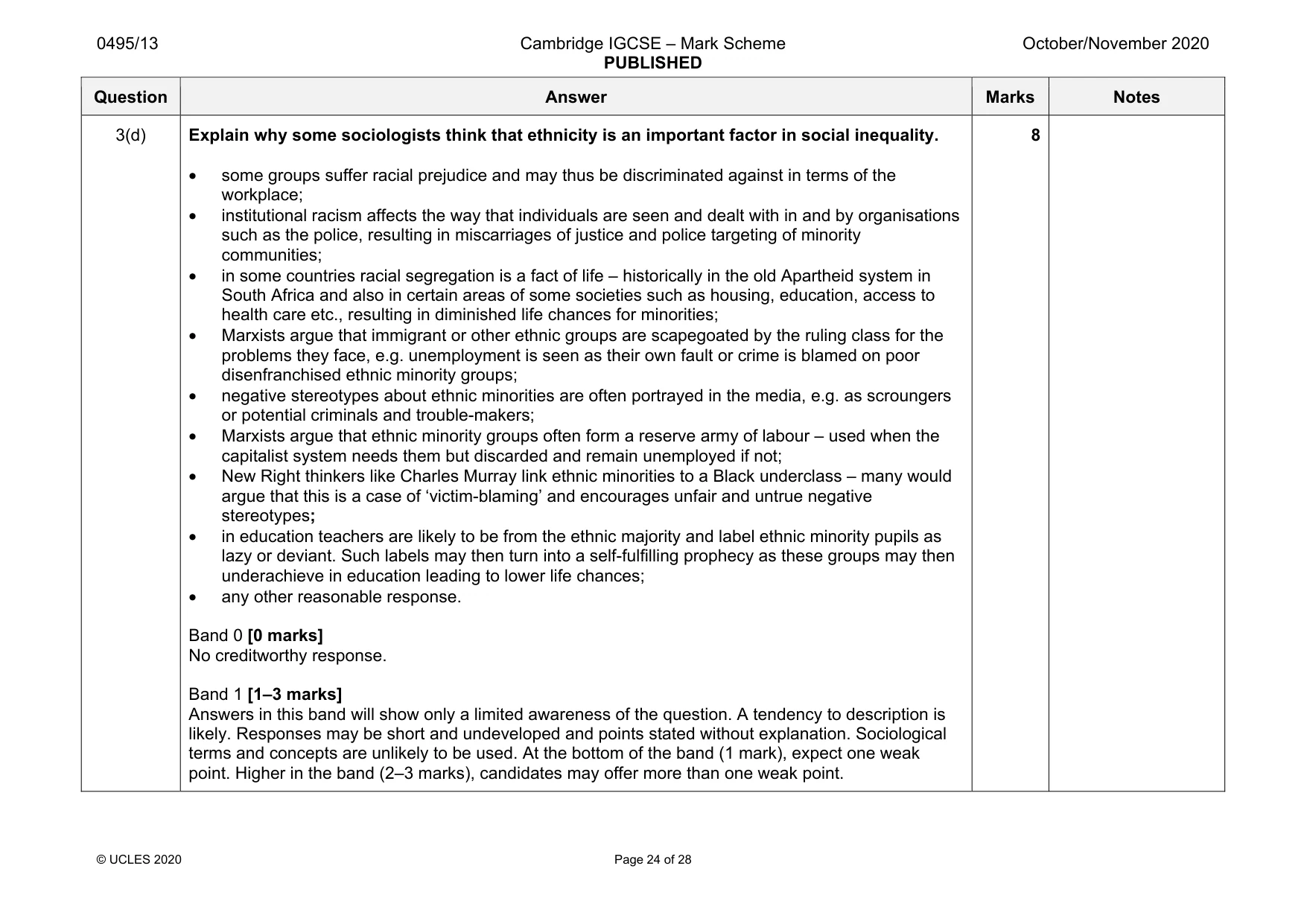
0495/13 Cambridge IGCSE – Mark Scheme PUBLISHED October/November 2020 © UCLES 2020 Page 24 of 28 Question Answer Marks Notes 3(d) Explain why some sociologists think that ethnicity is an important factor in social inequality. • some groups suffer racial prejudice and may thus be discriminated against in terms of the workplace; • institutional racism affects the way that individuals are seen and dealt with in and by organisations such as the police, resulting in miscarriages of justice and police targeting of minority communities; • in some countries racial segregation is a fact of life – historically in the old Apartheid system in South Africa and also in certain areas of some societies such as housing, education, access to health care etc., resulting in diminished life chances for minorities; • Marxists argue that immigrant or other ethnic groups are scapegoated by the ruling class for the problems they face, e.g. unemployment is seen as their own fault or crime is blamed on poor disenfranchised ethnic minority groups; • negative stereotypes about ethnic minorities are often portrayed in the media, e.g. as scroungers or potential criminals and trouble-makers; • Marxists argue that ethnic minority groups often form a reserve army of labour – used when the capitalist system needs them but discarded and remain unemployed if not; • New Right thinkers like Charles Murray link ethnic minorities to a Black underclass – many would argue that this is a case of ‘victim-blaming’ and encourages unfair and untrue negative stereotypes; • in education teachers are likely to be from the ethnic majority and label ethnic minority pupils as lazy or deviant. Such labels may then turn into a self-fulfilling prophecy as these groups may then underachieve in education leading to lower life chances; • any other reasonable response. Band 0 [0 marks] No creditworthy response. Band 1 [1–3 marks] Answers in this band will show only a limited awareness of the question. A tendency to description is likely. Responses may be short and undeveloped and points stated without explanation. Sociological terms and concepts are unlikely to be used. At the bottom of the band (1 mark), expect one weak point. Higher in the band (2–3 marks), candidates may offer more than one weak point. 8
Mark scheme, page 25
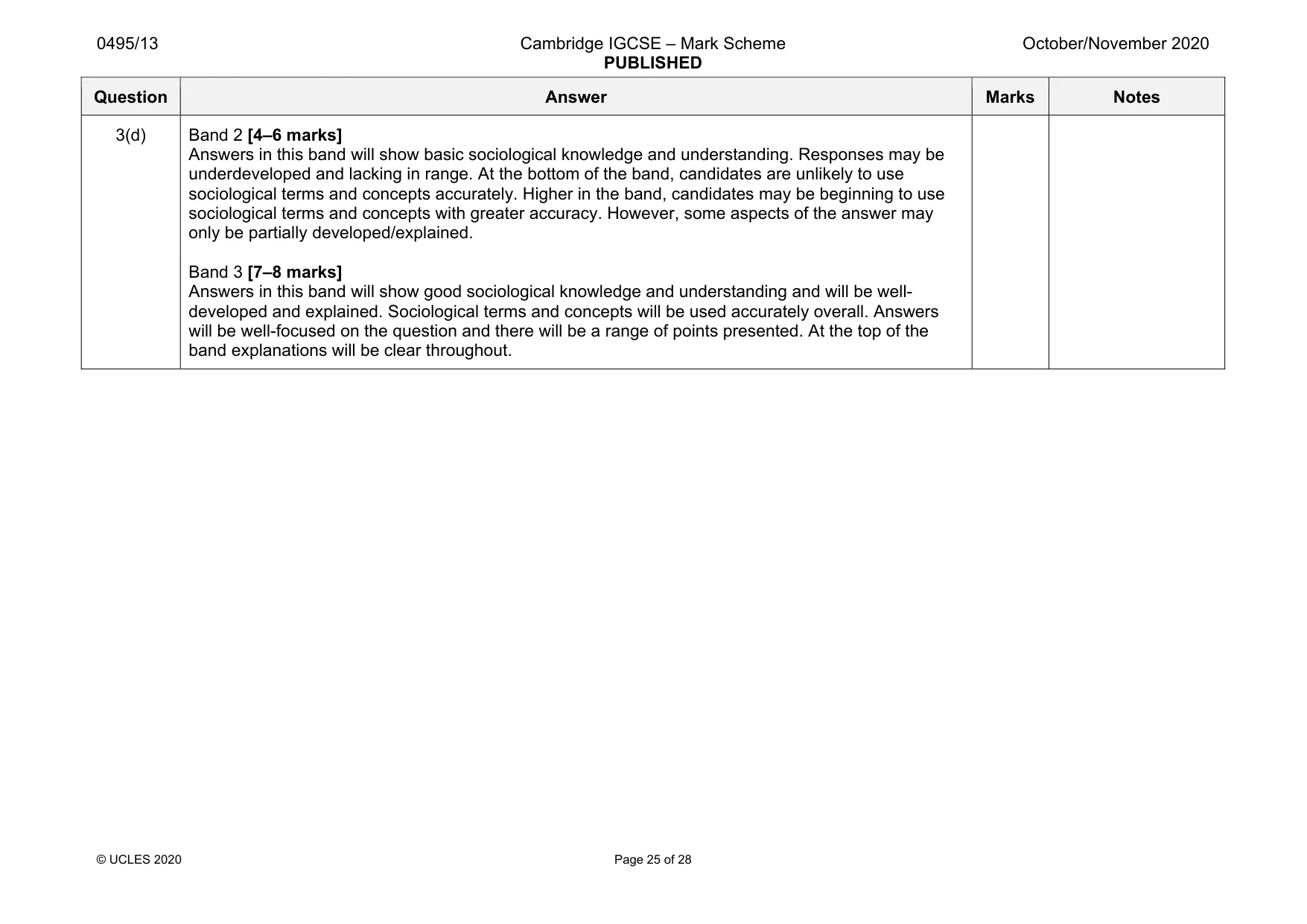
0495/13 Cambridge IGCSE – Mark Scheme PUBLISHED October/November 2020 © UCLES 2020 Page 25 of 28 Question Answer Marks Notes 3(d) Band 2 [4–6 marks] Answers in this band will show basic sociological knowledge and understanding. Responses may be underdeveloped and lacking in range. At the bottom of the band, candidates are unlikely to use sociological terms and concepts accurately. Higher in the band, candidates may be beginning to use sociological terms and concepts with greater accuracy. However, some aspects of the answer may only be partially developed/explained. Band 3 [7–8 marks] Answers in this band will show good sociological knowledge and understanding and will be well- developed and explained. Sociological terms and concepts will be used accurately overall. Answers will be well-focused on the question and there will be a range of points presented. At the top of the band explanations will be clear throughout.
Mark scheme, page 26
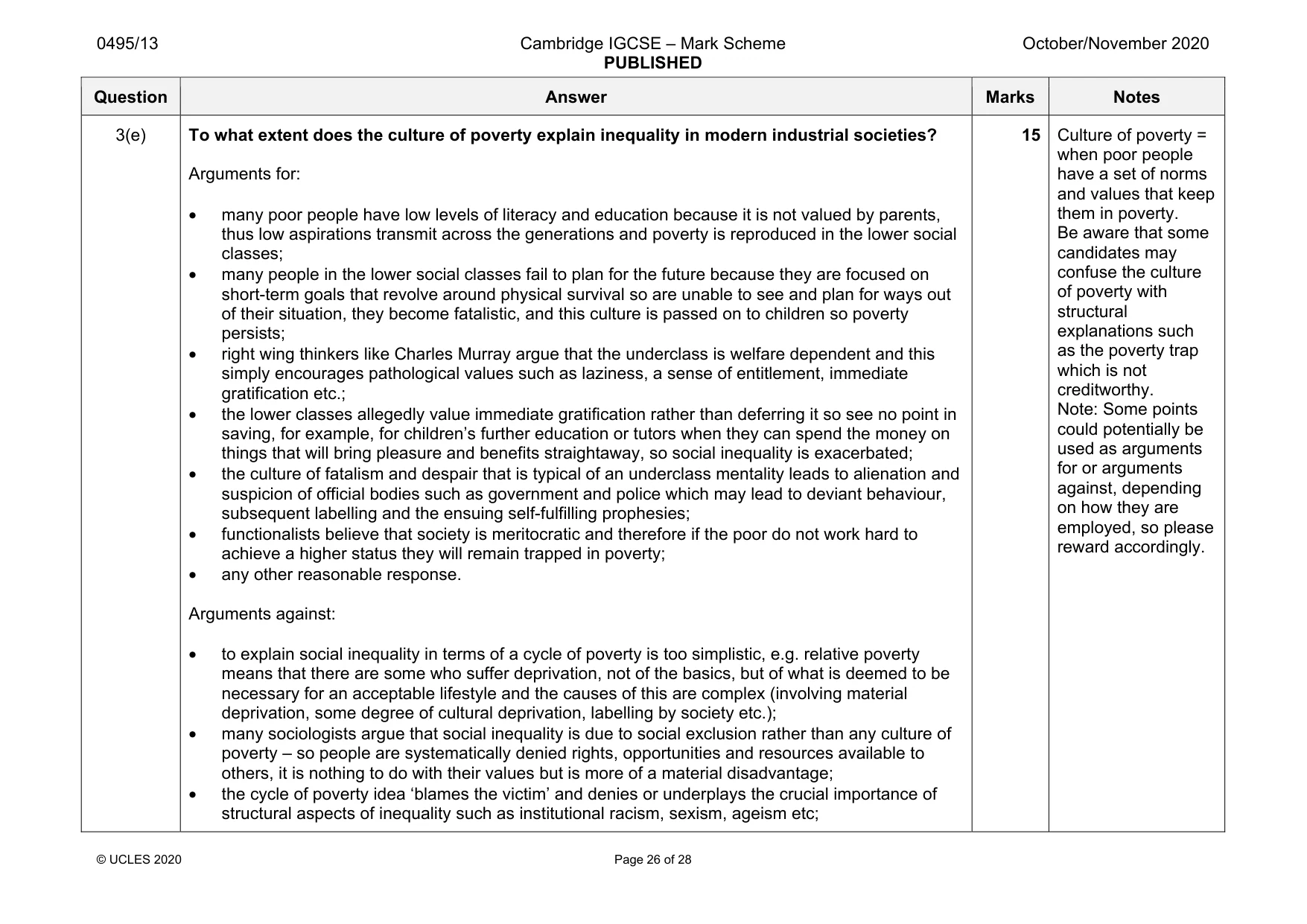
0495/13 Cambridge IGCSE – Mark Scheme PUBLISHED October/November 2020 © UCLES 2020 Page 26 of 28 Question Answer Marks Notes 3(e) To what extent does the culture of poverty explain inequality in modern industrial societies? Arguments for: • many poor people have low levels of literacy and education because it is not valued by parents, thus low aspirations transmit across the generations and poverty is reproduced in the lower social classes; • many people in the lower social classes fail to plan for the future because they are focused on short-term goals that revolve around physical survival so are unable to see and plan for ways out of their situation, they become fatalistic, and this culture is passed on to children so poverty persists; • right wing thinkers like Charles Murray argue that the underclass is welfare dependent and this simply encourages pathological values such as laziness, a sense of entitlement, immediate gratification etc.; • the lower classes allegedly value immediate gratification rather than deferring it so see no point in saving, for example, for children’s further education or tutors when they can spend the money on things that will bring pleasure and benefits straightaway, so social inequality is exacerbated; • the culture of fatalism and despair that is typical of an underclass mentality leads to alienation and suspicion of official bodies such as government and police which may lead to deviant behaviour, subsequent labelling and the ensuing self-fulfilling prophesies; • functionalists believe that society is meritocratic and therefore if the poor do not work hard to achieve a higher status they will remain trapped in poverty; • any other reasonable response. Arguments against: • to explain social inequality in terms of a cycle of poverty is too simplistic, e.g. relative poverty means that there are some who suffer deprivation, not of the basics, but of what is deemed to be necessary for an acceptable lifestyle and the causes of this are complex (involving material deprivation, some degree of cultural deprivation, labelling by society etc.); • many sociologists argue that social inequality is due to social exclusion rather than any culture of poverty – so people are systematically denied rights, opportunities and resources available to others, it is nothing to do with their values but is more of a material disadvantage; • the cycle of poverty idea ‘blames the victim’ and denies or underplays the crucial importance of structural aspects of inequality such as institutional racism, sexism, ageism etc; 15 Culture of poverty = when poor people have a set of norms and values that keep them in poverty. Be aware that some candidates may confuse the culture of poverty with structural explanations such as the poverty trap which is not creditworthy. Note: Some points could potentially be used as arguments for or arguments against, depending on how they are employed, so please reward accordingly.
Mark scheme, page 27
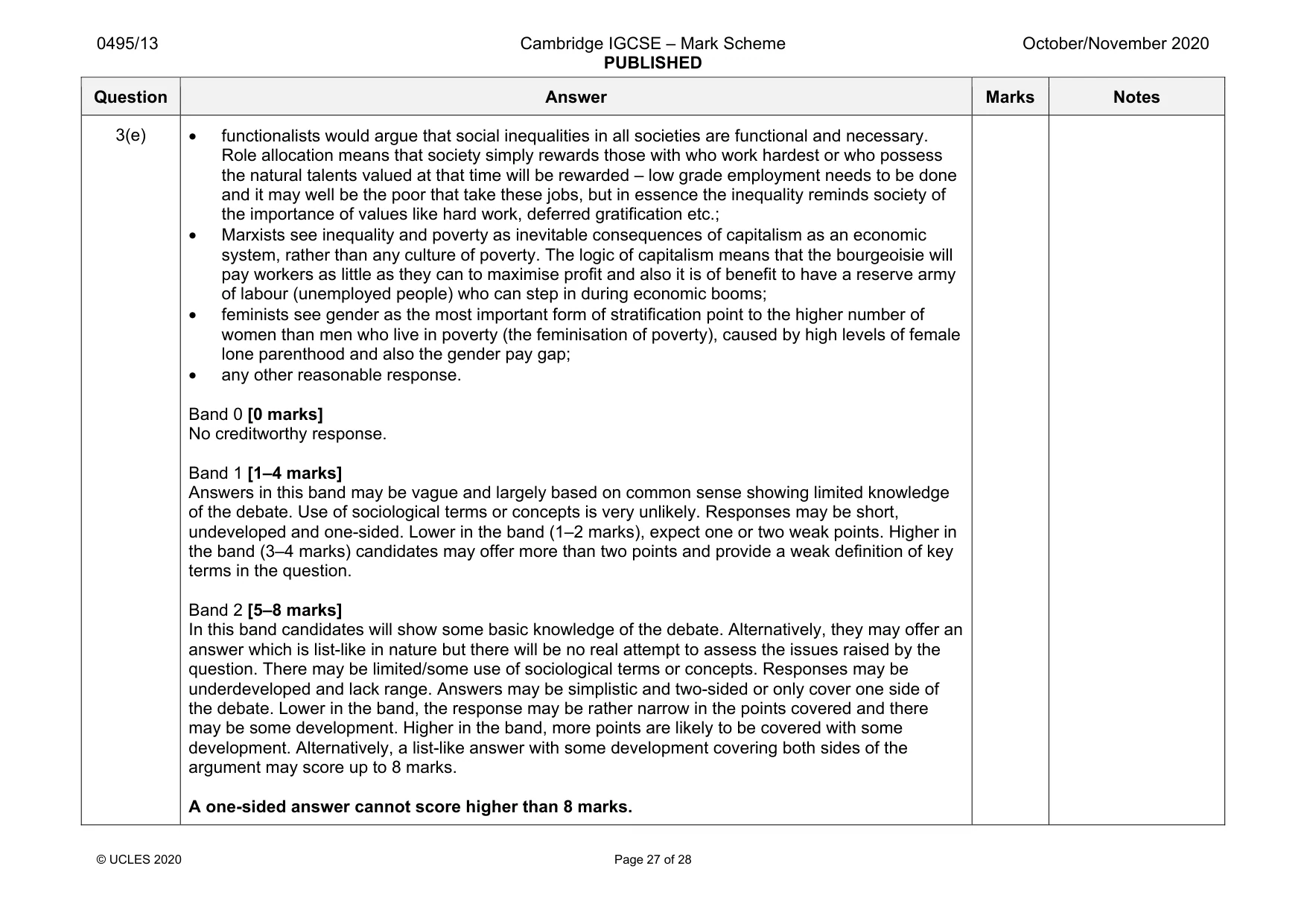
0495/13 Cambridge IGCSE – Mark Scheme PUBLISHED October/November 2020 © UCLES 2020 Page 27 of 28 Question Answer Marks Notes 3(e) • functionalists would argue that social inequalities in all societies are functional and necessary. Role allocation means that society simply rewards those with who work hardest or who possess the natural talents valued at that time will be rewarded – low grade employment needs to be done and it may well be the poor that take these jobs, but in essence the inequality reminds society of the importance of values like hard work, deferred gratification etc.; • Marxists see inequality and poverty as inevitable consequences of capitalism as an economic system, rather than any culture of poverty. The logic of capitalism means that the bourgeoisie will pay workers as little as they can to maximise profit and also it is of benefit to have a reserve army of labour (unemployed people) who can step in during economic booms; • feminists see gender as the most important form of stratification point to the higher number of women than men who live in poverty (the feminisation of poverty), caused by high levels of female lone parenthood and also the gender pay gap; • any other reasonable response. Band 0 [0 marks] No creditworthy response. Band 1 [1–4 marks] Answers in this band may be vague and largely based on common sense showing limited knowledge of the debate. Use of sociological terms or concepts is very unlikely. Responses may be short, undeveloped and one-sided. Lower in the band (1–2 marks), expect one or two weak points. Higher in the band (3–4 marks) candidates may offer more than two points and provide a weak definition of key terms in the question. Band 2 [5–8 marks] In this band candidates will show some basic knowledge of the debate. Alternatively, they may offer an answer which is list-like in nature but there will be no real attempt to assess the issues raised by the question. There may be limited/some use of sociological terms or concepts. Responses may be underdeveloped and lack range. Answers may be simplistic and two-sided or only cover one side of the debate. Lower in the band, the response may be rather narrow in the points covered and there may be some development. Higher in the band, more points are likely to be covered with some development. Alternatively, a list-like answer with some development covering both sides of the argument may score up to 8 marks. A one-sided answer cannot score higher than 8 marks.
Mark scheme, page 28
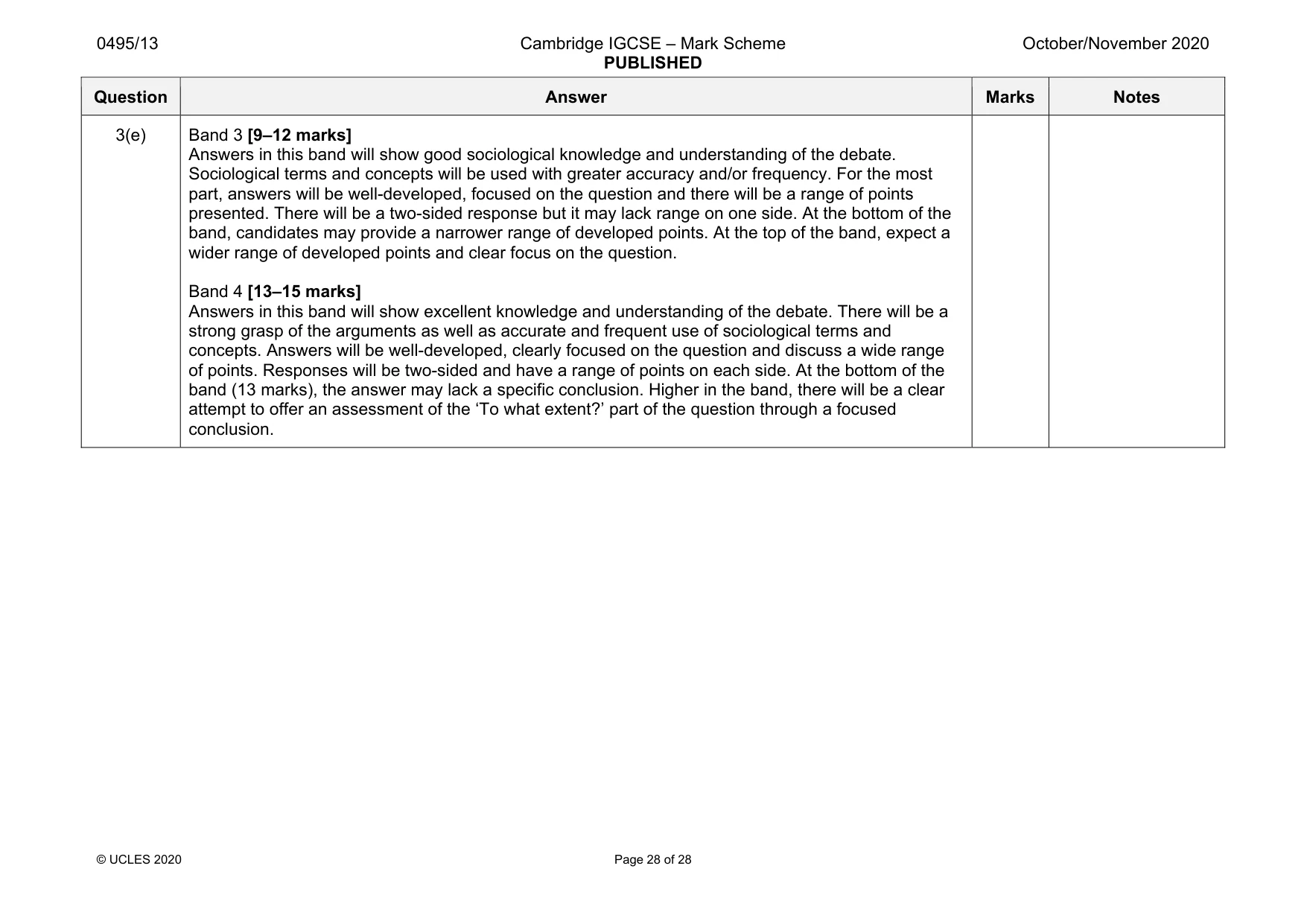
0495/13 Cambridge IGCSE – Mark Scheme PUBLISHED October/November 2020 © UCLES 2020 Page 28 of 28 Question Answer Marks Notes 3(e) Band 3 [9–12 marks] Answers in this band will show good sociological knowledge and understanding of the debate. Sociological terms and concepts will be used with greater accuracy and/or frequency. For the most part, answers will be well-developed, focused on the question and there will be a range of points presented. There will be a two-sided response but it may lack range on one side. At the bottom of the band, candidates may provide a narrower range of developed points. At the top of the band, expect a wider range of developed points and clear focus on the question. Band 4 [13–15 marks] Answers in this band will show excellent knowledge and understanding of the debate. There will be a strong grasp of the arguments as well as accurate and frequent use of sociological terms and concepts. Answers will be well-developed, clearly focused on the question and discuss a wide range of points. Responses will be two-sided and have a range of points on each side. At the bottom of the band (13 marks), the answer may lack a specific conclusion. Higher in the band, there will be a clear attempt to offer an assessment of the ‘To what extent?’ part of the question through a focused conclusion.
What you needed in this session
Cambridge’s own grade thresholds for 2020 Oct/Nov, Paper 1 · Variant 3. A higher threshold means an easier paper — the bar moves with how the cohort did.