Cambridge IGCSE Sociology 0495 — 2020 Oct/Nov Paper 1 · Variant 2
0495/12/O/N/20 · 80 marks · ≈90 min
The question paper and its mark scheme, free to read here and free to download. This is Cambridge’s own paper, exactly as it was sat.
Question paper4 pages

Mark scheme31 pages
Answers below. Sit the paper first if you are practising.
Paper as text
Question paper, page 1
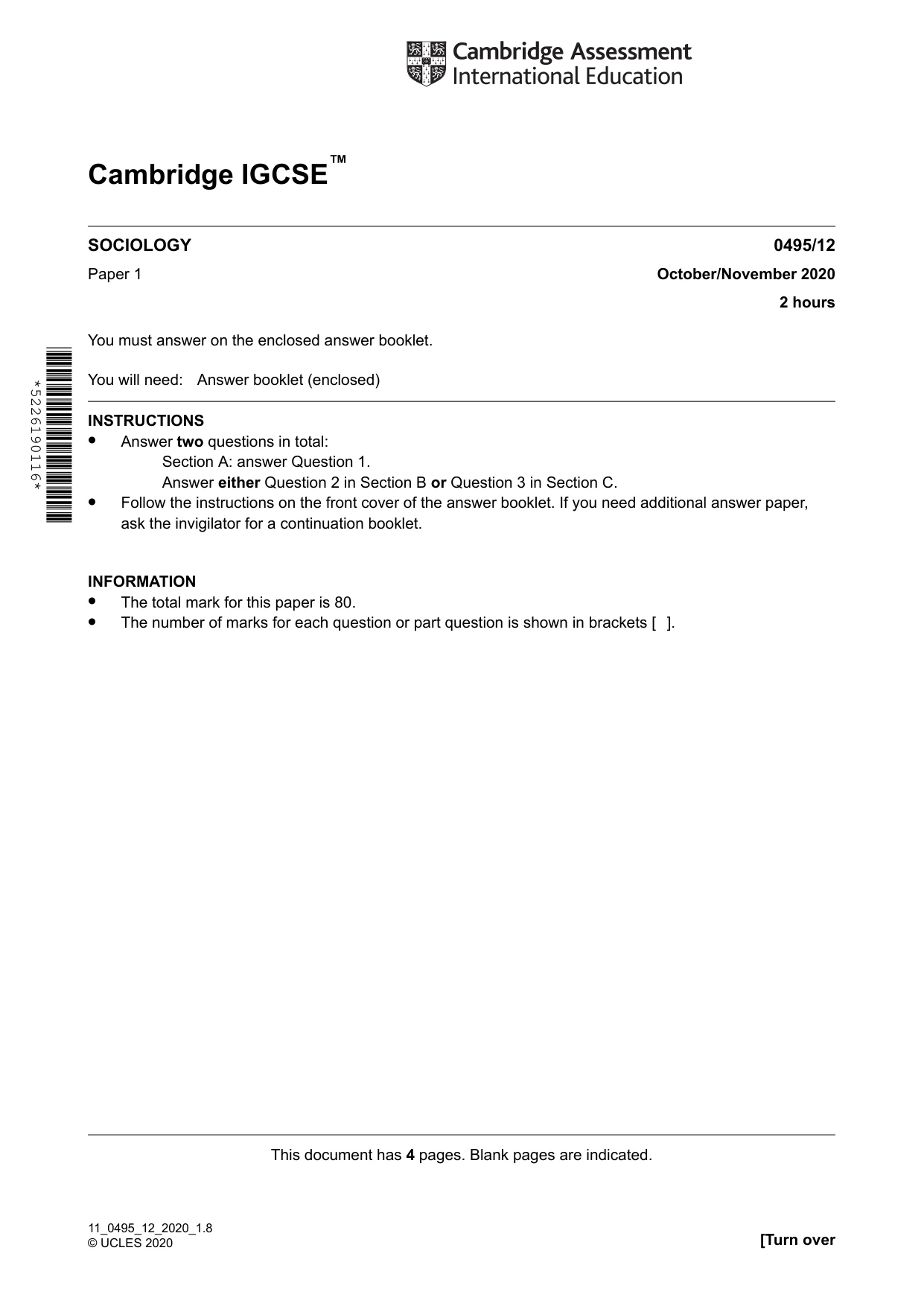
Cambridge IGCSE™ 0495/12 October/November 2020 2 hours SOCIOLOGY Paper 1 You must answer on the enclosed answer booklet. You will need: Answer booklet (enclosed) INSTRUCTIONS • Answer two questions in total: Section A: answer Question 1. Answer either Question 2 in Section B or Question 3 in Section C. • Follow the instructions on the front cover of the answer booklet. If you need additional answer paper, ask the invigilator for a continuation booklet. INFORMATION • The total mark for this paper is 80. • The number of marks for each question or part question is shown in brackets [ ]. This document has 4 pages. Blank pages are indicated. [Turn over 11_0495_12_2020_1.8 © UCLES 2020 *5226190116*
Question paper, page 2
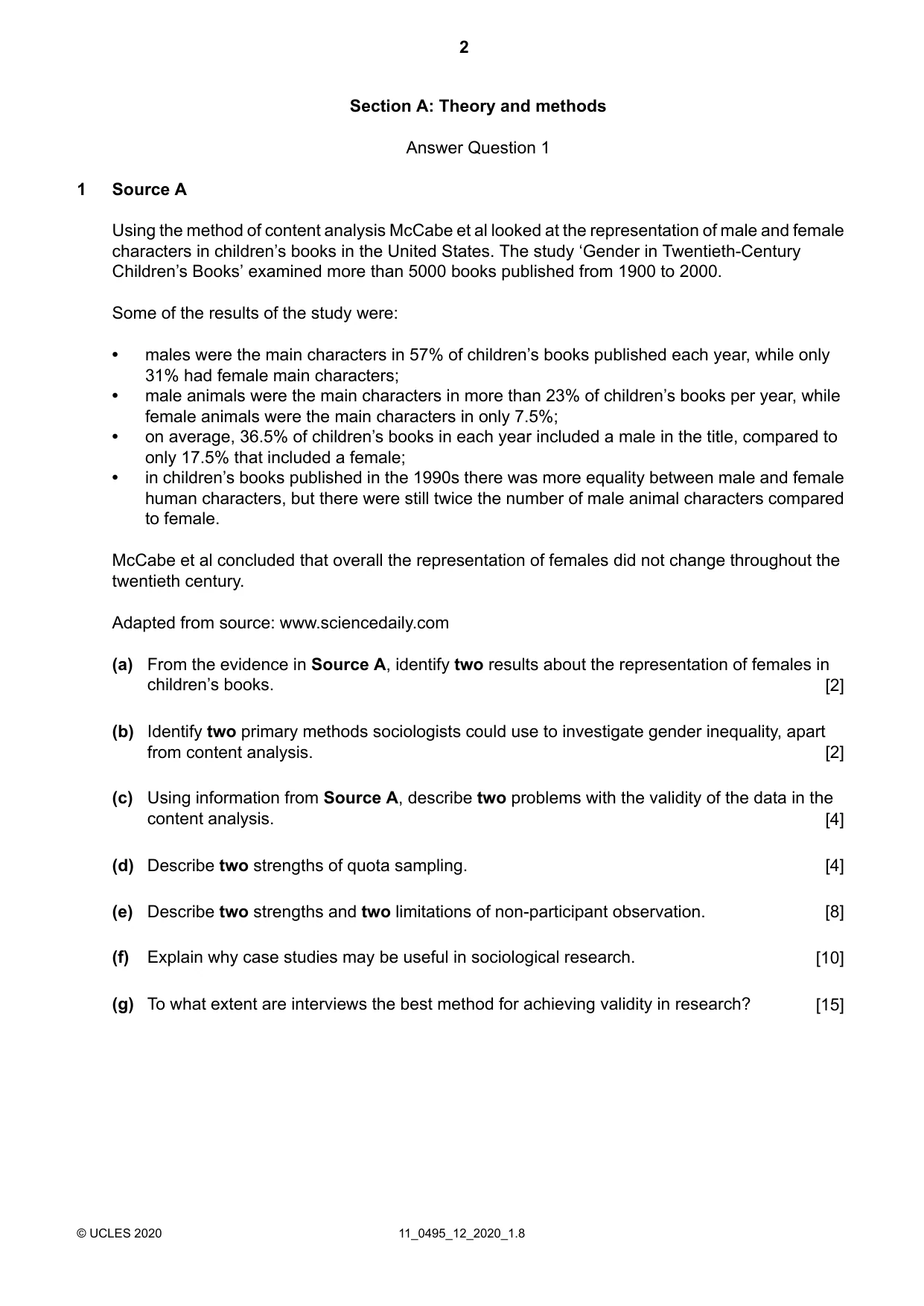
Section A: Theory and methods Answer Question 1 Source A 1 Using the method of content analysis McCabe et al looked at the representation of male and female characters in children’s books in the United States. The study ‘Gender in Twentieth-Century Children’s Books’ examined more than 5000 books published from 1900 to 2000. Some of the results of the study were: • males were the main characters in 57% of children’s books published each year, while only 31% had female main characters; • male animals were the main characters in more than 23% of children’s books per year, while female animals were the main characters in only 7.5%; • on average, 36.5% of children’s books in each year included a male in the title, compared to only 17.5% that included a female; • in children’s books published in the 1990s there was more equality between male and female human characters, but there were still twice the number of male animal characters compared to female. McCabe et al concluded that overall the representation of females did not change throughout the twentieth century. Adapted from source: www.sciencedaily.com From the evidence in Source A, identify two results about the representation of females in children’s books. [2] (a) Identify two primary methods sociologists could use to investigate gender inequality, apart from content analysis. [2] (b) Using information from Source A, describe two problems with the validity of the data in the content analysis. [4] (c) Describe two strengths of quota sampling. [4] (d) Describe two strengths and two limitations of non-participant observation. [8] (e) Explain why case studies may be useful in sociological research. [10] (f) To what extent are interviews the best method for achieving validity in research? [15] (g) 11_0495_12_2020_1.8 © UCLES 2020 2
Question paper, page 3
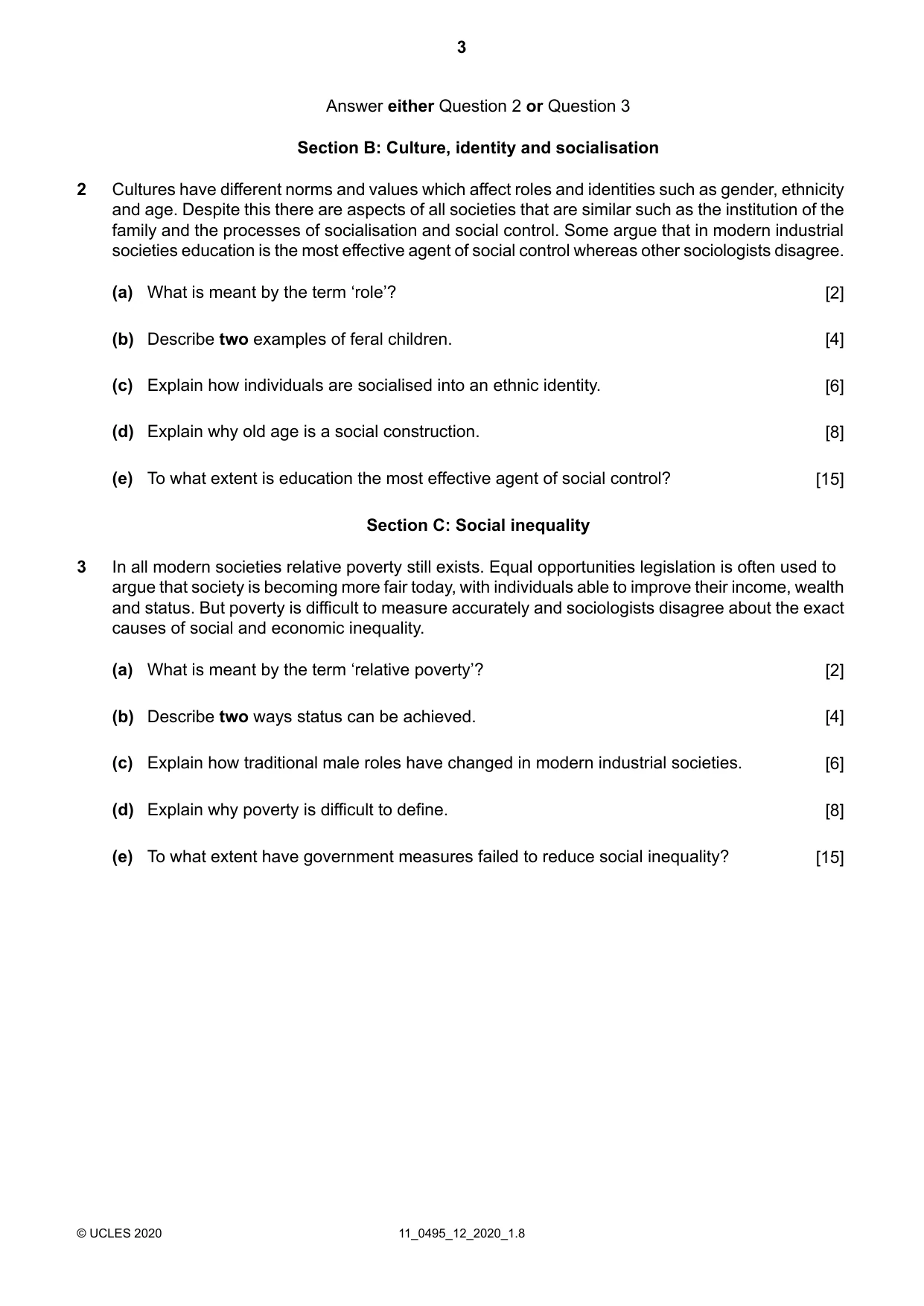
Answer either Question 2 or Question 3 Section B: Culture, identity and socialisation Cultures have different norms and values which affect roles and identities such as gender, ethnicity and age. Despite this there are aspects of all societies that are similar such as the institution of the 2 family and the processes of socialisation and social control. Some argue that in modern industrial societies education is the most effective agent of social control whereas other sociologists disagree. What is meant by the term ‘role’? [2] (a) Describe two examples of feral children. [4] (b) Explain how individuals are socialised into an ethnic identity. [6] (c) Explain why old age is a social construction. [8] (d) To what extent is education the most effective agent of social control? [15] (e) Section C: Social inequality In all modern societies relative poverty still exists. Equal opportunities legislation is often used to argue that society is becoming more fair today, with individuals able to improve their income, wealth 3 and status. But poverty is difficult to measure accurately and sociologists disagree about the exact causes of social and economic inequality. What is meant by the term ‘relative poverty’? [2] (a) Describe two ways status can be achieved. [4] (b) Explain how traditional male roles have changed in modern industrial societies. [6] (c) Explain why poverty is difficult to define. [8] (d) To what extent have government measures failed to reduce social inequality? [15] (e) 11_0495_12_2020_1.8 © UCLES 2020 3
Question paper, page 4
BLANK PAGE Permission to reproduce items where third-party owned material protected by copyright is included has been sought and cleared where possible. Every reasonable effort has been made by the publisher (UCLES) to trace copyright holders, but if any items requiring clearance have unwittingly been included, the publisher will be pleased to make amends at the earliest possible opportunity. To avoid the issue of disclosure of answer-related information to candidates, all copyright acknowledgements are reproduced online in the Cambridge Assessment International Education Copyright Acknowledgements Booklet. This is produced for each series of examinations and is freely available to download at www.cambridgeinternational.org after the live examination series. Cambridge Assessment International Education is part of the Cambridge Assessment Group. Cambridge Assessment is the brand name of the University of Cambridge Local Examinations Syndicate (UCLES), which itself is a department of the University of Cambridge. 11_0495_12_2020_1.8 © UCLES 2020 4
Mark scheme, page 1
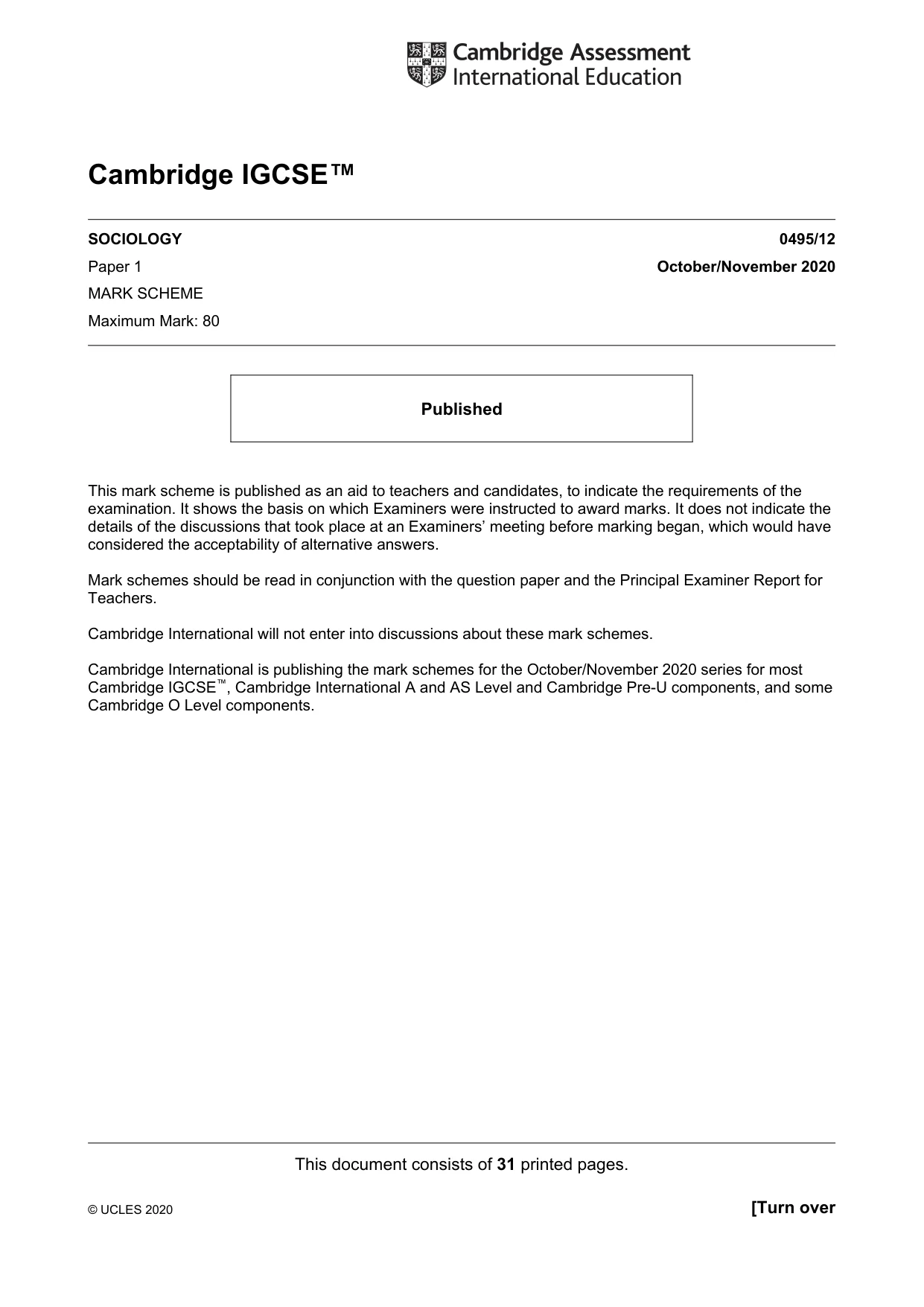
This document consists of 31 printed pages. © UCLES 2020 [Turn over Cambridge IGCSE™ SOCIOLOGY 0495/12 Paper 1 October/November 2020 MARK SCHEME Maximum Mark: 80 Published This mark scheme is published as an aid to teachers and candidates, to indicate the requirements of the examination. It shows the basis on which Examiners were instructed to award marks. It does not indicate the details of the discussions that took place at an Examiners’ meeting before marking began, which would have considered the acceptability of alternative answers. Mark schemes should be read in conjunction with the question paper and the Principal Examiner Report for Teachers. Cambridge International will not enter into discussions about these mark schemes. Cambridge International is publishing the mark schemes for the October/November 2020 series for most Cambridge IGCSE™, Cambridge International A and AS Level and Cambridge Pre-U components, and some Cambridge O Level components.
Mark scheme, page 2
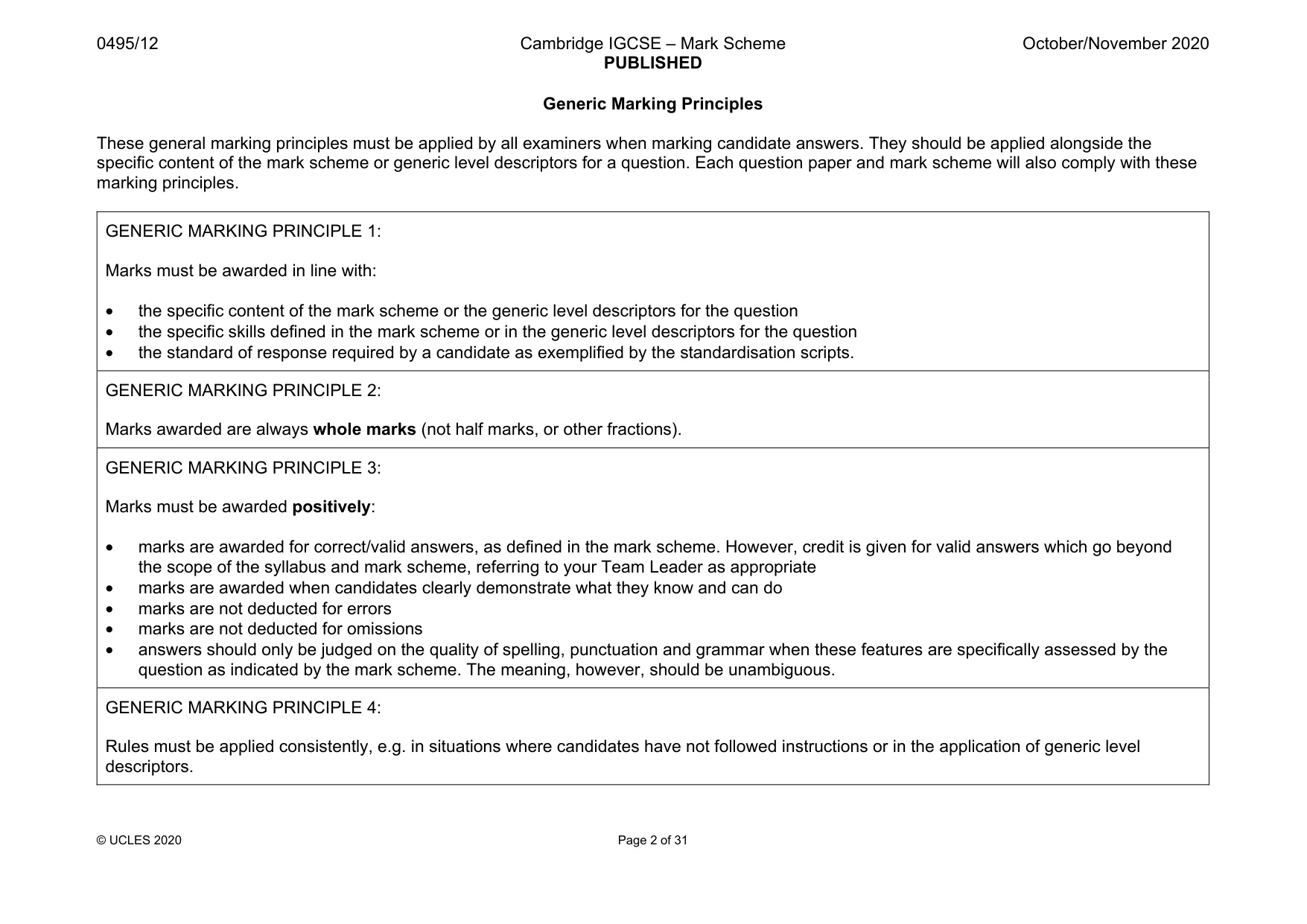
0495/12 Cambridge IGCSE – Mark Scheme PUBLISHED October/November 2020 © UCLES 2020 Page 2 of 31 Generic Marking Principles These general marking principles must be applied by all examiners when marking candidate answers. They should be applied alongside the specific content of the mark scheme or generic level descriptors for a question. Each question paper and mark scheme will also comply with these marking principles. GENERIC MARKING PRINCIPLE 1: Marks must be awarded in line with: • the specific content of the mark scheme or the generic level descriptors for the question • the specific skills defined in the mark scheme or in the generic level descriptors for the question • the standard of response required by a candidate as exemplified by the standardisation scripts. GENERIC MARKING PRINCIPLE 2: Marks awarded are always whole marks (not half marks, or other fractions). GENERIC MARKING PRINCIPLE 3: Marks must be awarded positively: • marks are awarded for correct/valid answers, as defined in the mark scheme. However, credit is given for valid answers which go beyond the scope of the syllabus and mark scheme, referring to your Team Leader as appropriate • marks are awarded when candidates clearly demonstrate what they know and can do • marks are not deducted for errors • marks are not deducted for omissions • answers should only be judged on the quality of spelling, punctuation and grammar when these features are specifically assessed by the question as indicated by the mark scheme. The meaning, however, should be unambiguous. GENERIC MARKING PRINCIPLE 4: Rules must be applied consistently, e.g. in situations where candidates have not followed instructions or in the application of generic level descriptors.
Mark scheme, page 3
0495/12 Cambridge IGCSE – Mark Scheme PUBLISHED October/November 2020 © UCLES 2020 Page 3 of 31 GENERIC MARKING PRINCIPLE 5: Marks should be awarded using the full range of marks defined in the mark scheme for the question (however; the use of the full mark range may be limited according to the quality of the candidate responses seen). GENERIC MARKING PRINCIPLE 6: Marks awarded are based solely on the requirements as defined in the mark scheme. Marks should not be awarded with grade thresholds or grade descriptors in mind.
Mark scheme, page 4
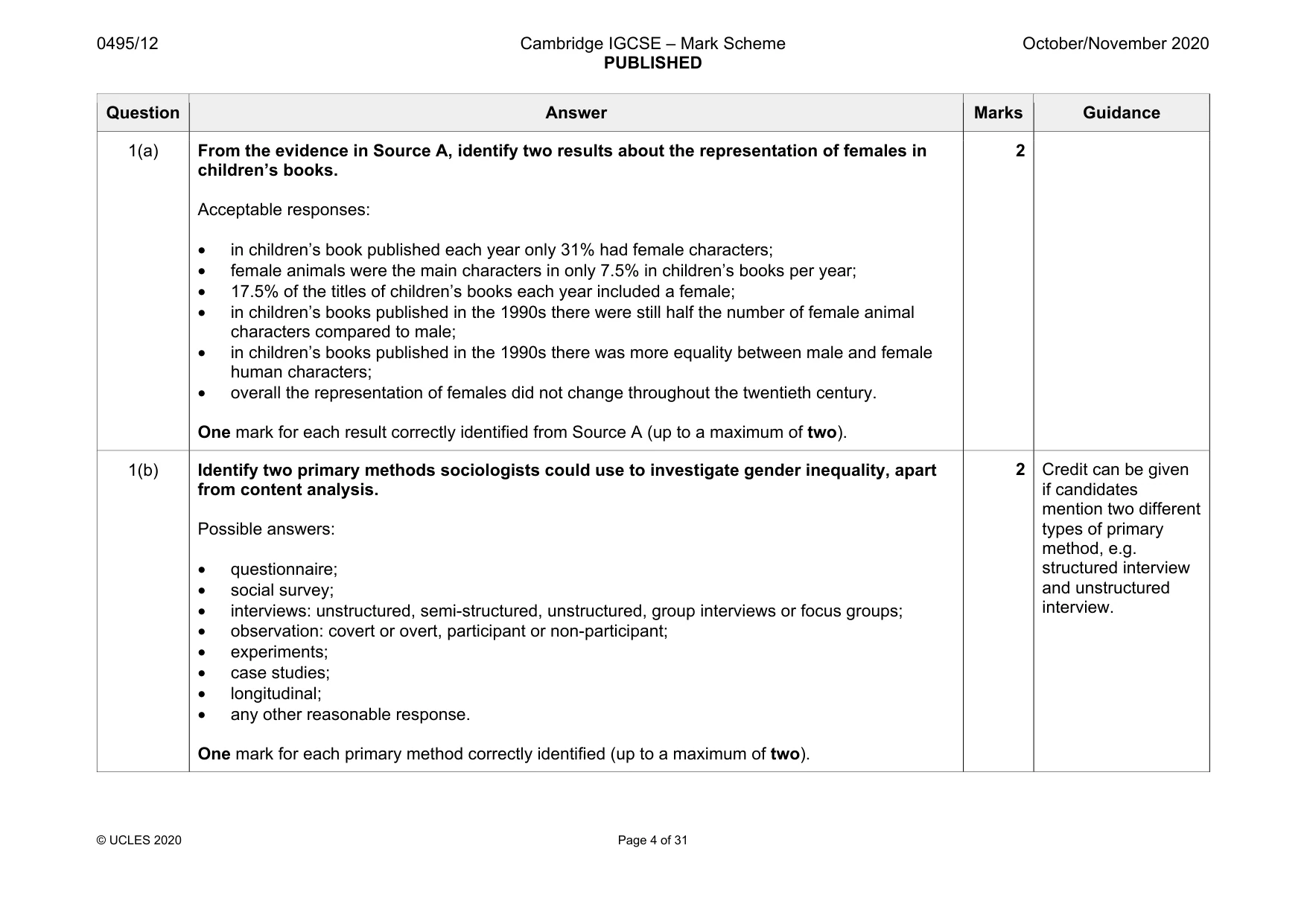
0495/12 Cambridge IGCSE – Mark Scheme PUBLISHED October/November 2020 © UCLES 2020 Page 4 of 31 Question Answer Marks Guidance 1(a) From the evidence in Source A, identify two results about the representation of females in children’s books. Acceptable responses: • in children’s book published each year only 31% had female characters; • female animals were the main characters in only 7.5% in children’s books per year; • 17.5% of the titles of children’s books each year included a female; • in children’s books published in the 1990s there were still half the number of female animal characters compared to male; • in children’s books published in the 1990s there was more equality between male and female human characters; • overall the representation of females did not change throughout the twentieth century. One mark for each result correctly identified from Source A (up to a maximum of two). 2 1(b) Identify two primary methods sociologists could use to investigate gender inequality, apart from content analysis. Possible answers: • questionnaire; • social survey; • interviews: unstructured, semi-structured, unstructured, group interviews or focus groups; • observation: covert or overt, participant or non-participant; • experiments; • case studies; • longitudinal; • any other reasonable response. One mark for each primary method correctly identified (up to a maximum of two). 2 Credit can be given if candidates mention two different types of primary method, e.g. structured interview and unstructured interview.
Mark scheme, page 5
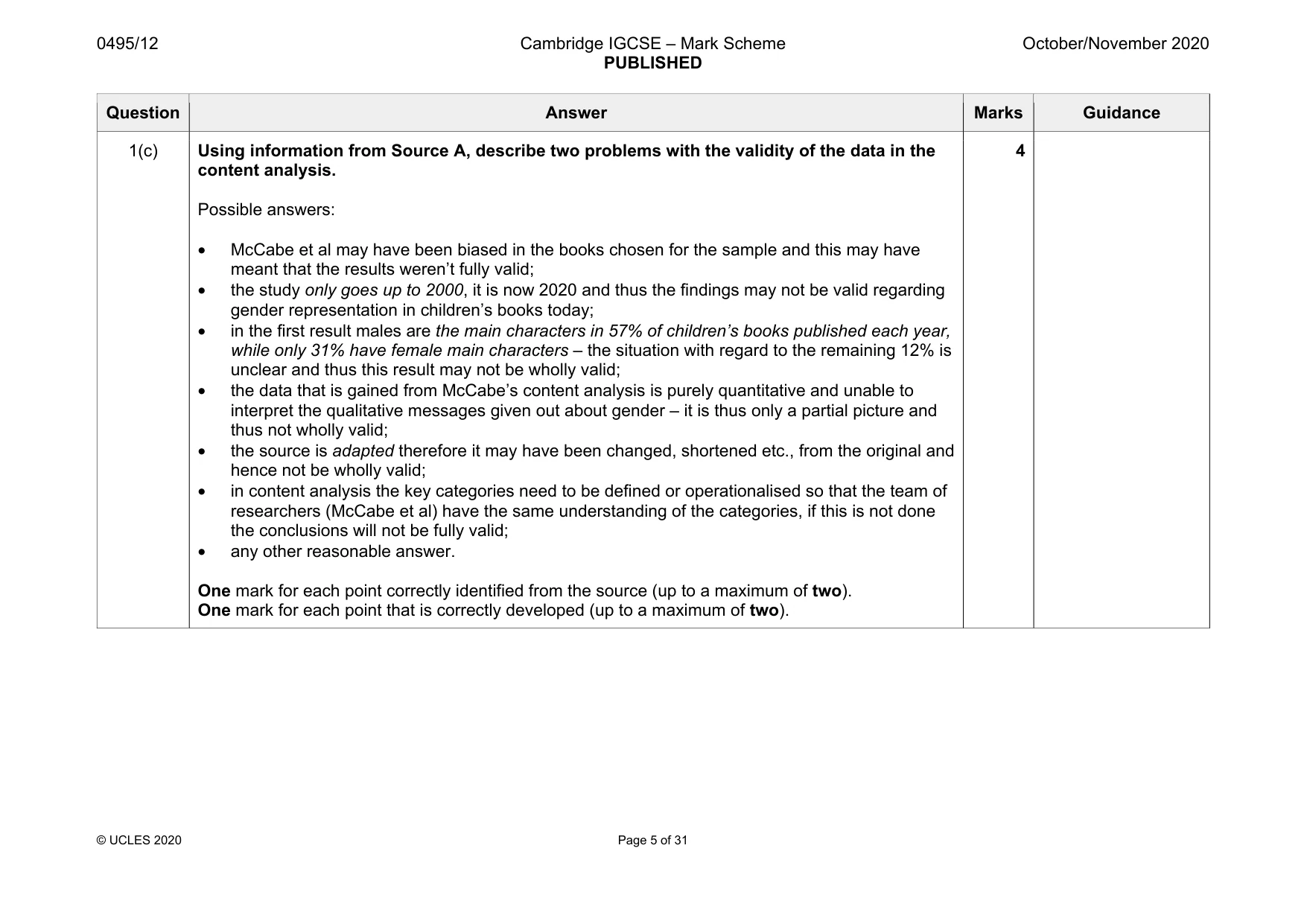
0495/12 Cambridge IGCSE – Mark Scheme PUBLISHED October/November 2020 © UCLES 2020 Page 5 of 31 Question Answer Marks Guidance 1(c) Using information from Source A, describe two problems with the validity of the data in the content analysis. Possible answers: • McCabe et al may have been biased in the books chosen for the sample and this may have meant that the results weren’t fully valid; • the study only goes up to 2000, it is now 2020 and thus the findings may not be valid regarding gender representation in children’s books today; • in the first result males are the main characters in 57% of children’s books published each year, while only 31% have female main characters – the situation with regard to the remaining 12% is unclear and thus this result may not be wholly valid; • the data that is gained from McCabe’s content analysis is purely quantitative and unable to interpret the qualitative messages given out about gender – it is thus only a partial picture and thus not wholly valid; • the source is adapted therefore it may have been changed, shortened etc., from the original and hence not be wholly valid; • in content analysis the key categories need to be defined or operationalised so that the team of researchers (McCabe et al) have the same understanding of the categories, if this is not done the conclusions will not be fully valid; • any other reasonable answer. One mark for each point correctly identified from the source (up to a maximum of two). One mark for each point that is correctly developed (up to a maximum of two). 4
Mark scheme, page 6
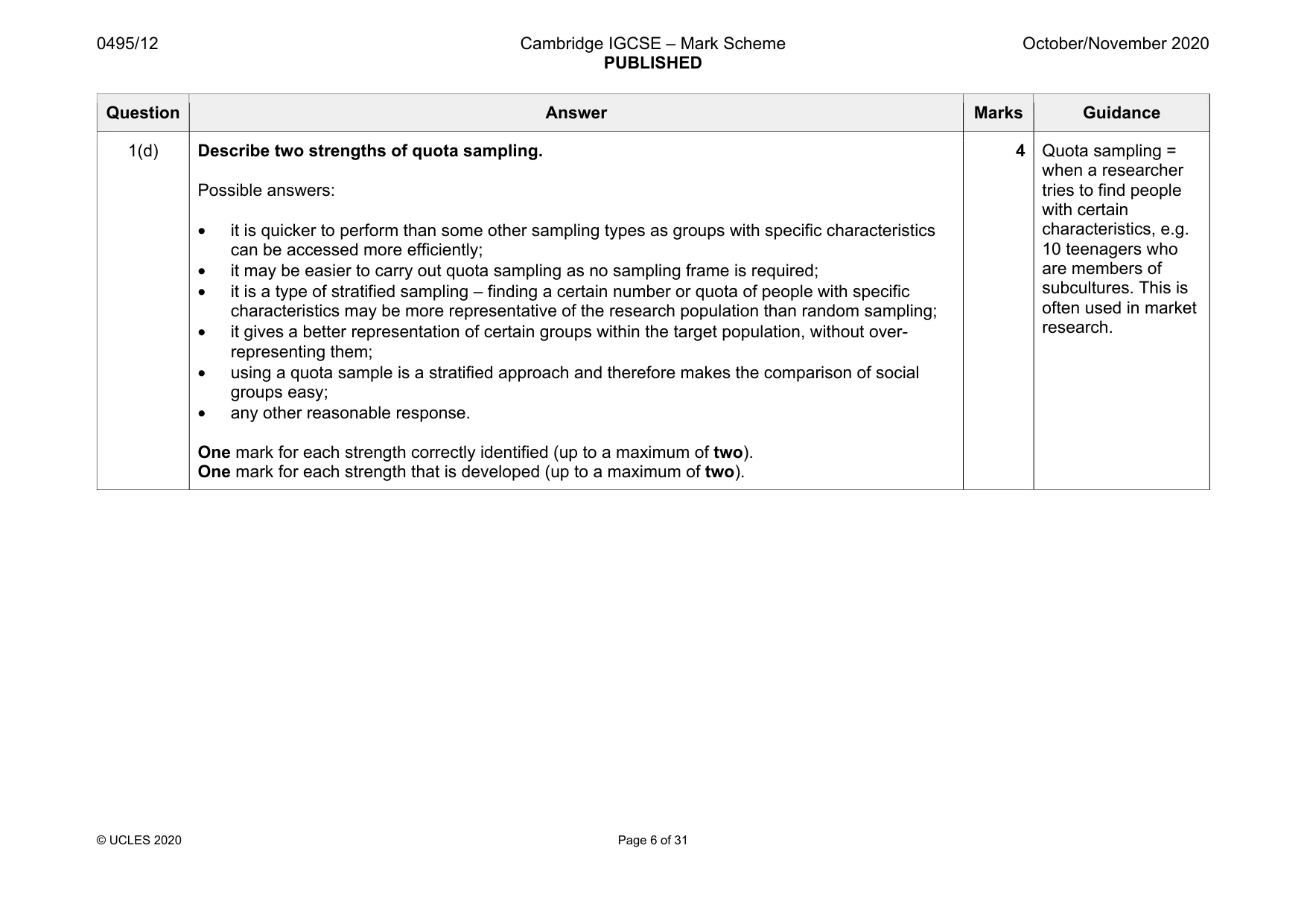
0495/12 Cambridge IGCSE – Mark Scheme PUBLISHED October/November 2020 © UCLES 2020 Page 6 of 31 Question Answer Marks Guidance 1(d) Describe two strengths of quota sampling. Possible answers: • it is quicker to perform than some other sampling types as groups with specific characteristics can be accessed more efficiently; • it may be easier to carry out quota sampling as no sampling frame is required; • it is a type of stratified sampling – finding a certain number or quota of people with specific characteristics may be more representative of the research population than random sampling; • it gives a better representation of certain groups within the target population, without over- representing them; • using a quota sample is a stratified approach and therefore makes the comparison of social groups easy; • any other reasonable response. One mark for each strength correctly identified (up to a maximum of two). One mark for each strength that is developed (up to a maximum of two). 4 Quota sampling = when a researcher tries to find people with certain characteristics, e.g. 10 teenagers who are members of subcultures. This is often used in market research.
Mark scheme, page 7
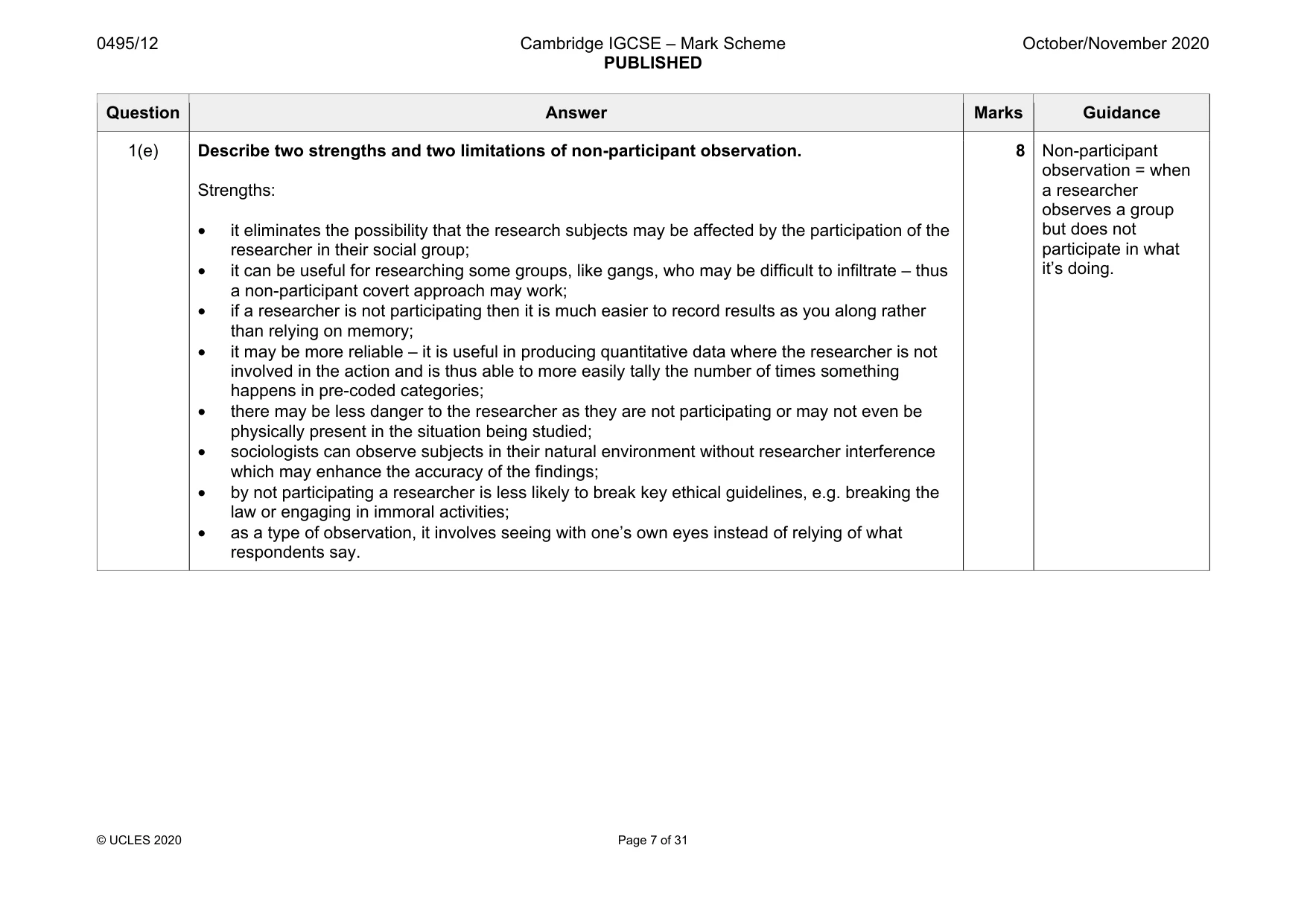
0495/12 Cambridge IGCSE – Mark Scheme PUBLISHED October/November 2020 © UCLES 2020 Page 7 of 31 Question Answer Marks Guidance 1(e) Describe two strengths and two limitations of non-participant observation. Strengths: • it eliminates the possibility that the research subjects may be affected by the participation of the researcher in their social group; • it can be useful for researching some groups, like gangs, who may be difficult to infiltrate – thus a non-participant covert approach may work; • if a researcher is not participating then it is much easier to record results as you along rather than relying on memory; • it may be more reliable – it is useful in producing quantitative data where the researcher is not involved in the action and is thus able to more easily tally the number of times something happens in pre-coded categories; • there may be less danger to the researcher as they are not participating or may not even be physically present in the situation being studied; • sociologists can observe subjects in their natural environment without researcher interference which may enhance the accuracy of the findings; • by not participating a researcher is less likely to break key ethical guidelines, e.g. breaking the law or engaging in immoral activities; • as a type of observation, it involves seeing with one’s own eyes instead of relying of what respondents say. 8 Non-participant observation = when a researcher observes a group but does not participate in what it’s doing.
Mark scheme, page 8
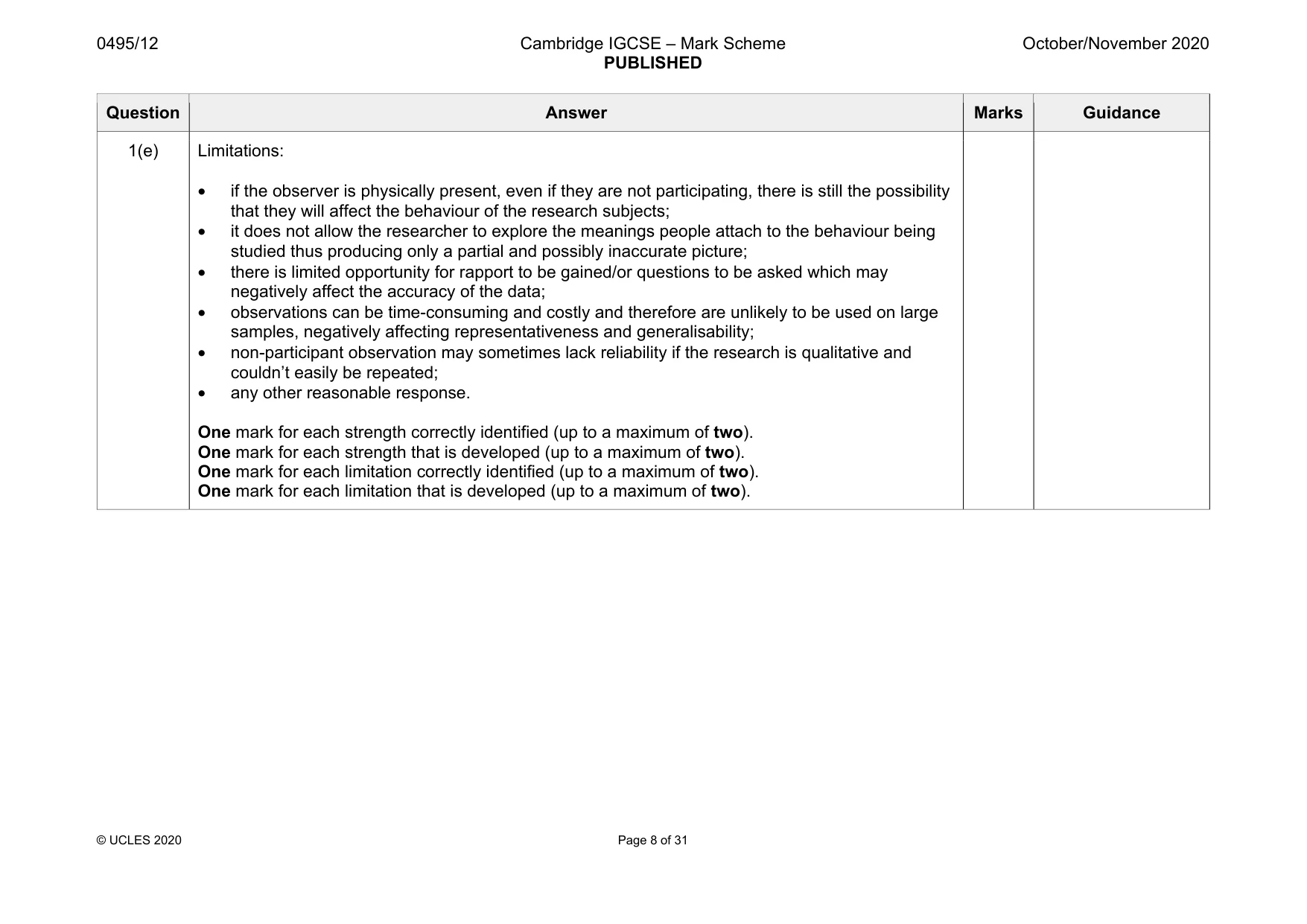
0495/12 Cambridge IGCSE – Mark Scheme PUBLISHED October/November 2020 © UCLES 2020 Page 8 of 31 Question Answer Marks Guidance 1(e) Limitations: • if the observer is physically present, even if they are not participating, there is still the possibility that they will affect the behaviour of the research subjects; • it does not allow the researcher to explore the meanings people attach to the behaviour being studied thus producing only a partial and possibly inaccurate picture; • there is limited opportunity for rapport to be gained/or questions to be asked which may negatively affect the accuracy of the data; • observations can be time-consuming and costly and therefore are unlikely to be used on large samples, negatively affecting representativeness and generalisability; • non-participant observation may sometimes lack reliability if the research is qualitative and couldn’t easily be repeated; • any other reasonable response. One mark for each strength correctly identified (up to a maximum of two). One mark for each strength that is developed (up to a maximum of two). One mark for each limitation correctly identified (up to a maximum of two). One mark for each limitation that is developed (up to a maximum of two).
Mark scheme, page 9
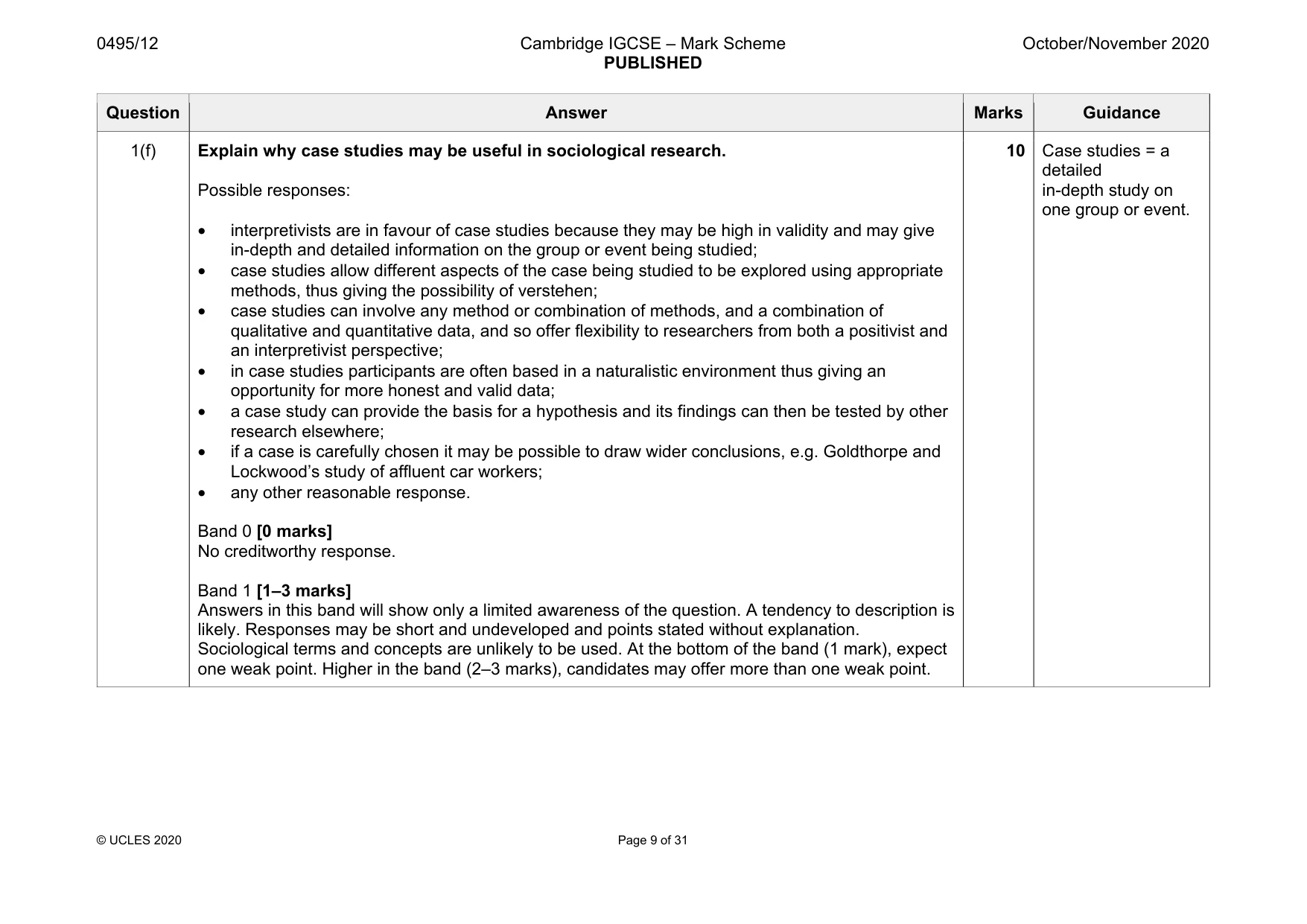
0495/12 Cambridge IGCSE – Mark Scheme PUBLISHED October/November 2020 © UCLES 2020 Page 9 of 31 Question Answer Marks Guidance 1(f) Explain why case studies may be useful in sociological research. Possible responses: • interpretivists are in favour of case studies because they may be high in validity and may give in-depth and detailed information on the group or event being studied; • case studies allow different aspects of the case being studied to be explored using appropriate methods, thus giving the possibility of verstehen; • case studies can involve any method or combination of methods, and a combination of qualitative and quantitative data, and so offer flexibility to researchers from both a positivist and an interpretivist perspective; • in case studies participants are often based in a naturalistic environment thus giving an opportunity for more honest and valid data; • a case study can provide the basis for a hypothesis and its findings can then be tested by other research elsewhere; • if a case is carefully chosen it may be possible to draw wider conclusions, e.g. Goldthorpe and Lockwood’s study of affluent car workers; • any other reasonable response. Band 0 [0 marks] No creditworthy response. Band 1 [1–3 marks] Answers in this band will show only a limited awareness of the question. A tendency to description is likely. Responses may be short and undeveloped and points stated without explanation. Sociological terms and concepts are unlikely to be used. At the bottom of the band (1 mark), expect one weak point. Higher in the band (2–3 marks), candidates may offer more than one weak point. 10 Case studies = a detailed in-depth study on one group or event.
Mark scheme, page 10
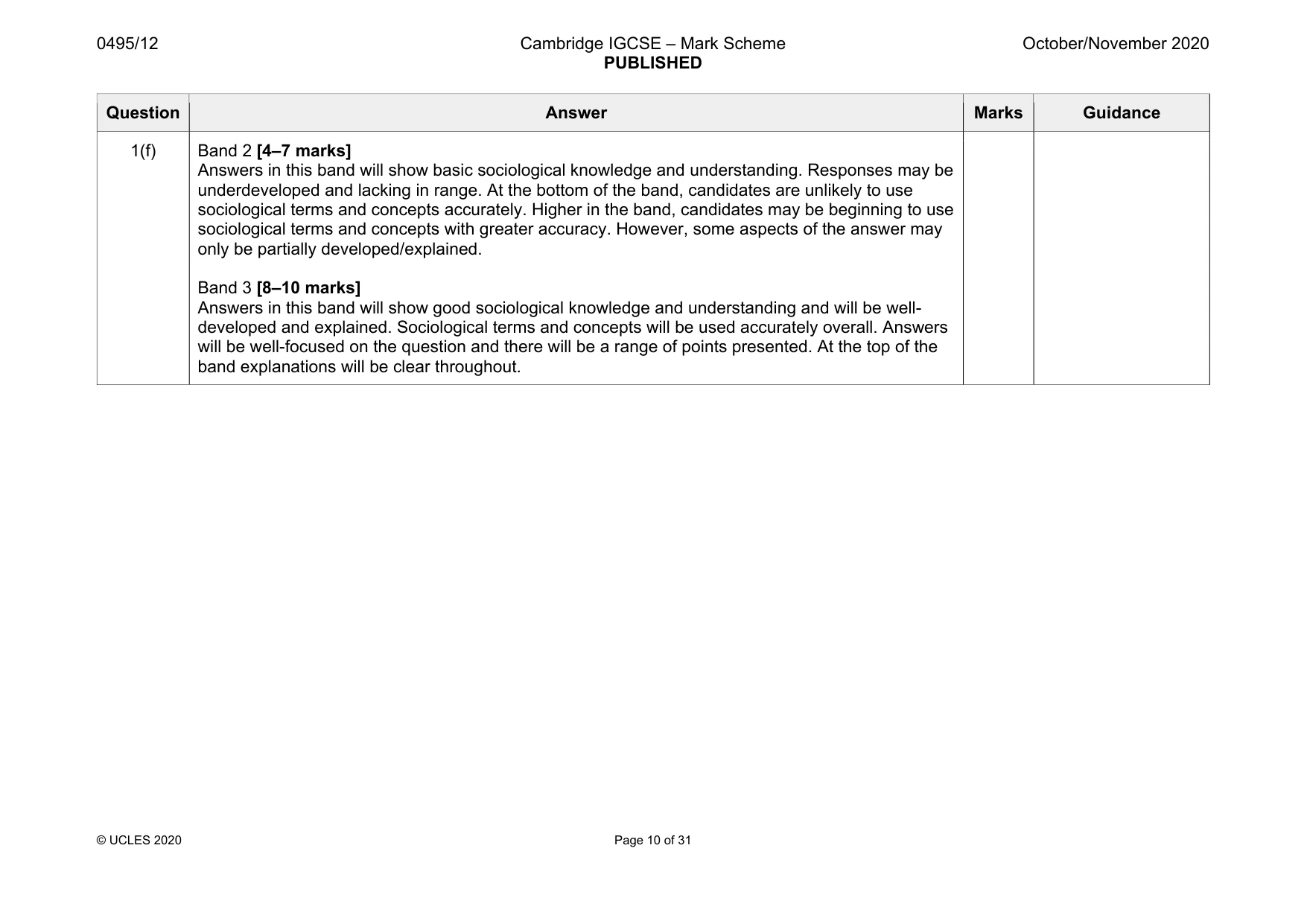
0495/12 Cambridge IGCSE – Mark Scheme PUBLISHED October/November 2020 © UCLES 2020 Page 10 of 31 Question Answer Marks Guidance 1(f) Band 2 [4–7 marks] Answers in this band will show basic sociological knowledge and understanding. Responses may be underdeveloped and lacking in range. At the bottom of the band, candidates are unlikely to use sociological terms and concepts accurately. Higher in the band, candidates may be beginning to use sociological terms and concepts with greater accuracy. However, some aspects of the answer may only be partially developed/explained. Band 3 [8–10 marks] Answers in this band will show good sociological knowledge and understanding and will be well- developed and explained. Sociological terms and concepts will be used accurately overall. Answers will be well-focused on the question and there will be a range of points presented. At the top of the band explanations will be clear throughout.
Mark scheme, page 11
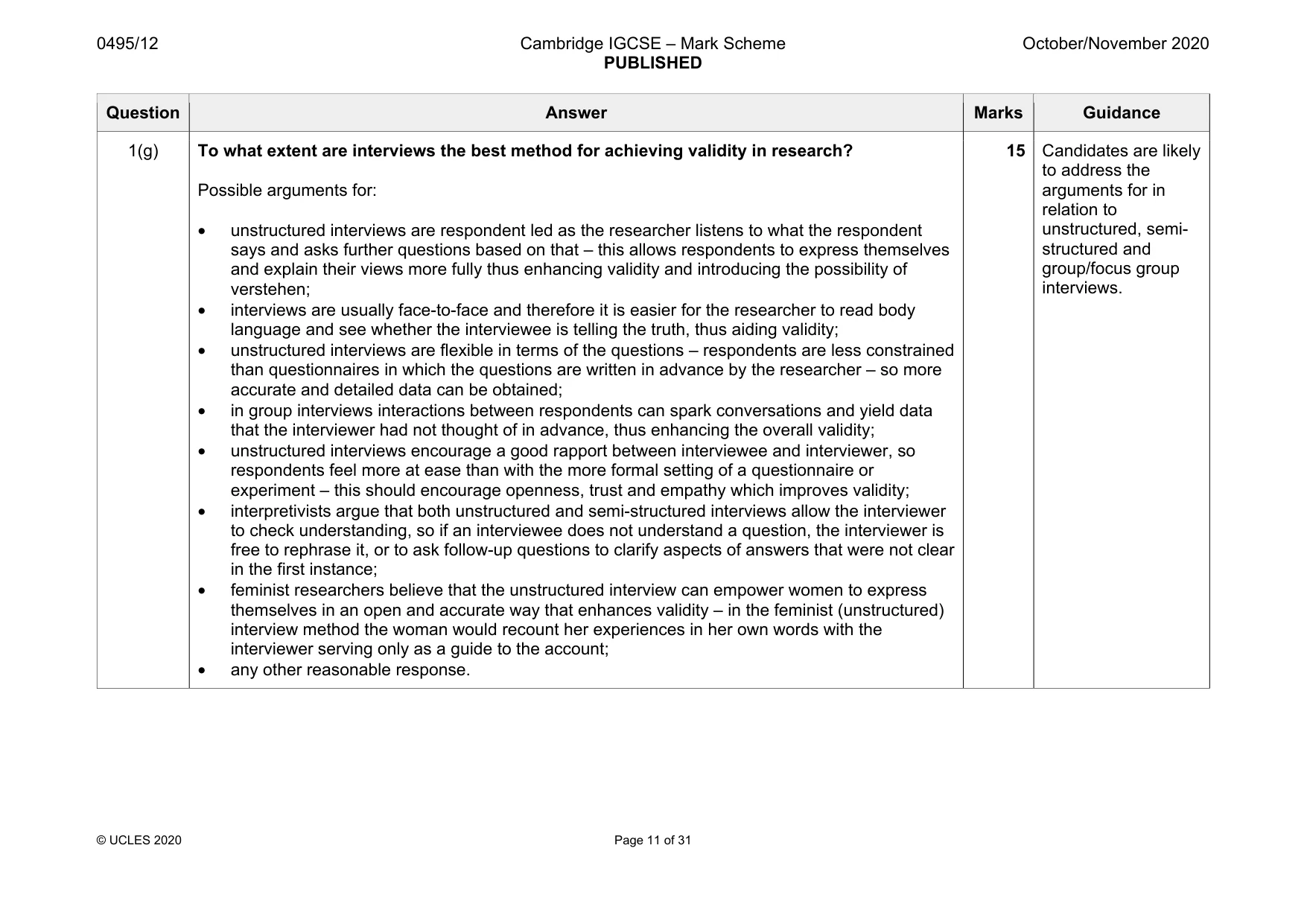
0495/12 Cambridge IGCSE – Mark Scheme PUBLISHED October/November 2020 © UCLES 2020 Page 11 of 31 Question Answer Marks Guidance 1(g) To what extent are interviews the best method for achieving validity in research? Possible arguments for: • unstructured interviews are respondent led as the researcher listens to what the respondent says and asks further questions based on that – this allows respondents to express themselves and explain their views more fully thus enhancing validity and introducing the possibility of verstehen; • interviews are usually face-to-face and therefore it is easier for the researcher to read body language and see whether the interviewee is telling the truth, thus aiding validity; • unstructured interviews are flexible in terms of the questions – respondents are less constrained than questionnaires in which the questions are written in advance by the researcher – so more accurate and detailed data can be obtained; • in group interviews interactions between respondents can spark conversations and yield data that the interviewer had not thought of in advance, thus enhancing the overall validity; • unstructured interviews encourage a good rapport between interviewee and interviewer, so respondents feel more at ease than with the more formal setting of a questionnaire or experiment – this should encourage openness, trust and empathy which improves validity; • interpretivists argue that both unstructured and semi-structured interviews allow the interviewer to check understanding, so if an interviewee does not understand a question, the interviewer is free to rephrase it, or to ask follow-up questions to clarify aspects of answers that were not clear in the first instance; • feminist researchers believe that the unstructured interview can empower women to express themselves in an open and accurate way that enhances validity – in the feminist (unstructured) interview method the woman would recount her experiences in her own words with the interviewer serving only as a guide to the account; • any other reasonable response. 15 Candidates are likely to address the arguments for in relation to unstructured, semi- structured and group/focus group interviews.
Mark scheme, page 12
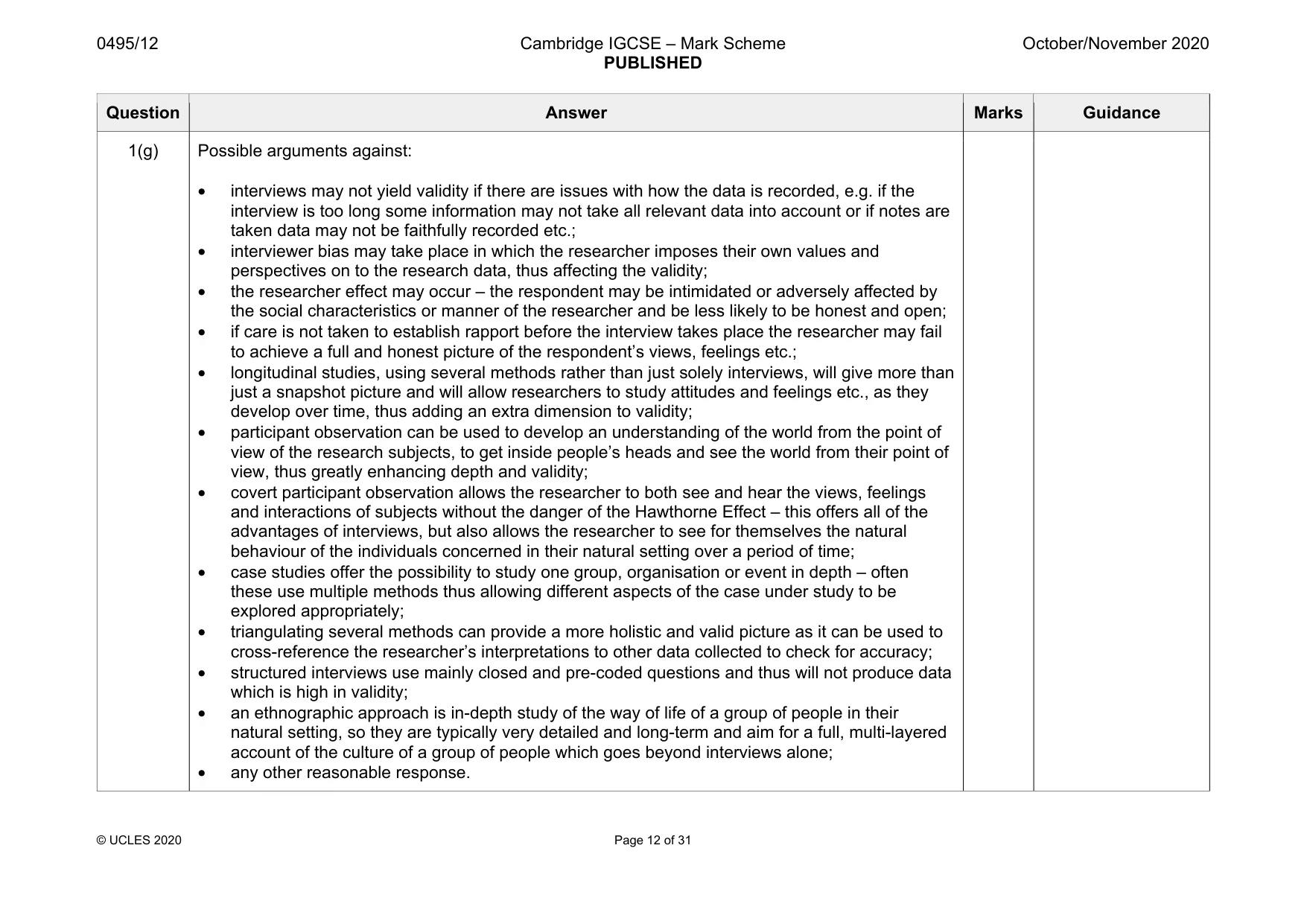
0495/12 Cambridge IGCSE – Mark Scheme PUBLISHED October/November 2020 © UCLES 2020 Page 12 of 31 Question Answer Marks Guidance 1(g) Possible arguments against: • interviews may not yield validity if there are issues with how the data is recorded, e.g. if the interview is too long some information may not take all relevant data into account or if notes are taken data may not be faithfully recorded etc.; • interviewer bias may take place in which the researcher imposes their own values and perspectives on to the research data, thus affecting the validity; • the researcher effect may occur – the respondent may be intimidated or adversely affected by the social characteristics or manner of the researcher and be less likely to be honest and open; • if care is not taken to establish rapport before the interview takes place the researcher may fail to achieve a full and honest picture of the respondent’s views, feelings etc.; • longitudinal studies, using several methods rather than just solely interviews, will give more than just a snapshot picture and will allow researchers to study attitudes and feelings etc., as they develop over time, thus adding an extra dimension to validity; • participant observation can be used to develop an understanding of the world from the point of view of the research subjects, to get inside people’s heads and see the world from their point of view, thus greatly enhancing depth and validity; • covert participant observation allows the researcher to both see and hear the views, feelings and interactions of subjects without the danger of the Hawthorne Effect – this offers all of the advantages of interviews, but also allows the researcher to see for themselves the natural behaviour of the individuals concerned in their natural setting over a period of time; • case studies offer the possibility to study one group, organisation or event in depth – often these use multiple methods thus allowing different aspects of the case under study to be explored appropriately; • triangulating several methods can provide a more holistic and valid picture as it can be used to cross-reference the researcher’s interpretations to other data collected to check for accuracy; • structured interviews use mainly closed and pre-coded questions and thus will not produce data which is high in validity; • an ethnographic approach is in-depth study of the way of life of a group of people in their natural setting, so they are typically very detailed and long-term and aim for a full, multi-layered account of the culture of a group of people which goes beyond interviews alone; • any other reasonable response.
Mark scheme, page 13
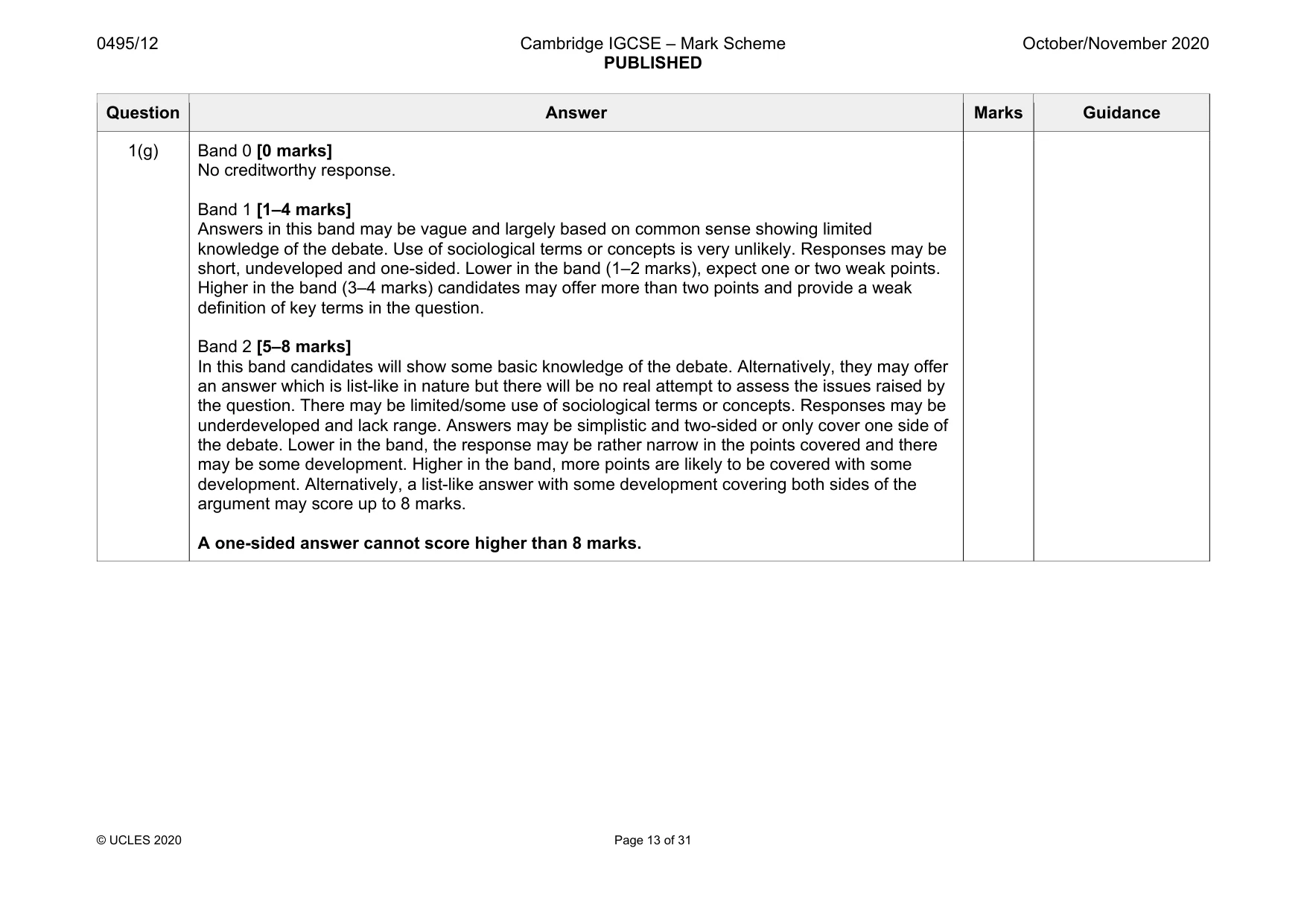
0495/12 Cambridge IGCSE – Mark Scheme PUBLISHED October/November 2020 © UCLES 2020 Page 13 of 31 Question Answer Marks Guidance 1(g) Band 0 [0 marks] No creditworthy response. Band 1 [1–4 marks] Answers in this band may be vague and largely based on common sense showing limited knowledge of the debate. Use of sociological terms or concepts is very unlikely. Responses may be short, undeveloped and one-sided. Lower in the band (1–2 marks), expect one or two weak points. Higher in the band (3–4 marks) candidates may offer more than two points and provide a weak definition of key terms in the question. Band 2 [5–8 marks] In this band candidates will show some basic knowledge of the debate. Alternatively, they may offer an answer which is list-like in nature but there will be no real attempt to assess the issues raised by the question. There may be limited/some use of sociological terms or concepts. Responses may be underdeveloped and lack range. Answers may be simplistic and two-sided or only cover one side of the debate. Lower in the band, the response may be rather narrow in the points covered and there may be some development. Higher in the band, more points are likely to be covered with some development. Alternatively, a list-like answer with some development covering both sides of the argument may score up to 8 marks. A one-sided answer cannot score higher than 8 marks.
Mark scheme, page 14
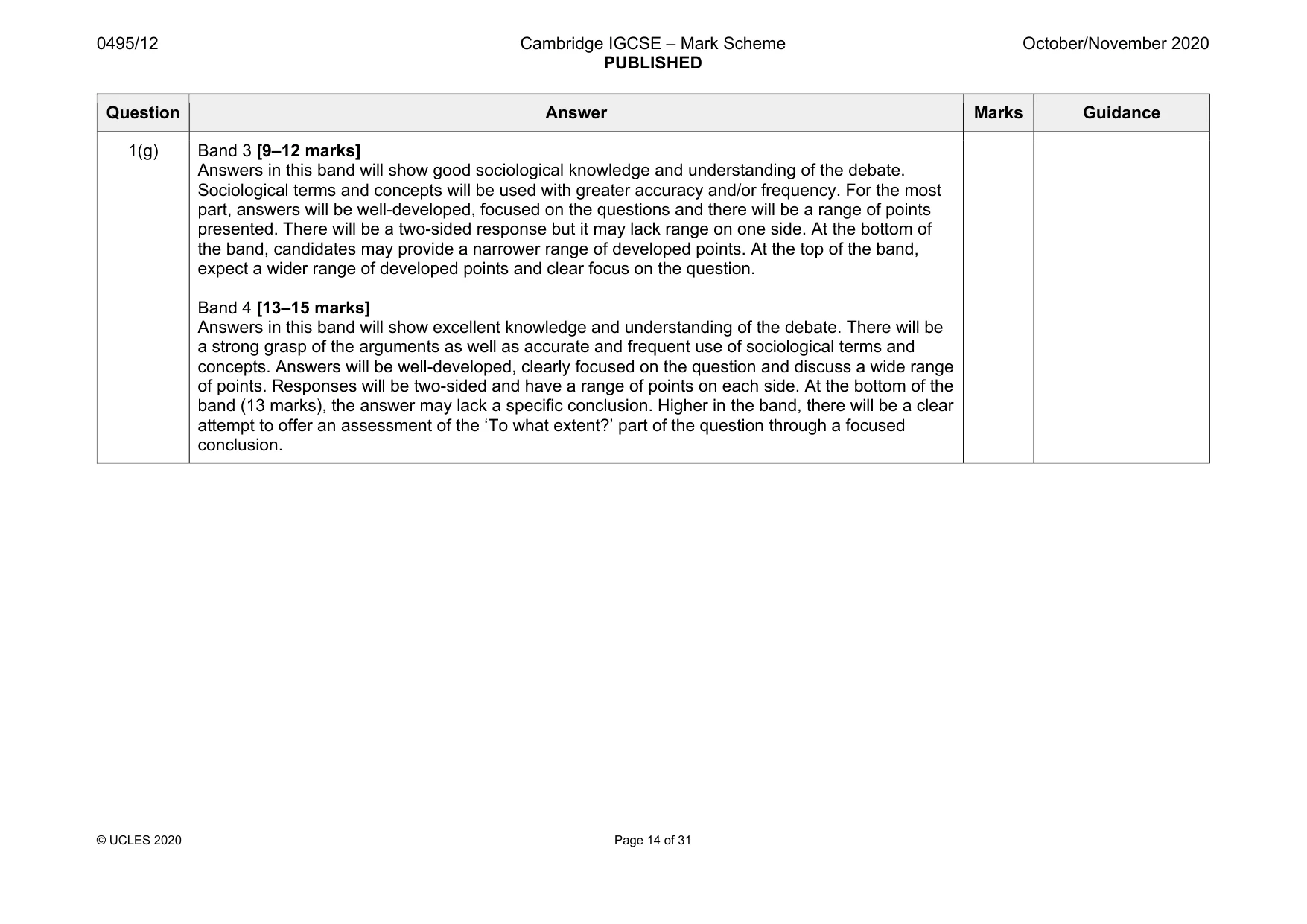
0495/12 Cambridge IGCSE – Mark Scheme PUBLISHED October/November 2020 © UCLES 2020 Page 14 of 31 Question Answer Marks Guidance 1(g) Band 3 [9–12 marks] Answers in this band will show good sociological knowledge and understanding of the debate. Sociological terms and concepts will be used with greater accuracy and/or frequency. For the most part, answers will be well-developed, focused on the questions and there will be a range of points presented. There will be a two-sided response but it may lack range on one side. At the bottom of the band, candidates may provide a narrower range of developed points. At the top of the band, expect a wider range of developed points and clear focus on the question. Band 4 [13–15 marks] Answers in this band will show excellent knowledge and understanding of the debate. There will be a strong grasp of the arguments as well as accurate and frequent use of sociological terms and concepts. Answers will be well-developed, clearly focused on the question and discuss a wide range of points. Responses will be two-sided and have a range of points on each side. At the bottom of the band (13 marks), the answer may lack a specific conclusion. Higher in the band, there will be a clear attempt to offer an assessment of the ‘To what extent?’ part of the question through a focused conclusion.
Mark scheme, page 15
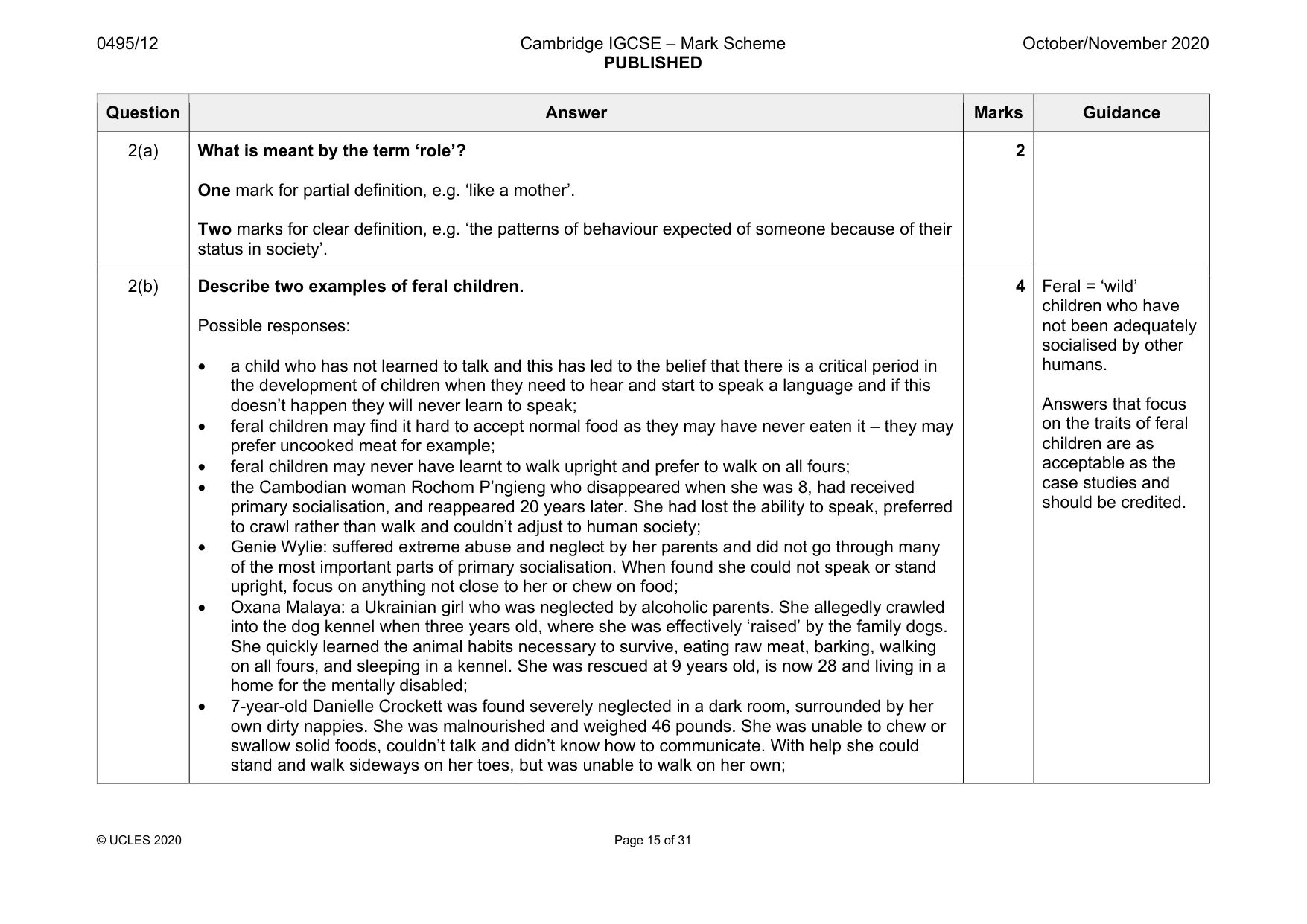
0495/12 Cambridge IGCSE – Mark Scheme PUBLISHED October/November 2020 © UCLES 2020 Page 15 of 31 Question Answer Marks Guidance 2(a) What is meant by the term ‘role’? One mark for partial definition, e.g. ‘like a mother’. Two marks for clear definition, e.g. ‘the patterns of behaviour expected of someone because of their status in society’. 2 2(b) Describe two examples of feral children. Possible responses: • a child who has not learned to talk and this has led to the belief that there is a critical period in the development of children when they need to hear and start to speak a language and if this doesn’t happen they will never learn to speak; • feral children may find it hard to accept normal food as they may have never eaten it – they may prefer uncooked meat for example; • feral children may never have learnt to walk upright and prefer to walk on all fours; • the Cambodian woman Rochom P’ngieng who disappeared when she was 8, had received primary socialisation, and reappeared 20 years later. She had lost the ability to speak, preferred to crawl rather than walk and couldn’t adjust to human society; • Genie Wylie: suffered extreme abuse and neglect by her parents and did not go through many of the most important parts of primary socialisation. When found she could not speak or stand upright, focus on anything not close to her or chew on food; • Oxana Malaya: a Ukrainian girl who was neglected by alcoholic parents. She allegedly crawled into the dog kennel when three years old, where she was effectively ‘raised’ by the family dogs. She quickly learned the animal habits necessary to survive, eating raw meat, barking, walking on all fours, and sleeping in a kennel. She was rescued at 9 years old, is now 28 and living in a home for the mentally disabled; • 7-year-old Danielle Crockett was found severely neglected in a dark room, surrounded by her own dirty nappies. She was malnourished and weighed 46 pounds. She was unable to chew or swallow solid foods, couldn’t talk and didn’t know how to communicate. With help she could stand and walk sideways on her toes, but was unable to walk on her own; 4 Feral = ‘wild’ children who have not been adequately socialised by other humans. Answers that focus on the traits of feral children are as acceptable as the case studies and should be credited.
Mark scheme, page 16
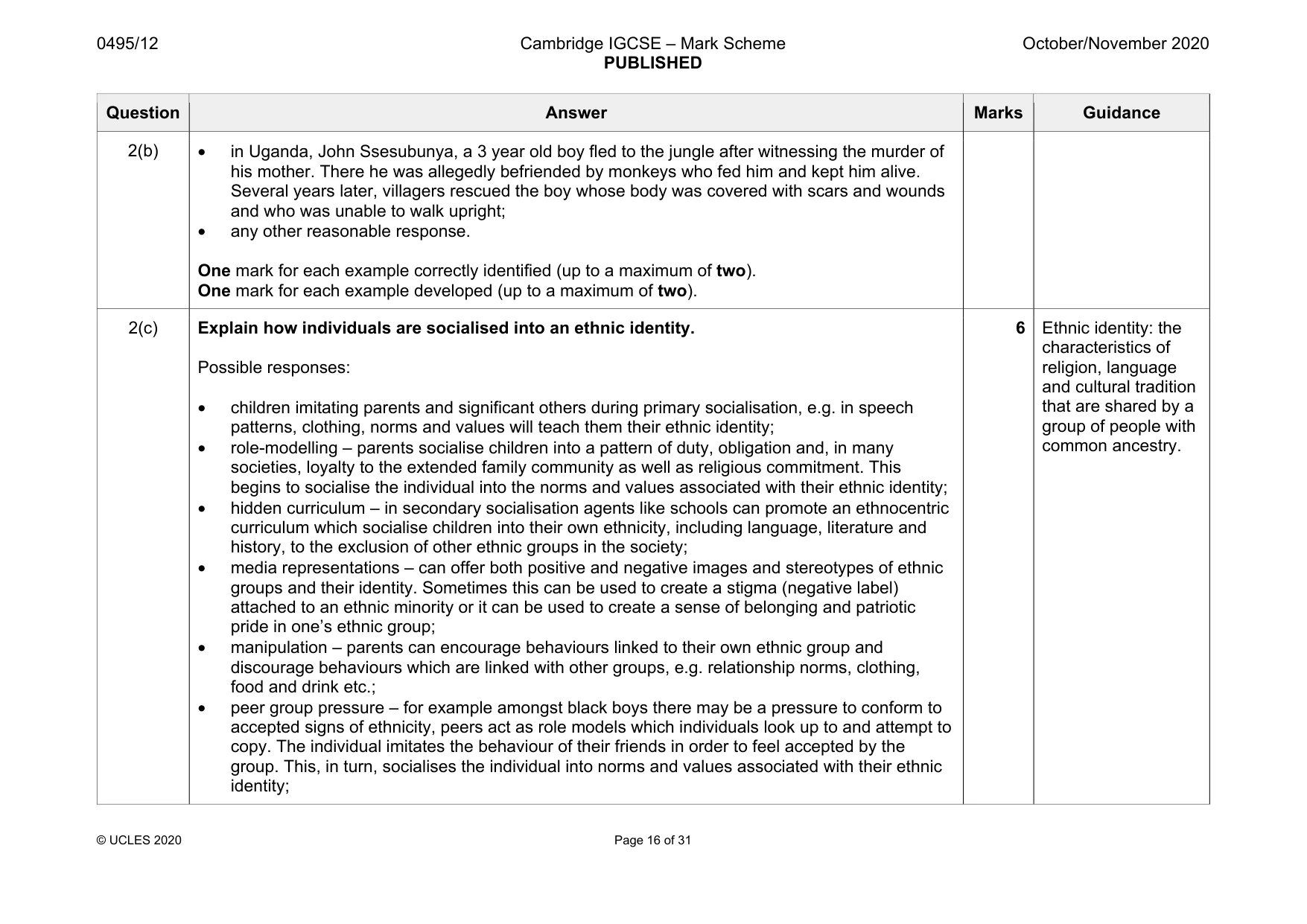
0495/12 Cambridge IGCSE – Mark Scheme PUBLISHED October/November 2020 © UCLES 2020 Page 16 of 31 Question Answer Marks Guidance 2(b) • in Uganda, John Ssesubunya, a 3 year old boy fled to the jungle after witnessing the murder of his mother. There he was allegedly befriended by monkeys who fed him and kept him alive. Several years later, villagers rescued the boy whose body was covered with scars and wounds and who was unable to walk upright; • any other reasonable response. One mark for each example correctly identified (up to a maximum of two). One mark for each example developed (up to a maximum of two). 2(c) Explain how individuals are socialised into an ethnic identity. Possible responses: • children imitating parents and significant others during primary socialisation, e.g. in speech patterns, clothing, norms and values will teach them their ethnic identity; • role-modelling – parents socialise children into a pattern of duty, obligation and, in many societies, loyalty to the extended family community as well as religious commitment. This begins to socialise the individual into the norms and values associated with their ethnic identity; • hidden curriculum – in secondary socialisation agents like schools can promote an ethnocentric curriculum which socialise children into their own ethnicity, including language, literature and history, to the exclusion of other ethnic groups in the society; • media representations – can offer both positive and negative images and stereotypes of ethnic groups and their identity. Sometimes this can be used to create a stigma (negative label) attached to an ethnic minority or it can be used to create a sense of belonging and patriotic pride in one’s ethnic group; • manipulation – parents can encourage behaviours linked to their own ethnic group and discourage behaviours which are linked with other groups, e.g. relationship norms, clothing, food and drink etc.; • peer group pressure – for example amongst black boys there may be a pressure to conform to accepted signs of ethnicity, peers act as role models which individuals look up to and attempt to copy. The individual imitates the behaviour of their friends in order to feel accepted by the group. This, in turn, socialises the individual into norms and values associated with their ethnic identity; 6 Ethnic identity: the characteristics of religion, language and cultural tradition that are shared by a group of people with common ancestry.
Mark scheme, page 17
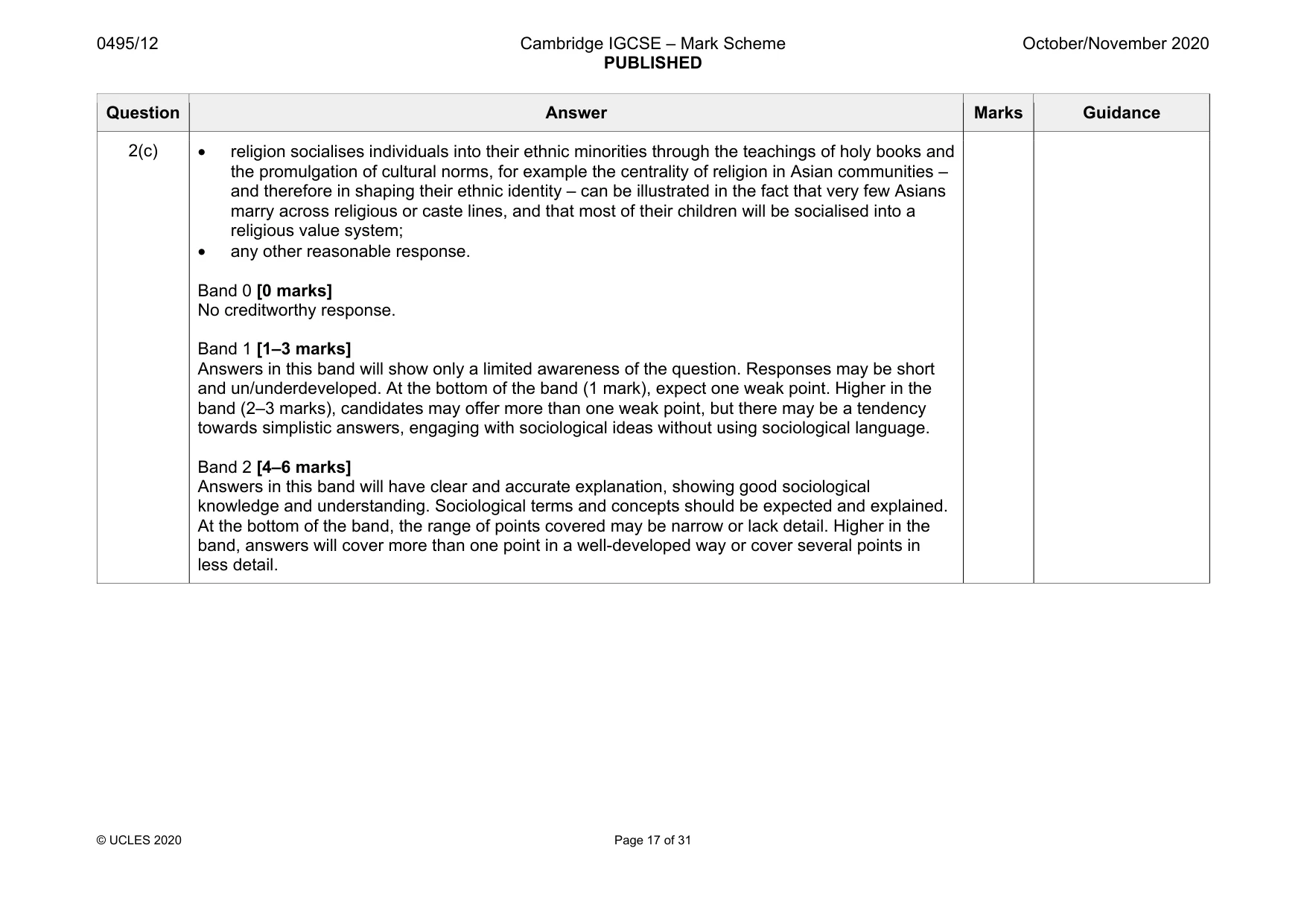
0495/12 Cambridge IGCSE – Mark Scheme PUBLISHED October/November 2020 © UCLES 2020 Page 17 of 31 Question Answer Marks Guidance 2(c) • religion socialises individuals into their ethnic minorities through the teachings of holy books and the promulgation of cultural norms, for example the centrality of religion in Asian communities – and therefore in shaping their ethnic identity – can be illustrated in the fact that very few Asians marry across religious or caste lines, and that most of their children will be socialised into a religious value system; • any other reasonable response. Band 0 [0 marks] No creditworthy response. Band 1 [1–3 marks] Answers in this band will show only a limited awareness of the question. Responses may be short and un/underdeveloped. At the bottom of the band (1 mark), expect one weak point. Higher in the band (2–3 marks), candidates may offer more than one weak point, but there may be a tendency towards simplistic answers, engaging with sociological ideas without using sociological language. Band 2 [4–6 marks] Answers in this band will have clear and accurate explanation, showing good sociological knowledge and understanding. Sociological terms and concepts should be expected and explained. At the bottom of the band, the range of points covered may be narrow or lack detail. Higher in the band, answers will cover more than one point in a well-developed way or cover several points in less detail.
Mark scheme, page 18
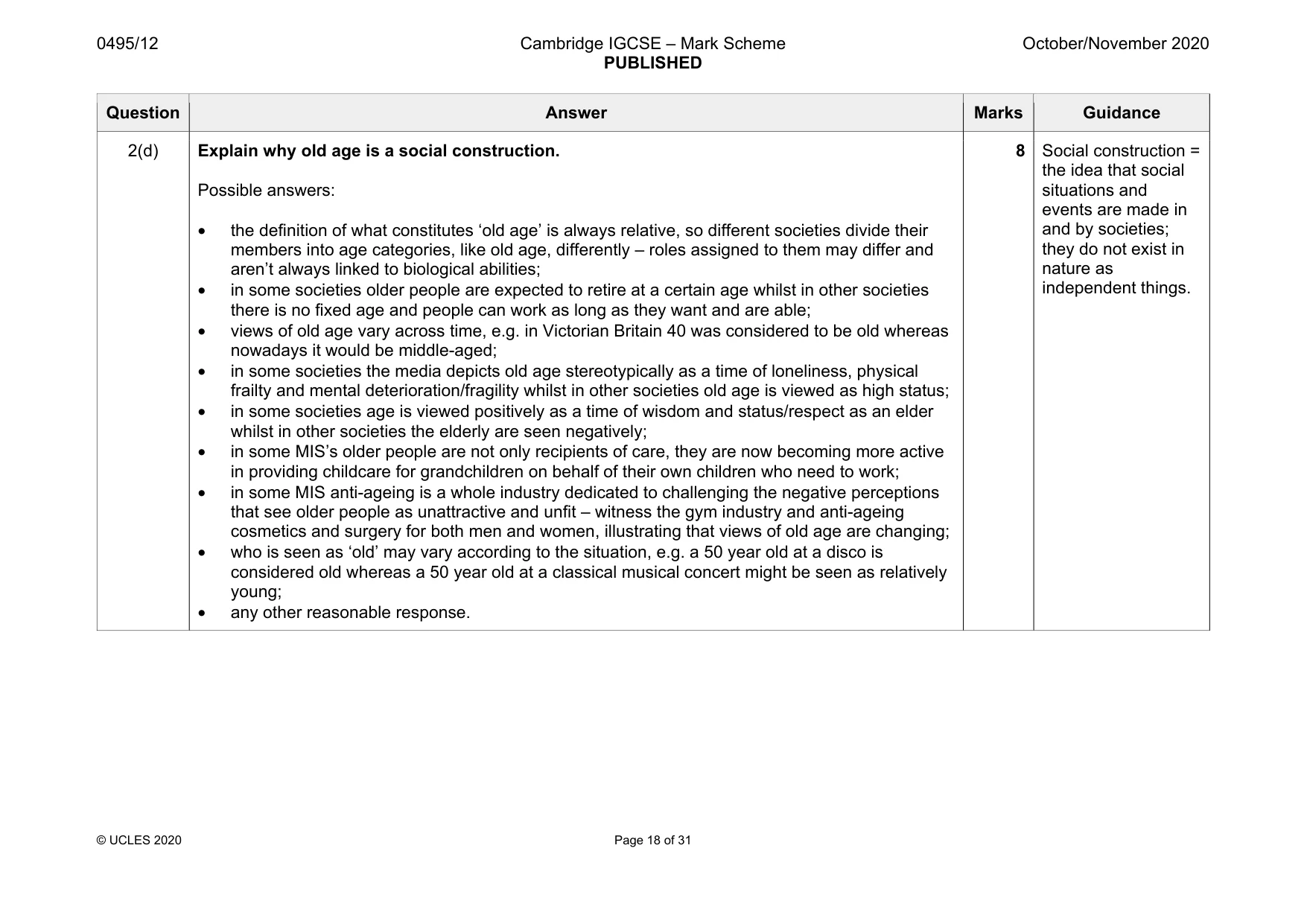
0495/12 Cambridge IGCSE – Mark Scheme PUBLISHED October/November 2020 © UCLES 2020 Page 18 of 31 Question Answer Marks Guidance 2(d) Explain why old age is a social construction. Possible answers: • the definition of what constitutes ‘old age’ is always relative, so different societies divide their members into age categories, like old age, differently – roles assigned to them may differ and aren’t always linked to biological abilities; • in some societies older people are expected to retire at a certain age whilst in other societies there is no fixed age and people can work as long as they want and are able; • views of old age vary across time, e.g. in Victorian Britain 40 was considered to be old whereas nowadays it would be middle-aged; • in some societies the media depicts old age stereotypically as a time of loneliness, physical frailty and mental deterioration/fragility whilst in other societies old age is viewed as high status; • in some societies age is viewed positively as a time of wisdom and status/respect as an elder whilst in other societies the elderly are seen negatively; • in some MIS’s older people are not only recipients of care, they are now becoming more active in providing childcare for grandchildren on behalf of their own children who need to work; • in some MIS anti-ageing is a whole industry dedicated to challenging the negative perceptions that see older people as unattractive and unfit – witness the gym industry and anti-ageing cosmetics and surgery for both men and women, illustrating that views of old age are changing; • who is seen as ‘old’ may vary according to the situation, e.g. a 50 year old at a disco is considered old whereas a 50 year old at a classical musical concert might be seen as relatively young; • any other reasonable response. 8 Social construction = the idea that social situations and events are made in and by societies; they do not exist in nature as independent things.
Mark scheme, page 19
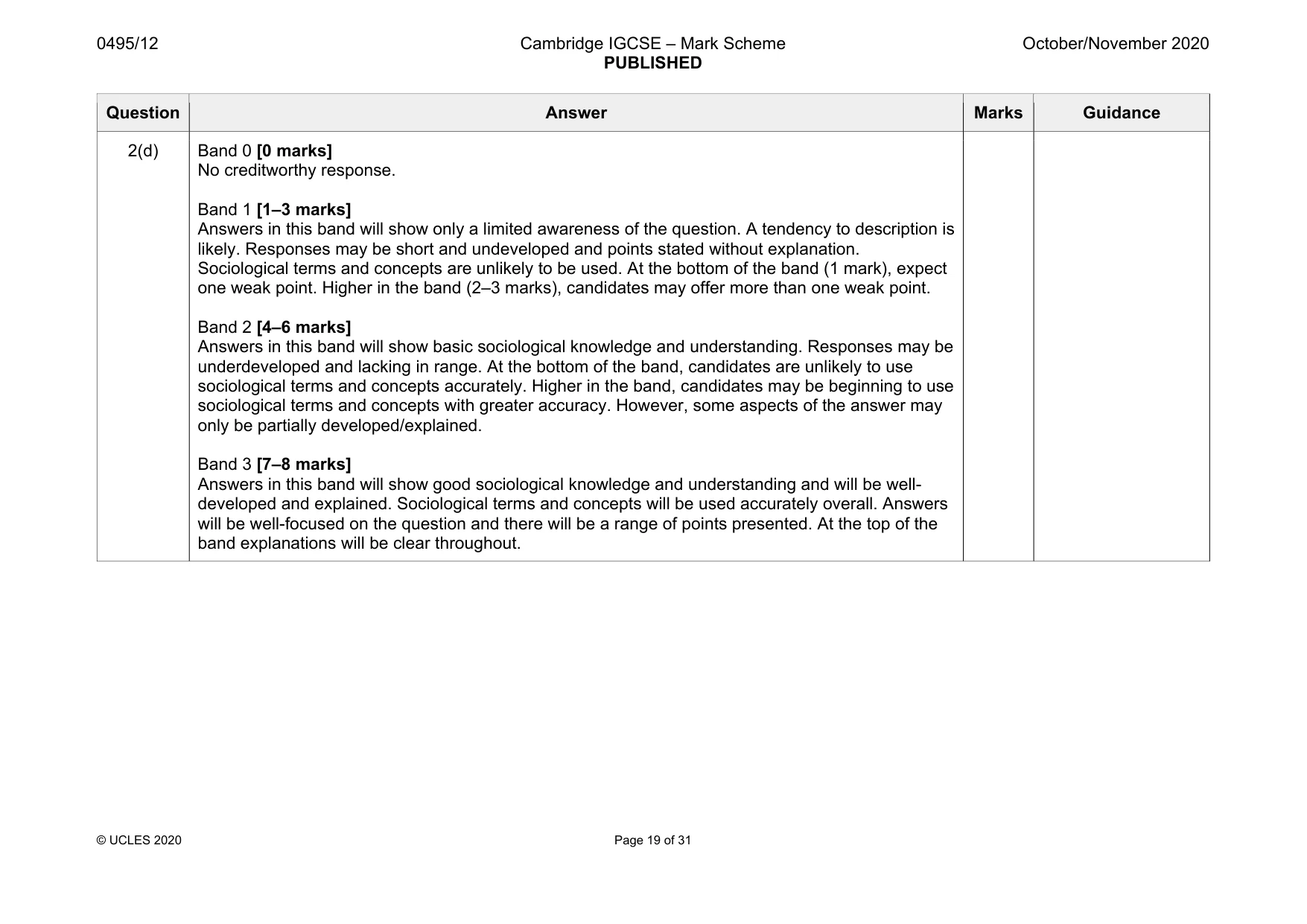
0495/12 Cambridge IGCSE – Mark Scheme PUBLISHED October/November 2020 © UCLES 2020 Page 19 of 31 Question Answer Marks Guidance 2(d) Band 0 [0 marks] No creditworthy response. Band 1 [1–3 marks] Answers in this band will show only a limited awareness of the question. A tendency to description is likely. Responses may be short and undeveloped and points stated without explanation. Sociological terms and concepts are unlikely to be used. At the bottom of the band (1 mark), expect one weak point. Higher in the band (2–3 marks), candidates may offer more than one weak point. Band 2 [4–6 marks] Answers in this band will show basic sociological knowledge and understanding. Responses may be underdeveloped and lacking in range. At the bottom of the band, candidates are unlikely to use sociological terms and concepts accurately. Higher in the band, candidates may be beginning to use sociological terms and concepts with greater accuracy. However, some aspects of the answer may only be partially developed/explained. Band 3 [7–8 marks] Answers in this band will show good sociological knowledge and understanding and will be well- developed and explained. Sociological terms and concepts will be used accurately overall. Answers will be well-focused on the question and there will be a range of points presented. At the top of the band explanations will be clear throughout.
Mark scheme, page 20
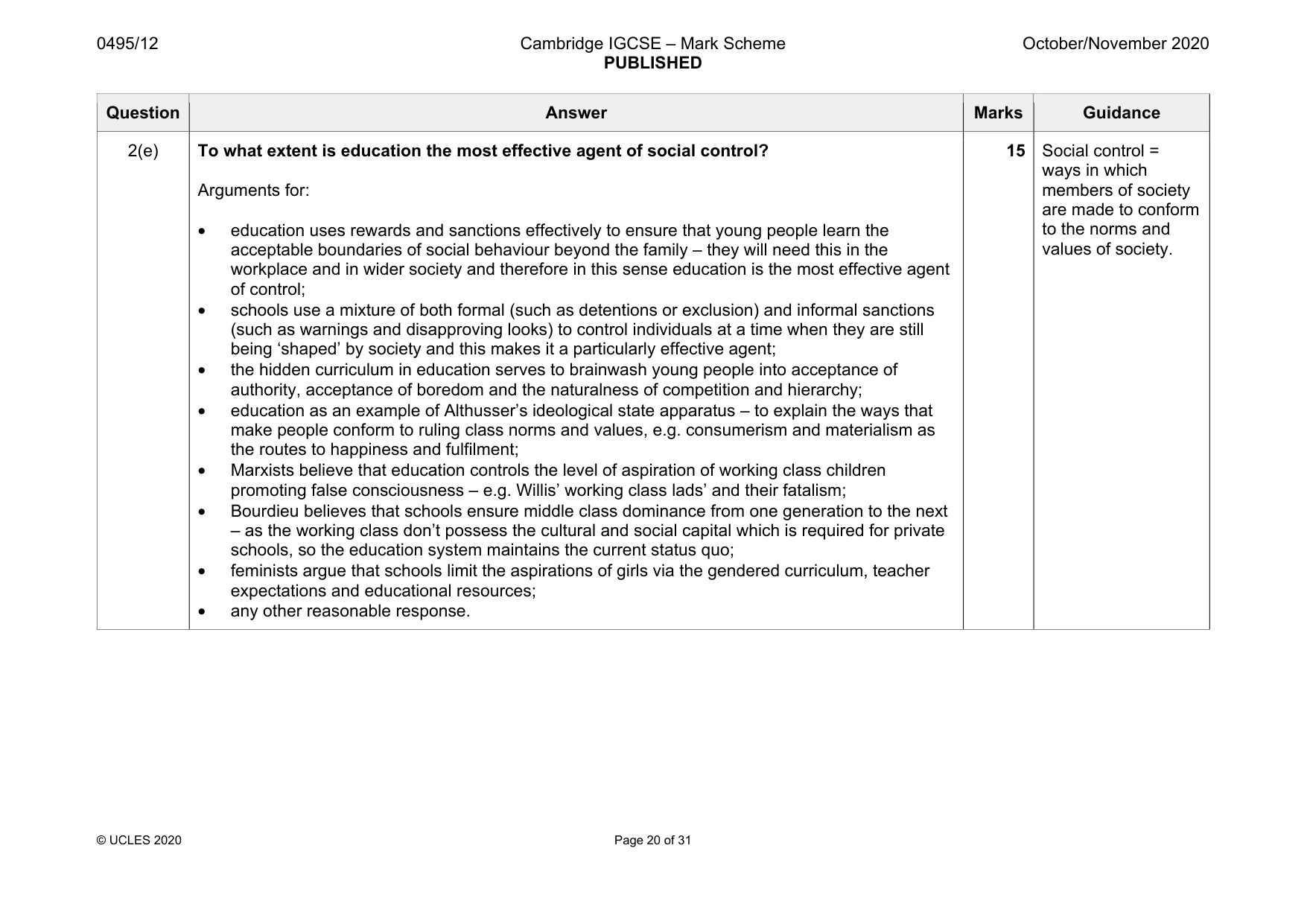
0495/12 Cambridge IGCSE – Mark Scheme PUBLISHED October/November 2020 © UCLES 2020 Page 20 of 31 Question Answer Marks Guidance 2(e) To what extent is education the most effective agent of social control? Arguments for: • education uses rewards and sanctions effectively to ensure that young people learn the acceptable boundaries of social behaviour beyond the family – they will need this in the workplace and in wider society and therefore in this sense education is the most effective agent of control; • schools use a mixture of both formal (such as detentions or exclusion) and informal sanctions (such as warnings and disapproving looks) to control individuals at a time when they are still being ‘shaped’ by society and this makes it a particularly effective agent; • the hidden curriculum in education serves to brainwash young people into acceptance of authority, acceptance of boredom and the naturalness of competition and hierarchy; • education as an example of Althusser’s ideological state apparatus – to explain the ways that make people conform to ruling class norms and values, e.g. consumerism and materialism as the routes to happiness and fulfilment; • Marxists believe that education controls the level of aspiration of working class children promoting false consciousness – e.g. Willis’ working class lads’ and their fatalism; • Bourdieu believes that schools ensure middle class dominance from one generation to the next – as the working class don’t possess the cultural and social capital which is required for private schools, so the education system maintains the current status quo; • feminists argue that schools limit the aspirations of girls via the gendered curriculum, teacher expectations and educational resources; • any other reasonable response. 15 Social control = ways in which members of society are made to conform to the norms and values of society.
Mark scheme, page 21
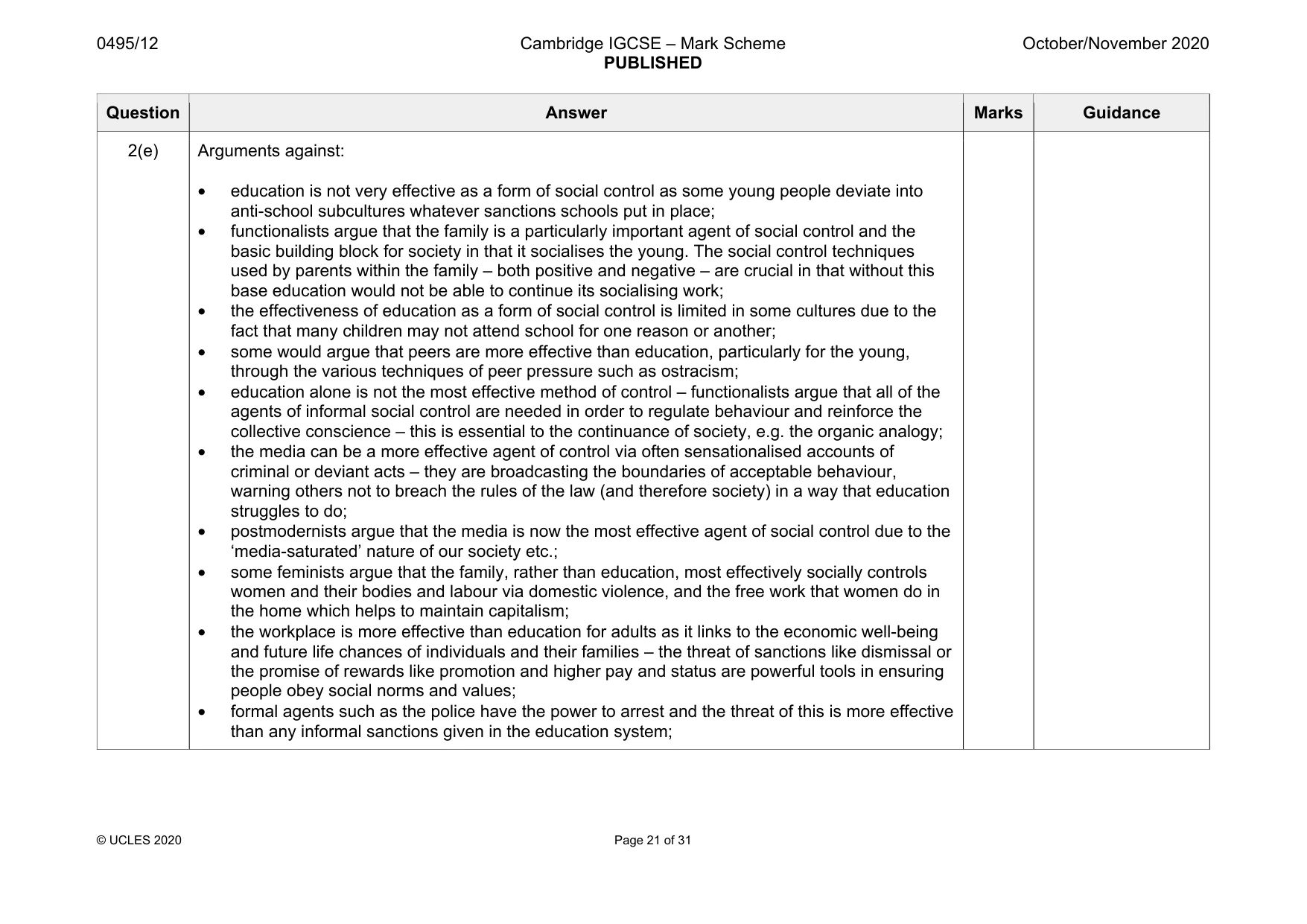
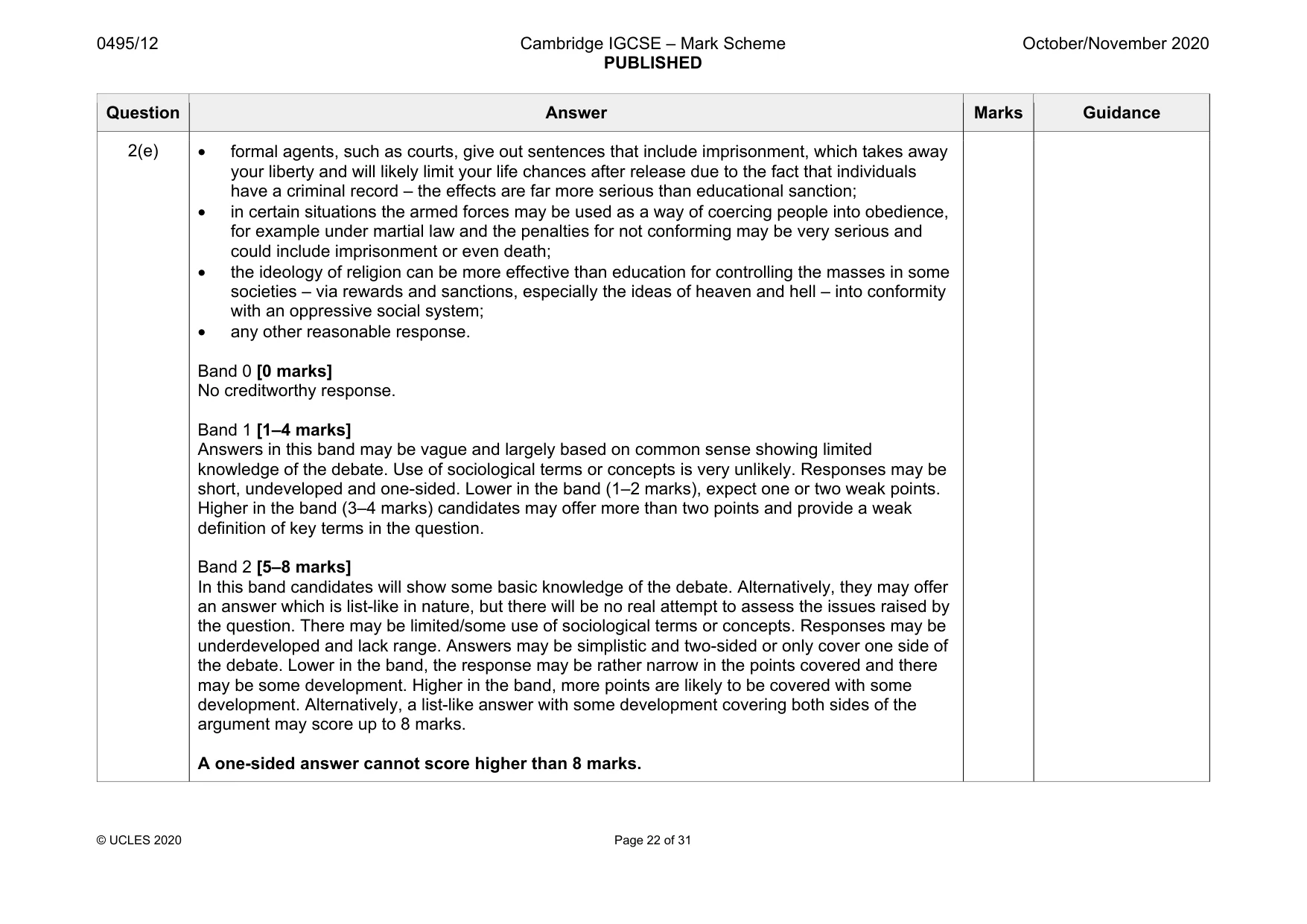
0495/12 Cambridge IGCSE – Mark Scheme PUBLISHED October/November 2020 © UCLES 2020 Page 21 of 31 Question Answer Marks Guidance 2(e) Arguments against: • education is not very effective as a form of social control as some young people deviate into anti-school subcultures whatever sanctions schools put in place; • functionalists argue that the family is a particularly important agent of social control and the basic building block for society in that it socialises the young. The social control techniques used by parents within the family – both positive and negative – are crucial in that without this base education would not be able to continue its socialising work; • the effectiveness of education as a form of social control is limited in some cultures due to the fact that many children may not attend school for one reason or another; • some would argue that peers are more effective than education, particularly for the young, through the various techniques of peer pressure such as ostracism; • education alone is not the most effective method of control – functionalists argue that all of the agents of informal social control are needed in order to regulate behaviour and reinforce the collective conscience – this is essential to the continuance of society, e.g. the organic analogy; • the media can be a more effective agent of control via often sensationalised accounts of criminal or deviant acts – they are broadcasting the boundaries of acceptable behaviour, warning others not to breach the rules of the law (and therefore society) in a way that education struggles to do; • postmodernists argue that the media is now the most effective agent of social control due to the ‘media-saturated’ nature of our society etc.; • some feminists argue that the family, rather than education, most effectively socially controls women and their bodies and labour via domestic violence, and the free work that women do in the home which helps to maintain capitalism; • the workplace is more effective than education for adults as it links to the economic well-being and future life chances of individuals and their families – the threat of sanctions like dismissal or the promise of rewards like promotion and higher pay and status are powerful tools in ensuring people obey social norms and values; • formal agents such as the police have the power to arrest and the threat of this is more effective than any informal sanctions given in the education system;
Mark scheme, page 22
0495/12 Cambridge IGCSE – Mark Scheme PUBLISHED October/November 2020 © UCLES 2020 Page 22 of 31 Question Answer Marks Guidance 2(e) • formal agents, such as courts, give out sentences that include imprisonment, which takes away your liberty and will likely limit your life chances after release due to the fact that individuals have a criminal record – the effects are far more serious than educational sanction; • in certain situations the armed forces may be used as a way of coercing people into obedience, for example under martial law and the penalties for not conforming may be very serious and could include imprisonment or even death; • the ideology of religion can be more effective than education for controlling the masses in some societies – via rewards and sanctions, especially the ideas of heaven and hell – into conformity with an oppressive social system; • any other reasonable response. Band 0 [0 marks] No creditworthy response. Band 1 [1–4 marks] Answers in this band may be vague and largely based on common sense showing limited knowledge of the debate. Use of sociological terms or concepts is very unlikely. Responses may be short, undeveloped and one-sided. Lower in the band (1–2 marks), expect one or two weak points. Higher in the band (3–4 marks) candidates may offer more than two points and provide a weak definition of key terms in the question. Band 2 [5–8 marks] In this band candidates will show some basic knowledge of the debate. Alternatively, they may offer an answer which is list-like in nature, but there will be no real attempt to assess the issues raised by the question. There may be limited/some use of sociological terms or concepts. Responses may be underdeveloped and lack range. Answers may be simplistic and two-sided or only cover one side of the debate. Lower in the band, the response may be rather narrow in the points covered and there may be some development. Higher in the band, more points are likely to be covered with some development. Alternatively, a list-like answer with some development covering both sides of the argument may score up to 8 marks. A one-sided answer cannot score higher than 8 marks.
Mark scheme, page 23
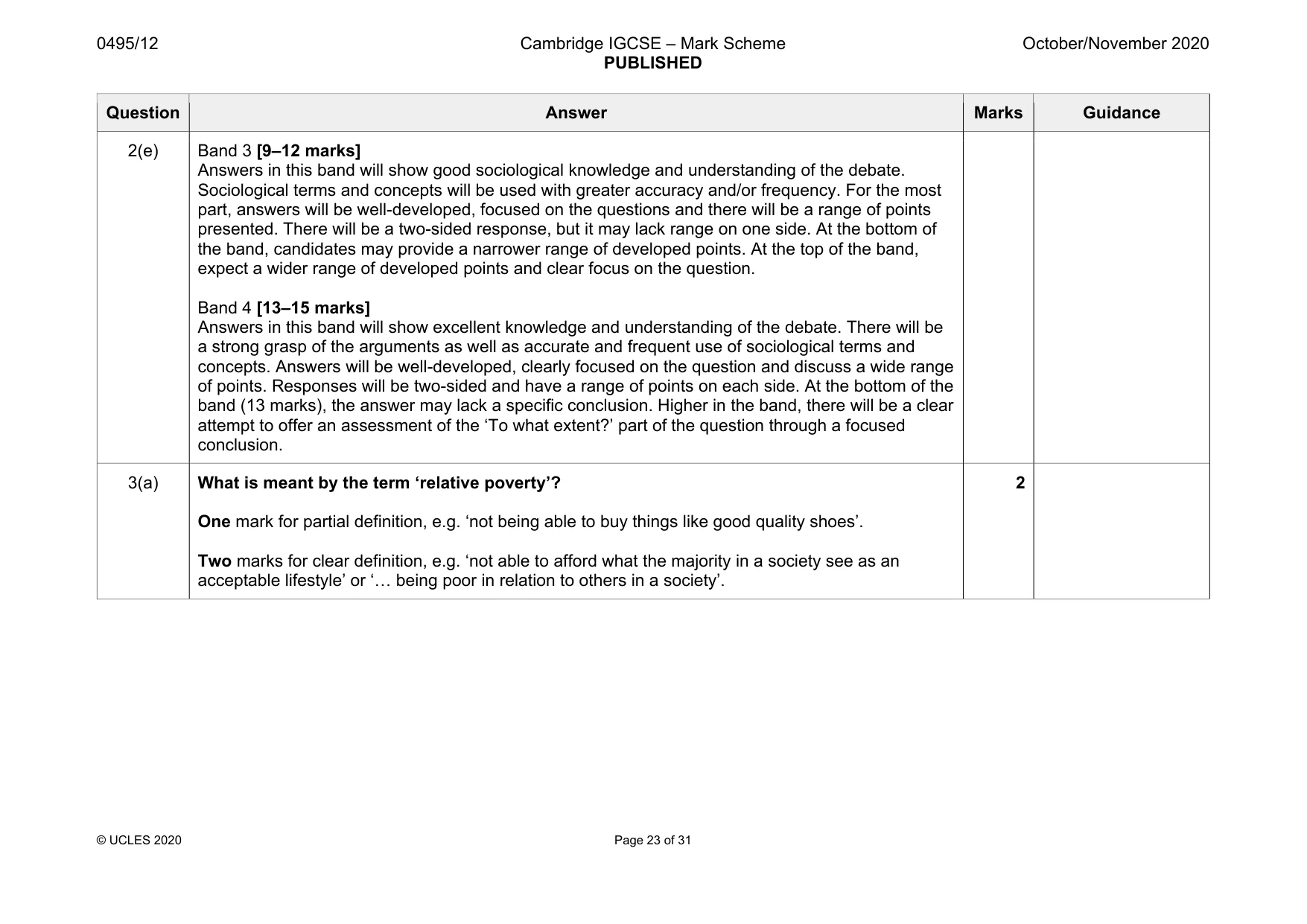
0495/12 Cambridge IGCSE – Mark Scheme PUBLISHED October/November 2020 © UCLES 2020 Page 23 of 31 Question Answer Marks Guidance 2(e) Band 3 [9–12 marks] Answers in this band will show good sociological knowledge and understanding of the debate. Sociological terms and concepts will be used with greater accuracy and/or frequency. For the most part, answers will be well-developed, focused on the questions and there will be a range of points presented. There will be a two-sided response, but it may lack range on one side. At the bottom of the band, candidates may provide a narrower range of developed points. At the top of the band, expect a wider range of developed points and clear focus on the question. Band 4 [13–15 marks] Answers in this band will show excellent knowledge and understanding of the debate. There will be a strong grasp of the arguments as well as accurate and frequent use of sociological terms and concepts. Answers will be well-developed, clearly focused on the question and discuss a wide range of points. Responses will be two-sided and have a range of points on each side. At the bottom of the band (13 marks), the answer may lack a specific conclusion. Higher in the band, there will be a clear attempt to offer an assessment of the ‘To what extent?’ part of the question through a focused conclusion. 3(a) What is meant by the term ‘relative poverty’? One mark for partial definition, e.g. ‘not being able to buy things like good quality shoes’. Two marks for clear definition, e.g. ‘not able to afford what the majority in a society see as an acceptable lifestyle’ or ‘… being poor in relation to others in a society’. 2
Mark scheme, page 24
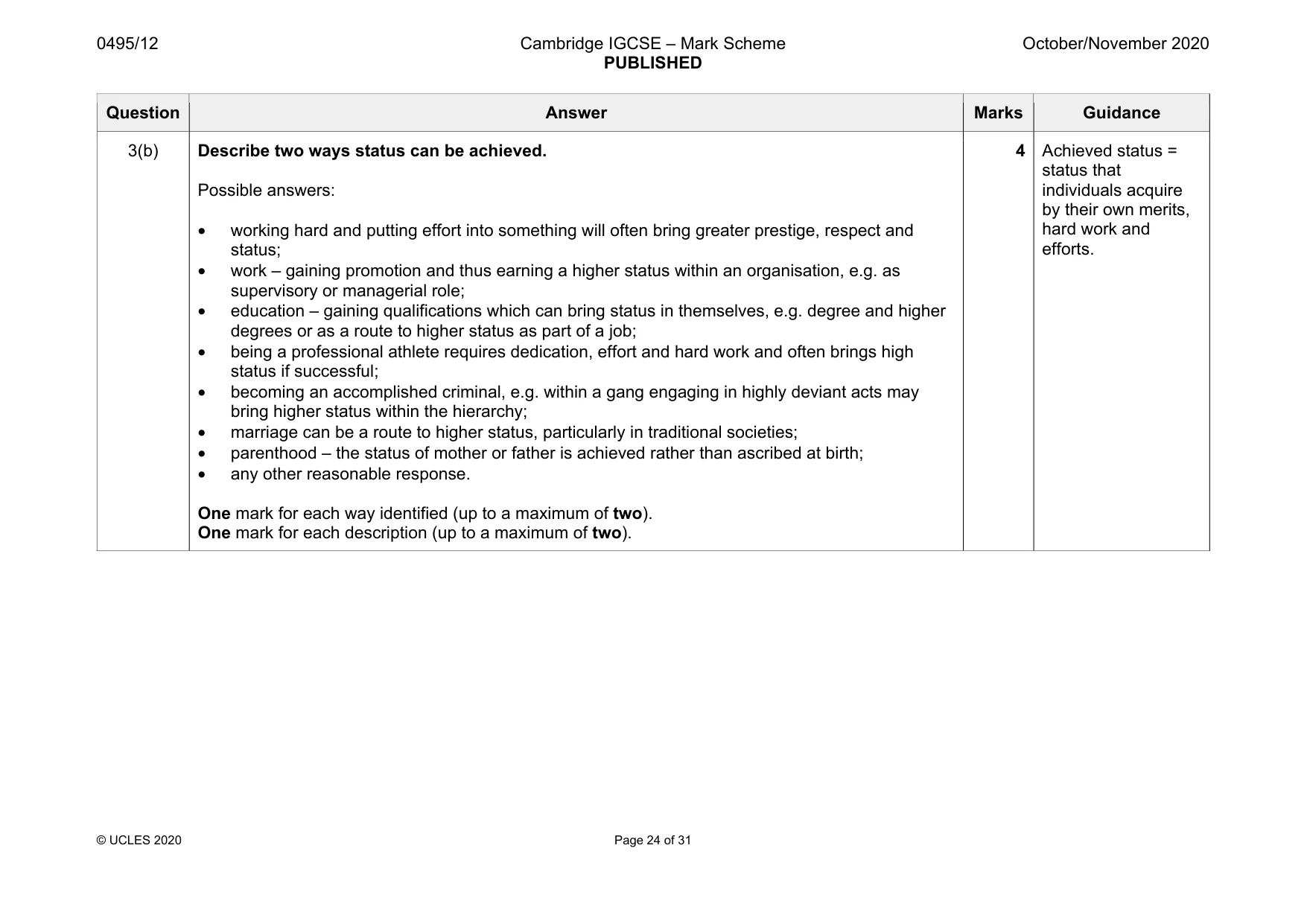
0495/12 Cambridge IGCSE – Mark Scheme PUBLISHED October/November 2020 © UCLES 2020 Page 24 of 31 Question Answer Marks Guidance 3(b) Describe two ways status can be achieved. Possible answers: • working hard and putting effort into something will often bring greater prestige, respect and status; • work – gaining promotion and thus earning a higher status within an organisation, e.g. as supervisory or managerial role; • education – gaining qualifications which can bring status in themselves, e.g. degree and higher degrees or as a route to higher status as part of a job; • being a professional athlete requires dedication, effort and hard work and often brings high status if successful; • becoming an accomplished criminal, e.g. within a gang engaging in highly deviant acts may bring higher status within the hierarchy; • marriage can be a route to higher status, particularly in traditional societies; • parenthood – the status of mother or father is achieved rather than ascribed at birth; • any other reasonable response. One mark for each way identified (up to a maximum of two). One mark for each description (up to a maximum of two). 4 Achieved status = status that individuals acquire by their own merits, hard work and efforts.
Mark scheme, page 25
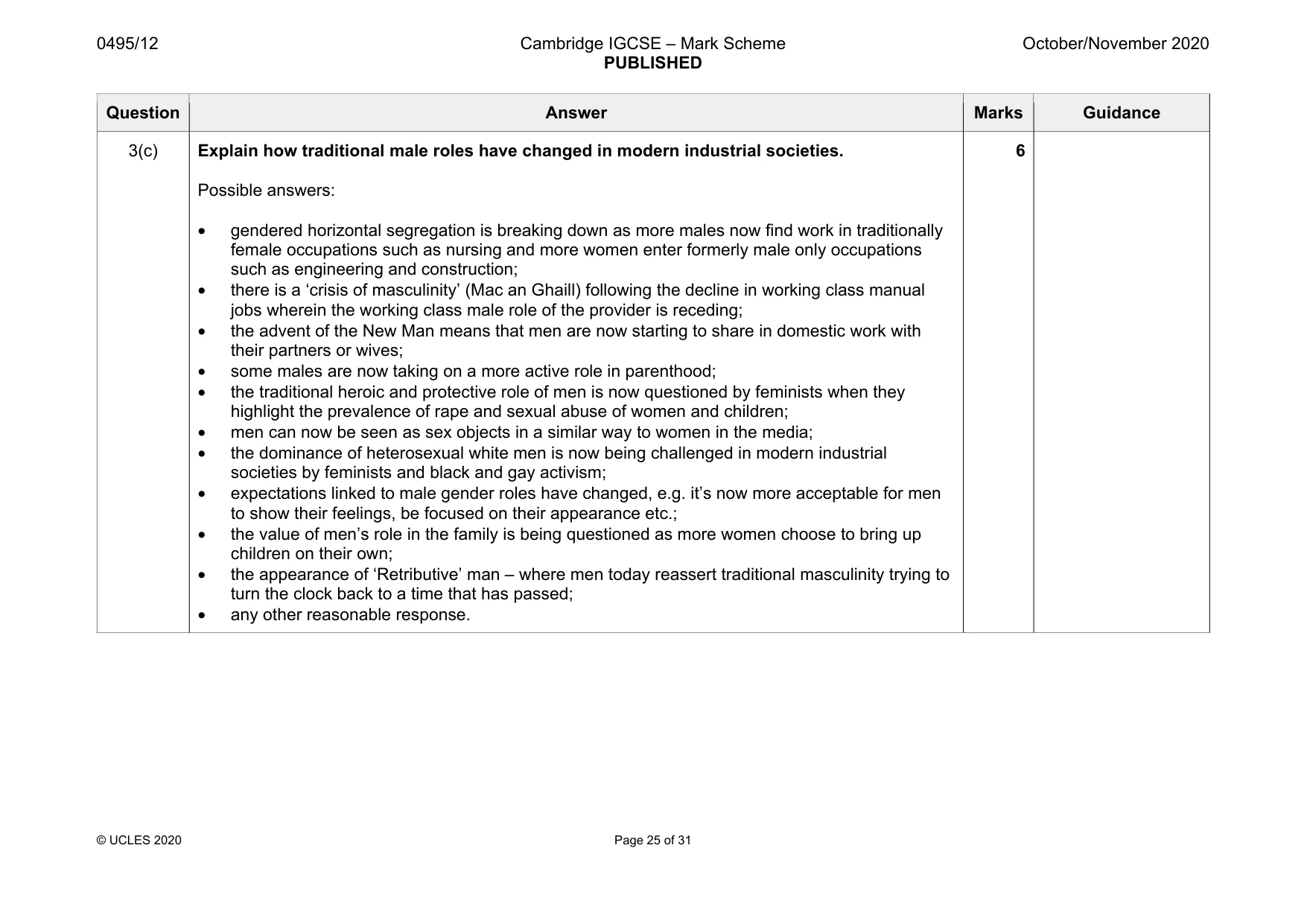
0495/12 Cambridge IGCSE – Mark Scheme PUBLISHED October/November 2020 © UCLES 2020 Page 25 of 31 Question Answer Marks Guidance 3(c) Explain how traditional male roles have changed in modern industrial societies. Possible answers: • gendered horizontal segregation is breaking down as more males now find work in traditionally female occupations such as nursing and more women enter formerly male only occupations such as engineering and construction; • there is a ‘crisis of masculinity’ (Mac an Ghaill) following the decline in working class manual jobs wherein the working class male role of the provider is receding; • the advent of the New Man means that men are now starting to share in domestic work with their partners or wives; • some males are now taking on a more active role in parenthood; • the traditional heroic and protective role of men is now questioned by feminists when they highlight the prevalence of rape and sexual abuse of women and children; • men can now be seen as sex objects in a similar way to women in the media; • the dominance of heterosexual white men is now being challenged in modern industrial societies by feminists and black and gay activism; • expectations linked to male gender roles have changed, e.g. it’s now more acceptable for men to show their feelings, be focused on their appearance etc.; • the value of men’s role in the family is being questioned as more women choose to bring up children on their own; • the appearance of ‘Retributive’ man – where men today reassert traditional masculinity trying to turn the clock back to a time that has passed; • any other reasonable response. 6
Mark scheme, page 26
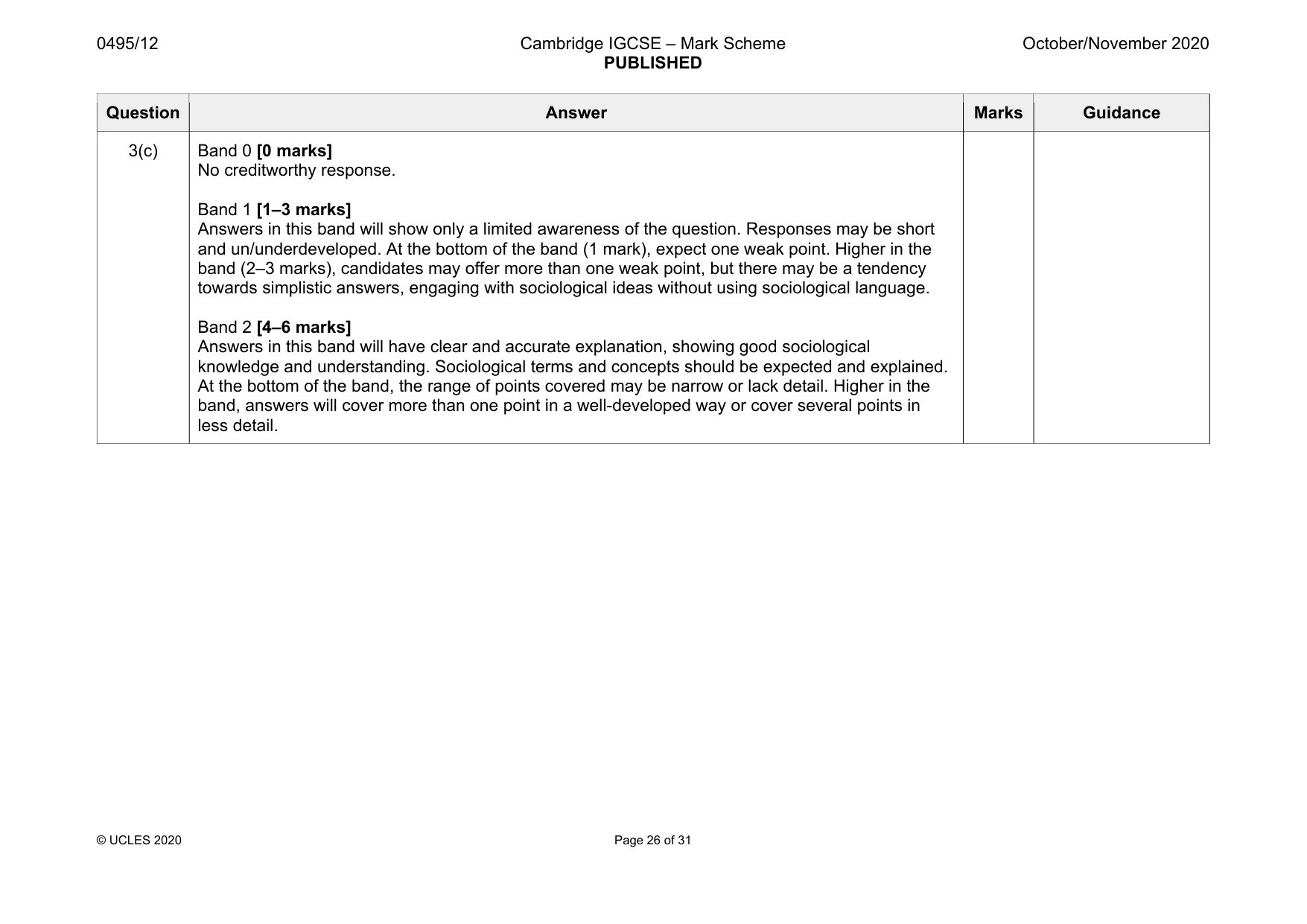
0495/12 Cambridge IGCSE – Mark Scheme PUBLISHED October/November 2020 © UCLES 2020 Page 26 of 31 Question Answer Marks Guidance 3(c) Band 0 [0 marks] No creditworthy response. Band 1 [1–3 marks] Answers in this band will show only a limited awareness of the question. Responses may be short and un/underdeveloped. At the bottom of the band (1 mark), expect one weak point. Higher in the band (2–3 marks), candidates may offer more than one weak point, but there may be a tendency towards simplistic answers, engaging with sociological ideas without using sociological language. Band 2 [4–6 marks] Answers in this band will have clear and accurate explanation, showing good sociological knowledge and understanding. Sociological terms and concepts should be expected and explained. At the bottom of the band, the range of points covered may be narrow or lack detail. Higher in the band, answers will cover more than one point in a well-developed way or cover several points in less detail.
Mark scheme, page 27
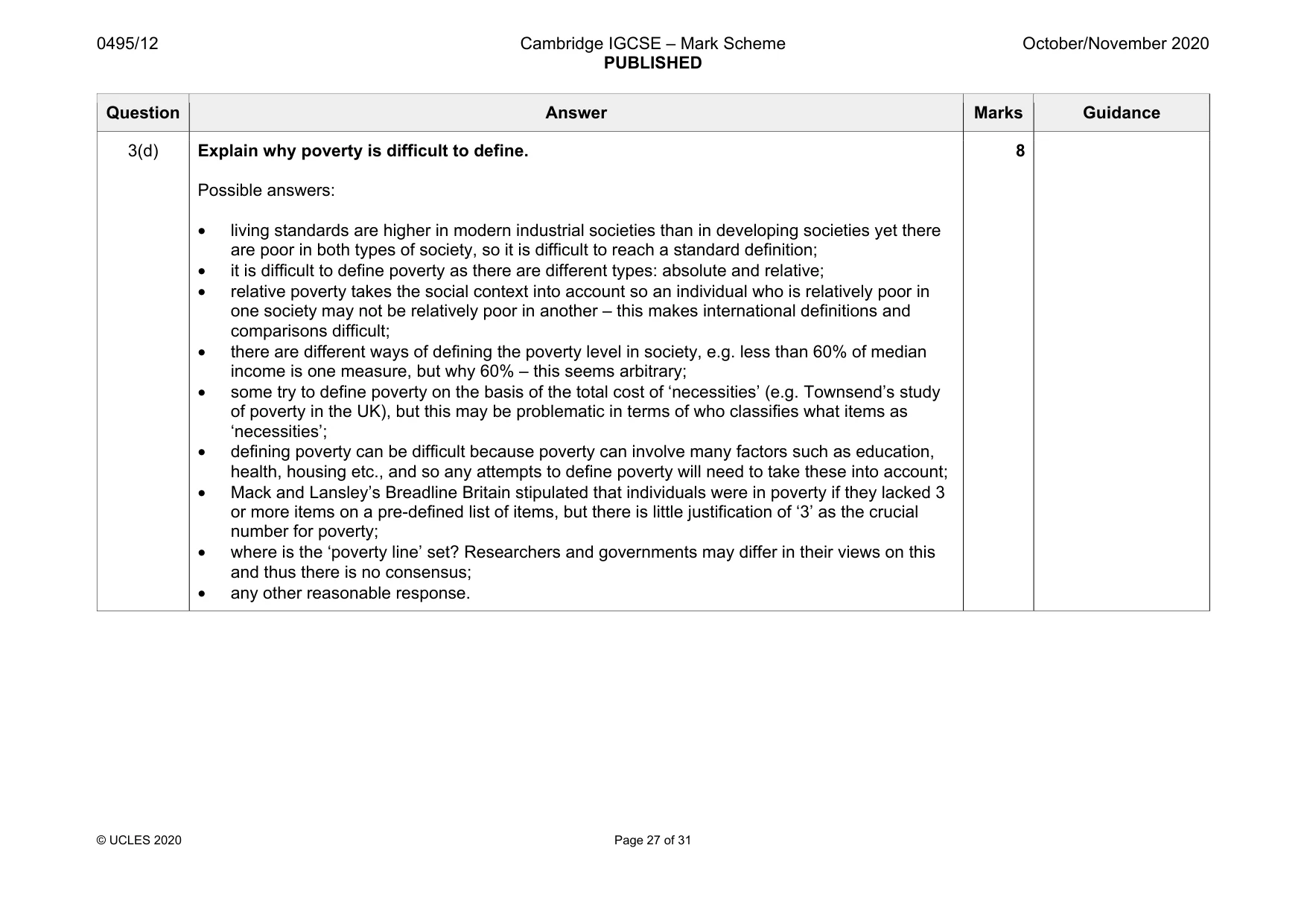
0495/12 Cambridge IGCSE – Mark Scheme PUBLISHED October/November 2020 © UCLES 2020 Page 27 of 31 Question Answer Marks Guidance 3(d) Explain why poverty is difficult to define. Possible answers: • living standards are higher in modern industrial societies than in developing societies yet there are poor in both types of society, so it is difficult to reach a standard definition; • it is difficult to define poverty as there are different types: absolute and relative; • relative poverty takes the social context into account so an individual who is relatively poor in one society may not be relatively poor in another – this makes international definitions and comparisons difficult; • there are different ways of defining the poverty level in society, e.g. less than 60% of median income is one measure, but why 60% – this seems arbitrary; • some try to define poverty on the basis of the total cost of ‘necessities’ (e.g. Townsend’s study of poverty in the UK), but this may be problematic in terms of who classifies what items as ‘necessities’; • defining poverty can be difficult because poverty can involve many factors such as education, health, housing etc., and so any attempts to define poverty will need to take these into account; • Mack and Lansley’s Breadline Britain stipulated that individuals were in poverty if they lacked 3 or more items on a pre-defined list of items, but there is little justification of ‘3’ as the crucial number for poverty; • where is the ‘poverty line’ set? Researchers and governments may differ in their views on this and thus there is no consensus; • any other reasonable response. 8
Mark scheme, page 28
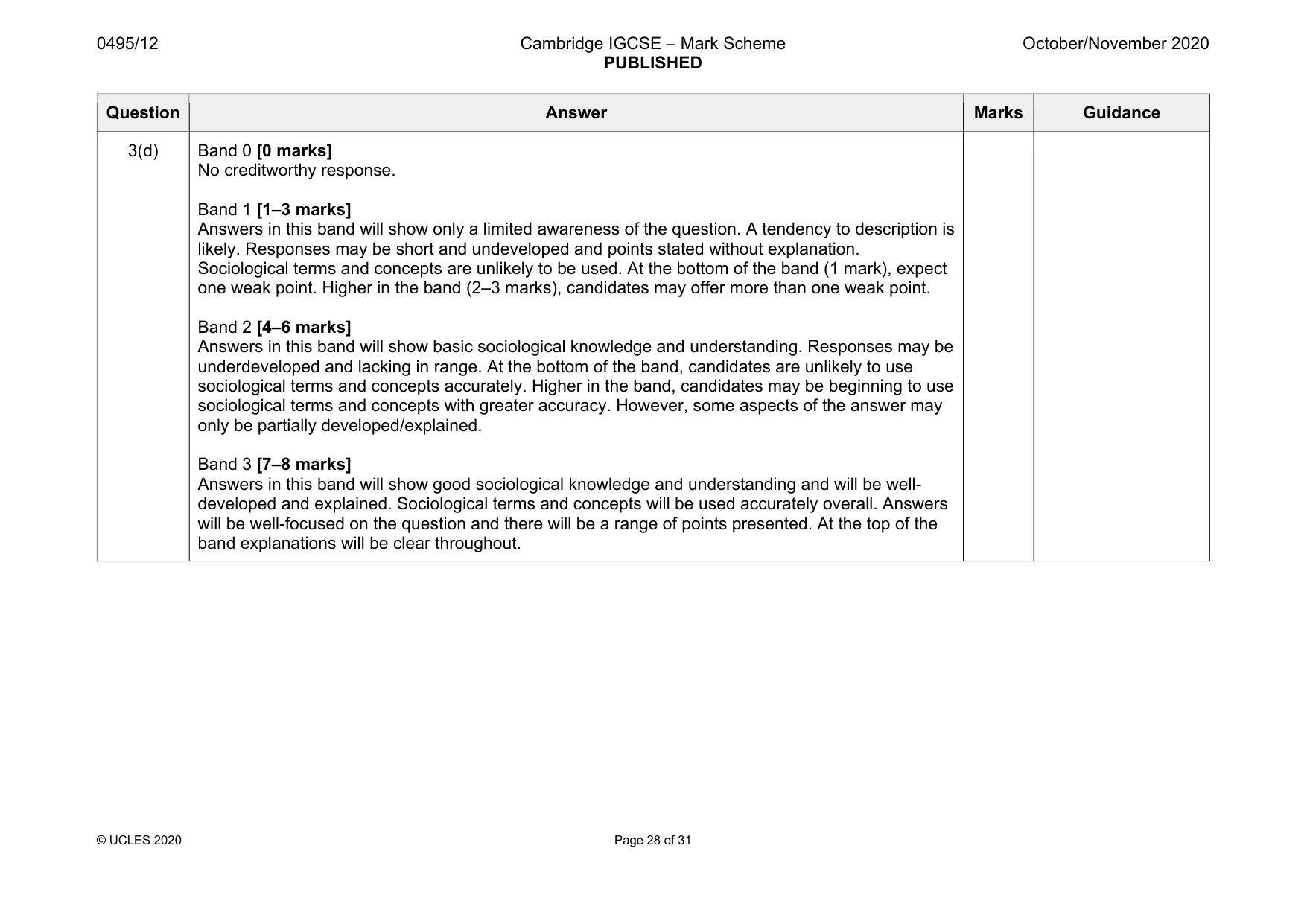
0495/12 Cambridge IGCSE – Mark Scheme PUBLISHED October/November 2020 © UCLES 2020 Page 28 of 31 Question Answer Marks Guidance 3(d) Band 0 [0 marks] No creditworthy response. Band 1 [1–3 marks] Answers in this band will show only a limited awareness of the question. A tendency to description is likely. Responses may be short and undeveloped and points stated without explanation. Sociological terms and concepts are unlikely to be used. At the bottom of the band (1 mark), expect one weak point. Higher in the band (2–3 marks), candidates may offer more than one weak point. Band 2 [4–6 marks] Answers in this band will show basic sociological knowledge and understanding. Responses may be underdeveloped and lacking in range. At the bottom of the band, candidates are unlikely to use sociological terms and concepts accurately. Higher in the band, candidates may be beginning to use sociological terms and concepts with greater accuracy. However, some aspects of the answer may only be partially developed/explained. Band 3 [7–8 marks] Answers in this band will show good sociological knowledge and understanding and will be well- developed and explained. Sociological terms and concepts will be used accurately overall. Answers will be well-focused on the question and there will be a range of points presented. At the top of the band explanations will be clear throughout.
Mark scheme, page 29
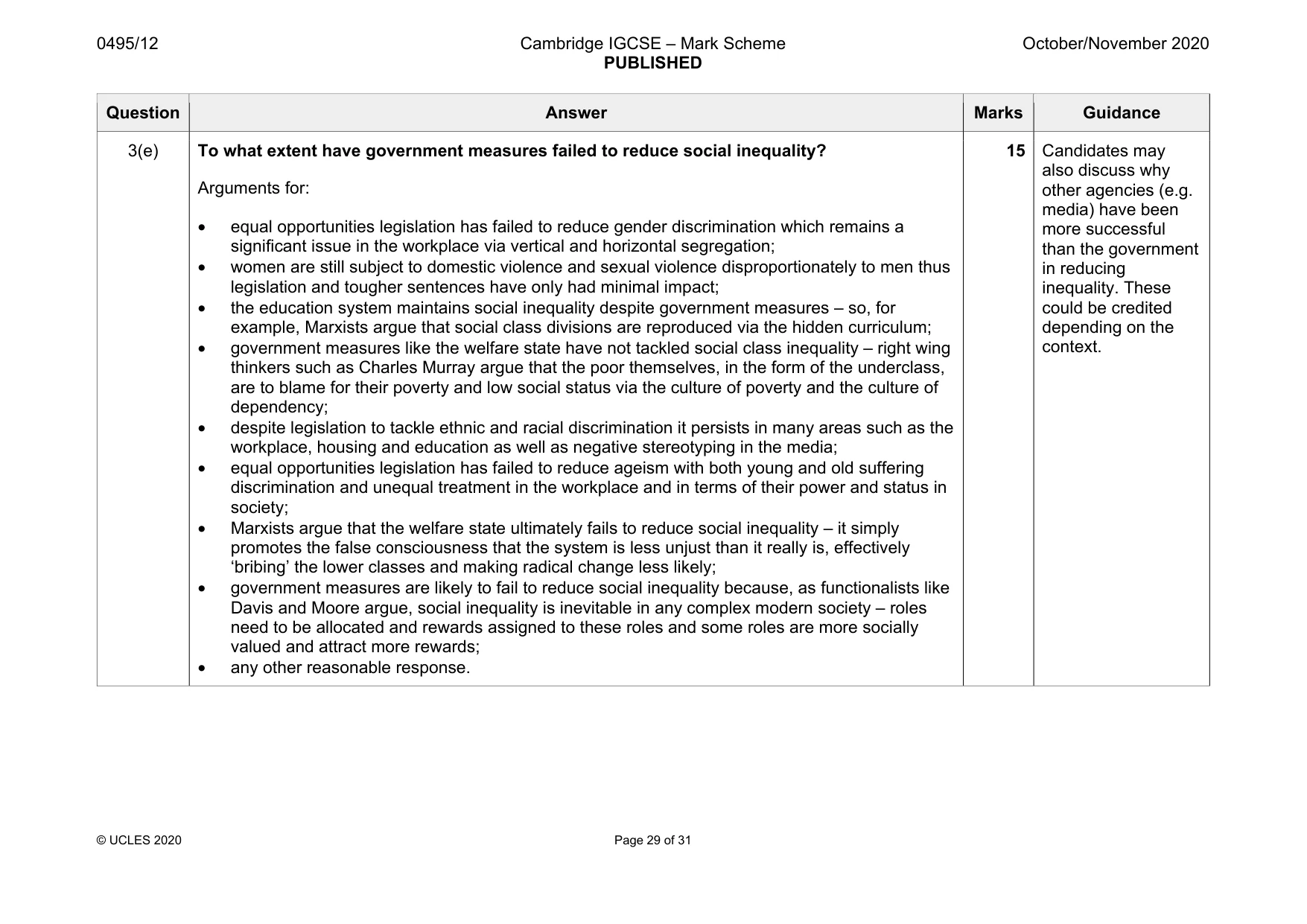
0495/12 Cambridge IGCSE – Mark Scheme PUBLISHED October/November 2020 © UCLES 2020 Page 29 of 31 Question Answer Marks Guidance 3(e) To what extent have government measures failed to reduce social inequality? Arguments for: • equal opportunities legislation has failed to reduce gender discrimination which remains a significant issue in the workplace via vertical and horizontal segregation; • women are still subject to domestic violence and sexual violence disproportionately to men thus legislation and tougher sentences have only had minimal impact; • the education system maintains social inequality despite government measures – so, for example, Marxists argue that social class divisions are reproduced via the hidden curriculum; • government measures like the welfare state have not tackled social class inequality – right wing thinkers such as Charles Murray argue that the poor themselves, in the form of the underclass, are to blame for their poverty and low social status via the culture of poverty and the culture of dependency; • despite legislation to tackle ethnic and racial discrimination it persists in many areas such as the workplace, housing and education as well as negative stereotyping in the media; • equal opportunities legislation has failed to reduce ageism with both young and old suffering discrimination and unequal treatment in the workplace and in terms of their power and status in society; • Marxists argue that the welfare state ultimately fails to reduce social inequality – it simply promotes the false consciousness that the system is less unjust than it really is, effectively ‘bribing’ the lower classes and making radical change less likely; • government measures are likely to fail to reduce social inequality because, as functionalists like Davis and Moore argue, social inequality is inevitable in any complex modern society – roles need to be allocated and rewards assigned to these roles and some roles are more socially valued and attract more rewards; • any other reasonable response. 15 Candidates may also discuss why other agencies (e.g. media) have been more successful than the government in reducing inequality. These could be credited depending on the context.
Mark scheme, page 30
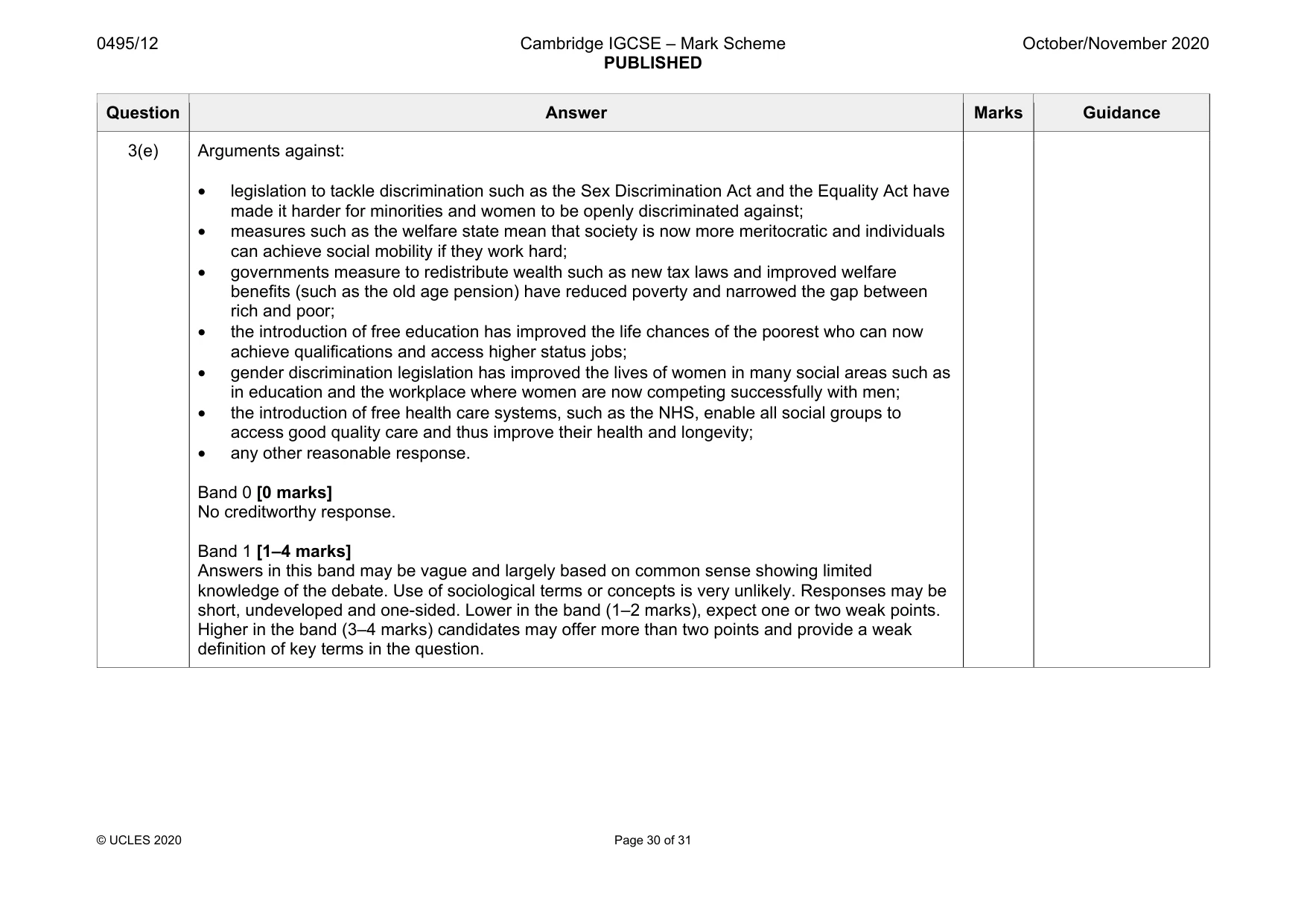
0495/12 Cambridge IGCSE – Mark Scheme PUBLISHED October/November 2020 © UCLES 2020 Page 30 of 31 Question Answer Marks Guidance 3(e) Arguments against: • legislation to tackle discrimination such as the Sex Discrimination Act and the Equality Act have made it harder for minorities and women to be openly discriminated against; • measures such as the welfare state mean that society is now more meritocratic and individuals can achieve social mobility if they work hard; • governments measure to redistribute wealth such as new tax laws and improved welfare benefits (such as the old age pension) have reduced poverty and narrowed the gap between rich and poor; • the introduction of free education has improved the life chances of the poorest who can now achieve qualifications and access higher status jobs; • gender discrimination legislation has improved the lives of women in many social areas such as in education and the workplace where women are now competing successfully with men; • the introduction of free health care systems, such as the NHS, enable all social groups to access good quality care and thus improve their health and longevity; • any other reasonable response. Band 0 [0 marks] No creditworthy response. Band 1 [1–4 marks] Answers in this band may be vague and largely based on common sense showing limited knowledge of the debate. Use of sociological terms or concepts is very unlikely. Responses may be short, undeveloped and one-sided. Lower in the band (1–2 marks), expect one or two weak points. Higher in the band (3–4 marks) candidates may offer more than two points and provide a weak definition of key terms in the question.
Mark scheme, page 31
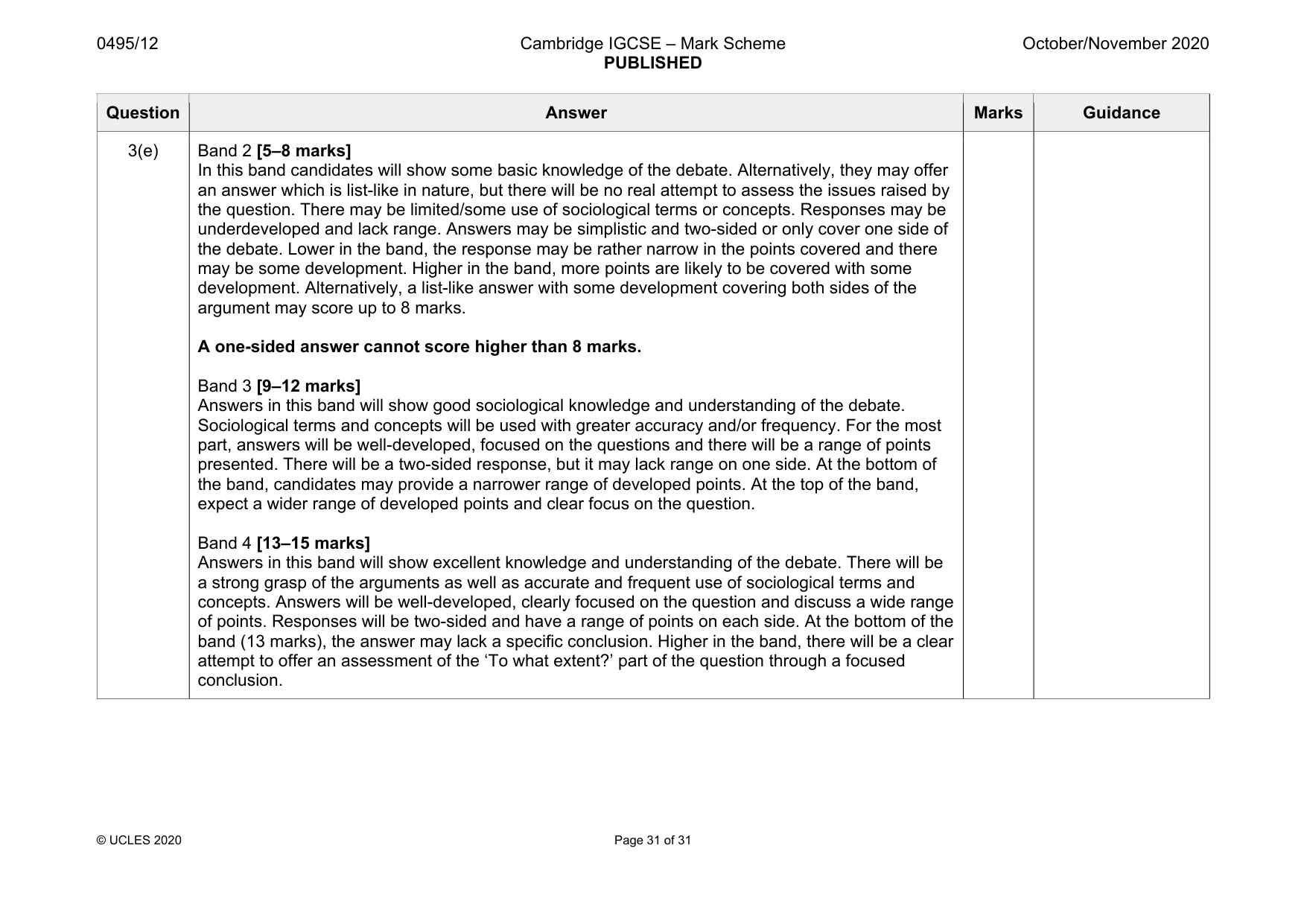
0495/12 Cambridge IGCSE – Mark Scheme PUBLISHED October/November 2020 © UCLES 2020 Page 31 of 31 Question Answer Marks Guidance 3(e) Band 2 [5–8 marks] In this band candidates will show some basic knowledge of the debate. Alternatively, they may offer an answer which is list-like in nature, but there will be no real attempt to assess the issues raised by the question. There may be limited/some use of sociological terms or concepts. Responses may be underdeveloped and lack range. Answers may be simplistic and two-sided or only cover one side of the debate. Lower in the band, the response may be rather narrow in the points covered and there may be some development. Higher in the band, more points are likely to be covered with some development. Alternatively, a list-like answer with some development covering both sides of the argument may score up to 8 marks. A one-sided answer cannot score higher than 8 marks. Band 3 [9–12 marks] Answers in this band will show good sociological knowledge and understanding of the debate. Sociological terms and concepts will be used with greater accuracy and/or frequency. For the most part, answers will be well-developed, focused on the questions and there will be a range of points presented. There will be a two-sided response, but it may lack range on one side. At the bottom of the band, candidates may provide a narrower range of developed points. At the top of the band, expect a wider range of developed points and clear focus on the question. Band 4 [13–15 marks] Answers in this band will show excellent knowledge and understanding of the debate. There will be a strong grasp of the arguments as well as accurate and frequent use of sociological terms and concepts. Answers will be well-developed, clearly focused on the question and discuss a wide range of points. Responses will be two-sided and have a range of points on each side. At the bottom of the band (13 marks), the answer may lack a specific conclusion. Higher in the band, there will be a clear attempt to offer an assessment of the ‘To what extent?’ part of the question through a focused conclusion.
What you needed in this session
Cambridge’s own grade thresholds for 2020 Oct/Nov, Paper 1 · Variant 2. A higher threshold means an easier paper — the bar moves with how the cohort did.