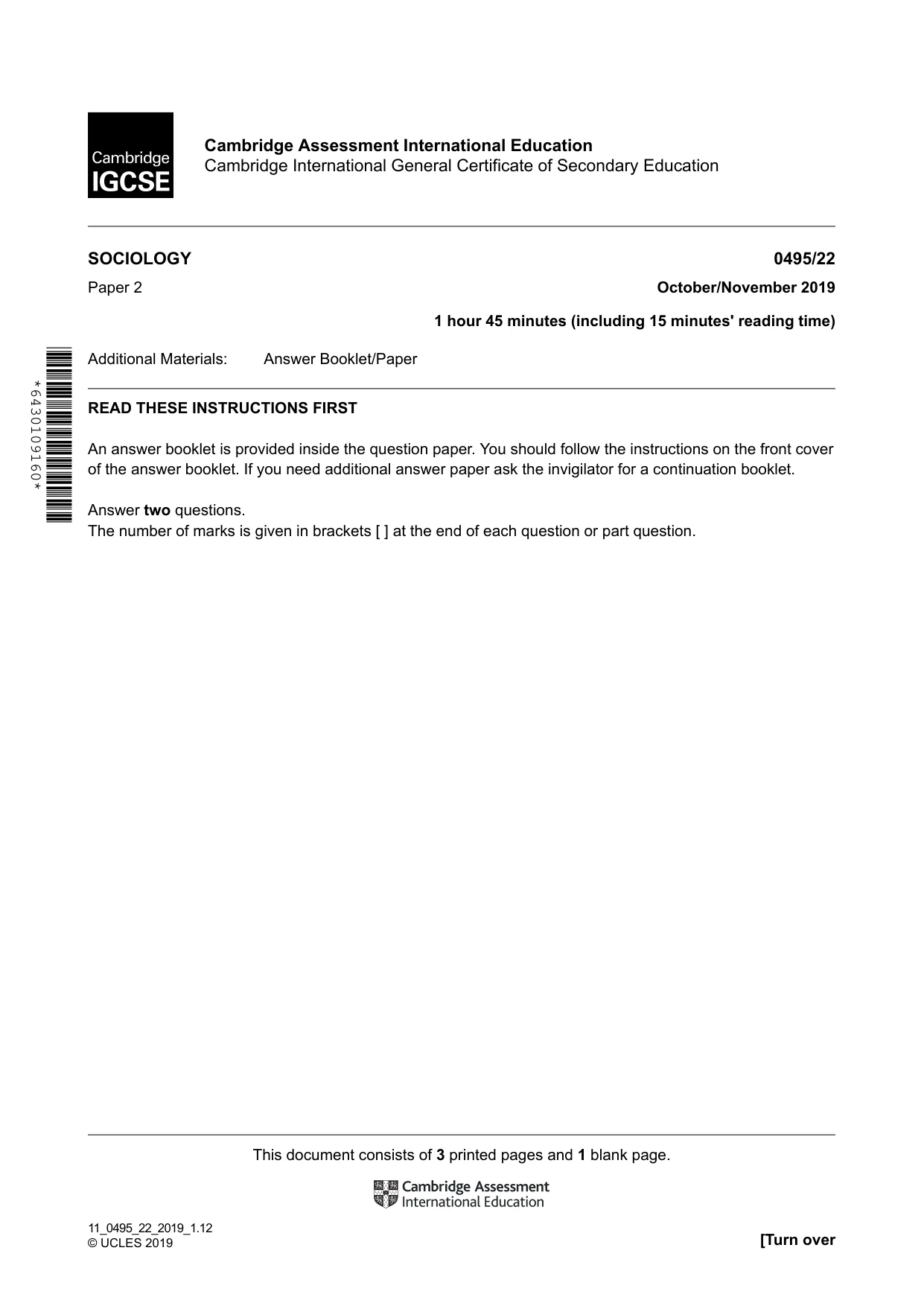
Cambridge IGCSE Sociology 0495 — 2019 Oct/Nov Paper 2 · Variant 2
0495/22/O/N/19 · 4 questions · 70 marks · ≈79 min
The question paper and its mark scheme, free to read here and free to download. This is Cambridge’s own paper, exactly as it was sat.
Question paper4 pages

Mark scheme27 pages
Answers below. Sit the paper first if you are practising.




Questions as text
Q1 · As the world and societies change, so do the institutions of marriage and the family
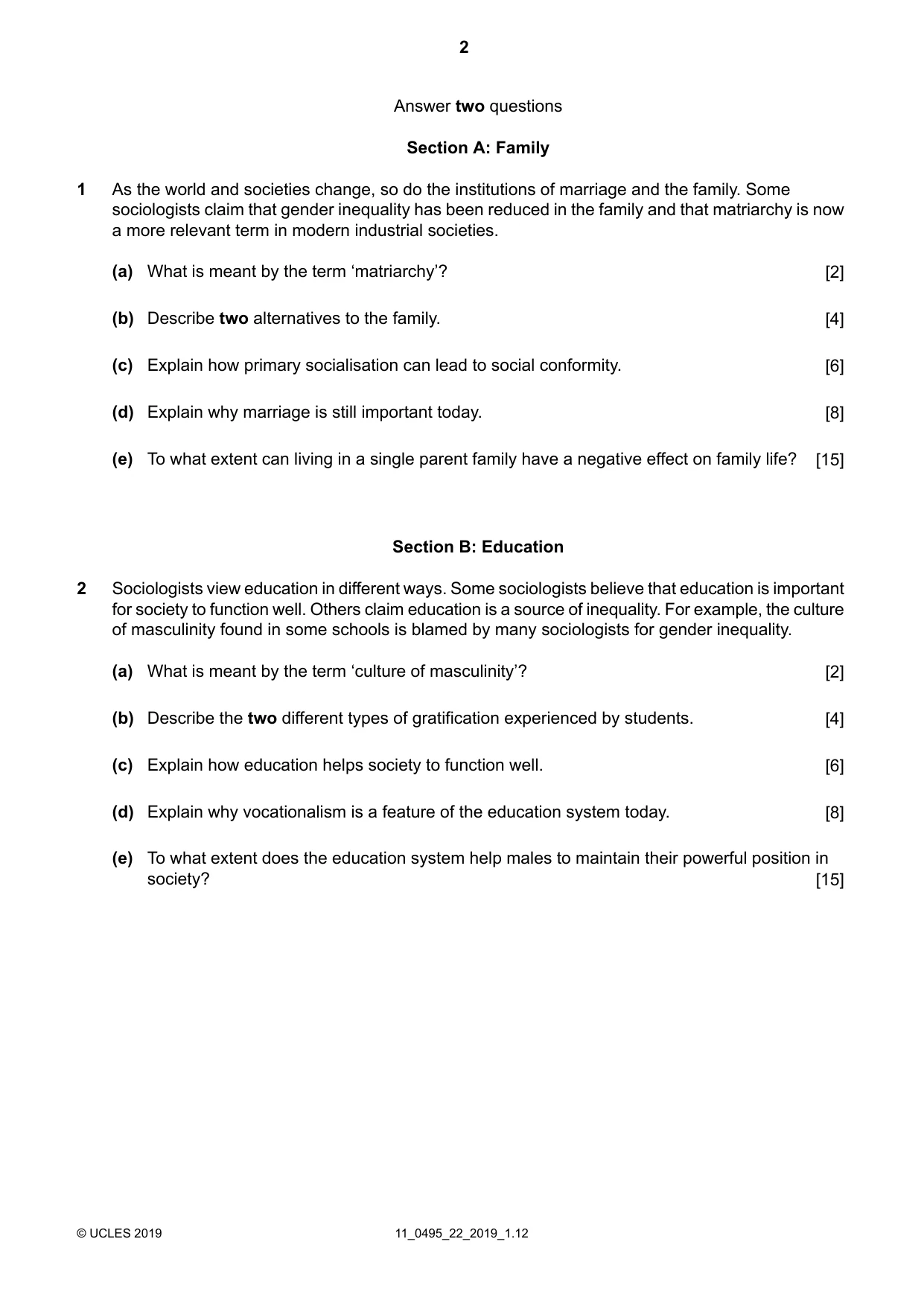
1 As the world and societies change, so do the institutions of marriage and the family. Some sociologists claim that gender inequality has been reduced in the family and that matriarchy is now a more relevant term in modern industrial societies. (a) What is meant by the term ‘matriarchy’? [2] (b) Describe two alternatives to the family. [4] (c) Explain how primary socialisation can lead to social conformity. [6] (d) Explain why marriage is still important today. [8] (e) To what extent can living in a single parent family have a negative effect on family life? [15]
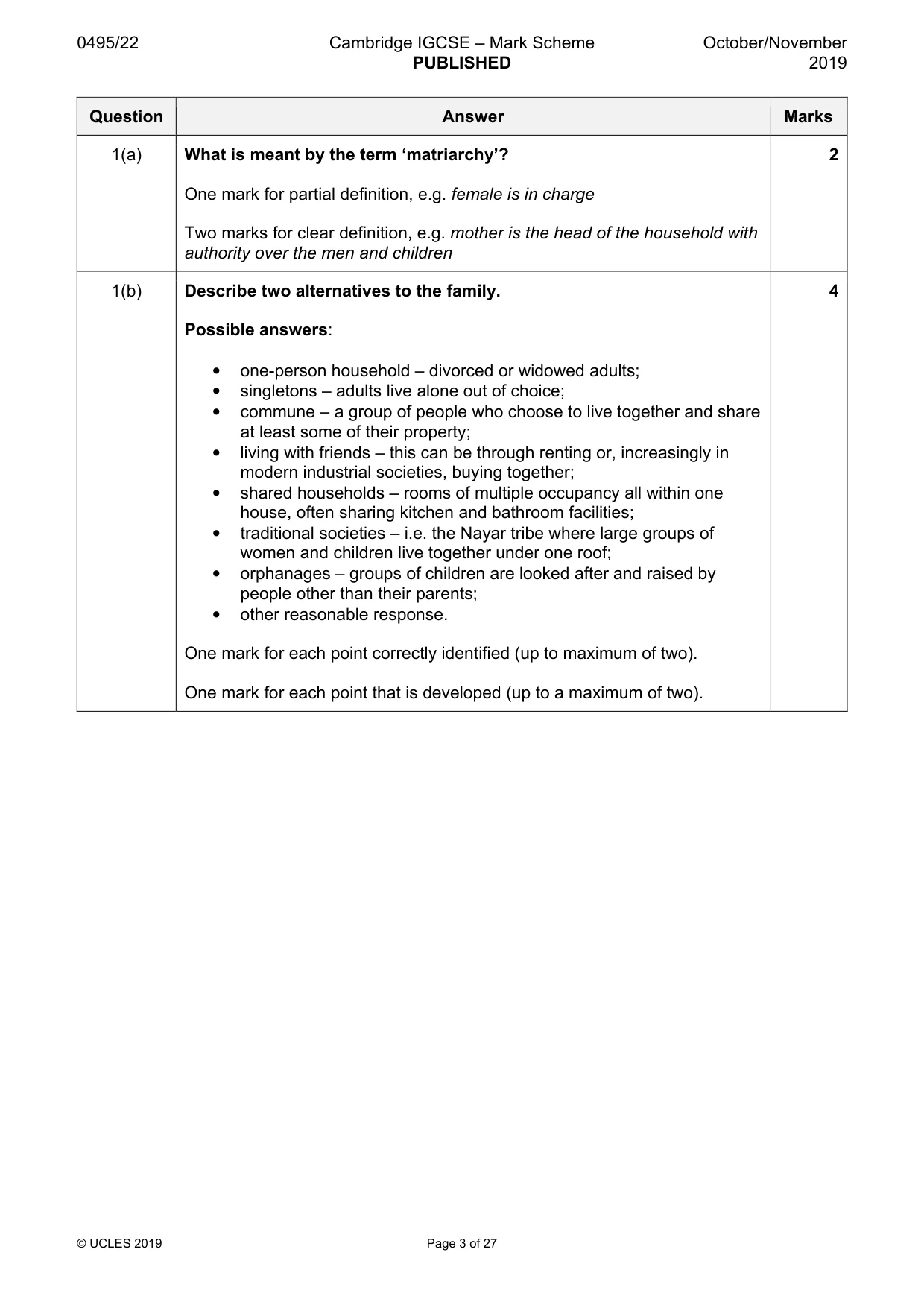
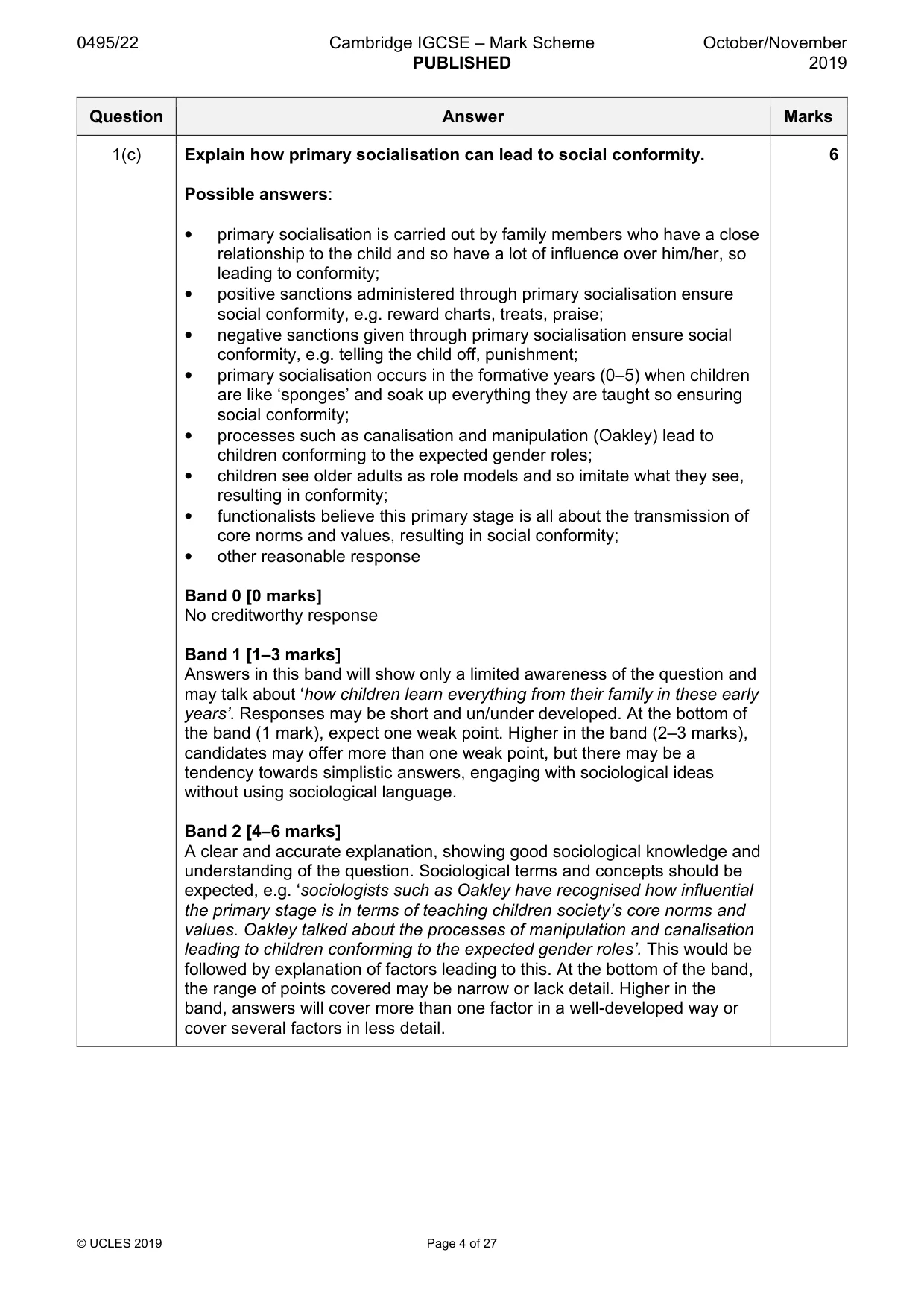
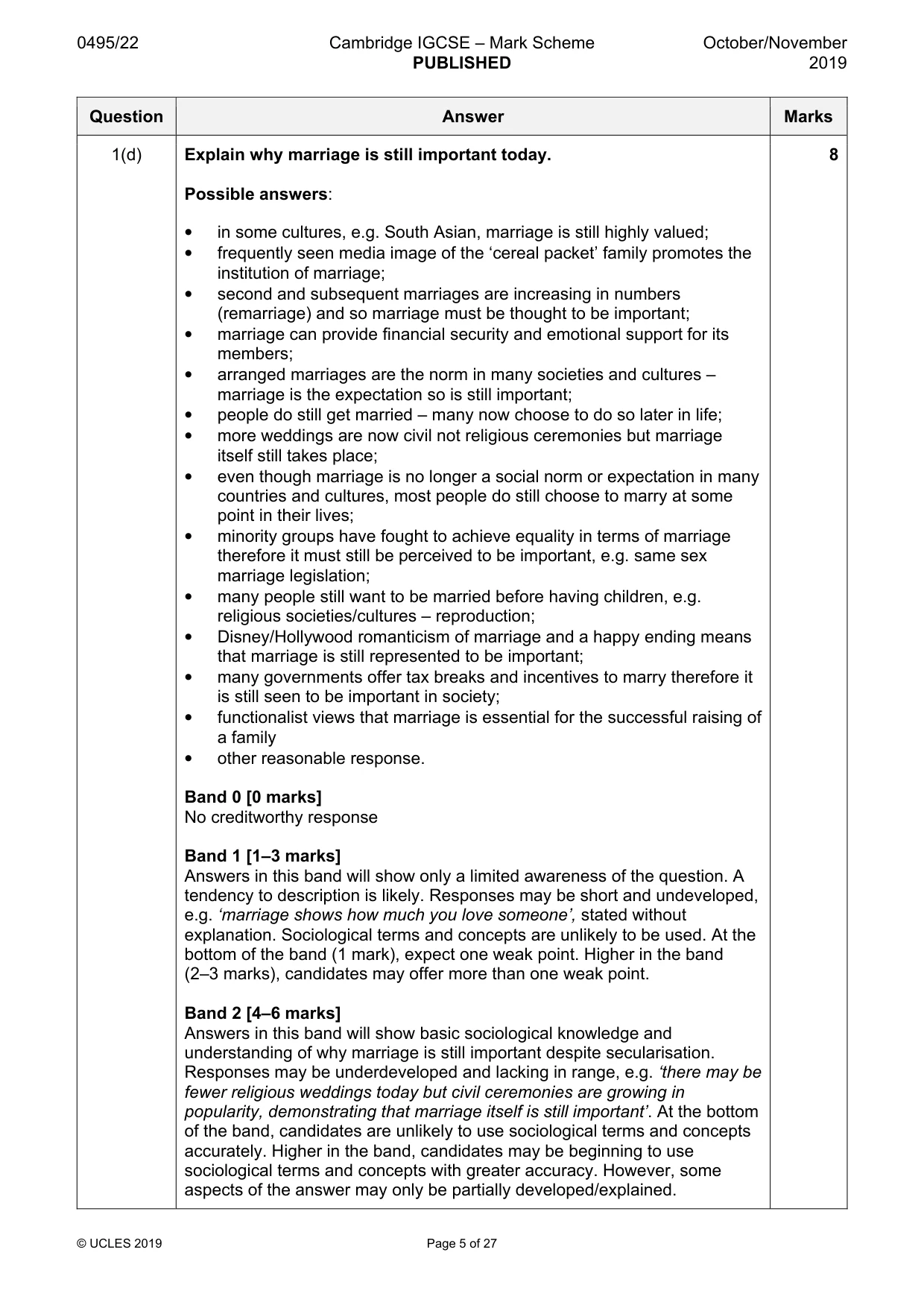
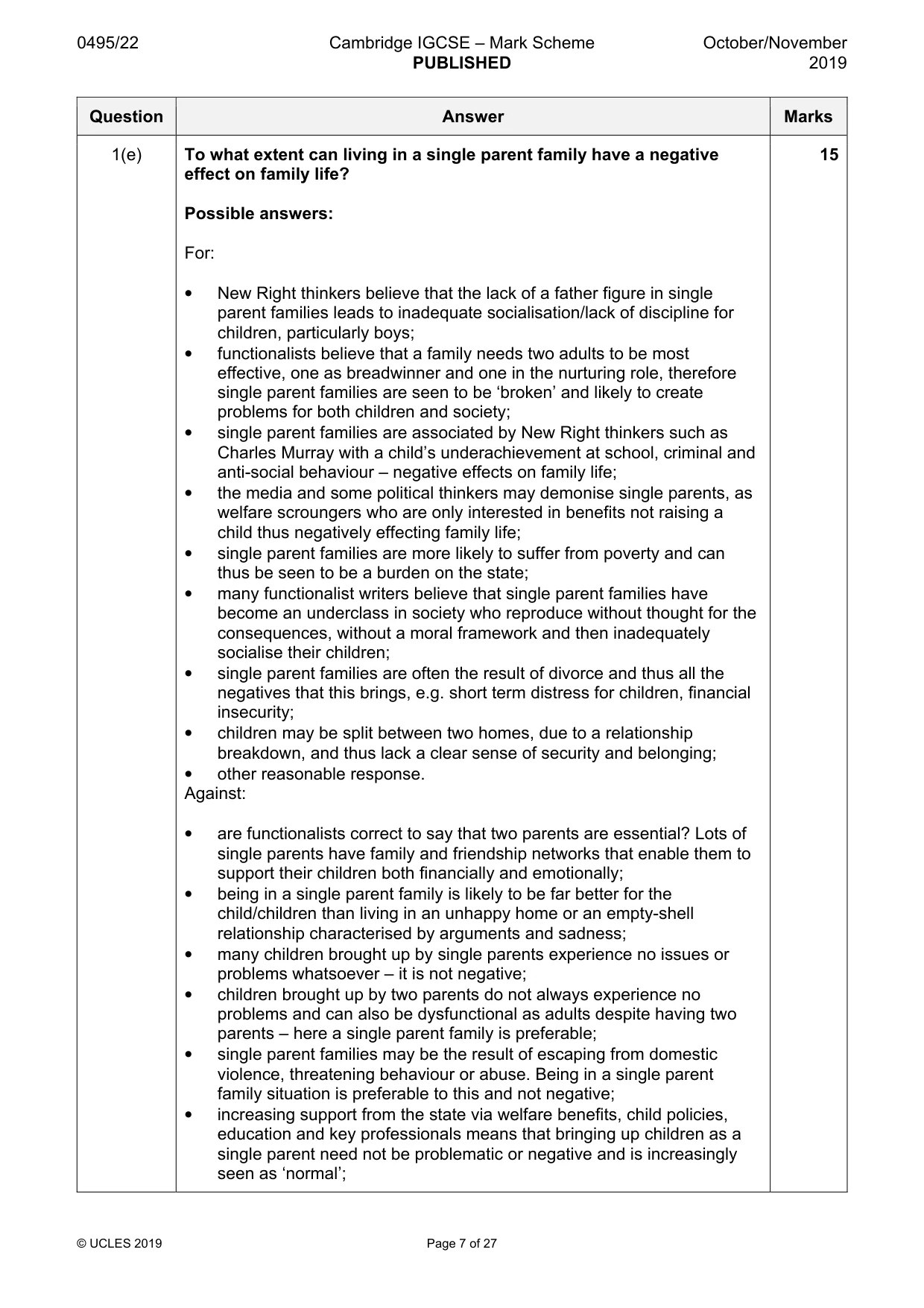
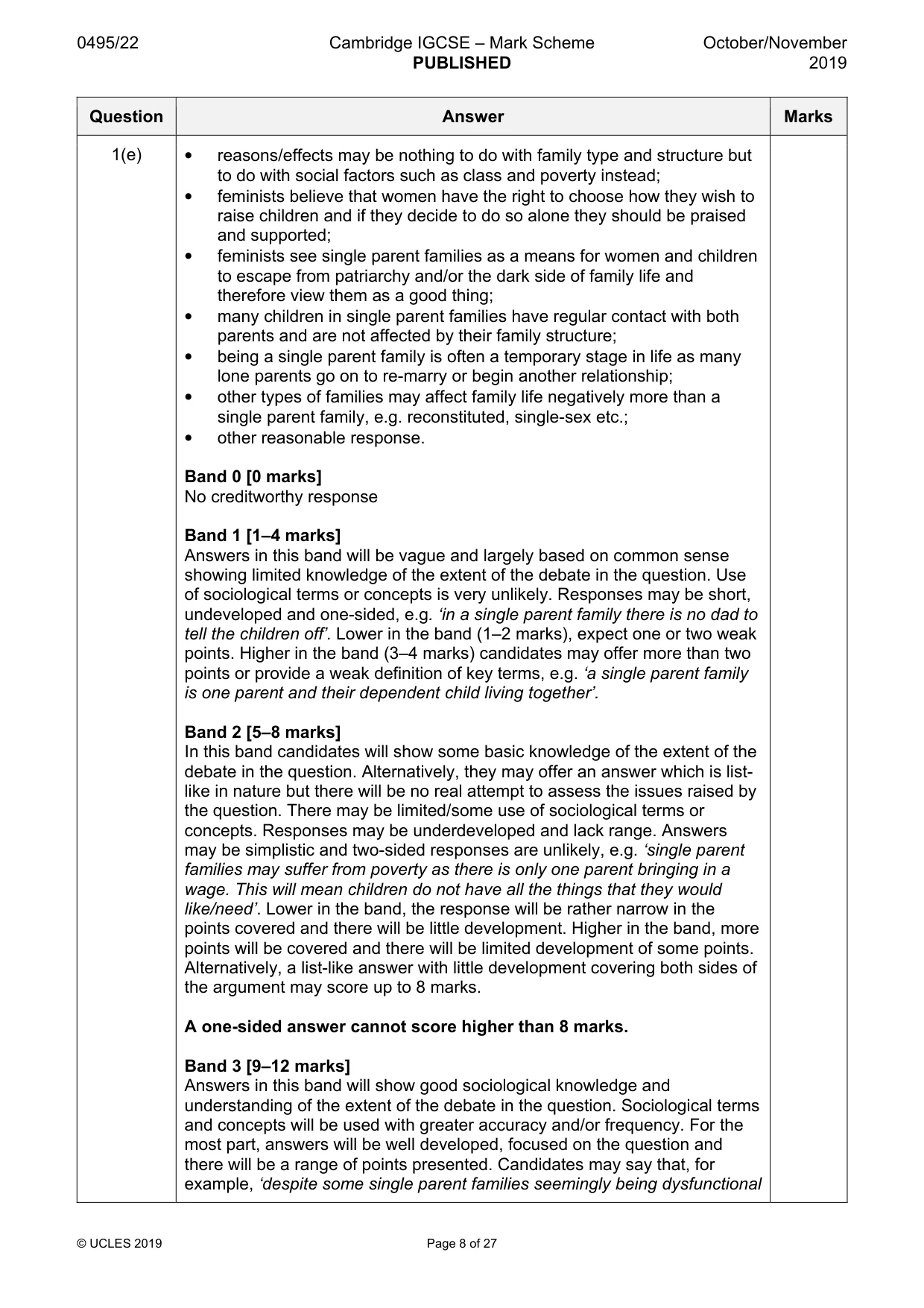
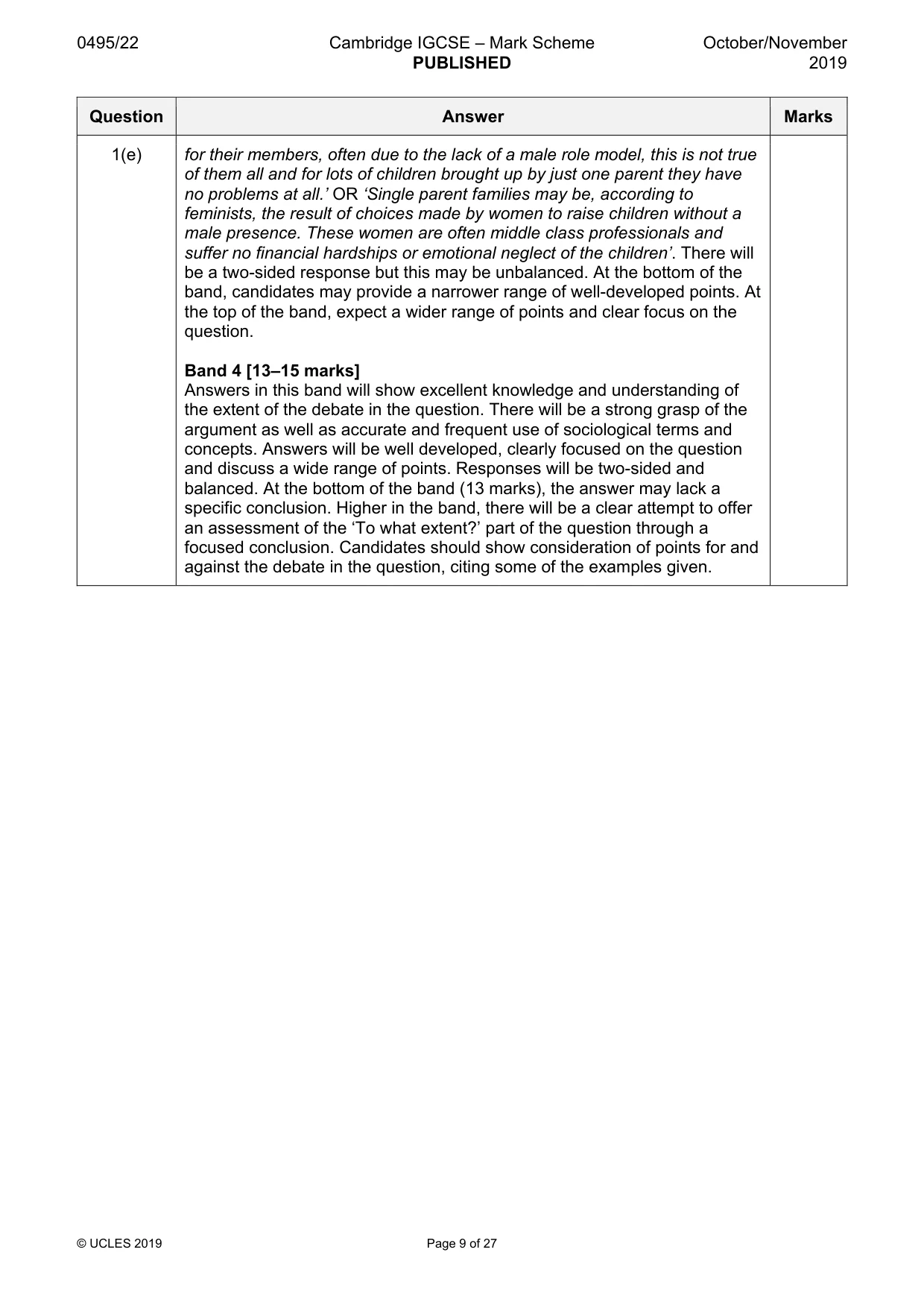
Mark scheme: Question Answer Marks 1(a) What is meant by the term ‘matriarchy’? 2 One mark for partial definition, e.g. female is in charge Two marks for clear definition, e.g. mother is the head of the household with authority over the men and children 1(b) Describe two alternatives to the family. 4 Possible answers: • one-person household – divorced or widowed adults; • singletons – adults live alone out of choice; • commune – a group of people who choose to live together and share at least some of their property; • living with friends – this can be through renting or, increasingly in modern industrial societies, buying together; • shared households – rooms of multiple occupancy all within one house, often sharing kitchen and bathroom facilities; • traditional societies – i.e. the Nayar tribe where large groups of women and children live together under one roof; • orphanages – groups of children are looked after and raised by people other than their parents; • other reasonable response. One mark for each point correctly identified (up to maximum of two). One mark for each point that is developed (up to a maximum of two). 1(c) Explain how primary socialisation can lead to social conformity. 6 Possible answers: • primary socialisation is carried out by family members who have a close relationship to the child and so have a lot of influence over him/her, so leading to conformity; • positive sanctions administered through primary socialisation ensure social conformity, e.g. reward charts, treats, praise; • negative sanctions given through primary socialisation ensure social conformity, e.g. telling the child off, punishment; • primary socialisation occurs in the formative years (0–5) when children are like ‘sponges’ and soak up everything they are taught so ensuring social conformity; • processes such as canalisation and manipulation (Oakley) lead to children conforming to the expected gender roles; • children see older adults as role models and so imitate what they see, resulting in conformity; • functionalists believe this primary stage is all about the transmission of core norms and values, resulting in social conformity; • other reasonable response Band 0 [0 marks] No creditworthy response Band 1 [1–3 marks] Answers in this band will show only a limited awareness of the question and may talk about ‘how children learn everything from their family in these early years’. Responses may be short and un/under developed. At the bottom of the band (1 mark), expect one weak point. Higher in the band (2–3 marks), candidates may offer more than one weak point, but there may be a tendency towards simplistic answers, engaging with sociological ideas without using sociological language. Band 2 [4–6 marks] A clear and accurate explanation, showing good sociological knowledge and understanding of the question. Sociological terms and concepts should be expected, e.g. ‘sociologists such as Oakley have recognised how influential the primary stage is in terms of teaching children society’s core norms and values. Oakley talked about the processes of manipulation and canalisation leading to children conforming to the expected gender roles’. This would be followed by explanation of factors leading to this. At the bottom of the band, the range of points covered may be narrow or lack detail. Higher in the band, answers will cover more than one factor in a well-developed way or cover several factors in less detail. 1(d) Explain why marriage is still important today. 8 Possible answers: • in some cultures, e.g. South Asian, marriage is still highly valued; • frequently seen media image of the ‘cereal packet’ family promotes the institution of marriage; • second and subsequent marriages are increasing in numbers (remarriage) and so marriage must be thought to be important; • marriage can provide financial security and emotional support for its members; • arranged marriages are the norm in many societies and cultures – marriage is the expectation so is still important; • people do still get married – many now choose to do so later in life; • more weddings are now civil not religious ceremonies but marriage itself still takes place; • even though marriage is no longer a social norm or expectation in many countries and cultures, most people do still choose to marry at some point in their lives; • minority groups have fought to achieve equality in terms of marriage therefore it must still be perceived to be important, e.g. same sex marriage legislation; • many people still want to be married before having children, e.g. religious societies/cultures – reproduction; • Disney/Hollywood romanticism of marriage and a happy ending means that marriage is still represented to be important; • many governments offer tax breaks and incentives to marry therefore it is still seen to be important in society; • functionalist views that marriage is essential for the successful raising of a family • other reasonable response. Band 0 [0 marks] No creditworthy response Band 1 [1–3 marks] Answers in this band will show only a limited awareness of the question. A tendency to description is likely. Responses may be short and undeveloped, e.g. ‘marriage shows how much you love someone’, stated without explanation. Sociological terms and concepts are unlikely to be used. At the bottom of the band (1 mark), expect one weak point. Higher in the band (2–3 marks), candidates may offer more than one weak point. Band 2 [4–6 marks] Answers in this band will show basic sociological knowledge and understanding of why marriage is still important despite secularisation. Responses may be underdeveloped and lacking in range, e.g. ‘there may be fewer religious weddings today but civil ceremonies are growing in popularity, demonstrating that marriage itself is still important’. At the bottom of the band, candidates are unlikely to use sociological terms and concepts accurately. Higher in the band, candidates may be beginning to use sociological terms and concepts with greater accuracy. However, some aspects of the answer may only be partially developed/explained. 1(d) Band 3 [7–8 marks] Answers in this band will show good sociological knowledge and understanding of why marriage is still important despite secularisation and will be well developed and explained, e.g. ‘despite there being little pressure from the state and most families to get married, a large number of people still value marriage as an institution and want to get married before they have children. It is a lifestyle choice rather than a social expectation that actually increases the importance of marriage for individuals’. They can then expand on the explanation of this and other factors as necessary. Sociological terms and concepts will be used accurately overall. Answers will be well focused on the question and there will be a range of reasons presented. At the top of the band explanations will be clear throughout. 1(e) To what extent can living in a single parent family have a negative 15 effect on family life? Possible answers: For: • New Right thinkers believe that the lack of a father figure in single parent families leads to inadequate socialisation/lack of discipline for children, particularly boys; • functionalists believe that a family needs two adults to be most effective, one as breadwinner and one in the nurturing role, therefore single parent families are seen to be ‘broken’ and likely to create problems for both children and society; • single parent families are associated by New Right thinkers such as Charles Murray with a child’s underachievement at school, criminal and anti-social behaviour – negative effects on family life; • the media and some political thinkers may demonise single parents, as welfare scroungers who are only interested in benefits not raising a child thus negatively effecting family life; • single parent families are more likely to suffer from poverty and can thus be seen to be a burden on the state; • many functionalist writers believe that single parent families have become an underclass in society who reproduce without thought for the consequences, without a moral framework and then inadequately socialise their children; • single parent families are often the result of divorce and thus all the negatives that this brings, e.g. short term distress for children, financial insecurity; • children may be split between two homes, due to a relationship breakdown, and thus lack a clear sense of security and belonging; • other reasonable response. Against: • are functionalists correct to say that two parents are essential? Lots of single parents have family and friendship networks that enable them to support their children both financially and emotionally; • being in a single parent family is likely to be far better for the child/children than living in an unhappy home or an empty-shell relationship characterised by arguments and sadness; • many children brought up by single parents experience no issues or problems whatsoever – it is not negative; • children brought up by two parents do not always experience no problems and can also be dysfunctional as adults despite having two parents – here a single parent family is preferable; • single parent families may be the result of escaping from domestic violence, threatening behaviour or abuse. Being in a single parent family situation is preferable to this and not negative; • increasing support from the state via welfare benefits, child policies, education and key professionals means that bringing up children as a single parent need not be problematic or negative and is increasingly seen as ‘normal’; 1(e) • reasons/effects may be nothing to do with family type and structure but to do with social factors such as class and poverty instead; • feminists believe that women have the right to choose how they wish to raise children and if they decide to do so alone they should be praised and supported; • feminists see single parent families as a means for women and children to escape from patriarchy and/or the dark side of family life and therefore view them as a good thing; • many children in single parent families have regular contact with both parents and are not affected by their family structure; • being a single parent family is often a temporary stage in life as many lone parents go on to re-marry or begin another relationship; • other types of families may affect family life negatively more than a single parent family, e.g. reconstituted, single-sex etc.; • other reasonable response. Band 0 [0 marks] No creditworthy response Band 1 [1–4 marks] Answers in this band will be vague and largely based on common sense showing limited knowledge of the extent of the debate in the question. Use of sociological terms or concepts is very unlikely. Responses may be short, undeveloped and one-sided, e.g. ‘in a single parent family there is no dad to tell the children off’. Lower in the band (1–2 marks), expect one or two weak points. Higher in the band (3–4 marks) candidates may offer more than two points or provide a weak definition of key terms, e.g. ‘a single parent family is one parent and their dependent child living together’. Band 2 [5–8 marks] In this band candidates will show some basic knowledge of the extent of the debate in the question. Alternatively, they may offer an answer which is list- like in nature but there will be no real attempt to assess the issues raised by the question. There may be limited/some use of sociological terms or concepts. Responses may be underdeveloped and lack range. Answers may be simplistic and two-sided responses are unlikely, e.g. ‘single parent families may suffer from poverty as there is only one parent bringing in a wage. This will mean children do not have all the things that they would like/need’. Lower in the band, the response will be rather narrow in the points covered and there will be little development. Higher in the band, more points will be covered and there will be limited development of some points. Alternatively, a list-like answer with little development covering both sides of the argument may score up to 8 marks. A one-sided answer cannot score higher than 8 marks. Band 3 [9–12 marks] Answers in this band will show good sociological knowledge and understanding of the extent of the debate in the question. Sociological terms and concepts will be used with greater accuracy and/or frequency. For the most part, answers will be well developed, focused on the question and there will be a range of points presented. Candidates may say that, for example, ‘despite some single parent families seemingly being dysfunctional 1(e) for their members, often due to the lack of a male role model, this is not true of them all and for lots of children brought up by just one parent they have no problems at all.’ OR ‘Single parent families may be, according to feminists, the result of choices made by women to raise children without a male presence. These women are often middle class professionals and suffer no financial hardships or emotional neglect of the children’. There will be a two-sided response but this may be unbalanced. At the bottom of the band, candidates may provide a narrower range of well-developed points. At the top of the band, expect a wider range of points and clear focus on the question. Band 4 [13–15 marks] Answers in this band will show excellent knowledge and understanding of the extent of the debate in the question. There will be a strong grasp of the argument as well as accurate and frequent use of sociological terms and concepts. Answers will be well developed, clearly focused on the question and discuss a wide range of points. Responses will be two-sided and balanced. At the bottom of the band (13 marks), the answer may lack a specific conclusion. Higher in the band, there will be a clear attempt to offer an assessment of the ‘To what extent?’ part of the question through a focused conclusion. Candidates should show consideration of points for and against the debate in the question, citing some of the examples given.
Q2 · Sociologists view education in different ways
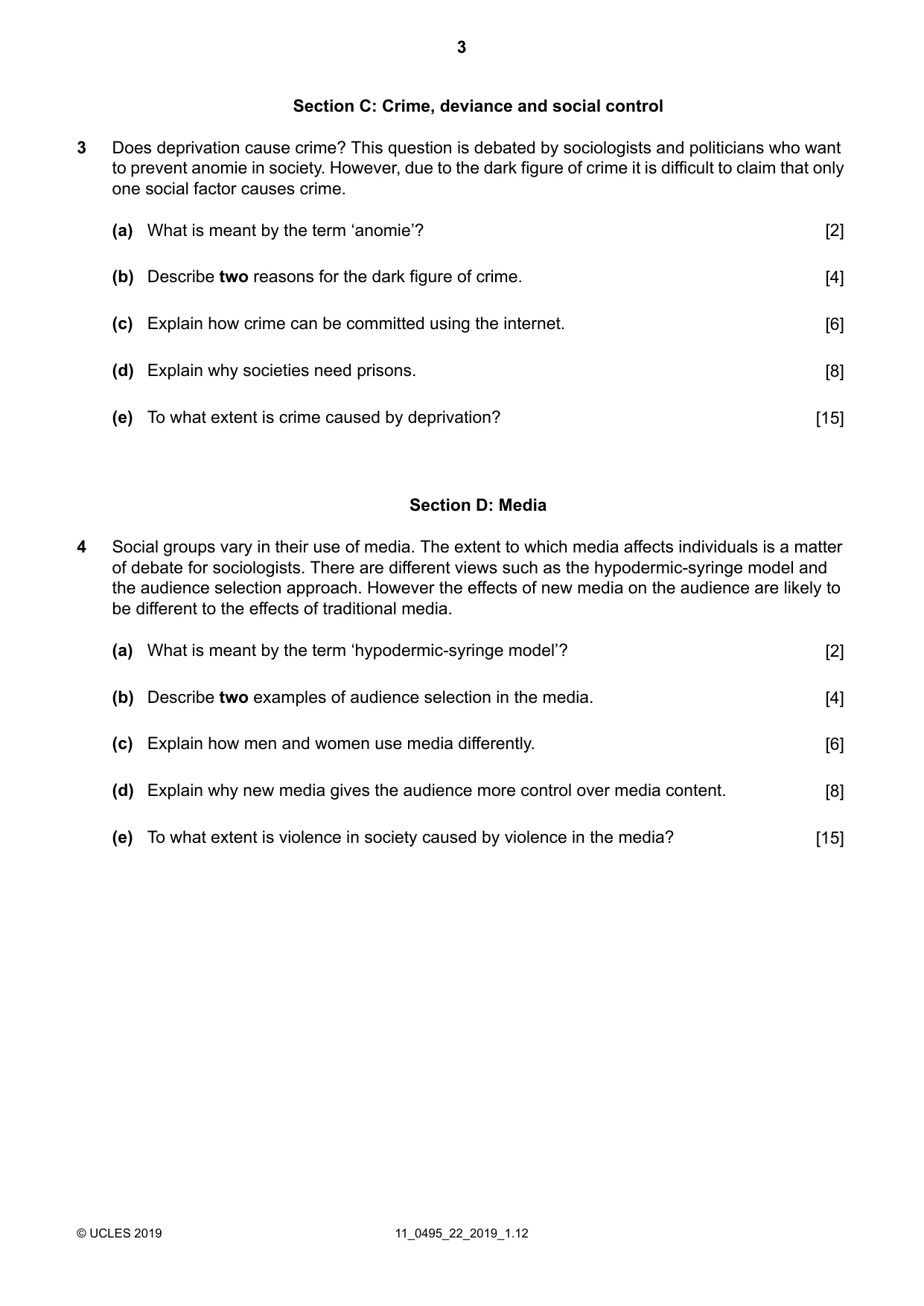
2 Sociologists view education in different ways. Some sociologists believe that education is important for society to function well. Others claim education is a source of inequality. For example, the culture of masculinity found in some schools is blamed by many sociologists for gender inequality. (a) What is meant by the term ‘culture of masculinity’? [2] (b) Describe the two different types of gratification experienced by students. [4] (c) Explain how education helps society to function well. [6] (d) Explain why vocationalism is a feature of the education system today. [8] (e) To what extent does the education system help males to maintain their powerful position in society? [15] Section C: Crime, deviance and social control
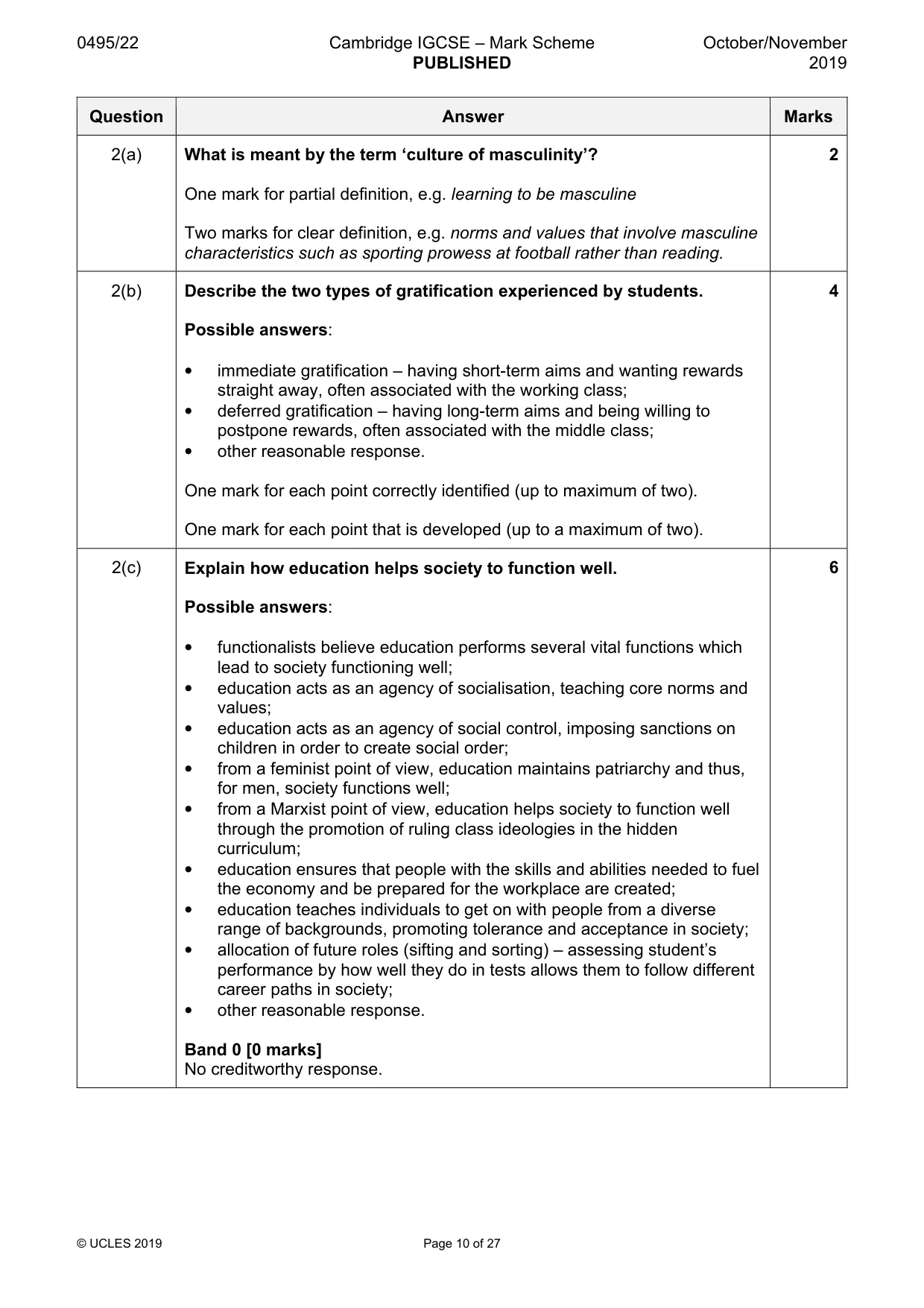
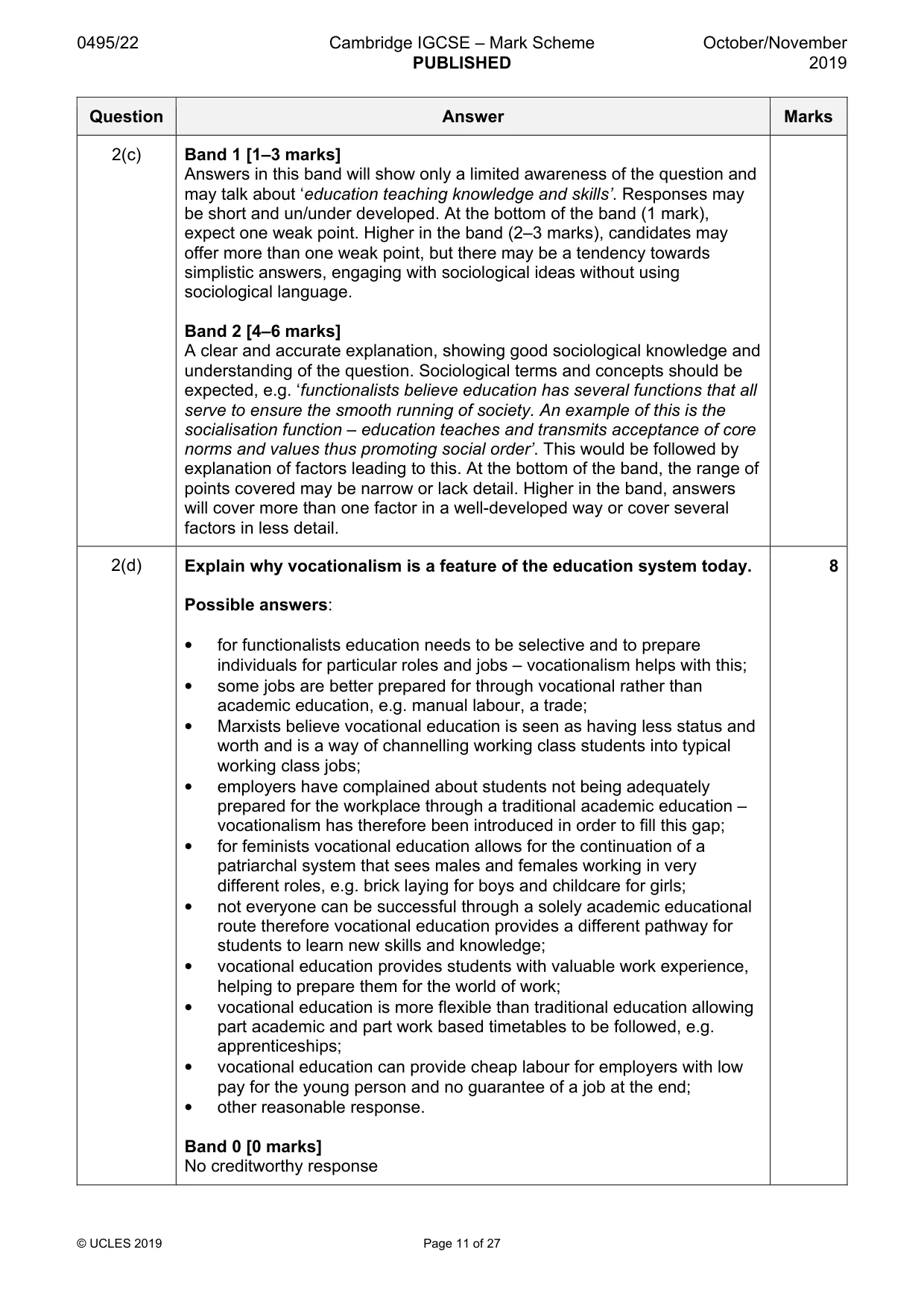
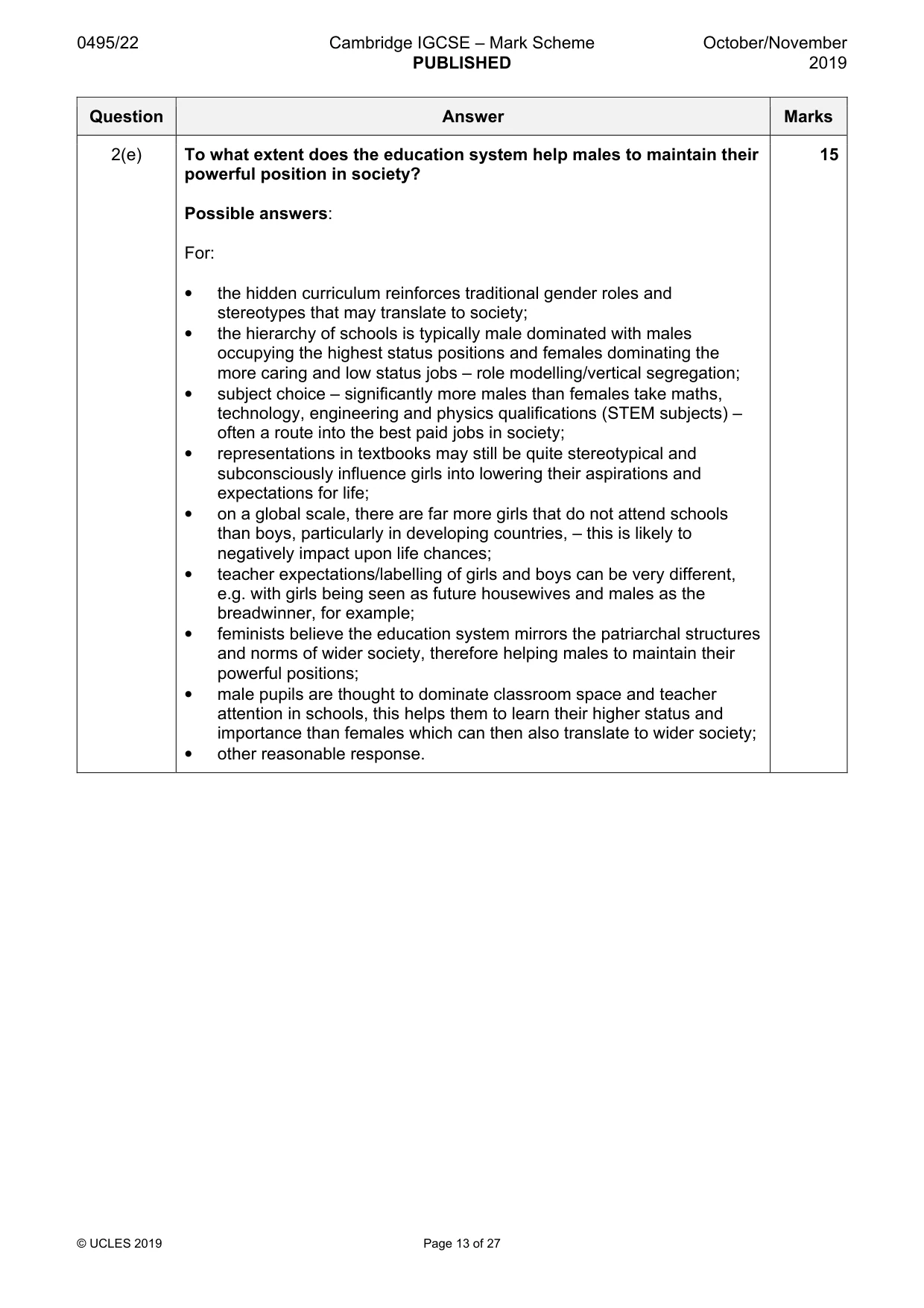
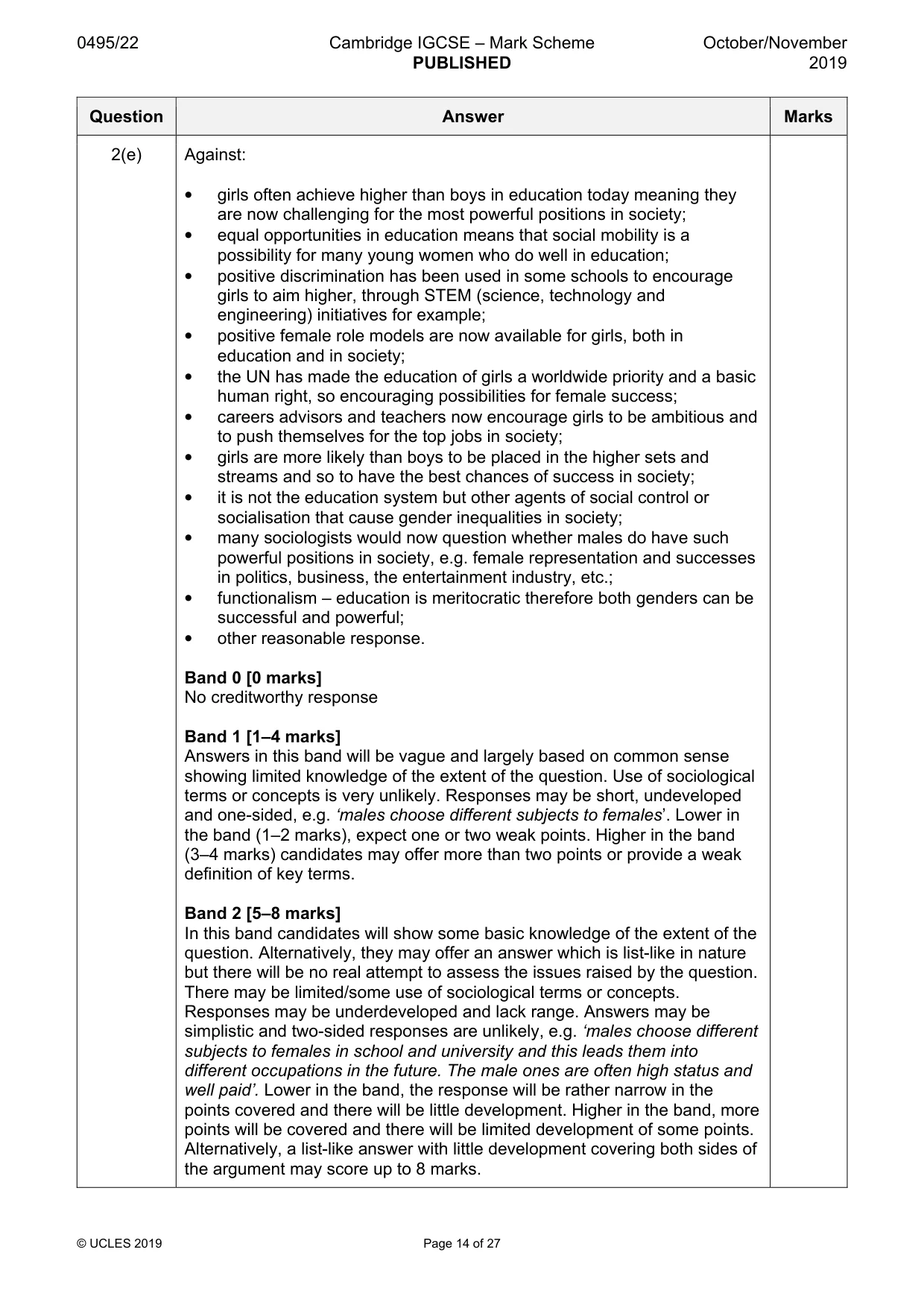
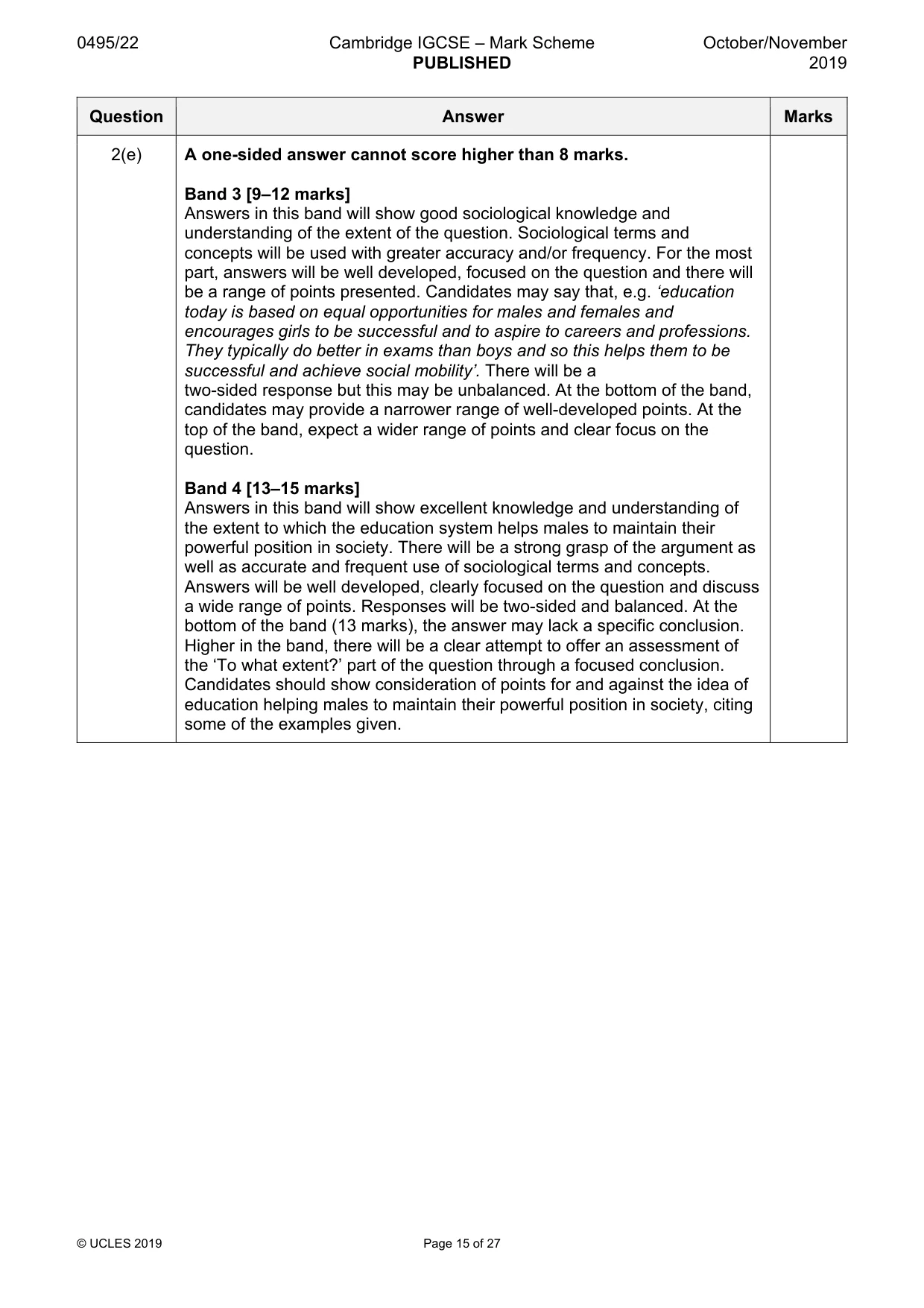
Mark scheme: 2(a) What is meant by the term ‘culture of masculinity’? 2 One mark for partial definition, e.g. learning to be masculine Two marks for clear definition, e.g. norms and values that involve masculine characteristics such as sporting prowess at football rather than reading. 2(b) Describe the two types of gratification experienced by students. 4 Possible answers: • immediate gratification – having short-term aims and wanting rewards straight away, often associated with the working class; • deferred gratification – having long-term aims and being willing to postpone rewards, often associated with the middle class; • other reasonable response. One mark for each point correctly identified (up to maximum of two). One mark for each point that is developed (up to a maximum of two). 2(c) Explain how education helps society to function well. 6 Possible answers: • functionalists believe education performs several vital functions which lead to society functioning well; • education acts as an agency of socialisation, teaching core norms and values; • education acts as an agency of social control, imposing sanctions on children in order to create social order; • from a feminist point of view, education maintains patriarchy and thus, for men, society functions well; • from a Marxist point of view, education helps society to function well through the promotion of ruling class ideologies in the hidden curriculum; • education ensures that people with the skills and abilities needed to fuel the economy and be prepared for the workplace are created; • education teaches individuals to get on with people from a diverse range of backgrounds, promoting tolerance and acceptance in society; • allocation of future roles (sifting and sorting) – assessing student’s performance by how well they do in tests allows them to follow different career paths in society; • other reasonable response. Band 0 [0 marks] No creditworthy response. 2(c) Band 1 [1–3 marks] Answers in this band will show only a limited awareness of the question and may talk about ‘education teaching knowledge and skills’. Responses may be short and un/under developed. At the bottom of the band (1 mark), expect one weak point. Higher in the band (2–3 marks), candidates may offer more than one weak point, but there may be a tendency towards simplistic answers, engaging with sociological ideas without using sociological language. Band 2 [4–6 marks] A clear and accurate explanation, showing good sociological knowledge and understanding of the question. Sociological terms and concepts should be expected, e.g. ‘functionalists believe education has several functions that all serve to ensure the smooth running of society. An example of this is the socialisation function – education teaches and transmits acceptance of core norms and values thus promoting social order’. This would be followed by explanation of factors leading to this. At the bottom of the band, the range of points covered may be narrow or lack detail. Higher in the band, answers will cover more than one factor in a well-developed way or cover several factors in less detail. 2(d) Explain why vocationalism is a feature of the education system today. 8 Possible answers: • for functionalists education needs to be selective and to prepare individuals for particular roles and jobs – vocationalism helps with this; • some jobs are better prepared for through vocational rather than academic education, e.g. manual labour, a trade; • Marxists believe vocational education is seen as having less status and worth and is a way of channelling working class students into typical working class jobs; • employers have complained about students not being adequately prepared for the workplace through a traditional academic education – vocationalism has therefore been introduced in order to fill this gap; • for feminists vocational education allows for the continuation of a patriarchal system that sees males and females working in very different roles, e.g. brick laying for boys and childcare for girls; • not everyone can be successful through a solely academic educational route therefore vocational education provides a different pathway for students to learn new skills and knowledge; • vocational education provides students with valuable work experience, helping to prepare them for the world of work; • vocational education is more flexible than traditional education allowing part academic and part work based timetables to be followed, e.g. apprenticeships; • vocational education can provide cheap labour for employers with low pay for the young person and no guarantee of a job at the end; • other reasonable response. Band 0 [0 marks] No creditworthy response 2(d) Band 1 [1–3 marks] Answers in this band will show only a limited awareness of the question. A tendency to description is likely. Responses may be short and undeveloped, e.g. ‘not everyone can be good at academic subjects’, stated without explanation. Sociological terms and concepts are unlikely to be used. At the bottom of the band (1 mark), expect one weak point. Higher in the band (2– 3 marks), candidates may offer more than one weak point. Band 2 [4–6 marks] Answers in this band will show basic sociological knowledge and understanding of why vocationalism is a feature of the education system today. Responses may be underdeveloped and lacking in range, e.g. ‘work based education allows students to be better prepared for the demands of the workplace, so giving employers more of what they need’. At the bottom of the band, candidates are unlikely to use sociological terms and concepts accurately. Higher in the band, candidates may be beginning to use sociological terms and concepts with greater accuracy. However, some aspects of the answer may only be partially developed/explained. Band 3 [7–8 marks] Answers in this band will show good sociological knowledge and understanding of ‘why’ vocationalism is a feature of the education system today and will be well developed and explained, e.g. ‘Marxists believe that vocational education keeps the lower classes in their place and ensures a continuation of the capitalist system and ideology’. They can then expand on the explanation of this and other factors as necessary. Sociological terms and concepts will be used accurately overall. Answers will be well focused on the question and there will be a range of reasons presented. At the top of the band explanations will be clear throughout. 2(e) To what extent does the education system help males to maintain their 15 powerful position in society? Possible answers: For: • the hidden curriculum reinforces traditional gender roles and stereotypes that may translate to society; • the hierarchy of schools is typically male dominated with males occupying the highest status positions and females dominating the more caring and low status jobs – role modelling/vertical segregation; • subject choice – significantly more males than females take maths, technology, engineering and physics qualifications (STEM subjects) – often a route into the best paid jobs in society; • representations in textbooks may still be quite stereotypical and subconsciously influence girls into lowering their aspirations and expectations for life; • on a global scale, there are far more girls that do not attend schools than boys, particularly in developing countries, – this is likely to negatively impact upon life chances; • teacher expectations/labelling of girls and boys can be very different, e.g. with girls being seen as future housewives and males as the breadwinner, for example; • feminists believe the education system mirrors the patriarchal structures and norms of wider society, therefore helping males to maintain their powerful positions; • male pupils are thought to dominate classroom space and teacher attention in schools, this helps them to learn their higher status and importance than females which can then also translate to wider society; • other reasonable response. 2(e) Against: • girls often achieve higher than boys in education today meaning they are now challenging for the most powerful positions in society; • equal opportunities in education means that social mobility is a possibility for many young women who do well in education; • positive discrimination has been used in some schools to encourage girls to aim higher, through STEM (science, technology and engineering) initiatives for example; • positive female role models are now available for girls, both in education and in society; • the UN has made the education of girls a worldwide priority and a basic human right, so encouraging possibilities for female success; • careers advisors and teachers now encourage girls to be ambitious and to push themselves for the top jobs in society; • girls are more likely than boys to be placed in the higher sets and streams and so to have the best chances of success in society; • it is not the education system but other agents of social control or socialisation that cause gender inequalities in society; • many sociologists would now question whether males do have such powerful positions in society, e.g. female representation and successes in politics, business, the entertainment industry, etc.; • functionalism – education is meritocratic therefore both genders can be successful and powerful; • other reasonable response. Band 0 [0 marks] No creditworthy response Band 1 [1–4 marks] Answers in this band will be vague and largely based on common sense showing limited knowledge of the extent of the question. Use of sociological terms or concepts is very unlikely. Responses may be short, undeveloped and one-sided, e.g. ‘males choose different subjects to females’. Lower in the band (1–2 marks), expect one or two weak points. Higher in the band (3–4 marks) candidates may offer more than two points or provide a weak definition of key terms. Band 2 [5–8 marks] In this band candidates will show some basic knowledge of the extent of the question. Alternatively, they may offer an answer which is list-like in nature but there will be no real attempt to assess the issues raised by the question. There may be limited/some use of sociological terms or concepts. Responses may be underdeveloped and lack range. Answers may be simplistic and two-sided responses are unlikely, e.g. ‘males choose different subjects to females in school and university and this leads them into different occupations in the future. The male ones are often high status and well paid’. Lower in the band, the response will be rather narrow in the points covered and there will be little development. Higher in the band, more points will be covered and there will be limited development of some points. Alternatively, a list-like answer with little development covering both sides of the argument may score up to 8 marks. 2(e) A one-sided answer cannot score higher than 8 marks. Band 3 [9–12 marks] Answers in this band will show good sociological knowledge and understanding of the extent of the question. Sociological terms and concepts will be used with greater accuracy and/or frequency. For the most part, answers will be well developed, focused on the question and there will be a range of points presented. Candidates may say that, e.g. ‘education today is based on equal opportunities for males and females and encourages girls to be successful and to aspire to careers and professions. They typically do better in exams than boys and so this helps them to be successful and achieve social mobility’. There will be a two-sided response but this may be unbalanced. At the bottom of the band, candidates may provide a narrower range of well-developed points. At the top of the band, expect a wider range of points and clear focus on the question. Band 4 [13–15 marks] Answers in this band will show excellent knowledge and understanding of the extent to which the education system helps males to maintain their powerful position in society. There will be a strong grasp of the argument as well as accurate and frequent use of sociological terms and concepts. Answers will be well developed, clearly focused on the question and discuss a wide range of points. Responses will be two-sided and balanced. At the bottom of the band (13 marks), the answer may lack a specific conclusion. Higher in the band, there will be a clear attempt to offer an assessment of the ‘To what extent?’ part of the question through a focused conclusion. Candidates should show consideration of points for and against the idea of education helping males to maintain their powerful position in society, citing some of the examples given.
Q3 · Does deprivation cause crime?
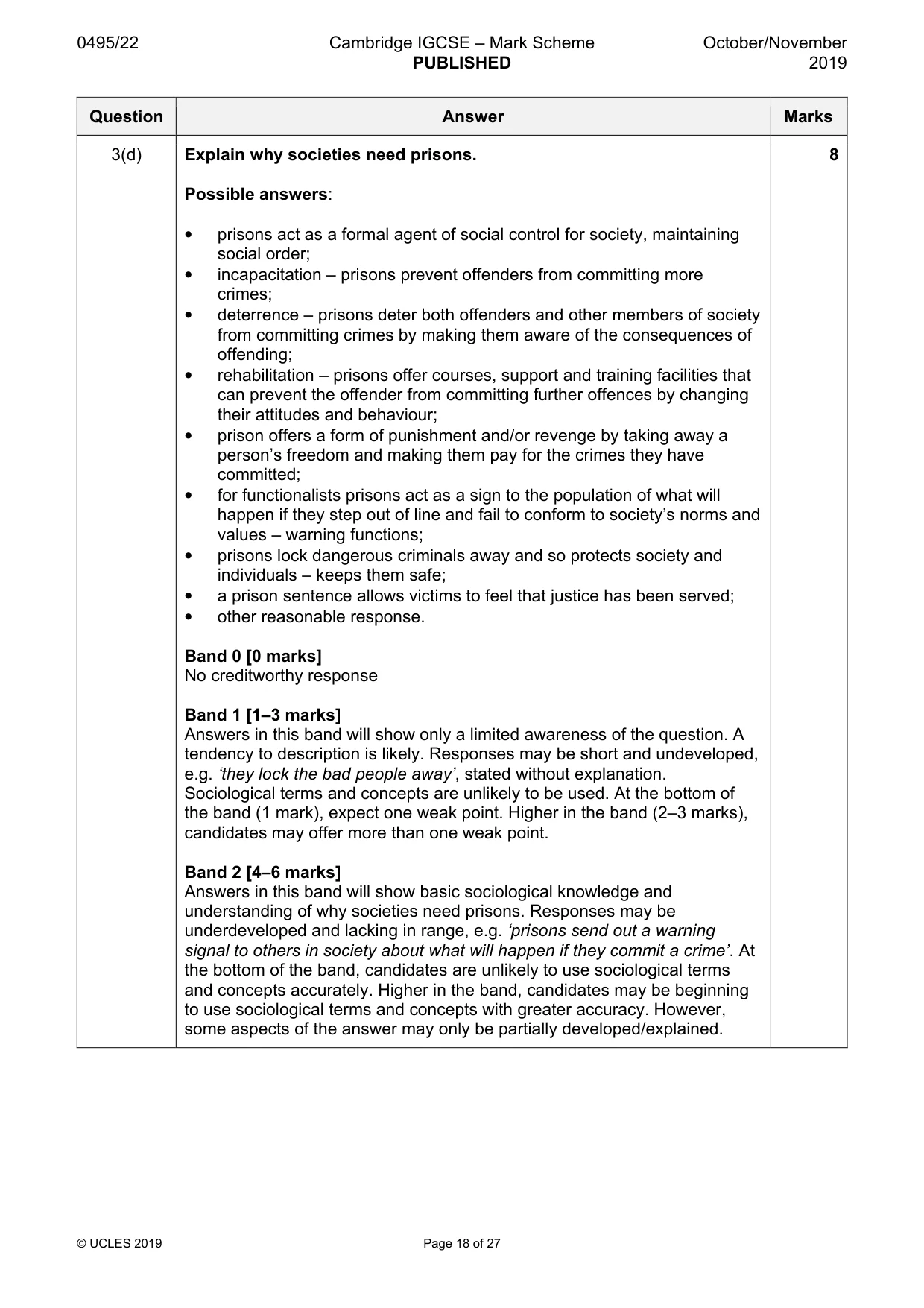
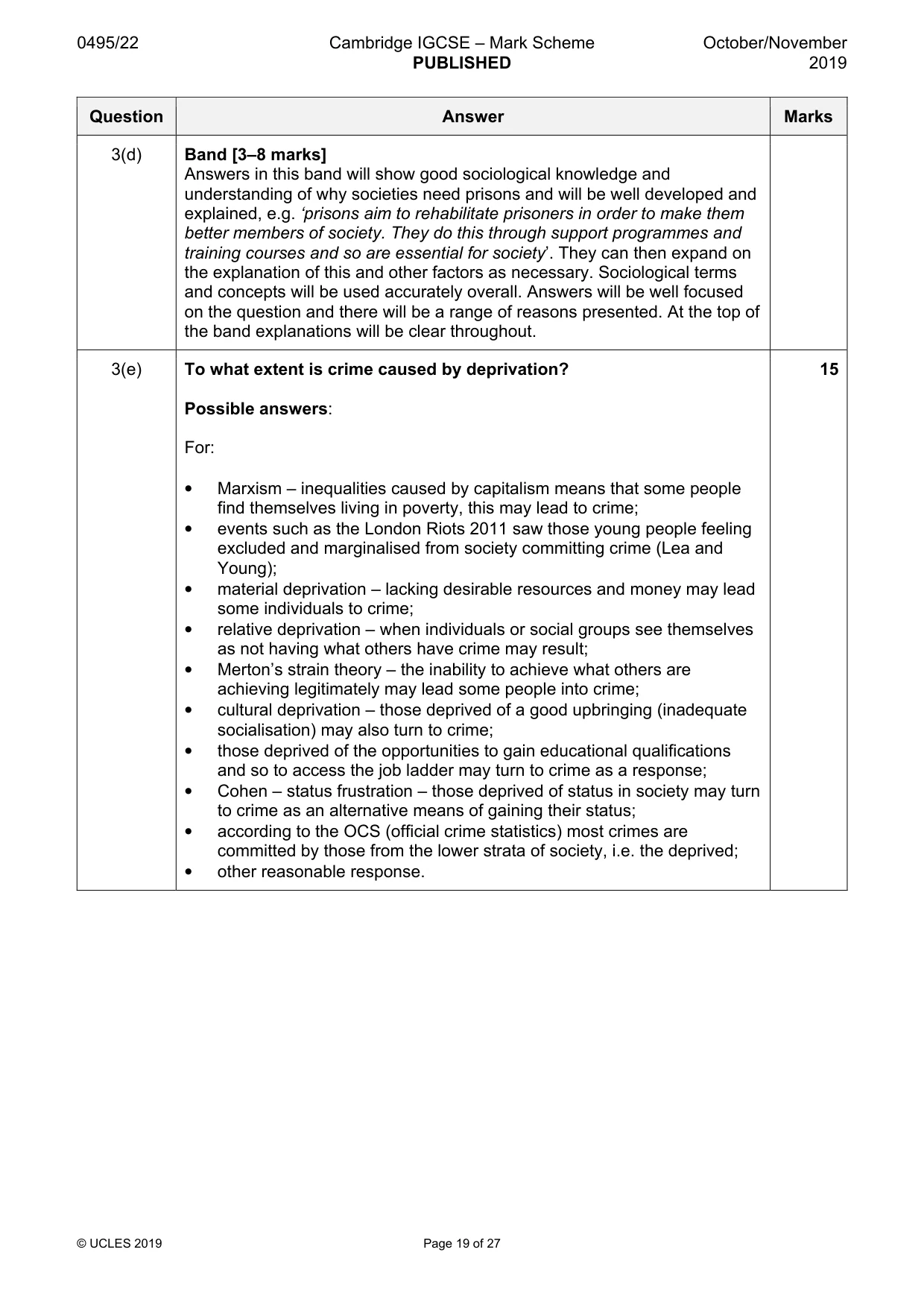
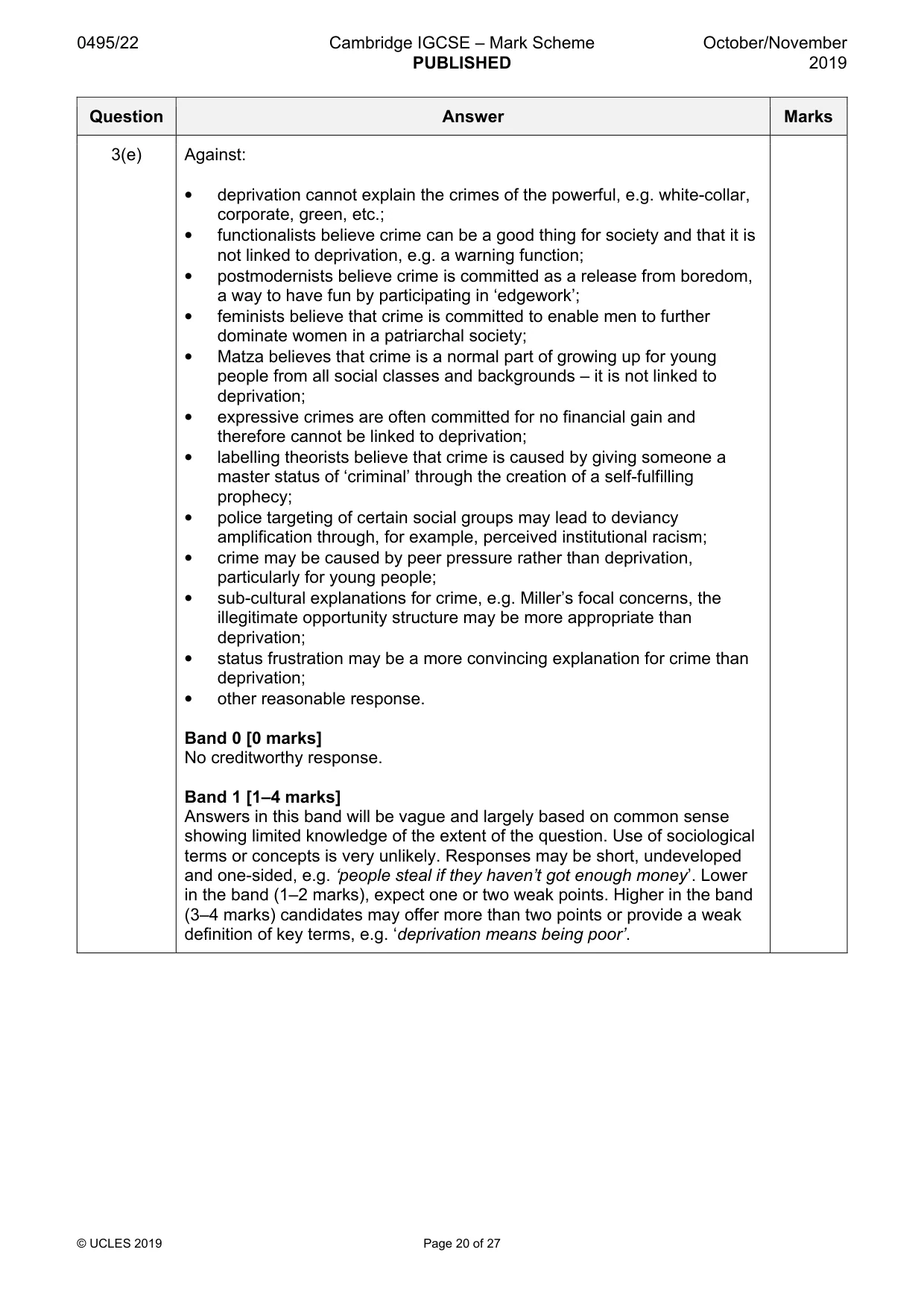
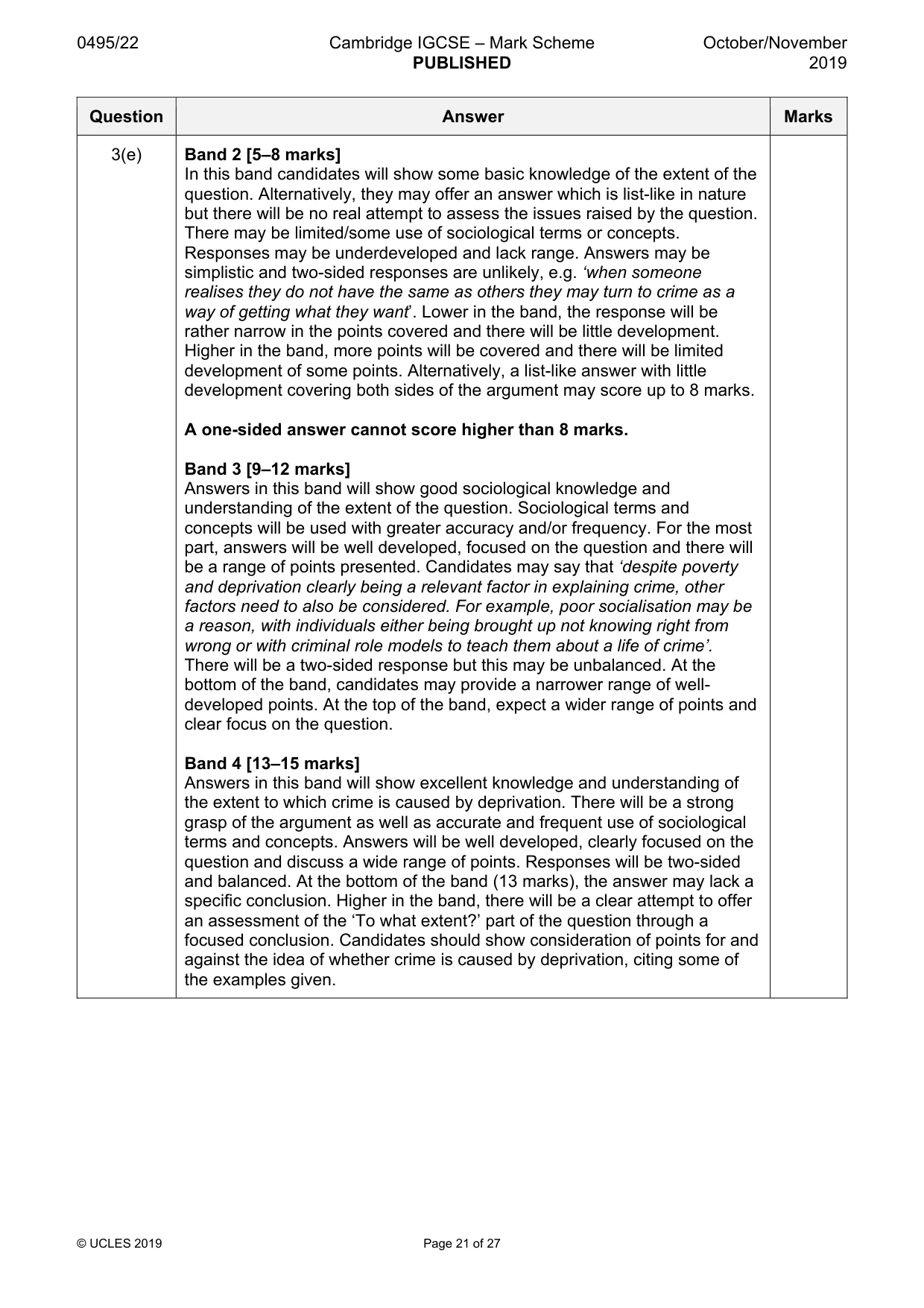
3 Does deprivation cause crime? This question is debated by sociologists and politicians who want to prevent anomie in society. However, due to the dark figure of crime it is difficult to claim that only one social factor causes crime. (a) What is meant by the term ‘anomie’? [2] (b) Describe two reasons for the dark figure of crime. [4] (c) Explain how crime can be committed using the internet. [6] (d) Explain why societies need prisons. [8] (e) To what extent is crime caused by deprivation? [15] Section D: Media
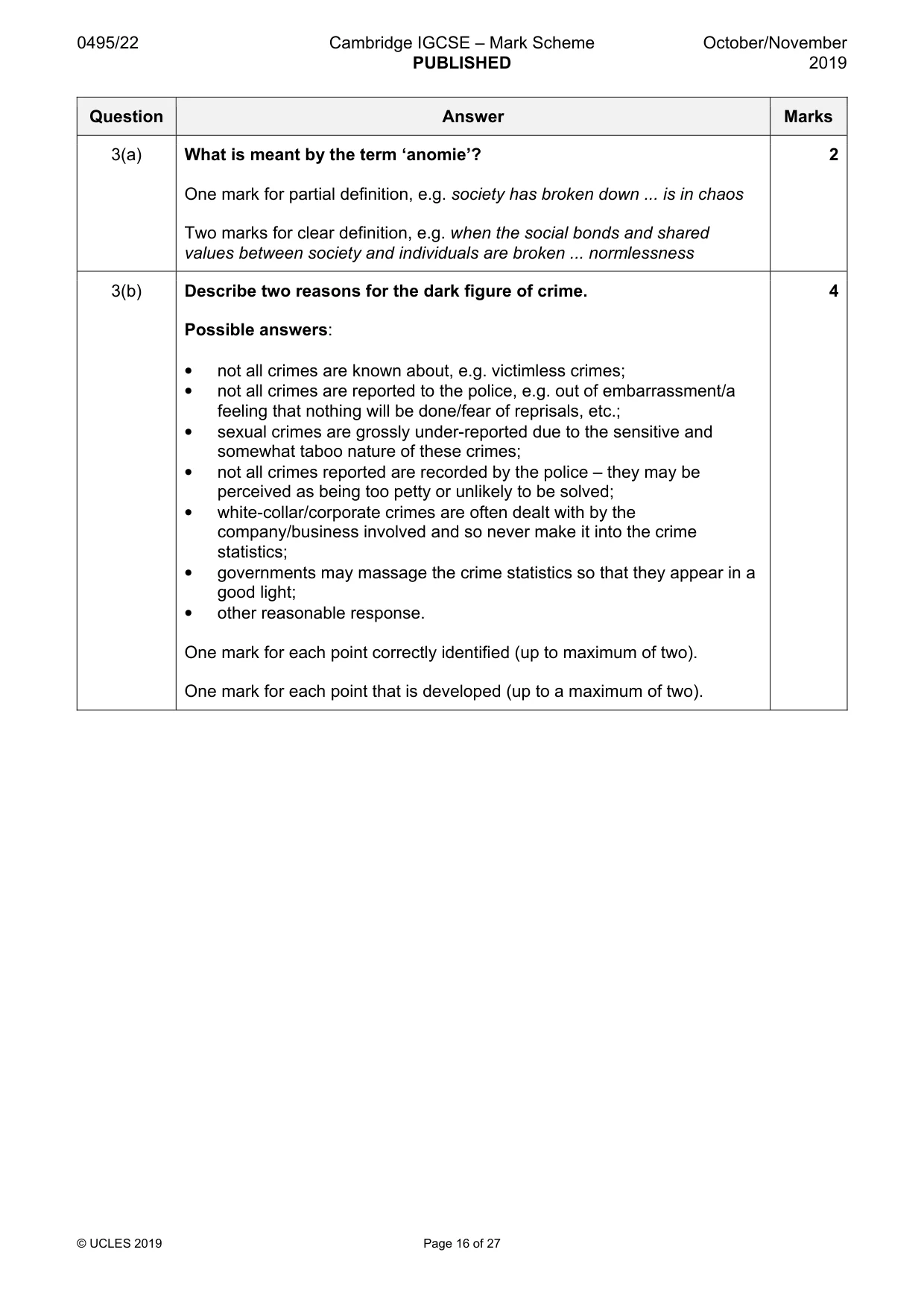
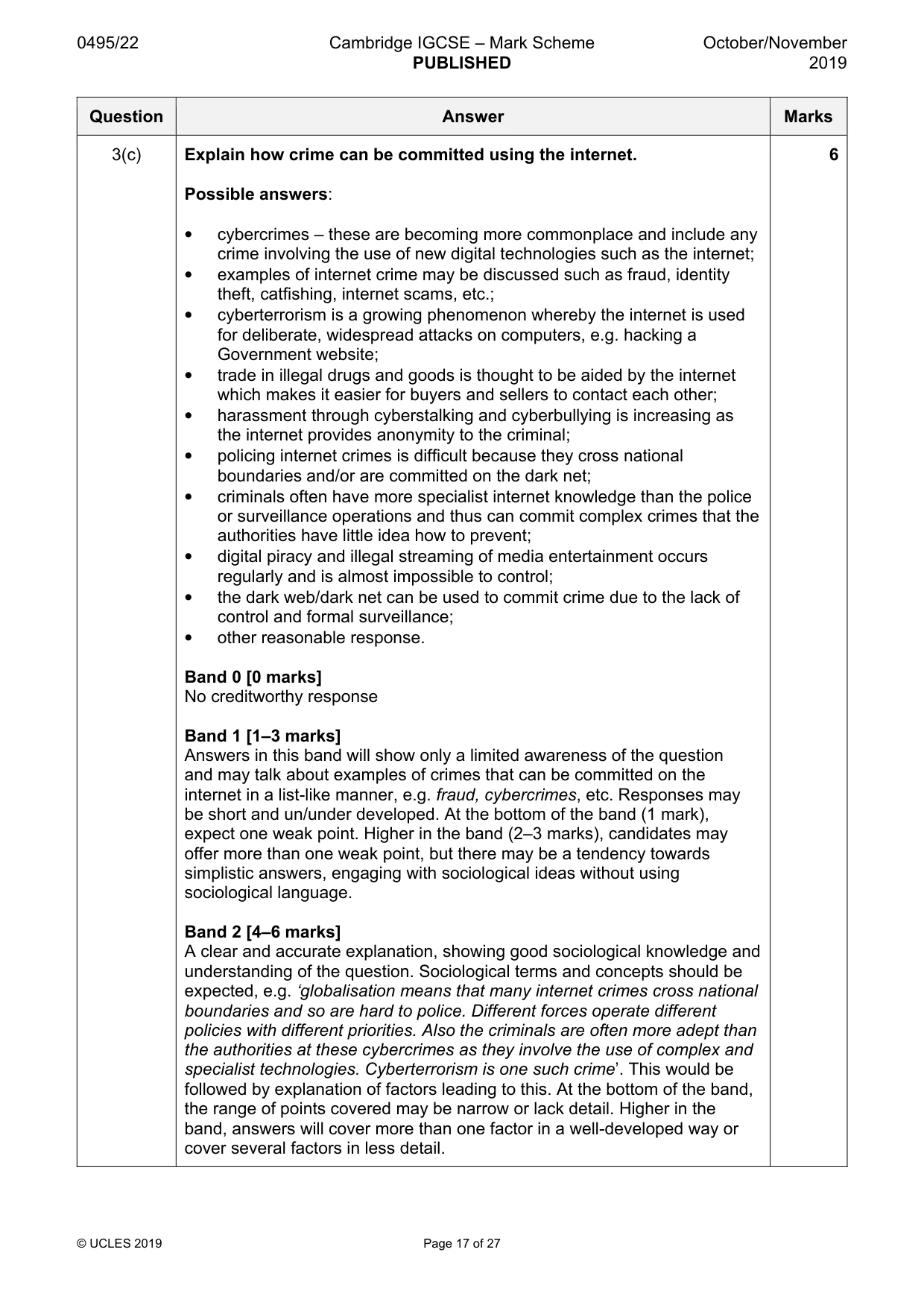
Mark scheme: 3(a) What is meant by the term ‘anomie’? 2 One mark for partial definition, e.g. society has broken down ... is in chaos Two marks for clear definition, e.g. when the social bonds and shared values between society and individuals are broken ... normlessness 3(b) Describe two reasons for the dark figure of crime. 4 Possible answers: • not all crimes are known about, e.g. victimless crimes; • not all crimes are reported to the police, e.g. out of embarrassment/a feeling that nothing will be done/fear of reprisals, etc.; • sexual crimes are grossly under-reported due to the sensitive and somewhat taboo nature of these crimes; • not all crimes reported are recorded by the police – they may be perceived as being too petty or unlikely to be solved; • white-collar/corporate crimes are often dealt with by the company/business involved and so never make it into the crime statistics; • governments may massage the crime statistics so that they appear in a good light; • other reasonable response. One mark for each point correctly identified (up to maximum of two). One mark for each point that is developed (up to a maximum of two). 3(c) Explain how crime can be committed using the internet. 6 Possible answers: • cybercrimes – these are becoming more commonplace and include any crime involving the use of new digital technologies such as the internet; • examples of internet crime may be discussed such as fraud, identity theft, catfishing, internet scams, etc.; • cyberterrorism is a growing phenomenon whereby the internet is used for deliberate, widespread attacks on computers, e.g. hacking a Government website; • trade in illegal drugs and goods is thought to be aided by the internet which makes it easier for buyers and sellers to contact each other; • harassment through cyberstalking and cyberbullying is increasing as the internet provides anonymity to the criminal; • policing internet crimes is difficult because they cross national boundaries and/or are committed on the dark net; • criminals often have more specialist internet knowledge than the police or surveillance operations and thus can commit complex crimes that the authorities have little idea how to prevent; • digital piracy and illegal streaming of media entertainment occurs regularly and is almost impossible to control; • the dark web/dark net can be used to commit crime due to the lack of control and formal surveillance; • other reasonable response. Band 0 [0 marks] No creditworthy response Band 1 [1–3 marks] Answers in this band will show only a limited awareness of the question and may talk about examples of crimes that can be committed on the internet in a list-like manner, e.g. fraud, cybercrimes, etc. Responses may be short and un/under developed. At the bottom of the band (1 mark), expect one weak point. Higher in the band (2–3 marks), candidates may offer more than one weak point, but there may be a tendency towards simplistic answers, engaging with sociological ideas without using sociological language. Band 2 [4–6 marks] A clear and accurate explanation, showing good sociological knowledge and understanding of the question. Sociological terms and concepts should be expected, e.g. ‘globalisation means that many internet crimes cross national boundaries and so are hard to police. Different forces operate different policies with different priorities. Also the criminals are often more adept than the authorities at these cybercrimes as they involve the use of complex and specialist technologies. Cyberterrorism is one such crime’. This would be followed by explanation of factors leading to this. At the bottom of the band, the range of points covered may be narrow or lack detail. Higher in the band, answers will cover more than one factor in a well-developed way or cover several factors in less detail. 3(d) Explain why societies need prisons. 8 Possible answers: • prisons act as a formal agent of social control for society, maintaining social order; • incapacitation – prisons prevent offenders from committing more crimes; • deterrence – prisons deter both offenders and other members of society from committing crimes by making them aware of the consequences of offending; • rehabilitation – prisons offer courses, support and training facilities that can prevent the offender from committing further offences by changing their attitudes and behaviour; • prison offers a form of punishment and/or revenge by taking away a person’s freedom and making them pay for the crimes they have committed; • for functionalists prisons act as a sign to the population of what will happen if they step out of line and fail to conform to society’s norms and values – warning functions; • prisons lock dangerous criminals away and so protects society and individuals – keeps them safe; • a prison sentence allows victims to feel that justice has been served; • other reasonable response. Band 0 [0 marks] No creditworthy response Band 1 [1–3 marks] Answers in this band will show only a limited awareness of the question. A tendency to description is likely. Responses may be short and undeveloped, e.g. ‘they lock the bad people away’, stated without explanation. Sociological terms and concepts are unlikely to be used. At the bottom of the band (1 mark), expect one weak point. Higher in the band (2–3 marks), candidates may offer more than one weak point. Band 2 [4–6 marks] Answers in this band will show basic sociological knowledge and understanding of why societies need prisons. Responses may be underdeveloped and lacking in range, e.g. ‘prisons send out a warning signal to others in society about what will happen if they commit a crime’. At the bottom of the band, candidates are unlikely to use sociological terms and concepts accurately. Higher in the band, candidates may be beginning to use sociological terms and concepts with greater accuracy. However, some aspects of the answer may only be partially developed/explained. 3(d) Band [3–8 marks] Answers in this band will show good sociological knowledge and understanding of why societies need prisons and will be well developed and explained, e.g. ‘prisons aim to rehabilitate prisoners in order to make them better members of society. They do this through support programmes and training courses and so are essential for society’. They can then expand on the explanation of this and other factors as necessary. Sociological terms and concepts will be used accurately overall. Answers will be well focused on the question and there will be a range of reasons presented. At the top of the band explanations will be clear throughout. 3(e) To what extent is crime caused by deprivation? 15 Possible answers: For: • Marxism – inequalities caused by capitalism means that some people find themselves living in poverty, this may lead to crime; • events such as the London Riots 2011 saw those young people feeling excluded and marginalised from society committing crime (Lea and Young); • material deprivation – lacking desirable resources and money may lead some individuals to crime; • relative deprivation – when individuals or social groups see themselves as not having what others have crime may result; • Merton’s strain theory – the inability to achieve what others are achieving legitimately may lead some people into crime; • cultural deprivation – those deprived of a good upbringing (inadequate socialisation) may also turn to crime; • those deprived of the opportunities to gain educational qualifications and so to access the job ladder may turn to crime as a response; • Cohen – status frustration – those deprived of status in society may turn to crime as an alternative means of gaining their status; • according to the OCS (official crime statistics) most crimes are committed by those from the lower strata of society, i.e. the deprived; • other reasonable response. 3(e) Against: • deprivation cannot explain the crimes of the powerful, e.g. white-collar, corporate, green, etc.; • functionalists believe crime can be a good thing for society and that it is not linked to deprivation, e.g. a warning function; • postmodernists believe crime is committed as a release from boredom, a way to have fun by participating in ‘edgework’; • feminists believe that crime is committed to enable men to further dominate women in a patriarchal society; • Matza believes that crime is a normal part of growing up for young people from all social classes and backgrounds – it is not linked to deprivation; • expressive crimes are often committed for no financial gain and therefore cannot be linked to deprivation; • labelling theorists believe that crime is caused by giving someone a master status of ‘criminal’ through the creation of a self-fulfilling prophecy; • police targeting of certain social groups may lead to deviancy amplification through, for example, perceived institutional racism; • crime may be caused by peer pressure rather than deprivation, particularly for young people; • sub-cultural explanations for crime, e.g. Miller’s focal concerns, the illegitimate opportunity structure may be more appropriate than deprivation; • status frustration may be a more convincing explanation for crime than deprivation; • other reasonable response. Band 0 [0 marks] No creditworthy response. Band 1 [1–4 marks] Answers in this band will be vague and largely based on common sense showing limited knowledge of the extent of the question. Use of sociological terms or concepts is very unlikely. Responses may be short, undeveloped and one-sided, e.g. ‘people steal if they haven’t got enough money’. Lower in the band (1–2 marks), expect one or two weak points. Higher in the band (3–4 marks) candidates may offer more than two points or provide a weak definition of key terms, e.g. ‘deprivation means being poor’. 3(e) Band 2 [5–8 marks] In this band candidates will show some basic knowledge of the extent of the question. Alternatively, they may offer an answer which is list-like in nature but there will be no real attempt to assess the issues raised by the question. There may be limited/some use of sociological terms or concepts. Responses may be underdeveloped and lack range. Answers may be simplistic and two-sided responses are unlikely, e.g. ‘when someone realises they do not have the same as others they may turn to crime as a way of getting what they want’. Lower in the band, the response will be rather narrow in the points covered and there will be little development. Higher in the band, more points will be covered and there will be limited development of some points. Alternatively, a list-like answer with little development covering both sides of the argument may score up to 8 marks. A one-sided answer cannot score higher than 8 marks. Band 3 [9–12 marks] Answers in this band will show good sociological knowledge and understanding of the extent of the question. Sociological terms and concepts will be used with greater accuracy and/or frequency. For the most part, answers will be well developed, focused on the question and there will be a range of points presented. Candidates may say that ‘despite poverty and deprivation clearly being a relevant factor in explaining crime, other factors need to also be considered. For example, poor socialisation may be a reason, with individuals either being brought up not knowing right from wrong or with criminal role models to teach them about a life of crime’. There will be a two-sided response but this may be unbalanced. At the bottom of the band, candidates may provide a narrower range of well- developed points. At the top of the band, expect a wider range of points and clear focus on the question. Band 4 [13–15 marks] Answers in this band will show excellent knowledge and understanding of the extent to which crime is caused by deprivation. There will be a strong grasp of the argument as well as accurate and frequent use of sociological terms and concepts. Answers will be well developed, clearly focused on the question and discuss a wide range of points. Responses will be two-sided and balanced. At the bottom of the band (13 marks), the answer may lack a specific conclusion. Higher in the band, there will be a clear attempt to offer an assessment of the ‘To what extent?’ part of the question through a focused conclusion. Candidates should show consideration of points for and against the idea of whether crime is caused by deprivation, citing some of the examples given.
Q4 · Social groups vary in their use of media
4 Social groups vary in their use of media. The extent to which media affects individuals is a matter of debate for sociologists. There are different views such as the hypodermic-syringe model and the audience selection approach. However the effects of new media on the audience are likely to be different to the effects of traditional media. (a) What is meant by the term ‘hypodermic-syringe model’? [2] (b) Describe two examples of audience selection in the media. [4] (c) Explain how men and women use media differently. [6] (d) Explain why new media gives the audience more control over media content. [8] (e) To what extent is violence in society caused by violence in the media? [15]
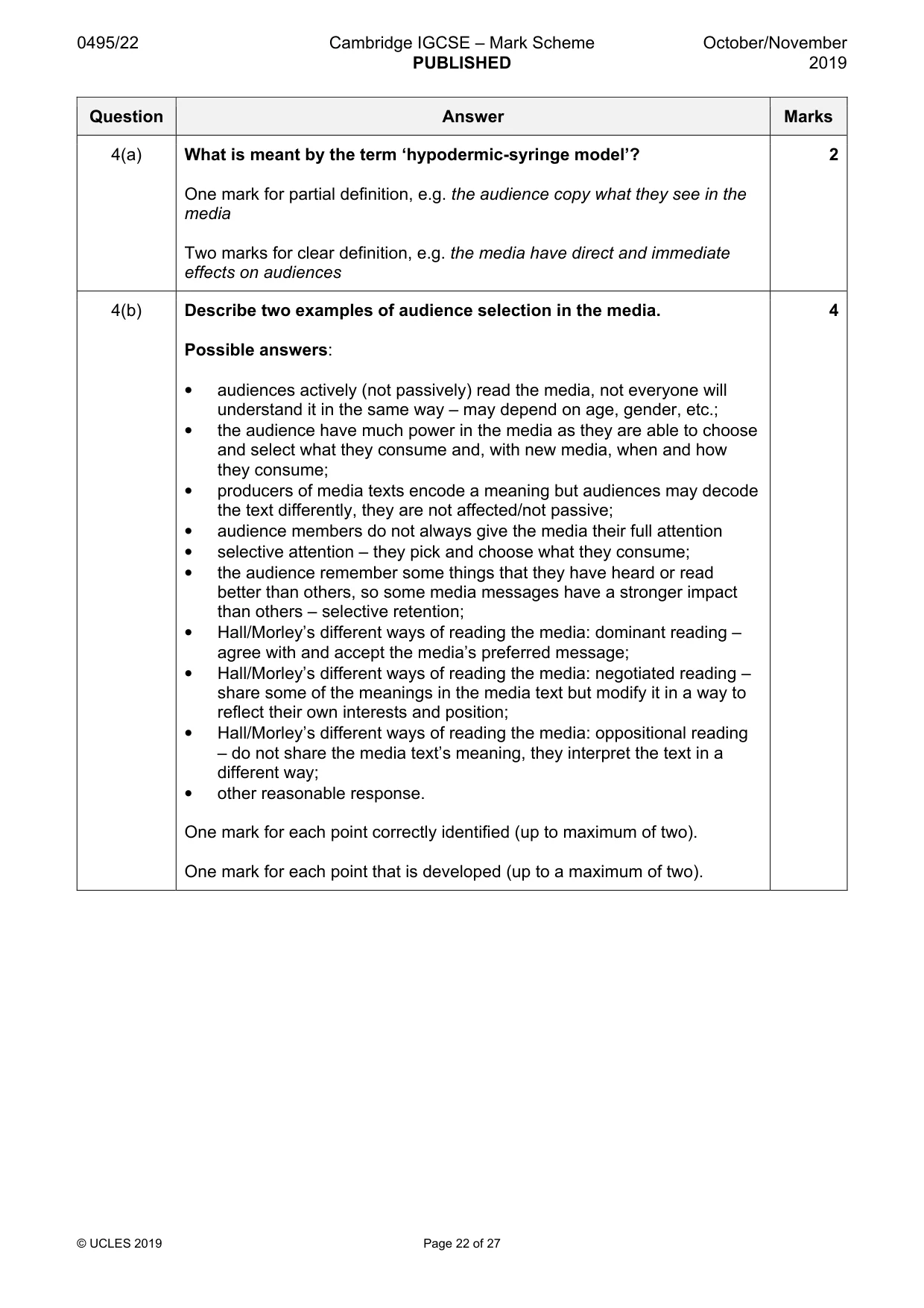
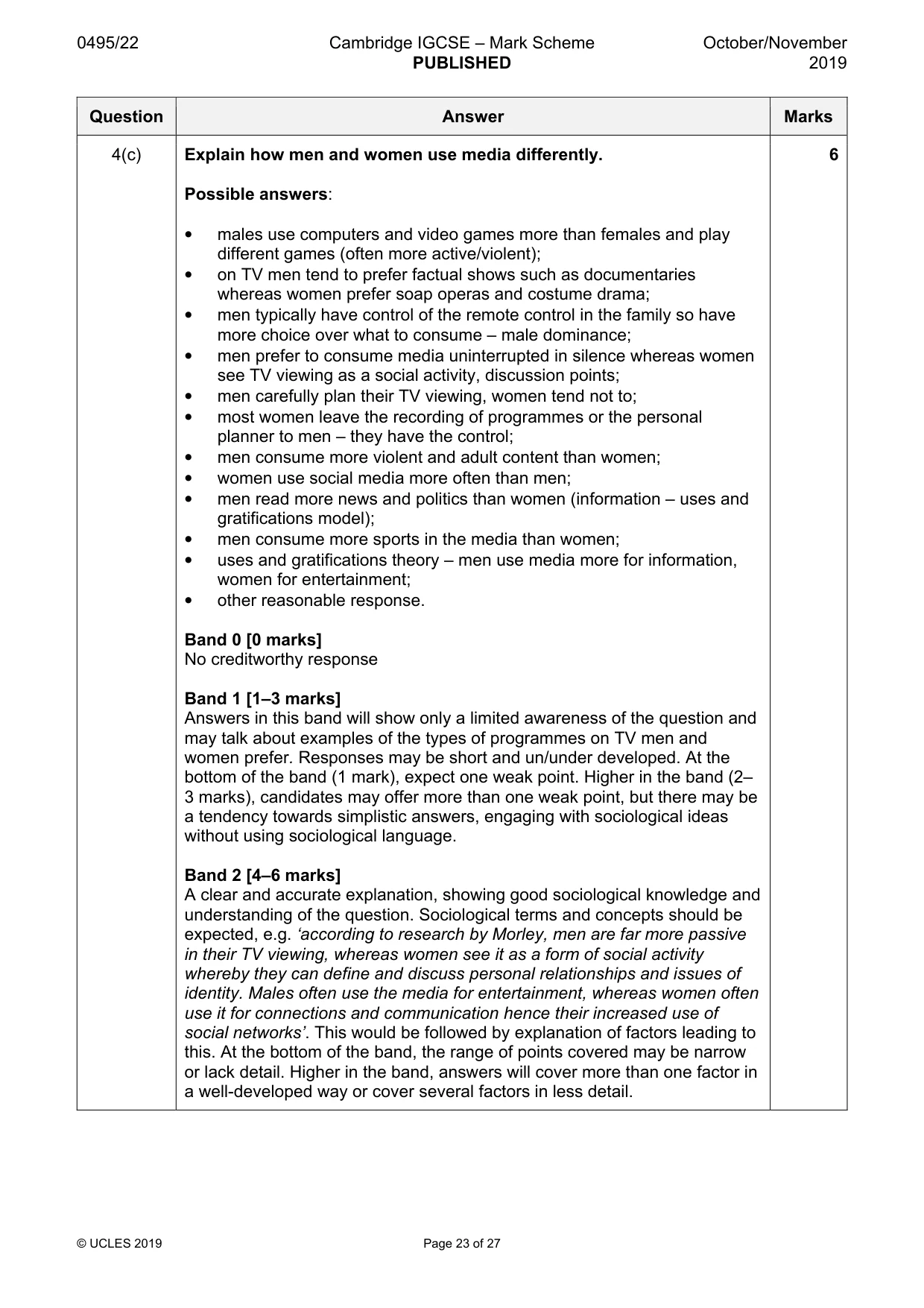
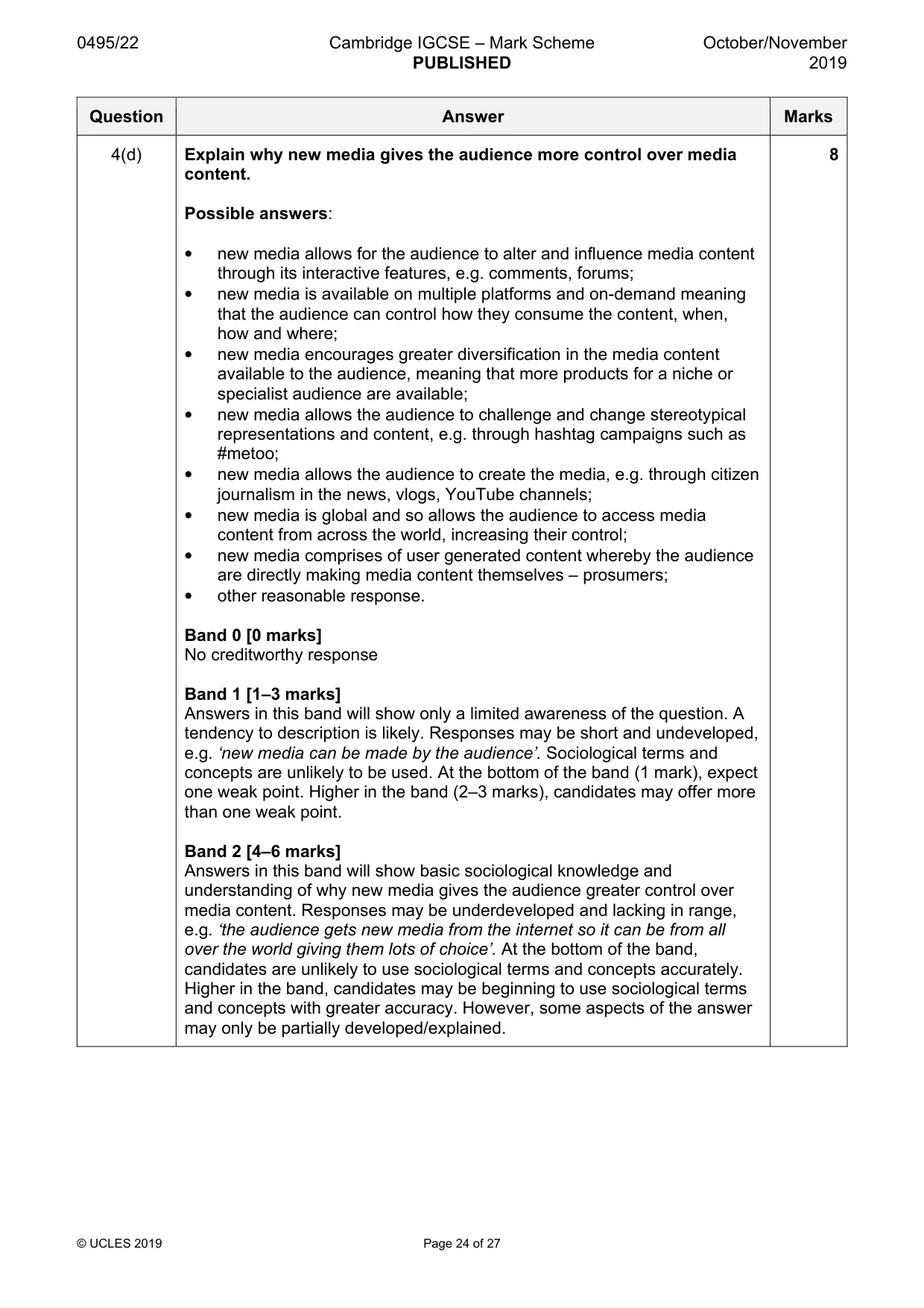
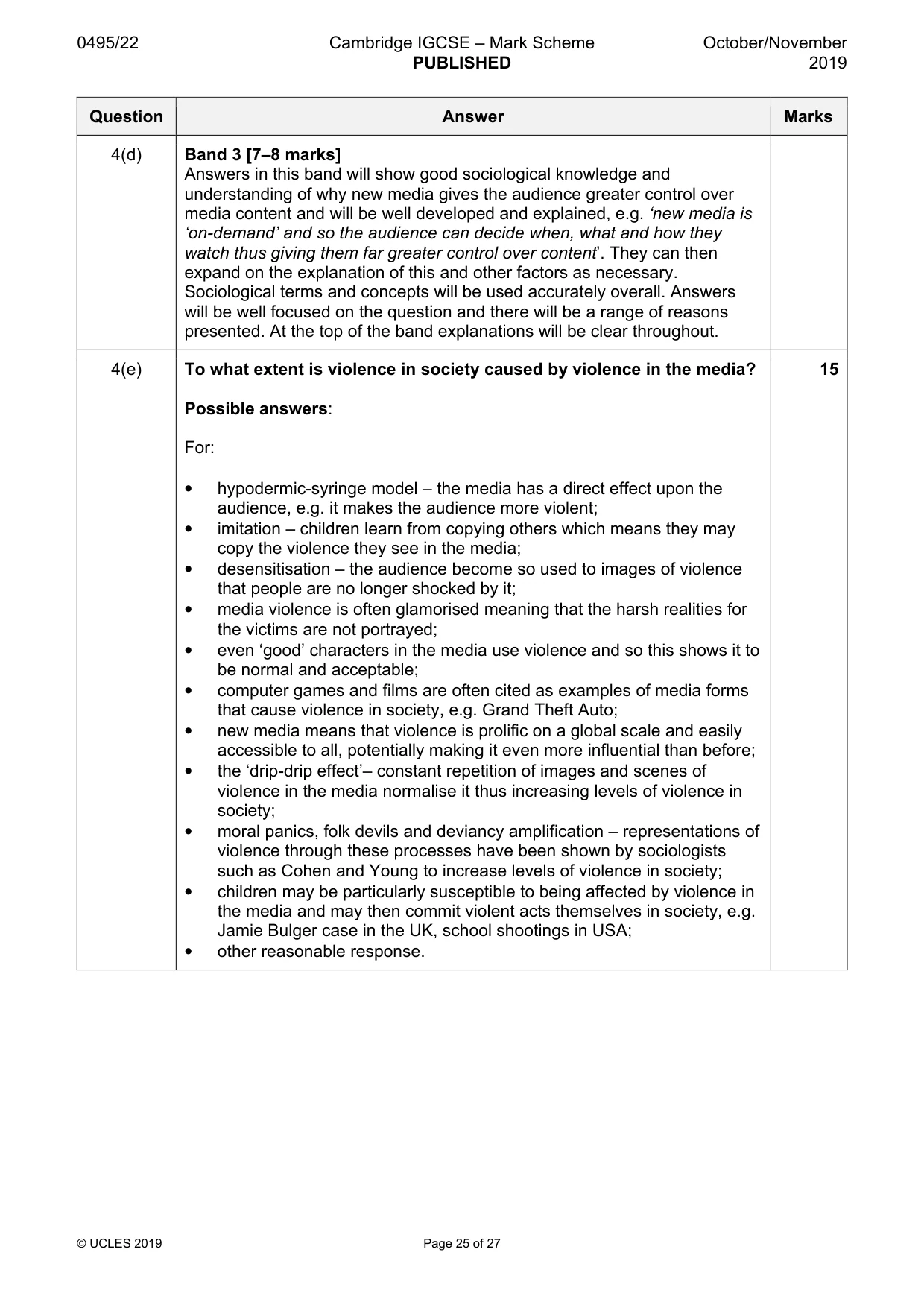
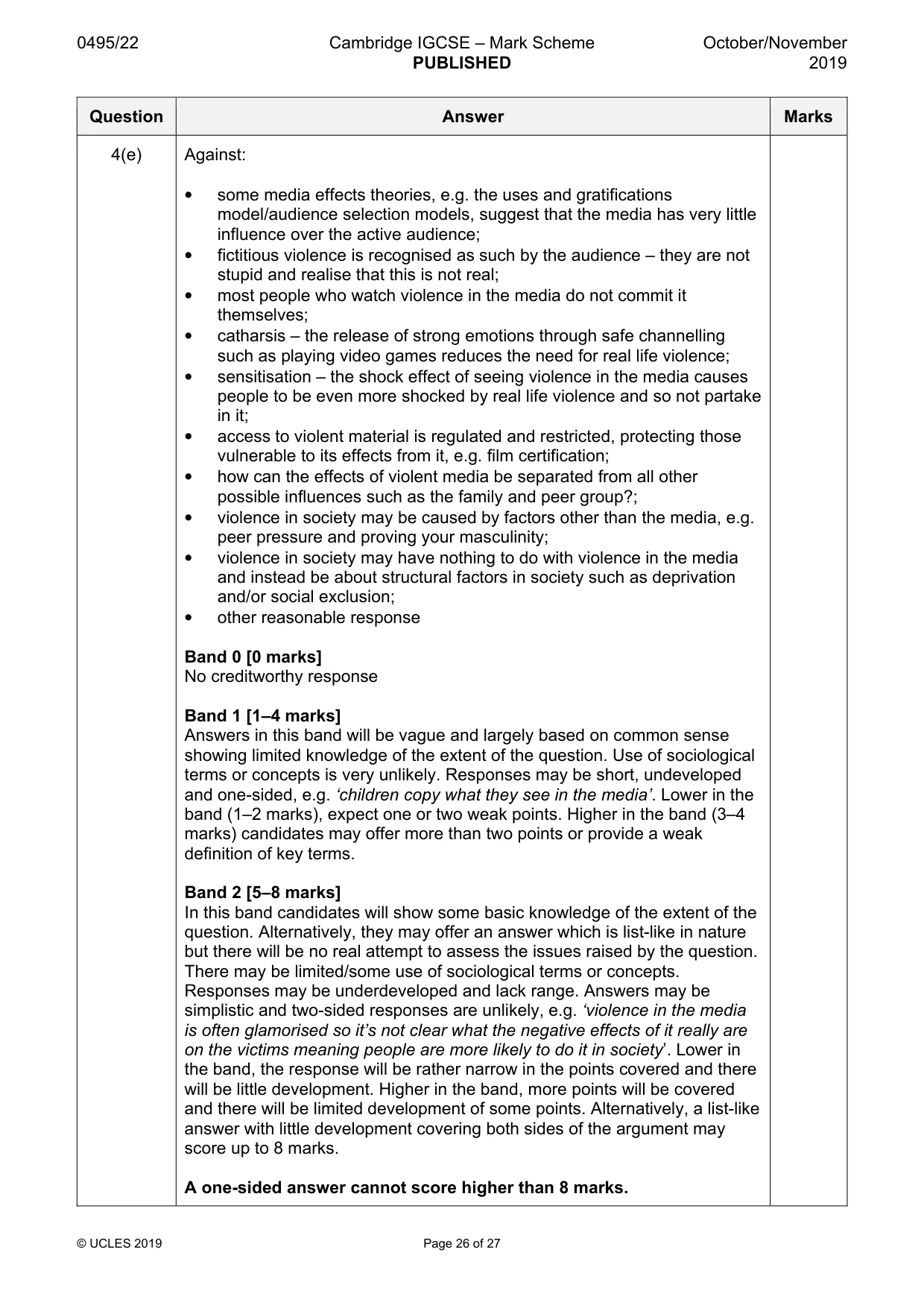
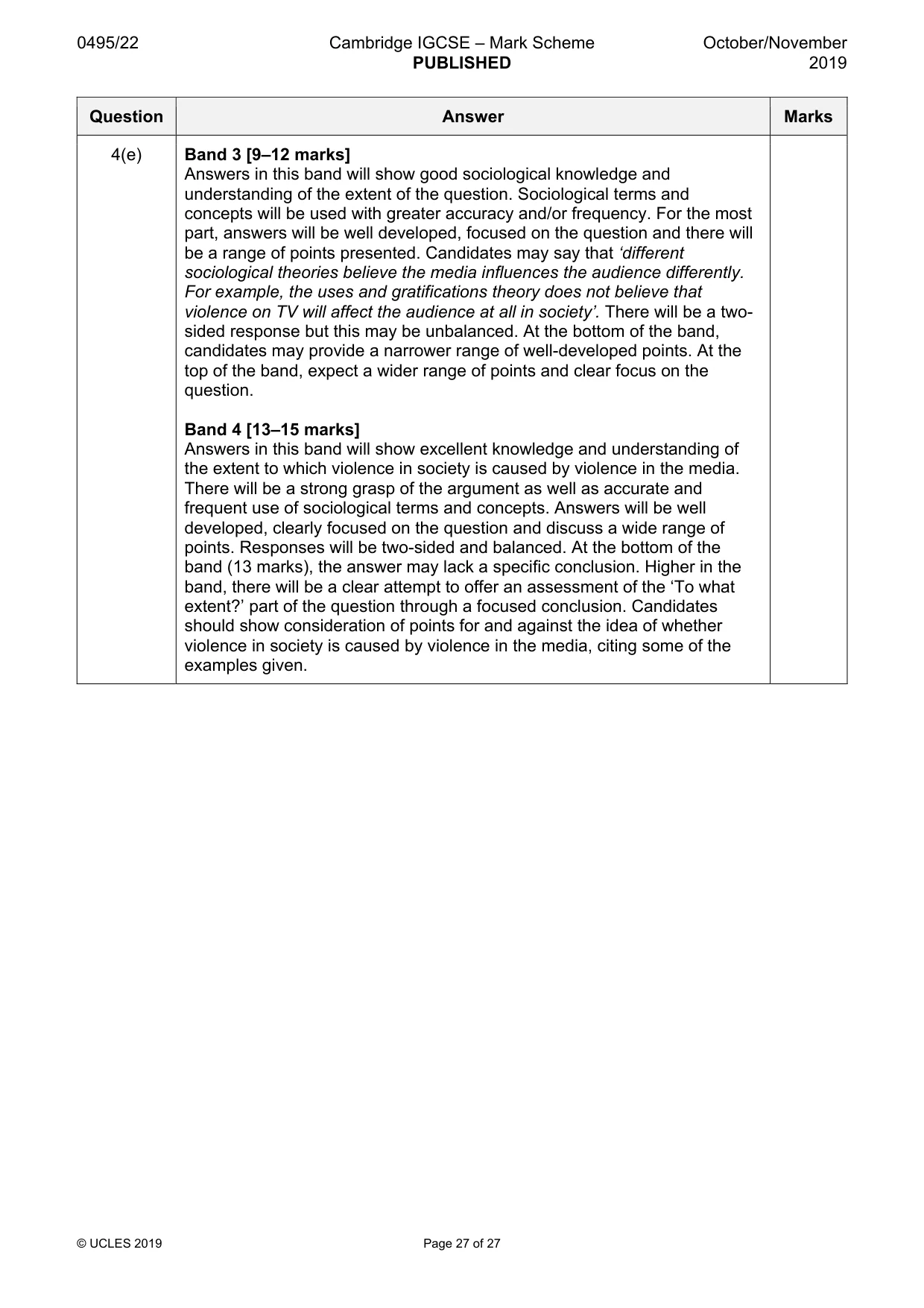
Mark scheme: 4(a) What is meant by the term ‘hypodermic-syringe model’? 2 One mark for partial definition, e.g. the audience copy what they see in the media Two marks for clear definition, e.g. the media have direct and immediate effects on audiences 4(b) Describe two examples of audience selection in the media. 4 Possible answers: • audiences actively (not passively) read the media, not everyone will understand it in the same way – may depend on age, gender, etc.; • the audience have much power in the media as they are able to choose and select what they consume and, with new media, when and how they consume; • producers of media texts encode a meaning but audiences may decode the text differently, they are not affected/not passive; • audience members do not always give the media their full attention • selective attention – they pick and choose what they consume; • the audience remember some things that they have heard or read better than others, so some media messages have a stronger impact than others – selective retention; • Hall/Morley’s different ways of reading the media: dominant reading – agree with and accept the media’s preferred message; • Hall/Morley’s different ways of reading the media: negotiated reading – share some of the meanings in the media text but modify it in a way to reflect their own interests and position; • Hall/Morley’s different ways of reading the media: oppositional reading – do not share the media text’s meaning, they interpret the text in a different way; • other reasonable response. One mark for each point correctly identified (up to maximum of two). One mark for each point that is developed (up to a maximum of two). 4(c) Explain how men and women use media differently. 6 Possible answers: • males use computers and video games more than females and play different games (often more active/violent); • on TV men tend to prefer factual shows such as documentaries whereas women prefer soap operas and costume drama; • men typically have control of the remote control in the family so have more choice over what to consume – male dominance; • men prefer to consume media uninterrupted in silence whereas women see TV viewing as a social activity, discussion points; • men carefully plan their TV viewing, women tend not to; • most women leave the recording of programmes or the personal planner to men – they have the control; • men consume more violent and adult content than women; • women use social media more often than men; • men read more news and politics than women (information – uses and gratifications model); • men consume more sports in the media than women; • uses and gratifications theory – men use media more for information, women for entertainment; • other reasonable response. Band 0 [0 marks] No creditworthy response Band 1 [1–3 marks] Answers in this band will show only a limited awareness of the question and may talk about examples of the types of programmes on TV men and women prefer. Responses may be short and un/under developed. At the bottom of the band (1 mark), expect one weak point. Higher in the band (2– 3 marks), candidates may offer more than one weak point, but there may be a tendency towards simplistic answers, engaging with sociological ideas without using sociological language. Band 2 [4–6 marks] A clear and accurate explanation, showing good sociological knowledge and understanding of the question. Sociological terms and concepts should be expected, e.g. ‘according to research by Morley, men are far more passive in their TV viewing, whereas women see it as a form of social activity whereby they can define and discuss personal relationships and issues of identity. Males often use the media for entertainment, whereas women often use it for connections and communication hence their increased use of social networks’. This would be followed by explanation of factors leading to this. At the bottom of the band, the range of points covered may be narrow or lack detail. Higher in the band, answers will cover more than one factor in a well-developed way or cover several factors in less detail. 4(d) Explain why new media gives the audience more control over media 8 content. Possible answers: • new media allows for the audience to alter and influence media content through its interactive features, e.g. comments, forums; • new media is available on multiple platforms and on-demand meaning that the audience can control how they consume the content, when, how and where; • new media encourages greater diversification in the media content available to the audience, meaning that more products for a niche or specialist audience are available; • new media allows the audience to challenge and change stereotypical representations and content, e.g. through hashtag campaigns such as #metoo; • new media allows the audience to create the media, e.g. through citizen journalism in the news, vlogs, YouTube channels; • new media is global and so allows the audience to access media content from across the world, increasing their control; • new media comprises of user generated content whereby the audience are directly making media content themselves – prosumers; • other reasonable response. Band 0 [0 marks] No creditworthy response Band 1 [1–3 marks] Answers in this band will show only a limited awareness of the question. A tendency to description is likely. Responses may be short and undeveloped, e.g. ‘new media can be made by the audience’. Sociological terms and concepts are unlikely to be used. At the bottom of the band (1 mark), expect one weak point. Higher in the band (2–3 marks), candidates may offer more than one weak point. Band 2 [4–6 marks] Answers in this band will show basic sociological knowledge and understanding of why new media gives the audience greater control over media content. Responses may be underdeveloped and lacking in range, e.g. ‘the audience gets new media from the internet so it can be from all over the world giving them lots of choice’. At the bottom of the band, candidates are unlikely to use sociological terms and concepts accurately. Higher in the band, candidates may be beginning to use sociological terms and concepts with greater accuracy. However, some aspects of the answer may only be partially developed/explained. 4(d) Band 3 [7–8 marks] Answers in this band will show good sociological knowledge and understanding of why new media gives the audience greater control over media content and will be well developed and explained, e.g. ‘new media is ‘on-demand’ and so the audience can decide when, what and how they watch thus giving them far greater control over content’. They can then expand on the explanation of this and other factors as necessary. Sociological terms and concepts will be used accurately overall. Answers will be well focused on the question and there will be a range of reasons presented. At the top of the band explanations will be clear throughout. 4(e) To what extent is violence in society caused by violence in the media? 15 Possible answers: For: • hypodermic-syringe model – the media has a direct effect upon the audience, e.g. it makes the audience more violent; • imitation – children learn from copying others which means they may copy the violence they see in the media; • desensitisation – the audience become so used to images of violence that people are no longer shocked by it; • media violence is often glamorised meaning that the harsh realities for the victims are not portrayed; • even ‘good’ characters in the media use violence and so this shows it to be normal and acceptable; • computer games and films are often cited as examples of media forms that cause violence in society, e.g. Grand Theft Auto; • new media means that violence is prolific on a global scale and easily accessible to all, potentially making it even more influential than before; • the ‘drip-drip effect’– constant repetition of images and scenes of violence in the media normalise it thus increasing levels of violence in society; • moral panics, folk devils and deviancy amplification – representations of violence through these processes have been shown by sociologists such as Cohen and Young to increase levels of violence in society; • children may be particularly susceptible to being affected by violence in the media and may then commit violent acts themselves in society, e.g. Jamie Bulger case in the UK, school shootings in USA; • other reasonable response. 4(e) Against: • some media effects theories, e.g. the uses and gratifications model/audience selection models, suggest that the media has very little influence over the active audience; • fictitious violence is recognised as such by the audience – they are not stupid and realise that this is not real; • most people who watch violence in the media do not commit it themselves; • catharsis – the release of strong emotions through safe channelling such as playing video games reduces the need for real life violence; • sensitisation – the shock effect of seeing violence in the media causes people to be even more shocked by real life violence and so not partake in it; • access to violent material is regulated and restricted, protecting those vulnerable to its effects from it, e.g. film certification; • how can the effects of violent media be separated from all other possible influences such as the family and peer group?; • violence in society may be caused by factors other than the media, e.g. peer pressure and proving your masculinity; • violence in society may have nothing to do with violence in the media and instead be about structural factors in society such as deprivation and/or social exclusion; • other reasonable response Band 0 [0 marks] No creditworthy response Band 1 [1–4 marks] Answers in this band will be vague and largely based on common sense showing limited knowledge of the extent of the question. Use of sociological terms or concepts is very unlikely. Responses may be short, undeveloped and one-sided, e.g. ‘children copy what they see in the media’. Lower in the band (1–2 marks), expect one or two weak points. Higher in the band (3–4 marks) candidates may offer more than two points or provide a weak definition of key terms. Band 2 [5–8 marks] In this band candidates will show some basic knowledge of the extent of the question. Alternatively, they may offer an answer which is list-like in nature but there will be no real attempt to assess the issues raised by the question. There may be limited/some use of sociological terms or concepts. Responses may be underdeveloped and lack range. Answers may be simplistic and two-sided responses are unlikely, e.g. ‘violence in the media is often glamorised so it’s not clear what the negative effects of it really are on the victims meaning people are more likely to do it in society’. Lower in the band, the response will be rather narrow in the points covered and there will be little development. Higher in the band, more points will be covered and there will be limited development of some points. Alternatively, a list-like answer with little development covering both sides of the argument may score up to 8 marks. A one-sided answer cannot score higher than 8 marks. 4(e) Band 3 [9–12 marks] Answers in this band will show good sociological knowledge and understanding of the extent of the question. Sociological terms and concepts will be used with greater accuracy and/or frequency. For the most part, answers will be well developed, focused on the question and there will be a range of points presented. Candidates may say that ‘different sociological theories believe the media influences the audience differently. For example, the uses and gratifications theory does not believe that violence on TV will affect the audience at all in society’. There will be a two- sided response but this may be unbalanced. At the bottom of the band, candidates may provide a narrower range of well-developed points. At the top of the band, expect a wider range of points and clear focus on the question. Band 4 [13–15 marks] Answers in this band will show excellent knowledge and understanding of the extent to which violence in society is caused by violence in the media. There will be a strong grasp of the argument as well as accurate and frequent use of sociological terms and concepts. Answers will be well developed, clearly focused on the question and discuss a wide range of points. Responses will be two-sided and balanced. At the bottom of the band (13 marks), the answer may lack a specific conclusion. Higher in the band, there will be a clear attempt to offer an assessment of the ‘To what extent?’ part of the question through a focused conclusion. Candidates should show consideration of points for and against the idea of whether violence in society is caused by violence in the media, citing some of the examples given.
More questions on What types of data and evidence do sociologists use?
What was in this paper
The subtopics covered by these 4 questions, and how many questions each got. Open one in a new tab to see every Cambridge question on it.
What you needed in this session
Cambridge’s own grade thresholds for 2019 Oct/Nov, Paper 2 · Variant 2. A higher threshold means an easier paper — the bar moves with how the cohort did.