Cambridge IGCSE Sociology 0495 — 2019 Oct/Nov Paper 2 · Variant 1
0495/21/O/N/19 · 4 questions · 70 marks · ≈79 min
The question paper and its mark scheme, free to read here and free to download. This is Cambridge’s own paper, exactly as it was sat.
Question paper4 pages
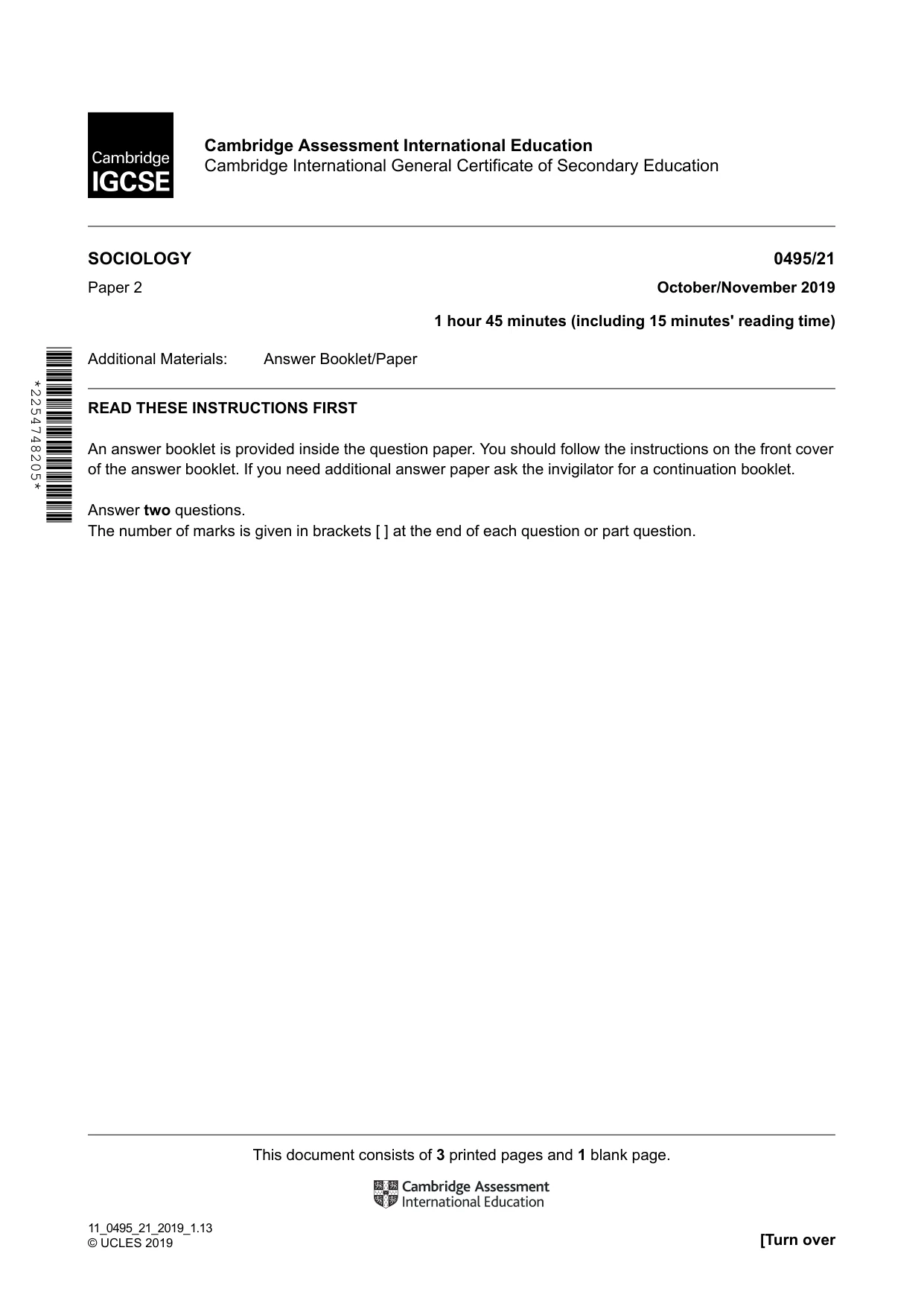
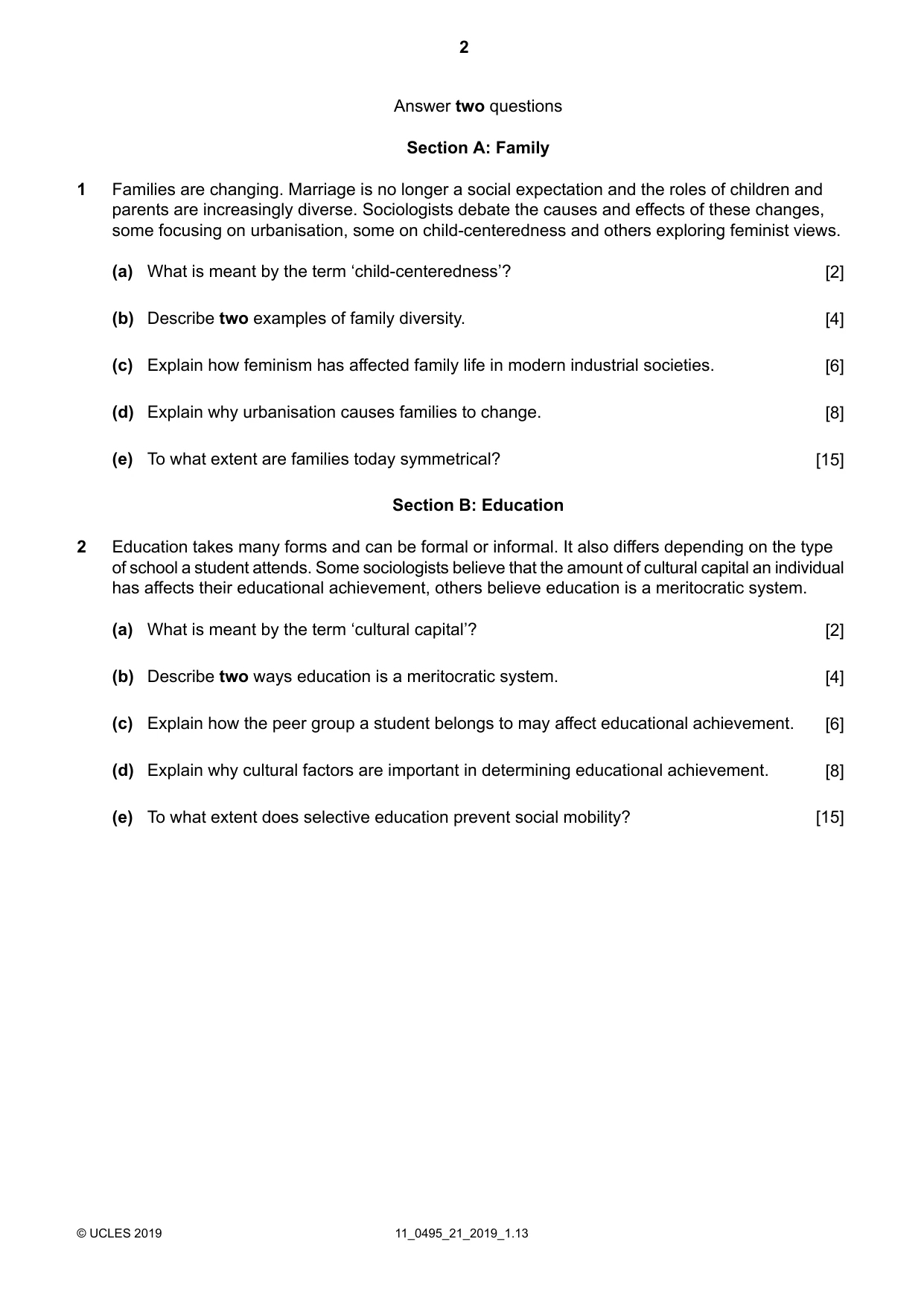
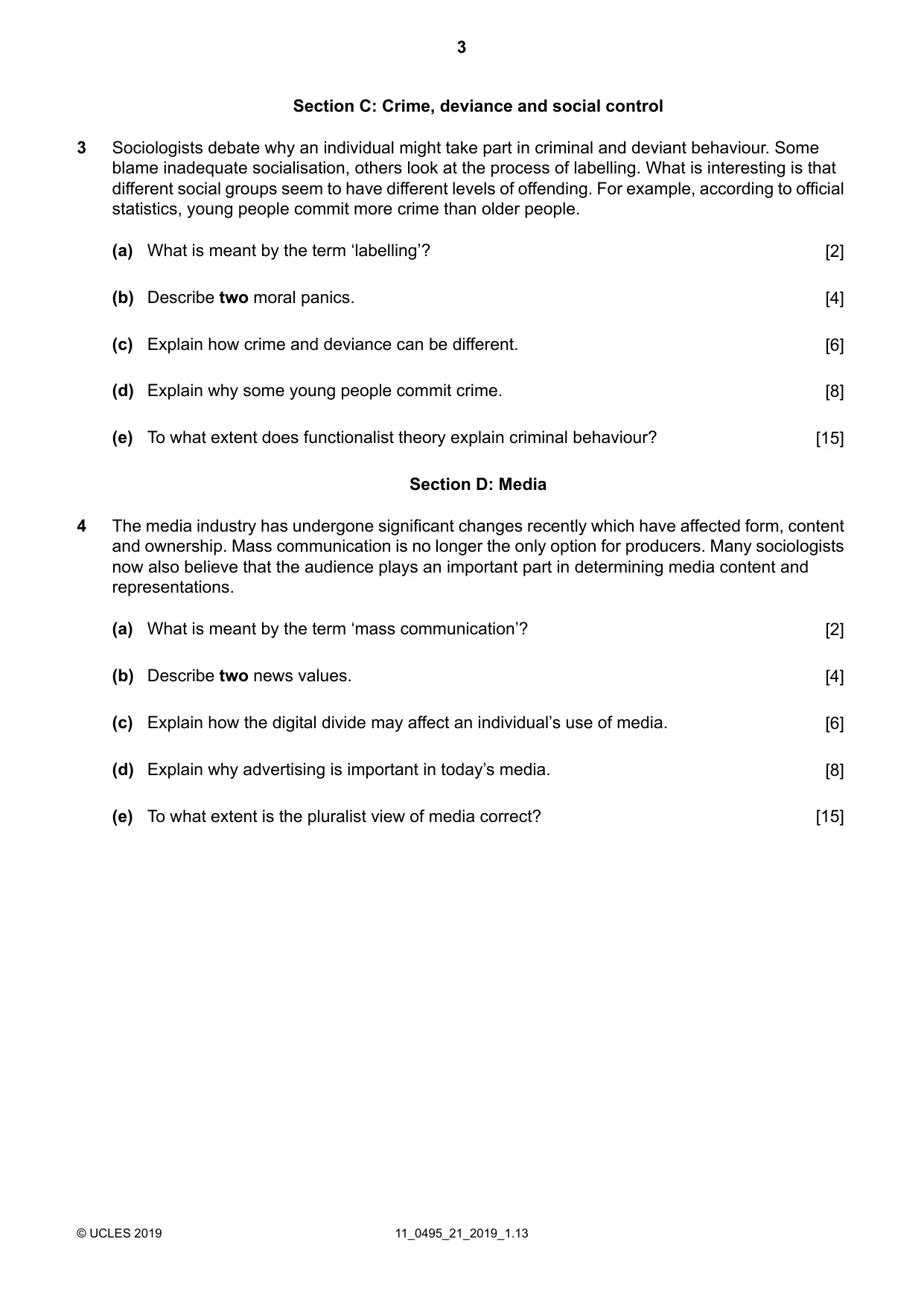

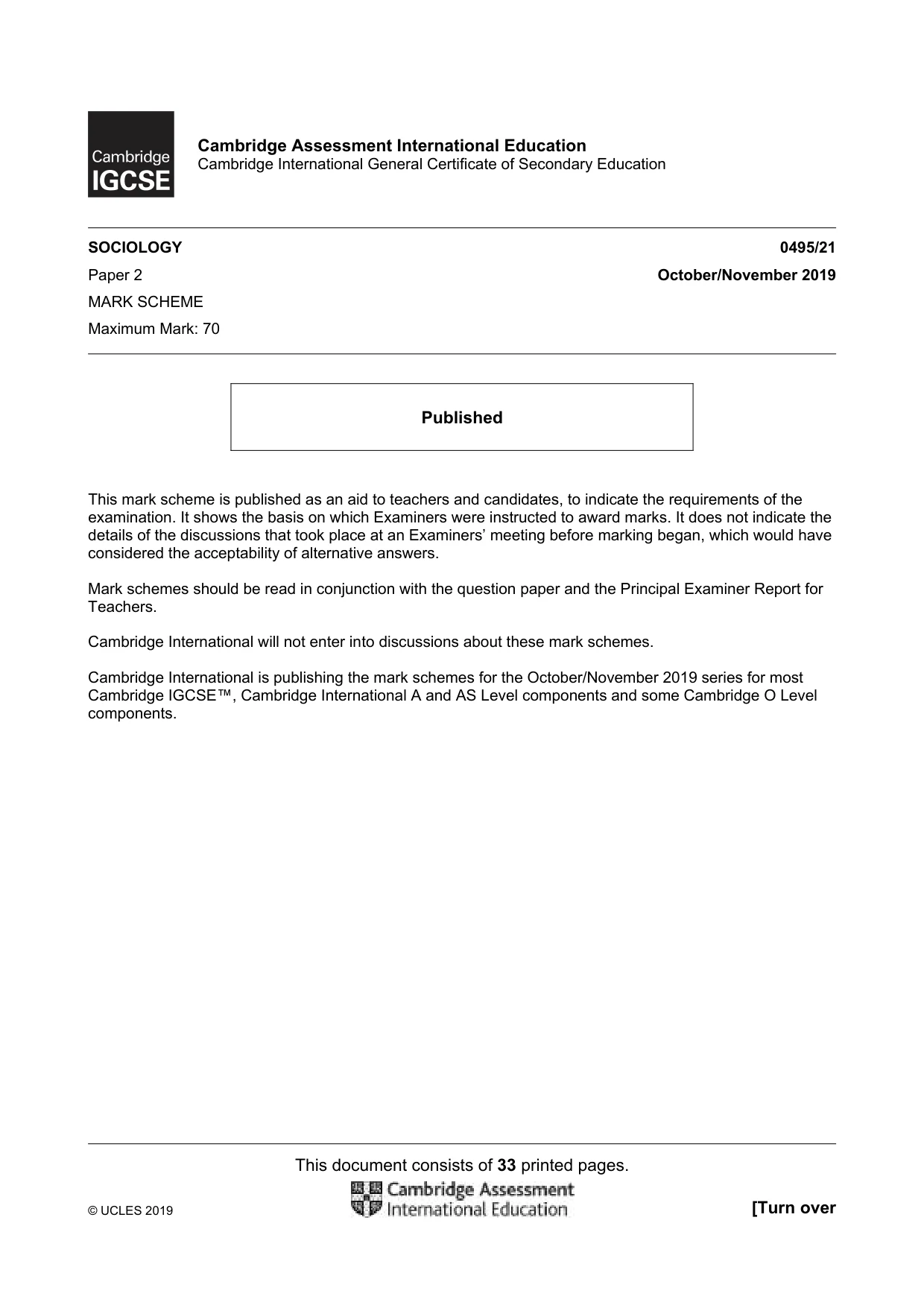
Mark scheme33 pages
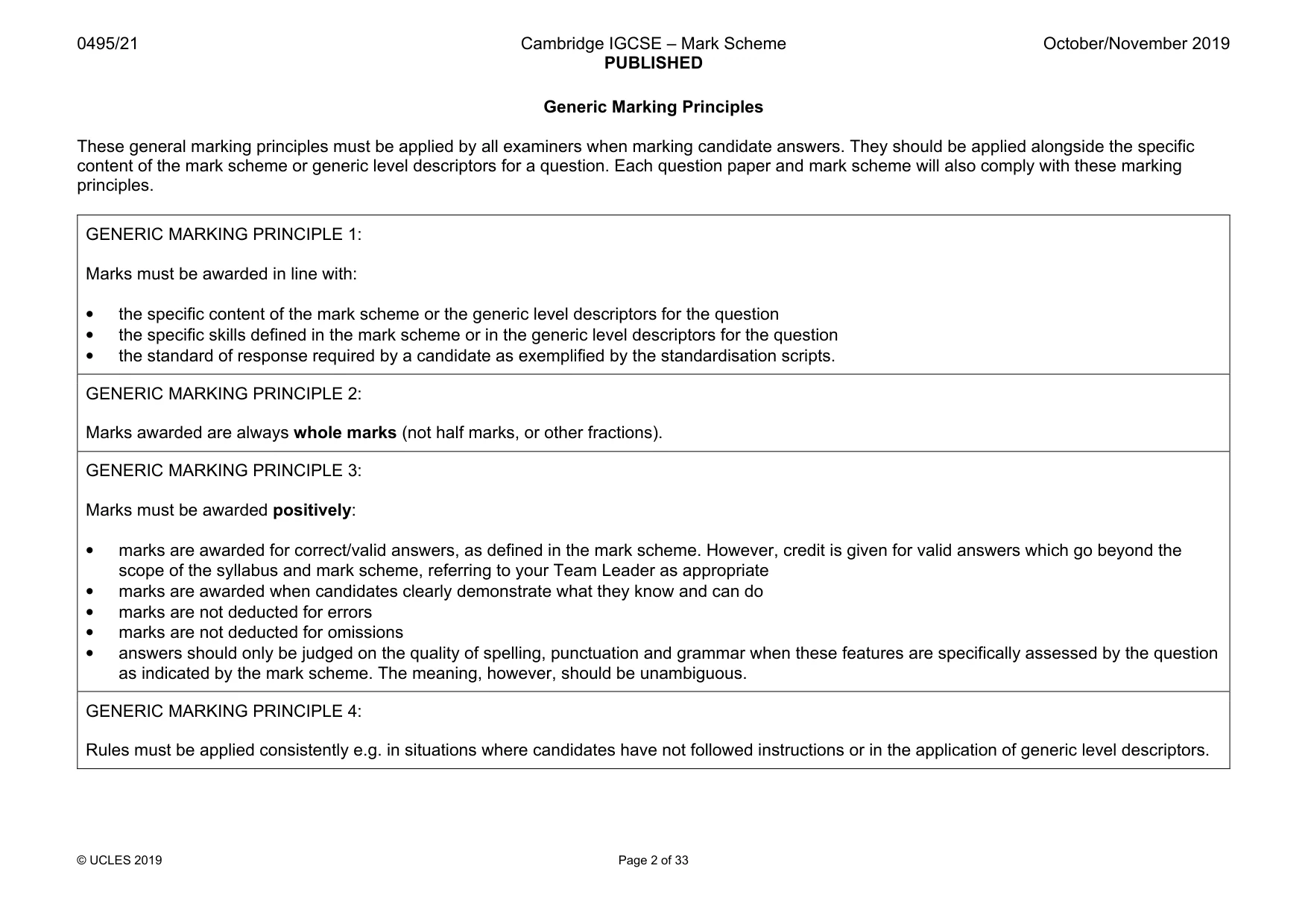
Answers below. Sit the paper first if you are practising.

Questions as text
Question 1
1 Families are changing. Marriage is no longer a social expectation and the roles of children and parents are increasingly diverse. Sociologists debate the causes and effects of these changes, some focusing on urbanisation, some on child-centeredness and others exploring feminist views. (a) What is meant by the term ‘child-centeredness’? [2] (b) Describe two examples of family diversity. [4] (c) Explain how feminism has affected family life in modern industrial societies. [6] (d) Explain why urbanisation causes families to change. [8] (e) To what extent are families today symmetrical? [15]
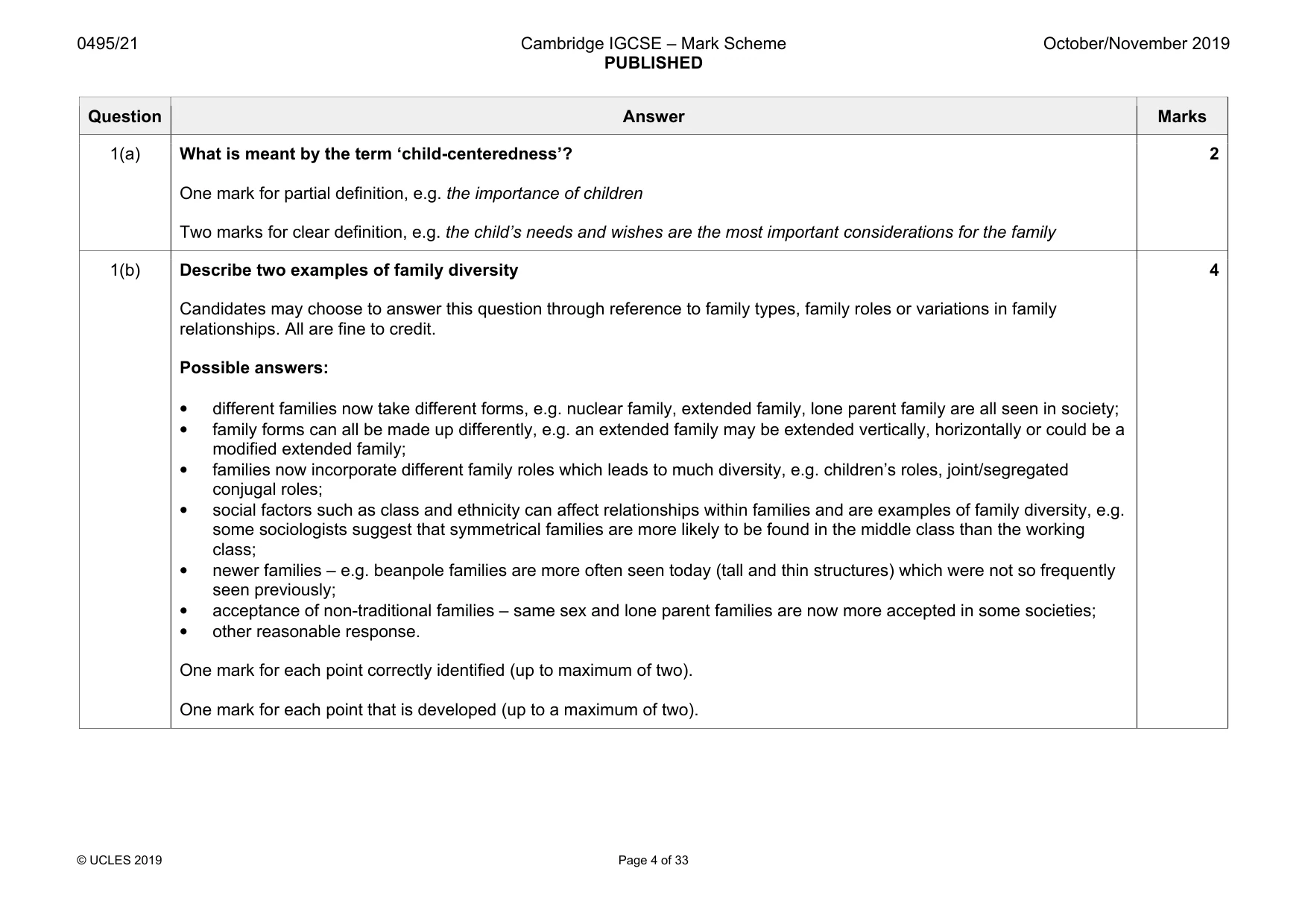
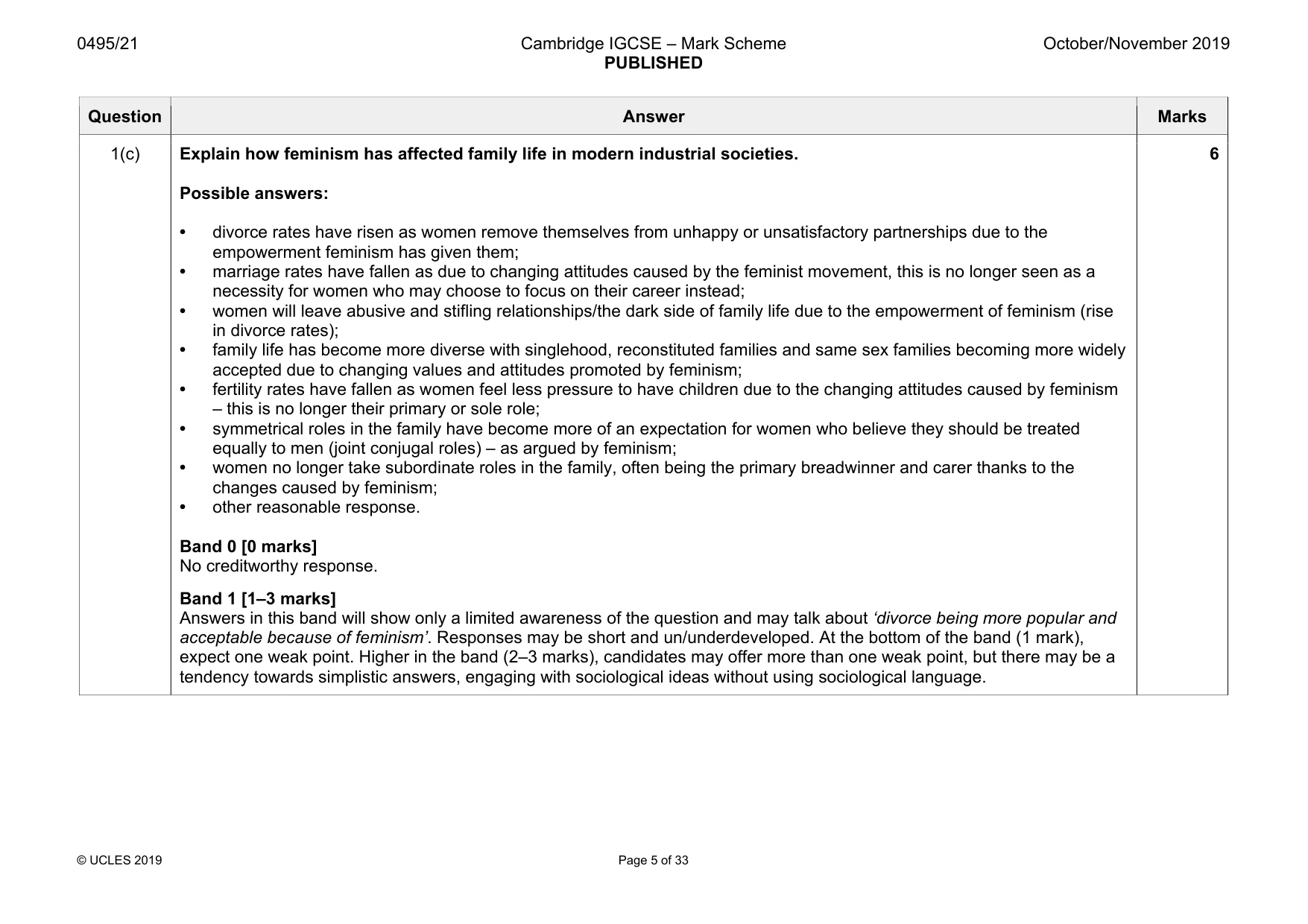
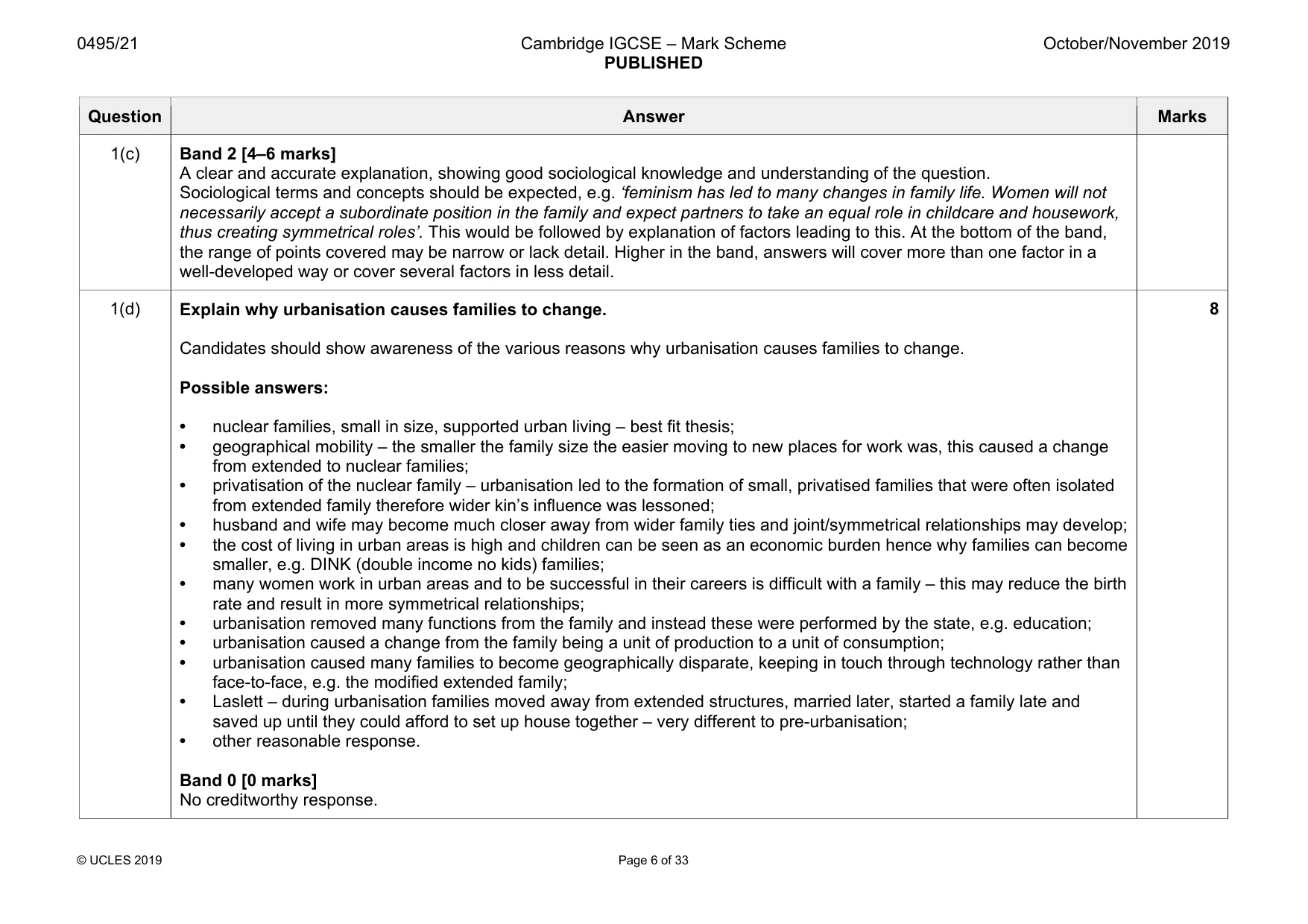
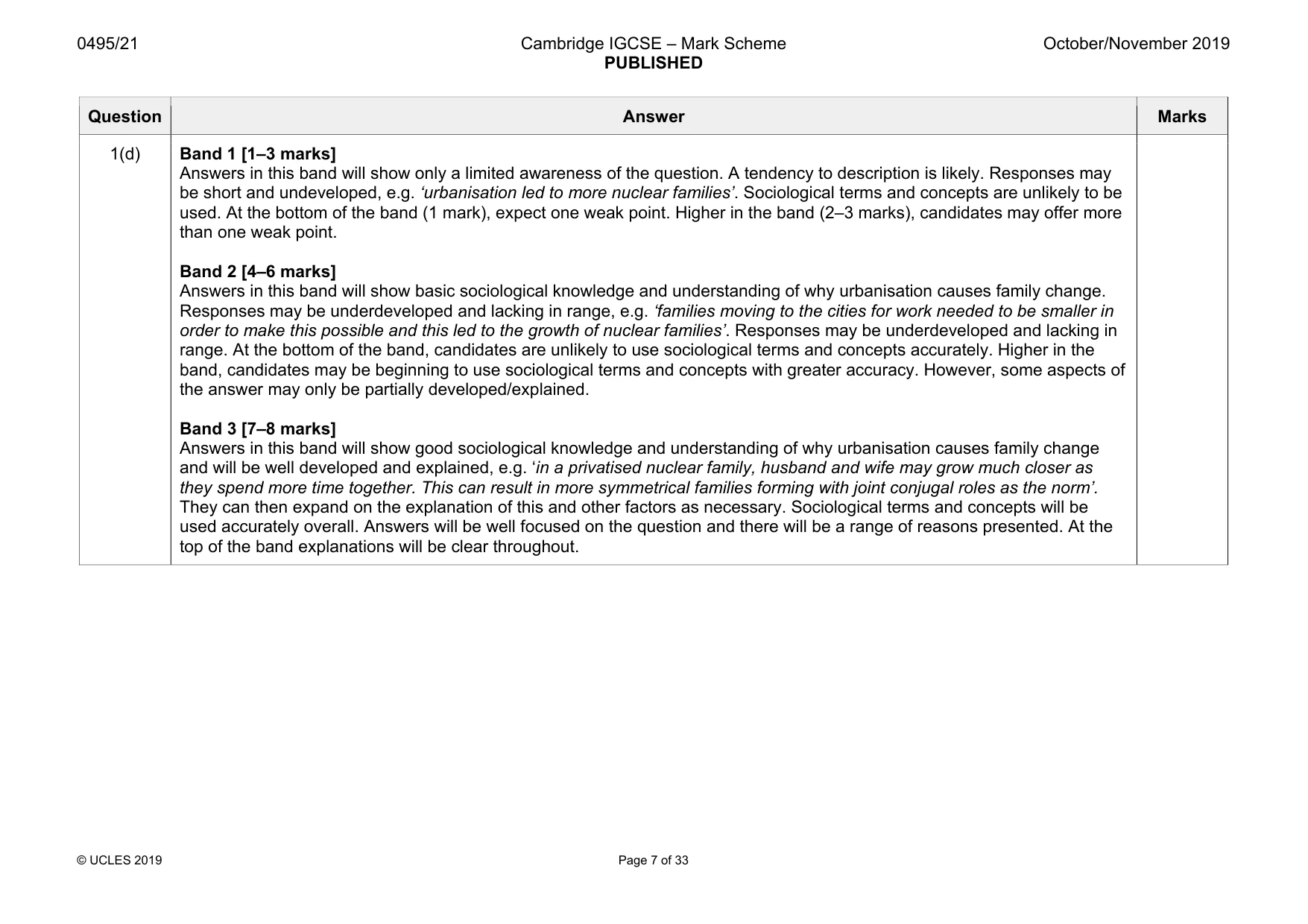
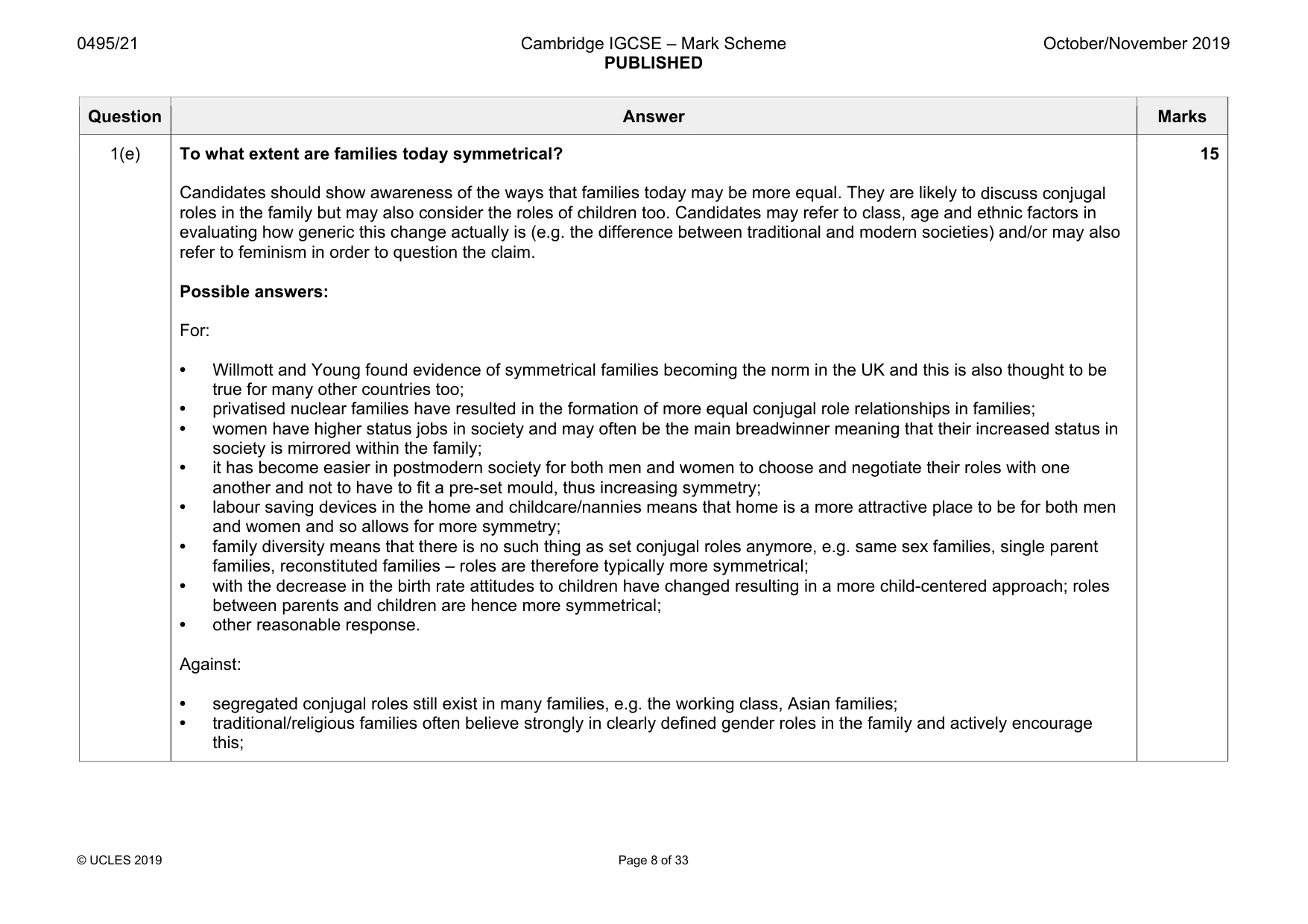
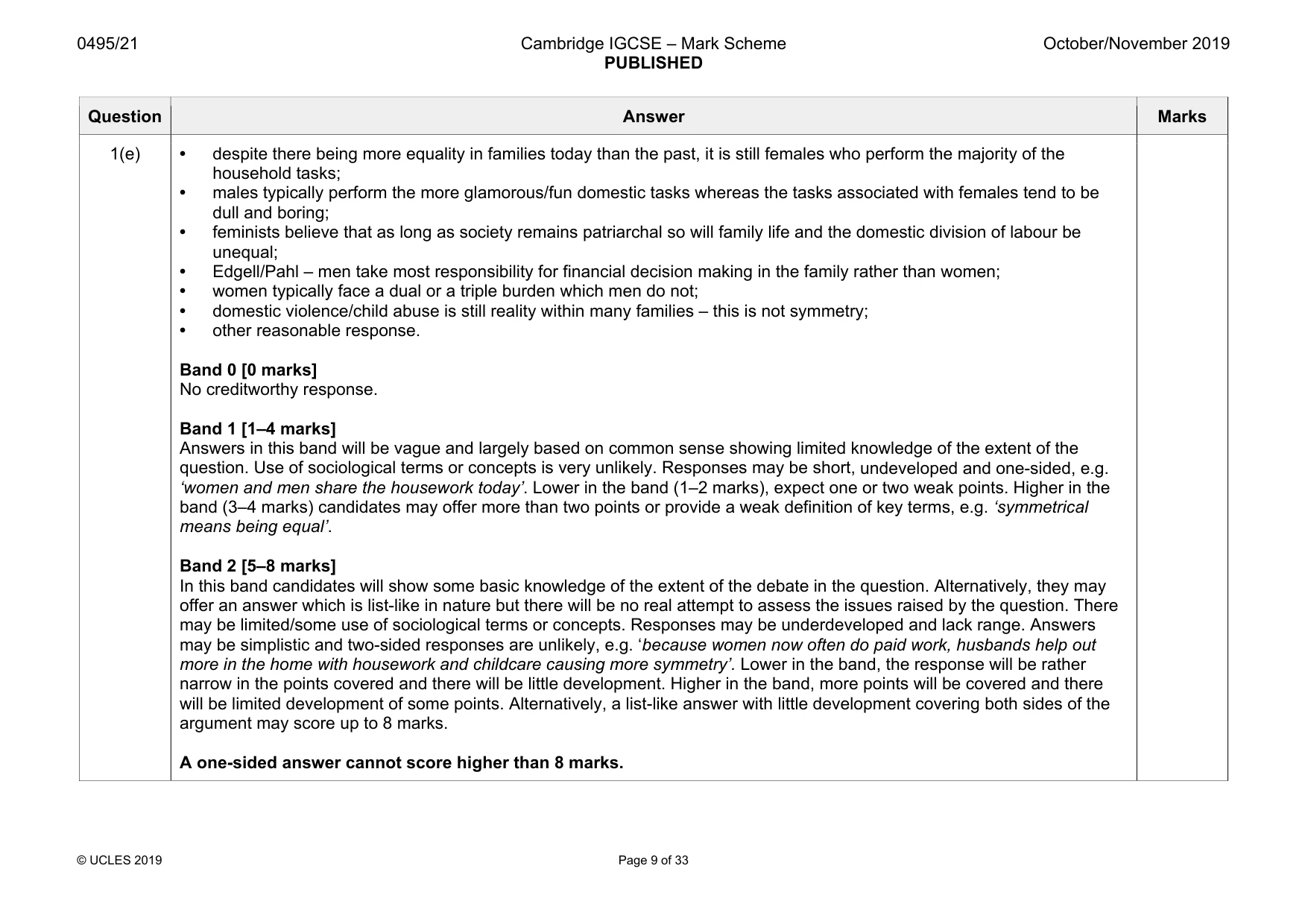
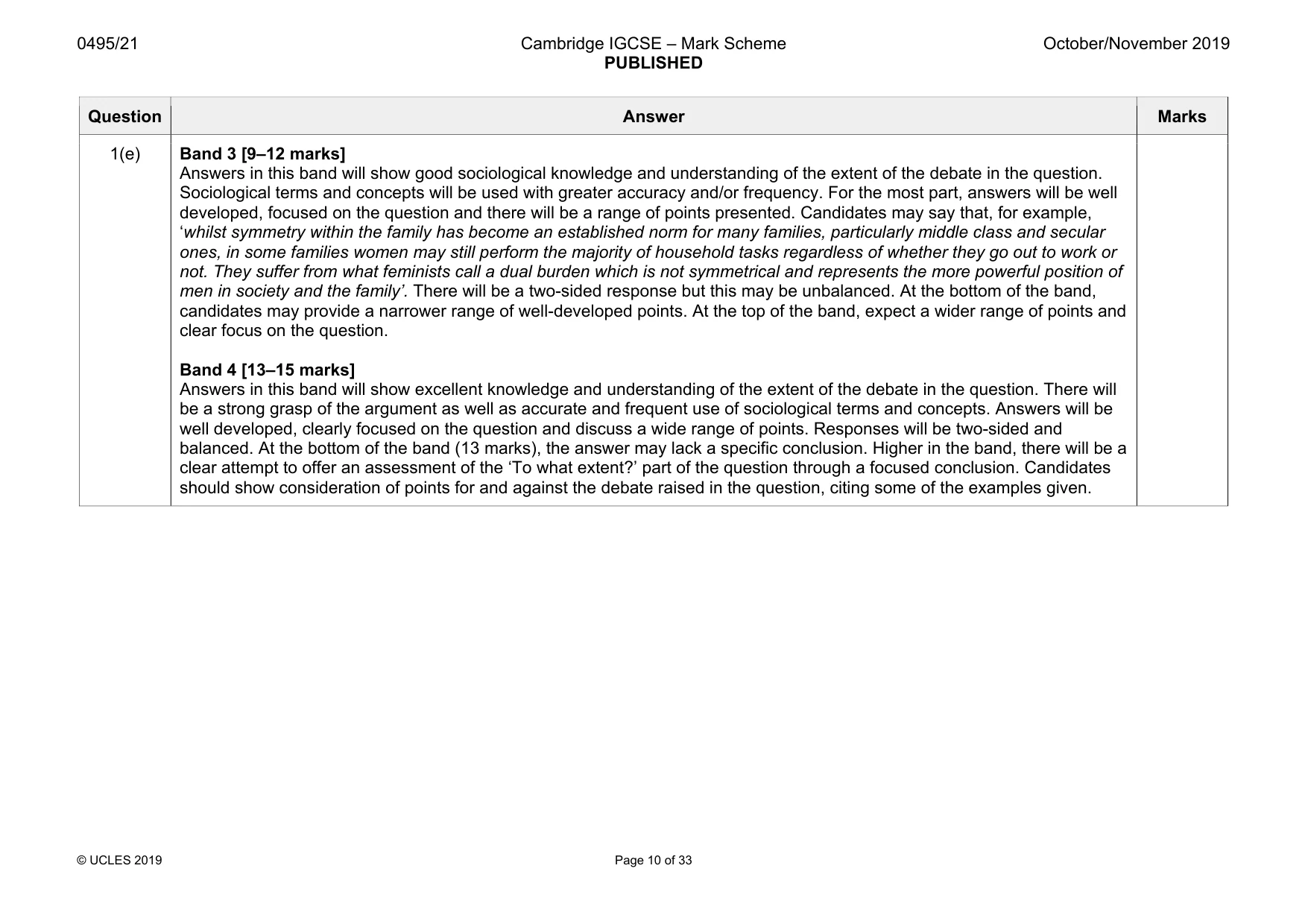
Mark scheme: 1(a) What is meant by the term ‘child-centeredness’? One mark for partial definition, e.g. the importance of children Two marks for clear definition, e.g. the child’s needs and wishes are the most important considerations for the family 2 1(b) Describe two examples of family diversity Candidates may choose to answer this question through reference to family types, family roles or variations in family relationships. All are fine to credit. Possible answers: • different families now take different forms, e.g. nuclear family, extended family, lone parent family are all seen in society; • family forms can all be made up differently, e.g. an extended family may be extended vertically, horizontally or could be a modified extended family; • families now incorporate different family roles which leads to much diversity, e.g. children’s roles, joint/segregated conjugal roles; • social factors such as class and ethnicity can affect relationships within families and are examples of family diversity, e.g. some sociologists suggest that symmetrical families are more likely to be found in the middle class than the working class; • newer families – e.g. beanpole families are more often seen today (tall and thin structures) which were not so frequently seen previously; • acceptance of non-traditional families – same sex and lone parent families are now more accepted in some societies; • other reasonable response. One mark for each point correctly identified (up to maximum of two). One mark for each point that is developed (up to a maximum of two). 4 Question Answer Marks 1(c) Explain how feminism has affected family life in modern industrial societies. Possible answers: • divorce rates have risen as women remove themselves from unhappy or unsatisfactory partnerships due to the empowerment feminism has given them; • marriage rates have fallen as due to changing attitudes caused by the feminist movement, this is no longer seen as a necessity for women who may choose to focus on their career instead; • women will leave abusive and stifling relationships/the dark side of family life due to the empowerment of feminism (rise in divorce rates); • family life has become more diverse with singlehood, reconstituted families and same sex families becoming more widely accepted due to changing values and attitudes promoted by feminism; • fertility rates have fallen as women feel less pressure to have children due to the changing attitudes caused by feminism – this is no longer their primary or sole role; • symmetrical roles in the family have become more of an expectation for women who believe they should be treated equally to men (joint conjugal roles) – as argued by feminism; • women no longer take subordinate roles in the family, often being the primary breadwinner and carer thanks to the changes caused by feminism; • other reasonable response. Band 0 [0 marks] No creditworthy response. Band 1 [1–3 marks] Answers in this band will show only a limited awareness of the question and may talk about ‘divorce being more popular and acceptable because of feminism’. Responses may be short and un/underdeveloped. At the bottom of the band (1 mark), expect one weak point. Higher in the band (2–3 marks), candidates may offer more than one weak point, but there may be a tendency towards simplistic answers, engaging with sociological ideas without using sociological language. 6 Question Answer Marks 1(c) Band 2 [4–6 marks] A clear and accurate explanation, showing good sociological knowledge and understanding of the question. Sociological terms and concepts should be expected, e.g. ‘feminism has led to many changes in family life. Women will not necessarily accept a subordinate position in the family and expect partners to take an equal role in childcare and housework, thus creating symmetrical roles’. This would be followed by explanation of factors leading to this. At the bottom of the band, the range of points covered may be narrow or lack detail. Higher in the band, answers will cover more than one factor in a well-developed way or cover several factors in less detail. 1(d) Explain why urbanisation causes families to change. Candidates should show awareness of the various reasons why urbanisation causes families to change. Possible answers: • nuclear families, small in size, supported urban living – best fit thesis; • geographical mobility – the smaller the family size the easier moving to new places for work was, this caused a change from extended to nuclear families; • privatisation of the nuclear family – urbanisation led to the formation of small, privatised families that were often isolated from extended family therefore wider kin’s influence was lessoned; • husband and wife may become much closer away from wider family ties and joint/symmetrical relationships may develop; • the cost of living in urban areas is high and children can be seen as an economic burden hence why families can become smaller, e.g. DINK (double income no kids) families; • many women work in urban areas and to be successful in their careers is difficult with a family – this may reduce the birth rate and result in more symmetrical relationships; • urbanisation removed many functions from the family and instead these were performed by the state, e.g. education; • urbanisation caused a change from the family being a unit of production to a unit of consumption; • urbanisation caused many families to become geographically disparate, keeping in touch through technology rather than face-to-face, e.g. the modified extended family; • Laslett – during urbanisation families moved away from extended structures, married later, started a family late and saved up until they could afford to set up house together – very different to pre-urbanisation; • other reasonable response. Band 0 [0 marks] No creditworthy response. 8 Question Answer Marks 1(d) Band 1 [1–3 marks] Answers in this band will show only a limited awareness of the question. A tendency to description is likely. Responses may be short and undeveloped, e.g. ‘urbanisation led to more nuclear families’. Sociological terms and concepts are unlikely to be used. At the bottom of the band (1 mark), expect one weak point. Higher in the band (2–3 marks), candidates may offer more than one weak point. Band 2 [4–6 marks] Answers in this band will show basic sociological knowledge and understanding of why urbanisation causes family change. Responses may be underdeveloped and lacking in range, e.g. ‘families moving to the cities for work needed to be smaller in order to make this possible and this led to the growth of nuclear families’. Responses may be underdeveloped and lacking in range. At the bottom of the band, candidates are unlikely to use sociological terms and concepts accurately. Higher in the band, candidates may be beginning to use sociological terms and concepts with greater accuracy. However, some aspects of the answer may only be partially developed/explained. Band 3 [7–8 marks] Answers in this band will show good sociological knowledge and understanding of why urbanisation causes family change and will be well developed and explained, e.g. ‘in a privatised nuclear family, husband and wife may grow much closer as they spend more time together. This can result in more symmetrical families forming with joint conjugal roles as the norm’. They can then expand on the explanation of this and other factors as necessary. Sociological terms and concepts will be used accurately overall. Answers will be well focused on the question and there will be a range of reasons presented. At the top of the band explanations will be clear throughout. Question Answer Marks 1(e) To what extent are families today symmetrical? Candidates should show awareness of the ways that families today may be more equal. They are likely to discuss conjugal roles in the family but may also consider the roles of children too. Candidates may refer to class, age and ethnic factors in evaluating how generic this change actually is (e.g. the difference between traditional and modern societies) and/or may also refer to feminism in order to question the claim. Possible answers: For: • Willmott and Young found evidence of symmetrical families becoming the norm in the UK and this is also thought to be true for many other countries too; • privatised nuclear families have resulted in the formation of more equal conjugal role relationships in families; • women have higher status jobs in society and may often be the main breadwinner meaning that their increased status in society is mirrored within the family; • it has become easier in postmodern society for both men and women to choose and negotiate their roles with one another and not to have to fit a pre-set mould, thus increasing symmetry; • labour saving devices in the home and childcare/nannies means that home is a more attractive place to be for both men and women and so allows for more symmetry; • family diversity means that there is no such thing as set conjugal roles anymore, e.g. same sex families, single parent families, reconstituted families – roles are therefore typically more symmetrical; • with the decrease in the birth rate attitudes to children have changed resulting in a more child-centered approach; roles between parents and children are hence more symmetrical; • other reasonable response. Against: • segregated conjugal roles still exist in many families, e.g. the working class, Asian families; • traditional/religious families often believe strongly in clearly defined gender roles in the family and actively encourage this; 15 Question Answer Marks 1(e) • despite there being more equality in families today than the past, it is still females who perform the majority of the household tasks; • males typically perform the more glamorous/fun domestic tasks whereas the tasks associated with females tend to be dull and boring; • feminists believe that as long as society remains patriarchal so will family life and the domestic division of labour be unequal; • Edgell/Pahl – men take most responsibility for financial decision making in the family rather than women; • women typically face a dual or a triple burden which men do not; • domestic violence/child abuse is still reality within many families – this is not symmetry; • other reasonable response. Band 0 [0 marks] No creditworthy response. Band 1 [1–4 marks] Answers in this band will be vague and largely based on common sense showing limited knowledge of the extent of the question. Use of sociological terms or concepts is very unlikely. Responses may be short, undeveloped and one-sided, e.g. ‘women and men share the housework today’. Lower in the band (1–2 marks), expect one or two weak points. Higher in the band (3–4 marks) candidates may offer more than two points or provide a weak definition of key terms, e.g. ‘symmetrical means being equal’. Band 2 [5–8 marks] In this band candidates will show some basic knowledge of the extent of the debate in the question. Alternatively, they may offer an answer which is list-like in nature but there will be no real attempt to assess the issues raised by the question. There may be limited/some use of sociological terms or concepts. Responses may be underdeveloped and lack range. Answers may be simplistic and two-sided responses are unlikely, e.g. ‘because women now often do paid work, husbands help out more in the home with housework and childcare causing more symmetry’. Lower in the band, the response will be rather narrow in the points covered and there will be little development. Higher in the band, more points will be covered and there will be limited development of some points. Alternatively, a list-like answer with little development covering both sides of the argument may score up to 8 marks. A one-sided answer cannot score higher than 8 marks. Question Answer Marks 1(e) Band 3 [9–12 marks] Answers in this band will show good sociological knowledge and understanding of the extent of the debate in the question. Sociological terms and concepts will be used with greater accuracy and/or frequency. For the most part, answers will be well developed, focused on the question and there will be a range of points presented. Candidates may say that, for example, ‘whilst symmetry within the family has become an established norm for many families, particularly middle class and secular ones, in some families women may still perform the majority of household tasks regardless of whether they go out to work or not. They suffer from what feminists call a dual burden which is not symmetrical and represents the more powerful position of men in society and the family’. There will be a two-sided response but this may be unbalanced. At the bottom of the band, candidates may provide a narrower range of well-developed points. At the top of the band, expect a wider range of points and clear focus on the question. Band 4 [13–15 marks] Answers in this band will show excellent knowledge and understanding of the extent of the debate in the question. There will be a strong grasp of the argument as well as accurate and frequent use of sociological terms and concepts. Answers will be well developed, clearly focused on the question and discuss a wide range of points. Responses will be two-sided and balanced. At the bottom of the band (13 marks), the answer may lack a specific conclusion. Higher in the band, there will be a clear attempt to offer an assessment of the ‘To what extent?’ part of the question through a focused conclusion. Candidates should show consideration of points for and against the debate raised in the question, citing some of the examples given.
Q2 · Education takes many forms and can be formal or informal
2 Education takes many forms and can be formal or informal. It also differs depending on the type of school a student attends. Some sociologists believe that the amount of cultural capital an individual has affects their educational achievement, others believe education is a meritocratic system. (a) What is meant by the term ‘cultural capital’? [2] (b) Describe two ways education is a meritocratic system. [4] (c) Explain how the peer group a student belongs to may affect educational achievement. [6] (d) Explain why cultural factors are important in determining educational achievement. [8] (e) To what extent does selective education prevent social mobility? [15] Section C: Crime, deviance and social control
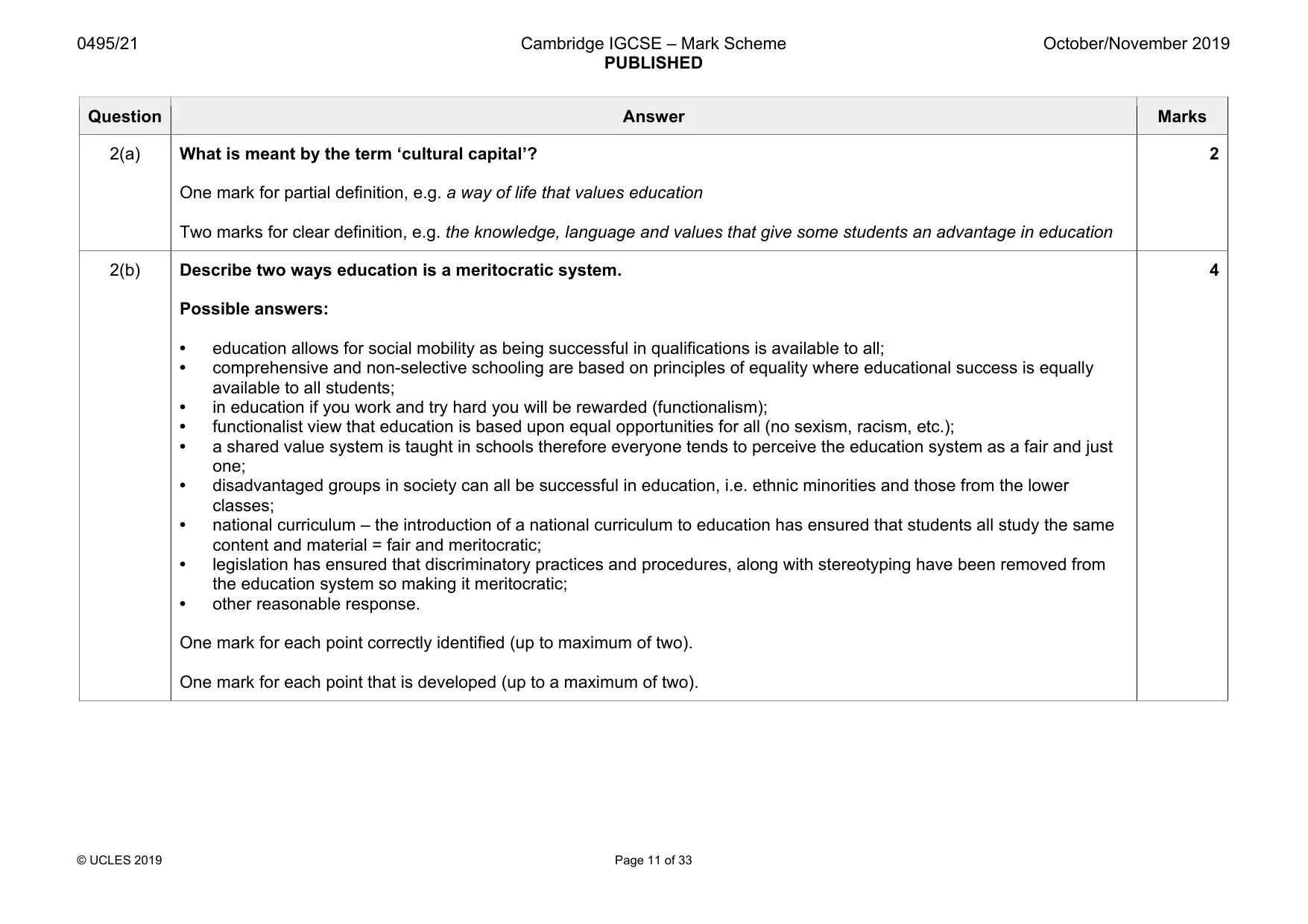
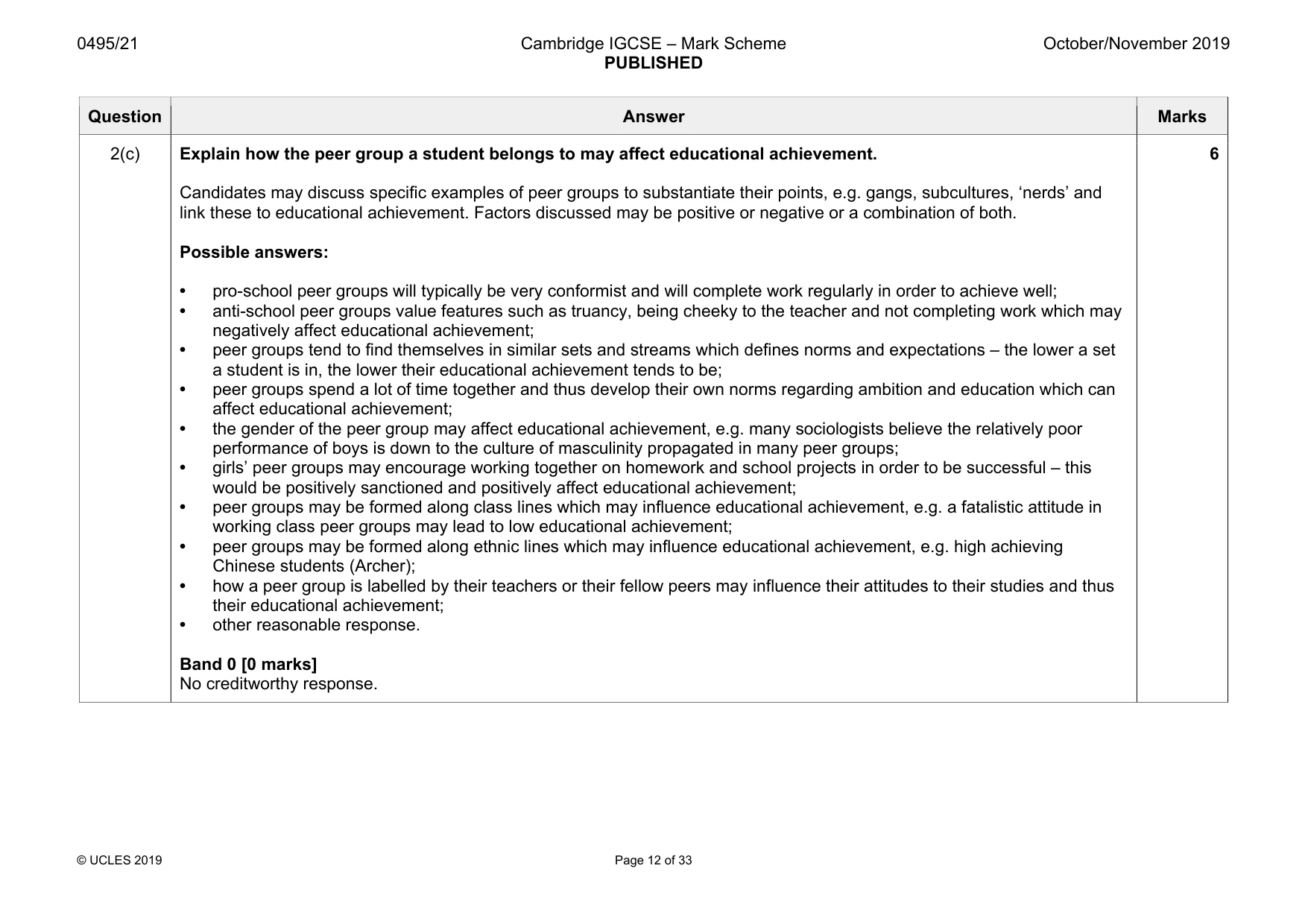
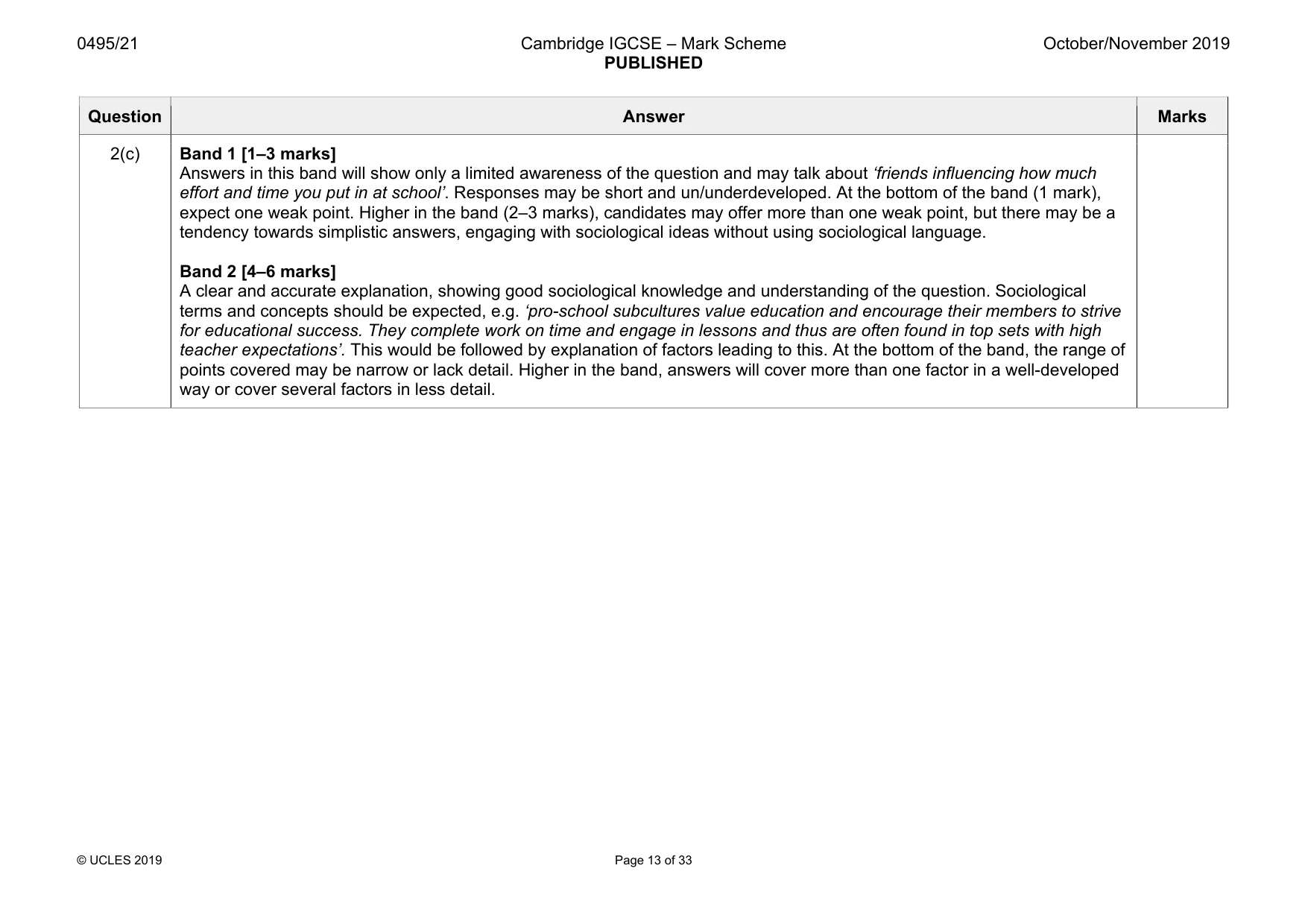
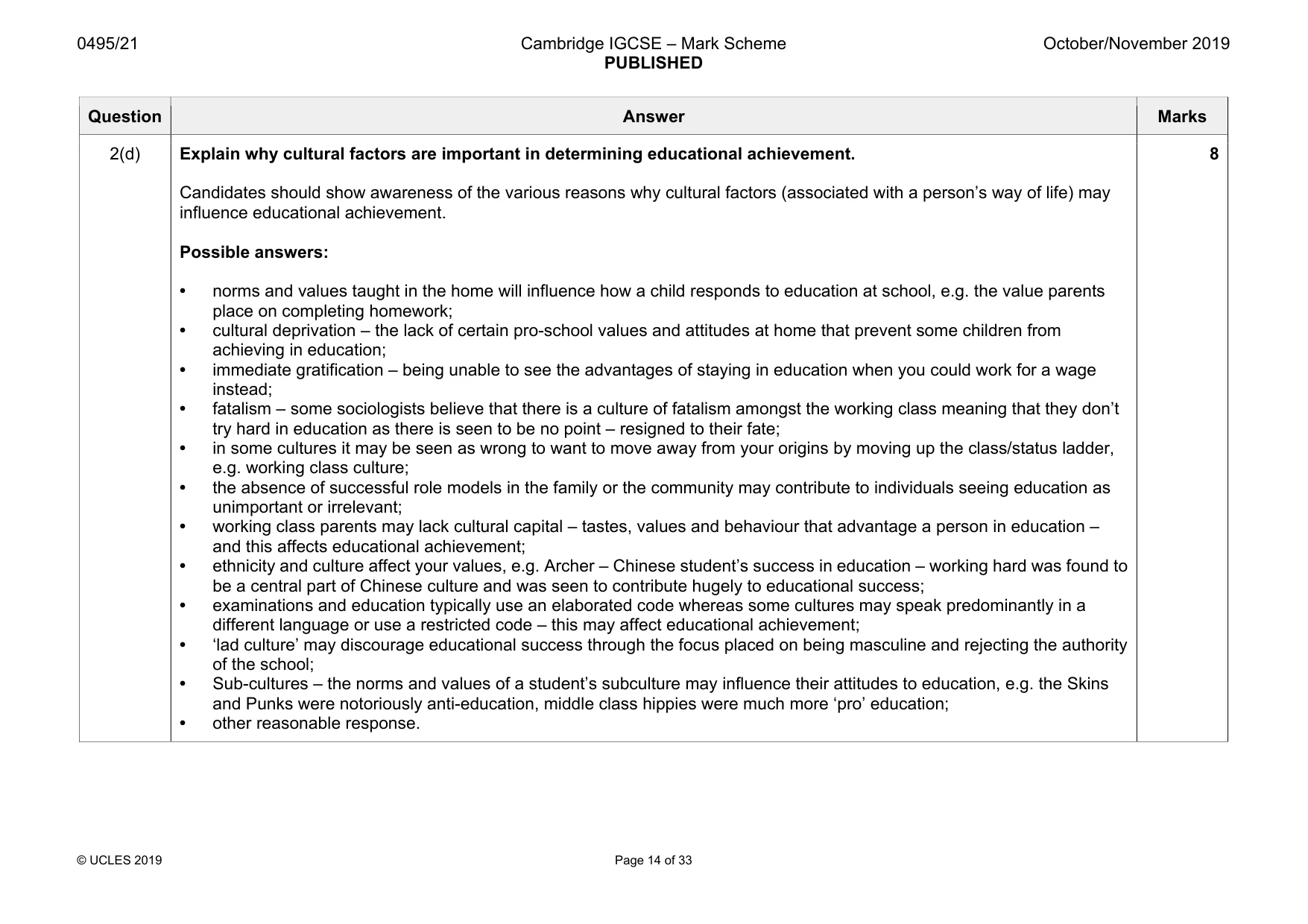
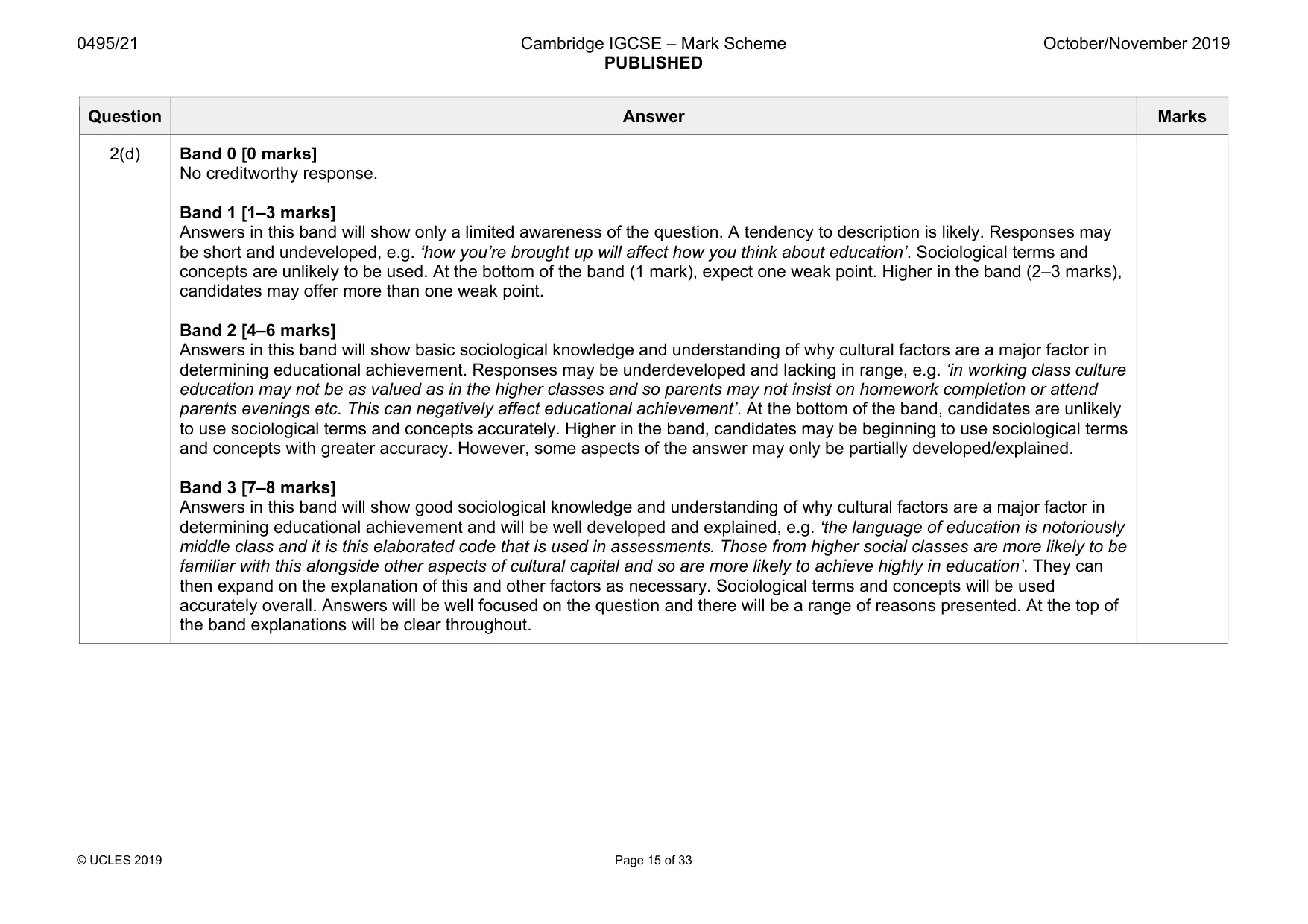
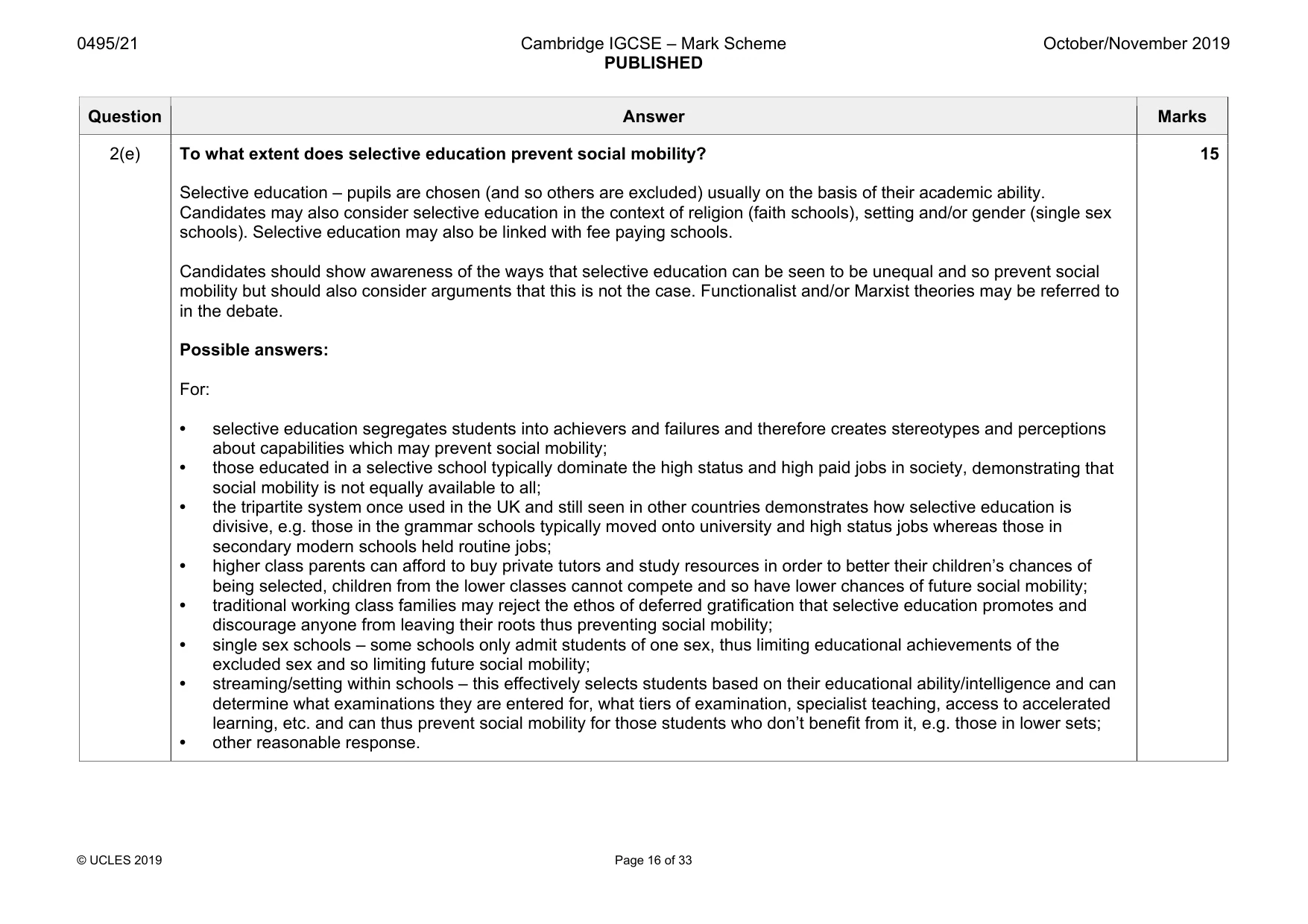
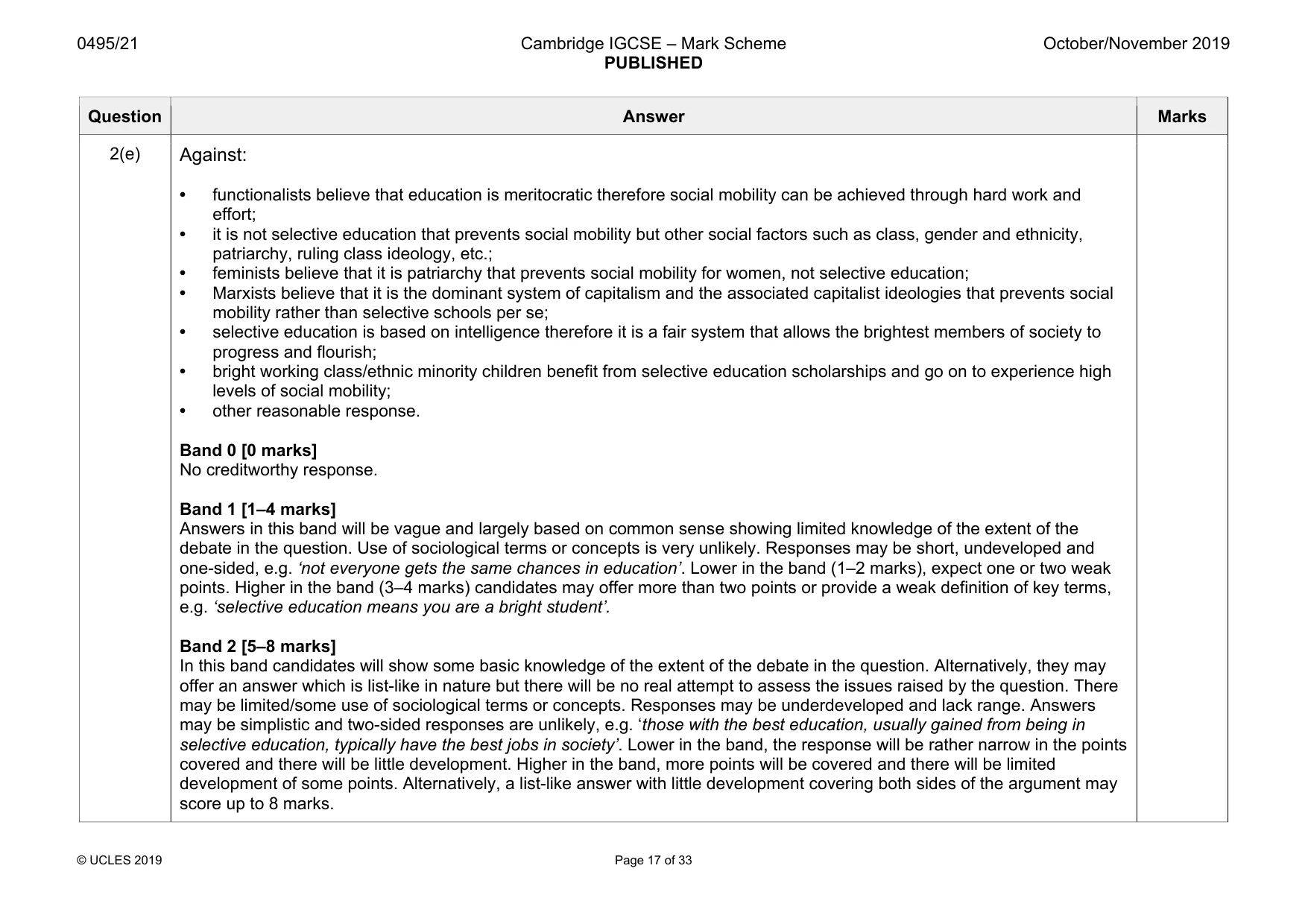
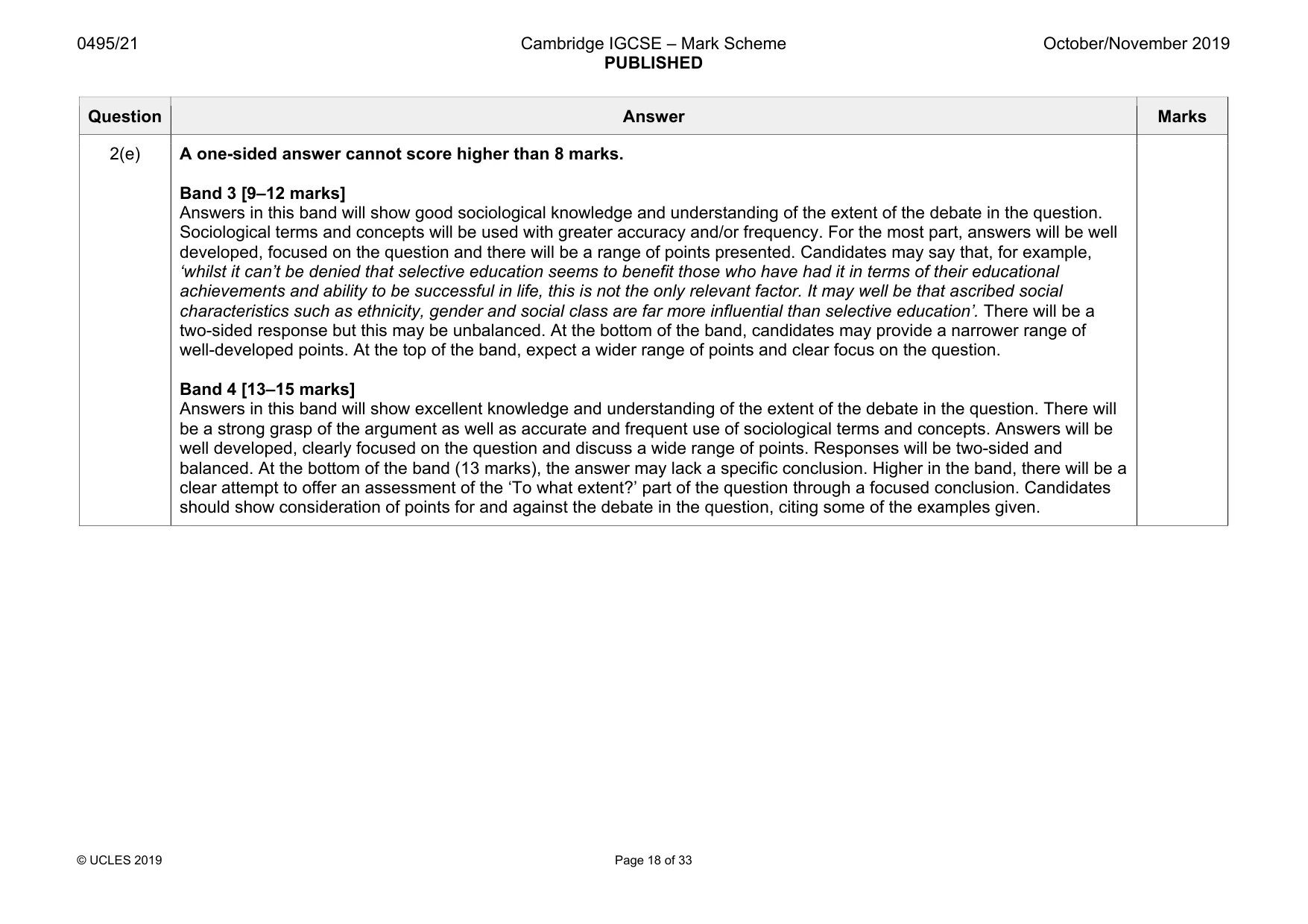
Mark scheme: 2(a) What is meant by the term ‘cultural capital’? One mark for partial definition, e.g. a way of life that values education Two marks for clear definition, e.g. the knowledge, language and values that give some students an advantage in education 2 2(b) Describe two ways education is a meritocratic system. Possible answers: • education allows for social mobility as being successful in qualifications is available to all; • comprehensive and non-selective schooling are based on principles of equality where educational success is equally available to all students; • in education if you work and try hard you will be rewarded (functionalism); • functionalist view that education is based upon equal opportunities for all (no sexism, racism, etc.); • a shared value system is taught in schools therefore everyone tends to perceive the education system as a fair and just one; • disadvantaged groups in society can all be successful in education, i.e. ethnic minorities and those from the lower classes; • national curriculum – the introduction of a national curriculum to education has ensured that students all study the same content and material = fair and meritocratic; • legislation has ensured that discriminatory practices and procedures, along with stereotyping have been removed from the education system so making it meritocratic; • other reasonable response. One mark for each point correctly identified (up to maximum of two). One mark for each point that is developed (up to a maximum of two). 4 Question Answer Marks 2(c) Explain how the peer group a student belongs to may affect educational achievement. Candidates may discuss specific examples of peer groups to substantiate their points, e.g. gangs, subcultures, ‘nerds’ and link these to educational achievement. Factors discussed may be positive or negative or a combination of both. Possible answers: • pro-school peer groups will typically be very conformist and will complete work regularly in order to achieve well; • anti-school peer groups value features such as truancy, being cheeky to the teacher and not completing work which may negatively affect educational achievement; • peer groups tend to find themselves in similar sets and streams which defines norms and expectations – the lower a set a student is in, the lower their educational achievement tends to be; • peer groups spend a lot of time together and thus develop their own norms regarding ambition and education which can affect educational achievement; • the gender of the peer group may affect educational achievement, e.g. many sociologists believe the relatively poor performance of boys is down to the culture of masculinity propagated in many peer groups; • girls’ peer groups may encourage working together on homework and school projects in order to be successful – this would be positively sanctioned and positively affect educational achievement; • peer groups may be formed along class lines which may influence educational achievement, e.g. a fatalistic attitude in working class peer groups may lead to low educational achievement; • peer groups may be formed along ethnic lines which may influence educational achievement, e.g. high achieving Chinese students (Archer); • how a peer group is labelled by their teachers or their fellow peers may influence their attitudes to their studies and thus their educational achievement; • other reasonable response. Band 0 [0 marks] No creditworthy response. 6 Question Answer Marks 2(c) Band 1 [1–3 marks] Answers in this band will show only a limited awareness of the question and may talk about ‘friends influencing how much effort and time you put in at school’. Responses may be short and un/underdeveloped. At the bottom of the band (1 mark), expect one weak point. Higher in the band (2–3 marks), candidates may offer more than one weak point, but there may be a tendency towards simplistic answers, engaging with sociological ideas without using sociological language. Band 2 [4–6 marks] A clear and accurate explanation, showing good sociological knowledge and understanding of the question. Sociological terms and concepts should be expected, e.g. ‘pro-school subcultures value education and encourage their members to strive for educational success. They complete work on time and engage in lessons and thus are often found in top sets with high teacher expectations’. This would be followed by explanation of factors leading to this. At the bottom of the band, the range of points covered may be narrow or lack detail. Higher in the band, answers will cover more than one factor in a well-developed way or cover several factors in less detail. Question Answer Marks 2(d) Explain why cultural factors are important in determining educational achievement. Candidates should show awareness of the various reasons why cultural factors (associated with a person’s way of life) may influence educational achievement. Possible answers: • norms and values taught in the home will influence how a child responds to education at school, e.g. the value parents place on completing homework; • cultural deprivation – the lack of certain pro-school values and attitudes at home that prevent some children from achieving in education; • immediate gratification – being unable to see the advantages of staying in education when you could work for a wage instead; • fatalism – some sociologists believe that there is a culture of fatalism amongst the working class meaning that they don’t try hard in education as there is seen to be no point – resigned to their fate; • in some cultures it may be seen as wrong to want to move away from your origins by moving up the class/status ladder, e.g. working class culture; • the absence of successful role models in the family or the community may contribute to individuals seeing education as unimportant or irrelevant; • working class parents may lack cultural capital – tastes, values and behaviour that advantage a person in education – and this affects educational achievement; • ethnicity and culture affect your values, e.g. Archer – Chinese student’s success in education – working hard was found to be a central part of Chinese culture and was seen to contribute hugely to educational success; • examinations and education typically use an elaborated code whereas some cultures may speak predominantly in a different language or use a restricted code – this may affect educational achievement; • ‘lad culture’ may discourage educational success through the focus placed on being masculine and rejecting the authority of the school; • Sub-cultures – the norms and values of a student’s subculture may influence their attitudes to education, e.g. the Skins and Punks were notoriously anti-education, middle class hippies were much more ‘pro’ education; • other reasonable response. 8 Question Answer Marks 2(d) Band 0 [0 marks] No creditworthy response. Band 1 [1–3 marks] Answers in this band will show only a limited awareness of the question. A tendency to description is likely. Responses may be short and undeveloped, e.g. ‘how you’re brought up will affect how you think about education’. Sociological terms and concepts are unlikely to be used. At the bottom of the band (1 mark), expect one weak point. Higher in the band (2–3 marks), candidates may offer more than one weak point. Band 2 [4–6 marks] Answers in this band will show basic sociological knowledge and understanding of why cultural factors are a major factor in determining educational achievement. Responses may be underdeveloped and lacking in range, e.g. ‘in working class culture education may not be as valued as in the higher classes and so parents may not insist on homework completion or attend parents evenings etc. This can negatively affect educational achievement’. At the bottom of the band, candidates are unlikely to use sociological terms and concepts accurately. Higher in the band, candidates may be beginning to use sociological terms and concepts with greater accuracy. However, some aspects of the answer may only be partially developed/explained. Band 3 [7–8 marks] Answers in this band will show good sociological knowledge and understanding of why cultural factors are a major factor in determining educational achievement and will be well developed and explained, e.g. ‘the language of education is notoriously middle class and it is this elaborated code that is used in assessments. Those from higher social classes are more likely to be familiar with this alongside other aspects of cultural capital and so are more likely to achieve highly in education’. They can then expand on the explanation of this and other factors as necessary. Sociological terms and concepts will be used accurately overall. Answers will be well focused on the question and there will be a range of reasons presented. At the top of the band explanations will be clear throughout. Question Answer Marks 2(e) To what extent does selective education prevent social mobility? Selective education – pupils are chosen (and so others are excluded) usually on the basis of their academic ability. Candidates may also consider selective education in the context of religion (faith schools), setting and/or gender (single sex schools). Selective education may also be linked with fee paying schools. Candidates should show awareness of the ways that selective education can be seen to be unequal and so prevent social mobility but should also consider arguments that this is not the case. Functionalist and/or Marxist theories may be referred to in the debate. Possible answers: For: • selective education segregates students into achievers and failures and therefore creates stereotypes and perceptions about capabilities which may prevent social mobility; • those educated in a selective school typically dominate the high status and high paid jobs in society, demonstrating that social mobility is not equally available to all; • the tripartite system once used in the UK and still seen in other countries demonstrates how selective education is divisive, e.g. those in the grammar schools typically moved onto university and high status jobs whereas those in secondary modern schools held routine jobs; • higher class parents can afford to buy private tutors and study resources in order to better their children’s chances of being selected, children from the lower classes cannot compete and so have lower chances of future social mobility; • traditional working class families may reject the ethos of deferred gratification that selective education promotes and discourage anyone from leaving their roots thus preventing social mobility; • single sex schools – some schools only admit students of one sex, thus limiting educational achievements of the excluded sex and so limiting future social mobility; • streaming/setting within schools – this effectively selects students based on their educational ability/intelligence and can determine what examinations they are entered for, what tiers of examination, specialist teaching, access to accelerated learning, etc. and can thus prevent social mobility for those students who don’t benefit from it, e.g. those in lower sets; • other reasonable response. 15 Question Answer Marks 2(e) Against: • functionalists believe that education is meritocratic therefore social mobility can be achieved through hard work and effort; • it is not selective education that prevents social mobility but other social factors such as class, gender and ethnicity, patriarchy, ruling class ideology, etc.; • feminists believe that it is patriarchy that prevents social mobility for women, not selective education; • Marxists believe that it is the dominant system of capitalism and the associated capitalist ideologies that prevents social mobility rather than selective schools per se; • selective education is based on intelligence therefore it is a fair system that allows the brightest members of society to progress and flourish; • bright working class/ethnic minority children benefit from selective education scholarships and go on to experience high levels of social mobility; • other reasonable response. Band 0 [0 marks] No creditworthy response. Band 1 [1–4 marks] Answers in this band will be vague and largely based on common sense showing limited knowledge of the extent of the debate in the question. Use of sociological terms or concepts is very unlikely. Responses may be short, undeveloped and one-sided, e.g. ‘not everyone gets the same chances in education’. Lower in the band (1–2 marks), expect one or two weak points. Higher in the band (3–4 marks) candidates may offer more than two points or provide a weak definition of key terms, e.g. ‘selective education means you are a bright student’. Band 2 [5–8 marks] In this band candidates will show some basic knowledge of the extent of the debate in the question. Alternatively, they may offer an answer which is list-like in nature but there will be no real attempt to assess the issues raised by the question. There may be limited/some use of sociological terms or concepts. Responses may be underdeveloped and lack range. Answers may be simplistic and two-sided responses are unlikely, e.g. ‘those with the best education, usually gained from being in selective education, typically have the best jobs in society’. Lower in the band, the response will be rather narrow in the points covered and there will be little development. Higher in the band, more points will be covered and there will be limited development of some points. Alternatively, a list-like answer with little development covering both sides of the argument may score up to 8 marks. Question Answer Marks 2(e) A one-sided answer cannot score higher than 8 marks. Band 3 [9–12 marks] Answers in this band will show good sociological knowledge and understanding of the extent of the debate in the question. Sociological terms and concepts will be used with greater accuracy and/or frequency. For the most part, answers will be well developed, focused on the question and there will be a range of points presented. Candidates may say that, for example, ‘whilst it can’t be denied that selective education seems to benefit those who have had it in terms of their educational achievements and ability to be successful in life, this is not the only relevant factor. It may well be that ascribed social characteristics such as ethnicity, gender and social class are far more influential than selective education’. There will be a two-sided response but this may be unbalanced. At the bottom of the band, candidates may provide a narrower range of well-developed points. At the top of the band, expect a wider range of points and clear focus on the question. Band 4 [13–15 marks] Answers in this band will show excellent knowledge and understanding of the extent of the debate in the question. There will be a strong grasp of the argument as well as accurate and frequent use of sociological terms and concepts. Answers will be well developed, clearly focused on the question and discuss a wide range of points. Responses will be two-sided and balanced. At the bottom of the band (13 marks), the answer may lack a specific conclusion. Higher in the band, there will be a clear attempt to offer an assessment of the ‘To what extent?’ part of the question through a focused conclusion. Candidates should show consideration of points for and against the debate in the question, citing some of the examples given.
Q3 · Sociologists debate why an individual might take part in criminal and deviant behaviour
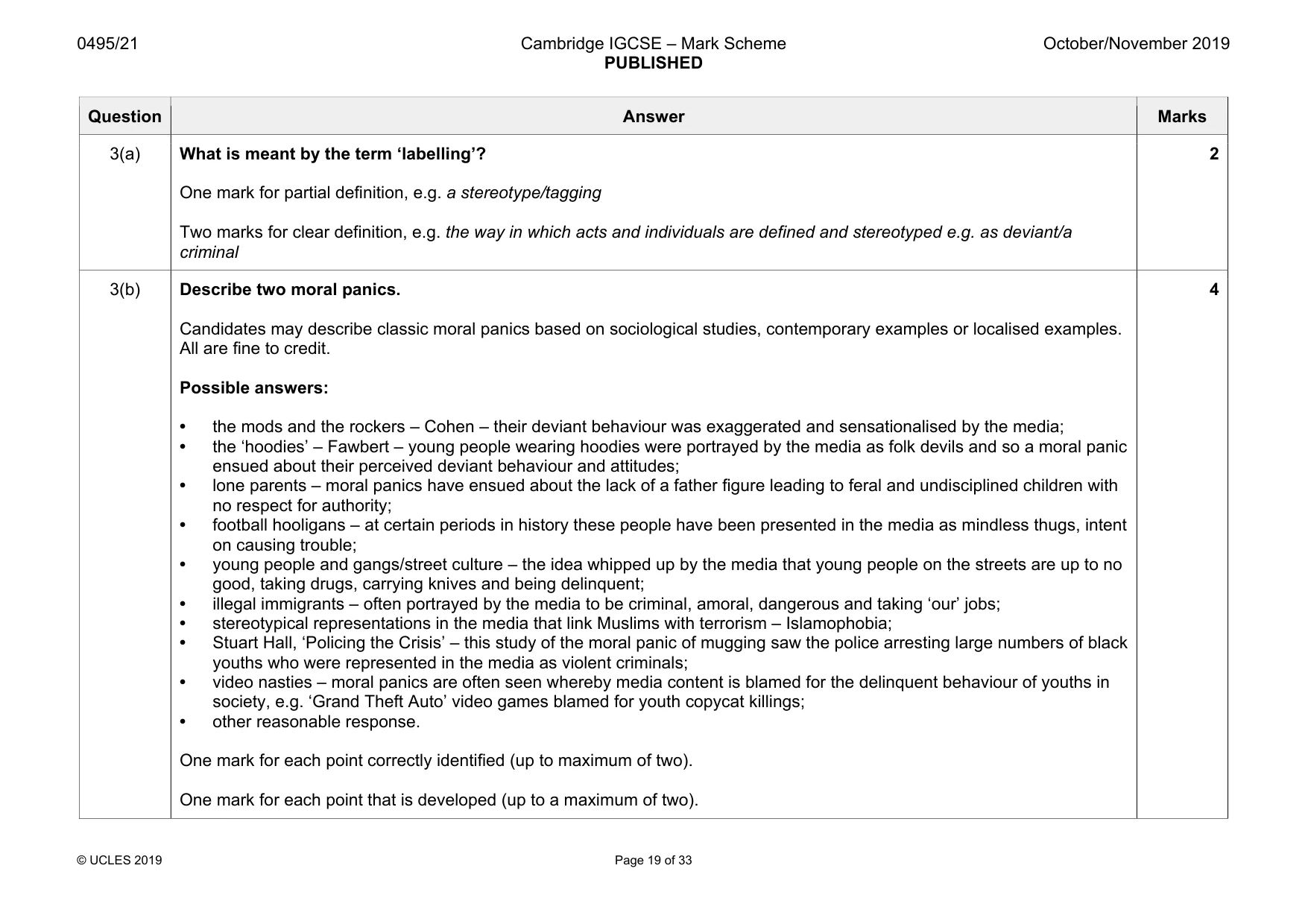
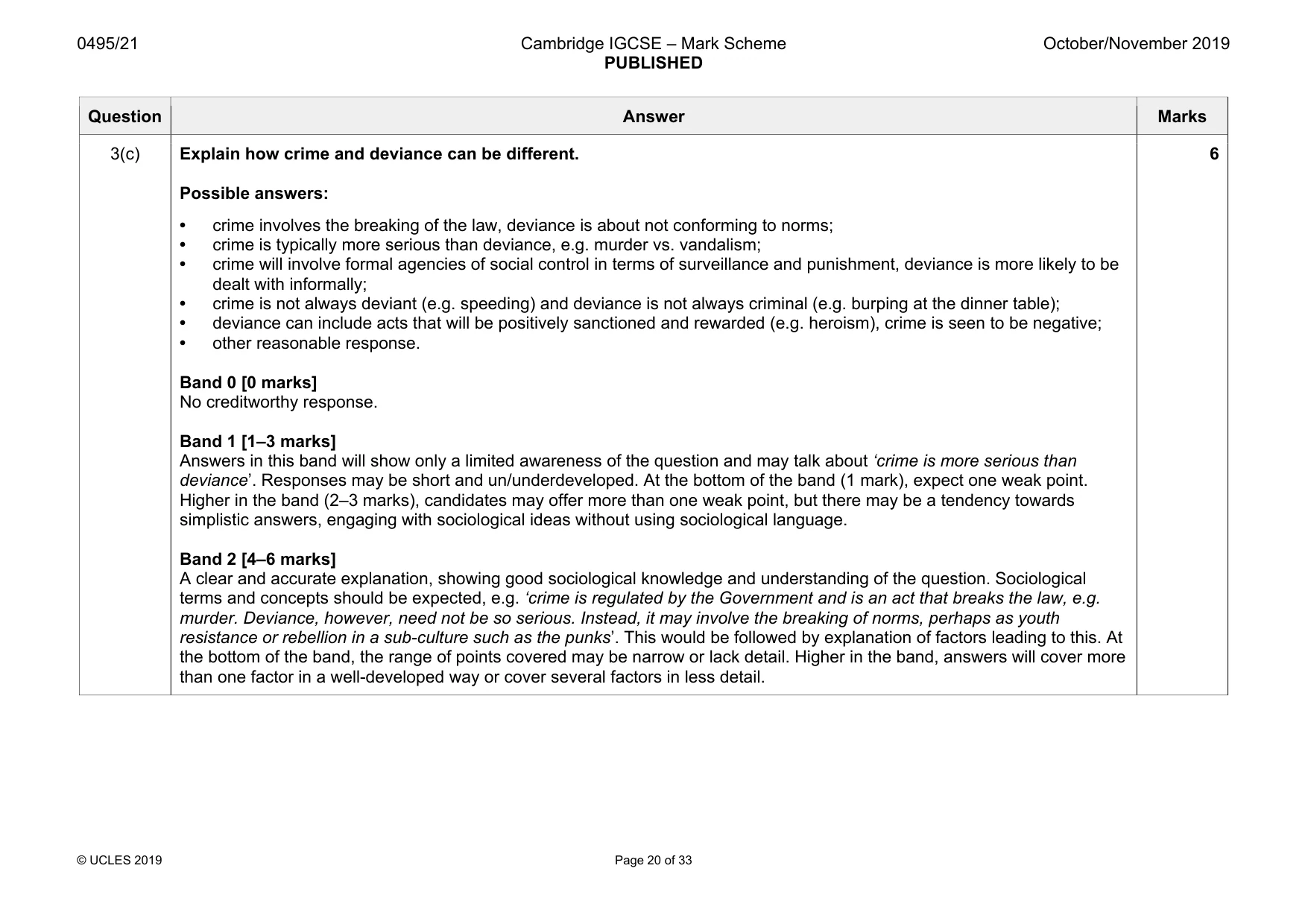
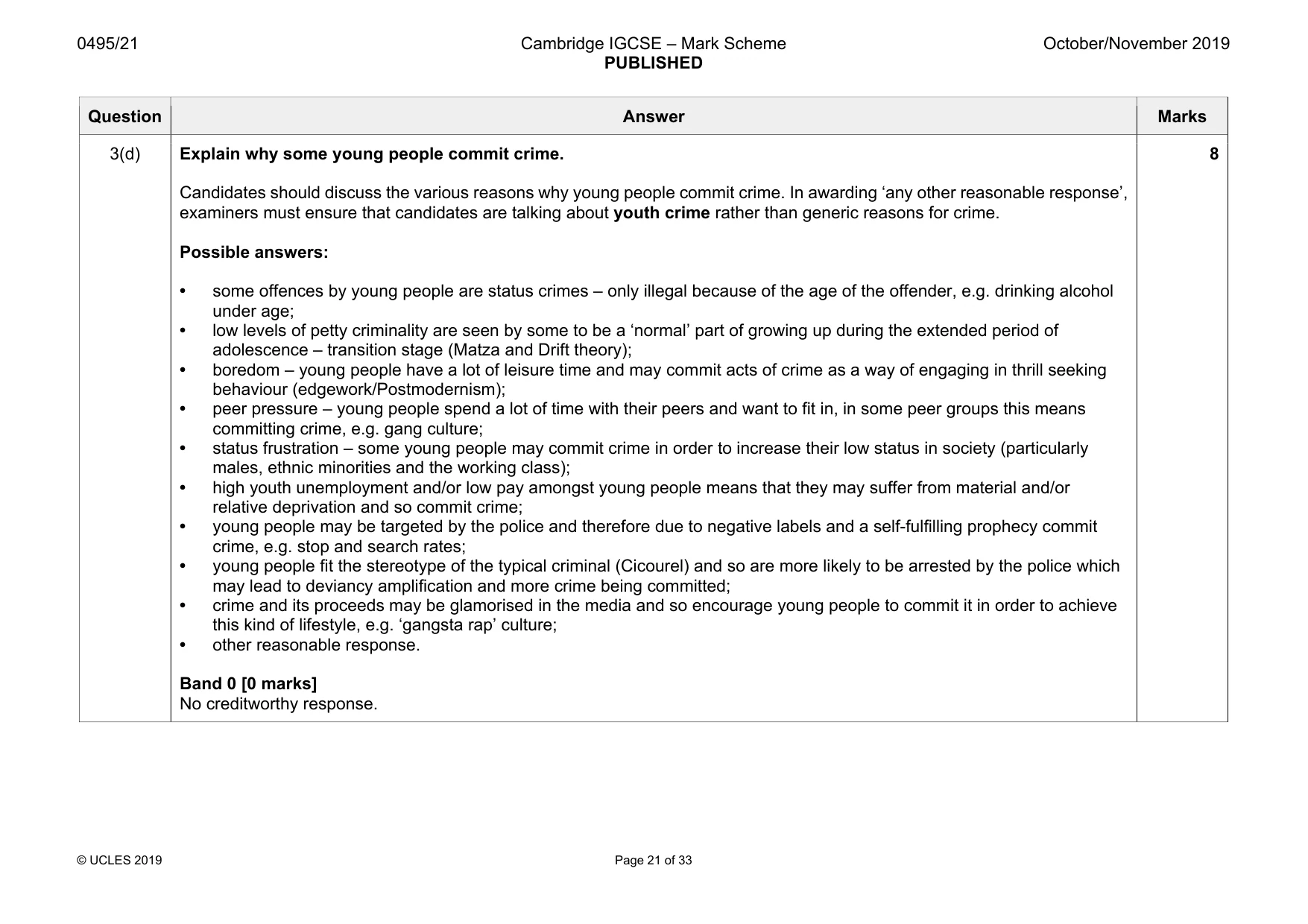
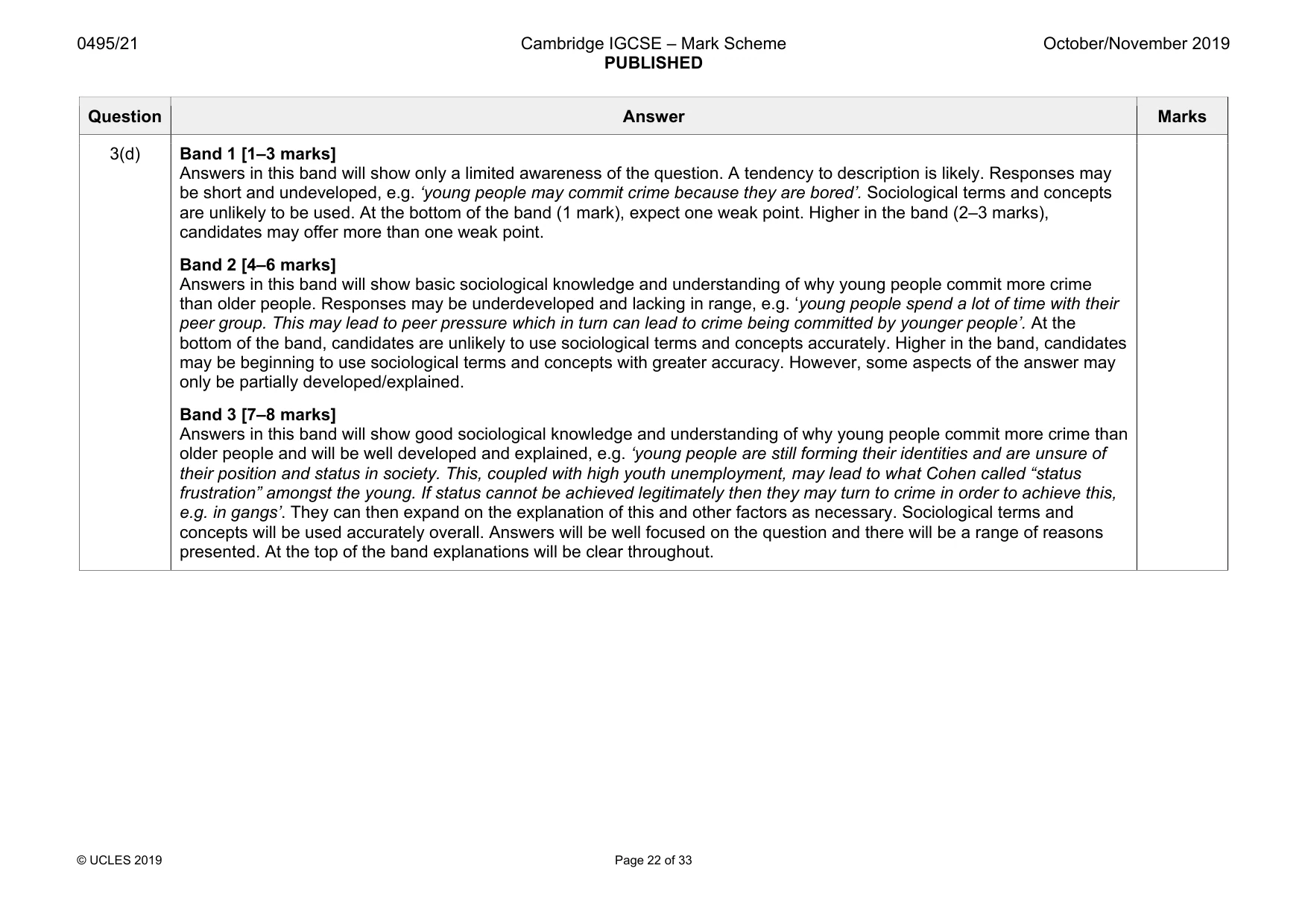
3 Sociologists debate why an individual might take part in criminal and deviant behaviour. Some blame inadequate socialisation, others look at the process of labelling. What is interesting is that different social groups seem to have different levels of offending. For example, according to official statistics, young people commit more crime than older people. (a) What is meant by the term ‘labelling’? [2] (b) Describe two moral panics. [4] (c) Explain how crime and deviance can be different. [6] (d) Explain why some young people commit crime. [8] (e) To what extent does functionalist theory explain criminal behaviour? [15] Section D: Media
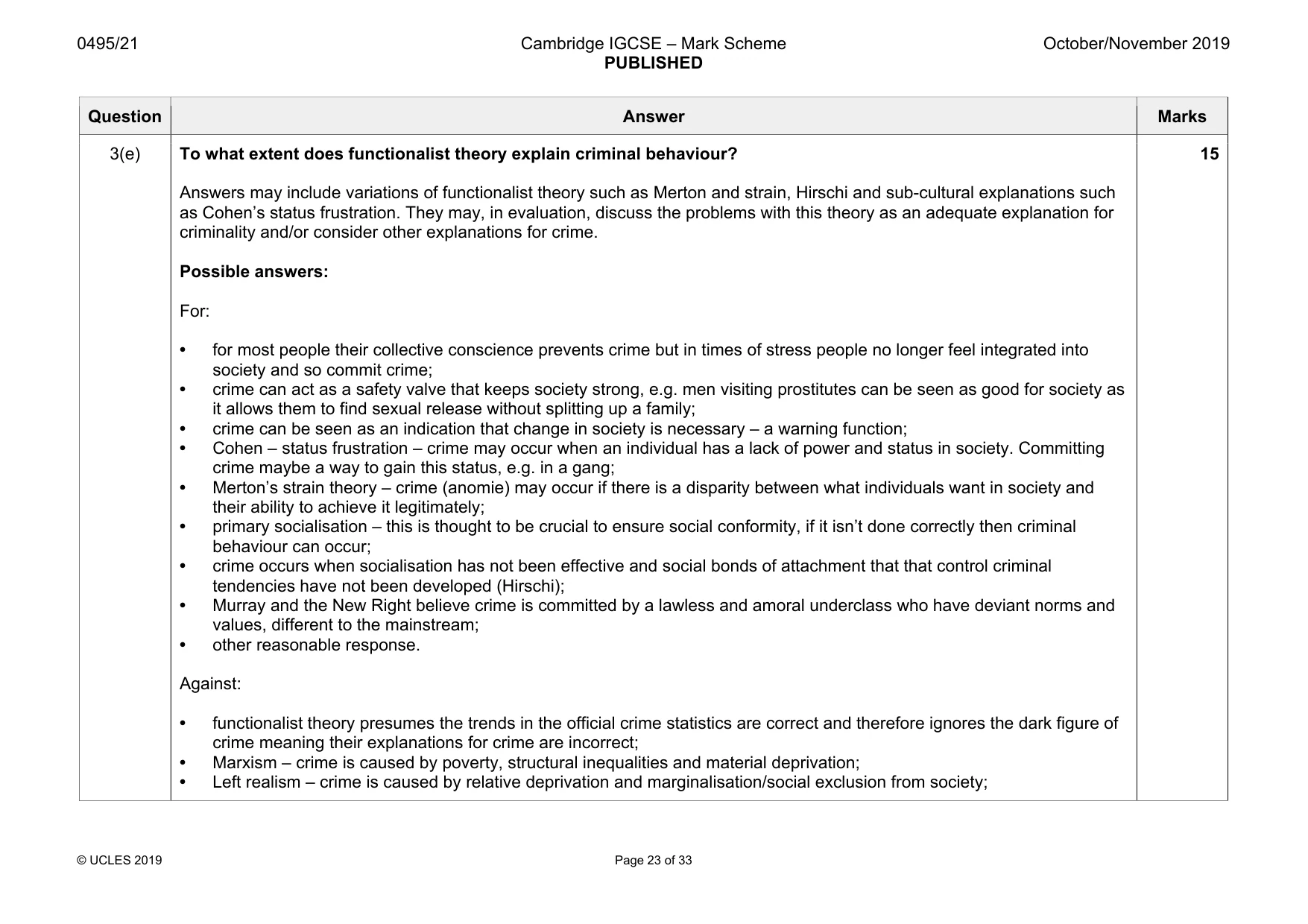
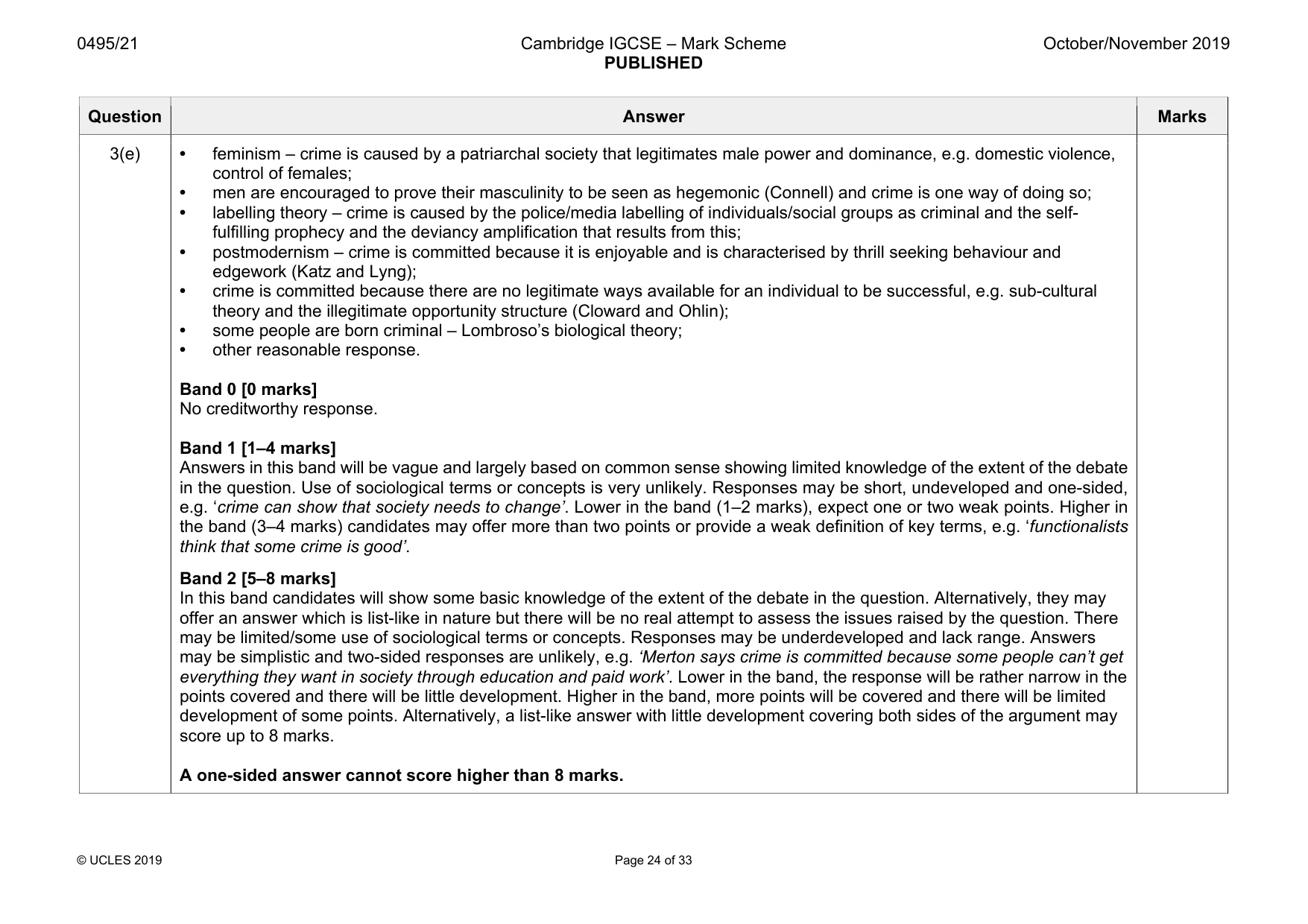
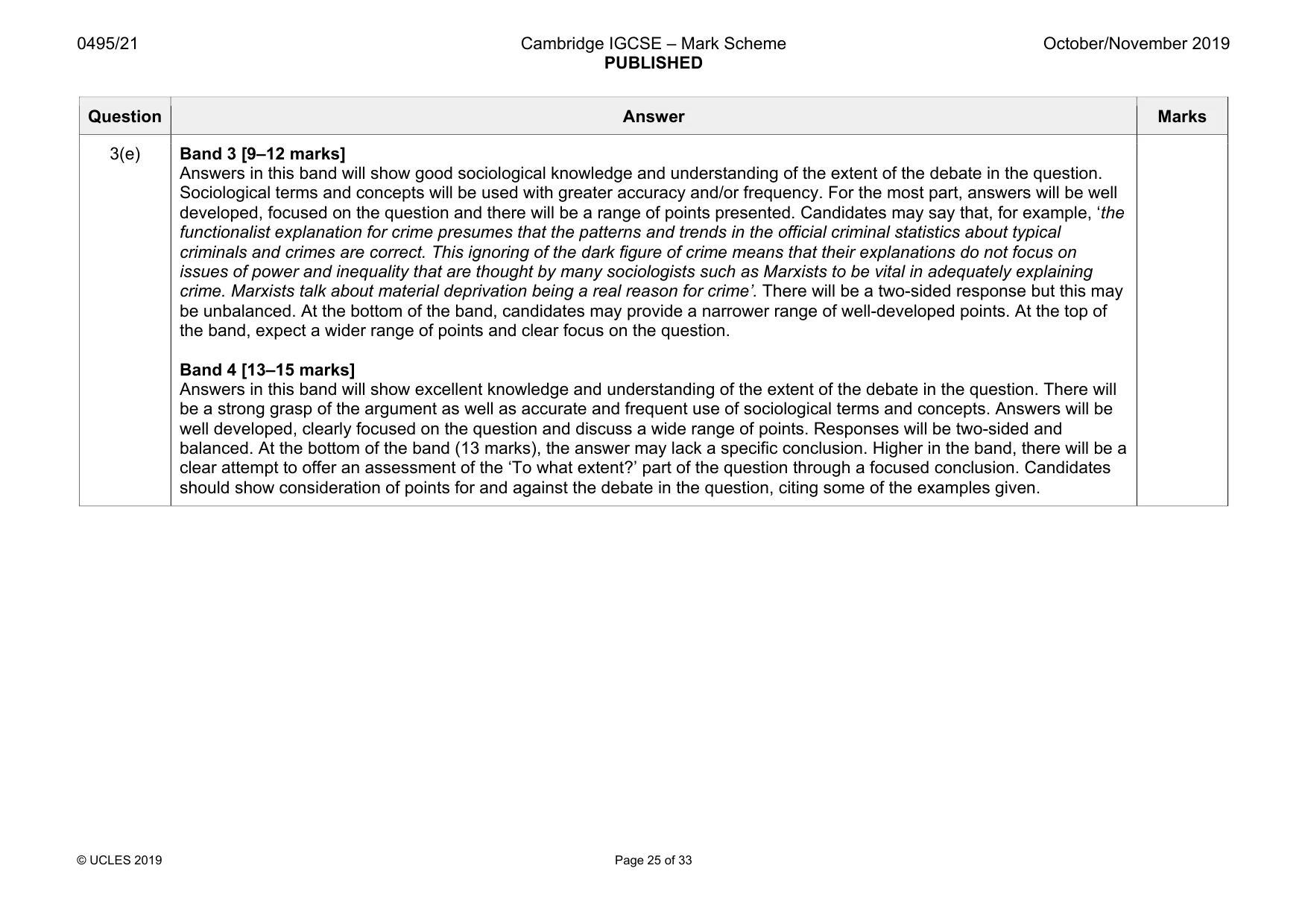
Mark scheme: 3(a) What is meant by the term ‘labelling’? One mark for partial definition, e.g. a stereotype/tagging Two marks for clear definition, e.g. the way in which acts and individuals are defined and stereotyped e.g. as deviant/a criminal 2 3(b) Describe two moral panics. Candidates may describe classic moral panics based on sociological studies, contemporary examples or localised examples. All are fine to credit. Possible answers: • the mods and the rockers – Cohen – their deviant behaviour was exaggerated and sensationalised by the media; • the ‘hoodies’ – Fawbert – young people wearing hoodies were portrayed by the media as folk devils and so a moral panic ensued about their perceived deviant behaviour and attitudes; • lone parents – moral panics have ensued about the lack of a father figure leading to feral and undisciplined children with no respect for authority; • football hooligans – at certain periods in history these people have been presented in the media as mindless thugs, intent on causing trouble; • young people and gangs/street culture – the idea whipped up by the media that young people on the streets are up to no good, taking drugs, carrying knives and being delinquent; • illegal immigrants – often portrayed by the media to be criminal, amoral, dangerous and taking ‘our’ jobs; • stereotypical representations in the media that link Muslims with terrorism – Islamophobia; • Stuart Hall, ‘Policing the Crisis’ – this study of the moral panic of mugging saw the police arresting large numbers of black youths who were represented in the media as violent criminals; • video nasties – moral panics are often seen whereby media content is blamed for the delinquent behaviour of youths in society, e.g. ‘Grand Theft Auto’ video games blamed for youth copycat killings; • other reasonable response. One mark for each point correctly identified (up to maximum of two). One mark for each point that is developed (up to a maximum of two). 4 Question Answer Marks 3(c) Explain how crime and deviance can be different. Possible answers: • crime involves the breaking of the law, deviance is about not conforming to norms; • crime is typically more serious than deviance, e.g. murder vs. vandalism; • crime will involve formal agencies of social control in terms of surveillance and punishment, deviance is more likely to be dealt with informally; • crime is not always deviant (e.g. speeding) and deviance is not always criminal (e.g. burping at the dinner table); • deviance can include acts that will be positively sanctioned and rewarded (e.g. heroism), crime is seen to be negative; • other reasonable response. Band 0 [0 marks] No creditworthy response. Band 1 [1–3 marks] Answers in this band will show only a limited awareness of the question and may talk about ‘crime is more serious than deviance’. Responses may be short and un/underdeveloped. At the bottom of the band (1 mark), expect one weak point. Higher in the band (2–3 marks), candidates may offer more than one weak point, but there may be a tendency towards simplistic answers, engaging with sociological ideas without using sociological language. Band 2 [4–6 marks] A clear and accurate explanation, showing good sociological knowledge and understanding of the question. Sociological terms and concepts should be expected, e.g. ‘crime is regulated by the Government and is an act that breaks the law, e.g. murder. Deviance, however, need not be so serious. Instead, it may involve the breaking of norms, perhaps as youth resistance or rebellion in a sub-culture such as the punks’. This would be followed by explanation of factors leading to this. At the bottom of the band, the range of points covered may be narrow or lack detail. Higher in the band, answers will cover more than one factor in a well-developed way or cover several factors in less detail. 6 Question Answer Marks 3(d) Explain why some young people commit crime. Candidates should discuss the various reasons why young people commit crime. In awarding ‘any other reasonable response’, examiners must ensure that candidates are talking about youth crime rather than generic reasons for crime. Possible answers: • some offences by young people are status crimes – only illegal because of the age of the offender, e.g. drinking alcohol under age; • low levels of petty criminality are seen by some to be a ‘normal’ part of growing up during the extended period of adolescence – transition stage (Matza and Drift theory); • boredom – young people have a lot of leisure time and may commit acts of crime as a way of engaging in thrill seeking behaviour (edgework/Postmodernism); • peer pressure – young people spend a lot of time with their peers and want to fit in, in some peer groups this means committing crime, e.g. gang culture; • status frustration – some young people may commit crime in order to increase their low status in society (particularly males, ethnic minorities and the working class); • high youth unemployment and/or low pay amongst young people means that they may suffer from material and/or relative deprivation and so commit crime; • young people may be targeted by the police and therefore due to negative labels and a self-fulfilling prophecy commit crime, e.g. stop and search rates; • young people fit the stereotype of the typical criminal (Cicourel) and so are more likely to be arrested by the police which may lead to deviancy amplification and more crime being committed; • crime and its proceeds may be glamorised in the media and so encourage young people to commit it in order to achieve this kind of lifestyle, e.g. ‘gangsta rap’ culture; • other reasonable response. Band 0 [0 marks] No creditworthy response. 8 Question Answer Marks 3(d) Band 1 [1–3 marks] Answers in this band will show only a limited awareness of the question. A tendency to description is likely. Responses may be short and undeveloped, e.g. ‘young people may commit crime because they are bored’. Sociological terms and concepts are unlikely to be used. At the bottom of the band (1 mark), expect one weak point. Higher in the band (2–3 marks), candidates may offer more than one weak point. Band 2 [4–6 marks] Answers in this band will show basic sociological knowledge and understanding of why young people commit more crime than older people. Responses may be underdeveloped and lacking in range, e.g. ‘young people spend a lot of time with their peer group. This may lead to peer pressure which in turn can lead to crime being committed by younger people’. At the bottom of the band, candidates are unlikely to use sociological terms and concepts accurately. Higher in the band, candidates may be beginning to use sociological terms and concepts with greater accuracy. However, some aspects of the answer may only be partially developed/explained. Band 3 [7–8 marks] Answers in this band will show good sociological knowledge and understanding of why young people commit more crime than older people and will be well developed and explained, e.g. ‘young people are still forming their identities and are unsure of their position and status in society. This, coupled with high youth unemployment, may lead to what Cohen called “status frustration” amongst the young. If status cannot be achieved legitimately then they may turn to crime in order to achieve this, e.g. in gangs’. They can then expand on the explanation of this and other factors as necessary. Sociological terms and concepts will be used accurately overall. Answers will be well focused on the question and there will be a range of reasons presented. At the top of the band explanations will be clear throughout. Question Answer Marks 3(e) To what extent does functionalist theory explain criminal behaviour? Answers may include variations of functionalist theory such as Merton and strain, Hirschi and sub-cultural explanations such as Cohen’s status frustration. They may, in evaluation, discuss the problems with this theory as an adequate explanation for criminality and/or consider other explanations for crime. Possible answers: For: • for most people their collective conscience prevents crime but in times of stress people no longer feel integrated into society and so commit crime; • crime can act as a safety valve that keeps society strong, e.g. men visiting prostitutes can be seen as good for society as it allows them to find sexual release without splitting up a family; • crime can be seen as an indication that change in society is necessary – a warning function; • Cohen – status frustration – crime may occur when an individual has a lack of power and status in society. Committing crime maybe a way to gain this status, e.g. in a gang; • Merton’s strain theory – crime (anomie) may occur if there is a disparity between what individuals want in society and their ability to achieve it legitimately; • primary socialisation – this is thought to be crucial to ensure social conformity, if it isn’t done correctly then criminal behaviour can occur; • crime occurs when socialisation has not been effective and social bonds of attachment that that control criminal tendencies have not been developed (Hirschi); • Murray and the New Right believe crime is committed by a lawless and amoral underclass who have deviant norms and values, different to the mainstream; • other reasonable response. Against: • functionalist theory presumes the trends in the official crime statistics are correct and therefore ignores the dark figure of crime meaning their explanations for crime are incorrect; • Marxism – crime is caused by poverty, structural inequalities and material deprivation; • Left realism – crime is caused by relative deprivation and marginalisation/social exclusion from society; 15 Question Answer Marks 3(e) • feminism – crime is caused by a patriarchal society that legitimates male power and dominance, e.g. domestic violence, control of females; • men are encouraged to prove their masculinity to be seen as hegemonic (Connell) and crime is one way of doing so; • labelling theory – crime is caused by the police/media labelling of individuals/social groups as criminal and the self- fulfilling prophecy and the deviancy amplification that results from this; • postmodernism – crime is committed because it is enjoyable and is characterised by thrill seeking behaviour and edgework (Katz and Lyng); • crime is committed because there are no legitimate ways available for an individual to be successful, e.g. sub-cultural theory and the illegitimate opportunity structure (Cloward and Ohlin); • some people are born criminal – Lombroso’s biological theory; • other reasonable response. Band 0 [0 marks] No creditworthy response. Band 1 [1–4 marks] Answers in this band will be vague and largely based on common sense showing limited knowledge of the extent of the debate in the question. Use of sociological terms or concepts is very unlikely. Responses may be short, undeveloped and one-sided, e.g. ‘crime can show that society needs to change’. Lower in the band (1–2 marks), expect one or two weak points. Higher in the band (3–4 marks) candidates may offer more than two points or provide a weak definition of key terms, e.g. ‘functionalists think that some crime is good’. Band 2 [5–8 marks] In this band candidates will show some basic knowledge of the extent of the debate in the question. Alternatively, they may offer an answer which is list-like in nature but there will be no real attempt to assess the issues raised by the question. There may be limited/some use of sociological terms or concepts. Responses may be underdeveloped and lack range. Answers may be simplistic and two-sided responses are unlikely, e.g. ‘Merton says crime is committed because some people can’t get everything they want in society through education and paid work’. Lower in the band, the response will be rather narrow in the points covered and there will be little development. Higher in the band, more points will be covered and there will be limited development of some points. Alternatively, a list-like answer with little development covering both sides of the argument may score up to 8 marks. A one-sided answer cannot score higher than 8 marks. Question Answer Marks 3(e) Band 3 [9–12 marks] Answers in this band will show good sociological knowledge and understanding of the extent of the debate in the question. Sociological terms and concepts will be used with greater accuracy and/or frequency. For the most part, answers will be well developed, focused on the question and there will be a range of points presented. Candidates may say that, for example, ‘the functionalist explanation for crime presumes that the patterns and trends in the official criminal statistics about typical criminals and crimes are correct. This ignoring of the dark figure of crime means that their explanations do not focus on issues of power and inequality that are thought by many sociologists such as Marxists to be vital in adequately explaining crime. Marxists talk about material deprivation being a real reason for crime’. There will be a two-sided response but this may be unbalanced. At the bottom of the band, candidates may provide a narrower range of well-developed points. At the top of the band, expect a wider range of points and clear focus on the question. Band 4 [13–15 marks] Answers in this band will show excellent knowledge and understanding of the extent of the debate in the question. There will be a strong grasp of the argument as well as accurate and frequent use of sociological terms and concepts. Answers will be well developed, clearly focused on the question and discuss a wide range of points. Responses will be two-sided and balanced. At the bottom of the band (13 marks), the answer may lack a specific conclusion. Higher in the band, there will be a clear attempt to offer an assessment of the ‘To what extent?’ part of the question through a focused conclusion. Candidates should show consideration of points for and against the debate in the question, citing some of the examples given.
Q4 · The media industry has undergone significant changes recently which have affected form…
4 The media industry has undergone significant changes recently which have affected form, content and ownership. Mass communication is no longer the only option for producers. Many sociologists now also believe that the audience plays an important part in determining media content and representations. (a) What is meant by the term ‘mass communication’? [2] (b) Describe two news values. [4] (c) Explain how the digital divide may affect an individual’s use of media. [6] (d) Explain why advertising is important in today’s media. [8] (e) To what extent is the pluralist view of media correct? [15]
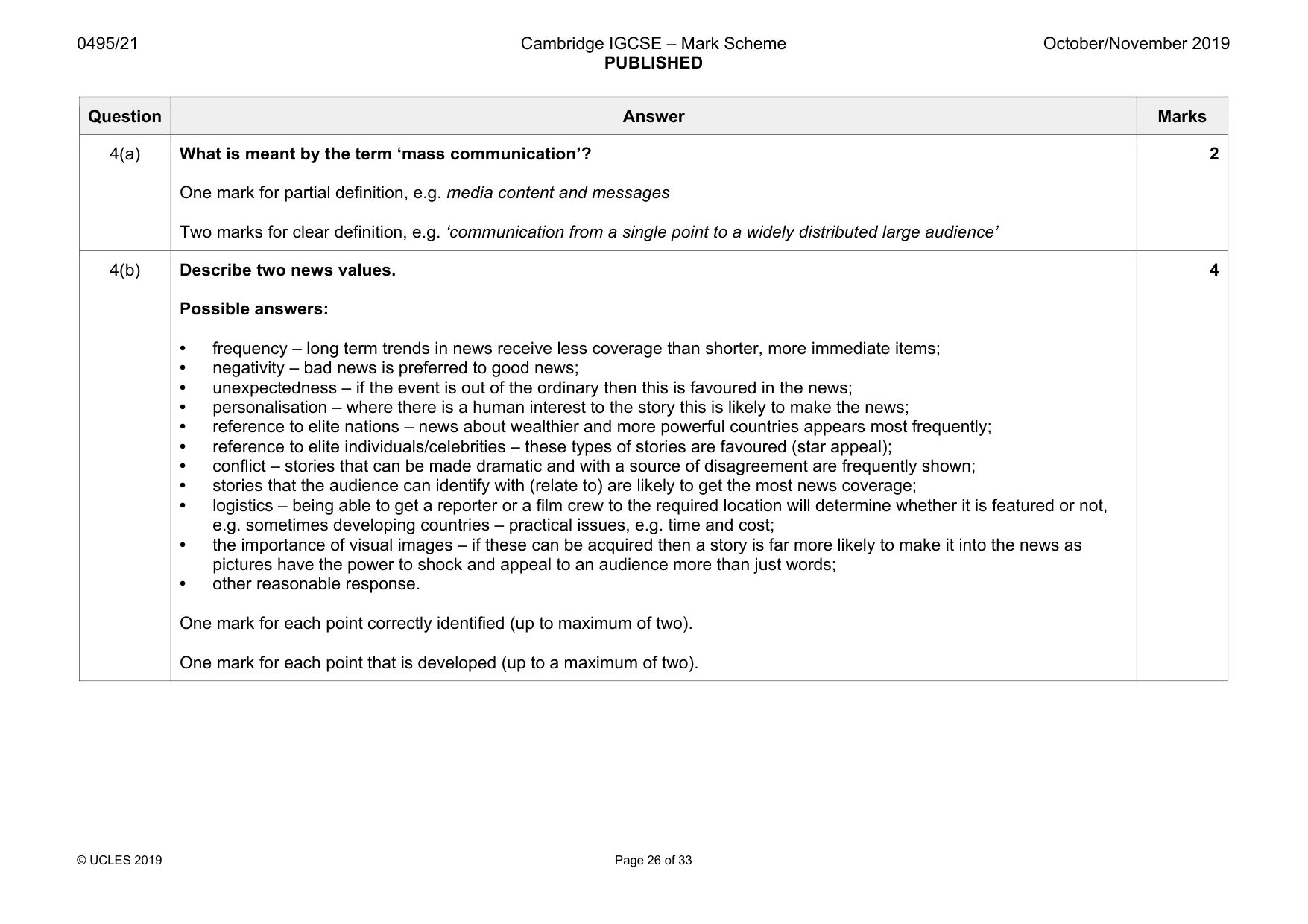
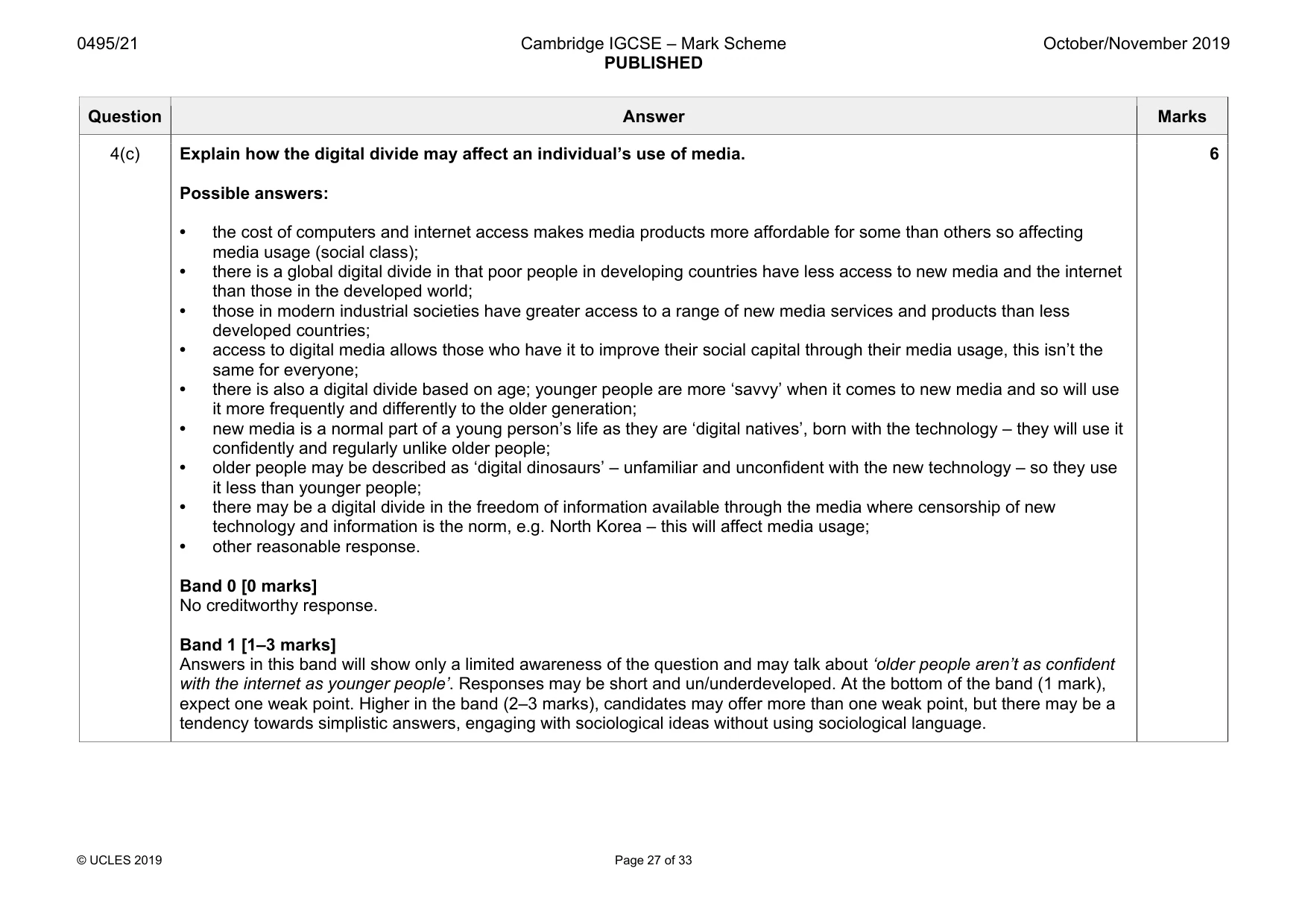
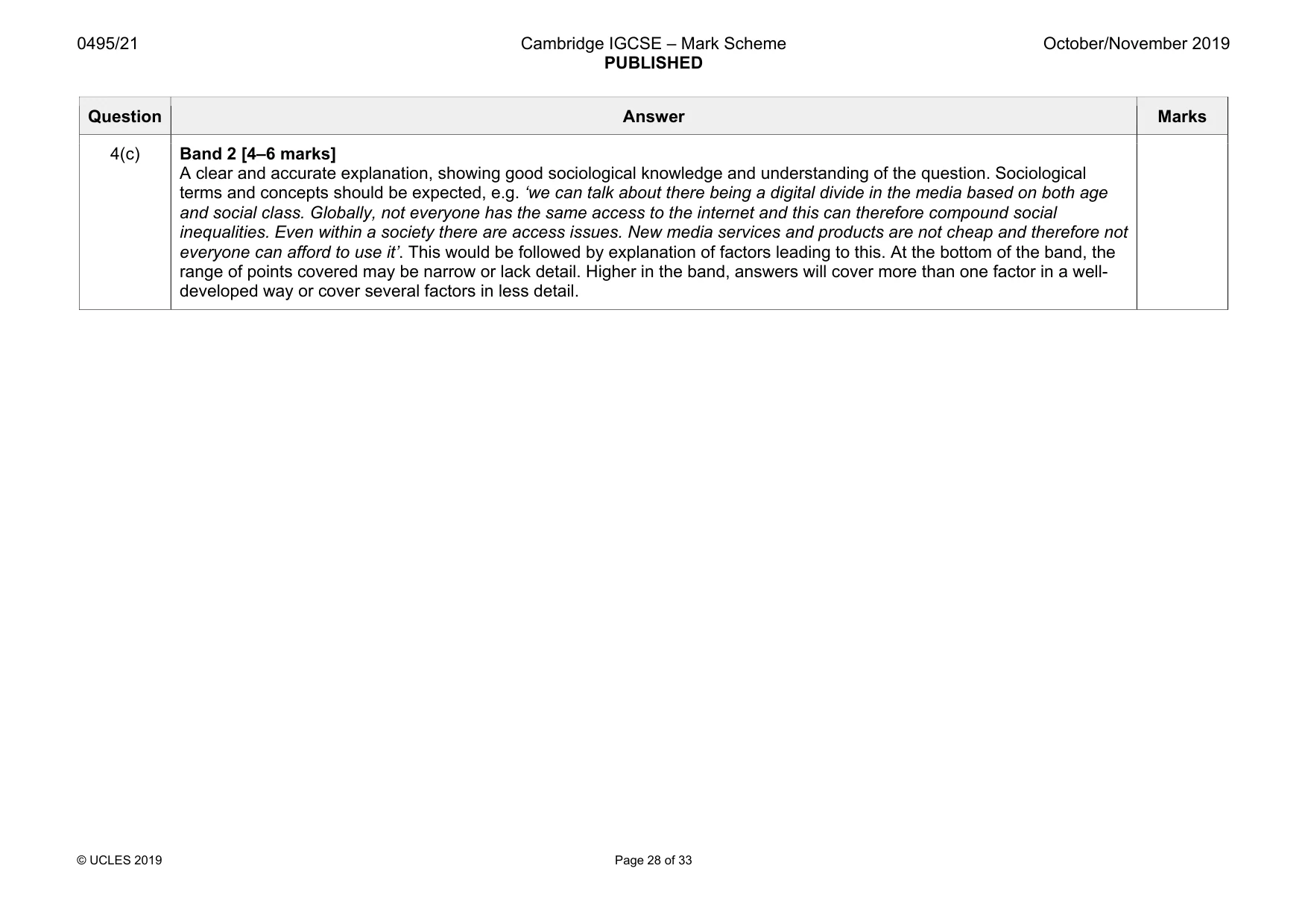
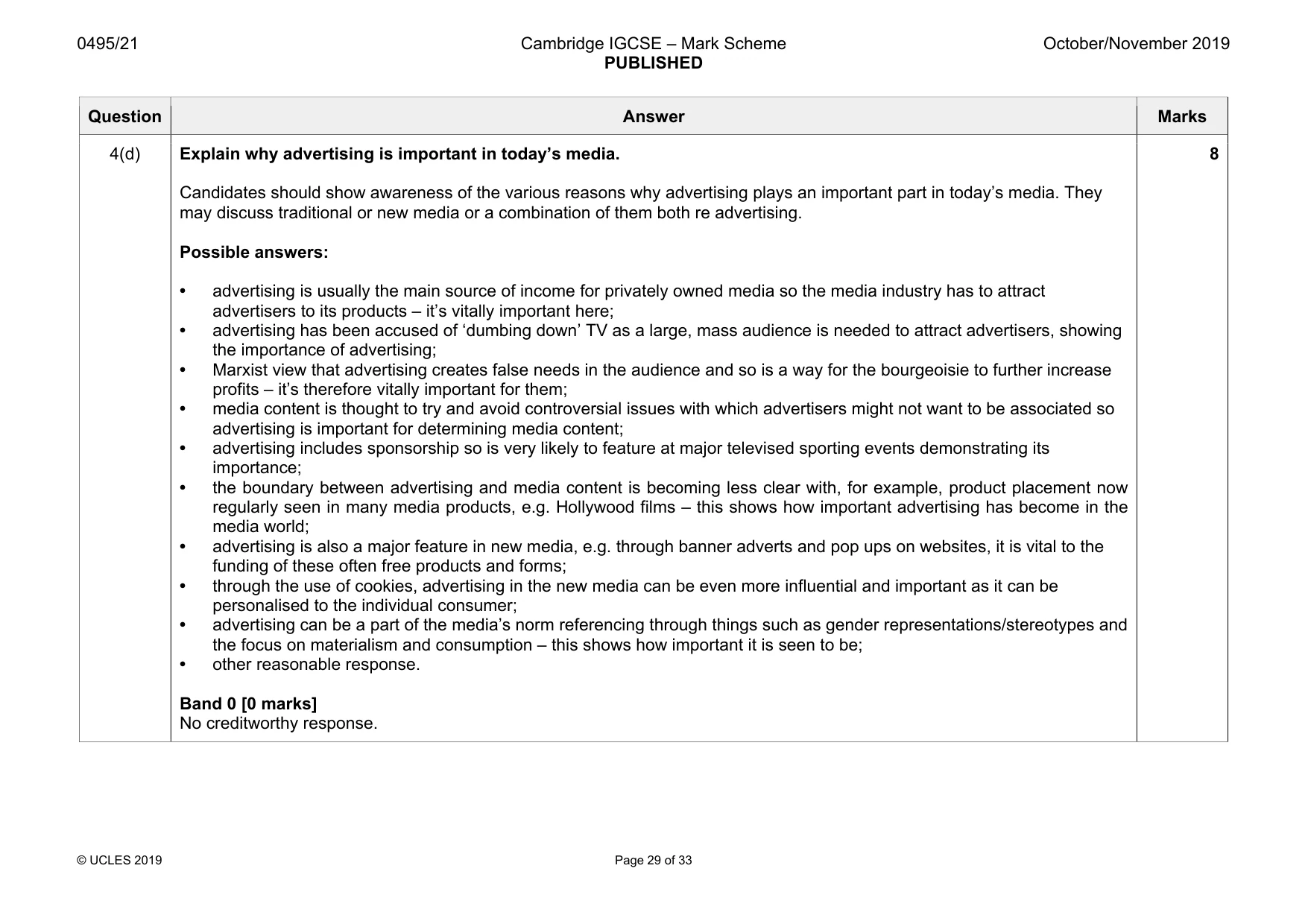
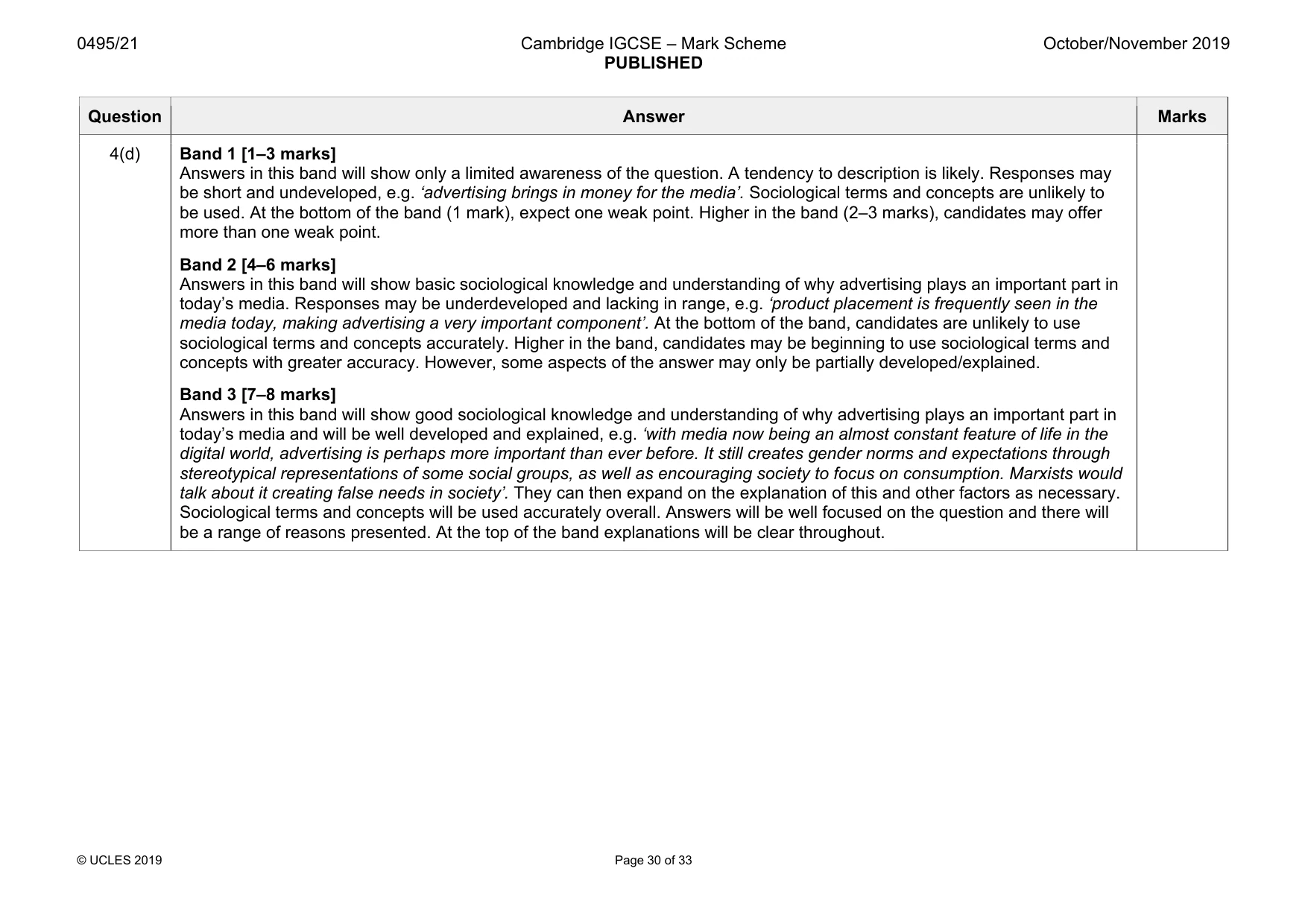
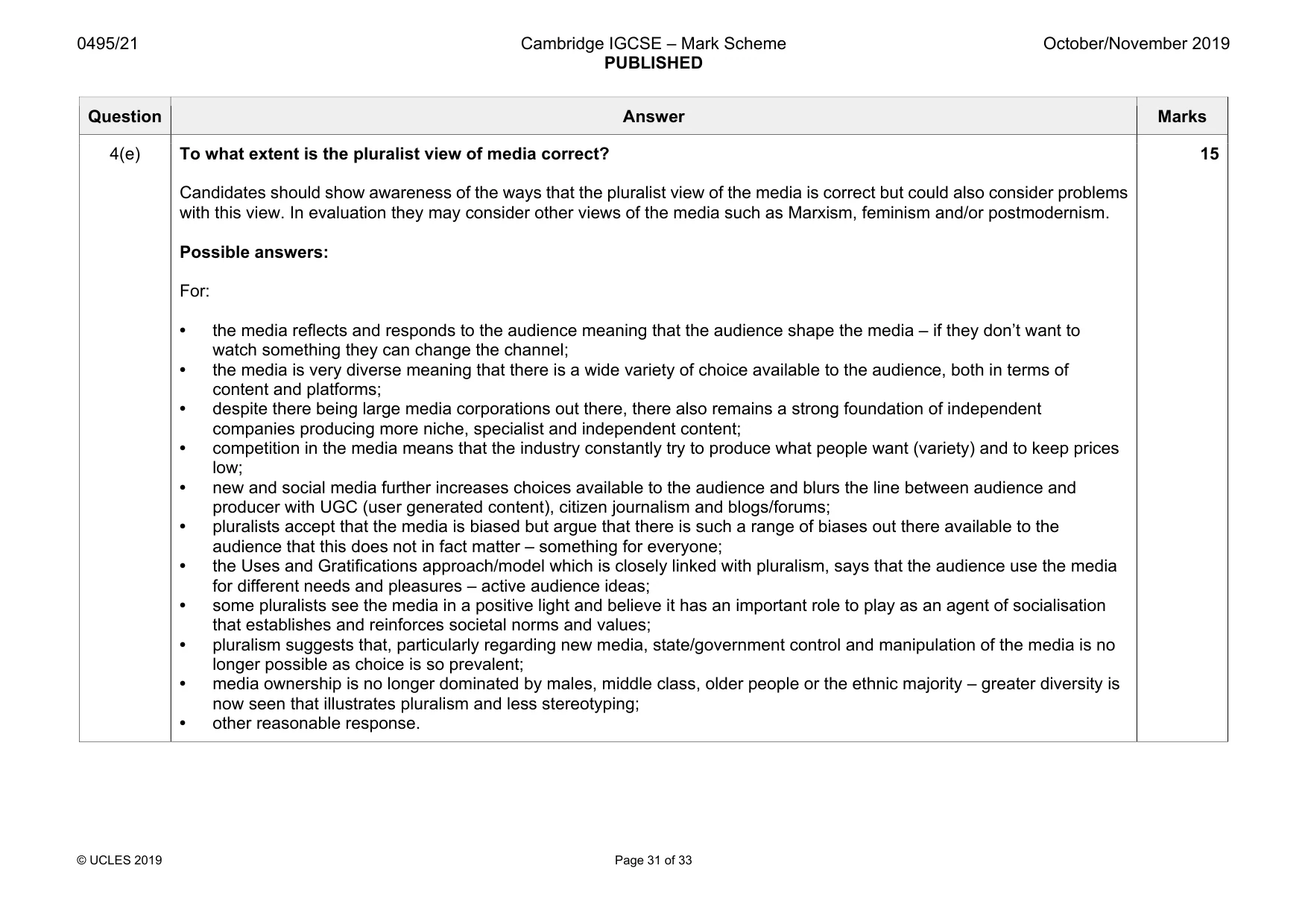
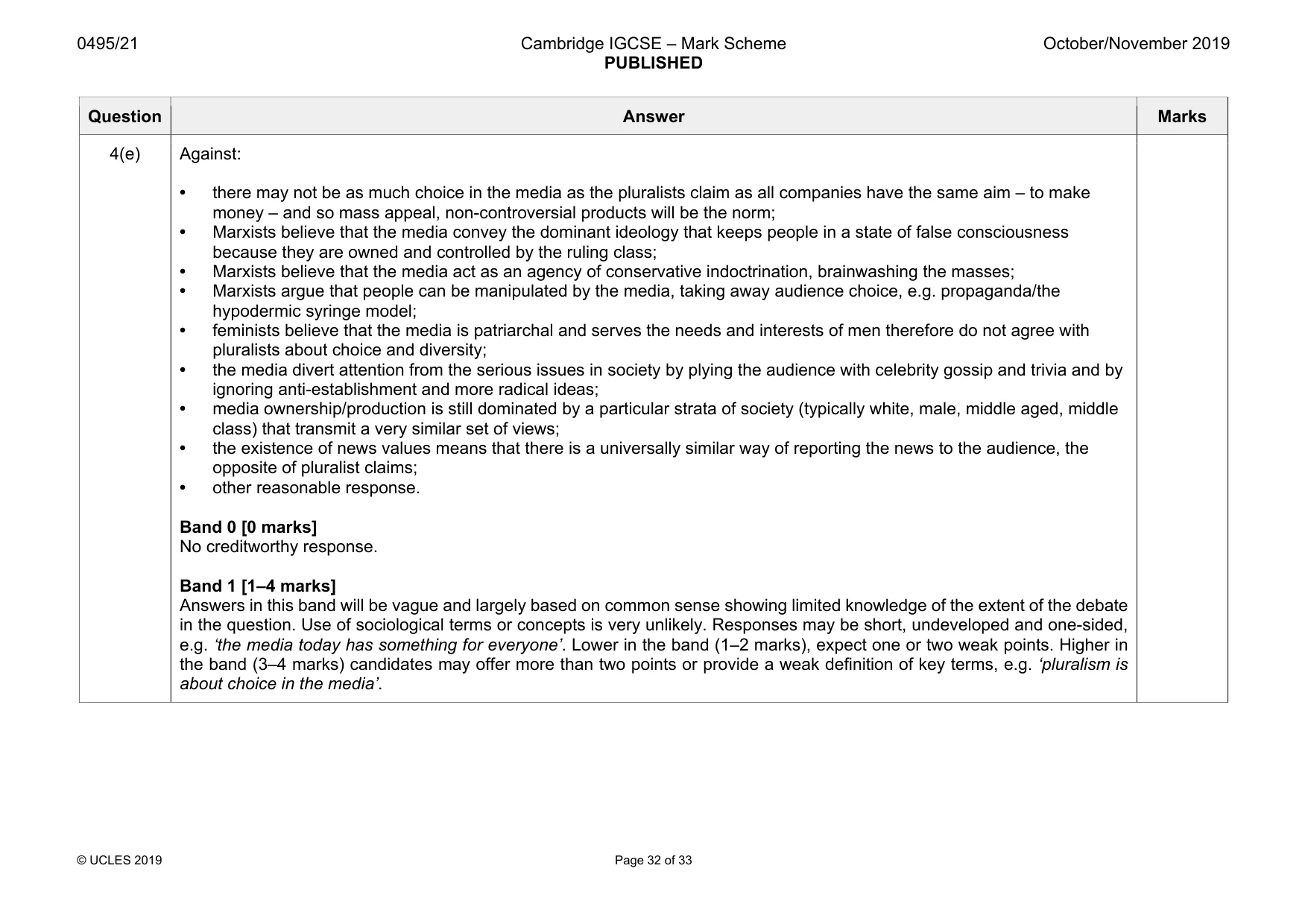
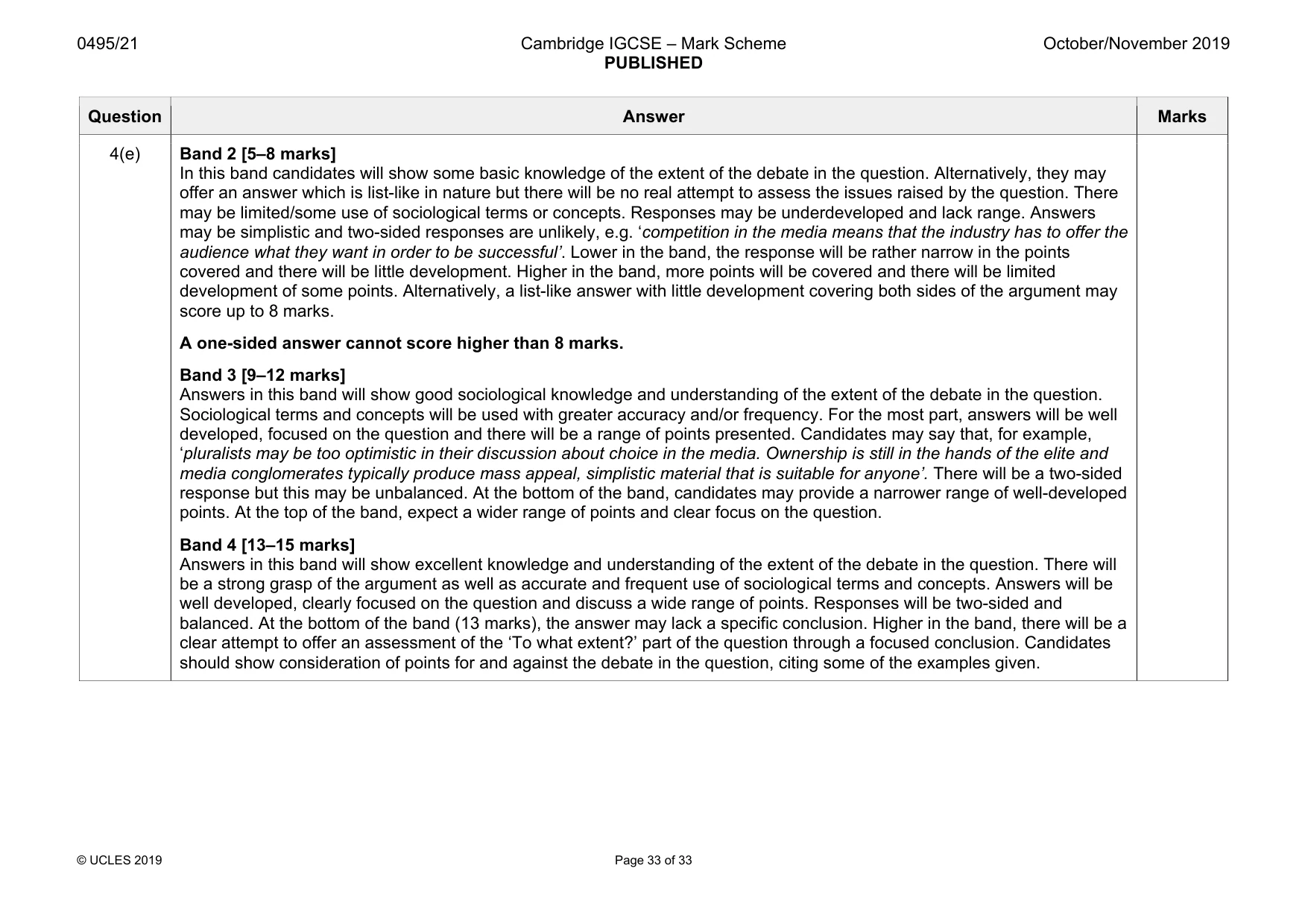
Mark scheme: 4(a) What is meant by the term ‘mass communication’? One mark for partial definition, e.g. media content and messages Two marks for clear definition, e.g. ‘communication from a single point to a widely distributed large audience’ 2 4(b) Describe two news values. Possible answers: • frequency – long term trends in news receive less coverage than shorter, more immediate items; • negativity – bad news is preferred to good news; • unexpectedness – if the event is out of the ordinary then this is favoured in the news; • personalisation – where there is a human interest to the story this is likely to make the news; • reference to elite nations – news about wealthier and more powerful countries appears most frequently; • reference to elite individuals/celebrities – these types of stories are favoured (star appeal); • conflict – stories that can be made dramatic and with a source of disagreement are frequently shown; • stories that the audience can identify with (relate to) are likely to get the most news coverage; • logistics – being able to get a reporter or a film crew to the required location will determine whether it is featured or not, e.g. sometimes developing countries – practical issues, e.g. time and cost; • the importance of visual images – if these can be acquired then a story is far more likely to make it into the news as pictures have the power to shock and appeal to an audience more than just words; • other reasonable response. One mark for each point correctly identified (up to maximum of two). One mark for each point that is developed (up to a maximum of two). 4 Question Answer Marks 4(c) Explain how the digital divide may affect an individual’s use of media. Possible answers: • the cost of computers and internet access makes media products more affordable for some than others so affecting media usage (social class); • there is a global digital divide in that poor people in developing countries have less access to new media and the internet than those in the developed world; • those in modern industrial societies have greater access to a range of new media services and products than less developed countries; • access to digital media allows those who have it to improve their social capital through their media usage, this isn’t the same for everyone; • there is also a digital divide based on age; younger people are more ‘savvy’ when it comes to new media and so will use it more frequently and differently to the older generation; • new media is a normal part of a young person’s life as they are ‘digital natives’, born with the technology – they will use it confidently and regularly unlike older people; • older people may be described as ‘digital dinosaurs’ – unfamiliar and unconfident with the new technology – so they use it less than younger people; • there may be a digital divide in the freedom of information available through the media where censorship of new technology and information is the norm, e.g. North Korea – this will affect media usage; • other reasonable response. Band 0 [0 marks] No creditworthy response. Band 1 [1–3 marks] Answers in this band will show only a limited awareness of the question and may talk about ‘older people aren’t as confident with the internet as younger people’. Responses may be short and un/underdeveloped. At the bottom of the band (1 mark), expect one weak point. Higher in the band (2–3 marks), candidates may offer more than one weak point, but there may be a tendency towards simplistic answers, engaging with sociological ideas without using sociological language. 6 Question Answer Marks 4(c) Band 2 [4–6 marks] A clear and accurate explanation, showing good sociological knowledge and understanding of the question. Sociological terms and concepts should be expected, e.g. ‘we can talk about there being a digital divide in the media based on both age and social class. Globally, not everyone has the same access to the internet and this can therefore compound social inequalities. Even within a society there are access issues. New media services and products are not cheap and therefore not everyone can afford to use it’. This would be followed by explanation of factors leading to this. At the bottom of the band, the range of points covered may be narrow or lack detail. Higher in the band, answers will cover more than one factor in a well- developed way or cover several factors in less detail. Question Answer Marks 4(d) Explain why advertising is important in today’s media. Candidates should show awareness of the various reasons why advertising plays an important part in today’s media. They may discuss traditional or new media or a combination of them both re advertising. Possible answers: • advertising is usually the main source of income for privately owned media so the media industry has to attract advertisers to its products – it’s vitally important here; • advertising has been accused of ‘dumbing down’ TV as a large, mass audience is needed to attract advertisers, showing the importance of advertising; • Marxist view that advertising creates false needs in the audience and so is a way for the bourgeoisie to further increase profits – it’s therefore vitally important for them; • media content is thought to try and avoid controversial issues with which advertisers might not want to be associated so advertising is important for determining media content; • advertising includes sponsorship so is very likely to feature at major televised sporting events demonstrating its importance; • the boundary between advertising and media content is becoming less clear with, for example, product placement now regularly seen in many media products, e.g. Hollywood films – this shows how important advertising has become in the media world; • advertising is also a major feature in new media, e.g. through banner adverts and pop ups on websites, it is vital to the funding of these often free products and forms; • through the use of cookies, advertising in the new media can be even more influential and important as it can be personalised to the individual consumer; • advertising can be a part of the media’s norm referencing through things such as gender representations/stereotypes and the focus on materialism and consumption – this shows how important it is seen to be; • other reasonable response. Band 0 [0 marks] No creditworthy response. 8 Question Answer Marks 4(d) Band 1 [1–3 marks] Answers in this band will show only a limited awareness of the question. A tendency to description is likely. Responses may be short and undeveloped, e.g. ‘advertising brings in money for the media’. Sociological terms and concepts are unlikely to be used. At the bottom of the band (1 mark), expect one weak point. Higher in the band (2–3 marks), candidates may offer more than one weak point. Band 2 [4–6 marks] Answers in this band will show basic sociological knowledge and understanding of why advertising plays an important part in today’s media. Responses may be underdeveloped and lacking in range, e.g. ‘product placement is frequently seen in the media today, making advertising a very important component’. At the bottom of the band, candidates are unlikely to use sociological terms and concepts accurately. Higher in the band, candidates may be beginning to use sociological terms and concepts with greater accuracy. However, some aspects of the answer may only be partially developed/explained. Band 3 [7–8 marks] Answers in this band will show good sociological knowledge and understanding of why advertising plays an important part in today’s media and will be well developed and explained, e.g. ‘with media now being an almost constant feature of life in the digital world, advertising is perhaps more important than ever before. It still creates gender norms and expectations through stereotypical representations of some social groups, as well as encouraging society to focus on consumption. Marxists would talk about it creating false needs in society’. They can then expand on the explanation of this and other factors as necessary. Sociological terms and concepts will be used accurately overall. Answers will be well focused on the question and there will be a range of reasons presented. At the top of the band explanations will be clear throughout. Question Answer Marks 4(e) To what extent is the pluralist view of media correct? Candidates should show awareness of the ways that the pluralist view of the media is correct but could also consider problems with this view. In evaluation they may consider other views of the media such as Marxism, feminism and/or postmodernism. Possible answers: For: • the media reflects and responds to the audience meaning that the audience shape the media – if they don’t want to watch something they can change the channel; • the media is very diverse meaning that there is a wide variety of choice available to the audience, both in terms of content and platforms; • despite there being large media corporations out there, there also remains a strong foundation of independent companies producing more niche, specialist and independent content; • competition in the media means that the industry constantly try to produce what people want (variety) and to keep prices low; • new and social media further increases choices available to the audience and blurs the line between audience and producer with UGC (user generated content), citizen journalism and blogs/forums; • pluralists accept that the media is biased but argue that there is such a range of biases out there available to the audience that this does not in fact matter – something for everyone; • the Uses and Gratifications approach/model which is closely linked with pluralism, says that the audience use the media for different needs and pleasures – active audience ideas; • some pluralists see the media in a positive light and believe it has an important role to play as an agent of socialisation that establishes and reinforces societal norms and values; • pluralism suggests that, particularly regarding new media, state/government control and manipulation of the media is no longer possible as choice is so prevalent; • media ownership is no longer dominated by males, middle class, older people or the ethnic majority – greater diversity is now seen that illustrates pluralism and less stereotyping; • other reasonable response. 15 Question Answer Marks 4(e) Against: • there may not be as much choice in the media as the pluralists claim as all companies have the same aim – to make money – and so mass appeal, non-controversial products will be the norm; • Marxists believe that the media convey the dominant ideology that keeps people in a state of false consciousness because they are owned and controlled by the ruling class; • Marxists believe that the media act as an agency of conservative indoctrination, brainwashing the masses; • Marxists argue that people can be manipulated by the media, taking away audience choice, e.g. propaganda/the hypodermic syringe model; • feminists believe that the media is patriarchal and serves the needs and interests of men therefore do not agree with pluralists about choice and diversity; • the media divert attention from the serious issues in society by plying the audience with celebrity gossip and trivia and by ignoring anti-establishment and more radical ideas; • media ownership/production is still dominated by a particular strata of society (typically white, male, middle aged, middle class) that transmit a very similar set of views; • the existence of news values means that there is a universally similar way of reporting the news to the audience, the opposite of pluralist claims; • other reasonable response. Band 0 [0 marks] No creditworthy response. Band 1 [1–4 marks] Answers in this band will be vague and largely based on common sense showing limited knowledge of the extent of the debate in the question. Use of sociological terms or concepts is very unlikely. Responses may be short, undeveloped and one-sided, e.g. ‘the media today has something for everyone’. Lower in the band (1–2 marks), expect one or two weak points. Higher in the band (3–4 marks) candidates may offer more than two points or provide a weak definition of key terms, e.g. ‘pluralism is about choice in the media’. Question Answer Marks 4(e) Band 2 [5–8 marks] In this band candidates will show some basic knowledge of the extent of the debate in the question. Alternatively, they may offer an answer which is list-like in nature but there will be no real attempt to assess the issues raised by the question. There may be limited/some use of sociological terms or concepts. Responses may be underdeveloped and lack range. Answers may be simplistic and two-sided responses are unlikely, e.g. ‘competition in the media means that the industry has to offer the audience what they want in order to be successful’. Lower in the band, the response will be rather narrow in the points covered and there will be little development. Higher in the band, more points will be covered and there will be limited development of some points. Alternatively, a list-like answer with little development covering both sides of the argument may score up to 8 marks. A one-sided answer cannot score higher than 8 marks. Band 3 [9–12 marks] Answers in this band will show good sociological knowledge and understanding of the extent of the debate in the question. Sociological terms and concepts will be used with greater accuracy and/or frequency. For the most part, answers will be well developed, focused on the question and there will be a range of points presented. Candidates may say that, for example, ‘pluralists may be too optimistic in their discussion about choice in the media. Ownership is still in the hands of the elite and media conglomerates typically produce mass appeal, simplistic material that is suitable for anyone’. There will be a two-sided response but this may be unbalanced. At the bottom of the band, candidates may provide a narrower range of well-developed points. At the top of the band, expect a wider range of points and clear focus on the question. Band 4 [13–15 marks] Answers in this band will show excellent knowledge and understanding of the extent of the debate in the question. There will be a strong grasp of the argument as well as accurate and frequent use of sociological terms and concepts. Answers will be well developed, clearly focused on the question and discuss a wide range of points. Responses will be two-sided and balanced. At the bottom of the band (13 marks), the answer may lack a specific conclusion. Higher in the band, there will be a clear attempt to offer an assessment of the ‘To what extent?’ part of the question through a focused conclusion. Candidates should show consideration of points for and against the debate in the question, citing some of the examples given.
More questions on How do sociologists approach the study of society?
What was in this paper
The subtopics covered by these 4 questions, and how many questions each got. Open one in a new tab to see every Cambridge question on it.
What you needed in this session
Cambridge’s own grade thresholds for 2019 Oct/Nov, Paper 2 · Variant 1. A higher threshold means an easier paper — the bar moves with how the cohort did.