Cambridge IGCSE Sociology 0495 — 2019 Oct/Nov Paper 1 · Variant 3
0495/13/O/N/19 · 80 marks · ≈90 min
The question paper and its mark scheme, free to read here and free to download. This is Cambridge’s own paper, exactly as it was sat.
Question paper4 pages

Mark scheme29 pages
Answers below. Sit the paper first if you are practising.
Paper as text
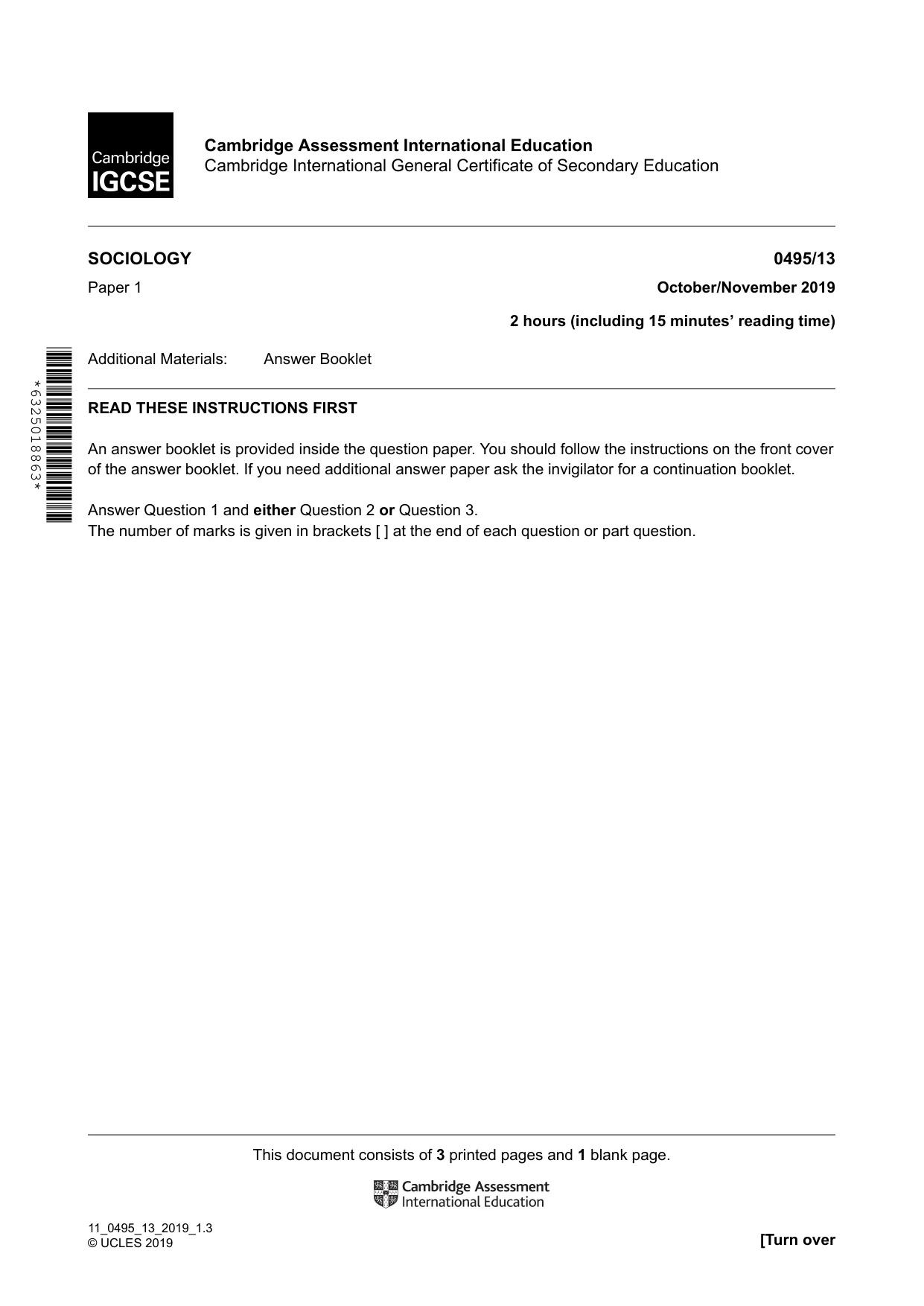
Question paper, page 1
Cambridge Assessment International Education Cambridge International General Certificate of Secondary Education 0495/13 SOCIOLOGY October/November 2019 Paper 1 2 hours (including 15 minutes’ reading time) Additional Materials: Answer Booklet READ THESE INSTRUCTIONS FIRST An answer booklet is provided inside the question paper. You should follow the instructions on the front cover of the answer booklet. If you need additional answer paper ask the invigilator for a continuation booklet. Answer Question 1 and either Question 2 or Question 3. The number of marks is given in brackets [ ] at the end of each question or part question. This document consists of 3 printed pages and 1 blank page. [Turn over 11_0495_13_2019_1.3 © UCLES 2019 *6325018863*
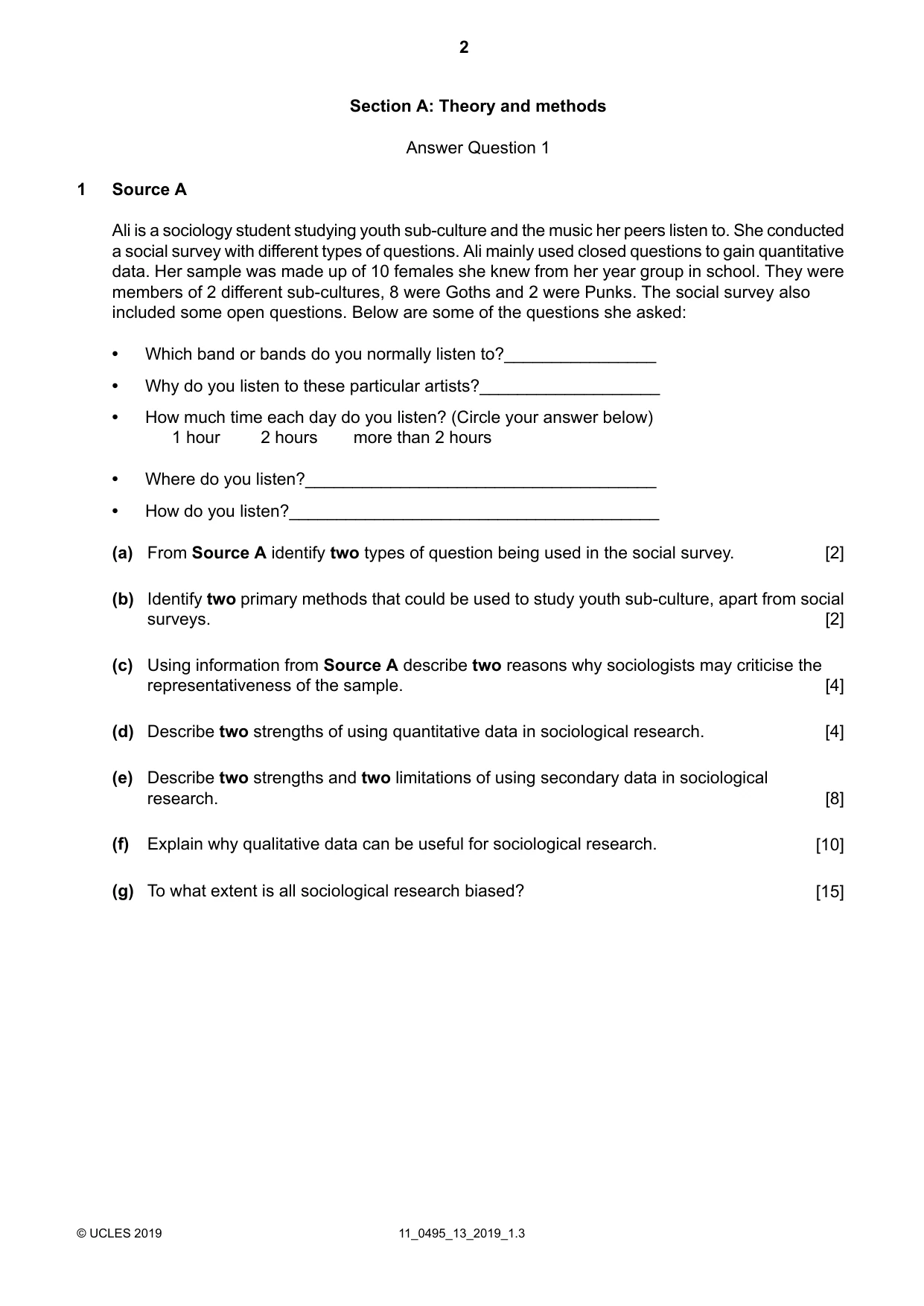
Question paper, page 2
Section A: Theory and methods Answer Question 1 Source A 1 Ali is a sociology student studying youth sub-culture and the music her peers listen to. She conducted a social survey with different types of questions. Ali mainly used closed questions to gain quantitative data. Her sample was made up of 10 females she knew from her year group in school. They were members of 2 different sub-cultures, 8 were Goths and 2 were Punks. The social survey also included some open questions. Below are some of the questions she asked: • Which band or bands do you normally listen to?________________ • Why do you listen to these particular artists?___________________ • How much time each day do you listen? (Circle your answer below) 1 hour 2 hours more than 2 hours • Where do you listen?_____________________________________ • How do you listen?_______________________________________ From Source A identify two types of question being used in the social survey. [2] (a) Identify two primary methods that could be used to study youth sub-culture, apart from social surveys. [2] (b) Using information from Source A describe two reasons why sociologists may criticise the representativeness of the sample. [4] (c) Describe two strengths of using quantitative data in sociological research. [4] (d) Describe two strengths and two limitations of using secondary data in sociological research. [8] (e) Explain why qualitative data can be useful for sociological research. (f) [10] To what extent is all sociological research biased? (g) [15] 11_0495_13_2019_1.3 © UCLES 2019 2
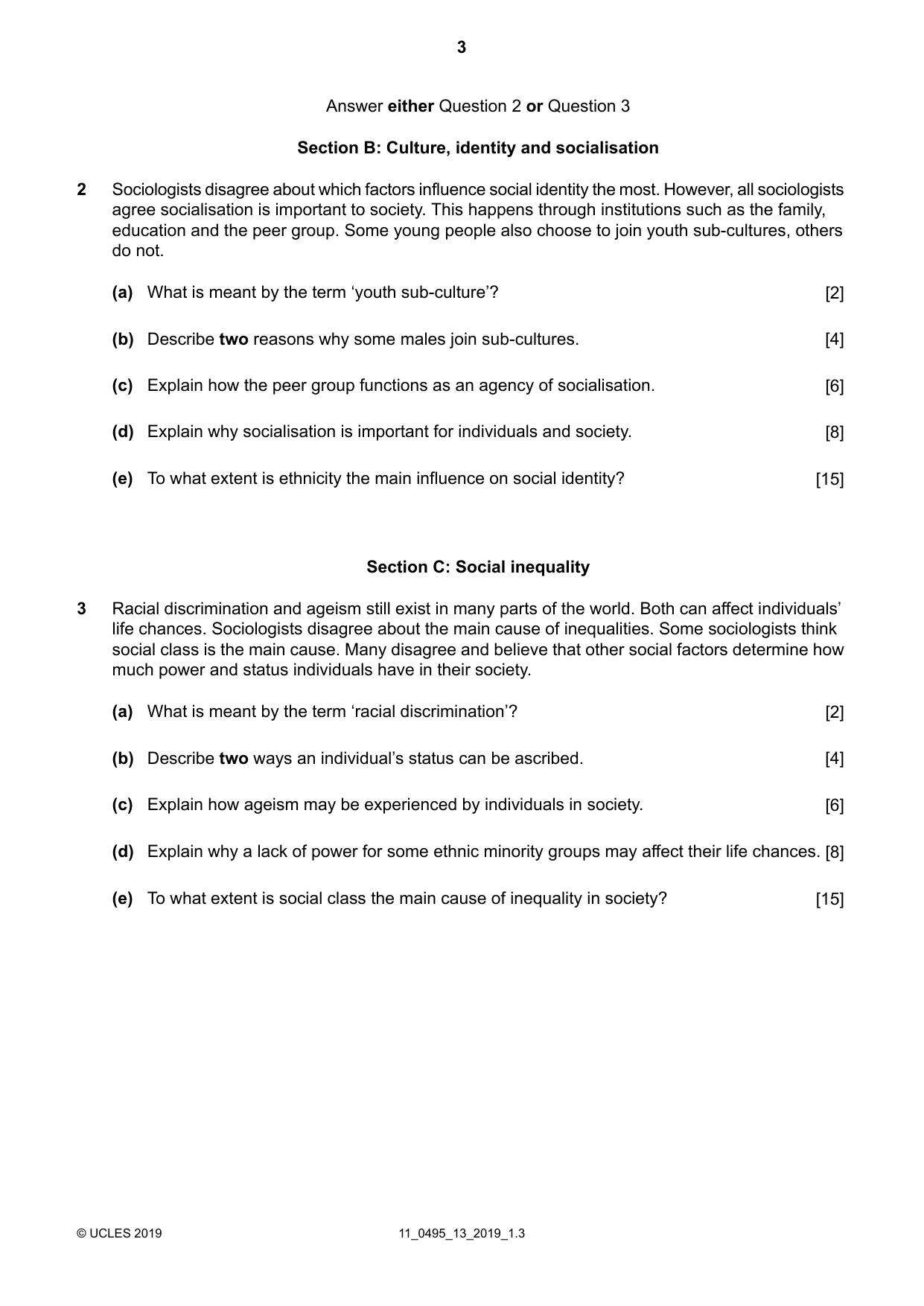
Question paper, page 3
Answer either Question 2 or Question 3 Section B: Culture, identity and socialisation Sociologists disagree about which factors influence social identity the most. However, all sociologists agree socialisation is important to society. This happens through institutions such as the family, 2 education and the peer group. Some young people also choose to join youth sub-cultures, others do not. What is meant by the term ‘youth sub-culture’? (a) [2] Describe two reasons why some males join sub-cultures. [4] (b) Explain how the peer group functions as an agency of socialisation. (c) [6] Explain why socialisation is important for individuals and society. (d) [8] To what extent is ethnicity the main influence on social identity? (e) [15] Section C: Social inequality Racial discrimination and ageism still exist in many parts of the world. Both can affect individuals’ life chances. Sociologists disagree about the main cause of inequalities. Some sociologists think 3 social class is the main cause. Many disagree and believe that other social factors determine how much power and status individuals have in their society. What is meant by the term ‘racial discrimination’? (a) [2] Describe two ways an individual’s status can be ascribed. [4] (b) Explain how ageism may be experienced by individuals in society. (c) [6] Explain why a lack of power for some ethnic minority groups may affect their life chances. (d) [8] To what extent is social class the main cause of inequality in society? (e) [15] 11_0495_13_2019_1.3 © UCLES 2019 3
Question paper, page 4
BLANK PAGE Permission to reproduce items where third-party owned material protected by copyright is included has been sought and cleared where possible. Every reasonable effort has been made by the publisher (UCLES) to trace copyright holders, but if any items requiring clearance have unwittingly been included, the publisher will be pleased to make amends at the earliest possible opportunity. To avoid the issue of disclosure of answer-related information to candidates, all copyright acknowledgements are reproduced online in the Cambridge Assessment International Education Copyright Acknowledgements Booklet. This is produced for each series of examinations and is freely available to download at www.cambridgeinternational.org after the live examination series. Cambridge Assessment International Education is part of the Cambridge Assessment Group. Cambridge Assessment is the brand name of the University of Cambridge Local Examinations Syndicate (UCLES), which itself is a department of the University of Cambridge. 11_0495_13_2019_1.3 © UCLES 2019 4
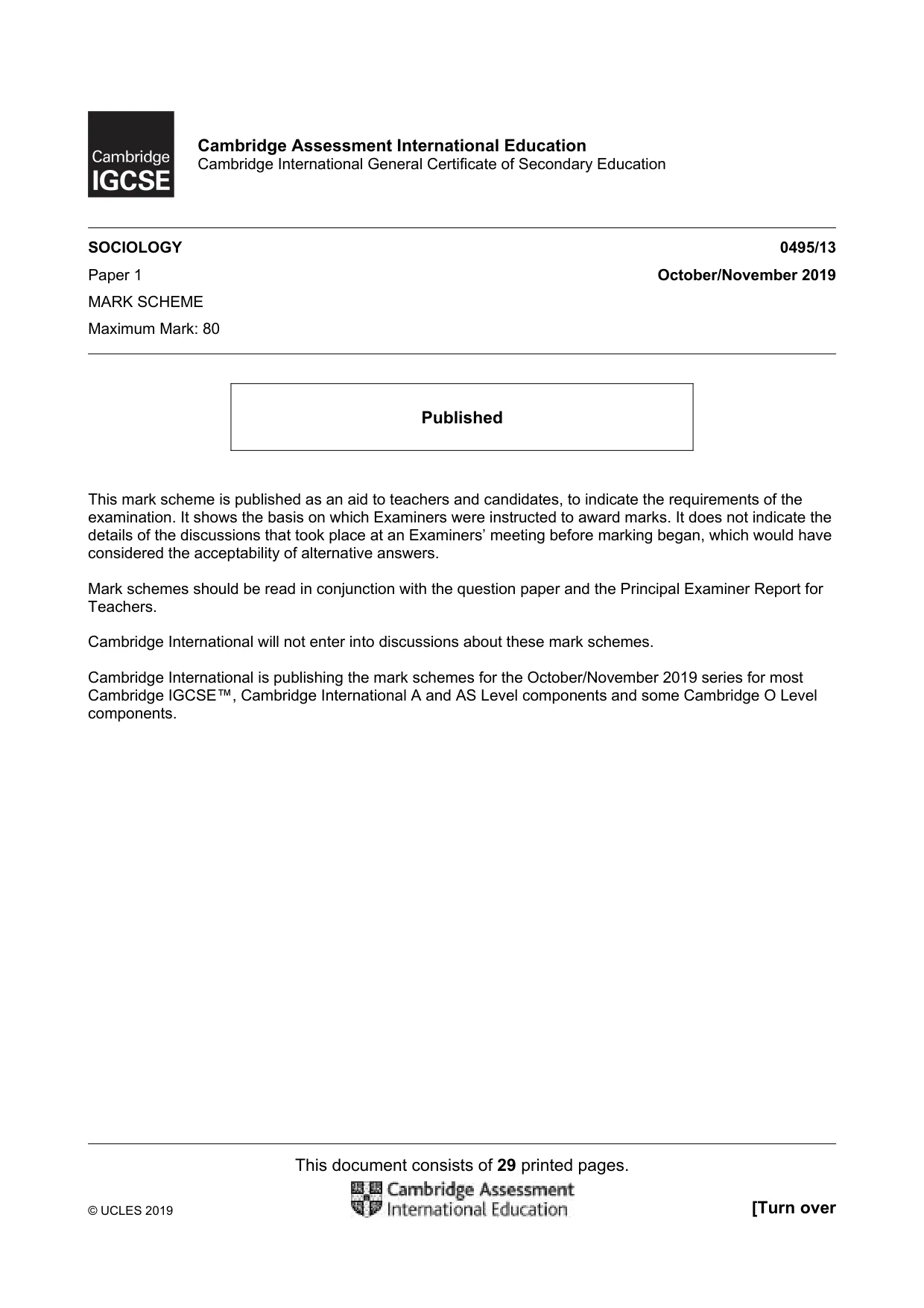
Mark scheme, page 1
This document consists of 29 printed pages. © UCLES 2019 [Turn over Cambridge Assessment International Education Cambridge International General Certificate of Secondary Education SOCIOLOGY 0495/13 Paper 1 October/November 2019 MARK SCHEME Maximum Mark: 80 Published This mark scheme is published as an aid to teachers and candidates, to indicate the requirements of the examination. It shows the basis on which Examiners were instructed to award marks. It does not indicate the details of the discussions that took place at an Examiners’ meeting before marking began, which would have considered the acceptability of alternative answers. Mark schemes should be read in conjunction with the question paper and the Principal Examiner Report for Teachers. Cambridge International will not enter into discussions about these mark schemes. Cambridge International is publishing the mark schemes for the October/November 2019 series for most Cambridge IGCSE™, Cambridge International A and AS Level components and some Cambridge O Level components.
Mark scheme, page 2
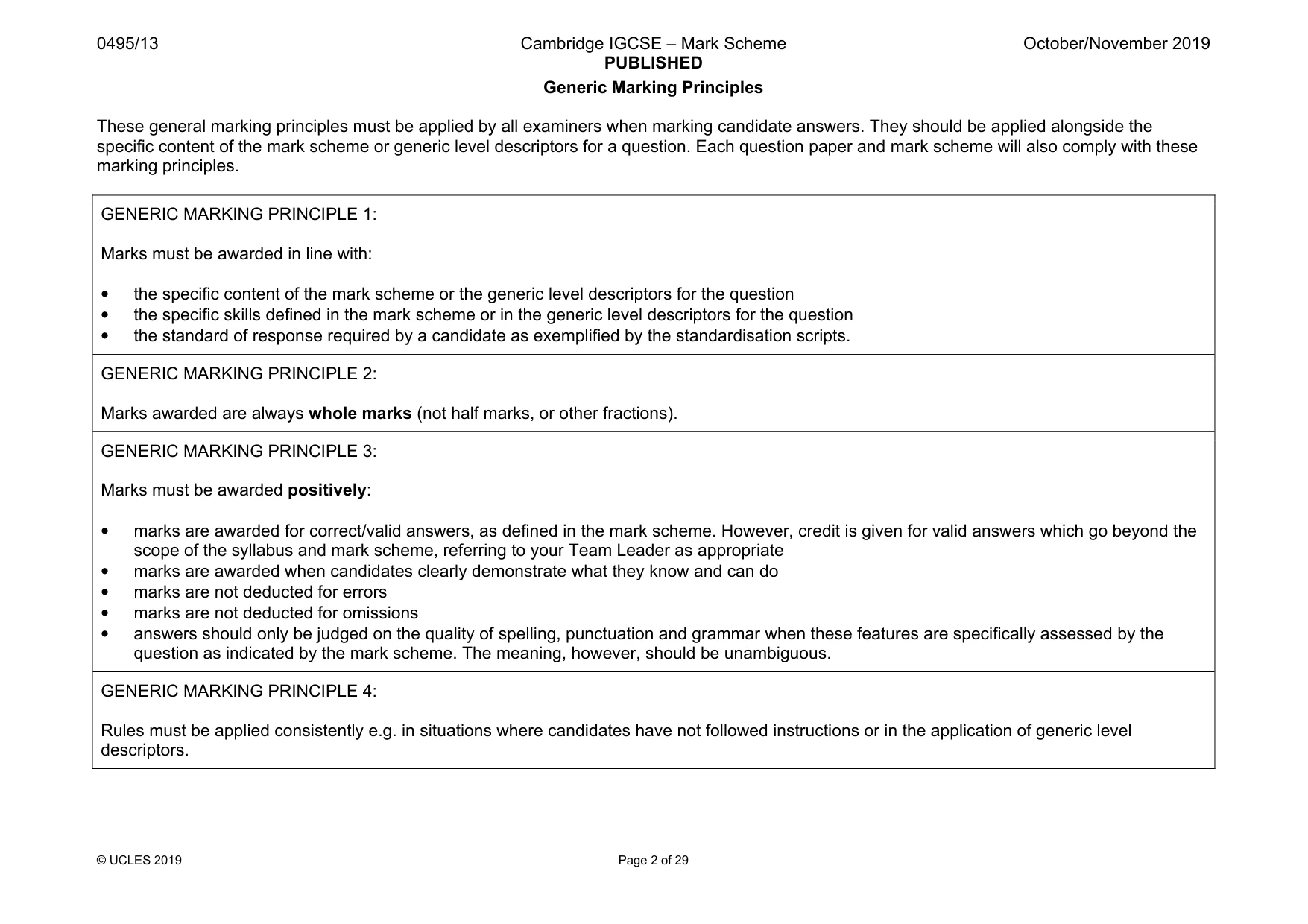
0495/13 Cambridge IGCSE – Mark Scheme PUBLISHED October/November 2019 © UCLES 2019 Page 2 of 29 Generic Marking Principles These general marking principles must be applied by all examiners when marking candidate answers. They should be applied alongside the specific content of the mark scheme or generic level descriptors for a question. Each question paper and mark scheme will also comply with these marking principles. GENERIC MARKING PRINCIPLE 1: Marks must be awarded in line with: • the specific content of the mark scheme or the generic level descriptors for the question • the specific skills defined in the mark scheme or in the generic level descriptors for the question • the standard of response required by a candidate as exemplified by the standardisation scripts. GENERIC MARKING PRINCIPLE 2: Marks awarded are always whole marks (not half marks, or other fractions). GENERIC MARKING PRINCIPLE 3: Marks must be awarded positively: • marks are awarded for correct/valid answers, as defined in the mark scheme. However, credit is given for valid answers which go beyond the scope of the syllabus and mark scheme, referring to your Team Leader as appropriate • marks are awarded when candidates clearly demonstrate what they know and can do • marks are not deducted for errors • marks are not deducted for omissions • answers should only be judged on the quality of spelling, punctuation and grammar when these features are specifically assessed by the question as indicated by the mark scheme. The meaning, however, should be unambiguous. GENERIC MARKING PRINCIPLE 4: Rules must be applied consistently e.g. in situations where candidates have not followed instructions or in the application of generic level descriptors.
Mark scheme, page 3
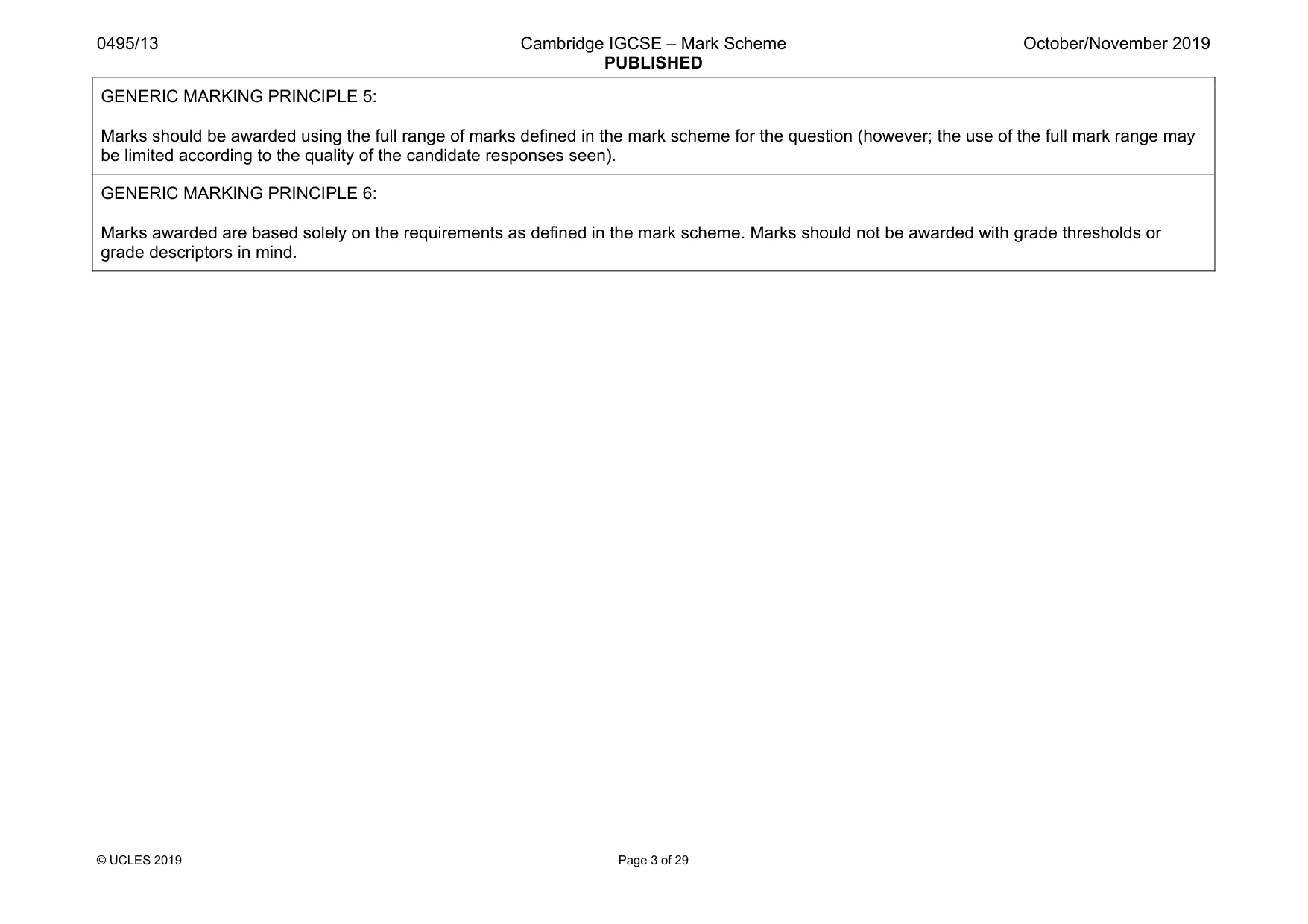
0495/13 Cambridge IGCSE – Mark Scheme PUBLISHED October/November 2019 © UCLES 2019 Page 3 of 29 GENERIC MARKING PRINCIPLE 5: Marks should be awarded using the full range of marks defined in the mark scheme for the question (however; the use of the full mark range may be limited according to the quality of the candidate responses seen). GENERIC MARKING PRINCIPLE 6: Marks awarded are based solely on the requirements as defined in the mark scheme. Marks should not be awarded with grade thresholds or grade descriptors in mind.
Mark scheme, page 4
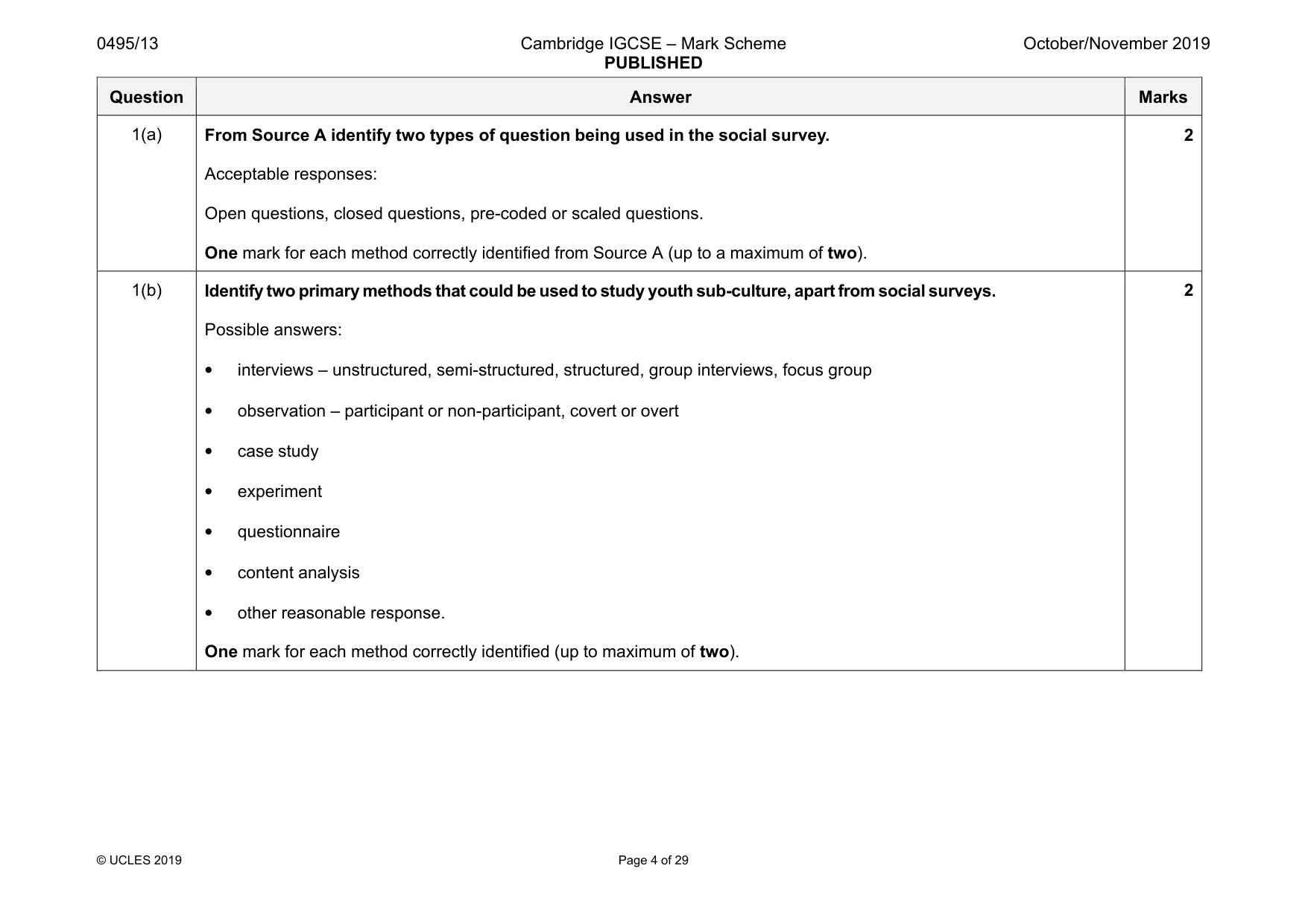
0495/13 Cambridge IGCSE – Mark Scheme PUBLISHED October/November 2019 © UCLES 2019 Page 4 of 29 Question Answer Marks 1(a) From Source A identify two types of question being used in the social survey. Acceptable responses: Open questions, closed questions, pre-coded or scaled questions. One mark for each method correctly identified from Source A (up to a maximum of two). 2 1(b) Identify two primary methods that could be used to study youth sub-culture, apart from social surveys. Possible answers: • interviews – unstructured, semi-structured, structured, group interviews, focus group • observation – participant or non-participant, covert or overt • case study • experiment • questionnaire • content analysis • other reasonable response. One mark for each method correctly identified (up to maximum of two). 2
Mark scheme, page 5
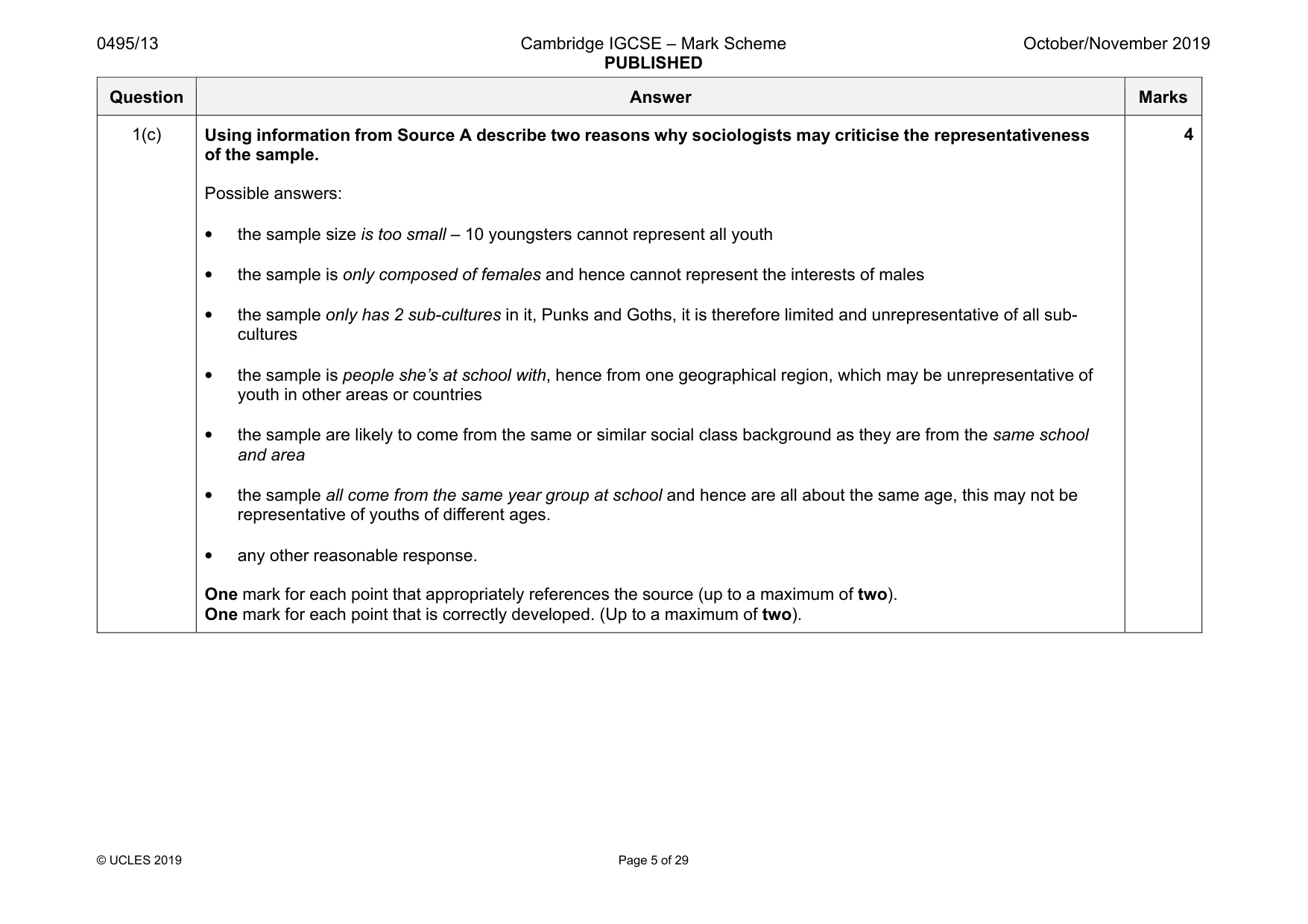
0495/13 Cambridge IGCSE – Mark Scheme PUBLISHED October/November 2019 © UCLES 2019 Page 5 of 29 Question Answer Marks 1(c) Using information from Source A describe two reasons why sociologists may criticise the representativeness of the sample. Possible answers: • the sample size is too small – 10 youngsters cannot represent all youth • the sample is only composed of females and hence cannot represent the interests of males • the sample only has 2 sub-cultures in it, Punks and Goths, it is therefore limited and unrepresentative of all sub- cultures • the sample is people she’s at school with, hence from one geographical region, which may be unrepresentative of youth in other areas or countries • the sample are likely to come from the same or similar social class background as they are from the same school and area • the sample all come from the same year group at school and hence are all about the same age, this may not be representative of youths of different ages. • any other reasonable response. One mark for each point that appropriately references the source (up to a maximum of two). One mark for each point that is correctly developed. (Up to a maximum of two). 4
Mark scheme, page 6
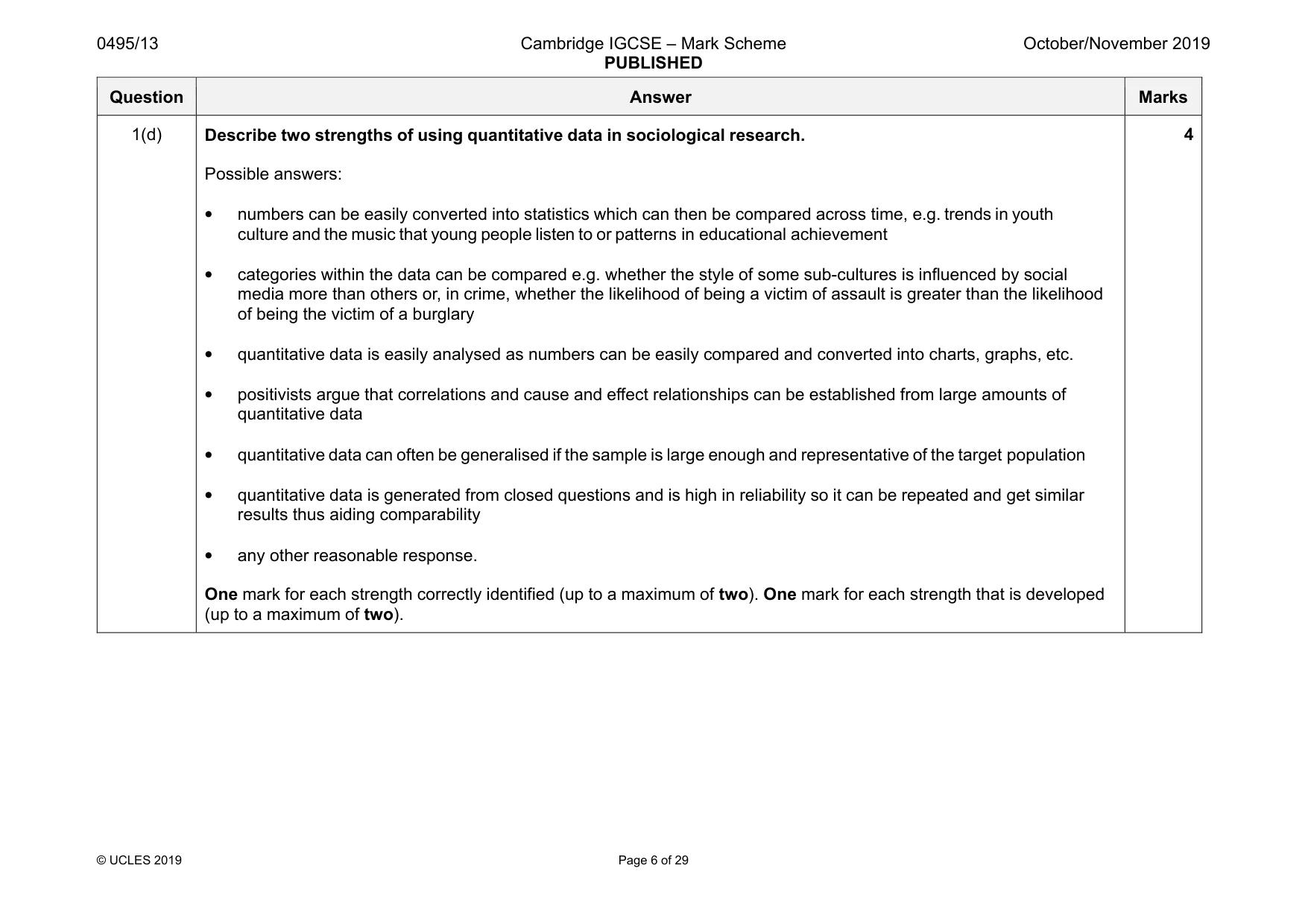
0495/13 Cambridge IGCSE – Mark Scheme PUBLISHED October/November 2019 © UCLES 2019 Page 6 of 29 Question Answer Marks 1(d) Describe two strengths of using quantitative data in sociological research. Possible answers: • numbers can be easily converted into statistics which can then be compared across time, e.g. trends in youth culture and the music that young people listen to or patterns in educational achievement • categories within the data can be compared e.g. whether the style of some sub-cultures is influenced by social media more than others or, in crime, whether the likelihood of being a victim of assault is greater than the likelihood of being the victim of a burglary • quantitative data is easily analysed as numbers can be easily compared and converted into charts, graphs, etc. • positivists argue that correlations and cause and effect relationships can be established from large amounts of quantitative data • quantitative data can often be generalised if the sample is large enough and representative of the target population • quantitative data is generated from closed questions and is high in reliability so it can be repeated and get similar results thus aiding comparability • any other reasonable response. One mark for each strength correctly identified (up to a maximum of two). One mark for each strength that is developed (up to a maximum of two). 4
Mark scheme, page 7
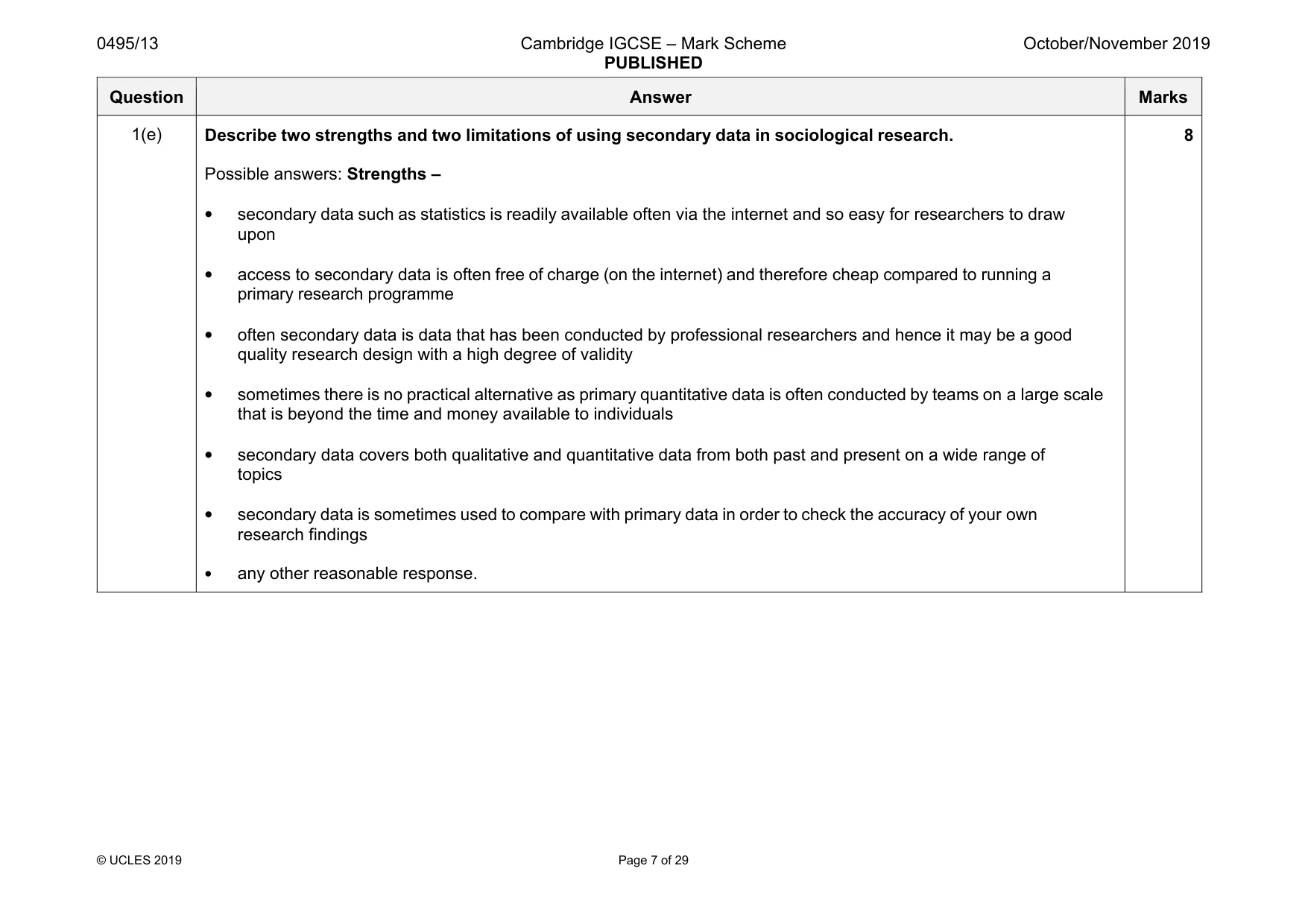
0495/13 Cambridge IGCSE – Mark Scheme PUBLISHED October/November 2019 © UCLES 2019 Page 7 of 29 Question Answer Marks 1(e) Describe two strengths and two limitations of using secondary data in sociological research. Possible answers: Strengths – • secondary data such as statistics is readily available often via the internet and so easy for researchers to draw upon • access to secondary data is often free of charge (on the internet) and therefore cheap compared to running a primary research programme • often secondary data is data that has been conducted by professional researchers and hence it may be a good quality research design with a high degree of validity • sometimes there is no practical alternative as primary quantitative data is often conducted by teams on a large scale that is beyond the time and money available to individuals • secondary data covers both qualitative and quantitative data from both past and present on a wide range of topics • secondary data is sometimes used to compare with primary data in order to check the accuracy of your own research findings • any other reasonable response. 8
Mark scheme, page 8
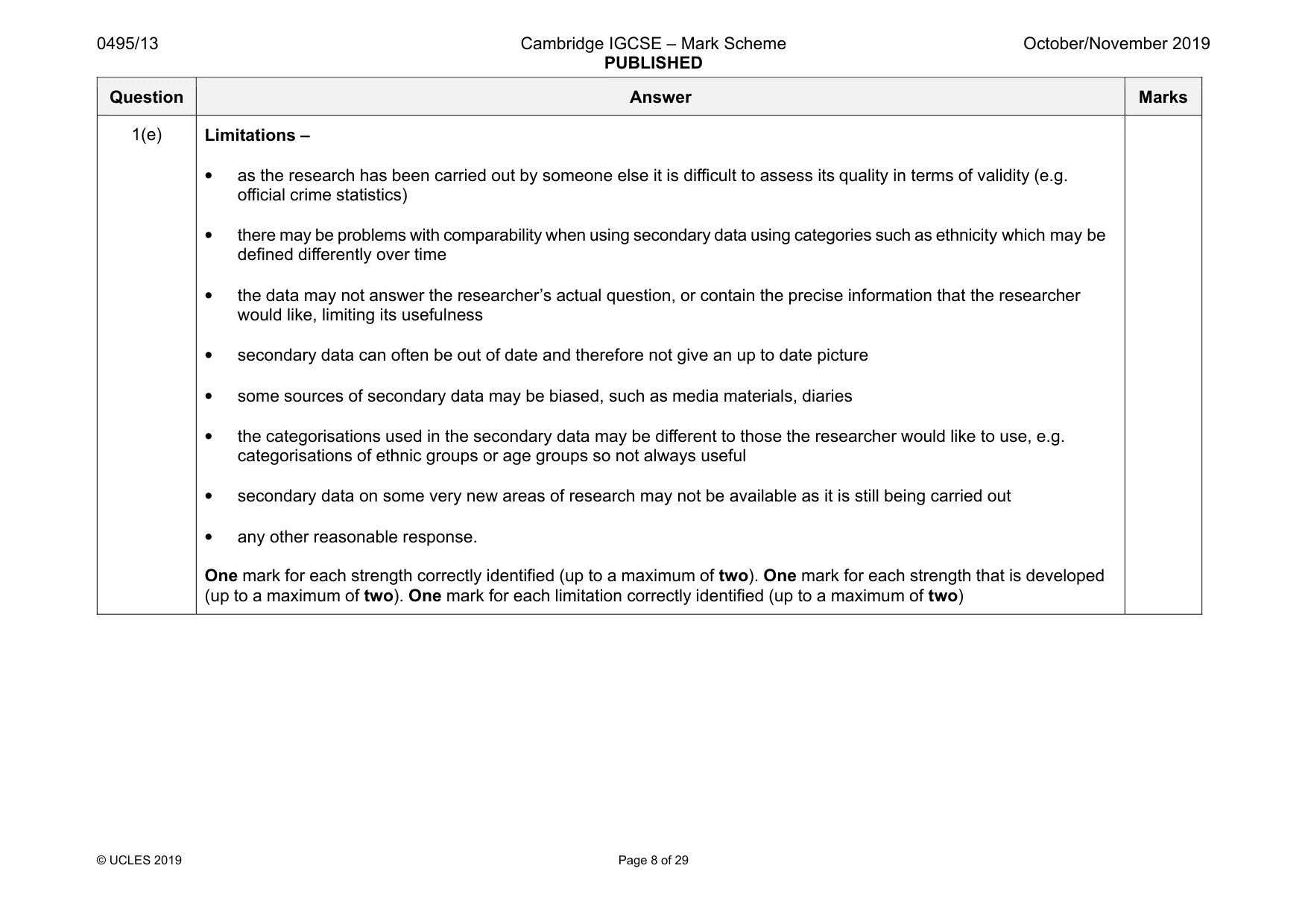
0495/13 Cambridge IGCSE – Mark Scheme PUBLISHED October/November 2019 © UCLES 2019 Page 8 of 29 Question Answer Marks 1(e) Limitations – • as the research has been carried out by someone else it is difficult to assess its quality in terms of validity (e.g. official crime statistics) • there may be problems with comparability when using secondary data using categories such as ethnicity which may be defined differently over time • the data may not answer the researcher’s actual question, or contain the precise information that the researcher would like, limiting its usefulness • secondary data can often be out of date and therefore not give an up to date picture • some sources of secondary data may be biased, such as media materials, diaries • the categorisations used in the secondary data may be different to those the researcher would like to use, e.g. categorisations of ethnic groups or age groups so not always useful • secondary data on some very new areas of research may not be available as it is still being carried out • any other reasonable response. One mark for each strength correctly identified (up to a maximum of two). One mark for each strength that is developed (up to a maximum of two). One mark for each limitation correctly identified (up to a maximum of two)
Mark scheme, page 9
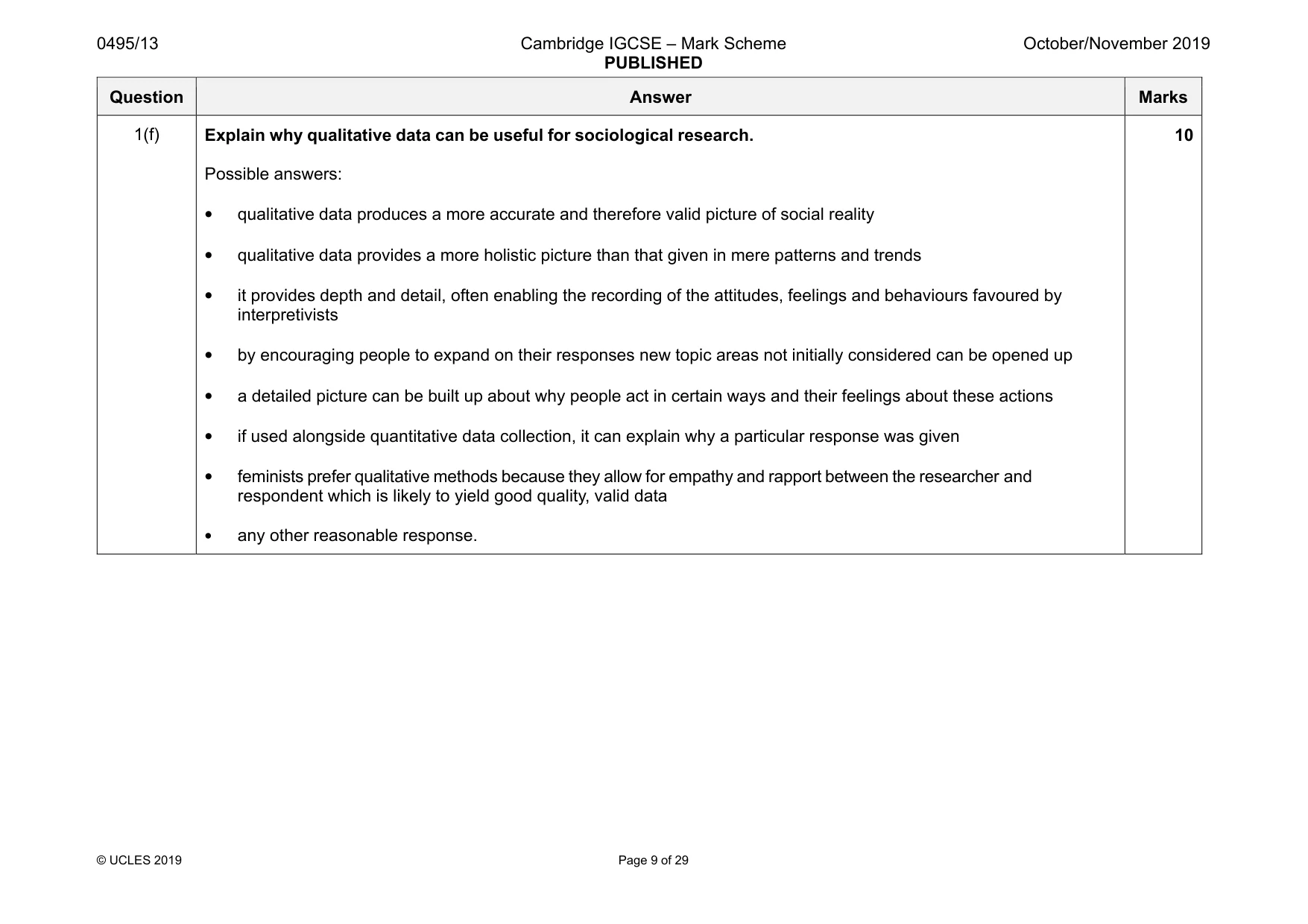
0495/13 Cambridge IGCSE – Mark Scheme PUBLISHED October/November 2019 © UCLES 2019 Page 9 of 29 Question Answer Marks 1(f) Explain why qualitative data can be useful for sociological research. Possible answers: • qualitative data produces a more accurate and therefore valid picture of social reality • qualitative data provides a more holistic picture than that given in mere patterns and trends • it provides depth and detail, often enabling the recording of the attitudes, feelings and behaviours favoured by interpretivists • by encouraging people to expand on their responses new topic areas not initially considered can be opened up • a detailed picture can be built up about why people act in certain ways and their feelings about these actions • if used alongside quantitative data collection, it can explain why a particular response was given • feminists prefer qualitative methods because they allow for empathy and rapport between the researcher and respondent which is likely to yield good quality, valid data • any other reasonable response. 10
Mark scheme, page 10
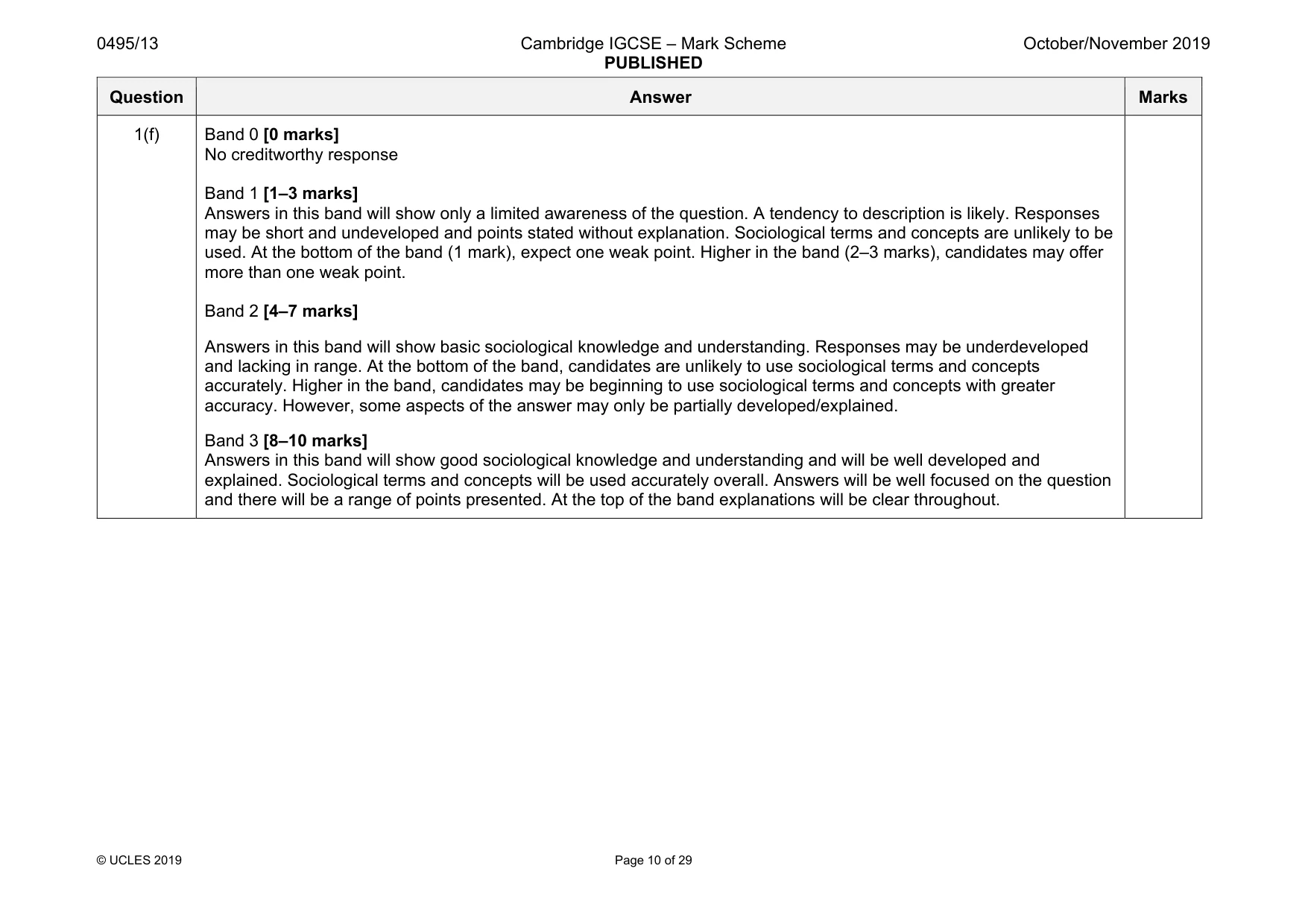
0495/13 Cambridge IGCSE – Mark Scheme PUBLISHED October/November 2019 © UCLES 2019 Page 10 of 29 Question Answer Marks 1(f) Band 0 [0 marks] No creditworthy response Band 1 [1–3 marks] Answers in this band will show only a limited awareness of the question. A tendency to description is likely. Responses may be short and undeveloped and points stated without explanation. Sociological terms and concepts are unlikely to be used. At the bottom of the band (1 mark), expect one weak point. Higher in the band (2–3 marks), candidates may offer more than one weak point. Band 2 [4–7 marks] Answers in this band will show basic sociological knowledge and understanding. Responses may be underdeveloped and lacking in range. At the bottom of the band, candidates are unlikely to use sociological terms and concepts accurately. Higher in the band, candidates may be beginning to use sociological terms and concepts with greater accuracy. However, some aspects of the answer may only be partially developed/explained. Band 3 [8–10 marks] Answers in this band will show good sociological knowledge and understanding and will be well developed and explained. Sociological terms and concepts will be used accurately overall. Answers will be well focused on the question and there will be a range of points presented. At the top of the band explanations will be clear throughout.
Mark scheme, page 11
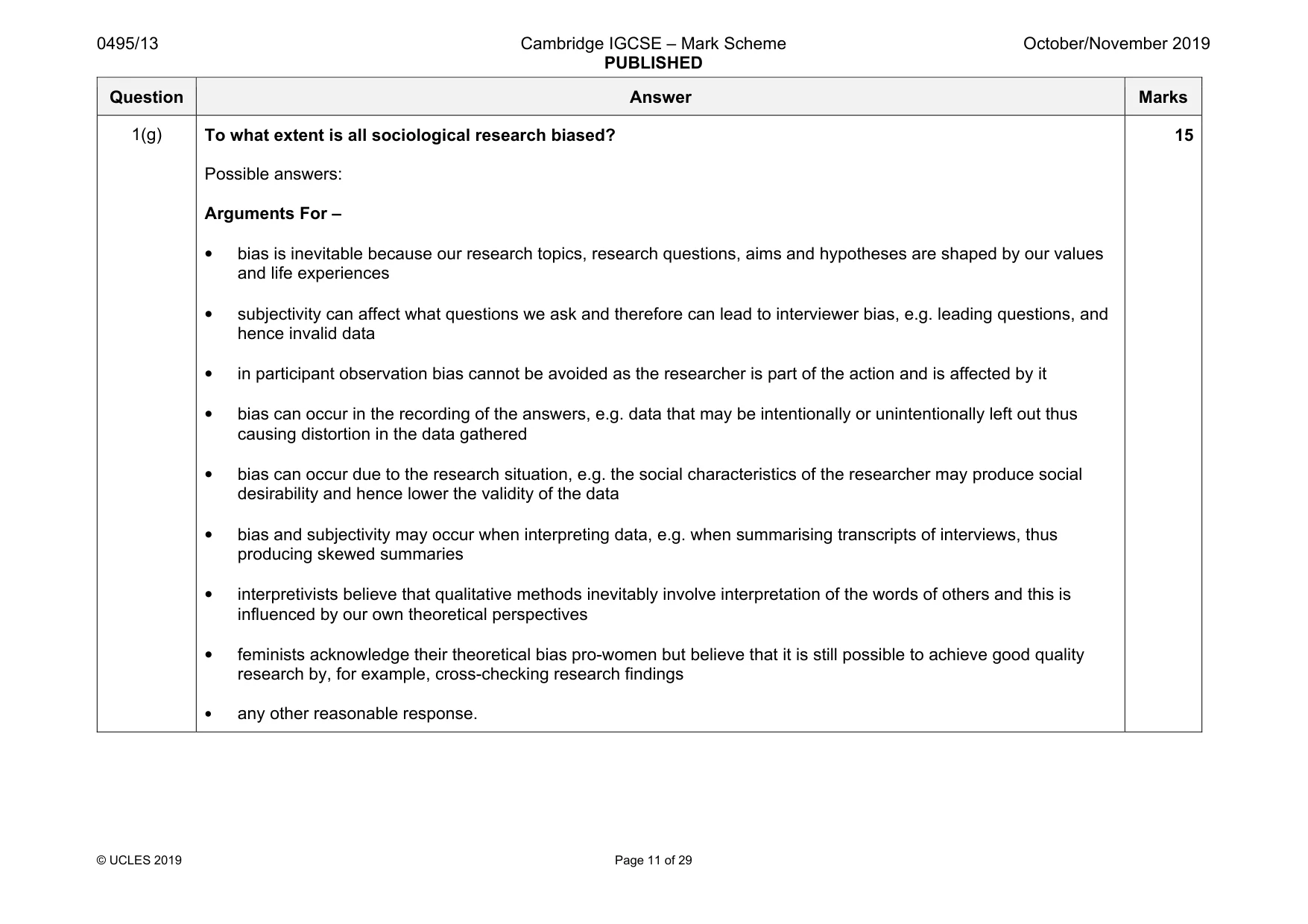
0495/13 Cambridge IGCSE – Mark Scheme PUBLISHED October/November 2019 © UCLES 2019 Page 11 of 29 Question Answer Marks 1(g) To what extent is all sociological research biased? Possible answers: Arguments For – • bias is inevitable because our research topics, research questions, aims and hypotheses are shaped by our values and life experiences • subjectivity can affect what questions we ask and therefore can lead to interviewer bias, e.g. leading questions, and hence invalid data • in participant observation bias cannot be avoided as the researcher is part of the action and is affected by it • bias can occur in the recording of the answers, e.g. data that may be intentionally or unintentionally left out thus causing distortion in the data gathered • bias can occur due to the research situation, e.g. the social characteristics of the researcher may produce social desirability and hence lower the validity of the data • bias and subjectivity may occur when interpreting data, e.g. when summarising transcripts of interviews, thus producing skewed summaries • interpretivists believe that qualitative methods inevitably involve interpretation of the words of others and this is influenced by our own theoretical perspectives • feminists acknowledge their theoretical bias pro-women but believe that it is still possible to achieve good quality research by, for example, cross-checking research findings • any other reasonable response. 15
Mark scheme, page 12
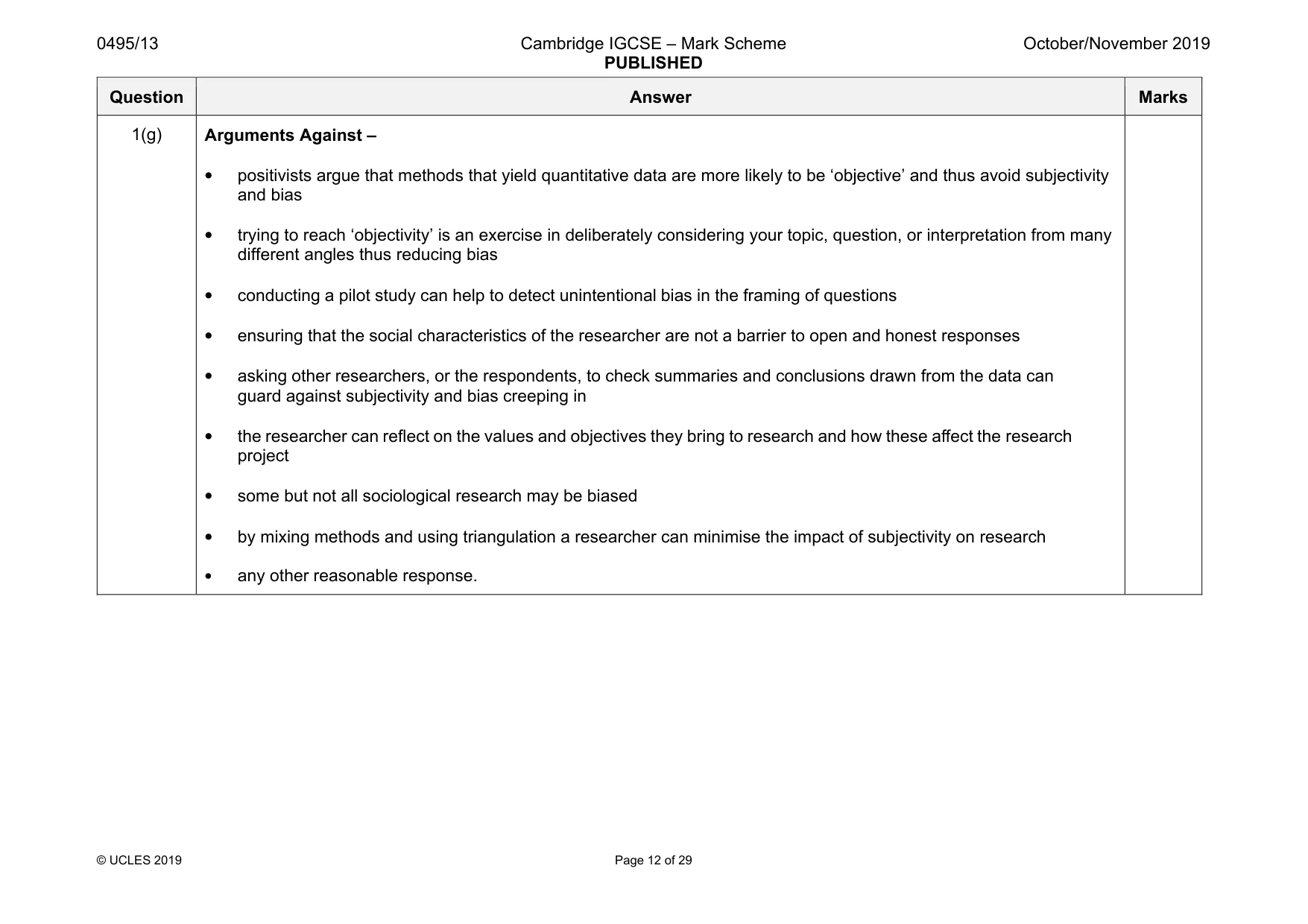
0495/13 Cambridge IGCSE – Mark Scheme PUBLISHED October/November 2019 © UCLES 2019 Page 12 of 29 Question Answer Marks 1(g) Arguments Against – • positivists argue that methods that yield quantitative data are more likely to be ‘objective’ and thus avoid subjectivity and bias • trying to reach ‘objectivity’ is an exercise in deliberately considering your topic, question, or interpretation from many different angles thus reducing bias • conducting a pilot study can help to detect unintentional bias in the framing of questions • ensuring that the social characteristics of the researcher are not a barrier to open and honest responses • asking other researchers, or the respondents, to check summaries and conclusions drawn from the data can guard against subjectivity and bias creeping in • the researcher can reflect on the values and objectives they bring to research and how these affect the research project • some but not all sociological research may be biased • by mixing methods and using triangulation a researcher can minimise the impact of subjectivity on research • any other reasonable response.
Mark scheme, page 13
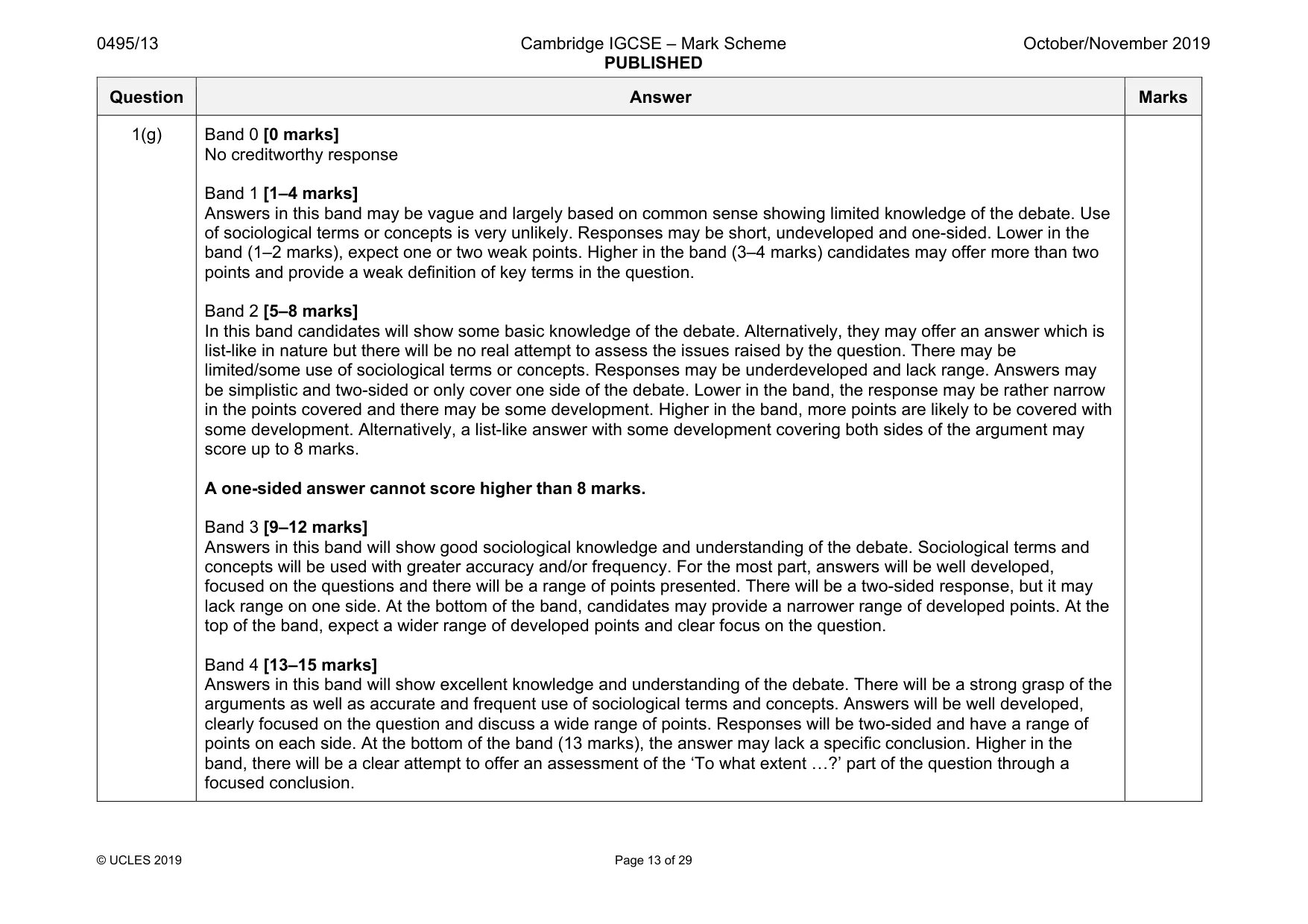
0495/13 Cambridge IGCSE – Mark Scheme PUBLISHED October/November 2019 © UCLES 2019 Page 13 of 29 Question Answer Marks 1(g) Band 0 [0 marks] No creditworthy response Band 1 [1–4 marks] Answers in this band may be vague and largely based on common sense showing limited knowledge of the debate. Use of sociological terms or concepts is very unlikely. Responses may be short, undeveloped and one-sided. Lower in the band (1–2 marks), expect one or two weak points. Higher in the band (3–4 marks) candidates may offer more than two points and provide a weak definition of key terms in the question. Band 2 [5–8 marks] In this band candidates will show some basic knowledge of the debate. Alternatively, they may offer an answer which is list-like in nature but there will be no real attempt to assess the issues raised by the question. There may be limited/some use of sociological terms or concepts. Responses may be underdeveloped and lack range. Answers may be simplistic and two-sided or only cover one side of the debate. Lower in the band, the response may be rather narrow in the points covered and there may be some development. Higher in the band, more points are likely to be covered with some development. Alternatively, a list-like answer with some development covering both sides of the argument may score up to 8 marks. A one-sided answer cannot score higher than 8 marks. Band 3 [9–12 marks] Answers in this band will show good sociological knowledge and understanding of the debate. Sociological terms and concepts will be used with greater accuracy and/or frequency. For the most part, answers will be well developed, focused on the questions and there will be a range of points presented. There will be a two-sided response, but it may lack range on one side. At the bottom of the band, candidates may provide a narrower range of developed points. At the top of the band, expect a wider range of developed points and clear focus on the question. Band 4 [13–15 marks] Answers in this band will show excellent knowledge and understanding of the debate. There will be a strong grasp of the arguments as well as accurate and frequent use of sociological terms and concepts. Answers will be well developed, clearly focused on the question and discuss a wide range of points. Responses will be two-sided and have a range of points on each side. At the bottom of the band (13 marks), the answer may lack a specific conclusion. Higher in the band, there will be a clear attempt to offer an assessment of the ‘To what extent «?’ part of the question through a focused conclusion.
Mark scheme, page 14
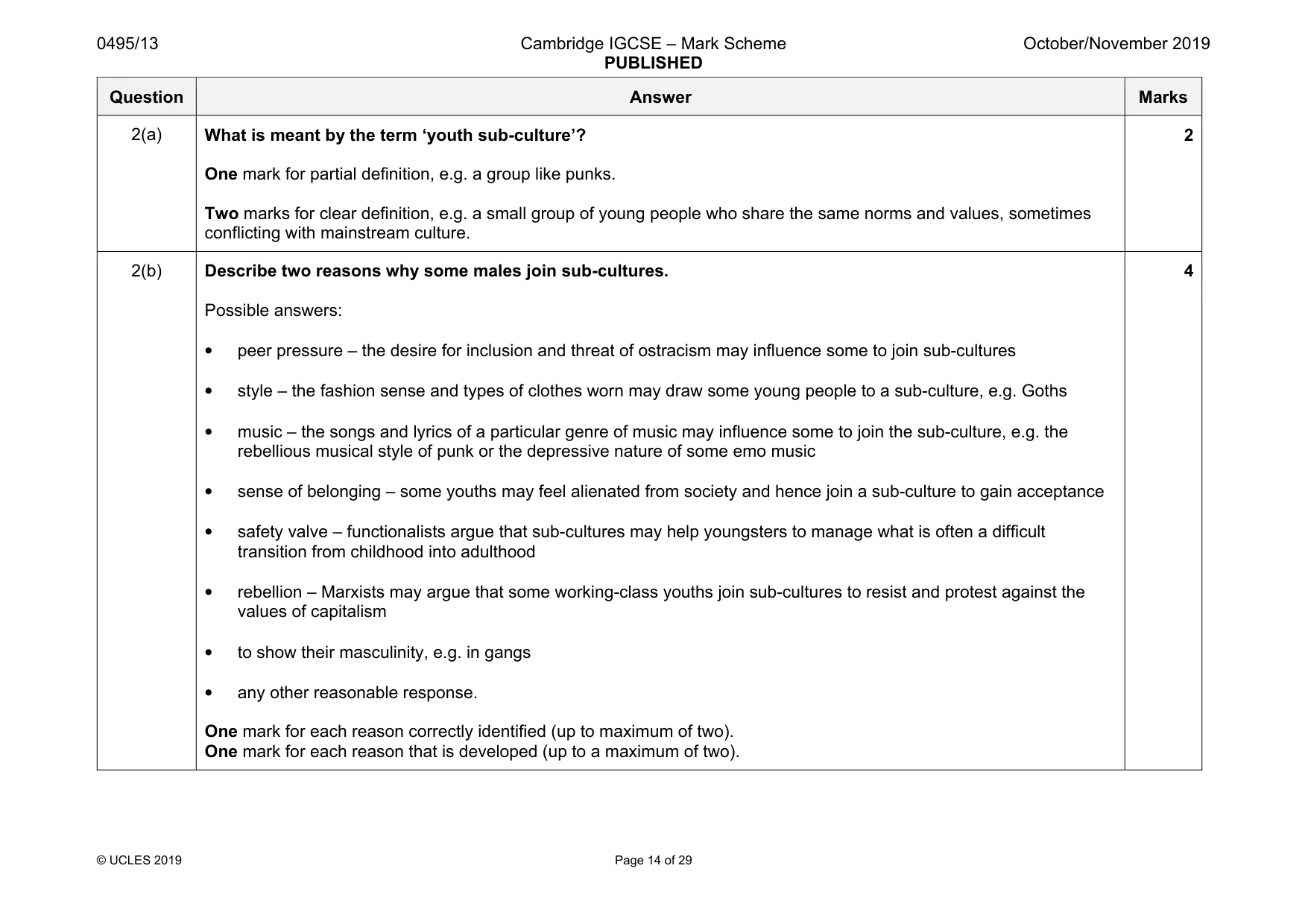
0495/13 Cambridge IGCSE – Mark Scheme PUBLISHED October/November 2019 © UCLES 2019 Page 14 of 29 Question Answer Marks 2(a) What is meant by the term ‘youth sub-culture’? One mark for partial definition, e.g. a group like punks. Two marks for clear definition, e.g. a small group of young people who share the same norms and values, sometimes conflicting with mainstream culture. 2 2(b) Describe two reasons why some males join sub-cultures. Possible answers: • peer pressure – the desire for inclusion and threat of ostracism may influence some to join sub-cultures • style – the fashion sense and types of clothes worn may draw some young people to a sub-culture, e.g. Goths • music – the songs and lyrics of a particular genre of music may influence some to join the sub-culture, e.g. the rebellious musical style of punk or the depressive nature of some emo music • sense of belonging – some youths may feel alienated from society and hence join a sub-culture to gain acceptance • safety valve – functionalists argue that sub-cultures may help youngsters to manage what is often a difficult transition from childhood into adulthood • rebellion – Marxists may argue that some working-class youths join sub-cultures to resist and protest against the values of capitalism • to show their masculinity, e.g. in gangs • any other reasonable response. One mark for each reason correctly identified (up to maximum of two). One mark for each reason that is developed (up to a maximum of two). 4
Mark scheme, page 15
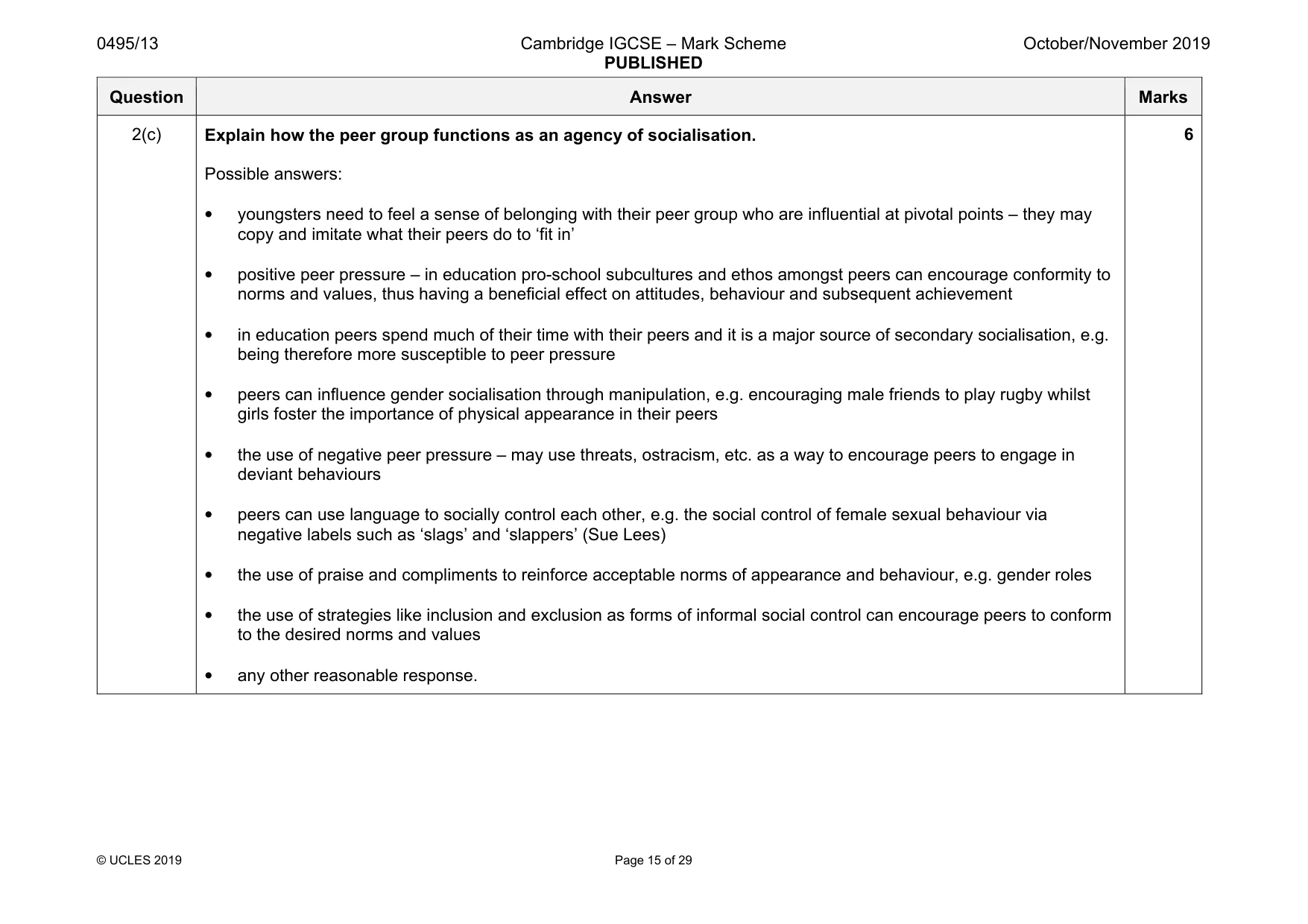
0495/13 Cambridge IGCSE – Mark Scheme PUBLISHED October/November 2019 © UCLES 2019 Page 15 of 29 Question Answer Marks 2(c) Explain how the peer group functions as an agency of socialisation. Possible answers: • youngsters need to feel a sense of belonging with their peer group who are influential at pivotal points – they may copy and imitate what their peers do to ‘fit in’ • positive peer pressure – in education pro-school subcultures and ethos amongst peers can encourage conformity to norms and values, thus having a beneficial effect on attitudes, behaviour and subsequent achievement • in education peers spend much of their time with their peers and it is a major source of secondary socialisation, e.g. being therefore more susceptible to peer pressure • peers can influence gender socialisation through manipulation, e.g. encouraging male friends to play rugby whilst girls foster the importance of physical appearance in their peers • the use of negative peer pressure – may use threats, ostracism, etc. as a way to encourage peers to engage in deviant behaviours • peers can use language to socially control each other, e.g. the social control of female sexual behaviour via negative labels such as ‘slags’ and ‘slappers’ (Sue Lees) • the use of praise and compliments to reinforce acceptable norms of appearance and behaviour, e.g. gender roles • the use of strategies like inclusion and exclusion as forms of informal social control can encourage peers to conform to the desired norms and values • any other reasonable response. 6
Mark scheme, page 16
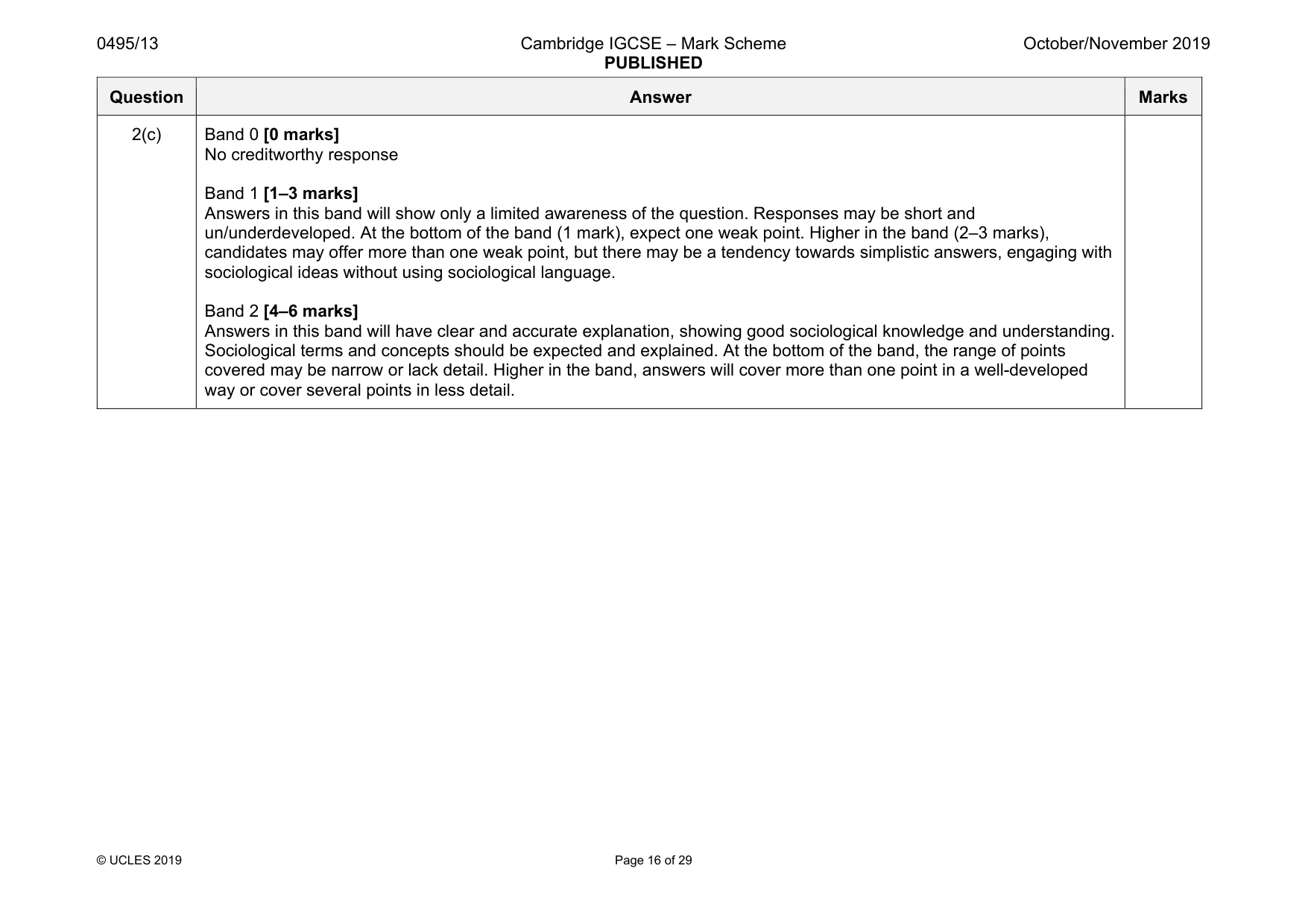
0495/13 Cambridge IGCSE – Mark Scheme PUBLISHED October/November 2019 © UCLES 2019 Page 16 of 29 Question Answer Marks 2(c) Band 0 [0 marks] No creditworthy response Band 1 [1–3 marks] Answers in this band will show only a limited awareness of the question. Responses may be short and un/underdeveloped. At the bottom of the band (1 mark), expect one weak point. Higher in the band (2–3 marks), candidates may offer more than one weak point, but there may be a tendency towards simplistic answers, engaging with sociological ideas without using sociological language. Band 2 [4–6 marks] Answers in this band will have clear and accurate explanation, showing good sociological knowledge and understanding. Sociological terms and concepts should be expected and explained. At the bottom of the band, the range of points covered may be narrow or lack detail. Higher in the band, answers will cover more than one point in a well-developed way or cover several points in less detail.
Mark scheme, page 17
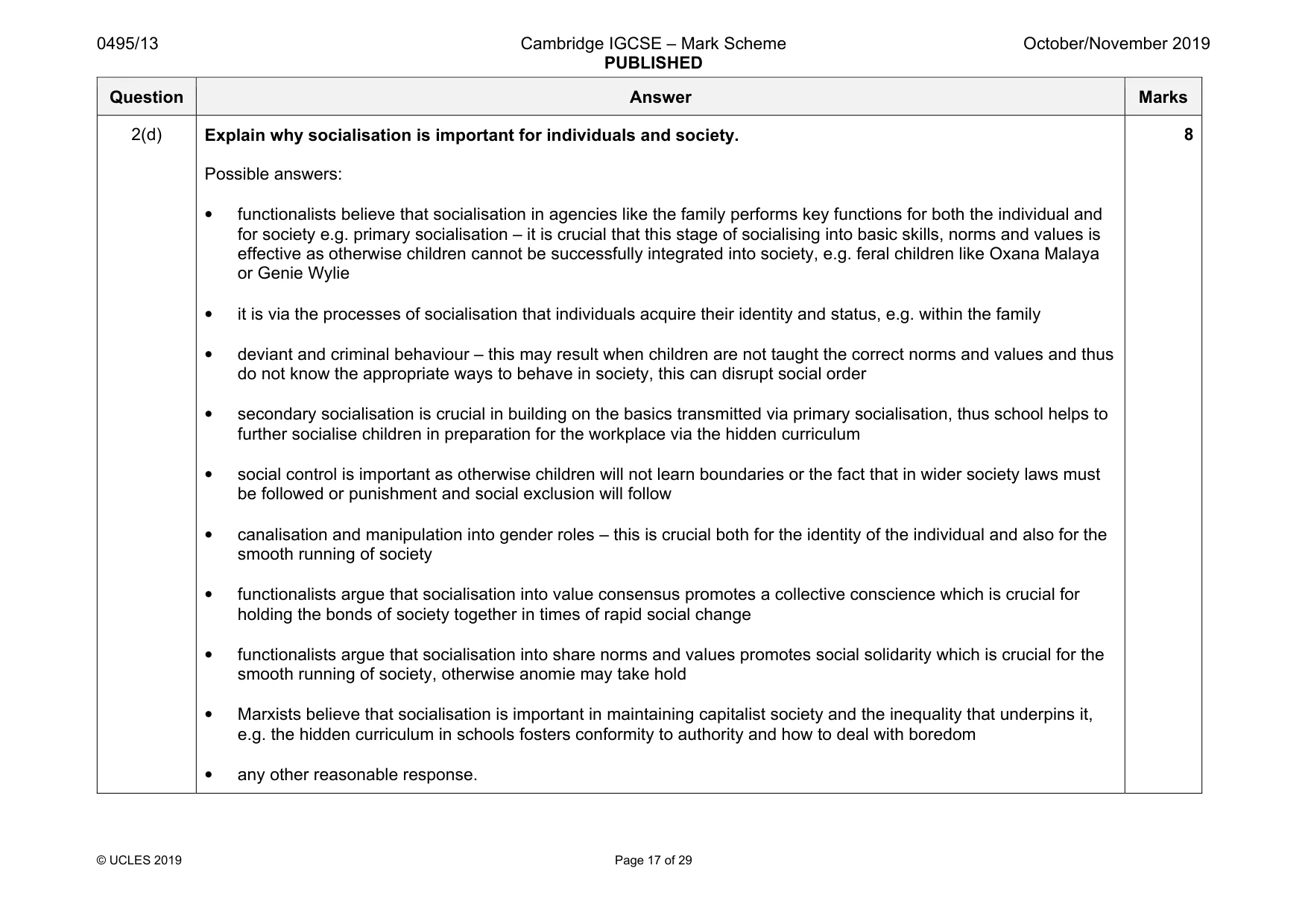
0495/13 Cambridge IGCSE – Mark Scheme PUBLISHED October/November 2019 © UCLES 2019 Page 17 of 29 Question Answer Marks 2(d) Explain why socialisation is important for individuals and society. Possible answers: • functionalists believe that socialisation in agencies like the family performs key functions for both the individual and for society e.g. primary socialisation – it is crucial that this stage of socialising into basic skills, norms and values is effective as otherwise children cannot be successfully integrated into society, e.g. feral children like Oxana Malaya or Genie Wylie • it is via the processes of socialisation that individuals acquire their identity and status, e.g. within the family • deviant and criminal behaviour – this may result when children are not taught the correct norms and values and thus do not know the appropriate ways to behave in society, this can disrupt social order • secondary socialisation is crucial in building on the basics transmitted via primary socialisation, thus school helps to further socialise children in preparation for the workplace via the hidden curriculum • social control is important as otherwise children will not learn boundaries or the fact that in wider society laws must be followed or punishment and social exclusion will follow • canalisation and manipulation into gender roles – this is crucial both for the identity of the individual and also for the smooth running of society • functionalists argue that socialisation into value consensus promotes a collective conscience which is crucial for holding the bonds of society together in times of rapid social change • functionalists argue that socialisation into share norms and values promotes social solidarity which is crucial for the smooth running of society, otherwise anomie may take hold • Marxists believe that socialisation is important in maintaining capitalist society and the inequality that underpins it, e.g. the hidden curriculum in schools fosters conformity to authority and how to deal with boredom • any other reasonable response. 8
Mark scheme, page 18
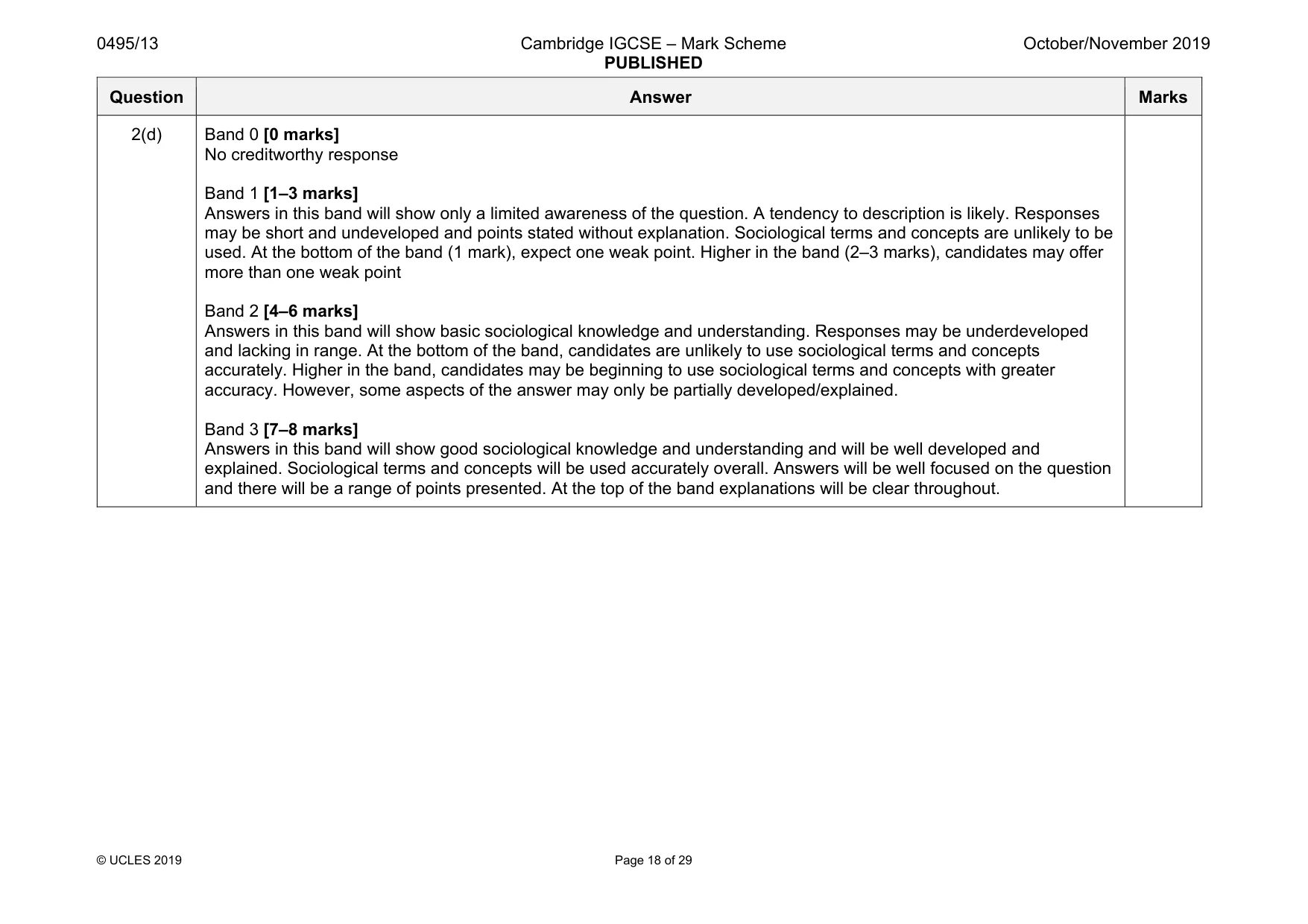
0495/13 Cambridge IGCSE – Mark Scheme PUBLISHED October/November 2019 © UCLES 2019 Page 18 of 29 Question Answer Marks 2(d) Band 0 [0 marks] No creditworthy response Band 1 [1–3 marks] Answers in this band will show only a limited awareness of the question. A tendency to description is likely. Responses may be short and undeveloped and points stated without explanation. Sociological terms and concepts are unlikely to be used. At the bottom of the band (1 mark), expect one weak point. Higher in the band (2–3 marks), candidates may offer more than one weak point Band 2 [4–6 marks] Answers in this band will show basic sociological knowledge and understanding. Responses may be underdeveloped and lacking in range. At the bottom of the band, candidates are unlikely to use sociological terms and concepts accurately. Higher in the band, candidates may be beginning to use sociological terms and concepts with greater accuracy. However, some aspects of the answer may only be partially developed/explained. Band 3 [7–8 marks] Answers in this band will show good sociological knowledge and understanding and will be well developed and explained. Sociological terms and concepts will be used accurately overall. Answers will be well focused on the question and there will be a range of points presented. At the top of the band explanations will be clear throughout.
Mark scheme, page 19
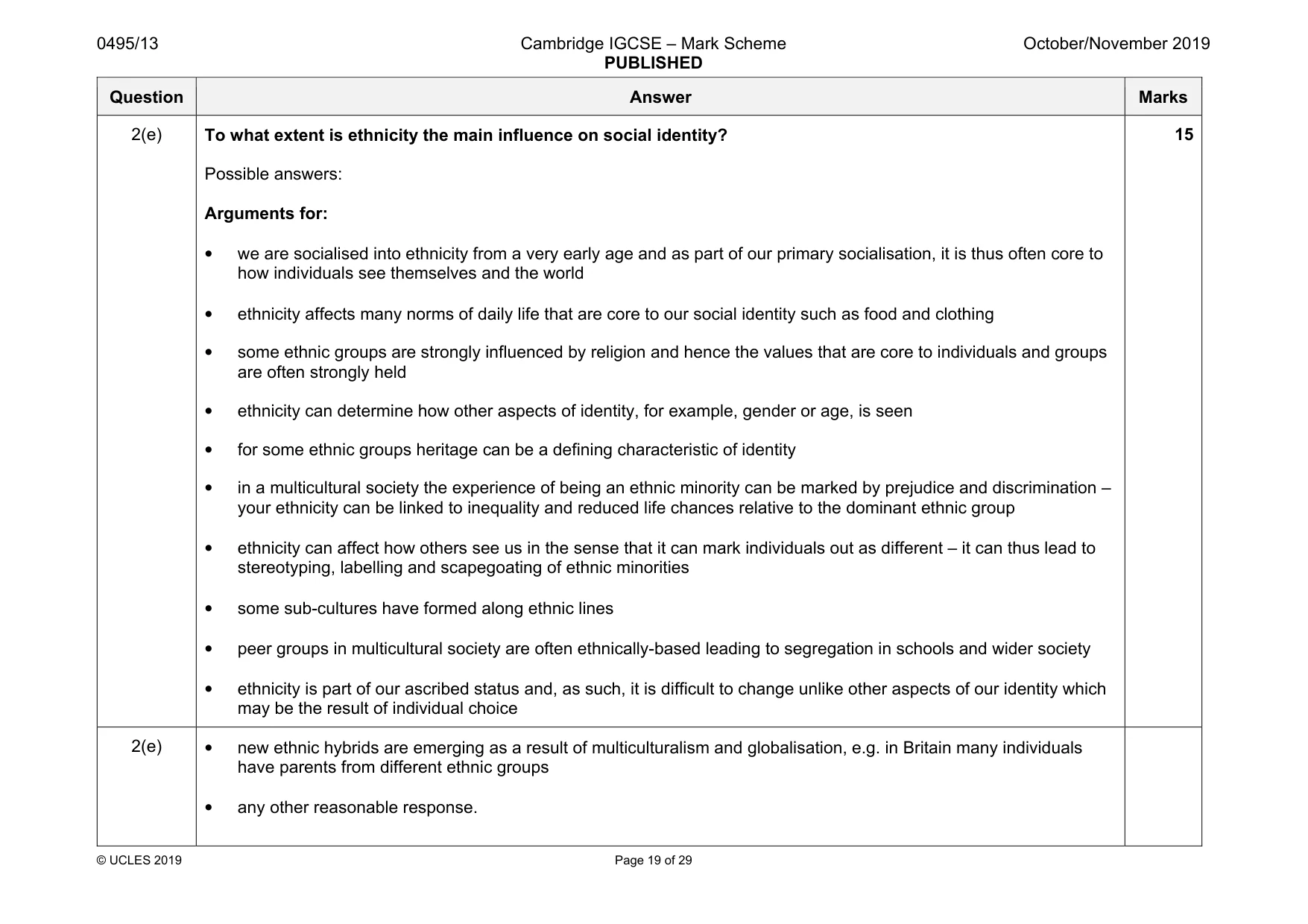
0495/13 Cambridge IGCSE – Mark Scheme PUBLISHED October/November 2019 © UCLES 2019 Page 19 of 29 Question Answer Marks 2(e) To what extent is ethnicity the main influence on social identity? Possible answers: Arguments for: • we are socialised into ethnicity from a very early age and as part of our primary socialisation, it is thus often core to how individuals see themselves and the world • ethnicity affects many norms of daily life that are core to our social identity such as food and clothing • some ethnic groups are strongly influenced by religion and hence the values that are core to individuals and groups are often strongly held • ethnicity can determine how other aspects of identity, for example, gender or age, is seen • for some ethnic groups heritage can be a defining characteristic of identity • in a multicultural society the experience of being an ethnic minority can be marked by prejudice and discrimination – your ethnicity can be linked to inequality and reduced life chances relative to the dominant ethnic group • ethnicity can affect how others see us in the sense that it can mark individuals out as different – it can thus lead to stereotyping, labelling and scapegoating of ethnic minorities • some sub-cultures have formed along ethnic lines • peer groups in multicultural society are often ethnically-based leading to segregation in schools and wider society • ethnicity is part of our ascribed status and, as such, it is difficult to change unlike other aspects of our identity which may be the result of individual choice 15 2(e) • new ethnic hybrids are emerging as a result of multiculturalism and globalisation, e.g. in Britain many individuals have parents from different ethnic groups • any other reasonable response.
Mark scheme, page 20
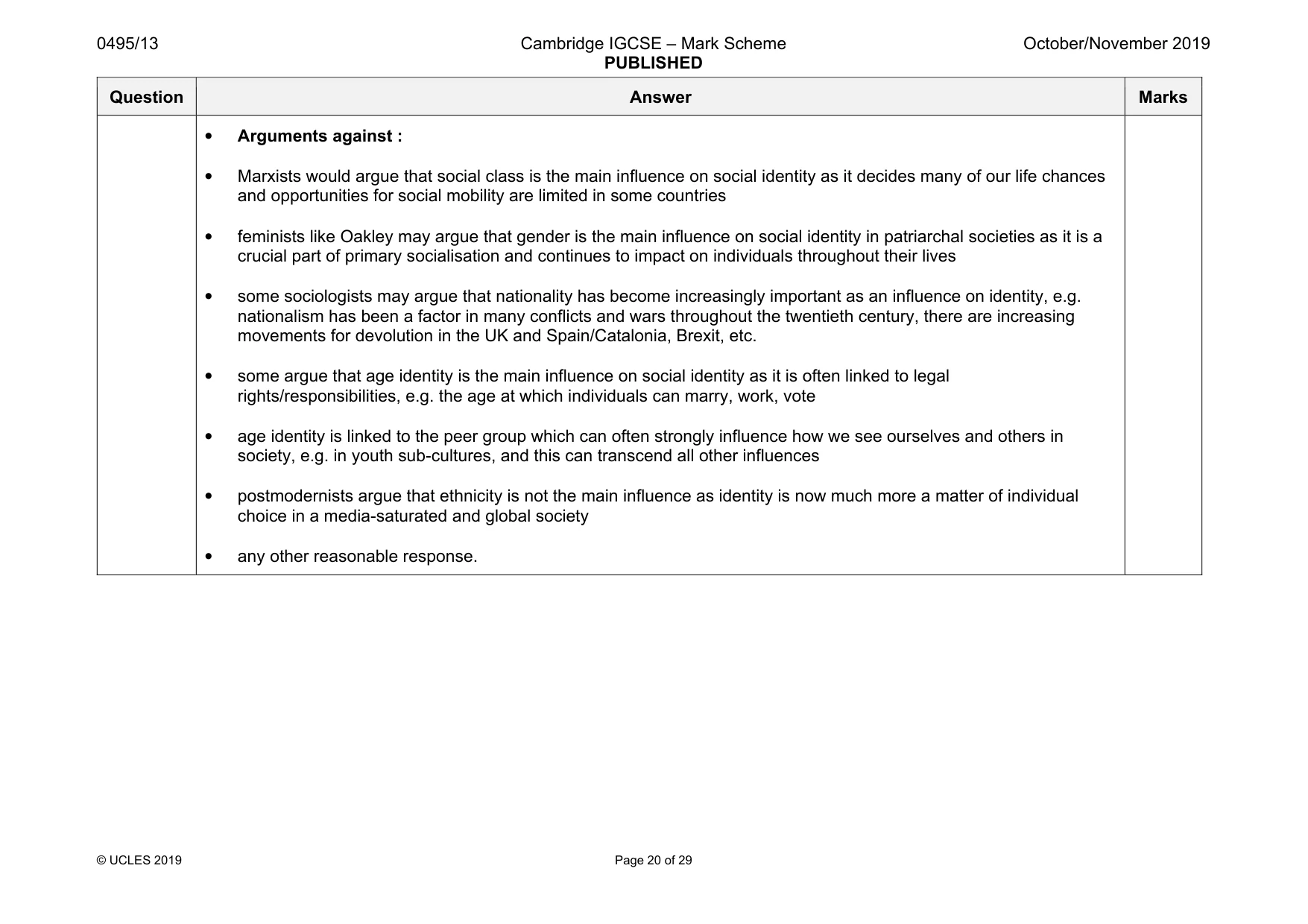
0495/13 Cambridge IGCSE – Mark Scheme PUBLISHED October/November 2019 © UCLES 2019 Page 20 of 29 Question Answer Marks • Arguments against : • Marxists would argue that social class is the main influence on social identity as it decides many of our life chances and opportunities for social mobility are limited in some countries • feminists like Oakley may argue that gender is the main influence on social identity in patriarchal societies as it is a crucial part of primary socialisation and continues to impact on individuals throughout their lives • some sociologists may argue that nationality has become increasingly important as an influence on identity, e.g. nationalism has been a factor in many conflicts and wars throughout the twentieth century, there are increasing movements for devolution in the UK and Spain/Catalonia, Brexit, etc. • some argue that age identity is the main influence on social identity as it is often linked to legal rights/responsibilities, e.g. the age at which individuals can marry, work, vote • age identity is linked to the peer group which can often strongly influence how we see ourselves and others in society, e.g. in youth sub-cultures, and this can transcend all other influences • postmodernists argue that ethnicity is not the main influence as identity is now much more a matter of individual choice in a media-saturated and global society • any other reasonable response.
Mark scheme, page 21
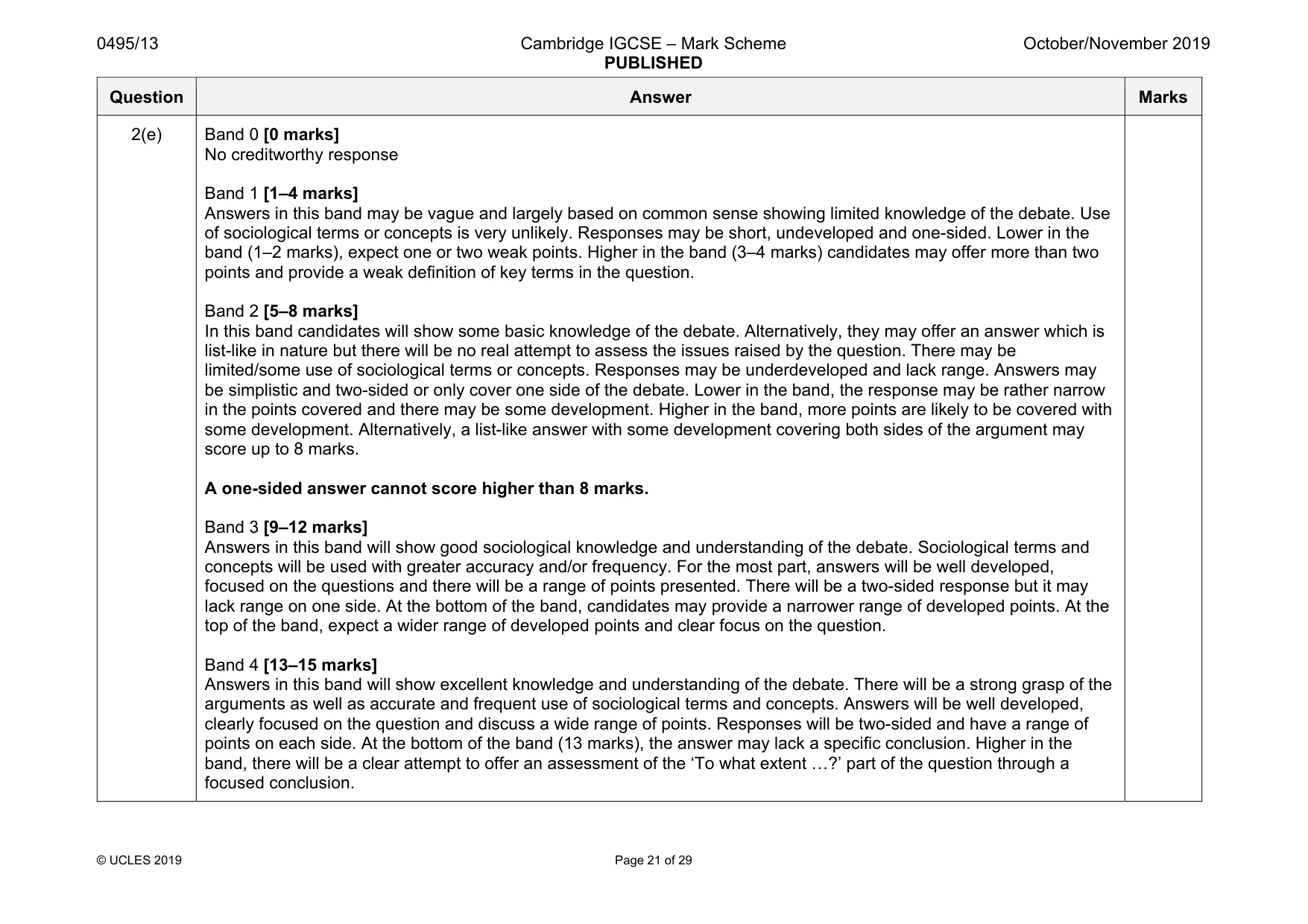
0495/13 Cambridge IGCSE – Mark Scheme PUBLISHED October/November 2019 © UCLES 2019 Page 21 of 29 Question Answer Marks 2(e) Band 0 [0 marks] No creditworthy response Band 1 [1–4 marks] Answers in this band may be vague and largely based on common sense showing limited knowledge of the debate. Use of sociological terms or concepts is very unlikely. Responses may be short, undeveloped and one-sided. Lower in the band (1–2 marks), expect one or two weak points. Higher in the band (3–4 marks) candidates may offer more than two points and provide a weak definition of key terms in the question. Band 2 [5–8 marks] In this band candidates will show some basic knowledge of the debate. Alternatively, they may offer an answer which is list-like in nature but there will be no real attempt to assess the issues raised by the question. There may be limited/some use of sociological terms or concepts. Responses may be underdeveloped and lack range. Answers may be simplistic and two-sided or only cover one side of the debate. Lower in the band, the response may be rather narrow in the points covered and there may be some development. Higher in the band, more points are likely to be covered with some development. Alternatively, a list-like answer with some development covering both sides of the argument may score up to 8 marks. A one-sided answer cannot score higher than 8 marks. Band 3 [9–12 marks] Answers in this band will show good sociological knowledge and understanding of the debate. Sociological terms and concepts will be used with greater accuracy and/or frequency. For the most part, answers will be well developed, focused on the questions and there will be a range of points presented. There will be a two-sided response but it may lack range on one side. At the bottom of the band, candidates may provide a narrower range of developed points. At the top of the band, expect a wider range of developed points and clear focus on the question. Band 4 [13–15 marks] Answers in this band will show excellent knowledge and understanding of the debate. There will be a strong grasp of the arguments as well as accurate and frequent use of sociological terms and concepts. Answers will be well developed, clearly focused on the question and discuss a wide range of points. Responses will be two-sided and have a range of points on each side. At the bottom of the band (13 marks), the answer may lack a specific conclusion. Higher in the band, there will be a clear attempt to offer an assessment of the ‘To what extent «?’ part of the question through a focused conclusion.
Mark scheme, page 22
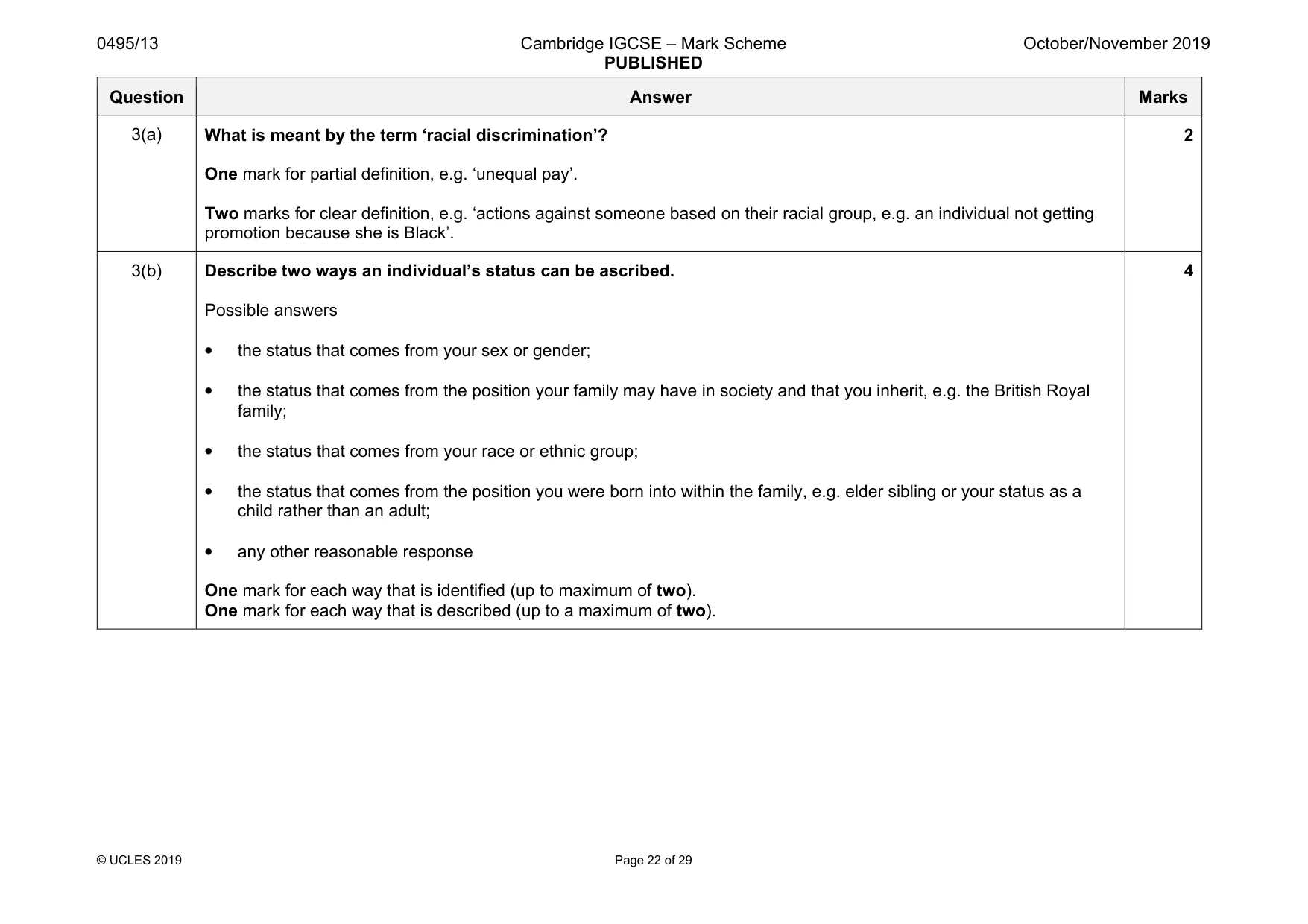
0495/13 Cambridge IGCSE – Mark Scheme PUBLISHED October/November 2019 © UCLES 2019 Page 22 of 29 Question Answer Marks 3(a) What is meant by the term ‘racial discrimination’? One mark for partial definition, e.g. ‘unequal pay’. Two marks for clear definition, e.g. ‘actions against someone based on their racial group, e.g. an individual not getting promotion because she is Black’. 2 3(b) Describe two ways an individual’s status can be ascribed. Possible answers • the status that comes from your sex or gender; • the status that comes from the position your family may have in society and that you inherit, e.g. the British Royal family; • the status that comes from your race or ethnic group; • the status that comes from the position you were born into within the family, e.g. elder sibling or your status as a child rather than an adult; • any other reasonable response One mark for each way that is identified (up to maximum of two). One mark for each way that is described (up to a maximum of two). 4
Mark scheme, page 23
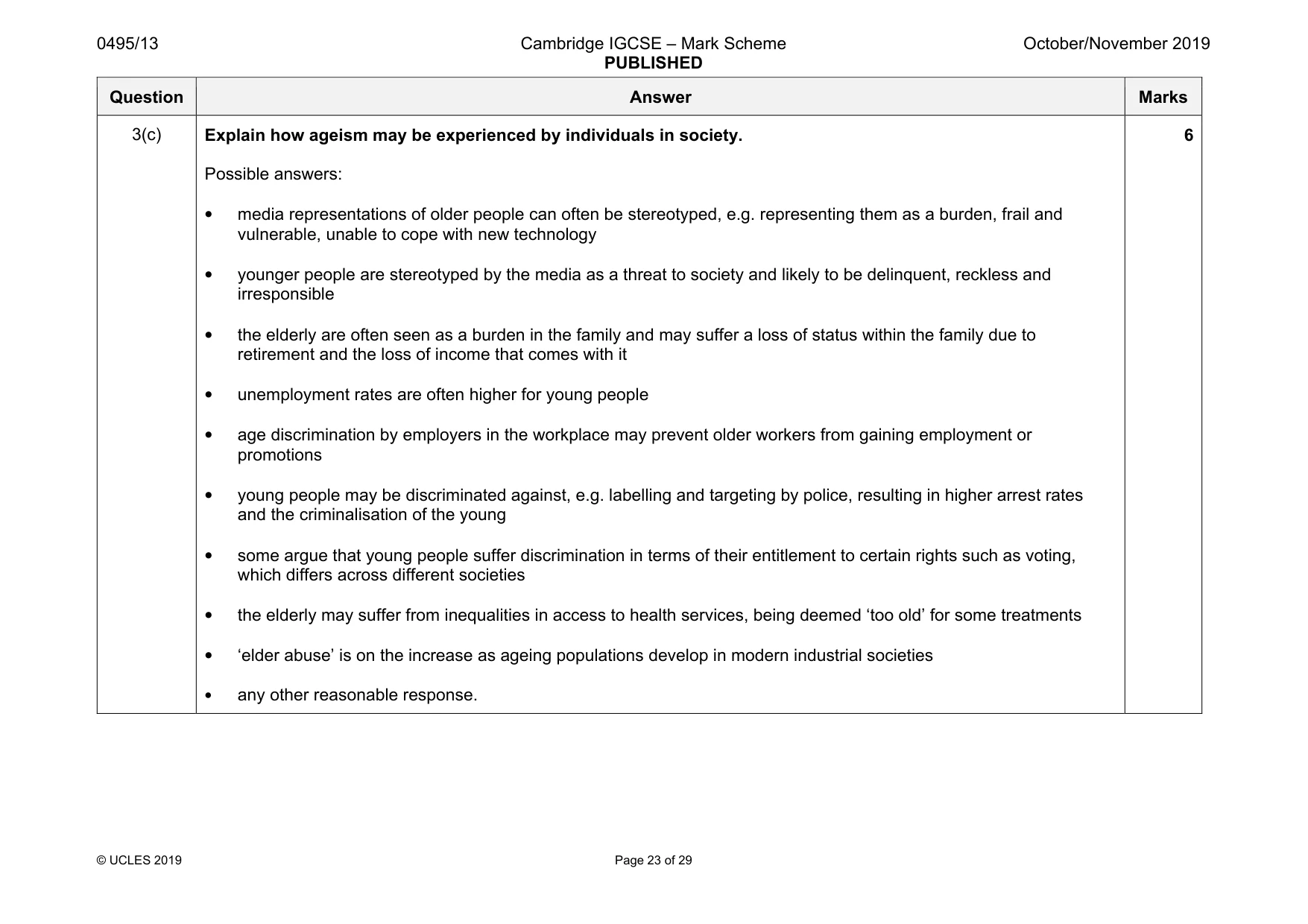
0495/13 Cambridge IGCSE – Mark Scheme PUBLISHED October/November 2019 © UCLES 2019 Page 23 of 29 Question Answer Marks 3(c) Explain how ageism may be experienced by individuals in society. Possible answers: • media representations of older people can often be stereotyped, e.g. representing them as a burden, frail and vulnerable, unable to cope with new technology • younger people are stereotyped by the media as a threat to society and likely to be delinquent, reckless and irresponsible • the elderly are often seen as a burden in the family and may suffer a loss of status within the family due to retirement and the loss of income that comes with it • unemployment rates are often higher for young people • age discrimination by employers in the workplace may prevent older workers from gaining employment or promotions • young people may be discriminated against, e.g. labelling and targeting by police, resulting in higher arrest rates and the criminalisation of the young • some argue that young people suffer discrimination in terms of their entitlement to certain rights such as voting, which differs across different societies • the elderly may suffer from inequalities in access to health services, being deemed ‘too old’ for some treatments • ‘elder abuse’ is on the increase as ageing populations develop in modern industrial societies • any other reasonable response. 6
Mark scheme, page 24
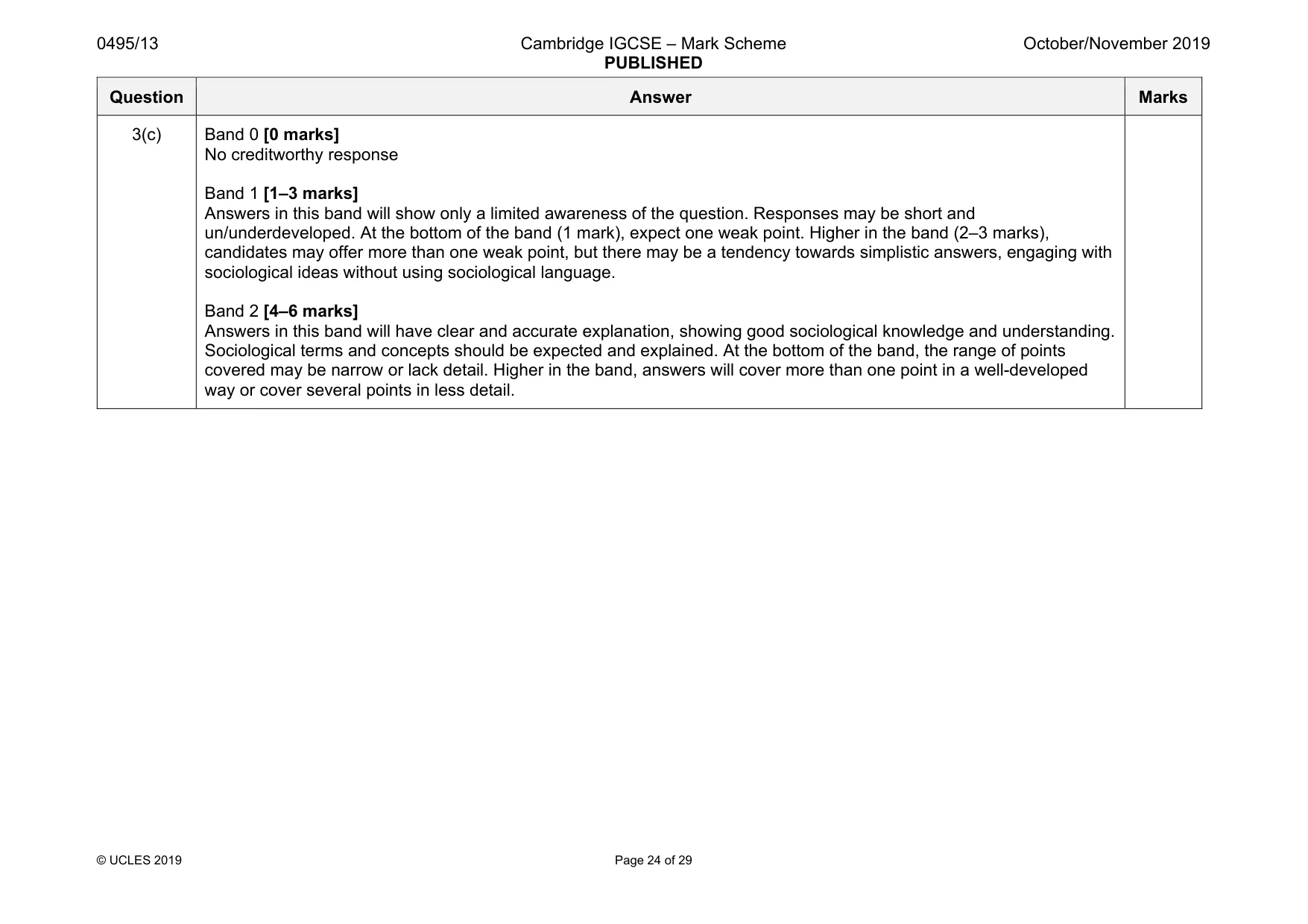
0495/13 Cambridge IGCSE – Mark Scheme PUBLISHED October/November 2019 © UCLES 2019 Page 24 of 29 Question Answer Marks 3(c) Band 0 [0 marks] No creditworthy response Band 1 [1–3 marks] Answers in this band will show only a limited awareness of the question. Responses may be short and un/underdeveloped. At the bottom of the band (1 mark), expect one weak point. Higher in the band (2–3 marks), candidates may offer more than one weak point, but there may be a tendency towards simplistic answers, engaging with sociological ideas without using sociological language. Band 2 [4–6 marks] Answers in this band will have clear and accurate explanation, showing good sociological knowledge and understanding. Sociological terms and concepts should be expected and explained. At the bottom of the band, the range of points covered may be narrow or lack detail. Higher in the band, answers will cover more than one point in a well-developed way or cover several points in less detail.
Mark scheme, page 25
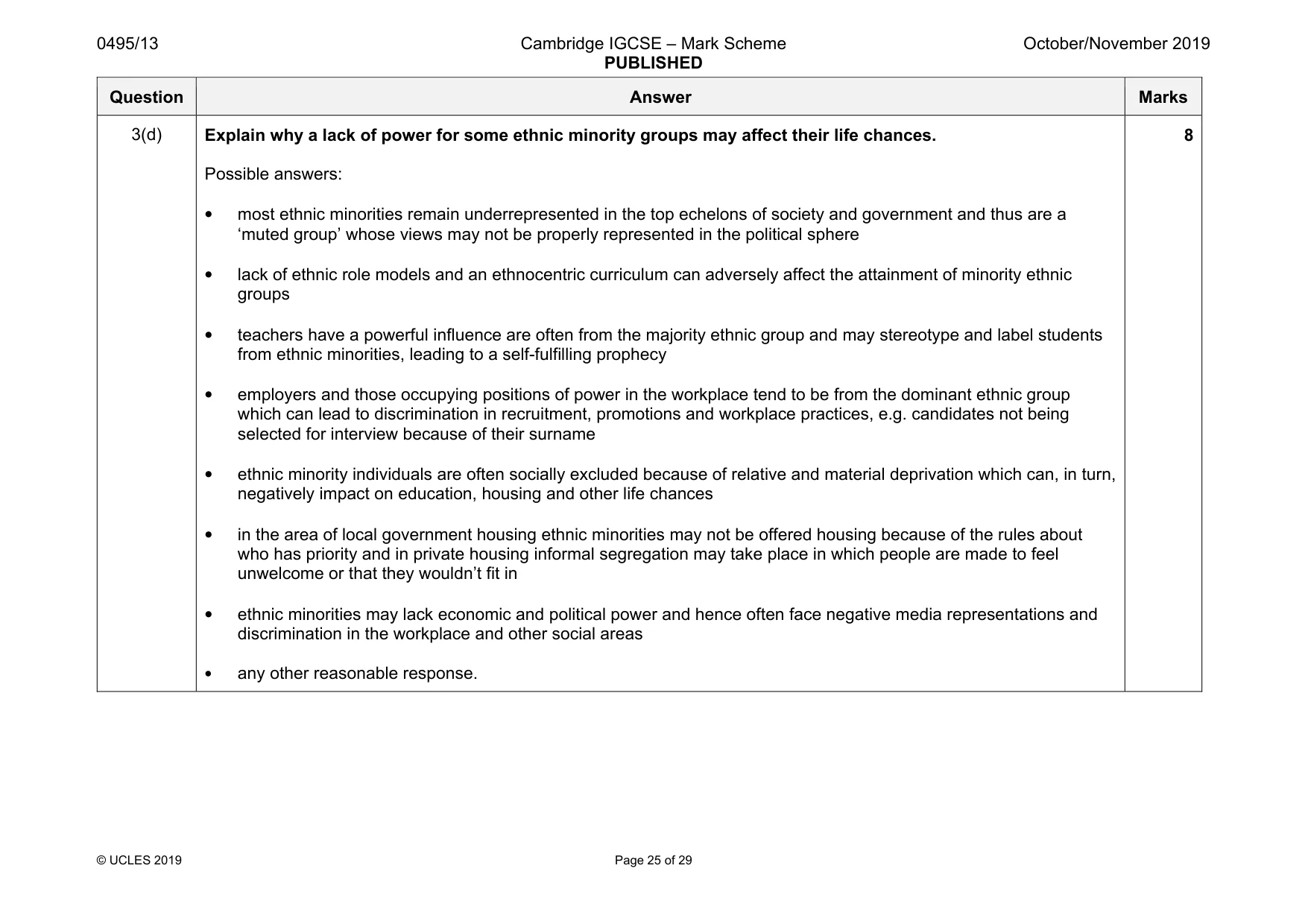
0495/13 Cambridge IGCSE – Mark Scheme PUBLISHED October/November 2019 © UCLES 2019 Page 25 of 29 Question Answer Marks 3(d) Explain why a lack of power for some ethnic minority groups may affect their life chances. Possible answers: • most ethnic minorities remain underrepresented in the top echelons of society and government and thus are a ‘muted group’ whose views may not be properly represented in the political sphere • lack of ethnic role models and an ethnocentric curriculum can adversely affect the attainment of minority ethnic groups • teachers have a powerful influence are often from the majority ethnic group and may stereotype and label students from ethnic minorities, leading to a self-fulfilling prophecy • employers and those occupying positions of power in the workplace tend to be from the dominant ethnic group which can lead to discrimination in recruitment, promotions and workplace practices, e.g. candidates not being selected for interview because of their surname • ethnic minority individuals are often socially excluded because of relative and material deprivation which can, in turn, negatively impact on education, housing and other life chances • in the area of local government housing ethnic minorities may not be offered housing because of the rules about who has priority and in private housing informal segregation may take place in which people are made to feel unwelcome or that they wouldn’t fit in • ethnic minorities may lack economic and political power and hence often face negative media representations and discrimination in the workplace and other social areas • any other reasonable response. 8
Mark scheme, page 26
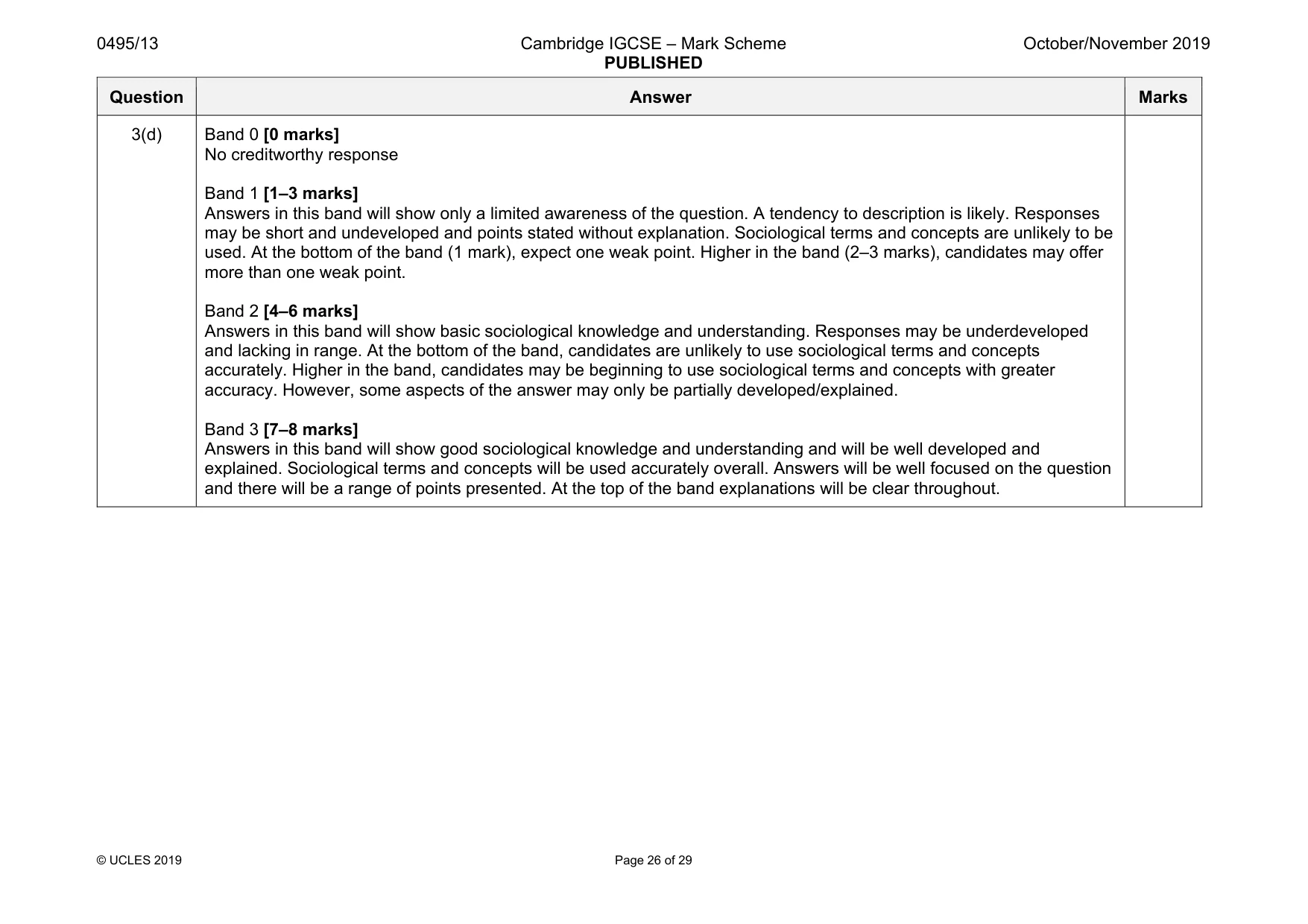
0495/13 Cambridge IGCSE – Mark Scheme PUBLISHED October/November 2019 © UCLES 2019 Page 26 of 29 Question Answer Marks 3(d) Band 0 [0 marks] No creditworthy response Band 1 [1–3 marks] Answers in this band will show only a limited awareness of the question. A tendency to description is likely. Responses may be short and undeveloped and points stated without explanation. Sociological terms and concepts are unlikely to be used. At the bottom of the band (1 mark), expect one weak point. Higher in the band (2–3 marks), candidates may offer more than one weak point. Band 2 [4–6 marks] Answers in this band will show basic sociological knowledge and understanding. Responses may be underdeveloped and lacking in range. At the bottom of the band, candidates are unlikely to use sociological terms and concepts accurately. Higher in the band, candidates may be beginning to use sociological terms and concepts with greater accuracy. However, some aspects of the answer may only be partially developed/explained. Band 3 [7–8 marks] Answers in this band will show good sociological knowledge and understanding and will be well developed and explained. Sociological terms and concepts will be used accurately overall. Answers will be well focused on the question and there will be a range of points presented. At the top of the band explanations will be clear throughout.
Mark scheme, page 27
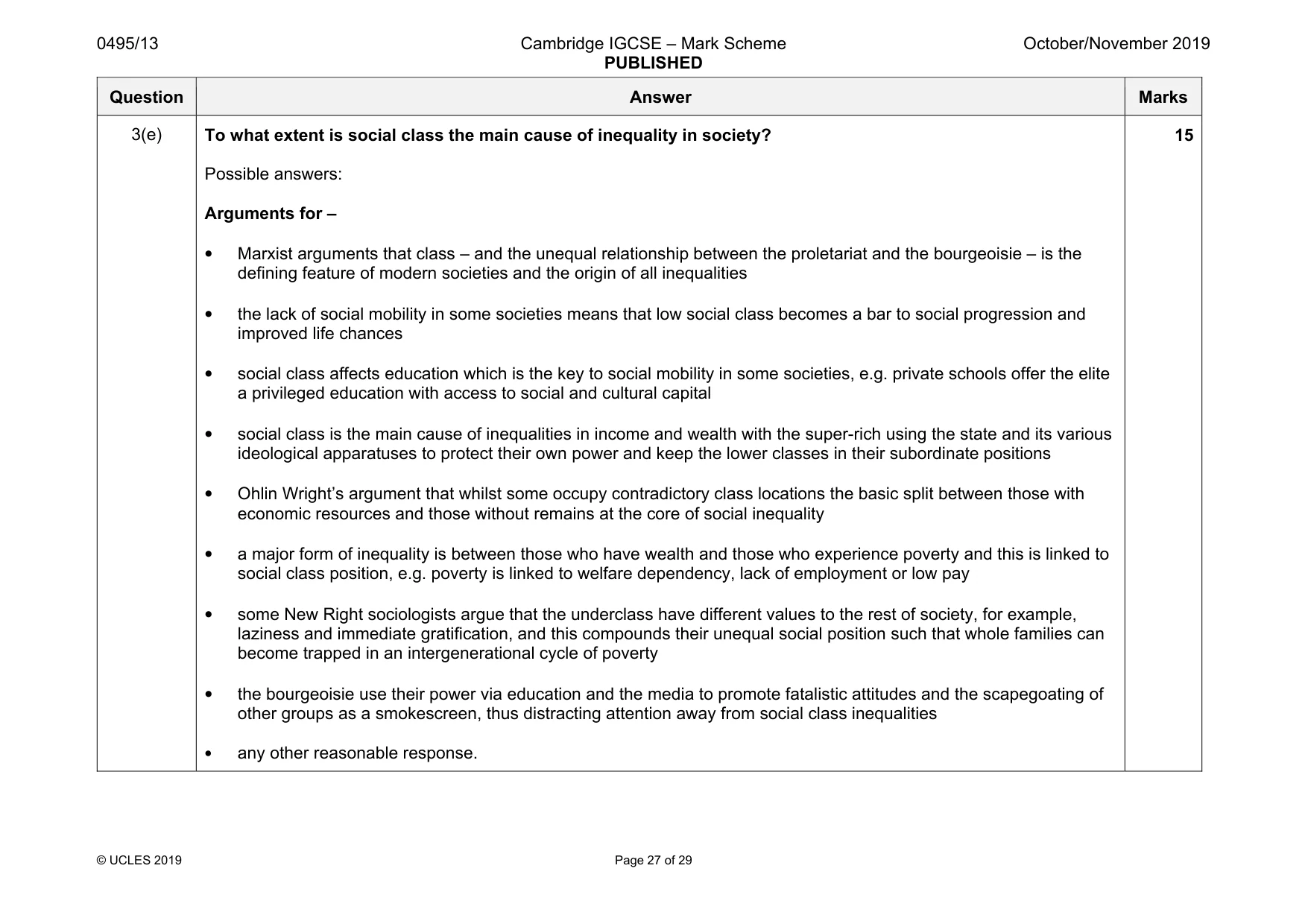
0495/13 Cambridge IGCSE – Mark Scheme PUBLISHED October/November 2019 © UCLES 2019 Page 27 of 29 Question Answer Marks 3(e) To what extent is social class the main cause of inequality in society? Possible answers: Arguments for – • Marxist arguments that class – and the unequal relationship between the proletariat and the bourgeoisie – is the defining feature of modern societies and the origin of all inequalities • the lack of social mobility in some societies means that low social class becomes a bar to social progression and improved life chances • social class affects education which is the key to social mobility in some societies, e.g. private schools offer the elite a privileged education with access to social and cultural capital • social class is the main cause of inequalities in income and wealth with the super-rich using the state and its various ideological apparatuses to protect their own power and keep the lower classes in their subordinate positions • Ohlin Wright’s argument that whilst some occupy contradictory class locations the basic split between those with economic resources and those without remains at the core of social inequality • a major form of inequality is between those who have wealth and those who experience poverty and this is linked to social class position, e.g. poverty is linked to welfare dependency, lack of employment or low pay • some New Right sociologists argue that the underclass have different values to the rest of society, for example, laziness and immediate gratification, and this compounds their unequal social position such that whole families can become trapped in an intergenerational cycle of poverty • the bourgeoisie use their power via education and the media to promote fatalistic attitudes and the scapegoating of other groups as a smokescreen, thus distracting attention away from social class inequalities • any other reasonable response. 15
Mark scheme, page 28
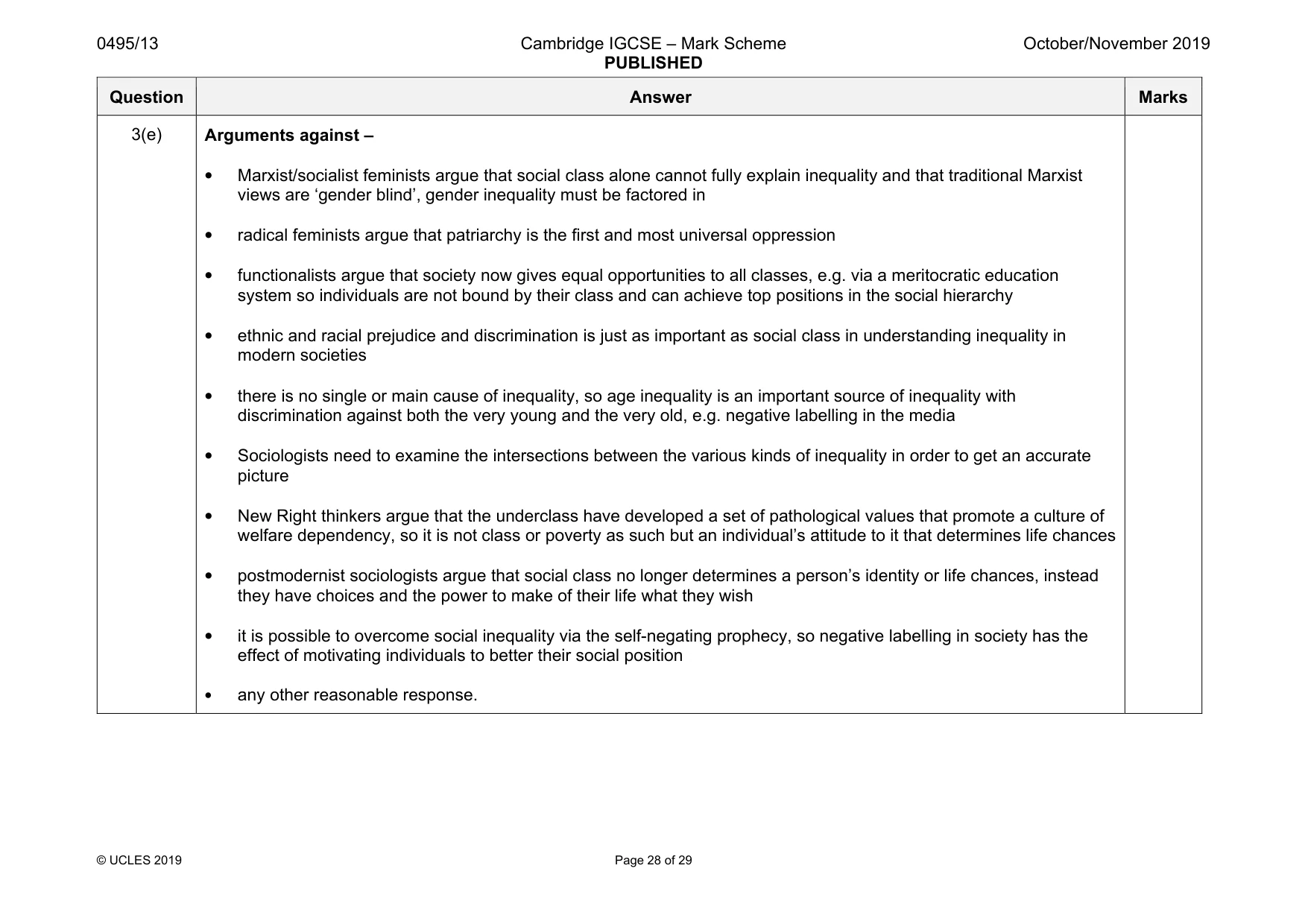
0495/13 Cambridge IGCSE – Mark Scheme PUBLISHED October/November 2019 © UCLES 2019 Page 28 of 29 Question Answer Marks 3(e) Arguments against – • Marxist/socialist feminists argue that social class alone cannot fully explain inequality and that traditional Marxist views are ‘gender blind’, gender inequality must be factored in • radical feminists argue that patriarchy is the first and most universal oppression • functionalists argue that society now gives equal opportunities to all classes, e.g. via a meritocratic education system so individuals are not bound by their class and can achieve top positions in the social hierarchy • ethnic and racial prejudice and discrimination is just as important as social class in understanding inequality in modern societies • there is no single or main cause of inequality, so age inequality is an important source of inequality with discrimination against both the very young and the very old, e.g. negative labelling in the media • Sociologists need to examine the intersections between the various kinds of inequality in order to get an accurate picture • New Right thinkers argue that the underclass have developed a set of pathological values that promote a culture of welfare dependency, so it is not class or poverty as such but an individual’s attitude to it that determines life chances • postmodernist sociologists argue that social class no longer determines a person’s identity or life chances, instead they have choices and the power to make of their life what they wish • it is possible to overcome social inequality via the self-negating prophecy, so negative labelling in society has the effect of motivating individuals to better their social position • any other reasonable response.
Mark scheme, page 29
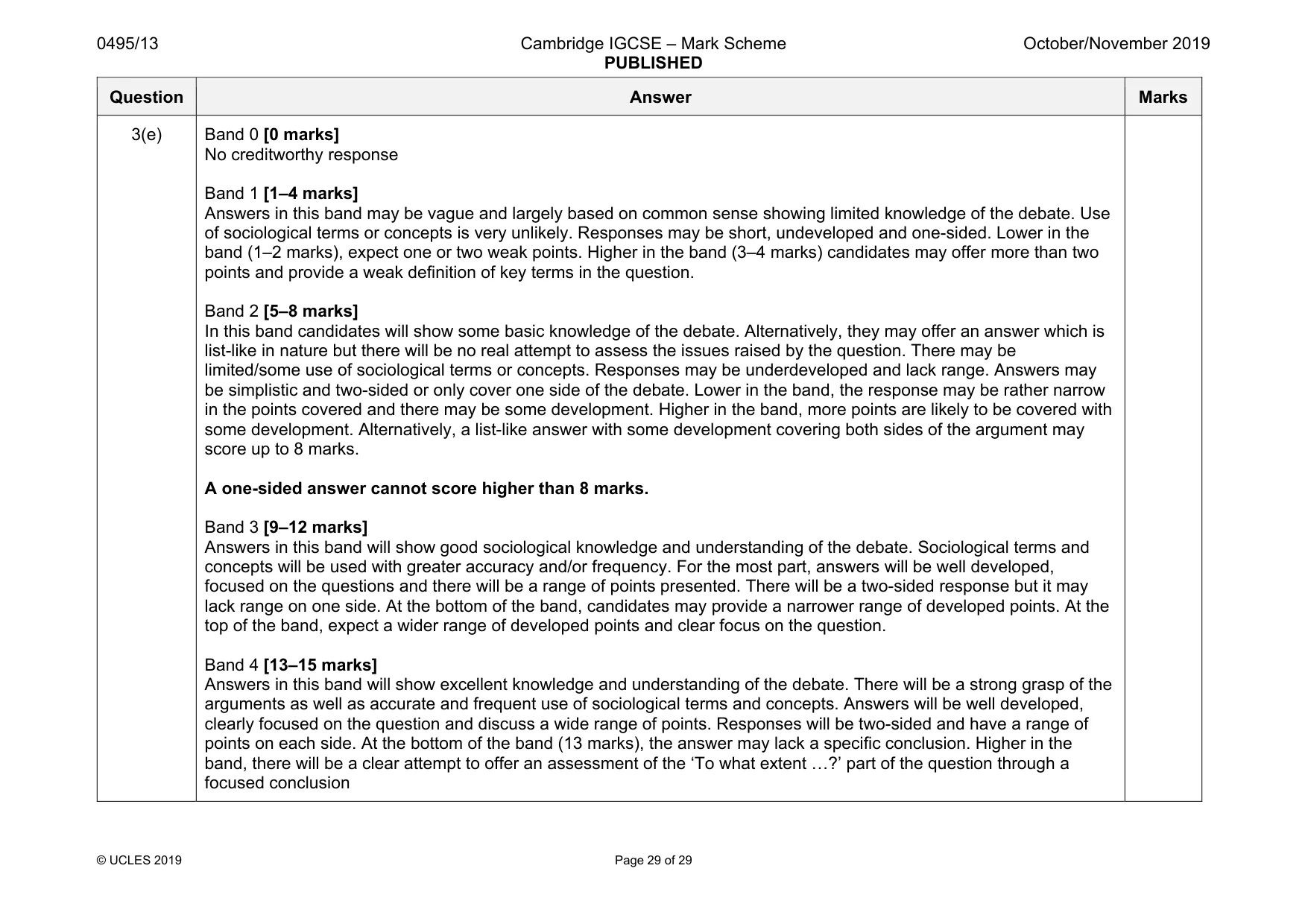
0495/13 Cambridge IGCSE – Mark Scheme PUBLISHED October/November 2019 © UCLES 2019 Page 29 of 29 Question Answer Marks 3(e) Band 0 [0 marks] No creditworthy response Band 1 [1–4 marks] Answers in this band may be vague and largely based on common sense showing limited knowledge of the debate. Use of sociological terms or concepts is very unlikely. Responses may be short, undeveloped and one-sided. Lower in the band (1–2 marks), expect one or two weak points. Higher in the band (3–4 marks) candidates may offer more than two points and provide a weak definition of key terms in the question. Band 2 [5–8 marks] In this band candidates will show some basic knowledge of the debate. Alternatively, they may offer an answer which is list-like in nature but there will be no real attempt to assess the issues raised by the question. There may be limited/some use of sociological terms or concepts. Responses may be underdeveloped and lack range. Answers may be simplistic and two-sided or only cover one side of the debate. Lower in the band, the response may be rather narrow in the points covered and there may be some development. Higher in the band, more points are likely to be covered with some development. Alternatively, a list-like answer with some development covering both sides of the argument may score up to 8 marks. A one-sided answer cannot score higher than 8 marks. Band 3 [9–12 marks] Answers in this band will show good sociological knowledge and understanding of the debate. Sociological terms and concepts will be used with greater accuracy and/or frequency. For the most part, answers will be well developed, focused on the questions and there will be a range of points presented. There will be a two-sided response but it may lack range on one side. At the bottom of the band, candidates may provide a narrower range of developed points. At the top of the band, expect a wider range of developed points and clear focus on the question. Band 4 [13–15 marks] Answers in this band will show excellent knowledge and understanding of the debate. There will be a strong grasp of the arguments as well as accurate and frequent use of sociological terms and concepts. Answers will be well developed, clearly focused on the question and discuss a wide range of points. Responses will be two-sided and have a range of points on each side. At the bottom of the band (13 marks), the answer may lack a specific conclusion. Higher in the band, there will be a clear attempt to offer an assessment of the ‘To what extent «?’ part of the question through a focused conclusion
What you needed in this session
Cambridge’s own grade thresholds for 2019 Oct/Nov, Paper 1 · Variant 3. A higher threshold means an easier paper — the bar moves with how the cohort did.