Cambridge IGCSE Sociology 0495 — 2019 Oct/Nov Paper 1 · Variant 2
0495/12/O/N/19 · 80 marks · ≈90 min
The question paper and its mark scheme, free to read here and free to download. This is Cambridge’s own paper, exactly as it was sat.
Question paper4 pages

Mark scheme30 pages
Answers below. Sit the paper first if you are practising.
Paper as text
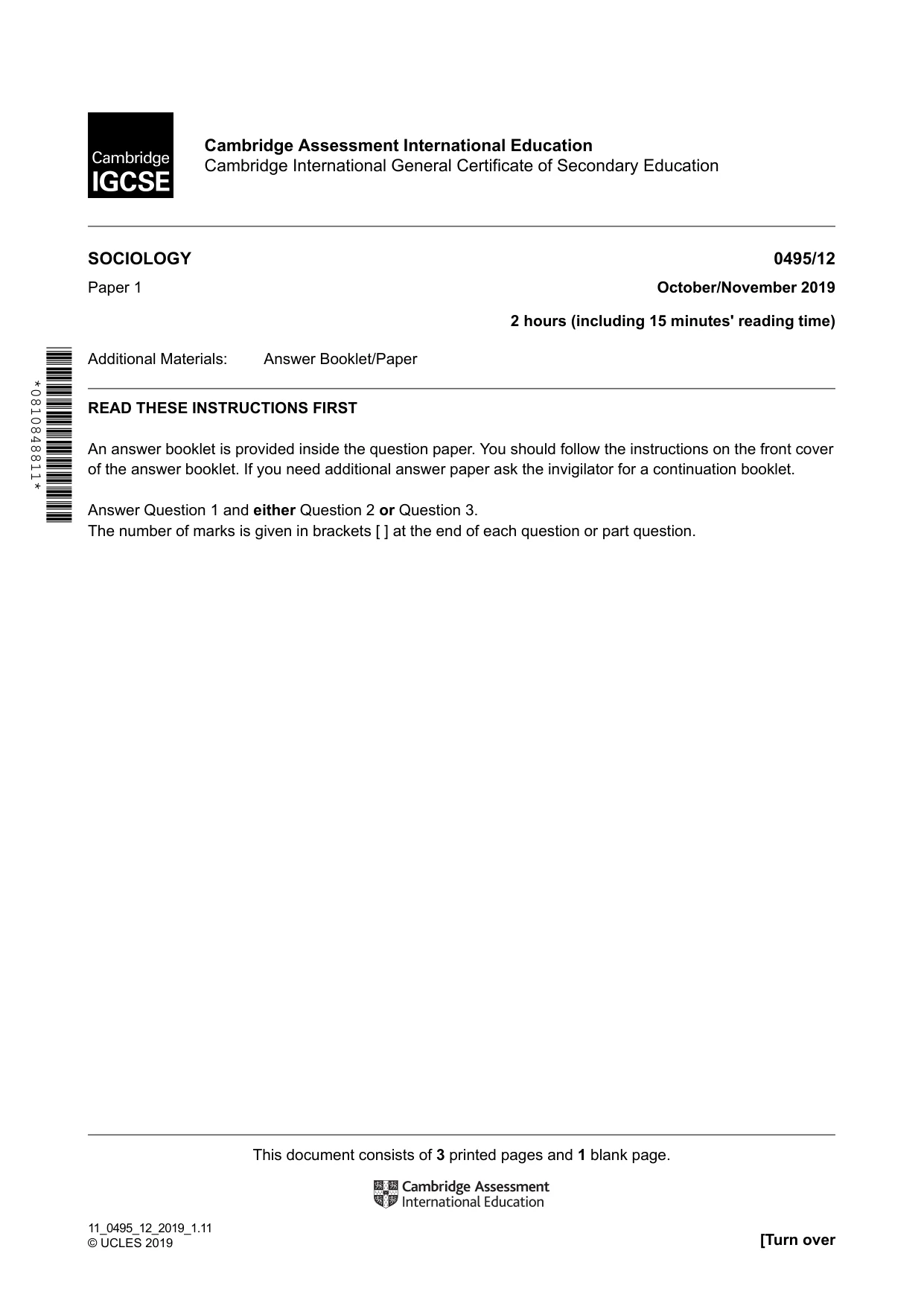
Question paper, page 1
Cambridge Assessment International Education Cambridge International General Certificate of Secondary Education 0495/12 October/November 2019 SOCIOLOGY Paper 1 2 hours (including 15 minutes' reading time) Additional Materials: Answer Booklet/Paper READ THESE INSTRUCTIONS FIRST An answer booklet is provided inside the question paper. You should follow the instructions on the front cover of the answer booklet. If you need additional answer paper ask the invigilator for a continuation booklet. Answer Question 1 and either Question 2 or Question 3. The number of marks is given in brackets [ ] at the end of each question or part question. This document consists of 3 printed pages and 1 blank page. [Turn over 11_0495_12_2019_1.11 © UCLES 2019 *0810848811*
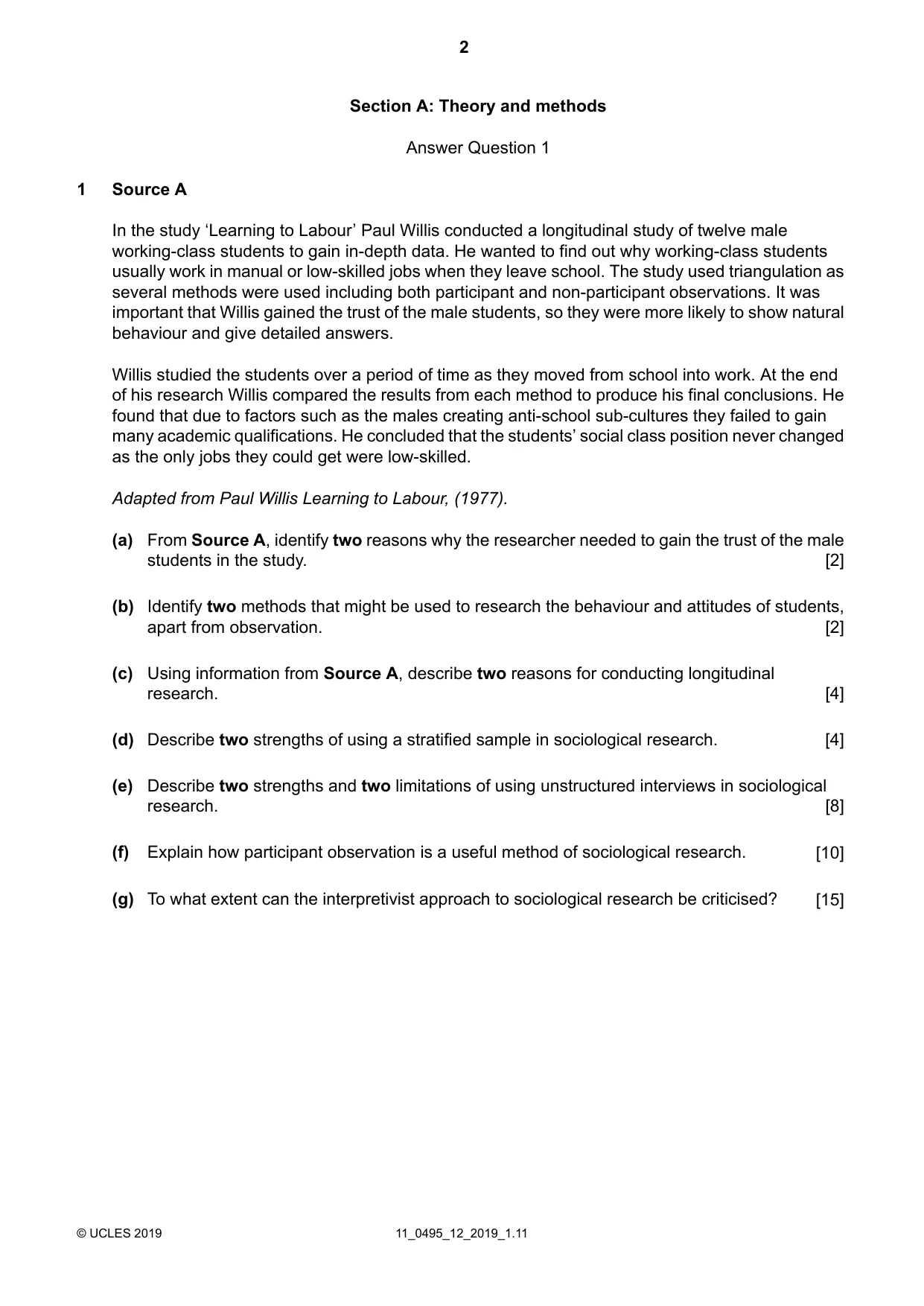
Question paper, page 2
Section A: Theory and methods Answer Question 1 Source A 1 In the study ‘Learning to Labour’ Paul Willis conducted a longitudinal study of twelve male working-class students to gain in-depth data. He wanted to find out why working-class students usually work in manual or low-skilled jobs when they leave school. The study used triangulation as several methods were used including both participant and non-participant observations. It was important that Willis gained the trust of the male students, so they were more likely to show natural behaviour and give detailed answers. Willis studied the students over a period of time as they moved from school into work. At the end of his research Willis compared the results from each method to produce his final conclusions. He found that due to factors such as the males creating anti-school sub-cultures they failed to gain many academic qualifications. He concluded that the students’ social class position never changed as the only jobs they could get were low-skilled. Adapted from Paul Willis Learning to Labour, (1977). From Source A, identify two reasons why the researcher needed to gain the trust of the male students in the study. [2] (a) Identify two methods that might be used to research the behaviour and attitudes of students, apart from observation. [2] (b) Using information from Source A, describe two reasons for conducting longitudinal research. [4] (c) Describe two strengths of using a stratified sample in sociological research. [4] (d) Describe two strengths and two limitations of using unstructured interviews in sociological research. [8] (e) Explain how participant observation is a useful method of sociological research. [10] (f) To what extent can the interpretivist approach to sociological research be criticised? [15] (g) 11_0495_12_2019_1.11 © UCLES 2019 2
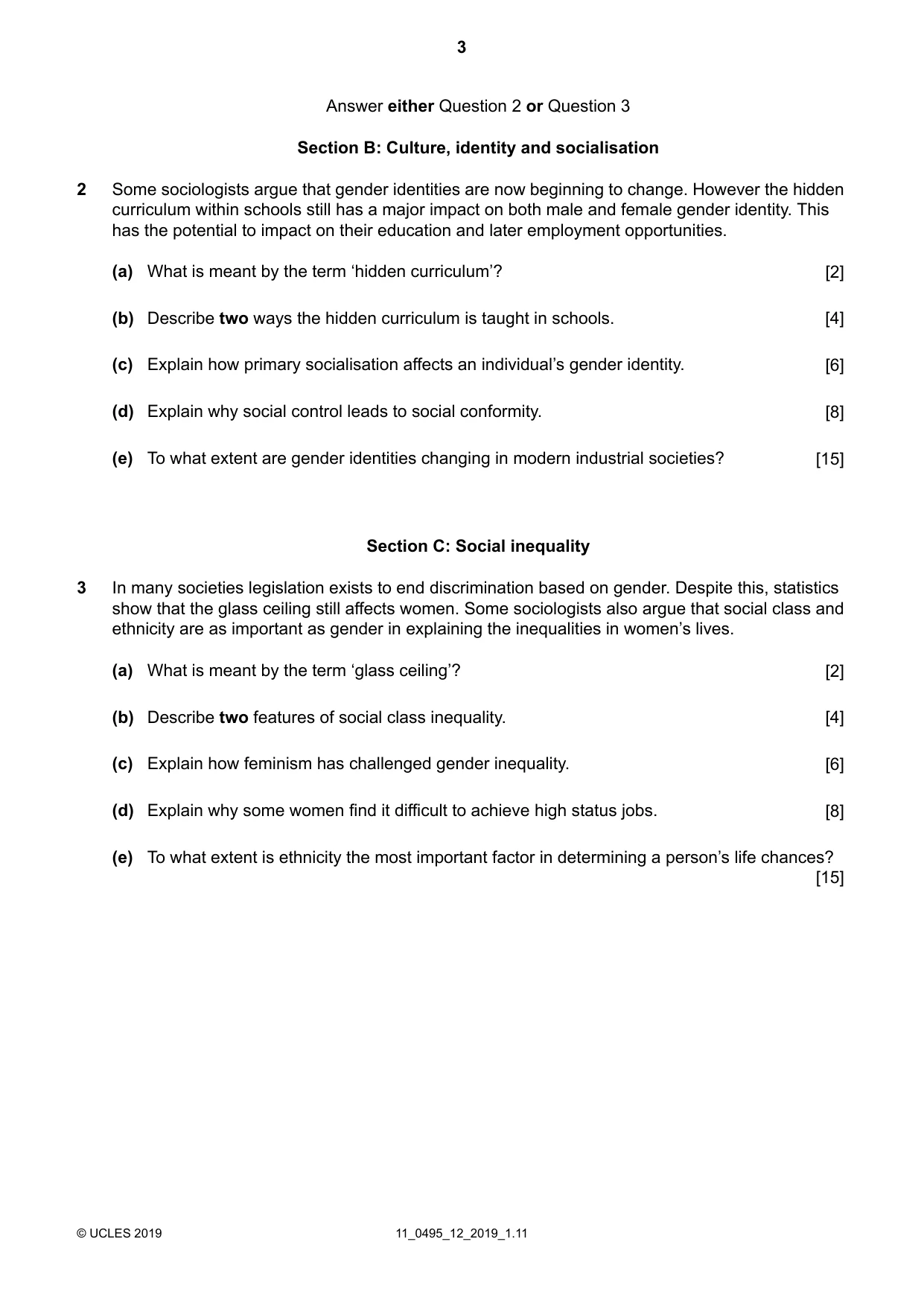
Question paper, page 3
Answer either Question 2 or Question 3 Section B: Culture, identity and socialisation Some sociologists argue that gender identities are now beginning to change. However the hidden curriculum within schools still has a major impact on both male and female gender identity. This has the potential to impact on their education and later employment opportunities. 2 What is meant by the term ‘hidden curriculum’? [2] (a) Describe two ways the hidden curriculum is taught in schools. [4] (b) Explain how primary socialisation affects an individual’s gender identity. [6] (c) Explain why social control leads to social conformity. [8] (d) To what extent are gender identities changing in modern industrial societies? [15] (e) Section C: Social inequality In many societies legislation exists to end discrimination based on gender. Despite this, statistics show that the glass ceiling still affects women. Some sociologists also argue that social class and ethnicity are as important as gender in explaining the inequalities in women’s lives. 3 What is meant by the term ‘glass ceiling’? [2] (a) Describe two features of social class inequality. [4] (b) Explain how feminism has challenged gender inequality. [6] (c) Explain why some women find it difficult to achieve high status jobs. [8] (d) To what extent is ethnicity the most important factor in determining a person’s life chances? [15] (e) 11_0495_12_2019_1.11 © UCLES 2019 3
Question paper, page 4
BLANK PAGE Permission to reproduce items where third-party owned material protected by copyright is included has been sought and cleared where possible. Every reasonable effort has been made by the publisher (UCLES) to trace copyright holders, but if any items requiring clearance have unwittingly been included, the publisher will be pleased to make amends at the earliest possible opportunity. To avoid the issue of disclosure of answer-related information to candidates, all copyright acknowledgements are reproduced online in the Cambridge Assessment International Education Copyright Acknowledgements Booklet. This is produced for each series of examinations and is freely available to download at www.cambridgeinternational.org after the live examination series. Cambridge Assessment International Education is part of the Cambridge Assessment Group. Cambridge Assessment is the brand name of the University of Cambridge Local Examinations Syndicate (UCLES), which itself is a department of the University of Cambridge. 11_0495_12_2019_1.11 © UCLES 2019 4
Mark scheme, page 1
This document consists of 30 printed pages. © UCLES 2019 [Turn over Cambridge Assessment International Education Cambridge International General Certificate of Secondary Education SOCIOLOGY 0495/12 Paper 1 October/November 2019 MARK SCHEME Maximum Mark: 80 Published This mark scheme is published as an aid to teachers and candidates, to indicate the requirements of the examination. It shows the basis on which Examiners were instructed to award marks. It does not indicate the details of the discussions that took place at an Examiners’ meeting before marking began, which would have considered the acceptability of alternative answers. Mark schemes should be read in conjunction with the question paper and the Principal Examiner Report for Teachers. Cambridge International will not enter into discussions about these mark schemes. Cambridge International is publishing the mark schemes for the October/November 2019 series for most Cambridge IGCSE™, Cambridge International A and AS Level components and some Cambridge O Level components.
Mark scheme, page 2
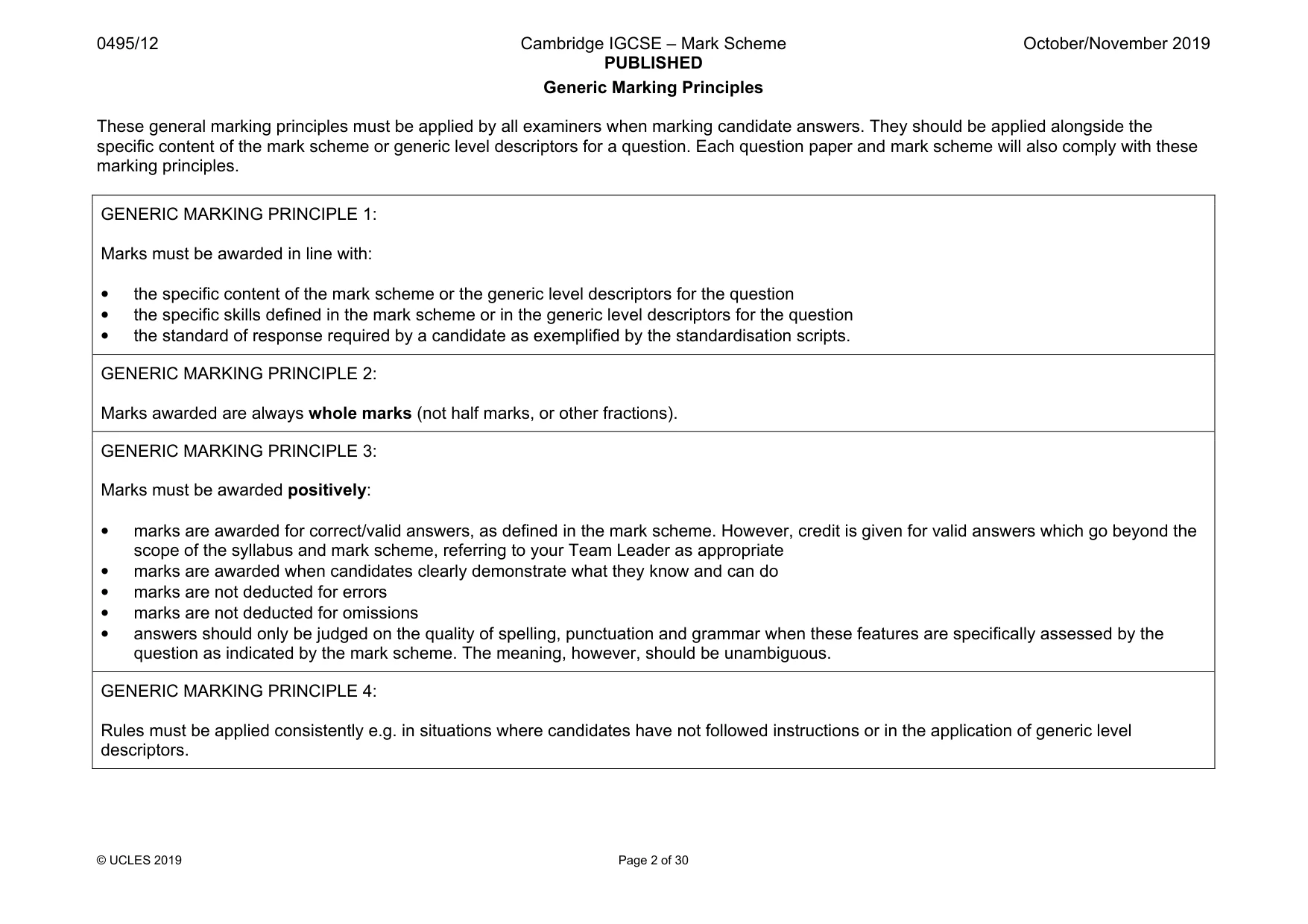
0495/12 Cambridge IGCSE – Mark Scheme PUBLISHED October/November 2019 © UCLES 2019 Page 2 of 30 Generic Marking Principles These general marking principles must be applied by all examiners when marking candidate answers. They should be applied alongside the specific content of the mark scheme or generic level descriptors for a question. Each question paper and mark scheme will also comply with these marking principles. GENERIC MARKING PRINCIPLE 1: Marks must be awarded in line with: • the specific content of the mark scheme or the generic level descriptors for the question • the specific skills defined in the mark scheme or in the generic level descriptors for the question • the standard of response required by a candidate as exemplified by the standardisation scripts. GENERIC MARKING PRINCIPLE 2: Marks awarded are always whole marks (not half marks, or other fractions). GENERIC MARKING PRINCIPLE 3: Marks must be awarded positively: • marks are awarded for correct/valid answers, as defined in the mark scheme. However, credit is given for valid answers which go beyond the scope of the syllabus and mark scheme, referring to your Team Leader as appropriate • marks are awarded when candidates clearly demonstrate what they know and can do • marks are not deducted for errors • marks are not deducted for omissions • answers should only be judged on the quality of spelling, punctuation and grammar when these features are specifically assessed by the question as indicated by the mark scheme. The meaning, however, should be unambiguous. GENERIC MARKING PRINCIPLE 4: Rules must be applied consistently e.g. in situations where candidates have not followed instructions or in the application of generic level descriptors.
Mark scheme, page 3
0495/12 Cambridge IGCSE – Mark Scheme PUBLISHED October/November 2019 © UCLES 2019 Page 3 of 30 GENERIC MARKING PRINCIPLE 5: Marks should be awarded using the full range of marks defined in the mark scheme for the question (however; the use of the full mark range may be limited according to the quality of the candidate responses seen). GENERIC MARKING PRINCIPLE 6: Marks awarded are based solely on the requirements as defined in the mark scheme. Marks should not be awarded with grade thresholds or grade descriptors in mind.
Mark scheme, page 4
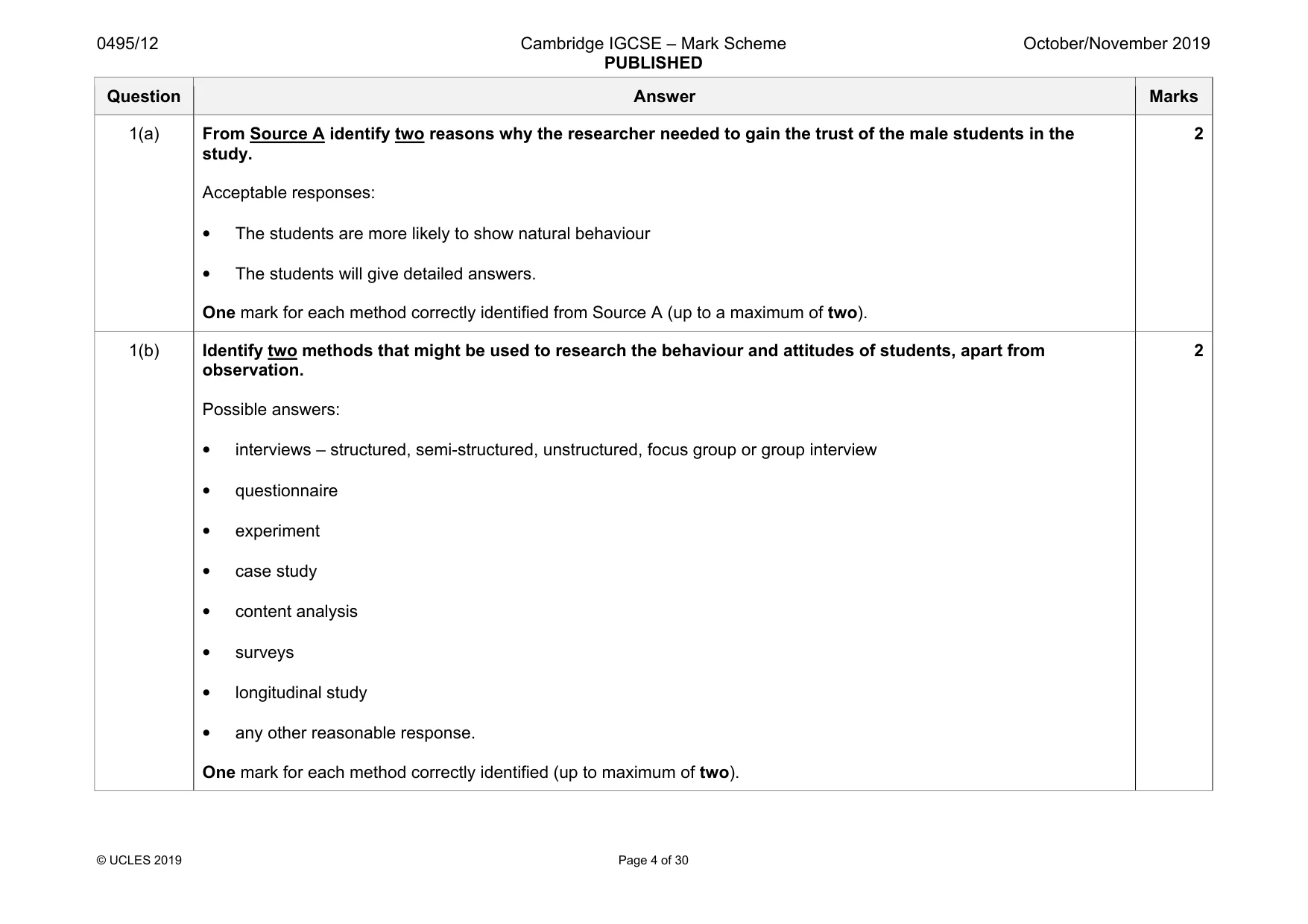
0495/12 Cambridge IGCSE – Mark Scheme PUBLISHED October/November 2019 © UCLES 2019 Page 4 of 30 Question Answer Marks 1(a) From Source A identify two reasons why the researcher needed to gain the trust of the male students in the study. Acceptable responses: • The students are more likely to show natural behaviour • The students will give detailed answers. One mark for each method correctly identified from Source A (up to a maximum of two). 2 1(b) Identify two methods that might be used to research the behaviour and attitudes of students, apart from observation. Possible answers: • interviews – structured, semi-structured, unstructured, focus group or group interview • questionnaire • experiment • case study • content analysis • surveys • longitudinal study • any other reasonable response. One mark for each method correctly identified (up to maximum of two). 2
Mark scheme, page 5
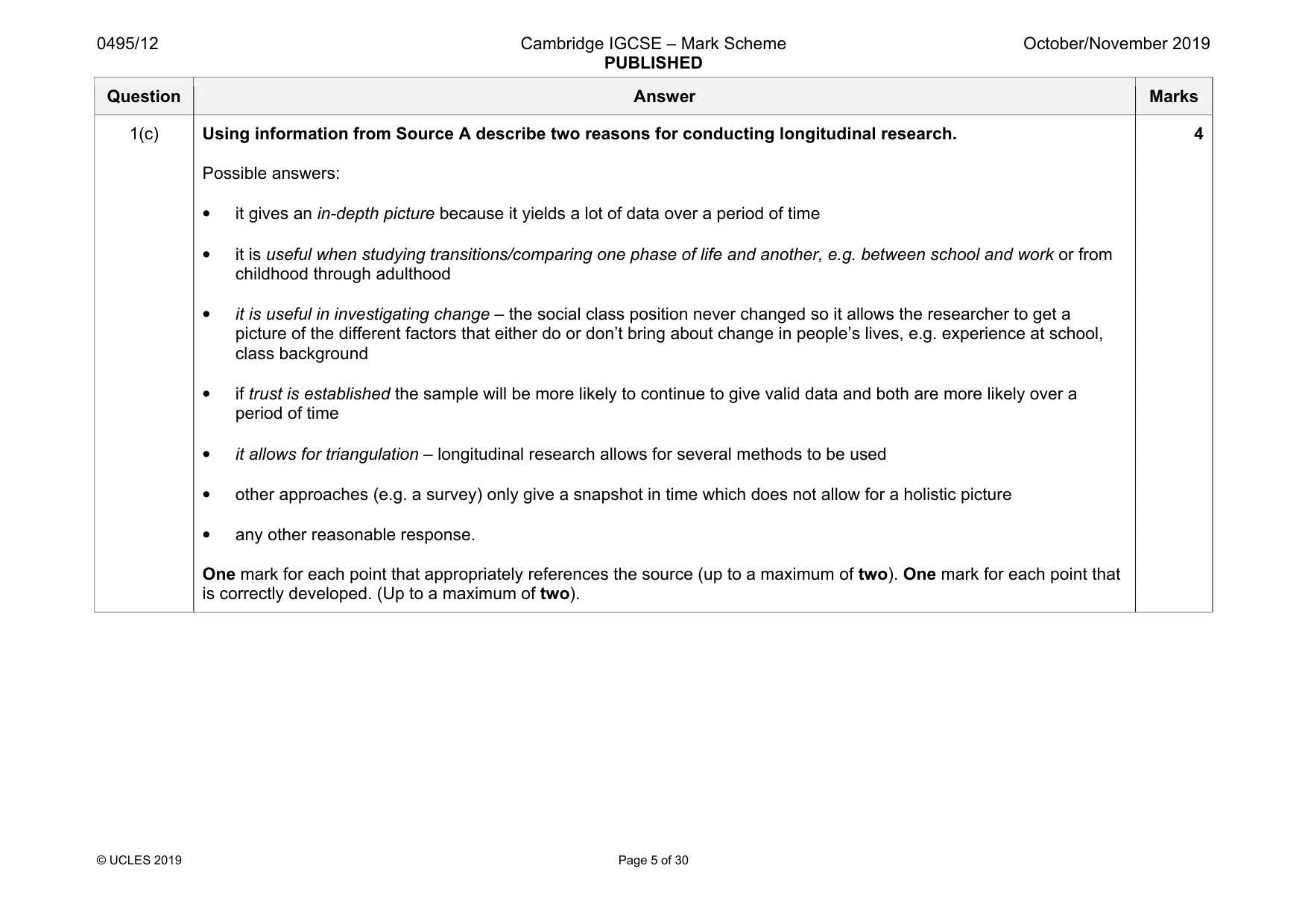
0495/12 Cambridge IGCSE – Mark Scheme PUBLISHED October/November 2019 © UCLES 2019 Page 5 of 30 Question Answer Marks 1(c) Using information from Source A describe two reasons for conducting longitudinal research. Possible answers: • it gives an in-depth picture because it yields a lot of data over a period of time • it is useful when studying transitions/comparing one phase of life and another, e.g. between school and work or from childhood through adulthood • it is useful in investigating change – the social class position never changed so it allows the researcher to get a picture of the different factors that either do or don’t bring about change in people’s lives, e.g. experience at school, class background • if trust is established the sample will be more likely to continue to give valid data and both are more likely over a period of time • it allows for triangulation – longitudinal research allows for several methods to be used • other approaches (e.g. a survey) only give a snapshot in time which does not allow for a holistic picture • any other reasonable response. One mark for each point that appropriately references the source (up to a maximum of two). One mark for each point that is correctly developed. (Up to a maximum of two). 4
Mark scheme, page 6
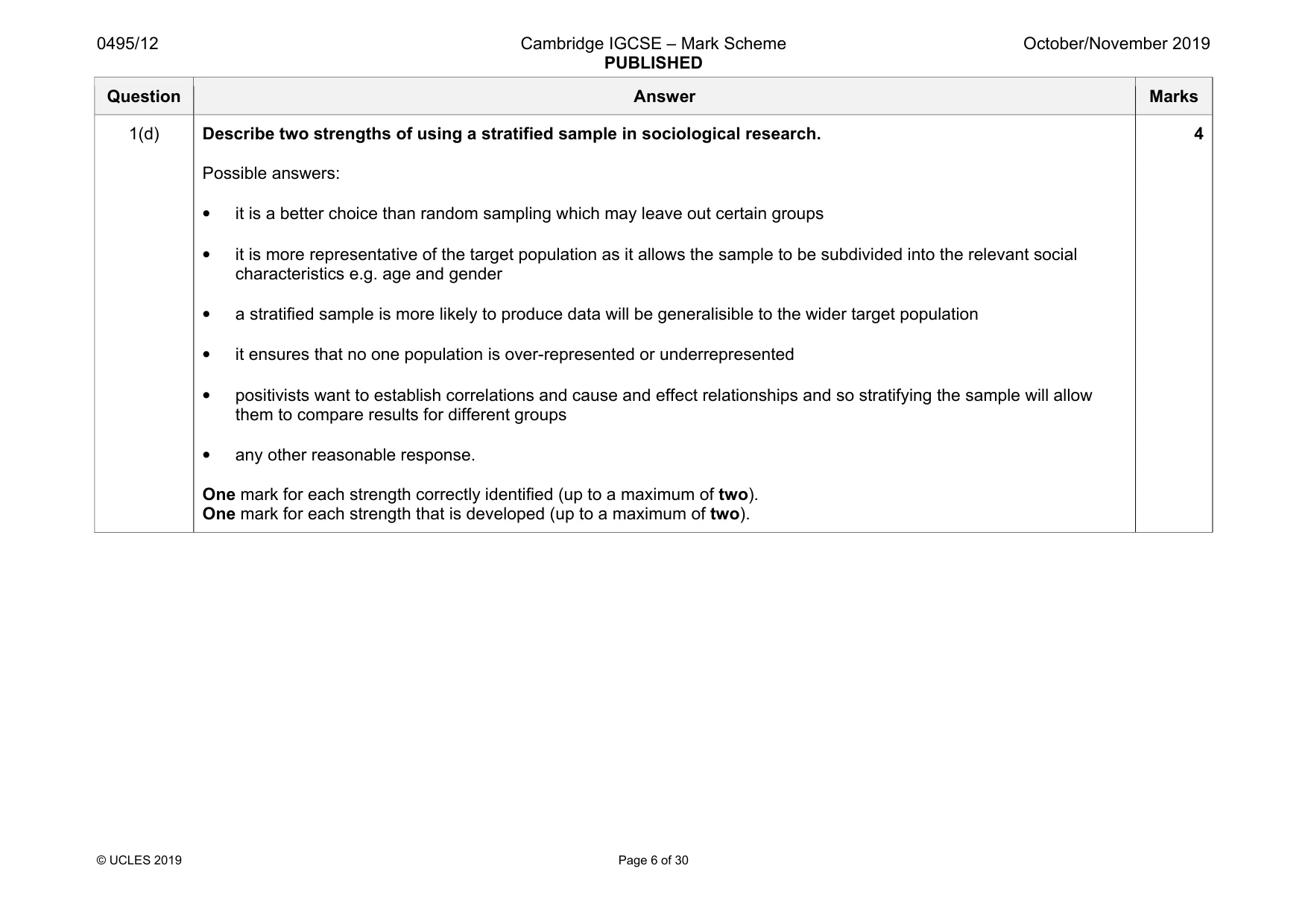
0495/12 Cambridge IGCSE – Mark Scheme PUBLISHED October/November 2019 © UCLES 2019 Page 6 of 30 Question Answer Marks 1(d) Describe two strengths of using a stratified sample in sociological research. Possible answers: • it is a better choice than random sampling which may leave out certain groups • it is more representative of the target population as it allows the sample to be subdivided into the relevant social characteristics e.g. age and gender • a stratified sample is more likely to produce data will be generalisible to the wider target population • it ensures that no one population is over-represented or underrepresented • positivists want to establish correlations and cause and effect relationships and so stratifying the sample will allow them to compare results for different groups • any other reasonable response. One mark for each strength correctly identified (up to a maximum of two). One mark for each strength that is developed (up to a maximum of two). 4
Mark scheme, page 7
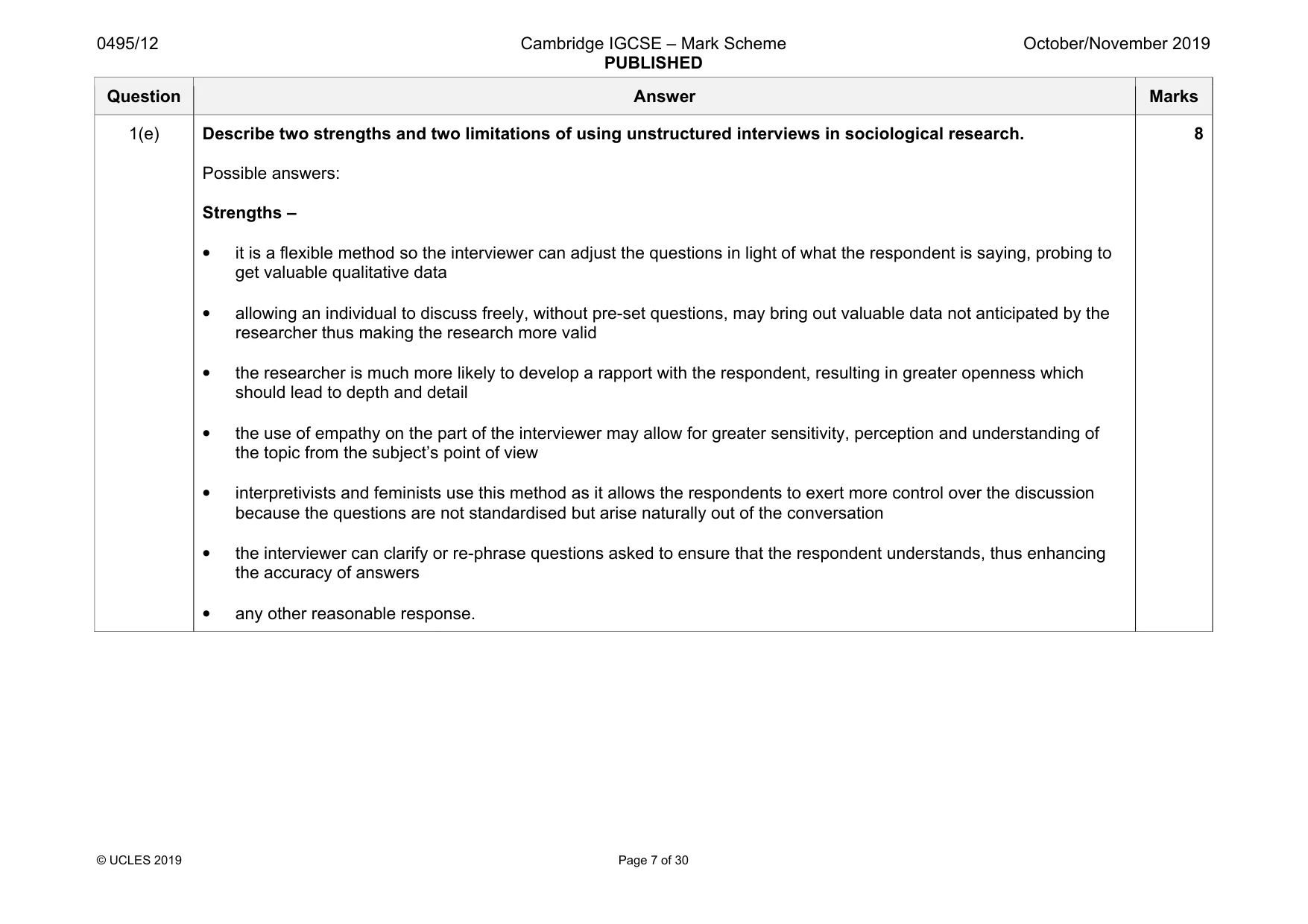
0495/12 Cambridge IGCSE – Mark Scheme PUBLISHED October/November 2019 © UCLES 2019 Page 7 of 30 Question Answer Marks 1(e) Describe two strengths and two limitations of using unstructured interviews in sociological research. Possible answers: Strengths – • it is a flexible method so the interviewer can adjust the questions in light of what the respondent is saying, probing to get valuable qualitative data • allowing an individual to discuss freely, without pre-set questions, may bring out valuable data not anticipated by the researcher thus making the research more valid • the researcher is much more likely to develop a rapport with the respondent, resulting in greater openness which should lead to depth and detail • the use of empathy on the part of the interviewer may allow for greater sensitivity, perception and understanding of the topic from the subject’s point of view • interpretivists and feminists use this method as it allows the respondents to exert more control over the discussion because the questions are not standardised but arise naturally out of the conversation • the interviewer can clarify or re-phrase questions asked to ensure that the respondent understands, thus enhancing the accuracy of answers • any other reasonable response. 8
Mark scheme, page 8
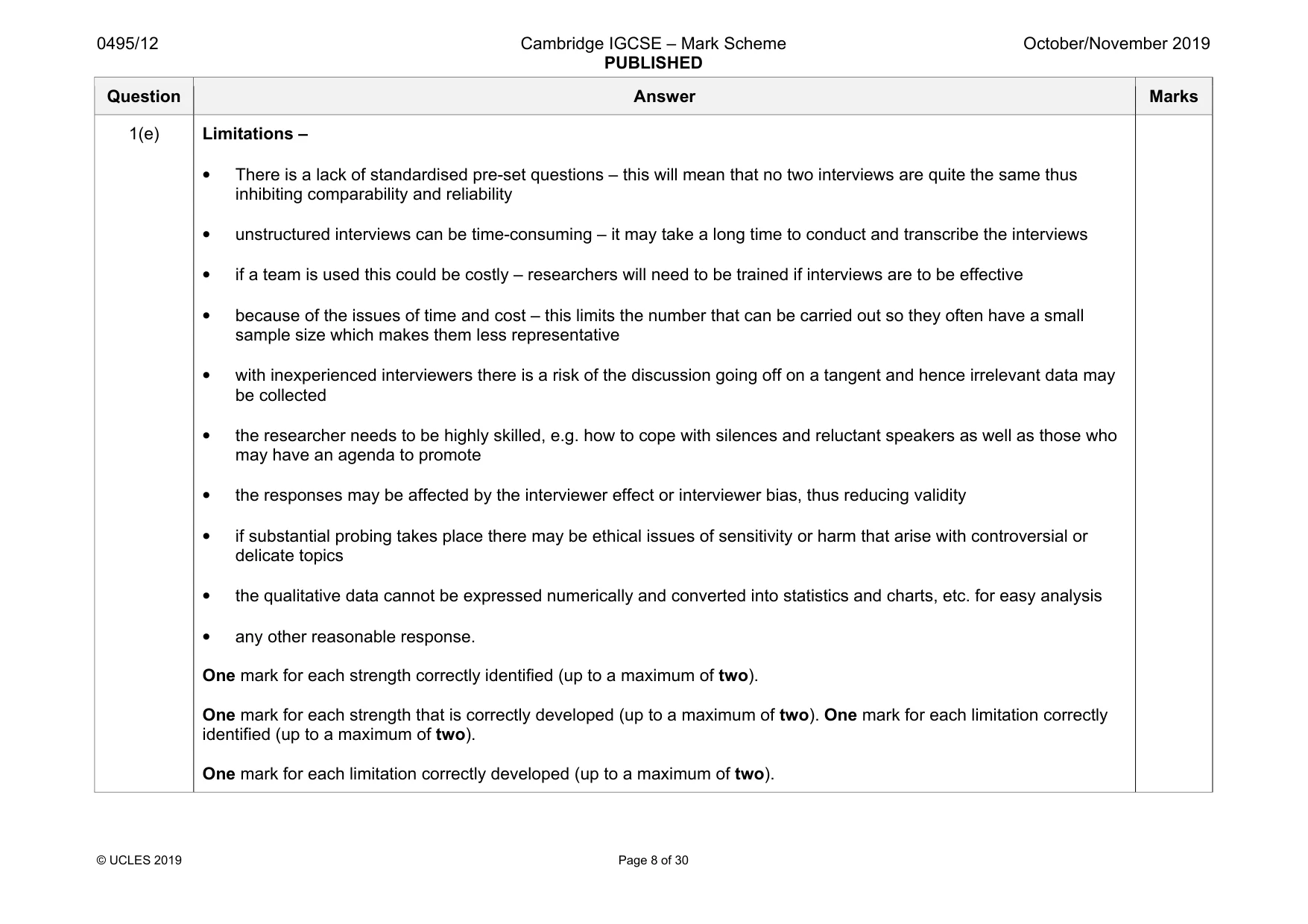
0495/12 Cambridge IGCSE – Mark Scheme PUBLISHED October/November 2019 © UCLES 2019 Page 8 of 30 Question Answer Marks 1(e) Limitations – • There is a lack of standardised pre-set questions – this will mean that no two interviews are quite the same thus inhibiting comparability and reliability • unstructured interviews can be time-consuming – it may take a long time to conduct and transcribe the interviews • if a team is used this could be costly – researchers will need to be trained if interviews are to be effective • because of the issues of time and cost – this limits the number that can be carried out so they often have a small sample size which makes them less representative • with inexperienced interviewers there is a risk of the discussion going off on a tangent and hence irrelevant data may be collected • the researcher needs to be highly skilled, e.g. how to cope with silences and reluctant speakers as well as those who may have an agenda to promote • the responses may be affected by the interviewer effect or interviewer bias, thus reducing validity • if substantial probing takes place there may be ethical issues of sensitivity or harm that arise with controversial or delicate topics • the qualitative data cannot be expressed numerically and converted into statistics and charts, etc. for easy analysis • any other reasonable response. One mark for each strength correctly identified (up to a maximum of two). One mark for each strength that is correctly developed (up to a maximum of two). One mark for each limitation correctly identified (up to a maximum of two). One mark for each limitation correctly developed (up to a maximum of two).
Mark scheme, page 9
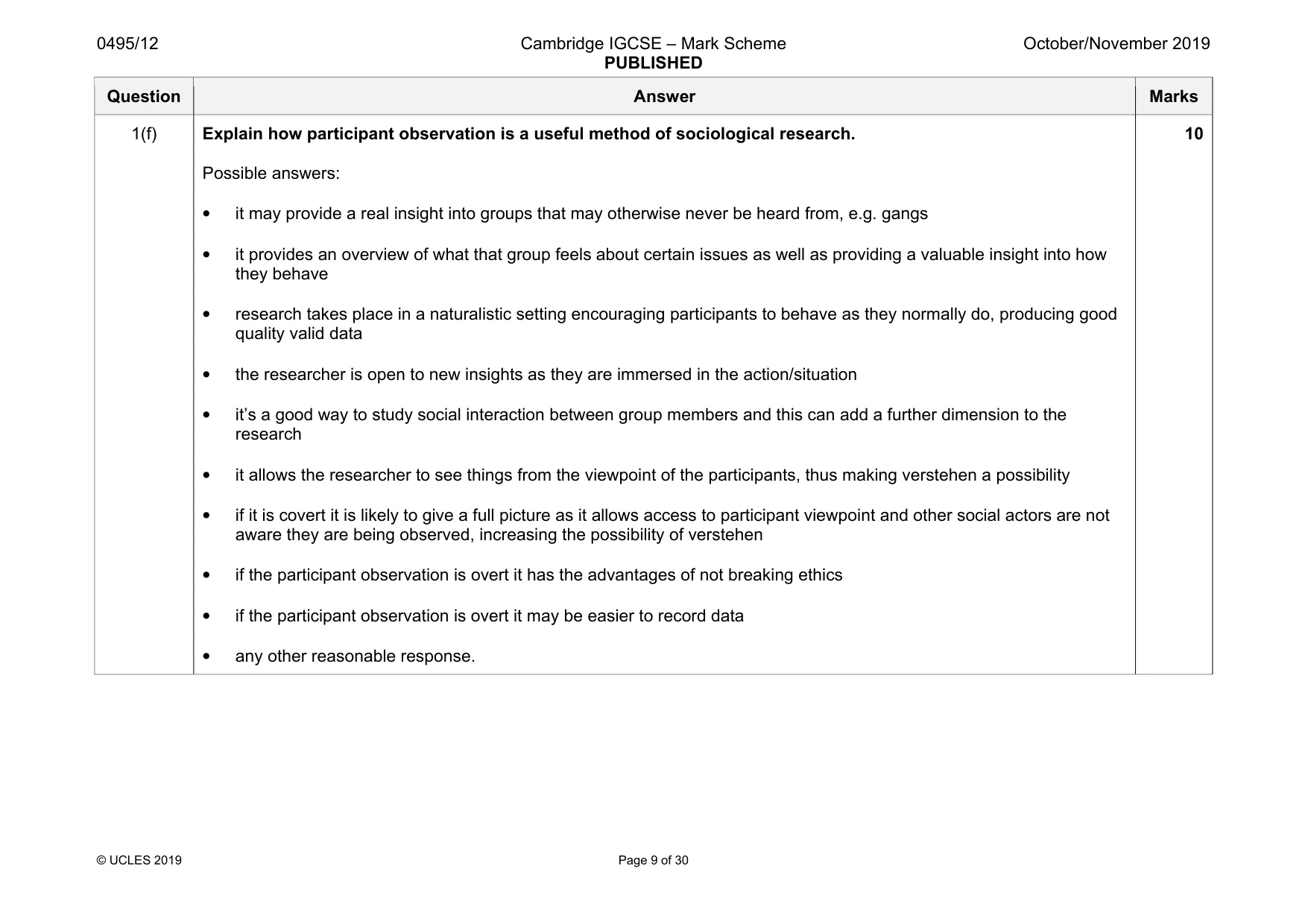
0495/12 Cambridge IGCSE – Mark Scheme PUBLISHED October/November 2019 © UCLES 2019 Page 9 of 30 Question Answer Marks 1(f) Explain how participant observation is a useful method of sociological research. Possible answers: • it may provide a real insight into groups that may otherwise never be heard from, e.g. gangs • it provides an overview of what that group feels about certain issues as well as providing a valuable insight into how they behave • research takes place in a naturalistic setting encouraging participants to behave as they normally do, producing good quality valid data • the researcher is open to new insights as they are immersed in the action/situation • it’s a good way to study social interaction between group members and this can add a further dimension to the research • it allows the researcher to see things from the viewpoint of the participants, thus making verstehen a possibility • if it is covert it is likely to give a full picture as it allows access to participant viewpoint and other social actors are not aware they are being observed, increasing the possibility of verstehen • if the participant observation is overt it has the advantages of not breaking ethics • if the participant observation is overt it may be easier to record data • any other reasonable response. 10
Mark scheme, page 10
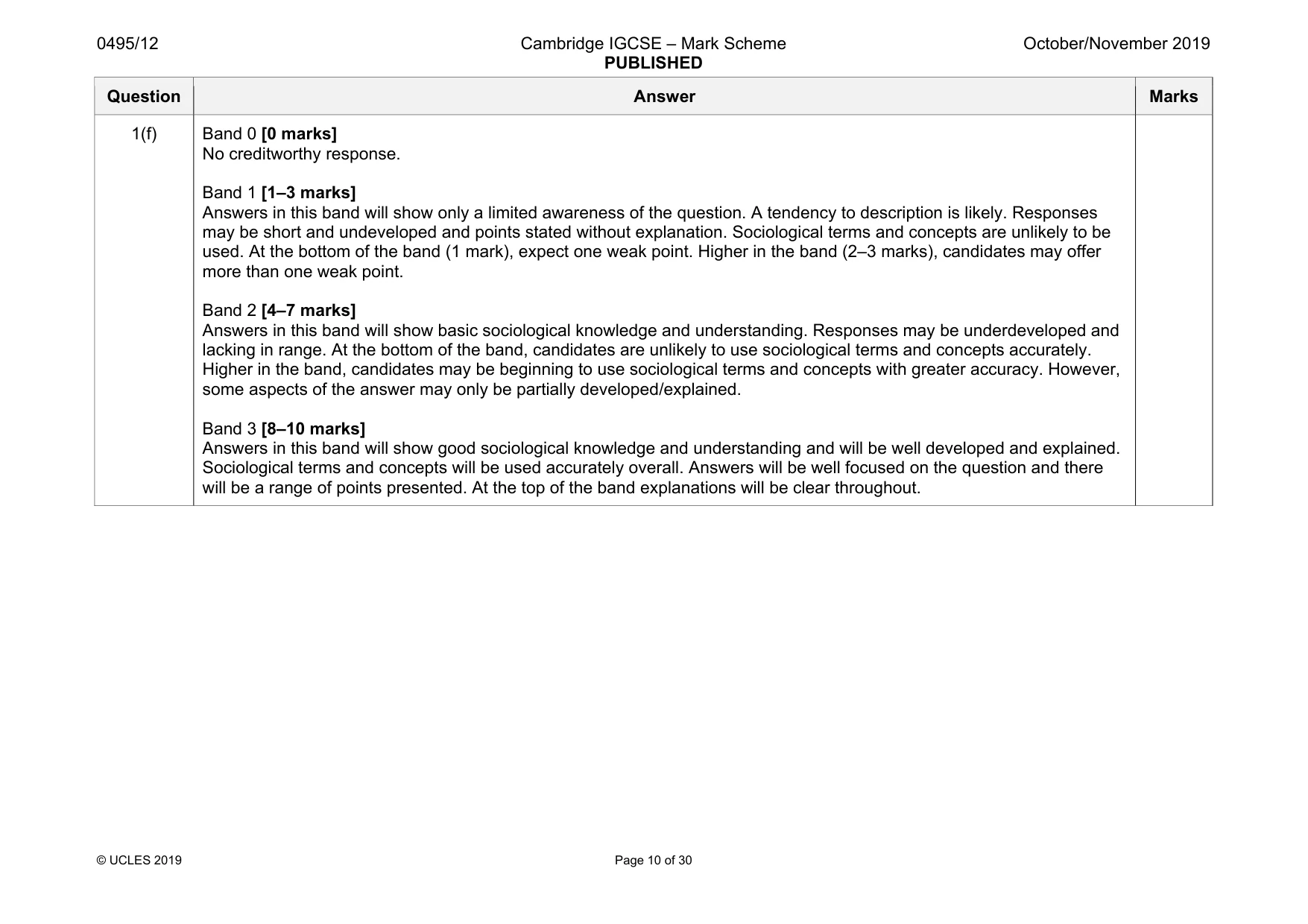
0495/12 Cambridge IGCSE – Mark Scheme PUBLISHED October/November 2019 © UCLES 2019 Page 10 of 30 Question Answer Marks 1(f) Band 0 [0 marks] No creditworthy response. Band 1 [1–3 marks] Answers in this band will show only a limited awareness of the question. A tendency to description is likely. Responses may be short and undeveloped and points stated without explanation. Sociological terms and concepts are unlikely to be used. At the bottom of the band (1 mark), expect one weak point. Higher in the band (2–3 marks), candidates may offer more than one weak point. Band 2 [4–7 marks] Answers in this band will show basic sociological knowledge and understanding. Responses may be underdeveloped and lacking in range. At the bottom of the band, candidates are unlikely to use sociological terms and concepts accurately. Higher in the band, candidates may be beginning to use sociological terms and concepts with greater accuracy. However, some aspects of the answer may only be partially developed/explained. Band 3 [8–10 marks] Answers in this band will show good sociological knowledge and understanding and will be well developed and explained. Sociological terms and concepts will be used accurately overall. Answers will be well focused on the question and there will be a range of points presented. At the top of the band explanations will be clear throughout.
Mark scheme, page 11
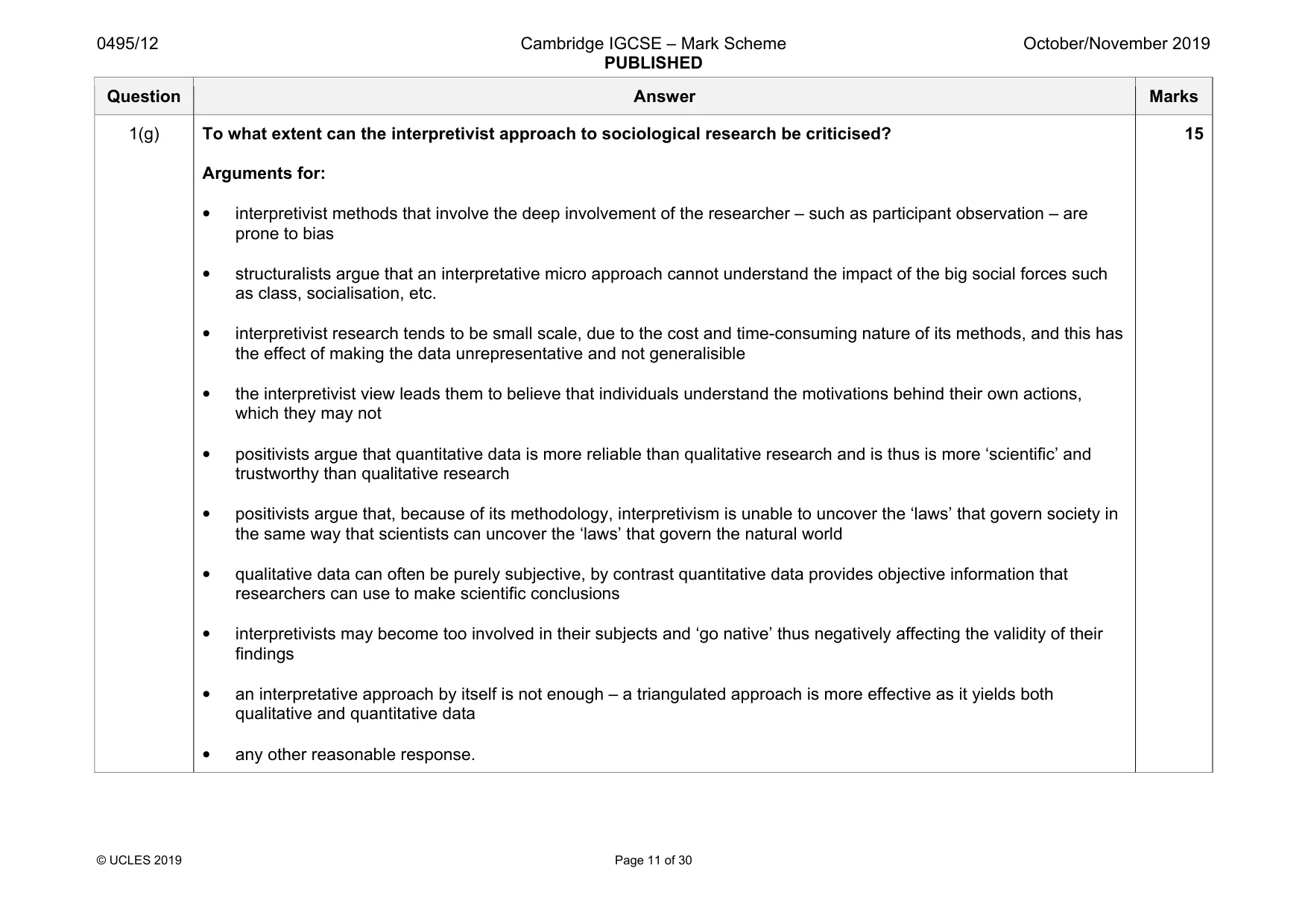
0495/12 Cambridge IGCSE – Mark Scheme PUBLISHED October/November 2019 © UCLES 2019 Page 11 of 30 Question Answer Marks 1(g) To what extent can the interpretivist approach to sociological research be criticised? Arguments for: • interpretivist methods that involve the deep involvement of the researcher – such as participant observation – are prone to bias • structuralists argue that an interpretative micro approach cannot understand the impact of the big social forces such as class, socialisation, etc. • interpretivist research tends to be small scale, due to the cost and time-consuming nature of its methods, and this has the effect of making the data unrepresentative and not generalisible • the interpretivist view leads them to believe that individuals understand the motivations behind their own actions, which they may not • positivists argue that quantitative data is more reliable than qualitative research and is thus is more ‘scientific’ and trustworthy than qualitative research • positivists argue that, because of its methodology, interpretivism is unable to uncover the ‘laws’ that govern society in the same way that scientists can uncover the ‘laws’ that govern the natural world • qualitative data can often be purely subjective, by contrast quantitative data provides objective information that researchers can use to make scientific conclusions • interpretivists may become too involved in their subjects and ‘go native’ thus negatively affecting the validity of their findings • an interpretative approach by itself is not enough – a triangulated approach is more effective as it yields both qualitative and quantitative data • any other reasonable response. 15
Mark scheme, page 12
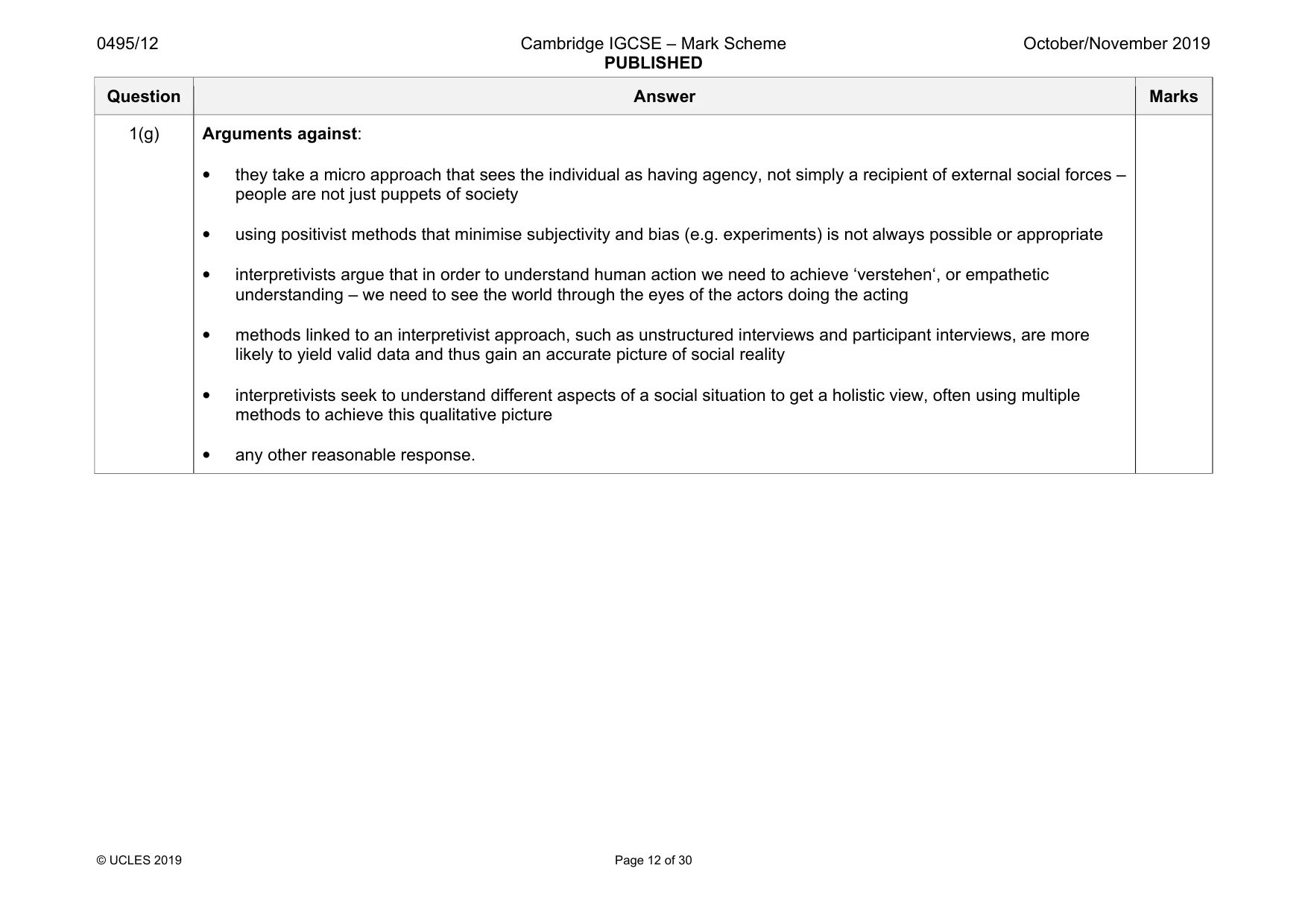
0495/12 Cambridge IGCSE – Mark Scheme PUBLISHED October/November 2019 © UCLES 2019 Page 12 of 30 Question Answer Marks 1(g) Arguments against: • they take a micro approach that sees the individual as having agency, not simply a recipient of external social forces – people are not just puppets of society • using positivist methods that minimise subjectivity and bias (e.g. experiments) is not always possible or appropriate • interpretivists argue that in order to understand human action we need to achieve ‘verstehen‘, or empathetic understanding – we need to see the world through the eyes of the actors doing the acting • methods linked to an interpretivist approach, such as unstructured interviews and participant interviews, are more likely to yield valid data and thus gain an accurate picture of social reality • interpretivists seek to understand different aspects of a social situation to get a holistic view, often using multiple methods to achieve this qualitative picture • any other reasonable response.
Mark scheme, page 13
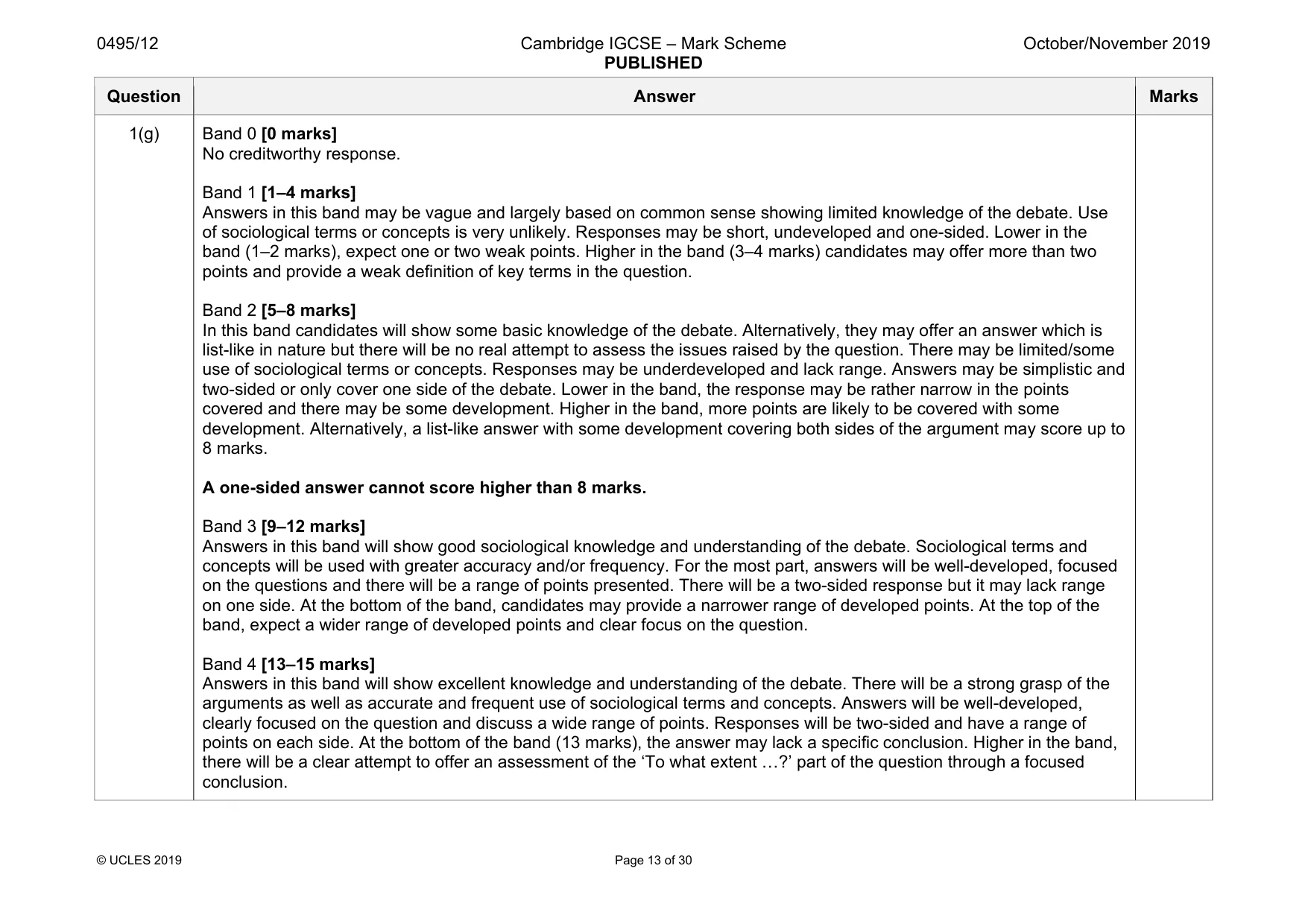
0495/12 Cambridge IGCSE – Mark Scheme PUBLISHED October/November 2019 © UCLES 2019 Page 13 of 30 Question Answer Marks 1(g) Band 0 [0 marks] No creditworthy response. Band 1 [1–4 marks] Answers in this band may be vague and largely based on common sense showing limited knowledge of the debate. Use of sociological terms or concepts is very unlikely. Responses may be short, undeveloped and one-sided. Lower in the band (1–2 marks), expect one or two weak points. Higher in the band (3–4 marks) candidates may offer more than two points and provide a weak definition of key terms in the question. Band 2 [5–8 marks] In this band candidates will show some basic knowledge of the debate. Alternatively, they may offer an answer which is list-like in nature but there will be no real attempt to assess the issues raised by the question. There may be limited/some use of sociological terms or concepts. Responses may be underdeveloped and lack range. Answers may be simplistic and two-sided or only cover one side of the debate. Lower in the band, the response may be rather narrow in the points covered and there may be some development. Higher in the band, more points are likely to be covered with some development. Alternatively, a list-like answer with some development covering both sides of the argument may score up to 8 marks. A one-sided answer cannot score higher than 8 marks. Band 3 [9–12 marks] Answers in this band will show good sociological knowledge and understanding of the debate. Sociological terms and concepts will be used with greater accuracy and/or frequency. For the most part, answers will be well-developed, focused on the questions and there will be a range of points presented. There will be a two-sided response but it may lack range on one side. At the bottom of the band, candidates may provide a narrower range of developed points. At the top of the band, expect a wider range of developed points and clear focus on the question. Band 4 [13–15 marks] Answers in this band will show excellent knowledge and understanding of the debate. There will be a strong grasp of the arguments as well as accurate and frequent use of sociological terms and concepts. Answers will be well-developed, clearly focused on the question and discuss a wide range of points. Responses will be two-sided and have a range of points on each side. At the bottom of the band (13 marks), the answer may lack a specific conclusion. Higher in the band, there will be a clear attempt to offer an assessment of the ‘To what extent «?’ part of the question through a focused conclusion.
Mark scheme, page 14
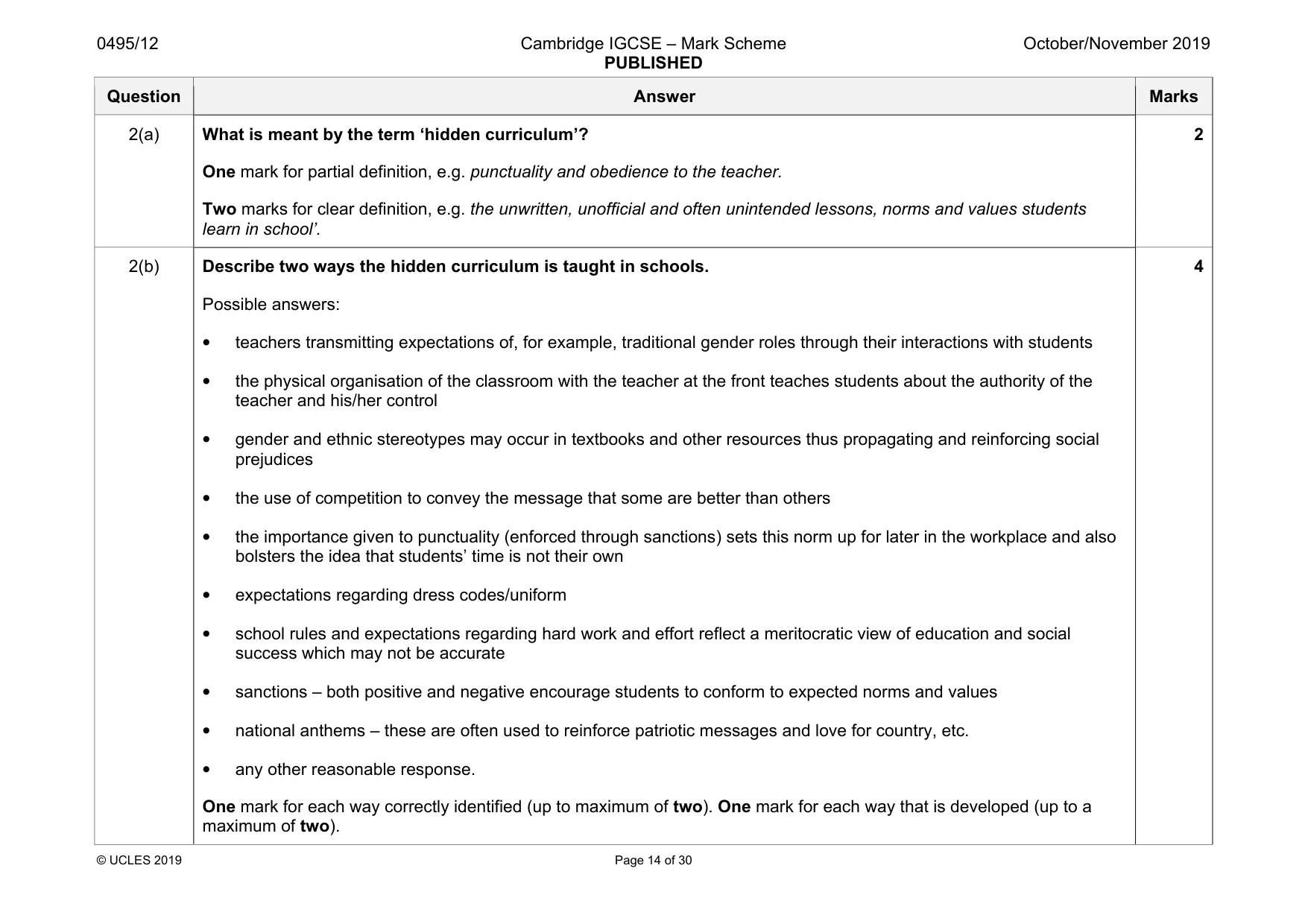
0495/12 Cambridge IGCSE – Mark Scheme PUBLISHED October/November 2019 © UCLES 2019 Page 14 of 30 Question Answer Marks 2(a) What is meant by the term ‘hidden curriculum’? One mark for partial definition, e.g. punctuality and obedience to the teacher. Two marks for clear definition, e.g. the unwritten, unofficial and often unintended lessons, norms and values students learn in school’. 2 2(b) Describe two ways the hidden curriculum is taught in schools. Possible answers: • teachers transmitting expectations of, for example, traditional gender roles through their interactions with students • the physical organisation of the classroom with the teacher at the front teaches students about the authority of the teacher and his/her control • gender and ethnic stereotypes may occur in textbooks and other resources thus propagating and reinforcing social prejudices • the use of competition to convey the message that some are better than others • the importance given to punctuality (enforced through sanctions) sets this norm up for later in the workplace and also bolsters the idea that students’ time is not their own • expectations regarding dress codes/uniform • school rules and expectations regarding hard work and effort reflect a meritocratic view of education and social success which may not be accurate • sanctions – both positive and negative encourage students to conform to expected norms and values • national anthems – these are often used to reinforce patriotic messages and love for country, etc. • any other reasonable response. One mark for each way correctly identified (up to maximum of two). One mark for each way that is developed (up to a maximum of two). 4
Mark scheme, page 15
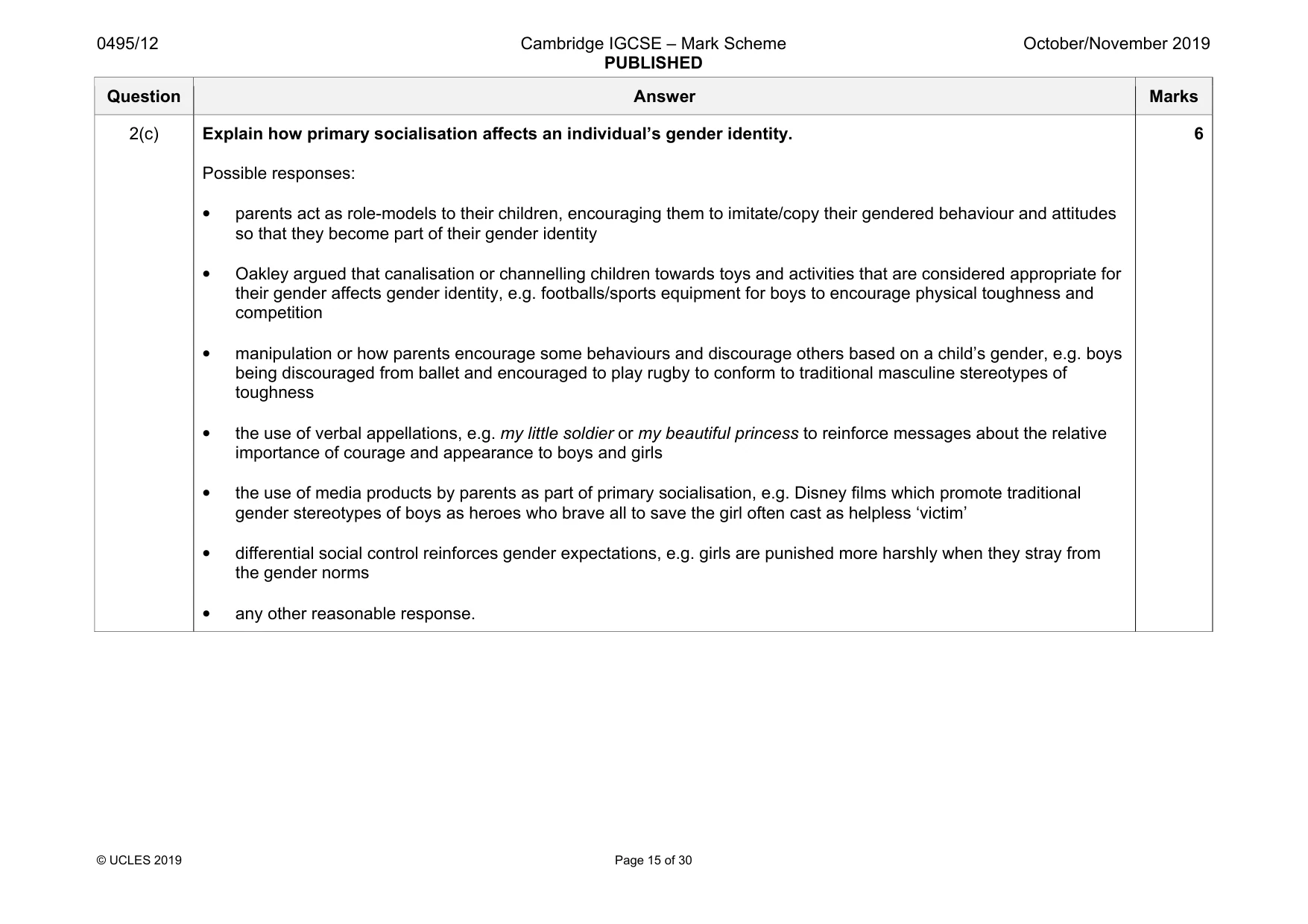
0495/12 Cambridge IGCSE – Mark Scheme PUBLISHED October/November 2019 © UCLES 2019 Page 15 of 30 Question Answer Marks 2(c) Explain how primary socialisation affects an individual’s gender identity. Possible responses: • parents act as role-models to their children, encouraging them to imitate/copy their gendered behaviour and attitudes so that they become part of their gender identity • Oakley argued that canalisation or channelling children towards toys and activities that are considered appropriate for their gender affects gender identity, e.g. footballs/sports equipment for boys to encourage physical toughness and competition • manipulation or how parents encourage some behaviours and discourage others based on a child’s gender, e.g. boys being discouraged from ballet and encouraged to play rugby to conform to traditional masculine stereotypes of toughness • the use of verbal appellations, e.g. my little soldier or my beautiful princess to reinforce messages about the relative importance of courage and appearance to boys and girls • the use of media products by parents as part of primary socialisation, e.g. Disney films which promote traditional gender stereotypes of boys as heroes who brave all to save the girl often cast as helpless ‘victim’ • differential social control reinforces gender expectations, e.g. girls are punished more harshly when they stray from the gender norms • any other reasonable response. 6
Mark scheme, page 16
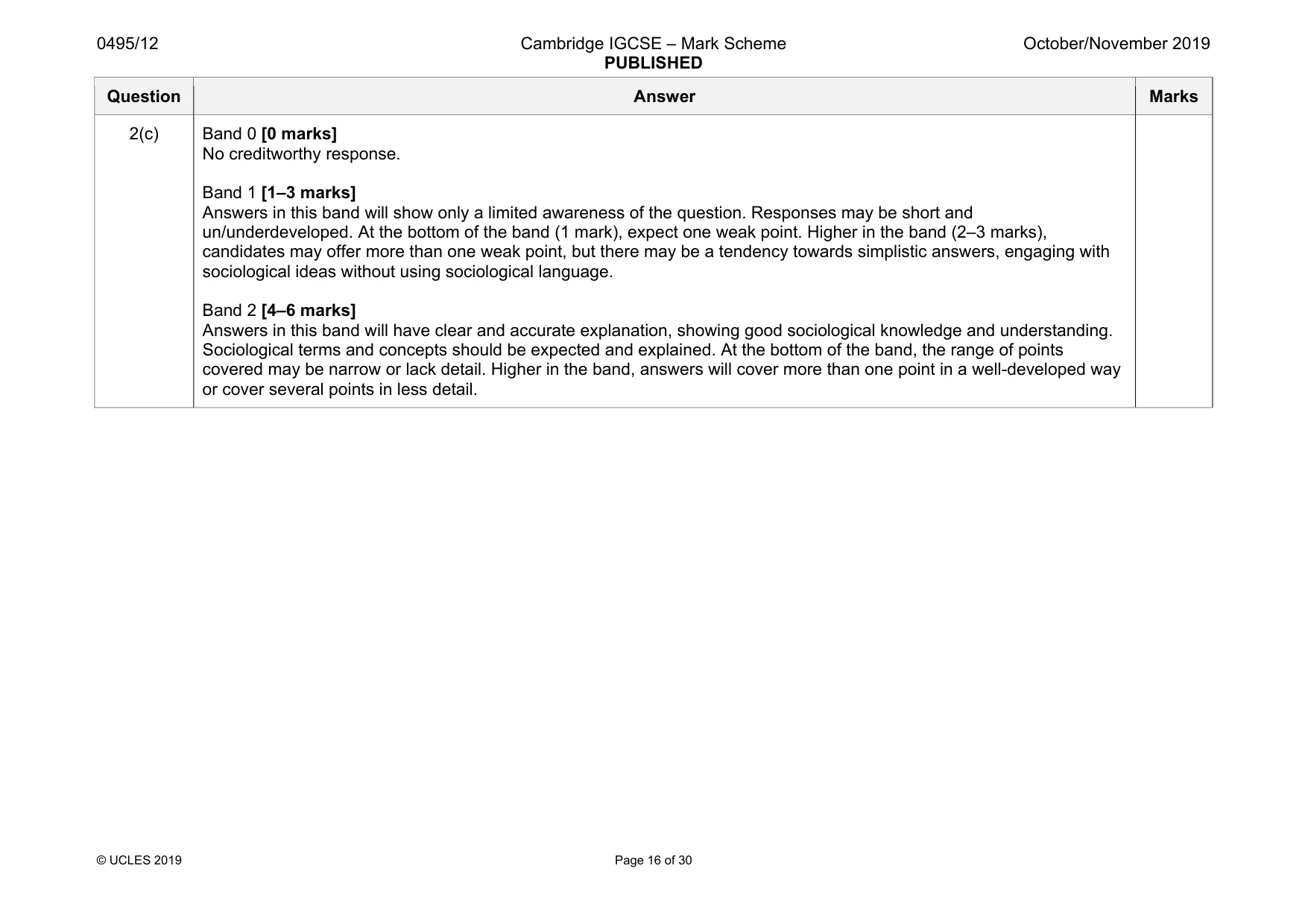
0495/12 Cambridge IGCSE – Mark Scheme PUBLISHED October/November 2019 © UCLES 2019 Page 16 of 30 Question Answer Marks 2(c) Band 0 [0 marks] No creditworthy response. Band 1 [1–3 marks] Answers in this band will show only a limited awareness of the question. Responses may be short and un/underdeveloped. At the bottom of the band (1 mark), expect one weak point. Higher in the band (2–3 marks), candidates may offer more than one weak point, but there may be a tendency towards simplistic answers, engaging with sociological ideas without using sociological language. Band 2 [4–6 marks] Answers in this band will have clear and accurate explanation, showing good sociological knowledge and understanding. Sociological terms and concepts should be expected and explained. At the bottom of the band, the range of points covered may be narrow or lack detail. Higher in the band, answers will cover more than one point in a well-developed way or cover several points in less detail.
Mark scheme, page 17
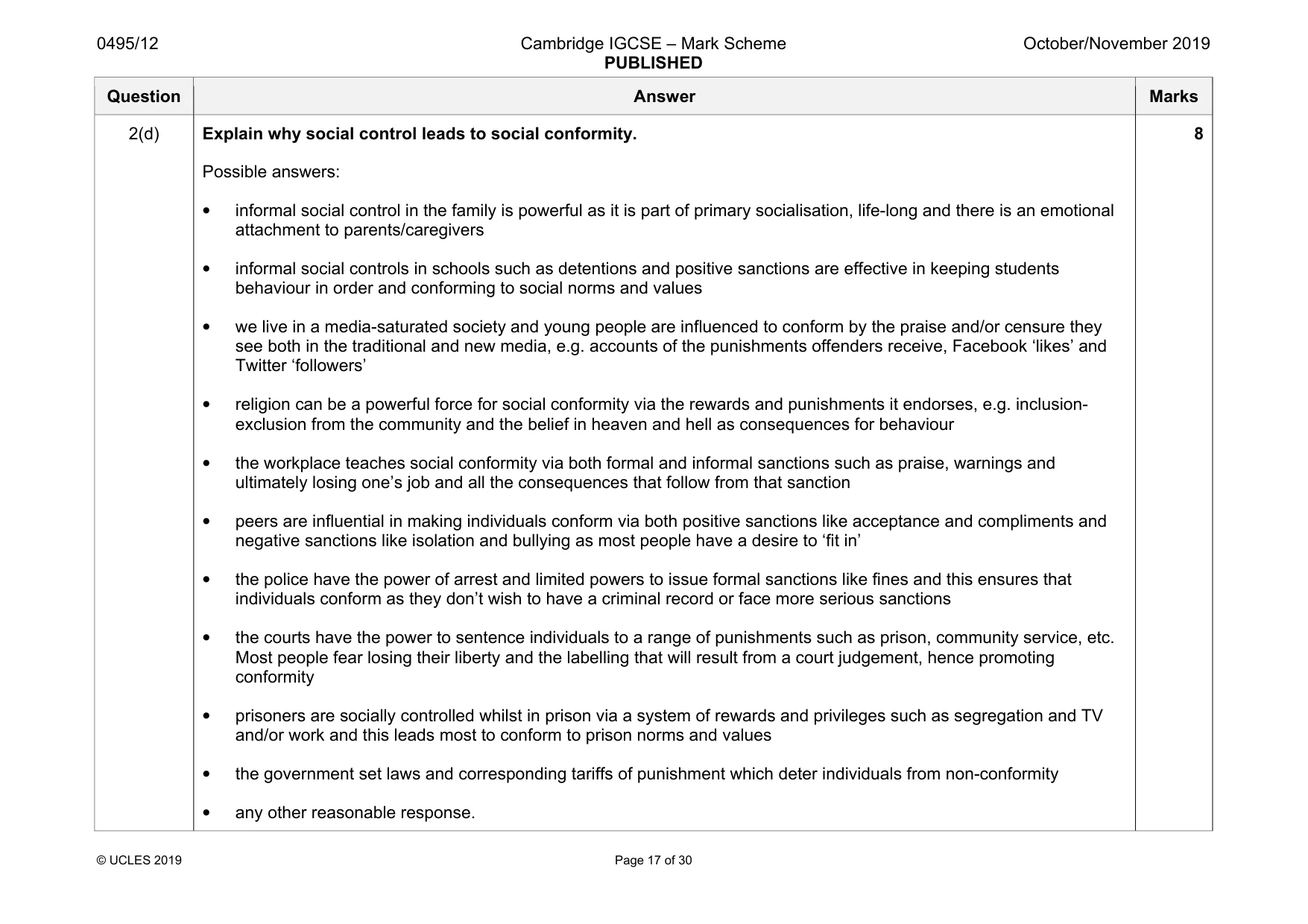
0495/12 Cambridge IGCSE – Mark Scheme PUBLISHED October/November 2019 © UCLES 2019 Page 17 of 30 Question Answer Marks 2(d) Explain why social control leads to social conformity. Possible answers: • informal social control in the family is powerful as it is part of primary socialisation, life-long and there is an emotional attachment to parents/caregivers • informal social controls in schools such as detentions and positive sanctions are effective in keeping students behaviour in order and conforming to social norms and values • we live in a media-saturated society and young people are influenced to conform by the praise and/or censure they see both in the traditional and new media, e.g. accounts of the punishments offenders receive, Facebook ‘likes’ and Twitter ‘followers’ • religion can be a powerful force for social conformity via the rewards and punishments it endorses, e.g. inclusion- exclusion from the community and the belief in heaven and hell as consequences for behaviour • the workplace teaches social conformity via both formal and informal sanctions such as praise, warnings and ultimately losing one’s job and all the consequences that follow from that sanction • peers are influential in making individuals conform via both positive sanctions like acceptance and compliments and negative sanctions like isolation and bullying as most people have a desire to ‘fit in’ • the police have the power of arrest and limited powers to issue formal sanctions like fines and this ensures that individuals conform as they don’t wish to have a criminal record or face more serious sanctions • the courts have the power to sentence individuals to a range of punishments such as prison, community service, etc. Most people fear losing their liberty and the labelling that will result from a court judgement, hence promoting conformity • prisoners are socially controlled whilst in prison via a system of rewards and privileges such as segregation and TV and/or work and this leads most to conform to prison norms and values • the government set laws and corresponding tariffs of punishment which deter individuals from non-conformity • any other reasonable response. 8
Mark scheme, page 18
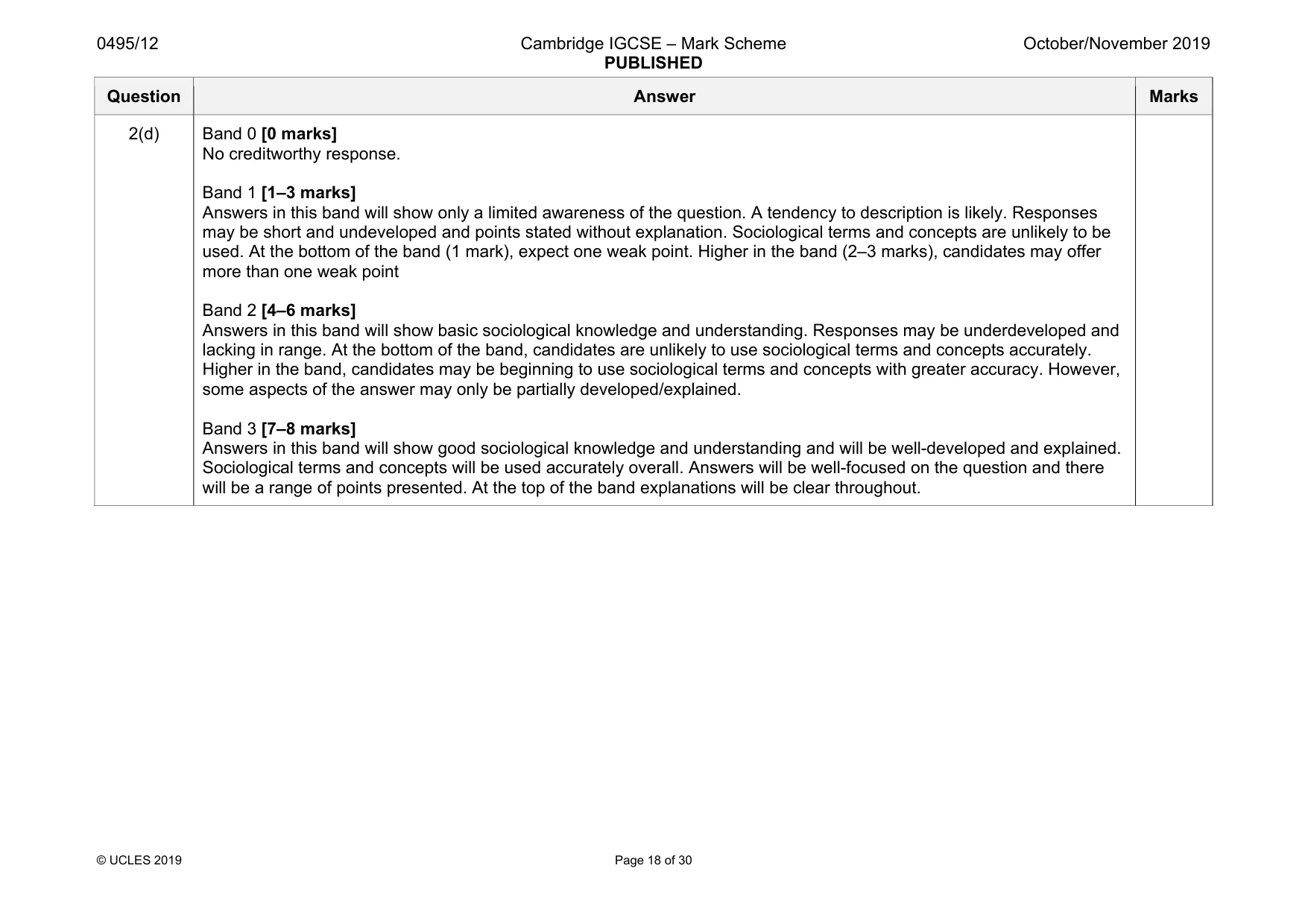
0495/12 Cambridge IGCSE – Mark Scheme PUBLISHED October/November 2019 © UCLES 2019 Page 18 of 30 Question Answer Marks 2(d) Band 0 [0 marks] No creditworthy response. Band 1 [1–3 marks] Answers in this band will show only a limited awareness of the question. A tendency to description is likely. Responses may be short and undeveloped and points stated without explanation. Sociological terms and concepts are unlikely to be used. At the bottom of the band (1 mark), expect one weak point. Higher in the band (2–3 marks), candidates may offer more than one weak point Band 2 [4–6 marks] Answers in this band will show basic sociological knowledge and understanding. Responses may be underdeveloped and lacking in range. At the bottom of the band, candidates are unlikely to use sociological terms and concepts accurately. Higher in the band, candidates may be beginning to use sociological terms and concepts with greater accuracy. However, some aspects of the answer may only be partially developed/explained. Band 3 [7–8 marks] Answers in this band will show good sociological knowledge and understanding and will be well-developed and explained. Sociological terms and concepts will be used accurately overall. Answers will be well-focused on the question and there will be a range of points presented. At the top of the band explanations will be clear throughout.
Mark scheme, page 19
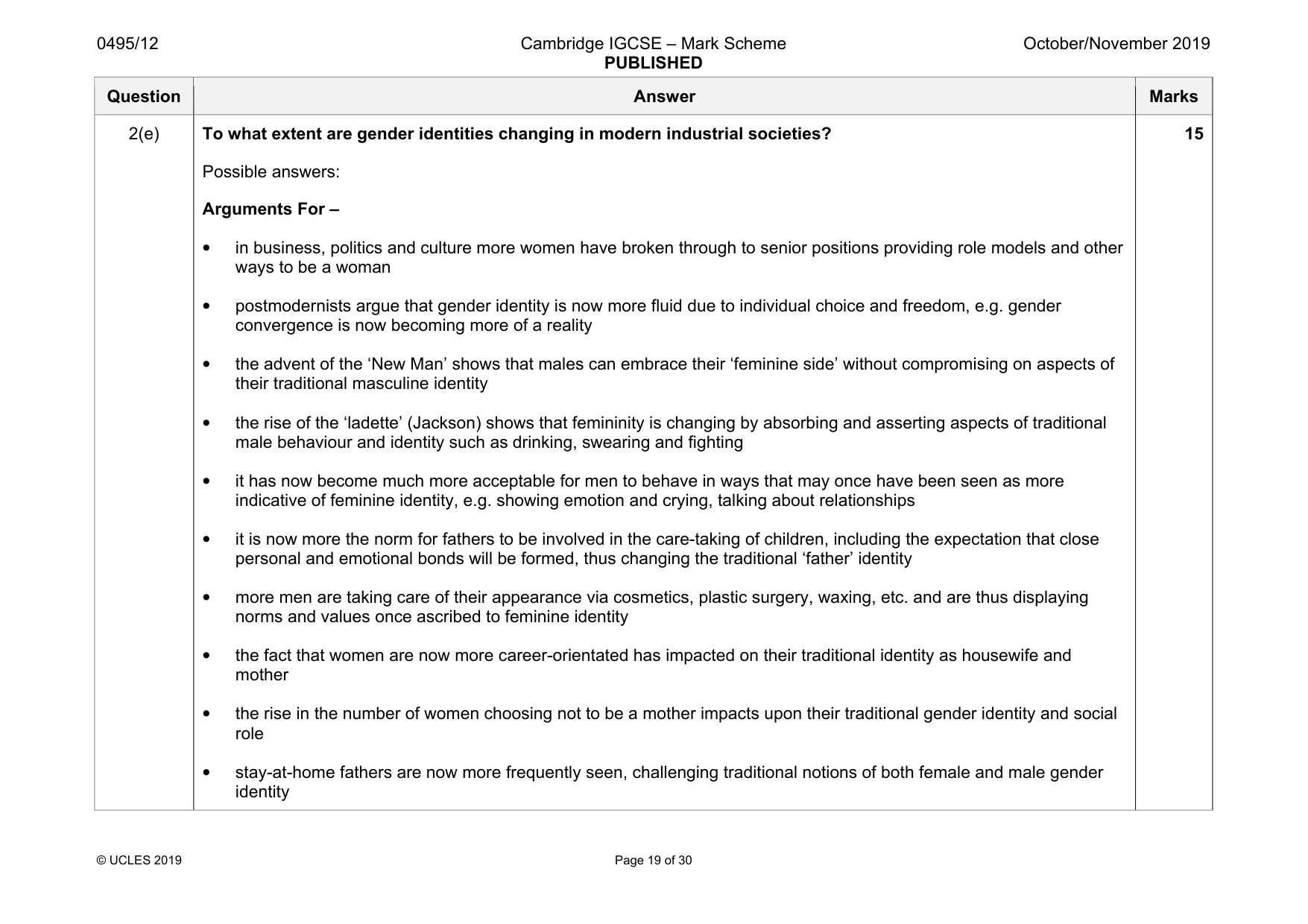
0495/12 Cambridge IGCSE – Mark Scheme PUBLISHED October/November 2019 © UCLES 2019 Page 19 of 30 Question Answer Marks 2(e) To what extent are gender identities changing in modern industrial societies? Possible answers: Arguments For – • in business, politics and culture more women have broken through to senior positions providing role models and other ways to be a woman • postmodernists argue that gender identity is now more fluid due to individual choice and freedom, e.g. gender convergence is now becoming more of a reality • the advent of the ‘New Man’ shows that males can embrace their ‘feminine side’ without compromising on aspects of their traditional masculine identity • the rise of the ‘ladette’ (Jackson) shows that femininity is changing by absorbing and asserting aspects of traditional male behaviour and identity such as drinking, swearing and fighting • it has now become much more acceptable for men to behave in ways that may once have been seen as more indicative of feminine identity, e.g. showing emotion and crying, talking about relationships • it is now more the norm for fathers to be involved in the care-taking of children, including the expectation that close personal and emotional bonds will be formed, thus changing the traditional ‘father’ identity • more men are taking care of their appearance via cosmetics, plastic surgery, waxing, etc. and are thus displaying norms and values once ascribed to feminine identity • the fact that women are now more career-orientated has impacted on their traditional identity as housewife and mother • the rise in the number of women choosing not to be a mother impacts upon their traditional gender identity and social role • stay-at-home fathers are now more frequently seen, challenging traditional notions of both female and male gender identity 15
Mark scheme, page 20
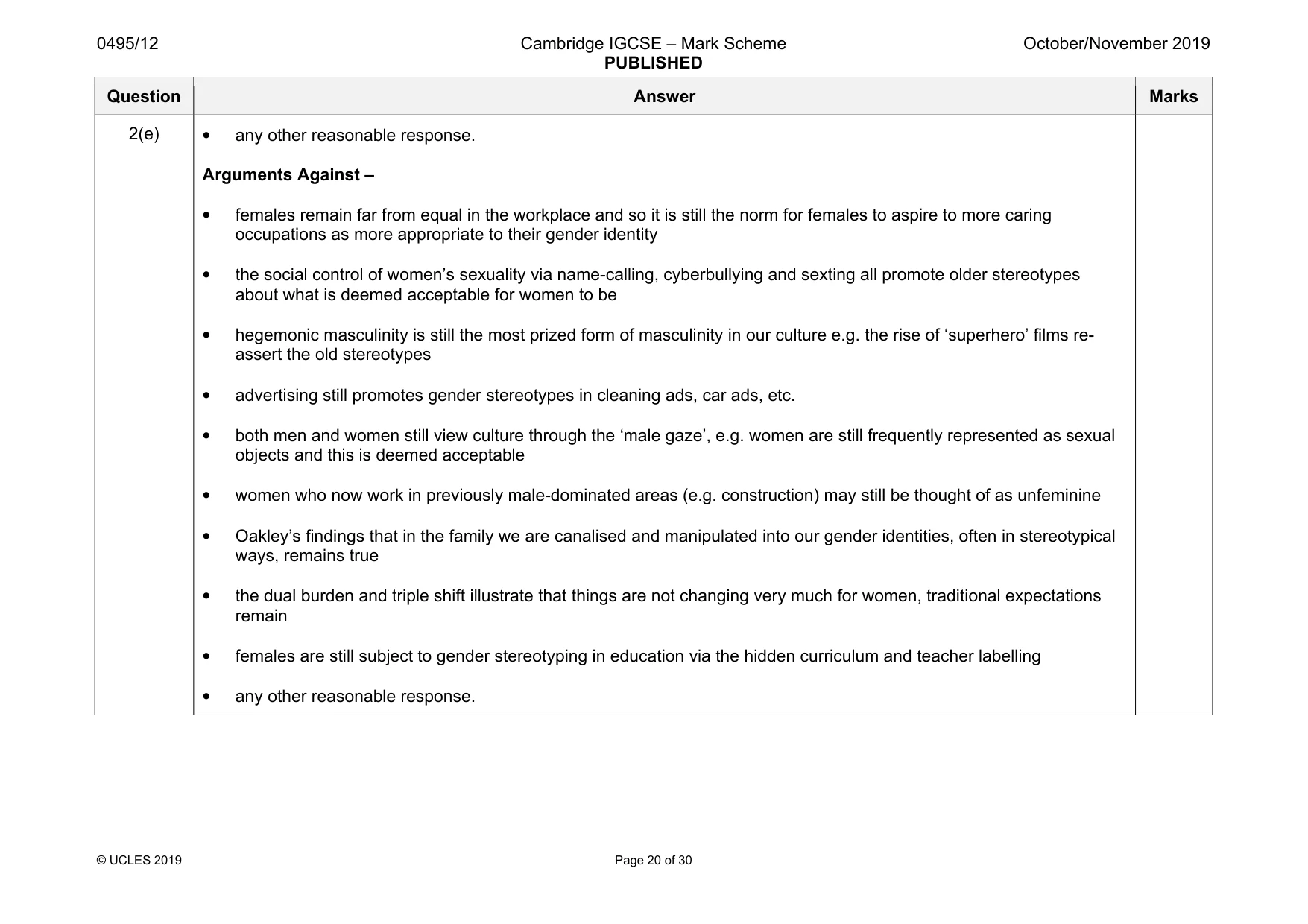
0495/12 Cambridge IGCSE – Mark Scheme PUBLISHED October/November 2019 © UCLES 2019 Page 20 of 30 Question Answer Marks 2(e) • any other reasonable response. Arguments Against – • females remain far from equal in the workplace and so it is still the norm for females to aspire to more caring occupations as more appropriate to their gender identity • the social control of women’s sexuality via name-calling, cyberbullying and sexting all promote older stereotypes about what is deemed acceptable for women to be • hegemonic masculinity is still the most prized form of masculinity in our culture e.g. the rise of ‘superhero’ films re- assert the old stereotypes • advertising still promotes gender stereotypes in cleaning ads, car ads, etc. • both men and women still view culture through the ‘male gaze’, e.g. women are still frequently represented as sexual objects and this is deemed acceptable • women who now work in previously male-dominated areas (e.g. construction) may still be thought of as unfeminine • Oakley’s findings that in the family we are canalised and manipulated into our gender identities, often in stereotypical ways, remains true • the dual burden and triple shift illustrate that things are not changing very much for women, traditional expectations remain • females are still subject to gender stereotyping in education via the hidden curriculum and teacher labelling • any other reasonable response.
Mark scheme, page 21
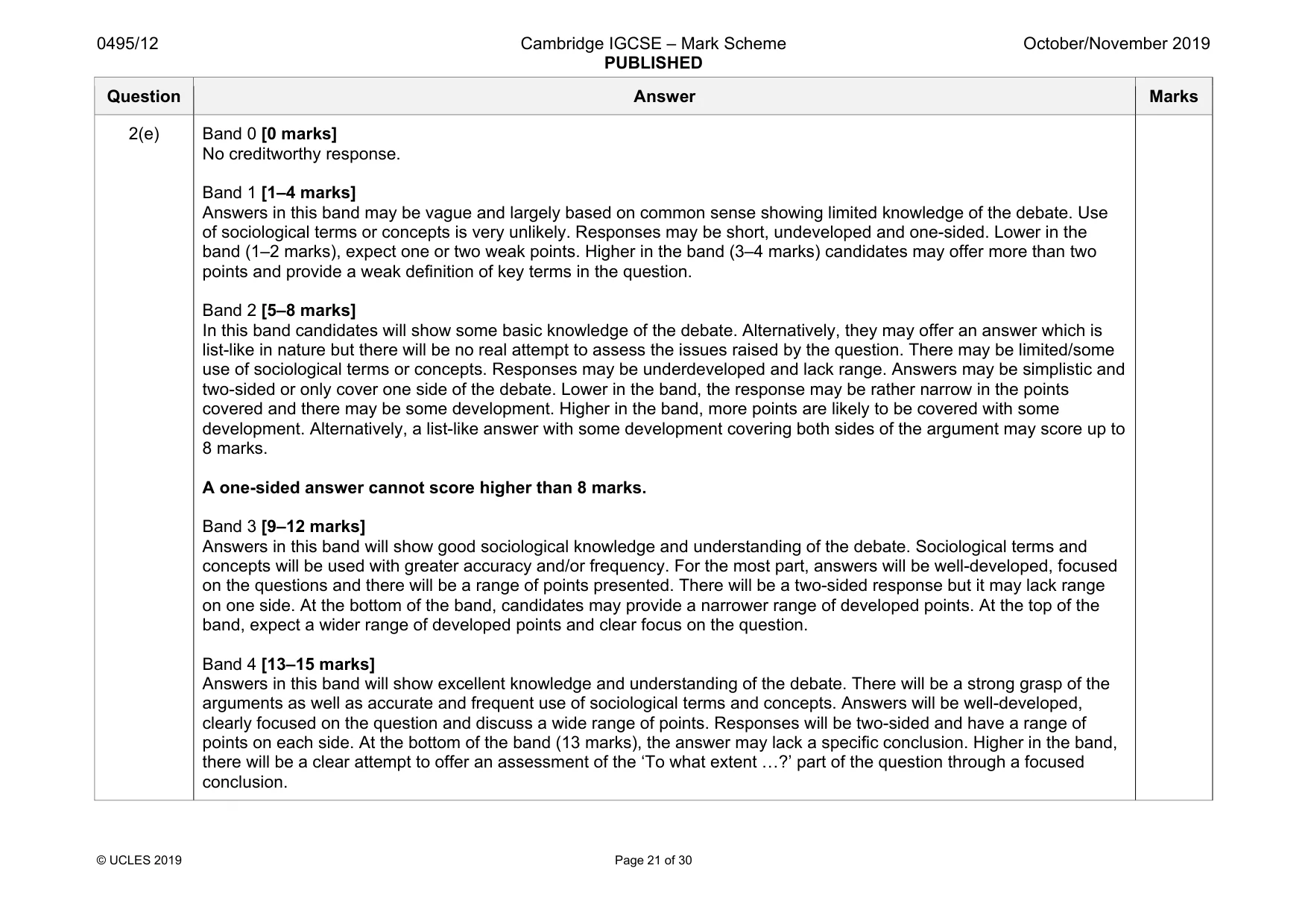
0495/12 Cambridge IGCSE – Mark Scheme PUBLISHED October/November 2019 © UCLES 2019 Page 21 of 30 Question Answer Marks 2(e) Band 0 [0 marks] No creditworthy response. Band 1 [1–4 marks] Answers in this band may be vague and largely based on common sense showing limited knowledge of the debate. Use of sociological terms or concepts is very unlikely. Responses may be short, undeveloped and one-sided. Lower in the band (1–2 marks), expect one or two weak points. Higher in the band (3–4 marks) candidates may offer more than two points and provide a weak definition of key terms in the question. Band 2 [5–8 marks] In this band candidates will show some basic knowledge of the debate. Alternatively, they may offer an answer which is list-like in nature but there will be no real attempt to assess the issues raised by the question. There may be limited/some use of sociological terms or concepts. Responses may be underdeveloped and lack range. Answers may be simplistic and two-sided or only cover one side of the debate. Lower in the band, the response may be rather narrow in the points covered and there may be some development. Higher in the band, more points are likely to be covered with some development. Alternatively, a list-like answer with some development covering both sides of the argument may score up to 8 marks. A one-sided answer cannot score higher than 8 marks. Band 3 [9–12 marks] Answers in this band will show good sociological knowledge and understanding of the debate. Sociological terms and concepts will be used with greater accuracy and/or frequency. For the most part, answers will be well-developed, focused on the questions and there will be a range of points presented. There will be a two-sided response but it may lack range on one side. At the bottom of the band, candidates may provide a narrower range of developed points. At the top of the band, expect a wider range of developed points and clear focus on the question. Band 4 [13–15 marks] Answers in this band will show excellent knowledge and understanding of the debate. There will be a strong grasp of the arguments as well as accurate and frequent use of sociological terms and concepts. Answers will be well-developed, clearly focused on the question and discuss a wide range of points. Responses will be two-sided and have a range of points on each side. At the bottom of the band (13 marks), the answer may lack a specific conclusion. Higher in the band, there will be a clear attempt to offer an assessment of the ‘To what extent «?’ part of the question through a focused conclusion.
Mark scheme, page 22
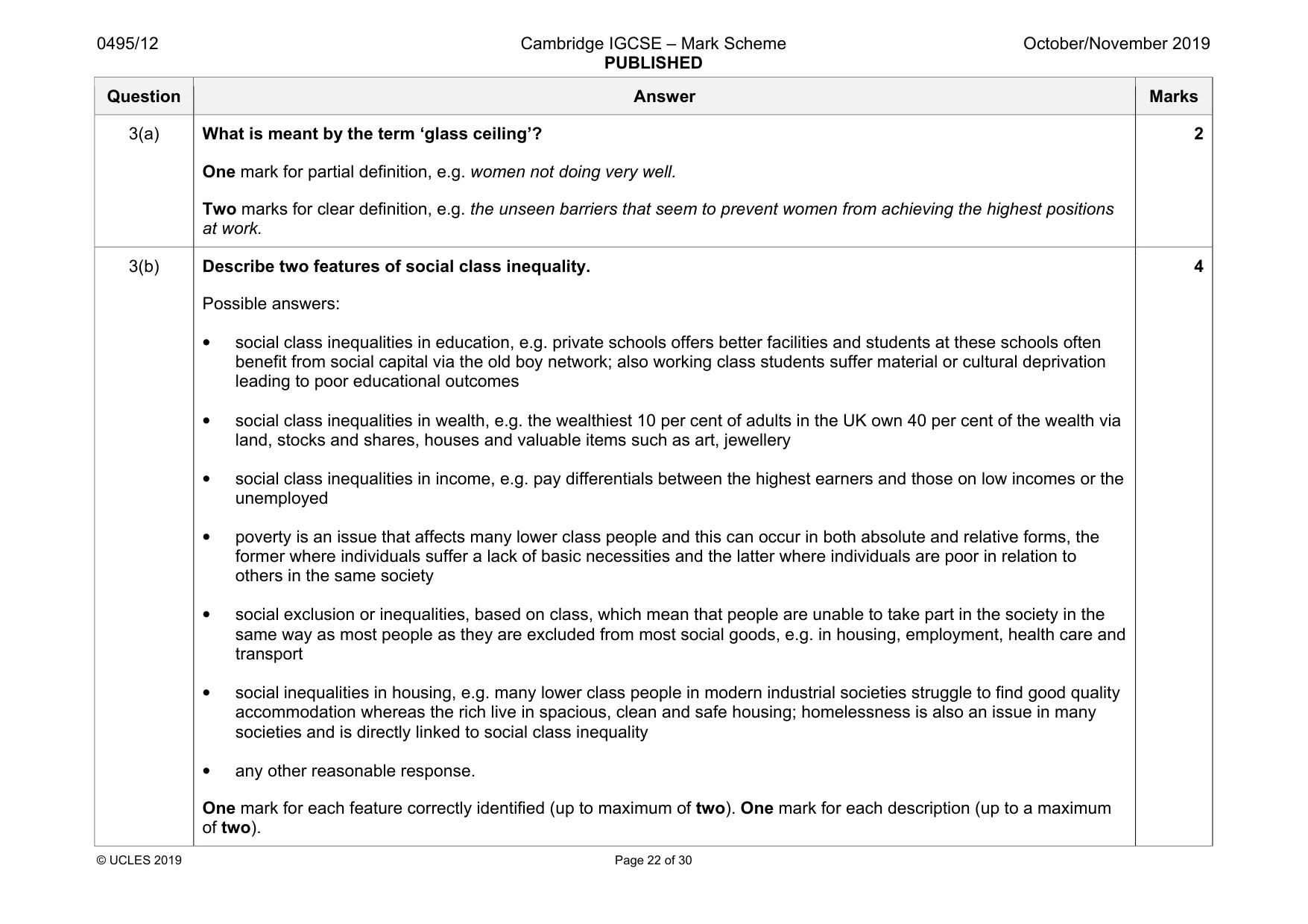
0495/12 Cambridge IGCSE – Mark Scheme PUBLISHED October/November 2019 © UCLES 2019 Page 22 of 30 Question Answer Marks 3(a) What is meant by the term ‘glass ceiling’? One mark for partial definition, e.g. women not doing very well. Two marks for clear definition, e.g. the unseen barriers that seem to prevent women from achieving the highest positions at work. 2 3(b) Describe two features of social class inequality. Possible answers: • social class inequalities in education, e.g. private schools offers better facilities and students at these schools often benefit from social capital via the old boy network; also working class students suffer material or cultural deprivation leading to poor educational outcomes • social class inequalities in wealth, e.g. the wealthiest 10 per cent of adults in the UK own 40 per cent of the wealth via land, stocks and shares, houses and valuable items such as art, jewellery • social class inequalities in income, e.g. pay differentials between the highest earners and those on low incomes or the unemployed • poverty is an issue that affects many lower class people and this can occur in both absolute and relative forms, the former where individuals suffer a lack of basic necessities and the latter where individuals are poor in relation to others in the same society • social exclusion or inequalities, based on class, which mean that people are unable to take part in the society in the same way as most people as they are excluded from most social goods, e.g. in housing, employment, health care and transport • social inequalities in housing, e.g. many lower class people in modern industrial societies struggle to find good quality accommodation whereas the rich live in spacious, clean and safe housing; homelessness is also an issue in many societies and is directly linked to social class inequality • any other reasonable response. One mark for each feature correctly identified (up to maximum of two). One mark for each description (up to a maximum of two). 4
Mark scheme, page 23
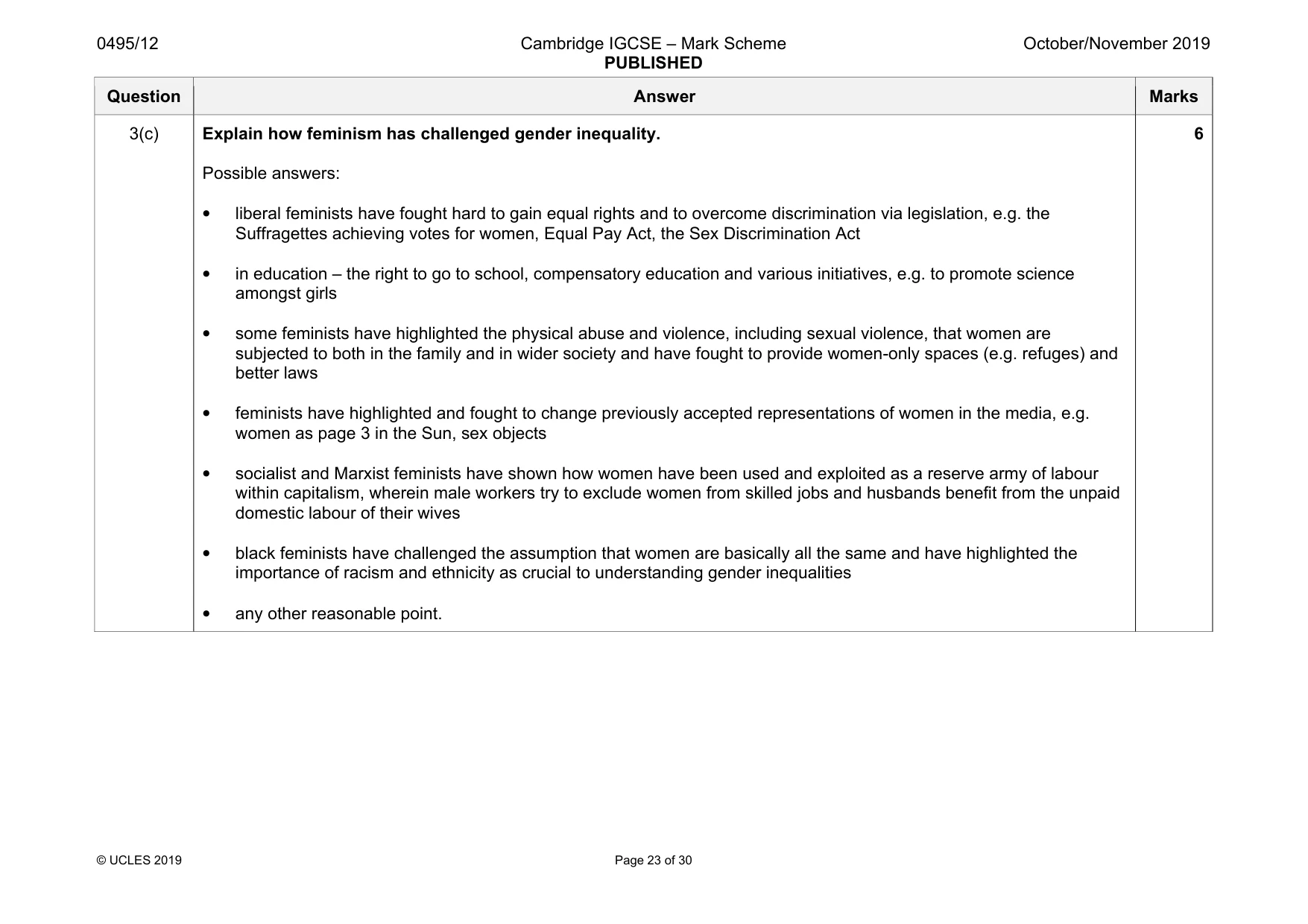
0495/12 Cambridge IGCSE – Mark Scheme PUBLISHED October/November 2019 © UCLES 2019 Page 23 of 30 Question Answer Marks 3(c) Explain how feminism has challenged gender inequality. Possible answers: • liberal feminists have fought hard to gain equal rights and to overcome discrimination via legislation, e.g. the Suffragettes achieving votes for women, Equal Pay Act, the Sex Discrimination Act • in education – the right to go to school, compensatory education and various initiatives, e.g. to promote science amongst girls • some feminists have highlighted the physical abuse and violence, including sexual violence, that women are subjected to both in the family and in wider society and have fought to provide women-only spaces (e.g. refuges) and better laws • feminists have highlighted and fought to change previously accepted representations of women in the media, e.g. women as page 3 in the Sun, sex objects • socialist and Marxist feminists have shown how women have been used and exploited as a reserve army of labour within capitalism, wherein male workers try to exclude women from skilled jobs and husbands benefit from the unpaid domestic labour of their wives • black feminists have challenged the assumption that women are basically all the same and have highlighted the importance of racism and ethnicity as crucial to understanding gender inequalities • any other reasonable point. 6
Mark scheme, page 24
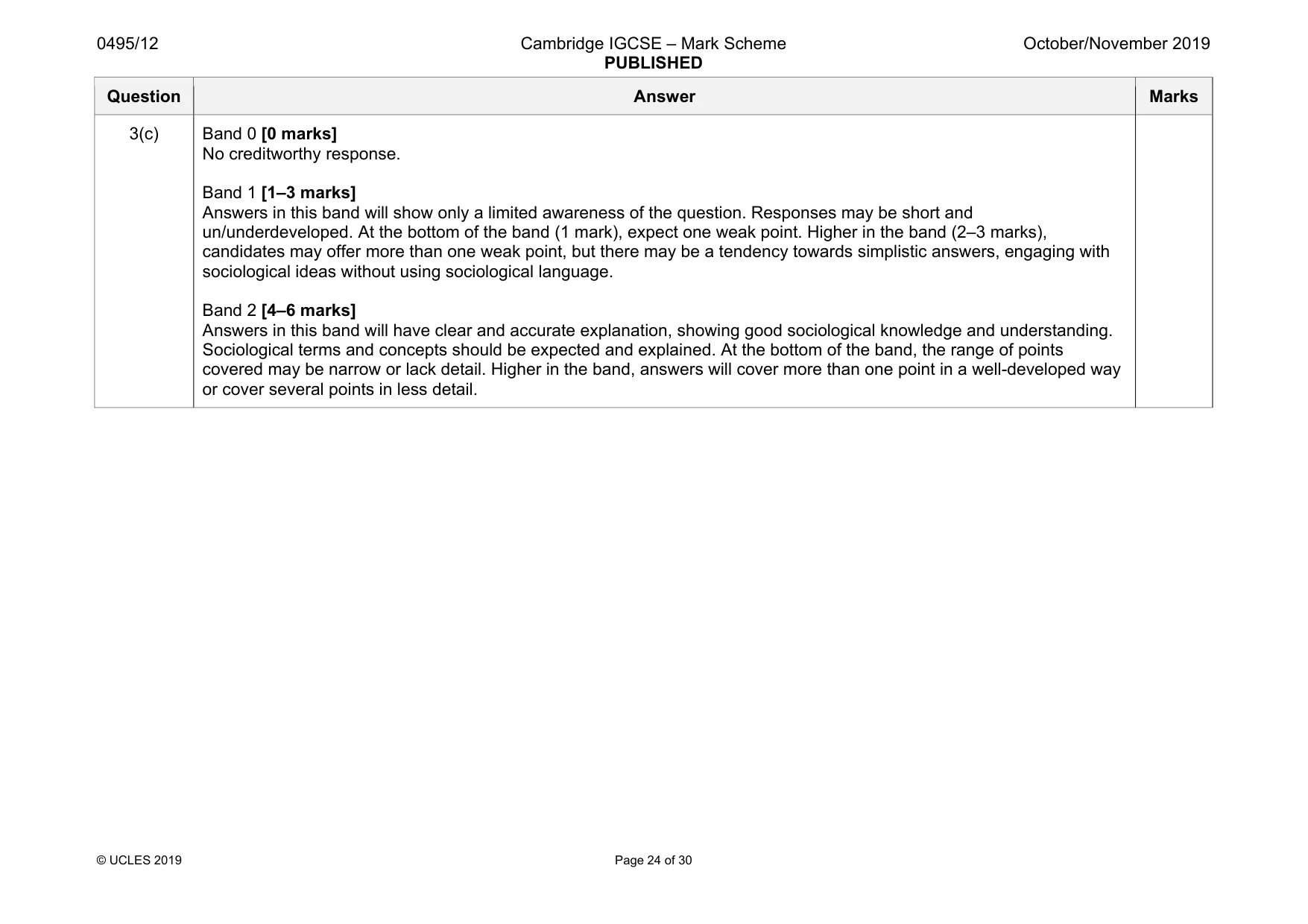
0495/12 Cambridge IGCSE – Mark Scheme PUBLISHED October/November 2019 © UCLES 2019 Page 24 of 30 Question Answer Marks 3(c) Band 0 [0 marks] No creditworthy response. Band 1 [1–3 marks] Answers in this band will show only a limited awareness of the question. Responses may be short and un/underdeveloped. At the bottom of the band (1 mark), expect one weak point. Higher in the band (2–3 marks), candidates may offer more than one weak point, but there may be a tendency towards simplistic answers, engaging with sociological ideas without using sociological language. Band 2 [4–6 marks] Answers in this band will have clear and accurate explanation, showing good sociological knowledge and understanding. Sociological terms and concepts should be expected and explained. At the bottom of the band, the range of points covered may be narrow or lack detail. Higher in the band, answers will cover more than one point in a well-developed way or cover several points in less detail.
Mark scheme, page 25
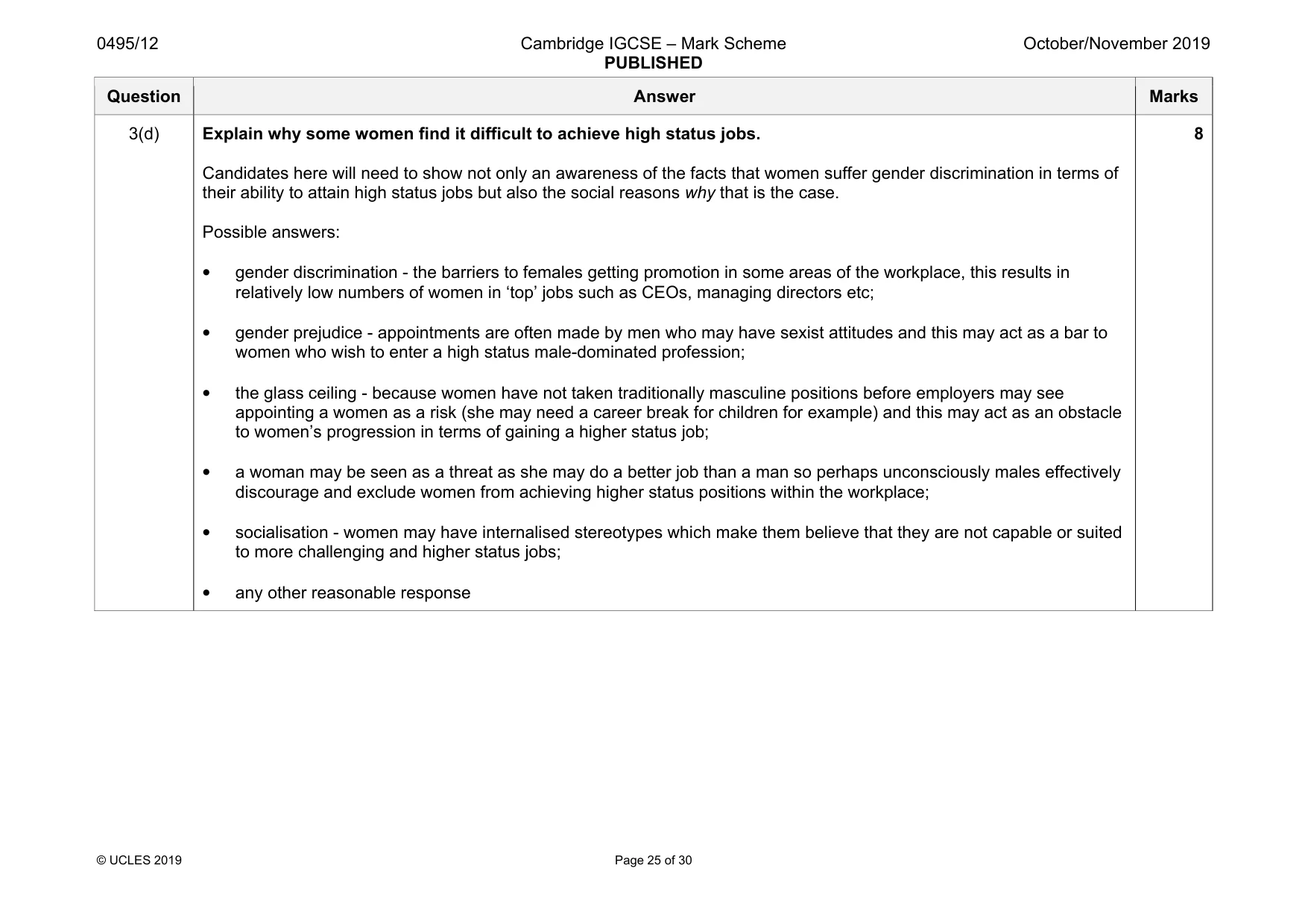
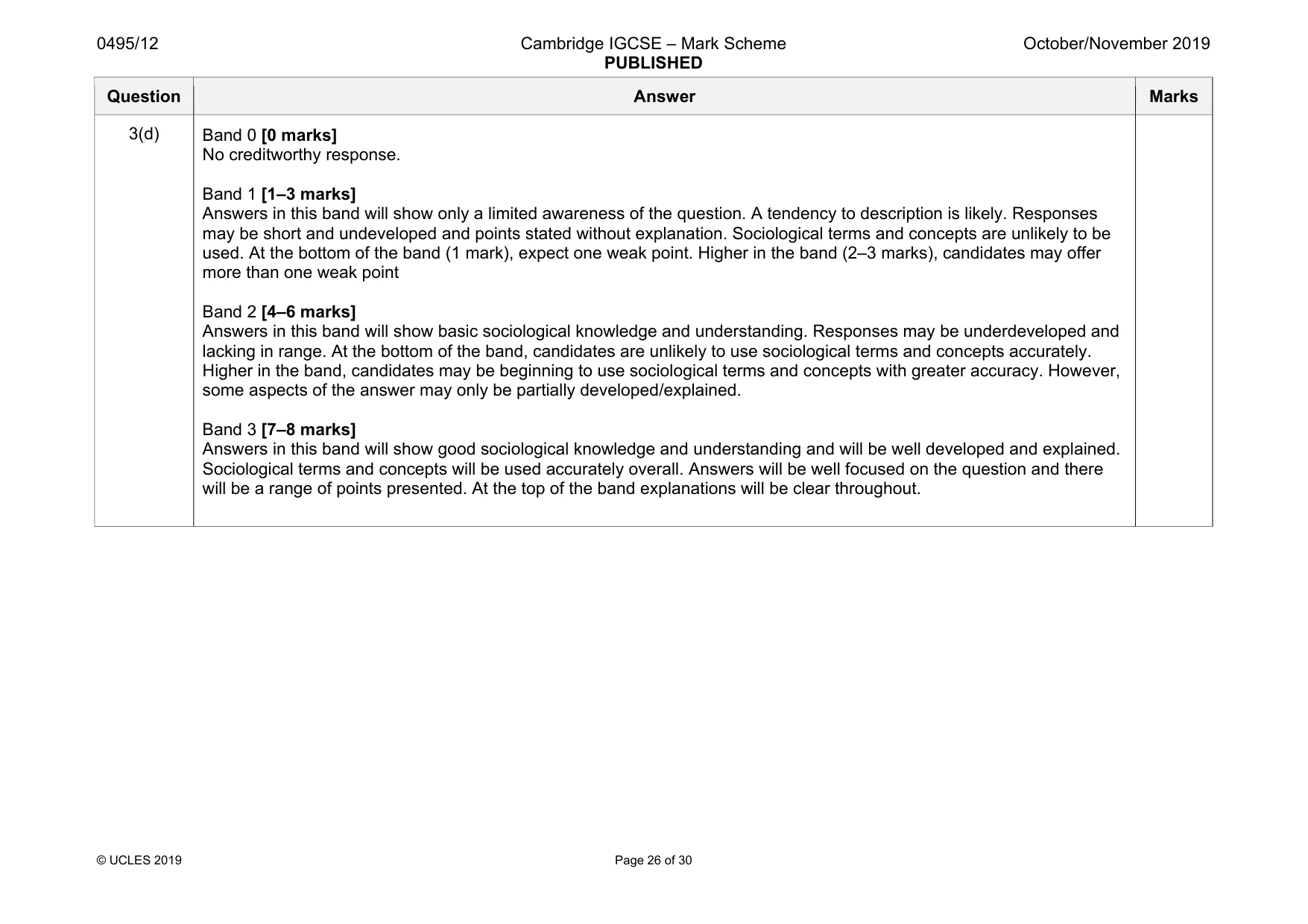
0495/12 Cambridge IGCSE – Mark Scheme PUBLISHED October/November 2019 © UCLES 2019 Page 25 of 30 Question Answer Marks 3(d) Explain why some women find it difficult to achieve high status jobs. Candidates here will need to show not only an awareness of the facts that women suffer gender discrimination in terms of their ability to attain high status jobs but also the social reasons why that is the case. Possible answers: • gender discrimination - the barriers to females getting promotion in some areas of the workplace, this results in relatively low numbers of women in ‘top’ jobs such as CEOs, managing directors etc; • gender prejudice - appointments are often made by men who may have sexist attitudes and this may act as a bar to women who wish to enter a high status male-dominated profession; • the glass ceiling - because women have not taken traditionally masculine positions before employers may see appointing a women as a risk (she may need a career break for children for example) and this may act as an obstacle to women’s progression in terms of gaining a higher status job; • a woman may be seen as a threat as she may do a better job than a man so perhaps unconsciously males effectively discourage and exclude women from achieving higher status positions within the workplace; • socialisation - women may have internalised stereotypes which make them believe that they are not capable or suited to more challenging and higher status jobs; • any other reasonable response 8
Mark scheme, page 26
0495/12 Cambridge IGCSE – Mark Scheme PUBLISHED October/November 2019 © UCLES 2019 Page 26 of 30 Question Answer Marks 3(d) Band 0 [0 marks] No creditworthy response. Band 1 [1–3 marks] Answers in this band will show only a limited awareness of the question. A tendency to description is likely. Responses may be short and undeveloped and points stated without explanation. Sociological terms and concepts are unlikely to be used. At the bottom of the band (1 mark), expect one weak point. Higher in the band (2–3 marks), candidates may offer more than one weak point Band 2 [4–6 marks] Answers in this band will show basic sociological knowledge and understanding. Responses may be underdeveloped and lacking in range. At the bottom of the band, candidates are unlikely to use sociological terms and concepts accurately. Higher in the band, candidates may be beginning to use sociological terms and concepts with greater accuracy. However, some aspects of the answer may only be partially developed/explained. Band 3 [7–8 marks] Answers in this band will show good sociological knowledge and understanding and will be well developed and explained. Sociological terms and concepts will be used accurately overall. Answers will be well focused on the question and there will be a range of points presented. At the top of the band explanations will be clear throughout.
Mark scheme, page 27
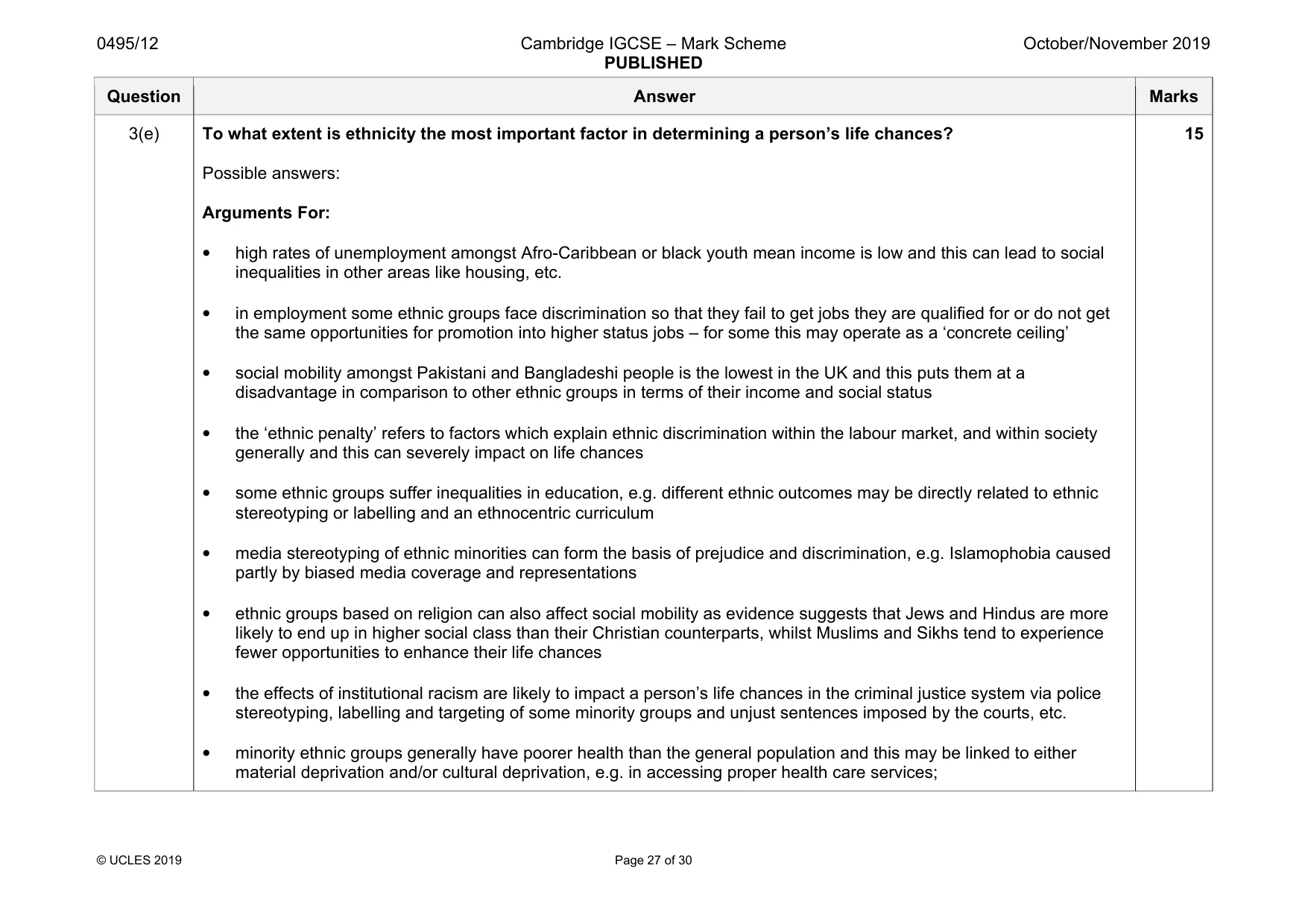
0495/12 Cambridge IGCSE – Mark Scheme PUBLISHED October/November 2019 © UCLES 2019 Page 27 of 30 Question Answer Marks 3(e) To what extent is ethnicity the most important factor in determining a person’s life chances? Possible answers: Arguments For: • high rates of unemployment amongst Afro-Caribbean or black youth mean income is low and this can lead to social inequalities in other areas like housing, etc. • in employment some ethnic groups face discrimination so that they fail to get jobs they are qualified for or do not get the same opportunities for promotion into higher status jobs – for some this may operate as a ‘concrete ceiling’ • social mobility amongst Pakistani and Bangladeshi people is the lowest in the UK and this puts them at a disadvantage in comparison to other ethnic groups in terms of their income and social status • the ‘ethnic penalty’ refers to factors which explain ethnic discrimination within the labour market, and within society generally and this can severely impact on life chances • some ethnic groups suffer inequalities in education, e.g. different ethnic outcomes may be directly related to ethnic stereotyping or labelling and an ethnocentric curriculum • media stereotyping of ethnic minorities can form the basis of prejudice and discrimination, e.g. Islamophobia caused partly by biased media coverage and representations • ethnic groups based on religion can also affect social mobility as evidence suggests that Jews and Hindus are more likely to end up in higher social class than their Christian counterparts, whilst Muslims and Sikhs tend to experience fewer opportunities to enhance their life chances • the effects of institutional racism are likely to impact a person’s life chances in the criminal justice system via police stereotyping, labelling and targeting of some minority groups and unjust sentences imposed by the courts, etc. • minority ethnic groups generally have poorer health than the general population and this may be linked to either material deprivation and/or cultural deprivation, e.g. in accessing proper health care services; 15
Mark scheme, page 28
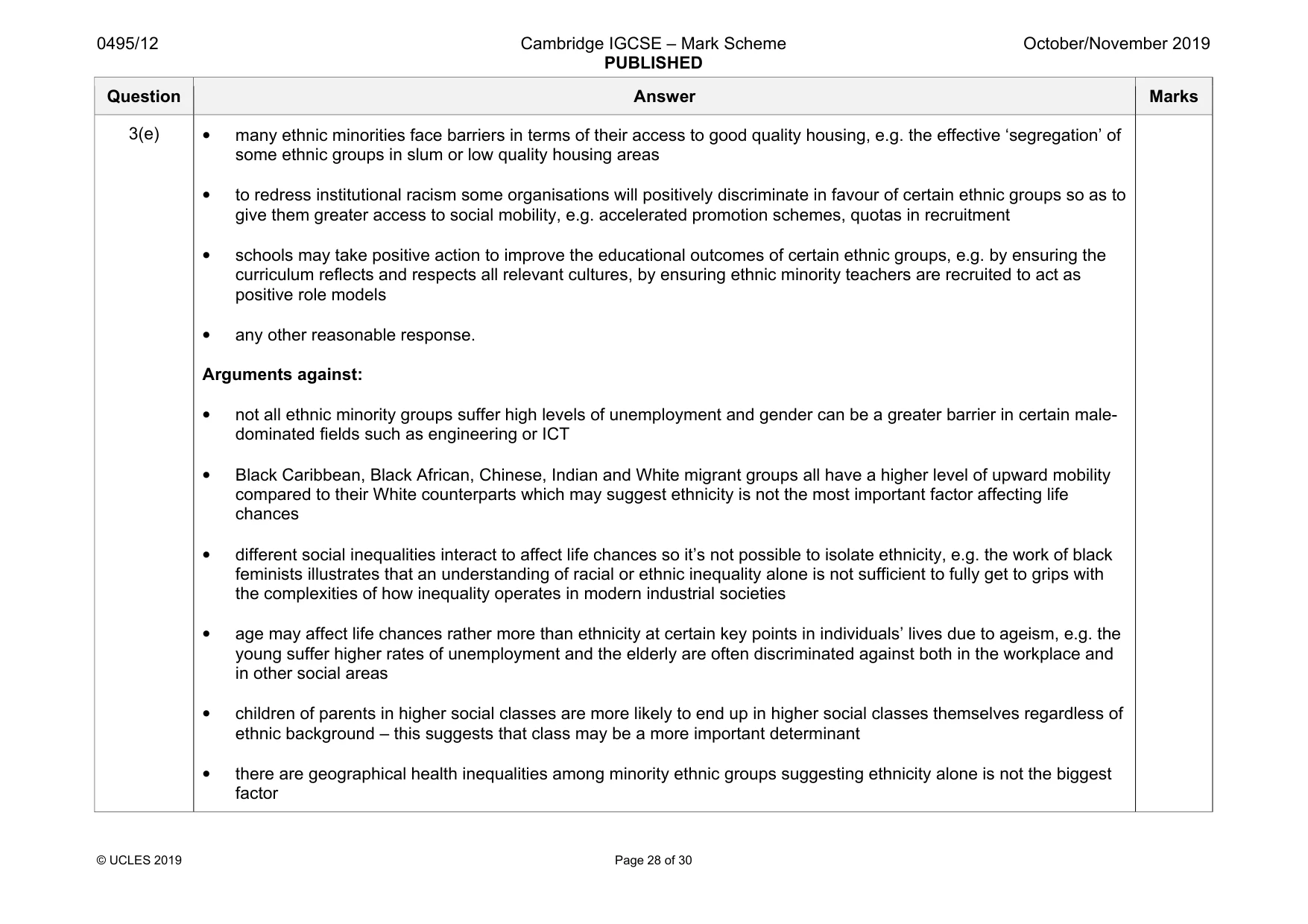
0495/12 Cambridge IGCSE – Mark Scheme PUBLISHED October/November 2019 © UCLES 2019 Page 28 of 30 Question Answer Marks 3(e) • many ethnic minorities face barriers in terms of their access to good quality housing, e.g. the effective ‘segregation’ of some ethnic groups in slum or low quality housing areas • to redress institutional racism some organisations will positively discriminate in favour of certain ethnic groups so as to give them greater access to social mobility, e.g. accelerated promotion schemes, quotas in recruitment • schools may take positive action to improve the educational outcomes of certain ethnic groups, e.g. by ensuring the curriculum reflects and respects all relevant cultures, by ensuring ethnic minority teachers are recruited to act as positive role models • any other reasonable response. Arguments against: • not all ethnic minority groups suffer high levels of unemployment and gender can be a greater barrier in certain male- dominated fields such as engineering or ICT • Black Caribbean, Black African, Chinese, Indian and White migrant groups all have a higher level of upward mobility compared to their White counterparts which may suggest ethnicity is not the most important factor affecting life chances • different social inequalities interact to affect life chances so it’s not possible to isolate ethnicity, e.g. the work of black feminists illustrates that an understanding of racial or ethnic inequality alone is not sufficient to fully get to grips with the complexities of how inequality operates in modern industrial societies • age may affect life chances rather more than ethnicity at certain key points in individuals’ lives due to ageism, e.g. the young suffer higher rates of unemployment and the elderly are often discriminated against both in the workplace and in other social areas • children of parents in higher social classes are more likely to end up in higher social classes themselves regardless of ethnic background – this suggests that class may be a more important determinant • there are geographical health inequalities among minority ethnic groups suggesting ethnicity alone is not the biggest factor
Mark scheme, page 29
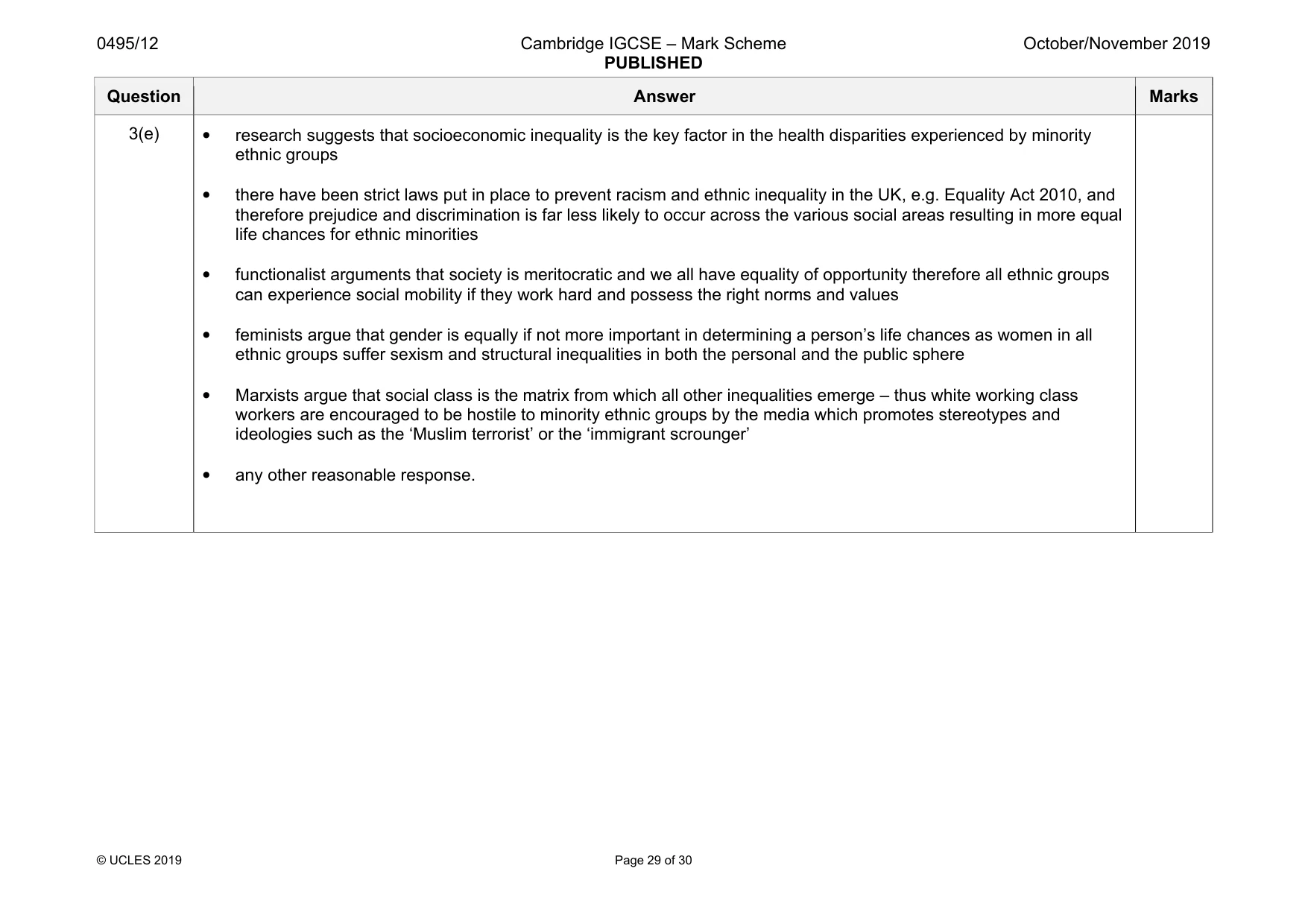
0495/12 Cambridge IGCSE – Mark Scheme PUBLISHED October/November 2019 © UCLES 2019 Page 29 of 30 Question Answer Marks 3(e) • research suggests that socioeconomic inequality is the key factor in the health disparities experienced by minority ethnic groups • there have been strict laws put in place to prevent racism and ethnic inequality in the UK, e.g. Equality Act 2010, and therefore prejudice and discrimination is far less likely to occur across the various social areas resulting in more equal life chances for ethnic minorities • functionalist arguments that society is meritocratic and we all have equality of opportunity therefore all ethnic groups can experience social mobility if they work hard and possess the right norms and values • feminists argue that gender is equally if not more important in determining a person’s life chances as women in all ethnic groups suffer sexism and structural inequalities in both the personal and the public sphere • Marxists argue that social class is the matrix from which all other inequalities emerge – thus white working class workers are encouraged to be hostile to minority ethnic groups by the media which promotes stereotypes and ideologies such as the ‘Muslim terrorist’ or the ‘immigrant scrounger’ • any other reasonable response.
Mark scheme, page 30
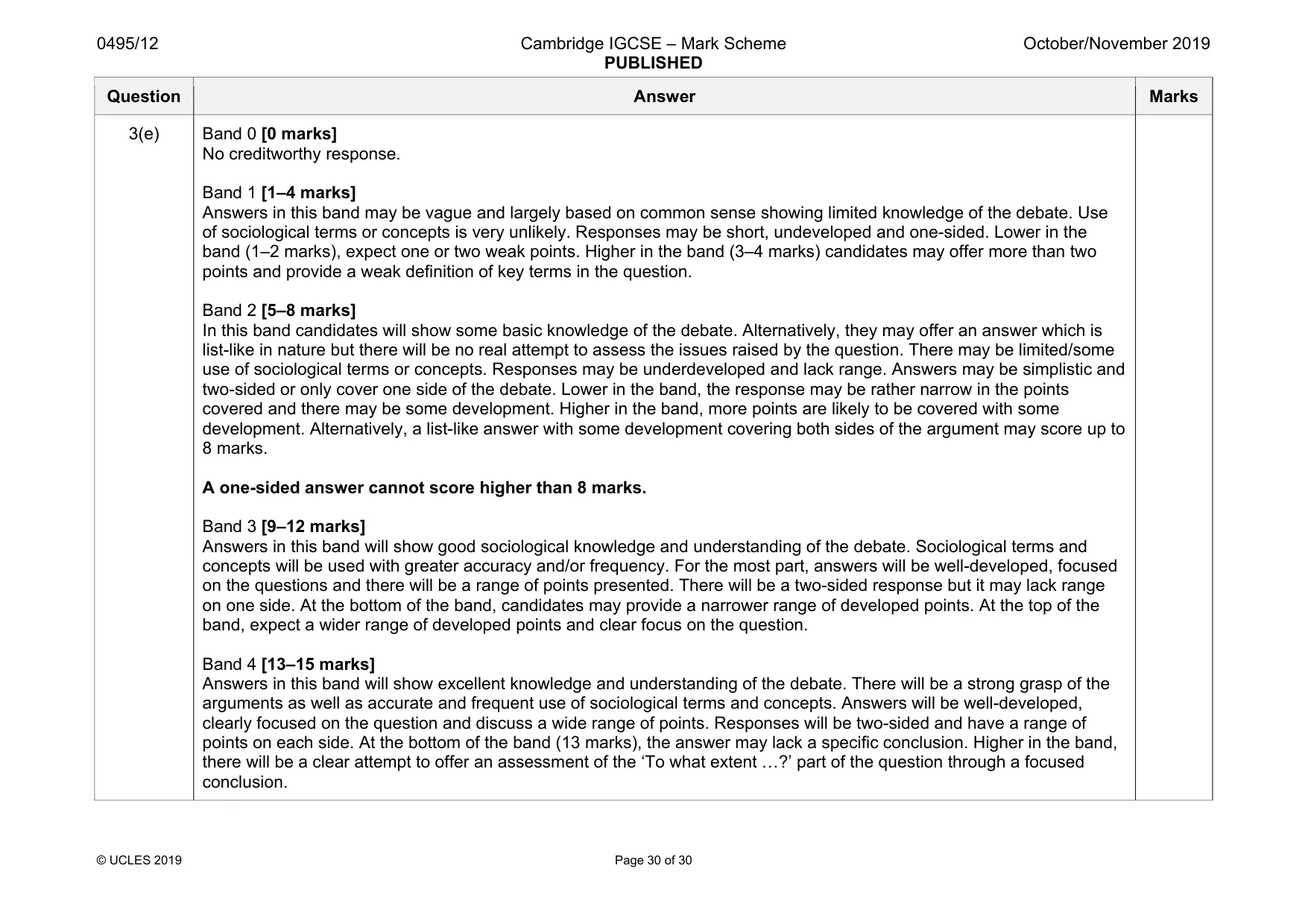
0495/12 Cambridge IGCSE – Mark Scheme PUBLISHED October/November 2019 © UCLES 2019 Page 30 of 30 Question Answer Marks 3(e) Band 0 [0 marks] No creditworthy response. Band 1 [1–4 marks] Answers in this band may be vague and largely based on common sense showing limited knowledge of the debate. Use of sociological terms or concepts is very unlikely. Responses may be short, undeveloped and one-sided. Lower in the band (1–2 marks), expect one or two weak points. Higher in the band (3–4 marks) candidates may offer more than two points and provide a weak definition of key terms in the question. Band 2 [5–8 marks] In this band candidates will show some basic knowledge of the debate. Alternatively, they may offer an answer which is list-like in nature but there will be no real attempt to assess the issues raised by the question. There may be limited/some use of sociological terms or concepts. Responses may be underdeveloped and lack range. Answers may be simplistic and two-sided or only cover one side of the debate. Lower in the band, the response may be rather narrow in the points covered and there may be some development. Higher in the band, more points are likely to be covered with some development. Alternatively, a list-like answer with some development covering both sides of the argument may score up to 8 marks. A one-sided answer cannot score higher than 8 marks. Band 3 [9–12 marks] Answers in this band will show good sociological knowledge and understanding of the debate. Sociological terms and concepts will be used with greater accuracy and/or frequency. For the most part, answers will be well-developed, focused on the questions and there will be a range of points presented. There will be a two-sided response but it may lack range on one side. At the bottom of the band, candidates may provide a narrower range of developed points. At the top of the band, expect a wider range of developed points and clear focus on the question. Band 4 [13–15 marks] Answers in this band will show excellent knowledge and understanding of the debate. There will be a strong grasp of the arguments as well as accurate and frequent use of sociological terms and concepts. Answers will be well-developed, clearly focused on the question and discuss a wide range of points. Responses will be two-sided and have a range of points on each side. At the bottom of the band (13 marks), the answer may lack a specific conclusion. Higher in the band, there will be a clear attempt to offer an assessment of the ‘To what extent «?’ part of the question through a focused conclusion.
What you needed in this session
Cambridge’s own grade thresholds for 2019 Oct/Nov, Paper 1 · Variant 2. A higher threshold means an easier paper — the bar moves with how the cohort did.