Cambridge IGCSE Sociology 0495 — 2018 May/June Paper 2 · Variant 3
0495/23/M/J/18 · 4 questions · 70 marks · ≈79 min
The question paper and its mark scheme, free to read here and free to download. This is Cambridge’s own paper, exactly as it was sat.
Question paper4 pages
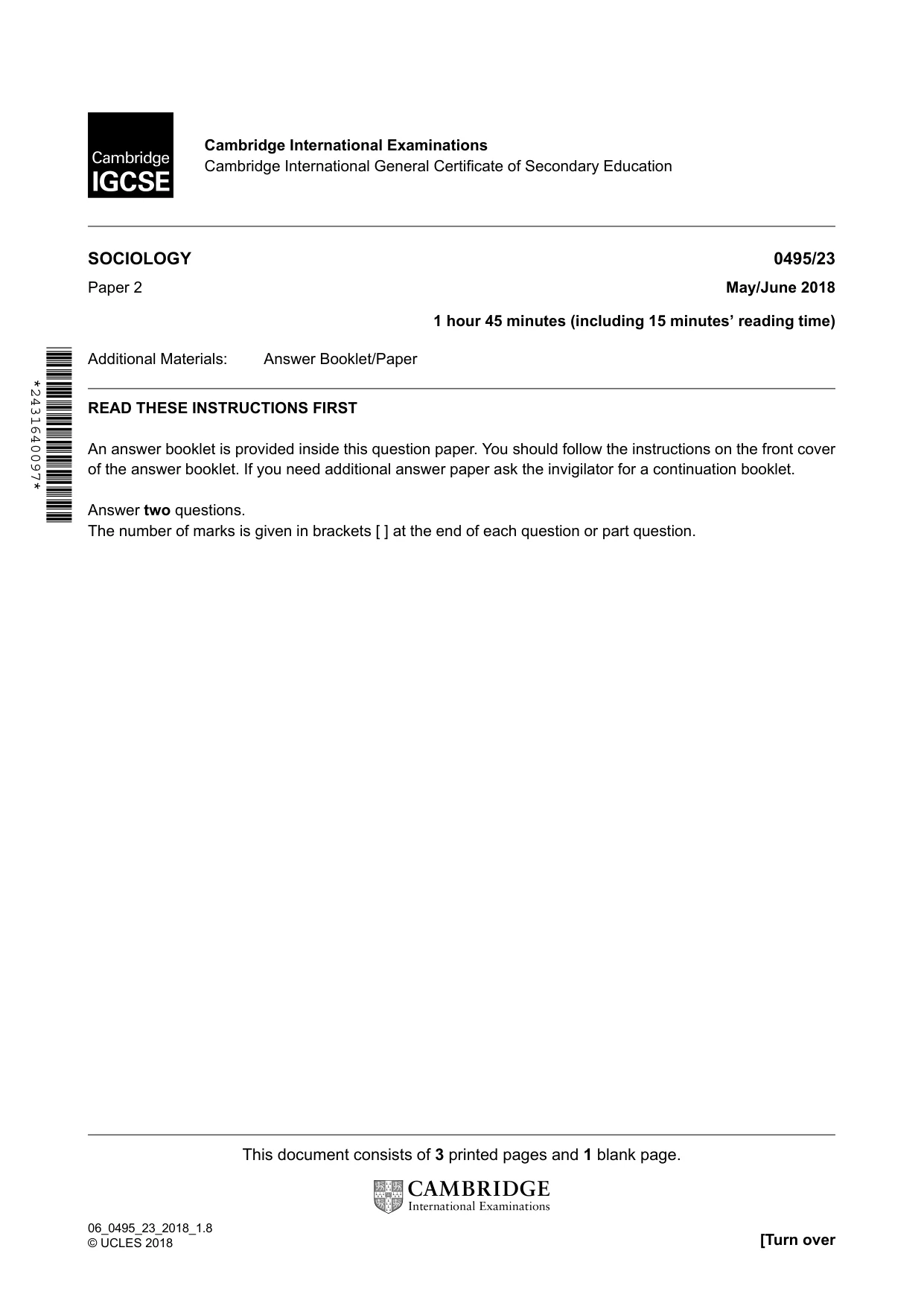
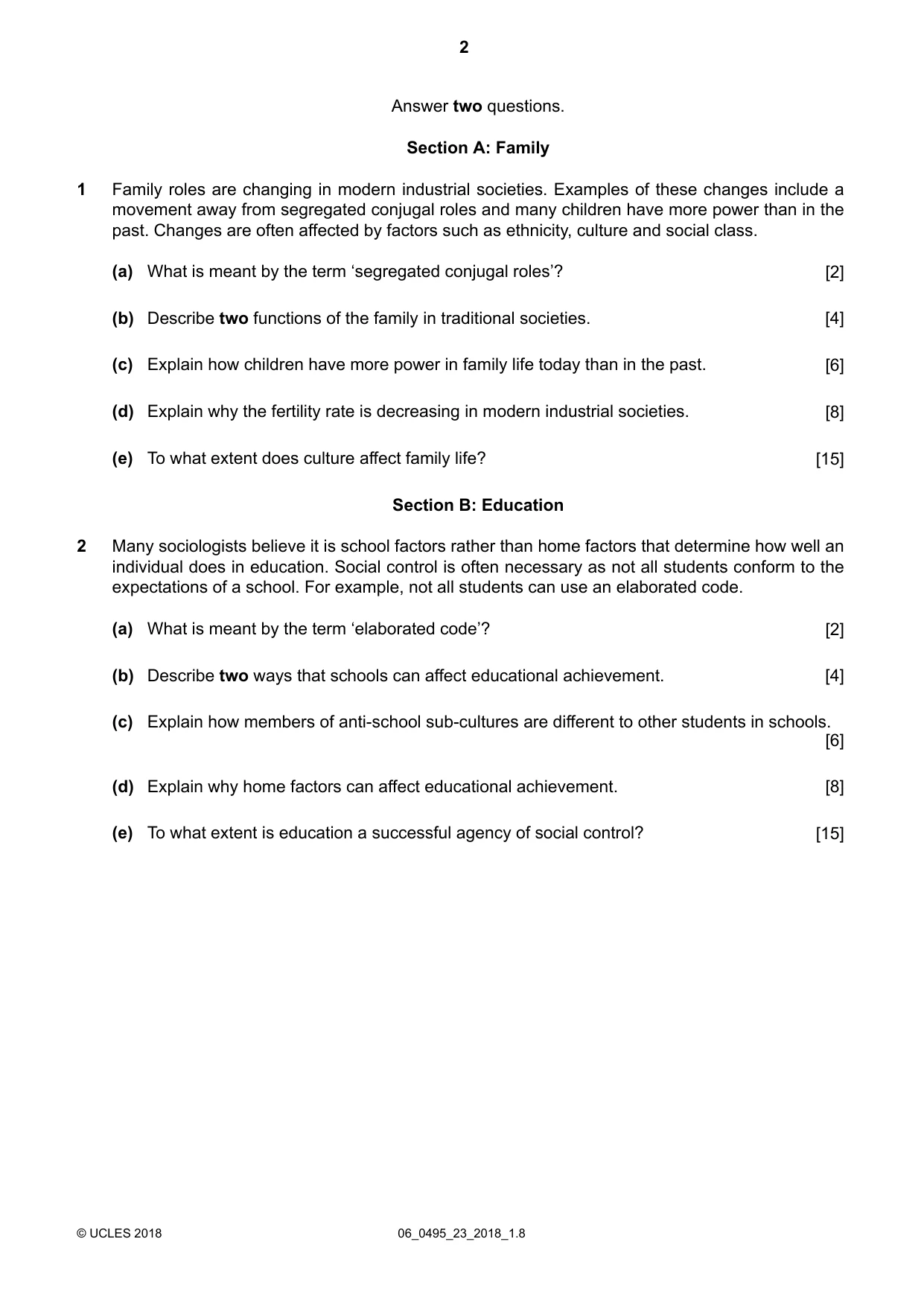
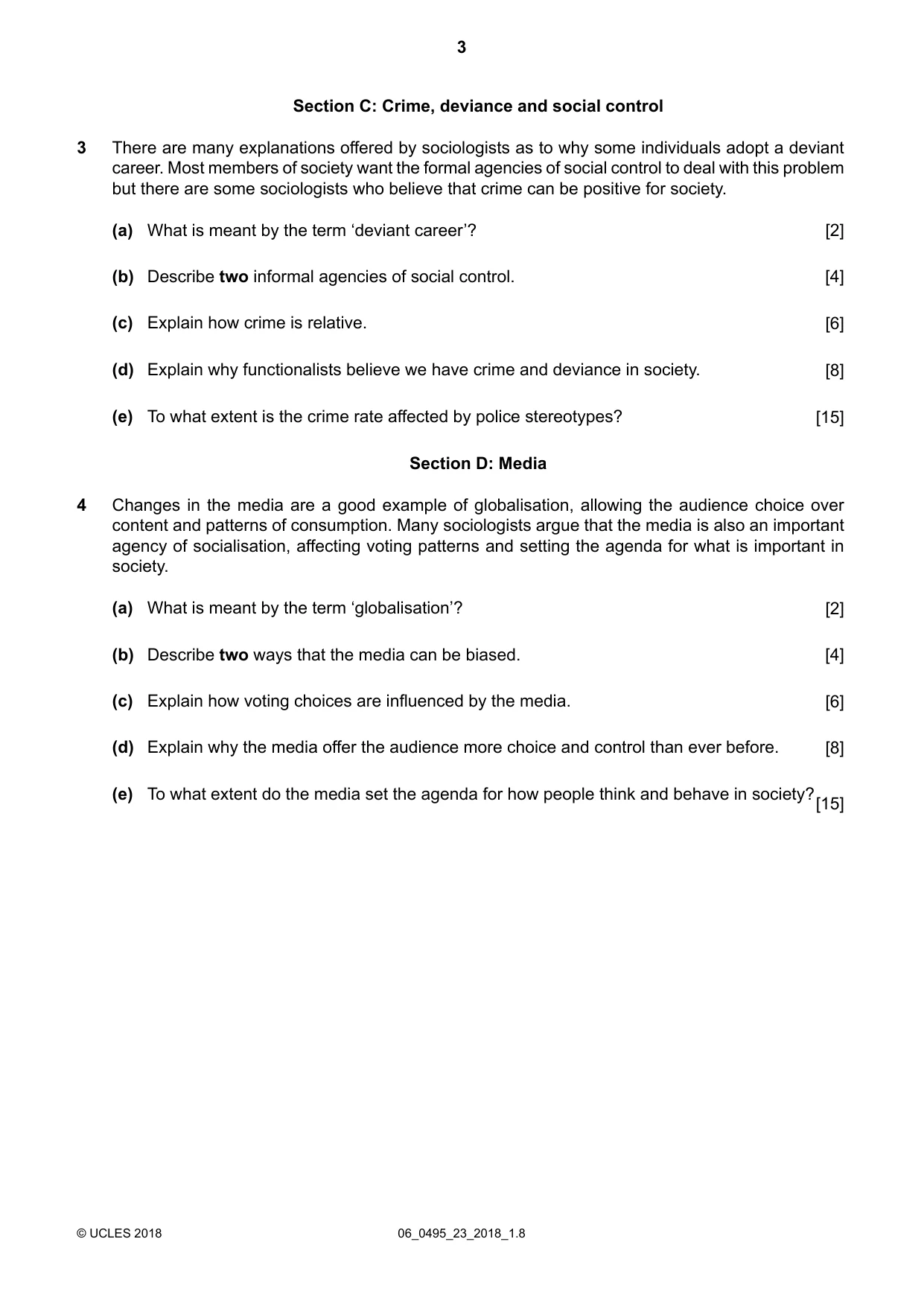

Mark scheme29 pages
Answers below. Sit the paper first if you are practising.

Questions as text
Q1 · Family roles are changing in modern industrial societies
1 Family roles are changing in modern industrial societies. Examples of these changes include a movement away from segregated conjugal roles and many children have more power than in the past. Changes are often affected by factors such as ethnicity, culture and social class. (a) What is meant by the term ‘segregated conjugal roles’? [2] (b) Describe two functions of the family in traditional societies. [4] (c) Explain how children have more power in family life today than in the past. [6] (d) Explain why the fertility rate is decreasing in modern industrial societies. [8] (e) To what extent does culture affect family life? [15]
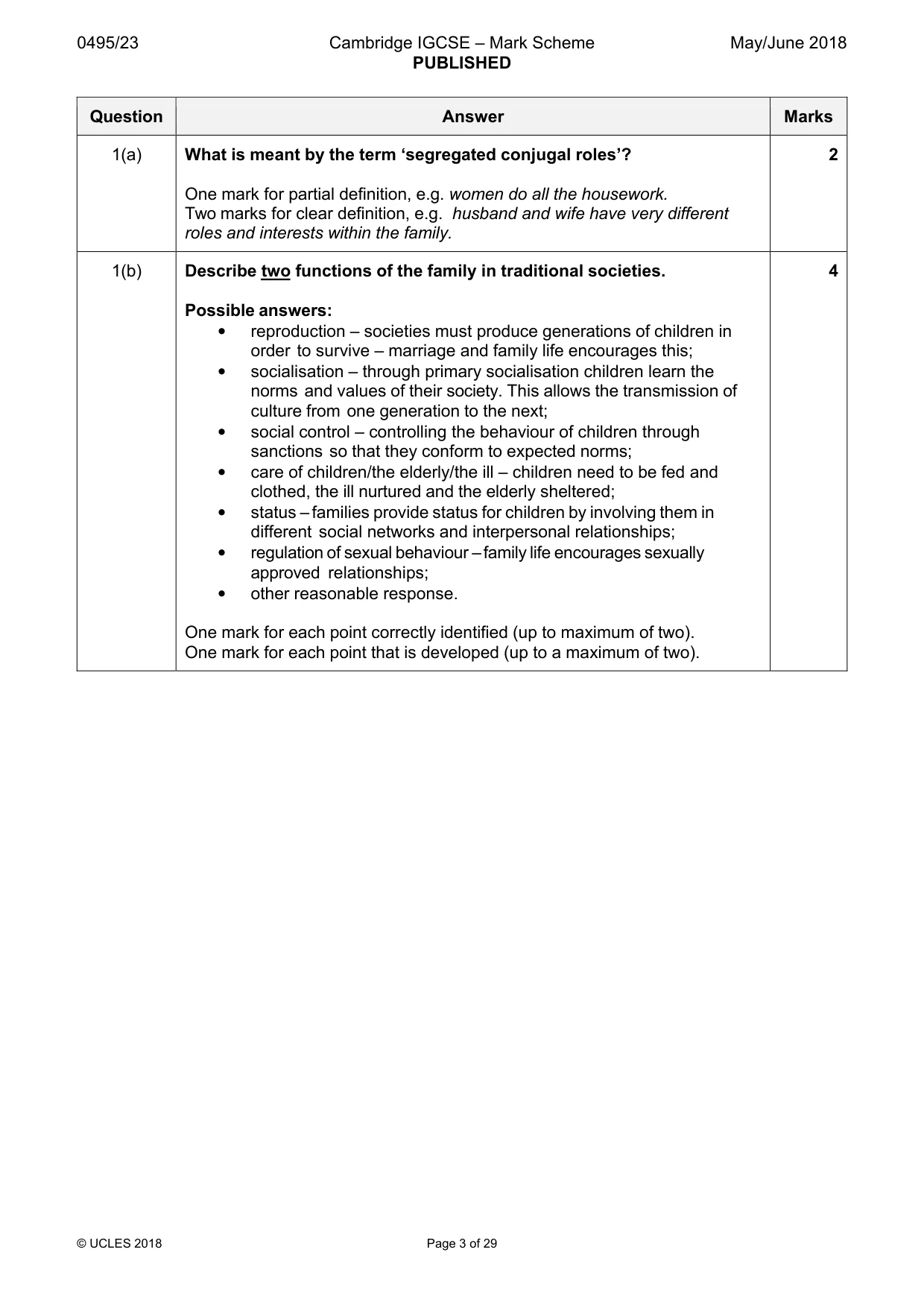
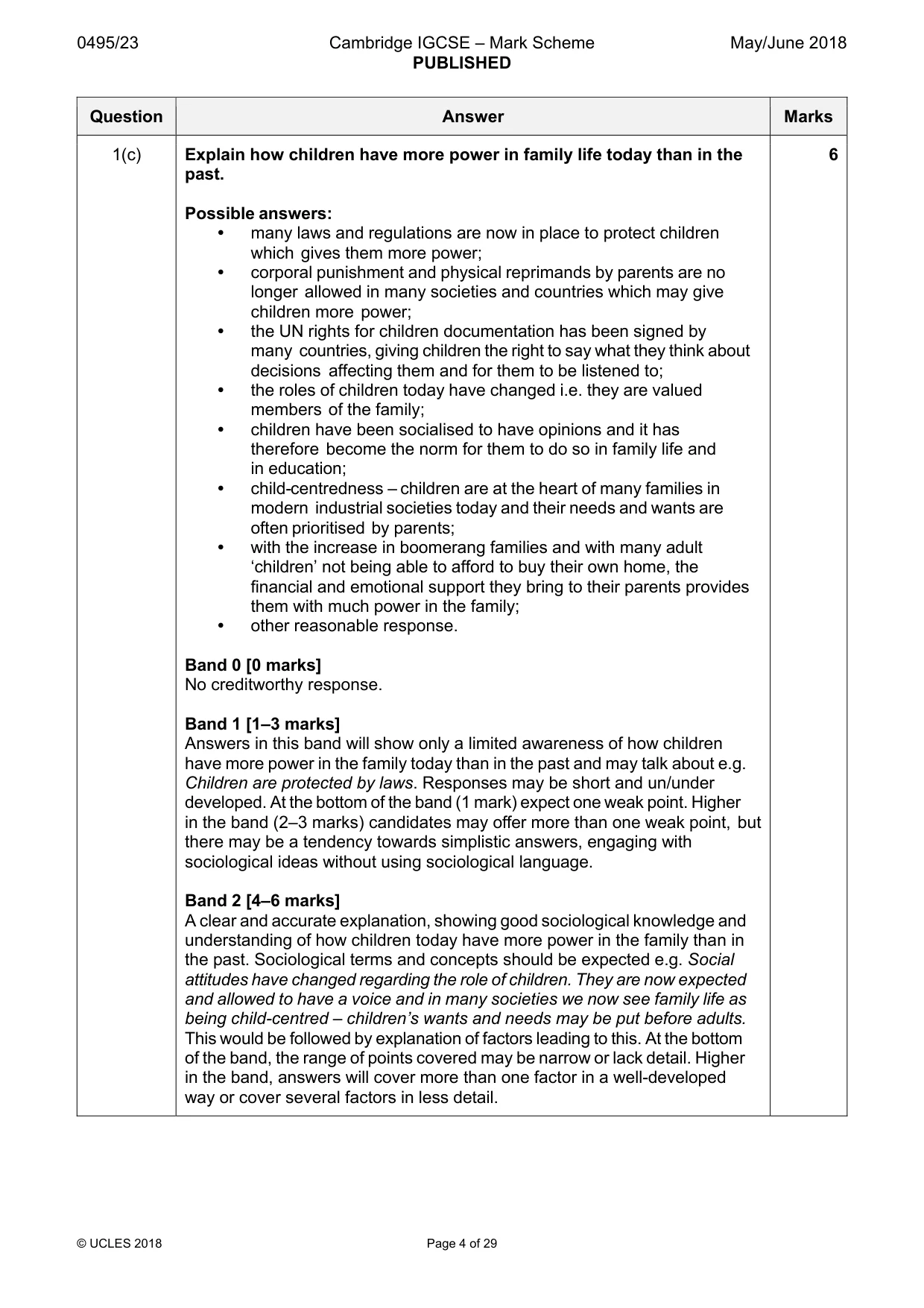
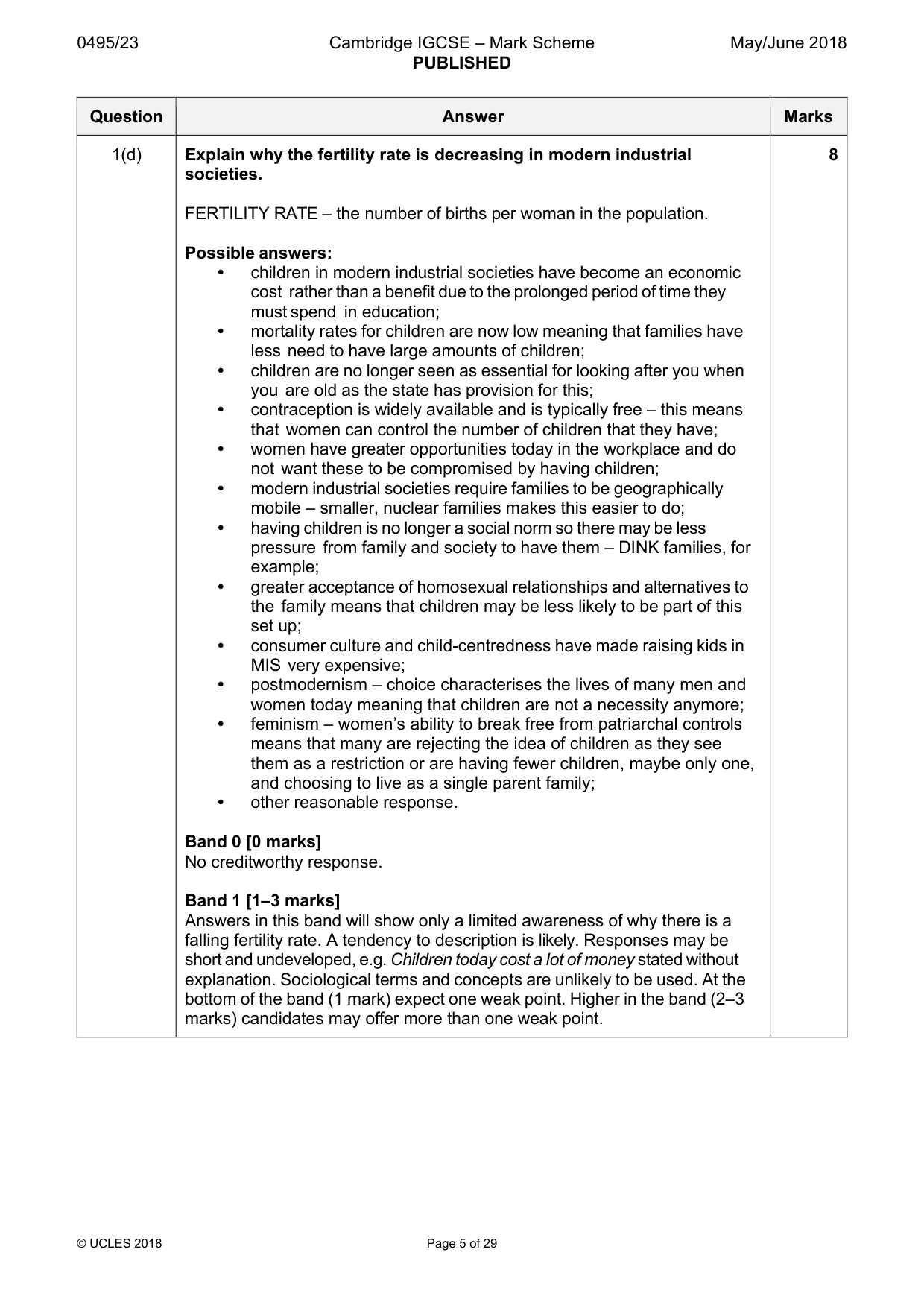
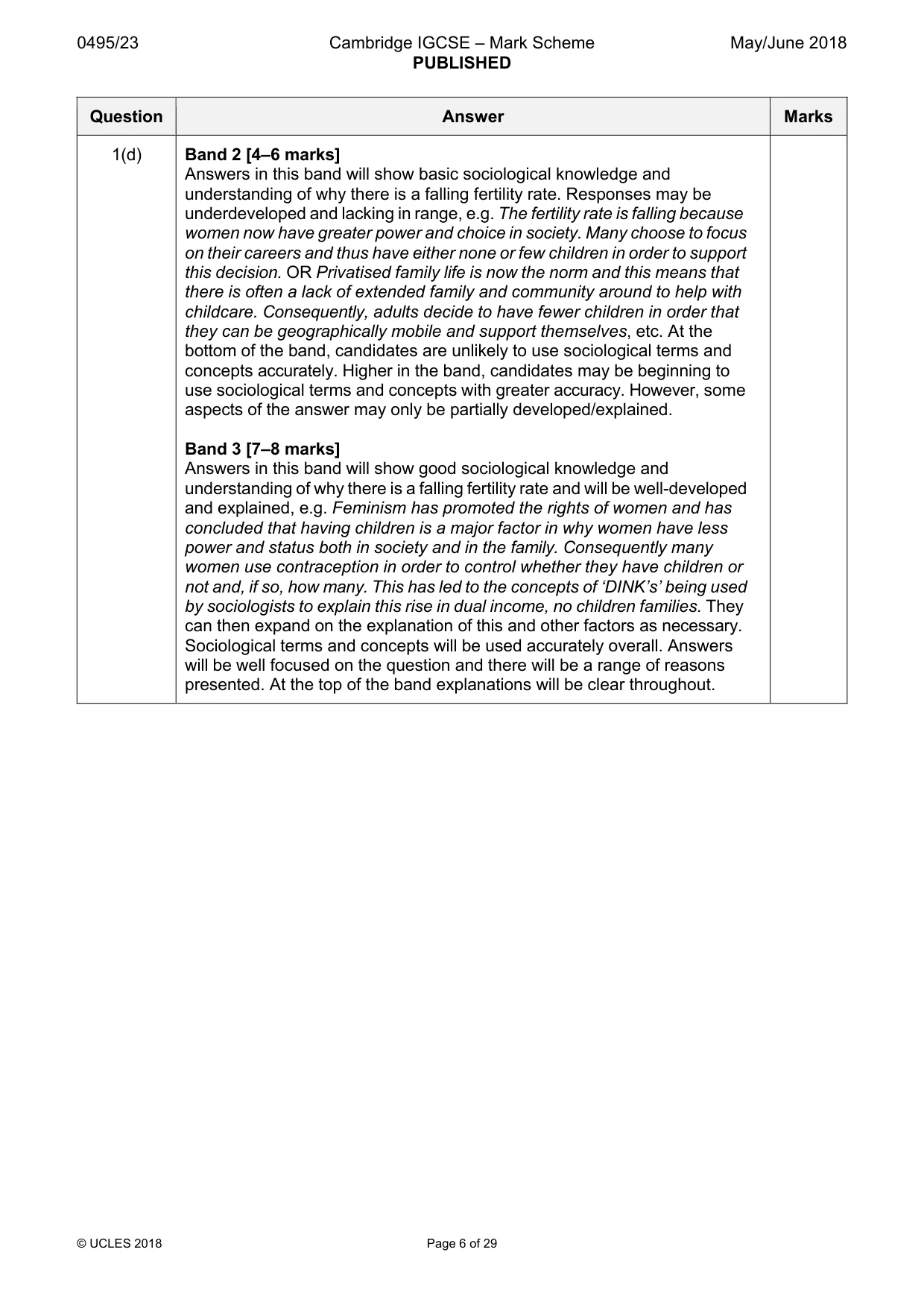
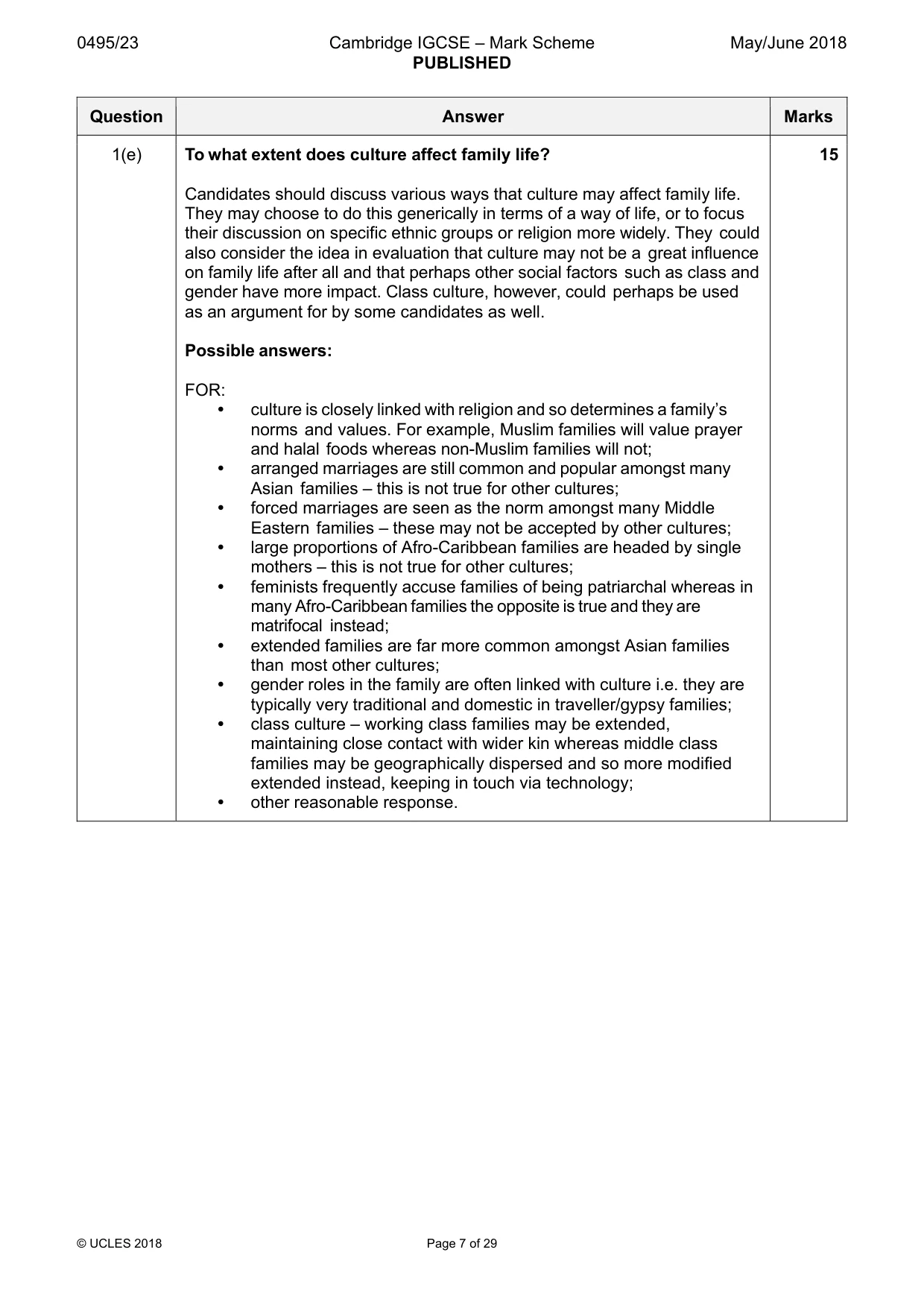
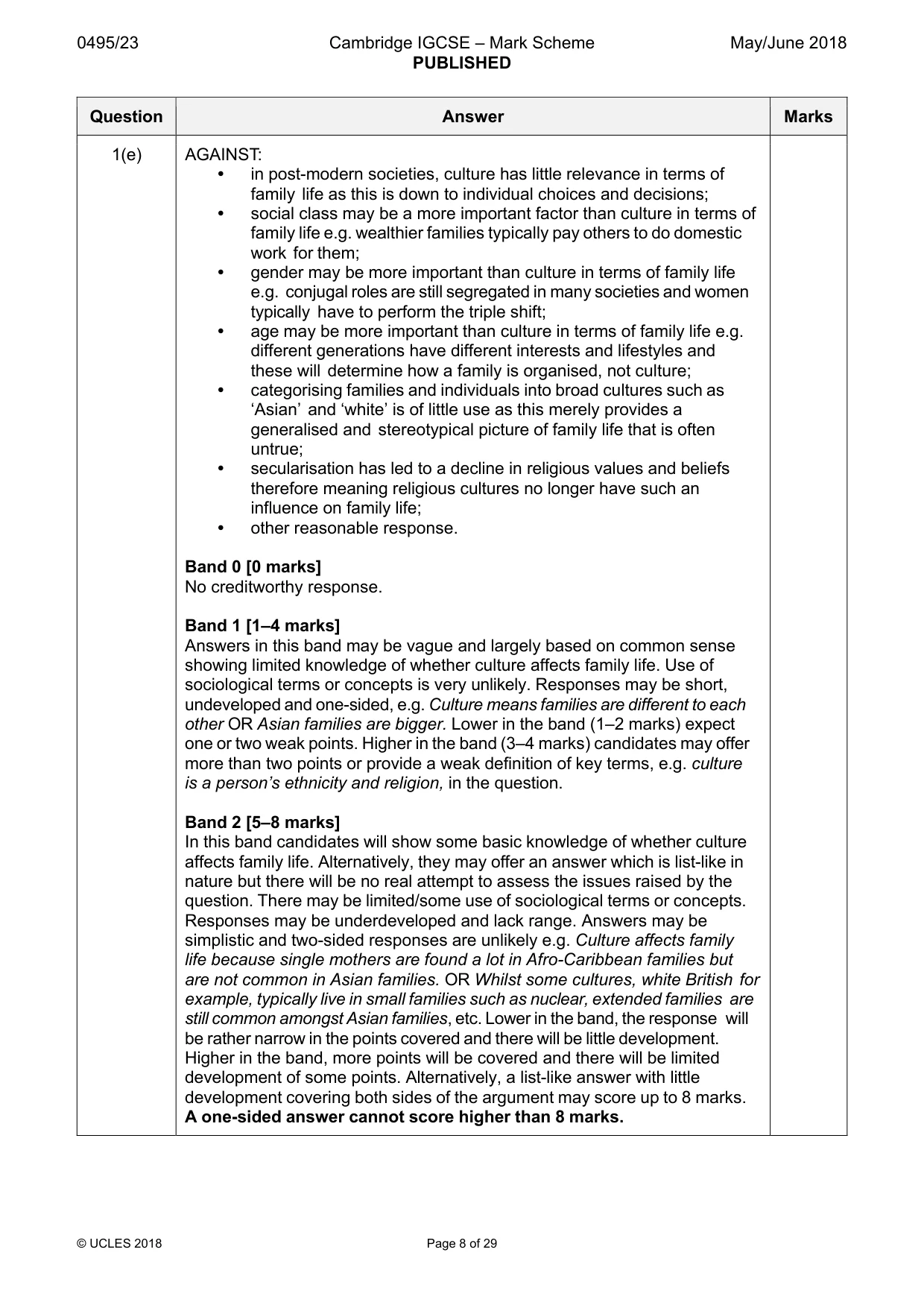
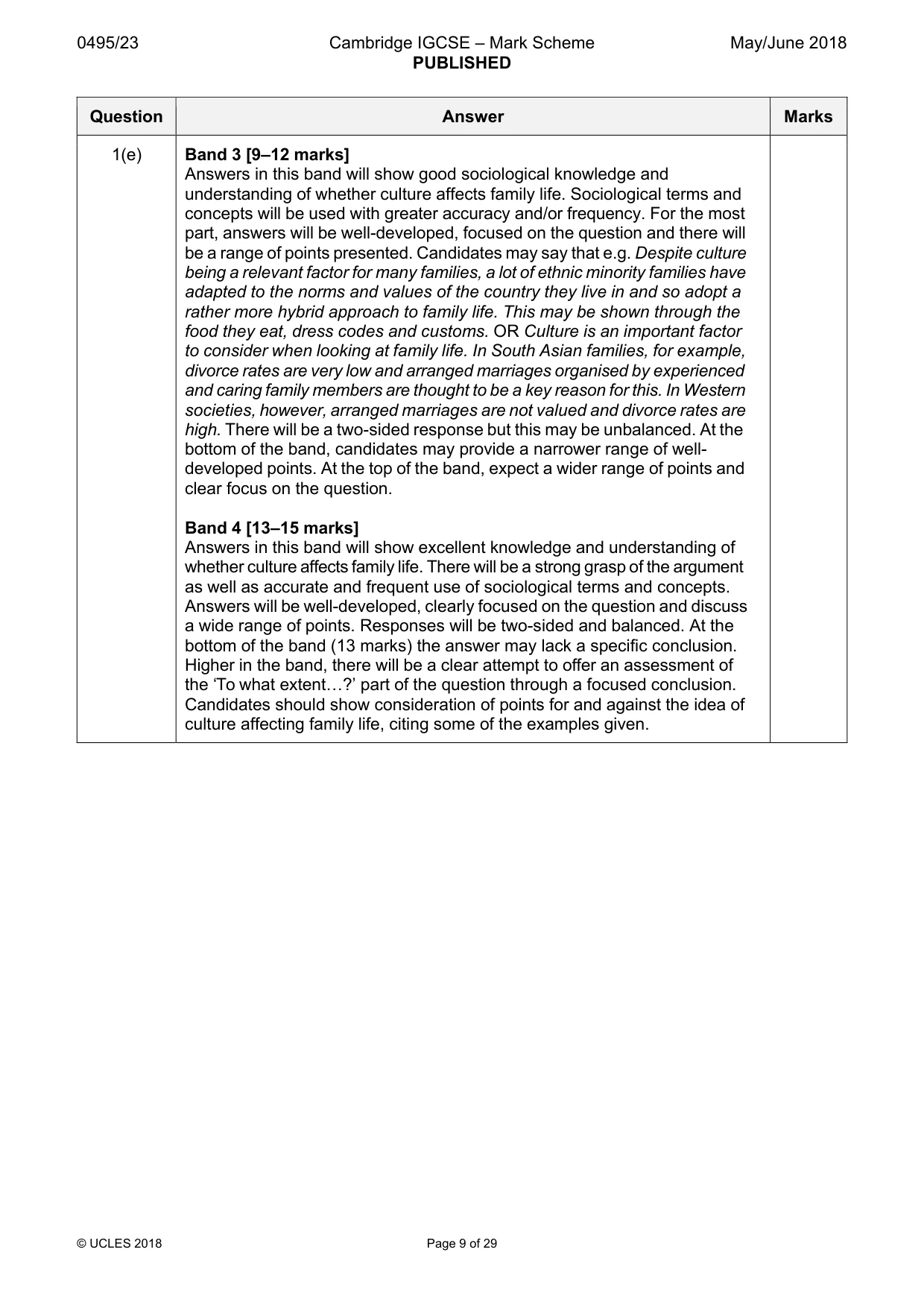
Mark scheme: Question Answer Marks 1(a) What is meant by the term ‘segregated conjugal roles’? 2 One mark for partial definition, e.g. women do all the housework. Two marks for clear definition, e.g. husband and wife have very different roles and interests within the family. 1(b) Describe two functions of the family in traditional societies. 4 Possible answers: • reproduction – societies must produce generations of children in order to survive – marriage and family life encourages this; • socialisation – through primary socialisation children learn the norms and values of their society. This allows the transmission of culture from one generation to the next; • social control – controlling the behaviour of children through sanctions so that they conform to expected norms; • care of children/the elderly/the ill – children need to be fed and clothed, the ill nurtured and the elderly sheltered; • status – families provide status for children by involving them in different social networks and interpersonal relationships; • regulation of sexual behaviour – family life encourages sexually approved relationships; • other reasonable response. One mark for each point correctly identified (up to maximum of two). One mark for each point that is developed (up to a maximum of two). 1(c) Explain how children have more power in family life today than in the 6 past. Possible answers: • many laws and regulations are now in place to protect children which gives them more power; • corporal punishment and physical reprimands by parents are no longer allowed in many societies and countries which may give children more power; • the UN rights for children documentation has been signed by many countries, giving children the right to say what they think about decisions affecting them and for them to be listened to; • the roles of children today have changed i.e. they are valued members of the family; • children have been socialised to have opinions and it has therefore become the norm for them to do so in family life and in education; • child-centredness – children are at the heart of many families in modern industrial societies today and their needs and wants are often prioritised by parents; • with the increase in boomerang families and with many adult ‘children’ not being able to afford to buy their own home, the financial and emotional support they bring to their parents provides them with much power in the family; • other reasonable response. Band 0 [0 marks] No creditworthy response. Band 1 [1–3 marks] Answers in this band will show only a limited awareness of how children have more power in the family today than in the past and may talk about e.g. Children are protected by laws. Responses may be short and un/under developed. At the bottom of the band (1 mark) expect one weak point. Higher in the band (2–3 marks) candidates may offer more than one weak point, but there may be a tendency towards simplistic answers, engaging with sociological ideas without using sociological language. Band 2 [4–6 marks] A clear and accurate explanation, showing good sociological knowledge and understanding of how children today have more power in the family than in the past. Sociological terms and concepts should be expected e.g. Social attitudes have changed regarding the role of children. They are now expected and allowed to have a voice and in many societies we now see family life as being child-centred – children’s wants and needs may be put before adults. This would be followed by explanation of factors leading to this. At the bottom of the band, the range of points covered may be narrow or lack detail. Higher in the band, answers will cover more than one factor in a well-developed way or cover several factors in less detail. 1(d) Explain why the fertility rate is decreasing in modern industrial 8 societies. FERTILITY RATE – the number of births per woman in the population. Possible answers: • children in modern industrial societies have become an economic cost rather than a benefit due to the prolonged period of time they must spend in education; • mortality rates for children are now low meaning that families have less need to have large amounts of children; • children are no longer seen as essential for looking after you when you are old as the state has provision for this; • contraception is widely available and is typically free – this means that women can control the number of children that they have; • women have greater opportunities today in the workplace and do not want these to be compromised by having children; • modern industrial societies require families to be geographically mobile – smaller, nuclear families makes this easier to do; • having children is no longer a social norm so there may be less pressure from family and society to have them – DINK families, for example; • greater acceptance of homosexual relationships and alternatives to the family means that children may be less likely to be part of this set up; • consumer culture and child-centredness have made raising kids in MIS very expensive; • postmodernism – choice characterises the lives of many men and women today meaning that children are not a necessity anymore; • feminism – women’s ability to break free from patriarchal controls means that many are rejecting the idea of children as they see them as a restriction or are having fewer children, maybe only one, and choosing to live as a single parent family; • other reasonable response. Band 0 [0 marks] No creditworthy response. Band 1 [1–3 marks] Answers in this band will show only a limited awareness of why there is a falling fertility rate. A tendency to description is likely. Responses may be short and undeveloped, e.g. Children today cost a lot of money stated without explanation. Sociological terms and concepts are unlikely to be used. At the bottom of the band (1 mark) expect one weak point. Higher in the band (2–3 marks) candidates may offer more than one weak point. 1(d) Band 2 [4–6 marks] Answers in this band will show basic sociological knowledge and understanding of why there is a falling fertility rate. Responses may be underdeveloped and lacking in range, e.g. The fertility rate is falling because women now have greater power and choice in society. Many choose to focus on their careers and thus have either none or few children in order to support this decision. OR Privatised family life is now the norm and this means that there is often a lack of extended family and community around to help with childcare. Consequently, adults decide to have fewer children in order that they can be geographically mobile and support themselves, etc. At the bottom of the band, candidates are unlikely to use sociological terms and concepts accurately. Higher in the band, candidates may be beginning to use sociological terms and concepts with greater accuracy. However, some aspects of the answer may only be partially developed/explained. Band 3 [7–8 marks] Answers in this band will show good sociological knowledge and understanding of why there is a falling fertility rate and will be well-developed and explained, e.g. Feminism has promoted the rights of women and has concluded that having children is a major factor in why women have less power and status both in society and in the family. Consequently many women use contraception in order to control whether they have children or not and, if so, how many. This has led to the concepts of ‘DINK’s’ being used by sociologists to explain this rise in dual income, no children families. They can then expand on the explanation of this and other factors as necessary. Sociological terms and concepts will be used accurately overall. Answers will be well focused on the question and there will be a range of reasons presented. At the top of the band explanations will be clear throughout. 1(e) To what extent does culture affect family life? 15 Candidates should discuss various ways that culture may affect family life. They may choose to do this generically in terms of a way of life, or to focus their discussion on specific ethnic groups or religion more widely. They could also consider the idea in evaluation that culture may not be a great influence on family life after all and that perhaps other social factors such as class and gender have more impact. Class culture, however, could perhaps be used as an argument for by some candidates as well. Possible answers: FOR: • culture is closely linked with religion and so determines a family’s norms and values. For example, Muslim families will value prayer and halal foods whereas non-Muslim families will not; • arranged marriages are still common and popular amongst many Asian families – this is not true for other cultures; • forced marriages are seen as the norm amongst many Middle Eastern families – these may not be accepted by other cultures; • large proportions of Afro-Caribbean families are headed by single mothers – this is not true for other cultures; • feminists frequently accuse families of being patriarchal whereas in many Afro-Caribbean families the opposite is true and they are matrifocal instead; • extended families are far more common amongst Asian families than most other cultures; • gender roles in the family are often linked with culture i.e. they are typically very traditional and domestic in traveller/gypsy families; • class culture – working class families may be extended, maintaining close contact with wider kin whereas middle class families may be geographically dispersed and so more modified extended instead, keeping in touch via technology; • other reasonable response. 1(e) AGAINST: • in post-modern societies, culture has little relevance in terms of family life as this is down to individual choices and decisions; • social class may be a more important factor than culture in terms of family life e.g. wealthier families typically pay others to do domestic work for them; • gender may be more important than culture in terms of family life e.g. conjugal roles are still segregated in many societies and women typically have to perform the triple shift; • age may be more important than culture in terms of family life e.g. different generations have different interests and lifestyles and these will determine how a family is organised, not culture; • categorising families and individuals into broad cultures such as ‘Asian’ and ‘white’ is of little use as this merely provides a generalised and stereotypical picture of family life that is often untrue; • secularisation has led to a decline in religious values and beliefs therefore meaning religious cultures no longer have such an influence on family life; • other reasonable response. Band 0 [0 marks] No creditworthy response. Band 1 [1–4 marks] Answers in this band may be vague and largely based on common sense showing limited knowledge of whether culture affects family life. Use of sociological terms or concepts is very unlikely. Responses may be short, undeveloped and one-sided, e.g. Culture means families are different to each other OR Asian families are bigger. Lower in the band (1–2 marks) expect one or two weak points. Higher in the band (3–4 marks) candidates may offer more than two points or provide a weak definition of key terms, e.g. culture is a person’s ethnicity and religion, in the question. Band 2 [5–8 marks] In this band candidates will show some basic knowledge of whether culture affects family life. Alternatively, they may offer an answer which is list-like in nature but there will be no real attempt to assess the issues raised by the question. There may be limited/some use of sociological terms or concepts. Responses may be underdeveloped and lack range. Answers may be simplistic and two-sided responses are unlikely e.g. Culture affects family life because single mothers are found a lot in Afro-Caribbean families but are not common in Asian families. OR Whilst some cultures, white British for example, typically live in small families such as nuclear, extended families are still common amongst Asian families, etc. Lower in the band, the response will be rather narrow in the points covered and there will be little development. Higher in the band, more points will be covered and there will be limited development of some points. Alternatively, a list-like answer with little development covering both sides of the argument may score up to 8 marks. A one-sided answer cannot score higher than 8 marks. 1(e) Band 3 [9–12 marks] Answers in this band will show good sociological knowledge and understanding of whether culture affects family life. Sociological terms and concepts will be used with greater accuracy and/or frequency. For the most part, answers will be well-developed, focused on the question and there will be a range of points presented. Candidates may say that e.g. Despite culture being a relevant factor for many families, a lot of ethnic minority families have adapted to the norms and values of the country they live in and so adopt a rather more hybrid approach to family life. This may be shown through the food they eat, dress codes and customs. OR Culture is an important factor to consider when looking at family life. In South Asian families, for example, divorce rates are very low and arranged marriages organised by experienced and caring family members are thought to be a key reason for this. In Western societies, however, arranged marriages are not valued and divorce rates are high. There will be a two-sided response but this may be unbalanced. At the bottom of the band, candidates may provide a narrower range of well- developed points. At the top of the band, expect a wider range of points and clear focus on the question. Band 4 [13–15 marks] Answers in this band will show excellent knowledge and understanding of whether culture affects family life. There will be a strong grasp of the argument as well as accurate and frequent use of sociological terms and concepts. Answers will be well-developed, clearly focused on the question and discuss a wide range of points. Responses will be two-sided and balanced. At the bottom of the band (13 marks) the answer may lack a specific conclusion. Higher in the band, there will be a clear attempt to offer an assessment of the ‘To what extent«?’ part of the question through a focused conclusion. Candidates should show consideration of points for and against the idea of culture affecting family life, citing some of the examples given.
Q2 · Many sociologists believe it is school factors rather than home factors that determine…
2 Many sociologists believe it is school factors rather than home factors that determine how well an individual does in education. Social control is often necessary as not all students conform to the expectations of a school. For example, not all students can use an elaborated code. (a) What is meant by the term ‘elaborated code’? [2] (b) Describe two ways that schools can affect educational achievement. [4] (c) Explain how members of anti-school sub-cultures are different to other students in schools. [6] (d) Explain why home factors can affect educational achievement. [8] (e) To what extent is education a successful agency of social control? [15] Section C: Crime, deviance and social control
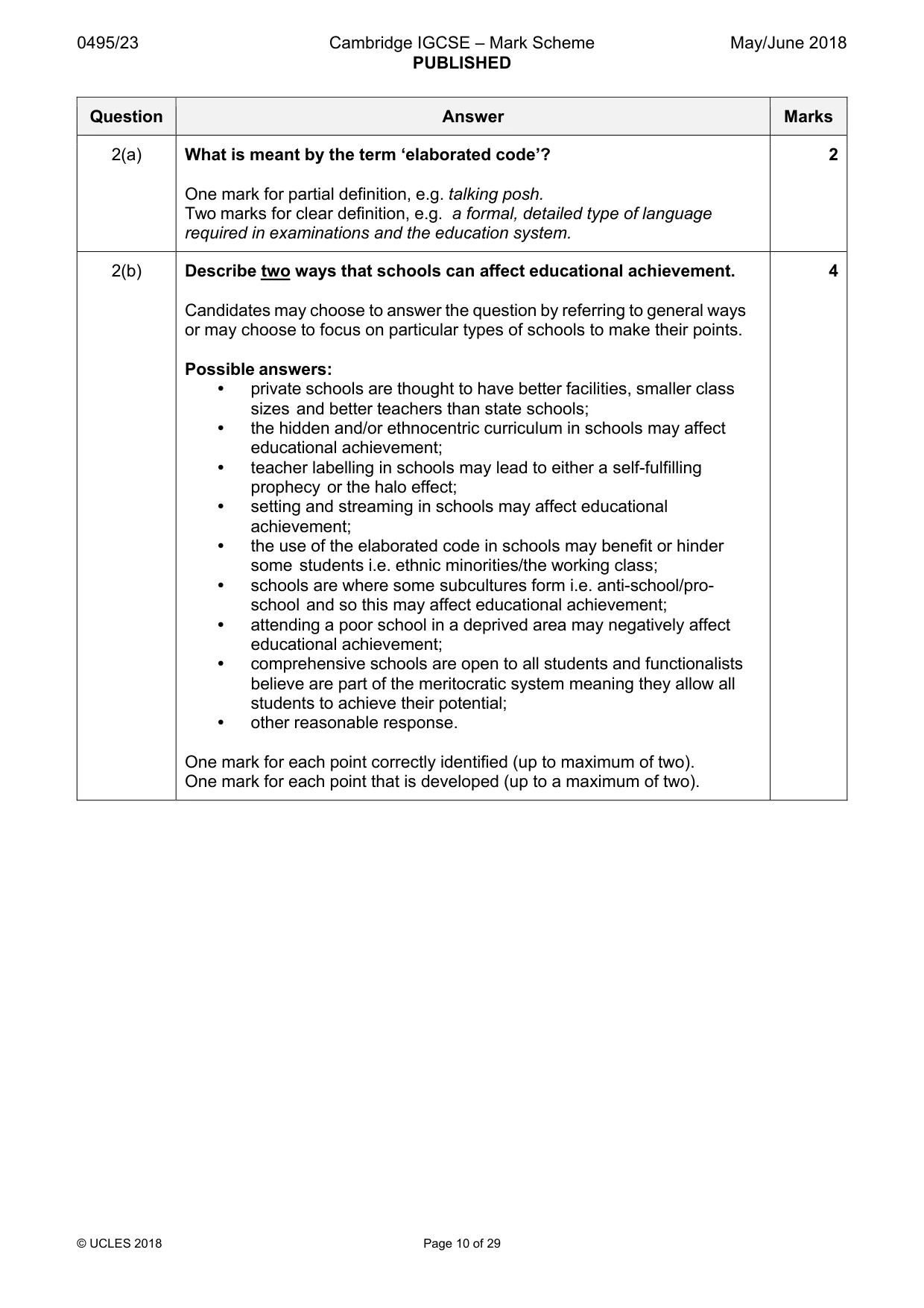
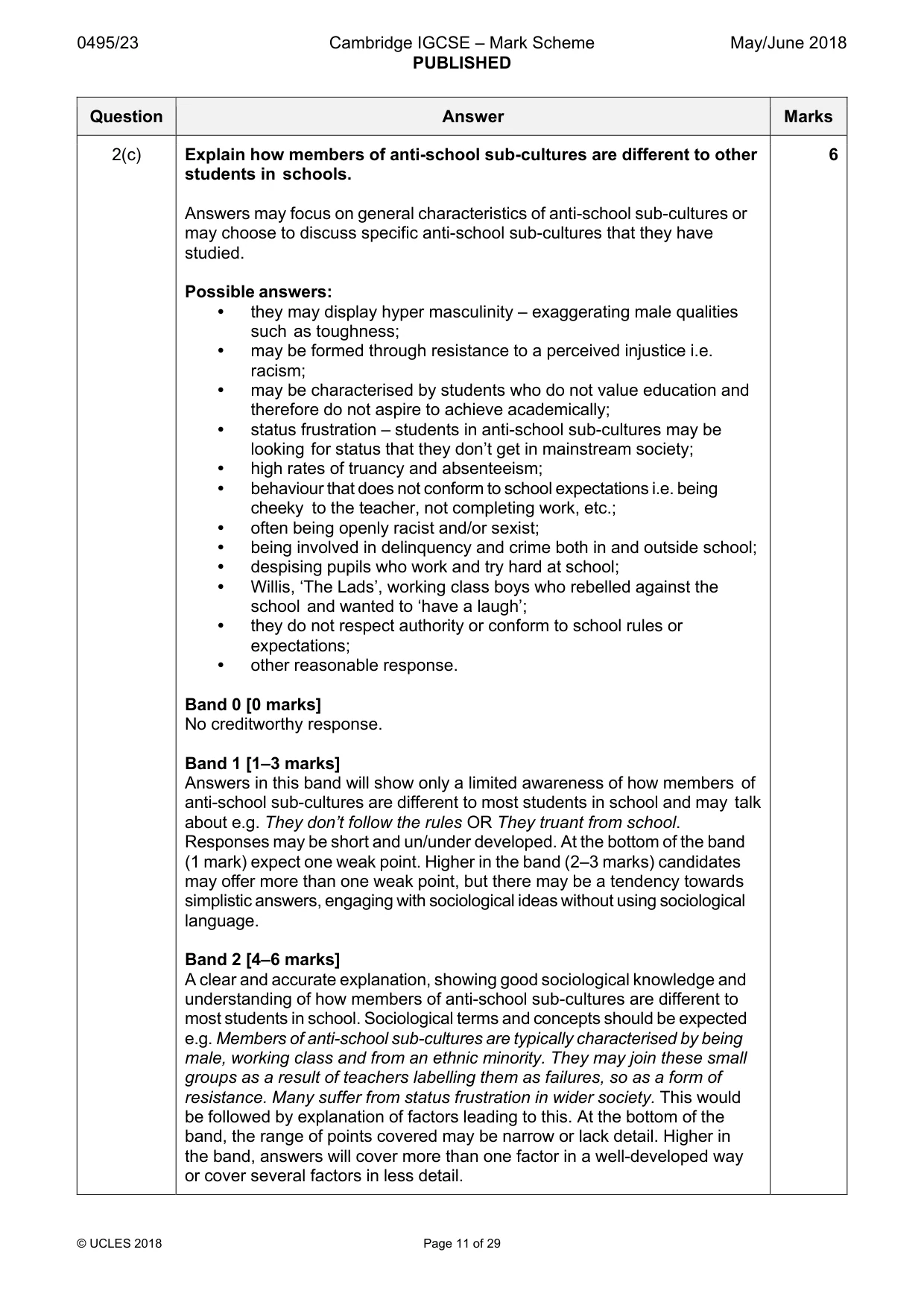
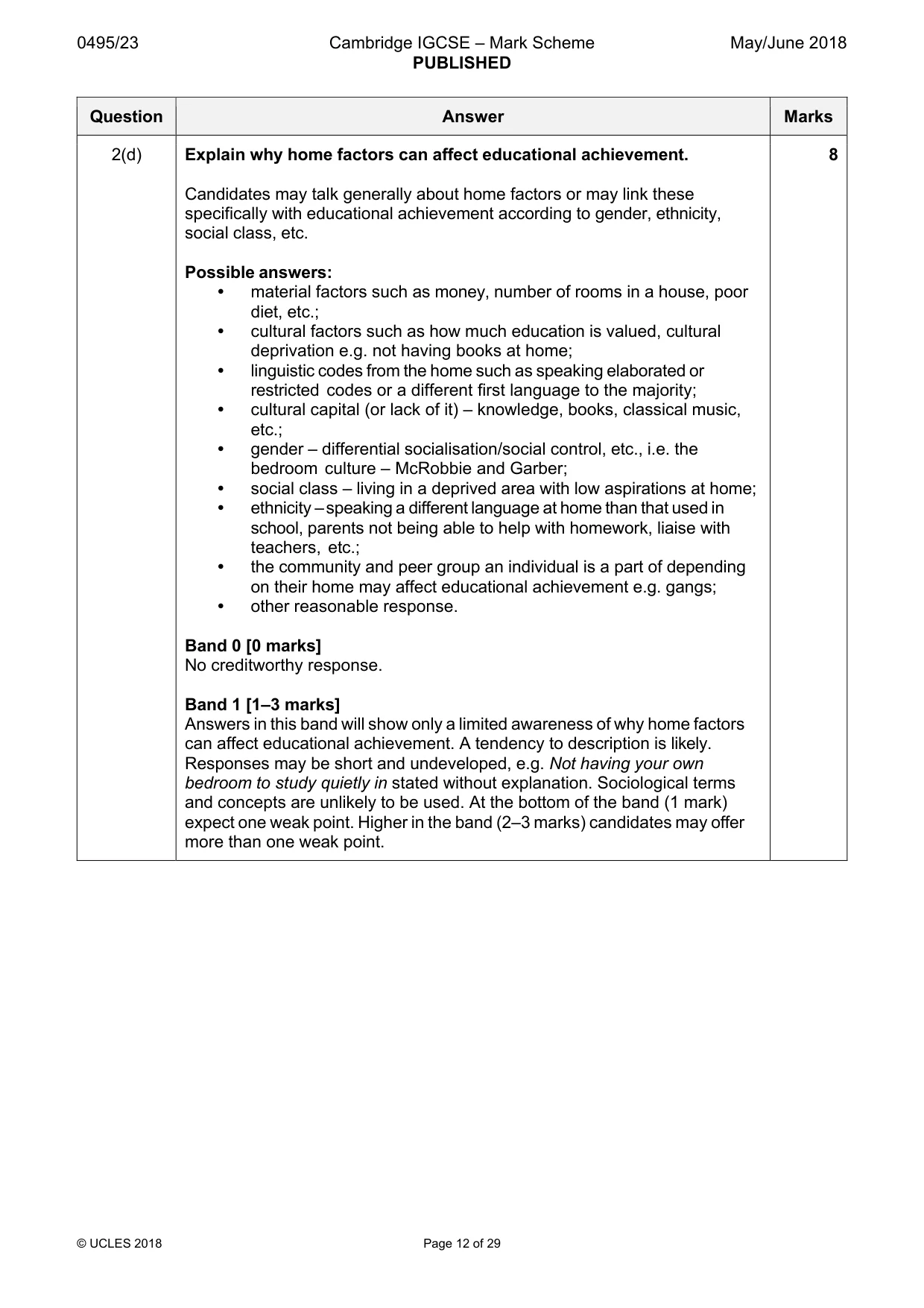
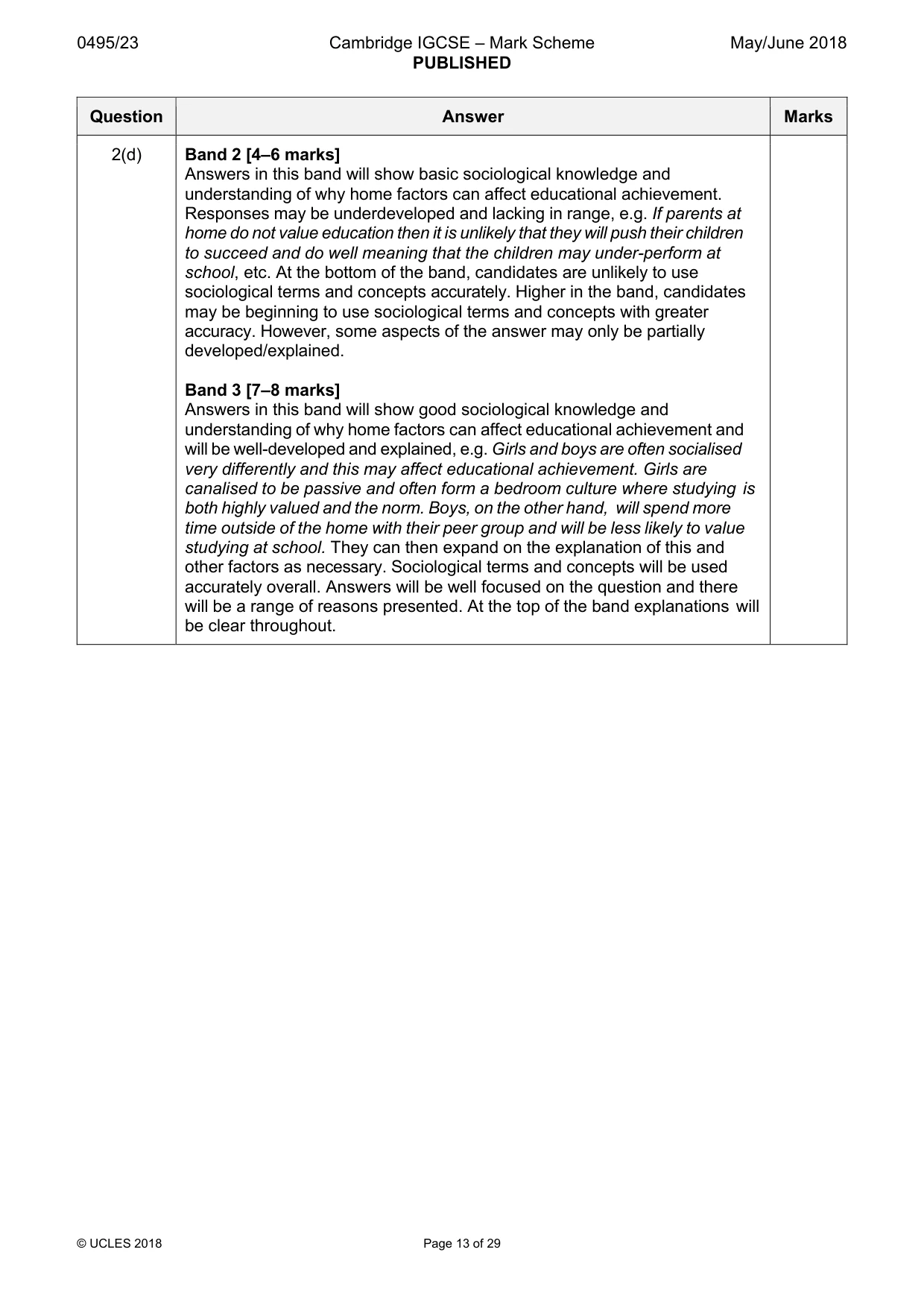
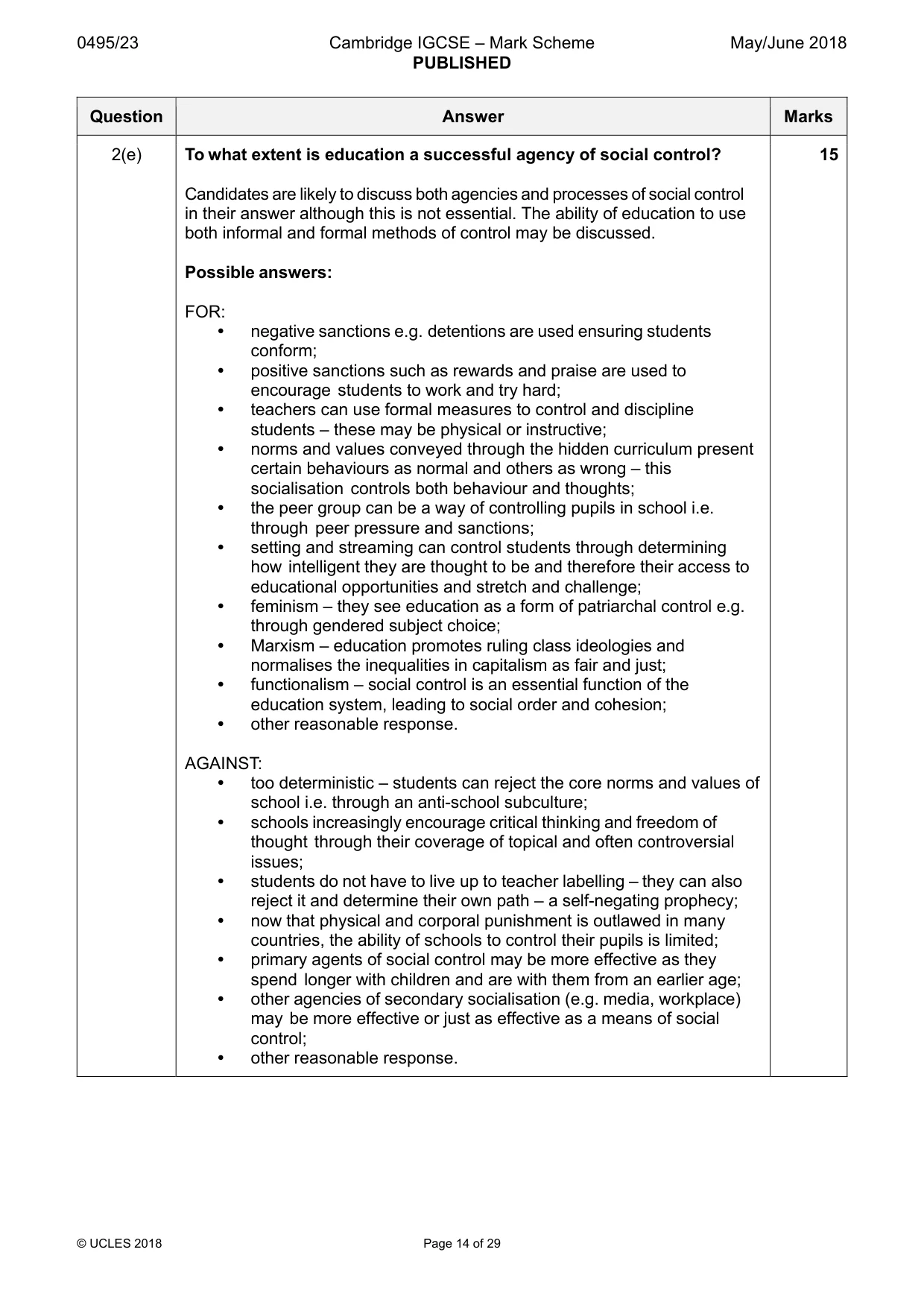
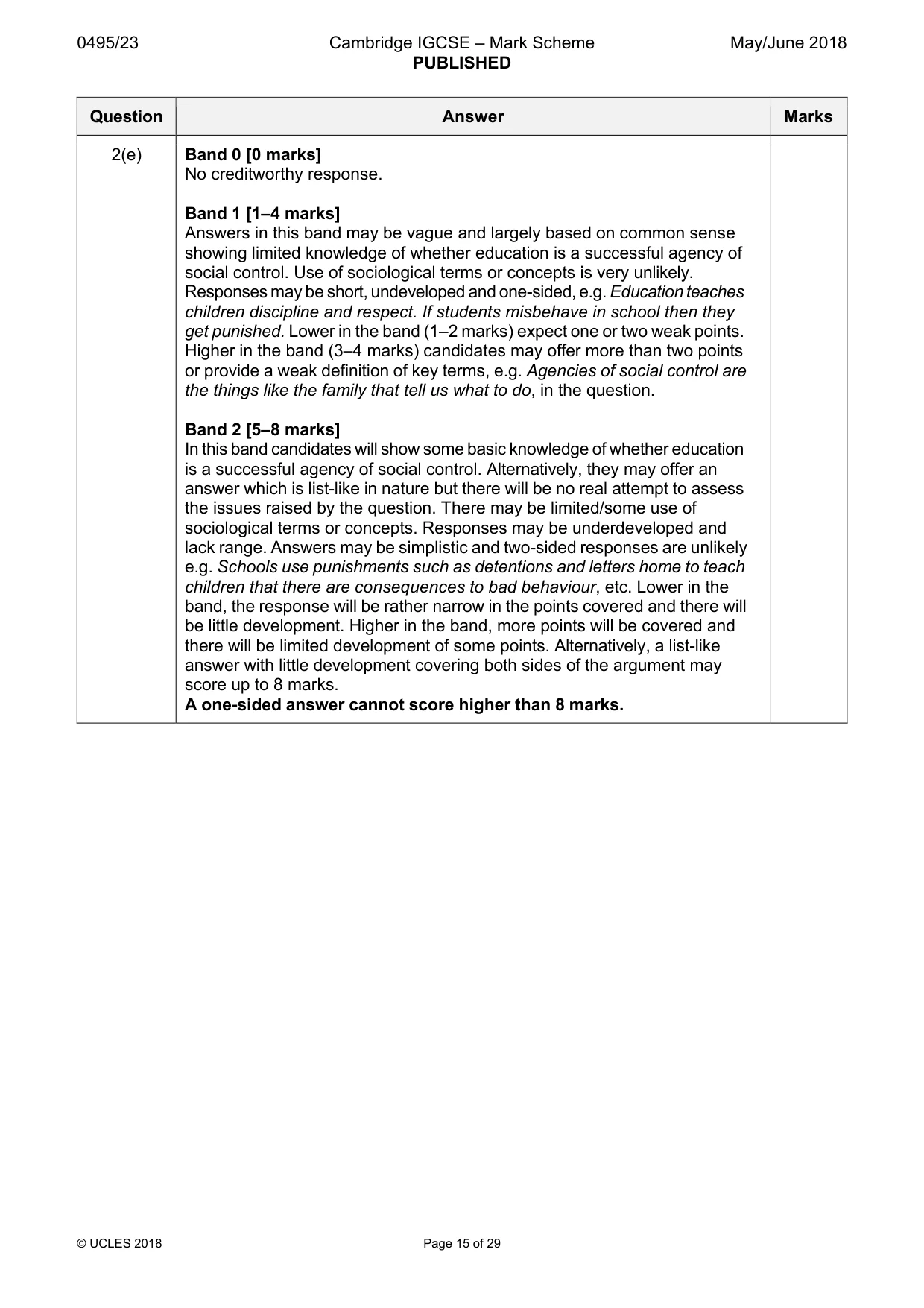
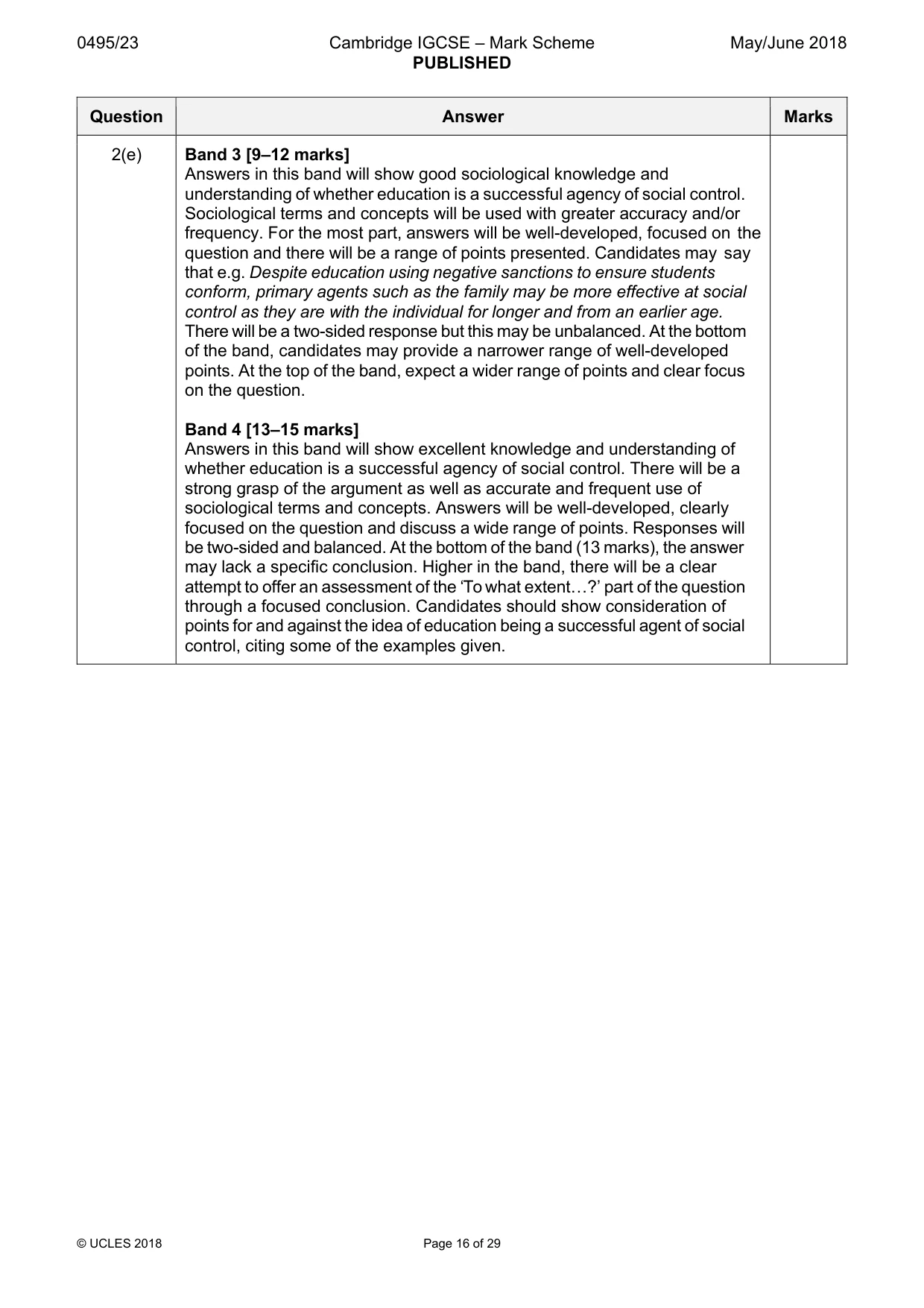
Mark scheme: 2(a) What is meant by the term ‘elaborated code’? 2 One mark for partial definition, e.g. talking posh. Two marks for clear definition, e.g. a formal, detailed type of language required in examinations and the education system. 2(b) Describe two ways that schools can affect educational achievement. 4 Candidates may choose to answer the question by referring to general ways or may choose to focus on particular types of schools to make their points. Possible answers: • private schools are thought to have better facilities, smaller class sizes and better teachers than state schools; • the hidden and/or ethnocentric curriculum in schools may affect educational achievement; • teacher labelling in schools may lead to either a self-fulfilling prophecy or the halo effect; • setting and streaming in schools may affect educational achievement; • the use of the elaborated code in schools may benefit or hinder some students i.e. ethnic minorities/the working class; • schools are where some subcultures form i.e. anti-school/pro- school and so this may affect educational achievement; • attending a poor school in a deprived area may negatively affect educational achievement; • comprehensive schools are open to all students and functionalists believe are part of the meritocratic system meaning they allow all students to achieve their potential; • other reasonable response. One mark for each point correctly identified (up to maximum of two). One mark for each point that is developed (up to a maximum of two). 2(c) Explain how members of anti-school sub-cultures are different to other 6 students in schools. Answers may focus on general characteristics of anti-school sub-cultures or may choose to discuss specific anti-school sub-cultures that they have studied. Possible answers: • they may display hyper masculinity – exaggerating male qualities such as toughness; • may be formed through resistance to a perceived injustice i.e. racism; • may be characterised by students who do not value education and therefore do not aspire to achieve academically; • status frustration – students in anti-school sub-cultures may be looking for status that they don’t get in mainstream society; • high rates of truancy and absenteeism; • behaviour that does not conform to school expectations i.e. being cheeky to the teacher, not completing work, etc.; • often being openly racist and/or sexist; • being involved in delinquency and crime both in and outside school; • despising pupils who work and try hard at school; • Willis, ‘The Lads’, working class boys who rebelled against the school and wanted to ‘have a laugh’; • they do not respect authority or conform to school rules or expectations; • other reasonable response. Band 0 [0 marks] No creditworthy response. Band 1 [1–3 marks] Answers in this band will show only a limited awareness of how members of anti-school sub-cultures are different to most students in school and may talk about e.g. They don’t follow the rules OR They truant from school. Responses may be short and un/under developed. At the bottom of the band (1 mark) expect one weak point. Higher in the band (2–3 marks) candidates may offer more than one weak point, but there may be a tendency towards simplistic answers, engaging with sociological ideas without using sociological language. Band 2 [4–6 marks] A clear and accurate explanation, showing good sociological knowledge and understanding of how members of anti-school sub-cultures are different to most students in school. Sociological terms and concepts should be expected e.g. Members of anti-school sub-cultures are typically characterised by being male, working class and from an ethnic minority. They may join these small groups as a result of teachers labelling them as failures, so as a form of resistance. Many suffer from status frustration in wider society. This would be followed by explanation of factors leading to this. At the bottom of the band, the range of points covered may be narrow or lack detail. Higher in the band, answers will cover more than one factor in a well-developed way or cover several factors in less detail. 2(d) Explain why home factors can affect educational achievement. 8 Candidates may talk generally about home factors or may link these specifically with educational achievement according to gender, ethnicity, social class, etc. Possible answers: • material factors such as money, number of rooms in a house, poor diet, etc.; • cultural factors such as how much education is valued, cultural deprivation e.g. not having books at home; • linguistic codes from the home such as speaking elaborated or restricted codes or a different first language to the majority; • cultural capital (or lack of it) – knowledge, books, classical music, etc.; • gender – differential socialisation/social control, etc., i.e. the bedroom culture – McRobbie and Garber; • social class – living in a deprived area with low aspirations at home; • ethnicity – speaking a different language at home than that used in school, parents not being able to help with homework, liaise with teachers, etc.; • the community and peer group an individual is a part of depending on their home may affect educational achievement e.g. gangs; • other reasonable response. Band 0 [0 marks] No creditworthy response. Band 1 [1–3 marks] Answers in this band will show only a limited awareness of why home factors can affect educational achievement. A tendency to description is likely. Responses may be short and undeveloped, e.g. Not having your own bedroom to study quietly in stated without explanation. Sociological terms and concepts are unlikely to be used. At the bottom of the band (1 mark) expect one weak point. Higher in the band (2–3 marks) candidates may offer more than one weak point. 2(d) Band 2 [4–6 marks] Answers in this band will show basic sociological knowledge and understanding of why home factors can affect educational achievement. Responses may be underdeveloped and lacking in range, e.g. If parents at home do not value education then it is unlikely that they will push their children to succeed and do well meaning that the children may under-perform at school, etc. At the bottom of the band, candidates are unlikely to use sociological terms and concepts accurately. Higher in the band, candidates may be beginning to use sociological terms and concepts with greater accuracy. However, some aspects of the answer may only be partially developed/explained. Band 3 [7–8 marks] Answers in this band will show good sociological knowledge and understanding of why home factors can affect educational achievement and will be well-developed and explained, e.g. Girls and boys are often socialised very differently and this may affect educational achievement. Girls are canalised to be passive and often form a bedroom culture where studying is both highly valued and the norm. Boys, on the other hand, will spend more time outside of the home with their peer group and will be less likely to value studying at school. They can then expand on the explanation of this and other factors as necessary. Sociological terms and concepts will be used accurately overall. Answers will be well focused on the question and there will be a range of reasons presented. At the top of the band explanations will be clear throughout. 2(e) To what extent is education a successful agency of social control? 15 Candidates are likely to discuss both agencies and processes of social control in their answer although this is not essential. The ability of education to use both informal and formal methods of control may be discussed. Possible answers: FOR: • negative sanctions e.g. detentions are used ensuring students conform; • positive sanctions such as rewards and praise are used to encourage students to work and try hard; • teachers can use formal measures to control and discipline students – these may be physical or instructive; • norms and values conveyed through the hidden curriculum present certain behaviours as normal and others as wrong – this socialisation controls both behaviour and thoughts; • the peer group can be a way of controlling pupils in school i.e. through peer pressure and sanctions; • setting and streaming can control students through determining how intelligent they are thought to be and therefore their access to educational opportunities and stretch and challenge; • feminism – they see education as a form of patriarchal control e.g. through gendered subject choice; • Marxism – education promotes ruling class ideologies and normalises the inequalities in capitalism as fair and just; • functionalism – social control is an essential function of the education system, leading to social order and cohesion; • other reasonable response. AGAINST: • too deterministic – students can reject the core norms and values of school i.e. through an anti-school subculture; • schools increasingly encourage critical thinking and freedom of thought through their coverage of topical and often controversial issues; • students do not have to live up to teacher labelling – they can also reject it and determine their own path – a self-negating prophecy; • now that physical and corporal punishment is outlawed in many countries, the ability of schools to control their pupils is limited; • primary agents of social control may be more effective as they spend longer with children and are with them from an earlier age; • other agencies of secondary socialisation (e.g. media, workplace) may be more effective or just as effective as a means of social control; • other reasonable response. 2(e) Band 0 [0 marks] No creditworthy response. Band 1 [1–4 marks] Answers in this band may be vague and largely based on common sense showing limited knowledge of whether education is a successful agency of social control. Use of sociological terms or concepts is very unlikely. Responses may be short, undeveloped and one-sided, e.g. Education teaches children discipline and respect. If students misbehave in school then they get punished. Lower in the band (1–2 marks) expect one or two weak points. Higher in the band (3–4 marks) candidates may offer more than two points or provide a weak definition of key terms, e.g. Agencies of social control are the things like the family that tell us what to do, in the question. Band 2 [5–8 marks] In this band candidates will show some basic knowledge of whether education is a successful agency of social control. Alternatively, they may offer an answer which is list-like in nature but there will be no real attempt to assess the issues raised by the question. There may be limited/some use of sociological terms or concepts. Responses may be underdeveloped and lack range. Answers may be simplistic and two-sided responses are unlikely e.g. Schools use punishments such as detentions and letters home to teach children that there are consequences to bad behaviour, etc. Lower in the band, the response will be rather narrow in the points covered and there will be little development. Higher in the band, more points will be covered and there will be limited development of some points. Alternatively, a list-like answer with little development covering both sides of the argument may score up to 8 marks. A one-sided answer cannot score higher than 8 marks. 2(e) Band 3 [9–12 marks] Answers in this band will show good sociological knowledge and understanding of whether education is a successful agency of social control. Sociological terms and concepts will be used with greater accuracy and/or frequency. For the most part, answers will be well-developed, focused on the question and there will be a range of points presented. Candidates may say that e.g. Despite education using negative sanctions to ensure students conform, primary agents such as the family may be more effective at social control as they are with the individual for longer and from an earlier age. There will be a two-sided response but this may be unbalanced. At the bottom of the band, candidates may provide a narrower range of well-developed points. At the top of the band, expect a wider range of points and clear focus on the question. Band 4 [13–15 marks] Answers in this band will show excellent knowledge and understanding of whether education is a successful agency of social control. There will be a strong grasp of the argument as well as accurate and frequent use of sociological terms and concepts. Answers will be well-developed, clearly focused on the question and discuss a wide range of points. Responses will be two-sided and balanced. At the bottom of the band (13 marks), the answer may lack a specific conclusion. Higher in the band, there will be a clear attempt to offer an assessment of the ‘To what extent«?’ part of the question through a focused conclusion. Candidates should show consideration of points for and against the idea of education being a successful agent of social control, citing some of the examples given.
Q3 · There are many explanations offered by sociologists as to why some individuals adopt a…
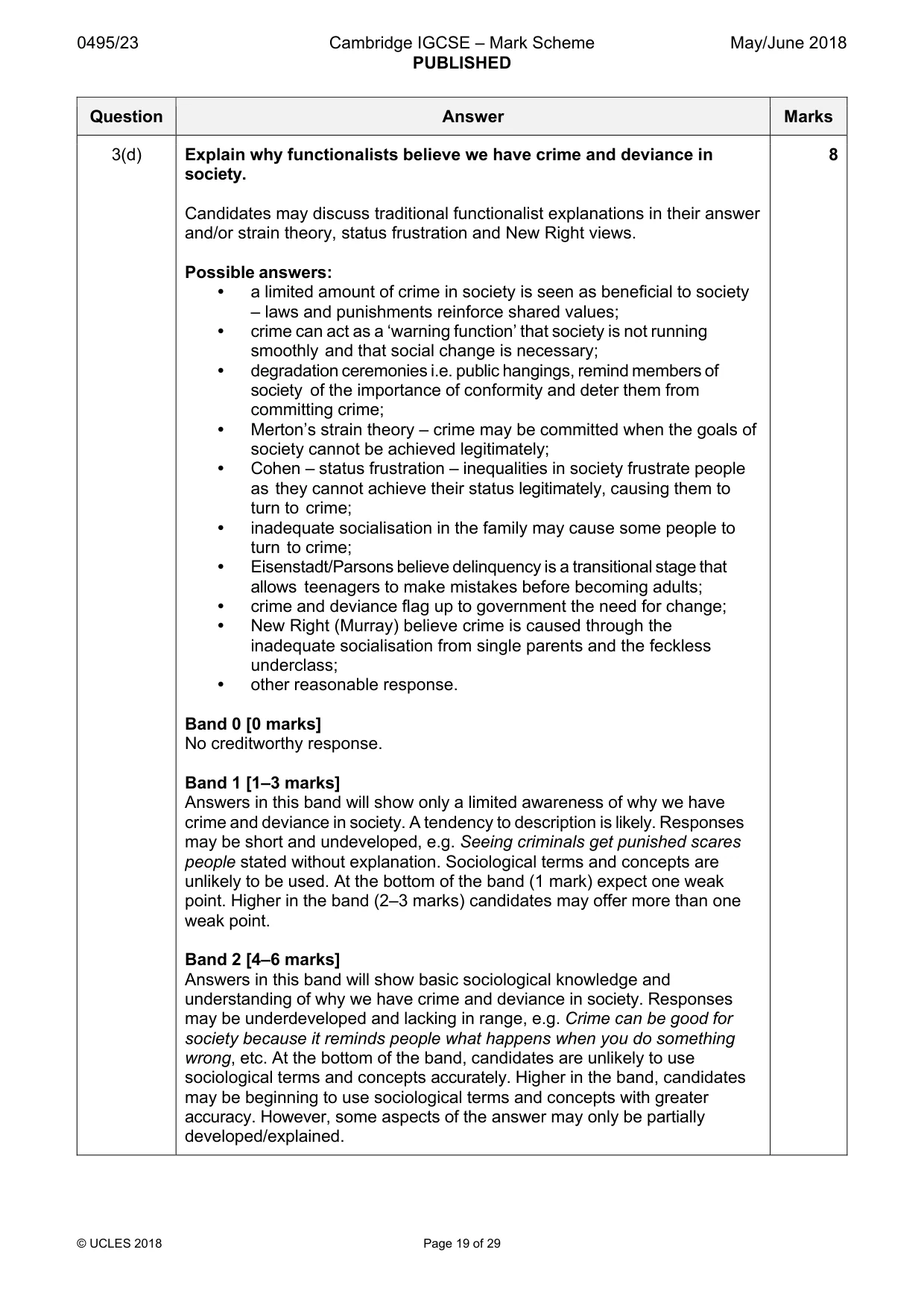
3 There are many explanations offered by sociologists as to why some individuals adopt a deviant career. Most members of society want the formal agencies of social control to deal with this problem but there are some sociologists who believe that crime can be positive for society. (a) What is meant by the term ‘deviant career’? [2] (b) Describe two informal agencies of social control. [4] (c) Explain how crime is relative. [6] (d) Explain why functionalists believe we have crime and deviance in society. [8] (e) To what extent is the crime rate affected by police stereotypes? [15] Section D: Media
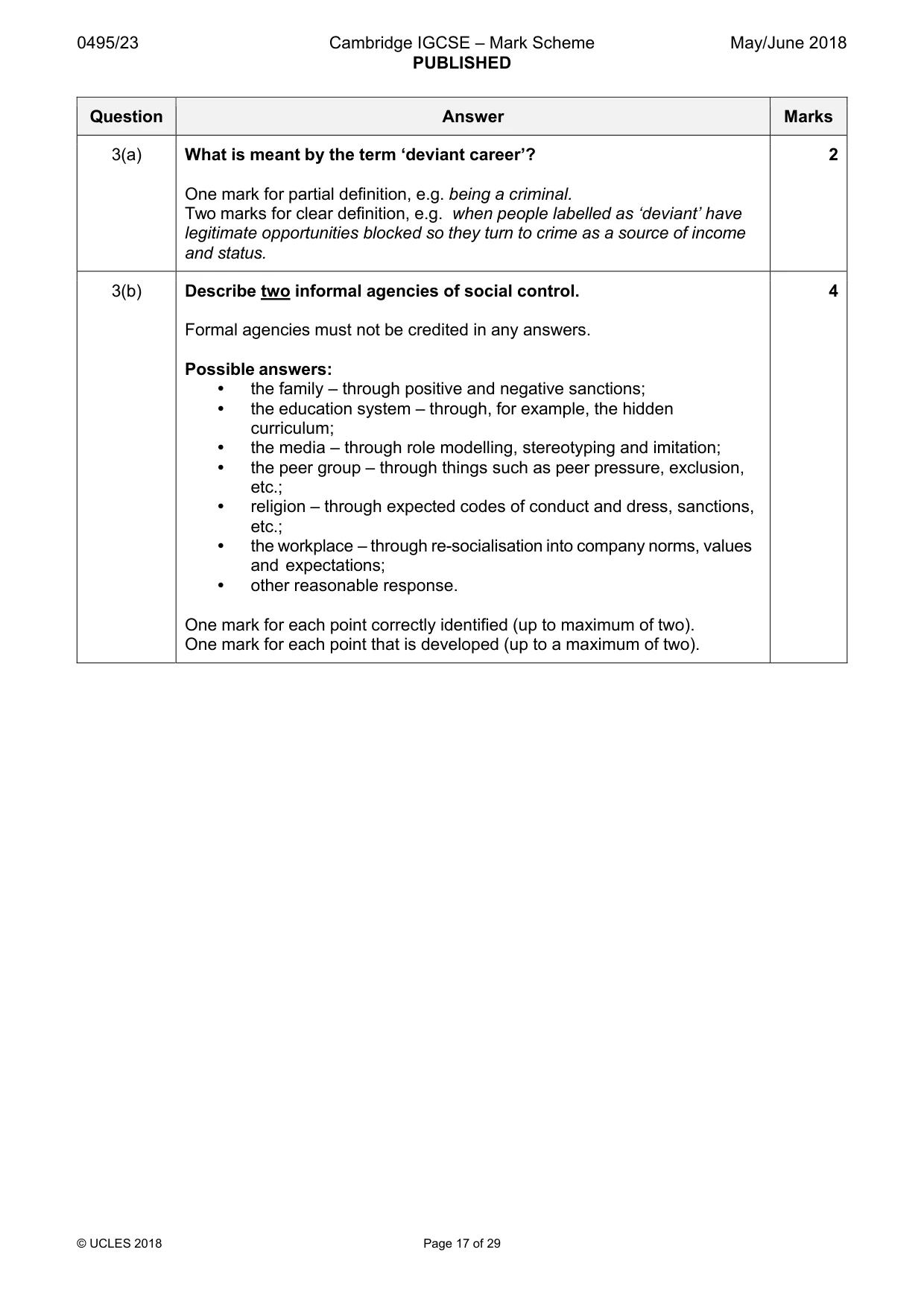
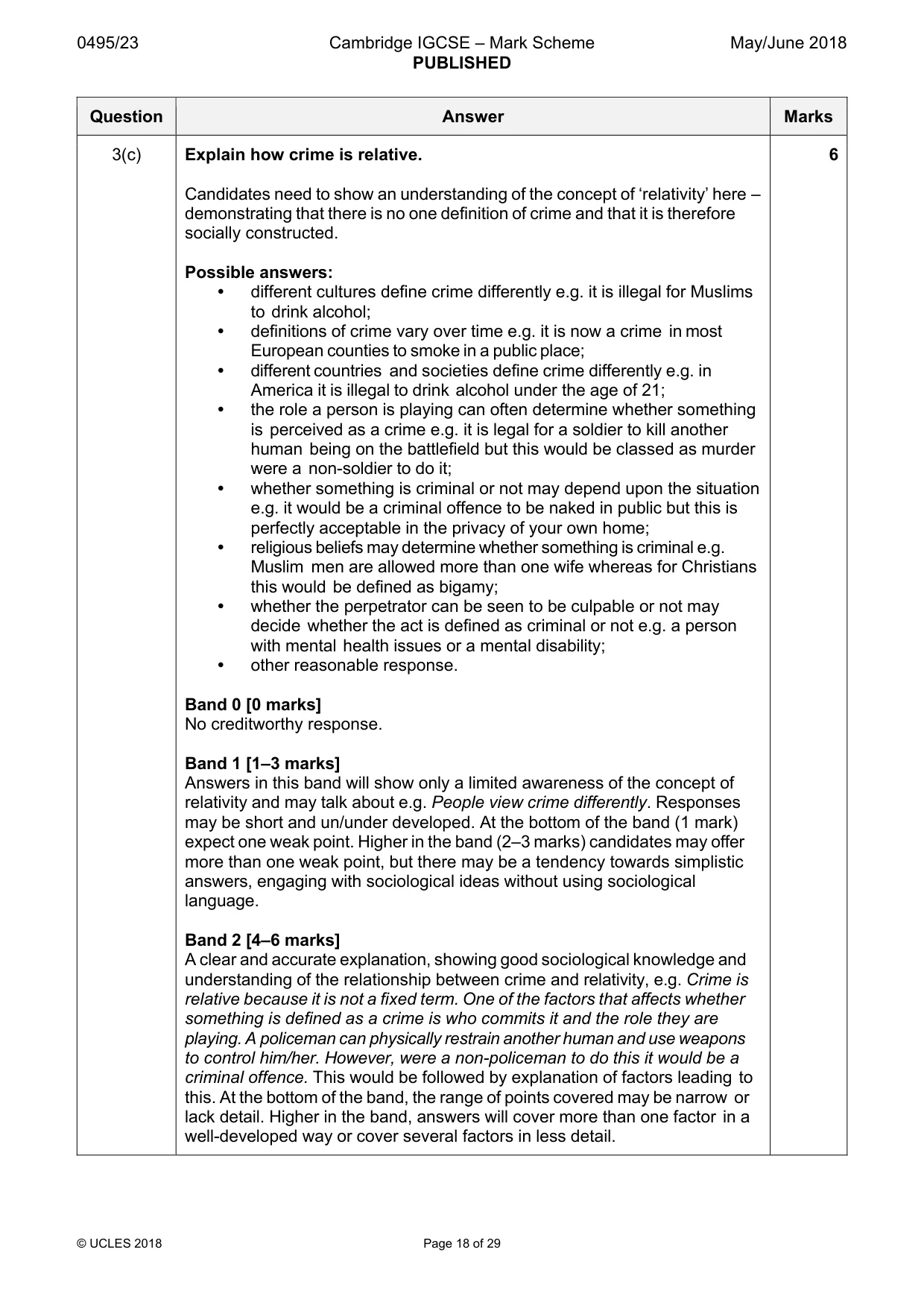
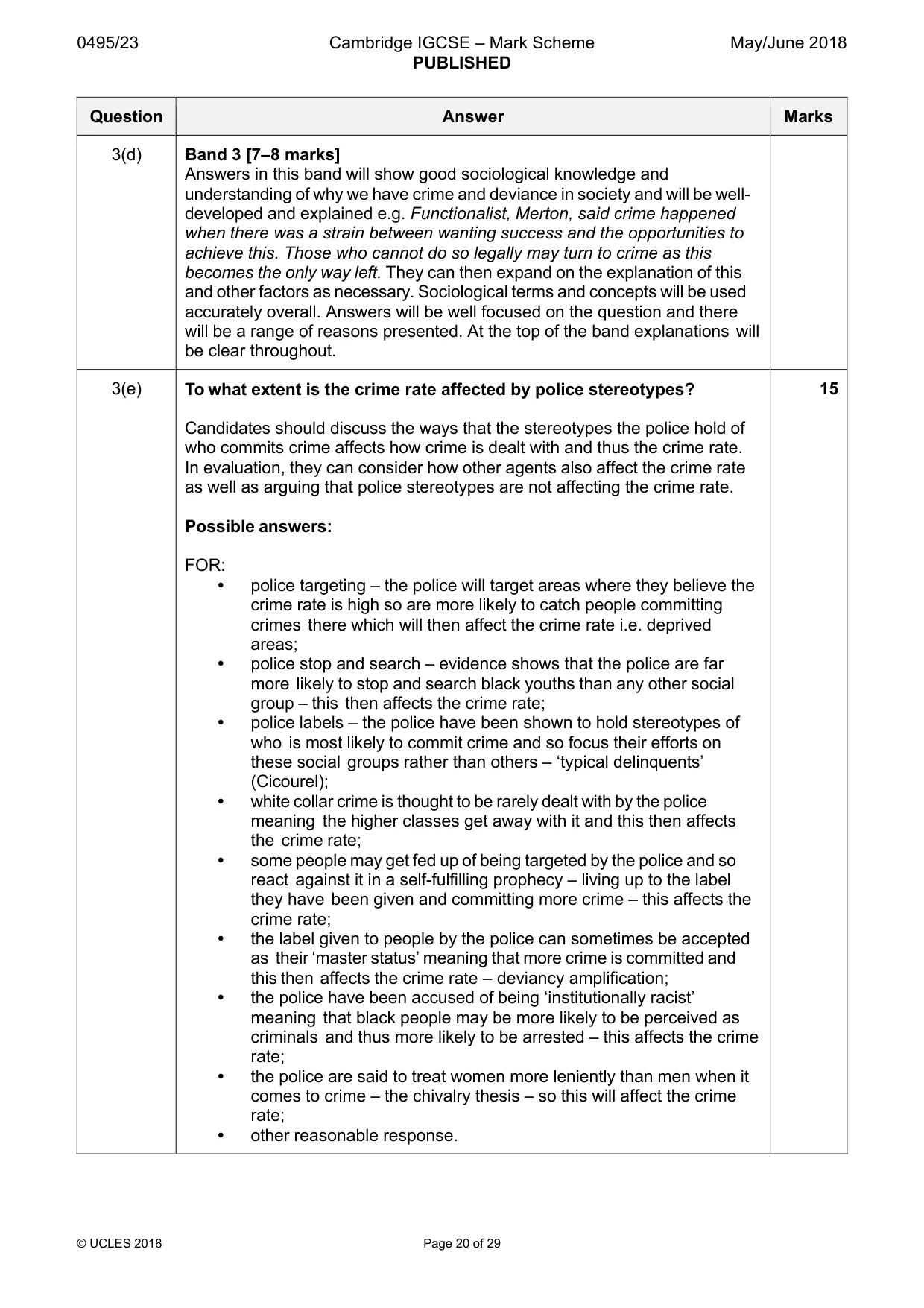
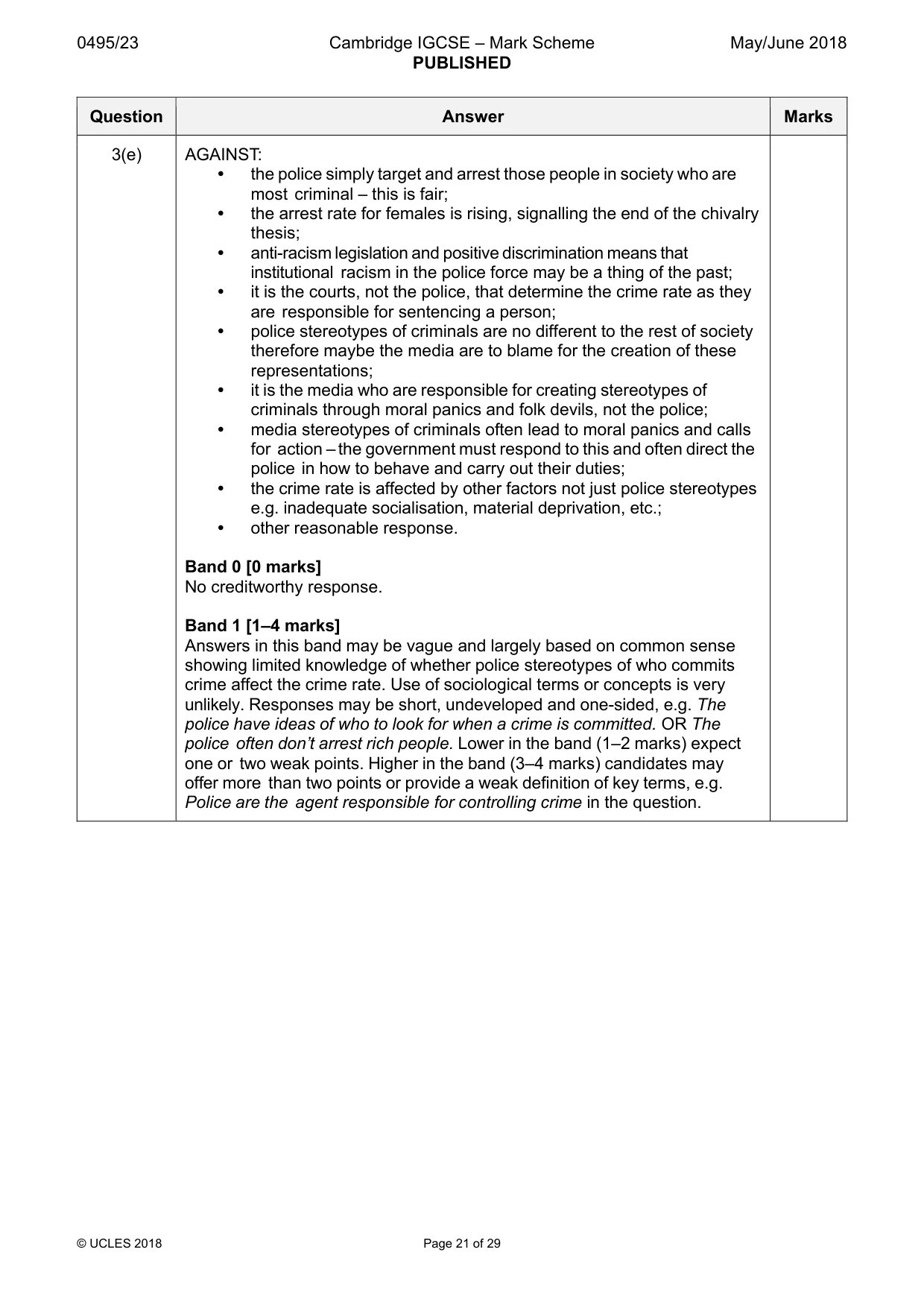
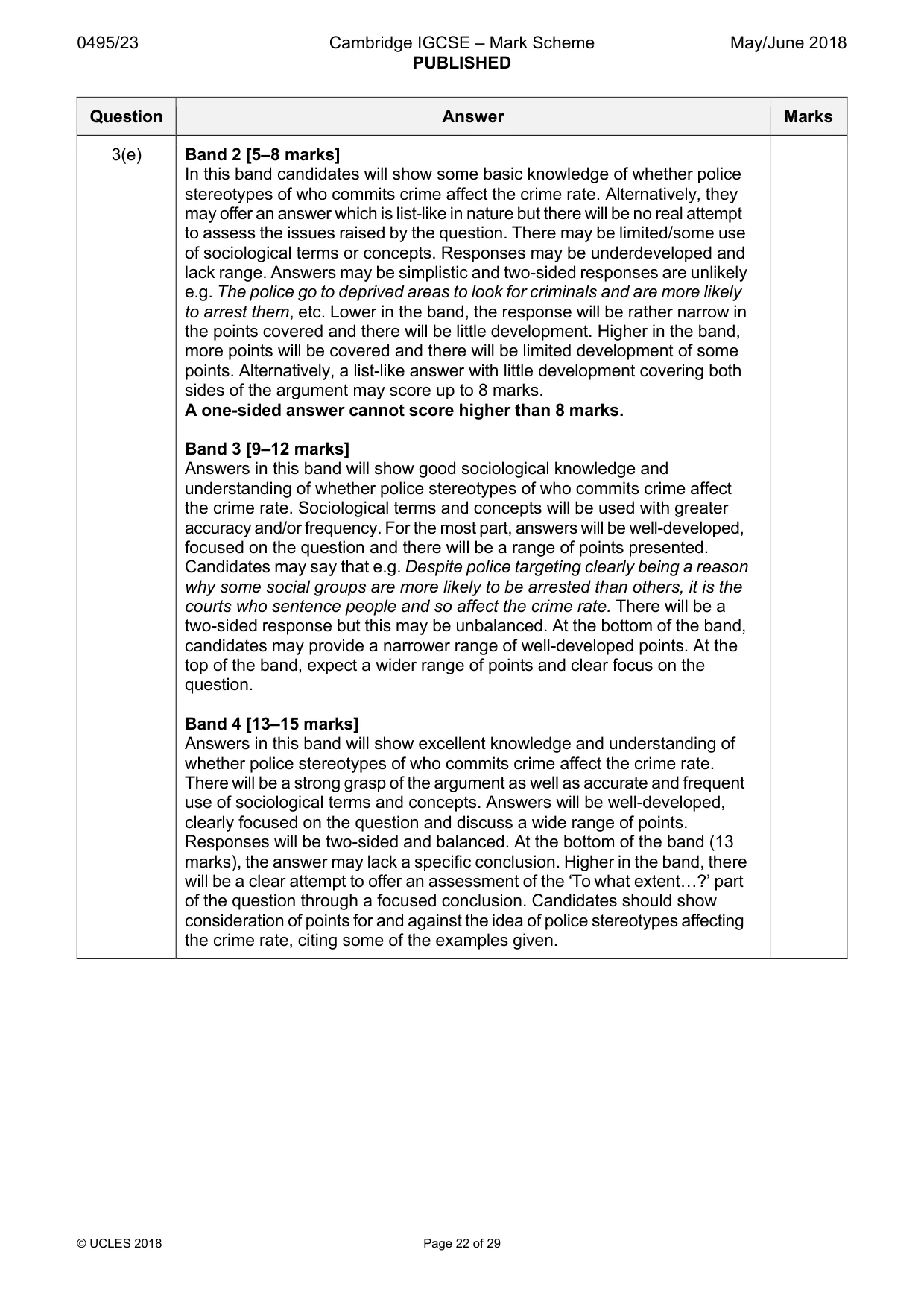
Mark scheme: 3(a) What is meant by the term ‘deviant career’? 2 One mark for partial definition, e.g. being a criminal. Two marks for clear definition, e.g. when people labelled as ‘deviant’ have legitimate opportunities blocked so they turn to crime as a source of income and status. 3(b) Describe two informal agencies of social control. 4 Formal agencies must not be credited in any answers. Possible answers: • the family – through positive and negative sanctions; • the education system – through, for example, the hidden curriculum; • the media – through role modelling, stereotyping and imitation; • the peer group – through things such as peer pressure, exclusion, etc.; • religion – through expected codes of conduct and dress, sanctions, etc.; • the workplace – through re-socialisation into company norms, values and expectations; • other reasonable response. One mark for each point correctly identified (up to maximum of two). One mark for each point that is developed (up to a maximum of two). 3(c) Explain how crime is relative. 6 Candidates need to show an understanding of the concept of ‘relativity’ here – demonstrating that there is no one definition of crime and that it is therefore socially constructed. Possible answers: • different cultures define crime differently e.g. it is illegal for Muslims to drink alcohol; • definitions of crime vary over time e.g. it is now a crime in most European counties to smoke in a public place; • different countries and societies define crime differently e.g. in America it is illegal to drink alcohol under the age of 21; • the role a person is playing can often determine whether something is perceived as a crime e.g. it is legal for a soldier to kill another human being on the battlefield but this would be classed as murder were a non-soldier to do it; • whether something is criminal or not may depend upon the situation e.g. it would be a criminal offence to be naked in public but this is perfectly acceptable in the privacy of your own home; • religious beliefs may determine whether something is criminal e.g. Muslim men are allowed more than one wife whereas for Christians this would be defined as bigamy; • whether the perpetrator can be seen to be culpable or not may decide whether the act is defined as criminal or not e.g. a person with mental health issues or a mental disability; • other reasonable response. Band 0 [0 marks] No creditworthy response. Band 1 [1–3 marks] Answers in this band will show only a limited awareness of the concept of relativity and may talk about e.g. People view crime differently. Responses may be short and un/under developed. At the bottom of the band (1 mark) expect one weak point. Higher in the band (2–3 marks) candidates may offer more than one weak point, but there may be a tendency towards simplistic answers, engaging with sociological ideas without using sociological language. Band 2 [4–6 marks] A clear and accurate explanation, showing good sociological knowledge and understanding of the relationship between crime and relativity, e.g. Crime is relative because it is not a fixed term. One of the factors that affects whether something is defined as a crime is who commits it and the role they are playing. A policeman can physically restrain another human and use weapons to control him/her. However, were a non-policeman to do this it would be a criminal offence. This would be followed by explanation of factors leading to this. At the bottom of the band, the range of points covered may be narrow or lack detail. Higher in the band, answers will cover more than one factor in a well-developed way or cover several factors in less detail. 3(d) Explain why functionalists believe we have crime and deviance in 8 society. Candidates may discuss traditional functionalist explanations in their answer and/or strain theory, status frustration and New Right views. Possible answers: • a limited amount of crime in society is seen as beneficial to society – laws and punishments reinforce shared values; • crime can act as a ‘warning function’ that society is not running smoothly and that social change is necessary; • degradation ceremonies i.e. public hangings, remind members of society of the importance of conformity and deter them from committing crime; • Merton’s strain theory – crime may be committed when the goals of society cannot be achieved legitimately; • Cohen – status frustration – inequalities in society frustrate people as they cannot achieve their status legitimately, causing them to turn to crime; • inadequate socialisation in the family may cause some people to turn to crime; • Eisenstadt/Parsons believe delinquency is a transitional stage that allows teenagers to make mistakes before becoming adults; • crime and deviance flag up to government the need for change; • New Right (Murray) believe crime is caused through the inadequate socialisation from single parents and the feckless underclass; • other reasonable response. Band 0 [0 marks] No creditworthy response. Band 1 [1–3 marks] Answers in this band will show only a limited awareness of why we have crime and deviance in society. A tendency to description is likely. Responses may be short and undeveloped, e.g. Seeing criminals get punished scares people stated without explanation. Sociological terms and concepts are unlikely to be used. At the bottom of the band (1 mark) expect one weak point. Higher in the band (2–3 marks) candidates may offer more than one weak point. Band 2 [4–6 marks] Answers in this band will show basic sociological knowledge and understanding of why we have crime and deviance in society. Responses may be underdeveloped and lacking in range, e.g. Crime can be good for society because it reminds people what happens when you do something wrong, etc. At the bottom of the band, candidates are unlikely to use sociological terms and concepts accurately. Higher in the band, candidates may be beginning to use sociological terms and concepts with greater accuracy. However, some aspects of the answer may only be partially developed/explained. 3(d) Band 3 [7–8 marks] Answers in this band will show good sociological knowledge and understanding of why we have crime and deviance in society and will be well- developed and explained e.g. Functionalist, Merton, said crime happened when there was a strain between wanting success and the opportunities to achieve this. Those who cannot do so legally may turn to crime as this becomes the only way left. They can then expand on the explanation of this and other factors as necessary. Sociological terms and concepts will be used accurately overall. Answers will be well focused on the question and there will be a range of reasons presented. At the top of the band explanations will be clear throughout. 3(e) To what extent is the crime rate affected by police stereotypes? 15 Candidates should discuss the ways that the stereotypes the police hold of who commits crime affects how crime is dealt with and thus the crime rate. In evaluation, they can consider how other agents also affect the crime rate as well as arguing that police stereotypes are not affecting the crime rate. Possible answers: FOR: • police targeting – the police will target areas where they believe the crime rate is high so are more likely to catch people committing crimes there which will then affect the crime rate i.e. deprived areas; • police stop and search – evidence shows that the police are far more likely to stop and search black youths than any other social group – this then affects the crime rate; • police labels – the police have been shown to hold stereotypes of who is most likely to commit crime and so focus their efforts on these social groups rather than others – ‘typical delinquents’ (Cicourel); • white collar crime is thought to be rarely dealt with by the police meaning the higher classes get away with it and this then affects the crime rate; • some people may get fed up of being targeted by the police and so react against it in a self-fulfilling prophecy – living up to the label they have been given and committing more crime – this affects the crime rate; • the label given to people by the police can sometimes be accepted as their ‘master status’ meaning that more crime is committed and this then affects the crime rate – deviancy amplification; • the police have been accused of being ‘institutionally racist’ meaning that black people may be more likely to be perceived as criminals and thus more likely to be arrested – this affects the crime rate; • the police are said to treat women more leniently than men when it comes to crime – the chivalry thesis – so this will affect the crime rate; • other reasonable response. 3(e) AGAINST: • the police simply target and arrest those people in society who are most criminal – this is fair; • the arrest rate for females is rising, signalling the end of the chivalry thesis; • anti-racism legislation and positive discrimination means that institutional racism in the police force may be a thing of the past; • it is the courts, not the police, that determine the crime rate as they are responsible for sentencing a person; • police stereotypes of criminals are no different to the rest of society therefore maybe the media are to blame for the creation of these representations; • it is the media who are responsible for creating stereotypes of criminals through moral panics and folk devils, not the police; • media stereotypes of criminals often lead to moral panics and calls for action – the government must respond to this and often direct the police in how to behave and carry out their duties; • the crime rate is affected by other factors not just police stereotypes e.g. inadequate socialisation, material deprivation, etc.; • other reasonable response. Band 0 [0 marks] No creditworthy response. Band 1 [1–4 marks] Answers in this band may be vague and largely based on common sense showing limited knowledge of whether police stereotypes of who commits crime affect the crime rate. Use of sociological terms or concepts is very unlikely. Responses may be short, undeveloped and one-sided, e.g. The police have ideas of who to look for when a crime is committed. OR The police often don’t arrest rich people. Lower in the band (1–2 marks) expect one or two weak points. Higher in the band (3–4 marks) candidates may offer more than two points or provide a weak definition of key terms, e.g. Police are the agent responsible for controlling crime in the question. 3(e) Band 2 [5–8 marks] In this band candidates will show some basic knowledge of whether police stereotypes of who commits crime affect the crime rate. Alternatively, they may offer an answer which is list-like in nature but there will be no real attempt to assess the issues raised by the question. There may be limited/some use of sociological terms or concepts. Responses may be underdeveloped and lack range. Answers may be simplistic and two-sided responses are unlikely e.g. The police go to deprived areas to look for criminals and are more likely to arrest them, etc. Lower in the band, the response will be rather narrow in the points covered and there will be little development. Higher in the band, more points will be covered and there will be limited development of some points. Alternatively, a list-like answer with little development covering both sides of the argument may score up to 8 marks. A one-sided answer cannot score higher than 8 marks. Band 3 [9–12 marks] Answers in this band will show good sociological knowledge and understanding of whether police stereotypes of who commits crime affect the crime rate. Sociological terms and concepts will be used with greater accuracy and/or frequency. For the most part, answers will be well-developed, focused on the question and there will be a range of points presented. Candidates may say that e.g. Despite police targeting clearly being a reason why some social groups are more likely to be arrested than others, it is the courts who sentence people and so affect the crime rate. There will be a two-sided response but this may be unbalanced. At the bottom of the band, candidates may provide a narrower range of well-developed points. At the top of the band, expect a wider range of points and clear focus on the question. Band 4 [13–15 marks] Answers in this band will show excellent knowledge and understanding of whether police stereotypes of who commits crime affect the crime rate. There will be a strong grasp of the argument as well as accurate and frequent use of sociological terms and concepts. Answers will be well-developed, clearly focused on the question and discuss a wide range of points. Responses will be two-sided and balanced. At the bottom of the band (13 marks), the answer may lack a specific conclusion. Higher in the band, there will be a clear attempt to offer an assessment of the ‘To what extent«?’ part of the question through a focused conclusion. Candidates should show consideration of points for and against the idea of police stereotypes affecting the crime rate, citing some of the examples given.
Q4 · Changes in the media are a good example of globalisation, allowing the audience choice…
4 Changes in the media are a good example of globalisation, allowing the audience choice over content and patterns of consumption. Many sociologists argue that the media is also an important agency of socialisation, affecting voting patterns and setting the agenda for what is important in society. (a) What is meant by the term ‘globalisation’? [2] (b) Describe two ways that the media can be biased. [4] (c) Explain how voting choices are influenced by the media. [6] (d) Explain why the media offer the audience more choice and control than ever before. [8] (e) To what extent do the media set the agenda for how people think and behave in society?[15]
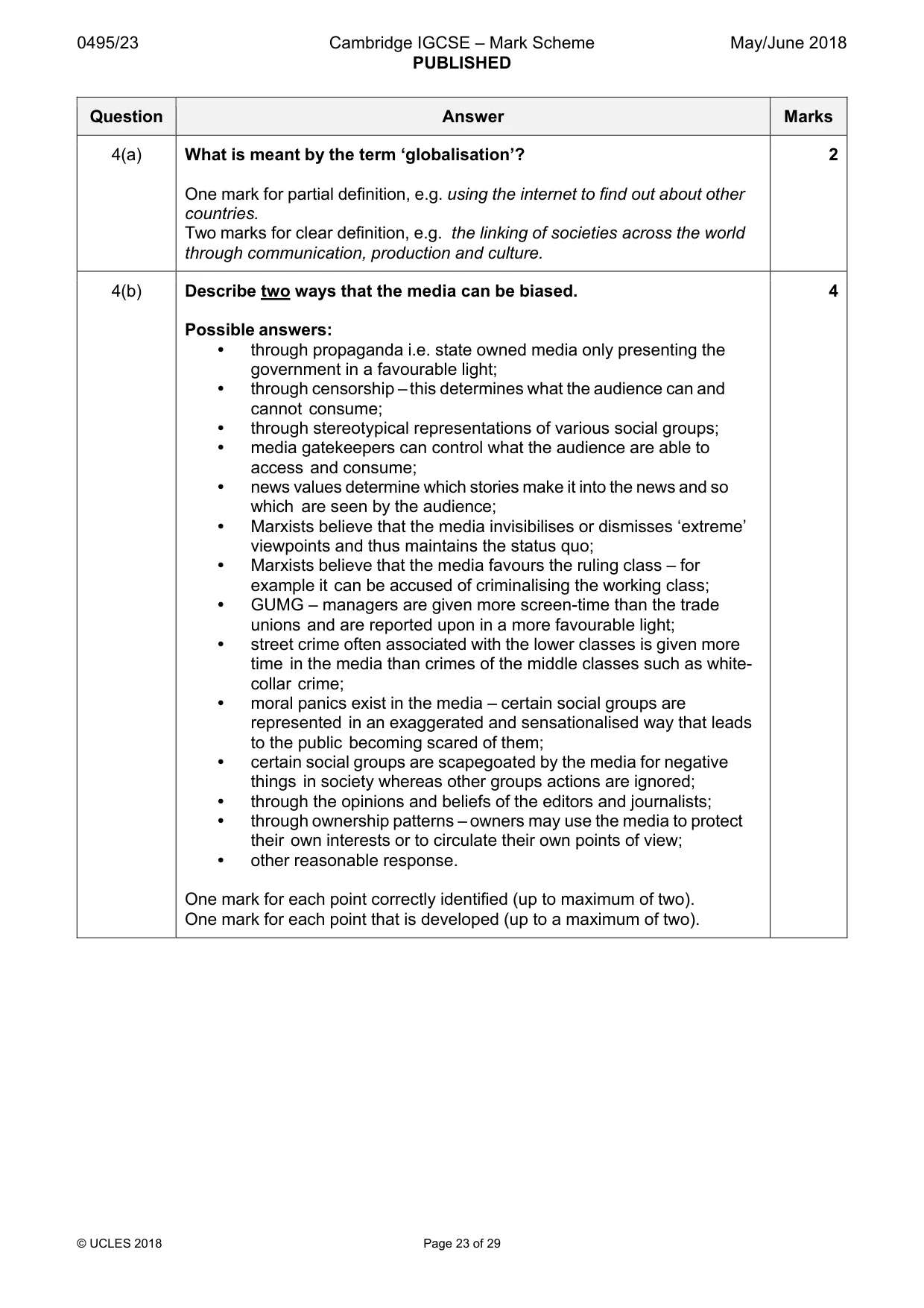
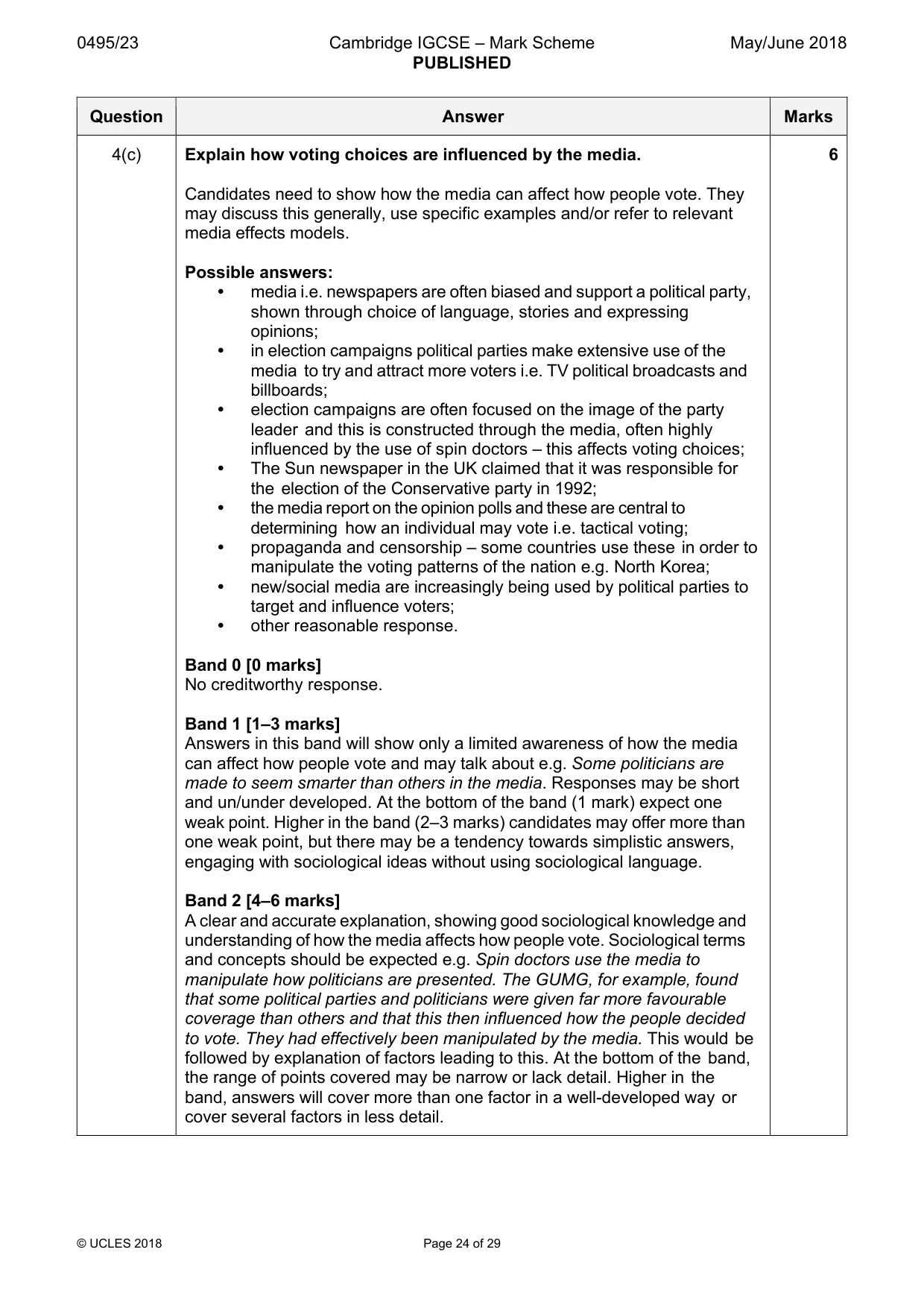
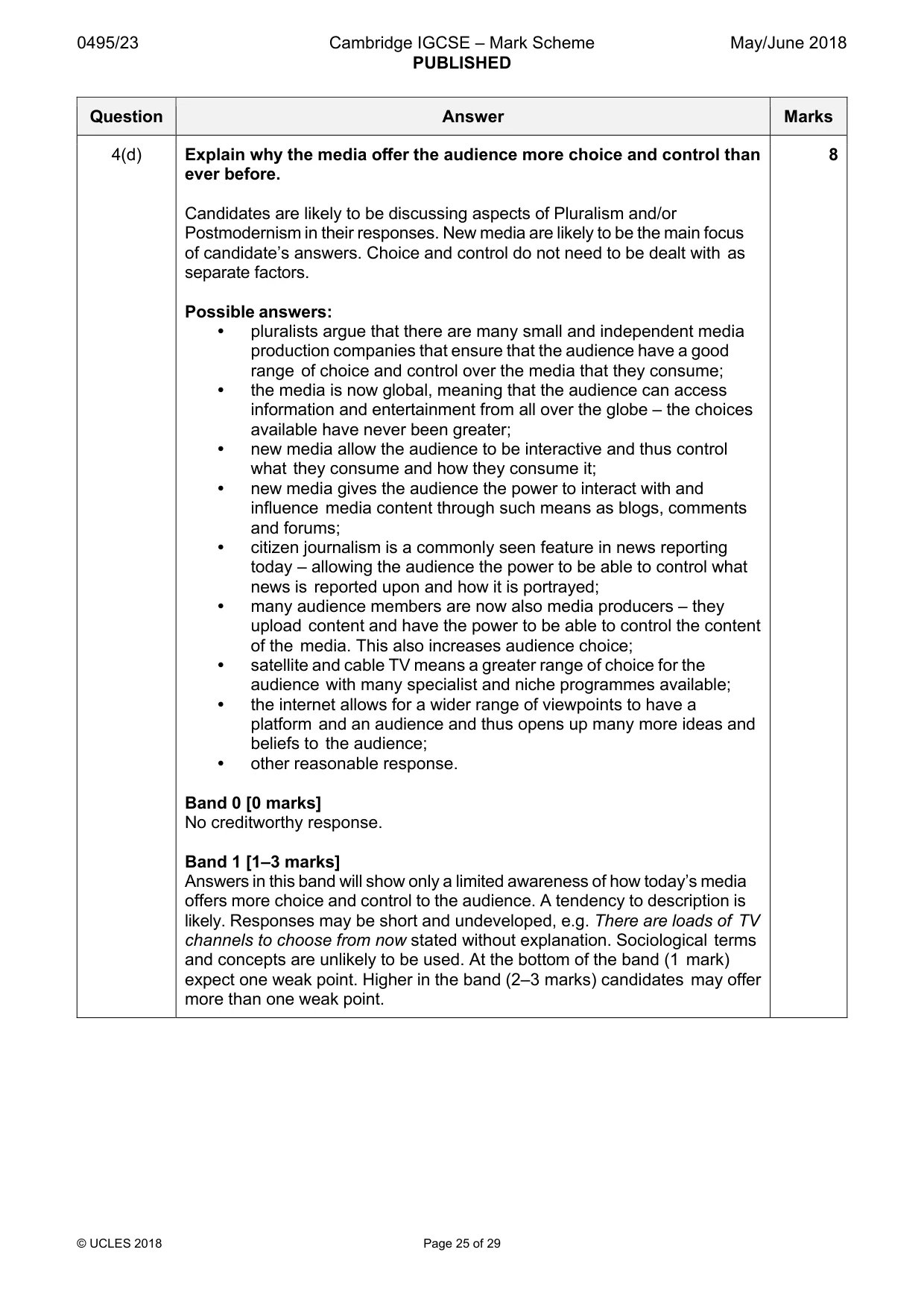
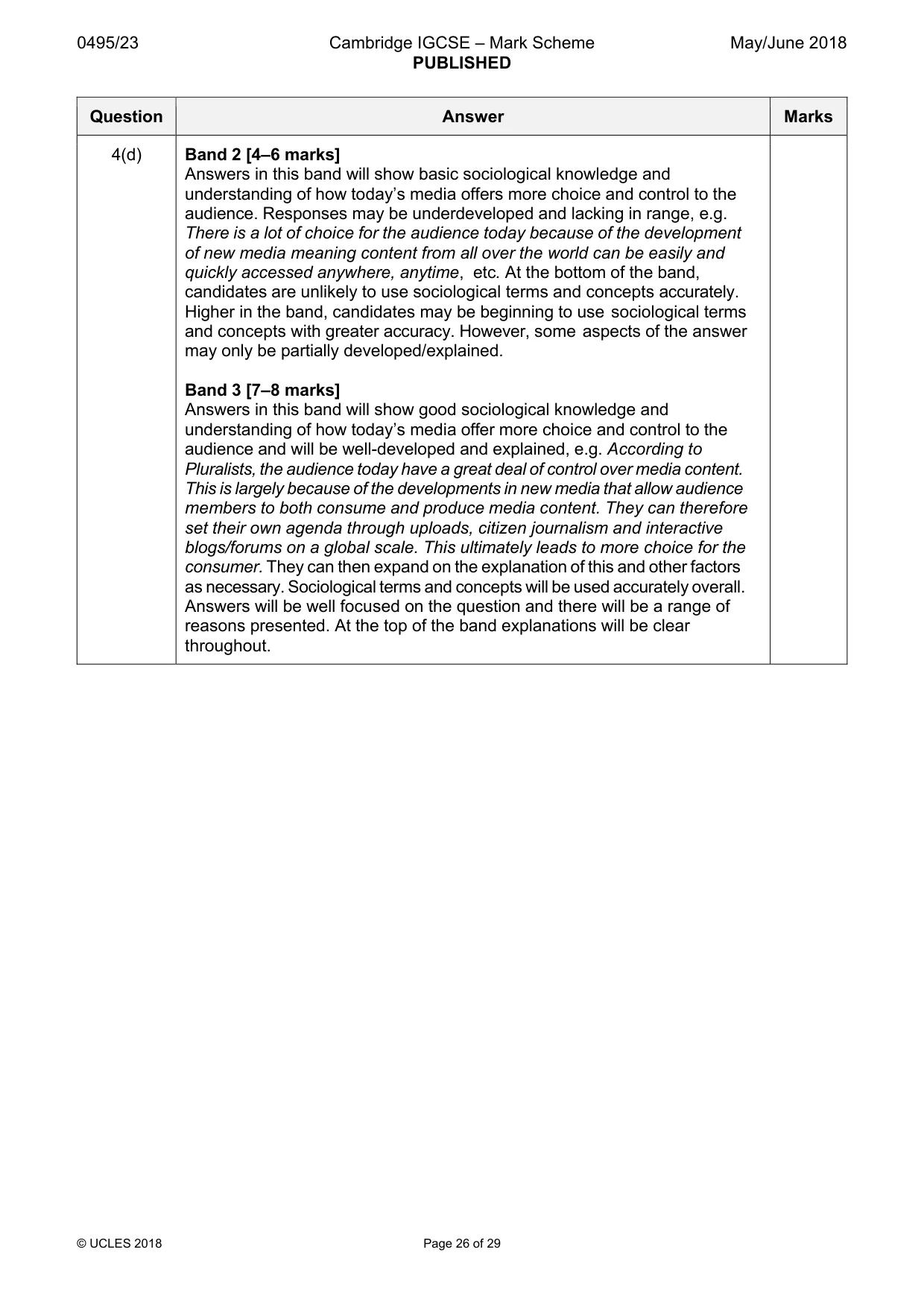
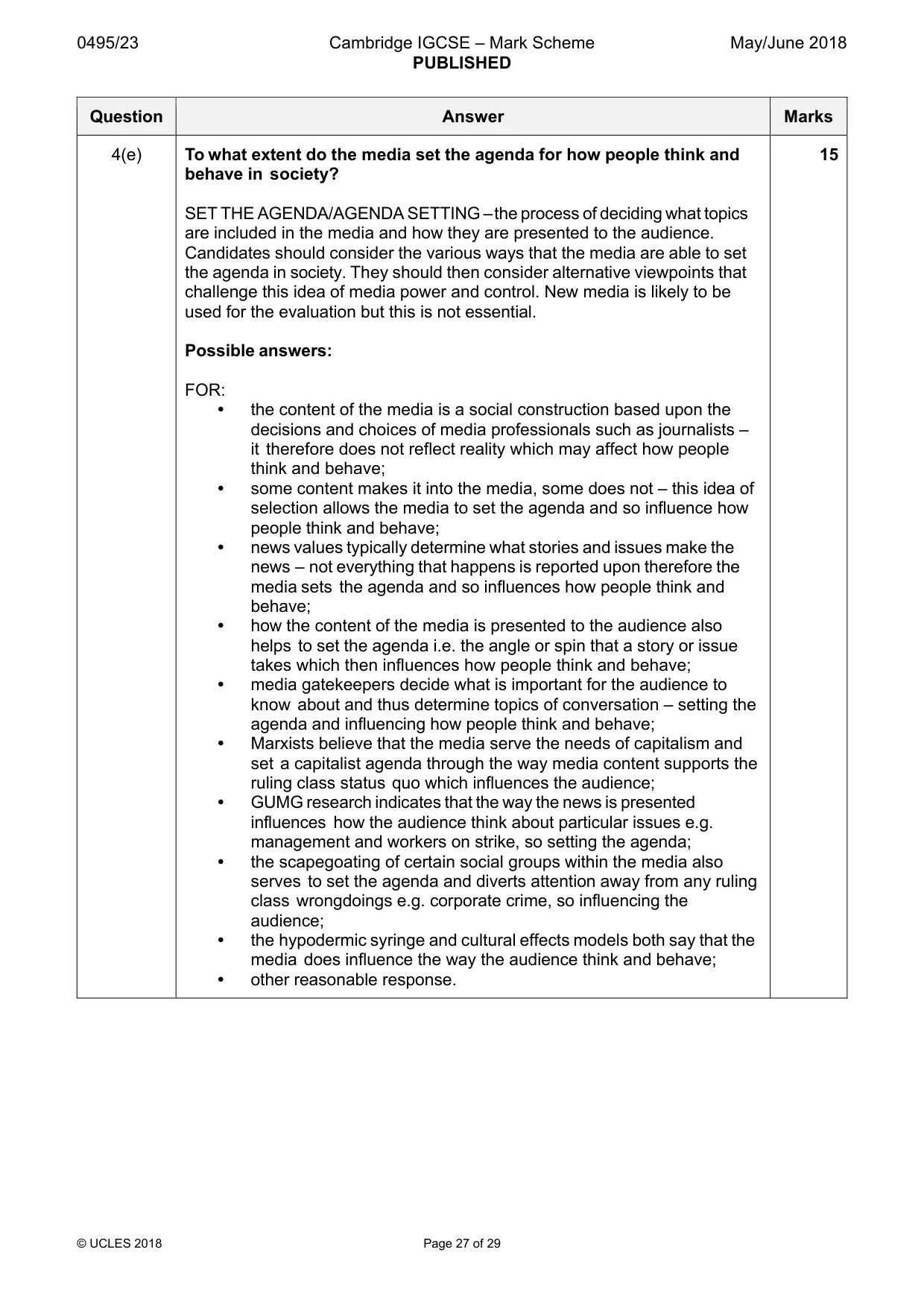
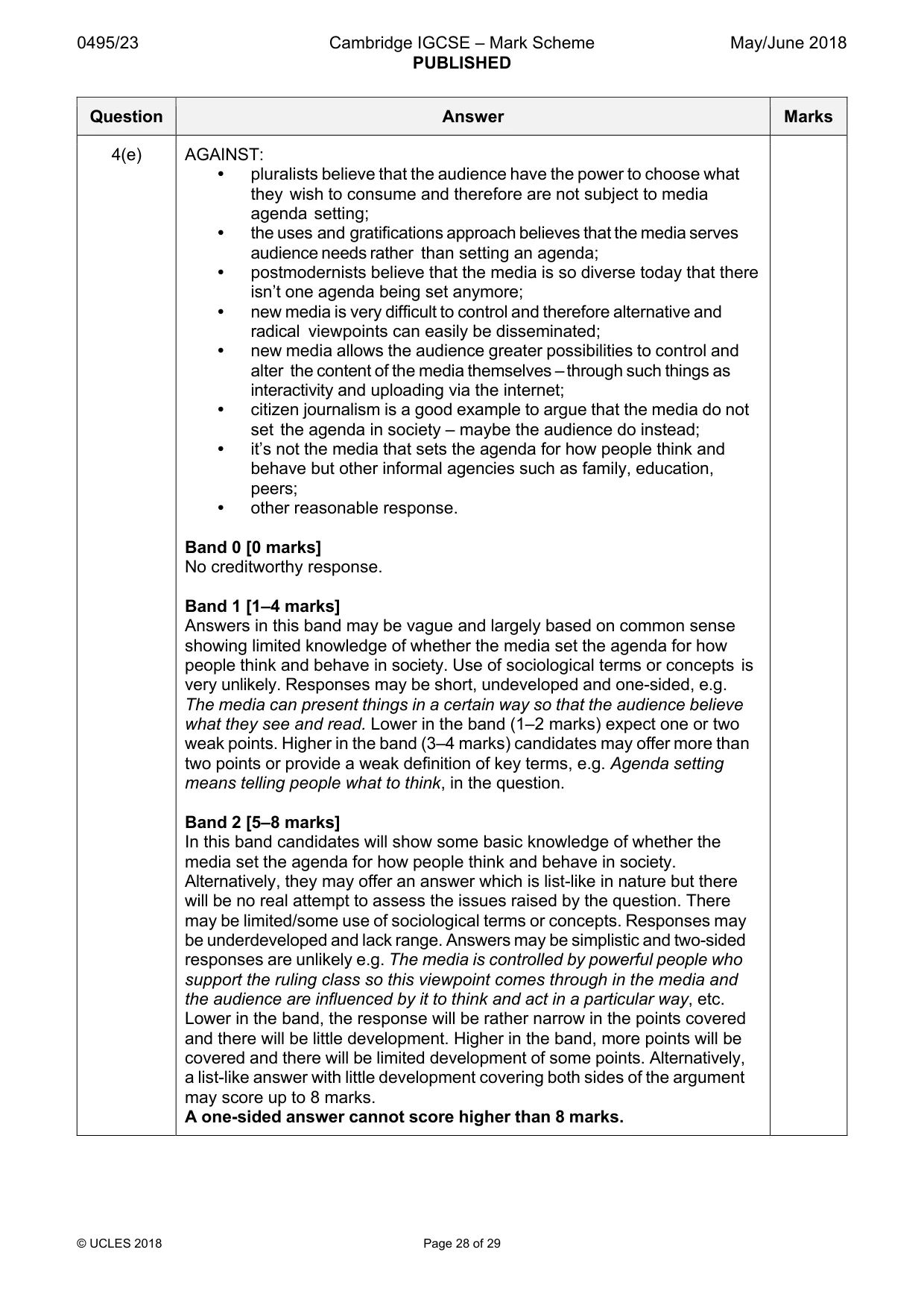
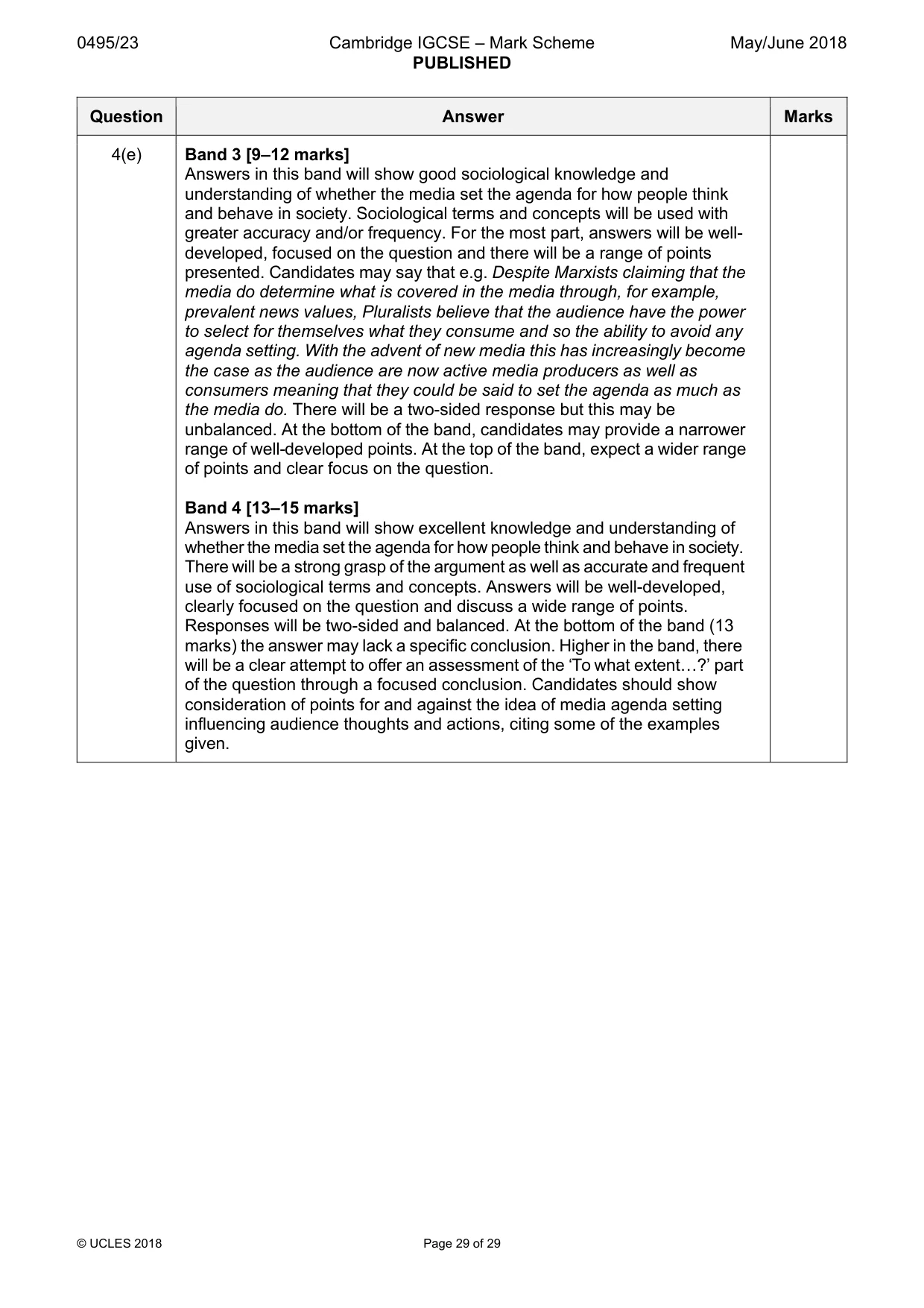
Mark scheme: 4(a) What is meant by the term ‘globalisation’? 2 One mark for partial definition, e.g. using the internet to find out about other countries. Two marks for clear definition, e.g. the linking of societies across the world through communication, production and culture. 4(b) Describe two ways that the media can be biased. 4 Possible answers: • through propaganda i.e. state owned media only presenting the government in a favourable light; • through censorship – this determines what the audience can and cannot consume; • through stereotypical representations of various social groups; • media gatekeepers can control what the audience are able to access and consume; • news values determine which stories make it into the news and so which are seen by the audience; • Marxists believe that the media invisibilises or dismisses ‘extreme’ viewpoints and thus maintains the status quo; • Marxists believe that the media favours the ruling class – for example it can be accused of criminalising the working class; • GUMG – managers are given more screen-time than the trade unions and are reported upon in a more favourable light; • street crime often associated with the lower classes is given more time in the media than crimes of the middle classes such as white- collar crime; • moral panics exist in the media – certain social groups are represented in an exaggerated and sensationalised way that leads to the public becoming scared of them; • certain social groups are scapegoated by the media for negative things in society whereas other groups actions are ignored; • through the opinions and beliefs of the editors and journalists; • through ownership patterns – owners may use the media to protect their own interests or to circulate their own points of view; • other reasonable response. One mark for each point correctly identified (up to maximum of two). One mark for each point that is developed (up to a maximum of two). 4(c) Explain how voting choices are influenced by the media. 6 Candidates need to show how the media can affect how people vote. They may discuss this generally, use specific examples and/or refer to relevant media effects models. Possible answers: • media i.e. newspapers are often biased and support a political party, shown through choice of language, stories and expressing opinions; • in election campaigns political parties make extensive use of the media to try and attract more voters i.e. TV political broadcasts and billboards; • election campaigns are often focused on the image of the party leader and this is constructed through the media, often highly influenced by the use of spin doctors – this affects voting choices; • The Sun newspaper in the UK claimed that it was responsible for the election of the Conservative party in 1992; • the media report on the opinion polls and these are central to determining how an individual may vote i.e. tactical voting; • propaganda and censorship – some countries use these in order to manipulate the voting patterns of the nation e.g. North Korea; • new/social media are increasingly being used by political parties to target and influence voters; • other reasonable response. Band 0 [0 marks] No creditworthy response. Band 1 [1–3 marks] Answers in this band will show only a limited awareness of how the media can affect how people vote and may talk about e.g. Some politicians are made to seem smarter than others in the media. Responses may be short and un/under developed. At the bottom of the band (1 mark) expect one weak point. Higher in the band (2–3 marks) candidates may offer more than one weak point, but there may be a tendency towards simplistic answers, engaging with sociological ideas without using sociological language. Band 2 [4–6 marks] A clear and accurate explanation, showing good sociological knowledge and understanding of how the media affects how people vote. Sociological terms and concepts should be expected e.g. Spin doctors use the media to manipulate how politicians are presented. The GUMG, for example, found that some political parties and politicians were given far more favourable coverage than others and that this then influenced how the people decided to vote. They had effectively been manipulated by the media. This would be followed by explanation of factors leading to this. At the bottom of the band, the range of points covered may be narrow or lack detail. Higher in the band, answers will cover more than one factor in a well-developed way or cover several factors in less detail. 4(d) Explain why the media offer the audience more choice and control than 8 ever before. Candidates are likely to be discussing aspects of Pluralism and/or Postmodernism in their responses. New media are likely to be the main focus of candidate’s answers. Choice and control do not need to be dealt with as separate factors. Possible answers: • pluralists argue that there are many small and independent media production companies that ensure that the audience have a good range of choice and control over the media that they consume; • the media is now global, meaning that the audience can access information and entertainment from all over the globe – the choices available have never been greater; • new media allow the audience to be interactive and thus control what they consume and how they consume it; • new media gives the audience the power to interact with and influence media content through such means as blogs, comments and forums; • citizen journalism is a commonly seen feature in news reporting today – allowing the audience the power to be able to control what news is reported upon and how it is portrayed; • many audience members are now also media producers – they upload content and have the power to be able to control the content of the media. This also increases audience choice; • satellite and cable TV means a greater range of choice for the audience with many specialist and niche programmes available; • the internet allows for a wider range of viewpoints to have a platform and an audience and thus opens up many more ideas and beliefs to the audience; • other reasonable response. Band 0 [0 marks] No creditworthy response. Band 1 [1–3 marks] Answers in this band will show only a limited awareness of how today’s media offers more choice and control to the audience. A tendency to description is likely. Responses may be short and undeveloped, e.g. There are loads of TV channels to choose from now stated without explanation. Sociological terms and concepts are unlikely to be used. At the bottom of the band (1 mark) expect one weak point. Higher in the band (2–3 marks) candidates may offer more than one weak point. 4(d) Band 2 [4–6 marks] Answers in this band will show basic sociological knowledge and understanding of how today’s media offers more choice and control to the audience. Responses may be underdeveloped and lacking in range, e.g. There is a lot of choice for the audience today because of the development of new media meaning content from all over the world can be easily and quickly accessed anywhere, anytime, etc. At the bottom of the band, candidates are unlikely to use sociological terms and concepts accurately. Higher in the band, candidates may be beginning to use sociological terms and concepts with greater accuracy. However, some aspects of the answer may only be partially developed/explained. Band 3 [7–8 marks] Answers in this band will show good sociological knowledge and understanding of how today’s media offer more choice and control to the audience and will be well-developed and explained, e.g. According to Pluralists, the audience today have a great deal of control over media content. This is largely because of the developments in new media that allow audience members to both consume and produce media content. They can therefore set their own agenda through uploads, citizen journalism and interactive blogs/forums on a global scale. This ultimately leads to more choice for the consumer. They can then expand on the explanation of this and other factors as necessary. Sociological terms and concepts will be used accurately overall. Answers will be well focused on the question and there will be a range of reasons presented. At the top of the band explanations will be clear throughout. 4(e) To what extent do the media set the agenda for how people think and 15 behave in society? SET THE AGENDA/AGENDA SETTING – the process of deciding what topics are included in the media and how they are presented to the audience. Candidates should consider the various ways that the media are able to set the agenda in society. They should then consider alternative viewpoints that challenge this idea of media power and control. New media is likely to be used for the evaluation but this is not essential. Possible answers: FOR: • the content of the media is a social construction based upon the decisions and choices of media professionals such as journalists – it therefore does not reflect reality which may affect how people think and behave; • some content makes it into the media, some does not – this idea of selection allows the media to set the agenda and so influence how people think and behave; • news values typically determine what stories and issues make the news – not everything that happens is reported upon therefore the media sets the agenda and so influences how people think and behave; • how the content of the media is presented to the audience also helps to set the agenda i.e. the angle or spin that a story or issue takes which then influences how people think and behave; • media gatekeepers decide what is important for the audience to know about and thus determine topics of conversation – setting the agenda and influencing how people think and behave; • Marxists believe that the media serve the needs of capitalism and set a capitalist agenda through the way media content supports the ruling class status quo which influences the audience; • GUMG research indicates that the way the news is presented influences how the audience think about particular issues e.g. management and workers on strike, so setting the agenda; • the scapegoating of certain social groups within the media also serves to set the agenda and diverts attention away from any ruling class wrongdoings e.g. corporate crime, so influencing the audience; • the hypodermic syringe and cultural effects models both say that the media does influence the way the audience think and behave; • other reasonable response. 4(e) AGAINST: • pluralists believe that the audience have the power to choose what they wish to consume and therefore are not subject to media agenda setting; • the uses and gratifications approach believes that the media serves audience needs rather than setting an agenda; • postmodernists believe that the media is so diverse today that there isn’t one agenda being set anymore; • new media is very difficult to control and therefore alternative and radical viewpoints can easily be disseminated; • new media allows the audience greater possibilities to control and alter the content of the media themselves – through such things as interactivity and uploading via the internet; • citizen journalism is a good example to argue that the media do not set the agenda in society – maybe the audience do instead; • it’s not the media that sets the agenda for how people think and behave but other informal agencies such as family, education, peers; • other reasonable response. Band 0 [0 marks] No creditworthy response. Band 1 [1–4 marks] Answers in this band may be vague and largely based on common sense showing limited knowledge of whether the media set the agenda for how people think and behave in society. Use of sociological terms or concepts is very unlikely. Responses may be short, undeveloped and one-sided, e.g. The media can present things in a certain way so that the audience believe what they see and read. Lower in the band (1–2 marks) expect one or two weak points. Higher in the band (3–4 marks) candidates may offer more than two points or provide a weak definition of key terms, e.g. Agenda setting means telling people what to think, in the question. Band 2 [5–8 marks] In this band candidates will show some basic knowledge of whether the media set the agenda for how people think and behave in society. Alternatively, they may offer an answer which is list-like in nature but there will be no real attempt to assess the issues raised by the question. There may be limited/some use of sociological terms or concepts. Responses may be underdeveloped and lack range. Answers may be simplistic and two-sided responses are unlikely e.g. The media is controlled by powerful people who support the ruling class so this viewpoint comes through in the media and the audience are influenced by it to think and act in a particular way, etc. Lower in the band, the response will be rather narrow in the points covered and there will be little development. Higher in the band, more points will be covered and there will be limited development of some points. Alternatively, a list-like answer with little development covering both sides of the argument may score up to 8 marks. A one-sided answer cannot score higher than 8 marks. 4(e) Band 3 [9–12 marks] Answers in this band will show good sociological knowledge and understanding of whether the media set the agenda for how people think and behave in society. Sociological terms and concepts will be used with greater accuracy and/or frequency. For the most part, answers will be well- developed, focused on the question and there will be a range of points presented. Candidates may say that e.g. Despite Marxists claiming that the media do determine what is covered in the media through, for example, prevalent news values, Pluralists believe that the audience have the power to select for themselves what they consume and so the ability to avoid any agenda setting. With the advent of new media this has increasingly become the case as the audience are now active media producers as well as consumers meaning that they could be said to set the agenda as much as the media do. There will be a two-sided response but this may be unbalanced. At the bottom of the band, candidates may provide a narrower range of well-developed points. At the top of the band, expect a wider range of points and clear focus on the question. Band 4 [13–15 marks] Answers in this band will show excellent knowledge and understanding of whether the media set the agenda for how people think and behave in society. There will be a strong grasp of the argument as well as accurate and frequent use of sociological terms and concepts. Answers will be well-developed, clearly focused on the question and discuss a wide range of points. Responses will be two-sided and balanced. At the bottom of the band (13 marks) the answer may lack a specific conclusion. Higher in the band, there will be a clear attempt to offer an assessment of the ‘To what extent«?’ part of the question through a focused conclusion. Candidates should show consideration of points for and against the idea of media agenda setting influencing audience thoughts and actions, citing some of the examples given.
What was in this paper
The subtopics covered by these 4 questions, and how many questions each got. Open one in a new tab to see every Cambridge question on it.
What you needed in this session
Cambridge’s own grade thresholds for 2018 May/June, Paper 2 · Variant 3. A higher threshold means an easier paper — the bar moves with how the cohort did.