Cambridge IGCSE Sociology 0495 — 2018 May/June Paper 2 · Variant 2
0495/22/M/J/18 · 4 questions · 70 marks · ≈79 min
The question paper and its mark scheme, free to read here and free to download. This is Cambridge’s own paper, exactly as it was sat.
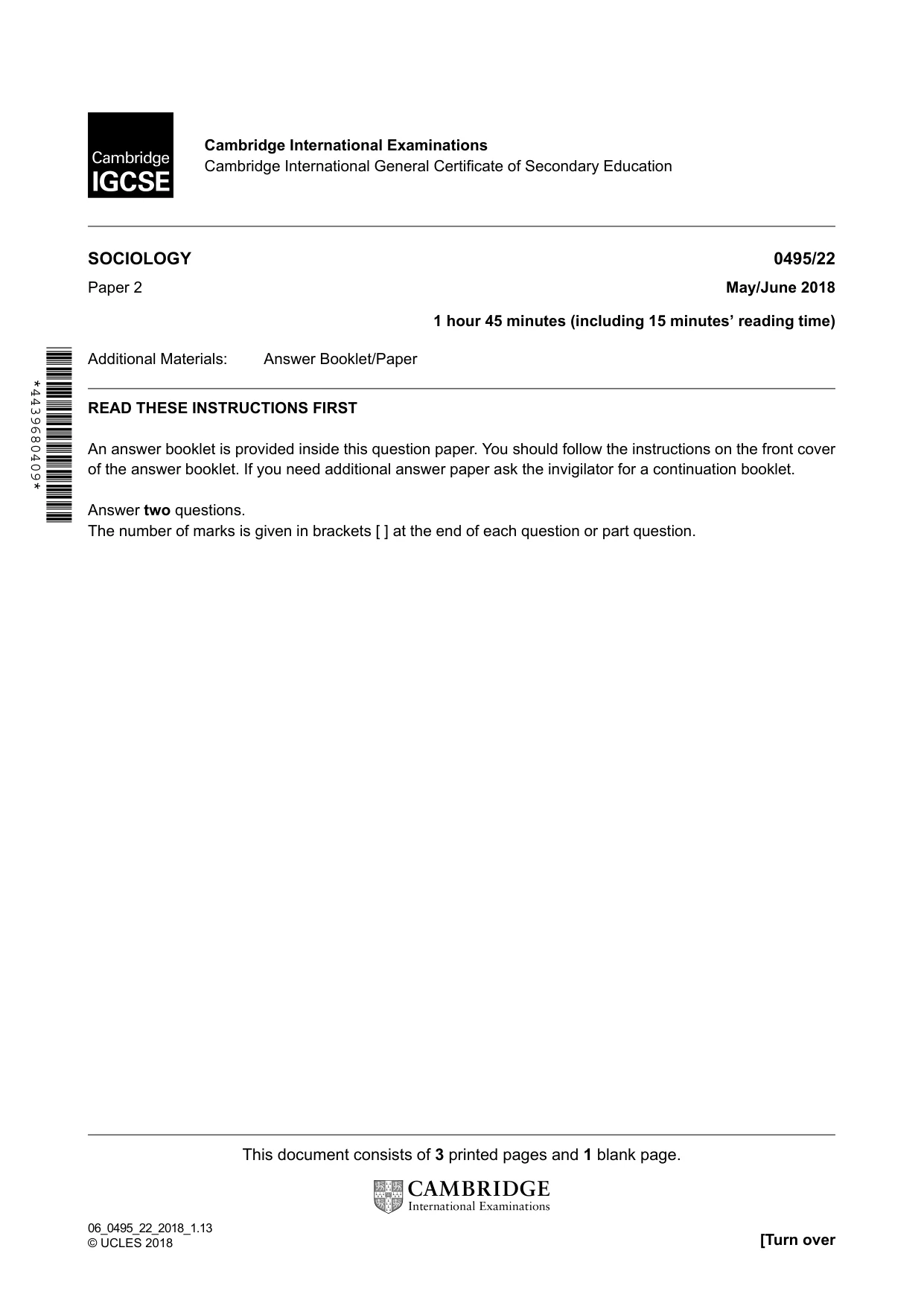
Question paper4 pages

Mark scheme28 pages
Answers below. Sit the paper first if you are practising.

Questions as text
Q1 · Sociologists have very different views of the family and whether it is beneficial for its…
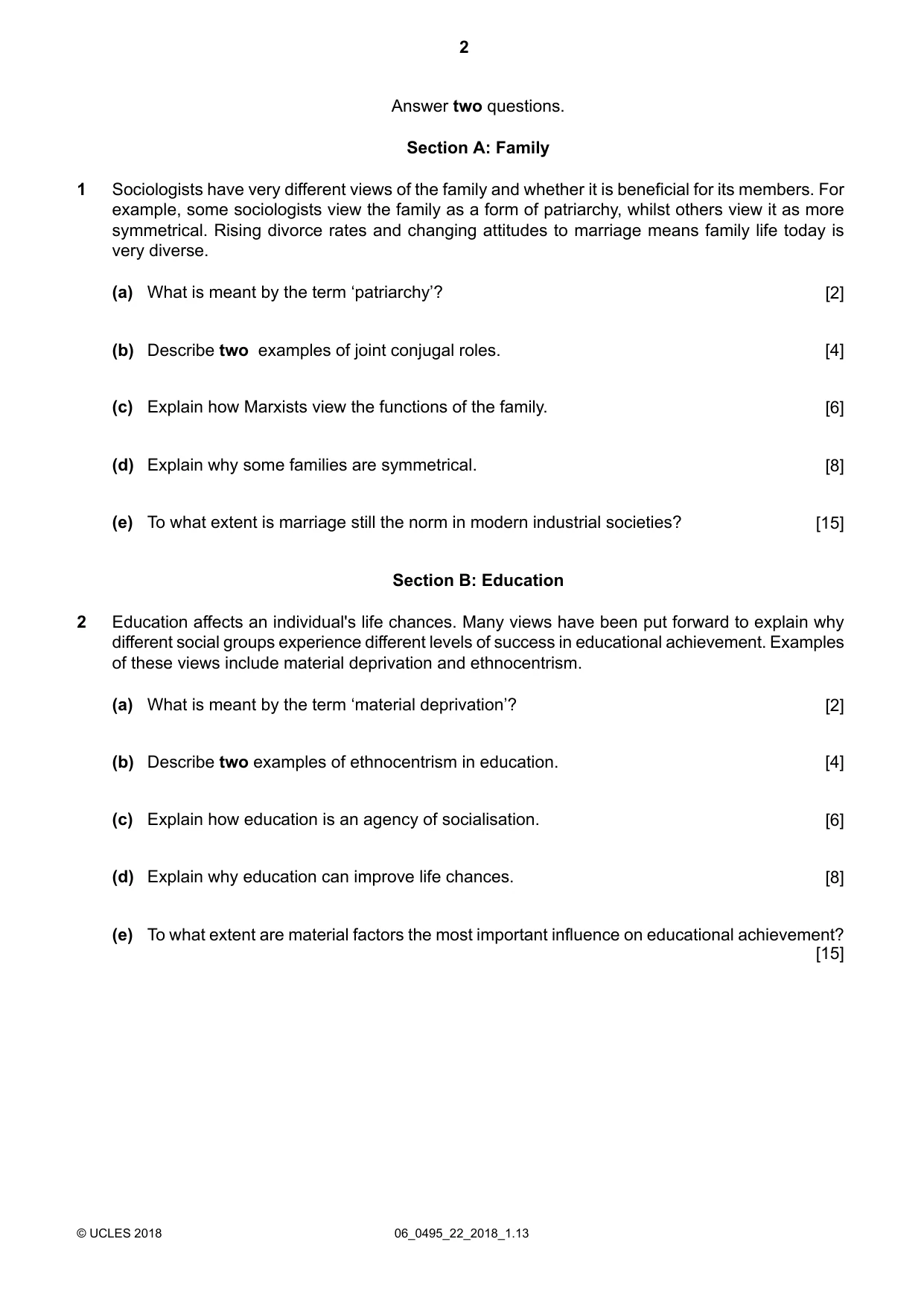
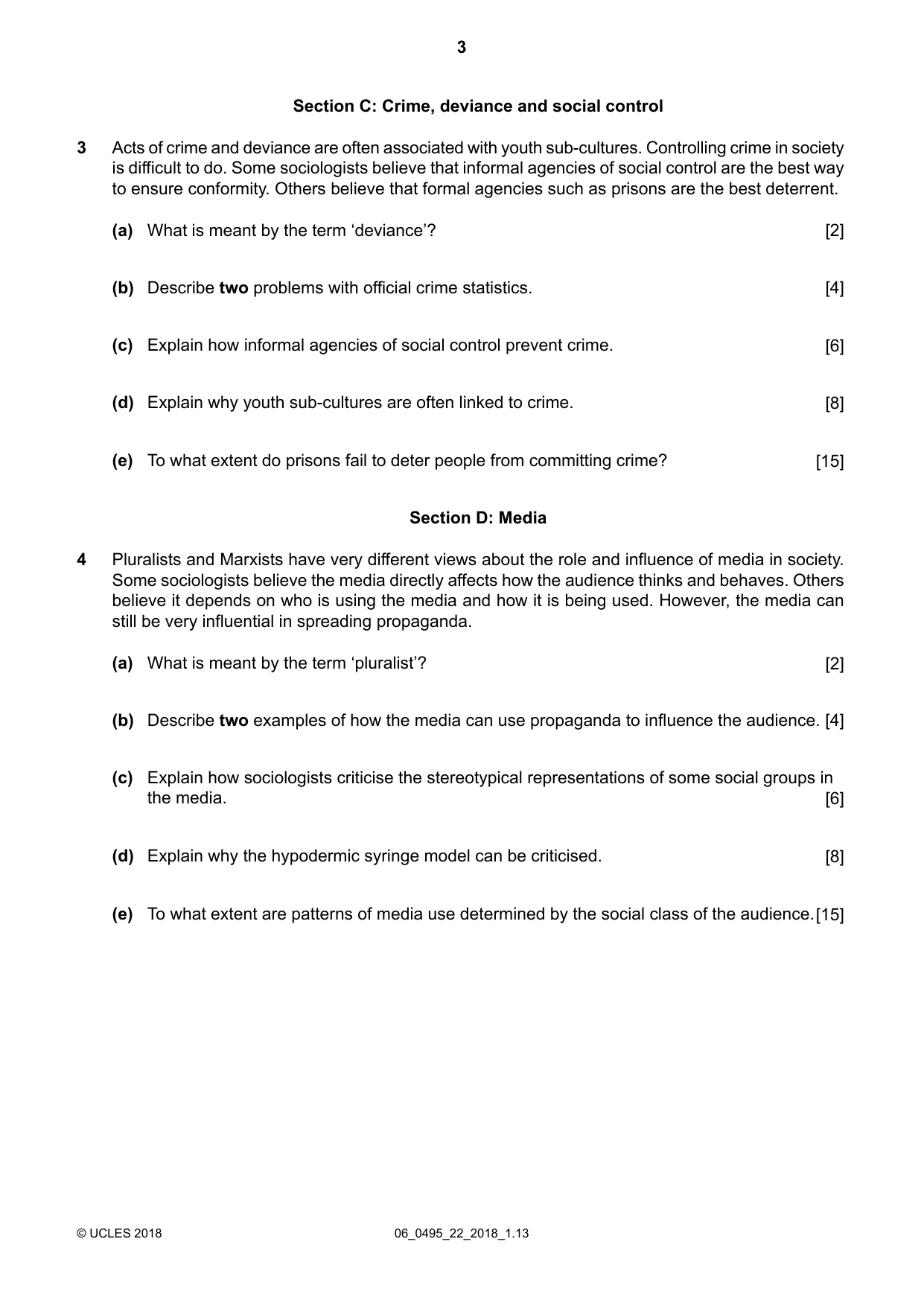
1 Sociologists have very different views of the family and whether it is beneficial for its members. For example, some sociologists view the family as a form of patriarchy, whilst others view it as more symmetrical. Rising divorce rates and changing attitudes to marriage means family life today is very diverse. (a) What is meant by the term ‘patriarchy’? [2] (b) Describe two examples of joint conjugal roles. [4] (c) Explain how Marxists view the functions of the family. [6] (d) Explain why some families are symmetrical. [8] (e) To what extent is marriage still the norm in modern industrial societies? [15]
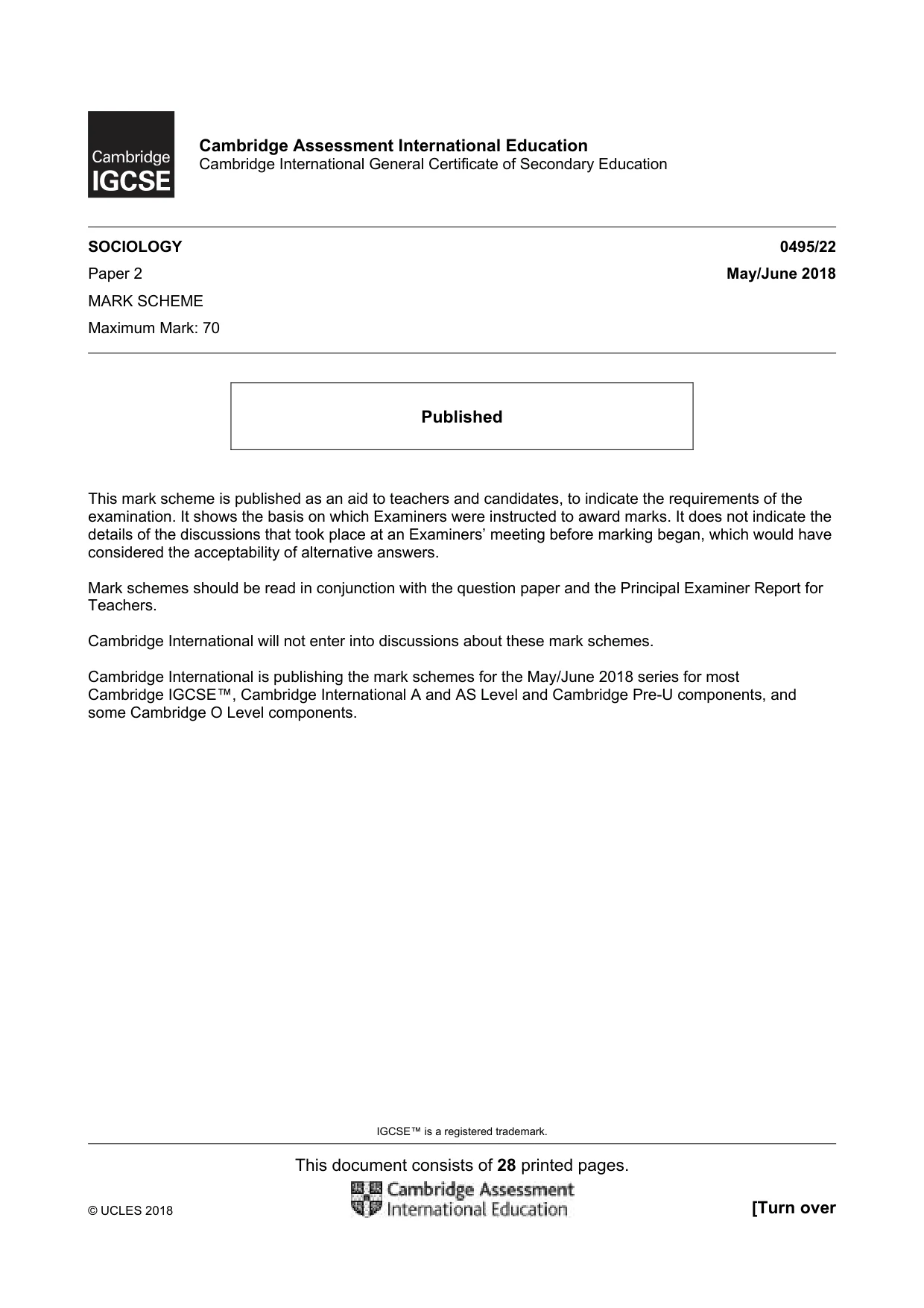
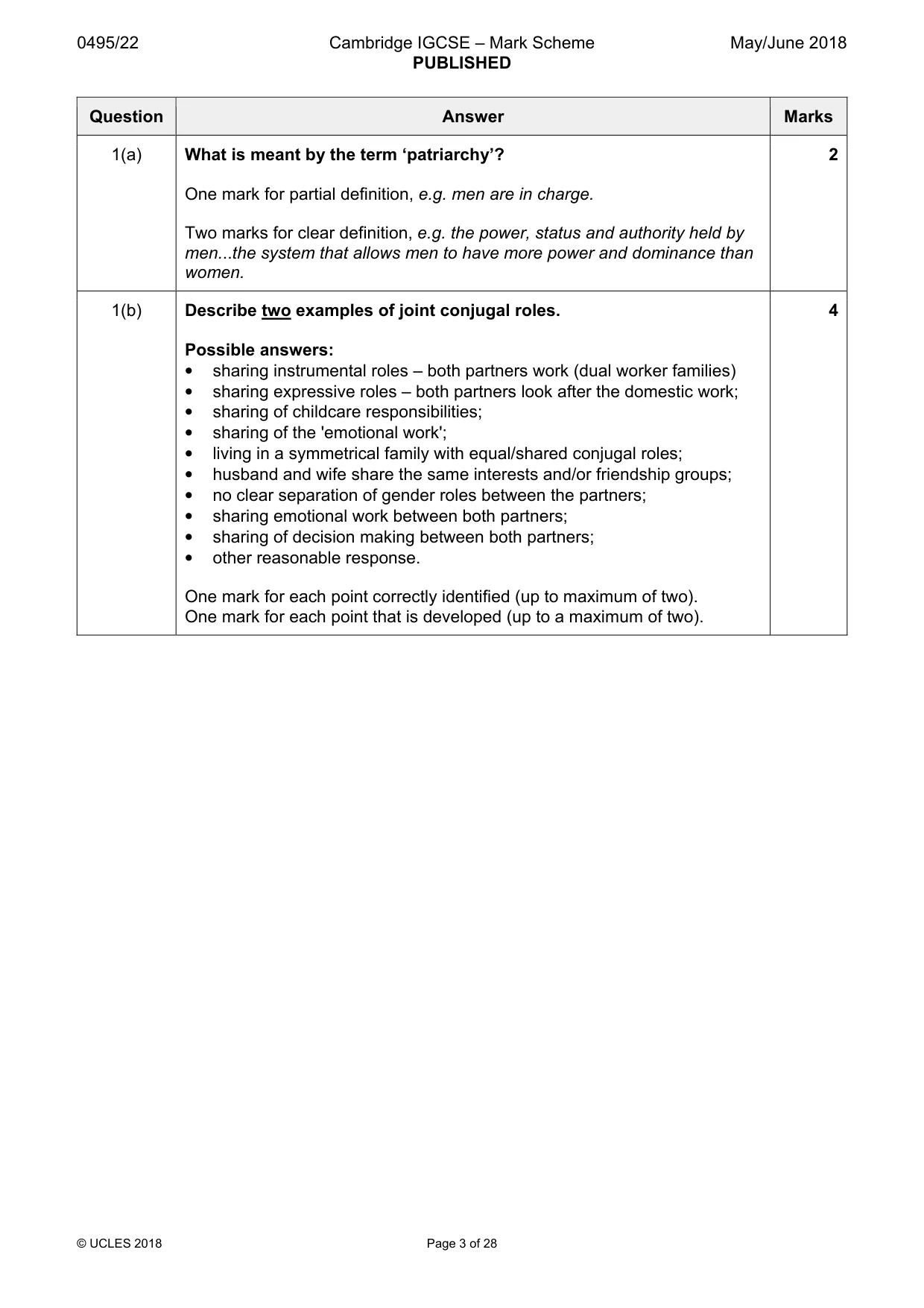
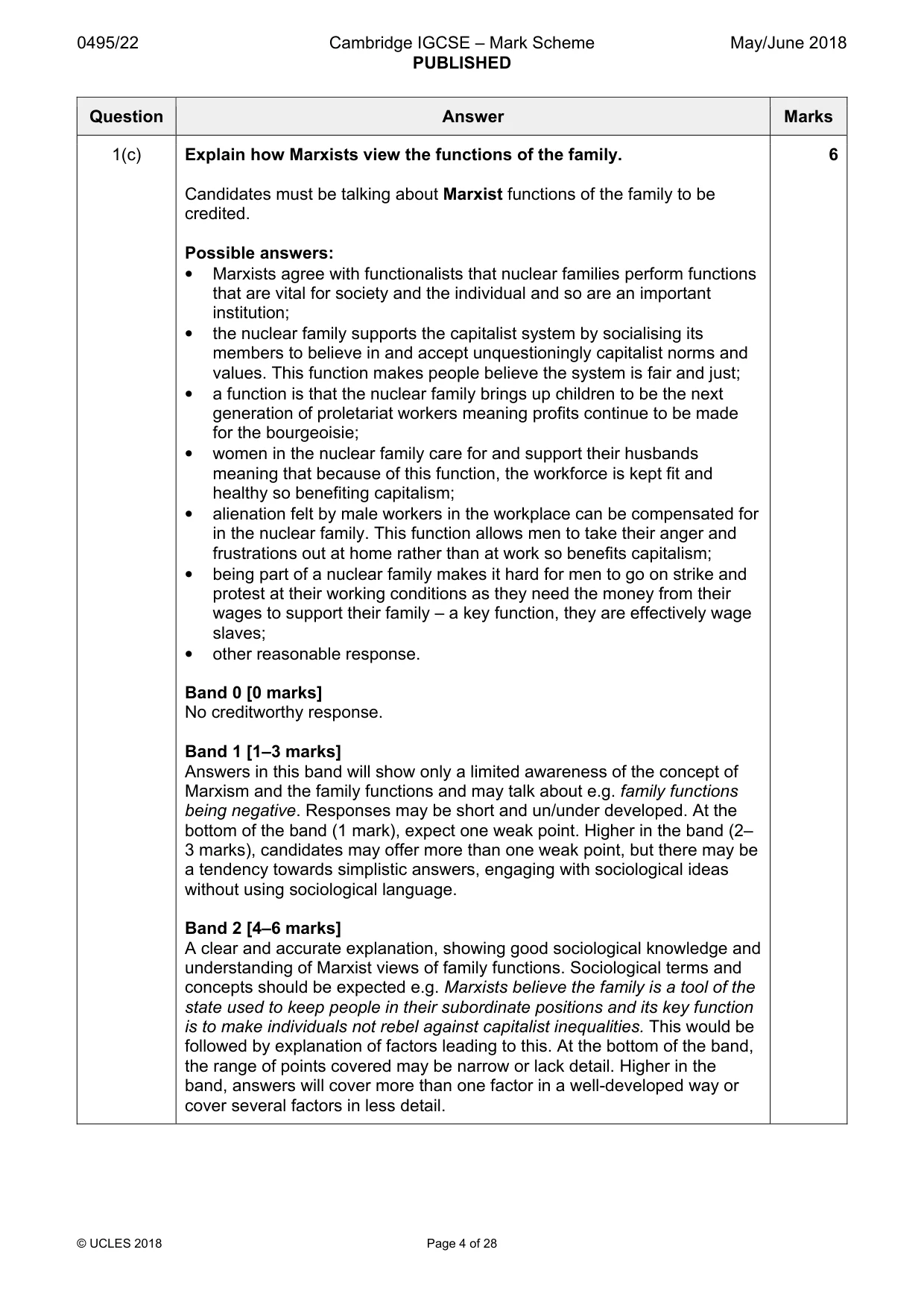
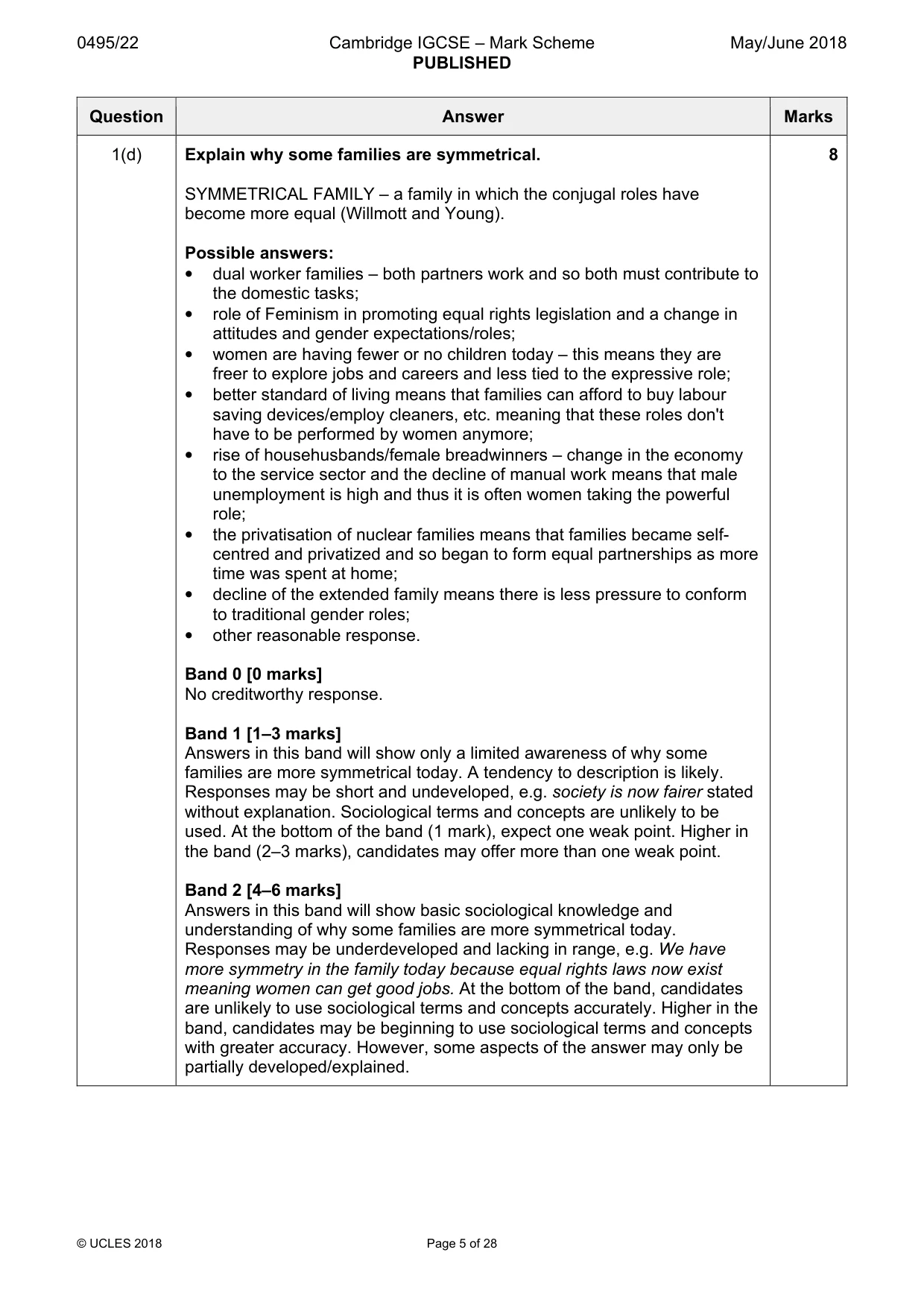
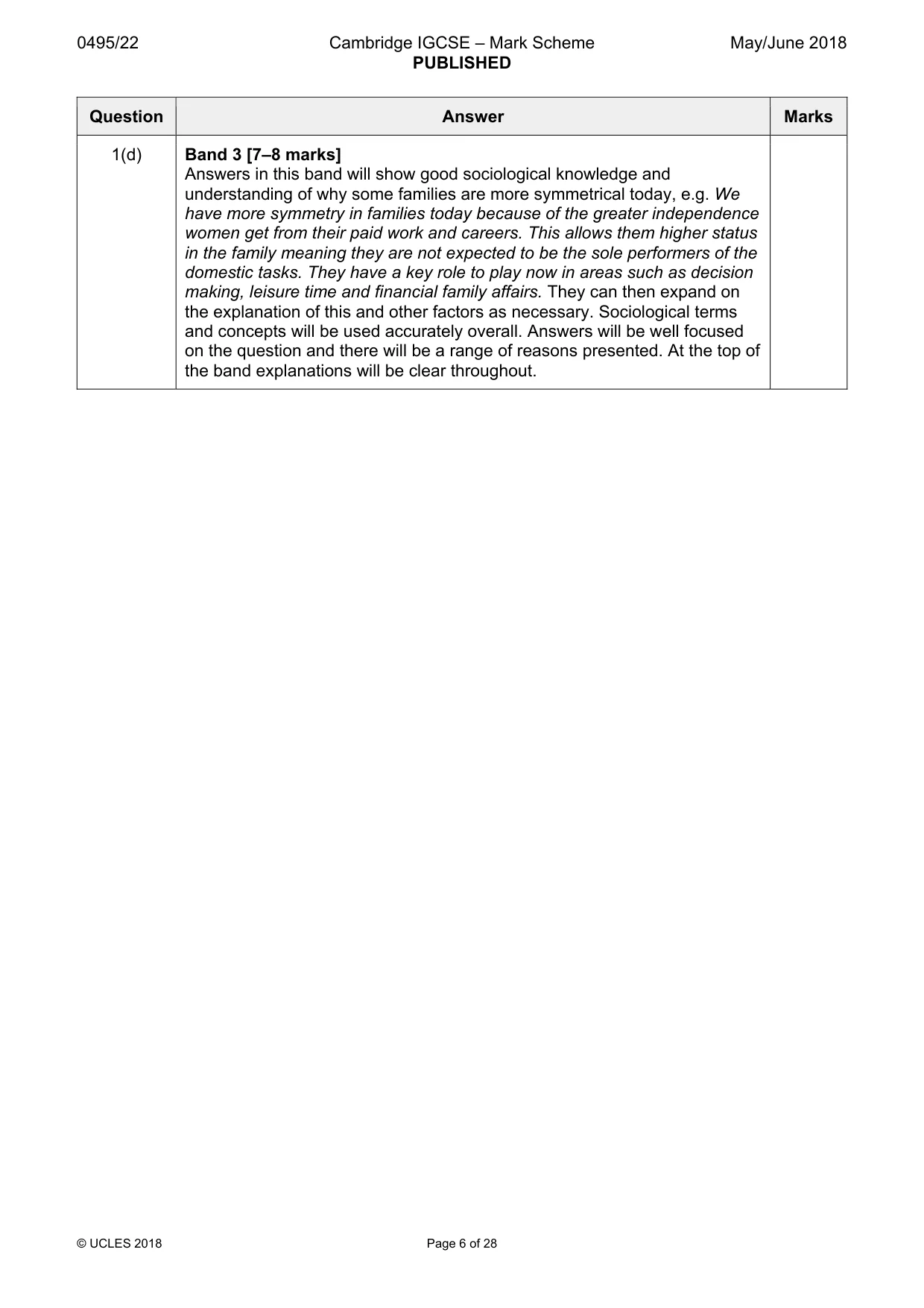
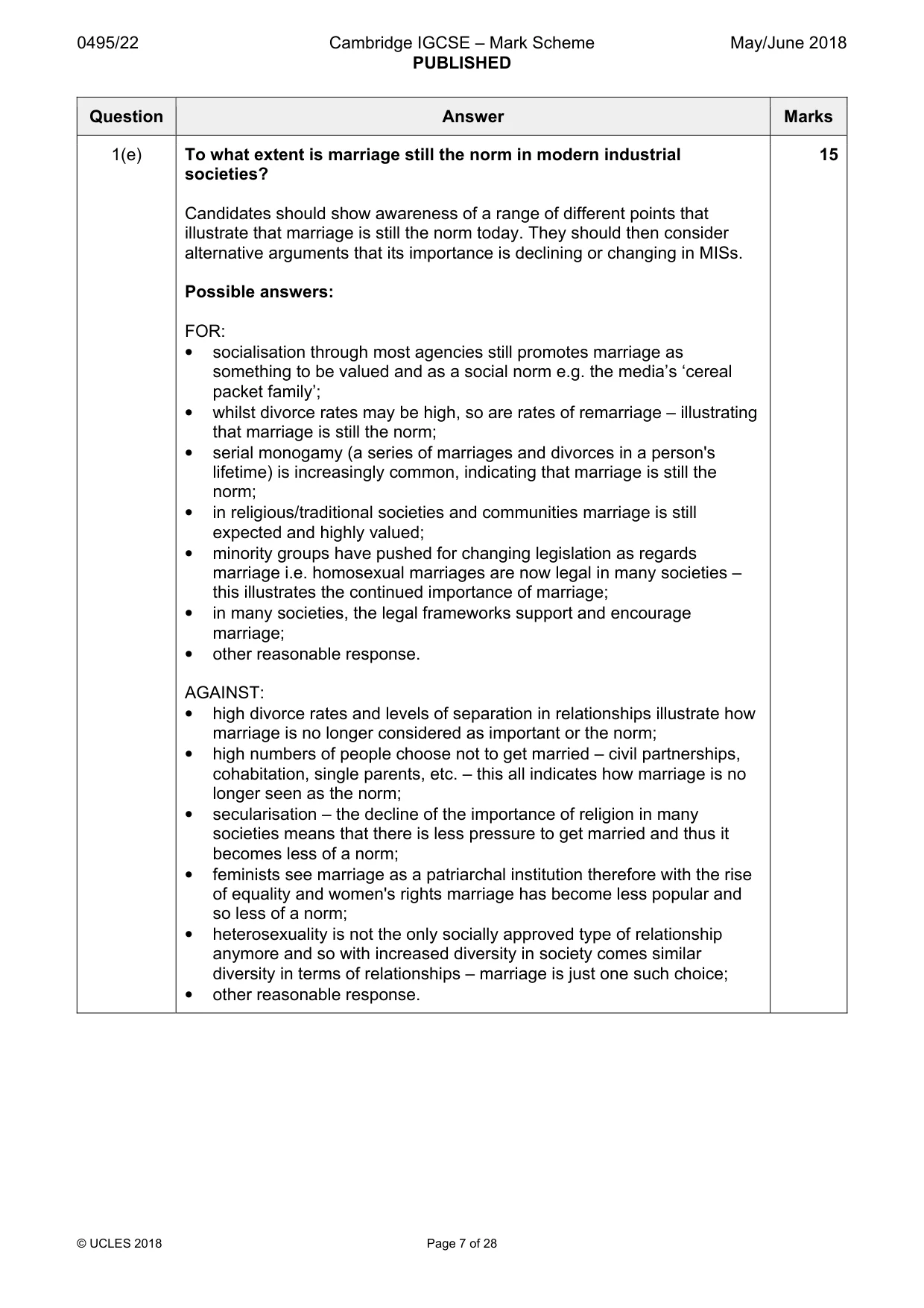
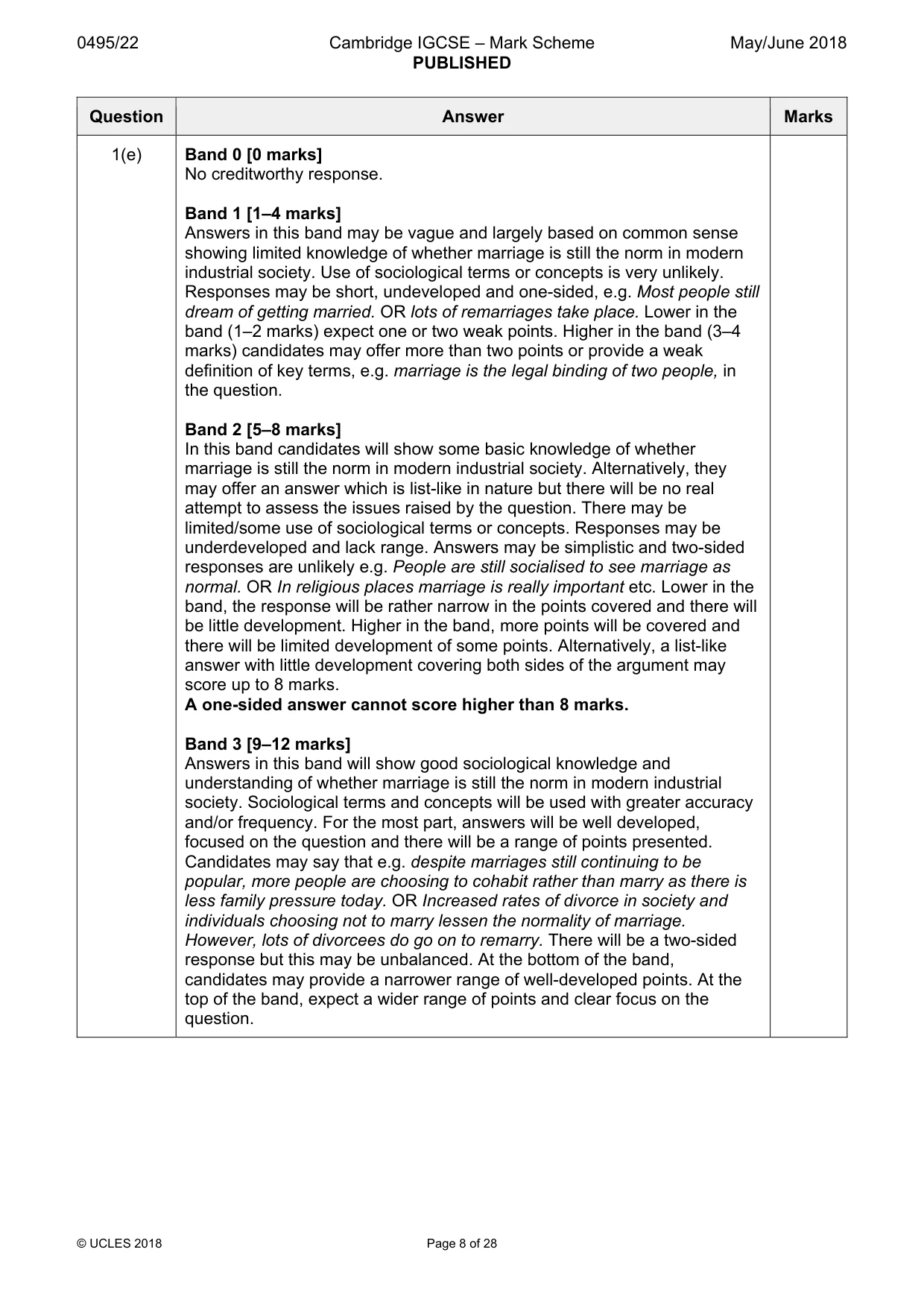
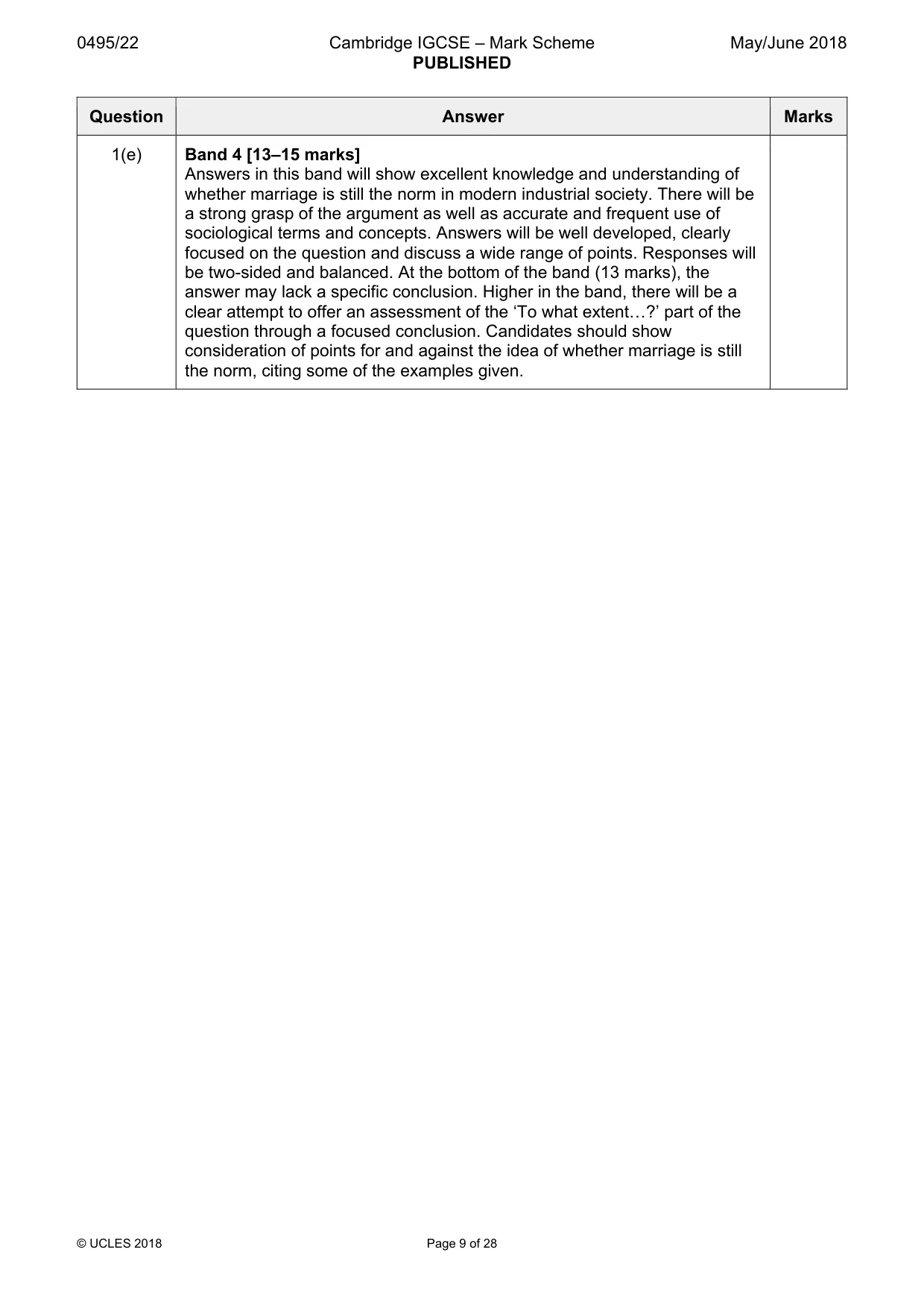
Mark scheme: Question Answer Marks 1(a) What is meant by the term ‘patriarchy’? 2 One mark for partial definition, e.g. men are in charge. Two marks for clear definition, e.g. the power, status and authority held by men...the system that allows men to have more power and dominance than women. 1(b) Describe two examples of joint conjugal roles. 4 Possible answers: • sharing instrumental roles – both partners work (dual worker families) • sharing expressive roles – both partners look after the domestic work; • sharing of childcare responsibilities; • sharing of the 'emotional work'; • living in a symmetrical family with equal/shared conjugal roles; • husband and wife share the same interests and/or friendship groups; • no clear separation of gender roles between the partners; • sharing emotional work between both partners; • sharing of decision making between both partners; • other reasonable response. One mark for each point correctly identified (up to maximum of two). One mark for each point that is developed (up to a maximum of two). 1(c) Explain how Marxists view the functions of the family. 6 Candidates must be talking about Marxist functions of the family to be credited. Possible answers: • Marxists agree with functionalists that nuclear families perform functions that are vital for society and the individual and so are an important institution; • the nuclear family supports the capitalist system by socialising its members to believe in and accept unquestioningly capitalist norms and values. This function makes people believe the system is fair and just; • a function is that the nuclear family brings up children to be the next generation of proletariat workers meaning profits continue to be made for the bourgeoisie; • women in the nuclear family care for and support their husbands meaning that because of this function, the workforce is kept fit and healthy so benefiting capitalism; • alienation felt by male workers in the workplace can be compensated for in the nuclear family. This function allows men to take their anger and frustrations out at home rather than at work so benefits capitalism; • being part of a nuclear family makes it hard for men to go on strike and protest at their working conditions as they need the money from their wages to support their family – a key function, they are effectively wage slaves; • other reasonable response. Band 0 [0 marks] No creditworthy response. Band 1 [1–3 marks] Answers in this band will show only a limited awareness of the concept of Marxism and the family functions and may talk about e.g. family functions being negative. Responses may be short and un/under developed. At the bottom of the band (1 mark), expect one weak point. Higher in the band (2– 3 marks), candidates may offer more than one weak point, but there may be a tendency towards simplistic answers, engaging with sociological ideas without using sociological language. Band 2 [4–6 marks] A clear and accurate explanation, showing good sociological knowledge and understanding of Marxist views of family functions. Sociological terms and concepts should be expected e.g. Marxists believe the family is a tool of the state used to keep people in their subordinate positions and its key function is to make individuals not rebel against capitalist inequalities. This would be followed by explanation of factors leading to this. At the bottom of the band, the range of points covered may be narrow or lack detail. Higher in the band, answers will cover more than one factor in a well-developed way or cover several factors in less detail. 1(d) Explain why some families are symmetrical. 8 SYMMETRICAL FAMILY – a family in which the conjugal roles have become more equal (Willmott and Young). Possible answers: • dual worker families – both partners work and so both must contribute to the domestic tasks; • role of Feminism in promoting equal rights legislation and a change in attitudes and gender expectations/roles; • women are having fewer or no children today – this means they are freer to explore jobs and careers and less tied to the expressive role; • better standard of living means that families can afford to buy labour saving devices/employ cleaners, etc. meaning that these roles don't have to be performed by women anymore; • rise of househusbands/female breadwinners – change in the economy to the service sector and the decline of manual work means that male unemployment is high and thus it is often women taking the powerful role; • the privatisation of nuclear families means that families became self- centred and privatized and so began to form equal partnerships as more time was spent at home; • decline of the extended family means there is less pressure to conform to traditional gender roles; • other reasonable response. Band 0 [0 marks] No creditworthy response. Band 1 [1–3 marks] Answers in this band will show only a limited awareness of why some families are more symmetrical today. A tendency to description is likely. Responses may be short and undeveloped, e.g. society is now fairer stated without explanation. Sociological terms and concepts are unlikely to be used. At the bottom of the band (1 mark), expect one weak point. Higher in the band (2–3 marks), candidates may offer more than one weak point. Band 2 [4–6 marks] Answers in this band will show basic sociological knowledge and understanding of why some families are more symmetrical today. Responses may be underdeveloped and lacking in range, e.g. We have more symmetry in the family today because equal rights laws now exist meaning women can get good jobs. At the bottom of the band, candidates are unlikely to use sociological terms and concepts accurately. Higher in the band, candidates may be beginning to use sociological terms and concepts with greater accuracy. However, some aspects of the answer may only be partially developed/explained. 1(d) Band 3 [7–8 marks] Answers in this band will show good sociological knowledge and understanding of why some families are more symmetrical today, e.g. We have more symmetry in families today because of the greater independence women get from their paid work and careers. This allows them higher status in the family meaning they are not expected to be the sole performers of the domestic tasks. They have a key role to play now in areas such as decision making, leisure time and financial family affairs. They can then expand on the explanation of this and other factors as necessary. Sociological terms and concepts will be used accurately overall. Answers will be well focused on the question and there will be a range of reasons presented. At the top of the band explanations will be clear throughout. 1(e) To what extent is marriage still the norm in modern industrial 15 societies? Candidates should show awareness of a range of different points that illustrate that marriage is still the norm today. They should then consider alternative arguments that its importance is declining or changing in MISs. Possible answers: FOR: • socialisation through most agencies still promotes marriage as something to be valued and as a social norm e.g. the media’s ‘cereal packet family’; • whilst divorce rates may be high, so are rates of remarriage – illustrating that marriage is still the norm; • serial monogamy (a series of marriages and divorces in a person's lifetime) is increasingly common, indicating that marriage is still the norm; • in religious/traditional societies and communities marriage is still expected and highly valued; • minority groups have pushed for changing legislation as regards marriage i.e. homosexual marriages are now legal in many societies – this illustrates the continued importance of marriage; • in many societies, the legal frameworks support and encourage marriage; • other reasonable response. AGAINST: • high divorce rates and levels of separation in relationships illustrate how marriage is no longer considered as important or the norm; • high numbers of people choose not to get married – civil partnerships, cohabitation, single parents, etc. – this all indicates how marriage is no longer seen as the norm; • secularisation – the decline of the importance of religion in many societies means that there is less pressure to get married and thus it becomes less of a norm; • feminists see marriage as a patriarchal institution therefore with the rise of equality and women's rights marriage has become less popular and so less of a norm; • heterosexuality is not the only socially approved type of relationship anymore and so with increased diversity in society comes similar diversity in terms of relationships – marriage is just one such choice; • other reasonable response. 1(e) Band 0 [0 marks] No creditworthy response. Band 1 [1–4 marks] Answers in this band may be vague and largely based on common sense showing limited knowledge of whether marriage is still the norm in modern industrial society. Use of sociological terms or concepts is very unlikely. Responses may be short, undeveloped and one-sided, e.g. Most people still dream of getting married. OR lots of remarriages take place. Lower in the band (1–2 marks) expect one or two weak points. Higher in the band (3–4 marks) candidates may offer more than two points or provide a weak definition of key terms, e.g. marriage is the legal binding of two people, in the question. Band 2 [5–8 marks] In this band candidates will show some basic knowledge of whether marriage is still the norm in modern industrial society. Alternatively, they may offer an answer which is list-like in nature but there will be no real attempt to assess the issues raised by the question. There may be limited/some use of sociological terms or concepts. Responses may be underdeveloped and lack range. Answers may be simplistic and two-sided responses are unlikely e.g. People are still socialised to see marriage as normal. OR In religious places marriage is really important etc. Lower in the band, the response will be rather narrow in the points covered and there will be little development. Higher in the band, more points will be covered and there will be limited development of some points. Alternatively, a list-like answer with little development covering both sides of the argument may score up to 8 marks. A one-sided answer cannot score higher than 8 marks. Band 3 [9–12 marks] Answers in this band will show good sociological knowledge and understanding of whether marriage is still the norm in modern industrial society. Sociological terms and concepts will be used with greater accuracy and/or frequency. For the most part, answers will be well developed, focused on the question and there will be a range of points presented. Candidates may say that e.g. despite marriages still continuing to be popular, more people are choosing to cohabit rather than marry as there is less family pressure today. OR Increased rates of divorce in society and individuals choosing not to marry lessen the normality of marriage. However, lots of divorcees do go on to remarry. There will be a two-sided response but this may be unbalanced. At the bottom of the band, candidates may provide a narrower range of well-developed points. At the top of the band, expect a wider range of points and clear focus on the question. 1(e) Band 4 [13–15 marks] Answers in this band will show excellent knowledge and understanding of whether marriage is still the norm in modern industrial society. There will be a strong grasp of the argument as well as accurate and frequent use of sociological terms and concepts. Answers will be well developed, clearly focused on the question and discuss a wide range of points. Responses will be two-sided and balanced. At the bottom of the band (13 marks), the answer may lack a specific conclusion. Higher in the band, there will be a clear attempt to offer an assessment of the ‘To what extent«?’ part of the question through a focused conclusion. Candidates should show consideration of points for and against the idea of whether marriage is still the norm, citing some of the examples given.
Q2 · Education affects an individual's life chances
2 Education affects an individual's life chances. Many views have been put forward to explain why different social groups experience different levels of success in educational achievement. Examples of these views include material deprivation and ethnocentrism. (a) What is meant by the term ‘material deprivation’? [2] (b) Describe two examples of ethnocentrism in education. [4] (c) Explain how education is an agency of socialisation. [6] (d) Explain why education can improve life chances. [8] (e) To what extent are material factors the most important influence on educational achievement? [15] Section C: Crime, deviance and social control
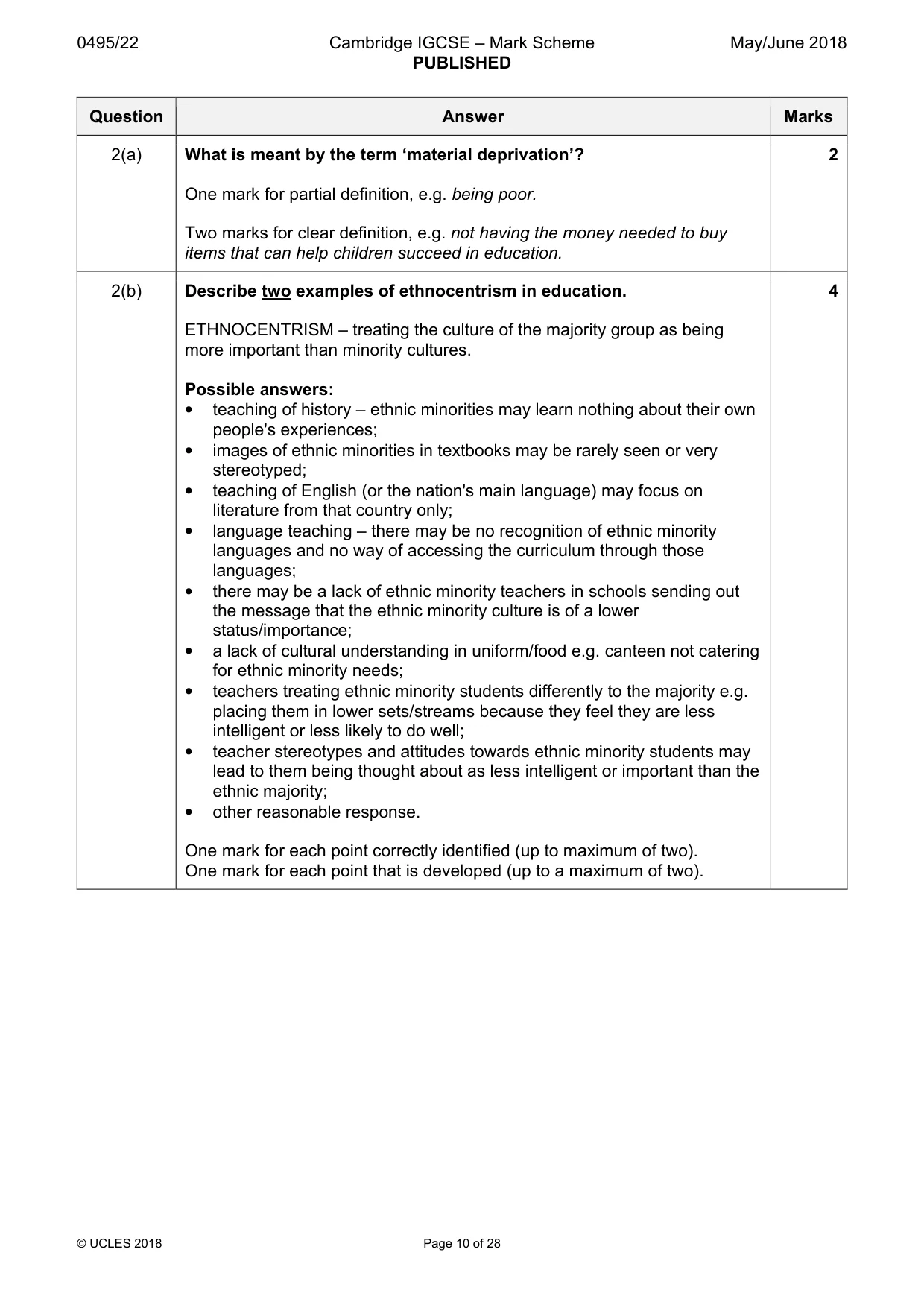
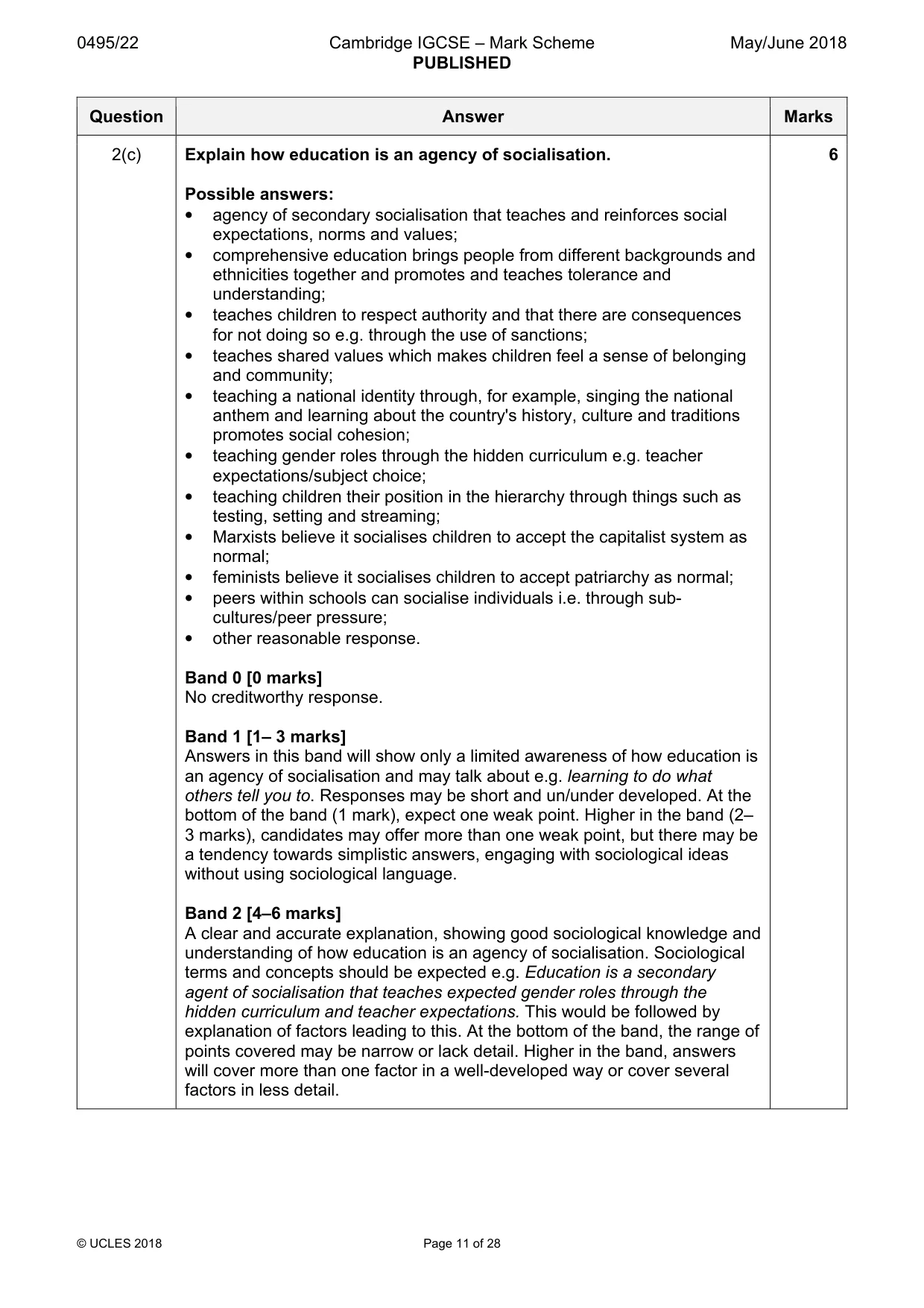
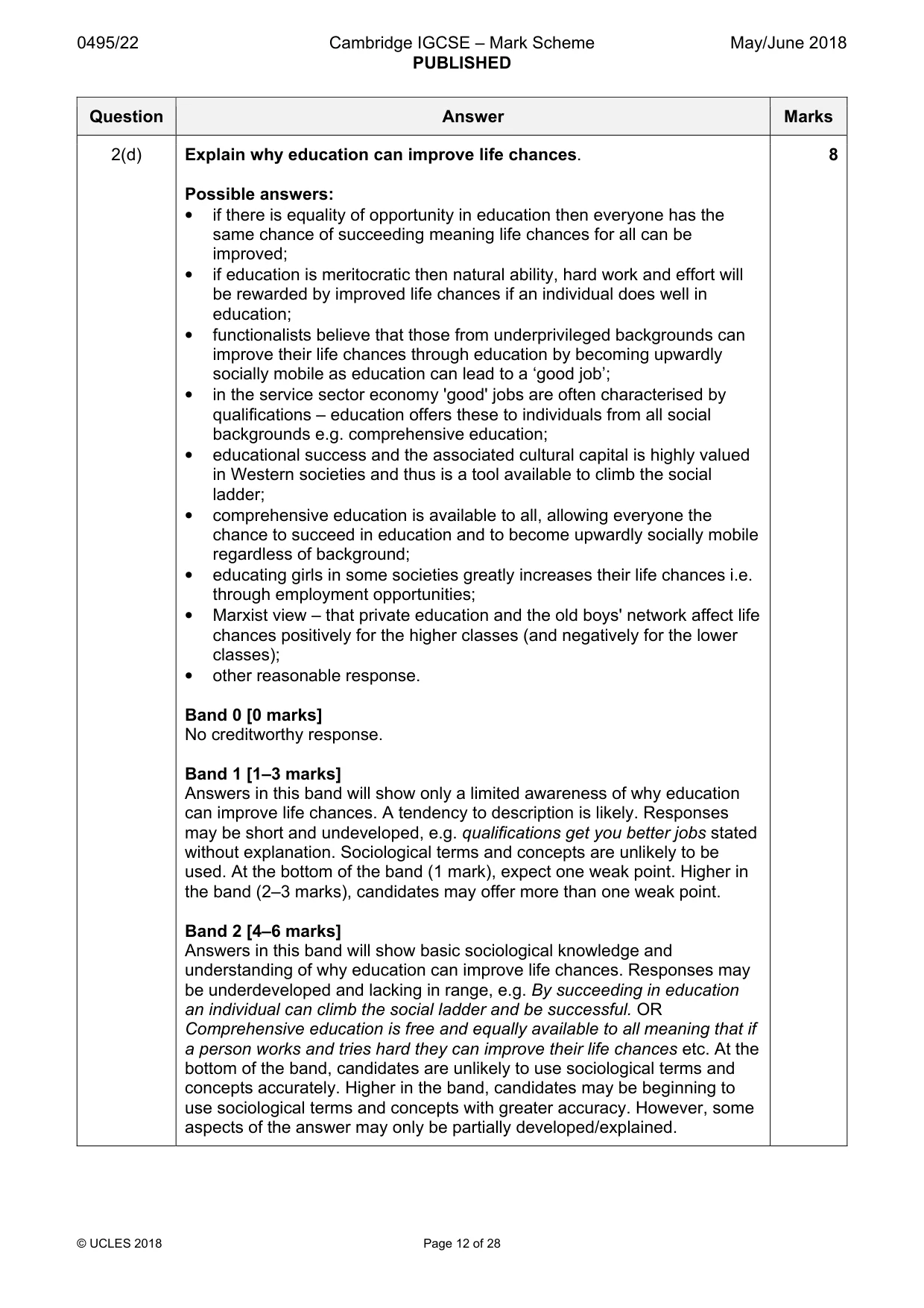
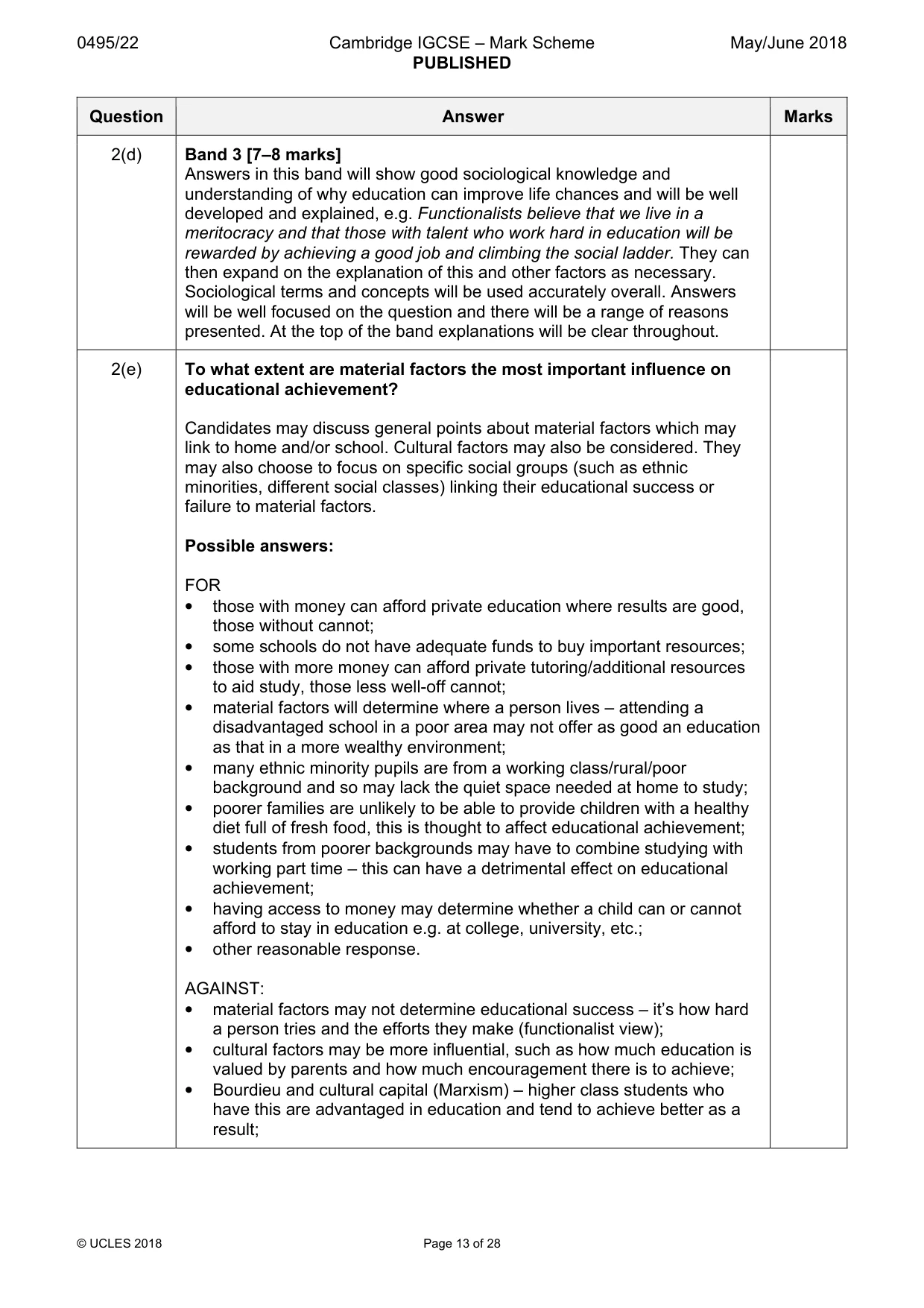
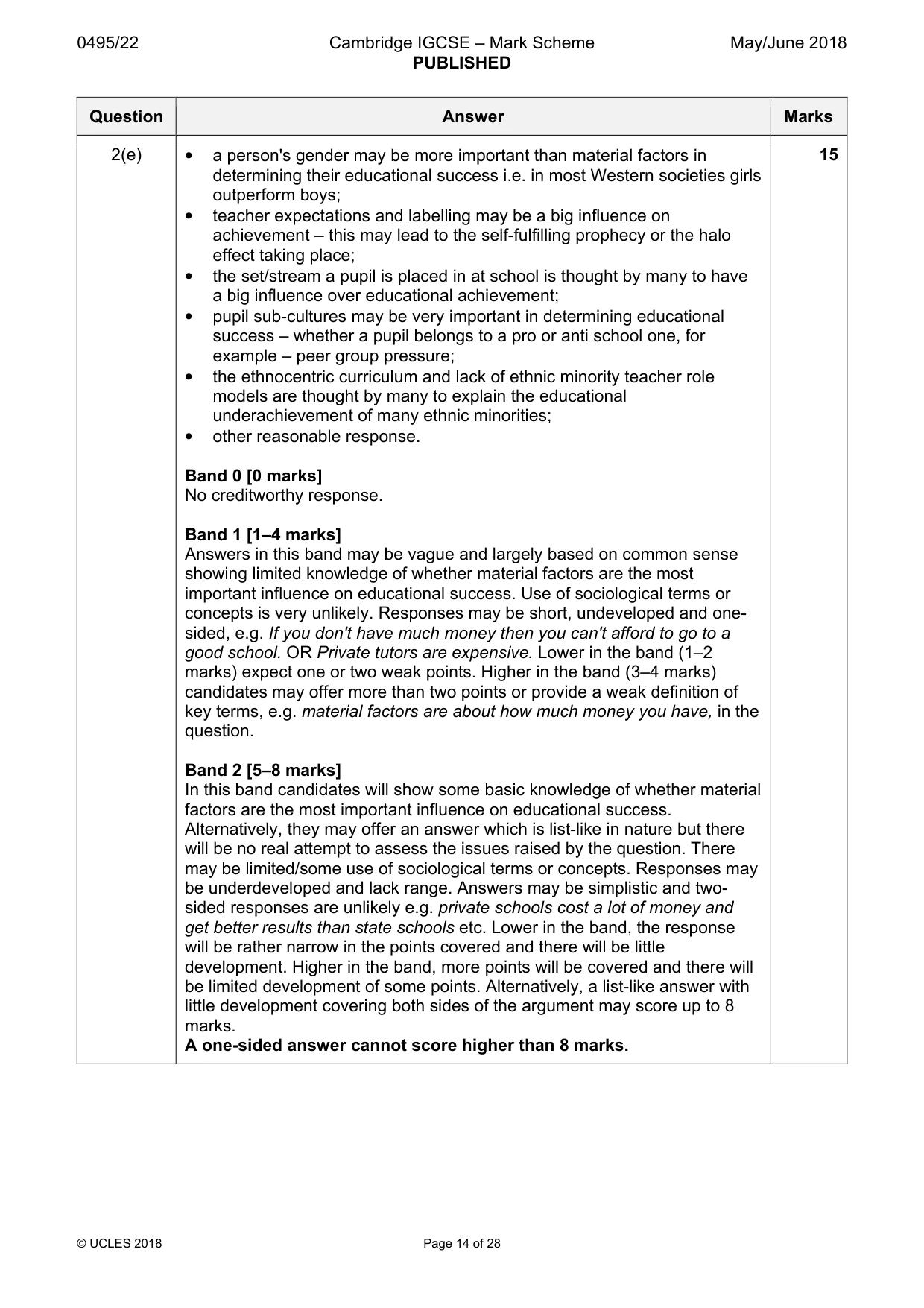
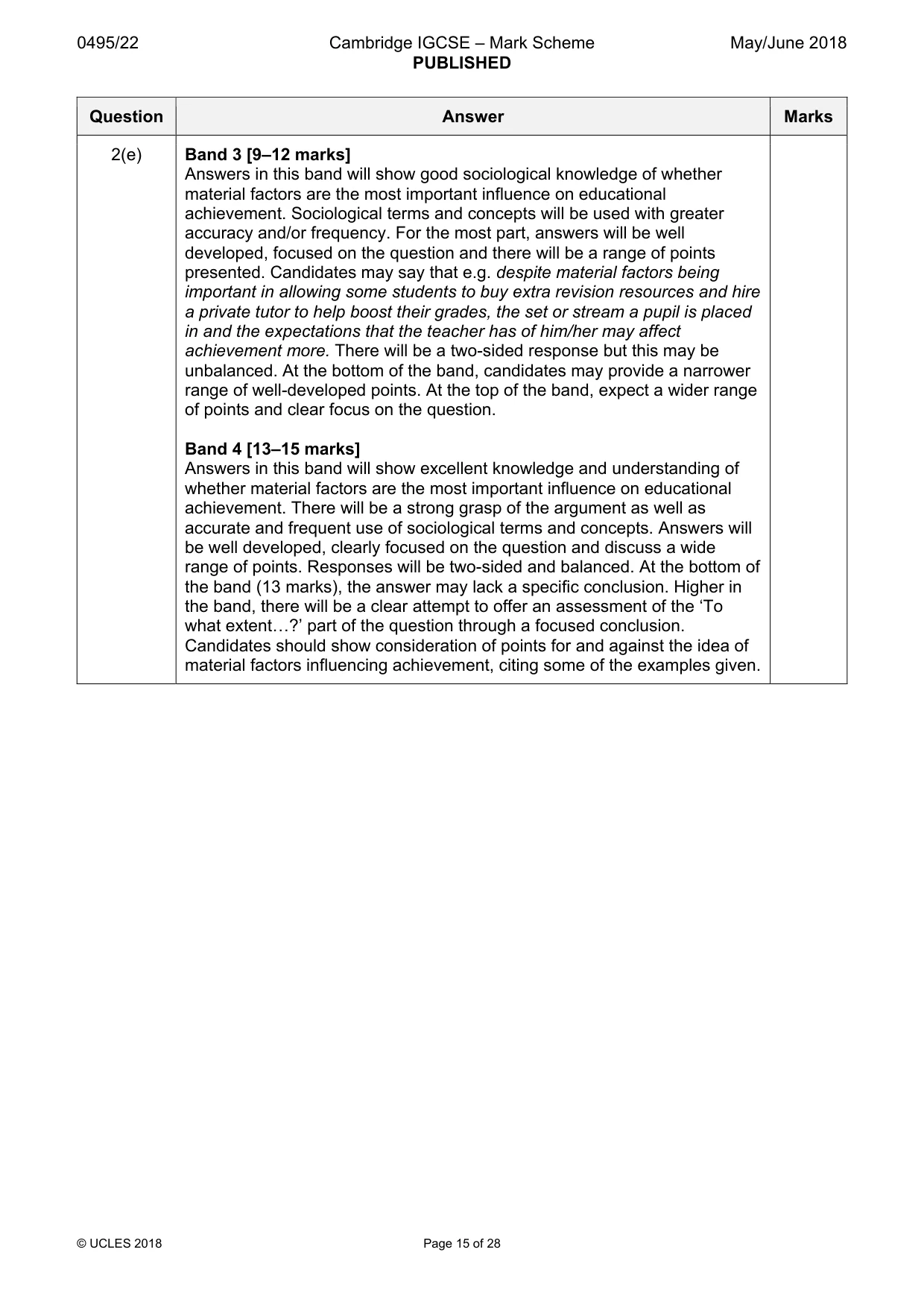
Mark scheme: 2(a) What is meant by the term ‘material deprivation’? 2 One mark for partial definition, e.g. being poor. Two marks for clear definition, e.g. not having the money needed to buy items that can help children succeed in education. 2(b) Describe two examples of ethnocentrism in education. 4 ETHNOCENTRISM – treating the culture of the majority group as being more important than minority cultures. Possible answers: • teaching of history – ethnic minorities may learn nothing about their own people's experiences; • images of ethnic minorities in textbooks may be rarely seen or very stereotyped; • teaching of English (or the nation's main language) may focus on literature from that country only; • language teaching – there may be no recognition of ethnic minority languages and no way of accessing the curriculum through those languages; • there may be a lack of ethnic minority teachers in schools sending out the message that the ethnic minority culture is of a lower status/importance; • a lack of cultural understanding in uniform/food e.g. canteen not catering for ethnic minority needs; • teachers treating ethnic minority students differently to the majority e.g. placing them in lower sets/streams because they feel they are less intelligent or less likely to do well; • teacher stereotypes and attitudes towards ethnic minority students may lead to them being thought about as less intelligent or important than the ethnic majority; • other reasonable response. One mark for each point correctly identified (up to maximum of two). One mark for each point that is developed (up to a maximum of two). 2(c) Explain how education is an agency of socialisation. 6 Possible answers: • agency of secondary socialisation that teaches and reinforces social expectations, norms and values; • comprehensive education brings people from different backgrounds and ethnicities together and promotes and teaches tolerance and understanding; • teaches children to respect authority and that there are consequences for not doing so e.g. through the use of sanctions; • teaches shared values which makes children feel a sense of belonging and community; • teaching a national identity through, for example, singing the national anthem and learning about the country's history, culture and traditions promotes social cohesion; • teaching gender roles through the hidden curriculum e.g. teacher expectations/subject choice; • teaching children their position in the hierarchy through things such as testing, setting and streaming; • Marxists believe it socialises children to accept the capitalist system as normal; • feminists believe it socialises children to accept patriarchy as normal; • peers within schools can socialise individuals i.e. through sub- cultures/peer pressure; • other reasonable response. Band 0 [0 marks] No creditworthy response. Band 1 [1– 3 marks] Answers in this band will show only a limited awareness of how education is an agency of socialisation and may talk about e.g. learning to do what others tell you to. Responses may be short and un/under developed. At the bottom of the band (1 mark), expect one weak point. Higher in the band (2– 3 marks), candidates may offer more than one weak point, but there may be a tendency towards simplistic answers, engaging with sociological ideas without using sociological language. Band 2 [4–6 marks] A clear and accurate explanation, showing good sociological knowledge and understanding of how education is an agency of socialisation. Sociological terms and concepts should be expected e.g. Education is a secondary agent of socialisation that teaches expected gender roles through the hidden curriculum and teacher expectations. This would be followed by explanation of factors leading to this. At the bottom of the band, the range of points covered may be narrow or lack detail. Higher in the band, answers will cover more than one factor in a well-developed way or cover several factors in less detail. 2(d) Explain why education can improve life chances. 8 Possible answers: • if there is equality of opportunity in education then everyone has the same chance of succeeding meaning life chances for all can be improved; • if education is meritocratic then natural ability, hard work and effort will be rewarded by improved life chances if an individual does well in education; • functionalists believe that those from underprivileged backgrounds can improve their life chances through education by becoming upwardly socially mobile as education can lead to a ‘good job’; • in the service sector economy 'good' jobs are often characterised by qualifications – education offers these to individuals from all social backgrounds e.g. comprehensive education; • educational success and the associated cultural capital is highly valued in Western societies and thus is a tool available to climb the social ladder; • comprehensive education is available to all, allowing everyone the chance to succeed in education and to become upwardly socially mobile regardless of background; • educating girls in some societies greatly increases their life chances i.e. through employment opportunities; • Marxist view – that private education and the old boys' network affect life chances positively for the higher classes (and negatively for the lower classes); • other reasonable response. Band 0 [0 marks] No creditworthy response. Band 1 [1–3 marks] Answers in this band will show only a limited awareness of why education can improve life chances. A tendency to description is likely. Responses may be short and undeveloped, e.g. qualifications get you better jobs stated without explanation. Sociological terms and concepts are unlikely to be used. At the bottom of the band (1 mark), expect one weak point. Higher in the band (2–3 marks), candidates may offer more than one weak point. Band 2 [4–6 marks] Answers in this band will show basic sociological knowledge and understanding of why education can improve life chances. Responses may be underdeveloped and lacking in range, e.g. By succeeding in education an individual can climb the social ladder and be successful. OR Comprehensive education is free and equally available to all meaning that if a person works and tries hard they can improve their life chances etc. At the bottom of the band, candidates are unlikely to use sociological terms and concepts accurately. Higher in the band, candidates may be beginning to use sociological terms and concepts with greater accuracy. However, some aspects of the answer may only be partially developed/explained. 2(d) Band 3 [7–8 marks] Answers in this band will show good sociological knowledge and understanding of why education can improve life chances and will be well developed and explained, e.g. Functionalists believe that we live in a meritocracy and that those with talent who work hard in education will be rewarded by achieving a good job and climbing the social ladder. They can then expand on the explanation of this and other factors as necessary. Sociological terms and concepts will be used accurately overall. Answers will be well focused on the question and there will be a range of reasons presented. At the top of the band explanations will be clear throughout. 2(e) To what extent are material factors the most important influence on educational achievement? Candidates may discuss general points about material factors which may link to home and/or school. Cultural factors may also be considered. They may also choose to focus on specific social groups (such as ethnic minorities, different social classes) linking their educational success or failure to material factors. Possible answers: FOR • those with money can afford private education where results are good, those without cannot; • some schools do not have adequate funds to buy important resources; • those with more money can afford private tutoring/additional resources to aid study, those less well-off cannot; • material factors will determine where a person lives – attending a disadvantaged school in a poor area may not offer as good an education as that in a more wealthy environment; • many ethnic minority pupils are from a working class/rural/poor background and so may lack the quiet space needed at home to study; • poorer families are unlikely to be able to provide children with a healthy diet full of fresh food, this is thought to affect educational achievement; • students from poorer backgrounds may have to combine studying with working part time – this can have a detrimental effect on educational achievement; • having access to money may determine whether a child can or cannot afford to stay in education e.g. at college, university, etc.; • other reasonable response. AGAINST: • material factors may not determine educational success – it’s how hard a person tries and the efforts they make (functionalist view); • cultural factors may be more influential, such as how much education is valued by parents and how much encouragement there is to achieve; • Bourdieu and cultural capital (Marxism) – higher class students who have this are advantaged in education and tend to achieve better as a result; 2(e) • a person's gender may be more important than material factors in 15 determining their educational success i.e. in most Western societies girls outperform boys; • teacher expectations and labelling may be a big influence on achievement – this may lead to the self-fulfilling prophecy or the halo effect taking place; • the set/stream a pupil is placed in at school is thought by many to have a big influence over educational achievement; • pupil sub-cultures may be very important in determining educational success – whether a pupil belongs to a pro or anti school one, for example – peer group pressure; • the ethnocentric curriculum and lack of ethnic minority teacher role models are thought by many to explain the educational underachievement of many ethnic minorities; • other reasonable response. Band 0 [0 marks] No creditworthy response. Band 1 [1–4 marks] Answers in this band may be vague and largely based on common sense showing limited knowledge of whether material factors are the most important influence on educational success. Use of sociological terms or concepts is very unlikely. Responses may be short, undeveloped and one- sided, e.g. If you don't have much money then you can't afford to go to a good school. OR Private tutors are expensive. Lower in the band (1–2 marks) expect one or two weak points. Higher in the band (3–4 marks) candidates may offer more than two points or provide a weak definition of key terms, e.g. material factors are about how much money you have, in the question. Band 2 [5–8 marks] In this band candidates will show some basic knowledge of whether material factors are the most important influence on educational success. Alternatively, they may offer an answer which is list-like in nature but there will be no real attempt to assess the issues raised by the question. There may be limited/some use of sociological terms or concepts. Responses may be underdeveloped and lack range. Answers may be simplistic and two- sided responses are unlikely e.g. private schools cost a lot of money and get better results than state schools etc. Lower in the band, the response will be rather narrow in the points covered and there will be little development. Higher in the band, more points will be covered and there will be limited development of some points. Alternatively, a list-like answer with little development covering both sides of the argument may score up to 8 marks. A one-sided answer cannot score higher than 8 marks. 2(e) Band 3 [9–12 marks] Answers in this band will show good sociological knowledge of whether material factors are the most important influence on educational achievement. Sociological terms and concepts will be used with greater accuracy and/or frequency. For the most part, answers will be well developed, focused on the question and there will be a range of points presented. Candidates may say that e.g. despite material factors being important in allowing some students to buy extra revision resources and hire a private tutor to help boost their grades, the set or stream a pupil is placed in and the expectations that the teacher has of him/her may affect achievement more. There will be a two-sided response but this may be unbalanced. At the bottom of the band, candidates may provide a narrower range of well-developed points. At the top of the band, expect a wider range of points and clear focus on the question. Band 4 [13–15 marks] Answers in this band will show excellent knowledge and understanding of whether material factors are the most important influence on educational achievement. There will be a strong grasp of the argument as well as accurate and frequent use of sociological terms and concepts. Answers will be well developed, clearly focused on the question and discuss a wide range of points. Responses will be two-sided and balanced. At the bottom of the band (13 marks), the answer may lack a specific conclusion. Higher in the band, there will be a clear attempt to offer an assessment of the ‘To what extent«?’ part of the question through a focused conclusion. Candidates should show consideration of points for and against the idea of material factors influencing achievement, citing some of the examples given.
Q3 · Acts of crime and deviance are often associated with youth sub-cultures
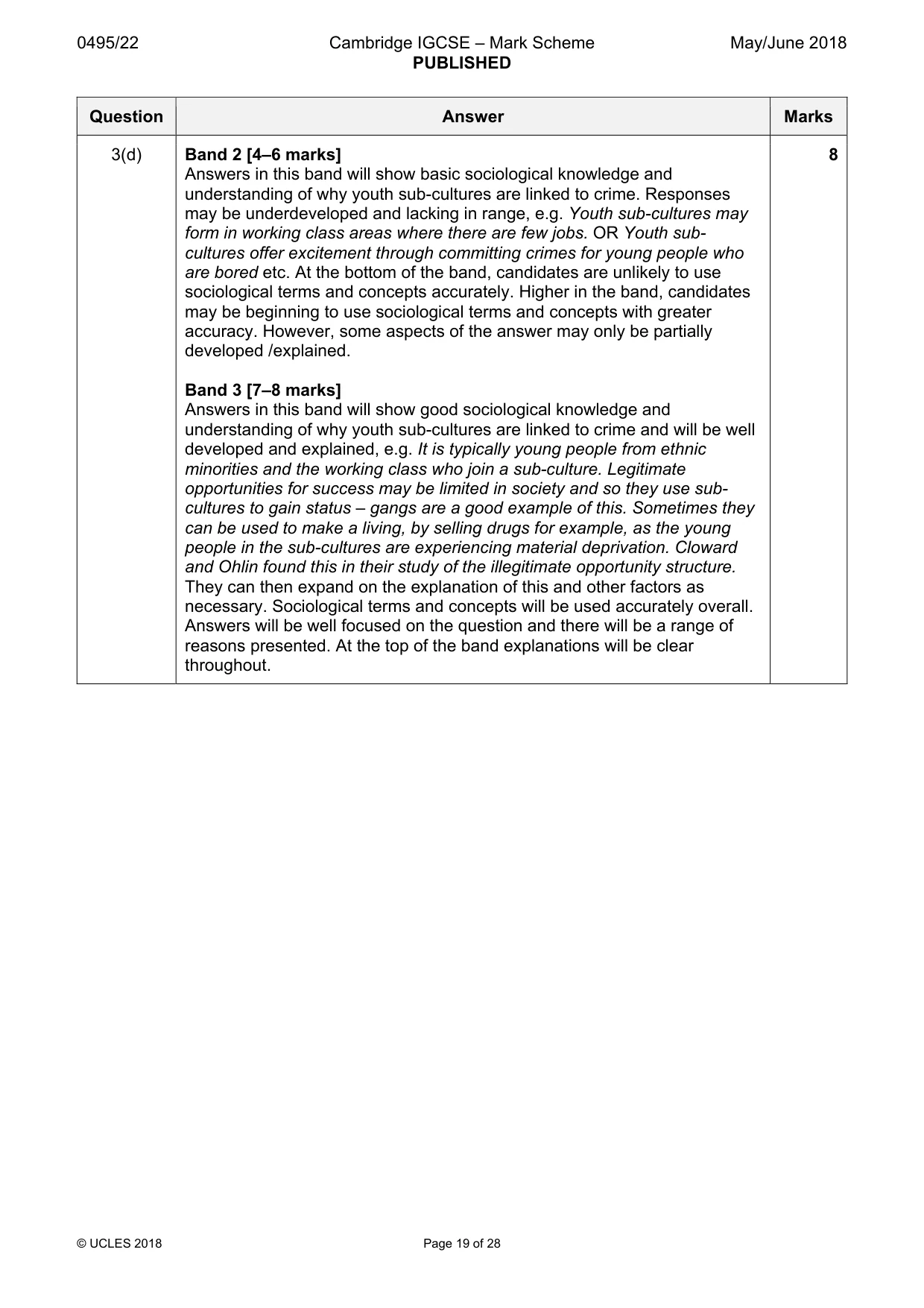
3 Acts of crime and deviance are often associated with youth sub-cultures. Controlling crime in society is difficult to do. Some sociologists believe that informal agencies of social control are the best way to ensure conformity. Others believe that formal agencies such as prisons are the best deterrent. (a) What is meant by the term ‘deviance’? [2] (b) Describe two problems with official crime statistics. [4] (c) Explain how informal agencies of social control prevent crime. [6] (d) Explain why youth sub-cultures are often linked to crime. [8] (e) To what extent do prisons fail to deter people from committing crime? [15] Section D: Media
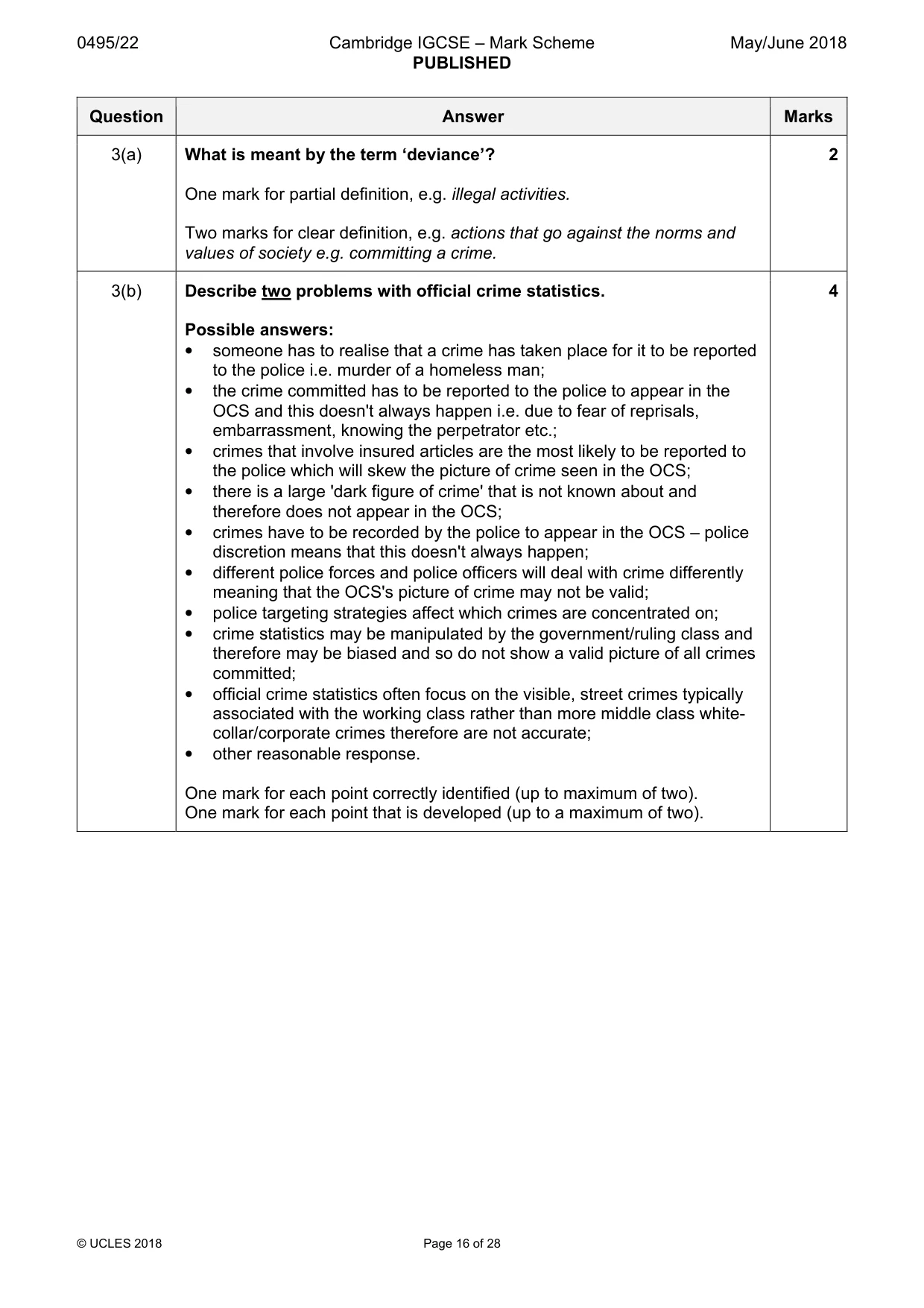
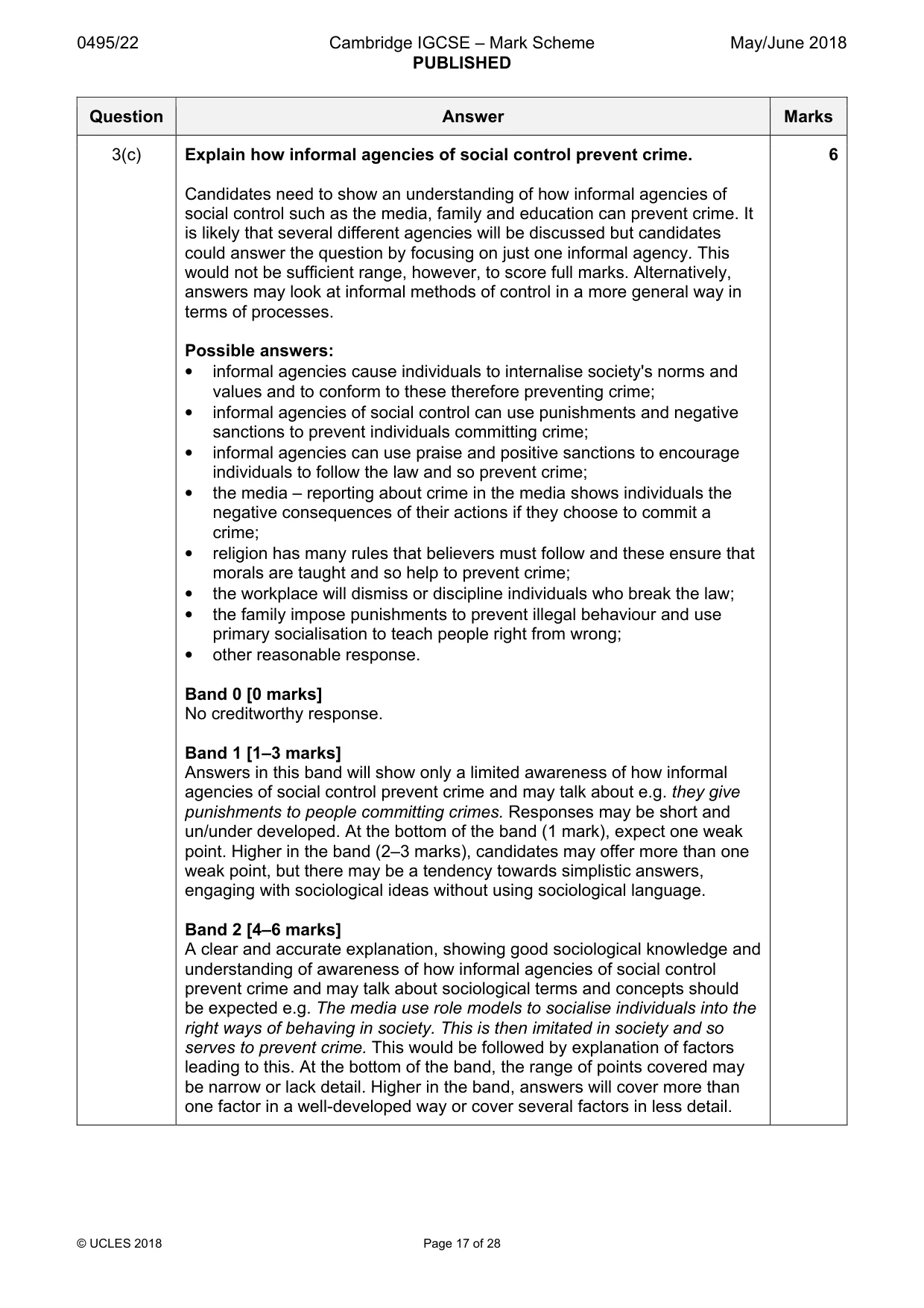
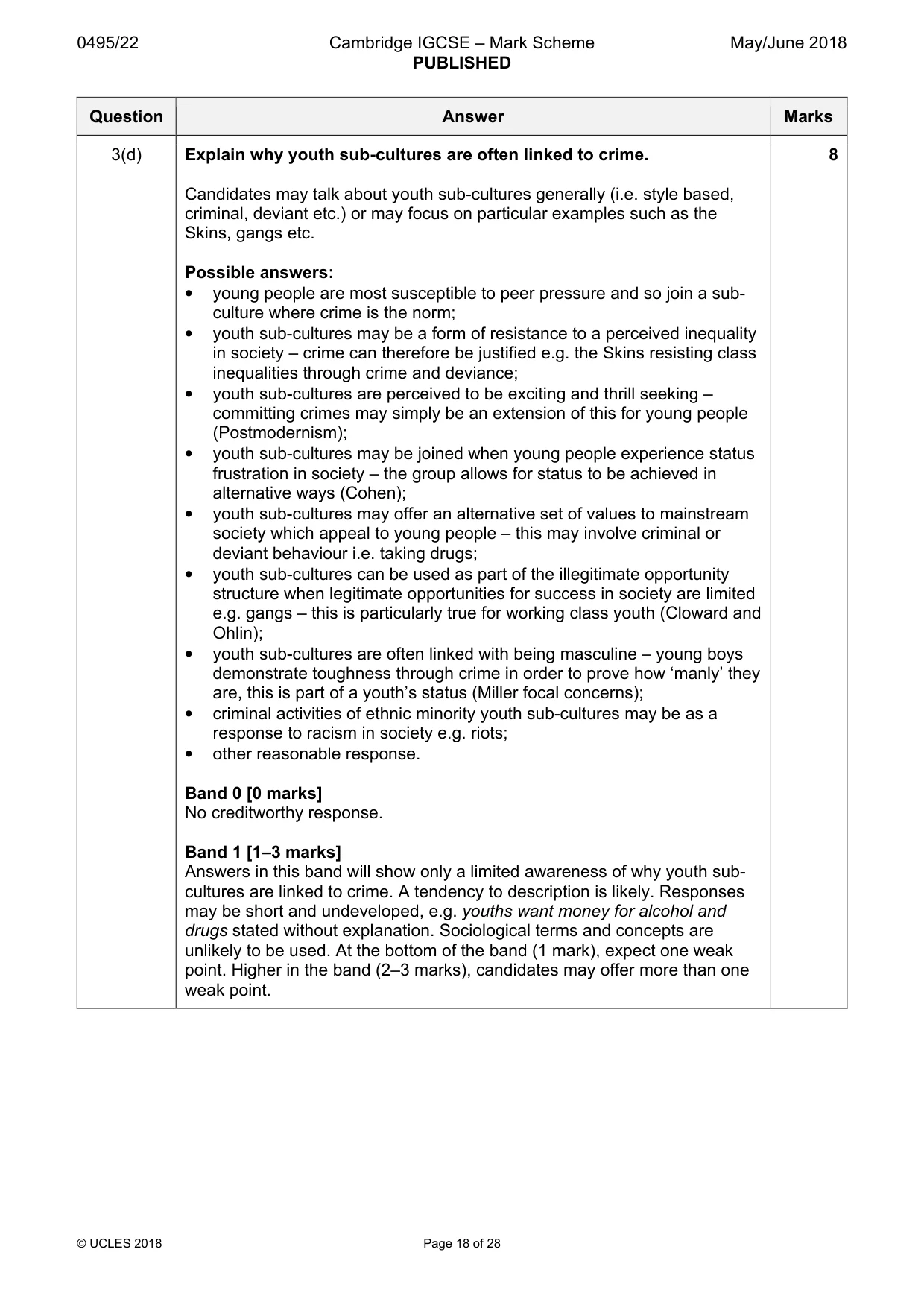
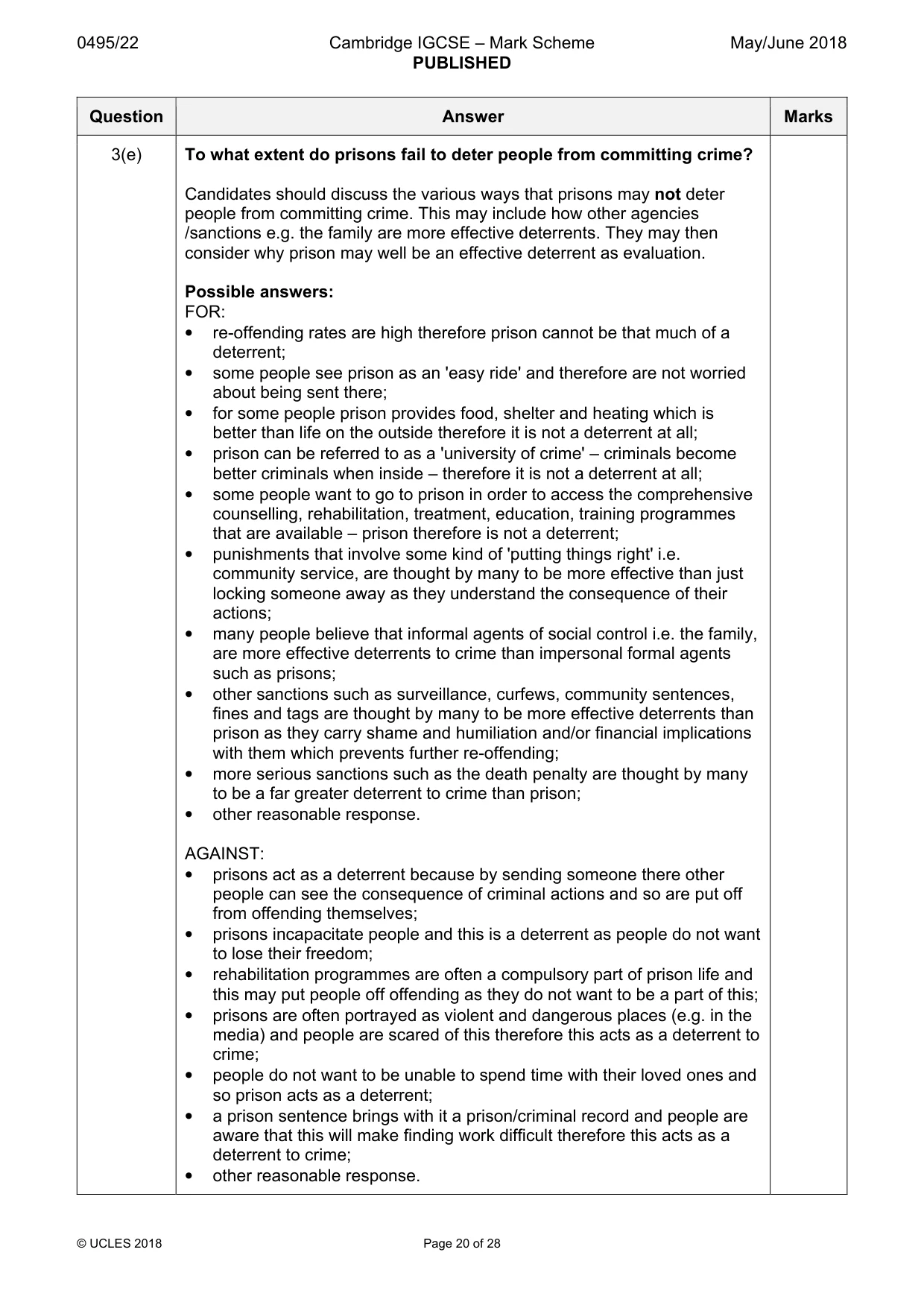
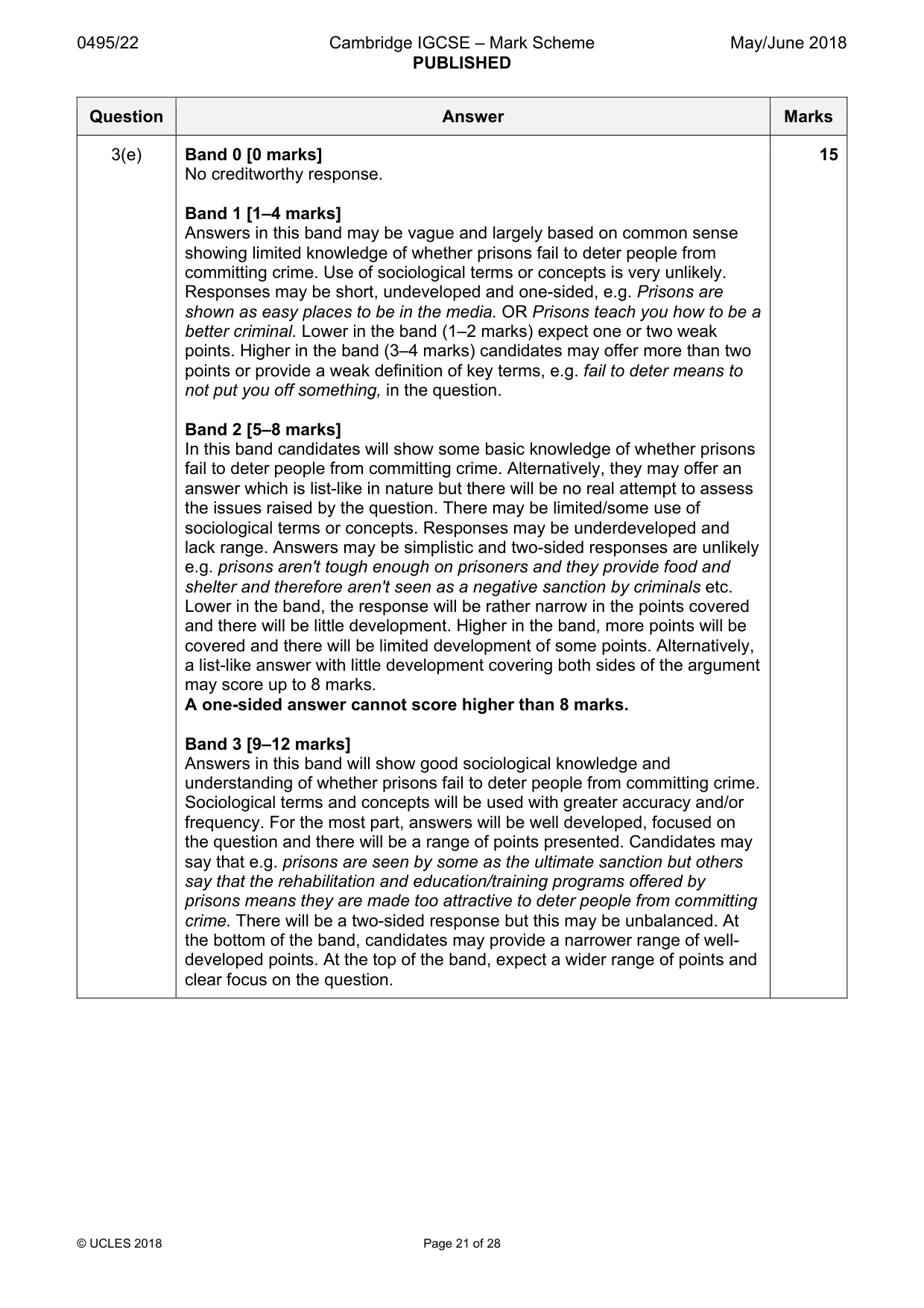
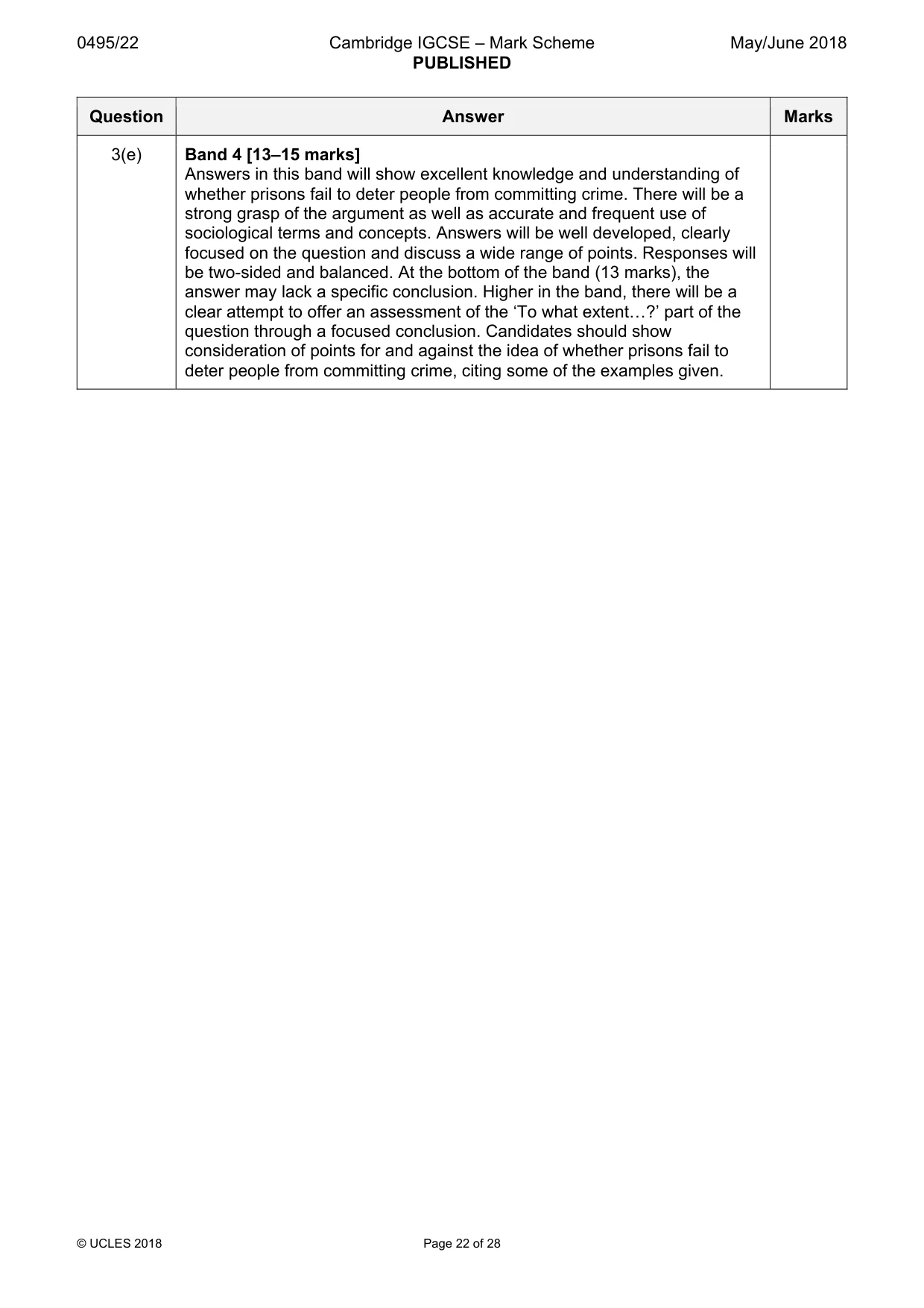
Mark scheme: 3(a) What is meant by the term ‘deviance’? 2 One mark for partial definition, e.g. illegal activities. Two marks for clear definition, e.g. actions that go against the norms and values of society e.g. committing a crime. 3(b) Describe two problems with official crime statistics. 4 Possible answers: • someone has to realise that a crime has taken place for it to be reported to the police i.e. murder of a homeless man; • the crime committed has to be reported to the police to appear in the OCS and this doesn't always happen i.e. due to fear of reprisals, embarrassment, knowing the perpetrator etc.; • crimes that involve insured articles are the most likely to be reported to the police which will skew the picture of crime seen in the OCS; • there is a large 'dark figure of crime' that is not known about and therefore does not appear in the OCS; • crimes have to be recorded by the police to appear in the OCS – police discretion means that this doesn't always happen; • different police forces and police officers will deal with crime differently meaning that the OCS's picture of crime may not be valid; • police targeting strategies affect which crimes are concentrated on; • crime statistics may be manipulated by the government/ruling class and therefore may be biased and so do not show a valid picture of all crimes committed; • official crime statistics often focus on the visible, street crimes typically associated with the working class rather than more middle class white- collar/corporate crimes therefore are not accurate; • other reasonable response. One mark for each point correctly identified (up to maximum of two). One mark for each point that is developed (up to a maximum of two). 3(c) Explain how informal agencies of social control prevent crime. 6 Candidates need to show an understanding of how informal agencies of social control such as the media, family and education can prevent crime. It is likely that several different agencies will be discussed but candidates could answer the question by focusing on just one informal agency. This would not be sufficient range, however, to score full marks. Alternatively, answers may look at informal methods of control in a more general way in terms of processes. Possible answers: • informal agencies cause individuals to internalise society's norms and values and to conform to these therefore preventing crime; • informal agencies of social control can use punishments and negative sanctions to prevent individuals committing crime; • informal agencies can use praise and positive sanctions to encourage individuals to follow the law and so prevent crime; • the media – reporting about crime in the media shows individuals the negative consequences of their actions if they choose to commit a crime; • religion has many rules that believers must follow and these ensure that morals are taught and so help to prevent crime; • the workplace will dismiss or discipline individuals who break the law; • the family impose punishments to prevent illegal behaviour and use primary socialisation to teach people right from wrong; • other reasonable response. Band 0 [0 marks] No creditworthy response. Band 1 [1–3 marks] Answers in this band will show only a limited awareness of how informal agencies of social control prevent crime and may talk about e.g. they give punishments to people committing crimes. Responses may be short and un/under developed. At the bottom of the band (1 mark), expect one weak point. Higher in the band (2–3 marks), candidates may offer more than one weak point, but there may be a tendency towards simplistic answers, engaging with sociological ideas without using sociological language. Band 2 [4–6 marks] A clear and accurate explanation, showing good sociological knowledge and understanding of awareness of how informal agencies of social control prevent crime and may talk about sociological terms and concepts should be expected e.g. The media use role models to socialise individuals into the right ways of behaving in society. This is then imitated in society and so serves to prevent crime. This would be followed by explanation of factors leading to this. At the bottom of the band, the range of points covered may be narrow or lack detail. Higher in the band, answers will cover more than one factor in a well-developed way or cover several factors in less detail. 3(d) Explain why youth sub-cultures are often linked to crime. 8 Candidates may talk about youth sub-cultures generally (i.e. style based, criminal, deviant etc.) or may focus on particular examples such as the Skins, gangs etc. Possible answers: • young people are most susceptible to peer pressure and so join a sub- culture where crime is the norm; • youth sub-cultures may be a form of resistance to a perceived inequality in society – crime can therefore be justified e.g. the Skins resisting class inequalities through crime and deviance; • youth sub-cultures are perceived to be exciting and thrill seeking – committing crimes may simply be an extension of this for young people (Postmodernism); • youth sub-cultures may be joined when young people experience status frustration in society – the group allows for status to be achieved in alternative ways (Cohen); • youth sub-cultures may offer an alternative set of values to mainstream society which appeal to young people – this may involve criminal or deviant behaviour i.e. taking drugs; • youth sub-cultures can be used as part of the illegitimate opportunity structure when legitimate opportunities for success in society are limited e.g. gangs – this is particularly true for working class youth (Cloward and Ohlin); • youth sub-cultures are often linked with being masculine – young boys demonstrate toughness through crime in order to prove how ‘manly’ they are, this is part of a youth’s status (Miller focal concerns); • criminal activities of ethnic minority youth sub-cultures may be as a response to racism in society e.g. riots; • other reasonable response. Band 0 [0 marks] No creditworthy response. Band 1 [1–3 marks] Answers in this band will show only a limited awareness of why youth sub- cultures are linked to crime. A tendency to description is likely. Responses may be short and undeveloped, e.g. youths want money for alcohol and drugs stated without explanation. Sociological terms and concepts are unlikely to be used. At the bottom of the band (1 mark), expect one weak point. Higher in the band (2–3 marks), candidates may offer more than one weak point. 3(d) Band 2 [4–6 marks] 8 Answers in this band will show basic sociological knowledge and understanding of why youth sub-cultures are linked to crime. Responses may be underdeveloped and lacking in range, e.g. Youth sub-cultures may form in working class areas where there are few jobs. OR Youth sub- cultures offer excitement through committing crimes for young people who are bored etc. At the bottom of the band, candidates are unlikely to use sociological terms and concepts accurately. Higher in the band, candidates may be beginning to use sociological terms and concepts with greater accuracy. However, some aspects of the answer may only be partially developed /explained. Band 3 [7–8 marks] Answers in this band will show good sociological knowledge and understanding of why youth sub-cultures are linked to crime and will be well developed and explained, e.g. It is typically young people from ethnic minorities and the working class who join a sub-culture. Legitimate opportunities for success may be limited in society and so they use sub- cultures to gain status – gangs are a good example of this. Sometimes they can be used to make a living, by selling drugs for example, as the young people in the sub-cultures are experiencing material deprivation. Cloward and Ohlin found this in their study of the illegitimate opportunity structure. They can then expand on the explanation of this and other factors as necessary. Sociological terms and concepts will be used accurately overall. Answers will be well focused on the question and there will be a range of reasons presented. At the top of the band explanations will be clear throughout. 3(e) To what extent do prisons fail to deter people from committing crime? Candidates should discuss the various ways that prisons may not deter people from committing crime. This may include how other agencies /sanctions e.g. the family are more effective deterrents. They may then consider why prison may well be an effective deterrent as evaluation. Possible answers: FOR: • re-offending rates are high therefore prison cannot be that much of a deterrent; • some people see prison as an 'easy ride' and therefore are not worried about being sent there; • for some people prison provides food, shelter and heating which is better than life on the outside therefore it is not a deterrent at all; • prison can be referred to as a 'university of crime' – criminals become better criminals when inside – therefore it is not a deterrent at all; • some people want to go to prison in order to access the comprehensive counselling, rehabilitation, treatment, education, training programmes that are available – prison therefore is not a deterrent; • punishments that involve some kind of 'putting things right' i.e. community service, are thought by many to be more effective than just locking someone away as they understand the consequence of their actions; • many people believe that informal agents of social control i.e. the family, are more effective deterrents to crime than impersonal formal agents such as prisons; • other sanctions such as surveillance, curfews, community sentences, fines and tags are thought by many to be more effective deterrents than prison as they carry shame and humiliation and/or financial implications with them which prevents further re-offending; • more serious sanctions such as the death penalty are thought by many to be a far greater deterrent to crime than prison; • other reasonable response. AGAINST: • prisons act as a deterrent because by sending someone there other people can see the consequence of criminal actions and so are put off from offending themselves; • prisons incapacitate people and this is a deterrent as people do not want to lose their freedom; • rehabilitation programmes are often a compulsory part of prison life and this may put people off offending as they do not want to be a part of this; • prisons are often portrayed as violent and dangerous places (e.g. in the media) and people are scared of this therefore this acts as a deterrent to crime; • people do not want to be unable to spend time with their loved ones and so prison acts as a deterrent; • a prison sentence brings with it a prison/criminal record and people are aware that this will make finding work difficult therefore this acts as a deterrent to crime; • other reasonable response. 3(e) Band 0 [0 marks] 15 No creditworthy response. Band 1 [1–4 marks] Answers in this band may be vague and largely based on common sense showing limited knowledge of whether prisons fail to deter people from committing crime. Use of sociological terms or concepts is very unlikely. Responses may be short, undeveloped and one-sided, e.g. Prisons are shown as easy places to be in the media. OR Prisons teach you how to be a better criminal. Lower in the band (1–2 marks) expect one or two weak points. Higher in the band (3–4 marks) candidates may offer more than two points or provide a weak definition of key terms, e.g. fail to deter means to not put you off something, in the question. Band 2 [5–8 marks] In this band candidates will show some basic knowledge of whether prisons fail to deter people from committing crime. Alternatively, they may offer an answer which is list-like in nature but there will be no real attempt to assess the issues raised by the question. There may be limited/some use of sociological terms or concepts. Responses may be underdeveloped and lack range. Answers may be simplistic and two-sided responses are unlikely e.g. prisons aren't tough enough on prisoners and they provide food and shelter and therefore aren't seen as a negative sanction by criminals etc. Lower in the band, the response will be rather narrow in the points covered and there will be little development. Higher in the band, more points will be covered and there will be limited development of some points. Alternatively, a list-like answer with little development covering both sides of the argument may score up to 8 marks. A one-sided answer cannot score higher than 8 marks. Band 3 [9–12 marks] Answers in this band will show good sociological knowledge and understanding of whether prisons fail to deter people from committing crime. Sociological terms and concepts will be used with greater accuracy and/or frequency. For the most part, answers will be well developed, focused on the question and there will be a range of points presented. Candidates may say that e.g. prisons are seen by some as the ultimate sanction but others say that the rehabilitation and education/training programs offered by prisons means they are made too attractive to deter people from committing crime. There will be a two-sided response but this may be unbalanced. At the bottom of the band, candidates may provide a narrower range of well- developed points. At the top of the band, expect a wider range of points and clear focus on the question. 3(e) Band 4 [13–15 marks] Answers in this band will show excellent knowledge and understanding of whether prisons fail to deter people from committing crime. There will be a strong grasp of the argument as well as accurate and frequent use of sociological terms and concepts. Answers will be well developed, clearly focused on the question and discuss a wide range of points. Responses will be two-sided and balanced. At the bottom of the band (13 marks), the answer may lack a specific conclusion. Higher in the band, there will be a clear attempt to offer an assessment of the ‘To what extent«?’ part of the question through a focused conclusion. Candidates should show consideration of points for and against the idea of whether prisons fail to deter people from committing crime, citing some of the examples given.
Q4 · Pluralists and Marxists have very different views about the role and influence of media…
4 Pluralists and Marxists have very different views about the role and influence of media in society. Some sociologists believe the media directly affects how the audience thinks and behaves. Others believe it depends on who is using the media and how it is being used. However, the media can still be very influential in spreading propaganda. (a) What is meant by the term ‘pluralist’? [2] (b) Describe two examples of how the media can use propaganda to influence the audience. [4] (c) Explain how sociologists criticise the stereotypical representations of some social groups in the media. [6] (d) Explain why the hypodermic syringe model can be criticised. [8] (e) To what extent are patterns of media use determined by the social class of the audience. [15]
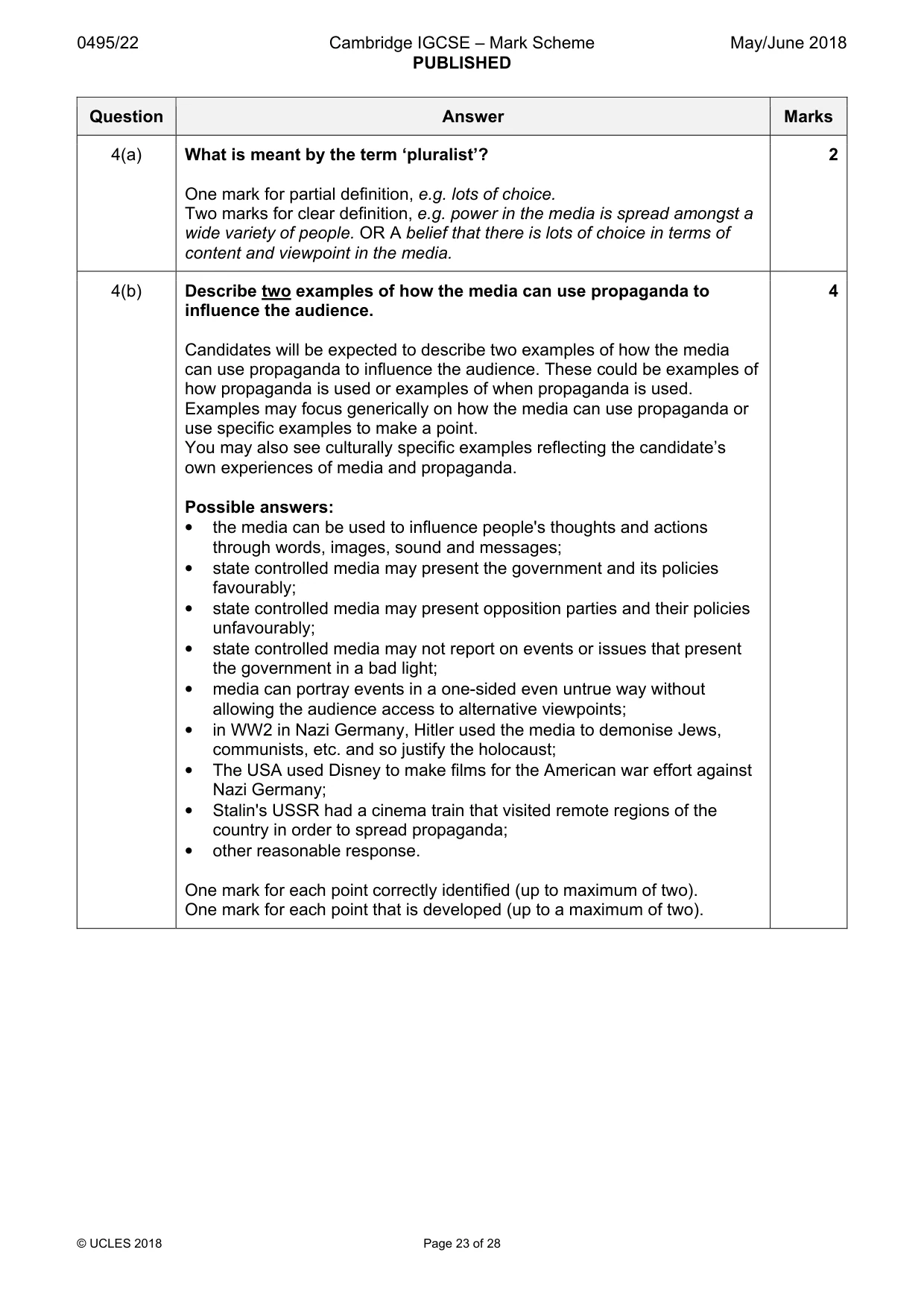
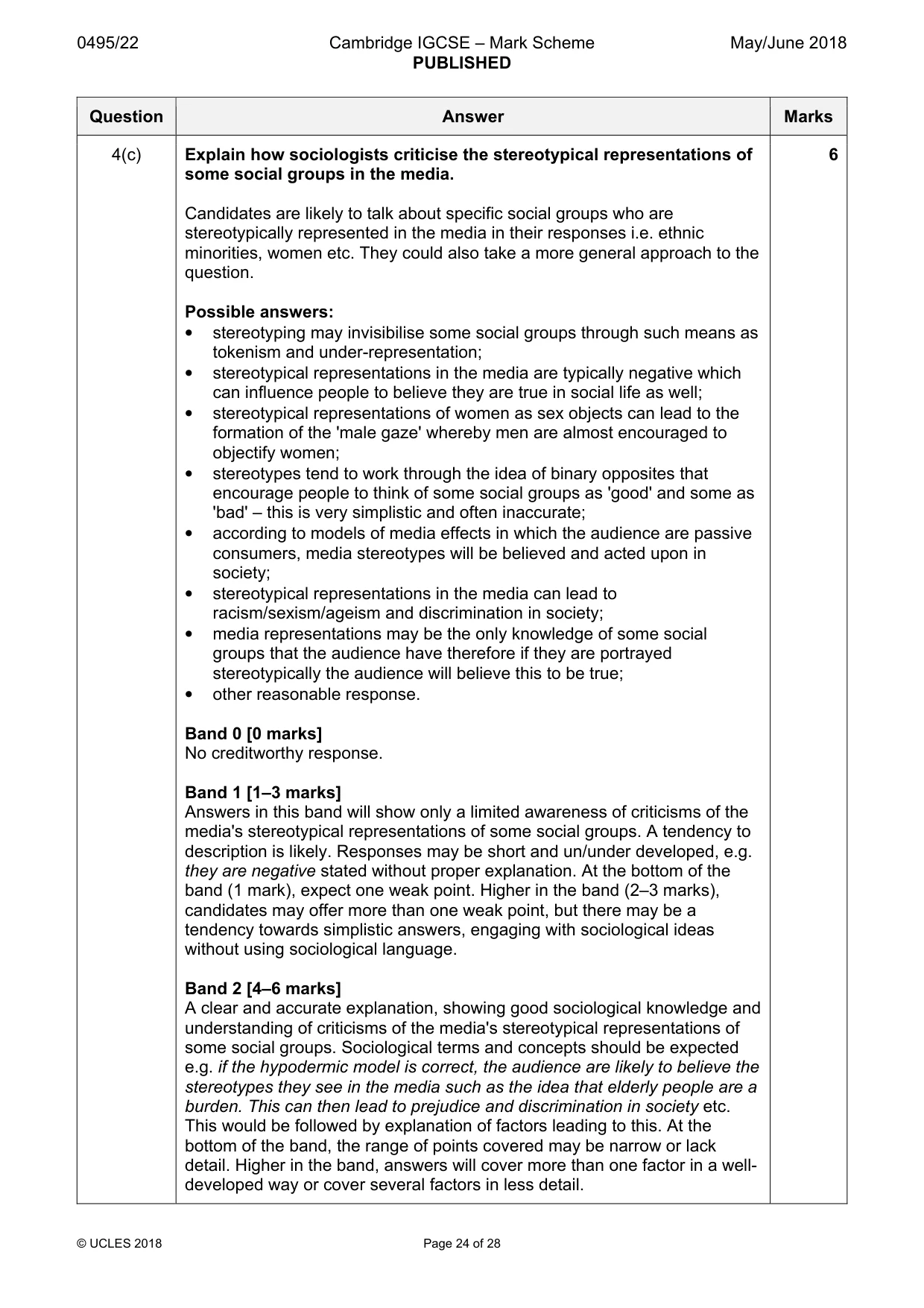
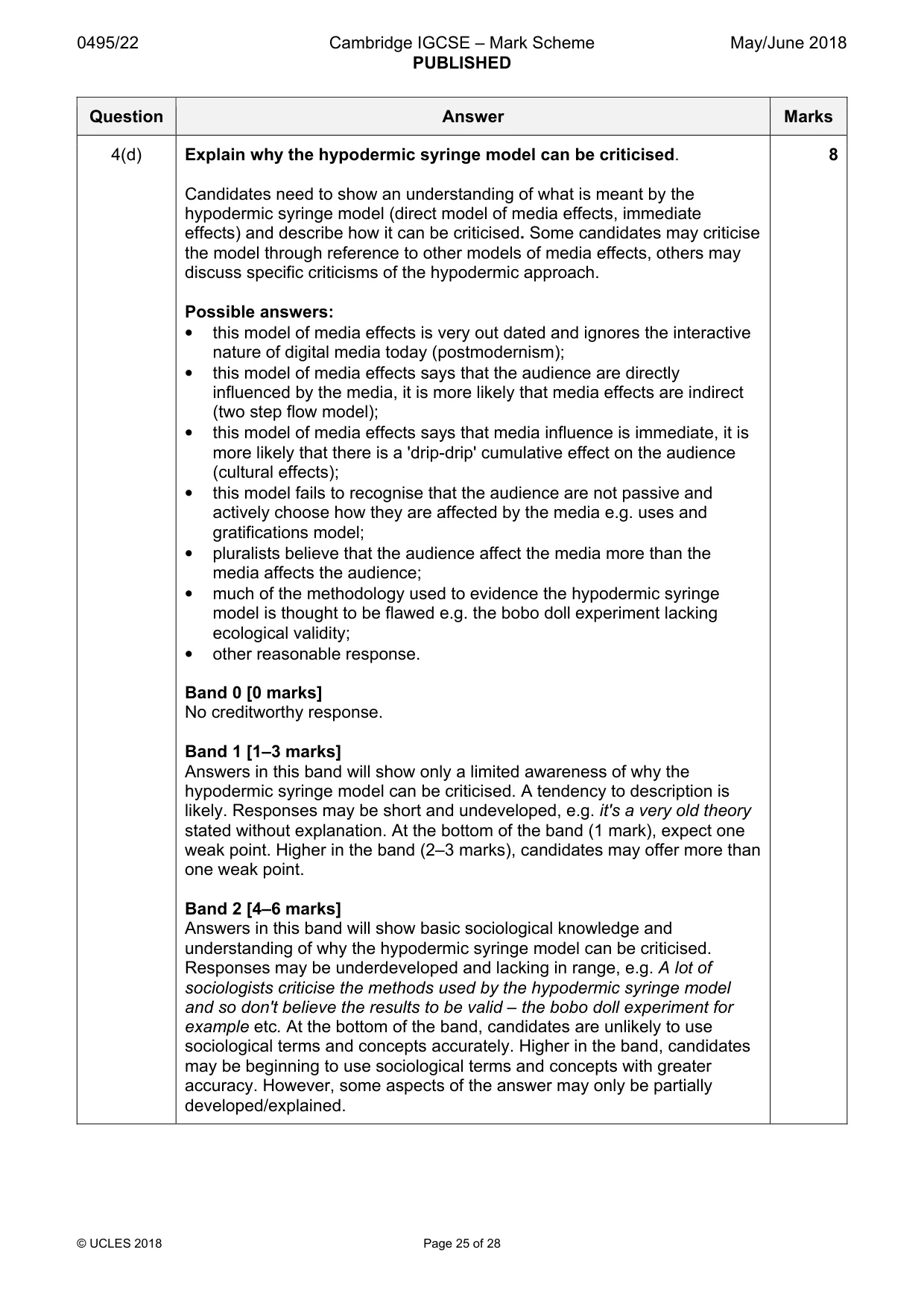
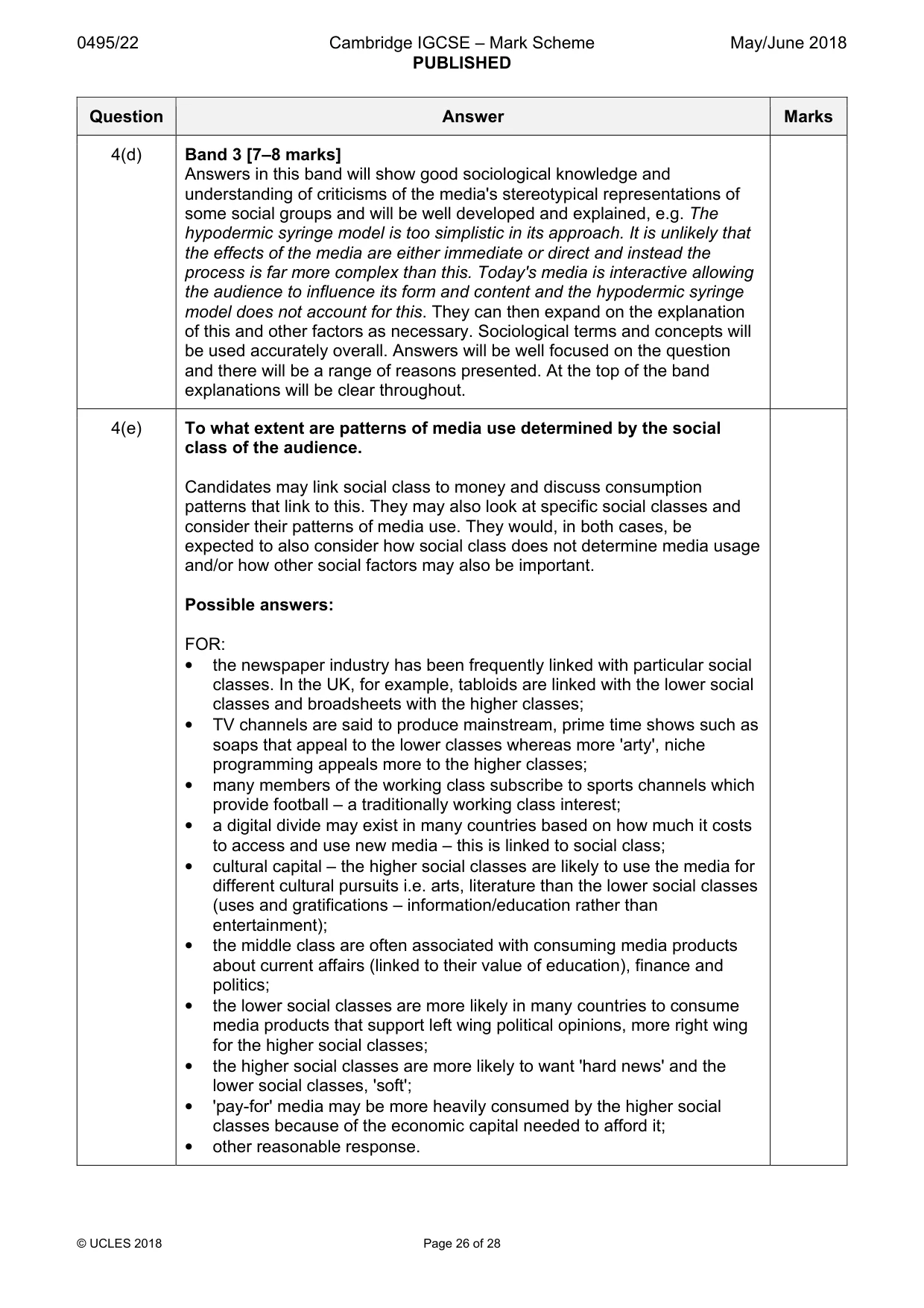
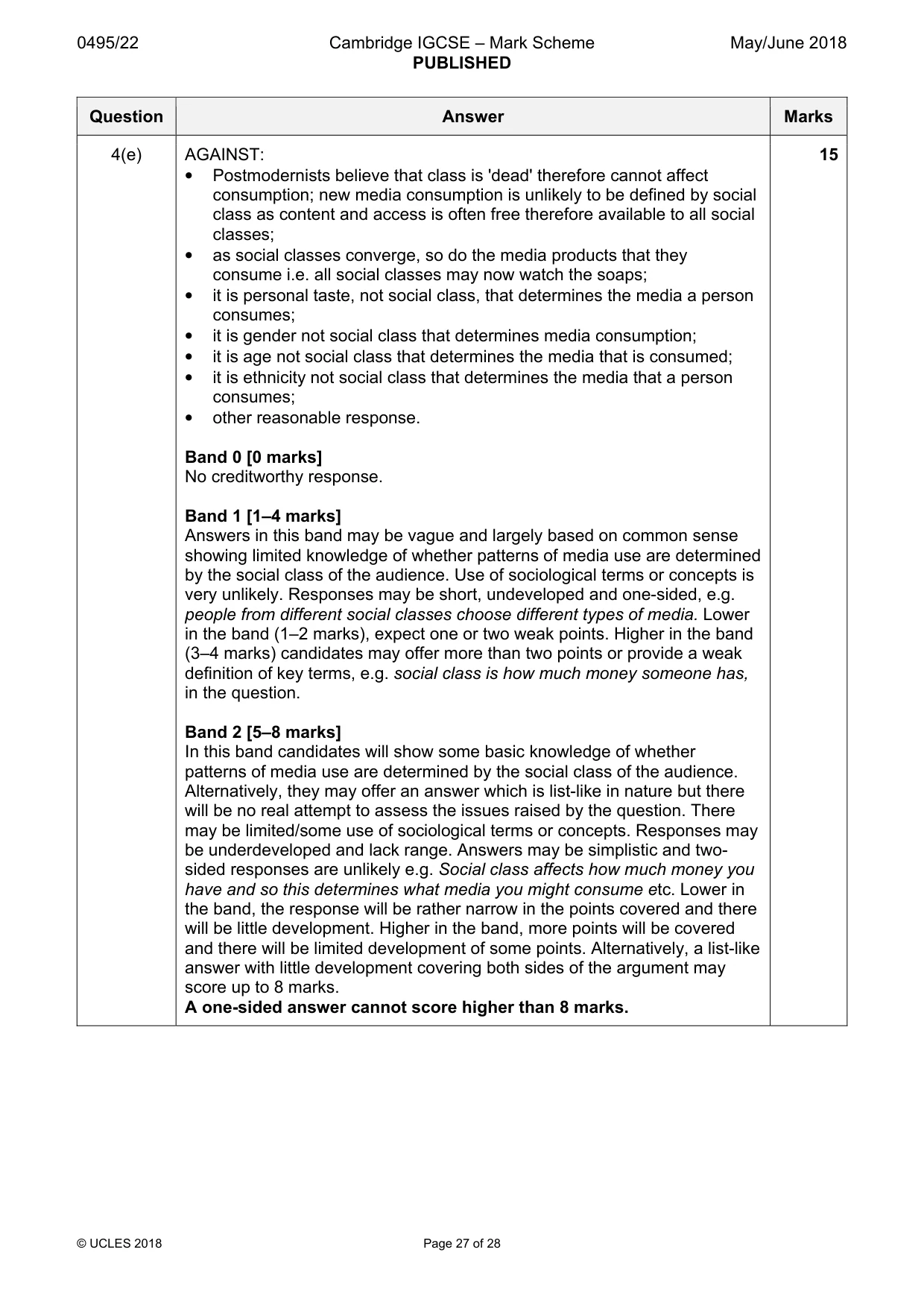
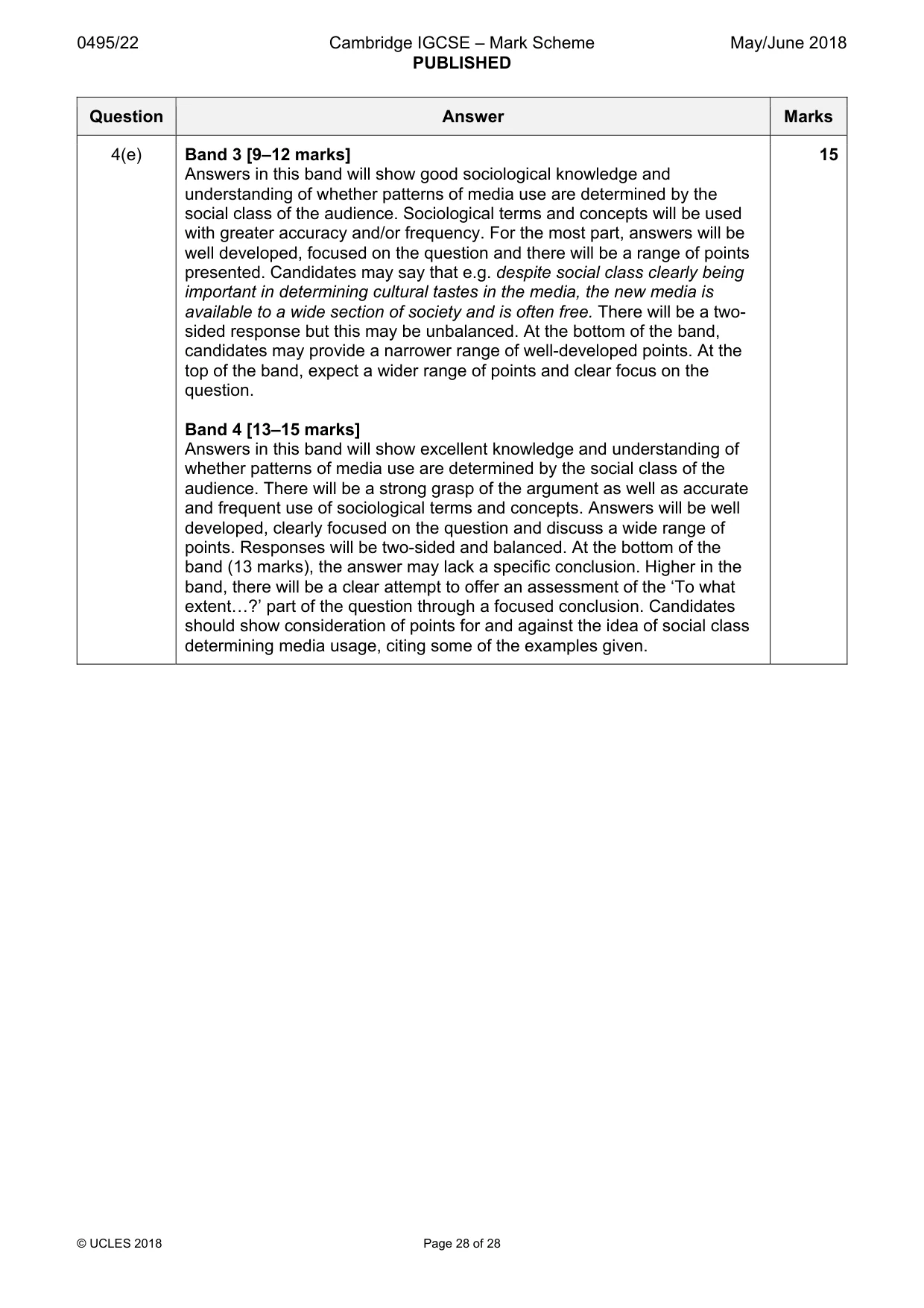
Mark scheme: 4(a) What is meant by the term ‘pluralist’? 2 One mark for partial definition, e.g. lots of choice. Two marks for clear definition, e.g. power in the media is spread amongst a wide variety of people. OR A belief that there is lots of choice in terms of content and viewpoint in the media. 4(b) Describe two examples of how the media can use propaganda to 4 influence the audience. Candidates will be expected to describe two examples of how the media can use propaganda to influence the audience. These could be examples of how propaganda is used or examples of when propaganda is used. Examples may focus generically on how the media can use propaganda or use specific examples to make a point. You may also see culturally specific examples reflecting the candidate’s own experiences of media and propaganda. Possible answers: • the media can be used to influence people's thoughts and actions through words, images, sound and messages; • state controlled media may present the government and its policies favourably; • state controlled media may present opposition parties and their policies unfavourably; • state controlled media may not report on events or issues that present the government in a bad light; • media can portray events in a one-sided even untrue way without allowing the audience access to alternative viewpoints; • in WW2 in Nazi Germany, Hitler used the media to demonise Jews, communists, etc. and so justify the holocaust; • The USA used Disney to make films for the American war effort against Nazi Germany; • Stalin's USSR had a cinema train that visited remote regions of the country in order to spread propaganda; • other reasonable response. One mark for each point correctly identified (up to maximum of two). One mark for each point that is developed (up to a maximum of two). 4(c) Explain how sociologists criticise the stereotypical representations of 6 some social groups in the media. Candidates are likely to talk about specific social groups who are stereotypically represented in the media in their responses i.e. ethnic minorities, women etc. They could also take a more general approach to the question. Possible answers: • stereotyping may invisibilise some social groups through such means as tokenism and under-representation; • stereotypical representations in the media are typically negative which can influence people to believe they are true in social life as well; • stereotypical representations of women as sex objects can lead to the formation of the 'male gaze' whereby men are almost encouraged to objectify women; • stereotypes tend to work through the idea of binary opposites that encourage people to think of some social groups as 'good' and some as 'bad' – this is very simplistic and often inaccurate; • according to models of media effects in which the audience are passive consumers, media stereotypes will be believed and acted upon in society; • stereotypical representations in the media can lead to racism/sexism/ageism and discrimination in society; • media representations may be the only knowledge of some social groups that the audience have therefore if they are portrayed stereotypically the audience will believe this to be true; • other reasonable response. Band 0 [0 marks] No creditworthy response. Band 1 [1–3 marks] Answers in this band will show only a limited awareness of criticisms of the media's stereotypical representations of some social groups. A tendency to description is likely. Responses may be short and un/under developed, e.g. they are negative stated without proper explanation. At the bottom of the band (1 mark), expect one weak point. Higher in the band (2–3 marks), candidates may offer more than one weak point, but there may be a tendency towards simplistic answers, engaging with sociological ideas without using sociological language. Band 2 [4–6 marks] A clear and accurate explanation, showing good sociological knowledge and understanding of criticisms of the media's stereotypical representations of some social groups. Sociological terms and concepts should be expected e.g. if the hypodermic model is correct, the audience are likely to believe the stereotypes they see in the media such as the idea that elderly people are a burden. This can then lead to prejudice and discrimination in society etc. This would be followed by explanation of factors leading to this. At the bottom of the band, the range of points covered may be narrow or lack detail. Higher in the band, answers will cover more than one factor in a well- developed way or cover several factors in less detail. 4(d) Explain why the hypodermic syringe model can be criticised. 8 Candidates need to show an understanding of what is meant by the hypodermic syringe model (direct model of media effects, immediate effects) and describe how it can be criticised. Some candidates may criticise the model through reference to other models of media effects, others may discuss specific criticisms of the hypodermic approach. Possible answers: • this model of media effects is very out dated and ignores the interactive nature of digital media today (postmodernism); • this model of media effects says that the audience are directly influenced by the media, it is more likely that media effects are indirect (two step flow model); • this model of media effects says that media influence is immediate, it is more likely that there is a 'drip-drip' cumulative effect on the audience (cultural effects); • this model fails to recognise that the audience are not passive and actively choose how they are affected by the media e.g. uses and gratifications model; • pluralists believe that the audience affect the media more than the media affects the audience; • much of the methodology used to evidence the hypodermic syringe model is thought to be flawed e.g. the bobo doll experiment lacking ecological validity; • other reasonable response. Band 0 [0 marks] No creditworthy response. Band 1 [1–3 marks] Answers in this band will show only a limited awareness of why the hypodermic syringe model can be criticised. A tendency to description is likely. Responses may be short and undeveloped, e.g. it's a very old theory stated without explanation. At the bottom of the band (1 mark), expect one weak point. Higher in the band (2–3 marks), candidates may offer more than one weak point. Band 2 [4–6 marks] Answers in this band will show basic sociological knowledge and understanding of why the hypodermic syringe model can be criticised. Responses may be underdeveloped and lacking in range, e.g. A lot of sociologists criticise the methods used by the hypodermic syringe model and so don't believe the results to be valid – the bobo doll experiment for example etc. At the bottom of the band, candidates are unlikely to use sociological terms and concepts accurately. Higher in the band, candidates may be beginning to use sociological terms and concepts with greater accuracy. However, some aspects of the answer may only be partially developed/explained. 4(d) Band 3 [7–8 marks] Answers in this band will show good sociological knowledge and understanding of criticisms of the media's stereotypical representations of some social groups and will be well developed and explained, e.g. The hypodermic syringe model is too simplistic in its approach. It is unlikely that the effects of the media are either immediate or direct and instead the process is far more complex than this. Today's media is interactive allowing the audience to influence its form and content and the hypodermic syringe model does not account for this. They can then expand on the explanation of this and other factors as necessary. Sociological terms and concepts will be used accurately overall. Answers will be well focused on the question and there will be a range of reasons presented. At the top of the band explanations will be clear throughout. 4(e) To what extent are patterns of media use determined by the social class of the audience. Candidates may link social class to money and discuss consumption patterns that link to this. They may also look at specific social classes and consider their patterns of media use. They would, in both cases, be expected to also consider how social class does not determine media usage and/or how other social factors may also be important. Possible answers: FOR: • the newspaper industry has been frequently linked with particular social classes. In the UK, for example, tabloids are linked with the lower social classes and broadsheets with the higher classes; • TV channels are said to produce mainstream, prime time shows such as soaps that appeal to the lower classes whereas more 'arty', niche programming appeals more to the higher classes; • many members of the working class subscribe to sports channels which provide football – a traditionally working class interest; • a digital divide may exist in many countries based on how much it costs to access and use new media – this is linked to social class; • cultural capital – the higher social classes are likely to use the media for different cultural pursuits i.e. arts, literature than the lower social classes (uses and gratifications – information/education rather than entertainment); • the middle class are often associated with consuming media products about current affairs (linked to their value of education), finance and politics; • the lower social classes are more likely in many countries to consume media products that support left wing political opinions, more right wing for the higher social classes; • the higher social classes are more likely to want 'hard news' and the lower social classes, 'soft'; • 'pay-for' media may be more heavily consumed by the higher social classes because of the economic capital needed to afford it; • other reasonable response. 4(e) AGAINST: 15 • Postmodernists believe that class is 'dead' therefore cannot affect consumption; new media consumption is unlikely to be defined by social class as content and access is often free therefore available to all social classes; • as social classes converge, so do the media products that they consume i.e. all social classes may now watch the soaps; • it is personal taste, not social class, that determines the media a person consumes; • it is gender not social class that determines media consumption; • it is age not social class that determines the media that is consumed; • it is ethnicity not social class that determines the media that a person consumes; • other reasonable response. Band 0 [0 marks] No creditworthy response. Band 1 [1–4 marks] Answers in this band may be vague and largely based on common sense showing limited knowledge of whether patterns of media use are determined by the social class of the audience. Use of sociological terms or concepts is very unlikely. Responses may be short, undeveloped and one-sided, e.g. people from different social classes choose different types of media. Lower in the band (1–2 marks), expect one or two weak points. Higher in the band (3–4 marks) candidates may offer more than two points or provide a weak definition of key terms, e.g. social class is how much money someone has, in the question. Band 2 [5–8 marks] In this band candidates will show some basic knowledge of whether patterns of media use are determined by the social class of the audience. Alternatively, they may offer an answer which is list-like in nature but there will be no real attempt to assess the issues raised by the question. There may be limited/some use of sociological terms or concepts. Responses may be underdeveloped and lack range. Answers may be simplistic and two- sided responses are unlikely e.g. Social class affects how much money you have and so this determines what media you might consume etc. Lower in the band, the response will be rather narrow in the points covered and there will be little development. Higher in the band, more points will be covered and there will be limited development of some points. Alternatively, a list-like answer with little development covering both sides of the argument may score up to 8 marks. A one-sided answer cannot score higher than 8 marks. 4(e) Band 3 [9–12 marks] 15 Answers in this band will show good sociological knowledge and understanding of whether patterns of media use are determined by the social class of the audience. Sociological terms and concepts will be used with greater accuracy and/or frequency. For the most part, answers will be well developed, focused on the question and there will be a range of points presented. Candidates may say that e.g. despite social class clearly being important in determining cultural tastes in the media, the new media is available to a wide section of society and is often free. There will be a two- sided response but this may be unbalanced. At the bottom of the band, candidates may provide a narrower range of well-developed points. At the top of the band, expect a wider range of points and clear focus on the question. Band 4 [13–15 marks] Answers in this band will show excellent knowledge and understanding of whether patterns of media use are determined by the social class of the audience. There will be a strong grasp of the argument as well as accurate and frequent use of sociological terms and concepts. Answers will be well developed, clearly focused on the question and discuss a wide range of points. Responses will be two-sided and balanced. At the bottom of the band (13 marks), the answer may lack a specific conclusion. Higher in the band, there will be a clear attempt to offer an assessment of the ‘To what extent«?’ part of the question through a focused conclusion. Candidates should show consideration of points for and against the idea of social class determining media usage, citing some of the examples given.
More questions on How do sociologists approach the study of society?
What was in this paper
The subtopics covered by these 4 questions, and how many questions each got. Open one in a new tab to see every Cambridge question on it.
What you needed in this session
Cambridge’s own grade thresholds for 2018 May/June, Paper 2 · Variant 2. A higher threshold means an easier paper — the bar moves with how the cohort did.