Cambridge IGCSE Sociology 0495 — 2017 Oct/Nov Paper 1 · Variant 2
0495/12/O/N/17 · 80 marks · ≈90 min
The question paper and its mark scheme, free to read here and free to download. This is Cambridge’s own paper, exactly as it was sat.
Question paper4 pages

Mark scheme17 pages
Answers below. Sit the paper first if you are practising.
Paper as text
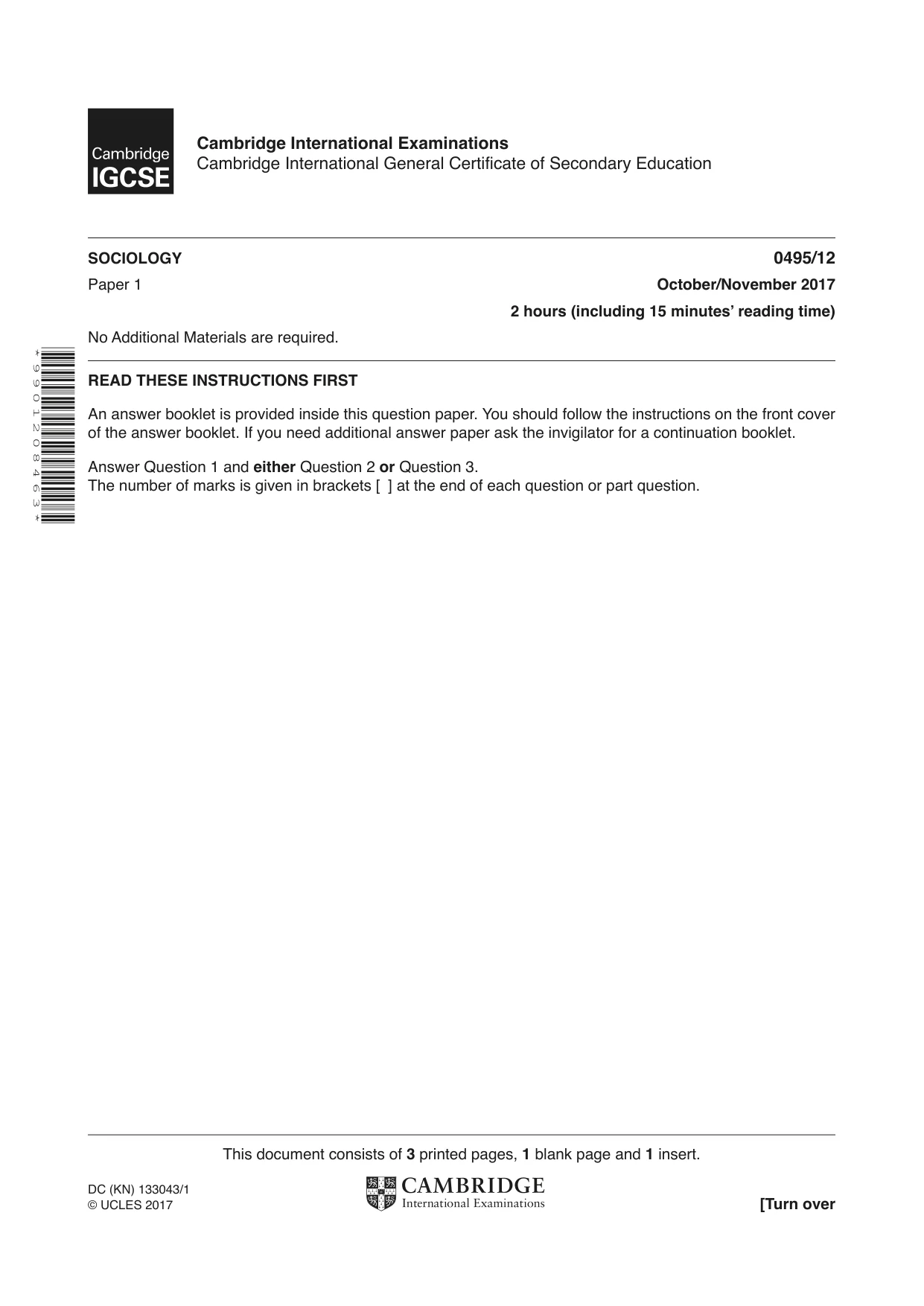
Question paper, page 1
This document consists of 3 printed pages, 1 blank page and 1 insert. DC (KN) 133043/1 © UCLES 2017 [Turn over Cambridge International Examinations Cambridge International General Certificate of Secondary Education * 9 9 0 1 2 0 8 4 6 3 * SOCIOLOGY 0495/12 Paper 1 October/November 2017 2 hours (including 15 minutes’ reading time) No Additional Materials are required. READ THESE INSTRUCTIONS FIRST An answer booklet is provided inside this question paper. You should follow the instructions on the front cover of the answer booklet. If you need additional answer paper ask the invigilator for a continuation booklet. Answer Question 1 and either Question 2 or Question 3. The number of marks is given in brackets [ ] at the end of each question or part question.
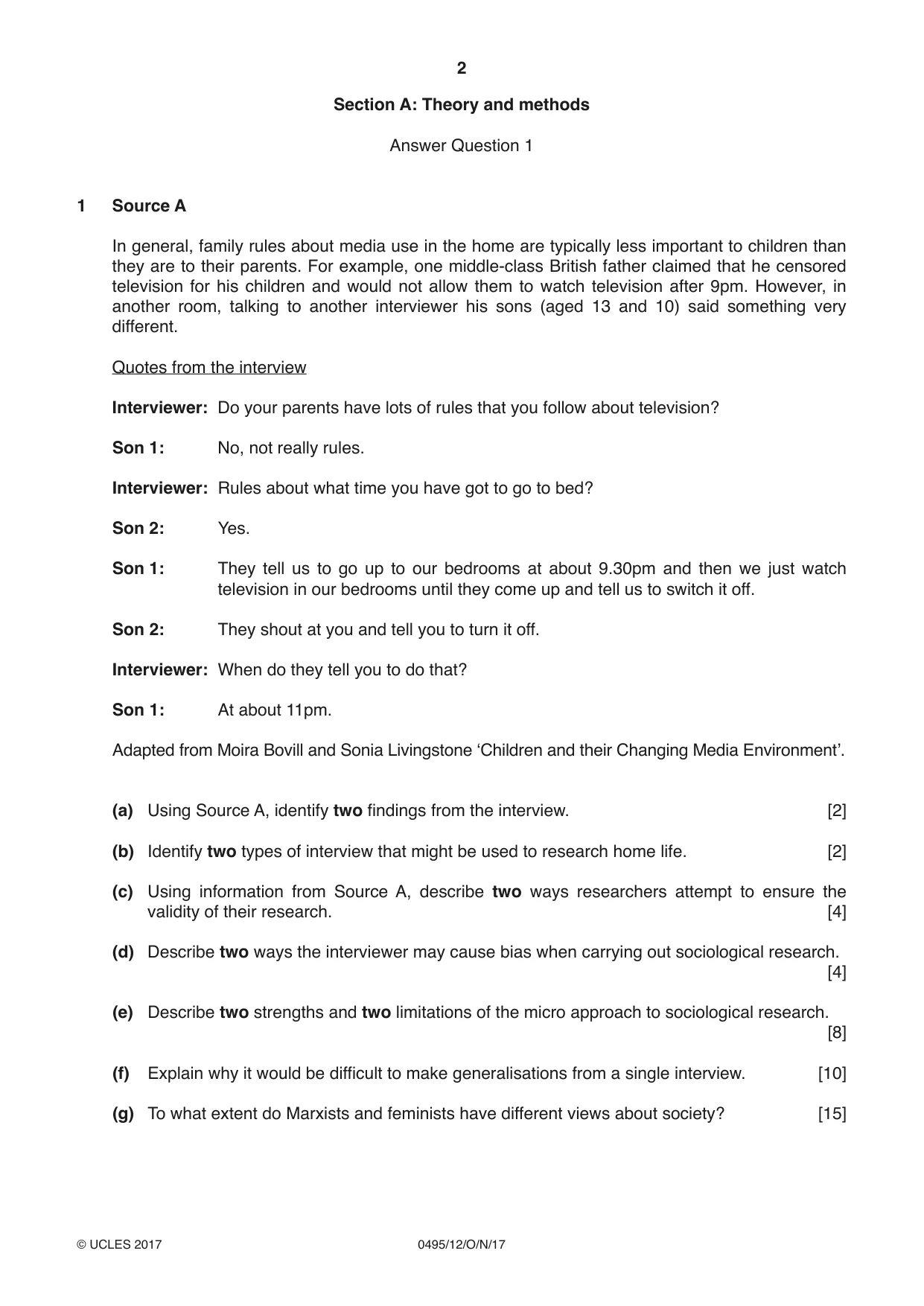
Question paper, page 2
2 0495/12/O/N/17 © UCLES 2017 Section A: Theory and methods Answer Question 1 1 Source A In general, family rules about media use in the home are typically less important to children than they are to their parents. For example, one middle-class British father claimed that he censored television for his children and would not allow them to watch television after 9pm. However, in another room, talking to another interviewer his sons (aged 13 and 10) said something very different. Quotes from the interview Interviewer: Do your parents have lots of rules that you follow about television? Son 1: No, not really rules. Interviewer: Rules about what time you have got to go to bed? Son 2: Yes. Son 1: They tell us to go up to our bedrooms at about 9.30pm and then we just watch television in our bedrooms until they come up and tell us to switch it off. Son 2: They shout at you and tell you to turn it off. Interviewer: When do they tell you to do that? Son 1: At about 11pm. Adapted from Moira Bovill and Sonia Livingstone ‘Children and their Changing Media Environment’. (a) Using Source A, identify two findings from the interview. [2] (b) Identify two types of interview that might be used to research home life. [2] (c) Using information from Source A, describe two ways researchers attempt to ensure the validity of their research. [4] (d) Describe two ways the interviewer may cause bias when carrying out sociological research. [4] (e) Describe two strengths and two limitations of the micro approach to sociological research. [8] (f) Explain why it would be difficult to make generalisations from a single interview. [10] (g) To what extent do Marxists and feminists have different views about society? [15]
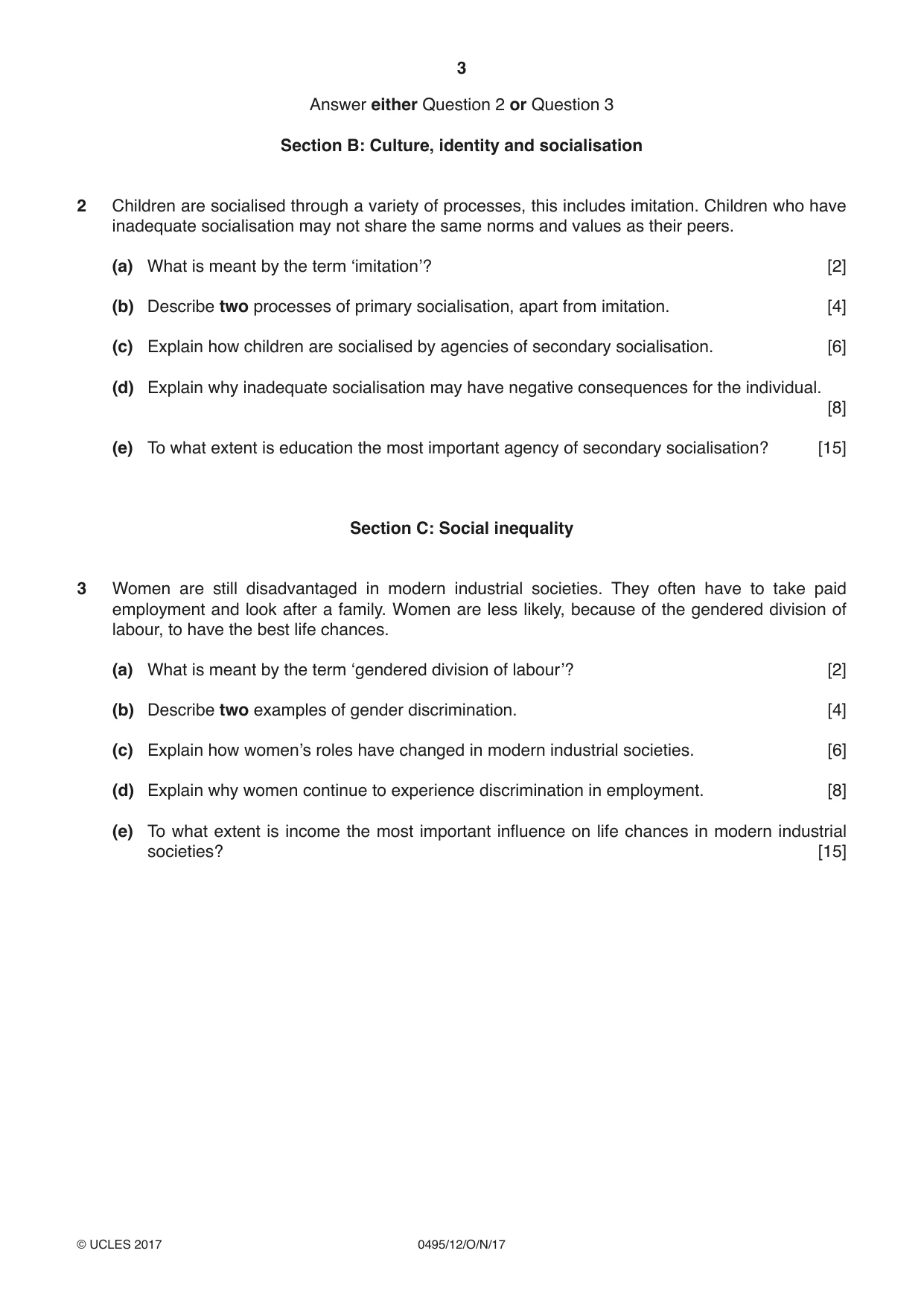
Question paper, page 3
3 0495/12/O/N/17 © UCLES 2017 Answer either Question 2 or Question 3 Section B: Culture, identity and socialisation 2 Children are socialised through a variety of processes, this includes imitation. Children who have inadequate socialisation may not share the same norms and values as their peers. (a) What is meant by the term ‘imitation’? [2] (b) Describe two processes of primary socialisation, apart from imitation. [4] (c) Explain how children are socialised by agencies of secondary socialisation. [6] (d) Explain why inadequate socialisation may have negative consequences for the individual. [8] (e) To what extent is education the most important agency of secondary socialisation? [15] Section C: Social inequality 3 Women are still disadvantaged in modern industrial societies. They often have to take paid employment and look after a family. Women are less likely, because of the gendered division of labour, to have the best life chances. (a) What is meant by the term ‘gendered division of labour’? [2] (b) Describe two examples of gender discrimination. [4] (c) Explain how women’s roles have changed in modern industrial societies. [6] (d) Explain why women continue to experience discrimination in employment. [8] (e) To what extent is income the most important influence on life chances in modern industrial societies? [15]
Question paper, page 4
4 0495/12/O/N/17 © UCLES 2017 BLANK PAGE Permission to reproduce items where third-party owned material protected by copyright is included has been sought and cleared where possible. Every reasonable effort has been made by the publisher (UCLES) to trace copyright holders, but if any items requiring clearance have unwittingly been included, the publisher will be pleased to make amends at the earliest possible opportunity. To avoid the issue of disclosure of answer-related information to candidates, all copyright acknowledgements are reproduced online in the Cambridge International Examinations Copyright Acknowledgements Booklet. This is produced for each series of examinations and is freely available to download at www.cie.org.uk after the live examination series. Cambridge International Examinations is part of the Cambridge Assessment Group. Cambridge Assessment is the brand name of University of Cambridge Local Examinations Syndicate (UCLES), which is itself a department of the University of Cambridge.
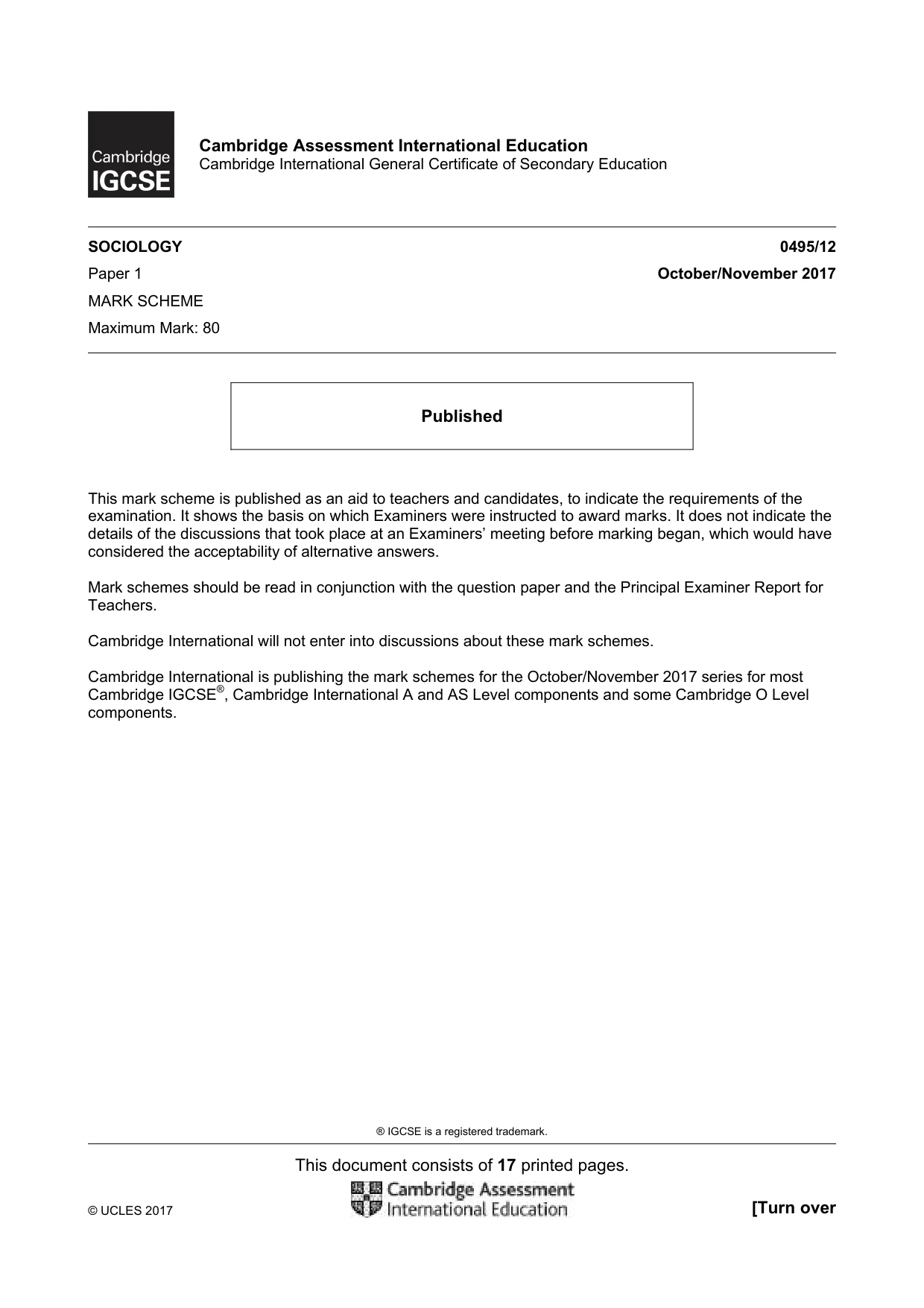
Mark scheme, page 1
® IGCSE is a registered trademark. This document consists of 17 printed pages. © UCLES 2017 [Turn over Cambridge Assessment International Education Cambridge International General Certificate of Secondary Education SOCIOLOGY 0495/12 Paper 1 October/November 2017 MARK SCHEME Maximum Mark: 80 Published This mark scheme is published as an aid to teachers and candidates, to indicate the requirements of the examination. It shows the basis on which Examiners were instructed to award marks. It does not indicate the details of the discussions that took place at an Examiners’ meeting before marking began, which would have considered the acceptability of alternative answers. Mark schemes should be read in conjunction with the question paper and the Principal Examiner Report for Teachers. Cambridge International will not enter into discussions about these mark schemes. Cambridge International is publishing the mark schemes for the October/November 2017 series for most Cambridge IGCSE®, Cambridge International A and AS Level components and some Cambridge O Level components.
Mark scheme, page 2
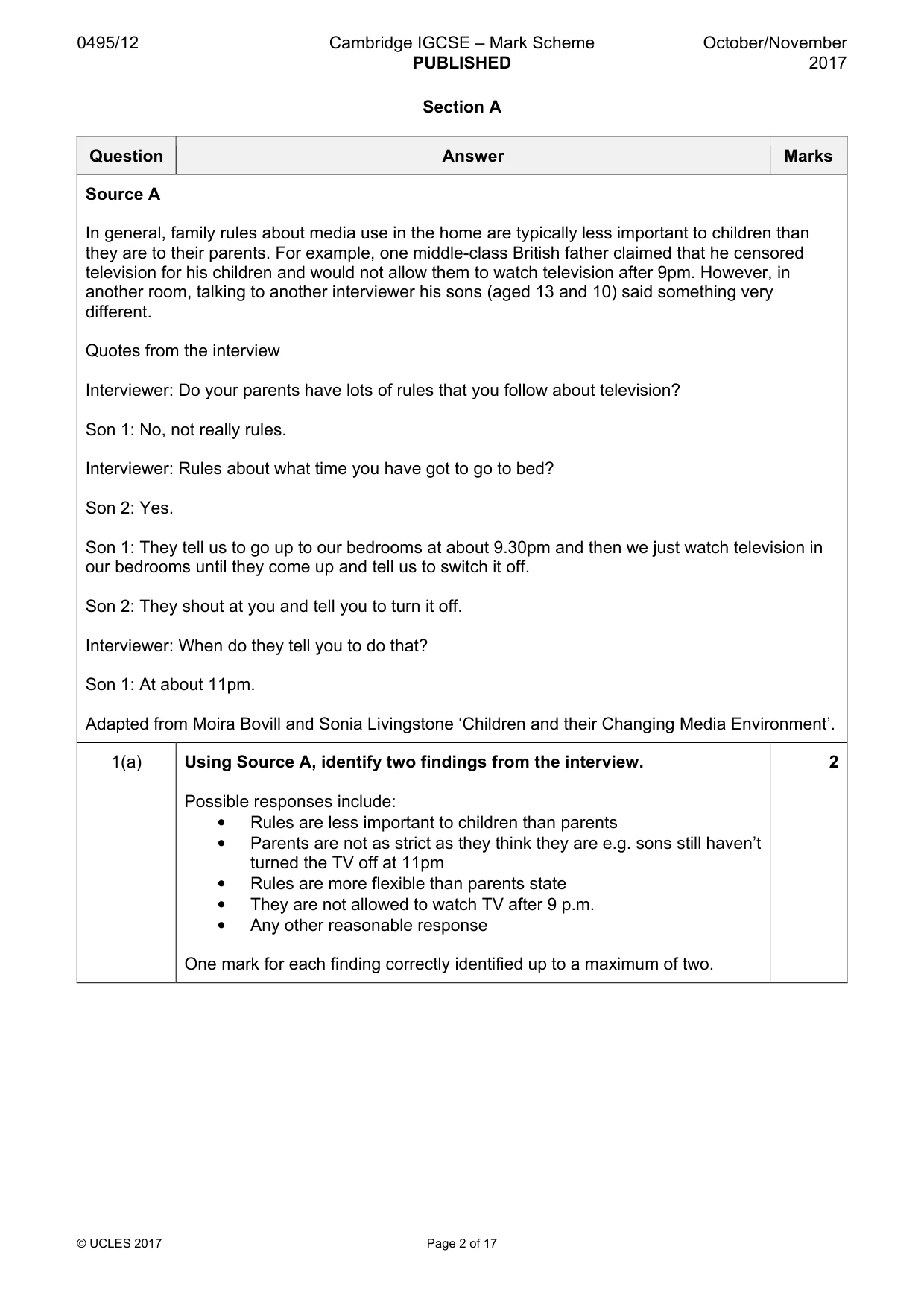
0495/12 Cambridge IGCSE – Mark Scheme PUBLISHED October/November 2017 © UCLES 2017 Page 2 of 17 Section A Question Answer Marks Source A In general, family rules about media use in the home are typically less important to children than they are to their parents. For example, one middle-class British father claimed that he censored television for his children and would not allow them to watch television after 9pm. However, in another room, talking to another interviewer his sons (aged 13 and 10) said something very different. Quotes from the interview Interviewer: Do your parents have lots of rules that you follow about television? Son 1: No, not really rules. Interviewer: Rules about what time you have got to go to bed? Son 2: Yes. Son 1: They tell us to go up to our bedrooms at about 9.30pm and then we just watch television in our bedrooms until they come up and tell us to switch it off. Son 2: They shout at you and tell you to turn it off. Interviewer: When do they tell you to do that? Son 1: At about 11pm. Adapted from Moira Bovill and Sonia Livingstone ‘Children and their Changing Media Environment’. 1(a) Using Source A, identify two findings from the interview. Possible responses include: • Rules are less important to children than parents • Parents are not as strict as they think they are e.g. sons still haven’t turned the TV off at 11pm • Rules are more flexible than parents state • They are not allowed to watch TV after 9 p.m. • Any other reasonable response One mark for each finding correctly identified up to a maximum of two. 2
Mark scheme, page 3
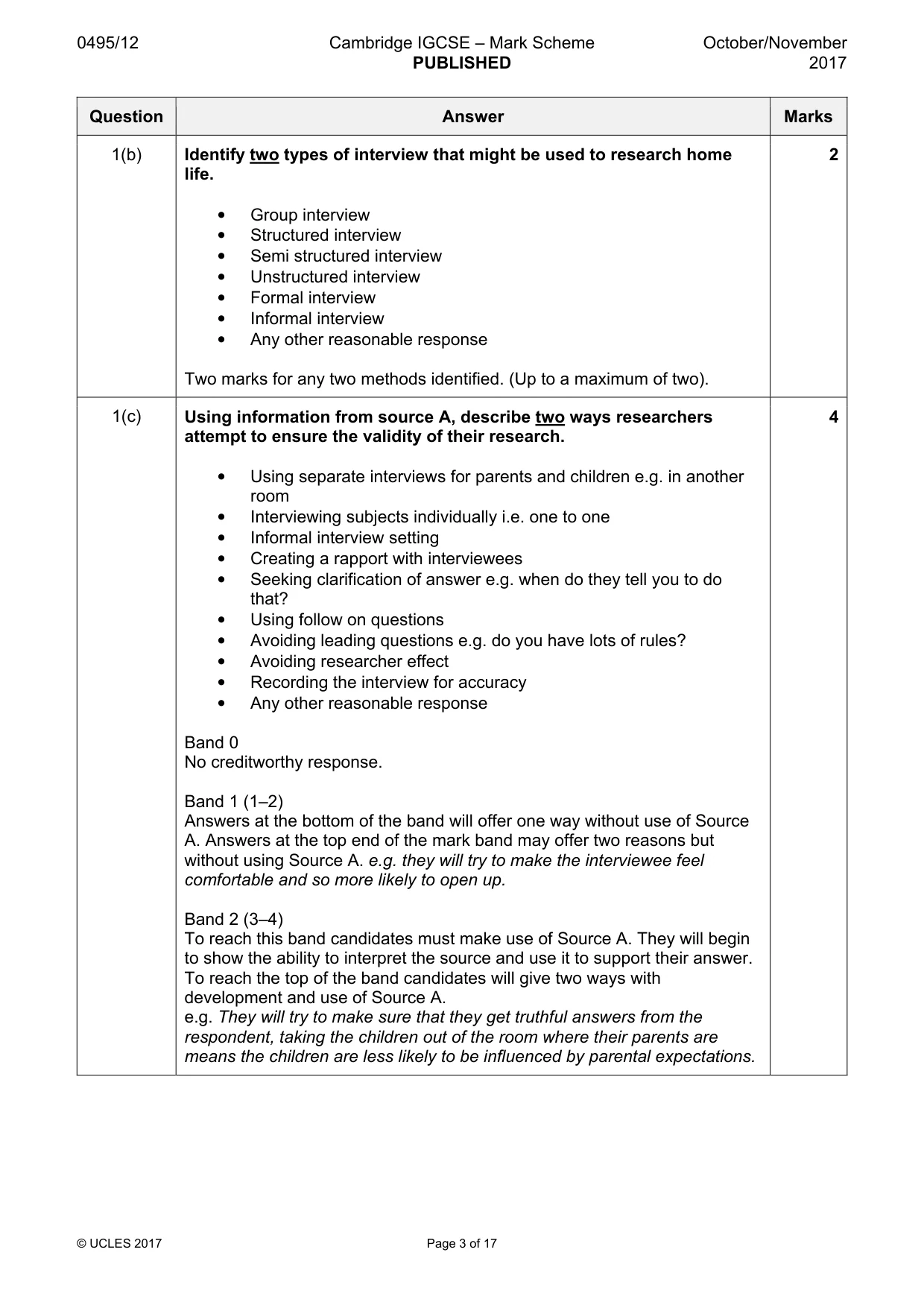
0495/12 Cambridge IGCSE – Mark Scheme PUBLISHED October/November 2017 © UCLES 2017 Page 3 of 17 Question Answer Marks 1(b) Identify two types of interview that might be used to research home life. • Group interview • Structured interview • Semi structured interview • Unstructured interview • Formal interview • Informal interview • Any other reasonable response Two marks for any two methods identified. (Up to a maximum of two). 2 1(c) Using information from source A, describe two ways researchers attempt to ensure the validity of their research. • Using separate interviews for parents and children e.g. in another room • Interviewing subjects individually i.e. one to one • Informal interview setting • Creating a rapport with interviewees • Seeking clarification of answer e.g. when do they tell you to do that? • Using follow on questions • Avoiding leading questions e.g. do you have lots of rules? • Avoiding researcher effect • Recording the interview for accuracy • Any other reasonable response Band 0 No creditworthy response. Band 1 (1–2) Answers at the bottom of the band will offer one way without use of Source A. Answers at the top end of the mark band may offer two reasons but without using Source A. e.g. they will try to make the interviewee feel comfortable and so more likely to open up. Band 2 (3–4) To reach this band candidates must make use of Source A. They will begin to show the ability to interpret the source and use it to support their answer. To reach the top of the band candidates will give two ways with development and use of Source A. e.g. They will try to make sure that they get truthful answers from the respondent, taking the children out of the room where their parents are means the children are less likely to be influenced by parental expectations. 4
Mark scheme, page 4
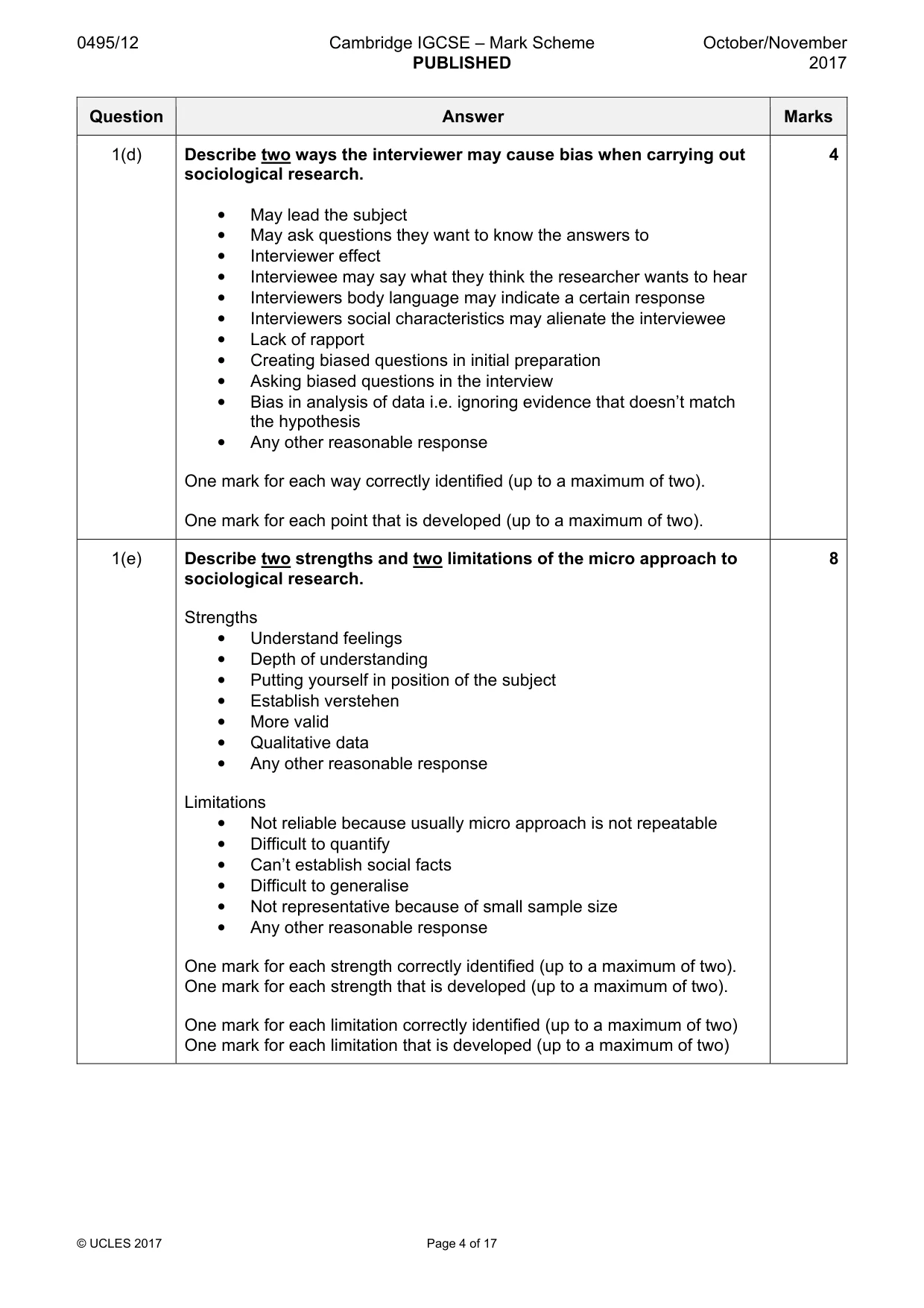
0495/12 Cambridge IGCSE – Mark Scheme PUBLISHED October/November 2017 © UCLES 2017 Page 4 of 17 Question Answer Marks 1(d) Describe two ways the interviewer may cause bias when carrying out sociological research. • May lead the subject • May ask questions they want to know the answers to • Interviewer effect • Interviewee may say what they think the researcher wants to hear • Interviewers body language may indicate a certain response • Interviewers social characteristics may alienate the interviewee • Lack of rapport • Creating biased questions in initial preparation • Asking biased questions in the interview • Bias in analysis of data i.e. ignoring evidence that doesn’t match the hypothesis • Any other reasonable response One mark for each way correctly identified (up to a maximum of two). One mark for each point that is developed (up to a maximum of two). 4 1(e) Describe two strengths and two limitations of the micro approach to sociological research. Strengths • Understand feelings • Depth of understanding • Putting yourself in position of the subject • Establish verstehen • More valid • Qualitative data • Any other reasonable response Limitations • Not reliable because usually micro approach is not repeatable • Difficult to quantify • Can’t establish social facts • Difficult to generalise • Not representative because of small sample size • Any other reasonable response One mark for each strength correctly identified (up to a maximum of two). One mark for each strength that is developed (up to a maximum of two). One mark for each limitation correctly identified (up to a maximum of two) One mark for each limitation that is developed (up to a maximum of two) 8
Mark scheme, page 5
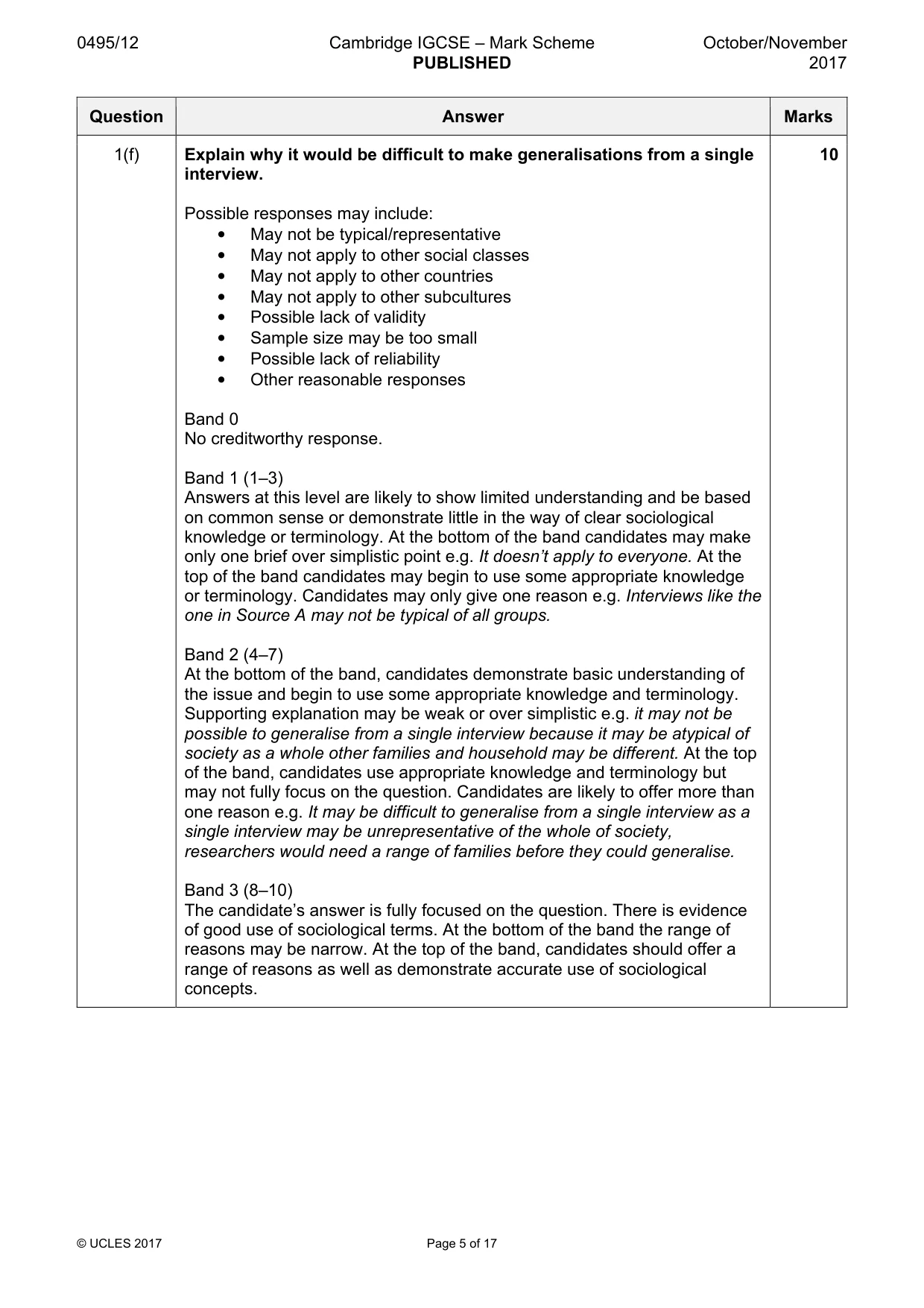
0495/12 Cambridge IGCSE – Mark Scheme PUBLISHED October/November 2017 © UCLES 2017 Page 5 of 17 Question Answer Marks 1(f) Explain why it would be difficult to make generalisations from a single interview. Possible responses may include: • May not be typical/representative • May not apply to other social classes • May not apply to other countries • May not apply to other subcultures • Possible lack of validity • Sample size may be too small • Possible lack of reliability • Other reasonable responses Band 0 No creditworthy response. Band 1 (1–3) Answers at this level are likely to show limited understanding and be based on common sense or demonstrate little in the way of clear sociological knowledge or terminology. At the bottom of the band candidates may make only one brief over simplistic point e.g. It doesn’t apply to everyone. At the top of the band candidates may begin to use some appropriate knowledge or terminology. Candidates may only give one reason e.g. Interviews like the one in Source A may not be typical of all groups. Band 2 (4–7) At the bottom of the band, candidates demonstrate basic understanding of the issue and begin to use some appropriate knowledge and terminology. Supporting explanation may be weak or over simplistic e.g. it may not be possible to generalise from a single interview because it may be atypical of society as a whole other families and household may be different. At the top of the band, candidates use appropriate knowledge and terminology but may not fully focus on the question. Candidates are likely to offer more than one reason e.g. It may be difficult to generalise from a single interview as a single interview may be unrepresentative of the whole of society, researchers would need a range of families before they could generalise. Band 3 (8–10) The candidate’s answer is fully focused on the question. There is evidence of good use of sociological terms. At the bottom of the band the range of reasons may be narrow. At the top of the band, candidates should offer a range of reasons as well as demonstrate accurate use of sociological concepts. 10
Mark scheme, page 6
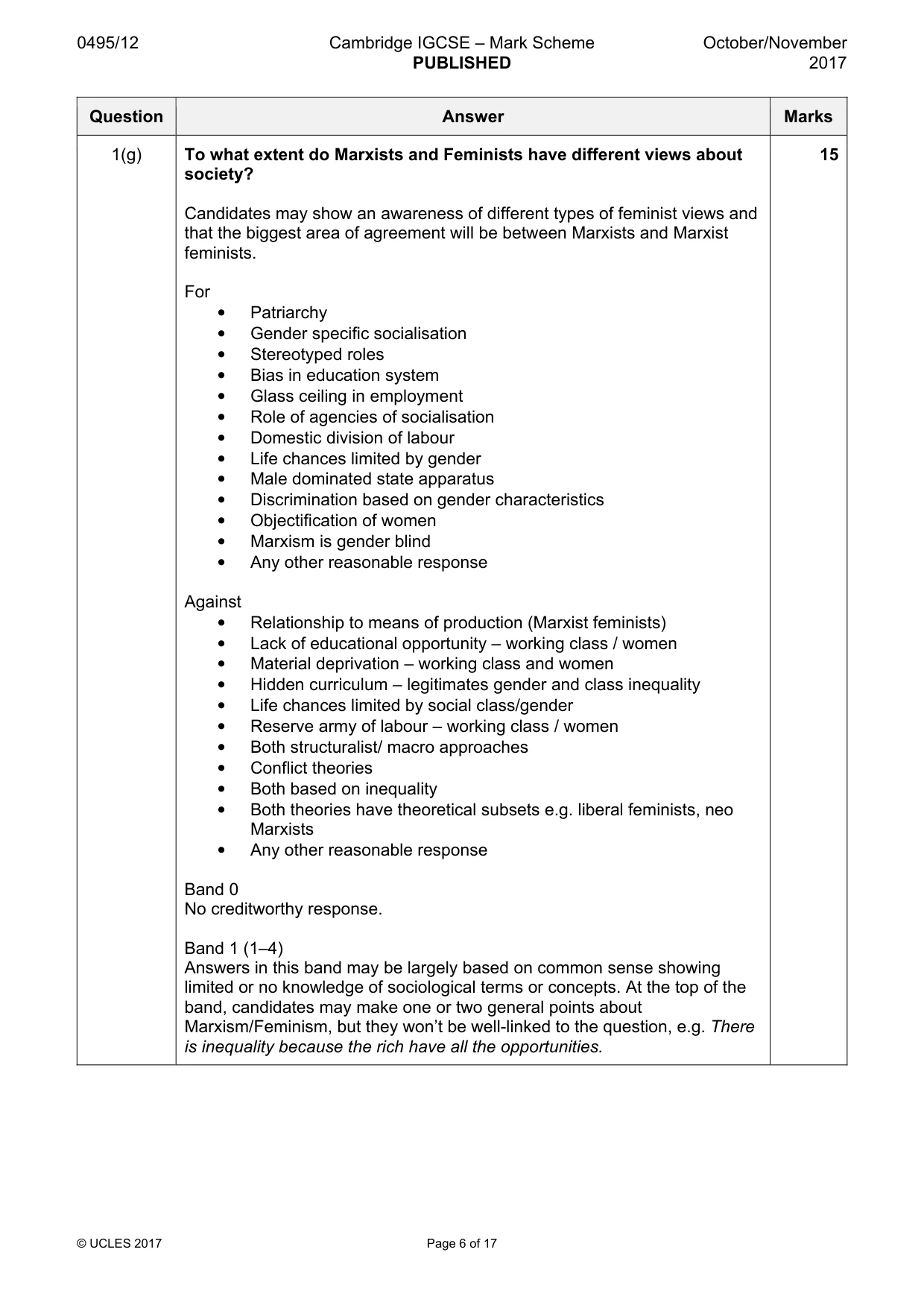
0495/12 Cambridge IGCSE – Mark Scheme PUBLISHED October/November 2017 © UCLES 2017 Page 6 of 17 Question Answer Marks 1(g) To what extent do Marxists and Feminists have different views about society? Candidates may show an awareness of different types of feminist views and that the biggest area of agreement will be between Marxists and Marxist feminists. For • Patriarchy • Gender specific socialisation • Stereotyped roles • Bias in education system • Glass ceiling in employment • Role of agencies of socialisation • Domestic division of labour • Life chances limited by gender • Male dominated state apparatus • Discrimination based on gender characteristics • Objectification of women • Marxism is gender blind • Any other reasonable response Against • Relationship to means of production (Marxist feminists) • Lack of educational opportunity – working class / women • Material deprivation – working class and women • Hidden curriculum – legitimates gender and class inequality • Life chances limited by social class/gender • Reserve army of labour – working class / women • Both structuralist/ macro approaches • Conflict theories • Both based on inequality • Both theories have theoretical subsets e.g. liberal feminists, neo Marxists • Any other reasonable response Band 0 No creditworthy response. Band 1 (1–4) Answers in this band may be largely based on common sense showing limited or no knowledge of sociological terms or concepts. At the top of the band, candidates may make one or two general points about Marxism/Feminism, but they won’t be well-linked to the question, e.g. There is inequality because the rich have all the opportunities. 15
Mark scheme, page 7
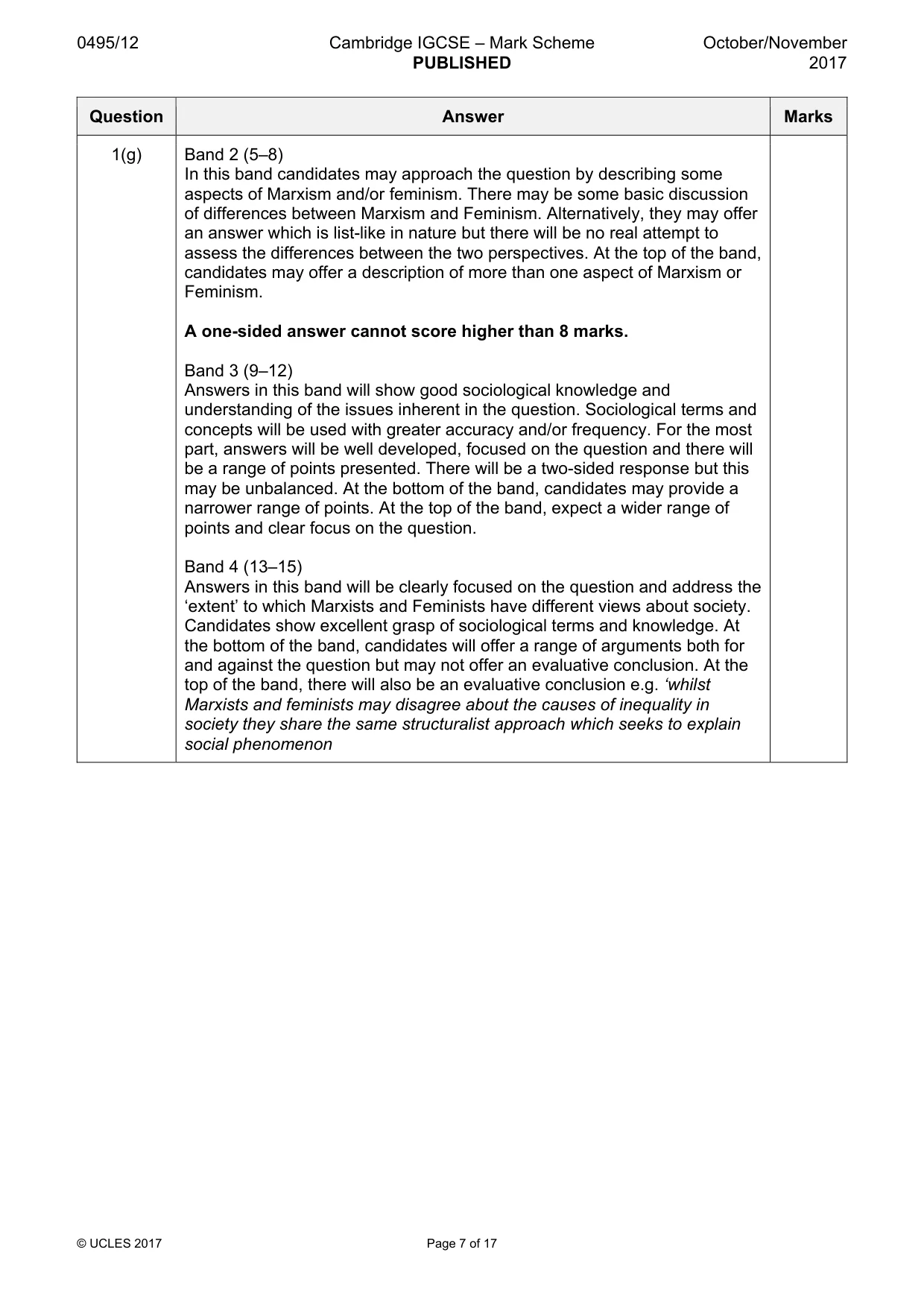
0495/12 Cambridge IGCSE – Mark Scheme PUBLISHED October/November 2017 © UCLES 2017 Page 7 of 17 Question Answer Marks 1(g) Band 2 (5–8) In this band candidates may approach the question by describing some aspects of Marxism and/or feminism. There may be some basic discussion of differences between Marxism and Feminism. Alternatively, they may offer an answer which is list-like in nature but there will be no real attempt to assess the differences between the two perspectives. At the top of the band, candidates may offer a description of more than one aspect of Marxism or Feminism. A one-sided answer cannot score higher than 8 marks. Band 3 (9–12) Answers in this band will show good sociological knowledge and understanding of the issues inherent in the question. Sociological terms and concepts will be used with greater accuracy and/or frequency. For the most part, answers will be well developed, focused on the question and there will be a range of points presented. There will be a two-sided response but this may be unbalanced. At the bottom of the band, candidates may provide a narrower range of points. At the top of the band, expect a wider range of points and clear focus on the question. Band 4 (13–15) Answers in this band will be clearly focused on the question and address the ‘extent’ to which Marxists and Feminists have different views about society. Candidates show excellent grasp of sociological terms and knowledge. At the bottom of the band, candidates will offer a range of arguments both for and against the question but may not offer an evaluative conclusion. At the top of the band, there will also be an evaluative conclusion e.g. ‘whilst Marxists and feminists may disagree about the causes of inequality in society they share the same structuralist approach which seeks to explain social phenomenon
Mark scheme, page 8
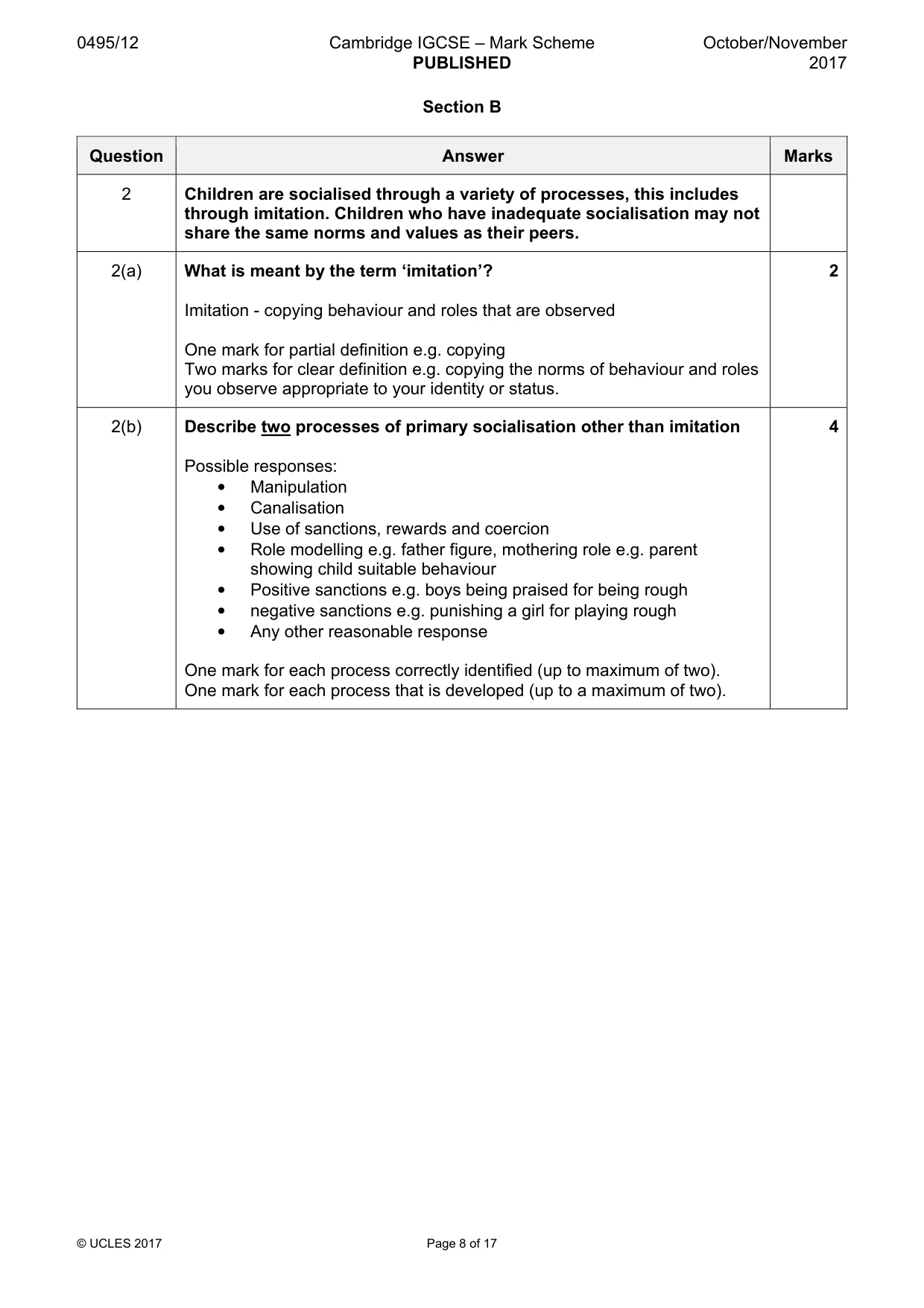
0495/12 Cambridge IGCSE – Mark Scheme PUBLISHED October/November 2017 © UCLES 2017 Page 8 of 17 Section B Question Answer Marks 2 Children are socialised through a variety of processes, this includes through imitation. Children who have inadequate socialisation may not share the same norms and values as their peers. 2(a) What is meant by the term ‘imitation’? Imitation - copying behaviour and roles that are observed One mark for partial definition e.g. copying Two marks for clear definition e.g. copying the norms of behaviour and roles you observe appropriate to your identity or status. 2 2(b) Describe two processes of primary socialisation other than imitation Possible responses: • Manipulation • Canalisation • Use of sanctions, rewards and coercion • Role modelling e.g. father figure, mothering role e.g. parent showing child suitable behaviour • Positive sanctions e.g. boys being praised for being rough • negative sanctions e.g. punishing a girl for playing rough • Any other reasonable response One mark for each process correctly identified (up to maximum of two). One mark for each process that is developed (up to a maximum of two). 4
Mark scheme, page 9
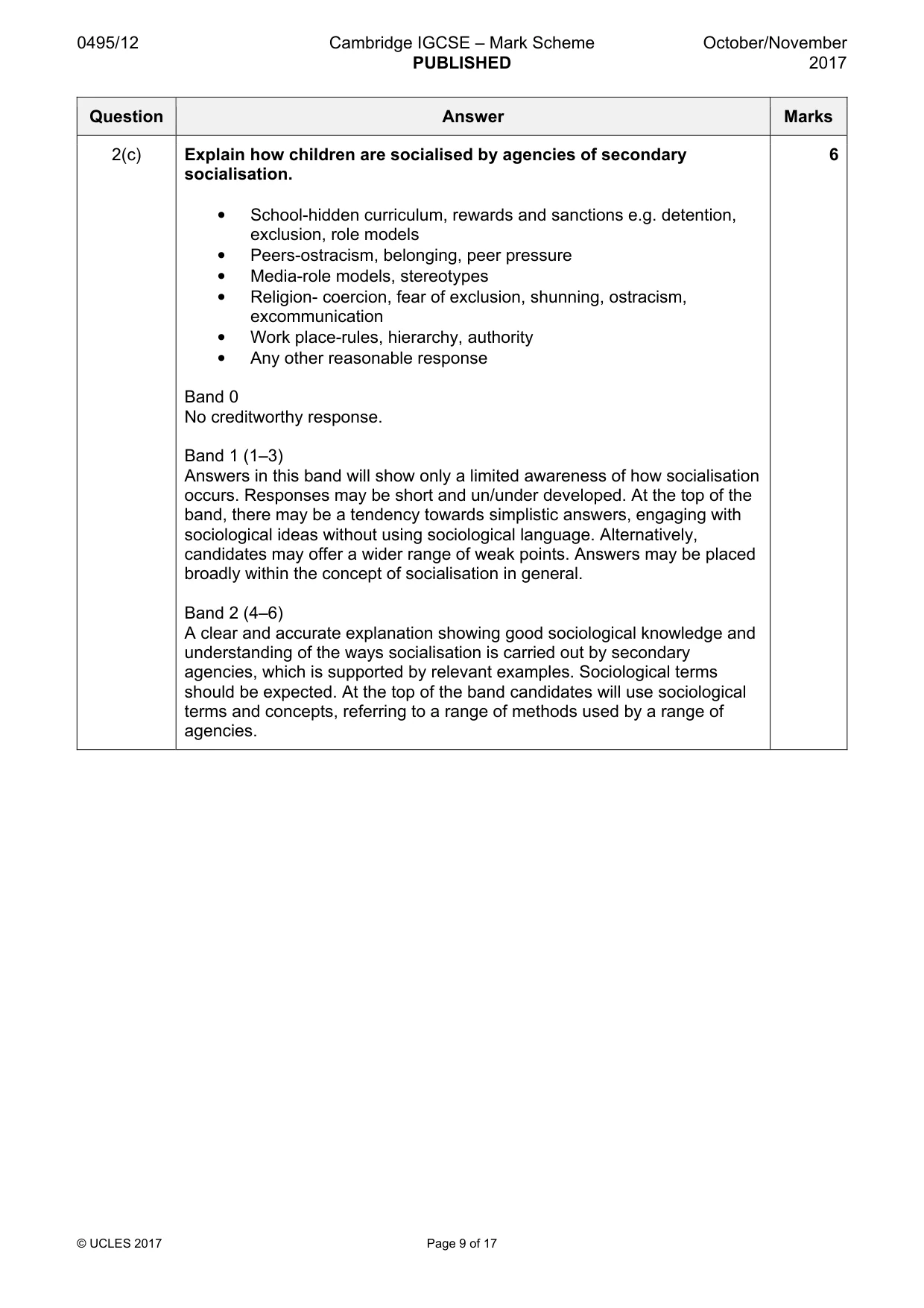
0495/12 Cambridge IGCSE – Mark Scheme PUBLISHED October/November 2017 © UCLES 2017 Page 9 of 17 Question Answer Marks 2(c) Explain how children are socialised by agencies of secondary socialisation. • School-hidden curriculum, rewards and sanctions e.g. detention, exclusion, role models • Peers-ostracism, belonging, peer pressure • Media-role models, stereotypes • Religion- coercion, fear of exclusion, shunning, ostracism, excommunication • Work place-rules, hierarchy, authority • Any other reasonable response Band 0 No creditworthy response. Band 1 (1–3) Answers in this band will show only a limited awareness of how socialisation occurs. Responses may be short and un/under developed. At the top of the band, there may be a tendency towards simplistic answers, engaging with sociological ideas without using sociological language. Alternatively, candidates may offer a wider range of weak points. Answers may be placed broadly within the concept of socialisation in general. Band 2 (4–6) A clear and accurate explanation showing good sociological knowledge and understanding of the ways socialisation is carried out by secondary agencies, which is supported by relevant examples. Sociological terms should be expected. At the top of the band candidates will use sociological terms and concepts, referring to a range of methods used by a range of agencies. 6
Mark scheme, page 10
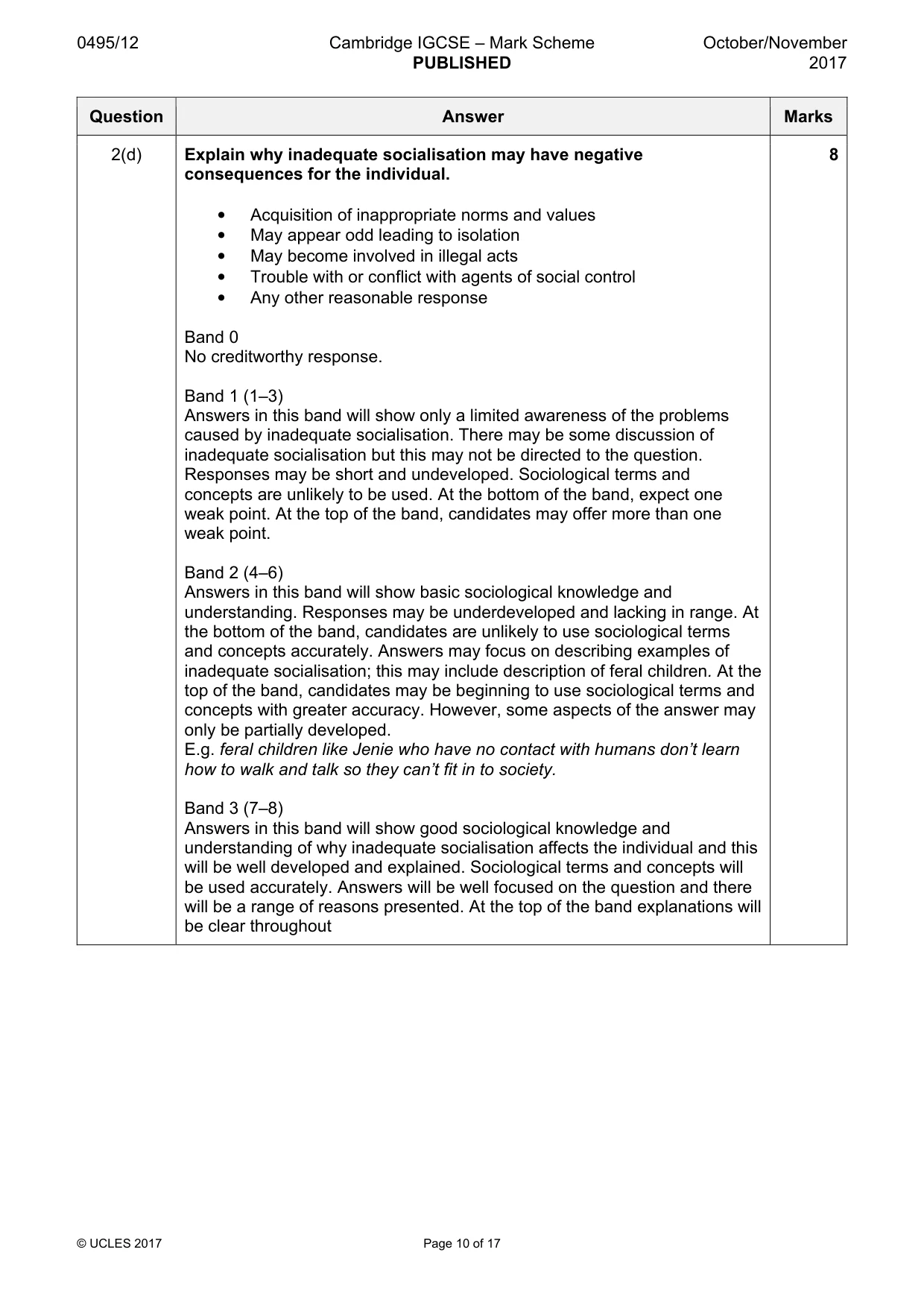
0495/12 Cambridge IGCSE – Mark Scheme PUBLISHED October/November 2017 © UCLES 2017 Page 10 of 17 Question Answer Marks 2(d) Explain why inadequate socialisation may have negative consequences for the individual. • Acquisition of inappropriate norms and values • May appear odd leading to isolation • May become involved in illegal acts • Trouble with or conflict with agents of social control • Any other reasonable response Band 0 No creditworthy response. Band 1 (1–3) Answers in this band will show only a limited awareness of the problems caused by inadequate socialisation. There may be some discussion of inadequate socialisation but this may not be directed to the question. Responses may be short and undeveloped. Sociological terms and concepts are unlikely to be used. At the bottom of the band, expect one weak point. At the top of the band, candidates may offer more than one weak point. Band 2 (4–6) Answers in this band will show basic sociological knowledge and understanding. Responses may be underdeveloped and lacking in range. At the bottom of the band, candidates are unlikely to use sociological terms and concepts accurately. Answers may focus on describing examples of inadequate socialisation; this may include description of feral children. At the top of the band, candidates may be beginning to use sociological terms and concepts with greater accuracy. However, some aspects of the answer may only be partially developed. E.g. feral children like Jenie who have no contact with humans don’t learn how to walk and talk so they can’t fit in to society. Band 3 (7–8) Answers in this band will show good sociological knowledge and understanding of why inadequate socialisation affects the individual and this will be well developed and explained. Sociological terms and concepts will be used accurately. Answers will be well focused on the question and there will be a range of reasons presented. At the top of the band explanations will be clear throughout 8
Mark scheme, page 11
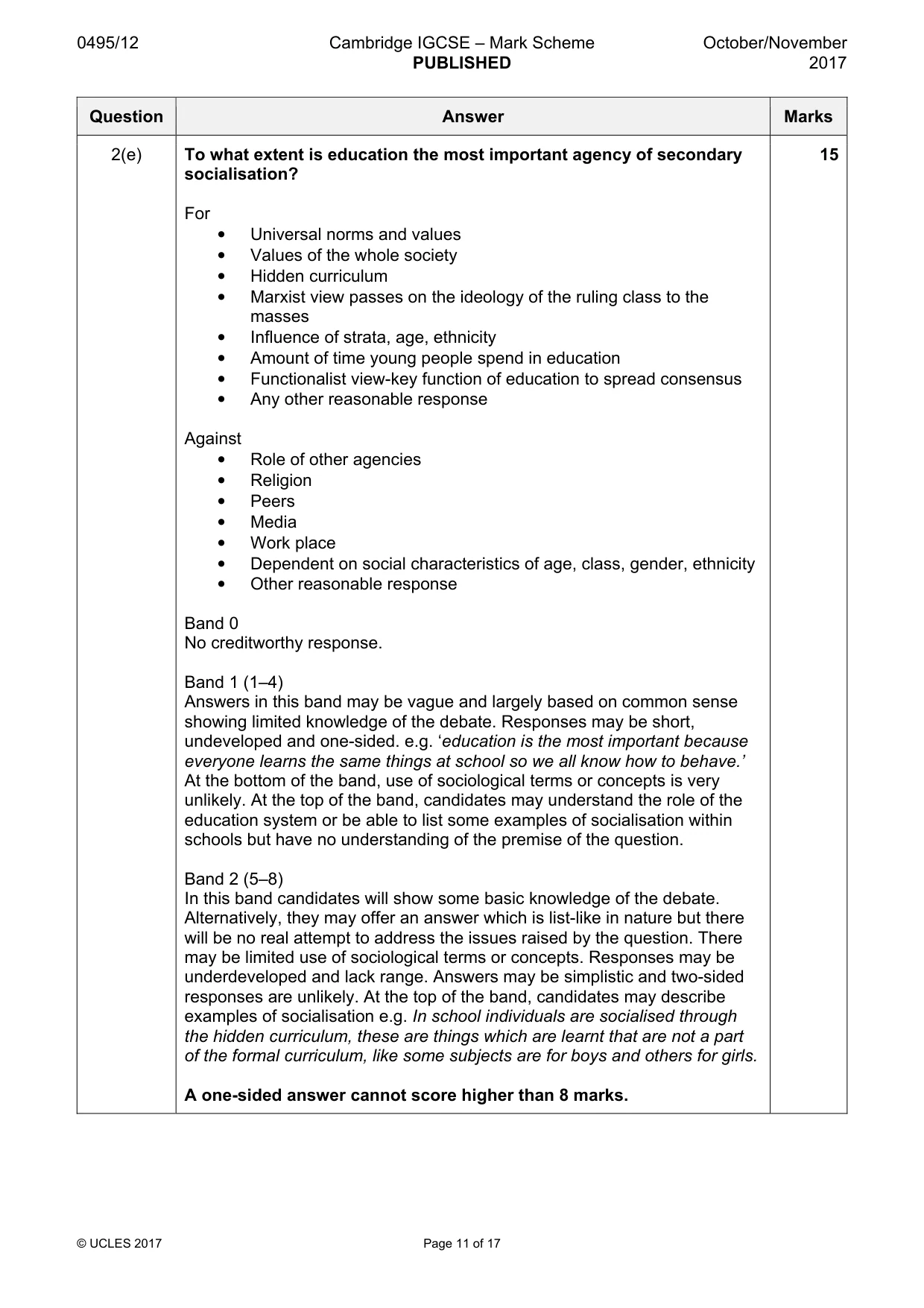
0495/12 Cambridge IGCSE – Mark Scheme PUBLISHED October/November 2017 © UCLES 2017 Page 11 of 17 Question Answer Marks 2(e) To what extent is education the most important agency of secondary socialisation? For • Universal norms and values • Values of the whole society • Hidden curriculum • Marxist view passes on the ideology of the ruling class to the masses • Influence of strata, age, ethnicity • Amount of time young people spend in education • Functionalist view-key function of education to spread consensus • Any other reasonable response Against • Role of other agencies • Religion • Peers • Media • Work place • Dependent on social characteristics of age, class, gender, ethnicity • Other reasonable response Band 0 No creditworthy response. Band 1 (1–4) Answers in this band may be vague and largely based on common sense showing limited knowledge of the debate. Responses may be short, undeveloped and one-sided. e.g. ‘education is the most important because everyone learns the same things at school so we all know how to behave.’ At the bottom of the band, use of sociological terms or concepts is very unlikely. At the top of the band, candidates may understand the role of the education system or be able to list some examples of socialisation within schools but have no understanding of the premise of the question. Band 2 (5–8) In this band candidates will show some basic knowledge of the debate. Alternatively, they may offer an answer which is list-like in nature but there will be no real attempt to address the issues raised by the question. There may be limited use of sociological terms or concepts. Responses may be underdeveloped and lack range. Answers may be simplistic and two-sided responses are unlikely. At the top of the band, candidates may describe examples of socialisation e.g. In school individuals are socialised through the hidden curriculum, these are things which are learnt that are not a part of the formal curriculum, like some subjects are for boys and others for girls. A one-sided answer cannot score higher than 8 marks. 15
Mark scheme, page 12
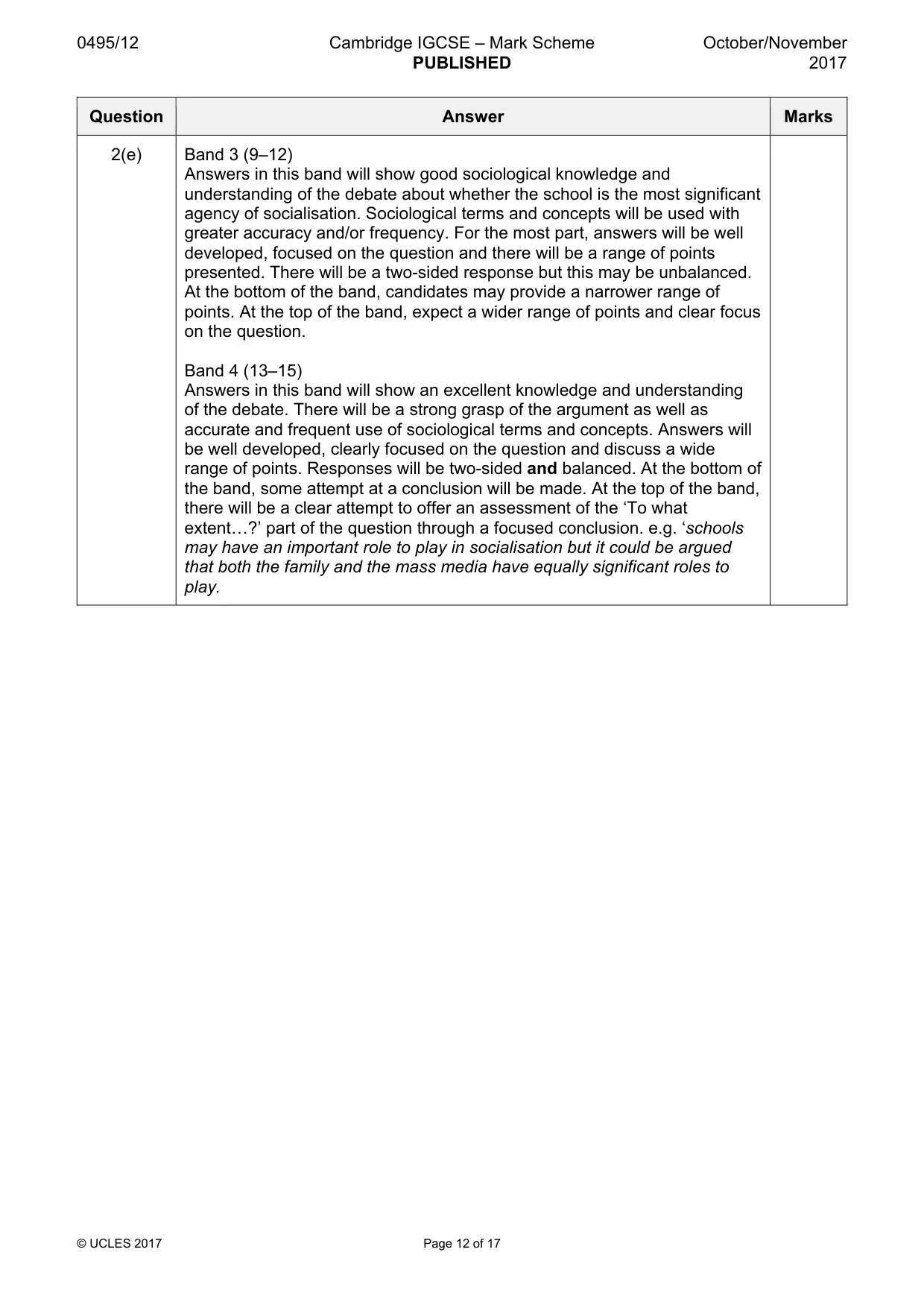
0495/12 Cambridge IGCSE – Mark Scheme PUBLISHED October/November 2017 © UCLES 2017 Page 12 of 17 Question Answer Marks 2(e) Band 3 (9–12) Answers in this band will show good sociological knowledge and understanding of the debate about whether the school is the most significant agency of socialisation. Sociological terms and concepts will be used with greater accuracy and/or frequency. For the most part, answers will be well developed, focused on the question and there will be a range of points presented. There will be a two-sided response but this may be unbalanced. At the bottom of the band, candidates may provide a narrower range of points. At the top of the band, expect a wider range of points and clear focus on the question. Band 4 (13–15) Answers in this band will show an excellent knowledge and understanding of the debate. There will be a strong grasp of the argument as well as accurate and frequent use of sociological terms and concepts. Answers will be well developed, clearly focused on the question and discuss a wide range of points. Responses will be two-sided and balanced. At the bottom of the band, some attempt at a conclusion will be made. At the top of the band, there will be a clear attempt to offer an assessment of the ‘To what extent«?’ part of the question through a focused conclusion. e.g. ‘schools may have an important role to play in socialisation but it could be argued that both the family and the mass media have equally significant roles to play.
Mark scheme, page 13
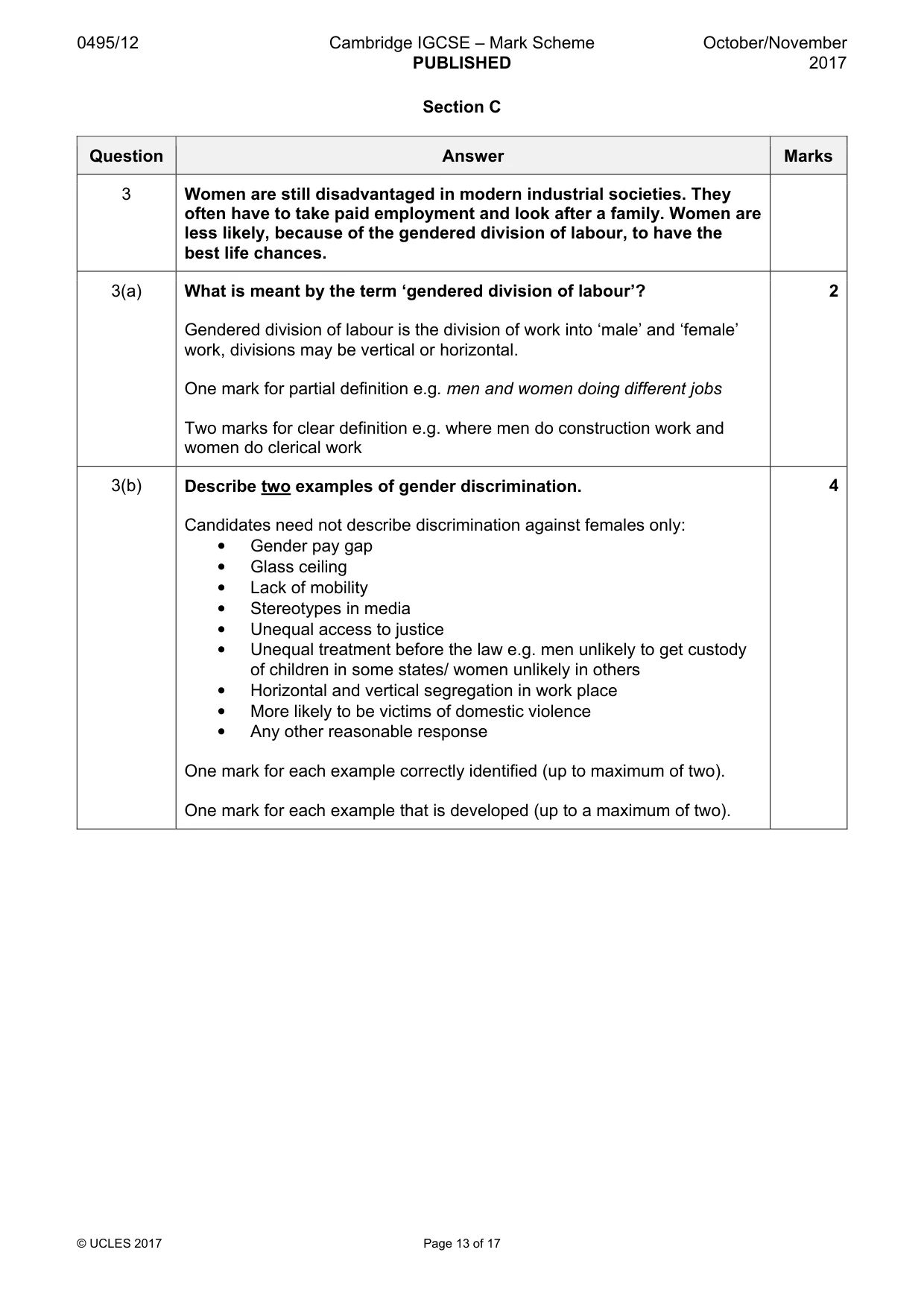
0495/12 Cambridge IGCSE – Mark Scheme PUBLISHED October/November 2017 © UCLES 2017 Page 13 of 17 Section C Question Answer Marks 3 Women are still disadvantaged in modern industrial societies. They often have to take paid employment and look after a family. Women are less likely, because of the gendered division of labour, to have the best life chances. 3(a) What is meant by the term ‘gendered division of labour’? Gendered division of labour is the division of work into ‘male’ and ‘female’ work, divisions may be vertical or horizontal. One mark for partial definition e.g. men and women doing different jobs Two marks for clear definition e.g. where men do construction work and women do clerical work 2 3(b) Describe two examples of gender discrimination. Candidates need not describe discrimination against females only: • Gender pay gap • Glass ceiling • Lack of mobility • Stereotypes in media • Unequal access to justice • Unequal treatment before the law e.g. men unlikely to get custody of children in some states/ women unlikely in others • Horizontal and vertical segregation in work place • More likely to be victims of domestic violence • Any other reasonable response One mark for each example correctly identified (up to maximum of two). One mark for each example that is developed (up to a maximum of two). 4
Mark scheme, page 14
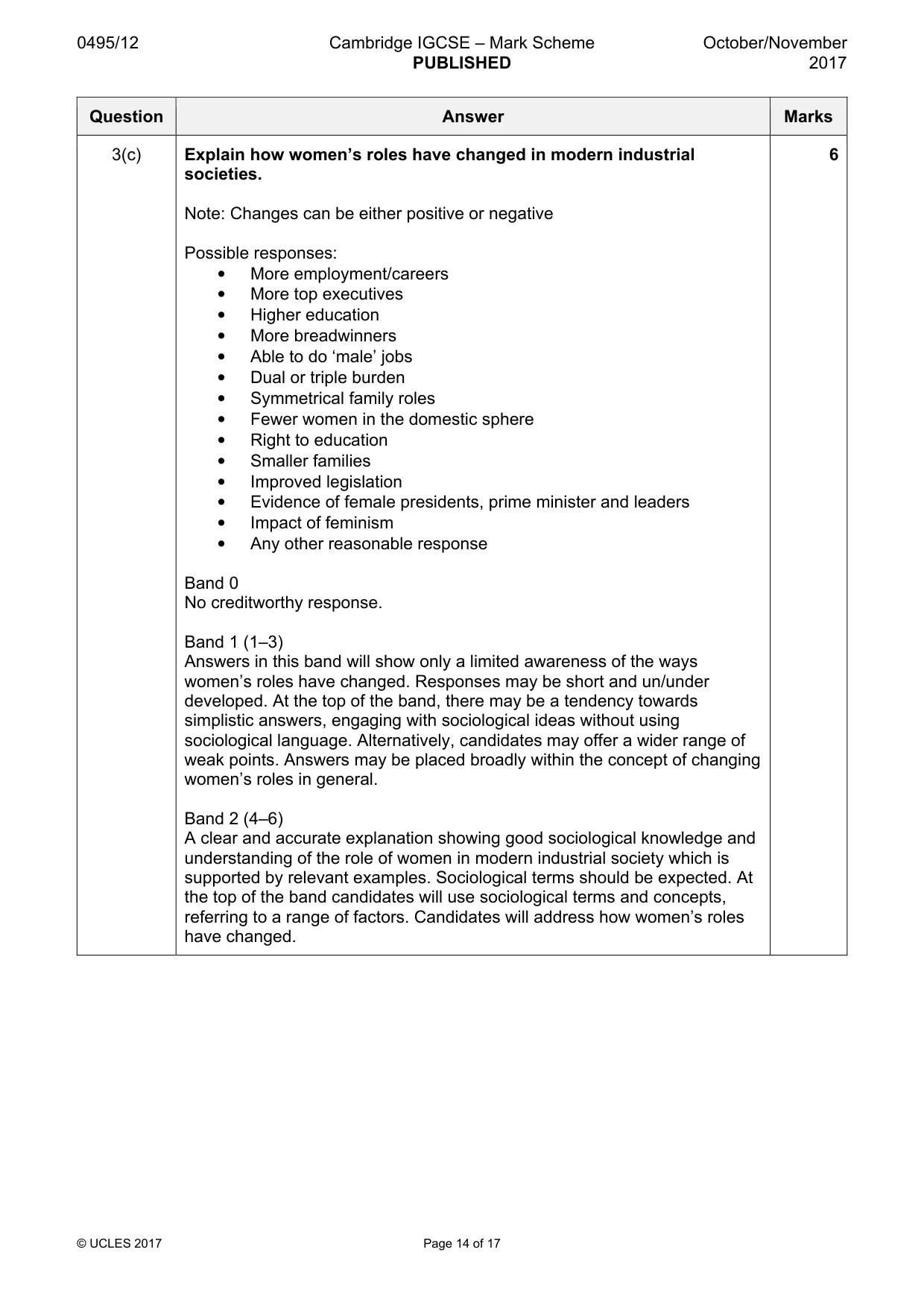
0495/12 Cambridge IGCSE – Mark Scheme PUBLISHED October/November 2017 © UCLES 2017 Page 14 of 17 Question Answer Marks 3(c) Explain how women’s roles have changed in modern industrial societies. Note: Changes can be either positive or negative Possible responses: • More employment/careers • More top executives • Higher education • More breadwinners • Able to do ‘male’ jobs • Dual or triple burden • Symmetrical family roles • Fewer women in the domestic sphere • Right to education • Smaller families • Improved legislation • Evidence of female presidents, prime minister and leaders • Impact of feminism • Any other reasonable response Band 0 No creditworthy response. Band 1 (1–3) Answers in this band will show only a limited awareness of the ways women’s roles have changed. Responses may be short and un/under developed. At the top of the band, there may be a tendency towards simplistic answers, engaging with sociological ideas without using sociological language. Alternatively, candidates may offer a wider range of weak points. Answers may be placed broadly within the concept of changing women’s roles in general. Band 2 (4–6) A clear and accurate explanation showing good sociological knowledge and understanding of the role of women in modern industrial society which is supported by relevant examples. Sociological terms should be expected. At the top of the band candidates will use sociological terms and concepts, referring to a range of factors. Candidates will address how women’s roles have changed. 6
Mark scheme, page 15
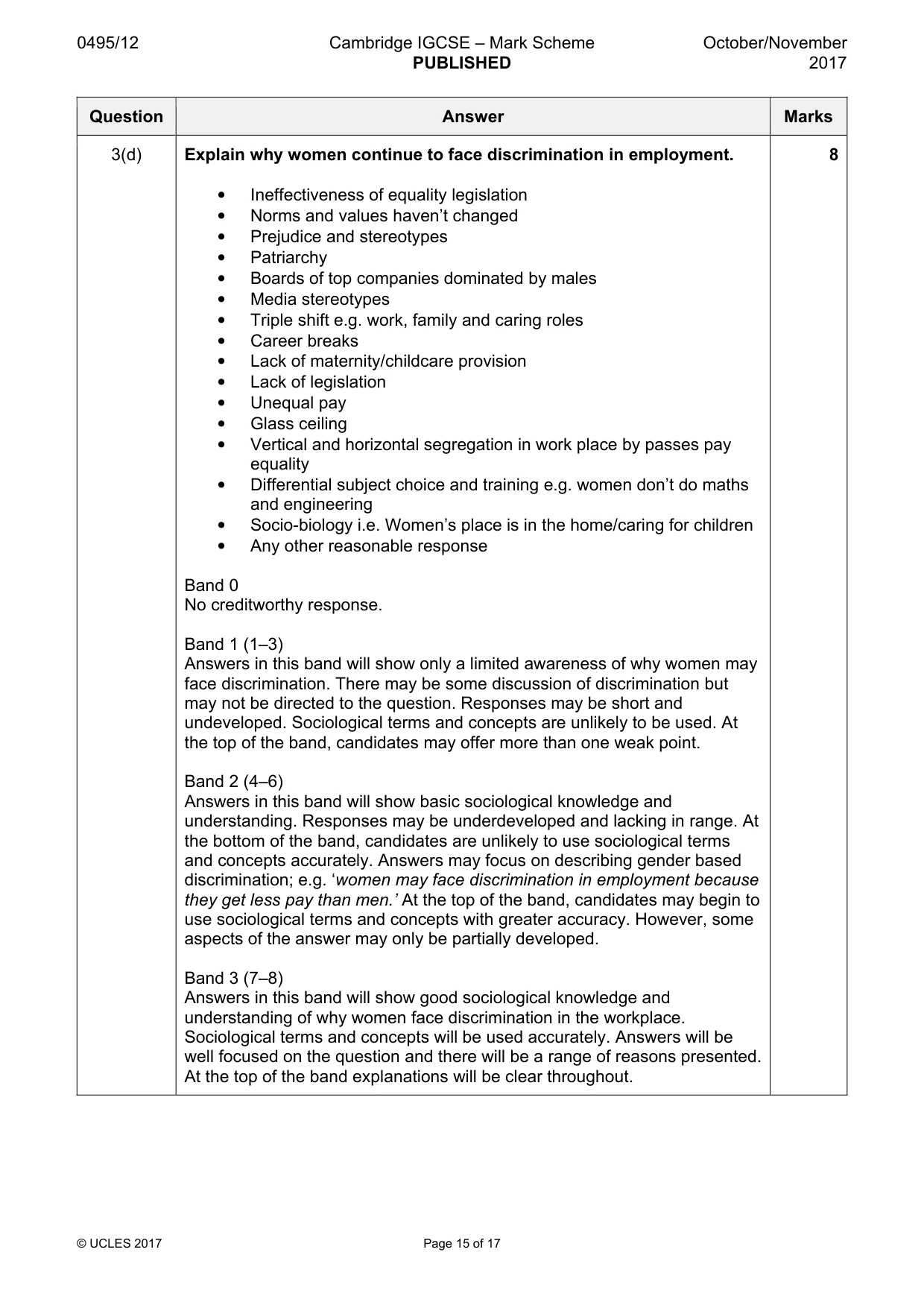
0495/12 Cambridge IGCSE – Mark Scheme PUBLISHED October/November 2017 © UCLES 2017 Page 15 of 17 Question Answer Marks 3(d) Explain why women continue to face discrimination in employment. • Ineffectiveness of equality legislation • Norms and values haven’t changed • Prejudice and stereotypes • Patriarchy • Boards of top companies dominated by males • Media stereotypes • Triple shift e.g. work, family and caring roles • Career breaks • Lack of maternity/childcare provision • Lack of legislation • Unequal pay • Glass ceiling • Vertical and horizontal segregation in work place by passes pay equality • Differential subject choice and training e.g. women don’t do maths and engineering • Socio-biology i.e. Women’s place is in the home/caring for children • Any other reasonable response Band 0 No creditworthy response. Band 1 (1–3) Answers in this band will show only a limited awareness of why women may face discrimination. There may be some discussion of discrimination but may not be directed to the question. Responses may be short and undeveloped. Sociological terms and concepts are unlikely to be used. At the top of the band, candidates may offer more than one weak point. Band 2 (4–6) Answers in this band will show basic sociological knowledge and understanding. Responses may be underdeveloped and lacking in range. At the bottom of the band, candidates are unlikely to use sociological terms and concepts accurately. Answers may focus on describing gender based discrimination; e.g. ‘women may face discrimination in employment because they get less pay than men.’ At the top of the band, candidates may begin to use sociological terms and concepts with greater accuracy. However, some aspects of the answer may only be partially developed. Band 3 (7–8) Answers in this band will show good sociological knowledge and understanding of why women face discrimination in the workplace. Sociological terms and concepts will be used accurately. Answers will be well focused on the question and there will be a range of reasons presented. At the top of the band explanations will be clear throughout. 8
Mark scheme, page 16
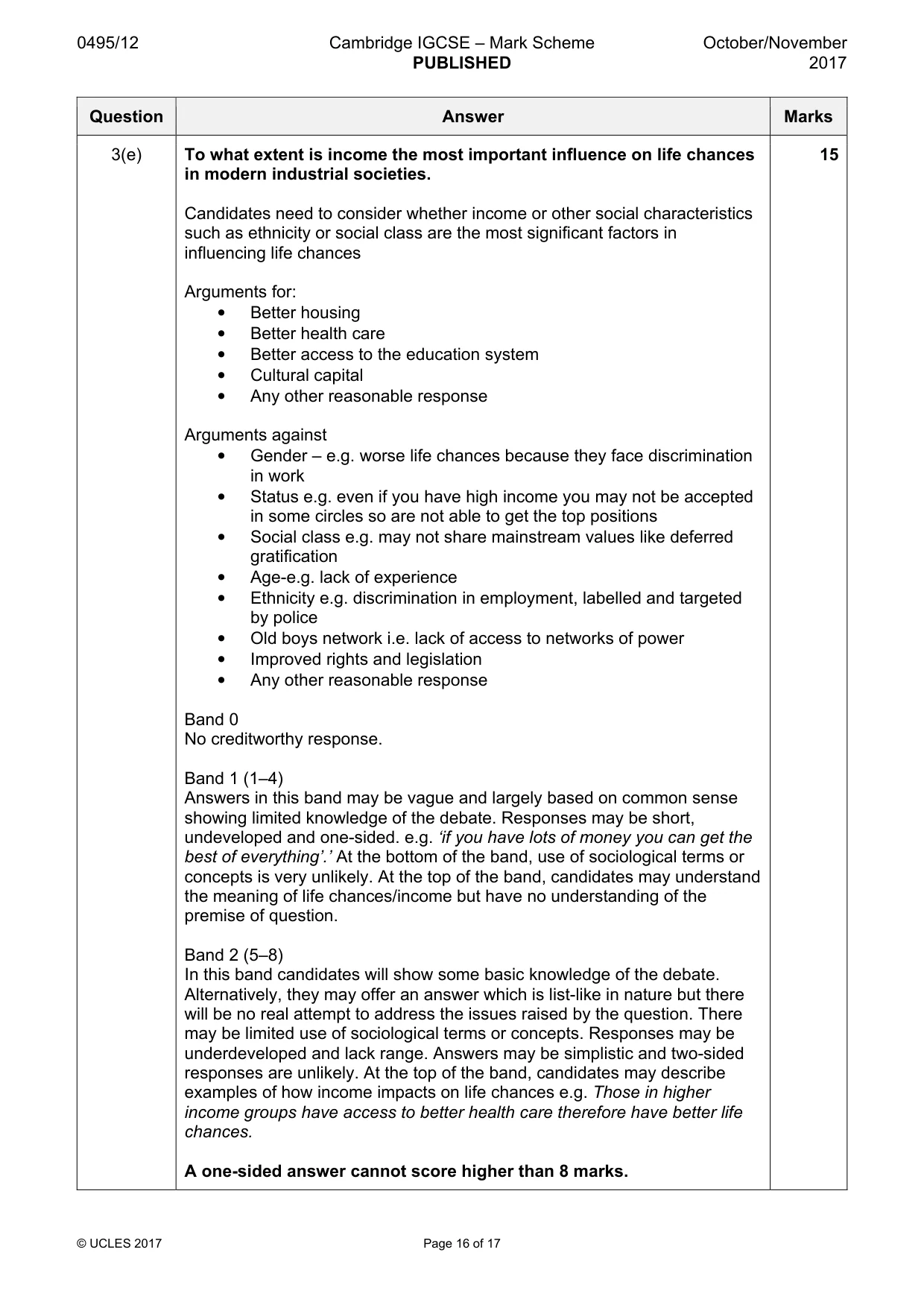
0495/12 Cambridge IGCSE – Mark Scheme PUBLISHED October/November 2017 © UCLES 2017 Page 16 of 17 Question Answer Marks 3(e) To what extent is income the most important influence on life chances in modern industrial societies. Candidates need to consider whether income or other social characteristics such as ethnicity or social class are the most significant factors in influencing life chances Arguments for: • Better housing • Better health care • Better access to the education system • Cultural capital • Any other reasonable response Arguments against • Gender – e.g. worse life chances because they face discrimination in work • Status e.g. even if you have high income you may not be accepted in some circles so are not able to get the top positions • Social class e.g. may not share mainstream values like deferred gratification • Age-e.g. lack of experience • Ethnicity e.g. discrimination in employment, labelled and targeted by police • Old boys network i.e. lack of access to networks of power • Improved rights and legislation • Any other reasonable response Band 0 No creditworthy response. Band 1 (1–4) Answers in this band may be vague and largely based on common sense showing limited knowledge of the debate. Responses may be short, undeveloped and one-sided. e.g. ‘if you have lots of money you can get the best of everything’.’ At the bottom of the band, use of sociological terms or concepts is very unlikely. At the top of the band, candidates may understand the meaning of life chances/income but have no understanding of the premise of question. Band 2 (5–8) In this band candidates will show some basic knowledge of the debate. Alternatively, they may offer an answer which is list-like in nature but there will be no real attempt to address the issues raised by the question. There may be limited use of sociological terms or concepts. Responses may be underdeveloped and lack range. Answers may be simplistic and two-sided responses are unlikely. At the top of the band, candidates may describe examples of how income impacts on life chances e.g. Those in higher income groups have access to better health care therefore have better life chances. A one-sided answer cannot score higher than 8 marks. 15
Mark scheme, page 17
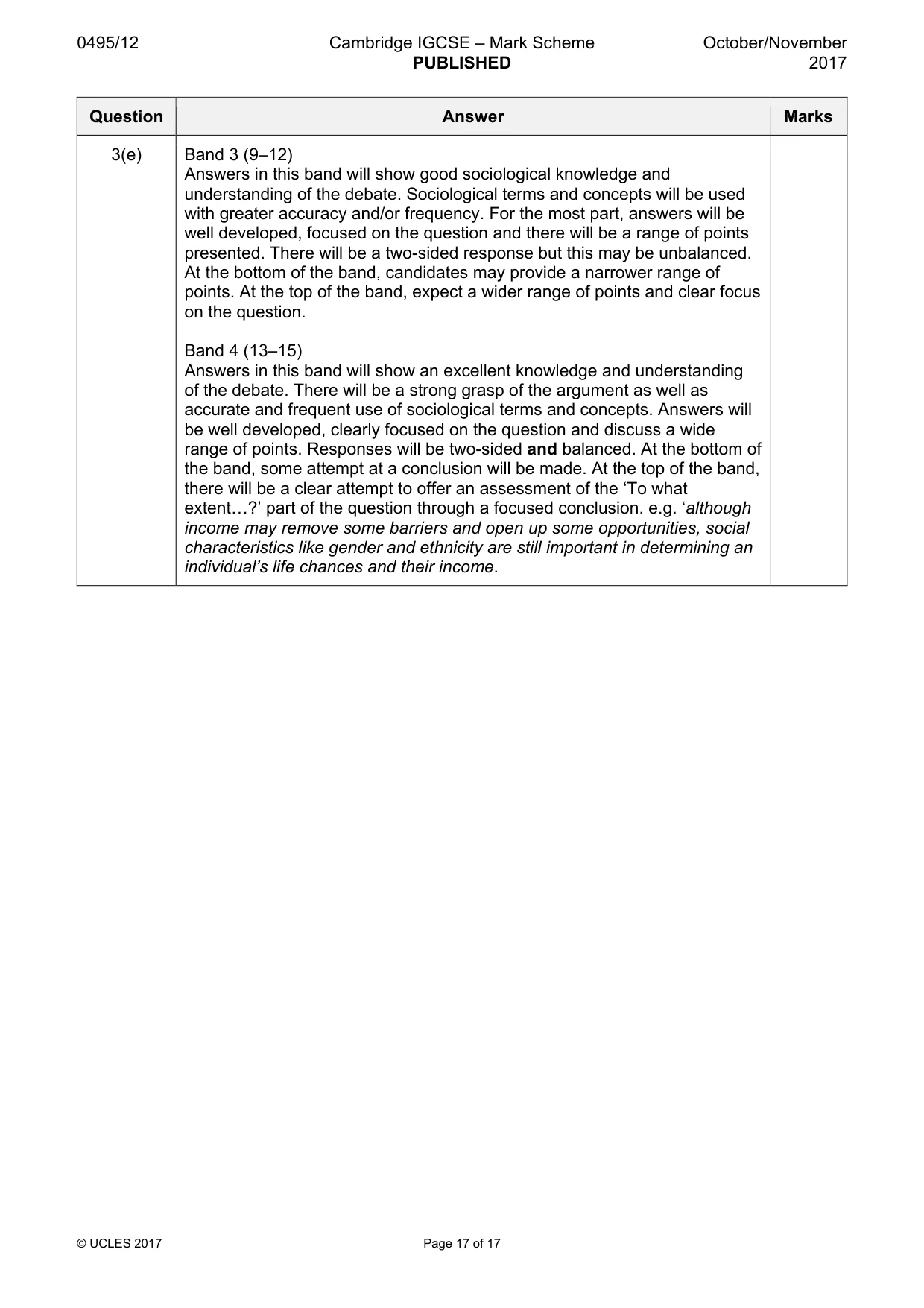
0495/12 Cambridge IGCSE – Mark Scheme PUBLISHED October/November 2017 © UCLES 2017 Page 17 of 17 Question Answer Marks 3(e) Band 3 (9–12) Answers in this band will show good sociological knowledge and understanding of the debate. Sociological terms and concepts will be used with greater accuracy and/or frequency. For the most part, answers will be well developed, focused on the question and there will be a range of points presented. There will be a two-sided response but this may be unbalanced. At the bottom of the band, candidates may provide a narrower range of points. At the top of the band, expect a wider range of points and clear focus on the question. Band 4 (13–15) Answers in this band will show an excellent knowledge and understanding of the debate. There will be a strong grasp of the argument as well as accurate and frequent use of sociological terms and concepts. Answers will be well developed, clearly focused on the question and discuss a wide range of points. Responses will be two-sided and balanced. At the bottom of the band, some attempt at a conclusion will be made. At the top of the band, there will be a clear attempt to offer an assessment of the ‘To what extent«?’ part of the question through a focused conclusion. e.g. ‘although income may remove some barriers and open up some opportunities, social characteristics like gender and ethnicity are still important in determining an individual’s life chances and their income.
What you needed in this session
Cambridge’s own grade thresholds for 2017 Oct/Nov, Paper 1 · Variant 2. A higher threshold means an easier paper — the bar moves with how the cohort did.