Cambridge IGCSE Sociology 0495 — 2017 Oct/Nov Paper 1 · Variant 1
0495/11/O/N/17 · 80 marks · ≈90 min
The question paper and its mark scheme, free to read here and free to download. This is Cambridge’s own paper, exactly as it was sat.
Question paper4 pages
Mark scheme20 pages
Answers below. Sit the paper first if you are practising.

Paper as text
Question paper, page 1
This document consists of 4 printed pages and 1 Insert. DC (ST/SW) 132665/4 © UCLES 2017 [Turn over Cambridge International Examinations Cambridge International General Certificate of Secondary Education * 9 6 5 2 2 7 9 6 2 7 * SOCIOLOGY 0495/11 Paper 1 October/November 2017 2 hours (including 15 minutes’ reading time) No Additional Materials are required. READ THESE INSTRUCTIONS FIRST An answer booklet is provided inside this question paper. You should follow the instructions on the front cover of the answer booklet. If you need additional answer paper ask the invigilator for a continuation booklet. Answer Question 1 and either Question 2 or Question 3. The number of marks is given in brackets [ ] at the end of each question or part question.
Question paper, page 2
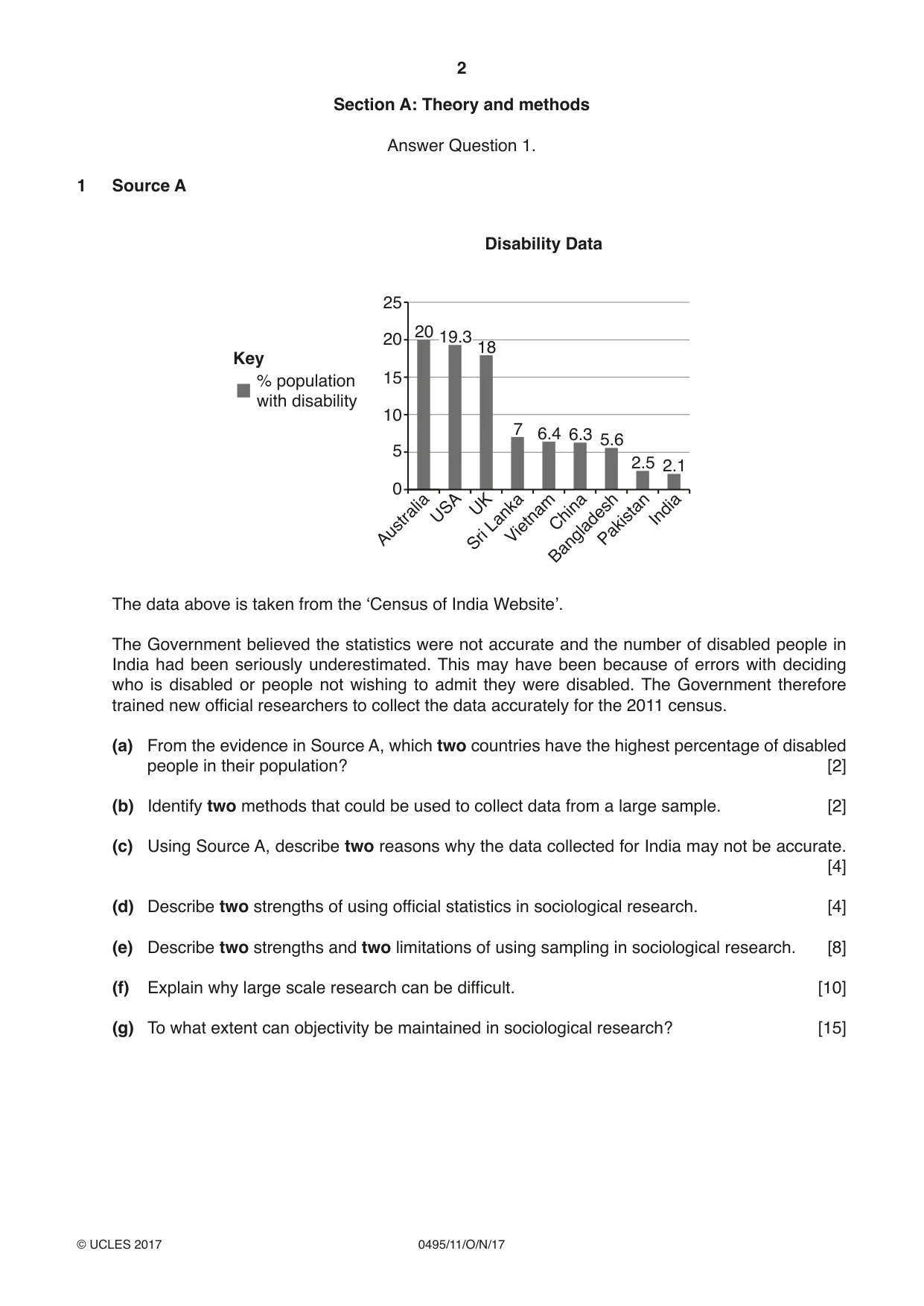
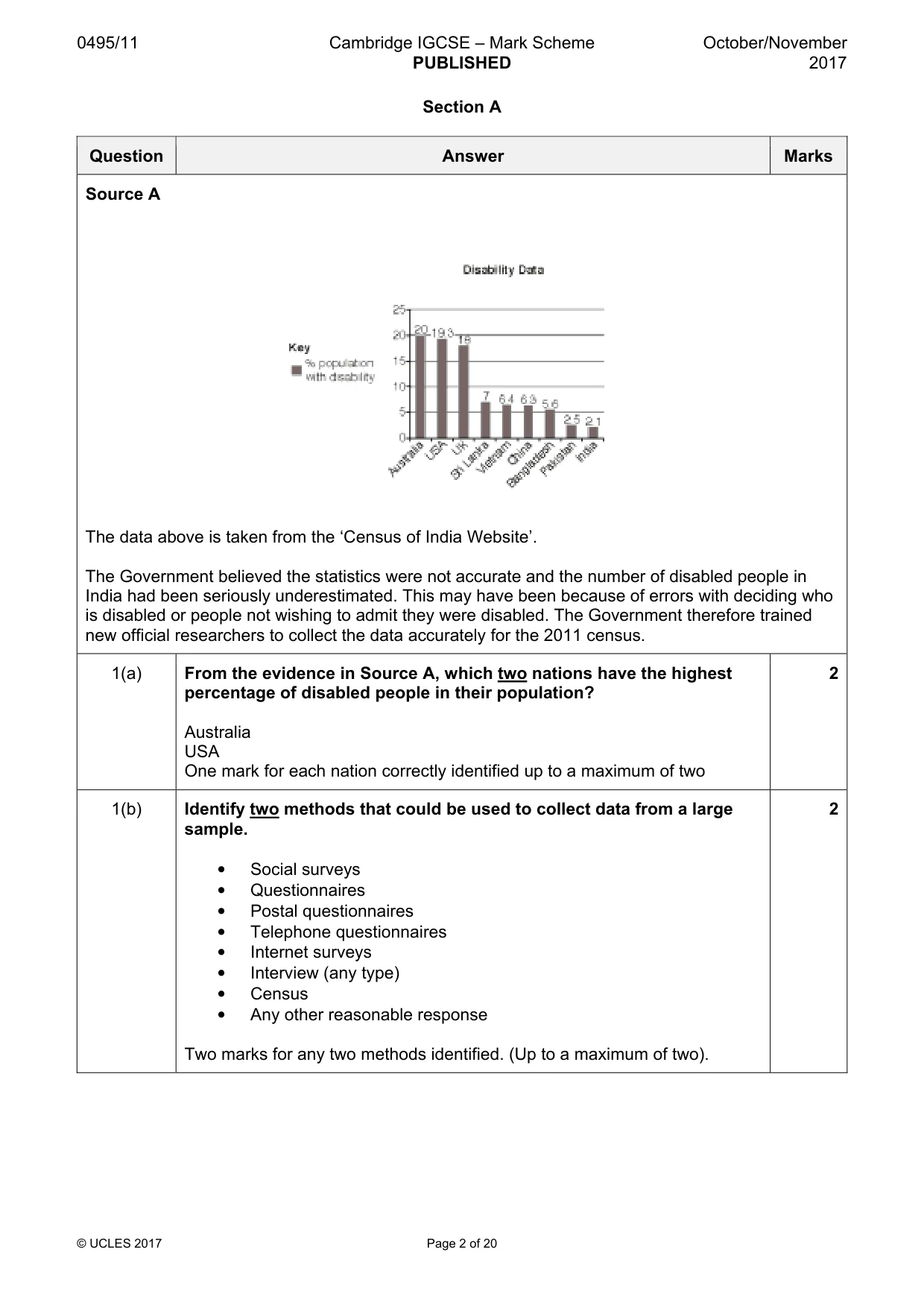
2 0495/11/O/N/17 © UCLES 2017 Section A: Theory and methods Answer Question 1. 1 Source A 20 19.3 18 7 6.4 25 20 15 10 5 0 Australia USA UK Sri Lanka Vietnam China Bangladesh Pakistan India 6.3 5.6 2.5 2.1 % population with disability Disability Data Key The data above is taken from the ‘Census of India Website’. The Government believed the statistics were not accurate and the number of disabled people in India had been seriously underestimated. This may have been because of errors with deciding who is disabled or people not wishing to admit they were disabled. The Government therefore trained new official researchers to collect the data accurately for the 2011 census. (a) From the evidence in Source A, which two countries have the highest percentage of disabled people in their population? [2] (b) Identify two methods that could be used to collect data from a large sample. [2] (c) Using Source A, describe two reasons why the data collected for India may not be accurate. [4] (d) Describe two strengths of using official statistics in sociological research. [4] (e) Describe two strengths and two limitations of using sampling in sociological research. [8] (f) Explain why large scale research can be difficult. [10] (g) To what extent can objectivity be maintained in sociological research? [15]
Question paper, page 3
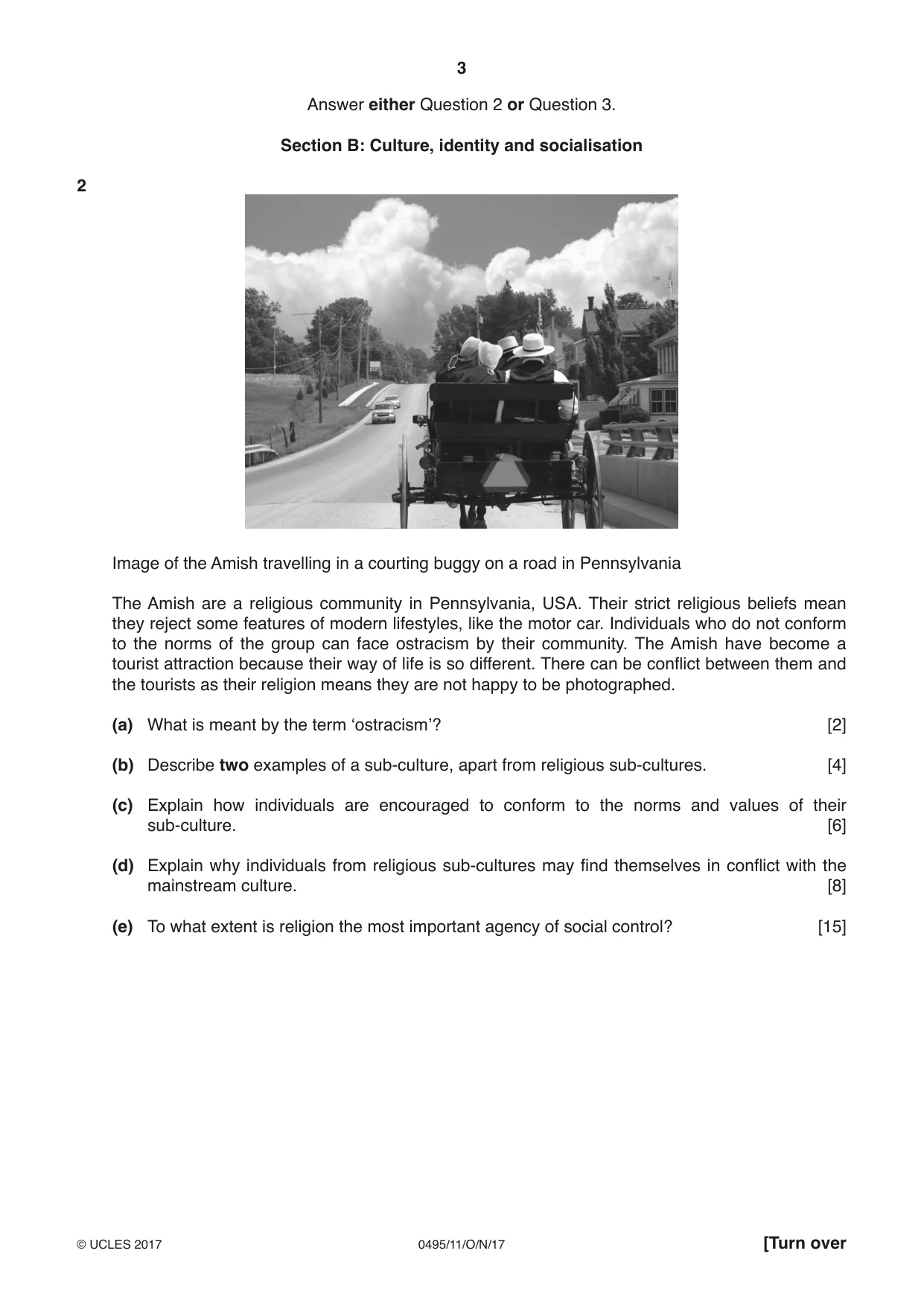
3 0495/11/O/N/17 © UCLES 2017 [Turn over Answer either Question 2 or Question 3. Section B: Culture, identity and socialisation 2 Image of the Amish travelling in a courting buggy on a road in Pennsylvania The Amish are a religious community in Pennsylvania, USA. Their strict religious beliefs mean they reject some features of modern lifestyles, like the motor car. Individuals who do not conform to the norms of the group can face ostracism by their community. The Amish have become a tourist attraction because their way of life is so different. There can be conflict between them and the tourists as their religion means they are not happy to be photographed. (a) What is meant by the term ‘ostracism’? [2] (b) Describe two examples of a sub-culture, apart from religious sub-cultures. [4] (c) Explain how individuals are encouraged to conform to the norms and values of their sub-culture. [6] (d) Explain why individuals from religious sub-cultures may find themselves in conflict with the mainstream culture. [8] (e) To what extent is religion the most important agency of social control? [15]
Question paper, page 4
4 0495/11/O/N/17 © UCLES 2017 Section C: Social inequality 3 Aspects of stratification such as gender, ethnicity and social class can have a significant impact on an individual’s life chances. An individual’s social position at birth can reduce their chances of upward social mobility and even shorten their life expectancy. (a) What is meant by the term ‘social mobility’? [2] (b) Describe two examples of social groups who may be disadvantaged. [4] (c) Explain how the life chances of minority ethnic groups differ from those of the majority ethnic group. [6] (d) Explain why downward social mobility occurs. [8] (e) To what extent is social class still important in modern industrial societies? [15] Permission to reproduce items where third-party owned material protected by copyright is included has been sought and cleared where possible. Every reasonable effort has been made by the publisher (UCLES) to trace copyright holders, but if any items requiring clearance have unwittingly been included, the publisher will be pleased to make amends at the earliest possible opportunity. To avoid the issue of disclosure of answer-related information to candidates, all copyright acknowledgements are reproduced online in the Cambridge International Examinations Copyright Acknowledgements Booklet. This is produced for each series of examinations and is freely available to download at www.cie.org.uk after the live examination series. Cambridge International Examinations is part of the Cambridge Assessment Group. Cambridge Assessment is the brand name of University of Cambridge Local Examinations Syndicate (UCLES), which is itself a department of the University of Cambridge.
Mark scheme, page 1
® IGCSE is a registered trademark. This document consists of 20 printed pages. © UCLES 2017 [Turn over Cambridge Assessment International Education Cambridge International General Certificate of Secondary Education SOCIOLOGY 0495/11 Paper 1 October/November 2017 MARK SCHEME Maximum Mark: 80 Published This mark scheme is published as an aid to teachers and candidates, to indicate the requirements of the examination. It shows the basis on which Examiners were instructed to award marks. It does not indicate the details of the discussions that took place at an Examiners’ meeting before marking began, which would have considered the acceptability of alternative answers. Mark schemes should be read in conjunction with the question paper and the Principal Examiner Report for Teachers. Cambridge International will not enter into discussions about these mark schemes. Cambridge International is publishing the mark schemes for the October/November 2017 series for most Cambridge IGCSE®, Cambridge International A and AS Level components and some Cambridge O Level components.
Mark scheme, page 2
0495/11 Cambridge IGCSE – Mark Scheme PUBLISHED October/November 2017 © UCLES 2017 Page 2 of 20 Section A Question Answer Marks Source A The data above is taken from the ‘Census of India Website’. The Government believed the statistics were not accurate and the number of disabled people in India had been seriously underestimated. This may have been because of errors with deciding who is disabled or people not wishing to admit they were disabled. The Government therefore trained new official researchers to collect the data accurately for the 2011 census. 1(a) From the evidence in Source A, which two nations have the highest percentage of disabled people in their population? Australia USA One mark for each nation correctly identified up to a maximum of two 2 1(b) Identify two methods that could be used to collect data from a large sample. • Social surveys • Questionnaires • Postal questionnaires • Telephone questionnaires • Internet surveys • Interview (any type) • Census • Any other reasonable response Two marks for any two methods identified. (Up to a maximum of two). 2
Mark scheme, page 3
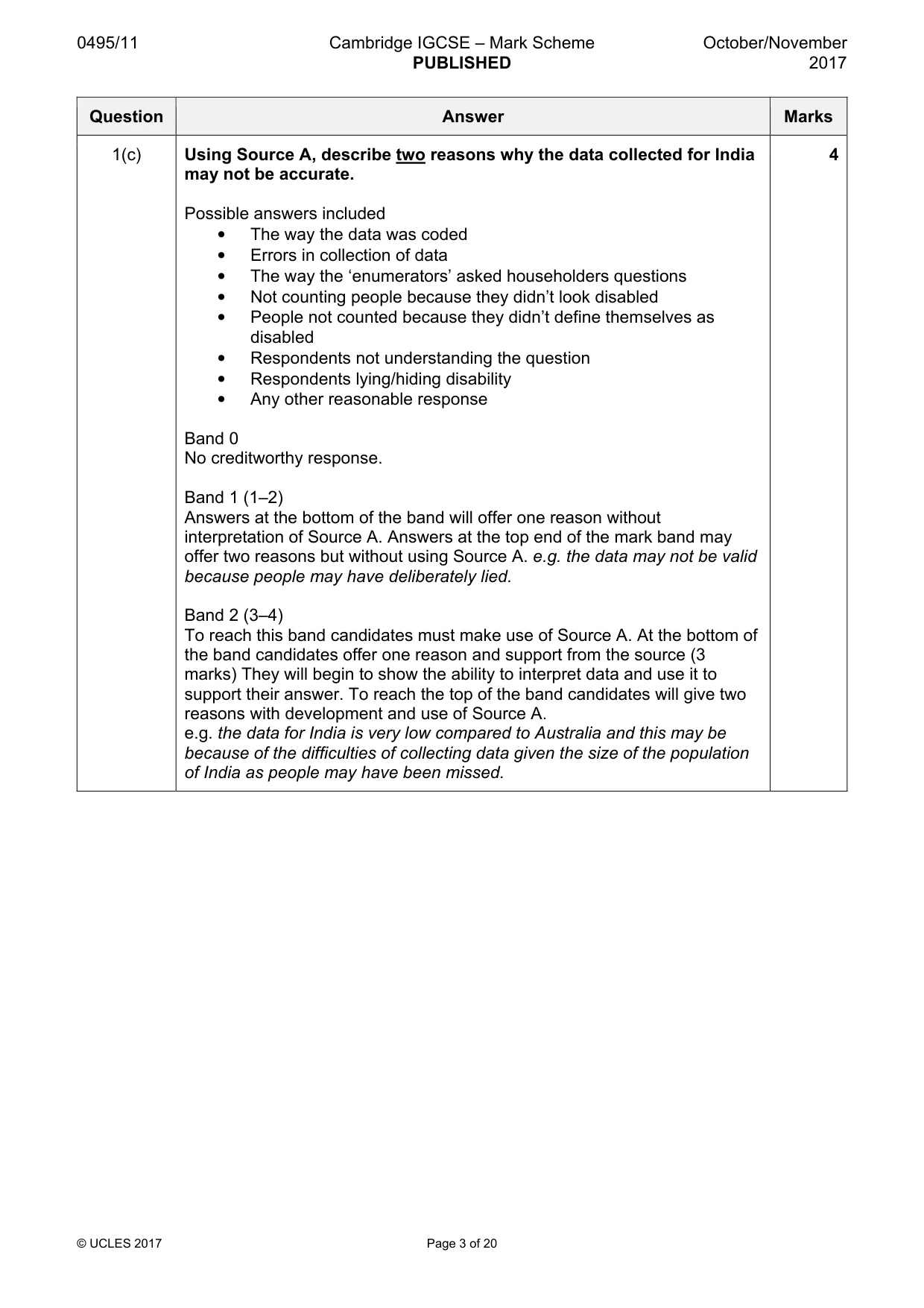
0495/11 Cambridge IGCSE – Mark Scheme PUBLISHED October/November 2017 © UCLES 2017 Page 3 of 20 Question Answer Marks 1(c) Using Source A, describe two reasons why the data collected for India may not be accurate. Possible answers included • The way the data was coded • Errors in collection of data • The way the ‘enumerators’ asked householders questions • Not counting people because they didn’t look disabled • People not counted because they didn’t define themselves as disabled • Respondents not understanding the question • Respondents lying/hiding disability • Any other reasonable response Band 0 No creditworthy response. Band 1 (1–2) Answers at the bottom of the band will offer one reason without interpretation of Source A. Answers at the top end of the mark band may offer two reasons but without using Source A. e.g. the data may not be valid because people may have deliberately lied. Band 2 (3–4) To reach this band candidates must make use of Source A. At the bottom of the band candidates offer one reason and support from the source (3 marks) They will begin to show the ability to interpret data and use it to support their answer. To reach the top of the band candidates will give two reasons with development and use of Source A. e.g. the data for India is very low compared to Australia and this may be because of the difficulties of collecting data given the size of the population of India as people may have been missed. 4
Mark scheme, page 4
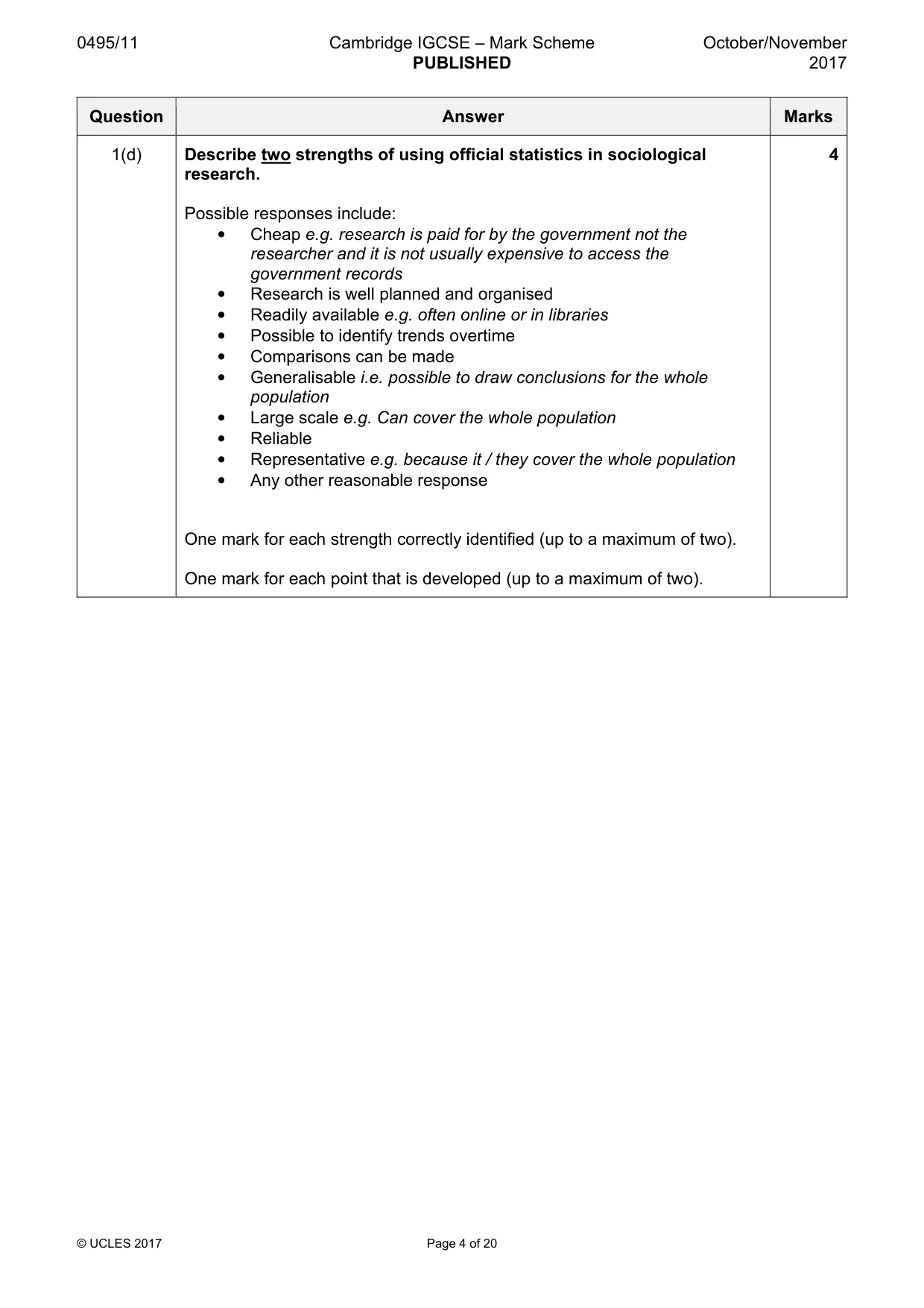
0495/11 Cambridge IGCSE – Mark Scheme PUBLISHED October/November 2017 © UCLES 2017 Page 4 of 20 Question Answer Marks 1(d) Describe two strengths of using official statistics in sociological research. Possible responses include: • Cheap e.g. research is paid for by the government not the researcher and it is not usually expensive to access the government records • Research is well planned and organised • Readily available e.g. often online or in libraries • Possible to identify trends overtime • Comparisons can be made • Generalisable i.e. possible to draw conclusions for the whole population • Large scale e.g. Can cover the whole population • Reliable • Representative e.g. because it / they cover the whole population • Any other reasonable response One mark for each strength correctly identified (up to a maximum of two). One mark for each point that is developed (up to a maximum of two). 4
Mark scheme, page 5
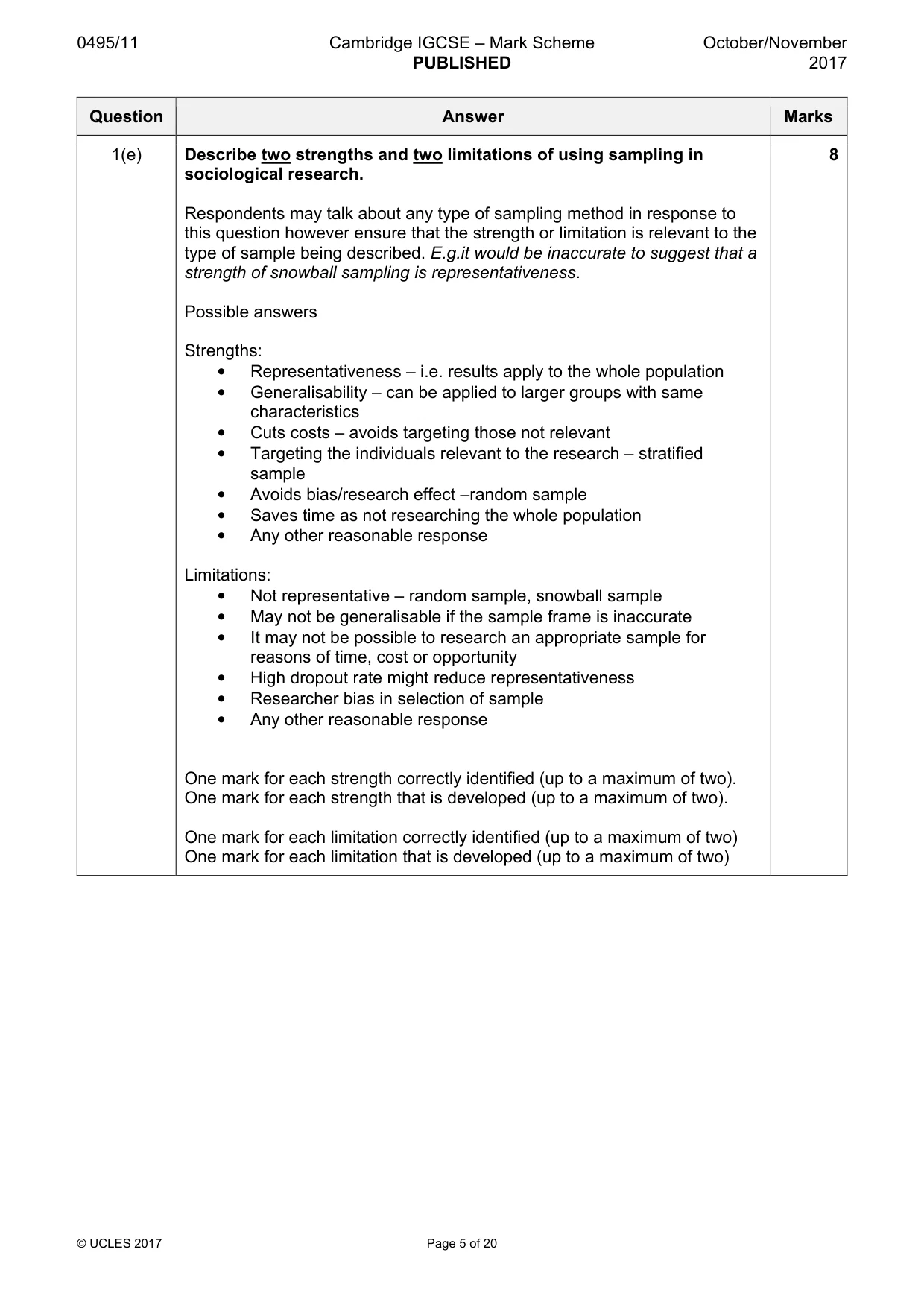
0495/11 Cambridge IGCSE – Mark Scheme PUBLISHED October/November 2017 © UCLES 2017 Page 5 of 20 Question Answer Marks 1(e) Describe two strengths and two limitations of using sampling in sociological research. Respondents may talk about any type of sampling method in response to this question however ensure that the strength or limitation is relevant to the type of sample being described. E.g.it would be inaccurate to suggest that a strength of snowball sampling is representativeness. Possible answers Strengths: • Representativeness – i.e. results apply to the whole population • Generalisability – can be applied to larger groups with same characteristics • Cuts costs – avoids targeting those not relevant • Targeting the individuals relevant to the research – stratified sample • Avoids bias/research effect –random sample • Saves time as not researching the whole population • Any other reasonable response Limitations: • Not representative – random sample, snowball sample • May not be generalisable if the sample frame is inaccurate • It may not be possible to research an appropriate sample for reasons of time, cost or opportunity • High dropout rate might reduce representativeness • Researcher bias in selection of sample • Any other reasonable response One mark for each strength correctly identified (up to a maximum of two). One mark for each strength that is developed (up to a maximum of two). One mark for each limitation correctly identified (up to a maximum of two) One mark for each limitation that is developed (up to a maximum of two) 8
Mark scheme, page 6
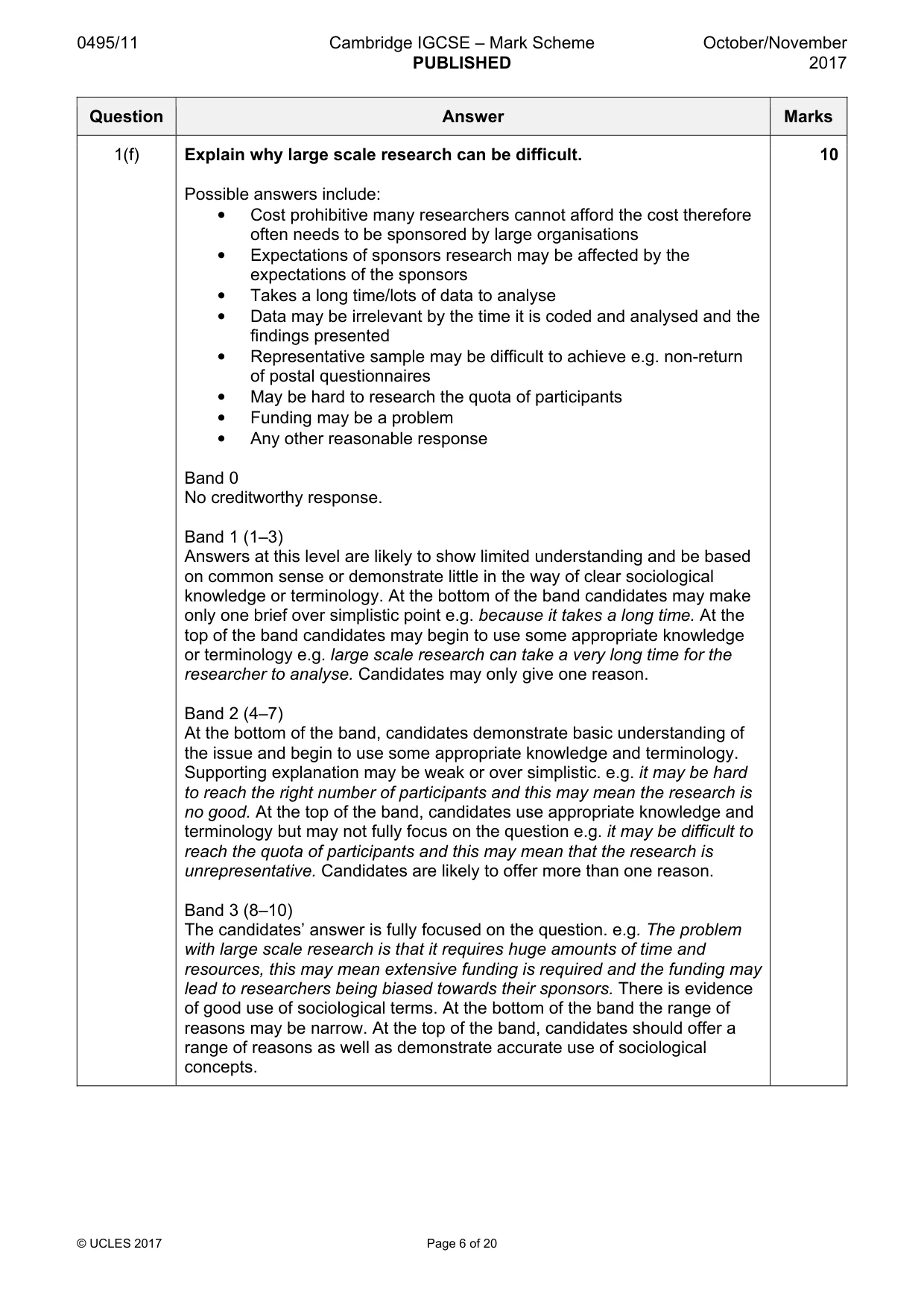
0495/11 Cambridge IGCSE – Mark Scheme PUBLISHED October/November 2017 © UCLES 2017 Page 6 of 20 Question Answer Marks 1(f) Explain why large scale research can be difficult. Possible answers include: • Cost prohibitive many researchers cannot afford the cost therefore often needs to be sponsored by large organisations • Expectations of sponsors research may be affected by the expectations of the sponsors • Takes a long time/lots of data to analyse • Data may be irrelevant by the time it is coded and analysed and the findings presented • Representative sample may be difficult to achieve e.g. non-return of postal questionnaires • May be hard to research the quota of participants • Funding may be a problem • Any other reasonable response Band 0 No creditworthy response. Band 1 (1–3) Answers at this level are likely to show limited understanding and be based on common sense or demonstrate little in the way of clear sociological knowledge or terminology. At the bottom of the band candidates may make only one brief over simplistic point e.g. because it takes a long time. At the top of the band candidates may begin to use some appropriate knowledge or terminology e.g. large scale research can take a very long time for the researcher to analyse. Candidates may only give one reason. Band 2 (4–7) At the bottom of the band, candidates demonstrate basic understanding of the issue and begin to use some appropriate knowledge and terminology. Supporting explanation may be weak or over simplistic. e.g. it may be hard to reach the right number of participants and this may mean the research is no good. At the top of the band, candidates use appropriate knowledge and terminology but may not fully focus on the question e.g. it may be difficult to reach the quota of participants and this may mean that the research is unrepresentative. Candidates are likely to offer more than one reason. Band 3 (8–10) The candidates’ answer is fully focused on the question. e.g. The problem with large scale research is that it requires huge amounts of time and resources, this may mean extensive funding is required and the funding may lead to researchers being biased towards their sponsors. There is evidence of good use of sociological terms. At the bottom of the band the range of reasons may be narrow. At the top of the band, candidates should offer a range of reasons as well as demonstrate accurate use of sociological concepts. 10
Mark scheme, page 7
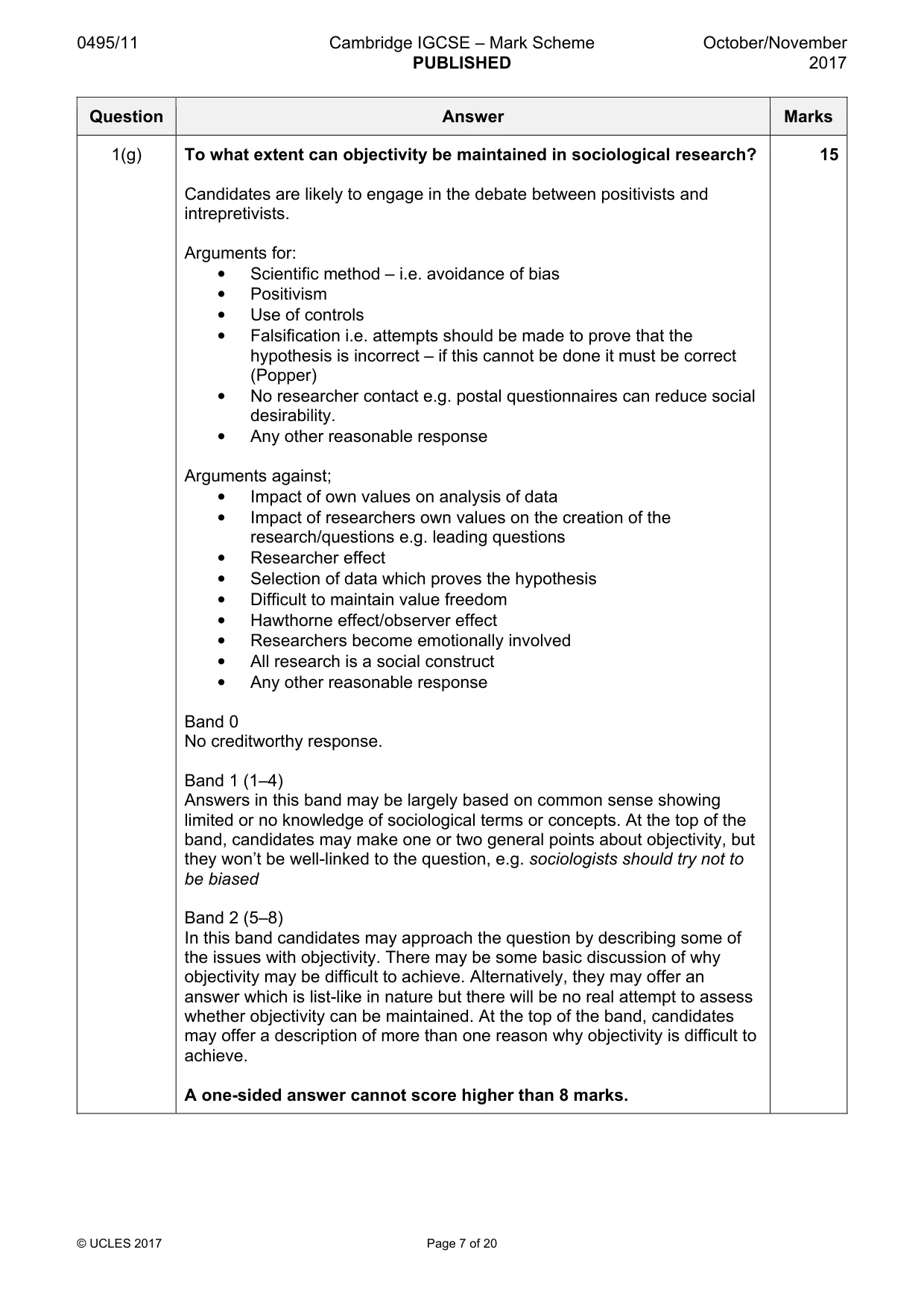
0495/11 Cambridge IGCSE – Mark Scheme PUBLISHED October/November 2017 © UCLES 2017 Page 7 of 20 Question Answer Marks 1(g) To what extent can objectivity be maintained in sociological research? Candidates are likely to engage in the debate between positivists and intrepretivists. Arguments for: • Scientific method – i.e. avoidance of bias • Positivism • Use of controls • Falsification i.e. attempts should be made to prove that the hypothesis is incorrect – if this cannot be done it must be correct (Popper) • No researcher contact e.g. postal questionnaires can reduce social desirability. • Any other reasonable response Arguments against; • Impact of own values on analysis of data • Impact of researchers own values on the creation of the research/questions e.g. leading questions • Researcher effect • Selection of data which proves the hypothesis • Difficult to maintain value freedom • Hawthorne effect/observer effect • Researchers become emotionally involved • All research is a social construct • Any other reasonable response Band 0 No creditworthy response. Band 1 (1–4) Answers in this band may be largely based on common sense showing limited or no knowledge of sociological terms or concepts. At the top of the band, candidates may make one or two general points about objectivity, but they won’t be well-linked to the question, e.g. sociologists should try not to be biased Band 2 (5–8) In this band candidates may approach the question by describing some of the issues with objectivity. There may be some basic discussion of why objectivity may be difficult to achieve. Alternatively, they may offer an answer which is list-like in nature but there will be no real attempt to assess whether objectivity can be maintained. At the top of the band, candidates may offer a description of more than one reason why objectivity is difficult to achieve. A one-sided answer cannot score higher than 8 marks. 15
Mark scheme, page 8
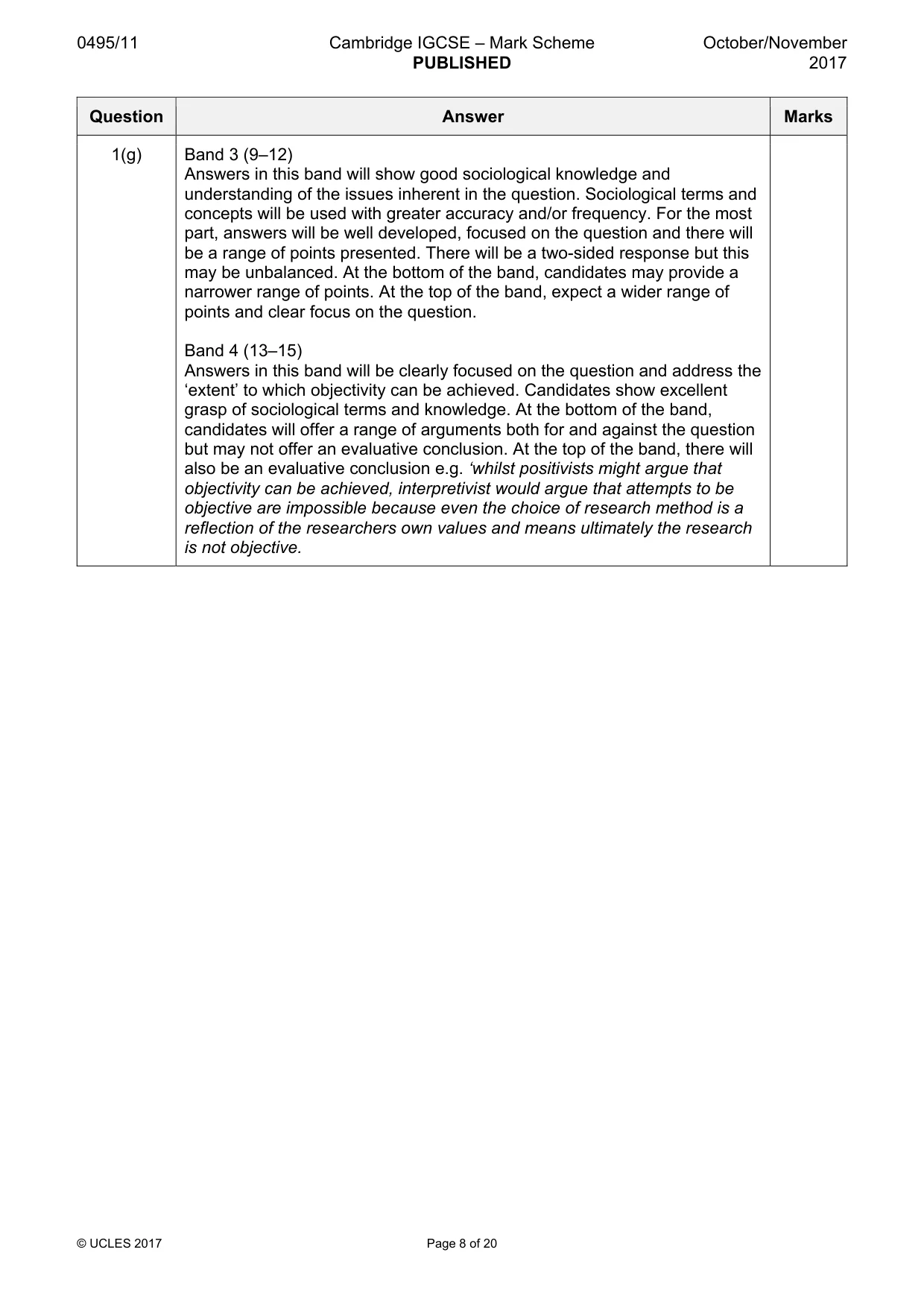
0495/11 Cambridge IGCSE – Mark Scheme PUBLISHED October/November 2017 © UCLES 2017 Page 8 of 20 Question Answer Marks 1(g) Band 3 (9–12) Answers in this band will show good sociological knowledge and understanding of the issues inherent in the question. Sociological terms and concepts will be used with greater accuracy and/or frequency. For the most part, answers will be well developed, focused on the question and there will be a range of points presented. There will be a two-sided response but this may be unbalanced. At the bottom of the band, candidates may provide a narrower range of points. At the top of the band, expect a wider range of points and clear focus on the question. Band 4 (13–15) Answers in this band will be clearly focused on the question and address the ‘extent’ to which objectivity can be achieved. Candidates show excellent grasp of sociological terms and knowledge. At the bottom of the band, candidates will offer a range of arguments both for and against the question but may not offer an evaluative conclusion. At the top of the band, there will also be an evaluative conclusion e.g. ‘whilst positivists might argue that objectivity can be achieved, interpretivist would argue that attempts to be objective are impossible because even the choice of research method is a reflection of the researchers own values and means ultimately the research is not objective.
Mark scheme, page 9
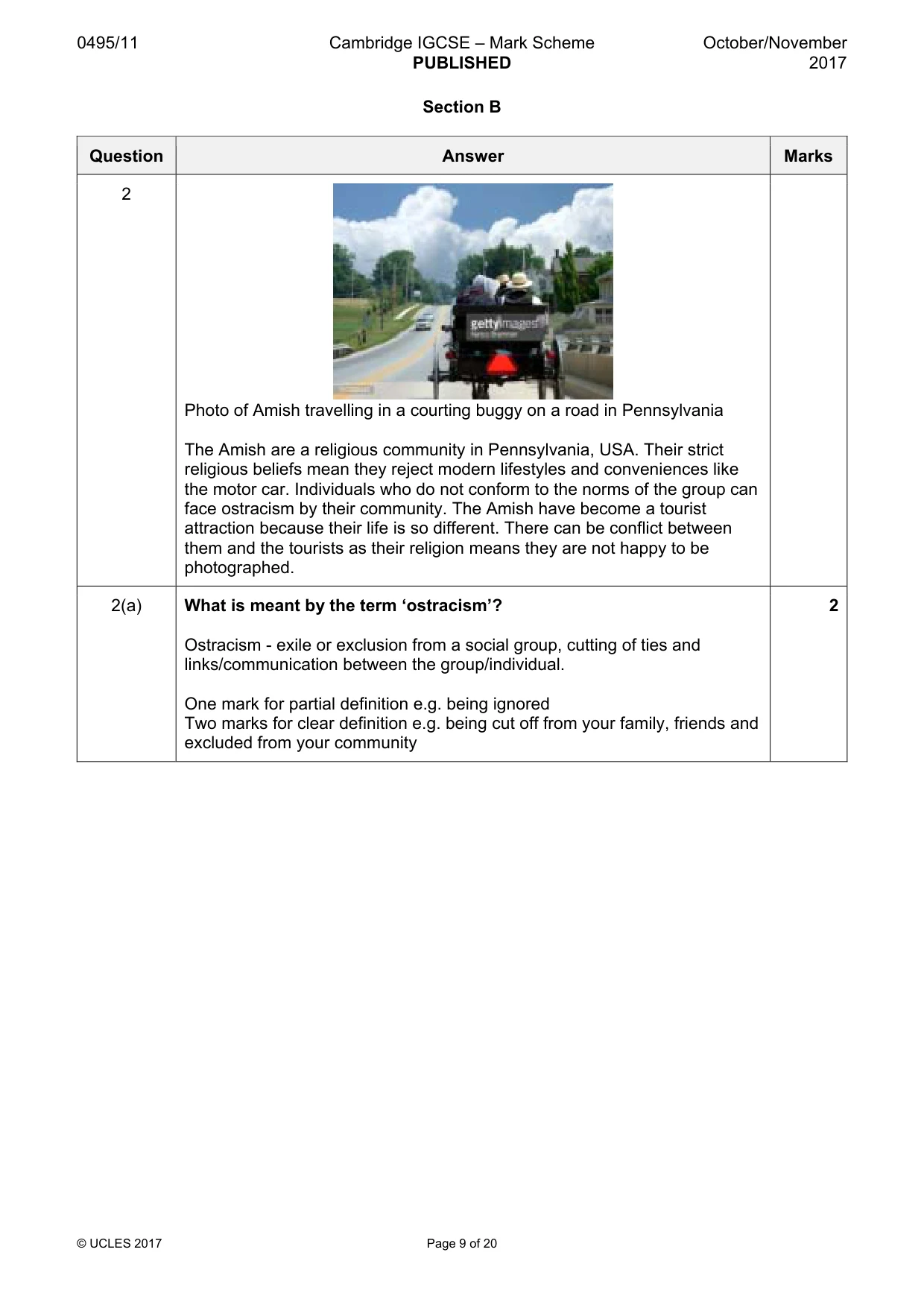
0495/11 Cambridge IGCSE – Mark Scheme PUBLISHED October/November 2017 © UCLES 2017 Page 9 of 20 Section B Question Answer Marks 2 Photo of Amish travelling in a courting buggy on a road in Pennsylvania The Amish are a religious community in Pennsylvania, USA. Their strict religious beliefs mean they reject modern lifestyles and conveniences like the motor car. Individuals who do not conform to the norms of the group can face ostracism by their community. The Amish have become a tourist attraction because their life is so different. There can be conflict between them and the tourists as their religion means they are not happy to be photographed. 2(a) What is meant by the term ‘ostracism’? Ostracism - exile or exclusion from a social group, cutting of ties and links/communication between the group/individual. One mark for partial definition e.g. being ignored Two marks for clear definition e.g. being cut off from your family, friends and excluded from your community 2
Mark scheme, page 10
0495/11 Cambridge IGCSE – Mark Scheme PUBLISHED October/November 2017 © UCLES 2017 Page 10 of 20 Question Answer Marks 2(b) Describe two examples of a sub-culture, apart from religious sub- cultures. Answers can be generic or specific – allow regional examples. Possible answers include: • Goths • Rockers • Emos • Skinheads • Punks • Working class • Youth • Ethnic • Asian/Indian • Hispanic • Afro-American • Leisure sub-culture • Sport sub-culture • School sub-culture • Deviant sub-culture • Any other reasonable response One mark for each example correctly identified (up to maximum of two). One mark for each example that is developed (up to a maximum of two). 4
Mark scheme, page 11
0495/11 Cambridge IGCSE – Mark Scheme PUBLISHED October/November 2017 © UCLES 2017 Page 11 of 20 Question Answer Marks 2(c) Explain how individuals are encouraged to conform to the norms and values of their sub-culture. Possible answers include: • The need to belong • The need to fit in • Rewards • Inclusion • Sanctions • Coercion • Ostracism • Shunning • Excommunication • Any other reasonable response Band 0 No creditworthy response. Band 1 (1–3) Answers in this band will show only a limited awareness of the ways sub- cultures enforce their norms and values. Responses may be short and un/under developed. At the top of the band, there may be a tendency towards simplistic answers, engaging with sociological ideas without using sociological language. Alternatively, candidates may offer a wider range of weak points. Answers will address the concepts of norms and values/subcultures in general without reference to how they enforce their norms and values. Band 2 (4–6) A clear and accurate explanation showing good sociological knowledge and understanding of how sub-cultures enforce norms and values which is supported by relevant examples. Sociological terms should be expected. At the top of the band candidates will use sociological terms and concepts, referring to a range of ways in which sub-cultures enforce their norms and values. 6
Mark scheme, page 12
0495/11 Cambridge IGCSE – Mark Scheme PUBLISHED October/November 2017 © UCLES 2017 Page 12 of 20 Question Answer Marks 2(d) Explain why individuals from religious sub-cultures may find themselves in conflict with the mainstream culture. Possible answers include: • Religious requirements clash with norms of mainstream culture e.g. dress requirements of Muslim religion for Muslims living in the west • Customs and holidays/holy days e.g. observation of religious holidays which may mean absence from work • Literal or fundamentalist interpretations of holy books e.g. Darwinism vs. creationism Scopes trial ‘monkey trial’ USA 1925 • Beliefs and values differ e.g. patriarch vs. equality • Lack of assimilation • Religious requirements clash with those of public institutions e.g. clashes over school uniform, lack of gender segregation, or having to wear a helmet in the police force rather than religiously proscribed headwear • Religious requirements clash with health and safety legislations e.g. requirement to wear/not wear certain items of clothing/ religious symbols • Any other reasonable response Band 0 No creditworthy response. Band 1 (1–3) Answers in this band will show only a limited awareness of why religious sub-cultures may clash with mainstream culture. There may be some discussion of religious tradition but may not be directed to the question. Responses may be short and undeveloped. Sociological terms and concepts are unlikely to be used. At the top of the band, candidates may offer more than one weak point. Band 2 (4–6) Answers in this band will show basic sociological knowledge and understanding. Responses may be underdeveloped and lacking in range. At the bottom of the band, candidates are unlikely to use sociological terms and concepts accurately. Answers may focus on describing religious sub- cultures; this may include description of different traditions, without any attempt to explain why they may cause conflict. e.g. ‘A Muslim girl wearing a hijab’. At the top of the band, candidates may begin to use sociological terms and concepts with greater accuracy and address why conflict might occur. However, some aspects of the answer may only be partially developed. Band 3 (7–8) Answers in this band will show good sociological knowledge and understanding of why individuals from religious sub-cultures may find themselves in conflict with the mainstream culture and this will be well- developed and explained. Sociological terms and concepts will be used accurately. Answers will be well focused on the question and there will be a range of reasons presented. At the top of the band explanations will be clear throughout. 8
Mark scheme, page 13
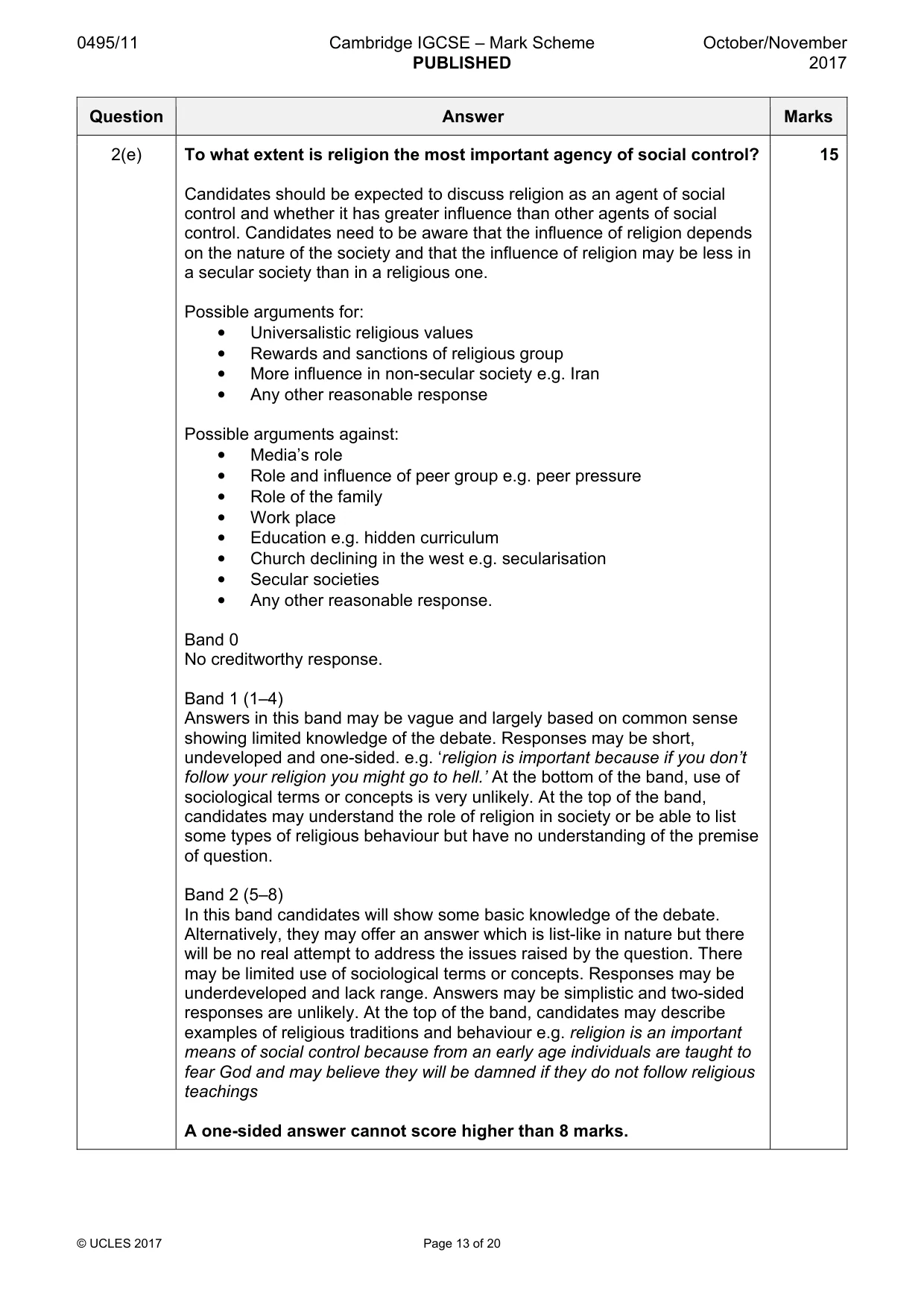
0495/11 Cambridge IGCSE – Mark Scheme PUBLISHED October/November 2017 © UCLES 2017 Page 13 of 20 Question Answer Marks 2(e) To what extent is religion the most important agency of social control? Candidates should be expected to discuss religion as an agent of social control and whether it has greater influence than other agents of social control. Candidates need to be aware that the influence of religion depends on the nature of the society and that the influence of religion may be less in a secular society than in a religious one. Possible arguments for: • Universalistic religious values • Rewards and sanctions of religious group • More influence in non-secular society e.g. Iran • Any other reasonable response Possible arguments against: • Media’s role • Role and influence of peer group e.g. peer pressure • Role of the family • Work place • Education e.g. hidden curriculum • Church declining in the west e.g. secularisation • Secular societies • Any other reasonable response. Band 0 No creditworthy response. Band 1 (1–4) Answers in this band may be vague and largely based on common sense showing limited knowledge of the debate. Responses may be short, undeveloped and one-sided. e.g. ‘religion is important because if you don’t follow your religion you might go to hell.’ At the bottom of the band, use of sociological terms or concepts is very unlikely. At the top of the band, candidates may understand the role of religion in society or be able to list some types of religious behaviour but have no understanding of the premise of question. Band 2 (5–8) In this band candidates will show some basic knowledge of the debate. Alternatively, they may offer an answer which is list-like in nature but there will be no real attempt to address the issues raised by the question. There may be limited use of sociological terms or concepts. Responses may be underdeveloped and lack range. Answers may be simplistic and two-sided responses are unlikely. At the top of the band, candidates may describe examples of religious traditions and behaviour e.g. religion is an important means of social control because from an early age individuals are taught to fear God and may believe they will be damned if they do not follow religious teachings A one-sided answer cannot score higher than 8 marks. 15
Mark scheme, page 14
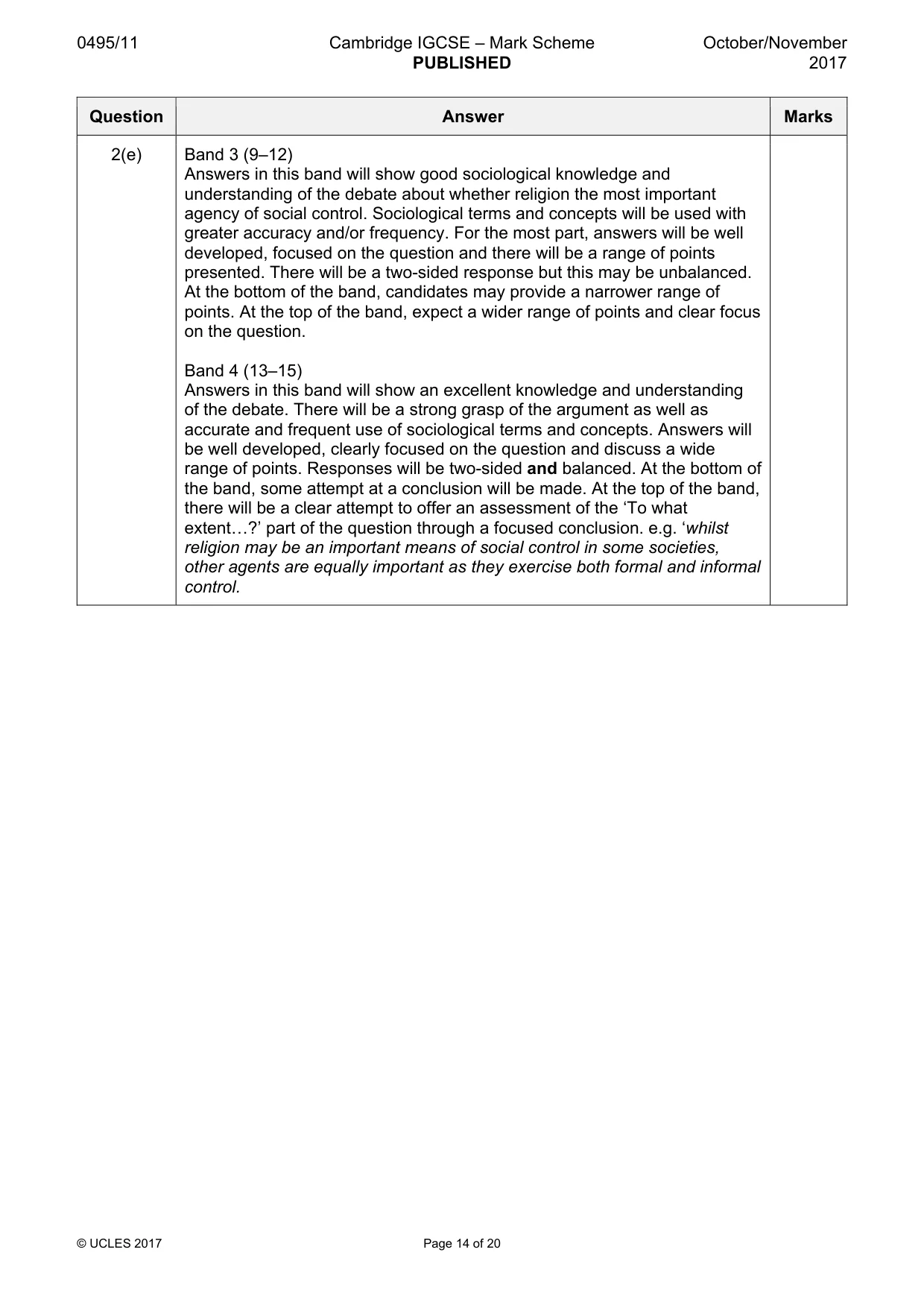
0495/11 Cambridge IGCSE – Mark Scheme PUBLISHED October/November 2017 © UCLES 2017 Page 14 of 20 Question Answer Marks 2(e) Band 3 (9–12) Answers in this band will show good sociological knowledge and understanding of the debate about whether religion the most important agency of social control. Sociological terms and concepts will be used with greater accuracy and/or frequency. For the most part, answers will be well developed, focused on the question and there will be a range of points presented. There will be a two-sided response but this may be unbalanced. At the bottom of the band, candidates may provide a narrower range of points. At the top of the band, expect a wider range of points and clear focus on the question. Band 4 (13–15) Answers in this band will show an excellent knowledge and understanding of the debate. There will be a strong grasp of the argument as well as accurate and frequent use of sociological terms and concepts. Answers will be well developed, clearly focused on the question and discuss a wide range of points. Responses will be two-sided and balanced. At the bottom of the band, some attempt at a conclusion will be made. At the top of the band, there will be a clear attempt to offer an assessment of the ‘To what extent«?’ part of the question through a focused conclusion. e.g. ‘whilst religion may be an important means of social control in some societies, other agents are equally important as they exercise both formal and informal control.
Mark scheme, page 15
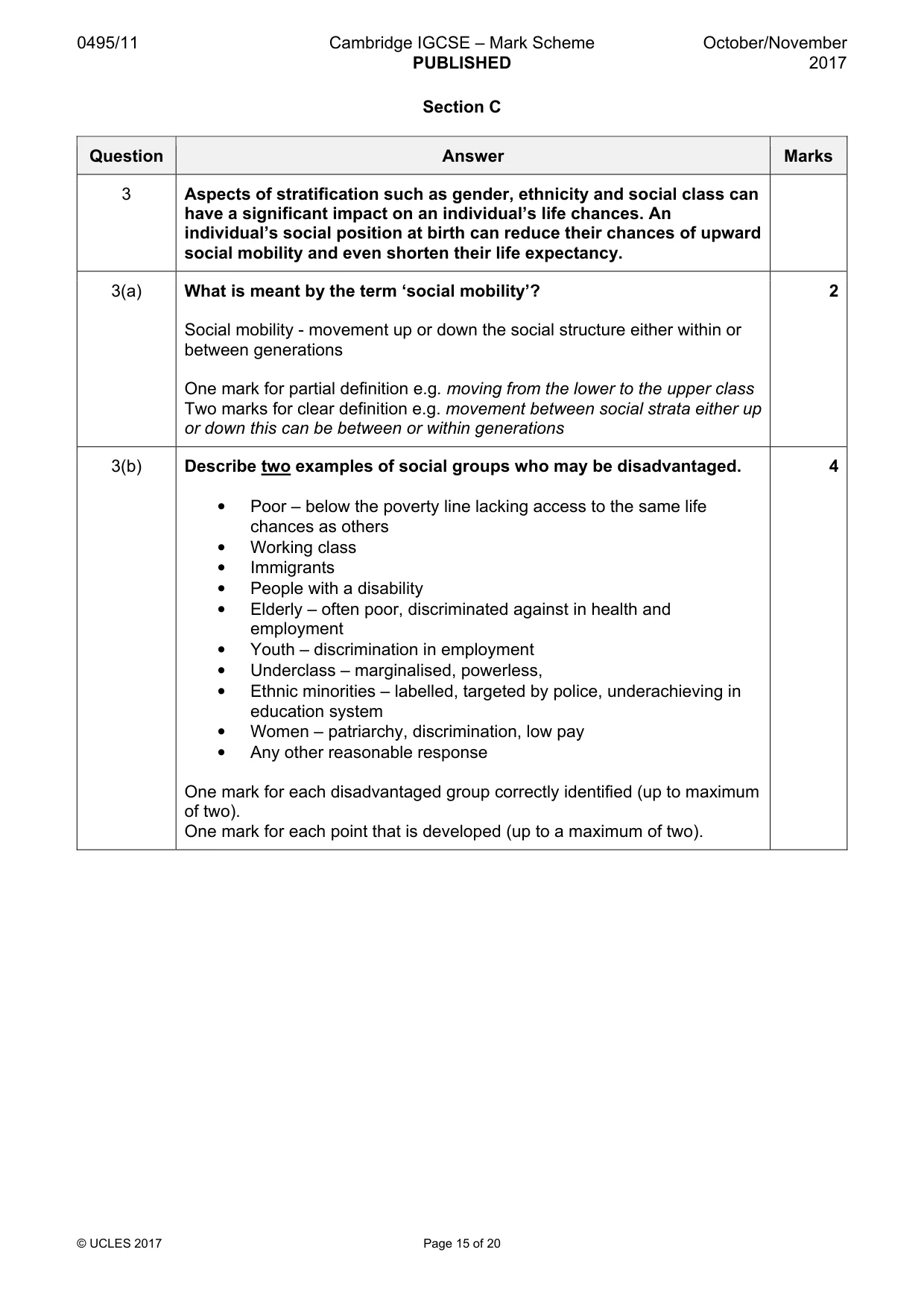
0495/11 Cambridge IGCSE – Mark Scheme PUBLISHED October/November 2017 © UCLES 2017 Page 15 of 20 Section C Question Answer Marks 3 Aspects of stratification such as gender, ethnicity and social class can have a significant impact on an individual’s life chances. An individual’s social position at birth can reduce their chances of upward social mobility and even shorten their life expectancy. 3(a) What is meant by the term ‘social mobility’? Social mobility - movement up or down the social structure either within or between generations One mark for partial definition e.g. moving from the lower to the upper class Two marks for clear definition e.g. movement between social strata either up or down this can be between or within generations 2 3(b) Describe two examples of social groups who may be disadvantaged. • Poor – below the poverty line lacking access to the same life chances as others • Working class • Immigrants • People with a disability • Elderly – often poor, discriminated against in health and employment • Youth – discrimination in employment • Underclass – marginalised, powerless, • Ethnic minorities – labelled, targeted by police, underachieving in education system • Women – patriarchy, discrimination, low pay • Any other reasonable response One mark for each disadvantaged group correctly identified (up to maximum of two). One mark for each point that is developed (up to a maximum of two). 4
Mark scheme, page 16
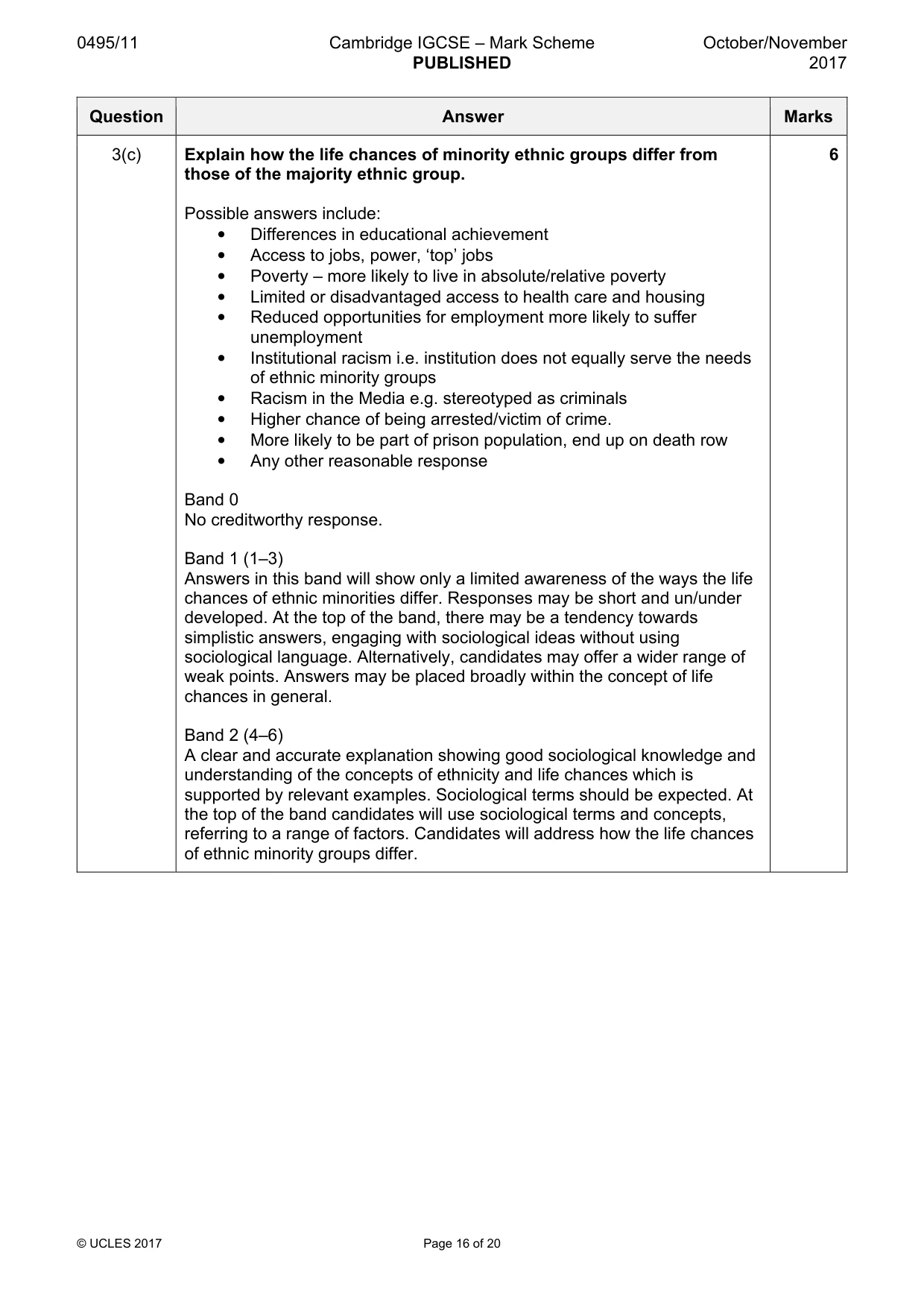
0495/11 Cambridge IGCSE – Mark Scheme PUBLISHED October/November 2017 © UCLES 2017 Page 16 of 20 Question Answer Marks 3(c) Explain how the life chances of minority ethnic groups differ from those of the majority ethnic group. Possible answers include: • Differences in educational achievement • Access to jobs, power, ‘top’ jobs • Poverty – more likely to live in absolute/relative poverty • Limited or disadvantaged access to health care and housing • Reduced opportunities for employment more likely to suffer unemployment • Institutional racism i.e. institution does not equally serve the needs of ethnic minority groups • Racism in the Media e.g. stereotyped as criminals • Higher chance of being arrested/victim of crime. • More likely to be part of prison population, end up on death row • Any other reasonable response Band 0 No creditworthy response. Band 1 (1–3) Answers in this band will show only a limited awareness of the ways the life chances of ethnic minorities differ. Responses may be short and un/under developed. At the top of the band, there may be a tendency towards simplistic answers, engaging with sociological ideas without using sociological language. Alternatively, candidates may offer a wider range of weak points. Answers may be placed broadly within the concept of life chances in general. Band 2 (4–6) A clear and accurate explanation showing good sociological knowledge and understanding of the concepts of ethnicity and life chances which is supported by relevant examples. Sociological terms should be expected. At the top of the band candidates will use sociological terms and concepts, referring to a range of factors. Candidates will address how the life chances of ethnic minority groups differ. 6
Mark scheme, page 17
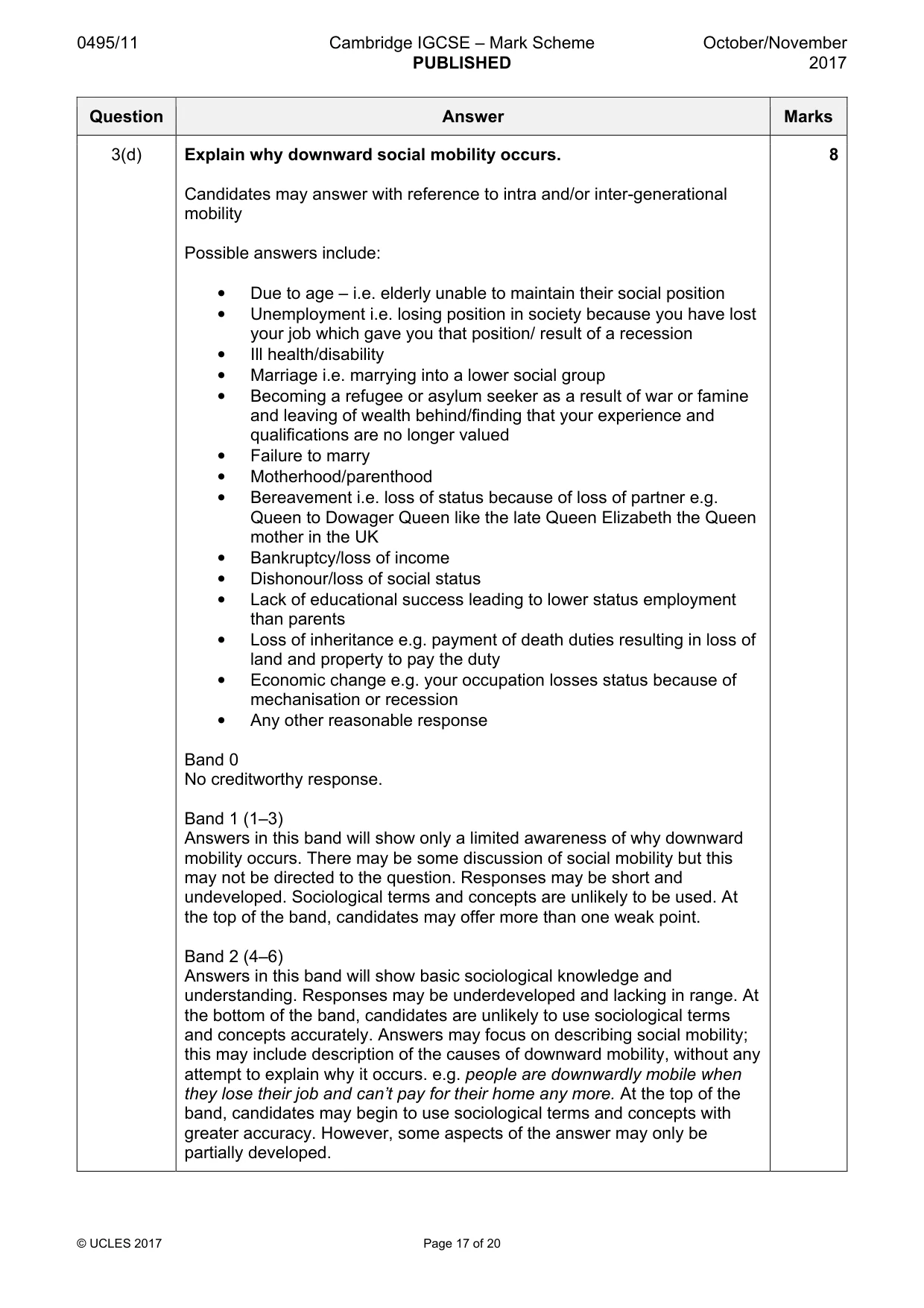
0495/11 Cambridge IGCSE – Mark Scheme PUBLISHED October/November 2017 © UCLES 2017 Page 17 of 20 Question Answer Marks 3(d) Explain why downward social mobility occurs. Candidates may answer with reference to intra and/or inter-generational mobility Possible answers include: • Due to age – i.e. elderly unable to maintain their social position • Unemployment i.e. losing position in society because you have lost your job which gave you that position/ result of a recession • Ill health/disability • Marriage i.e. marrying into a lower social group • Becoming a refugee or asylum seeker as a result of war or famine and leaving of wealth behind/finding that your experience and qualifications are no longer valued • Failure to marry • Motherhood/parenthood • Bereavement i.e. loss of status because of loss of partner e.g. Queen to Dowager Queen like the late Queen Elizabeth the Queen mother in the UK • Bankruptcy/loss of income • Dishonour/loss of social status • Lack of educational success leading to lower status employment than parents • Loss of inheritance e.g. payment of death duties resulting in loss of land and property to pay the duty • Economic change e.g. your occupation losses status because of mechanisation or recession • Any other reasonable response Band 0 No creditworthy response. Band 1 (1–3) Answers in this band will show only a limited awareness of why downward mobility occurs. There may be some discussion of social mobility but this may not be directed to the question. Responses may be short and undeveloped. Sociological terms and concepts are unlikely to be used. At the top of the band, candidates may offer more than one weak point. Band 2 (4–6) Answers in this band will show basic sociological knowledge and understanding. Responses may be underdeveloped and lacking in range. At the bottom of the band, candidates are unlikely to use sociological terms and concepts accurately. Answers may focus on describing social mobility; this may include description of the causes of downward mobility, without any attempt to explain why it occurs. e.g. people are downwardly mobile when they lose their job and can’t pay for their home any more. At the top of the band, candidates may begin to use sociological terms and concepts with greater accuracy. However, some aspects of the answer may only be partially developed. 8
Mark scheme, page 18
0495/11 Cambridge IGCSE – Mark Scheme PUBLISHED October/November 2017 © UCLES 2017 Page 18 of 20 Question Answer Marks 3(d) Band 3 (7–8) Answers in this band will show good sociological knowledge and understanding of why downward mobility may occur and this will be well- developed and explained. Sociological terms and concepts will be used accurately. Answers will be well focused on the question and there will be a range of reasons presented. At the top of the band explanations will be clear throughout.
Mark scheme, page 19
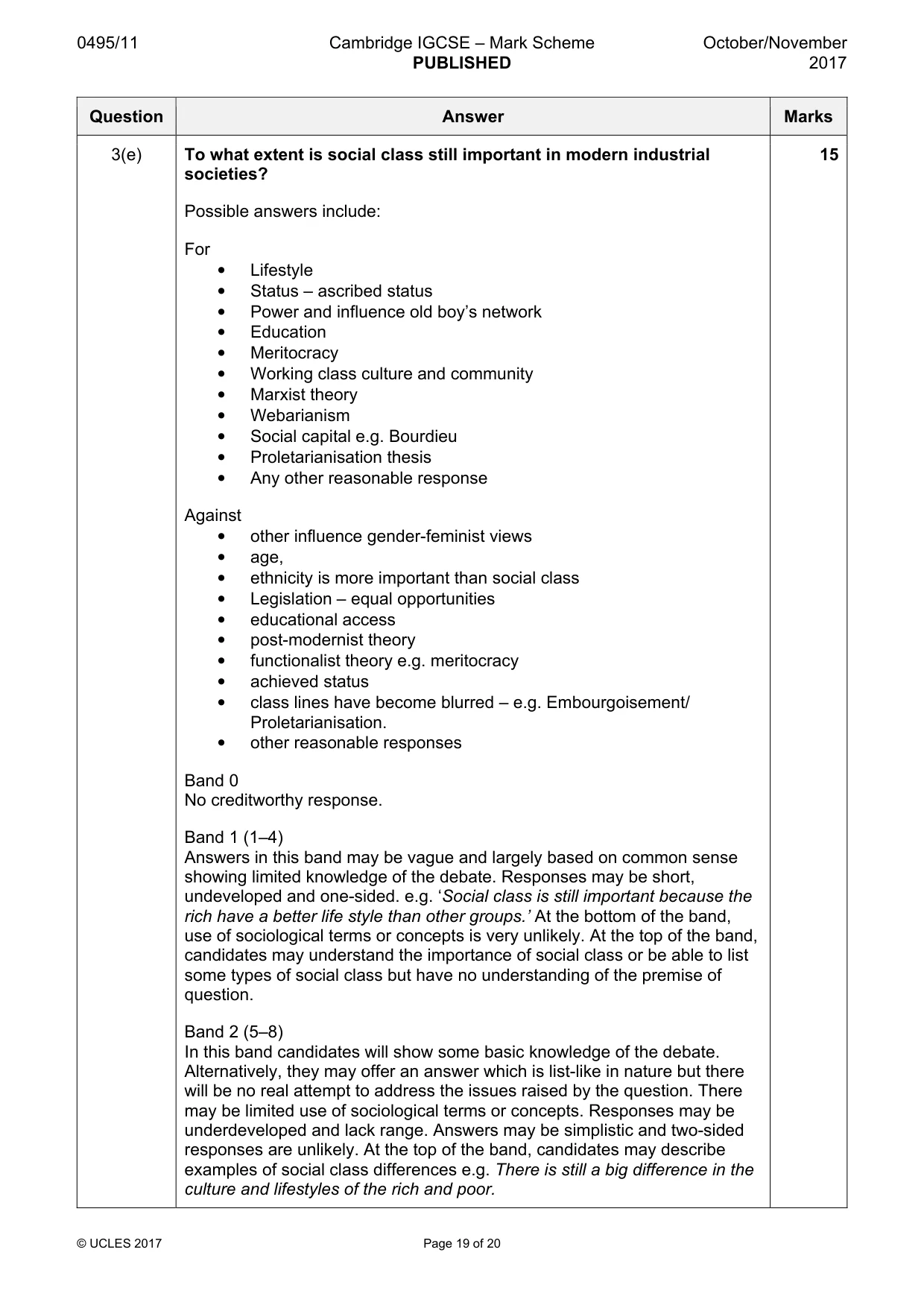
0495/11 Cambridge IGCSE – Mark Scheme PUBLISHED October/November 2017 © UCLES 2017 Page 19 of 20 Question Answer Marks 3(e) To what extent is social class still important in modern industrial societies? Possible answers include: For • Lifestyle • Status – ascribed status • Power and influence old boy’s network • Education • Meritocracy • Working class culture and community • Marxist theory • Webarianism • Social capital e.g. Bourdieu • Proletarianisation thesis • Any other reasonable response Against • other influence gender-feminist views • age, • ethnicity is more important than social class • Legislation – equal opportunities • educational access • post-modernist theory • functionalist theory e.g. meritocracy • achieved status • class lines have become blurred – e.g. Embourgoisement/ Proletarianisation. • other reasonable responses Band 0 No creditworthy response. Band 1 (1–4) Answers in this band may be vague and largely based on common sense showing limited knowledge of the debate. Responses may be short, undeveloped and one-sided. e.g. ‘Social class is still important because the rich have a better life style than other groups.’ At the bottom of the band, use of sociological terms or concepts is very unlikely. At the top of the band, candidates may understand the importance of social class or be able to list some types of social class but have no understanding of the premise of question. Band 2 (5–8) In this band candidates will show some basic knowledge of the debate. Alternatively, they may offer an answer which is list-like in nature but there will be no real attempt to address the issues raised by the question. There may be limited use of sociological terms or concepts. Responses may be underdeveloped and lack range. Answers may be simplistic and two-sided responses are unlikely. At the top of the band, candidates may describe examples of social class differences e.g. There is still a big difference in the culture and lifestyles of the rich and poor. 15
Mark scheme, page 20
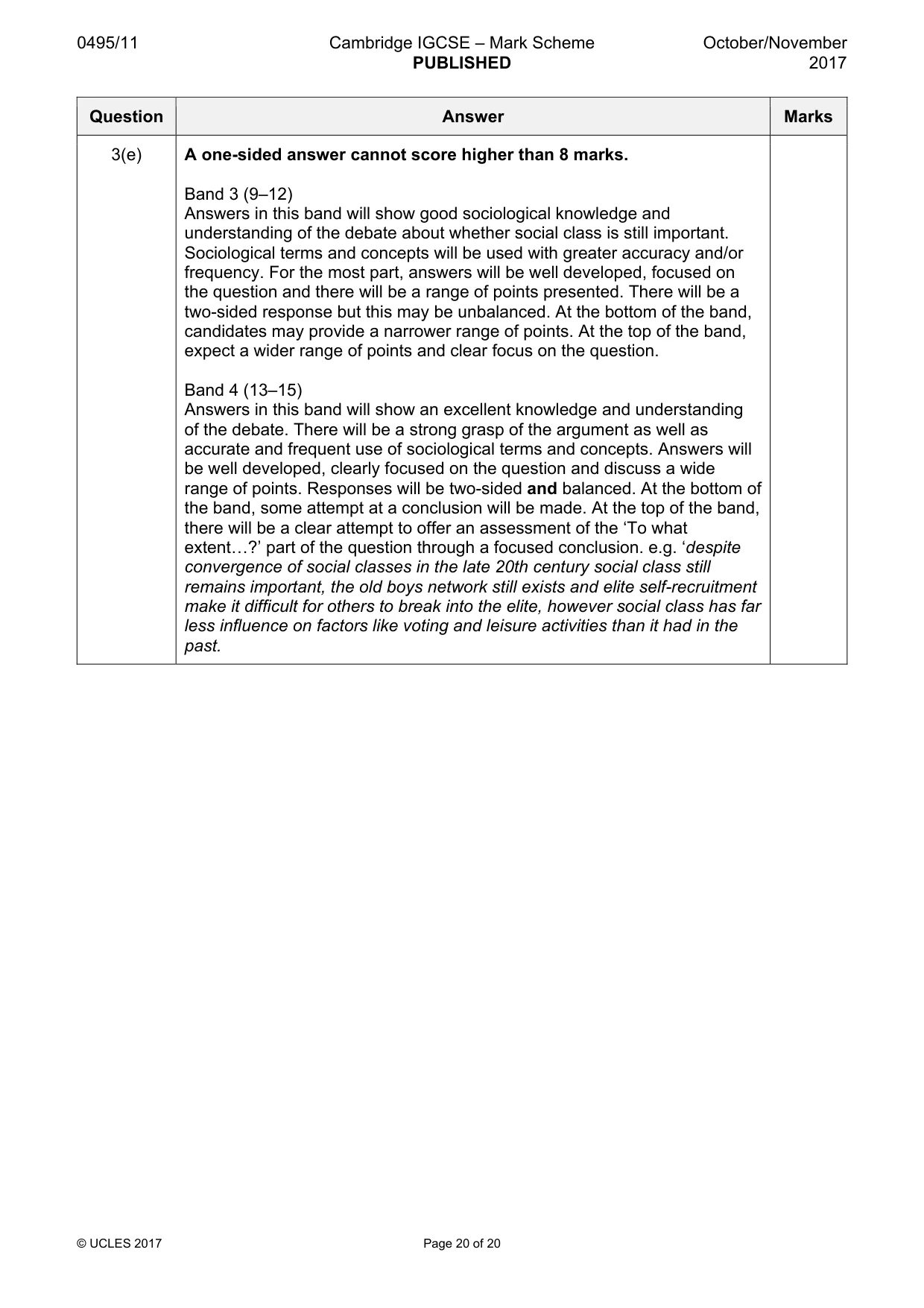
0495/11 Cambridge IGCSE – Mark Scheme PUBLISHED October/November 2017 © UCLES 2017 Page 20 of 20 Question Answer Marks 3(e) A one-sided answer cannot score higher than 8 marks. Band 3 (9–12) Answers in this band will show good sociological knowledge and understanding of the debate about whether social class is still important. Sociological terms and concepts will be used with greater accuracy and/or frequency. For the most part, answers will be well developed, focused on the question and there will be a range of points presented. There will be a two-sided response but this may be unbalanced. At the bottom of the band, candidates may provide a narrower range of points. At the top of the band, expect a wider range of points and clear focus on the question. Band 4 (13–15) Answers in this band will show an excellent knowledge and understanding of the debate. There will be a strong grasp of the argument as well as accurate and frequent use of sociological terms and concepts. Answers will be well developed, clearly focused on the question and discuss a wide range of points. Responses will be two-sided and balanced. At the bottom of the band, some attempt at a conclusion will be made. At the top of the band, there will be a clear attempt to offer an assessment of the ‘To what extent«?’ part of the question through a focused conclusion. e.g. ‘despite convergence of social classes in the late 20th century social class still remains important, the old boys network still exists and elite self-recruitment make it difficult for others to break into the elite, however social class has far less influence on factors like voting and leisure activities than it had in the past.
What you needed in this session
Cambridge’s own grade thresholds for 2017 Oct/Nov, Paper 1 · Variant 1. A higher threshold means an easier paper — the bar moves with how the cohort did.