Cambridge IGCSE Sociology 0495 — 2017 May/June Paper 2 · Variant 3
0495/23/M/J/17 · 4 questions · 70 marks · ≈79 min
The question paper and its mark scheme, free to read here and free to download. This is Cambridge’s own paper, exactly as it was sat.
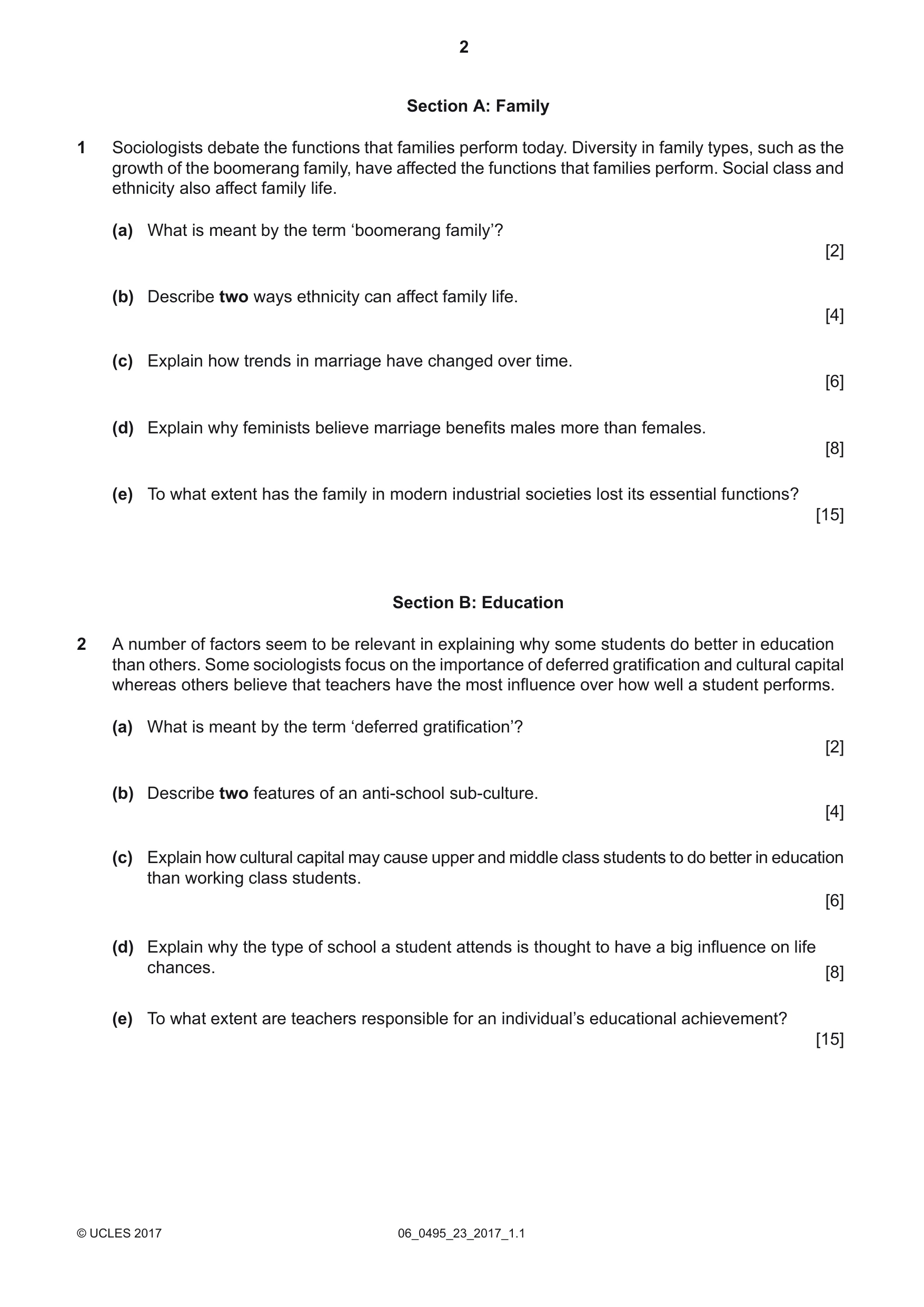
Question paper4 pages

Mark scheme27 pages
Answers below. Sit the paper first if you are practising.
Questions as text
Q1 · Sociologists debate the functions that families perform today
1 Sociologists debate the functions that families perform today. Diversity in family types, such as the growth of the boomerang family, have affected the functions that families perform. Social class and ethnicity also affect family life. (a) What is meant by the term ‘boomerang family’? [2] (b) Describe two ways ethnicity can affect family life. [4] (c) Explain how trends in marriage have changed over time. [6] (d) Explain why feminists believe marriage benefits males more than females. [8] (e) To what extent has the family in modern industrial societies lost its essential functions? [15]
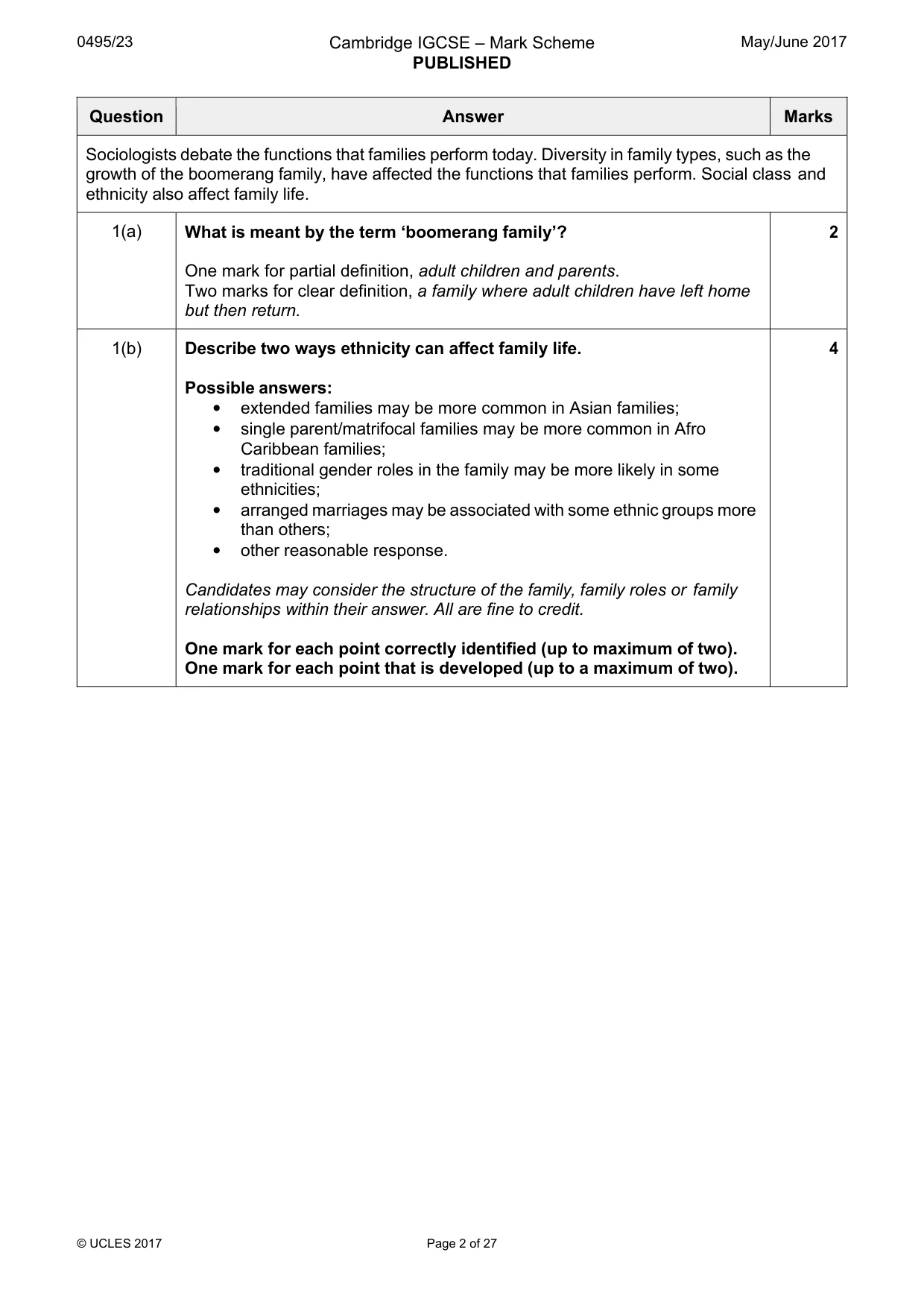
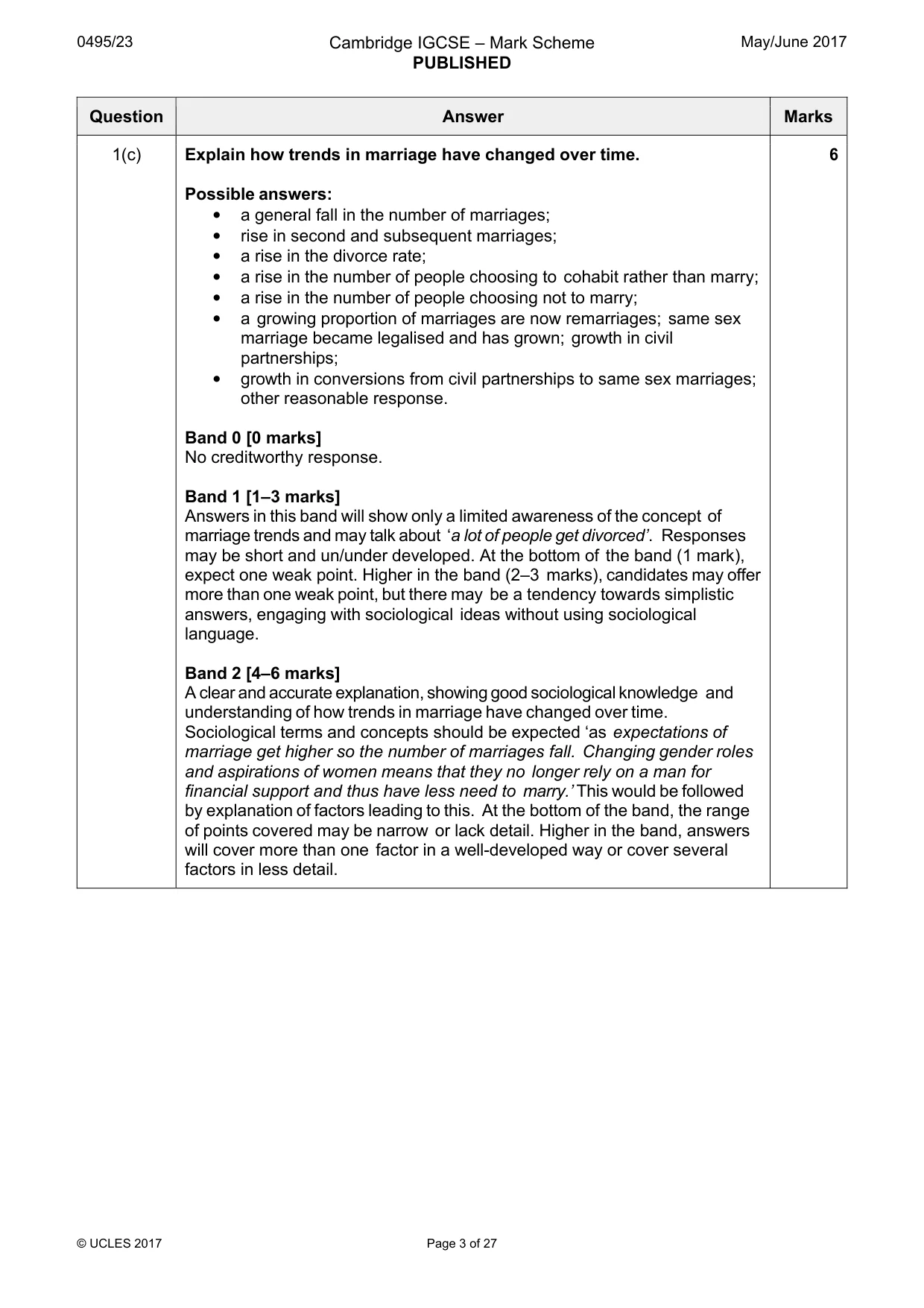
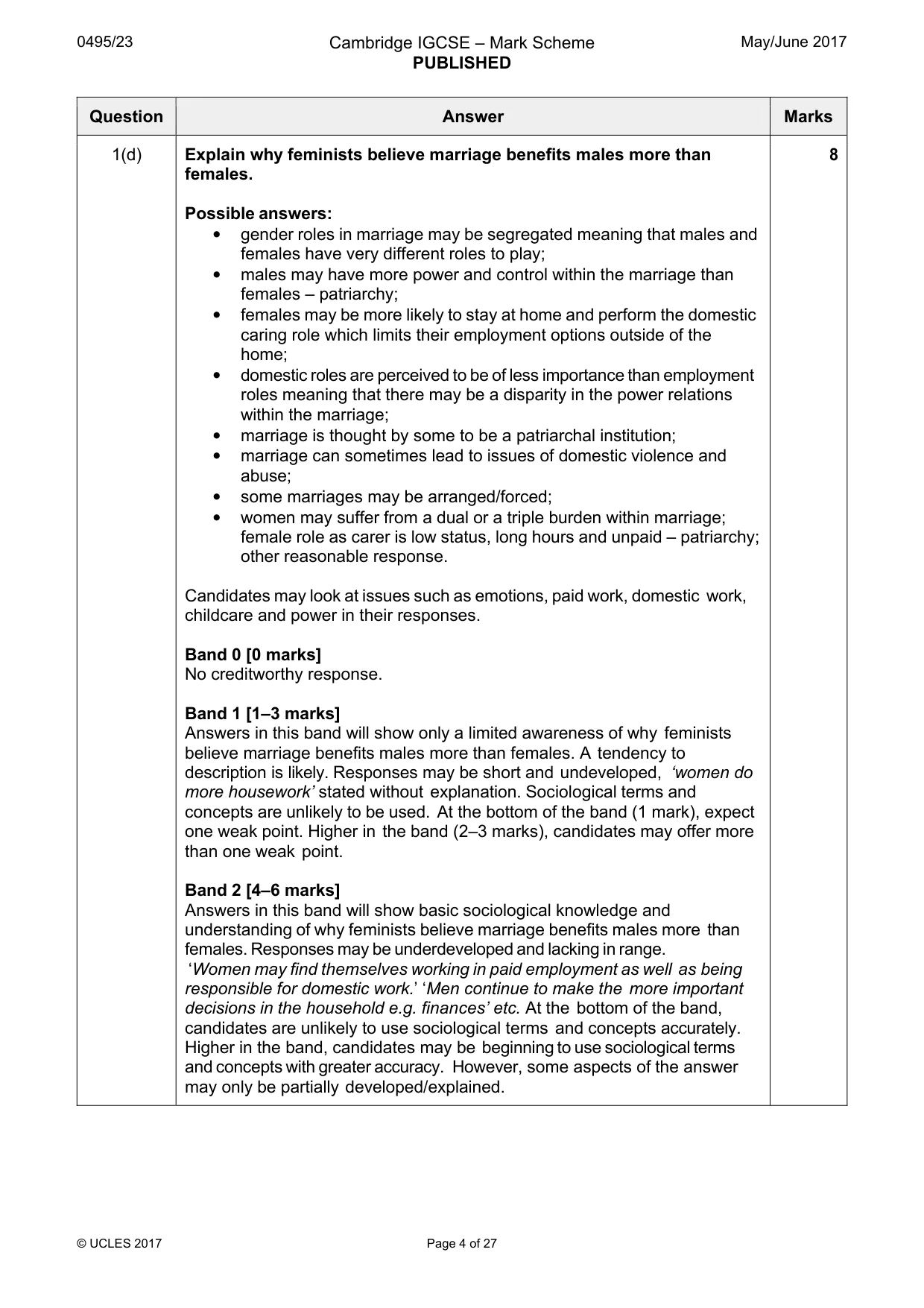
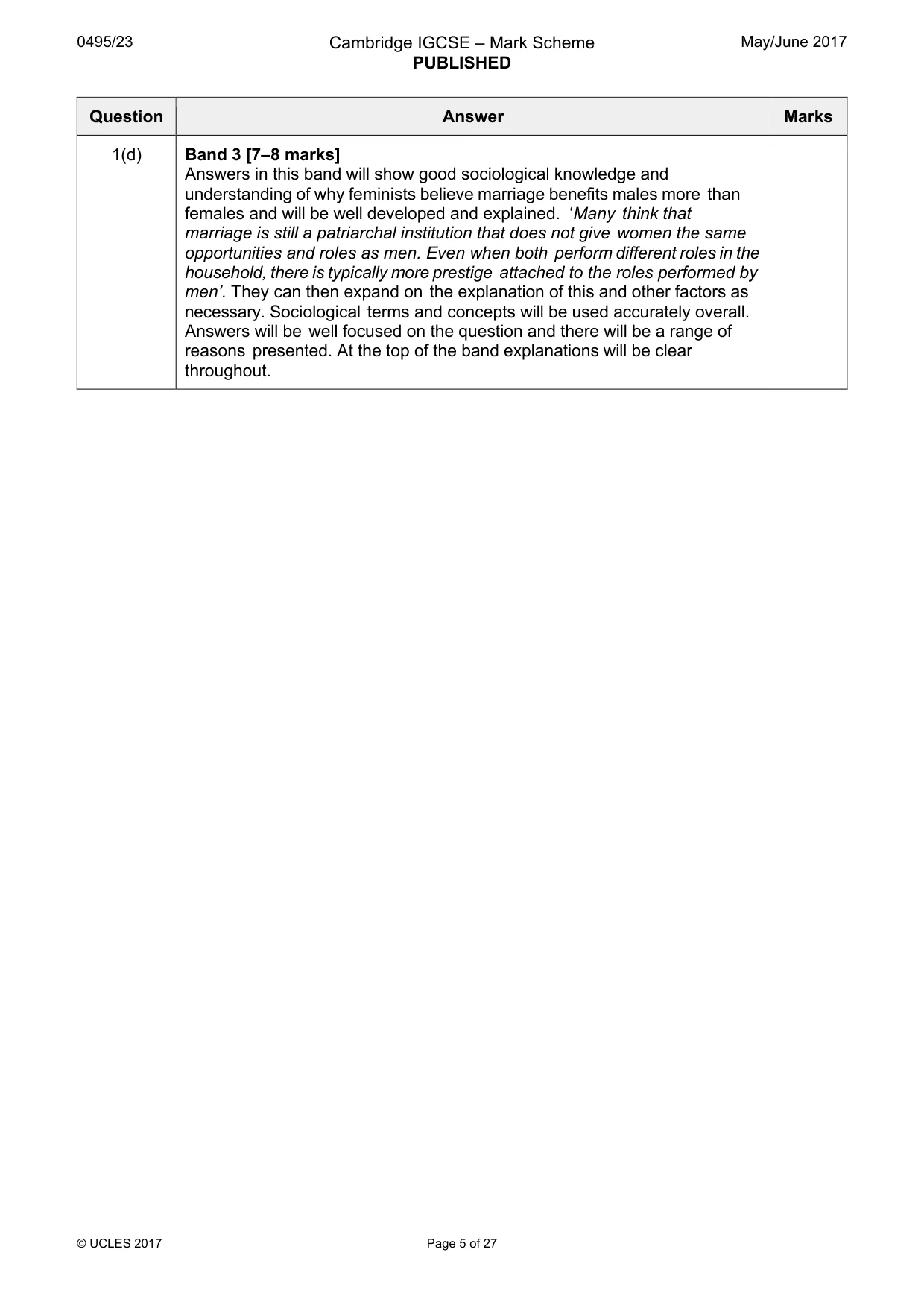
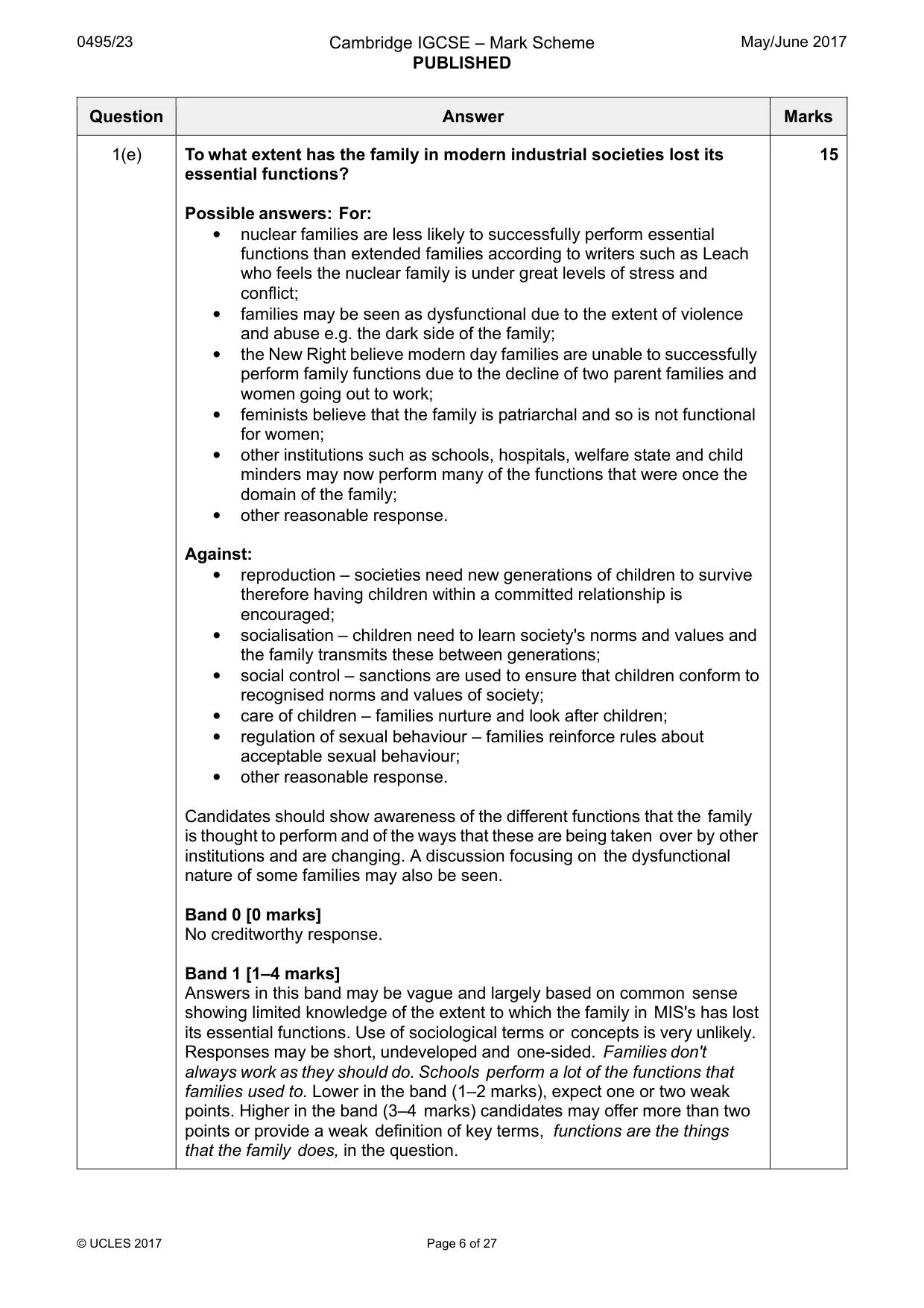
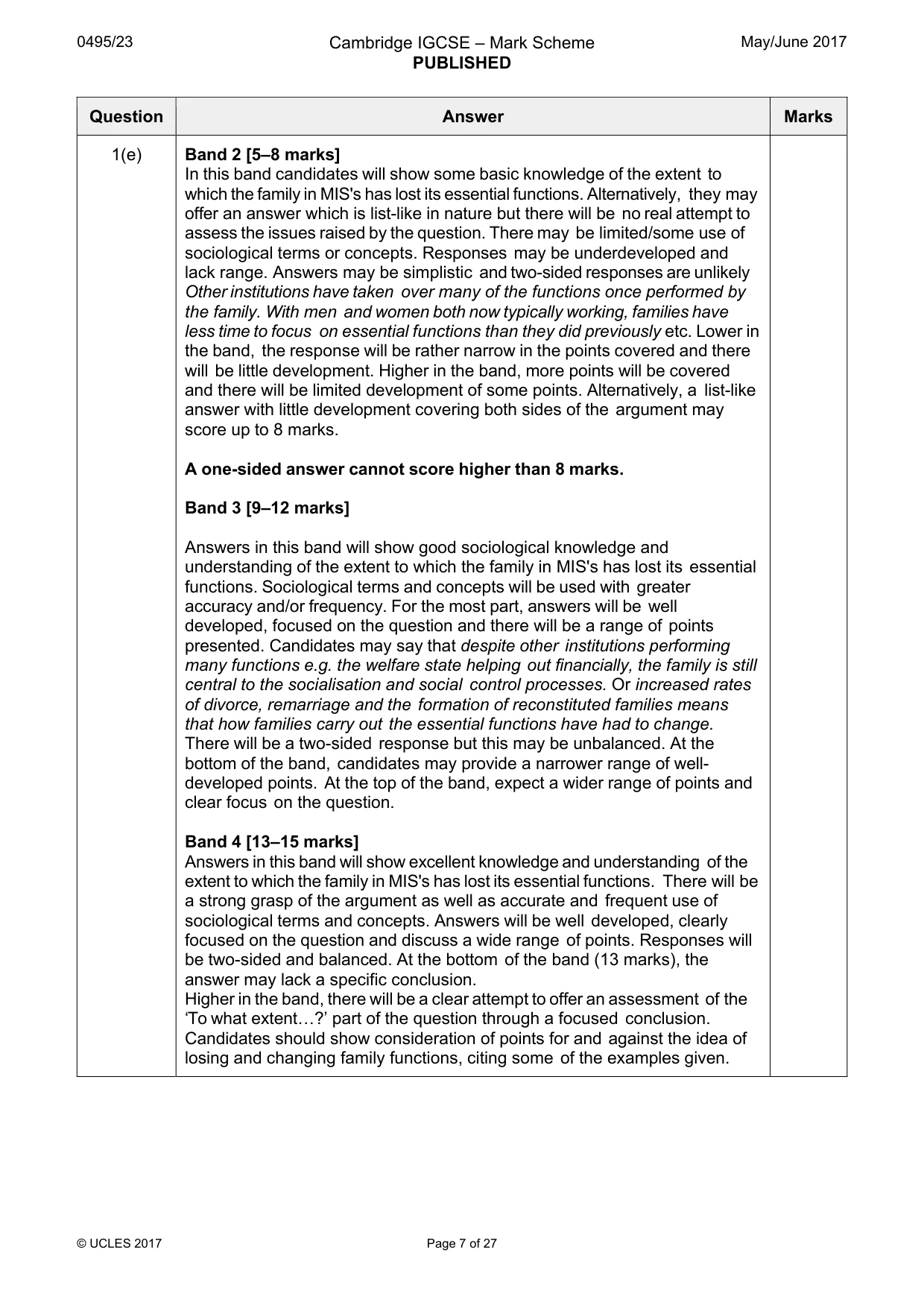
Mark scheme: Question Answer Marks Sociologists debate the functions that families perform today. Diversity in family types, such as the growth of the boomerang family, have affected the functions that families perform. Social class and ethnicity also affect family life. 1(a) What is meant by the term ‘boomerang family’? 2 One mark for partial definition, adult children and parents. Two marks for clear definition, a family where adult children have left home but then return. 1(b) Describe two ways ethnicity can affect family life. 4 Possible answers: • extended families may be more common in Asian families; • single parent/matrifocal families may be more common in Afro Caribbean families; • traditional gender roles in the family may be more likely in some ethnicities; • arranged marriages may be associated with some ethnic groups more than others; • other reasonable response. Candidates may consider the structure of the family, family roles or family relationships within their answer. All are fine to credit. One mark for each point correctly identified (up to maximum of two). One mark for each point that is developed (up to a maximum of two). 1(c) Explain how trends in marriage have changed over time. 6 Possible answers: • a general fall in the number of marriages; • rise in second and subsequent marriages; • a rise in the divorce rate; • a rise in the number of people choosing to cohabit rather than marry; • a rise in the number of people choosing not to marry; • a growing proportion of marriages are now remarriages; same sex marriage became legalised and has grown; growth in civil partnerships; • growth in conversions from civil partnerships to same sex marriages; other reasonable response. Band 0 [0 marks] No creditworthy response. Band 1 [1–3 marks] Answers in this band will show only a limited awareness of the concept of marriage trends and may talk about ‘a lot of people get divorced’. Responses may be short and un/under developed. At the bottom of the band (1 mark), expect one weak point. Higher in the band (2–3 marks), candidates may offer more than one weak point, but there may be a tendency towards simplistic answers, engaging with sociological ideas without using sociological language. Band 2 [4–6 marks] A clear and accurate explanation, showing good sociological knowledge and understanding of how trends in marriage have changed over time. Sociological terms and concepts should be expected ‘as expectations of marriage get higher so the number of marriages fall. Changing gender roles and aspirations of women means that they no longer rely on a man for financial support and thus have less need to marry.’ This would be followed by explanation of factors leading to this. At the bottom of the band, the range of points covered may be narrow or lack detail. Higher in the band, answers will cover more than one factor in a well-developed way or cover several factors in less detail. 1(d) Explain why feminists believe marriage benefits males more than 8 females. Possible answers: • gender roles in marriage may be segregated meaning that males and females have very different roles to play; • males may have more power and control within the marriage than females – patriarchy; • females may be more likely to stay at home and perform the domestic caring role which limits their employment options outside of the home; • domestic roles are perceived to be of less importance than employment roles meaning that there may be a disparity in the power relations within the marriage; • marriage is thought by some to be a patriarchal institution; • marriage can sometimes lead to issues of domestic violence and abuse; • some marriages may be arranged/forced; • women may suffer from a dual or a triple burden within marriage; female role as carer is low status, long hours and unpaid – patriarchy; other reasonable response. Candidates may look at issues such as emotions, paid work, domestic work, childcare and power in their responses. Band 0 [0 marks] No creditworthy response. Band 1 [1–3 marks] Answers in this band will show only a limited awareness of why feminists believe marriage benefits males more than females. A tendency to description is likely. Responses may be short and undeveloped, ‘women do more housework’ stated without explanation. Sociological terms and concepts are unlikely to be used. At the bottom of the band (1 mark), expect one weak point. Higher in the band (2–3 marks), candidates may offer more than one weak point. Band 2 [4–6 marks] Answers in this band will show basic sociological knowledge and understanding of why feminists believe marriage benefits males more than females. Responses may be underdeveloped and lacking in range. ‘Women may find themselves working in paid employment as well as being responsible for domestic work.’ ‘Men continue to make the more important decisions in the household e.g. finances’ etc. At the bottom of the band, candidates are unlikely to use sociological terms and concepts accurately. Higher in the band, candidates may be beginning to use sociological terms and concepts with greater accuracy. However, some aspects of the answer may only be partially developed/explained. 1(d) Band 3 [7–8 marks] Answers in this band will show good sociological knowledge and understanding of why feminists believe marriage benefits males more than females and will be well developed and explained. ‘Many think that marriage is still a patriarchal institution that does not give women the same opportunities and roles as men. Even when both perform different roles in the household, there is typically more prestige attached to the roles performed by men’. They can then expand on the explanation of this and other factors as necessary. Sociological terms and concepts will be used accurately overall. Answers will be well focused on the question and there will be a range of reasons presented. At the top of the band explanations will be clear throughout. 1(e) To what extent has the family in modern industrial societies lost its 15 essential functions? Possible answers: For: • nuclear families are less likely to successfully perform essential functions than extended families according to writers such as Leach who feels the nuclear family is under great levels of stress and conflict; • families may be seen as dysfunctional due to the extent of violence and abuse e.g. the dark side of the family; • the New Right believe modern day families are unable to successfully perform family functions due to the decline of two parent families and women going out to work; • feminists believe that the family is patriarchal and so is not functional for women; • other institutions such as schools, hospitals, welfare state and child minders may now perform many of the functions that were once the domain of the family; • other reasonable response. Against: • reproduction – societies need new generations of children to survive therefore having children within a committed relationship is encouraged; • socialisation – children need to learn society's norms and values and the family transmits these between generations; • social control – sanctions are used to ensure that children conform to recognised norms and values of society; • care of children – families nurture and look after children; • regulation of sexual behaviour – families reinforce rules about acceptable sexual behaviour; • other reasonable response. Candidates should show awareness of the different functions that the family is thought to perform and of the ways that these are being taken over by other institutions and are changing. A discussion focusing on the dysfunctional nature of some families may also be seen. Band 0 [0 marks] No creditworthy response. Band 1 [1–4 marks] Answers in this band may be vague and largely based on common sense showing limited knowledge of the extent to which the family in MIS's has lost its essential functions. Use of sociological terms or concepts is very unlikely. Responses may be short, undeveloped and one-sided. Families don't always work as they should do. Schools perform a lot of the functions that families used to. Lower in the band (1–2 marks), expect one or two weak points. Higher in the band (3–4 marks) candidates may offer more than two points or provide a weak definition of key terms, functions are the things that the family does, in the question. 1(e) Band 2 [5–8 marks] In this band candidates will show some basic knowledge of the extent to which the family in MIS's has lost its essential functions. Alternatively, they may offer an answer which is list-like in nature but there will be no real attempt to assess the issues raised by the question. There may be limited/some use of sociological terms or concepts. Responses may be underdeveloped and lack range. Answers may be simplistic and two-sided responses are unlikely Other institutions have taken over many of the functions once performed by the family. With men and women both now typically working, families have less time to focus on essential functions than they did previously etc. Lower in the band, the response will be rather narrow in the points covered and there will be little development. Higher in the band, more points will be covered and there will be limited development of some points. Alternatively, a list-like answer with little development covering both sides of the argument may score up to 8 marks. A one-sided answer cannot score higher than 8 marks. Band 3 [9–12 marks] Answers in this band will show good sociological knowledge and understanding of the extent to which the family in MIS's has lost its essential functions. Sociological terms and concepts will be used with greater accuracy and/or frequency. For the most part, answers will be well developed, focused on the question and there will be a range of points presented. Candidates may say that despite other institutions performing many functions e.g. the welfare state helping out financially, the family is still central to the socialisation and social control processes. Or increased rates of divorce, remarriage and the formation of reconstituted families means that how families carry out the essential functions have had to change. There will be a two-sided response but this may be unbalanced. At the bottom of the band, candidates may provide a narrower range of well- developed points. At the top of the band, expect a wider range of points and clear focus on the question. Band 4 [13–15 marks] Answers in this band will show excellent knowledge and understanding of the extent to which the family in MIS's has lost its essential functions. There will be a strong grasp of the argument as well as accurate and frequent use of sociological terms and concepts. Answers will be well developed, clearly focused on the question and discuss a wide range of points. Responses will be two-sided and balanced. At the bottom of the band (13 marks), the answer may lack a specific conclusion. Higher in the band, there will be a clear attempt to offer an assessment of the ‘To what extent«?’ part of the question through a focused conclusion. Candidates should show consideration of points for and against the idea of losing and changing family functions, citing some of the examples given.
Q2 · A number of factors seem to be relevant in explaining why some students do better in…
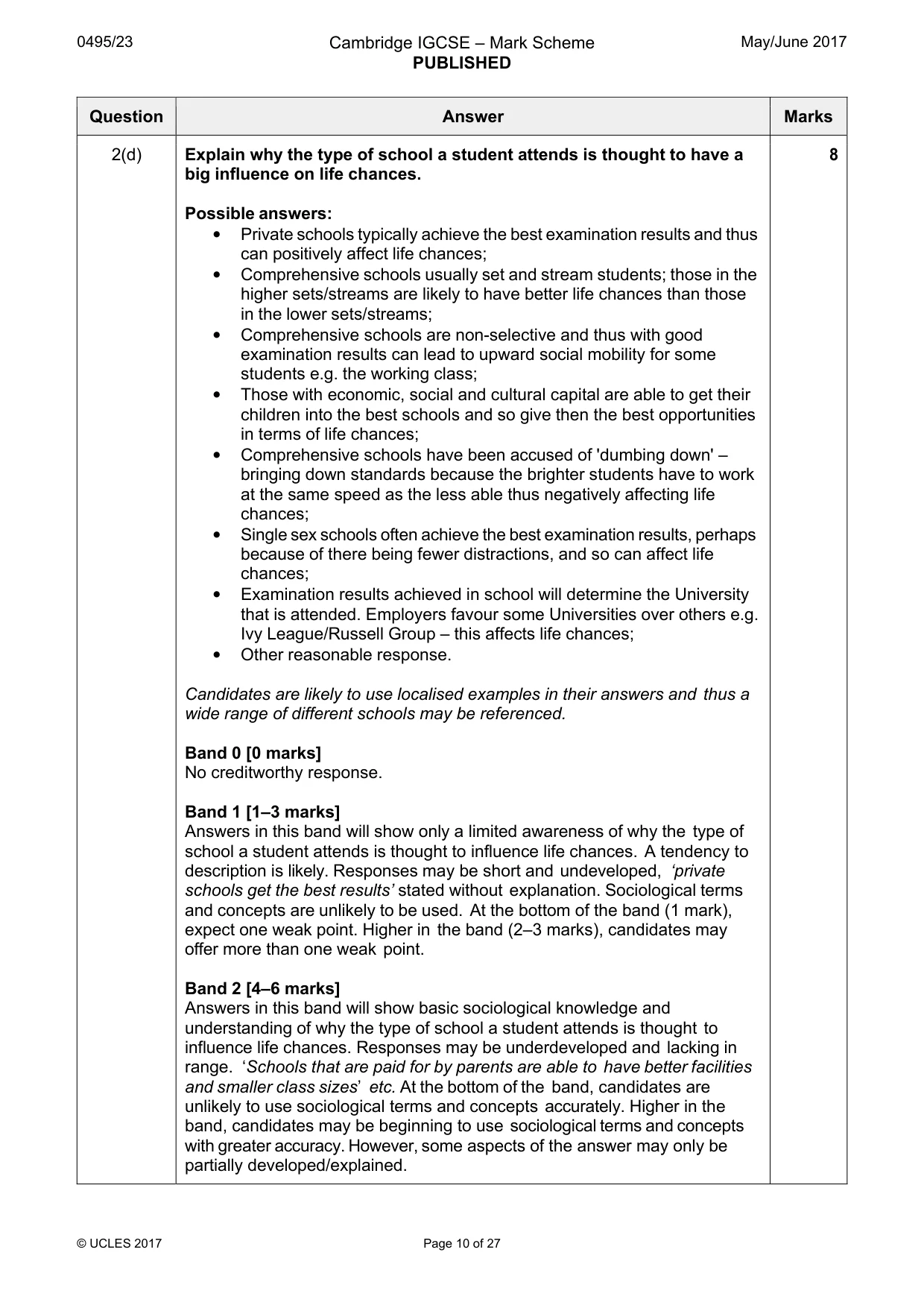
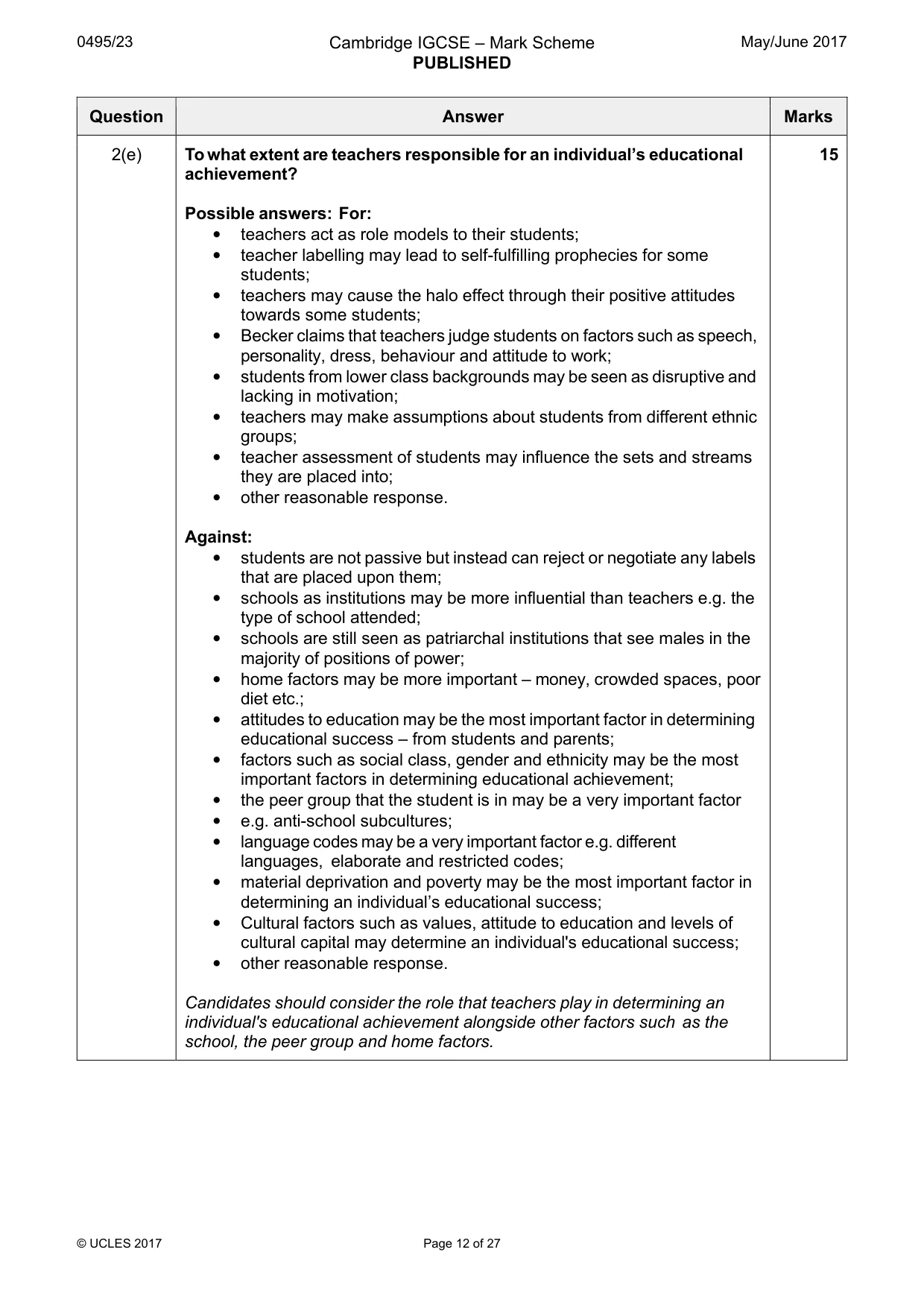
2 A number of factors seem to be relevant in explaining why some students do better in education than others. Some sociologists focus on the importance of deferred gratification and cultural capital whereas others believe that teachers have the most influence over how well a student performs. (a) What is meant by the term ‘deferred gratification’? [2] (b) Describe two features of an anti-school sub-culture. [4] (c) Explain how cultural capital may cause upper and middle class students to do better in education than working class students. [6] (d) Explain why the type of school a student attends is thought to have a big influence on life chances. [8] (e) To what extent are teachers responsible for an individual’s educational achievement? [15] Section C: Crime, deviance and social control
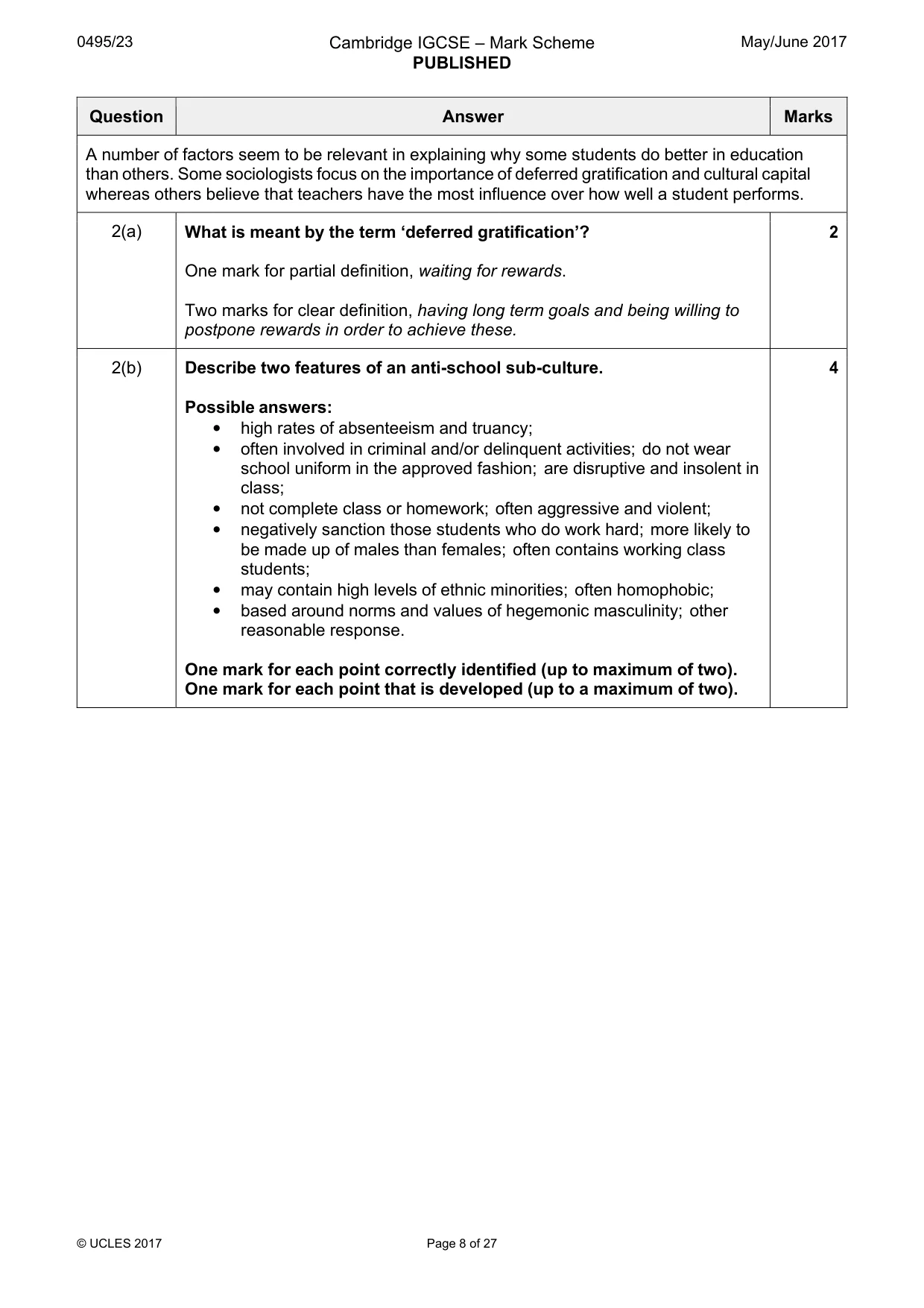
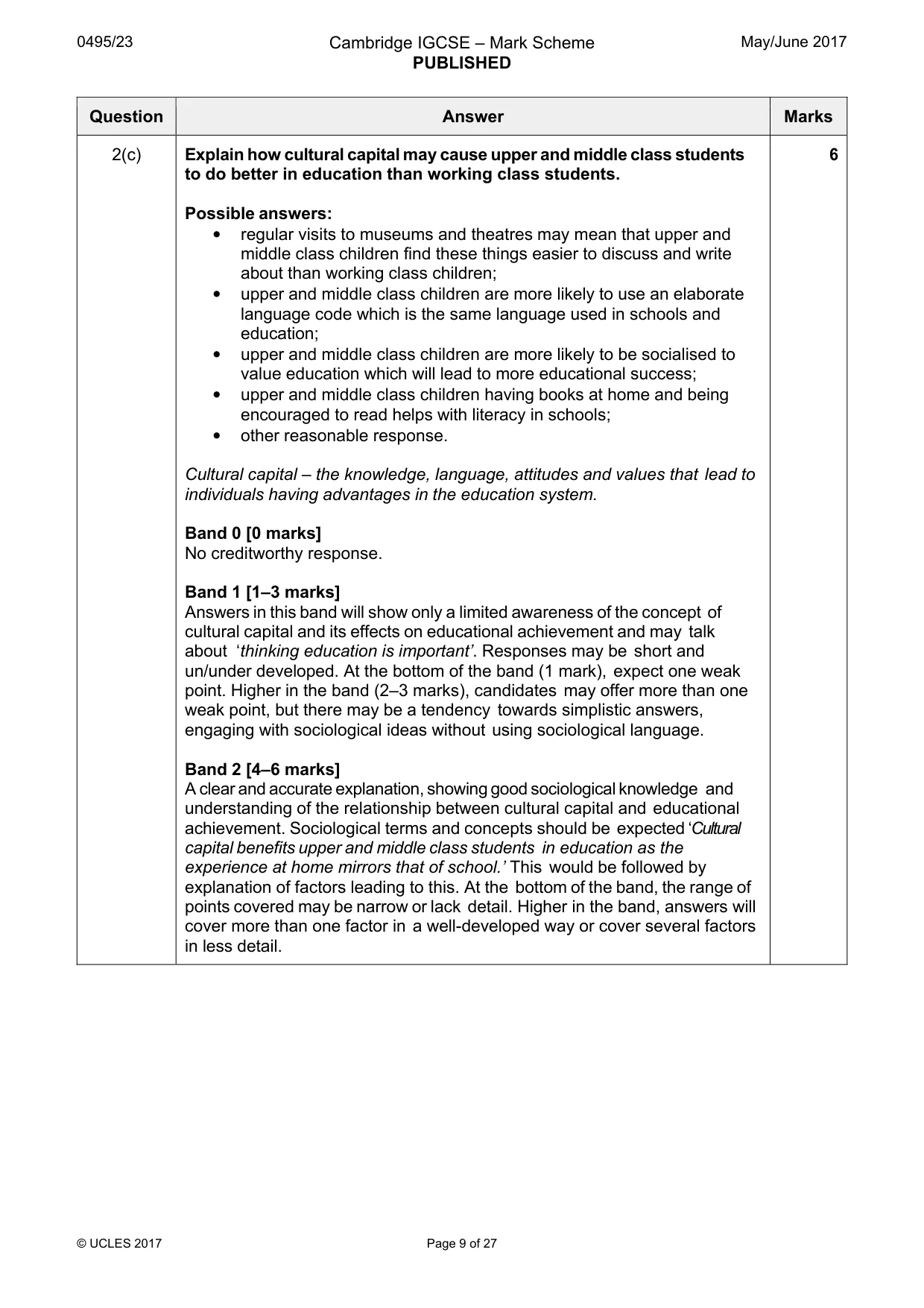
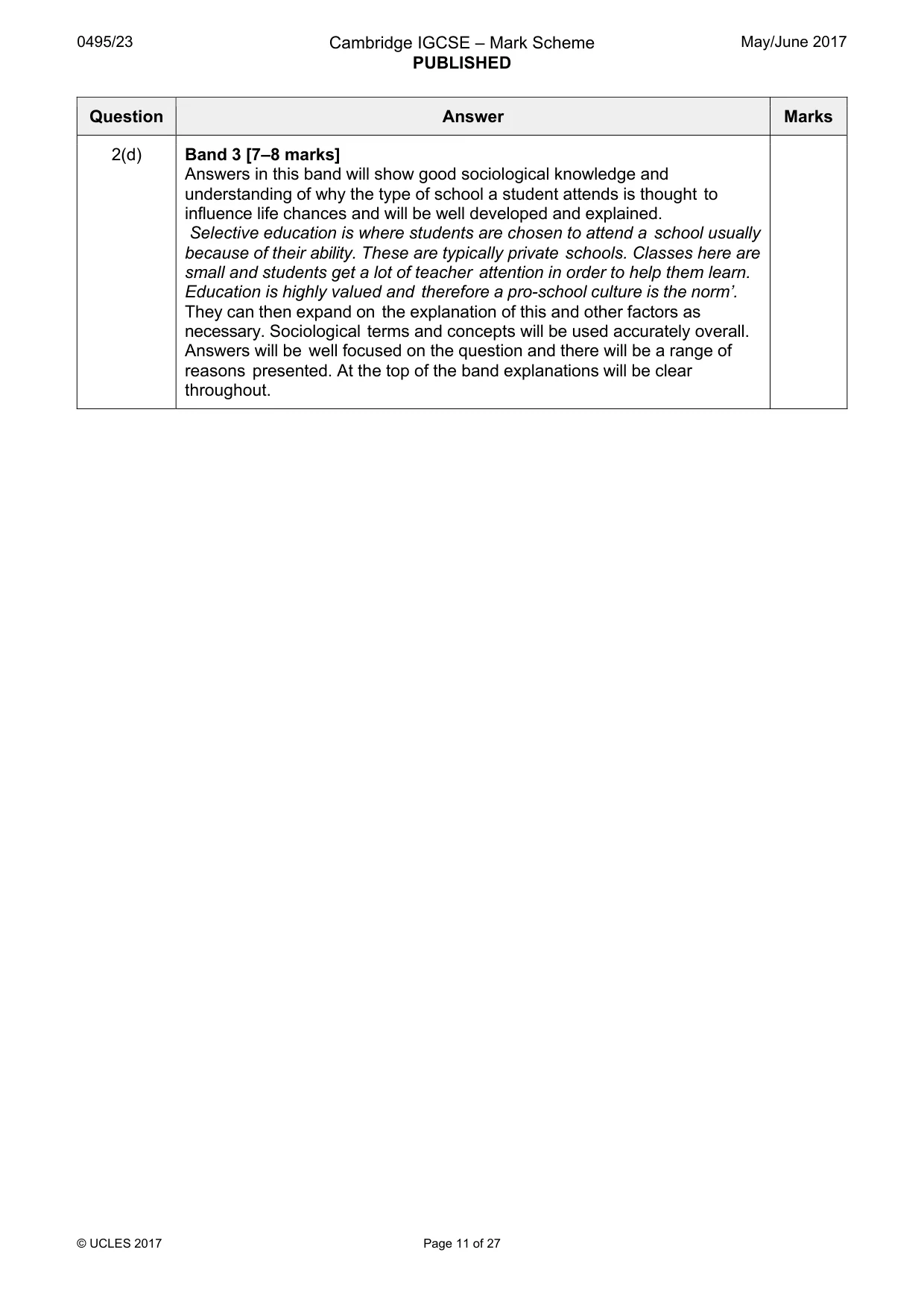
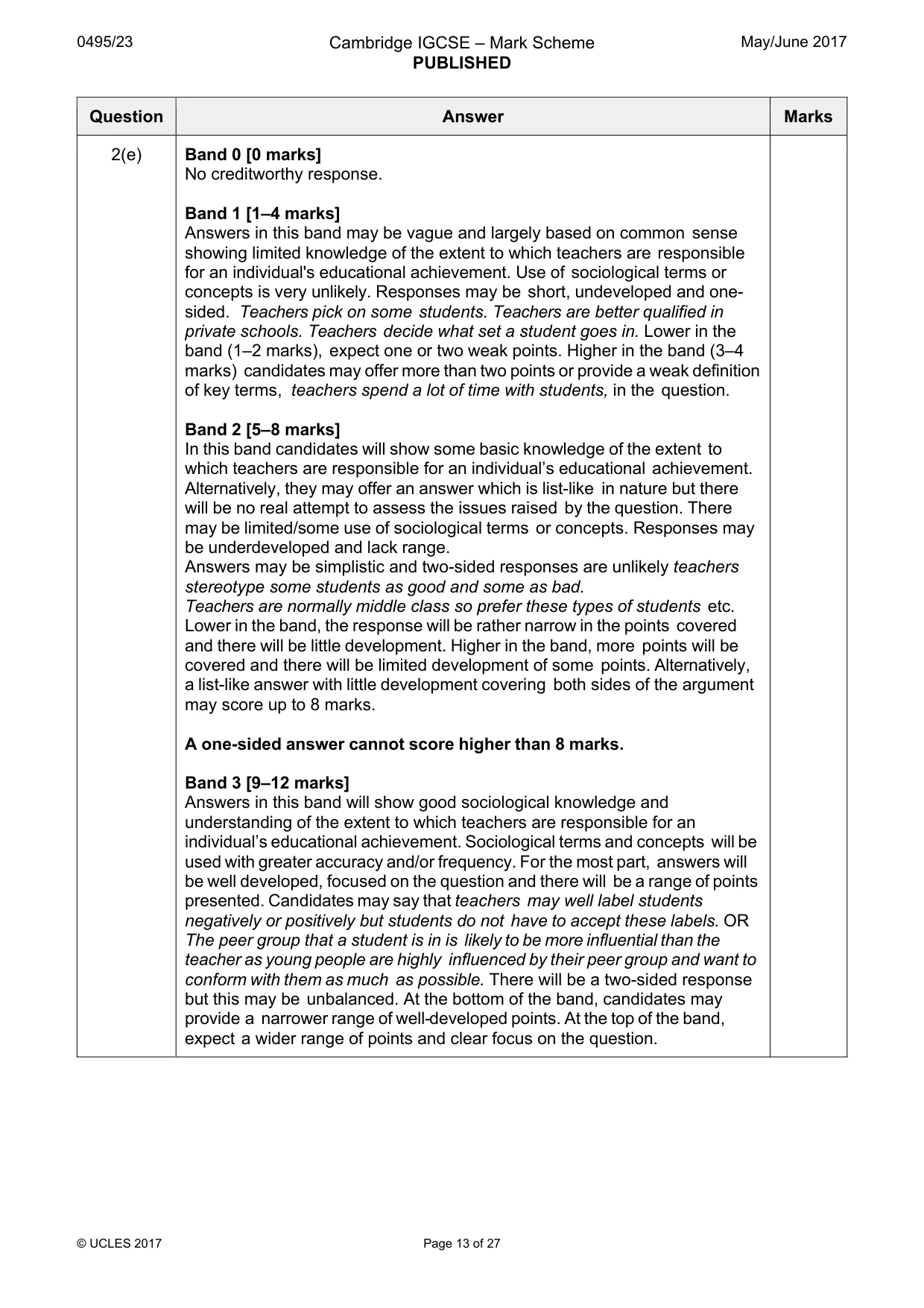
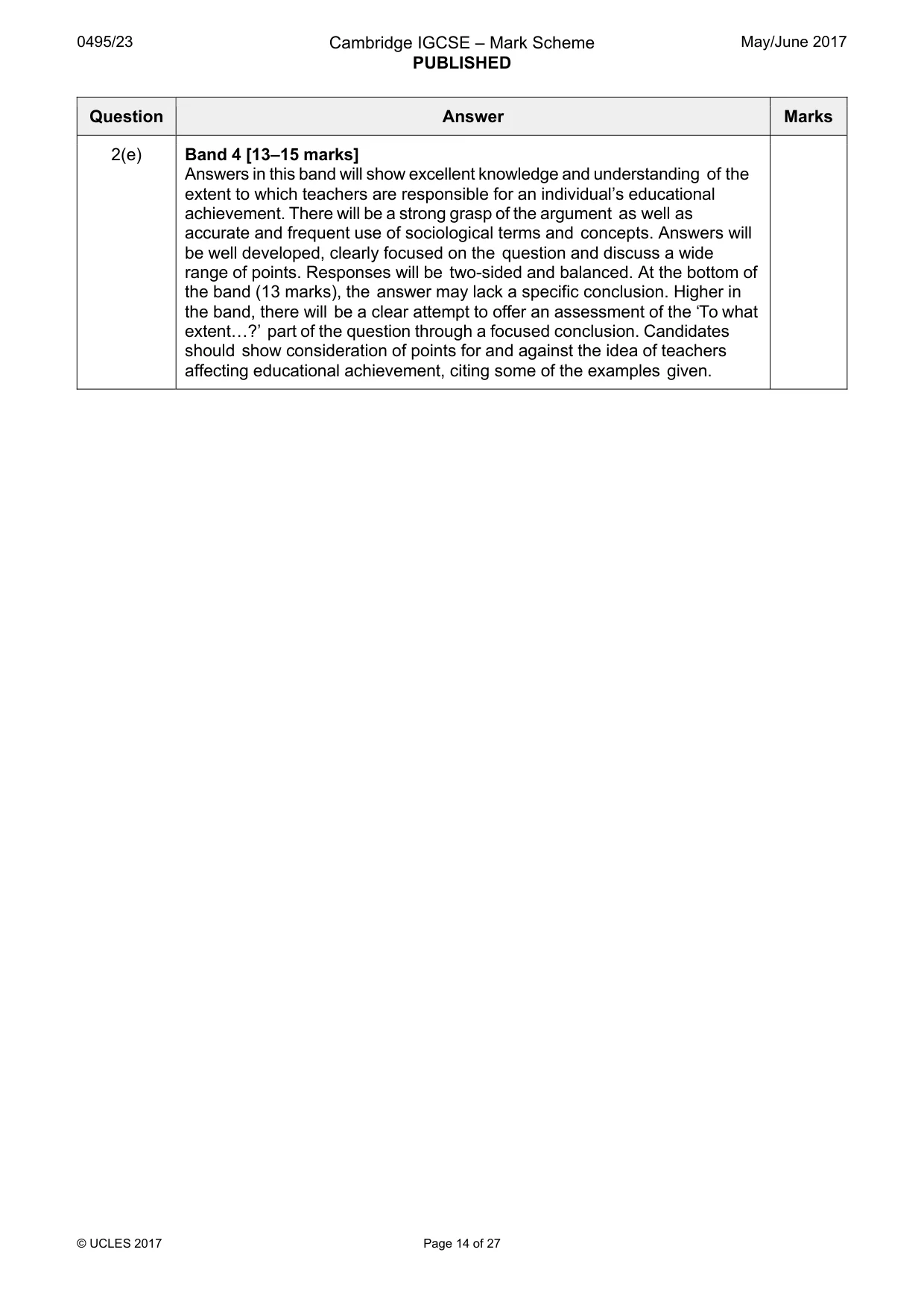
Mark scheme: 2(a) What is meant by the term ‘deferred gratification’? 2 One mark for partial definition, waiting for rewards. Two marks for clear definition, having long term goals and being willing to postpone rewards in order to achieve these. 2(b) Describe two features of an anti-school sub-culture. 4 Possible answers: • high rates of absenteeism and truancy; • often involved in criminal and/or delinquent activities; do not wear school uniform in the approved fashion; are disruptive and insolent in class; • not complete class or homework; often aggressive and violent; • negatively sanction those students who do work hard; more likely to be made up of males than females; often contains working class students; • may contain high levels of ethnic minorities; often homophobic; • based around norms and values of hegemonic masculinity; other reasonable response. One mark for each point correctly identified (up to maximum of two). One mark for each point that is developed (up to a maximum of two). 2(c) Explain how cultural capital may cause upper and middle class students 6 to do better in education than working class students. Possible answers: • regular visits to museums and theatres may mean that upper and middle class children find these things easier to discuss and write about than working class children; • upper and middle class children are more likely to use an elaborate language code which is the same language used in schools and education; • upper and middle class children are more likely to be socialised to value education which will lead to more educational success; • upper and middle class children having books at home and being encouraged to read helps with literacy in schools; • other reasonable response. Cultural capital – the knowledge, language, attitudes and values that lead to individuals having advantages in the education system. Band 0 [0 marks] No creditworthy response. Band 1 [1–3 marks] Answers in this band will show only a limited awareness of the concept of cultural capital and its effects on educational achievement and may talk about ‘thinking education is important’. Responses may be short and un/under developed. At the bottom of the band (1 mark), expect one weak point. Higher in the band (2–3 marks), candidates may offer more than one weak point, but there may be a tendency towards simplistic answers, engaging with sociological ideas without using sociological language. Band 2 [4–6 marks] A clear and accurate explanation, showing good sociological knowledge and understanding of the relationship between cultural capital and educational achievement. Sociological terms and concepts should be expected ‘Cultural capital benefits upper and middle class students in education as the experience at home mirrors that of school.’ This would be followed by explanation of factors leading to this. At the bottom of the band, the range of points covered may be narrow or lack detail. Higher in the band, answers will cover more than one factor in a well-developed way or cover several factors in less detail. 2(d) Explain why the type of school a student attends is thought to have a 8 big influence on life chances. Possible answers: • Private schools typically achieve the best examination results and thus can positively affect life chances; • Comprehensive schools usually set and stream students; those in the higher sets/streams are likely to have better life chances than those in the lower sets/streams; • Comprehensive schools are non-selective and thus with good examination results can lead to upward social mobility for some students e.g. the working class; • Those with economic, social and cultural capital are able to get their children into the best schools and so give then the best opportunities in terms of life chances; • Comprehensive schools have been accused of 'dumbing down' – bringing down standards because the brighter students have to work at the same speed as the less able thus negatively affecting life chances; • Single sex schools often achieve the best examination results, perhaps because of there being fewer distractions, and so can affect life chances; • Examination results achieved in school will determine the University that is attended. Employers favour some Universities over others e.g. Ivy League/Russell Group – this affects life chances; • Other reasonable response. Candidates are likely to use localised examples in their answers and thus a wide range of different schools may be referenced. Band 0 [0 marks] No creditworthy response. Band 1 [1–3 marks] Answers in this band will show only a limited awareness of why the type of school a student attends is thought to influence life chances. A tendency to description is likely. Responses may be short and undeveloped, ‘private schools get the best results’ stated without explanation. Sociological terms and concepts are unlikely to be used. At the bottom of the band (1 mark), expect one weak point. Higher in the band (2–3 marks), candidates may offer more than one weak point. Band 2 [4–6 marks] Answers in this band will show basic sociological knowledge and understanding of why the type of school a student attends is thought to influence life chances. Responses may be underdeveloped and lacking in range. ‘Schools that are paid for by parents are able to have better facilities and smaller class sizes’ etc. At the bottom of the band, candidates are unlikely to use sociological terms and concepts accurately. Higher in the band, candidates may be beginning to use sociological terms and concepts with greater accuracy. However, some aspects of the answer may only be partially developed/explained. 2(d) Band 3 [7–8 marks] Answers in this band will show good sociological knowledge and understanding of why the type of school a student attends is thought to influence life chances and will be well developed and explained. Selective education is where students are chosen to attend a school usually because of their ability. These are typically private schools. Classes here are small and students get a lot of teacher attention in order to help them learn. Education is highly valued and therefore a pro-school culture is the norm’. They can then expand on the explanation of this and other factors as necessary. Sociological terms and concepts will be used accurately overall. Answers will be well focused on the question and there will be a range of reasons presented. At the top of the band explanations will be clear throughout. 2(e) To what extent are teachers responsible for an individual’s educational 15 achievement? Possible answers: For: • teachers act as role models to their students; • teacher labelling may lead to self-fulfilling prophecies for some students; • teachers may cause the halo effect through their positive attitudes towards some students; • Becker claims that teachers judge students on factors such as speech, personality, dress, behaviour and attitude to work; • students from lower class backgrounds may be seen as disruptive and lacking in motivation; • teachers may make assumptions about students from different ethnic groups; • teacher assessment of students may influence the sets and streams they are placed into; • other reasonable response. Against: • students are not passive but instead can reject or negotiate any labels that are placed upon them; • schools as institutions may be more influential than teachers e.g. the type of school attended; • schools are still seen as patriarchal institutions that see males in the majority of positions of power; • home factors may be more important – money, crowded spaces, poor diet etc.; • attitudes to education may be the most important factor in determining educational success – from students and parents; • factors such as social class, gender and ethnicity may be the most important factors in determining educational achievement; • the peer group that the student is in may be a very important factor • e.g. anti-school subcultures; • language codes may be a very important factor e.g. different languages, elaborate and restricted codes; • material deprivation and poverty may be the most important factor in determining an individual’s educational success; • Cultural factors such as values, attitude to education and levels of cultural capital may determine an individual's educational success; • other reasonable response. Candidates should consider the role that teachers play in determining an individual's educational achievement alongside other factors such as the school, the peer group and home factors. 2(e) Band 0 [0 marks] No creditworthy response. Band 1 [1–4 marks] Answers in this band may be vague and largely based on common sense showing limited knowledge of the extent to which teachers are responsible for an individual's educational achievement. Use of sociological terms or concepts is very unlikely. Responses may be short, undeveloped and one- sided. Teachers pick on some students. Teachers are better qualified in private schools. Teachers decide what set a student goes in. Lower in the band (1–2 marks), expect one or two weak points. Higher in the band (3–4 marks) candidates may offer more than two points or provide a weak definition of key terms, teachers spend a lot of time with students, in the question. Band 2 [5–8 marks] In this band candidates will show some basic knowledge of the extent to which teachers are responsible for an individual’s educational achievement. Alternatively, they may offer an answer which is list-like in nature but there will be no real attempt to assess the issues raised by the question. There may be limited/some use of sociological terms or concepts. Responses may be underdeveloped and lack range. Answers may be simplistic and two-sided responses are unlikely teachers stereotype some students as good and some as bad. Teachers are normally middle class so prefer these types of students etc. Lower in the band, the response will be rather narrow in the points covered and there will be little development. Higher in the band, more points will be covered and there will be limited development of some points. Alternatively, a list-like answer with little development covering both sides of the argument may score up to 8 marks. A one-sided answer cannot score higher than 8 marks. Band 3 [9–12 marks] Answers in this band will show good sociological knowledge and understanding of the extent to which teachers are responsible for an individual’s educational achievement. Sociological terms and concepts will be used with greater accuracy and/or frequency. For the most part, answers will be well developed, focused on the question and there will be a range of points presented. Candidates may say that teachers may well label students negatively or positively but students do not have to accept these labels. OR The peer group that a student is in is likely to be more influential than the teacher as young people are highly influenced by their peer group and want to conform with them as much as possible. There will be a two-sided response but this may be unbalanced. At the bottom of the band, candidates may provide a narrower range of well-developed points. At the top of the band, expect a wider range of points and clear focus on the question. 2(e) Band 4 [13–15 marks] Answers in this band will show excellent knowledge and understanding of the extent to which teachers are responsible for an individual’s educational achievement. There will be a strong grasp of the argument as well as accurate and frequent use of sociological terms and concepts. Answers will be well developed, clearly focused on the question and discuss a wide range of points. Responses will be two-sided and balanced. At the bottom of the band (13 marks), the answer may lack a specific conclusion. Higher in the band, there will be a clear attempt to offer an assessment of the ‘To what extent«?’ part of the question through a focused conclusion. Candidates should show consideration of points for and against the idea of teachers affecting educational achievement, citing some of the examples given.
Q3 · Most sociologists believe that crime has a negative effect on society and therefore use…
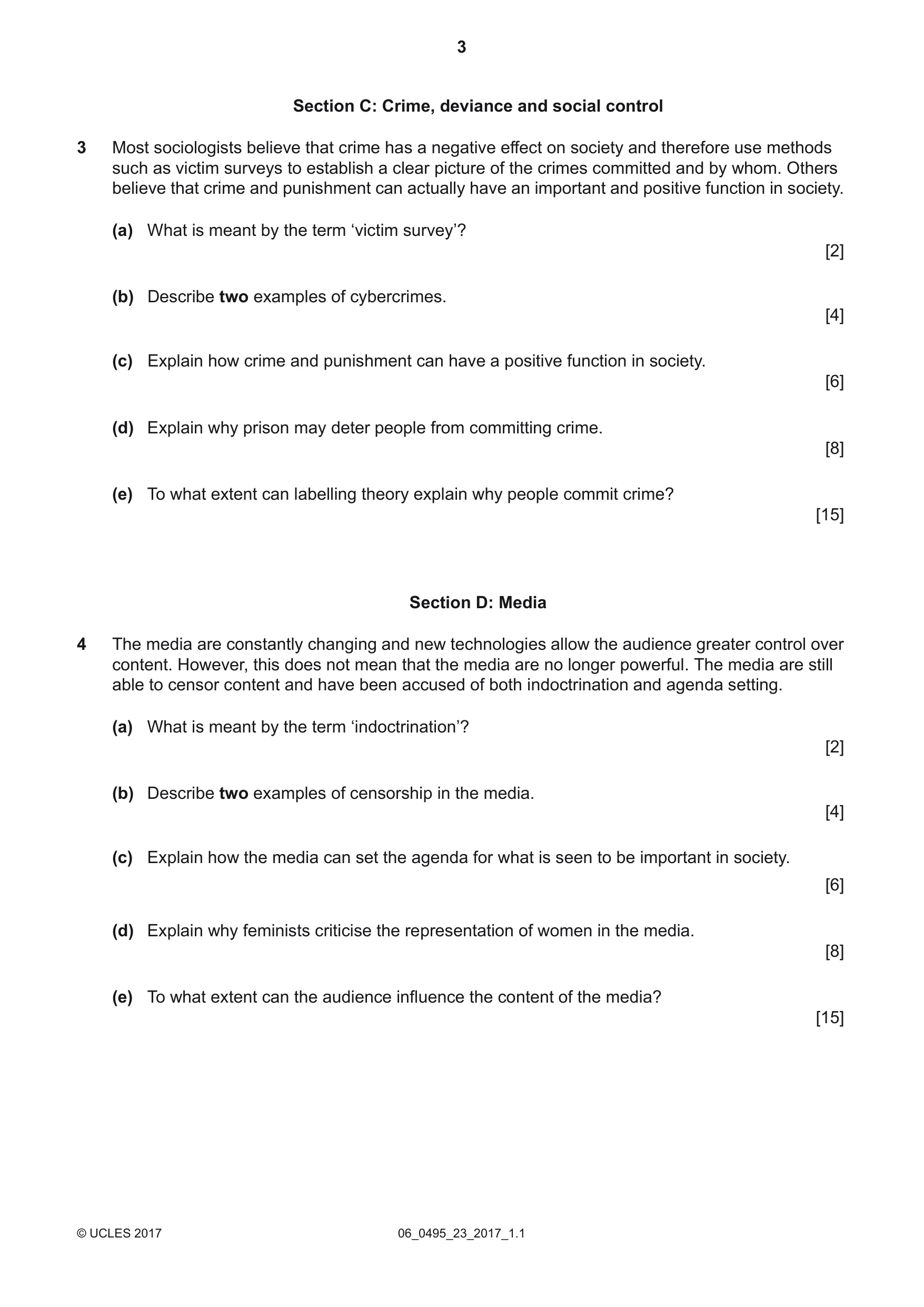
3 Most sociologists believe that crime has a negative effect on society and therefore use methods such as victim surveys to establish a clear picture of the crimes committed and by whom. Others believe that crime and punishment can actually have an important and positive function in society. (a) What is meant by the term ‘victim survey’? [2] (b) Describe two examples of cybercrimes. [4] (c) Explain how crime and punishment can have a positive function in society. [6] (d) Explain why prison may deter people from committing crime. [8] (e) To what extent can labelling theory explain why people commit crime? [15] Section D: Media
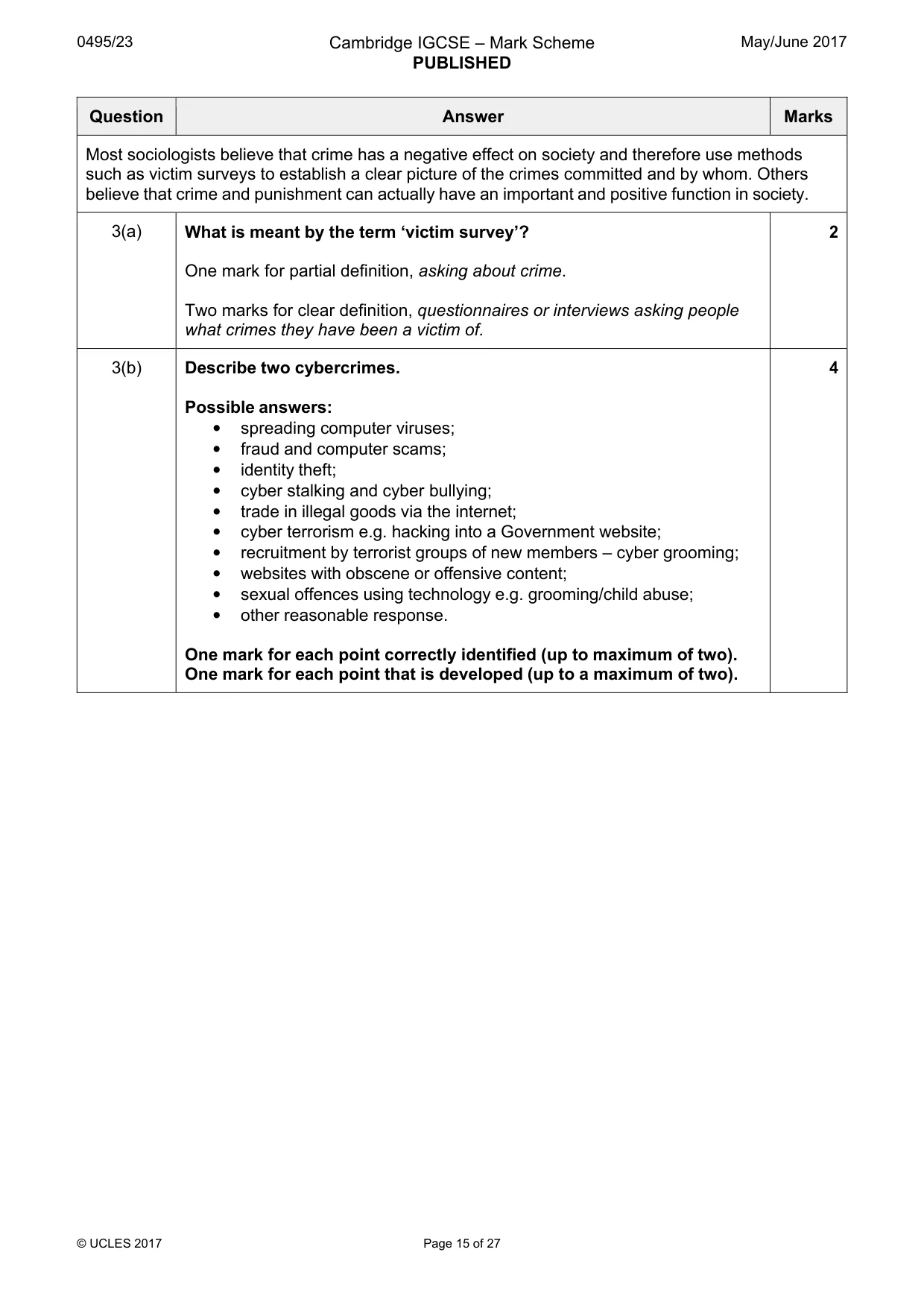
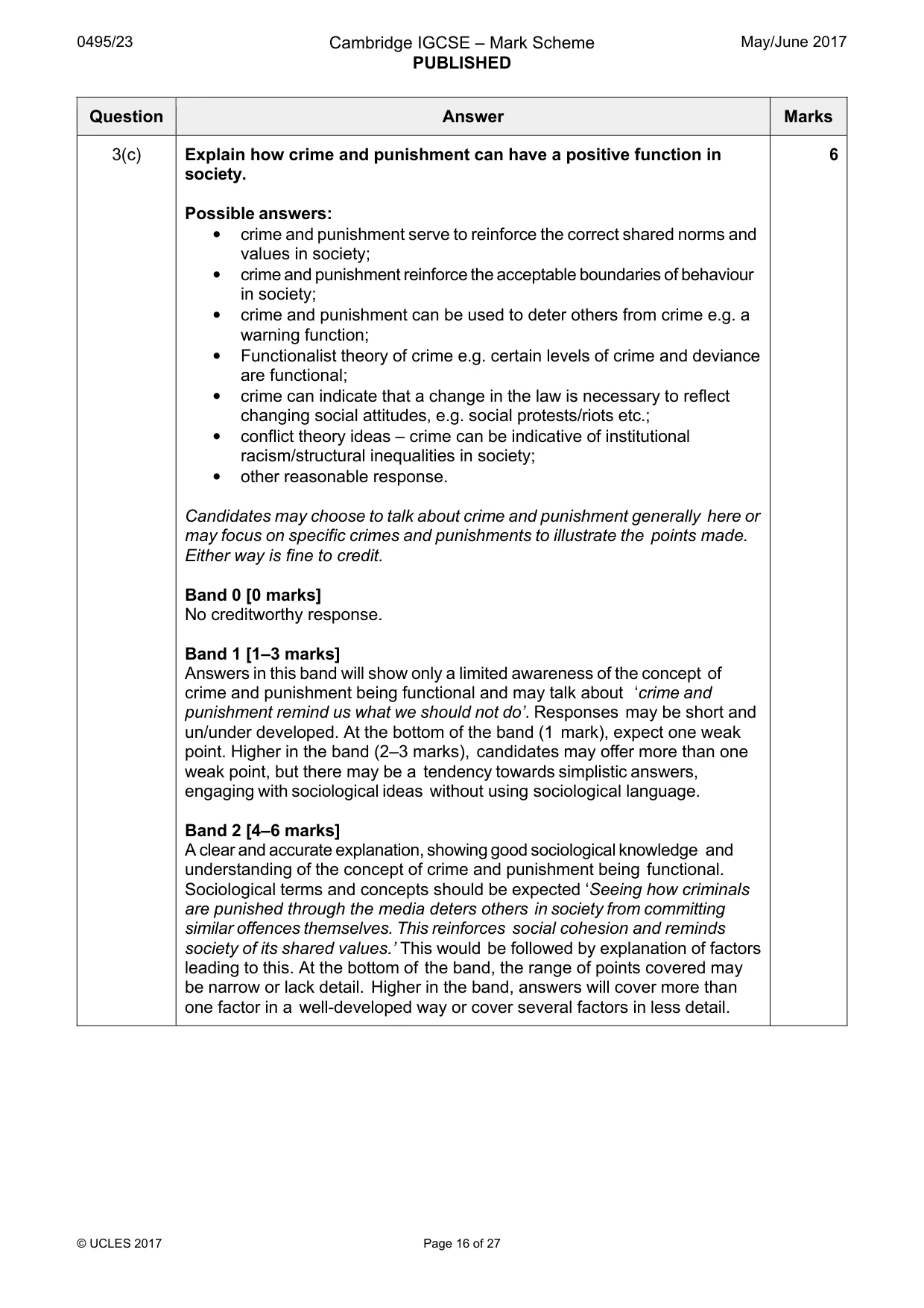
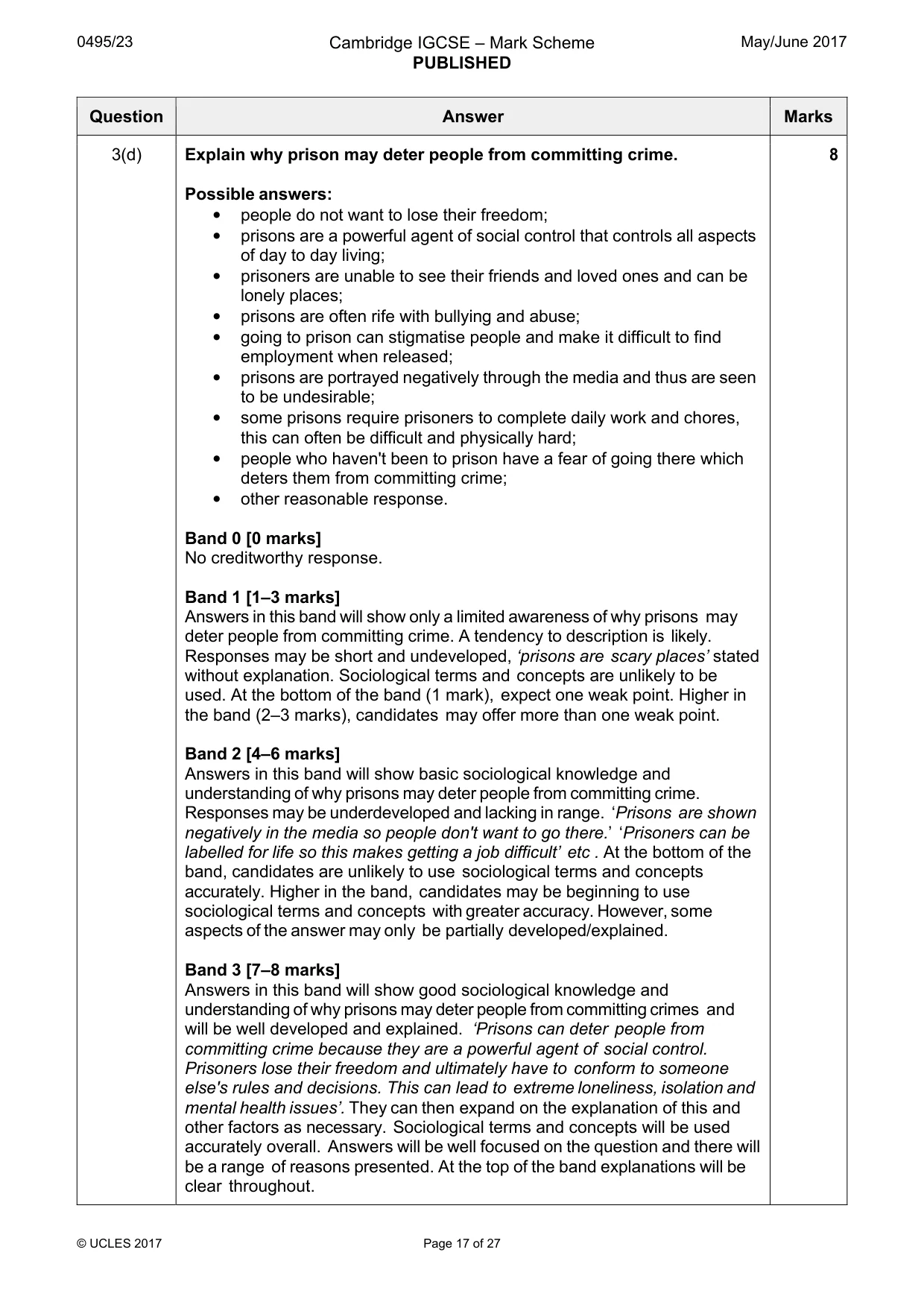
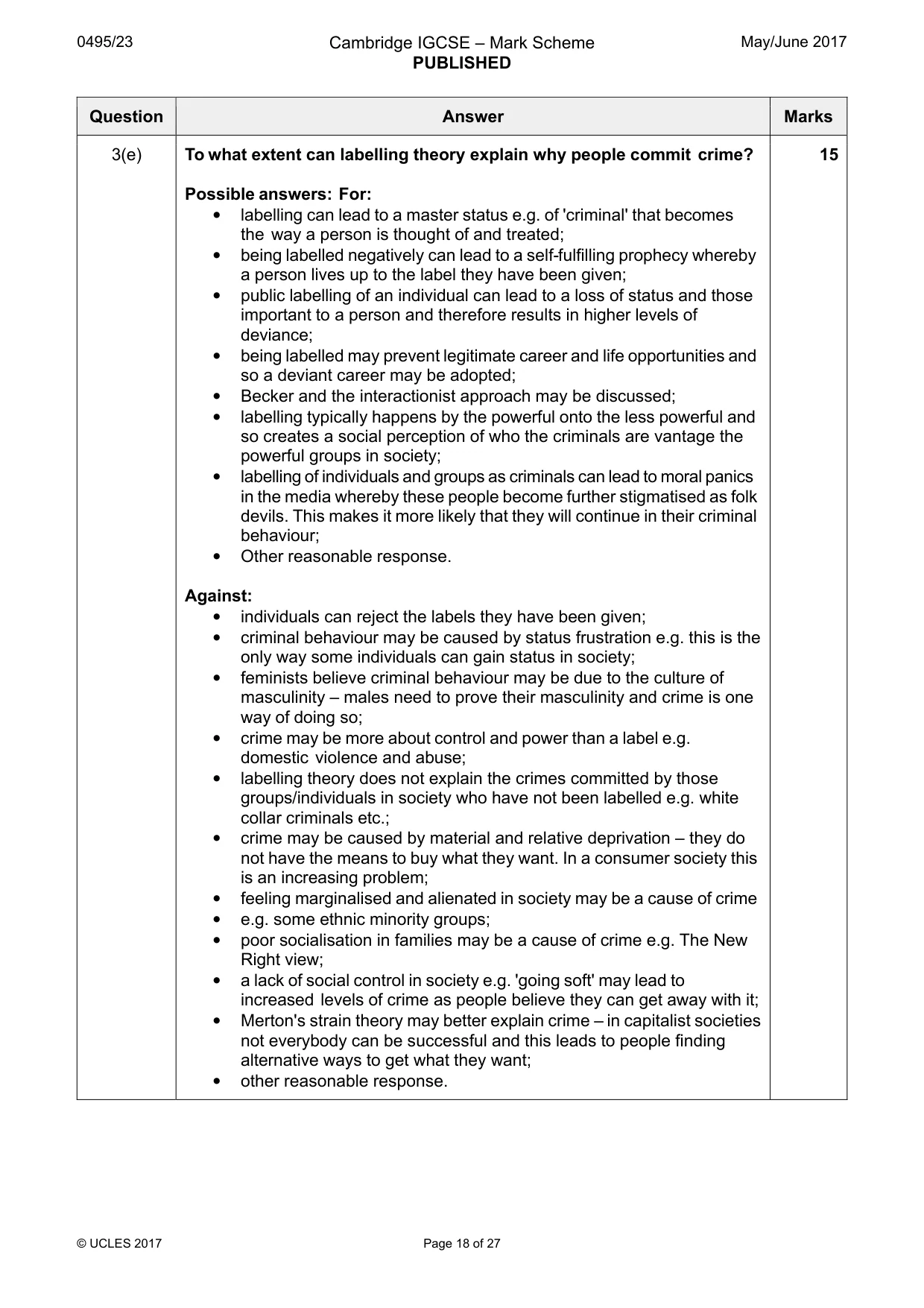
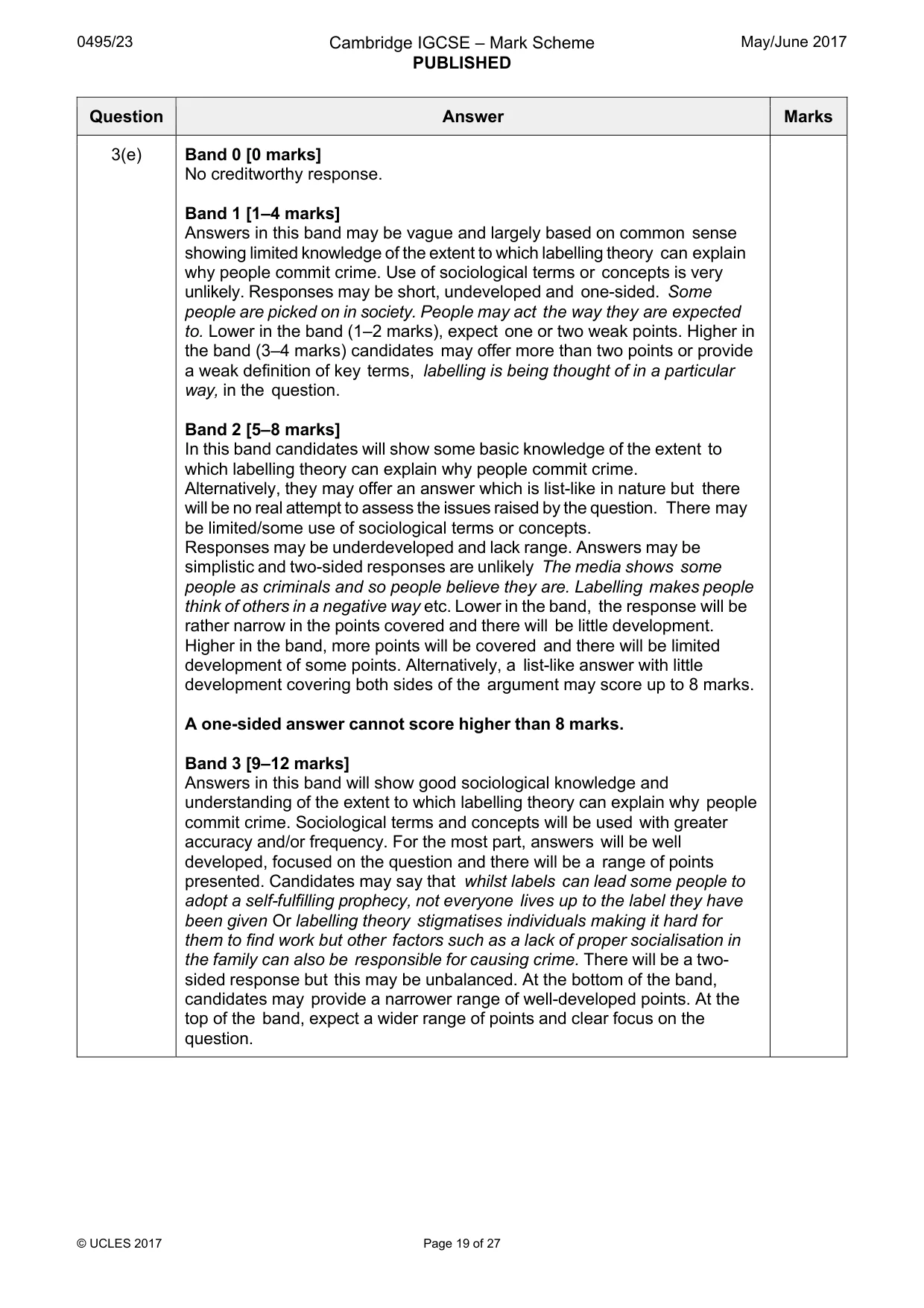
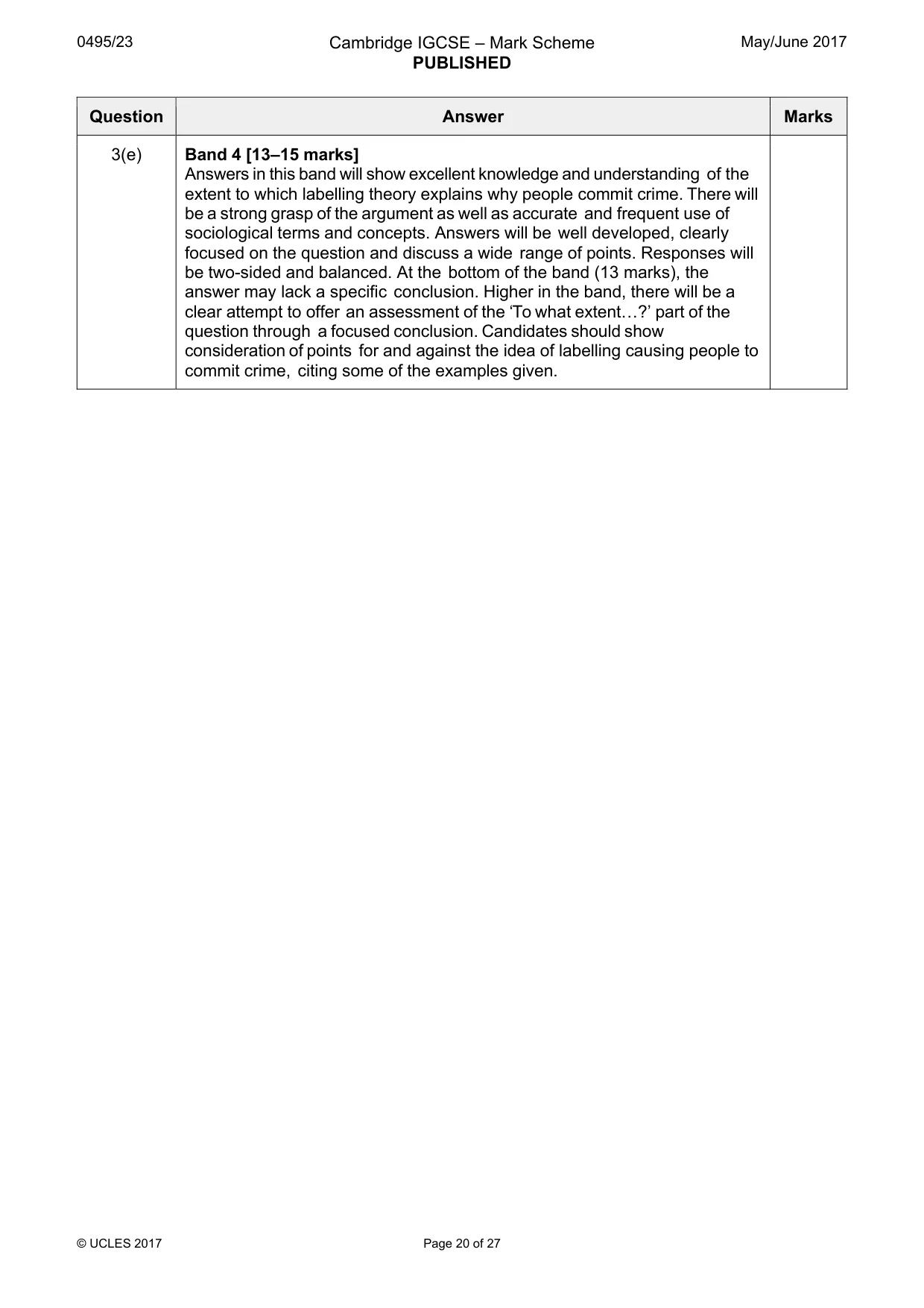
Mark scheme: 3(a) What is meant by the term ‘victim survey’? 2 One mark for partial definition, asking about crime. Two marks for clear definition, questionnaires or interviews asking people what crimes they have been a victim of. 3(b) Describe two cybercrimes. 4 Possible answers: • spreading computer viruses; • fraud and computer scams; • identity theft; • cyber stalking and cyber bullying; • trade in illegal goods via the internet; • cyber terrorism e.g. hacking into a Government website; • recruitment by terrorist groups of new members – cyber grooming; • websites with obscene or offensive content; • sexual offences using technology e.g. grooming/child abuse; • other reasonable response. One mark for each point correctly identified (up to maximum of two). One mark for each point that is developed (up to a maximum of two). 3(c) Explain how crime and punishment can have a positive function in 6 society. Possible answers: • crime and punishment serve to reinforce the correct shared norms and values in society; • crime and punishment reinforce the acceptable boundaries of behaviour in society; • crime and punishment can be used to deter others from crime e.g. a warning function; • Functionalist theory of crime e.g. certain levels of crime and deviance are functional; • crime can indicate that a change in the law is necessary to reflect changing social attitudes, e.g. social protests/riots etc.; • conflict theory ideas – crime can be indicative of institutional racism/structural inequalities in society; • other reasonable response. Candidates may choose to talk about crime and punishment generally here or may focus on specific crimes and punishments to illustrate the points made. Either way is fine to credit. Band 0 [0 marks] No creditworthy response. Band 1 [1–3 marks] Answers in this band will show only a limited awareness of the concept of crime and punishment being functional and may talk about ‘crime and punishment remind us what we should not do’. Responses may be short and un/under developed. At the bottom of the band (1 mark), expect one weak point. Higher in the band (2–3 marks), candidates may offer more than one weak point, but there may be a tendency towards simplistic answers, engaging with sociological ideas without using sociological language. Band 2 [4–6 marks] A clear and accurate explanation, showing good sociological knowledge and understanding of the concept of crime and punishment being functional. Sociological terms and concepts should be expected ‘Seeing how criminals are punished through the media deters others in society from committing similar offences themselves. This reinforces social cohesion and reminds society of its shared values.’ This would be followed by explanation of factors leading to this. At the bottom of the band, the range of points covered may be narrow or lack detail. Higher in the band, answers will cover more than one factor in a well-developed way or cover several factors in less detail. 3(d) Explain why prison may deter people from committing crime. 8 Possible answers: • people do not want to lose their freedom; • prisons are a powerful agent of social control that controls all aspects of day to day living; • prisoners are unable to see their friends and loved ones and can be lonely places; • prisons are often rife with bullying and abuse; • going to prison can stigmatise people and make it difficult to find employment when released; • prisons are portrayed negatively through the media and thus are seen to be undesirable; • some prisons require prisoners to complete daily work and chores, this can often be difficult and physically hard; • people who haven't been to prison have a fear of going there which deters them from committing crime; • other reasonable response. Band 0 [0 marks] No creditworthy response. Band 1 [1–3 marks] Answers in this band will show only a limited awareness of why prisons may deter people from committing crime. A tendency to description is likely. Responses may be short and undeveloped, ‘prisons are scary places’ stated without explanation. Sociological terms and concepts are unlikely to be used. At the bottom of the band (1 mark), expect one weak point. Higher in the band (2–3 marks), candidates may offer more than one weak point. Band 2 [4–6 marks] Answers in this band will show basic sociological knowledge and understanding of why prisons may deter people from committing crime. Responses may be underdeveloped and lacking in range. ‘Prisons are shown negatively in the media so people don't want to go there.’ ‘Prisoners can be labelled for life so this makes getting a job difficult’ etc . At the bottom of the band, candidates are unlikely to use sociological terms and concepts accurately. Higher in the band, candidates may be beginning to use sociological terms and concepts with greater accuracy. However, some aspects of the answer may only be partially developed/explained. Band 3 [7–8 marks] Answers in this band will show good sociological knowledge and understanding of why prisons may deter people from committing crimes and will be well developed and explained. ‘Prisons can deter people from committing crime because they are a powerful agent of social control. Prisoners lose their freedom and ultimately have to conform to someone else's rules and decisions. This can lead to extreme loneliness, isolation and mental health issues’. They can then expand on the explanation of this and other factors as necessary. Sociological terms and concepts will be used accurately overall. Answers will be well focused on the question and there will be a range of reasons presented. At the top of the band explanations will be clear throughout. 3(e) To what extent can labelling theory explain why people commit crime? 15 Possible answers: For: • labelling can lead to a master status e.g. of 'criminal' that becomes the way a person is thought of and treated; • being labelled negatively can lead to a self-fulfilling prophecy whereby a person lives up to the label they have been given; • public labelling of an individual can lead to a loss of status and those important to a person and therefore results in higher levels of deviance; • being labelled may prevent legitimate career and life opportunities and so a deviant career may be adopted; • Becker and the interactionist approach may be discussed; • labelling typically happens by the powerful onto the less powerful and so creates a social perception of who the criminals are vantage the powerful groups in society; • labelling of individuals and groups as criminals can lead to moral panics in the media whereby these people become further stigmatised as folk devils. This makes it more likely that they will continue in their criminal behaviour; • Other reasonable response. Against: • individuals can reject the labels they have been given; • criminal behaviour may be caused by status frustration e.g. this is the only way some individuals can gain status in society; • feminists believe criminal behaviour may be due to the culture of masculinity – males need to prove their masculinity and crime is one way of doing so; • crime may be more about control and power than a label e.g. domestic violence and abuse; • labelling theory does not explain the crimes committed by those groups/individuals in society who have not been labelled e.g. white collar criminals etc.; • crime may be caused by material and relative deprivation – they do not have the means to buy what they want. In a consumer society this is an increasing problem; • feeling marginalised and alienated in society may be a cause of crime • e.g. some ethnic minority groups; • poor socialisation in families may be a cause of crime e.g. The New Right view; • a lack of social control in society e.g. 'going soft' may lead to increased levels of crime as people believe they can get away with it; • Merton's strain theory may better explain crime – in capitalist societies not everybody can be successful and this leads to people finding alternative ways to get what they want; • other reasonable response. 3(e) Band 0 [0 marks] No creditworthy response. Band 1 [1–4 marks] Answers in this band may be vague and largely based on common sense showing limited knowledge of the extent to which labelling theory can explain why people commit crime. Use of sociological terms or concepts is very unlikely. Responses may be short, undeveloped and one-sided. Some people are picked on in society. People may act the way they are expected to. Lower in the band (1–2 marks), expect one or two weak points. Higher in the band (3–4 marks) candidates may offer more than two points or provide a weak definition of key terms, labelling is being thought of in a particular way, in the question. Band 2 [5–8 marks] In this band candidates will show some basic knowledge of the extent to which labelling theory can explain why people commit crime. Alternatively, they may offer an answer which is list-like in nature but there will be no real attempt to assess the issues raised by the question. There may be limited/some use of sociological terms or concepts. Responses may be underdeveloped and lack range. Answers may be simplistic and two-sided responses are unlikely The media shows some people as criminals and so people believe they are. Labelling makes people think of others in a negative way etc. Lower in the band, the response will be rather narrow in the points covered and there will be little development. Higher in the band, more points will be covered and there will be limited development of some points. Alternatively, a list-like answer with little development covering both sides of the argument may score up to 8 marks. A one-sided answer cannot score higher than 8 marks. Band 3 [9–12 marks] Answers in this band will show good sociological knowledge and understanding of the extent to which labelling theory can explain why people commit crime. Sociological terms and concepts will be used with greater accuracy and/or frequency. For the most part, answers will be well developed, focused on the question and there will be a range of points presented. Candidates may say that whilst labels can lead some people to adopt a self-fulfilling prophecy, not everyone lives up to the label they have been given Or labelling theory stigmatises individuals making it hard for them to find work but other factors such as a lack of proper socialisation in the family can also be responsible for causing crime. There will be a two- sided response but this may be unbalanced. At the bottom of the band, candidates may provide a narrower range of well-developed points. At the top of the band, expect a wider range of points and clear focus on the question. 3(e) Band 4 [13–15 marks] Answers in this band will show excellent knowledge and understanding of the extent to which labelling theory explains why people commit crime. There will be a strong grasp of the argument as well as accurate and frequent use of sociological terms and concepts. Answers will be well developed, clearly focused on the question and discuss a wide range of points. Responses will be two-sided and balanced. At the bottom of the band (13 marks), the answer may lack a specific conclusion. Higher in the band, there will be a clear attempt to offer an assessment of the ‘To what extent«?’ part of the question through a focused conclusion. Candidates should show consideration of points for and against the idea of labelling causing people to commit crime, citing some of the examples given.
More questions on What types of data and evidence do sociologists use?
Q4 · The media are constantly changing and new technologies allow the audience greater control…
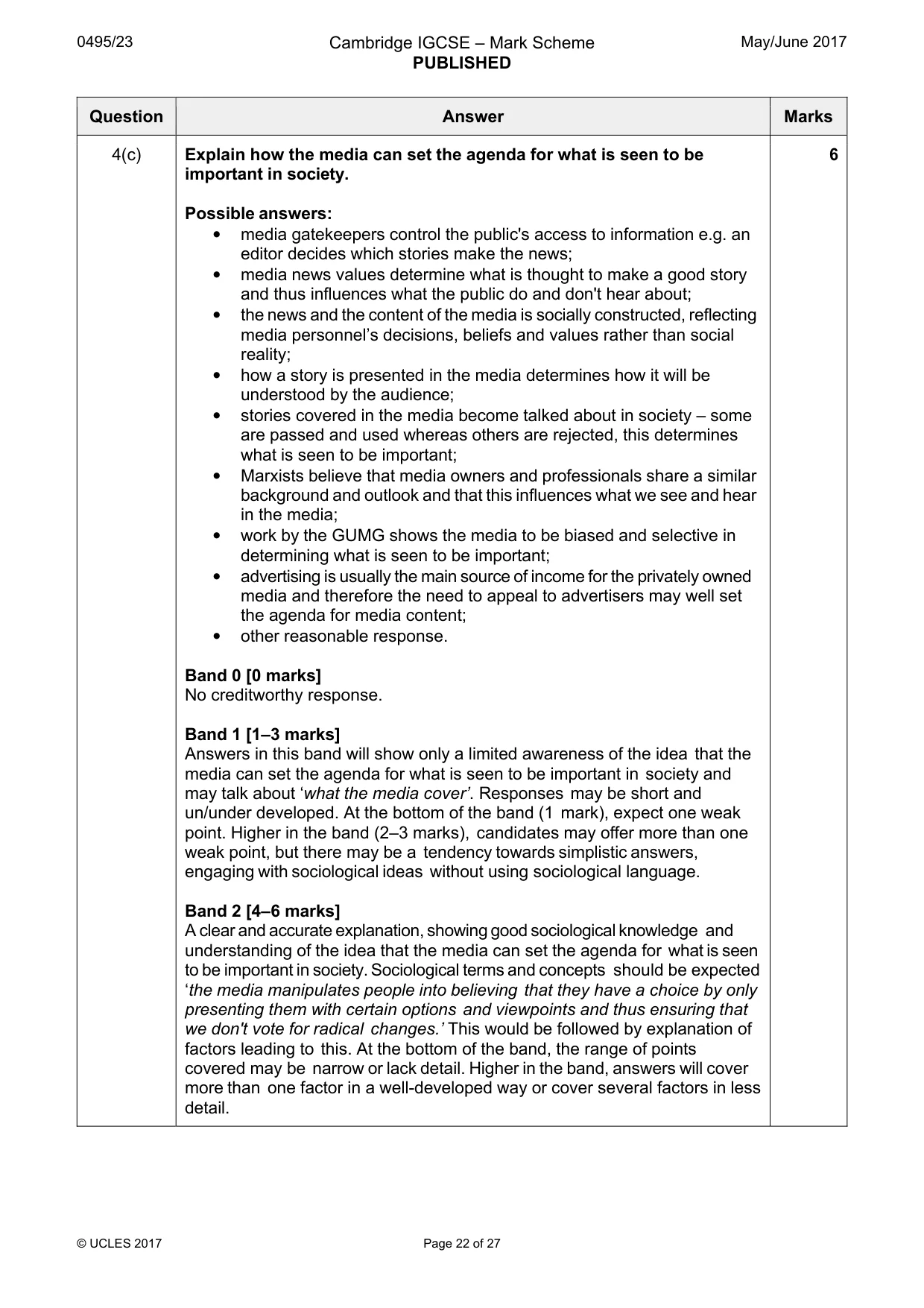
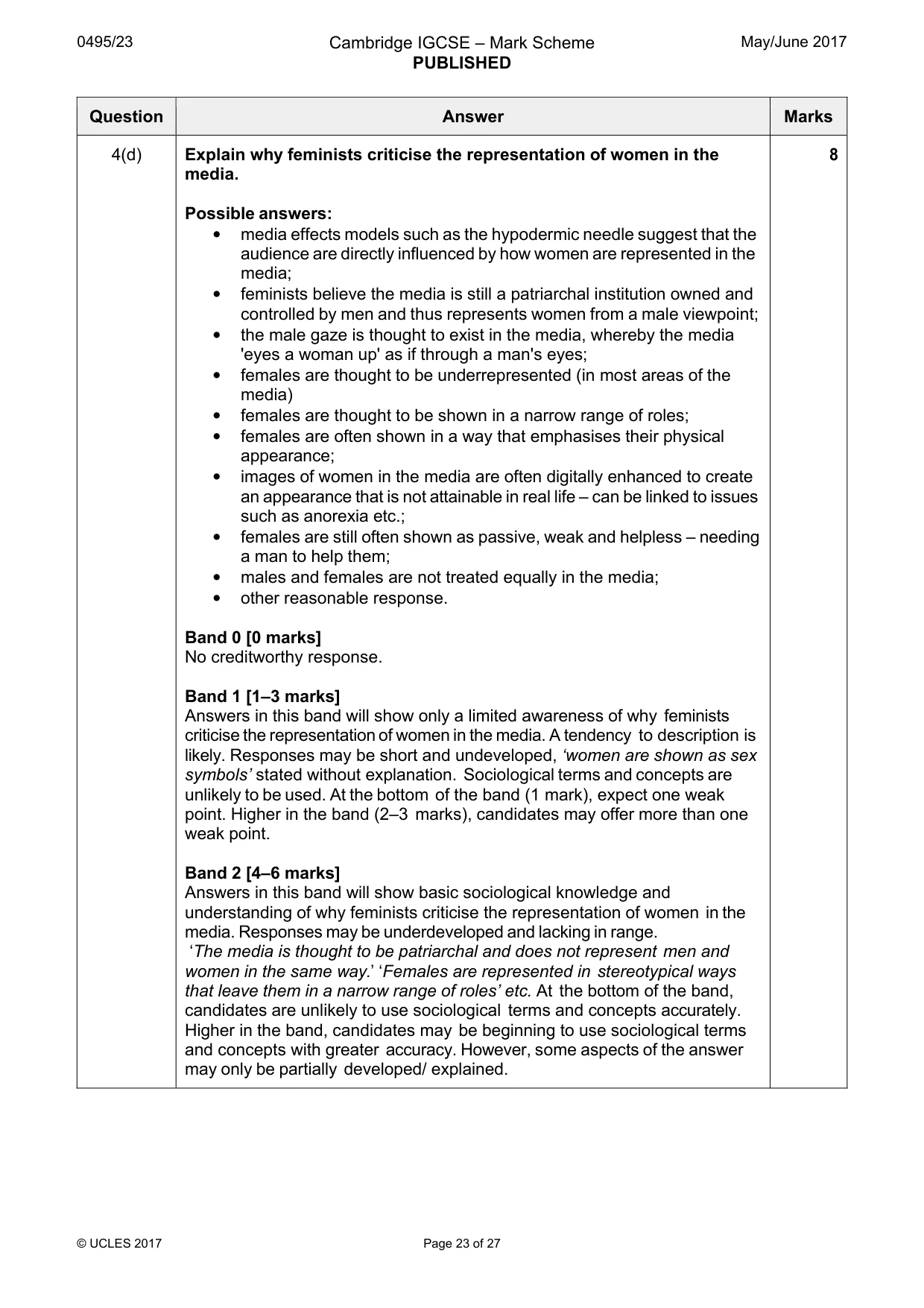
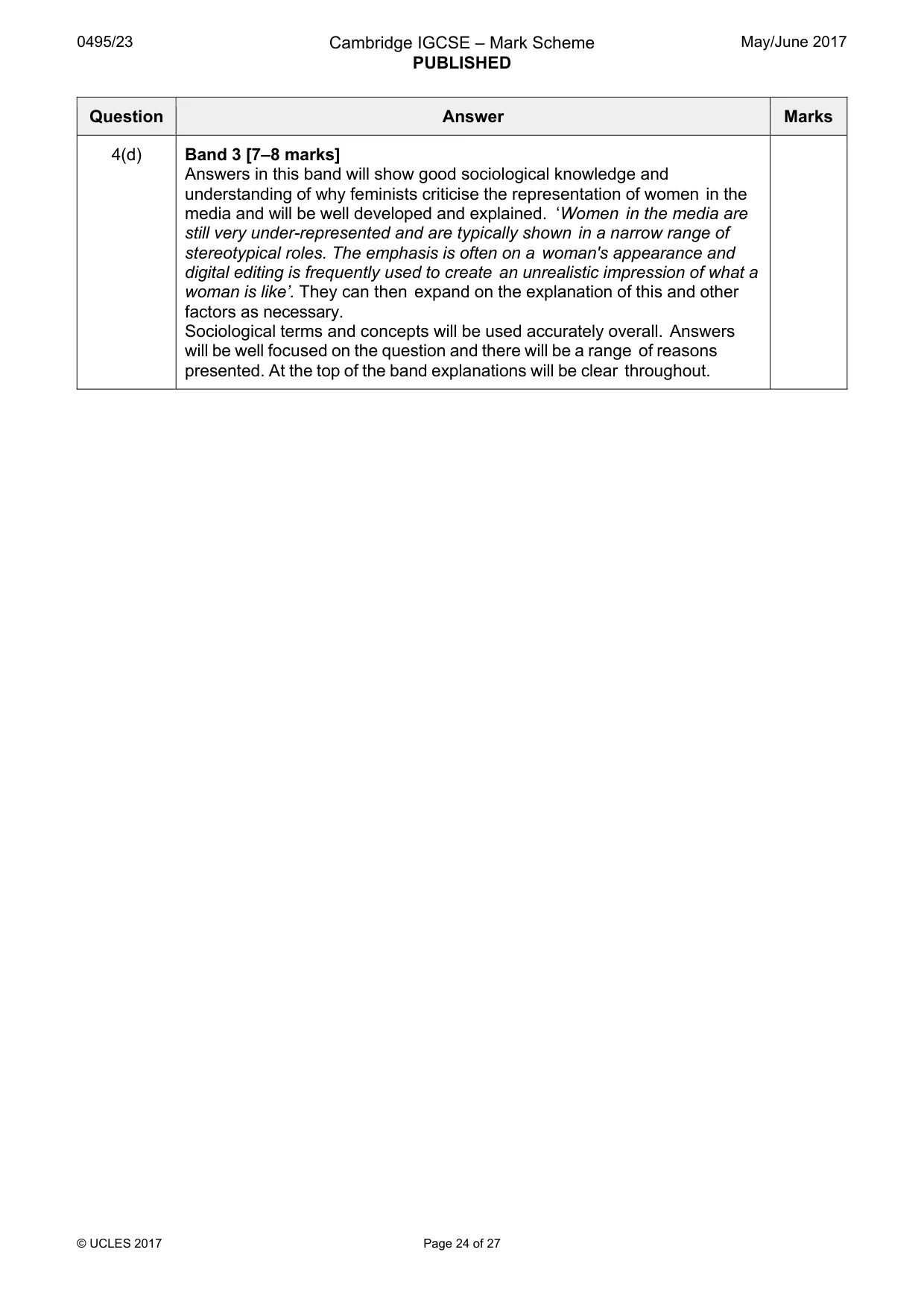
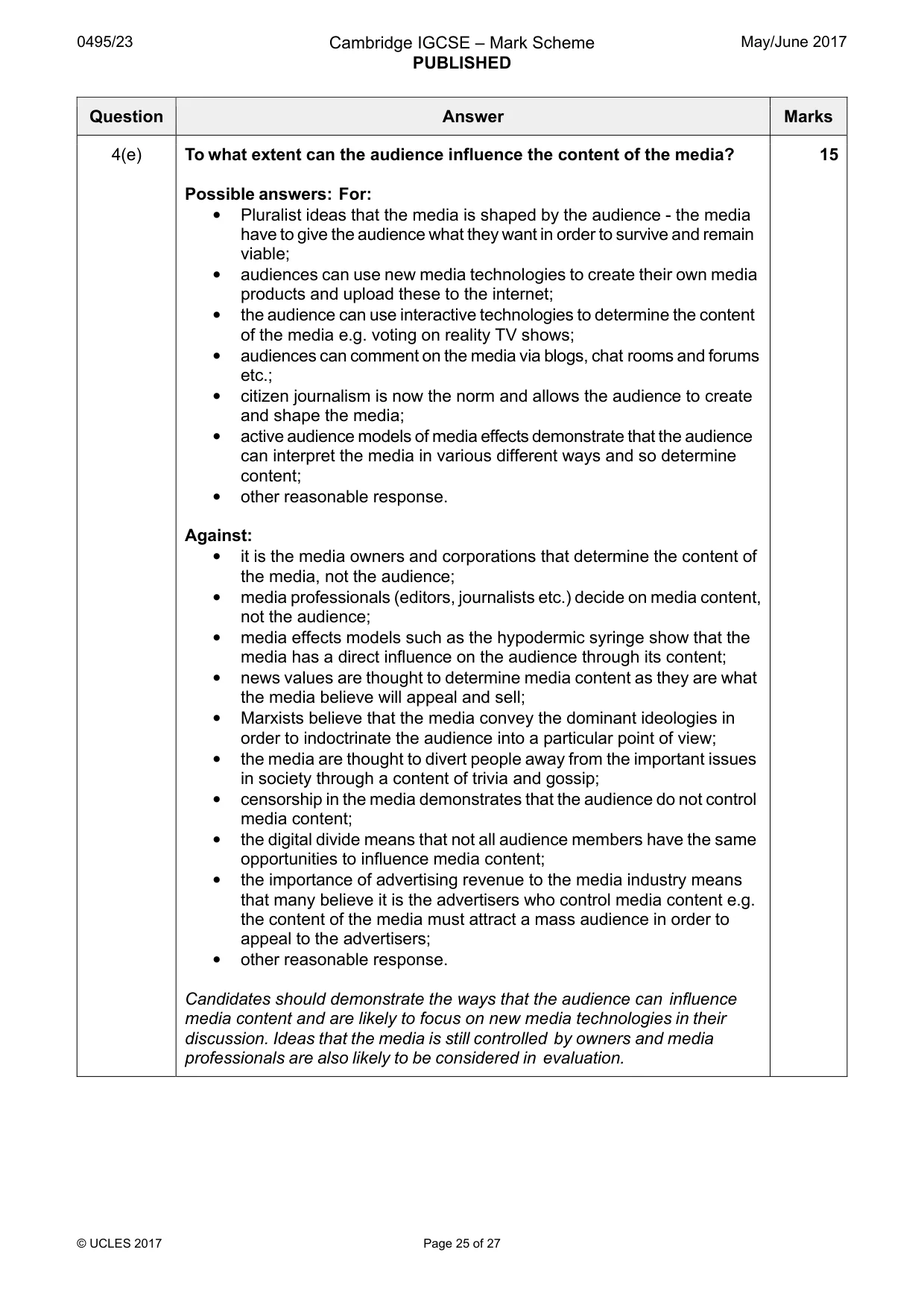
4 The media are constantly changing and new technologies allow the audience greater control over content. However, this does not mean that the media are no longer powerful. The media are still able to censor content and have been accused of both indoctrination and agenda setting. (a) What is meant by the term ‘indoctrination’? [2] (b) Describe two examples of censorship in the media. [4] (c) Explain how the media can set the agenda for what is seen to be important in society. [6] (d) Explain why feminists criticise the representation of women in the media. [8] (e) To what extent can the audience influence the content of the media? [15]
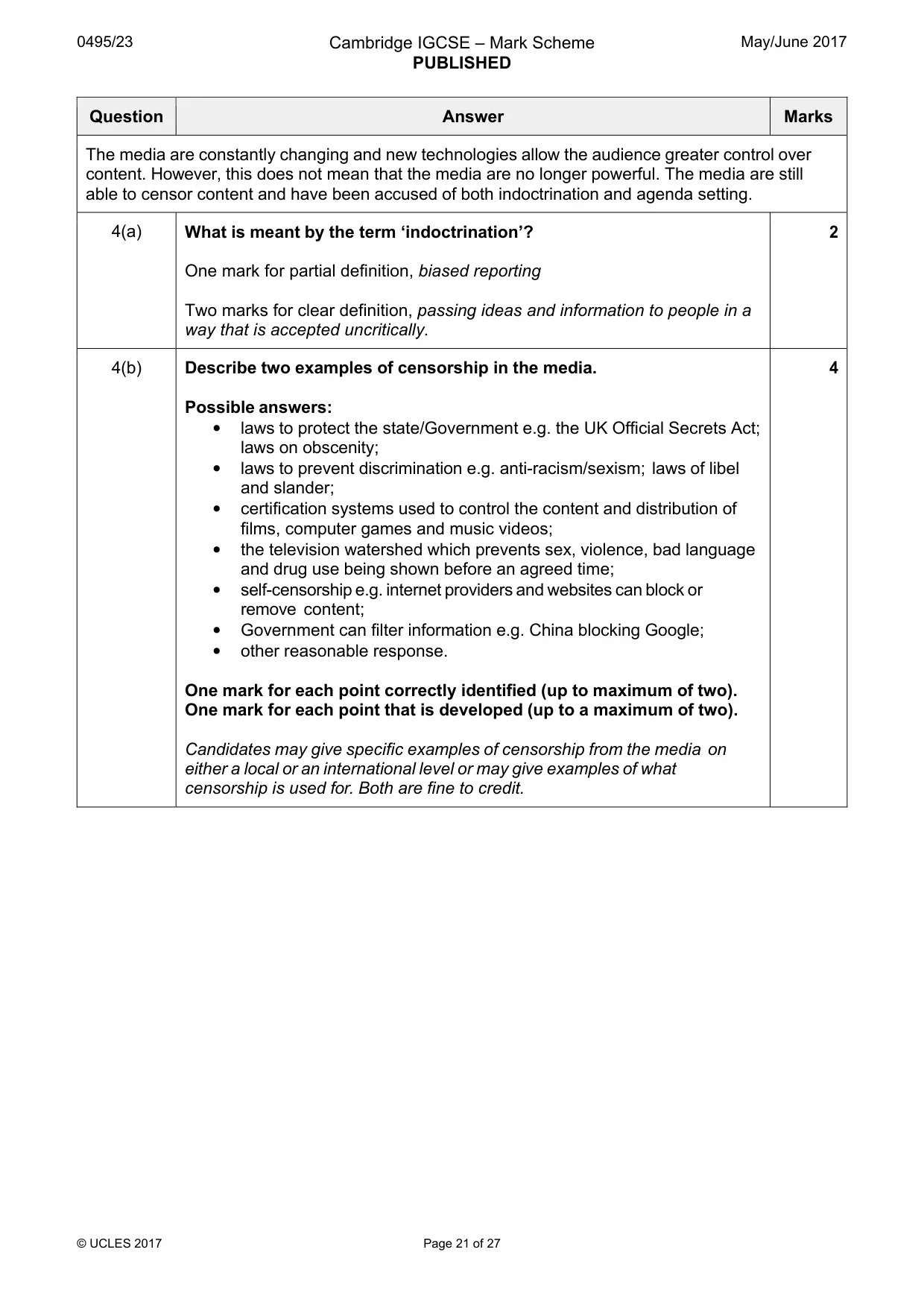
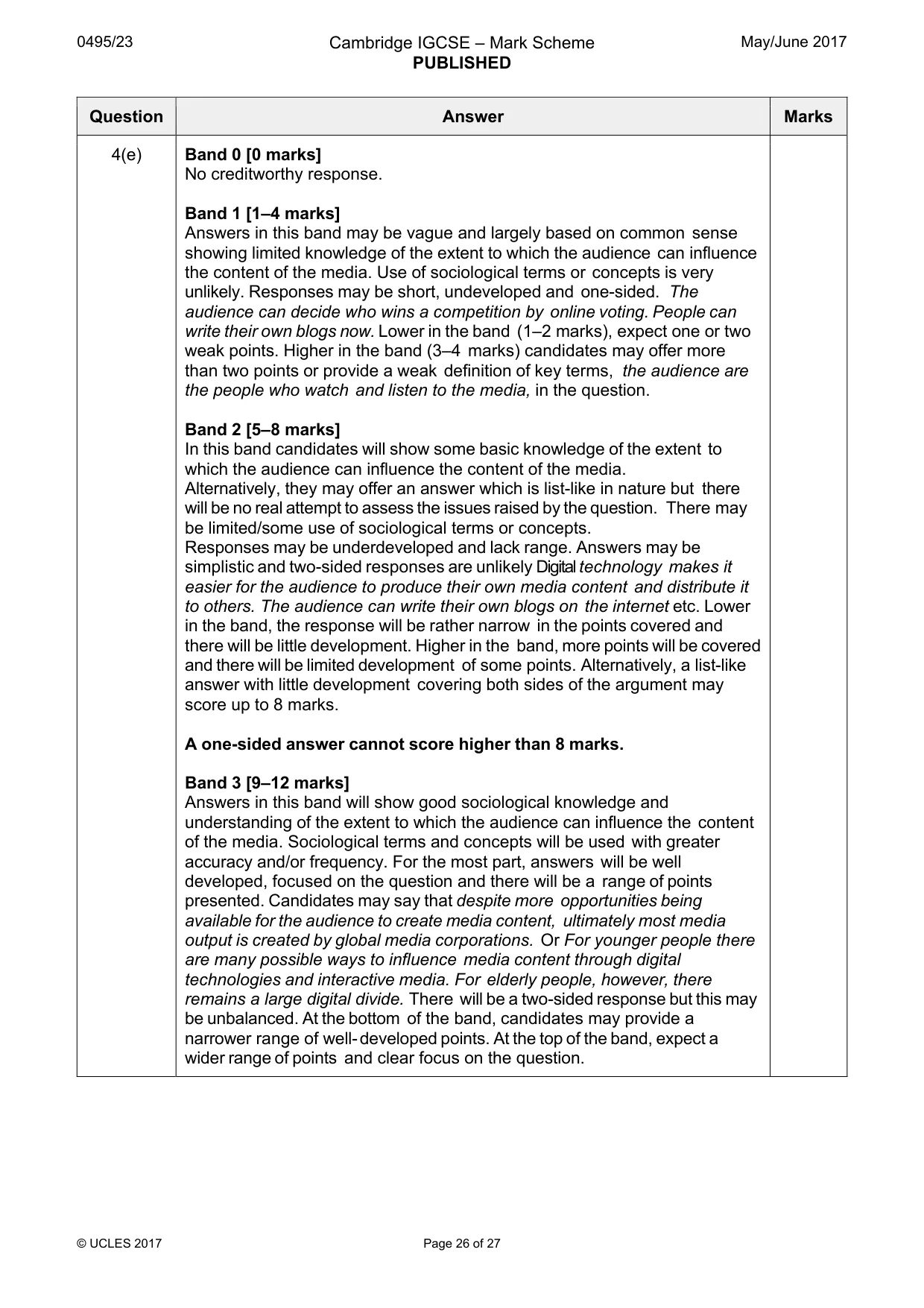
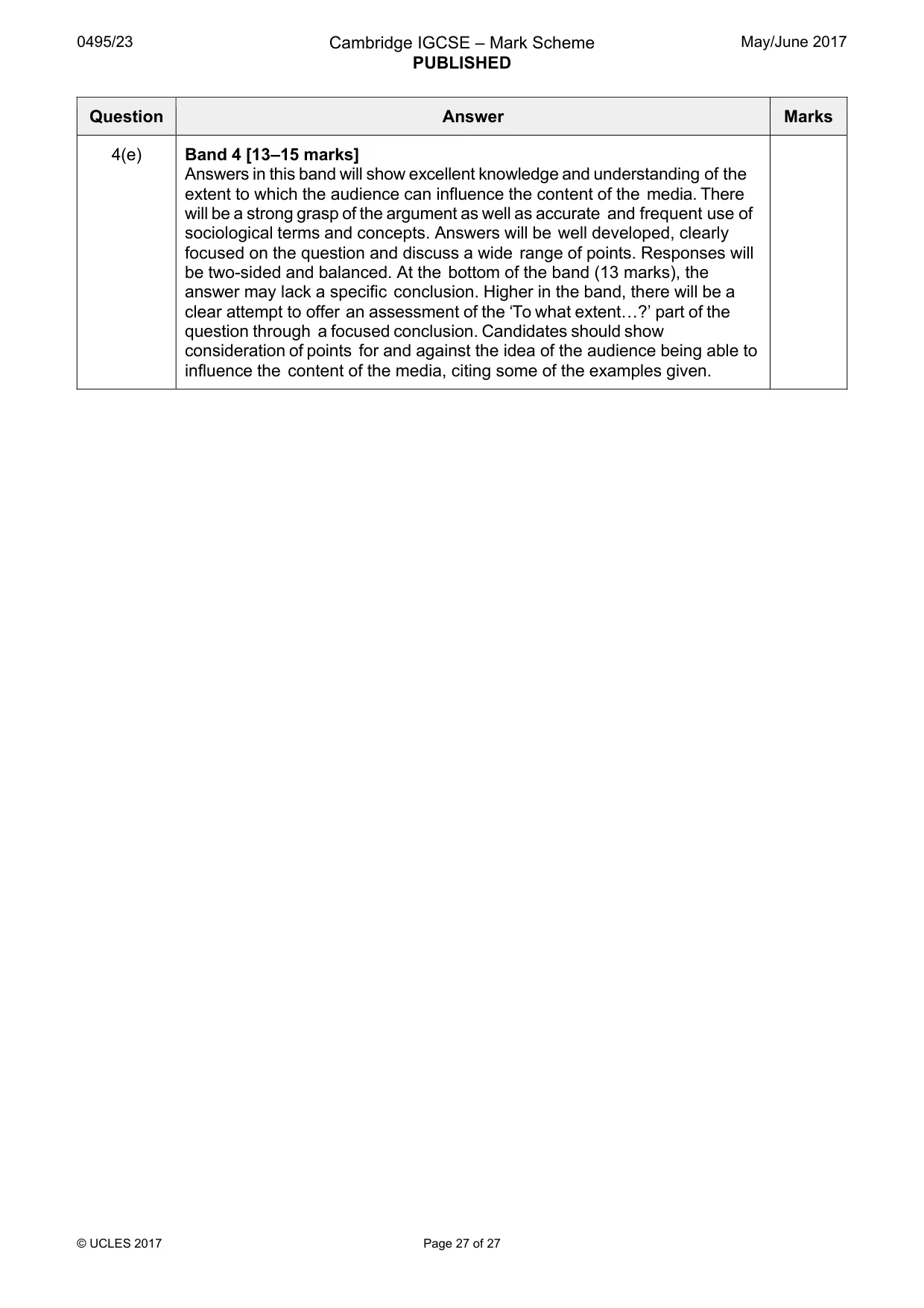
Mark scheme: 4(a) What is meant by the term ‘indoctrination’? 2 One mark for partial definition, biased reporting Two marks for clear definition, passing ideas and information to people in a way that is accepted uncritically. 4(b) Describe two examples of censorship in the media. 4 Possible answers: • laws to protect the state/Government e.g. the UK Official Secrets Act; laws on obscenity; • laws to prevent discrimination e.g. anti-racism/sexism; laws of libel and slander; • certification systems used to control the content and distribution of films, computer games and music videos; • the television watershed which prevents sex, violence, bad language and drug use being shown before an agreed time; • self-censorship e.g. internet providers and websites can block or remove content; • Government can filter information e.g. China blocking Google; • other reasonable response. One mark for each point correctly identified (up to maximum of two). One mark for each point that is developed (up to a maximum of two). Candidates may give specific examples of censorship from the media on either a local or an international level or may give examples of what censorship is used for. Both are fine to credit. 4(c) Explain how the media can set the agenda for what is seen to be 6 important in society. Possible answers: • media gatekeepers control the public's access to information e.g. an editor decides which stories make the news; • media news values determine what is thought to make a good story and thus influences what the public do and don't hear about; • the news and the content of the media is socially constructed, reflecting media personnel’s decisions, beliefs and values rather than social reality; • how a story is presented in the media determines how it will be understood by the audience; • stories covered in the media become talked about in society – some are passed and used whereas others are rejected, this determines what is seen to be important; • Marxists believe that media owners and professionals share a similar background and outlook and that this influences what we see and hear in the media; • work by the GUMG shows the media to be biased and selective in determining what is seen to be important; • advertising is usually the main source of income for the privately owned media and therefore the need to appeal to advertisers may well set the agenda for media content; • other reasonable response. Band 0 [0 marks] No creditworthy response. Band 1 [1–3 marks] Answers in this band will show only a limited awareness of the idea that the media can set the agenda for what is seen to be important in society and may talk about ‘what the media cover’. Responses may be short and un/under developed. At the bottom of the band (1 mark), expect one weak point. Higher in the band (2–3 marks), candidates may offer more than one weak point, but there may be a tendency towards simplistic answers, engaging with sociological ideas without using sociological language. Band 2 [4–6 marks] A clear and accurate explanation, showing good sociological knowledge and understanding of the idea that the media can set the agenda for what is seen to be important in society. Sociological terms and concepts should be expected ‘the media manipulates people into believing that they have a choice by only presenting them with certain options and viewpoints and thus ensuring that we don't vote for radical changes.’ This would be followed by explanation of factors leading to this. At the bottom of the band, the range of points covered may be narrow or lack detail. Higher in the band, answers will cover more than one factor in a well-developed way or cover several factors in less detail. 4(d) Explain why feminists criticise the representation of women in the 8 media. Possible answers: • media effects models such as the hypodermic needle suggest that the audience are directly influenced by how women are represented in the media; • feminists believe the media is still a patriarchal institution owned and controlled by men and thus represents women from a male viewpoint; • the male gaze is thought to exist in the media, whereby the media 'eyes a woman up' as if through a man's eyes; • females are thought to be underrepresented (in most areas of the media) • females are thought to be shown in a narrow range of roles; • females are often shown in a way that emphasises their physical appearance; • images of women in the media are often digitally enhanced to create an appearance that is not attainable in real life – can be linked to issues such as anorexia etc.; • females are still often shown as passive, weak and helpless – needing a man to help them; • males and females are not treated equally in the media; • other reasonable response. Band 0 [0 marks] No creditworthy response. Band 1 [1–3 marks] Answers in this band will show only a limited awareness of why feminists criticise the representation of women in the media. A tendency to description is likely. Responses may be short and undeveloped, ‘women are shown as sex symbols’ stated without explanation. Sociological terms and concepts are unlikely to be used. At the bottom of the band (1 mark), expect one weak point. Higher in the band (2–3 marks), candidates may offer more than one weak point. Band 2 [4–6 marks] Answers in this band will show basic sociological knowledge and understanding of why feminists criticise the representation of women in the media. Responses may be underdeveloped and lacking in range. ‘The media is thought to be patriarchal and does not represent men and women in the same way.’ ‘Females are represented in stereotypical ways that leave them in a narrow range of roles’ etc. At the bottom of the band, candidates are unlikely to use sociological terms and concepts accurately. Higher in the band, candidates may be beginning to use sociological terms and concepts with greater accuracy. However, some aspects of the answer may only be partially developed/ explained. 4(d) Band 3 [7–8 marks] Answers in this band will show good sociological knowledge and understanding of why feminists criticise the representation of women in the media and will be well developed and explained. ‘Women in the media are still very under-represented and are typically shown in a narrow range of stereotypical roles. The emphasis is often on a woman's appearance and digital editing is frequently used to create an unrealistic impression of what a woman is like’. They can then expand on the explanation of this and other factors as necessary. Sociological terms and concepts will be used accurately overall. Answers will be well focused on the question and there will be a range of reasons presented. At the top of the band explanations will be clear throughout. 4(e) To what extent can the audience influence the content of the media? 15 Possible answers: For: • Pluralist ideas that the media is shaped by the audience - the media have to give the audience what they want in order to survive and remain viable; • audiences can use new media technologies to create their own media products and upload these to the internet; • the audience can use interactive technologies to determine the content of the media e.g. voting on reality TV shows; • audiences can comment on the media via blogs, chat rooms and forums etc.; • citizen journalism is now the norm and allows the audience to create and shape the media; • active audience models of media effects demonstrate that the audience can interpret the media in various different ways and so determine content; • other reasonable response. Against: • it is the media owners and corporations that determine the content of the media, not the audience; • media professionals (editors, journalists etc.) decide on media content, not the audience; • media effects models such as the hypodermic syringe show that the media has a direct influence on the audience through its content; • news values are thought to determine media content as they are what the media believe will appeal and sell; • Marxists believe that the media convey the dominant ideologies in order to indoctrinate the audience into a particular point of view; • the media are thought to divert people away from the important issues in society through a content of trivia and gossip; • censorship in the media demonstrates that the audience do not control media content; • the digital divide means that not all audience members have the same opportunities to influence media content; • the importance of advertising revenue to the media industry means that many believe it is the advertisers who control media content e.g. the content of the media must attract a mass audience in order to appeal to the advertisers; • other reasonable response. Candidates should demonstrate the ways that the audience can influence media content and are likely to focus on new media technologies in their discussion. Ideas that the media is still controlled by owners and media professionals are also likely to be considered in evaluation. 4(e) Band 0 [0 marks] No creditworthy response. Band 1 [1–4 marks] Answers in this band may be vague and largely based on common sense showing limited knowledge of the extent to which the audience can influence the content of the media. Use of sociological terms or concepts is very unlikely. Responses may be short, undeveloped and one-sided. The audience can decide who wins a competition by online voting. People can write their own blogs now. Lower in the band (1–2 marks), expect one or two weak points. Higher in the band (3–4 marks) candidates may offer more than two points or provide a weak definition of key terms, the audience are the people who watch and listen to the media, in the question. Band 2 [5–8 marks] In this band candidates will show some basic knowledge of the extent to which the audience can influence the content of the media. Alternatively, they may offer an answer which is list-like in nature but there will be no real attempt to assess the issues raised by the question. There may be limited/some use of sociological terms or concepts. Responses may be underdeveloped and lack range. Answers may be simplistic and two-sided responses are unlikely Digital technology makes it easier for the audience to produce their own media content and distribute it to others. The audience can write their own blogs on the internet etc. Lower in the band, the response will be rather narrow in the points covered and there will be little development. Higher in the band, more points will be covered and there will be limited development of some points. Alternatively, a list-like answer with little development covering both sides of the argument may score up to 8 marks. A one-sided answer cannot score higher than 8 marks. Band 3 [9–12 marks] Answers in this band will show good sociological knowledge and understanding of the extent to which the audience can influence the content of the media. Sociological terms and concepts will be used with greater accuracy and/or frequency. For the most part, answers will be well developed, focused on the question and there will be a range of points presented. Candidates may say that despite more opportunities being available for the audience to create media content, ultimately most media output is created by global media corporations. Or For younger people there are many possible ways to influence media content through digital technologies and interactive media. For elderly people, however, there remains a large digital divide. There will be a two-sided response but this may be unbalanced. At the bottom of the band, candidates may provide a narrower range of well-developed points. At the top of the band, expect a wider range of points and clear focus on the question. 4(e) Band 4 [13–15 marks] Answers in this band will show excellent knowledge and understanding of the extent to which the audience can influence the content of the media. There will be a strong grasp of the argument as well as accurate and frequent use of sociological terms and concepts. Answers will be well developed, clearly focused on the question and discuss a wide range of points. Responses will be two-sided and balanced. At the bottom of the band (13 marks), the answer may lack a specific conclusion. Higher in the band, there will be a clear attempt to offer an assessment of the ‘To what extent«?’ part of the question through a focused conclusion. Candidates should show consideration of points for and against the idea of the audience being able to influence the content of the media, citing some of the examples given.
What was in this paper
The subtopics covered by these 4 questions, and how many questions each got. Open one in a new tab to see every Cambridge question on it.
What you needed in this session
Cambridge’s own grade thresholds for 2017 May/June, Paper 2 · Variant 3. A higher threshold means an easier paper — the bar moves with how the cohort did.