Cambridge IGCSE Sociology 0495 — 2017 May/June Paper 2 · Variant 2
0495/22/M/J/17 · 4 questions · 70 marks · ≈79 min
The question paper and its mark scheme, free to read here and free to download. This is Cambridge’s own paper, exactly as it was sat.
Question paper4 pages

Mark scheme33 pages
Answers below. Sit the paper first if you are practising.

Questions as text
Q1 · Families are becoming increasingly diverse, for some even monogamy is not the norm
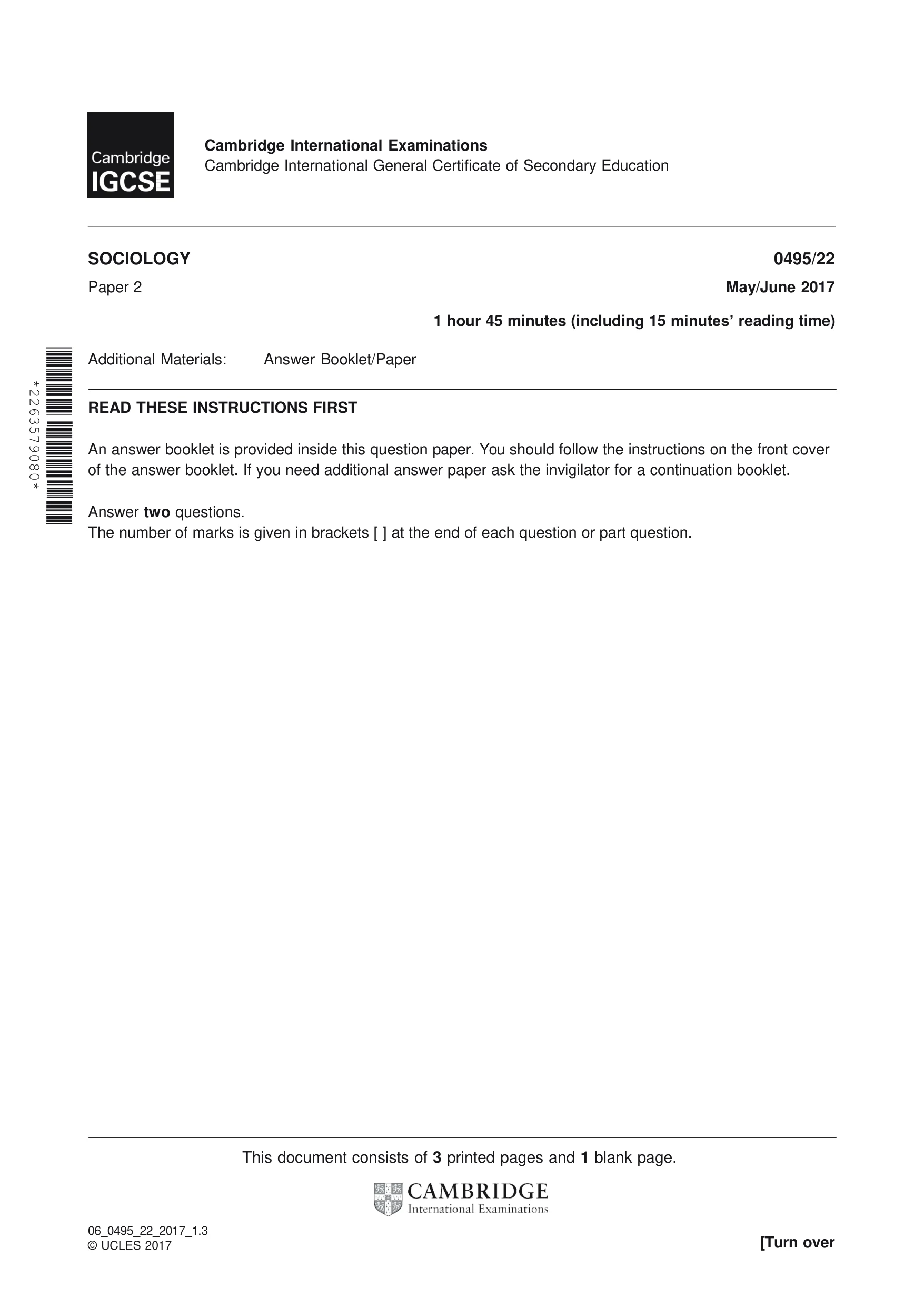
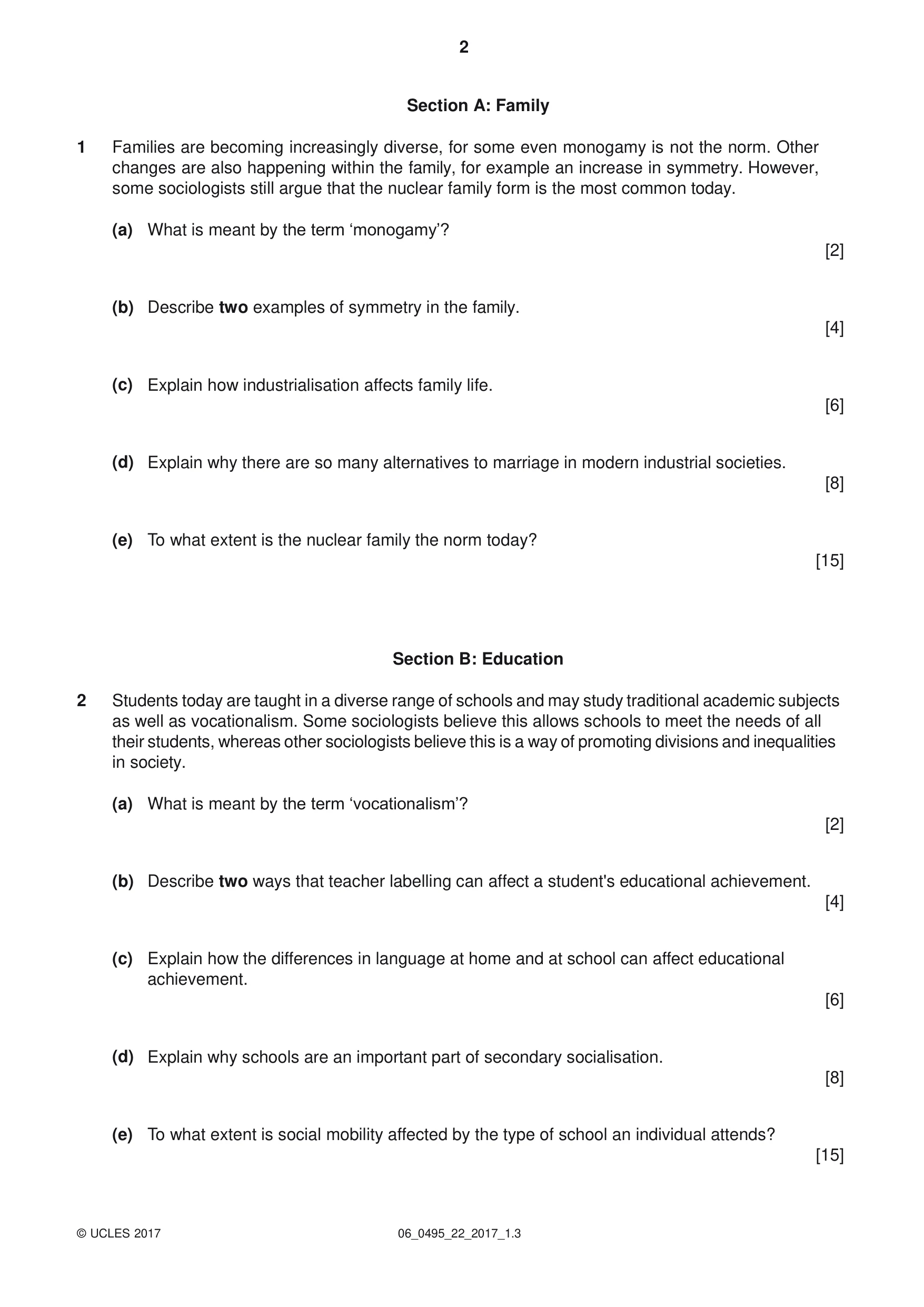
1 Families are becoming increasingly diverse, for some even monogamy is not the norm. Other changes are also happening within the family, for example an increase in symmetry. However, some sociologists still argue that the nuclear family form is the most common today. (a) What is meant by the term ‘monogamy’? [2] (b) Describe two examples of symmetry in the family. [4] (c) Explain how industrialisation affects family life. [6] (d) Explain why there are so many alternatives to marriage in modern industrial societies. [8] (e) To what extent is the nuclear family the norm today? [15]
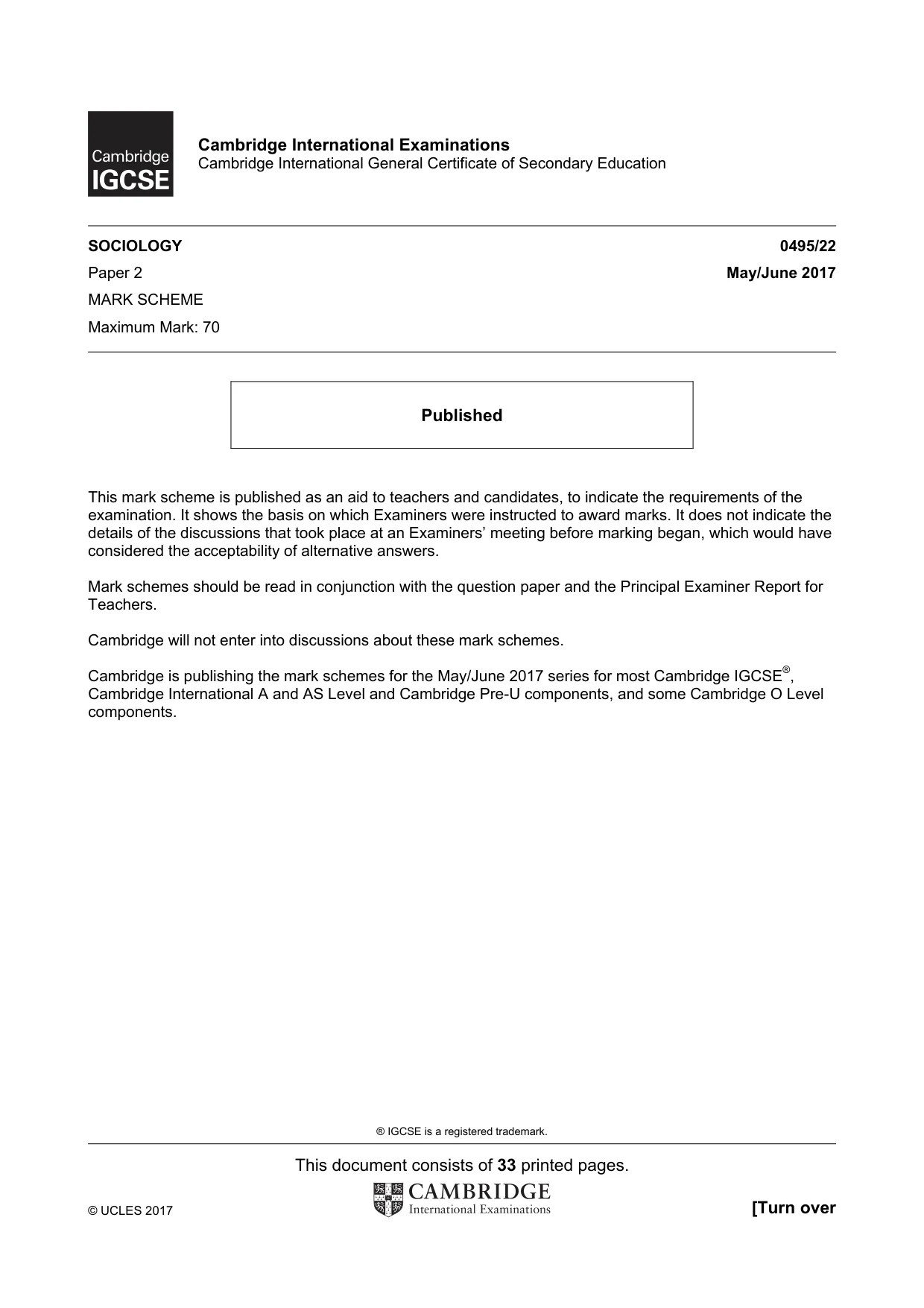
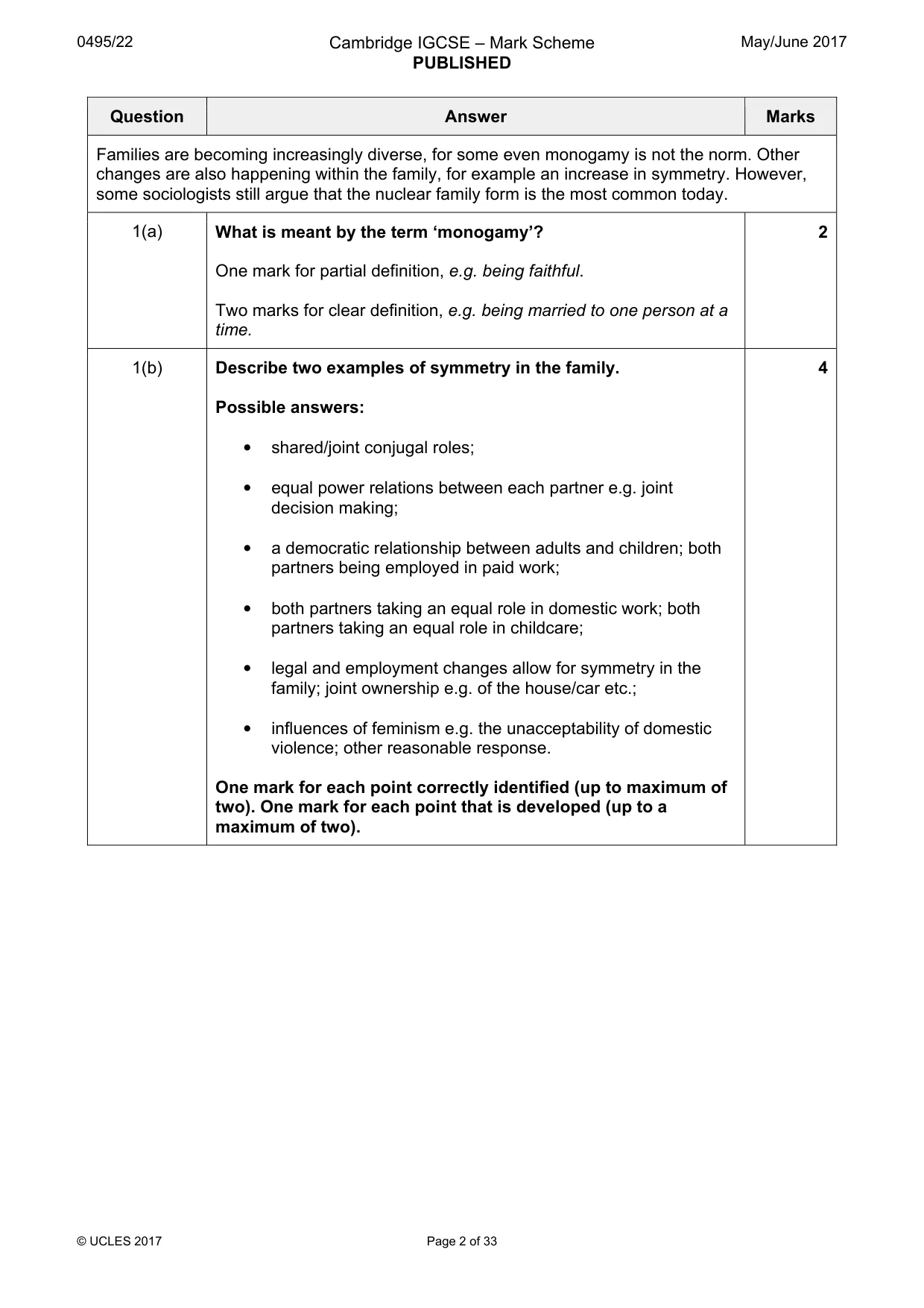
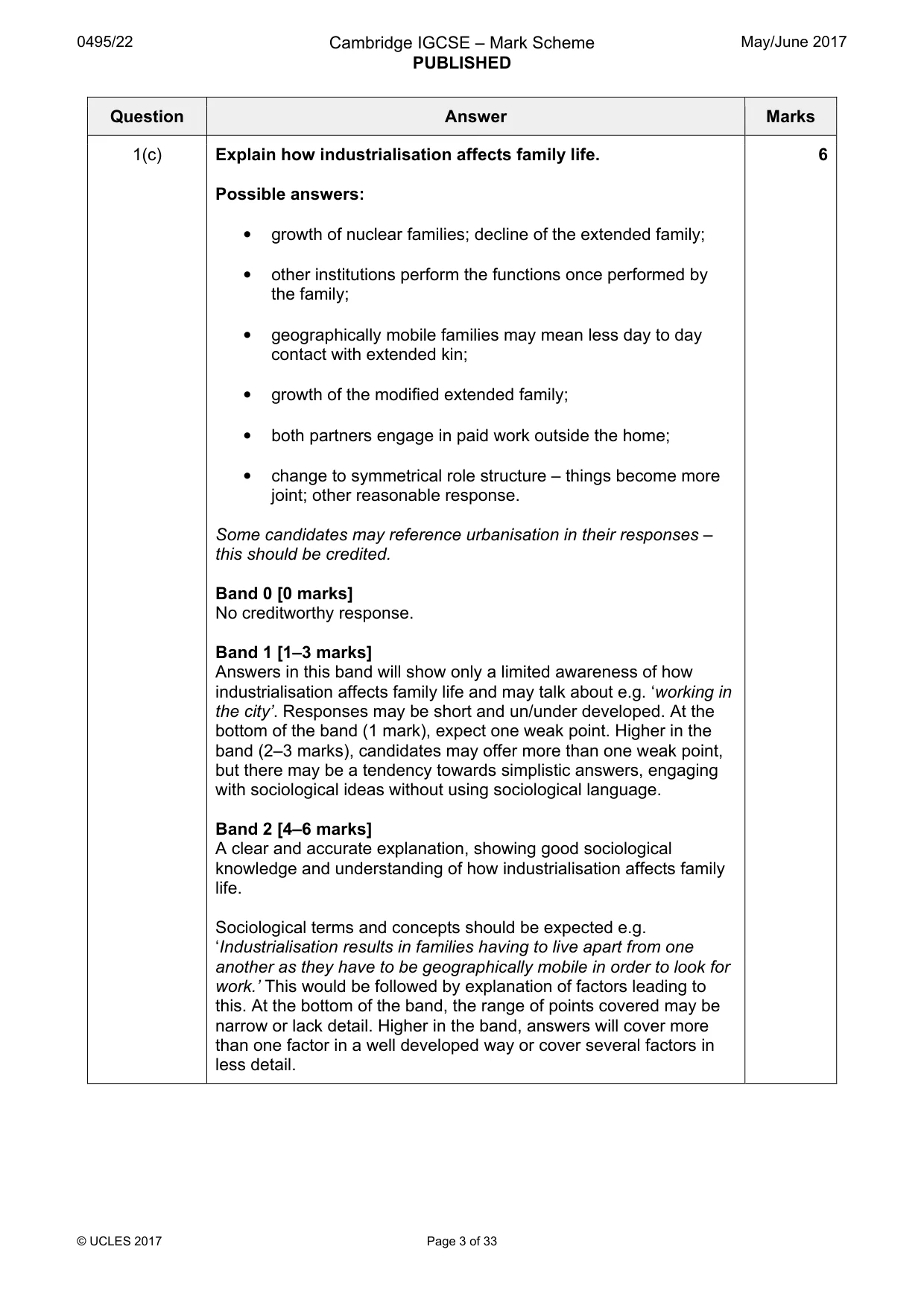
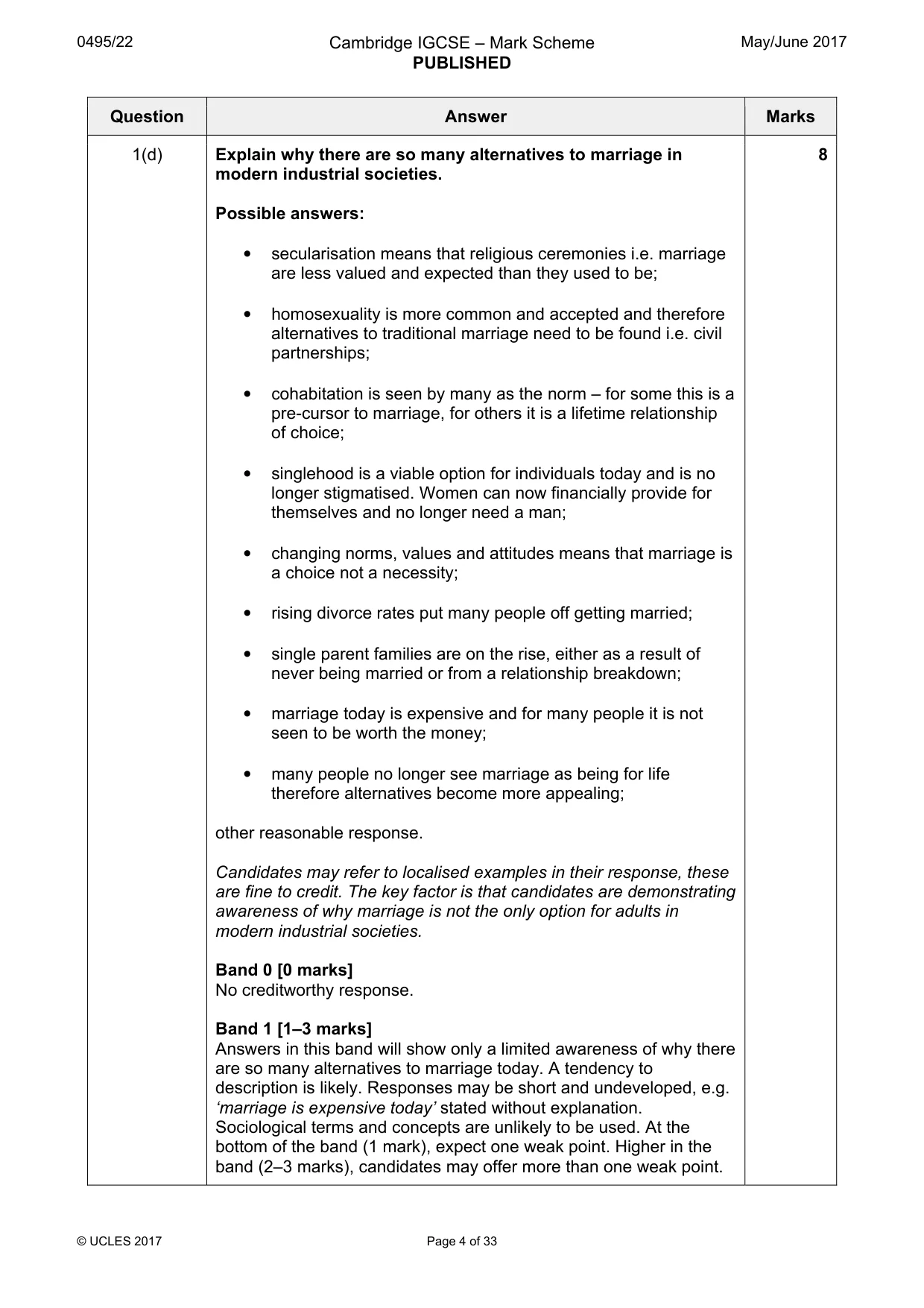
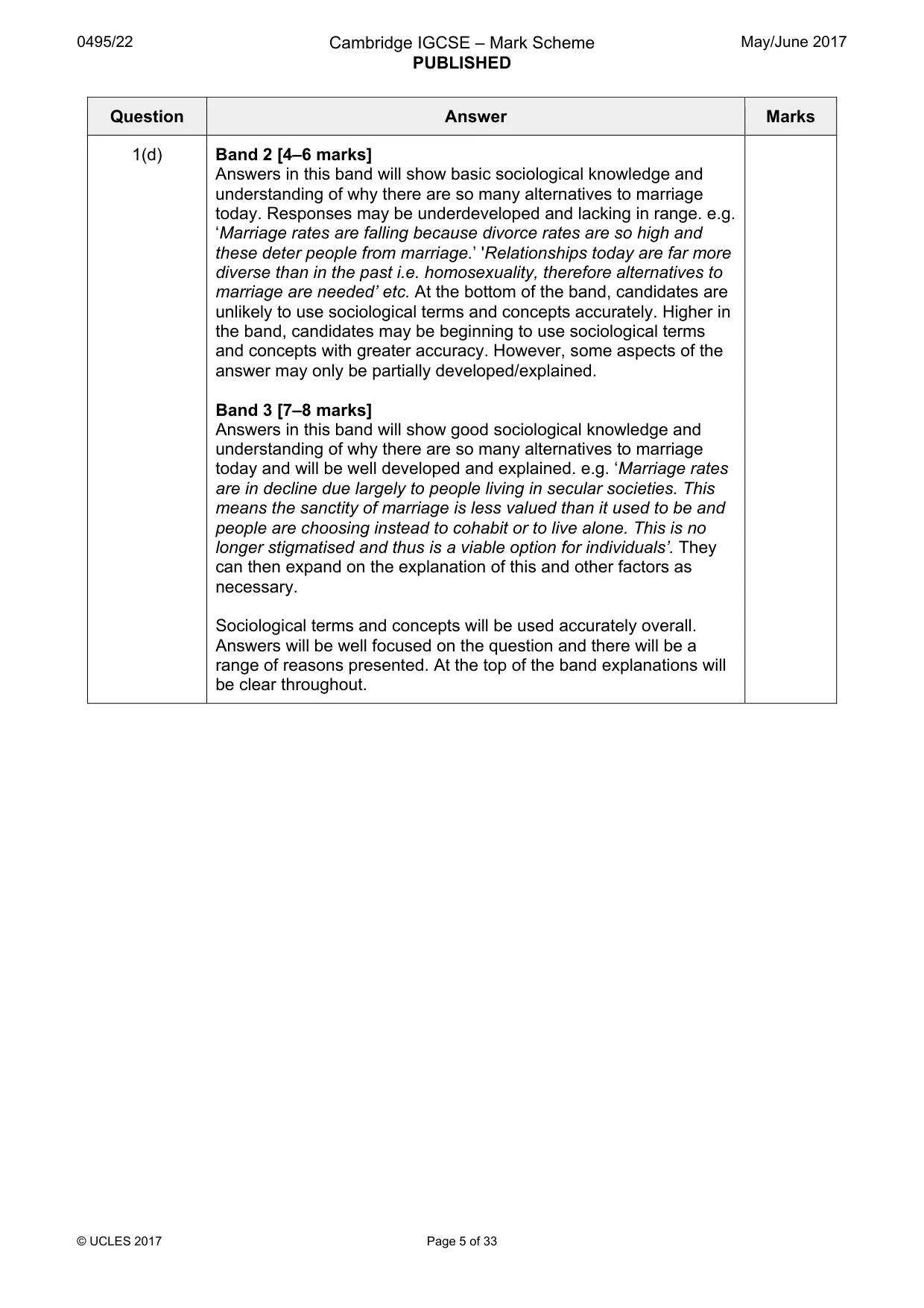
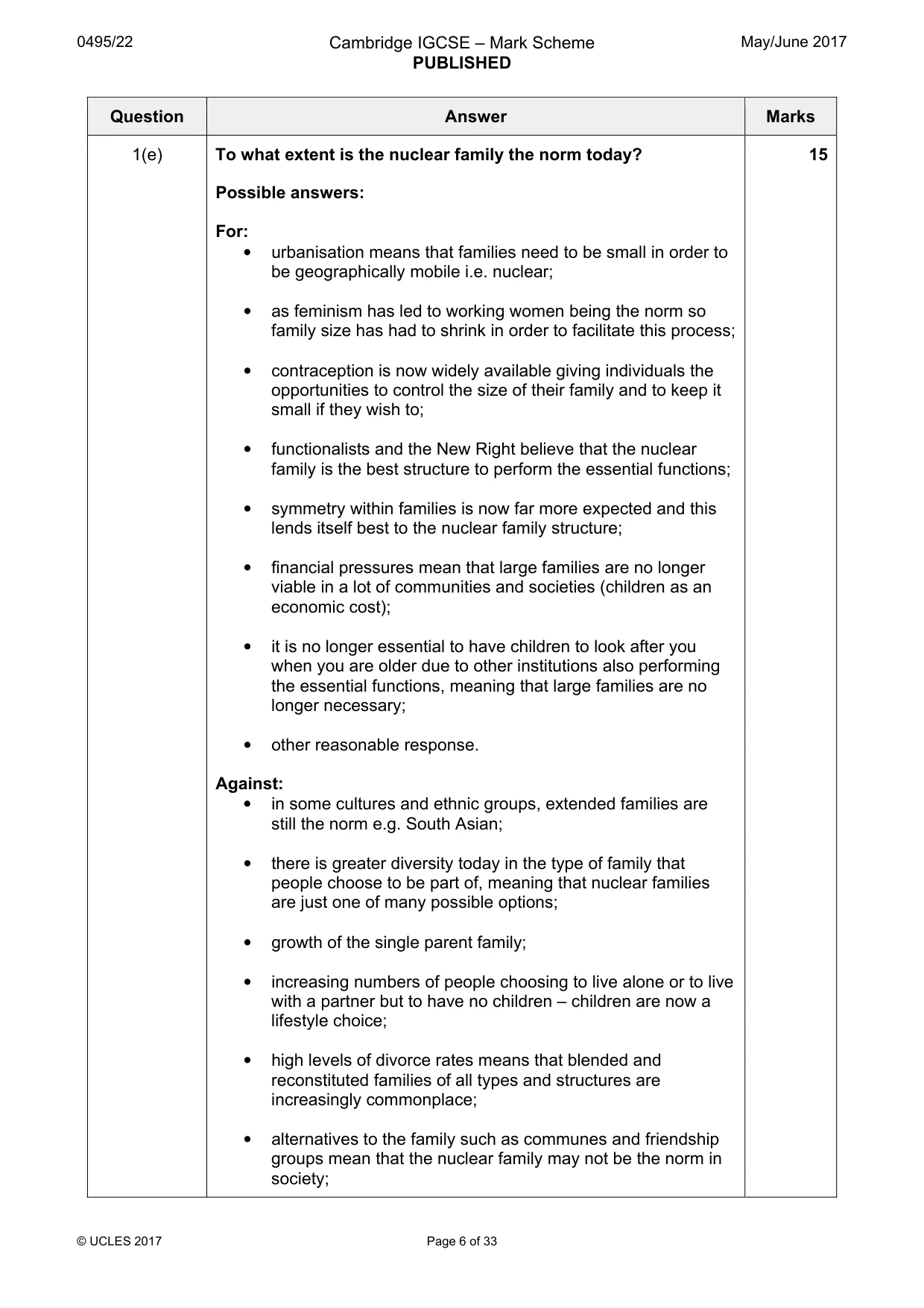
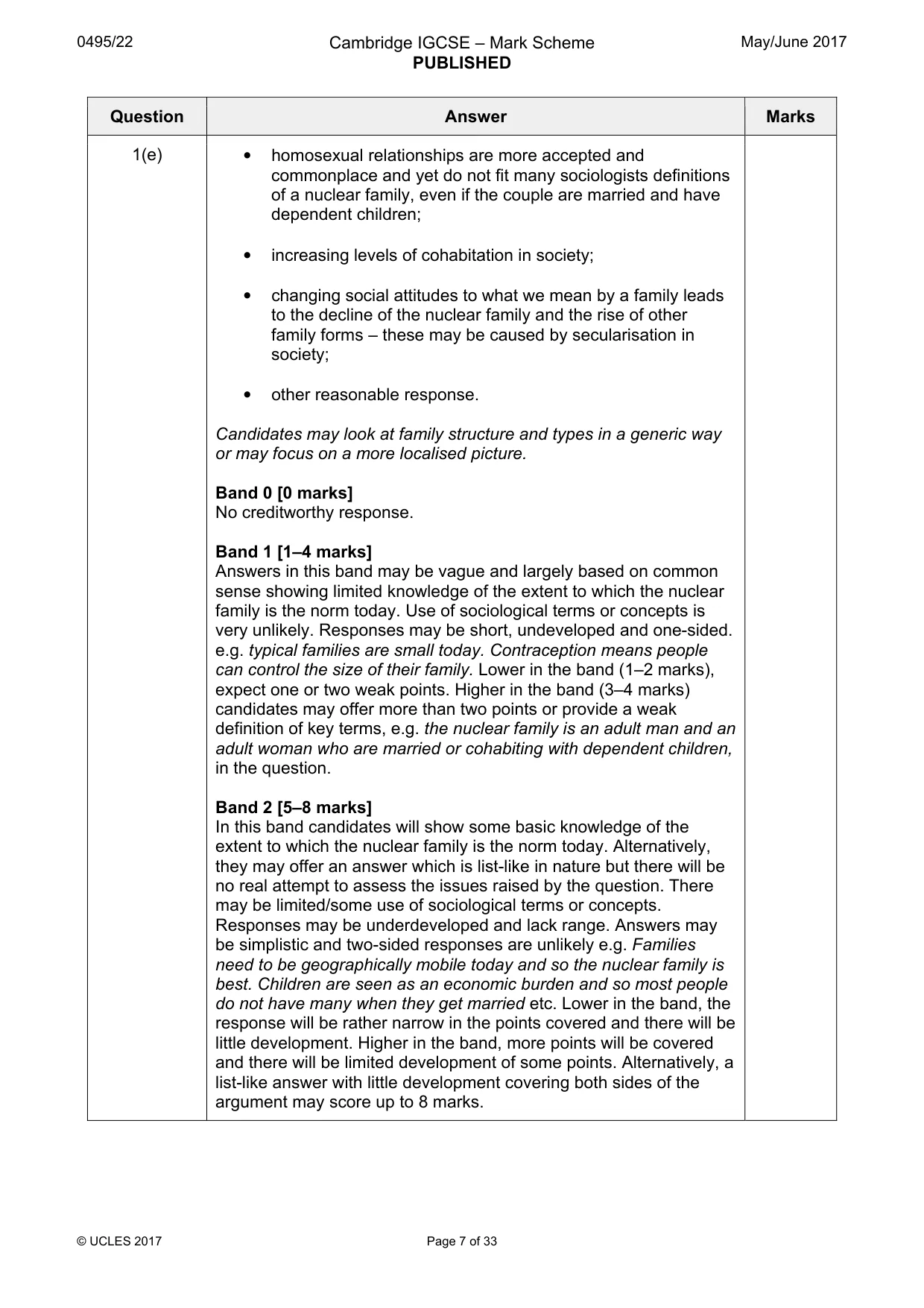
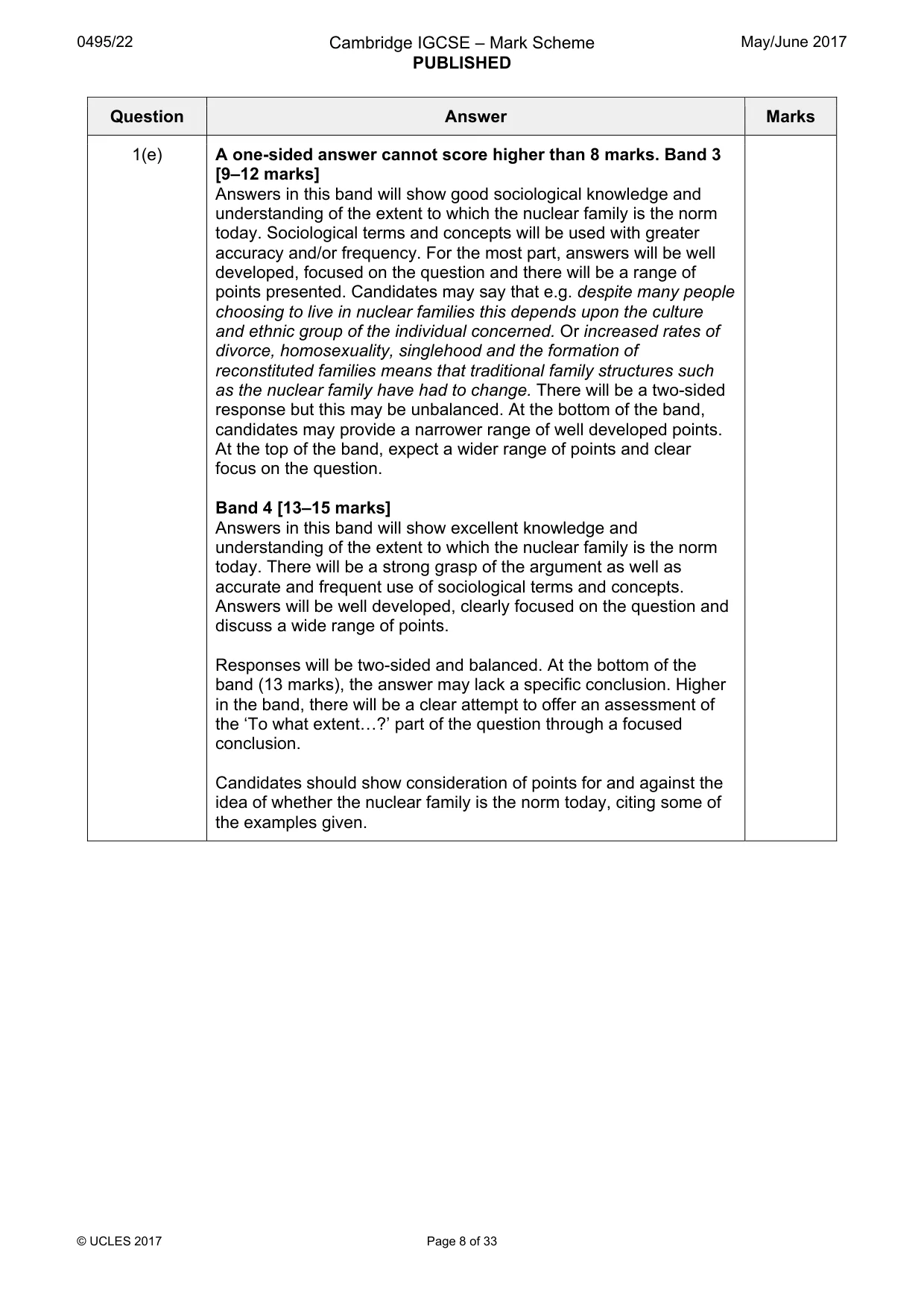
Mark scheme: Question Answer Marks Families are becoming increasingly diverse, for some even monogamy is not the norm. Other changes are also happening within the family, for example an increase in symmetry. However, some sociologists still argue that the nuclear family form is the most common today. 1(a) What is meant by the term ‘monogamy’? 2 One mark for partial definition, e.g. being faithful. Two marks for clear definition, e.g. being married to one person at a time. 1(b) Describe two examples of symmetry in the family. 4 Possible answers: • shared/joint conjugal roles; • equal power relations between each partner e.g. joint decision making; • a democratic relationship between adults and children; both partners being employed in paid work; • both partners taking an equal role in domestic work; both partners taking an equal role in childcare; • legal and employment changes allow for symmetry in the family; joint ownership e.g. of the house/car etc.; • influences of feminism e.g. the unacceptability of domestic violence; other reasonable response. One mark for each point correctly identified (up to maximum of two). One mark for each point that is developed (up to a maximum of two). 1(c) Explain how industrialisation affects family life. 6 Possible answers: • growth of nuclear families; decline of the extended family; • other institutions perform the functions once performed by the family; • geographically mobile families may mean less day to day contact with extended kin; • growth of the modified extended family; • both partners engage in paid work outside the home; • change to symmetrical role structure – things become more joint; other reasonable response. Some candidates may reference urbanisation in their responses – this should be credited. Band 0 [0 marks] No creditworthy response. Band 1 [1–3 marks] Answers in this band will show only a limited awareness of how industrialisation affects family life and may talk about e.g. ‘working in the city’. Responses may be short and un/under developed. At the bottom of the band (1 mark), expect one weak point. Higher in the band (2–3 marks), candidates may offer more than one weak point, but there may be a tendency towards simplistic answers, engaging with sociological ideas without using sociological language. Band 2 [4–6 marks] A clear and accurate explanation, showing good sociological knowledge and understanding of how industrialisation affects family life. Sociological terms and concepts should be expected e.g. ‘Industrialisation results in families having to live apart from one another as they have to be geographically mobile in order to look for work.’ This would be followed by explanation of factors leading to this. At the bottom of the band, the range of points covered may be narrow or lack detail. Higher in the band, answers will cover more than one factor in a well developed way or cover several factors in less detail. 1(d) Explain why there are so many alternatives to marriage in 8 modern industrial societies. Possible answers: • secularisation means that religious ceremonies i.e. marriage are less valued and expected than they used to be; • homosexuality is more common and accepted and therefore alternatives to traditional marriage need to be found i.e. civil partnerships; • cohabitation is seen by many as the norm – for some this is a pre-cursor to marriage, for others it is a lifetime relationship of choice; • singlehood is a viable option for individuals today and is no longer stigmatised. Women can now financially provide for themselves and no longer need a man; • changing norms, values and attitudes means that marriage is a choice not a necessity; • rising divorce rates put many people off getting married; • single parent families are on the rise, either as a result of never being married or from a relationship breakdown; • marriage today is expensive and for many people it is not seen to be worth the money; • many people no longer see marriage as being for life therefore alternatives become more appealing; other reasonable response. Candidates may refer to localised examples in their response, these are fine to credit. The key factor is that candidates are demonstrating awareness of why marriage is not the only option for adults in modern industrial societies. Band 0 [0 marks] No creditworthy response. Band 1 [1–3 marks] Answers in this band will show only a limited awareness of why there are so many alternatives to marriage today. A tendency to description is likely. Responses may be short and undeveloped, e.g. ‘marriage is expensive today’ stated without explanation. Sociological terms and concepts are unlikely to be used. At the bottom of the band (1 mark), expect one weak point. Higher in the band (2–3 marks), candidates may offer more than one weak point. 1(d) Band 2 [4–6 marks] Answers in this band will show basic sociological knowledge and understanding of why there are so many alternatives to marriage today. Responses may be underdeveloped and lacking in range. e.g. ‘Marriage rates are falling because divorce rates are so high and these deter people from marriage.’ 'Relationships today are far more diverse than in the past i.e. homosexuality, therefore alternatives to marriage are needed’ etc. At the bottom of the band, candidates are unlikely to use sociological terms and concepts accurately. Higher in the band, candidates may be beginning to use sociological terms and concepts with greater accuracy. However, some aspects of the answer may only be partially developed/explained. Band 3 [7–8 marks] Answers in this band will show good sociological knowledge and understanding of why there are so many alternatives to marriage today and will be well developed and explained. e.g. ‘Marriage rates are in decline due largely to people living in secular societies. This means the sanctity of marriage is less valued than it used to be and people are choosing instead to cohabit or to live alone. This is no longer stigmatised and thus is a viable option for individuals’. They can then expand on the explanation of this and other factors as necessary. Sociological terms and concepts will be used accurately overall. Answers will be well focused on the question and there will be a range of reasons presented. At the top of the band explanations will be clear throughout. 1(e) To what extent is the nuclear family the norm today? 15 Possible answers: For: • urbanisation means that families need to be small in order to be geographically mobile i.e. nuclear; • as feminism has led to working women being the norm so family size has had to shrink in order to facilitate this process; • contraception is now widely available giving individuals the opportunities to control the size of their family and to keep it small if they wish to; • functionalists and the New Right believe that the nuclear family is the best structure to perform the essential functions; • symmetry within families is now far more expected and this lends itself best to the nuclear family structure; • financial pressures mean that large families are no longer viable in a lot of communities and societies (children as an economic cost); • it is no longer essential to have children to look after you when you are older due to other institutions also performing the essential functions, meaning that large families are no longer necessary; • other reasonable response. Against: • in some cultures and ethnic groups, extended families are still the norm e.g. South Asian; • there is greater diversity today in the type of family that people choose to be part of, meaning that nuclear families are just one of many possible options; • growth of the single parent family; • increasing numbers of people choosing to live alone or to live with a partner but to have no children – children are now a lifestyle choice; • high levels of divorce rates means that blended and reconstituted families of all types and structures are increasingly commonplace; • alternatives to the family such as communes and friendship groups mean that the nuclear family may not be the norm in society; 1(e) • homosexual relationships are more accepted and commonplace and yet do not fit many sociologists definitions of a nuclear family, even if the couple are married and have dependent children; • increasing levels of cohabitation in society; • changing social attitudes to what we mean by a family leads to the decline of the nuclear family and the rise of other family forms – these may be caused by secularisation in society; • other reasonable response. Candidates may look at family structure and types in a generic way or may focus on a more localised picture. Band 0 [0 marks] No creditworthy response. Band 1 [1–4 marks] Answers in this band may be vague and largely based on common sense showing limited knowledge of the extent to which the nuclear family is the norm today. Use of sociological terms or concepts is very unlikely. Responses may be short, undeveloped and one-sided. e.g. typical families are small today. Contraception means people can control the size of their family. Lower in the band (1–2 marks), expect one or two weak points. Higher in the band (3–4 marks) candidates may offer more than two points or provide a weak definition of key terms, e.g. the nuclear family is an adult man and an adult woman who are married or cohabiting with dependent children, in the question. Band 2 [5–8 marks] In this band candidates will show some basic knowledge of the extent to which the nuclear family is the norm today. Alternatively, they may offer an answer which is list-like in nature but there will be no real attempt to assess the issues raised by the question. There may be limited/some use of sociological terms or concepts. Responses may be underdeveloped and lack range. Answers may be simplistic and two-sided responses are unlikely e.g. Families need to be geographically mobile today and so the nuclear family is best. Children are seen as an economic burden and so most people do not have many when they get married etc. Lower in the band, the response will be rather narrow in the points covered and there will be little development. Higher in the band, more points will be covered and there will be limited development of some points. Alternatively, a list-like answer with little development covering both sides of the argument may score up to 8 marks. 1(e) A one-sided answer cannot score higher than 8 marks. Band 3 [9–12 marks] Answers in this band will show good sociological knowledge and understanding of the extent to which the nuclear family is the norm today. Sociological terms and concepts will be used with greater accuracy and/or frequency. For the most part, answers will be well developed, focused on the question and there will be a range of points presented. Candidates may say that e.g. despite many people choosing to live in nuclear families this depends upon the culture and ethnic group of the individual concerned. Or increased rates of divorce, homosexuality, singlehood and the formation of reconstituted families means that traditional family structures such as the nuclear family have had to change. There will be a two-sided response but this may be unbalanced. At the bottom of the band, candidates may provide a narrower range of well developed points. At the top of the band, expect a wider range of points and clear focus on the question. Band 4 [13–15 marks] Answers in this band will show excellent knowledge and understanding of the extent to which the nuclear family is the norm today. There will be a strong grasp of the argument as well as accurate and frequent use of sociological terms and concepts. Answers will be well developed, clearly focused on the question and discuss a wide range of points. Responses will be two-sided and balanced. At the bottom of the band (13 marks), the answer may lack a specific conclusion. Higher in the band, there will be a clear attempt to offer an assessment of the ‘To what extent«?’ part of the question through a focused conclusion. Candidates should show consideration of points for and against the idea of whether the nuclear family is the norm today, citing some of the examples given.
Q2 · Students today are taught in a diverse range of schools and may study traditional…
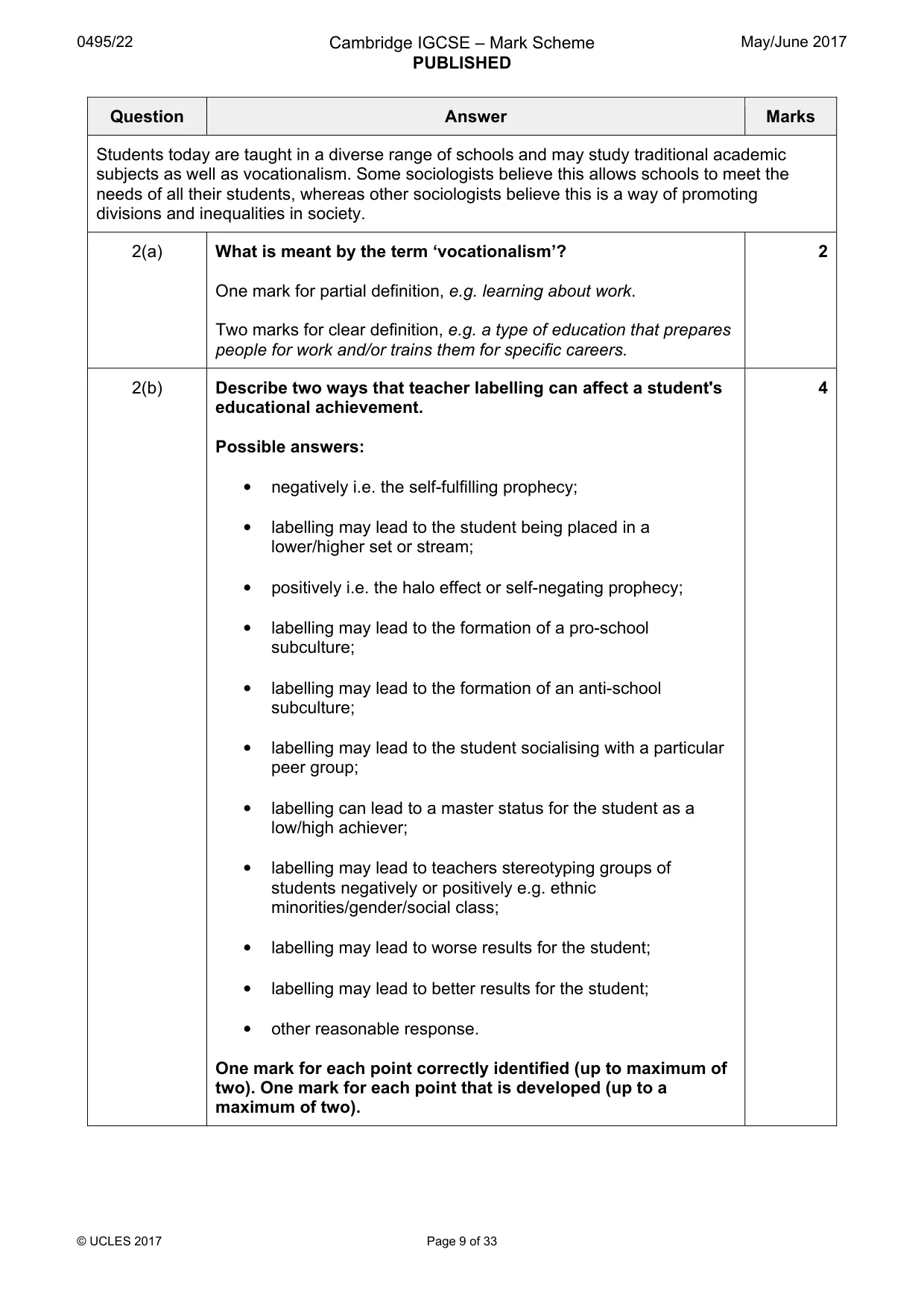
2 Students today are taught in a diverse range of schools and may study traditional academic subjects as well as vocationalism. Some sociologists believe this allows schools to meet the needs of all their students, whereas other sociologists believe this is a way of promoting divisions and inequalities in society. (a) What is meant by the term ‘vocationalism’? [2] (b) Describe two ways that teacher labelling can affect a student's educational achievement. [4] (c) Explain how the differences in language at home and at school can affect educational achievement. [6] (d) Explain why schools are an important part of secondary socialisation. [8] (e) To what extent is social mobility affected by the type of school an individual attends? [15] Section C: Crime, deviance and social control
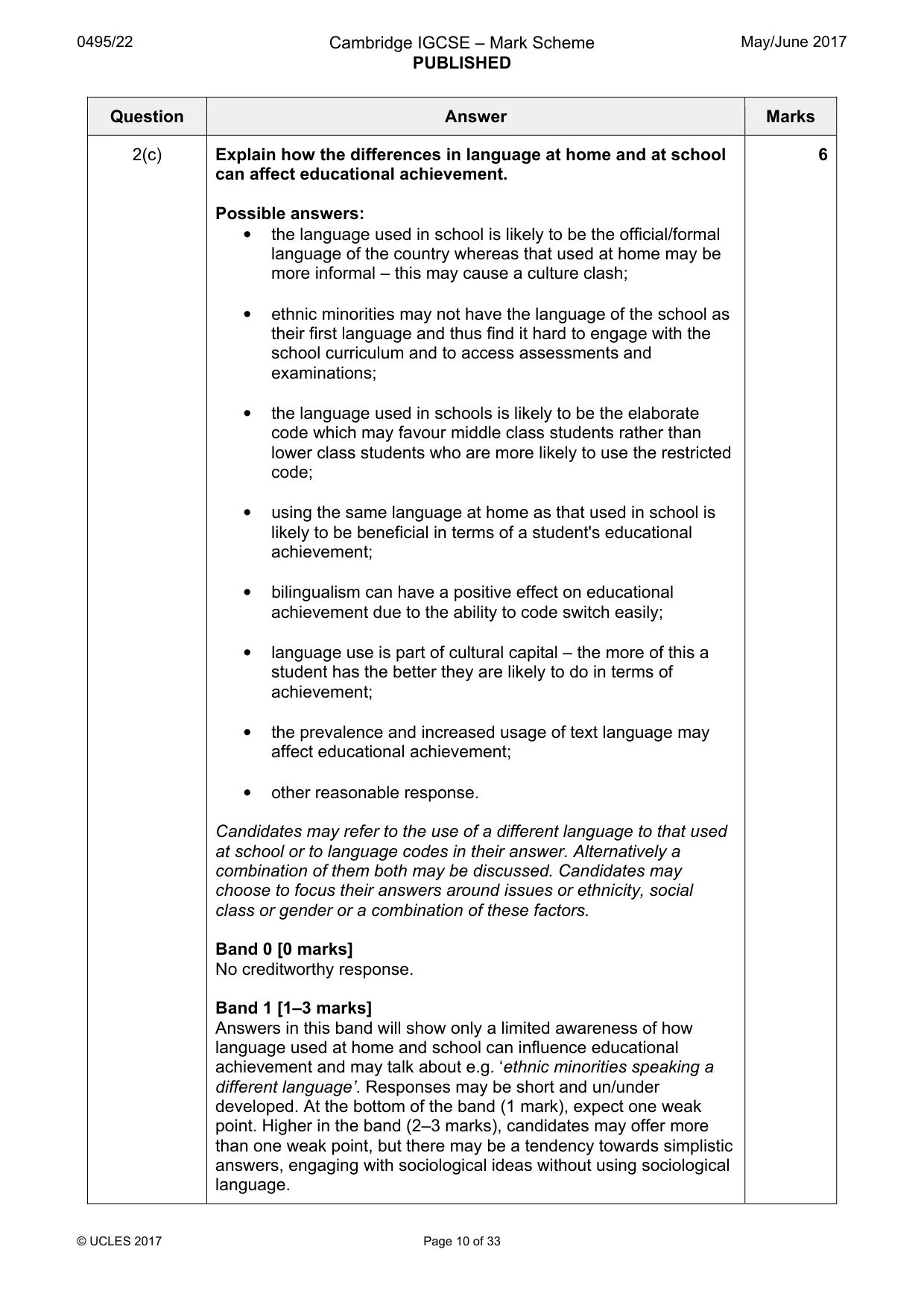
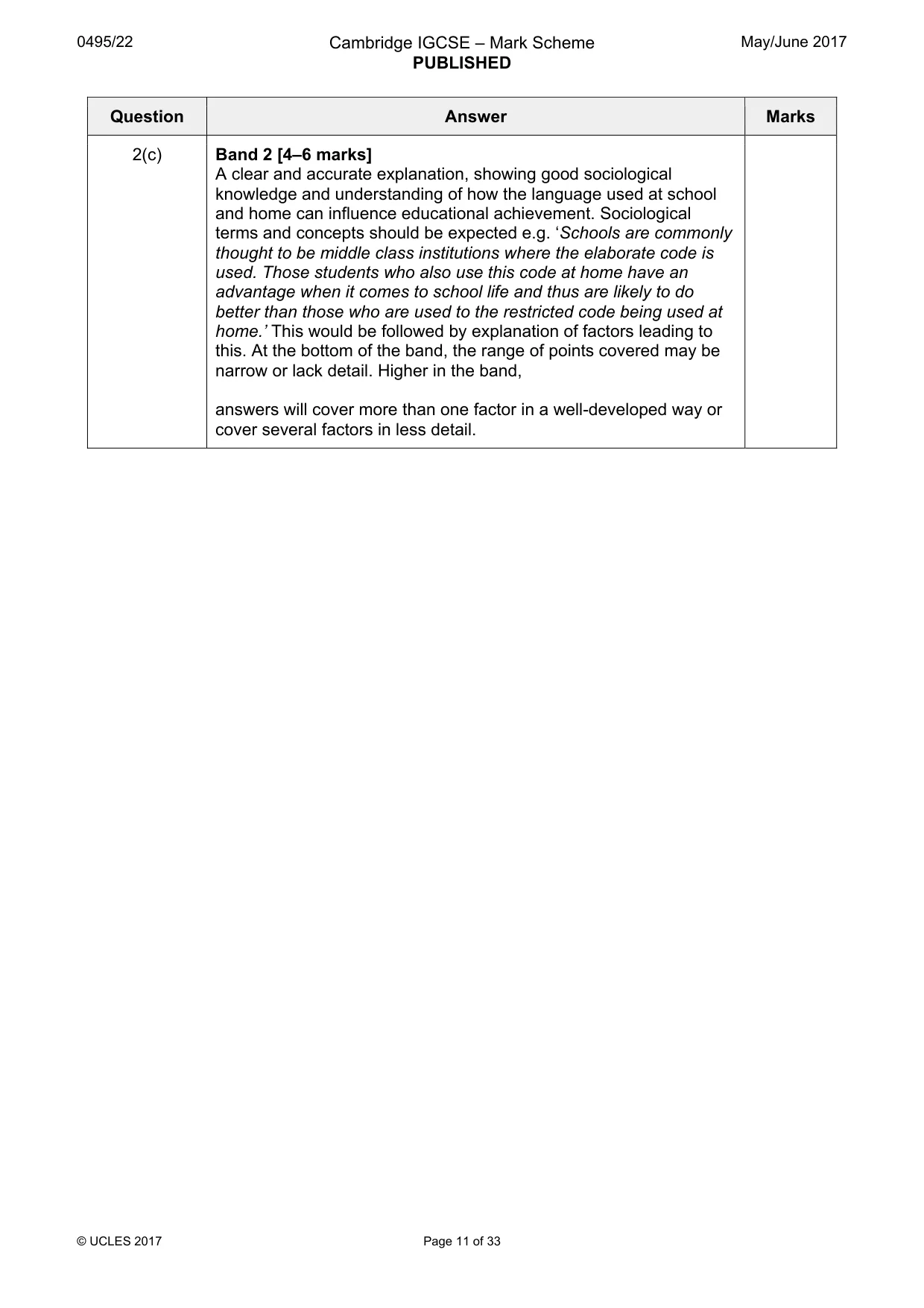
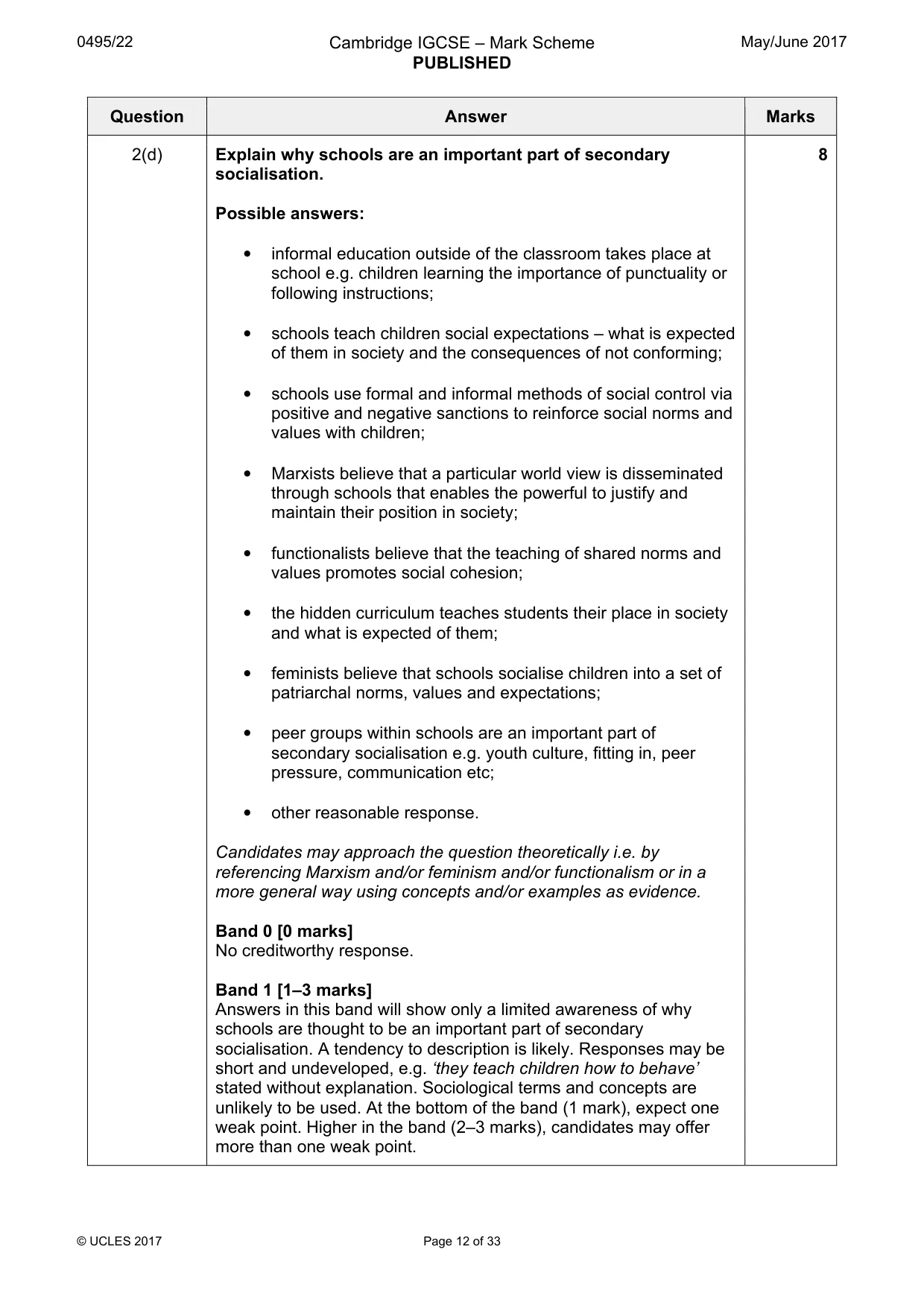
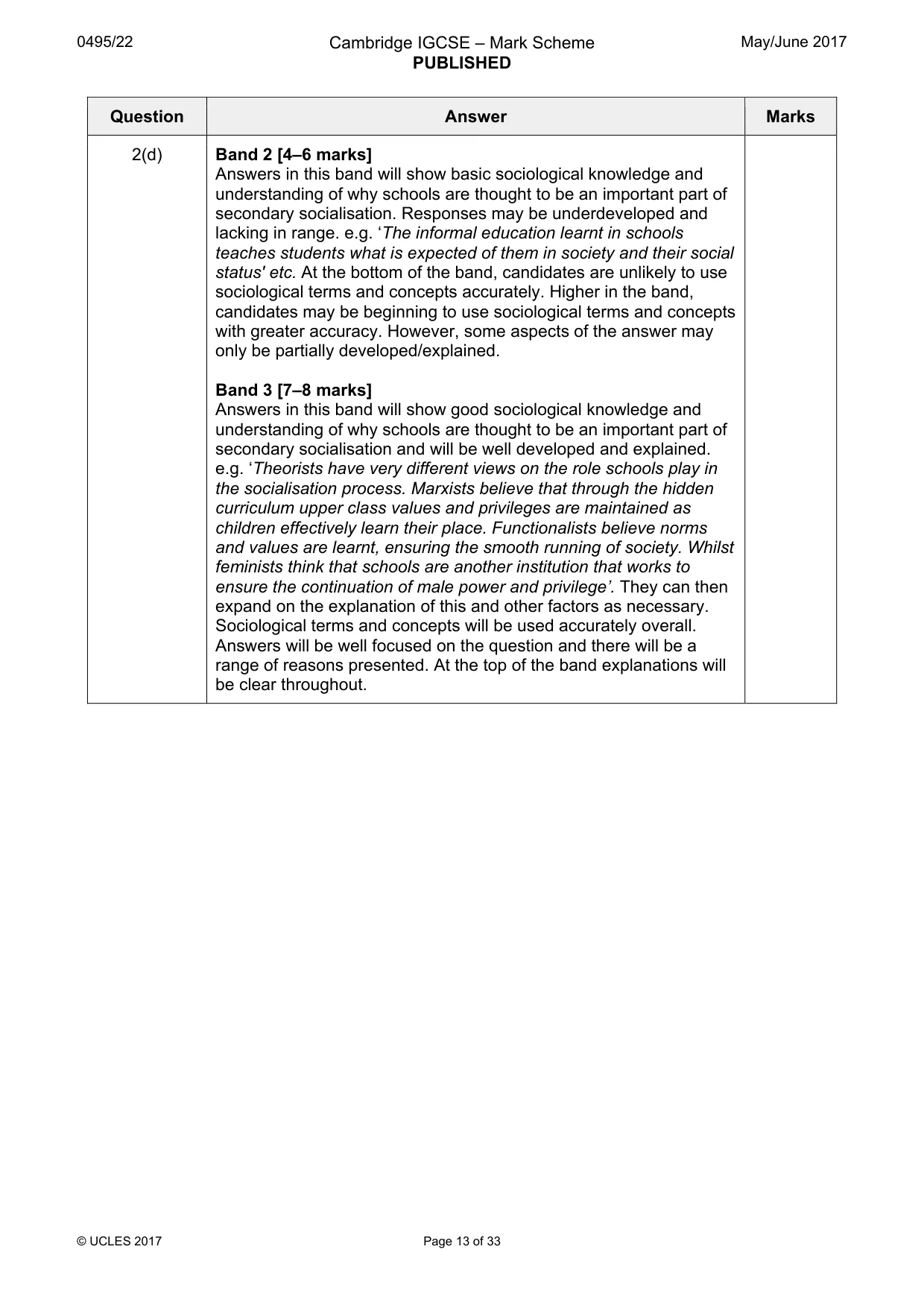
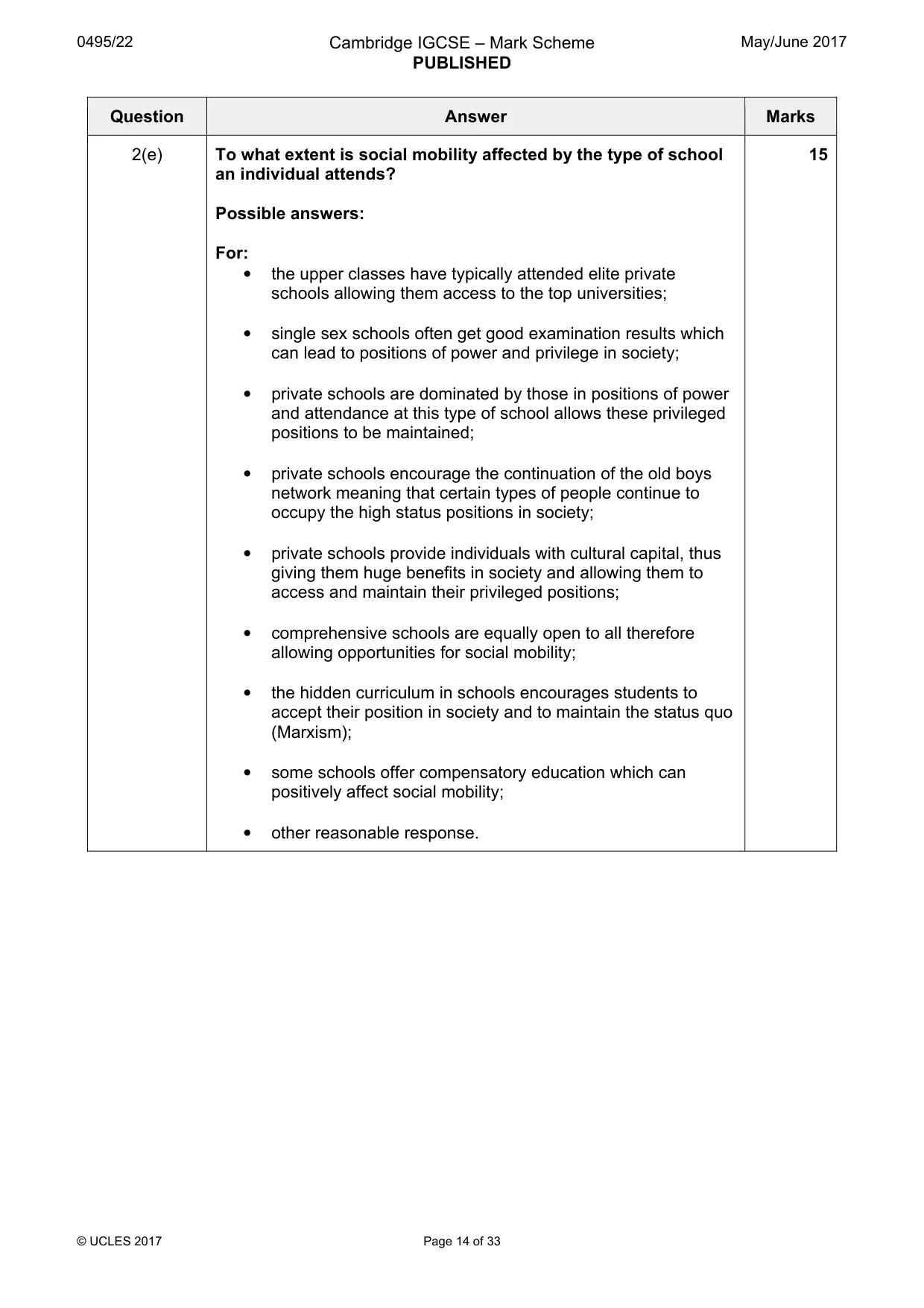
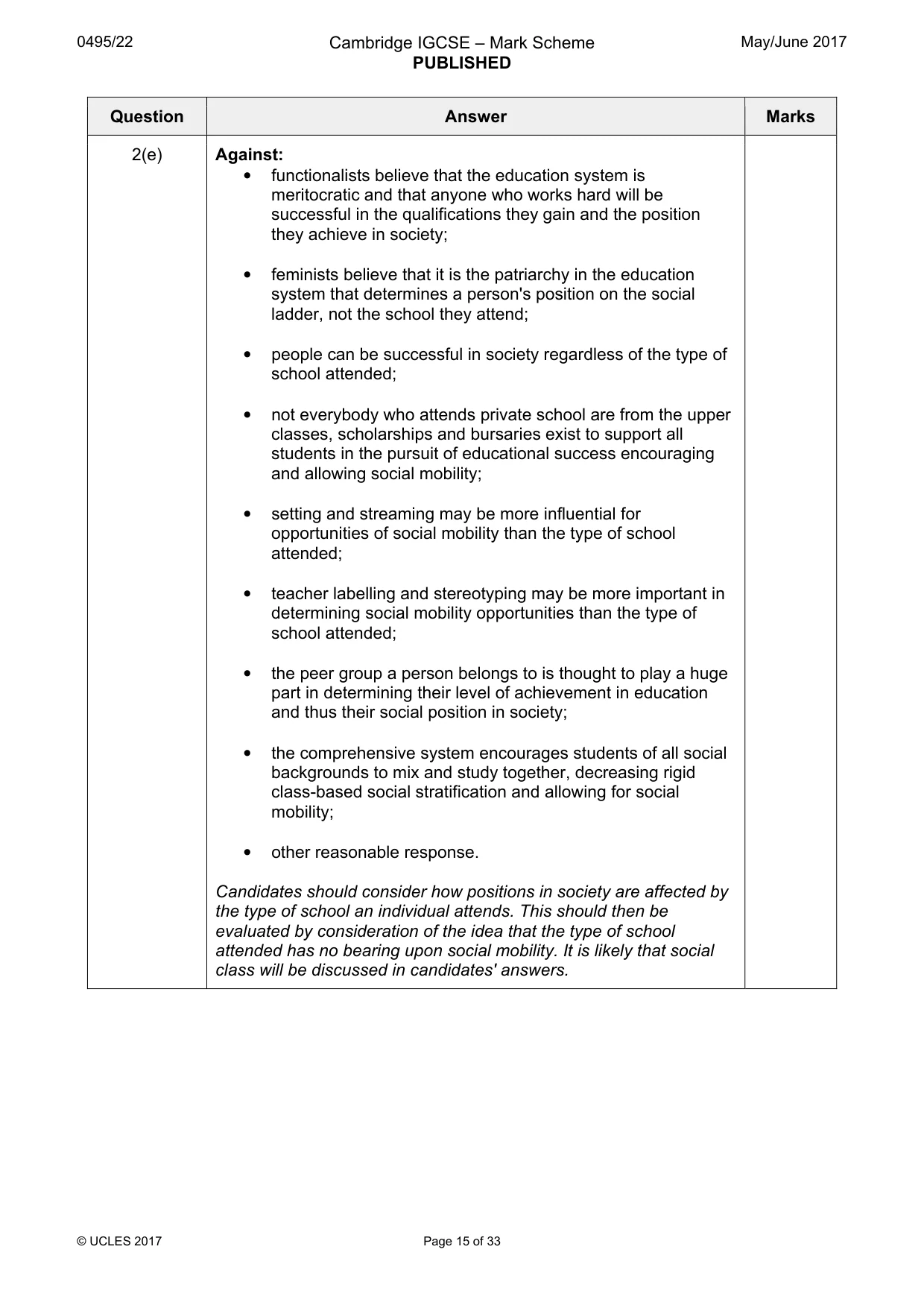
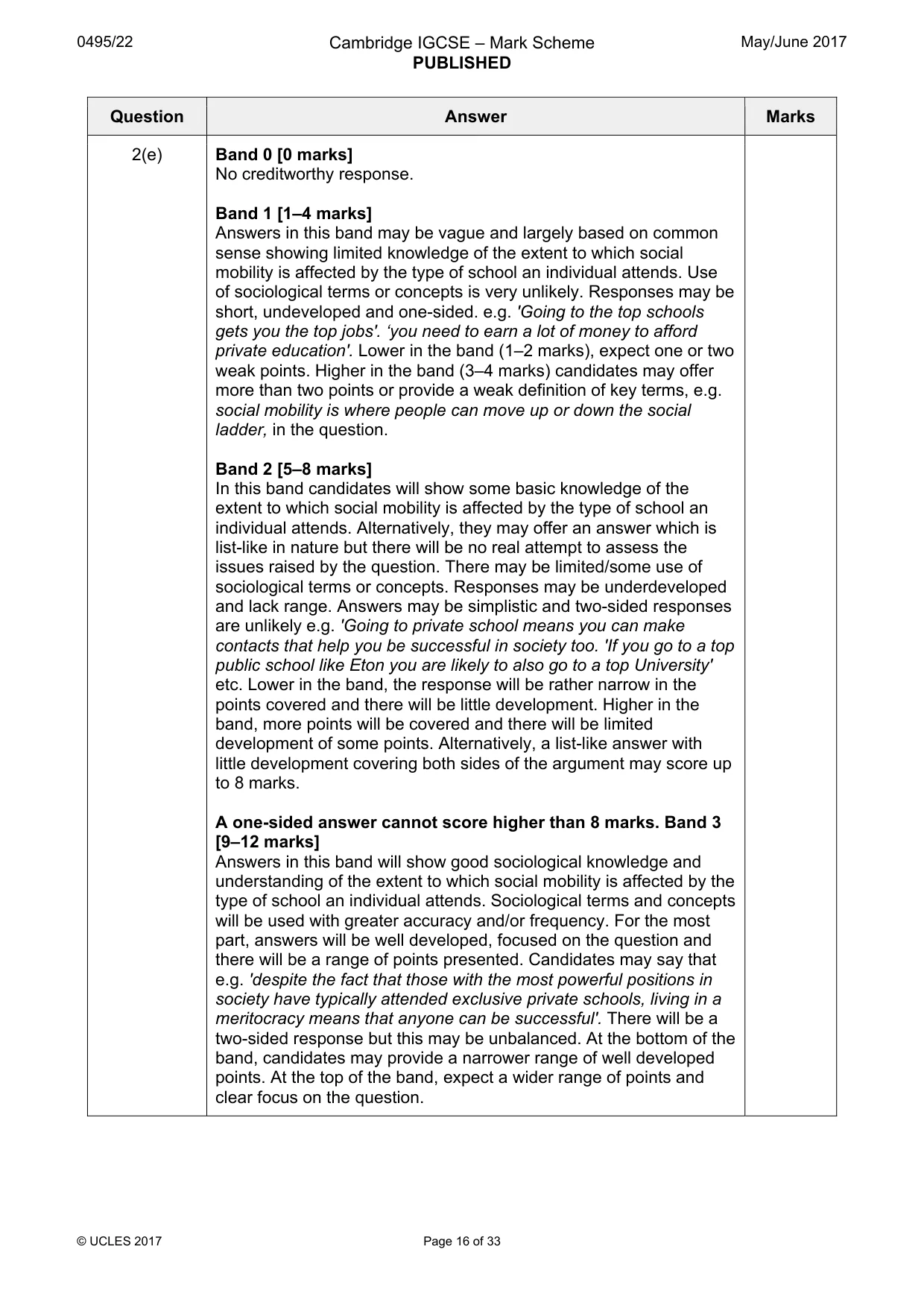
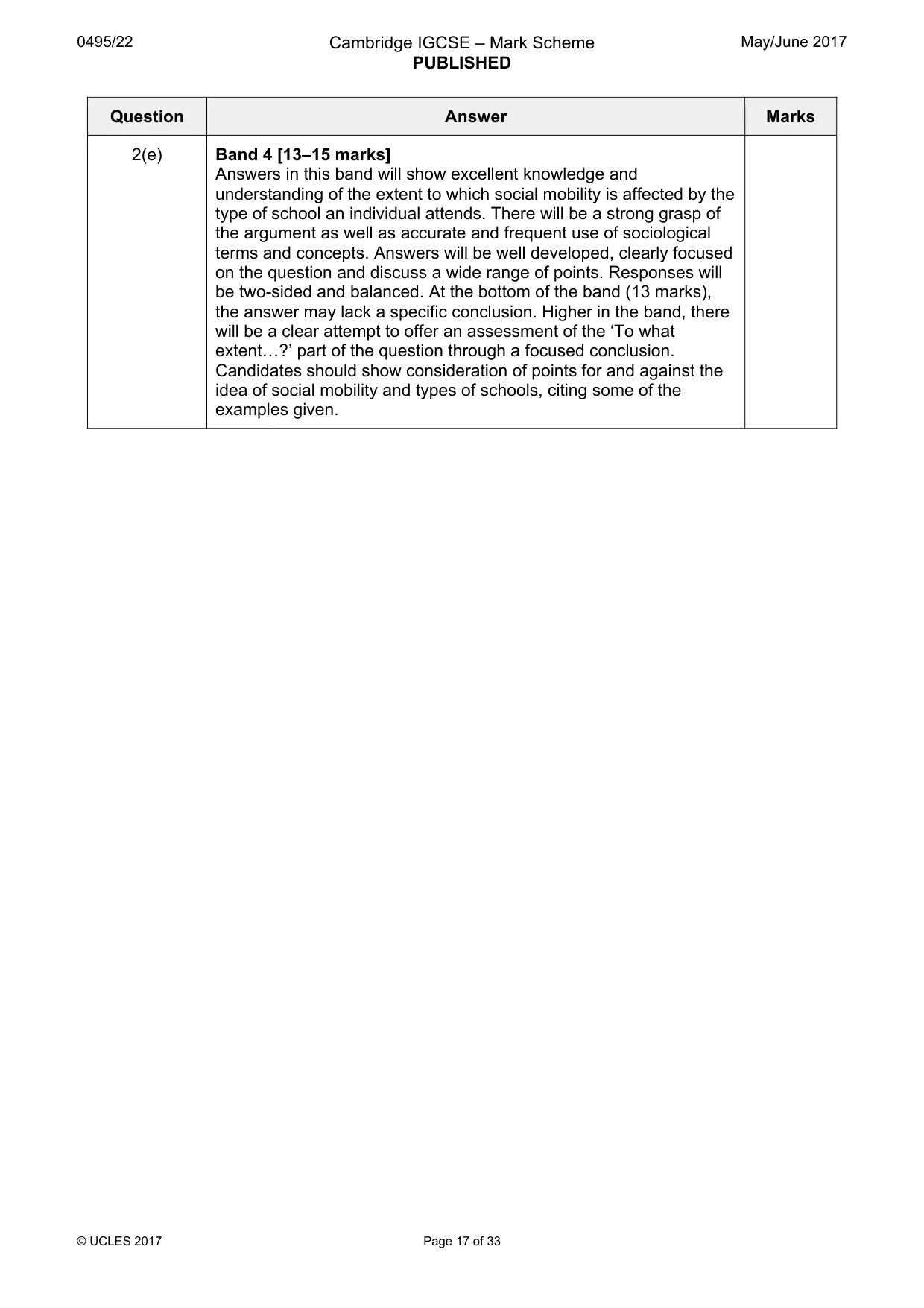
Mark scheme: 2(a) What is meant by the term ‘vocationalism’? 2 One mark for partial definition, e.g. learning about work. Two marks for clear definition, e.g. a type of education that prepares people for work and/or trains them for specific careers. 2(b) Describe two ways that teacher labelling can affect a student's 4 educational achievement. Possible answers: • negatively i.e. the self-fulfilling prophecy; • labelling may lead to the student being placed in a lower/higher set or stream; • positively i.e. the halo effect or self-negating prophecy; • labelling may lead to the formation of a pro-school subculture; • labelling may lead to the formation of an anti-school subculture; • labelling may lead to the student socialising with a particular peer group; • labelling can lead to a master status for the student as a low/high achiever; • labelling may lead to teachers stereotyping groups of students negatively or positively e.g. ethnic minorities/gender/social class; • labelling may lead to worse results for the student; • labelling may lead to better results for the student; • other reasonable response. One mark for each point correctly identified (up to maximum of two). One mark for each point that is developed (up to a maximum of two). 2(c) Explain how the differences in language at home and at school 6 can affect educational achievement. Possible answers: • the language used in school is likely to be the official/formal language of the country whereas that used at home may be more informal – this may cause a culture clash; • ethnic minorities may not have the language of the school as their first language and thus find it hard to engage with the school curriculum and to access assessments and examinations; • the language used in schools is likely to be the elaborate code which may favour middle class students rather than lower class students who are more likely to use the restricted code; • using the same language at home as that used in school is likely to be beneficial in terms of a student's educational achievement; • bilingualism can have a positive effect on educational achievement due to the ability to code switch easily; • language use is part of cultural capital – the more of this a student has the better they are likely to do in terms of achievement; • the prevalence and increased usage of text language may affect educational achievement; • other reasonable response. Candidates may refer to the use of a different language to that used at school or to language codes in their answer. Alternatively a combination of them both may be discussed. Candidates may choose to focus their answers around issues or ethnicity, social class or gender or a combination of these factors. Band 0 [0 marks] No creditworthy response. Band 1 [1–3 marks] Answers in this band will show only a limited awareness of how language used at home and school can influence educational achievement and may talk about e.g. ‘ethnic minorities speaking a different language’. Responses may be short and un/under developed. At the bottom of the band (1 mark), expect one weak point. Higher in the band (2–3 marks), candidates may offer more than one weak point, but there may be a tendency towards simplistic answers, engaging with sociological ideas without using sociological language. 2(c) Band 2 [4–6 marks] A clear and accurate explanation, showing good sociological knowledge and understanding of how the language used at school and home can influence educational achievement. Sociological terms and concepts should be expected e.g. ‘Schools are commonly thought to be middle class institutions where the elaborate code is used. Those students who also use this code at home have an advantage when it comes to school life and thus are likely to do better than those who are used to the restricted code being used at home.’ This would be followed by explanation of factors leading to this. At the bottom of the band, the range of points covered may be narrow or lack detail. Higher in the band, answers will cover more than one factor in a well-developed way or cover several factors in less detail. 2(d) Explain why schools are an important part of secondary 8 socialisation. Possible answers: • informal education outside of the classroom takes place at school e.g. children learning the importance of punctuality or following instructions; • schools teach children social expectations – what is expected of them in society and the consequences of not conforming; • schools use formal and informal methods of social control via positive and negative sanctions to reinforce social norms and values with children; • Marxists believe that a particular world view is disseminated through schools that enables the powerful to justify and maintain their position in society; • functionalists believe that the teaching of shared norms and values promotes social cohesion; • the hidden curriculum teaches students their place in society and what is expected of them; • feminists believe that schools socialise children into a set of patriarchal norms, values and expectations; • peer groups within schools are an important part of secondary socialisation e.g. youth culture, fitting in, peer pressure, communication etc; • other reasonable response. Candidates may approach the question theoretically i.e. by referencing Marxism and/or feminism and/or functionalism or in a more general way using concepts and/or examples as evidence. Band 0 [0 marks] No creditworthy response. Band 1 [1–3 marks] Answers in this band will show only a limited awareness of why schools are thought to be an important part of secondary socialisation. A tendency to description is likely. Responses may be short and undeveloped, e.g. ‘they teach children how to behave’ stated without explanation. Sociological terms and concepts are unlikely to be used. At the bottom of the band (1 mark), expect one weak point. Higher in the band (2–3 marks), candidates may offer more than one weak point. 2(d) Band 2 [4–6 marks] Answers in this band will show basic sociological knowledge and understanding of why schools are thought to be an important part of secondary socialisation. Responses may be underdeveloped and lacking in range. e.g. ‘The informal education learnt in schools teaches students what is expected of them in society and their social status' etc. At the bottom of the band, candidates are unlikely to use sociological terms and concepts accurately. Higher in the band, candidates may be beginning to use sociological terms and concepts with greater accuracy. However, some aspects of the answer may only be partially developed/explained. Band 3 [7–8 marks] Answers in this band will show good sociological knowledge and understanding of why schools are thought to be an important part of secondary socialisation and will be well developed and explained. e.g. ‘Theorists have very different views on the role schools play in the socialisation process. Marxists believe that through the hidden curriculum upper class values and privileges are maintained as children effectively learn their place. Functionalists believe norms and values are learnt, ensuring the smooth running of society. Whilst feminists think that schools are another institution that works to ensure the continuation of male power and privilege’. They can then expand on the explanation of this and other factors as necessary. Sociological terms and concepts will be used accurately overall. Answers will be well focused on the question and there will be a range of reasons presented. At the top of the band explanations will be clear throughout. 2(e) To what extent is social mobility affected by the type of school 15 an individual attends? Possible answers: For: • the upper classes have typically attended elite private schools allowing them access to the top universities; • single sex schools often get good examination results which can lead to positions of power and privilege in society; • private schools are dominated by those in positions of power and attendance at this type of school allows these privileged positions to be maintained; • private schools encourage the continuation of the old boys network meaning that certain types of people continue to occupy the high status positions in society; • private schools provide individuals with cultural capital, thus giving them huge benefits in society and allowing them to access and maintain their privileged positions; • comprehensive schools are equally open to all therefore allowing opportunities for social mobility; • the hidden curriculum in schools encourages students to accept their position in society and to maintain the status quo (Marxism); • some schools offer compensatory education which can positively affect social mobility; • other reasonable response. 2(e) Against: • functionalists believe that the education system is meritocratic and that anyone who works hard will be successful in the qualifications they gain and the position they achieve in society; • feminists believe that it is the patriarchy in the education system that determines a person's position on the social ladder, not the school they attend; • people can be successful in society regardless of the type of school attended; • not everybody who attends private school are from the upper classes, scholarships and bursaries exist to support all students in the pursuit of educational success encouraging and allowing social mobility; • setting and streaming may be more influential for opportunities of social mobility than the type of school attended; • teacher labelling and stereotyping may be more important in determining social mobility opportunities than the type of school attended; • the peer group a person belongs to is thought to play a huge part in determining their level of achievement in education and thus their social position in society; • the comprehensive system encourages students of all social backgrounds to mix and study together, decreasing rigid class-based social stratification and allowing for social mobility; • other reasonable response. Candidates should consider how positions in society are affected by the type of school an individual attends. This should then be evaluated by consideration of the idea that the type of school attended has no bearing upon social mobility. It is likely that social class will be discussed in candidates' answers. 2(e) Band 0 [0 marks] No creditworthy response. Band 1 [1–4 marks] Answers in this band may be vague and largely based on common sense showing limited knowledge of the extent to which social mobility is affected by the type of school an individual attends. Use of sociological terms or concepts is very unlikely. Responses may be short, undeveloped and one-sided. e.g. 'Going to the top schools gets you the top jobs'. ‘you need to earn a lot of money to afford private education'. Lower in the band (1–2 marks), expect one or two weak points. Higher in the band (3–4 marks) candidates may offer more than two points or provide a weak definition of key terms, e.g. social mobility is where people can move up or down the social ladder, in the question. Band 2 [5–8 marks] In this band candidates will show some basic knowledge of the extent to which social mobility is affected by the type of school an individual attends. Alternatively, they may offer an answer which is list-like in nature but there will be no real attempt to assess the issues raised by the question. There may be limited/some use of sociological terms or concepts. Responses may be underdeveloped and lack range. Answers may be simplistic and two-sided responses are unlikely e.g. 'Going to private school means you can make contacts that help you be successful in society too. 'If you go to a top public school like Eton you are likely to also go to a top University' etc. Lower in the band, the response will be rather narrow in the points covered and there will be little development. Higher in the band, more points will be covered and there will be limited development of some points. Alternatively, a list-like answer with little development covering both sides of the argument may score up to 8 marks. A one-sided answer cannot score higher than 8 marks. Band 3 [9–12 marks] Answers in this band will show good sociological knowledge and understanding of the extent to which social mobility is affected by the type of school an individual attends. Sociological terms and concepts will be used with greater accuracy and/or frequency. For the most part, answers will be well developed, focused on the question and there will be a range of points presented. Candidates may say that e.g. 'despite the fact that those with the most powerful positions in society have typically attended exclusive private schools, living in a meritocracy means that anyone can be successful'. There will be a two-sided response but this may be unbalanced. At the bottom of the band, candidates may provide a narrower range of well developed points. At the top of the band, expect a wider range of points and clear focus on the question. 2(e) Band 4 [13–15 marks] Answers in this band will show excellent knowledge and understanding of the extent to which social mobility is affected by the type of school an individual attends. There will be a strong grasp of the argument as well as accurate and frequent use of sociological terms and concepts. Answers will be well developed, clearly focused on the question and discuss a wide range of points. Responses will be two-sided and balanced. At the bottom of the band (13 marks), the answer may lack a specific conclusion. Higher in the band, there will be a clear attempt to offer an assessment of the ‘To what extent«?’ part of the question through a focused conclusion. Candidates should show consideration of points for and against the idea of social mobility and types of schools, citing some of the examples given.
Q3 · Explanations for crime depend on the type of crime being discussed
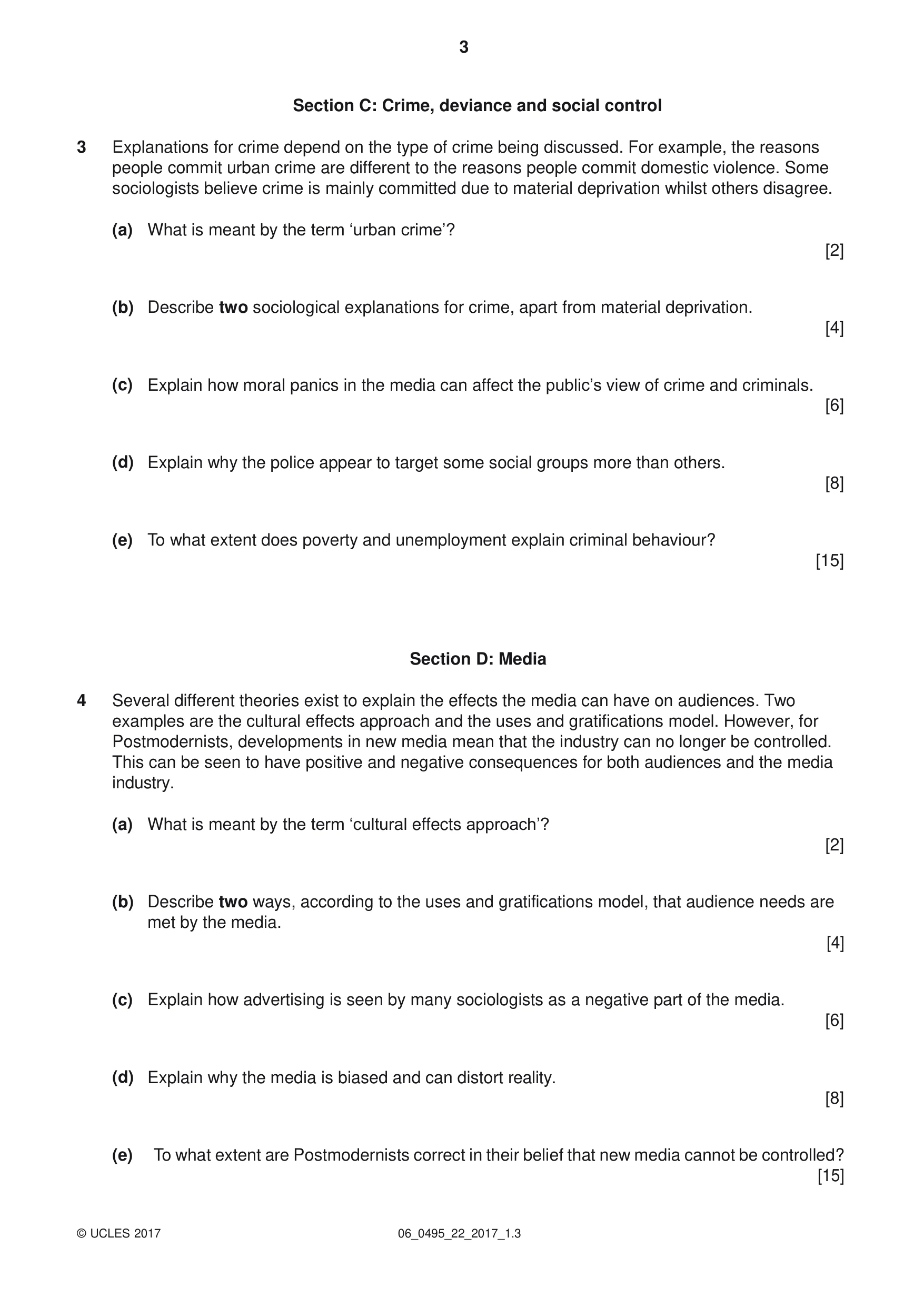
3 Explanations for crime depend on the type of crime being discussed. For example, the reasons people commit urban crime are different to the reasons people commit domestic violence. Some sociologists believe crime is mainly committed due to material deprivation whilst others disagree. (a) What is meant by the term ‘urban crime’? [2] (b) Describe two sociological explanations for crime, apart from material deprivation. [4] (c) Explain how moral panics in the media can affect the public’s view of crime and criminals. [6] (d) Explain why the police appear to target some social groups more than others. [8] (e) To what extent does poverty and unemployment explain criminal behaviour? [15] Section D: Media
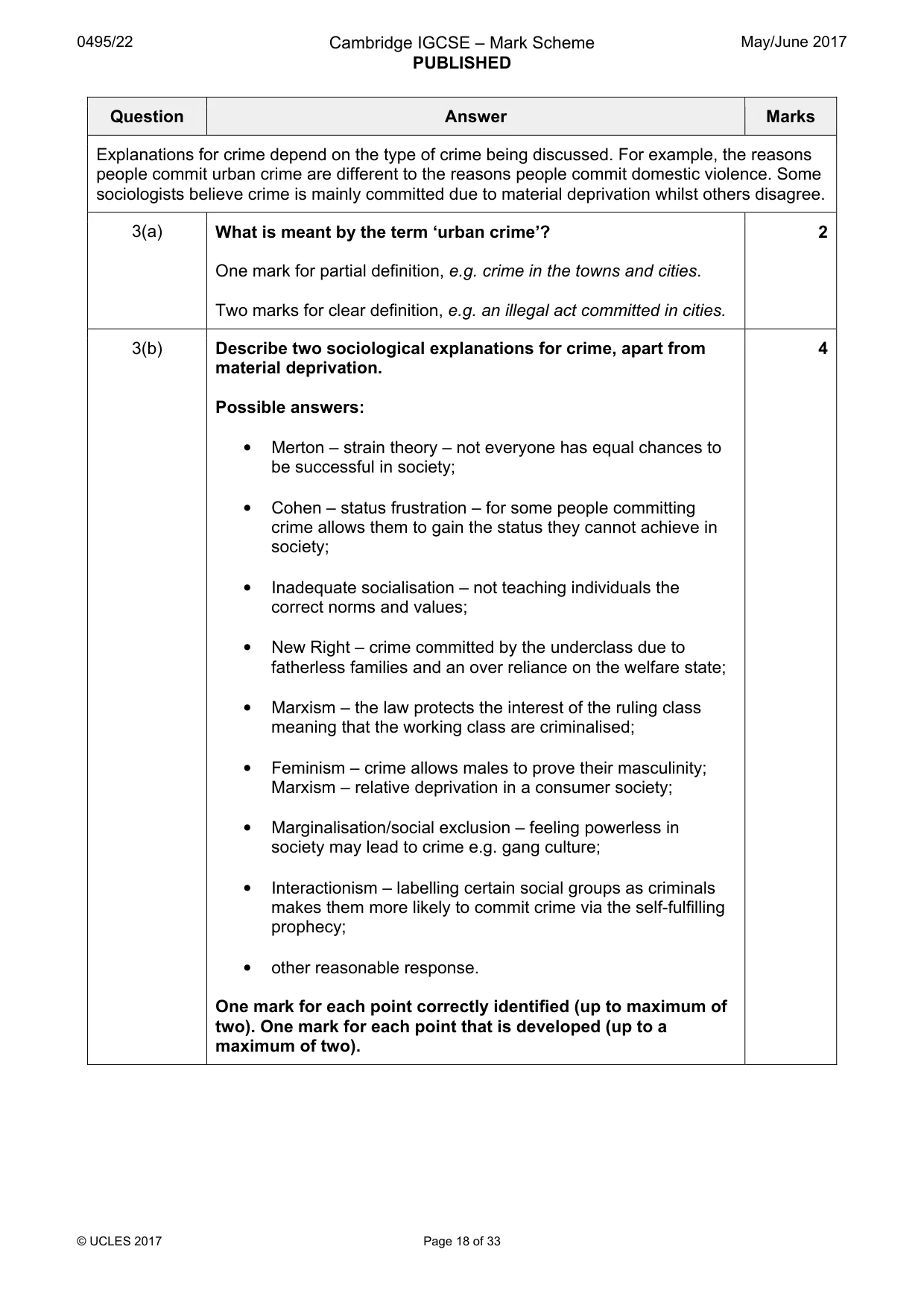
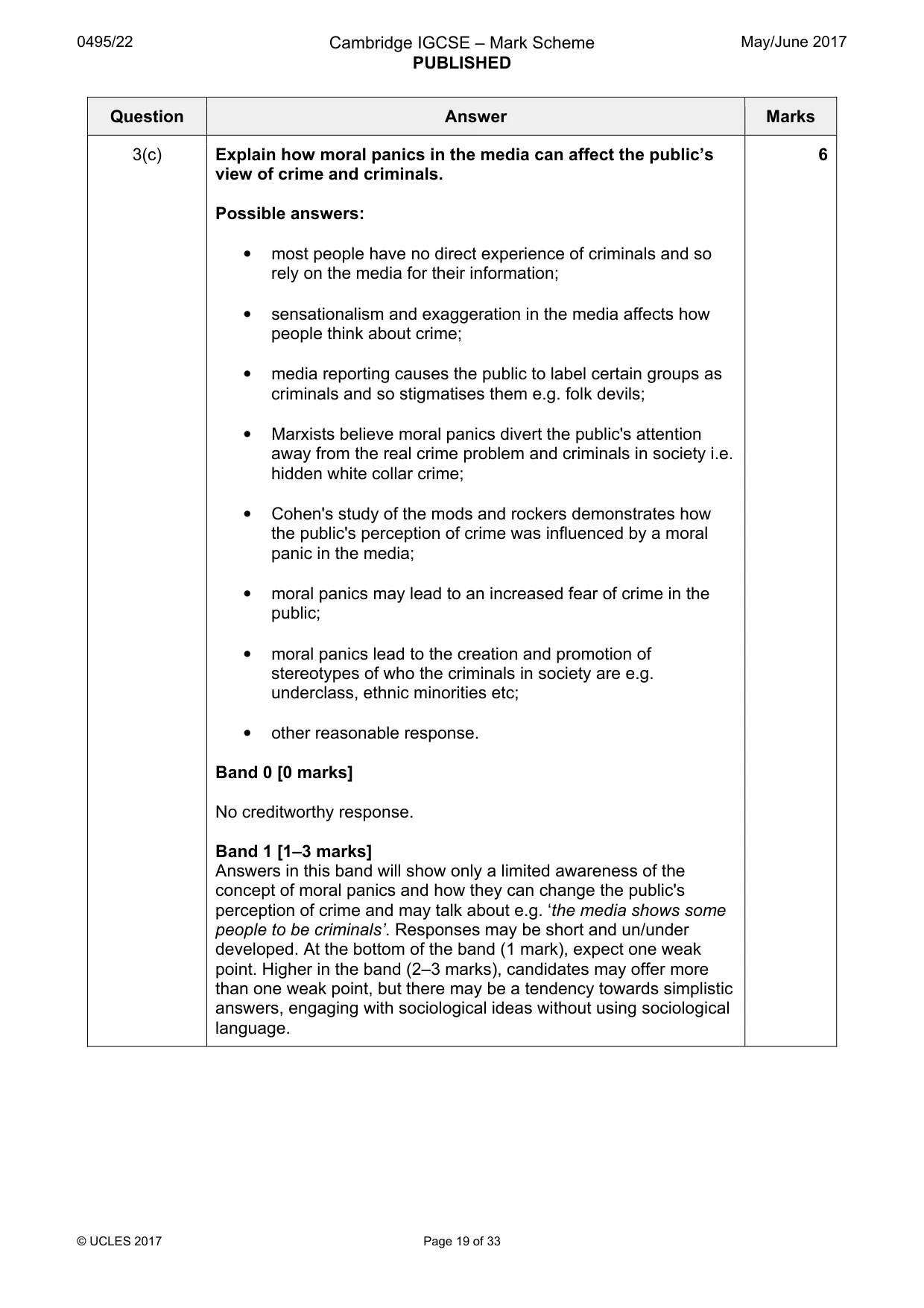
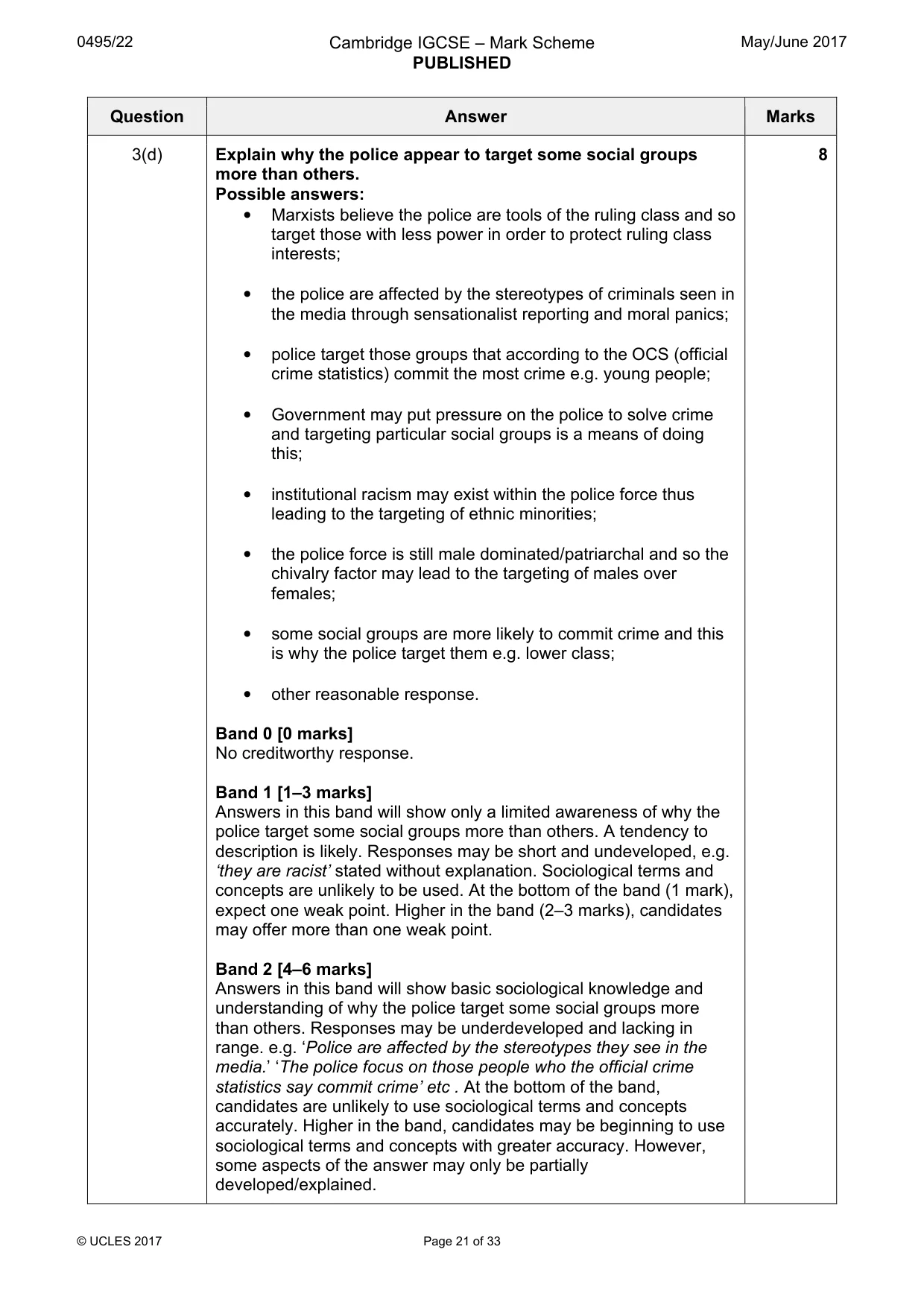
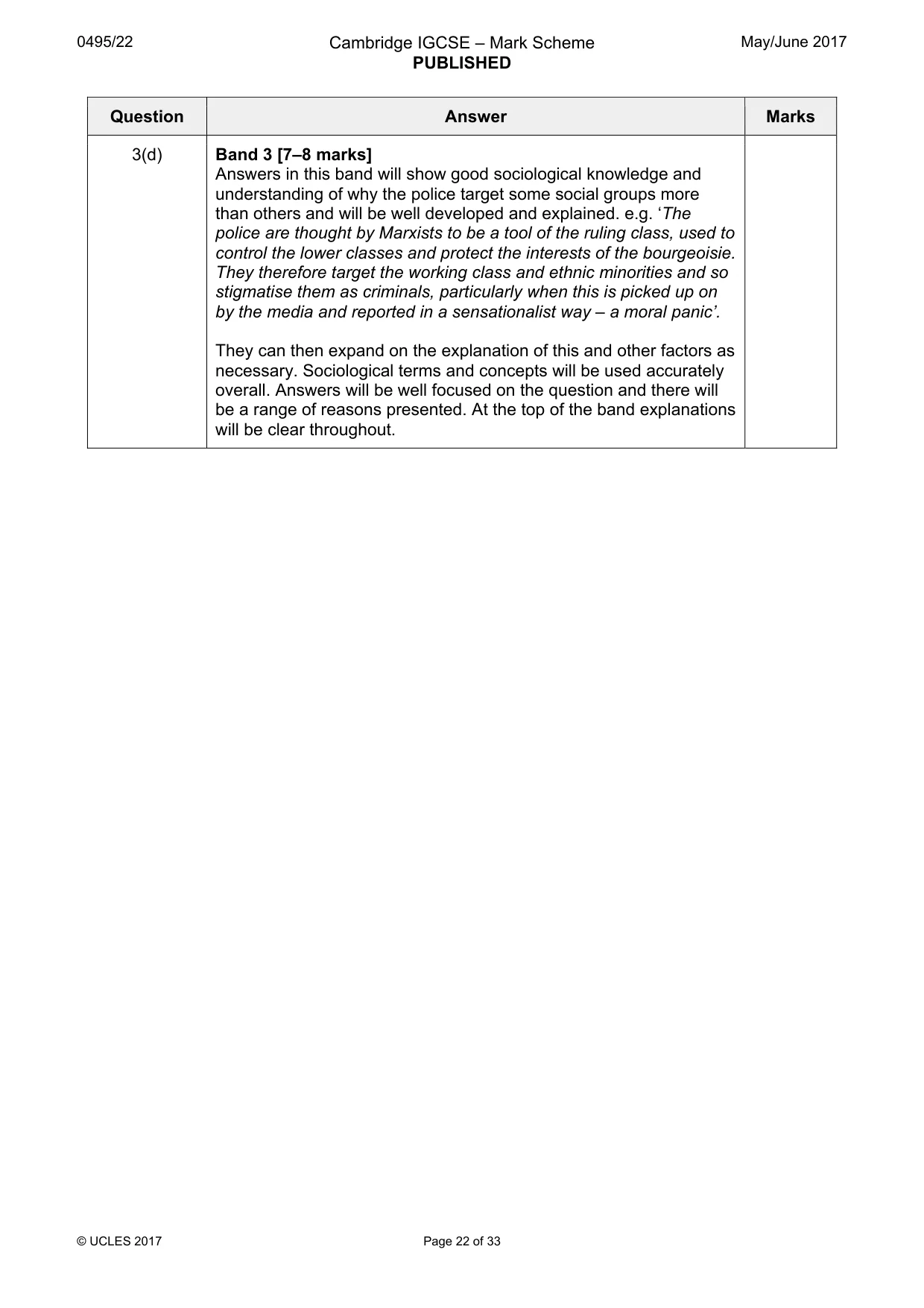
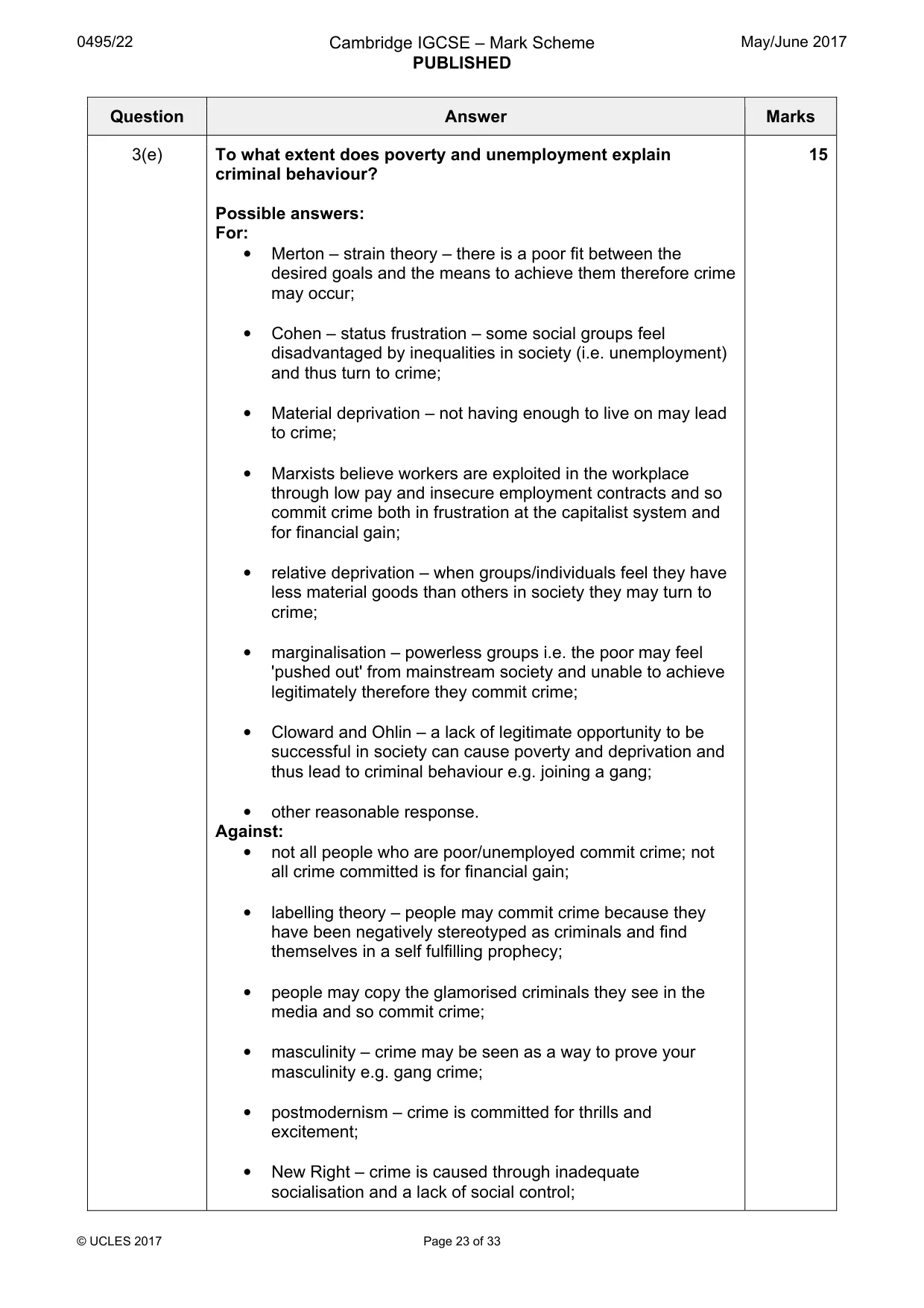
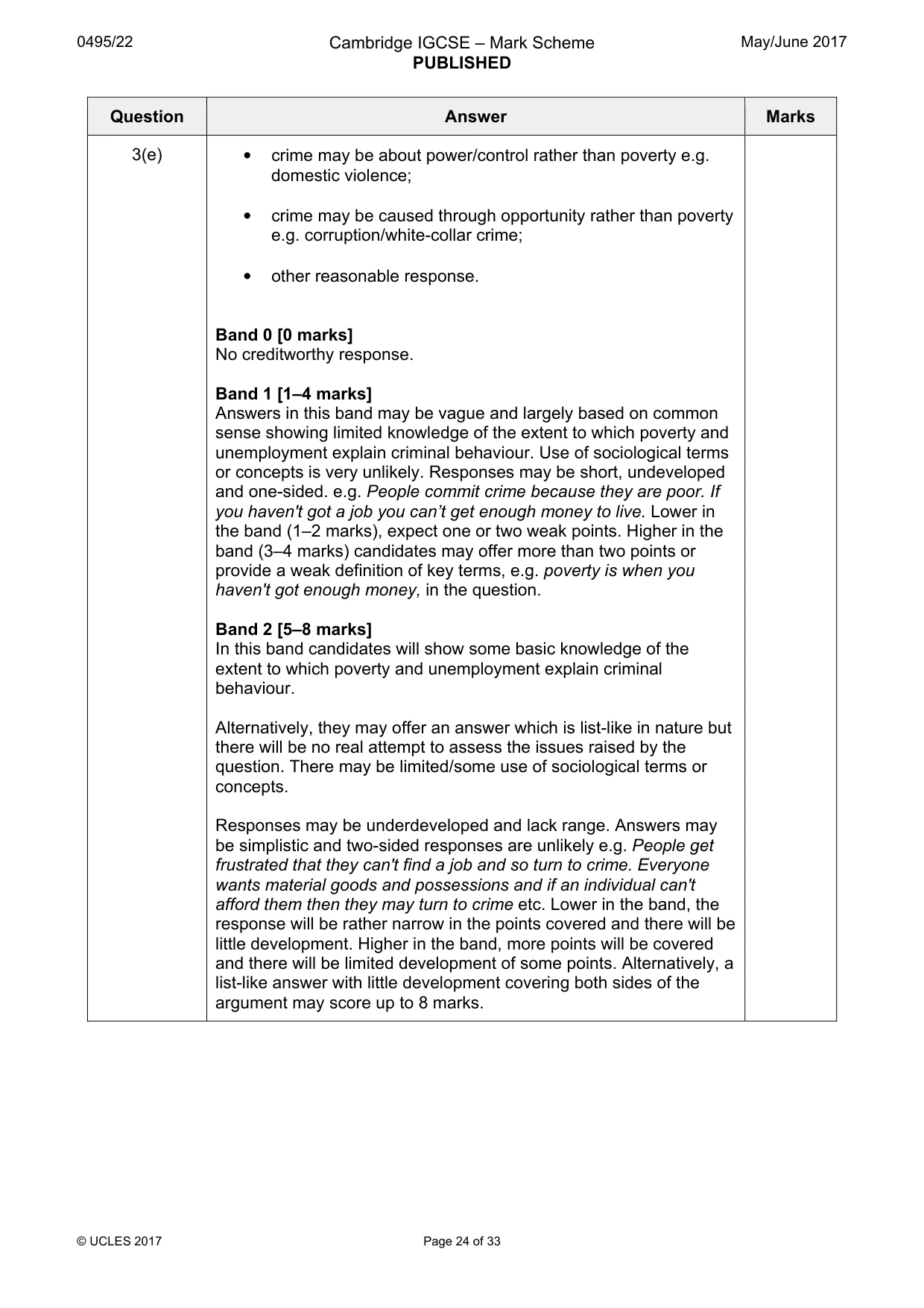
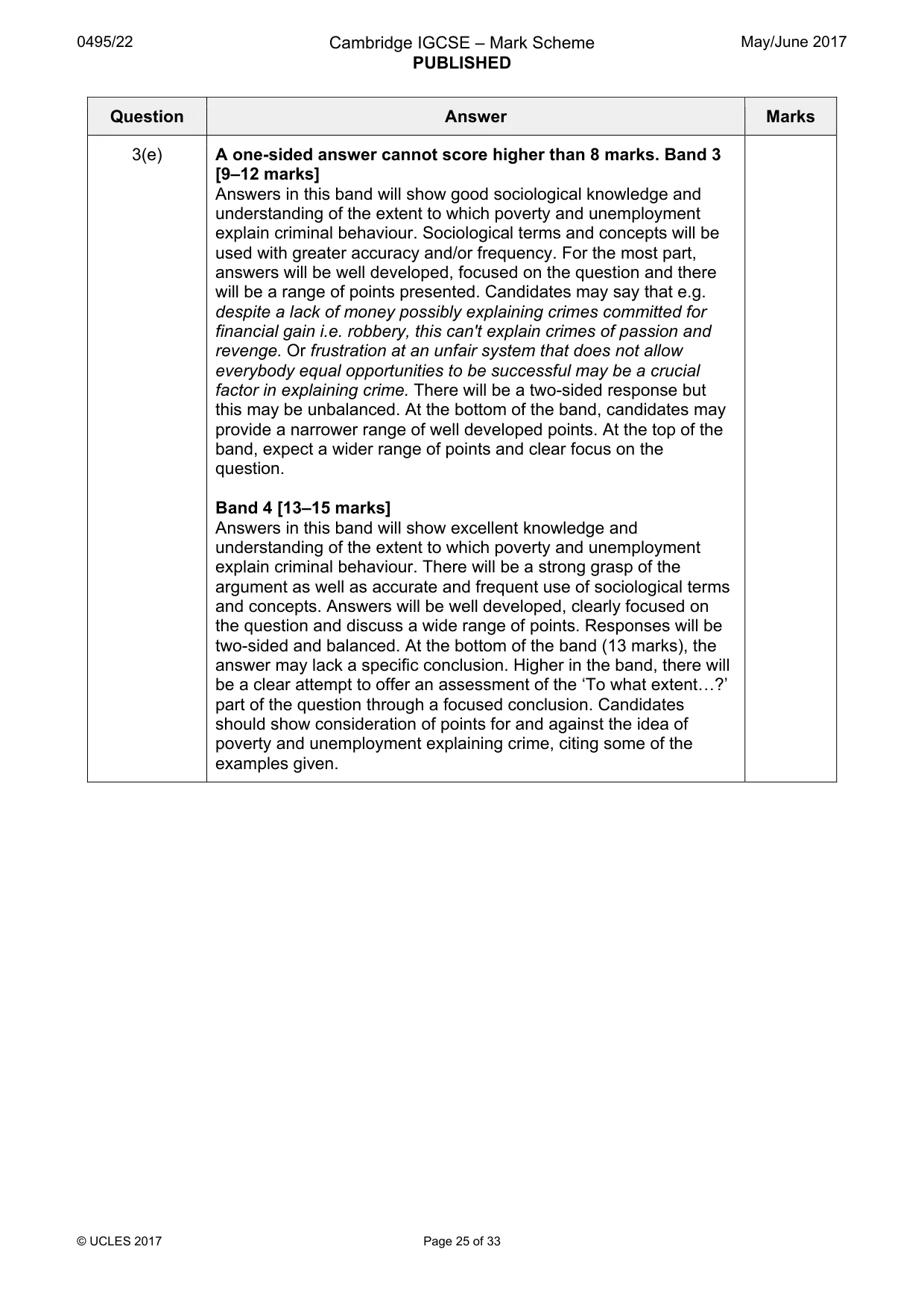
Mark scheme: 3(a) What is meant by the term ‘urban crime’? 2 One mark for partial definition, e.g. crime in the towns and cities. Two marks for clear definition, e.g. an illegal act committed in cities. 3(b) Describe two sociological explanations for crime, apart from 4 material deprivation. Possible answers: • Merton – strain theory – not everyone has equal chances to be successful in society; • Cohen – status frustration – for some people committing crime allows them to gain the status they cannot achieve in society; • Inadequate socialisation – not teaching individuals the correct norms and values; • New Right – crime committed by the underclass due to fatherless families and an over reliance on the welfare state; • Marxism – the law protects the interest of the ruling class meaning that the working class are criminalised; • Feminism – crime allows males to prove their masculinity; Marxism – relative deprivation in a consumer society; • Marginalisation/social exclusion – feeling powerless in society may lead to crime e.g. gang culture; • Interactionism – labelling certain social groups as criminals makes them more likely to commit crime via the self-fulfilling prophecy; • other reasonable response. One mark for each point correctly identified (up to maximum of two). One mark for each point that is developed (up to a maximum of two). 3(c) Explain how moral panics in the media can affect the public’s 6 view of crime and criminals. Possible answers: • most people have no direct experience of criminals and so rely on the media for their information; • sensationalism and exaggeration in the media affects how people think about crime; • media reporting causes the public to label certain groups as criminals and so stigmatises them e.g. folk devils; • Marxists believe moral panics divert the public's attention away from the real crime problem and criminals in society i.e. hidden white collar crime; • Cohen's study of the mods and rockers demonstrates how the public's perception of crime was influenced by a moral panic in the media; • moral panics may lead to an increased fear of crime in the public; • moral panics lead to the creation and promotion of stereotypes of who the criminals in society are e.g. underclass, ethnic minorities etc; • other reasonable response. Band 0 [0 marks] No creditworthy response. Band 1 [1–3 marks] Answers in this band will show only a limited awareness of the concept of moral panics and how they can change the public's perception of crime and may talk about e.g. ‘the media shows some people to be criminals’. Responses may be short and un/under developed. At the bottom of the band (1 mark), expect one weak point. Higher in the band (2–3 marks), candidates may offer more than one weak point, but there may be a tendency towards simplistic answers, engaging with sociological ideas without using sociological language. 3(c) Band 2 [4–6 marks] A clear and accurate explanation, showing good sociological knowledge and understanding of the relationship between moral panics and the public's perception of crime. Sociological terms and concepts should be expected e.g. ‘Sensationalist media reporting leads to the public stigmatising certain social groups as criminals.’ This would be followed by explanation of factors leading to this. At the bottom of the band, the range of points covered may be narrow or lack detail. Higher in the band, answers will cover more than one factor in a well-developed way or cover several factors in less detail. 3(d) Explain why the police appear to target some social groups 8 more than others. Possible answers: • Marxists believe the police are tools of the ruling class and so target those with less power in order to protect ruling class interests; • the police are affected by the stereotypes of criminals seen in the media through sensationalist reporting and moral panics; • police target those groups that according to the OCS (official crime statistics) commit the most crime e.g. young people; • Government may put pressure on the police to solve crime and targeting particular social groups is a means of doing this; • institutional racism may exist within the police force thus leading to the targeting of ethnic minorities; • the police force is still male dominated/patriarchal and so the chivalry factor may lead to the targeting of males over females; • some social groups are more likely to commit crime and this is why the police target them e.g. lower class; • other reasonable response. Band 0 [0 marks] No creditworthy response. Band 1 [1–3 marks] Answers in this band will show only a limited awareness of why the police target some social groups more than others. A tendency to description is likely. Responses may be short and undeveloped, e.g. ‘they are racist’ stated without explanation. Sociological terms and concepts are unlikely to be used. At the bottom of the band (1 mark), expect one weak point. Higher in the band (2–3 marks), candidates may offer more than one weak point. Band 2 [4–6 marks] Answers in this band will show basic sociological knowledge and understanding of why the police target some social groups more than others. Responses may be underdeveloped and lacking in range. e.g. ‘Police are affected by the stereotypes they see in the media.’ ‘The police focus on those people who the official crime statistics say commit crime’ etc . At the bottom of the band, candidates are unlikely to use sociological terms and concepts accurately. Higher in the band, candidates may be beginning to use sociological terms and concepts with greater accuracy. However, some aspects of the answer may only be partially developed/explained. 3(d) Band 3 [7–8 marks] Answers in this band will show good sociological knowledge and understanding of why the police target some social groups more than others and will be well developed and explained. e.g. ‘The police are thought by Marxists to be a tool of the ruling class, used to control the lower classes and protect the interests of the bourgeoisie. They therefore target the working class and ethnic minorities and so stigmatise them as criminals, particularly when this is picked up on by the media and reported in a sensationalist way – a moral panic’. They can then expand on the explanation of this and other factors as necessary. Sociological terms and concepts will be used accurately overall. Answers will be well focused on the question and there will be a range of reasons presented. At the top of the band explanations will be clear throughout. 3(e) To what extent does poverty and unemployment explain 15 criminal behaviour? Possible answers: For: • Merton – strain theory – there is a poor fit between the desired goals and the means to achieve them therefore crime may occur; • Cohen – status frustration – some social groups feel disadvantaged by inequalities in society (i.e. unemployment) and thus turn to crime; • Material deprivation – not having enough to live on may lead to crime; • Marxists believe workers are exploited in the workplace through low pay and insecure employment contracts and so commit crime both in frustration at the capitalist system and for financial gain; • relative deprivation – when groups/individuals feel they have less material goods than others in society they may turn to crime; • marginalisation – powerless groups i.e. the poor may feel 'pushed out' from mainstream society and unable to achieve legitimately therefore they commit crime; • Cloward and Ohlin – a lack of legitimate opportunity to be successful in society can cause poverty and deprivation and thus lead to criminal behaviour e.g. joining a gang; • other reasonable response. Against: • not all people who are poor/unemployed commit crime; not all crime committed is for financial gain; • labelling theory – people may commit crime because they have been negatively stereotyped as criminals and find themselves in a self fulfilling prophecy; • people may copy the glamorised criminals they see in the media and so commit crime; • masculinity – crime may be seen as a way to prove your masculinity e.g. gang crime; • postmodernism – crime is committed for thrills and excitement; • New Right – crime is caused through inadequate socialisation and a lack of social control; 3(e) • crime may be about power/control rather than poverty e.g. domestic violence; • crime may be caused through opportunity rather than poverty e.g. corruption/white-collar crime; • other reasonable response. Band 0 [0 marks] No creditworthy response. Band 1 [1–4 marks] Answers in this band may be vague and largely based on common sense showing limited knowledge of the extent to which poverty and unemployment explain criminal behaviour. Use of sociological terms or concepts is very unlikely. Responses may be short, undeveloped and one-sided. e.g. People commit crime because they are poor. If you haven't got a job you can’t get enough money to live. Lower in the band (1–2 marks), expect one or two weak points. Higher in the band (3–4 marks) candidates may offer more than two points or provide a weak definition of key terms, e.g. poverty is when you haven't got enough money, in the question. Band 2 [5–8 marks] In this band candidates will show some basic knowledge of the extent to which poverty and unemployment explain criminal behaviour. Alternatively, they may offer an answer which is list-like in nature but there will be no real attempt to assess the issues raised by the question. There may be limited/some use of sociological terms or concepts. Responses may be underdeveloped and lack range. Answers may be simplistic and two-sided responses are unlikely e.g. People get frustrated that they can't find a job and so turn to crime. Everyone wants material goods and possessions and if an individual can't afford them then they may turn to crime etc. Lower in the band, the response will be rather narrow in the points covered and there will be little development. Higher in the band, more points will be covered and there will be limited development of some points. Alternatively, a list-like answer with little development covering both sides of the argument may score up to 8 marks. 3(e) A one-sided answer cannot score higher than 8 marks. Band 3 [9–12 marks] Answers in this band will show good sociological knowledge and understanding of the extent to which poverty and unemployment explain criminal behaviour. Sociological terms and concepts will be used with greater accuracy and/or frequency. For the most part, answers will be well developed, focused on the question and there will be a range of points presented. Candidates may say that e.g. despite a lack of money possibly explaining crimes committed for financial gain i.e. robbery, this can't explain crimes of passion and revenge. Or frustration at an unfair system that does not allow everybody equal opportunities to be successful may be a crucial factor in explaining crime. There will be a two-sided response but this may be unbalanced. At the bottom of the band, candidates may provide a narrower range of well developed points. At the top of the band, expect a wider range of points and clear focus on the question. Band 4 [13–15 marks] Answers in this band will show excellent knowledge and understanding of the extent to which poverty and unemployment explain criminal behaviour. There will be a strong grasp of the argument as well as accurate and frequent use of sociological terms and concepts. Answers will be well developed, clearly focused on the question and discuss a wide range of points. Responses will be two-sided and balanced. At the bottom of the band (13 marks), the answer may lack a specific conclusion. Higher in the band, there will be a clear attempt to offer an assessment of the ‘To what extent«?’ part of the question through a focused conclusion. Candidates should show consideration of points for and against the idea of poverty and unemployment explaining crime, citing some of the examples given.
Q4 · Several different theories exist to explain the effects the media can have on audiences
4 Several different theories exist to explain the effects the media can have on audiences. Two examples are the cultural effects approach and the uses and gratifications model. However, for Postmodernists, developments in new media mean that the industry can no longer be controlled. This can be seen to have positive and negative consequences for both audiences and the media industry. (a) What is meant by the term ‘cultural effects approach’? [2] (b) Describe two ways, according to the uses and gratifications model, that audience needs are met by the media. [4] (c) Explain how advertising is seen by many sociologists as a negative part of the media. [6] (d) Explain why the media is biased and can distort reality. [8] (e) To what extent are Postmodernists correct in their belief that new media cannot be controlled? [15]
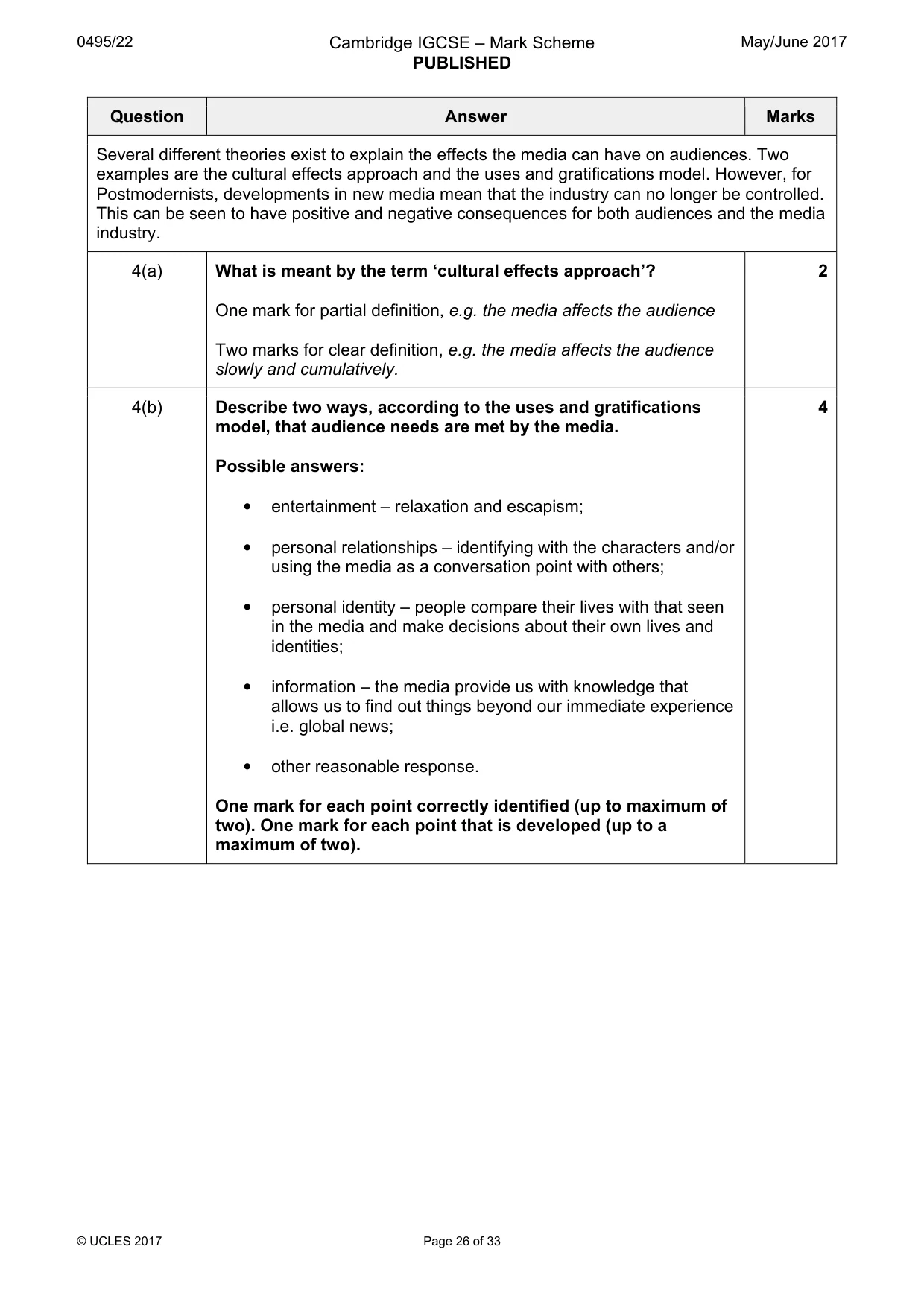
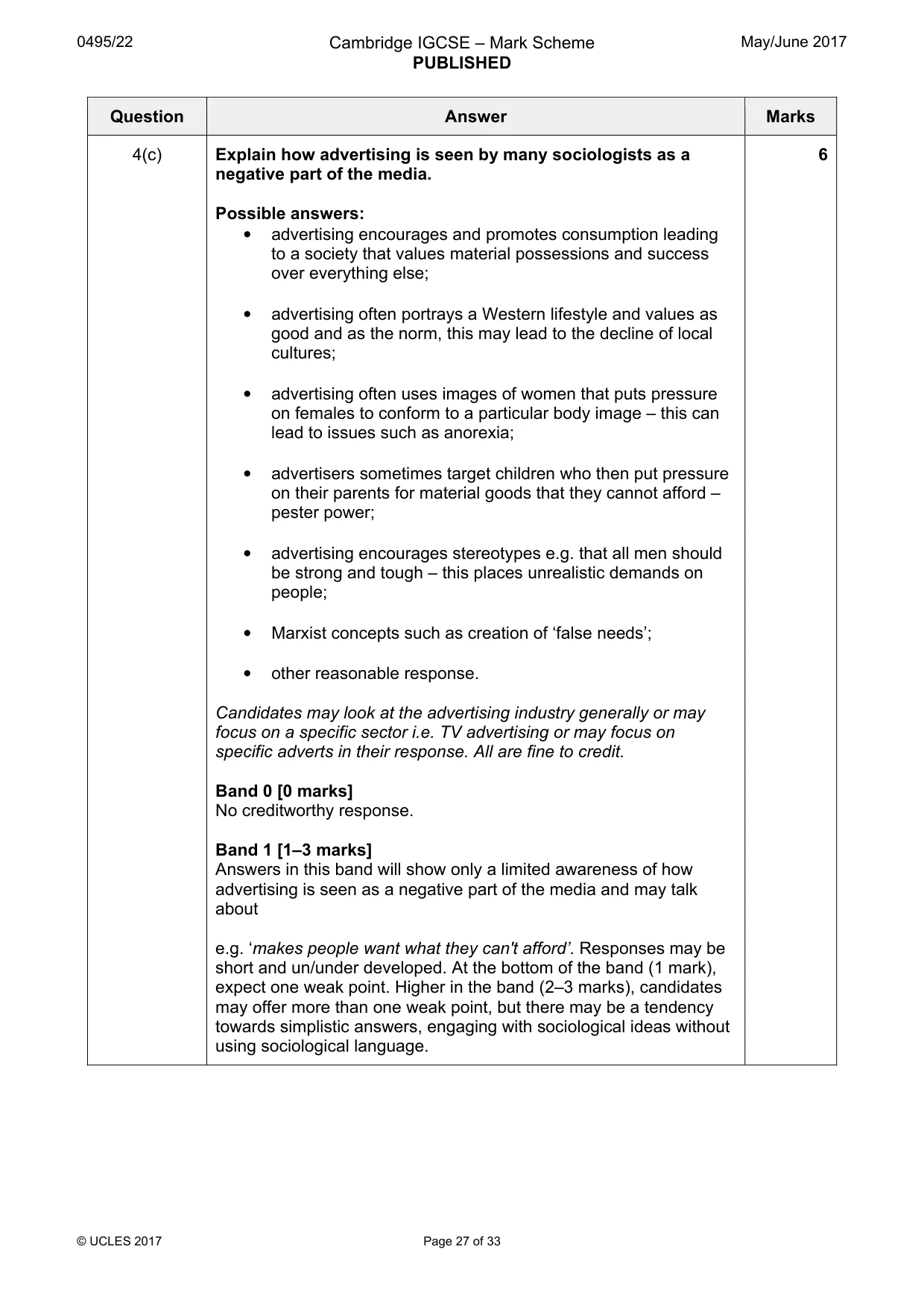
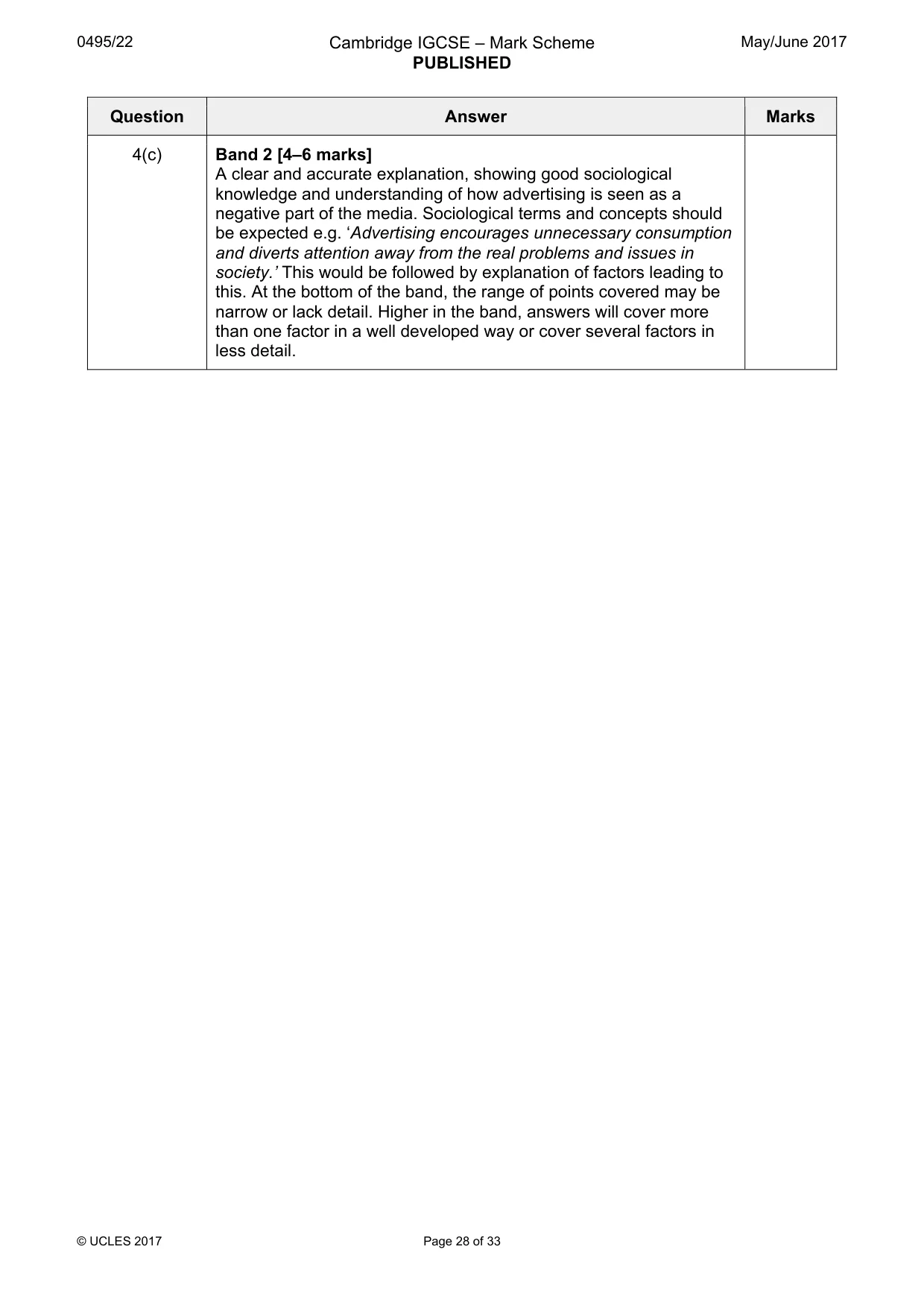
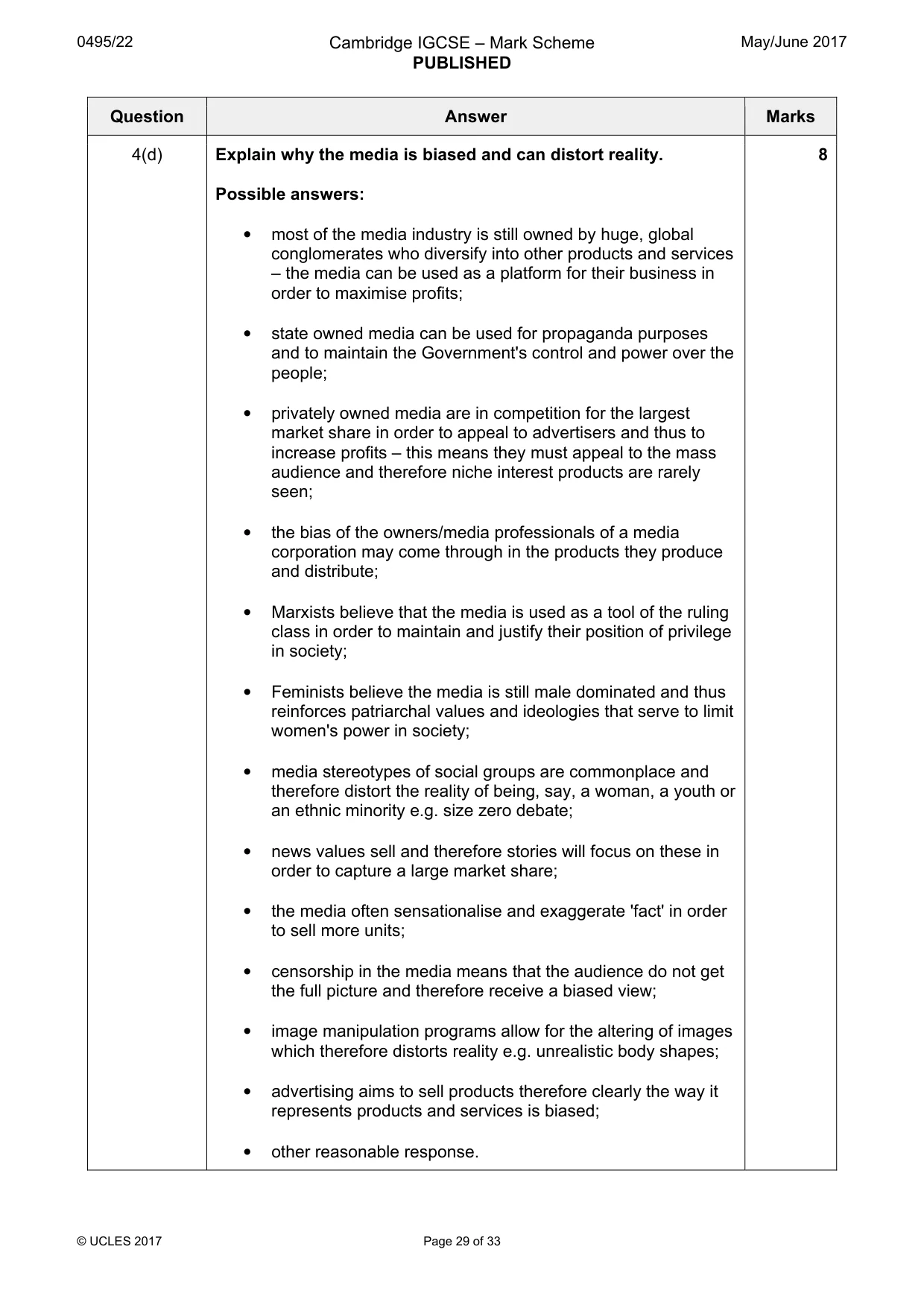
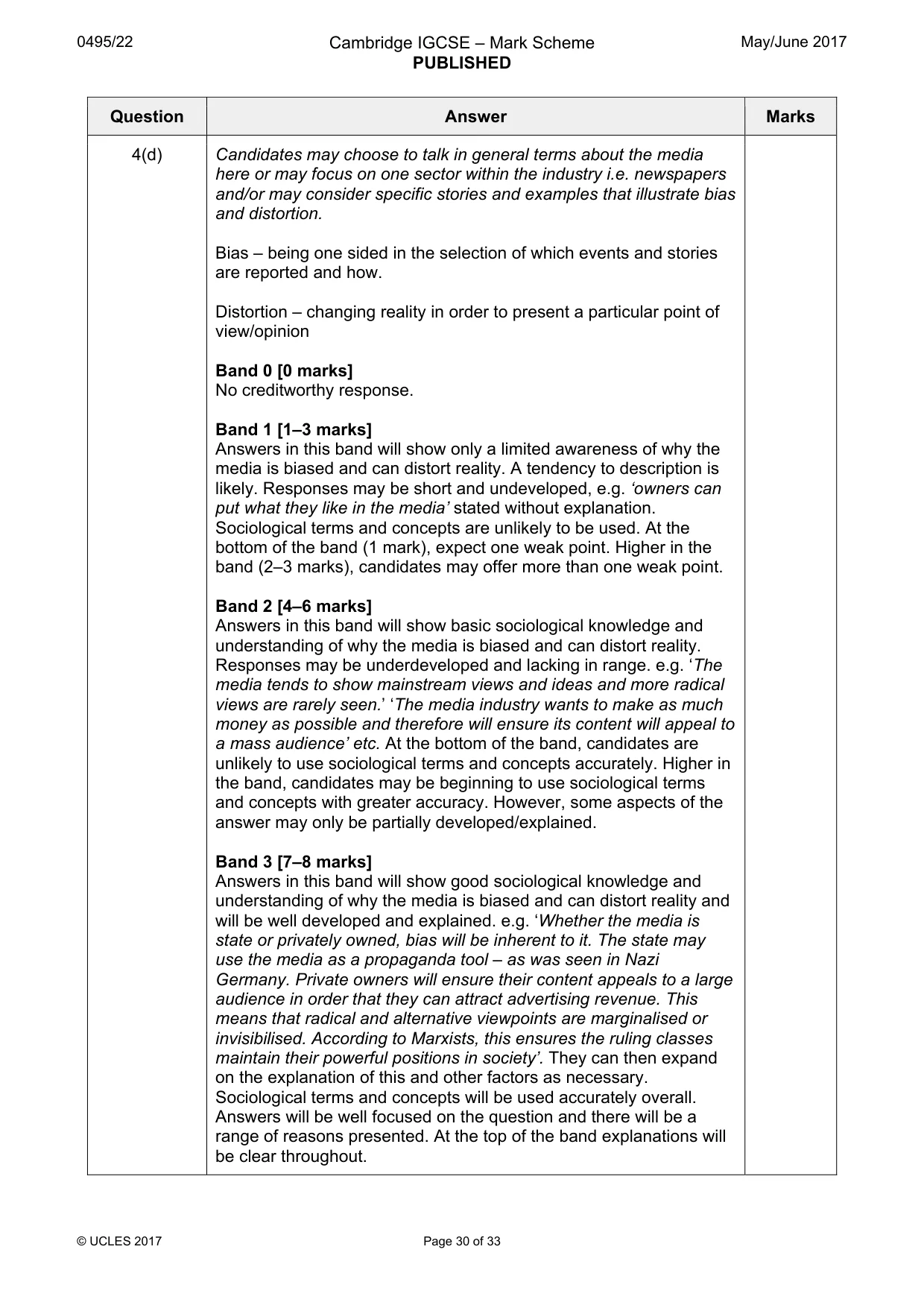
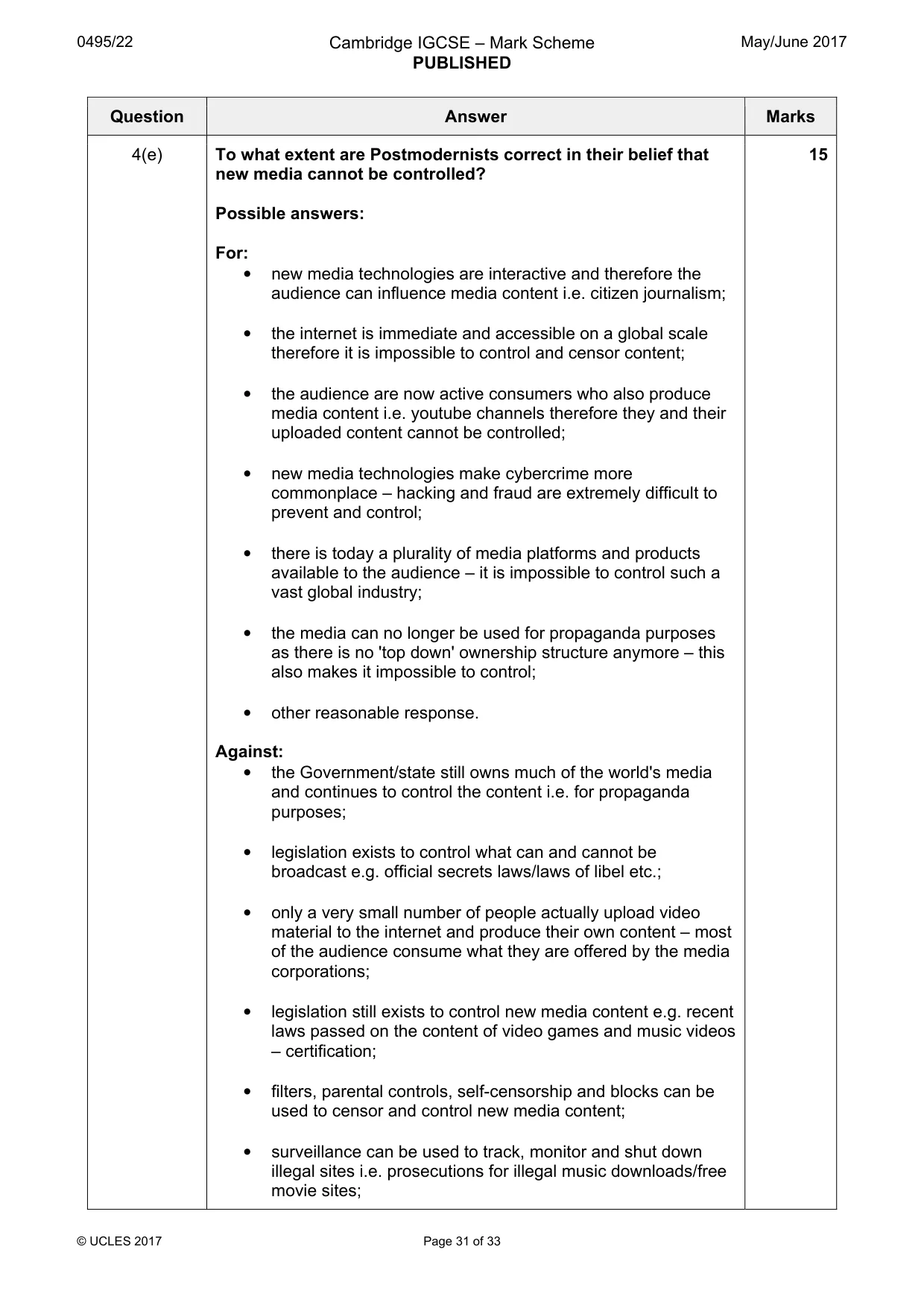
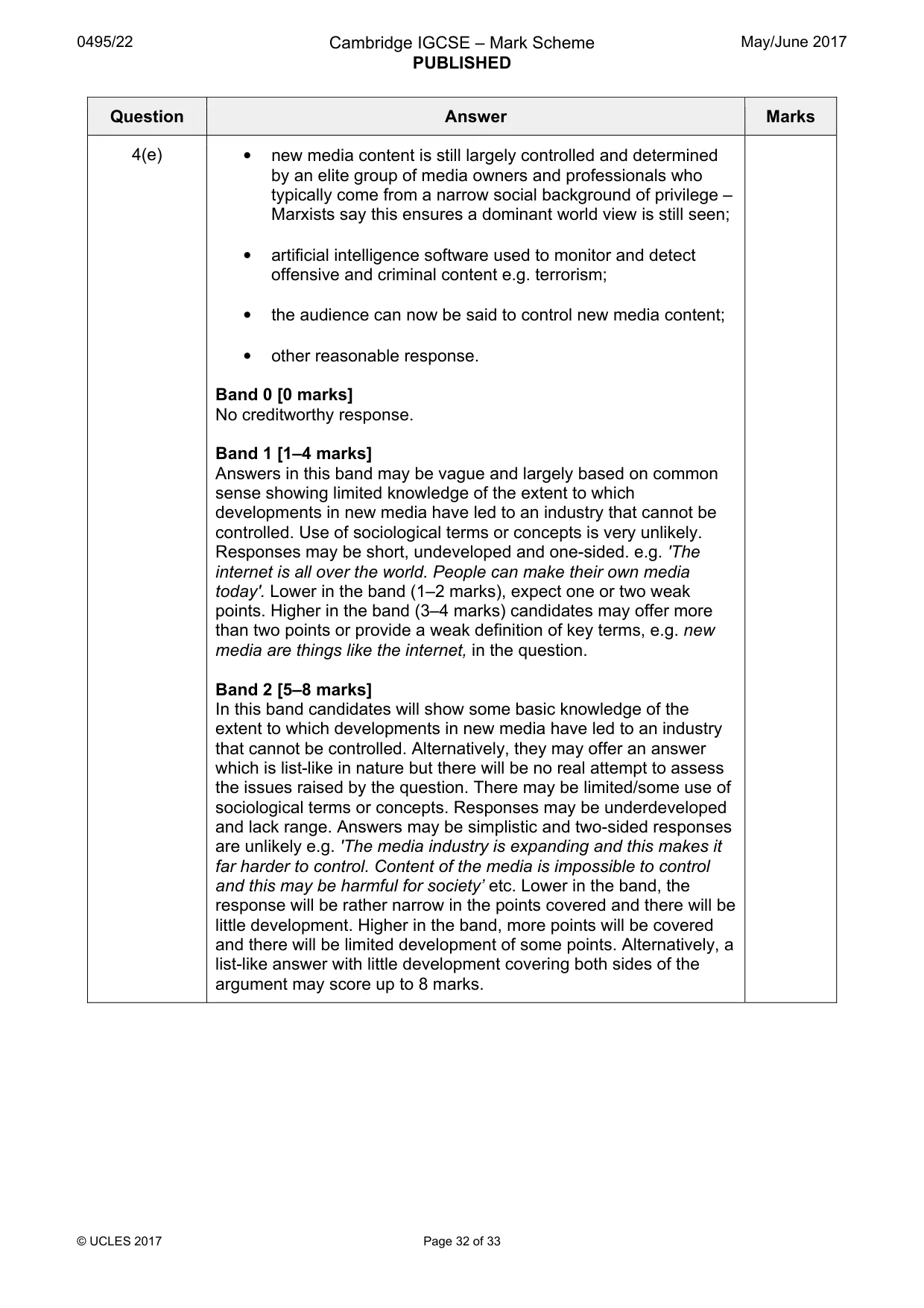
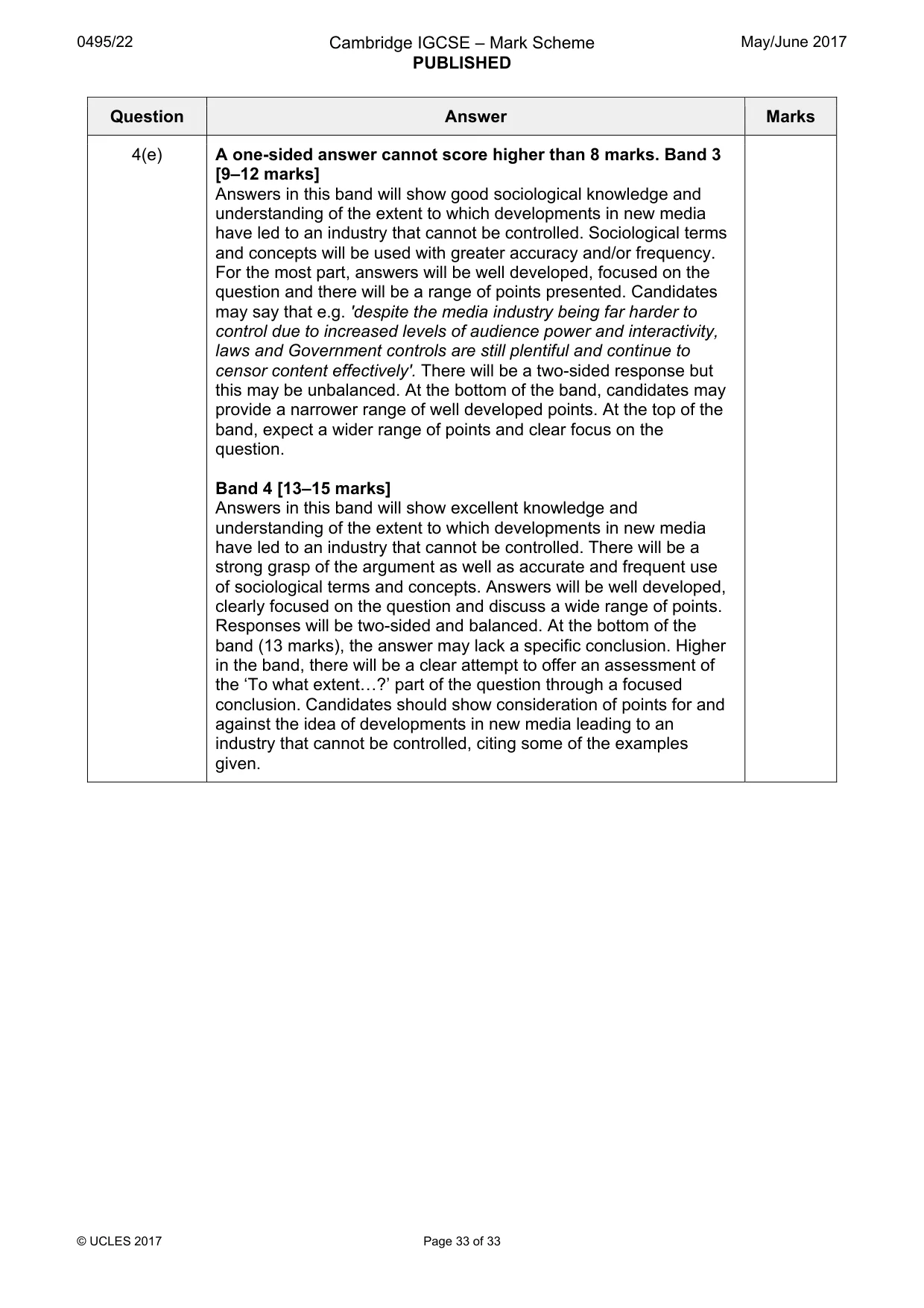
Mark scheme: 4(a) What is meant by the term ‘cultural effects approach’? 2 One mark for partial definition, e.g. the media affects the audience Two marks for clear definition, e.g. the media affects the audience slowly and cumulatively. 4(b) Describe two ways, according to the uses and gratifications 4 model, that audience needs are met by the media. Possible answers: • entertainment – relaxation and escapism; • personal relationships – identifying with the characters and/or using the media as a conversation point with others; • personal identity – people compare their lives with that seen in the media and make decisions about their own lives and identities; • information – the media provide us with knowledge that allows us to find out things beyond our immediate experience i.e. global news; • other reasonable response. One mark for each point correctly identified (up to maximum of two). One mark for each point that is developed (up to a maximum of two). 4(c) Explain how advertising is seen by many sociologists as a 6 negative part of the media. Possible answers: • advertising encourages and promotes consumption leading to a society that values material possessions and success over everything else; • advertising often portrays a Western lifestyle and values as good and as the norm, this may lead to the decline of local cultures; • advertising often uses images of women that puts pressure on females to conform to a particular body image – this can lead to issues such as anorexia; • advertisers sometimes target children who then put pressure on their parents for material goods that they cannot afford – pester power; • advertising encourages stereotypes e.g. that all men should be strong and tough – this places unrealistic demands on people; • Marxist concepts such as creation of ‘false needs’; • other reasonable response. Candidates may look at the advertising industry generally or may focus on a specific sector i.e. TV advertising or may focus on specific adverts in their response. All are fine to credit. Band 0 [0 marks] No creditworthy response. Band 1 [1–3 marks] Answers in this band will show only a limited awareness of how advertising is seen as a negative part of the media and may talk about e.g. ‘makes people want what they can't afford’. Responses may be short and un/under developed. At the bottom of the band (1 mark), expect one weak point. Higher in the band (2–3 marks), candidates may offer more than one weak point, but there may be a tendency towards simplistic answers, engaging with sociological ideas without using sociological language. 4(c) Band 2 [4–6 marks] A clear and accurate explanation, showing good sociological knowledge and understanding of how advertising is seen as a negative part of the media. Sociological terms and concepts should be expected e.g. ‘Advertising encourages unnecessary consumption and diverts attention away from the real problems and issues in society.’ This would be followed by explanation of factors leading to this. At the bottom of the band, the range of points covered may be narrow or lack detail. Higher in the band, answers will cover more than one factor in a well developed way or cover several factors in less detail. 4(d) Explain why the media is biased and can distort reality. 8 Possible answers: • most of the media industry is still owned by huge, global conglomerates who diversify into other products and services – the media can be used as a platform for their business in order to maximise profits; • state owned media can be used for propaganda purposes and to maintain the Government's control and power over the people; • privately owned media are in competition for the largest market share in order to appeal to advertisers and thus to increase profits – this means they must appeal to the mass audience and therefore niche interest products are rarely seen; • the bias of the owners/media professionals of a media corporation may come through in the products they produce and distribute; • Marxists believe that the media is used as a tool of the ruling class in order to maintain and justify their position of privilege in society; • Feminists believe the media is still male dominated and thus reinforces patriarchal values and ideologies that serve to limit women's power in society; • media stereotypes of social groups are commonplace and therefore distort the reality of being, say, a woman, a youth or an ethnic minority e.g. size zero debate; • news values sell and therefore stories will focus on these in order to capture a large market share; • the media often sensationalise and exaggerate 'fact' in order to sell more units; • censorship in the media means that the audience do not get the full picture and therefore receive a biased view; • image manipulation programs allow for the altering of images which therefore distorts reality e.g. unrealistic body shapes; • advertising aims to sell products therefore clearly the way it represents products and services is biased; • other reasonable response. 4(d) Candidates may choose to talk in general terms about the media here or may focus on one sector within the industry i.e. newspapers and/or may consider specific stories and examples that illustrate bias and distortion. Bias – being one sided in the selection of which events and stories are reported and how. Distortion – changing reality in order to present a particular point of view/opinion Band 0 [0 marks] No creditworthy response. Band 1 [1–3 marks] Answers in this band will show only a limited awareness of why the media is biased and can distort reality. A tendency to description is likely. Responses may be short and undeveloped, e.g. ‘owners can put what they like in the media’ stated without explanation. Sociological terms and concepts are unlikely to be used. At the bottom of the band (1 mark), expect one weak point. Higher in the band (2–3 marks), candidates may offer more than one weak point. Band 2 [4–6 marks] Answers in this band will show basic sociological knowledge and understanding of why the media is biased and can distort reality. Responses may be underdeveloped and lacking in range. e.g. ‘The media tends to show mainstream views and ideas and more radical views are rarely seen.’ ‘The media industry wants to make as much money as possible and therefore will ensure its content will appeal to a mass audience’ etc. At the bottom of the band, candidates are unlikely to use sociological terms and concepts accurately. Higher in the band, candidates may be beginning to use sociological terms and concepts with greater accuracy. However, some aspects of the answer may only be partially developed/explained. Band 3 [7–8 marks] Answers in this band will show good sociological knowledge and understanding of why the media is biased and can distort reality and will be well developed and explained. e.g. ‘Whether the media is state or privately owned, bias will be inherent to it. The state may use the media as a propaganda tool – as was seen in Nazi Germany. Private owners will ensure their content appeals to a large audience in order that they can attract advertising revenue. This means that radical and alternative viewpoints are marginalised or invisibilised. According to Marxists, this ensures the ruling classes maintain their powerful positions in society’. They can then expand on the explanation of this and other factors as necessary. Sociological terms and concepts will be used accurately overall. Answers will be well focused on the question and there will be a range of reasons presented. At the top of the band explanations will be clear throughout. 4(e) To what extent are Postmodernists correct in their belief that 15 new media cannot be controlled? Possible answers: For: • new media technologies are interactive and therefore the audience can influence media content i.e. citizen journalism; • the internet is immediate and accessible on a global scale therefore it is impossible to control and censor content; • the audience are now active consumers who also produce media content i.e. youtube channels therefore they and their uploaded content cannot be controlled; • new media technologies make cybercrime more commonplace – hacking and fraud are extremely difficult to prevent and control; • there is today a plurality of media platforms and products available to the audience – it is impossible to control such a vast global industry; • the media can no longer be used for propaganda purposes as there is no 'top down' ownership structure anymore – this also makes it impossible to control; • other reasonable response. Against: • the Government/state still owns much of the world's media and continues to control the content i.e. for propaganda purposes; • legislation exists to control what can and cannot be broadcast e.g. official secrets laws/laws of libel etc.; • only a very small number of people actually upload video material to the internet and produce their own content – most of the audience consume what they are offered by the media corporations; • legislation still exists to control new media content e.g. recent laws passed on the content of video games and music videos – certification; • filters, parental controls, self-censorship and blocks can be used to censor and control new media content; • surveillance can be used to track, monitor and shut down illegal sites i.e. prosecutions for illegal music downloads/free movie sites; 4(e) • new media content is still largely controlled and determined by an elite group of media owners and professionals who typically come from a narrow social background of privilege – Marxists say this ensures a dominant world view is still seen; • artificial intelligence software used to monitor and detect offensive and criminal content e.g. terrorism; • the audience can now be said to control new media content; • other reasonable response. Band 0 [0 marks] No creditworthy response. Band 1 [1–4 marks] Answers in this band may be vague and largely based on common sense showing limited knowledge of the extent to which developments in new media have led to an industry that cannot be controlled. Use of sociological terms or concepts is very unlikely. Responses may be short, undeveloped and one-sided. e.g. 'The internet is all over the world. People can make their own media today'. Lower in the band (1–2 marks), expect one or two weak points. Higher in the band (3–4 marks) candidates may offer more than two points or provide a weak definition of key terms, e.g. new media are things like the internet, in the question. Band 2 [5–8 marks] In this band candidates will show some basic knowledge of the extent to which developments in new media have led to an industry that cannot be controlled. Alternatively, they may offer an answer which is list-like in nature but there will be no real attempt to assess the issues raised by the question. There may be limited/some use of sociological terms or concepts. Responses may be underdeveloped and lack range. Answers may be simplistic and two-sided responses are unlikely e.g. 'The media industry is expanding and this makes it far harder to control. Content of the media is impossible to control and this may be harmful for society’ etc. Lower in the band, the response will be rather narrow in the points covered and there will be little development. Higher in the band, more points will be covered and there will be limited development of some points. Alternatively, a list-like answer with little development covering both sides of the argument may score up to 8 marks. 4(e) A one-sided answer cannot score higher than 8 marks. Band 3 [9–12 marks] Answers in this band will show good sociological knowledge and understanding of the extent to which developments in new media have led to an industry that cannot be controlled. Sociological terms and concepts will be used with greater accuracy and/or frequency. For the most part, answers will be well developed, focused on the question and there will be a range of points presented. Candidates may say that e.g. 'despite the media industry being far harder to control due to increased levels of audience power and interactivity, laws and Government controls are still plentiful and continue to censor content effectively'. There will be a two-sided response but this may be unbalanced. At the bottom of the band, candidates may provide a narrower range of well developed points. At the top of the band, expect a wider range of points and clear focus on the question. Band 4 [13–15 marks] Answers in this band will show excellent knowledge and understanding of the extent to which developments in new media have led to an industry that cannot be controlled. There will be a strong grasp of the argument as well as accurate and frequent use of sociological terms and concepts. Answers will be well developed, clearly focused on the question and discuss a wide range of points. Responses will be two-sided and balanced. At the bottom of the band (13 marks), the answer may lack a specific conclusion. Higher in the band, there will be a clear attempt to offer an assessment of the ‘To what extent«?’ part of the question through a focused conclusion. Candidates should show consideration of points for and against the idea of developments in new media leading to an industry that cannot be controlled, citing some of the examples given.
More questions on How do sociologists approach the study of society?
What was in this paper
The subtopics covered by these 4 questions, and how many questions each got. Open one in a new tab to see every Cambridge question on it.
What you needed in this session
Cambridge’s own grade thresholds for 2017 May/June, Paper 2 · Variant 2. A higher threshold means an easier paper — the bar moves with how the cohort did.