Cambridge IGCSE Sociology 0495 — 2016 May/June Paper 1 · Variant 3
0495/13/M/J/16 · 80 marks · ≈90 min
The question paper and its mark scheme, free to read here and free to download. This is Cambridge’s own paper, exactly as it was sat.
Question paper4 pages

Mark scheme18 pages
Answers below. Sit the paper first if you are practising.
Paper as text
Question paper, page 1
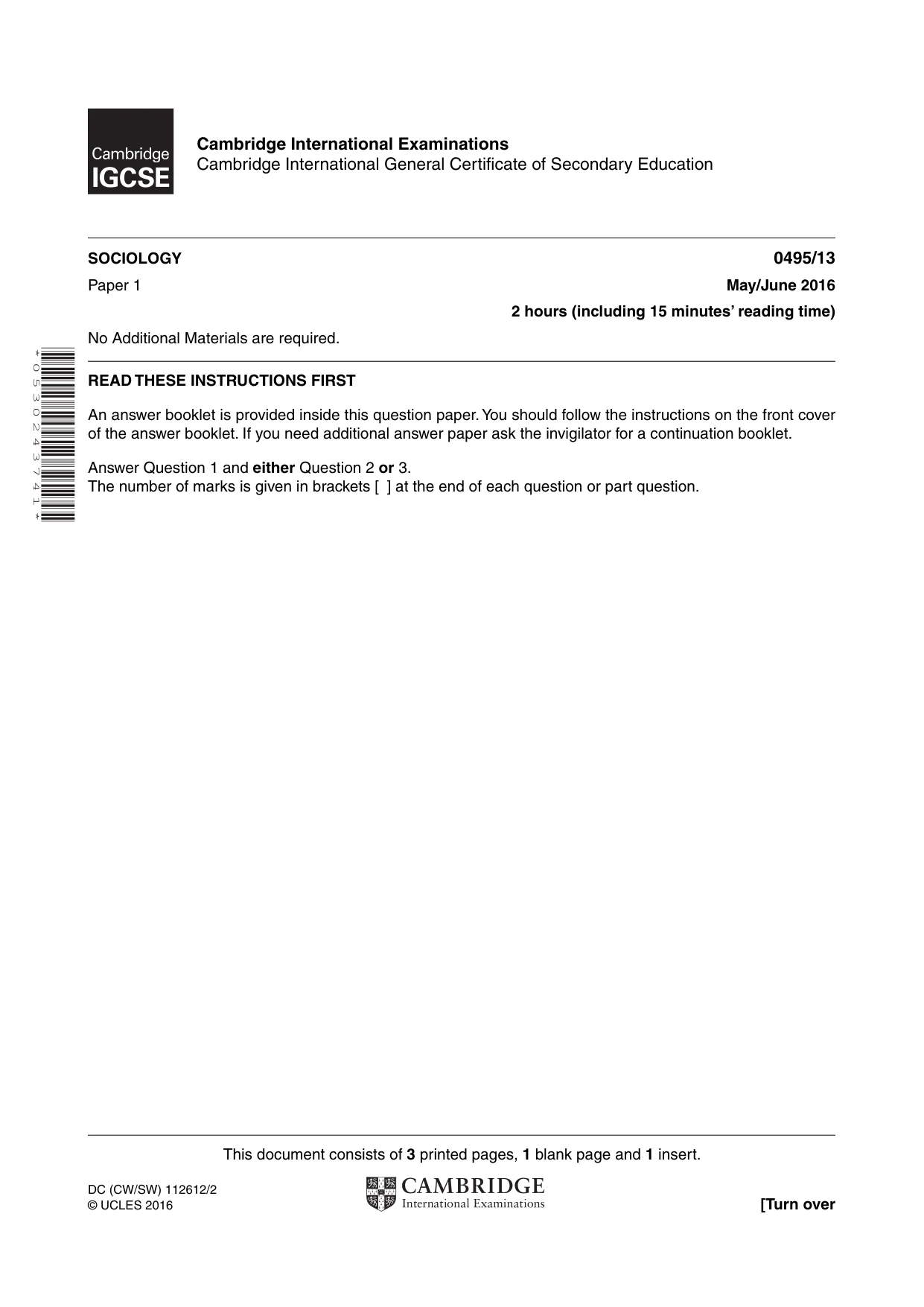
This document consists of 3 printed pages, 1 blank page and 1 insert. DC (CW/SW) 112612/2 © UCLES 2016 [Turn over Cambridge International Examinations Cambridge International General Certificate of Secondary Education * 0 5 3 0 2 4 3 7 4 1 * SOCIOLOGY 0495/13 Paper 1 May/June 2016 2 hours (including 15 minutes’ reading time) No Additional Materials are required. READ THESE INSTRUCTIONS FIRST An answer booklet is provided inside this question paper. You should follow the instructions on the front cover of the answer booklet. If you need additional answer paper ask the invigilator for a continuation booklet. Answer Question 1 and either Question 2 or 3. The number of marks is given in brackets [ ] at the end of each question or part question.
Question paper, page 2
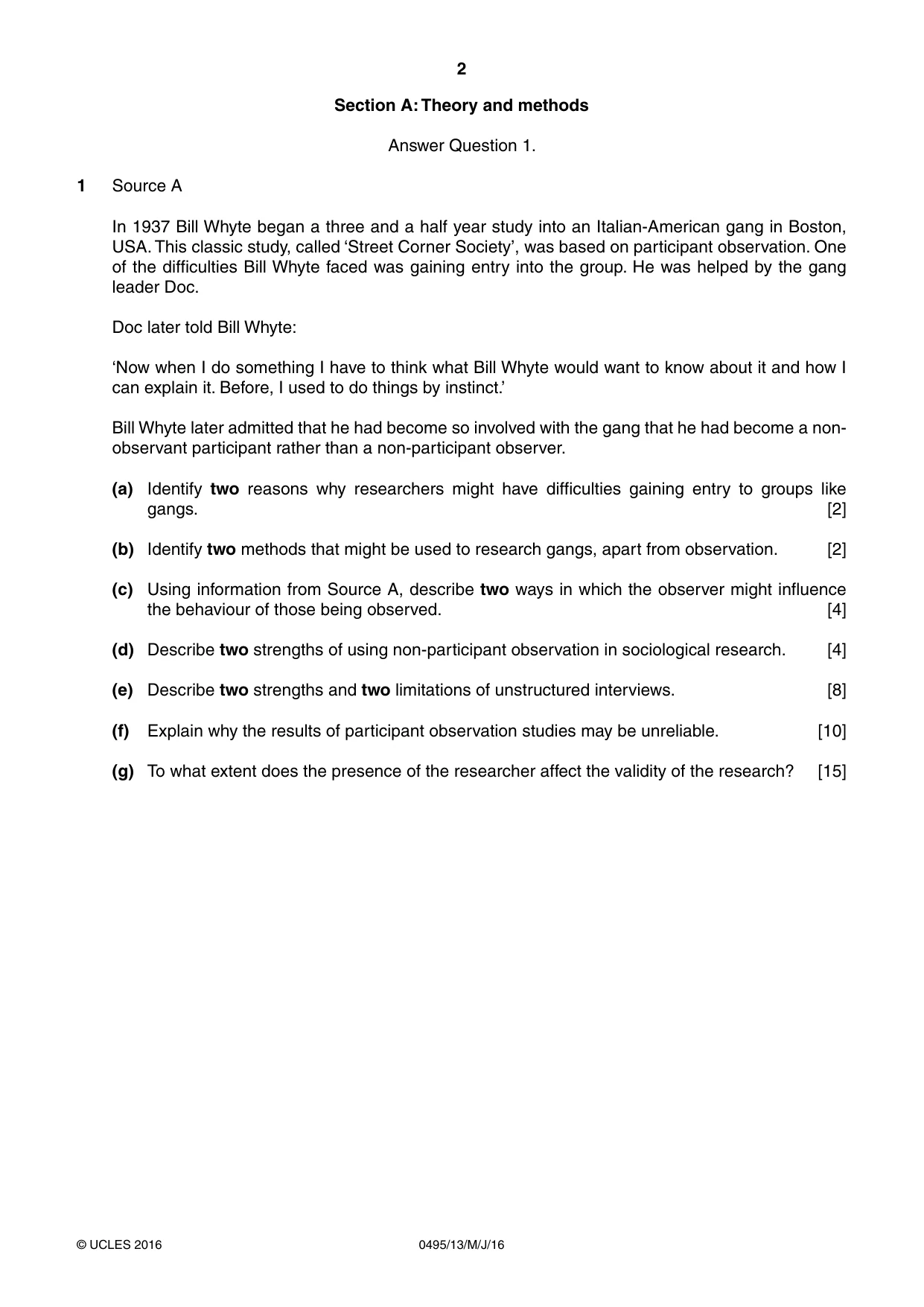
2 0495/13/M/J/16 © UCLES 2016 Section A: Theory and methods Answer Question 1. 1 Source A In 1937 Bill Whyte began a three and a half year study into an Italian-American gang in Boston, USA. This classic study, called ‘Street Corner Society’, was based on participant observation. One of the difficulties Bill Whyte faced was gaining entry into the group. He was helped by the gang leader Doc. Doc later told Bill Whyte: ‘Now when I do something I have to think what Bill Whyte would want to know about it and how I can explain it. Before, I used to do things by instinct.’ Bill Whyte later admitted that he had become so involved with the gang that he had become a non- observant participant rather than a non-participant observer. (a) Identify two reasons why researchers might have difficulties gaining entry to groups like gangs. [2] (b) Identify two methods that might be used to research gangs, apart from observation. [2] (c) Using information from Source A, describe two ways in which the observer might influence the behaviour of those being observed. [4] (d) Describe two strengths of using non-participant observation in sociological research. [4] (e) Describe two strengths and two limitations of unstructured interviews. [8] (f) Explain why the results of participant observation studies may be unreliable. [10] (g) To what extent does the presence of the researcher affect the validity of the research? [15]
Question paper, page 3
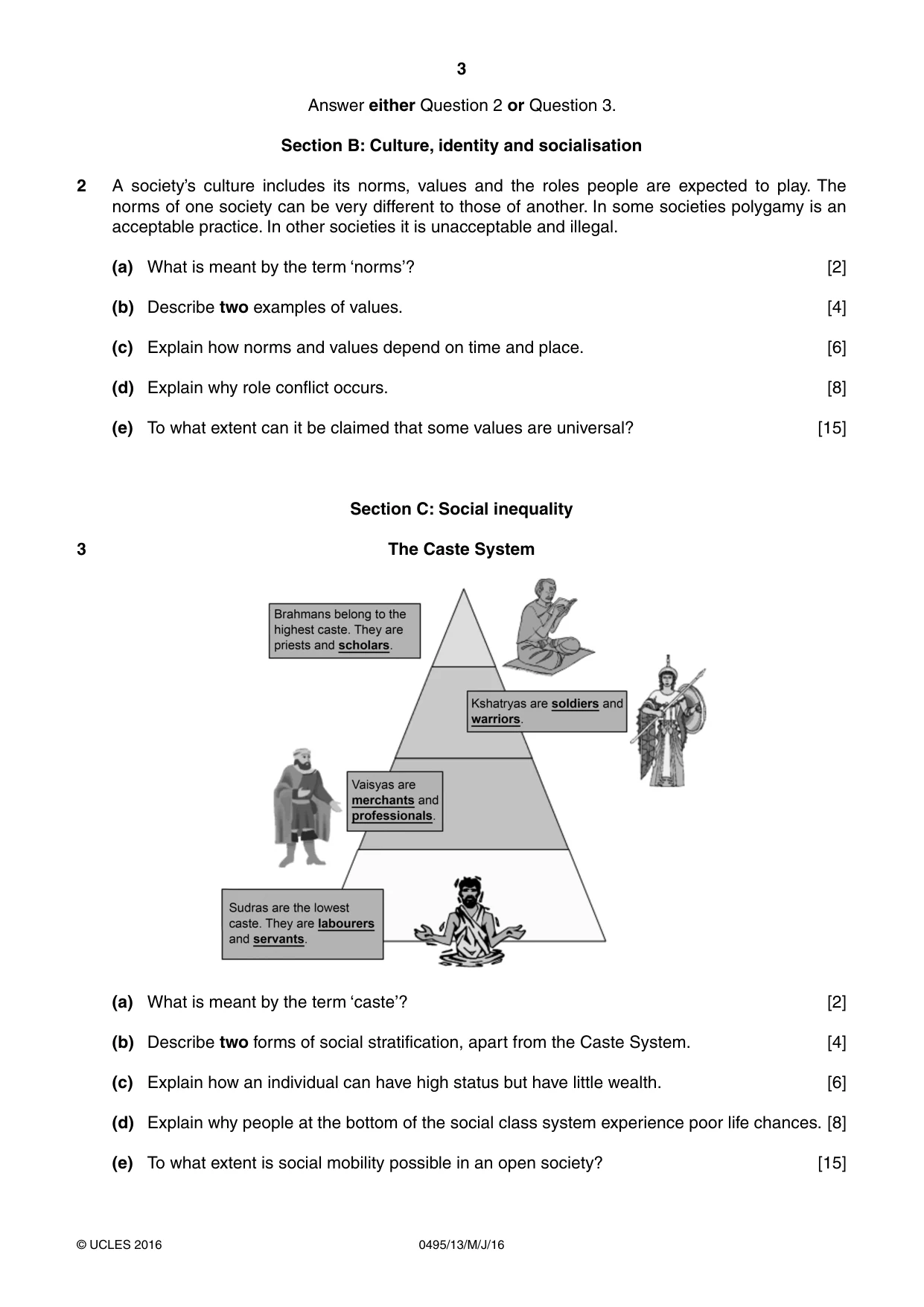
3 0495/13/M/J/16 © UCLES 2016 Answer either Question 2 or Question 3. Section B: Culture, identity and socialisation 2 A society’s culture includes its norms, values and the roles people are expected to play. The norms of one society can be very different to those of another. In some societies polygamy is an acceptable practice. In other societies it is unacceptable and illegal. (a) What is meant by the term ‘norms’? [2] (b) Describe two examples of values. [4] (c) Explain how norms and values depend on time and place. [6] (d) Explain why role conflict occurs. [8] (e) To what extent can it be claimed that some values are universal? [15] Section C: Social inequality 3 The Caste System (a) What is meant by the term ‘caste’? [2] (b) Describe two forms of social stratification, apart from the Caste System. [4] (c) Explain how an individual can have high status but have little wealth. [6] (d) Explain why people at the bottom of the social class system experience poor life chances. [8] (e) To what extent is social mobility possible in an open society? [15]
Question paper, page 4
4 0495/13/M/J/16 © UCLES 2016 BLANK PAGE Permission to reproduce items where third-party owned material protected by copyright is included has been sought and cleared where possible. Every reasonable effort has been made by the publisher (UCLES) to trace copyright holders, but if any items requiring clearance have unwittingly been included, the publisher will be pleased to make amends at the earliest possible opportunity. To avoid the issue of disclosure of answer-related information to candidates, all copyright acknowledgements are reproduced online in the Cambridge International Examinations Copyright Acknowledgements Booklet. This is produced for each series of examinations and is freely available to download at www.cie.org.uk after the live examination series. Cambridge International Examinations is part of the Cambridge Assessment Group. Cambridge Assessment is the brand name of University of Cambridge Local Examinations Syndicate (UCLES), which is itself a department of the University of Cambridge.
Mark scheme, page 1
® IGCSE is the registered trademark of Cambridge International Examinations. This document consists of 18 printed pages. © UCLES 2016 [Turn over Cambridge International Examinations Cambridge International General Certificate of Secondary Education SOCIOLOGY 0495/13 Paper 1 May/June 2016 MARK SCHEME Maximum Mark: 80 Published This mark scheme is published as an aid to teachers and candidates, to indicate the requirements of the examination. It shows the basis on which Examiners were instructed to award marks. It does not indicate the details of the discussions that took place at an Examiners’ meeting before marking began, which would have considered the acceptability of alternative answers. Mark schemes should be read in conjunction with the question paper and the Principal Examiner Report for Teachers. Cambridge will not enter into discussions about these mark schemes. Cambridge is publishing the mark schemes for the May/June 2016 series for most Cambridge IGCSE®, Cambridge International A and AS Level components and some Cambridge O Level components.
Mark scheme, page 2
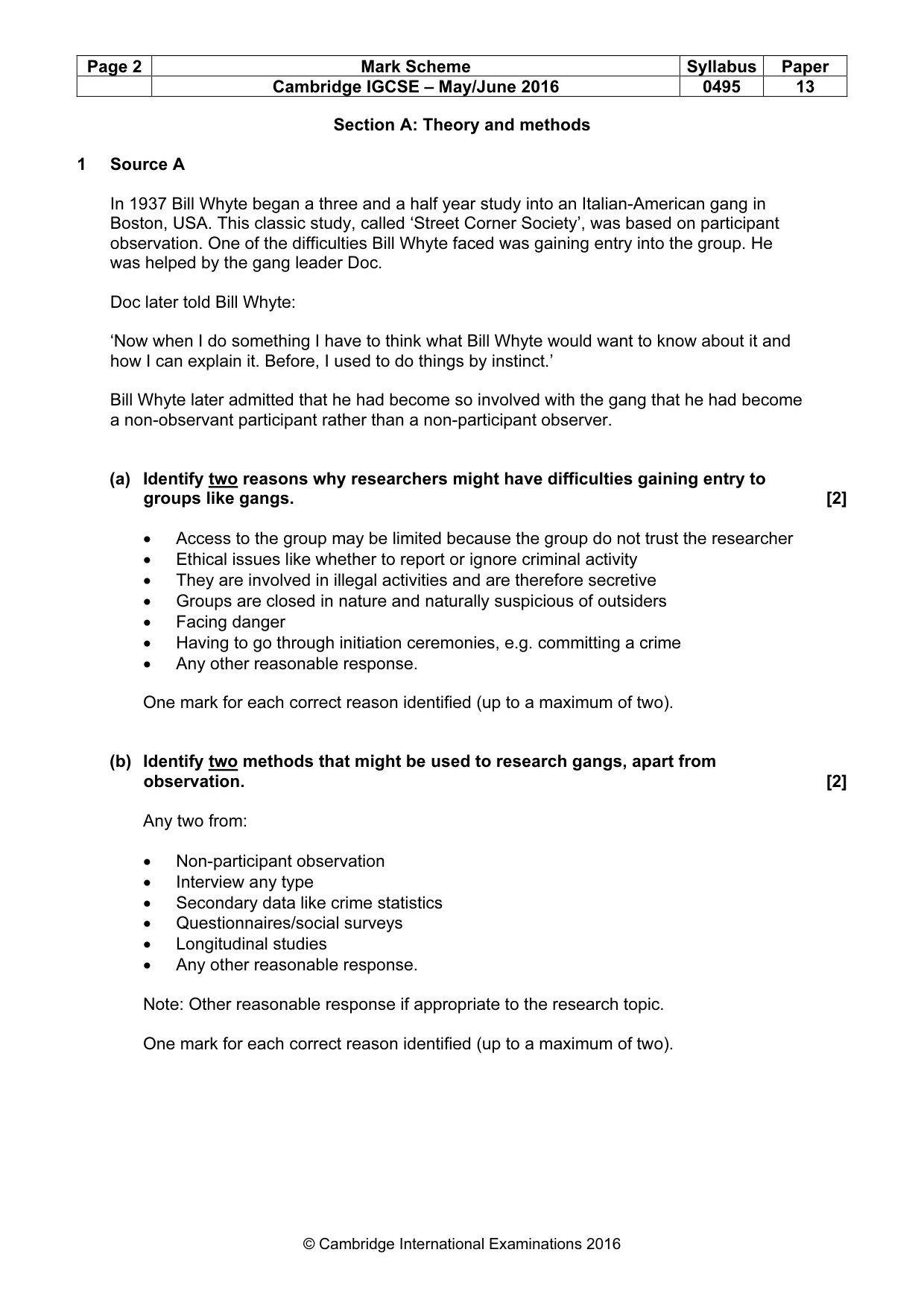
Page 2 Mark Scheme Syllabus Paper Cambridge IGCSE – May/June 2016 0495 13 © Cambridge International Examinations 2016 Section A: Theory and methods 1 Source A In 1937 Bill Whyte began a three and a half year study into an Italian-American gang in Boston, USA. This classic study, called ‘Street Corner Society’, was based on participant observation. One of the difficulties Bill Whyte faced was gaining entry into the group. He was helped by the gang leader Doc. Doc later told Bill Whyte: ‘Now when I do something I have to think what Bill Whyte would want to know about it and how I can explain it. Before, I used to do things by instinct.’ Bill Whyte later admitted that he had become so involved with the gang that he had become a non-observant participant rather than a non-participant observer. (a) Identify two reasons why researchers might have difficulties gaining entry to groups like gangs. [2] • Access to the group may be limited because the group do not trust the researcher • Ethical issues like whether to report or ignore criminal activity • They are involved in illegal activities and are therefore secretive • Groups are closed in nature and naturally suspicious of outsiders • Facing danger • Having to go through initiation ceremonies, e.g. committing a crime • Any other reasonable response. One mark for each correct reason identified (up to a maximum of two). (b) Identify two methods that might be used to research gangs, apart from observation. [2] Any two from: • Non-participant observation • Interview any type • Secondary data like crime statistics • Questionnaires/social surveys • Longitudinal studies • Any other reasonable response. Note: Other reasonable response if appropriate to the research topic. One mark for each correct reason identified (up to a maximum of two).
Mark scheme, page 3
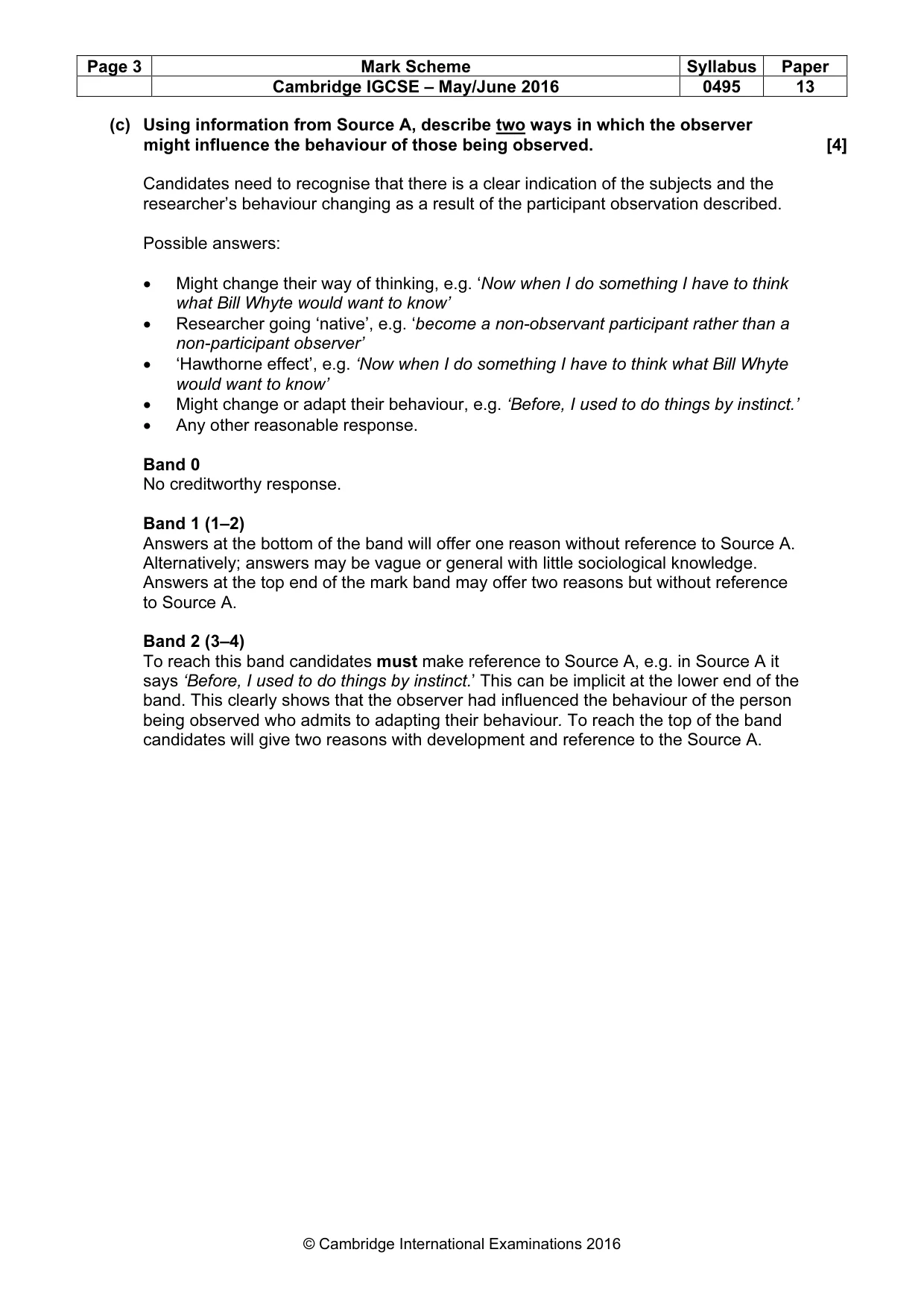
Page 3 Mark Scheme Syllabus Paper Cambridge IGCSE – May/June 2016 0495 13 © Cambridge International Examinations 2016 (c) Using information from Source A, describe two ways in which the observer might influence the behaviour of those being observed. [4] Candidates need to recognise that there is a clear indication of the subjects and the researcher’s behaviour changing as a result of the participant observation described. Possible answers: • Might change their way of thinking, e.g. ‘Now when I do something I have to think what Bill Whyte would want to know’ • Researcher going ‘native’, e.g. ‘become a non-observant participant rather than a non-participant observer’ • ‘Hawthorne effect’, e.g. ‘Now when I do something I have to think what Bill Whyte would want to know’ • Might change or adapt their behaviour, e.g. ‘Before, I used to do things by instinct.’ • Any other reasonable response. Band 0 No creditworthy response. Band 1 (1–2) Answers at the bottom of the band will offer one reason without reference to Source A. Alternatively; answers may be vague or general with little sociological knowledge. Answers at the top end of the mark band may offer two reasons but without reference to Source A. Band 2 (3–4) To reach this band candidates must make reference to Source A, e.g. in Source A it says ‘Before, I used to do things by instinct.’ This can be implicit at the lower end of the band. This clearly shows that the observer had influenced the behaviour of the person being observed who admits to adapting their behaviour. To reach the top of the band candidates will give two reasons with development and reference to the Source A.
Mark scheme, page 4
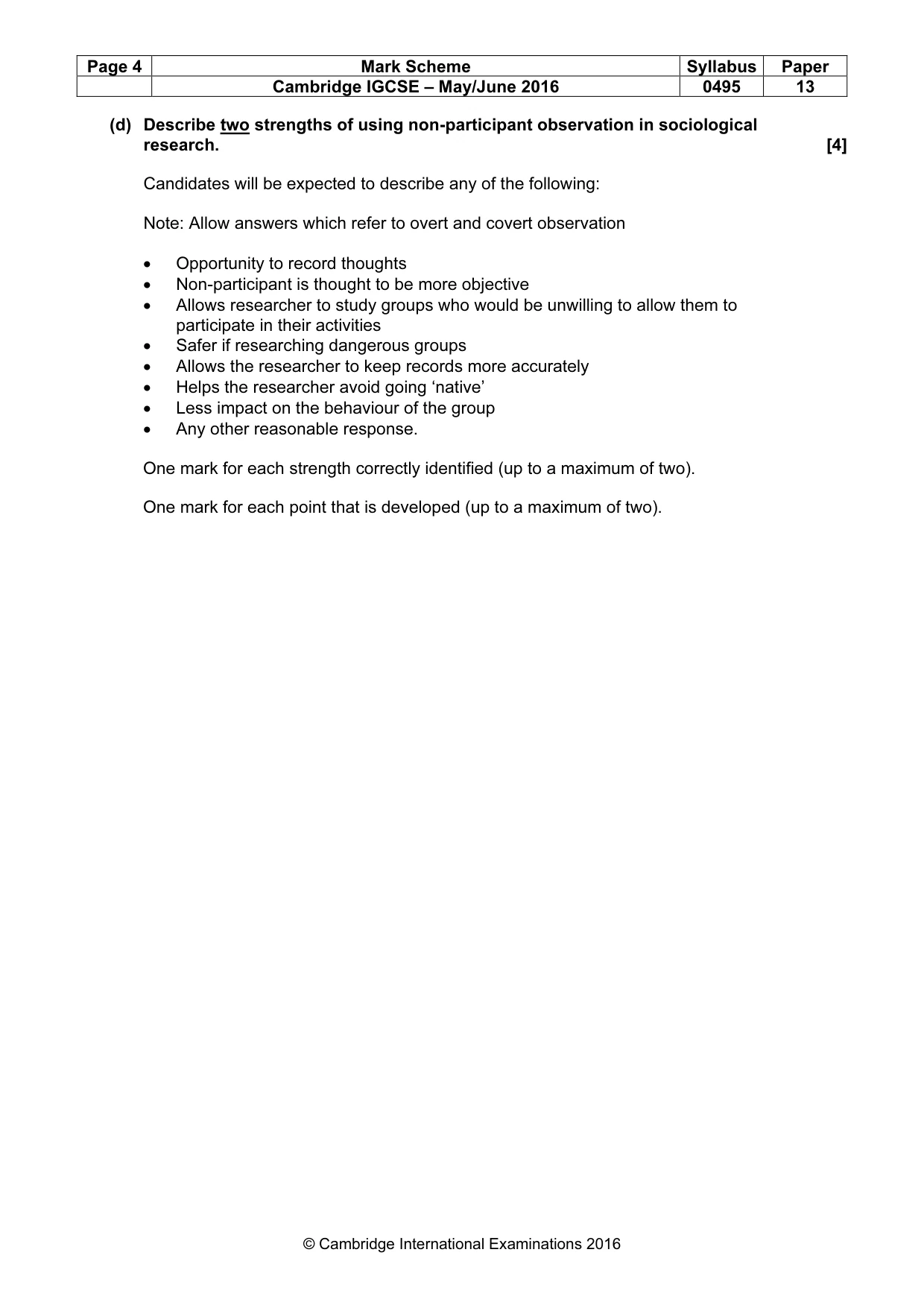
Page 4 Mark Scheme Syllabus Paper Cambridge IGCSE – May/June 2016 0495 13 © Cambridge International Examinations 2016 (d) Describe two strengths of using non-participant observation in sociological research. [4] Candidates will be expected to describe any of the following: Note: Allow answers which refer to overt and covert observation • Opportunity to record thoughts • Non-participant is thought to be more objective • Allows researcher to study groups who would be unwilling to allow them to participate in their activities • Safer if researching dangerous groups • Allows the researcher to keep records more accurately • Helps the researcher avoid going ‘native’ • Less impact on the behaviour of the group • Any other reasonable response. One mark for each strength correctly identified (up to a maximum of two). One mark for each point that is developed (up to a maximum of two).
Mark scheme, page 5
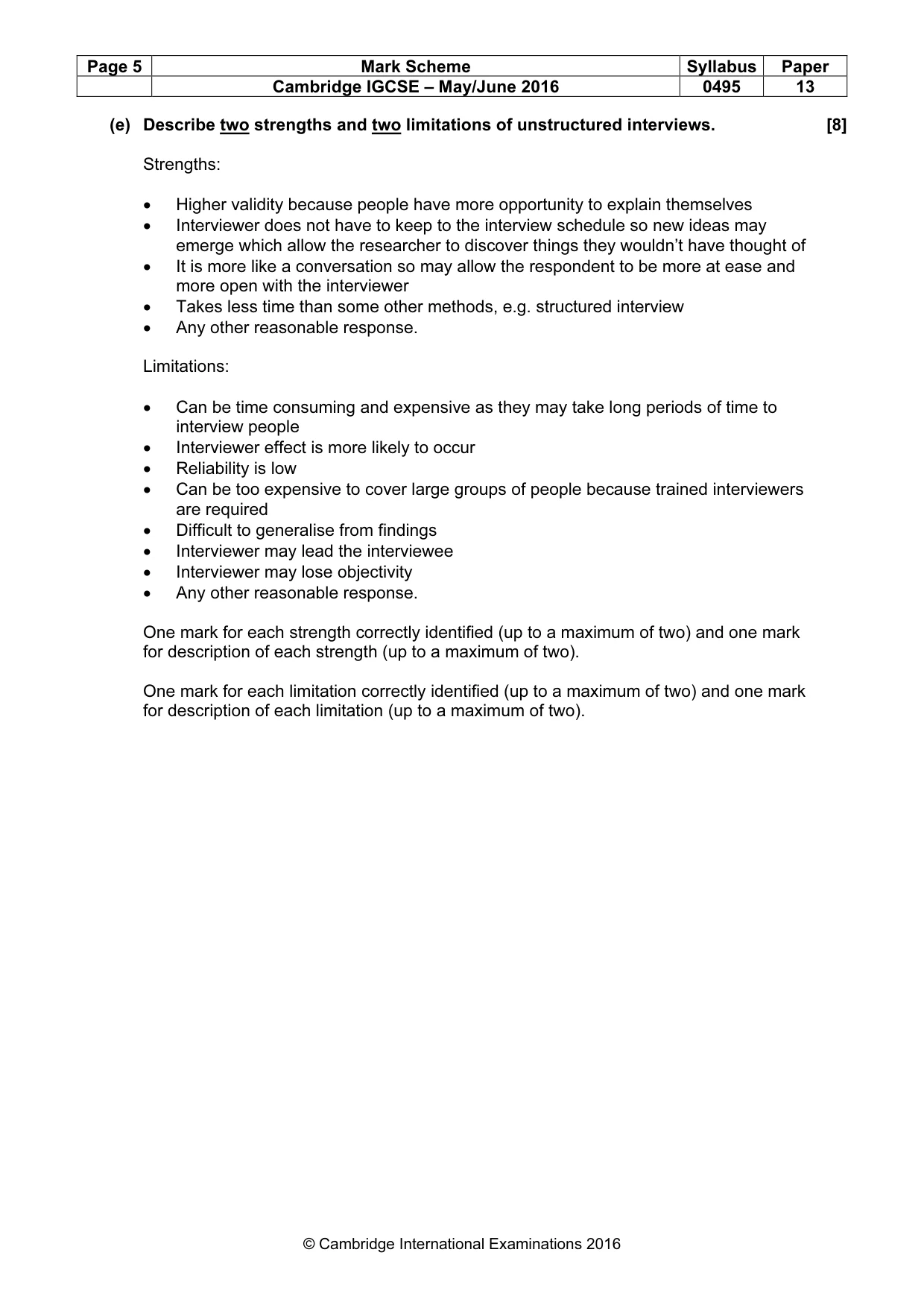
Page 5 Mark Scheme Syllabus Paper Cambridge IGCSE – May/June 2016 0495 13 © Cambridge International Examinations 2016 (e) Describe two strengths and two limitations of unstructured interviews. [8] Strengths: • Higher validity because people have more opportunity to explain themselves • Interviewer does not have to keep to the interview schedule so new ideas may emerge which allow the researcher to discover things they wouldn’t have thought of • It is more like a conversation so may allow the respondent to be more at ease and more open with the interviewer • Takes less time than some other methods, e.g. structured interview • Any other reasonable response. Limitations: • Can be time consuming and expensive as they may take long periods of time to interview people • Interviewer effect is more likely to occur • Reliability is low • Can be too expensive to cover large groups of people because trained interviewers are required • Difficult to generalise from findings • Interviewer may lead the interviewee • Interviewer may lose objectivity • Any other reasonable response. One mark for each strength correctly identified (up to a maximum of two) and one mark for description of each strength (up to a maximum of two). One mark for each limitation correctly identified (up to a maximum of two) and one mark for description of each limitation (up to a maximum of two).
Mark scheme, page 6
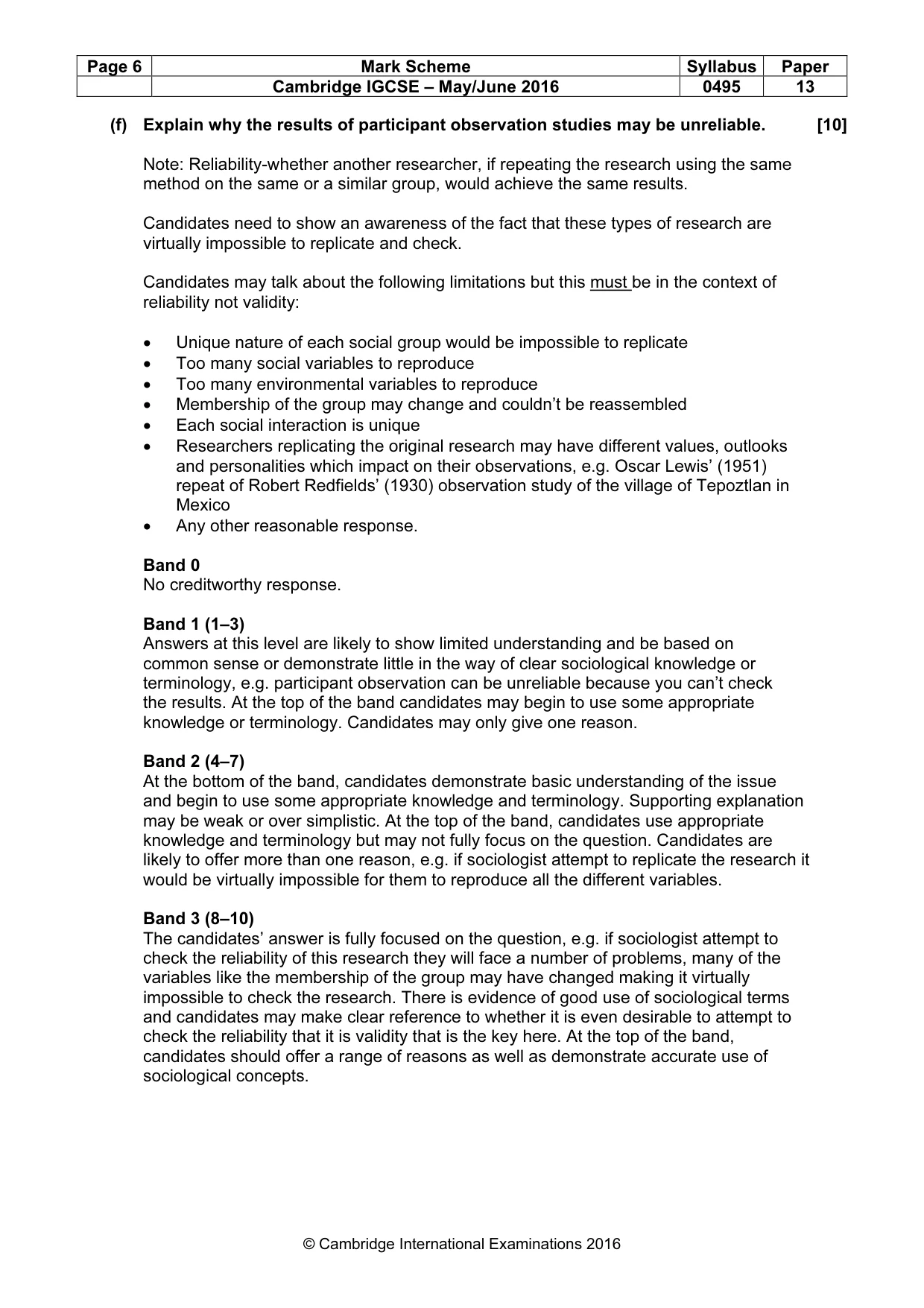
Page 6 Mark Scheme Syllabus Paper Cambridge IGCSE – May/June 2016 0495 13 © Cambridge International Examinations 2016 (f) Explain why the results of participant observation studies may be unreliable. [10] Note: Reliability-whether another researcher, if repeating the research using the same method on the same or a similar group, would achieve the same results. Candidates need to show an awareness of the fact that these types of research are virtually impossible to replicate and check. Candidates may talk about the following limitations but this must be in the context of reliability not validity: • Unique nature of each social group would be impossible to replicate • Too many social variables to reproduce • Too many environmental variables to reproduce • Membership of the group may change and couldn’t be reassembled • Each social interaction is unique • Researchers replicating the original research may have different values, outlooks and personalities which impact on their observations, e.g. Oscar Lewis’ (1951) repeat of Robert Redfields’ (1930) observation study of the village of Tepoztlan in Mexico • Any other reasonable response. Band 0 No creditworthy response. Band 1 (1–3) Answers at this level are likely to show limited understanding and be based on common sense or demonstrate little in the way of clear sociological knowledge or terminology, e.g. participant observation can be unreliable because you can’t check the results. At the top of the band candidates may begin to use some appropriate knowledge or terminology. Candidates may only give one reason. Band 2 (4–7) At the bottom of the band, candidates demonstrate basic understanding of the issue and begin to use some appropriate knowledge and terminology. Supporting explanation may be weak or over simplistic. At the top of the band, candidates use appropriate knowledge and terminology but may not fully focus on the question. Candidates are likely to offer more than one reason, e.g. if sociologist attempt to replicate the research it would be virtually impossible for them to reproduce all the different variables. Band 3 (8–10) The candidates’ answer is fully focused on the question, e.g. if sociologist attempt to check the reliability of this research they will face a number of problems, many of the variables like the membership of the group may have changed making it virtually impossible to check the research. There is evidence of good use of sociological terms and candidates may make clear reference to whether it is even desirable to attempt to check the reliability that it is validity that is the key here. At the top of the band, candidates should offer a range of reasons as well as demonstrate accurate use of sociological concepts.
Mark scheme, page 7
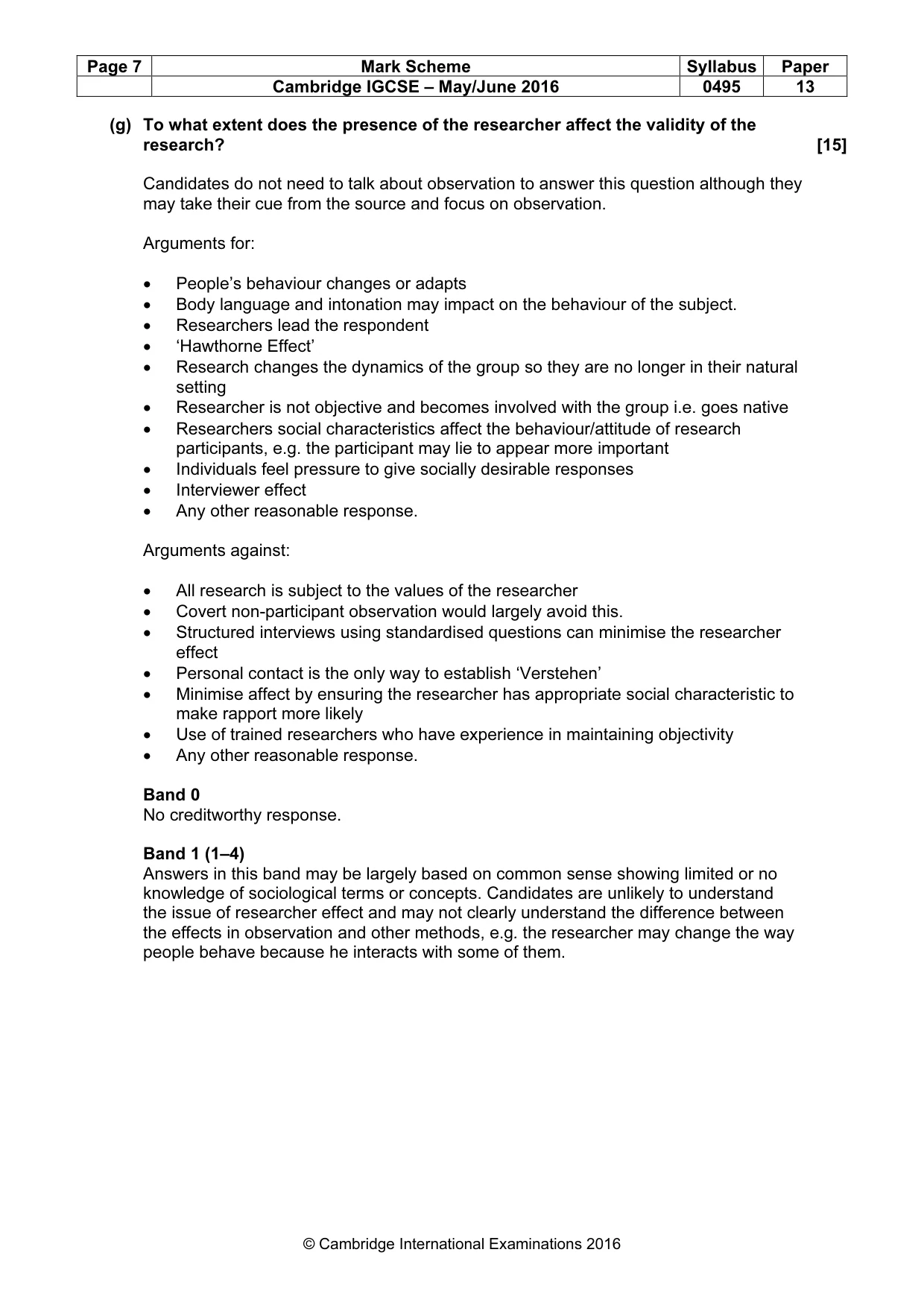
Page 7 Mark Scheme Syllabus Paper Cambridge IGCSE – May/June 2016 0495 13 © Cambridge International Examinations 2016 (g) To what extent does the presence of the researcher affect the validity of the research? [15] Candidates do not need to talk about observation to answer this question although they may take their cue from the source and focus on observation. Arguments for: • People’s behaviour changes or adapts • Body language and intonation may impact on the behaviour of the subject. • Researchers lead the respondent • ‘Hawthorne Effect’ • Research changes the dynamics of the group so they are no longer in their natural setting • Researcher is not objective and becomes involved with the group i.e. goes native • Researchers social characteristics affect the behaviour/attitude of research participants, e.g. the participant may lie to appear more important • Individuals feel pressure to give socially desirable responses • Interviewer effect • Any other reasonable response. Arguments against: • All research is subject to the values of the researcher • Covert non-participant observation would largely avoid this. • Structured interviews using standardised questions can minimise the researcher effect • Personal contact is the only way to establish ‘Verstehen’ • Minimise affect by ensuring the researcher has appropriate social characteristic to make rapport more likely • Use of trained researchers who have experience in maintaining objectivity • Any other reasonable response. Band 0 No creditworthy response. Band 1 (1–4) Answers in this band may be largely based on common sense showing limited or no knowledge of sociological terms or concepts. Candidates are unlikely to understand the issue of researcher effect and may not clearly understand the difference between the effects in observation and other methods, e.g. the researcher may change the way people behave because he interacts with some of them.
Mark scheme, page 8
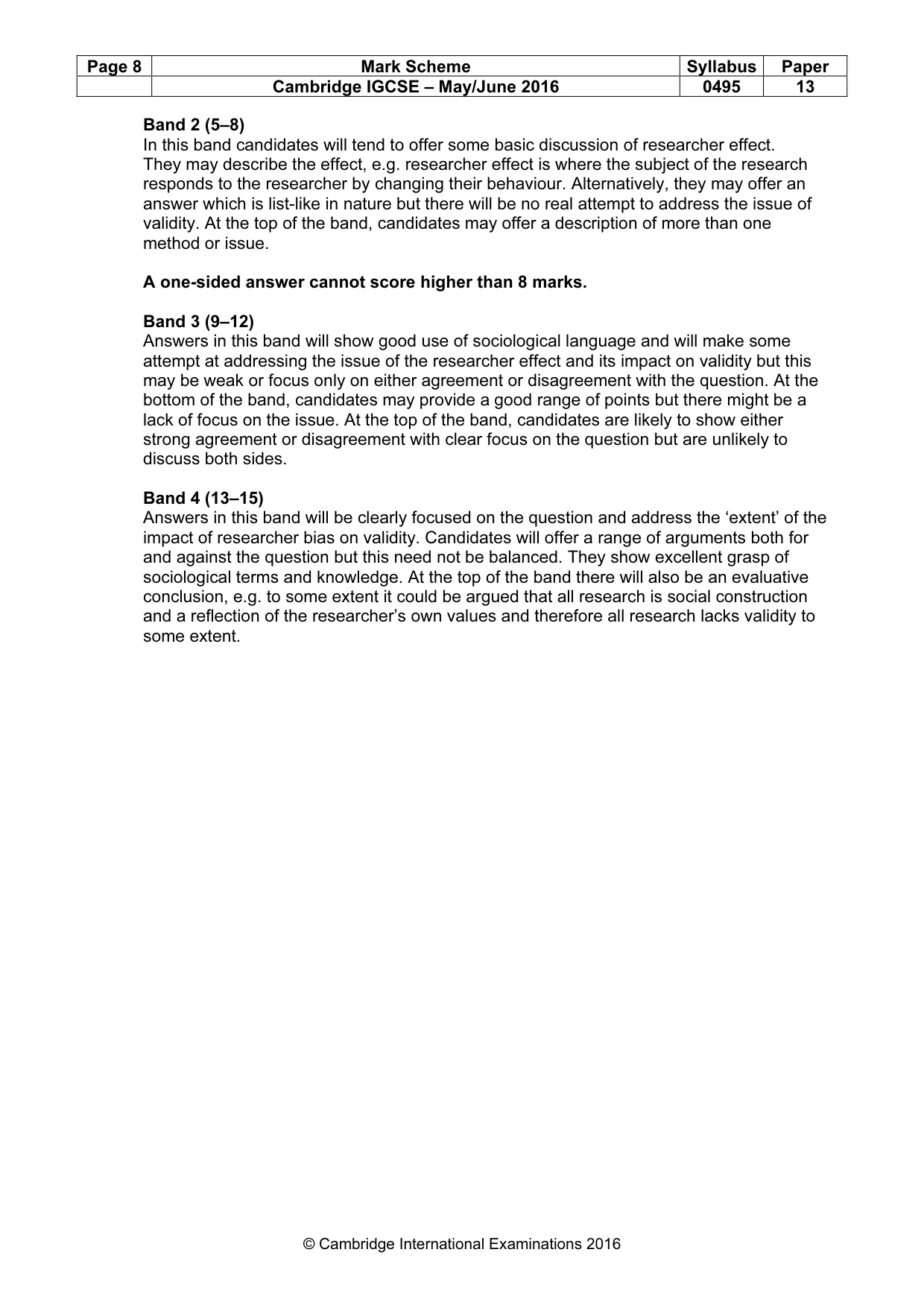
Page 8 Mark Scheme Syllabus Paper Cambridge IGCSE – May/June 2016 0495 13 © Cambridge International Examinations 2016 Band 2 (5–8) In this band candidates will tend to offer some basic discussion of researcher effect. They may describe the effect, e.g. researcher effect is where the subject of the research responds to the researcher by changing their behaviour. Alternatively, they may offer an answer which is list-like in nature but there will be no real attempt to address the issue of validity. At the top of the band, candidates may offer a description of more than one method or issue. A one-sided answer cannot score higher than 8 marks. Band 3 (9–12) Answers in this band will show good use of sociological language and will make some attempt at addressing the issue of the researcher effect and its impact on validity but this may be weak or focus only on either agreement or disagreement with the question. At the bottom of the band, candidates may provide a good range of points but there might be a lack of focus on the issue. At the top of the band, candidates are likely to show either strong agreement or disagreement with clear focus on the question but are unlikely to discuss both sides. Band 4 (13–15) Answers in this band will be clearly focused on the question and address the ‘extent’ of the impact of researcher bias on validity. Candidates will offer a range of arguments both for and against the question but this need not be balanced. They show excellent grasp of sociological terms and knowledge. At the top of the band there will also be an evaluative conclusion, e.g. to some extent it could be argued that all research is social construction and a reflection of the researcher’s own values and therefore all research lacks validity to some extent.
Mark scheme, page 9
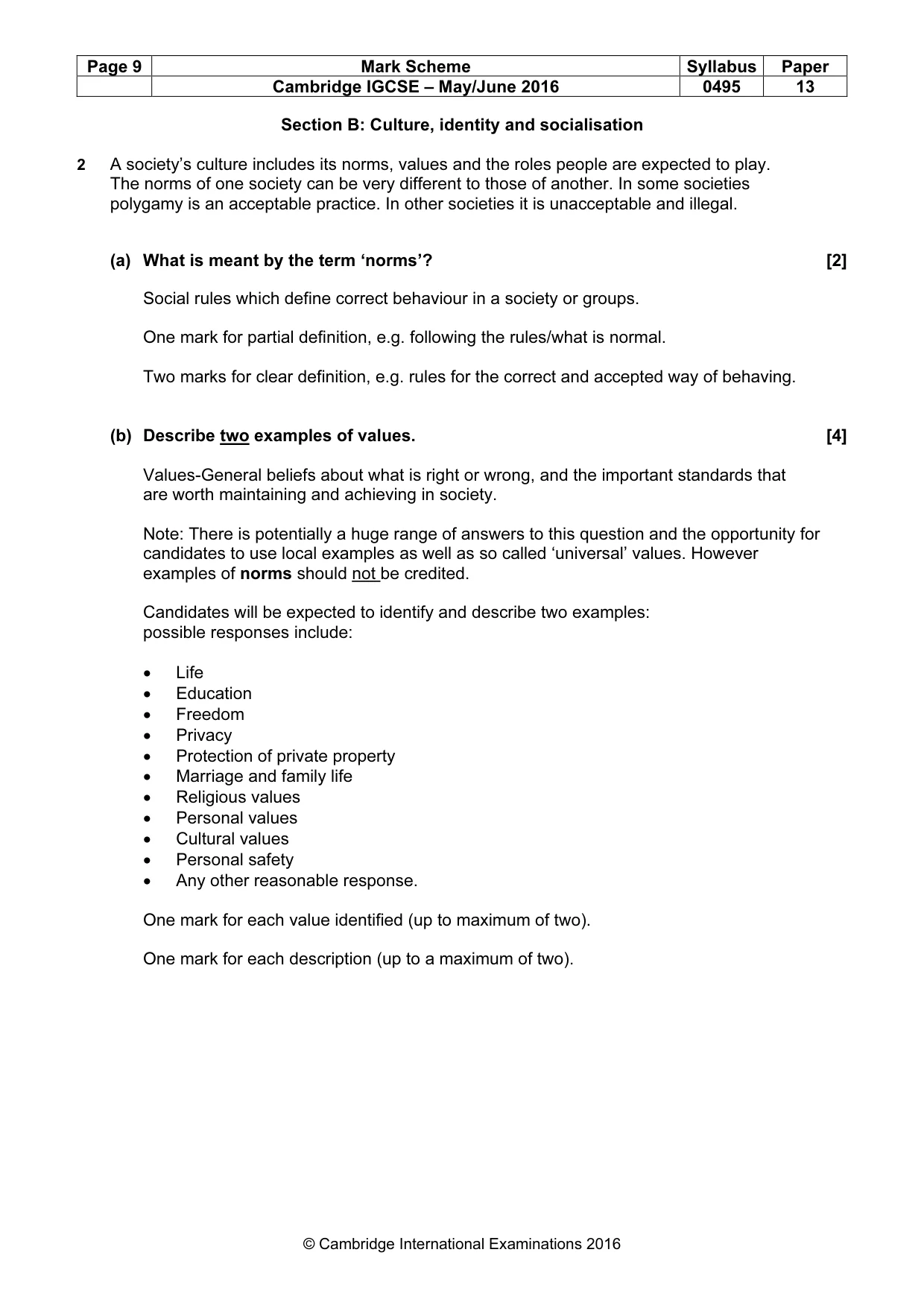
Page 9 Mark Scheme Syllabus Paper Cambridge IGCSE – May/June 2016 0495 13 © Cambridge International Examinations 2016 Section B: Culture, identity and socialisation 2 A society’s culture includes its norms, values and the roles people are expected to play. The norms of one society can be very different to those of another. In some societies polygamy is an acceptable practice. In other societies it is unacceptable and illegal. (a) What is meant by the term ‘norms’? [2] Social rules which define correct behaviour in a society or groups. One mark for partial definition, e.g. following the rules/what is normal. Two marks for clear definition, e.g. rules for the correct and accepted way of behaving. (b) Describe two examples of values. [4] Values-General beliefs about what is right or wrong, and the important standards that are worth maintaining and achieving in society. Note: There is potentially a huge range of answers to this question and the opportunity for candidates to use local examples as well as so called ‘universal’ values. However examples of norms should not be credited. Candidates will be expected to identify and describe two examples: possible responses include: • Life • Education • Freedom • Privacy • Protection of private property • Marriage and family life • Religious values • Personal values • Cultural values • Personal safety • Any other reasonable response. One mark for each value identified (up to maximum of two). One mark for each description (up to a maximum of two).
Mark scheme, page 10
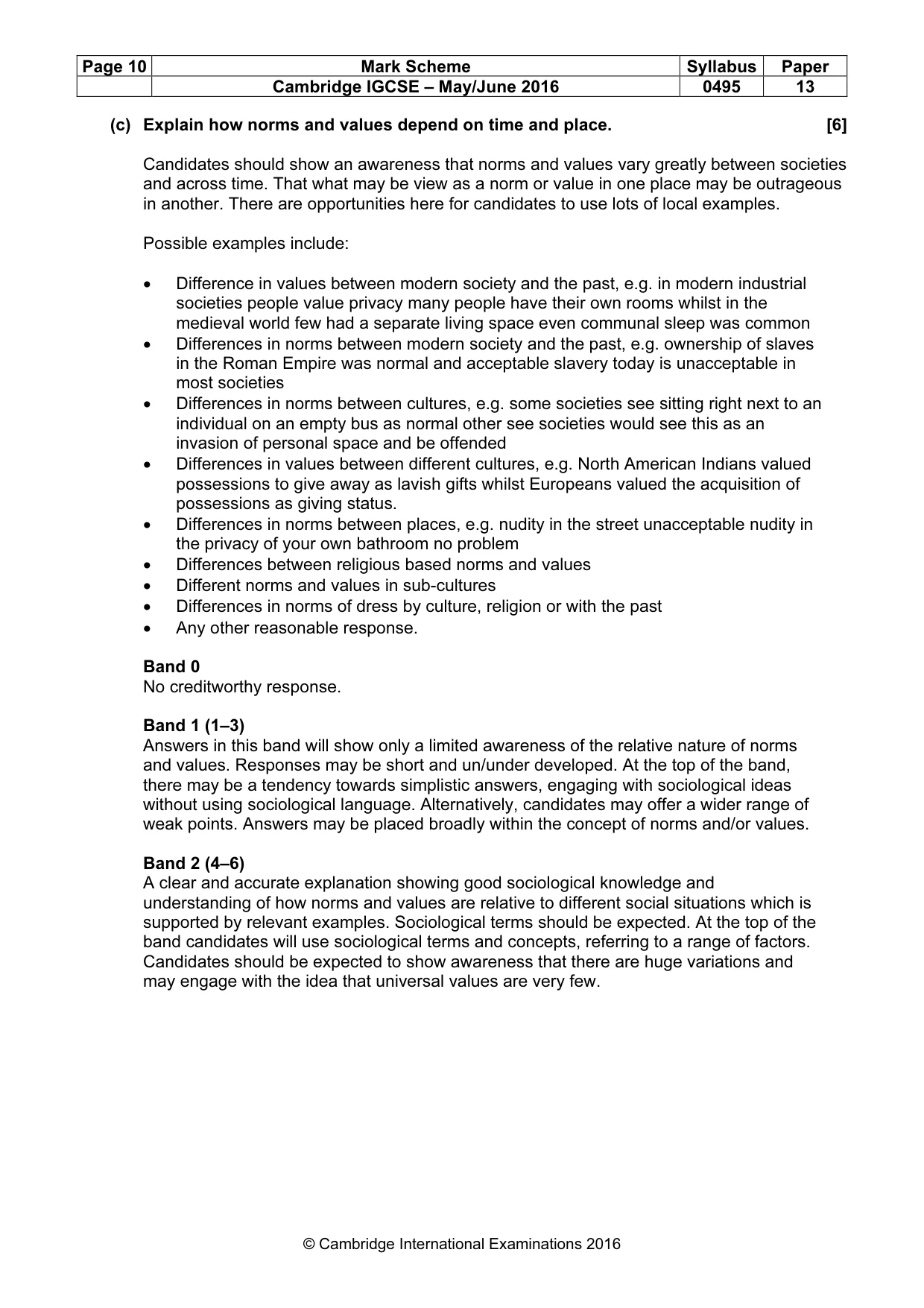
Page 10 Mark Scheme Syllabus Paper Cambridge IGCSE – May/June 2016 0495 13 © Cambridge International Examinations 2016 (c) Explain how norms and values depend on time and place. [6] Candidates should show an awareness that norms and values vary greatly between societies and across time. That what may be view as a norm or value in one place may be outrageous in another. There are opportunities here for candidates to use lots of local examples. Possible examples include: • Difference in values between modern society and the past, e.g. in modern industrial societies people value privacy many people have their own rooms whilst in the medieval world few had a separate living space even communal sleep was common • Differences in norms between modern society and the past, e.g. ownership of slaves in the Roman Empire was normal and acceptable slavery today is unacceptable in most societies • Differences in norms between cultures, e.g. some societies see sitting right next to an individual on an empty bus as normal other see societies would see this as an invasion of personal space and be offended • Differences in values between different cultures, e.g. North American Indians valued possessions to give away as lavish gifts whilst Europeans valued the acquisition of possessions as giving status. • Differences in norms between places, e.g. nudity in the street unacceptable nudity in the privacy of your own bathroom no problem • Differences between religious based norms and values • Different norms and values in sub-cultures • Differences in norms of dress by culture, religion or with the past • Any other reasonable response. Band 0 No creditworthy response. Band 1 (1–3) Answers in this band will show only a limited awareness of the relative nature of norms and values. Responses may be short and un/under developed. At the top of the band, there may be a tendency towards simplistic answers, engaging with sociological ideas without using sociological language. Alternatively, candidates may offer a wider range of weak points. Answers may be placed broadly within the concept of norms and/or values. Band 2 (4–6) A clear and accurate explanation showing good sociological knowledge and understanding of how norms and values are relative to different social situations which is supported by relevant examples. Sociological terms should be expected. At the top of the band candidates will use sociological terms and concepts, referring to a range of factors. Candidates should be expected to show awareness that there are huge variations and may engage with the idea that universal values are very few.
Mark scheme, page 11
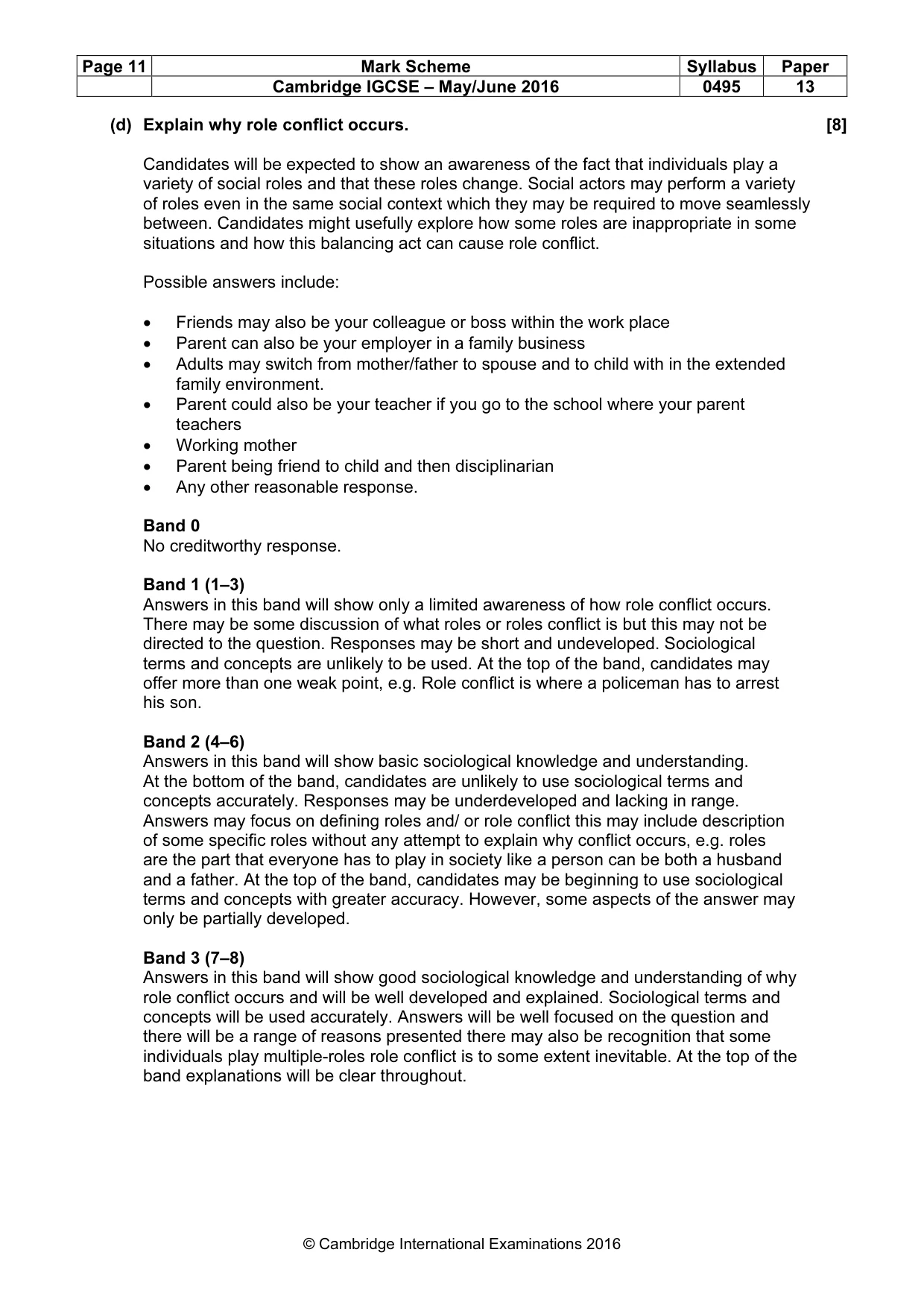
Page 11 Mark Scheme Syllabus Paper Cambridge IGCSE – May/June 2016 0495 13 © Cambridge International Examinations 2016 (d) Explain why role conflict occurs. [8] Candidates will be expected to show an awareness of the fact that individuals play a variety of social roles and that these roles change. Social actors may perform a variety of roles even in the same social context which they may be required to move seamlessly between. Candidates might usefully explore how some roles are inappropriate in some situations and how this balancing act can cause role conflict. Possible answers include: • Friends may also be your colleague or boss within the work place • Parent can also be your employer in a family business • Adults may switch from mother/father to spouse and to child with in the extended family environment. • Parent could also be your teacher if you go to the school where your parent teachers • Working mother • Parent being friend to child and then disciplinarian • Any other reasonable response. Band 0 No creditworthy response. Band 1 (1–3) Answers in this band will show only a limited awareness of how role conflict occurs. There may be some discussion of what roles or roles conflict is but this may not be directed to the question. Responses may be short and undeveloped. Sociological terms and concepts are unlikely to be used. At the top of the band, candidates may offer more than one weak point, e.g. Role conflict is where a policeman has to arrest his son. Band 2 (4–6) Answers in this band will show basic sociological knowledge and understanding. At the bottom of the band, candidates are unlikely to use sociological terms and concepts accurately. Responses may be underdeveloped and lacking in range. Answers may focus on defining roles and/ or role conflict this may include description of some specific roles without any attempt to explain why conflict occurs, e.g. roles are the part that everyone has to play in society like a person can be both a husband and a father. At the top of the band, candidates may be beginning to use sociological terms and concepts with greater accuracy. However, some aspects of the answer may only be partially developed. Band 3 (7–8) Answers in this band will show good sociological knowledge and understanding of why role conflict occurs and will be well developed and explained. Sociological terms and concepts will be used accurately. Answers will be well focused on the question and there will be a range of reasons presented there may also be recognition that some individuals play multiple-roles role conflict is to some extent inevitable. At the top of the band explanations will be clear throughout.
Mark scheme, page 12
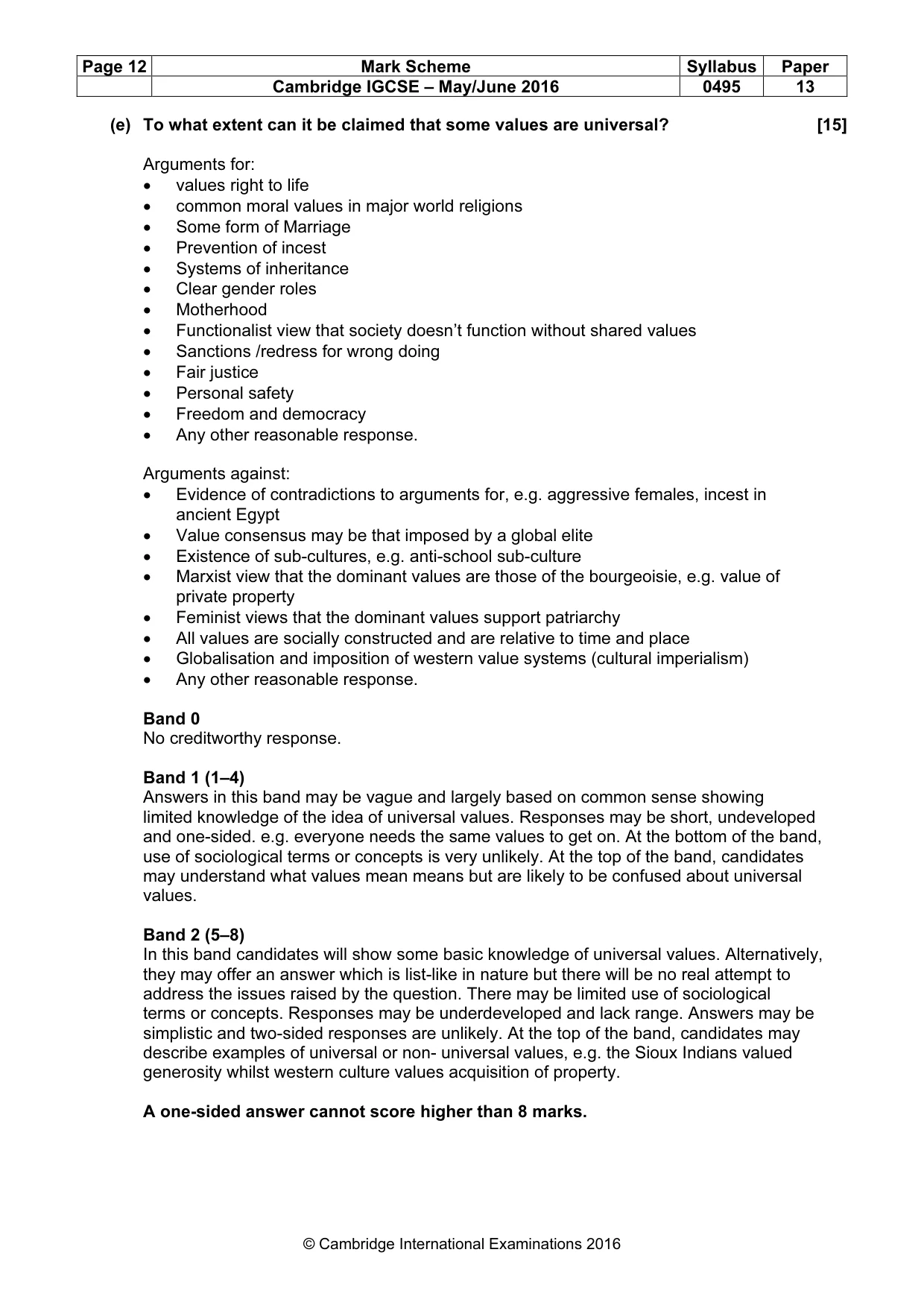
Page 12 Mark Scheme Syllabus Paper Cambridge IGCSE – May/June 2016 0495 13 © Cambridge International Examinations 2016 (e) To what extent can it be claimed that some values are universal? [15] Arguments for: • values right to life • common moral values in major world religions • Some form of Marriage • Prevention of incest • Systems of inheritance • Clear gender roles • Motherhood • Functionalist view that society doesn’t function without shared values • Sanctions /redress for wrong doing • Fair justice • Personal safety • Freedom and democracy • Any other reasonable response. Arguments against: • Evidence of contradictions to arguments for, e.g. aggressive females, incest in ancient Egypt • Value consensus may be that imposed by a global elite • Existence of sub-cultures, e.g. anti-school sub-culture • Marxist view that the dominant values are those of the bourgeoisie, e.g. value of private property • Feminist views that the dominant values support patriarchy • All values are socially constructed and are relative to time and place • Globalisation and imposition of western value systems (cultural imperialism) • Any other reasonable response. Band 0 No creditworthy response. Band 1 (1–4) Answers in this band may be vague and largely based on common sense showing limited knowledge of the idea of universal values. Responses may be short, undeveloped and one-sided. e.g. everyone needs the same values to get on. At the bottom of the band, use of sociological terms or concepts is very unlikely. At the top of the band, candidates may understand what values mean means but are likely to be confused about universal values. Band 2 (5–8) In this band candidates will show some basic knowledge of universal values. Alternatively, they may offer an answer which is list-like in nature but there will be no real attempt to address the issues raised by the question. There may be limited use of sociological terms or concepts. Responses may be underdeveloped and lack range. Answers may be simplistic and two-sided responses are unlikely. At the top of the band, candidates may describe examples of universal or non- universal values, e.g. the Sioux Indians valued generosity whilst western culture values acquisition of property. A one-sided answer cannot score higher than 8 marks.
Mark scheme, page 13
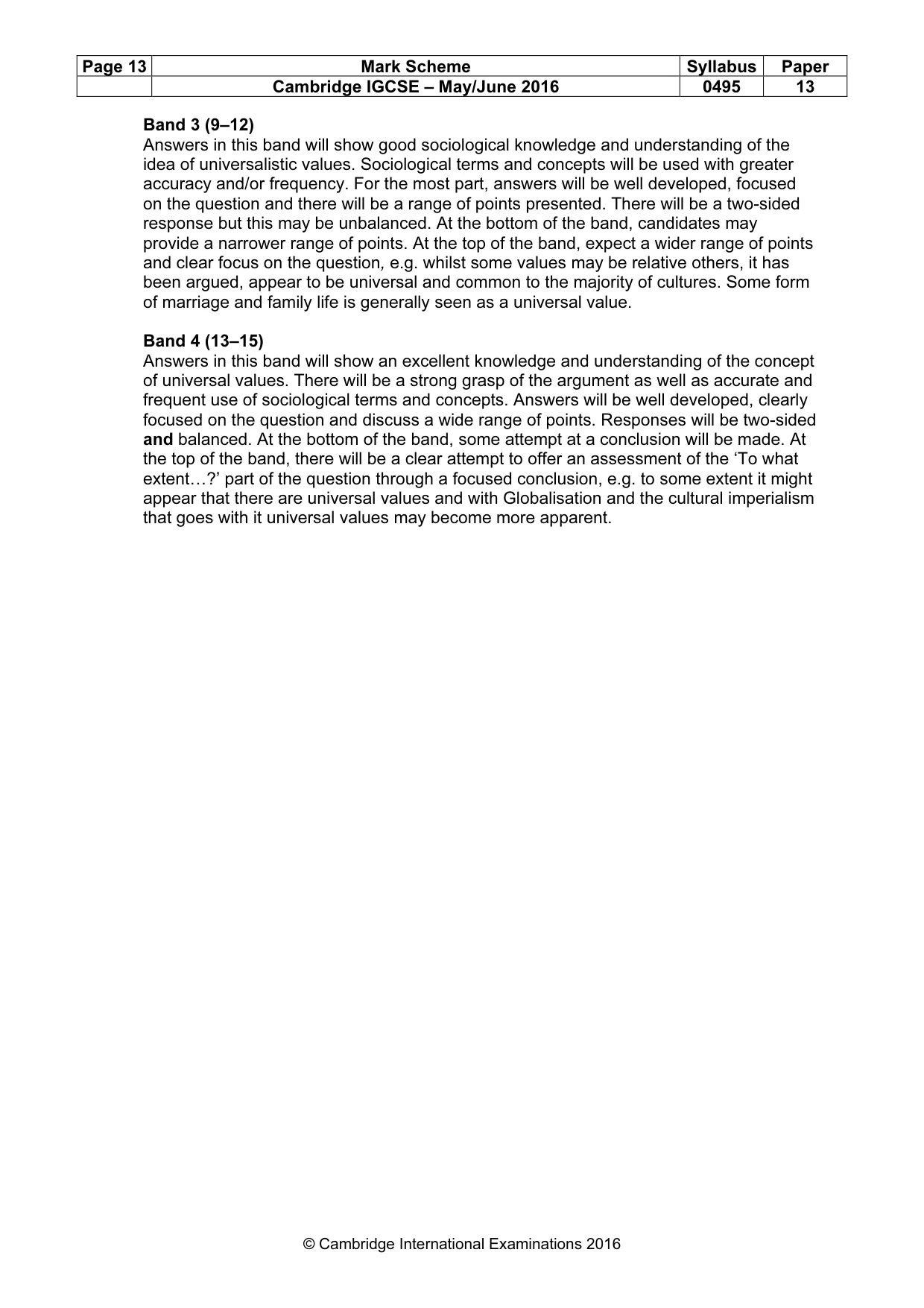
Page 13 Mark Scheme Syllabus Paper Cambridge IGCSE – May/June 2016 0495 13 © Cambridge International Examinations 2016 Band 3 (9–12) Answers in this band will show good sociological knowledge and understanding of the idea of universalistic values. Sociological terms and concepts will be used with greater accuracy and/or frequency. For the most part, answers will be well developed, focused on the question and there will be a range of points presented. There will be a two-sided response but this may be unbalanced. At the bottom of the band, candidates may provide a narrower range of points. At the top of the band, expect a wider range of points and clear focus on the question, e.g. whilst some values may be relative others, it has been argued, appear to be universal and common to the majority of cultures. Some form of marriage and family life is generally seen as a universal value. Band 4 (13–15) Answers in this band will show an excellent knowledge and understanding of the concept of universal values. There will be a strong grasp of the argument as well as accurate and frequent use of sociological terms and concepts. Answers will be well developed, clearly focused on the question and discuss a wide range of points. Responses will be two-sided and balanced. At the bottom of the band, some attempt at a conclusion will be made. At the top of the band, there will be a clear attempt to offer an assessment of the ‘To what extent…?’ part of the question through a focused conclusion, e.g. to some extent it might appear that there are universal values and with Globalisation and the cultural imperialism that goes with it universal values may become more apparent.
Mark scheme, page 14
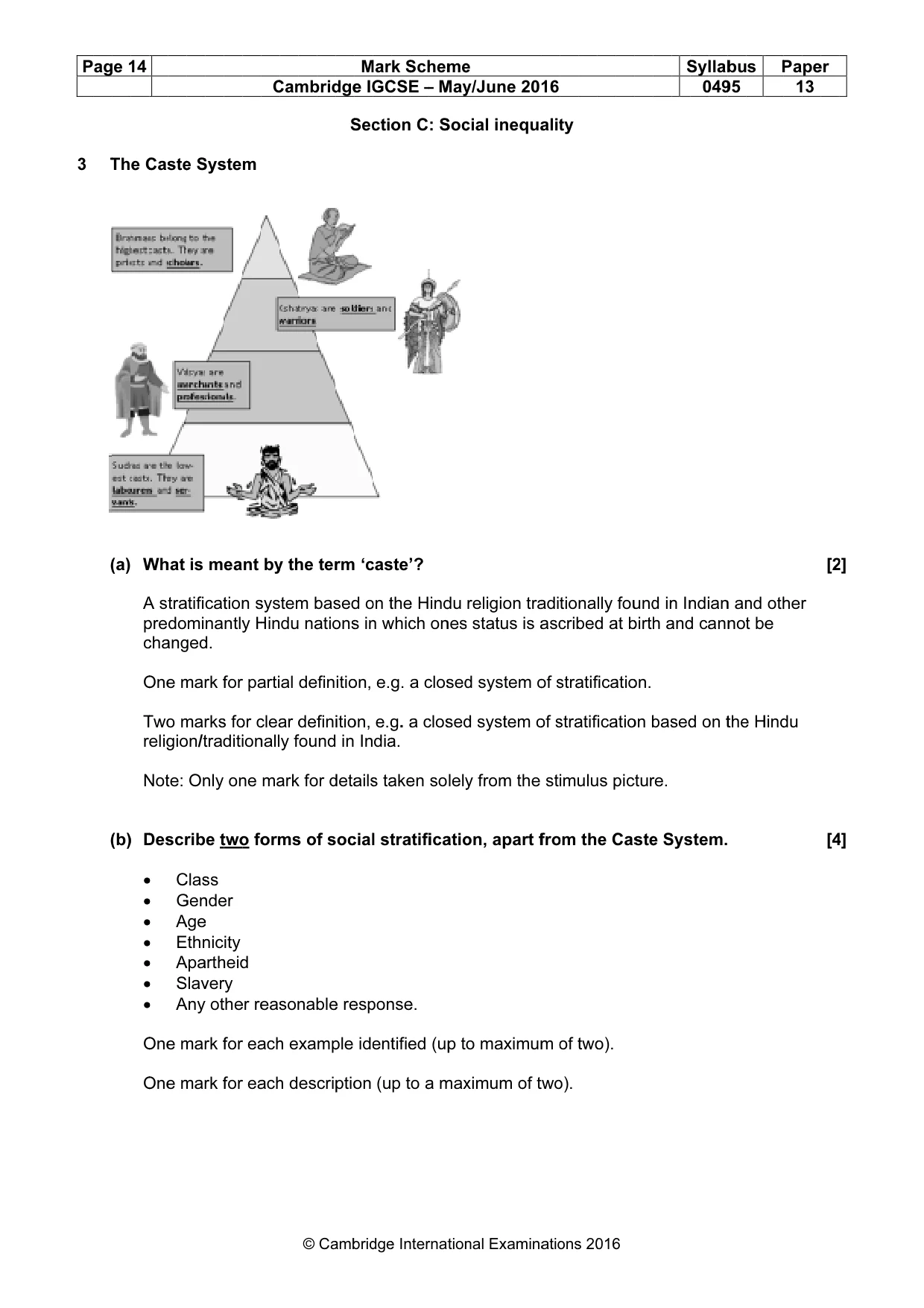
P 3 ag T ( ( ge 1 Th (a) (b) 14 e C W A p c O T r N ) D • • • • • • • O O Cas Wh A s pre cha One Two elig Not Des • • • • • • • One One ste hat tra do ang e m o m gio te: scr C G A E A S A e m e m e S is atifi mi ged mar mar on/t On rib Clas Gen Age thn Apa lav Any mar mar Sys m cat na d. rk f rks trad nly e t ss nde e nic arth ver y ot rk f rk f ste ea tion ntly for s fo diti on two er ity heid ry the for for m nt n s y H r pa or c ion ne o fo d er re r ea r ea C by sys Hin arti clea nall ma orm eas ach ach Cam y th tem du al ar d y f ark ms son h e h d mb © he m b na de def fou k fo s of nab xa es brid Ca ter bas atio fin fini nd or d f s ble mp crip dge amb S rm sed ons itio itio in deta oc e re ple ptio M e IG brid Sec ‘c d o s in on, on, In ails cial esp ide on Mar GC dge ctio cas on t n w e.g e.g dia s ta l st pon ent (u k S CSE e In on ste’ the whic g. a g. a a. ake tra nse tifie p t Sch E – nter C ’? e H ch a c a c en atifi e. ed o a hem – M rnat : S ind on clos clos so ica (up a m me May tion Soc du nes sed sed lely atio p to max e y/J nal cia rel s st d s d s y fr on, o m xim un Ex l in igio tatu sys yst rom , ap max mum ne 2 xam neq on us tem tem m t pa xim m o 20 mina qua tra is a m o m o he rt f mum of t 16 atio alit adi asc of s of s st fro m o two ons ty tio crib stra stra imu om of t o). s 20 na bed atif atif ulu th two 016 lly d a fica fica us p e C o). 6 fou at b atio atio pic Cas und birth on. on b ctur ste d in h a bas re. e S S n In and sed Sys Syl 0 ndi d ca d o ste llab 049 ian ann on t m. bu 95 n an not the s nd t be e H P oth e Hind Pa 1 her du pe 3 r er [2 [4 2] 4]
Mark scheme, page 15
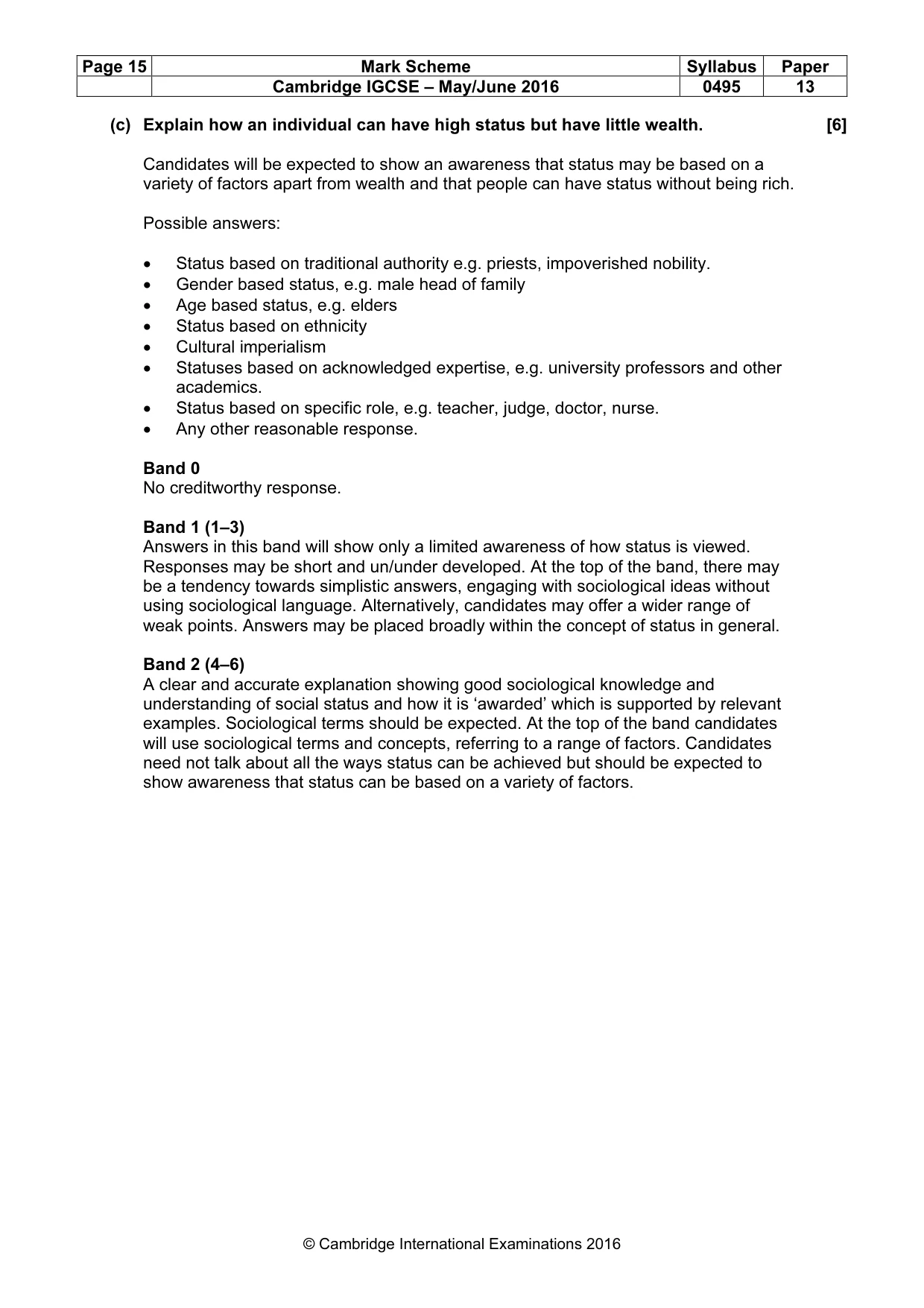
Page 15 Mark Scheme Syllabus Paper Cambridge IGCSE – May/June 2016 0495 13 © Cambridge International Examinations 2016 (c) Explain how an individual can have high status but have little wealth. [6] Candidates will be expected to show an awareness that status may be based on a variety of factors apart from wealth and that people can have status without being rich. Possible answers: • Status based on traditional authority e.g. priests, impoverished nobility. • Gender based status, e.g. male head of family • Age based status, e.g. elders • Status based on ethnicity • Cultural imperialism • Statuses based on acknowledged expertise, e.g. university professors and other academics. • Status based on specific role, e.g. teacher, judge, doctor, nurse. • Any other reasonable response. Band 0 No creditworthy response. Band 1 (1–3) Answers in this band will show only a limited awareness of how status is viewed. Responses may be short and un/under developed. At the top of the band, there may be a tendency towards simplistic answers, engaging with sociological ideas without using sociological language. Alternatively, candidates may offer a wider range of weak points. Answers may be placed broadly within the concept of status in general. Band 2 (4–6) A clear and accurate explanation showing good sociological knowledge and understanding of social status and how it is ‘awarded’ which is supported by relevant examples. Sociological terms should be expected. At the top of the band candidates will use sociological terms and concepts, referring to a range of factors. Candidates need not talk about all the ways status can be achieved but should be expected to show awareness that status can be based on a variety of factors.
Mark scheme, page 16
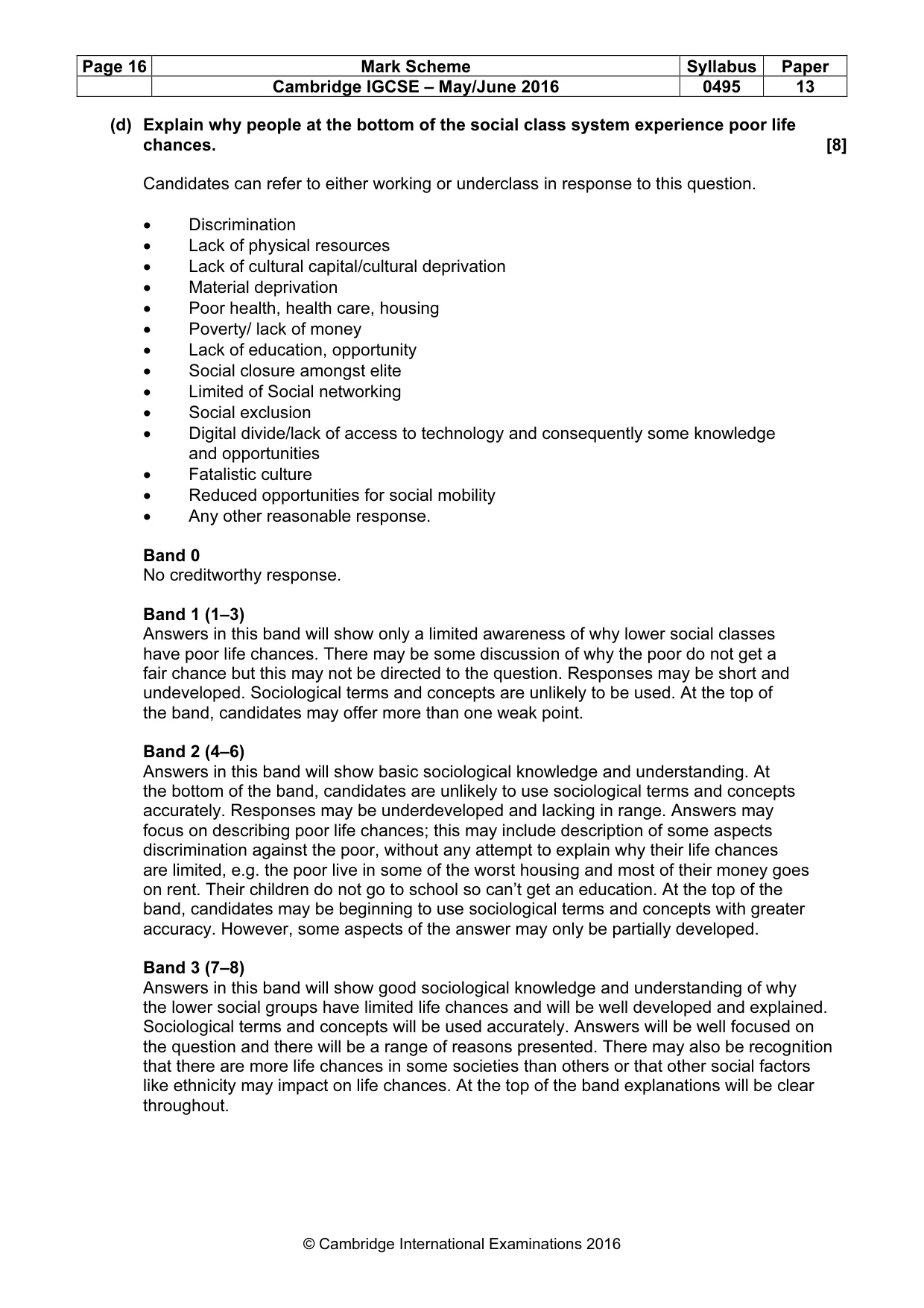
Page 16 Mark Scheme Syllabus Paper Cambridge IGCSE – May/June 2016 0495 13 © Cambridge International Examinations 2016 (d) Explain why people at the bottom of the social class system experience poor life chances. [8] Candidates can refer to either working or underclass in response to this question. • Discrimination • Lack of physical resources • Lack of cultural capital/cultural deprivation • Material deprivation • Poor health, health care, housing • Poverty/ lack of money • Lack of education, opportunity • Social closure amongst elite • Limited of Social networking • Social exclusion • Digital divide/lack of access to technology and consequently some knowledge and opportunities • Fatalistic culture • Reduced opportunities for social mobility • Any other reasonable response. Band 0 No creditworthy response. Band 1 (1–3) Answers in this band will show only a limited awareness of why lower social classes have poor life chances. There may be some discussion of why the poor do not get a fair chance but this may not be directed to the question. Responses may be short and undeveloped. Sociological terms and concepts are unlikely to be used. At the top of the band, candidates may offer more than one weak point. Band 2 (4–6) Answers in this band will show basic sociological knowledge and understanding. At the bottom of the band, candidates are unlikely to use sociological terms and concepts accurately. Responses may be underdeveloped and lacking in range. Answers may focus on describing poor life chances; this may include description of some aspects discrimination against the poor, without any attempt to explain why their life chances are limited, e.g. the poor live in some of the worst housing and most of their money goes on rent. Their children do not go to school so can’t get an education. At the top of the band, candidates may be beginning to use sociological terms and concepts with greater accuracy. However, some aspects of the answer may only be partially developed. Band 3 (7–8) Answers in this band will show good sociological knowledge and understanding of why the lower social groups have limited life chances and will be well developed and explained. Sociological terms and concepts will be used accurately. Answers will be well focused on the question and there will be a range of reasons presented. There may also be recognition that there are more life chances in some societies than others or that other social factors like ethnicity may impact on life chances. At the top of the band explanations will be clear throughout.
Mark scheme, page 17
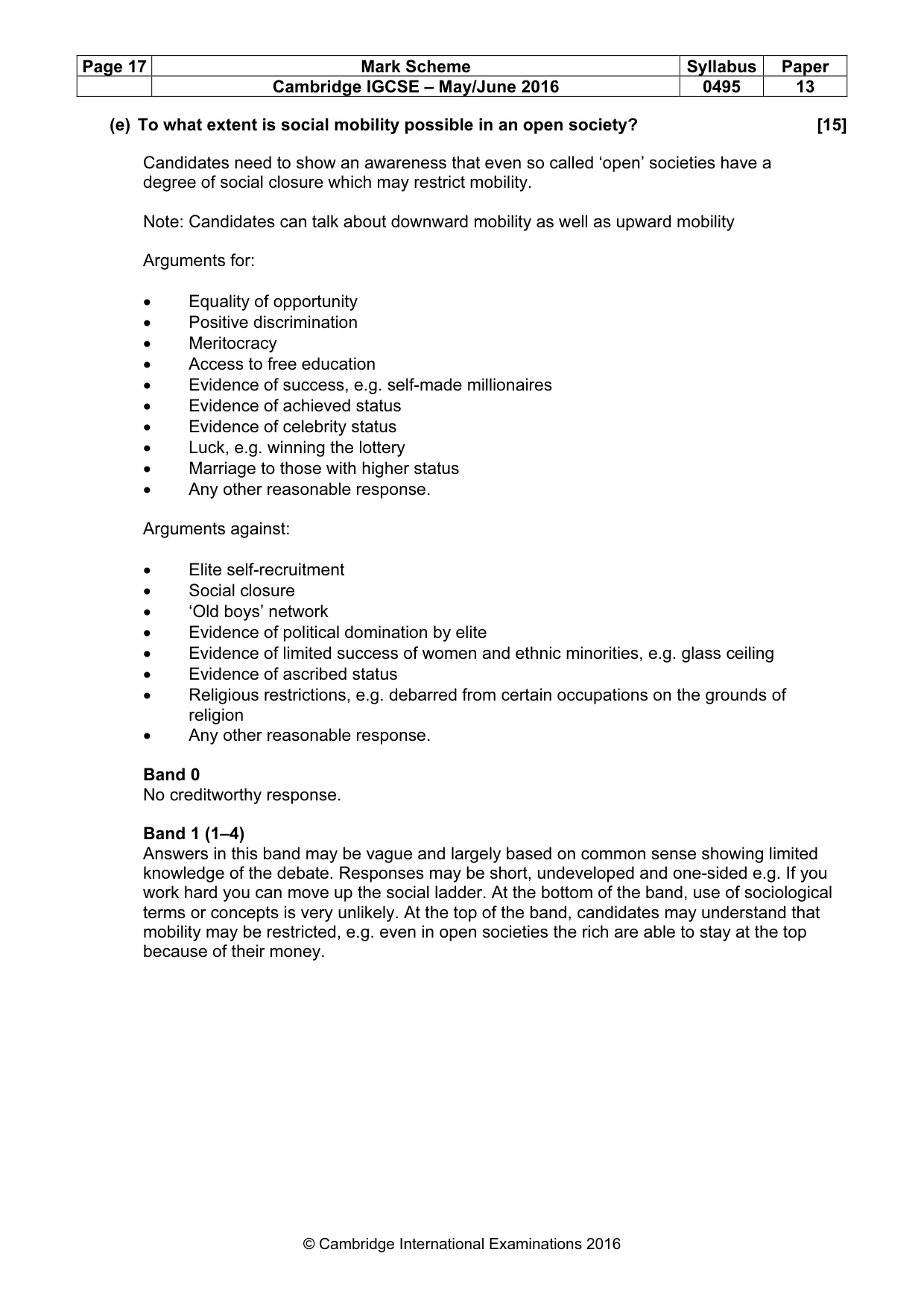
Page 17 Mark Scheme Syllabus Paper Cambridge IGCSE – May/June 2016 0495 13 © Cambridge International Examinations 2016 (e) To what extent is social mobility possible in an open society? [15] Candidates need to show an awareness that even so called ‘open’ societies have a degree of social closure which may restrict mobility. Note: Candidates can talk about downward mobility as well as upward mobility Arguments for: • Equality of opportunity • Positive discrimination • Meritocracy • Access to free education • Evidence of success, e.g. self-made millionaires • Evidence of achieved status • Evidence of celebrity status • Luck, e.g. winning the lottery • Marriage to those with higher status • Any other reasonable response. Arguments against: • Elite self-recruitment • Social closure • ‘Old boys’ network • Evidence of political domination by elite • Evidence of limited success of women and ethnic minorities, e.g. glass ceiling • Evidence of ascribed status • Religious restrictions, e.g. debarred from certain occupations on the grounds of religion • Any other reasonable response. Band 0 No creditworthy response. Band 1 (1–4) Answers in this band may be vague and largely based on common sense showing limited knowledge of the debate. Responses may be short, undeveloped and one-sided e.g. If you work hard you can move up the social ladder. At the bottom of the band, use of sociological terms or concepts is very unlikely. At the top of the band, candidates may understand that mobility may be restricted, e.g. even in open societies the rich are able to stay at the top because of their money.
Mark scheme, page 18
Page 18 Mark Scheme Syllabus Paper Cambridge IGCSE – May/June 2016 0495 13 © Cambridge International Examinations 2016 Band 2 (5–8) In this band candidates will show some basic knowledge opportunities or the barriers to mobility. Alternatively, they may offer an answer which is list-like in nature but there will be no real attempt to address the issues raised by the question. There may be limited use of sociological terms or concepts. Responses may be underdeveloped and lack range. Answers may be simplistic and two-sided responses are unlikely. At the top of the band, candidates may describe social mobility, e.g. individuals may have the opportunity to be socially mobile when they marry someone who is rich and move to the upper class. A one-sided answer cannot score higher than 8 marks. Band 3 (9–12) Answers in this band will show good sociological knowledge and understanding of the factors which enable and prevent mobility. Sociological terms and concepts will be used with greater accuracy and/or frequency. For the most part, answers will be well developed, focused on the question and there will be a range of points presented. There will be a two- sided response but this may be unbalanced. At the bottom of the band, candidates may provide a narrower range of points. At the top of the band, expect a wider range of points and clear focus on the question. Band 4 (13–15) Answers in this band will show an excellent knowledge and understanding of social mobility. There will be a strong grasp of the argument as well as accurate and frequent use of sociological terms and concepts. Answers will be well developed, clearly focused on the question and discuss a wide range of points. Responses will be two-sided and balanced. At the bottom of the band, some attempt at a conclusion will be made. At the top of the band, there will be a clear attempt to offer an assessment of the ‘To what extent…?’ part of the question through a focused conclusion, e.g. whilst a person may have more opportunity for mobility in an open ‘meritocratic’ society than in a closed society these opportunities are still restricted by factors like social class at birth, gender or ethnicity.
What you needed in this session
Cambridge’s own grade thresholds for 2016 May/June, Paper 1 · Variant 3. A higher threshold means an easier paper — the bar moves with how the cohort did.