Cambridge IGCSE Sociology 0495 — 2016 May/June Paper 1 · Variant 1
0495/11/M/J/16 · 80 marks · ≈90 min
The question paper and its mark scheme, free to read here and free to download. This is Cambridge’s own paper, exactly as it was sat.
Question paper4 pages
Mark scheme17 pages
Answers below. Sit the paper first if you are practising.
Paper as text
Question paper, page 1
This document consists of 4 printed pages and 1 insert. DC (CW/CGW) 118917/3 © UCLES 2016 [Turn over Cambridge International Examinations Cambridge International General Certificate of Secondary Education * 9 5 2 2 4 6 4 1 9 7 * SOCIOLOGY 0495/11 Paper 1 May/June 2016 2 hours (including 15 minutes’ reading time) No Additional Materials are required. READ THESE INSTRUCTIONS FIRST An answer booklet is provided inside this question paper. You should follow the instructions on the front cover of the answer booklet. If you need additional answer paper ask the invigilator for a continuation booklet. Answer Question 1 and either Question 2 or Question 3. The number of marks is given in brackets [ ] at the end of each question or part question.
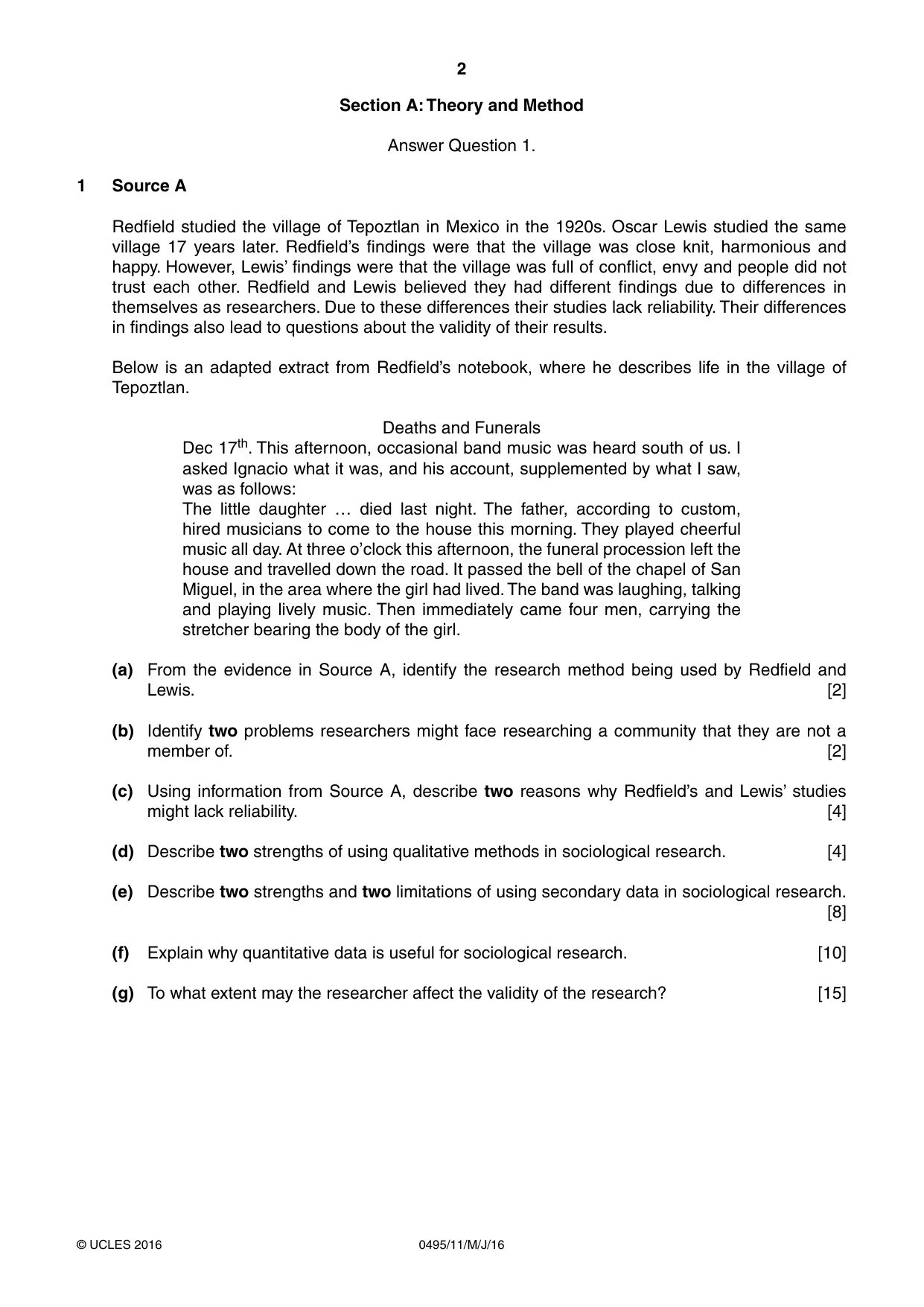
Question paper, page 2
2 0495/11/M/J/16 © UCLES 2016 Section A: Theory and Method Answer Question 1. 1 Source A Redfield studied the village of Tepoztlan in Mexico in the 1920s. Oscar Lewis studied the same village 17 years later. Redfield’s findings were that the village was close knit, harmonious and happy. However, Lewis’ findings were that the village was full of conflict, envy and people did not trust each other. Redfield and Lewis believed they had different findings due to differences in themselves as researchers. Due to these differences their studies lack reliability. Their differences in findings also lead to questions about the validity of their results. Below is an adapted extract from Redfield’s notebook, where he describes life in the village of Tepoztlan. Deaths and Funerals Dec 17th. This afternoon, occasional band music was heard south of us. I asked Ignacio what it was, and his account, supplemented by what I saw, was as follows: The little daughter … died last night. The father, according to custom, hired musicians to come to the house this morning. They played cheerful music all day. At three o’clock this afternoon, the funeral procession left the house and travelled down the road. It passed the bell of the chapel of San Miguel, in the area where the girl had lived. The band was laughing, talking and playing lively music. Then immediately came four men, carrying the stretcher bearing the body of the girl. (a) From the evidence in Source A, identify the research method being used by Redfield and Lewis. [2] (b) Identify two problems researchers might face researching a community that they are not a member of. [2] (c) Using information from Source A, describe two reasons why Redfield’s and Lewis’ studies might lack reliability. [4] (d) Describe two strengths of using qualitative methods in sociological research. [4] (e) Describe two strengths and two limitations of using secondary data in sociological research. [8] (f) Explain why quantitative data is useful for sociological research. [10] (g) To what extent may the researcher affect the validity of the research? [15]
Question paper, page 3
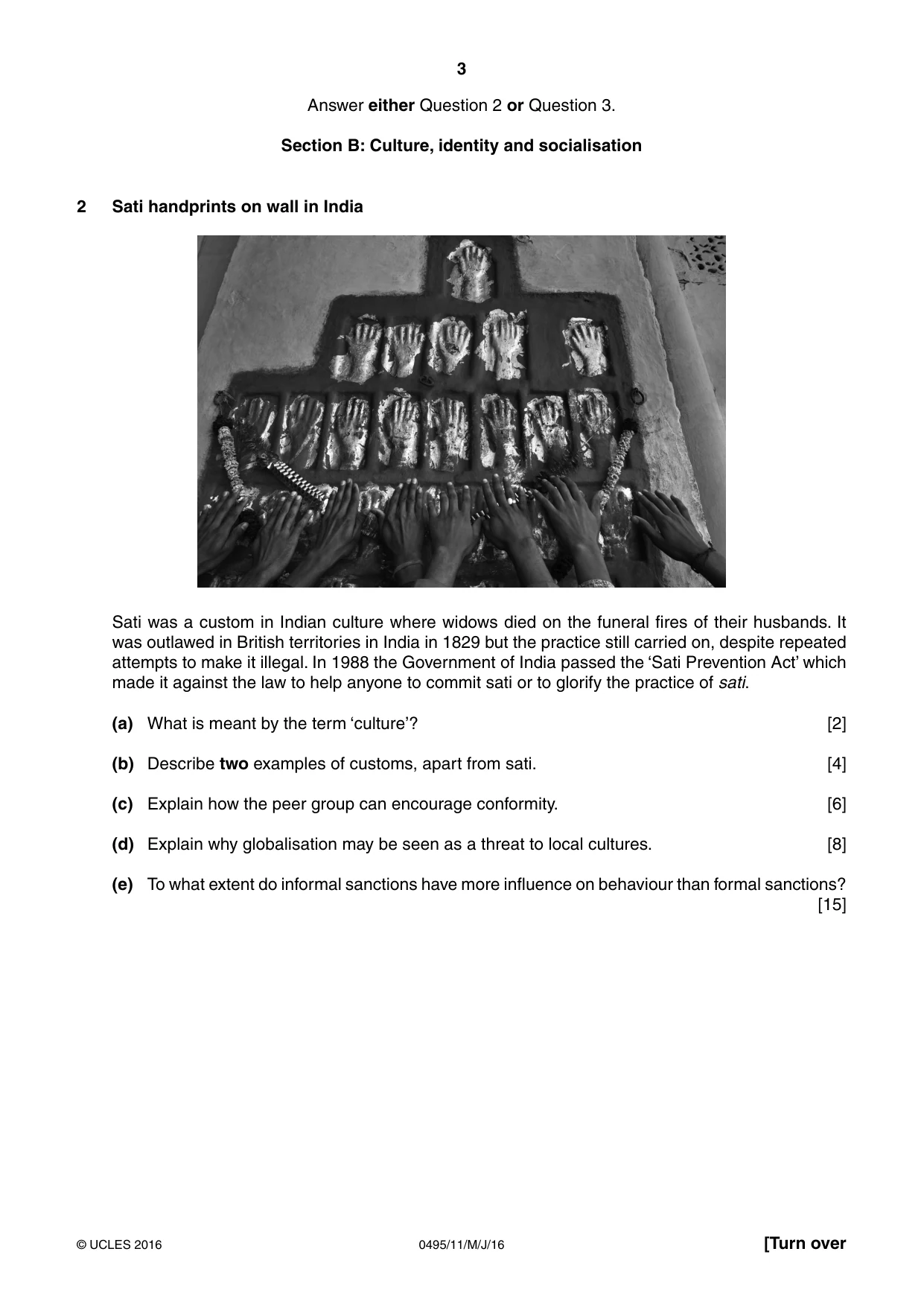
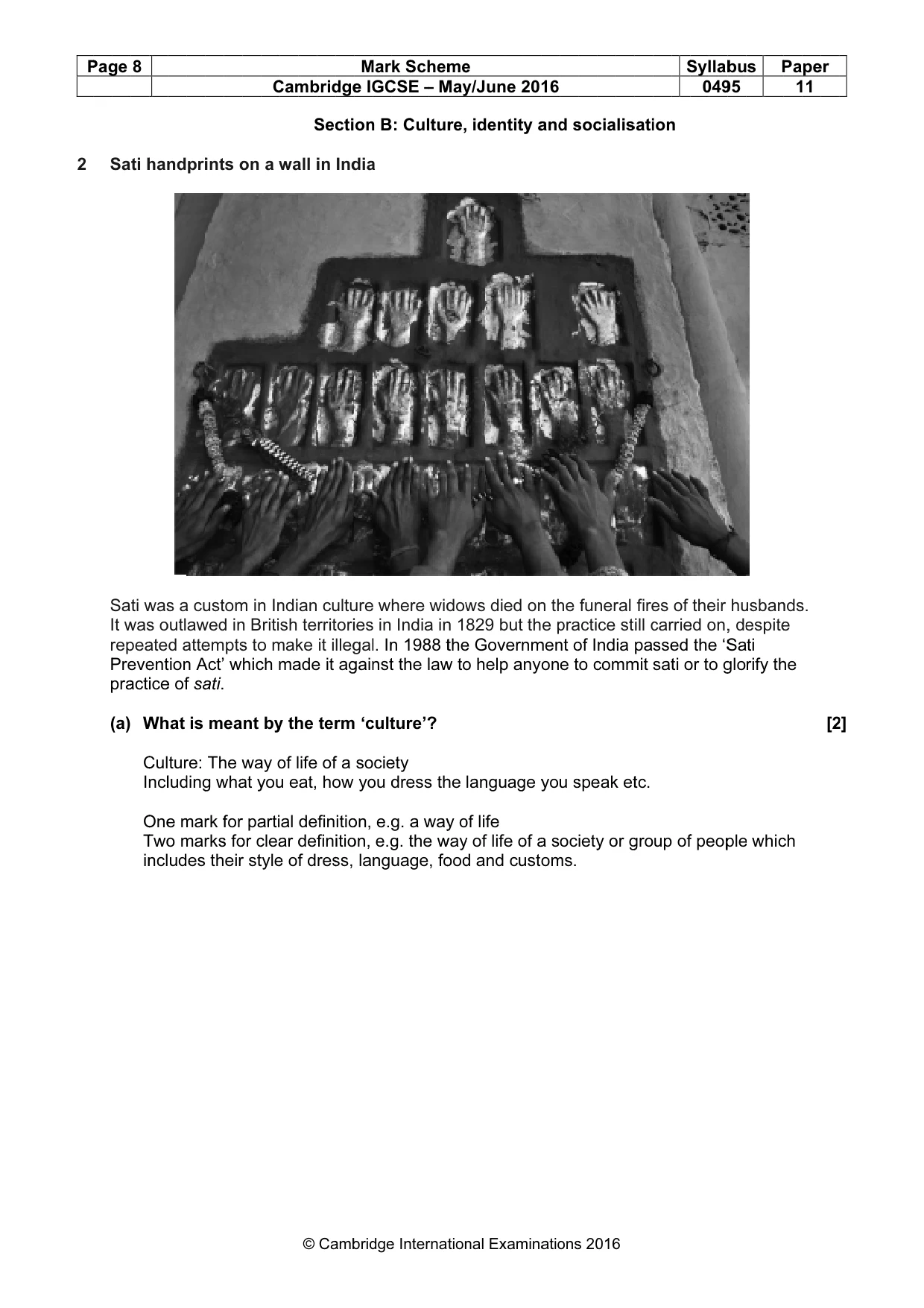
3 0495/11/M/J/16 © UCLES 2016 [Turn over Answer either Question 2 or Question 3. Section B: Culture, identity and socialisation 2 Sati handprints on wall in India Sati was a custom in Indian culture where widows died on the funeral fires of their husbands. It was outlawed in British territories in India in 1829 but the practice still carried on, despite repeated attempts to make it illegal. In 1988 the Government of India passed the ‘Sati Prevention Act’ which made it against the law to help anyone to commit sati or to glorify the practice of sati. (a) What is meant by the term ‘culture’? [2] (b) Describe two examples of customs, apart from sati. [4] (c) Explain how the peer group can encourage conformity. [6] (d) Explain why globalisation may be seen as a threat to local cultures. [8] (e) To what extent do informal sanctions have more influence on behaviour than formal sanctions? [15]
Question paper, page 4
4 0495/11/M/J/16 © UCLES 2016 Section C: Social Inequality 3 ‘Weber believed that social class is based on the economic market place…while it is possible to make out broad classes within which people share broadly similar life chances, there is also a finely graded ladder of classes based on occupations. He distinguished between market situation… and the work situation. An individual’s position on the ladder involves not only income but also their status.’ ‘Cambridge IGCSE Sociology Coursebook’ Jonathan Blundell (a) What is meant by the term ‘market situation’? [2] (b) Describe two examples of inequality, apart from social class. [4] (c) Explain how Marxists define social class. [6] (d) Explain why social class is not the only factor influencing a person’s status. [8] (e) To what extent has social class changed in modern industrial societies? [15] Permission to reproduce items where third-party owned material protected by copyright is included has been sought and cleared where possible. Every reasonable effort has been made by the publisher (UCLES) to trace copyright holders, but if any items requiring clearance have unwittingly been included, the publisher will be pleased to make amends at the earliest possible opportunity. To avoid the issue of disclosure of answer-related information to candidates, all copyright acknowledgements are reproduced online in the Cambridge International Examinations Copyright Acknowledgements Booklet. This is produced for each series of examinations and is freely available to download at www.cie.org.uk after the live examination series. Cambridge International Examinations is part of the Cambridge Assessment Group. Cambridge Assessment is the brand name of University of Cambridge Local Examinations Syndicate (UCLES), which is itself a department of the University of Cambridge.
Mark scheme, page 1
® IGCSE is the registered trademark of Cambridge International Examinations. This document consists of 17 printed pages. © UCLES 2016 [Turn over Cambridge International Examinations Cambridge International General Certificate of Secondary Education SOCIOLOGY 0495/11 Paper 1 May/June 2016 MARK SCHEME Maximum Mark: 80 Published This mark scheme is published as an aid to teachers and candidates, to indicate the requirements of the examination. It shows the basis on which Examiners were instructed to award marks. It does not indicate the details of the discussions that took place at an Examiners’ meeting before marking began, which would have considered the acceptability of alternative answers. Mark schemes should be read in conjunction with the question paper and the Principal Examiner Report for Teachers. Cambridge will not enter into discussions about these mark schemes. Cambridge is publishing the mark schemes for the May/June 2016 series for most Cambridge IGCSE®, Cambridge International A and AS Level components and some Cambridge O Level components.
Mark scheme, page 2
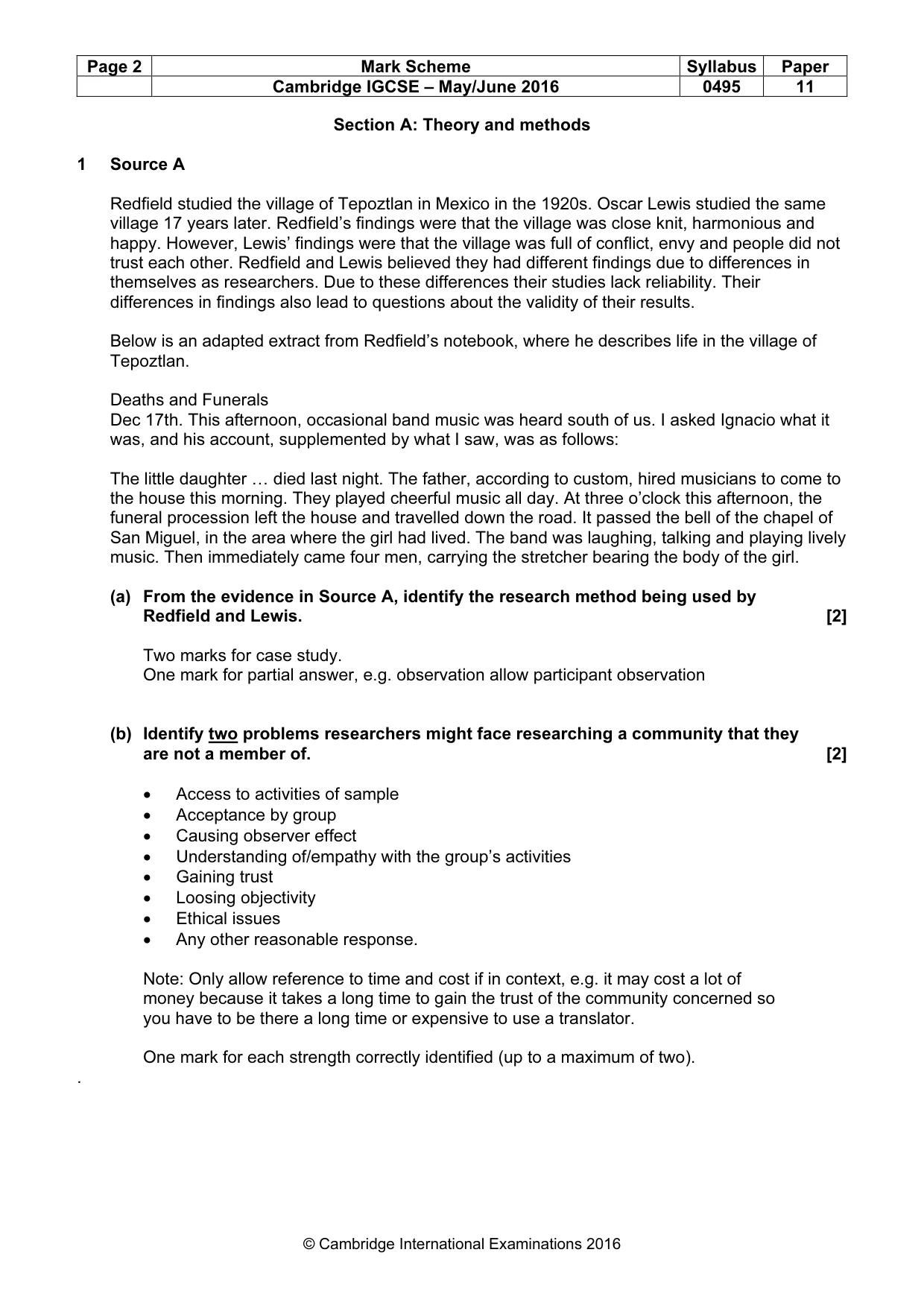
Page 2 Mark Scheme Syllabus Paper Cambridge IGCSE – May/June 2016 0495 11 © Cambridge International Examinations 2016 Section A: Theory and methods 1 Source A Redfield studied the village of Tepoztlan in Mexico in the 1920s. Oscar Lewis studied the same village 17 years later. Redfield’s findings were that the village was close knit, harmonious and happy. However, Lewis’ findings were that the village was full of conflict, envy and people did not trust each other. Redfield and Lewis believed they had different findings due to differences in themselves as researchers. Due to these differences their studies lack reliability. Their differences in findings also lead to questions about the validity of their results. Below is an adapted extract from Redfield’s notebook, where he describes life in the village of Tepoztlan. Deaths and Funerals Dec 17th. This afternoon, occasional band music was heard south of us. I asked Ignacio what it was, and his account, supplemented by what I saw, was as follows: The little daughter … died last night. The father, according to custom, hired musicians to come to the house this morning. They played cheerful music all day. At three o’clock this afternoon, the funeral procession left the house and travelled down the road. It passed the bell of the chapel of San Miguel, in the area where the girl had lived. The band was laughing, talking and playing lively music. Then immediately came four men, carrying the stretcher bearing the body of the girl. (a) From the evidence in Source A, identify the research method being used by Redfield and Lewis. [2] Two marks for case study. One mark for partial answer, e.g. observation allow participant observation (b) Identify two problems researchers might face researching a community that they are not a member of. [2] • Access to activities of sample • Acceptance by group • Causing observer effect • Understanding of/empathy with the group’s activities • Gaining trust • Loosing objectivity • Ethical issues • Any other reasonable response. Note: Only allow reference to time and cost if in context, e.g. it may cost a lot of money because it takes a long time to gain the trust of the community concerned so you have to be there a long time or expensive to use a translator. One mark for each strength correctly identified (up to a maximum of two). .
Mark scheme, page 3
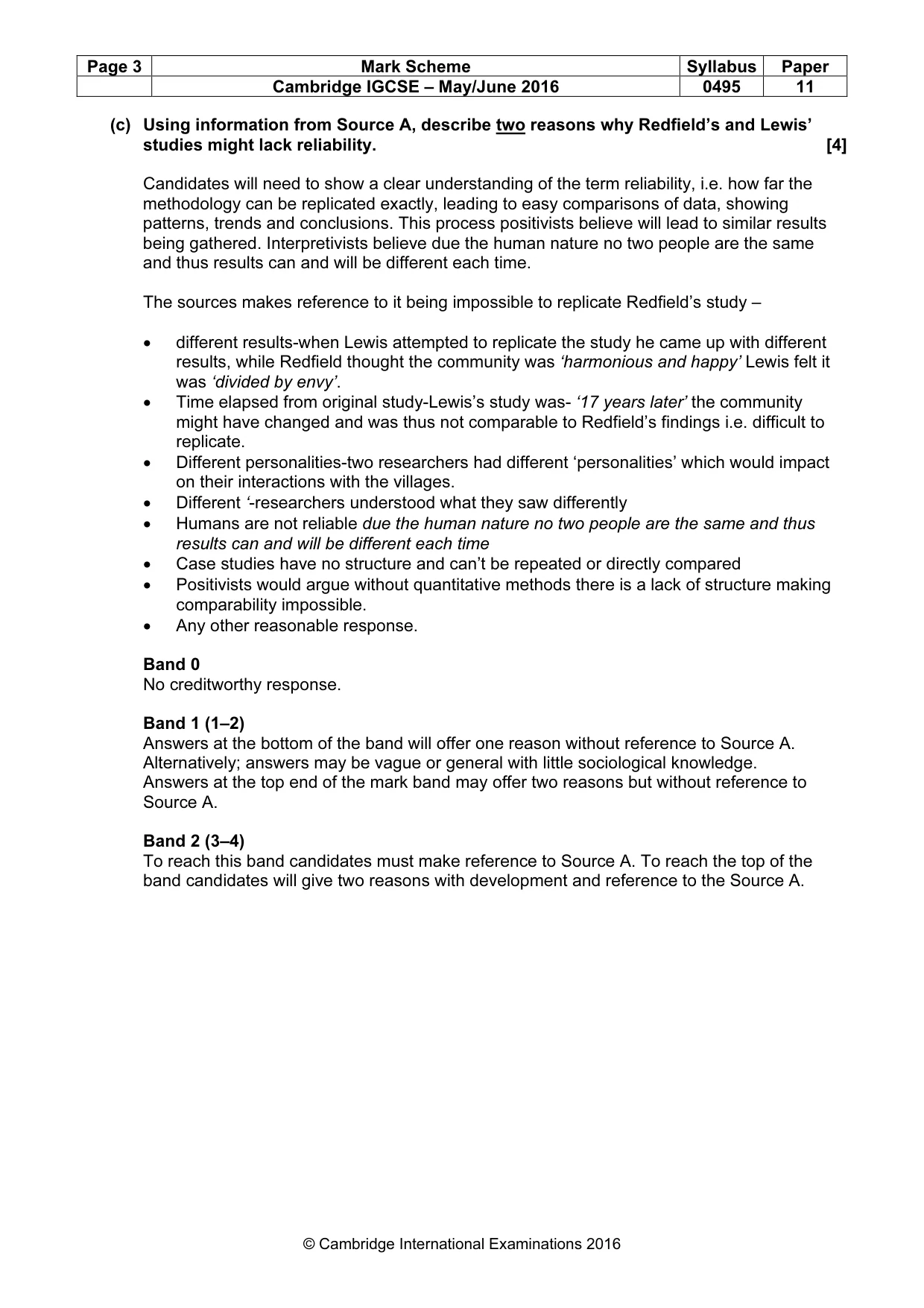
Page 3 Mark Scheme Syllabus Paper Cambridge IGCSE – May/June 2016 0495 11 © Cambridge International Examinations 2016 (c) Using information from Source A, describe two reasons why Redfield’s and Lewis’ studies might lack reliability. [4] Candidates will need to show a clear understanding of the term reliability, i.e. how far the methodology can be replicated exactly, leading to easy comparisons of data, showing patterns, trends and conclusions. This process positivists believe will lead to similar results being gathered. Interpretivists believe due the human nature no two people are the same and thus results can and will be different each time. The sources makes reference to it being impossible to replicate Redfield’s study – • different results-when Lewis attempted to replicate the study he came up with different results, while Redfield thought the community was ‘harmonious and happy’ Lewis felt it was ‘divided by envy’. • Time elapsed from original study-Lewis’s study was- ‘17 years later’ the community might have changed and was thus not comparable to Redfield’s findings i.e. difficult to replicate. • Different personalities-two researchers had different ‘personalities’ which would impact on their interactions with the villages. • Different ‘-researchers understood what they saw differently • Humans are not reliable due the human nature no two people are the same and thus results can and will be different each time • Case studies have no structure and can’t be repeated or directly compared • Positivists would argue without quantitative methods there is a lack of structure making comparability impossible. • Any other reasonable response. Band 0 No creditworthy response. Band 1 (1–2) Answers at the bottom of the band will offer one reason without reference to Source A. Alternatively; answers may be vague or general with little sociological knowledge. Answers at the top end of the mark band may offer two reasons but without reference to Source A. Band 2 (3–4) To reach this band candidates must make reference to Source A. To reach the top of the band candidates will give two reasons with development and reference to the Source A.
Mark scheme, page 4
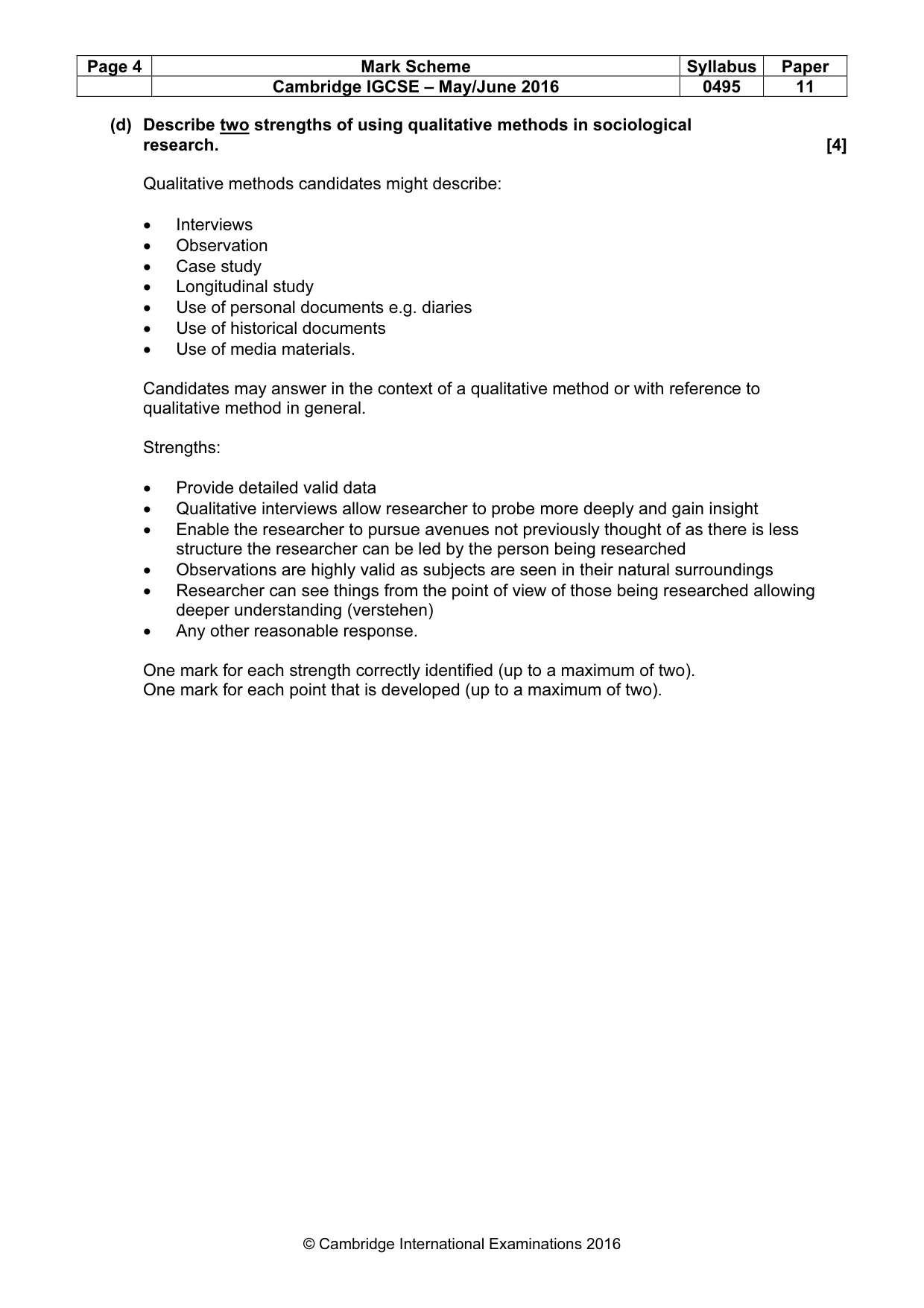
Page 4 Mark Scheme Syllabus Paper Cambridge IGCSE – May/June 2016 0495 11 © Cambridge International Examinations 2016 (d) Describe two strengths of using qualitative methods in sociological research. [4] Qualitative methods candidates might describe: • Interviews • Observation • Case study • Longitudinal study • Use of personal documents e.g. diaries • Use of historical documents • Use of media materials. Candidates may answer in the context of a qualitative method or with reference to qualitative method in general. Strengths: • Provide detailed valid data • Qualitative interviews allow researcher to probe more deeply and gain insight • Enable the researcher to pursue avenues not previously thought of as there is less structure the researcher can be led by the person being researched • Observations are highly valid as subjects are seen in their natural surroundings • Researcher can see things from the point of view of those being researched allowing deeper understanding (verstehen) • Any other reasonable response. One mark for each strength correctly identified (up to a maximum of two). One mark for each point that is developed (up to a maximum of two).
Mark scheme, page 5
Page 5 Mark Scheme Syllabus Paper Cambridge IGCSE – May/June 2016 0495 11 © Cambridge International Examinations 2016 (e) Describe two strengths and two limitations of using secondary data in sociological research. [8] Strengths: • Inexpensive and readily available • May be large scale and allow generalisation (e.g. Official Statistics) • Practical advantage generally being quicker than primary research • To provide background in preparation for primary research • May allow comparison over time • Any other reasonable response. Limitations: • May not be valid • It may not be possible to check the validity • May be out of date • May be biased • May not cover what researcher wants to know • May not have been carried out for the researchers purpose • Any other reasonable response. One mark for each strength correctly identified (up to a maximum of two) and one mark for description of each strength (up to a maximum of two). One mark for each limitation correctly identified (up to a maximum of two) and one mark for description of each limitation (up to a maximum of two). (f) Explain why quantitative data is useful for sociological research. [10] Candidates will be expected to show a clear understanding of the nature of quantitative data. Quantitative data: data that can be represented in numerical, tabular or graphic forms or that can be measured in some way. Candidates may talk about quantitative data in general or they may use specific examples, e.g. official statistics in the context of the question. Candidates might usefully discuss: • It is useful to identify patterns and trends • It can be relatively inexpensive to collect • Secondary quantitative data may be readily available and cheap to access • It is easy to replicate and is therefore viewed as more reliable • Large scale data is likely to be representative • It makes it easy to make comparisons across time and between social groups • It is useful for reaching large research populations and wide geographical areas • Trends may suggest topics for qualitative research • Make it easier to make generalisations about large social groups. • Positivist argue that is easier to be value free and unbiased • Any other reasonable response.
Mark scheme, page 6
Page 6 Mark Scheme Syllabus Paper Cambridge IGCSE – May/June 2016 0495 11 © Cambridge International Examinations 2016 Note: Do not credit points about why quantitative data is not useful Band 0 No creditworthy response. Band 1 (1–3) Answers at this level are likely to show limited understanding and be based on common sense or demonstrate little in the way of clear sociological knowledge or terminology, e.g. quantitative data is useful because it is in numbers. At the top of the band candidates may begin to use some appropriate knowledge or terminology. Candidates may only give one reason. Band 2 (4–7) At the bottom of the band, candidates demonstrate basic understanding of the issue and begin to use some appropriate knowledge and terminology. Supporting explanation may be weak or over simplistic, e.g. quantitative methods are useful because they allow sociologists to make comparisons between social groups. At the top of the band, candidates use appropriate knowledge and terminology but may not fully focus on the question. Candidates are likely to offer more than one reason e.g. quantitative research is useful to the sociologists because it allows them to make comparison between social groups and it is easy to replicate which makes it more reliable. Band 3 (8–10) The candidates’ answer is fully focused on the question, e.g. there are a number of reasons why quantitative data is useful to sociologists, it allows for easy comparison between various social groups and the identification of trends which may then be used to suggest areas of further qualitative research, it is also easier to cover large research populations using quantitative methods which result in more representative data. There is evidence of good use of sociological terms and candidates may make reference to positivist methodology and understand the link between this and quantitative data. At the top of the band, candidates should offer a range of reasons as well as demonstrate accurate use of sociological concepts. (g) To what extent may the researcher affect the validity of the research? [15] Candidates will be expected to discuss researcher effect: Researcher effect values, bias, distortion, issues of validity and choice of research methods on the validity of their research. Candidates can place their answers in the context of the debate between positivists (neutral and objective research) and interpretivist (impossible to be unbiased). Candidates can usefully discuss: Arguments for: • Researcher may lead the subject • Researcher bias • Misinterpretation • Selecting data that matches hypothesis/ ignoring data that doesn’t fit hypothesis • Ethnocentrisms • Any other reasonable response.
Mark scheme, page 7
Page 7 Mark Scheme Syllabus Paper Cambridge IGCSE – May/June 2016 0495 11 © Cambridge International Examinations 2016 Arguments against: • Neutral and objective research • Value free • Triangulation • Peer review • Respondents have more impact on the validity of the research than the researcher • Any other reasonable response. Band 0 No creditworthy response. Band 1 (1–4) Answers in this band may be largely based on common sense showing limited or no knowledge of sociological terms or concepts. Candidates are unlikely to understand the issue of respondents being manipulated by researchers, e.g. if the researcher is friendly and has a nice personality people are more likely to answer their questions. Band 2 (5–8) In this band candidates will tend to offer some basic discussion of researcher affect. They may describe various affects and their problems. Alternatively, they may offer an answer which is list-like in nature but there will be no real attempt to address the issues beyond the personal characteristics of the researcher. At the top of the band, candidates may offer a description of more than one issue, e.g. the researcher may be biased and not behave in an objective manner and they may not have a very friendly personality so people may lie to them. A one-sided answer cannot score higher than 8 marks. Band 3 (9–12) Answers in this band will show good use of sociological language and will make some attempt at addressing the issue of the researchers influence on the research but this may be weak or focus only on either agreement or disagreement with the question. At the bottom of the band, candidates may provide a good range of points but there might be a lack of focus on the issue. At the top of the band, candidates are likely to show either strong agreement or disagreement with clear focus on the question but are unlikely to discuss both sides. Band 4 (13–15) Answers in this band will be clearly focused on the question and address the ‘extent’ of the researcher’s impact on the research. Candidates will offer a range of arguments both for and against the question but this need not be balanced. They show excellent grasp of sociological terms and knowledge. At the top of the band there will also be an evaluative conclusion, e.g. as any research involves choice and some level of human interaction inevitably the researcher will impact on the research but this is less important than the values and bias they bring to the research at the outset. A researcher’s own bias may lead them to misinterpret data that does not fit their hypothesis they may interpret what they see in an ethnocentric way which means their findings lack validity.
Mark scheme, page 8
P 2 Pag S S I r P p ( ge Sa Sa It w rep Pre pra (a) 8 ti h ti w was pea eve acti W C In O T in han was s o ate ent ice Wh Cul ncl One Two ncl nd s a outl d a tion e of hat tur lud e m o m ud pri a cu aw atte n A f sa is re: ding mar mar es int ust wed em Act’ ati. m Th g w rk f rks th ts o tom d in pts w ea he w wha for s fo eir on m in n B s to hic nt wa at y r pa or c r st C a w n In riti o m ch m by ay o you arti clea tyle Cam wa ndi sh mak ma y th of l u e al ar d e of mb © S all i an te ke ade he ife at, de def f d brid Ca Sec in cu rrit it i e it ter of ho fin fini res dge amb cti Ind ultu tori lleg ag rm f a ow itio itio ss, M e IG brid on dia ure ies gal gain ‘c so yo on, on, lan Mar GC dge n B a w in l. In nst cult cie ou d e.g e.g ngu k S CSE e In : C he In n 1 t th tur ety dre g. a g. t uag Sch E – nter Cul re dia 98 he l re’? ess a w the ge hem – M rnat ltur wid a in 88 t law ? s th way e w , fo me May tion re, dow n 1 the w to he y o way ood e y/J nal id ws 82 e G o h lan of li y of d a un Ex den di 9 b Gov elp ngu fe f lif nd ne 2 xam ntit ed but vern p a uag fe o cu 20 mina ty a on t th nm ny ge y of a ust 16 atio and n th e p men on yo a s om ons d s he pra nt o e t u s oc ms. s 20 soc fun acti of I to c spe iety 016 cia ner ce nd com eak y o 6 lis ral st ia mm k et or g sati fire ill c pa mit tc. gro ion es car sse sat up S n of rrie ed ti o of Syl 0 the ed o the or t f pe llab 049 eir on, e ‘S o g eop bu 95 hu , de Sa glo ple s usb esp ti rify e w P ban pite y th hic Pa 1 nds e he ch pe 1 s. er [2]
Mark scheme, page 9
Page 9 Mark Scheme Syllabus Paper Cambridge IGCSE – May/June 2016 0495 11 © Cambridge International Examinations 2016 (b) Describe two examples of customs, apart from sati. [4] Customs: norms in a particular society that are widely accepted and are carried on over time. Any custom is acceptable there may be wide cultural variation on this: • Use of specific colours, e.g. wearing white at a Christian wedding, black for mourning, wearing red at a Hindu wedding. • Eating specific foods for feasts and celebrations e.g. turkey at Christmas in UK • Ceremonial customs, e.g. father giving away the bride, having a dowry • Styles of dress, e.g. wearing a kimono in Japan, wearing a kilt in Scotland, wearing turbans • Any other reasonable answer. Note: Candidates who simply state ‘dress’ or ‘food’ should not be given credit. One mark for each custom identified (up to maximum of two). One mark for each description (up to a maximum of two). (c) Explain how the peer group can encourage conformity. [6] Candidates are expected to discuss the importance of the peer group as an agent of informal social control. Possible responses may include: • Need to fit in/belong • Use of various rewards and sanctions • Adopting norms and values of the group • Ostracism/rejection/ acceptance/approval etc. • Any other reasonable response. Band 0 No creditworthy response. Band 1 (1–3) Answers in this band will show only a limited understanding of the role of the peer group as an agent of social control. Responses may be short and un/under developed. At the top of the band, there may be a tendency towards simplistic answers, engaging with sociological ideas without using sociological language. Alternatively, candidates may offer a wider range of weak points. Answers may be placed broadly within the concept of peer group. Band 2 (4–6) A clear and accurate explanation showing good sociological knowledge and understanding of the role of the peer group as an agent of social control which is supported by relevant examples. Sociological terms should be expected. At the top of the band candidates will use sociological terms and concepts, referring to a range of factors. Candidates will address the role of the peer group in ensuring conformity.
Mark scheme, page 10
Page 10 Mark Scheme Syllabus Paper Cambridge IGCSE – May/June 2016 0495 11 © Cambridge International Examinations 2016 (d) Explain why globalisation may be seen as a threat to local cultures. [8] Possible evidence: • Western media domination- Hollywood films spreading American values • Western dominated music industry-spreading western culture and values • Dominance of English language spread by media, internet and social media spreading western norms and values • Western style clothing, jeans and t shirt widely adopted especially by youth • Homogeneous culture • Western food brands • Western designer brands • Western sports Football (soccer) European origin of sport • Global tourism dominated by western tourists caters to western tastes worldwide. • International news production dominated by western corporations • Any other reasonable response Band 0 No creditworthy response. Band 1 (1–3) Answers in this band will show only a limited awareness of why local cultures are seen as under threat. There may be some discussion of cultural differences but this may not be directed to the question. Responses may be short and undeveloped. Sociological terms and concepts are unlikely to be used. At the top of the band, candidates may offer more than one weak point. Band 2 (4–6) Answers in this band will show basic sociological knowledge and understanding. At the bottom of the band, candidates are unlikely to use sociological terms and concepts accurately. Responses may be underdeveloped and lacking in range. Answers may focus on describing globalisation/global culture; this may include description of some global trends, organisations, without any attempt to explain why globalisation may threaten local culture, e.g. globalisation means that the unique culture of many countries is disappearing in favour of one worldwide culture. At the top of the band, candidates may be beginning to use sociological terms and concepts with greater accuracy. However, some aspects of the answer may only be partially developed. Band 3 (7–8) Answers in this band will show good sociological knowledge and understanding of why globalisation may threaten local culture and will be well developed and explained. Sociological terms and concepts will be used accurately. Answers will be well focused on the question and there will be a range of reasons presented. At the top of the band explanations will be clear throughout.
Mark scheme, page 11
Page 11 Mark Scheme Syllabus Paper Cambridge IGCSE – May/June 2016 0495 11 © Cambridge International Examinations 2016 (e) To what extent do informal sanctions have more influence on behaviour than formal sanctions? [15] Candidates should show an awareness of the role of formal and informal sanctions and agents of social control in ensuring social conformity. Candidates will need to engage with discussion of the role of various formal and informal agencies of socialisation and their role in ensuring social conformity. Candidates might usefully consider ideas like value consensus, authority, ideological state apparatus and they might consider the extent to which formal sanctions might be ignored, e.g. laws broken because of peer pressure or because it is widely accepted. Candidates might also suggest that it is the rewards that are most effective not the sanctions. Informal agents: • Family • Religious community • School • Media • Peers • Work place Formal agents: • Government • Police • Courts • Penal system Possible answers: For • Need to belong to group • Need to conform • Social pressure teasing, bullying, ostracism, shunning, exclusion, excommunication • Influence of values with in religious, peer group, family, education system • Effect of socialisation by informal agents of socialisation • Functionalist view- value consensus • Marxist view-ideological control, media, propaganda and hidden curriculum • Punishments within family, e.g. being grounded • Punishments within school, e.g. detentions • Formal agents using informal sanctions, e.g. police just giving you a ‘telling off’ • Any other reasonable response. Against • Role of police-arrest • Role of courts fines, imprisonment etc. • Role of prison in ensuring conformity • Use of coercion • Deterrent effect of consequences of breaking law, financial, social, e.g. loss of job, reputation etc. • Any other reasonable response.
Mark scheme, page 12
Page 12 Mark Scheme Syllabus Paper Cambridge IGCSE – May/June 2016 0495 11 © Cambridge International Examinations 2016 Band 0 No creditworthy response. Band 1 (1–4) Answers in this band may be vague and largely based on common sense showing limited knowledge of formal and informal sanctions. Responses may be short, undeveloped and one-sided, e.g. formal controls are more important because people are scared of the police. At the bottom of the band, use of sociological terms or concepts is very unlikely. At the top of the band, candidates may understand what formal and informal sanctions means. Band 2 (5–8) In this band candidates will show some basic knowledge of the role of formal and informal sanctions in ensuring conformity. Alternatively, they may offer an answer which is list-like in nature but there will be no real attempt to address the issues raised by the question. There may be limited use of sociological terms or concepts. Responses may be underdeveloped and lack range. Answers may be simplistic and two-sided responses are unlikely. At the top of the band, candidates may describe types of formal and informal social control. A one-sided answer cannot score higher than 8 marks. Band 3 (9–12) Answers in this band will show good sociological knowledge and understanding of the impact of the role of formal and informal sanctions in maintaining social control. Sociological terms and concepts will be used with greater accuracy and/or frequency. For the most part, answers will be well developed, focused on the question and there will be a range of points presented. There will be a two-sided response but this may be unbalanced. At the bottom of the band, candidates may provide a narrower range of points. At the top of the band, expect a wider range of points and clear focus on the question, e.g. informal sanctions are very important in maintaining social conformity and stability, children learn norms and values from their parents as part of primary socialisation, if they do not conform they may face punishments like being grounded but if this socialisation is ineffective formal sanctions may be used. Band 4 (13–15) Answers in this band will show an excellent knowledge and understanding of the processes of the role of formal and informal sanctions .There will be a strong grasp of the argument as well as accurate and frequent use of sociological terms and concepts. Answers will be well developed, clearly focused on the question and discuss a wide range of points. Responses will be two-sided and balanced. At the bottom of the band, some attempt at a conclusion will be made. At the top of the band, there will be a clear attempt to offer an assessment of the ‘To what extent…?’ part of the question through a focused conclusion, e.g. informal sanctions are a very important part of ensuring social order and stability but informal sanctions do not always ensure conformity therefore some form of coercion through formal agencies of social control may also be required.
Mark scheme, page 13
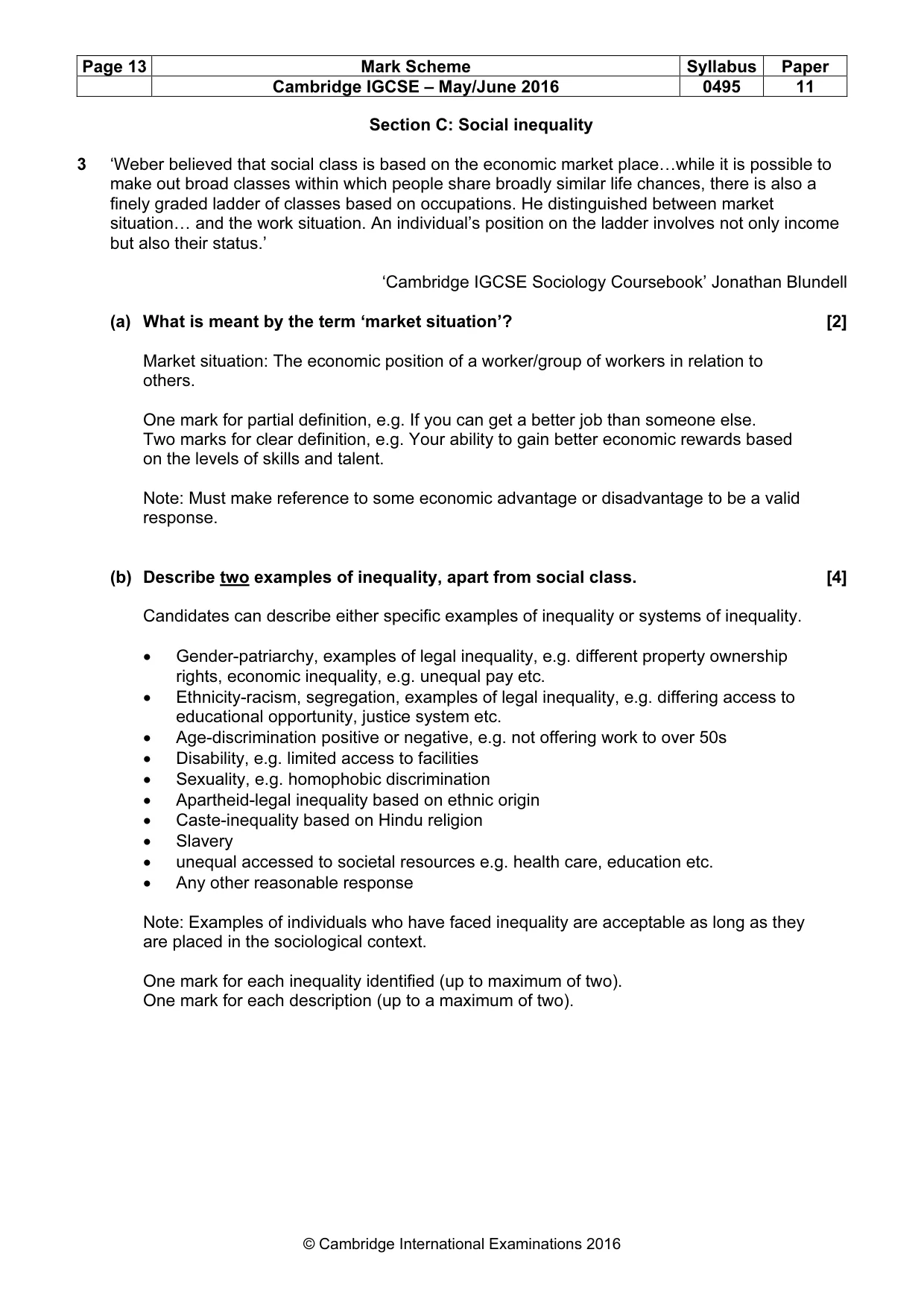
Page 13 Mark Scheme Syllabus Paper Cambridge IGCSE – May/June 2016 0495 11 © Cambridge International Examinations 2016 Section C: Social inequality 3 ‘Weber believed that social class is based on the economic market place…while it is possible to make out broad classes within which people share broadly similar life chances, there is also a finely graded ladder of classes based on occupations. He distinguished between market situation… and the work situation. An individual’s position on the ladder involves not only income but also their status.’ ‘Cambridge IGCSE Sociology Coursebook’ Jonathan Blundell (a) What is meant by the term ‘market situation’? [2] Market situation: The economic position of a worker/group of workers in relation to others. One mark for partial definition, e.g. If you can get a better job than someone else. Two marks for clear definition, e.g. Your ability to gain better economic rewards based on the levels of skills and talent. Note: Must make reference to some economic advantage or disadvantage to be a valid response. (b) Describe two examples of inequality, apart from social class. [4] Candidates can describe either specific examples of inequality or systems of inequality. • Gender-patriarchy, examples of legal inequality, e.g. different property ownership rights, economic inequality, e.g. unequal pay etc. • Ethnicity-racism, segregation, examples of legal inequality, e.g. differing access to educational opportunity, justice system etc. • Age-discrimination positive or negative, e.g. not offering work to over 50s • Disability, e.g. limited access to facilities • Sexuality, e.g. homophobic discrimination • Apartheid-legal inequality based on ethnic origin • Caste-inequality based on Hindu religion • Slavery • unequal accessed to societal resources e.g. health care, education etc. • Any other reasonable response Note: Examples of individuals who have faced inequality are acceptable as long as they are placed in the sociological context. One mark for each inequality identified (up to maximum of two). One mark for each description (up to a maximum of two).
Mark scheme, page 14
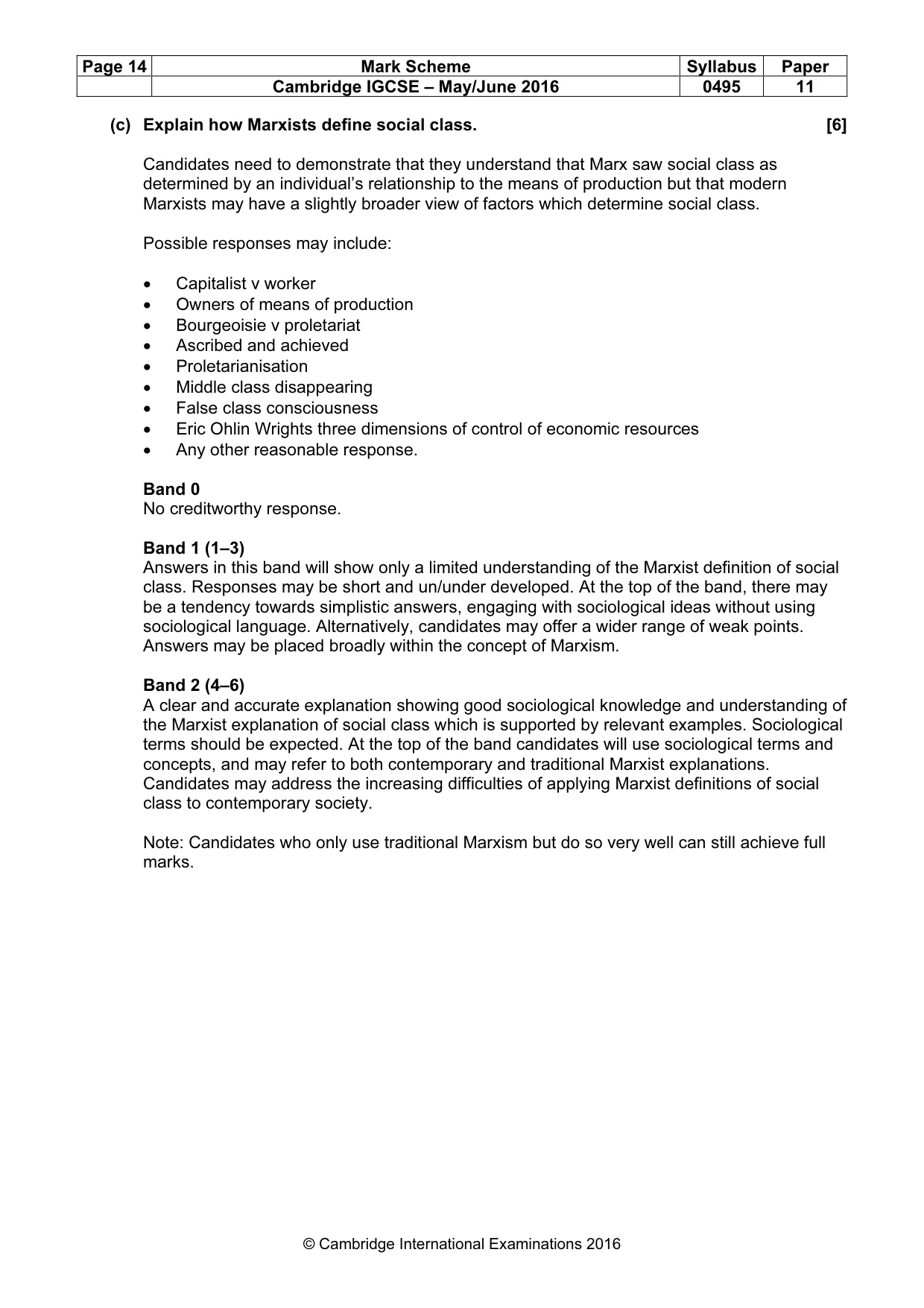
Page 14 Mark Scheme Syllabus Paper Cambridge IGCSE – May/June 2016 0495 11 © Cambridge International Examinations 2016 (c) Explain how Marxists define social class. [6] Candidates need to demonstrate that they understand that Marx saw social class as determined by an individual’s relationship to the means of production but that modern Marxists may have a slightly broader view of factors which determine social class. Possible responses may include: • Capitalist v worker • Owners of means of production • Bourgeoisie v proletariat • Ascribed and achieved • Proletarianisation • Middle class disappearing • False class consciousness • Eric Ohlin Wrights three dimensions of control of economic resources • Any other reasonable response. Band 0 No creditworthy response. Band 1 (1–3) Answers in this band will show only a limited understanding of the Marxist definition of social class. Responses may be short and un/under developed. At the top of the band, there may be a tendency towards simplistic answers, engaging with sociological ideas without using sociological language. Alternatively, candidates may offer a wider range of weak points. Answers may be placed broadly within the concept of Marxism. Band 2 (4–6) A clear and accurate explanation showing good sociological knowledge and understanding of the Marxist explanation of social class which is supported by relevant examples. Sociological terms should be expected. At the top of the band candidates will use sociological terms and concepts, and may refer to both contemporary and traditional Marxist explanations. Candidates may address the increasing difficulties of applying Marxist definitions of social class to contemporary society. Note: Candidates who only use traditional Marxism but do so very well can still achieve full marks.
Mark scheme, page 15
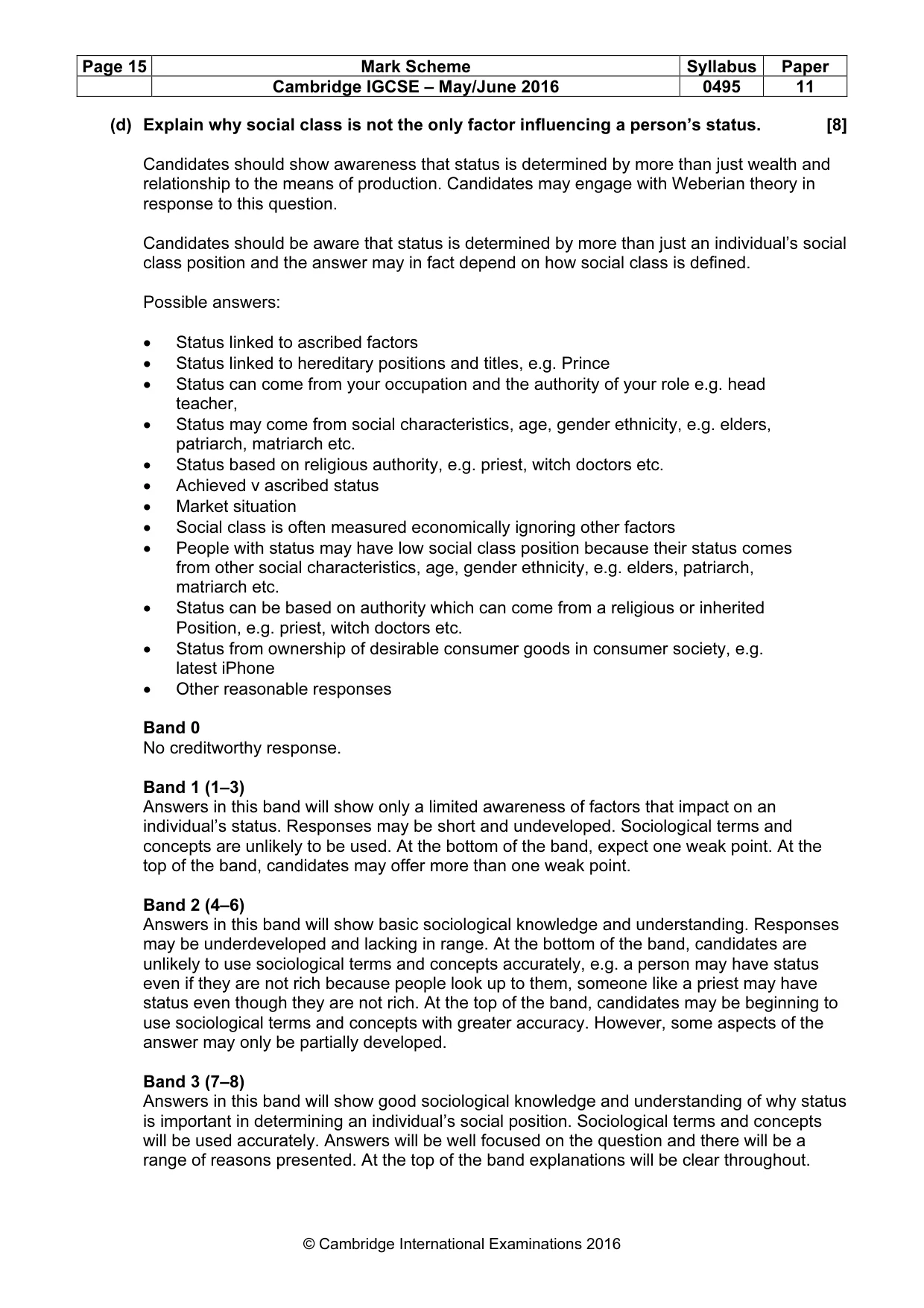
Page 15 Mark Scheme Syllabus Paper Cambridge IGCSE – May/June 2016 0495 11 © Cambridge International Examinations 2016 (d) Explain why social class is not the only factor influencing a person’s status. [8] Candidates should show awareness that status is determined by more than just wealth and relationship to the means of production. Candidates may engage with Weberian theory in response to this question. Candidates should be aware that status is determined by more than just an individual’s social class position and the answer may in fact depend on how social class is defined. Possible answers: • Status linked to ascribed factors • Status linked to hereditary positions and titles, e.g. Prince • Status can come from your occupation and the authority of your role e.g. head teacher, • Status may come from social characteristics, age, gender ethnicity, e.g. elders, patriarch, matriarch etc. • Status based on religious authority, e.g. priest, witch doctors etc. • Achieved v ascribed status • Market situation • Social class is often measured economically ignoring other factors • People with status may have low social class position because their status comes from other social characteristics, age, gender ethnicity, e.g. elders, patriarch, matriarch etc. • Status can be based on authority which can come from a religious or inherited Position, e.g. priest, witch doctors etc. • Status from ownership of desirable consumer goods in consumer society, e.g. latest iPhone • Other reasonable responses Band 0 No creditworthy response. Band 1 (1–3) Answers in this band will show only a limited awareness of factors that impact on an individual’s status. Responses may be short and undeveloped. Sociological terms and concepts are unlikely to be used. At the bottom of the band, expect one weak point. At the top of the band, candidates may offer more than one weak point. Band 2 (4–6) Answers in this band will show basic sociological knowledge and understanding. Responses may be underdeveloped and lacking in range. At the bottom of the band, candidates are unlikely to use sociological terms and concepts accurately, e.g. a person may have status even if they are not rich because people look up to them, someone like a priest may have status even though they are not rich. At the top of the band, candidates may be beginning to use sociological terms and concepts with greater accuracy. However, some aspects of the answer may only be partially developed. Band 3 (7–8) Answers in this band will show good sociological knowledge and understanding of why status is important in determining an individual’s social position. Sociological terms and concepts will be used accurately. Answers will be well focused on the question and there will be a range of reasons presented. At the top of the band explanations will be clear throughout.
Mark scheme, page 16
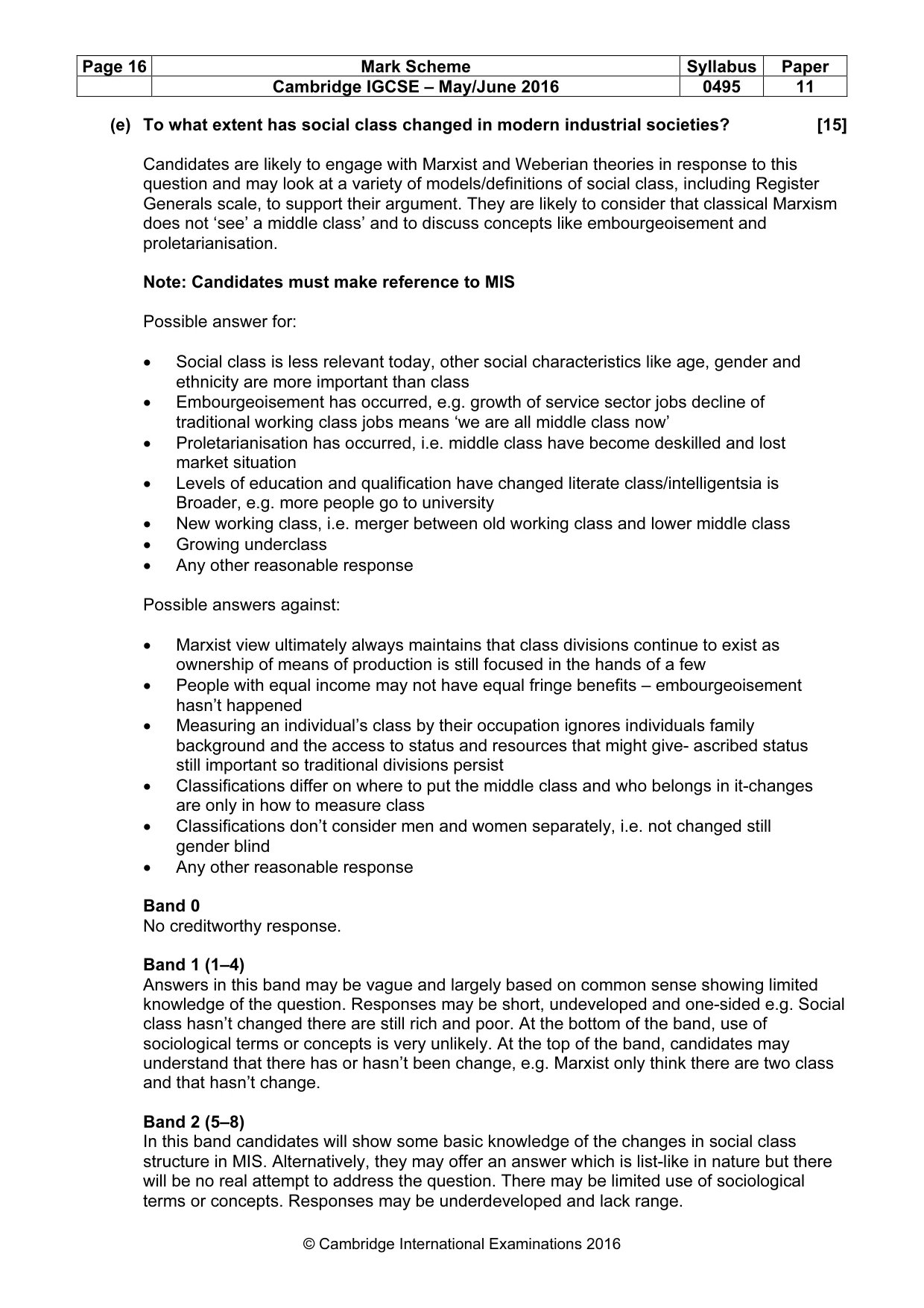
Page 16 Mark Scheme Syllabus Paper Cambridge IGCSE – May/June 2016 0495 11 © Cambridge International Examinations 2016 (e) To what extent has social class changed in modern industrial societies? [15] Candidates are likely to engage with Marxist and Weberian theories in response to this question and may look at a variety of models/definitions of social class, including Register Generals scale, to support their argument. They are likely to consider that classical Marxism does not ‘see’ a middle class’ and to discuss concepts like embourgeoisement and proletarianisation. Note: Candidates must make reference to MIS Possible answer for: • Social class is less relevant today, other social characteristics like age, gender and ethnicity are more important than class • Embourgeoisement has occurred, e.g. growth of service sector jobs decline of traditional working class jobs means ‘we are all middle class now’ • Proletarianisation has occurred, i.e. middle class have become deskilled and lost market situation • Levels of education and qualification have changed literate class/intelligentsia is Broader, e.g. more people go to university • New working class, i.e. merger between old working class and lower middle class • Growing underclass • Any other reasonable response Possible answers against: • Marxist view ultimately always maintains that class divisions continue to exist as ownership of means of production is still focused in the hands of a few • People with equal income may not have equal fringe benefits – embourgeoisement hasn’t happened • Measuring an individual’s class by their occupation ignores individuals family background and the access to status and resources that might give- ascribed status still important so traditional divisions persist • Classifications differ on where to put the middle class and who belongs in it-changes are only in how to measure class • Classifications don’t consider men and women separately, i.e. not changed still gender blind • Any other reasonable response Band 0 No creditworthy response. Band 1 (1–4) Answers in this band may be vague and largely based on common sense showing limited knowledge of the question. Responses may be short, undeveloped and one-sided e.g. Social class hasn’t changed there are still rich and poor. At the bottom of the band, use of sociological terms or concepts is very unlikely. At the top of the band, candidates may understand that there has or hasn’t been change, e.g. Marxist only think there are two class and that hasn’t change. Band 2 (5–8) In this band candidates will show some basic knowledge of the changes in social class structure in MIS. Alternatively, they may offer an answer which is list-like in nature but there will be no real attempt to address the question. There may be limited use of sociological terms or concepts. Responses may be underdeveloped and lack range.
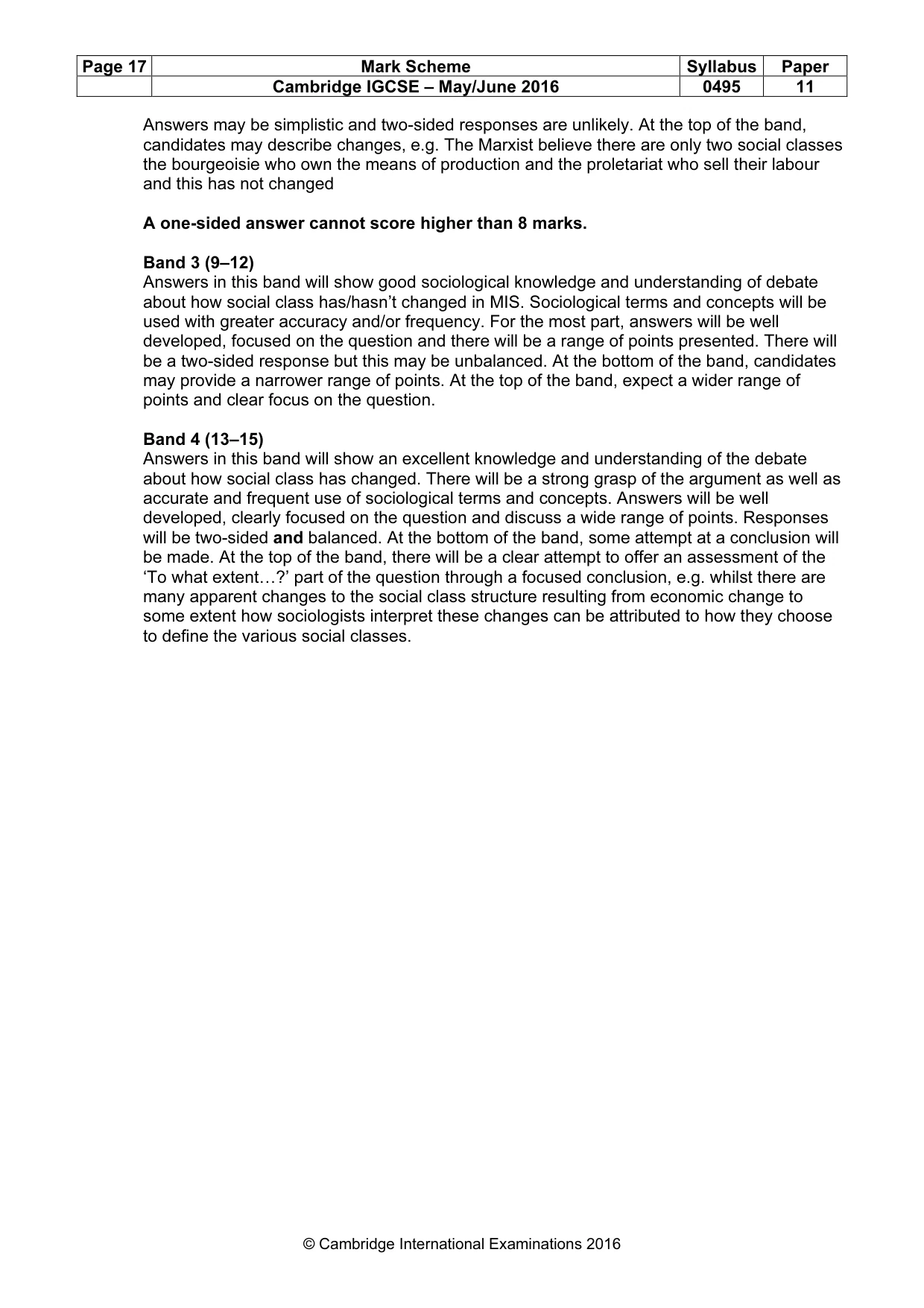
Mark scheme, page 17
Page 17 Mark Scheme Syllabus Paper Cambridge IGCSE – May/June 2016 0495 11 © Cambridge International Examinations 2016 Answers may be simplistic and two-sided responses are unlikely. At the top of the band, candidates may describe changes, e.g. The Marxist believe there are only two social classes the bourgeoisie who own the means of production and the proletariat who sell their labour and this has not changed A one-sided answer cannot score higher than 8 marks. Band 3 (9–12) Answers in this band will show good sociological knowledge and understanding of debate about how social class has/hasn’t changed in MIS. Sociological terms and concepts will be used with greater accuracy and/or frequency. For the most part, answers will be well developed, focused on the question and there will be a range of points presented. There will be a two-sided response but this may be unbalanced. At the bottom of the band, candidates may provide a narrower range of points. At the top of the band, expect a wider range of points and clear focus on the question. Band 4 (13–15) Answers in this band will show an excellent knowledge and understanding of the debate about how social class has changed. There will be a strong grasp of the argument as well as accurate and frequent use of sociological terms and concepts. Answers will be well developed, clearly focused on the question and discuss a wide range of points. Responses will be two-sided and balanced. At the bottom of the band, some attempt at a conclusion will be made. At the top of the band, there will be a clear attempt to offer an assessment of the ‘To what extent…?’ part of the question through a focused conclusion, e.g. whilst there are many apparent changes to the social class structure resulting from economic change to some extent how sociologists interpret these changes can be attributed to how they choose to define the various social classes.
What you needed in this session
Cambridge’s own grade thresholds for 2016 May/June, Paper 1 · Variant 1. A higher threshold means an easier paper — the bar moves with how the cohort did.