Cambridge IGCSE Sociology 0495 — 2015 Oct/Nov Paper 2 · Variant 3
0495/23/O/N/15 · 70 marks · ≈79 min
The question paper and its mark scheme, free to read here and free to download. This is Cambridge’s own paper, exactly as it was sat.
Question paper4 pages

Mark scheme17 pages
Answers below. Sit the paper first if you are practising.
Paper as text
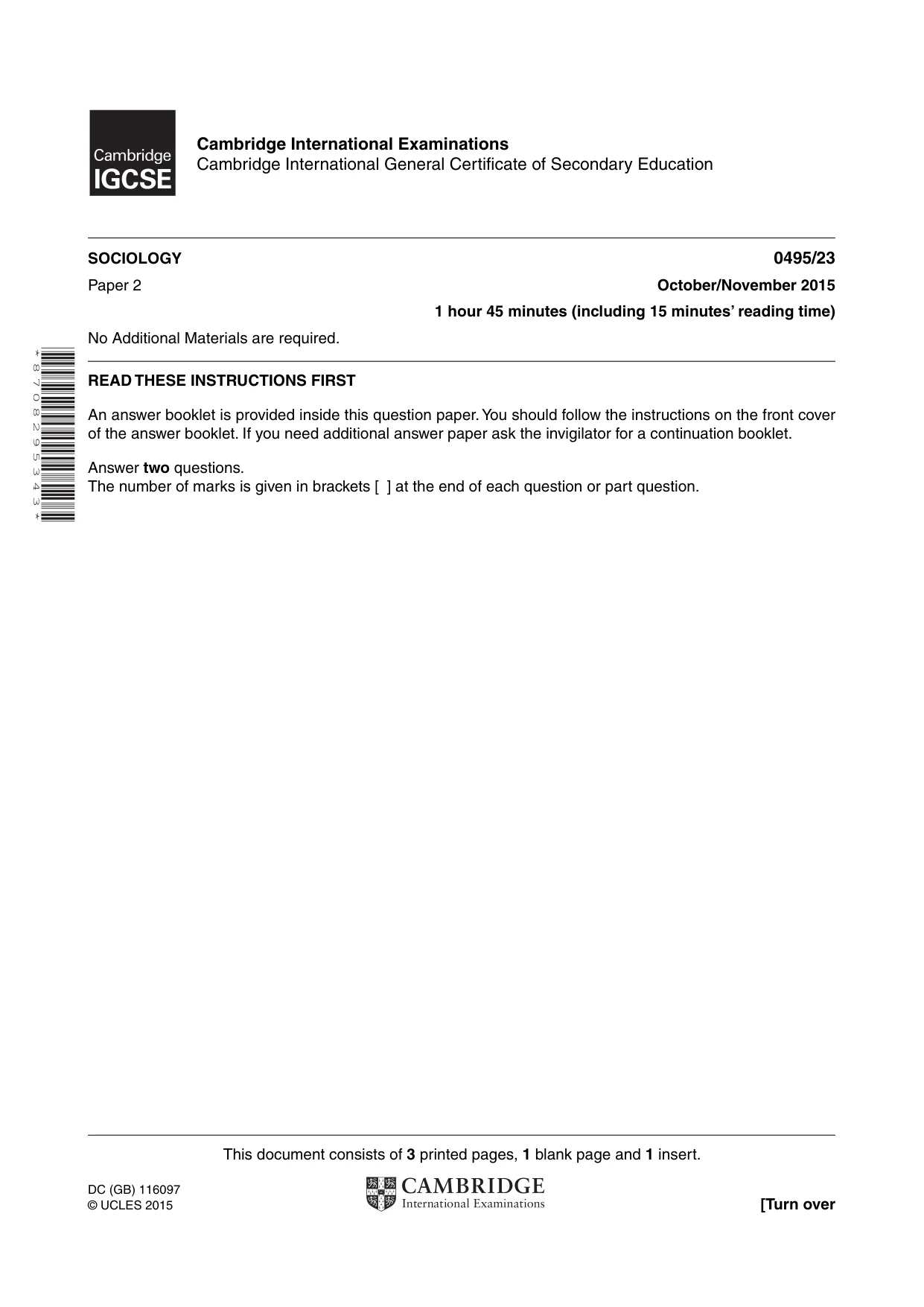
Question paper, page 1
This document consists of 3 printed pages, 1 blank page and 1 insert. DC (GB) 116097 © UCLES 2015 [Turn over Cambridge International Examinations Cambridge International General Certificate of Secondary Education * 8 7 0 8 2 9 5 3 4 3 * SOCIOLOGY 0495/23 Paper 2 October/November 2015 1 hour 45 minutes (including 15 minutes’ reading time) No Additional Materials are required. READ THESE INSTRUCTIONS FIRST An answer booklet is provided inside this question paper. You should follow the instructions on the front cover of the answer booklet. If you need additional answer paper ask the invigilator for a continuation booklet. Answer two questions. The number of marks is given in brackets [ ] at the end of each question or part question.
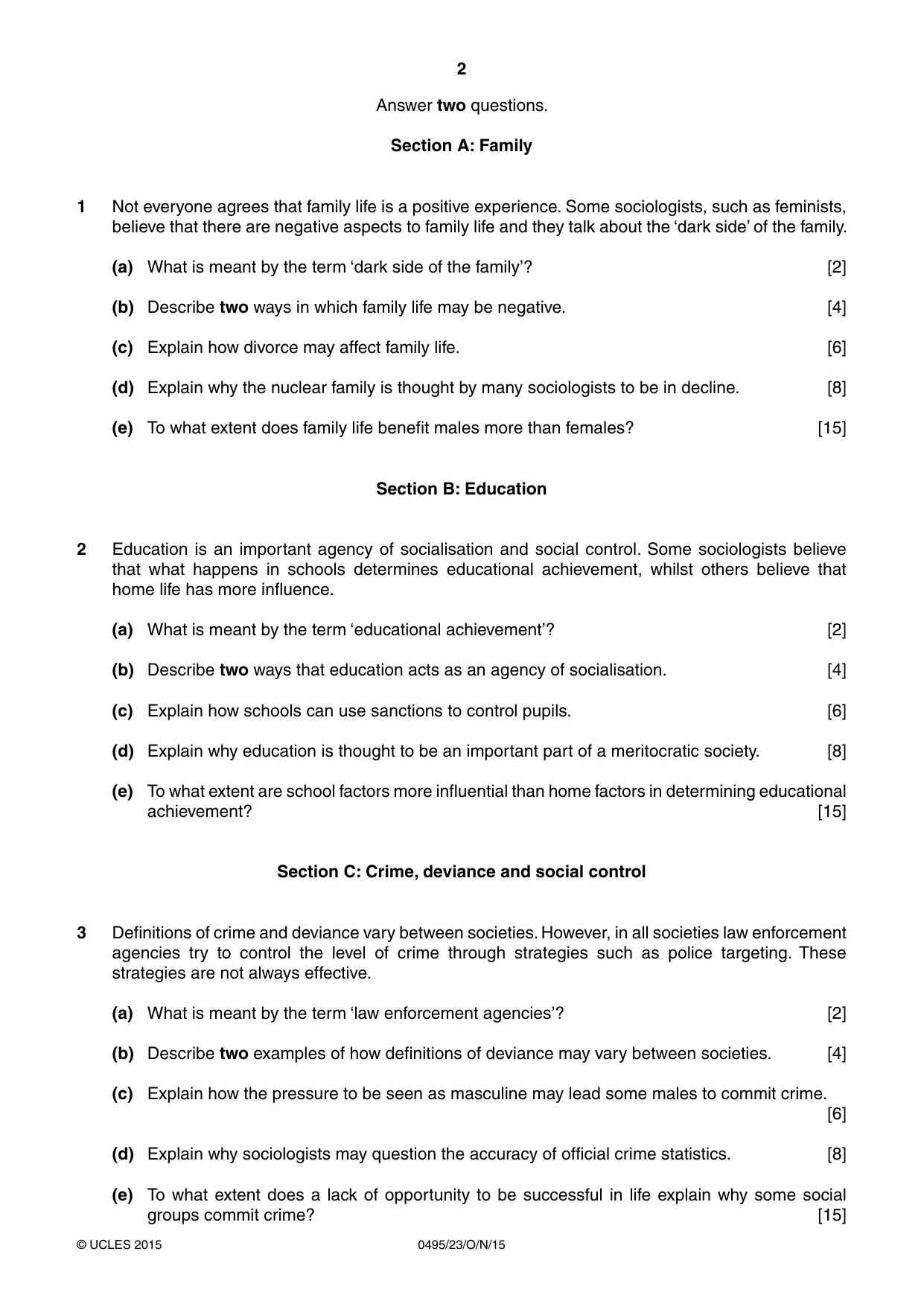
Question paper, page 2
2 0495/23/O/N/15 © UCLES 2015 Answer two questions. Section A: Family 1 Not everyone agrees that family life is a positive experience. Some sociologists, such as feminists, believe that there are negative aspects to family life and they talk about the ‘dark side’ of the family. (a) What is meant by the term ‘dark side of the family’? [2] (b) Describe two ways in which family life may be negative. [4] (c) Explain how divorce may affect family life. [6] (d) Explain why the nuclear family is thought by many sociologists to be in decline. [8] (e) To what extent does family life benefit males more than females? [15] Section B: Education 2 Education is an important agency of socialisation and social control. Some sociologists believe that what happens in schools determines educational achievement, whilst others believe that home life has more influence. (a) What is meant by the term ‘educational achievement’? [2] (b) Describe two ways that education acts as an agency of socialisation. [4] (c) Explain how schools can use sanctions to control pupils. [6] (d) Explain why education is thought to be an important part of a meritocratic society. [8] (e) To what extent are school factors more influential than home factors in determining educational achievement? [15] Section C: Crime, deviance and social control 3 Definitions of crime and deviance vary between societies. However, in all societies law enforcement agencies try to control the level of crime through strategies such as police targeting. These strategies are not always effective. (a) What is meant by the term ‘law enforcement agencies’? [2] (b) Describe two examples of how definitions of deviance may vary between societies. [4] (c) Explain how the pressure to be seen as masculine may lead some males to commit crime. [6] (d) Explain why sociologists may question the accuracy of official crime statistics. [8] (e) To what extent does a lack of opportunity to be successful in life explain why some social groups commit crime? [15]
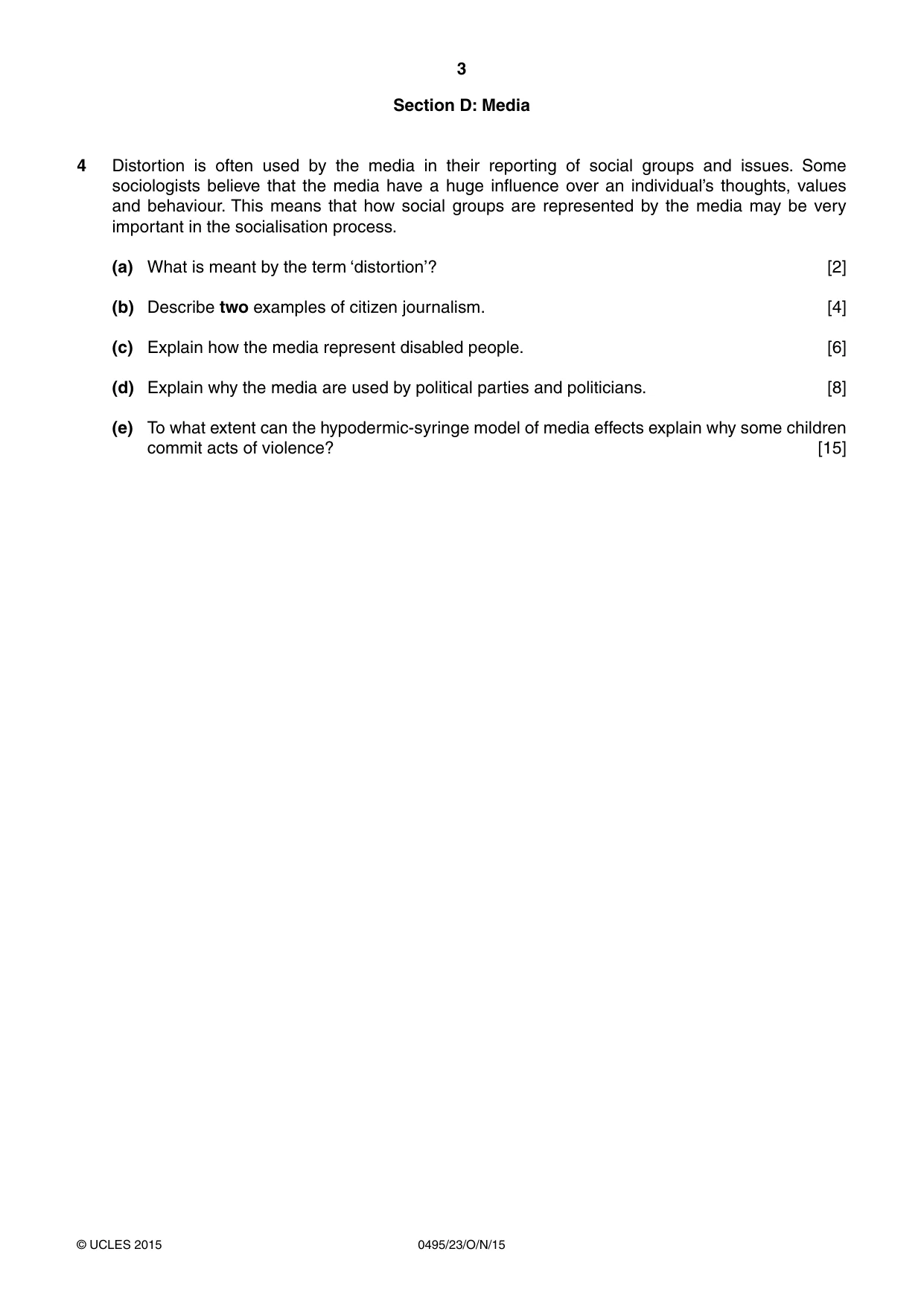
Question paper, page 3
3 0495/23/O/N/15 © UCLES 2015 Section D: Media 4 Distortion is often used by the media in their reporting of social groups and issues. Some sociologists believe that the media have a huge influence over an individual’s thoughts, values and behaviour. This means that how social groups are represented by the media may be very important in the socialisation process. (a) What is meant by the term ‘distortion’? [2] (b) Describe two examples of citizen journalism. [4] (c) Explain how the media represent disabled people. [6] (d) Explain why the media are used by political parties and politicians. [8] (e) To what extent can the hypodermic-syringe model of media effects explain why some children commit acts of violence? [15]
Question paper, page 4
4 0495/23/O/N/15 © UCLES 2015 Permission to reproduce items where third-party owned material protected by copyright is included has been sought and cleared where possible. Every reasonable effort has been made by the publisher (UCLES) to trace copyright holders, but if any items requiring clearance have unwittingly been included, the publisher will be pleased to make amends at the earliest possible opportunity. To avoid the issue of disclosure of answer-related information to candidates, all copyright acknowledgements are reproduced online in the Cambridge International Examinations Copyright Acknowledgements Booklet. This is produced for each series of examinations and is freely available to download at www.cie.org.uk after the live examination series. Cambridge International Examinations is part of the Cambridge Assessment Group. Cambridge Assessment is the brand name of University of Cambridge Local Examinations Syndicate (UCLES), which is itself a department of the University of Cambridge. BLANK PAGE
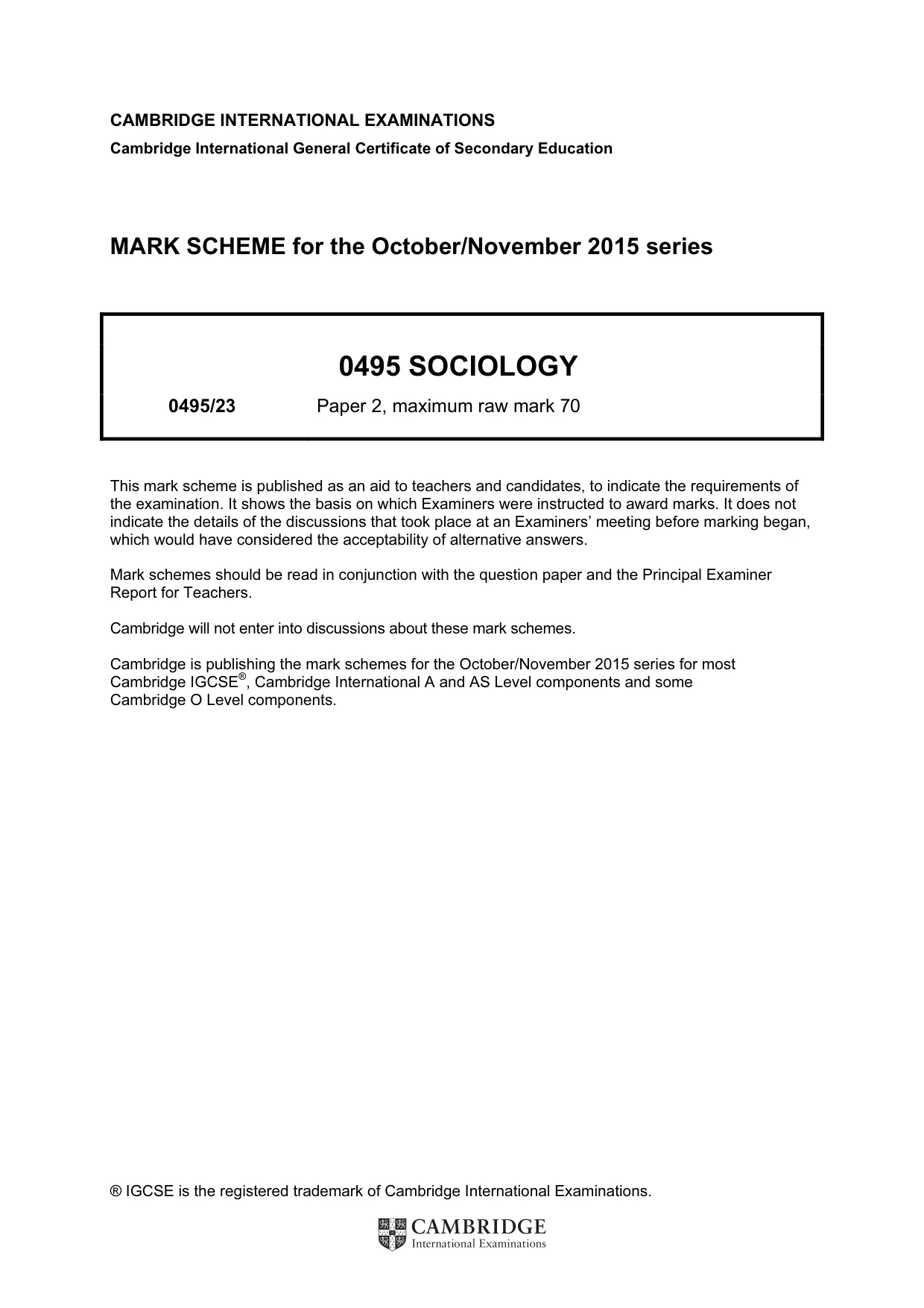
Mark scheme, page 1
® IGCSE is the registered trademark of Cambridge International Examinations. CAMBRIDGE INTERNATIONAL EXAMINATIONS Cambridge International General Certificate of Secondary Education MARK SCHEME for the October/November 2015 series 0495 SOCIOLOGY 0495/23 Paper 2, maximum raw mark 70 This mark scheme is published as an aid to teachers and candidates, to indicate the requirements of the examination. It shows the basis on which Examiners were instructed to award marks. It does not indicate the details of the discussions that took place at an Examiners’ meeting before marking began, which would have considered the acceptability of alternative answers. Mark schemes should be read in conjunction with the question paper and the Principal Examiner Report for Teachers. Cambridge will not enter into discussions about these mark schemes. Cambridge is publishing the mark schemes for the October/November 2015 series for most Cambridge IGCSE®, Cambridge International A and AS Level components and some Cambridge O Level components.
Mark scheme, page 2
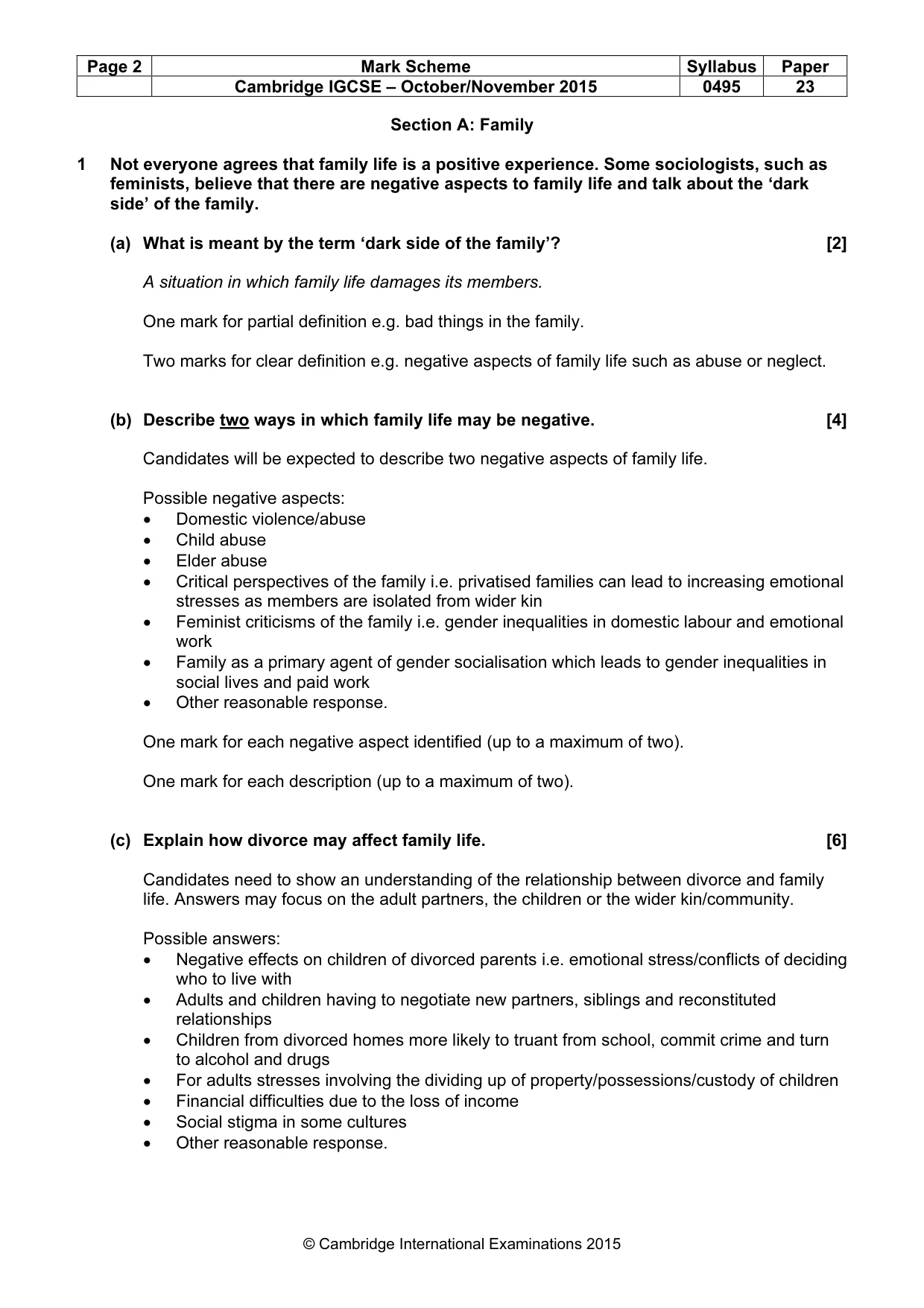
Page 2 Mark Scheme Syllabus Paper Cambridge IGCSE – October/November 2015 0495 23 © Cambridge International Examinations 2015 Section A: Family 1 Not everyone agrees that family life is a positive experience. Some sociologists, such as feminists, believe that there are negative aspects to family life and talk about the ‘dark side’ of the family. (a) What is meant by the term ‘dark side of the family’? [2] A situation in which family life damages its members. One mark for partial definition e.g. bad things in the family. Two marks for clear definition e.g. negative aspects of family life such as abuse or neglect. (b) Describe two ways in which family life may be negative. [4] Candidates will be expected to describe two negative aspects of family life. Possible negative aspects: • Domestic violence/abuse • Child abuse • Elder abuse • Critical perspectives of the family i.e. privatised families can lead to increasing emotional stresses as members are isolated from wider kin • Feminist criticisms of the family i.e. gender inequalities in domestic labour and emotional work • Family as a primary agent of gender socialisation which leads to gender inequalities in social lives and paid work • Other reasonable response. One mark for each negative aspect identified (up to a maximum of two). One mark for each description (up to a maximum of two). (c) Explain how divorce may affect family life. [6] Candidates need to show an understanding of the relationship between divorce and family life. Answers may focus on the adult partners, the children or the wider kin/community. Possible answers: • Negative effects on children of divorced parents i.e. emotional stress/conflicts of deciding who to live with • Adults and children having to negotiate new partners, siblings and reconstituted relationships • Children from divorced homes more likely to truant from school, commit crime and turn to alcohol and drugs • For adults stresses involving the dividing up of property/possessions/custody of children • Financial difficulties due to the loss of income • Social stigma in some cultures • Other reasonable response.
Mark scheme, page 3
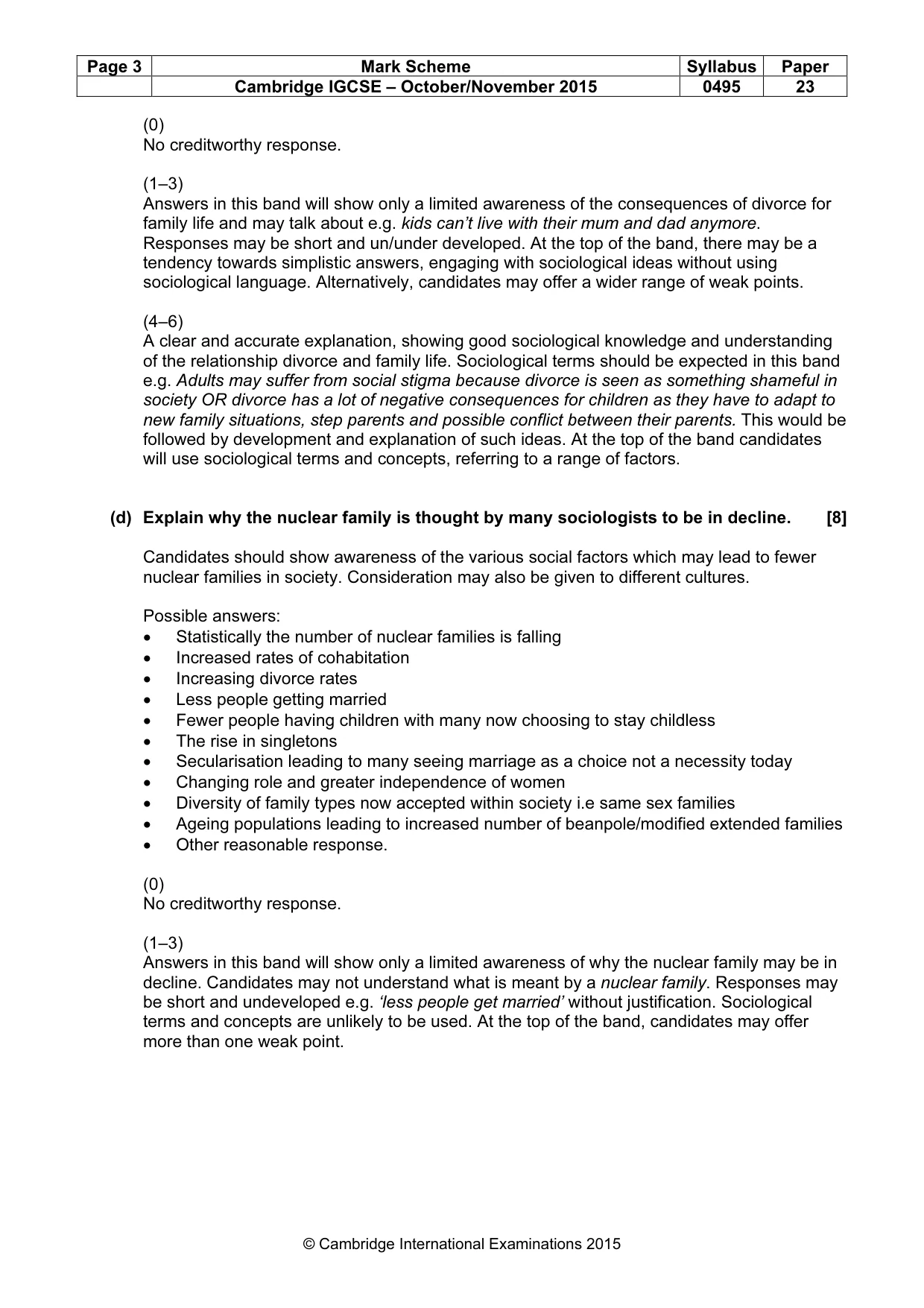
Page 3 Mark Scheme Syllabus Paper Cambridge IGCSE – October/November 2015 0495 23 © Cambridge International Examinations 2015 (0) No creditworthy response. (1–3) Answers in this band will show only a limited awareness of the consequences of divorce for family life and may talk about e.g. kids can’t live with their mum and dad anymore. Responses may be short and un/under developed. At the top of the band, there may be a tendency towards simplistic answers, engaging with sociological ideas without using sociological language. Alternatively, candidates may offer a wider range of weak points. (4–6) A clear and accurate explanation, showing good sociological knowledge and understanding of the relationship divorce and family life. Sociological terms should be expected in this band e.g. Adults may suffer from social stigma because divorce is seen as something shameful in society OR divorce has a lot of negative consequences for children as they have to adapt to new family situations, step parents and possible conflict between their parents. This would be followed by development and explanation of such ideas. At the top of the band candidates will use sociological terms and concepts, referring to a range of factors. (d) Explain why the nuclear family is thought by many sociologists to be in decline. [8] Candidates should show awareness of the various social factors which may lead to fewer nuclear families in society. Consideration may also be given to different cultures. Possible answers: • Statistically the number of nuclear families is falling • Increased rates of cohabitation • Increasing divorce rates • Less people getting married • Fewer people having children with many now choosing to stay childless • The rise in singletons • Secularisation leading to many seeing marriage as a choice not a necessity today • Changing role and greater independence of women • Diversity of family types now accepted within society i.e same sex families • Ageing populations leading to increased number of beanpole/modified extended families • Other reasonable response. (0) No creditworthy response. (1–3) Answers in this band will show only a limited awareness of why the nuclear family may be in decline. Candidates may not understand what is meant by a nuclear family. Responses may be short and undeveloped e.g. ‘less people get married’ without justification. Sociological terms and concepts are unlikely to be used. At the top of the band, candidates may offer more than one weak point.
Mark scheme, page 4
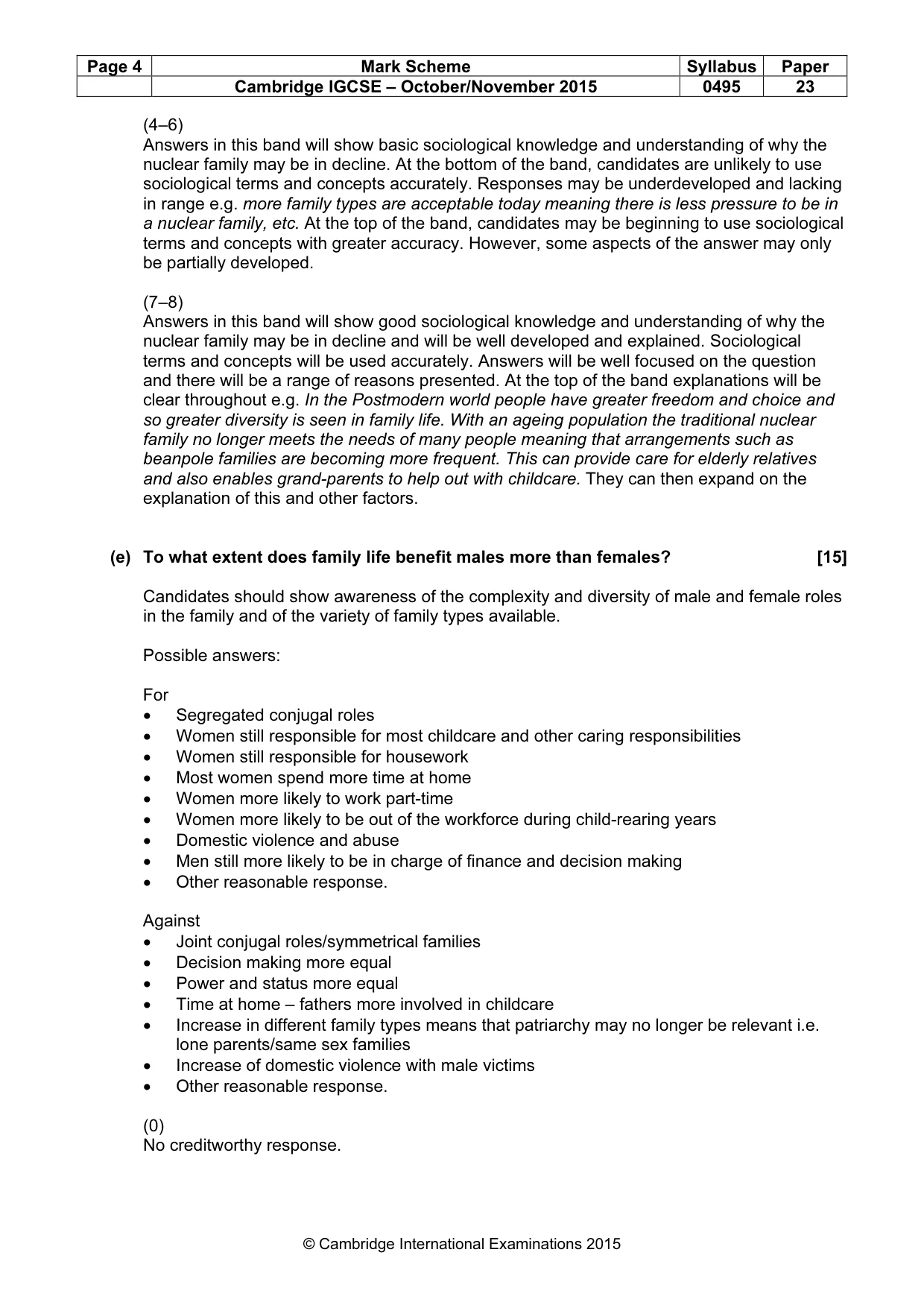
Page 4 Mark Scheme Syllabus Paper Cambridge IGCSE – October/November 2015 0495 23 © Cambridge International Examinations 2015 (4–6) Answers in this band will show basic sociological knowledge and understanding of why the nuclear family may be in decline. At the bottom of the band, candidates are unlikely to use sociological terms and concepts accurately. Responses may be underdeveloped and lacking in range e.g. more family types are acceptable today meaning there is less pressure to be in a nuclear family, etc. At the top of the band, candidates may be beginning to use sociological terms and concepts with greater accuracy. However, some aspects of the answer may only be partially developed. (7–8) Answers in this band will show good sociological knowledge and understanding of why the nuclear family may be in decline and will be well developed and explained. Sociological terms and concepts will be used accurately. Answers will be well focused on the question and there will be a range of reasons presented. At the top of the band explanations will be clear throughout e.g. In the Postmodern world people have greater freedom and choice and so greater diversity is seen in family life. With an ageing population the traditional nuclear family no longer meets the needs of many people meaning that arrangements such as beanpole families are becoming more frequent. This can provide care for elderly relatives and also enables grand-parents to help out with childcare. They can then expand on the explanation of this and other factors. (e) To what extent does family life benefit males more than females? [15] Candidates should show awareness of the complexity and diversity of male and female roles in the family and of the variety of family types available. Possible answers: For • Segregated conjugal roles • Women still responsible for most childcare and other caring responsibilities • Women still responsible for housework • Most women spend more time at home • Women more likely to work part-time • Women more likely to be out of the workforce during child-rearing years • Domestic violence and abuse • Men still more likely to be in charge of finance and decision making • Other reasonable response. Against • Joint conjugal roles/symmetrical families • Decision making more equal • Power and status more equal • Time at home – fathers more involved in childcare • Increase in different family types means that patriarchy may no longer be relevant i.e. lone parents/same sex families • Increase of domestic violence with male victims • Other reasonable response. (0) No creditworthy response.
Mark scheme, page 5
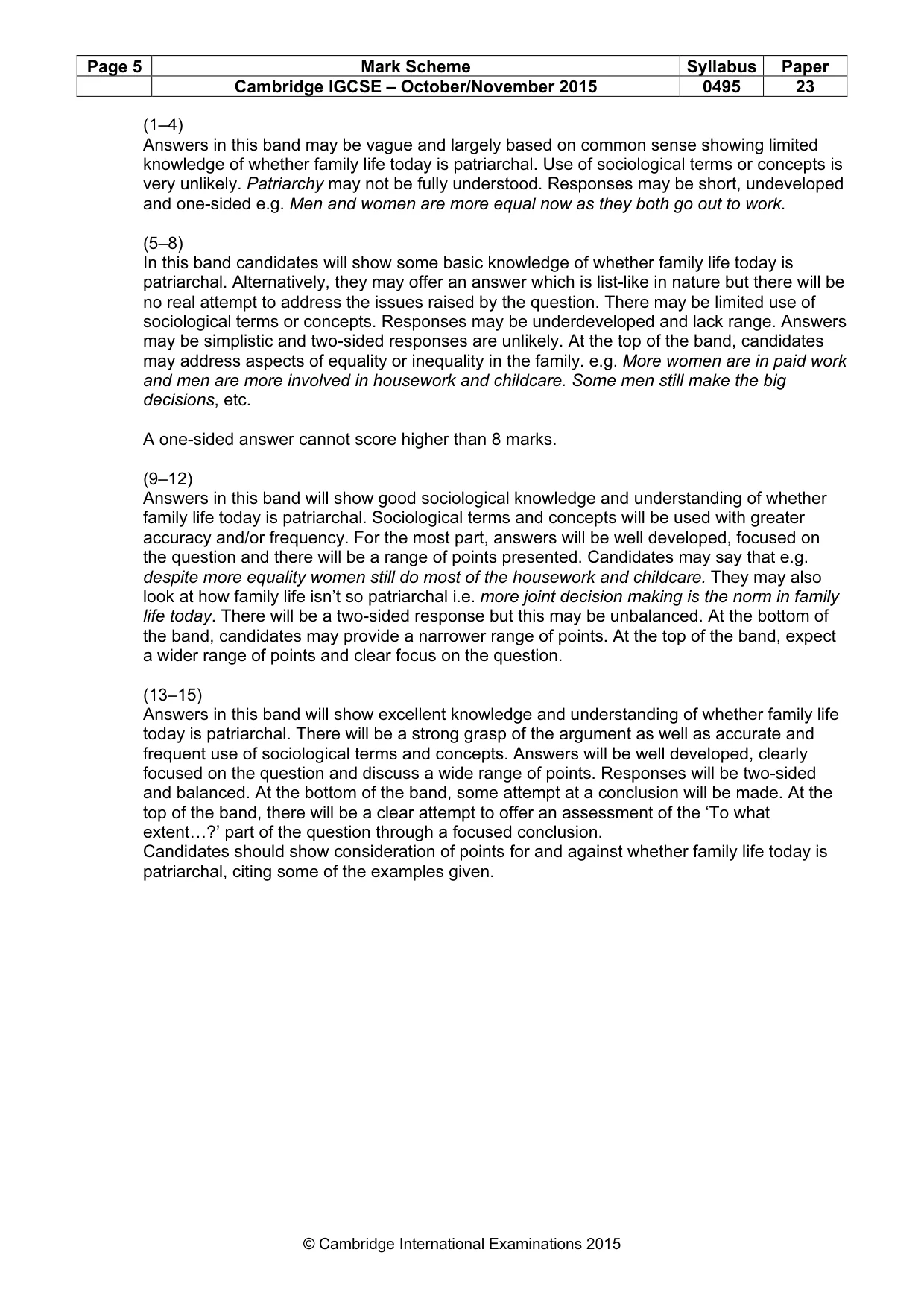
Page 5 Mark Scheme Syllabus Paper Cambridge IGCSE – October/November 2015 0495 23 © Cambridge International Examinations 2015 (1–4) Answers in this band may be vague and largely based on common sense showing limited knowledge of whether family life today is patriarchal. Use of sociological terms or concepts is very unlikely. Patriarchy may not be fully understood. Responses may be short, undeveloped and one-sided e.g. Men and women are more equal now as they both go out to work. (5–8) In this band candidates will show some basic knowledge of whether family life today is patriarchal. Alternatively, they may offer an answer which is list-like in nature but there will be no real attempt to address the issues raised by the question. There may be limited use of sociological terms or concepts. Responses may be underdeveloped and lack range. Answers may be simplistic and two-sided responses are unlikely. At the top of the band, candidates may address aspects of equality or inequality in the family. e.g. More women are in paid work and men are more involved in housework and childcare. Some men still make the big decisions, etc. A one-sided answer cannot score higher than 8 marks. (9–12) Answers in this band will show good sociological knowledge and understanding of whether family life today is patriarchal. Sociological terms and concepts will be used with greater accuracy and/or frequency. For the most part, answers will be well developed, focused on the question and there will be a range of points presented. Candidates may say that e.g. despite more equality women still do most of the housework and childcare. They may also look at how family life isn’t so patriarchal i.e. more joint decision making is the norm in family life today. There will be a two-sided response but this may be unbalanced. At the bottom of the band, candidates may provide a narrower range of points. At the top of the band, expect a wider range of points and clear focus on the question. (13–15) Answers in this band will show excellent knowledge and understanding of whether family life today is patriarchal. There will be a strong grasp of the argument as well as accurate and frequent use of sociological terms and concepts. Answers will be well developed, clearly focused on the question and discuss a wide range of points. Responses will be two-sided and balanced. At the bottom of the band, some attempt at a conclusion will be made. At the top of the band, there will be a clear attempt to offer an assessment of the ‘To what extent…?’ part of the question through a focused conclusion. Candidates should show consideration of points for and against whether family life today is patriarchal, citing some of the examples given.
Mark scheme, page 6
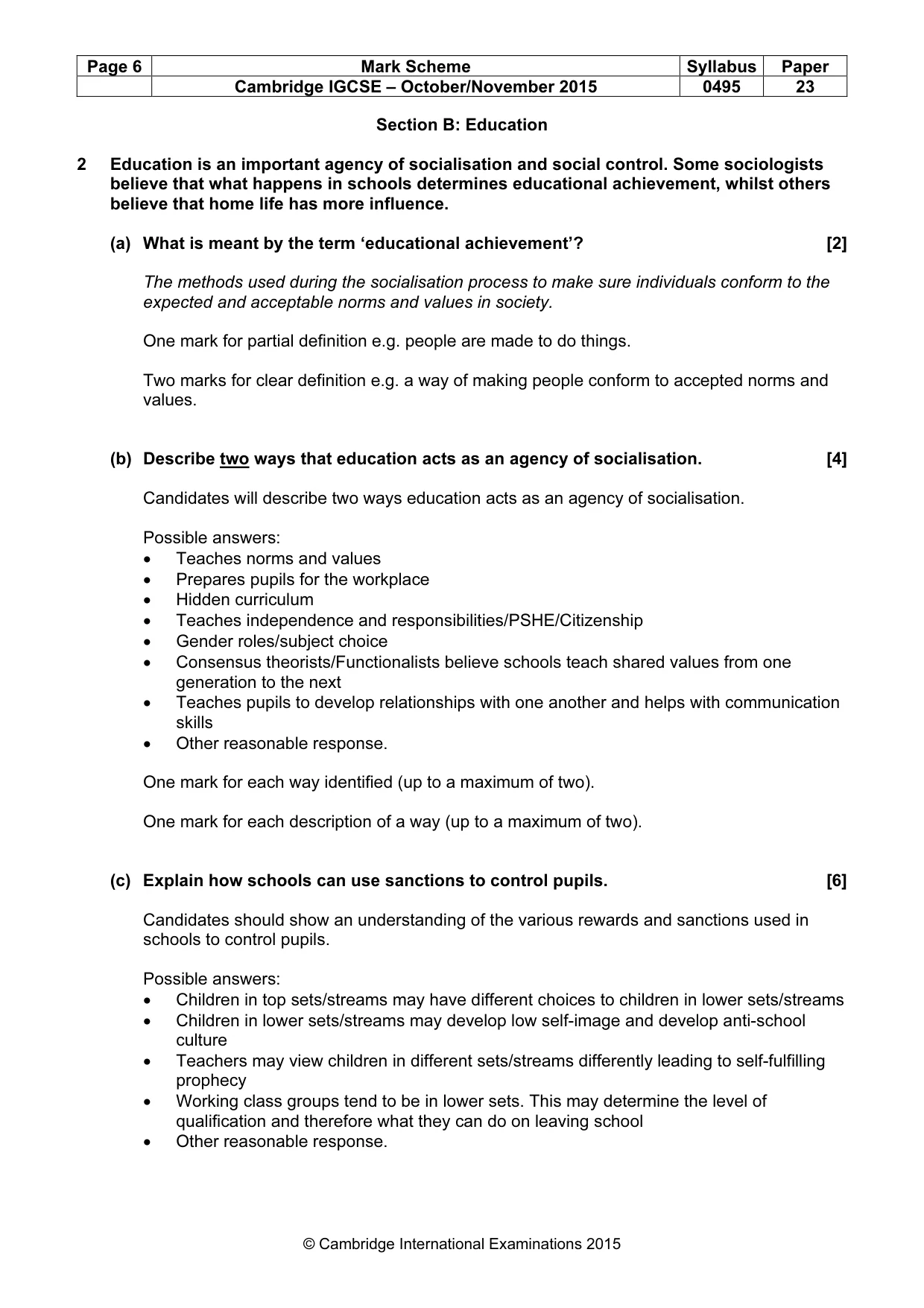
Page 6 Mark Scheme Syllabus Paper Cambridge IGCSE – October/November 2015 0495 23 © Cambridge International Examinations 2015 Section B: Education 2 Education is an important agency of socialisation and social control. Some sociologists believe that what happens in schools determines educational achievement, whilst others believe that home life has more influence. (a) What is meant by the term ‘educational achievement’? [2] The methods used during the socialisation process to make sure individuals conform to the expected and acceptable norms and values in society. One mark for partial definition e.g. people are made to do things. Two marks for clear definition e.g. a way of making people conform to accepted norms and values. (b) Describe two ways that education acts as an agency of socialisation. [4] Candidates will describe two ways education acts as an agency of socialisation. Possible answers: • Teaches norms and values • Prepares pupils for the workplace • Hidden curriculum • Teaches independence and responsibilities/PSHE/Citizenship • Gender roles/subject choice • Consensus theorists/Functionalists believe schools teach shared values from one generation to the next • Teaches pupils to develop relationships with one another and helps with communication skills • Other reasonable response. One mark for each way identified (up to a maximum of two). One mark for each description of a way (up to a maximum of two). (c) Explain how schools can use sanctions to control pupils. [6] Candidates should show an understanding of the various rewards and sanctions used in schools to control pupils. Possible answers: • Children in top sets/streams may have different choices to children in lower sets/streams • Children in lower sets/streams may develop low self-image and develop anti-school culture • Teachers may view children in different sets/streams differently leading to self-fulfilling prophecy • Working class groups tend to be in lower sets. This may determine the level of qualification and therefore what they can do on leaving school • Other reasonable response.
Mark scheme, page 7
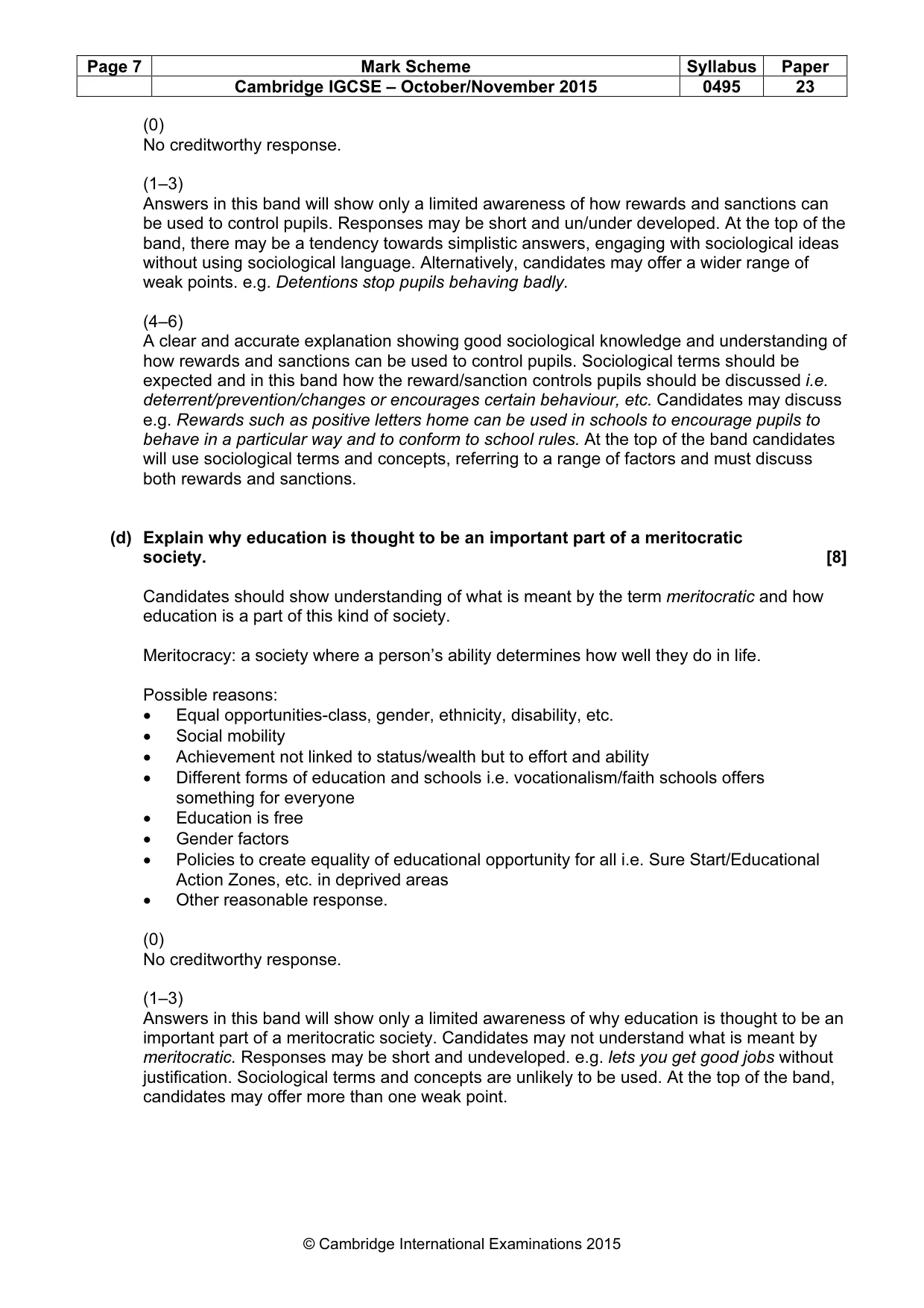
Page 7 Mark Scheme Syllabus Paper Cambridge IGCSE – October/November 2015 0495 23 © Cambridge International Examinations 2015 (0) No creditworthy response. (1–3) Answers in this band will show only a limited awareness of how rewards and sanctions can be used to control pupils. Responses may be short and un/under developed. At the top of the band, there may be a tendency towards simplistic answers, engaging with sociological ideas without using sociological language. Alternatively, candidates may offer a wider range of weak points. e.g. Detentions stop pupils behaving badly. (4–6) A clear and accurate explanation showing good sociological knowledge and understanding of how rewards and sanctions can be used to control pupils. Sociological terms should be expected and in this band how the reward/sanction controls pupils should be discussed i.e. deterrent/prevention/changes or encourages certain behaviour, etc. Candidates may discuss e.g. Rewards such as positive letters home can be used in schools to encourage pupils to behave in a particular way and to conform to school rules. At the top of the band candidates will use sociological terms and concepts, referring to a range of factors and must discuss both rewards and sanctions. (d) Explain why education is thought to be an important part of a meritocratic society. [8] Candidates should show understanding of what is meant by the term meritocratic and how education is a part of this kind of society. Meritocracy: a society where a person’s ability determines how well they do in life. Possible reasons: • Equal opportunities-class, gender, ethnicity, disability, etc. • Social mobility • Achievement not linked to status/wealth but to effort and ability • Different forms of education and schools i.e. vocationalism/faith schools offers something for everyone • Education is free • Gender factors • Policies to create equality of educational opportunity for all i.e. Sure Start/Educational Action Zones, etc. in deprived areas • Other reasonable response. (0) No creditworthy response. (1–3) Answers in this band will show only a limited awareness of why education is thought to be an important part of a meritocratic society. Candidates may not understand what is meant by meritocratic. Responses may be short and undeveloped. e.g. lets you get good jobs without justification. Sociological terms and concepts are unlikely to be used. At the top of the band, candidates may offer more than one weak point.
Mark scheme, page 8
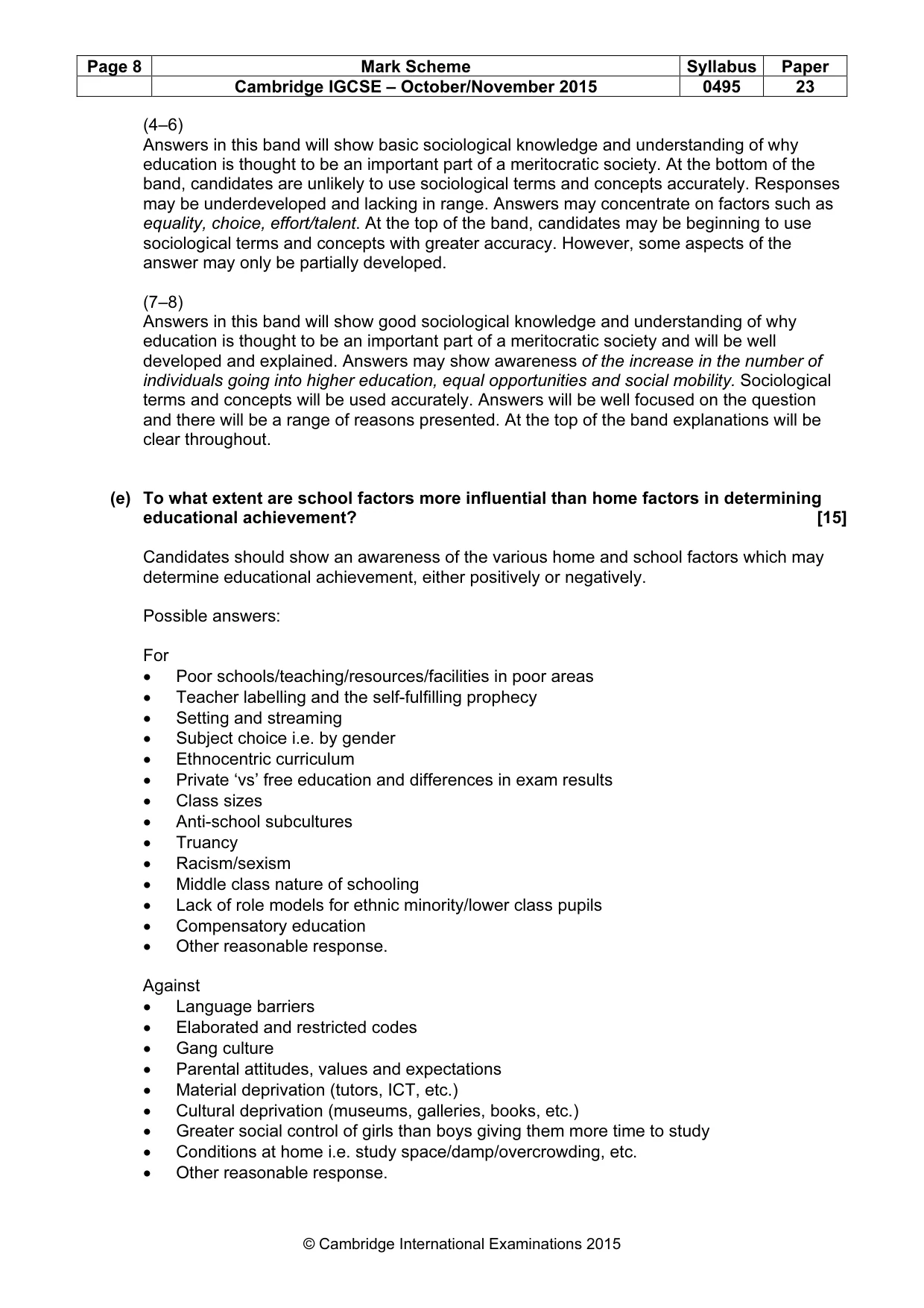
Page 8 Mark Scheme Syllabus Paper Cambridge IGCSE – October/November 2015 0495 23 © Cambridge International Examinations 2015 (4–6) Answers in this band will show basic sociological knowledge and understanding of why education is thought to be an important part of a meritocratic society. At the bottom of the band, candidates are unlikely to use sociological terms and concepts accurately. Responses may be underdeveloped and lacking in range. Answers may concentrate on factors such as equality, choice, effort/talent. At the top of the band, candidates may be beginning to use sociological terms and concepts with greater accuracy. However, some aspects of the answer may only be partially developed. (7–8) Answers in this band will show good sociological knowledge and understanding of why education is thought to be an important part of a meritocratic society and will be well developed and explained. Answers may show awareness of the increase in the number of individuals going into higher education, equal opportunities and social mobility. Sociological terms and concepts will be used accurately. Answers will be well focused on the question and there will be a range of reasons presented. At the top of the band explanations will be clear throughout. (e) To what extent are school factors more influential than home factors in determining educational achievement? [15] Candidates should show an awareness of the various home and school factors which may determine educational achievement, either positively or negatively. Possible answers: For • Poor schools/teaching/resources/facilities in poor areas • Teacher labelling and the self-fulfilling prophecy • Setting and streaming • Subject choice i.e. by gender • Ethnocentric curriculum • Private ‘vs’ free education and differences in exam results • Class sizes • Anti-school subcultures • Truancy • Racism/sexism • Middle class nature of schooling • Lack of role models for ethnic minority/lower class pupils • Compensatory education • Other reasonable response. Against • Language barriers • Elaborated and restricted codes • Gang culture • Parental attitudes, values and expectations • Material deprivation (tutors, ICT, etc.) • Cultural deprivation (museums, galleries, books, etc.) • Greater social control of girls than boys giving them more time to study • Conditions at home i.e. study space/damp/overcrowding, etc. • Other reasonable response.
Mark scheme, page 9
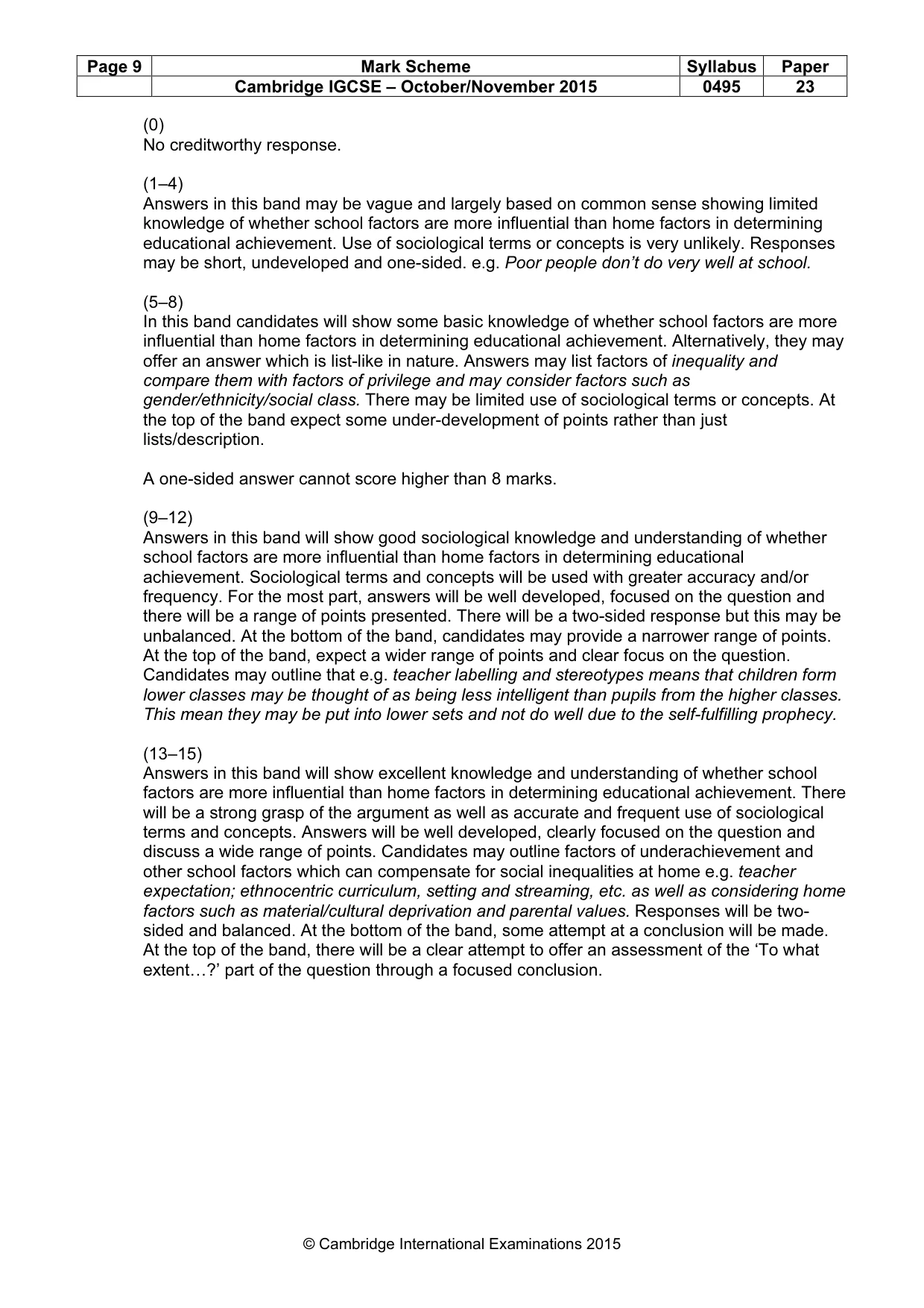
Page 9 Mark Scheme Syllabus Paper Cambridge IGCSE – October/November 2015 0495 23 © Cambridge International Examinations 2015 (0) No creditworthy response. (1–4) Answers in this band may be vague and largely based on common sense showing limited knowledge of whether school factors are more influential than home factors in determining educational achievement. Use of sociological terms or concepts is very unlikely. Responses may be short, undeveloped and one-sided. e.g. Poor people don’t do very well at school. (5–8) In this band candidates will show some basic knowledge of whether school factors are more influential than home factors in determining educational achievement. Alternatively, they may offer an answer which is list-like in nature. Answers may list factors of inequality and compare them with factors of privilege and may consider factors such as gender/ethnicity/social class. There may be limited use of sociological terms or concepts. At the top of the band expect some under-development of points rather than just lists/description. A one-sided answer cannot score higher than 8 marks. (9–12) Answers in this band will show good sociological knowledge and understanding of whether school factors are more influential than home factors in determining educational achievement. Sociological terms and concepts will be used with greater accuracy and/or frequency. For the most part, answers will be well developed, focused on the question and there will be a range of points presented. There will be a two-sided response but this may be unbalanced. At the bottom of the band, candidates may provide a narrower range of points. At the top of the band, expect a wider range of points and clear focus on the question. Candidates may outline that e.g. teacher labelling and stereotypes means that children form lower classes may be thought of as being less intelligent than pupils from the higher classes. This mean they may be put into lower sets and not do well due to the self-fulfilling prophecy. (13–15) Answers in this band will show excellent knowledge and understanding of whether school factors are more influential than home factors in determining educational achievement. There will be a strong grasp of the argument as well as accurate and frequent use of sociological terms and concepts. Answers will be well developed, clearly focused on the question and discuss a wide range of points. Candidates may outline factors of underachievement and other school factors which can compensate for social inequalities at home e.g. teacher expectation; ethnocentric curriculum, setting and streaming, etc. as well as considering home factors such as material/cultural deprivation and parental values. Responses will be two- sided and balanced. At the bottom of the band, some attempt at a conclusion will be made. At the top of the band, there will be a clear attempt to offer an assessment of the ‘To what extent…?’ part of the question through a focused conclusion.
Mark scheme, page 10
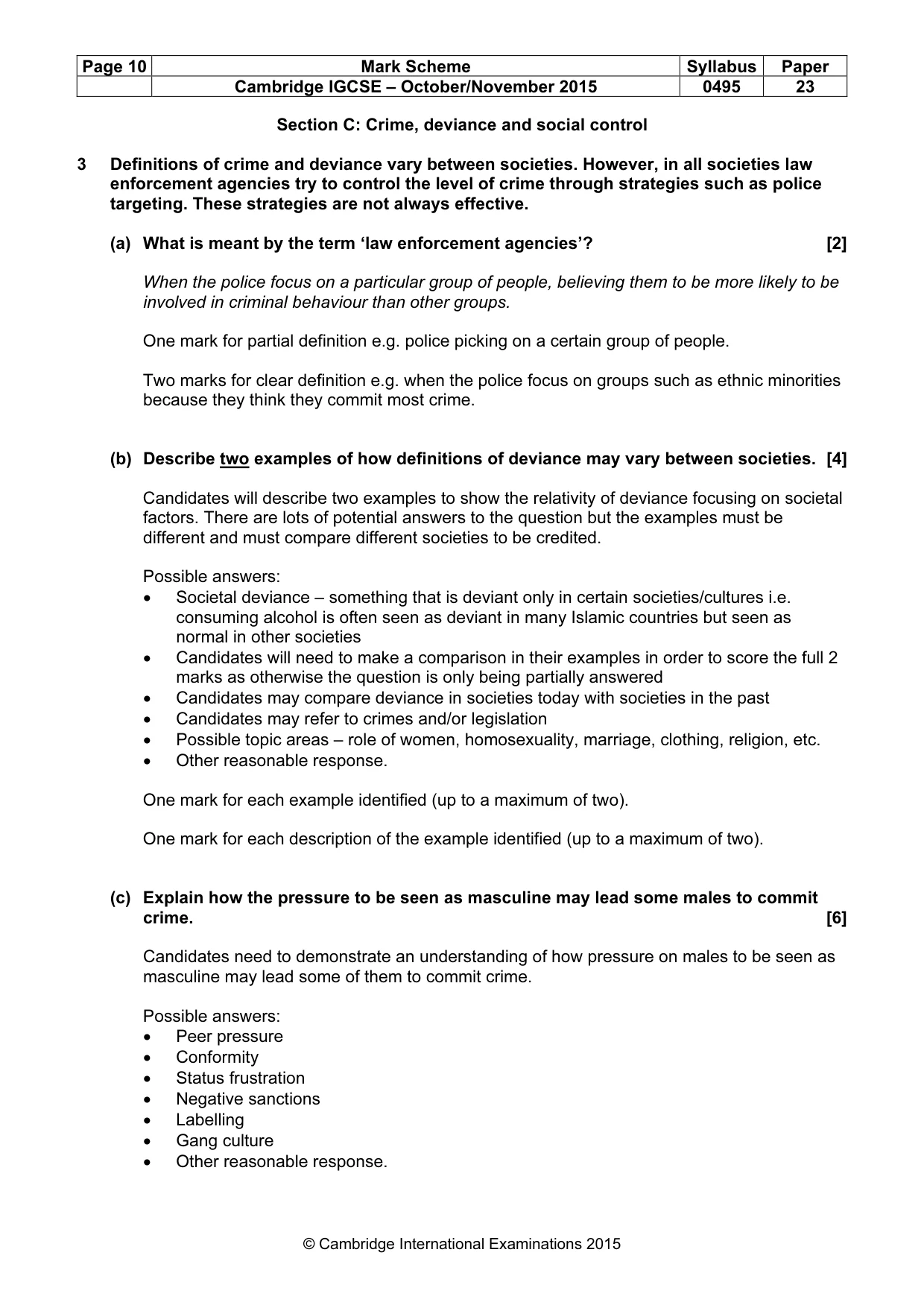
Page 10 Mark Scheme Syllabus Paper Cambridge IGCSE – October/November 2015 0495 23 © Cambridge International Examinations 2015 Section C: Crime, deviance and social control 3 Definitions of crime and deviance vary between societies. However, in all societies law enforcement agencies try to control the level of crime through strategies such as police targeting. These strategies are not always effective. (a) What is meant by the term ‘law enforcement agencies’? [2] When the police focus on a particular group of people, believing them to be more likely to be involved in criminal behaviour than other groups. One mark for partial definition e.g. police picking on a certain group of people. Two marks for clear definition e.g. when the police focus on groups such as ethnic minorities because they think they commit most crime. (b) Describe two examples of how definitions of deviance may vary between societies. [4] Candidates will describe two examples to show the relativity of deviance focusing on societal factors. There are lots of potential answers to the question but the examples must be different and must compare different societies to be credited. Possible answers: • Societal deviance – something that is deviant only in certain societies/cultures i.e. consuming alcohol is often seen as deviant in many Islamic countries but seen as normal in other societies • Candidates will need to make a comparison in their examples in order to score the full 2 marks as otherwise the question is only being partially answered • Candidates may compare deviance in societies today with societies in the past • Candidates may refer to crimes and/or legislation • Possible topic areas – role of women, homosexuality, marriage, clothing, religion, etc. • Other reasonable response. One mark for each example identified (up to a maximum of two). One mark for each description of the example identified (up to a maximum of two). (c) Explain how the pressure to be seen as masculine may lead some males to commit crime. [6] Candidates need to demonstrate an understanding of how pressure on males to be seen as masculine may lead some of them to commit crime. Possible answers: • Peer pressure • Conformity • Status frustration • Negative sanctions • Labelling • Gang culture • Other reasonable response.
Mark scheme, page 11
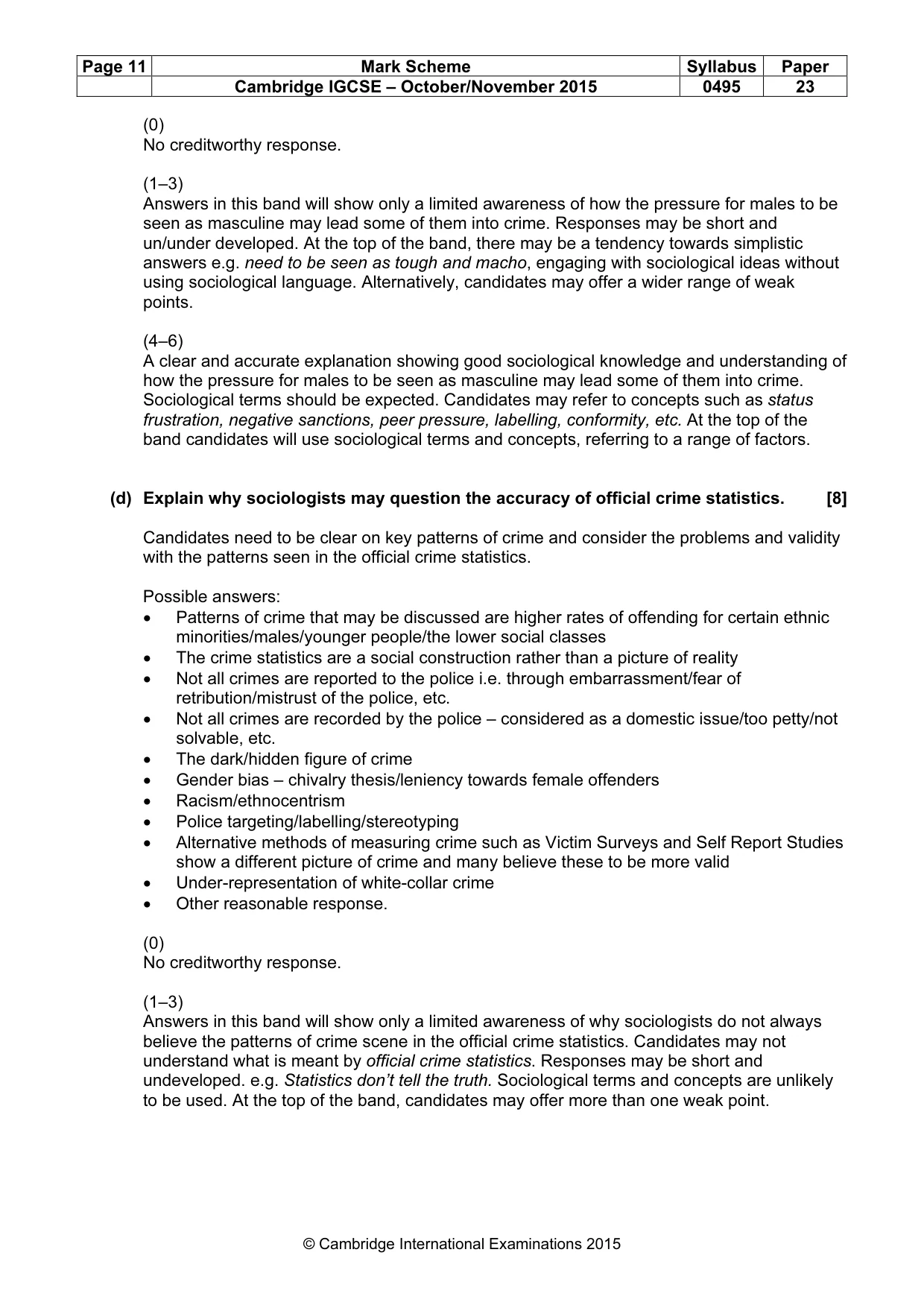
Page 11 Mark Scheme Syllabus Paper Cambridge IGCSE – October/November 2015 0495 23 © Cambridge International Examinations 2015 (0) No creditworthy response. (1–3) Answers in this band will show only a limited awareness of how the pressure for males to be seen as masculine may lead some of them into crime. Responses may be short and un/under developed. At the top of the band, there may be a tendency towards simplistic answers e.g. need to be seen as tough and macho, engaging with sociological ideas without using sociological language. Alternatively, candidates may offer a wider range of weak points. (4–6) A clear and accurate explanation showing good sociological knowledge and understanding of how the pressure for males to be seen as masculine may lead some of them into crime. Sociological terms should be expected. Candidates may refer to concepts such as status frustration, negative sanctions, peer pressure, labelling, conformity, etc. At the top of the band candidates will use sociological terms and concepts, referring to a range of factors. (d) Explain why sociologists may question the accuracy of official crime statistics. [8] Candidates need to be clear on key patterns of crime and consider the problems and validity with the patterns seen in the official crime statistics. Possible answers: • Patterns of crime that may be discussed are higher rates of offending for certain ethnic minorities/males/younger people/the lower social classes • The crime statistics are a social construction rather than a picture of reality • Not all crimes are reported to the police i.e. through embarrassment/fear of retribution/mistrust of the police, etc. • Not all crimes are recorded by the police – considered as a domestic issue/too petty/not solvable, etc. • The dark/hidden figure of crime • Gender bias – chivalry thesis/leniency towards female offenders • Racism/ethnocentrism • Police targeting/labelling/stereotyping • Alternative methods of measuring crime such as Victim Surveys and Self Report Studies show a different picture of crime and many believe these to be more valid • Under-representation of white-collar crime • Other reasonable response. (0) No creditworthy response. (1–3) Answers in this band will show only a limited awareness of why sociologists do not always believe the patterns of crime scene in the official crime statistics. Candidates may not understand what is meant by official crime statistics. Responses may be short and undeveloped. e.g. Statistics don’t tell the truth. Sociological terms and concepts are unlikely to be used. At the top of the band, candidates may offer more than one weak point.
Mark scheme, page 12
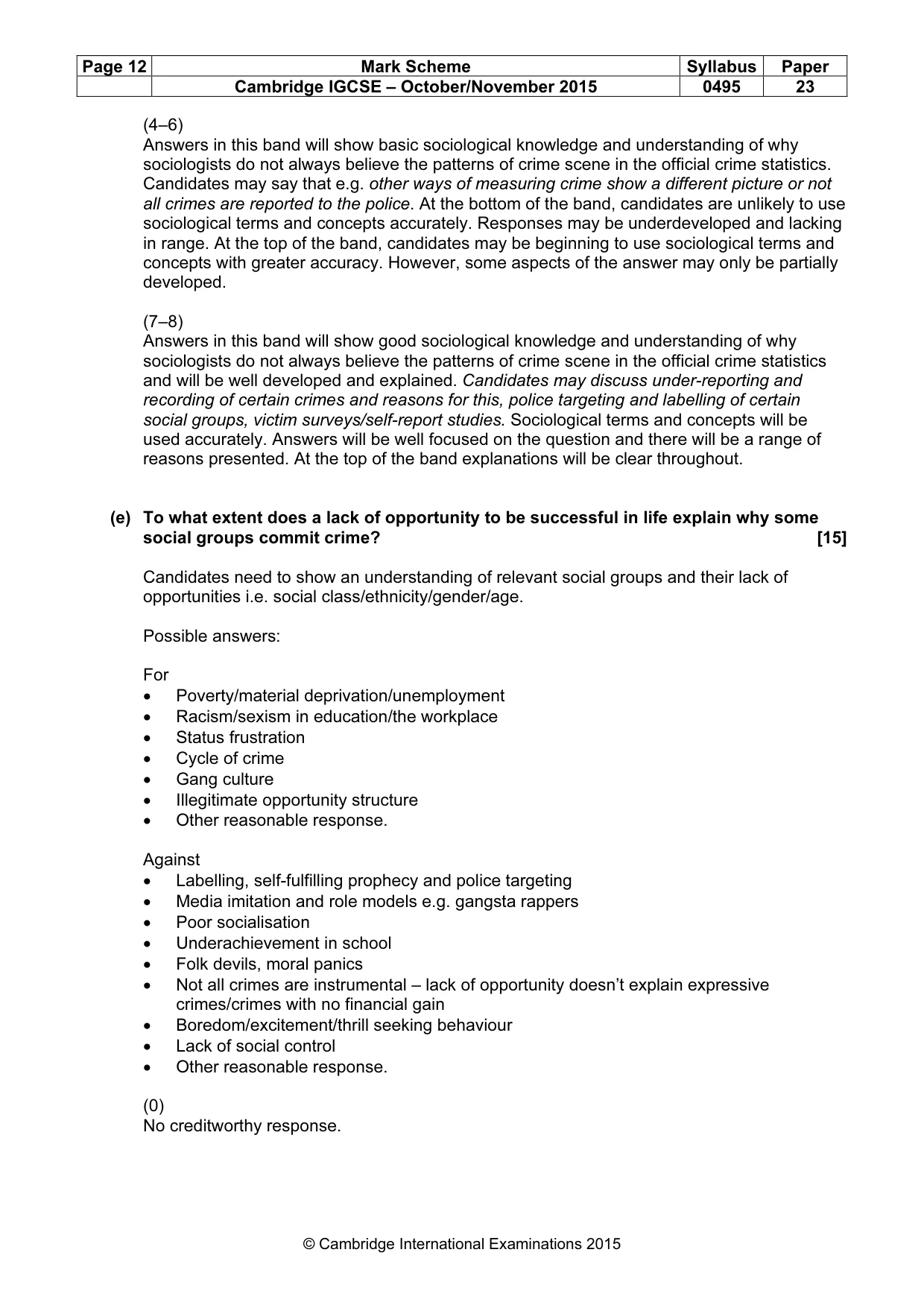
Page 12 Mark Scheme Syllabus Paper Cambridge IGCSE – October/November 2015 0495 23 © Cambridge International Examinations 2015 (4–6) Answers in this band will show basic sociological knowledge and understanding of why sociologists do not always believe the patterns of crime scene in the official crime statistics. Candidates may say that e.g. other ways of measuring crime show a different picture or not all crimes are reported to the police. At the bottom of the band, candidates are unlikely to use sociological terms and concepts accurately. Responses may be underdeveloped and lacking in range. At the top of the band, candidates may be beginning to use sociological terms and concepts with greater accuracy. However, some aspects of the answer may only be partially developed. (7–8) Answers in this band will show good sociological knowledge and understanding of why sociologists do not always believe the patterns of crime scene in the official crime statistics and will be well developed and explained. Candidates may discuss under-reporting and recording of certain crimes and reasons for this, police targeting and labelling of certain social groups, victim surveys/self-report studies. Sociological terms and concepts will be used accurately. Answers will be well focused on the question and there will be a range of reasons presented. At the top of the band explanations will be clear throughout. (e) To what extent does a lack of opportunity to be successful in life explain why some social groups commit crime? [15] Candidates need to show an understanding of relevant social groups and their lack of opportunities i.e. social class/ethnicity/gender/age. Possible answers: For • Poverty/material deprivation/unemployment • Racism/sexism in education/the workplace • Status frustration • Cycle of crime • Gang culture • Illegitimate opportunity structure • Other reasonable response. Against • Labelling, self-fulfilling prophecy and police targeting • Media imitation and role models e.g. gangsta rappers • Poor socialisation • Underachievement in school • Folk devils, moral panics • Not all crimes are instrumental – lack of opportunity doesn’t explain expressive crimes/crimes with no financial gain • Boredom/excitement/thrill seeking behaviour • Lack of social control • Other reasonable response. (0) No creditworthy response.
Mark scheme, page 13
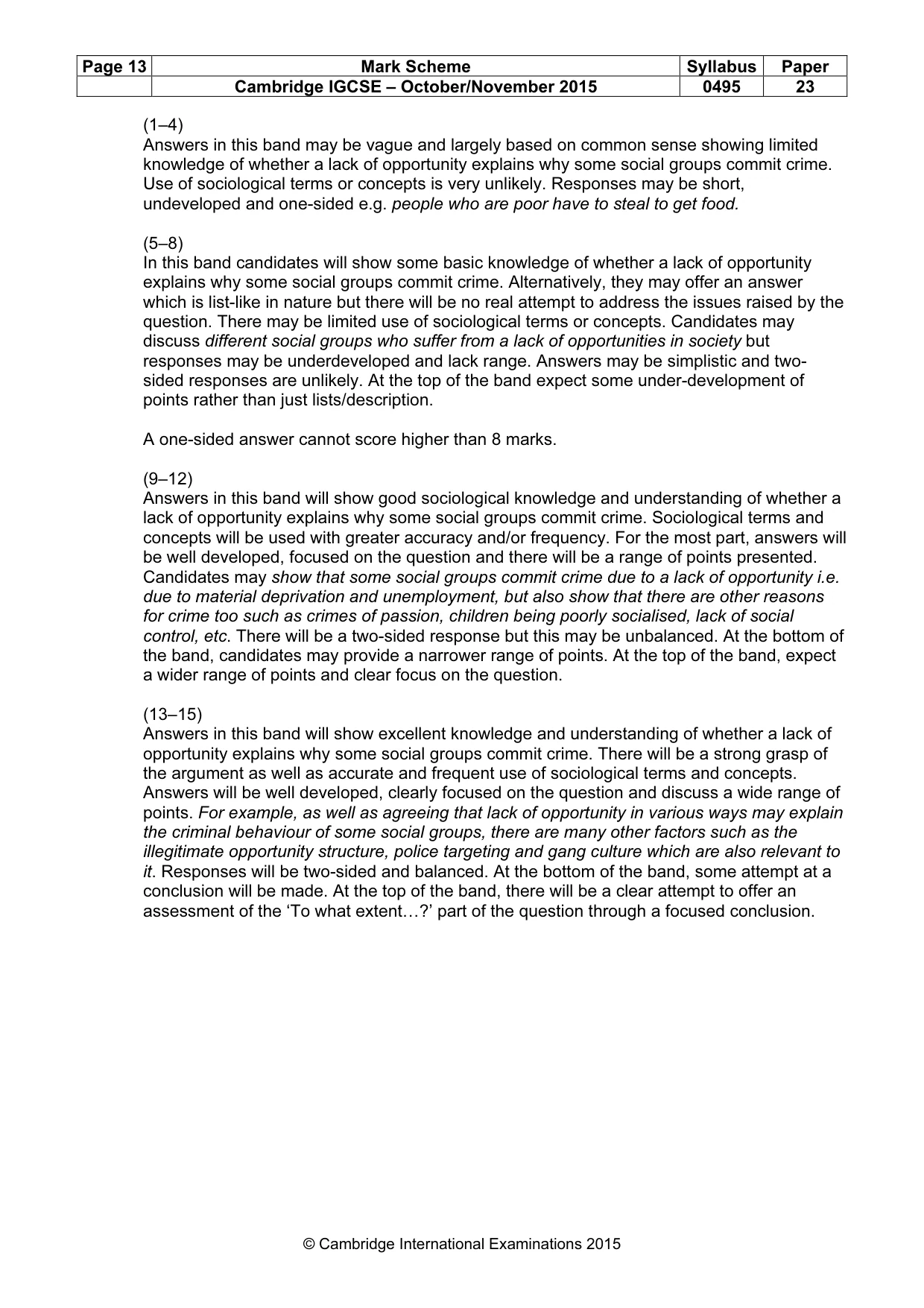
Page 13 Mark Scheme Syllabus Paper Cambridge IGCSE – October/November 2015 0495 23 © Cambridge International Examinations 2015 (1–4) Answers in this band may be vague and largely based on common sense showing limited knowledge of whether a lack of opportunity explains why some social groups commit crime. Use of sociological terms or concepts is very unlikely. Responses may be short, undeveloped and one-sided e.g. people who are poor have to steal to get food. (5–8) In this band candidates will show some basic knowledge of whether a lack of opportunity explains why some social groups commit crime. Alternatively, they may offer an answer which is list-like in nature but there will be no real attempt to address the issues raised by the question. There may be limited use of sociological terms or concepts. Candidates may discuss different social groups who suffer from a lack of opportunities in society but responses may be underdeveloped and lack range. Answers may be simplistic and two- sided responses are unlikely. At the top of the band expect some under-development of points rather than just lists/description. A one-sided answer cannot score higher than 8 marks. (9–12) Answers in this band will show good sociological knowledge and understanding of whether a lack of opportunity explains why some social groups commit crime. Sociological terms and concepts will be used with greater accuracy and/or frequency. For the most part, answers will be well developed, focused on the question and there will be a range of points presented. Candidates may show that some social groups commit crime due to a lack of opportunity i.e. due to material deprivation and unemployment, but also show that there are other reasons for crime too such as crimes of passion, children being poorly socialised, lack of social control, etc. There will be a two-sided response but this may be unbalanced. At the bottom of the band, candidates may provide a narrower range of points. At the top of the band, expect a wider range of points and clear focus on the question. (13–15) Answers in this band will show excellent knowledge and understanding of whether a lack of opportunity explains why some social groups commit crime. There will be a strong grasp of the argument as well as accurate and frequent use of sociological terms and concepts. Answers will be well developed, clearly focused on the question and discuss a wide range of points. For example, as well as agreeing that lack of opportunity in various ways may explain the criminal behaviour of some social groups, there are many other factors such as the illegitimate opportunity structure, police targeting and gang culture which are also relevant to it. Responses will be two-sided and balanced. At the bottom of the band, some attempt at a conclusion will be made. At the top of the band, there will be a clear attempt to offer an assessment of the ‘To what extent…?’ part of the question through a focused conclusion.
Mark scheme, page 14
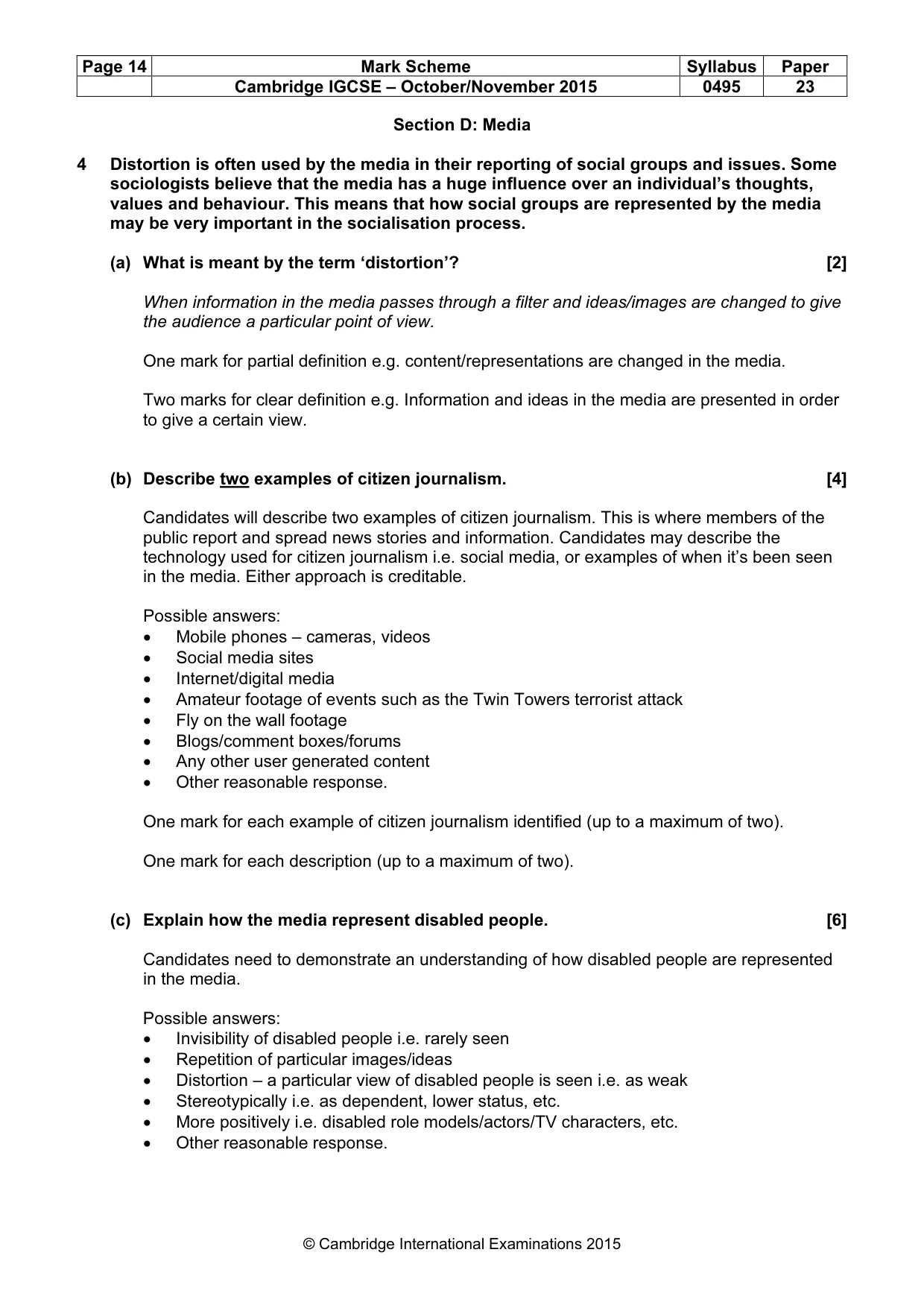
Page 14 Mark Scheme Syllabus Paper Cambridge IGCSE – October/November 2015 0495 23 © Cambridge International Examinations 2015 Section D: Media 4 Distortion is often used by the media in their reporting of social groups and issues. Some sociologists believe that the media has a huge influence over an individual’s thoughts, values and behaviour. This means that how social groups are represented by the media may be very important in the socialisation process. (a) What is meant by the term ‘distortion’? [2] When information in the media passes through a filter and ideas/images are changed to give the audience a particular point of view. One mark for partial definition e.g. content/representations are changed in the media. Two marks for clear definition e.g. Information and ideas in the media are presented in order to give a certain view. (b) Describe two examples of citizen journalism. [4] Candidates will describe two examples of citizen journalism. This is where members of the public report and spread news stories and information. Candidates may describe the technology used for citizen journalism i.e. social media, or examples of when it’s been seen in the media. Either approach is creditable. Possible answers: • Mobile phones – cameras, videos • Social media sites • Internet/digital media • Amateur footage of events such as the Twin Towers terrorist attack • Fly on the wall footage • Blogs/comment boxes/forums • Any other user generated content • Other reasonable response. One mark for each example of citizen journalism identified (up to a maximum of two). One mark for each description (up to a maximum of two). (c) Explain how the media represent disabled people. [6] Candidates need to demonstrate an understanding of how disabled people are represented in the media. Possible answers: • Invisibility of disabled people i.e. rarely seen • Repetition of particular images/ideas • Distortion – a particular view of disabled people is seen i.e. as weak • Stereotypically i.e. as dependent, lower status, etc. • More positively i.e. disabled role models/actors/TV characters, etc. • Other reasonable response.
Mark scheme, page 15
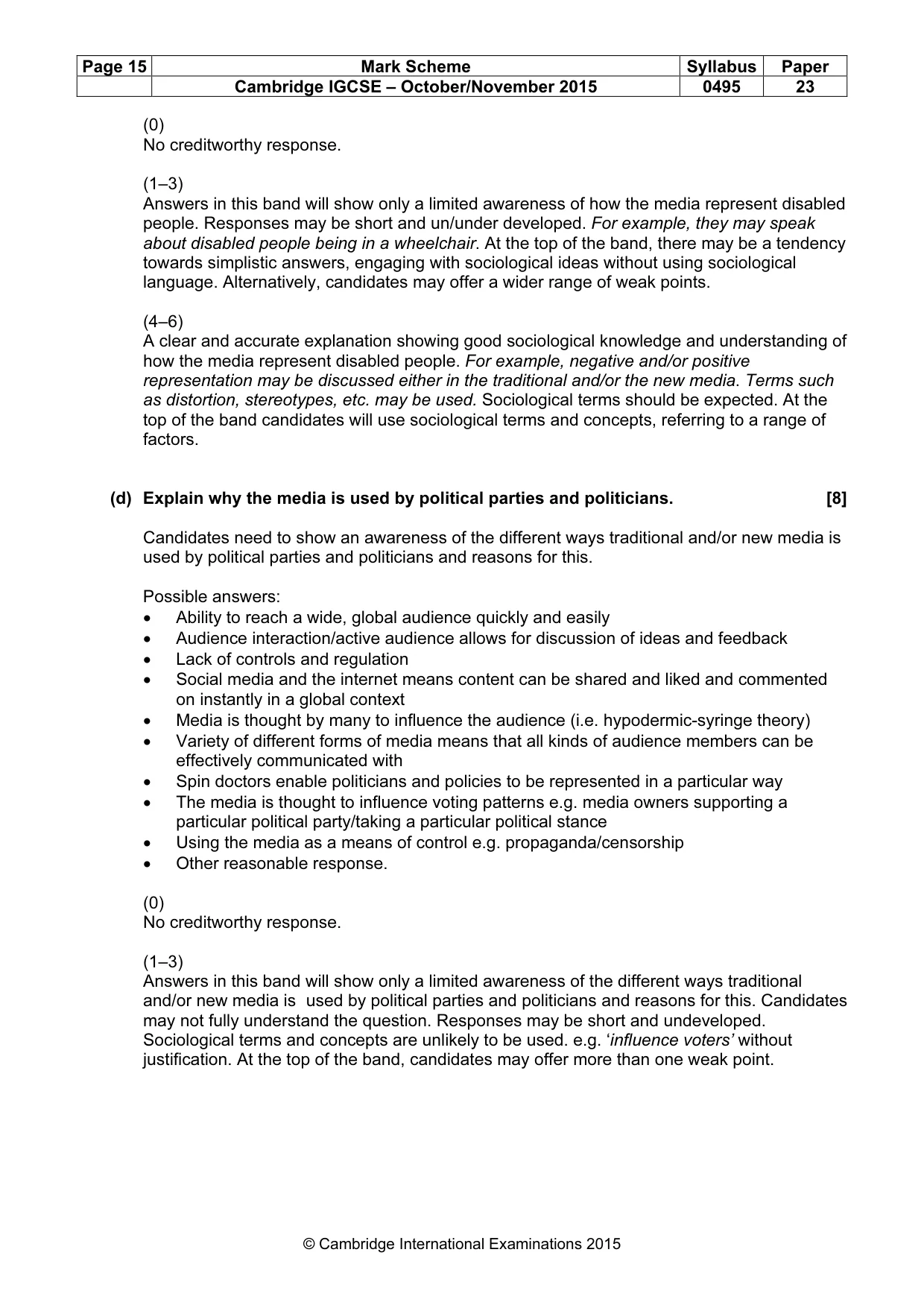
Page 15 Mark Scheme Syllabus Paper Cambridge IGCSE – October/November 2015 0495 23 © Cambridge International Examinations 2015 (0) No creditworthy response. (1–3) Answers in this band will show only a limited awareness of how the media represent disabled people. Responses may be short and un/under developed. For example, they may speak about disabled people being in a wheelchair. At the top of the band, there may be a tendency towards simplistic answers, engaging with sociological ideas without using sociological language. Alternatively, candidates may offer a wider range of weak points. (4–6) A clear and accurate explanation showing good sociological knowledge and understanding of how the media represent disabled people. For example, negative and/or positive representation may be discussed either in the traditional and/or the new media. Terms such as distortion, stereotypes, etc. may be used. Sociological terms should be expected. At the top of the band candidates will use sociological terms and concepts, referring to a range of factors. (d) Explain why the media is used by political parties and politicians. [8] Candidates need to show an awareness of the different ways traditional and/or new media is used by political parties and politicians and reasons for this. Possible answers: • Ability to reach a wide, global audience quickly and easily • Audience interaction/active audience allows for discussion of ideas and feedback • Lack of controls and regulation • Social media and the internet means content can be shared and liked and commented on instantly in a global context • Media is thought by many to influence the audience (i.e. hypodermic-syringe theory) • Variety of different forms of media means that all kinds of audience members can be effectively communicated with • Spin doctors enable politicians and policies to be represented in a particular way • The media is thought to influence voting patterns e.g. media owners supporting a particular political party/taking a particular political stance • Using the media as a means of control e.g. propaganda/censorship • Other reasonable response. (0) No creditworthy response. (1–3) Answers in this band will show only a limited awareness of the different ways traditional and/or new media is used by political parties and politicians and reasons for this. Candidates may not fully understand the question. Responses may be short and undeveloped. Sociological terms and concepts are unlikely to be used. e.g. ‘influence voters’ without justification. At the top of the band, candidates may offer more than one weak point.
Mark scheme, page 16
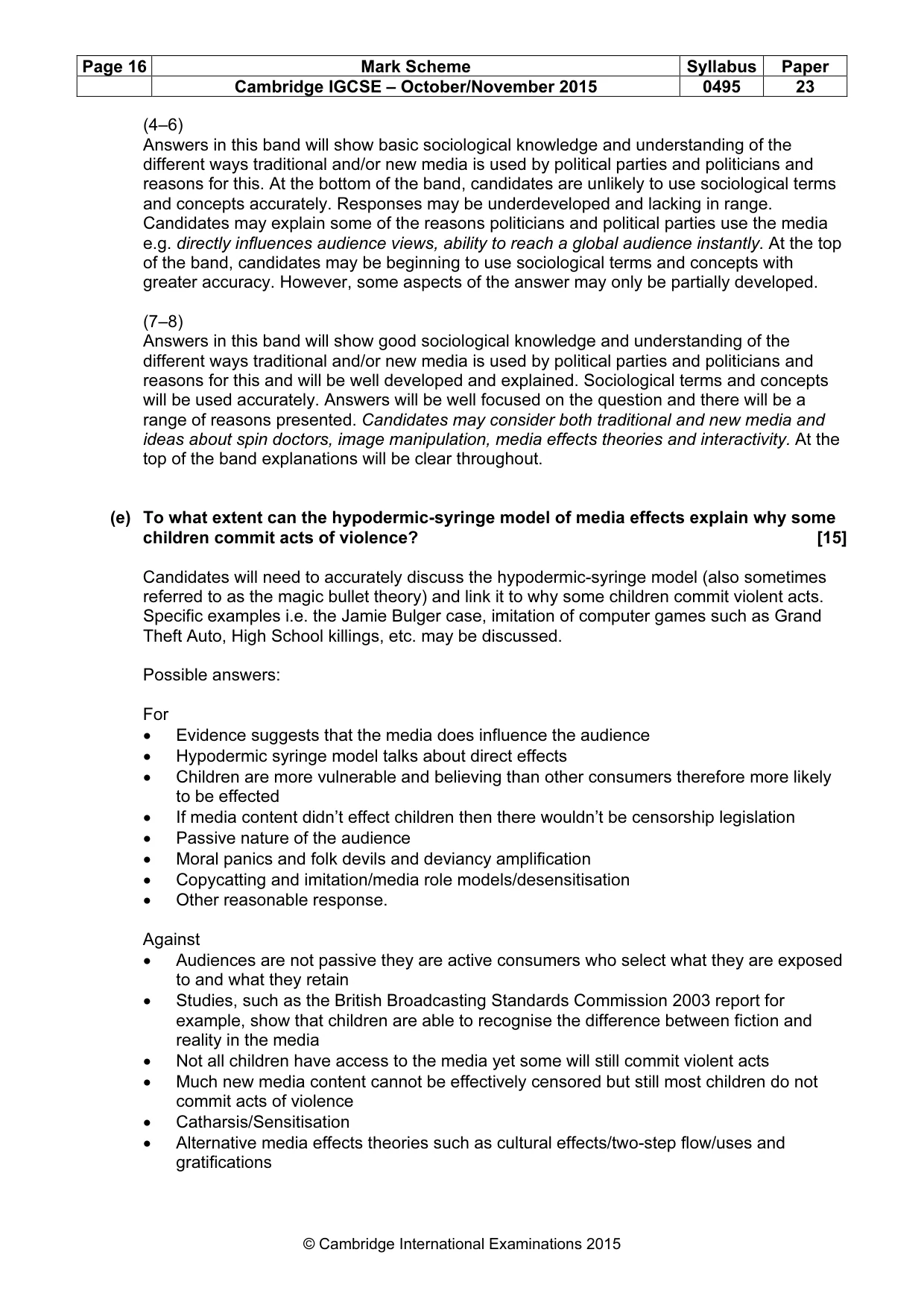
Page 16 Mark Scheme Syllabus Paper Cambridge IGCSE – October/November 2015 0495 23 © Cambridge International Examinations 2015 (4–6) Answers in this band will show basic sociological knowledge and understanding of the different ways traditional and/or new media is used by political parties and politicians and reasons for this. At the bottom of the band, candidates are unlikely to use sociological terms and concepts accurately. Responses may be underdeveloped and lacking in range. Candidates may explain some of the reasons politicians and political parties use the media e.g. directly influences audience views, ability to reach a global audience instantly. At the top of the band, candidates may be beginning to use sociological terms and concepts with greater accuracy. However, some aspects of the answer may only be partially developed. (7–8) Answers in this band will show good sociological knowledge and understanding of the different ways traditional and/or new media is used by political parties and politicians and reasons for this and will be well developed and explained. Sociological terms and concepts will be used accurately. Answers will be well focused on the question and there will be a range of reasons presented. Candidates may consider both traditional and new media and ideas about spin doctors, image manipulation, media effects theories and interactivity. At the top of the band explanations will be clear throughout. (e) To what extent can the hypodermic-syringe model of media effects explain why some children commit acts of violence? [15] Candidates will need to accurately discuss the hypodermic-syringe model (also sometimes referred to as the magic bullet theory) and link it to why some children commit violent acts. Specific examples i.e. the Jamie Bulger case, imitation of computer games such as Grand Theft Auto, High School killings, etc. may be discussed. Possible answers: For • Evidence suggests that the media does influence the audience • Hypodermic syringe model talks about direct effects • Children are more vulnerable and believing than other consumers therefore more likely to be effected • If media content didn’t effect children then there wouldn’t be censorship legislation • Passive nature of the audience • Moral panics and folk devils and deviancy amplification • Copycatting and imitation/media role models/desensitisation • Other reasonable response. Against • Audiences are not passive they are active consumers who select what they are exposed to and what they retain • Studies, such as the British Broadcasting Standards Commission 2003 report for example, show that children are able to recognise the difference between fiction and reality in the media • Not all children have access to the media yet some will still commit violent acts • Much new media content cannot be effectively censored but still most children do not commit acts of violence • Catharsis/Sensitisation • Alternative media effects theories such as cultural effects/two-step flow/uses and gratifications
Mark scheme, page 17
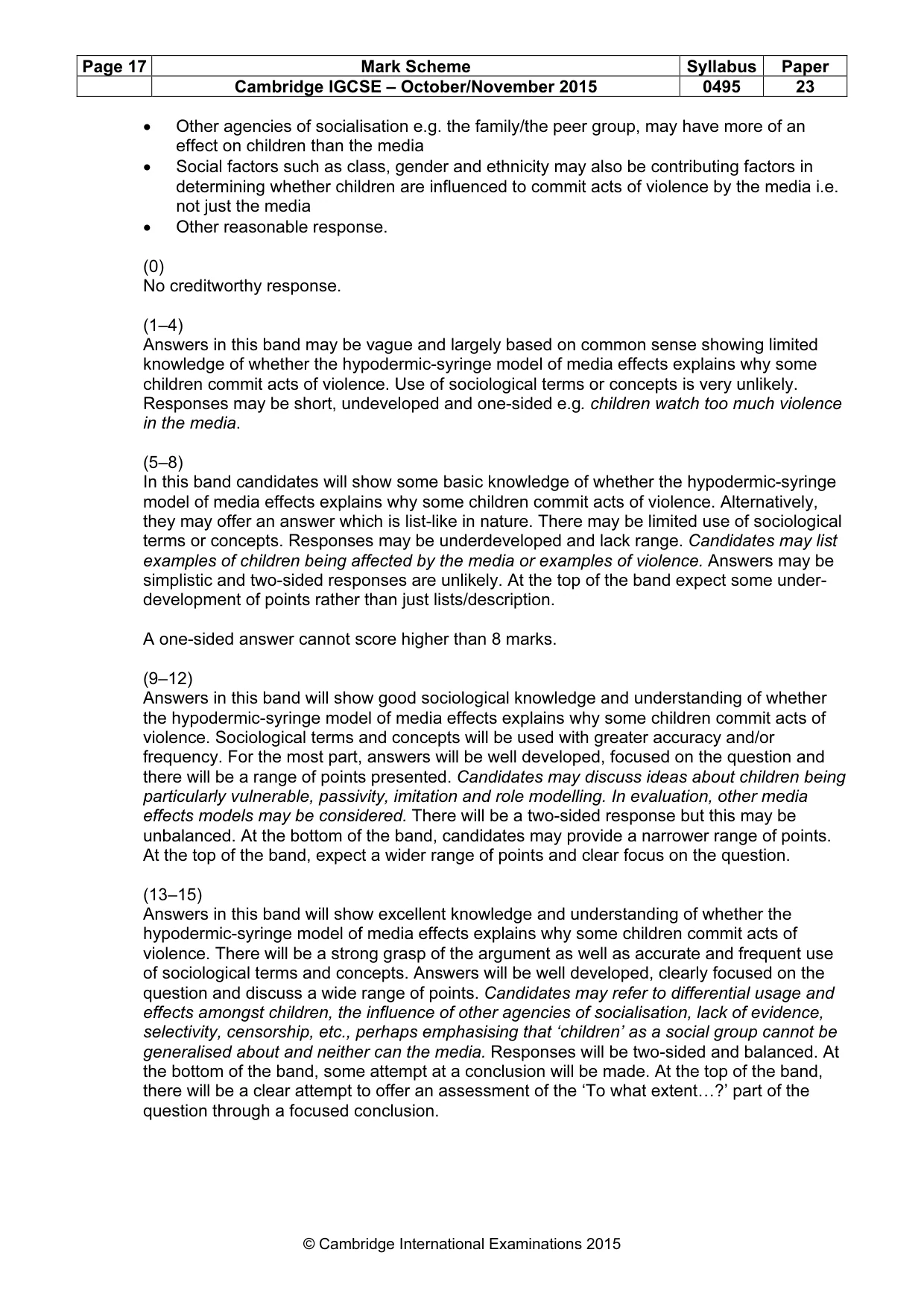
Page 17 Mark Scheme Syllabus Paper Cambridge IGCSE – October/November 2015 0495 23 © Cambridge International Examinations 2015 • Other agencies of socialisation e.g. the family/the peer group, may have more of an effect on children than the media • Social factors such as class, gender and ethnicity may also be contributing factors in determining whether children are influenced to commit acts of violence by the media i.e. not just the media • Other reasonable response. (0) No creditworthy response. (1–4) Answers in this band may be vague and largely based on common sense showing limited knowledge of whether the hypodermic-syringe model of media effects explains why some children commit acts of violence. Use of sociological terms or concepts is very unlikely. Responses may be short, undeveloped and one-sided e.g. children watch too much violence in the media. (5–8) In this band candidates will show some basic knowledge of whether the hypodermic-syringe model of media effects explains why some children commit acts of violence. Alternatively, they may offer an answer which is list-like in nature. There may be limited use of sociological terms or concepts. Responses may be underdeveloped and lack range. Candidates may list examples of children being affected by the media or examples of violence. Answers may be simplistic and two-sided responses are unlikely. At the top of the band expect some under- development of points rather than just lists/description. A one-sided answer cannot score higher than 8 marks. (9–12) Answers in this band will show good sociological knowledge and understanding of whether the hypodermic-syringe model of media effects explains why some children commit acts of violence. Sociological terms and concepts will be used with greater accuracy and/or frequency. For the most part, answers will be well developed, focused on the question and there will be a range of points presented. Candidates may discuss ideas about children being particularly vulnerable, passivity, imitation and role modelling. In evaluation, other media effects models may be considered. There will be a two-sided response but this may be unbalanced. At the bottom of the band, candidates may provide a narrower range of points. At the top of the band, expect a wider range of points and clear focus on the question. (13–15) Answers in this band will show excellent knowledge and understanding of whether the hypodermic-syringe model of media effects explains why some children commit acts of violence. There will be a strong grasp of the argument as well as accurate and frequent use of sociological terms and concepts. Answers will be well developed, clearly focused on the question and discuss a wide range of points. Candidates may refer to differential usage and effects amongst children, the influence of other agencies of socialisation, lack of evidence, selectivity, censorship, etc., perhaps emphasising that ‘children’ as a social group cannot be generalised about and neither can the media. Responses will be two-sided and balanced. At the bottom of the band, some attempt at a conclusion will be made. At the top of the band, there will be a clear attempt to offer an assessment of the ‘To what extent…?’ part of the question through a focused conclusion.
What you needed in this session
Cambridge’s own grade thresholds for 2015 Oct/Nov, Paper 2 · Variant 3. A higher threshold means an easier paper — the bar moves with how the cohort did.