Cambridge IGCSE Sociology 0495 — 2015 Oct/Nov Paper 2 · Variant 2
0495/22/O/N/15 · 70 marks · ≈79 min
The question paper and its mark scheme, free to read here and free to download. This is Cambridge’s own paper, exactly as it was sat.
Question paper4 pages

Mark scheme21 pages
Answers below. Sit the paper first if you are practising.
Paper as text
Question paper, page 1
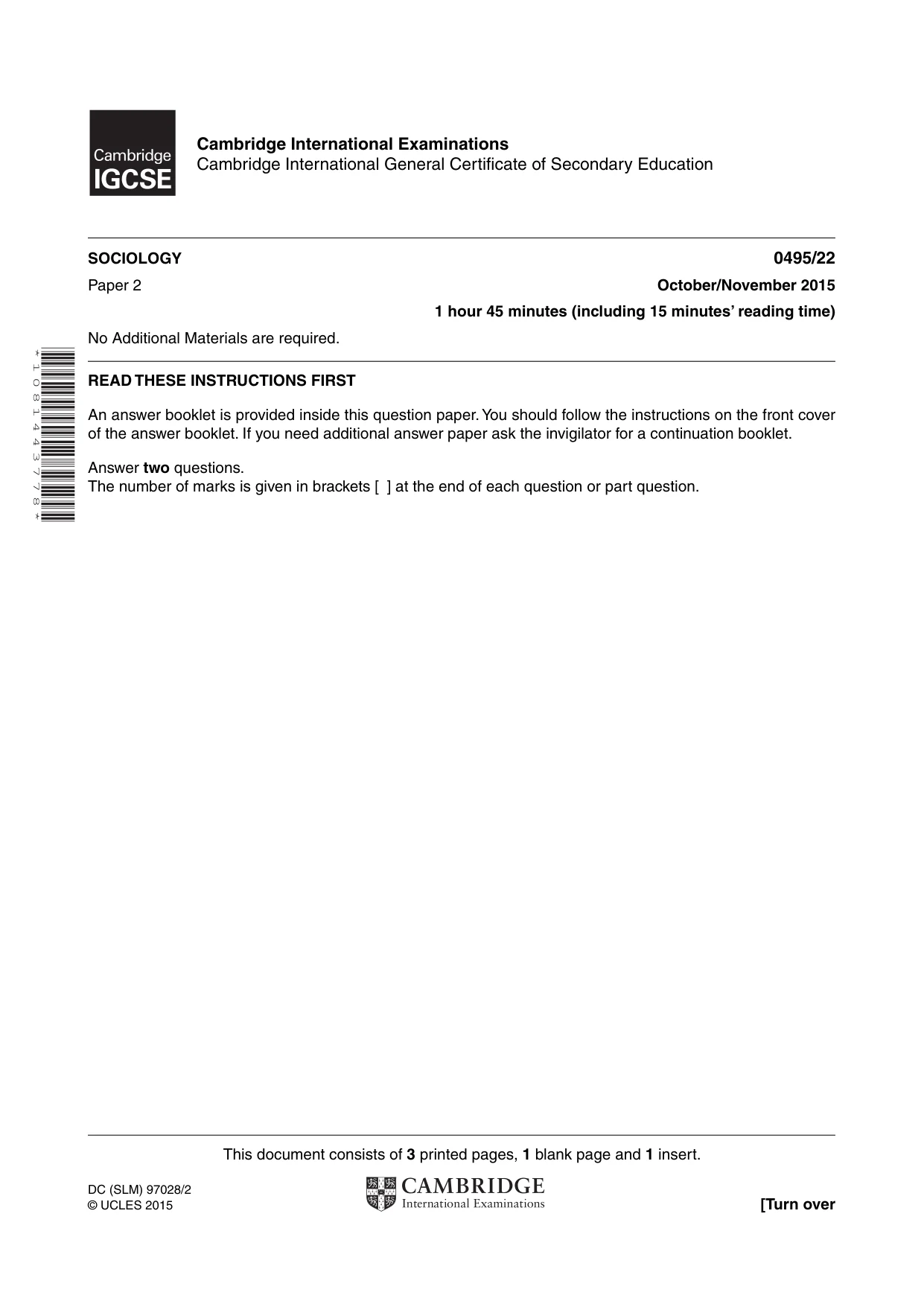
This document consists of 3 printed pages, 1 blank page and 1 insert. DC (SLM) 97028/2 © UCLES 2015 [Turn over Cambridge International Examinations Cambridge International General Certificate of Secondary Education * 1 0 8 1 4 4 3 7 7 8 * SOCIOLOGY 0495/22 Paper 2 October/November 2015 1 hour 45 minutes (including 15 minutes’ reading time) No Additional Materials are required. READ THESE INSTRUCTIONS FIRST An answer booklet is provided inside this question paper. You should follow the instructions on the front cover of the answer booklet. If you need additional answer paper ask the invigilator for a continuation booklet. Answer two questions. The number of marks is given in brackets [ ] at the end of each question or part question.
Question paper, page 2
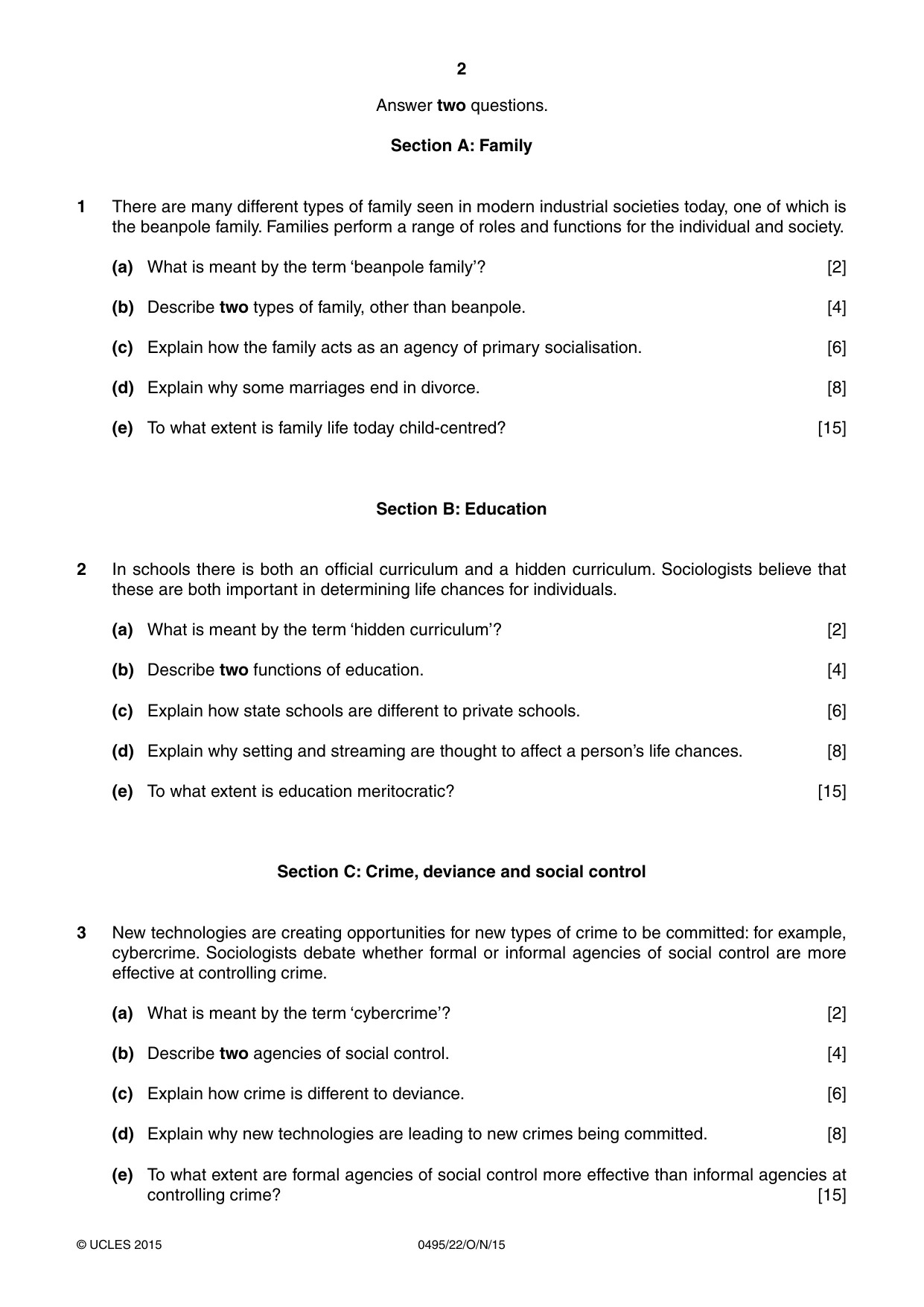
2 0495/22/O/N/15 © UCLES 2015 Answer two questions. Section A: Family 1 There are many different types of family seen in modern industrial societies today, one of which is the beanpole family. Families perform a range of roles and functions for the individual and society. (a) What is meant by the term ‘beanpole family’? [2] (b) Describe two types of family, other than beanpole. [4] (c) Explain how the family acts as an agency of primary socialisation. [6] (d) Explain why some marriages end in divorce. [8] (e) To what extent is family life today child-centred? [15] Section B: Education 2 In schools there is both an official curriculum and a hidden curriculum. Sociologists believe that these are both important in determining life chances for individuals. (a) What is meant by the term ‘hidden curriculum’? [2] (b) Describe two functions of education. [4] (c) Explain how state schools are different to private schools. [6] (d) Explain why setting and streaming are thought to affect a person’s life chances. [8] (e) To what extent is education meritocratic? [15] Section C: Crime, deviance and social control 3 New technologies are creating opportunities for new types of crime to be committed: for example, cybercrime. Sociologists debate whether formal or informal agencies of social control are more effective at controlling crime. (a) What is meant by the term ‘cybercrime’? [2] (b) Describe two agencies of social control. [4] (c) Explain how crime is different to deviance. [6] (d) Explain why new technologies are leading to new crimes being committed. [8] (e) To what extent are formal agencies of social control more effective than informal agencies at controlling crime? [15]
Question paper, page 3
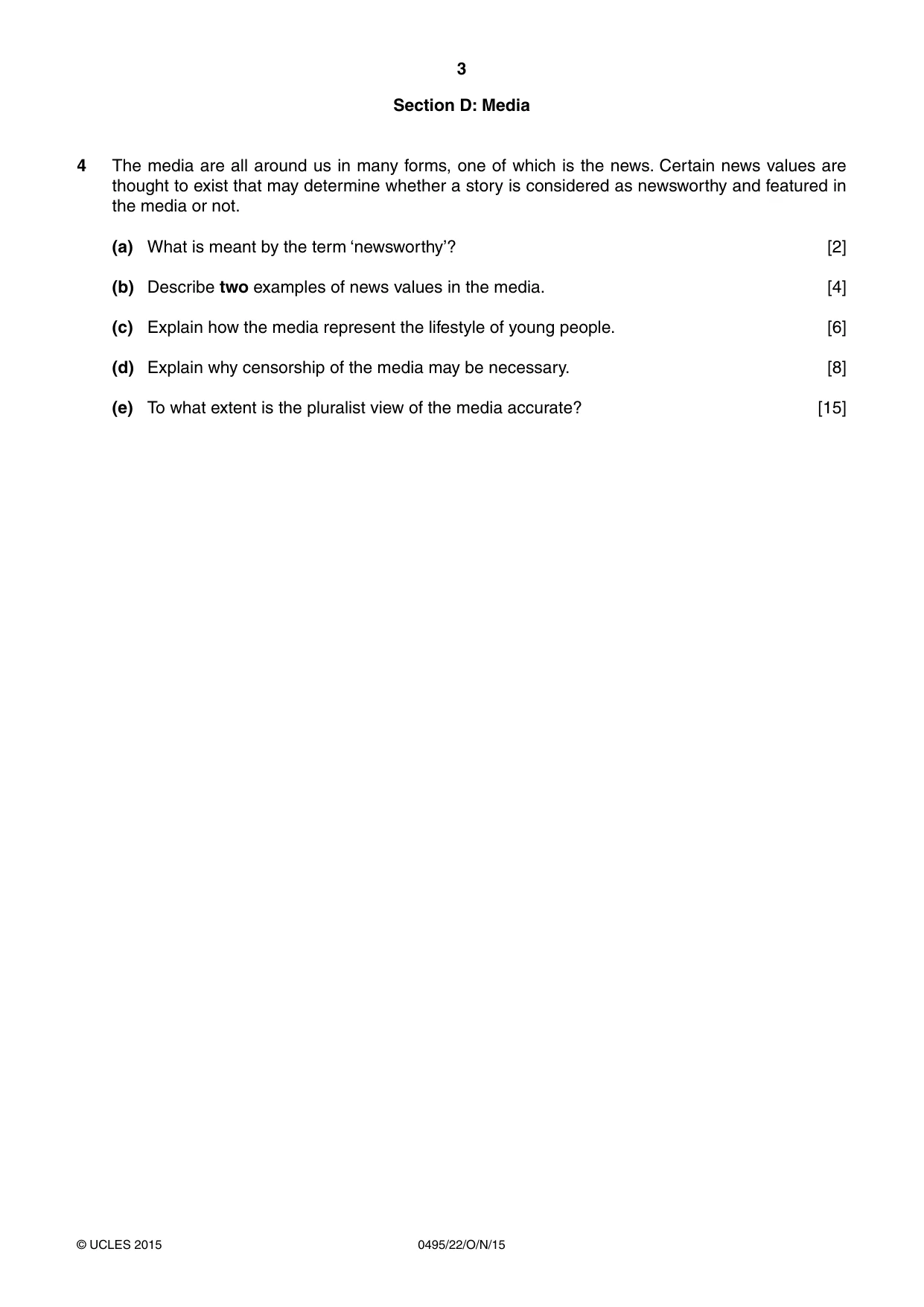
3 0495/22/O/N/15 © UCLES 2015 Section D: Media 4 The media are all around us in many forms, one of which is the news. Certain news values are thought to exist that may determine whether a story is considered as newsworthy and featured in the media or not. (a) What is meant by the term ‘newsworthy’? [2] (b) Describe two examples of news values in the media. [4] (c) Explain how the media represent the lifestyle of young people. [6] (d) Explain why censorship of the media may be necessary. [8] (e) To what extent is the pluralist view of the media accurate? [15]
Question paper, page 4
4 0495/22/O/N/15 © UCLES 2015 Permission to reproduce items where third-party owned material protected by copyright is included has been sought and cleared where possible. Every reasonable effort has been made by the publisher (UCLES) to trace copyright holders, but if any items requiring clearance have unwittingly been included, the publisher will be pleased to make amends at the earliest possible opportunity. To avoid the issue of disclosure of answer-related information to candidates, all copyright acknowledgements are reproduced online in the Cambridge International Examinations Copyright Acknowledgements Booklet. This is produced for each series of examinations and is freely available to download at www.cie.org.uk after the live examination series. Cambridge International Examinations is part of the Cambridge Assessment Group. Cambridge Assessment is the brand name of University of Cambridge Local Examinations Syndicate (UCLES), which is itself a department of the University of Cambridge. BLANK PAGE
Mark scheme, page 1
® IGCSE is the registered trademark of Cambridge International Examinations. CAMBRIDGE INTERNATIONAL EXAMINATIONS Cambridge International General Certificate of Secondary Education MARK SCHEME for the October/November 2015 series 0495 SOCIOLOGY 0495/22 Paper 2, maximum raw mark 70 This mark scheme is published as an aid to teachers and candidates, to indicate the requirements of the examination. It shows the basis on which Examiners were instructed to award marks. It does not indicate the details of the discussions that took place at an Examiners’ meeting before marking began, which would have considered the acceptability of alternative answers. Mark schemes should be read in conjunction with the question paper and the Principal Examiner Report for Teachers. Cambridge will not enter into discussions about these mark schemes. Cambridge is publishing the mark schemes for the October/November 2015 series for most Cambridge IGCSE®, Cambridge International A and AS Level components and some Cambridge O Level components.
Mark scheme, page 2
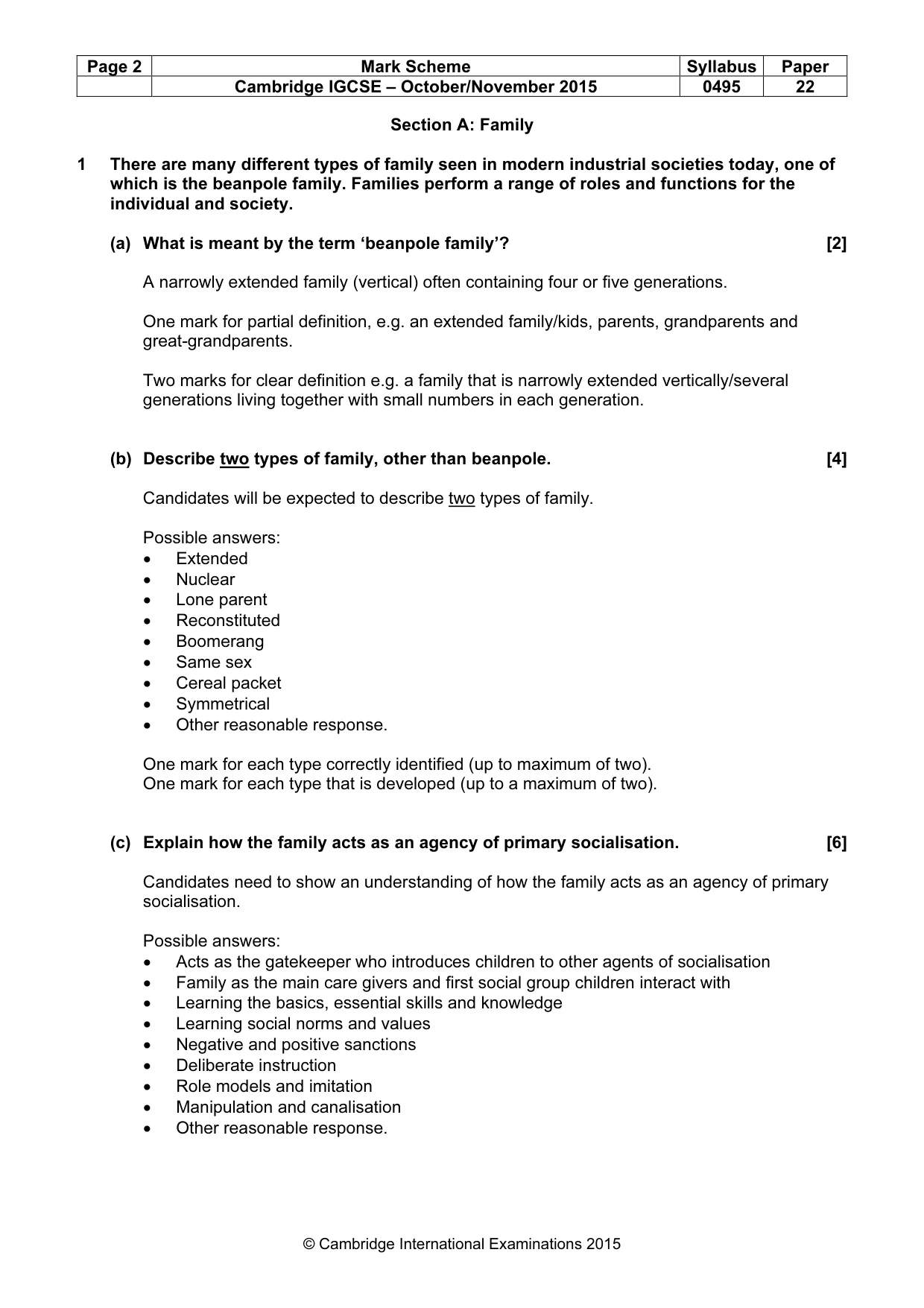
Page 2 Mark Scheme Syllabus Paper Cambridge IGCSE – October/November 2015 0495 22 © Cambridge International Examinations 2015 Section A: Family 1 There are many different types of family seen in modern industrial societies today, one of which is the beanpole family. Families perform a range of roles and functions for the individual and society. (a) What is meant by the term ‘beanpole family’? [2] A narrowly extended family (vertical) often containing four or five generations. One mark for partial definition, e.g. an extended family/kids, parents, grandparents and great-grandparents. Two marks for clear definition e.g. a family that is narrowly extended vertically/several generations living together with small numbers in each generation. (b) Describe two types of family, other than beanpole. [4] Candidates will be expected to describe two types of family. Possible answers: • Extended • Nuclear • Lone parent • Reconstituted • Boomerang • Same sex • Cereal packet • Symmetrical • Other reasonable response. One mark for each type correctly identified (up to maximum of two). One mark for each type that is developed (up to a maximum of two). (c) Explain how the family acts as an agency of primary socialisation. [6] Candidates need to show an understanding of how the family acts as an agency of primary socialisation. Possible answers: • Acts as the gatekeeper who introduces children to other agents of socialisation • Family as the main care givers and first social group children interact with • Learning the basics, essential skills and knowledge • Learning social norms and values • Negative and positive sanctions • Deliberate instruction • Role models and imitation • Manipulation and canalisation • Other reasonable response.
Mark scheme, page 3
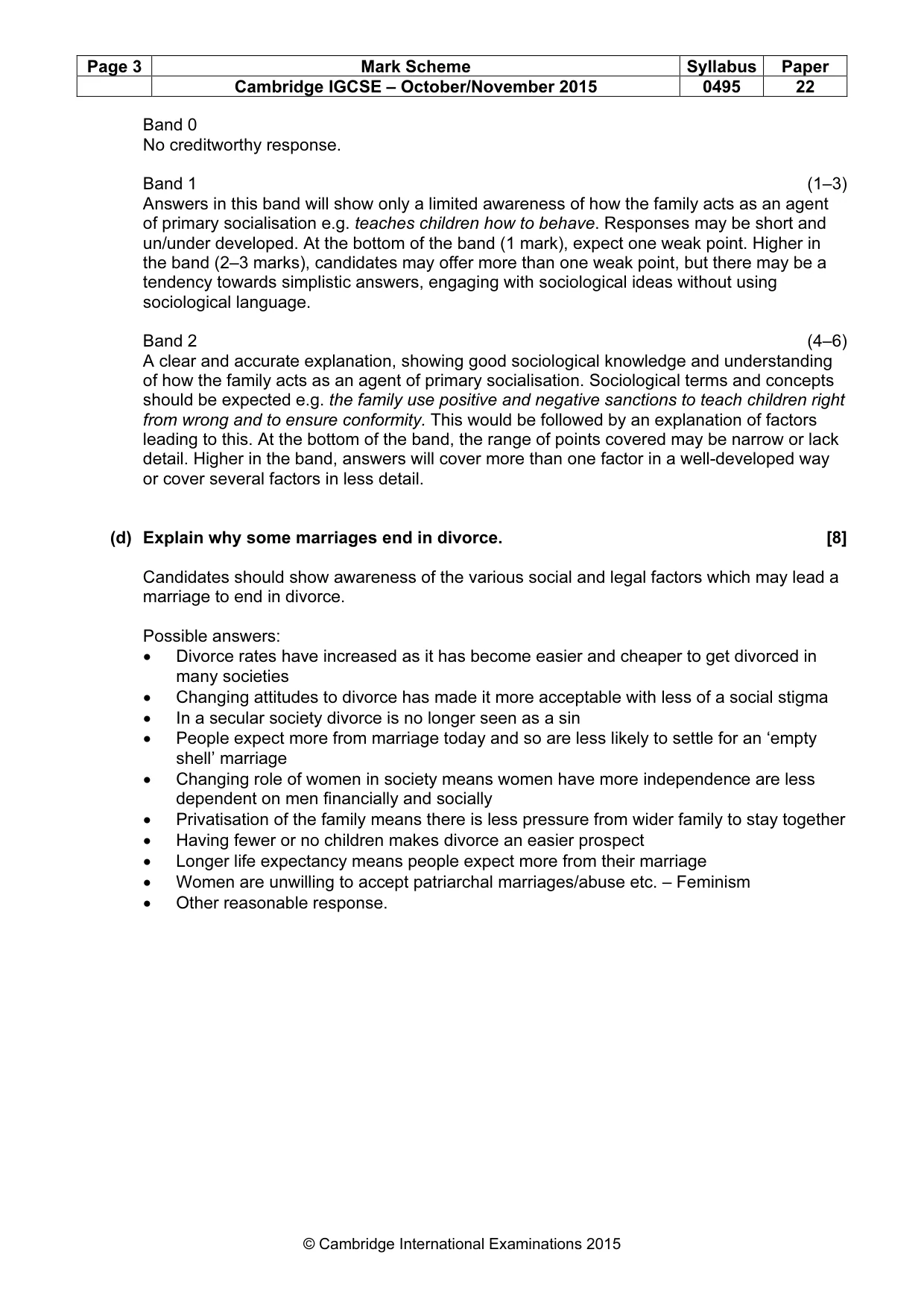
Page 3 Mark Scheme Syllabus Paper Cambridge IGCSE – October/November 2015 0495 22 © Cambridge International Examinations 2015 Band 0 No creditworthy response. Band 1 (1–3) Answers in this band will show only a limited awareness of how the family acts as an agent of primary socialisation e.g. teaches children how to behave. Responses may be short and un/under developed. At the bottom of the band (1 mark), expect one weak point. Higher in the band (2–3 marks), candidates may offer more than one weak point, but there may be a tendency towards simplistic answers, engaging with sociological ideas without using sociological language. Band 2 (4–6) A clear and accurate explanation, showing good sociological knowledge and understanding of how the family acts as an agent of primary socialisation. Sociological terms and concepts should be expected e.g. the family use positive and negative sanctions to teach children right from wrong and to ensure conformity. This would be followed by an explanation of factors leading to this. At the bottom of the band, the range of points covered may be narrow or lack detail. Higher in the band, answers will cover more than one factor in a well-developed way or cover several factors in less detail. (d) Explain why some marriages end in divorce. [8] Candidates should show awareness of the various social and legal factors which may lead a marriage to end in divorce. Possible answers: • Divorce rates have increased as it has become easier and cheaper to get divorced in many societies • Changing attitudes to divorce has made it more acceptable with less of a social stigma • In a secular society divorce is no longer seen as a sin • People expect more from marriage today and so are less likely to settle for an ‘empty shell’ marriage • Changing role of women in society means women have more independence are less dependent on men financially and socially • Privatisation of the family means there is less pressure from wider family to stay together • Having fewer or no children makes divorce an easier prospect • Longer life expectancy means people expect more from their marriage • Women are unwilling to accept patriarchal marriages/abuse etc. – Feminism • Other reasonable response.
Mark scheme, page 4
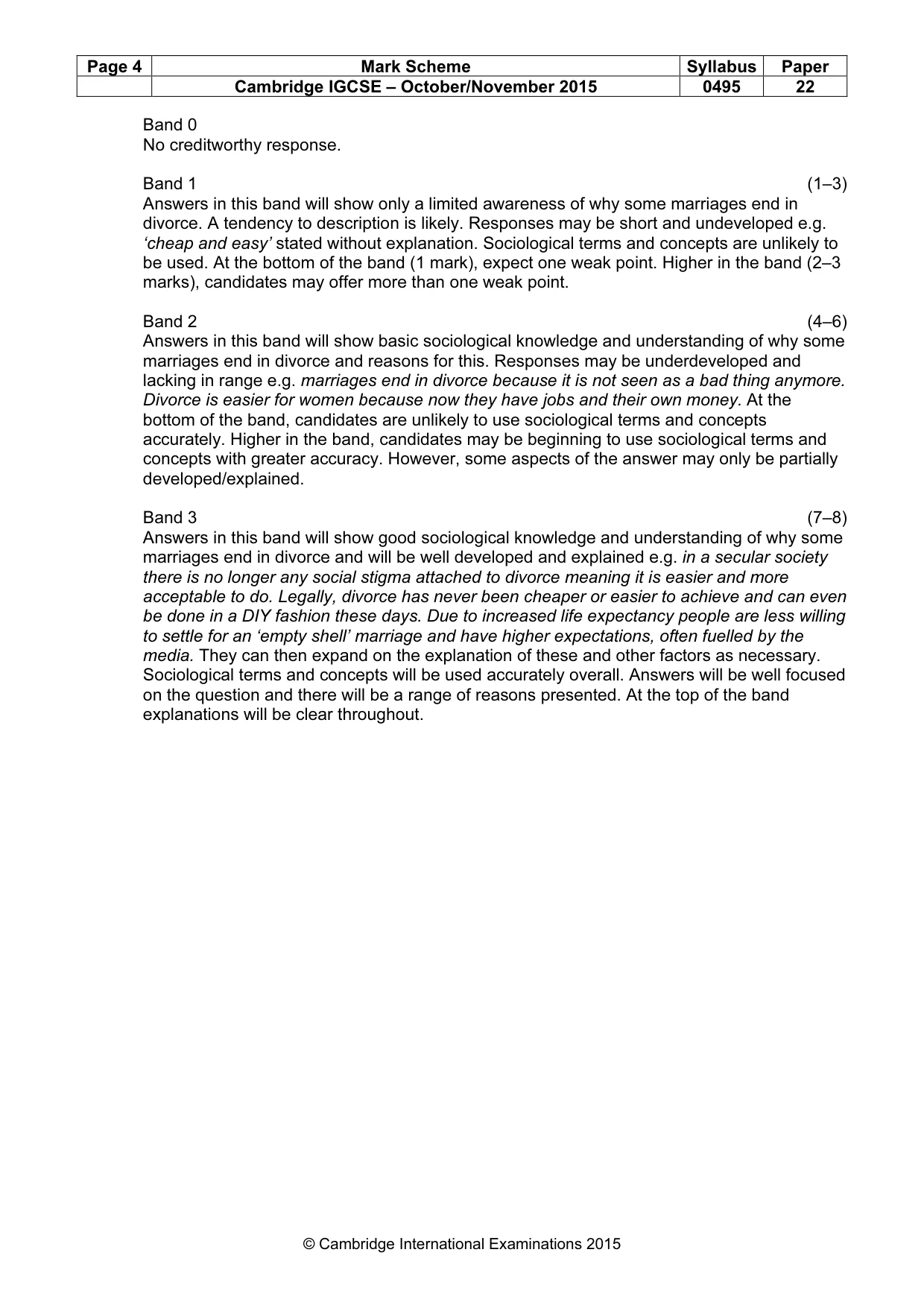
Page 4 Mark Scheme Syllabus Paper Cambridge IGCSE – October/November 2015 0495 22 © Cambridge International Examinations 2015 Band 0 No creditworthy response. Band 1 (1–3) Answers in this band will show only a limited awareness of why some marriages end in divorce. A tendency to description is likely. Responses may be short and undeveloped e.g. ‘cheap and easy’ stated without explanation. Sociological terms and concepts are unlikely to be used. At the bottom of the band (1 mark), expect one weak point. Higher in the band (2–3 marks), candidates may offer more than one weak point. Band 2 (4–6) Answers in this band will show basic sociological knowledge and understanding of why some marriages end in divorce and reasons for this. Responses may be underdeveloped and lacking in range e.g. marriages end in divorce because it is not seen as a bad thing anymore. Divorce is easier for women because now they have jobs and their own money. At the bottom of the band, candidates are unlikely to use sociological terms and concepts accurately. Higher in the band, candidates may be beginning to use sociological terms and concepts with greater accuracy. However, some aspects of the answer may only be partially developed/explained. Band 3 (7–8) Answers in this band will show good sociological knowledge and understanding of why some marriages end in divorce and will be well developed and explained e.g. in a secular society there is no longer any social stigma attached to divorce meaning it is easier and more acceptable to do. Legally, divorce has never been cheaper or easier to achieve and can even be done in a DIY fashion these days. Due to increased life expectancy people are less willing to settle for an ‘empty shell’ marriage and have higher expectations, often fuelled by the media. They can then expand on the explanation of these and other factors as necessary. Sociological terms and concepts will be used accurately overall. Answers will be well focused on the question and there will be a range of reasons presented. At the top of the band explanations will be clear throughout.
Mark scheme, page 5
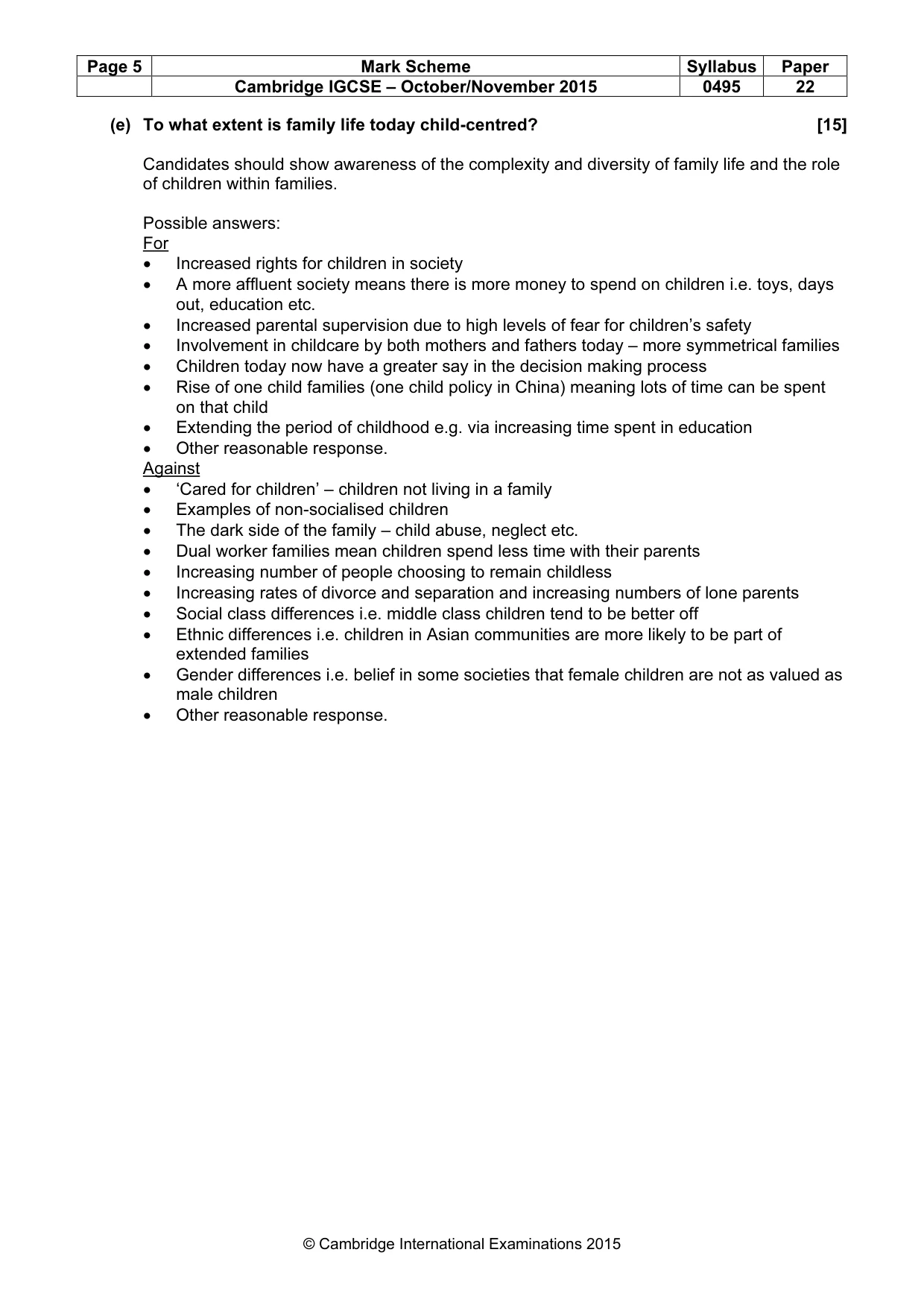
Page 5 Mark Scheme Syllabus Paper Cambridge IGCSE – October/November 2015 0495 22 © Cambridge International Examinations 2015 (e) To what extent is family life today child-centred? [15] Candidates should show awareness of the complexity and diversity of family life and the role of children within families. Possible answers: For • Increased rights for children in society • A more affluent society means there is more money to spend on children i.e. toys, days out, education etc. • Increased parental supervision due to high levels of fear for children’s safety • Involvement in childcare by both mothers and fathers today – more symmetrical families • Children today now have a greater say in the decision making process • Rise of one child families (one child policy in China) meaning lots of time can be spent on that child • Extending the period of childhood e.g. via increasing time spent in education • Other reasonable response. Against • ‘Cared for children’ – children not living in a family • Examples of non-socialised children • The dark side of the family – child abuse, neglect etc. • Dual worker families mean children spend less time with their parents • Increasing number of people choosing to remain childless • Increasing rates of divorce and separation and increasing numbers of lone parents • Social class differences i.e. middle class children tend to be better off • Ethnic differences i.e. children in Asian communities are more likely to be part of extended families • Gender differences i.e. belief in some societies that female children are not as valued as male children • Other reasonable response.
Mark scheme, page 6
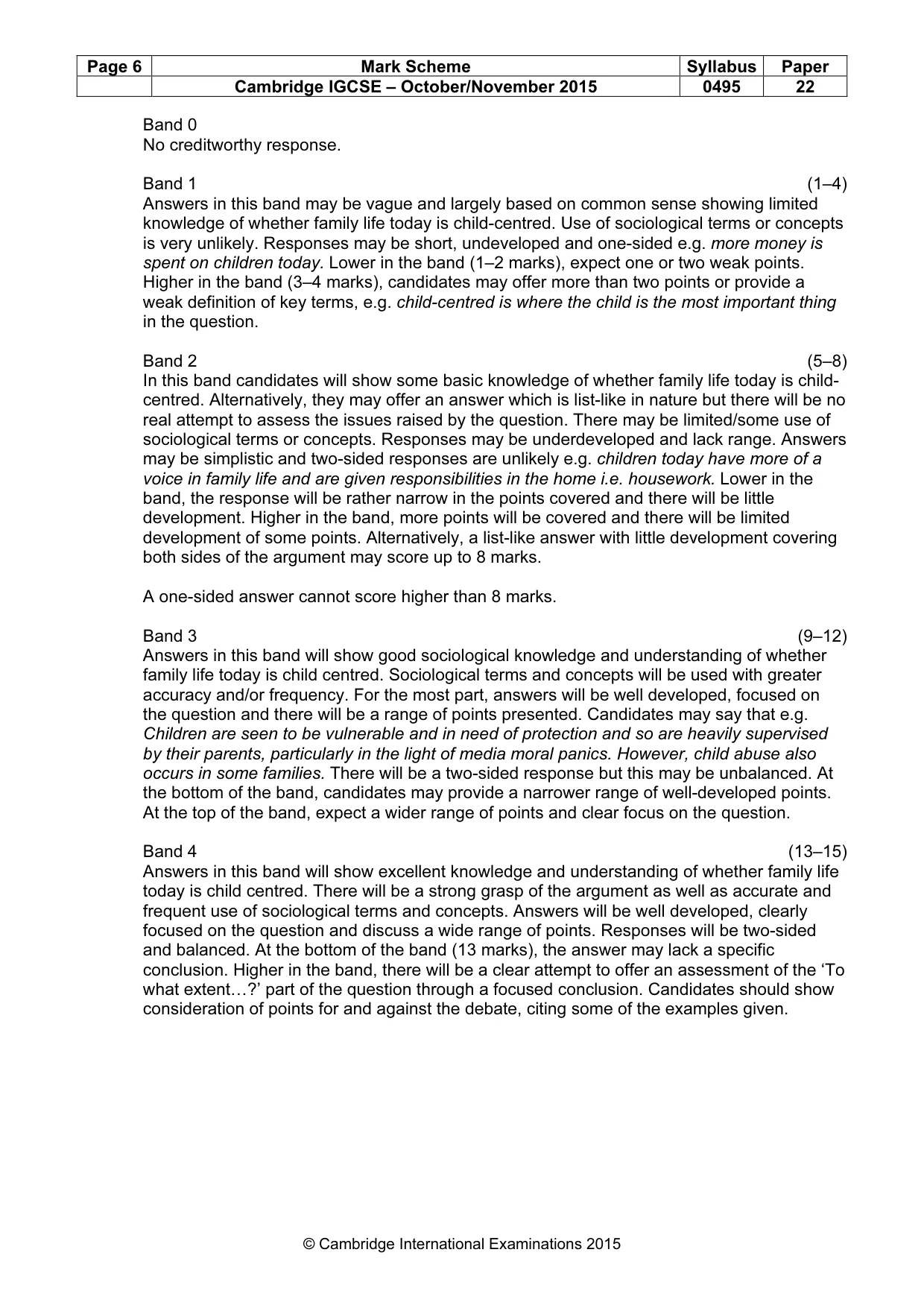
Page 6 Mark Scheme Syllabus Paper Cambridge IGCSE – October/November 2015 0495 22 © Cambridge International Examinations 2015 Band 0 No creditworthy response. Band 1 (1–4) Answers in this band may be vague and largely based on common sense showing limited knowledge of whether family life today is child-centred. Use of sociological terms or concepts is very unlikely. Responses may be short, undeveloped and one-sided e.g. more money is spent on children today. Lower in the band (1–2 marks), expect one or two weak points. Higher in the band (3–4 marks), candidates may offer more than two points or provide a weak definition of key terms, e.g. child-centred is where the child is the most important thing in the question. Band 2 (5–8) In this band candidates will show some basic knowledge of whether family life today is child- centred. Alternatively, they may offer an answer which is list-like in nature but there will be no real attempt to assess the issues raised by the question. There may be limited/some use of sociological terms or concepts. Responses may be underdeveloped and lack range. Answers may be simplistic and two-sided responses are unlikely e.g. children today have more of a voice in family life and are given responsibilities in the home i.e. housework. Lower in the band, the response will be rather narrow in the points covered and there will be little development. Higher in the band, more points will be covered and there will be limited development of some points. Alternatively, a list-like answer with little development covering both sides of the argument may score up to 8 marks. A one-sided answer cannot score higher than 8 marks. Band 3 (9–12) Answers in this band will show good sociological knowledge and understanding of whether family life today is child centred. Sociological terms and concepts will be used with greater accuracy and/or frequency. For the most part, answers will be well developed, focused on the question and there will be a range of points presented. Candidates may say that e.g. Children are seen to be vulnerable and in need of protection and so are heavily supervised by their parents, particularly in the light of media moral panics. However, child abuse also occurs in some families. There will be a two-sided response but this may be unbalanced. At the bottom of the band, candidates may provide a narrower range of well-developed points. At the top of the band, expect a wider range of points and clear focus on the question. Band 4 (13–15) Answers in this band will show excellent knowledge and understanding of whether family life today is child centred. There will be a strong grasp of the argument as well as accurate and frequent use of sociological terms and concepts. Answers will be well developed, clearly focused on the question and discuss a wide range of points. Responses will be two-sided and balanced. At the bottom of the band (13 marks), the answer may lack a specific conclusion. Higher in the band, there will be a clear attempt to offer an assessment of the ‘To what extent…?’ part of the question through a focused conclusion. Candidates should show consideration of points for and against the debate, citing some of the examples given.
Mark scheme, page 7
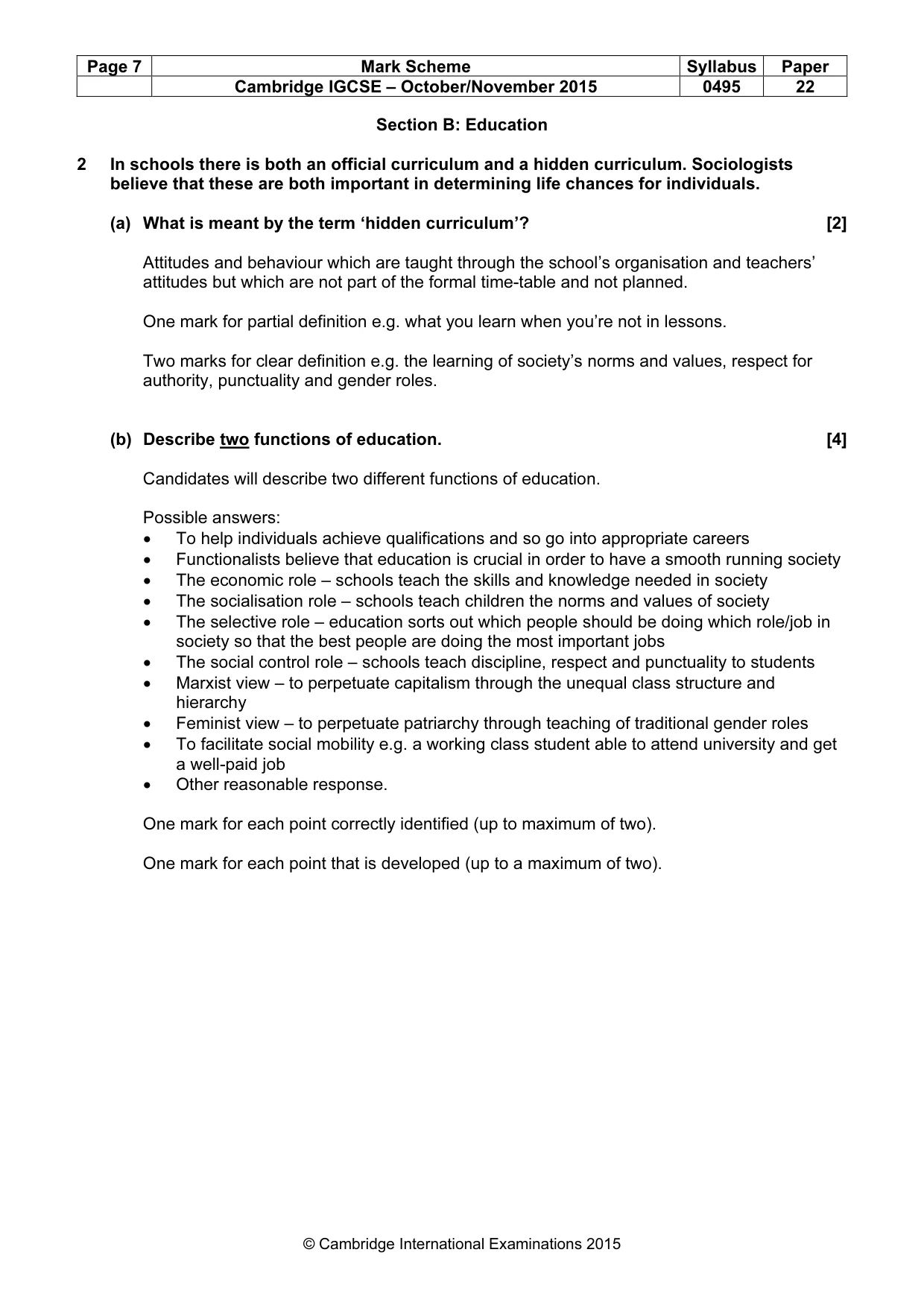
Page 7 Mark Scheme Syllabus Paper Cambridge IGCSE – October/November 2015 0495 22 © Cambridge International Examinations 2015 Section B: Education 2 In schools there is both an official curriculum and a hidden curriculum. Sociologists believe that these are both important in determining life chances for individuals. (a) What is meant by the term ‘hidden curriculum’? [2] Attitudes and behaviour which are taught through the school’s organisation and teachers’ attitudes but which are not part of the formal time-table and not planned. One mark for partial definition e.g. what you learn when you’re not in lessons. Two marks for clear definition e.g. the learning of society’s norms and values, respect for authority, punctuality and gender roles. (b) Describe two functions of education. [4] Candidates will describe two different functions of education. Possible answers: • To help individuals achieve qualifications and so go into appropriate careers • Functionalists believe that education is crucial in order to have a smooth running society • The economic role – schools teach the skills and knowledge needed in society • The socialisation role – schools teach children the norms and values of society • The selective role – education sorts out which people should be doing which role/job in society so that the best people are doing the most important jobs • The social control role – schools teach discipline, respect and punctuality to students • Marxist view – to perpetuate capitalism through the unequal class structure and hierarchy • Feminist view – to perpetuate patriarchy through teaching of traditional gender roles • To facilitate social mobility e.g. a working class student able to attend university and get a well-paid job • Other reasonable response. One mark for each point correctly identified (up to maximum of two). One mark for each point that is developed (up to a maximum of two).
Mark scheme, page 8
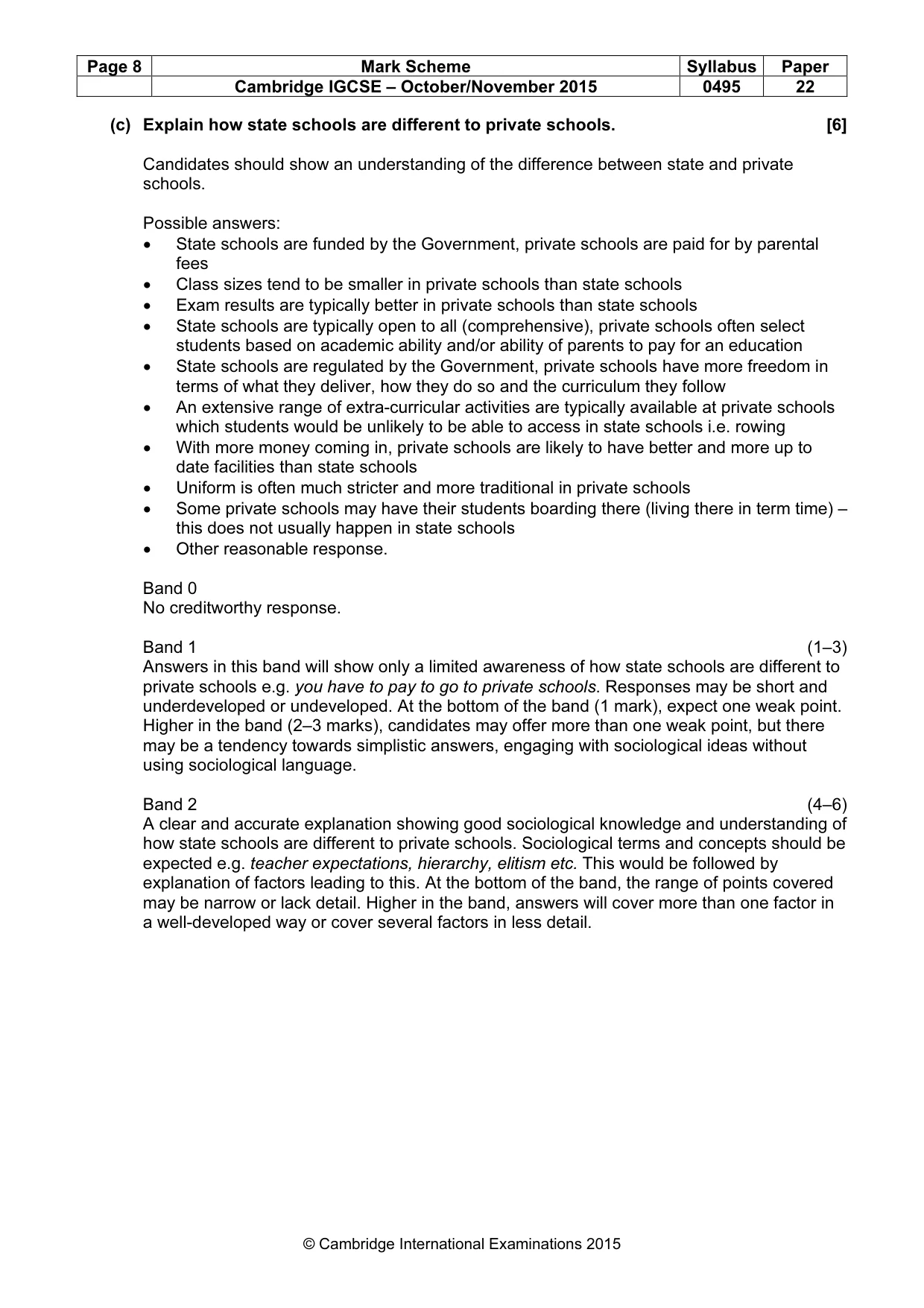
Page 8 Mark Scheme Syllabus Paper Cambridge IGCSE – October/November 2015 0495 22 © Cambridge International Examinations 2015 (c) Explain how state schools are different to private schools. [6] Candidates should show an understanding of the difference between state and private schools. Possible answers: • State schools are funded by the Government, private schools are paid for by parental fees • Class sizes tend to be smaller in private schools than state schools • Exam results are typically better in private schools than state schools • State schools are typically open to all (comprehensive), private schools often select students based on academic ability and/or ability of parents to pay for an education • State schools are regulated by the Government, private schools have more freedom in terms of what they deliver, how they do so and the curriculum they follow • An extensive range of extra-curricular activities are typically available at private schools which students would be unlikely to be able to access in state schools i.e. rowing • With more money coming in, private schools are likely to have better and more up to date facilities than state schools • Uniform is often much stricter and more traditional in private schools • Some private schools may have their students boarding there (living there in term time) – this does not usually happen in state schools • Other reasonable response. Band 0 No creditworthy response. Band 1 (1–3) Answers in this band will show only a limited awareness of how state schools are different to private schools e.g. you have to pay to go to private schools. Responses may be short and underdeveloped or undeveloped. At the bottom of the band (1 mark), expect one weak point. Higher in the band (2–3 marks), candidates may offer more than one weak point, but there may be a tendency towards simplistic answers, engaging with sociological ideas without using sociological language. Band 2 (4–6) A clear and accurate explanation showing good sociological knowledge and understanding of how state schools are different to private schools. Sociological terms and concepts should be expected e.g. teacher expectations, hierarchy, elitism etc. This would be followed by explanation of factors leading to this. At the bottom of the band, the range of points covered may be narrow or lack detail. Higher in the band, answers will cover more than one factor in a well-developed way or cover several factors in less detail.
Mark scheme, page 9
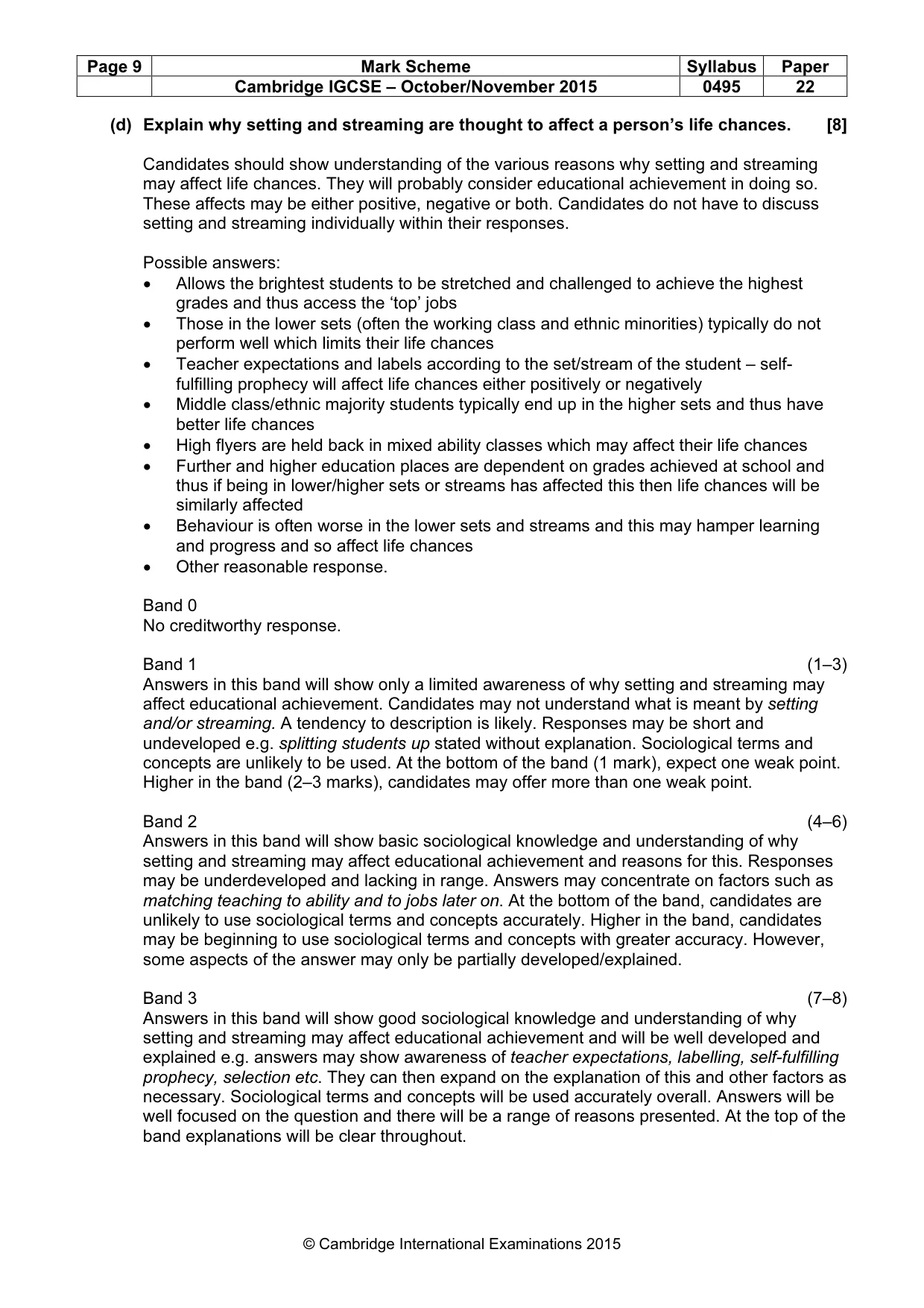
Page 9 Mark Scheme Syllabus Paper Cambridge IGCSE – October/November 2015 0495 22 © Cambridge International Examinations 2015 (d) Explain why setting and streaming are thought to affect a person’s life chances. [8] Candidates should show understanding of the various reasons why setting and streaming may affect life chances. They will probably consider educational achievement in doing so. These affects may be either positive, negative or both. Candidates do not have to discuss setting and streaming individually within their responses. Possible answers: • Allows the brightest students to be stretched and challenged to achieve the highest grades and thus access the ‘top’ jobs • Those in the lower sets (often the working class and ethnic minorities) typically do not perform well which limits their life chances • Teacher expectations and labels according to the set/stream of the student – self- fulfilling prophecy will affect life chances either positively or negatively • Middle class/ethnic majority students typically end up in the higher sets and thus have better life chances • High flyers are held back in mixed ability classes which may affect their life chances • Further and higher education places are dependent on grades achieved at school and thus if being in lower/higher sets or streams has affected this then life chances will be similarly affected • Behaviour is often worse in the lower sets and streams and this may hamper learning and progress and so affect life chances • Other reasonable response. Band 0 No creditworthy response. Band 1 (1–3) Answers in this band will show only a limited awareness of why setting and streaming may affect educational achievement. Candidates may not understand what is meant by setting and/or streaming. A tendency to description is likely. Responses may be short and undeveloped e.g. splitting students up stated without explanation. Sociological terms and concepts are unlikely to be used. At the bottom of the band (1 mark), expect one weak point. Higher in the band (2–3 marks), candidates may offer more than one weak point. Band 2 (4–6) Answers in this band will show basic sociological knowledge and understanding of why setting and streaming may affect educational achievement and reasons for this. Responses may be underdeveloped and lacking in range. Answers may concentrate on factors such as matching teaching to ability and to jobs later on. At the bottom of the band, candidates are unlikely to use sociological terms and concepts accurately. Higher in the band, candidates may be beginning to use sociological terms and concepts with greater accuracy. However, some aspects of the answer may only be partially developed/explained. Band 3 (7–8) Answers in this band will show good sociological knowledge and understanding of why setting and streaming may affect educational achievement and will be well developed and explained e.g. answers may show awareness of teacher expectations, labelling, self-fulfilling prophecy, selection etc. They can then expand on the explanation of this and other factors as necessary. Sociological terms and concepts will be used accurately overall. Answers will be well focused on the question and there will be a range of reasons presented. At the top of the band explanations will be clear throughout.
Mark scheme, page 10
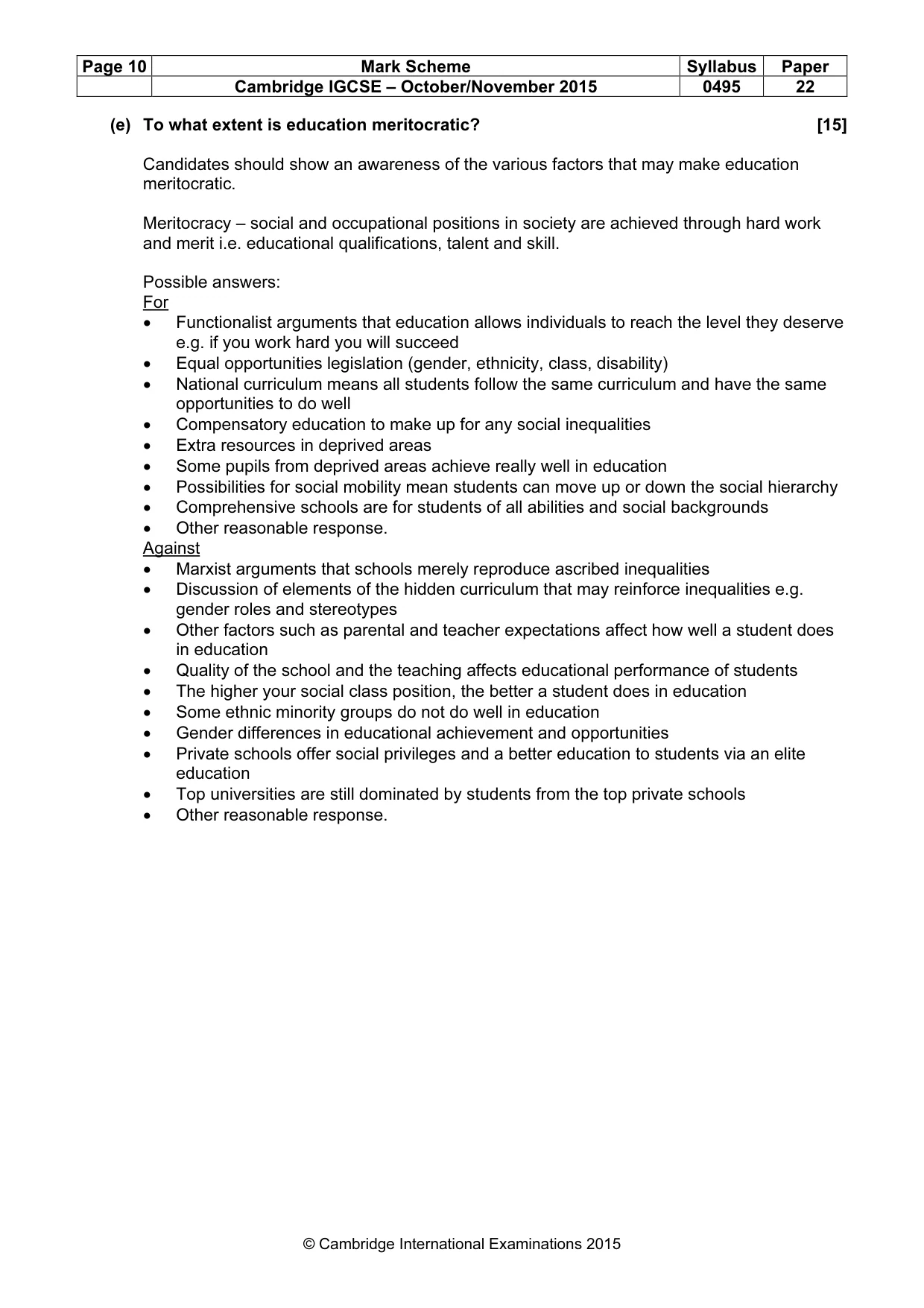
Page 10 Mark Scheme Syllabus Paper Cambridge IGCSE – October/November 2015 0495 22 © Cambridge International Examinations 2015 (e) To what extent is education meritocratic? [15] Candidates should show an awareness of the various factors that may make education meritocratic. Meritocracy – social and occupational positions in society are achieved through hard work and merit i.e. educational qualifications, talent and skill. Possible answers: For • Functionalist arguments that education allows individuals to reach the level they deserve e.g. if you work hard you will succeed • Equal opportunities legislation (gender, ethnicity, class, disability) • National curriculum means all students follow the same curriculum and have the same opportunities to do well • Compensatory education to make up for any social inequalities • Extra resources in deprived areas • Some pupils from deprived areas achieve really well in education • Possibilities for social mobility mean students can move up or down the social hierarchy • Comprehensive schools are for students of all abilities and social backgrounds • Other reasonable response. Against • Marxist arguments that schools merely reproduce ascribed inequalities • Discussion of elements of the hidden curriculum that may reinforce inequalities e.g. gender roles and stereotypes • Other factors such as parental and teacher expectations affect how well a student does in education • Quality of the school and the teaching affects educational performance of students • The higher your social class position, the better a student does in education • Some ethnic minority groups do not do well in education • Gender differences in educational achievement and opportunities • Private schools offer social privileges and a better education to students via an elite education • Top universities are still dominated by students from the top private schools • Other reasonable response.
Mark scheme, page 11
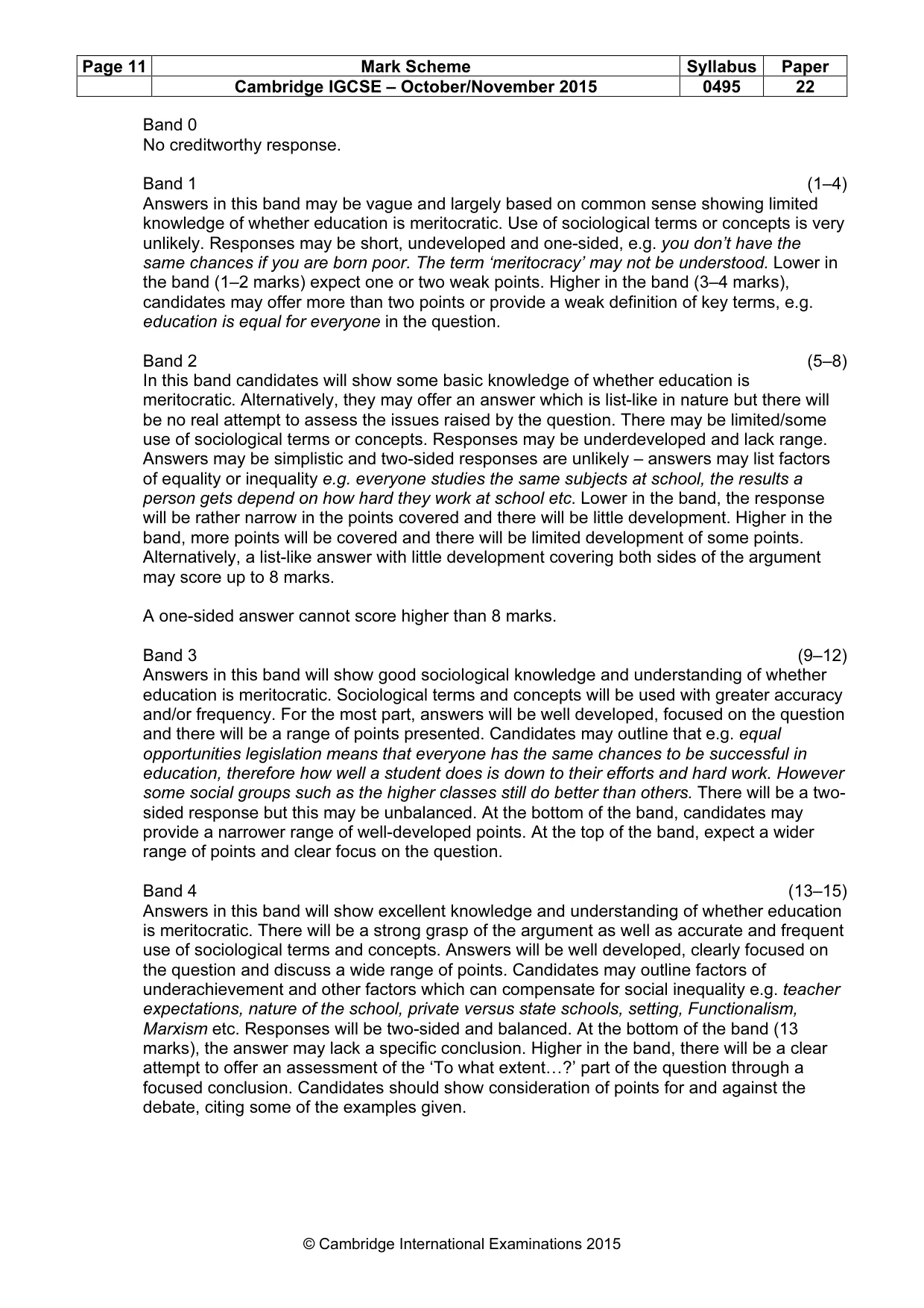
Page 11 Mark Scheme Syllabus Paper Cambridge IGCSE – October/November 2015 0495 22 © Cambridge International Examinations 2015 Band 0 No creditworthy response. Band 1 (1–4) Answers in this band may be vague and largely based on common sense showing limited knowledge of whether education is meritocratic. Use of sociological terms or concepts is very unlikely. Responses may be short, undeveloped and one-sided, e.g. you don’t have the same chances if you are born poor. The term ‘meritocracy’ may not be understood. Lower in the band (1–2 marks) expect one or two weak points. Higher in the band (3–4 marks), candidates may offer more than two points or provide a weak definition of key terms, e.g. education is equal for everyone in the question. Band 2 (5–8) In this band candidates will show some basic knowledge of whether education is meritocratic. Alternatively, they may offer an answer which is list-like in nature but there will be no real attempt to assess the issues raised by the question. There may be limited/some use of sociological terms or concepts. Responses may be underdeveloped and lack range. Answers may be simplistic and two-sided responses are unlikely – answers may list factors of equality or inequality e.g. everyone studies the same subjects at school, the results a person gets depend on how hard they work at school etc. Lower in the band, the response will be rather narrow in the points covered and there will be little development. Higher in the band, more points will be covered and there will be limited development of some points. Alternatively, a list-like answer with little development covering both sides of the argument may score up to 8 marks. A one-sided answer cannot score higher than 8 marks. Band 3 (9–12) Answers in this band will show good sociological knowledge and understanding of whether education is meritocratic. Sociological terms and concepts will be used with greater accuracy and/or frequency. For the most part, answers will be well developed, focused on the question and there will be a range of points presented. Candidates may outline that e.g. equal opportunities legislation means that everyone has the same chances to be successful in education, therefore how well a student does is down to their efforts and hard work. However some social groups such as the higher classes still do better than others. There will be a two- sided response but this may be unbalanced. At the bottom of the band, candidates may provide a narrower range of well-developed points. At the top of the band, expect a wider range of points and clear focus on the question. Band 4 (13–15) Answers in this band will show excellent knowledge and understanding of whether education is meritocratic. There will be a strong grasp of the argument as well as accurate and frequent use of sociological terms and concepts. Answers will be well developed, clearly focused on the question and discuss a wide range of points. Candidates may outline factors of underachievement and other factors which can compensate for social inequality e.g. teacher expectations, nature of the school, private versus state schools, setting, Functionalism, Marxism etc. Responses will be two-sided and balanced. At the bottom of the band (13 marks), the answer may lack a specific conclusion. Higher in the band, there will be a clear attempt to offer an assessment of the ‘To what extent…?’ part of the question through a focused conclusion. Candidates should show consideration of points for and against the debate, citing some of the examples given.
Mark scheme, page 12
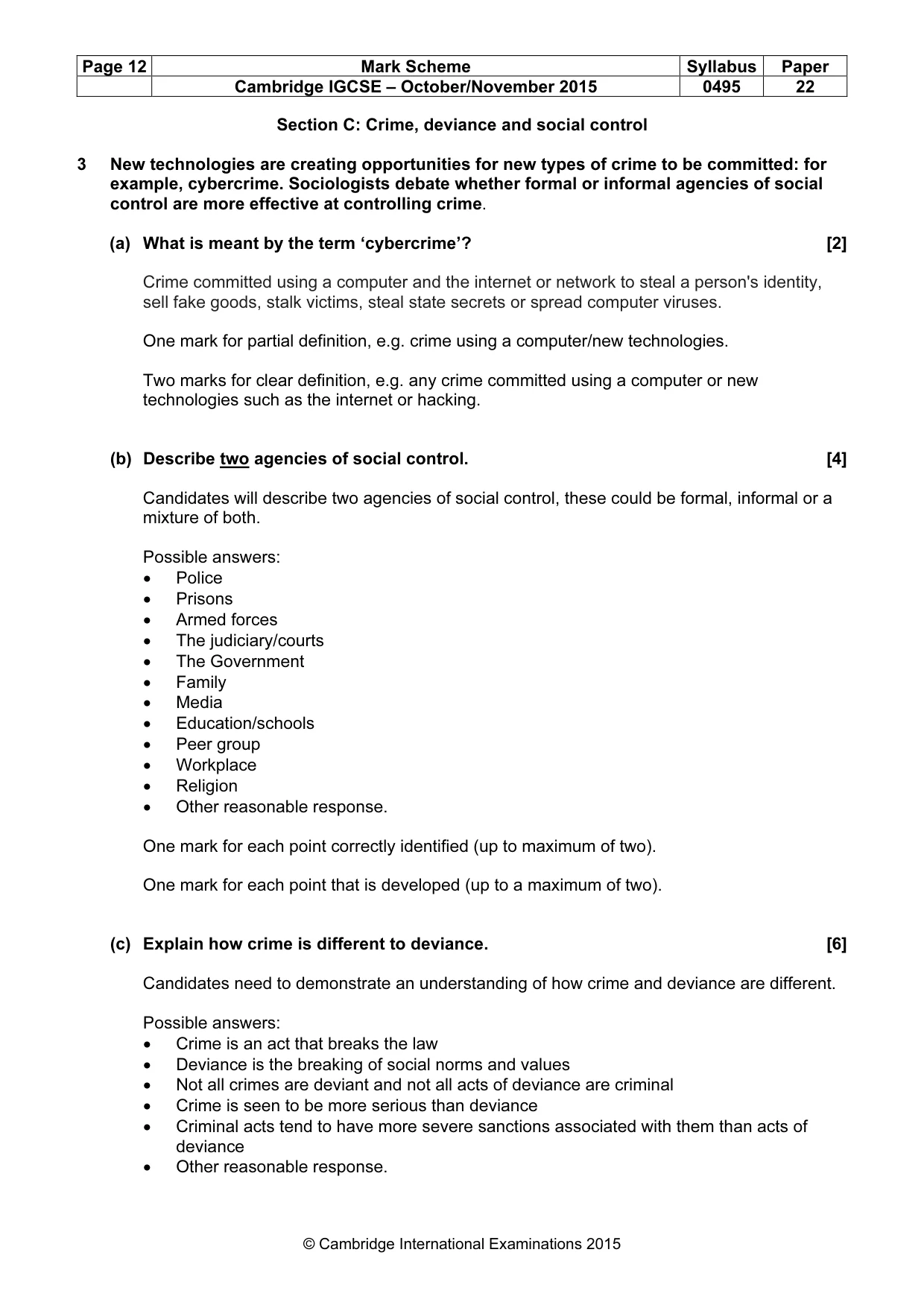
Page 12 Mark Scheme Syllabus Paper Cambridge IGCSE – October/November 2015 0495 22 © Cambridge International Examinations 2015 Section C: Crime, deviance and social control 3 New technologies are creating opportunities for new types of crime to be committed: for example, cybercrime. Sociologists debate whether formal or informal agencies of social control are more effective at controlling crime. (a) What is meant by the term ‘cybercrime’? [2] Crime committed using a computer and the internet or network to steal a person's identity, sell fake goods, stalk victims, steal state secrets or spread computer viruses. One mark for partial definition, e.g. crime using a computer/new technologies. Two marks for clear definition, e.g. any crime committed using a computer or new technologies such as the internet or hacking. (b) Describe two agencies of social control. [4] Candidates will describe two agencies of social control, these could be formal, informal or a mixture of both. Possible answers: • Police • Prisons • Armed forces • The judiciary/courts • The Government • Family • Media • Education/schools • Peer group • Workplace • Religion • Other reasonable response. One mark for each point correctly identified (up to maximum of two). One mark for each point that is developed (up to a maximum of two). (c) Explain how crime is different to deviance. [6] Candidates need to demonstrate an understanding of how crime and deviance are different. Possible answers: • Crime is an act that breaks the law • Deviance is the breaking of social norms and values • Not all crimes are deviant and not all acts of deviance are criminal • Crime is seen to be more serious than deviance • Criminal acts tend to have more severe sanctions associated with them than acts of deviance • Other reasonable response.
Mark scheme, page 13
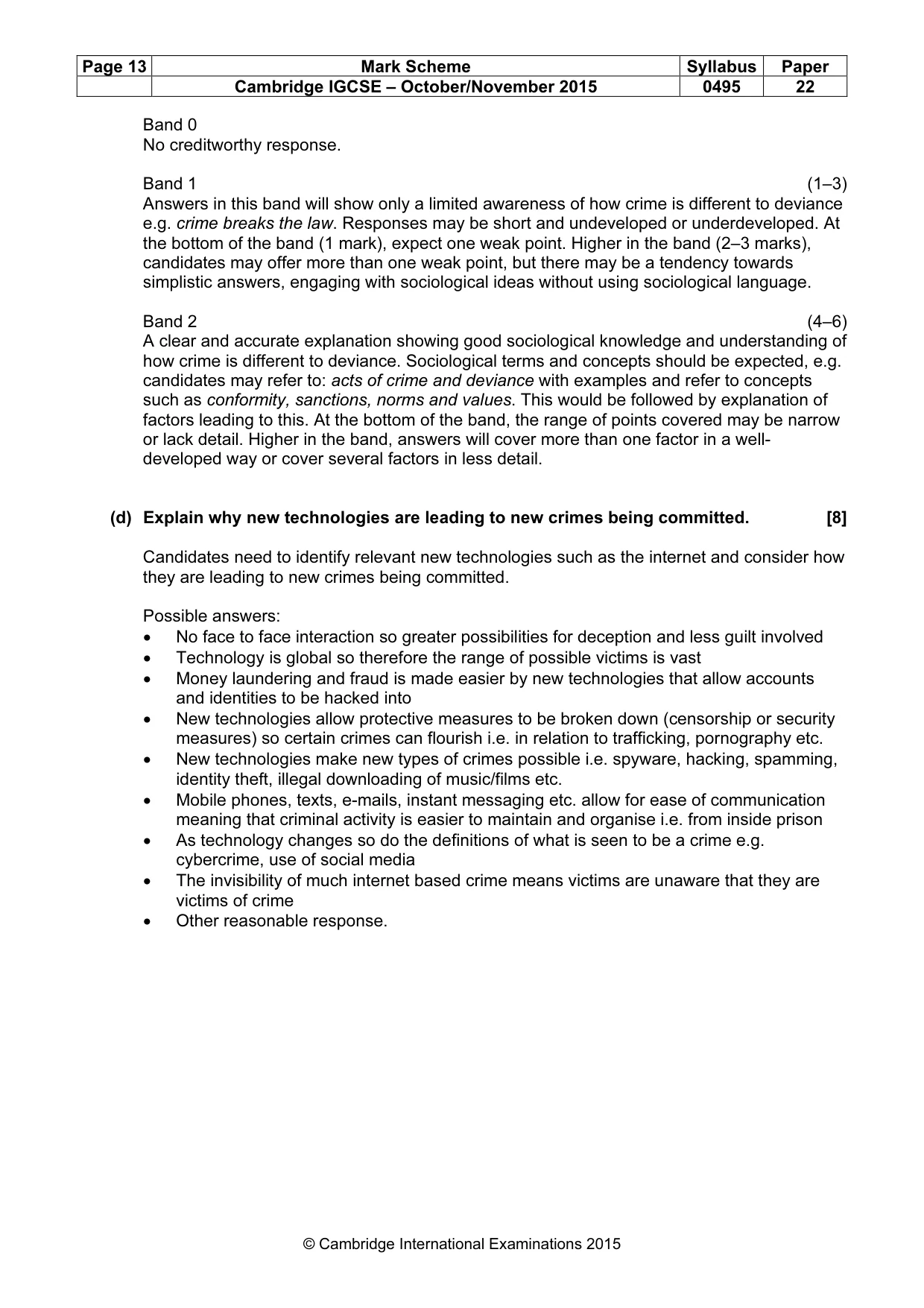
Page 13 Mark Scheme Syllabus Paper Cambridge IGCSE – October/November 2015 0495 22 © Cambridge International Examinations 2015 Band 0 No creditworthy response. Band 1 (1–3) Answers in this band will show only a limited awareness of how crime is different to deviance e.g. crime breaks the law. Responses may be short and undeveloped or underdeveloped. At the bottom of the band (1 mark), expect one weak point. Higher in the band (2–3 marks), candidates may offer more than one weak point, but there may be a tendency towards simplistic answers, engaging with sociological ideas without using sociological language. Band 2 (4–6) A clear and accurate explanation showing good sociological knowledge and understanding of how crime is different to deviance. Sociological terms and concepts should be expected, e.g. candidates may refer to: acts of crime and deviance with examples and refer to concepts such as conformity, sanctions, norms and values. This would be followed by explanation of factors leading to this. At the bottom of the band, the range of points covered may be narrow or lack detail. Higher in the band, answers will cover more than one factor in a well- developed way or cover several factors in less detail. (d) Explain why new technologies are leading to new crimes being committed. [8] Candidates need to identify relevant new technologies such as the internet and consider how they are leading to new crimes being committed. Possible answers: • No face to face interaction so greater possibilities for deception and less guilt involved • Technology is global so therefore the range of possible victims is vast • Money laundering and fraud is made easier by new technologies that allow accounts and identities to be hacked into • New technologies allow protective measures to be broken down (censorship or security measures) so certain crimes can flourish i.e. in relation to trafficking, pornography etc. • New technologies make new types of crimes possible i.e. spyware, hacking, spamming, identity theft, illegal downloading of music/films etc. • Mobile phones, texts, e-mails, instant messaging etc. allow for ease of communication meaning that criminal activity is easier to maintain and organise i.e. from inside prison • As technology changes so do the definitions of what is seen to be a crime e.g. cybercrime, use of social media • The invisibility of much internet based crime means victims are unaware that they are victims of crime • Other reasonable response.
Mark scheme, page 14
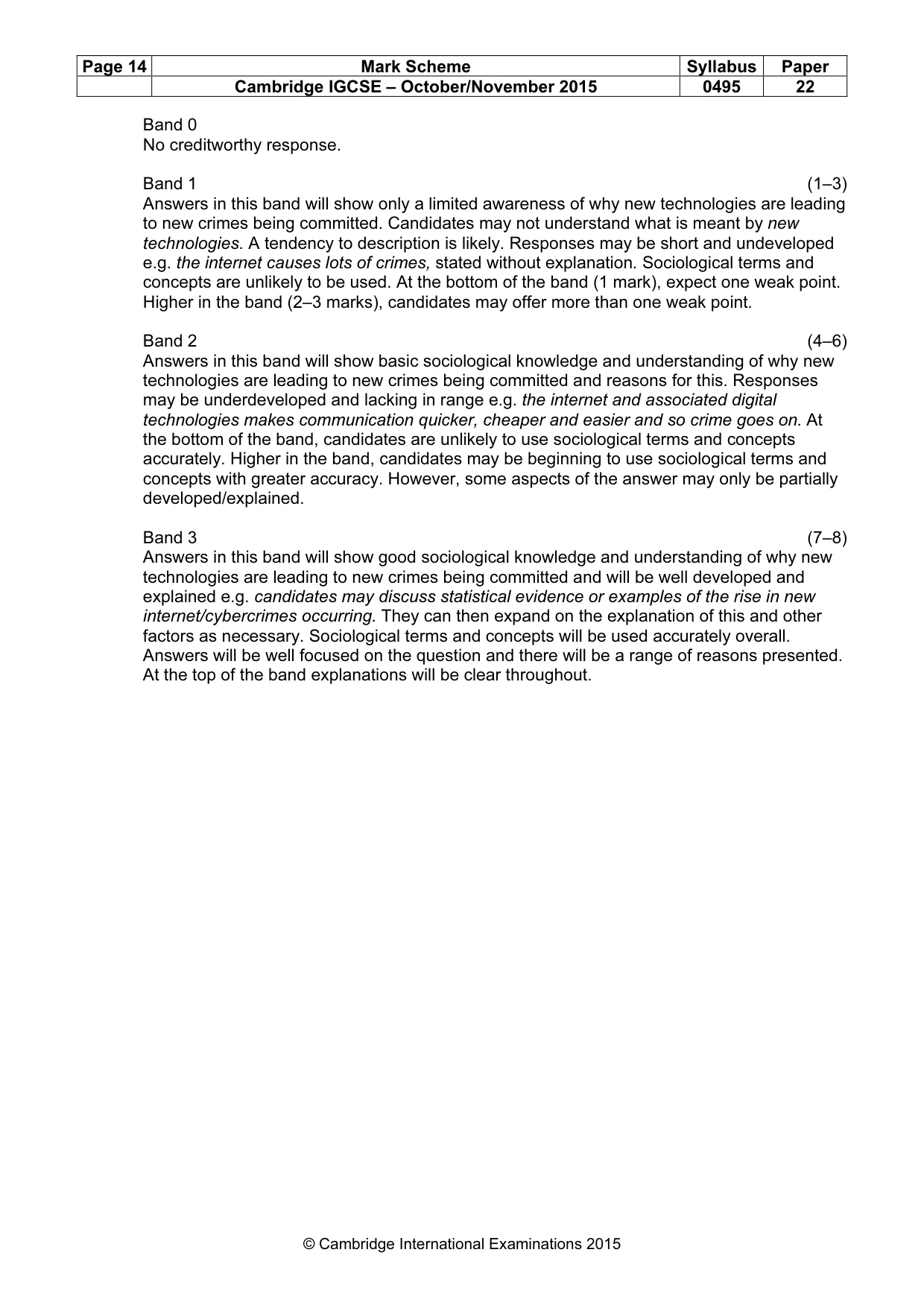
Page 14 Mark Scheme Syllabus Paper Cambridge IGCSE – October/November 2015 0495 22 © Cambridge International Examinations 2015 Band 0 No creditworthy response. Band 1 (1–3) Answers in this band will show only a limited awareness of why new technologies are leading to new crimes being committed. Candidates may not understand what is meant by new technologies. A tendency to description is likely. Responses may be short and undeveloped e.g. the internet causes lots of crimes, stated without explanation. Sociological terms and concepts are unlikely to be used. At the bottom of the band (1 mark), expect one weak point. Higher in the band (2–3 marks), candidates may offer more than one weak point. Band 2 (4–6) Answers in this band will show basic sociological knowledge and understanding of why new technologies are leading to new crimes being committed and reasons for this. Responses may be underdeveloped and lacking in range e.g. the internet and associated digital technologies makes communication quicker, cheaper and easier and so crime goes on. At the bottom of the band, candidates are unlikely to use sociological terms and concepts accurately. Higher in the band, candidates may be beginning to use sociological terms and concepts with greater accuracy. However, some aspects of the answer may only be partially developed/explained. Band 3 (7–8) Answers in this band will show good sociological knowledge and understanding of why new technologies are leading to new crimes being committed and will be well developed and explained e.g. candidates may discuss statistical evidence or examples of the rise in new internet/cybercrimes occurring. They can then expand on the explanation of this and other factors as necessary. Sociological terms and concepts will be used accurately overall. Answers will be well focused on the question and there will be a range of reasons presented. At the top of the band explanations will be clear throughout.
Mark scheme, page 15
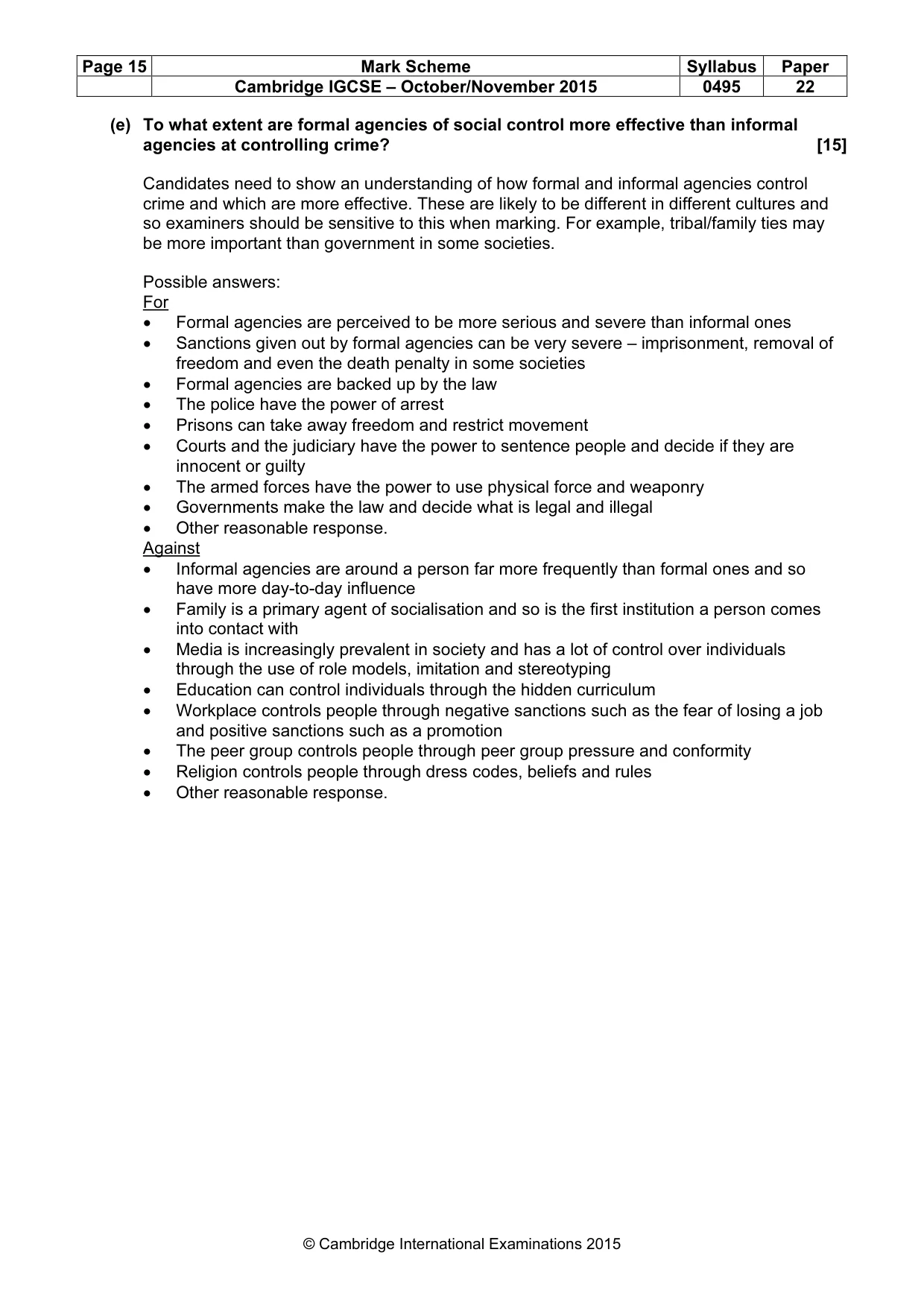
Page 15 Mark Scheme Syllabus Paper Cambridge IGCSE – October/November 2015 0495 22 © Cambridge International Examinations 2015 (e) To what extent are formal agencies of social control more effective than informal agencies at controlling crime? [15] Candidates need to show an understanding of how formal and informal agencies control crime and which are more effective. These are likely to be different in different cultures and so examiners should be sensitive to this when marking. For example, tribal/family ties may be more important than government in some societies. Possible answers: For • Formal agencies are perceived to be more serious and severe than informal ones • Sanctions given out by formal agencies can be very severe – imprisonment, removal of freedom and even the death penalty in some societies • Formal agencies are backed up by the law • The police have the power of arrest • Prisons can take away freedom and restrict movement • Courts and the judiciary have the power to sentence people and decide if they are innocent or guilty • The armed forces have the power to use physical force and weaponry • Governments make the law and decide what is legal and illegal • Other reasonable response. Against • Informal agencies are around a person far more frequently than formal ones and so have more day-to-day influence • Family is a primary agent of socialisation and so is the first institution a person comes into contact with • Media is increasingly prevalent in society and has a lot of control over individuals through the use of role models, imitation and stereotyping • Education can control individuals through the hidden curriculum • Workplace controls people through negative sanctions such as the fear of losing a job and positive sanctions such as a promotion • The peer group controls people through peer group pressure and conformity • Religion controls people through dress codes, beliefs and rules • Other reasonable response.
Mark scheme, page 16
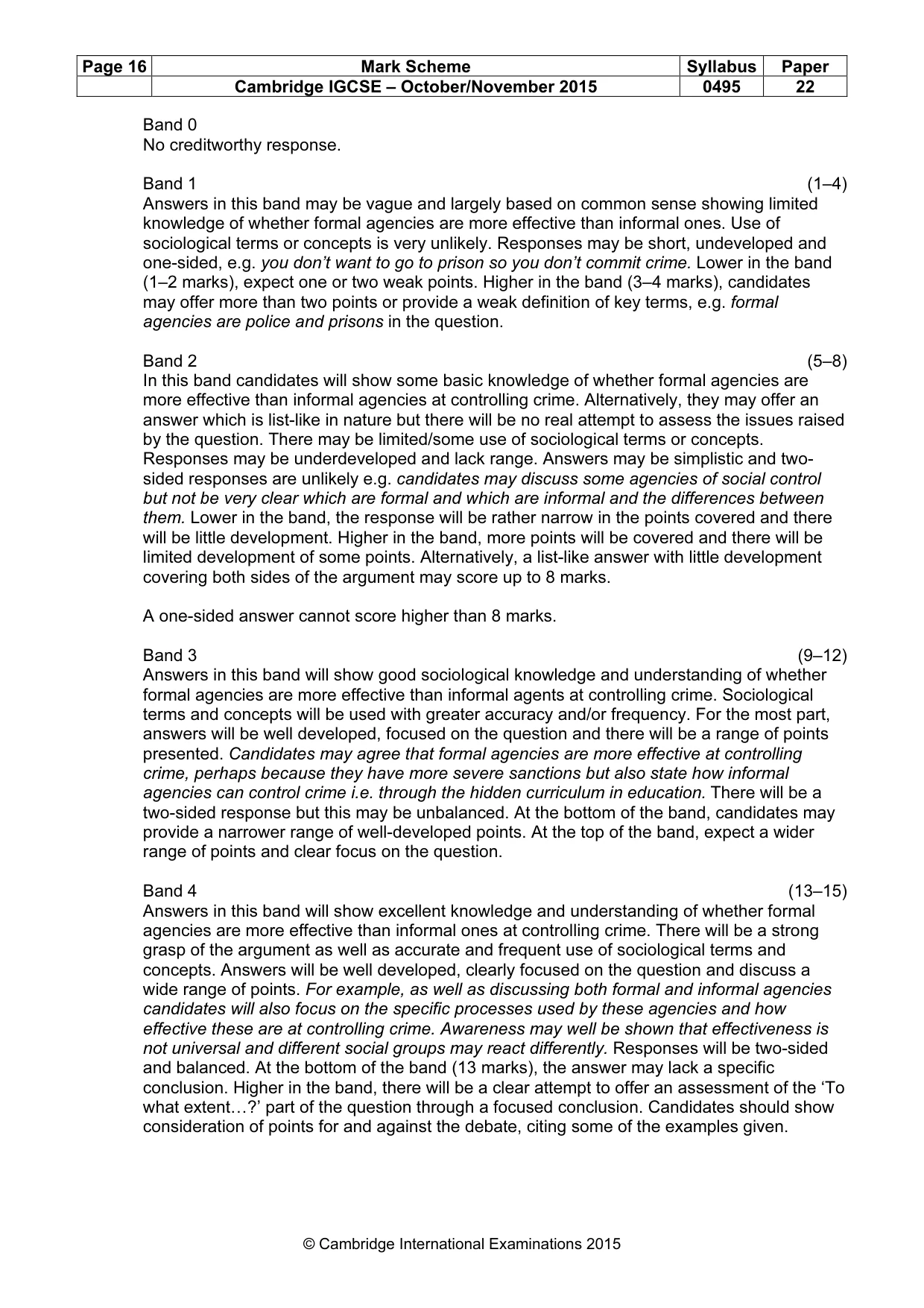
Page 16 Mark Scheme Syllabus Paper Cambridge IGCSE – October/November 2015 0495 22 © Cambridge International Examinations 2015 Band 0 No creditworthy response. Band 1 (1–4) Answers in this band may be vague and largely based on common sense showing limited knowledge of whether formal agencies are more effective than informal ones. Use of sociological terms or concepts is very unlikely. Responses may be short, undeveloped and one-sided, e.g. you don’t want to go to prison so you don’t commit crime. Lower in the band (1–2 marks), expect one or two weak points. Higher in the band (3–4 marks), candidates may offer more than two points or provide a weak definition of key terms, e.g. formal agencies are police and prisons in the question. Band 2 (5–8) In this band candidates will show some basic knowledge of whether formal agencies are more effective than informal agencies at controlling crime. Alternatively, they may offer an answer which is list-like in nature but there will be no real attempt to assess the issues raised by the question. There may be limited/some use of sociological terms or concepts. Responses may be underdeveloped and lack range. Answers may be simplistic and two- sided responses are unlikely e.g. candidates may discuss some agencies of social control but not be very clear which are formal and which are informal and the differences between them. Lower in the band, the response will be rather narrow in the points covered and there will be little development. Higher in the band, more points will be covered and there will be limited development of some points. Alternatively, a list-like answer with little development covering both sides of the argument may score up to 8 marks. A one-sided answer cannot score higher than 8 marks. Band 3 (9–12) Answers in this band will show good sociological knowledge and understanding of whether formal agencies are more effective than informal agents at controlling crime. Sociological terms and concepts will be used with greater accuracy and/or frequency. For the most part, answers will be well developed, focused on the question and there will be a range of points presented. Candidates may agree that formal agencies are more effective at controlling crime, perhaps because they have more severe sanctions but also state how informal agencies can control crime i.e. through the hidden curriculum in education. There will be a two-sided response but this may be unbalanced. At the bottom of the band, candidates may provide a narrower range of well-developed points. At the top of the band, expect a wider range of points and clear focus on the question. Band 4 (13–15) Answers in this band will show excellent knowledge and understanding of whether formal agencies are more effective than informal ones at controlling crime. There will be a strong grasp of the argument as well as accurate and frequent use of sociological terms and concepts. Answers will be well developed, clearly focused on the question and discuss a wide range of points. For example, as well as discussing both formal and informal agencies candidates will also focus on the specific processes used by these agencies and how effective these are at controlling crime. Awareness may well be shown that effectiveness is not universal and different social groups may react differently. Responses will be two-sided and balanced. At the bottom of the band (13 marks), the answer may lack a specific conclusion. Higher in the band, there will be a clear attempt to offer an assessment of the ‘To what extent…?’ part of the question through a focused conclusion. Candidates should show consideration of points for and against the debate, citing some of the examples given.
Mark scheme, page 17
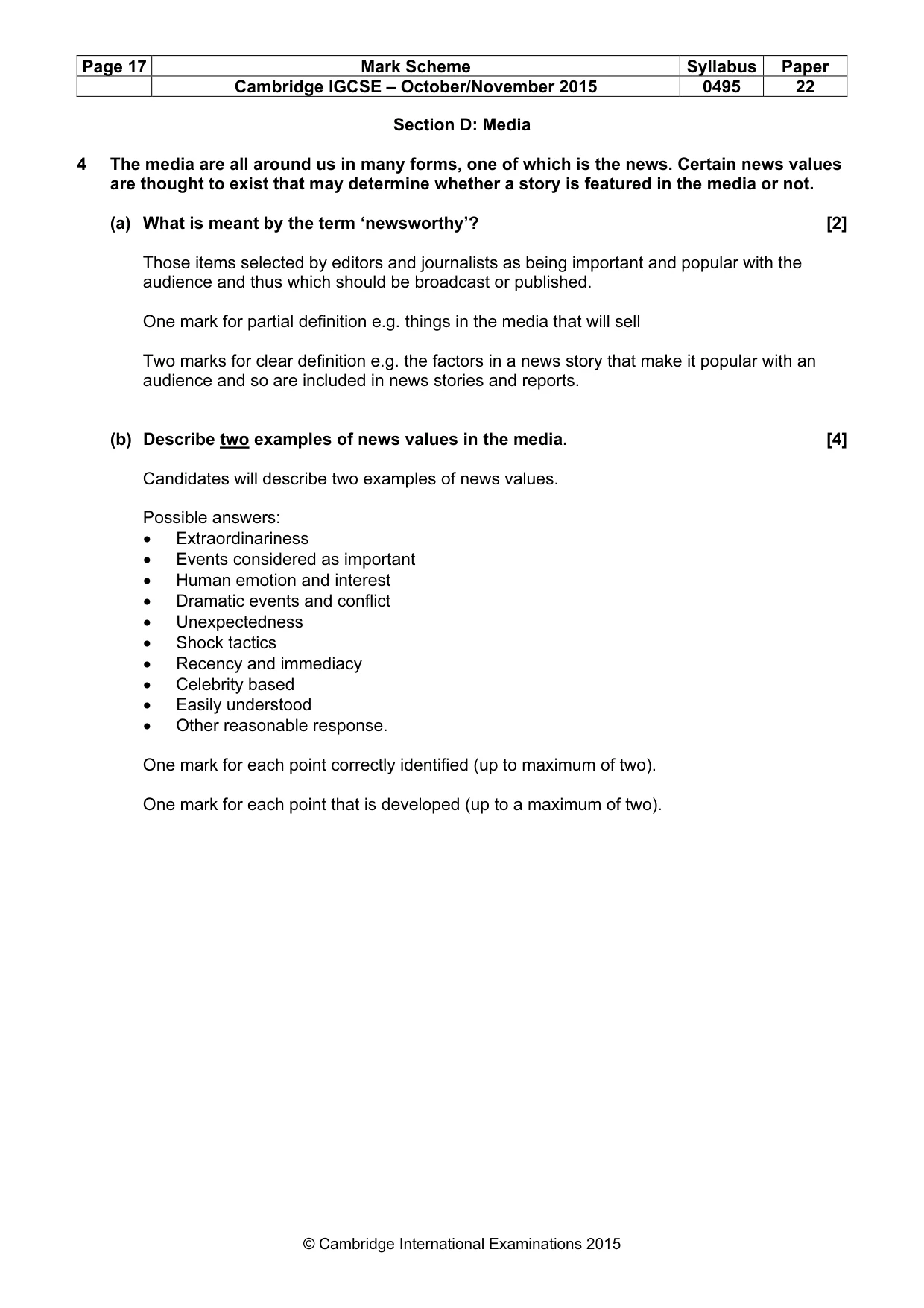
Page 17 Mark Scheme Syllabus Paper Cambridge IGCSE – October/November 2015 0495 22 © Cambridge International Examinations 2015 Section D: Media 4 The media are all around us in many forms, one of which is the news. Certain news values are thought to exist that may determine whether a story is featured in the media or not. (a) What is meant by the term ‘newsworthy’? [2] Those items selected by editors and journalists as being important and popular with the audience and thus which should be broadcast or published. One mark for partial definition e.g. things in the media that will sell Two marks for clear definition e.g. the factors in a news story that make it popular with an audience and so are included in news stories and reports. (b) Describe two examples of news values in the media. [4] Candidates will describe two examples of news values. Possible answers: • Extraordinariness • Events considered as important • Human emotion and interest • Dramatic events and conflict • Unexpectedness • Shock tactics • Recency and immediacy • Celebrity based • Easily understood • Other reasonable response. One mark for each point correctly identified (up to maximum of two). One mark for each point that is developed (up to a maximum of two).
Mark scheme, page 18
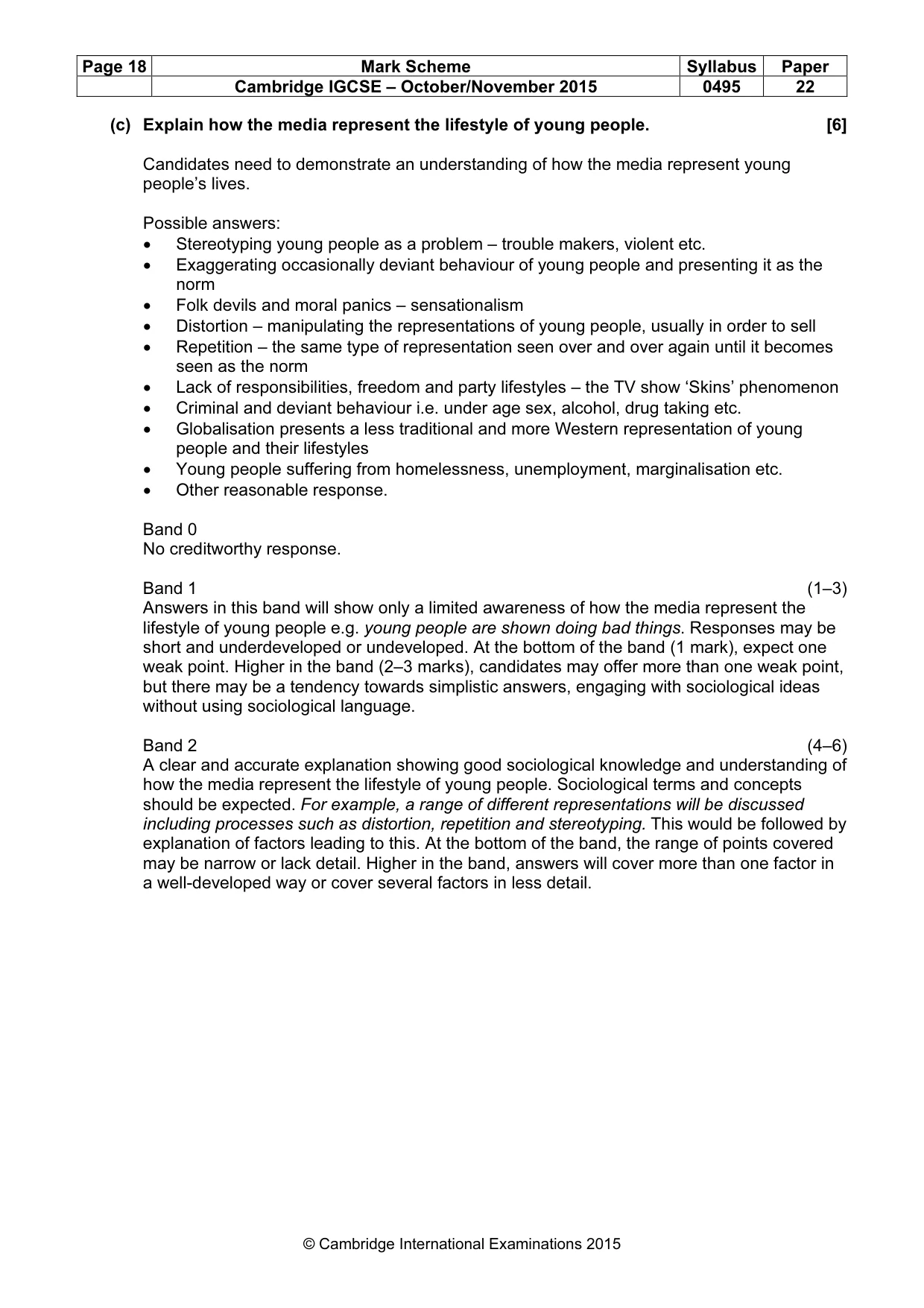
Page 18 Mark Scheme Syllabus Paper Cambridge IGCSE – October/November 2015 0495 22 © Cambridge International Examinations 2015 (c) Explain how the media represent the lifestyle of young people. [6] Candidates need to demonstrate an understanding of how the media represent young people’s lives. Possible answers: • Stereotyping young people as a problem – trouble makers, violent etc. • Exaggerating occasionally deviant behaviour of young people and presenting it as the norm • Folk devils and moral panics – sensationalism • Distortion – manipulating the representations of young people, usually in order to sell • Repetition – the same type of representation seen over and over again until it becomes seen as the norm • Lack of responsibilities, freedom and party lifestyles – the TV show ‘Skins’ phenomenon • Criminal and deviant behaviour i.e. under age sex, alcohol, drug taking etc. • Globalisation presents a less traditional and more Western representation of young people and their lifestyles • Young people suffering from homelessness, unemployment, marginalisation etc. • Other reasonable response. Band 0 No creditworthy response. Band 1 (1–3) Answers in this band will show only a limited awareness of how the media represent the lifestyle of young people e.g. young people are shown doing bad things. Responses may be short and underdeveloped or undeveloped. At the bottom of the band (1 mark), expect one weak point. Higher in the band (2–3 marks), candidates may offer more than one weak point, but there may be a tendency towards simplistic answers, engaging with sociological ideas without using sociological language. Band 2 (4–6) A clear and accurate explanation showing good sociological knowledge and understanding of how the media represent the lifestyle of young people. Sociological terms and concepts should be expected. For example, a range of different representations will be discussed including processes such as distortion, repetition and stereotyping. This would be followed by explanation of factors leading to this. At the bottom of the band, the range of points covered may be narrow or lack detail. Higher in the band, answers will cover more than one factor in a well-developed way or cover several factors in less detail.
Mark scheme, page 19
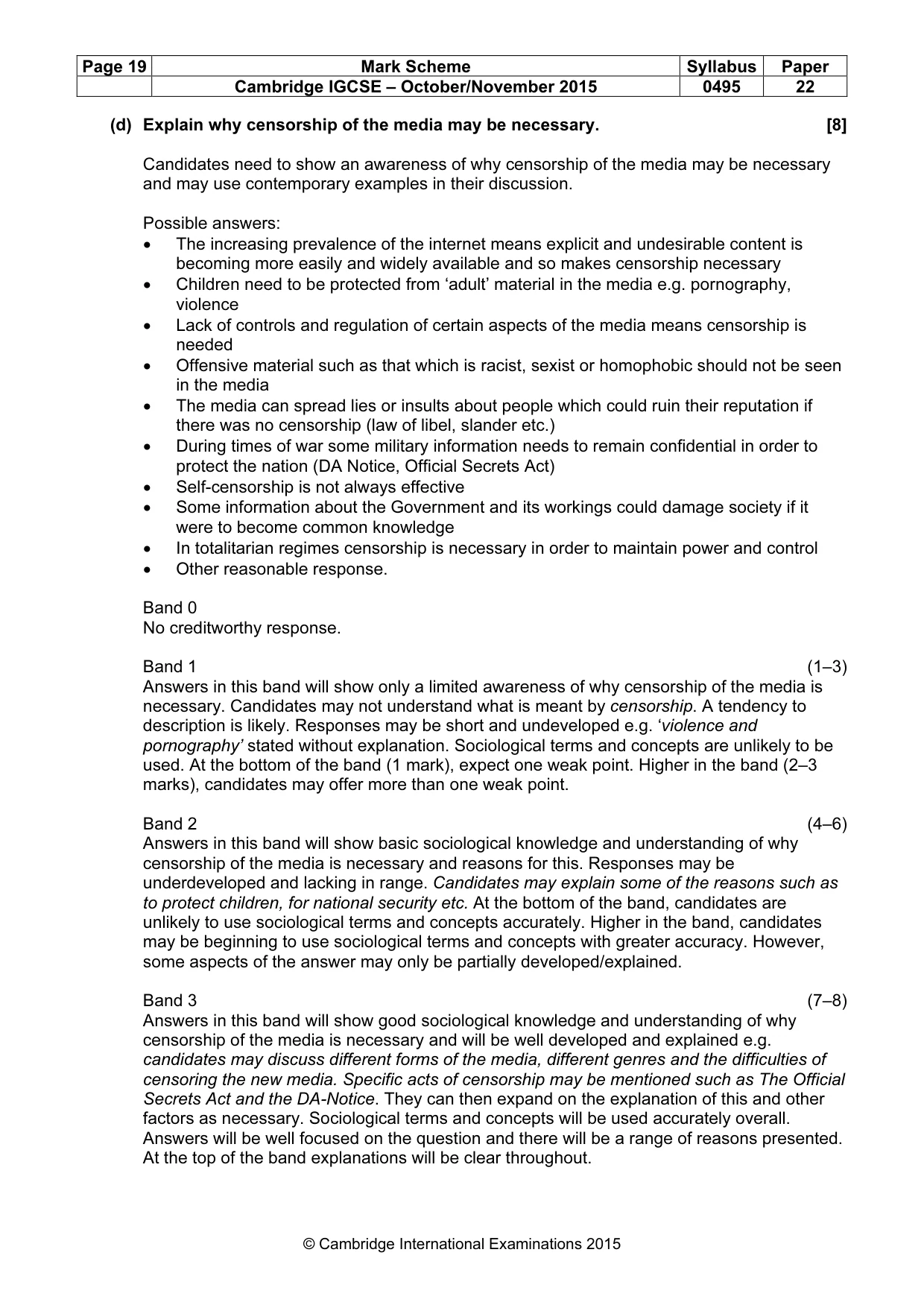
Page 19 Mark Scheme Syllabus Paper Cambridge IGCSE – October/November 2015 0495 22 © Cambridge International Examinations 2015 (d) Explain why censorship of the media may be necessary. [8] Candidates need to show an awareness of why censorship of the media may be necessary and may use contemporary examples in their discussion. Possible answers: • The increasing prevalence of the internet means explicit and undesirable content is becoming more easily and widely available and so makes censorship necessary • Children need to be protected from ‘adult’ material in the media e.g. pornography, violence • Lack of controls and regulation of certain aspects of the media means censorship is needed • Offensive material such as that which is racist, sexist or homophobic should not be seen in the media • The media can spread lies or insults about people which could ruin their reputation if there was no censorship (law of libel, slander etc.) • During times of war some military information needs to remain confidential in order to protect the nation (DA Notice, Official Secrets Act) • Self-censorship is not always effective • Some information about the Government and its workings could damage society if it were to become common knowledge • In totalitarian regimes censorship is necessary in order to maintain power and control • Other reasonable response. Band 0 No creditworthy response. Band 1 (1–3) Answers in this band will show only a limited awareness of why censorship of the media is necessary. Candidates may not understand what is meant by censorship. A tendency to description is likely. Responses may be short and undeveloped e.g. ‘violence and pornography’ stated without explanation. Sociological terms and concepts are unlikely to be used. At the bottom of the band (1 mark), expect one weak point. Higher in the band (2–3 marks), candidates may offer more than one weak point. Band 2 (4–6) Answers in this band will show basic sociological knowledge and understanding of why censorship of the media is necessary and reasons for this. Responses may be underdeveloped and lacking in range. Candidates may explain some of the reasons such as to protect children, for national security etc. At the bottom of the band, candidates are unlikely to use sociological terms and concepts accurately. Higher in the band, candidates may be beginning to use sociological terms and concepts with greater accuracy. However, some aspects of the answer may only be partially developed/explained. Band 3 (7–8) Answers in this band will show good sociological knowledge and understanding of why censorship of the media is necessary and will be well developed and explained e.g. candidates may discuss different forms of the media, different genres and the difficulties of censoring the new media. Specific acts of censorship may be mentioned such as The Official Secrets Act and the DA-Notice. They can then expand on the explanation of this and other factors as necessary. Sociological terms and concepts will be used accurately overall. Answers will be well focused on the question and there will be a range of reasons presented. At the top of the band explanations will be clear throughout.
Mark scheme, page 20
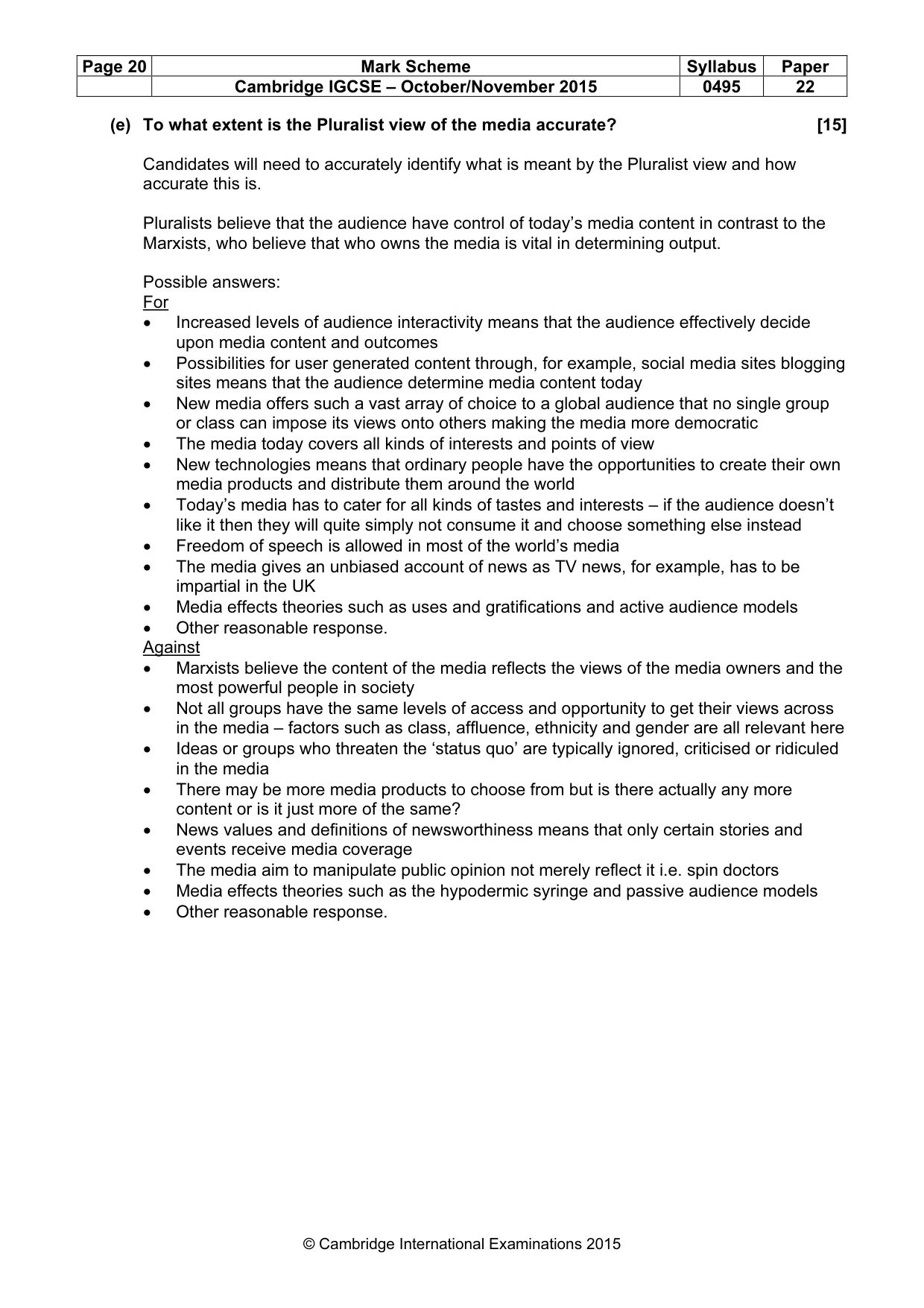
Page 20 Mark Scheme Syllabus Paper Cambridge IGCSE – October/November 2015 0495 22 © Cambridge International Examinations 2015 (e) To what extent is the Pluralist view of the media accurate? [15] Candidates will need to accurately identify what is meant by the Pluralist view and how accurate this is. Pluralists believe that the audience have control of today’s media content in contrast to the Marxists, who believe that who owns the media is vital in determining output. Possible answers: For • Increased levels of audience interactivity means that the audience effectively decide upon media content and outcomes • Possibilities for user generated content through, for example, social media sites blogging sites means that the audience determine media content today • New media offers such a vast array of choice to a global audience that no single group or class can impose its views onto others making the media more democratic • The media today covers all kinds of interests and points of view • New technologies means that ordinary people have the opportunities to create their own media products and distribute them around the world • Today’s media has to cater for all kinds of tastes and interests – if the audience doesn’t like it then they will quite simply not consume it and choose something else instead • Freedom of speech is allowed in most of the world’s media • The media gives an unbiased account of news as TV news, for example, has to be impartial in the UK • Media effects theories such as uses and gratifications and active audience models • Other reasonable response. Against • Marxists believe the content of the media reflects the views of the media owners and the most powerful people in society • Not all groups have the same levels of access and opportunity to get their views across in the media – factors such as class, affluence, ethnicity and gender are all relevant here • Ideas or groups who threaten the ‘status quo’ are typically ignored, criticised or ridiculed in the media • There may be more media products to choose from but is there actually any more content or is it just more of the same? • News values and definitions of newsworthiness means that only certain stories and events receive media coverage • The media aim to manipulate public opinion not merely reflect it i.e. spin doctors • Media effects theories such as the hypodermic syringe and passive audience models • Other reasonable response.
Mark scheme, page 21
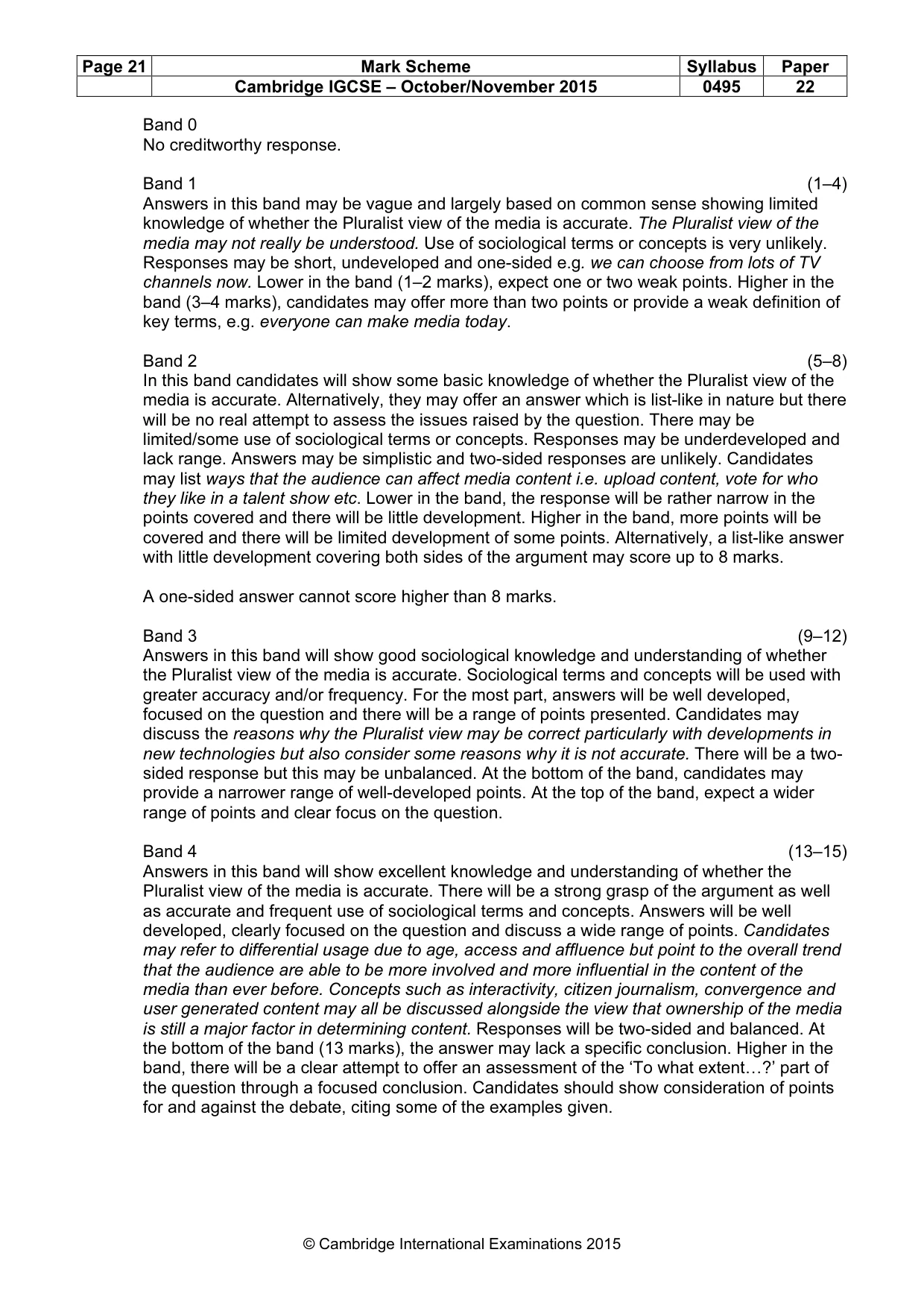
Page 21 Mark Scheme Syllabus Paper Cambridge IGCSE – October/November 2015 0495 22 © Cambridge International Examinations 2015 Band 0 No creditworthy response. Band 1 (1–4) Answers in this band may be vague and largely based on common sense showing limited knowledge of whether the Pluralist view of the media is accurate. The Pluralist view of the media may not really be understood. Use of sociological terms or concepts is very unlikely. Responses may be short, undeveloped and one-sided e.g. we can choose from lots of TV channels now. Lower in the band (1–2 marks), expect one or two weak points. Higher in the band (3–4 marks), candidates may offer more than two points or provide a weak definition of key terms, e.g. everyone can make media today. Band 2 (5–8) In this band candidates will show some basic knowledge of whether the Pluralist view of the media is accurate. Alternatively, they may offer an answer which is list-like in nature but there will be no real attempt to assess the issues raised by the question. There may be limited/some use of sociological terms or concepts. Responses may be underdeveloped and lack range. Answers may be simplistic and two-sided responses are unlikely. Candidates may list ways that the audience can affect media content i.e. upload content, vote for who they like in a talent show etc. Lower in the band, the response will be rather narrow in the points covered and there will be little development. Higher in the band, more points will be covered and there will be limited development of some points. Alternatively, a list-like answer with little development covering both sides of the argument may score up to 8 marks. A one-sided answer cannot score higher than 8 marks. Band 3 (9–12) Answers in this band will show good sociological knowledge and understanding of whether the Pluralist view of the media is accurate. Sociological terms and concepts will be used with greater accuracy and/or frequency. For the most part, answers will be well developed, focused on the question and there will be a range of points presented. Candidates may discuss the reasons why the Pluralist view may be correct particularly with developments in new technologies but also consider some reasons why it is not accurate. There will be a two- sided response but this may be unbalanced. At the bottom of the band, candidates may provide a narrower range of well-developed points. At the top of the band, expect a wider range of points and clear focus on the question. Band 4 (13–15) Answers in this band will show excellent knowledge and understanding of whether the Pluralist view of the media is accurate. There will be a strong grasp of the argument as well as accurate and frequent use of sociological terms and concepts. Answers will be well developed, clearly focused on the question and discuss a wide range of points. Candidates may refer to differential usage due to age, access and affluence but point to the overall trend that the audience are able to be more involved and more influential in the content of the media than ever before. Concepts such as interactivity, citizen journalism, convergence and user generated content may all be discussed alongside the view that ownership of the media is still a major factor in determining content. Responses will be two-sided and balanced. At the bottom of the band (13 marks), the answer may lack a specific conclusion. Higher in the band, there will be a clear attempt to offer an assessment of the ‘To what extent…?’ part of the question through a focused conclusion. Candidates should show consideration of points for and against the debate, citing some of the examples given.
What you needed in this session
Cambridge’s own grade thresholds for 2015 Oct/Nov, Paper 2 · Variant 2. A higher threshold means an easier paper — the bar moves with how the cohort did.