Cambridge IGCSE Sociology 0495 — 2015 Oct/Nov Paper 1 · Variant 3
0495/13/O/N/15 · 80 marks · ≈90 min
The question paper and its mark scheme, free to read here and free to download. This is Cambridge’s own paper, exactly as it was sat.
Question paper4 pages

Mark scheme15 pages
Answers below. Sit the paper first if you are practising.
Paper as text
Question paper, page 1
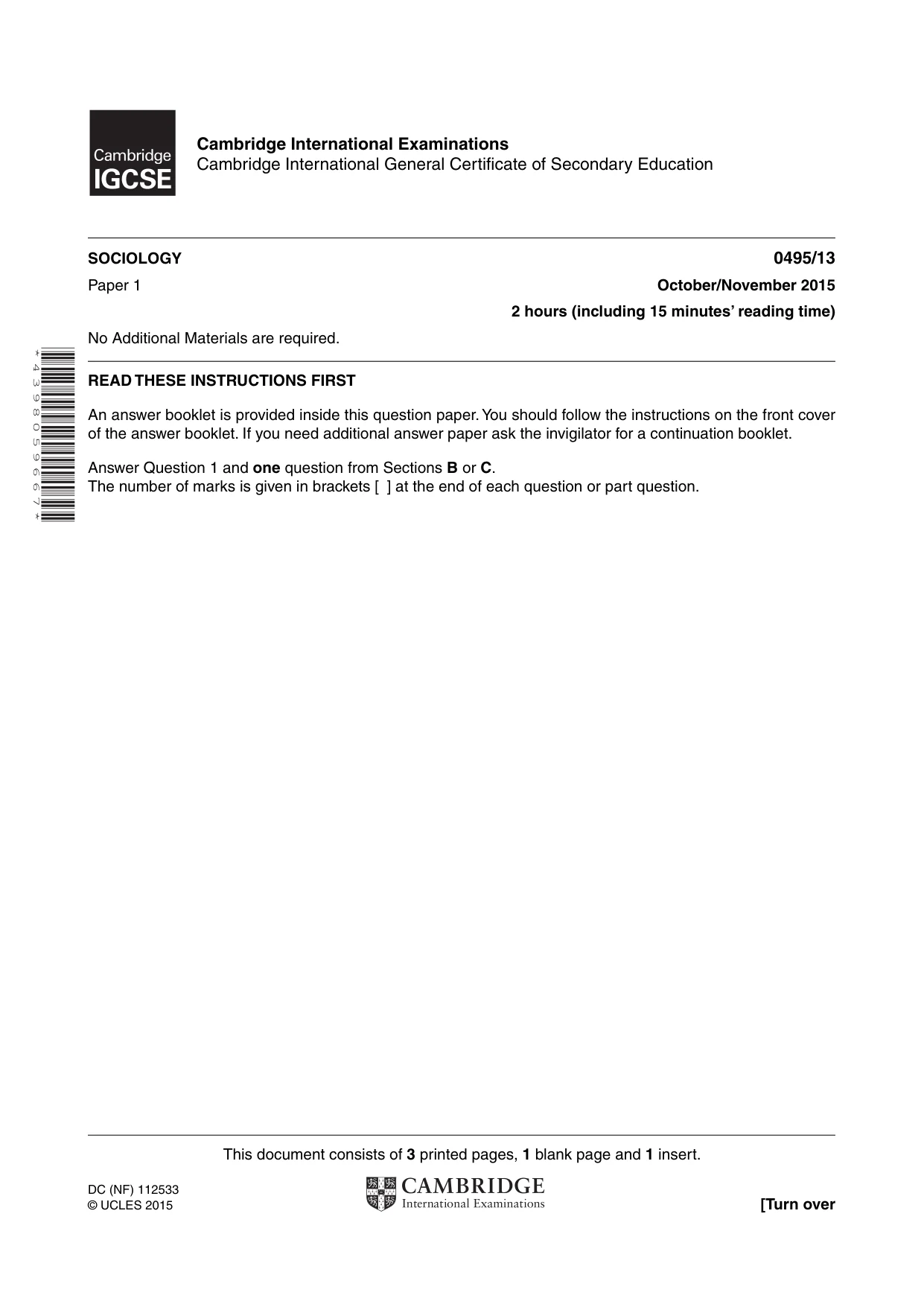
This document consists of 3 printed pages, 1 blank page and 1 insert. DC (NF) 112533 © UCLES 2015 [Turn over Cambridge International Examinations Cambridge International General Certificate of Secondary Education * 4 3 9 8 0 5 9 6 6 7 * SOCIOLOGY 0495/13 Paper 1 October/November 2015 2 hours (including 15 minutes’ reading time) No Additional Materials are required. READ THESE INSTRUCTIONS FIRST An answer booklet is provided inside this question paper. You should follow the instructions on the front cover of the answer booklet. If you need additional answer paper ask the invigilator for a continuation booklet. Answer Question 1 and one question from Sections B or C. The number of marks is given in brackets [ ] at the end of each question or part question.
Question paper, page 2
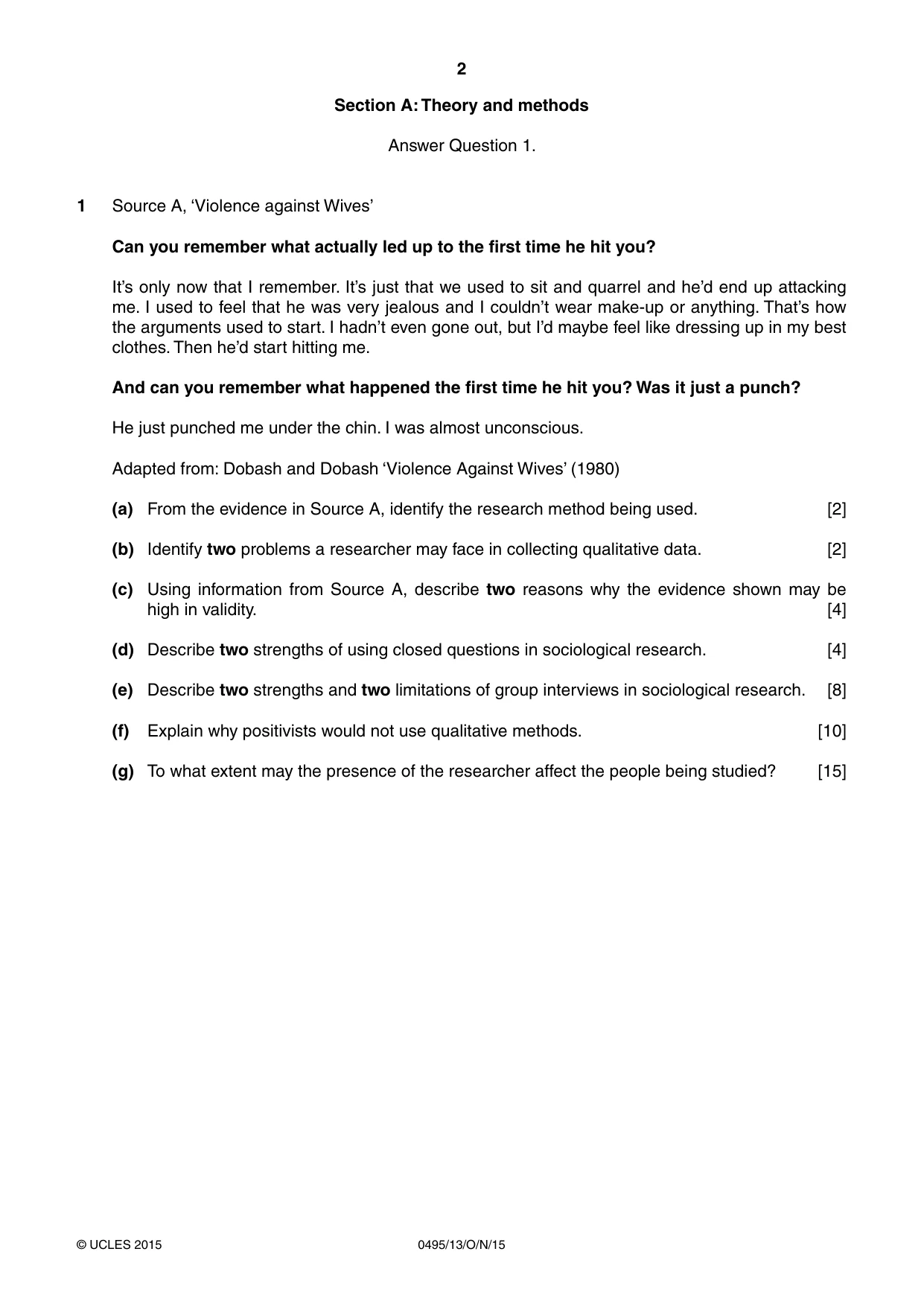
2 0495/13/O/N/15 © UCLES 2015 Section A: Theory and methods Answer Question 1. 1 Source A, ‘Violence against Wives’ Can you remember what actually led up to the first time he hit you? It’s only now that I remember. It’s just that we used to sit and quarrel and he’d end up attacking me. I used to feel that he was very jealous and I couldn’t wear make-up or anything. That’s how the arguments used to start. I hadn’t even gone out, but I’d maybe feel like dressing up in my best clothes. Then he’d start hitting me. And can you remember what happened the first time he hit you? Was it just a punch? He just punched me under the chin. I was almost unconscious. Adapted from: Dobash and Dobash ‘Violence Against Wives’ (1980) (a) From the evidence in Source A, identify the research method being used. [2] (b) Identify two problems a researcher may face in collecting qualitative data. [2] (c) Using information from Source A, describe two reasons why the evidence shown may be high in validity. [4] (d) Describe two strengths of using closed questions in sociological research. [4] (e) Describe two strengths and two limitations of group interviews in sociological research. [8] (f) Explain why positivists would not use qualitative methods. [10] (g) To what extent may the presence of the researcher affect the people being studied? [15]
Question paper, page 3
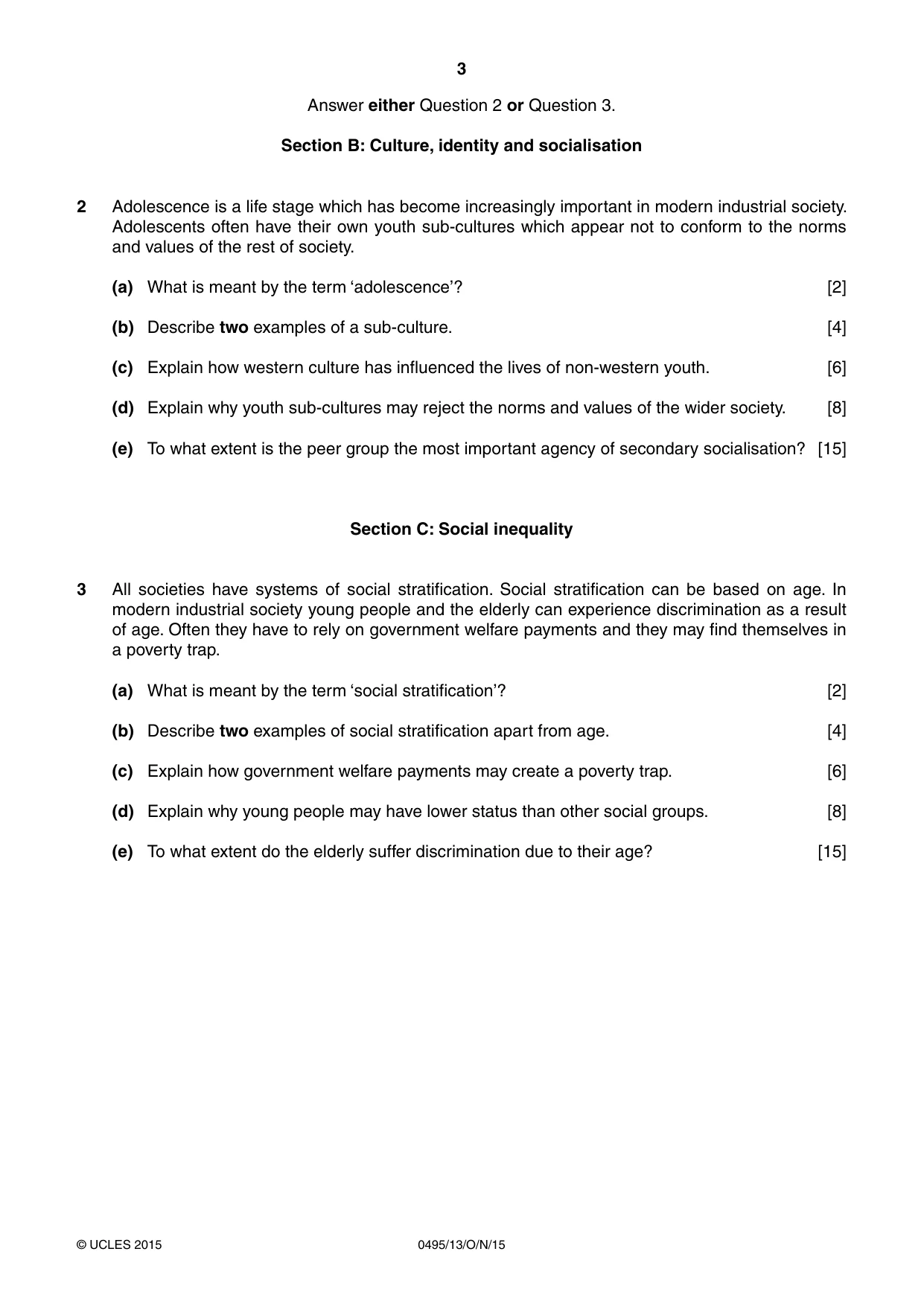
3 0495/13/O/N/15 © UCLES 2015 Answer either Question 2 or Question 3. Section B: Culture, identity and socialisation 2 Adolescence is a life stage which has become increasingly important in modern industrial society. Adolescents often have their own youth sub-cultures which appear not to conform to the norms and values of the rest of society. (a) What is meant by the term ‘adolescence’? [2] (b) Describe two examples of a sub-culture. [4] (c) Explain how western culture has influenced the lives of non-western youth. [6] (d) Explain why youth sub-cultures may reject the norms and values of the wider society. [8] (e) To what extent is the peer group the most important agency of secondary socialisation? [15] Section C: Social inequality 3 All societies have systems of social stratification. Social stratification can be based on age. In modern industrial society young people and the elderly can experience discrimination as a result of age. Often they have to rely on government welfare payments and they may find themselves in a poverty trap. (a) What is meant by the term ‘social stratification’? [2] (b) Describe two examples of social stratification apart from age. [4] (c) Explain how government welfare payments may create a poverty trap. [6] (d) Explain why young people may have lower status than other social groups. [8] (e) To what extent do the elderly suffer discrimination due to their age? [15]
Question paper, page 4
4 0495/13/O/N/15 © UCLES 2015 Permission to reproduce items where third-party owned material protected by copyright is included has been sought and cleared where possible. Every reasonable effort has been made by the publisher (UCLES) to trace copyright holders, but if any items requiring clearance have unwittingly been included, the publisher will be pleased to make amends at the earliest possible opportunity. To avoid the issue of disclosure of answer-related information to candidates, all copyright acknowledgements are reproduced online in the Cambridge International Examinations Copyright Acknowledgements Booklet. This is produced for each series of examinations and is freely available to download at www.cie.org.uk after the live examination series. Cambridge International Examinations is part of the Cambridge Assessment Group. Cambridge Assessment is the brand name of University of Cambridge Local Examinations Syndicate (UCLES), which is itself a department of the University of Cambridge. BLANK PAGE
Mark scheme, page 1
® IGCSE is the registered trademark of Cambridge International Examinations. CAMBRIDGE INTERNATIONAL EXAMINATIONS Cambridge International General Certificate of Secondary Education MARK SCHEME for the October/November 2015 series 0495 SOCIOLOGY 0495/13 Paper 1, maximum raw mark 80 This mark scheme is published as an aid to teachers and candidates, to indicate the requirements of the examination. It shows the basis on which Examiners were instructed to award marks. It does not indicate the details of the discussions that took place at an Examiners’ meeting before marking began, which would have considered the acceptability of alternative answers. Mark schemes should be read in conjunction with the question paper and the Principal Examiner Report for Teachers. Cambridge will not enter into discussions about these mark schemes. Cambridge is publishing the mark schemes for the October/November 2015 series for most Cambridge IGCSE®, Cambridge International A and AS Level components and some Cambridge O Level components.
Mark scheme, page 2
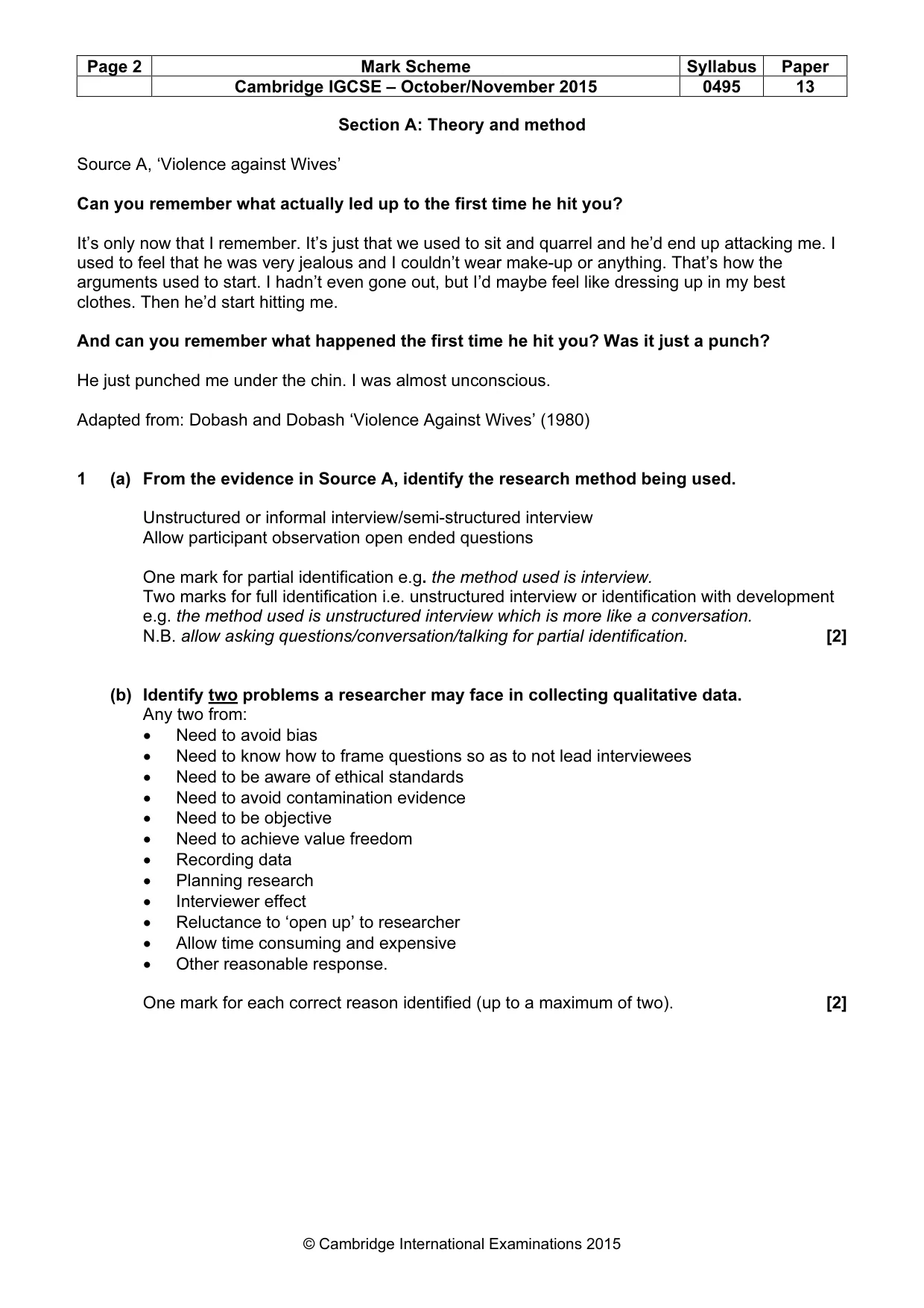
Page 2 Mark Scheme Syllabus Paper Cambridge IGCSE – October/November 2015 0495 13 © Cambridge International Examinations 2015 Section A: Theory and method Source A, ‘Violence against Wives’ Can you remember what actually led up to the first time he hit you? It’s only now that I remember. It’s just that we used to sit and quarrel and he’d end up attacking me. I used to feel that he was very jealous and I couldn’t wear make-up or anything. That’s how the arguments used to start. I hadn’t even gone out, but I’d maybe feel like dressing up in my best clothes. Then he’d start hitting me. And can you remember what happened the first time he hit you? Was it just a punch? He just punched me under the chin. I was almost unconscious. Adapted from: Dobash and Dobash ‘Violence Against Wives’ (1980) 1 (a) From the evidence in Source A, identify the research method being used. Unstructured or informal interview/semi-structured interview Allow participant observation open ended questions One mark for partial identification e.g. the method used is interview. Two marks for full identification i.e. unstructured interview or identification with development e.g. the method used is unstructured interview which is more like a conversation. N.B. allow asking questions/conversation/talking for partial identification. [2] (b) Identify two problems a researcher may face in collecting qualitative data. Any two from: • Need to avoid bias • Need to know how to frame questions so as to not lead interviewees • Need to be aware of ethical standards • Need to avoid contamination evidence • Need to be objective • Need to achieve value freedom • Recording data • Planning research • Interviewer effect • Reluctance to ‘open up’ to researcher • Allow time consuming and expensive • Other reasonable response. One mark for each correct reason identified (up to a maximum of two). [2]
Mark scheme, page 3
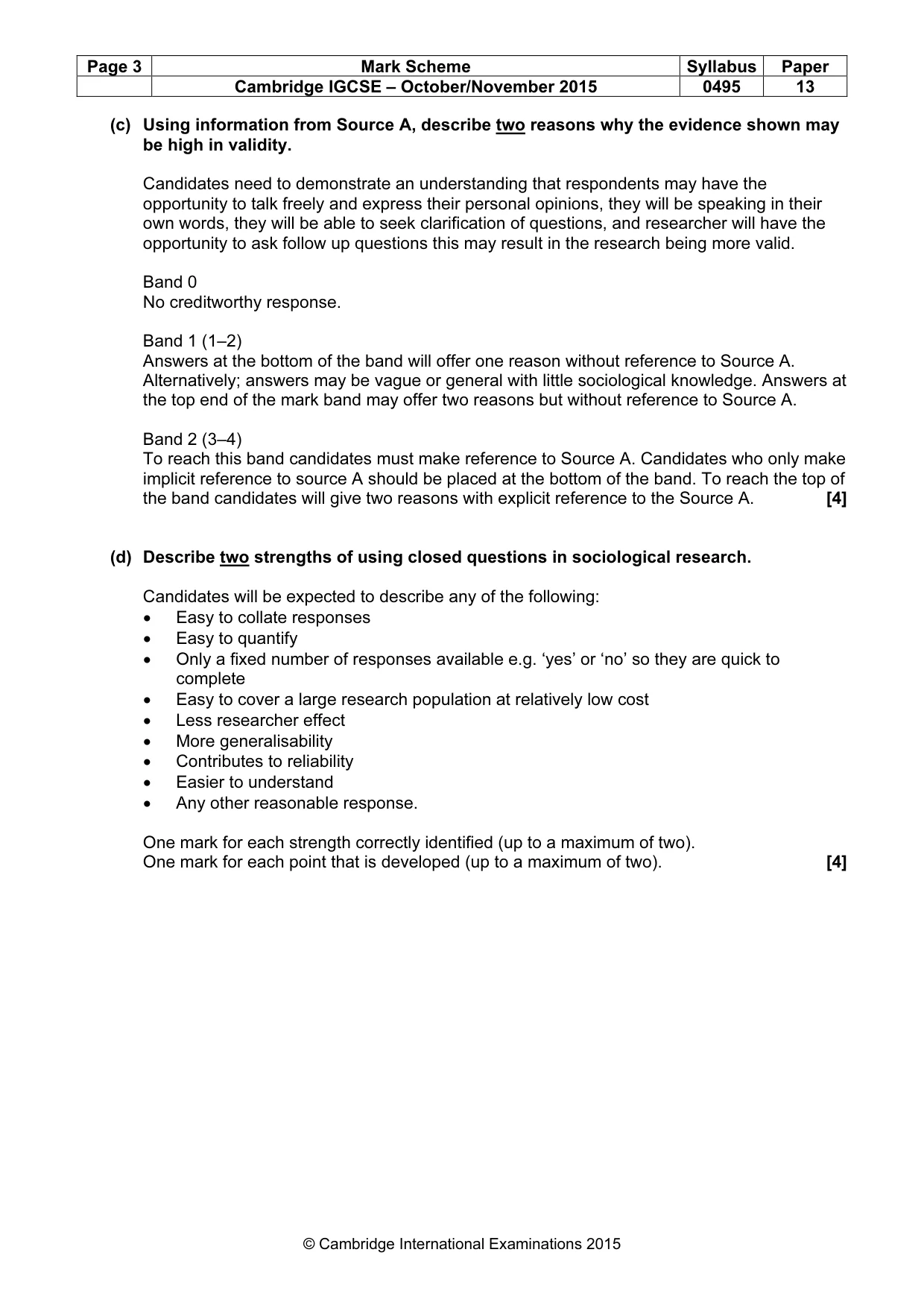
Page 3 Mark Scheme Syllabus Paper Cambridge IGCSE – October/November 2015 0495 13 © Cambridge International Examinations 2015 (c) Using information from Source A, describe two reasons why the evidence shown may be high in validity. Candidates need to demonstrate an understanding that respondents may have the opportunity to talk freely and express their personal opinions, they will be speaking in their own words, they will be able to seek clarification of questions, and researcher will have the opportunity to ask follow up questions this may result in the research being more valid. Band 0 No creditworthy response. Band 1 (1–2) Answers at the bottom of the band will offer one reason without reference to Source A. Alternatively; answers may be vague or general with little sociological knowledge. Answers at the top end of the mark band may offer two reasons but without reference to Source A. Band 2 (3–4) To reach this band candidates must make reference to Source A. Candidates who only make implicit reference to source A should be placed at the bottom of the band. To reach the top of the band candidates will give two reasons with explicit reference to the Source A. [4] (d) Describe two strengths of using closed questions in sociological research. Candidates will be expected to describe any of the following: • Easy to collate responses • Easy to quantify • Only a fixed number of responses available e.g. ‘yes’ or ‘no’ so they are quick to complete • Easy to cover a large research population at relatively low cost • Less researcher effect • More generalisability • Contributes to reliability • Easier to understand • Any other reasonable response. One mark for each strength correctly identified (up to a maximum of two). One mark for each point that is developed (up to a maximum of two). [4]
Mark scheme, page 4
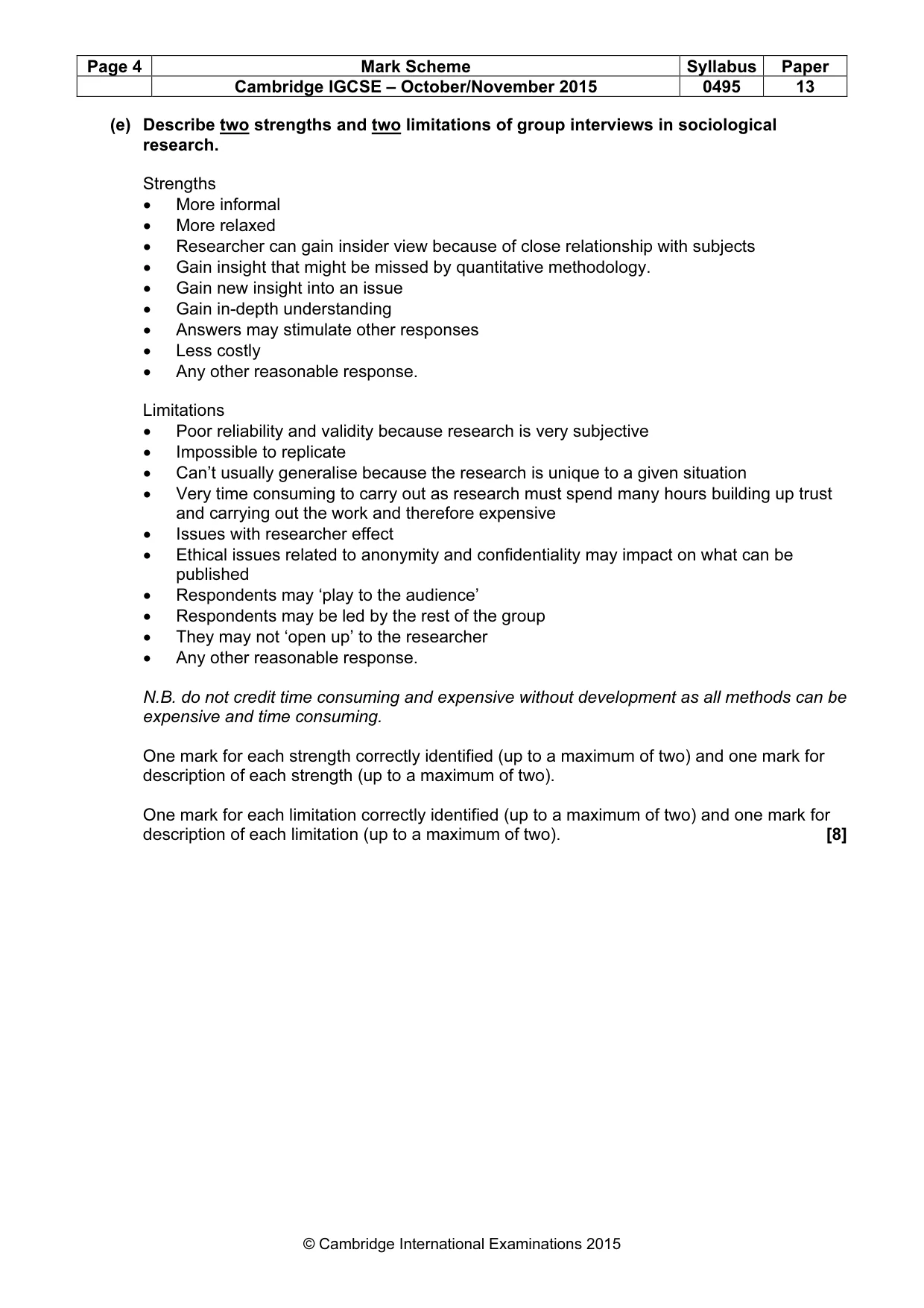
Page 4 Mark Scheme Syllabus Paper Cambridge IGCSE – October/November 2015 0495 13 © Cambridge International Examinations 2015 (e) Describe two strengths and two limitations of group interviews in sociological research. Strengths • More informal • More relaxed • Researcher can gain insider view because of close relationship with subjects • Gain insight that might be missed by quantitative methodology. • Gain new insight into an issue • Gain in-depth understanding • Answers may stimulate other responses • Less costly • Any other reasonable response. Limitations • Poor reliability and validity because research is very subjective • Impossible to replicate • Can’t usually generalise because the research is unique to a given situation • Very time consuming to carry out as research must spend many hours building up trust and carrying out the work and therefore expensive • Issues with researcher effect • Ethical issues related to anonymity and confidentiality may impact on what can be published • Respondents may ‘play to the audience’ • Respondents may be led by the rest of the group • They may not ‘open up’ to the researcher • Any other reasonable response. N.B. do not credit time consuming and expensive without development as all methods can be expensive and time consuming. One mark for each strength correctly identified (up to a maximum of two) and one mark for description of each strength (up to a maximum of two). One mark for each limitation correctly identified (up to a maximum of two) and one mark for description of each limitation (up to a maximum of two). [8]
Mark scheme, page 5
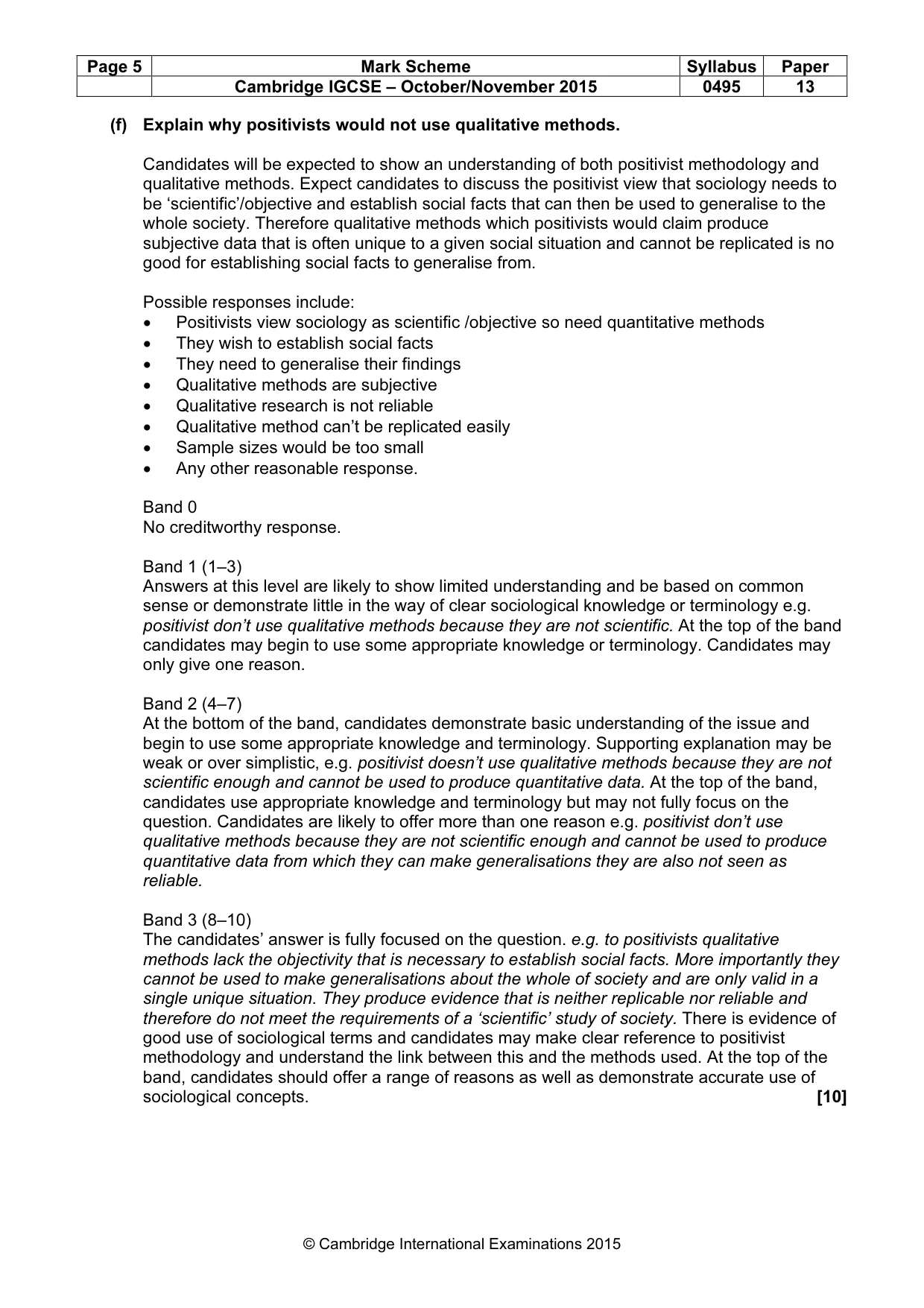
Page 5 Mark Scheme Syllabus Paper Cambridge IGCSE – October/November 2015 0495 13 © Cambridge International Examinations 2015 (f) Explain why positivists would not use qualitative methods. Candidates will be expected to show an understanding of both positivist methodology and qualitative methods. Expect candidates to discuss the positivist view that sociology needs to be ‘scientific’/objective and establish social facts that can then be used to generalise to the whole society. Therefore qualitative methods which positivists would claim produce subjective data that is often unique to a given social situation and cannot be replicated is no good for establishing social facts to generalise from. Possible responses include: • Positivists view sociology as scientific /objective so need quantitative methods • They wish to establish social facts • They need to generalise their findings • Qualitative methods are subjective • Qualitative research is not reliable • Qualitative method can’t be replicated easily • Sample sizes would be too small • Any other reasonable response. Band 0 No creditworthy response. Band 1 (1–3) Answers at this level are likely to show limited understanding and be based on common sense or demonstrate little in the way of clear sociological knowledge or terminology e.g. positivist don’t use qualitative methods because they are not scientific. At the top of the band candidates may begin to use some appropriate knowledge or terminology. Candidates may only give one reason. Band 2 (4–7) At the bottom of the band, candidates demonstrate basic understanding of the issue and begin to use some appropriate knowledge and terminology. Supporting explanation may be weak or over simplistic, e.g. positivist doesn’t use qualitative methods because they are not scientific enough and cannot be used to produce quantitative data. At the top of the band, candidates use appropriate knowledge and terminology but may not fully focus on the question. Candidates are likely to offer more than one reason e.g. positivist don’t use qualitative methods because they are not scientific enough and cannot be used to produce quantitative data from which they can make generalisations they are also not seen as reliable. Band 3 (8–10) The candidates’ answer is fully focused on the question. e.g. to positivists qualitative methods lack the objectivity that is necessary to establish social facts. More importantly they cannot be used to make generalisations about the whole of society and are only valid in a single unique situation. They produce evidence that is neither replicable nor reliable and therefore do not meet the requirements of a ‘scientific’ study of society. There is evidence of good use of sociological terms and candidates may make clear reference to positivist methodology and understand the link between this and the methods used. At the top of the band, candidates should offer a range of reasons as well as demonstrate accurate use of sociological concepts. [10]
Mark scheme, page 6
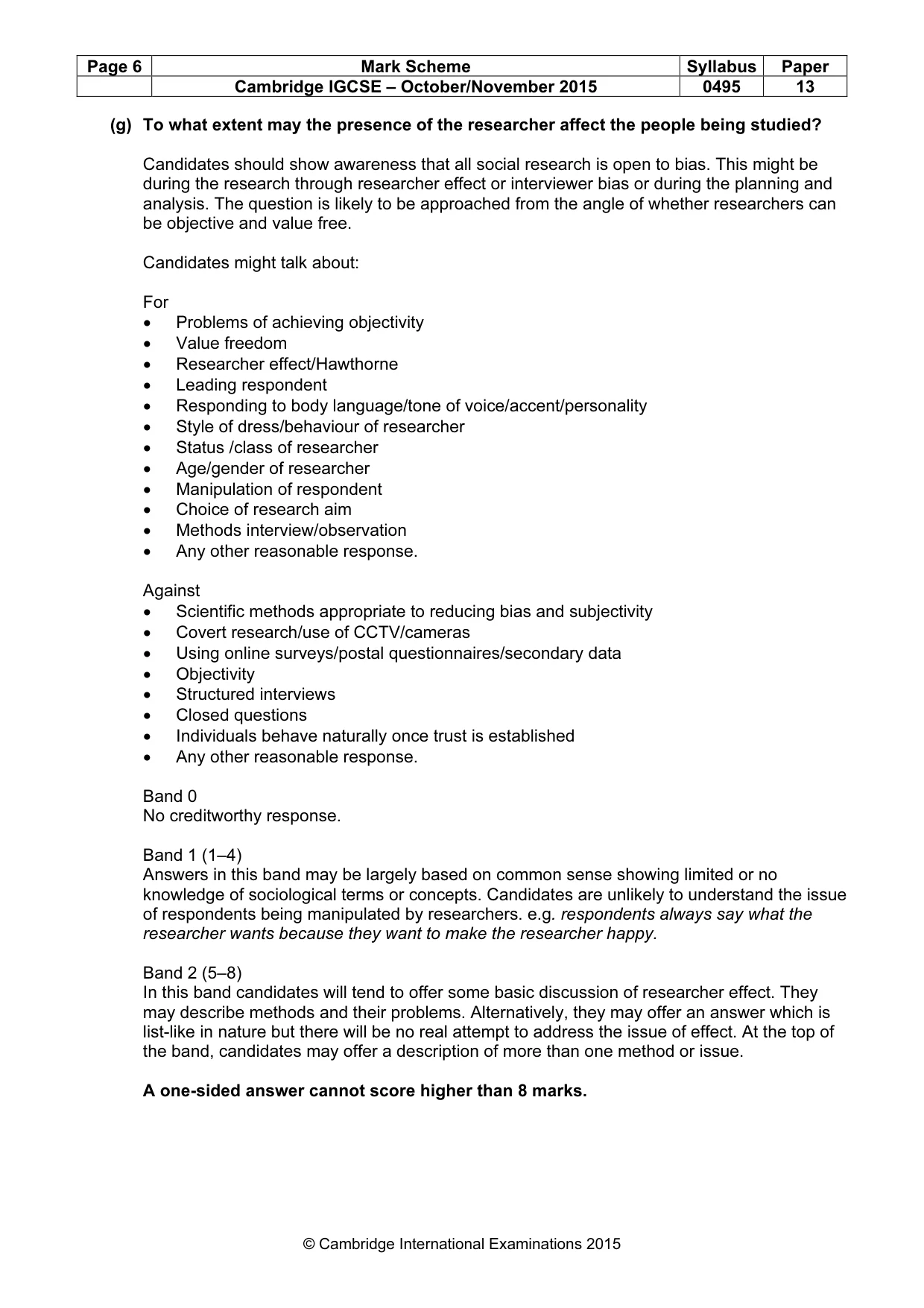
Page 6 Mark Scheme Syllabus Paper Cambridge IGCSE – October/November 2015 0495 13 © Cambridge International Examinations 2015 (g) To what extent may the presence of the researcher affect the people being studied? Candidates should show awareness that all social research is open to bias. This might be during the research through researcher effect or interviewer bias or during the planning and analysis. The question is likely to be approached from the angle of whether researchers can be objective and value free. Candidates might talk about: For • Problems of achieving objectivity • Value freedom • Researcher effect/Hawthorne • Leading respondent • Responding to body language/tone of voice/accent/personality • Style of dress/behaviour of researcher • Status /class of researcher • Age/gender of researcher • Manipulation of respondent • Choice of research aim • Methods interview/observation • Any other reasonable response. Against • Scientific methods appropriate to reducing bias and subjectivity • Covert research/use of CCTV/cameras • Using online surveys/postal questionnaires/secondary data • Objectivity • Structured interviews • Closed questions • Individuals behave naturally once trust is established • Any other reasonable response. Band 0 No creditworthy response. Band 1 (1–4) Answers in this band may be largely based on common sense showing limited or no knowledge of sociological terms or concepts. Candidates are unlikely to understand the issue of respondents being manipulated by researchers. e.g. respondents always say what the researcher wants because they want to make the researcher happy. Band 2 (5–8) In this band candidates will tend to offer some basic discussion of researcher effect. They may describe methods and their problems. Alternatively, they may offer an answer which is list-like in nature but there will be no real attempt to address the issue of effect. At the top of the band, candidates may offer a description of more than one method or issue. A one-sided answer cannot score higher than 8 marks.
Mark scheme, page 7
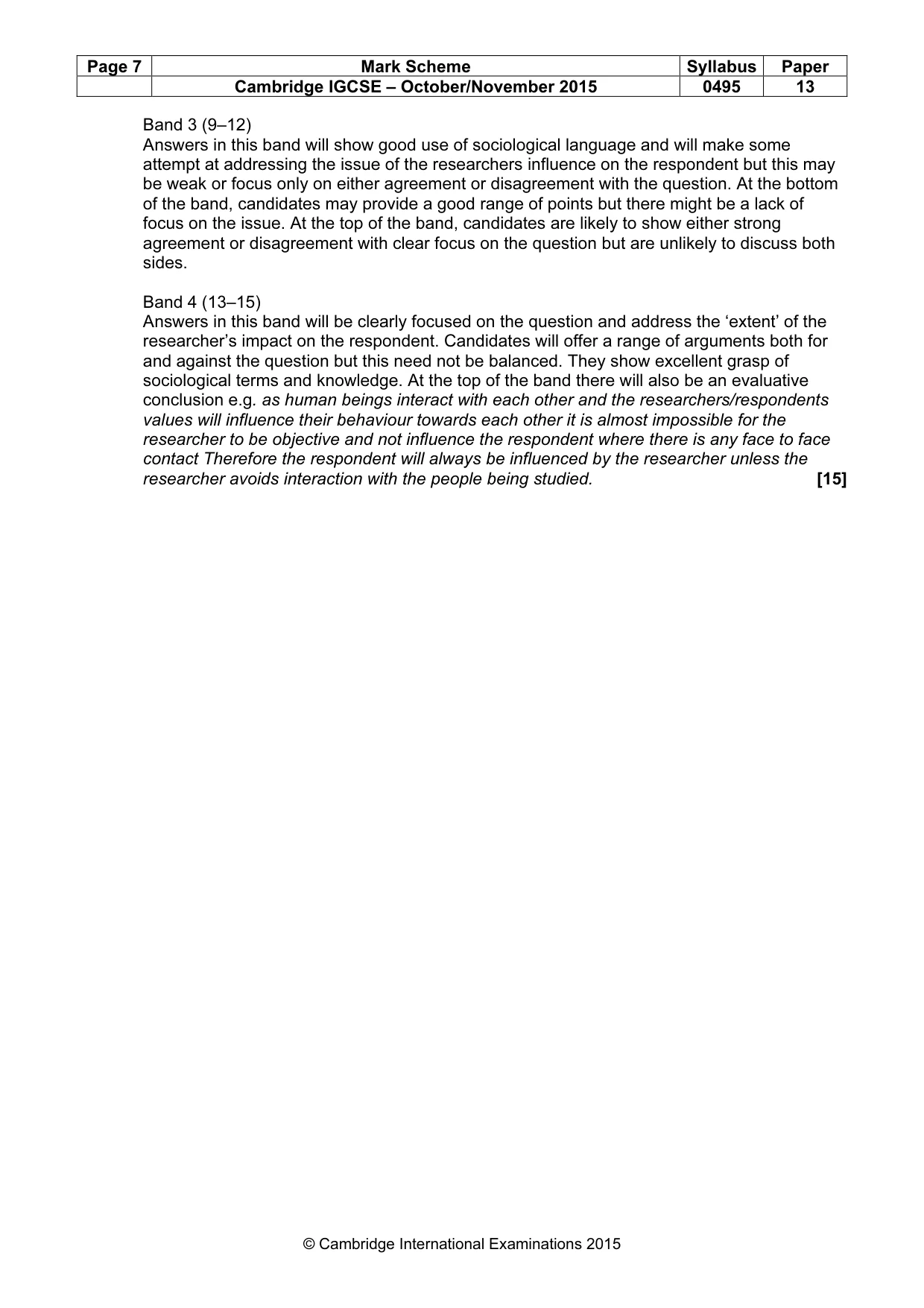
Page 7 Mark Scheme Syllabus Paper Cambridge IGCSE – October/November 2015 0495 13 © Cambridge International Examinations 2015 Band 3 (9–12) Answers in this band will show good use of sociological language and will make some attempt at addressing the issue of the researchers influence on the respondent but this may be weak or focus only on either agreement or disagreement with the question. At the bottom of the band, candidates may provide a good range of points but there might be a lack of focus on the issue. At the top of the band, candidates are likely to show either strong agreement or disagreement with clear focus on the question but are unlikely to discuss both sides. Band 4 (13–15) Answers in this band will be clearly focused on the question and address the ‘extent’ of the researcher’s impact on the respondent. Candidates will offer a range of arguments both for and against the question but this need not be balanced. They show excellent grasp of sociological terms and knowledge. At the top of the band there will also be an evaluative conclusion e.g. as human beings interact with each other and the researchers/respondents values will influence their behaviour towards each other it is almost impossible for the researcher to be objective and not influence the respondent where there is any face to face contact Therefore the respondent will always be influenced by the researcher unless the researcher avoids interaction with the people being studied. [15]
Mark scheme, page 8
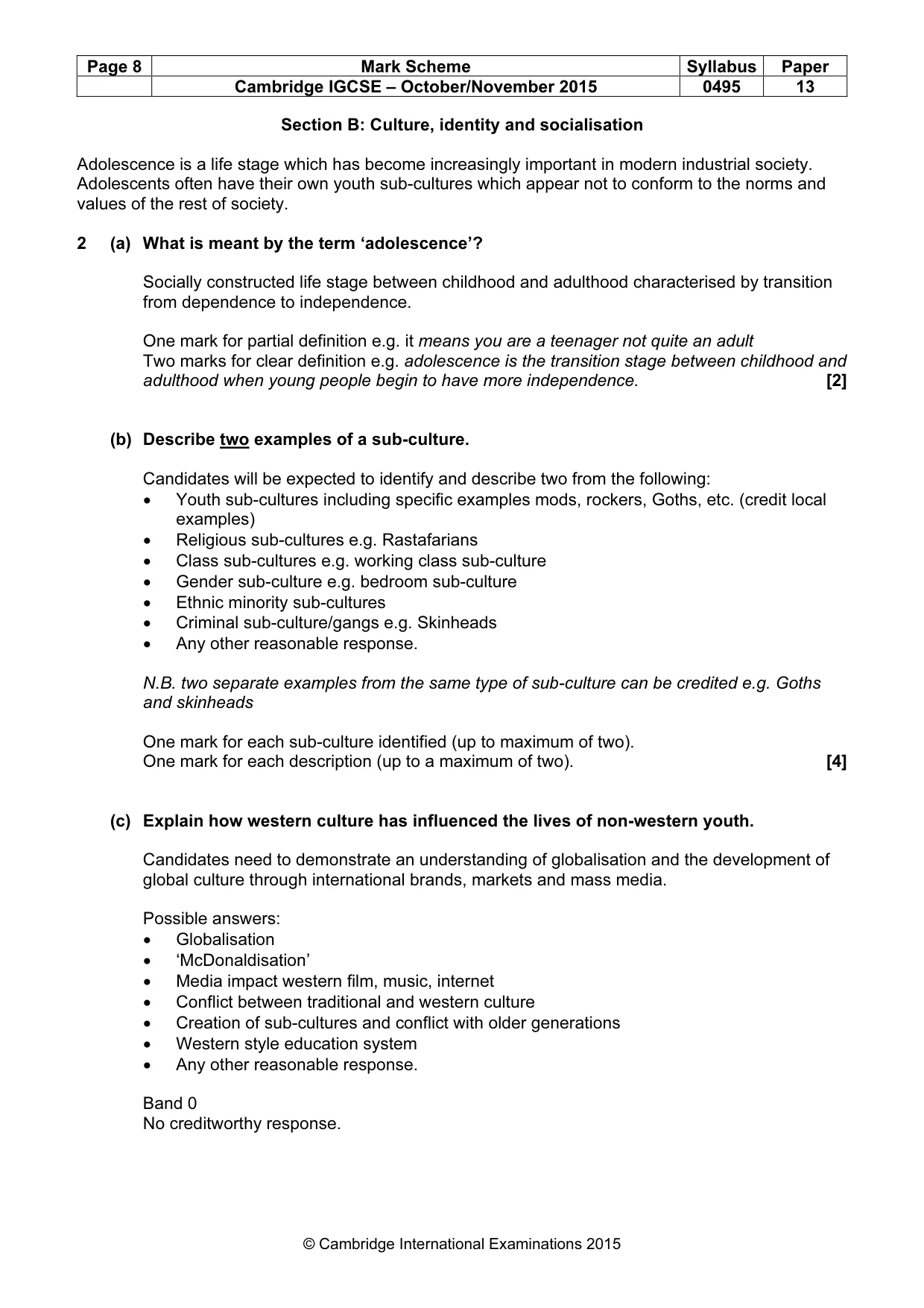
Page 8 Mark Scheme Syllabus Paper Cambridge IGCSE – October/November 2015 0495 13 © Cambridge International Examinations 2015 Section B: Culture, identity and socialisation Adolescence is a life stage which has become increasingly important in modern industrial society. Adolescents often have their own youth sub-cultures which appear not to conform to the norms and values of the rest of society. 2 (a) What is meant by the term ‘adolescence’? Socially constructed life stage between childhood and adulthood characterised by transition from dependence to independence. One mark for partial definition e.g. it means you are a teenager not quite an adult Two marks for clear definition e.g. adolescence is the transition stage between childhood and adulthood when young people begin to have more independence. [2] (b) Describe two examples of a sub-culture. Candidates will be expected to identify and describe two from the following: • Youth sub-cultures including specific examples mods, rockers, Goths, etc. (credit local examples) • Religious sub-cultures e.g. Rastafarians • Class sub-cultures e.g. working class sub-culture • Gender sub-culture e.g. bedroom sub-culture • Ethnic minority sub-cultures • Criminal sub-culture/gangs e.g. Skinheads • Any other reasonable response. N.B. two separate examples from the same type of sub-culture can be credited e.g. Goths and skinheads One mark for each sub-culture identified (up to maximum of two). One mark for each description (up to a maximum of two). [4] (c) Explain how western culture has influenced the lives of non-western youth. Candidates need to demonstrate an understanding of globalisation and the development of global culture through international brands, markets and mass media. Possible answers: • Globalisation • ‘McDonaldisation’ • Media impact western film, music, internet • Conflict between traditional and western culture • Creation of sub-cultures and conflict with older generations • Western style education system • Any other reasonable response. Band 0 No creditworthy response.
Mark scheme, page 9
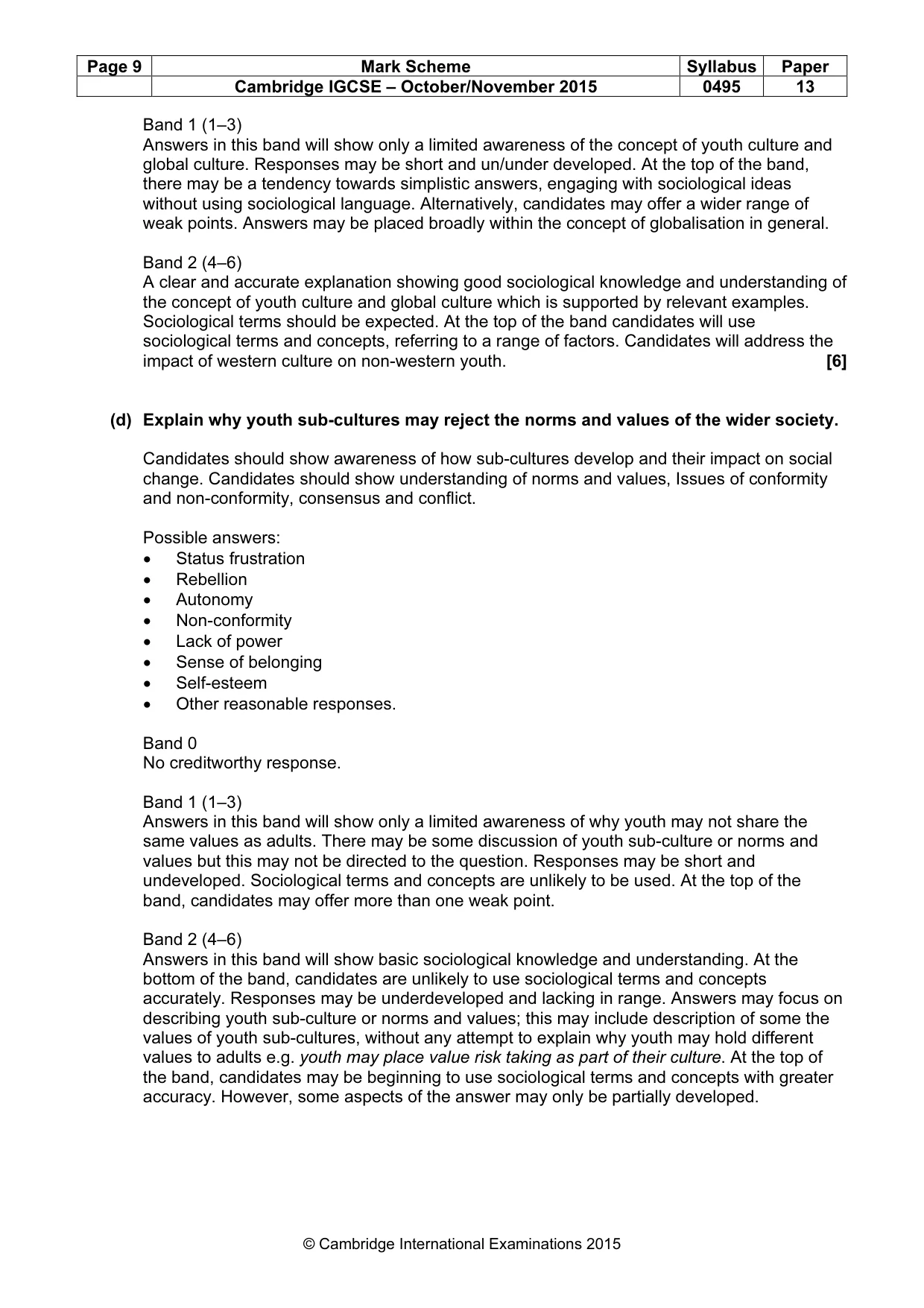
Page 9 Mark Scheme Syllabus Paper Cambridge IGCSE – October/November 2015 0495 13 © Cambridge International Examinations 2015 Band 1 (1–3) Answers in this band will show only a limited awareness of the concept of youth culture and global culture. Responses may be short and un/under developed. At the top of the band, there may be a tendency towards simplistic answers, engaging with sociological ideas without using sociological language. Alternatively, candidates may offer a wider range of weak points. Answers may be placed broadly within the concept of globalisation in general. Band 2 (4–6) A clear and accurate explanation showing good sociological knowledge and understanding of the concept of youth culture and global culture which is supported by relevant examples. Sociological terms should be expected. At the top of the band candidates will use sociological terms and concepts, referring to a range of factors. Candidates will address the impact of western culture on non-western youth. [6] (d) Explain why youth sub-cultures may reject the norms and values of the wider society. Candidates should show awareness of how sub-cultures develop and their impact on social change. Candidates should show understanding of norms and values, Issues of conformity and non-conformity, consensus and conflict. Possible answers: • Status frustration • Rebellion • Autonomy • Non-conformity • Lack of power • Sense of belonging • Self-esteem • Other reasonable responses. Band 0 No creditworthy response. Band 1 (1–3) Answers in this band will show only a limited awareness of why youth may not share the same values as adults. There may be some discussion of youth sub-culture or norms and values but this may not be directed to the question. Responses may be short and undeveloped. Sociological terms and concepts are unlikely to be used. At the top of the band, candidates may offer more than one weak point. Band 2 (4–6) Answers in this band will show basic sociological knowledge and understanding. At the bottom of the band, candidates are unlikely to use sociological terms and concepts accurately. Responses may be underdeveloped and lacking in range. Answers may focus on describing youth sub-culture or norms and values; this may include description of some the values of youth sub-cultures, without any attempt to explain why youth may hold different values to adults e.g. youth may place value risk taking as part of their culture. At the top of the band, candidates may be beginning to use sociological terms and concepts with greater accuracy. However, some aspects of the answer may only be partially developed.
Mark scheme, page 10
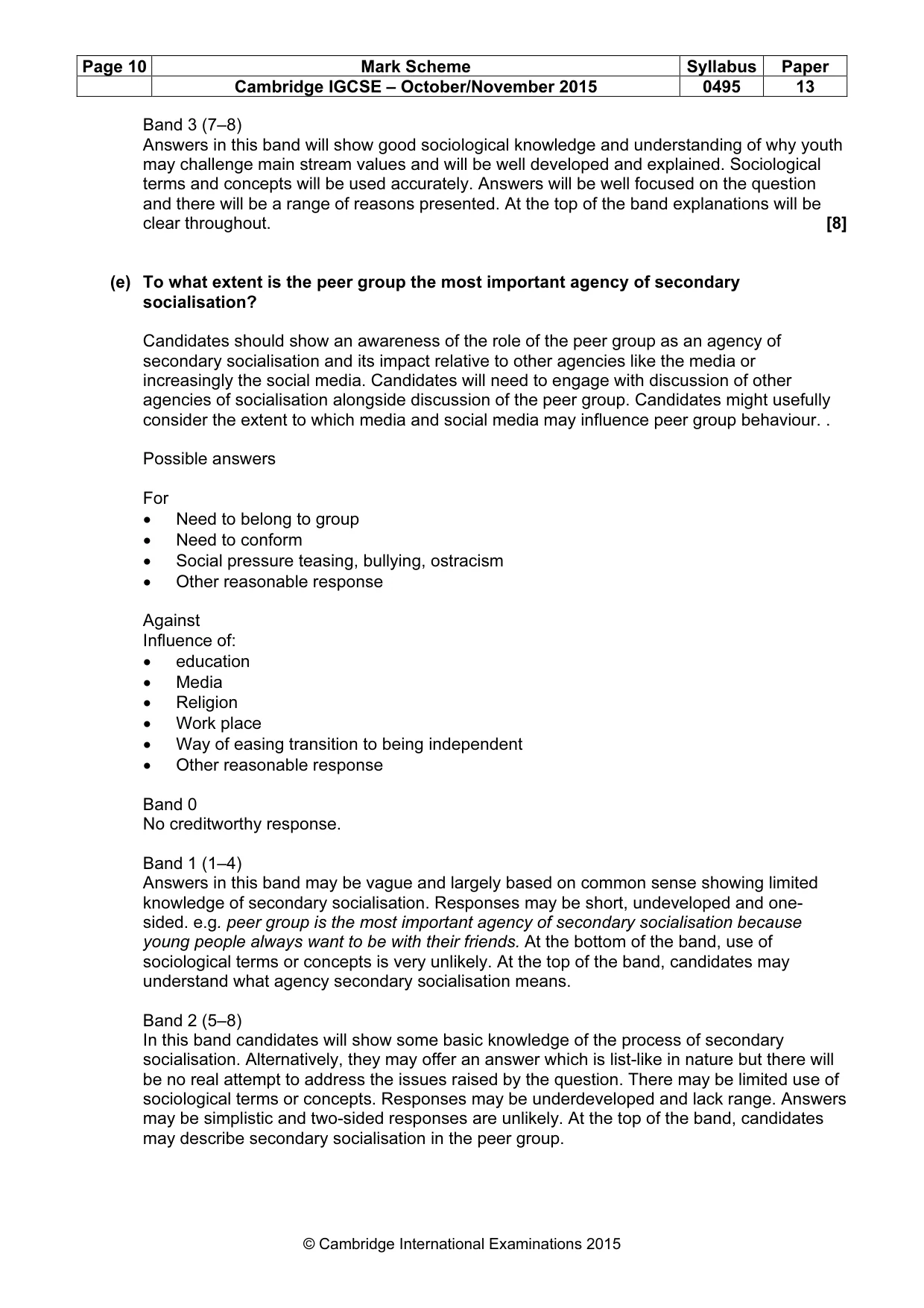
Page 10 Mark Scheme Syllabus Paper Cambridge IGCSE – October/November 2015 0495 13 © Cambridge International Examinations 2015 Band 3 (7–8) Answers in this band will show good sociological knowledge and understanding of why youth may challenge main stream values and will be well developed and explained. Sociological terms and concepts will be used accurately. Answers will be well focused on the question and there will be a range of reasons presented. At the top of the band explanations will be clear throughout. [8] (e) To what extent is the peer group the most important agency of secondary socialisation? Candidates should show an awareness of the role of the peer group as an agency of secondary socialisation and its impact relative to other agencies like the media or increasingly the social media. Candidates will need to engage with discussion of other agencies of socialisation alongside discussion of the peer group. Candidates might usefully consider the extent to which media and social media may influence peer group behaviour. . Possible answers For • Need to belong to group • Need to conform • Social pressure teasing, bullying, ostracism • Other reasonable response Against Influence of: • education • Media • Religion • Work place • Way of easing transition to being independent • Other reasonable response Band 0 No creditworthy response. Band 1 (1–4) Answers in this band may be vague and largely based on common sense showing limited knowledge of secondary socialisation. Responses may be short, undeveloped and one- sided. e.g. peer group is the most important agency of secondary socialisation because young people always want to be with their friends. At the bottom of the band, use of sociological terms or concepts is very unlikely. At the top of the band, candidates may understand what agency secondary socialisation means. Band 2 (5–8) In this band candidates will show some basic knowledge of the process of secondary socialisation. Alternatively, they may offer an answer which is list-like in nature but there will be no real attempt to address the issues raised by the question. There may be limited use of sociological terms or concepts. Responses may be underdeveloped and lack range. Answers may be simplistic and two-sided responses are unlikely. At the top of the band, candidates may describe secondary socialisation in the peer group.
Mark scheme, page 11
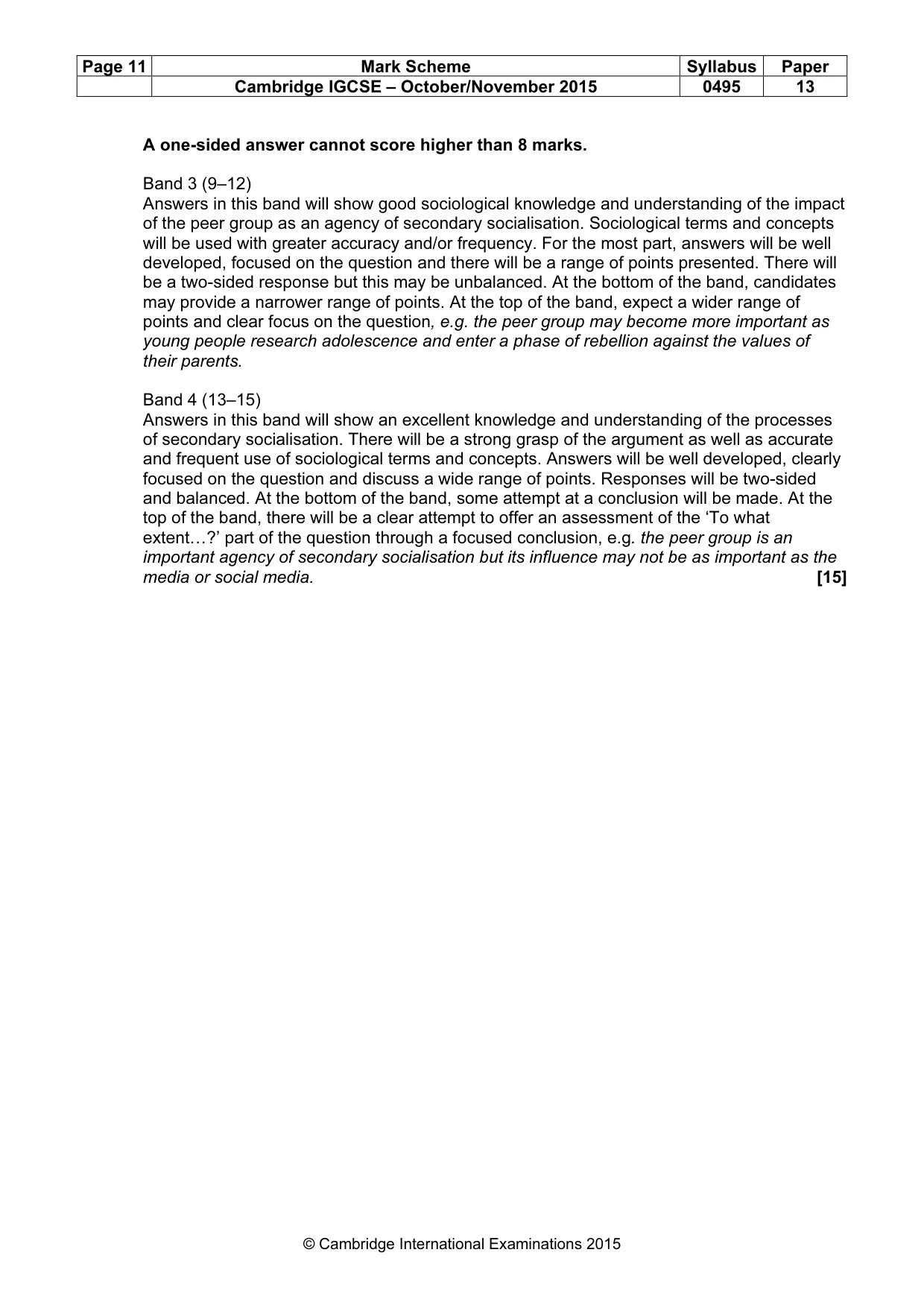
Page 11 Mark Scheme Syllabus Paper Cambridge IGCSE – October/November 2015 0495 13 © Cambridge International Examinations 2015 A one-sided answer cannot score higher than 8 marks. Band 3 (9–12) Answers in this band will show good sociological knowledge and understanding of the impact of the peer group as an agency of secondary socialisation. Sociological terms and concepts will be used with greater accuracy and/or frequency. For the most part, answers will be well developed, focused on the question and there will be a range of points presented. There will be a two-sided response but this may be unbalanced. At the bottom of the band, candidates may provide a narrower range of points. At the top of the band, expect a wider range of points and clear focus on the question, e.g. the peer group may become more important as young people research adolescence and enter a phase of rebellion against the values of their parents. Band 4 (13–15) Answers in this band will show an excellent knowledge and understanding of the processes of secondary socialisation. There will be a strong grasp of the argument as well as accurate and frequent use of sociological terms and concepts. Answers will be well developed, clearly focused on the question and discuss a wide range of points. Responses will be two-sided and balanced. At the bottom of the band, some attempt at a conclusion will be made. At the top of the band, there will be a clear attempt to offer an assessment of the ‘To what extent…?’ part of the question through a focused conclusion, e.g. the peer group is an important agency of secondary socialisation but its influence may not be as important as the media or social media. [15]
Mark scheme, page 12
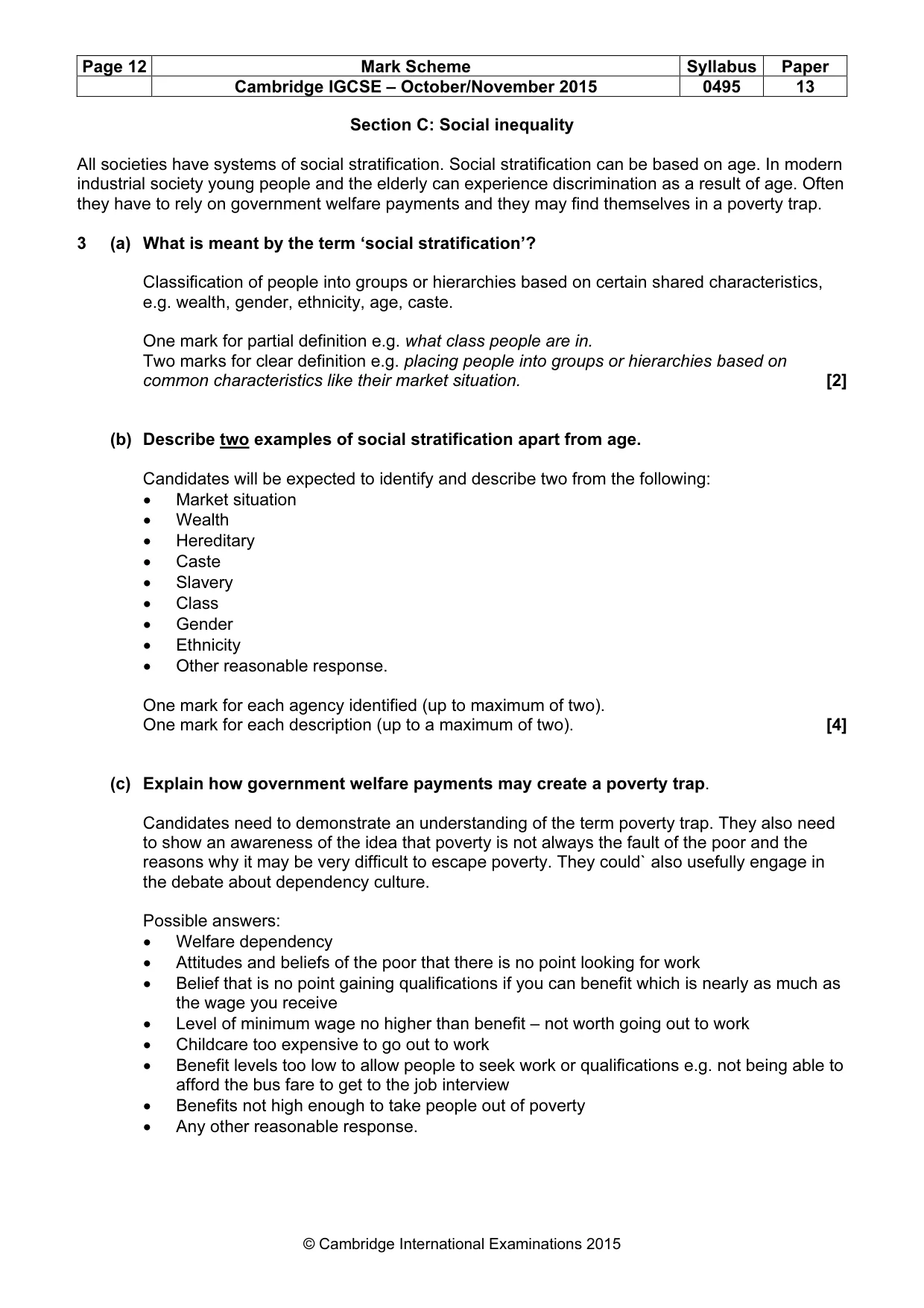
Page 12 Mark Scheme Syllabus Paper Cambridge IGCSE – October/November 2015 0495 13 © Cambridge International Examinations 2015 Section C: Social inequality All societies have systems of social stratification. Social stratification can be based on age. In modern industrial society young people and the elderly can experience discrimination as a result of age. Often they have to rely on government welfare payments and they may find themselves in a poverty trap. 3 (a) What is meant by the term ‘social stratification’? Classification of people into groups or hierarchies based on certain shared characteristics, e.g. wealth, gender, ethnicity, age, caste. One mark for partial definition e.g. what class people are in. Two marks for clear definition e.g. placing people into groups or hierarchies based on common characteristics like their market situation. [2] (b) Describe two examples of social stratification apart from age. Candidates will be expected to identify and describe two from the following: • Market situation • Wealth • Hereditary • Caste • Slavery • Class • Gender • Ethnicity • Other reasonable response. One mark for each agency identified (up to maximum of two). One mark for each description (up to a maximum of two). [4] (c) Explain how government welfare payments may create a poverty trap. Candidates need to demonstrate an understanding of the term poverty trap. They also need to show an awareness of the idea that poverty is not always the fault of the poor and the reasons why it may be very difficult to escape poverty. They could` also usefully engage in the debate about dependency culture. Possible answers: • Welfare dependency • Attitudes and beliefs of the poor that there is no point looking for work • Belief that is no point gaining qualifications if you can benefit which is nearly as much as the wage you receive • Level of minimum wage no higher than benefit – not worth going out to work • Childcare too expensive to go out to work • Benefit levels too low to allow people to seek work or qualifications e.g. not being able to afford the bus fare to get to the job interview • Benefits not high enough to take people out of poverty • Any other reasonable response.
Mark scheme, page 13
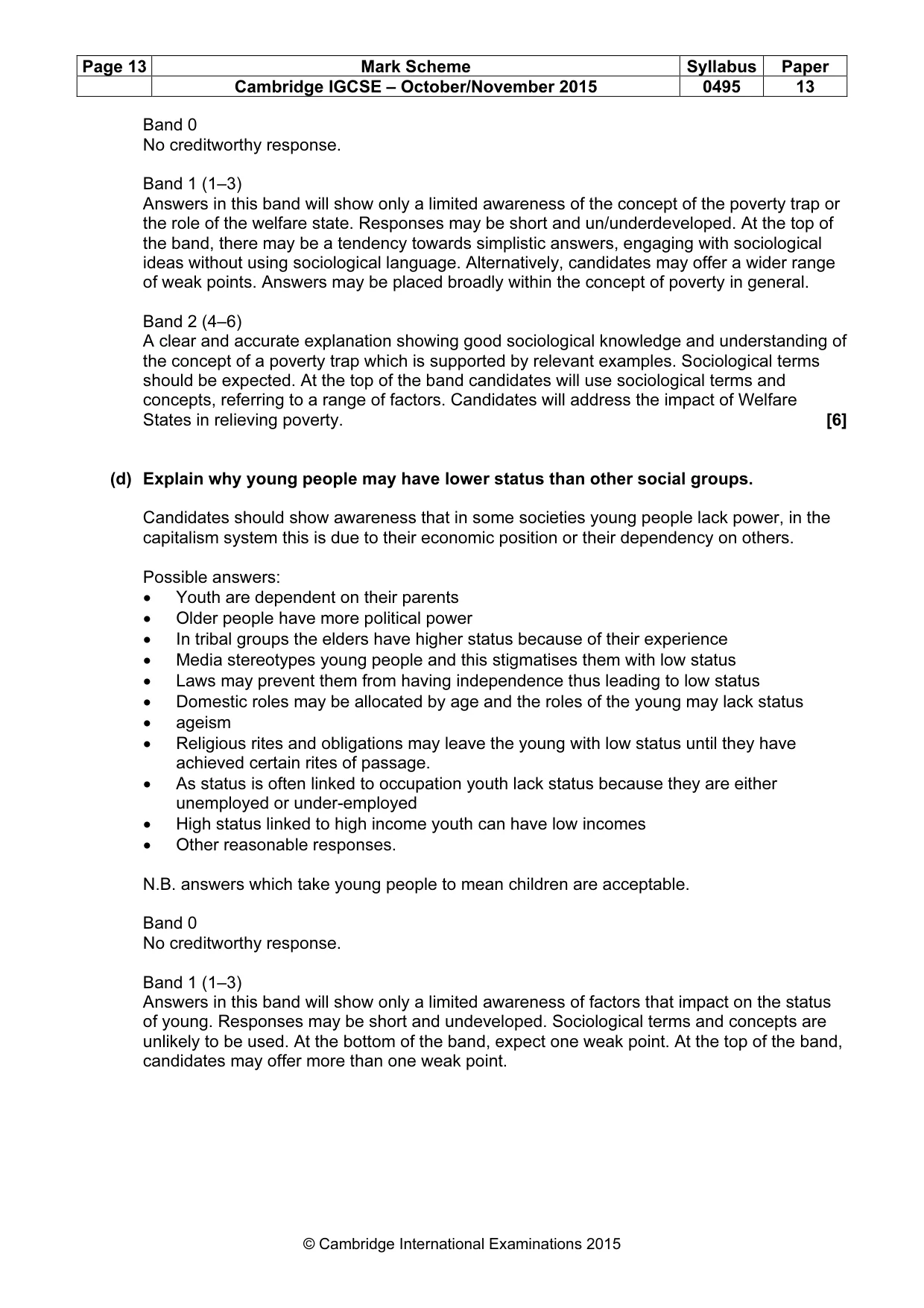
Page 13 Mark Scheme Syllabus Paper Cambridge IGCSE – October/November 2015 0495 13 © Cambridge International Examinations 2015 Band 0 No creditworthy response. Band 1 (1–3) Answers in this band will show only a limited awareness of the concept of the poverty trap or the role of the welfare state. Responses may be short and un/underdeveloped. At the top of the band, there may be a tendency towards simplistic answers, engaging with sociological ideas without using sociological language. Alternatively, candidates may offer a wider range of weak points. Answers may be placed broadly within the concept of poverty in general. Band 2 (4–6) A clear and accurate explanation showing good sociological knowledge and understanding of the concept of a poverty trap which is supported by relevant examples. Sociological terms should be expected. At the top of the band candidates will use sociological terms and concepts, referring to a range of factors. Candidates will address the impact of Welfare States in relieving poverty. [6] (d) Explain why young people may have lower status than other social groups. Candidates should show awareness that in some societies young people lack power, in the capitalism system this is due to their economic position or their dependency on others. Possible answers: • Youth are dependent on their parents • Older people have more political power • In tribal groups the elders have higher status because of their experience • Media stereotypes young people and this stigmatises them with low status • Laws may prevent them from having independence thus leading to low status • Domestic roles may be allocated by age and the roles of the young may lack status • ageism • Religious rites and obligations may leave the young with low status until they have achieved certain rites of passage. • As status is often linked to occupation youth lack status because they are either unemployed or under-employed • High status linked to high income youth can have low incomes • Other reasonable responses. N.B. answers which take young people to mean children are acceptable. Band 0 No creditworthy response. Band 1 (1–3) Answers in this band will show only a limited awareness of factors that impact on the status of young. Responses may be short and undeveloped. Sociological terms and concepts are unlikely to be used. At the bottom of the band, expect one weak point. At the top of the band, candidates may offer more than one weak point.
Mark scheme, page 14
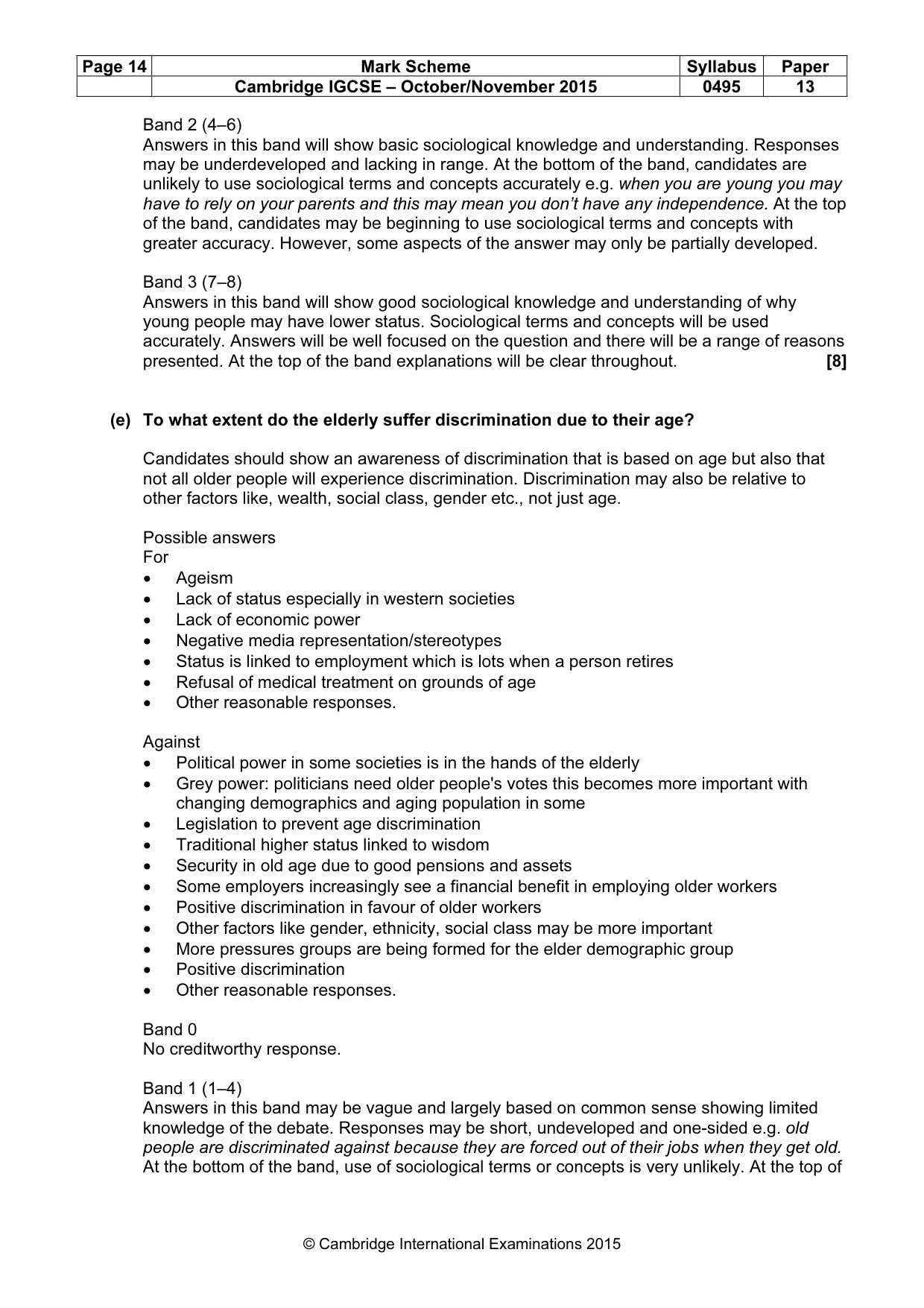
Page 14 Mark Scheme Syllabus Paper Cambridge IGCSE – October/November 2015 0495 13 © Cambridge International Examinations 2015 Band 2 (4–6) Answers in this band will show basic sociological knowledge and understanding. Responses may be underdeveloped and lacking in range. At the bottom of the band, candidates are unlikely to use sociological terms and concepts accurately e.g. when you are young you may have to rely on your parents and this may mean you don’t have any independence. At the top of the band, candidates may be beginning to use sociological terms and concepts with greater accuracy. However, some aspects of the answer may only be partially developed. Band 3 (7–8) Answers in this band will show good sociological knowledge and understanding of why young people may have lower status. Sociological terms and concepts will be used accurately. Answers will be well focused on the question and there will be a range of reasons presented. At the top of the band explanations will be clear throughout. [8] (e) To what extent do the elderly suffer discrimination due to their age? Candidates should show an awareness of discrimination that is based on age but also that not all older people will experience discrimination. Discrimination may also be relative to other factors like, wealth, social class, gender etc., not just age. Possible answers For • Ageism • Lack of status especially in western societies • Lack of economic power • Negative media representation/stereotypes • Status is linked to employment which is lots when a person retires • Refusal of medical treatment on grounds of age • Other reasonable responses. Against • Political power in some societies is in the hands of the elderly • Grey power: politicians need older people's votes this becomes more important with changing demographics and aging population in some • Legislation to prevent age discrimination • Traditional higher status linked to wisdom • Security in old age due to good pensions and assets • Some employers increasingly see a financial benefit in employing older workers • Positive discrimination in favour of older workers • Other factors like gender, ethnicity, social class may be more important • More pressures groups are being formed for the elder demographic group • Positive discrimination • Other reasonable responses. Band 0 No creditworthy response. Band 1 (1–4) Answers in this band may be vague and largely based on common sense showing limited knowledge of the debate. Responses may be short, undeveloped and one-sided e.g. old people are discriminated against because they are forced out of their jobs when they get old. At the bottom of the band, use of sociological terms or concepts is very unlikely. At the top of
Mark scheme, page 15
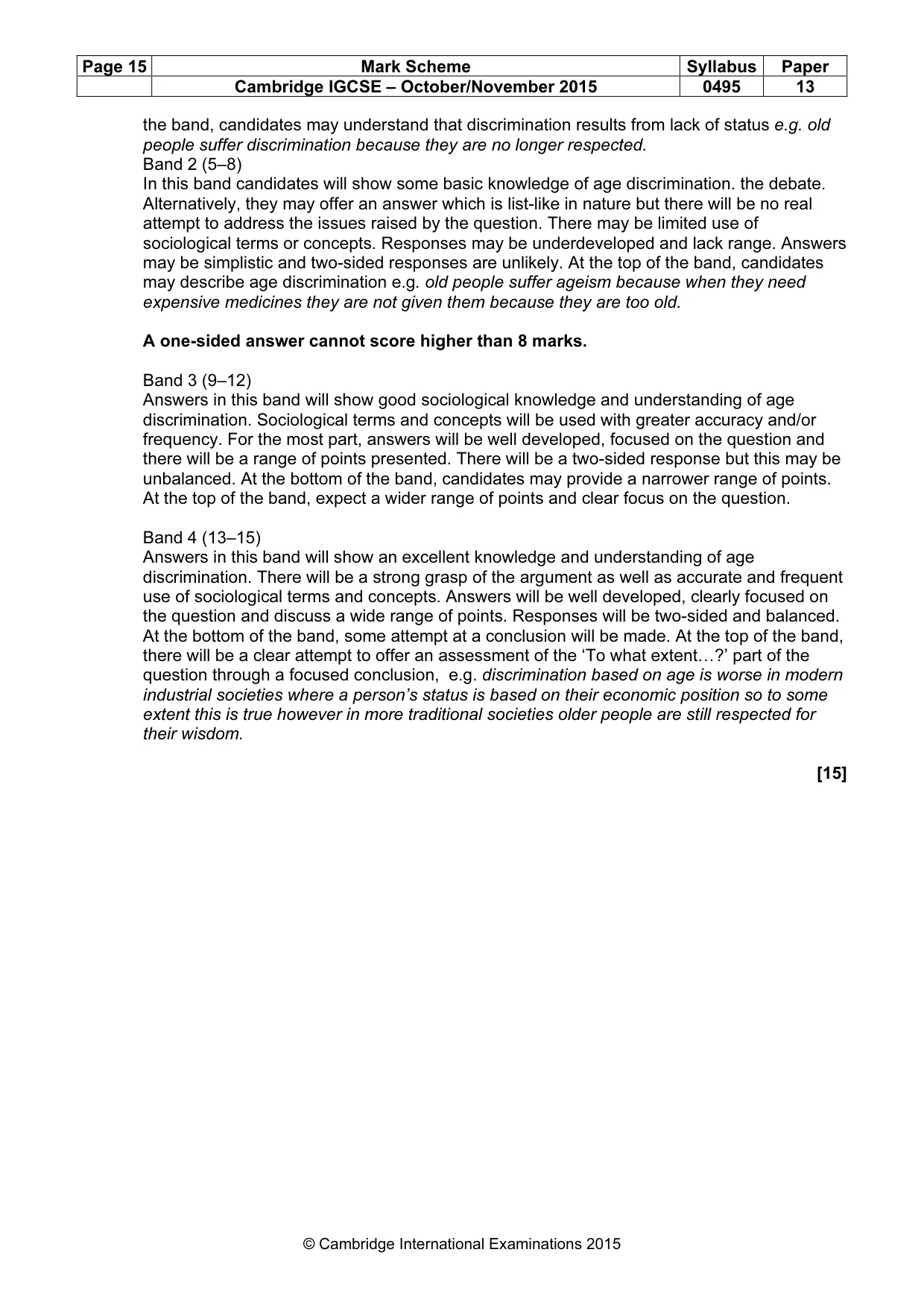
Page 15 Mark Scheme Syllabus Paper Cambridge IGCSE – October/November 2015 0495 13 © Cambridge International Examinations 2015 the band, candidates may understand that discrimination results from lack of status e.g. old people suffer discrimination because they are no longer respected. Band 2 (5–8) In this band candidates will show some basic knowledge of age discrimination. the debate. Alternatively, they may offer an answer which is list-like in nature but there will be no real attempt to address the issues raised by the question. There may be limited use of sociological terms or concepts. Responses may be underdeveloped and lack range. Answers may be simplistic and two-sided responses are unlikely. At the top of the band, candidates may describe age discrimination e.g. old people suffer ageism because when they need expensive medicines they are not given them because they are too old. A one-sided answer cannot score higher than 8 marks. Band 3 (9–12) Answers in this band will show good sociological knowledge and understanding of age discrimination. Sociological terms and concepts will be used with greater accuracy and/or frequency. For the most part, answers will be well developed, focused on the question and there will be a range of points presented. There will be a two-sided response but this may be unbalanced. At the bottom of the band, candidates may provide a narrower range of points. At the top of the band, expect a wider range of points and clear focus on the question. Band 4 (13–15) Answers in this band will show an excellent knowledge and understanding of age discrimination. There will be a strong grasp of the argument as well as accurate and frequent use of sociological terms and concepts. Answers will be well developed, clearly focused on the question and discuss a wide range of points. Responses will be two-sided and balanced. At the bottom of the band, some attempt at a conclusion will be made. At the top of the band, there will be a clear attempt to offer an assessment of the ‘To what extent…?’ part of the question through a focused conclusion, e.g. discrimination based on age is worse in modern industrial societies where a person’s status is based on their economic position so to some extent this is true however in more traditional societies older people are still respected for their wisdom. [15]
What you needed in this session
Cambridge’s own grade thresholds for 2015 Oct/Nov, Paper 1 · Variant 3. A higher threshold means an easier paper — the bar moves with how the cohort did.