Cambridge IGCSE Sociology 0495 — 2015 Oct/Nov Paper 1 · Variant 2
0495/12/O/N/15 · 80 marks · ≈90 min
The question paper and its mark scheme, free to read here and free to download. This is Cambridge’s own paper, exactly as it was sat.
Question paper4 pages

Mark scheme14 pages
Answers below. Sit the paper first if you are practising.
Paper as text
Question paper, page 1
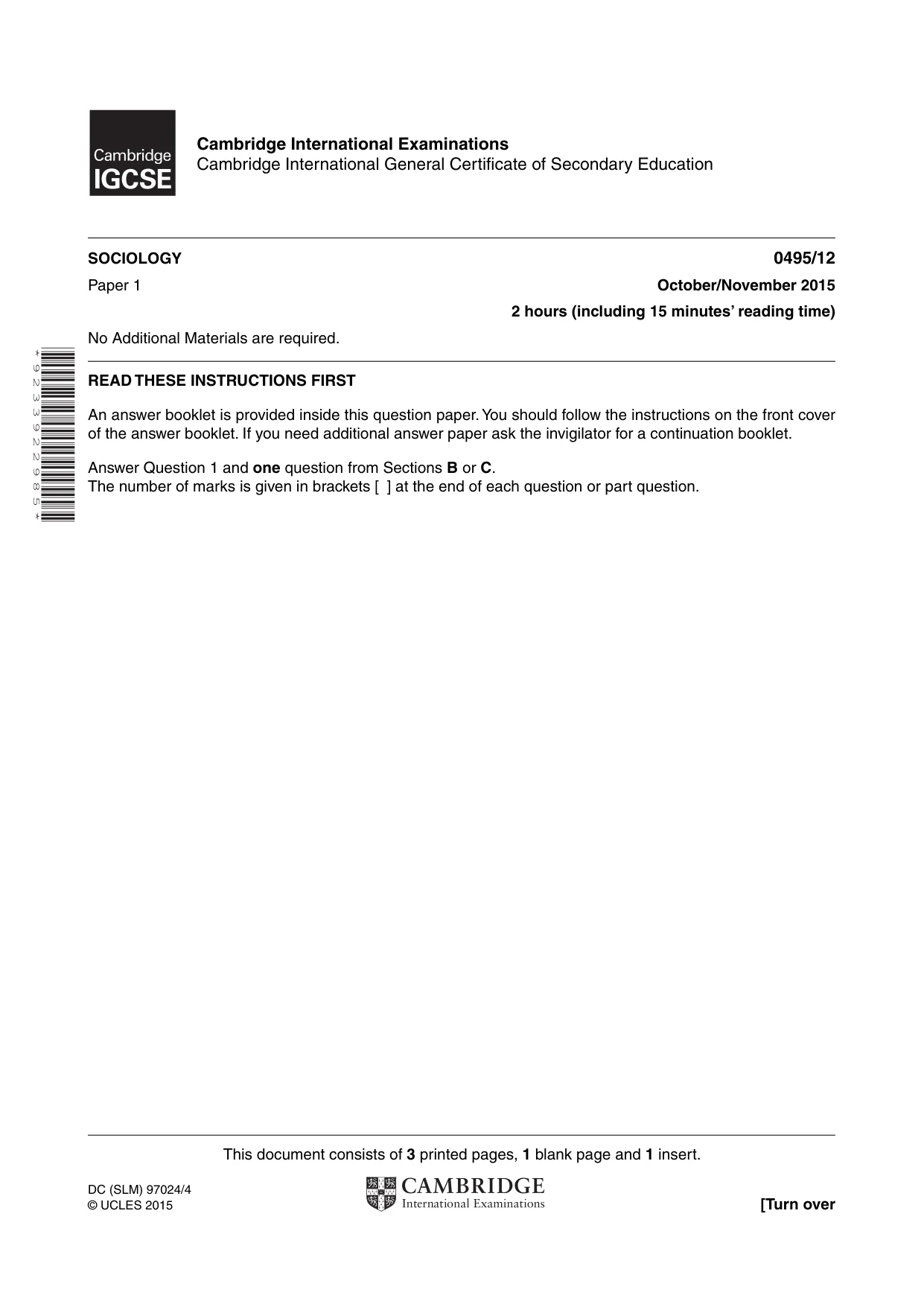
This document consists of 3 printed pages, 1 blank page and 1 insert. DC (SLM) 97024/4 © UCLES 2015 [Turn over Cambridge International Examinations Cambridge International General Certificate of Secondary Education * 9 2 3 3 9 2 2 9 8 5 * SOCIOLOGY 0495/12 Paper 1 October/November 2015 2 hours (including 15 minutes’ reading time) No Additional Materials are required. READ THESE INSTRUCTIONS FIRST An answer booklet is provided inside this question paper. You should follow the instructions on the front cover of the answer booklet. If you need additional answer paper ask the invigilator for a continuation booklet. Answer Question 1 and one question from Sections B or C. The number of marks is given in brackets [ ] at the end of each question or part question.
Question paper, page 2
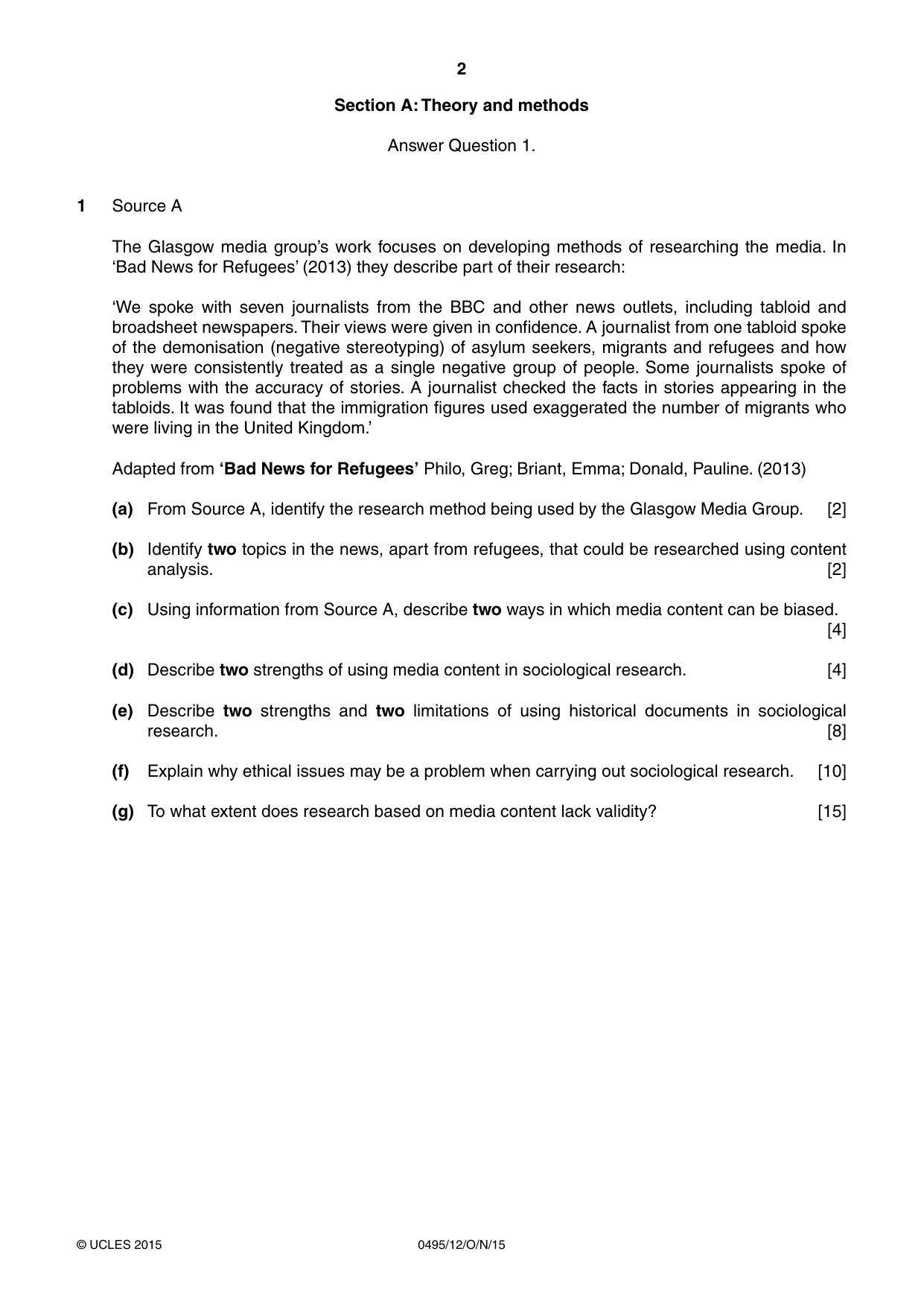
2 0495/12/O/N/15 © UCLES 2015 Section A: Theory and methods Answer Question 1. 1 Source A The Glasgow media group’s work focuses on developing methods of researching the media. In ‘Bad News for Refugees’ (2013) they describe part of their research: ‘We spoke with seven journalists from the BBC and other news outlets, including tabloid and broadsheet newspapers. Their views were given in confidence. A journalist from one tabloid spoke of the demonisation (negative stereotyping) of asylum seekers, migrants and refugees and how they were consistently treated as a single negative group of people. Some journalists spoke of problems with the accuracy of stories. A journalist checked the facts in stories appearing in the tabloids. It was found that the immigration figures used exaggerated the number of migrants who were living in the United Kingdom.’ Adapted from ‘Bad News for Refugees’ Philo, Greg; Briant, Emma; Donald, Pauline. (2013) (a) From Source A, identify the research method being used by the Glasgow Media Group. [2] (b) Identify two topics in the news, apart from refugees, that could be researched using content analysis. [2] (c) Using information from Source A, describe two ways in which media content can be biased. [4] (d) Describe two strengths of using media content in sociological research. [4] (e) Describe two strengths and two limitations of using historical documents in sociological research. [8] (f) Explain why ethical issues may be a problem when carrying out sociological research. [10] (g) To what extent does research based on media content lack validity? [15]
Question paper, page 3
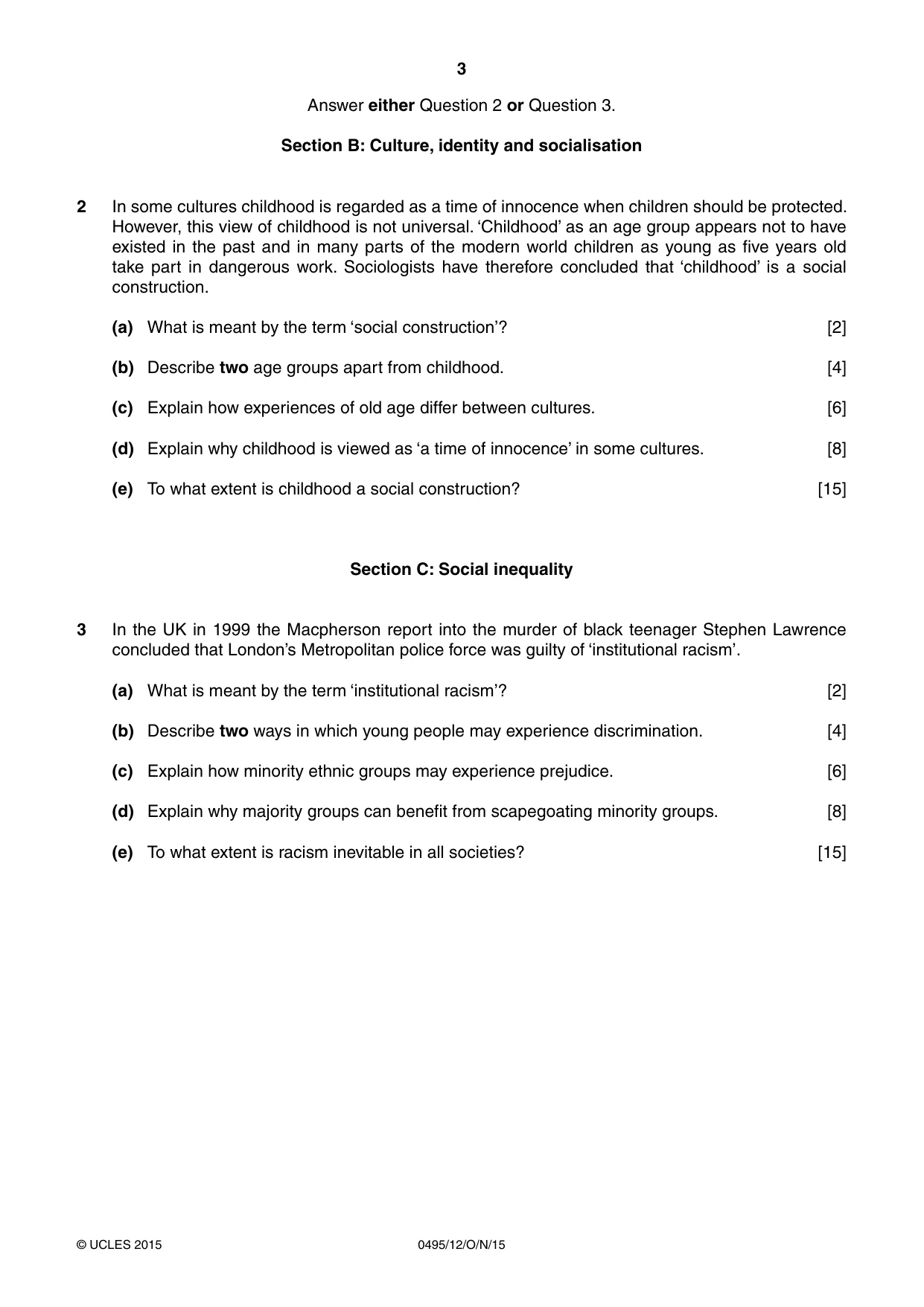
3 0495/12/O/N/15 © UCLES 2015 Answer either Question 2 or Question 3. Section B: Culture, identity and socialisation 2 In some cultures childhood is regarded as a time of innocence when children should be protected. However, this view of childhood is not universal. ‘Childhood’ as an age group appears not to have existed in the past and in many parts of the modern world children as young as five years old take part in dangerous work. Sociologists have therefore concluded that ‘childhood’ is a social construction. (a) What is meant by the term ‘social construction’? [2] (b) Describe two age groups apart from childhood. [4] (c) Explain how experiences of old age differ between cultures. [6] (d) Explain why childhood is viewed as ‘a time of innocence’ in some cultures. [8] (e) To what extent is childhood a social construction? [15] Section C: Social inequality 3 In the UK in 1999 the Macpherson report into the murder of black teenager Stephen Lawrence concluded that London’s Metropolitan police force was guilty of ‘institutional racism’. (a) What is meant by the term ‘institutional racism’? [2] (b) Describe two ways in which young people may experience discrimination. [4] (c) Explain how minority ethnic groups may experience prejudice. [6] (d) Explain why majority groups can benefit from scapegoating minority groups. [8] (e) To what extent is racism inevitable in all societies? [15]
Question paper, page 4
4 0495/12/O/N/15 © UCLES 2015 Permission to reproduce items where third-party owned material protected by copyright is included has been sought and cleared where possible. Every reasonable effort has been made by the publisher (UCLES) to trace copyright holders, but if any items requiring clearance have unwittingly been included, the publisher will be pleased to make amends at the earliest possible opportunity. To avoid the issue of disclosure of answer-related information to candidates, all copyright acknowledgements are reproduced online in the Cambridge International Examinations Copyright Acknowledgements Booklet. This is produced for each series of examinations and is freely available to download at www.cie.org.uk after the live examination series. Cambridge International Examinations is part of the Cambridge Assessment Group. Cambridge Assessment is the brand name of University of Cambridge Local Examinations Syndicate (UCLES), which is itself a department of the University of Cambridge. BLANK PAGE
Mark scheme, page 1
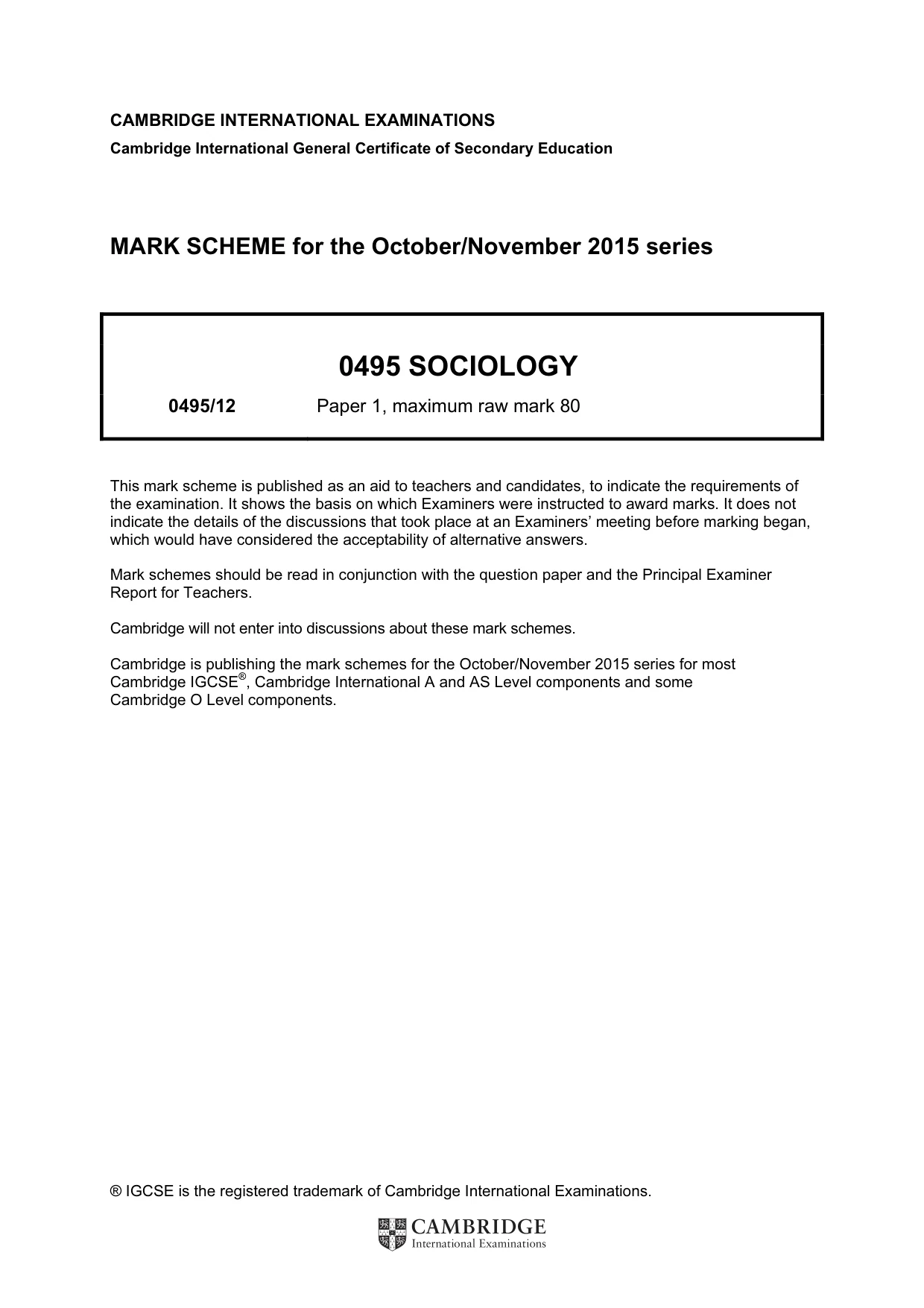
® IGCSE is the registered trademark of Cambridge International Examinations. CAMBRIDGE INTERNATIONAL EXAMINATIONS Cambridge International General Certificate of Secondary Education MARK SCHEME for the October/November 2015 series 0495 SOCIOLOGY 0495/12 Paper 1, maximum raw mark 80 This mark scheme is published as an aid to teachers and candidates, to indicate the requirements of the examination. It shows the basis on which Examiners were instructed to award marks. It does not indicate the details of the discussions that took place at an Examiners’ meeting before marking began, which would have considered the acceptability of alternative answers. Mark schemes should be read in conjunction with the question paper and the Principal Examiner Report for Teachers. Cambridge will not enter into discussions about these mark schemes. Cambridge is publishing the mark schemes for the October/November 2015 series for most Cambridge IGCSE®, Cambridge International A and AS Level components and some Cambridge O Level components.
Mark scheme, page 2
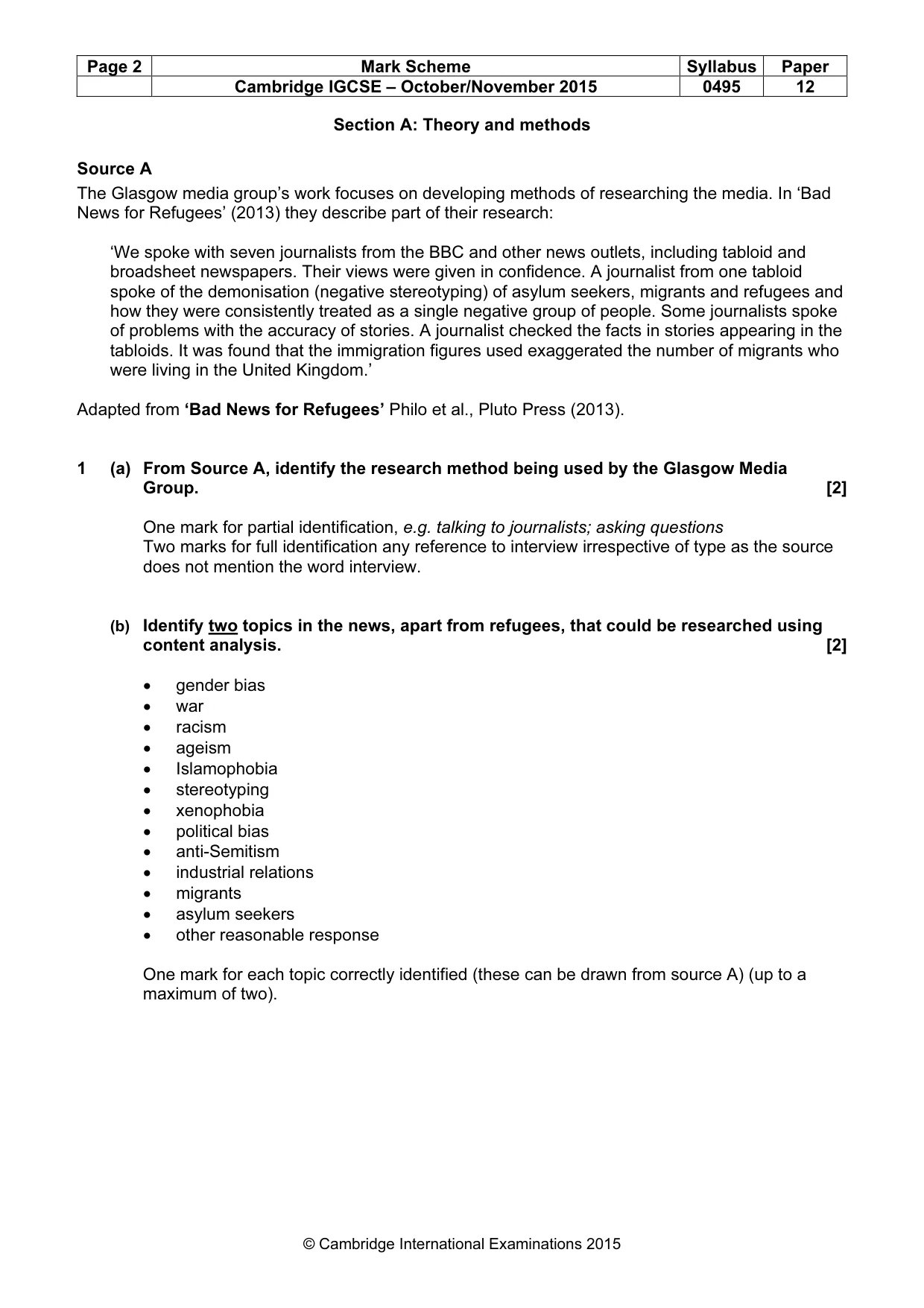
Page 2 Mark Scheme Syllabus Paper Cambridge IGCSE – October/November 2015 0495 12 © Cambridge International Examinations 2015 Section A: Theory and methods Source A The Glasgow media group’s work focuses on developing methods of researching the media. In ‘Bad News for Refugees’ (2013) they describe part of their research: ‘We spoke with seven journalists from the BBC and other news outlets, including tabloid and broadsheet newspapers. Their views were given in confidence. A journalist from one tabloid spoke of the demonisation (negative stereotyping) of asylum seekers, migrants and refugees and how they were consistently treated as a single negative group of people. Some journalists spoke of problems with the accuracy of stories. A journalist checked the facts in stories appearing in the tabloids. It was found that the immigration figures used exaggerated the number of migrants who were living in the United Kingdom.’ Adapted from ‘Bad News for Refugees’ Philo et al., Pluto Press (2013). 1 (a) From Source A, identify the research method being used by the Glasgow Media Group. [2] One mark for partial identification, e.g. talking to journalists; asking questions Two marks for full identification any reference to interview irrespective of type as the source does not mention the word interview. (b) Identify two topics in the news, apart from refugees, that could be researched using content analysis. [2] • gender bias • war • racism • ageism • Islamophobia • stereotyping • xenophobia • political bias • anti-Semitism • industrial relations • migrants • asylum seekers • other reasonable response One mark for each topic correctly identified (these can be drawn from source A) (up to a maximum of two).
Mark scheme, page 3
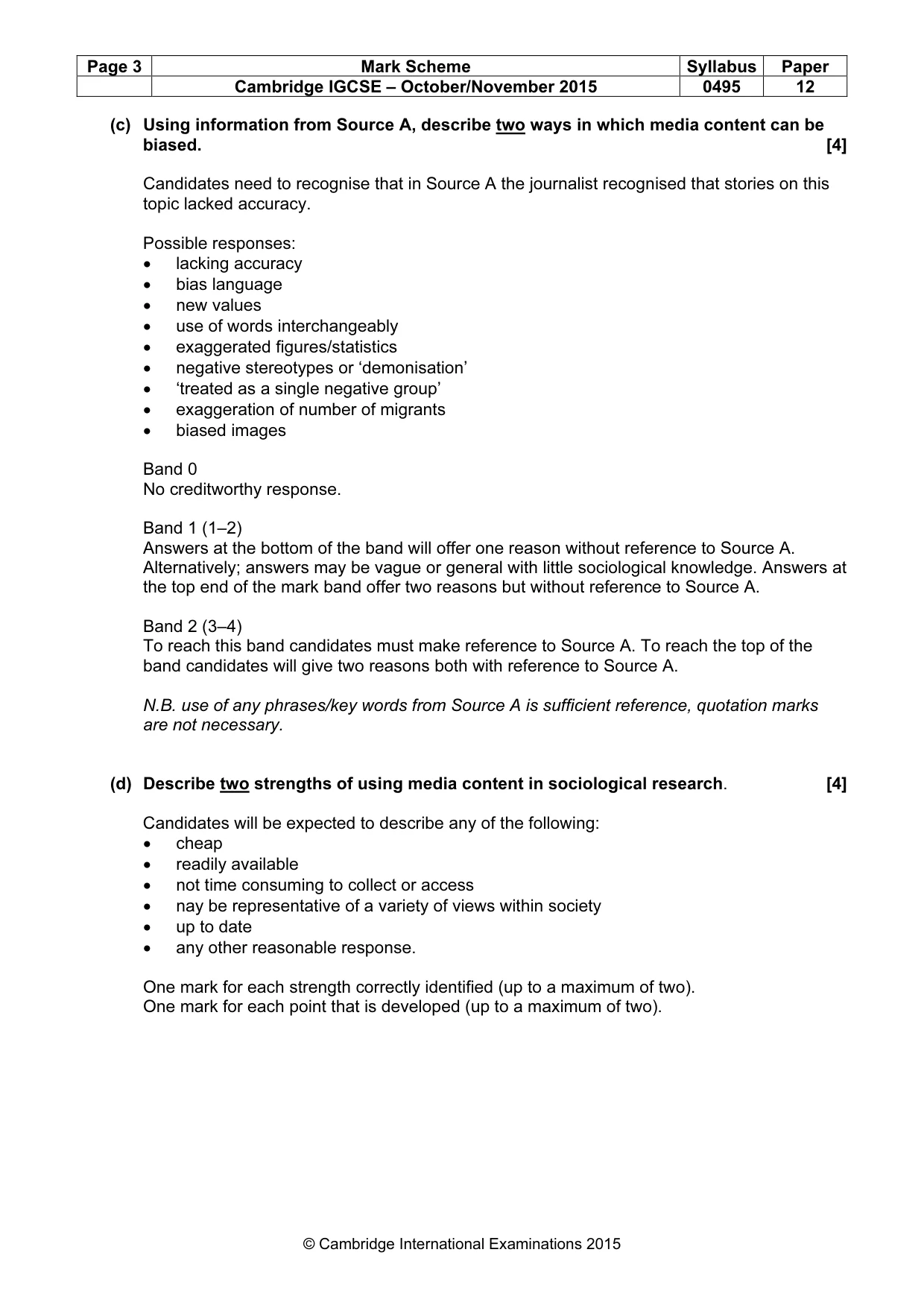
Page 3 Mark Scheme Syllabus Paper Cambridge IGCSE – October/November 2015 0495 12 © Cambridge International Examinations 2015 (c) Using information from Source A, describe two ways in which media content can be biased. [4] Candidates need to recognise that in Source A the journalist recognised that stories on this topic lacked accuracy. Possible responses: • lacking accuracy • bias language • new values • use of words interchangeably • exaggerated figures/statistics • negative stereotypes or ‘demonisation’ • ‘treated as a single negative group’ • exaggeration of number of migrants • biased images Band 0 No creditworthy response. Band 1 (1–2) Answers at the bottom of the band will offer one reason without reference to Source A. Alternatively; answers may be vague or general with little sociological knowledge. Answers at the top end of the mark band offer two reasons but without reference to Source A. Band 2 (3–4) To reach this band candidates must make reference to Source A. To reach the top of the band candidates will give two reasons both with reference to Source A. N.B. use of any phrases/key words from Source A is sufficient reference, quotation marks are not necessary. (d) Describe two strengths of using media content in sociological research. [4] Candidates will be expected to describe any of the following: • cheap • readily available • not time consuming to collect or access • nay be representative of a variety of views within society • up to date • any other reasonable response. One mark for each strength correctly identified (up to a maximum of two). One mark for each point that is developed (up to a maximum of two).
Mark scheme, page 4
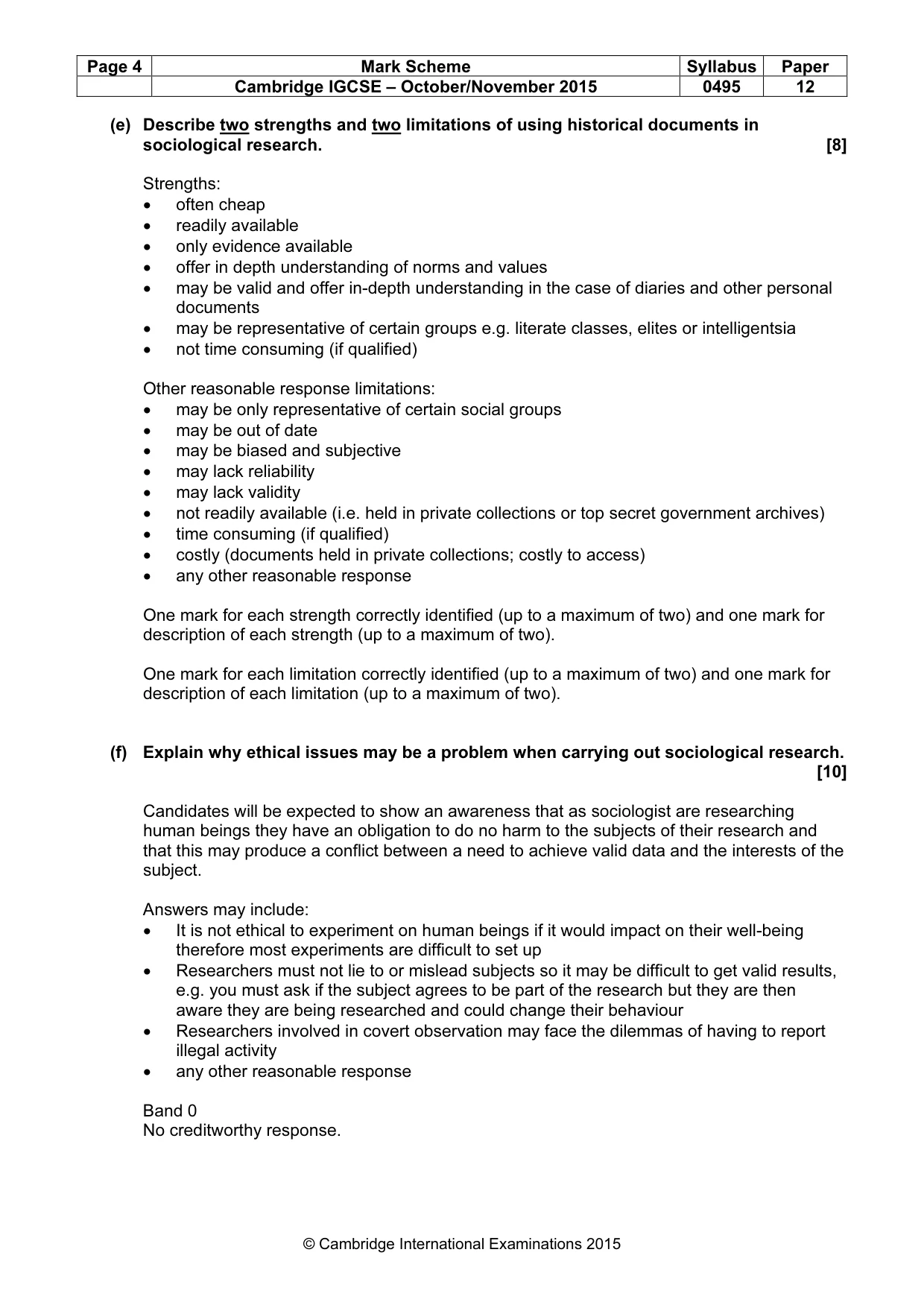
Page 4 Mark Scheme Syllabus Paper Cambridge IGCSE – October/November 2015 0495 12 © Cambridge International Examinations 2015 (e) Describe two strengths and two limitations of using historical documents in sociological research. [8] Strengths: • often cheap • readily available • only evidence available • offer in depth understanding of norms and values • may be valid and offer in-depth understanding in the case of diaries and other personal documents • may be representative of certain groups e.g. literate classes, elites or intelligentsia • not time consuming (if qualified) Other reasonable response limitations: • may be only representative of certain social groups • may be out of date • may be biased and subjective • may lack reliability • may lack validity • not readily available (i.e. held in private collections or top secret government archives) • time consuming (if qualified) • costly (documents held in private collections; costly to access) • any other reasonable response One mark for each strength correctly identified (up to a maximum of two) and one mark for description of each strength (up to a maximum of two). One mark for each limitation correctly identified (up to a maximum of two) and one mark for description of each limitation (up to a maximum of two). (f) Explain why ethical issues may be a problem when carrying out sociological research. [10] Candidates will be expected to show an awareness that as sociologist are researching human beings they have an obligation to do no harm to the subjects of their research and that this may produce a conflict between a need to achieve valid data and the interests of the subject. Answers may include: • It is not ethical to experiment on human beings if it would impact on their well-being therefore most experiments are difficult to set up • Researchers must not lie to or mislead subjects so it may be difficult to get valid results, e.g. you must ask if the subject agrees to be part of the research but they are then aware they are being researched and could change their behaviour • Researchers involved in covert observation may face the dilemmas of having to report illegal activity • any other reasonable response Band 0 No creditworthy response.
Mark scheme, page 5
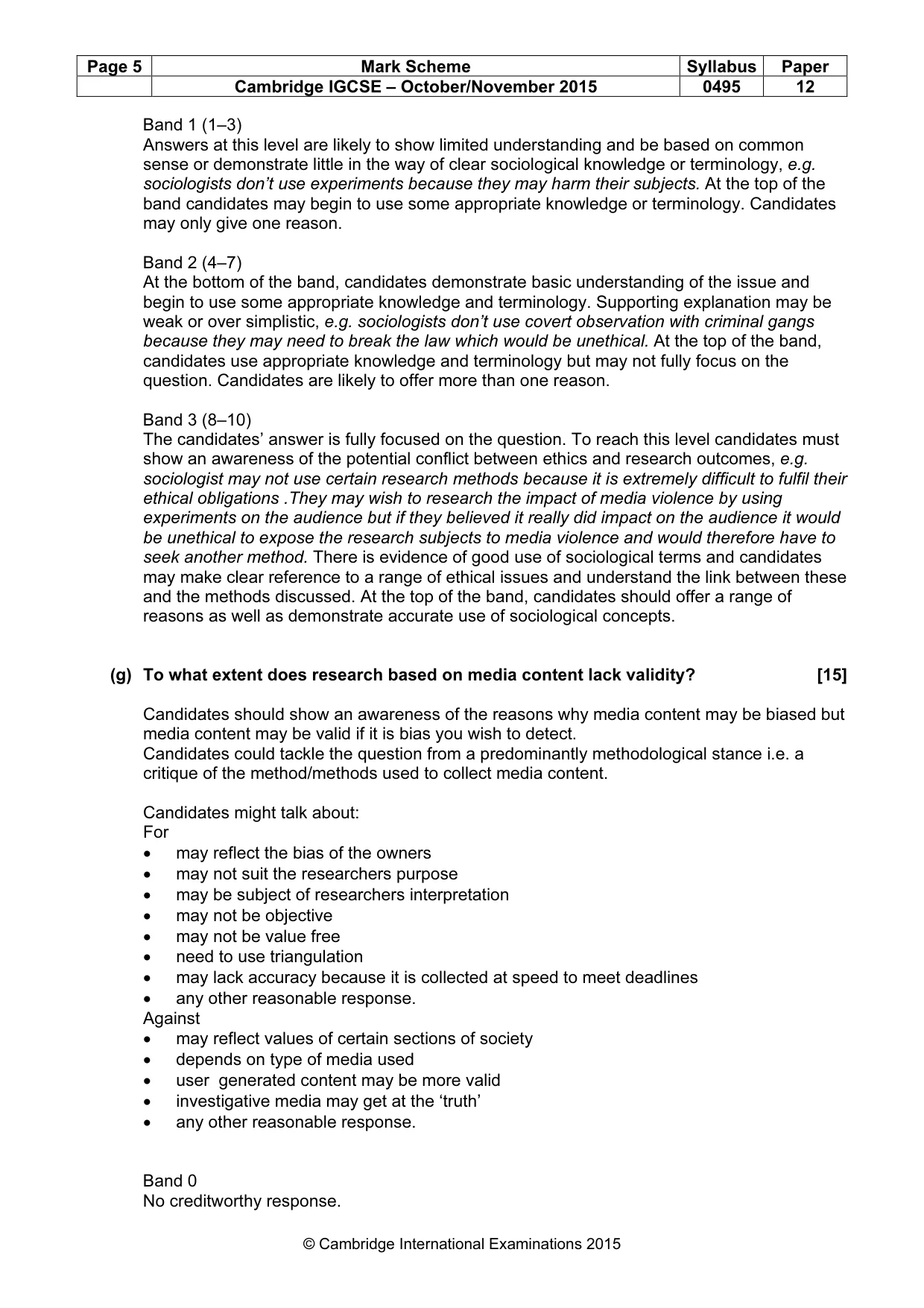
Page 5 Mark Scheme Syllabus Paper Cambridge IGCSE – October/November 2015 0495 12 © Cambridge International Examinations 2015 Band 1 (1–3) Answers at this level are likely to show limited understanding and be based on common sense or demonstrate little in the way of clear sociological knowledge or terminology, e.g. sociologists don’t use experiments because they may harm their subjects. At the top of the band candidates may begin to use some appropriate knowledge or terminology. Candidates may only give one reason. Band 2 (4–7) At the bottom of the band, candidates demonstrate basic understanding of the issue and begin to use some appropriate knowledge and terminology. Supporting explanation may be weak or over simplistic, e.g. sociologists don’t use covert observation with criminal gangs because they may need to break the law which would be unethical. At the top of the band, candidates use appropriate knowledge and terminology but may not fully focus on the question. Candidates are likely to offer more than one reason. Band 3 (8–10) The candidates’ answer is fully focused on the question. To reach this level candidates must show an awareness of the potential conflict between ethics and research outcomes, e.g. sociologist may not use certain research methods because it is extremely difficult to fulfil their ethical obligations .They may wish to research the impact of media violence by using experiments on the audience but if they believed it really did impact on the audience it would be unethical to expose the research subjects to media violence and would therefore have to seek another method. There is evidence of good use of sociological terms and candidates may make clear reference to a range of ethical issues and understand the link between these and the methods discussed. At the top of the band, candidates should offer a range of reasons as well as demonstrate accurate use of sociological concepts. (g) To what extent does research based on media content lack validity? [15] Candidates should show an awareness of the reasons why media content may be biased but media content may be valid if it is bias you wish to detect. Candidates could tackle the question from a predominantly methodological stance i.e. a critique of the method/methods used to collect media content. Candidates might talk about: For • may reflect the bias of the owners • may not suit the researchers purpose • may be subject of researchers interpretation • may not be objective • may not be value free • need to use triangulation • may lack accuracy because it is collected at speed to meet deadlines • any other reasonable response. Against • may reflect values of certain sections of society • depends on type of media used • user generated content may be more valid • investigative media may get at the ‘truth’ • any other reasonable response. Band 0 No creditworthy response.
Mark scheme, page 6
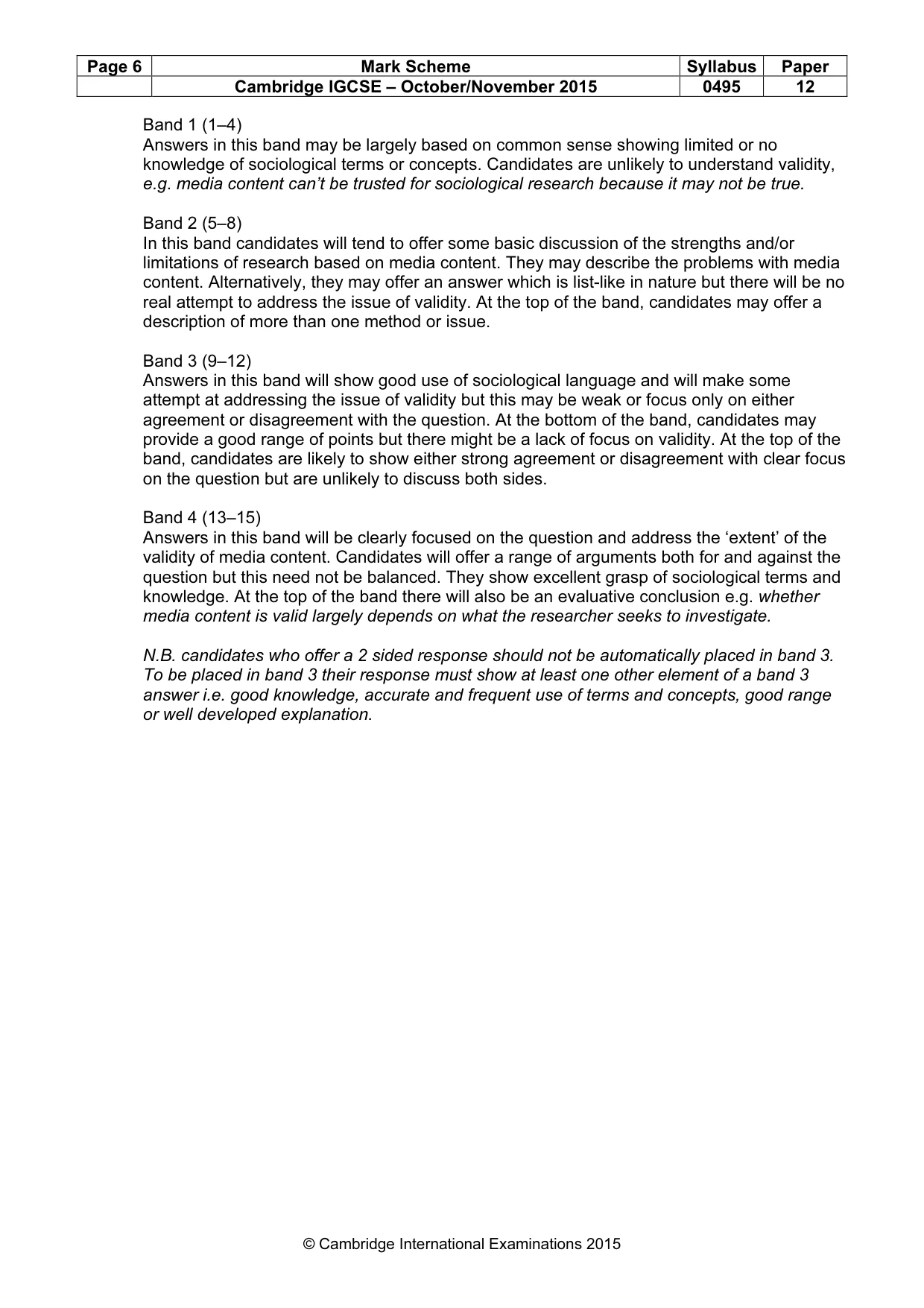
Page 6 Mark Scheme Syllabus Paper Cambridge IGCSE – October/November 2015 0495 12 © Cambridge International Examinations 2015 Band 1 (1–4) Answers in this band may be largely based on common sense showing limited or no knowledge of sociological terms or concepts. Candidates are unlikely to understand validity, e.g. media content can’t be trusted for sociological research because it may not be true. Band 2 (5–8) In this band candidates will tend to offer some basic discussion of the strengths and/or limitations of research based on media content. They may describe the problems with media content. Alternatively, they may offer an answer which is list-like in nature but there will be no real attempt to address the issue of validity. At the top of the band, candidates may offer a description of more than one method or issue. Band 3 (9–12) Answers in this band will show good use of sociological language and will make some attempt at addressing the issue of validity but this may be weak or focus only on either agreement or disagreement with the question. At the bottom of the band, candidates may provide a good range of points but there might be a lack of focus on validity. At the top of the band, candidates are likely to show either strong agreement or disagreement with clear focus on the question but are unlikely to discuss both sides. Band 4 (13–15) Answers in this band will be clearly focused on the question and address the ‘extent’ of the validity of media content. Candidates will offer a range of arguments both for and against the question but this need not be balanced. They show excellent grasp of sociological terms and knowledge. At the top of the band there will also be an evaluative conclusion e.g. whether media content is valid largely depends on what the researcher seeks to investigate. N.B. candidates who offer a 2 sided response should not be automatically placed in band 3. To be placed in band 3 their response must show at least one other element of a band 3 answer i.e. good knowledge, accurate and frequent use of terms and concepts, good range or well developed explanation.
Mark scheme, page 7
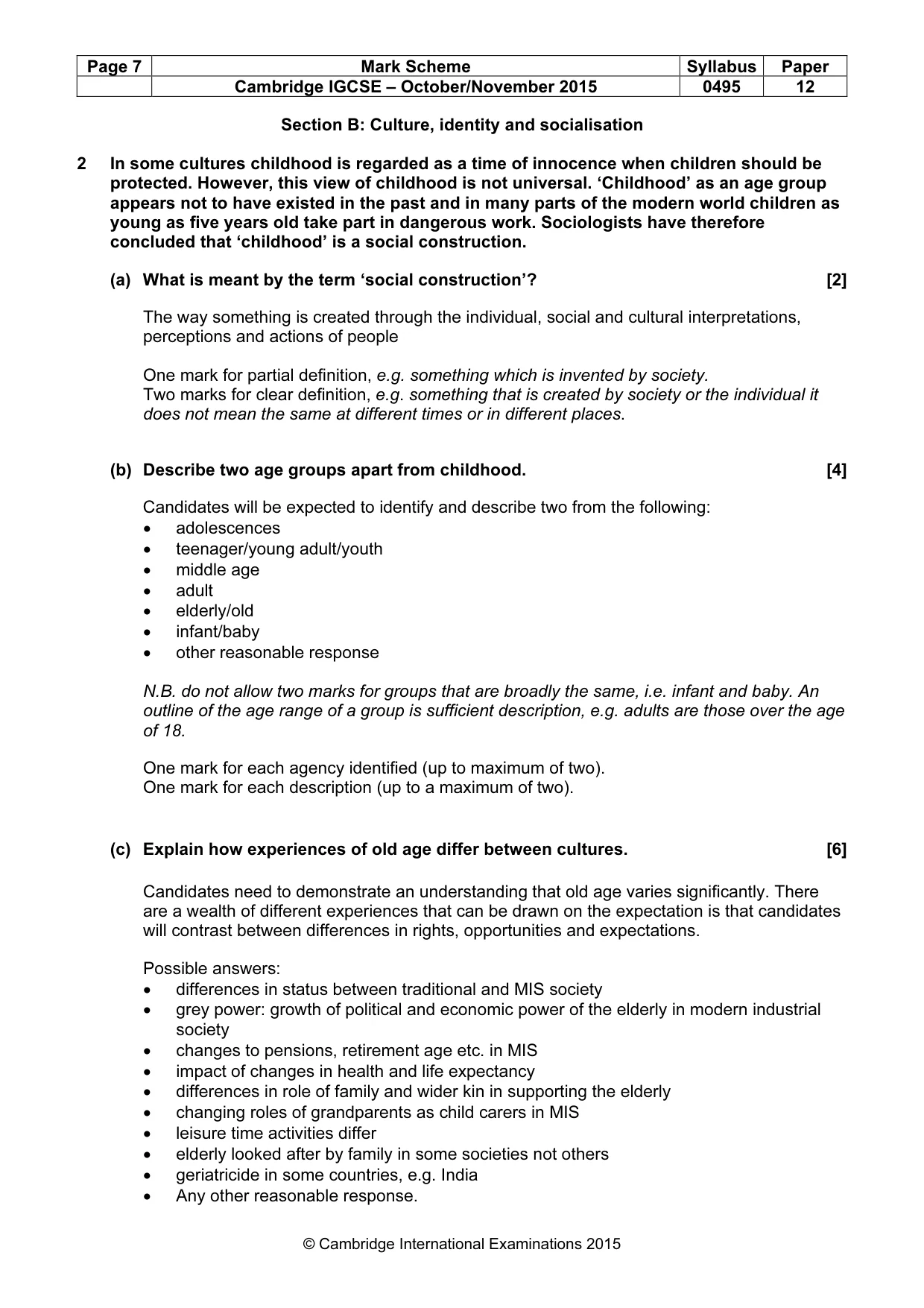
Page 7 Mark Scheme Syllabus Paper Cambridge IGCSE – October/November 2015 0495 12 © Cambridge International Examinations 2015 Section B: Culture, identity and socialisation 2 In some cultures childhood is regarded as a time of innocence when children should be protected. However, this view of childhood is not universal. ‘Childhood’ as an age group appears not to have existed in the past and in many parts of the modern world children as young as five years old take part in dangerous work. Sociologists have therefore concluded that ‘childhood’ is a social construction. (a) What is meant by the term ‘social construction’? [2] The way something is created through the individual, social and cultural interpretations, perceptions and actions of people One mark for partial definition, e.g. something which is invented by society. Two marks for clear definition, e.g. something that is created by society or the individual it does not mean the same at different times or in different places. (b) Describe two age groups apart from childhood. [4] Candidates will be expected to identify and describe two from the following: • adolescences • teenager/young adult/youth • middle age • adult • elderly/old • infant/baby • other reasonable response N.B. do not allow two marks for groups that are broadly the same, i.e. infant and baby. An outline of the age range of a group is sufficient description, e.g. adults are those over the age of 18. One mark for each agency identified (up to maximum of two). One mark for each description (up to a maximum of two). (c) Explain how experiences of old age differ between cultures. [6] Candidates need to demonstrate an understanding that old age varies significantly. There are a wealth of different experiences that can be drawn on the expectation is that candidates will contrast between differences in rights, opportunities and expectations. Possible answers: • differences in status between traditional and MIS society • grey power: growth of political and economic power of the elderly in modern industrial society • changes to pensions, retirement age etc. in MIS • impact of changes in health and life expectancy • differences in role of family and wider kin in supporting the elderly • changing roles of grandparents as child carers in MIS • leisure time activities differ • elderly looked after by family in some societies not others • geriatricide in some countries, e.g. India • Any other reasonable response.
Mark scheme, page 8
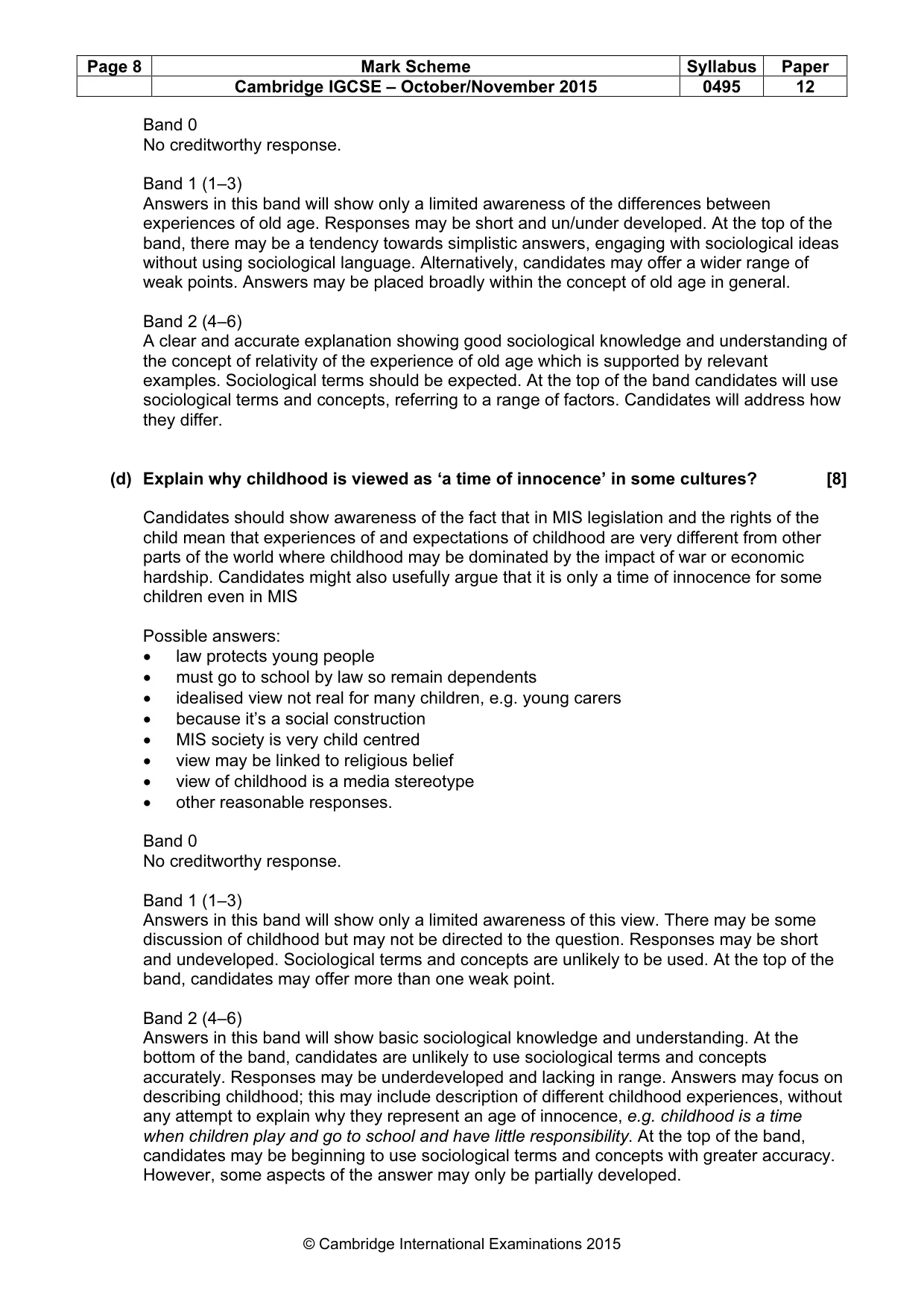
Page 8 Mark Scheme Syllabus Paper Cambridge IGCSE – October/November 2015 0495 12 © Cambridge International Examinations 2015 Band 0 No creditworthy response. Band 1 (1–3) Answers in this band will show only a limited awareness of the differences between experiences of old age. Responses may be short and un/under developed. At the top of the band, there may be a tendency towards simplistic answers, engaging with sociological ideas without using sociological language. Alternatively, candidates may offer a wider range of weak points. Answers may be placed broadly within the concept of old age in general. Band 2 (4–6) A clear and accurate explanation showing good sociological knowledge and understanding of the concept of relativity of the experience of old age which is supported by relevant examples. Sociological terms should be expected. At the top of the band candidates will use sociological terms and concepts, referring to a range of factors. Candidates will address how they differ. (d) Explain why childhood is viewed as ‘a time of innocence’ in some cultures? [8] Candidates should show awareness of the fact that in MIS legislation and the rights of the child mean that experiences of and expectations of childhood are very different from other parts of the world where childhood may be dominated by the impact of war or economic hardship. Candidates might also usefully argue that it is only a time of innocence for some children even in MIS Possible answers: • law protects young people • must go to school by law so remain dependents • idealised view not real for many children, e.g. young carers • because it’s a social construction • MIS society is very child centred • view may be linked to religious belief • view of childhood is a media stereotype • other reasonable responses. Band 0 No creditworthy response. Band 1 (1–3) Answers in this band will show only a limited awareness of this view. There may be some discussion of childhood but may not be directed to the question. Responses may be short and undeveloped. Sociological terms and concepts are unlikely to be used. At the top of the band, candidates may offer more than one weak point. Band 2 (4–6) Answers in this band will show basic sociological knowledge and understanding. At the bottom of the band, candidates are unlikely to use sociological terms and concepts accurately. Responses may be underdeveloped and lacking in range. Answers may focus on describing childhood; this may include description of different childhood experiences, without any attempt to explain why they represent an age of innocence, e.g. childhood is a time when children play and go to school and have little responsibility. At the top of the band, candidates may be beginning to use sociological terms and concepts with greater accuracy. However, some aspects of the answer may only be partially developed.
Mark scheme, page 9
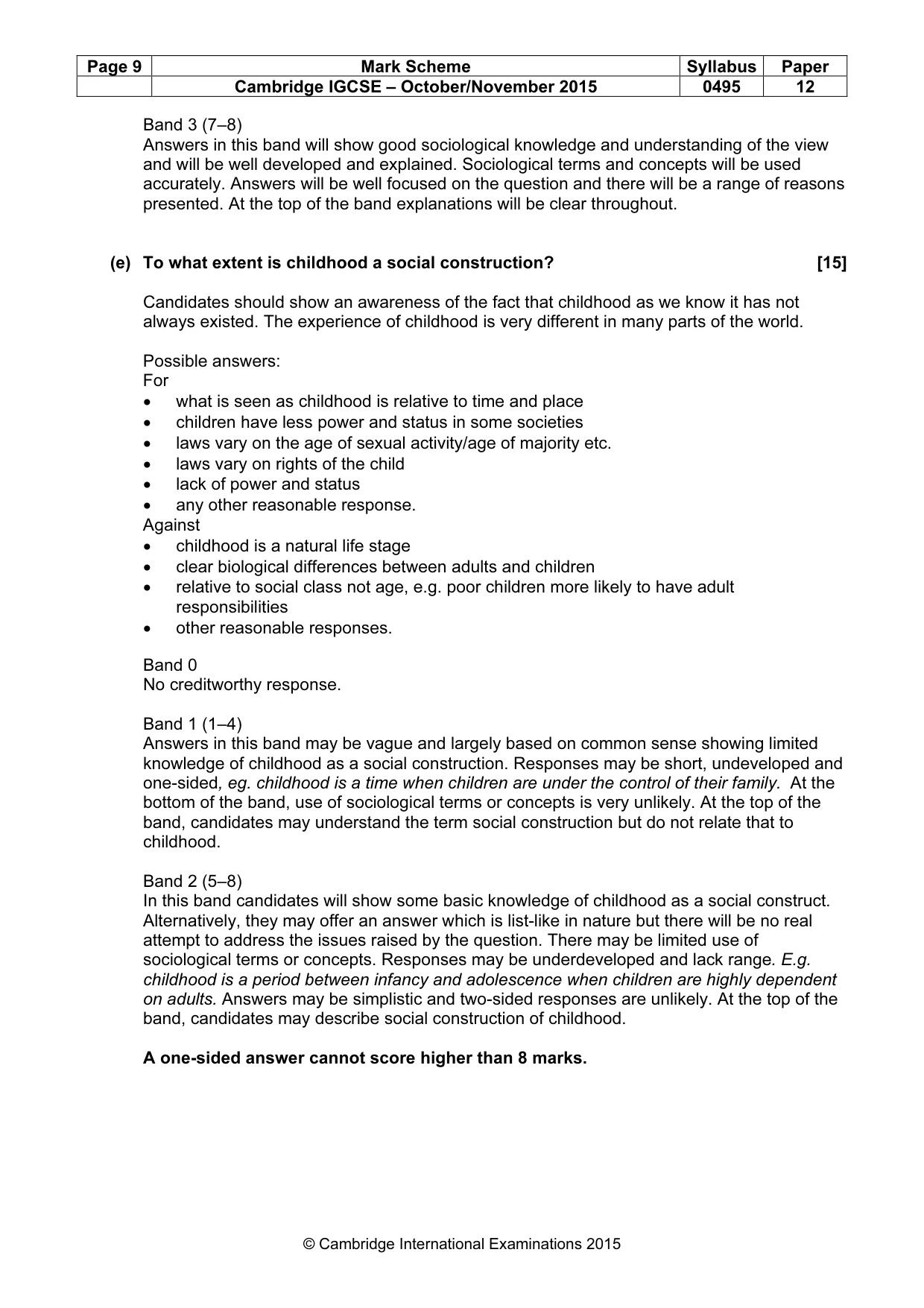
Page 9 Mark Scheme Syllabus Paper Cambridge IGCSE – October/November 2015 0495 12 © Cambridge International Examinations 2015 Band 3 (7–8) Answers in this band will show good sociological knowledge and understanding of the view and will be well developed and explained. Sociological terms and concepts will be used accurately. Answers will be well focused on the question and there will be a range of reasons presented. At the top of the band explanations will be clear throughout. (e) To what extent is childhood a social construction? [15] Candidates should show an awareness of the fact that childhood as we know it has not always existed. The experience of childhood is very different in many parts of the world. Possible answers: For • what is seen as childhood is relative to time and place • children have less power and status in some societies • laws vary on the age of sexual activity/age of majority etc. • laws vary on rights of the child • lack of power and status • any other reasonable response. Against • childhood is a natural life stage • clear biological differences between adults and children • relative to social class not age, e.g. poor children more likely to have adult responsibilities • other reasonable responses. Band 0 No creditworthy response. Band 1 (1–4) Answers in this band may be vague and largely based on common sense showing limited knowledge of childhood as a social construction. Responses may be short, undeveloped and one-sided, eg. childhood is a time when children are under the control of their family. At the bottom of the band, use of sociological terms or concepts is very unlikely. At the top of the band, candidates may understand the term social construction but do not relate that to childhood. Band 2 (5–8) In this band candidates will show some basic knowledge of childhood as a social construct. Alternatively, they may offer an answer which is list-like in nature but there will be no real attempt to address the issues raised by the question. There may be limited use of sociological terms or concepts. Responses may be underdeveloped and lack range. E.g. childhood is a period between infancy and adolescence when children are highly dependent on adults. Answers may be simplistic and two-sided responses are unlikely. At the top of the band, candidates may describe social construction of childhood. A one-sided answer cannot score higher than 8 marks.
Mark scheme, page 10
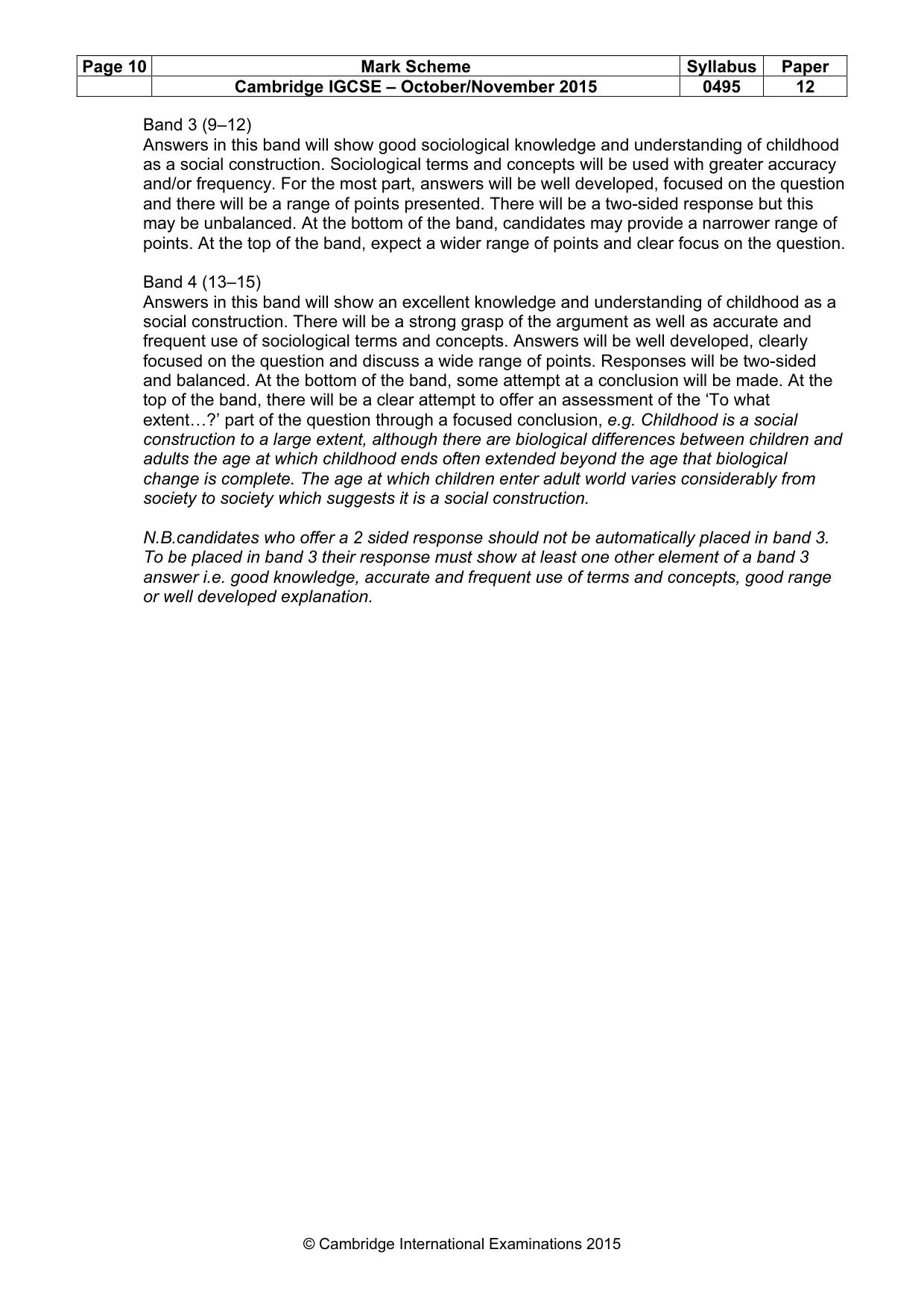
Page 10 Mark Scheme Syllabus Paper Cambridge IGCSE – October/November 2015 0495 12 © Cambridge International Examinations 2015 Band 3 (9–12) Answers in this band will show good sociological knowledge and understanding of childhood as a social construction. Sociological terms and concepts will be used with greater accuracy and/or frequency. For the most part, answers will be well developed, focused on the question and there will be a range of points presented. There will be a two-sided response but this may be unbalanced. At the bottom of the band, candidates may provide a narrower range of points. At the top of the band, expect a wider range of points and clear focus on the question. Band 4 (13–15) Answers in this band will show an excellent knowledge and understanding of childhood as a social construction. There will be a strong grasp of the argument as well as accurate and frequent use of sociological terms and concepts. Answers will be well developed, clearly focused on the question and discuss a wide range of points. Responses will be two-sided and balanced. At the bottom of the band, some attempt at a conclusion will be made. At the top of the band, there will be a clear attempt to offer an assessment of the ‘To what extent…?’ part of the question through a focused conclusion, e.g. Childhood is a social construction to a large extent, although there are biological differences between children and adults the age at which childhood ends often extended beyond the age that biological change is complete. The age at which children enter adult world varies considerably from society to society which suggests it is a social construction. N.B.candidates who offer a 2 sided response should not be automatically placed in band 3. To be placed in band 3 their response must show at least one other element of a band 3 answer i.e. good knowledge, accurate and frequent use of terms and concepts, good range or well developed explanation.
Mark scheme, page 11
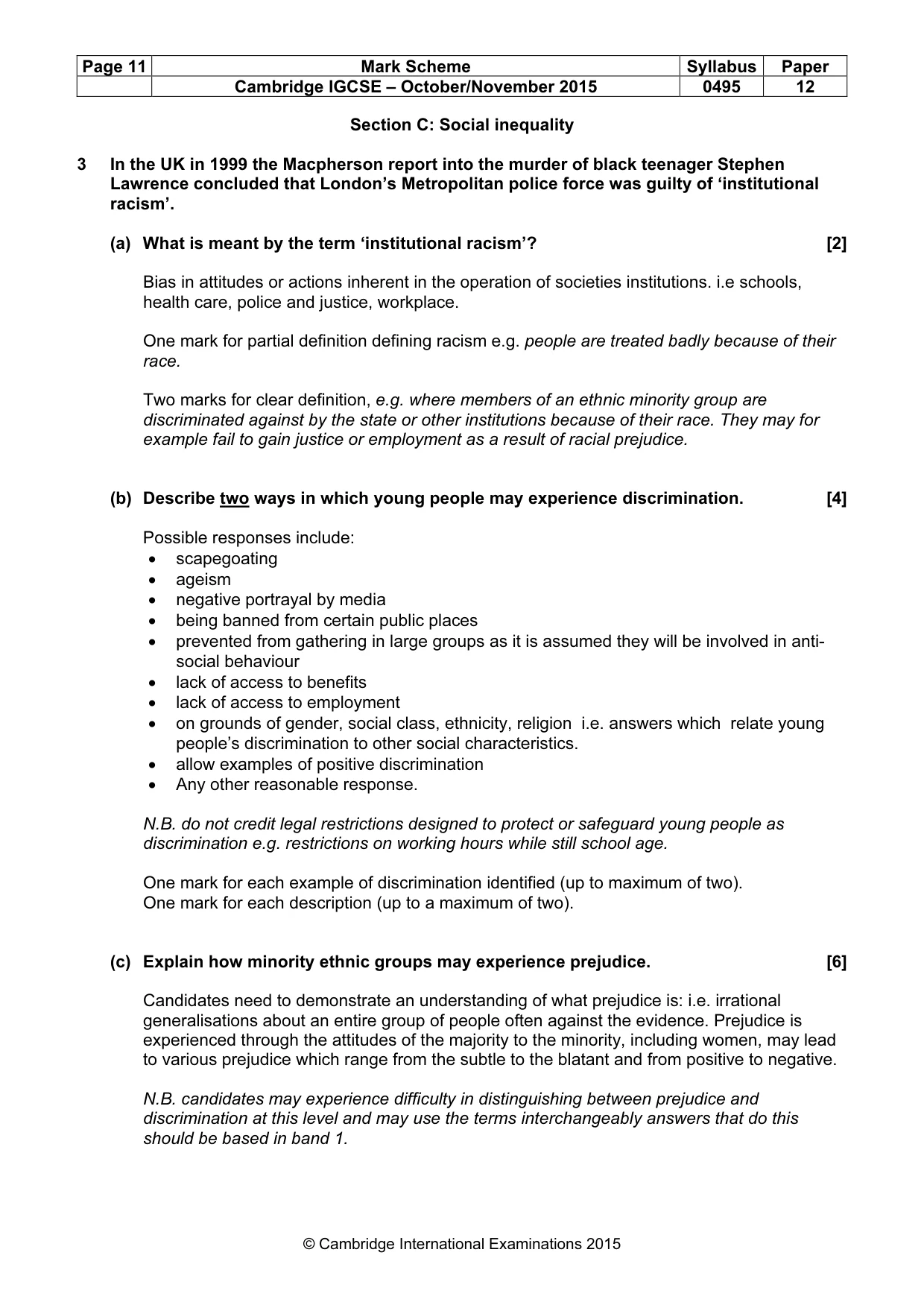
Page 11 Mark Scheme Syllabus Paper Cambridge IGCSE – October/November 2015 0495 12 © Cambridge International Examinations 2015 Section C: Social inequality 3 In the UK in 1999 the Macpherson report into the murder of black teenager Stephen Lawrence concluded that London’s Metropolitan police force was guilty of ‘institutional racism’. (a) What is meant by the term ‘institutional racism’? [2] Bias in attitudes or actions inherent in the operation of societies institutions. i.e schools, health care, police and justice, workplace. One mark for partial definition defining racism e.g. people are treated badly because of their race. Two marks for clear definition, e.g. where members of an ethnic minority group are discriminated against by the state or other institutions because of their race. They may for example fail to gain justice or employment as a result of racial prejudice. (b) Describe two ways in which young people may experience discrimination. [4] Possible responses include: • scapegoating • ageism • negative portrayal by media • being banned from certain public places • prevented from gathering in large groups as it is assumed they will be involved in anti- social behaviour • lack of access to benefits • lack of access to employment • on grounds of gender, social class, ethnicity, religion i.e. answers which relate young people’s discrimination to other social characteristics. • allow examples of positive discrimination • Any other reasonable response. N.B. do not credit legal restrictions designed to protect or safeguard young people as discrimination e.g. restrictions on working hours while still school age. One mark for each example of discrimination identified (up to maximum of two). One mark for each description (up to a maximum of two). (c) Explain how minority ethnic groups may experience prejudice. [6] Candidates need to demonstrate an understanding of what prejudice is: i.e. irrational generalisations about an entire group of people often against the evidence. Prejudice is experienced through the attitudes of the majority to the minority, including women, may lead to various prejudice which range from the subtle to the blatant and from positive to negative. N.B. candidates may experience difficulty in distinguishing between prejudice and discrimination at this level and may use the terms interchangeably answers that do this should be based in band 1.
Mark scheme, page 12
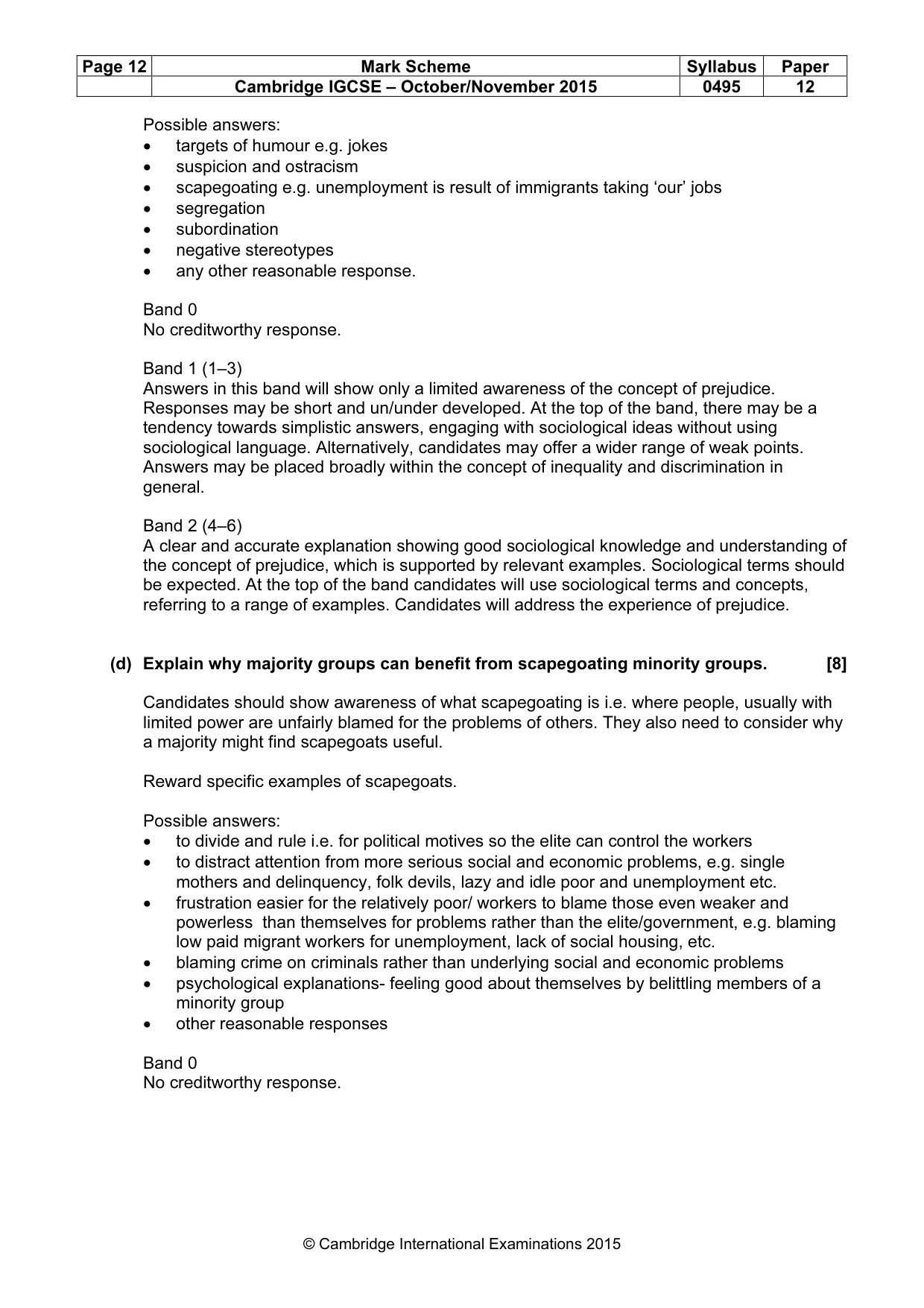
Page 12 Mark Scheme Syllabus Paper Cambridge IGCSE – October/November 2015 0495 12 © Cambridge International Examinations 2015 Possible answers: • targets of humour e.g. jokes • suspicion and ostracism • scapegoating e.g. unemployment is result of immigrants taking ‘our’ jobs • segregation • subordination • negative stereotypes • any other reasonable response. Band 0 No creditworthy response. Band 1 (1–3) Answers in this band will show only a limited awareness of the concept of prejudice. Responses may be short and un/under developed. At the top of the band, there may be a tendency towards simplistic answers, engaging with sociological ideas without using sociological language. Alternatively, candidates may offer a wider range of weak points. Answers may be placed broadly within the concept of inequality and discrimination in general. Band 2 (4–6) A clear and accurate explanation showing good sociological knowledge and understanding of the concept of prejudice, which is supported by relevant examples. Sociological terms should be expected. At the top of the band candidates will use sociological terms and concepts, referring to a range of examples. Candidates will address the experience of prejudice. (d) Explain why majority groups can benefit from scapegoating minority groups. [8] Candidates should show awareness of what scapegoating is i.e. where people, usually with limited power are unfairly blamed for the problems of others. They also need to consider why a majority might find scapegoats useful. Reward specific examples of scapegoats. Possible answers: • to divide and rule i.e. for political motives so the elite can control the workers • to distract attention from more serious social and economic problems, e.g. single mothers and delinquency, folk devils, lazy and idle poor and unemployment etc. • frustration easier for the relatively poor/ workers to blame those even weaker and powerless than themselves for problems rather than the elite/government, e.g. blaming low paid migrant workers for unemployment, lack of social housing, etc. • blaming crime on criminals rather than underlying social and economic problems • psychological explanations- feeling good about themselves by belittling members of a minority group • other reasonable responses Band 0 No creditworthy response.
Mark scheme, page 13
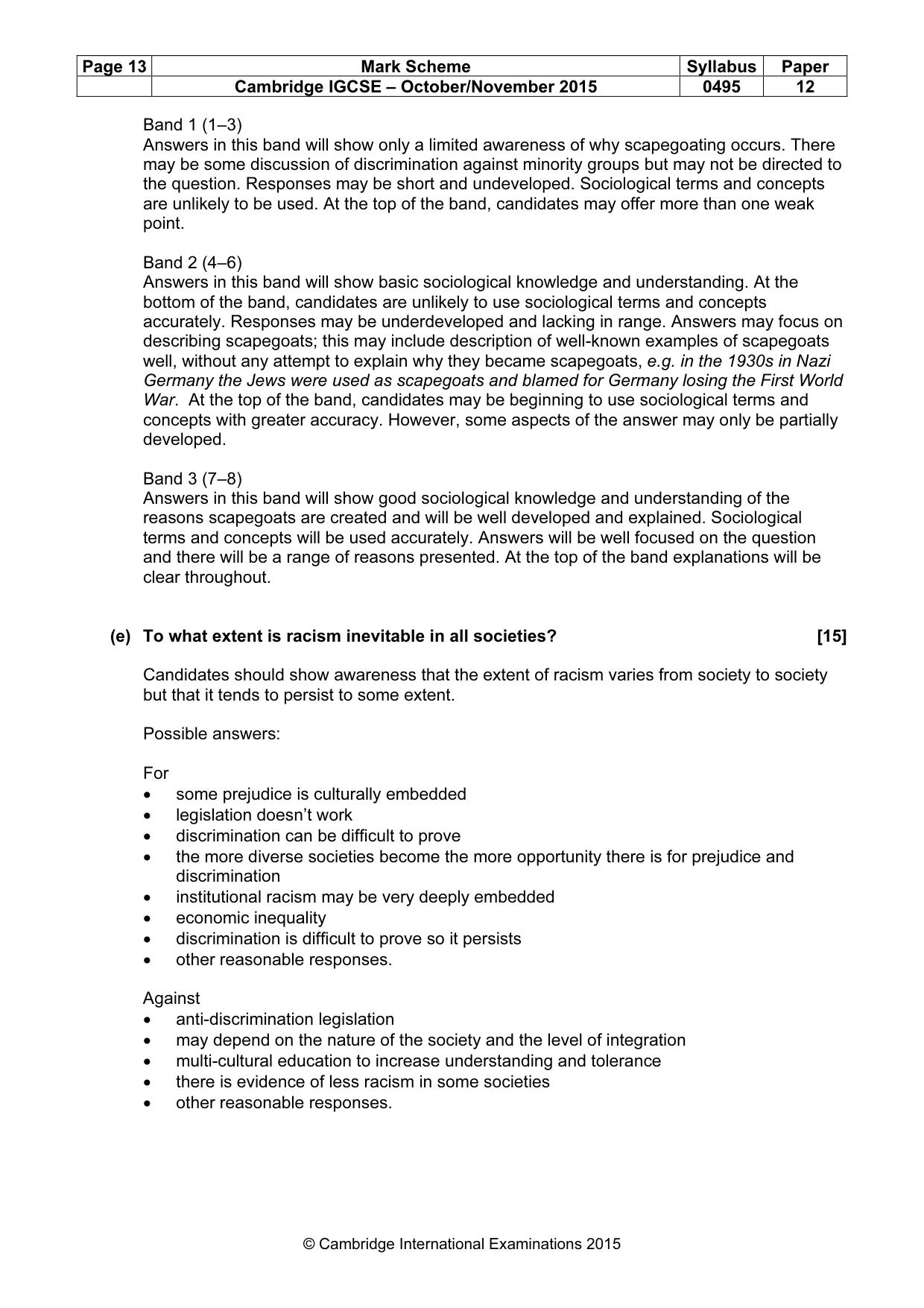
Page 13 Mark Scheme Syllabus Paper Cambridge IGCSE – October/November 2015 0495 12 © Cambridge International Examinations 2015 Band 1 (1–3) Answers in this band will show only a limited awareness of why scapegoating occurs. There may be some discussion of discrimination against minority groups but may not be directed to the question. Responses may be short and undeveloped. Sociological terms and concepts are unlikely to be used. At the top of the band, candidates may offer more than one weak point. Band 2 (4–6) Answers in this band will show basic sociological knowledge and understanding. At the bottom of the band, candidates are unlikely to use sociological terms and concepts accurately. Responses may be underdeveloped and lacking in range. Answers may focus on describing scapegoats; this may include description of well-known examples of scapegoats well, without any attempt to explain why they became scapegoats, e.g. in the 1930s in Nazi Germany the Jews were used as scapegoats and blamed for Germany losing the First World War. At the top of the band, candidates may be beginning to use sociological terms and concepts with greater accuracy. However, some aspects of the answer may only be partially developed. Band 3 (7–8) Answers in this band will show good sociological knowledge and understanding of the reasons scapegoats are created and will be well developed and explained. Sociological terms and concepts will be used accurately. Answers will be well focused on the question and there will be a range of reasons presented. At the top of the band explanations will be clear throughout. (e) To what extent is racism inevitable in all societies? [15] Candidates should show awareness that the extent of racism varies from society to society but that it tends to persist to some extent. Possible answers: For • some prejudice is culturally embedded • legislation doesn’t work • discrimination can be difficult to prove • the more diverse societies become the more opportunity there is for prejudice and discrimination • institutional racism may be very deeply embedded • economic inequality • discrimination is difficult to prove so it persists • other reasonable responses. Against • anti-discrimination legislation • may depend on the nature of the society and the level of integration • multi-cultural education to increase understanding and tolerance • there is evidence of less racism in some societies • other reasonable responses.
Mark scheme, page 14
Page 14 Mark Scheme Syllabus Paper Cambridge IGCSE – October/November 2015 0495 12 © Cambridge International Examinations 2015 Band 0 No creditworthy response. Band 1 (1–4) Answers in this band may be vague and largely based on common sense showing limited knowledge of the debate. Responses may be short, undeveloped and one-sided. At the bottom of the band, use of sociological terms or concepts is very unlikely, e.g. people will always dislike others who are different from themselves so it is inevitable. At the top of the band, candidates may understand what racism is. Band 2 (5–8) In this band candidates will show some basic knowledge of the extent of racism. Alternatively, they may offer an answer which is list-like in nature but there will be no real attempt to address the issues raised by the question. There may be limited use of sociological terms or concepts. Responses may be underdeveloped and lack range. Answers may be simplistic and two-sided responses are unlikely. At the top of the band, candidates may describe evidence of racism, e.g. sometimes black football player face abusive language from fans or ‘monkey chants’ A one-sided answer cannot score higher than 8 marks. Band 3 (9–12) Answers in this band will show good sociological knowledge and understanding of racism. Sociological terms and concepts will be used with greater accuracy and/or frequency. For the most part, answers will be well developed, focused on the question and there will be a range of points presented. There will be a two-sided response but this may be unbalanced. At the bottom of the band, candidates may provide a narrower range of points. At the top of the band, expect a wider range of points and clear focus on the question. Band 4 (13–15) Answers in this band will show excellent knowledge and understanding of the nature of racism. There will be a strong grasp of the argument as well as accurate and frequent use of sociological terms and concepts. Answers will be well developed, clearly focused on the question and discuss a wide range of points. Responses will be two-sided and balanced. At the bottom of the band, some attempt at a conclusion will be made. At the top of the band, there will be a clear attempt to offer an assessment of the ‘To what extent…?’ part of the question through a focused conclusion, e.g. to some extent it may be inevitable as racism can be so deeply imbedded in social institutions like the police that it is difficult to overcome, although education and anti-discrimination legislation may have some impact this may be limited. N.B. candidates who offer a 2 sided response should not be automatically placed in band 3. To be placed in band 3 their response must show at least one other element of a band 3 answer, i.e. good knowledge, accurate and frequent use of terms and concepts, good range or well developed explanation.
What you needed in this session
Cambridge’s own grade thresholds for 2015 Oct/Nov, Paper 1 · Variant 2. A higher threshold means an easier paper — the bar moves with how the cohort did.