Cambridge IGCSE Sociology 0495 — 2015 May/June Paper 1 · Variant 3
0495/13/M/J/15 · 80 marks · ≈90 min
The question paper and its mark scheme, free to read here and free to download. This is Cambridge’s own paper, exactly as it was sat.
Question paper4 pages

Mark scheme16 pages
Answers below. Sit the paper first if you are practising.
Paper as text
Question paper, page 1
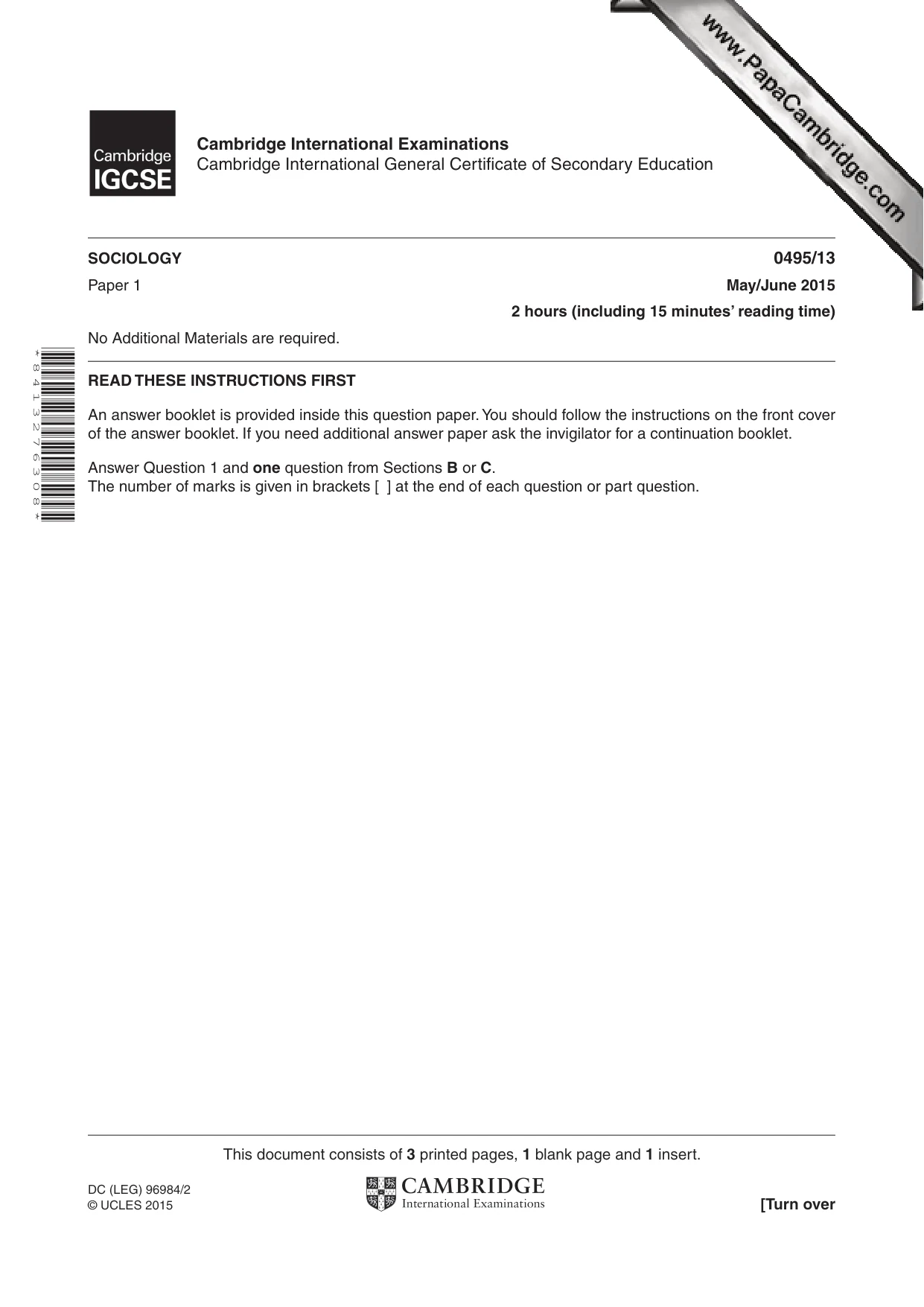
This document consists of 3 printed pages, 1 blank page and 1 insert. DC (LEG) 96984/2 © UCLES 2015 [Turn over Cambridge International Examinations Cambridge International General Certificate of Secondary Education * 8 4 1 3 2 7 6 3 0 8 * SOCIOLOGY 0495/13 Paper 1 May/June 2015 2 hours (including 15 minutes’ reading time) No Additional Materials are required. READ THESE INSTRUCTIONS FIRST An answer booklet is provided inside this question paper. You should follow the instructions on the front cover of the answer booklet. If you need additional answer paper ask the invigilator for a continuation booklet. Answer Question 1 and one question from Sections B or C. The number of marks is given in brackets [ ] at the end of each question or part question.
Question paper, page 2
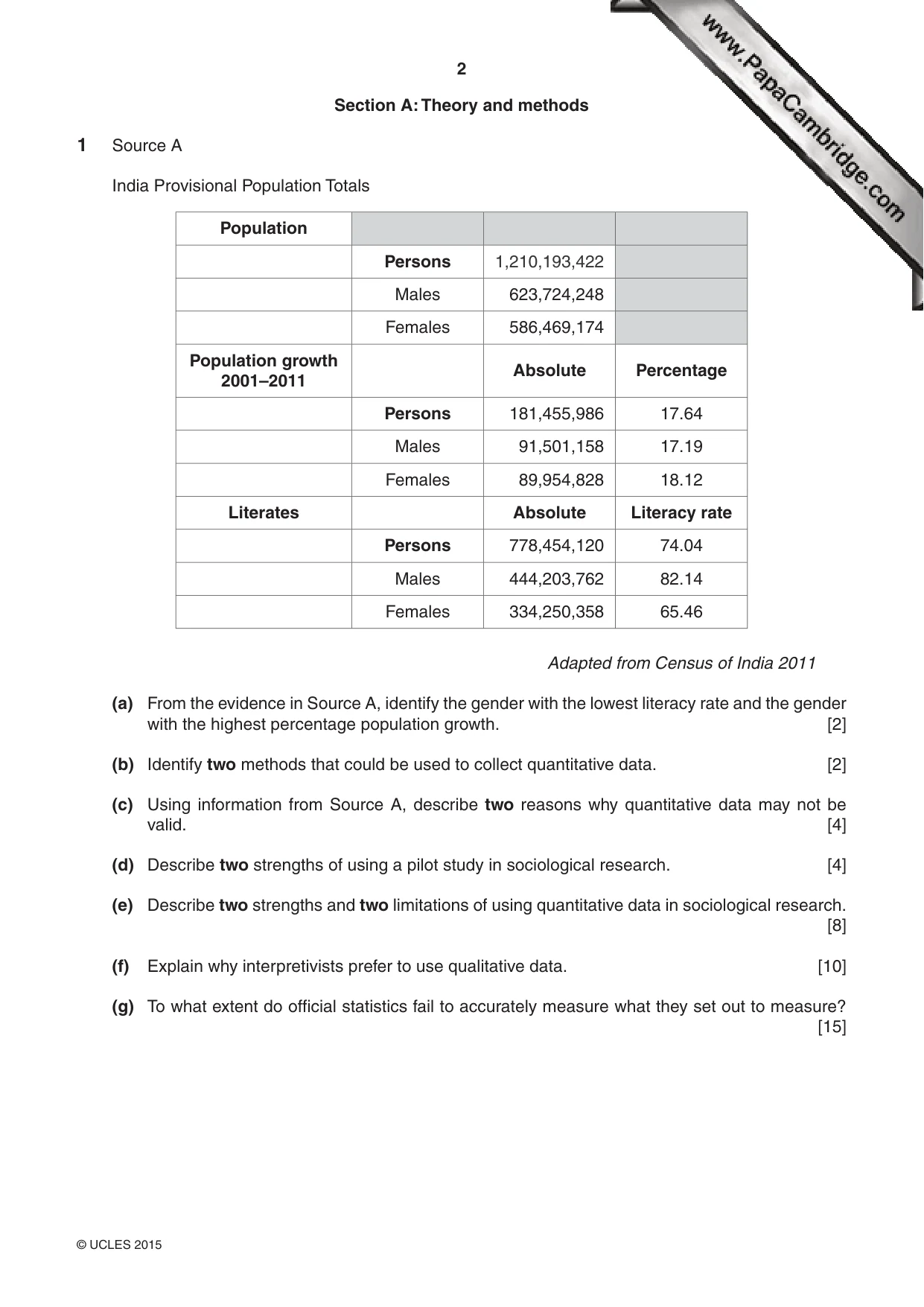
2 0495/13/M/J/15 © UCLES 2015 Section A: Theory and methods 1 Source A India Provisional Population Totals Population Persons 1,210,193,422 Males 623,724,248 Females 586,469,174 Population growth 2001–2011 Absolute Percentage Persons 181,455,986 17.64 Males 91,501,158 17.19 Females 89,954,828 18.12 Literates Absolute Literacy rate Persons 778,454,120 74.04 Males 444,203,762 82.14 Females 334,250,358 65.46 Adapted from Census of India 2011 (a) From the evidence in Source A, identify the gender with the lowest literacy rate and the gender with the highest percentage population growth. [2] (b) Identify two methods that could be used to collect quantitative data. [2] (c) Using information from Source A, describe two reasons why quantitative data may not be valid. [4] (d) Describe two strengths of using a pilot study in sociological research. [4] (e) Describe two strengths and two limitations of using quantitative data in sociological research. [8] (f) Explain why interpretivists prefer to use qualitative data. [10] (g) To what extent do official statistics fail to accurately measure what they set out to measure? [15]
Question paper, page 3
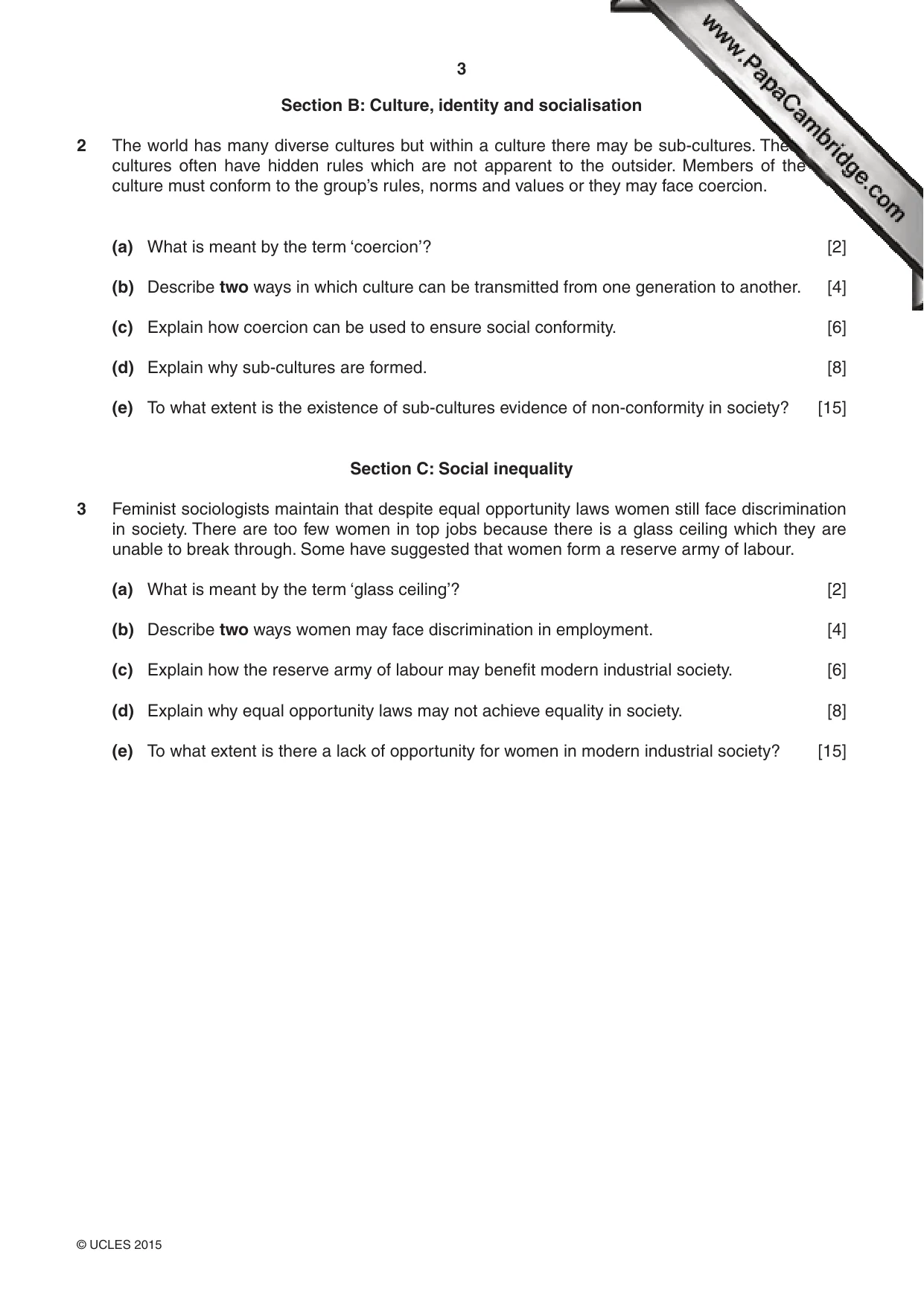
3 0495/13/M/J/15 © UCLES 2015 Section B: Culture, identity and socialisation 2 The world has many diverse cultures but within a culture there may be sub-cultures. These sub- cultures often have hidden rules which are not apparent to the outsider. Members of the sub- culture must conform to the group’s rules, norms and values or they may face coercion. (a) What is meant by the term ‘coercion’? [2] (b) Describe two ways in which culture can be transmitted from one generation to another. [4] (c) Explain how coercion can be used to ensure social conformity. [6] (d) Explain why sub-cultures are formed. [8] (e) To what extent is the existence of sub-cultures evidence of non-conformity in society? [15] Section C: Social inequality 3 Feminist sociologists maintain that despite equal opportunity laws women still face discrimination in society. There are too few women in top jobs because there is a glass ceiling which they are unable to break through. Some have suggested that women form a reserve army of labour. (a) What is meant by the term ‘glass ceiling’? [2] (b) Describe two ways women may face discrimination in employment. [4] (c) Explain how the reserve army of labour may benefit modern industrial society. [6] (d) Explain why equal opportunity laws may not achieve equality in society. [8] (e) To what extent is there a lack of opportunity for women in modern industrial society? [15]
Question paper, page 4
4 0495/13/M/J/15 © UCLES 2015 BLANK PAGE Permission to reproduce items where third-party owned material protected by copyright is included has been sought and cleared where possible. Every reasonable effort has been made by the publisher (UCLES) to trace copyright holders, but if any items requiring clearance have unwittingly been included, the publisher will be pleased to make amends at the earliest possible opportunity. To avoid the issue of disclosure of answer-related information to candidates, all copyright acknowledgements are reproduced online in the Cambridge International Examinations Copyright Acknowledgements Booklet. This is produced for each series of examinations and is freely available to download at www.cie.org.uk after the live examination series. Cambridge International Examinations is part of the Cambridge Assessment Group. Cambridge Assessment is the brand name of University of Cambridge Local Examinations Syndicate (UCLES), which is itself a department of the University of Cambridge.
Mark scheme, page 1
® IGCSE is the registered trademark of Cambridge International Examinations. CAMBRIDGE INTERNATIONAL EXAMINATIONS Cambridge International General Certificate of Secondary Education MARK SCHEME for the May/June 2015 series 0495 SOCIOLOGY 0495/13 Paper 1 (paper 1), maximum raw mark 80 This mark scheme is published as an aid to teachers and candidates, to indicate the requirements of the examination. It shows the basis on which Examiners were instructed to award marks. It does not indicate the details of the discussions that took place at an Examiners’ meeting before marking began, which would have considered the acceptability of alternative answers. Mark schemes should be read in conjunction with the question paper and the Principal Examiner Report for Teachers. Cambridge will not enter into discussions about these mark schemes. Cambridge is publishing the mark schemes for the May/June 2015 series for most Cambridge IGCSE®, Cambridge International A and AS Level components and some Cambridge O Level components.
Mark scheme, page 2
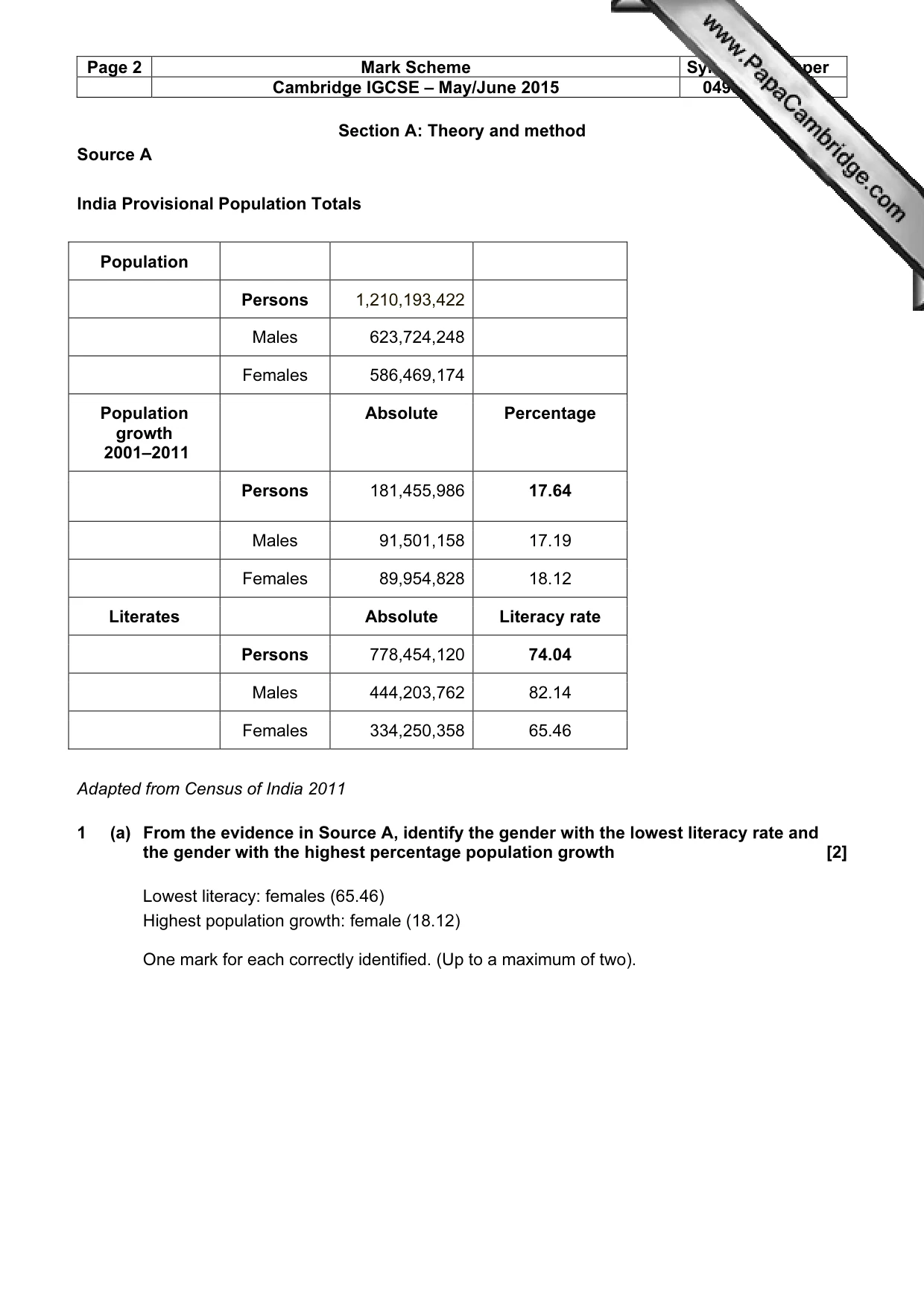
Page 2 Mark Scheme Syllabus Paper Cambridge IGCSE – May/June 2015 0495 13 © Cambridge International Examinations 2015 Section A: Theory and method Source A India Provisional Population Totals Population Persons 1,210,193,422 Males 623,724,248 Females 586,469,174 Population growth 2001–2011 Absolute Percentage Persons 181,455,986 17.64 Males 91,501,158 17.19 Females 89,954,828 18.12 Literates Absolute Literacy rate Persons 778,454,120 74.04 Males 444,203,762 82.14 Females 334,250,358 65.46 Adapted from Census of India 2011 1 (a) From the evidence in Source A, identify the gender with the lowest literacy rate and the gender with the highest percentage population growth [2] Lowest literacy: females (65.46) Highest population growth: female (18.12) One mark for each correctly identified. (Up to a maximum of two).
Mark scheme, page 3
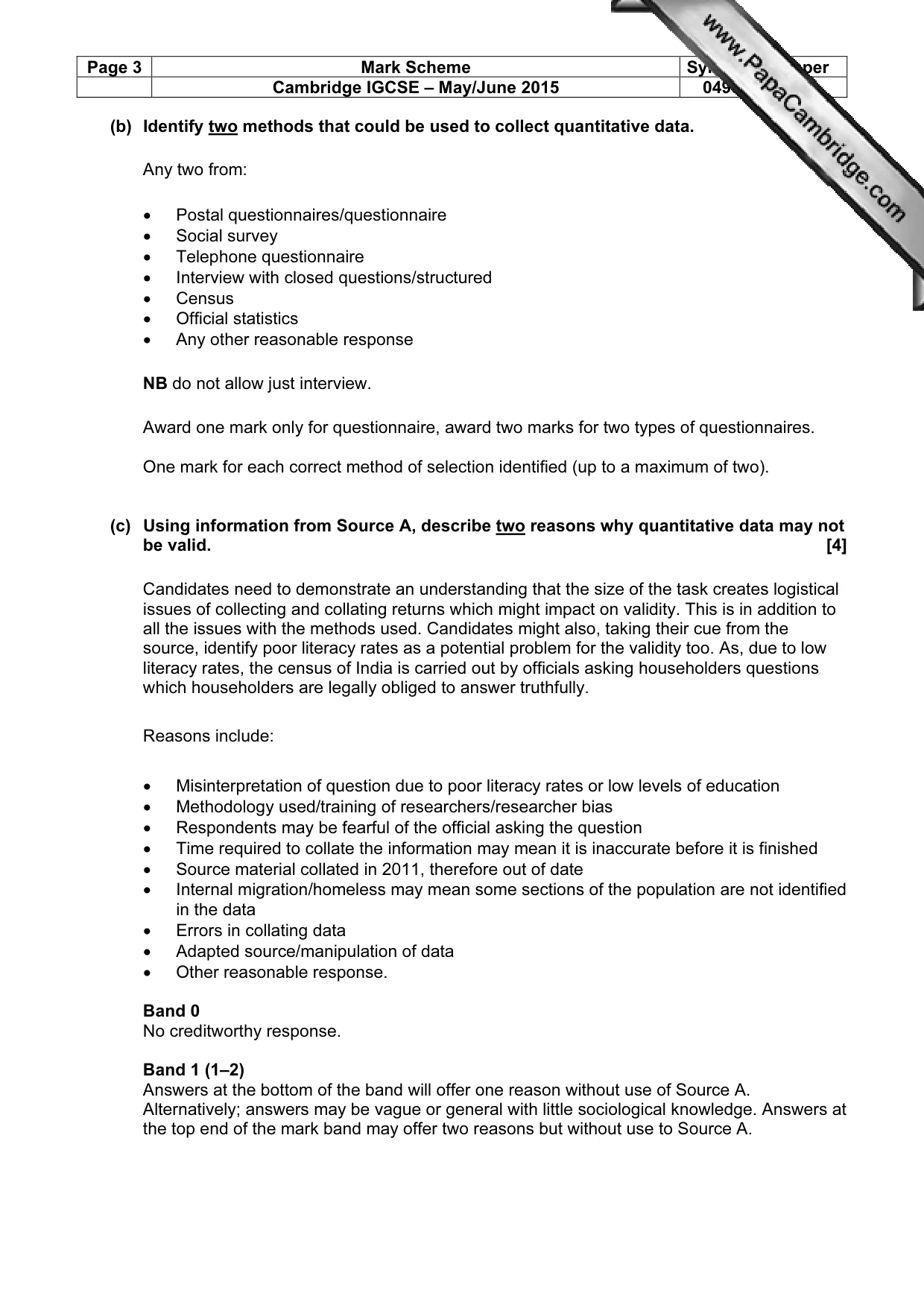
Page 3 Mark Scheme Syllabus Paper Cambridge IGCSE – May/June 2015 0495 13 © Cambridge International Examinations 2015 (b) Identify two methods that could be used to collect quantitative data. [2] Any two from: • Postal questionnaires/questionnaire • Social survey • Telephone questionnaire • Interview with closed questions/structured • Census • Official statistics • Any other reasonable response NB do not allow just interview. Award one mark only for questionnaire, award two marks for two types of questionnaires. One mark for each correct method of selection identified (up to a maximum of two). (c) Using information from Source A, describe two reasons why quantitative data may not be valid. [4] Candidates need to demonstrate an understanding that the size of the task creates logistical issues of collecting and collating returns which might impact on validity. This is in addition to all the issues with the methods used. Candidates might also, taking their cue from the source, identify poor literacy rates as a potential problem for the validity too. As, due to low literacy rates, the census of India is carried out by officials asking householders questions which householders are legally obliged to answer truthfully. Reasons include: • Misinterpretation of question due to poor literacy rates or low levels of education • Methodology used/training of researchers/researcher bias • Respondents may be fearful of the official asking the question • Time required to collate the information may mean it is inaccurate before it is finished • Source material collated in 2011, therefore out of date • Internal migration/homeless may mean some sections of the population are not identified in the data • Errors in collating data • Adapted source/manipulation of data • Other reasonable response. Band 0 No creditworthy response. Band 1 (1–2) Answers at the bottom of the band will offer one reason without use of Source A. Alternatively; answers may be vague or general with little sociological knowledge. Answers at the top end of the mark band may offer two reasons but without use to Source A.
Mark scheme, page 4
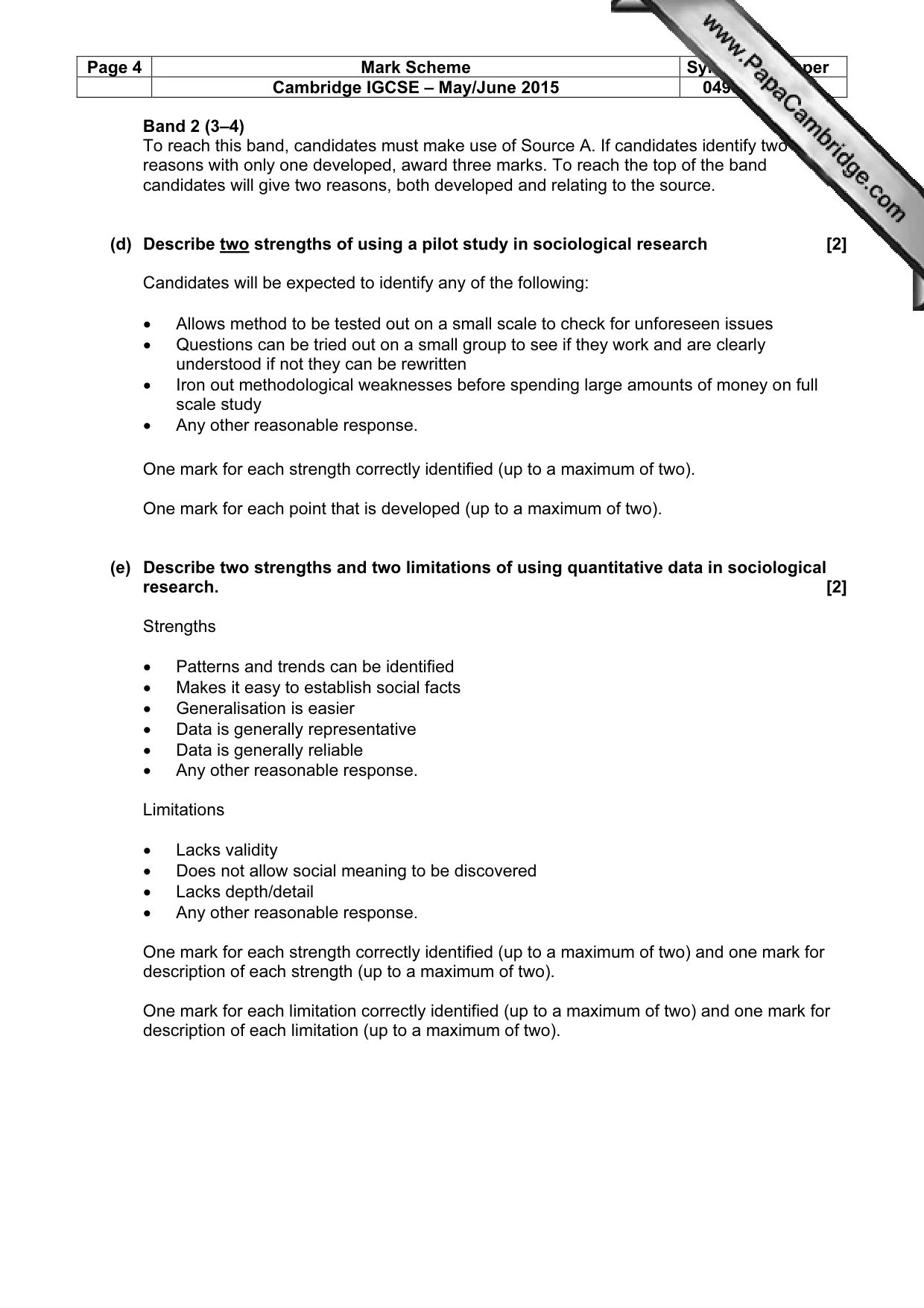
Page 4 Mark Scheme Syllabus Paper Cambridge IGCSE – May/June 2015 0495 13 © Cambridge International Examinations 2015 Band 2 (3–4) To reach this band, candidates must make use of Source A. If candidates identify two reasons with only one developed, award three marks. To reach the top of the band candidates will give two reasons, both developed and relating to the source. (d) Describe two strengths of using a pilot study in sociological research [2] Candidates will be expected to identify any of the following: • Allows method to be tested out on a small scale to check for unforeseen issues • Questions can be tried out on a small group to see if they work and are clearly understood if not they can be rewritten • Iron out methodological weaknesses before spending large amounts of money on full scale study • Any other reasonable response. One mark for each strength correctly identified (up to a maximum of two). One mark for each point that is developed (up to a maximum of two). (e) Describe two strengths and two limitations of using quantitative data in sociological research. [2] Strengths • Patterns and trends can be identified • Makes it easy to establish social facts • Generalisation is easier • Data is generally representative • Data is generally reliable • Any other reasonable response. Limitations • Lacks validity • Does not allow social meaning to be discovered • Lacks depth/detail • Any other reasonable response. One mark for each strength correctly identified (up to a maximum of two) and one mark for description of each strength (up to a maximum of two). One mark for each limitation correctly identified (up to a maximum of two) and one mark for description of each limitation (up to a maximum of two).
Mark scheme, page 5
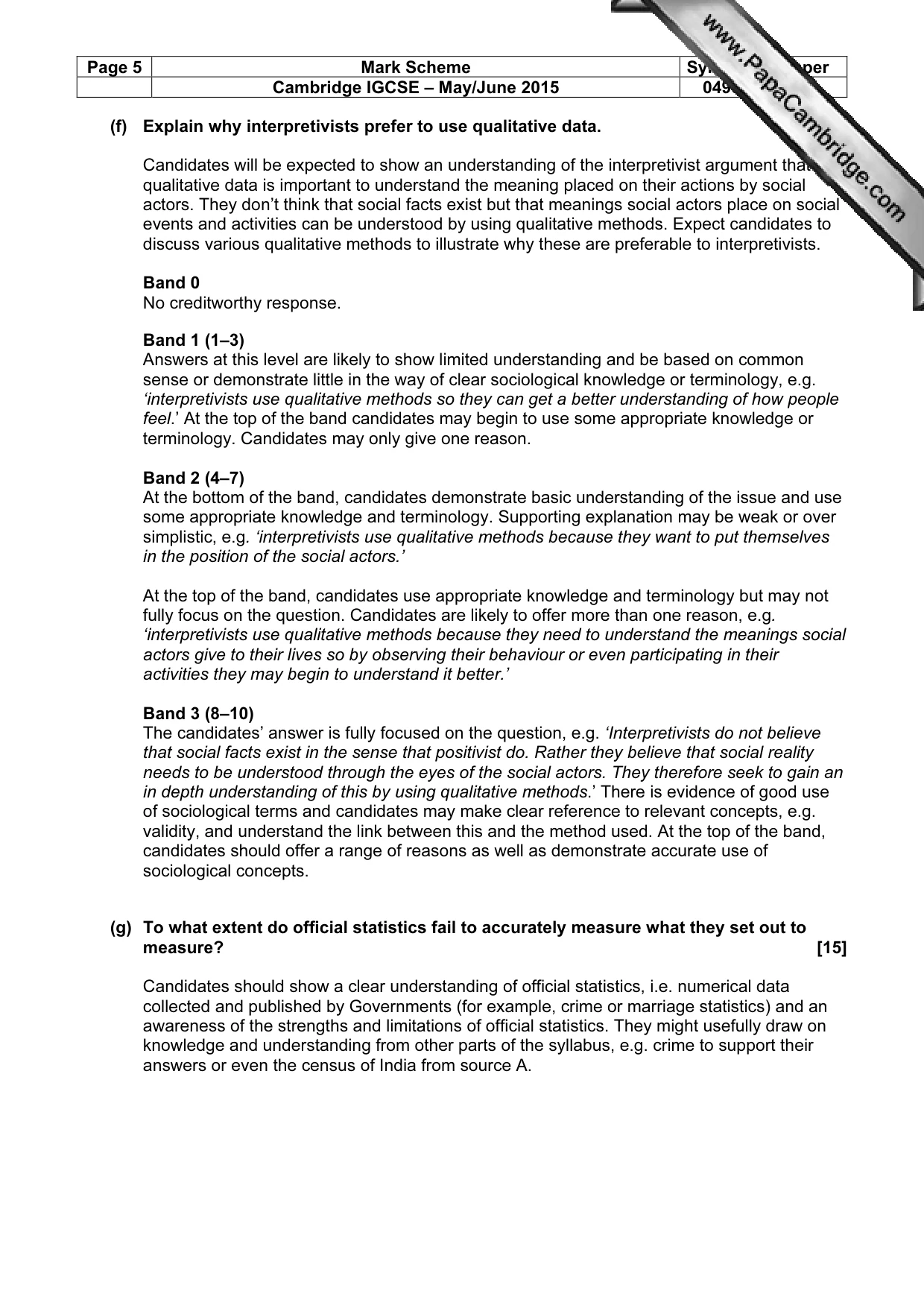
Page 5 Mark Scheme Syllabus Paper Cambridge IGCSE – May/June 2015 0495 13 © Cambridge International Examinations 2015 (f) Explain why interpretivists prefer to use qualitative data. [10] Candidates will be expected to show an understanding of the interpretivist argument that qualitative data is important to understand the meaning placed on their actions by social actors. They don’t think that social facts exist but that meanings social actors place on social events and activities can be understood by using qualitative methods. Expect candidates to discuss various qualitative methods to illustrate why these are preferable to interpretivists. Band 0 No creditworthy response. Band 1 (1–3) Answers at this level are likely to show limited understanding and be based on common sense or demonstrate little in the way of clear sociological knowledge or terminology, e.g. ‘interpretivists use qualitative methods so they can get a better understanding of how people feel.’ At the top of the band candidates may begin to use some appropriate knowledge or terminology. Candidates may only give one reason. Band 2 (4–7) At the bottom of the band, candidates demonstrate basic understanding of the issue and use some appropriate knowledge and terminology. Supporting explanation may be weak or over simplistic, e.g. ‘interpretivists use qualitative methods because they want to put themselves in the position of the social actors.’ At the top of the band, candidates use appropriate knowledge and terminology but may not fully focus on the question. Candidates are likely to offer more than one reason, e.g. ‘interpretivists use qualitative methods because they need to understand the meanings social actors give to their lives so by observing their behaviour or even participating in their activities they may begin to understand it better.’ Band 3 (8–10) The candidates’ answer is fully focused on the question, e.g. ‘Interpretivists do not believe that social facts exist in the sense that positivist do. Rather they believe that social reality needs to be understood through the eyes of the social actors. They therefore seek to gain an in depth understanding of this by using qualitative methods.’ There is evidence of good use of sociological terms and candidates may make clear reference to relevant concepts, e.g. validity, and understand the link between this and the method used. At the top of the band, candidates should offer a range of reasons as well as demonstrate accurate use of sociological concepts. (g) To what extent do official statistics fail to accurately measure what they set out to measure? [15] Candidates should show a clear understanding of official statistics, i.e. numerical data collected and published by Governments (for example, crime or marriage statistics) and an awareness of the strengths and limitations of official statistics. They might usefully draw on knowledge and understanding from other parts of the syllabus, e.g. crime to support their answers or even the census of India from source A.
Mark scheme, page 6
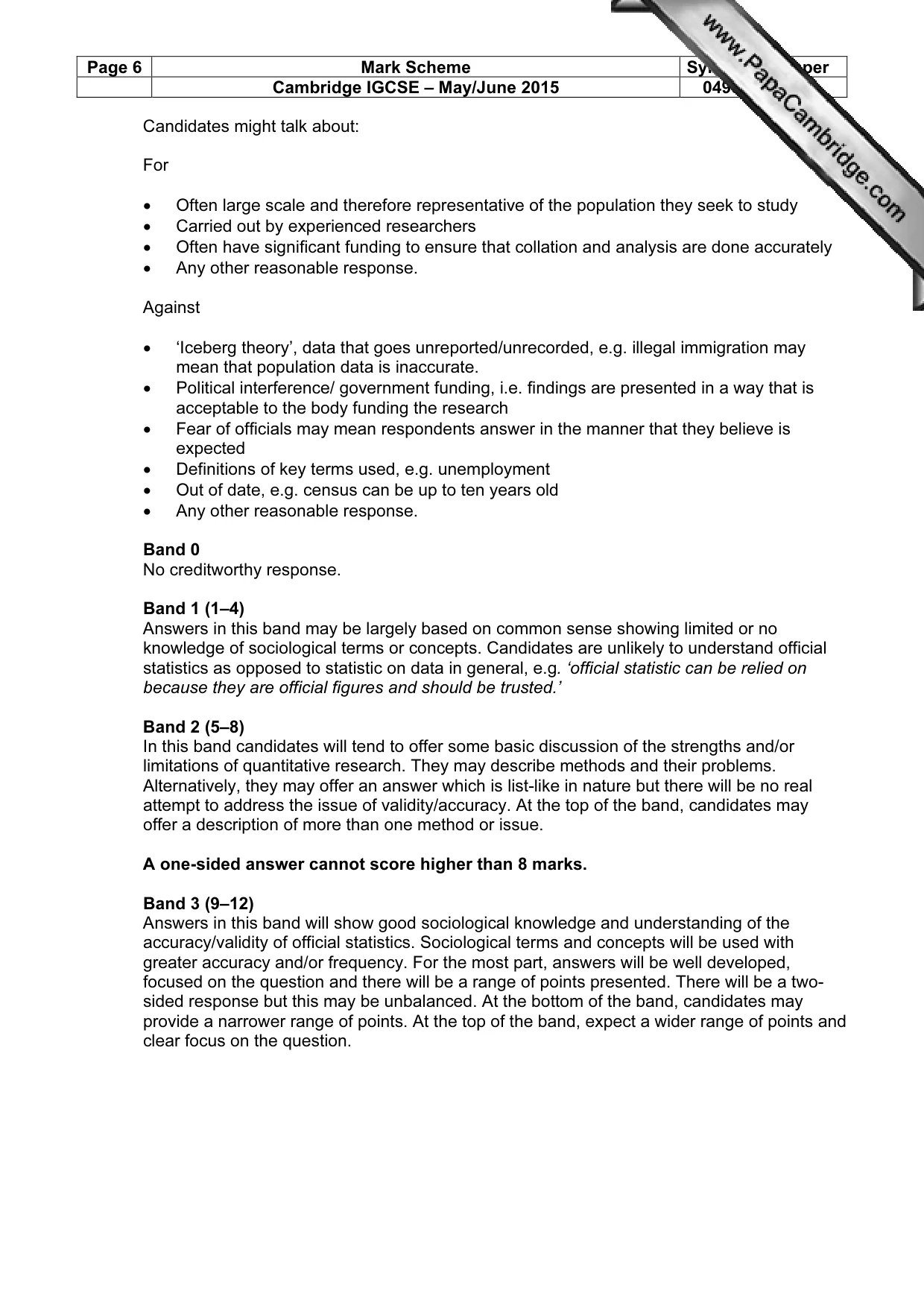
Page 6 Mark Scheme Syllabus Paper Cambridge IGCSE – May/June 2015 0495 13 © Cambridge International Examinations 2015 Candidates might talk about: For • Often large scale and therefore representative of the population they seek to study • Carried out by experienced researchers • Often have significant funding to ensure that collation and analysis are done accurately • Any other reasonable response. Against • ‘Iceberg theory’, data that goes unreported/unrecorded, e.g. illegal immigration may mean that population data is inaccurate. • Political interference/ government funding, i.e. findings are presented in a way that is acceptable to the body funding the research • Fear of officials may mean respondents answer in the manner that they believe is expected • Definitions of key terms used, e.g. unemployment • Out of date, e.g. census can be up to ten years old • Any other reasonable response. Band 0 No creditworthy response. Band 1 (1–4) Answers in this band may be largely based on common sense showing limited or no knowledge of sociological terms or concepts. Candidates are unlikely to understand official statistics as opposed to statistic on data in general, e.g. ‘official statistic can be relied on because they are official figures and should be trusted.’ Band 2 (5–8) In this band candidates will tend to offer some basic discussion of the strengths and/or limitations of quantitative research. They may describe methods and their problems. Alternatively, they may offer an answer which is list-like in nature but there will be no real attempt to address the issue of validity/accuracy. At the top of the band, candidates may offer a description of more than one method or issue. A one-sided answer cannot score higher than 8 marks. Band 3 (9–12) Answers in this band will show good sociological knowledge and understanding of the accuracy/validity of official statistics. Sociological terms and concepts will be used with greater accuracy and/or frequency. For the most part, answers will be well developed, focused on the question and there will be a range of points presented. There will be a two- sided response but this may be unbalanced. At the bottom of the band, candidates may provide a narrower range of points. At the top of the band, expect a wider range of points and clear focus on the question.
Mark scheme, page 7
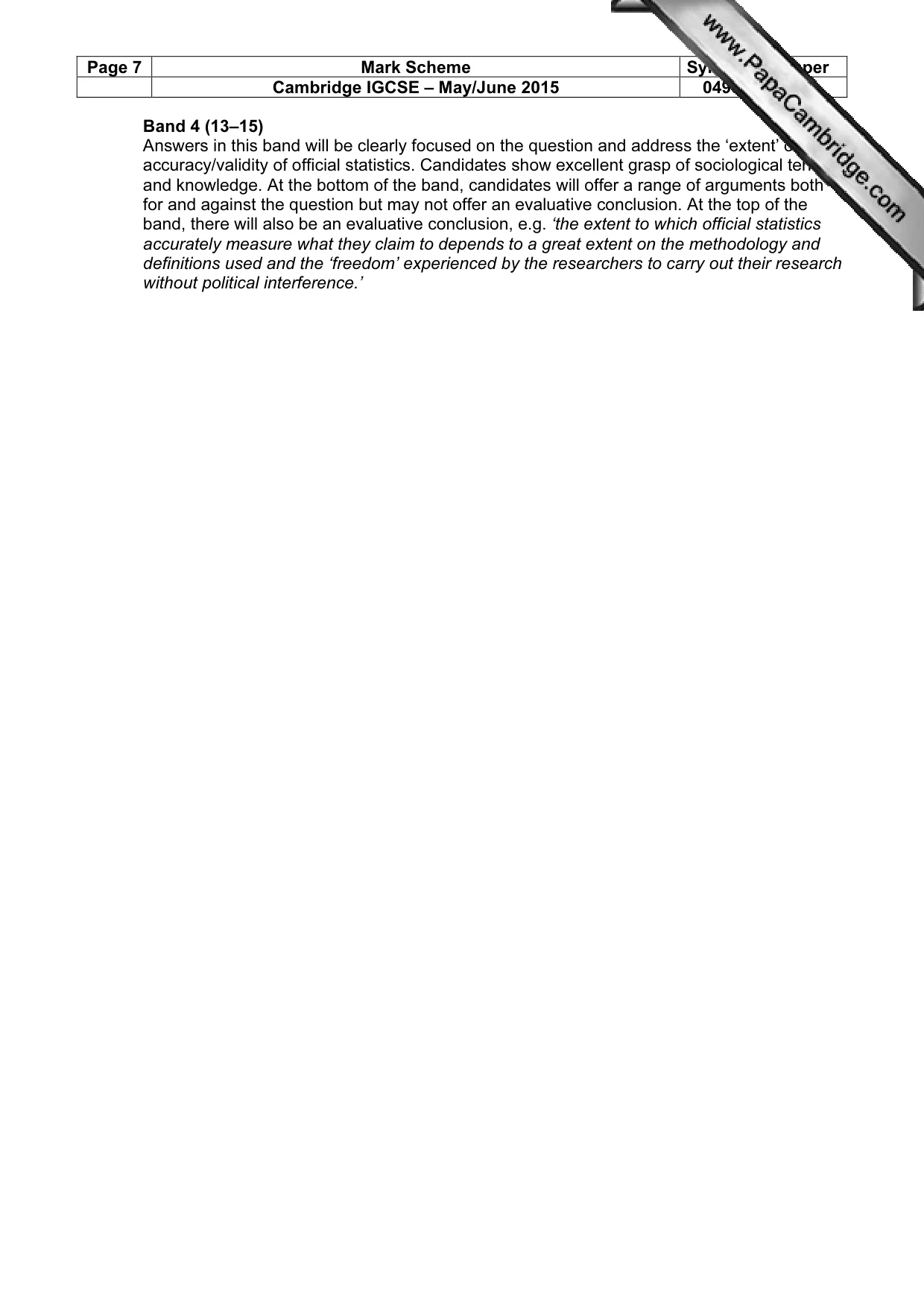
Page 7 Mark Scheme Syllabus Paper Cambridge IGCSE – May/June 2015 0495 13 © Cambridge International Examinations 2015 Band 4 (13–15) Answers in this band will be clearly focused on the question and address the ‘extent’ of the accuracy/validity of official statistics. Candidates show excellent grasp of sociological terms and knowledge. At the bottom of the band, candidates will offer a range of arguments both for and against the question but may not offer an evaluative conclusion. At the top of the band, there will also be an evaluative conclusion, e.g. ‘the extent to which official statistics accurately measure what they claim to depends to a great extent on the methodology and definitions used and the ‘freedom’ experienced by the researchers to carry out their research without political interference.’
Mark scheme, page 8
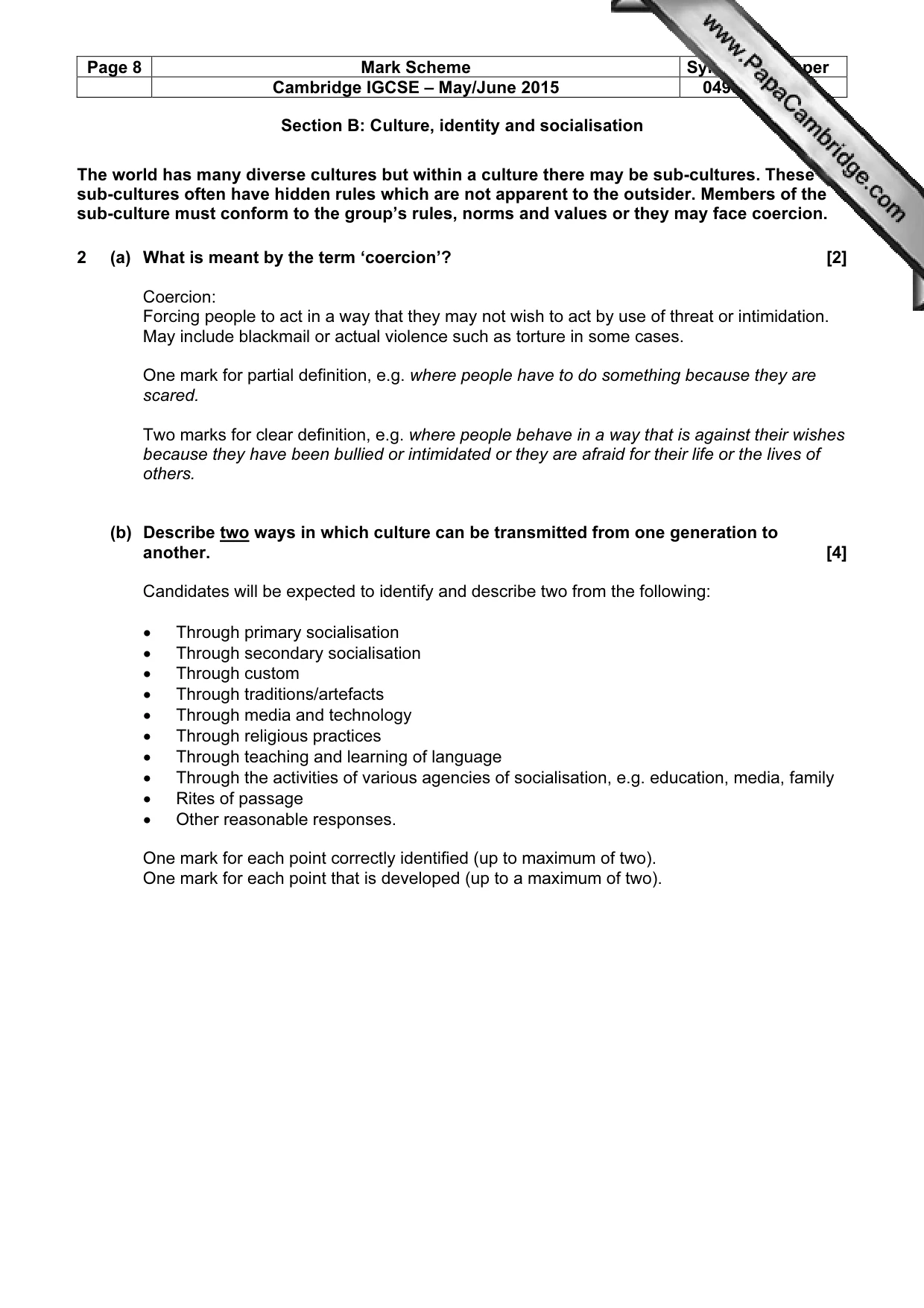
Page 8 Mark Scheme Syllabus Paper Cambridge IGCSE – May/June 2015 0495 13 © Cambridge International Examinations 2015 Section B: Culture, identity and socialisation The world has many diverse cultures but within a culture there may be sub-cultures. These sub-cultures often have hidden rules which are not apparent to the outsider. Members of the sub-culture must conform to the group’s rules, norms and values or they may face coercion. 2 (a) What is meant by the term ‘coercion’? [2] Coercion: Forcing people to act in a way that they may not wish to act by use of threat or intimidation. May include blackmail or actual violence such as torture in some cases. One mark for partial definition, e.g. where people have to do something because they are scared. Two marks for clear definition, e.g. where people behave in a way that is against their wishes because they have been bullied or intimidated or they are afraid for their life or the lives of others. (b) Describe two ways in which culture can be transmitted from one generation to another. [4] Candidates will be expected to identify and describe two from the following: • Through primary socialisation • Through secondary socialisation • Through custom • Through traditions/artefacts • Through media and technology • Through religious practices • Through teaching and learning of language • Through the activities of various agencies of socialisation, e.g. education, media, family • Rites of passage • Other reasonable responses. One mark for each point correctly identified (up to maximum of two). One mark for each point that is developed (up to a maximum of two).
Mark scheme, page 9
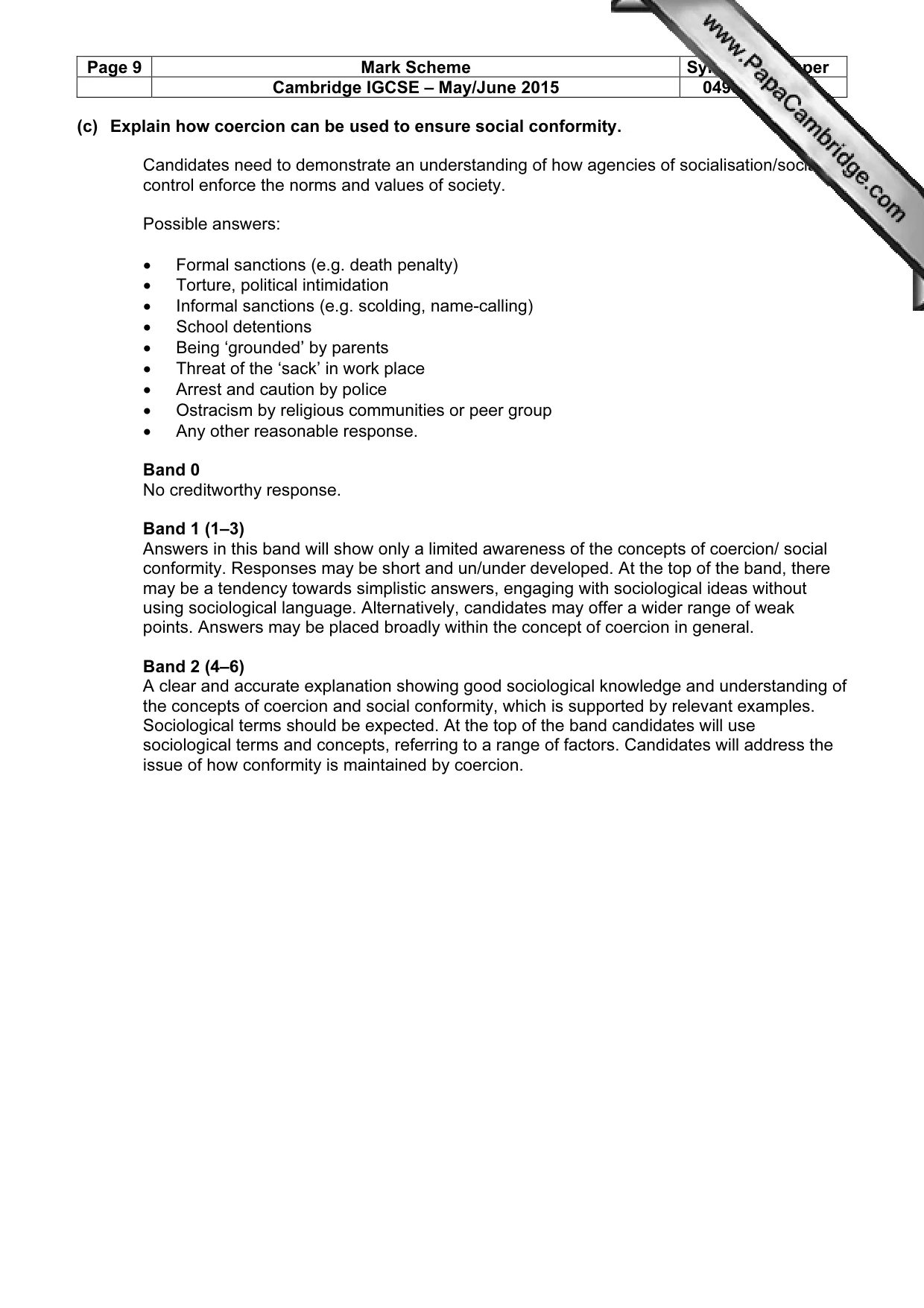
Page 9 Mark Scheme Syllabus Paper Cambridge IGCSE – May/June 2015 0495 13 © Cambridge International Examinations 2015 (c) Explain how coercion can be used to ensure social conformity. [6] Candidates need to demonstrate an understanding of how agencies of socialisation/social control enforce the norms and values of society. Possible answers: • Formal sanctions (e.g. death penalty) • Torture, political intimidation • Informal sanctions (e.g. scolding, name-calling) • School detentions • Being ‘grounded’ by parents • Threat of the ‘sack’ in work place • Arrest and caution by police • Ostracism by religious communities or peer group • Any other reasonable response. Band 0 No creditworthy response. Band 1 (1–3) Answers in this band will show only a limited awareness of the concepts of coercion/ social conformity. Responses may be short and un/under developed. At the top of the band, there may be a tendency towards simplistic answers, engaging with sociological ideas without using sociological language. Alternatively, candidates may offer a wider range of weak points. Answers may be placed broadly within the concept of coercion in general. Band 2 (4–6) A clear and accurate explanation showing good sociological knowledge and understanding of the concepts of coercion and social conformity, which is supported by relevant examples. Sociological terms should be expected. At the top of the band candidates will use sociological terms and concepts, referring to a range of factors. Candidates will address the issue of how conformity is maintained by coercion.
Mark scheme, page 10
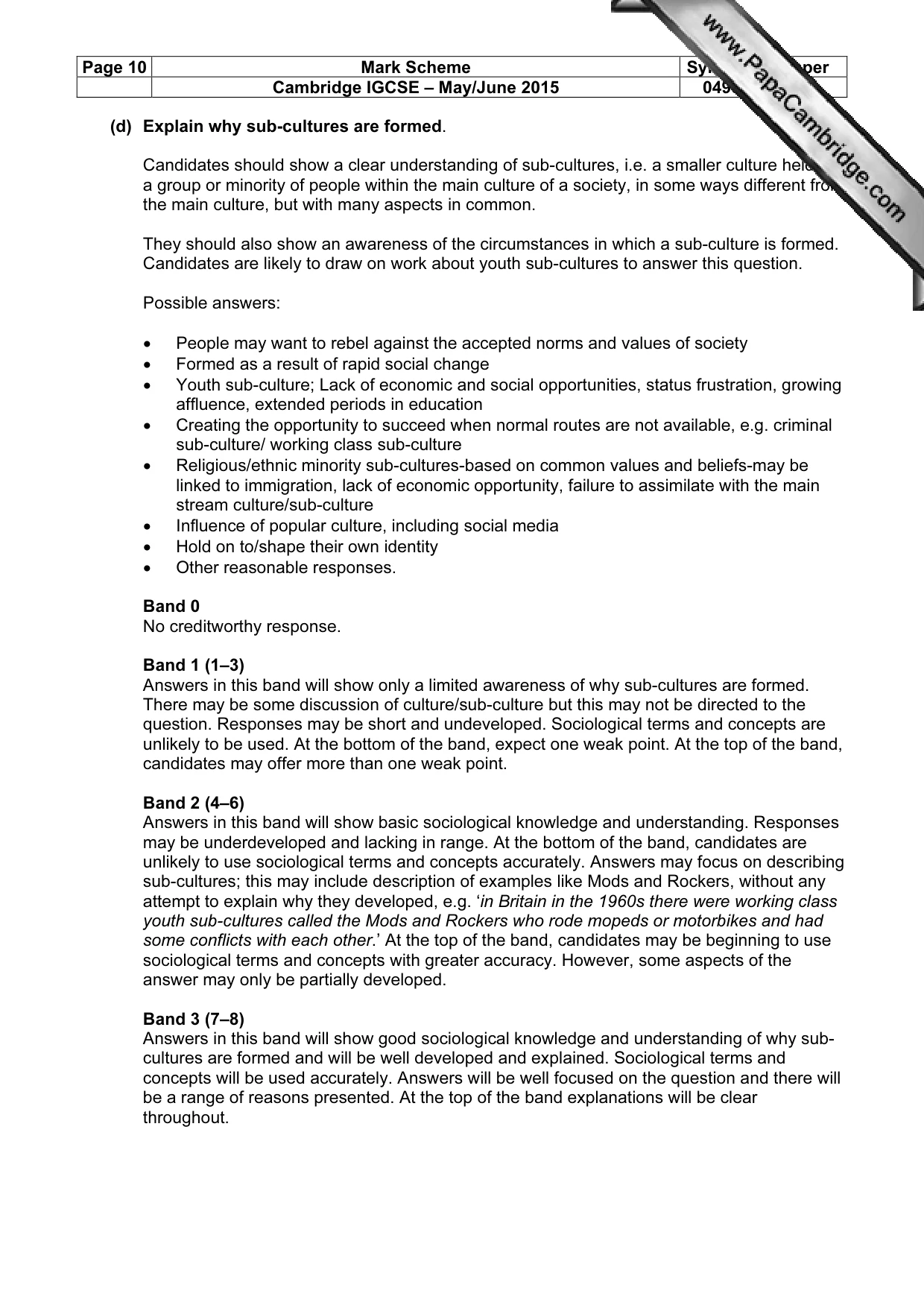
Page 10 Mark Scheme Syllabus Paper Cambridge IGCSE – May/June 2015 0495 13 © Cambridge International Examinations 2015 (d) Explain why sub-cultures are formed. [8] Candidates should show a clear understanding of sub-cultures, i.e. a smaller culture held by a group or minority of people within the main culture of a society, in some ways different from the main culture, but with many aspects in common. They should also show an awareness of the circumstances in which a sub-culture is formed. Candidates are likely to draw on work about youth sub-cultures to answer this question. Possible answers: • People may want to rebel against the accepted norms and values of society • Formed as a result of rapid social change • Youth sub-culture; Lack of economic and social opportunities, status frustration, growing affluence, extended periods in education • Creating the opportunity to succeed when normal routes are not available, e.g. criminal sub-culture/ working class sub-culture • Religious/ethnic minority sub-cultures-based on common values and beliefs-may be linked to immigration, lack of economic opportunity, failure to assimilate with the main stream culture/sub-culture • Influence of popular culture, including social media • Hold on to/shape their own identity • Other reasonable responses. Band 0 No creditworthy response. Band 1 (1–3) Answers in this band will show only a limited awareness of why sub-cultures are formed. There may be some discussion of culture/sub-culture but this may not be directed to the question. Responses may be short and undeveloped. Sociological terms and concepts are unlikely to be used. At the bottom of the band, expect one weak point. At the top of the band, candidates may offer more than one weak point. Band 2 (4–6) Answers in this band will show basic sociological knowledge and understanding. Responses may be underdeveloped and lacking in range. At the bottom of the band, candidates are unlikely to use sociological terms and concepts accurately. Answers may focus on describing sub-cultures; this may include description of examples like Mods and Rockers, without any attempt to explain why they developed, e.g. ‘in Britain in the 1960s there were working class youth sub-cultures called the Mods and Rockers who rode mopeds or motorbikes and had some conflicts with each other.’ At the top of the band, candidates may be beginning to use sociological terms and concepts with greater accuracy. However, some aspects of the answer may only be partially developed. Band 3 (7–8) Answers in this band will show good sociological knowledge and understanding of why sub- cultures are formed and will be well developed and explained. Sociological terms and concepts will be used accurately. Answers will be well focused on the question and there will be a range of reasons presented. At the top of the band explanations will be clear throughout.
Mark scheme, page 11
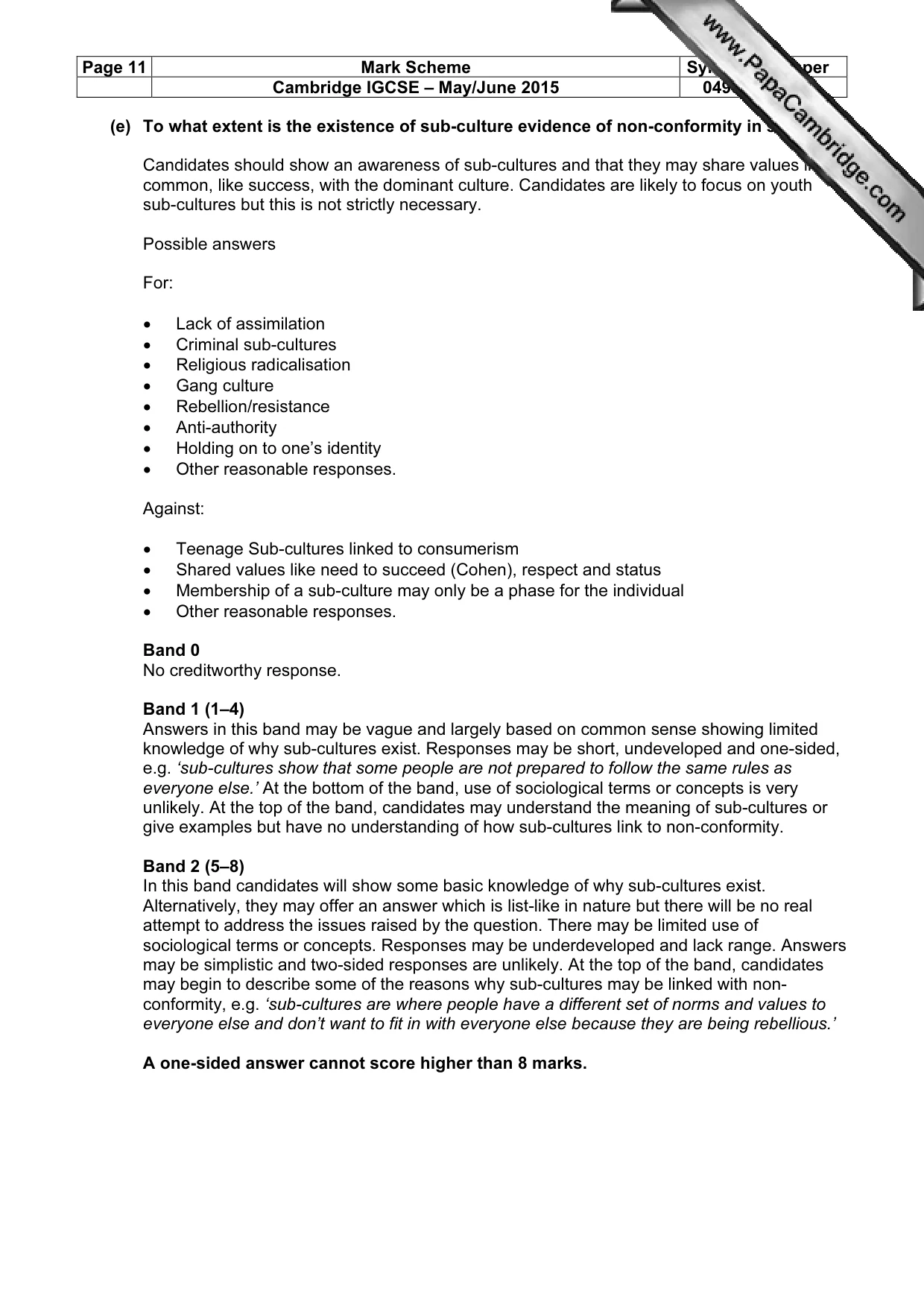
Page 11 Mark Scheme Syllabus Paper Cambridge IGCSE – May/June 2015 0495 13 © Cambridge International Examinations 2015 (e) To what extent is the existence of sub-culture evidence of non-conformity in society? [15] Candidates should show an awareness of sub-cultures and that they may share values in common, like success, with the dominant culture. Candidates are likely to focus on youth sub-cultures but this is not strictly necessary. Possible answers For: • Lack of assimilation • Criminal sub-cultures • Religious radicalisation • Gang culture • Rebellion/resistance • Anti-authority • Holding on to one’s identity • Other reasonable responses. Against: • Teenage Sub-cultures linked to consumerism • Shared values like need to succeed (Cohen), respect and status • Membership of a sub-culture may only be a phase for the individual • Other reasonable responses. Band 0 No creditworthy response. Band 1 (1–4) Answers in this band may be vague and largely based on common sense showing limited knowledge of why sub-cultures exist. Responses may be short, undeveloped and one-sided, e.g. ‘sub-cultures show that some people are not prepared to follow the same rules as everyone else.’ At the bottom of the band, use of sociological terms or concepts is very unlikely. At the top of the band, candidates may understand the meaning of sub-cultures or give examples but have no understanding of how sub-cultures link to non-conformity. Band 2 (5–8) In this band candidates will show some basic knowledge of why sub-cultures exist. Alternatively, they may offer an answer which is list-like in nature but there will be no real attempt to address the issues raised by the question. There may be limited use of sociological terms or concepts. Responses may be underdeveloped and lack range. Answers may be simplistic and two-sided responses are unlikely. At the top of the band, candidates may begin to describe some of the reasons why sub-cultures may be linked with non- conformity, e.g. ‘sub-cultures are where people have a different set of norms and values to everyone else and don’t want to fit in with everyone else because they are being rebellious.’ A one-sided answer cannot score higher than 8 marks.
Mark scheme, page 12
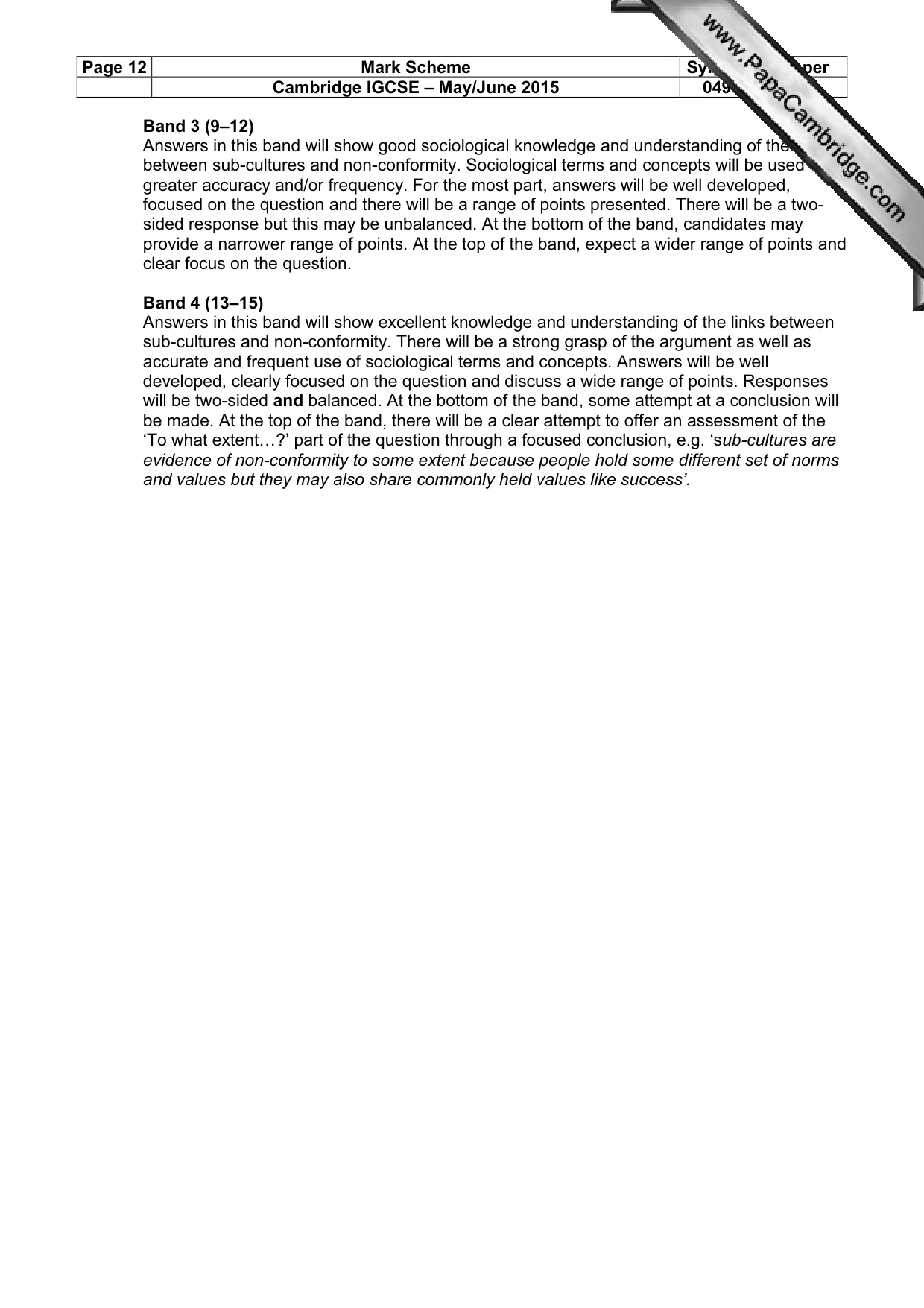
Page 12 Mark Scheme Syllabus Paper Cambridge IGCSE – May/June 2015 0495 13 © Cambridge International Examinations 2015 Band 3 (9–12) Answers in this band will show good sociological knowledge and understanding of the links between sub-cultures and non-conformity. Sociological terms and concepts will be used with greater accuracy and/or frequency. For the most part, answers will be well developed, focused on the question and there will be a range of points presented. There will be a two- sided response but this may be unbalanced. At the bottom of the band, candidates may provide a narrower range of points. At the top of the band, expect a wider range of points and clear focus on the question. Band 4 (13–15) Answers in this band will show excellent knowledge and understanding of the links between sub-cultures and non-conformity. There will be a strong grasp of the argument as well as accurate and frequent use of sociological terms and concepts. Answers will be well developed, clearly focused on the question and discuss a wide range of points. Responses will be two-sided and balanced. At the bottom of the band, some attempt at a conclusion will be made. At the top of the band, there will be a clear attempt to offer an assessment of the ‘To what extent…?’ part of the question through a focused conclusion, e.g. ‘sub-cultures are evidence of non-conformity to some extent because people hold some different set of norms and values but they may also share commonly held values like success’.
Mark scheme, page 13
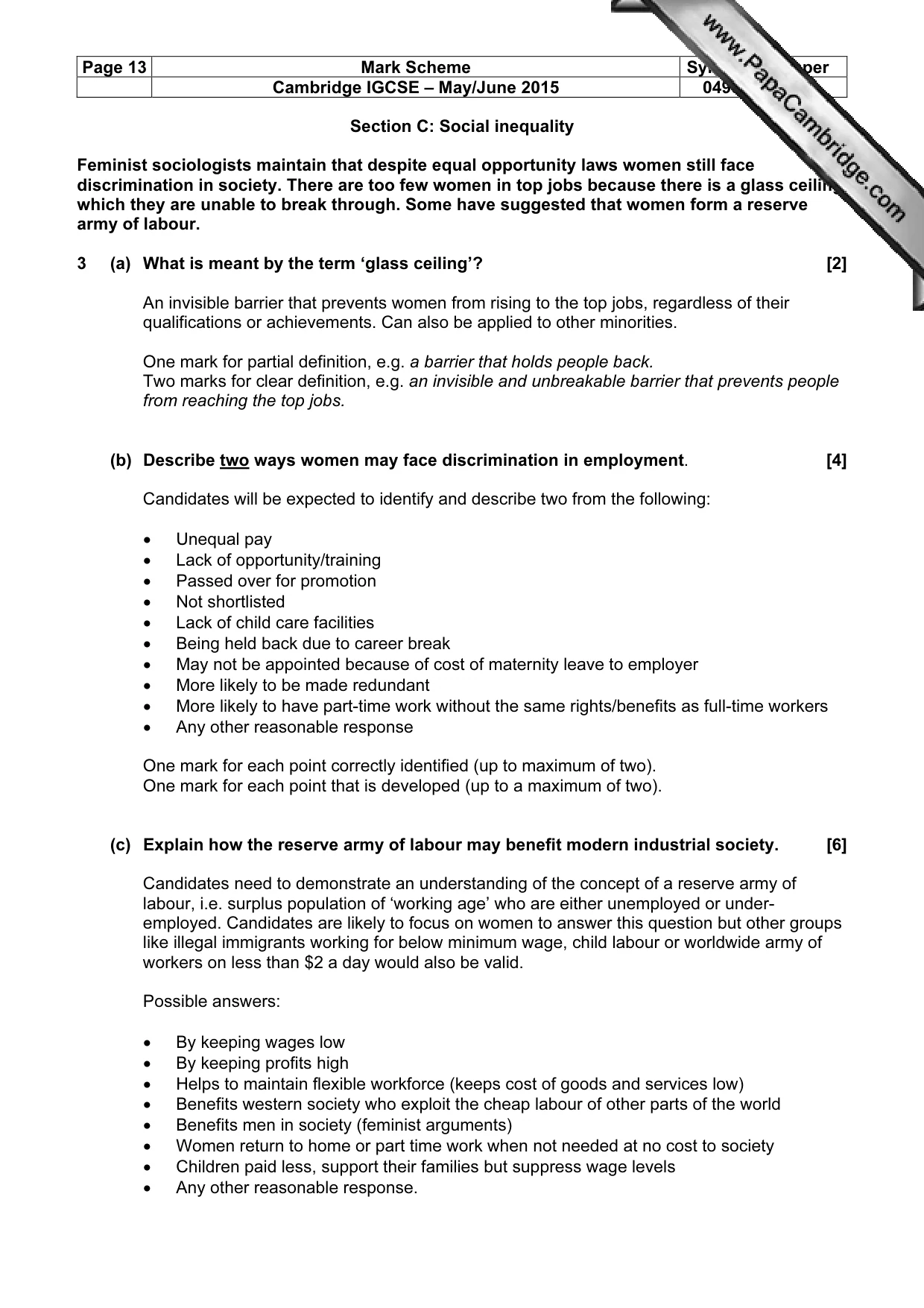
Page 13 Mark Scheme Syllabus Paper Cambridge IGCSE – May/June 2015 0495 13 © Cambridge International Examinations 2015 Section C: Social inequality Feminist sociologists maintain that despite equal opportunity laws women still face discrimination in society. There are too few women in top jobs because there is a glass ceiling which they are unable to break through. Some have suggested that women form a reserve army of labour. 3 (a) What is meant by the term ‘glass ceiling’? [2] An invisible barrier that prevents women from rising to the top jobs, regardless of their qualifications or achievements. Can also be applied to other minorities. One mark for partial definition, e.g. a barrier that holds people back. Two marks for clear definition, e.g. an invisible and unbreakable barrier that prevents people from reaching the top jobs. (b) Describe two ways women may face discrimination in employment. [4] Candidates will be expected to identify and describe two from the following: • Unequal pay • Lack of opportunity/training • Passed over for promotion • Not shortlisted • Lack of child care facilities • Being held back due to career break • May not be appointed because of cost of maternity leave to employer • More likely to be made redundant • More likely to have part-time work without the same rights/benefits as full-time workers • Any other reasonable response One mark for each point correctly identified (up to maximum of two). One mark for each point that is developed (up to a maximum of two). (c) Explain how the reserve army of labour may benefit modern industrial society. [6] Candidates need to demonstrate an understanding of the concept of a reserve army of labour, i.e. surplus population of ‘working age’ who are either unemployed or under- employed. Candidates are likely to focus on women to answer this question but other groups like illegal immigrants working for below minimum wage, child labour or worldwide army of workers on less than $2 a day would also be valid. Possible answers: • By keeping wages low • By keeping profits high • Helps to maintain flexible workforce (keeps cost of goods and services low) • Benefits western society who exploit the cheap labour of other parts of the world • Benefits men in society (feminist arguments) • Women return to home or part time work when not needed at no cost to society • Children paid less, support their families but suppress wage levels • Any other reasonable response.
Mark scheme, page 14
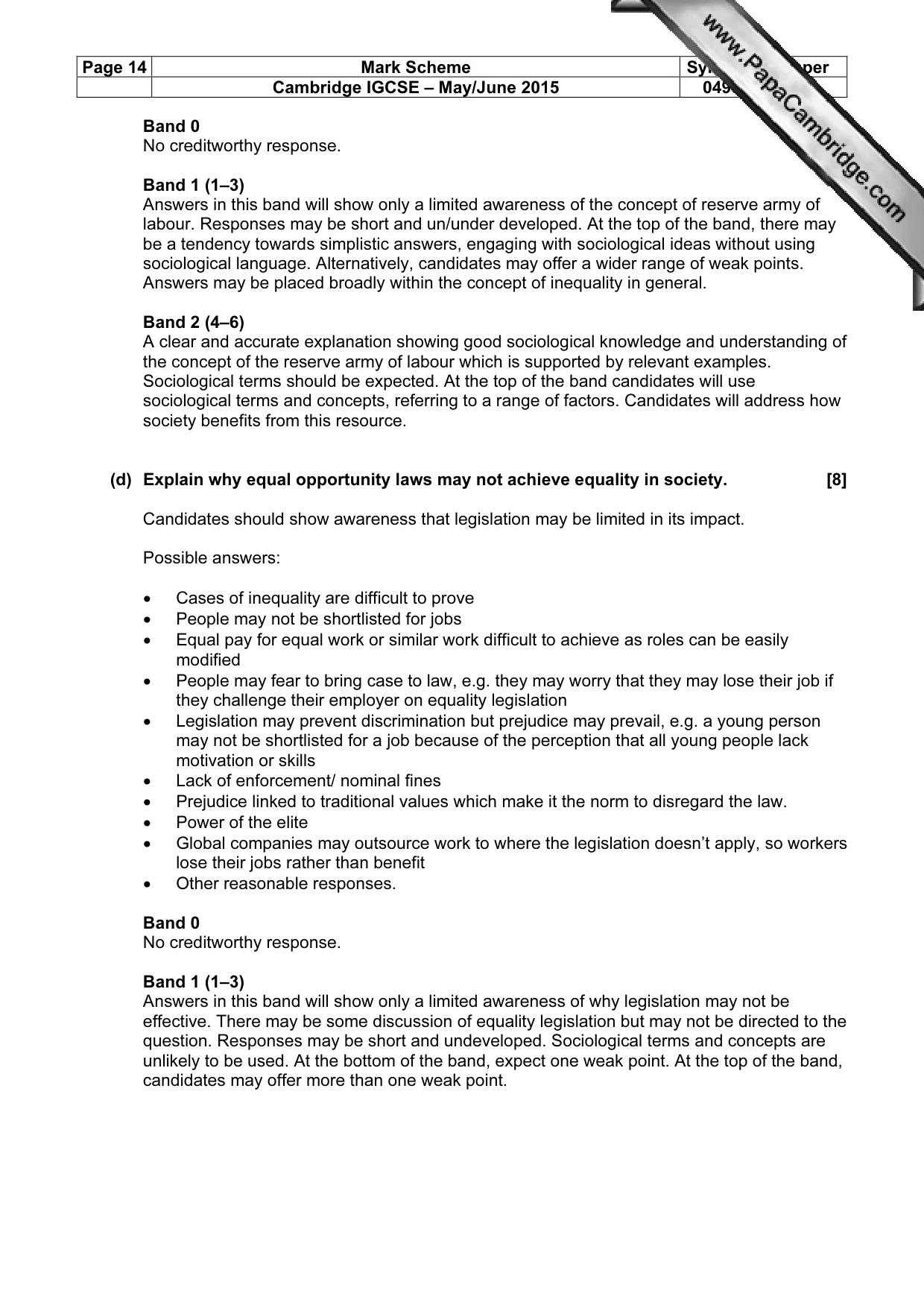
Page 14 Mark Scheme Syllabus Paper Cambridge IGCSE – May/June 2015 0495 13 © Cambridge International Examinations 2015 Band 0 No creditworthy response. Band 1 (1–3) Answers in this band will show only a limited awareness of the concept of reserve army of labour. Responses may be short and un/under developed. At the top of the band, there may be a tendency towards simplistic answers, engaging with sociological ideas without using sociological language. Alternatively, candidates may offer a wider range of weak points. Answers may be placed broadly within the concept of inequality in general. Band 2 (4–6) A clear and accurate explanation showing good sociological knowledge and understanding of the concept of the reserve army of labour which is supported by relevant examples. Sociological terms should be expected. At the top of the band candidates will use sociological terms and concepts, referring to a range of factors. Candidates will address how society benefits from this resource. (d) Explain why equal opportunity laws may not achieve equality in society. [8] Candidates should show awareness that legislation may be limited in its impact. Possible answers: • Cases of inequality are difficult to prove • People may not be shortlisted for jobs • Equal pay for equal work or similar work difficult to achieve as roles can be easily modified • People may fear to bring case to law, e.g. they may worry that they may lose their job if they challenge their employer on equality legislation • Legislation may prevent discrimination but prejudice may prevail, e.g. a young person may not be shortlisted for a job because of the perception that all young people lack motivation or skills • Lack of enforcement/ nominal fines • Prejudice linked to traditional values which make it the norm to disregard the law. • Power of the elite • Global companies may outsource work to where the legislation doesn’t apply, so workers lose their jobs rather than benefit • Other reasonable responses. Band 0 No creditworthy response. Band 1 (1–3) Answers in this band will show only a limited awareness of why legislation may not be effective. There may be some discussion of equality legislation but may not be directed to the question. Responses may be short and undeveloped. Sociological terms and concepts are unlikely to be used. At the bottom of the band, expect one weak point. At the top of the band, candidates may offer more than one weak point.
Mark scheme, page 15
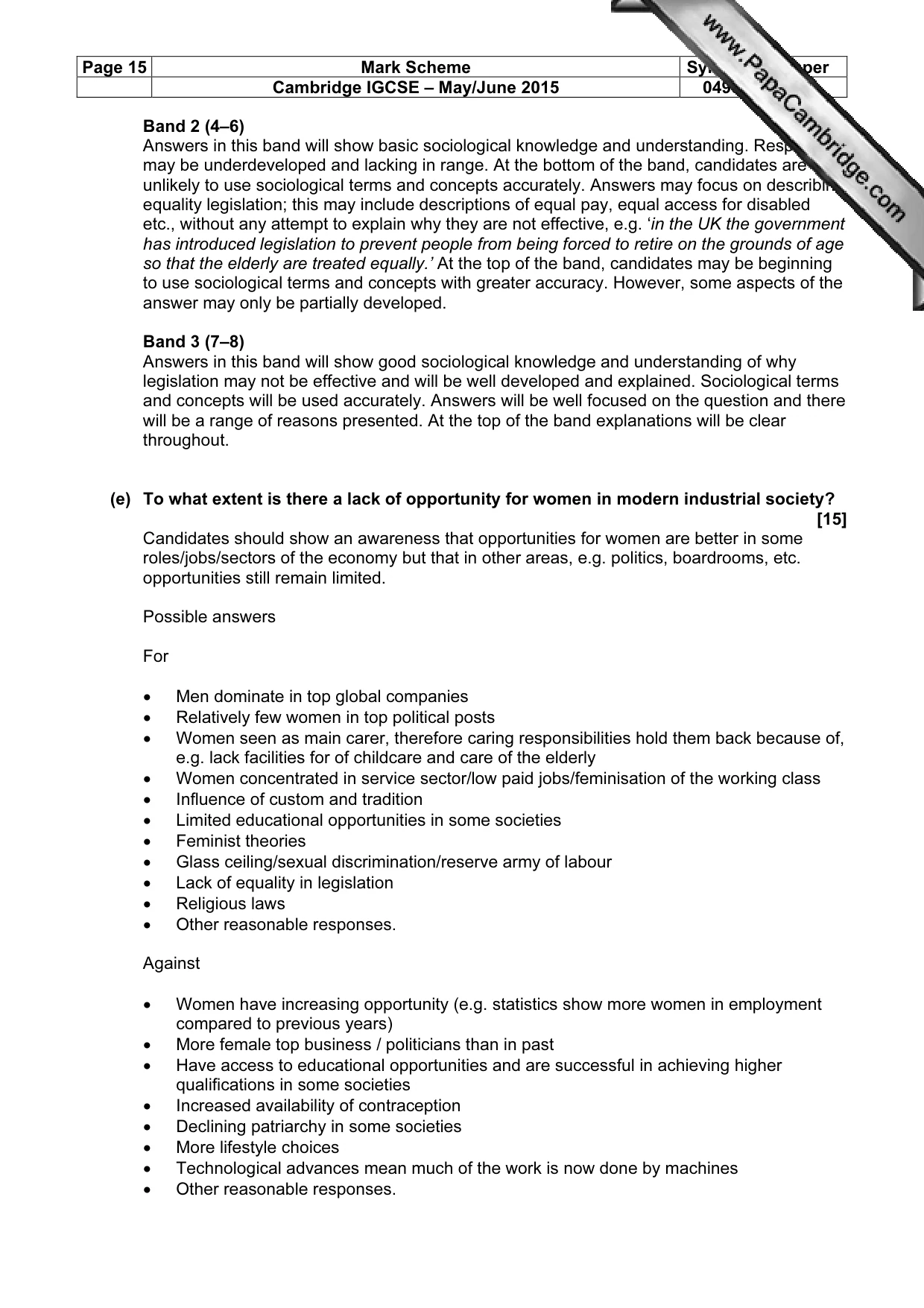
Page 15 Mark Scheme Syllabus Paper Cambridge IGCSE – May/June 2015 0495 13 © Cambridge International Examinations 2015 Band 2 (4–6) Answers in this band will show basic sociological knowledge and understanding. Responses may be underdeveloped and lacking in range. At the bottom of the band, candidates are unlikely to use sociological terms and concepts accurately. Answers may focus on describing equality legislation; this may include descriptions of equal pay, equal access for disabled etc., without any attempt to explain why they are not effective, e.g. ‘in the UK the government has introduced legislation to prevent people from being forced to retire on the grounds of age so that the elderly are treated equally.’ At the top of the band, candidates may be beginning to use sociological terms and concepts with greater accuracy. However, some aspects of the answer may only be partially developed. Band 3 (7–8) Answers in this band will show good sociological knowledge and understanding of why legislation may not be effective and will be well developed and explained. Sociological terms and concepts will be used accurately. Answers will be well focused on the question and there will be a range of reasons presented. At the top of the band explanations will be clear throughout. (e) To what extent is there a lack of opportunity for women in modern industrial society? [15] Candidates should show an awareness that opportunities for women are better in some roles/jobs/sectors of the economy but that in other areas, e.g. politics, boardrooms, etc. opportunities still remain limited. Possible answers For • Men dominate in top global companies • Relatively few women in top political posts • Women seen as main carer, therefore caring responsibilities hold them back because of, e.g. lack facilities for of childcare and care of the elderly • Women concentrated in service sector/low paid jobs/feminisation of the working class • Influence of custom and tradition • Limited educational opportunities in some societies • Feminist theories • Glass ceiling/sexual discrimination/reserve army of labour • Lack of equality in legislation • Religious laws • Other reasonable responses. Against • Women have increasing opportunity (e.g. statistics show more women in employment compared to previous years) • More female top business / politicians than in past • Have access to educational opportunities and are successful in achieving higher qualifications in some societies • Increased availability of contraception • Declining patriarchy in some societies • More lifestyle choices • Technological advances mean much of the work is now done by machines • Other reasonable responses.
Mark scheme, page 16
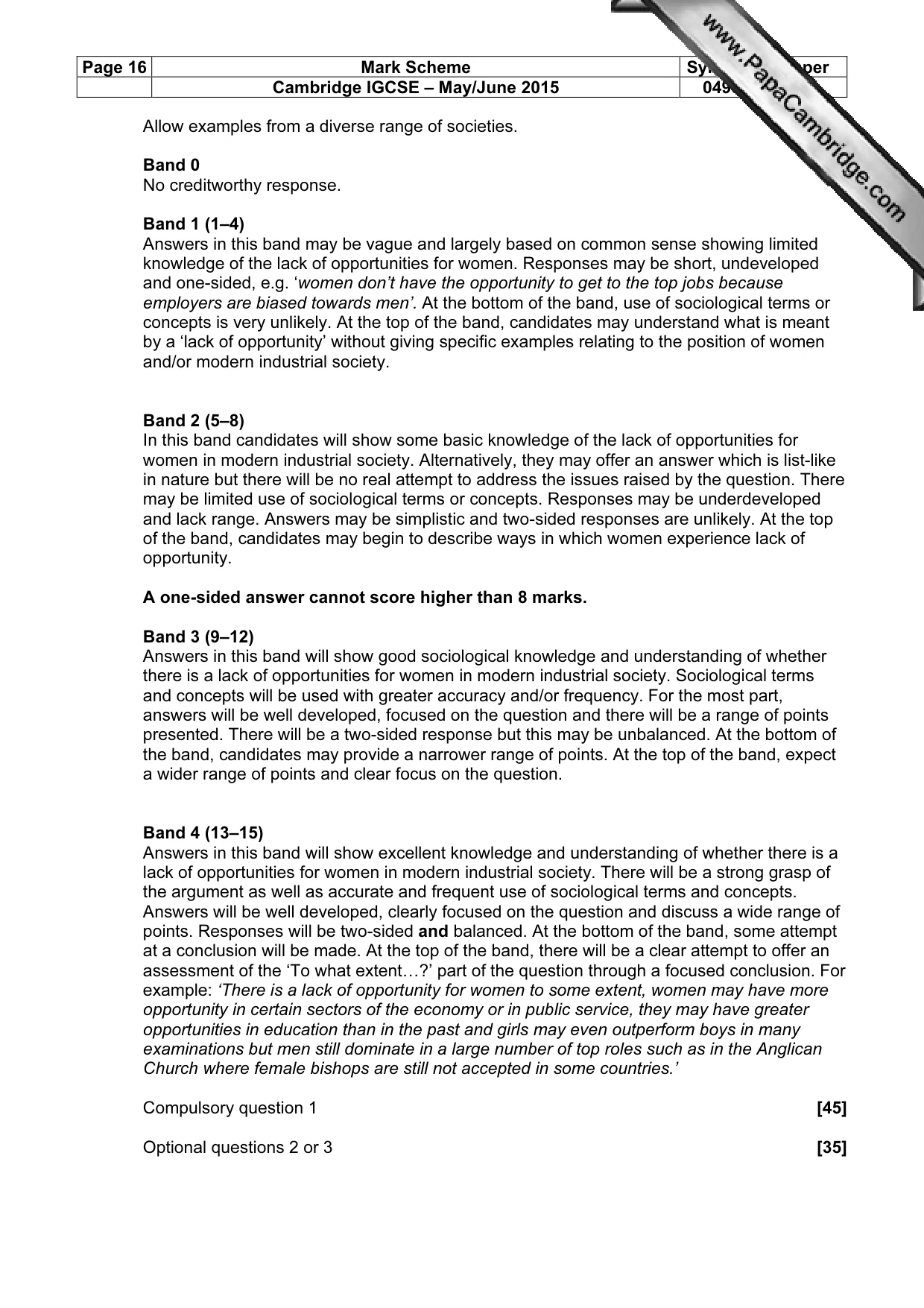
Page 16 Mark Scheme Syllabus Paper Cambridge IGCSE – May/June 2015 0495 13 © Cambridge International Examinations 2015 Allow examples from a diverse range of societies. Band 0 No creditworthy response. Band 1 (1–4) Answers in this band may be vague and largely based on common sense showing limited knowledge of the lack of opportunities for women. Responses may be short, undeveloped and one-sided, e.g. ‘women don’t have the opportunity to get to the top jobs because employers are biased towards men’. At the bottom of the band, use of sociological terms or concepts is very unlikely. At the top of the band, candidates may understand what is meant by a ‘lack of opportunity’ without giving specific examples relating to the position of women and/or modern industrial society. Band 2 (5–8) In this band candidates will show some basic knowledge of the lack of opportunities for women in modern industrial society. Alternatively, they may offer an answer which is list-like in nature but there will be no real attempt to address the issues raised by the question. There may be limited use of sociological terms or concepts. Responses may be underdeveloped and lack range. Answers may be simplistic and two-sided responses are unlikely. At the top of the band, candidates may begin to describe ways in which women experience lack of opportunity. A one-sided answer cannot score higher than 8 marks. Band 3 (9–12) Answers in this band will show good sociological knowledge and understanding of whether there is a lack of opportunities for women in modern industrial society. Sociological terms and concepts will be used with greater accuracy and/or frequency. For the most part, answers will be well developed, focused on the question and there will be a range of points presented. There will be a two-sided response but this may be unbalanced. At the bottom of the band, candidates may provide a narrower range of points. At the top of the band, expect a wider range of points and clear focus on the question. Band 4 (13–15) Answers in this band will show excellent knowledge and understanding of whether there is a lack of opportunities for women in modern industrial society. There will be a strong grasp of the argument as well as accurate and frequent use of sociological terms and concepts. Answers will be well developed, clearly focused on the question and discuss a wide range of points. Responses will be two-sided and balanced. At the bottom of the band, some attempt at a conclusion will be made. At the top of the band, there will be a clear attempt to offer an assessment of the ‘To what extent…?’ part of the question through a focused conclusion. For example: ‘There is a lack of opportunity for women to some extent, women may have more opportunity in certain sectors of the economy or in public service, they may have greater opportunities in education than in the past and girls may even outperform boys in many examinations but men still dominate in a large number of top roles such as in the Anglican Church where female bishops are still not accepted in some countries.’ Compulsory question 1 [45] Optional questions 2 or 3 [35]
What you needed in this session
Cambridge’s own grade thresholds for 2015 May/June, Paper 1 · Variant 3. A higher threshold means an easier paper — the bar moves with how the cohort did.