Cambridge IGCSE Sociology 0495 — 2015 May/June Paper 1 · Variant 1
0495/11/M/J/15 · 80 marks · ≈90 min
The question paper and its mark scheme, free to read here and free to download. This is Cambridge’s own paper, exactly as it was sat.
Question paper4 pages

Mark scheme15 pages
Answers below. Sit the paper first if you are practising.
Paper as text
Question paper, page 1
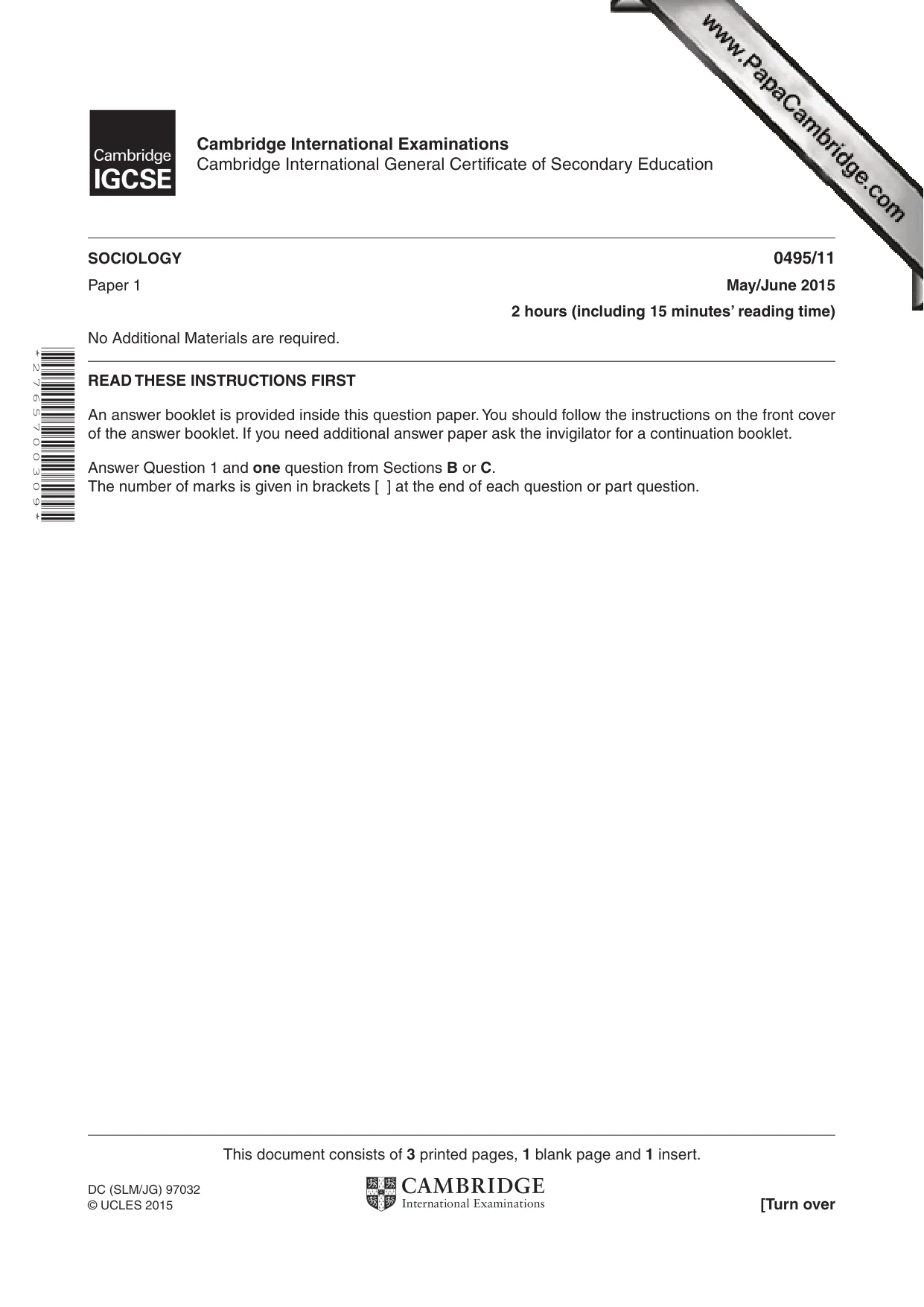
This document consists of 3 printed pages, 1 blank page and 1 insert. DC (SLM/JG) 97032 © UCLES 2015 [Turn over Cambridge International Examinations Cambridge International General Certificate of Secondary Education * 2 7 6 5 7 0 0 3 0 9 * SOCIOLOGY 0495/11 Paper 1 May/June 2015 2 hours (including 15 minutes’ reading time) No Additional Materials are required. READ THESE INSTRUCTIONS FIRST An answer booklet is provided inside this question paper. You should follow the instructions on the front cover of the answer booklet. If you need additional answer paper ask the invigilator for a continuation booklet. Answer Question 1 and one question from Sections B or C. The number of marks is given in brackets [ ] at the end of each question or part question.
Question paper, page 2
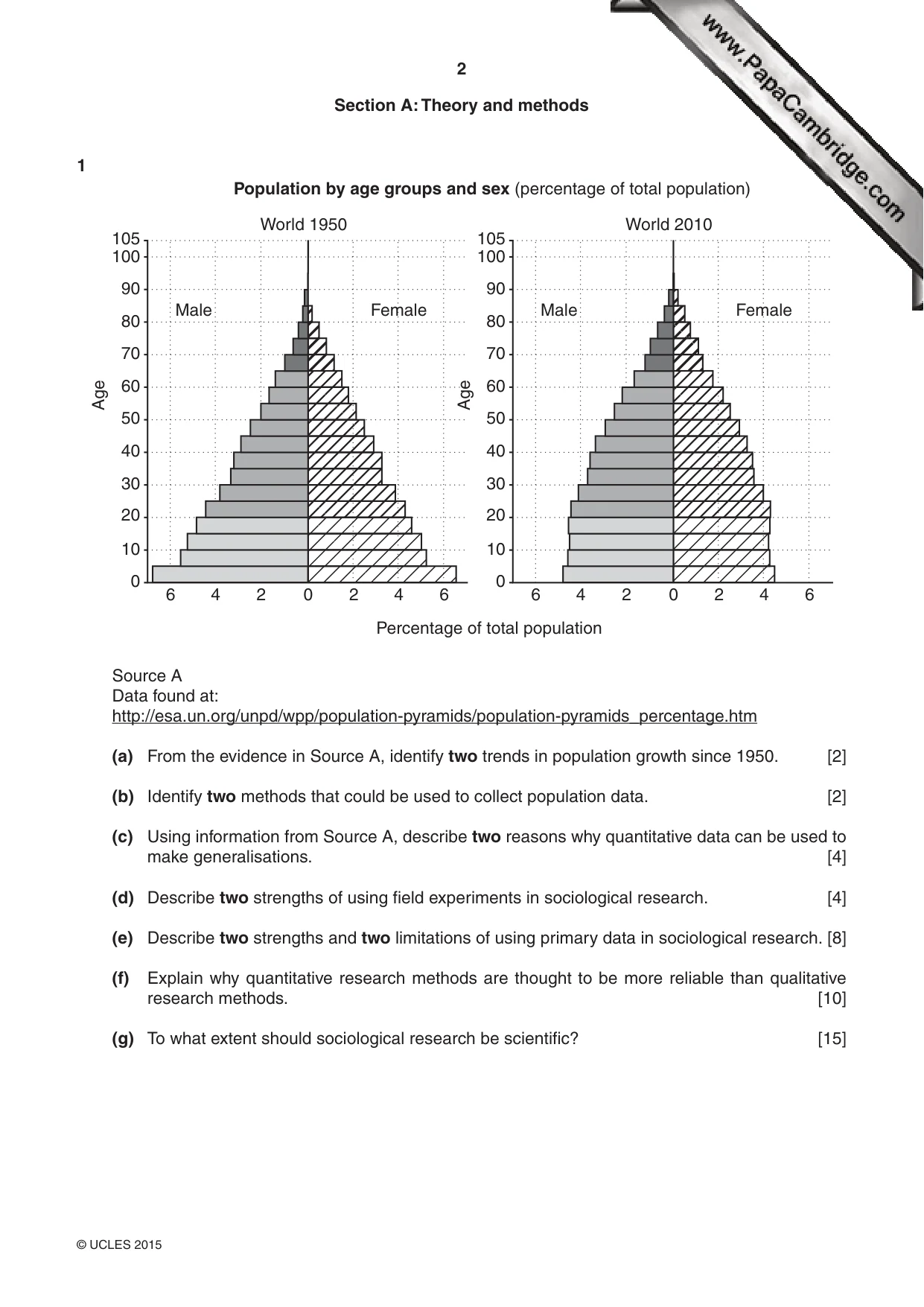
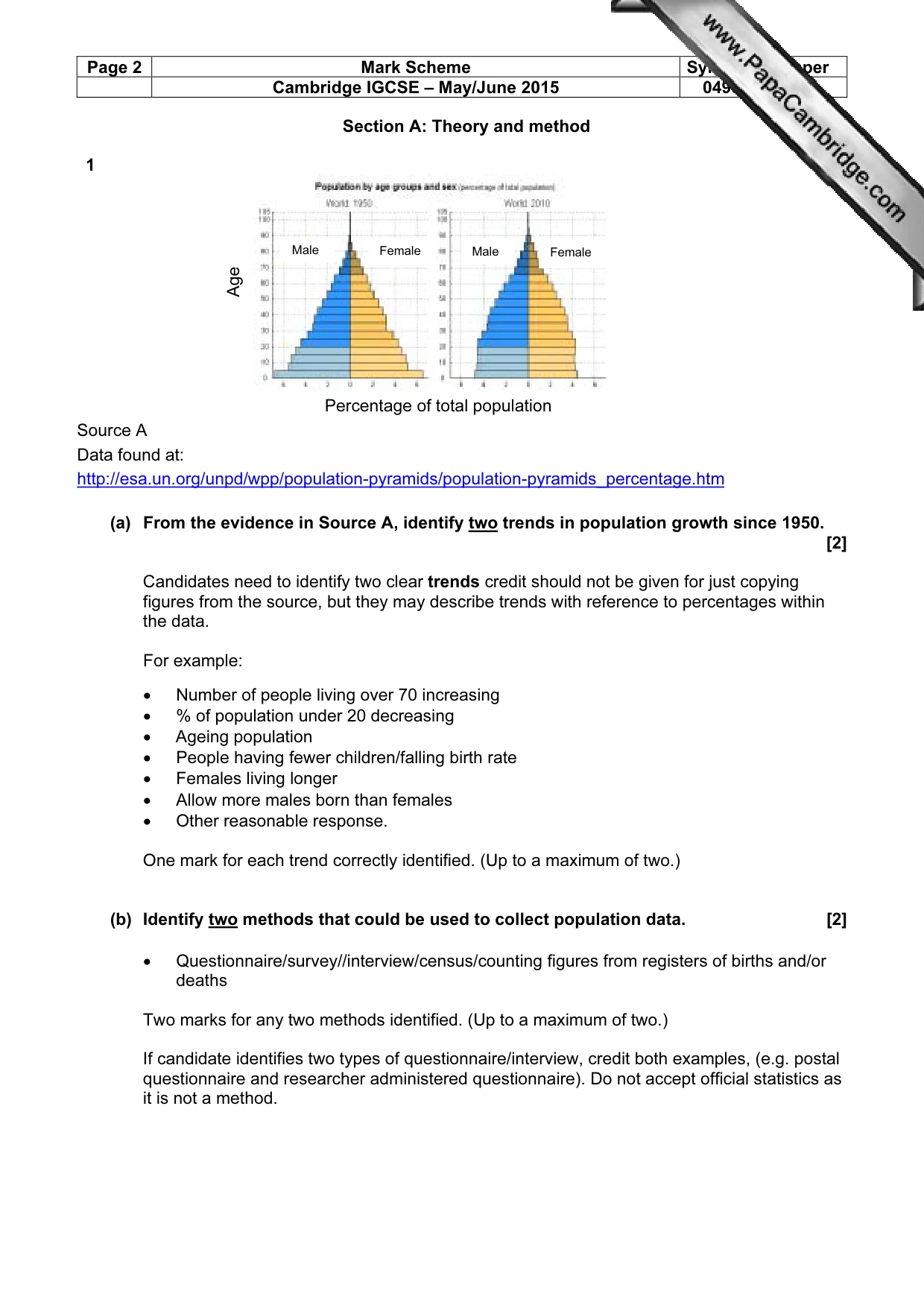
2 0495/11/M/J/15 © UCLES 2015 Section A: Theory and methods 1 105 100 90 80 70 60 50 40 30 20 10 0 6 4 2 0 2 4 6 Male Female World 1950 Age 105 100 90 80 70 60 50 40 30 20 10 0 6 4 2 0 2 4 6 Male Female World 2010 Percentage of total population Age Population by age groups and sex (percentage of total population) Source A Data found at: http://esa.un.org/unpd/wpp/population-pyramids/population-pyramids_percentage.htm (a) From the evidence in Source A, identify two trends in population growth since 1950. [2] (b) Identify two methods that could be used to collect population data. [2] (c) Using information from Source A, describe two reasons why quantitative data can be used to make generalisations. [4] (d) Describe two strengths of using field experiments in sociological research. [4] (e) Describe two strengths and two limitations of using primary data in sociological research. [8] (f) Explain why quantitative research methods are thought to be more reliable than qualitative research methods. [10] (g) To what extent should sociological research be scientific? [15]
Question paper, page 3
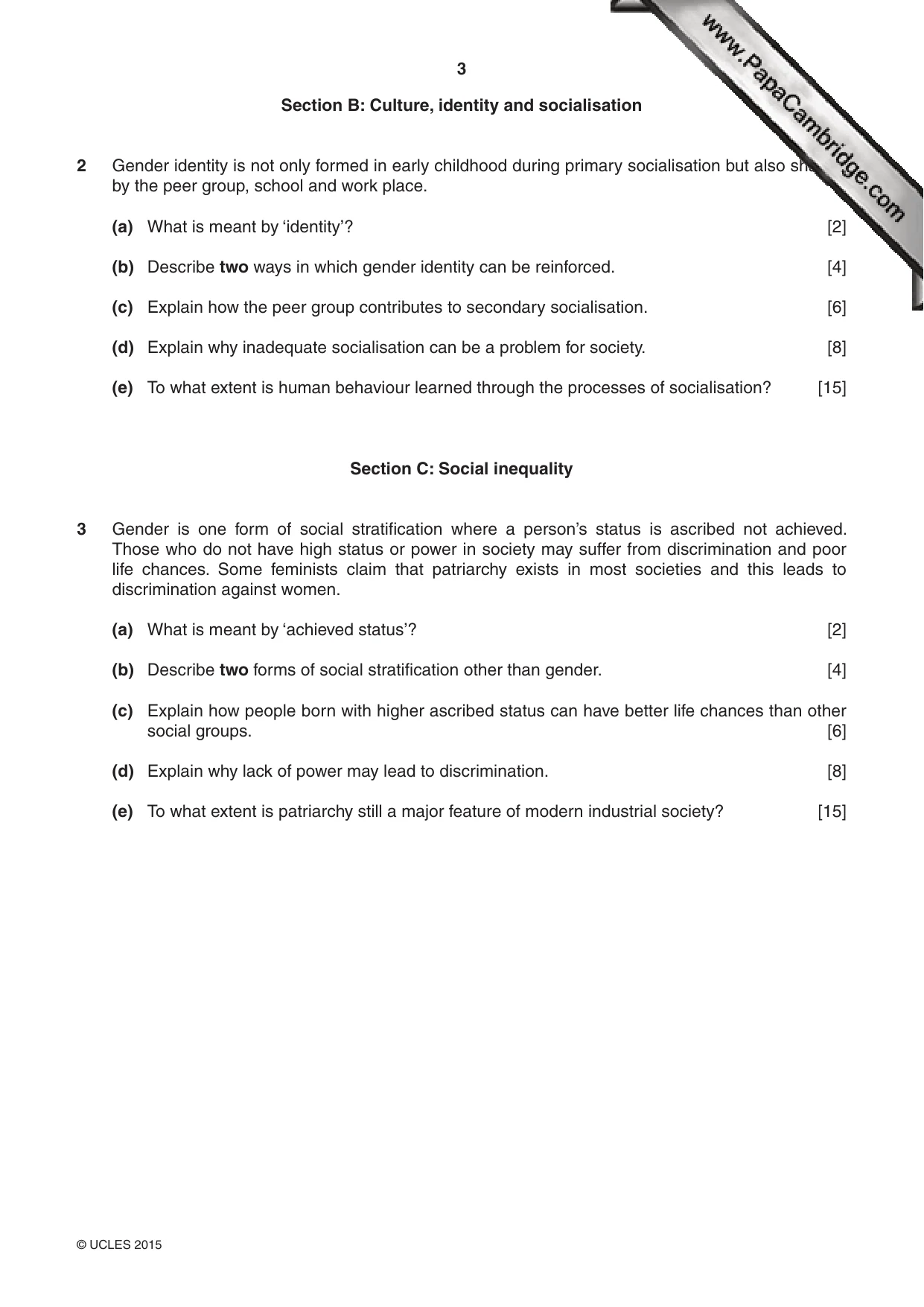
3 0495/11/M/J/15 © UCLES 2015 Section B: Culture, identity and socialisation 2 Gender identity is not only formed in early childhood during primary socialisation but also shaped by the peer group, school and work place. (a) What is meant by ‘identity’? [2] (b) Describe two ways in which gender identity can be reinforced. [4] (c) Explain how the peer group contributes to secondary socialisation. [6] (d) Explain why inadequate socialisation can be a problem for society. [8] (e) To what extent is human behaviour learned through the processes of socialisation? [15] Section C: Social inequality 3 Gender is one form of social stratification where a person’s status is ascribed not achieved. Those who do not have high status or power in society may suffer from discrimination and poor life chances. Some feminists claim that patriarchy exists in most societies and this leads to discrimination against women. (a) What is meant by ‘achieved status’? [2] (b) Describe two forms of social stratification other than gender. [4] (c) Explain how people born with higher ascribed status can have better life chances than other social groups. [6] (d) Explain why lack of power may lead to discrimination. [8] (e) To what extent is patriarchy still a major feature of modern industrial society? [15]
Question paper, page 4
4 0495/11/M/J/15 © UCLES 2015 Permission to reproduce items where third-party owned material protected by copyright is included has been sought and cleared where possible. Every reasonable effort has been made by the publisher (UCLES) to trace copyright holders, but if any items requiring clearance have unwittingly been included, the publisher will be pleased to make amends at the earliest possible opportunity. To avoid the issue of disclosure of answer-related information to candidates, all copyright acknowledgements are reproduced online in the Cambridge International Examinations Copyright Acknowledgements Booklet. This is produced for each series of examinations and is freely available to download at www.cie.org.uk after the live examination series. Cambridge International Examinations is part of the Cambridge Assessment Group. Cambridge Assessment is the brand name of University of Cambridge Local Examinations Syndicate (UCLES), which is itself a department of the University of Cambridge. BLANK PAGE
Mark scheme, page 1
® IGCSE is the registered trademark of Cambridge International Examinations. CAMBRIDGE INTERNATIONAL EXAMINATIONS Cambridge International General Certificate of Secondary Education MARK SCHEME for the May/June 2015 series 0495 SOCIOLOGY 0495/11 Paper 1, maximum raw mark 80 This mark scheme is published as an aid to teachers and candidates, to indicate the requirements of the examination. It shows the basis on which Examiners were instructed to award marks. It does not indicate the details of the discussions that took place at an Examiners’ meeting before marking began, which would have considered the acceptability of alternative answers. Mark schemes should be read in conjunction with the question paper and the Principal Examiner Report for Teachers. Cambridge will not enter into discussions about these mark schemes. Cambridge is publishing the mark schemes for the May/June 2015 series for most Cambridge IGCSE®, Cambridge International A and AS Level components and some Cambridge O Level components.
Mark scheme, page 2
Page 2 Mark Scheme Syllabus Paper Cambridge IGCSE – May/June 2015 0495 11 © Cambridge International Examinations 2015 Section A: Theory and method 1 Percentage of total population Source A Data found at: http://esa.un.org/unpd/wpp/population-pyramids/population-pyramids_percentage.htm (a) From the evidence in Source A, identify two trends in population growth since 1950. [2] Candidates need to identify two clear trends credit should not be given for just copying figures from the source, but they may describe trends with reference to percentages within the data. For example: • Number of people living over 70 increasing • % of population under 20 decreasing • Ageing population • People having fewer children/falling birth rate • Females living longer • Allow more males born than females • Other reasonable response. One mark for each trend correctly identified. (Up to a maximum of two.) (b) Identify two methods that could be used to collect population data. [2] • Questionnaire/survey//interview/census/counting figures from registers of births and/or deaths Two marks for any two methods identified. (Up to a maximum of two.) If candidate identifies two types of questionnaire/interview, credit both examples, (e.g. postal questionnaire and researcher administered questionnaire). Do not accept official statistics as it is not a method. Age Female Female Male Male
Mark scheme, page 3
Page 3 Mark Scheme Syllabus Paper Cambridge IGCSE – May/June 2015 0495 11 © Cambridge International Examinations 2015 (c) Using information from Source A, describe two reasons why quantitative data can be used to make generalisations. [4] • Makes it easy to identify long term trends or patterns • Large scale and numbers involved aid accurate generalisation • Global coverage • representative • Make comparisons (age/gender) across time • Any other reasonable response Band 0 No creditworthy response. Band 1 (1–2) Answers at the bottom of the band will offer one reason without reference to Source A. Alternatively; answers may be vague or general with little sociological knowledge. Answers at the top end of the mark band may offer two reasons but without use of details in Source A. Band 2 (3–4) To reach this band candidates must make clear use of Source A. To reach the top of the band candidates will give two reasons with development and use of the data in Source A, e.g. You can generalise from quantitative data because you can see trends, source A shows that the world population is aging as in 2010 there are more people over 80 than there were in 1950. (d) Describe two strengths of using field experiments in sociological research. [4] Candidates will be expected to describe any of the following: • Takes place in real social setting • Not artificial • More VALID • Shows us how people behave in their natural surroundings • May have fewer ethical problems • Other reasonable response • Allow covert observation so no Hawthorn effect One mark for each strength correctly identified (up to a maximum of two). One mark for each point that is developed (up to a maximum of two). For example, candidate might write: “Field experiments are more valid (1 identification mark), relative to quantitative methods which don’t have the same level of detail (1 development mark)
Mark scheme, page 4
Page 4 Mark Scheme Syllabus Paper Cambridge IGCSE – May/June 2015 0495 11 © Cambridge International Examinations 2015 (e) Describe two strengths and two limitations of using primary data in sociological research. [8] Possible answers may include: Strengths: • Produced specifically for the researcher’s purpose • More representative as sample is selected by researcher • More reliable than secondary data since researcher has greater control over data collection • More valid than secondary data since researcher has greater control over data collection • More relevant and up-to-date than some secondary data • Other reasonable response. Limitations: • Expensive to produce • Time consuming to collect • Researcher may select data to support their own hypothesis/ researcher bias. • May lack validity • May still lack reliability and/or representativeness even though the researcher has produced the data themselves. • Other reasonable response. Four marks are available for strengths and four marks for limitations. One mark for each strength correctly identified (up to a maximum of two). One mark for each strength that is developed (up to a maximum of two). One mark for each limitation correctly identified (up to a maximum of two). One mark for each limitation that is developed (up to a maximum of two).
Mark scheme, page 5
Page 5 Mark Scheme Syllabus Paper Cambridge IGCSE – May/June 2015 0495 11 © Cambridge International Examinations 2015 (f) Explain why quantitative research methods are thought to be more reliable than qualitative research methods. [10] Key to this question is that candidates understand both quantitative and reliable. Candidates who confuse quantitative and qualitative, reliable and valid are unlikely to score highly. Candidates may demonstrate an understanding that quantitative methods are favoured by positivists because this ‘scientific method’ is seen as more objective and systematic. These methods allow numerical data to be produced and trends to be identified. The research is easily replicated by others because data is often collected using standardised questions, which are easily coded and quantified. This makes replication easy and allows for accurate cross-checking of results. Candidates may approach the question by discussing a particular quantitative method, e.g. questionnaires. If this is done well, candidates could potentially reach Band 3. Band 0 No creditworthy response. Band 1 (1–3) Answers at this level are likely to show limited understanding and be based on common sense or demonstrate little in the way of clear sociological knowledge or terminology, e.g. 'quantitative data is more reliable because it is in number form.’ At the top of the band candidates may begin to use some appropriate knowledge or terminology. Candidates may only give one reason. Band 2 (4–7) At the bottom of the band, candidates demonstrate basic understanding of the issue and use some appropriate knowledge and terminology. Supporting explanation may be weak or over- simplistic, e.g. ‘quantitative data is more reliable because the research is easily repeated’. At the top of the band, candidates use appropriate knowledge and terminology but may not fully focus on the question. Candidates are likely to offer more than one reason, e.g. ‘quantitative data is more reliable because the research produces lots of data which is easily turned into statistic. It is easy to repeat and is more scientific’. Band 3 (8–10) The candidates’ answer is fully focused on the question. There is evidence of good use of sociological terms and candidates may make clear reference to the concept of reliability and understand the link between this and the method used. At the top of the band, candidates should offer a range of reasons as well as demonstrate accurate use of sociological concepts. Candidates will be expected to demonstrate a good understanding of the links between methods chosen and reliability of the data.
Mark scheme, page 6
Page 6 Mark Scheme Syllabus Paper Cambridge IGCSE – May/June 2015 0495 11 © Cambridge International Examinations 2015 (g) To what extent should sociological research be scientific? [15] The key to this question is understanding the classic debate between positivists and interpretivists about whether sociology can be scientific. Candidates may discuss that this is now a dated argument and that ‘triangulation’ is the favoured method. Candidates might also consider if ‘science’ itself needs to be defined/redefined. Candidates might talk about: For • Sociology needs to establish social facts to be able to make generalisations about society. • Researchers need to maintain objectivity in order to prevent their values influencing the research findings • Positivists think that scientific methods should be used because society is an external reality constraining the individual • Scientific research can be easily replicated and checked for accuracy • Other reasonable arguments. Against • Interpretivists would argue that humans are not inanimate objects. They would say humans interact with their surroundings and the researcher, so scientific methods shouldn’t be used. • Science is not objective; researchers are influenced by their choice of research topic, method and funding. • Methods like experiments may be unethical and so shouldn’t be used. • Subject may be manipulated by the researcher or vice versa. • Interpretivists would argue that variables cannot be controlled and may not even be known. • Other reasonable arguments. Band 0 No creditworthy response. Band 1 (1–4) Answers in this band may be largely based on common sense showing limited or no knowledge of sociological terms or concepts. At the top of the band, candidates may make one or two general points about positivism, but they won’t be well-linked to the question, e.g. ‘sociology should be scientific because you need facts about society.’ Band 2 (5–8) In this band candidates may approach the question by describing some of the methods associated with scientific/quantitative research. There may be some basic discussion of the strengths and/or limitations of quantitative research. They may describe methods and their problems. Alternatively, they may offer an answer which is list-like in nature but there will be no real attempt to assess whether sociological research should be scientific. At the top of the band, candidates may offer a description of more than one method or issue. A one-sided answer cannot score higher than 8 marks.
Mark scheme, page 7
Page 7 Mark Scheme Syllabus Paper Cambridge IGCSE – May/June 2015 0495 11 © Cambridge International Examinations 2015 Band 3 (9–12) Answers in this band will show good sociological knowledge and understanding of whether sociology should be scientific. Sociological terms and concepts will be used with greater accuracy and/or frequency. For the most part, answers will be well developed, focused on the question and there will be a range of points presented. There will be a two-sided response but this may be unbalanced. At the bottom of the band, candidates may provide a narrower range of points. At the top of the band, expect a wider range of points and clear focus on the question. Band 4 (13–15) Answers in this band will be clearly focused on the question and address the ‘extent’ to which sociology should be scientific. Candidates show excellent grasp of sociological terms and knowledge. At the bottom of the band, candidates will offer a range of arguments both for and against the question but may not offer an evaluative conclusion. At the top of the band, there will also be an evaluative conclusion, e.g. ‘positivists might aim to be scientific but they cannot hope to achieve the ‘objectivity’ of the natural sciences as the subject will always interact with the researcher.’
Mark scheme, page 8
Page 8 Mark Scheme Syllabus Paper Cambridge IGCSE – May/June 2015 0495 11 © Cambridge International Examinations 2015 Section B: Culture, identity and socialisation Gender identity is not only formed in early childhood during primary socialisation but also shaped by the peer group, school and work place. [2] 2 (a) What is meant by ‘identity’? How individuals see and define themselves and how other people see and define them. One mark for partial definition, e.g. how others see us. Two marks for clear definition, e.g. how we see ourselves and how other people see and define us. (b) Describe two ways in which gender identity can be reinforced. [4] Candidates will be expected to identify and describe two from the following: • Canalisation • Manipulation • Coercion • Sanctions • Rewards • Secondary socialisation e.g. peer pressure • Primary socialisation • Verbal appellation • Role modelling in the media • Hidden curriculum • Other reasonable responses. One mark for each point correctly identified (up to maximum of two). One mark for each point that is developed (up to a maximum of two). (c) Explain how the peer group contributes to secondary socialisation. [6] Candidates need to demonstrate an understanding of the process of secondary socialisation in the peer group irrespective of age. Possible answers: • Anti-school sub-culture • Youth sub-culture • Need to fit in/conform/acceptance/ridicule/shunning/ostracism • Peer pressure • Examples of adult peer group influences, e.g. work place • Any other reasonable response.
Mark scheme, page 9
Page 9 Mark Scheme Syllabus Paper Cambridge IGCSE – May/June 2015 0495 11 © Cambridge International Examinations 2015 Band 0 No creditworthy response. Band 1 (1–3) Answers in this band will show only a limited awareness of the role of the peer groups in secondary socialisation. Responses may be short and un/under developed. At the top of the band, there may be a tendency towards simplistic answers, engaging with sociological ideas without using sociological language. Alternatively, candidates may offer a wider range of weak points. Answers may be placed broadly within the concept of secondary socialisation in general. Band 2 (4–6) A clear and accurate explanation showing good sociological knowledge and understanding of the role of the peer group in secondary socialisation, which is supported by relevant examples. Sociological terms should be expected. At the top of the band candidates will use sociological terms and concepts, referring to a range of factors. Candidates will address the contribution of the peer group in secondary socialisation. (d) Explain why inadequate socialisation can be a problem for society. [8] Candidates should show awareness of the argument that inadequate socialisation can threaten the stability of society. Possible answers: • Dysfunctional for society • Anomie • Crime and deviance • Encourages counter culture • Feral children • Encourages other social division, e.g. racism, homophobia, sexism • Undermines value consensus • Other reasonable responses. Band 0 No creditworthy response. Band 1 (1–3) Answers in this band will show only a limited awareness of the problem of inadequate socialisation. There may be some discussion of socialisation but this may not be directed to the question. Responses may be short and undeveloped. Sociological terms and concepts are unlikely to be used. At the bottom of the band, expect one weak point. At the top of the band, candidates may offer more than one weak point. Band 2 (4–6) Answers in this band will show basic sociological knowledge and understanding. Responses may be underdeveloped and lacking in range. At the bottom of the band, candidates are unlikely to use sociological terms and concepts accurately. Answers may focus on describing inadequate socialisation; this may include description of how inadequately socialised groups like feral children struggle to adapt, without any attempt to explain why this presents a problem for society, e.g. ‘feral children are not socialised correctly and they are unable to do basic things like walk and talk so they don’t fit in.’ At the top of the band, candidates may be beginning to use sociological terms and concepts with greater accuracy. However, some aspects of the answer may only be partially developed.
Mark scheme, page 10
Page 10 Mark Scheme Syllabus Paper Cambridge IGCSE – May/June 2015 0495 11 © Cambridge International Examinations 2015 Band 3 (7–8) Answers in this band will show good sociological knowledge and understanding of how inadequate socialisation can be viewed as a problem and will be well developed and explained. Sociological terms and concepts will be used accurately. Answers will be well focused on the question and there will be a range of reasons presented. At the top of the band explanations will be clear throughout. (e) To what is extent is human behaviour learned through the processes of socialisation? [15] Candidates should show an awareness of the nature vs. nurture debate. Possible answers: For • Relative nature of behaviour from society to society and across time • Evidence of difference in gender role socialisation • Feral children • Agencies of socialisation • Processes of socialisation • Other reasonable responses. Against: • Instinct • Mothering instinct • Genetics and intelligence • Other reasonable responses. Band 0 No creditworthy response. Band 1 (1–4) Answers in this band may be vague and largely based on common sense showing limited knowledge of the debate. Responses may be short, undeveloped and one-sided, e.g. ‘sociologists believe that most human behaviour is learnt from our parents.’ At the bottom of the band, use of sociological terms or concepts is very unlikely. At the top of the band, candidates may understand the meaning of socialisation or be able to list the agencies of socialisation but have no understanding of the processes of socialisation. Band 2 (5–8) In this band candidates will show some basic knowledge of the debate. Alternatively, they may offer an answer which is list-like in nature but there will be no real attempt to address the issues raised by the question. There may be limited use of sociological terms or concepts. Responses may be underdeveloped and lack range. Answers may be simplistic and two-sided responses are unlikely. At the top of the band, candidates may describe examples of primary or secondary socialisation, e.g. 'parents socialise their children into being male or female by the way they speak to them, dress them and treat them.' A one-sided answer cannot score higher than 8 marks.
Mark scheme, page 11
Page 11 Mark Scheme Syllabus Paper Cambridge IGCSE – May/June 2015 0495 11 © Cambridge International Examinations 2015 Band 3 (9–12) Answers in this band will show good sociological knowledge and understanding of the nature vs. nurture debate. Sociological terms and concepts will be used with greater accuracy and/or frequency. For the most part, answers will be well developed, focused on the question and there will be a range of points presented. There will be a two-sided response but this may be unbalanced. At the bottom of the band, candidates may provide a narrower range of points. At the top of the band, expect a wider range of points and clear focus on the question. Band 4 (13–15) Answers in this band will show an excellent knowledge and understanding of the nature vs. nurture debate. There will be a strong grasp of the argument as well as accurate and frequent use of sociological terms and concepts. Answers will be well developed, clearly focused on the question and discuss a wide range of points. Responses will be two-sided and balanced. At the bottom of the band, some attempt at a conclusion will be made. At the top of the band, there will be a clear attempt to offer an assessment of the ‘To what extent…?’ part of the question through a focused conclusion, e.g. 'human behaviour is learned to a large extent although humans may have some basics instincts the wide varieties of human behaviours observed across time and between different cultures strongly suggests most human behaviour is learnt.’
Mark scheme, page 12
Page 12 Mark Scheme Syllabus Paper Cambridge IGCSE – May/June 2015 0495 11 © Cambridge International Examinations 2015 Section C: Social inequality Gender is one form of social stratification where a person’s status is ascribed not achieved. Those who do not have high status or power in society may suffer from discrimination and poor life chances. Some feminists claim that patriarchy exists in most societies and this leads to discrimination against women. 3 (a) What is meant by ‘achieved status’? [2] Position which is earned through a person’s own efforts rather than inherited. One mark for partial definition, e.g. 'the status you get from working hard.' Two marks for clear definition, e.g. 'the status you get through your own efforts rather than status you inherit from your family.' (b) Describe two forms of social stratification other than gender. [4] Candidates will be expected to identify and describe two from the following: • Age • Class • Wealth/income • Ethnicity/race • Religion/ theocracy • Status • Power • Disability • Caste • Other reasonable responses. One mark for each point correctly identified (up to maximum of two). One mark for each point that is developed (up to a maximum of two).
Mark scheme, page 13
Page 13 Mark Scheme Syllabus Paper Cambridge IGCSE – May/June 2015 0495 11 © Cambridge International Examinations 2015 (c) Explain how people born with higher ascribed status can have better life chances than other social groups. [6] Candidates need to demonstrate an understanding of both what ascribed status means and life chances. Candidates who confuse ascribed and achieved status are unlikely to score highly. Possible answers: • Better access to education including top universities • ‘old boys’ network better access to higher status jobs • Better access to health care/more advanced health care • Access to political elite/ part of political classes • Access to technology/ media/knowledge • Better access to legal representation • Any other reasonable response. Band 0 No creditworthy response. Band 1 (1–3) Answers in this band will show only a limited awareness of the concept of ascribed status and life chances. Responses may be short and un/under developed. At the top of the band, there may be a tendency towards simplistic answers, engaging with sociological ideas without using sociological language. Alternatively, candidates may offer a wider range of weak points. Answers may be placed broadly within the concept of life chances in general. Band 2 (4–6) A clear and accurate explanation showing good sociological knowledge and understanding of the concepts of ascribed status and life chances which is supported by relevant examples. Sociological terms should be expected. At the top of the band candidates will use sociological terms and concepts, referring to a range of factors. Candidates will address how life chances are improved relative to other social groups. (d) Explain why lack of power may lead to discrimination. [8] Candidates should show an understanding of the concepts of power and discrimination. Power need not be political power it can also be economic power in capitalist society. The question is clearly not intended to be power as in electricity, as this is not a sociological concept, although a candidate who argued that lack of electricity resulted in poor life chances/discrimination would deserve some credit. Possible answers: • Media stereotypes • Police labelling • Lack of rights • Patriarchal societies • Lack of economic • Lack of political power • Being old, disabled, working class, ethnic minority • Other reasonable responses
Mark scheme, page 14
Page 14 Mark Scheme Syllabus Paper Cambridge IGCSE – May/June 2015 0495 11 © Cambridge International Examinations 2015 Band 0 No creditworthy response. Band 1 (1–3) Answers in this band will show only a limited awareness of why lack of power may be linked to discrimination. There may be some discussion of discrimination but may not be directed to the question. Responses may be short and undeveloped. Sociological terms and concepts are unlikely to be used. At the top of the band, candidates may offer more than one weak point. Band 2 (4–6) Answers in this band will show basic sociological knowledge and understanding. Responses may be underdeveloped and lacking in range. At the bottom of the band, candidates are unlikely to use sociological terms and concepts accurately. Answers may focus on describing discrimination; this may include description of causes of discrimination, without any attempt to explain why lack of power is significant, e.g. ‘working class people may suffer discrimination because they lack the qualifications to get the best jobs.’ At the top of the band, candidates may begin to use sociological terms and concepts with greater accuracy. However, some aspects of the answer may only be partially developed. Band 3 (7–8) Answers in this band will show good sociological knowledge and understanding of why lack of power may lead to discrimination and will be well-developed and explained. Sociological terms and concepts will be used accurately. Answers will be well focused on the question and there will be a range of reasons presented. At the top of the band explanations will be clear throughout. (e) To what extent is patriarchy still a major feature of modern industrial society? [15] Candidates will debate whether the influence of patriarchy has declined in modern industrial societies in recent times. There is a range of ways that candidates might address the question including looking at various feminist perspectives. Possible reasons For: • Domestic violence • Domestic division of labour • Glass ceiling • Gender inequality in employment • Burden of child-care • Inequality of education • Gender inequality in access to positions of power • Status and pay • Other reasonable responses
Mark scheme, page 15
Page 15 Mark Scheme Syllabus Paper Cambridge IGCSE – May/June 2015 0495 11 © Cambridge International Examinations 2015 Against: • Equality legislation • Domestic role reversal • Positive discrimination • Equal opportunities • Improvement in female educational achievement • Gender role convergence • More females in positions of power • Other reasonable responses Band 0 No creditworthy response. Band 1 (1–4) Answers in this band may be vague and largely based on common sense. Responses may be short, undeveloped and one-sided, e.g. ‘women will always be disadvantaged because they have to have the children and have the main responsibility for caring for them.’ At the bottom of the band, use of sociological terms or concepts is very unlikely. At the top of the band, candidates may demonstrate limited knowledge of what is meant by patriarchy, e.g. men have more power than women. Band 2 (5–8) In this band candidates will show some basic knowledge of patriarchy, e.g. ‘patriarchy is where the men dominate the women, make the decisions and hold all the power.’ Alternatively, they may offer an answer which is list-like in nature but there will be no real attempt to address the issues raised by the question. There may be limited use of sociological terms or concepts. Responses may be underdeveloped and lack range. Answers may be simplistic and two-sided responses are unlikely. At the top of the band, candidates may describe some features of patriarchal society, such as gender inequality in employment, domestic division of labour, domestic violence. A one-sided answer cannot score higher than 8 marks. Band 3 (9–12) Answers in this band will show good sociological knowledge and understanding of patriarchy. Sociological terms and concepts will be used with greater accuracy and/or frequency. For the most part, answers will be well developed, focused on the question and there will be a range of points presented. There will be a two-sided response but this may be unbalanced. At the bottom of the band, candidates may provide a narrower range of points. At the top of the band, expect a wider range of points and clear focus on the question. Band 4 (13–15) Answers in this band will show excellent knowledge and understanding of patriarchy. There will be a strong grasp of the argument as well as accurate and frequent use of sociological terms and concepts. Answers will be well developed, clearly focused on the question and discuss a wide range of points. Responses will be two-sided and balanced. At the bottom of the band, some attempt at a conclusion will be made. At the top of the band, there will be a clear attempt to offer an assessment of the ‘To what extent…?’ part of the question through a focused conclusion, e.g. ‘radical feminists would argue that patriarchy remains a major feature, although other sociologists may claim that technology has begun to liberate women from the family and household.’
What you needed in this session
Cambridge’s own grade thresholds for 2015 May/June, Paper 1 · Variant 1. A higher threshold means an easier paper — the bar moves with how the cohort did.