Cambridge IGCSE Sociology 0495 — 2014 Oct/Nov Paper 2 · Variant 2
0495/22/O/N/14 · 60 marks · ≈68 min
The question paper and its mark scheme, free to read here and free to download. This is Cambridge’s own paper, exactly as it was sat.
Question paper4 pages
Mark scheme20 pages
Answers below. Sit the paper first if you are practising.
Paper as text
Question paper, page 1
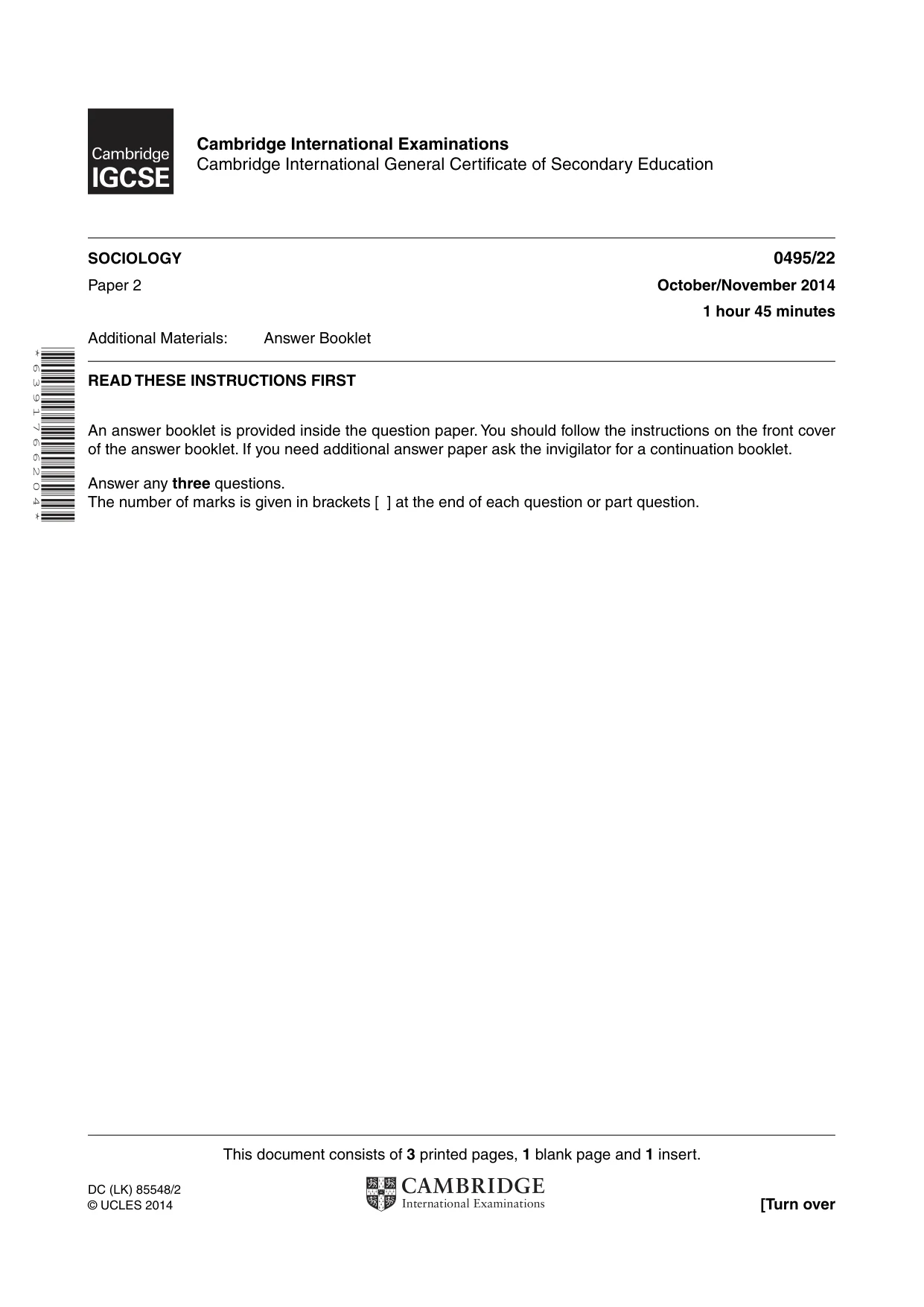
This document consists of 3 printed pages, 1 blank page and 1 insert. DC (LK) 85548/2 © UCLES 2014 [Turn over Cambridge International Examinations Cambridge International General Certificate of Secondary Education * 6 3 9 1 7 6 6 2 0 4 * SOCIOLOGY 0495/22 Paper 2 October/November 2014 1 hour 45 minutes Additional Materials: Answer Booklet READ THESE INSTRUCTIONS FIRST An answer booklet is provided inside the question paper. You should follow the instructions on the front cover of the answer booklet. If you need additional answer paper ask the invigilator for a continuation booklet. Answer any three questions. The number of marks is given in brackets [ ] at the end of each question or part question.
Question paper, page 2
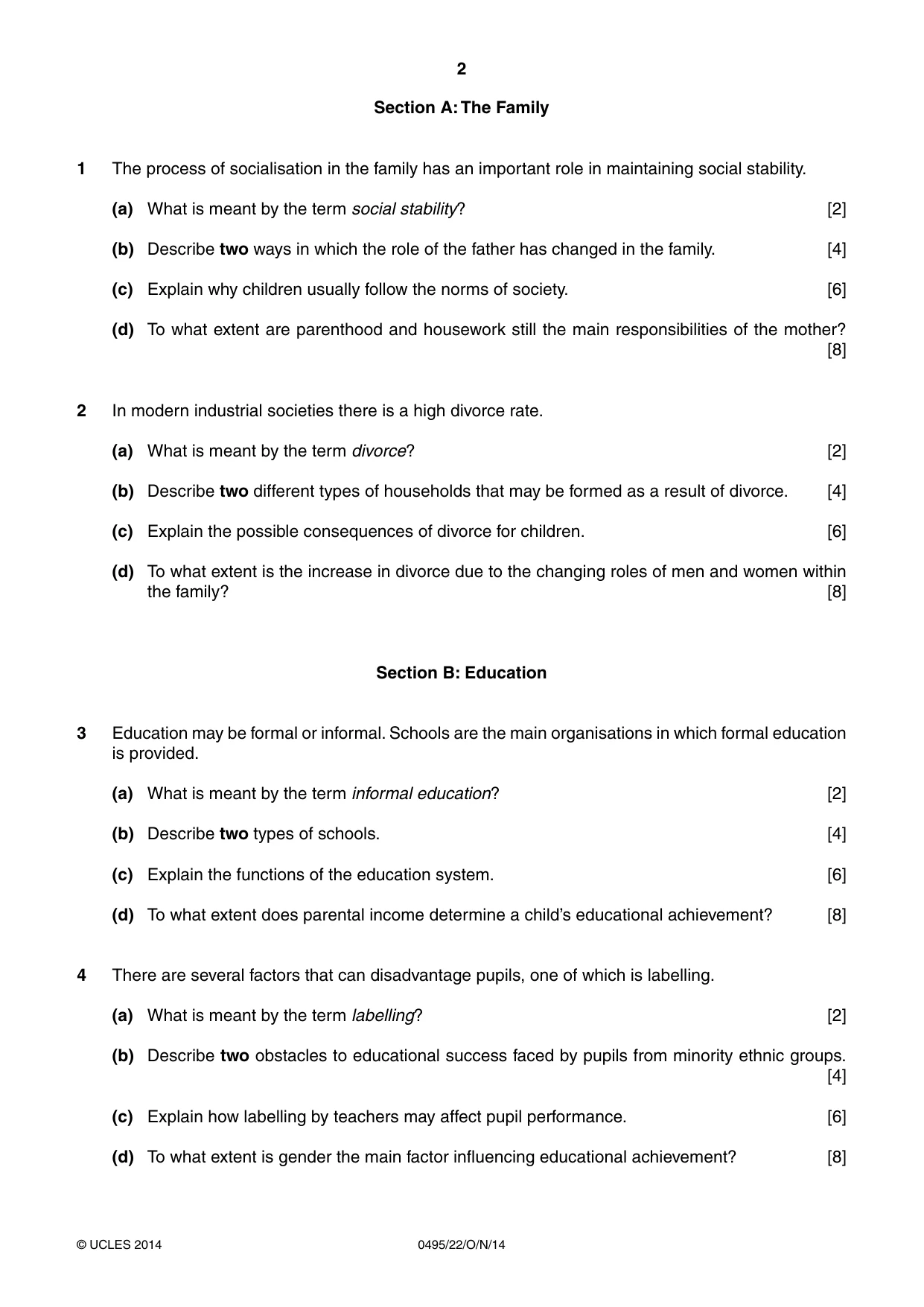
2 0495/22/O/N/14 © UCLES 2014 Section A: The Family 1 The process of socialisation in the family has an important role in maintaining social stability. (a) What is meant by the term social stability? [2] (b) Describe two ways in which the role of the father has changed in the family. [4] (c) Explain why children usually follow the norms of society. [6] (d) To what extent are parenthood and housework still the main responsibilities of the mother? [8] 2 In modern industrial societies there is a high divorce rate. (a) What is meant by the term divorce? [2] (b) Describe two different types of households that may be formed as a result of divorce. [4] (c) Explain the possible consequences of divorce for children. [6] (d) To what extent is the increase in divorce due to the changing roles of men and women within the family? [8] Section B: Education 3 Education may be formal or informal. Schools are the main organisations in which formal education is provided. (a) What is meant by the term informal education? [2] (b) Describe two types of schools. [4] (c) Explain the functions of the education system. [6] (d) To what extent does parental income determine a child’s educational achievement? [8] 4 There are several factors that can disadvantage pupils, one of which is labelling. (a) What is meant by the term labelling? [2] (b) Describe two obstacles to educational success faced by pupils from minority ethnic groups. [4] (c) Explain how labelling by teachers may affect pupil performance. [6] (d) To what extent is gender the main factor influencing educational achievement? [8]
Question paper, page 3
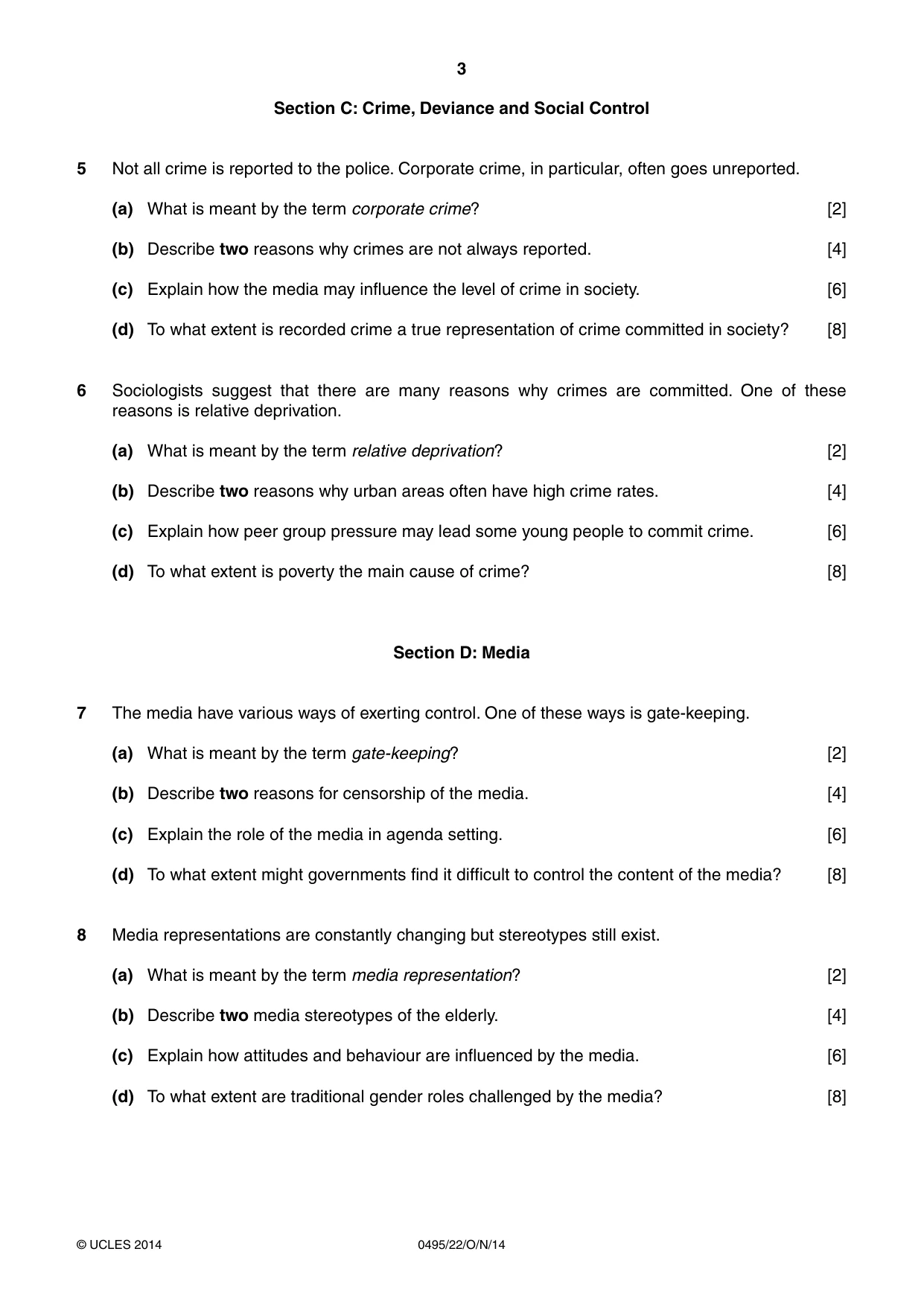
3 0495/22/O/N/14 © UCLES 2014 Section C: Crime, Deviance and Social Control 5 Not all crime is reported to the police. Corporate crime, in particular, often goes unreported. (a) What is meant by the term corporate crime? [2] (b) Describe two reasons why crimes are not always reported. [4] (c) Explain how the media may influence the level of crime in society. [6] (d) To what extent is recorded crime a true representation of crime committed in society? [8] 6 Sociologists suggest that there are many reasons why crimes are committed. One of these reasons is relative deprivation. (a) What is meant by the term relative deprivation? [2] (b) Describe two reasons why urban areas often have high crime rates. [4] (c) Explain how peer group pressure may lead some young people to commit crime. [6] (d) To what extent is poverty the main cause of crime? [8] Section D: Media 7 The media have various ways of exerting control. One of these ways is gate-keeping. (a) What is meant by the term gate-keeping? [2] (b) Describe two reasons for censorship of the media. [4] (c) Explain the role of the media in agenda setting. [6] (d) To what extent might governments find it difficult to control the content of the media? [8] 8 Media representations are constantly changing but stereotypes still exist. (a) What is meant by the term media representation? [2] (b) Describe two media stereotypes of the elderly. [4] (c) Explain how attitudes and behaviour are influenced by the media. [6] (d) To what extent are traditional gender roles challenged by the media? [8]
Question paper, page 4
4 0495/22/O/N/14 © UCLES 2014 Permission to reproduce items where third-party owned material protected by copyright is included has been sought and cleared where possible. Every reasonable effort has been made by the publisher (UCLES) to trace copyright holders, but if any items requiring clearance have unwittingly been included, the publisher will be pleased to make amends at the earliest possible opportunity. Cambridge International Examinations is part of the Cambridge Assessment Group. Cambridge Assessment is the brand name of University of Cambridge Local Examinations Syndicate (UCLES), which is itself a department of the University of Cambridge. BLANK PAGE
Mark scheme, page 1
® IGCSE is the registered trademark of Cambridge International Examinations. CAMBRIDGE INTERNATIONAL EXAMINATIONS Cambridge International General Certificate of Secondary Education MARK SCHEME for the October/November 2014 series 0495 SOCIOLOGY 0495/22 Paper 2, maximum raw mark 60 This mark scheme is published as an aid to teachers and candidates, to indicate the requirements of the examination. It shows the basis on which Examiners were instructed to award marks. It does not indicate the details of the discussions that took place at an Examiners’ meeting before marking began, which would have considered the acceptability of alternative answers. Mark schemes should be read in conjunction with the question paper and the Principal Examiner Report for Teachers. Cambridge will not enter into discussions about these mark schemes. Cambridge is publishing the mark schemes for the October/November 2014 series for most Cambridge IGCSE®, Cambridge International A and AS Level components and some Cambridge O Level components. PAPA CAMBRIDGE
Mark scheme, page 2
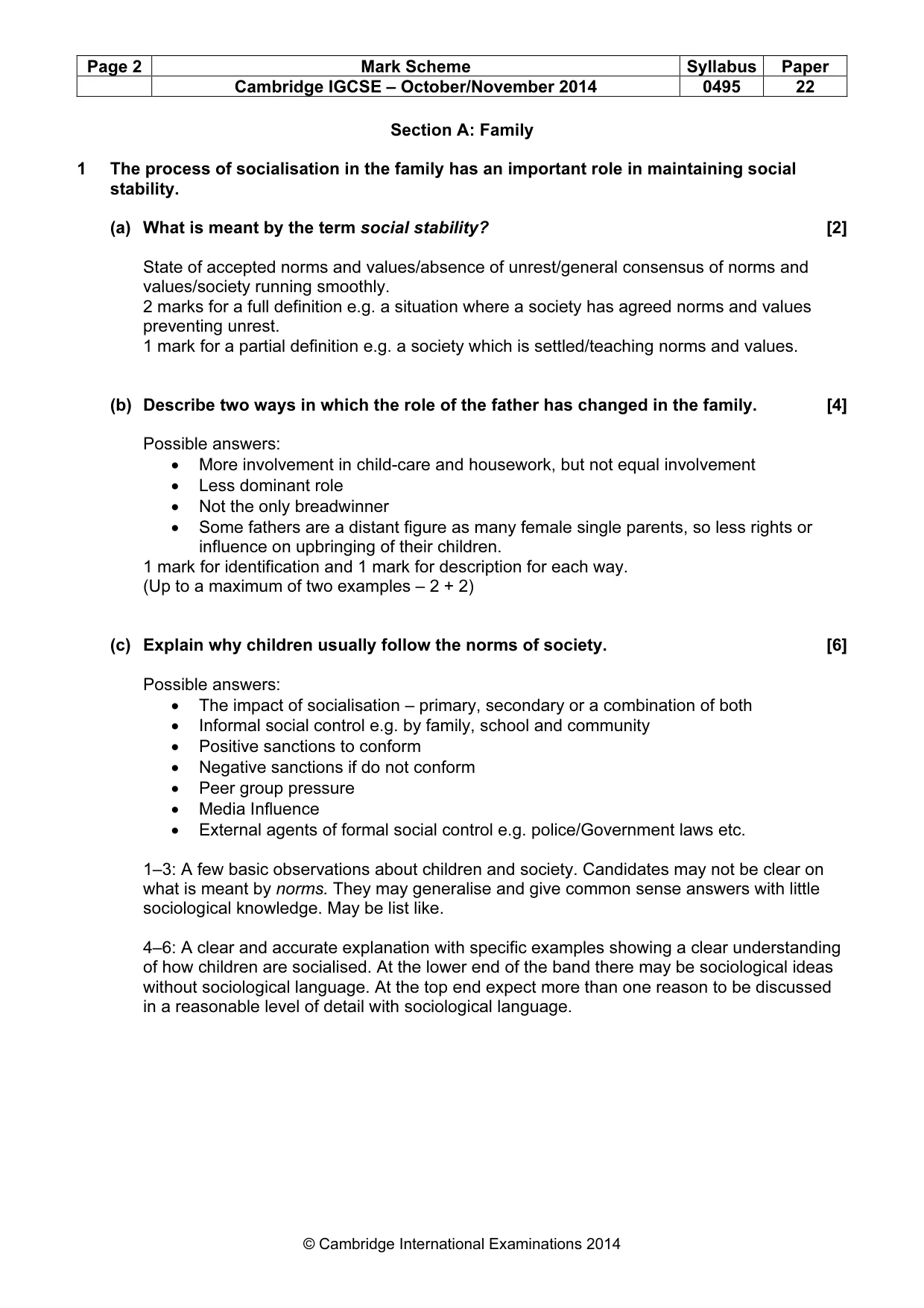
Page 2 Mark Scheme Syllabus Paper Cambridge IGCSE – October/November 2014 0495 22 © Cambridge International Examinations 2014 Section A: Family 1 The process of socialisation in the family has an important role in maintaining social stability. (a) What is meant by the term social stability? [2] State of accepted norms and values/absence of unrest/general consensus of norms and values/society running smoothly. 2 marks for a full definition e.g. a situation where a society has agreed norms and values preventing unrest. 1 mark for a partial definition e.g. a society which is settled/teaching norms and values. (b) Describe two ways in which the role of the father has changed in the family. [4] Possible answers: • More involvement in child-care and housework, but not equal involvement • Less dominant role • Not the only breadwinner • Some fathers are a distant figure as many female single parents, so less rights or influence on upbringing of their children. 1 mark for identification and 1 mark for description for each way. (Up to a maximum of two examples – 2 + 2) (c) Explain why children usually follow the norms of society. [6] Possible answers: • The impact of socialisation – primary, secondary or a combination of both • Informal social control e.g. by family, school and community • Positive sanctions to conform • Negative sanctions if do not conform • Peer group pressure • Media Influence • External agents of formal social control e.g. police/Government laws etc. 1–3: A few basic observations about children and society. Candidates may not be clear on what is meant by norms. They may generalise and give common sense answers with little sociological knowledge. May be list like. 4–6: A clear and accurate explanation with specific examples showing a clear understanding of how children are socialised. At the lower end of the band there may be sociological ideas without sociological language. At the top end expect more than one reason to be discussed in a reasonable level of detail with sociological language.
Mark scheme, page 3
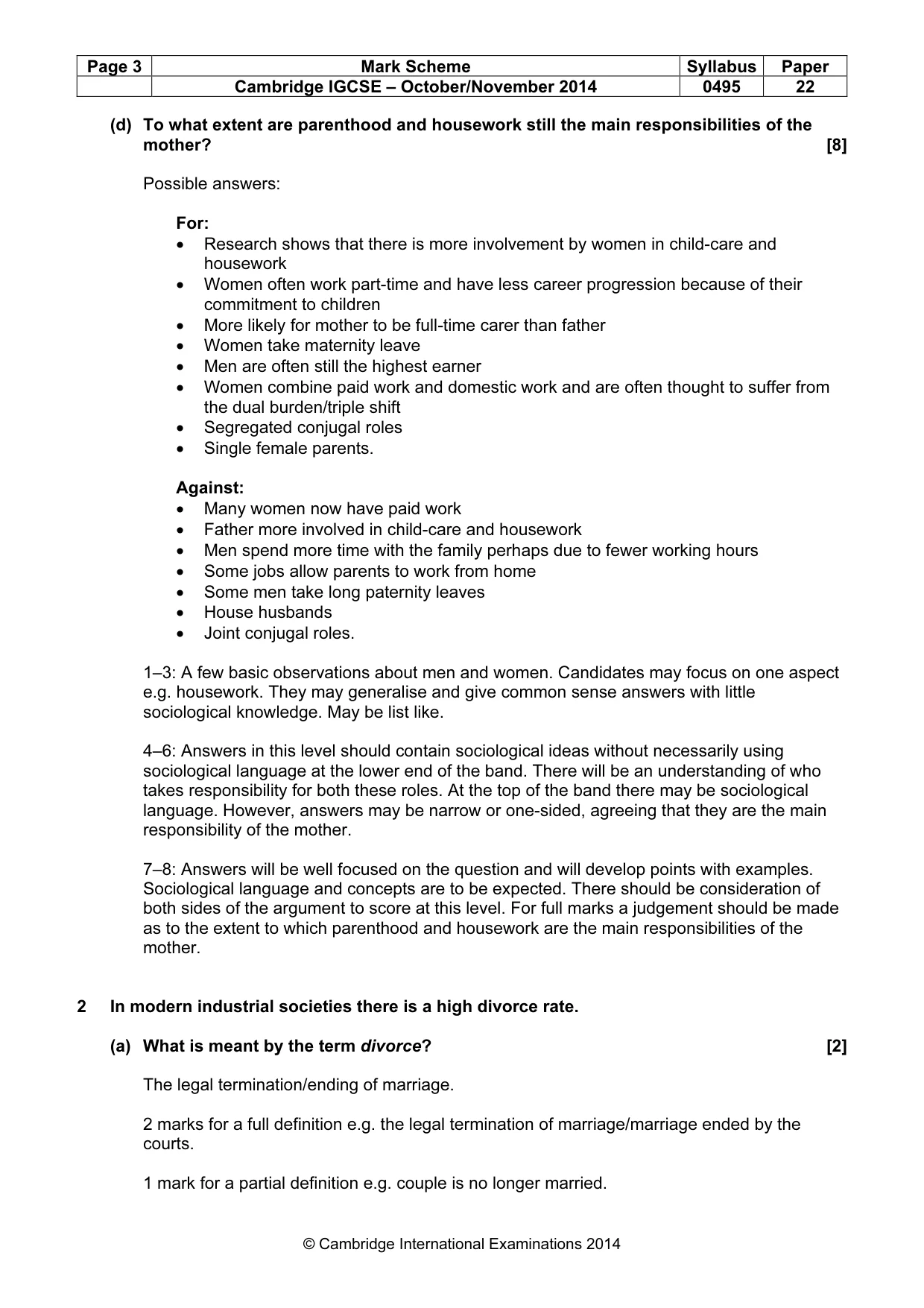
Page 3 Mark Scheme Syllabus Paper Cambridge IGCSE – October/November 2014 0495 22 © Cambridge International Examinations 2014 (d) To what extent are parenthood and housework still the main responsibilities of the mother? [8] Possible answers: For: • Research shows that there is more involvement by women in child-care and housework • Women often work part-time and have less career progression because of their commitment to children • More likely for mother to be full-time carer than father • Women take maternity leave • Men are often still the highest earner • Women combine paid work and domestic work and are often thought to suffer from the dual burden/triple shift • Segregated conjugal roles • Single female parents. Against: • Many women now have paid work • Father more involved in child-care and housework • Men spend more time with the family perhaps due to fewer working hours • Some jobs allow parents to work from home • Some men take long paternity leaves • House husbands • Joint conjugal roles. 1–3: A few basic observations about men and women. Candidates may focus on one aspect e.g. housework. They may generalise and give common sense answers with little sociological knowledge. May be list like. 4–6: Answers in this level should contain sociological ideas without necessarily using sociological language at the lower end of the band. There will be an understanding of who takes responsibility for both these roles. At the top of the band there may be sociological language. However, answers may be narrow or one-sided, agreeing that they are the main responsibility of the mother. 7–8: Answers will be well focused on the question and will develop points with examples. Sociological language and concepts are to be expected. There should be consideration of both sides of the argument to score at this level. For full marks a judgement should be made as to the extent to which parenthood and housework are the main responsibilities of the mother. 2 In modern industrial societies there is a high divorce rate. (a) What is meant by the term divorce? [2] The legal termination/ending of marriage. 2 marks for a full definition e.g. the legal termination of marriage/marriage ended by the courts. 1 mark for a partial definition e.g. couple is no longer married.
Mark scheme, page 4
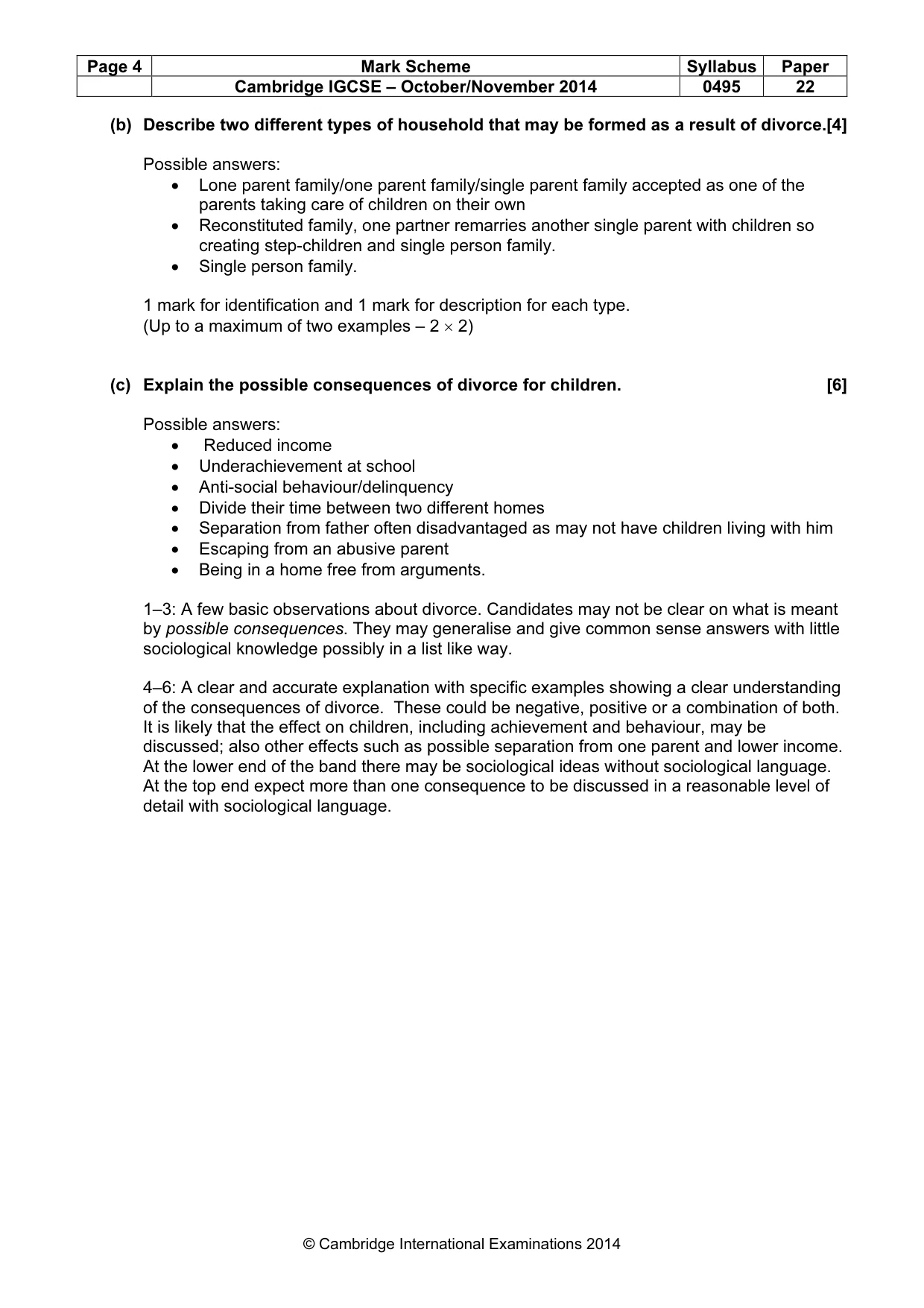
Page 4 Mark Scheme Syllabus Paper Cambridge IGCSE – October/November 2014 0495 22 © Cambridge International Examinations 2014 (b) Describe two different types of household that may be formed as a result of divorce. [4] Possible answers: • Lone parent family/one parent family/single parent family accepted as one of the parents taking care of children on their own • Reconstituted family, one partner remarries another single parent with children so creating step-children and single person family. • Single person family. 1 mark for identification and 1 mark for description for each type. (Up to a maximum of two examples – 2 × 2) (c) Explain the possible consequences of divorce for children. [6] Possible answers: • Reduced income • Underachievement at school • Anti-social behaviour/delinquency • Divide their time between two different homes • Separation from father often disadvantaged as may not have children living with him • Escaping from an abusive parent • Being in a home free from arguments. 1–3: A few basic observations about divorce. Candidates may not be clear on what is meant by possible consequences. They may generalise and give common sense answers with little sociological knowledge possibly in a list like way. 4–6: A clear and accurate explanation with specific examples showing a clear understanding of the consequences of divorce. These could be negative, positive or a combination of both. It is likely that the effect on children, including achievement and behaviour, may be discussed; also other effects such as possible separation from one parent and lower income. At the lower end of the band there may be sociological ideas without sociological language. At the top end expect more than one consequence to be discussed in a reasonable level of detail with sociological language.
Mark scheme, page 5
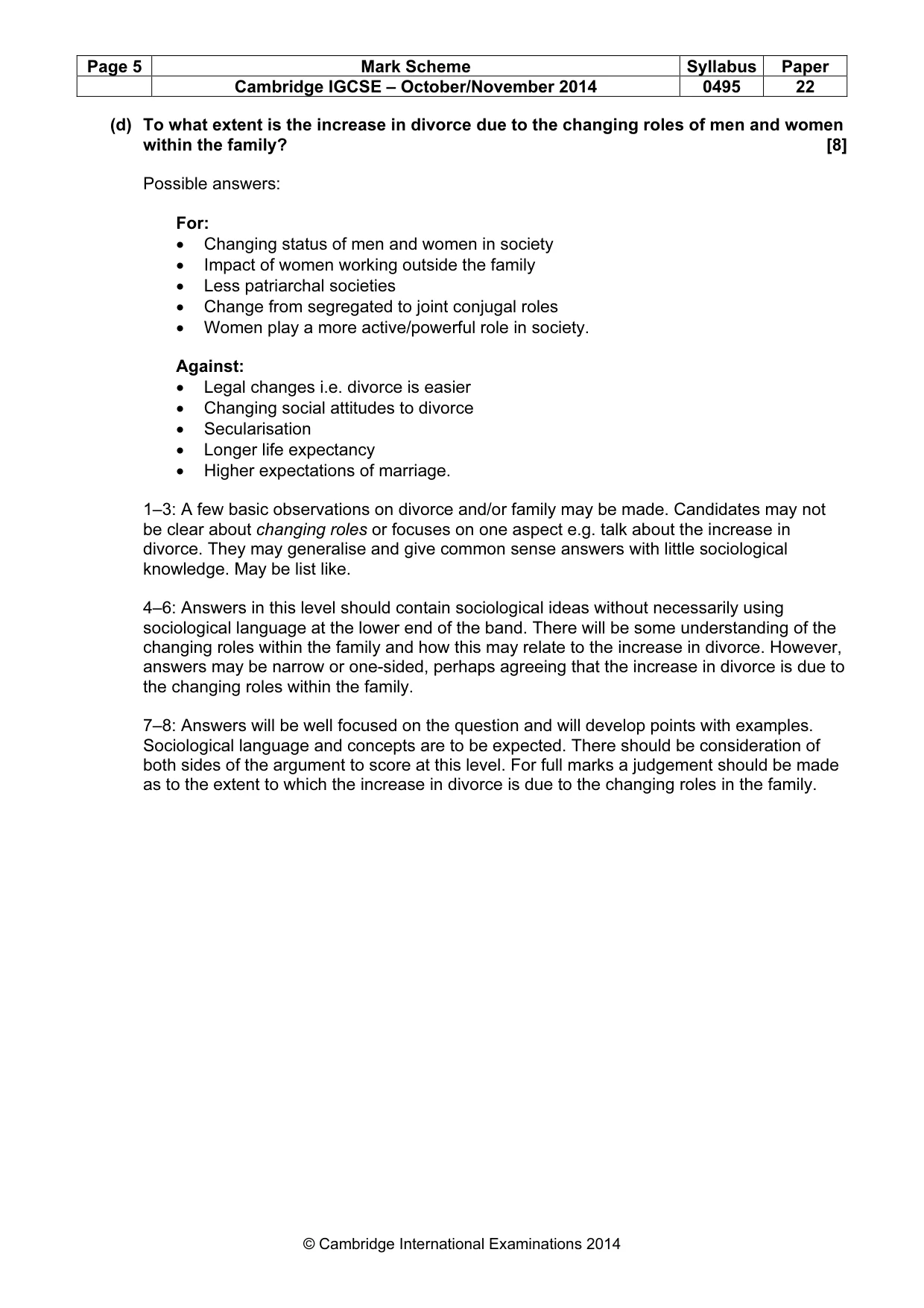
Page 5 Mark Scheme Syllabus Paper Cambridge IGCSE – October/November 2014 0495 22 © Cambridge International Examinations 2014 (d) To what extent is the increase in divorce due to the changing roles of men and women within the family? [8] Possible answers: For: • Changing status of men and women in society • Impact of women working outside the family • Less patriarchal societies • Change from segregated to joint conjugal roles • Women play a more active/powerful role in society. Against: • Legal changes i.e. divorce is easier • Changing social attitudes to divorce • Secularisation • Longer life expectancy • Higher expectations of marriage. 1–3: A few basic observations on divorce and/or family may be made. Candidates may not be clear about changing roles or focuses on one aspect e.g. talk about the increase in divorce. They may generalise and give common sense answers with little sociological knowledge. May be list like. 4–6: Answers in this level should contain sociological ideas without necessarily using sociological language at the lower end of the band. There will be some understanding of the changing roles within the family and how this may relate to the increase in divorce. However, answers may be narrow or one-sided, perhaps agreeing that the increase in divorce is due to the changing roles within the family. 7–8: Answers will be well focused on the question and will develop points with examples. Sociological language and concepts are to be expected. There should be consideration of both sides of the argument to score at this level. For full marks a judgement should be made as to the extent to which the increase in divorce is due to the changing roles in the family.
Mark scheme, page 6
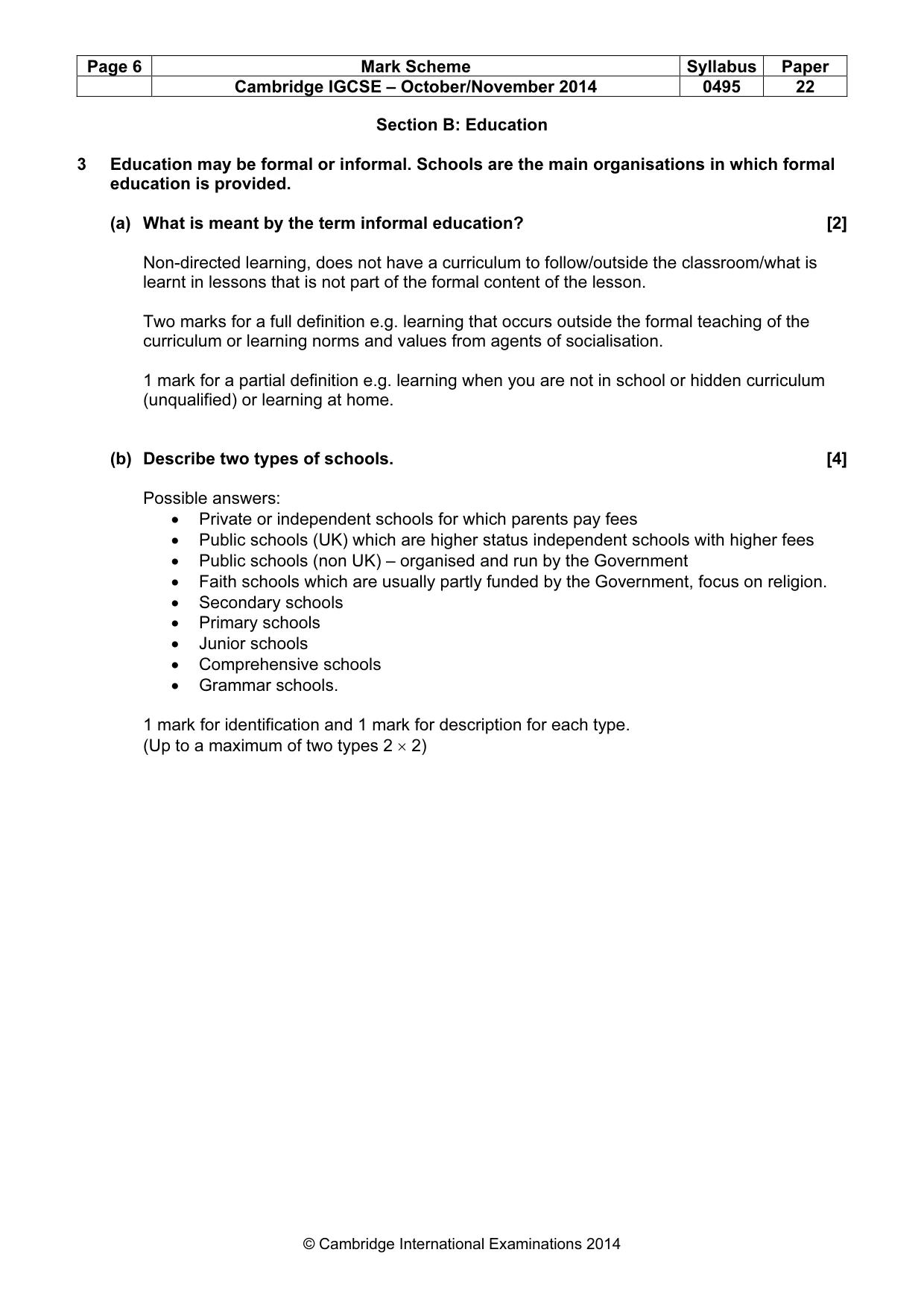
Page 6 Mark Scheme Syllabus Paper Cambridge IGCSE – October/November 2014 0495 22 © Cambridge International Examinations 2014 Section B: Education 3 Education may be formal or informal. Schools are the main organisations in which formal education is provided. (a) What is meant by the term informal education? [2] Non-directed learning, does not have a curriculum to follow/outside the classroom/what is learnt in lessons that is not part of the formal content of the lesson. Two marks for a full definition e.g. learning that occurs outside the formal teaching of the curriculum or learning norms and values from agents of socialisation. 1 mark for a partial definition e.g. learning when you are not in school or hidden curriculum (unqualified) or learning at home. (b) Describe two types of schools. [4] Possible answers: • Private or independent schools for which parents pay fees • Public schools (UK) which are higher status independent schools with higher fees • Public schools (non UK) – organised and run by the Government • Faith schools which are usually partly funded by the Government, focus on religion. • Secondary schools • Primary schools • Junior schools • Comprehensive schools • Grammar schools. 1 mark for identification and 1 mark for description for each type. (Up to a maximum of two types 2 × 2)
Mark scheme, page 7
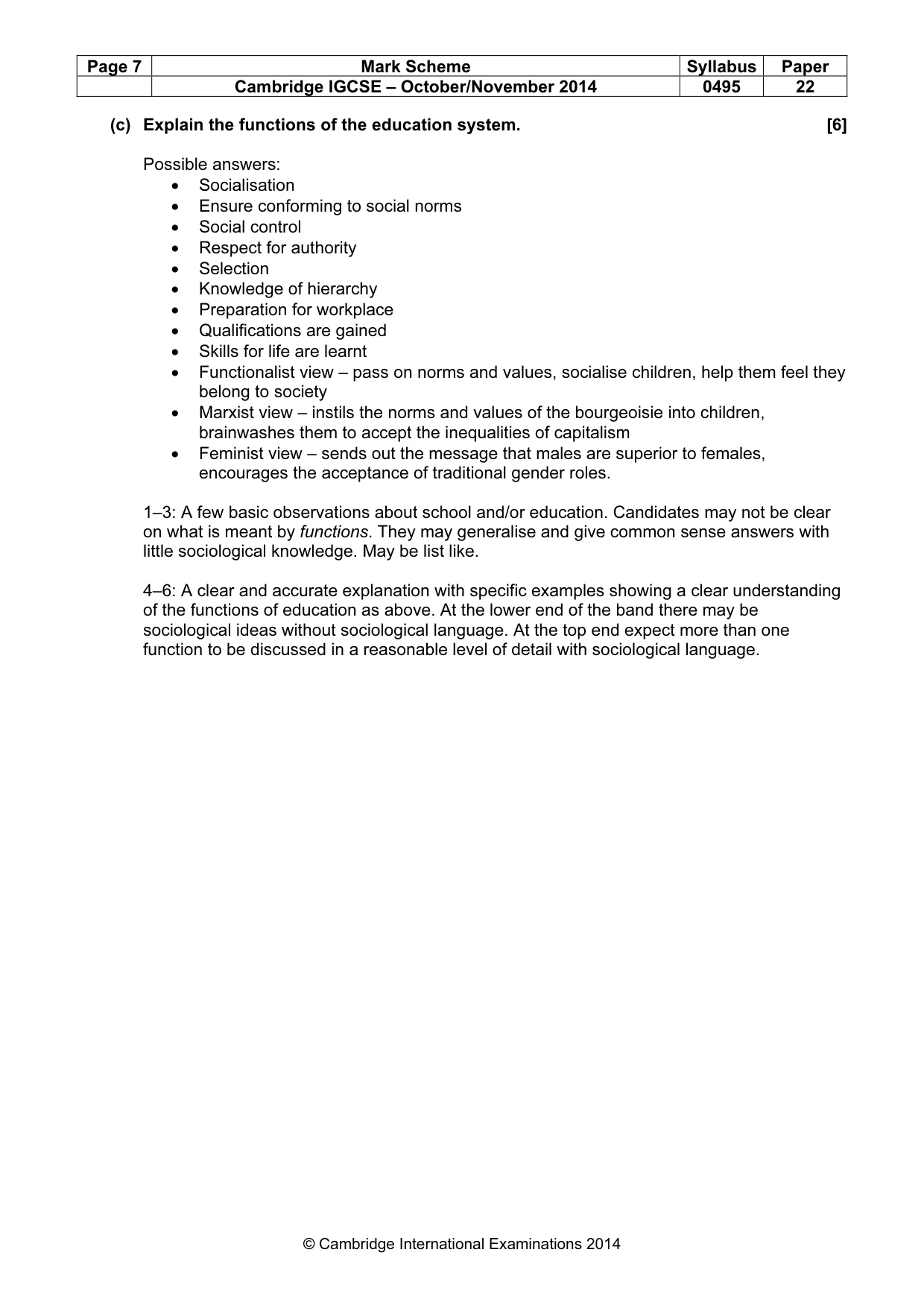
Page 7 Mark Scheme Syllabus Paper Cambridge IGCSE – October/November 2014 0495 22 © Cambridge International Examinations 2014 (c) Explain the functions of the education system. [6] Possible answers: • Socialisation • Ensure conforming to social norms • Social control • Respect for authority • Selection • Knowledge of hierarchy • Preparation for workplace • Qualifications are gained • Skills for life are learnt • Functionalist view – pass on norms and values, socialise children, help them feel they belong to society • Marxist view – instils the norms and values of the bourgeoisie into children, brainwashes them to accept the inequalities of capitalism • Feminist view – sends out the message that males are superior to females, encourages the acceptance of traditional gender roles. 1–3: A few basic observations about school and/or education. Candidates may not be clear on what is meant by functions. They may generalise and give common sense answers with little sociological knowledge. May be list like. 4–6: A clear and accurate explanation with specific examples showing a clear understanding of the functions of education as above. At the lower end of the band there may be sociological ideas without sociological language. At the top end expect more than one function to be discussed in a reasonable level of detail with sociological language.
Mark scheme, page 8
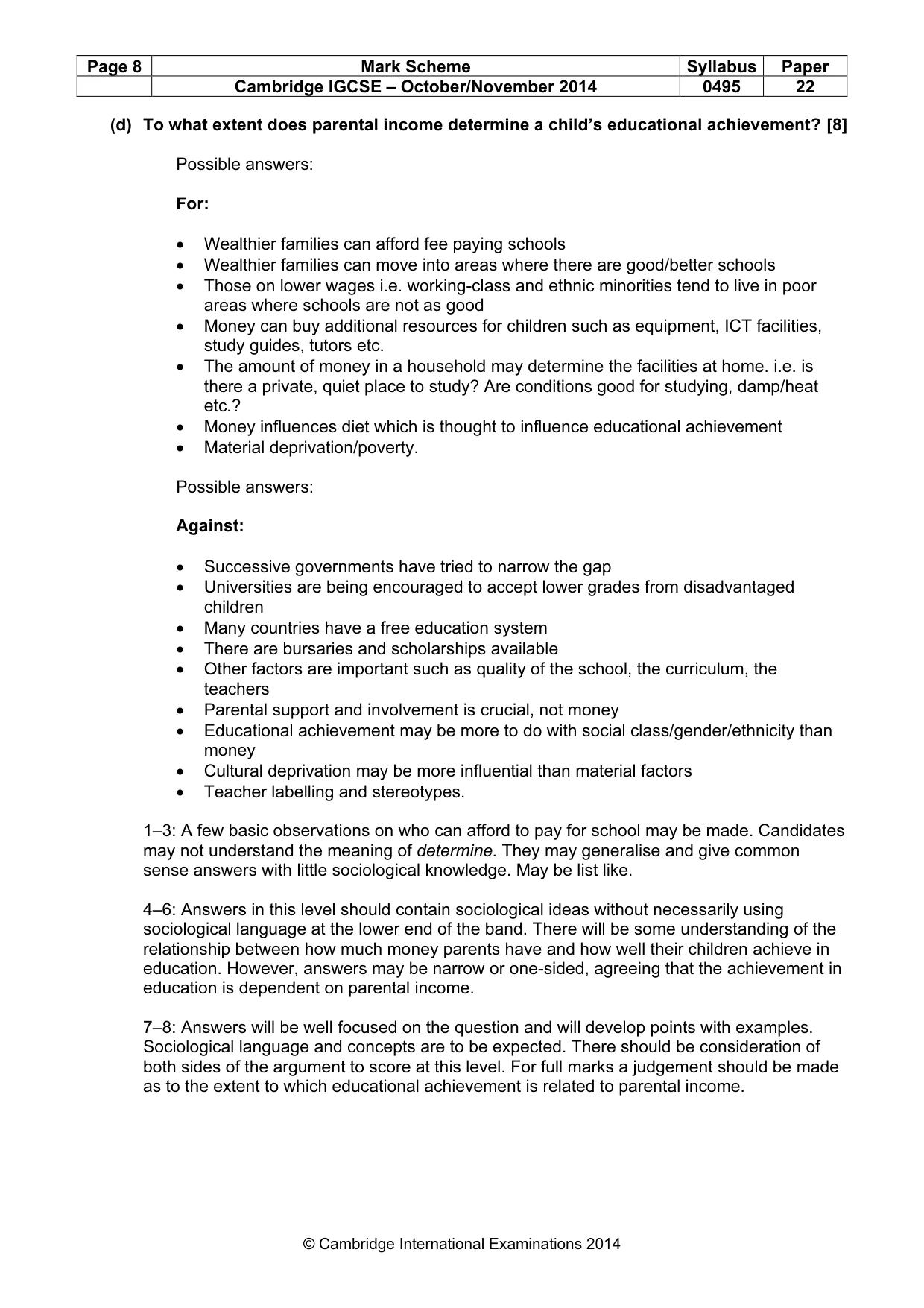
Page 8 Mark Scheme Syllabus Paper Cambridge IGCSE – October/November 2014 0495 22 © Cambridge International Examinations 2014 (d) To what extent does parental income determine a child’s educational achievement? [8] Possible answers: For: • Wealthier families can afford fee paying schools • Wealthier families can move into areas where there are good/better schools • Those on lower wages i.e. working-class and ethnic minorities tend to live in poor areas where schools are not as good • Money can buy additional resources for children such as equipment, ICT facilities, study guides, tutors etc. • The amount of money in a household may determine the facilities at home. i.e. is there a private, quiet place to study? Are conditions good for studying, damp/heat etc.? • Money influences diet which is thought to influence educational achievement • Material deprivation/poverty. Possible answers: Against: • Successive governments have tried to narrow the gap • Universities are being encouraged to accept lower grades from disadvantaged children • Many countries have a free education system • There are bursaries and scholarships available • Other factors are important such as quality of the school, the curriculum, the teachers • Parental support and involvement is crucial, not money • Educational achievement may be more to do with social class/gender/ethnicity than money • Cultural deprivation may be more influential than material factors • Teacher labelling and stereotypes. 1–3: A few basic observations on who can afford to pay for school may be made. Candidates may not understand the meaning of determine. They may generalise and give common sense answers with little sociological knowledge. May be list like. 4–6: Answers in this level should contain sociological ideas without necessarily using sociological language at the lower end of the band. There will be some understanding of the relationship between how much money parents have and how well their children achieve in education. However, answers may be narrow or one-sided, agreeing that the achievement in education is dependent on parental income. 7–8: Answers will be well focused on the question and will develop points with examples. Sociological language and concepts are to be expected. There should be consideration of both sides of the argument to score at this level. For full marks a judgement should be made as to the extent to which educational achievement is related to parental income.
Mark scheme, page 9
Page 9 Mark Scheme Syllabus Paper Cambridge IGCSE – October/November 2014 0495 22 © Cambridge International Examinations 2014 4 There are several factors that can disadvantage pupils, one of which is labelling. (a) What is meant by the term labelling? [2] Defining a person or a group of people in a particular way, often based on stereotypes, so that certain behaviour is expected from them. 2 marks for a full definition e.g. a particular perception of a person or group. 1 mark for a partial definition e.g. a stereotype/tagging a student/thinking of someone in a certain way. (b) Describe two obstacles to educational success faced by pupils from minority ethnic groups. [4] Possible answers: • Language barriers • Ethnocentricity of school • Labelling • Stereotyping • Self-fulfilling prophecy • May share the material deprivation of the working class • Few ethnic minority teachers/lack of role models • Different ideas about the value of education to boys and girls. 1 mark for identification and 1 mark for description of each obstacle. (Up to a maximum of two obstacles 2 × 2) (c) Explain how labelling by teachers may affect pupil performance. [6] Candidates may discuss the concept generally in their answer or may focus on specific examples such as social class, ethnicity and gender. Either way is fine to credit. Possible answers: • Teacher expectations • Self-fulfilling prophecy • Setting and streaming leading to anti-school cultures • High-performing students improving • Low-performing students not improving, accepting the label • Self-negating prophecy – rejecting the label given • Girls and boys opting for gender specific subjects. 1-3: A few basic observations on the influence of teachers. Candidates may not be clear on what is meant by labelling and/or pupil performance in schools. They may generalise and give common sense answers with little sociological knowledge e.g. whether the teacher likes you or not. May be list like. 4-6: A clear and accurate explanation with specific examples showing a clear understanding of the effect of labelling and its relationship to achievement in school. Candidates may show knowledge of specific groups such as the working class and ethnic minorities. At the lower end of the band there may be sociological ideas without sociological language. At the top end expect more than one example to be discussed in a reasonable level of detail with sociological language.
Mark scheme, page 10
Page 10 Mark Scheme Syllabus Paper Cambridge IGCSE – October/November 2014 0495 22 © Cambridge International Examinations 2014 (d) To what extent is gender the main factor influencing educational achievement? [8] Possible answers for: • Different expectations of achievement of boys and girls by parents and teachers • Different subject expectations/choices e.g. boys in maths, science and engineering, girls in communication/caring/creative subjects • Different career expectations and ambitions by boys, girls, teachers and parents • Accept that there will be cultural differences in the answers; still some countries where more expectation on boys to achieve in education. Possible answers against: • Equal opportunities • Other factors such as class/ethnicity • Teacher expectations as the main factor • Parental expectation as influential • Less of a factor than it used to be in most countries • Gender may be one of the factors but neither the main or the sole one. 1–3: A few basic observations which may focus on some misunderstanding of gender or simply say that girls do better than boys in school. They may generalise and give common sense answers with little sociological knowledge. May be list like. 4–6: Answers in this level should contain sociological ideas without necessarily using sociological language at the lower end of the band. There will be an understanding of how one gender performs differently to the other. However, answers may be narrow or one-sided, not offering alternative influences on educational achievement. 7–8: Answers will be well-focused on the question and will develop points with examples. Sociological language and concepts are to be expected. There should be consideration of both sides of the argument to score at this level. For full marks a judgement should be made as to the extent to which gender is the main influence on educational achievement. There should be consideration of other important influences such as home and class factors.
Mark scheme, page 11
Page 11 Mark Scheme Syllabus Paper Cambridge IGCSE – October/November 2014 0495 22 © Cambridge International Examinations 2014 Section C: Crime, Deviance and Social Control 5 Not all crime is reported to the police. Corporate crime, in particular, often goes unreported. (a) What is meant by the term corporate crime? [2] Illegal acts committed by a business or corporation or by individuals acting on behalf of a business; usually in pursuit of profit for the corporation rather than for the benefit of individuals. 2 marks for a full definition e.g. crime committed by a corporation/organisation or individual acting on behalf of a corporation. Crimes committed by companies in pursuit of obtaining monitory profit margins for the company. 1 mark for a partial definition e.g. crime that happens in a business/white collar crime. (b) Describe two reasons why crimes are not always reported. [4] Possible answers: • Embarrassment e.g. sexual crimes • The fear of what will happen to them if they report crime in certain neighbourhoods – retaliation • The thought that the police will not do anything • It may seem trivial i.e. petty crime • Businesses may prefer to dismiss rather than expose themselves in the media. • Dealt with by the organisation themselves i.e. corporate crime/white collar crime/crimes in the armed forces etc. • People aren’t always aware that a crime has occurred i.e. a small amount of money goes missing • If an individual operates in a criminal world i.e. a drug dealer/gang member they would be unlikely to report. 1 mark for identification and 1 mark for description for each reason. (Up to a maximum of two examples 2 × 2)
Mark scheme, page 12
Page 12 Mark Scheme Syllabus Paper Cambridge IGCSE – October/November 2014 0495 22 © Cambridge International Examinations 2014 (c) Explain how the media may influence the level of crime in society. [6] Possible answers: • Draw attention of the public to a particular issue • Alert the police to a crime problem • Police may target that area or crime with increased manpower and resources based on media reporting • It may lead to a moral panic • Examples of London riots in 2011 – publicity led to them spreading • May influence crimes to come down if the public see the consequences of criminal behaviour • May lead to crime rates rising if people copy what they have seen i.e. copycatting • May create folk devils and moral panics. 1–3: A few basic observations on the influence of the media on behaviour. Candidate will have simplistic understanding of this – possibly copying. They may generalise and give common sense answers with little sociological knowledge. May be list like. 4–6: A clear and accurate explanation with specific examples showing a clear understanding of the relationship between crime and media attention. Candidates may show knowledge of moral panic and reaction of police to media attention. At the lower end of the band there may be sociological ideas without sociological language. At the top end expect more than one way to be discussed in a reasonable level of detail with sociological language.
Mark scheme, page 13
Page 13 Mark Scheme Syllabus Paper Cambridge IGCSE – October/November 2014 0495 22 © Cambridge International Examinations 2014 (d) To what extent is recorded crime a true representation of crime committed in society? [8] For: • Official Statistics are an annual national survey therefore are up to date • Useful information on rates of crime and areas where crime is committed • Recorded crime is based on facts/figures • Recorded crime has been put together by sources perceived to be trustworthy i.e. the Government and the police • Recorded crime is the official figure used by Governments and official agencies to determine policy. Against: • Recorded crime e.g. Official Statistics only show a proportion of crime committed • Dark figure of crime/hidden figure • Evidence of self-report studies and victim surveys that show very different pictures of crime • Reflects influence of police targeting and media attention • A crime has to be recognised as such to be recorded • The public frequently don’t report all crimes • Police don’t record all crimes reported i.e. police discretion/perceived as too petty etc. • Official figures underrepresent white collar and corporate crimes. 1–3: A few basic observations on the amount of crime in society. Candidates may not understand the significance of the difference between recorded crime and committed crime. They may generalise and give common sense answers with little sociological knowledge. May be list like. 4–6: Answers in this level should contain sociological ideas without necessarily using sociological language at the lower end of the band. There will be an understanding of how/why crime is recorded and the advantages of the Official Statistics. However, answers may be narrow or one-sided, showing some lack of awareness of unrecorded crime. 7–8: Answers will be well focused on the question and will develop points with examples. Sociological language and concepts are to be expected. There should be consideration of both sides of the argument to score at this level. For full marks a judgement should be made as to the extent to which recorded crime represents how much crime there is in society. There should be an awareness of the dark figure of crime and how this is known about. Different ways of measuring crime such as victim surveys and self-report studies may be discussed.
Mark scheme, page 14
Page 14 Mark Scheme Syllabus Paper Cambridge IGCSE – October/November 2014 0495 22 © Cambridge International Examinations 2014 6 Sociologists suggest that there are many reasons why crimes are committed. One of these reasons is relative deprivation. (a) What is meant by the term relative deprivation? [2] They do not have what most people in the society have as far as material goods, opportunities and living standards are concerned. A feeling of having less than others. 2 marks for a full definition e.g. the state of having less material goods, opportunities and lower living standards than most other people in society. 1 mark for a partial definition e.g. not being well-off. A partial definition may only focus on either ‘relative’ or deprivation’. (b) Describe two reasons why urban areas often have high crime rates. [4] Possible answers: • Urban areas are often areas of high unemployment • Areas where large numbers of ethnic minority and working-class groups live who, according to statistics, are most likely to commit crime • Areas of poverty • There is often a higher number of police in urban areas to detect crime • More consumer goods available i.e. more temptation • Night-time economy • Surveillance by C.C.T.V. • More opportunity • Could link urban areas to places that richer people live in too therefore more temptation. 1 mark for identification and 1 mark for description for each reason. (Up to a maximum of two reasons – 2 × 2) (c) Explain how peer group pressure may lead some young people to commit crime. [6] Possible answers: • May join groups because afraid not to i.e. gangs and a fear of the consequences • May be encouraged to commit crime as part of initiation • May get involved because they want to fit in • To gain status • Part of a sub-culture • Peer group as an influential agent of socialisation and informal social control • Fear of rejection/isolation/exclusion from the group. 1–3: A few basic observations on young people committing crime. Candidate may not understand peer group pressure. They may generalise about young people and crime, giving common sense answers with little sociological knowledge. May be list like. 4–6: A clear and accurate explanation with specific examples showing a clear understanding of peer group pressure with relevant examples. Candidates may show knowledge of positive and negative sanctions, status and different sub-cultures. At the lower end of the band there may be sociological ideas without sociological language. At the top end expect more than one example to be discussed in a reasonable level of detail with sociological language.
Mark scheme, page 15
Page 15 Mark Scheme Syllabus Paper Cambridge IGCSE – October/November 2014 0495 22 © Cambridge International Examinations 2014 (d) To what extent is poverty the main cause of crime? [8] Possible answers: For: • Social/relative/material deprivation • Unemployment • Lack of legitimate means to achieve material and life goals • Anomie • Poor performance in school • Lack of life chances/opportunities. Possible answers: Against: • White-collar crime e.g. fraud • Other crime unrelated to poverty such as crimes in relationships/expressive crimes • Assaults / violence i.e. expressive crimes • Labelling and the self-fulfilling prophecy • Police targeting of certain groups • Inadequate socialisation • Maybe more about ethnicity/gender/age than poverty. 1–3: A few basic observations on why poor people commit crime. Candidates may express this in simplistic terms, e .g. they have no money so they steal. They may generalise and give common sense answers with little sociological knowledge. Maybe list like. 4–6: Answers in this level should contain sociological ideas without necessarily using sociological language. There will be some understanding of why poverty may be related to crime with reasons why e.g. unemployment, poor achievement in school etc. However, answers may be narrow or one-sided, agreeing that poverty is the main cause of crime. 7–8: Answers will be well focused on the question and will develop points with examples. Sociological language and concepts are to be expected. There should be consideration of both sides of the argument to score at this level. For full marks a judgement should be made as to the extent to which crime is related to poverty. There should be an awareness of the amount of crime committed which is not related to poverty.
Mark scheme, page 16
Page 16 Mark Scheme Syllabus Paper Cambridge IGCSE – October/November 2014 0495 22 © Cambridge International Examinations 2014 Section D: Media 7 The media have various ways of exerting control. One of these ways is gate-keeping. (a) What is meant by the term gate-keeping? [2] Deciding which ideas/stories will go in the media. 2 marks for a full definition e.g. the process by which an editor or others decide what should be published or broadcast. 1 mark for a partial definition e.g. deciding not to publish certain things. (b) Describe two reasons for censorship of the media. [4] Possible answers: • Prevent citizens from finding out certain things • To protect children and others from obscene content • To protect the interests of the Government/ruling class • To prevent discrimination • To prevent the publication of untrue/unverified information • To protect countries/citizens/individuals in times of war and national unrest 1 mark for identification and 1 mark for description for each reason. (Up to a maximum of two ways – 2 × 2) (c) Explain the role of the media in agenda setting. [6] Possible answers: • Reflect the interests of owner and those in power in society • Editors on campaigns which will attract publicity and sell advertising • Advertisers and main players in commercial areas such as theatre and cinema • Create and/or reinforce stereotypical representations of certain social groups • Reinforce and maintain certain accepted norms and values • Create moral panics and folk devils. Agenda setting: the ability of the media to make some topics important and to decide which subjects are appropriate for news/discussion. 1–3: Candidate may not understand the term agenda setting. They may generalise about what the media does and give common sense answers with little sociological knowledge. Maybe list like. 4–6: A clear and accurate explanation with specific examples showing a clear understanding of the different elements of the media who have reason to focus on particular subject areas and events. At the lower end of the band there may be sociological ideas without sociological language. At the top end expect more than one example to be discussed in a reasonable level of detail with sociological language.
Mark scheme, page 17
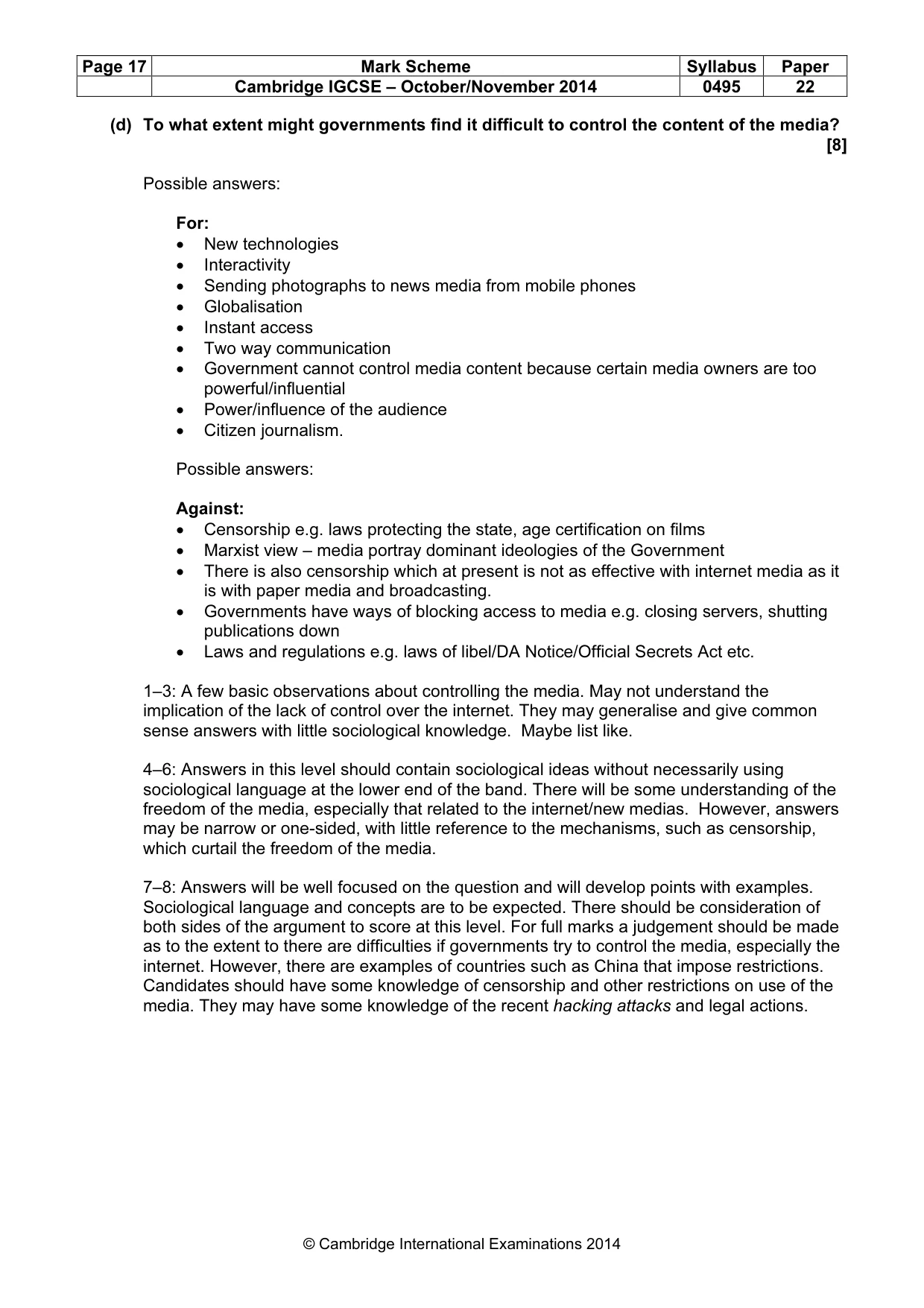
Page 17 Mark Scheme Syllabus Paper Cambridge IGCSE – October/November 2014 0495 22 © Cambridge International Examinations 2014 (d) To what extent might governments find it difficult to control the content of the media? [8] Possible answers: For: • New technologies • Interactivity • Sending photographs to news media from mobile phones • Globalisation • Instant access • Two way communication • Government cannot control media content because certain media owners are too powerful/influential • Power/influence of the audience • Citizen journalism. Possible answers: Against: • Censorship e.g. laws protecting the state, age certification on films • Marxist view – media portray dominant ideologies of the Government • There is also censorship which at present is not as effective with internet media as it is with paper media and broadcasting. • Governments have ways of blocking access to media e.g. closing servers, shutting publications down • Laws and regulations e.g. laws of libel/DA Notice/Official Secrets Act etc. 1–3: A few basic observations about controlling the media. May not understand the implication of the lack of control over the internet. They may generalise and give common sense answers with little sociological knowledge. Maybe list like. 4–6: Answers in this level should contain sociological ideas without necessarily using sociological language at the lower end of the band. There will be some understanding of the freedom of the media, especially that related to the internet/new medias. However, answers may be narrow or one-sided, with little reference to the mechanisms, such as censorship, which curtail the freedom of the media. 7–8: Answers will be well focused on the question and will develop points with examples. Sociological language and concepts are to be expected. There should be consideration of both sides of the argument to score at this level. For full marks a judgement should be made as to the extent to there are difficulties if governments try to control the media, especially the internet. However, there are examples of countries such as China that impose restrictions. Candidates should have some knowledge of censorship and other restrictions on use of the media. They may have some knowledge of the recent hacking attacks and legal actions.
Mark scheme, page 18
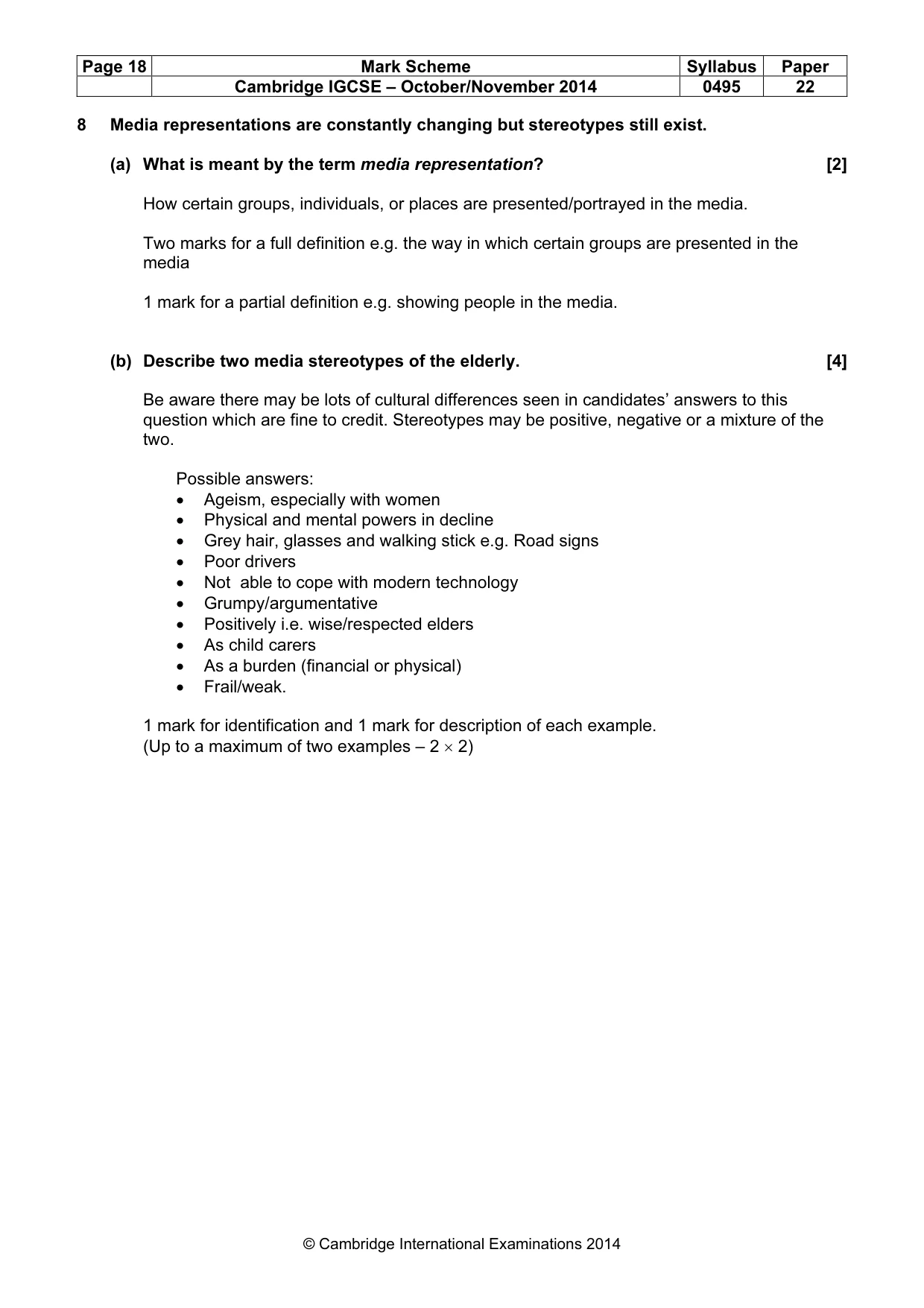
Page 18 Mark Scheme Syllabus Paper Cambridge IGCSE – October/November 2014 0495 22 © Cambridge International Examinations 2014 8 Media representations are constantly changing but stereotypes still exist. (a) What is meant by the term media representation? [2] How certain groups, individuals, or places are presented/portrayed in the media. Two marks for a full definition e.g. the way in which certain groups are presented in the media 1 mark for a partial definition e.g. showing people in the media. (b) Describe two media stereotypes of the elderly. [4] Be aware there may be lots of cultural differences seen in candidates’ answers to this question which are fine to credit. Stereotypes may be positive, negative or a mixture of the two. Possible answers: • Ageism, especially with women • Physical and mental powers in decline • Grey hair, glasses and walking stick e.g. Road signs • Poor drivers • Not able to cope with modern technology • Grumpy/argumentative • Positively i.e. wise/respected elders • As child carers • As a burden (financial or physical) • Frail/weak. 1 mark for identification and 1 mark for description of each example. (Up to a maximum of two examples – 2 × 2)
Mark scheme, page 19
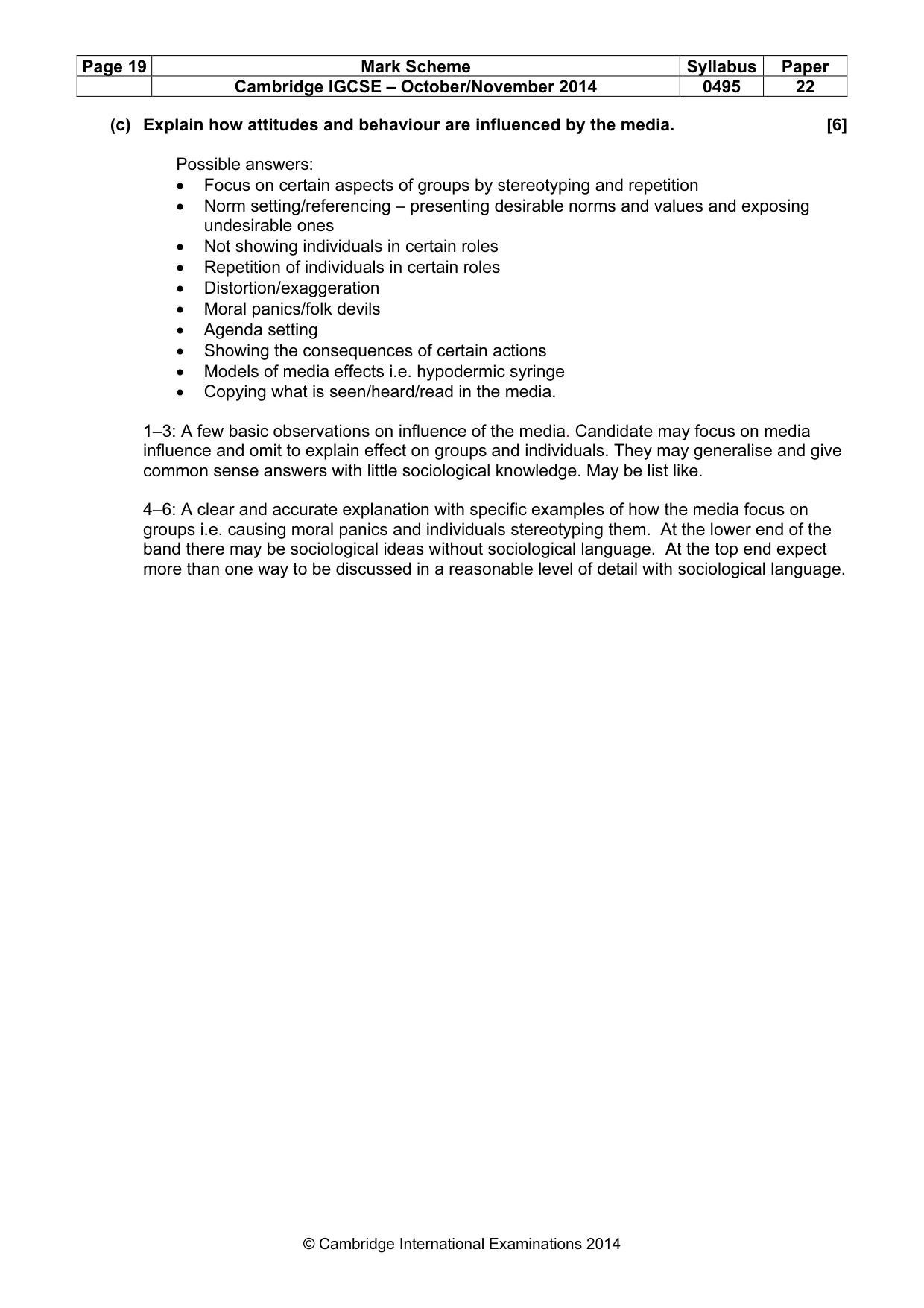
Page 19 Mark Scheme Syllabus Paper Cambridge IGCSE – October/November 2014 0495 22 © Cambridge International Examinations 2014 (c) Explain how attitudes and behaviour are influenced by the media. [6] Possible answers: • Focus on certain aspects of groups by stereotyping and repetition • Norm setting/referencing – presenting desirable norms and values and exposing undesirable ones • Not showing individuals in certain roles • Repetition of individuals in certain roles • Distortion/exaggeration • Moral panics/folk devils • Agenda setting • Showing the consequences of certain actions • Models of media effects i.e. hypodermic syringe • Copying what is seen/heard/read in the media. 1–3: A few basic observations on influence of the media. Candidate may focus on media influence and omit to explain effect on groups and individuals. They may generalise and give common sense answers with little sociological knowledge. May be list like. 4–6: A clear and accurate explanation with specific examples of how the media focus on groups i.e. causing moral panics and individuals stereotyping them. At the lower end of the band there may be sociological ideas without sociological language. At the top end expect more than one way to be discussed in a reasonable level of detail with sociological language.
Mark scheme, page 20
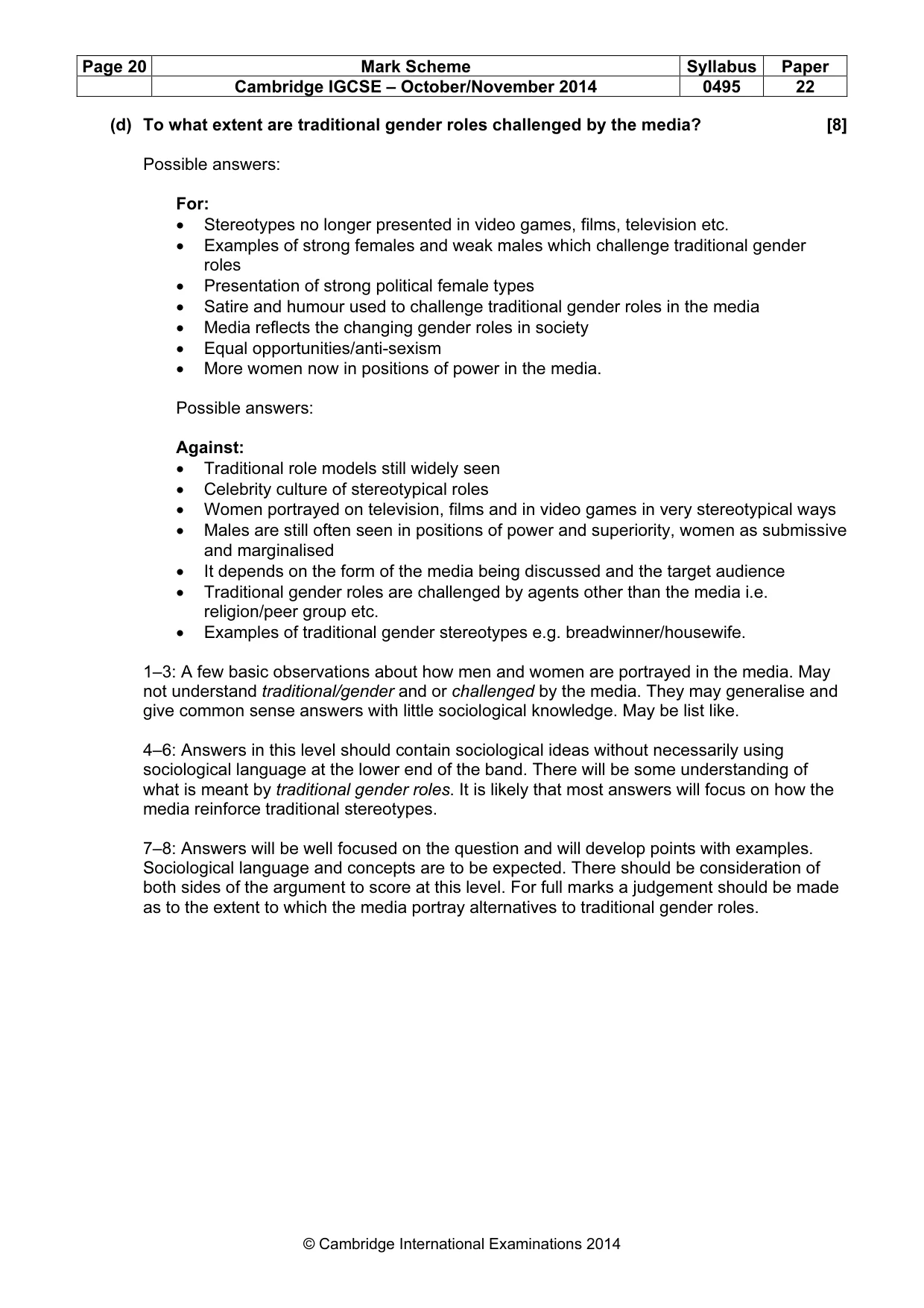
Page 20 Mark Scheme Syllabus Paper Cambridge IGCSE – October/November 2014 0495 22 © Cambridge International Examinations 2014 (d) To what extent are traditional gender roles challenged by the media? [8] Possible answers: For: • Stereotypes no longer presented in video games, films, television etc. • Examples of strong females and weak males which challenge traditional gender roles • Presentation of strong political female types • Satire and humour used to challenge traditional gender roles in the media • Media reflects the changing gender roles in society • Equal opportunities/anti-sexism • More women now in positions of power in the media. Possible answers: Against: • Traditional role models still widely seen • Celebrity culture of stereotypical roles • Women portrayed on television, films and in video games in very stereotypical ways • Males are still often seen in positions of power and superiority, women as submissive and marginalised • It depends on the form of the media being discussed and the target audience • Traditional gender roles are challenged by agents other than the media i.e. religion/peer group etc. • Examples of traditional gender stereotypes e.g. breadwinner/housewife. 1–3: A few basic observations about how men and women are portrayed in the media. May not understand traditional/gender and or challenged by the media. They may generalise and give common sense answers with little sociological knowledge. May be list like. 4–6: Answers in this level should contain sociological ideas without necessarily using sociological language at the lower end of the band. There will be some understanding of what is meant by traditional gender roles. It is likely that most answers will focus on how the media reinforce traditional stereotypes. 7–8: Answers will be well focused on the question and will develop points with examples. Sociological language and concepts are to be expected. There should be consideration of both sides of the argument to score at this level. For full marks a judgement should be made as to the extent to which the media portray alternatives to traditional gender roles.
What you needed in this session
Cambridge’s own grade thresholds for 2014 Oct/Nov, Paper 2 · Variant 2. A higher threshold means an easier paper — the bar moves with how the cohort did.