Cambridge IGCSE Sociology 0495 — 2014 Oct/Nov Paper 2 · Variant 1
0495/21/O/N/14 · 60 marks · ≈68 min
The question paper and its mark scheme, free to read here and free to download. This is Cambridge’s own paper, exactly as it was sat.
Question paper4 pages
Mark scheme17 pages
Answers below. Sit the paper first if you are practising.
Paper as text
Question paper, page 1
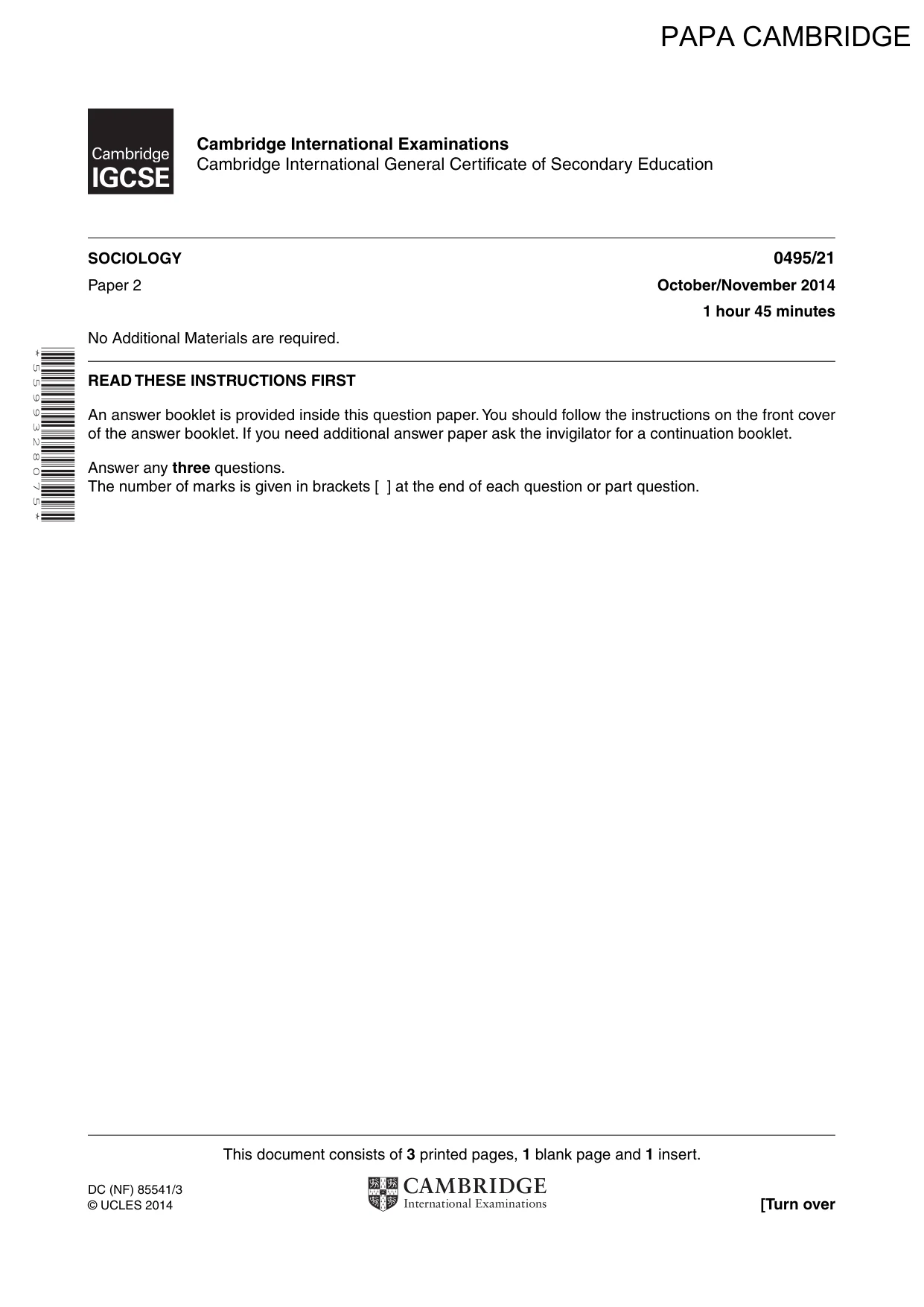
This document consists of 3 printed pages, 1 blank page and 1 insert. DC (NF) 85541/3 © UCLES 2014 [Turn over Cambridge International Examinations Cambridge International General Certificate of Secondary Education * 5 5 9 9 3 2 8 0 7 5 * SOCIOLOGY 0495/21 Paper 2 October/November 2014 1 hour 45 minutes No Additional Materials are required. READ THESE INSTRUCTIONS FIRST An answer booklet is provided inside this question paper. You should follow the instructions on the front cover of the answer booklet. If you need additional answer paper ask the invigilator for a continuation booklet. Answer any three questions. The number of marks is given in brackets [ ] at the end of each question or part question. PAPA CAMBRIDGE
Question paper, page 2
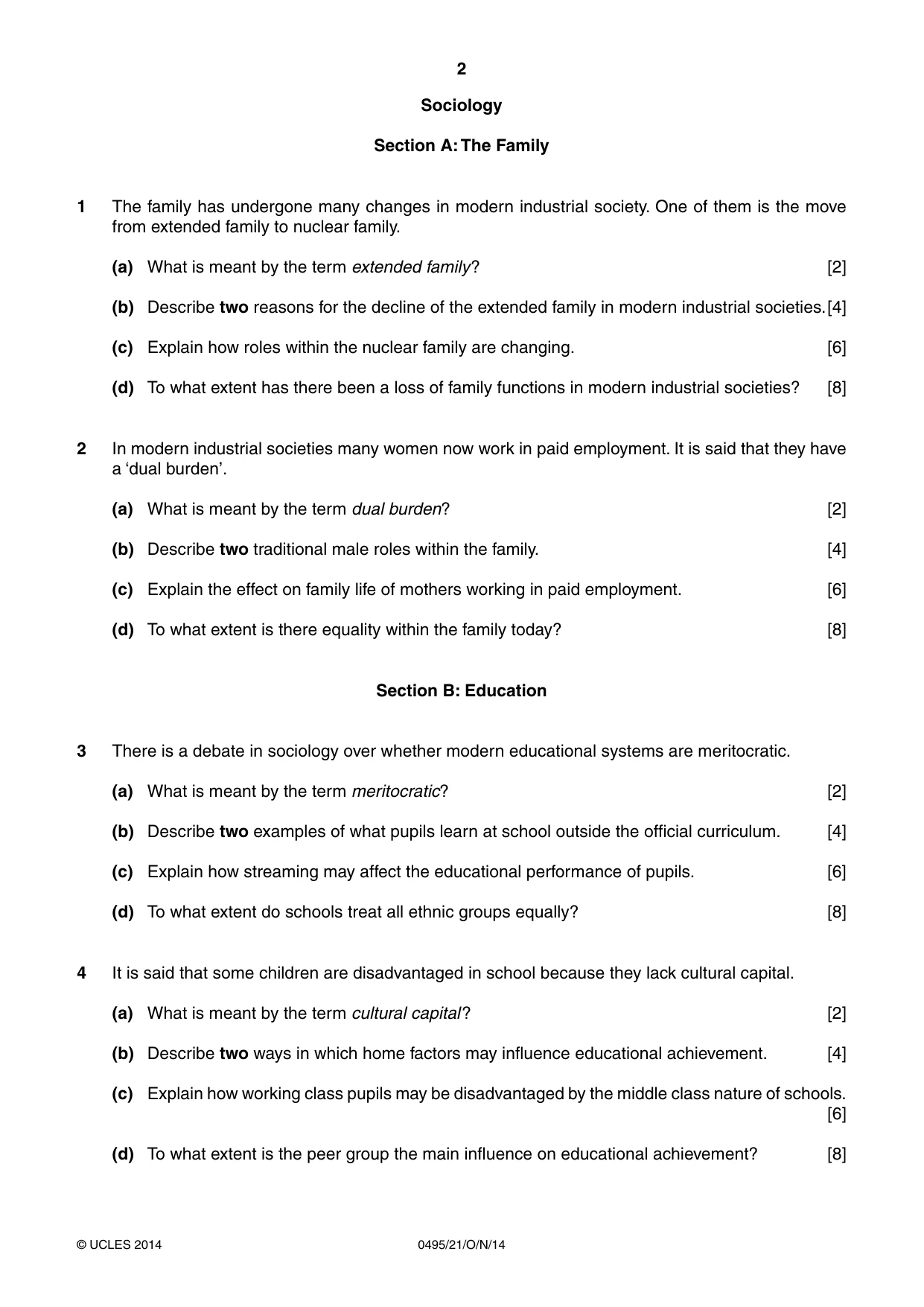
2 0495/21/O/N/14 © UCLES 2014 Sociology Section A: The Family 1 The family has undergone many changes in modern industrial society. One of them is the move from extended family to nuclear family. (a) What is meant by the term extended family? [2] (b) Describe two reasons for the decline of the extended family in modern industrial societies. [4] (c) Explain how roles within the nuclear family are changing. [6] (d) To what extent has there been a loss of family functions in modern industrial societies? [8] 2 In modern industrial societies many women now work in paid employment. It is said that they have a ‘dual burden’. (a) What is meant by the term dual burden? [2] (b) Describe two traditional male roles within the family. [4] (c) Explain the effect on family life of mothers working in paid employment. [6] (d) To what extent is there equality within the family today? [8] Section B: Education 3 There is a debate in sociology over whether modern educational systems are meritocratic. (a) What is meant by the term meritocratic? [2] (b) Describe two examples of what pupils learn at school outside the official curriculum. [4] (c) Explain how streaming may affect the educational performance of pupils. [6] (d) To what extent do schools treat all ethnic groups equally? [8] 4 It is said that some children are disadvantaged in school because they lack cultural capital. (a) What is meant by the term cultural capital? [2] (b) Describe two ways in which home factors may influence educational achievement. [4] (c) Explain how working class pupils may be disadvantaged by the middle class nature of schools. [6] (d) To what extent is the peer group the main influence on educational achievement? [8]
Question paper, page 3
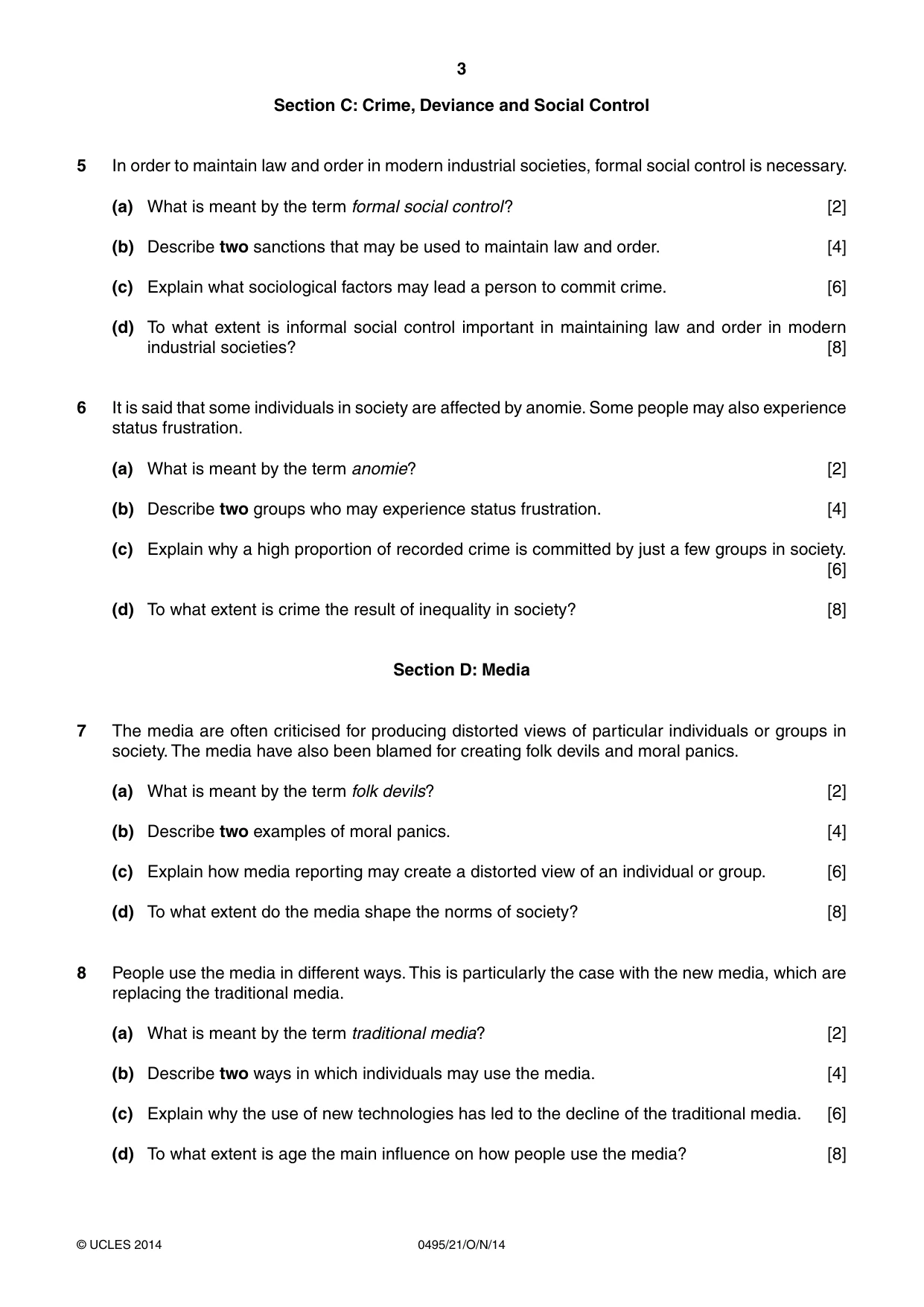
3 0495/21/O/N/14 © UCLES 2014 Section C: Crime, Deviance and Social Control 5 In order to maintain law and order in modern industrial societies, formal social control is necessary. (a) What is meant by the term formal social control? [2] (b) Describe two sanctions that may be used to maintain law and order. [4] (c) Explain what sociological factors may lead a person to commit crime. [6] (d) To what extent is informal social control important in maintaining law and order in modern industrial societies? [8] 6 It is said that some individuals in society are affected by anomie. Some people may also experience status frustration. (a) What is meant by the term anomie? [2] (b) Describe two groups who may experience status frustration. [4] (c) Explain why a high proportion of recorded crime is committed by just a few groups in society. [6] (d) To what extent is crime the result of inequality in society? [8] Section D: Media 7 The media are often criticised for producing distorted views of particular individuals or groups in society. The media have also been blamed for creating folk devils and moral panics. (a) What is meant by the term folk devils? [2] (b) Describe two examples of moral panics. [4] (c) Explain how media reporting may create a distorted view of an individual or group. [6] (d) To what extent do the media shape the norms of society? [8] 8 People use the media in different ways. This is particularly the case with the new media, which are replacing the traditional media. (a) What is meant by the term traditional media? [2] (b) Describe two ways in which individuals may use the media. [4] (c) Explain why the use of new technologies has led to the decline of the traditional media. [6] (d) To what extent is age the main influence on how people use the media? [8]
Question paper, page 4
4 0495/21/O/N/14 © UCLES 2014 BLANK PAGE Permission to reproduce items where third-party owned material protected by copyright is included has been sought and cleared where possible. Every reasonable effort has been made by the publisher (UCLES) to trace copyright holders, but if any items requiring clearance have unwittingly been included, the publisher will be pleased to make amends at the earliest possible opportunity. Cambridge International Examinations is part of the Cambridge Assessment Group. Cambridge Assessment is the brand name of University of Cambridge Local Examinations Syndicate (UCLES), which is itself a department of the University of Cambridge.
Mark scheme, page 1
® IGCSE is the registered trademark of Cambridge International Examinations. CAMBRIDGE INTERNATIONAL EXAMINATIONS Cambridge International General Certificate of Secondary Education MARK SCHEME for the October/November 2014 series 0495 SOCIOLOGY 0495/21 Paper 2, maximum raw mark 60 This mark scheme is published as an aid to teachers and candidates, to indicate the requirements of the examination. It shows the basis on which Examiners were instructed to award marks. It does not indicate the details of the discussions that took place at an Examiners’ meeting before marking began, which would have considered the acceptability of alternative answers. Mark schemes should be read in conjunction with the question paper and the Principal Examiner Report for Teachers. Cambridge will not enter into discussions about these mark schemes. Cambridge is publishing the mark schemes for the October/November 2014 series for most Cambridge IGCSE®, Cambridge International A and AS Level components and some Cambridge O Level components. PAPA CAMBRIDGE
Mark scheme, page 2
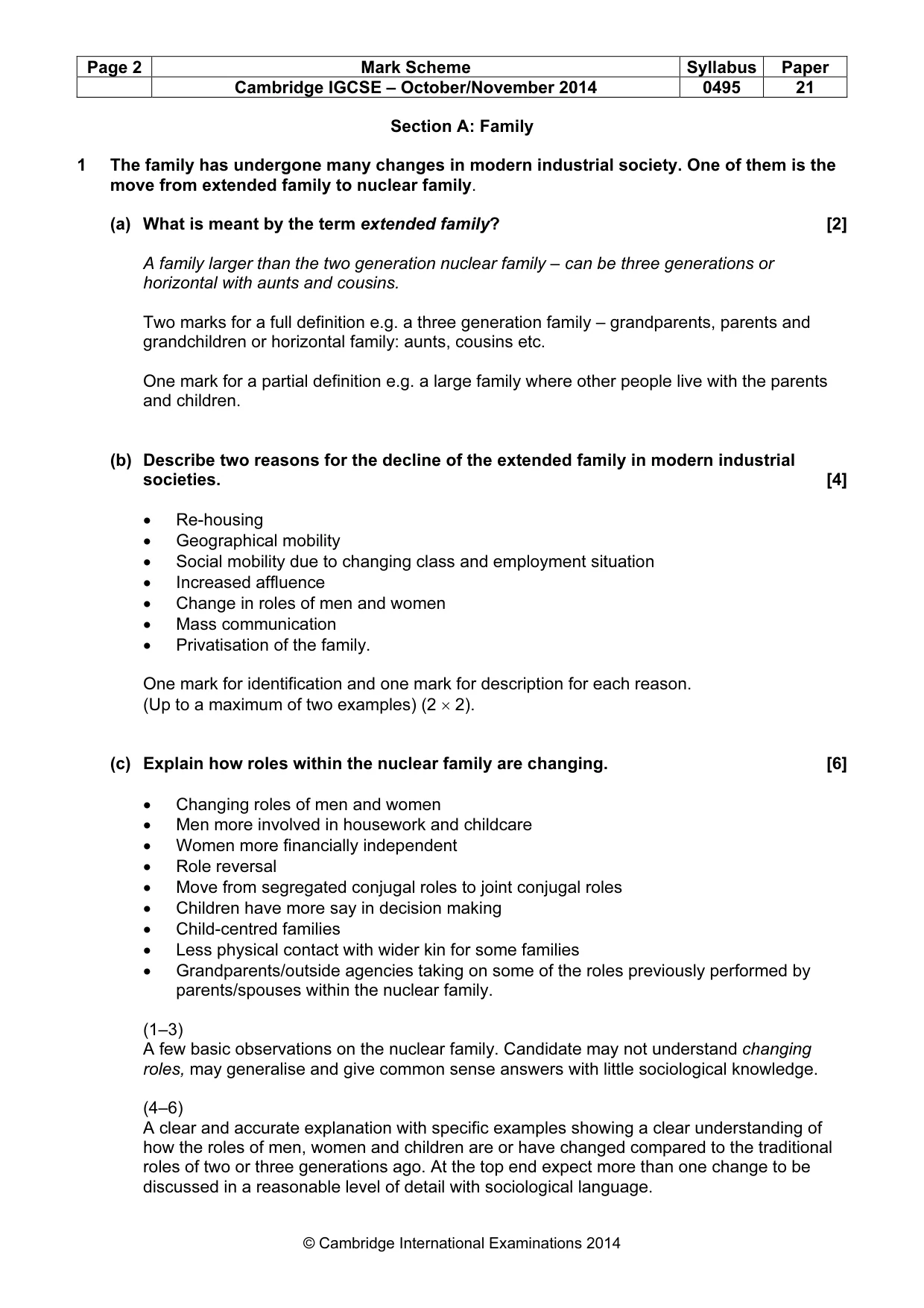
Page 2 Mark Scheme Syllabus Paper Cambridge IGCSE – October/November 2014 0495 21 © Cambridge International Examinations 2014 Section A: Family 1 The family has undergone many changes in modern industrial society. One of them is the move from extended family to nuclear family. (a) What is meant by the term extended family? [2] A family larger than the two generation nuclear family – can be three generations or horizontal with aunts and cousins. Two marks for a full definition e.g. a three generation family – grandparents, parents and grandchildren or horizontal family: aunts, cousins etc. One mark for a partial definition e.g. a large family where other people live with the parents and children. (b) Describe two reasons for the decline of the extended family in modern industrial societies. [4] • Re-housing • Geographical mobility • Social mobility due to changing class and employment situation • Increased affluence • Change in roles of men and women • Mass communication • Privatisation of the family. One mark for identification and one mark for description for each reason. (Up to a maximum of two examples) (2 × 2). (c) Explain how roles within the nuclear family are changing. [6] • Changing roles of men and women • Men more involved in housework and childcare • Women more financially independent • Role reversal • Move from segregated conjugal roles to joint conjugal roles • Children have more say in decision making • Child-centred families • Less physical contact with wider kin for some families • Grandparents/outside agencies taking on some of the roles previously performed by parents/spouses within the nuclear family. (1–3) A few basic observations on the nuclear family. Candidate may not understand changing roles, may generalise and give common sense answers with little sociological knowledge. (4–6) A clear and accurate explanation with specific examples showing a clear understanding of how the roles of men, women and children are or have changed compared to the traditional roles of two or three generations ago. At the top end expect more than one change to be discussed in a reasonable level of detail with sociological language.
Mark scheme, page 3
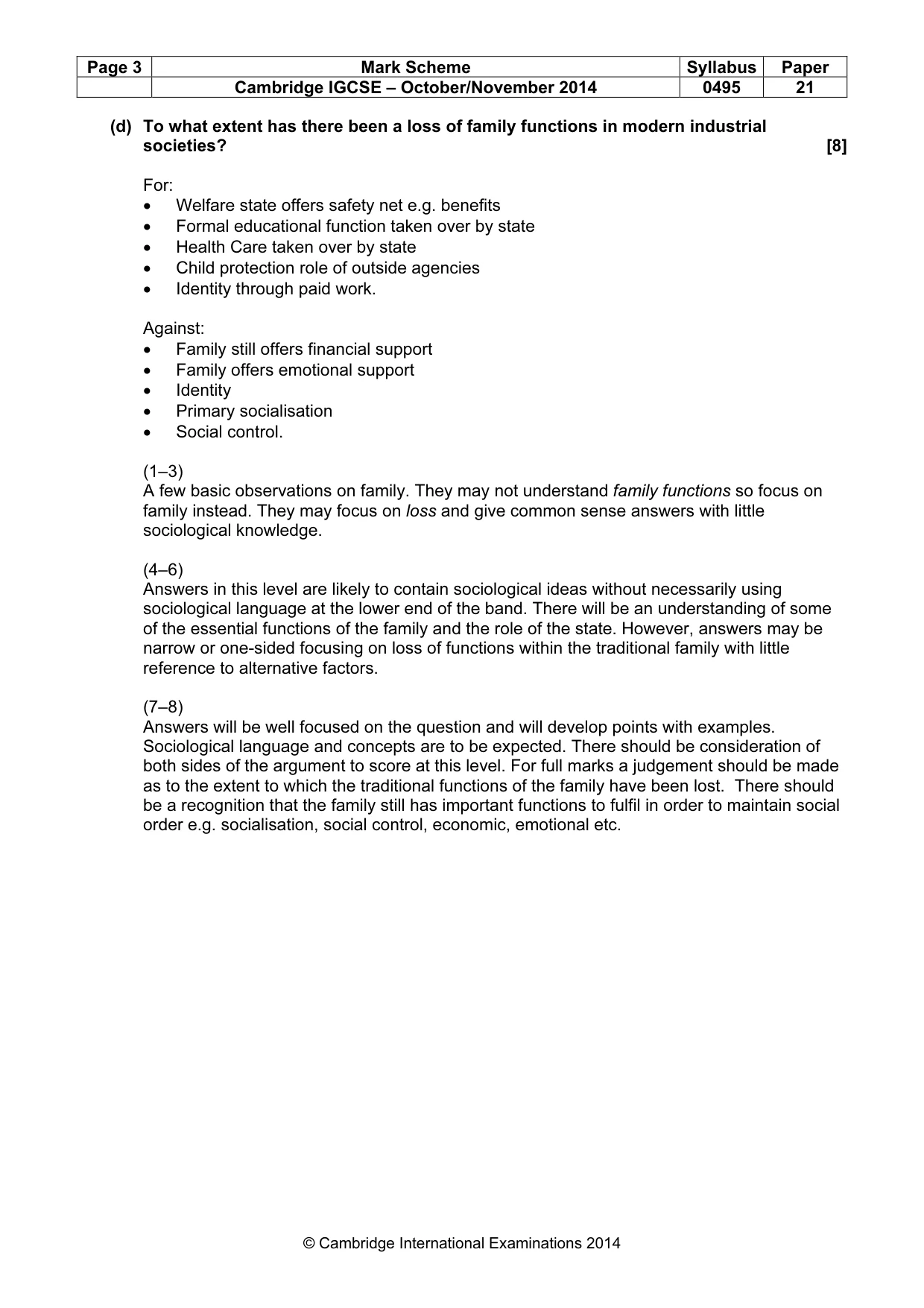
Page 3 Mark Scheme Syllabus Paper Cambridge IGCSE – October/November 2014 0495 21 © Cambridge International Examinations 2014 (d) To what extent has there been a loss of family functions in modern industrial societies? [8] For: • Welfare state offers safety net e.g. benefits • Formal educational function taken over by state • Health Care taken over by state • Child protection role of outside agencies • Identity through paid work. Against: • Family still offers financial support • Family offers emotional support • Identity • Primary socialisation • Social control. (1–3) A few basic observations on family. They may not understand family functions so focus on family instead. They may focus on loss and give common sense answers with little sociological knowledge. (4–6) Answers in this level are likely to contain sociological ideas without necessarily using sociological language at the lower end of the band. There will be an understanding of some of the essential functions of the family and the role of the state. However, answers may be narrow or one-sided focusing on loss of functions within the traditional family with little reference to alternative factors. (7–8) Answers will be well focused on the question and will develop points with examples. Sociological language and concepts are to be expected. There should be consideration of both sides of the argument to score at this level. For full marks a judgement should be made as to the extent to which the traditional functions of the family have been lost. There should be a recognition that the family still has important functions to fulfil in order to maintain social order e.g. socialisation, social control, economic, emotional etc.
Mark scheme, page 4
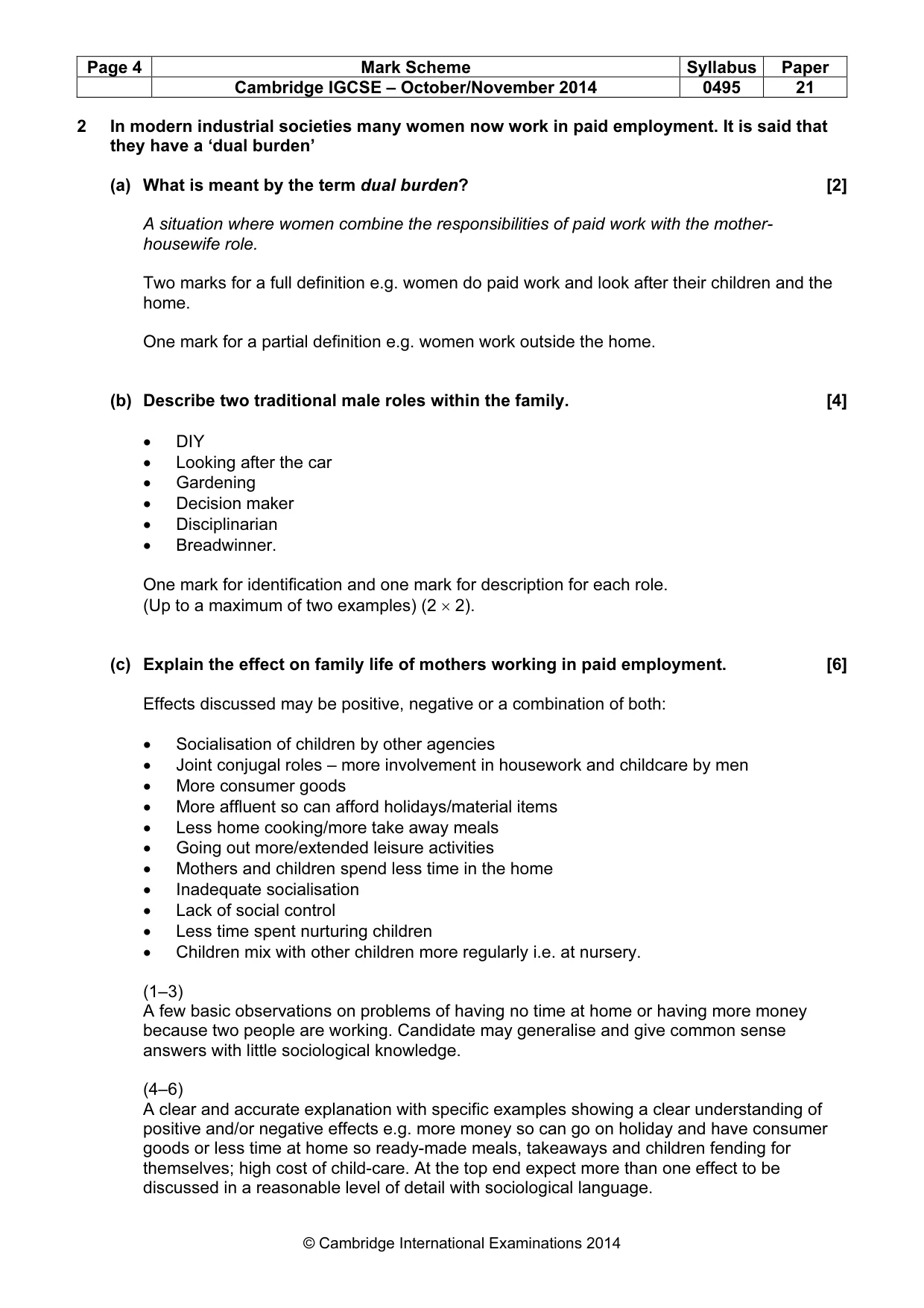
Page 4 Mark Scheme Syllabus Paper Cambridge IGCSE – October/November 2014 0495 21 © Cambridge International Examinations 2014 2 In modern industrial societies many women now work in paid employment. It is said that they have a ‘dual burden’ (a) What is meant by the term dual burden? [2] A situation where women combine the responsibilities of paid work with the mother- housewife role. Two marks for a full definition e.g. women do paid work and look after their children and the home. One mark for a partial definition e.g. women work outside the home. (b) Describe two traditional male roles within the family. [4] • DIY • Looking after the car • Gardening • Decision maker • Disciplinarian • Breadwinner. One mark for identification and one mark for description for each role. (Up to a maximum of two examples) (2 × 2). (c) Explain the effect on family life of mothers working in paid employment. [6] Effects discussed may be positive, negative or a combination of both: • Socialisation of children by other agencies • Joint conjugal roles – more involvement in housework and childcare by men • More consumer goods • More affluent so can afford holidays/material items • Less home cooking/more take away meals • Going out more/extended leisure activities • Mothers and children spend less time in the home • Inadequate socialisation • Lack of social control • Less time spent nurturing children • Children mix with other children more regularly i.e. at nursery. (1–3) A few basic observations on problems of having no time at home or having more money because two people are working. Candidate may generalise and give common sense answers with little sociological knowledge. (4–6) A clear and accurate explanation with specific examples showing a clear understanding of positive and/or negative effects e.g. more money so can go on holiday and have consumer goods or less time at home so ready-made meals, takeaways and children fending for themselves; high cost of child-care. At the top end expect more than one effect to be discussed in a reasonable level of detail with sociological language.
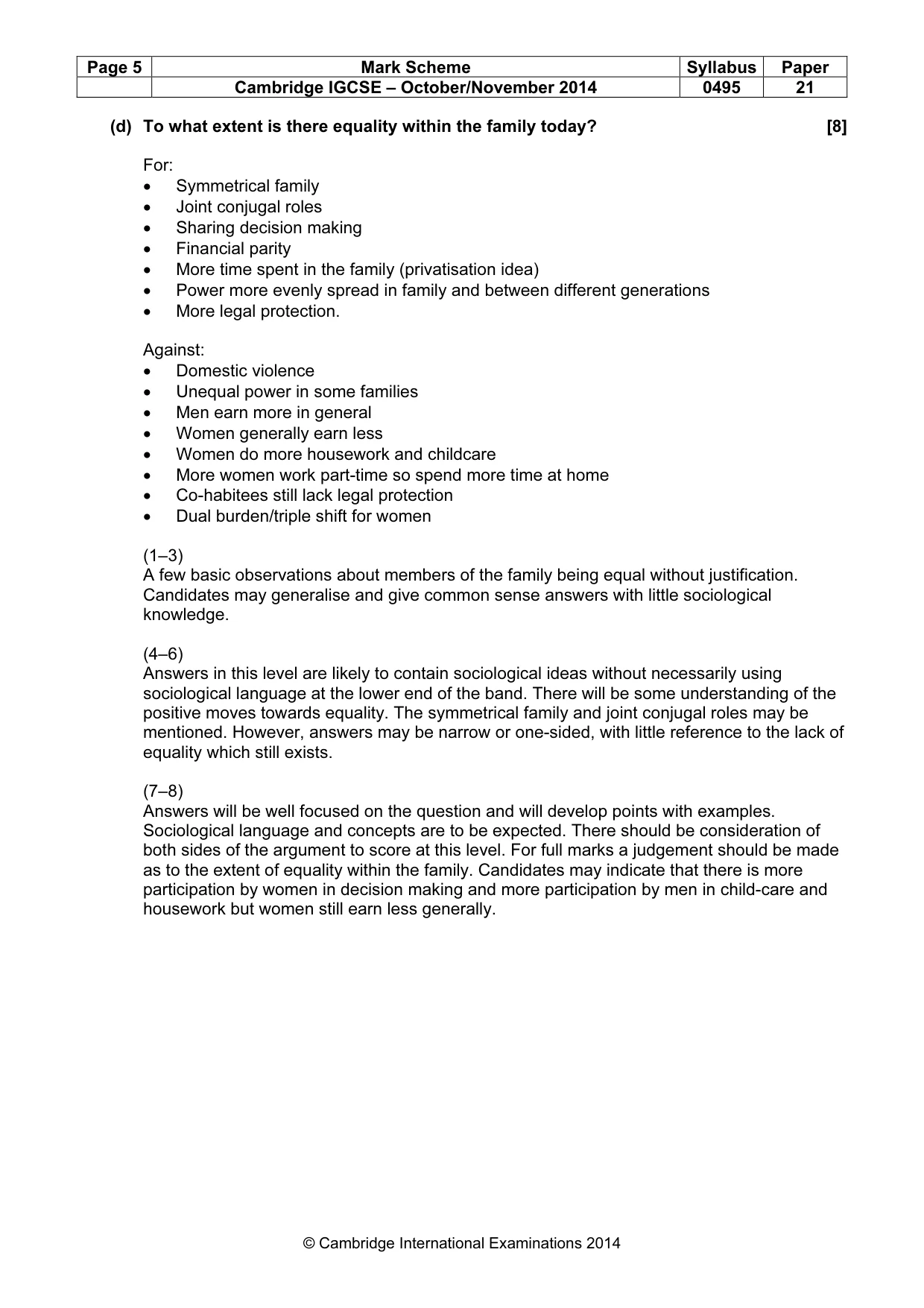
Mark scheme, page 5
Page 5 Mark Scheme Syllabus Paper Cambridge IGCSE – October/November 2014 0495 21 © Cambridge International Examinations 2014 (d) To what extent is there equality within the family today? [8] For: • Symmetrical family • Joint conjugal roles • Sharing decision making • Financial parity • More time spent in the family (privatisation idea) • Power more evenly spread in family and between different generations • More legal protection. Against: • Domestic violence • Unequal power in some families • Men earn more in general • Women generally earn less • Women do more housework and childcare • More women work part-time so spend more time at home • Co-habitees still lack legal protection • Dual burden/triple shift for women (1–3) A few basic observations about members of the family being equal without justification. Candidates may generalise and give common sense answers with little sociological knowledge. (4–6) Answers in this level are likely to contain sociological ideas without necessarily using sociological language at the lower end of the band. There will be some understanding of the positive moves towards equality. The symmetrical family and joint conjugal roles may be mentioned. However, answers may be narrow or one-sided, with little reference to the lack of equality which still exists. (7–8) Answers will be well focused on the question and will develop points with examples. Sociological language and concepts are to be expected. There should be consideration of both sides of the argument to score at this level. For full marks a judgement should be made as to the extent of equality within the family. Candidates may indicate that there is more participation by women in decision making and more participation by men in child-care and housework but women still earn less generally.
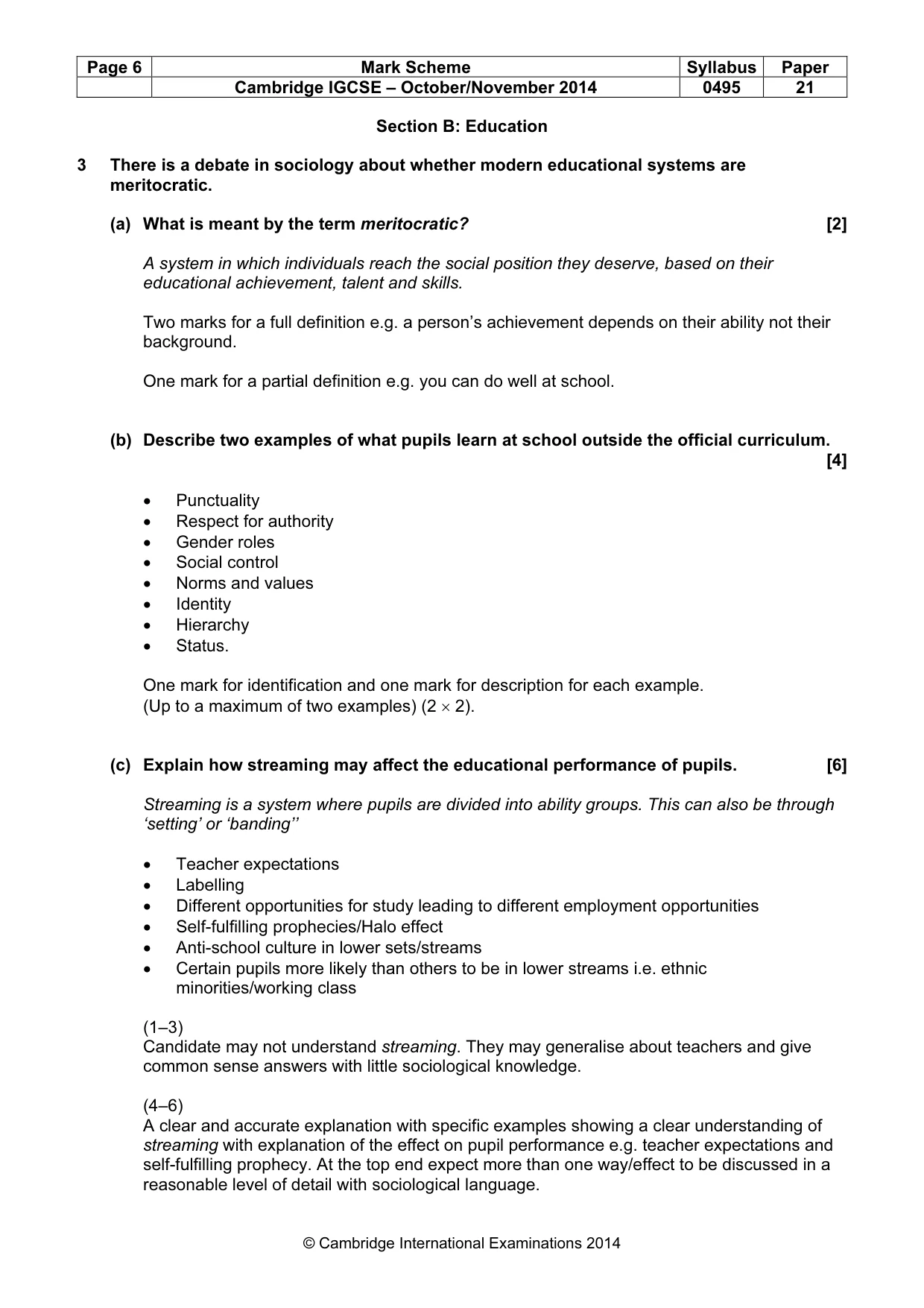
Mark scheme, page 6
Page 6 Mark Scheme Syllabus Paper Cambridge IGCSE – October/November 2014 0495 21 © Cambridge International Examinations 2014 Section B: Education 3 There is a debate in sociology about whether modern educational systems are meritocratic. (a) What is meant by the term meritocratic? [2] A system in which individuals reach the social position they deserve, based on their educational achievement, talent and skills. Two marks for a full definition e.g. a person’s achievement depends on their ability not their background. One mark for a partial definition e.g. you can do well at school. (b) Describe two examples of what pupils learn at school outside the official curriculum. [4] • Punctuality • Respect for authority • Gender roles • Social control • Norms and values • Identity • Hierarchy • Status. One mark for identification and one mark for description for each example. (Up to a maximum of two examples) (2 × 2). (c) Explain how streaming may affect the educational performance of pupils. [6] Streaming is a system where pupils are divided into ability groups. This can also be through ‘setting’ or ‘banding’’ • Teacher expectations • Labelling • Different opportunities for study leading to different employment opportunities • Self-fulfilling prophecies/Halo effect • Anti-school culture in lower sets/streams • Certain pupils more likely than others to be in lower streams i.e. ethnic minorities/working class (1–3) Candidate may not understand streaming. They may generalise about teachers and give common sense answers with little sociological knowledge. (4–6) A clear and accurate explanation with specific examples showing a clear understanding of streaming with explanation of the effect on pupil performance e.g. teacher expectations and self-fulfilling prophecy. At the top end expect more than one way/effect to be discussed in a reasonable level of detail with sociological language.
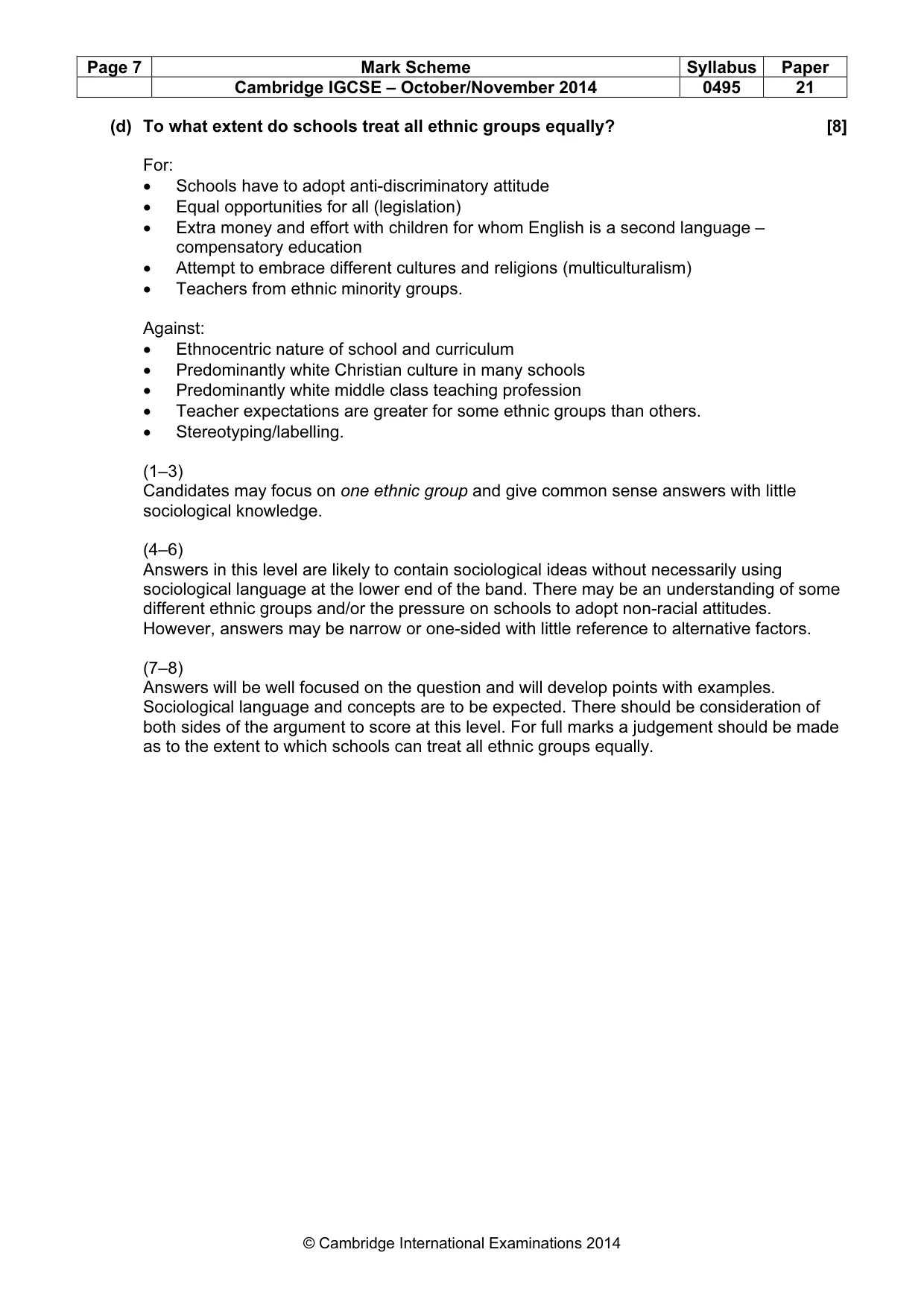
Mark scheme, page 7
Page 7 Mark Scheme Syllabus Paper Cambridge IGCSE – October/November 2014 0495 21 © Cambridge International Examinations 2014 (d) To what extent do schools treat all ethnic groups equally? [8] For: • Schools have to adopt anti-discriminatory attitude • Equal opportunities for all (legislation) • Extra money and effort with children for whom English is a second language – compensatory education • Attempt to embrace different cultures and religions (multiculturalism) • Teachers from ethnic minority groups. Against: • Ethnocentric nature of school and curriculum • Predominantly white Christian culture in many schools • Predominantly white middle class teaching profession • Teacher expectations are greater for some ethnic groups than others. • Stereotyping/labelling. (1–3) Candidates may focus on one ethnic group and give common sense answers with little sociological knowledge. (4–6) Answers in this level are likely to contain sociological ideas without necessarily using sociological language at the lower end of the band. There may be an understanding of some different ethnic groups and/or the pressure on schools to adopt non-racial attitudes. However, answers may be narrow or one-sided with little reference to alternative factors. (7–8) Answers will be well focused on the question and will develop points with examples. Sociological language and concepts are to be expected. There should be consideration of both sides of the argument to score at this level. For full marks a judgement should be made as to the extent to which schools can treat all ethnic groups equally.
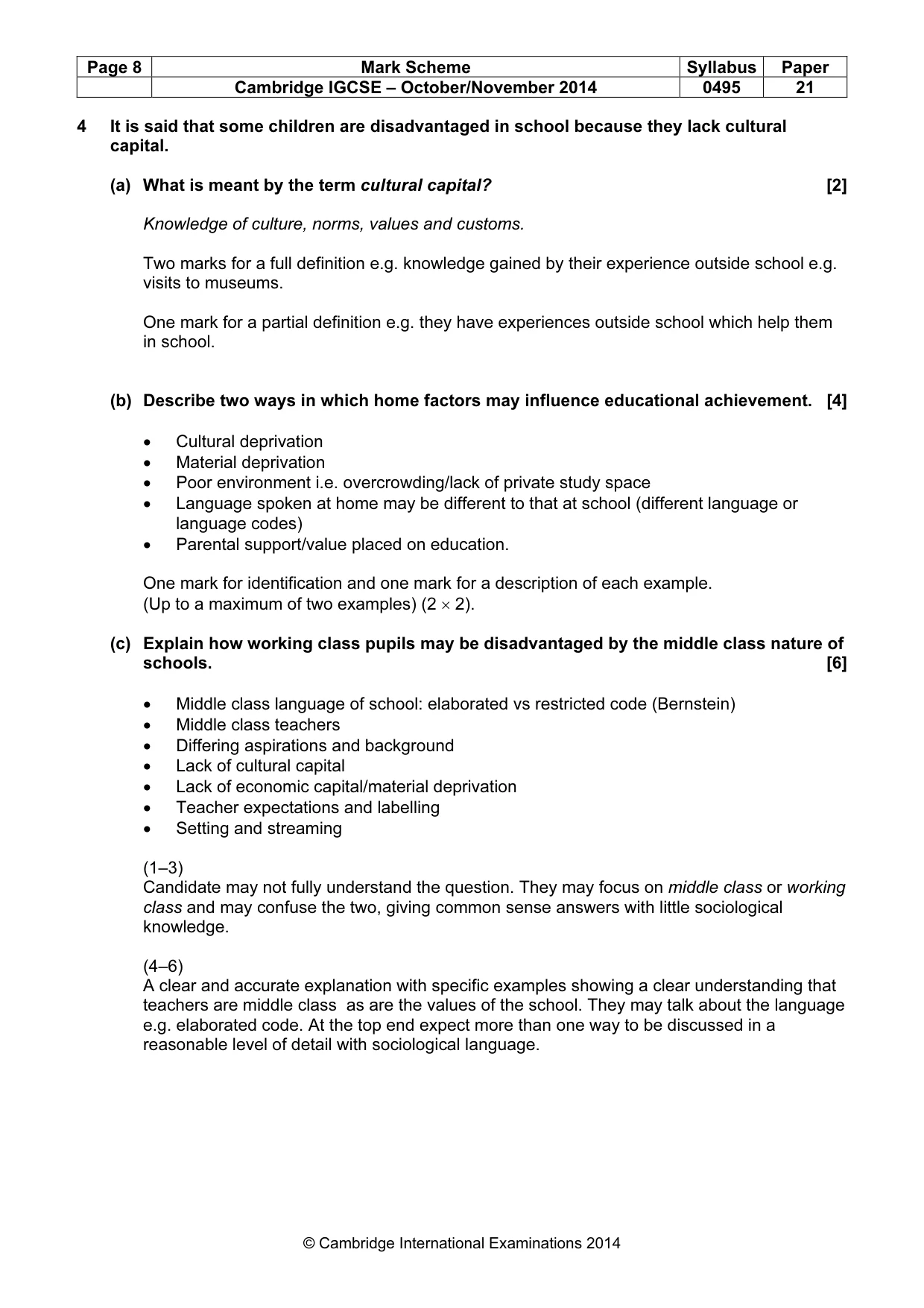
Mark scheme, page 8
Page 8 Mark Scheme Syllabus Paper Cambridge IGCSE – October/November 2014 0495 21 © Cambridge International Examinations 2014 4 It is said that some children are disadvantaged in school because they lack cultural capital. (a) What is meant by the term cultural capital? [2] Knowledge of culture, norms, values and customs. Two marks for a full definition e.g. knowledge gained by their experience outside school e.g. visits to museums. One mark for a partial definition e.g. they have experiences outside school which help them in school. (b) Describe two ways in which home factors may influence educational achievement. [4] • Cultural deprivation • Material deprivation • Poor environment i.e. overcrowding/lack of private study space • Language spoken at home may be different to that at school (different language or language codes) • Parental support/value placed on education. One mark for identification and one mark for a description of each example. (Up to a maximum of two examples) (2 × 2). (c) Explain how working class pupils may be disadvantaged by the middle class nature of schools. [6] • Middle class language of school: elaborated vs restricted code (Bernstein) • Middle class teachers • Differing aspirations and background • Lack of cultural capital • Lack of economic capital/material deprivation • Teacher expectations and labelling • Setting and streaming (1–3) Candidate may not fully understand the question. They may focus on middle class or working class and may confuse the two, giving common sense answers with little sociological knowledge. (4–6) A clear and accurate explanation with specific examples showing a clear understanding that teachers are middle class as are the values of the school. They may talk about the language e.g. elaborated code. At the top end expect more than one way to be discussed in a reasonable level of detail with sociological language.
Mark scheme, page 9
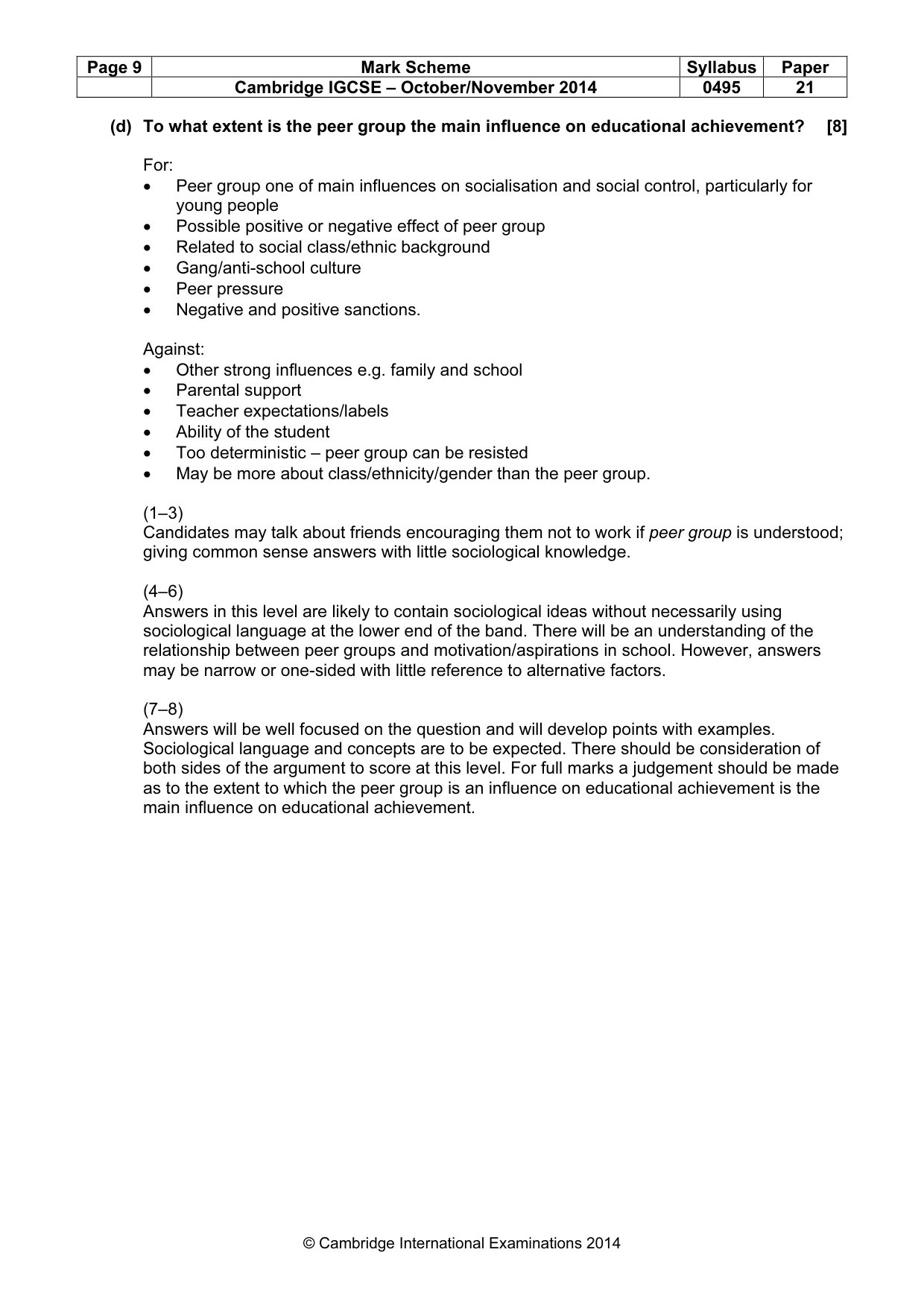
Page 9 Mark Scheme Syllabus Paper Cambridge IGCSE – October/November 2014 0495 21 © Cambridge International Examinations 2014 (d) To what extent is the peer group the main influence on educational achievement? [8] For: • Peer group one of main influences on socialisation and social control, particularly for young people • Possible positive or negative effect of peer group • Related to social class/ethnic background • Gang/anti-school culture • Peer pressure • Negative and positive sanctions. Against: • Other strong influences e.g. family and school • Parental support • Teacher expectations/labels • Ability of the student • Too deterministic – peer group can be resisted • May be more about class/ethnicity/gender than the peer group. (1–3) Candidates may talk about friends encouraging them not to work if peer group is understood; giving common sense answers with little sociological knowledge. (4–6) Answers in this level are likely to contain sociological ideas without necessarily using sociological language at the lower end of the band. There will be an understanding of the relationship between peer groups and motivation/aspirations in school. However, answers may be narrow or one-sided with little reference to alternative factors. (7–8) Answers will be well focused on the question and will develop points with examples. Sociological language and concepts are to be expected. There should be consideration of both sides of the argument to score at this level. For full marks a judgement should be made as to the extent to which the peer group is an influence on educational achievement is the main influence on educational achievement.
Mark scheme, page 10
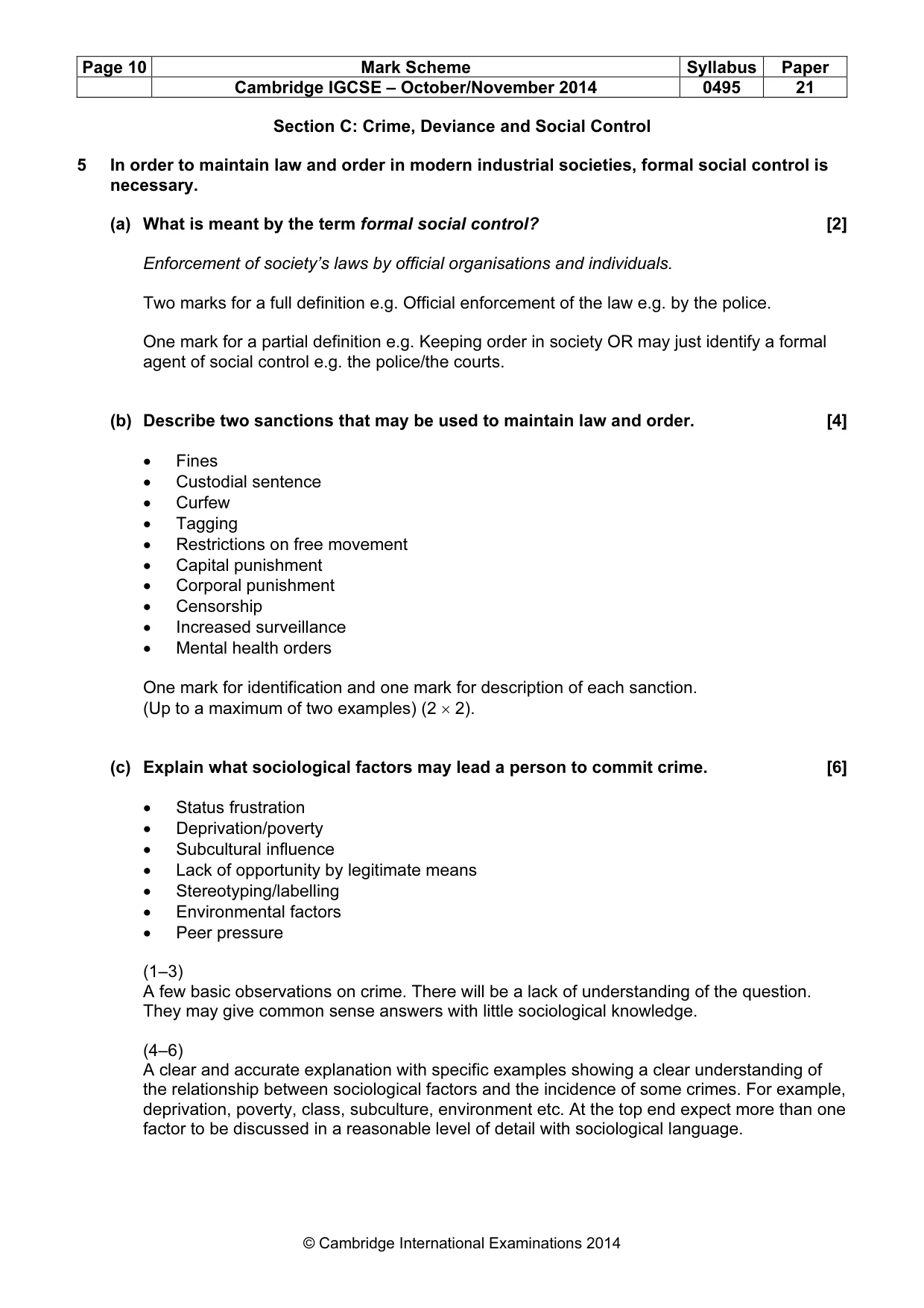
Page 10 Mark Scheme Syllabus Paper Cambridge IGCSE – October/November 2014 0495 21 © Cambridge International Examinations 2014 Section C: Crime, Deviance and Social Control 5 In order to maintain law and order in modern industrial societies, formal social control is necessary. (a) What is meant by the term formal social control? [2] Enforcement of society’s laws by official organisations and individuals. Two marks for a full definition e.g. Official enforcement of the law e.g. by the police. One mark for a partial definition e.g. Keeping order in society OR may just identify a formal agent of social control e.g. the police/the courts. (b) Describe two sanctions that may be used to maintain law and order. [4] • Fines • Custodial sentence • Curfew • Tagging • Restrictions on free movement • Capital punishment • Corporal punishment • Censorship • Increased surveillance • Mental health orders One mark for identification and one mark for description of each sanction. (Up to a maximum of two examples) (2 × 2). (c) Explain what sociological factors may lead a person to commit crime. [6] • Status frustration • Deprivation/poverty • Subcultural influence • Lack of opportunity by legitimate means • Stereotyping/labelling • Environmental factors • Peer pressure (1–3) A few basic observations on crime. There will be a lack of understanding of the question. They may give common sense answers with little sociological knowledge. (4–6) A clear and accurate explanation with specific examples showing a clear understanding of the relationship between sociological factors and the incidence of some crimes. For example, deprivation, poverty, class, subculture, environment etc. At the top end expect more than one factor to be discussed in a reasonable level of detail with sociological language.
Mark scheme, page 11
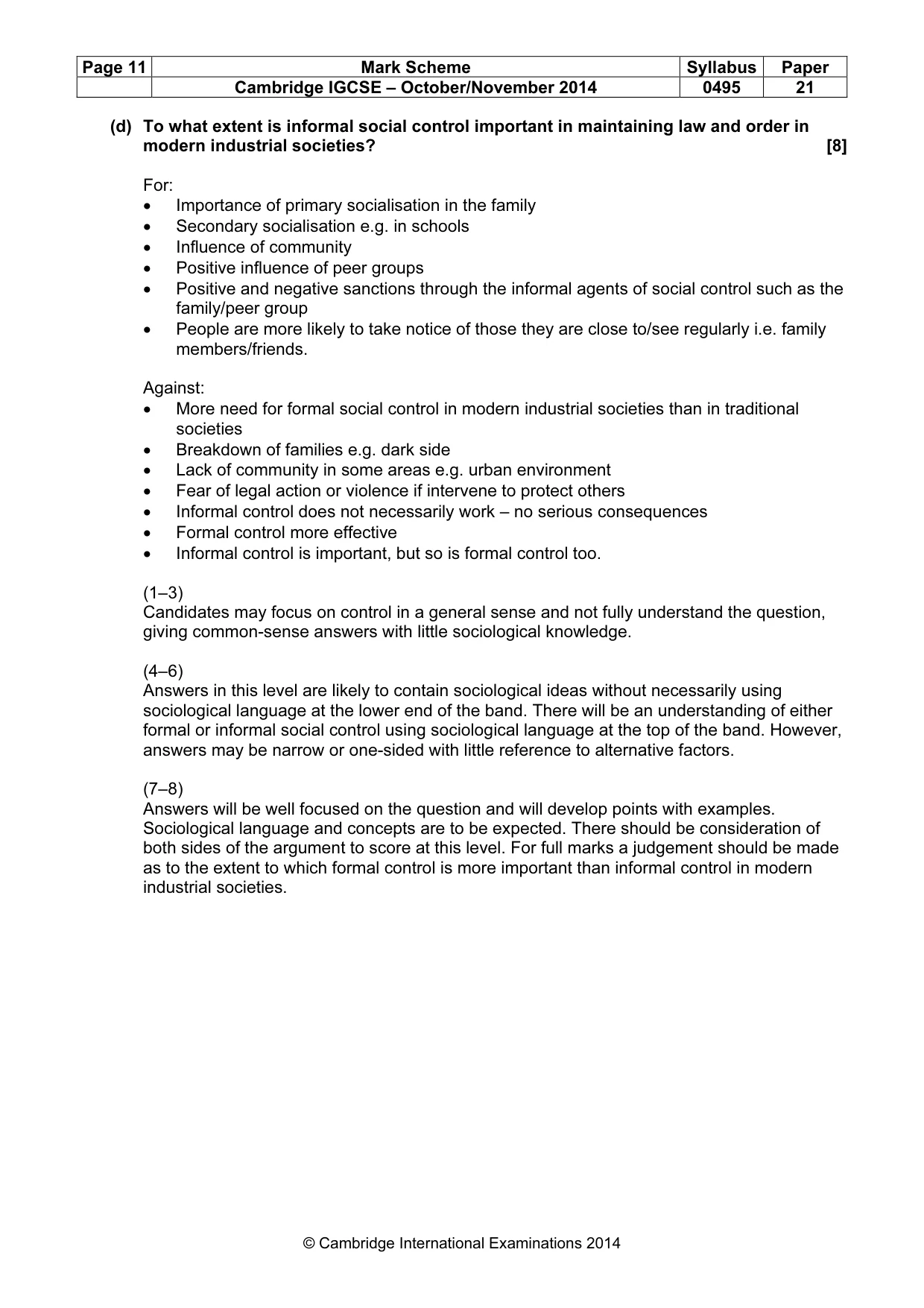
Page 11 Mark Scheme Syllabus Paper Cambridge IGCSE – October/November 2014 0495 21 © Cambridge International Examinations 2014 (d) To what extent is informal social control important in maintaining law and order in modern industrial societies? [8] For: • Importance of primary socialisation in the family • Secondary socialisation e.g. in schools • Influence of community • Positive influence of peer groups • Positive and negative sanctions through the informal agents of social control such as the family/peer group • People are more likely to take notice of those they are close to/see regularly i.e. family members/friends. Against: • More need for formal social control in modern industrial societies than in traditional societies • Breakdown of families e.g. dark side • Lack of community in some areas e.g. urban environment • Fear of legal action or violence if intervene to protect others • Informal control does not necessarily work – no serious consequences • Formal control more effective • Informal control is important, but so is formal control too. (1–3) Candidates may focus on control in a general sense and not fully understand the question, giving common-sense answers with little sociological knowledge. (4–6) Answers in this level are likely to contain sociological ideas without necessarily using sociological language at the lower end of the band. There will be an understanding of either formal or informal social control using sociological language at the top of the band. However, answers may be narrow or one-sided with little reference to alternative factors. (7–8) Answers will be well focused on the question and will develop points with examples. Sociological language and concepts are to be expected. There should be consideration of both sides of the argument to score at this level. For full marks a judgement should be made as to the extent to which formal control is more important than informal control in modern industrial societies.
Mark scheme, page 12
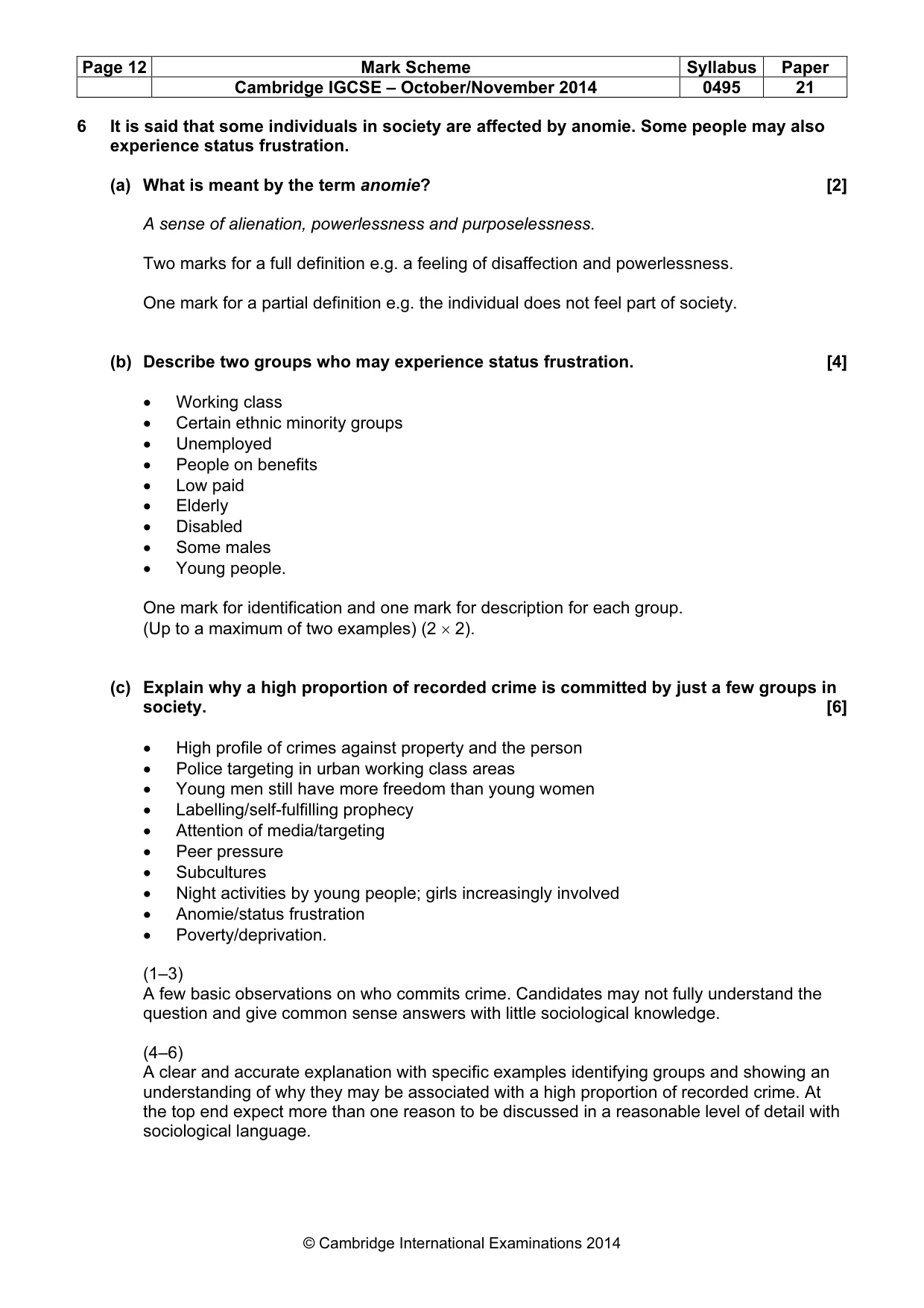
Page 12 Mark Scheme Syllabus Paper Cambridge IGCSE – October/November 2014 0495 21 © Cambridge International Examinations 2014 6 It is said that some individuals in society are affected by anomie. Some people may also experience status frustration. (a) What is meant by the term anomie? [2] A sense of alienation, powerlessness and purposelessness. Two marks for a full definition e.g. a feeling of disaffection and powerlessness. One mark for a partial definition e.g. the individual does not feel part of society. (b) Describe two groups who may experience status frustration. [4] • Working class • Certain ethnic minority groups • Unemployed • People on benefits • Low paid • Elderly • Disabled • Some males • Young people. One mark for identification and one mark for description for each group. (Up to a maximum of two examples) (2 × 2). (c) Explain why a high proportion of recorded crime is committed by just a few groups in society. [6] • High profile of crimes against property and the person • Police targeting in urban working class areas • Young men still have more freedom than young women • Labelling/self-fulfilling prophecy • Attention of media/targeting • Peer pressure • Subcultures • Night activities by young people; girls increasingly involved • Anomie/status frustration • Poverty/deprivation. (1–3) A few basic observations on who commits crime. Candidates may not fully understand the question and give common sense answers with little sociological knowledge. (4–6) A clear and accurate explanation with specific examples identifying groups and showing an understanding of why they may be associated with a high proportion of recorded crime. At the top end expect more than one reason to be discussed in a reasonable level of detail with sociological language.
Mark scheme, page 13
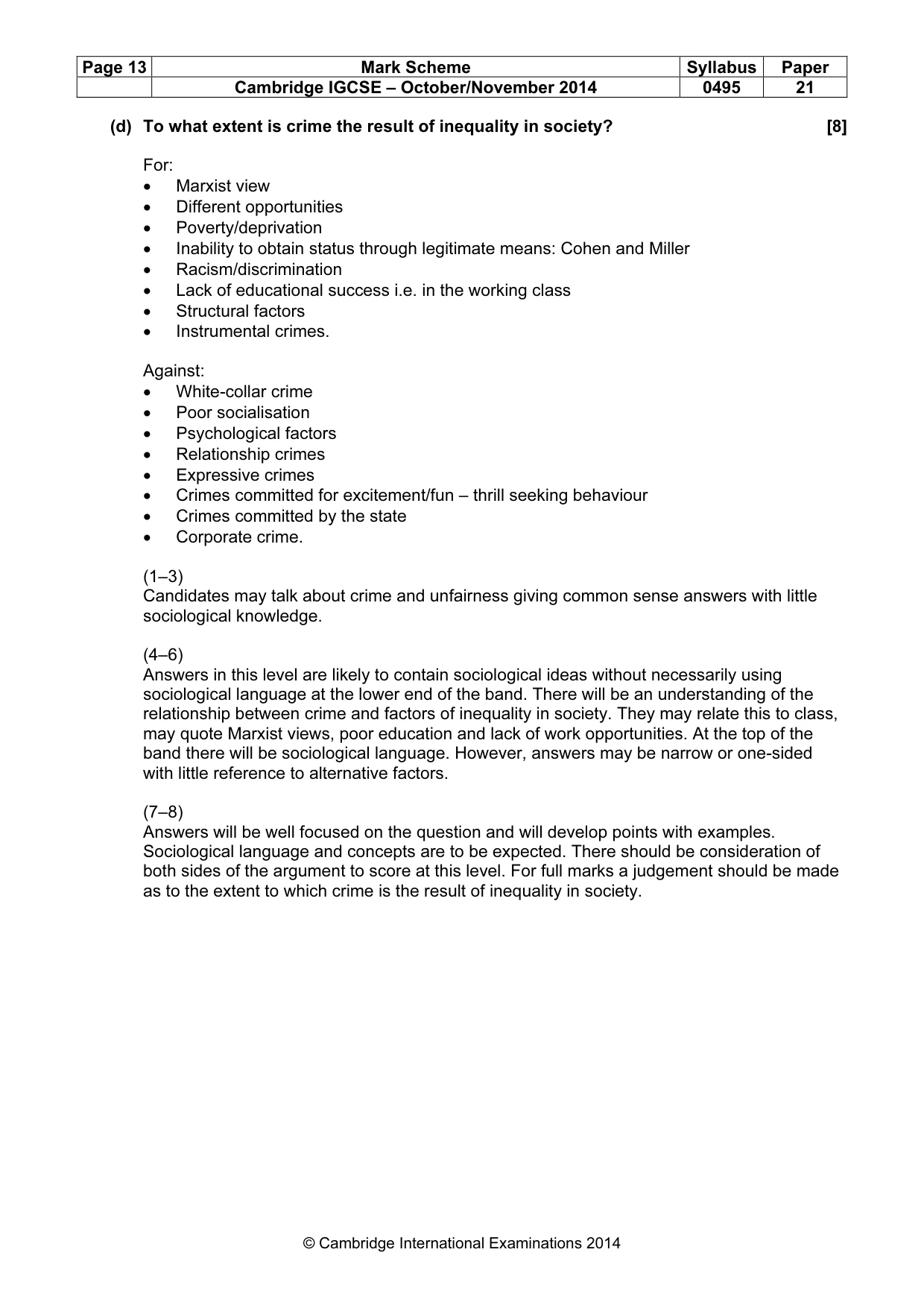
Page 13 Mark Scheme Syllabus Paper Cambridge IGCSE – October/November 2014 0495 21 © Cambridge International Examinations 2014 (d) To what extent is crime the result of inequality in society? [8] For: • Marxist view • Different opportunities • Poverty/deprivation • Inability to obtain status through legitimate means: Cohen and Miller • Racism/discrimination • Lack of educational success i.e. in the working class • Structural factors • Instrumental crimes. Against: • White-collar crime • Poor socialisation • Psychological factors • Relationship crimes • Expressive crimes • Crimes committed for excitement/fun – thrill seeking behaviour • Crimes committed by the state • Corporate crime. (1–3) Candidates may talk about crime and unfairness giving common sense answers with little sociological knowledge. (4–6) Answers in this level are likely to contain sociological ideas without necessarily using sociological language at the lower end of the band. There will be an understanding of the relationship between crime and factors of inequality in society. They may relate this to class, may quote Marxist views, poor education and lack of work opportunities. At the top of the band there will be sociological language. However, answers may be narrow or one-sided with little reference to alternative factors. (7–8) Answers will be well focused on the question and will develop points with examples. Sociological language and concepts are to be expected. There should be consideration of both sides of the argument to score at this level. For full marks a judgement should be made as to the extent to which crime is the result of inequality in society.
Mark scheme, page 14
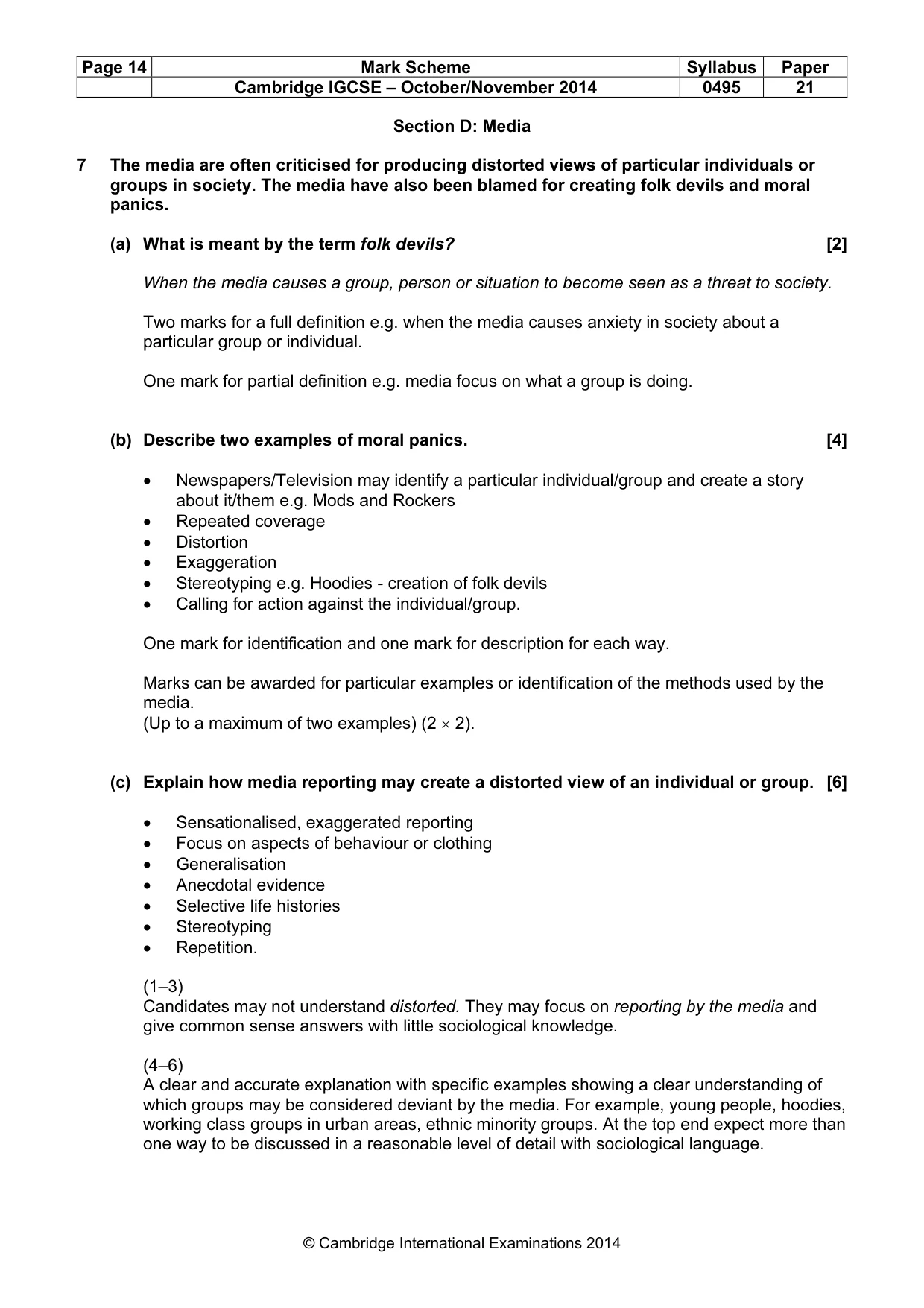
Page 14 Mark Scheme Syllabus Paper Cambridge IGCSE – October/November 2014 0495 21 © Cambridge International Examinations 2014 Section D: Media 7 The media are often criticised for producing distorted views of particular individuals or groups in society. The media have also been blamed for creating folk devils and moral panics. (a) What is meant by the term folk devils? [2] When the media causes a group, person or situation to become seen as a threat to society. Two marks for a full definition e.g. when the media causes anxiety in society about a particular group or individual. One mark for partial definition e.g. media focus on what a group is doing. (b) Describe two examples of moral panics. [4] • Newspapers/Television may identify a particular individual/group and create a story about it/them e.g. Mods and Rockers • Repeated coverage • Distortion • Exaggeration • Stereotyping e.g. Hoodies - creation of folk devils • Calling for action against the individual/group. One mark for identification and one mark for description for each way. Marks can be awarded for particular examples or identification of the methods used by the media. (Up to a maximum of two examples) (2 × 2). (c) Explain how media reporting may create a distorted view of an individual or group. [6] • Sensationalised, exaggerated reporting • Focus on aspects of behaviour or clothing • Generalisation • Anecdotal evidence • Selective life histories • Stereotyping • Repetition. (1–3) Candidates may not understand distorted. They may focus on reporting by the media and give common sense answers with little sociological knowledge. (4–6) A clear and accurate explanation with specific examples showing a clear understanding of which groups may be considered deviant by the media. For example, young people, hoodies, working class groups in urban areas, ethnic minority groups. At the top end expect more than one way to be discussed in a reasonable level of detail with sociological language.
Mark scheme, page 15
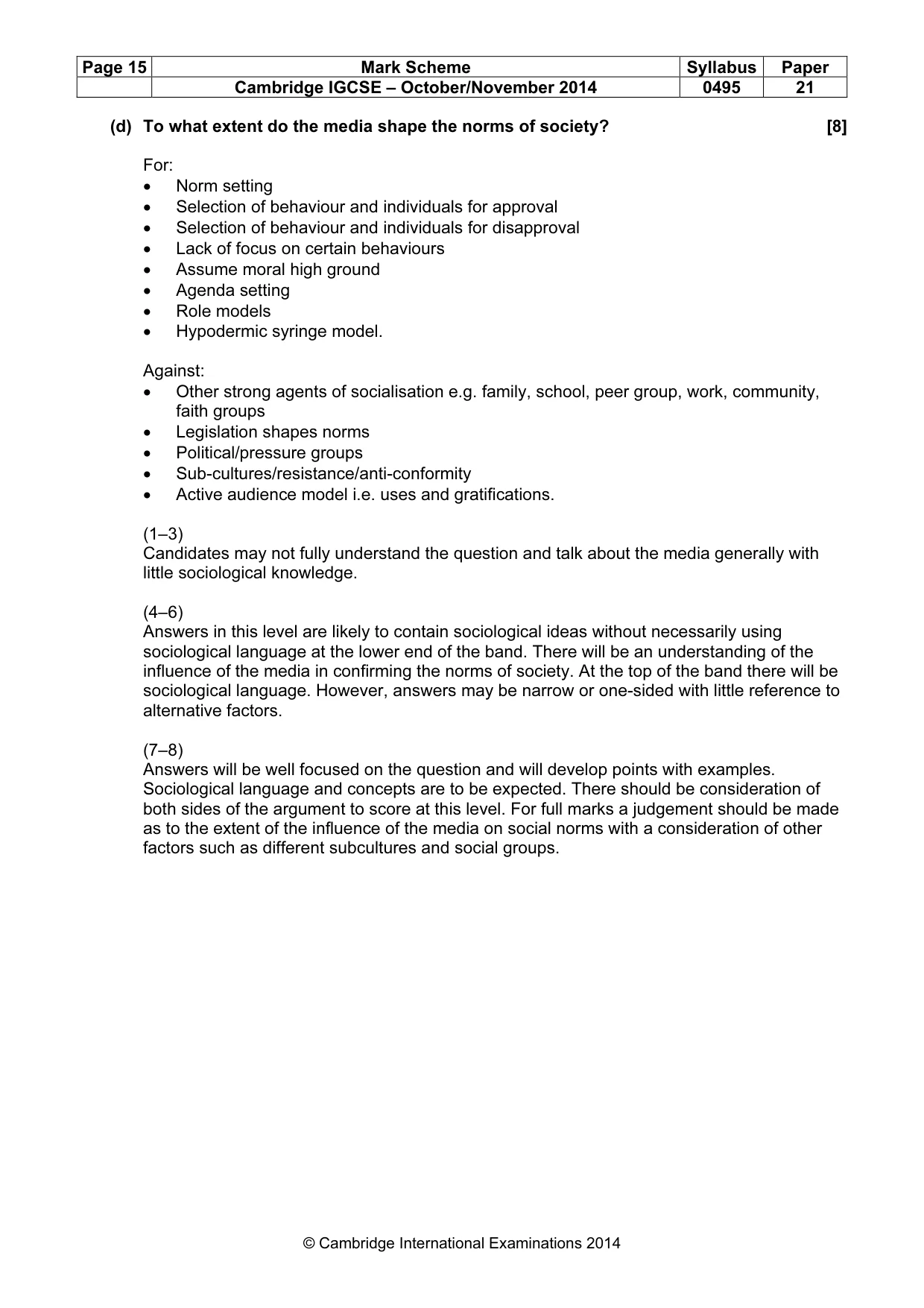
Page 15 Mark Scheme Syllabus Paper Cambridge IGCSE – October/November 2014 0495 21 © Cambridge International Examinations 2014 (d) To what extent do the media shape the norms of society? [8] For: • Norm setting • Selection of behaviour and individuals for approval • Selection of behaviour and individuals for disapproval • Lack of focus on certain behaviours • Assume moral high ground • Agenda setting • Role models • Hypodermic syringe model. Against: • Other strong agents of socialisation e.g. family, school, peer group, work, community, faith groups • Legislation shapes norms • Political/pressure groups • Sub-cultures/resistance/anti-conformity • Active audience model i.e. uses and gratifications. (1–3) Candidates may not fully understand the question and talk about the media generally with little sociological knowledge. (4–6) Answers in this level are likely to contain sociological ideas without necessarily using sociological language at the lower end of the band. There will be an understanding of the influence of the media in confirming the norms of society. At the top of the band there will be sociological language. However, answers may be narrow or one-sided with little reference to alternative factors. (7–8) Answers will be well focused on the question and will develop points with examples. Sociological language and concepts are to be expected. There should be consideration of both sides of the argument to score at this level. For full marks a judgement should be made as to the extent of the influence of the media on social norms with a consideration of other factors such as different subcultures and social groups.
Mark scheme, page 16
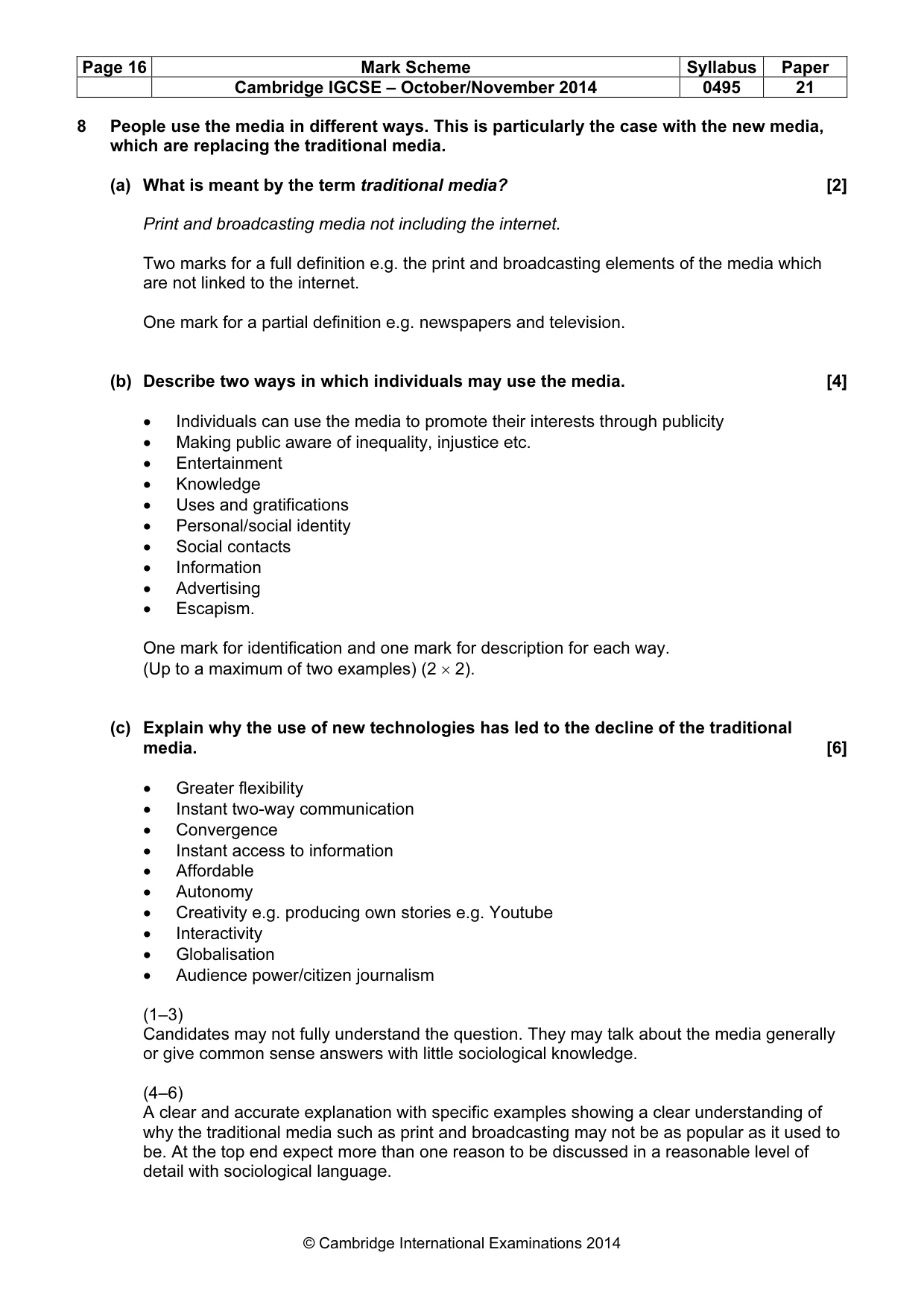
Page 16 Mark Scheme Syllabus Paper Cambridge IGCSE – October/November 2014 0495 21 © Cambridge International Examinations 2014 8 People use the media in different ways. This is particularly the case with the new media, which are replacing the traditional media. (a) What is meant by the term traditional media? [2] Print and broadcasting media not including the internet. Two marks for a full definition e.g. the print and broadcasting elements of the media which are not linked to the internet. One mark for a partial definition e.g. newspapers and television. (b) Describe two ways in which individuals may use the media. [4] • Individuals can use the media to promote their interests through publicity • Making public aware of inequality, injustice etc. • Entertainment • Knowledge • Uses and gratifications • Personal/social identity • Social contacts • Information • Advertising • Escapism. One mark for identification and one mark for description for each way. (Up to a maximum of two examples) (2 × 2). (c) Explain why the use of new technologies has led to the decline of the traditional media. [6] • Greater flexibility • Instant two-way communication • Convergence • Instant access to information • Affordable • Autonomy • Creativity e.g. producing own stories e.g. Youtube • Interactivity • Globalisation • Audience power/citizen journalism (1–3) Candidates may not fully understand the question. They may talk about the media generally or give common sense answers with little sociological knowledge. (4–6) A clear and accurate explanation with specific examples showing a clear understanding of why the traditional media such as print and broadcasting may not be as popular as it used to be. At the top end expect more than one reason to be discussed in a reasonable level of detail with sociological language.
Mark scheme, page 17
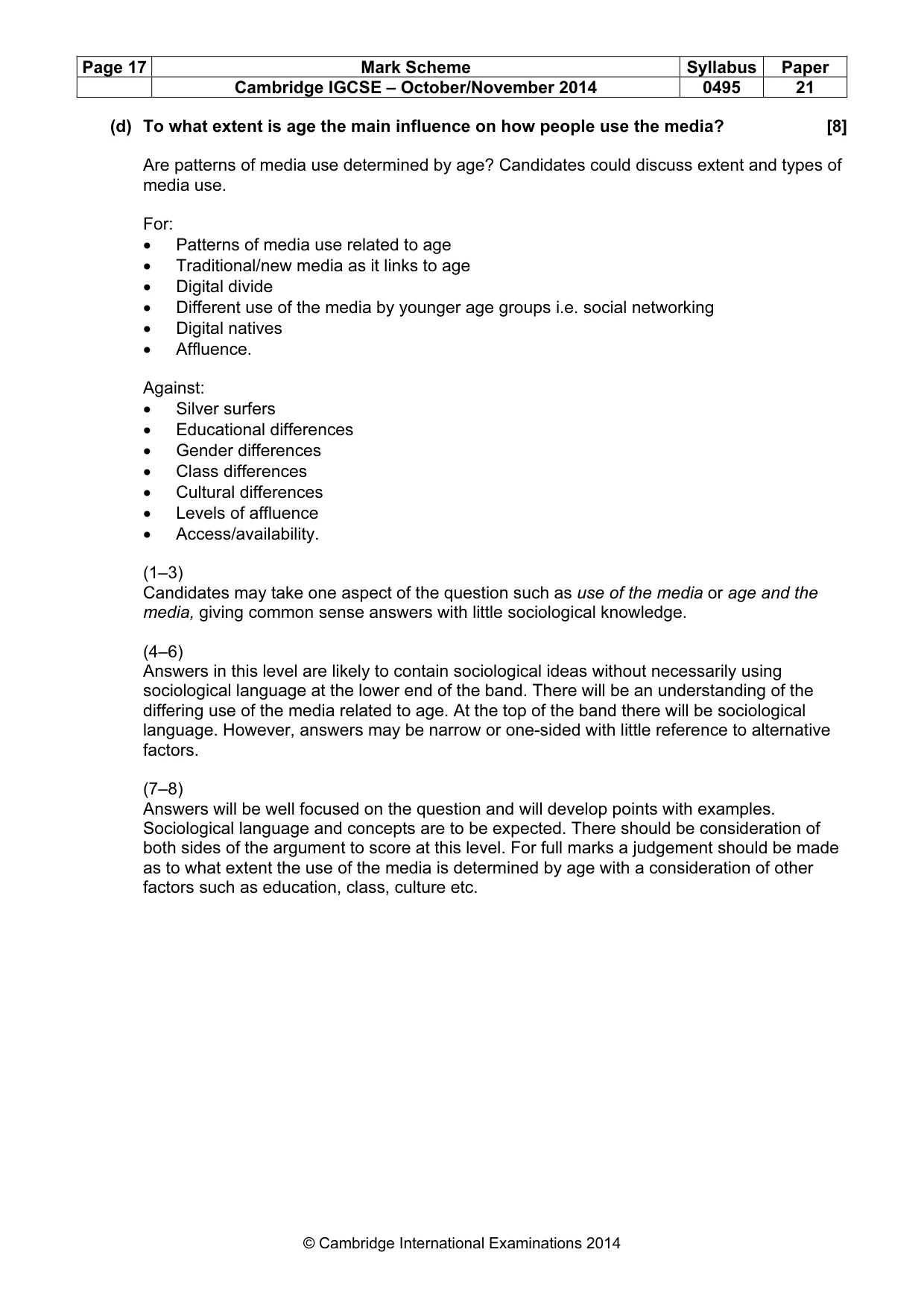
Page 17 Mark Scheme Syllabus Paper Cambridge IGCSE – October/November 2014 0495 21 © Cambridge International Examinations 2014 (d) To what extent is age the main influence on how people use the media? [8] Are patterns of media use determined by age? Candidates could discuss extent and types of media use. For: • Patterns of media use related to age • Traditional/new media as it links to age • Digital divide • Different use of the media by younger age groups i.e. social networking • Digital natives • Affluence. Against: • Silver surfers • Educational differences • Gender differences • Class differences • Cultural differences • Levels of affluence • Access/availability. (1–3) Candidates may take one aspect of the question such as use of the media or age and the media, giving common sense answers with little sociological knowledge. (4–6) Answers in this level are likely to contain sociological ideas without necessarily using sociological language at the lower end of the band. There will be an understanding of the differing use of the media related to age. At the top of the band there will be sociological language. However, answers may be narrow or one-sided with little reference to alternative factors. (7–8) Answers will be well focused on the question and will develop points with examples. Sociological language and concepts are to be expected. There should be consideration of both sides of the argument to score at this level. For full marks a judgement should be made as to what extent the use of the media is determined by age with a consideration of other factors such as education, class, culture etc.
What you needed in this session
Cambridge’s own grade thresholds for 2014 Oct/Nov, Paper 2 · Variant 1. A higher threshold means an easier paper — the bar moves with how the cohort did.