Cambridge IGCSE Sociology 0495 — 2013 May/June Paper 2 · Variant 3
0495/23/M/J/13 · 60 marks · ≈68 min
The question paper and its mark scheme, free to read here and free to download. This is Cambridge’s own paper, exactly as it was sat.
Question paper36 pages



Mark scheme11 pages
Answers below. Sit the paper first if you are practising.
Paper as text
Question paper, page 1
This document consists of 33 printed pages and 3 blank pages. DC (LEG) 61574 © UCLES 2013 [Turn over UNIVERSITY OF CAMBRIDGE INTERNATIONAL EXAMINATIONS International General Certificate of Secondary Education * 3 6 6 9 3 9 4 2 4 4 * SOCIOLOGY 0495/23 Paper 2 May/June 2013 1 hour 45 minutes Candidates answer on the Question Paper. No Additional Materials are required. READ THESE INSTRUCTIONS FIRST Write your Centre number, candidate number and name in the spaces provided. Write in dark blue or black pen. You may use a soft pencil for any diagrams, graphs or rough working. Do not use staples, paper clips, highlighters, glue or correction fluid. You may not need all the answer lines for your answer. DO NOT WRITE IN ANY BARCODES. Answer any three questions. The number of marks is given in brackets [ ] at the end of each question or part question. www.XtremePapers.com
Question paper, page 2
2 0495/23/M/J/13 © UCLES 2013 For Examiner’s Use Section A: The Family 1 Many sociologists agree that living in a family tends to benefit men more than women. This may be particularly true of some ethnic minority families. (a) What is meant by the term ethnic minority families? … … … …[2] (b) Describe two reasons why some people live in extended families. … … … … … … … …[4]
Question paper, page 3
3 0495/23/M/J/13 © UCLES 2013 [Turn over For Examiner’s Use (c) Explain why men may benefit more than women from living in a family. … … … … … … … … … … … … … … … … … … … … … … … … … … …[6]
Question paper, page 4
4 0495/23/M/J/13 © UCLES 2013 For Examiner’s Use (d) To what extent is ethnicity the main factor influencing the structure of the family? … … … … … … … … … … … … … … … … … … … … … … … … … … …
Question paper, page 5
5 0495/23/M/J/13 © UCLES 2013 [Turn over For Examiner’s Use … … … … … … … … … … … … … …[8]
Question paper, page 6
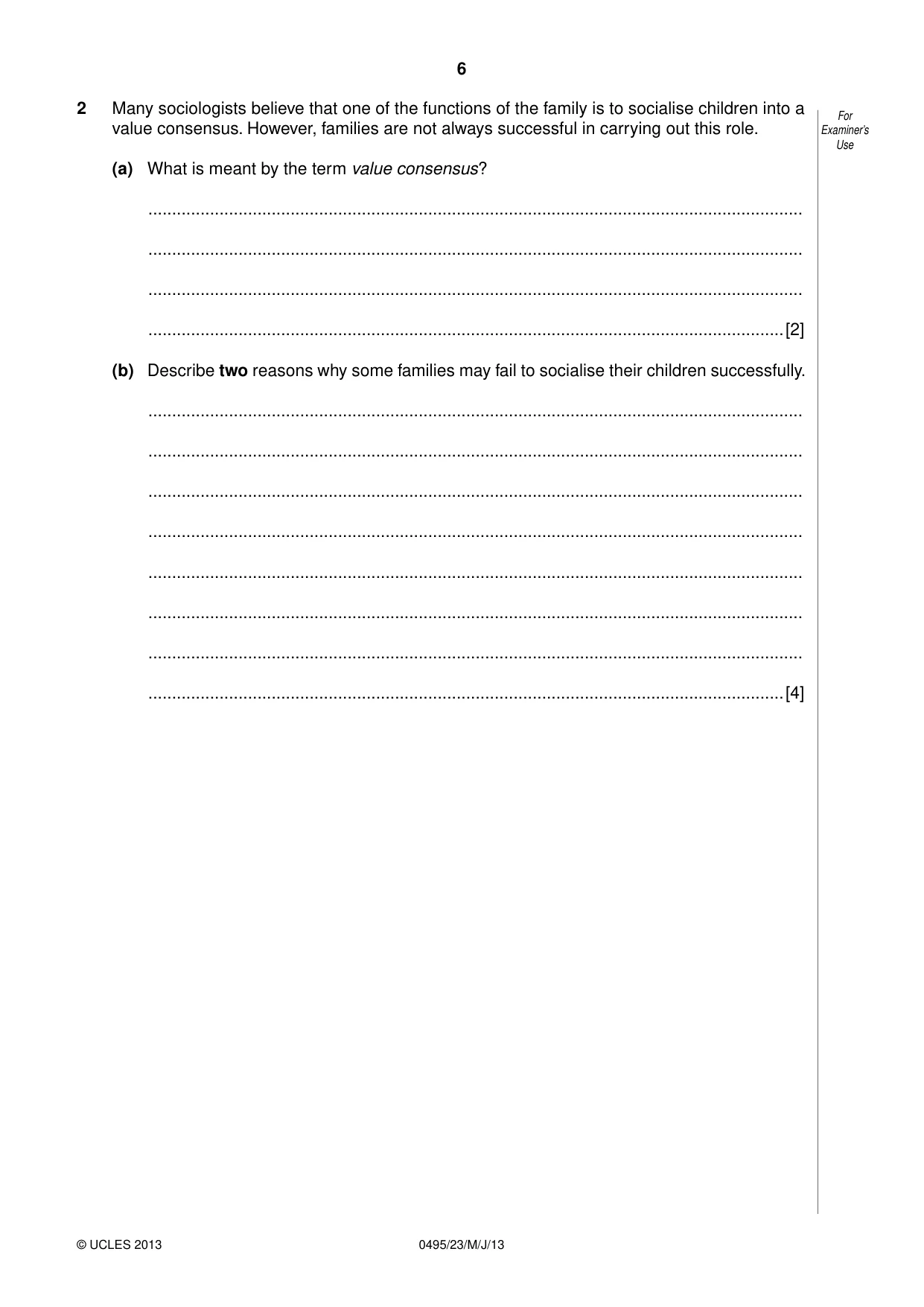
6 0495/23/M/J/13 © UCLES 2013 For Examiner’s Use 2 Many sociologists believe that one of the functions of the family is to socialise children into a value consensus. However, families are not always successful in carrying out this role. (a) What is meant by the term value consensus? … … … …[2] (b) Describe two reasons why some families may fail to socialise their children successfully. … … … … … … … …[4]
Question paper, page 7
7 0495/23/M/J/13 © UCLES 2013 [Turn over For Examiner’s Use (c) Explain how sanctions may be used to reinforce the socialisation process within the family. … … … … … … … … … … … … … … … … … … … … … … … … … … …[6]
Question paper, page 8
8 0495/23/M/J/13 © UCLES 2013 For Examiner’s Use (d) To what extent may the family be dysfunctional for its members? … … … … … … … … … … … … … … … … … … … … … … … … … … …
Question paper, page 9
9 0495/23/M/J/13 © UCLES 2013 [Turn over For Examiner’s Use … … … … … … … … … … … … … …[8]
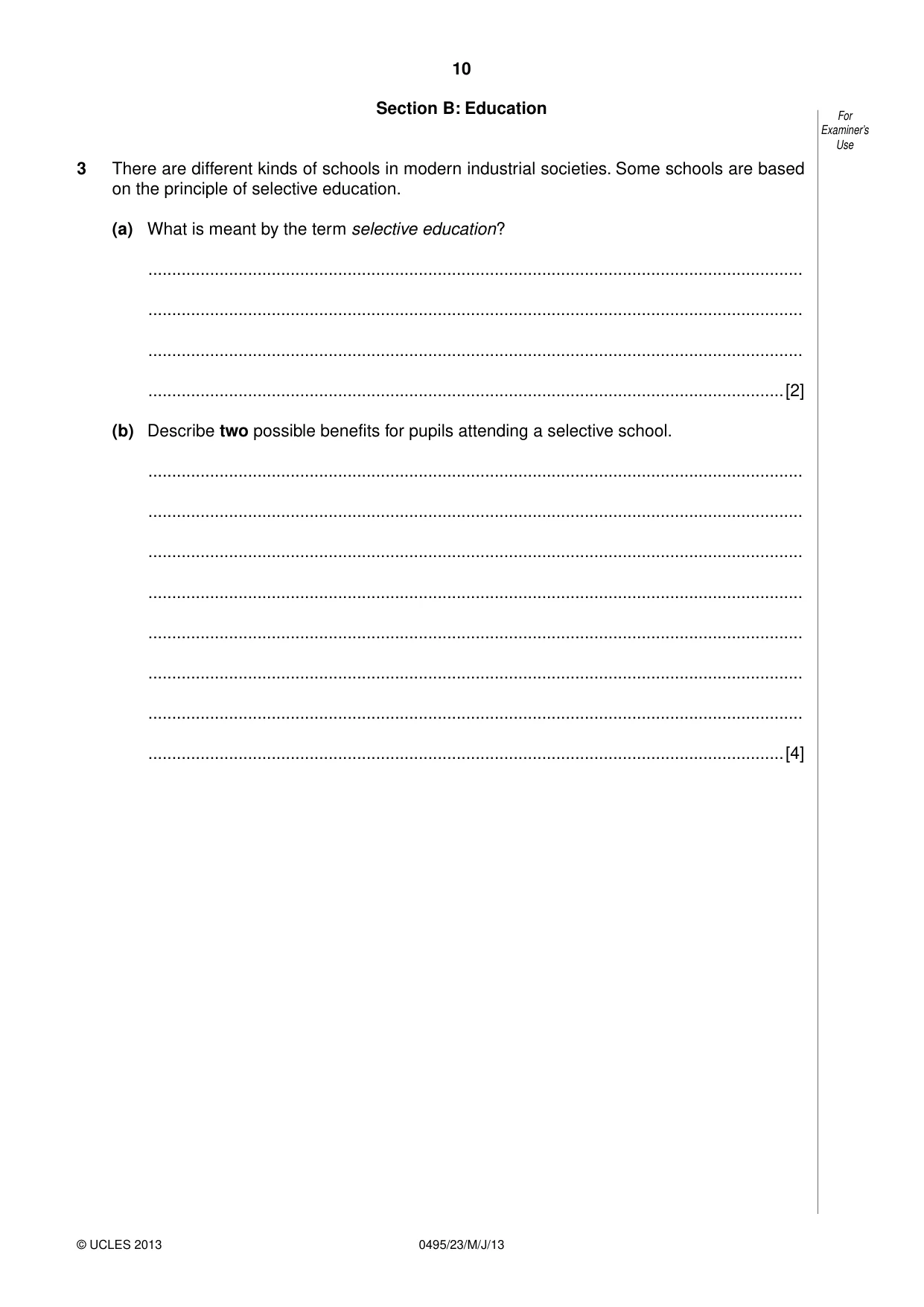
Question paper, page 10
10 0495/23/M/J/13 © UCLES 2013 For Examiner’s Use Section B: Education 3 There are different kinds of schools in modern industrial societies. Some schools are based on the principle of selective education. (a) What is meant by the term selective education? … … … …[2] (b) Describe two possible benefits for pupils attending a selective school. … … … … … … … …[4]
Question paper, page 11
11 0495/23/M/J/13 © UCLES 2013 [Turn over For Examiner’s Use (c) Explain the actions that schools can take to provide equal access to educational opportunities. … … … … … … … … … … … … … … … … … … … … … … … … … … …[6]
Question paper, page 12
12 0495/23/M/J/13 © UCLES 2013 For Examiner’s Use (d) To what extent may selective education create divisions in society? … … … … … … … … … … … … … … … … … … … … … … … … … … …
Question paper, page 13
13 0495/23/M/J/13 © UCLES 2013 [Turn over For Examiner’s Use … … … … … … … … … … … … …[8]
Question paper, page 14
14 0495/23/M/J/13 © UCLES 2013 For Examiner’s Use 4 Schools are part of the formal education process through which pupils receive a preparation for work. There is a debate about how far schools promote social mobility. (a) What is meant by the term formal education? … … … …[2] (b) Describe two ways in which schools may promote upward social mobility. … … … … … … … …[4]
Question paper, page 15
15 0495/23/M/J/13 © UCLES 2013 [Turn over For Examiner’s Use (c) Explain how schooling may be a preparation for work. … … … … … … … … … … … … … … … … … … … … … … … … … … …[6]
Question paper, page 16
16 0495/23/M/J/13 © UCLES 2013 For Examiner’s Use (d) To what extent does formal education promote social mobility? … … … … … … … … … … … … … … … … … … … … … … … … … … …
Question paper, page 17
17 0495/23/M/J/13 © UCLES 2013 [Turn over For Examiner’s Use … … … … … … … … … … … … …[8]
Question paper, page 18
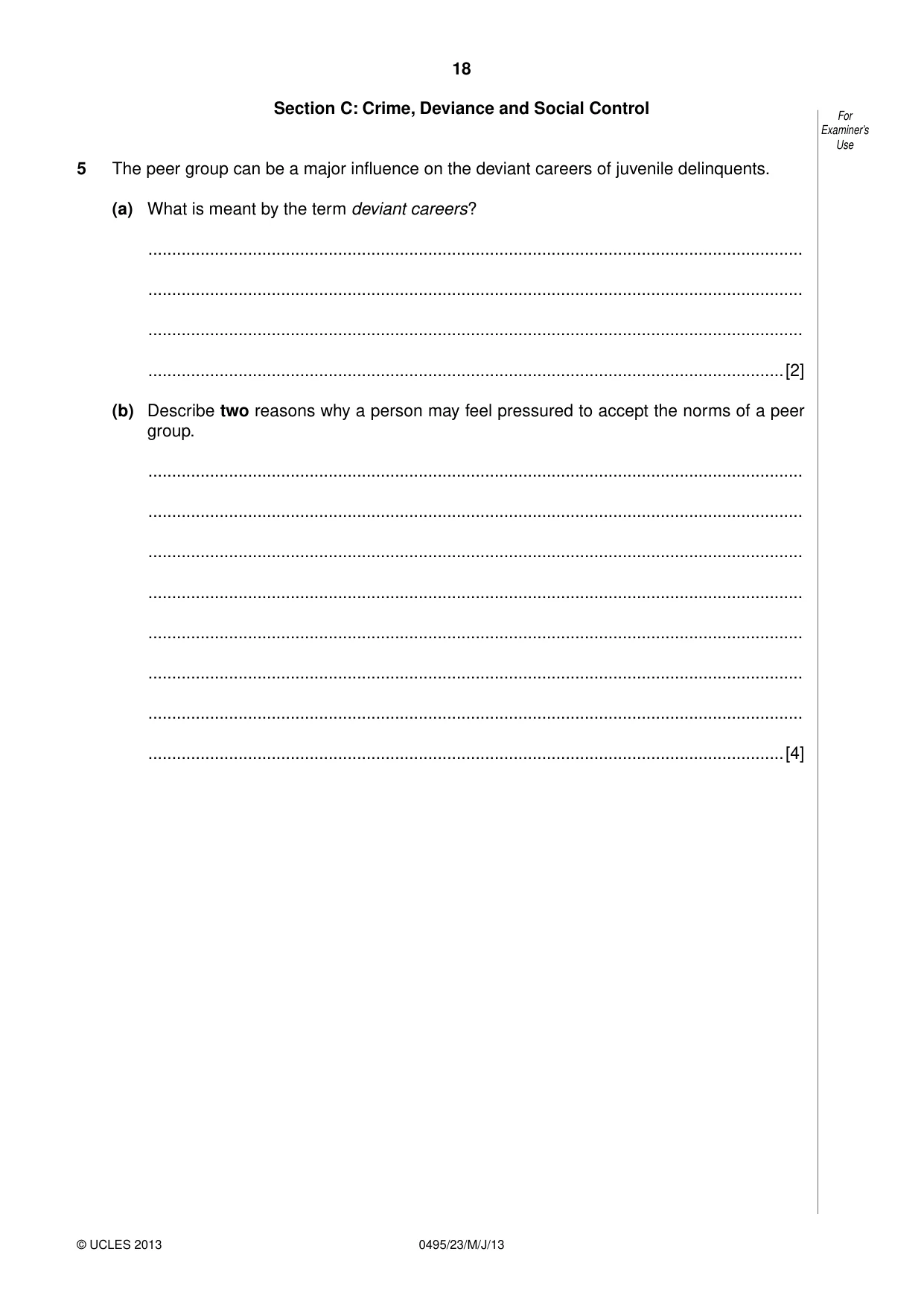
18 0495/23/M/J/13 © UCLES 2013 For Examiner’s Use Section C: Crime, Deviance and Social Control 5 The peer group can be a major influence on the deviant careers of juvenile delinquents. (a) What is meant by the term deviant careers? … … … …[2] (b) Describe two reasons why a person may feel pressured to accept the norms of a peer group. … … … … … … … …[4]
Question paper, page 19
19 0495/23/M/J/13 © UCLES 2013 [Turn over For Examiner’s Use (c) Explain why young people rather than other age groups are more likely to appear in crime statistics. … … … … … … … … … … … … … … … … … … … … … … … … … … …[6]
Question paper, page 20
20 0495/23/M/J/13 © UCLES 2013 For Examiner’s Use (d) To what extent is juvenile delinquency a result of poor socialisation? … … … … … … … … … … … … … … … … … … … … … … … … … … …
Question paper, page 21
21 0495/23/M/J/13 © UCLES 2013 [Turn over For Examiner’s Use … … … … … … … … … … … … …[8]
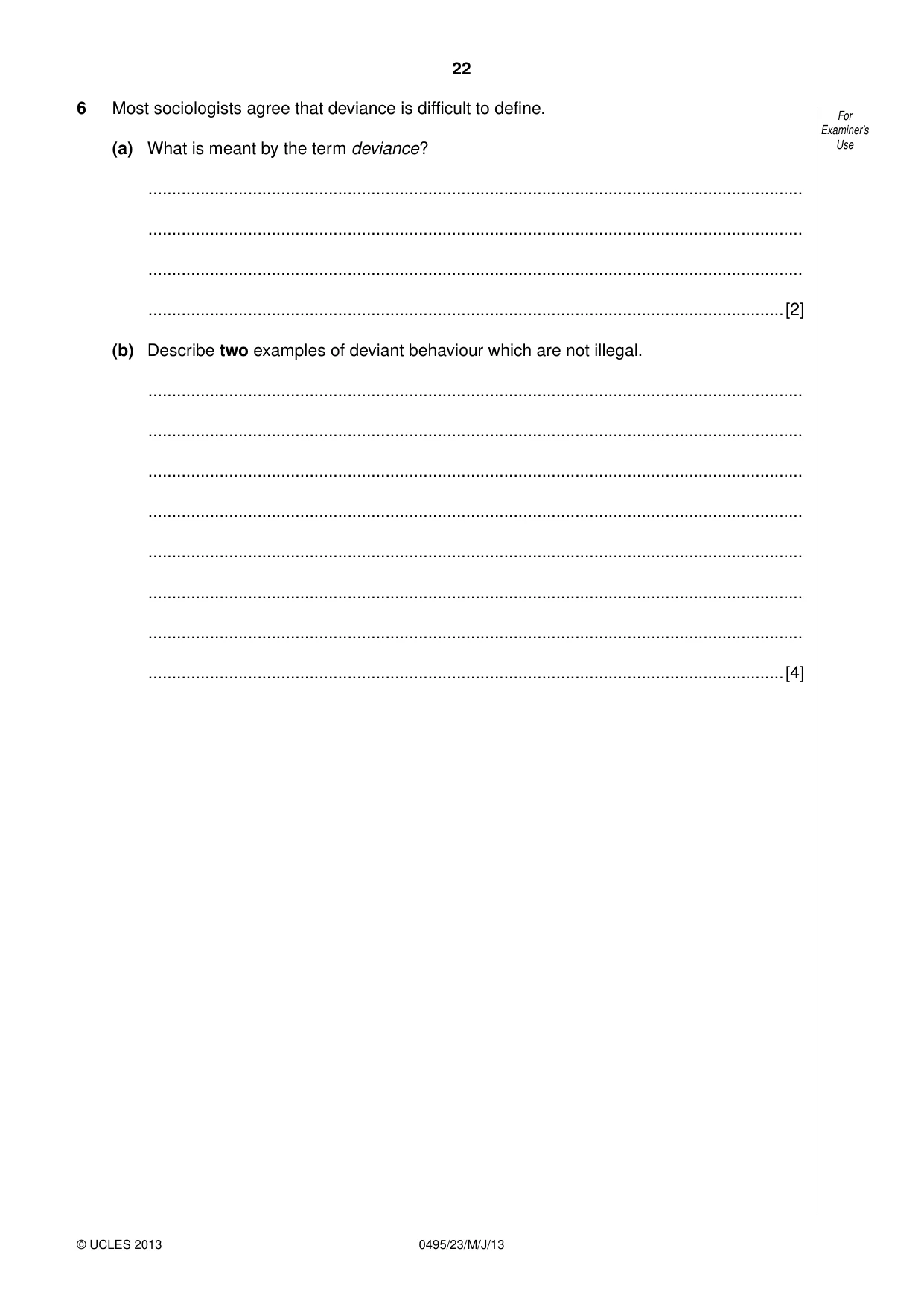
Question paper, page 22
22 0495/23/M/J/13 © UCLES 2013 For Examiner’s Use 6 Most sociologists agree that deviance is difficult to define. (a) What is meant by the term deviance? … … … …[2] (b) Describe two examples of deviant behaviour which are not illegal. … … … … … … … …[4]
Question paper, page 23
23 0495/23/M/J/13 © UCLES 2013 [Turn over For Examiner’s Use (c) Explain how definitions of deviance may vary between societies and across time. … … … … … … … … … … … … … … … … … … … … … … … … … … …[6]
Question paper, page 24
24 0495/23/M/J/13 © UCLES 2013 For Examiner’s Use (d) To what extent can deviant behaviour be explained in terms of the conflict approaches? … … … … … … … … … … … … … … … … … … … … … … … … … … …
Question paper, page 25
25 0495/23/M/J/13 © UCLES 2013 [Turn over For Examiner’s Use … … … … … … … … … … … … …[8]
Question paper, page 26
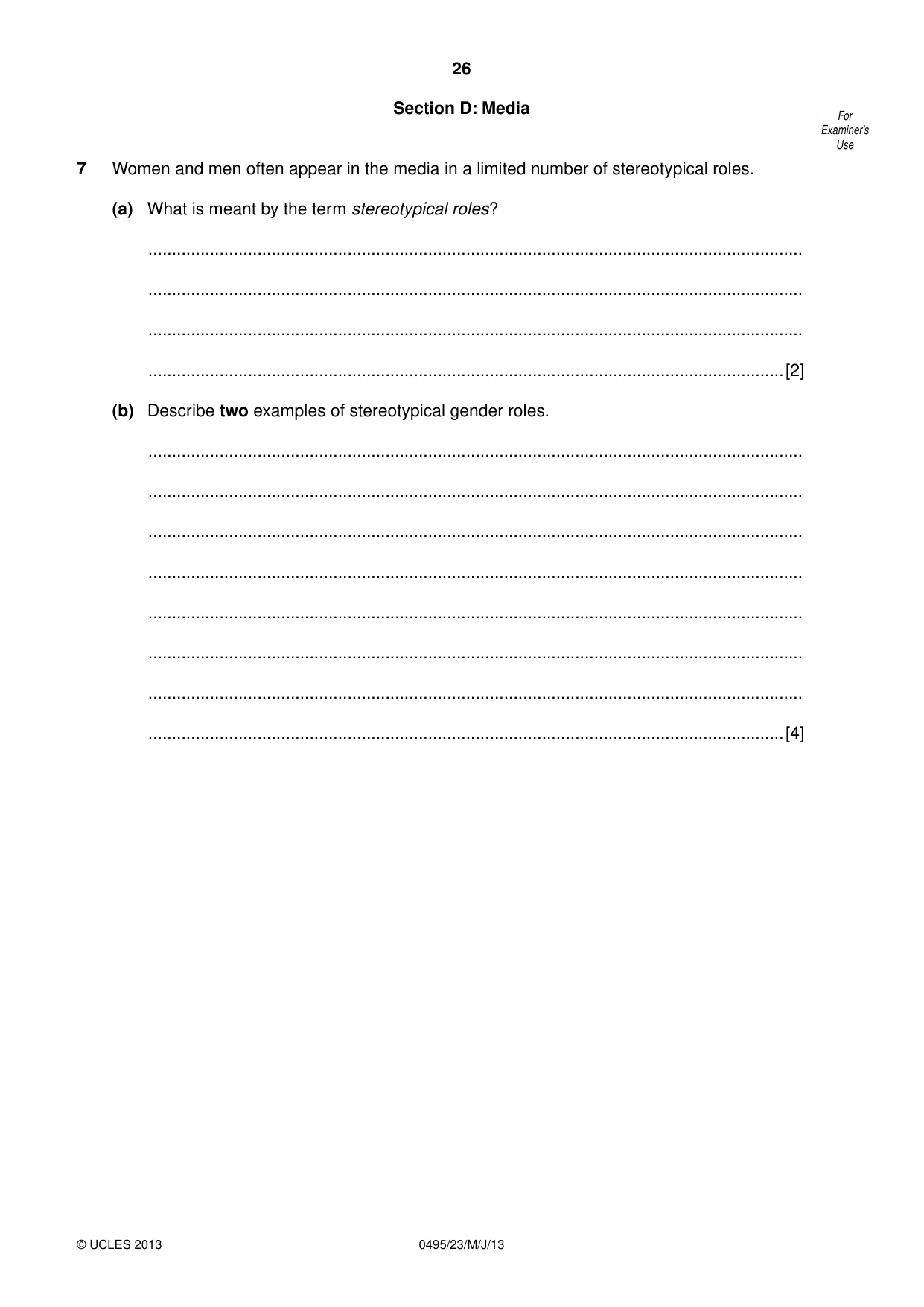
26 0495/23/M/J/13 © UCLES 2013 For Examiner’s Use Section D: Media 7 Women and men often appear in the media in a limited number of stereotypical roles. (a) What is meant by the term stereotypical roles? … … … …[2] (b) Describe two examples of stereotypical gender roles. … … … … … … … …[4]
Question paper, page 27
27 0495/23/M/J/13 © UCLES 2013 [Turn over For Examiner’s Use (c) Explain why the media construct stereotypical images of women and men. … … … … … … … … … … … … … … … … … … … … … … … … … … …[6]
Question paper, page 28
28 0495/23/M/J/13 © UCLES 2013 For Examiner’s Use (d) To what extent are people influenced by the stereotypical images presented in the media? … … … … … … … … … … … … … … … … … … … … … … … … … … …
Question paper, page 29
29 0495/23/M/J/13 © UCLES 2013 [Turn over For Examiner’s Use … … … … … … … … … … … … …[8]
Question paper, page 30
30 0495/23/M/J/13 © UCLES 2013 For Examiner’s Use 8 The media play a major role in the communication of popular culture. The new media have become an important part of this process. (a) What is meant by the term popular culture? … … … …[2] (b) Describe two differences between popular culture and high culture. … … … … … … … …[4]
Question paper, page 31
31 0495/23/M/J/13 © UCLES 2013 [Turn over For Examiner’s Use (c) Explain some of the ways in which the new media have increased the spread of popular culture. … … … … … … … … … … … … … … … … … … … … … … … … … … …[6]
Question paper, page 32
32 0495/23/M/J/13 © UCLES 2013 For Examiner’s Use (d) How far is the content of popular culture shaped by the media? … … … … … … … … … … … … … … … … … … … … … … … … … … …
Question paper, page 33
33 0495/23/M/J/13 © UCLES 2013 For Examiner’s Use … … … … … … … … … … … … …[8]
Question paper, page 34
34 0495/23/M/J/13 © UCLES 2013 BLANK PAGE
Question paper, page 35
35 0495/23/M/J/13 © UCLES 2013 BLANK PAGE
Question paper, page 36
36 0495/23/M/J/13 © UCLES 2013 Permission to reproduce items where third-party owned material protected by copyright is included has been sought and cleared where possible. Every reasonable effort has been made by the publisher (UCLES) to trace copyright holders, but if any items requiring clearance have unwittingly been included, the publisher will be pleased to make amends at the earliest possible opportunity. University of Cambridge International Examinations is part of the Cambridge Assessment Group. Cambridge Assessment is the brand name of University of Cambridge Local Examinations Syndicate (UCLES), which is itself a department of the University of Cambridge. BLANK PAGE
Mark scheme, page 1
CAMBRIDGE INTERNATIONAL EXAMINATIONS International General Certificate of Secondary Education MARK SCHEME for the May/June 2013 series 0495 SOCIOLOGY 0495/23 Paper 2, maximum raw mark 60 This mark scheme is published as an aid to teachers and candidates, to indicate the requirements of the examination. It shows the basis on which Examiners were instructed to award marks. It does not indicate the details of the discussions that took place at an Examiners’ meeting before marking began, which would have considered the acceptability of alternative answers. Mark schemes should be read in conjunction with the question paper and the Principal Examiner Report for Teachers. Cambridge will not enter into discussions about these mark schemes. Cambridge is publishing the mark schemes for the May/June 2013 series for most IGCSE, GCE Advanced Level and Advanced Subsidiary Level components and some Ordinary Level components. www.XtremePapers.com
Mark scheme, page 2
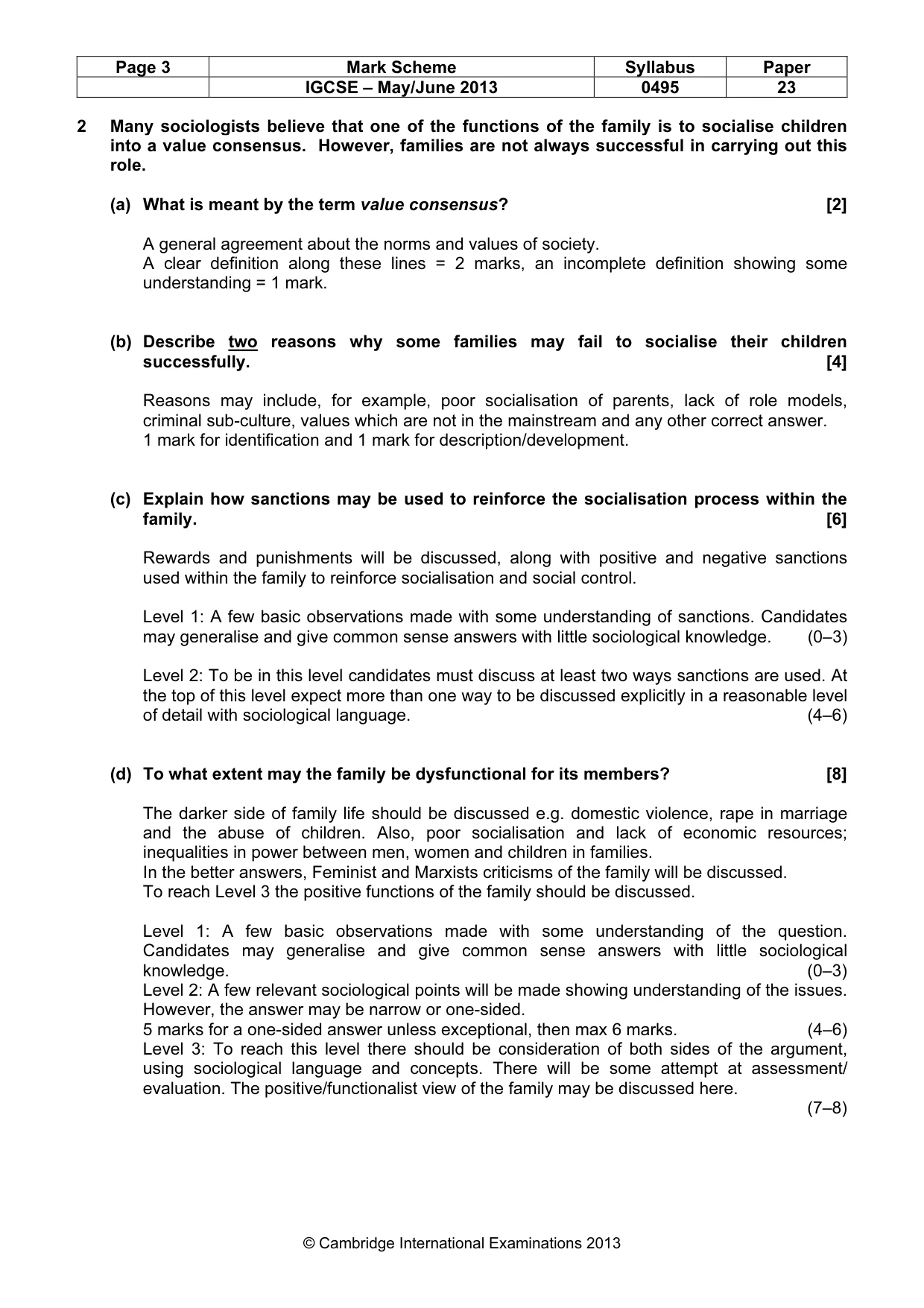
Page 2 Mark Scheme Syllabus Paper IGCSE – May/June 2013 0495 23 © Cambridge International Examinations 2013 Section A: The Family 1 Many sociologists agree that living in a family tends to benefit men more than women. This may be particularly true of some ethnic minority families. (a) What is meant by the term ethnic minority families? [2] Families whose culture and beliefs are different to the majority of the population. A clear definition along these lines = 2 marks, an incomplete definition showing some understanding = 1 mark (b) Describe two reasons why some people live in extended families. [4] Culture and tradition, support network economically and socially, strong kinship ties, not their country of origin therefore stick together. Women of the family have a female network of kin to help them with children and any other correct answer. 1 mark for identification and 1 mark for description/development. (c) Explain why men may benefit more than women from living in a family. [6] Inequalities within families and segregated conjugal roles should be discussed along with the domestic division of labour, women's triple burden, dual burden, and the myth of the new man. Domestic violence and the darker side of family life may also be discussed. Level 1: A few basic observations made on the benefits for men. Candidates may generalise and give common sense answers with little sociological knowledge. (0–3) Level 2: To be in this level candidates must discuss at least two reasons why men benefit more. At the top of this level expect more than one change to be discussed explicitly in a reasonable level of detail with sociological language. (4–6) (d) To what extent is ethnicity the main factor influencing the structure of the family? [8] There is a growing diversity of family types in modern industrial society; ethnic minorities bring with them their own culture and traditions. Afro-Caribbean families tend to be matrifocal with a larger proportion of lone mothers. Asian families tend to be extended with sometimes three generations living together. But many ethnic minorities are now second and third generation immigrants and have taken on British values and ways of life. Also, the structure of the family has changed due to other factors e.g. geographical mobility etc. Level 1: A few basic observations made with some understanding of the question. Candidates may generalise and give common sense answers with little sociological knowledge. (0–3) Level 2: A few relevant sociological points will be made showing understanding of the issues. However, the answer may be narrow or one-sided. 5 marks for a one-sided answer unless exceptional, then max 6 marks. (4–6) Level 3: To reach this level there should be consideration of both sides of the argument, using sociological language and concepts. There will be some attempt at assessment/ evaluation. (7–8)
Mark scheme, page 3
Page 3 Mark Scheme Syllabus Paper IGCSE – May/June 2013 0495 23 © Cambridge International Examinations 2013 2 Many sociologists believe that one of the functions of the family is to socialise children into a value consensus. However, families are not always successful in carrying out this role. (a) What is meant by the term value consensus? [2] A general agreement about the norms and values of society. A clear definition along these lines = 2 marks, an incomplete definition showing some understanding = 1 mark. (b) Describe two reasons why some families may fail to socialise their children successfully. [4] Reasons may include, for example, poor socialisation of parents, lack of role models, criminal sub-culture, values which are not in the mainstream and any other correct answer. 1 mark for identification and 1 mark for description/development. (c) Explain how sanctions may be used to reinforce the socialisation process within the family. [6] Rewards and punishments will be discussed, along with positive and negative sanctions used within the family to reinforce socialisation and social control. Level 1: A few basic observations made with some understanding of sanctions. Candidates may generalise and give common sense answers with little sociological knowledge. (0–3) Level 2: To be in this level candidates must discuss at least two ways sanctions are used. At the top of this level expect more than one way to be discussed explicitly in a reasonable level of detail with sociological language. (4–6) (d) To what extent may the family be dysfunctional for its members? [8] The darker side of family life should be discussed e.g. domestic violence, rape in marriage and the abuse of children. Also, poor socialisation and lack of economic resources; inequalities in power between men, women and children in families. In the better answers, Feminist and Marxists criticisms of the family will be discussed. To reach Level 3 the positive functions of the family should be discussed. Level 1: A few basic observations made with some understanding of the question. Candidates may generalise and give common sense answers with little sociological knowledge. (0–3) Level 2: A few relevant sociological points will be made showing understanding of the issues. However, the answer may be narrow or one-sided. 5 marks for a one-sided answer unless exceptional, then max 6 marks. (4–6) Level 3: To reach this level there should be consideration of both sides of the argument, using sociological language and concepts. There will be some attempt at assessment/ evaluation. The positive/functionalist view of the family may be discussed here. (7–8)
Mark scheme, page 4
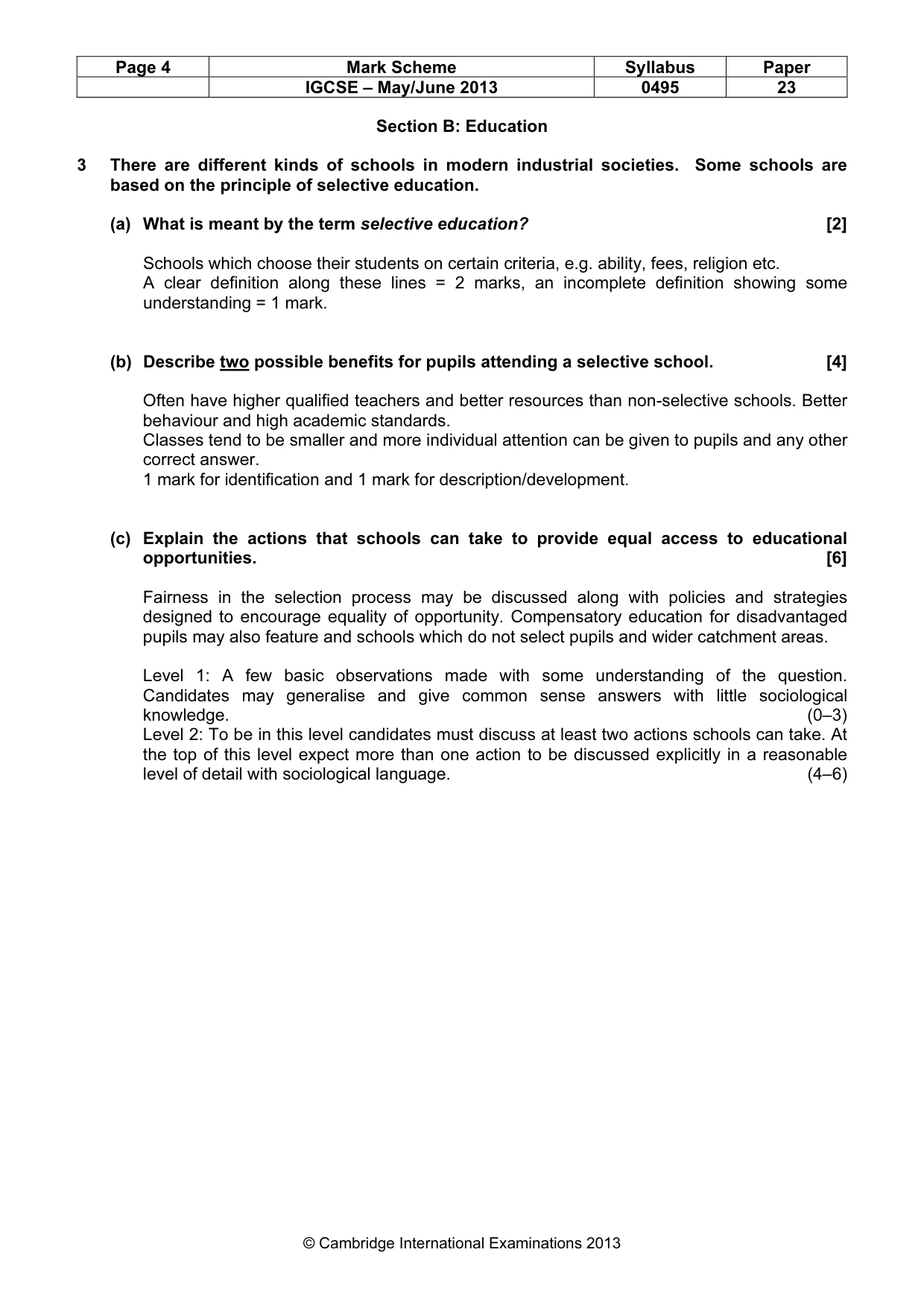
Page 4 Mark Scheme Syllabus Paper IGCSE – May/June 2013 0495 23 © Cambridge International Examinations 2013 Section B: Education 3 There are different kinds of schools in modern industrial societies. Some schools are based on the principle of selective education. (a) What is meant by the term selective education? [2] Schools which choose their students on certain criteria, e.g. ability, fees, religion etc. A clear definition along these lines = 2 marks, an incomplete definition showing some understanding = 1 mark. (b) Describe two possible benefits for pupils attending a selective school. [4] Often have higher qualified teachers and better resources than non-selective schools. Better behaviour and high academic standards. Classes tend to be smaller and more individual attention can be given to pupils and any other correct answer. 1 mark for identification and 1 mark for description/development. (c) Explain the actions that schools can take to provide equal access to educational opportunities. [6] Fairness in the selection process may be discussed along with policies and strategies designed to encourage equality of opportunity. Compensatory education for disadvantaged pupils may also feature and schools which do not select pupils and wider catchment areas. Level 1: A few basic observations made with some understanding of the question. Candidates may generalise and give common sense answers with little sociological knowledge. (0–3) Level 2: To be in this level candidates must discuss at least two actions schools can take. At the top of this level expect more than one action to be discussed explicitly in a reasonable level of detail with sociological language. (4–6)
Mark scheme, page 5
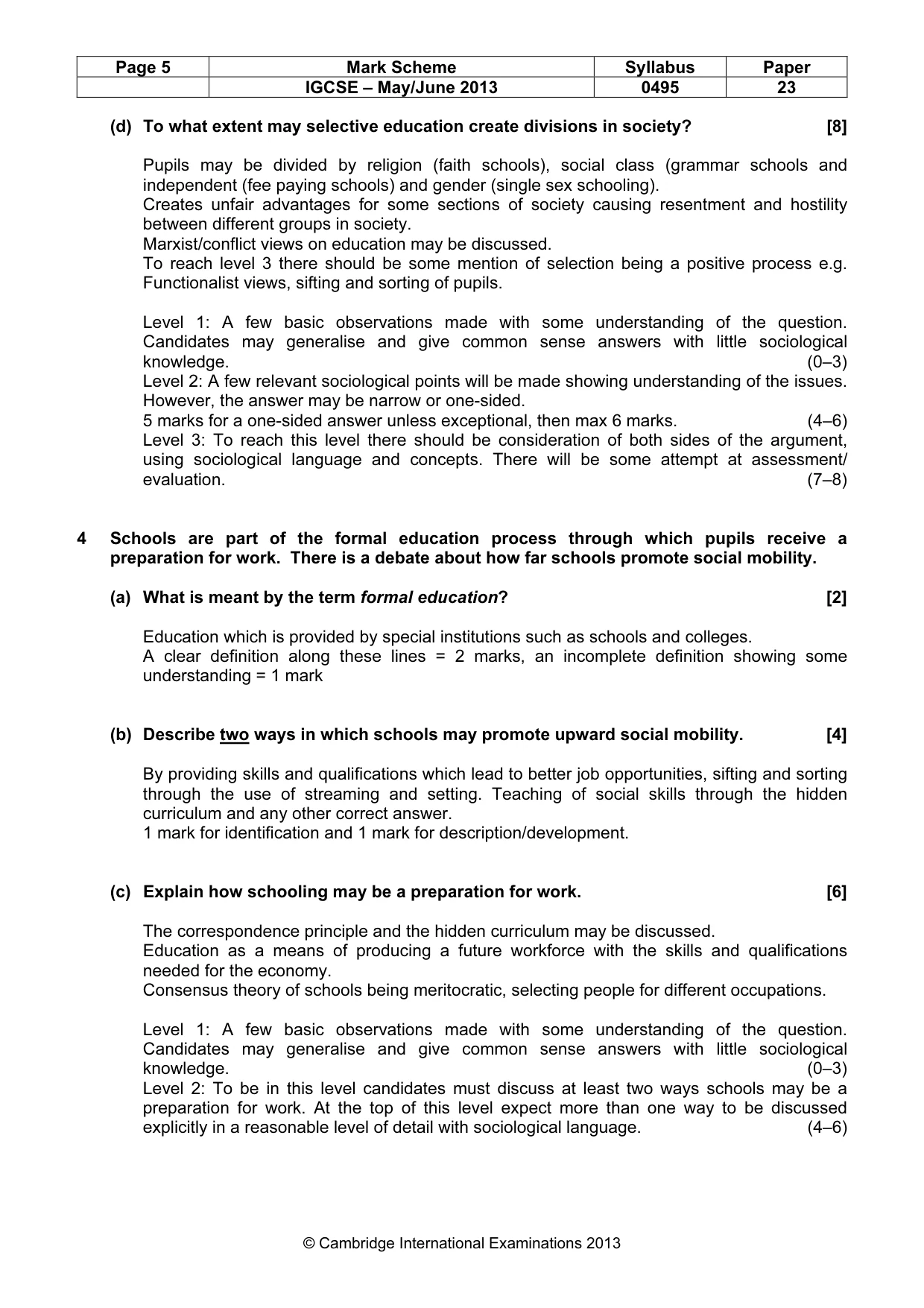
Page 5 Mark Scheme Syllabus Paper IGCSE – May/June 2013 0495 23 © Cambridge International Examinations 2013 (d) To what extent may selective education create divisions in society? [8] Pupils may be divided by religion (faith schools), social class (grammar schools and independent (fee paying schools) and gender (single sex schooling). Creates unfair advantages for some sections of society causing resentment and hostility between different groups in society. Marxist/conflict views on education may be discussed. To reach level 3 there should be some mention of selection being a positive process e.g. Functionalist views, sifting and sorting of pupils. Level 1: A few basic observations made with some understanding of the question. Candidates may generalise and give common sense answers with little sociological knowledge. (0–3) Level 2: A few relevant sociological points will be made showing understanding of the issues. However, the answer may be narrow or one-sided. 5 marks for a one-sided answer unless exceptional, then max 6 marks. (4–6) Level 3: To reach this level there should be consideration of both sides of the argument, using sociological language and concepts. There will be some attempt at assessment/ evaluation. (7–8) 4 Schools are part of the formal education process through which pupils receive a preparation for work. There is a debate about how far schools promote social mobility. (a) What is meant by the term formal education? [2] Education which is provided by special institutions such as schools and colleges. A clear definition along these lines = 2 marks, an incomplete definition showing some understanding = 1 mark (b) Describe two ways in which schools may promote upward social mobility. [4] By providing skills and qualifications which lead to better job opportunities, sifting and sorting through the use of streaming and setting. Teaching of social skills through the hidden curriculum and any other correct answer. 1 mark for identification and 1 mark for description/development. (c) Explain how schooling may be a preparation for work. [6] The correspondence principle and the hidden curriculum may be discussed. Education as a means of producing a future workforce with the skills and qualifications needed for the economy. Consensus theory of schools being meritocratic, selecting people for different occupations. Level 1: A few basic observations made with some understanding of the question. Candidates may generalise and give common sense answers with little sociological knowledge. (0–3) Level 2: To be in this level candidates must discuss at least two ways schools may be a preparation for work. At the top of this level expect more than one way to be discussed explicitly in a reasonable level of detail with sociological language. (4–6)
Mark scheme, page 6
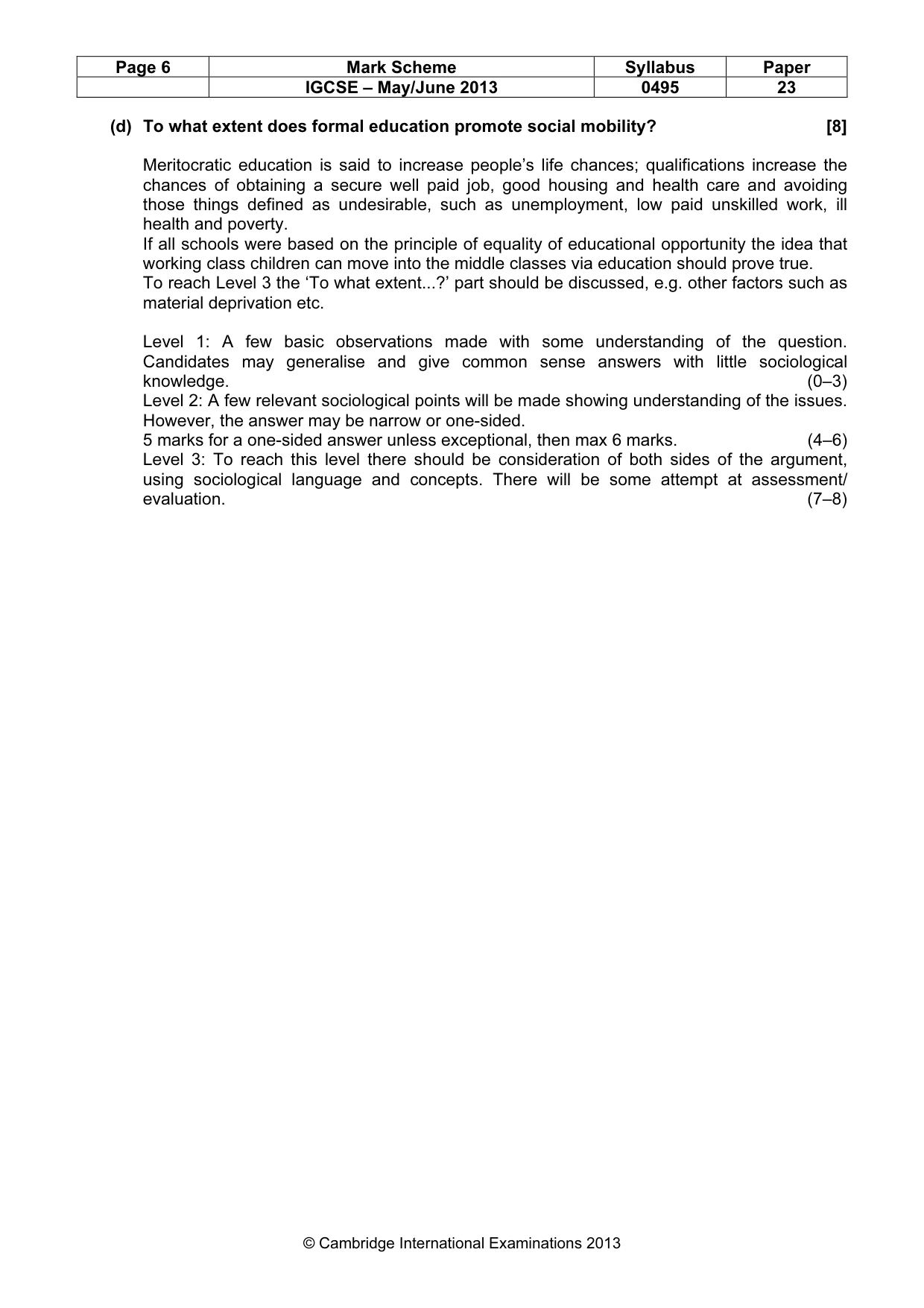
Page 6 Mark Scheme Syllabus Paper IGCSE – May/June 2013 0495 23 © Cambridge International Examinations 2013 (d) To what extent does formal education promote social mobility? [8] Meritocratic education is said to increase people’s life chances; qualifications increase the chances of obtaining a secure well paid job, good housing and health care and avoiding those things defined as undesirable, such as unemployment, low paid unskilled work, ill health and poverty. If all schools were based on the principle of equality of educational opportunity the idea that working class children can move into the middle classes via education should prove true. To reach Level 3 the ‘To what extent...?’ part should be discussed, e.g. other factors such as material deprivation etc. Level 1: A few basic observations made with some understanding of the question. Candidates may generalise and give common sense answers with little sociological knowledge. (0–3) Level 2: A few relevant sociological points will be made showing understanding of the issues. However, the answer may be narrow or one-sided. 5 marks for a one-sided answer unless exceptional, then max 6 marks. (4–6) Level 3: To reach this level there should be consideration of both sides of the argument, using sociological language and concepts. There will be some attempt at assessment/ evaluation. (7–8)
Mark scheme, page 7
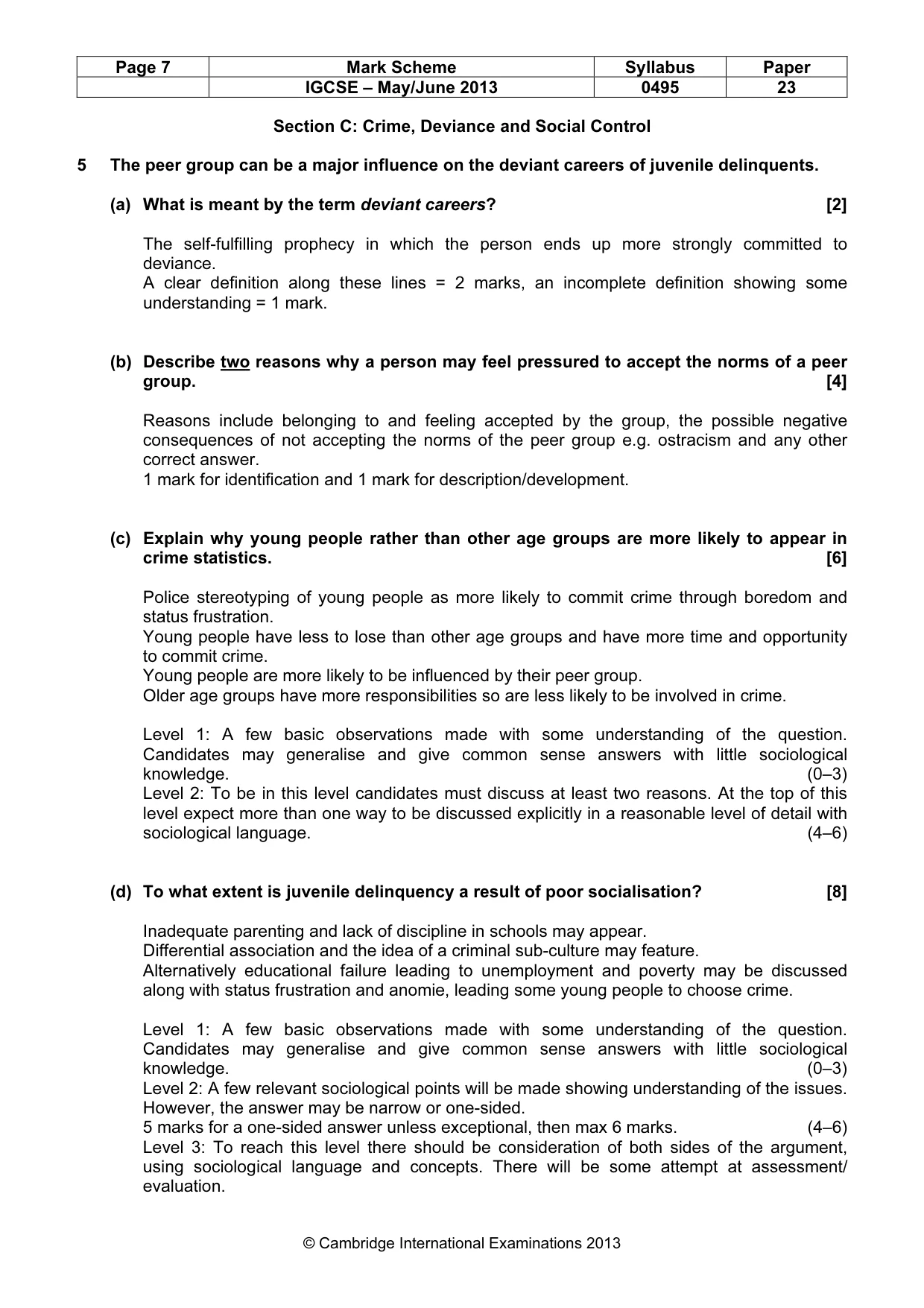
Page 7 Mark Scheme Syllabus Paper IGCSE – May/June 2013 0495 23 © Cambridge International Examinations 2013 Section C: Crime, Deviance and Social Control 5 The peer group can be a major influence on the deviant careers of juvenile delinquents. (a) What is meant by the term deviant careers? [2] The self-fulfilling prophecy in which the person ends up more strongly committed to deviance. A clear definition along these lines = 2 marks, an incomplete definition showing some understanding = 1 mark. (b) Describe two reasons why a person may feel pressured to accept the norms of a peer group. [4] Reasons include belonging to and feeling accepted by the group, the possible negative consequences of not accepting the norms of the peer group e.g. ostracism and any other correct answer. 1 mark for identification and 1 mark for description/development. (c) Explain why young people rather than other age groups are more likely to appear in crime statistics. [6] Police stereotyping of young people as more likely to commit crime through boredom and status frustration. Young people have less to lose than other age groups and have more time and opportunity to commit crime. Young people are more likely to be influenced by their peer group. Older age groups have more responsibilities so are less likely to be involved in crime. Level 1: A few basic observations made with some understanding of the question. Candidates may generalise and give common sense answers with little sociological knowledge. (0–3) Level 2: To be in this level candidates must discuss at least two reasons. At the top of this level expect more than one way to be discussed explicitly in a reasonable level of detail with sociological language. (4–6) (d) To what extent is juvenile delinquency a result of poor socialisation? [8] Inadequate parenting and lack of discipline in schools may appear. Differential association and the idea of a criminal sub-culture may feature. Alternatively educational failure leading to unemployment and poverty may be discussed along with status frustration and anomie, leading some young people to choose crime. Level 1: A few basic observations made with some understanding of the question. Candidates may generalise and give common sense answers with little sociological knowledge. (0–3) Level 2: A few relevant sociological points will be made showing understanding of the issues. However, the answer may be narrow or one-sided. 5 marks for a one-sided answer unless exceptional, then max 6 marks. (4–6) Level 3: To reach this level there should be consideration of both sides of the argument, using sociological language and concepts. There will be some attempt at assessment/ evaluation.
Mark scheme, page 8
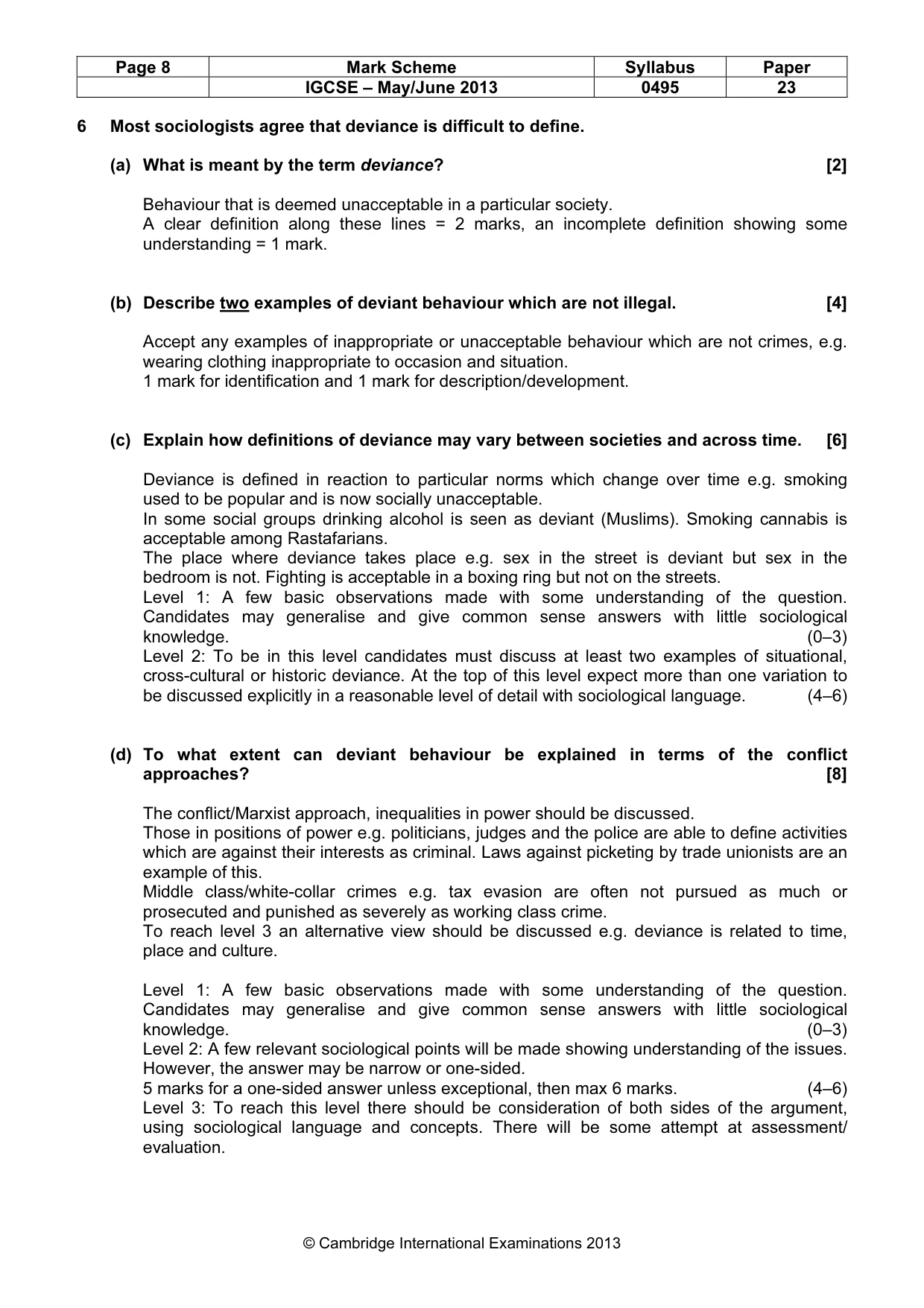
Page 8 Mark Scheme Syllabus Paper IGCSE – May/June 2013 0495 23 © Cambridge International Examinations 2013 6 Most sociologists agree that deviance is difficult to define. (a) What is meant by the term deviance? [2] Behaviour that is deemed unacceptable in a particular society. A clear definition along these lines = 2 marks, an incomplete definition showing some understanding = 1 mark. (b) Describe two examples of deviant behaviour which are not illegal. [4] Accept any examples of inappropriate or unacceptable behaviour which are not crimes, e.g. wearing clothing inappropriate to occasion and situation. 1 mark for identification and 1 mark for description/development. (c) Explain how definitions of deviance may vary between societies and across time. [6] Deviance is defined in reaction to particular norms which change over time e.g. smoking used to be popular and is now socially unacceptable. In some social groups drinking alcohol is seen as deviant (Muslims). Smoking cannabis is acceptable among Rastafarians. The place where deviance takes place e.g. sex in the street is deviant but sex in the bedroom is not. Fighting is acceptable in a boxing ring but not on the streets. Level 1: A few basic observations made with some understanding of the question. Candidates may generalise and give common sense answers with little sociological knowledge. (0–3) Level 2: To be in this level candidates must discuss at least two examples of situational, cross-cultural or historic deviance. At the top of this level expect more than one variation to be discussed explicitly in a reasonable level of detail with sociological language. (4–6) (d) To what extent can deviant behaviour be explained in terms of the conflict approaches? [8] The conflict/Marxist approach, inequalities in power should be discussed. Those in positions of power e.g. politicians, judges and the police are able to define activities which are against their interests as criminal. Laws against picketing by trade unionists are an example of this. Middle class/white-collar crimes e.g. tax evasion are often not pursued as much or prosecuted and punished as severely as working class crime. To reach level 3 an alternative view should be discussed e.g. deviance is related to time, place and culture. Level 1: A few basic observations made with some understanding of the question. Candidates may generalise and give common sense answers with little sociological knowledge. (0–3) Level 2: A few relevant sociological points will be made showing understanding of the issues. However, the answer may be narrow or one-sided. 5 marks for a one-sided answer unless exceptional, then max 6 marks. (4–6) Level 3: To reach this level there should be consideration of both sides of the argument, using sociological language and concepts. There will be some attempt at assessment/ evaluation.
Mark scheme, page 9
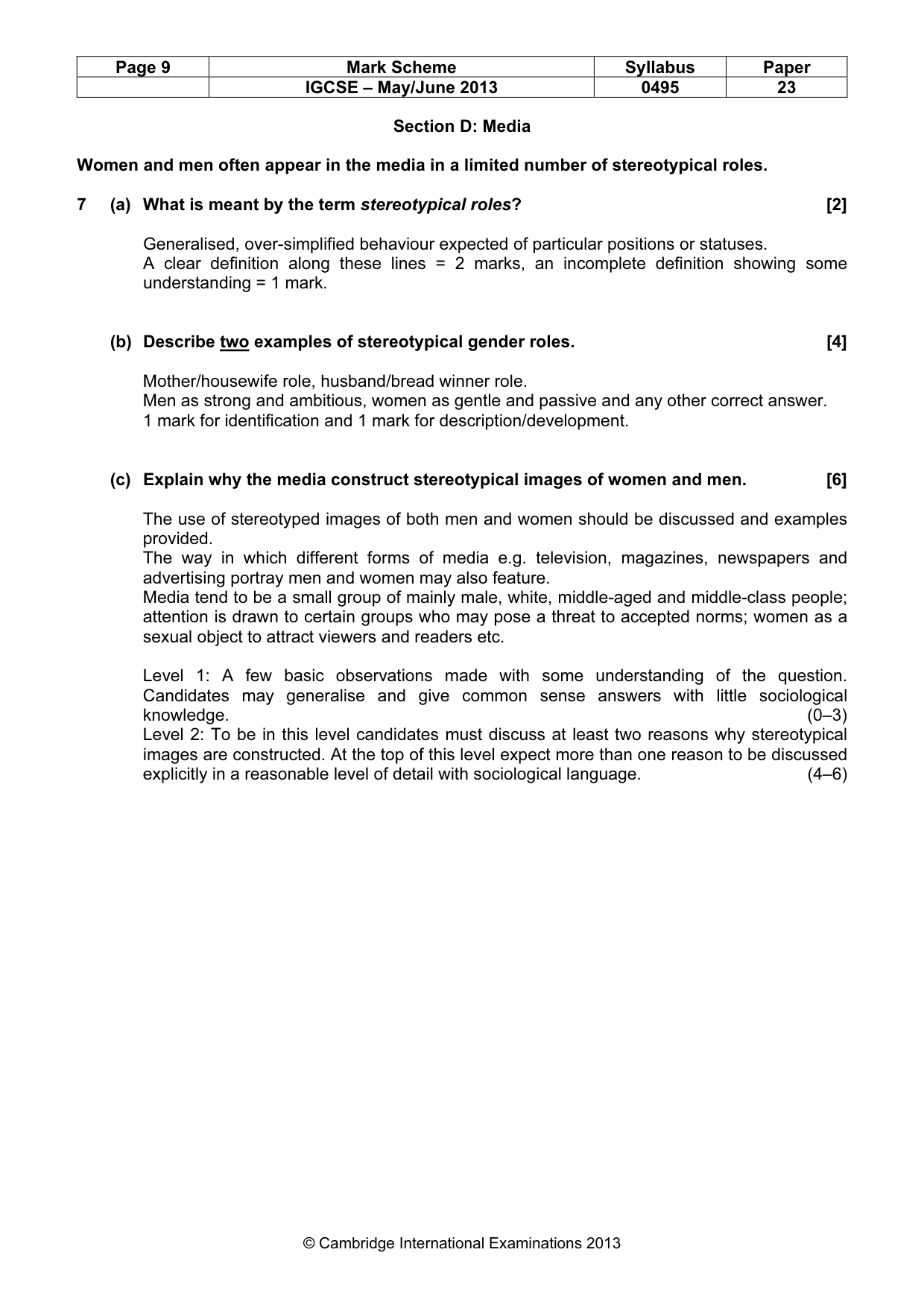
Page 9 Mark Scheme Syllabus Paper IGCSE – May/June 2013 0495 23 © Cambridge International Examinations 2013 Section D: Media Women and men often appear in the media in a limited number of stereotypical roles. 7 (a) What is meant by the term stereotypical roles? [2] Generalised, over-simplified behaviour expected of particular positions or statuses. A clear definition along these lines = 2 marks, an incomplete definition showing some understanding = 1 mark. (b) Describe two examples of stereotypical gender roles. [4] Mother/housewife role, husband/bread winner role. Men as strong and ambitious, women as gentle and passive and any other correct answer. 1 mark for identification and 1 mark for description/development. (c) Explain why the media construct stereotypical images of women and men. [6] The use of stereotyped images of both men and women should be discussed and examples provided. The way in which different forms of media e.g. television, magazines, newspapers and advertising portray men and women may also feature. Media tend to be a small group of mainly male, white, middle-aged and middle-class people; attention is drawn to certain groups who may pose a threat to accepted norms; women as a sexual object to attract viewers and readers etc. Level 1: A few basic observations made with some understanding of the question. Candidates may generalise and give common sense answers with little sociological knowledge. (0–3) Level 2: To be in this level candidates must discuss at least two reasons why stereotypical images are constructed. At the top of this level expect more than one reason to be discussed explicitly in a reasonable level of detail with sociological language. (4–6)
Mark scheme, page 10
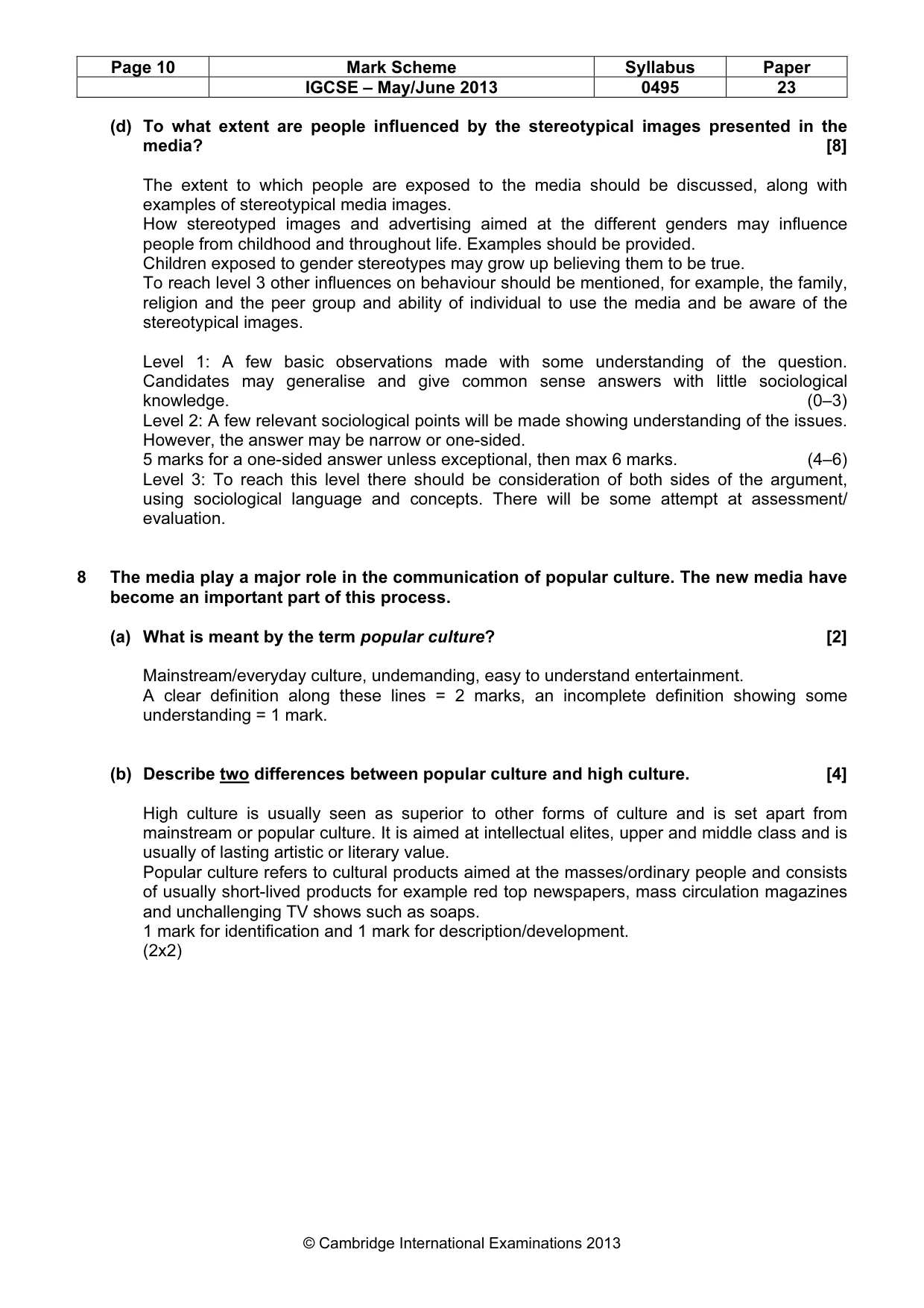
Page 10 Mark Scheme Syllabus Paper IGCSE – May/June 2013 0495 23 © Cambridge International Examinations 2013 (d) To what extent are people influenced by the stereotypical images presented in the media? [8] The extent to which people are exposed to the media should be discussed, along with examples of stereotypical media images. How stereotyped images and advertising aimed at the different genders may influence people from childhood and throughout life. Examples should be provided. Children exposed to gender stereotypes may grow up believing them to be true. To reach level 3 other influences on behaviour should be mentioned, for example, the family, religion and the peer group and ability of individual to use the media and be aware of the stereotypical images. Level 1: A few basic observations made with some understanding of the question. Candidates may generalise and give common sense answers with little sociological knowledge. (0–3) Level 2: A few relevant sociological points will be made showing understanding of the issues. However, the answer may be narrow or one-sided. 5 marks for a one-sided answer unless exceptional, then max 6 marks. (4–6) Level 3: To reach this level there should be consideration of both sides of the argument, using sociological language and concepts. There will be some attempt at assessment/ evaluation. 8 The media play a major role in the communication of popular culture. The new media have become an important part of this process. (a) What is meant by the term popular culture? [2] Mainstream/everyday culture, undemanding, easy to understand entertainment. A clear definition along these lines = 2 marks, an incomplete definition showing some understanding = 1 mark. (b) Describe two differences between popular culture and high culture. [4] High culture is usually seen as superior to other forms of culture and is set apart from mainstream or popular culture. It is aimed at intellectual elites, upper and middle class and is usually of lasting artistic or literary value. Popular culture refers to cultural products aimed at the masses/ordinary people and consists of usually short-lived products for example red top newspapers, mass circulation magazines and unchallenging TV shows such as soaps. 1 mark for identification and 1 mark for description/development. (2x2)
Mark scheme, page 11
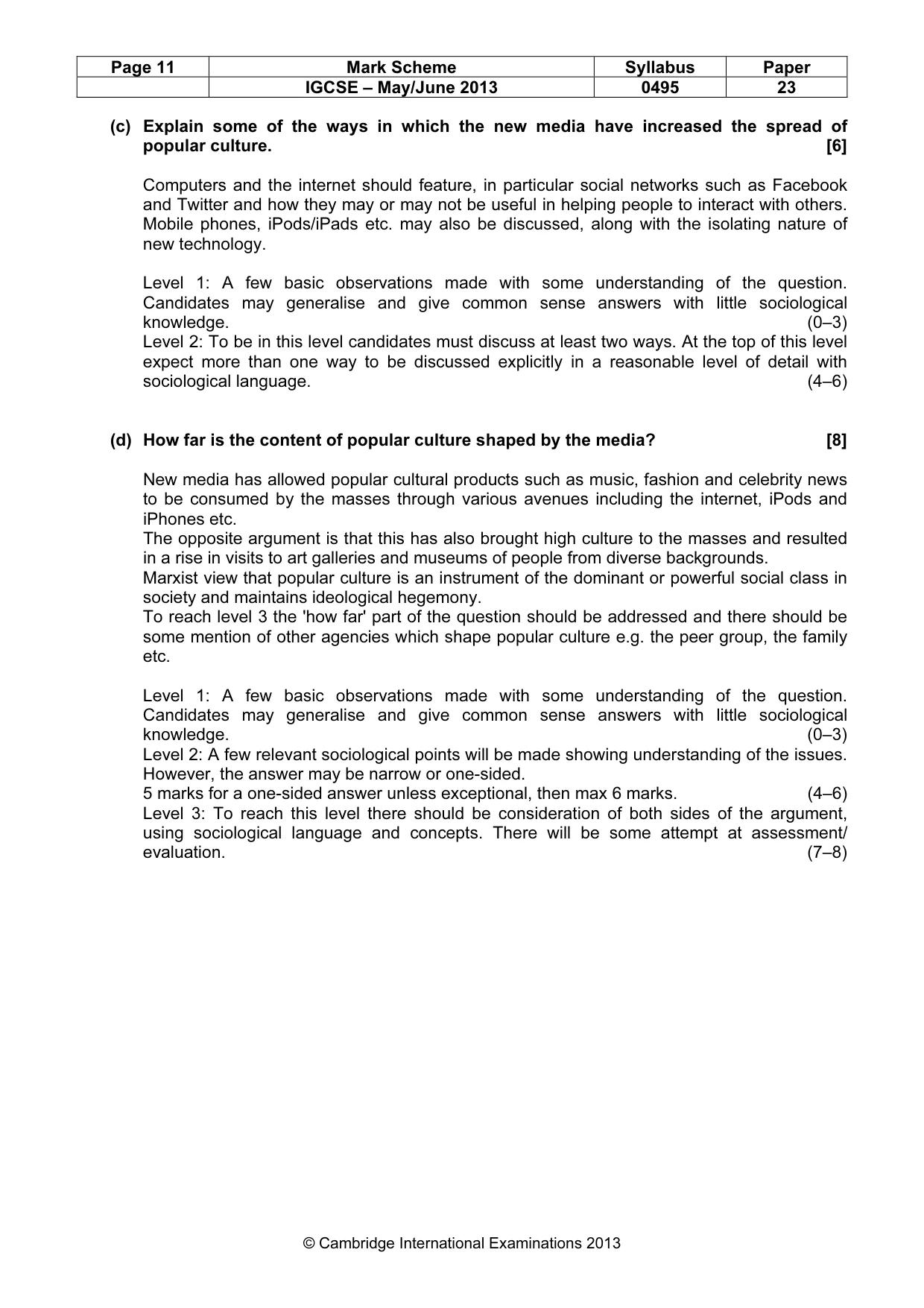
Page 11 Mark Scheme Syllabus Paper IGCSE – May/June 2013 0495 23 © Cambridge International Examinations 2013 (c) Explain some of the ways in which the new media have increased the spread of popular culture. [6] Computers and the internet should feature, in particular social networks such as Facebook and Twitter and how they may or may not be useful in helping people to interact with others. Mobile phones, iPods/iPads etc. may also be discussed, along with the isolating nature of new technology. Level 1: A few basic observations made with some understanding of the question. Candidates may generalise and give common sense answers with little sociological knowledge. (0–3) Level 2: To be in this level candidates must discuss at least two ways. At the top of this level expect more than one way to be discussed explicitly in a reasonable level of detail with sociological language. (4–6) (d) How far is the content of popular culture shaped by the media? [8] New media has allowed popular cultural products such as music, fashion and celebrity news to be consumed by the masses through various avenues including the internet, iPods and iPhones etc. The opposite argument is that this has also brought high culture to the masses and resulted in a rise in visits to art galleries and museums of people from diverse backgrounds. Marxist view that popular culture is an instrument of the dominant or powerful social class in society and maintains ideological hegemony. To reach level 3 the 'how far' part of the question should be addressed and there should be some mention of other agencies which shape popular culture e.g. the peer group, the family etc. Level 1: A few basic observations made with some understanding of the question. Candidates may generalise and give common sense answers with little sociological knowledge. (0–3) Level 2: A few relevant sociological points will be made showing understanding of the issues. However, the answer may be narrow or one-sided. 5 marks for a one-sided answer unless exceptional, then max 6 marks. (4–6) Level 3: To reach this level there should be consideration of both sides of the argument, using sociological language and concepts. There will be some attempt at assessment/ evaluation. (7–8)
What you needed in this session
Cambridge’s own grade thresholds for 2013 May/June, Paper 2 · Variant 3. A higher threshold means an easier paper — the bar moves with how the cohort did.