Cambridge IGCSE Sociology 0495 — 2013 May/June Paper 2 · Variant 2
0495/22/M/J/13 · 60 marks · ≈68 min
The question paper and its mark scheme, free to read here and free to download. This is Cambridge’s own paper, exactly as it was sat.
Question paper28 pages



Mark scheme14 pages
Answers below. Sit the paper first if you are practising.
Paper as text
Question paper, page 1
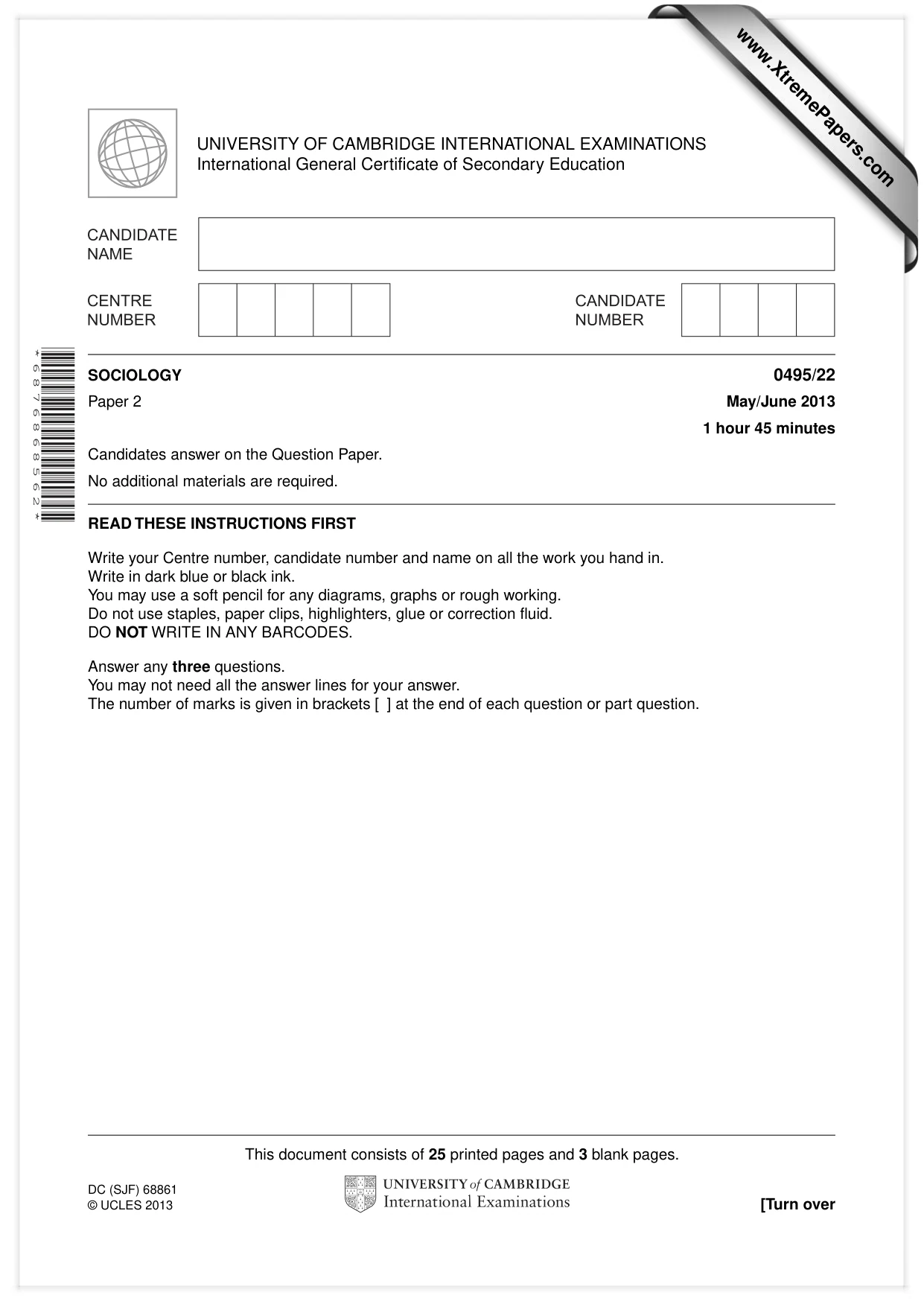
This document consists of 25 printed pages and 3 blank pages. DC (SJF) 68861 © UCLES 2013 [Turn over UNIVERSITY OF CAMBRIDGE INTERNATIONAL EXAMINATIONS International General Certificate of Secondary Education * 6 8 7 6 8 6 8 5 6 2 * SOCIOLOGY 0495/22 Paper 2 May/June 2013 1 hour 45 minutes Candidates answer on the Question Paper. No additional materials are required. READ THESE INSTRUCTIONS FIRST Write your Centre number, candidate number and name on all the work you hand in. Write in dark blue or black ink. You may use a soft pencil for any diagrams, graphs or rough working. Do not use staples, paper clips, highlighters, glue or correction fluid. DO NOT WRITE IN ANY BARCODES. Answer any three questions. You may not need all the answer lines for your answer. The number of marks is given in brackets [ ] at the end of each question or part question. www.XtremePapers.com
Question paper, page 2
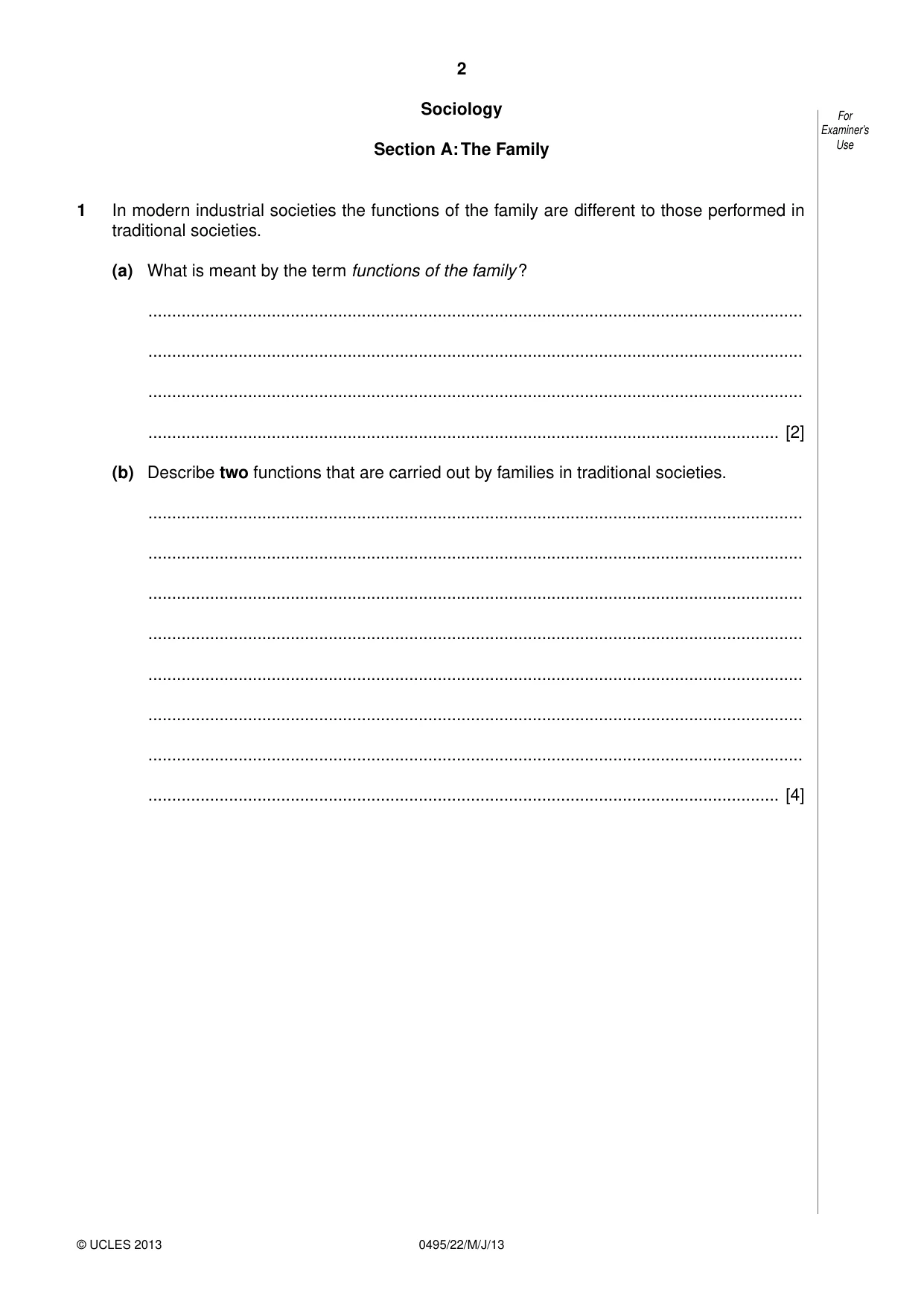
2 0495/22/M/J/13 © UCLES 2013 For Examiner’s Use Sociology Section A: The Family 1 In modern industrial societies the functions of the family are different to those performed in traditional societies. (a) What is meant by the term functions of the family ? … … … … [2] (b) Describe two functions that are carried out by families in traditional societies. … … … … … … … … [4]
Question paper, page 3
3 0495/22/M/J/13 © UCLES 2013 [Turn over For Examiner’s Use (c) Explain how the functions performed by families in modern industrial societies have changed from those performed by families in traditional societies. … … … … … … … … … … … … … … … … … … [6]
Question paper, page 4
4 0495/22/M/J/13 © UCLES 2013 For Examiner’s Use (d) To what extent is there a variety of family types in modern industrial societies today? … … … … … … … … … … … … … … … … … … … … … … … … [8]
Question paper, page 5
5 0495/22/M/J/13 © UCLES 2013 [Turn over For Examiner’s Use 2 Families are found in almost every society. However, families can take many different forms including those based on arranged marriages and civil partnerships. (a) What is meant by the term civil partnerships? … … … … [2] (b) Describe two reasons why arranged marriages are favoured in some societies. … … … … … … … … [4]
Question paper, page 6
6 0495/22/M/J/13 © UCLES 2013 For Examiner’s Use (c) Explain why arranged marriages are less likely to be found in modern industrial societies. … … … … … … … … … … … … … … … … … … [6]
Question paper, page 7
7 0495/22/M/J/13 © UCLES 2013 [Turn over For Examiner’s Use (d) How far is marriage still valued in modern industrial societies? … … … … … … … … … … … … … … … … … … … … … … … … [8]
Question paper, page 8
8 0495/22/M/J/13 © UCLES 2013 For Examiner’s Use Section B: Education 3 In modern industrial societies there is a greater range of schools than ever before, including faith schools. (a) What is meant by the term faith schools ? … … … … [2] (b) Describe two types of school other than faith schools. … … … … … … … … [4]
Question paper, page 9
9 0495/22/M/J/13 © UCLES 2013 [Turn over For Examiner’s Use (c) Explain the possible negative effects for society of faith schools. … … … … … … … … … … … … … … … … … … [6]
Question paper, page 10
10 0495/22/M/J/13 © UCLES 2013 For Examiner’s Use (d) How far does a range of school types help to promote equality in education? … … … … … … … … … … … … … … … … … … … … … … … … [8]
Question paper, page 11
11 0495/22/M/J/13 © UCLES 2013 [Turn over For Examiner’s Use 4 In a meritocratic society every pupil has equality of opportunity. (a) What is meant by the term meritocratic society ? … … … … [2] (b) Describe two ways in which pupils may be treated unequally within the education system. … … … … … … … … [4]
Question paper, page 12
12 0495/22/M/J/13 © UCLES 2013 For Examiner’s Use (c) Explain why pupils from middle class homes may find it easier to perform well at school. … … … … … … … … … … … … … … … … … … [6]
Question paper, page 13
13 0495/22/M/J/13 © UCLES 2013 [Turn over For Examiner’s Use (d) How far is there equality of opportunity for all pupils within the education system in modern industrial societies? … … … … … … … … … … … … … … … … … … … … … … … … [8]
Question paper, page 14
14 0495/22/M/J/13 © UCLES 2013 For Examiner’s Use Section C: Crime, Deviance and Social Control 5 Official crime statistics and studies of the ‘dark figure’ of crime have shown an increase in crimes committed by females in recent years. (a) What is meant by the term dark figure? … … … … [2] (b) Describe two examples of crimes typically associated with females. … … … … … … … … [4]
Question paper, page 15
15 0495/22/M/J/13 © UCLES 2013 [Turn over For Examiner’s Use (c) Explain why there has been an increase in crimes committed by females in recent years. … … … … … … … … … … … … … … … … … … [6]
Question paper, page 16
16 0495/22/M/J/13 © UCLES 2013 For Examiner’s Use (d) To what extent are females treated differently from males within the criminal justice system? … … … … … … … … … … … … … … … … … … … … … … … … [8]
Question paper, page 17
17 0495/22/M/J/13 © UCLES 2013 [Turn over For Examiner’s Use 6 In some societies young people are regarded as a separate group, with their own distinct youth cultures. Mods and Rockers are an early example of a youth culture. (a) What is meant by the term youth culture? … … … … [2] (b) Describe briefly two examples of youth cultures, other than Mods and Rockers. … … … … … … … … [4]
Question paper, page 18
18 0495/22/M/J/13 © UCLES 2013 For Examiner’s Use (c) Explain why youth cultures have become a feature of modern industrial societies. … … … … … … … … … … … … … … … … … … [6]
Question paper, page 19
19 0495/22/M/J/13 © UCLES 2013 [Turn over For Examiner’s Use (d) To what extent is youth culture the main influence on the identities of young people in modern industrial societies? … … … … … … … … … … … … … … … … … … … … … … … … [8]
Question paper, page 20
20 0495/22/M/J/13 © UCLES 2013 For Examiner’s Use Section D: Media 7 The media create many stereotypes which may lead to the creation of folk devils and moral panics. (a) What is meant by the term folk devils? … … … … [2] (b) Describe two examples of moral panics. … … … … … … … … [4]
Question paper, page 21
21 0495/22/M/J/13 © UCLES 2013 [Turn over For Examiner’s Use (c) Explain why some groups are more likely than others to be stereotyped by the media. … … … … … … … … … … … … … … … … … … [6]
Question paper, page 22
22 0495/22/M/J/13 © UCLES 2013 For Examiner’s Use (d) How far is the behaviour of young women shaped by the media? … … … … … … … … … … … … … … … … … … … … … … … … [8]
Question paper, page 23
23 0495/22/M/J/13 © UCLES 2013 [Turn over For Examiner’s Use 8 The media are now divided into traditional and new media. (a) What is meant by the term traditional media ? … … … … [2] (b) Describe two examples of the new media. … … … … … … … … [4]
Question paper, page 24
24 0495/22/M/J/13 © UCLES 2013 For Examiner’s Use (c) Explain the differences between the traditional media and the new media. … … … … … … … … … … … … … … … … … … [6]
Question paper, page 25
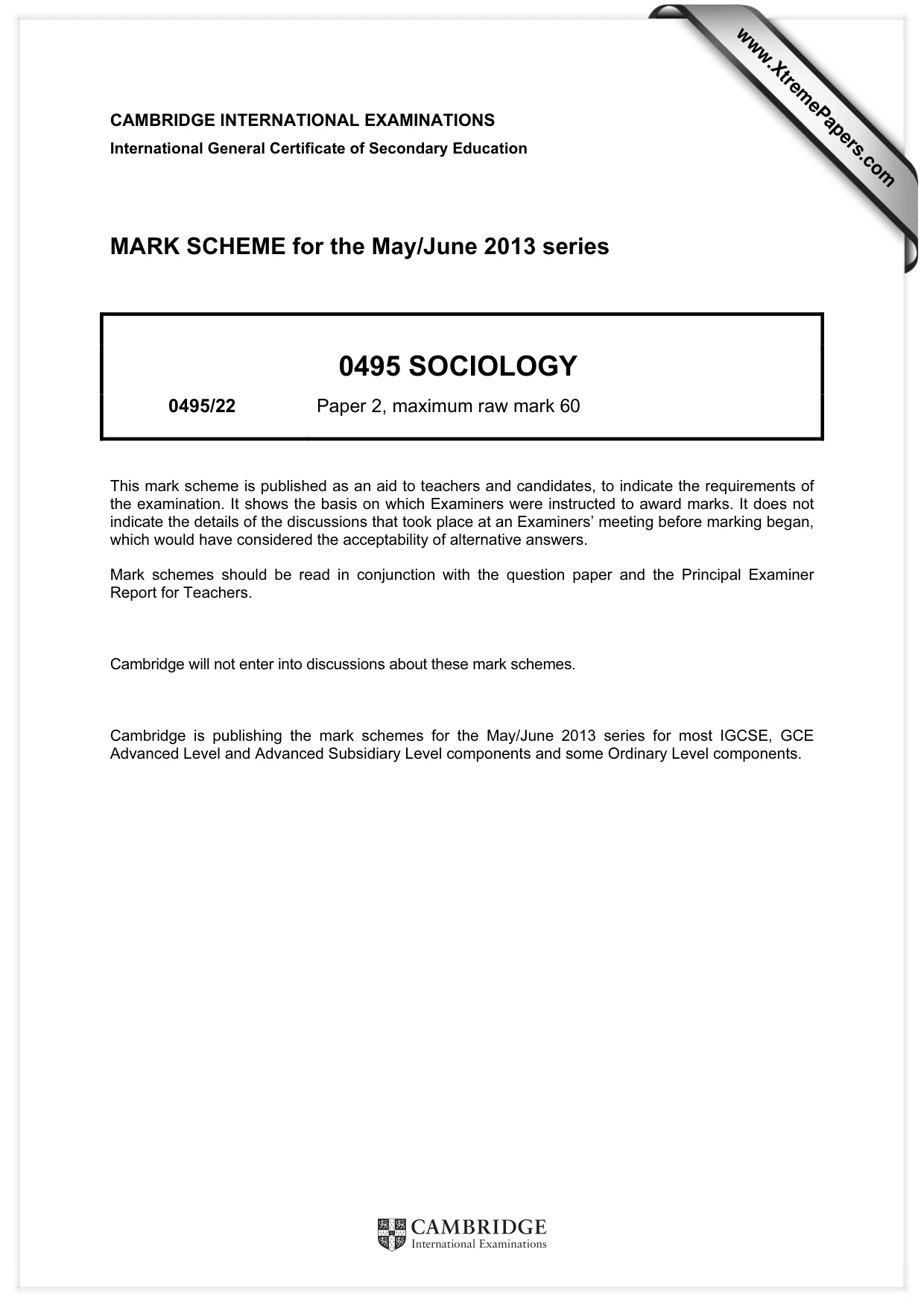
25 0495/22/M/J/13 © UCLES 2013 For Examiner’s Use (d) To what extent do the new media increase opportunities for democratic participation in society? … … … … … … … … … … … … … … … … … … … … … … … … [8]
Question paper, page 26
26 0495/22/M/J/13 © UCLES 2013 BLANK PAGE
Question paper, page 27
27 0495/22/M/J/13 © UCLES 2013 BLANK PAGE
Question paper, page 28
28 0495/22/M/J/13 © UCLES 2013 BLANK PAGE Permission to reproduce items where third-party owned material protected by copyright is included has been sought and cleared where possible. Every reasonable effort has been made by the publisher (UCLES) to trace copyright holders, but if any items requiring clearance have unwittingly been included, the publisher will be pleased to make amends at the earliest possible opportunity. University of Cambridge International Examinations is part of the Cambridge Assessment Group. Cambridge Assessment is the brand name of University of Cambridge Local Examinations Syndicate (UCLES), which is itself a department of the University of Cambridge.
Mark scheme, page 1
CAMBRIDGE INTERNATIONAL EXAMINATIONS International General Certificate of Secondary Education MARK SCHEME for the May/June 2013 series 0495 SOCIOLOGY 0495/22 Paper 2, maximum raw mark 60 This mark scheme is published as an aid to teachers and candidates, to indicate the requirements of the examination. It shows the basis on which Examiners were instructed to award marks. It does not indicate the details of the discussions that took place at an Examiners’ meeting before marking began, which would have considered the acceptability of alternative answers. Mark schemes should be read in conjunction with the question paper and the Principal Examiner Report for Teachers. Cambridge will not enter into discussions about these mark schemes. Cambridge is publishing the mark schemes for the May/June 2013 series for most IGCSE, GCE Advanced Level and Advanced Subsidiary Level components and some Ordinary Level components. www.XtremePapers.com
Mark scheme, page 2
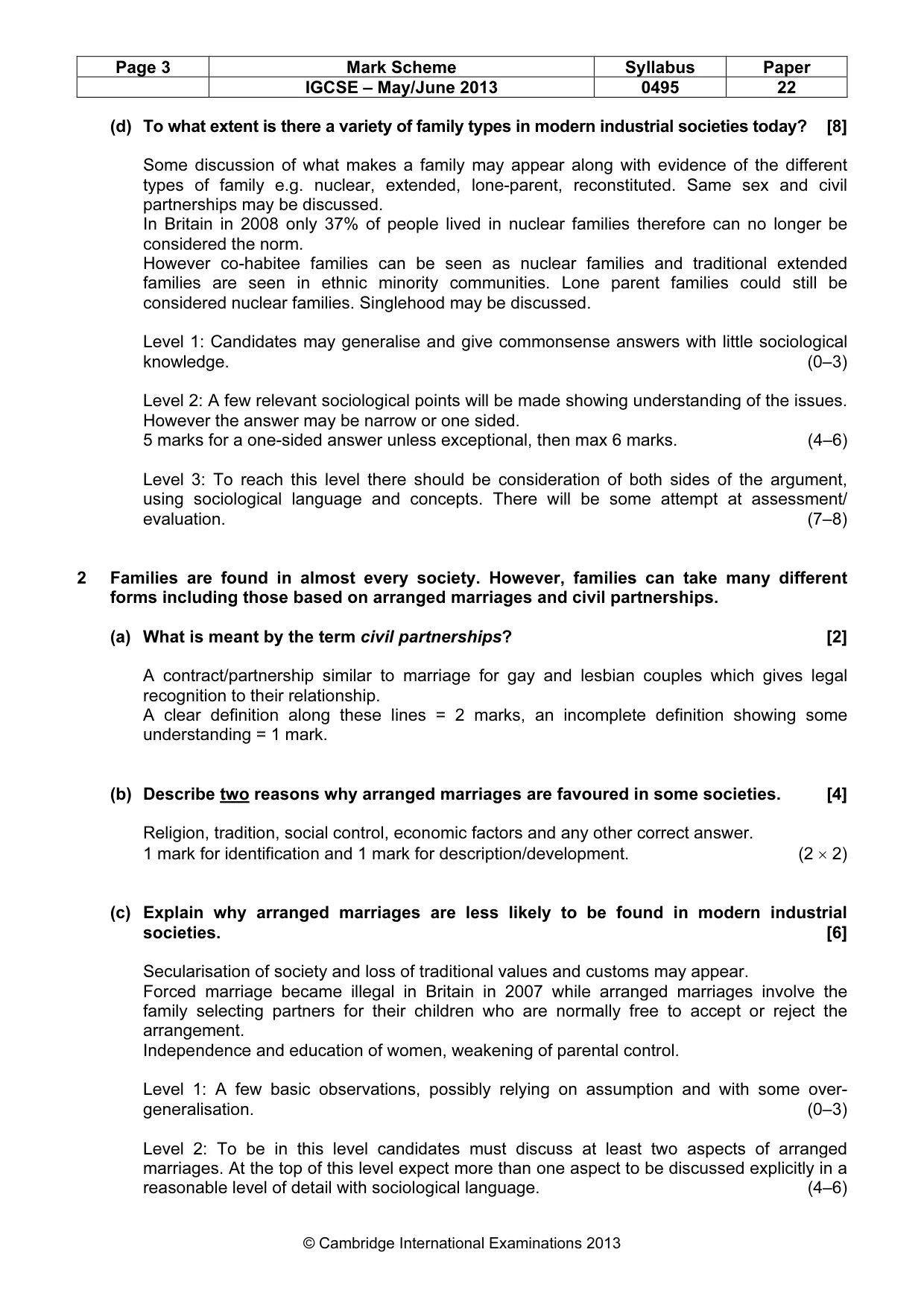
Page 2 Mark Scheme Syllabus Paper IGCSE – May/June 2013 0495 22 © Cambridge International Examinations 2013 Section A: The Family 1 In modern industrial societies the functions of the family are different to those performed in traditional societies. (a) What is meant by the term functions of the family? [2] The expected roles, responsibilities or duties carried out by families. A clear definition along these lines = 2 marks, an incomplete definition showing some understanding = 1 mark. (b) Describe two functions that are carried out by families in traditional societies. [4] Reproduction, primary socialisation, regulation of sexual behaviour and economic support and any other correct answer. 1 mark for identification and 1 mark for description/development. (2 × 2) (c) Explain how the functions performed by families in modern industrial societies have changed from those performed by families in traditional societies. [6] Candidates may refer to functions such as socialisation and social control and consider how the family performs these differently today. Many functions have now been taken over by the state e.g. education, health and welfare, care of the sick and elderly, retirement, pensions. Some functions are shared between the family and the state. Level 1: A few basic observations on the functions of the family. Candidates may describe one type of family, may generalise and give common sense answers with little sociological knowledge. To get three marks there must be at least an implicit reference to change, e.g. children didn’t go to school in the traditional societies. (0–3) Level 2: To be in this level candidates must discuss at least two changes. At the top of this level expect more than one change to be discussed explicitly in a reasonable level of detail with sociological language. (4–6)
Mark scheme, page 3
Page 3 Mark Scheme Syllabus Paper IGCSE – May/June 2013 0495 22 © Cambridge International Examinations 2013 (d) To what extent is there a variety of family types in modern industrial societies today? [8] Some discussion of what makes a family may appear along with evidence of the different types of family e.g. nuclear, extended, lone-parent, reconstituted. Same sex and civil partnerships may be discussed. In Britain in 2008 only 37% of people lived in nuclear families therefore can no longer be considered the norm. However co-habitee families can be seen as nuclear families and traditional extended families are seen in ethnic minority communities. Lone parent families could still be considered nuclear families. Singlehood may be discussed. Level 1: Candidates may generalise and give commonsense answers with little sociological knowledge. (0–3) Level 2: A few relevant sociological points will be made showing understanding of the issues. However the answer may be narrow or one sided. 5 marks for a one-sided answer unless exceptional, then max 6 marks. (4–6) Level 3: To reach this level there should be consideration of both sides of the argument, using sociological language and concepts. There will be some attempt at assessment/ evaluation. (7–8) 2 Families are found in almost every society. However, families can take many different forms including those based on arranged marriages and civil partnerships. (a) What is meant by the term civil partnerships? [2] A contract/partnership similar to marriage for gay and lesbian couples which gives legal recognition to their relationship. A clear definition along these lines = 2 marks, an incomplete definition showing some understanding = 1 mark. (b) Describe two reasons why arranged marriages are favoured in some societies. [4] Religion, tradition, social control, economic factors and any other correct answer. 1 mark for identification and 1 mark for description/development. (2 × 2) (c) Explain why arranged marriages are less likely to be found in modern industrial societies. [6] Secularisation of society and loss of traditional values and customs may appear. Forced marriage became illegal in Britain in 2007 while arranged marriages involve the family selecting partners for their children who are normally free to accept or reject the arrangement. Independence and education of women, weakening of parental control. Level 1: A few basic observations, possibly relying on assumption and with some over- generalisation. (0–3) Level 2: To be in this level candidates must discuss at least two aspects of arranged marriages. At the top of this level expect more than one aspect to be discussed explicitly in a reasonable level of detail with sociological language. (4–6)
Mark scheme, page 4
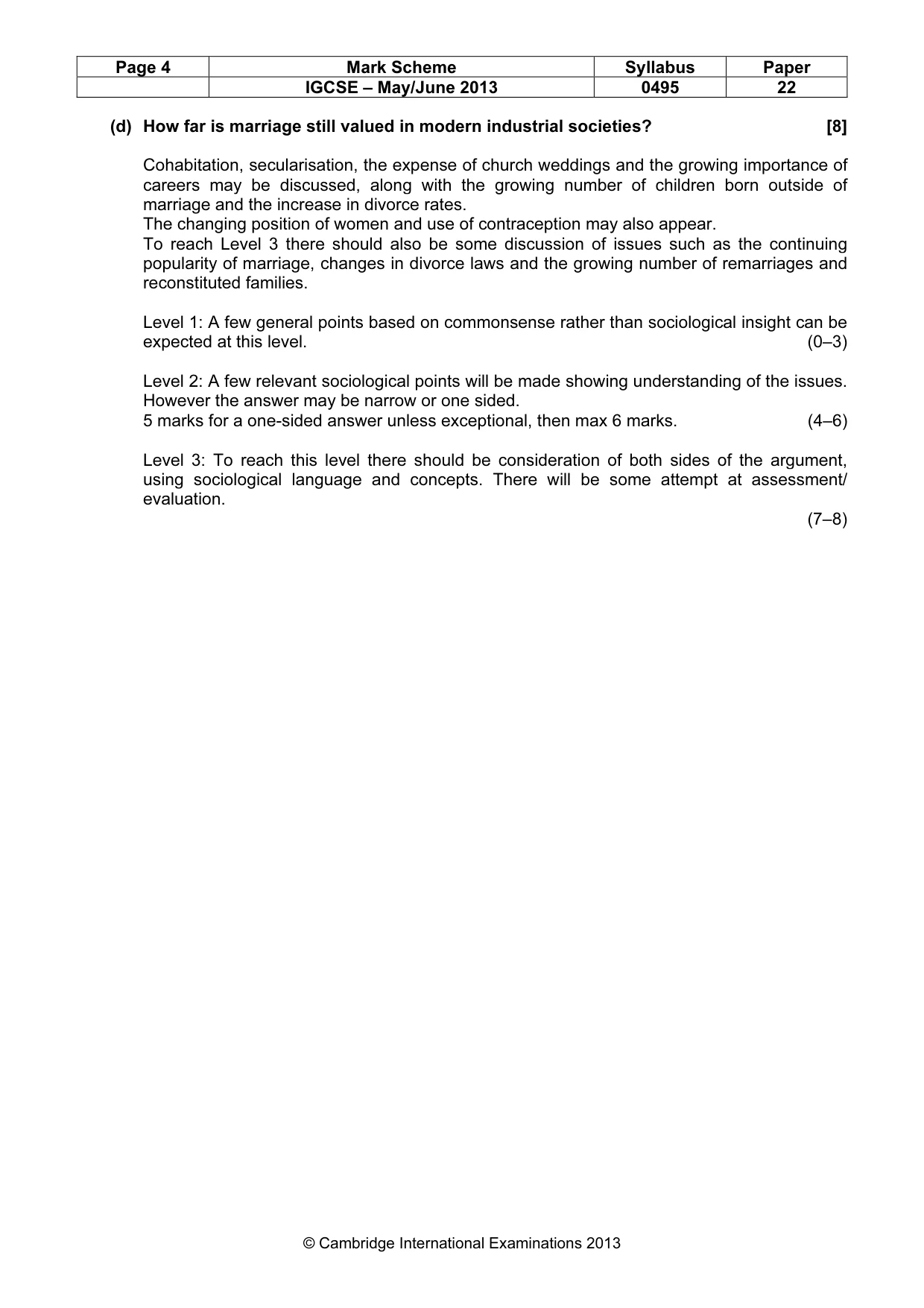
Page 4 Mark Scheme Syllabus Paper IGCSE – May/June 2013 0495 22 © Cambridge International Examinations 2013 (d) How far is marriage still valued in modern industrial societies? [8] Cohabitation, secularisation, the expense of church weddings and the growing importance of careers may be discussed, along with the growing number of children born outside of marriage and the increase in divorce rates. The changing position of women and use of contraception may also appear. To reach Level 3 there should also be some discussion of issues such as the continuing popularity of marriage, changes in divorce laws and the growing number of remarriages and reconstituted families. Level 1: A few general points based on commonsense rather than sociological insight can be expected at this level. (0–3) Level 2: A few relevant sociological points will be made showing understanding of the issues. However the answer may be narrow or one sided. 5 marks for a one-sided answer unless exceptional, then max 6 marks. (4–6) Level 3: To reach this level there should be consideration of both sides of the argument, using sociological language and concepts. There will be some attempt at assessment/ evaluation. (7–8)
Mark scheme, page 5
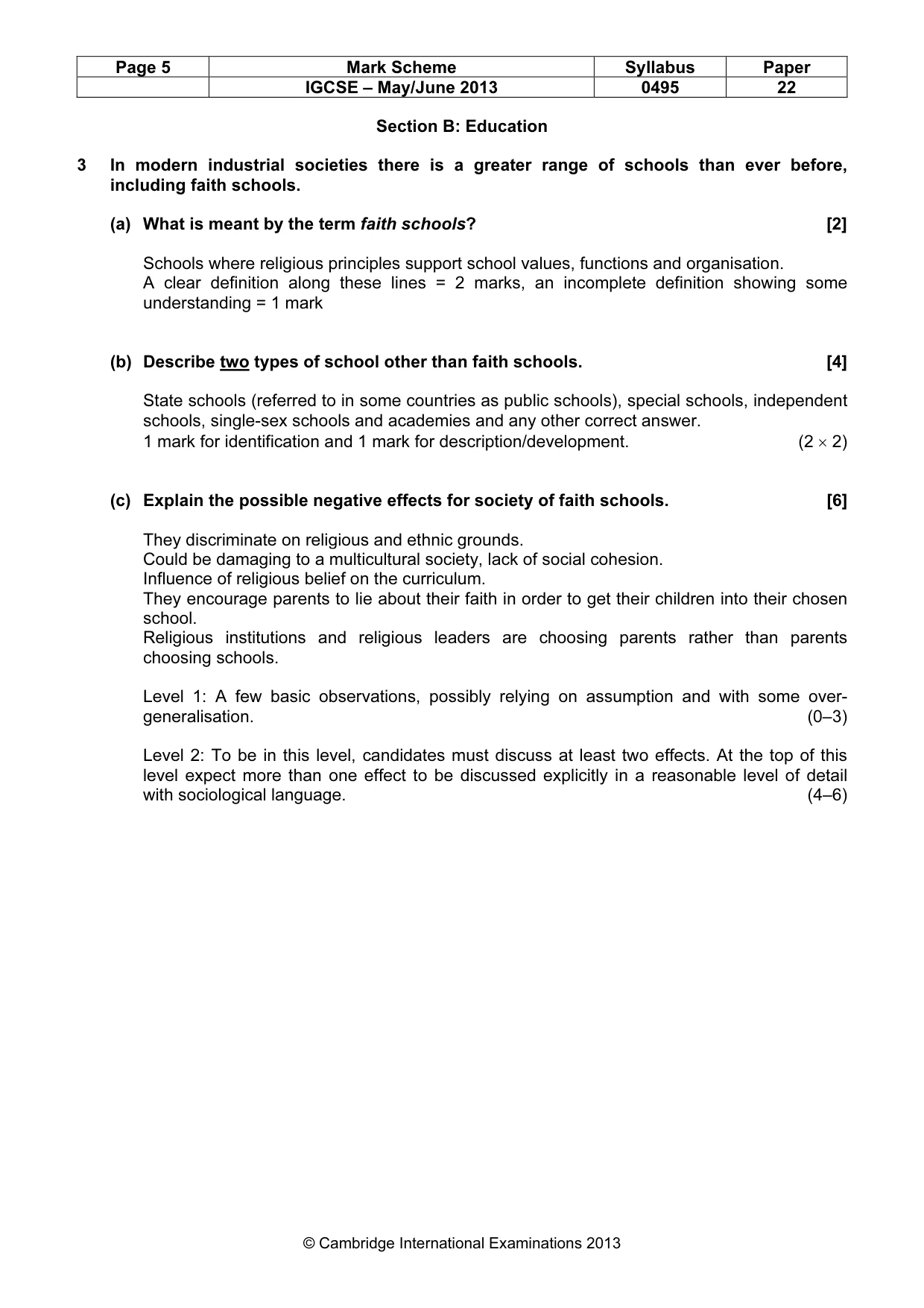
Page 5 Mark Scheme Syllabus Paper IGCSE – May/June 2013 0495 22 © Cambridge International Examinations 2013 Section B: Education 3 In modern industrial societies there is a greater range of schools than ever before, including faith schools. (a) What is meant by the term faith schools? [2] Schools where religious principles support school values, functions and organisation. A clear definition along these lines = 2 marks, an incomplete definition showing some understanding = 1 mark (b) Describe two types of school other than faith schools. [4] State schools (referred to in some countries as public schools), special schools, independent schools, single-sex schools and academies and any other correct answer. 1 mark for identification and 1 mark for description/development. (2 × 2) (c) Explain the possible negative effects for society of faith schools. [6] They discriminate on religious and ethnic grounds. Could be damaging to a multicultural society, lack of social cohesion. Influence of religious belief on the curriculum. They encourage parents to lie about their faith in order to get their children into their chosen school. Religious institutions and religious leaders are choosing parents rather than parents choosing schools. Level 1: A few basic observations, possibly relying on assumption and with some over- generalisation. (0–3) Level 2: To be in this level, candidates must discuss at least two effects. At the top of this level expect more than one effect to be discussed explicitly in a reasonable level of detail with sociological language. (4–6)
Mark scheme, page 6
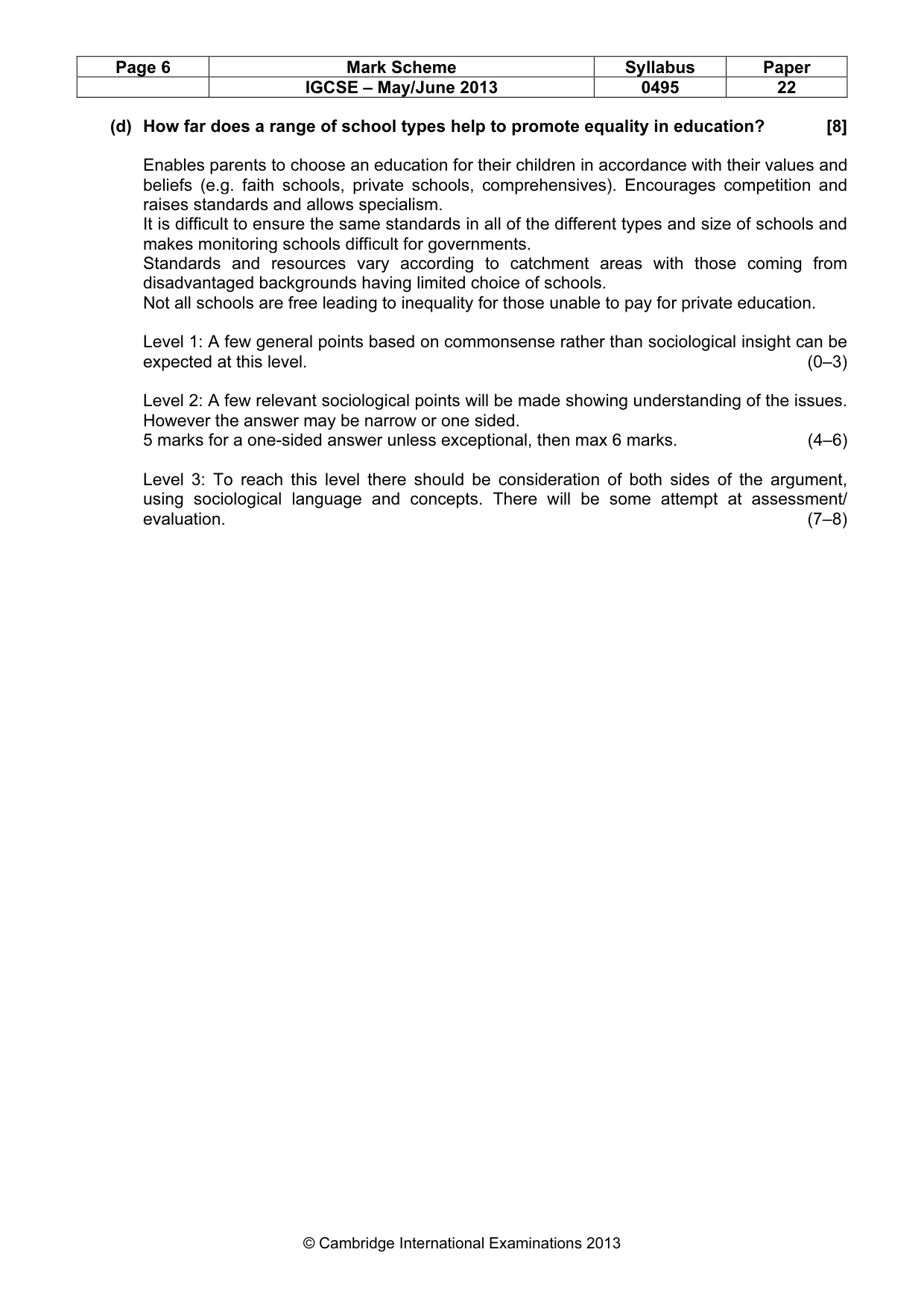
Page 6 Mark Scheme Syllabus Paper IGCSE – May/June 2013 0495 22 © Cambridge International Examinations 2013 (d) How far does a range of school types help to promote equality in education? [8] Enables parents to choose an education for their children in accordance with their values and beliefs (e.g. faith schools, private schools, comprehensives). Encourages competition and raises standards and allows specialism. It is difficult to ensure the same standards in all of the different types and size of schools and makes monitoring schools difficult for governments. Standards and resources vary according to catchment areas with those coming from disadvantaged backgrounds having limited choice of schools. Not all schools are free leading to inequality for those unable to pay for private education. Level 1: A few general points based on commonsense rather than sociological insight can be expected at this level. (0–3) Level 2: A few relevant sociological points will be made showing understanding of the issues. However the answer may be narrow or one sided. 5 marks for a one-sided answer unless exceptional, then max 6 marks. (4–6) Level 3: To reach this level there should be consideration of both sides of the argument, using sociological language and concepts. There will be some attempt at assessment/ evaluation. (7–8)
Mark scheme, page 7
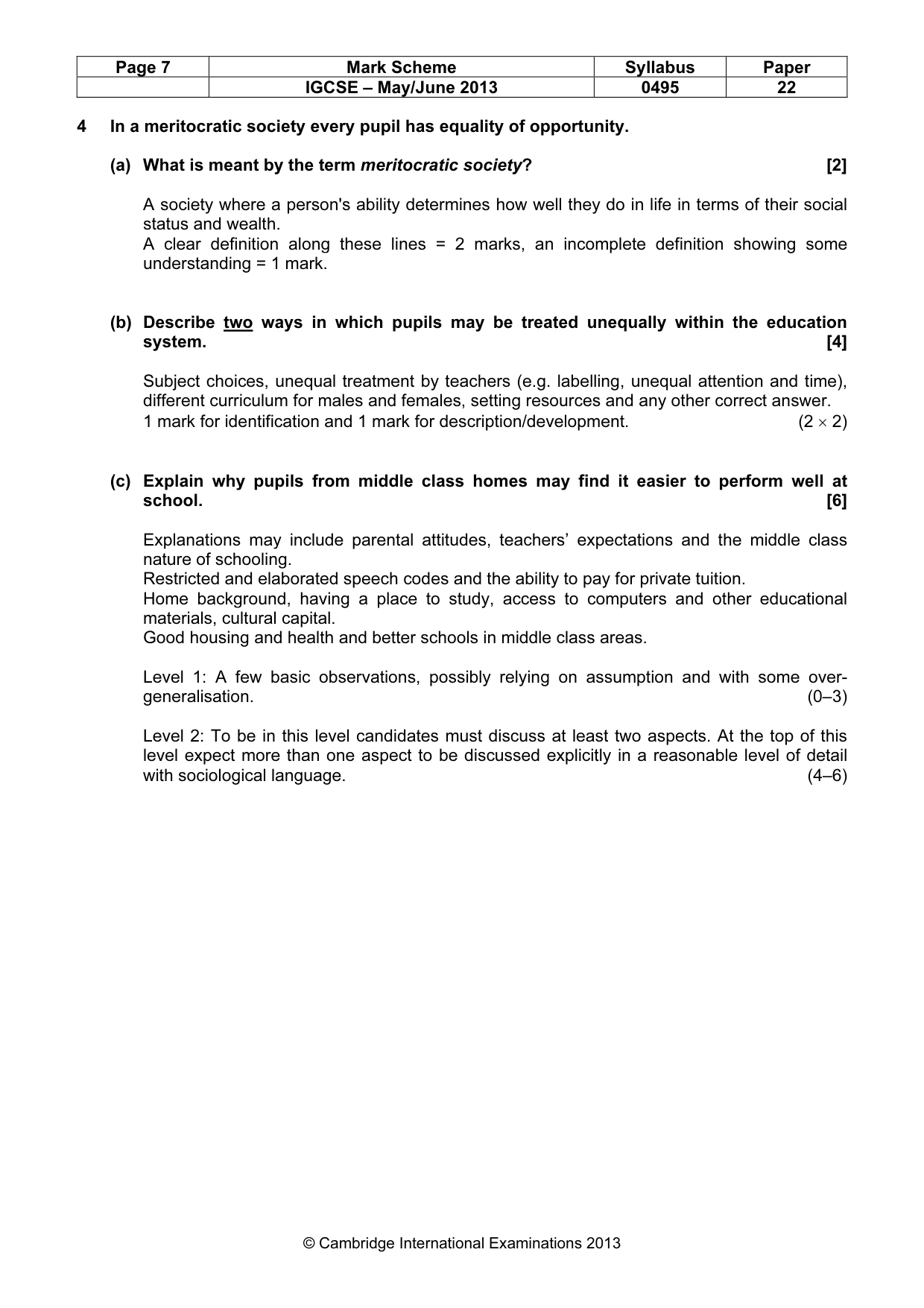
Page 7 Mark Scheme Syllabus Paper IGCSE – May/June 2013 0495 22 © Cambridge International Examinations 2013 4 In a meritocratic society every pupil has equality of opportunity. (a) What is meant by the term meritocratic society? [2] A society where a person's ability determines how well they do in life in terms of their social status and wealth. A clear definition along these lines = 2 marks, an incomplete definition showing some understanding = 1 mark. (b) Describe two ways in which pupils may be treated unequally within the education system. [4] Subject choices, unequal treatment by teachers (e.g. labelling, unequal attention and time), different curriculum for males and females, setting resources and any other correct answer. 1 mark for identification and 1 mark for description/development. (2 × 2) (c) Explain why pupils from middle class homes may find it easier to perform well at school. [6] Explanations may include parental attitudes, teachers’ expectations and the middle class nature of schooling. Restricted and elaborated speech codes and the ability to pay for private tuition. Home background, having a place to study, access to computers and other educational materials, cultural capital. Good housing and health and better schools in middle class areas. Level 1: A few basic observations, possibly relying on assumption and with some over- generalisation. (0–3) Level 2: To be in this level candidates must discuss at least two aspects. At the top of this level expect more than one aspect to be discussed explicitly in a reasonable level of detail with sociological language. (4–6)
Mark scheme, page 8
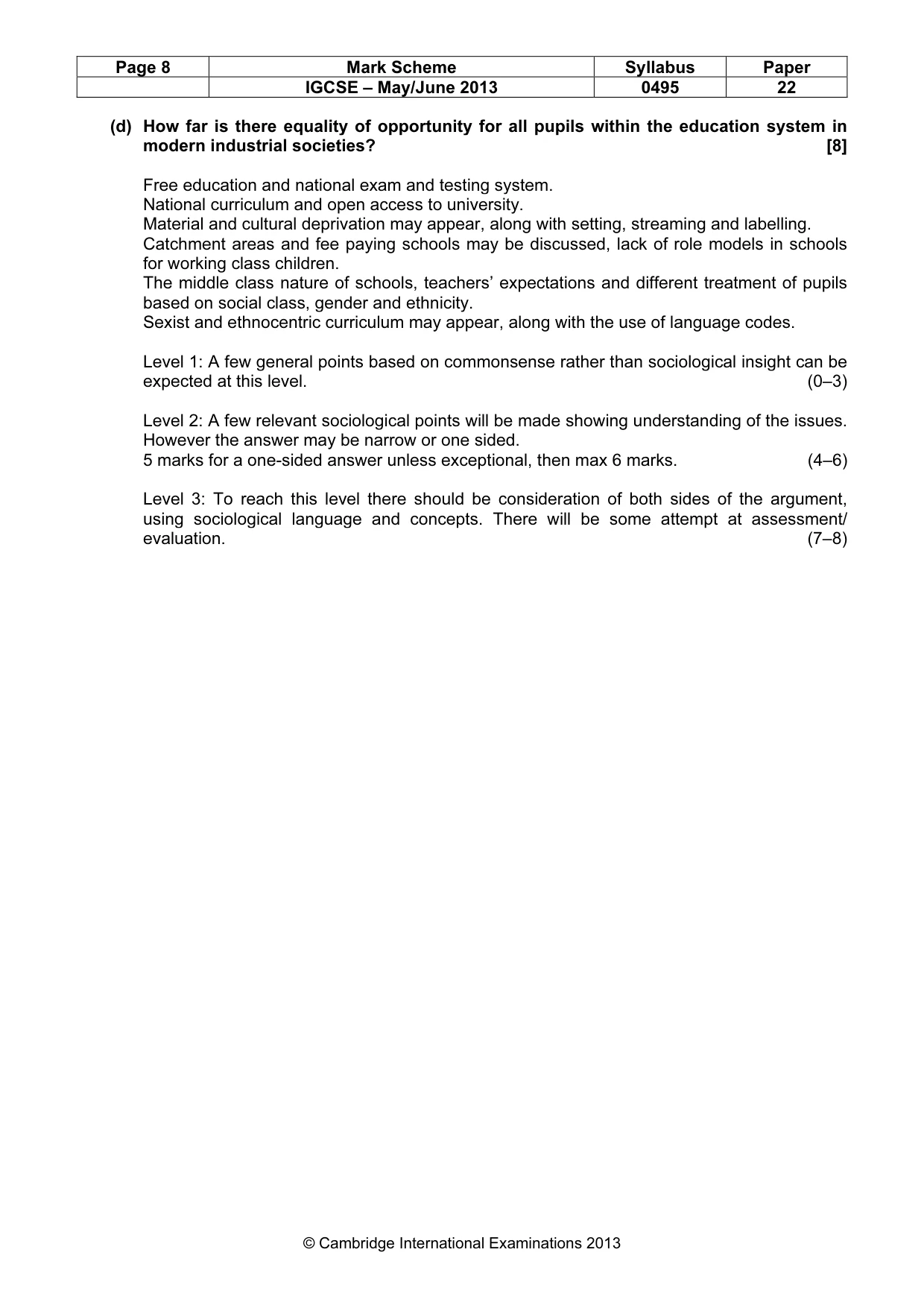
Page 8 Mark Scheme Syllabus Paper IGCSE – May/June 2013 0495 22 © Cambridge International Examinations 2013 (d) How far is there equality of opportunity for all pupils within the education system in modern industrial societies? [8] Free education and national exam and testing system. National curriculum and open access to university. Material and cultural deprivation may appear, along with setting, streaming and labelling. Catchment areas and fee paying schools may be discussed, lack of role models in schools for working class children. The middle class nature of schools, teachers’ expectations and different treatment of pupils based on social class, gender and ethnicity. Sexist and ethnocentric curriculum may appear, along with the use of language codes. Level 1: A few general points based on commonsense rather than sociological insight can be expected at this level. (0–3) Level 2: A few relevant sociological points will be made showing understanding of the issues. However the answer may be narrow or one sided. 5 marks for a one-sided answer unless exceptional, then max 6 marks. (4–6) Level 3: To reach this level there should be consideration of both sides of the argument, using sociological language and concepts. There will be some attempt at assessment/ evaluation. (7–8)
Mark scheme, page 9
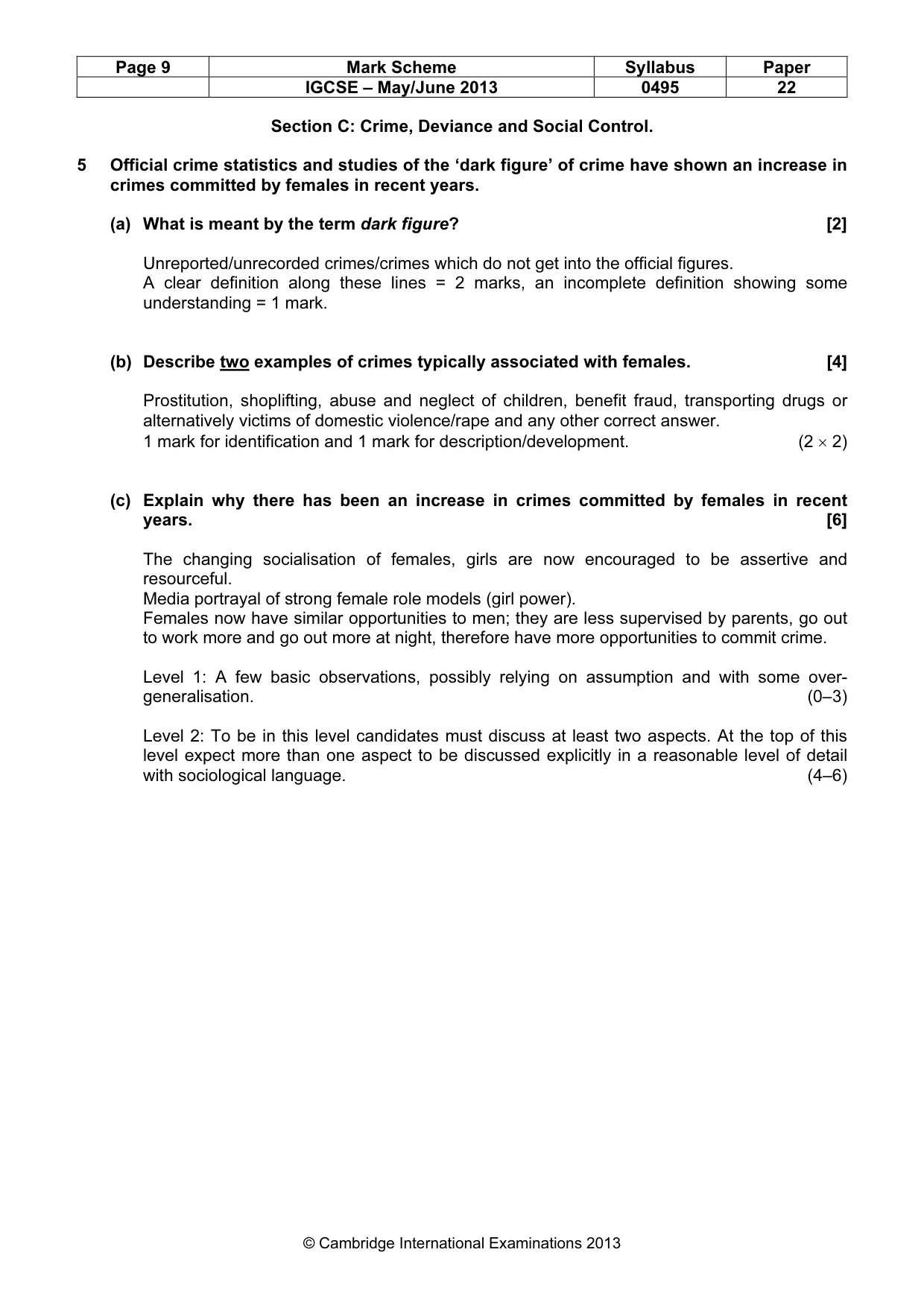
Page 9 Mark Scheme Syllabus Paper IGCSE – May/June 2013 0495 22 © Cambridge International Examinations 2013 Section C: Crime, Deviance and Social Control. 5 Official crime statistics and studies of the ‘dark figure’ of crime have shown an increase in crimes committed by females in recent years. (a) What is meant by the term dark figure? [2] Unreported/unrecorded crimes/crimes which do not get into the official figures. A clear definition along these lines = 2 marks, an incomplete definition showing some understanding = 1 mark. (b) Describe two examples of crimes typically associated with females. [4] Prostitution, shoplifting, abuse and neglect of children, benefit fraud, transporting drugs or alternatively victims of domestic violence/rape and any other correct answer. 1 mark for identification and 1 mark for description/development. (2 × 2) (c) Explain why there has been an increase in crimes committed by females in recent years. [6] The changing socialisation of females, girls are now encouraged to be assertive and resourceful. Media portrayal of strong female role models (girl power). Females now have similar opportunities to men; they are less supervised by parents, go out to work more and go out more at night, therefore have more opportunities to commit crime. Level 1: A few basic observations, possibly relying on assumption and with some over- generalisation. (0–3) Level 2: To be in this level candidates must discuss at least two aspects. At the top of this level expect more than one aspect to be discussed explicitly in a reasonable level of detail with sociological language. (4–6)
Mark scheme, page 10
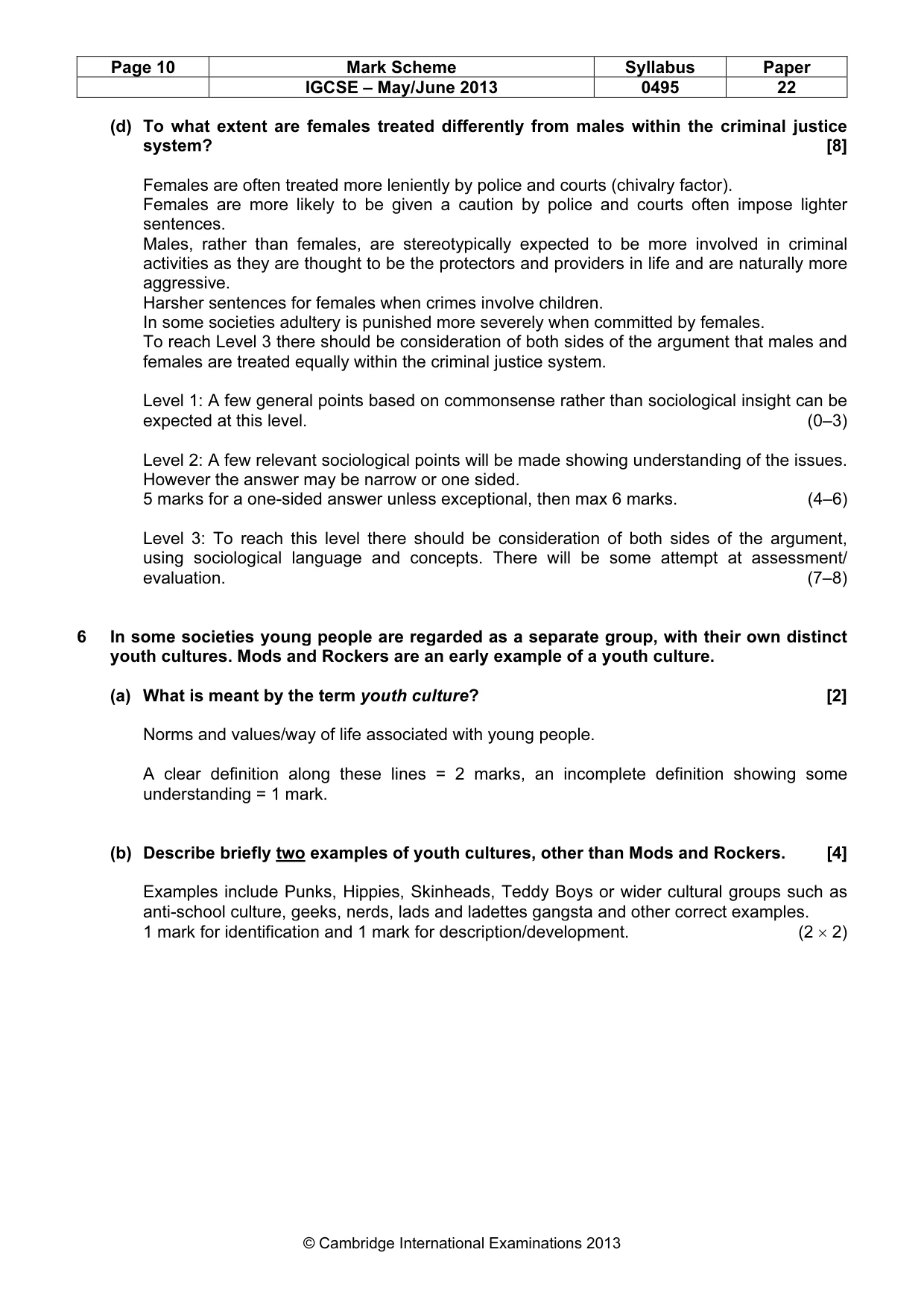
Page 10 Mark Scheme Syllabus Paper IGCSE – May/June 2013 0495 22 © Cambridge International Examinations 2013 (d) To what extent are females treated differently from males within the criminal justice system? [8] Females are often treated more leniently by police and courts (chivalry factor). Females are more likely to be given a caution by police and courts often impose lighter sentences. Males, rather than females, are stereotypically expected to be more involved in criminal activities as they are thought to be the protectors and providers in life and are naturally more aggressive. Harsher sentences for females when crimes involve children. In some societies adultery is punished more severely when committed by females. To reach Level 3 there should be consideration of both sides of the argument that males and females are treated equally within the criminal justice system. Level 1: A few general points based on commonsense rather than sociological insight can be expected at this level. (0–3) Level 2: A few relevant sociological points will be made showing understanding of the issues. However the answer may be narrow or one sided. 5 marks for a one-sided answer unless exceptional, then max 6 marks. (4–6) Level 3: To reach this level there should be consideration of both sides of the argument, using sociological language and concepts. There will be some attempt at assessment/ evaluation. (7–8) 6 In some societies young people are regarded as a separate group, with their own distinct youth cultures. Mods and Rockers are an early example of a youth culture. (a) What is meant by the term youth culture? [2] Norms and values/way of life associated with young people. A clear definition along these lines = 2 marks, an incomplete definition showing some understanding = 1 mark. (b) Describe briefly two examples of youth cultures, other than Mods and Rockers. [4] Examples include Punks, Hippies, Skinheads, Teddy Boys or wider cultural groups such as anti-school culture, geeks, nerds, lads and ladettes gangsta and other correct examples. 1 mark for identification and 1 mark for description/development. (2 × 2)
Mark scheme, page 11
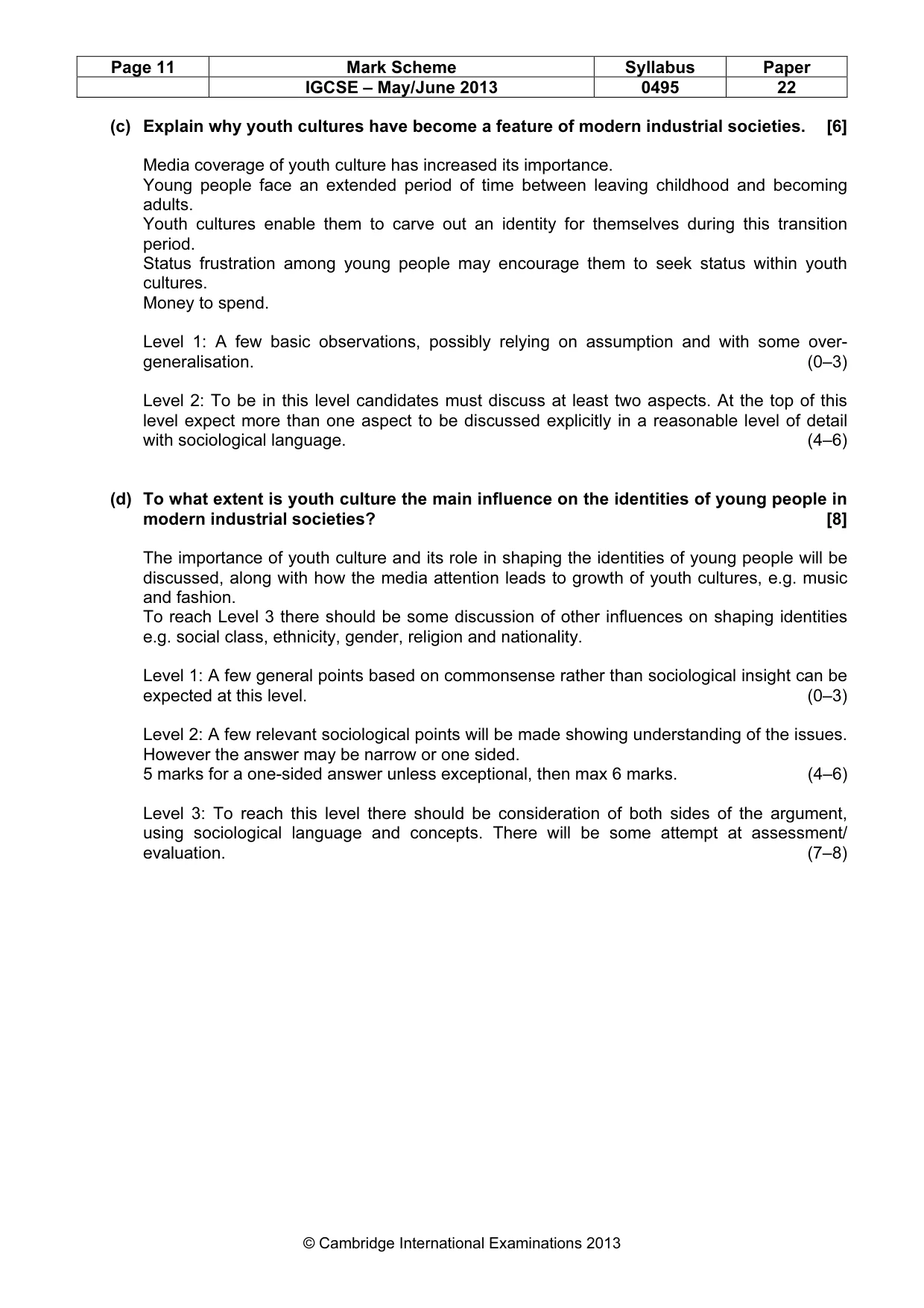
Page 11 Mark Scheme Syllabus Paper IGCSE – May/June 2013 0495 22 © Cambridge International Examinations 2013 (c) Explain why youth cultures have become a feature of modern industrial societies. [6] Media coverage of youth culture has increased its importance. Young people face an extended period of time between leaving childhood and becoming adults. Youth cultures enable them to carve out an identity for themselves during this transition period. Status frustration among young people may encourage them to seek status within youth cultures. Money to spend. Level 1: A few basic observations, possibly relying on assumption and with some over- generalisation. (0–3) Level 2: To be in this level candidates must discuss at least two aspects. At the top of this level expect more than one aspect to be discussed explicitly in a reasonable level of detail with sociological language. (4–6) (d) To what extent is youth culture the main influence on the identities of young people in modern industrial societies? [8] The importance of youth culture and its role in shaping the identities of young people will be discussed, along with how the media attention leads to growth of youth cultures, e.g. music and fashion. To reach Level 3 there should be some discussion of other influences on shaping identities e.g. social class, ethnicity, gender, religion and nationality. Level 1: A few general points based on commonsense rather than sociological insight can be expected at this level. (0–3) Level 2: A few relevant sociological points will be made showing understanding of the issues. However the answer may be narrow or one sided. 5 marks for a one-sided answer unless exceptional, then max 6 marks. (4–6) Level 3: To reach this level there should be consideration of both sides of the argument, using sociological language and concepts. There will be some attempt at assessment/ evaluation. (7–8)
Mark scheme, page 12
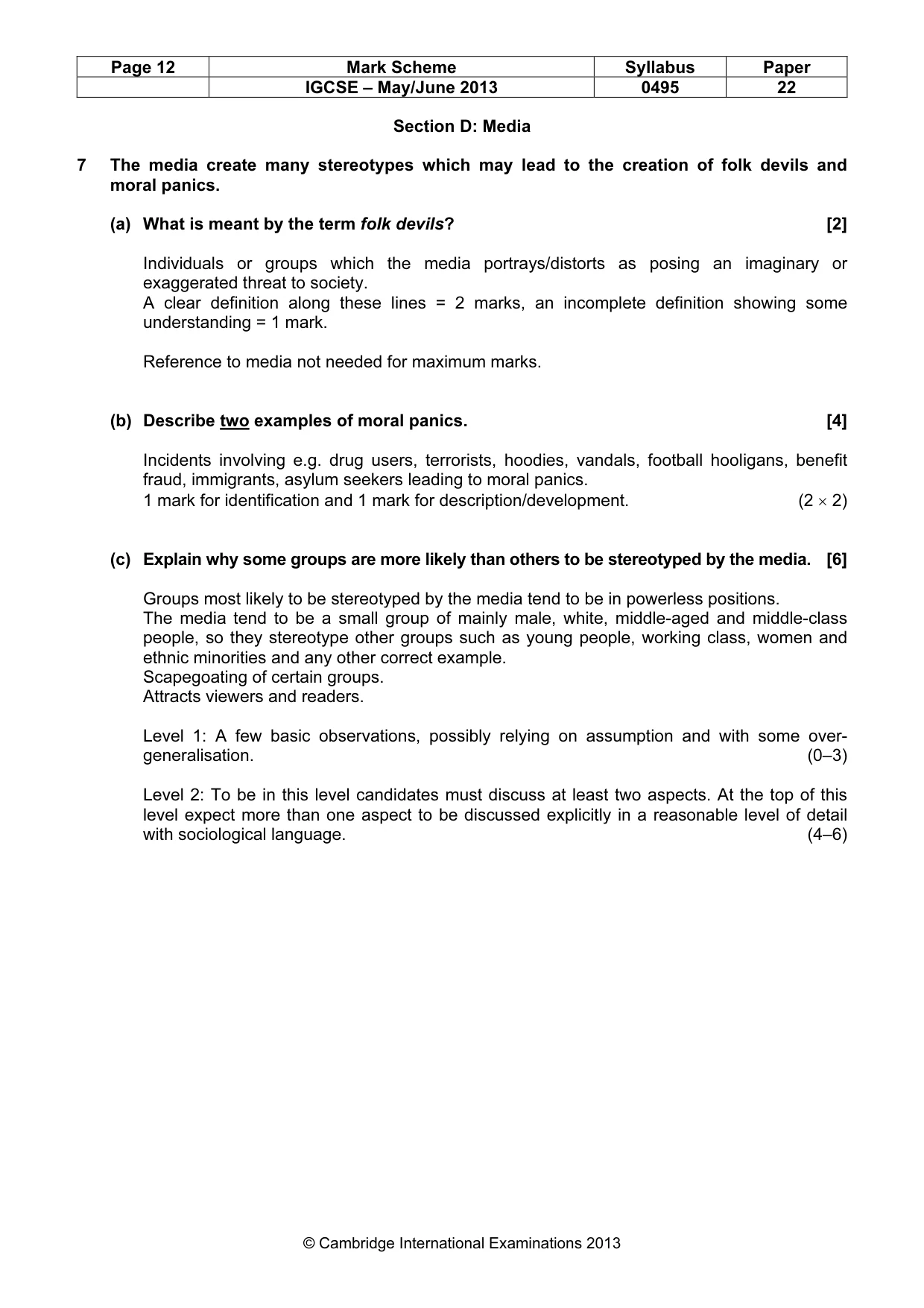
Page 12 Mark Scheme Syllabus Paper IGCSE – May/June 2013 0495 22 © Cambridge International Examinations 2013 Section D: Media 7 The media create many stereotypes which may lead to the creation of folk devils and moral panics. (a) What is meant by the term folk devils? [2] Individuals or groups which the media portrays/distorts as posing an imaginary or exaggerated threat to society. A clear definition along these lines = 2 marks, an incomplete definition showing some understanding = 1 mark. Reference to media not needed for maximum marks. (b) Describe two examples of moral panics. [4] Incidents involving e.g. drug users, terrorists, hoodies, vandals, football hooligans, benefit fraud, immigrants, asylum seekers leading to moral panics. 1 mark for identification and 1 mark for description/development. (2 × 2) (c) Explain why some groups are more likely than others to be stereotyped by the media. [6] Groups most likely to be stereotyped by the media tend to be in powerless positions. The media tend to be a small group of mainly male, white, middle-aged and middle-class people, so they stereotype other groups such as young people, working class, women and ethnic minorities and any other correct example. Scapegoating of certain groups. Attracts viewers and readers. Level 1: A few basic observations, possibly relying on assumption and with some over- generalisation. (0–3) Level 2: To be in this level candidates must discuss at least two aspects. At the top of this level expect more than one aspect to be discussed explicitly in a reasonable level of detail with sociological language. (4–6)
Mark scheme, page 13
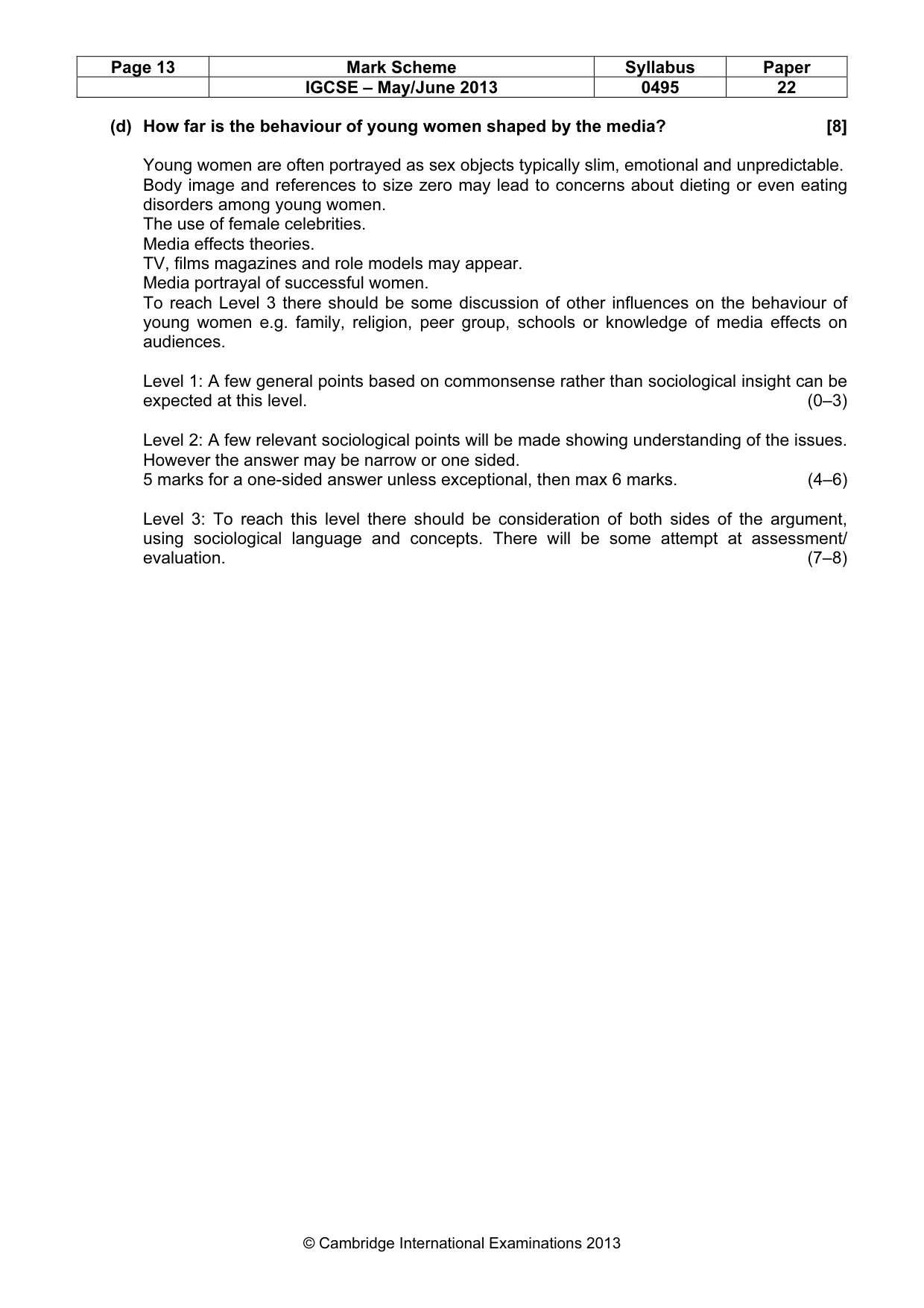
Page 13 Mark Scheme Syllabus Paper IGCSE – May/June 2013 0495 22 © Cambridge International Examinations 2013 (d) How far is the behaviour of young women shaped by the media? [8] Young women are often portrayed as sex objects typically slim, emotional and unpredictable. Body image and references to size zero may lead to concerns about dieting or even eating disorders among young women. The use of female celebrities. Media effects theories. TV, films magazines and role models may appear. Media portrayal of successful women. To reach Level 3 there should be some discussion of other influences on the behaviour of young women e.g. family, religion, peer group, schools or knowledge of media effects on audiences. Level 1: A few general points based on commonsense rather than sociological insight can be expected at this level. (0–3) Level 2: A few relevant sociological points will be made showing understanding of the issues. However the answer may be narrow or one sided. 5 marks for a one-sided answer unless exceptional, then max 6 marks. (4–6) Level 3: To reach this level there should be consideration of both sides of the argument, using sociological language and concepts. There will be some attempt at assessment/ evaluation. (7–8)
Mark scheme, page 14
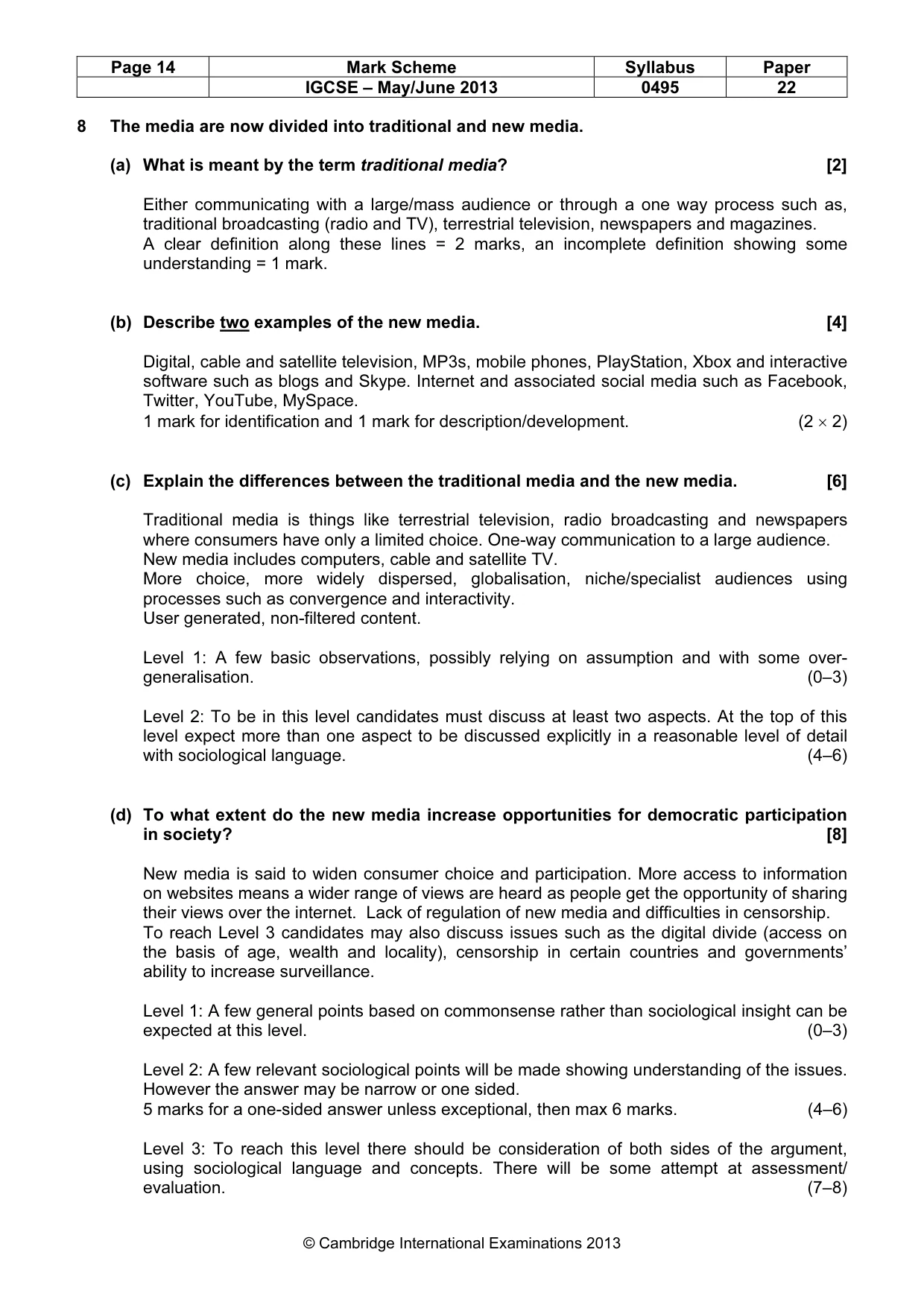
Page 14 Mark Scheme Syllabus Paper IGCSE – May/June 2013 0495 22 © Cambridge International Examinations 2013 8 The media are now divided into traditional and new media. (a) What is meant by the term traditional media? [2] Either communicating with a large/mass audience or through a one way process such as, traditional broadcasting (radio and TV), terrestrial television, newspapers and magazines. A clear definition along these lines = 2 marks, an incomplete definition showing some understanding = 1 mark. (b) Describe two examples of the new media. [4] Digital, cable and satellite television, MP3s, mobile phones, PlayStation, Xbox and interactive software such as blogs and Skype. Internet and associated social media such as Facebook, Twitter, YouTube, MySpace. 1 mark for identification and 1 mark for description/development. (2 × 2) (c) Explain the differences between the traditional media and the new media. [6] Traditional media is things like terrestrial television, radio broadcasting and newspapers where consumers have only a limited choice. One-way communication to a large audience. New media includes computers, cable and satellite TV. More choice, more widely dispersed, globalisation, niche/specialist audiences using processes such as convergence and interactivity. User generated, non-filtered content. Level 1: A few basic observations, possibly relying on assumption and with some over- generalisation. (0–3) Level 2: To be in this level candidates must discuss at least two aspects. At the top of this level expect more than one aspect to be discussed explicitly in a reasonable level of detail with sociological language. (4–6) (d) To what extent do the new media increase opportunities for democratic participation in society? [8] New media is said to widen consumer choice and participation. More access to information on websites means a wider range of views are heard as people get the opportunity of sharing their views over the internet. Lack of regulation of new media and difficulties in censorship. To reach Level 3 candidates may also discuss issues such as the digital divide (access on the basis of age, wealth and locality), censorship in certain countries and governments’ ability to increase surveillance. Level 1: A few general points based on commonsense rather than sociological insight can be expected at this level. (0–3) Level 2: A few relevant sociological points will be made showing understanding of the issues. However the answer may be narrow or one sided. 5 marks for a one-sided answer unless exceptional, then max 6 marks. (4–6) Level 3: To reach this level there should be consideration of both sides of the argument, using sociological language and concepts. There will be some attempt at assessment/ evaluation. (7–8)
What you needed in this session
Cambridge’s own grade thresholds for 2013 May/June, Paper 2 · Variant 2. A higher threshold means an easier paper — the bar moves with how the cohort did.