Cambridge IGCSE Sociology 0495 — 2011 May/June Paper 2 · Variant 2
0495/22/M/J/11 · 60 marks · ≈68 min
The question paper and its mark scheme, free to read here and free to download. This is Cambridge’s own paper, exactly as it was sat.
Question paper28 pages



Mark scheme9 pages
Answers below. Sit the paper first if you are practising.
Paper as text
Question paper, page 1
This document consists of 25 printed pages and 3 blank pages. DC (SM) 41557/1 © UCLES 2011 [Turn over UNIVERSITY OF CAMBRIDGE INTERNATIONAL EXAMINATIONS International General Certificate of Secondary Education * 4 3 6 1 9 2 0 6 6 4 * SOCIOLOGY 0495/22 Paper 2 May/June 2011 1 hour 45 minutes Candidates answer on the Question Paper. No additional materials are required. READ THESE INSTRUCTIONS FIRST Write your Centre number, candidate number and name on all the work you hand in. Write in dark blue or black pen. You may use a soft pencil for any diagrams, graphs or rough working. Do not use staples, paper clips, highlighters, glue or correction fluid. DO NOT WRITE IN ANY BARCODES. Answer any three questions. You may not need all the answer lines for your answer. The number of marks is given in brackets [ ] at the end of each question or part question. www.XtremePapers.com
Question paper, page 2
2 0495/22/M/J/11 © UCLES 2011 For Examiner’s Use Section A: Family 1 In modern industrial societies roles within the family have changed considerably. (a) What is meant by the term role? … … … … [2] (b) Describe two examples of how the roles of men have changed in modern industrial societies. … … … … … … … … [4]
Question paper, page 3
3 0495/22/M/J/11 © UCLES 2011 [Turn over For Examiner’s Use (c) Explain why sociologists think that families have become increasingly child-centred in modern industrial societies. … … … … … … … … … … … … … … … … … … [6]
Question paper, page 4
4 0495/22/M/J/11 © UCLES 2011 For Examiner’s Use (d) How far is there equality in the roles performed by men and women within the family in modern industrial societies? … … … … … … … … … … … … … … … … … … … … … … … … [8]
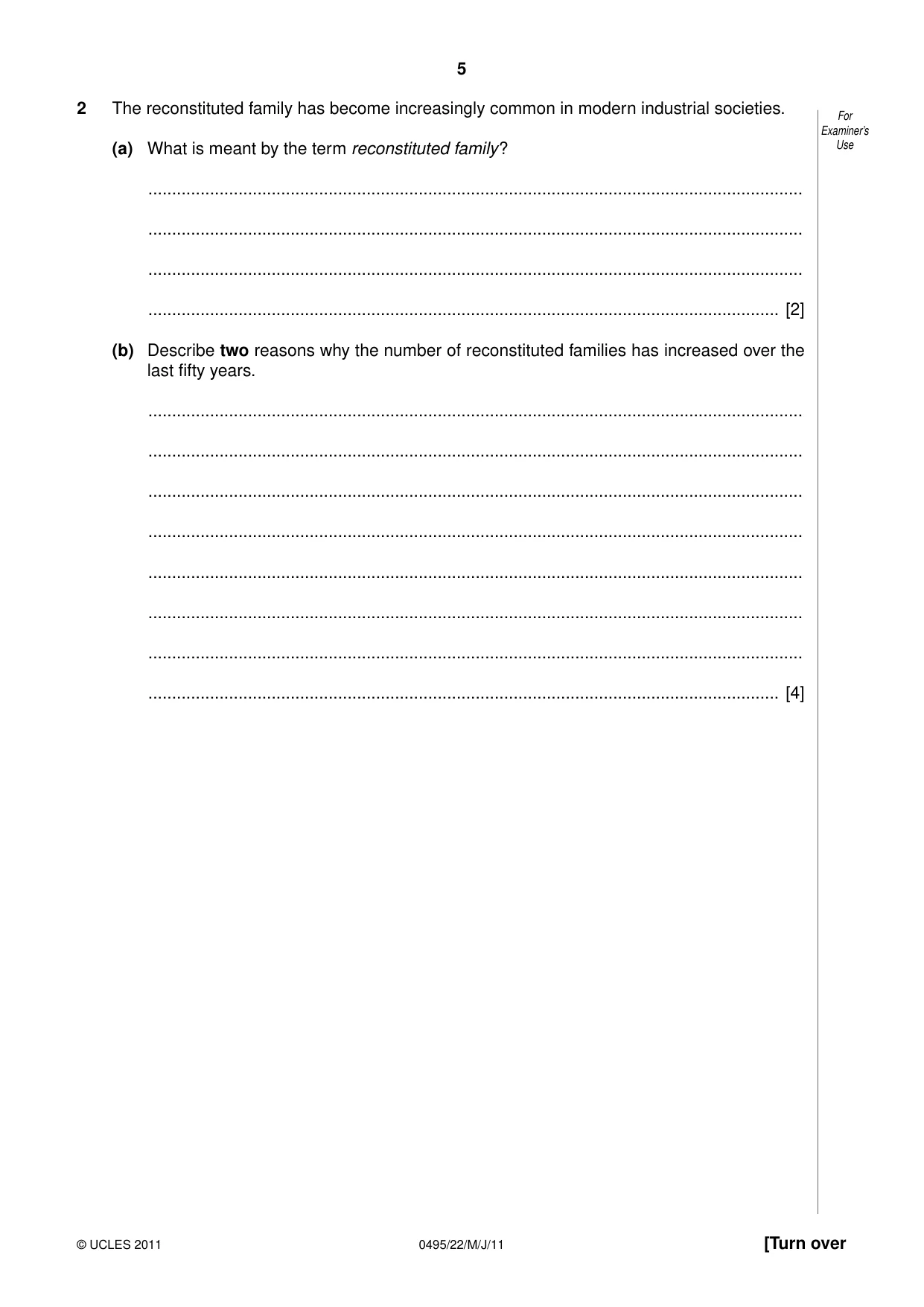
Question paper, page 5
5 0495/22/M/J/11 © UCLES 2011 [Turn over For Examiner’s Use 2 The reconstituted family has become increasingly common in modern industrial societies. (a) What is meant by the term reconstituted family? … … … … [2] (b) Describe two reasons why the number of reconstituted families has increased over the last fifty years. … … … … … … … … [4]
Question paper, page 6
6 0495/22/M/J/11 © UCLES 2011 For Examiner’s Use (c) Explain the consequences for society of an increasingly high divorce rate. … … … … … … … … … … … … … … … … … … [6]
Question paper, page 7
7 0495/22/M/J/11 © UCLES 2011 [Turn over For Examiner’s Use (d) How far can the increase in the divorce rate in modern industrial societies be explained in terms of the growing independence of women? … … … … … … … … … … … … … … … … … … … … … … … … [8]
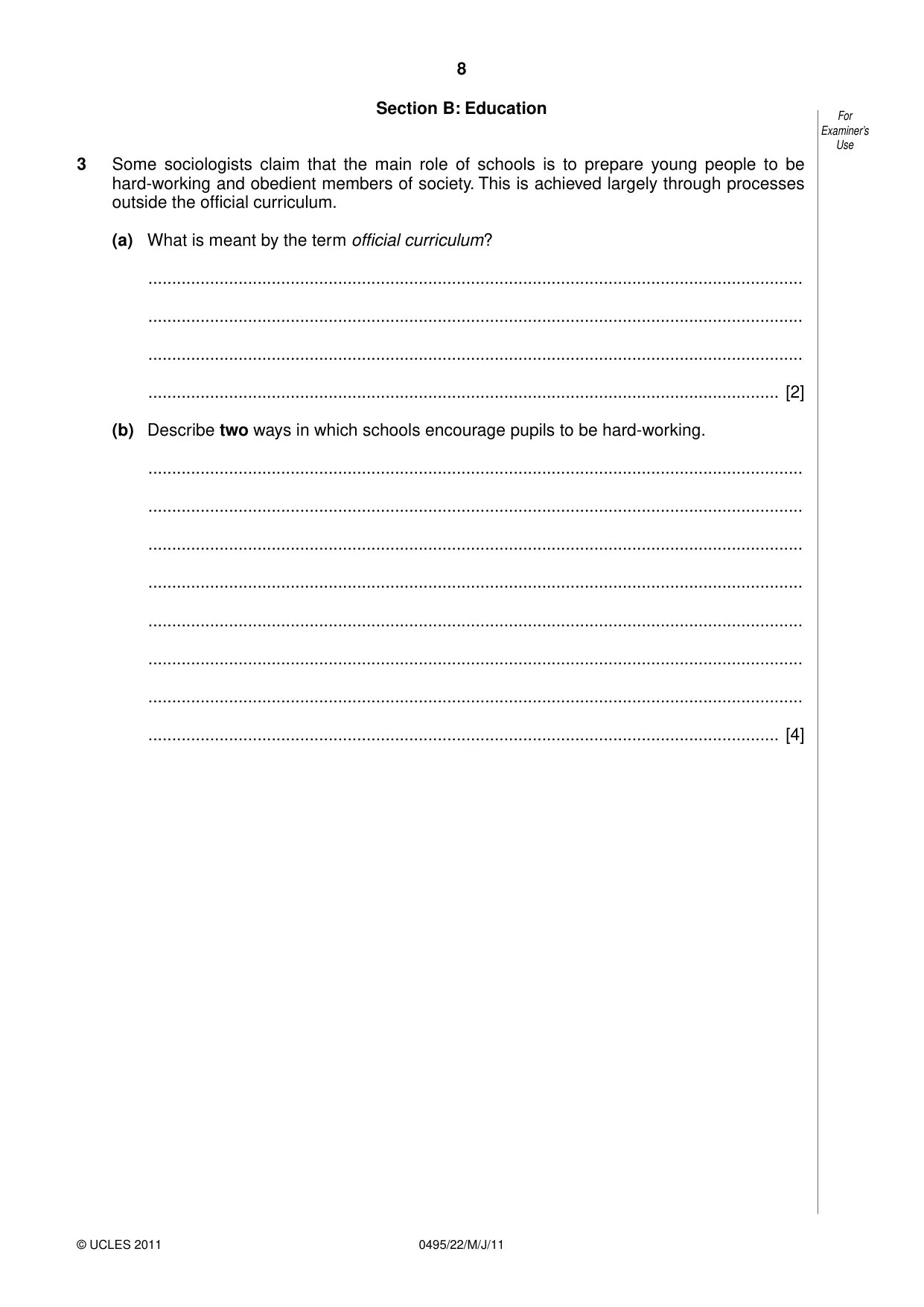
Question paper, page 8
8 0495/22/M/J/11 © UCLES 2011 For Examiner’s Use Section B: Education 3 Some sociologists claim that the main role of schools is to prepare young people to be hard-working and obedient members of society. This is achieved largely through processes outside the official curriculum. (a) What is meant by the term official curriculum? … … … … [2] (b) Describe two ways in which schools encourage pupils to be hard-working. … … … … … … … … [4]
Question paper, page 9
9 0495/22/M/J/11 © UCLES 2011 [Turn over For Examiner’s Use (c) Explain the role of informal education in traditional societies. … … … … … … … … … … … … … … … … … … [6]
Question paper, page 10
10 0495/22/M/J/11 © UCLES 2011 For Examiner’s Use (d) Assess the view that the main role of schools is to prepare young people to be obedient members of society. … … … … … … … … … … … … … … … … … … … … … … … … [8]
Question paper, page 11
11 0495/22/M/J/11 © UCLES 2011 [Turn over For Examiner’s Use 4 Despite compensatory education and equality of opportunity, pupils from some social backgrounds still underachieve in schools today. (a) What is meant by the term equality of opportunity? … … … … [2] (b) Describe two groups of people who are more likely to underachieve at school. … … … … … … … … [4]
Question paper, page 12
12 0495/22/M/J/11 © UCLES 2011 For Examiner’s Use (c) Explain how schools use compensatory education in order to improve educational achievement. … … … … … … … … … … … … … … … … … … [6]
Question paper, page 13
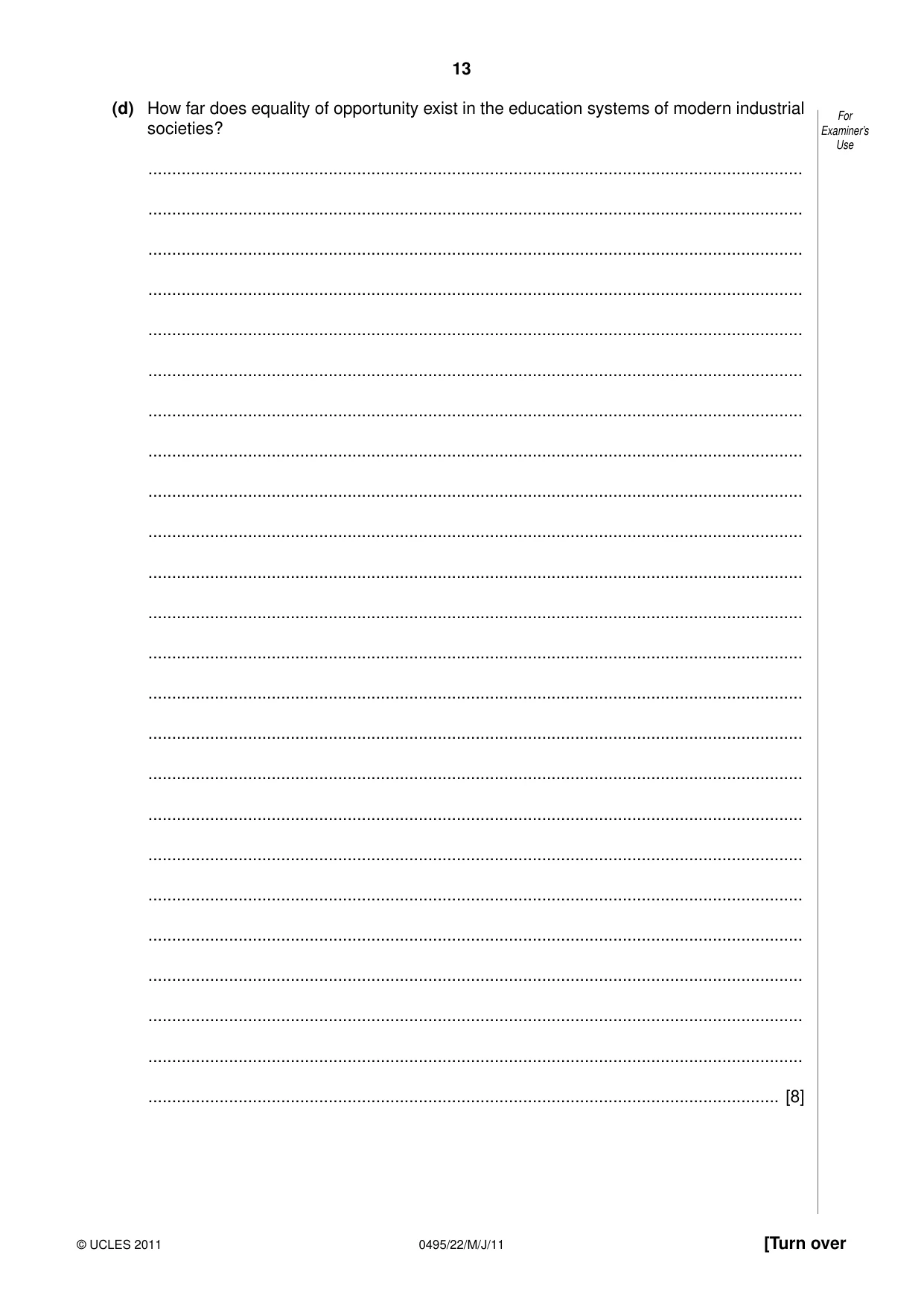
13 0495/22/M/J/11 © UCLES 2011 [Turn over For Examiner’s Use (d) How far does equality of opportunity exist in the education systems of modern industrial societies? … … … … … … … … … … … … … … … … … … … … … … … … [8]
Question paper, page 14
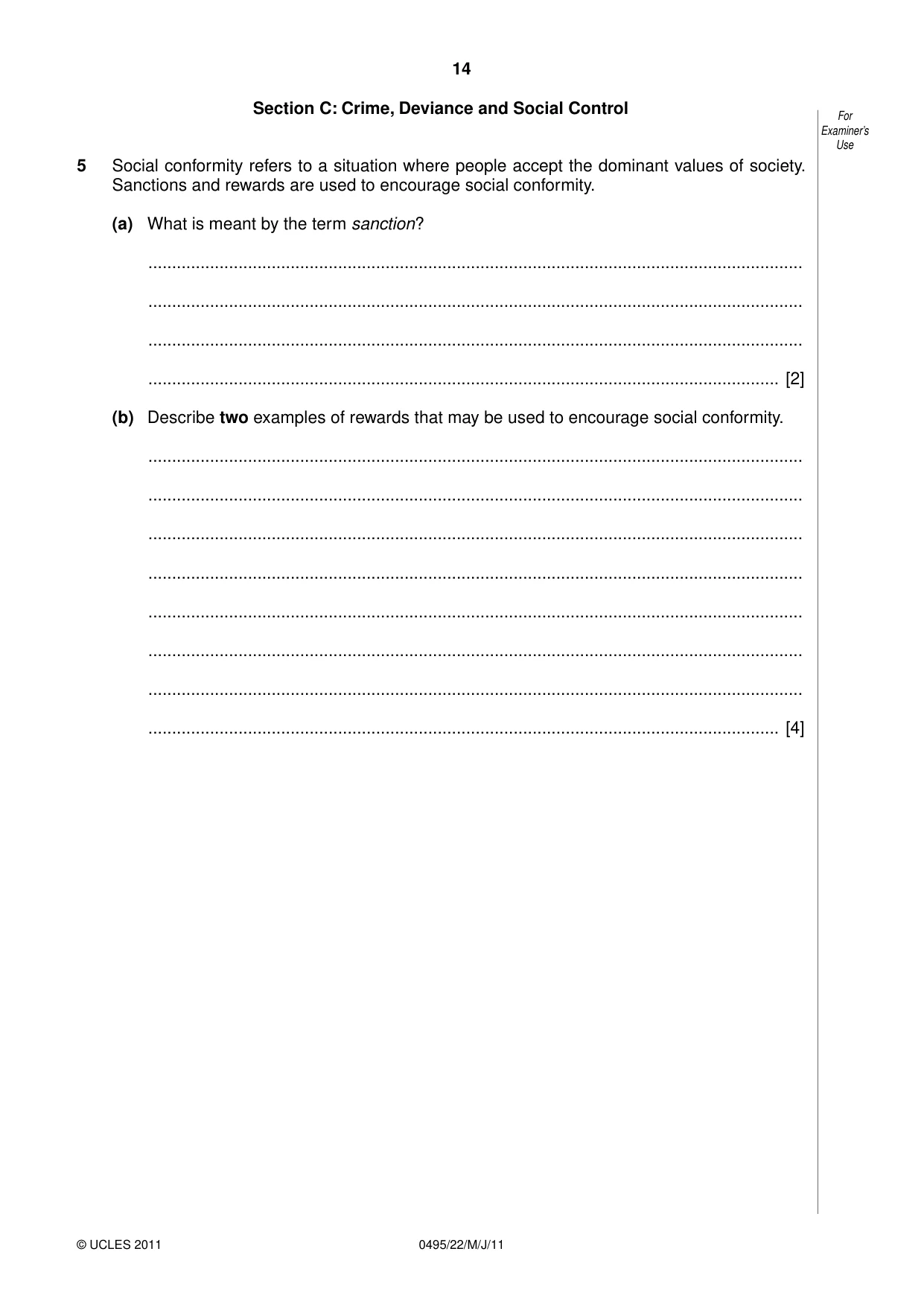
14 0495/22/M/J/11 © UCLES 2011 For Examiner’s Use Section C: Crime, Deviance and Social Control 5 Social conformity refers to a situation where people accept the dominant values of society. Sanctions and rewards are used to encourage social conformity. (a) What is meant by the term sanction? … … … … [2] (b) Describe two examples of rewards that may be used to encourage social conformity. … … … … … … … … [4]
Question paper, page 15
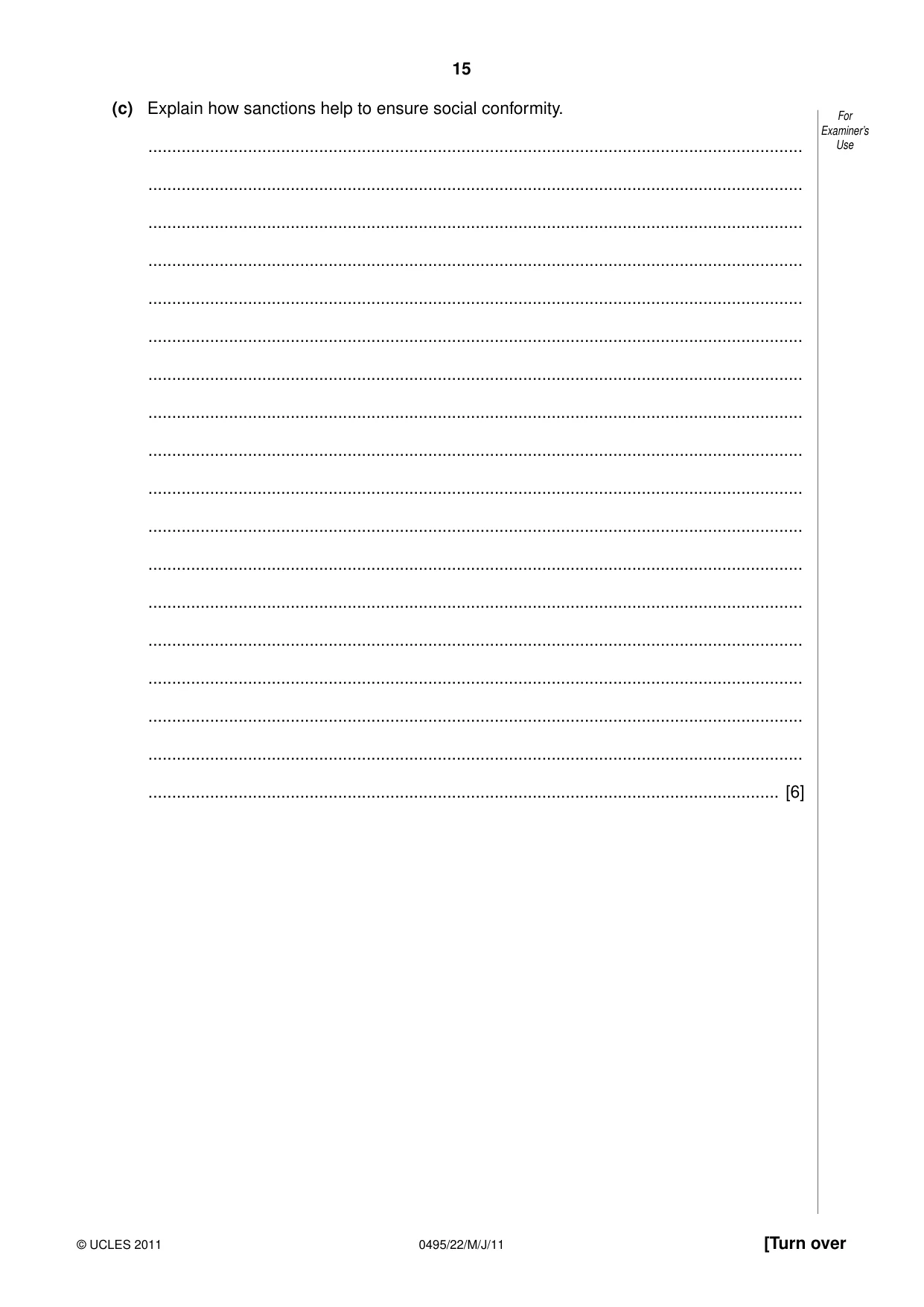
15 0495/22/M/J/11 © UCLES 2011 For Examiner’s Use [Turn over (c) Explain how sanctions help to ensure social conformity. … … … … … … … … … … … … … … … … … … [6]
Question paper, page 16
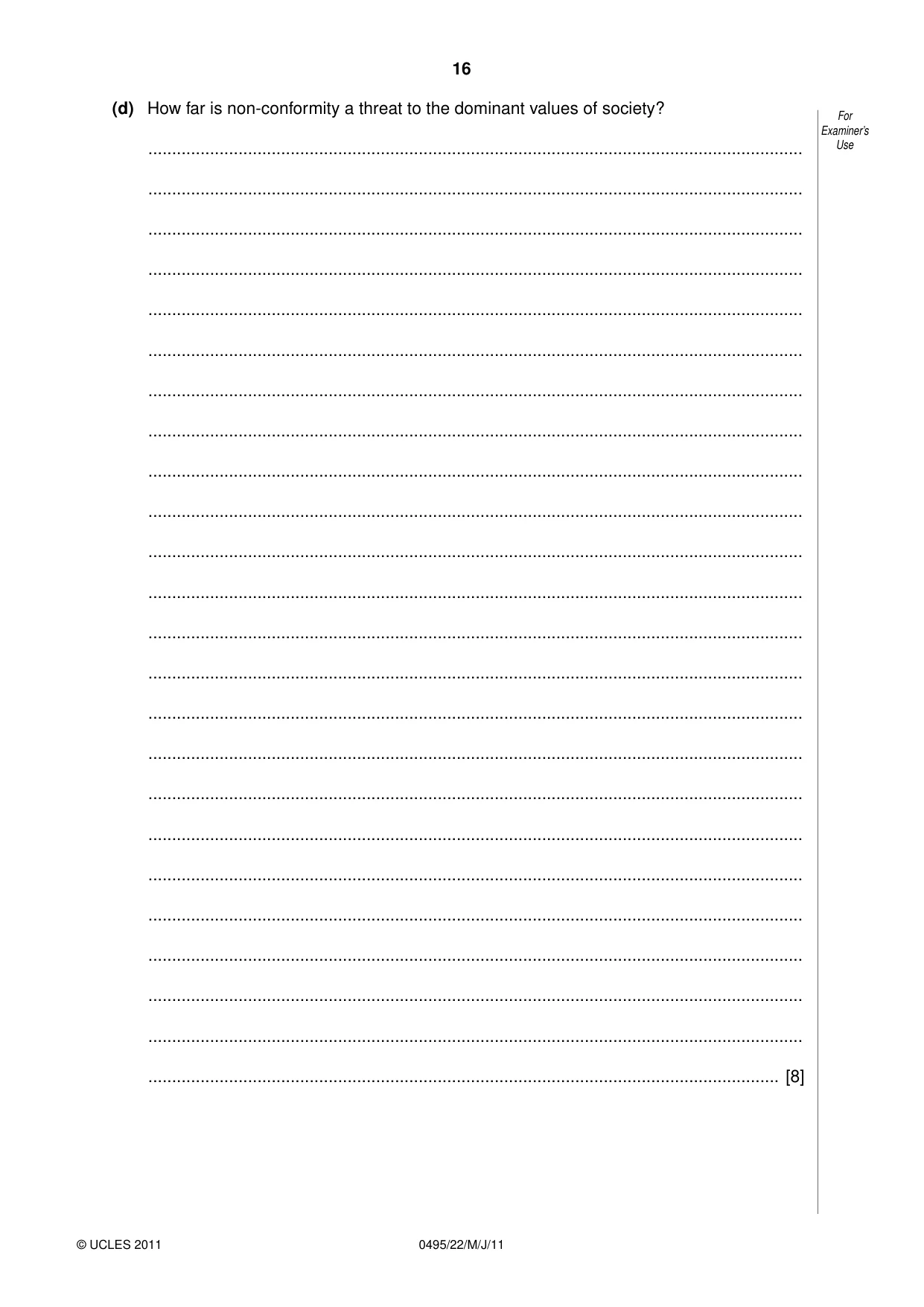
16 0495/22/M/J/11 © UCLES 2011 For Examiner’s Use (d) How far is non-conformity a threat to the dominant values of society? … … … … … … … … … … … … … … … … … … … … … … … … [8]
Question paper, page 17
17 0495/22/M/J/11 © UCLES 2011 For Examiner’s Use [Turn over 6 The idea that there is a ‘typical criminal’ is a stereotype. Crimes are committed by people from a wide range of social backgrounds, though this fact might not be reflected in the official crime statistics. (a) What is meant by the term stereotype? … … … … [2] (b) Describe two groups who are likely to fit the stereotype of a criminal. … … … … … … … … [4]
Question paper, page 18
18 0495/22/M/J/11 © UCLES 2011 For Examiner’s Use (c) Explain why female crime is under-represented in the official crime statistics. … … … … … … … … … … … … … … … … … … [6]
Question paper, page 19
19 0495/22/M/J/11 © UCLES 2011 [Turn over For Examiner’s Use (d) To what extent do self-report studies and victim surveys reflect the amount of crime in society more accurately than the official crime statistics? … … … … … … … … … … … … … … … … … … … … … … … … [8]
Question paper, page 20
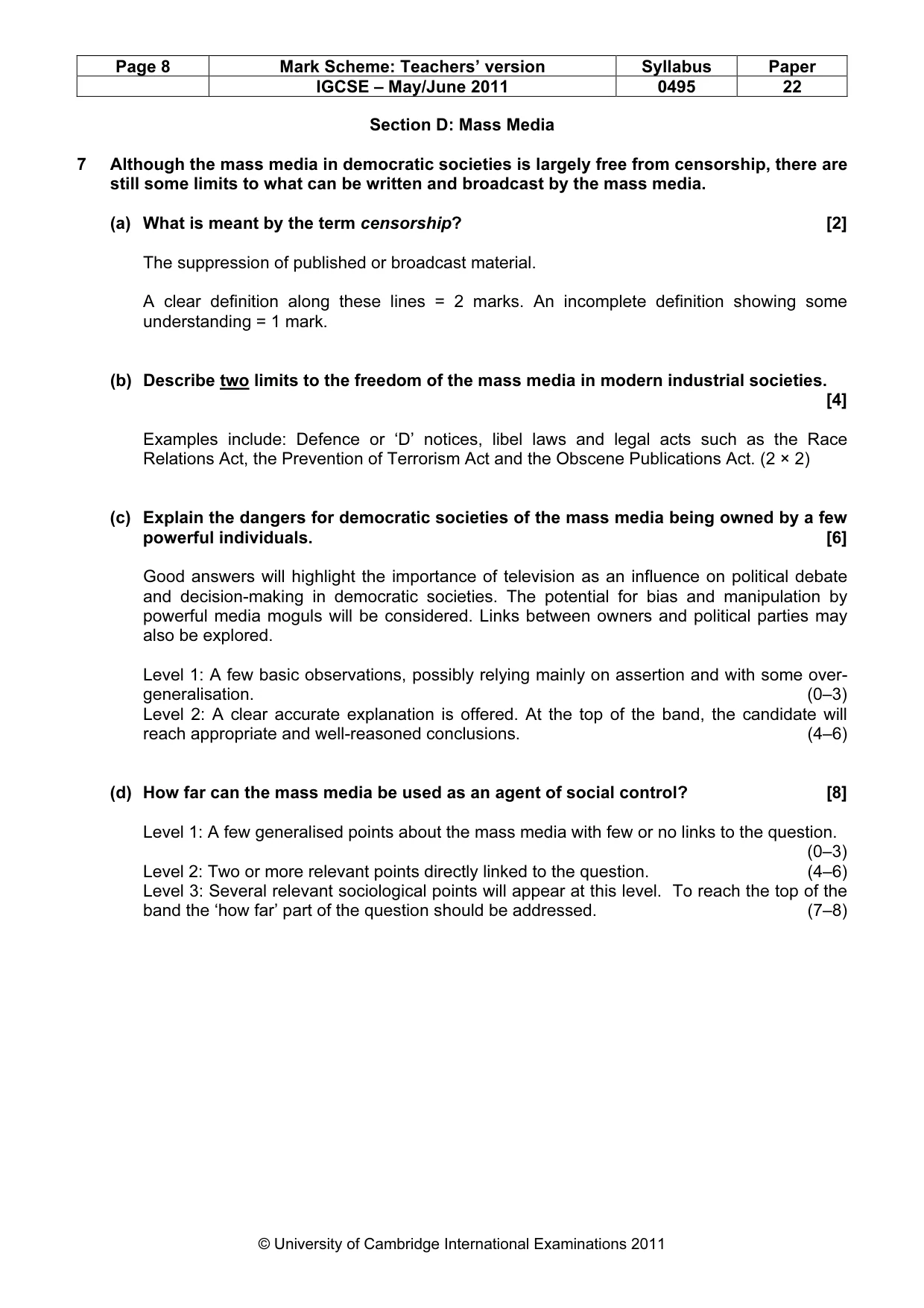
20 0495/22/M/J/11 © UCLES 2011 For Examiner’s Use Section D: Mass Media 7 Although the mass media in democratic societies is largely free from censorship, there are still some limits to what can be written and broadcast by the mass media. (a) What is meant by the term censorship? … … … … [2] (b) Describe two limits to the freedom of the mass media in modern industrial societies. … … … … … … … … [4]
Question paper, page 21
21 0495/22/M/J/11 © UCLES 2011 [Turn over For Examiner’s Use (c) Explain the dangers for democratic societies of the mass media being owned by a few powerful individuals. … … … … … … … … … … … … … … … … … … [6]
Question paper, page 22
22 0495/22/M/J/11 © UCLES 2011 For Examiner’s Use (d) How far can the mass media be used as an agent of social control? … … … … … … … … … … … … … … … … … … … … … … … … [8]
Question paper, page 23
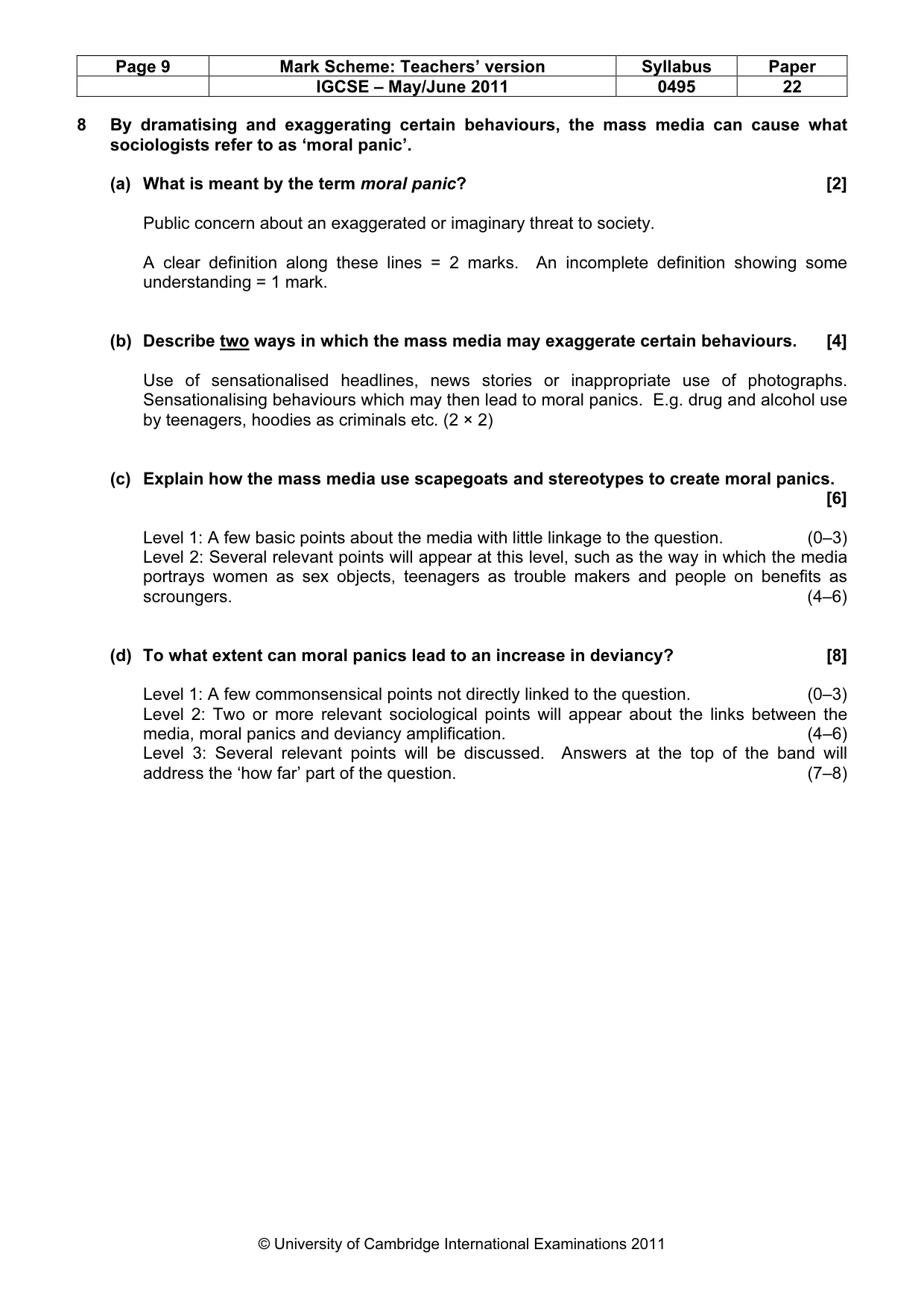
23 0495/22/M/J/11 © UCLES 2011 [Turn over For Examiner’s Use 8 By dramatising and exaggerating certain behaviours, the mass media can cause what sociologists refer to as ‘moral panic’. (a) What is meant by the term moral panic? … … … … [2] (b) Describe two ways in which the mass media may exaggerate certain behaviours. … … … … … … … … [4]
Question paper, page 24
24 0495/22/M/J/11 © UCLES 2011 For Examiner’s Use (c) Explain how the mass media use scapegoats and stereotypes to create moral panics. … … … … … … … … … … … … … … … … … … [6]
Question paper, page 25
25 0495/22/M/J/11 © UCLES 2011 For Examiner’s Use (d) To what extent can moral panics lead to an increase in deviancy? … … … … … … … … … … … … … … … … … … … … … … … … [8]
Question paper, page 26
26 0495/22/M/J/11 © UCLES 2011 BLANK PAGE
Question paper, page 27
27 0495/22/M/J/11 © UCLES 2011 BLANK PAGE
Question paper, page 28
28 0495/22/M/J/11 © UCLES 2011 Permission to reproduce items where third-party owned material protected by copyright is included has been sought and cleared where possible. Every reasonable effort has been made by the publisher (UCLES) to trace copyright holders, but if any items requiring clearance have unwittingly been included, the publisher will be pleased to make amends at the earliest possible opportunity. University of Cambridge International Examinations is part of the Cambridge Assessment Group. Cambridge Assessment is the brand name of University of Cambridge Local Examinations Syndicate (UCLES), which is itself a department of the University of Cambridge. BLANK PAGE
Mark scheme, page 1
UNIVERSITY OF CAMBRIDGE INTERNATIONAL EXAMINATIONS International General Certificate of Secondary Education MARK SCHEME for the May/June 2011 question paper for the guidance of teachers 0495 SOCIOLOGY 0495/22 Paper 2, maximum raw mark 60 This mark scheme is published as an aid to teachers and candidates, to indicate the requirements of the examination. It shows the basis on which Examiners were instructed to award marks. It does not indicate the details of the discussions that took place at an Examiners’ meeting before marking began, which would have considered the acceptability of alternative answers. Mark schemes must be read in conjunction with the question papers and the report on the examination. • Cambridge will not enter into discussions or correspondence in connection with these mark schemes. Cambridge is publishing the mark schemes for the May/June 2011 question papers for most IGCSE, GCE Advanced Level and Advanced Subsidiary Level syllabuses and some Ordinary Level syllabuses. www.XtremePapers.com
Mark scheme, page 2
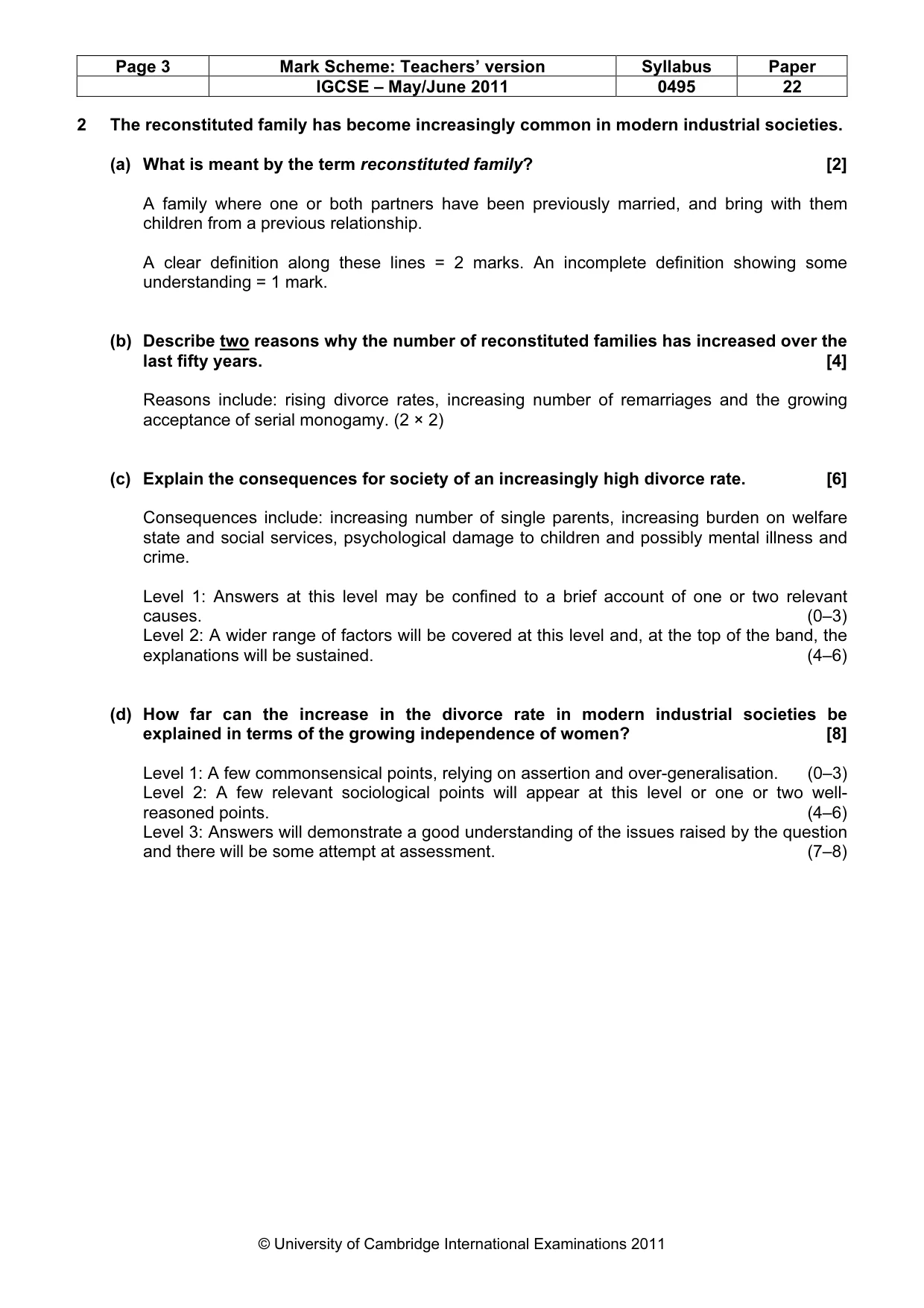
Page 2 Mark Scheme: Teachers’ version Syllabus Paper IGCSE – May/June 2011 0495 22 © University of Cambridge International Examinations 2011 Section A: The Family 1 In modern industrial societies roles within the family have changed considerably. (a) What is meant by the term role? [2] The socially accepted patterns of behaviour associated with a particular status. A clear definition along these lines = 2 marks; an incomplete definition showing some understanding = 1 mark. (b) Describe two examples of how the roles of men have changed in modern industrial societies. [4] Examples include: ‘new man’, more involved in childrearing and household duties, sharing decisions with female partner; house husbands, staying at home to care for children whilst wife goes out to work. A basic statement of one relevant change = 1 mark; a developed statement of just one example = 2 marks. A basic statement of two examples = 2 marks. (c) Explain why sociologists think that families have become increasingly child-centred in modern industrial societies. [6] Smaller families, more individual attention for each child. Shorter working week, parents have more leisure time. Increasing affluence means parents have more money to spend on children’s activities. Welfare state has put pressure on parents to look after children properly. Level 1: A few basic comments, with little linkage to the question. (0–3) Level 2: Several relevant sociological comments will be discussed. (4–6) (d) How far is there equality in the roles performed by men and women within the family in modern industrial societies? [8] Level 1: A few commonsensical points, relying on assertion and over-generalisation. (0–3) Level 2: Relevant sociological observations will appear, possibly offering a fixed answer rather than exploring different perspectives. (4–6) Level 3: Candidates will provide a well-informed account of the relevant debates surrounding sexual equality and conjugal roles in modern society. To reach the top of the band a well- reasoned conclusion will appear. (7–8)
Mark scheme, page 3
Page 3 Mark Scheme: Teachers’ version Syllabus Paper IGCSE – May/June 2011 0495 22 © University of Cambridge International Examinations 2011 2 The reconstituted family has become increasingly common in modern industrial societies. (a) What is meant by the term reconstituted family? [2] A family where one or both partners have been previously married, and bring with them children from a previous relationship. A clear definition along these lines = 2 marks. An incomplete definition showing some understanding = 1 mark. (b) Describe two reasons why the number of reconstituted families has increased over the last fifty years. [4] Reasons include: rising divorce rates, increasing number of remarriages and the growing acceptance of serial monogamy. (2 × 2) (c) Explain the consequences for society of an increasingly high divorce rate. [6] Consequences include: increasing number of single parents, increasing burden on welfare state and social services, psychological damage to children and possibly mental illness and crime. Level 1: Answers at this level may be confined to a brief account of one or two relevant causes. (0–3) Level 2: A wider range of factors will be covered at this level and, at the top of the band, the explanations will be sustained. (4–6) (d) How far can the increase in the divorce rate in modern industrial societies be explained in terms of the growing independence of women? [8] Level 1: A few commonsensical points, relying on assertion and over-generalisation. (0–3) Level 2: A few relevant sociological points will appear at this level or one or two well- reasoned points. (4–6) Level 3: Answers will demonstrate a good understanding of the issues raised by the question and there will be some attempt at assessment. (7–8)
Mark scheme, page 4
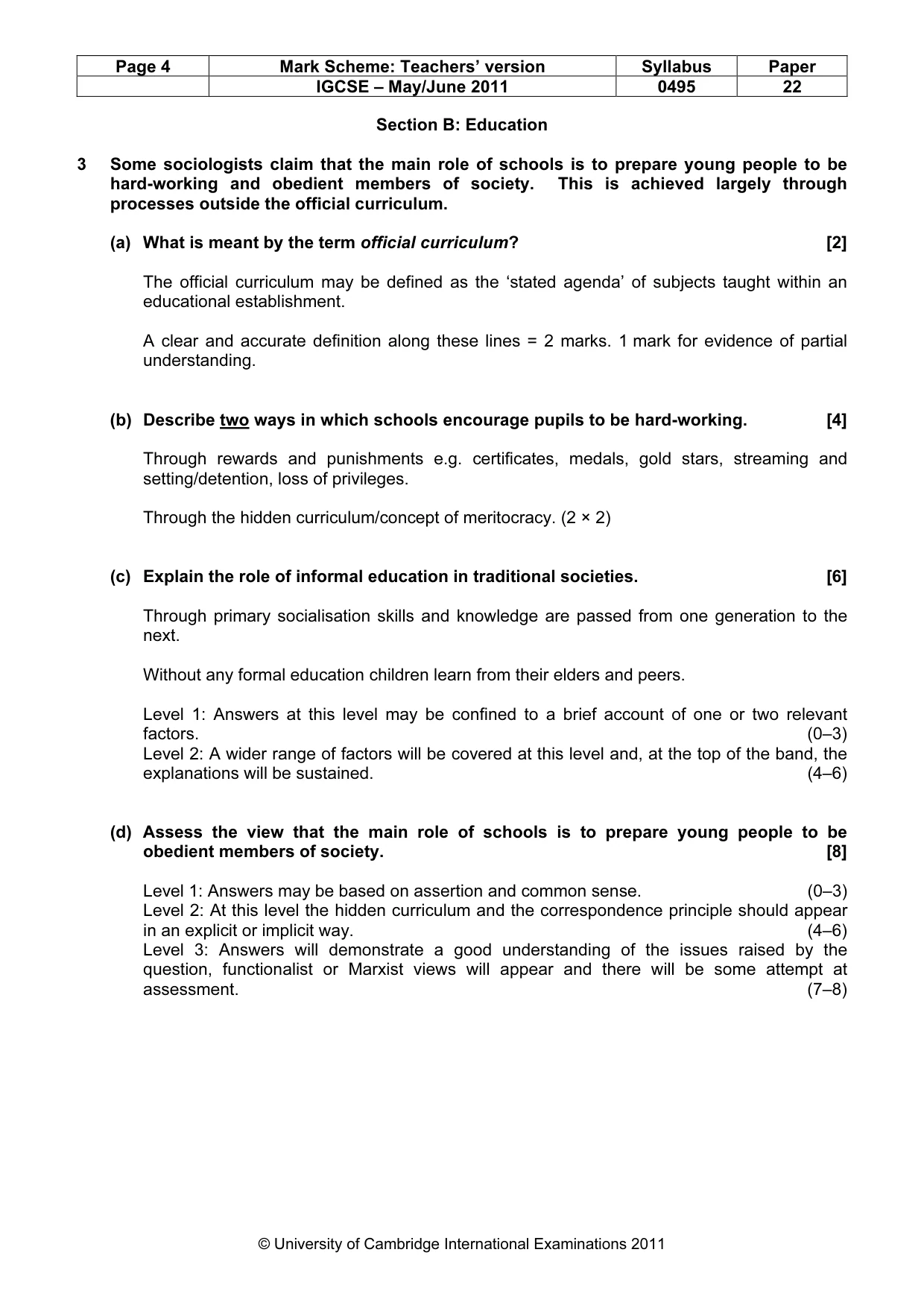
Page 4 Mark Scheme: Teachers’ version Syllabus Paper IGCSE – May/June 2011 0495 22 © University of Cambridge International Examinations 2011 Section B: Education 3 Some sociologists claim that the main role of schools is to prepare young people to be hard-working and obedient members of society. This is achieved largely through processes outside the official curriculum. (a) What is meant by the term official curriculum? [2] The official curriculum may be defined as the ‘stated agenda’ of subjects taught within an educational establishment. A clear and accurate definition along these lines = 2 marks. 1 mark for evidence of partial understanding. (b) Describe two ways in which schools encourage pupils to be hard-working. [4] Through rewards and punishments e.g. certificates, medals, gold stars, streaming and setting/detention, loss of privileges. Through the hidden curriculum/concept of meritocracy. (2 × 2) (c) Explain the role of informal education in traditional societies. [6] Through primary socialisation skills and knowledge are passed from one generation to the next. Without any formal education children learn from their elders and peers. Level 1: Answers at this level may be confined to a brief account of one or two relevant factors. (0–3) Level 2: A wider range of factors will be covered at this level and, at the top of the band, the explanations will be sustained. (4–6) (d) Assess the view that the main role of schools is to prepare young people to be obedient members of society. [8] Level 1: Answers may be based on assertion and common sense. (0–3) Level 2: At this level the hidden curriculum and the correspondence principle should appear in an explicit or implicit way. (4–6) Level 3: Answers will demonstrate a good understanding of the issues raised by the question, functionalist or Marxist views will appear and there will be some attempt at assessment. (7–8)
Mark scheme, page 5
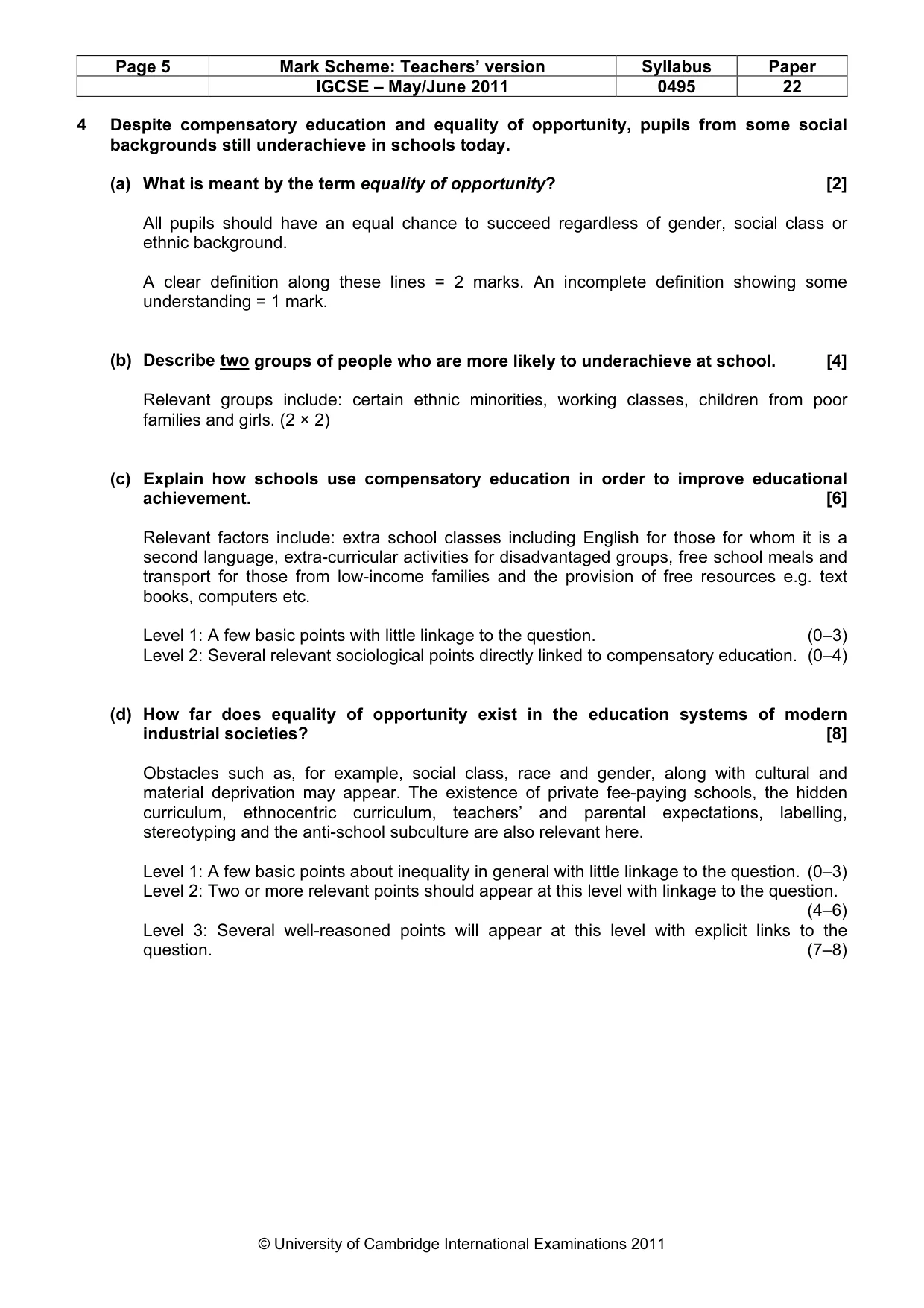
Page 5 Mark Scheme: Teachers’ version Syllabus Paper IGCSE – May/June 2011 0495 22 © University of Cambridge International Examinations 2011 4 Despite compensatory education and equality of opportunity, pupils from some social backgrounds still underachieve in schools today. (a) What is meant by the term equality of opportunity? [2] All pupils should have an equal chance to succeed regardless of gender, social class or ethnic background. A clear definition along these lines = 2 marks. An incomplete definition showing some understanding = 1 mark. (b) Describe two groups of people who are more likely to underachieve at school. [4] Relevant groups include: certain ethnic minorities, working classes, children from poor families and girls. (2 × 2) (c) Explain how schools use compensatory education in order to improve educational achievement. [6] Relevant factors include: extra school classes including English for those for whom it is a second language, extra-curricular activities for disadvantaged groups, free school meals and transport for those from low-income families and the provision of free resources e.g. text books, computers etc. Level 1: A few basic points with little linkage to the question. (0–3) Level 2: Several relevant sociological points directly linked to compensatory education. (0–4) (d) How far does equality of opportunity exist in the education systems of modern industrial societies? [8] Obstacles such as, for example, social class, race and gender, along with cultural and material deprivation may appear. The existence of private fee-paying schools, the hidden curriculum, ethnocentric curriculum, teachers’ and parental expectations, labelling, stereotyping and the anti-school subculture are also relevant here. Level 1: A few basic points about inequality in general with little linkage to the question. (0–3) Level 2: Two or more relevant points should appear at this level with linkage to the question. (4–6) Level 3: Several well-reasoned points will appear at this level with explicit links to the question. (7–8)
Mark scheme, page 6
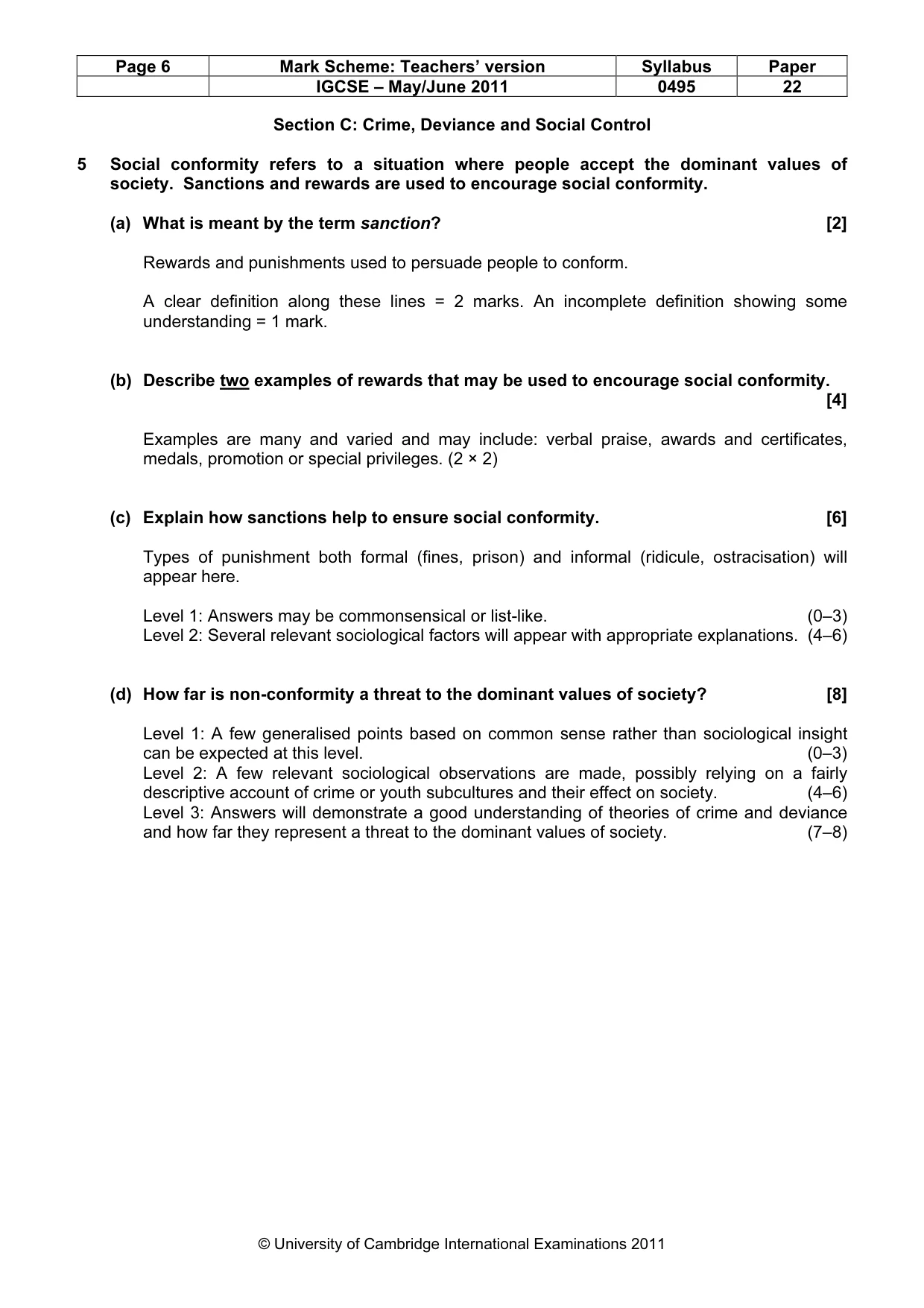
Page 6 Mark Scheme: Teachers’ version Syllabus Paper IGCSE – May/June 2011 0495 22 © University of Cambridge International Examinations 2011 Section C: Crime, Deviance and Social Control 5 Social conformity refers to a situation where people accept the dominant values of society. Sanctions and rewards are used to encourage social conformity. (a) What is meant by the term sanction? [2] Rewards and punishments used to persuade people to conform. A clear definition along these lines = 2 marks. An incomplete definition showing some understanding = 1 mark. (b) Describe two examples of rewards that may be used to encourage social conformity. [4] Examples are many and varied and may include: verbal praise, awards and certificates, medals, promotion or special privileges. (2 × 2) (c) Explain how sanctions help to ensure social conformity. [6] Types of punishment both formal (fines, prison) and informal (ridicule, ostracisation) will appear here. Level 1: Answers may be commonsensical or list-like. (0–3) Level 2: Several relevant sociological factors will appear with appropriate explanations. (4–6) (d) How far is non-conformity a threat to the dominant values of society? [8] Level 1: A few generalised points based on common sense rather than sociological insight can be expected at this level. (0–3) Level 2: A few relevant sociological observations are made, possibly relying on a fairly descriptive account of crime or youth subcultures and their effect on society. (4–6) Level 3: Answers will demonstrate a good understanding of theories of crime and deviance and how far they represent a threat to the dominant values of society. (7–8)
Mark scheme, page 7
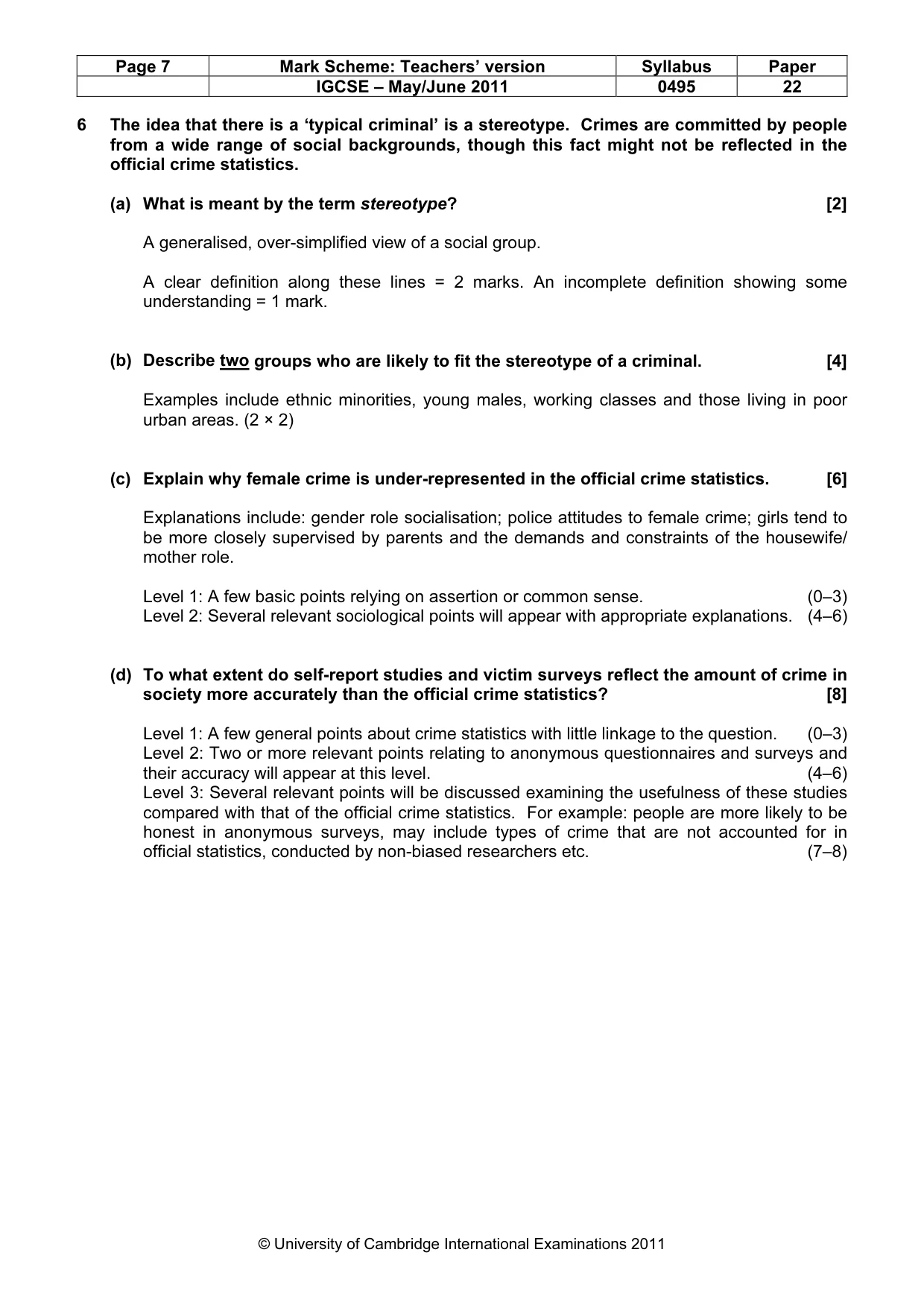
Page 7 Mark Scheme: Teachers’ version Syllabus Paper IGCSE – May/June 2011 0495 22 © University of Cambridge International Examinations 2011 6 The idea that there is a ‘typical criminal’ is a stereotype. Crimes are committed by people from a wide range of social backgrounds, though this fact might not be reflected in the official crime statistics. (a) What is meant by the term stereotype? [2] A generalised, over-simplified view of a social group. A clear definition along these lines = 2 marks. An incomplete definition showing some understanding = 1 mark. (b) Describe two groups who are likely to fit the stereotype of a criminal. [4] Examples include ethnic minorities, young males, working classes and those living in poor urban areas. (2 × 2) (c) Explain why female crime is under-represented in the official crime statistics. [6] Explanations include: gender role socialisation; police attitudes to female crime; girls tend to be more closely supervised by parents and the demands and constraints of the housewife/ mother role. Level 1: A few basic points relying on assertion or common sense. (0–3) Level 2: Several relevant sociological points will appear with appropriate explanations. (4–6) (d) To what extent do self-report studies and victim surveys reflect the amount of crime in society more accurately than the official crime statistics? [8] Level 1: A few general points about crime statistics with little linkage to the question. (0–3) Level 2: Two or more relevant points relating to anonymous questionnaires and surveys and their accuracy will appear at this level. (4–6) Level 3: Several relevant points will be discussed examining the usefulness of these studies compared with that of the official crime statistics. For example: people are more likely to be honest in anonymous surveys, may include types of crime that are not accounted for in official statistics, conducted by non-biased researchers etc. (7–8)
Mark scheme, page 8
Page 8 Mark Scheme: Teachers’ version Syllabus Paper IGCSE – May/June 2011 0495 22 © University of Cambridge International Examinations 2011 Section D: Mass Media 7 Although the mass media in democratic societies is largely free from censorship, there are still some limits to what can be written and broadcast by the mass media. (a) What is meant by the term censorship? [2] The suppression of published or broadcast material. A clear definition along these lines = 2 marks. An incomplete definition showing some understanding = 1 mark. (b) Describe two limits to the freedom of the mass media in modern industrial societies. [4] Examples include: Defence or ‘D’ notices, libel laws and legal acts such as the Race Relations Act, the Prevention of Terrorism Act and the Obscene Publications Act. (2 × 2) (c) Explain the dangers for democratic societies of the mass media being owned by a few powerful individuals. [6] Good answers will highlight the importance of television as an influence on political debate and decision-making in democratic societies. The potential for bias and manipulation by powerful media moguls will be considered. Links between owners and political parties may also be explored. Level 1: A few basic observations, possibly relying mainly on assertion and with some over- generalisation. (0–3) Level 2: A clear accurate explanation is offered. At the top of the band, the candidate will reach appropriate and well-reasoned conclusions. (4–6) (d) How far can the mass media be used as an agent of social control? [8] Level 1: A few generalised points about the mass media with few or no links to the question. (0–3) Level 2: Two or more relevant points directly linked to the question. (4–6) Level 3: Several relevant sociological points will appear at this level. To reach the top of the band the ‘how far’ part of the question should be addressed. (7–8)
Mark scheme, page 9
Page 9 Mark Scheme: Teachers’ version Syllabus Paper IGCSE – May/June 2011 0495 22 © University of Cambridge International Examinations 2011 8 By dramatising and exaggerating certain behaviours, the mass media can cause what sociologists refer to as ‘moral panic’. (a) What is meant by the term moral panic? [2] Public concern about an exaggerated or imaginary threat to society. A clear definition along these lines = 2 marks. An incomplete definition showing some understanding = 1 mark. (b) Describe two ways in which the mass media may exaggerate certain behaviours. [4] Use of sensationalised headlines, news stories or inappropriate use of photographs. Sensationalising behaviours which may then lead to moral panics. E.g. drug and alcohol use by teenagers, hoodies as criminals etc. (2 × 2) (c) Explain how the mass media use scapegoats and stereotypes to create moral panics. [6] Level 1: A few basic points about the media with little linkage to the question. (0–3) Level 2: Several relevant points will appear at this level, such as the way in which the media portrays women as sex objects, teenagers as trouble makers and people on benefits as scroungers. (4–6) (d) To what extent can moral panics lead to an increase in deviancy? [8] Level 1: A few commonsensical points not directly linked to the question. (0–3) Level 2: Two or more relevant sociological points will appear about the links between the media, moral panics and deviancy amplification. (4–6) Level 3: Several relevant points will be discussed. Answers at the top of the band will address the ‘how far’ part of the question. (7–8)
What you needed in this session
Cambridge’s own grade thresholds for 2011 May/June, Paper 2 · Variant 2. A higher threshold means an easier paper — the bar moves with how the cohort did.