Cambridge IGCSE Sociology 0495 — 2011 May/June Paper 2 · Variant 1
0495/21/M/J/11 · 60 marks · ≈68 min
The question paper and its mark scheme, free to read here and free to download. This is Cambridge’s own paper, exactly as it was sat.
Question paper28 pages



Mark scheme9 pages
Answers below. Sit the paper first if you are practising.
Paper as text
Question paper, page 1
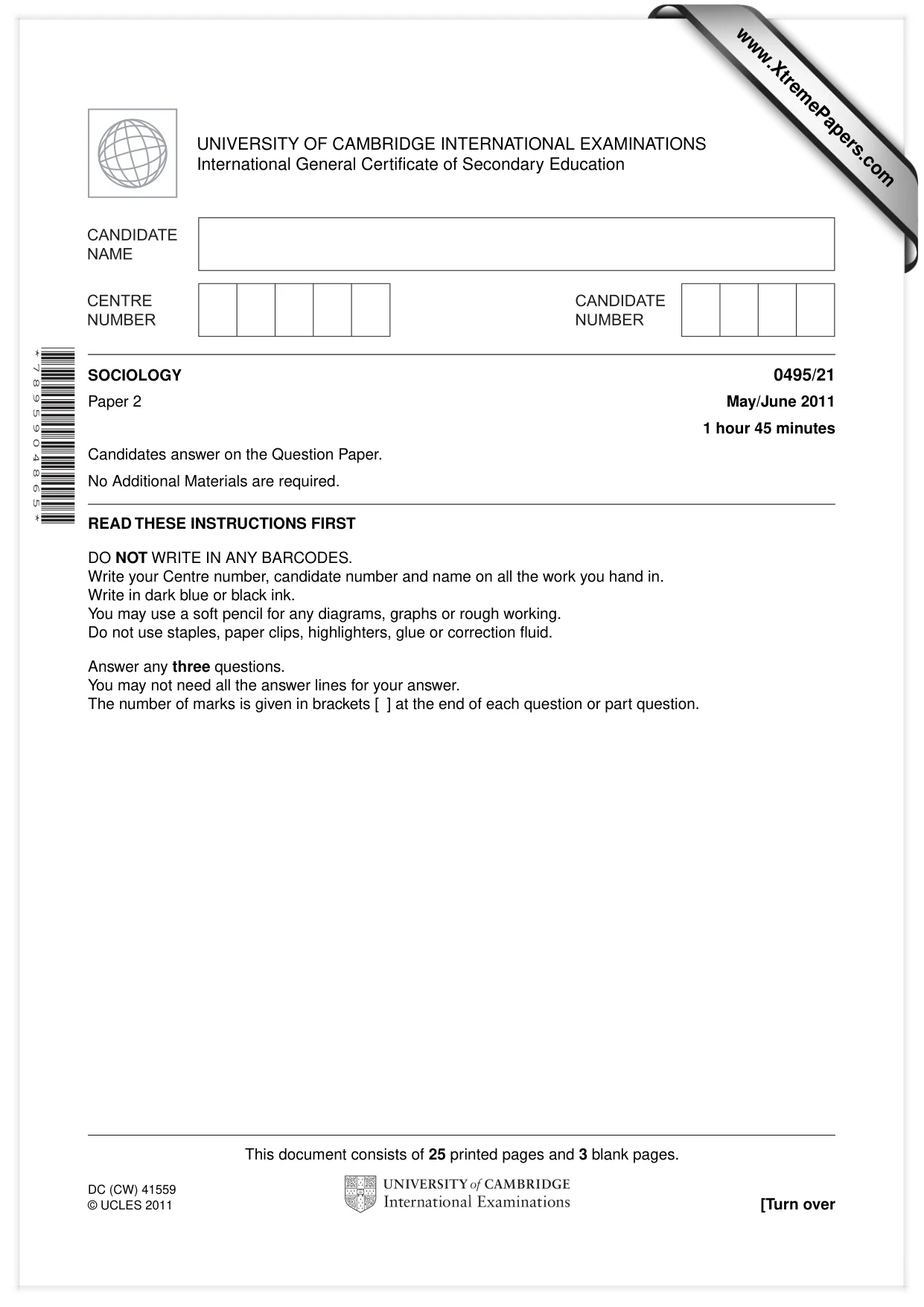
This document consists of 25 printed pages and 3 blank pages. DC (CW) 41559 © UCLES 2011 [Turn over UNIVERSITY OF CAMBRIDGE INTERNATIONAL EXAMINATIONS International General Certificate of Secondary Education * 7 8 9 5 9 0 4 8 6 5 * SOCIOLOGY 0495/21 Paper 2 May/June 2011 1 hour 45 minutes Candidates answer on the Question Paper. No Additional Materials are required. READ THESE INSTRUCTIONS FIRST DO NOT WRITE IN ANY BARCODES. Write your Centre number, candidate number and name on all the work you hand in. Write in dark blue or black ink. You may use a soft pencil for any diagrams, graphs or rough working. Do not use staples, paper clips, highlighters, glue or correction fluid. Answer any three questions. You may not need all the answer lines for your answer. The number of marks is given in brackets [ ] at the end of each question or part question. www.XtremePapers.com
Question paper, page 2
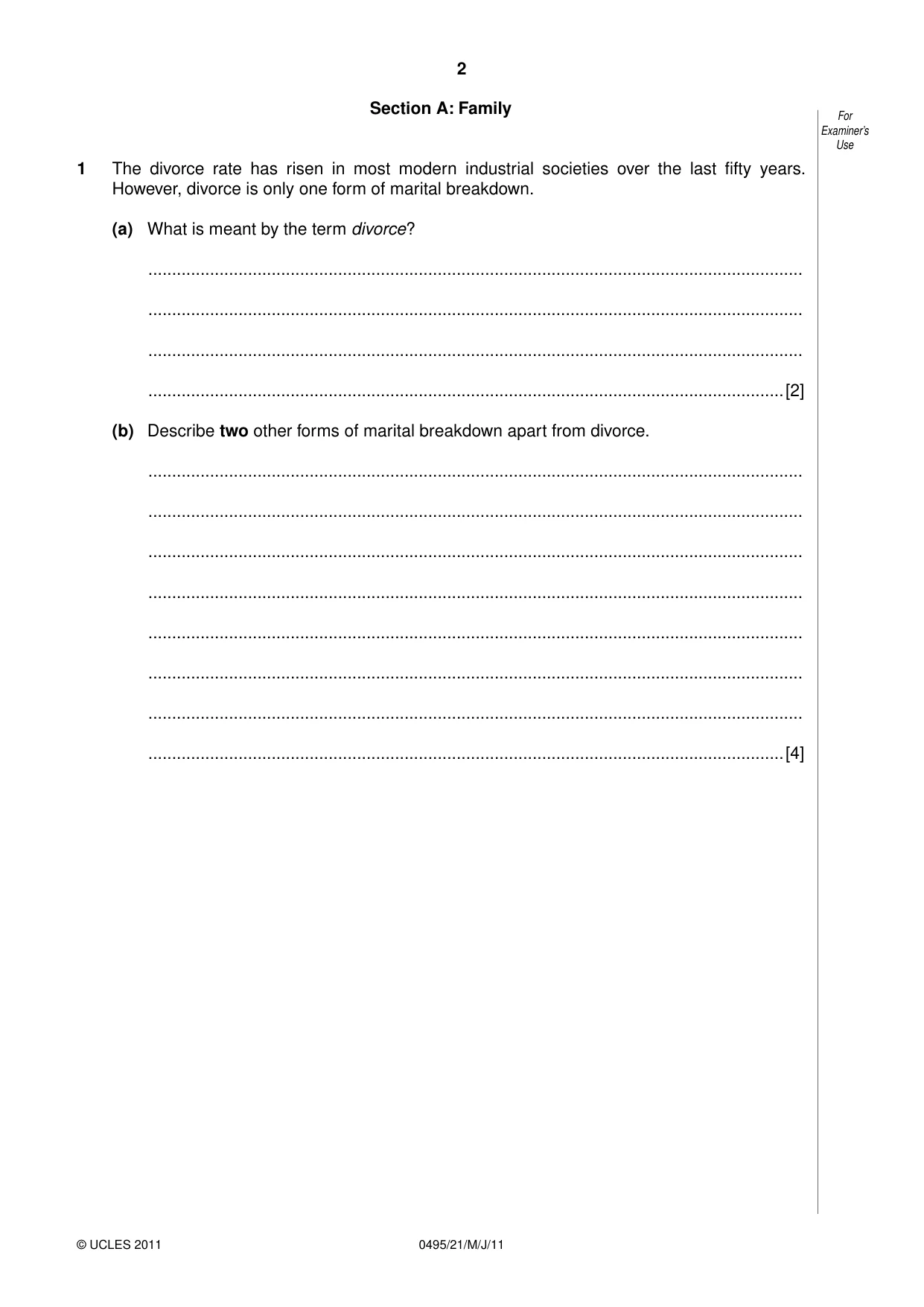
2 0495/21/M/J/11 © UCLES 2011 For Examiner’s Use Section A: Family 1 The divorce rate has risen in most modern industrial societies over the last fifty years. However, divorce is only one form of marital breakdown. (a) What is meant by the term divorce? … … … …[2] (b) Describe two other forms of marital breakdown apart from divorce. … … … … … … … …[4]
Question paper, page 3
3 0495/21/M/J/11 © UCLES 2011 [Turn over For Examiner’s Use (c) Explain why the divorce rate has risen in most modern industrial societies over the last fifty years. … … … … … … … … … … … … … … … … … …[6]
Question paper, page 4
4 0495/21/M/J/11 © UCLES 2011 For Examiner’s Use (d) To what extent is the institution of marriage in decline in modern industrial societies? … … … … … … … … … … … … … … … … … … … … … … … …[8]
Question paper, page 5
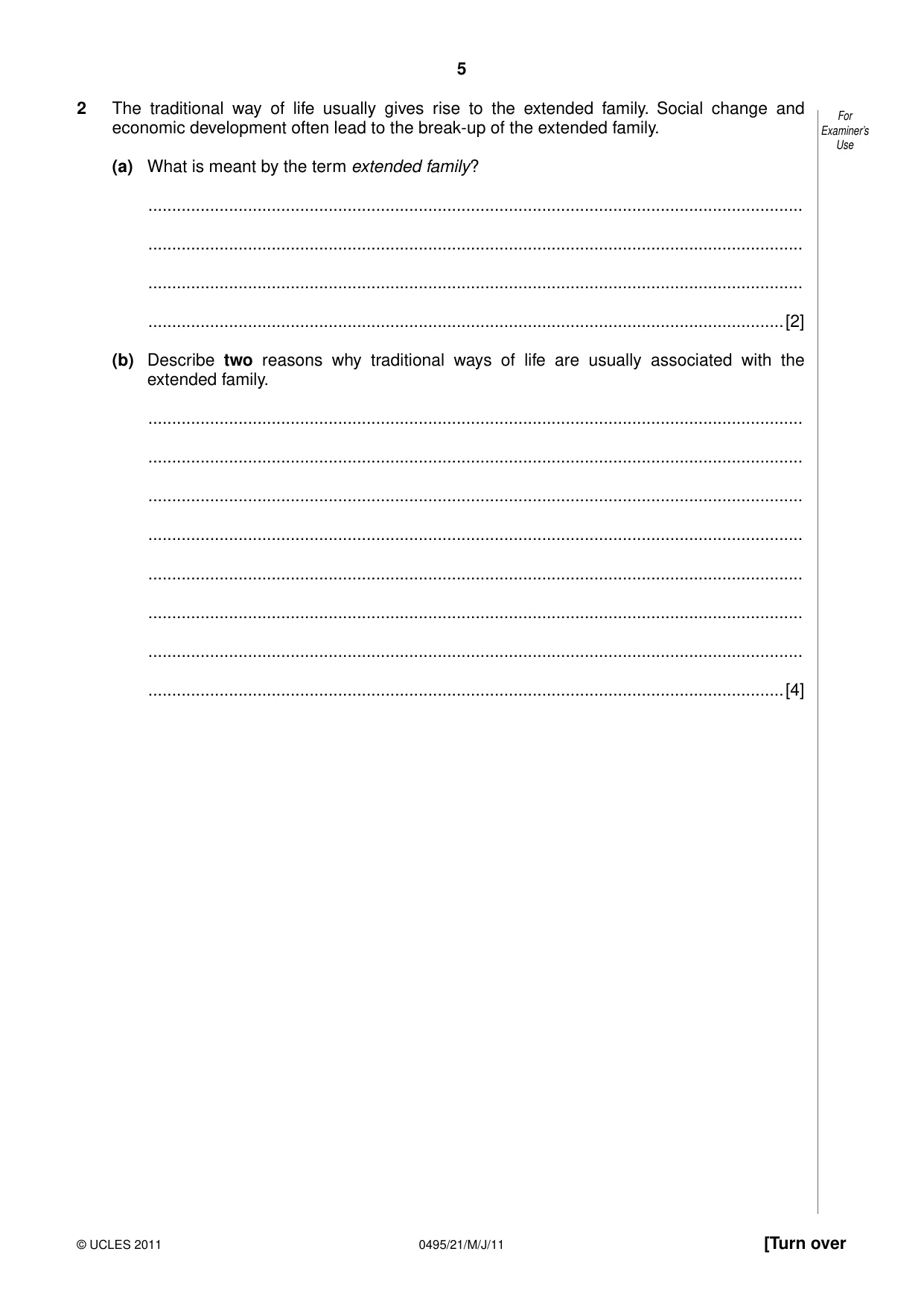
5 0495/21/M/J/11 © UCLES 2011 [Turn over For Examiner’s Use 2 The traditional way of life usually gives rise to the extended family. Social change and economic development often lead to the break-up of the extended family. (a) What is meant by the term extended family? … … … …[2] (b) Describe two reasons why traditional ways of life are usually associated with the extended family. … … … … … … … …[4]
Question paper, page 6
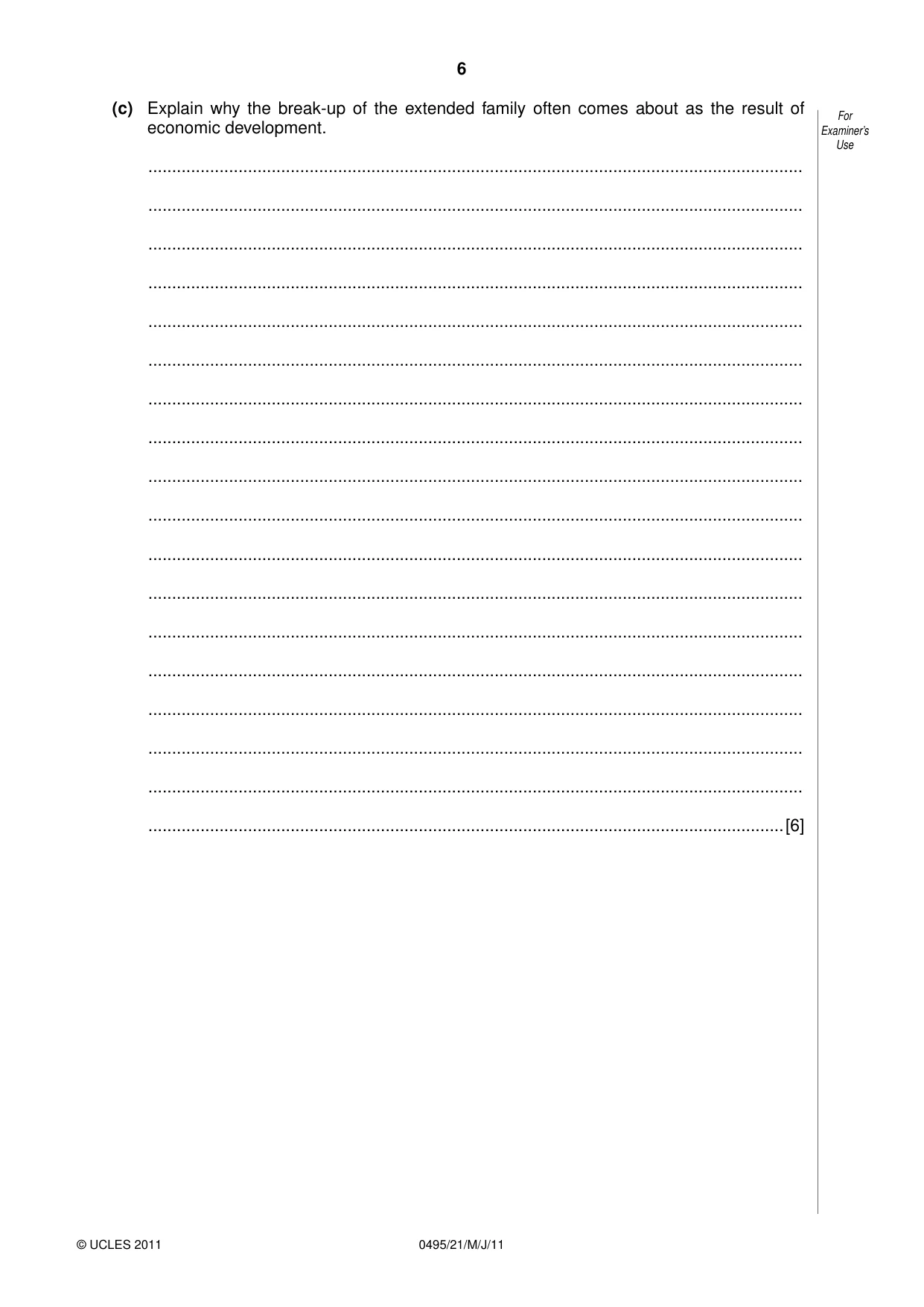
6 0495/21/M/J/11 © UCLES 2011 For Examiner’s Use (c) Explain why the break-up of the extended family often comes about as the result of economic development. … … … … … … … … … … … … … … … … … …[6]
Question paper, page 7
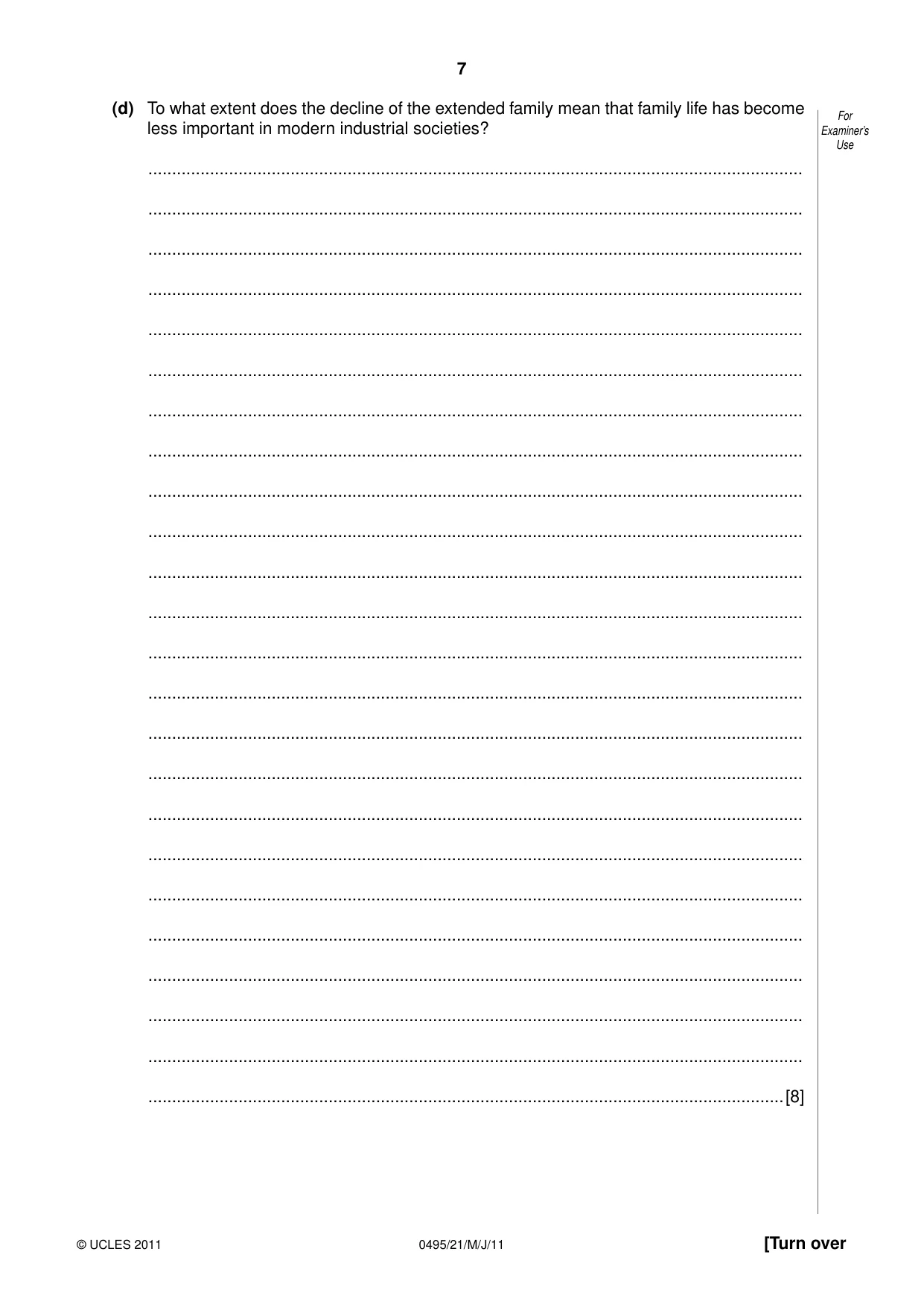
7 0495/21/M/J/11 © UCLES 2011 [Turn over For Examiner’s Use (d) To what extent does the decline of the extended family mean that family life has become less important in modern industrial societies? … … … … … … … … … … … … … … … … … … … … … … … …[8]
Question paper, page 8
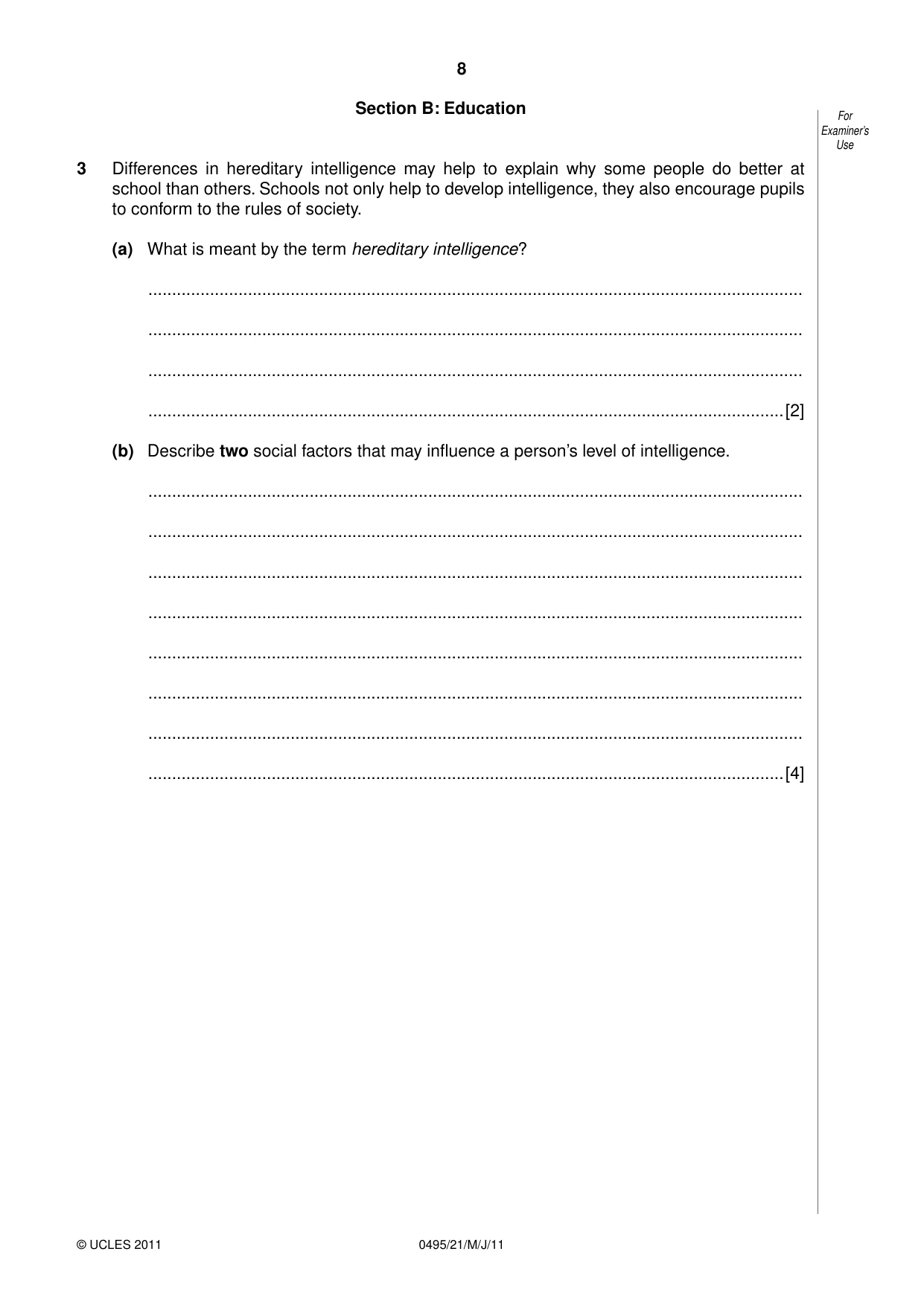
8 0495/21/M/J/11 © UCLES 2011 For Examiner’s Use Section B: Education 3 Differences in hereditary intelligence may help to explain why some people do better at school than others. Schools not only help to develop intelligence, they also encourage pupils to conform to the rules of society. (a) What is meant by the term hereditary intelligence? … … … …[2] (b) Describe two social factors that may influence a person’s level of intelligence. … … … … … … … …[4]
Question paper, page 9
9 0495/21/M/J/11 © UCLES 2011 [Turn over For Examiner’s Use (c) Explain why sociologists think that intelligence is only one factor influencing educational achievement. … … … … … … … … … … … … … … … … … …[6]
Question paper, page 10
10 0495/21/M/J/11 © UCLES 2011 For Examiner’s Use (d) How far do schools promote social conformity among pupils? … … … … … … … … … … … … … … … … … … … … … … … …[8]
Question paper, page 11
11 0495/21/M/J/11 © UCLES 2011 [Turn over For Examiner’s Use 4 Much importance is attached to the provision of formal education in modern industrial societies. However, sociologists hold different views about the functions of education. (a) What is meant by the term functions? … … … …[2] (b) Describe two functions of the education system in modern industrial societies. … … … … … … … …[4]
Question paper, page 12
12 0495/21/M/J/11 © UCLES 2011 For Examiner’s Use (c) Explain how schools try to provide equality of opportunity for all pupils. … … … … … … … … … … … … … … … … … …[6]
Question paper, page 13
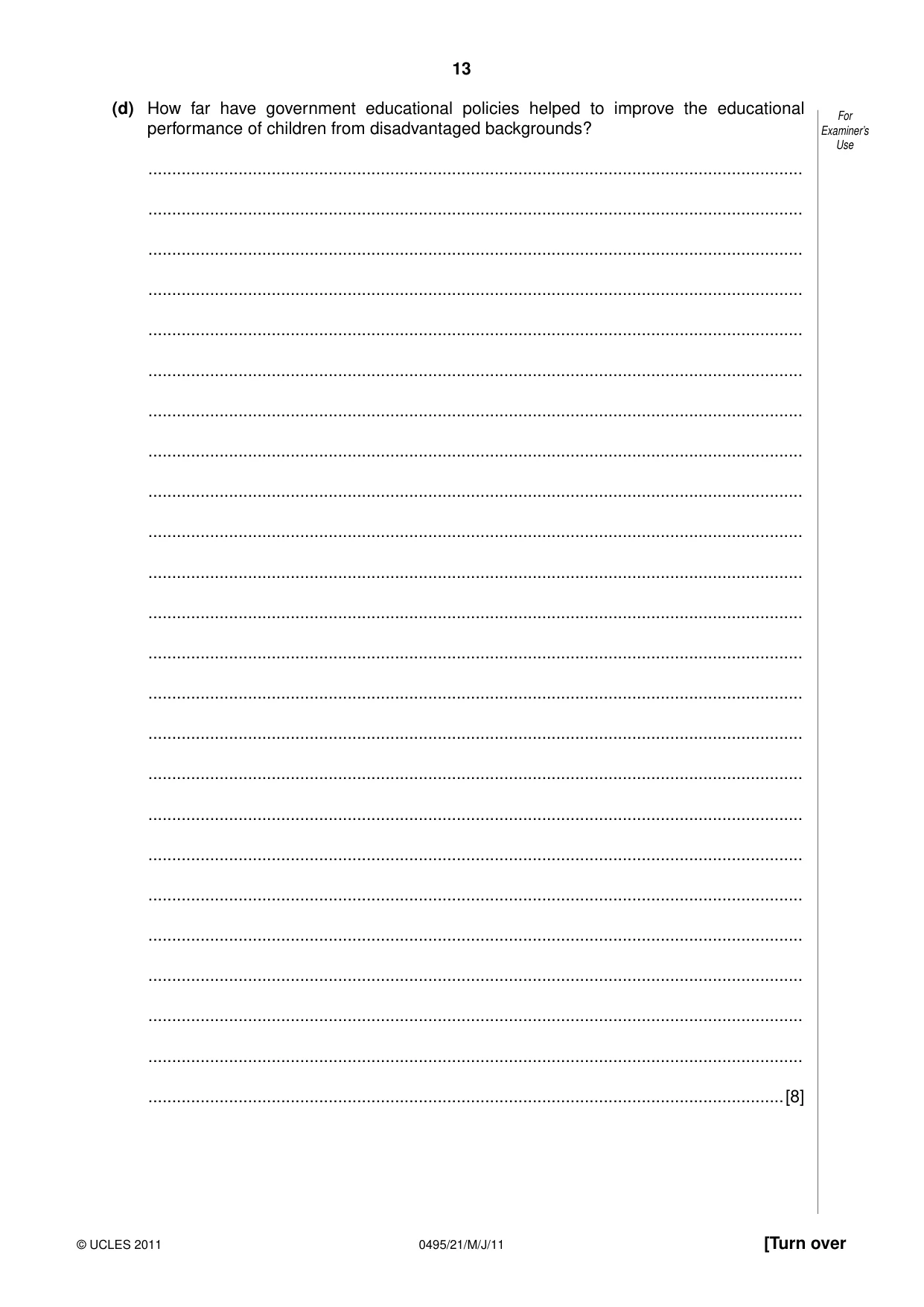
13 0495/21/M/J/11 © UCLES 2011 [Turn over For Examiner’s Use (d) How far have government educational policies helped to improve the educational performance of children from disadvantaged backgrounds? … … … … … … … … … … … … … … … … … … … … … … … …[8]
Question paper, page 14
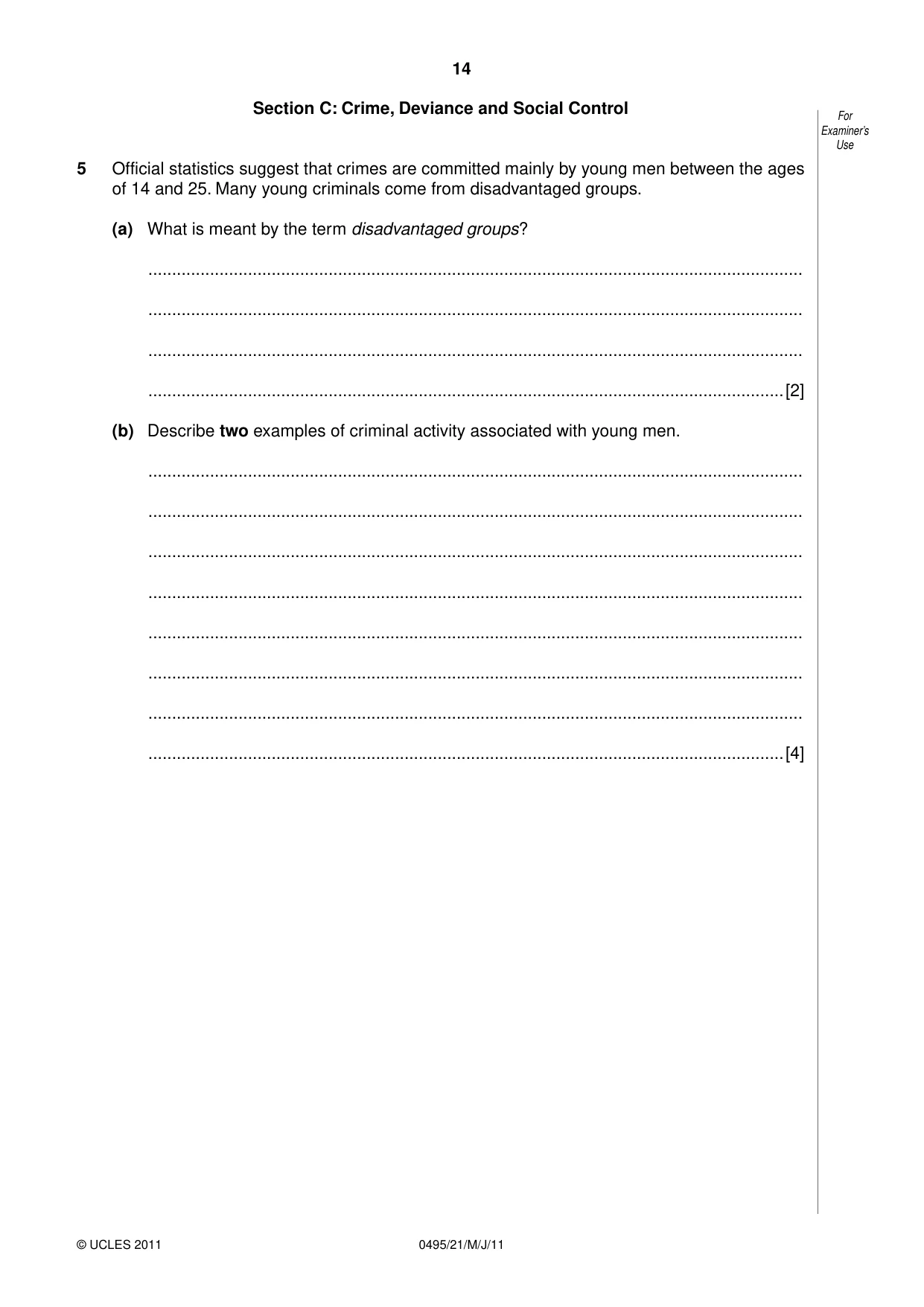
14 0495/21/M/J/11 © UCLES 2011 For Examiner’s Use Section C: Crime, Deviance and Social Control 5 Official statistics suggest that crimes are committed mainly by young men between the ages of 14 and 25. Many young criminals come from disadvantaged groups. (a) What is meant by the term disadvantaged groups? … … … …[2] (b) Describe two examples of criminal activity associated with young men. … … … … … … … …[4]
Question paper, page 15
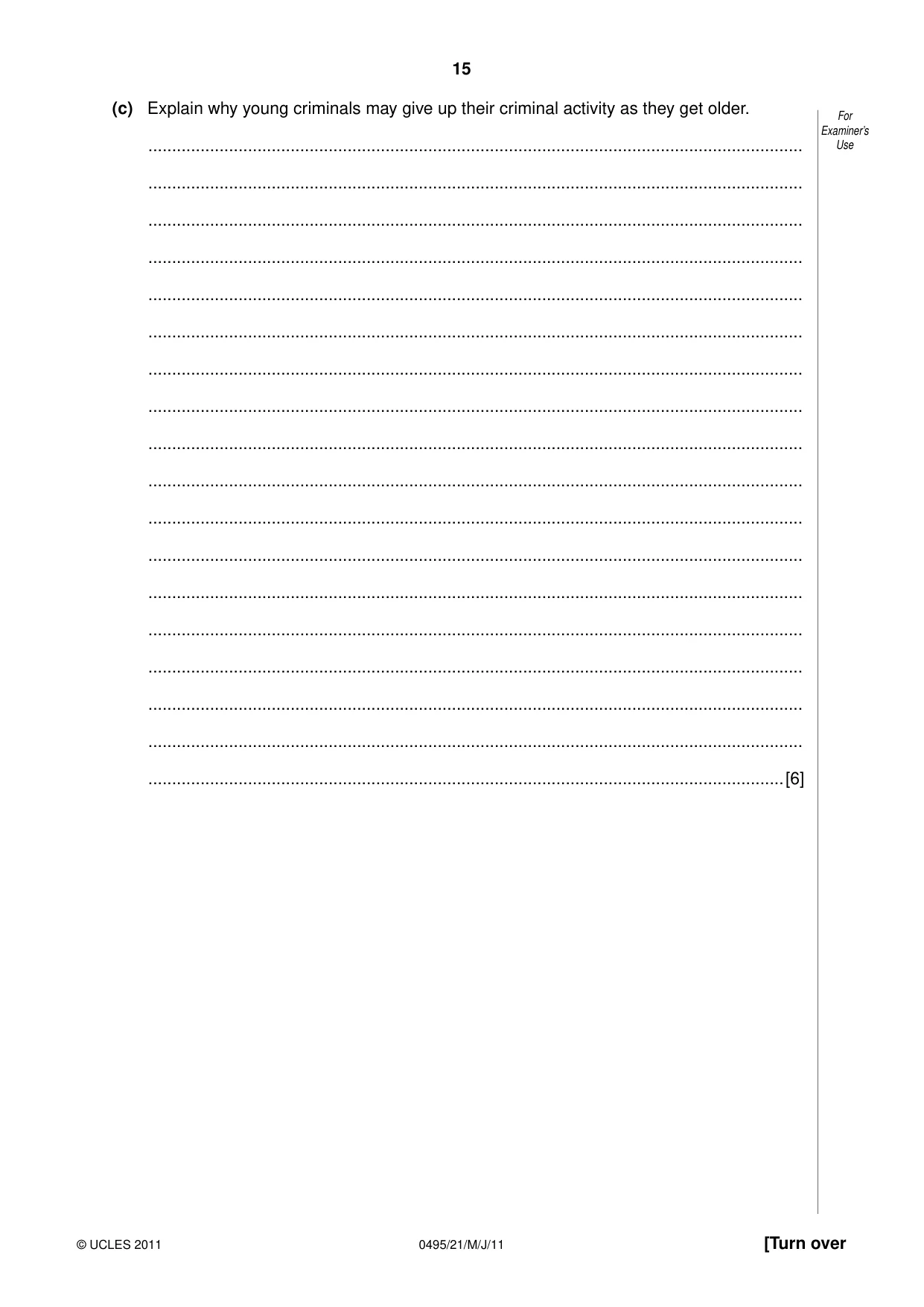
15 0495/21/M/J/11 © UCLES 2011 [Turn over For Examiner’s Use (c) Explain why young criminals may give up their criminal activity as they get older. … … … … … … … … … … … … … … … … … …[6]
Question paper, page 16
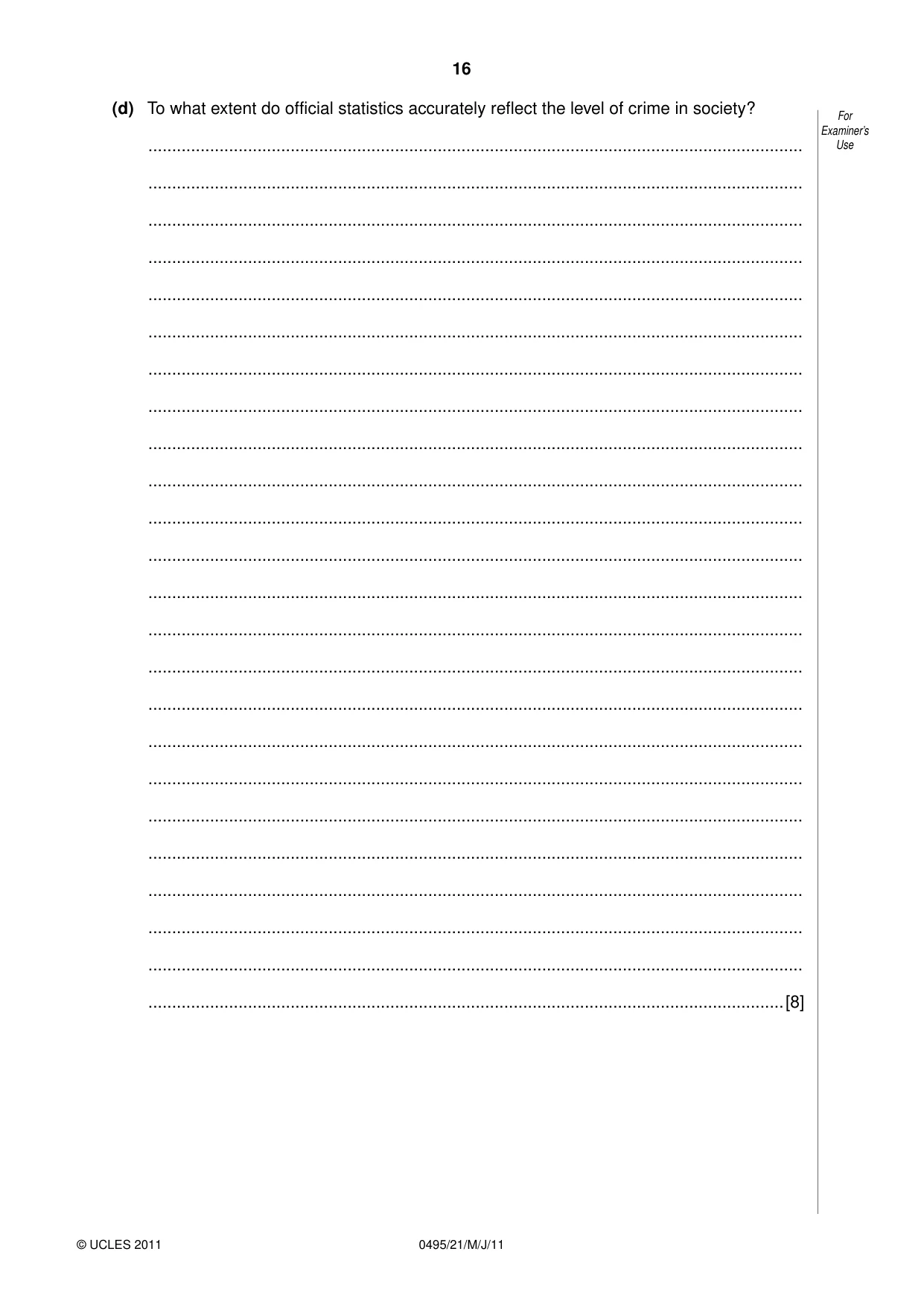
16 0495/21/M/J/11 © UCLES 2011 For Examiner’s Use (d) To what extent do official statistics accurately reflect the level of crime in society? … … … … … … … … … … … … … … … … … … … … … … … …[8]
Question paper, page 17
17 0495/21/M/J/11 © UCLES 2011 [Turn over For Examiner’s Use 6 In modern industrial societies there are a variety of styles of dress, types of music, special language and attitudes that distinguish young people from other age groups. This is known as youth culture. (a) What is meant by the term age group? … … … …[2] (b) Describe two influences on the way that young people view themselves. … … … … … … … …[4]
Question paper, page 18
18 0495/21/M/J/11 © UCLES 2011 For Examiner’s Use (c) Explain the role of the advertising industry in the growth of youth culture. … … … … … … … … … … … … … … … … … …[6]
Question paper, page 19
19 0495/21/M/J/11 © UCLES 2011 [Turn over For Examiner’s Use (d) How far does youth culture differ from the mainstream culture in society? … … … … … … … … … … … … … … … … … … … … … … … …[8]
Question paper, page 20
20 0495/21/M/J/11 © UCLES 2011 For Examiner’s Use Section D: Mass Media 7 The mass media play a major role in agenda setting in modern industrial societies. However, audience selection also influences the way people interpret media messages. (a) What is meant by the term audience selection? … … … …[2] (b) Describe two examples of how the mass media may influence images of older people. … … … … … … … …[4]
Question paper, page 21
21 0495/21/M/J/11 © UCLES 2011 [Turn over For Examiner’s Use (c) Explain the pluralist perspective of the role of the media. … … … … … … … … … … … … … … … … … …[6]
Question paper, page 22
22 0495/21/M/J/11 © UCLES 2011 For Examiner’s Use (d) Assess the ‘cultural effects’ explanation of how the mass media influence behaviour in society. … … … … … … … … … … … … … … … … … … … … … … … …[8]
Question paper, page 23
23 0495/21/M/J/11 © UCLES 2011 [Turn over For Examiner’s Use 8 The mass media often leave out important information and not all sides to a news story are given equal coverage. News reports often contain bias. (a) What is meant by the term bias? … … … …[2] (b) Describe two ways in which journalists may influence the content of news reports. … … … … … … … …[4]
Question paper, page 24
24 0495/21/M/J/11 © UCLES 2011 For Examiner’s Use (c) Explain how the process of gathering and editing news reports can lead to bias. … … … … … … … … … … … … … … … … … …[6]
Question paper, page 25
25 0495/21/M/J/11 © UCLES 2011 For Examiner’s Use (d) To what extent do the mass media represent the interests of privileged groups in society? … … … … … … … … … … … … … … … … … … … … … … … …[8]
Question paper, page 26
26 0495/21/M/J/11 © UCLES 2011 BLANK PAGE
Question paper, page 27
27 0495/21/M/J/11 © UCLES 2011 BLANK PAGE
Question paper, page 28
28 0495/21/M/J/11 © UCLES 2011 Permission to reproduce items where third-party owned material protected by copyright is included has been sought and cleared where possible. Every reasonable effort has been made by the publisher (UCLES) to trace copyright holders, but if any items requiring clearance have unwittingly been included, the publisher will be pleased to make amends at the earliest possible opportunity. University of Cambridge International Examinations is part of the Cambridge Assessment Group. Cambridge Assessment is the brand name of University of Cambridge Local Examinations Syndicate (UCLES), which is itself a department of the University of Cambridge. BLANK PAGE
Mark scheme, page 1
UNIVERSITY OF CAMBRIDGE INTERNATIONAL EXAMINATIONS International General Certificate of Secondary Education MARK SCHEME for the May/June 2011 question paper for the guidance of teachers 0495 SOCIOLOGY 0495/21 Paper 2, maximum raw mark 60 This mark scheme is published as an aid to teachers and candidates, to indicate the requirements of the examination. It shows the basis on which Examiners were instructed to award marks. It does not indicate the details of the discussions that took place at an Examiners’ meeting before marking began, which would have considered the acceptability of alternative answers. Mark schemes must be read in conjunction with the question papers and the report on the examination. • Cambridge will not enter into discussions or correspondence in connection with these mark schemes. Cambridge is publishing the mark schemes for the May/June 2011 question papers for most IGCSE, GCE Advanced Level and Advanced Subsidiary Level syllabuses and some Ordinary Level syllabuses. www.XtremePapers.com
Mark scheme, page 2
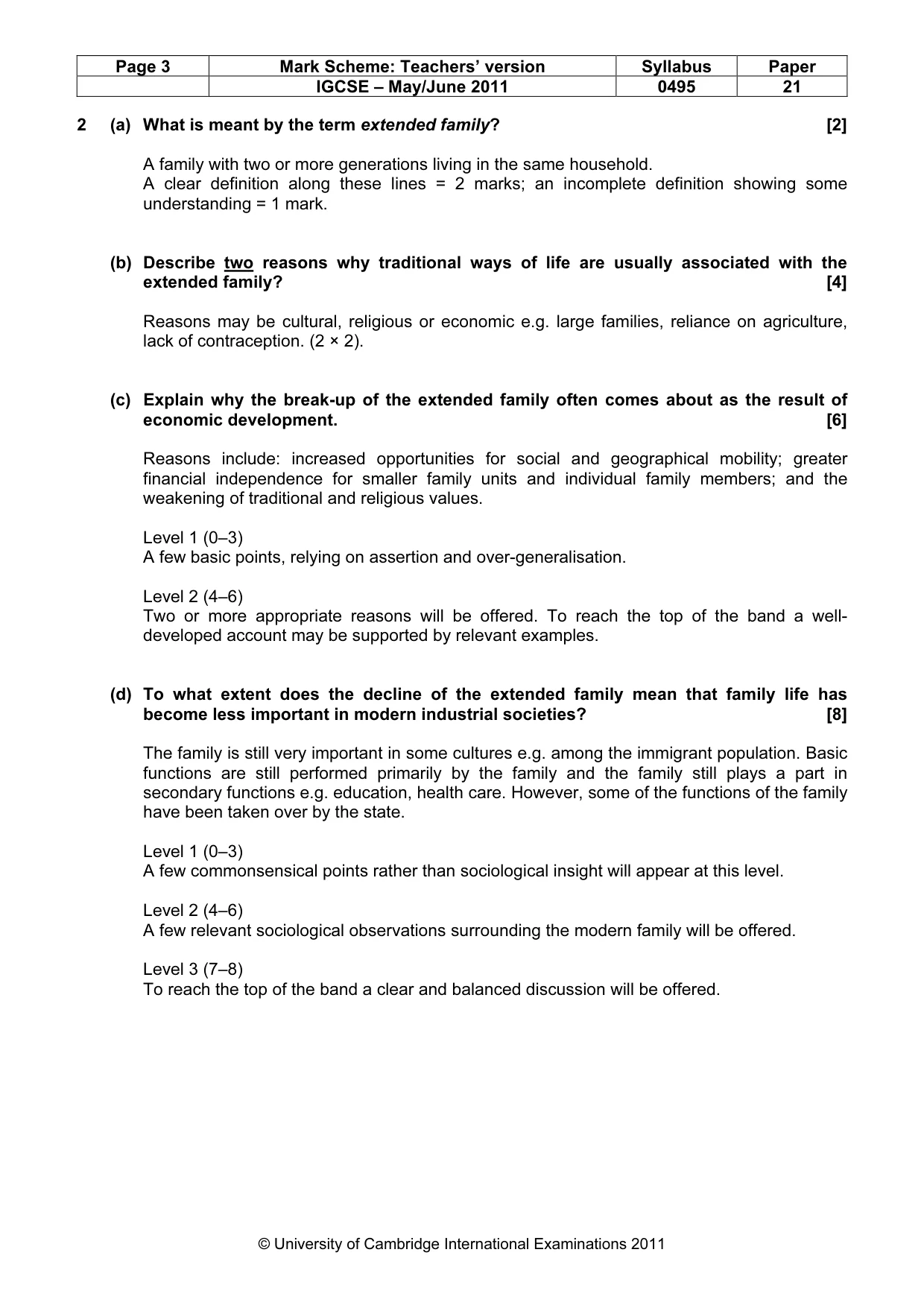
Page 2 Mark Scheme: Teachers’ version Syllabus Paper IGCSE – May/June 2011 0495 21 © University of Cambridge International Examinations 2011 Section A: Family 1 (a) What is meant by the term divorce? [2] The termination of a marriage (= 1 mark) through a legally recognised process (= 2 marks). (b) Describe two other forms of marital breakdown apart from divorce. [4] Desertion, separation, empty-shell marriages. (2 × 2) (c) Explain why the divorce rate has risen in most modern industrial societies over the last fifty years. [6] Level 1 (0–3) One or two basic points will be covered about the reasons for the rising divorce rate. Level 2 (4–6) Explanations for rising divorce rate include: increasing independence of women, move to isolated nuclear family, legal changes, changes in attitudes and expectations, historical factors such as Second World War. To reach the top of the band several factors well explained would appear. (d) To what extent is the institution of marriage in decline in modern industrial societies? [8] Level 1 (0–3) Answers at this level may be based on assertion and personal opinion. Level 2 (4–6) Some basic sociological points may be made at this level. Answers may be narrow or one- sided. Level 3 (7–8) The evidence supporting the claim that marriage is less important refers to the rising divorce rate, the decline in first marriages, possibly the decline in church weddings, the trend towards serial monogamy (although this could also be used as evidence to support the contrary view). Evidence and arguments against the declining importance would include the increase in remarriages, the fact that marriage is still the dominant form of cohabitation, and the difficulty of assessing how important marriage was in the past. Good coverage of some relevant evidence is required to trigger this band. To reach the top of the band, there has to be some attempt at assessment.
Mark scheme, page 3
Page 3 Mark Scheme: Teachers’ version Syllabus Paper IGCSE – May/June 2011 0495 21 © University of Cambridge International Examinations 2011 2 (a) What is meant by the term extended family? [2] A family with two or more generations living in the same household. A clear definition along these lines = 2 marks; an incomplete definition showing some understanding = 1 mark. (b) Describe two reasons why traditional ways of life are usually associated with the extended family? [4] Reasons may be cultural, religious or economic e.g. large families, reliance on agriculture, lack of contraception. (2 × 2). (c) Explain why the break-up of the extended family often comes about as the result of economic development. [6] Reasons include: increased opportunities for social and geographical mobility; greater financial independence for smaller family units and individual family members; and the weakening of traditional and religious values. Level 1 (0–3) A few basic points, relying on assertion and over-generalisation. Level 2 (4–6) Two or more appropriate reasons will be offered. To reach the top of the band a well- developed account may be supported by relevant examples. (d) To what extent does the decline of the extended family mean that family life has become less important in modern industrial societies? [8] The family is still very important in some cultures e.g. among the immigrant population. Basic functions are still performed primarily by the family and the family still plays a part in secondary functions e.g. education, health care. However, some of the functions of the family have been taken over by the state. Level 1 (0–3) A few commonsensical points rather than sociological insight will appear at this level. Level 2 (4–6) A few relevant sociological observations surrounding the modern family will be offered. Level 3 (7–8) To reach the top of the band a clear and balanced discussion will be offered.
Mark scheme, page 4
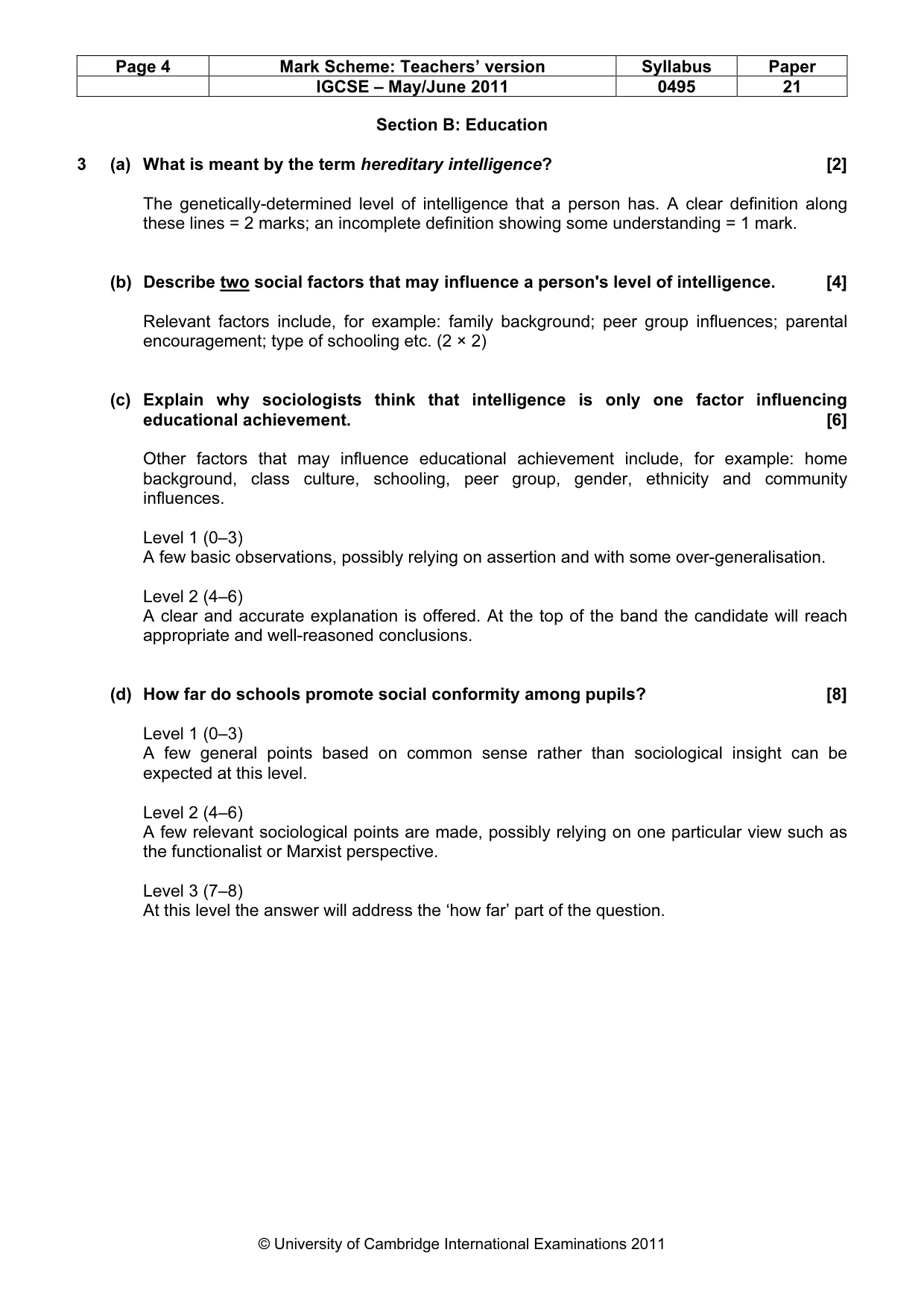
Page 4 Mark Scheme: Teachers’ version Syllabus Paper IGCSE – May/June 2011 0495 21 © University of Cambridge International Examinations 2011 Section B: Education 3 (a) What is meant by the term hereditary intelligence? [2] The genetically-determined level of intelligence that a person has. A clear definition along these lines = 2 marks; an incomplete definition showing some understanding = 1 mark. (b) Describe two social factors that may influence a person's level of intelligence. [4] Relevant factors include, for example: family background; peer group influences; parental encouragement; type of schooling etc. (2 × 2) (c) Explain why sociologists think that intelligence is only one factor influencing educational achievement. [6] Other factors that may influence educational achievement include, for example: home background, class culture, schooling, peer group, gender, ethnicity and community influences. Level 1 (0–3) A few basic observations, possibly relying on assertion and with some over-generalisation. Level 2 (4–6) A clear and accurate explanation is offered. At the top of the band the candidate will reach appropriate and well-reasoned conclusions. (d) How far do schools promote social conformity among pupils? [8] Level 1 (0–3) A few general points based on common sense rather than sociological insight can be expected at this level. Level 2 (4–6) A few relevant sociological points are made, possibly relying on one particular view such as the functionalist or Marxist perspective. Level 3 (7–8) At this level the answer will address the ‘how far’ part of the question.
Mark scheme, page 5
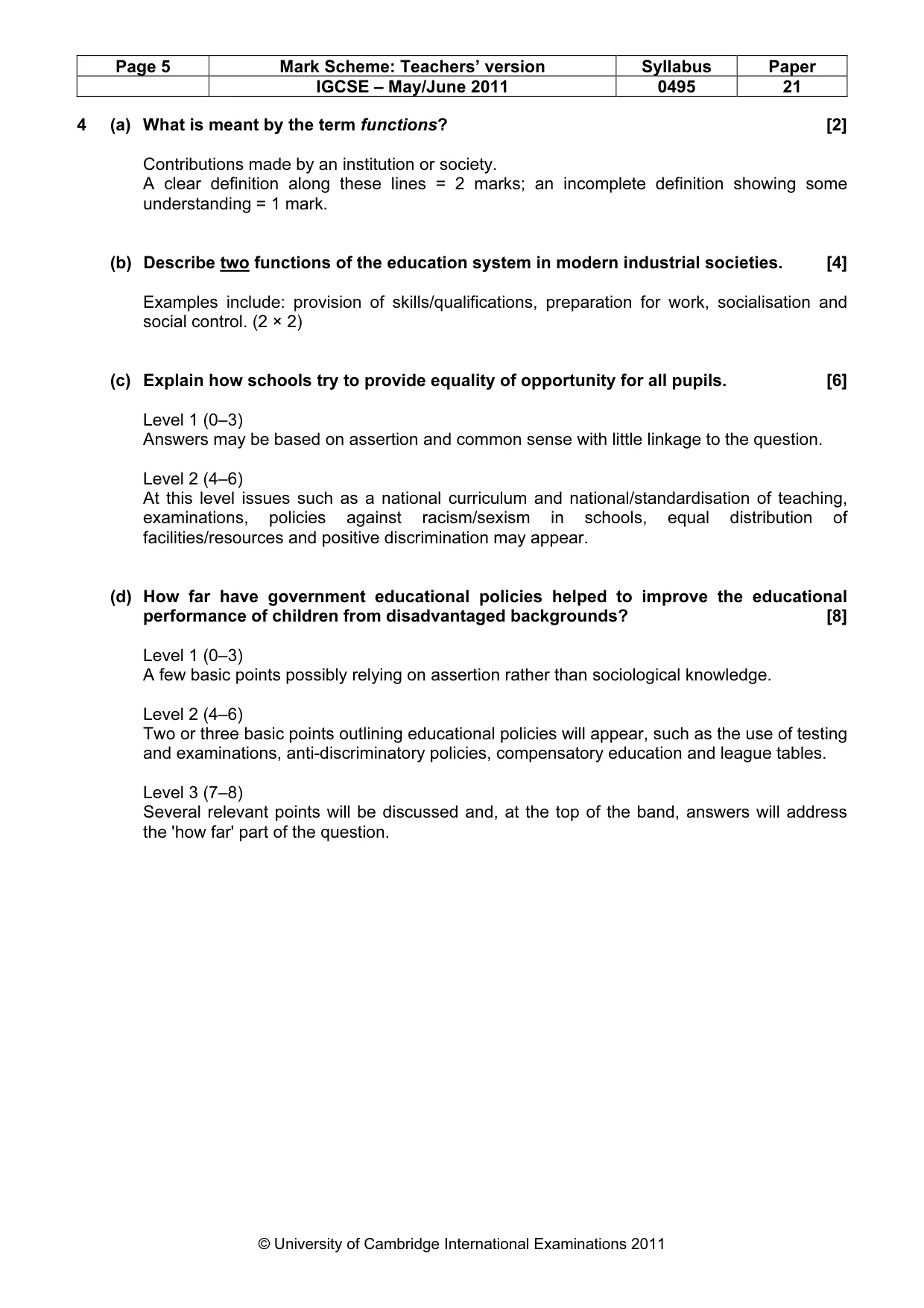
Page 5 Mark Scheme: Teachers’ version Syllabus Paper IGCSE – May/June 2011 0495 21 © University of Cambridge International Examinations 2011 4 (a) What is meant by the term functions? [2] Contributions made by an institution or society. A clear definition along these lines = 2 marks; an incomplete definition showing some understanding = 1 mark. (b) Describe two functions of the education system in modern industrial societies. [4] Examples include: provision of skills/qualifications, preparation for work, socialisation and social control. (2 × 2) (c) Explain how schools try to provide equality of opportunity for all pupils. [6] Level 1 (0–3) Answers may be based on assertion and common sense with little linkage to the question. Level 2 (4–6) At this level issues such as a national curriculum and national/standardisation of teaching, examinations, policies against racism/sexism in schools, equal distribution of facilities/resources and positive discrimination may appear. (d) How far have government educational policies helped to improve the educational performance of children from disadvantaged backgrounds? [8] Level 1 (0–3) A few basic points possibly relying on assertion rather than sociological knowledge. Level 2 (4–6) Two or three basic points outlining educational policies will appear, such as the use of testing and examinations, anti-discriminatory policies, compensatory education and league tables. Level 3 (7–8) Several relevant points will be discussed and, at the top of the band, answers will address the 'how far' part of the question.
Mark scheme, page 6
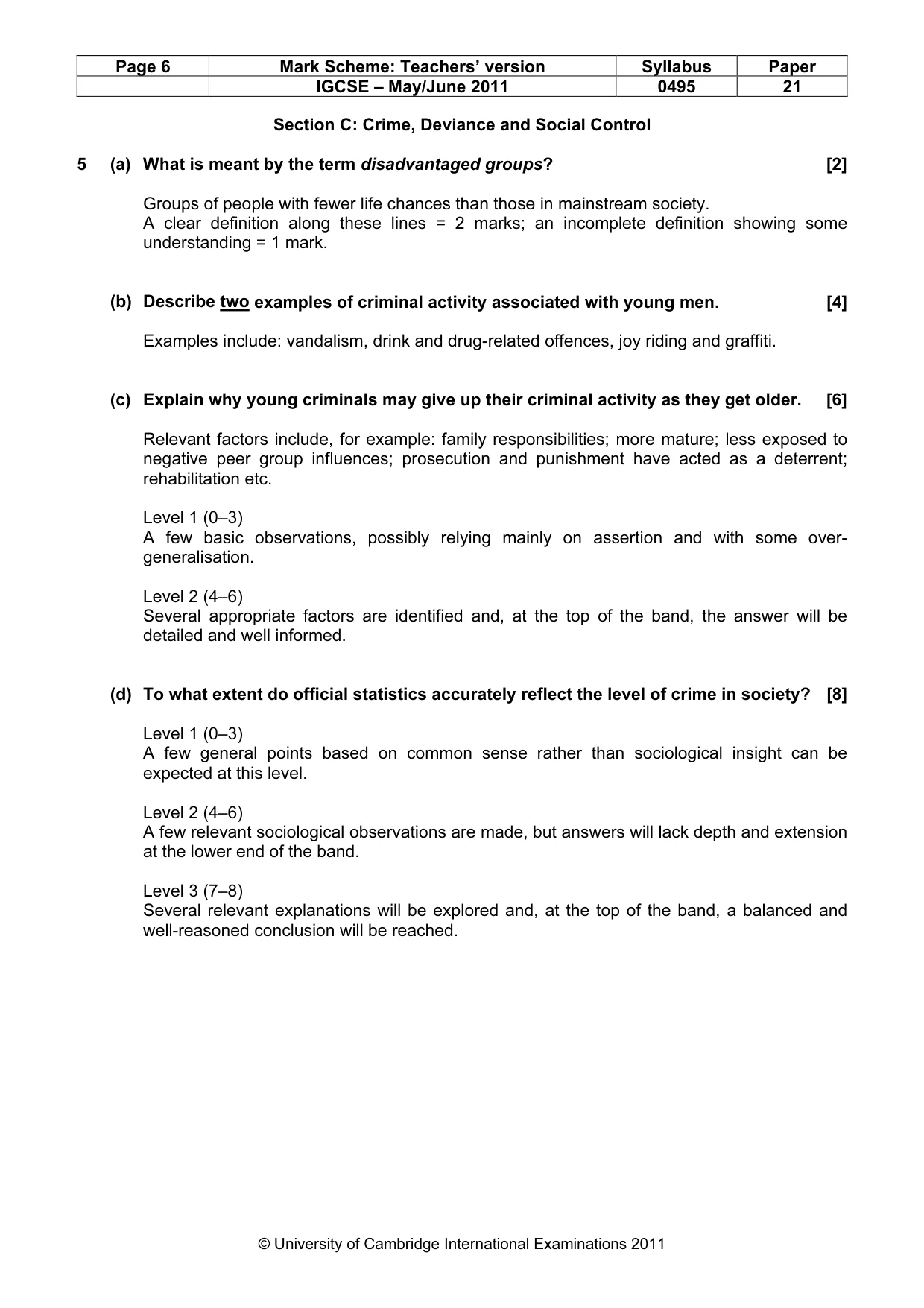
Page 6 Mark Scheme: Teachers’ version Syllabus Paper IGCSE – May/June 2011 0495 21 © University of Cambridge International Examinations 2011 Section C: Crime, Deviance and Social Control 5 (a) What is meant by the term disadvantaged groups? [2] Groups of people with fewer life chances than those in mainstream society. A clear definition along these lines = 2 marks; an incomplete definition showing some understanding = 1 mark. (b) Describe two examples of criminal activity associated with young men. [4] Examples include: vandalism, drink and drug-related offences, joy riding and graffiti. (c) Explain why young criminals may give up their criminal activity as they get older. [6] Relevant factors include, for example: family responsibilities; more mature; less exposed to negative peer group influences; prosecution and punishment have acted as a deterrent; rehabilitation etc. Level 1 (0–3) A few basic observations, possibly relying mainly on assertion and with some over- generalisation. Level 2 (4–6) Several appropriate factors are identified and, at the top of the band, the answer will be detailed and well informed. (d) To what extent do official statistics accurately reflect the level of crime in society? [8] Level 1 (0–3) A few general points based on common sense rather than sociological insight can be expected at this level. Level 2 (4–6) A few relevant sociological observations are made, but answers will lack depth and extension at the lower end of the band. Level 3 (7–8) Several relevant explanations will be explored and, at the top of the band, a balanced and well-reasoned conclusion will be reached.
Mark scheme, page 7
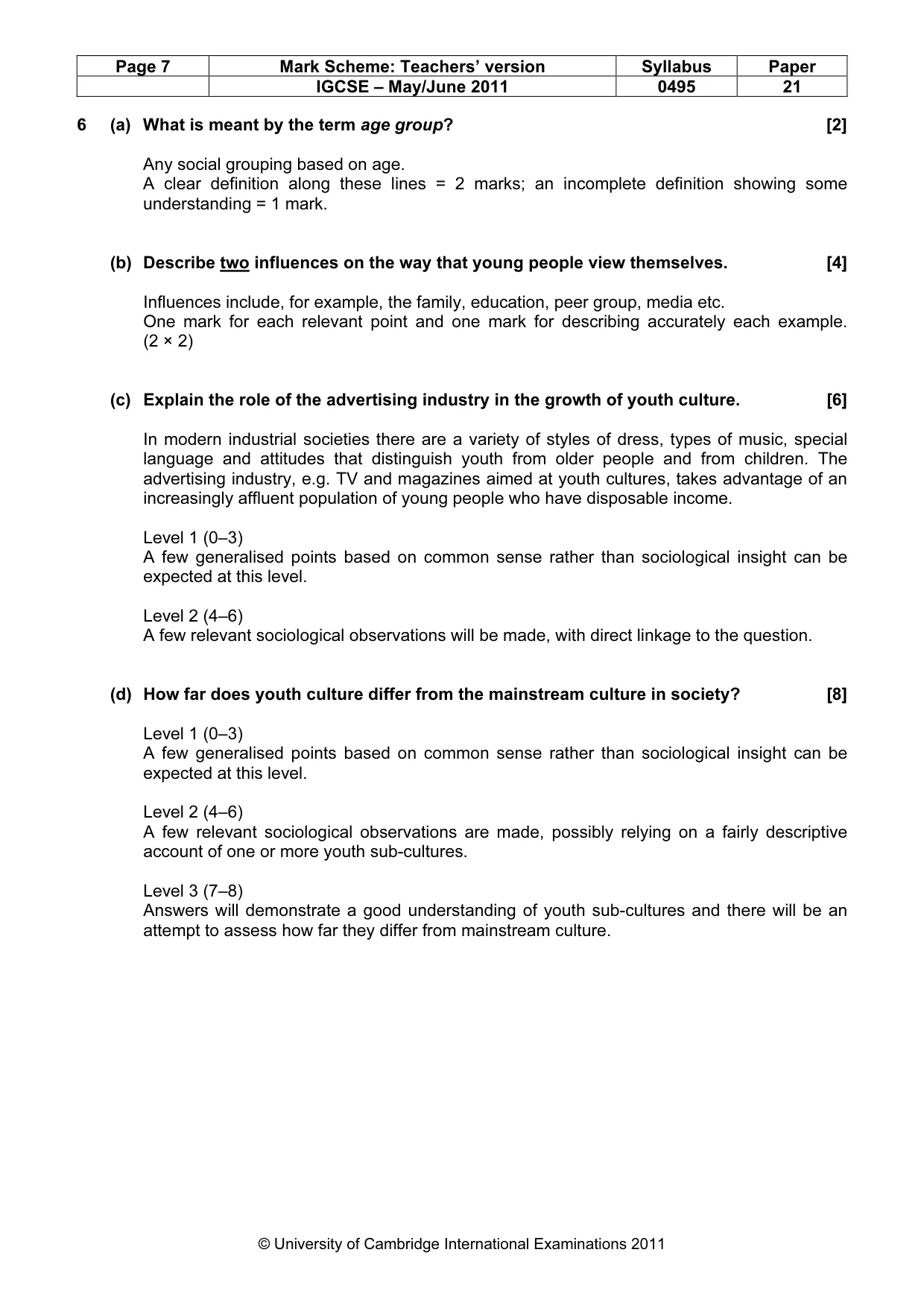
Page 7 Mark Scheme: Teachers’ version Syllabus Paper IGCSE – May/June 2011 0495 21 © University of Cambridge International Examinations 2011 6 (a) What is meant by the term age group? [2] Any social grouping based on age. A clear definition along these lines = 2 marks; an incomplete definition showing some understanding = 1 mark. (b) Describe two influences on the way that young people view themselves. [4] Influences include, for example, the family, education, peer group, media etc. One mark for each relevant point and one mark for describing accurately each example. (2 × 2) (c) Explain the role of the advertising industry in the growth of youth culture. [6] In modern industrial societies there are a variety of styles of dress, types of music, special language and attitudes that distinguish youth from older people and from children. The advertising industry, e.g. TV and magazines aimed at youth cultures, takes advantage of an increasingly affluent population of young people who have disposable income. Level 1 (0–3) A few generalised points based on common sense rather than sociological insight can be expected at this level. Level 2 (4–6) A few relevant sociological observations will be made, with direct linkage to the question. (d) How far does youth culture differ from the mainstream culture in society? [8] Level 1 (0–3) A few generalised points based on common sense rather than sociological insight can be expected at this level. Level 2 (4–6) A few relevant sociological observations are made, possibly relying on a fairly descriptive account of one or more youth sub-cultures. Level 3 (7–8) Answers will demonstrate a good understanding of youth sub-cultures and there will be an attempt to assess how far they differ from mainstream culture.
Mark scheme, page 8
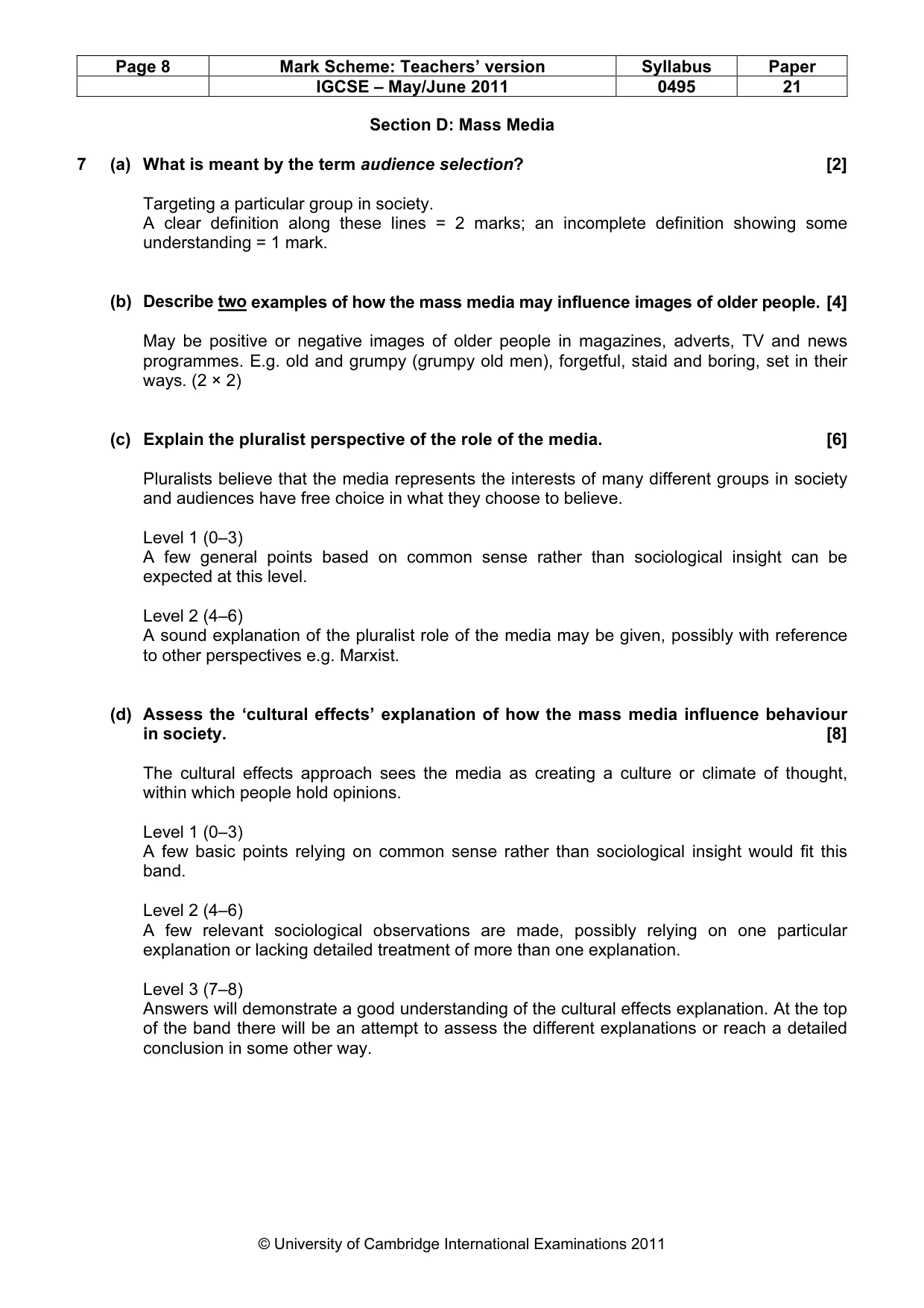
Page 8 Mark Scheme: Teachers’ version Syllabus Paper IGCSE – May/June 2011 0495 21 © University of Cambridge International Examinations 2011 Section D: Mass Media 7 (a) What is meant by the term audience selection? [2] Targeting a particular group in society. A clear definition along these lines = 2 marks; an incomplete definition showing some understanding = 1 mark. (b) Describe two examples of how the mass media may influence images of older people. [4] May be positive or negative images of older people in magazines, adverts, TV and news programmes. E.g. old and grumpy (grumpy old men), forgetful, staid and boring, set in their ways. (2 × 2) (c) Explain the pluralist perspective of the role of the media. [6] Pluralists believe that the media represents the interests of many different groups in society and audiences have free choice in what they choose to believe. Level 1 (0–3) A few general points based on common sense rather than sociological insight can be expected at this level. Level 2 (4–6) A sound explanation of the pluralist role of the media may be given, possibly with reference to other perspectives e.g. Marxist. (d) Assess the ‘cultural effects’ explanation of how the mass media influence behaviour in society. [8] The cultural effects approach sees the media as creating a culture or climate of thought, within which people hold opinions. Level 1 (0–3) A few basic points relying on common sense rather than sociological insight would fit this band. Level 2 (4–6) A few relevant sociological observations are made, possibly relying on one particular explanation or lacking detailed treatment of more than one explanation. Level 3 (7–8) Answers will demonstrate a good understanding of the cultural effects explanation. At the top of the band there will be an attempt to assess the different explanations or reach a detailed conclusion in some other way.
Mark scheme, page 9
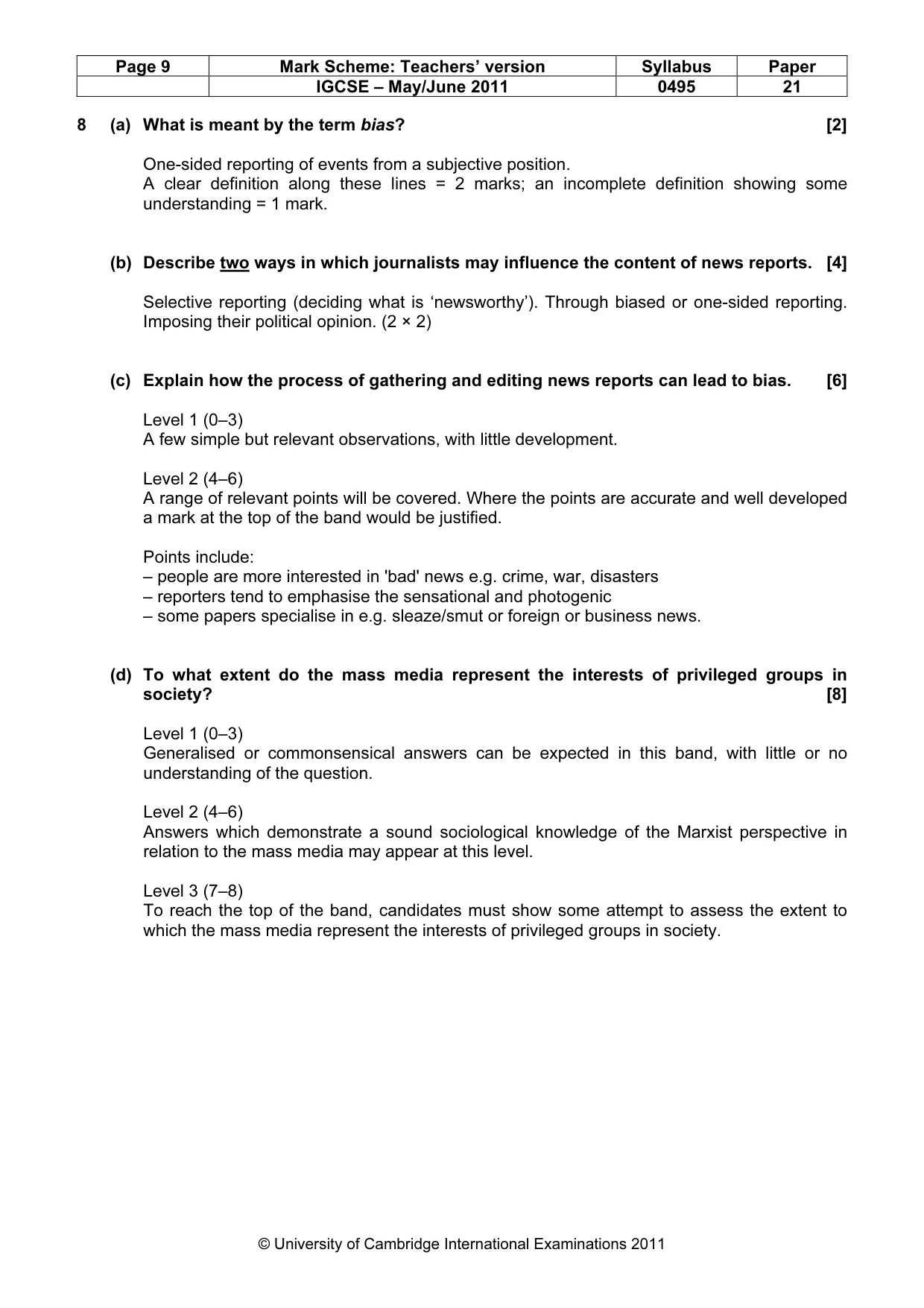
Page 9 Mark Scheme: Teachers’ version Syllabus Paper IGCSE – May/June 2011 0495 21 © University of Cambridge International Examinations 2011 8 (a) What is meant by the term bias? [2] One-sided reporting of events from a subjective position. A clear definition along these lines = 2 marks; an incomplete definition showing some understanding = 1 mark. (b) Describe two ways in which journalists may influence the content of news reports. [4] Selective reporting (deciding what is ‘newsworthy’). Through biased or one-sided reporting. Imposing their political opinion. (2 × 2) (c) Explain how the process of gathering and editing news reports can lead to bias. [6] Level 1 (0–3) A few simple but relevant observations, with little development. Level 2 (4–6) A range of relevant points will be covered. Where the points are accurate and well developed a mark at the top of the band would be justified. Points include: – people are more interested in 'bad' news e.g. crime, war, disasters – reporters tend to emphasise the sensational and photogenic – some papers specialise in e.g. sleaze/smut or foreign or business news. (d) To what extent do the mass media represent the interests of privileged groups in society? [8] Level 1 (0–3) Generalised or commonsensical answers can be expected in this band, with little or no understanding of the question. Level 2 (4–6) Answers which demonstrate a sound sociological knowledge of the Marxist perspective in relation to the mass media may appear at this level. Level 3 (7–8) To reach the top of the band, candidates must show some attempt to assess the extent to which the mass media represent the interests of privileged groups in society.
What you needed in this session
Cambridge’s own grade thresholds for 2011 May/June, Paper 2 · Variant 1. A higher threshold means an easier paper — the bar moves with how the cohort did.