Cambridge IGCSE Sociology 0495 — 2010 May/June Paper 1 · Variant 2
0495/12/M/J/10 · 90 marks · ≈101 min
The question paper and its mark scheme, free to read here and free to download. This is Cambridge’s own paper, exactly as it was sat.
Question paper4 pages
Mark scheme9 pages
Answers below. Sit the paper first if you are practising.
Paper as text
Question paper, page 1
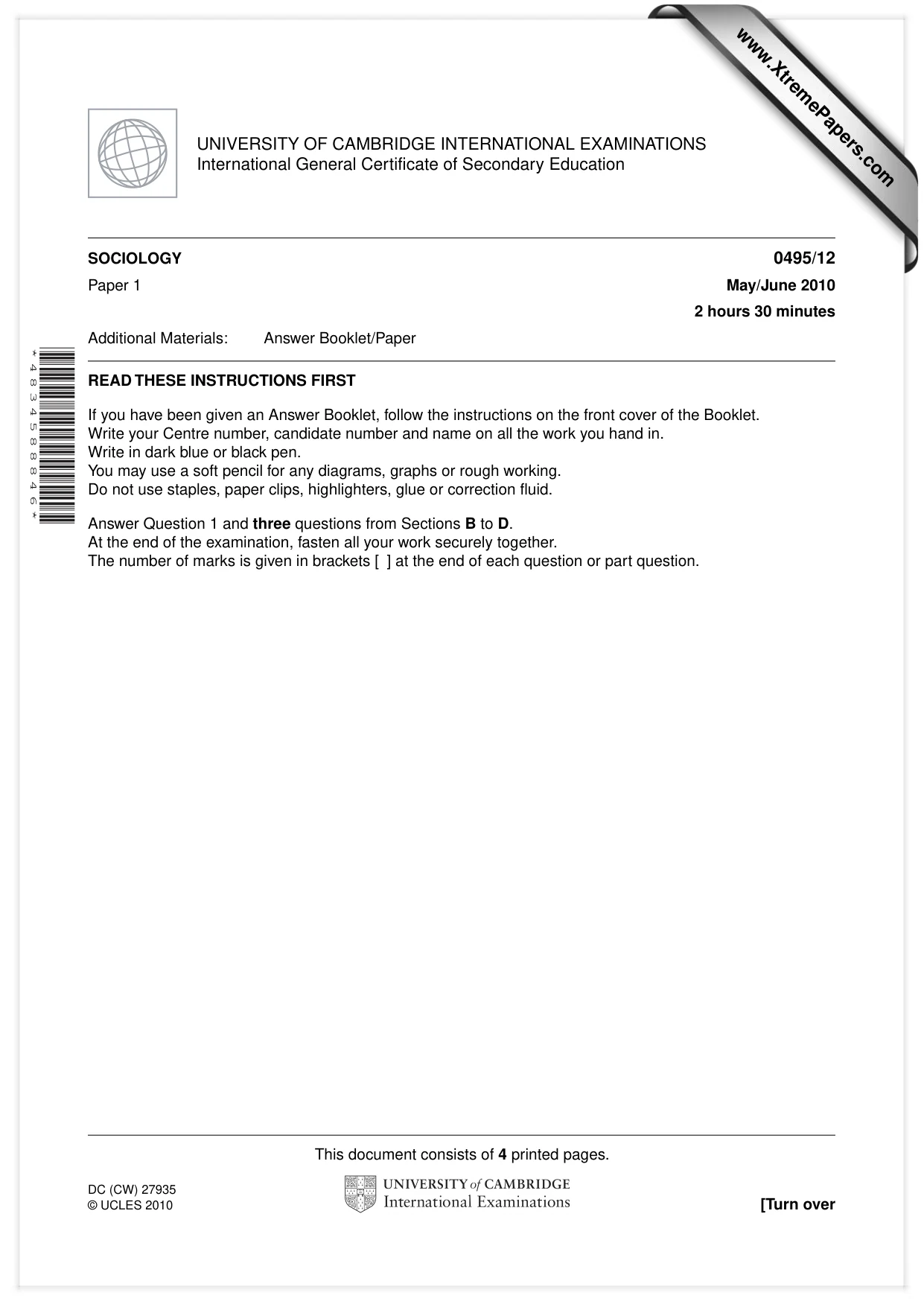
This document consists of 4 printed pages. DC (CW) 27935 © UCLES 2010 [Turn over UNIVERSITY OF CAMBRIDGE INTERNATIONAL EXAMINATIONS International General Certificate of Secondary Education READ THESE INSTRUCTIONS FIRST If you have been given an Answer Booklet, follow the instructions on the front cover of the Booklet. Write your Centre number, candidate number and name on all the work you hand in. Write in dark blue or black pen. You may use a soft pencil for any diagrams, graphs or rough working. Do not use staples, paper clips, highlighters, glue or correction fluid. Answer Question 1 and three questions from Sections B to D. At the end of the examination, fasten all your work securely together. The number of marks is given in brackets [ ] at the end of each question or part question. * 4 8 3 4 5 8 8 8 4 6 * SOCIOLOGY 0495/12 Paper 1 May/June 2010 2 hours 30 minutes Additional Materials: Answer Booklet/Paper www.XtremePapers.com
Question paper, page 2
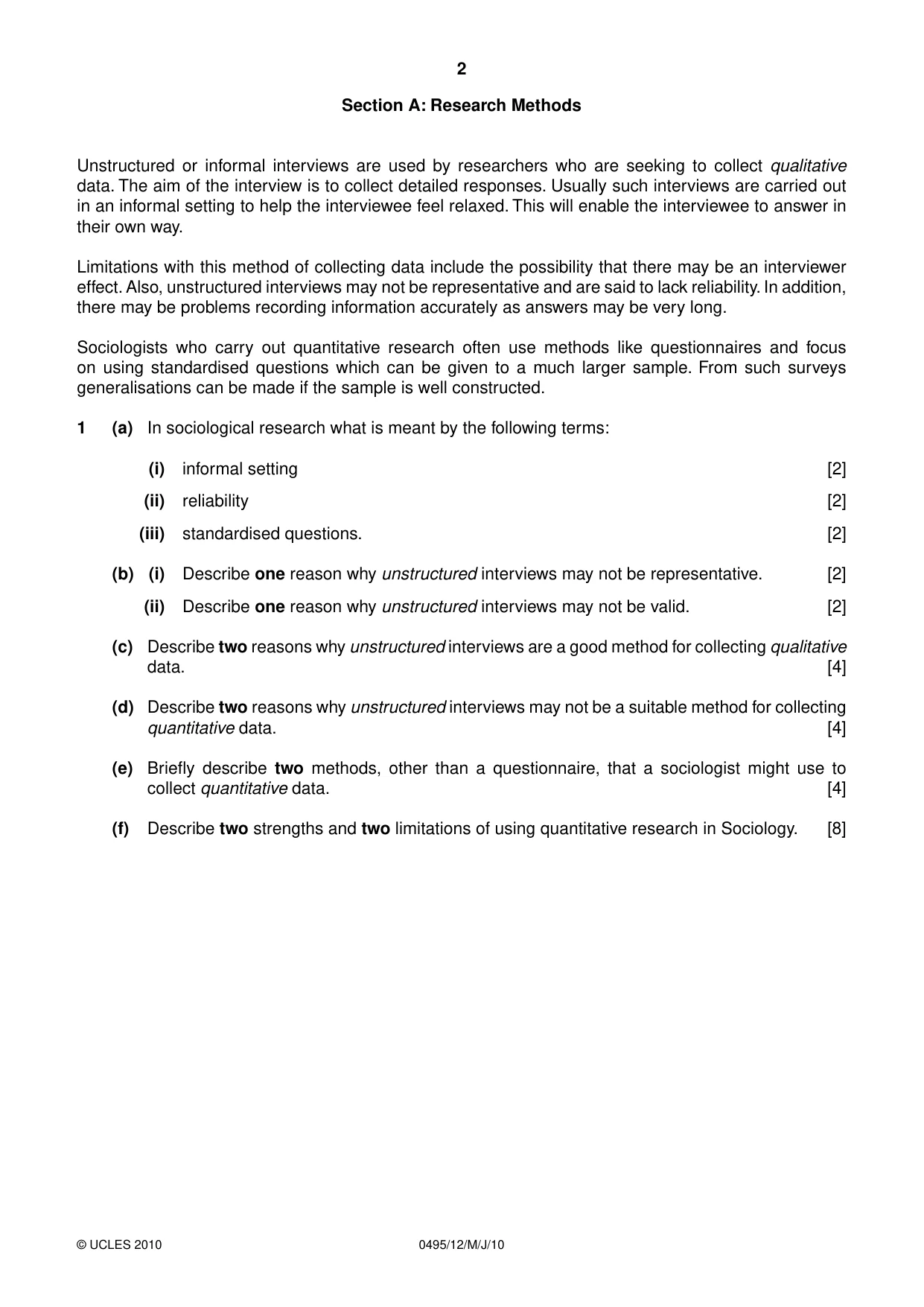
2 0495/12/M/J/10 © UCLES 2010 Section A: Research Methods Unstructured or informal interviews are used by researchers who are seeking to collect qualitative data. The aim of the interview is to collect detailed responses. Usually such interviews are carried out in an informal setting to help the interviewee feel relaxed. This will enable the interviewee to answer in their own way. Limitations with this method of collecting data include the possibility that there may be an interviewer effect. Also, unstructured interviews may not be representative and are said to lack reliability. In addition, there may be problems recording information accurately as answers may be very long. Sociologists who carry out quantitative research often use methods like questionnaires and focus on using standardised questions which can be given to a much larger sample. From such surveys generalisations can be made if the sample is well constructed. 1 (a) In sociological research what is meant by the following terms: (i) informal setting [2] (ii) reliability [2] (iii) standardised questions. [2] (b) (i) Describe one reason why unstructured interviews may not be representative. [2] (ii) Describe one reason why unstructured interviews may not be valid. [2] (c) Describe two reasons why unstructured interviews are a good method for collecting qualitative data. [4] (d) Describe two reasons why unstructured interviews may not be a suitable method for collecting quantitative data. [4] (e) Briefly describe two methods, other than a questionnaire, that a sociologist might use to collect quantitative data. [4] (f) Describe two strengths and two limitations of using quantitative research in Sociology. [8]
Question paper, page 3
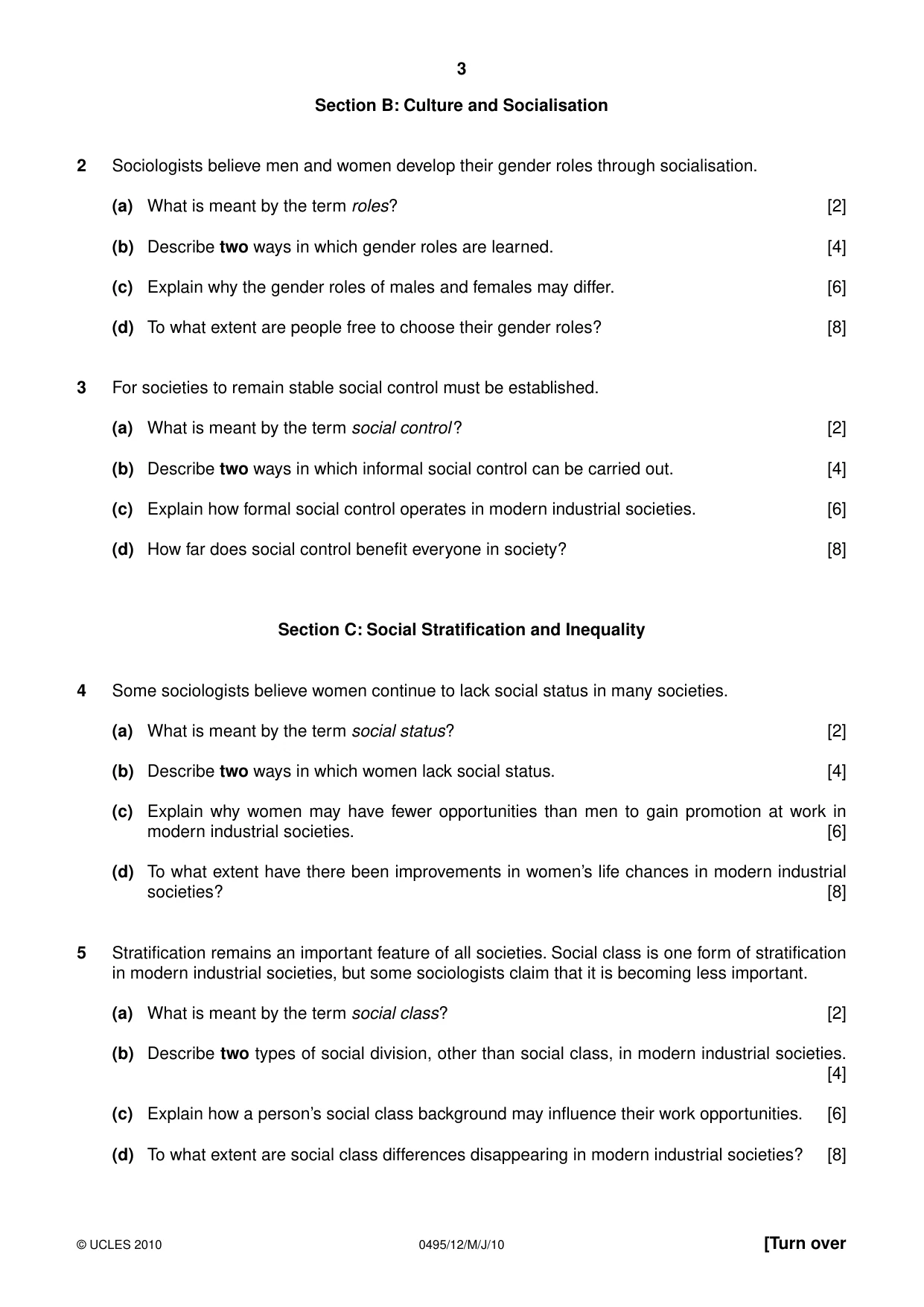
3 0495/12/M/J/10 © UCLES 2010 [Turn over Section B: Culture and Socialisation 2 Sociologists believe men and women develop their gender roles through socialisation. (a) What is meant by the term roles? [2] (b) Describe two ways in which gender roles are learned. [4] (c) Explain why the gender roles of males and females may differ. [6] (d) To what extent are people free to choose their gender roles? [8] 3 For societies to remain stable social control must be established. (a) What is meant by the term social control ? [2] (b) Describe two ways in which informal social control can be carried out. [4] (c) Explain how formal social control operates in modern industrial societies. [6] (d) How far does social control benefit everyone in society? [8] Section C: Social Stratification and Inequality 4 Some sociologists believe women continue to lack social status in many societies. (a) What is meant by the term social status? [2] (b) Describe two ways in which women lack social status. [4] (c) Explain why women may have fewer opportunities than men to gain promotion at work in modern industrial societies. [6] (d) To what extent have there been improvements in women’s life chances in modern industrial societies? [8] 5 Stratification remains an important feature of all societies. Social class is one form of stratification in modern industrial societies, but some sociologists claim that it is becoming less important. (a) What is meant by the term social class? [2] (b) Describe two types of social division, other than social class, in modern industrial societies. [4] (c) Explain how a person’s social class background may influence their work opportunities. [6] (d) To what extent are social class differences disappearing in modern industrial societies? [8]
Question paper, page 4
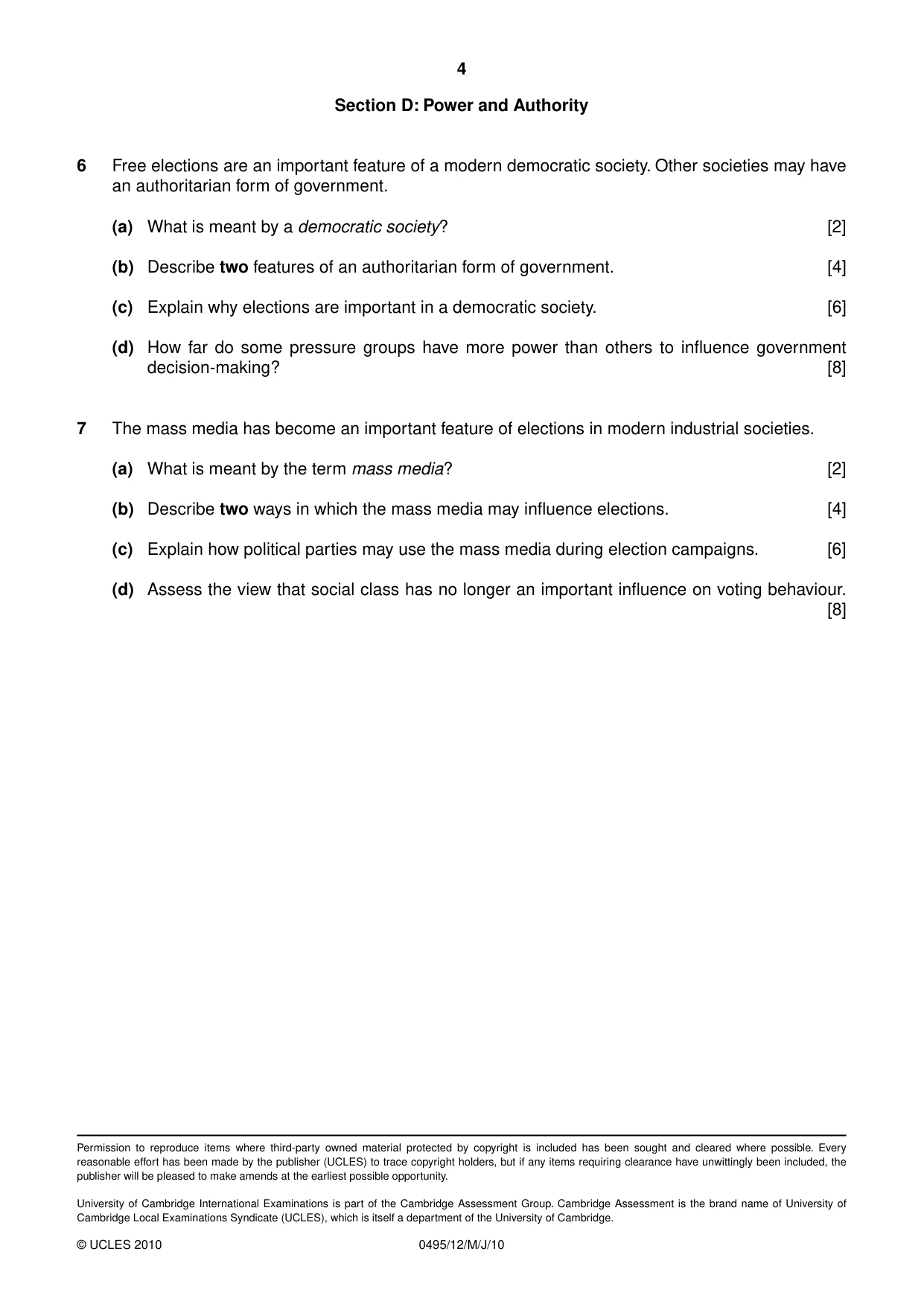
4 0495/12/M/J/10 © UCLES 2010 Section D: Power and Authority 6 Free elections are an important feature of a modern democratic society. Other societies may have an authoritarian form of government. (a) What is meant by a democratic society? [2] (b) Describe two features of an authoritarian form of government. [4] (c) Explain why elections are important in a democratic society. [6] (d) How far do some pressure groups have more power than others to influence government decision-making? [8] 7 The mass media has become an important feature of elections in modern industrial societies. (a) What is meant by the term mass media? [2] (b) Describe two ways in which the mass media may influence elections. [4] (c) Explain how political parties may use the mass media during election campaigns. [6] (d) Assess the view that social class has no longer an important influence on voting behaviour. [8] Permission to reproduce items where third-party owned material protected by copyright is included has been sought and cleared where possible. Every reasonable effort has been made by the publisher (UCLES) to trace copyright holders, but if any items requiring clearance have unwittingly been included, the publisher will be pleased to make amends at the earliest possible opportunity. University of Cambridge International Examinations is part of the Cambridge Assessment Group. Cambridge Assessment is the brand name of University of Cambridge Local Examinations Syndicate (UCLES), which is itself a department of the University of Cambridge.
Mark scheme, page 1
UNIVERSITY OF CAMBRIDGE INTERNATIONAL EXAMINATIONS International General Certificate of Secondary Education MARK SCHEME for the May/June 2010 question paper for the guidance of teachers 0495 SOCIOLOGY 0495/12 Paper 12, maximum raw mark 90 This mark scheme is published as an aid to teachers and candidates, to indicate the requirements of the examination. It shows the basis on which Examiners were instructed to award marks. It does not indicate the details of the discussions that took place at an Examiners’ meeting before marking began, which would have considered the acceptability of alternative answers. Mark schemes must be read in conjunction with the question papers and the report on the examination. • CIE will not enter into discussions or correspondence in connection with these mark schemes. CIE is publishing the mark schemes for the May/June 2010 question papers for most IGCSE, GCE Advanced Level and Advanced Subsidiary Level syllabuses and some Ordinary Level syllabuses. www.XtremePapers.com
Mark scheme, page 2
Page 2 Mark Scheme: Teachers’ version Syllabus Paper IGCSE – May/June 2010 0495 12 © UCLES 2010 Section A: Research Methods 1 (a) Unstructured or informal interviews are used by researchers who are seeking to collect qualitative data. The aim of the interview is to collect detailed responses. Usually such interviews are carried out in an informal setting to help the interviewee feel relaxed. This will enable the interviewee to answer in their own way. Limitations with this method of collecting data include the possibility that there may be an interviewer effect. Also, unstructured interviews may not be representative and are said to lack reliability. In addition, there may be problems recording information accurately as answers may be very long. Sociologists who carry out quantitative research often use methods like questionnaires and focus on using standardised questions which can be given to a much larger sample. From such surveys generalisations can be made if the sample is well constructed. In sociological research what is meant by the following terms: (i) informal setting [2] Definitions should refer to interviews that are carried in a relaxed setting where the interviewee feels comfortable and at ease, which should encourage truthful and detailed accounts. 2 marks for a full description, 1 mark for a partial explanation. (ii) reliability [2] Definitions should refer to the ability of a method to provide consistent results. This is normally achieved by being able to repeat the method and achieve the same or similar results. 2 marks for a full description, 1 mark for a partial explanation. (iii) standardised questions. [2] Definitions should refer to the way questions are posed in a very similar way, using the same procedure and wording to all participants. This enables comparison. 2 marks for a full description, 1 mark for a partial explanation. (b) (i) Describe one reason why unstructured interviews may not be representative. [2] Answers are likely to focus on the limited number of unstructured interviews that are usually undertaken, making it difficult to make generalisations. 2 marks for a full explanation, 1 mark for a partial explanation. (ii) Describe one reason why unstructured interviews may not be valid. [2] Answers are likely to focus on the interviewer effect which may occur during the conduct of unstructured interviews. 2 marks for a full explanation, 1 mark for a partial explanation.
Mark scheme, page 3
Page 3 Mark Scheme: Teachers’ version Syllabus Paper IGCSE – May/June 2010 0495 12 © UCLES 2010 (c) Describe two reasons why unstructured interviews are a good method for collecting qualitative data. [4] Answers are likely to focus on reasons such as: such interviews provide detailed accounts which provide in depth data, they provide a high degree of flexibility, which enables new ideas to be developed, the data collected tends to be highly descriptive, which is a feature of qualitative data. Any other reasonable response. 2 marks for each reason fully explained, 1 mark for each partial explanation. (d) Describe two reasons why unstructured interviews may not be a suitable method for collecting quantitative data. [4] Answers are likely to focus on issues such as: unstructured interviews tend to be relatively few in number so findings are unlikely to be representative. Such interviews tend to be flexible and therefore difficult to quantify as questions are not standardised. Such interviews are likely to be recorded in detail, focusing on description rather than statistics. Any other reasonable response. 2 marks for each problem fully explained, 1 mark for each partial explanation. (e) Briefly describe two methods, other than a questionnaire, that a sociologist might use to collect quantitative data. [4] A brief description of each method such as: structured interviews, use of official statistics, content analysis and experiments for 2 marks. 1 mark for identification of a method. (f) Describe two strengths and two limitations of using quantitative research in Sociology. [8] Likely strengths to be identified: easy to use standardised questions so that reliable data can be collected; a larger sample can be created which enables generalisability and representativeness; practical advantages: time and cost. Any other relevant response. 2 marks for each identified and described. 1 mark for a partial response. Likely limitations to be identified: lack of validity, the inflexibility of the research process, difficulties of sampling which may damage representativeness; problems of the interviewer effect when conducting structured interviews. Any other relevant response. 2 marks for each identified and described, 1 mark for a partial response.
Mark scheme, page 4
Page 4 Mark Scheme: Teachers’ version Syllabus Paper IGCSE – May/June 2010 0495 12 © UCLES 2010 Section B: Culture and Socialisation 2 Sociologists believe men and women develop their gender roles through socialisation. (a) What is meant by the term roles? [2] Roles refer to the social expectations that are associated with particular aspects of social behaviour in a particular society. 2 marks for an accurate definition, 1 mark for a partial definition. (b) Describe two ways in which gender roles are learned. [4] Various agents of socialisation may be referred to such as the family, imitation of a parent or guardian etc. The role of school, media or peer group may also be considered. 2 marks for an identification and description. 1 mark for an identification or description. (c) Explain why the gender roles of males and females may differ. [6] 0–3 A few general comments about how boys and girls are treated differently during childhood. Alternatively, a simple account of the way social expectations of men and women may differ may be presented. For example, the toys and dress associated with various genders. 4–6 At this level there will be an attempt to demonstrate sociological knowledge, perhaps referring to different ways boys and girls are socialised. Reference may be made to differing parental attitudes towards boys and girls which they may experience. At the top of the band, answers will present a range of issues, which may refer to social expectations of various genders, possibly making reference to feminist theory. (d) To what extent are people free to choose their gender roles? [8] 0–3 At this level answers are likely to be simplistic, perhaps outlining some of the traditional gender roles children learn during childhood. 4–6 At this level answers are likely to be more developed, outlining the ways socialisation has an impact on the development of gender roles. At the top of the band, there will be an attempt to point to a wider range of examples of socialisation. Specific examples will be used to support points. There will be no or a limited attempt to address the question specifically, perhaps commenting on how gender roles are now less fixed. 7–8 At this level answers are likely to focus directly on the issues raised in the question and provide some form of assessment involving biological factors, or there may be reference to changing patterns of gender role socialisation.
Mark scheme, page 5
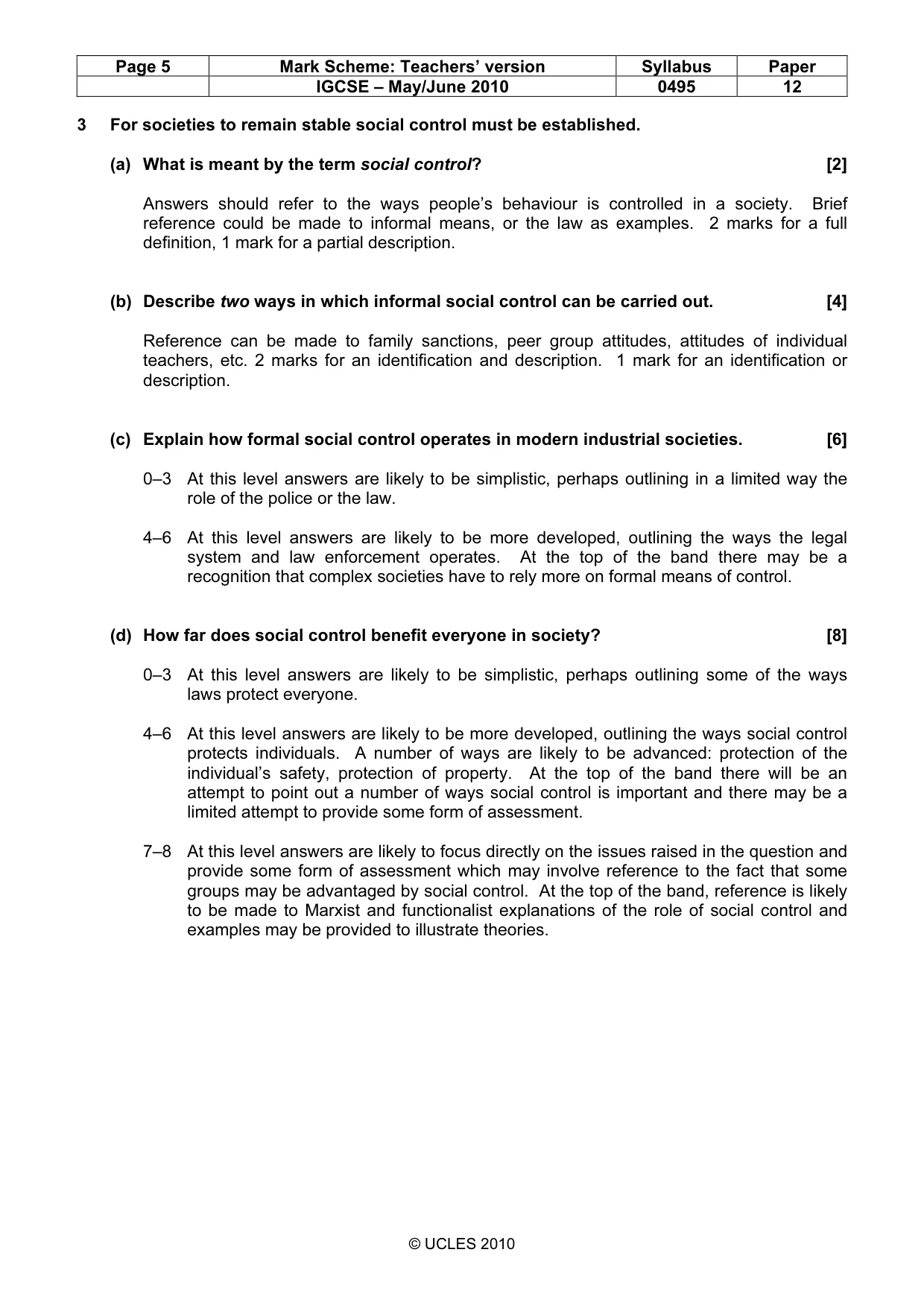
Page 5 Mark Scheme: Teachers’ version Syllabus Paper IGCSE – May/June 2010 0495 12 © UCLES 2010 3 For societies to remain stable social control must be established. (a) What is meant by the term social control? [2] Answers should refer to the ways people’s behaviour is controlled in a society. Brief reference could be made to informal means, or the law as examples. 2 marks for a full definition, 1 mark for a partial description. (b) Describe two ways in which informal social control can be carried out. [4] Reference can be made to family sanctions, peer group attitudes, attitudes of individual teachers, etc. 2 marks for an identification and description. 1 mark for an identification or description. (c) Explain how formal social control operates in modern industrial societies. [6] 0–3 At this level answers are likely to be simplistic, perhaps outlining in a limited way the role of the police or the law. 4–6 At this level answers are likely to be more developed, outlining the ways the legal system and law enforcement operates. At the top of the band there may be a recognition that complex societies have to rely more on formal means of control. (d) How far does social control benefit everyone in society? [8] 0–3 At this level answers are likely to be simplistic, perhaps outlining some of the ways laws protect everyone. 4–6 At this level answers are likely to be more developed, outlining the ways social control protects individuals. A number of ways are likely to be advanced: protection of the individual’s safety, protection of property. At the top of the band there will be an attempt to point out a number of ways social control is important and there may be a limited attempt to provide some form of assessment. 7–8 At this level answers are likely to focus directly on the issues raised in the question and provide some form of assessment which may involve reference to the fact that some groups may be advantaged by social control. At the top of the band, reference is likely to be made to Marxist and functionalist explanations of the role of social control and examples may be provided to illustrate theories.
Mark scheme, page 6
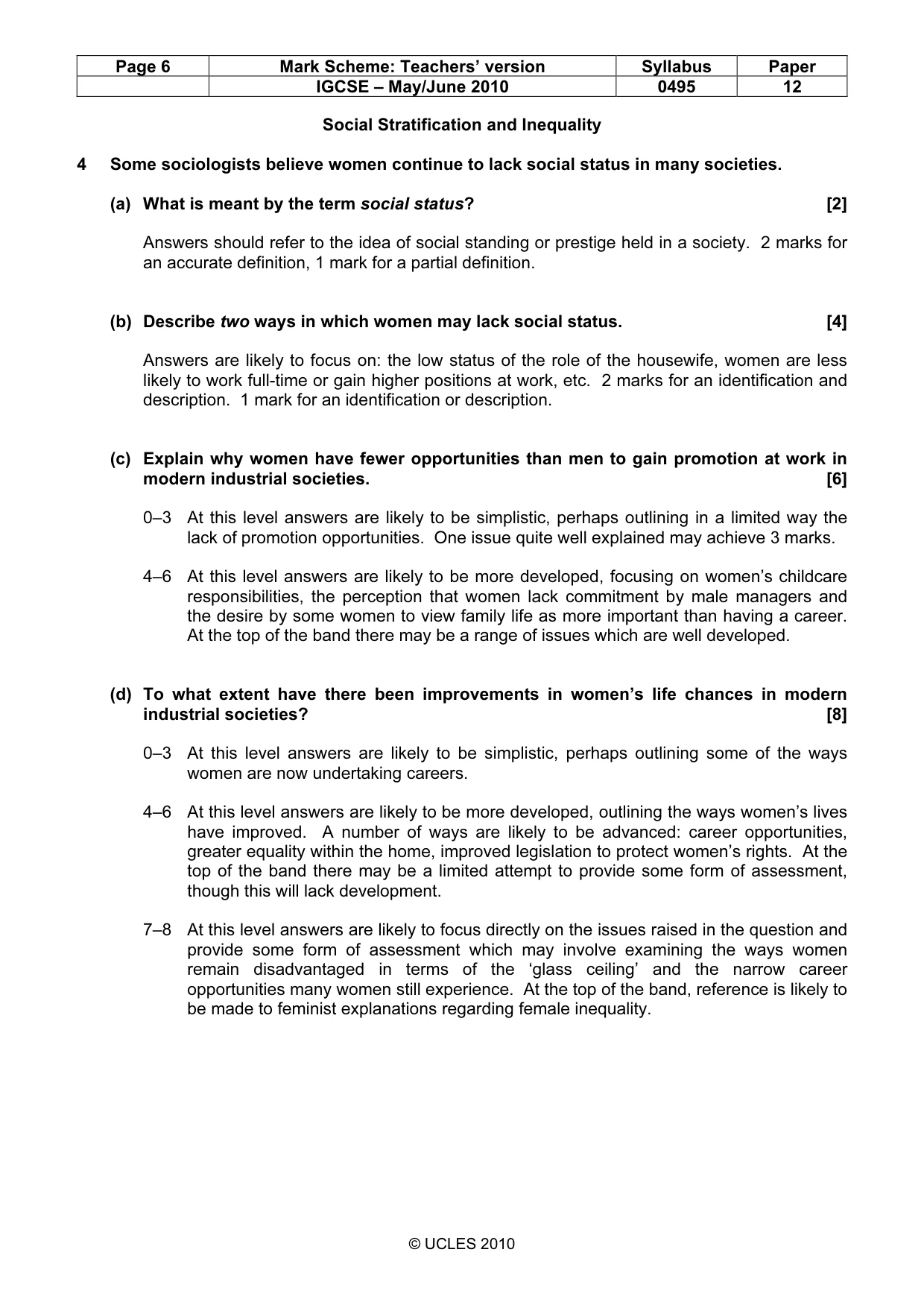
Page 6 Mark Scheme: Teachers’ version Syllabus Paper IGCSE – May/June 2010 0495 12 © UCLES 2010 Social Stratification and Inequality 4 Some sociologists believe women continue to lack social status in many societies. (a) What is meant by the term social status? [2] Answers should refer to the idea of social standing or prestige held in a society. 2 marks for an accurate definition, 1 mark for a partial definition. (b) Describe two ways in which women may lack social status. [4] Answers are likely to focus on: the low status of the role of the housewife, women are less likely to work full-time or gain higher positions at work, etc. 2 marks for an identification and description. 1 mark for an identification or description. (c) Explain why women have fewer opportunities than men to gain promotion at work in modern industrial societies. [6] 0–3 At this level answers are likely to be simplistic, perhaps outlining in a limited way the lack of promotion opportunities. One issue quite well explained may achieve 3 marks. 4–6 At this level answers are likely to be more developed, focusing on women’s childcare responsibilities, the perception that women lack commitment by male managers and the desire by some women to view family life as more important than having a career. At the top of the band there may be a range of issues which are well developed. (d) To what extent have there been improvements in women’s life chances in modern industrial societies? [8] 0–3 At this level answers are likely to be simplistic, perhaps outlining some of the ways women are now undertaking careers. 4–6 At this level answers are likely to be more developed, outlining the ways women’s lives have improved. A number of ways are likely to be advanced: career opportunities, greater equality within the home, improved legislation to protect women’s rights. At the top of the band there may be a limited attempt to provide some form of assessment, though this will lack development. 7–8 At this level answers are likely to focus directly on the issues raised in the question and provide some form of assessment which may involve examining the ways women remain disadvantaged in terms of the ‘glass ceiling’ and the narrow career opportunities many women still experience. At the top of the band, reference is likely to be made to feminist explanations regarding female inequality.
Mark scheme, page 7
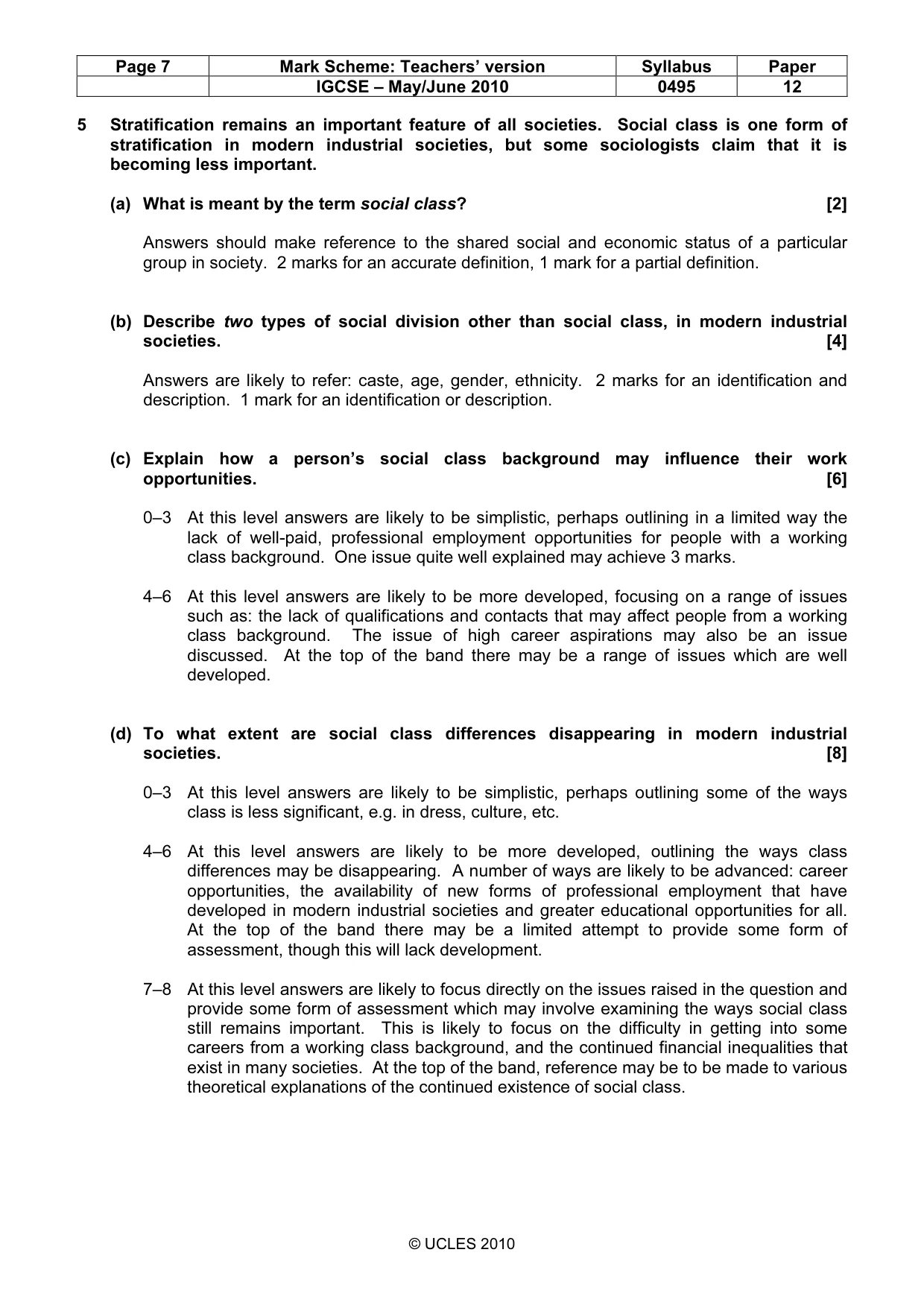
Page 7 Mark Scheme: Teachers’ version Syllabus Paper IGCSE – May/June 2010 0495 12 © UCLES 2010 5 Stratification remains an important feature of all societies. Social class is one form of stratification in modern industrial societies, but some sociologists claim that it is becoming less important. (a) What is meant by the term social class? [2] Answers should make reference to the shared social and economic status of a particular group in society. 2 marks for an accurate definition, 1 mark for a partial definition. (b) Describe two types of social division other than social class, in modern industrial societies. [4] Answers are likely to refer: caste, age, gender, ethnicity. 2 marks for an identification and description. 1 mark for an identification or description. (c) Explain how a person’s social class background may influence their work opportunities. [6] 0–3 At this level answers are likely to be simplistic, perhaps outlining in a limited way the lack of well-paid, professional employment opportunities for people with a working class background. One issue quite well explained may achieve 3 marks. 4–6 At this level answers are likely to be more developed, focusing on a range of issues such as: the lack of qualifications and contacts that may affect people from a working class background. The issue of high career aspirations may also be an issue discussed. At the top of the band there may be a range of issues which are well developed. (d) To what extent are social class differences disappearing in modern industrial societies. [8] 0–3 At this level answers are likely to be simplistic, perhaps outlining some of the ways class is less significant, e.g. in dress, culture, etc. 4–6 At this level answers are likely to be more developed, outlining the ways class differences may be disappearing. A number of ways are likely to be advanced: career opportunities, the availability of new forms of professional employment that have developed in modern industrial societies and greater educational opportunities for all. At the top of the band there may be a limited attempt to provide some form of assessment, though this will lack development. 7–8 At this level answers are likely to focus directly on the issues raised in the question and provide some form of assessment which may involve examining the ways social class still remains important. This is likely to focus on the difficulty in getting into some careers from a working class background, and the continued financial inequalities that exist in many societies. At the top of the band, reference may be to be made to various theoretical explanations of the continued existence of social class.
Mark scheme, page 8
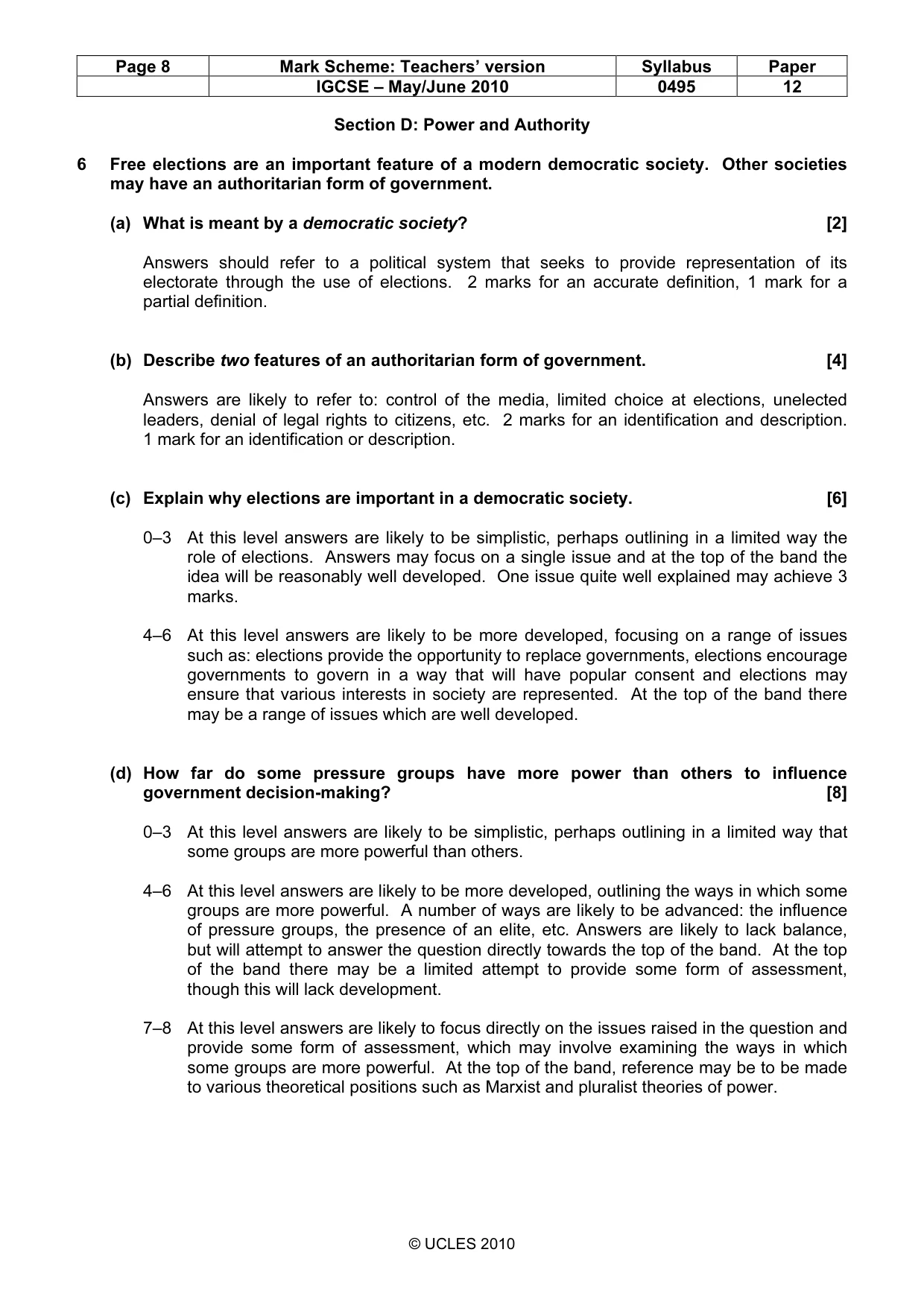
Page 8 Mark Scheme: Teachers’ version Syllabus Paper IGCSE – May/June 2010 0495 12 © UCLES 2010 Section D: Power and Authority 6 Free elections are an important feature of a modern democratic society. Other societies may have an authoritarian form of government. (a) What is meant by a democratic society? [2] Answers should refer to a political system that seeks to provide representation of its electorate through the use of elections. 2 marks for an accurate definition, 1 mark for a partial definition. (b) Describe two features of an authoritarian form of government. [4] Answers are likely to refer to: control of the media, limited choice at elections, unelected leaders, denial of legal rights to citizens, etc. 2 marks for an identification and description. 1 mark for an identification or description. (c) Explain why elections are important in a democratic society. [6] 0–3 At this level answers are likely to be simplistic, perhaps outlining in a limited way the role of elections. Answers may focus on a single issue and at the top of the band the idea will be reasonably well developed. One issue quite well explained may achieve 3 marks. 4–6 At this level answers are likely to be more developed, focusing on a range of issues such as: elections provide the opportunity to replace governments, elections encourage governments to govern in a way that will have popular consent and elections may ensure that various interests in society are represented. At the top of the band there may be a range of issues which are well developed. (d) How far do some pressure groups have more power than others to influence government decision-making? [8] 0–3 At this level answers are likely to be simplistic, perhaps outlining in a limited way that some groups are more powerful than others. 4–6 At this level answers are likely to be more developed, outlining the ways in which some groups are more powerful. A number of ways are likely to be advanced: the influence of pressure groups, the presence of an elite, etc. Answers are likely to lack balance, but will attempt to answer the question directly towards the top of the band. At the top of the band there may be a limited attempt to provide some form of assessment, though this will lack development. 7–8 At this level answers are likely to focus directly on the issues raised in the question and provide some form of assessment, which may involve examining the ways in which some groups are more powerful. At the top of the band, reference may be to be made to various theoretical positions such as Marxist and pluralist theories of power.
Mark scheme, page 9
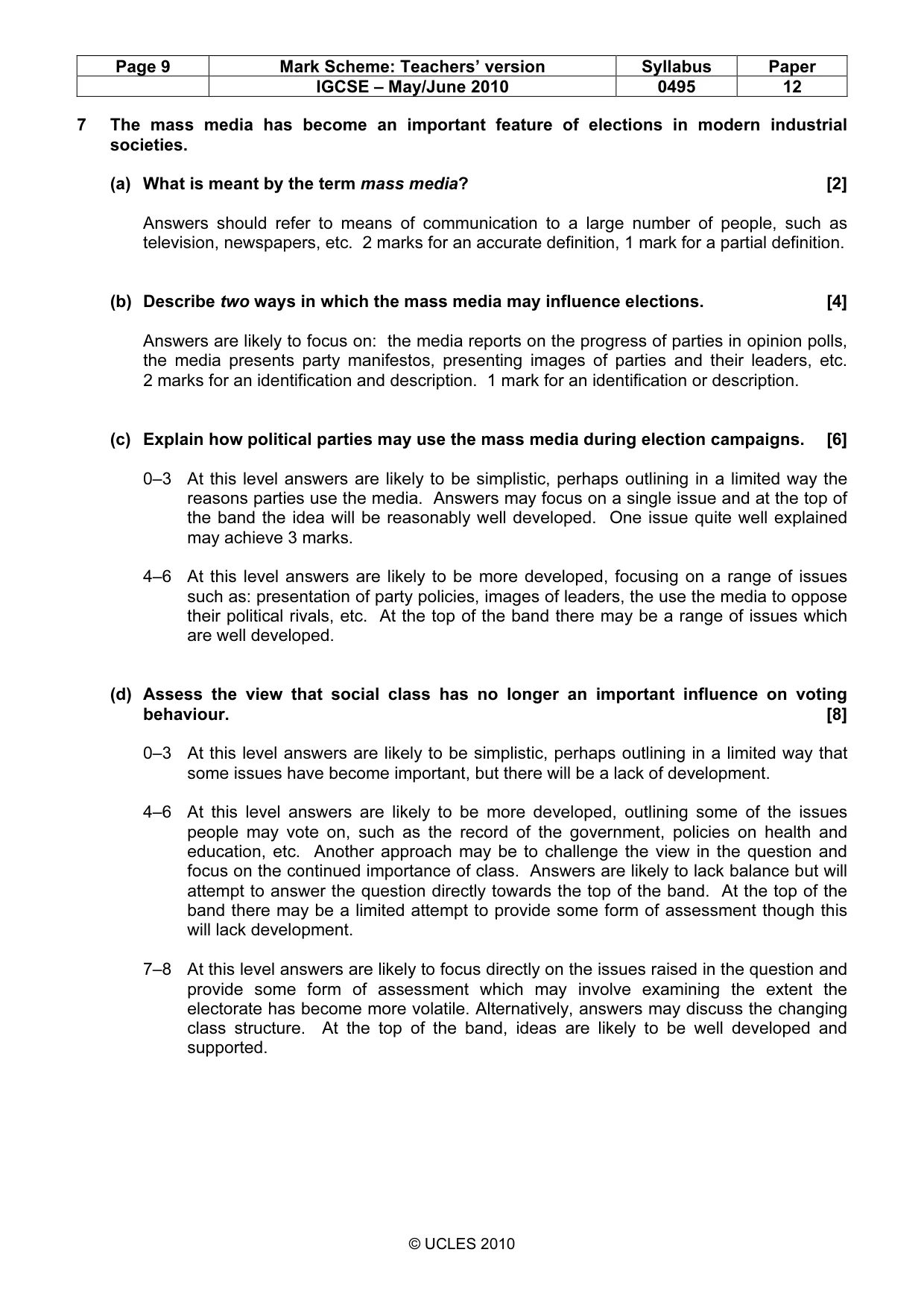
Page 9 Mark Scheme: Teachers’ version Syllabus Paper IGCSE – May/June 2010 0495 12 © UCLES 2010 7 The mass media has become an important feature of elections in modern industrial societies. (a) What is meant by the term mass media? [2] Answers should refer to means of communication to a large number of people, such as television, newspapers, etc. 2 marks for an accurate definition, 1 mark for a partial definition. (b) Describe two ways in which the mass media may influence elections. [4] Answers are likely to focus on: the media reports on the progress of parties in opinion polls, the media presents party manifestos, presenting images of parties and their leaders, etc. 2 marks for an identification and description. 1 mark for an identification or description. (c) Explain how political parties may use the mass media during election campaigns. [6] 0–3 At this level answers are likely to be simplistic, perhaps outlining in a limited way the reasons parties use the media. Answers may focus on a single issue and at the top of the band the idea will be reasonably well developed. One issue quite well explained may achieve 3 marks. 4–6 At this level answers are likely to be more developed, focusing on a range of issues such as: presentation of party policies, images of leaders, the use the media to oppose their political rivals, etc. At the top of the band there may be a range of issues which are well developed. (d) Assess the view that social class has no longer an important influence on voting behaviour. [8] 0–3 At this level answers are likely to be simplistic, perhaps outlining in a limited way that some issues have become important, but there will be a lack of development. 4–6 At this level answers are likely to be more developed, outlining some of the issues people may vote on, such as the record of the government, policies on health and education, etc. Another approach may be to challenge the view in the question and focus on the continued importance of class. Answers are likely to lack balance but will attempt to answer the question directly towards the top of the band. At the top of the band there may be a limited attempt to provide some form of assessment though this will lack development. 7–8 At this level answers are likely to focus directly on the issues raised in the question and provide some form of assessment which may involve examining the extent the electorate has become more volatile. Alternatively, answers may discuss the changing class structure. At the top of the band, ideas are likely to be well developed and supported.
What you needed in this session
Cambridge’s own grade thresholds for 2010 May/June, Paper 1 · Variant 2. A higher threshold means an easier paper — the bar moves with how the cohort did.