Cambridge IGCSE Sociology 0495 — 2010 May/June Paper 1 · Variant 1
0495/11/M/J/10 · 90 marks · ≈101 min
The question paper and its mark scheme, free to read here and free to download. This is Cambridge’s own paper, exactly as it was sat.
Question paper4 pages
Mark scheme9 pages
Answers below. Sit the paper first if you are practising.
Paper as text
Question paper, page 1
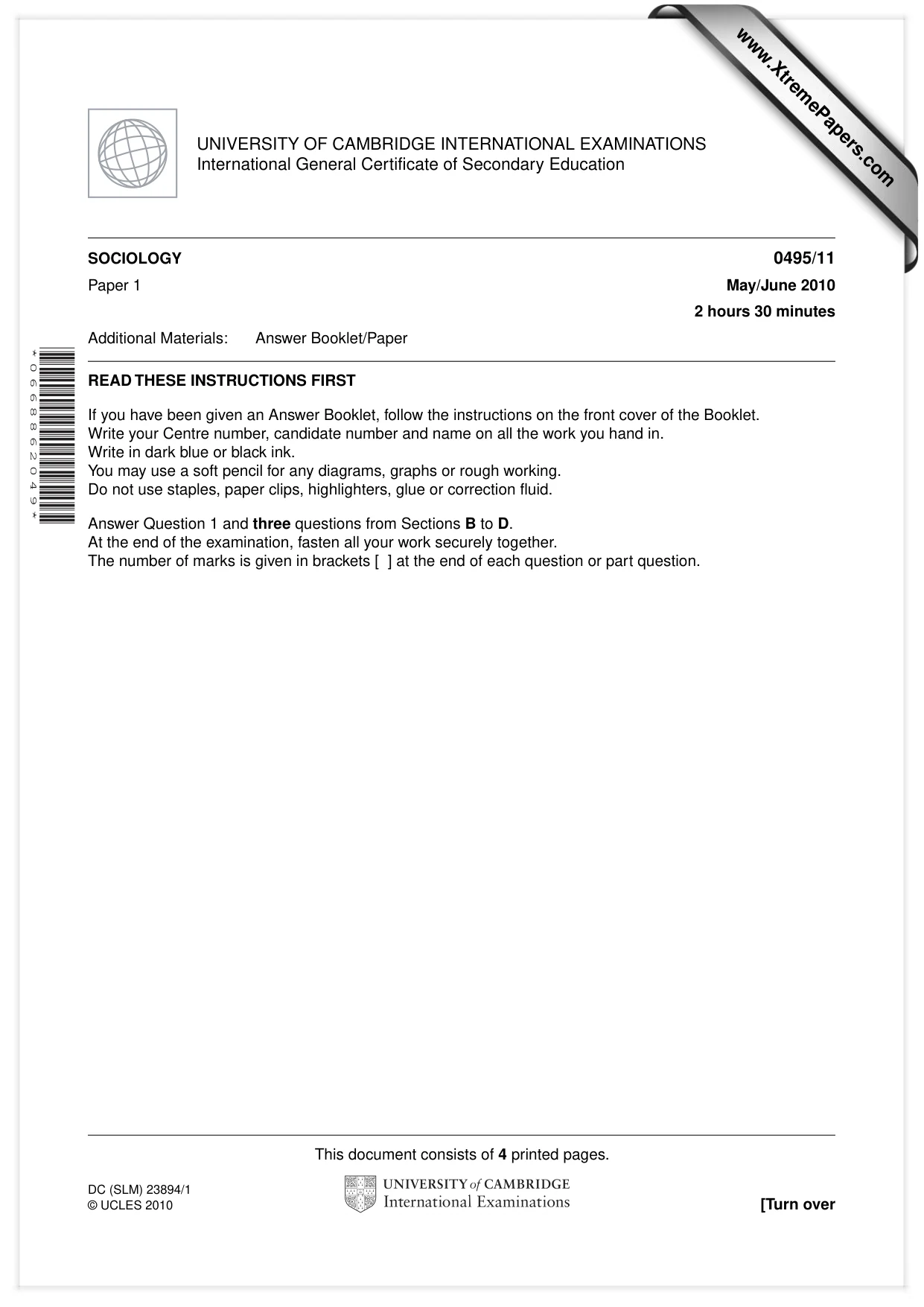
This document consists of 4 printed pages. DC (SLM) 23894/1 © UCLES 2010 [Turn over UNIVERSITY OF CAMBRIDGE INTERNATIONAL EXAMINATIONS International General Certificate of Secondary Education SOCIOLOGY 0495/11 Paper 1 May/June 2010 2 hours 30 minutes Additional Materials: Answer Booklet/Paper READ THESE INSTRUCTIONS FIRST If you have been given an Answer Booklet, follow the instructions on the front cover of the Booklet. Write your Centre number, candidate number and name on all the work you hand in. Write in dark blue or black ink. You may use a soft pencil for any diagrams, graphs or rough working. Do not use staples, paper clips, highlighters, glue or correction fluid. Answer Question 1 and three questions from Sections B to D. At the end of the examination, fasten all your work securely together. The number of marks is given in brackets [ ] at the end of each question or part question. * 0 6 6 8 8 6 2 0 4 9 * www.XtremePapers.com
Question paper, page 2
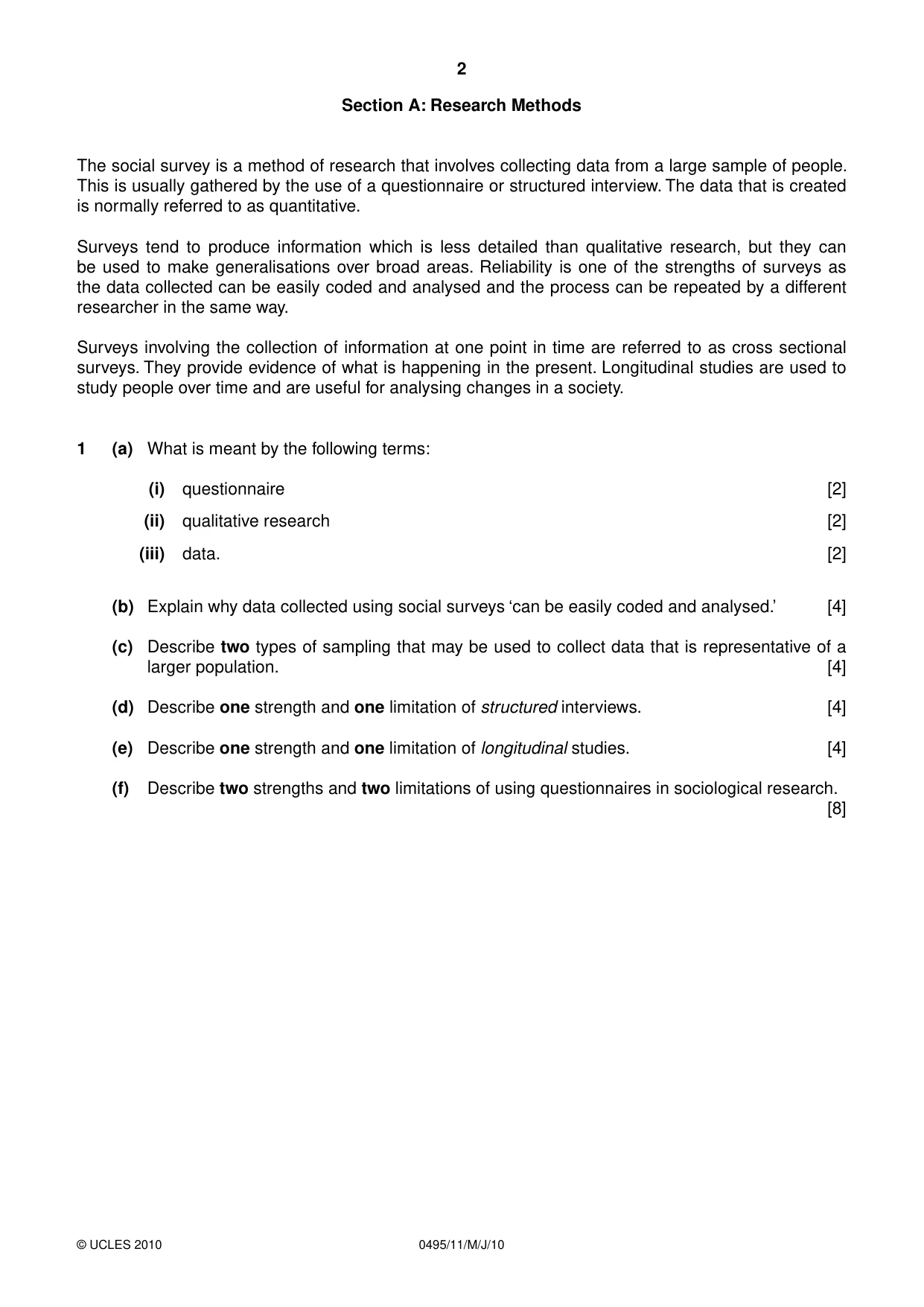
2 0495/11/M/J/10 © UCLES 2010 Section A: Research Methods The social survey is a method of research that involves collecting data from a large sample of people. This is usually gathered by the use of a questionnaire or structured interview. The data that is created is normally referred to as quantitative. Surveys tend to produce information which is less detailed than qualitative research, but they can be used to make generalisations over broad areas. Reliability is one of the strengths of surveys as the data collected can be easily coded and analysed and the process can be repeated by a different researcher in the same way. Surveys involving the collection of information at one point in time are referred to as cross sectional surveys. They provide evidence of what is happening in the present. Longitudinal studies are used to study people over time and are useful for analysing changes in a society. 1 (a) What is meant by the following terms: (i) questionnaire [2] (ii) qualitative research [2] (iii) data. [2] (b) Explain why data collected using social surveys ‘can be easily coded and analysed.’ [4] (c) Describe two types of sampling that may be used to collect data that is representative of a larger population. [4] (d) Describe one strength and one limitation of structured interviews. [4] (e) Describe one strength and one limitation of longitudinal studies. [4] (f) Describe two strengths and two limitations of using questionnaires in sociological research. [8]
Question paper, page 3
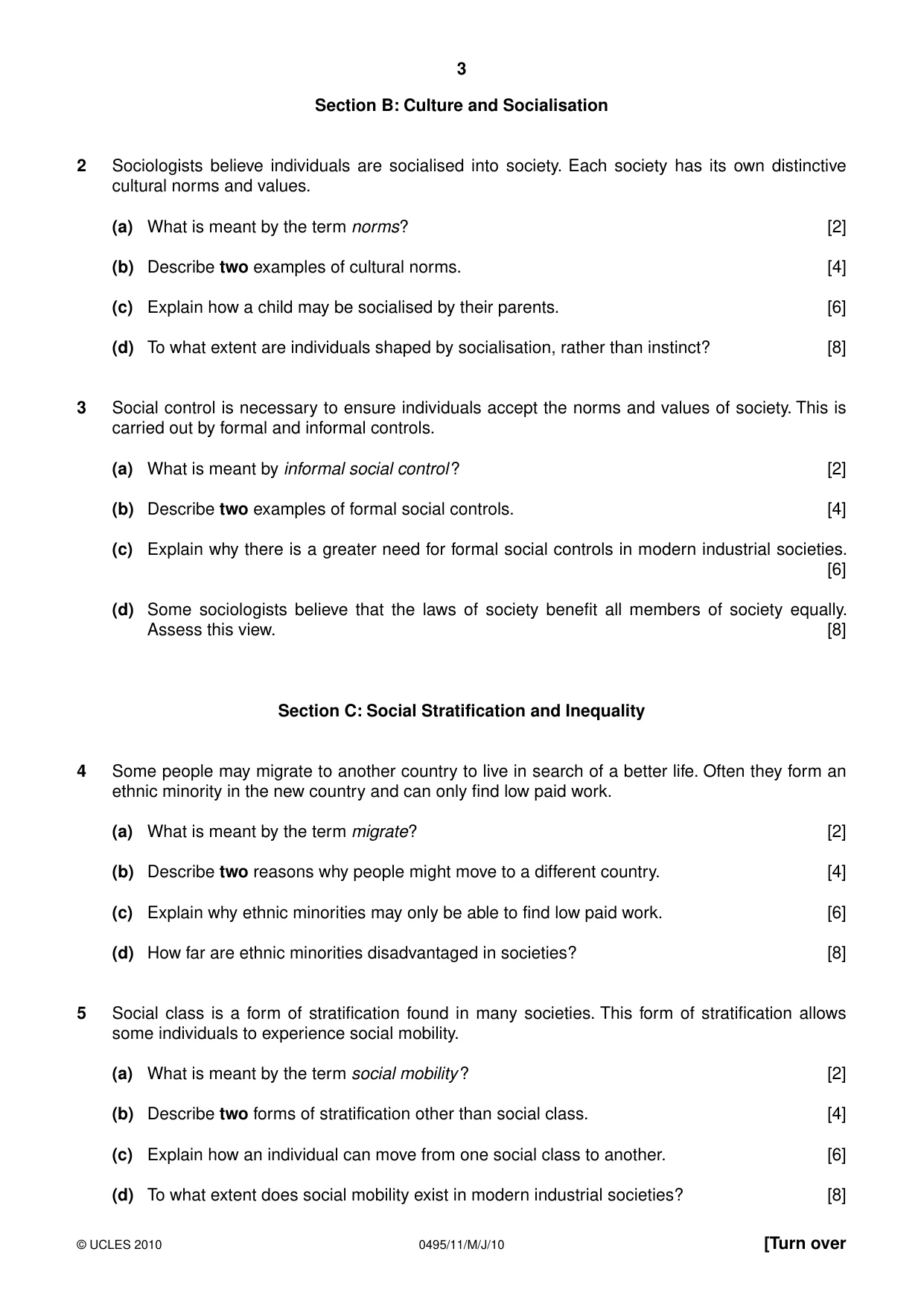
3 0495/11/M/J/10 © UCLES 2010 [Turn over Section B: Culture and Socialisation 2 Sociologists believe individuals are socialised into society. Each society has its own distinctive cultural norms and values. (a) What is meant by the term norms? [2] (b) Describe two examples of cultural norms. [4] (c) Explain how a child may be socialised by their parents. [6] (d) To what extent are individuals shaped by socialisation, rather than instinct? [8] 3 Social control is necessary to ensure individuals accept the norms and values of society. This is carried out by formal and informal controls. (a) What is meant by informal social control ? [2] (b) Describe two examples of formal social controls. [4] (c) Explain why there is a greater need for formal social controls in modern industrial societies. [6] (d) Some sociologists believe that the laws of society benefit all members of society equally. Assess this view. [8] Section C: Social Stratification and Inequality 4 Some people may migrate to another country to live in search of a better life. Often they form an ethnic minority in the new country and can only find low paid work. (a) What is meant by the term migrate? [2] (b) Describe two reasons why people might move to a different country. [4] (c) Explain why ethnic minorities may only be able to find low paid work. [6] (d) How far are ethnic minorities disadvantaged in societies? [8] 5 Social class is a form of stratification found in many societies. This form of stratification allows some individuals to experience social mobility. (a) What is meant by the term social mobility ? [2] (b) Describe two forms of stratification other than social class. [4] (c) Explain how an individual can move from one social class to another. [6] (d) To what extent does social mobility exist in modern industrial societies? [8]
Question paper, page 4
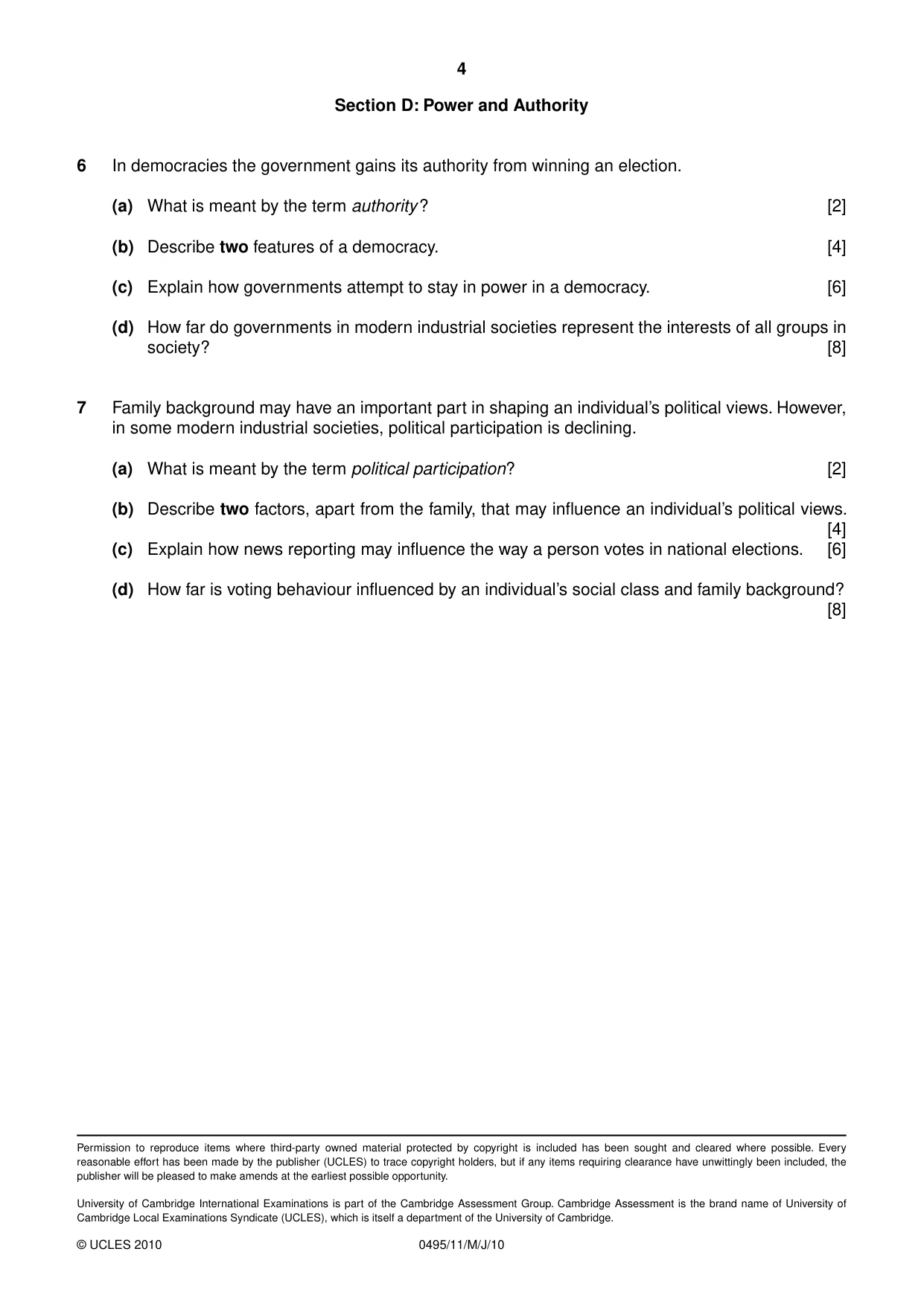
4 0495/11/M/J/10 © UCLES 2010 Section D: Power and Authority 6 In democracies the government gains its authority from winning an election. (a) What is meant by the term authority ? [2] (b) Describe two features of a democracy. [4] (c) Explain how governments attempt to stay in power in a democracy. [6] (d) How far do governments in modern industrial societies represent the interests of all groups in society? [8] 7 Family background may have an important part in shaping an individual’s political views. However, in some modern industrial societies, political participation is declining. (a) What is meant by the term political participation? [2] (b) Describe two factors, apart from the family, that may influence an individual’s political views. [4] (c) Explain how news reporting may influence the way a person votes in national elections. [6] (d) How far is voting behaviour influenced by an individual’s social class and family background? [8] Permission to reproduce items where third-party owned material protected by copyright is included has been sought and cleared where possible. Every reasonable effort has been made by the publisher (UCLES) to trace copyright holders, but if any items requiring clearance have unwittingly been included, the publisher will be pleased to make amends at the earliest possible opportunity. University of Cambridge International Examinations is part of the Cambridge Assessment Group. Cambridge Assessment is the brand name of University of Cambridge Local Examinations Syndicate (UCLES), which is itself a department of the University of Cambridge.
Mark scheme, page 1
UNIVERSITY OF CAMBRIDGE INTERNATIONAL EXAMINATIONS International General Certificate of Secondary Education MARK SCHEME for the May/June 2010 question paper for the guidance of teachers 0495 SOCIOLOGY 0495/11 Paper 11, maximum raw mark 90 This mark scheme is published as an aid to teachers and candidates, to indicate the requirements of the examination. It shows the basis on which Examiners were instructed to award marks. It does not indicate the details of the discussions that took place at an Examiners’ meeting before marking began, which would have considered the acceptability of alternative answers. Mark schemes must be read in conjunction with the question papers and the report on the examination. • CIE will not enter into discussions or correspondence in connection with these mark schemes. CIE is publishing the mark schemes for the May/June 2010 question papers for most IGCSE, GCE Advanced Level and Advanced Subsidiary Level syllabuses and some Ordinary Level syllabuses. www.XtremePapers.com
Mark scheme, page 2
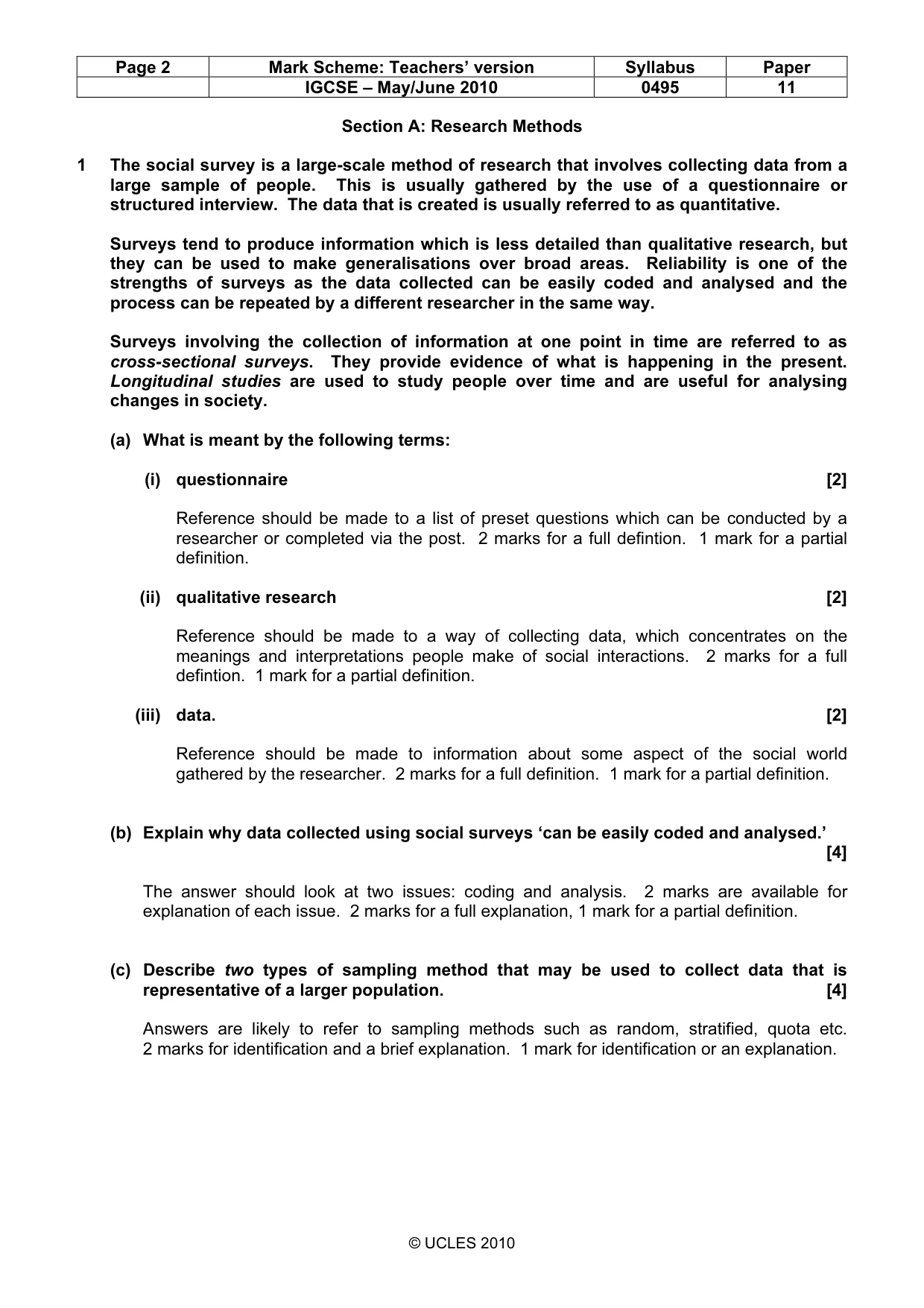
Page 2 Mark Scheme: Teachers’ version Syllabus Paper IGCSE – May/June 2010 0495 11 © UCLES 2010 Section A: Research Methods 1 The social survey is a large-scale method of research that involves collecting data from a large sample of people. This is usually gathered by the use of a questionnaire or structured interview. The data that is created is usually referred to as quantitative. Surveys tend to produce information which is less detailed than qualitative research, but they can be used to make generalisations over broad areas. Reliability is one of the strengths of surveys as the data collected can be easily coded and analysed and the process can be repeated by a different researcher in the same way. Surveys involving the collection of information at one point in time are referred to as cross-sectional surveys. They provide evidence of what is happening in the present. Longitudinal studies are used to study people over time and are useful for analysing changes in society. (a) What is meant by the following terms: (i) questionnaire [2] Reference should be made to a list of preset questions which can be conducted by a researcher or completed via the post. 2 marks for a full defintion. 1 mark for a partial definition. (ii) qualitative research [2] Reference should be made to a way of collecting data, which concentrates on the meanings and interpretations people make of social interactions. 2 marks for a full defintion. 1 mark for a partial definition. (iii) data. [2] Reference should be made to information about some aspect of the social world gathered by the researcher. 2 marks for a full definition. 1 mark for a partial definition. (b) Explain why data collected using social surveys ‘can be easily coded and analysed.’ [4] The answer should look at two issues: coding and analysis. 2 marks are available for explanation of each issue. 2 marks for a full explanation, 1 mark for a partial definition. (c) Describe two types of sampling method that may be used to collect data that is representative of a larger population. [4] Answers are likely to refer to sampling methods such as random, stratified, quota etc. 2 marks for identification and a brief explanation. 1 mark for identification or an explanation.
Mark scheme, page 3
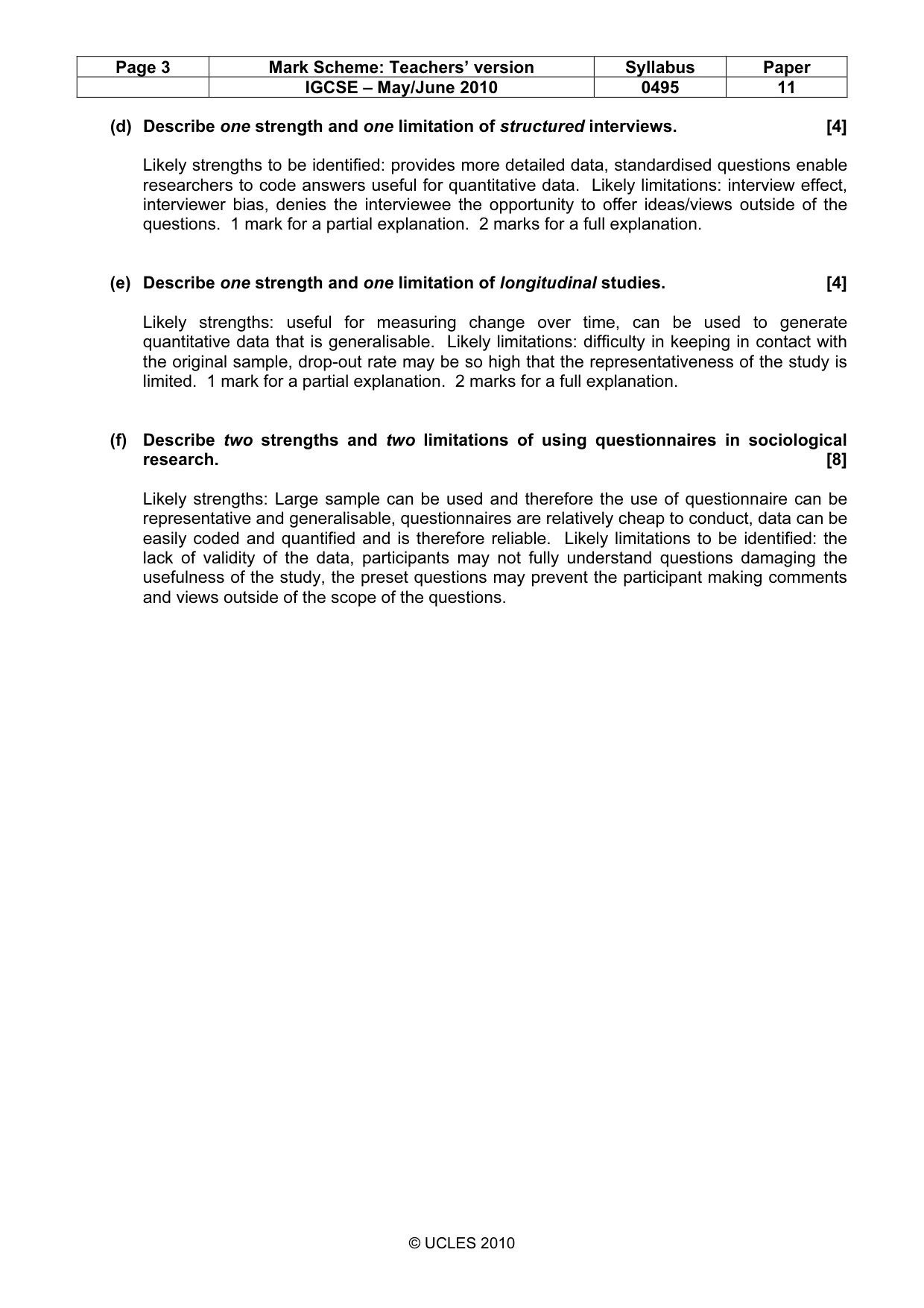
Page 3 Mark Scheme: Teachers’ version Syllabus Paper IGCSE – May/June 2010 0495 11 © UCLES 2010 (d) Describe one strength and one limitation of structured interviews. [4] Likely strengths to be identified: provides more detailed data, standardised questions enable researchers to code answers useful for quantitative data. Likely limitations: interview effect, interviewer bias, denies the interviewee the opportunity to offer ideas/views outside of the questions. 1 mark for a partial explanation. 2 marks for a full explanation. (e) Describe one strength and one limitation of longitudinal studies. [4] Likely strengths: useful for measuring change over time, can be used to generate quantitative data that is generalisable. Likely limitations: difficulty in keeping in contact with the original sample, drop-out rate may be so high that the representativeness of the study is limited. 1 mark for a partial explanation. 2 marks for a full explanation. (f) Describe two strengths and two limitations of using questionnaires in sociological research. [8] Likely strengths: Large sample can be used and therefore the use of questionnaire can be representative and generalisable, questionnaires are relatively cheap to conduct, data can be easily coded and quantified and is therefore reliable. Likely limitations to be identified: the lack of validity of the data, participants may not fully understand questions damaging the usefulness of the study, the preset questions may prevent the participant making comments and views outside of the scope of the questions.
Mark scheme, page 4
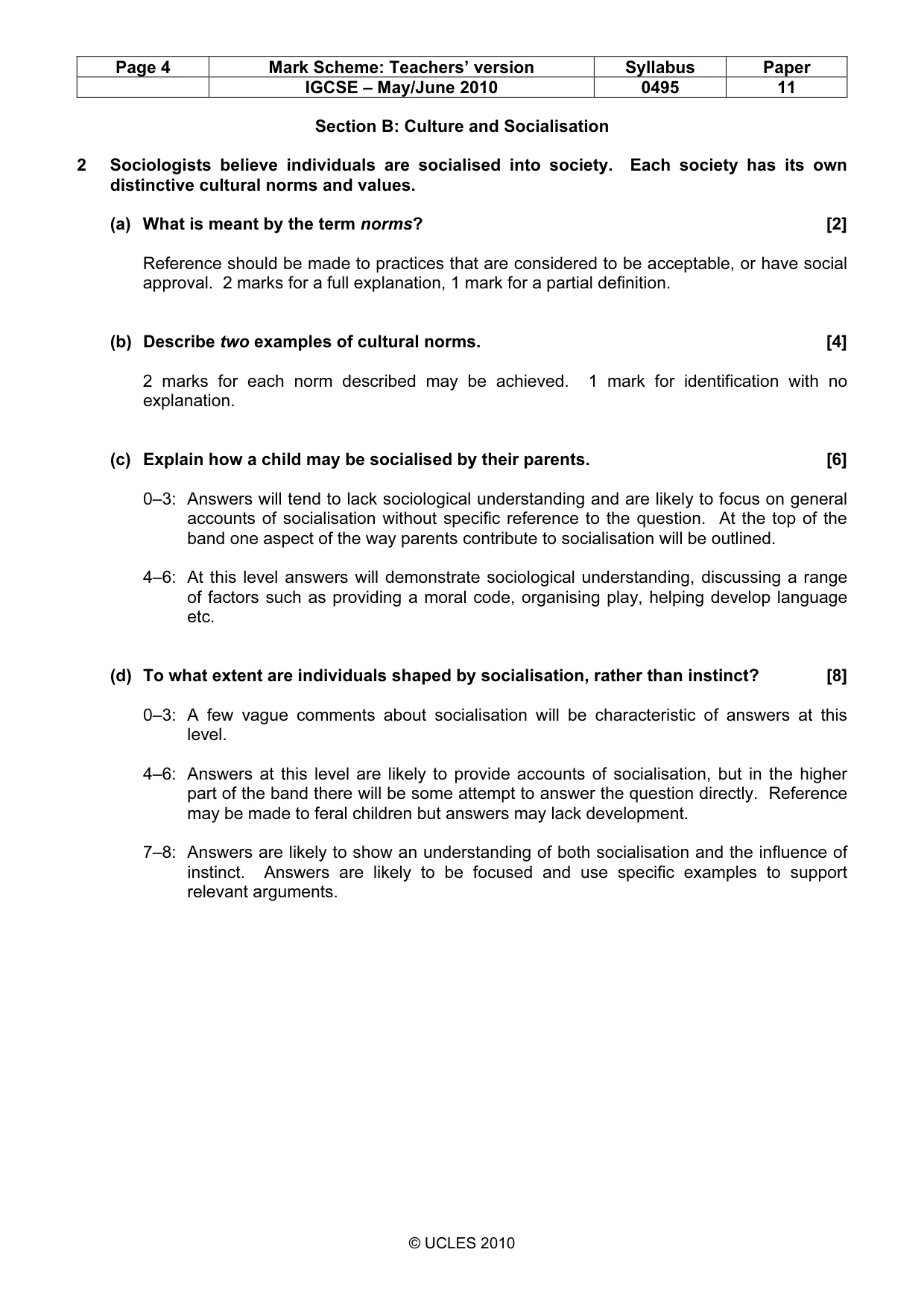
Page 4 Mark Scheme: Teachers’ version Syllabus Paper IGCSE – May/June 2010 0495 11 © UCLES 2010 Section B: Culture and Socialisation 2 Sociologists believe individuals are socialised into society. Each society has its own distinctive cultural norms and values. (a) What is meant by the term norms? [2] Reference should be made to practices that are considered to be acceptable, or have social approval. 2 marks for a full explanation, 1 mark for a partial definition. (b) Describe two examples of cultural norms. [4] 2 marks for each norm described may be achieved. 1 mark for identification with no explanation. (c) Explain how a child may be socialised by their parents. [6] 0–3: Answers will tend to lack sociological understanding and are likely to focus on general accounts of socialisation without specific reference to the question. At the top of the band one aspect of the way parents contribute to socialisation will be outlined. 4–6: At this level answers will demonstrate sociological understanding, discussing a range of factors such as providing a moral code, organising play, helping develop language etc. (d) To what extent are individuals shaped by socialisation, rather than instinct? [8] 0–3: A few vague comments about socialisation will be characteristic of answers at this level. 4–6: Answers at this level are likely to provide accounts of socialisation, but in the higher part of the band there will be some attempt to answer the question directly. Reference may be made to feral children but answers may lack development. 7–8: Answers are likely to show an understanding of both socialisation and the influence of instinct. Answers are likely to be focused and use specific examples to support relevant arguments.
Mark scheme, page 5
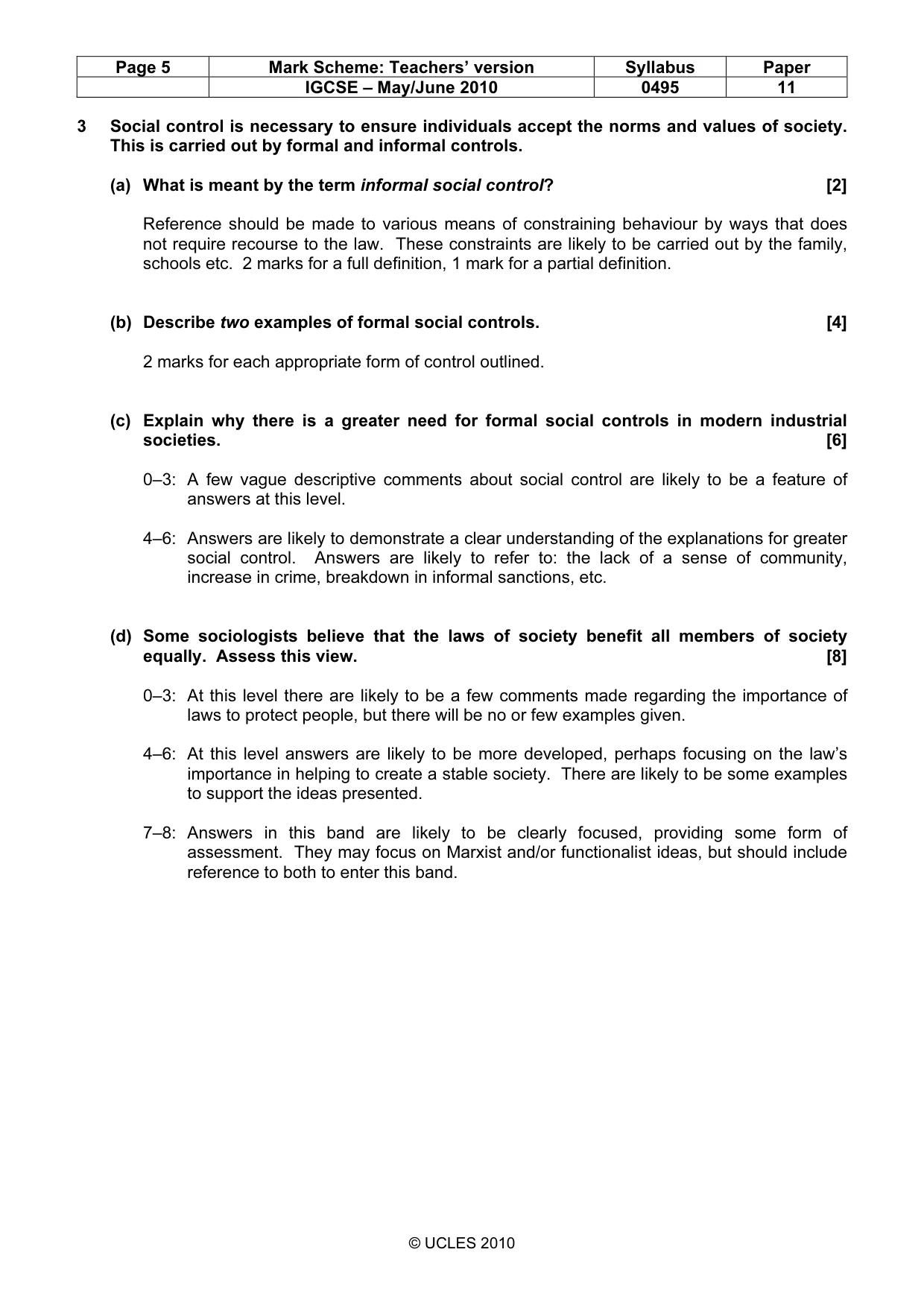
Page 5 Mark Scheme: Teachers’ version Syllabus Paper IGCSE – May/June 2010 0495 11 © UCLES 2010 3 Social control is necessary to ensure individuals accept the norms and values of society. This is carried out by formal and informal controls. (a) What is meant by the term informal social control? [2] Reference should be made to various means of constraining behaviour by ways that does not require recourse to the law. These constraints are likely to be carried out by the family, schools etc. 2 marks for a full definition, 1 mark for a partial definition. (b) Describe two examples of formal social controls. [4] 2 marks for each appropriate form of control outlined. (c) Explain why there is a greater need for formal social controls in modern industrial societies. [6] 0–3: A few vague descriptive comments about social control are likely to be a feature of answers at this level. 4–6: Answers are likely to demonstrate a clear understanding of the explanations for greater social control. Answers are likely to refer to: the lack of a sense of community, increase in crime, breakdown in informal sanctions, etc. (d) Some sociologists believe that the laws of society benefit all members of society equally. Assess this view. [8] 0–3: At this level there are likely to be a few comments made regarding the importance of laws to protect people, but there will be no or few examples given. 4–6: At this level answers are likely to be more developed, perhaps focusing on the law’s importance in helping to create a stable society. There are likely to be some examples to support the ideas presented. 7–8: Answers in this band are likely to be clearly focused, providing some form of assessment. They may focus on Marxist and/or functionalist ideas, but should include reference to both to enter this band.
Mark scheme, page 6
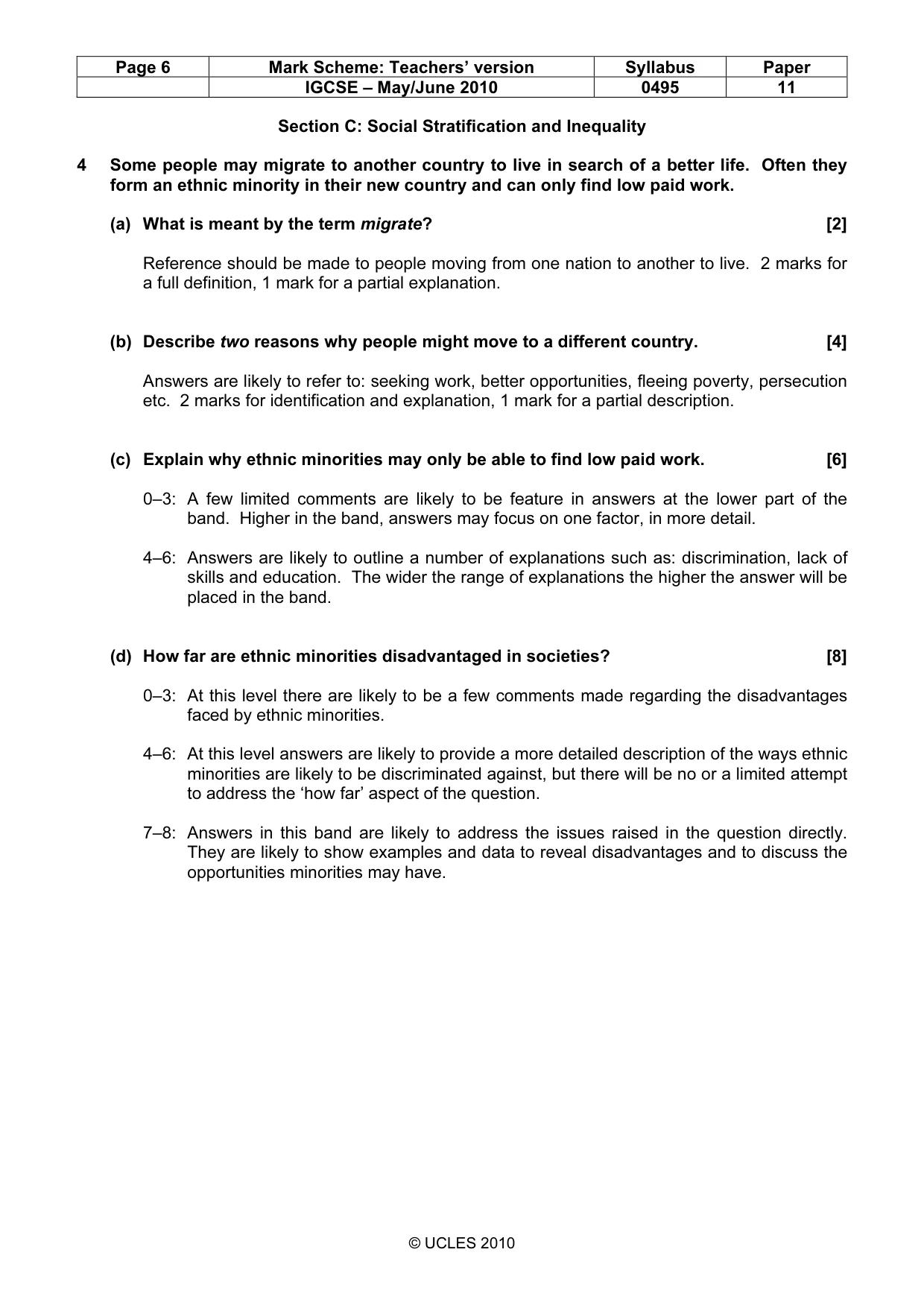
Page 6 Mark Scheme: Teachers’ version Syllabus Paper IGCSE – May/June 2010 0495 11 © UCLES 2010 Section C: Social Stratification and Inequality 4 Some people may migrate to another country to live in search of a better life. Often they form an ethnic minority in their new country and can only find low paid work. (a) What is meant by the term migrate? [2] Reference should be made to people moving from one nation to another to live. 2 marks for a full definition, 1 mark for a partial explanation. (b) Describe two reasons why people might move to a different country. [4] Answers are likely to refer to: seeking work, better opportunities, fleeing poverty, persecution etc. 2 marks for identification and explanation, 1 mark for a partial description. (c) Explain why ethnic minorities may only be able to find low paid work. [6] 0–3: A few limited comments are likely to be feature in answers at the lower part of the band. Higher in the band, answers may focus on one factor, in more detail. 4–6: Answers are likely to outline a number of explanations such as: discrimination, lack of skills and education. The wider the range of explanations the higher the answer will be placed in the band. (d) How far are ethnic minorities disadvantaged in societies? [8] 0–3: At this level there are likely to be a few comments made regarding the disadvantages faced by ethnic minorities. 4–6: At this level answers are likely to provide a more detailed description of the ways ethnic minorities are likely to be discriminated against, but there will be no or a limited attempt to address the ‘how far’ aspect of the question. 7–8: Answers in this band are likely to address the issues raised in the question directly. They are likely to show examples and data to reveal disadvantages and to discuss the opportunities minorities may have.
Mark scheme, page 7
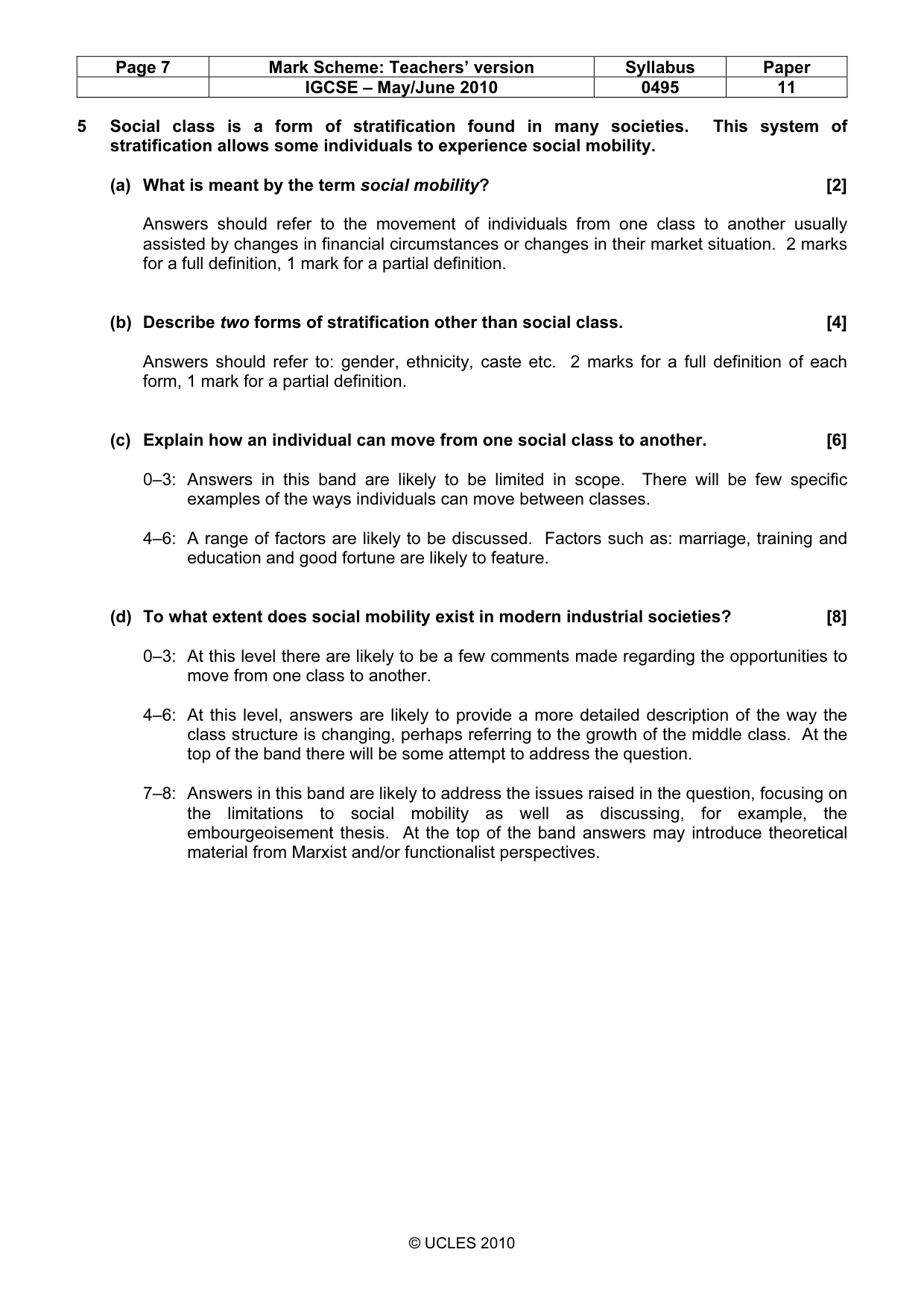
Page 7 Mark Scheme: Teachers’ version Syllabus Paper IGCSE – May/June 2010 0495 11 © UCLES 2010 5 Social class is a form of stratification found in many societies. This system of stratification allows some individuals to experience social mobility. (a) What is meant by the term social mobility? [2] Answers should refer to the movement of individuals from one class to another usually assisted by changes in financial circumstances or changes in their market situation. 2 marks for a full definition, 1 mark for a partial definition. (b) Describe two forms of stratification other than social class. [4] Answers should refer to: gender, ethnicity, caste etc. 2 marks for a full definition of each form, 1 mark for a partial definition. (c) Explain how an individual can move from one social class to another. [6] 0–3: Answers in this band are likely to be limited in scope. There will be few specific examples of the ways individuals can move between classes. 4–6: A range of factors are likely to be discussed. Factors such as: marriage, training and education and good fortune are likely to feature. (d) To what extent does social mobility exist in modern industrial societies? [8] 0–3: At this level there are likely to be a few comments made regarding the opportunities to move from one class to another. 4–6: At this level, answers are likely to provide a more detailed description of the way the class structure is changing, perhaps referring to the growth of the middle class. At the top of the band there will be some attempt to address the question. 7–8: Answers in this band are likely to address the issues raised in the question, focusing on the limitations to social mobility as well as discussing, for example, the embourgeoisement thesis. At the top of the band answers may introduce theoretical material from Marxist and/or functionalist perspectives.
Mark scheme, page 8
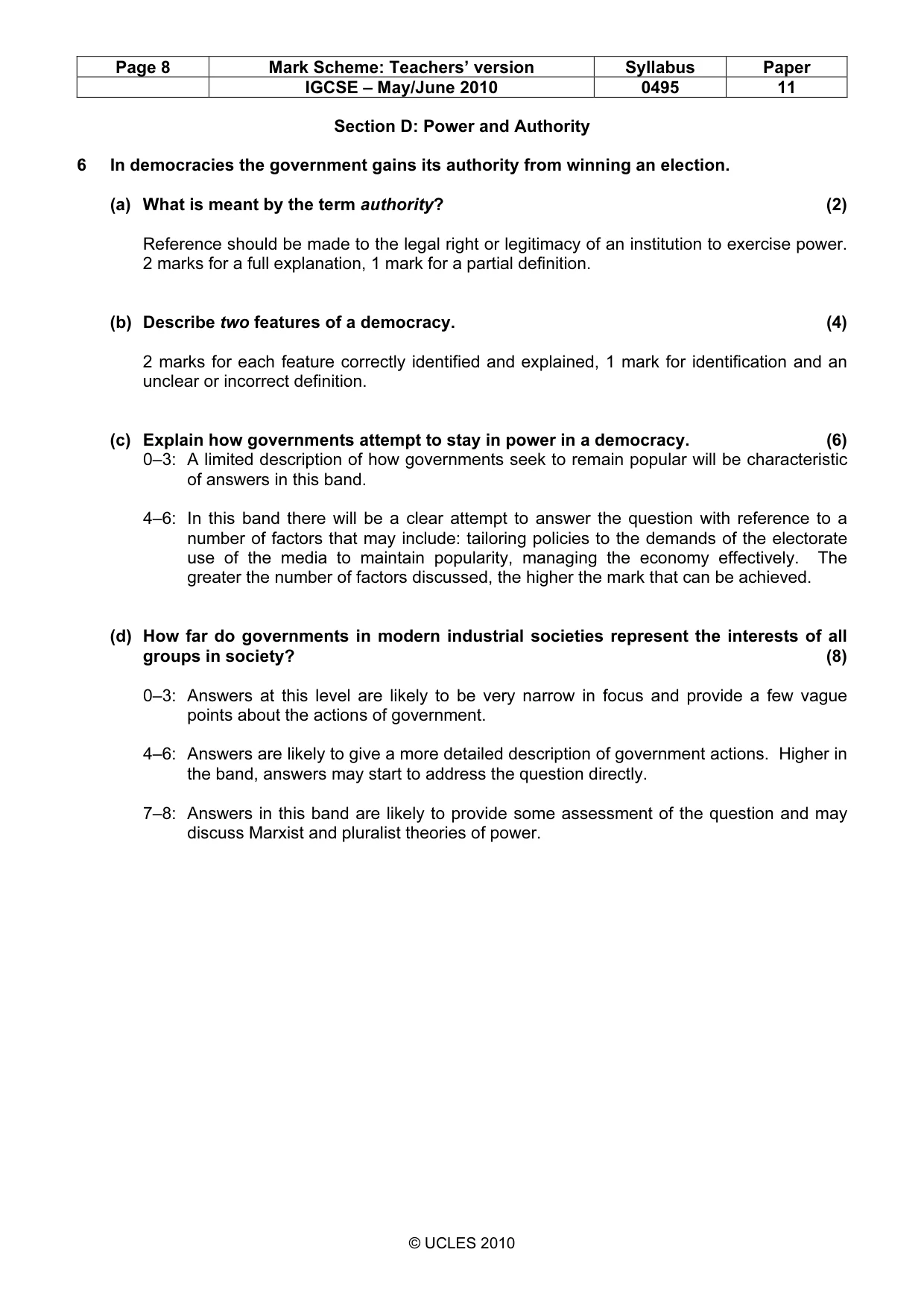
Page 8 Mark Scheme: Teachers’ version Syllabus Paper IGCSE – May/June 2010 0495 11 © UCLES 2010 Section D: Power and Authority 6 In democracies the government gains its authority from winning an election. (a) What is meant by the term authority? (2) Reference should be made to the legal right or legitimacy of an institution to exercise power. 2 marks for a full explanation, 1 mark for a partial definition. (b) Describe two features of a democracy. (4) 2 marks for each feature correctly identified and explained, 1 mark for identification and an unclear or incorrect definition. (c) Explain how governments attempt to stay in power in a democracy. (6) 0–3: A limited description of how governments seek to remain popular will be characteristic of answers in this band. 4–6: In this band there will be a clear attempt to answer the question with reference to a number of factors that may include: tailoring policies to the demands of the electorate use of the media to maintain popularity, managing the economy effectively. The greater the number of factors discussed, the higher the mark that can be achieved. (d) How far do governments in modern industrial societies represent the interests of all groups in society? (8) 0–3: Answers at this level are likely to be very narrow in focus and provide a few vague points about the actions of government. 4–6: Answers are likely to give a more detailed description of government actions. Higher in the band, answers may start to address the question directly. 7–8: Answers in this band are likely to provide some assessment of the question and may discuss Marxist and pluralist theories of power.
Mark scheme, page 9
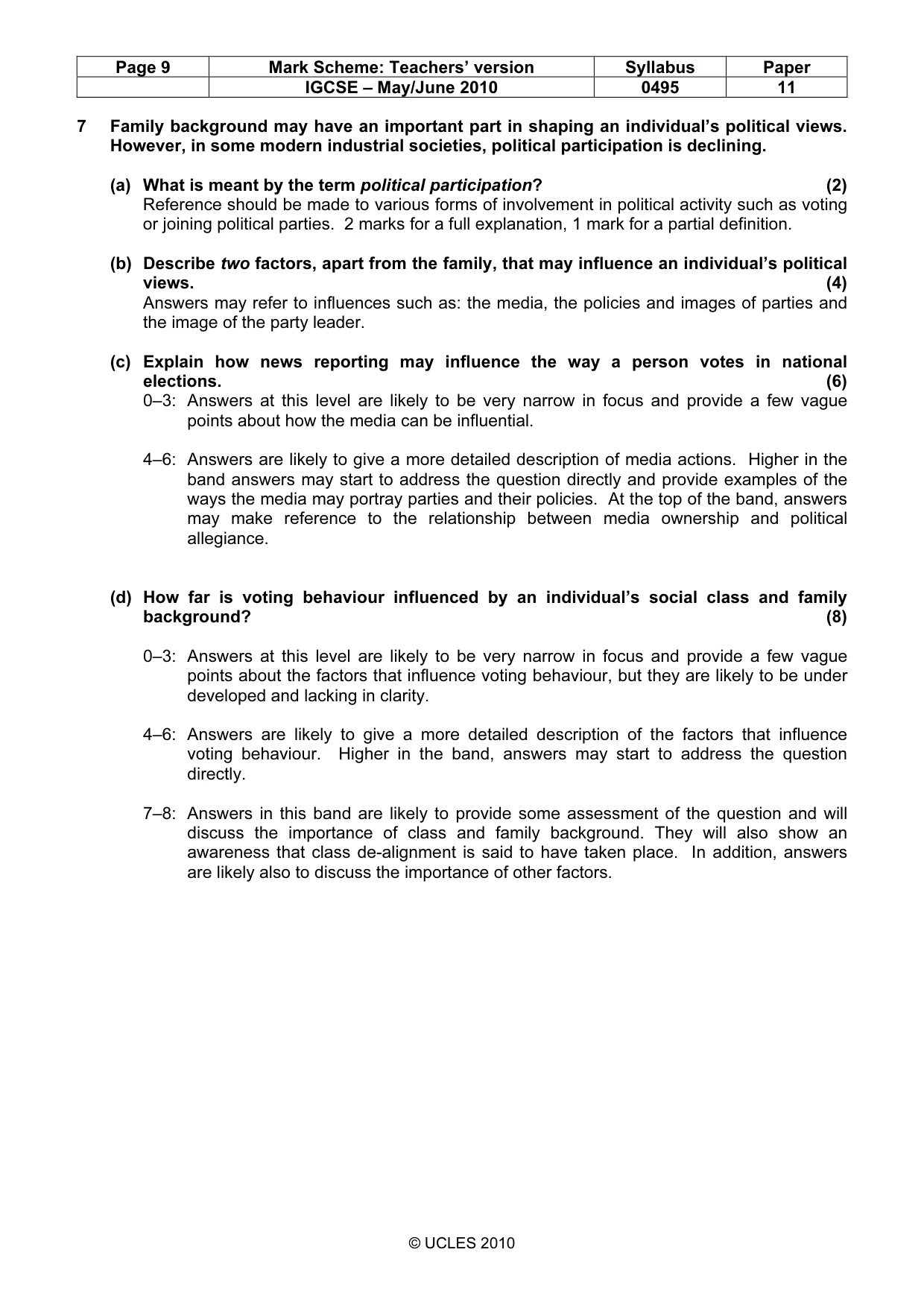
Page 9 Mark Scheme: Teachers’ version Syllabus Paper IGCSE – May/June 2010 0495 11 © UCLES 2010 7 Family background may have an important part in shaping an individual’s political views. However, in some modern industrial societies, political participation is declining. (a) What is meant by the term political participation? (2) Reference should be made to various forms of involvement in political activity such as voting or joining political parties. 2 marks for a full explanation, 1 mark for a partial definition. (b) Describe two factors, apart from the family, that may influence an individual’s political views. (4) Answers may refer to influences such as: the media, the policies and images of parties and the image of the party leader. (c) Explain how news reporting may influence the way a person votes in national elections. (6) 0–3: Answers at this level are likely to be very narrow in focus and provide a few vague points about how the media can be influential. 4–6: Answers are likely to give a more detailed description of media actions. Higher in the band answers may start to address the question directly and provide examples of the ways the media may portray parties and their policies. At the top of the band, answers may make reference to the relationship between media ownership and political allegiance. (d) How far is voting behaviour influenced by an individual’s social class and family background? (8) 0–3: Answers at this level are likely to be very narrow in focus and provide a few vague points about the factors that influence voting behaviour, but they are likely to be under developed and lacking in clarity. 4–6: Answers are likely to give a more detailed description of the factors that influence voting behaviour. Higher in the band, answers may start to address the question directly. 7–8: Answers in this band are likely to provide some assessment of the question and will discuss the importance of class and family background. They will also show an awareness that class de-alignment is said to have taken place. In addition, answers are likely also to discuss the importance of other factors.
What you needed in this session
Cambridge’s own grade thresholds for 2010 May/June, Paper 1 · Variant 1. A higher threshold means an easier paper — the bar moves with how the cohort did.