Cambridge IGCSE Sciences - Co-ordinated (Double) 0654 — 2024 May/June Paper 4 · Variant 1
0654/41/M/J/24 · 120 marks · ≈135 min
The question paper and its mark scheme, free to read here and free to download. This is Cambridge’s own paper, exactly as it was sat.
Question paper28 pages



Mark scheme13 pages
Answers below. Sit the paper first if you are practising.
Paper as text
Question paper, page 1
This document has 28 pages. Any blank pages are indicated. [Turn over Cambridge IGCSE™ CO-ORDINATED SCIENCES 0654/41 Paper 4 Theory (Extended) May/June 2024 2 hours You must answer on the question paper. No additional materials are needed. INSTRUCTIONS ● Answer all questions. ● Use a black or dark blue pen. You may use an HB pencil for any diagrams or graphs. ● Write your name, centre number and candidate number in the boxes at the top of the page. ● Write your answer to each question in the space provided. ● Do not use an erasable pen or correction fluid. ● Do not write on any bar codes. ● You may use a calculator. ● You should show all your working and use appropriate units. INFORMATION ● The total mark for this paper is 120. ● The number of marks for each question or part question is shown in brackets [ ]. ● The Periodic Table is printed in the question paper. * 3 7 2 6 5 7 5 3 6 7 * DC (PB/CB) 331166/2 © UCLES 2024
Question paper, page 2
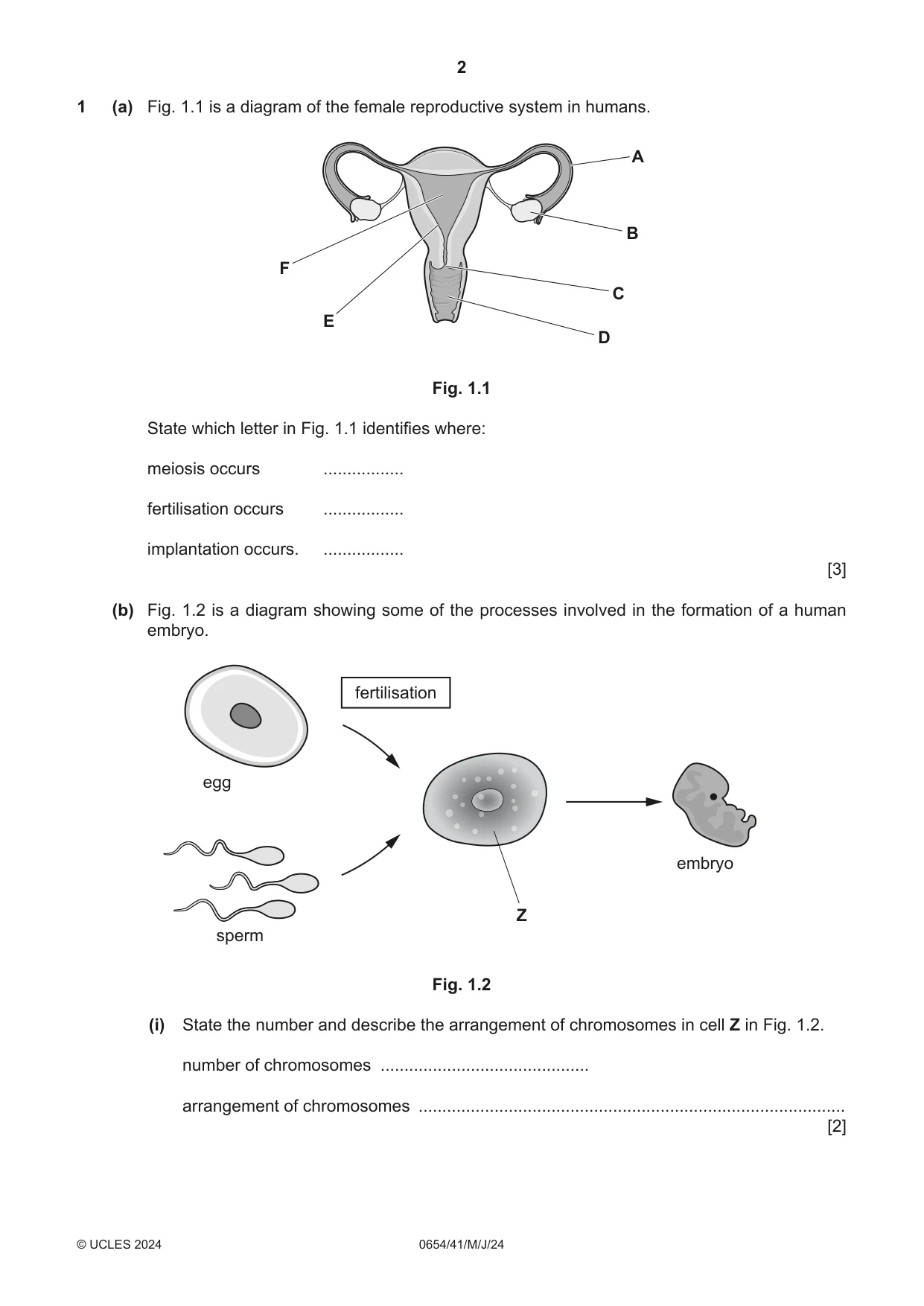
2 0654/41/ M/J/24 © UCLES 2024 1 (a) Fig. 1.1 is a diagram of the female reproductive system in humans. A B C D E F Fig. 1.1 State which letter in Fig. 1.1 identifies where: meiosis occurs … fertilisation occurs … implantation occurs. … [3] (b) Fig. 1.2 is a diagram showing some of the processes involved in the formation of a human embryo. sperm fertilisation Z egg embryo Fig. 1.2 (i) State the number and describe the arrangement of chromosomes in cell Z in Fig. 1.2. number of chromosomes … arrangement of chromosomes … [2]
Question paper, page 3
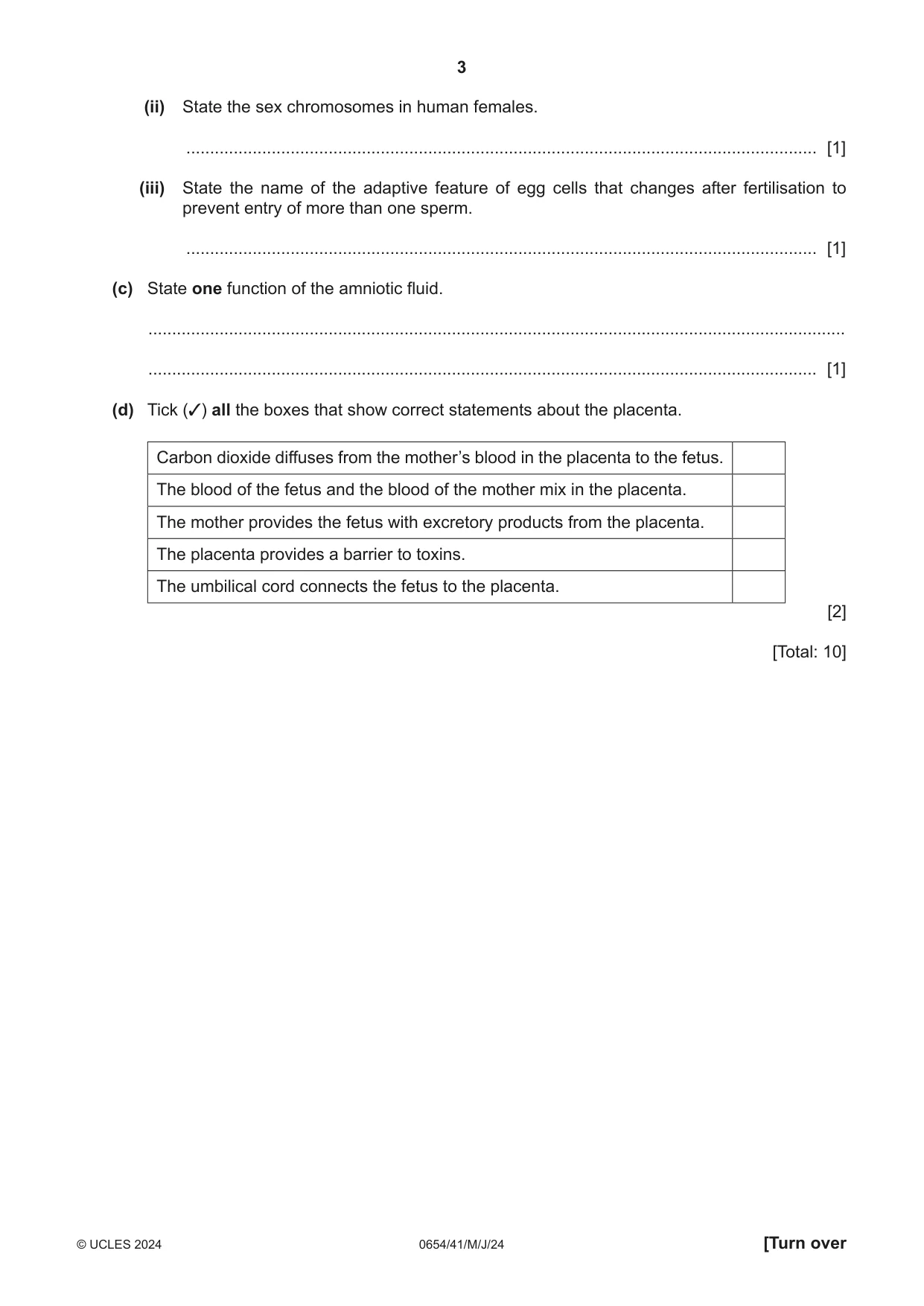
3 0654/41/M/J/24 © UCLES 2024 [Turn over (ii) State the sex chromosomes in human females. … [1] (iii) State the name of the adaptive feature of egg cells that changes after fertilisation to prevent entry of more than one sperm. … [1] (c) State one function of the amniotic fluid. … … [1] (d) Tick (✓) all the boxes that show correct statements about the placenta. Carbon dioxide diffuses from the mother’s blood in the placenta to the fetus. The blood of the fetus and the blood of the mother mix in the placenta. The mother provides the fetus with excretory products from the placenta. The placenta provides a barrier to toxins. The umbilical cord connects the fetus to the placenta. [2] [Total: 10]
Question paper, page 4
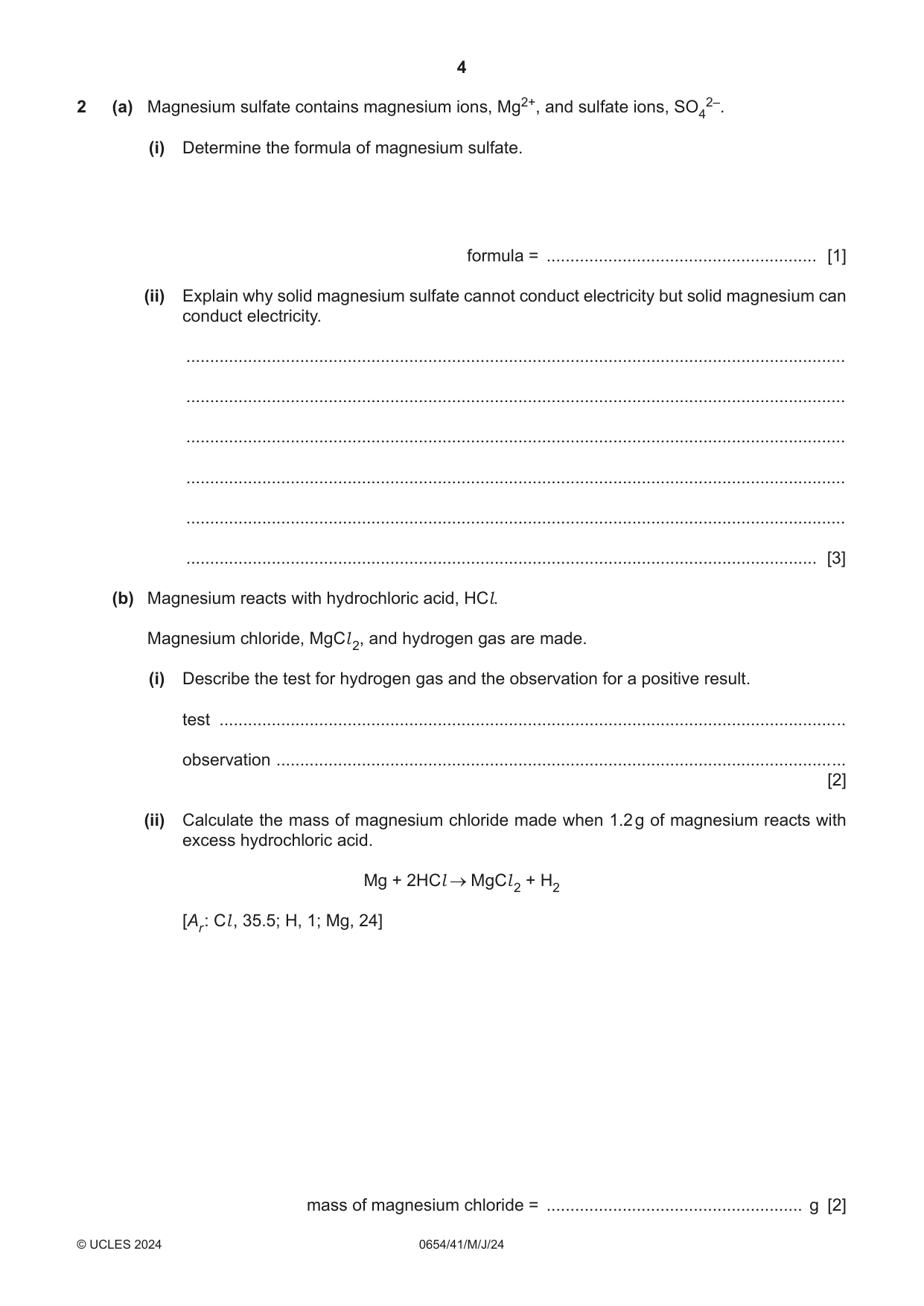
4 0654/41/M/J/24 © UCLES 2024 2 (a) Magnesium sulfate contains magnesium ions, Mg2+, and sulfate ions, SO4 2–. (i) Determine the formula of magnesium sulfate. formula = … [1] (ii) Explain why solid magnesium sulfate cannot conduct electricity but solid magnesium can conduct electricity. … … … … … … [3] (b) Magnesium reacts with hydrochloric acid, HCl. Magnesium chloride, MgCl 2, and hydrogen gas are made. (i) Describe the test for hydrogen gas and the observation for a positive result. test … observation … [2] (ii) Calculate the mass of magnesium chloride made when 1.2 g of magnesium reacts with excess hydrochloric acid. Mg + 2HCl MgCl 2 + H2 [Ar : Cl , 35.5; H, 1; Mg, 24] mass of magnesium chloride = … g [2]
Question paper, page 5
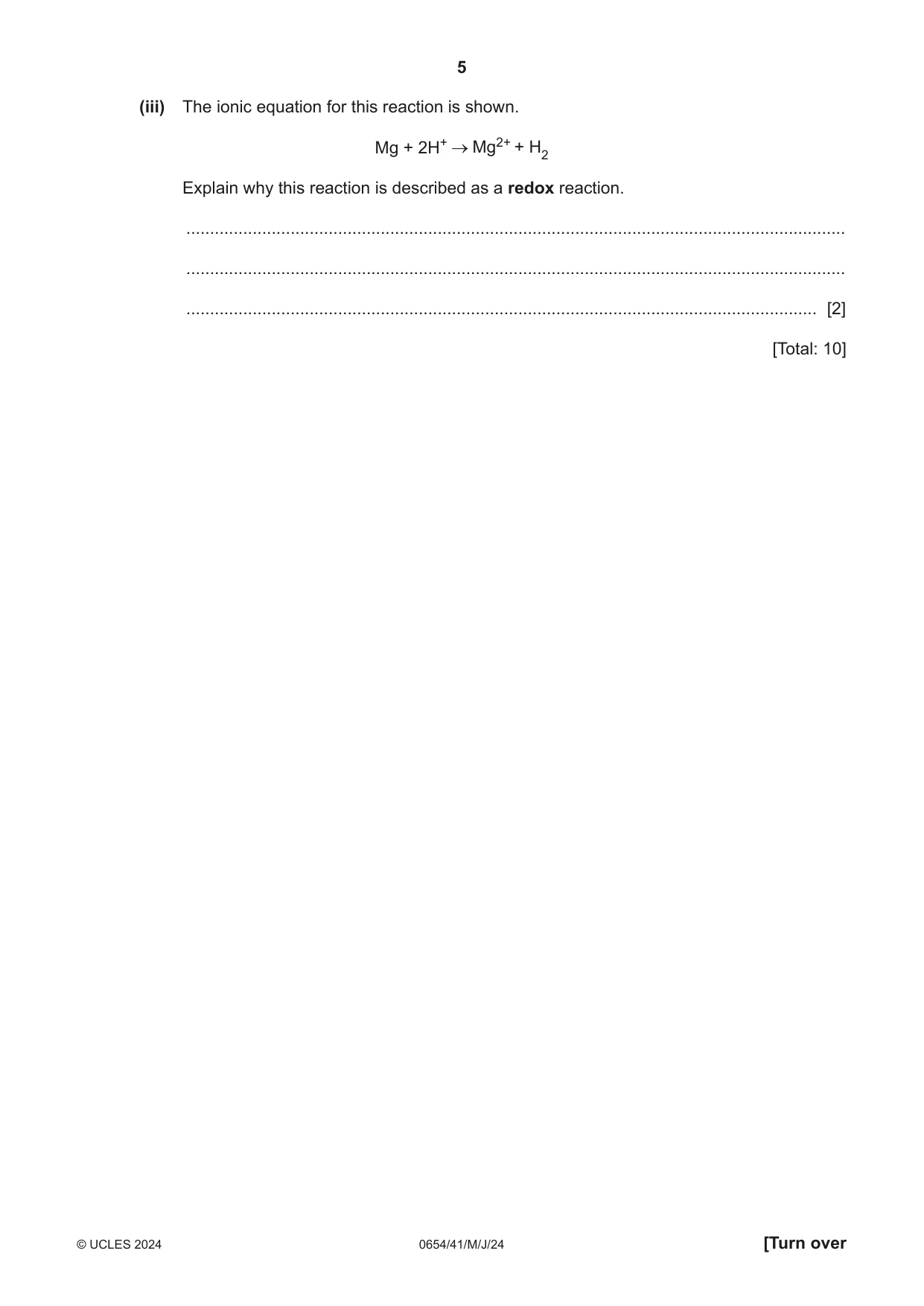
5 0654/41/M/J/24 © UCLES 2024 [Turn over (iii) The ionic equation for this reaction is shown. Mg + 2H+ Mg2+ + H2 Explain why this reaction is described as a redox reaction. … … … [2] [Total: 10]
Question paper, page 6
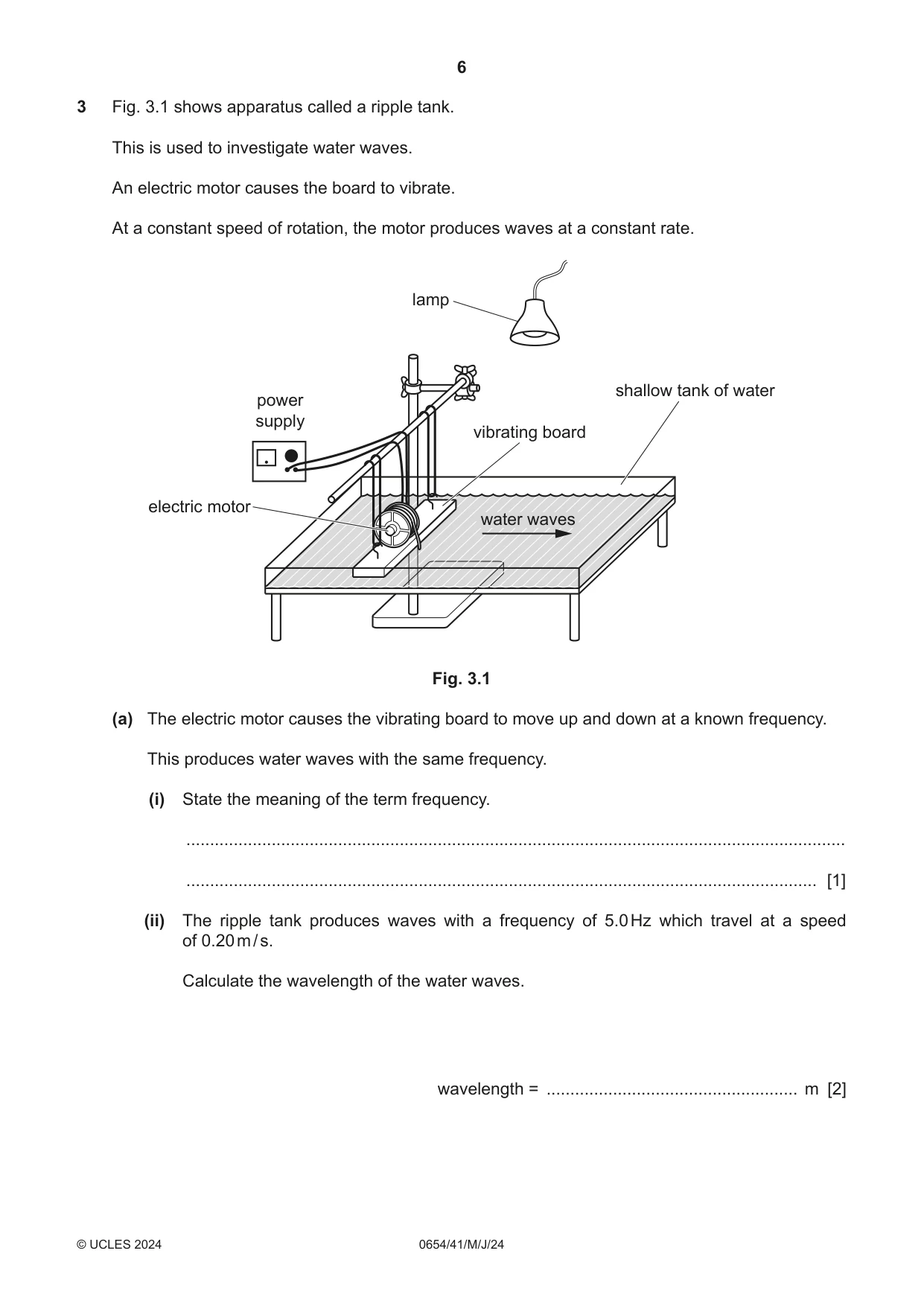
6 0654/41/M/J/24 © UCLES 2024 3 Fig. 3.1 shows apparatus called a ripple tank. This is used to investigate water waves. An electric motor causes the board to vibrate. At a constant speed of rotation, the motor produces waves at a constant rate. shallow tank of water vibrating board water waves power supply electric motor lamp Fig. 3.1 (a) The electric motor causes the vibrating board to move up and down at a known frequency. This produces water waves with the same frequency. (i) State the meaning of the term frequency. … … [1] (ii) The ripple tank produces waves with a frequency of 5.0 Hz which travel at a speed of 0.20 m / s. Calculate the wavelength of the water waves. wavelength = … m [2]
Question paper, page 7
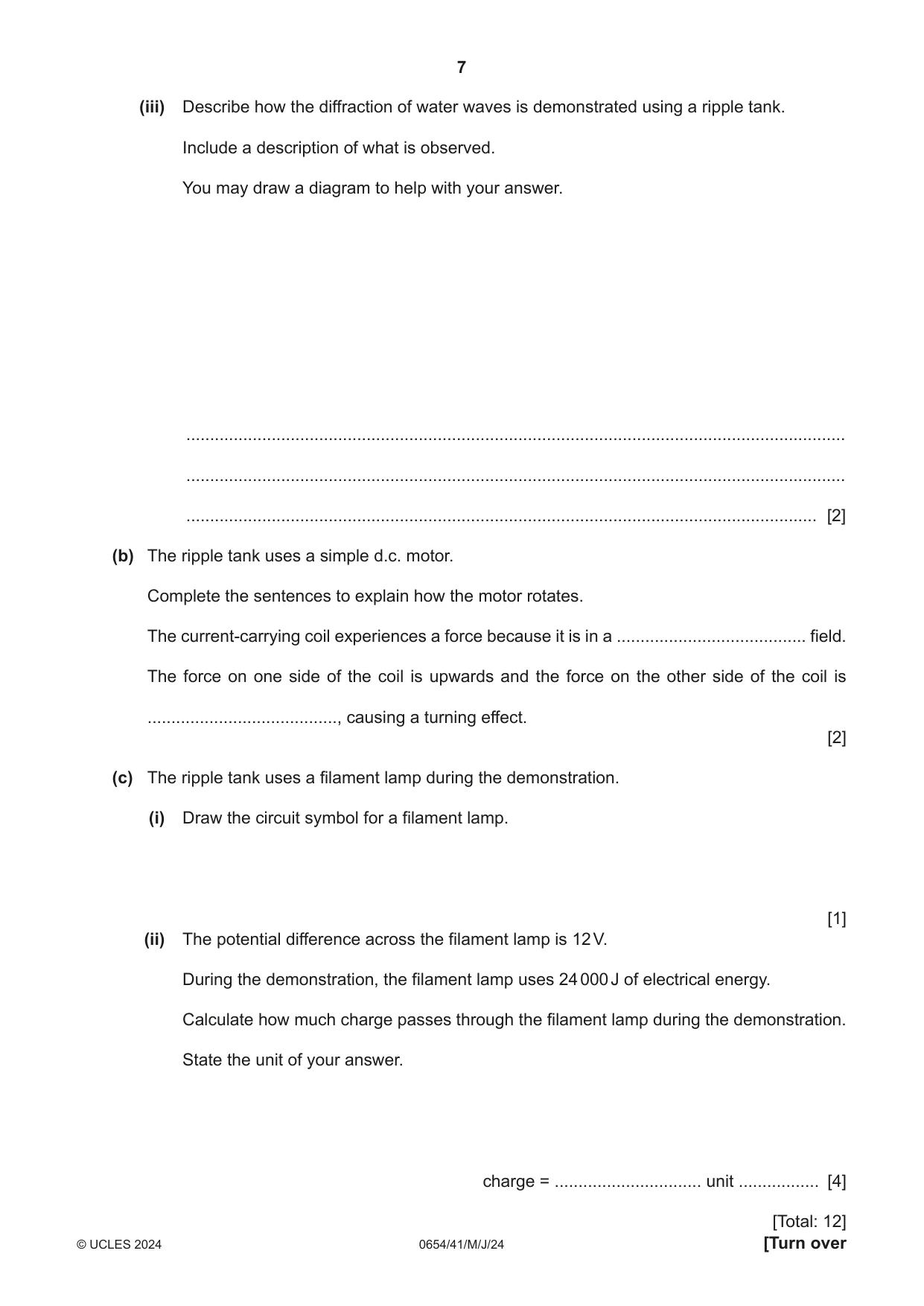
7 0654/41/M/J/24 © UCLES 2024 [Turn over (iii) Describe how the diffraction of water waves is demonstrated using a ripple tank. Include a description of what is observed. You may draw a diagram to help with your answer. … … … [2] (b) The ripple tank uses a simple d.c. motor. Complete the sentences to explain how the motor rotates. The current‑carrying coil experiences a force because it is in a … field. The force on one side of the coil is upwards and the force on the other side of the coil is …, causing a turning effect. [2] (c) The ripple tank uses a filament lamp during the demonstration. (i) Draw the circuit symbol for a filament lamp. [1] (ii) The potential difference across the filament lamp is 12 V. During the demonstration, the filament lamp uses 24 000 J of electrical energy. Calculate how much charge passes through the filament lamp during the demonstration. State the unit of your answer. charge = … unit … [4] [Total: 12]
Question paper, page 8
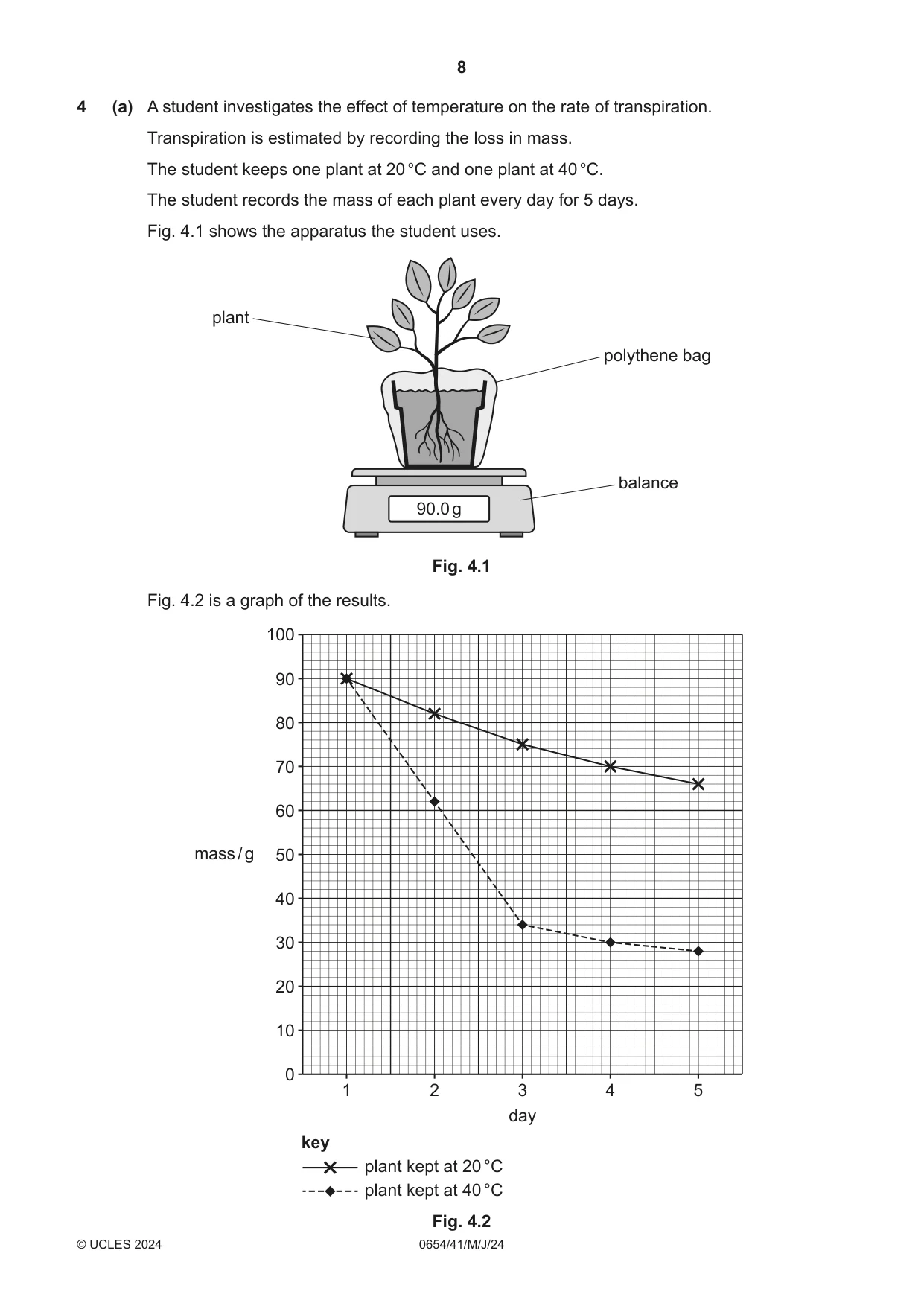
8 0654/41/M/J/24 © UCLES 2024 4 (a) A student investigates the effect of temperature on the rate of transpiration. Transpiration is estimated by recording the loss in mass. The student keeps one plant at 20 °C and one plant at 40 °C. The student records the mass of each plant every day for 5 days. Fig. 4.1 shows the apparatus the student uses. balance polythene bag plant 90.0 g Fig. 4.1 Fig. 4.2 is a graph of the results. 1 0 10 20 30 40 50 mass / g 60 70 80 90 100 2 3 day 4 5 key plant kept at 20 °C plant kept at 40 °C Fig. 4.2
Question paper, page 9
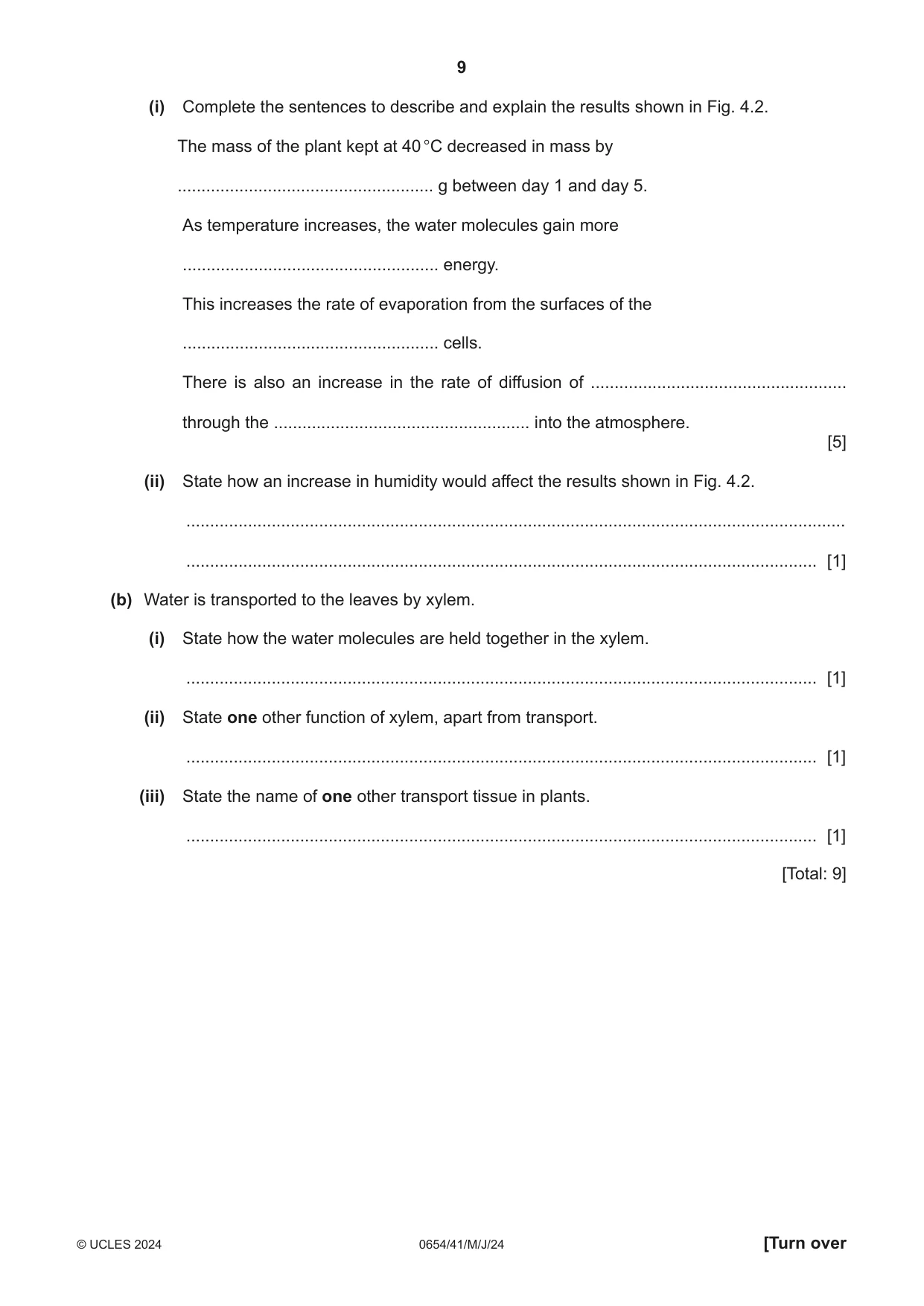
9 0654/41/M/J/24 © UCLES 2024 [Turn over (i) Complete the sentences to describe and explain the results shown in Fig. 4.2. The mass of the plant kept at 40 °C decreased in mass by … g between day 1 and day 5. As temperature increases, the water molecules gain more … energy. This increases the rate of evaporation from the surfaces of the … cells. There is also an increase in the rate of diffusion of … through the … into the atmosphere. [5] (ii) State how an increase in humidity would affect the results shown in Fig. 4.2. … … [1] (b) Water is transported to the leaves by xylem. (i) State how the water molecules are held together in the xylem. … [1] (ii) State one other function of xylem, apart from transport. … [1] (iii) State the name of one other transport tissue in plants. … [1] [Total: 9]
Question paper, page 10
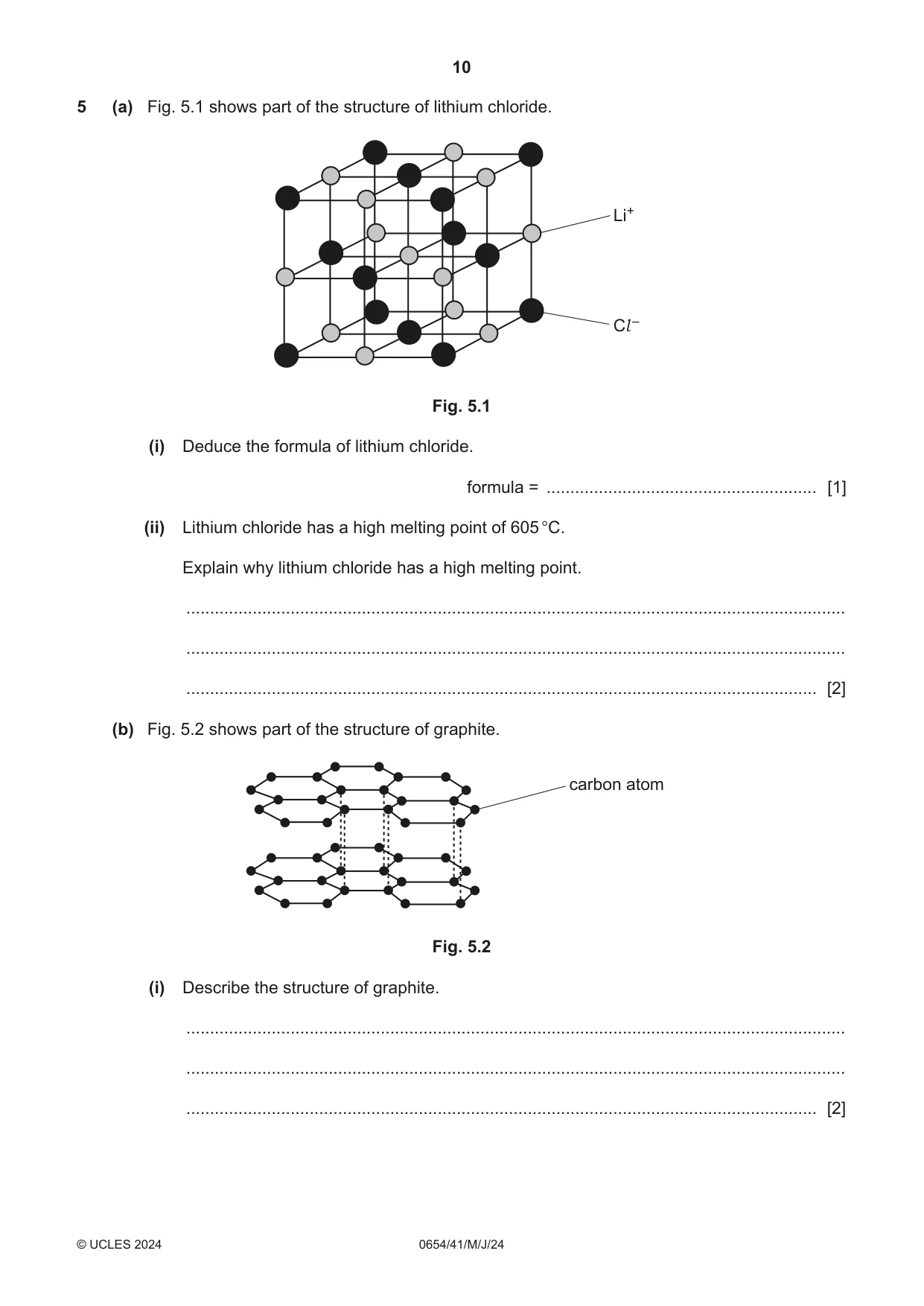
10 0654/41/M/J/24 © UCLES 2024 5 (a) Fig. 5.1 shows part of the structure of lithium chloride. Li+ Cl – Fig. 5.1 (i) Deduce the formula of lithium chloride. formula = … [1] (ii) Lithium chloride has a high melting point of 605 °C. Explain why lithium chloride has a high melting point. … … … [2] (b) Fig. 5.2 shows part of the structure of graphite. carbon atom Fig. 5.2 (i) Describe the structure of graphite. … … … [2]
Question paper, page 11
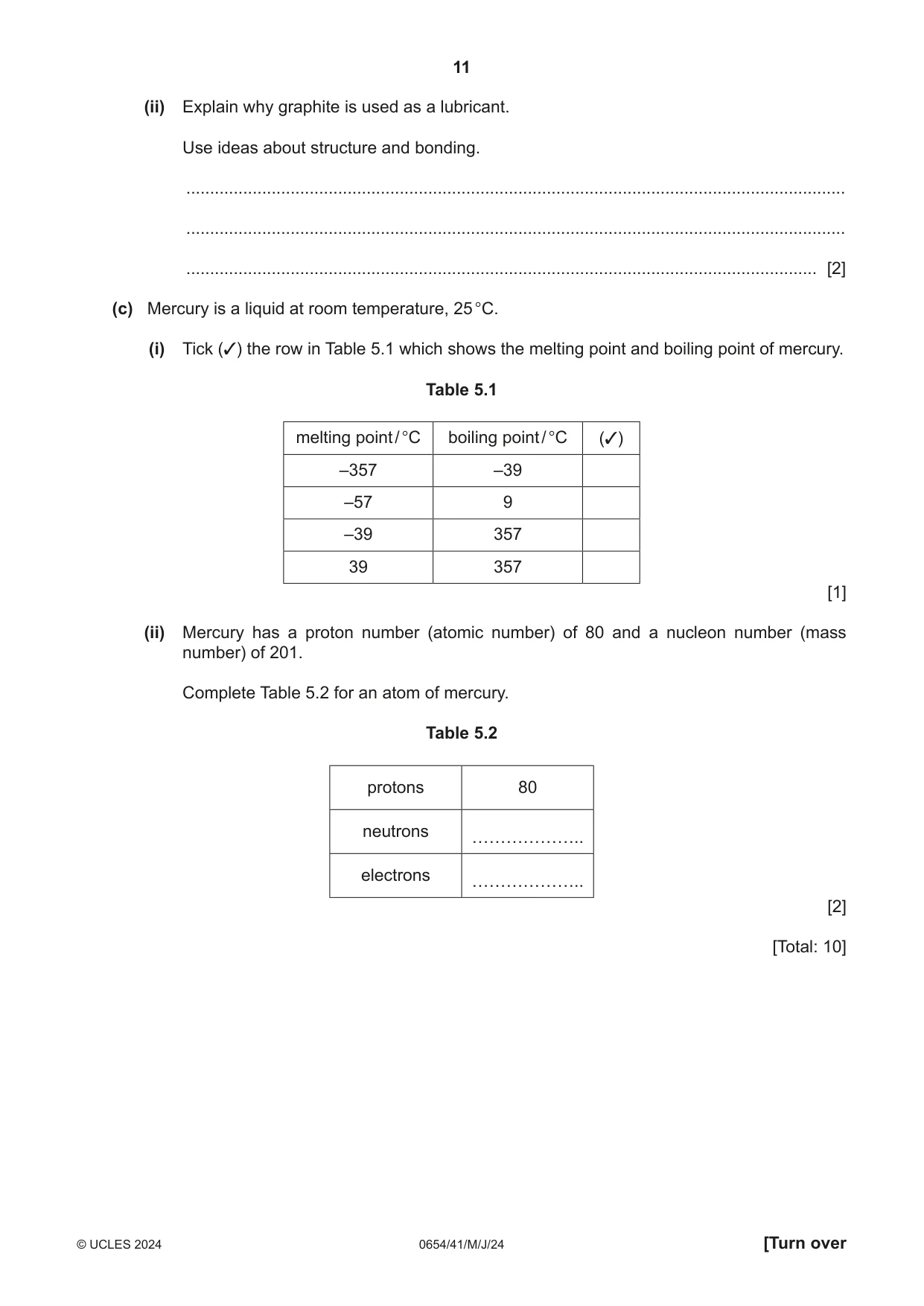
11 0654/41/M/J/24 © UCLES 2024 [Turn over (ii) Explain why graphite is used as a lubricant. Use ideas about structure and bonding. … … … [2] (c) Mercury is a liquid at room temperature, 25 °C. (i) Tick (✓) the row in Table 5.1 which shows the melting point and boiling point of mercury. Table 5.1 melting point / °C boiling point / °C (✓) –357 –39 –57 9 –39 357 39 357 [1] (ii) Mercury has a proton number (atomic number) of 80 and a nucleon number (mass number) of 201. Complete Table 5.2 for an atom of mercury. Table 5.2 protons 80 neutrons ……………….. electrons ……………….. [2] [Total: 10]
Question paper, page 12
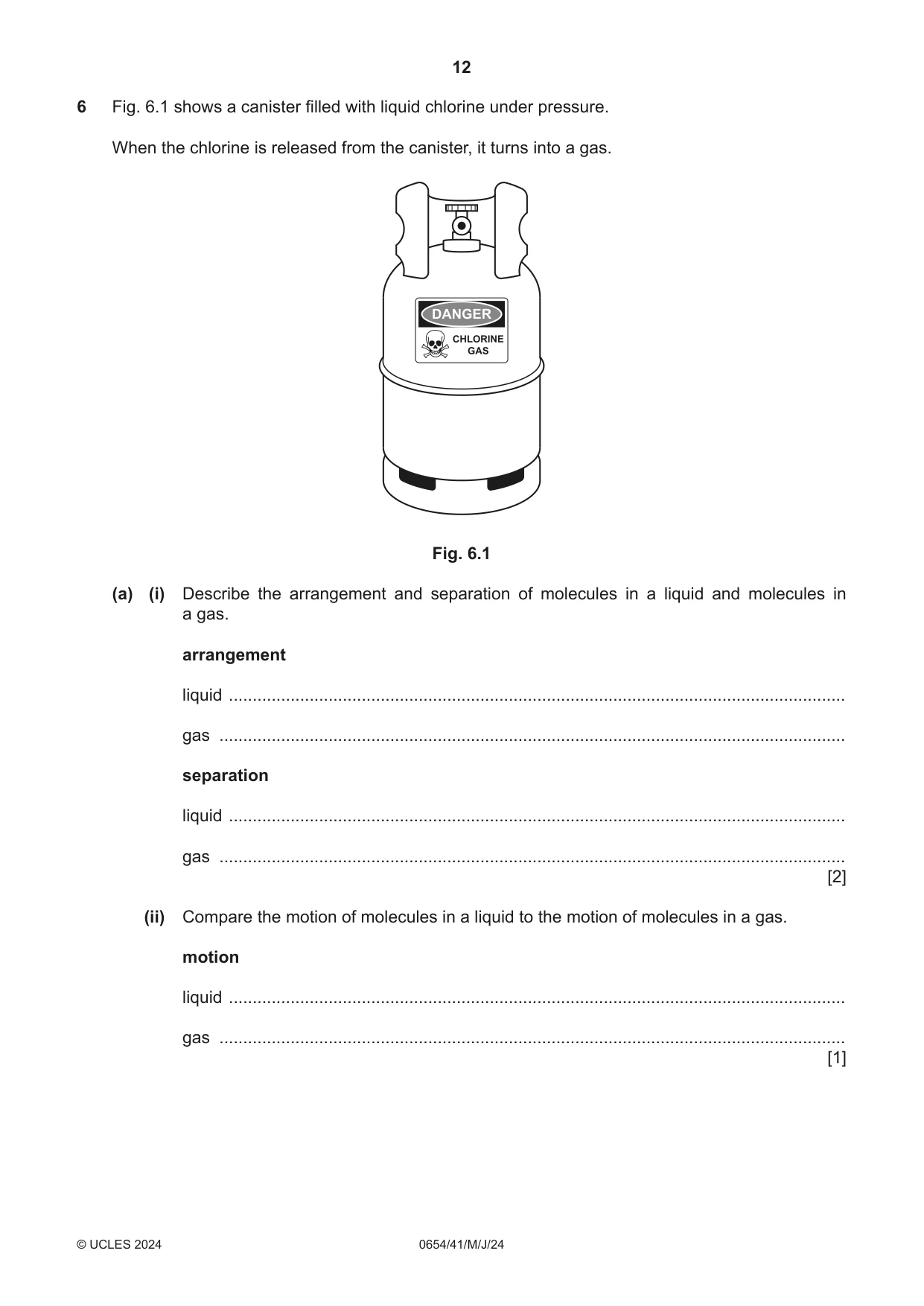
12 0654/41/M/J/24 © UCLES 2024 6 Fig. 6.1 shows a canister filled with liquid chlorine under pressure. When the chlorine is released from the canister, it turns into a gas. Fig. 6.1 (a) (i) Describe the arrangement and separation of molecules in a liquid and molecules in a gas. arrangement liquid … gas … separation liquid … gas … [2] (ii) Compare the motion of molecules in a liquid to the motion of molecules in a gas. motion liquid … gas … [1]
Question paper, page 13
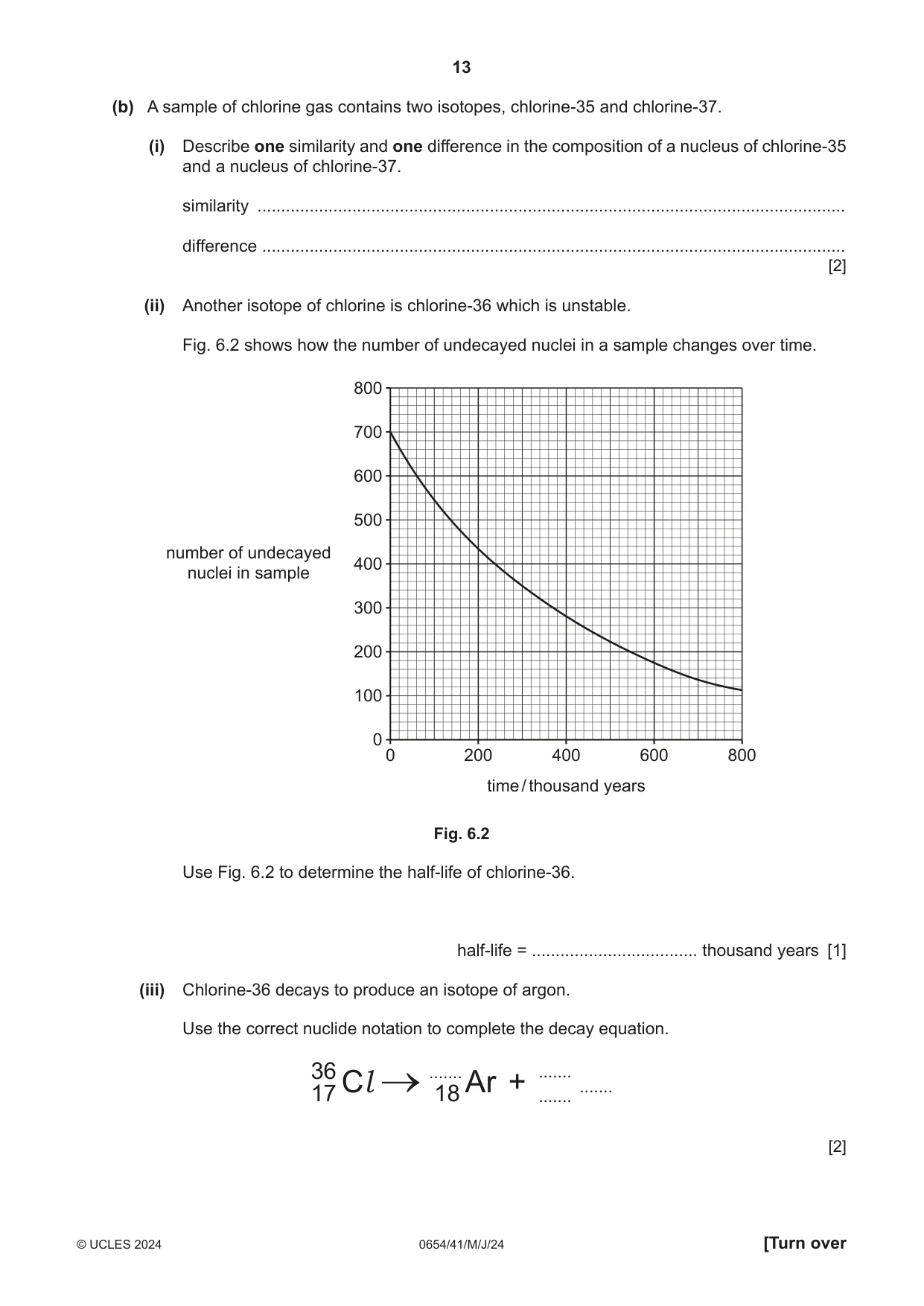
13 0654/41/M/J/24 © UCLES 2024 [Turn over (b) A sample of chlorine gas contains two isotopes, chlorine‑35 and chlorine‑37. (i) Describe one similarity and one difference in the composition of a nucleus of chlorine‑35 and a nucleus of chlorine‑37. similarity … difference … [2] (ii) Another isotope of chlorine is chlorine‑36 which is unstable. Fig. 6.2 shows how the number of undecayed nuclei in a sample changes over time. 0 100 200 300 400 500 600 700 800 0 200 400 time / thousand years number of undecayed nuclei in sample 600 800 Fig. 6.2 Use Fig. 6.2 to determine the half‑life of chlorine‑36. half‑life = … thousand years [1] (iii) Chlorine‑36 decays to produce an isotope of argon. Use the correct nuclide notation to complete the decay equation. 36 17 Cl … 18 Ar + … … … [2]
Question paper, page 14
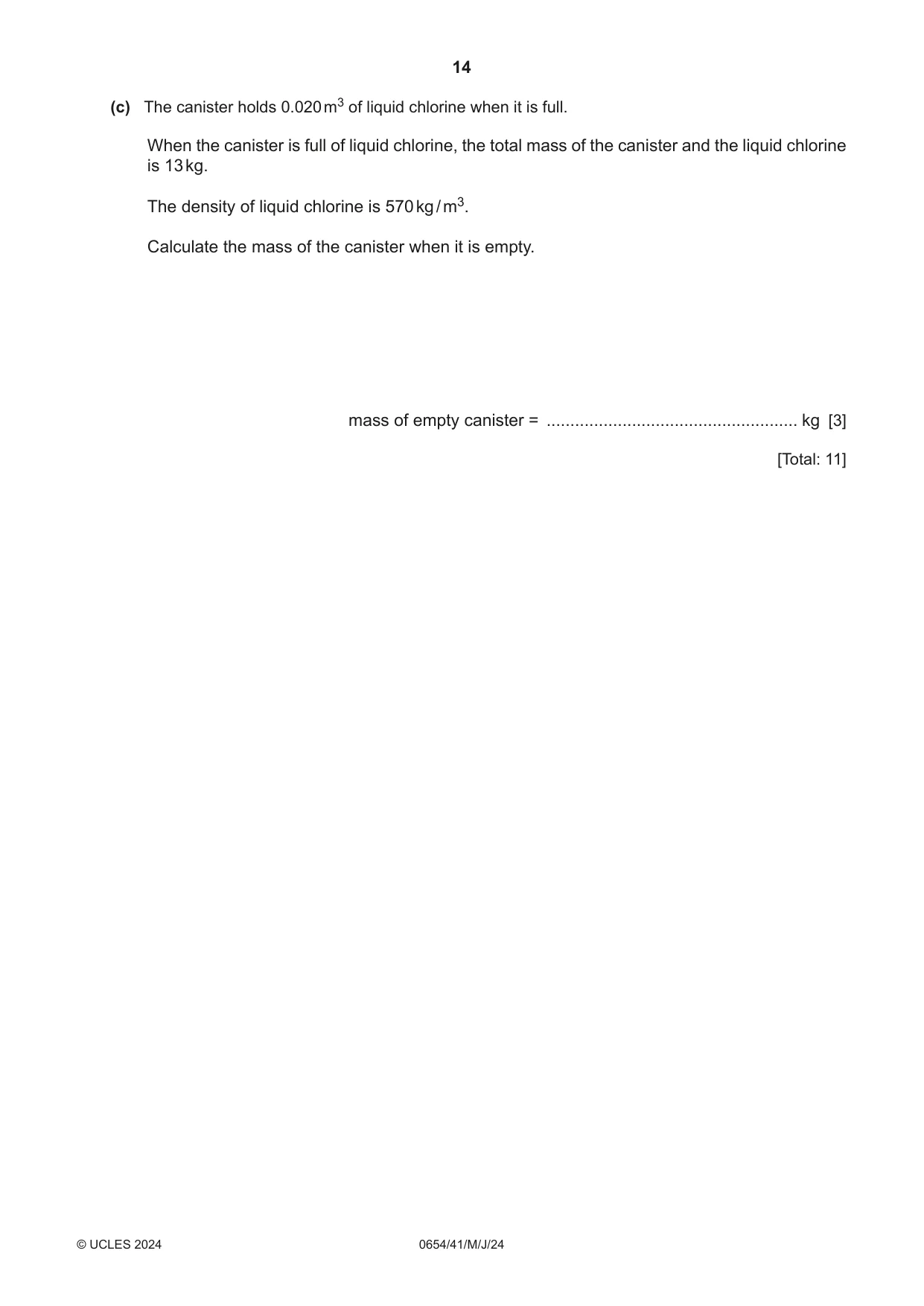
14 0654/41/M/J/24 © UCLES 2024 (c) The canister holds 0.020 m3 of liquid chlorine when it is full. When the canister is full of liquid chlorine, the total mass of the canister and the liquid chlorine is 13 kg. The density of liquid chlorine is 570 kg / m3. Calculate the mass of the canister when it is empty. mass of empty canister = … kg [3] [Total: 11]
Question paper, page 15
15 0654/41/M/J/24 © UCLES 2024 [Turn over BLANK PAGE
Question paper, page 16
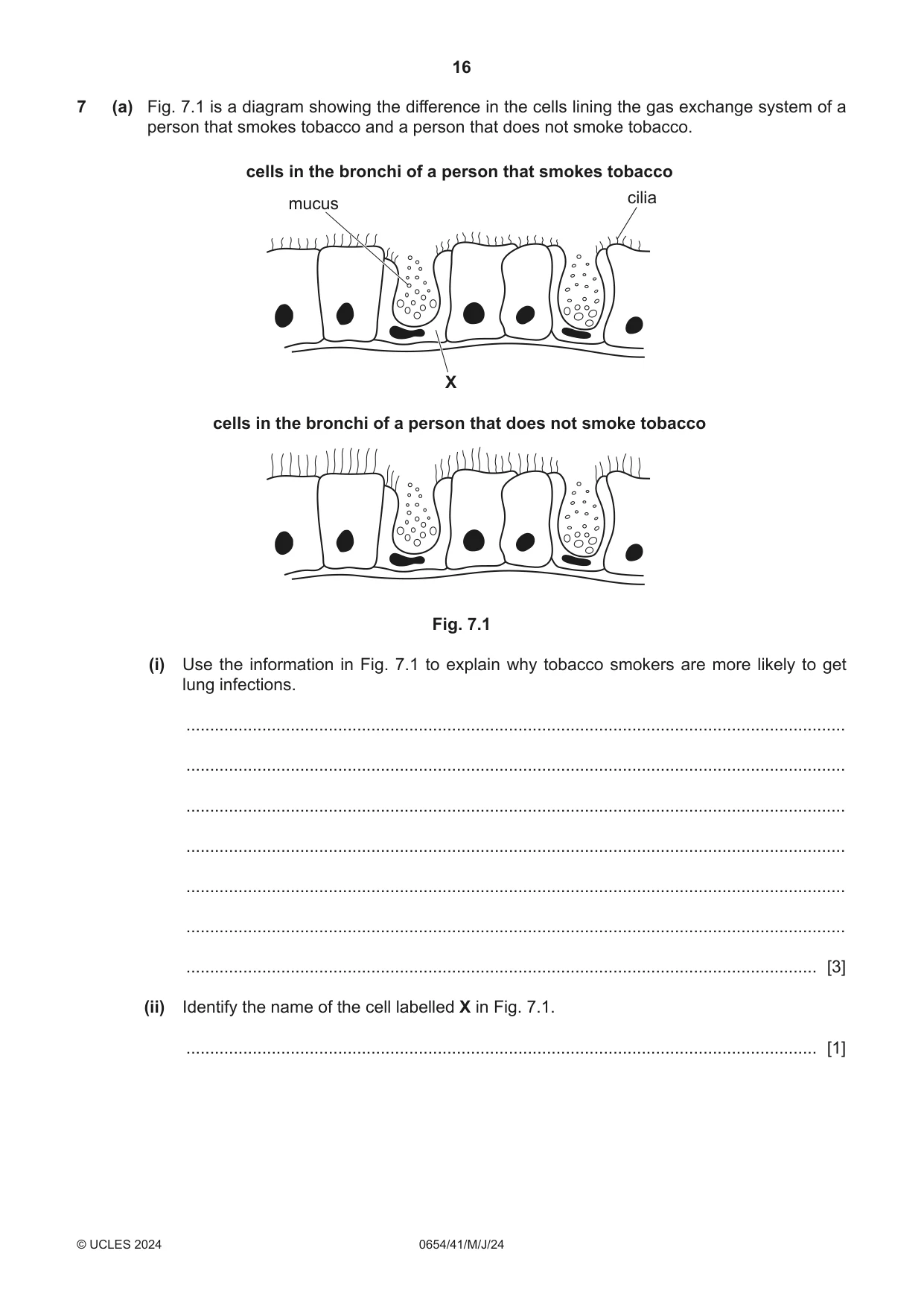
16 0654/41/M/J/24 © UCLES 2024 7 (a) Fig. 7.1 is a diagram showing the difference in the cells lining the gas exchange system of a person that smokes tobacco and a person that does not smoke tobacco. X mucus cells in the bronchi of a person that smokes tobacco cells in the bronchi of a person that does not smoke tobacco cilia Fig. 7.1 (i) Use the information in Fig. 7.1 to explain why tobacco smokers are more likely to get lung infections. … … … … … … … [3] (ii) Identify the name of the cell labelled X in Fig. 7.1. … [1]
Question paper, page 17
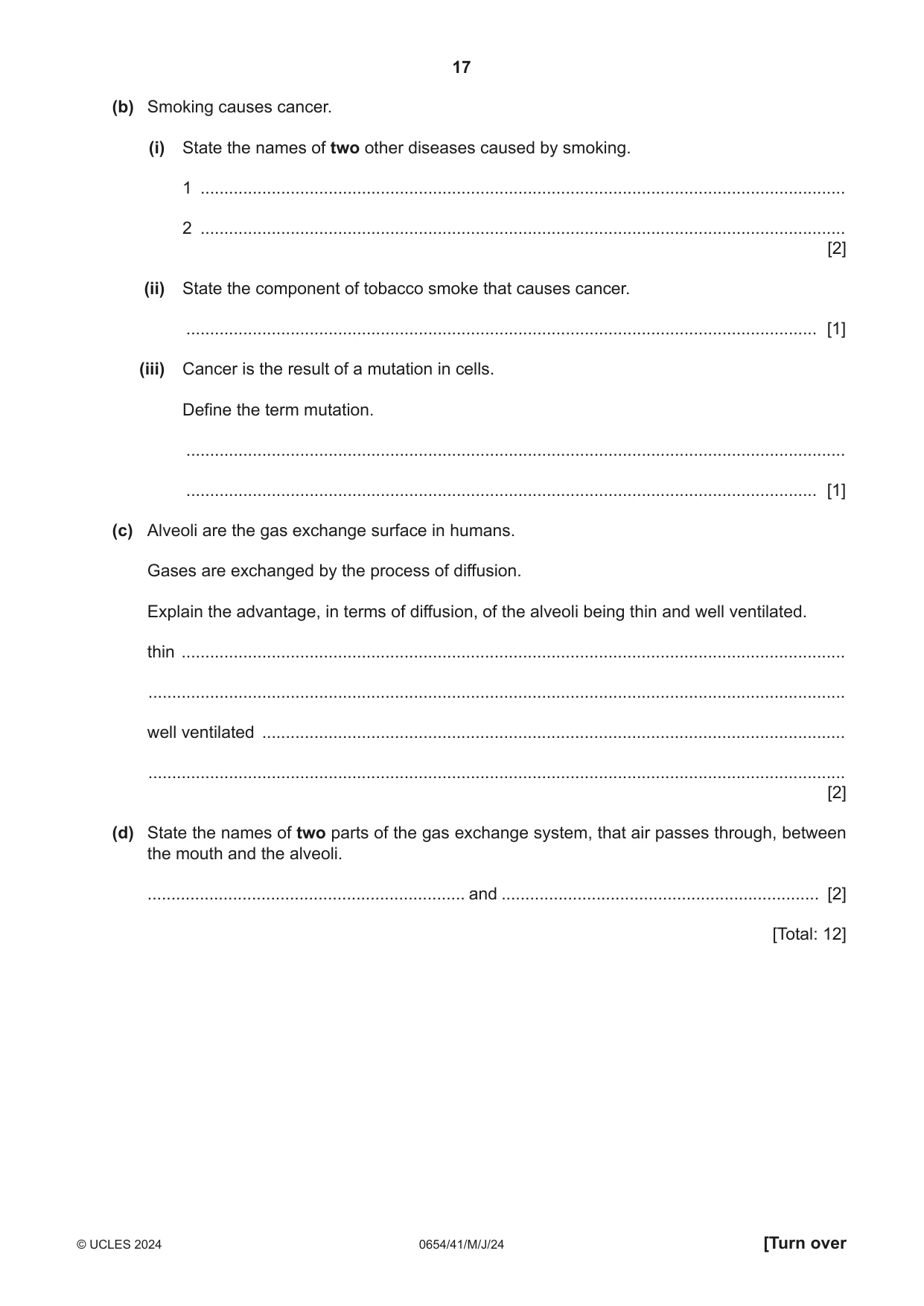
17 0654/41/M/J/24 © UCLES 2024 [Turn over (b) Smoking causes cancer. (i) State the names of two other diseases caused by smoking. 1 … 2 … [2] (ii) State the component of tobacco smoke that causes cancer. … [1] (iii) Cancer is the result of a mutation in cells. Define the term mutation. … … [1] (c) Alveoli are the gas exchange surface in humans. Gases are exchanged by the process of diffusion. Explain the advantage, in terms of diffusion, of the alveoli being thin and well ventilated. thin … … well ventilated … … [2] (d) State the names of two parts of the gas exchange system, that air passes through, between the mouth and the alveoli. … and … [2] [Total: 12]
Question paper, page 18
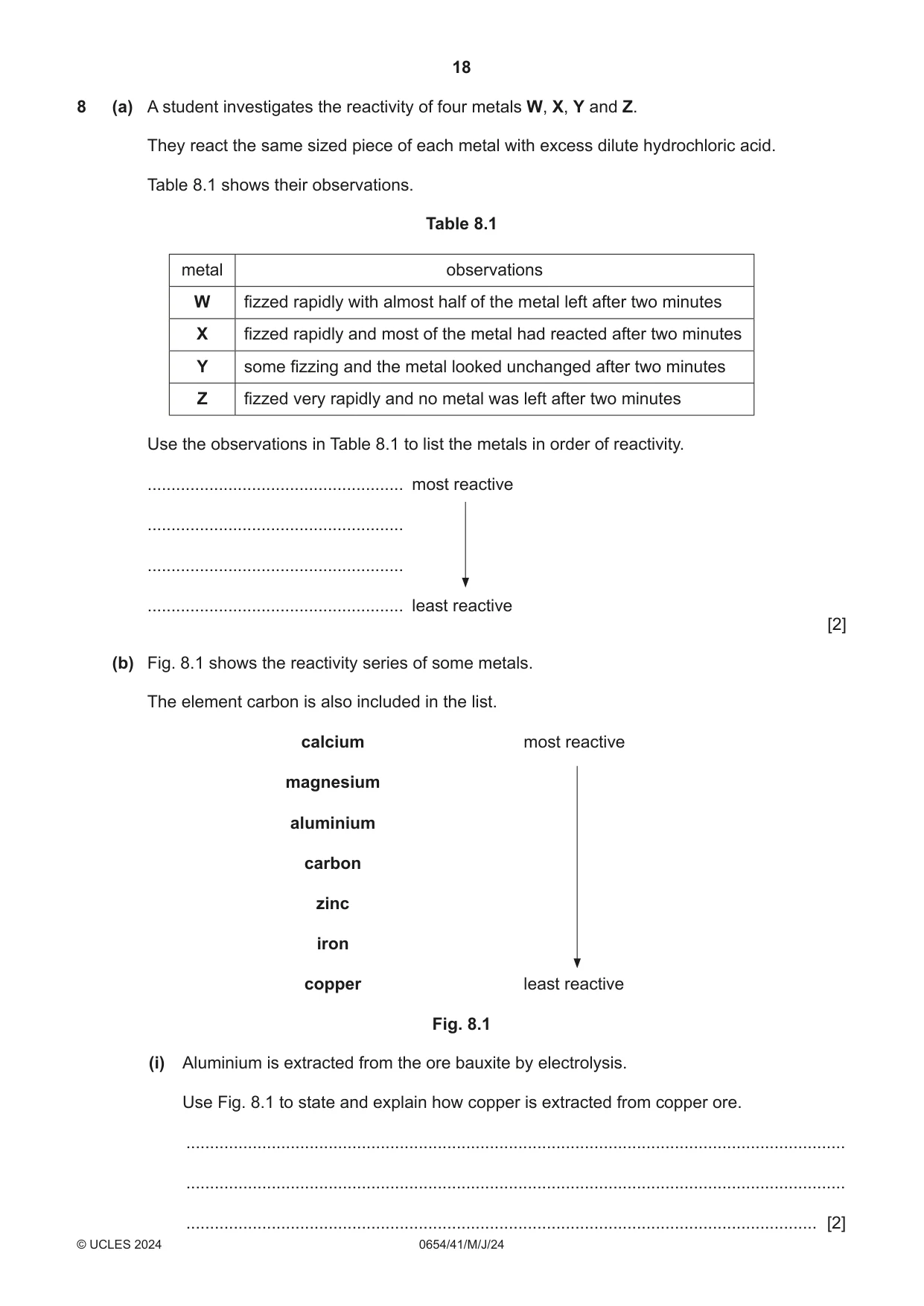
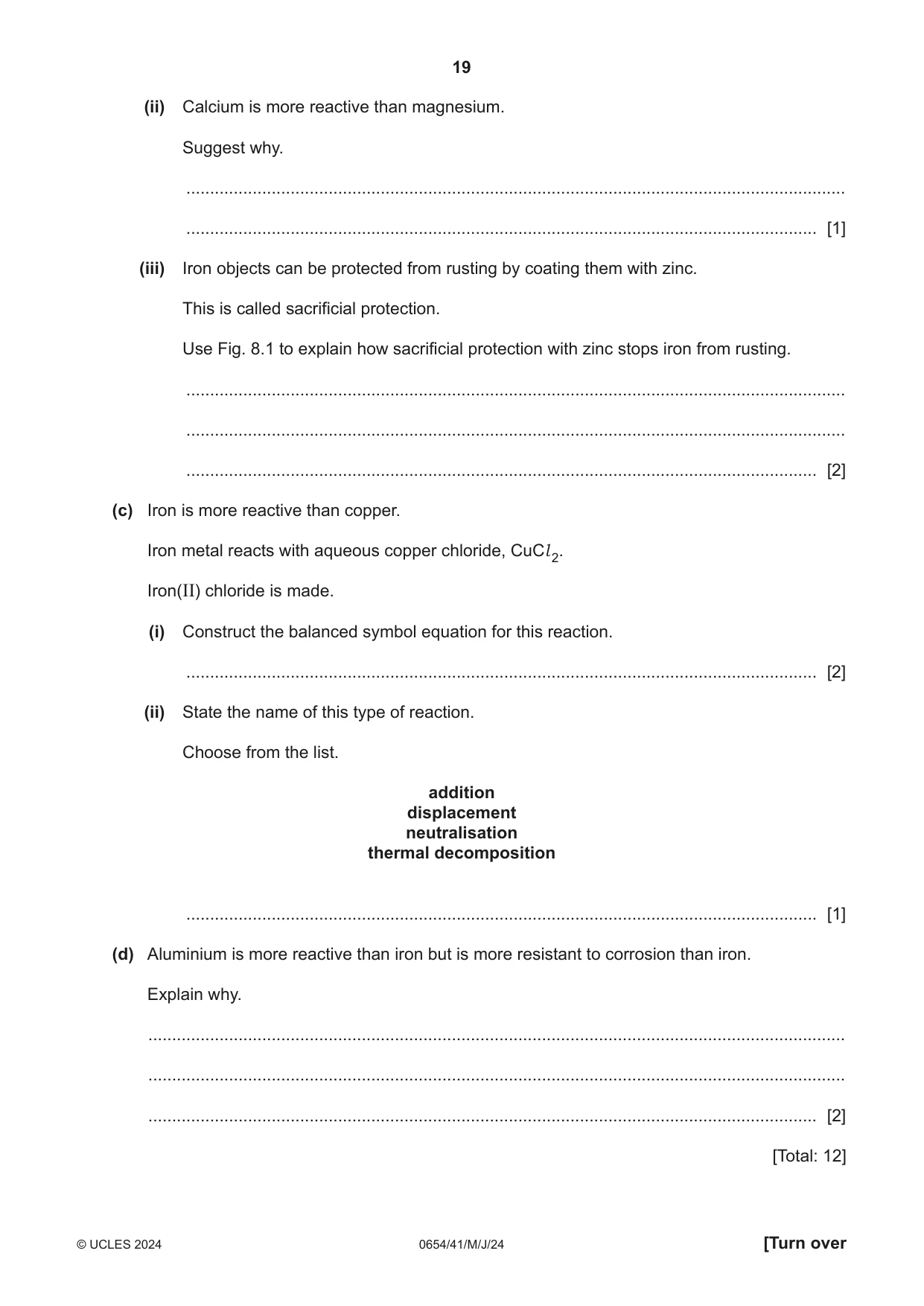
18 0654/41/M/J/24 © UCLES 2024 8 (a) A student investigates the reactivity of four metals W, X, Y and Z. They react the same sized piece of each metal with excess dilute hydrochloric acid. Table 8.1 shows their observations. Table 8.1 metal observations W fizzed rapidly with almost half of the metal left after two minutes X fizzed rapidly and most of the metal had reacted after two minutes Y some fizzing and the metal looked unchanged after two minutes Z fizzed very rapidly and no metal was left after two minutes Use the observations in Table 8.1 to list the metals in order of reactivity. … most reactive … … … least reactive [2] (b) Fig. 8.1 shows the reactivity series of some metals. The element carbon is also included in the list. calcium most reactive magnesium aluminium carbon zinc iron copper least reactive Fig. 8.1 (i) Aluminium is extracted from the ore bauxite by electrolysis. Use Fig. 8.1 to state and explain how copper is extracted from copper ore. … … … [2]
Question paper, page 19
19 0654/41/M/J/24 © UCLES 2024 [Turn over (ii) Calcium is more reactive than magnesium. Suggest why. … … [1] (iii) Iron objects can be protected from rusting by coating them with zinc. This is called sacrificial protection. Use Fig. 8.1 to explain how sacrificial protection with zinc stops iron from rusting. … … … [2] (c) Iron is more reactive than copper. Iron metal reacts with aqueous copper chloride, CuCl 2. Iron(II) chloride is made. (i) Construct the balanced symbol equation for this reaction. … [2] (ii) State the name of this type of reaction. Choose from the list. addition displacement neutralisation thermal decomposition … [1] (d) Aluminium is more reactive than iron but is more resistant to corrosion than iron. Explain why. … … … [2] [Total: 12]
Question paper, page 20
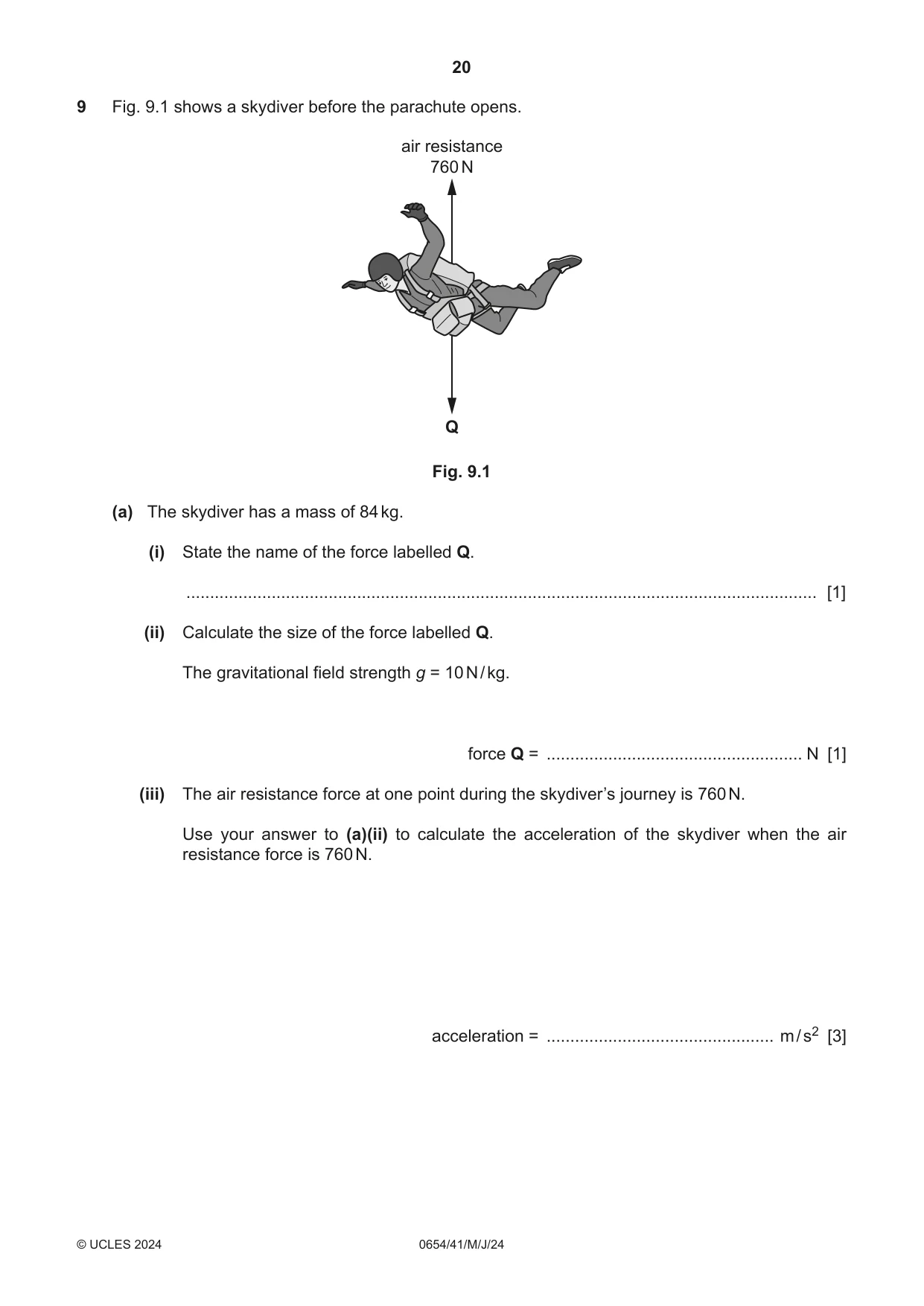
20 0654/41/M/J/24 © UCLES 2024 9 Fig. 9.1 shows a skydiver before the parachute opens. air resistance 760 N Q Fig. 9.1 (a) The skydiver has a mass of 84 kg. (i) State the name of the force labelled Q. … [1] (ii) Calculate the size of the force labelled Q. The gravitational field strength g = 10 N / kg. force Q = … N [1] (iii) The air resistance force at one point during the skydiver’s journey is 760 N. Use your answer to (a)(ii) to calculate the acceleration of the skydiver when the air resistance force is 760 N. acceleration = … m / s2 [3]
Question paper, page 21
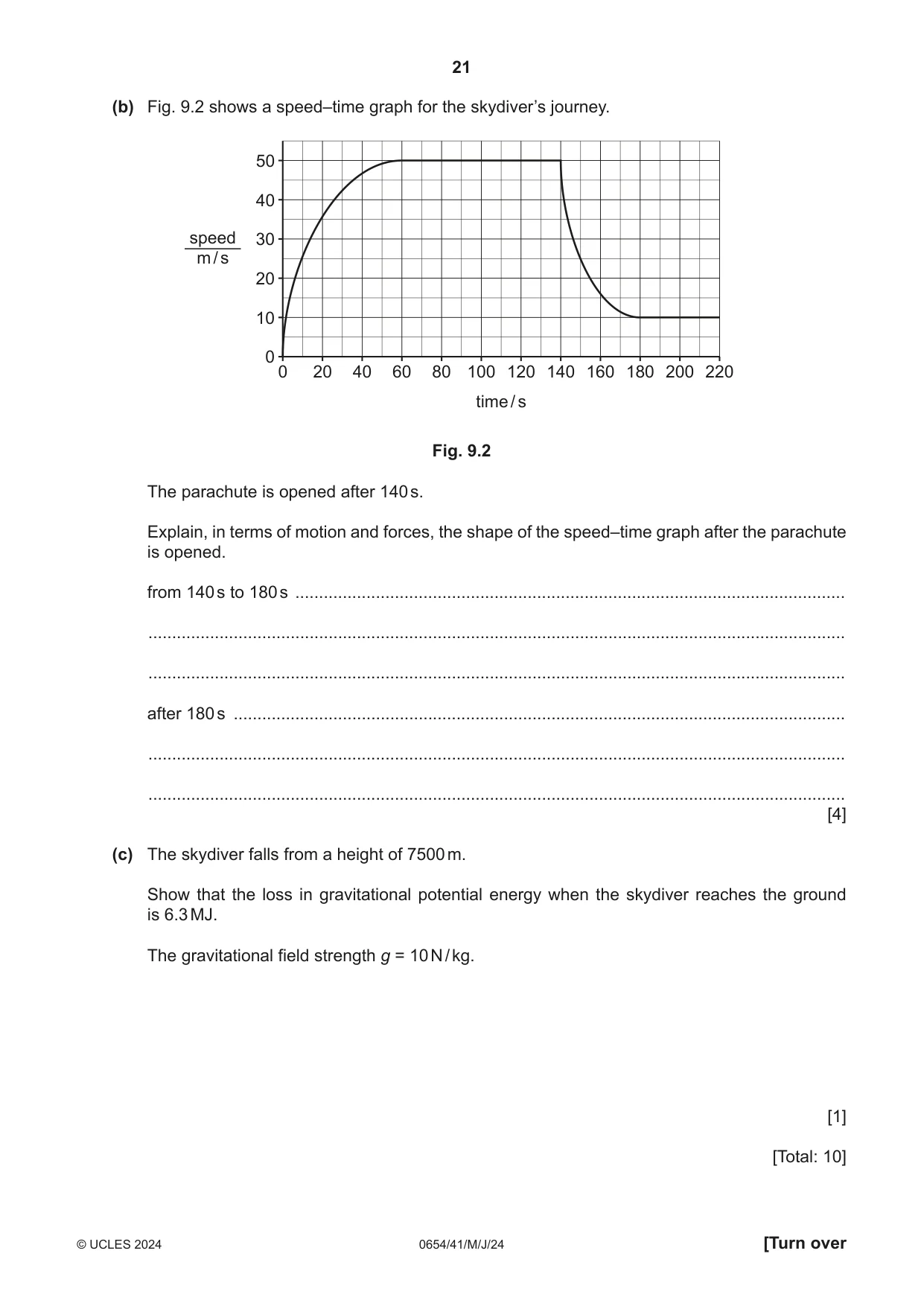
21 0654/41/M/J/24 © UCLES 2024 [Turn over (b) Fig. 9.2 shows a speed–time graph for the skydiver’s journey. 0 20 40 60 80 100 120 140 160 180 200 220 0 10 20 30 time / s 40 50 speed m / s Fig. 9.2 The parachute is opened after 140 s. Explain, in terms of motion and forces, the shape of the speed–time graph after the parachute is opened. from 140 s to 180 s … … … after 180 s … … … [4] (c) The skydiver falls from a height of 7500 m. Show that the loss in gravitational potential energy when the skydiver reaches the ground is 6.3 MJ. The gravitational field strength g = 10 N / kg. [1] [Total: 10]
Question paper, page 22
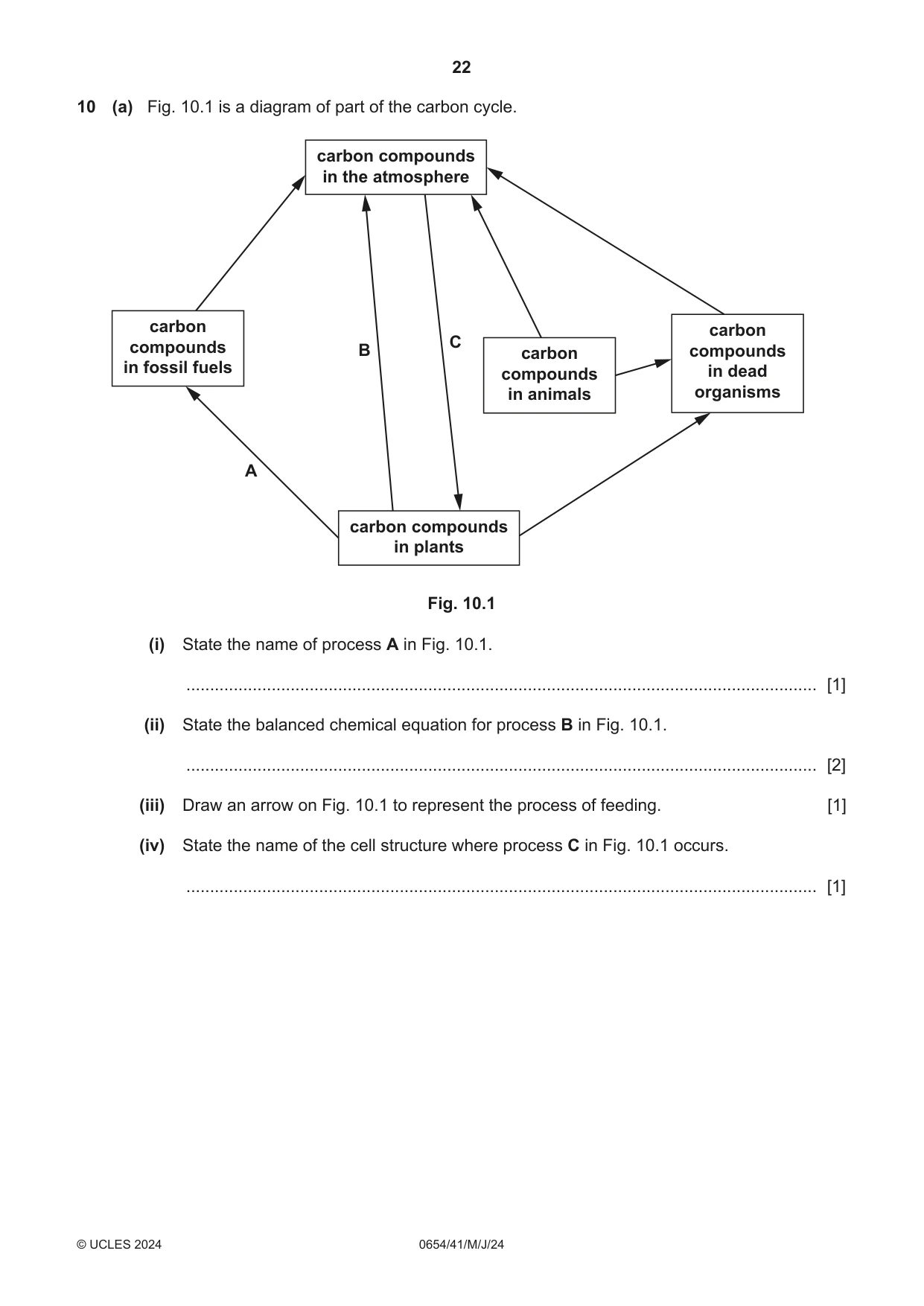
22 0654/41/M/J/24 © UCLES 2024 10 (a) Fig. 10.1 is a diagram of part of the carbon cycle. carbon compounds in the atmosphere carbon compounds in plants carbon compounds in fossil fuels A B C carbon compounds in animals carbon compounds in dead organisms Fig. 10.1 (i) State the name of process A in Fig. 10.1. … [1] (ii) State the balanced chemical equation for process B in Fig. 10.1. … [2] (iii) Draw an arrow on Fig. 10.1 to represent the process of feeding. [1] (iv) State the name of the cell structure where process C in Fig. 10.1 occurs. … [1]
Question paper, page 23
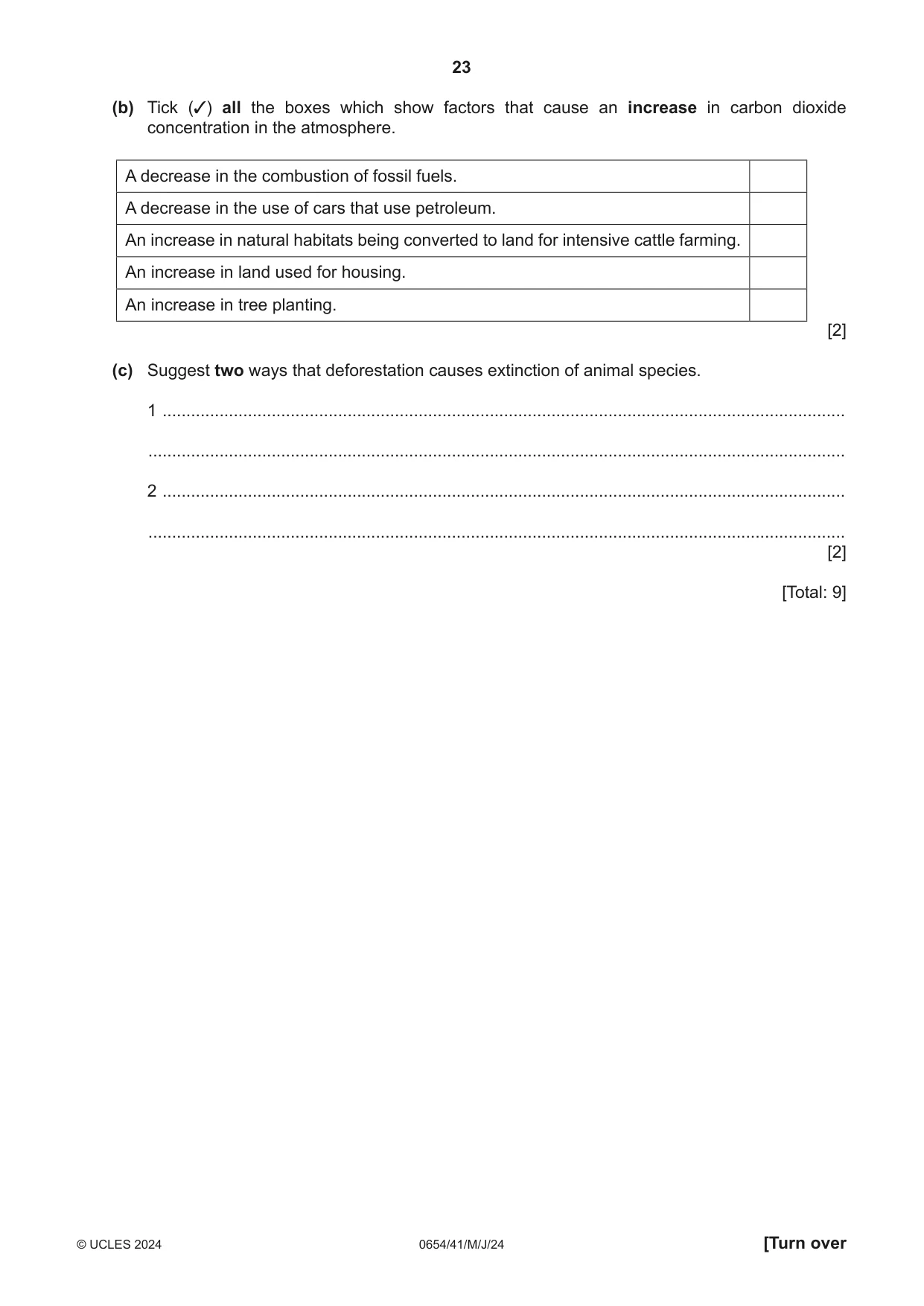
23 0654/41/M/J/24 © UCLES 2024 [Turn over (b) Tick (✓) all the boxes which show factors that cause an increase in carbon dioxide concentration in the atmosphere. A decrease in the combustion of fossil fuels. A decrease in the use of cars that use petroleum. An increase in natural habitats being converted to land for intensive cattle farming. An increase in land used for housing. An increase in tree planting. [2] (c) Suggest two ways that deforestation causes extinction of animal species. 1 … … 2 … … [2] [Total: 9]
Question paper, page 24
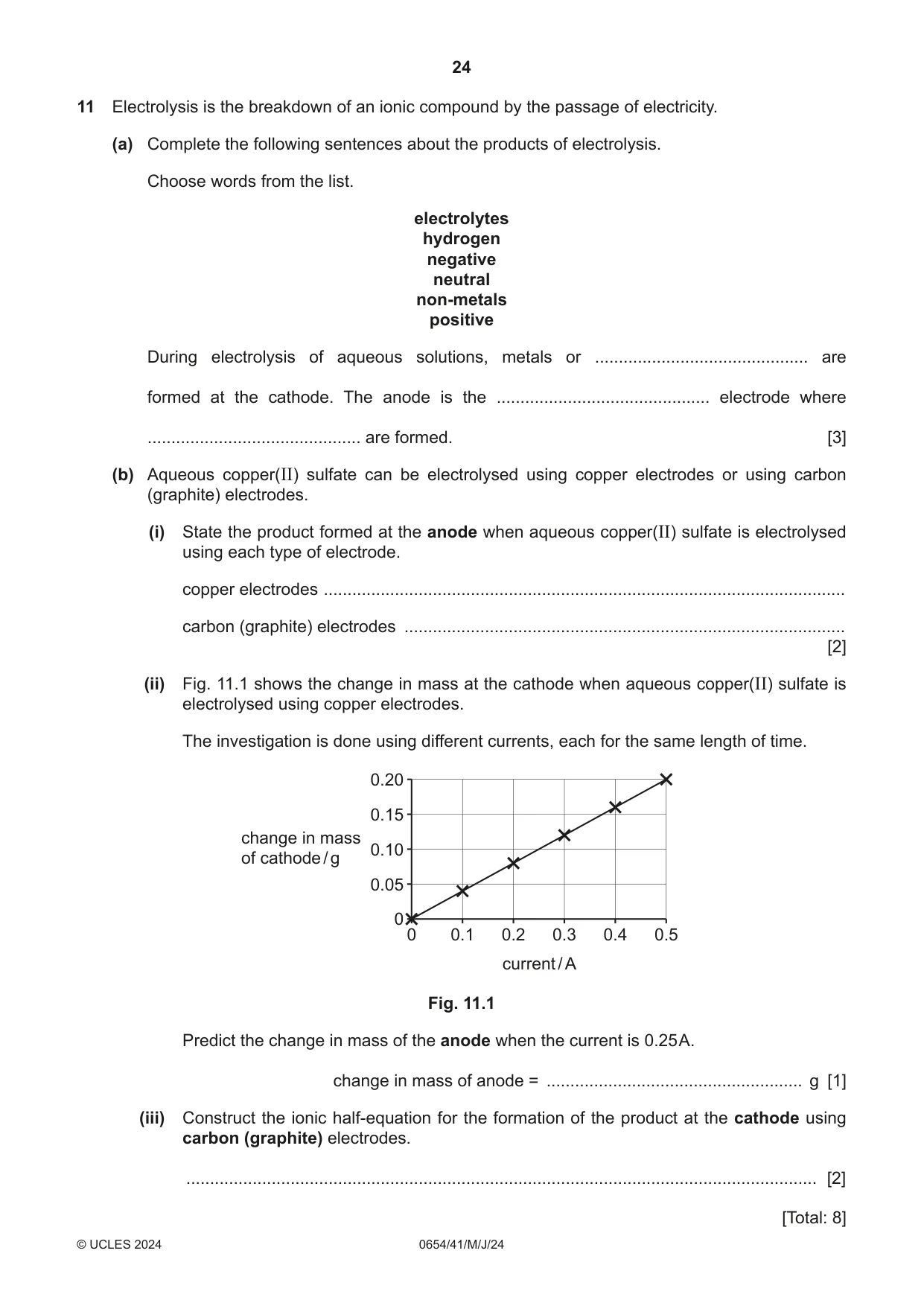
24 0654/41/M/J/24 © UCLES 2024 11 Electrolysis is the breakdown of an ionic compound by the passage of electricity. (a) Complete the following sentences about the products of electrolysis. Choose words from the list. electrolytes hydrogen negative neutral non-metals positive During electrolysis of aqueous solutions, metals or … are formed at the cathode. The anode is the … electrode where … are formed. [3] (b) Aqueous copper(II) sulfate can be electrolysed using copper electrodes or using carbon (graphite) electrodes. (i) State the product formed at the anode when aqueous copper(II) sulfate is electrolysed using each type of electrode. copper electrodes … carbon (graphite) electrodes … [2] (ii) Fig. 11.1 shows the change in mass at the cathode when aqueous copper(II) sulfate is electrolysed using copper electrodes. The investigation is done using different currents, each for the same length of time. 0 0 0.05 0.10 0.15 0.20 0.1 0.2 0.3 0.4 0.5 change in mass of cathode / g current / A Fig. 11.1 Predict the change in mass of the anode when the current is 0.25 A. change in mass of anode = … g [1] (iii) Construct the ionic half‑equation for the formation of the product at the cathode using carbon (graphite) electrodes. … [2] [Total: 8]
Question paper, page 25
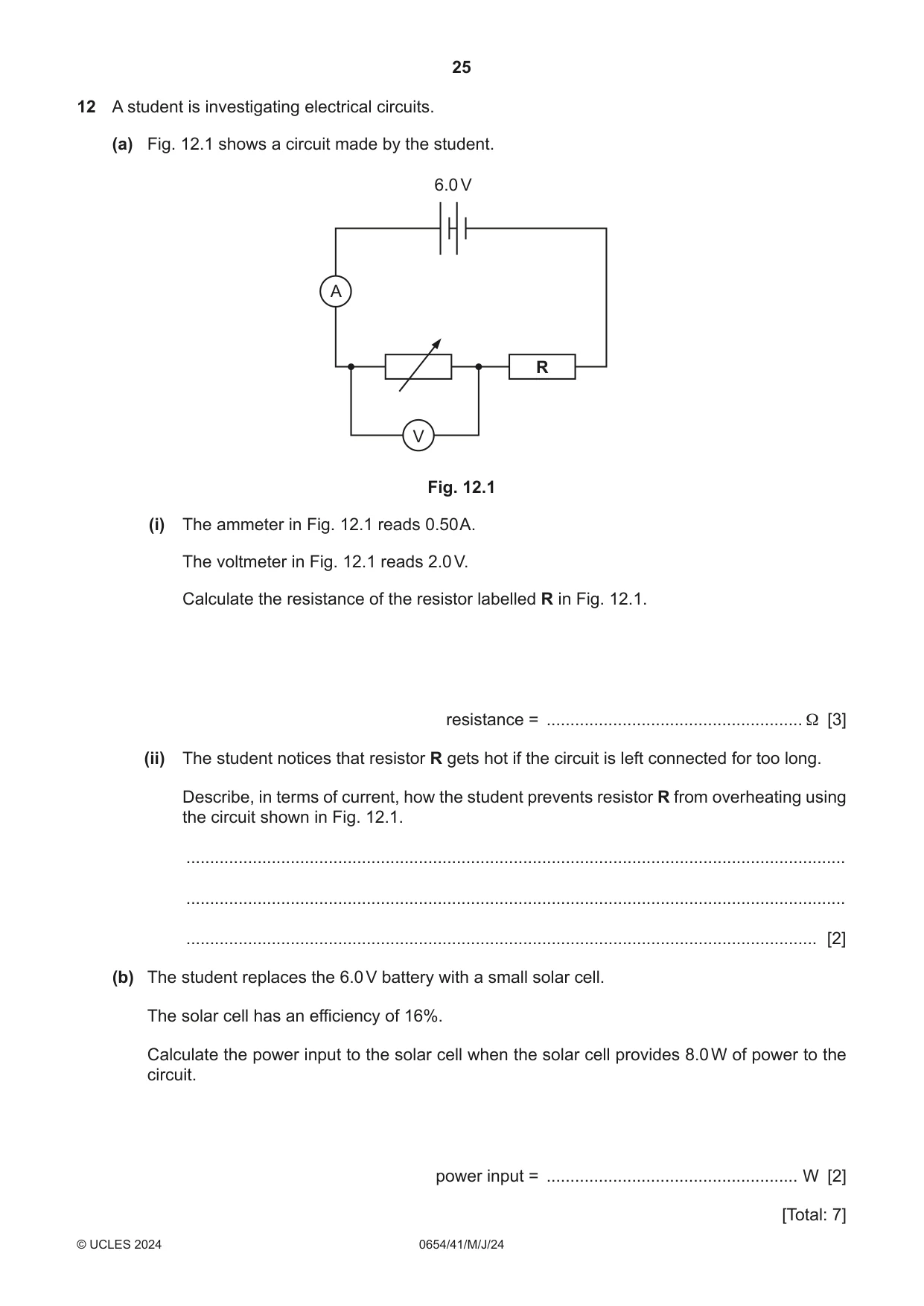
25 0654/41/M/J/24 © UCLES 2024 12 A student is investigating electrical circuits. (a) Fig. 12.1 shows a circuit made by the student. A V 6.0 V R Fig. 12.1 (i) The ammeter in Fig. 12.1 reads 0.50 A. The voltmeter in Fig. 12.1 reads 2.0 V. Calculate the resistance of the resistor labelled R in Fig. 12.1. resistance = … Ω [3] (ii) The student notices that resistor R gets hot if the circuit is left connected for too long. Describe, in terms of current, how the student prevents resistor R from overheating using the circuit shown in Fig. 12.1. … … … [2] (b) The student replaces the 6.0 V battery with a small solar cell. The solar cell has an efficiency of 16%. Calculate the power input to the solar cell when the solar cell provides 8.0 W of power to the circuit. power input = … W [2] [Total: 7]
Question paper, page 26
26 0654/41/M/J/24 © UCLES 2024 BLANK PAGE
Question paper, page 27
27 0654/41/M/J/24 © UCLES 2024 Permission to reproduce items where third‑party owned material protected by copyright is included has been sought and cleared where possible. Every reasonable effort has been made by the publisher (UCLES) to trace copyright holders, but if any items requiring clearance have unwittingly been included, the publisher will be pleased to make amends at the earliest possible opportunity. To avoid the issue of disclosure of answer‑related information to candidates, all copyright acknowledgements are reproduced online in the Cambridge Assessment International Education Copyright Acknowledgements Booklet. This is produced for each series of examinations and is freely available to download at www.cambridgeinternational.org after the live examination series. Cambridge Assessment International Education is part of Cambridge Assessment. Cambridge Assessment is the brand name of the University of Cambridge Local Examinations Syndicate (UCLES), which is a department of the University of Cambridge. BLANK PAGE
Question paper, page 28
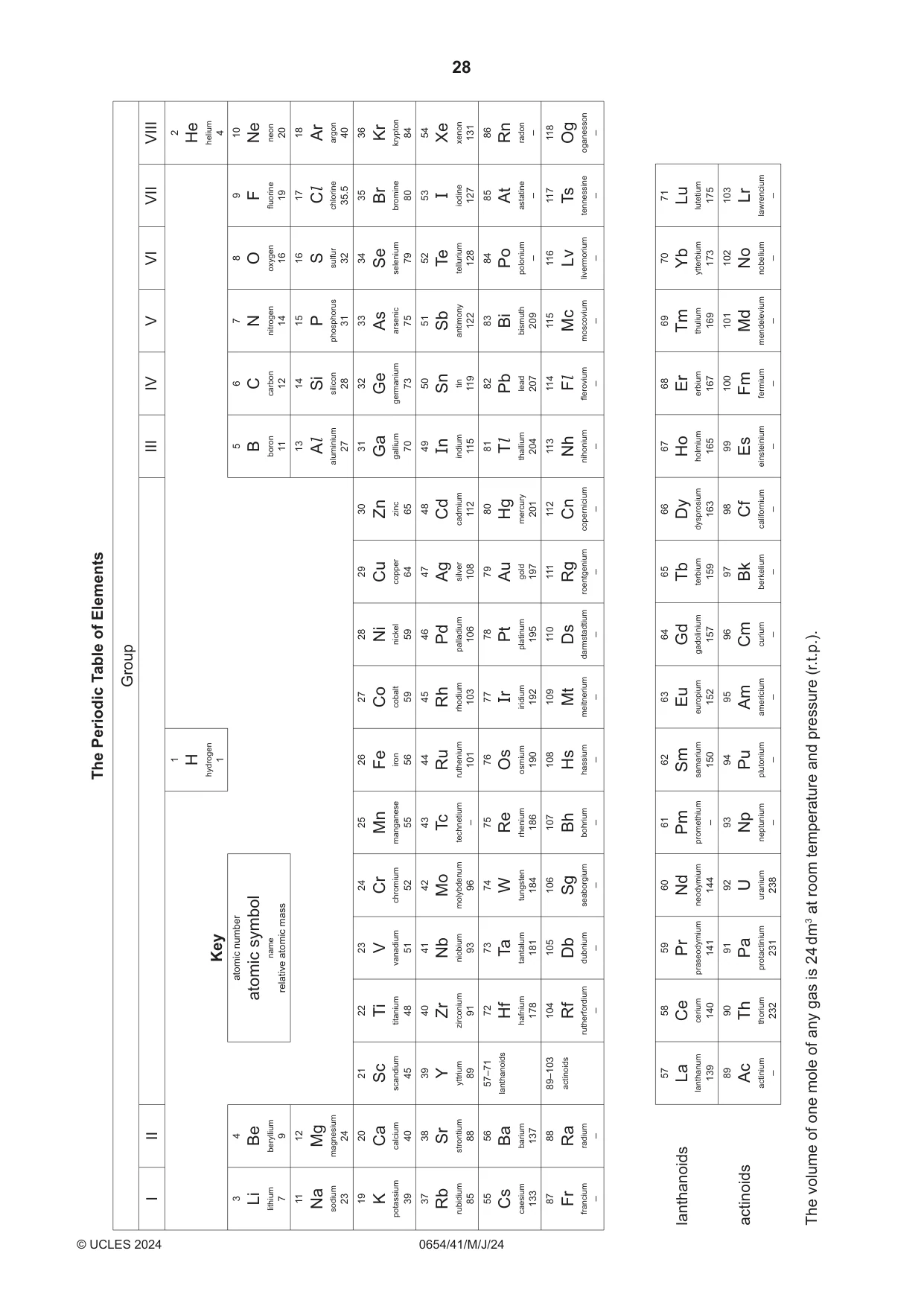
28 0654/41/M/J/24 © UCLES 2024 Group The Periodic Table of Elements 1 H hydrogen 1 2 He helium 4 I II III IV V VI VII VIII 3 Li lithium 7 4 Be beryllium 9 atomic number atomic symbol Key name relative atomic mass 11 Na sodium 23 12 Mg magnesium 24 19 K potassium 39 20 Ca calcium 40 37 Rb rubidium 85 38 Sr strontium 88 55 Cs caesium 133 56 Ba barium 137 87 Fr francium – 88 Ra radium – 5 B boron 11 13 Al aluminium 27 31 Ga gallium 70 49 In indium 115 81 Tl thallium 204 113 Nh nihonium – 6 C carbon 12 14 Si silicon 28 32 Ge germanium 73 50 Sn tin 119 82 Pb lead 207 22 Ti titanium 48 40 Zr zirconium 91 72 Hf hafnium 178 104 Rf rutherfordium – 23 V vanadium 51 41 Nb niobium 93 73 Ta tantalum 181 105 Db dubnium – 24 Cr chromium 52 42 Mo molybdenum 96 74 W tungsten 184 106 Sg seaborgium – 25 Mn manganese 55 43 Tc technetium – 75 Re rhenium 186 107 Bh bohrium – 26 Fe iron 56 44 Ru ruthenium 101 76 Os osmium 190 108 Hs hassium – 27 Co cobalt 59 45 Rh rhodium 103 77 Ir iridium 192 109 Mt meitnerium – 28 Ni nickel 59 46 Pd palladium 106 78 Pt platinum 195 110 Ds darmstadtium – 29 Cu copper 64 47 Ag silver 108 79 Au gold 197 111 Rg roentgenium – 30 Zn zinc 65 48 Cd cadmium 112 80 Hg mercury 201 112 Cn copernicium – 114 Fl flerovium – 116 Lv livermorium – 7 N nitrogen 14 15 P phosphorus 31 33 As arsenic 75 51 Sb antimony 122 83 Bi bismuth 209 115 Mc moscovium – 8 O oxygen 16 16 S sulfur 32 34 Se selenium 79 52 Te tellurium 128 84 Po polonium – 9 F fluorine 19 17 Cl chlorine 35.5 35 Br bromine 80 53 I iodine 127 85 At astatine – 117 Ts tennessine – 10 Ne neon 20 18 Ar argon 40 36 Kr krypton 84 54 Xe xenon 131 86 Rn radon – 118 Og oganesson – 21 Sc scandium 45 39 Y yttrium 89 57–71 lanthanoids 89–103 actinoids 57 La lanthanum 139 89 Ac lanthanoids actinoids The volume of one mole of any gas is 24 dm3 at room temperature and pressure (r.t.p.). actinium – 58 Ce cerium 140 90 Th thorium 232 59 Pr praseodymium 141 91 Pa protactinium 231 60 Nd neodymium 144 92 U uranium 238 61 Pm promethium – 93 Np neptunium – 62 Sm samarium 150 94 Pu plutonium – 63 Eu europium 152 95 Am americium – 64 Gd gadolinium 157 96 Cm curium – 65 Tb terbium 159 97 Bk berkelium – 66 Dy dysprosium 163 98 Cf californium – 67 Ho holmium 165 99 Es einsteinium – 68 Er erbium 167 100 Fm fermium – 69 Tm thulium 169 101 Md mendelevium – 70 Yb ytterbium 173 102 No nobelium – 71 Lu lutetium 175 103 Lr lawrencium –
Mark scheme, page 1
This document consists of 13 printed pages. © Cambridge University Press & Assessment 2024 [Turn over Cambridge IGCSE™ CO-ORDINATED SCIENCES 0654/41 Paper 4 Theory (Extended) May/June 2024 MARK SCHEME Maximum Mark: 120 Published This mark scheme is published as an aid to teachers and candidates, to indicate the requirements of the examination. It shows the basis on which Examiners were instructed to award marks. It does not indicate the details of the discussions that took place at an Examiners’ meeting before marking began, which would have considered the acceptability of alternative answers. Mark schemes should be read in conjunction with the question paper and the Principal Examiner Report for Teachers. Cambridge International will not enter into discussions about these mark schemes. Cambridge International is publishing the mark schemes for the May/June 2024 series for most Cambridge IGCSE, Cambridge International A and AS Level and Cambridge Pre-U components, and some Cambridge O Level components.
Mark scheme, page 2
0654/41 Cambridge IGCSE – Mark Scheme PUBLISHED May/June 2024 © Cambridge University Press & Assessment 2024 Page 2 of 13 Generic Marking Principles These general marking principles must be applied by all examiners when marking candidate answers. They should be applied alongside the specific content of the mark scheme or generic level descriptions for a question. Each question paper and mark scheme will also comply with these marking principles. GENERIC MARKING PRINCIPLE 1: Marks must be awarded in line with: the specific content of the mark scheme or the generic level descriptors for the question the specific skills defined in the mark scheme or in the generic level descriptors for the question the standard of response required by a candidate as exemplified by the standardisation scripts. GENERIC MARKING PRINCIPLE 2: Marks awarded are always whole marks (not half marks, or other fractions). GENERIC MARKING PRINCIPLE 3: Marks must be awarded positively: marks are awarded for correct/valid answers, as defined in the mark scheme. However, credit is given for valid answers which go beyond the scope of the syllabus and mark scheme, referring to your Team Leader as appropriate marks are awarded when candidates clearly demonstrate what they know and can do marks are not deducted for errors marks are not deducted for omissions answers should only be judged on the quality of spelling, punctuation and grammar when these features are specifically assessed by the question as indicated by the mark scheme. The meaning, however, should be unambiguous. GENERIC MARKING PRINCIPLE 4: Rules must be applied consistently, e.g. in situations where candidates have not followed instructions or in the application of generic level descriptors.
Mark scheme, page 3
0654/41 Cambridge IGCSE – Mark Scheme PUBLISHED May/June 2024 © Cambridge University Press & Assessment 2024 Page 3 of 13 GENERIC MARKING PRINCIPLE 5: Marks should be awarded using the full range of marks defined in the mark scheme for the question (however; the use of the full mark range may be limited according to the quality of the candidate responses seen). GENERIC MARKING PRINCIPLE 6: Marks awarded are based solely on the requirements as defined in the mark scheme. Marks should not be awarded with grade thresholds or grade descriptors in mind. Science-Specific Marking Principles 1 Examiners should consider the context and scientific use of any keywords when awarding marks. Although keywords may be present, marks should not be awarded if the keywords are used incorrectly. 2 The examiner should not choose between contradictory statements given in the same question part, and credit should not be awarded for any correct statement that is contradicted within the same question part. Wrong science that is irrelevant to the question should be ignored. 3 Although spellings do not have to be correct, spellings of syllabus terms must allow for clear and unambiguous separation from other syllabus terms with which they may be confused (e.g. ethane / ethene, glucagon / glycogen, refraction / reflection). 4 The error carried forward (ecf) principle should be applied, where appropriate. If an incorrect answer is subsequently used in a scientifically correct way, the candidate should be awarded these subsequent marking points. Further guidance will be included in the mark scheme where necessary and any exceptions to this general principle will be noted. 5 ‘List rule’ guidance For questions that require n responses (e.g. State two reasons …): The response should be read as continuous prose, even when numbered answer spaces are provided. Any response marked ignore in the mark scheme should not count towards n. Incorrect responses should not be awarded credit but will still count towards n. Read the entire response to check for any responses that contradict those that would otherwise be credited. Credit should not be awarded for any responses that are contradicted within the rest of the response. Where two responses contradict one another, this should be treated as a single incorrect response. Non-contradictory responses after the first n responses may be ignored even if they include incorrect science.
Mark scheme, page 4
0654/41 Cambridge IGCSE – Mark Scheme PUBLISHED May/June 2024 © Cambridge University Press & Assessment 2024 Page 4 of 13 6 Calculation specific guidance Correct answers to calculations should be given full credit even if there is no working or incorrect working, unless the question states ‘show your working’. For questions in which the number of significant figures required is not stated, credit should be awarded for correct answers when rounded by the examiner to the number of significant figures given in the mark scheme. This may not apply to measured values. For answers given in standard form (e.g. a 10n) in which the convention of restricting the value of the coefficient (a) to a value between 1 and 10 is not followed, credit may still be awarded if the answer can be converted to the answer given in the mark scheme. Unless a separate mark is given for a unit, a missing or incorrect unit will normally mean that the final calculation mark is not awarded. Exceptions to this general principle will be noted in the mark scheme. 7 Guidance for chemical equations Multiples / fractions of coefficients used in chemical equations are acceptable unless stated otherwise in the mark scheme. State symbols given in an equation should be ignored unless asked for in the question or stated otherwise in the mark scheme.
Mark scheme, page 5
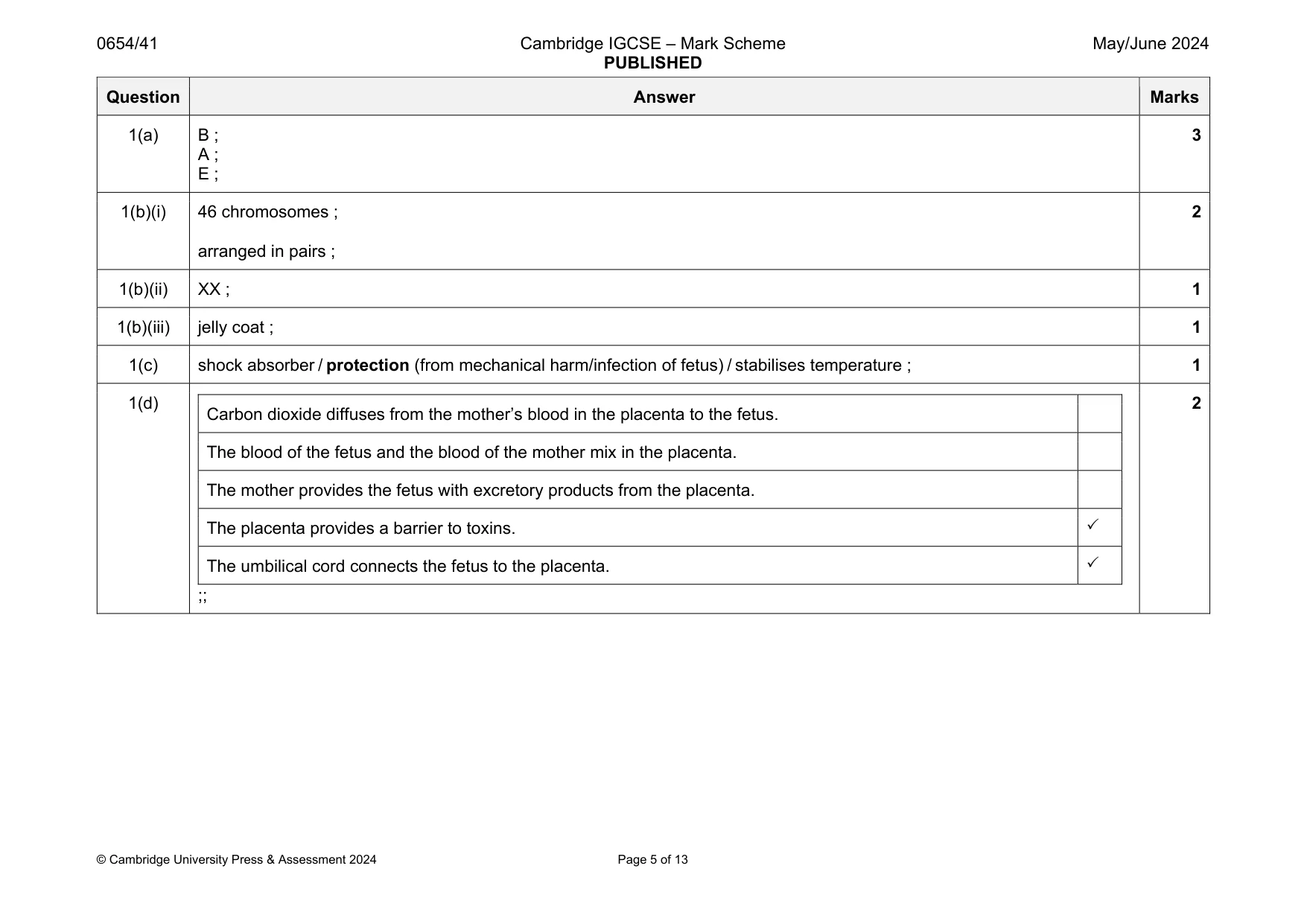
0654/41 Cambridge IGCSE – Mark Scheme PUBLISHED May/June 2024 © Cambridge University Press & Assessment 2024 Page 5 of 13 Question Answer Marks 1(a) B ; A ; E ; 3 1(b)(i) 46 chromosomes ; arranged in pairs ; 2 1(b)(ii) XX ; 1 1(b)(iii) jelly coat ; 1 1(c) shock absorber / protection (from mechanical harm/infection of fetus) / stabilises temperature ; 1 1(d) Carbon dioxide diffuses from the mother’s blood in the placenta to the fetus. The blood of the fetus and the blood of the mother mix in the placenta. The mother provides the fetus with excretory products from the placenta. The placenta provides a barrier to toxins. The umbilical cord connects the fetus to the placenta. ;; 2
Mark scheme, page 6
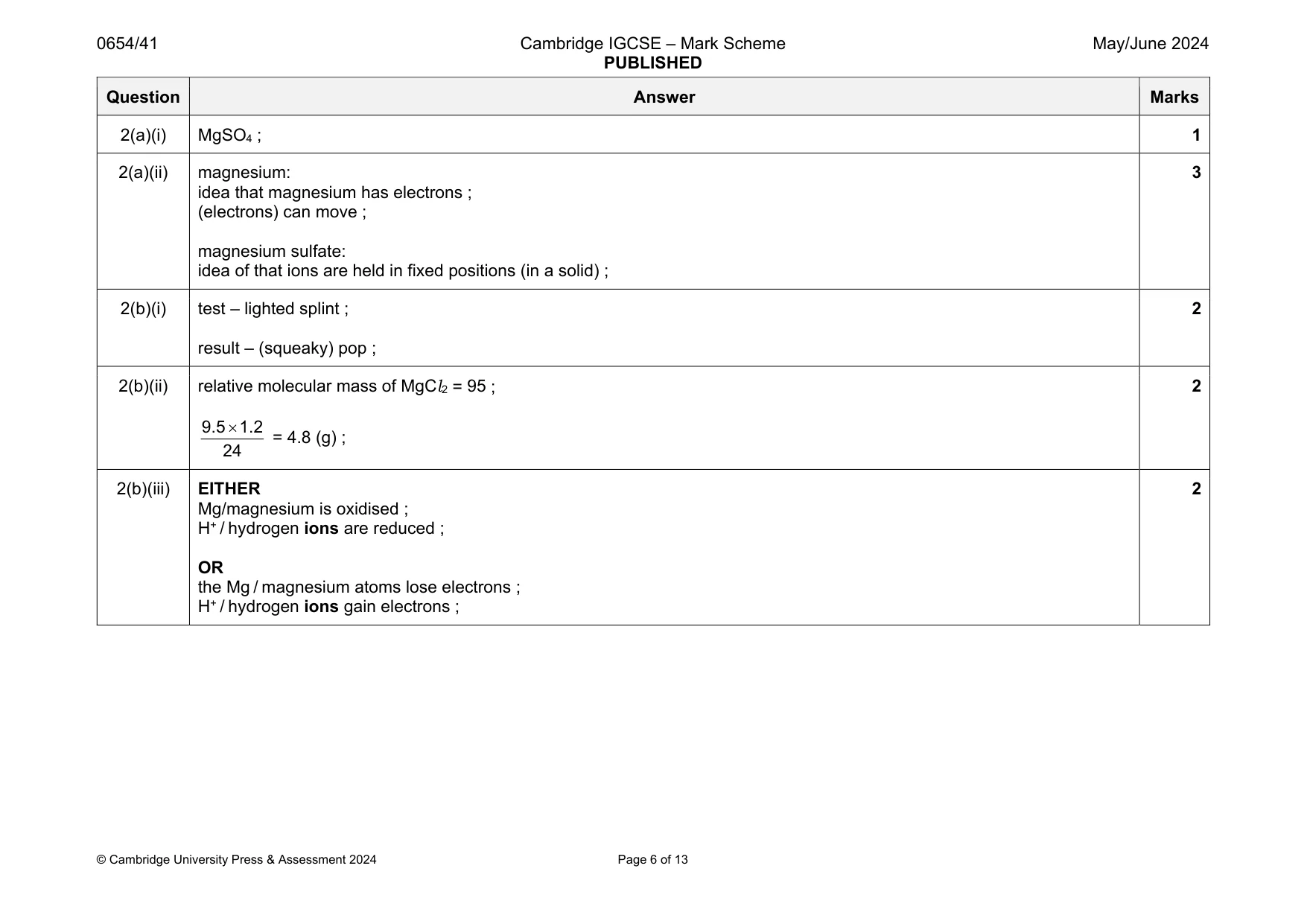
0654/41 Cambridge IGCSE – Mark Scheme PUBLISHED May/June 2024 © Cambridge University Press & Assessment 2024 Page 6 of 13 Question Answer Marks 2(a)(i) MgSO4 ; 1 2(a)(ii) magnesium: idea that magnesium has electrons ; (electrons) can move ; magnesium sulfate: idea of that ions are held in fixed positions (in a solid) ; 3 2(b)(i) test – lighted splint ; result – (squeaky) pop ; 2 2(b)(ii) relative molecular mass of MgCl2 = 95 ; 9.5 1.2 24 = 4.8 (g) ; 2 2(b)(iii) EITHER Mg/magnesium is oxidised ; H+ / hydrogen ions are reduced ; OR the Mg / magnesium atoms lose electrons ; H+ / hydrogen ions gain electrons ; 2
Mark scheme, page 7
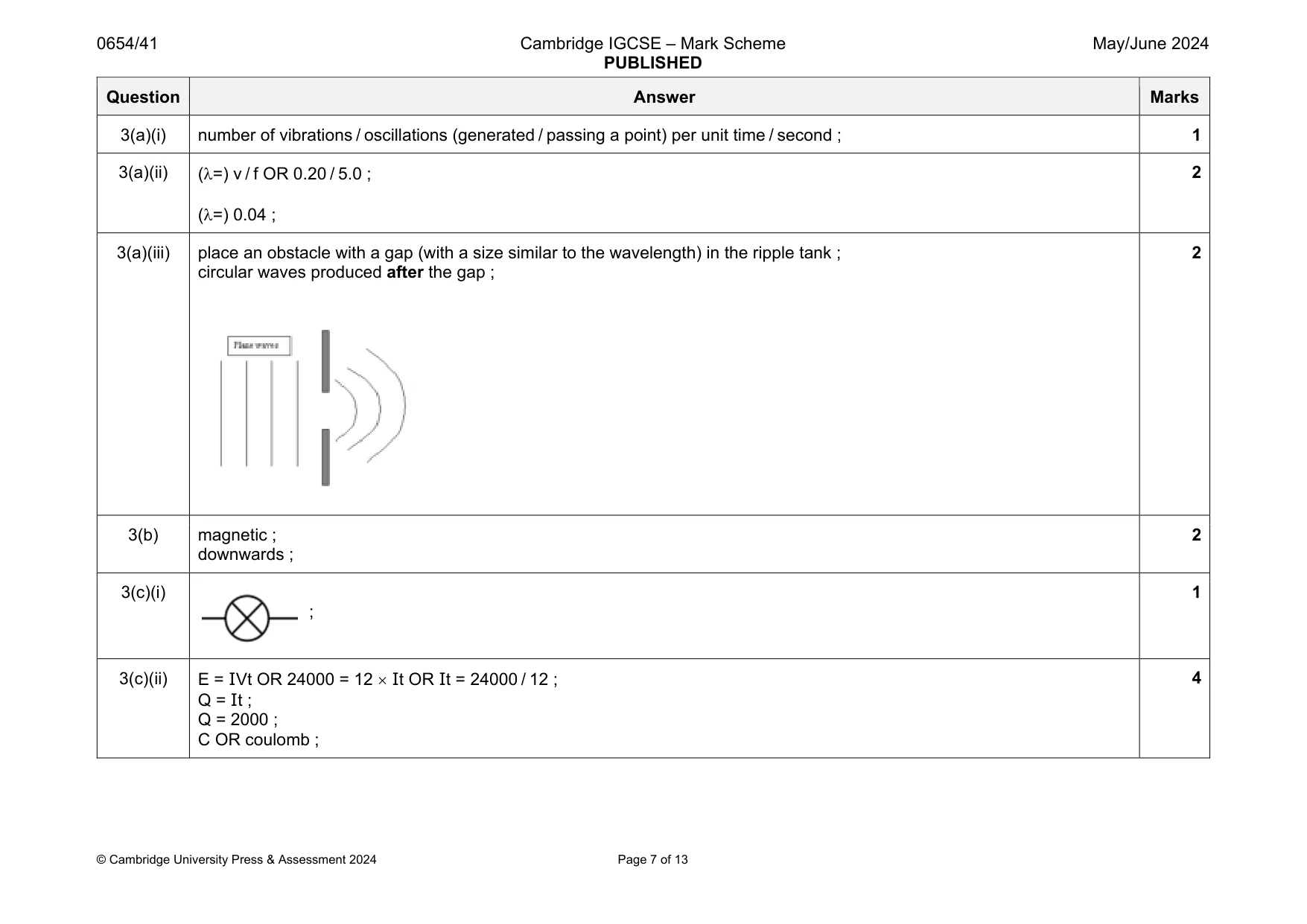
0654/41 Cambridge IGCSE – Mark Scheme PUBLISHED May/June 2024 © Cambridge University Press & Assessment 2024 Page 7 of 13 Question Answer Marks 3(a)(i) number of vibrations / oscillations (generated / passing a point) per unit time / second ; 1 3(a)(ii) (=) v / f OR 0.20 / 5.0 ; (=) 0.04 ; 2 3(a)(iii) place an obstacle with a gap (with a size similar to the wavelength) in the ripple tank ; circular waves produced after the gap ; 2 3(b) magnetic ; downwards ; 2 3(c)(i) ; 1 3(c)(ii) E = IVt OR 24000 = 12 It OR It = 24000 / 12 ; Q = It ; Q = 2000 ; C OR coulomb ; 4
Mark scheme, page 8
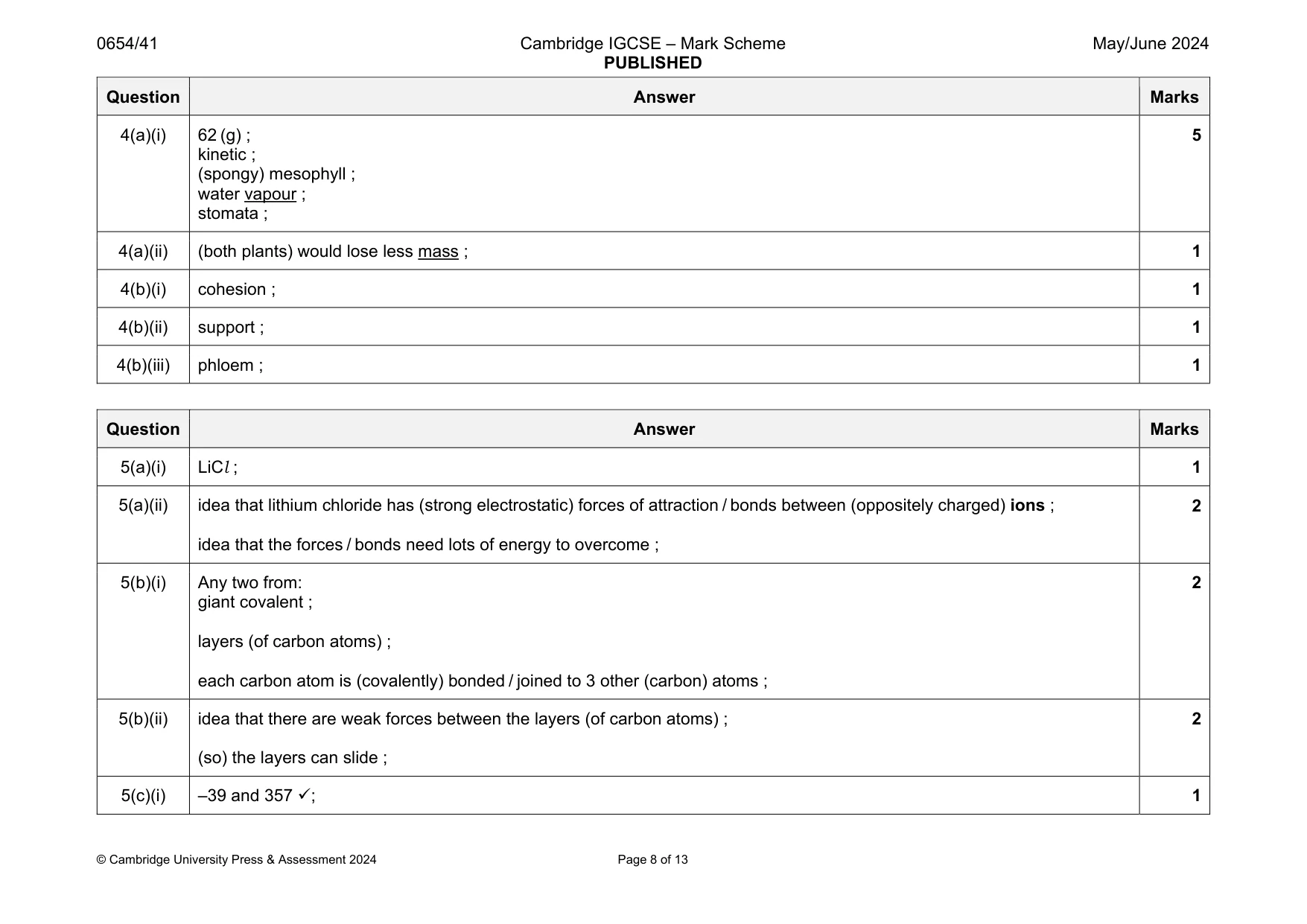
0654/41 Cambridge IGCSE – Mark Scheme PUBLISHED May/June 2024 © Cambridge University Press & Assessment 2024 Page 8 of 13 Question Answer Marks 4(a)(i) 62 (g) ; kinetic ; (spongy) mesophyll ; water vapour ; stomata ; 5 4(a)(ii) (both plants) would lose less mass ; 1 4(b)(i) cohesion ; 1 4(b)(ii) support ; 1 4(b)(iii) phloem ; 1 Question Answer Marks 5(a)(i) LiCl ; 1 5(a)(ii) idea that lithium chloride has (strong electrostatic) forces of attraction / bonds between (oppositely charged) ions ; idea that the forces / bonds need lots of energy to overcome ; 2 5(b)(i) Any two from: giant covalent ; layers (of carbon atoms) ; each carbon atom is (covalently) bonded / joined to 3 other (carbon) atoms ; 2 5(b)(ii) idea that there are weak forces between the layers (of carbon atoms) ; (so) the layers can slide ; 2 5(c)(i) –39 and 357 ; 1
Mark scheme, page 9
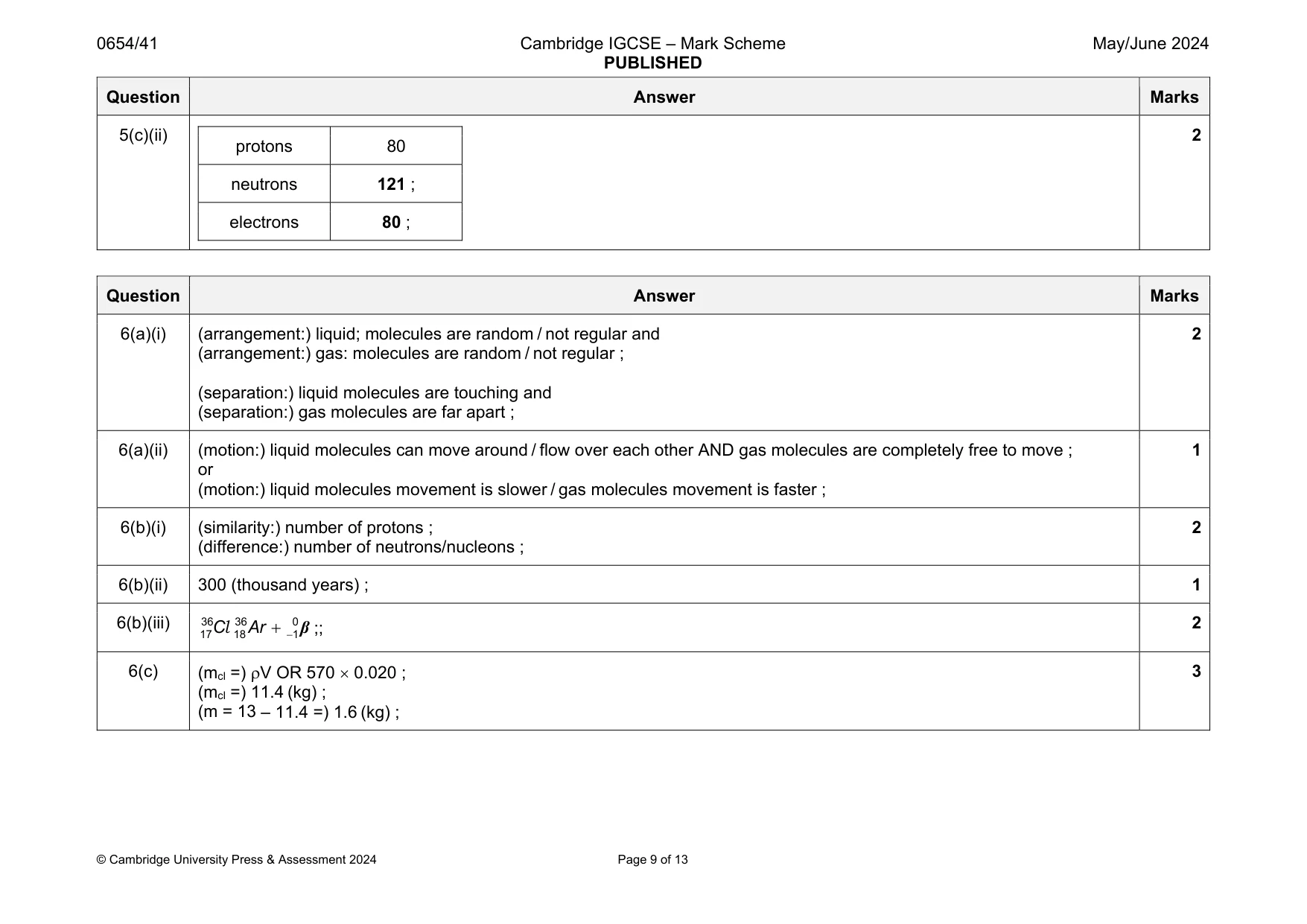
0654/41 Cambridge IGCSE – Mark Scheme PUBLISHED May/June 2024 © Cambridge University Press & Assessment 2024 Page 9 of 13 Question Answer Marks 5(c)(ii) protons 80 neutrons 121 ; electrons 80 ; 2 Question Answer Marks 6(a)(i) (arrangement:) liquid; molecules are random / not regular and (arrangement:) gas: molecules are random / not regular ; (separation:) liquid molecules are touching and (separation:) gas molecules are far apart ; 2 6(a)(ii) (motion:) liquid molecules can move around / flow over each other AND gas molecules are completely free to move ; or (motion:) liquid molecules movement is slower / gas molecules movement is faster ; 1 6(b)(i) (similarity:) number of protons ; (difference:) number of neutrons/nucleons ; 2 6(b)(ii) 300 (thousand years) ; 1 6(b)(iii) 36 36 0 17 18 1 C Ar β l ;; 2 6(c) (mcl =) V OR 570 0.020 ; (mcl =) 11.4 (kg) ; (m = 13 – 11.4 =) 1.6 (kg) ; 3
Mark scheme, page 10
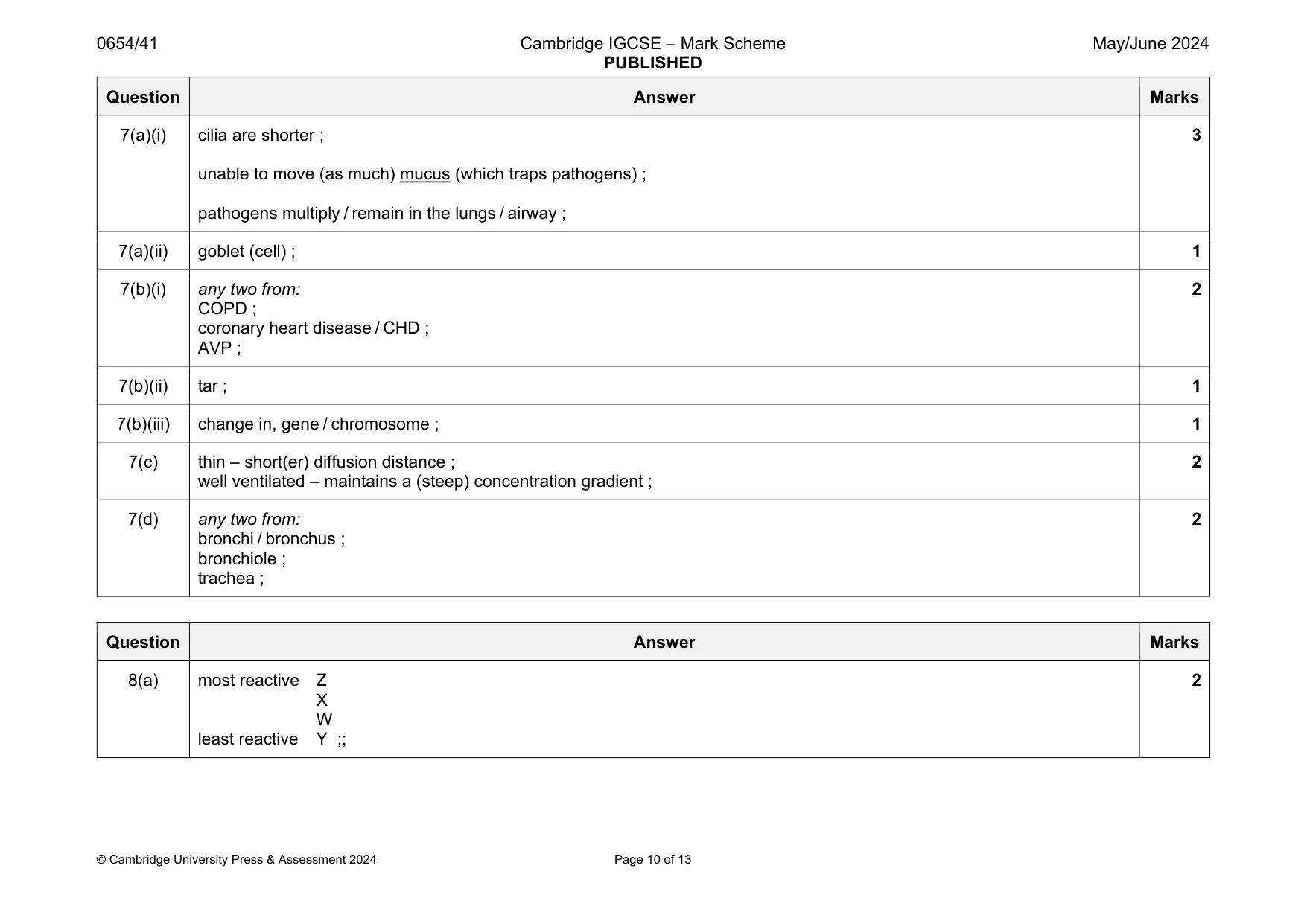
0654/41 Cambridge IGCSE – Mark Scheme PUBLISHED May/June 2024 © Cambridge University Press & Assessment 2024 Page 10 of 13 Question Answer Marks 7(a)(i) cilia are shorter ; unable to move (as much) mucus (which traps pathogens) ; pathogens multiply / remain in the lungs / airway ; 3 7(a)(ii) goblet (cell) ; 1 7(b)(i) any two from: COPD ; coronary heart disease / CHD ; AVP ; 2 7(b)(ii) tar ; 1 7(b)(iii) change in, gene / chromosome ; 1 7(c) thin – short(er) diffusion distance ; well ventilated – maintains a (steep) concentration gradient ; 2 7(d) any two from: bronchi / bronchus ; bronchiole ; trachea ; 2 Question Answer Marks 8(a) most reactive Z X W least reactive Y ;; 2
Mark scheme, page 11
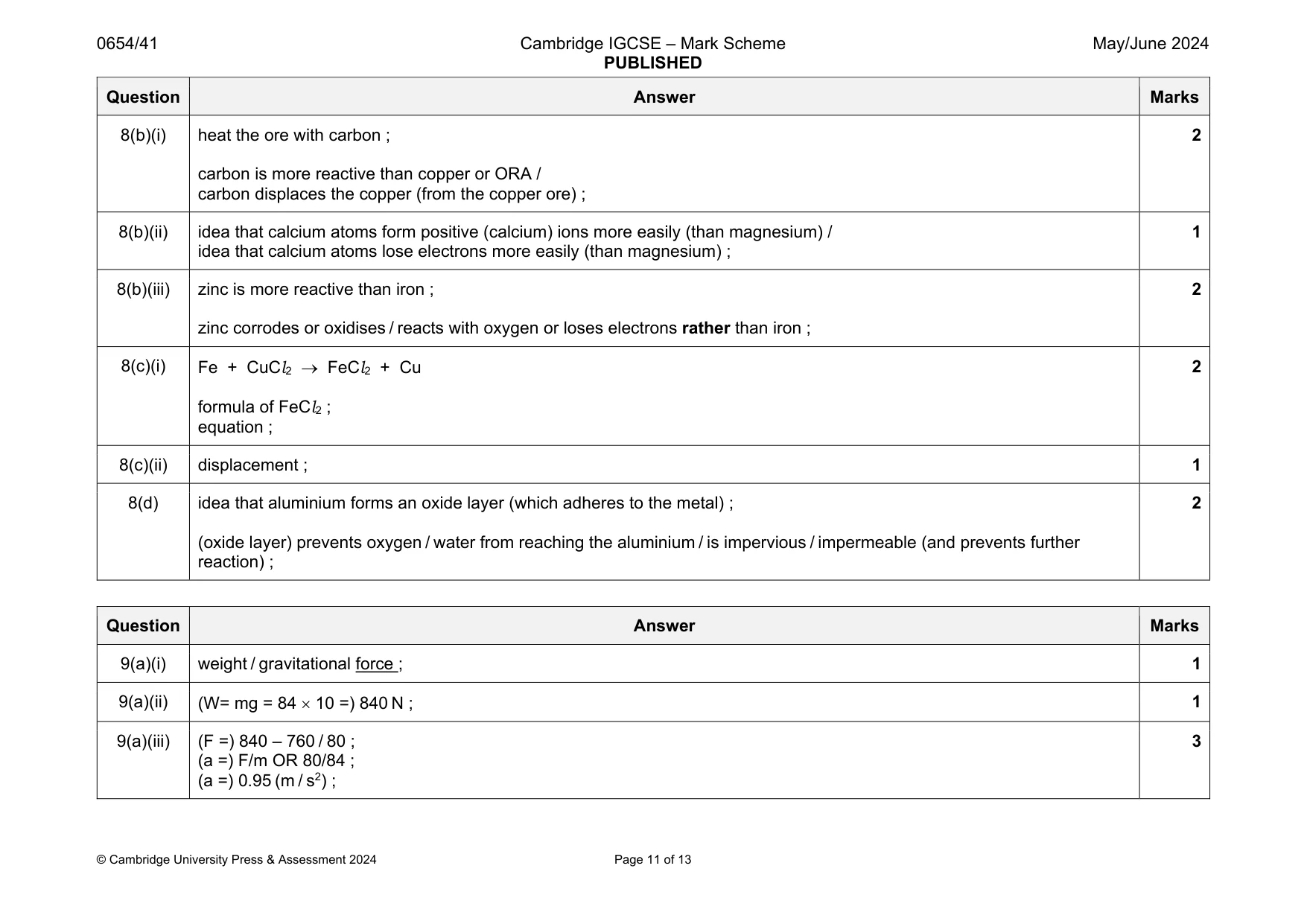
0654/41 Cambridge IGCSE – Mark Scheme PUBLISHED May/June 2024 © Cambridge University Press & Assessment 2024 Page 11 of 13 Question Answer Marks 8(b)(i) heat the ore with carbon ; carbon is more reactive than copper or ORA / carbon displaces the copper (from the copper ore) ; 2 8(b)(ii) idea that calcium atoms form positive (calcium) ions more easily (than magnesium) / idea that calcium atoms lose electrons more easily (than magnesium) ; 1 8(b)(iii) zinc is more reactive than iron ; zinc corrodes or oxidises / reacts with oxygen or loses electrons rather than iron ; 2 8(c)(i) Fe + CuCl2 FeCl2 + Cu formula of FeCl2 ; equation ; 2 8(c)(ii) displacement ; 1 8(d) idea that aluminium forms an oxide layer (which adheres to the metal) ; (oxide layer) prevents oxygen / water from reaching the aluminium / is impervious / impermeable (and prevents further reaction) ; 2 Question Answer Marks 9(a)(i) weight / gravitational force ; 1 9(a)(ii) (W= mg = 84 10 =) 840 N ; 1 9(a)(iii) (F =) 840 – 760 / 80 ; (a =) F/m OR 80/84 ; (a =) 0.95 (m / s2) ; 3
Mark scheme, page 12
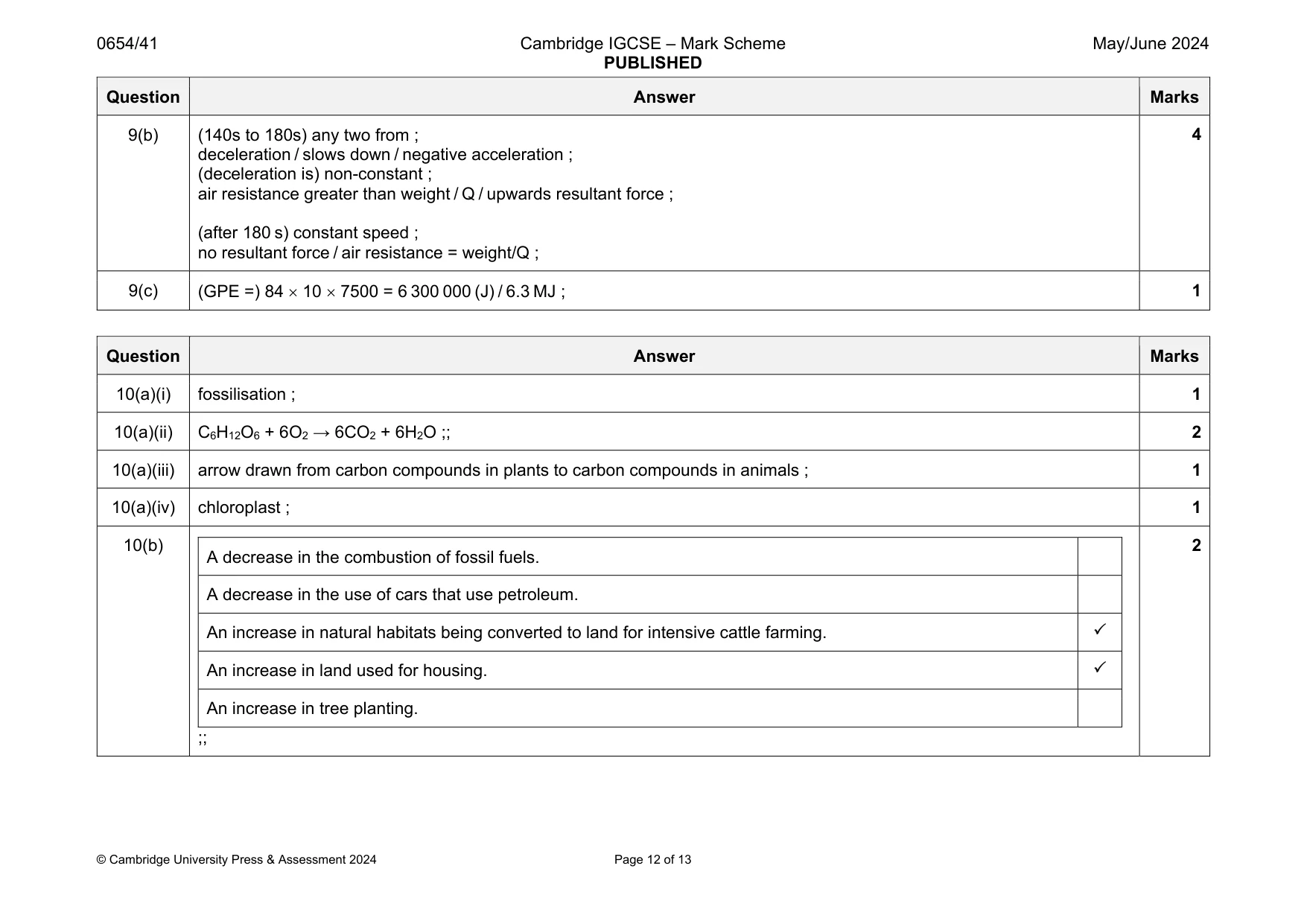
0654/41 Cambridge IGCSE – Mark Scheme PUBLISHED May/June 2024 © Cambridge University Press & Assessment 2024 Page 12 of 13 Question Answer Marks 9(b) (140s to 180s) any two from ; deceleration / slows down / negative acceleration ; (deceleration is) non-constant ; air resistance greater than weight / Q / upwards resultant force ; (after 180 s) constant speed ; no resultant force / air resistance = weight/Q ; 4 9(c) (GPE =) 84 10 7500 = 6 300 000 (J) / 6.3 MJ ; 1 Question Answer Marks 10(a)(i) fossilisation ; 1 10(a)(ii) C6H12O6 + 6O2 → 6CO2 + 6H2O ;; 2 10(a)(iii) arrow drawn from carbon compounds in plants to carbon compounds in animals ; 1 10(a)(iv) chloroplast ; 1 10(b) A decrease in the combustion of fossil fuels. A decrease in the use of cars that use petroleum. An increase in natural habitats being converted to land for intensive cattle farming. An increase in land used for housing. An increase in tree planting. ;; 2
Mark scheme, page 13
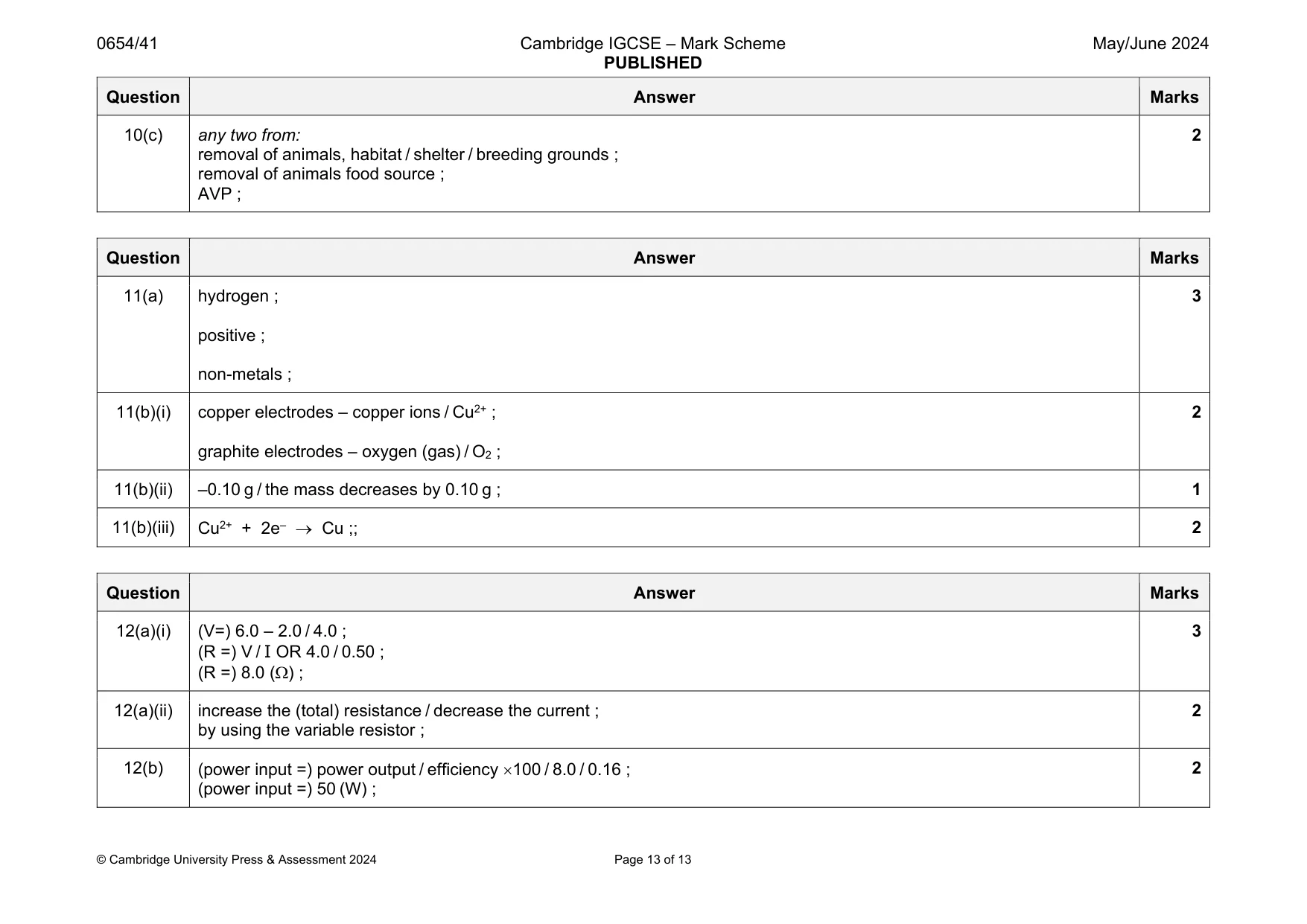
0654/41 Cambridge IGCSE – Mark Scheme PUBLISHED May/June 2024 © Cambridge University Press & Assessment 2024 Page 13 of 13 Question Answer Marks 10(c) any two from: removal of animals, habitat / shelter / breeding grounds ; removal of animals food source ; AVP ; 2 Question Answer Marks 11(a) hydrogen ; positive ; non-metals ; 3 11(b)(i) copper electrodes – copper ions / Cu2+ ; graphite electrodes – oxygen (gas) / O2 ; 2 11(b)(ii) –0.10 g / the mass decreases by 0.10 g ; 1 11(b)(iii) Cu2+ + 2e– Cu ;; 2 Question Answer Marks 12(a)(i) (V=) 6.0 – 2.0 / 4.0 ; (R =) V / I OR 4.0 / 0.50 ; (R =) 8.0 () ; 3 12(a)(ii) increase the (total) resistance / decrease the current ; by using the variable resistor ; 2 12(b) (power input =) power output / efficiency 100 / 8.0 / 0.16 ; (power input =) 50 (W) ; 2
What you needed in this session
Cambridge’s own grade thresholds for 2024 May/June, Paper 4 · Variant 1. A higher threshold means an easier paper — the bar moves with how the cohort did.