Cambridge IGCSE Sciences - Co-ordinated (Double) 0654 — 2021 May/June Paper 6 · Variant 2
0654/62/M/J/21 · 7 questions · 60 marks · ≈68 min
The question paper and its mark scheme, free to read here and free to download. This is Cambridge’s own paper, exactly as it was sat.
Question paper20 pages




Mark scheme12 pages
Answers below. Sit the paper first if you are practising.
Questions as text
Q1 · A student investigates the nutrient content of three solutions, A, B and C
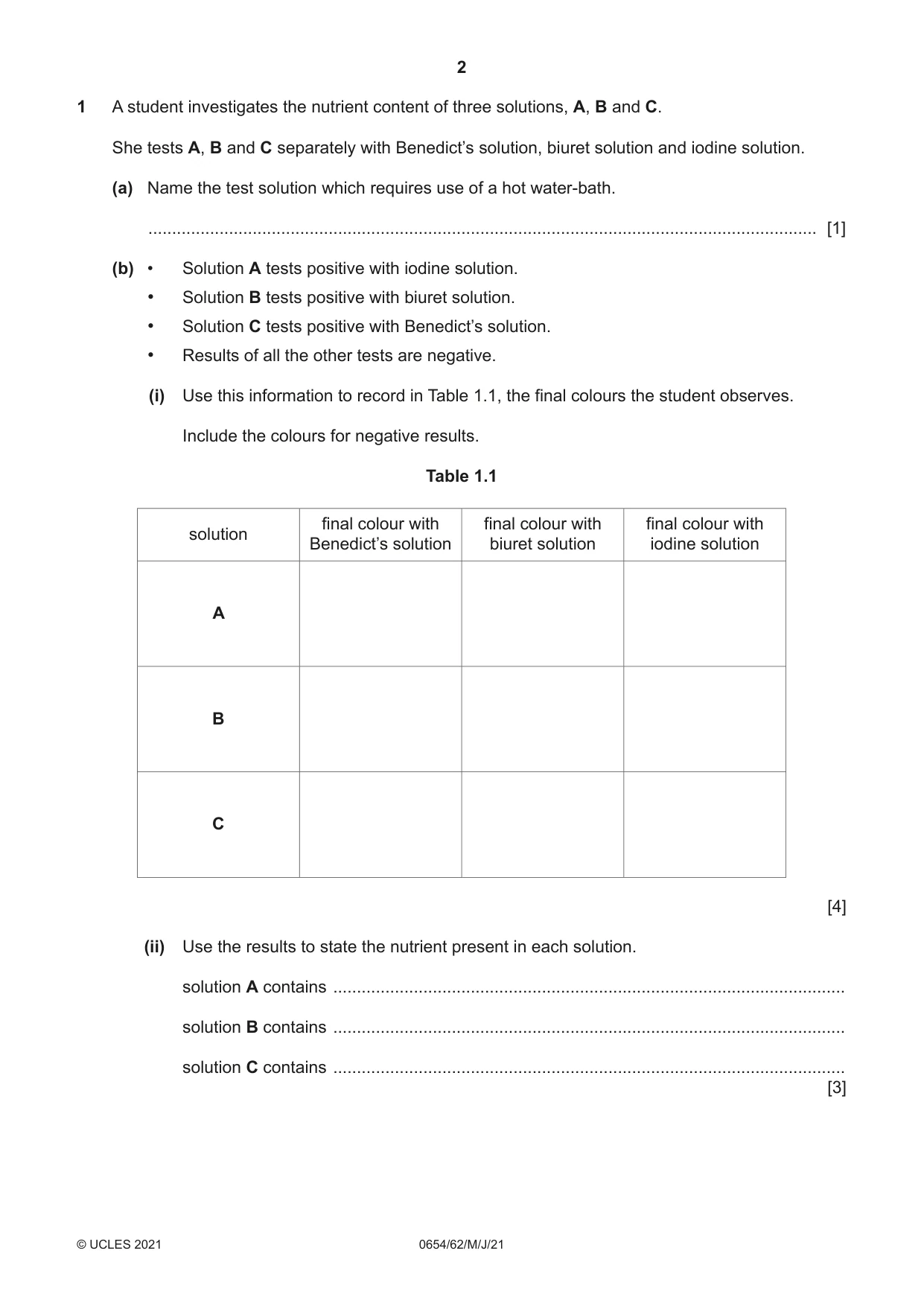
1 A student investigates the nutrient content of three solutions, A, B and C. She tests A, B and C separately with Benedict’s solution, biuret solution and iodine solution. (a) Name the test solution which requires use of a hot water-bath. ............................................................................................................................................. [1] (b) • Solution A tests positive with iodine solution. • Solution B tests positive with biuret solution. • Solution C tests positive with Benedict’s solution. • Results of all the other tests are negative. (i) Use this information to record in Table 1.1, the final colours the student observes. Include the colours for negative results. Table 1.1 final colour with final colour with final colour with solution Benedict’s solution biuret solution iodine solution A B C [4] (ii) Use the results to state the nutrient present in each solution. solution A contains ............................................................................................................ solution B contains ............................................................................................................ solution C contains ............................................................................................................ [3] (c) Describe a method used to test a liquid for the presence of fats. Include the observation for a positive result. method ...................................................................................................................................... ................................................................................................................................................... observation ......................................................................................................................... [2] (d) A student investigates the nutrient concentration in two different samples using Benedict’s solution. This allows her to compare the concentrations of the nutrient in the two solutions. (i) Explain how the results will allow the concentrations of the nutrient in the two solutions to be compared. ........................................................................................................................................... ..................................................................................................................................... [1] (ii) State two variables which need to be controlled in this investigation. variable 1 ........................................................................................................................... variable 2 ........................................................................................................................... [2] [Total: 13]
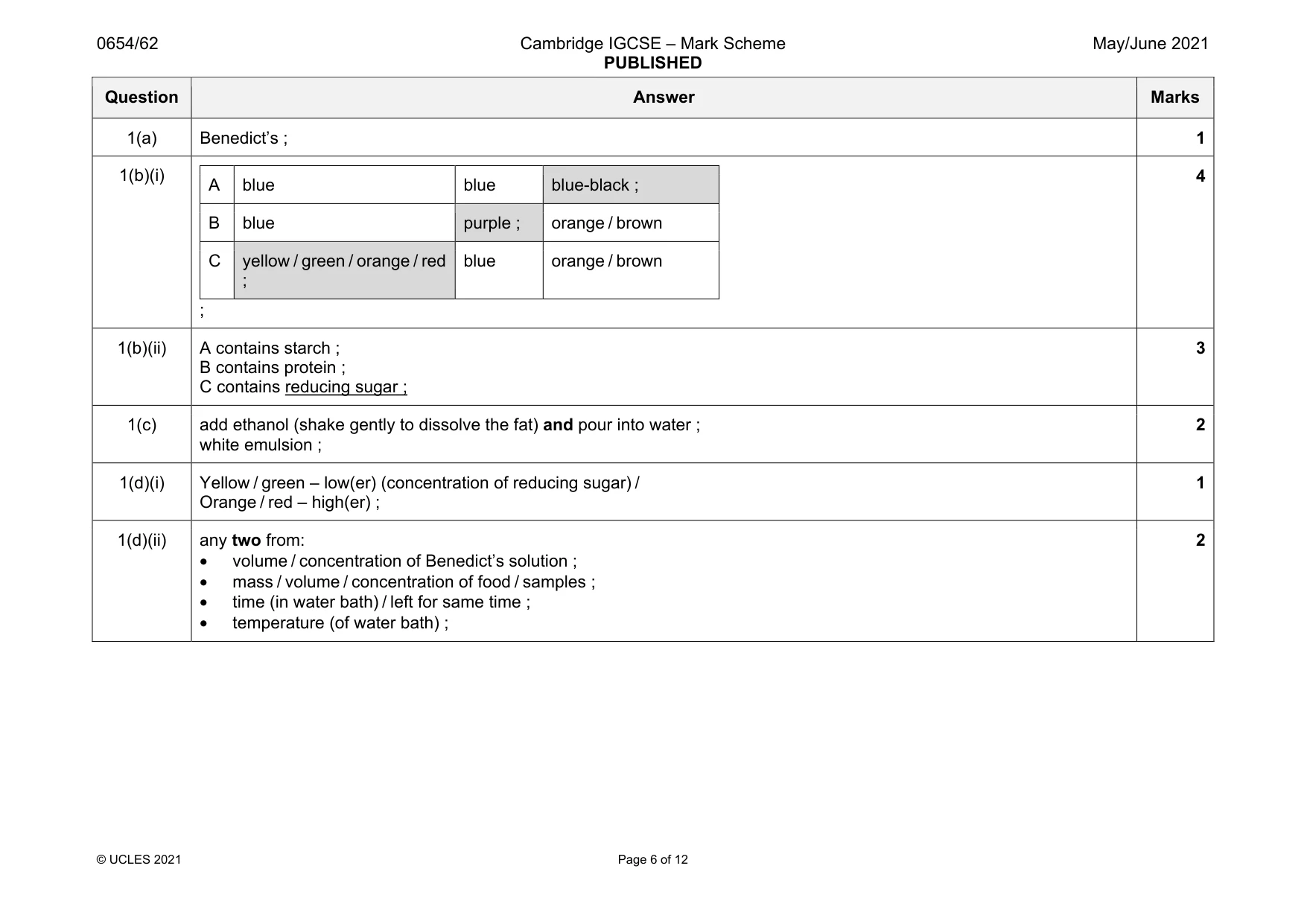
Mark scheme: 1(a) Benedict’s ; 1 1(b)(i) A blue blue blue-black ; B blue purple ; orange / brown C yellow / green / orange / red ; blue orange / brown ; 4 1(b)(ii) A contains starch ; B contains protein ; C contains reducing sugar ; 3 1(c) add ethanol (shake gently to dissolve the fat) and pour into water ; white emulsion ; 2 1(d)(i) Yellow / green – low(er) (concentration of reducing sugar) / Orange / red – high(er) ; 1 1(d)(ii) any two from: • volume / concentration of Benedict’s solution ; • mass / volume / concentration of food / samples ; • time (in water bath) / left for same time ; • temperature (of water bath) ; 2
Q2 · Small maggots (insect larvae), as shown in Fig
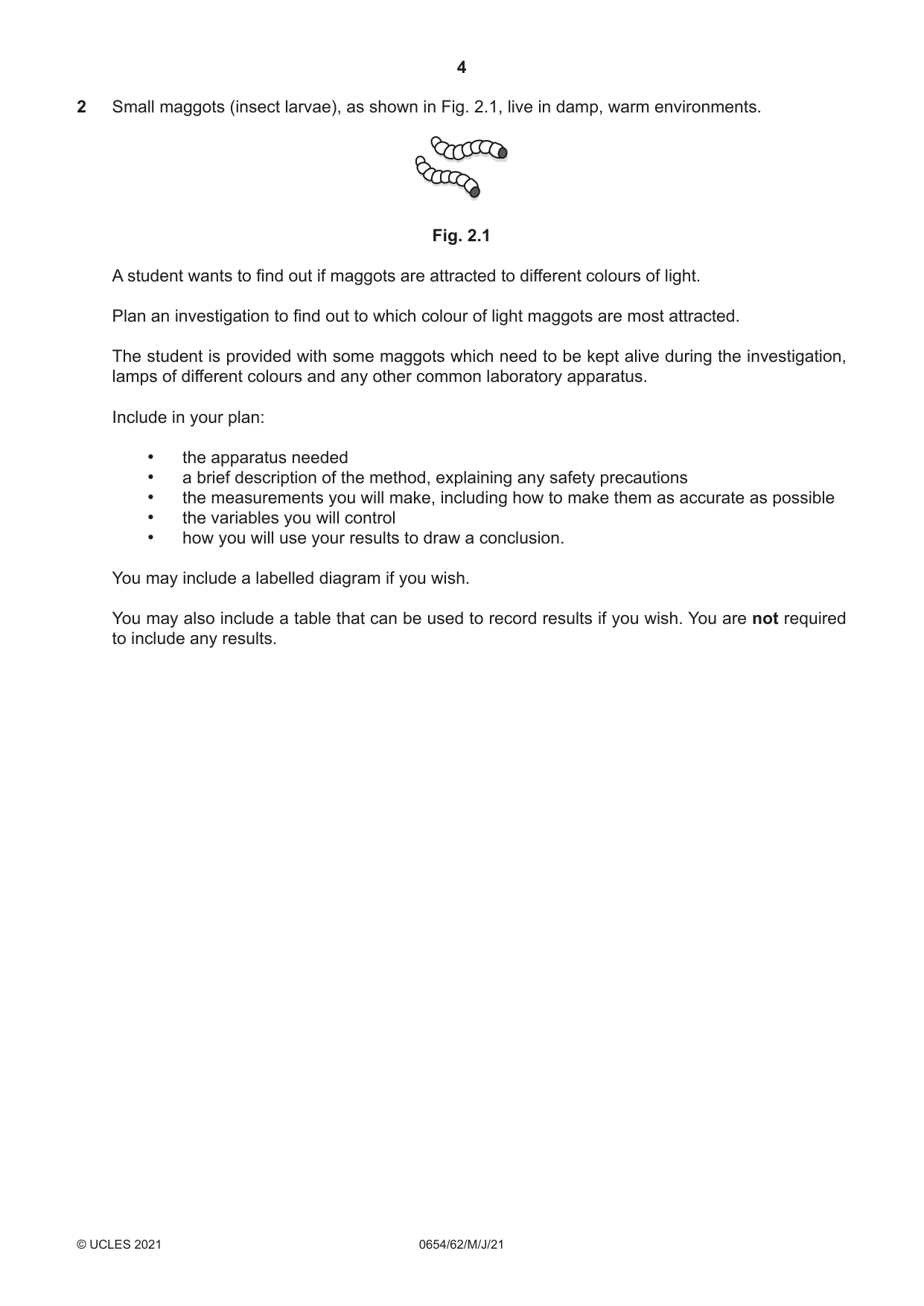
2 Small maggots (insect larvae), as shown in Fig. 2.1, live in damp, warm environments. Fig. 2.1 A student wants to find out if maggots are attracted to different colours of light. Plan an investigation to find out to which colour of light maggots are most attracted. The student is provided with some maggots which need to be kept alive during the investigation, lamps of different colours and any other common laboratory apparatus. Include in your plan: • the apparatus needed • a brief description of the method, explaining any safety precautions • the measurements you will make, including how to make them as accurate as possible • the variables you will control • how you will use your results to draw a conclusion. You may include a labelled diagram if you wish. You may also include a table that can be used to record results if you wish. You are not required to include any results. .......................................................................................................................................................... .......................................................................................................................................................... .......................................................................................................................................................... .......................................................................................................................................................... .......................................................................................................................................................... .......................................................................................................................................................... .......................................................................................................................................................... .......................................................................................................................................................... .......................................................................................................................................................... .......................................................................................................................................................... .......................................................................................................................................................... .......................................................................................................................................................... .......................................................................................................................................................... .......................................................................................................................................................... .......................................................................................................................................................... .......................................................................................................................................................... .......................................................................................................................................................... .......................................................................................................................................................... .......................................................................................................................................................... .................................................................................................................................................... [7]
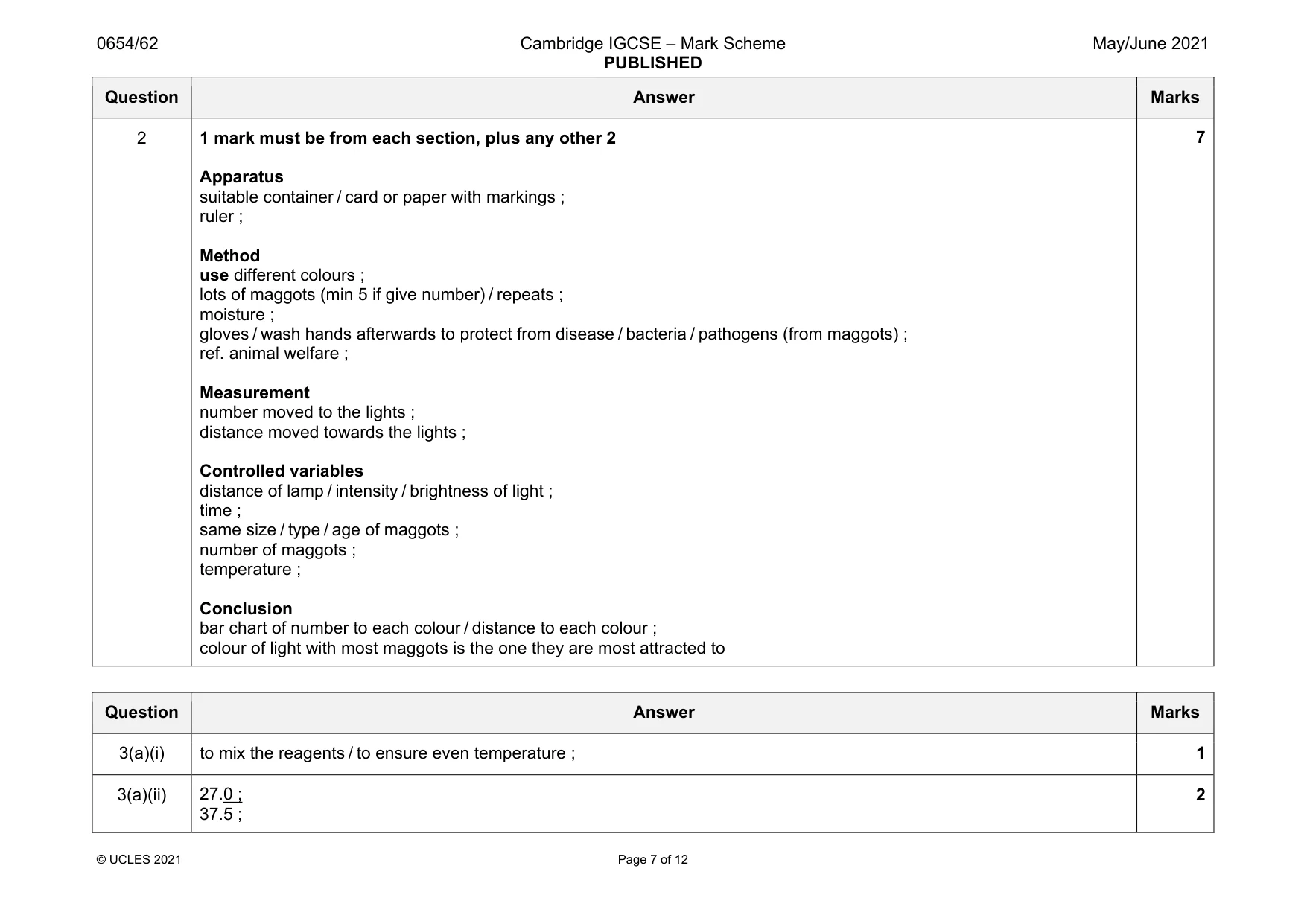
Mark scheme: 2 1 mark must be from each section, plus any other 2 Apparatus suitable container / card or paper with markings ; ruler ; Method use different colours ; lots of maggots (min 5 if give number) / repeats ; moisture ; gloves / wash hands afterwards to protect from disease / bacteria / pathogens (from maggots) ; ref. animal welfare ; Measurement number moved to the lights ; distance moved towards the lights ; Controlled variables distance of lamp / intensity / brightness of light ; time ; same size / type / age of maggots ; number of maggots ; temperature ; Conclusion bar chart of number to each colour / distance to each colour ; colour of light with most maggots is the one they are most attracted to
Q3 · Finds the amount of heat energy hydrochloric acid into a test-tub temperature of the…
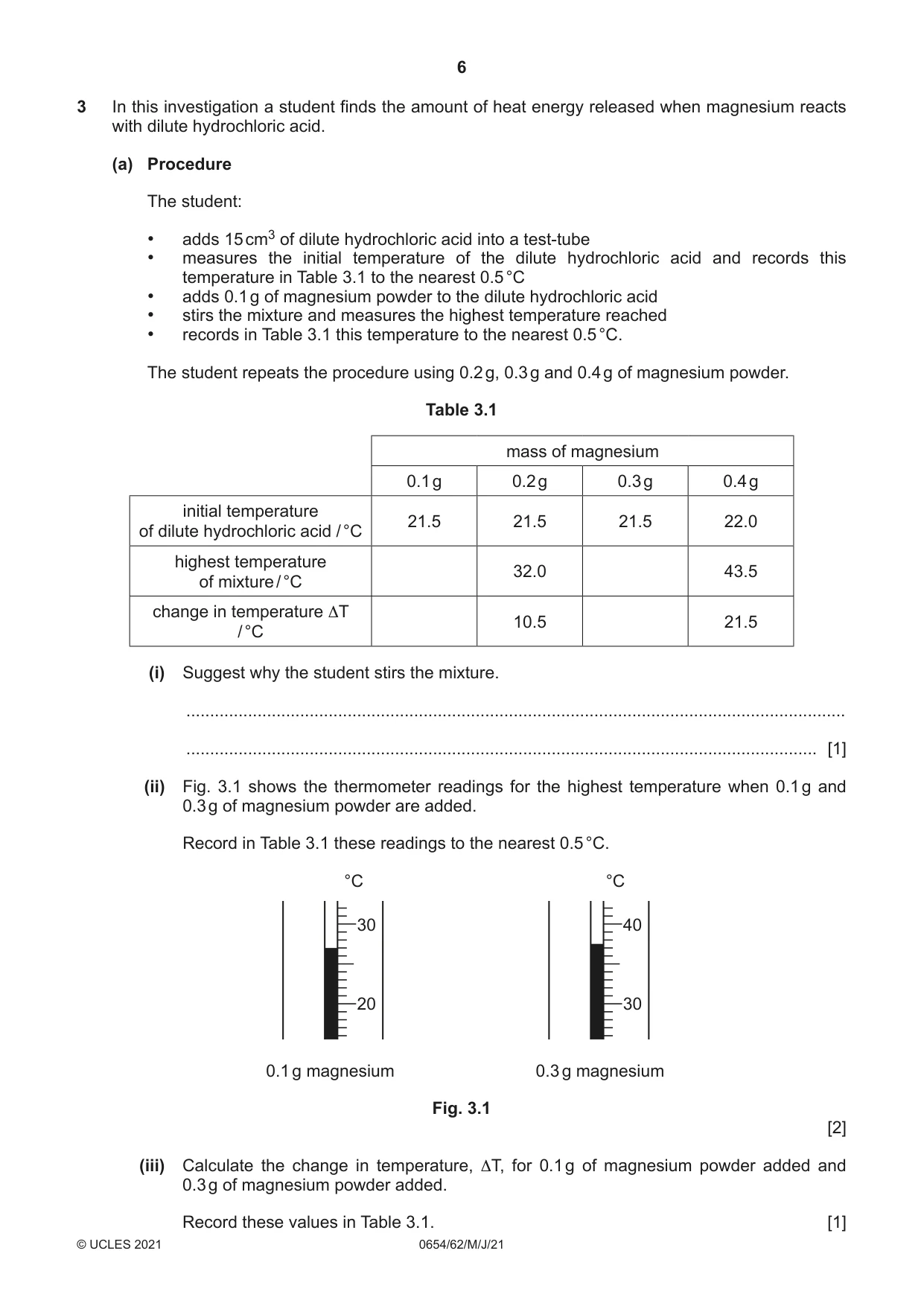
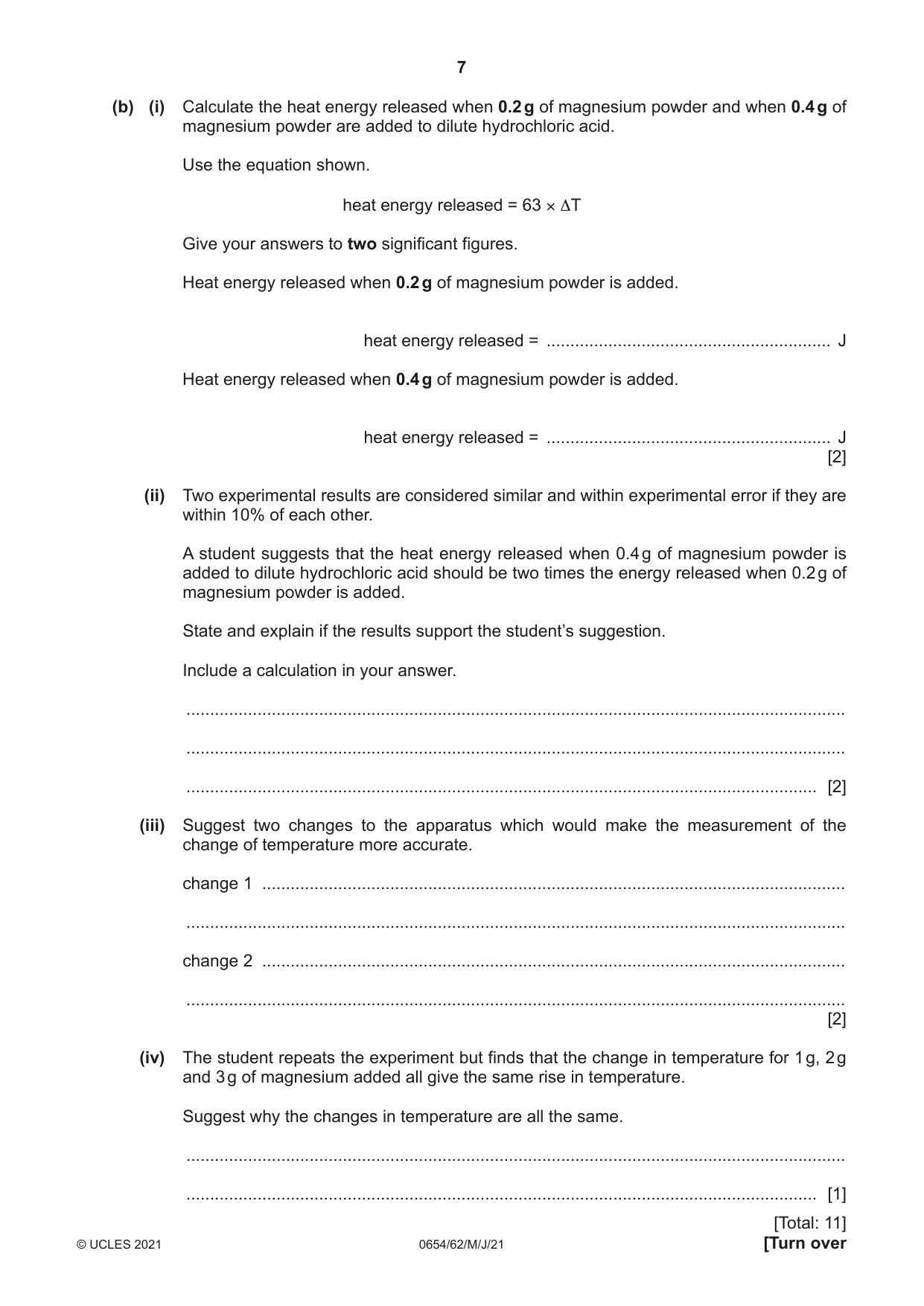
finds the amount of heat energy hydrochloric acid into a test-tub temperature of the dilute hy 3.1 to the nearest 0.5 °C ium powder to the dilute hydroc measures the highest temperatu his temperature to the nearest 0. rocedure using 0.2 g, 0.3 g and 0 Table 3.1 mass of m 0.1 g 0.2 g 21.5 21.5°C 32.0 10.5 ent stirs the mixture. ................................................... ................................................... ermometer readings for the hi owder are added. ese readings to the nearest 0.5 °C 30 20 esium 0.3 g Fig. 3.1 in temperature, ΔT, for 0.1 g owder added. in Table 3.1. (b) (i) Calculate the heat energy released when 0.2 g of magnesium powder and when 0.4 g of magnesium powder are added to dilute hydrochloric acid. Use the equation shown. heat energy released = 63 × ΔT Give your answers to two significant figures. Heat energy released when 0.2 g of magnesium powder is added. heat energy released = ............................................................ J Heat energy released when 0.4 g of magnesium powder is added. heat energy released = ............................................................ J [2] (ii) Two experimental results are considered similar and within experimental error if they are within 10% of each other. A student suggests that the heat energy released when 0.4 g of magnesium powder is added to dilute hydrochloric acid should be two times the energy released when 0.2 g of magnesium powder is added. State and explain if the results support the student’s suggestion. Include a calculation in your answer. ........................................................................................................................................... ........................................................................................................................................... ..................................................................................................................................... [2] (iii) Suggest two changes to the apparatus which would make the measurement of the change of temperature more accurate. change 1 ........................................................................................................................... ........................................................................................................................................... change 2 ........................................................................................................................... ........................................................................................................................................... [2] (iv) The student repeats the experiment but finds that the change in temperature for 1 g, 2 g and 3 g of magnesium added all give the same rise in temperature. Suggest why the changes in temperature are all the same. ........................................................................................................................................... ..................................................................................................................................... [1]
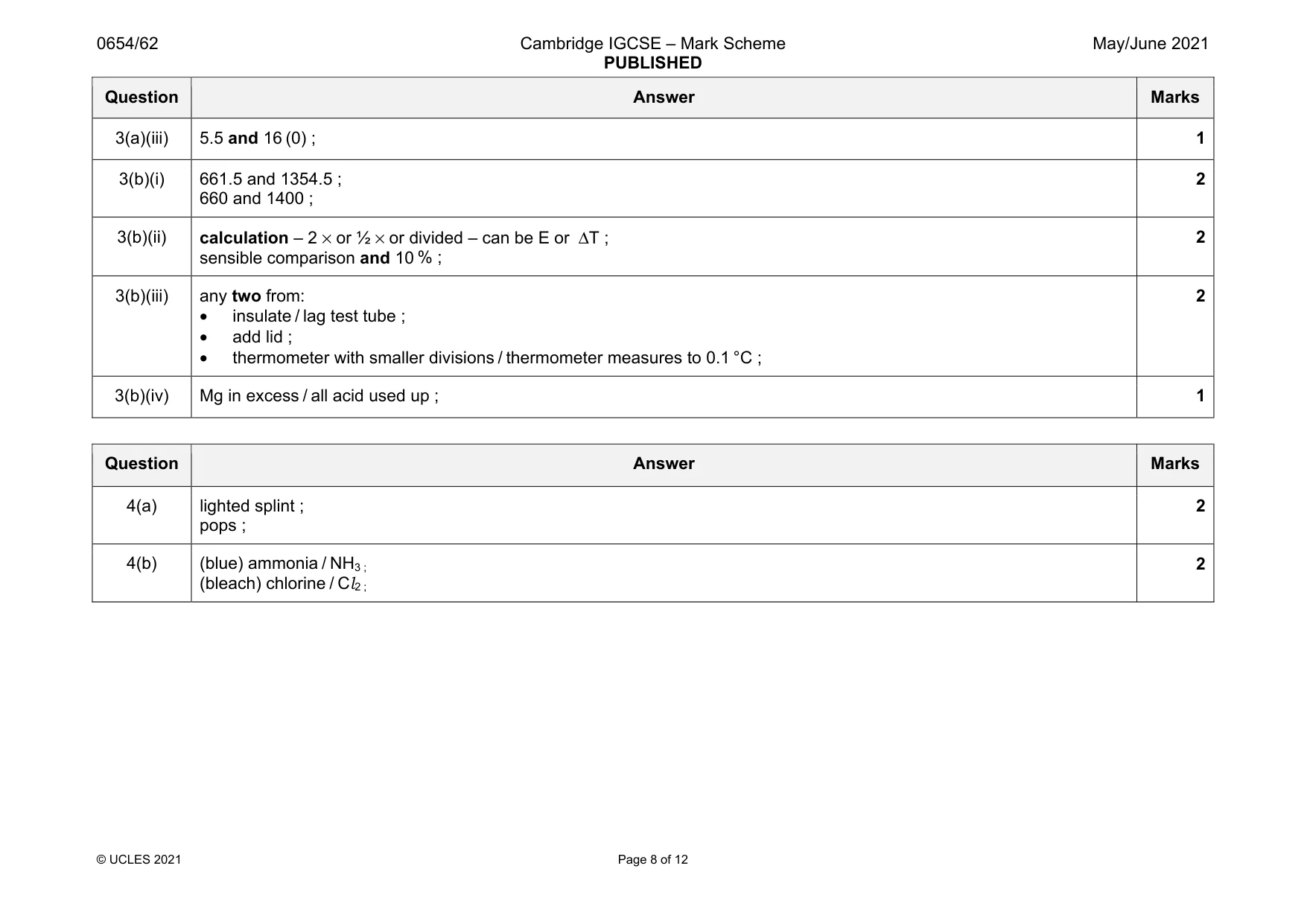
Mark scheme: 3(a)(i) to mix the reagents / to ensure even temperature ; 1 3(a)(ii) 27.0 ; 37.5 ; 2 Question Answer Marks 3(a)(iii) 5.5 and 16 (0) ; 1 3(b)(i) 661.5 and 1354.5 ; 660 and 1400 ; 2 3(b)(ii) calculation – 2 × or ½ × or divided – can be E or ΔT ; sensible comparison and 10 % ; 2 3(b)(iii) any two from: • insulate / lag test tube ; • add lid ; • thermometer with smaller divisions / thermometer measures to 0.1 °C ; 2 3(b)(iv) Mg in excess / all acid used up ; 1
Q4 · In this investigation, a student identifies three gases
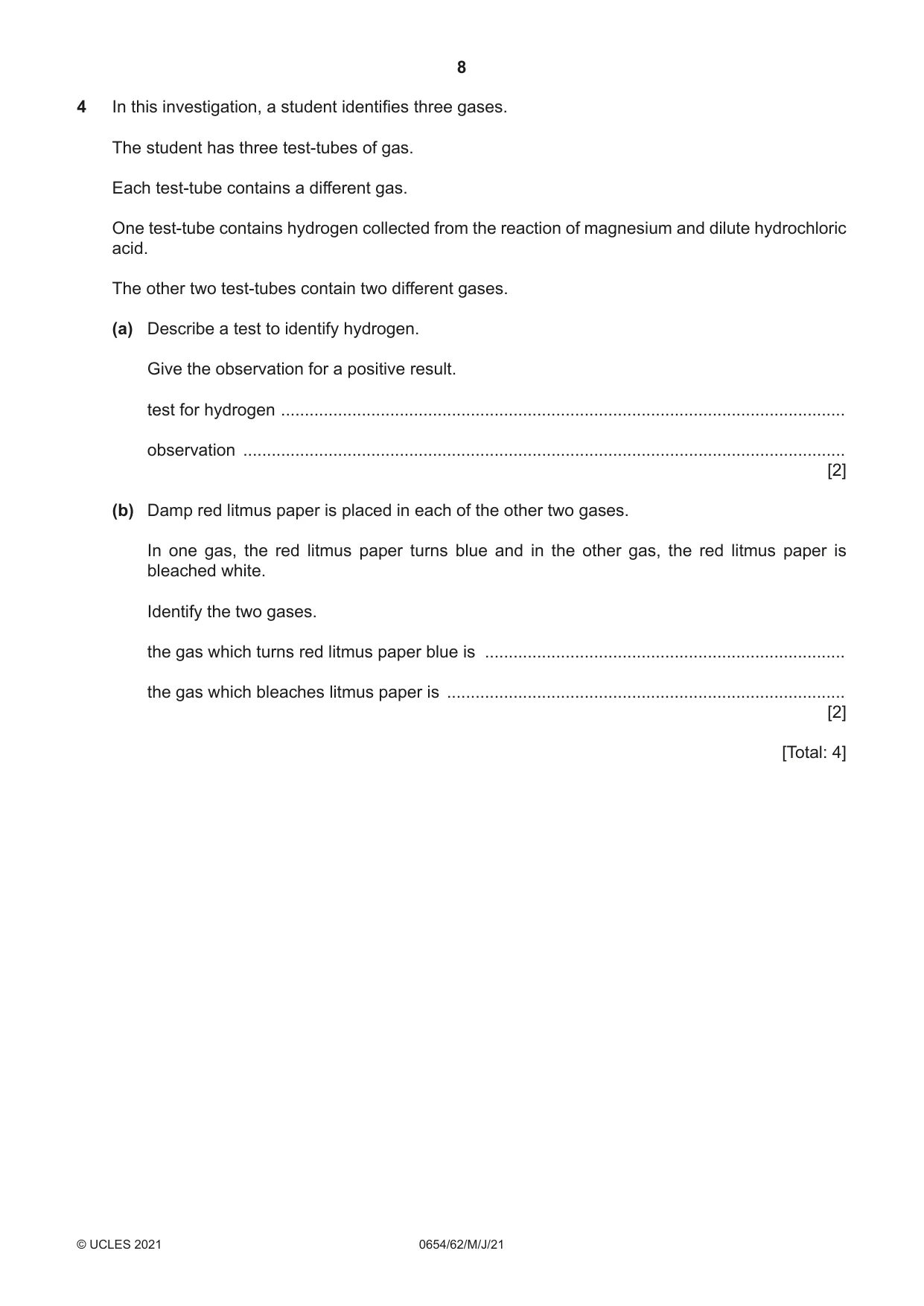
4 In this investigation, a student identifies three gases. The student has three test-tubes of gas. Each test-tube contains a different gas. One test-tube contains hydrogen collected from the reaction of magnesium and dilute hydrochloric acid. The other two test-tubes contain two different gases. (a) Describe a test to identify hydrogen. Give the observation for a positive result. test for hydrogen ....................................................................................................................... observation ............................................................................................................................... [2] (b) Damp red litmus paper is placed in each of the other two gases. In one gas, the red litmus paper turns blue and in the other gas, the red litmus paper is bleached white. Identify the two gases. the gas which turns red litmus paper blue is ............................................................................ the gas which bleaches litmus paper is .................................................................................... [2] [Total: 4]
Mark scheme: 4(a) lighted splint ; pops ; 2 4(b) (blue) ammonia / NH3 ; (bleach) chlorine / Cl2 ; 2
Q5 · In this question you will draw the apparatus required for separating a mixture
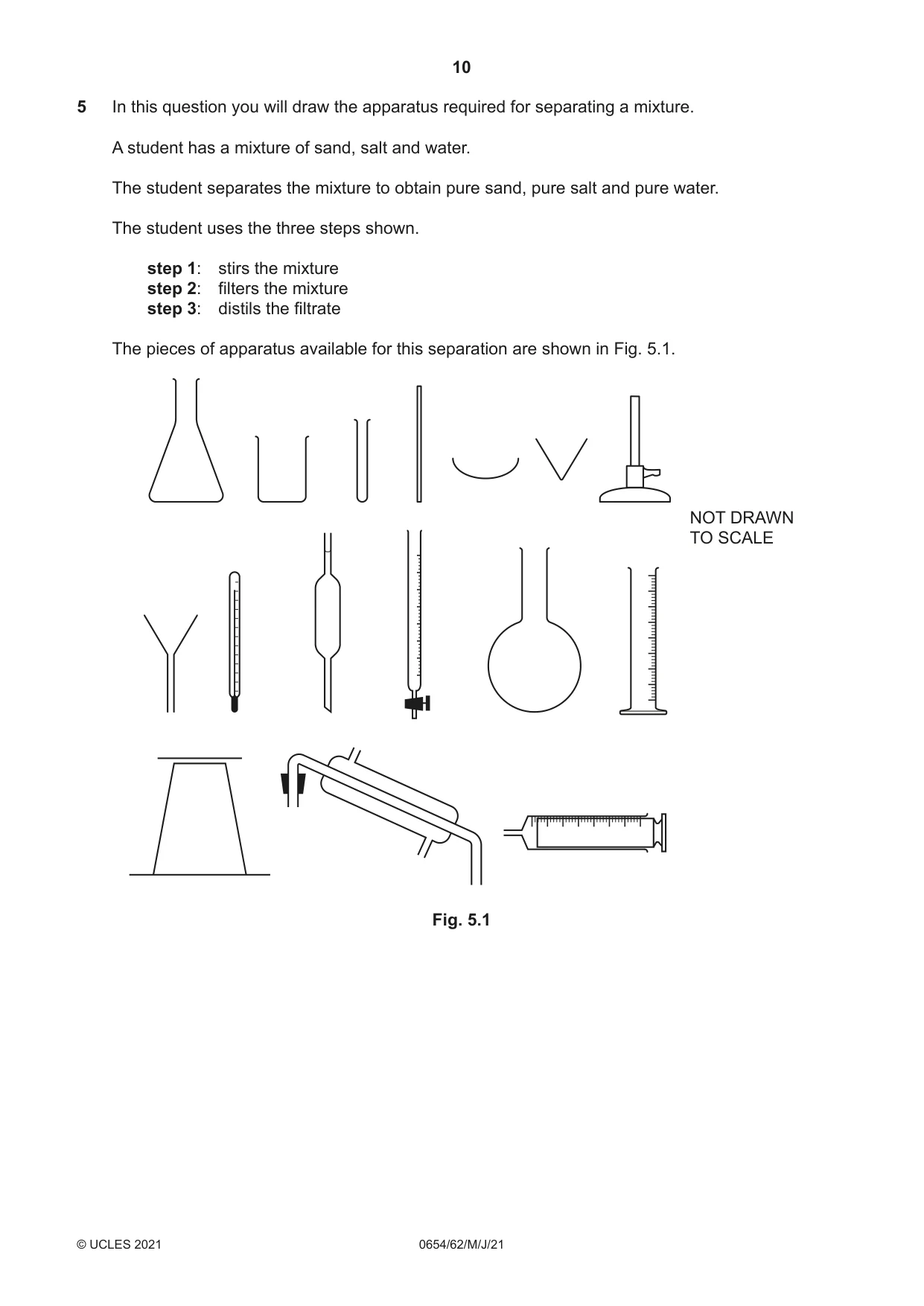
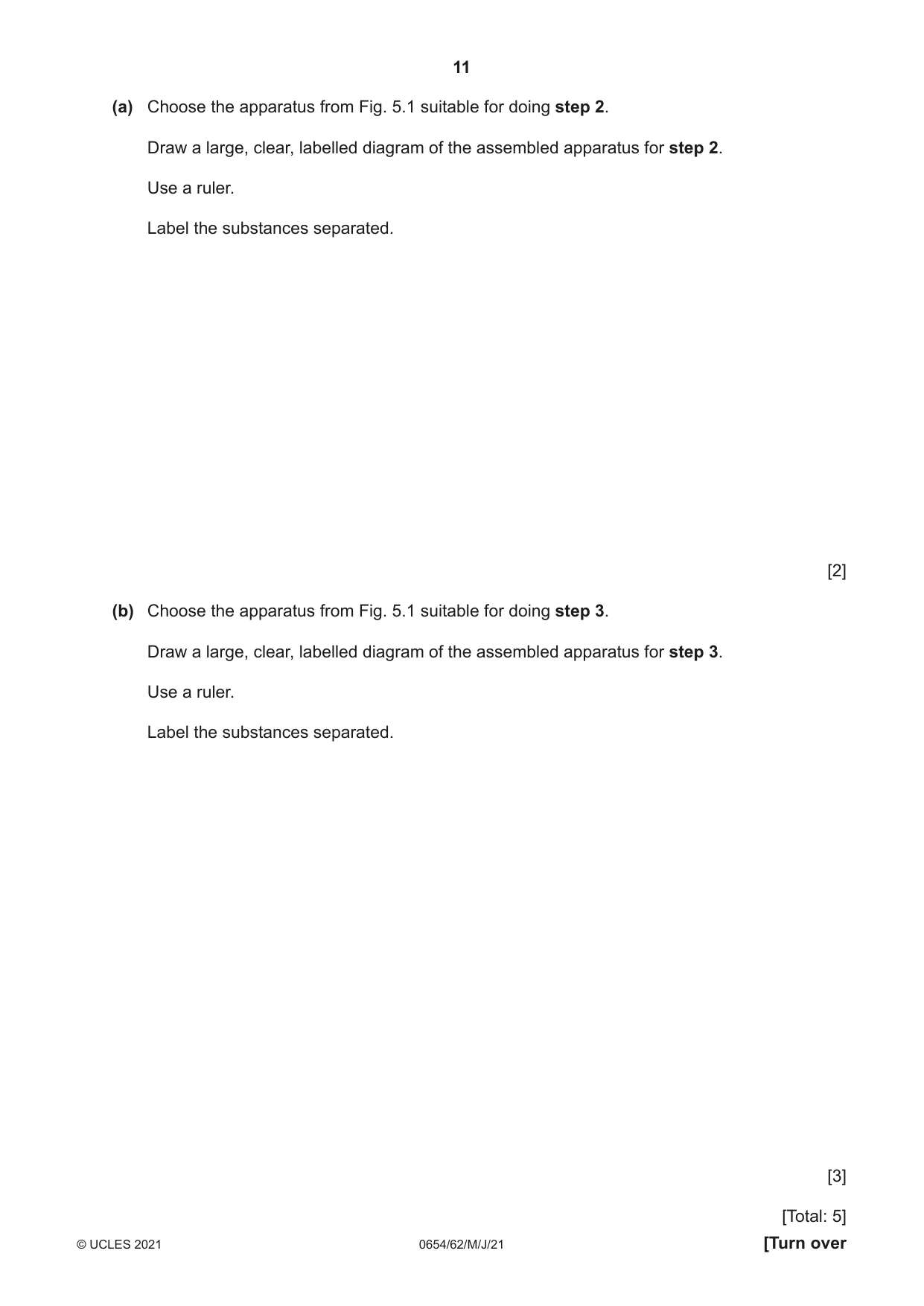
5 In this question you will draw the apparatus required for separating a mixture. A student has a mixture of sand, salt and water. The student separates the mixture to obtain pure sand, pure salt and pure water. The student uses the three steps shown. step 1: stirs the mixture step 2: filters the mixture step 3: distils the filtrate The pieces of apparatus available for this separation are shown in Fig. 5.1. NOT DRAWN TO SCALE Fig. 5.1 (a) Choose the apparatus from Fig. 5.1 suitable for doing step 2. Draw a large, clear, labelled diagram of the assembled apparatus for step 2. Use a ruler. Label the substances separated. [2] (b) Choose the apparatus from Fig. 5.1 suitable for doing step 3. Draw a large, clear, labelled diagram of the assembled apparatus for step 3. Use a ruler. Label the substances separated. [3] [Total: 5]
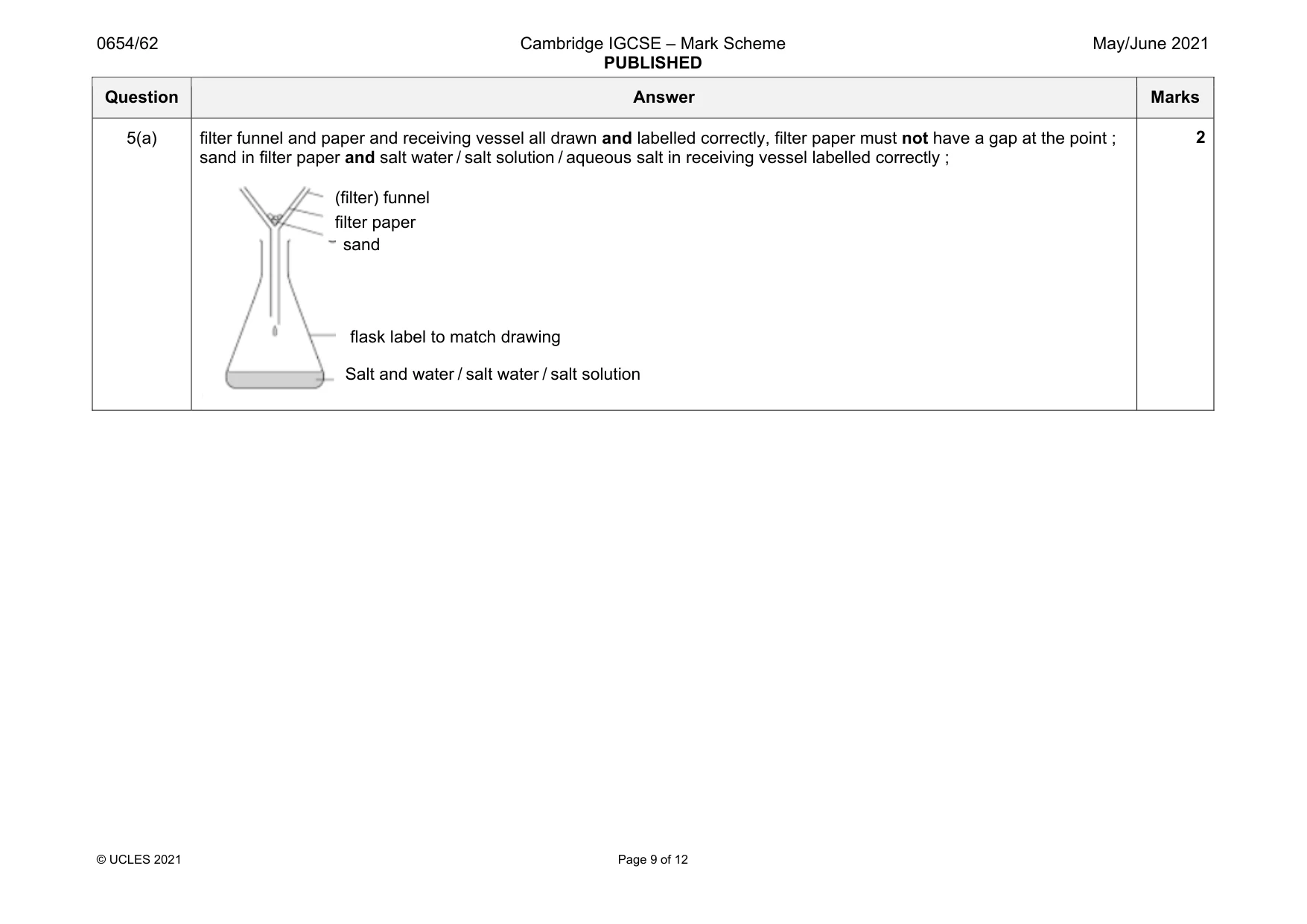
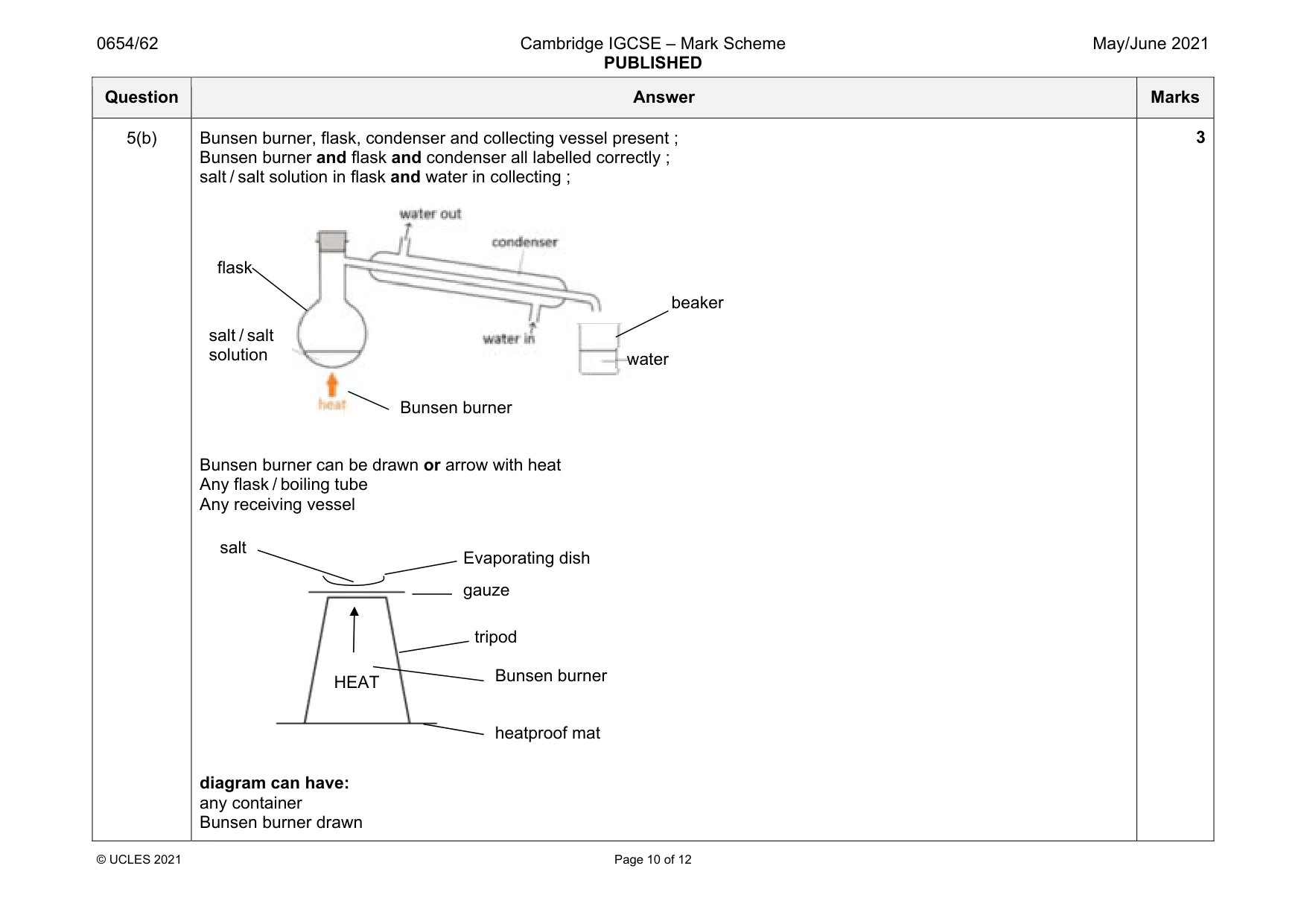
Mark scheme: 5(a) filter funnel and paper and receiving vessel all drawn and labelled correctly, filter paper must not have a gap at the point ; sand in filter paper and salt water / salt solution / aqueous salt in receiving vessel labelled correctly ; (filter) funnel filter paper Salt and water / salt water / salt solution sand flask label to match drawing Question Answer Marks 5(b) Bunsen burner, flask, condenser and collecting vessel present ; Bunsen burner and flask and condenser all labelled correctly ; salt / salt solution in flask and water in collecting ; Bunsen burner can be drawn or arrow with heat Any flask / boiling tube Any receiving vessel diagram can have: any container Bunsen burner drawn 3 salt / salt solution flask Bunsen burner water beaker HEAT Evaporating dish gauze tripod heatproof mat Bunsen burner salt
Q6 · A student does an investigation to find an approximate value for the internal diameter d…
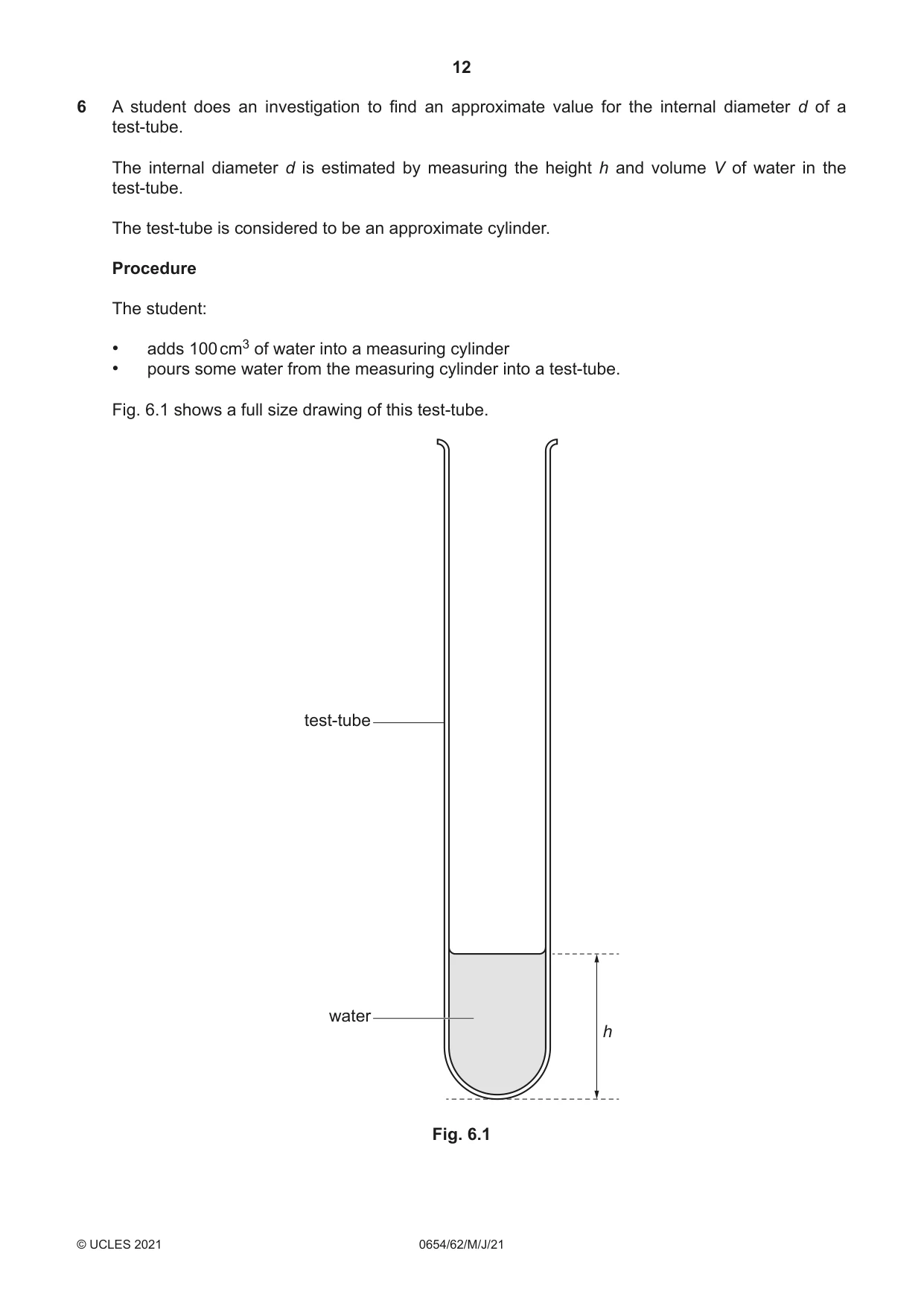
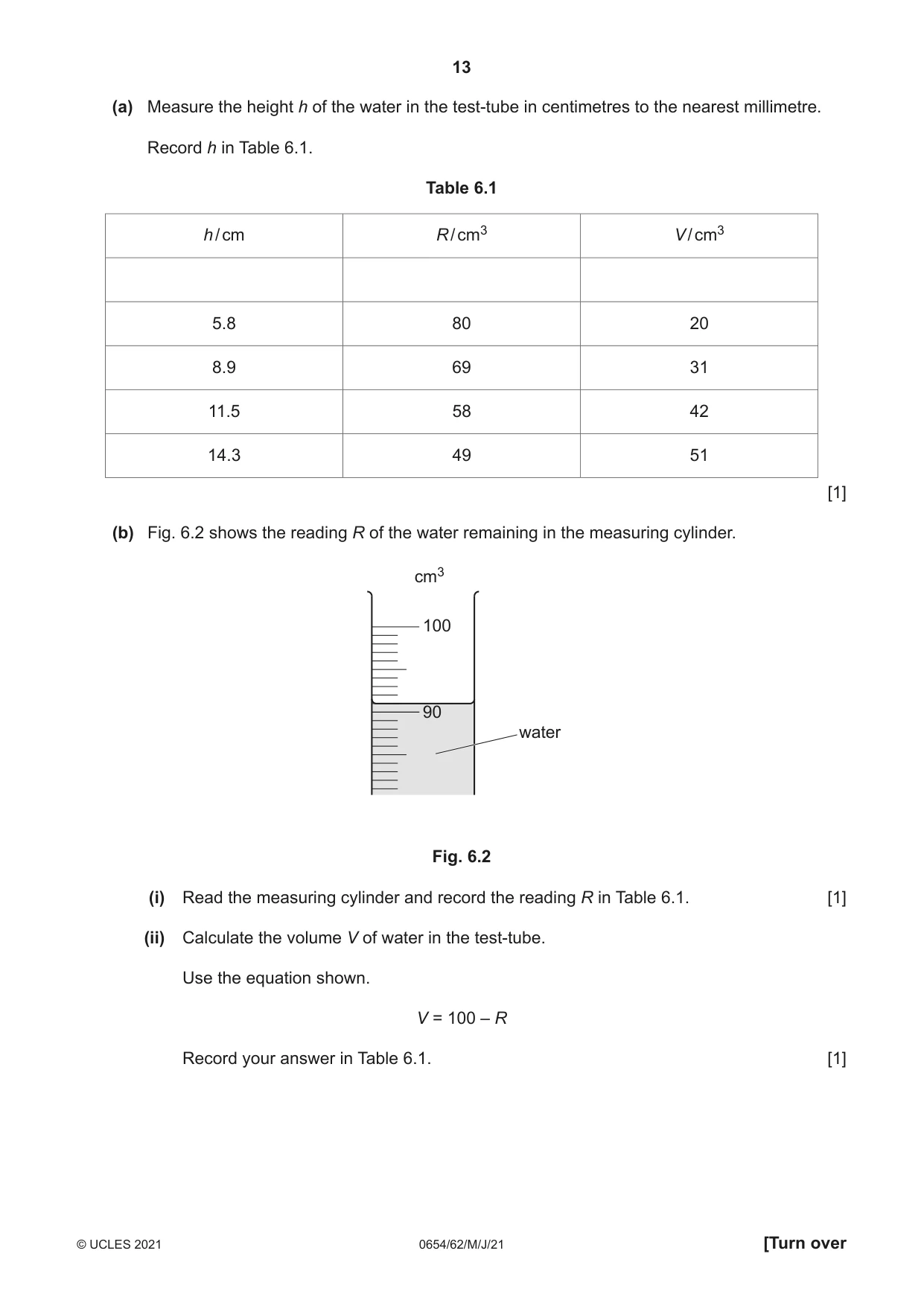
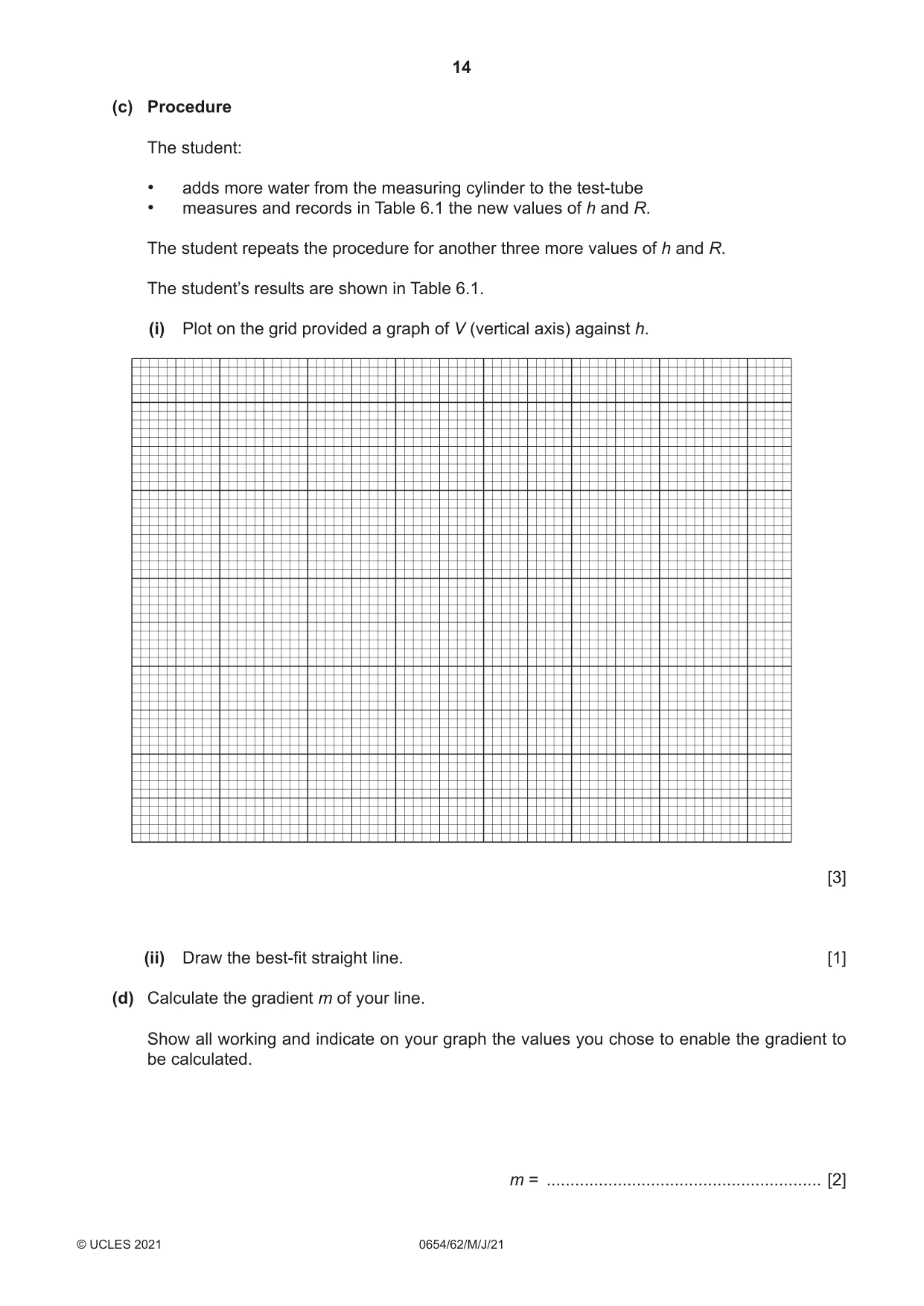
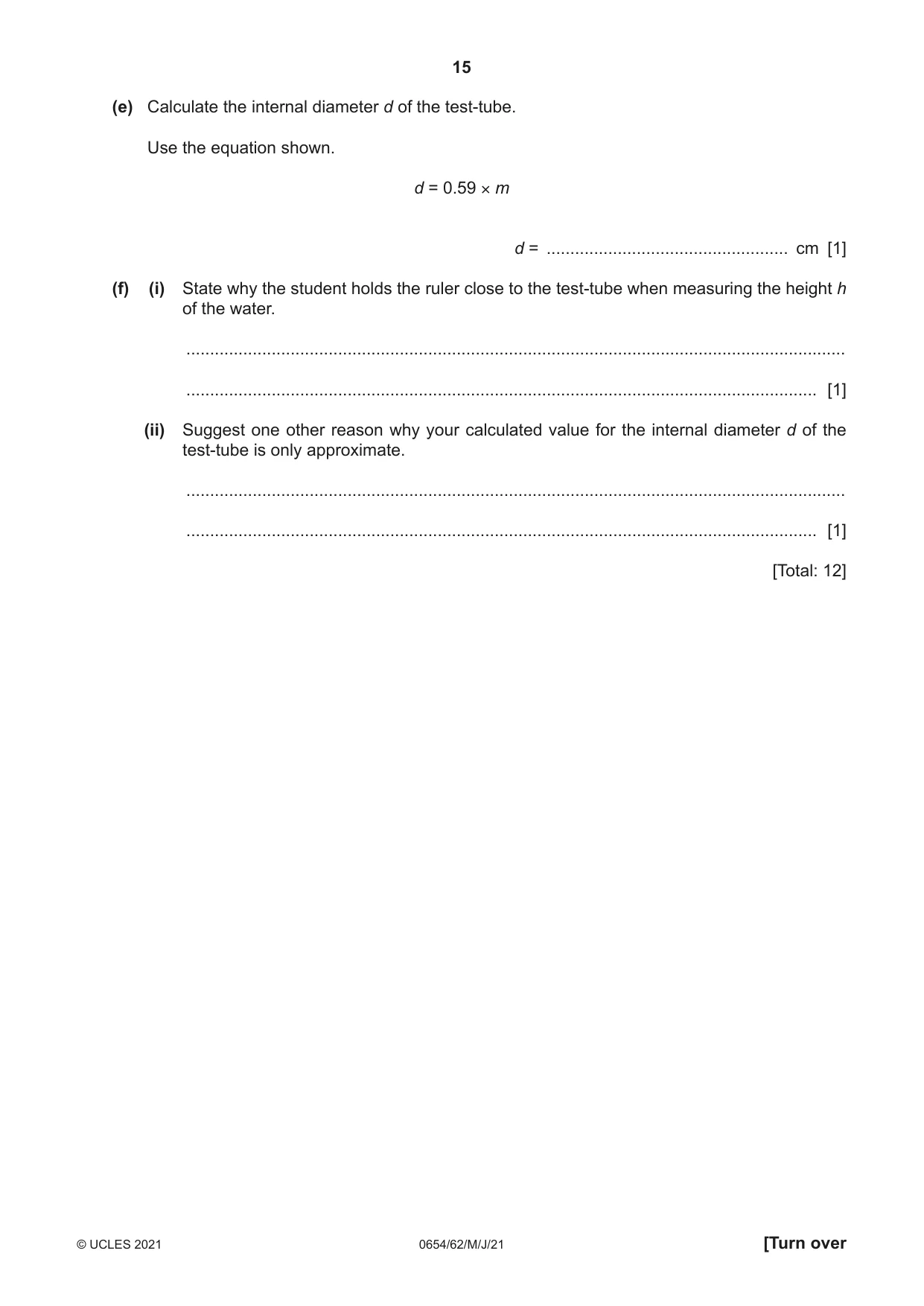
6 A student does an investigation to find an approximate value for the internal diameter d of a test-tube. The internal diameter d is estimated by measuring the height h and volume V of water in the test-tube. The test-tube is considered to be an approximate cylinder. Procedure The student: • adds 100 cm3 of water into a measuring cylinder • pours some water from the measuring cylinder into a test-tube. Fig. 6.1 shows a full size drawing of this test-tube. test-tube water h Fig. 6.1 (a) Measure the height h of the water in the test-tube in centimetres to the nearest millimetre. Record h in Table 6.1. Table 6.1 h / cm R / cm3 V / cm3 5.8 80 20 8.9 69 31 11.5 58 42 14.3 49 51 [1] (b) Fig. 6.2 shows the reading R of the water remaining in the measuring cylinder. cm3 100 90 water Fig. 6.2 (i) Read the measuring cylinder and record the reading R in Table 6.1. [1] (ii) Calculate the volume V of water in the test-tube. Use the equation shown. V = 100 – R Record your answer in Table 6.1. [1] (c) Procedure The student: • adds more water from the measuring cylinder to the test-tube • measures and records in Table 6.1 the new values of h and R. The student repeats the procedure for another three more values of h and R. The student’s results are shown in Table 6.1. (i) Plot on the grid provided a graph of V (vertical axis) against h. [3] (ii) Draw the best-fit straight line. [1] (d) Calculate the gradient m of your line. Show all working and indicate on your graph the values you chose to enable the gradient to be calculated. m = .......................................................... [2] (e) Calculate the internal diameter d of the test-tube. Use the equation shown. d = 0.59 × m d = ................................................... cm [1] (f) (i) State why the student holds the ruler close to the test-tube when measuring the height h of the water. ........................................................................................................................................... ..................................................................................................................................... [1] (ii) Suggest one other reason why your calculated value for the internal diameter d of the test-tube is only approximate. ........................................................................................................................................... ..................................................................................................................................... [1] [Total: 12]
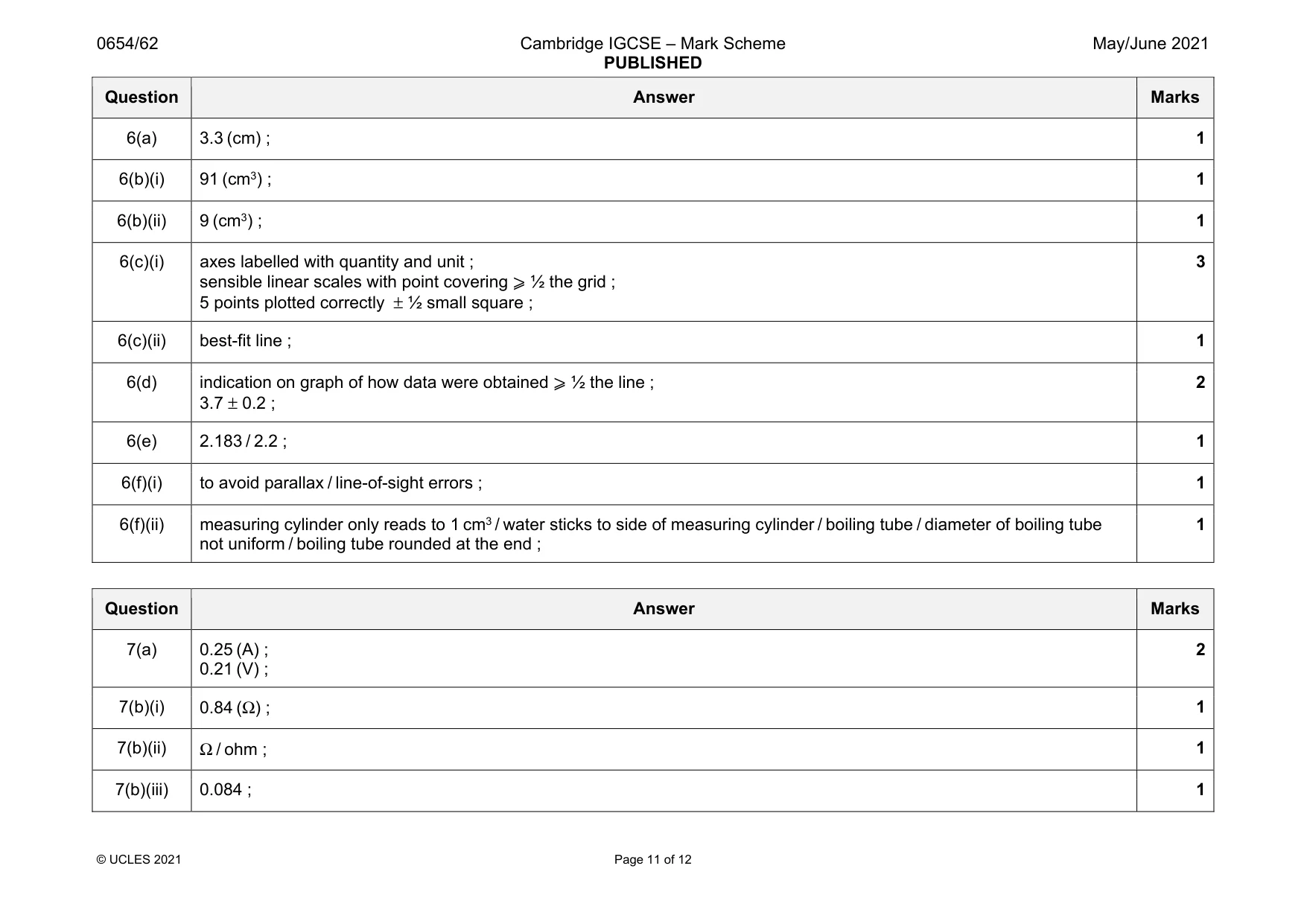
Mark scheme: 6(a) 3.3 (cm) ; 1 6(b)(i) 91 (cm3) ; 1 6(b)(ii) 9 (cm3) ; 1 6(c)(i) axes labelled with quantity and unit ; sensible linear scales with point covering ⩾ ½ the grid ; 5 points plotted correctly ± ½ small square ; 3 6(c)(ii) best-fit line ; 1 6(d) indication on graph of how data were obtained ⩾ ½ the line ; 3.7 ± 0.2 ; 2 6(e) 2.183 / 2.2 ; 1 6(f)(i) to avoid parallax / line-of-sight errors ; 1 6(f)(ii) measuring cylinder only reads to 1 cm3 / water sticks to side of measuring cylinder / boiling tube / diameter of boiling tube not uniform / boiling tube rounded at the end ; 1
More questions on Physical quantities and measurement techniques
Q7 · A student investigates how the resistance of a metal wire depends upon its length
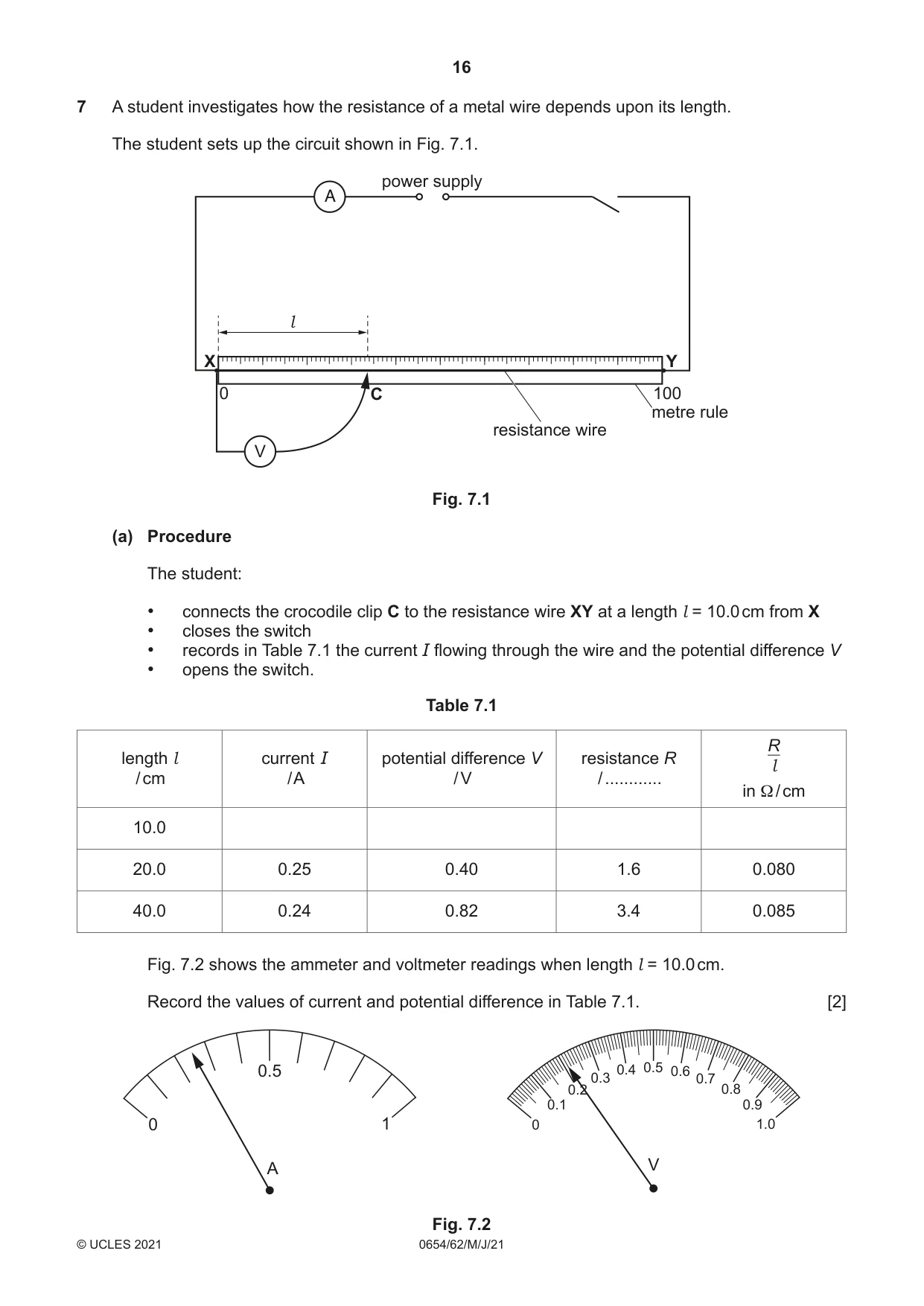
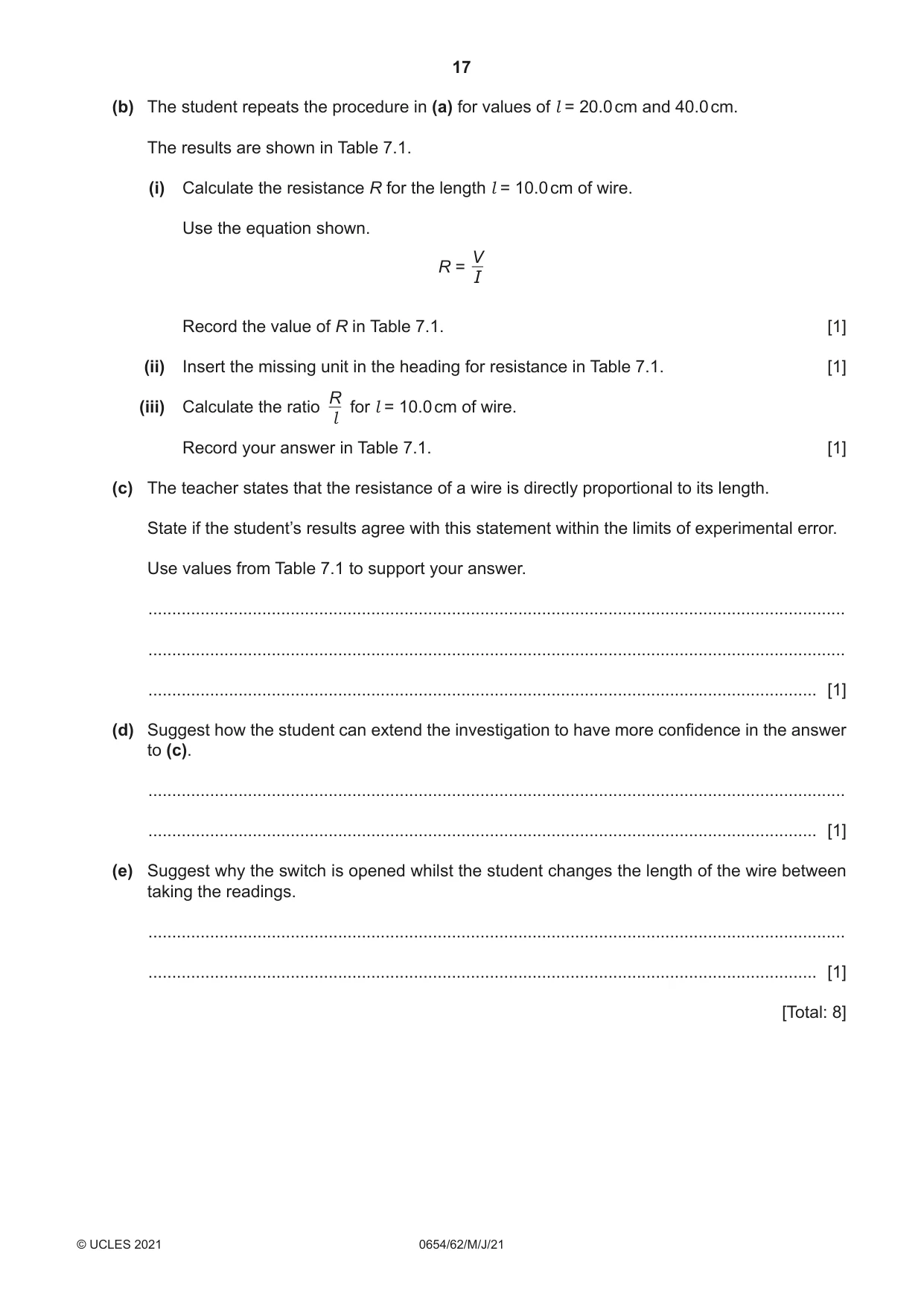
7 A student investigates how the resistance of a metal wire depends upon its length. The student sets up the circuit shown in Fig. 7.1. power supply A l X Y 0 C 100 metre rule resistance wire V Fig. 7.1 (a) Procedure The student: • connects the crocodile clip C to the resistance wire XY at a length l = 10.0 cm from X • closes the switch • records in Table 7.1 the current I flowing through the wire and the potential difference V • opens the switch. Table 7.1 R length l current I potential difference V resistance R l / cm / A / V / ............ in Ω / cm 10.0 20.0 0.25 0.40 1.6 0.080 40.0 0.24 0.82 3.4 0.085 Fig. 7.2 shows the ammeter and voltmeter readings when length l = 10.0 cm. Record the values of current and potential difference in Table 7.1. [2] 0.5 0.4 0.5 0.6 0.3 0.7 0.2 0.8 0.1 0.9 0 1 0 1.0 A V Fig. 7.2 (b) The student repeats the procedure in (a) for values of l = 20.0 cm and 40.0 cm. The results are shown in Table 7.1. (i) Calculate the resistance R for the length l = 10.0 cm of wire. Use the equation shown. V R = I Record the value of R in Table 7.1. [1] (ii) Insert the missing unit in the heading for resistance in Table 7.1. [1] R (iii) Calculate the ratio for l = 10.0 cm of wire. l Record your answer in Table 7.1. [1] (c) The teacher states that the resistance of a wire is directly proportional to its length. State if the student’s results agree with this statement within the limits of experimental error. Use values from Table 7.1 to support your answer. ................................................................................................................................................... ................................................................................................................................................... ............................................................................................................................................. [1] (d) Suggest how the student can extend the investigation to have more confidence in the answer to (c). ................................................................................................................................................... ............................................................................................................................................. [1] (e) Suggest why the switch is opened whilst the student changes the length of the wire between taking the readings. ................................................................................................................................................... ............................................................................................................................................. [1] [Total: 8]
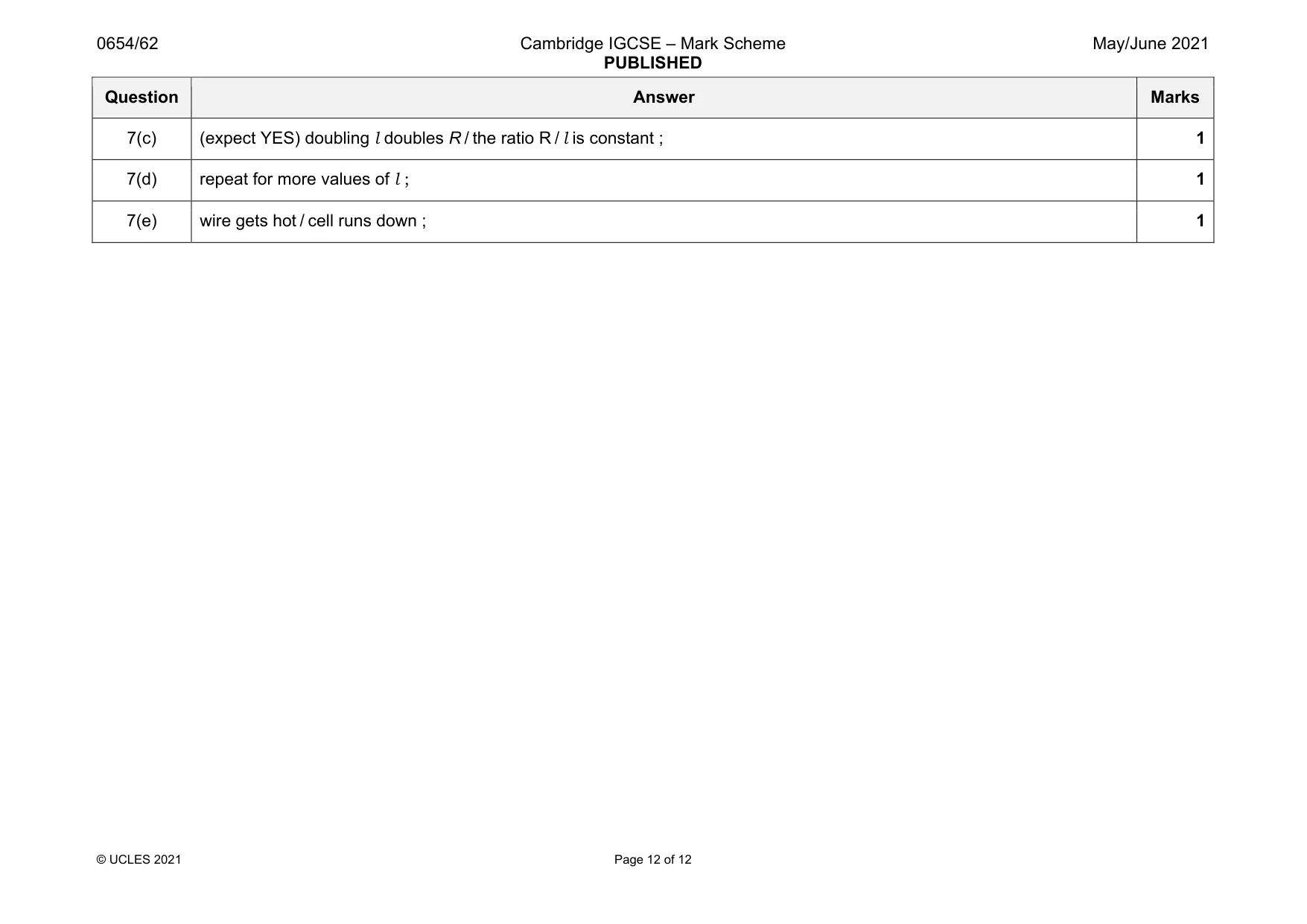
Mark scheme: 7(a) 0.25 (A) ; 0.21 (V) ; 2 7(b)(i) 0.84 (Ω) ; 1 7(b)(ii) Ω / ohm ; 1 7(b)(iii) 0.084 ; 1 Question Answer Marks 7(c) (expect YES) doubling l doubles R / the ratio R / l is constant ; 1 7(d) repeat for more values of l ; 1 7(e) wire gets hot / cell runs down ; 1
What was in this paper
The subtopics covered by these 7 questions, and how many questions each got. Open one in a new tab to see every Cambridge question on it.
What you needed in this session
Cambridge’s own grade thresholds for 2021 May/June, Paper 6 · Variant 2. A higher threshold means an easier paper — the bar moves with how the cohort did.