Questions as text
Q1 · An object X with mass 2.0 kg is moving with a speed of 4.0 m / s 0973/21 May/June 2019
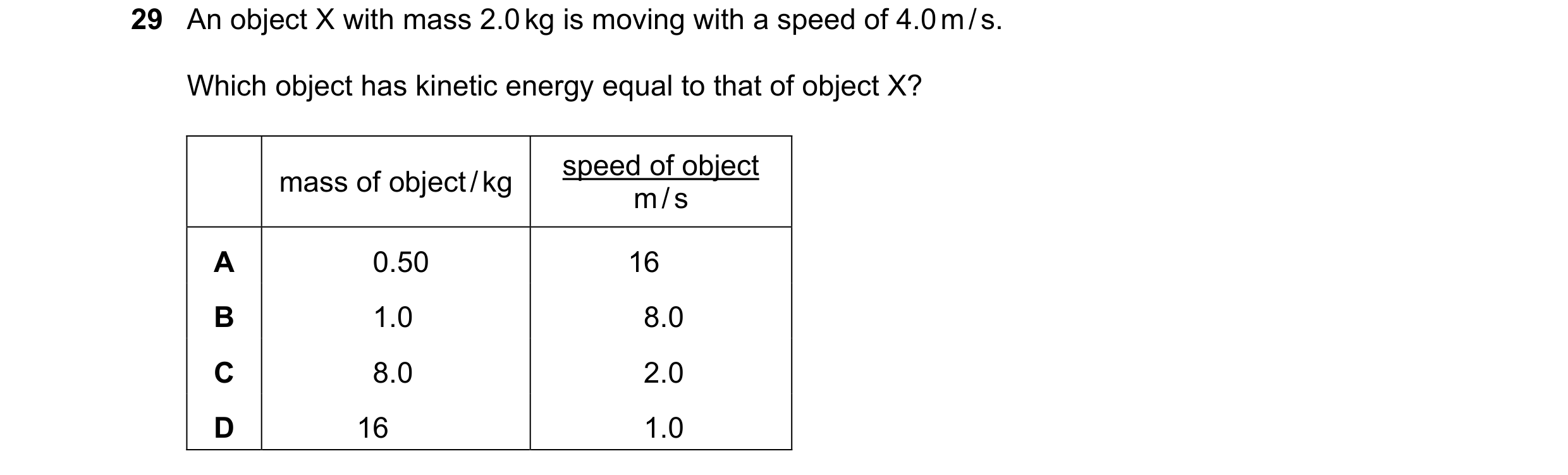
29 An object X with mass 2.0 kg is moving with a speed of 4.0 m / s. Which object has kinetic energy equal to that of object X? speed of object mass of object / kg m / s A 0.50 16 B 1.0 8.0 C 8.0 2.0 D 16 1.0
1 marks
Answer: C
This question in 0973/21 May/June 2019
Q2 · What are the units of work and power? 0973/21 May/June 2019
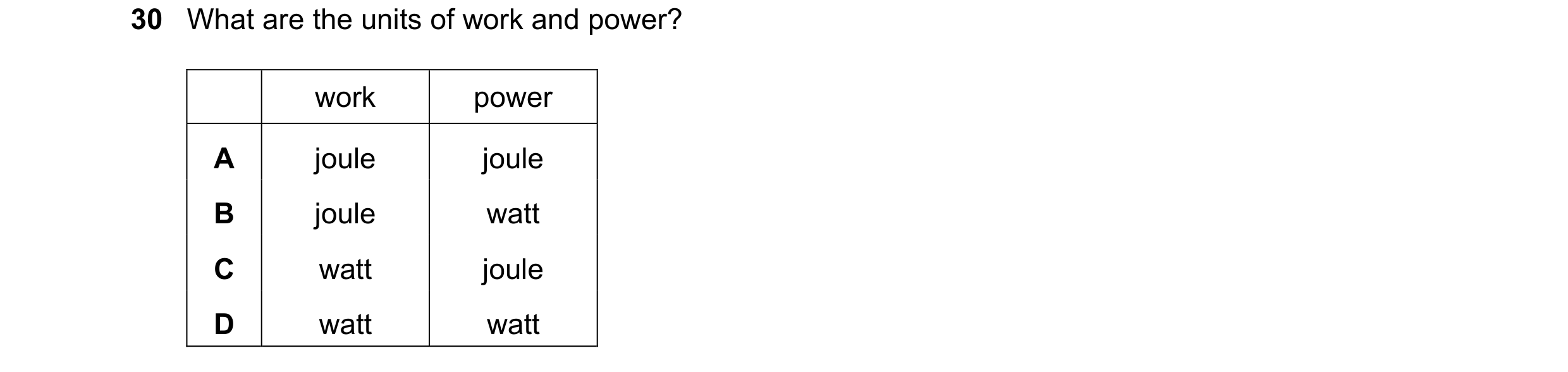
30 What are the units of work and power? work power A joule joule B joule watt C watt joule D watt watt
1 marks
Answer: B
This question in 0973/21 May/June 2019
Q3 · An object X with mass 2.0 kg is moving with a speed of 4.0 m / s 0973/22 May/June 2019
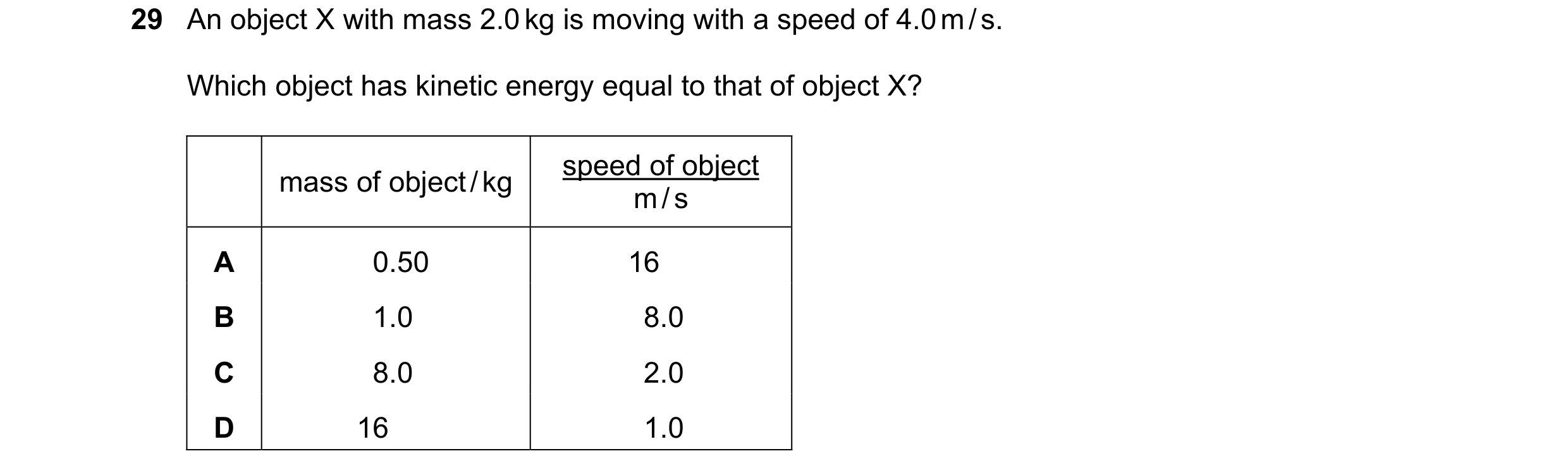
29 An object X with mass 2.0 kg is moving with a speed of 4.0 m / s. Which object has kinetic energy equal to that of object X? speed of object mass of object / kg m / s A 0.50 16 B 1.0 8.0 C 8.0 2.0 D 16 1.0
1 marks
Answer: C
This question in 0973/22 May/June 2019
Q4 · For which list is the Sun the original source of the energy for all of the energy… 0973/22 May/June 2019
30 For which list is the Sun the original source of the energy for all of the energy resources? A coal, geothermal and wind B coal, hydroelectric and nuclear fission C hydroelectric, oil and wind D oil, geothermal and nuclear fission
1 marks
Answer: C
This question in 0973/22 May/June 2019
Q5 · An engine is doing work on a car as the car moves along a road 0973/21 Oct/Nov 2019
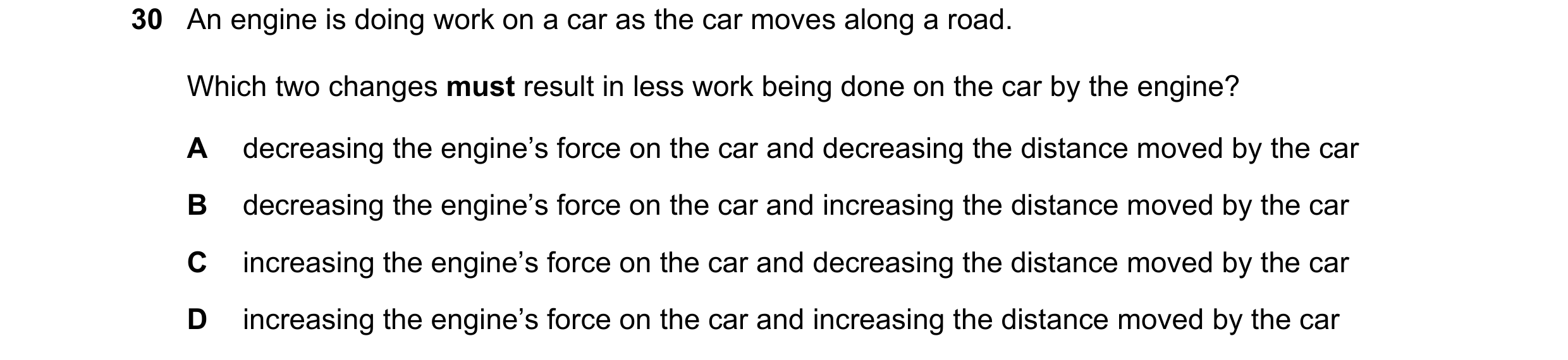
30 An engine is doing work on a car as the car moves along a road. Which two changes must result in less work being done on the car by the engine? A decreasing the engine’s force on the car and decreasing the distance moved by the car B decreasing the engine’s force on the car and increasing the distance moved by the car C increasing the engine’s force on the car and decreasing the distance moved by the car D increasing the engine’s force on the car and increasing the distance moved by the car
1 marks
Answer: A
This question in 0973/21 Oct/Nov 2019
Q6 · A machine has useful output energy of 1000 J, and wasted energy of 300 J 0973/21 Oct/Nov 2019
31 A machine has useful output energy of 1000 J, and wasted energy of 300 J. Which expression is used to calculate the efficiency of the machine? 300 × 100% A (1000 + 300) B 300 × 100% 1000 (1000 − 300) C × 100% 1000 D 1000 × 100% (1000 + 300)
1 marks
Answer: D
This question in 0973/21 Oct/Nov 2019
Q7 · An object is moving along a straight path with 200 J of kinetic energy 0973/21 May/June 2020
30 An object is moving along a straight path with 200 J of kinetic energy. A resultant force acts on the object, in the direction it is moving, for a distance of 20 m. The kinetic energy of the object increases to 1000 J. What is the magnitude of the force? A 10 N B 40 N C 50 N D 60 N
1 marks
Answer: B
This question in 0973/21 May/June 2020
Q8 · An object of mass m moving with speed v has kinetic energy E 0973/21 May/June 2020
31 An object of mass m moving with speed v has kinetic energy E. v . A second object, also of mass m, moves with speed 2 What is the kinetic energy of the second object? E E A B C E D 2E 4 2
1 marks
Answer: A
This question in 0973/21 May/June 2020
Q9 · Which statement describes the production of electricity from a renewable energy source? 0973/21 May/June 2020
32 Which statement describes the production of electricity from a renewable energy source? A Coal is burnt to release energy to make steam that turns a generator. B Moving air passes over blades that rotate and turn a generator. C Nuclear fission releases energy to make steam that turns a generator. D Oil is burnt to release energy to make steam that turns a generator.
1 marks
Answer: B
This question in 0973/21 May/June 2020
Q10 · An object of mass m moving with speed v has kinetic energy E 0973/22 May/June 2020
29 An object of mass m moving with speed v has kinetic energy E. v . A second object, also of mass m, moves with speed 2 What is the kinetic energy of the second object? E E A B C E D 2E 4 2
1 marks
Answer: A
This question in 0973/22 May/June 2020
Q11 · Which energy resource does not have the Sun as its source of energy? 0973/22 May/June 2020
30 Which energy resource does not have the Sun as its source of energy? A coal B geothermal C hydroelectric D waves
1 marks
Answer: B
This question in 0973/22 May/June 2020
Q12 · Electricity is generated in power stations 0973/21 Oct/Nov 2020
31 Electricity is generated in power stations. Many power stations use steam to drive turbines. Which type of power station does not use steam? A chemical energy (fuel) power stations B geothermal energy power stations C hydroelectric energy power stations D nuclear energy power stations
1 marks
Answer: C
This question in 0973/21 Oct/Nov 2020
Q13 · The diagram shows a man diving into water 0973/21 May/June 2021
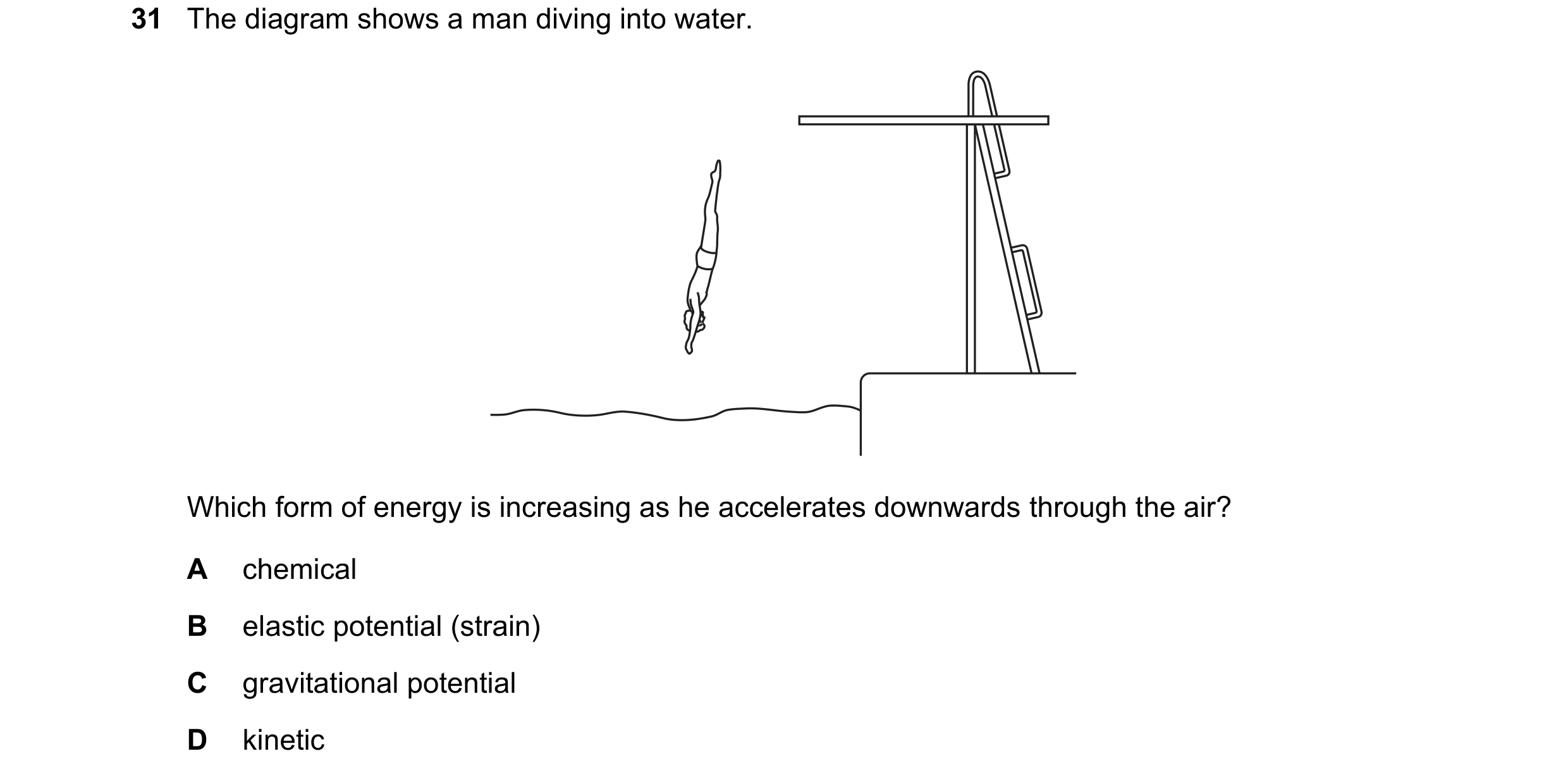
31 The diagram shows a man diving into water. Which form of energy is increasing as he accelerates downwards through the air? A chemical B elastic potential (strain) C gravitational potential D kinetic
1 marks
Answer: D
This question in 0973/21 May/June 2021
Q14 · The diagram shows a man diving into water 0973/22 May/June 2021
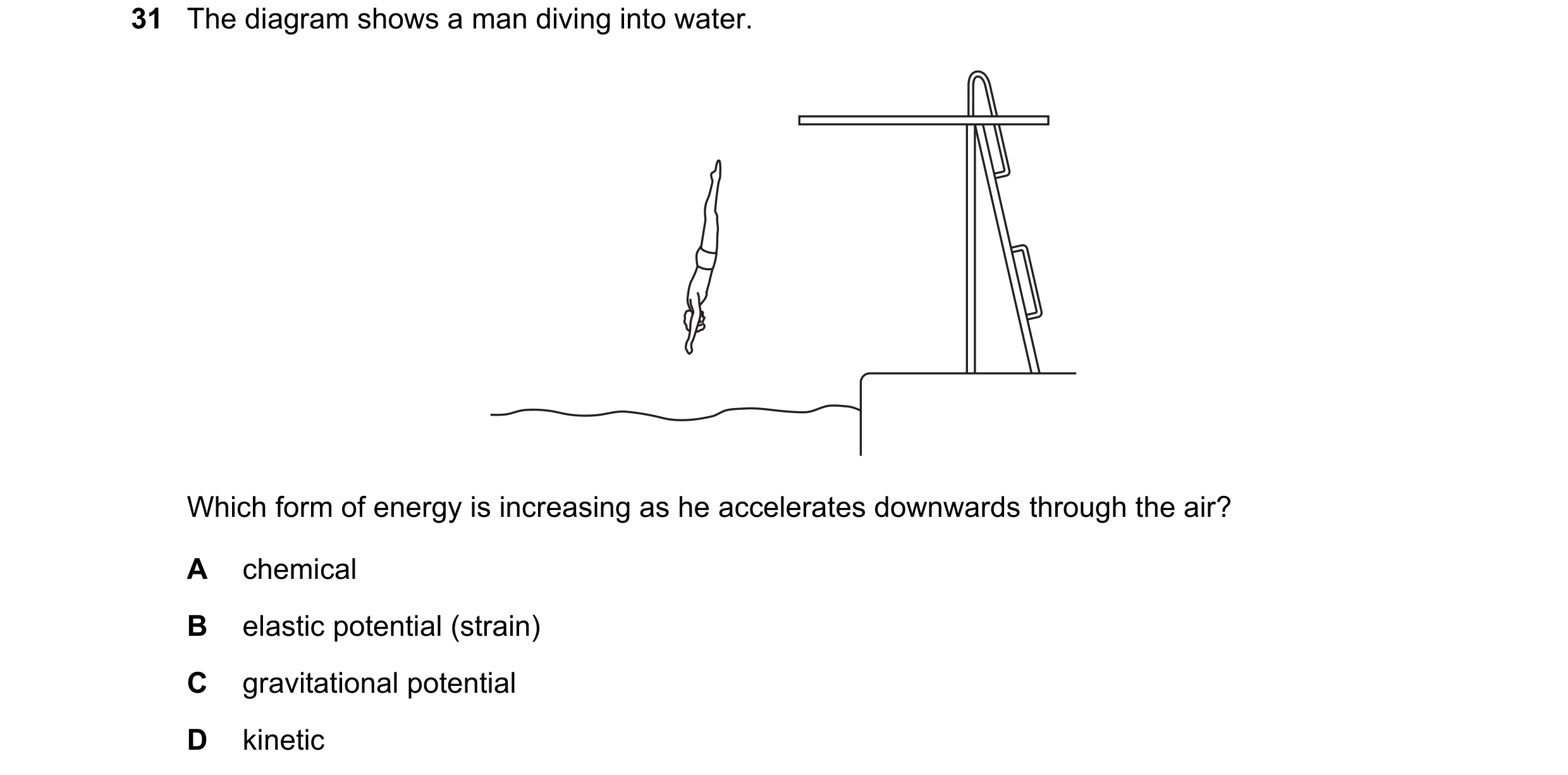
31 The diagram shows a man diving into water. Which form of energy is increasing as he accelerates downwards through the air? A chemical B elastic potential (strain) C gravitational potential D kinetic
1 marks
Answer: D
This question in 0973/22 May/June 2021
Q15 · A ball falls vertically downwards 0973/21 Oct/Nov 2021
30 A ball falls vertically downwards. Which energy transfer takes place as the ball accelerates downwards? A gravitational potential to elastic potential (strain) B gravitational potential to kinetic C elastic potential (strain) to kinetic D kinetic to gravitational potential
1 marks
Answer: B
This question in 0973/21 Oct/Nov 2021
Q16 · A 250 W electric motor lifts a 50 N load through a height of 4.0 m in 3.0 s 0973/21 Oct/Nov 2021
31 A 250 W electric motor lifts a 50 N load through a height of 4.0 m in 3.0 s. What is the efficiency of this system of lifting the load? A 15% B 27% C 38% D 67%
1 marks
Answer: B
This question in 0973/21 Oct/Nov 2021
Q17 · An object moving at speed v has kinetic energy E 0973/21 May/June 2022
30 An object moving at speed v has kinetic energy E. What is the speed of the object when its kinetic energy is 4.0 E ? A 0.25 v B 2.0 v C 4.0 v D 16 v
1 marks
Answer: B
This question in 0973/21 May/June 2022
Q18 · A passenger lift (elevator) has a total weight of 4000 N, including the people inside it 0973/21 May/June 2022
31 A passenger lift (elevator) has a total weight of 4000 N, including the people inside it. The power output of the lift motor is 800 W. How much time does it take for the lift to rise 12 m vertically? A 2.4 s B 6.0 s C 24 s D 60 s
1 marks
Answer: D
This question in 0973/21 May/June 2022
Q19 · An object moving at speed v has kinetic energy E 0973/22 May/June 2022
30 An object moving at speed v has kinetic energy E. What is the speed of the object when its kinetic energy is 4.0 E ? A 0.25 v B 2.0 v C 4.0 v D 16 v
1 marks
Answer: B
This question in 0973/22 May/June 2022
Q20 · The power input to a power station is 800 MW 0973/22 May/June 2022
31 The power input to a power station is 800 MW. The useful electrical power output is 320 MW. What is the efficiency of the power station? A 0.40% B 2.5% C 40% D 250%
1 marks
Answer: C
This question in 0973/22 May/June 2022
Q21 · From which type of energy is electrical energy transferred in a hydroelectric power… 0973/21 Oct/Nov 2022
32 From which type of energy is electrical energy transferred in a hydroelectric power station? A chemical potential energy B elastic potential (strain) energy C gravitational potential energy D nuclear energy
1 marks
Answer: C
This question in 0973/21 Oct/Nov 2022
Q22 · A machine has useful output energy of 1000 J and wasted energy of 300 J 0973/21 May/June 2023
30 A machine has useful output energy of 1000 J and wasted energy of 300 J. Which expression is used to calculate the efficiency of the machine? 300 × 100% A 1000 + 300 B 300 × 100% 1000 1000 − 300 C × 100% 1000 1000 × 100% D 1000 + 300
1 marks
Answer: D
This question in 0973/21 May/June 2023
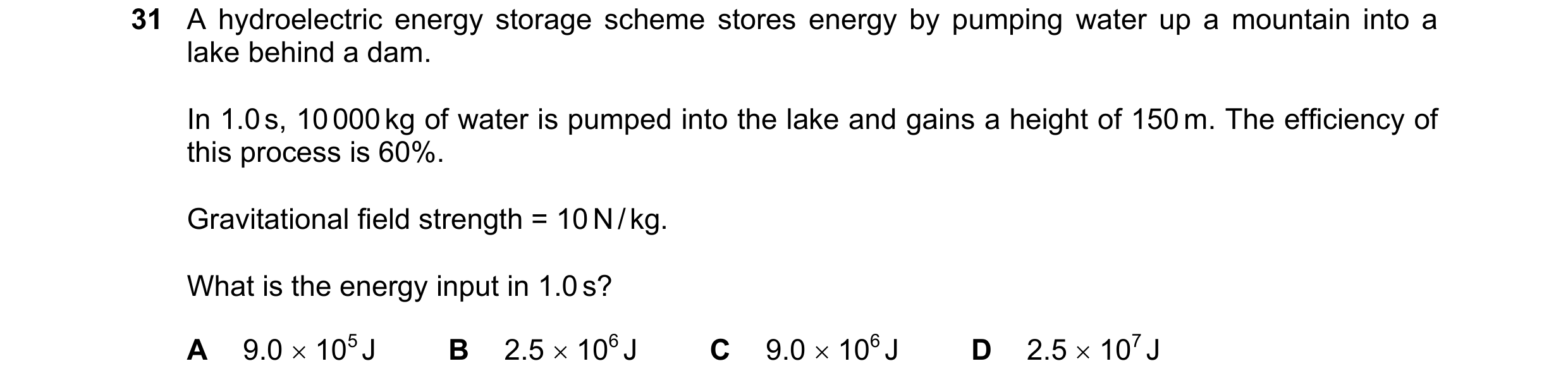
Q23 · A hydroelectric energy storage scheme stores energy by pumping water up a mountain into a… 0973/21 Oct/Nov 2023
31 A hydroelectric energy storage scheme stores energy by pumping water up a mountain into a lake behind a dam. In 1.0 s, 10 000 kg of water is pumped into the lake and gains a height of 150 m. The efficiency of this process is 60%. Gravitational field strength = 10 N / kg. What is the energy input in 1.0 s? A 9.0 105 J B 2.5 106 J C 9.0 106 J D 2.5 107 J
1 marks
Answer: D
This question in 0973/21 Oct/Nov 2023
Q24 · An object of mass 5.0 kg falls vertically from rest through a height of 13 m in a vacuum 0973/21 May/June 2024
30 An object of mass 5.0 kg falls vertically from rest through a height of 13 m in a vacuum. The gravitational field strength g is 10 N / kg. What is the final speed of the object? A 8.1 m / s B 10 m / s C 11 m / s D 16 m / s
1 marks
Answer: D
This question in 0973/21 May/June 2024
Q25 · For which energy resource is the Sun not the source of the energy? 0973/21 May/June 2024
31 For which energy resource is the Sun not the source of the energy? A geothermal B natural gas C water behind a hydroelectric dam D wind
1 marks
Answer: A
This question in 0973/21 May/June 2024
Q26 · A paralympic athlete of mass 70 kg uses a wheelchair of mass 10 kg in a race 0973/22 May/June 2024
30 A paralympic athlete of mass 70 kg uses a wheelchair of mass 10 kg in a race. What is the kinetic energy of the athlete and wheelchair when they are moving at 6.0 m / s? A 240 J B 480 J C 1440 J D 2880 J
1 marks
Answer: C
This question in 0973/22 May/June 2024
Q27 · The table shows four sources of energy used to generate electricity 0973/22 May/June 2024
31 The table shows four sources of energy used to generate electricity. Which row about the energy source is correct? source renewable reliable at all times A coal yes no B nuclear fission no yes C tides no no D wind yes yes
1 marks
Answer: B
This question in 0973/22 May/June 2024
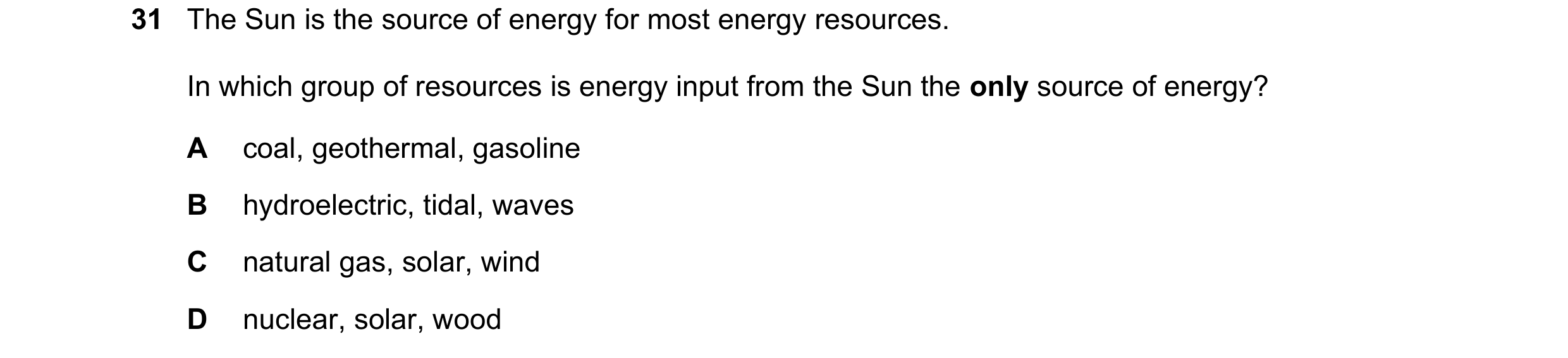
Q28 · The Sun is the source of energy for most energy resources 0973/21 Oct/Nov 2024
31 The Sun is the source of energy for most energy resources. In which group of resources is energy input from the Sun the only source of energy? A coal, geothermal, gasoline B hydroelectric, tidal, waves C natural gas, solar, wind D nuclear, solar, wood
1 marks
Answer: C
This question in 0973/21 Oct/Nov 2024
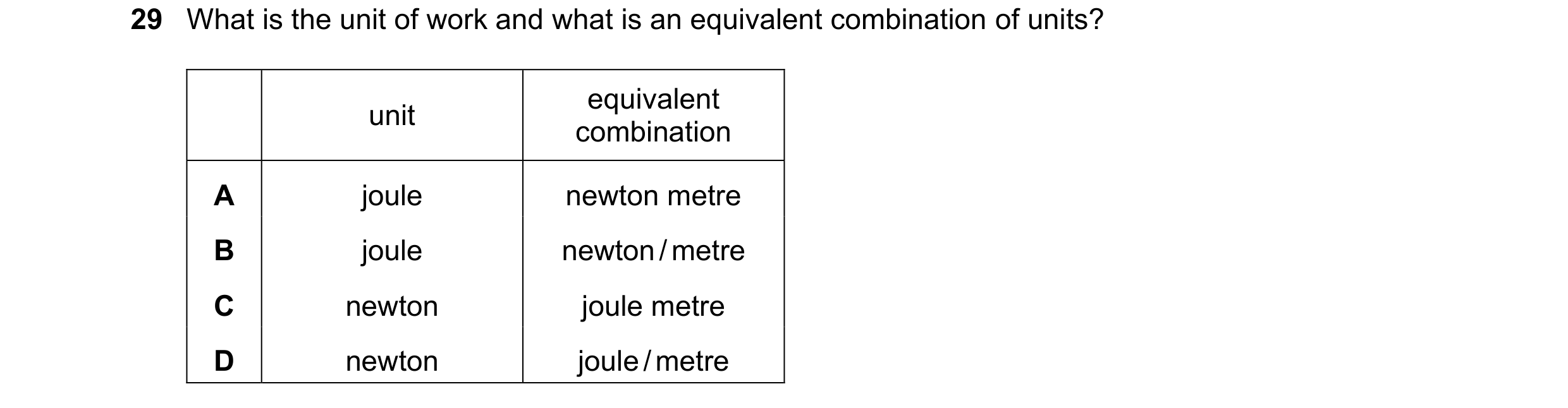
Q29 · What is the unit of work and what is an equivalent combination of units? 0973/21 May/June 2025
29 What is the unit of work and what is an equivalent combination of units? equivalent unit combination A joule newton metre B joule newton / metre C newton joule metre D newton joule / metre
1 marks
Answer: A
This question in 0973/21 May/June 2025
Q30 · The total energy input to an electric lamp is 20 J 0973/21 May/June 2025
30 The total energy input to an electric lamp is 20 J. The useful energy output is 12 J. What is the efficiency of the lamp? A 33% B 40% C 60% D 66%
1 marks
Answer: C
This question in 0973/21 May/June 2025
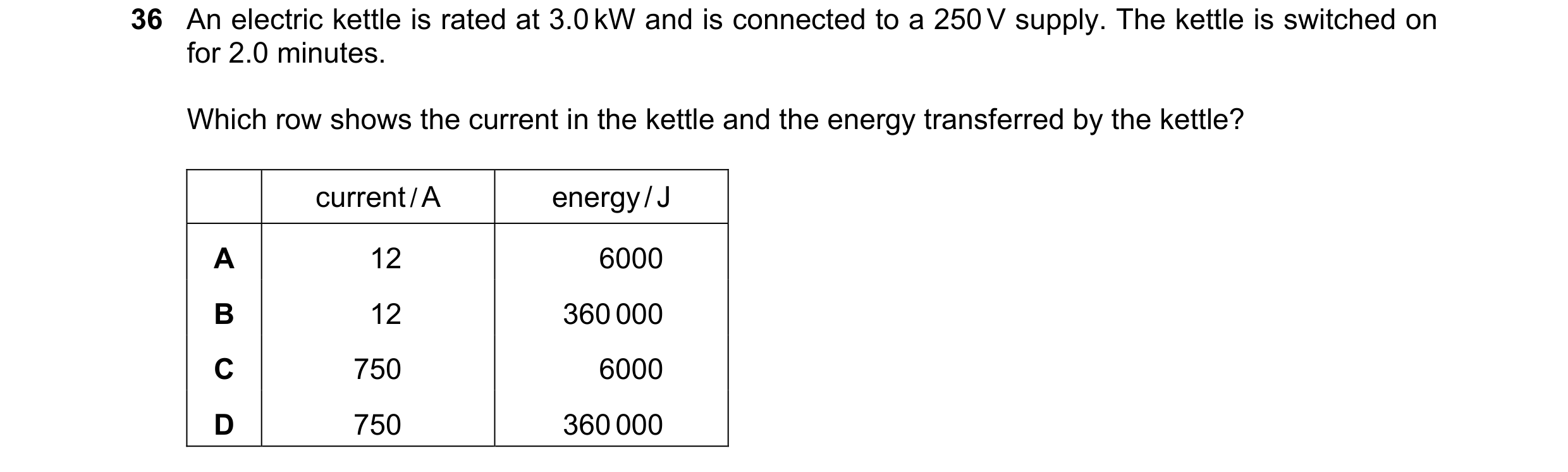
Q31 · An electric kettle is rated at 3.0 kW and is connected to a 250 V supply 0973/21 May/June 2025
36 An electric kettle is rated at 3.0 kW and is connected to a 250 V supply. The kettle is switched on for 2.0 minutes. Which row shows the current in the kettle and the energy transferred by the kettle? current / A energy / J A 12 6000 B 12 360 000 C 750 6000 D 750 360 000
1 marks
Answer: B
This question in 0973/21 May/June 2025
Q32 · A lamp produces 760 J of wasted energy for every 1000 J of energy supplied to it 0973/22 May/June 2025
29 A lamp produces 760 J of wasted energy for every 1000 J of energy supplied to it. What is the efficiency of the lamp? A 0.24% B 0.76% C 24% D 76%
1 marks
Answer: C
This question in 0973/22 May/June 2025
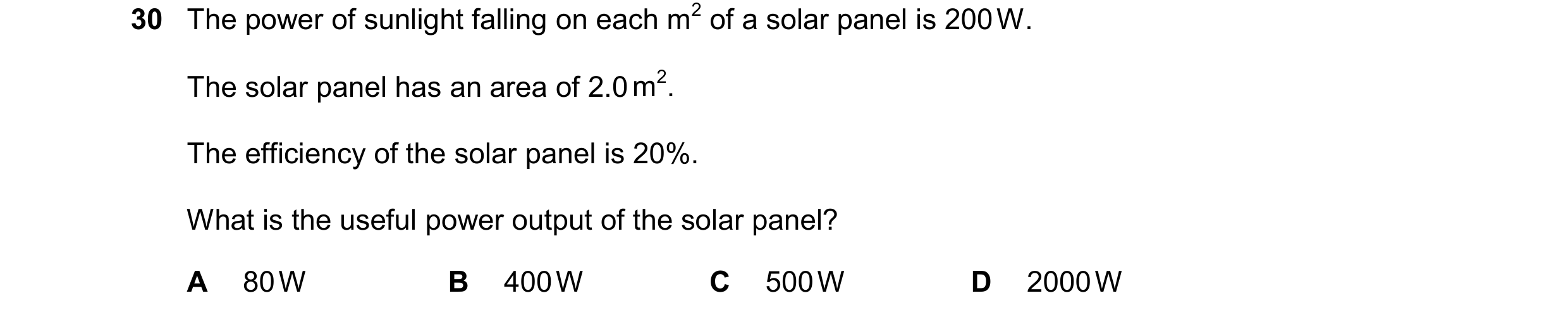
Q33 · The power of sunlight falling on each m2 of a solar panel is 200 W 0973/21 Oct/Nov 2025
30 The power of sunlight falling on each m2 of a solar panel is 200 W. The solar panel has an area of 2.0 m2. The efficiency of the solar panel is 20%. What is the useful power output of the solar panel? A 80 W B 400 W C 500 W D 2000 W
1 marks
Answer: A
This question in 0973/21 Oct/Nov 2025

 1 / 7
1 / 7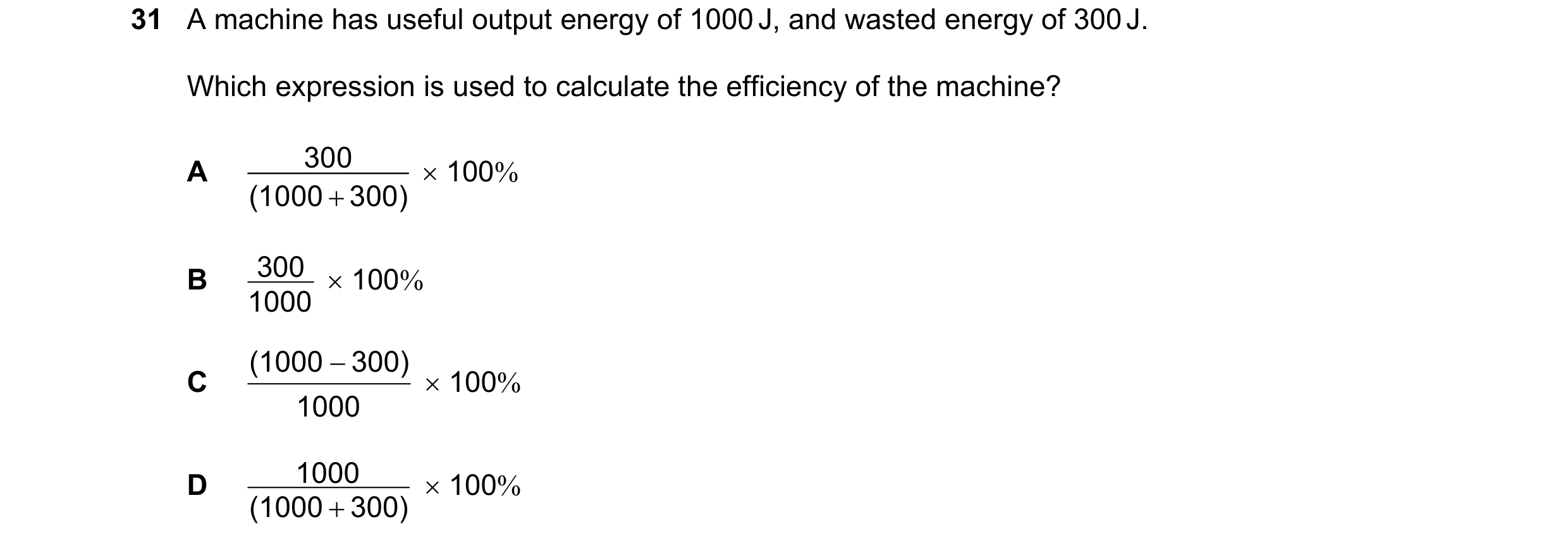




 2 / 7
2 / 7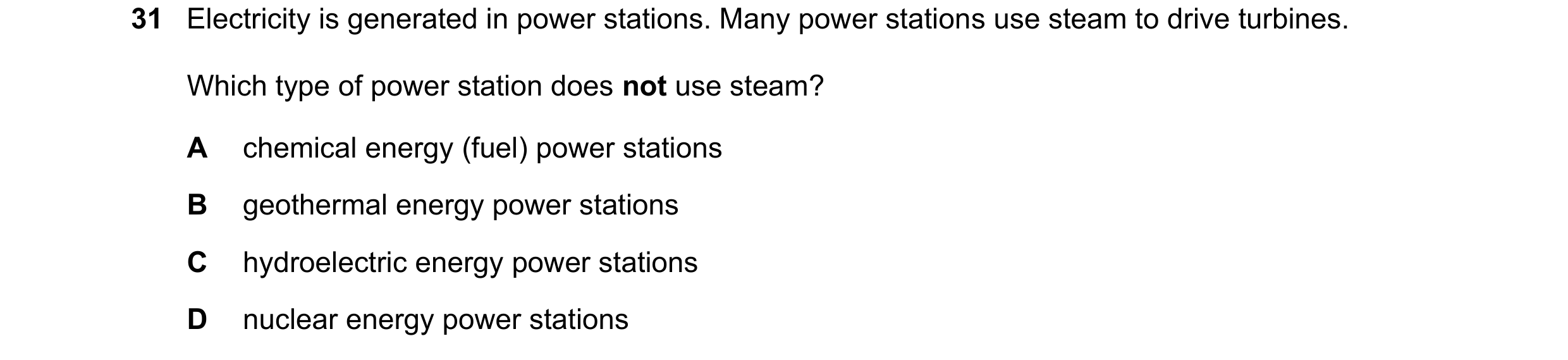
 3 / 7
3 / 7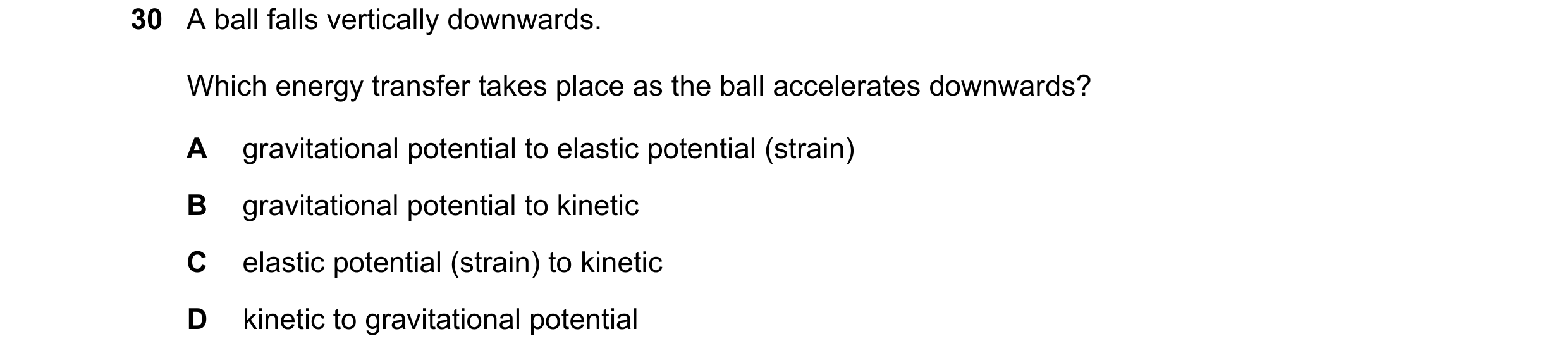





 4 / 7
4 / 7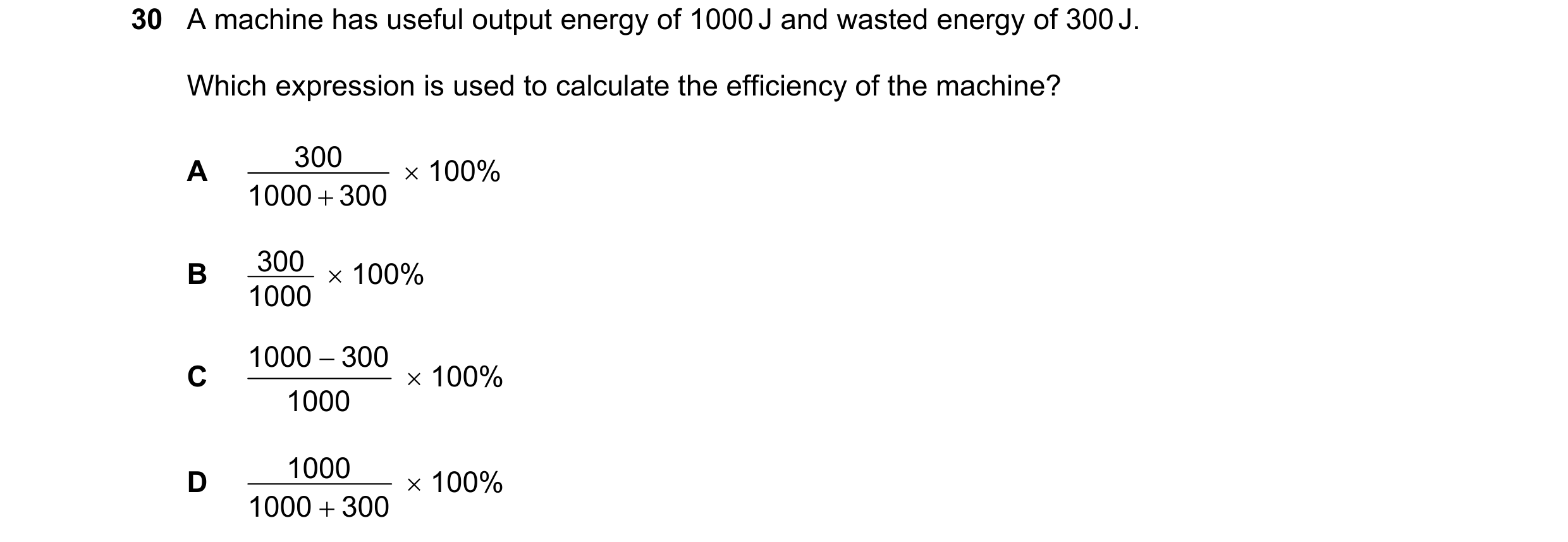


 5 / 7
5 / 7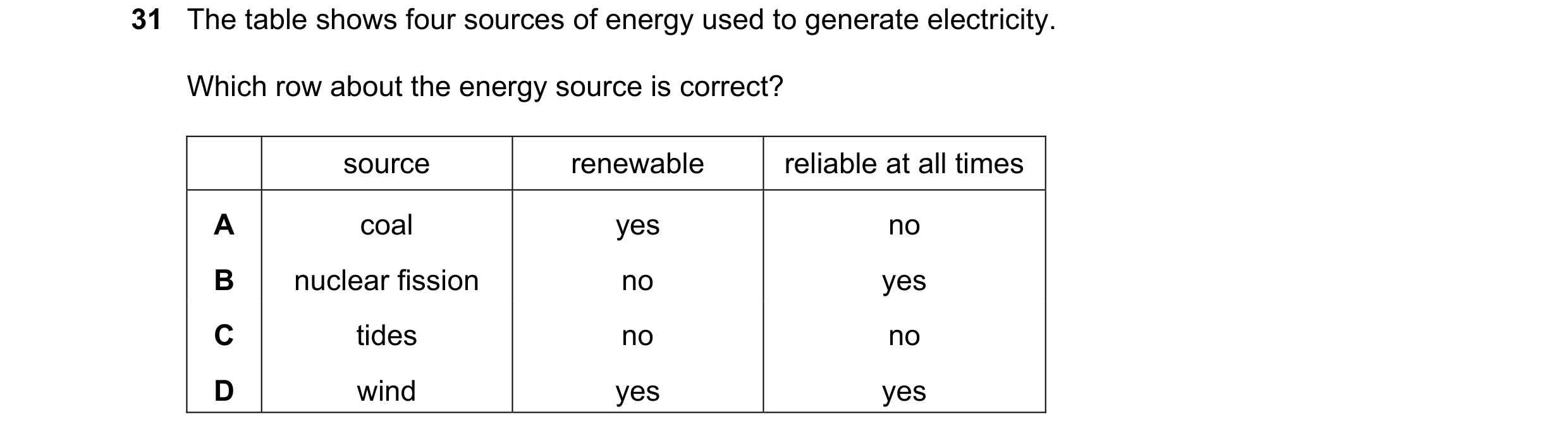

 6 / 7
6 / 7
 7 / 7
7 / 7