Cambridge IGCSE Sciences - Co-ordinated (9-1) 0973 — 2020 May/June Paper 2 · Variant 2
0973/22/M/J/20 · 40 questions · 40 marks · ≈45 min
The question paper and its mark scheme, free to read here and free to download. This is Cambridge’s own paper, exactly as it was sat.
Question paper16 pages
Mark scheme4 pages
Answers below. Sit the paper first if you are practising.
Questions as text
Q1 · Which characteristic of living things is described as the removal of toxic materials and…
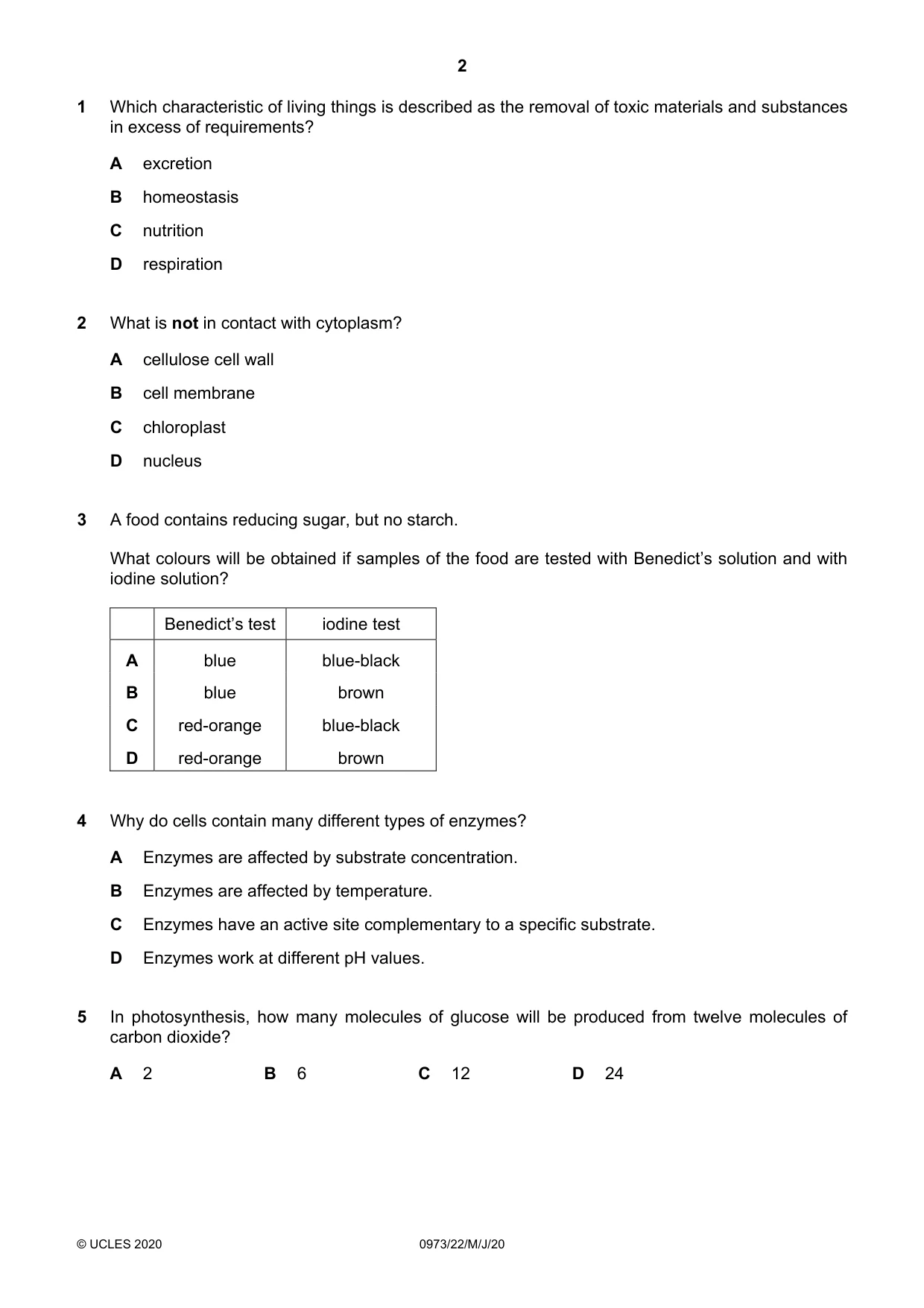
1 Which characteristic of living things is described as the removal of toxic materials and substances in excess of requirements? A excretion B homeostasis C nutrition D respiration
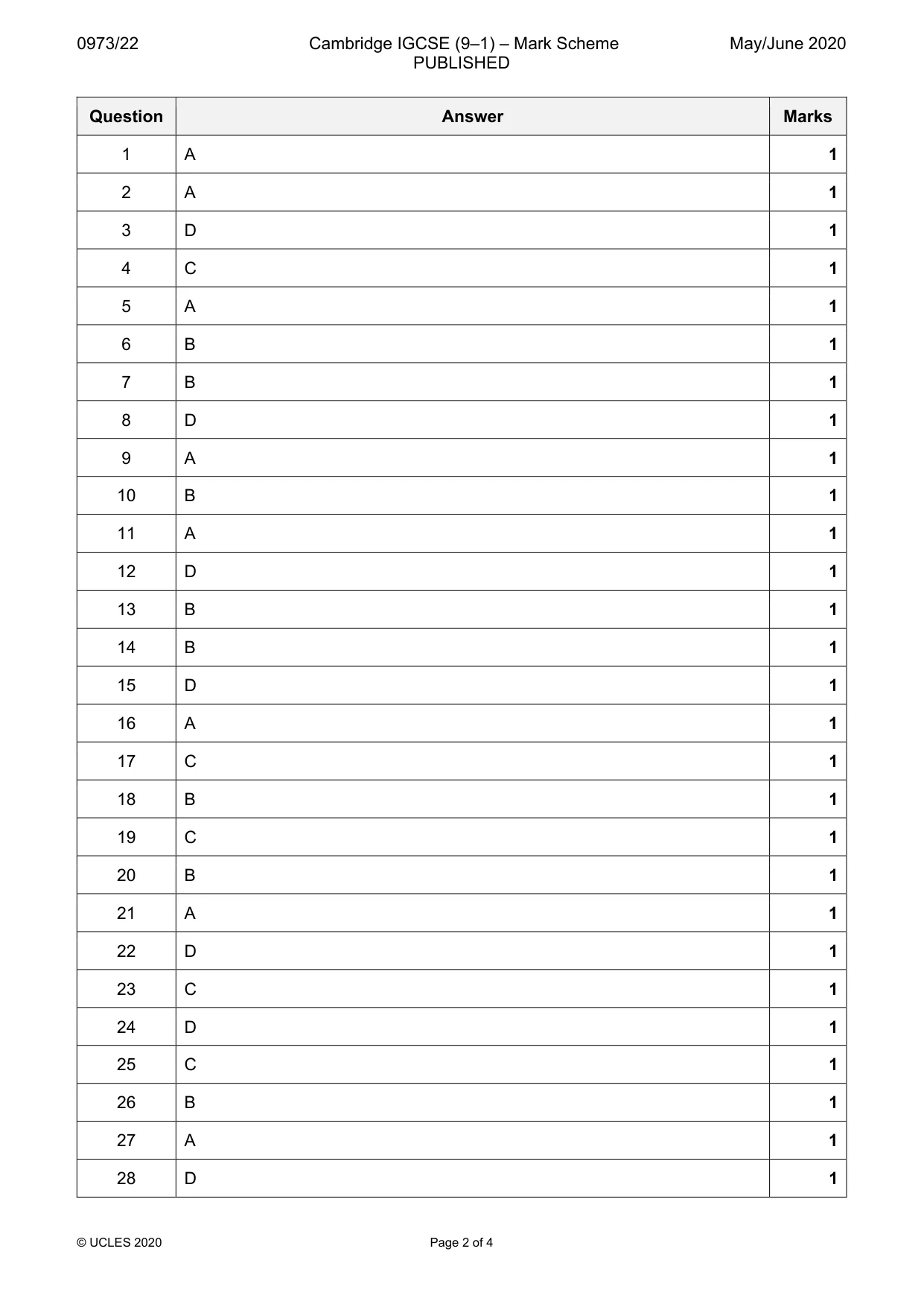
Mark scheme: A
Q2 · What is not in contact with cytoplasm?
2 What is not in contact with cytoplasm? A cellulose cell wall B cell membrane C chloroplast D nucleus
Mark scheme: A
Q3 · A food contains reducing sugar, but no starch
3 A food contains reducing sugar, but no starch. What colours will be obtained if samples of the food are tested with Benedict’s solution and with iodine solution? Benedict’s test iodine test A blue blue-black B blue brown C red-orange blue-black D red-orange brown
Mark scheme: D
Q4 · Why do cells contain many different types of enzymes?
4 Why do cells contain many different types of enzymes? A Enzymes are affected by substrate concentration. B Enzymes are affected by temperature. C Enzymes have an active site complementary to a specific substrate. D Enzymes work at different pH values.
Mark scheme: C
Q5 · In photosynthesis, how many molecules of glucose will be produced from twelve molecules…
5 In photosynthesis, how many molecules of glucose will be produced from twelve molecules of carbon dioxide? A 2 B 6 C 12 D 24
Mark scheme: A
Q6 · Why is calcium needed in the diet?
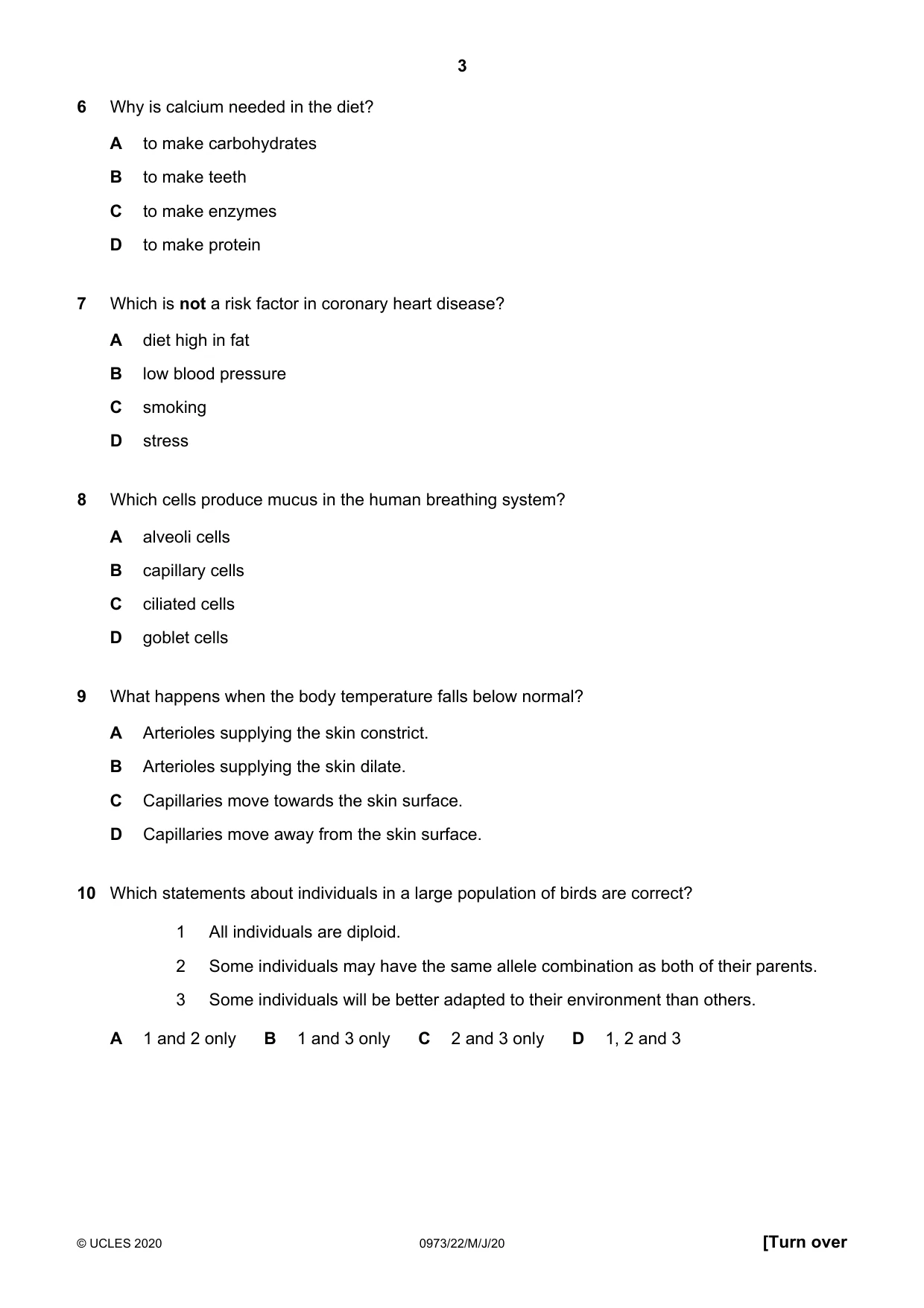
6 Why is calcium needed in the diet? A to make carbohydrates B to make teeth C to make enzymes D to make protein
Mark scheme: B
Q7 · Which is not a risk factor in coronary heart disease?
7 Which is not a risk factor in coronary heart disease? A diet high in fat B low blood pressure C smoking D stress
Mark scheme: B
Q8 · Which cells produce mucus in the human breathing system?
8 Which cells produce mucus in the human breathing system? A alveoli cells B capillary cells C ciliated cells D goblet cells
Mark scheme: D
Q9 · What happens when the body temperature falls below normal?
9 What happens when the body temperature falls below normal? A Arterioles supplying the skin constrict. B Arterioles supplying the skin dilate. C Capillaries move towards the skin surface. D Capillaries move away from the skin surface.
Mark scheme: A
Q10 · Which statements about individuals in a large population of birds are correct?
10 Which statements about individuals in a large population of birds are correct? 1 All individuals are diploid. 2 Some individuals may have the same allele combination as both of their parents. 3 Some individuals will be better adapted to their environment than others. A 1 and 2 only B 1 and 3 only C 2 and 3 only D 1, 2 and 3
Mark scheme: B
Q11 · A farmer wants to breed sheep that will produce a high yield of milk
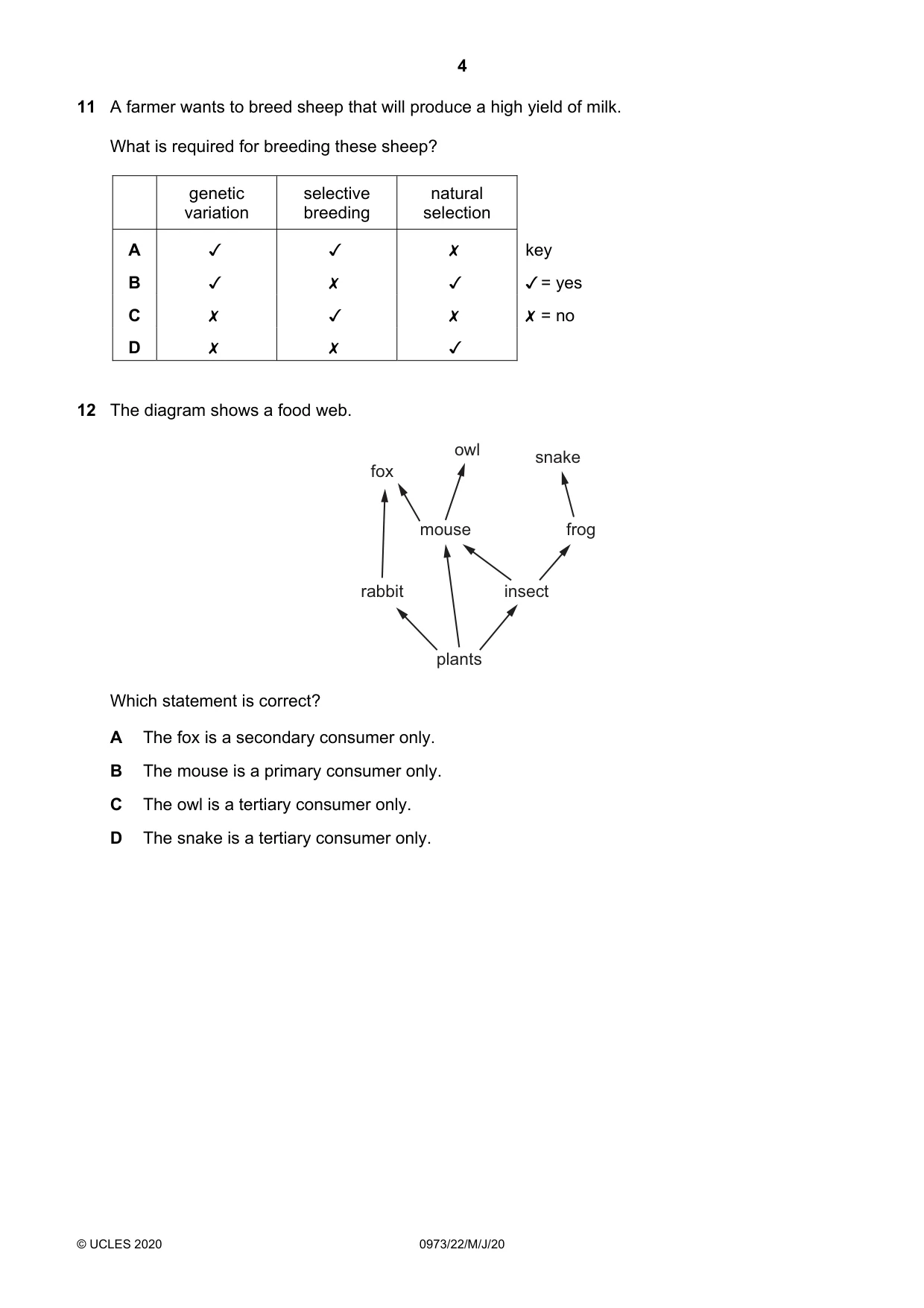
11 A farmer wants to breed sheep that will produce a high yield of milk. What is required for breeding these sheep? genetic selective natural variation breeding selection Jv v x v x v x v x x x v key J/ = yes X =no
Mark scheme: A
Q12 · The diagram shows a food web
12 The diagram shows a food web. owl snake fox mouse frog rabbit insect plants Which statement is correct? A The fox is a secondary consumer only. B The mouse is a primary consumer only. C The owl is a tertiary consumer only. D The snake is a tertiary consumer only.
Mark scheme: D
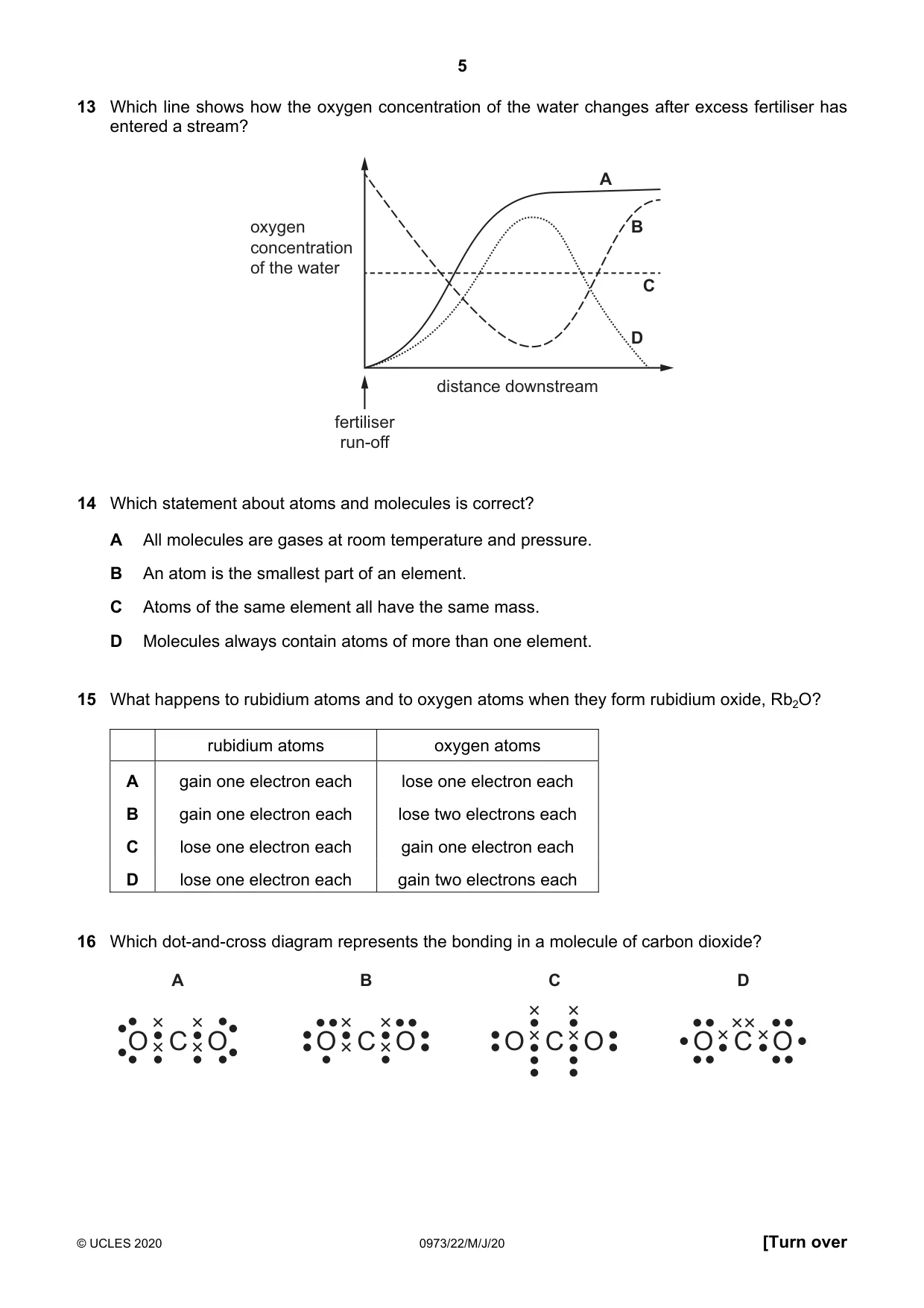
Q13 · Which line shows how the oxygen concentration of the water changes after excess…
13 Which line shows how the oxygen concentration of the water changes after excess fertiliser has entered a stream? A oxygen B concentration of the water C D distance downstream fertiliser run-off
Mark scheme: B
Q14 · Which statement about atoms and molecules is correct?
14 Which statement about atoms and molecules is correct? A All molecules are gases at room temperature and pressure. B An atom is the smallest part of an element. C Atoms of the same element all have the same mass. D Molecules always contain atoms of more than one element.
Mark scheme: B
Q15 · What happens to rubidium atoms and to oxygen atoms when they form rubidium oxide, Rb2O?
15 What happens to rubidium atoms and to oxygen atoms when they form rubidium oxide, Rb2O? rubidium atoms oxygen atoms A gain one electron each lose one electron each B gain one electron each lose two electrons each C lose one electron each gain one electron each D lose one electron each gain two electrons each
Mark scheme: D
Q16 · Which dot-and-cross diagram represents the bonding in a molecule of carbon dioxide?
16 Which dot-and-cross diagram represents the bonding in a molecule of carbon dioxide? A B C D O C O O C O O C O O C O
Mark scheme: A
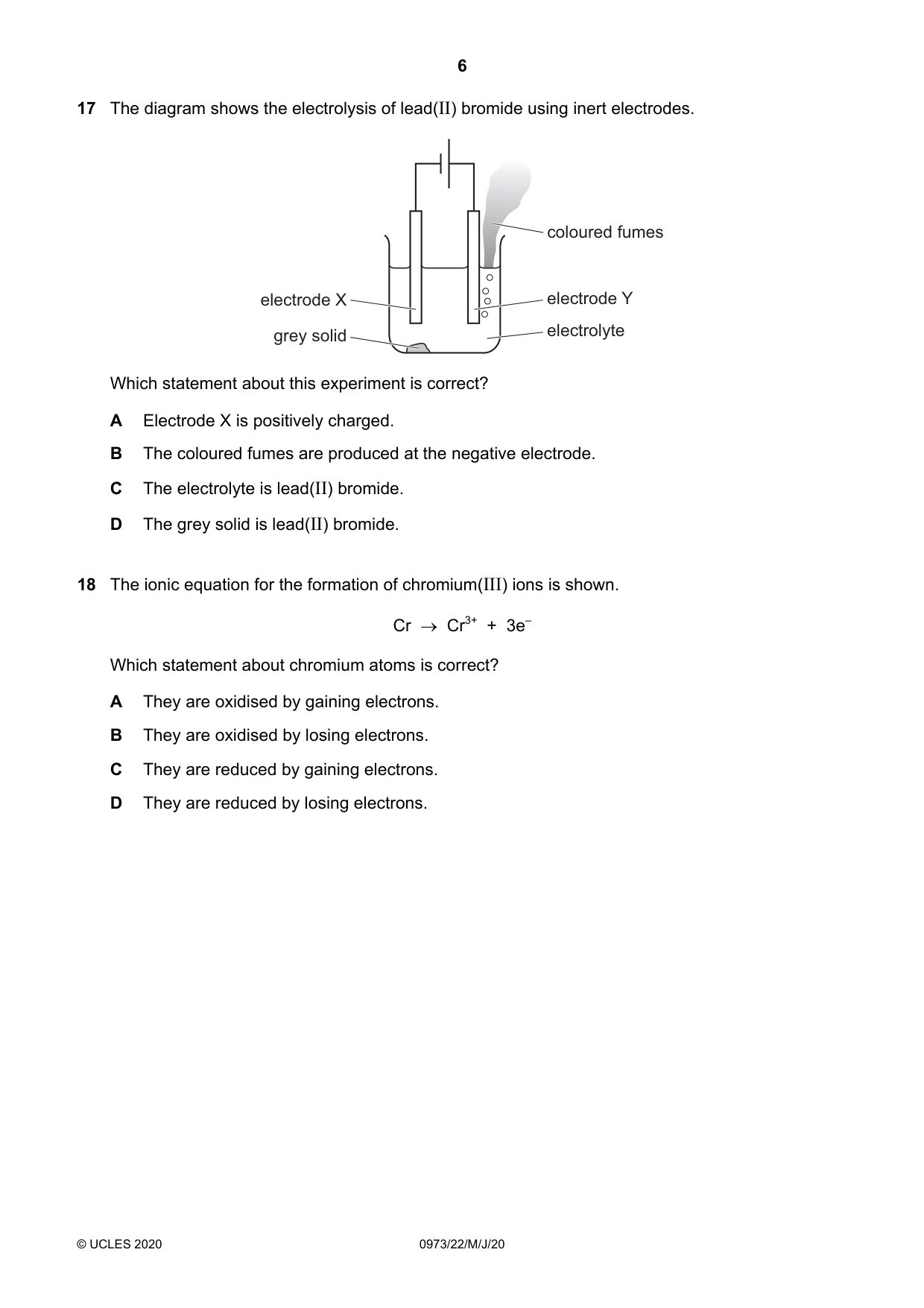
Q17 · The diagram shows the electrolysis of lead(II) bromide using inert electrodes
17 The diagram shows the electrolysis of lead(II) bromide using inert electrodes. coloured fumes electrode X electrode Y grey solid electrolyte Which statement about this experiment is correct? A Electrode X is positively charged. B The coloured fumes are produced at the negative electrode. C The electrolyte is lead(II) bromide. D The grey solid is lead(II) bromide.
Mark scheme: C
Q18 · The ionic equation for the formation of chromium(III) ions is shown
18 The ionic equation for the formation of chromium(III) ions is shown. Cr → Cr3+ + 3e– Which statement about chromium atoms is correct? A They are oxidised by gaining electrons. B They are oxidised by losing electrons. C They are reduced by gaining electrons. D They are reduced by losing electrons.
Mark scheme: B
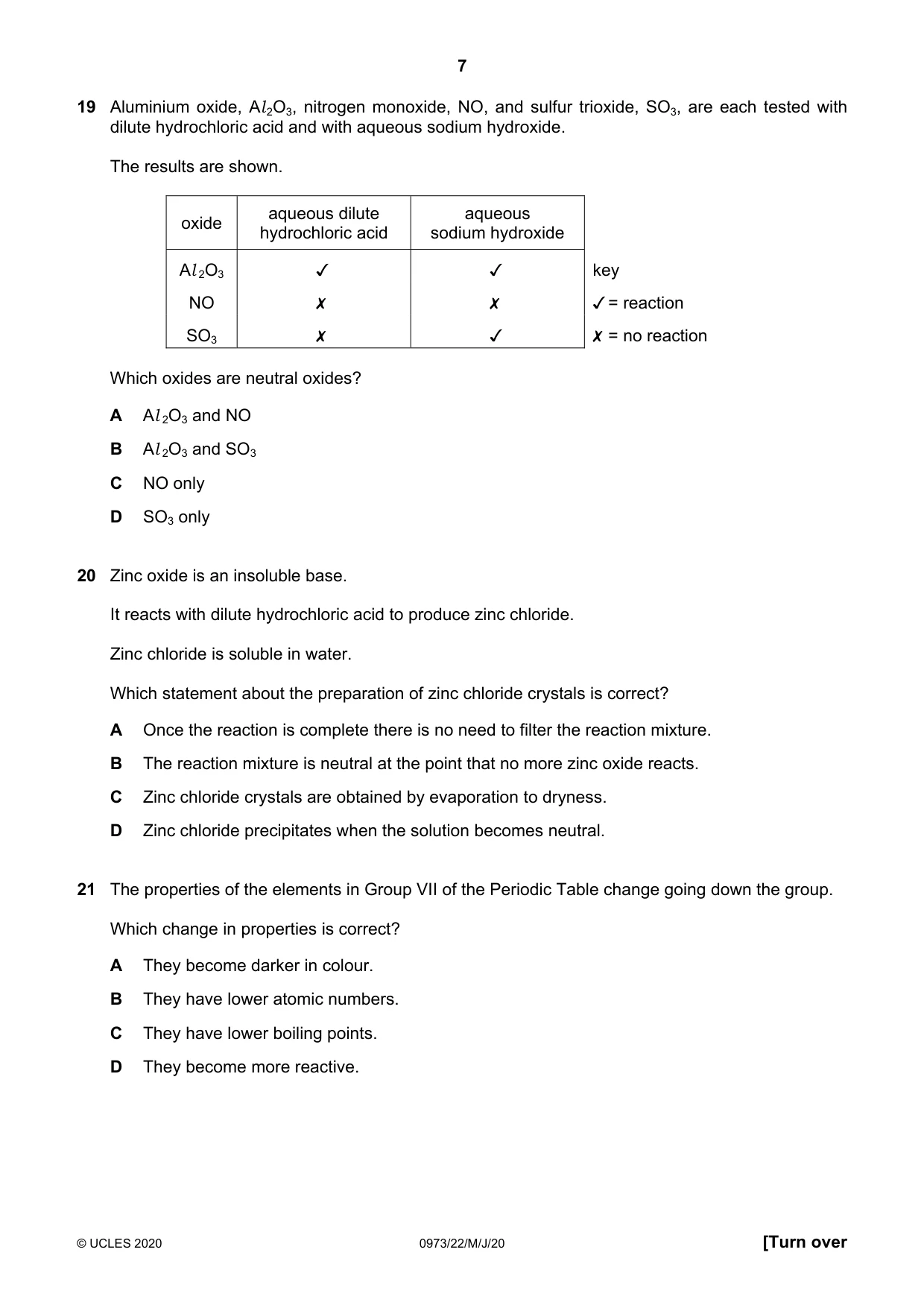
Q19 · Aluminium oxide, Al,O3, nitrogen monoxide, NO, and sulfur trioxide, SOs, are each tested…
19 Aluminium oxide, Al,O3, nitrogen monoxide, NO, and sulfur trioxide, SOs, are each tested with dilute hydrochloric acid and with aqueous sodium hydroxide. The results are shown. oxide aqueous dilute aqueous — hydrochloric acid sodium hydroxide Al203 v Jv NO x x SO3 x Jv Which oxides are neutral oxides? A B Cc D Al,O3 and SO; NO only SO3 only key J/ = reaction X = no reaction
Mark scheme: C
Q20 · Zinc oxide is an insoluble base
20 Zinc oxide is an insoluble base. It reacts with dilute hydrochloric acid to produce zinc chloride. Zinc chloride is soluble in water. Which statement about the preparation of zinc chloride crystals is correct? A Once the reaction is complete there is no need to filter the reaction mixture. B The reaction mixture is neutral at the point that no more zinc oxide reacts. C Zinc chloride crystals are obtained by evaporation to dryness. D Zinc chloride precipitates when the solution becomes neutral.
Mark scheme: B
Q21 · The properties of the elements in Group VII of the Periodic Table change going down the…
21 The properties of the elements in Group VII of the Periodic Table change going down the group. Which change in properties is correct? A They become darker in colour. B They have lower atomic numbers. C They have lower boiling points. D They become more reactive.
Mark scheme: A
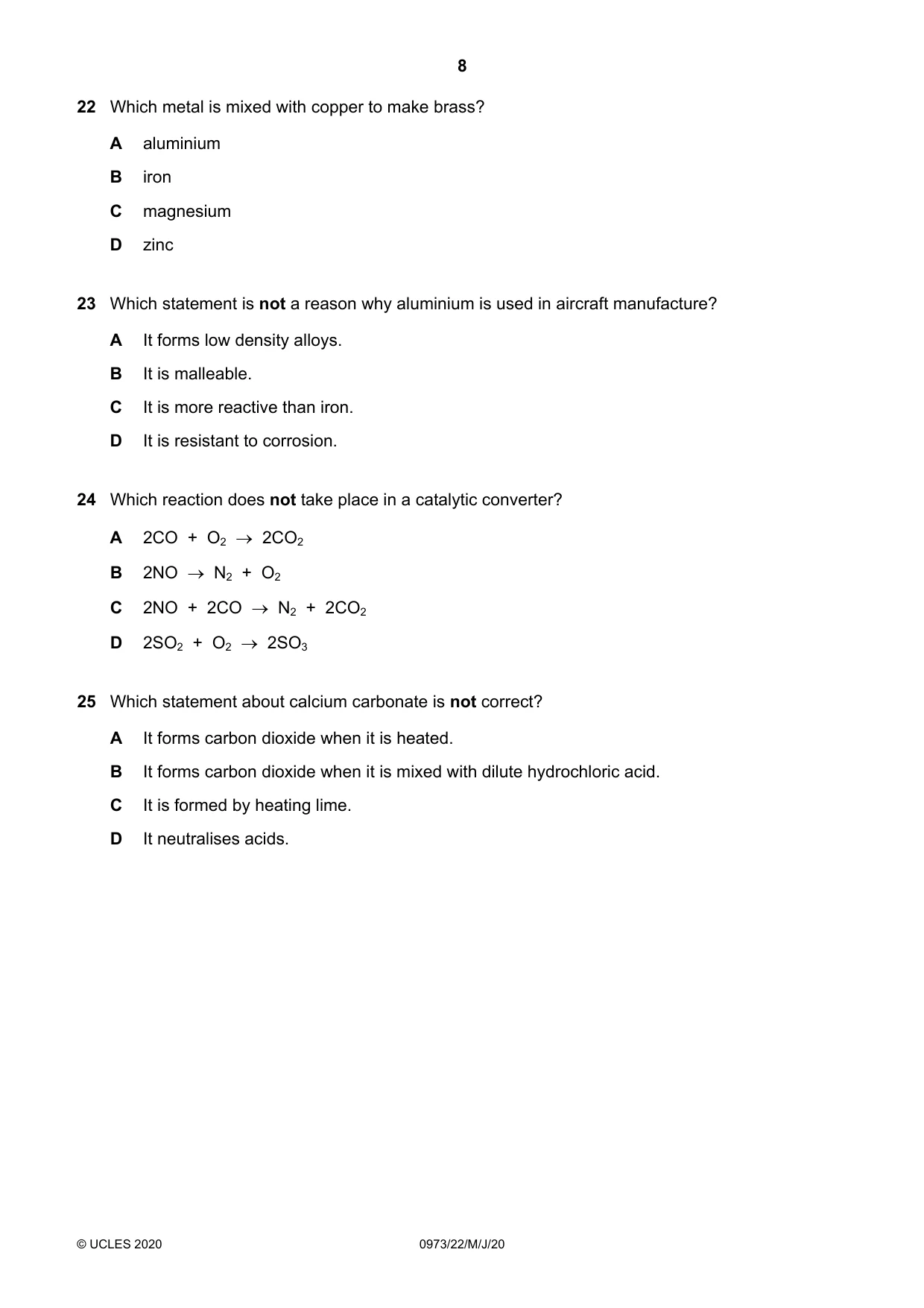
Q22 · Which metal is mixed with copper to make brass?
22 Which metal is mixed with copper to make brass? A aluminium B iron C magnesium D zinc
Mark scheme: D
Q23 · Which statement is not a reason why aluminium is used in aircraft manufacture?
23 Which statement is not a reason why aluminium is used in aircraft manufacture? A It forms low density alloys. B It is malleable. C It is more reactive than iron. D It is resistant to corrosion.
Mark scheme: C
Q24 · Which reaction does not take place in a catalytic converter?
24 Which reaction does not take place in a catalytic converter? A 2CO + O2 → 2CO2 B 2NO → N2 + O2 C 2NO + 2CO → N2 + 2CO2 D 2SO2 + O2 → 2SO3
Mark scheme: D
Q25 · Which statement about calcium carbonate is not correct?
25 Which statement about calcium carbonate is not correct? A It forms carbon dioxide when it is heated. B It forms carbon dioxide when it is mixed with dilute hydrochloric acid. C It is formed by heating lime. D It neutralises acids.
Mark scheme: C
More questions on The characteristic properties of acids and bases
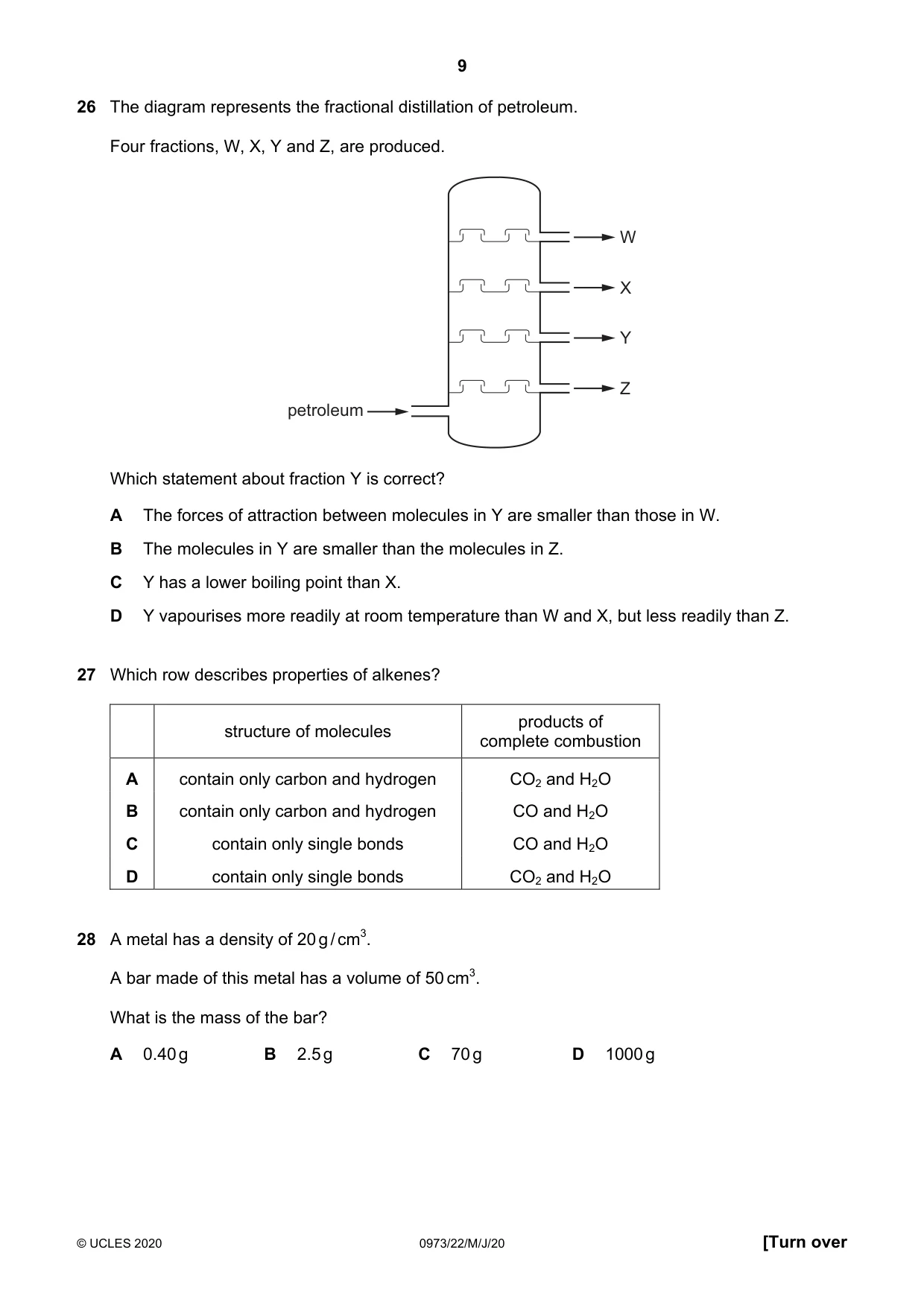
Q26 · The diagram represents the fractional distillation of petroleum
26 The diagram represents the fractional distillation of petroleum. Four fractions, W, X, Y and Z, are produced. W X Y Z petroleum Which statement about fraction Y is correct? A The forces of attraction between molecules in Y are smaller than those in W. B The molecules in Y are smaller than the molecules in Z. C Y has a lower boiling point than X. D Y vapourises more readily at room temperature than W and X, but less readily than Z.
Mark scheme: B
Q27 · Which row describes properties of alkenes?
27 Which row describes properties of alkenes? products of structure of molecules complete combustion A contain only carbon and hydrogen CO2 and H2O B contain only carbon and hydrogen CO and H2O C contain only single bonds CO and H2O D contain only single bonds CO2 and H2O
Mark scheme: A
Q28 · A metal has a density of 20 g / cm3
28 A metal has a density of 20 g / cm3. A bar made of this metal has a volume of 50 cm3. What is the mass of the bar? A 0.40 g B 2.5 g C 70 g D 1000 g
Mark scheme: D
Q29 · An object of mass m moving with speed v has kinetic energy E
29 An object of mass m moving with speed v has kinetic energy E. v . A second object, also of mass m, moves with speed 2 What is the kinetic energy of the second object? E E A B C E D 2E 4 2
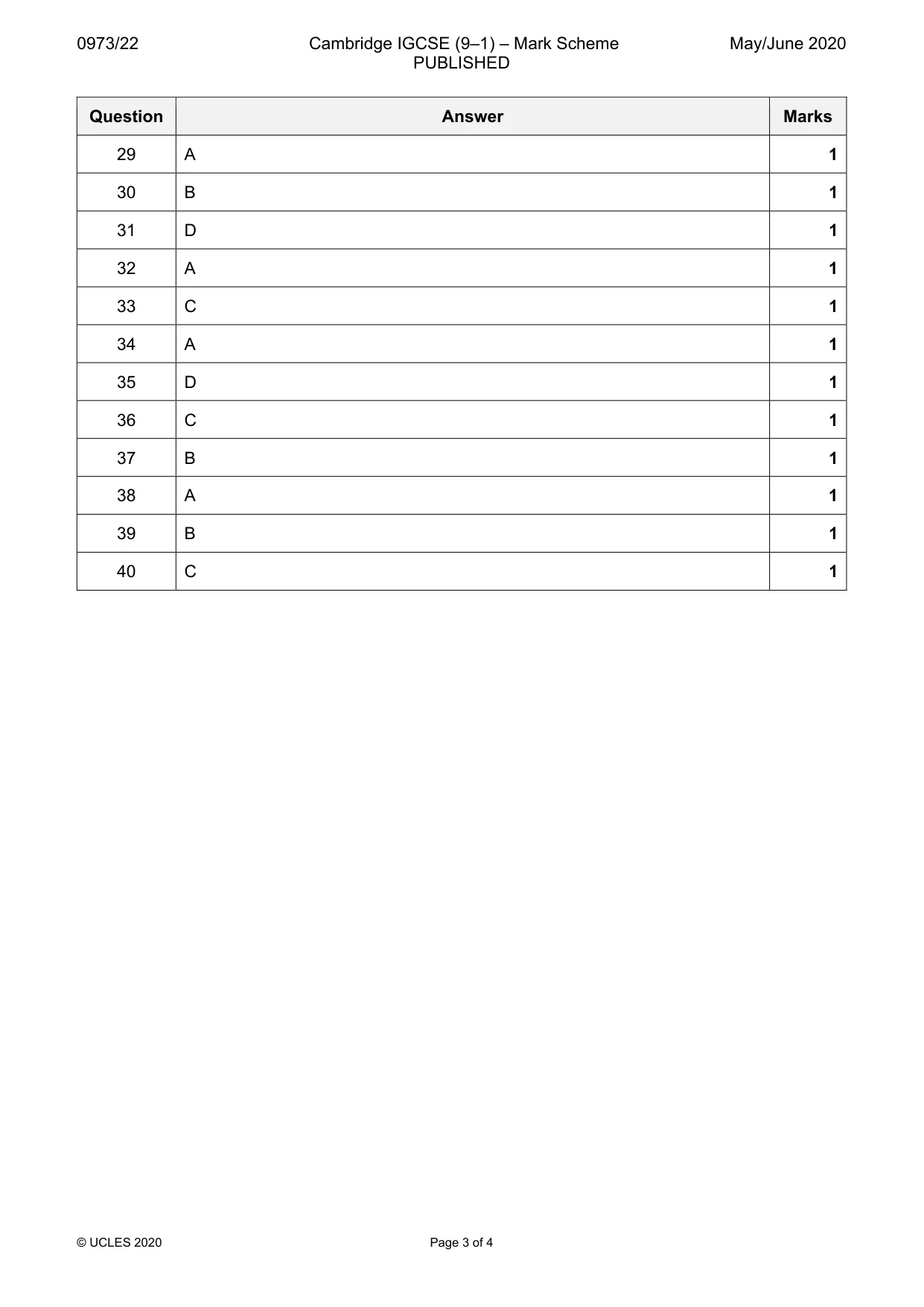
Mark scheme: A
Q30 · Which energy resource does not have the Sun as its source of energy?
30 Which energy resource does not have the Sun as its source of energy? A coal B geothermal C hydroelectric D waves
Mark scheme: B
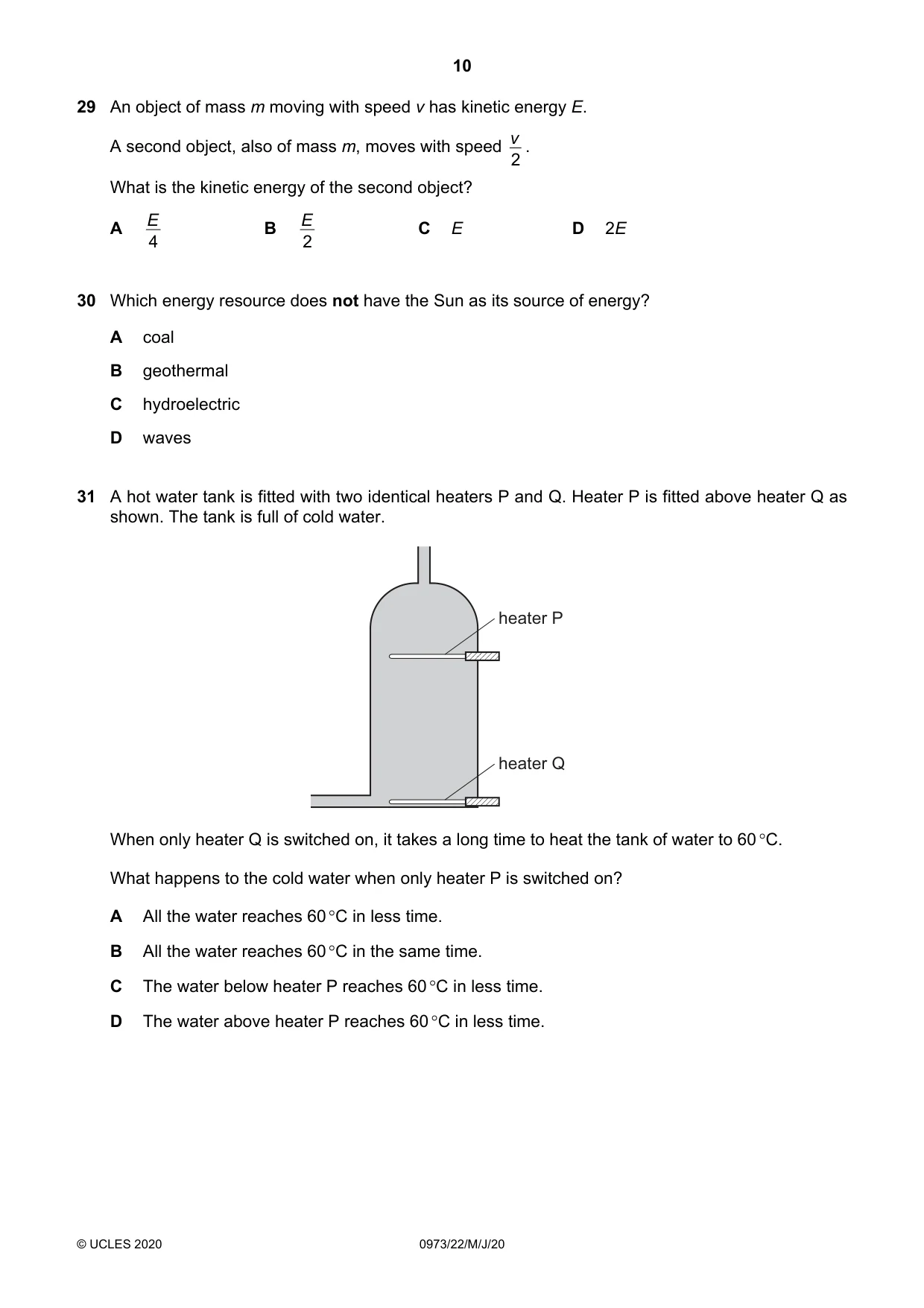
Q31 · A hot water tank is fitted with two identical heaters P and Q
31 A hot water tank is fitted with two identical heaters P and Q. Heater P is fitted above heater Q as shown. The tank is full of cold water. heater P heater Q When only heater Q is switched on, it takes a long time to heat the tank of water to 60 °C. What happens to the cold water when only heater P is switched on? A All the water reaches 60 °C in less time. B All the water reaches 60 °C in the same time. C The water below heater P reaches 60 °C in less time. D The water above heater P reaches 60 °C in less time.
Mark scheme: D
Q32 · ‘The maximum distance a particle on the surface of deep water moves from its rest…
32 ‘The maximum distance a particle on the surface of deep water moves from its rest position when a wave passes it.’ Which property of a wave does this describe? A amplitude B frequency C speed D wavelength
Mark scheme: A
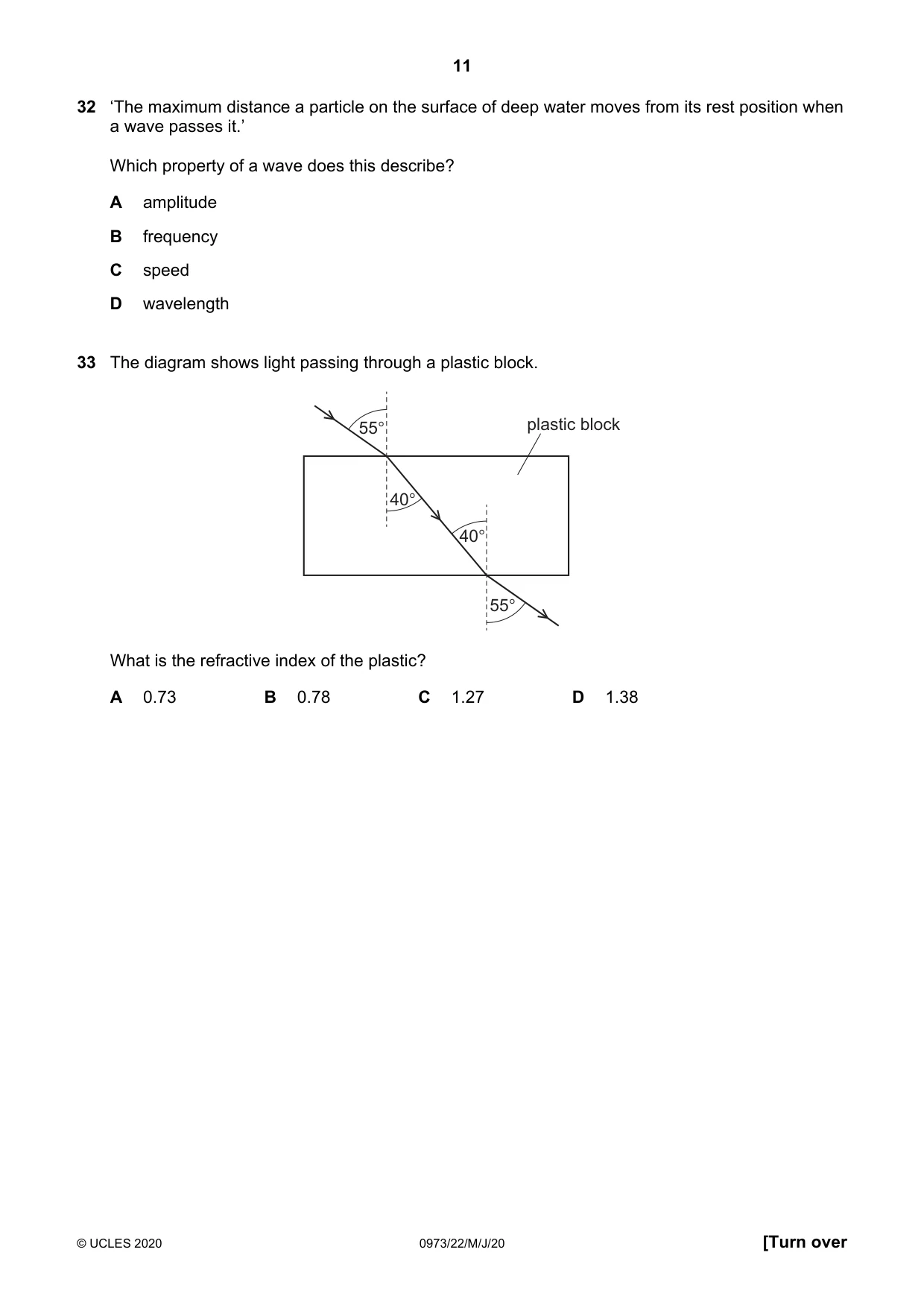
Q33 · The diagram shows light passing through a plastic block
33 The diagram shows light passing through a plastic block. 55° plastic block 40° 40° 55° What is the refractive index of the plastic? A 0.73 B 0.78 C 1.27 D 1.38
Mark scheme: C
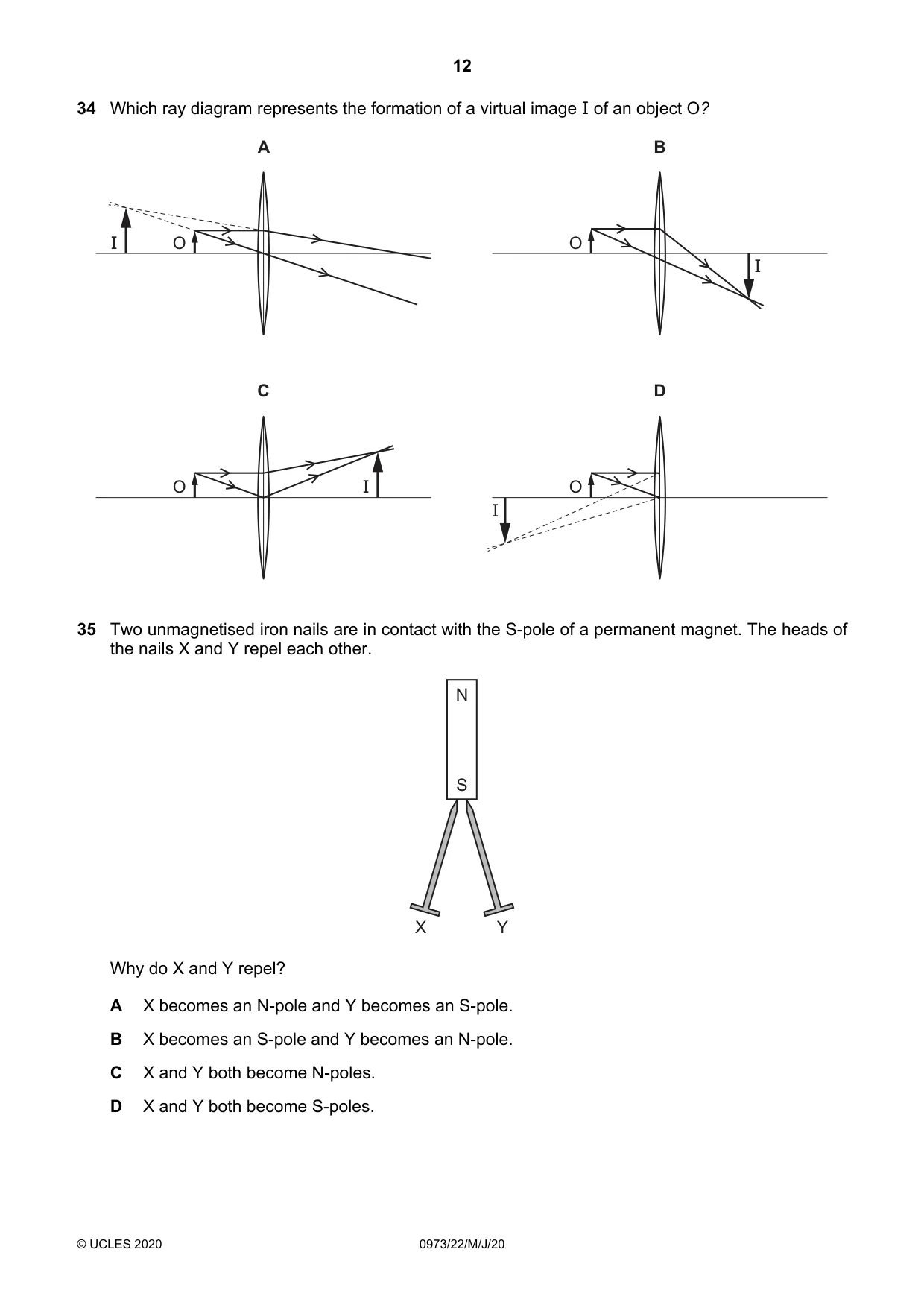
Q34 · Which ray diagram represents the formation of a virtual image I of an object O?
34 Which ray diagram represents the formation of a virtual image I of an object O? A B I O O I C D O I O I
Mark scheme: A
Q35 · Two unmagnetised iron nails are in contact with the S-pole of a permanent magnet
35 Two unmagnetised iron nails are in contact with the S-pole of a permanent magnet. The heads of the nails X and Y repel each other. N S X Y Why do X and Y repel? A X becomes an N-pole and Y becomes an S-pole. B X becomes an S-pole and Y becomes an N-pole. C X and Y both become N-poles. D X and Y both become S-poles.
Mark scheme: D
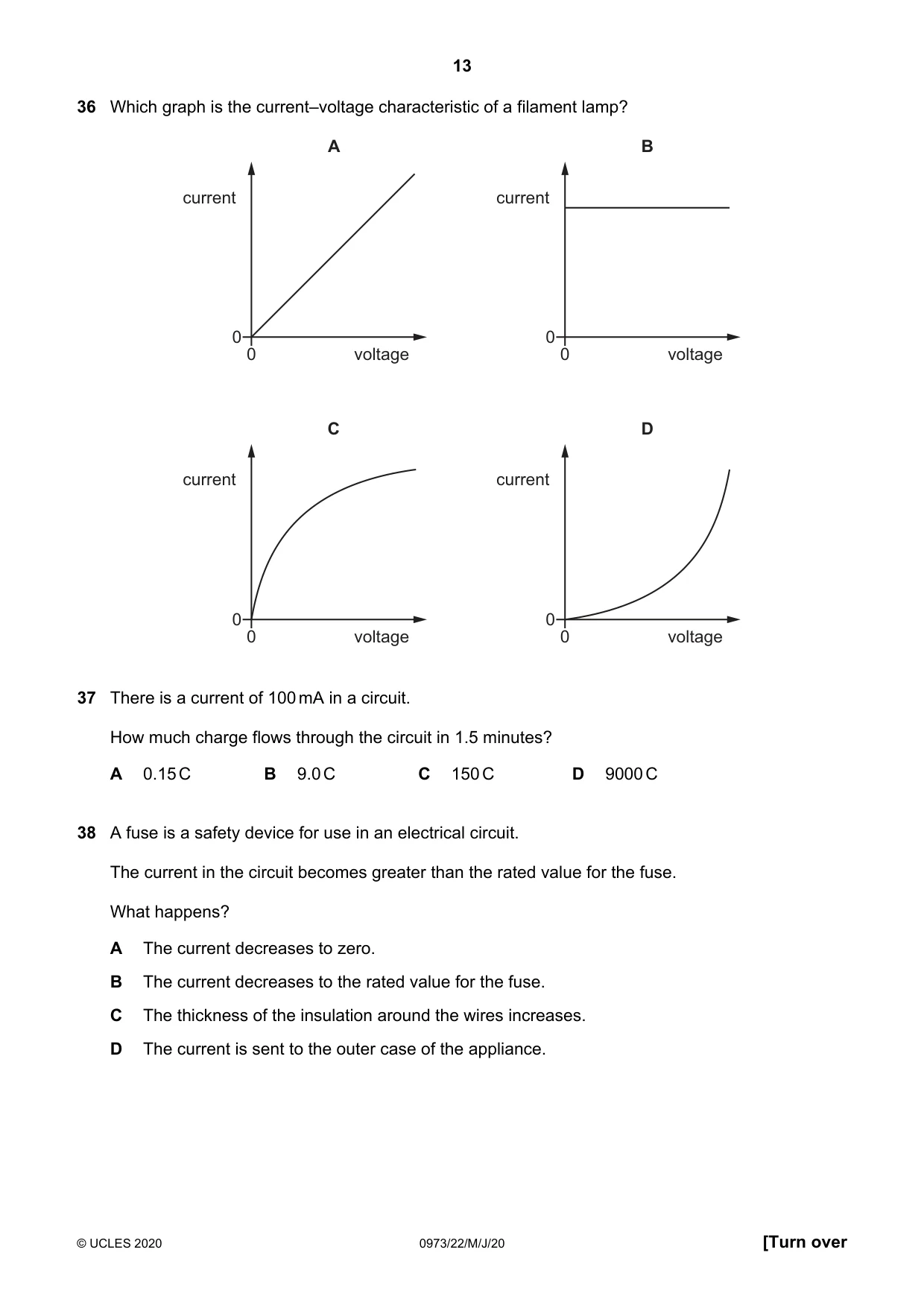
Q36 · Which graph is the current–voltage characteristic of a filament lamp?
36 Which graph is the current–voltage characteristic of a filament lamp? A B current current 0 0 0 voltage 0 voltage C D current current 0 0 0 voltage 0 voltage
Mark scheme: C
Q37 · There is a current of 100 mA in a circuit
37 There is a current of 100 mA in a circuit. How much charge flows through the circuit in 1.5 minutes? A 0.15 C B 9.0 C C 150 C D 9000 C
Mark scheme: B
Q38 · A fuse is a safety device for use in an electrical circuit
38 A fuse is a safety device for use in an electrical circuit. The current in the circuit becomes greater than the rated value for the fuse. What happens? A The current decreases to zero. B The current decreases to the rated value for the fuse. C The thickness of the insulation around the wires increases. D The current is sent to the outer case of the appliance.
Mark scheme: A
Q39 · What is the purpose of the slip rings in an alternating current (a.c.) generator?
39 What is the purpose of the slip rings in an alternating current (a.c.) generator? A to allow each end of the coil to contact each carbon brush alternately B to allow each end of the coil to remain in contact with the same carbon brush at all times C to maintain a constant voltage in the output circuit while the coil is rotating D to remain stationary while the coil rotates between them
Mark scheme: B
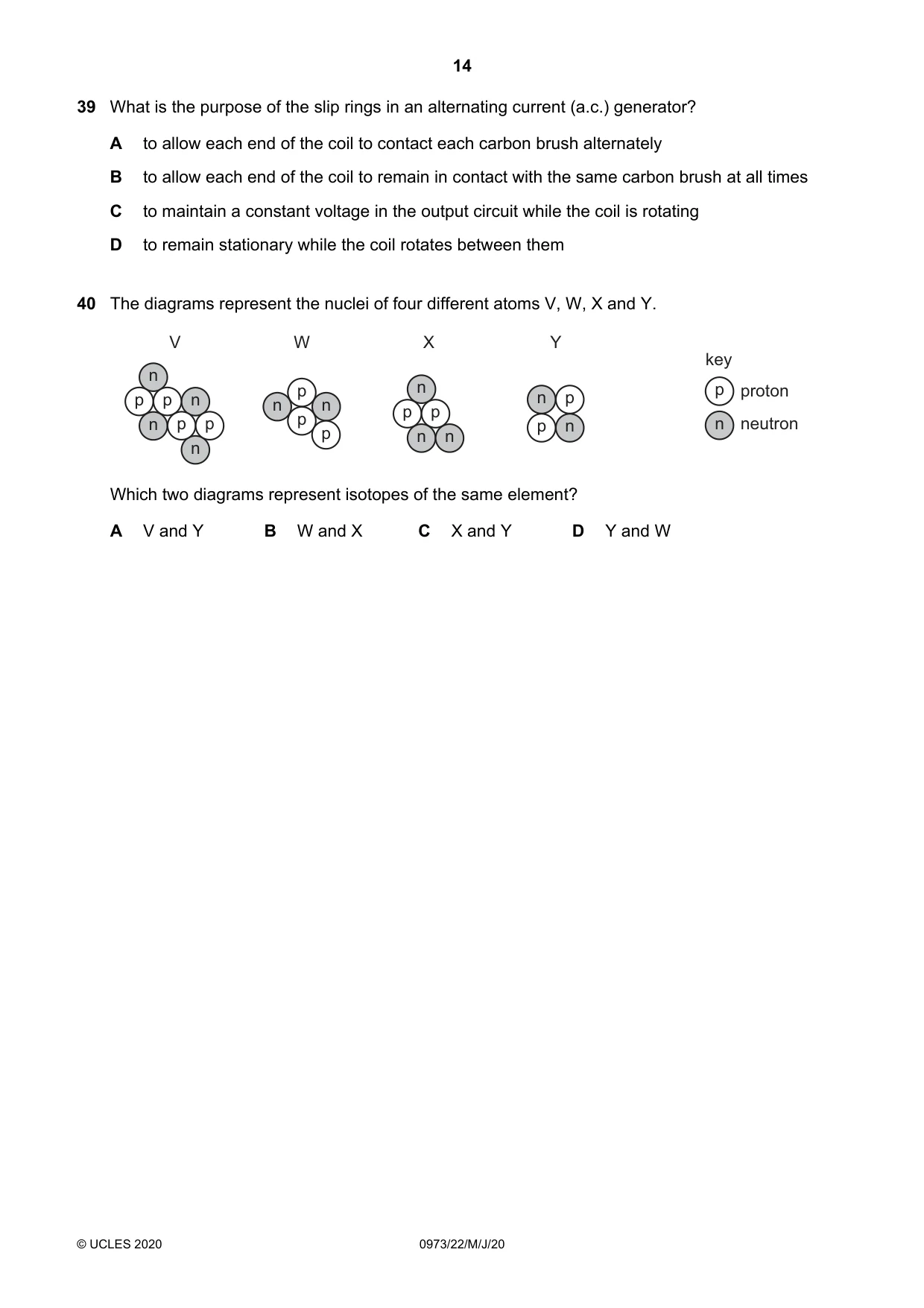
Q40 · The diagrams represent the nuclei of four different atoms V, W, X and Y
40 The diagrams represent the nuclei of four different atoms V, W, X and Y. V W X Y key n p n p proton p p n n n n p p p p n p p p n n neutron p n n n Which two diagrams represent isotopes of the same element? A V and Y B W and X C X and Y D Y and W
Mark scheme: C
What was in this paper
The subtopics covered by these 40 questions, and how many questions each got. Open one in a new tab to see every Cambridge question on it.
2Light2Air quality and climate1Alkenes1Alloys and their properties1Biological molecules1Cell structure1Characteristics of living organisms1Circulatory systems1Density1Diet1Electrical circuits1Electrical quantities1Electrical safety1Electrolysis1Electromagnetic effects1Elements, compounds and mixtures1Enzymes1Food chains and food webs1Fuels1Gas exchange in humans1General properties of waves1Group VII properties1Habitat destruction1Homeostasis1Ions and ionic bonds1Isotopes1Oxides1Photosynthesis1Preparation of salts1Redox1Selection1Simple molecules and covalent bonds1Simple phenomena of magnetism1The characteristic properties of acids and bases1Transfer of thermal energy1Uses of metals1Variation1