Cambridge IGCSE Sciences - Co-ordinated (9-1) 0973 — 2024 Oct/Nov Paper 2 · Variant 1
0973/21/O/N/24 · 40 questions · 40 marks · ≈45 min
The question paper and its mark scheme, free to read here and free to download. This is Cambridge’s own paper, exactly as it was sat.
Question paper16 pages


Mark scheme3 pages
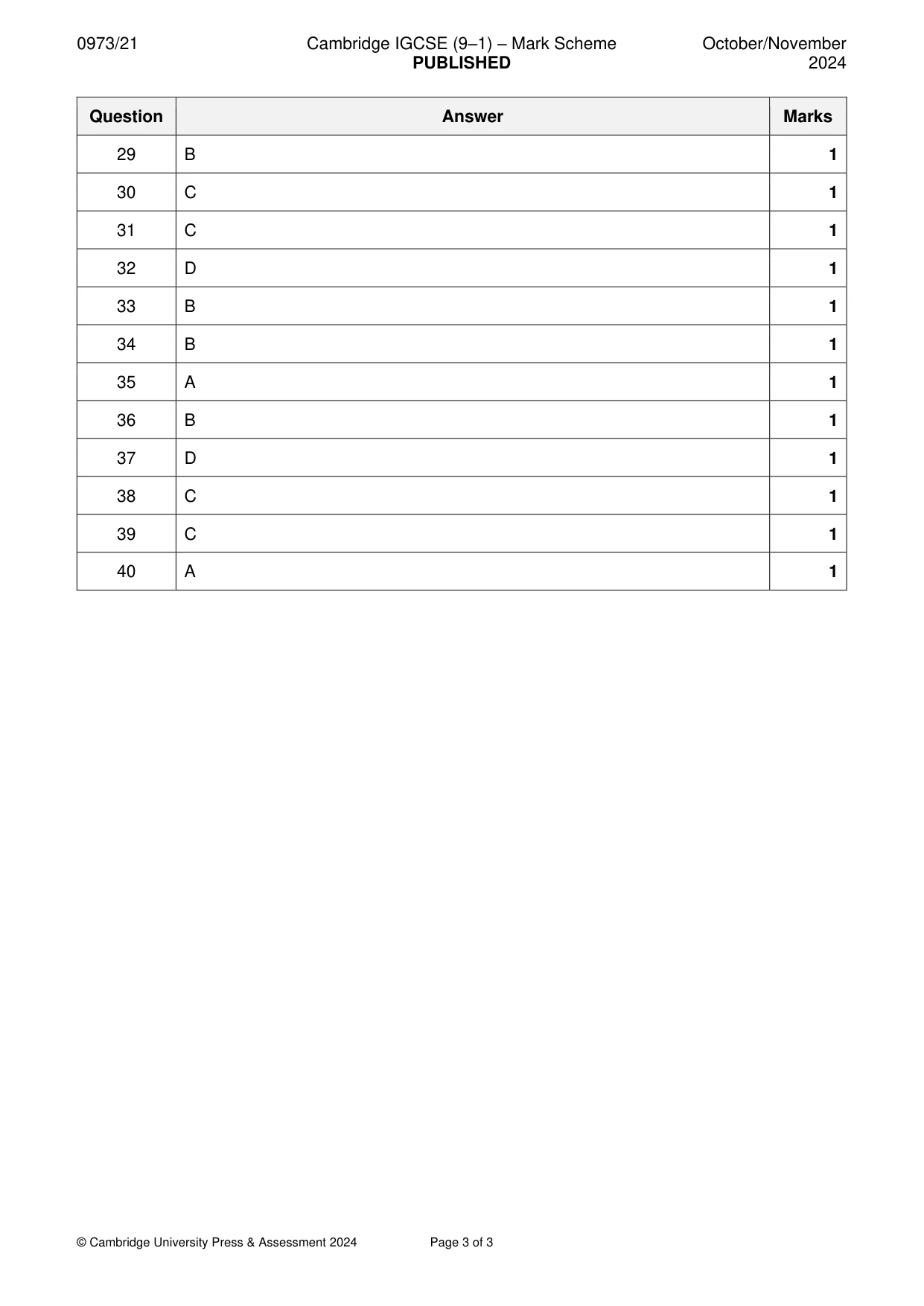
Answers below. Sit the paper first if you are practising.
Questions as text
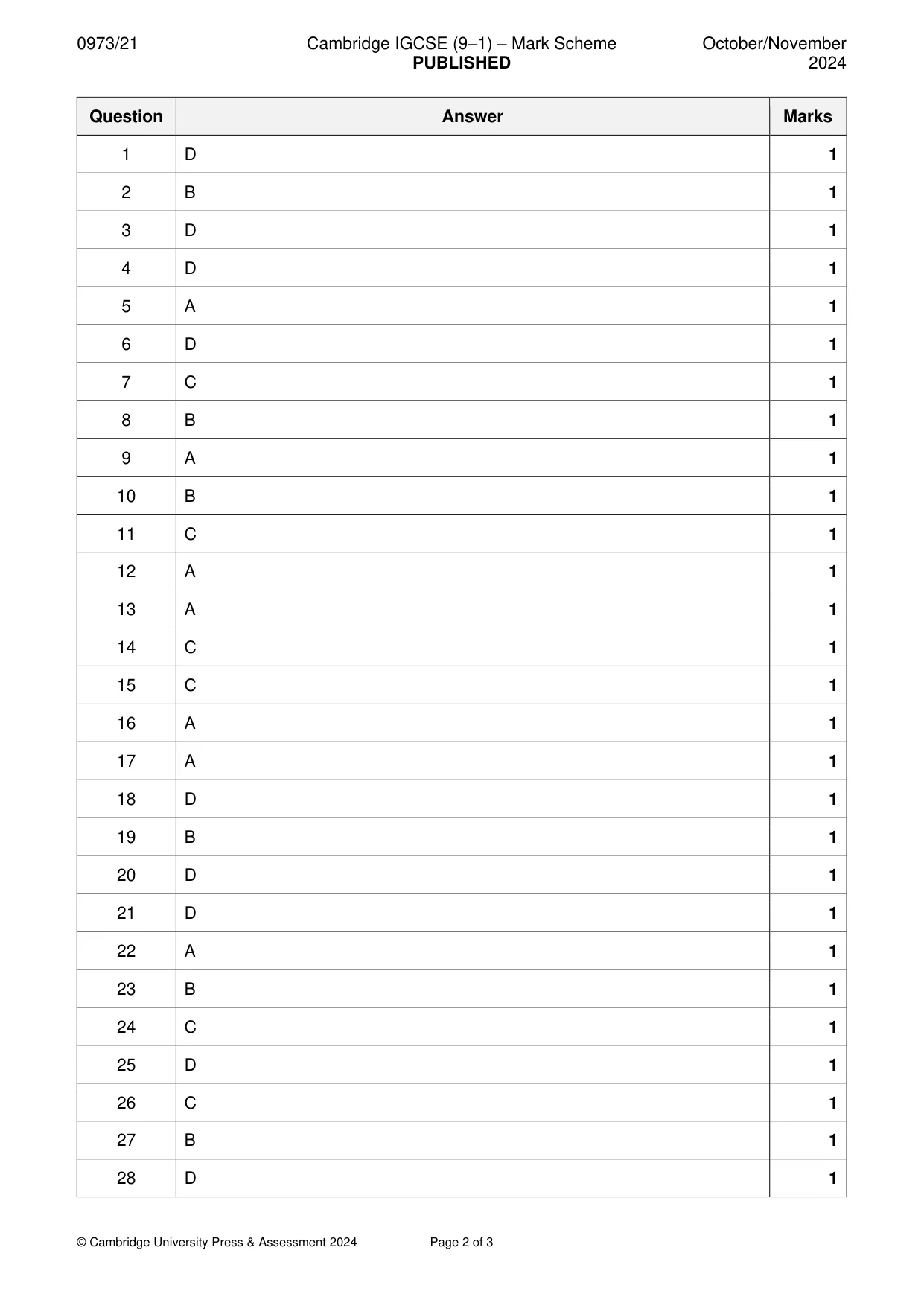
Q1 · Which term describes the ability to detect and respond to changes in the environment?
1 Which term describes the ability to detect and respond to changes in the environment? A excretion B growth C movement D sensitivity
Mark scheme: D
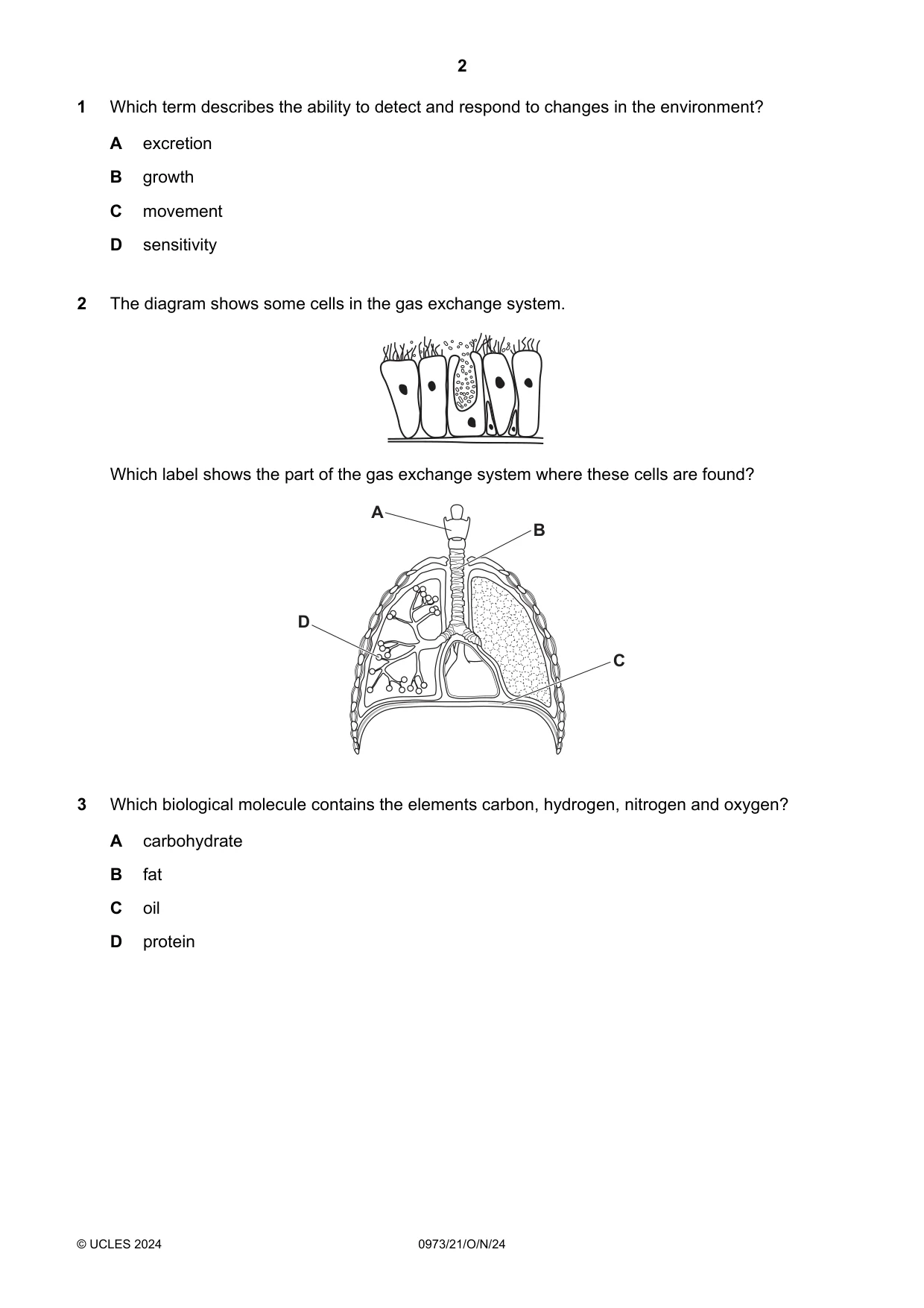
Q2 · The diagram shows some cells in the gas exchange system
2 The diagram shows some cells in the gas exchange system. Which label shows the part of the gas exchange system where these cells are found? A B D C
Mark scheme: B
Q3 · Which biological molecule contains the elements carbon, hydrogen, nitrogen and oxygen?
3 Which biological molecule contains the elements carbon, hydrogen, nitrogen and oxygen? A carbohydrate B fat C oil D protein
Mark scheme: D
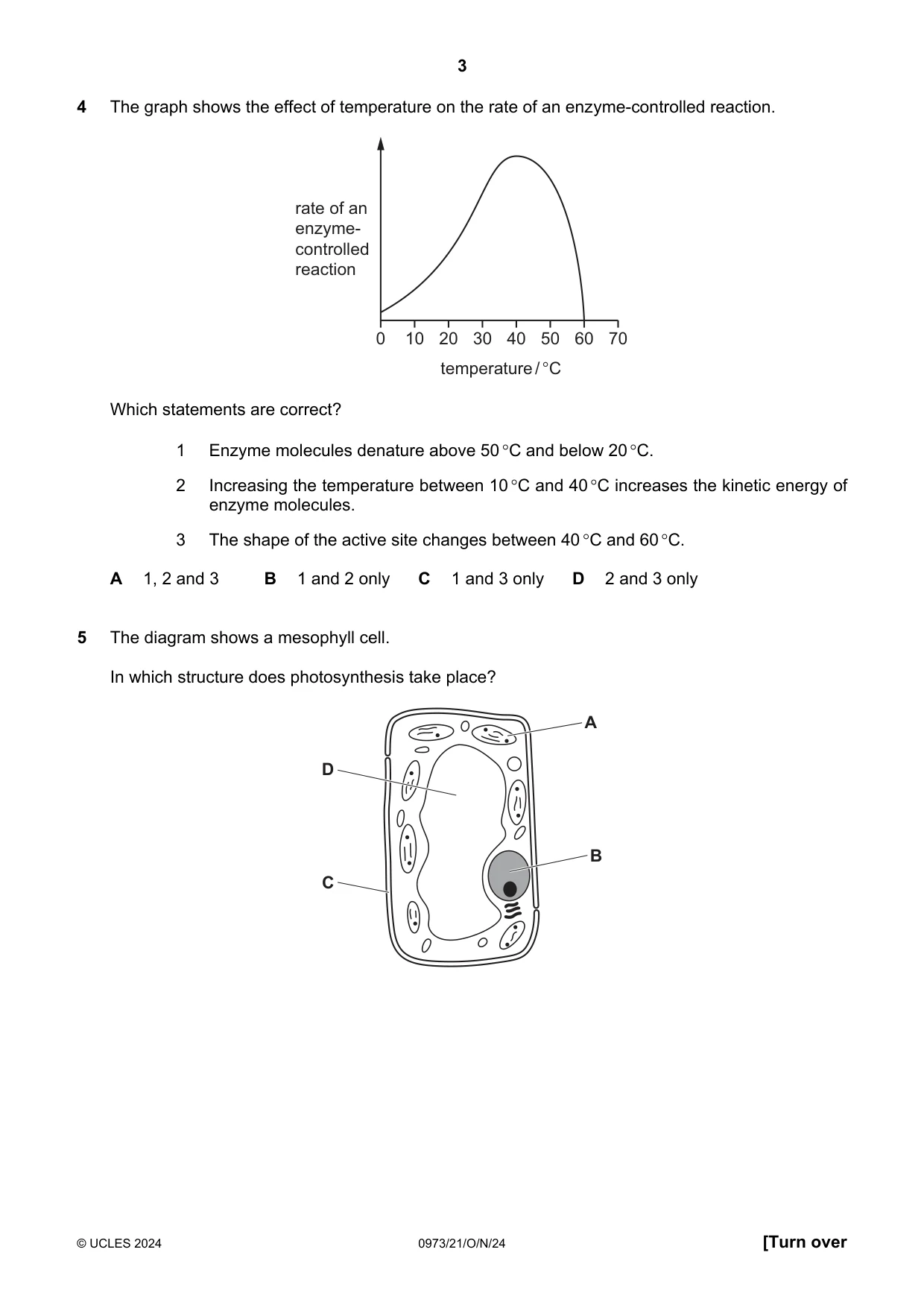
Q4 · The graph shows the effect of temperature on the rate of an enzyme-controlled reaction
4 The graph shows the effect of temperature on the rate of an enzyme-controlled reaction. rate of an enzyme- controlled reaction 0 10 20 30 40 50 60 70 temperature / °C Which statements are correct? 1 Enzyme molecules denature above 50 C and below 20 C. 2 Increasing the temperature between 10 C and 40 C increases the kinetic energy of enzyme molecules. 3 The shape of the active site changes between 40 C and 60 C. A 1, 2 and 3 B 1 and 2 only C 1 and 3 only D 2 and 3 only
Mark scheme: D
Q5 · The diagram shows a mesophyll cell
5 The diagram shows a mesophyll cell. In which structure does photosynthesis take place? A D B C
Mark scheme: A
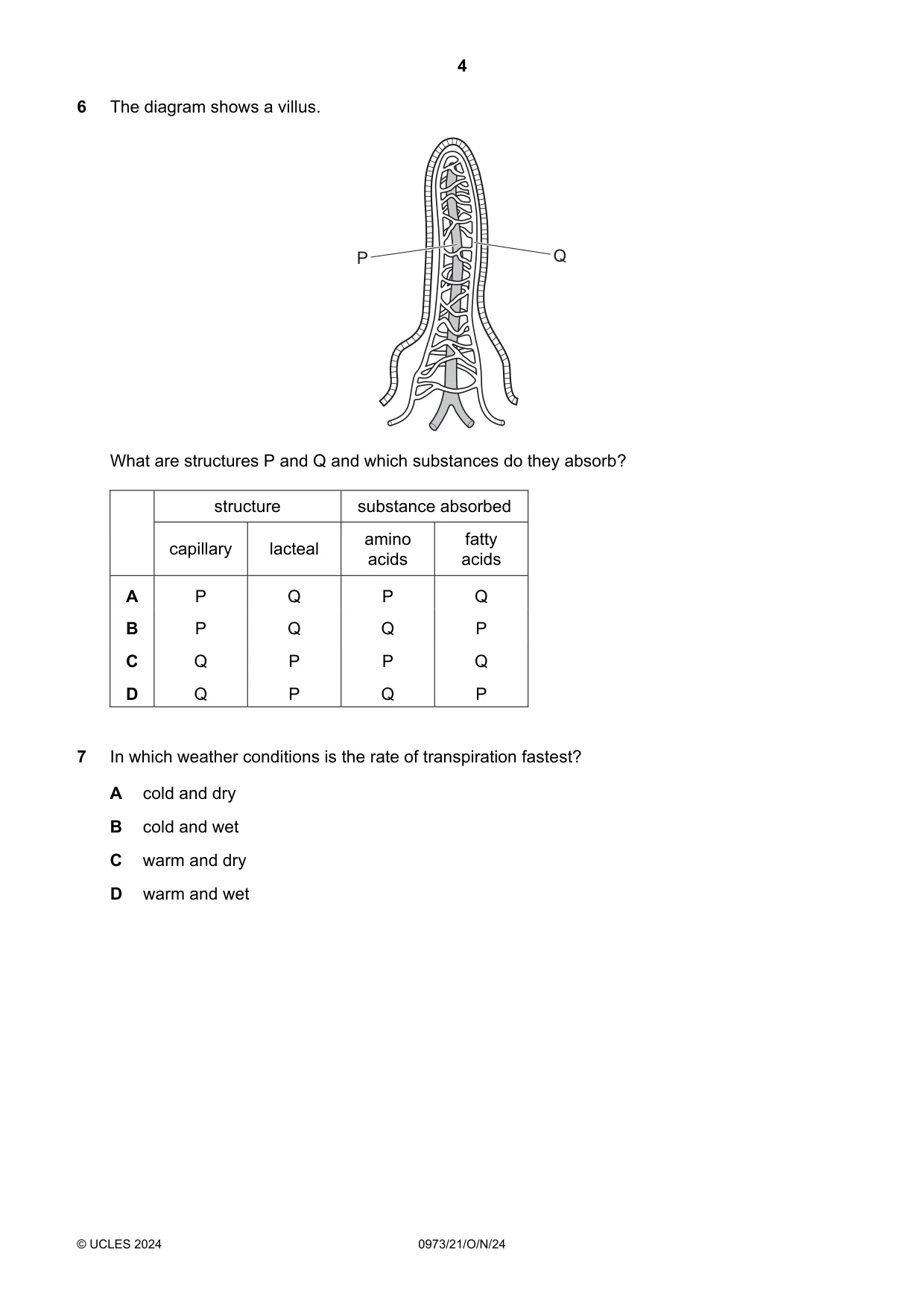
Q6 · The diagram shows a villus
6 The diagram shows a villus. P Q What are structures P and Q and which substances do they absorb? structure substance absorbed amino fatty capillary lacteal acids acids A P Q P Q B P Q Q P C Q P P Q D Q P Q P
Mark scheme: D
Q7 · In which weather conditions is the rate of transpiration fastest?
7 In which weather conditions is the rate of transpiration fastest? A cold and dry B cold and wet C warm and dry D warm and wet
Mark scheme: C
Q8 · A student breathed gently in and out of the mouthpiece of the apparatus shown
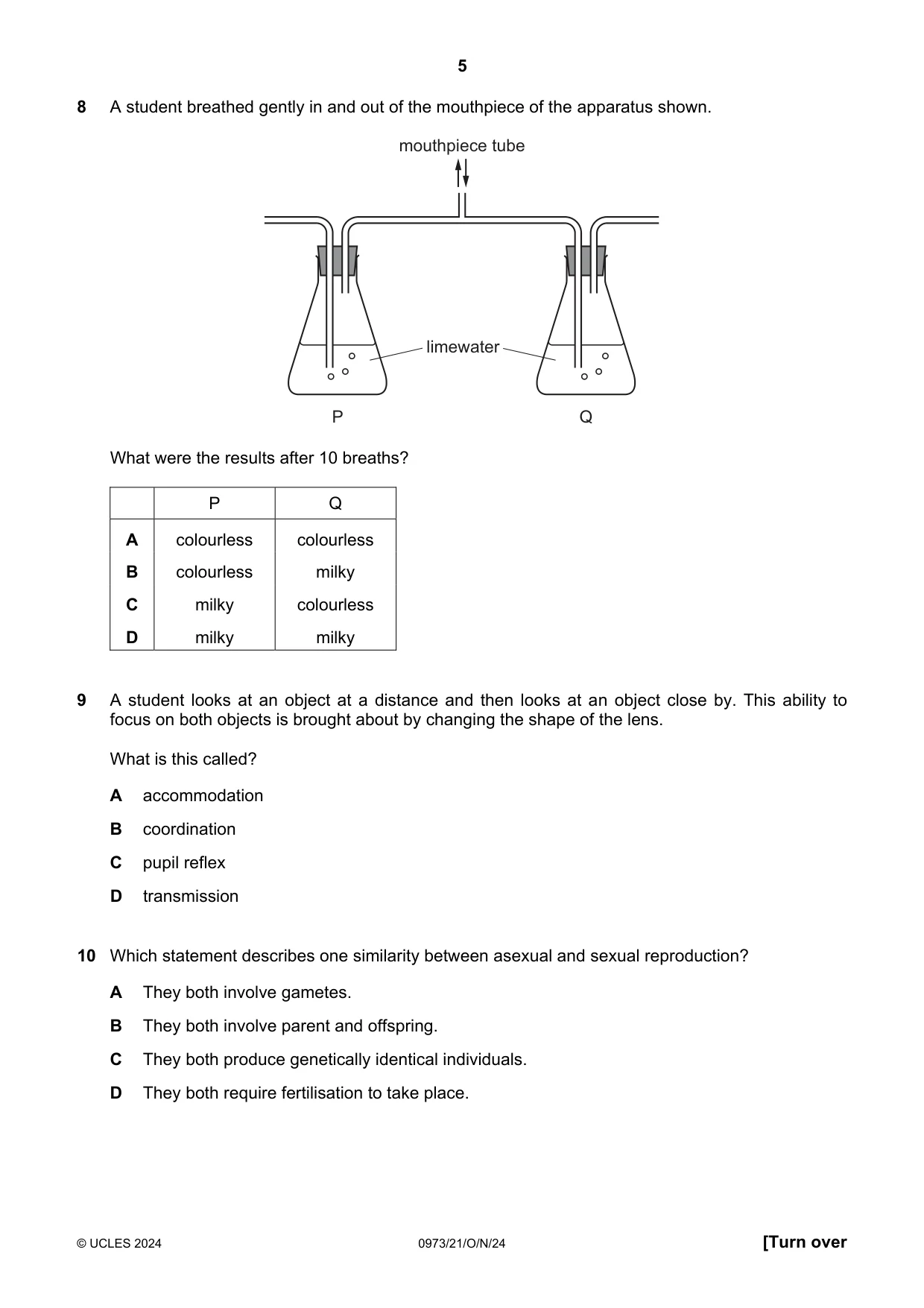
8 A student breathed gently in and out of the mouthpiece of the apparatus shown. mouthpiece tube limewater P Q What were the results after 10 breaths? P Q A colourless colourless B colourless milky C milky colourless D milky milky
Mark scheme: B
Q9 · A student looks at an object at a distance and then looks at an object close by
9 A student looks at an object at a distance and then looks at an object close by. This ability to focus on both objects is brought about by changing the shape of the lens. What is this called? A accommodation B coordination C pupil reflex D transmission
Mark scheme: A
Q10 · Which statement describes one similarity between asexual and sexual reproduction?
10 Which statement describes one similarity between asexual and sexual reproduction? A They both involve gametes. B They both involve parent and offspring. C They both produce genetically identical individuals. D They both require fertilisation to take place.
Mark scheme: B
Q11 · Horn development in some cattle is controlled by a pair of alleles
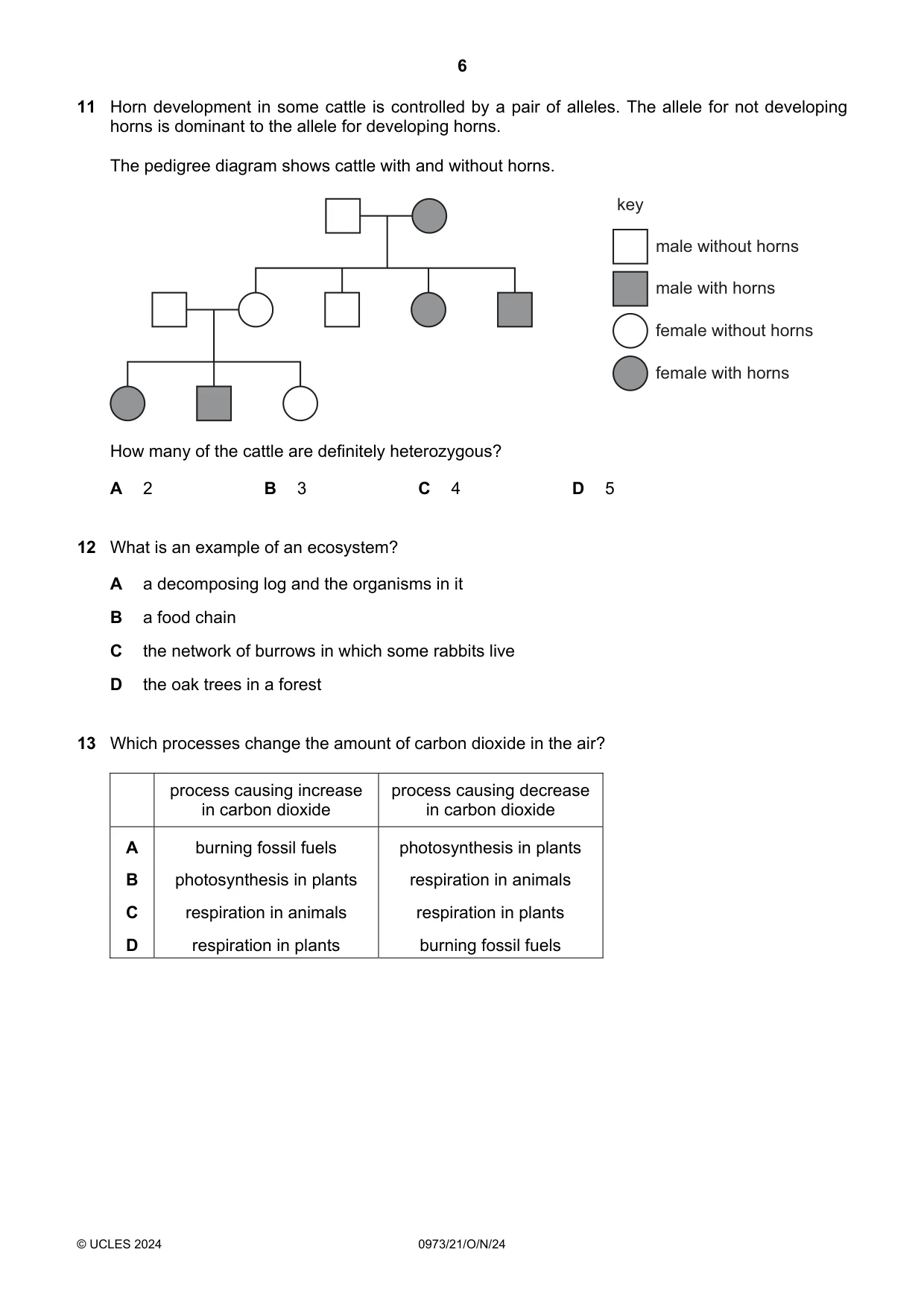
11 Horn development in some cattle is controlled by a pair of alleles. The allele for not developing horns is dominant to the allele for developing horns. The pedigree diagram shows cattle with and without horns. key male without horns male with horns female without horns female with horns How many of the cattle are definitely heterozygous? A 2 B 3 C 4 D 5
Mark scheme: C
Q12 · What is an example of an ecosystem?
12 What is an example of an ecosystem? A a decomposing log and the organisms in it B a food chain C the network of burrows in which some rabbits live D the oak trees in a forest
Mark scheme: A
Q13 · Which processes change the amount of carbon dioxide in the air?
13 Which processes change the amount of carbon dioxide in the air? process causing increase process causing decrease in carbon dioxide in carbon dioxide A burning fossil fuels photosynthesis in plants B photosynthesis in plants respiration in animals C respiration in animals respiration in plants D respiration in plants burning fossil fuels
Mark scheme: A
Q14 · Sea water is heated in the apparatus shown
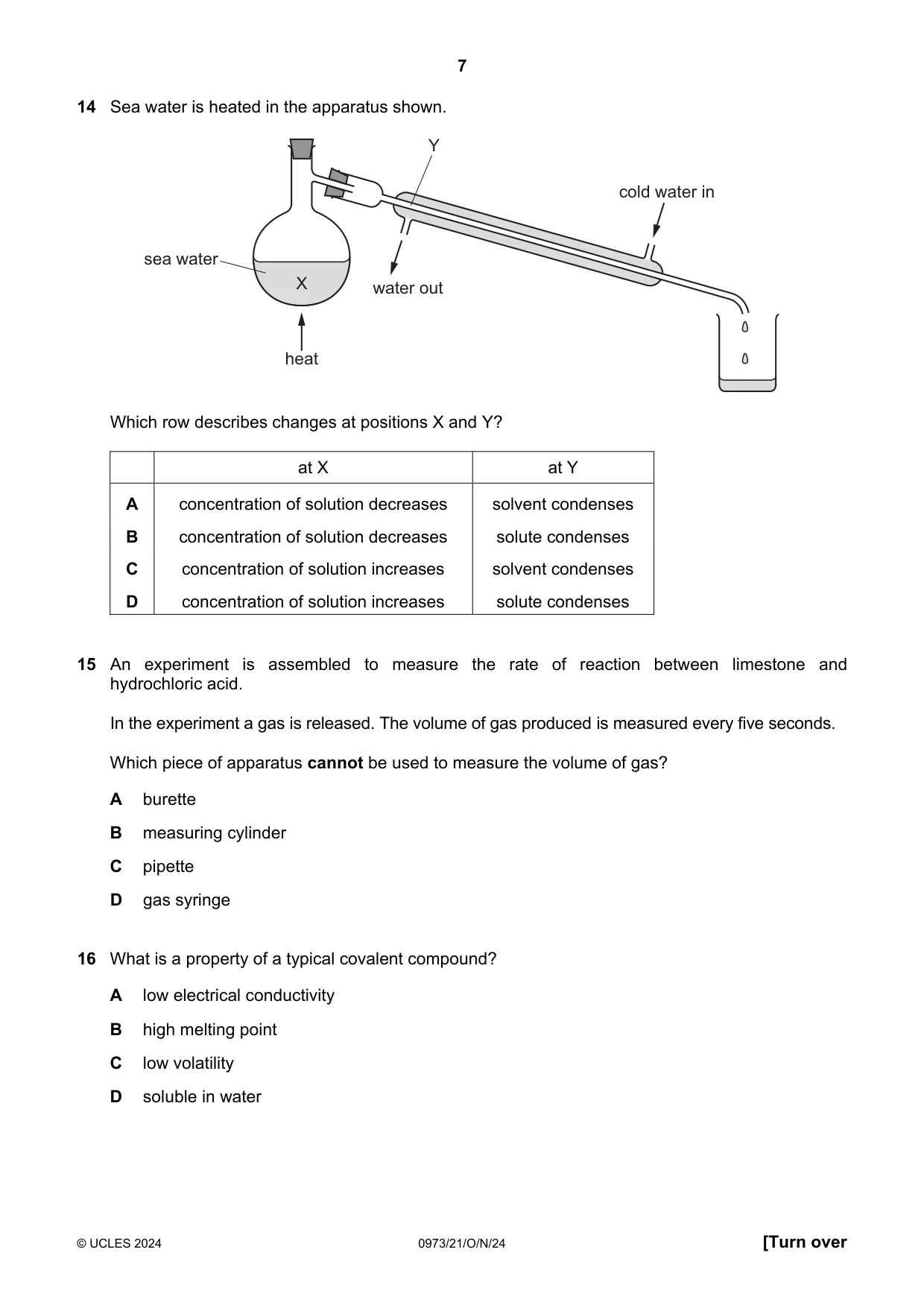
14 Sea water is heated in the apparatus shown. Y cold water in sea water X water out heat Which row describes changes at positions X and Y? at X at Y A concentration of solution decreases solvent condenses B concentration of solution decreases solute condenses C concentration of solution increases solvent condenses D concentration of solution increases solute condenses
Mark scheme: C
Q15 · An experiment is assembled to measure the rate of reaction between limestone and…
15 An experiment is assembled to measure the rate of reaction between limestone and hydrochloric acid. In the experiment a gas is released. The volume of gas produced is measured every five seconds. Which piece of apparatus cannot be used to measure the volume of gas? A burette B measuring cylinder C pipette D gas syringe
Mark scheme: C
Q16 · What is a property of a typical covalent compound?
16 What is a property of a typical covalent compound? A low electrical conductivity B high melting point C low volatility D soluble in water
Mark scheme: A
Q17 · The formula of an ammonium ion is NH4 +
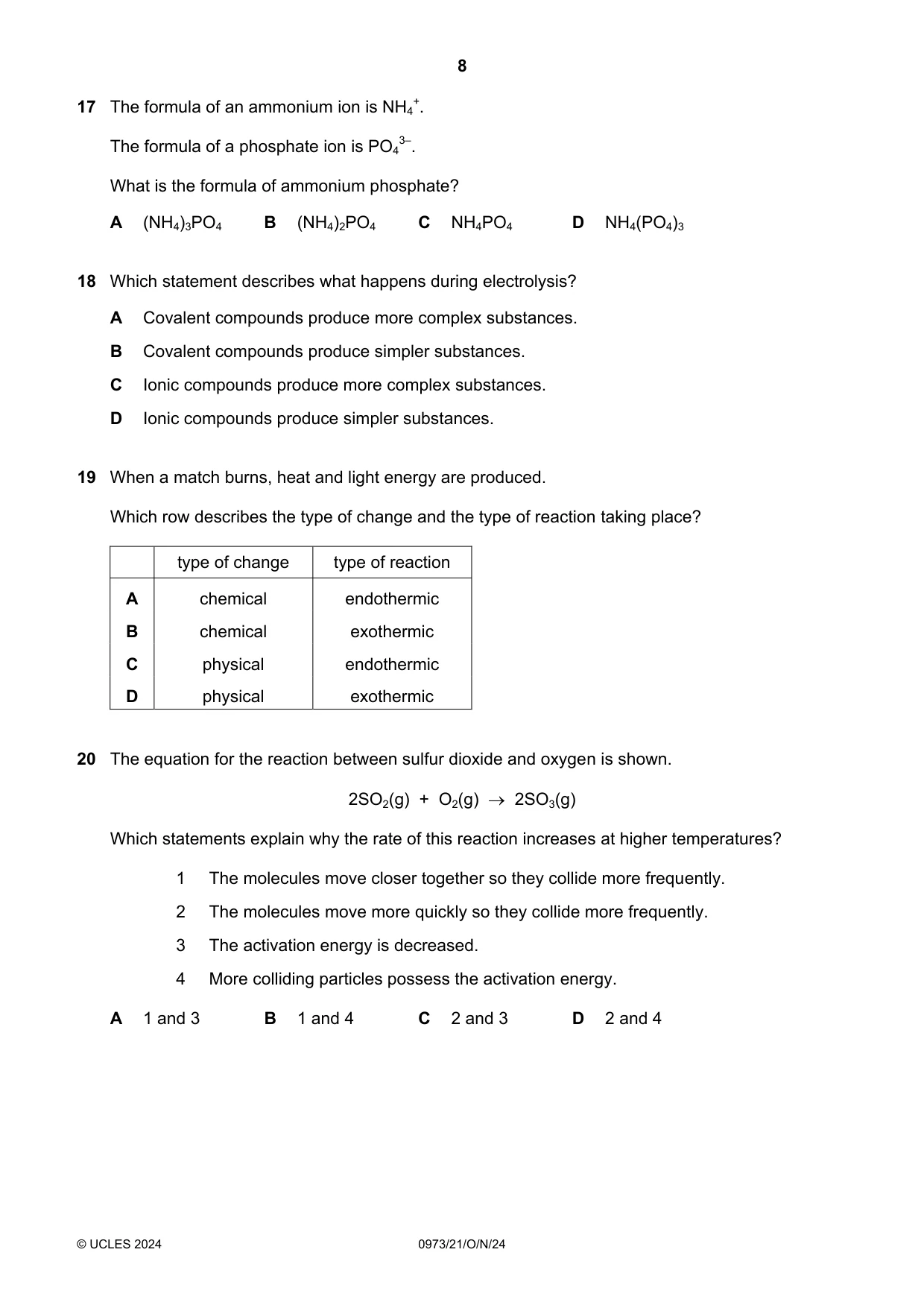
17 The formula of an ammonium ion is NH4 +. The formula of a phosphate ion is PO4 3–. What is the formula of ammonium phosphate? A (NH4)3PO4 B (NH4)2PO4 C NH4PO4 D NH4(PO4)3
Mark scheme: A
Q18 · Which statement describes what happens during electrolysis?
18 Which statement describes what happens during electrolysis? A Covalent compounds produce more complex substances. B Covalent compounds produce simpler substances. C Ionic compounds produce more complex substances. D Ionic compounds produce simpler substances.
Mark scheme: D
Q19 · When a match burns, heat and light energy are produced
19 When a match burns, heat and light energy are produced. Which row describes the type of change and the type of reaction taking place? type of change type of reaction A chemical endothermic B chemical exothermic C physical endothermic D physical exothermic
Mark scheme: B
Q20 · The equation for the reaction between sulfur dioxide and oxygen is shown
20 The equation for the reaction between sulfur dioxide and oxygen is shown. 2SO2(g) + O2(g) 2SO3(g) Which statements explain why the rate of this reaction increases at higher temperatures? 1 The molecules move closer together so they collide more frequently. 2 The molecules move more quickly so they collide more frequently. 3 The activation energy is decreased. 4 More colliding particles possess the activation energy. A 1 and 3 B 1 and 4 C 2 and 3 D 2 and 4
Mark scheme: D
Q21 · All Group I metal compounds and all Group II metal chlorides are soluble in water
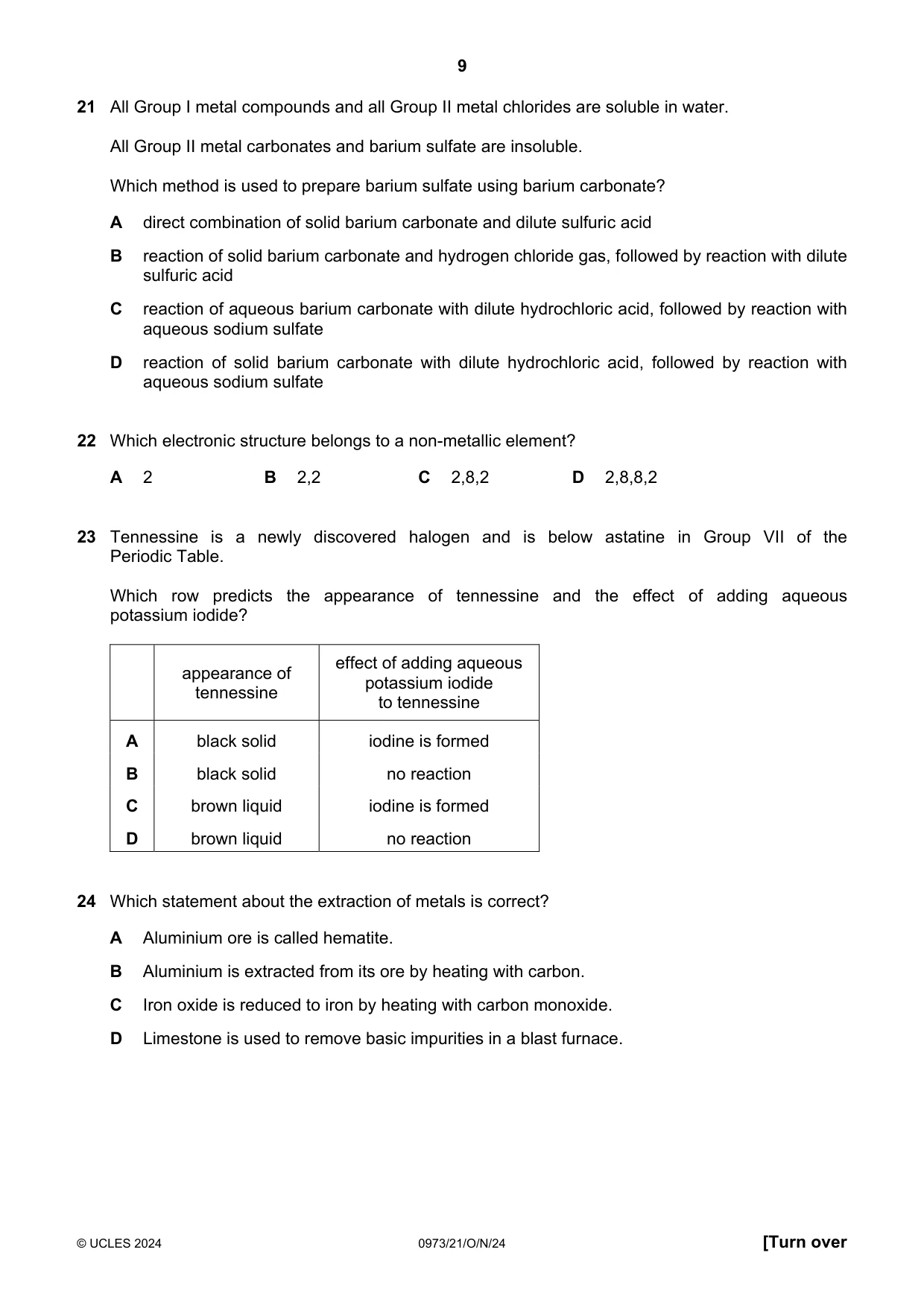
21 All Group I metal compounds and all Group II metal chlorides are soluble in water. All Group II metal carbonates and barium sulfate are insoluble. Which method is used to prepare barium sulfate using barium carbonate? A direct combination of solid barium carbonate and dilute sulfuric acid B reaction of solid barium carbonate and hydrogen chloride gas, followed by reaction with dilute sulfuric acid C reaction of aqueous barium carbonate with dilute hydrochloric acid, followed by reaction with aqueous sodium sulfate D reaction of solid barium carbonate with dilute hydrochloric acid, followed by reaction with aqueous sodium sulfate
Mark scheme: D
Q22 · Which electronic structure belongs to a non-metallic element?
22 Which electronic structure belongs to a non-metallic element? A 2 B 2,2 C 2,8,2 D 2,8,8,2
Mark scheme: A
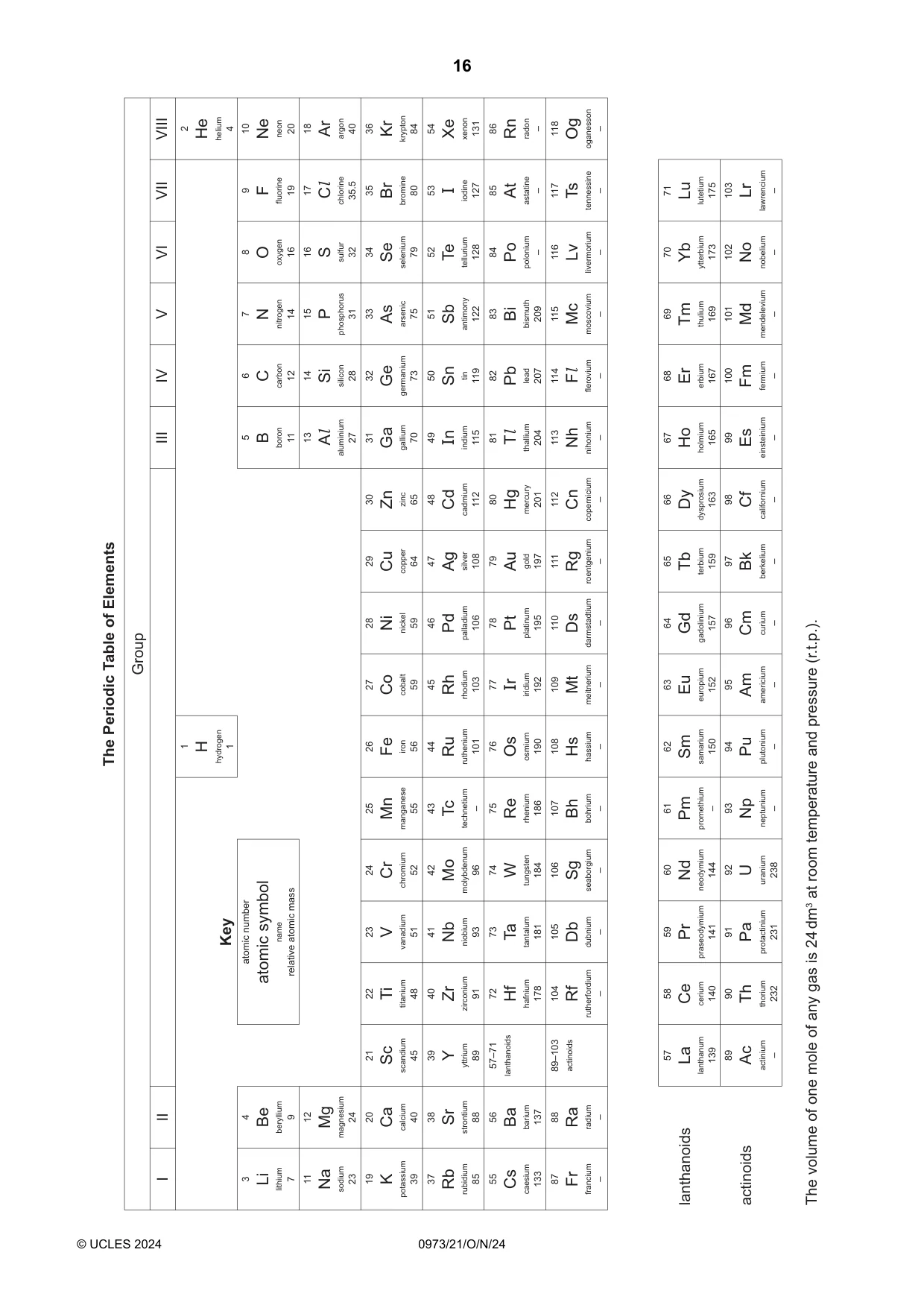
Q23 · Tennessine is a newly discovered halogen and is below astatine in Group VII of the…
23 Tennessine is a newly discovered halogen and is below astatine in Group VII of the Periodic Table. Which row predicts the appearance of tennessine and the effect of adding aqueous potassium iodide? effect of adding aqueous appearance of potassium iodide tennessine to tennessine A black solid iodine is formed B black solid no reaction C brown liquid iodine is formed D brown liquid no reaction
Mark scheme: B
Q24 · Which statement about the extraction of metals is correct?
24 Which statement about the extraction of metals is correct? A Aluminium ore is called hematite. B Aluminium is extracted from its ore by heating with carbon. C Iron oxide is reduced to iron by heating with carbon monoxide. D Limestone is used to remove basic impurities in a blast furnace.
Mark scheme: C
Q25 · In a test for water, water turns anhydrous copper(II) ......1.....
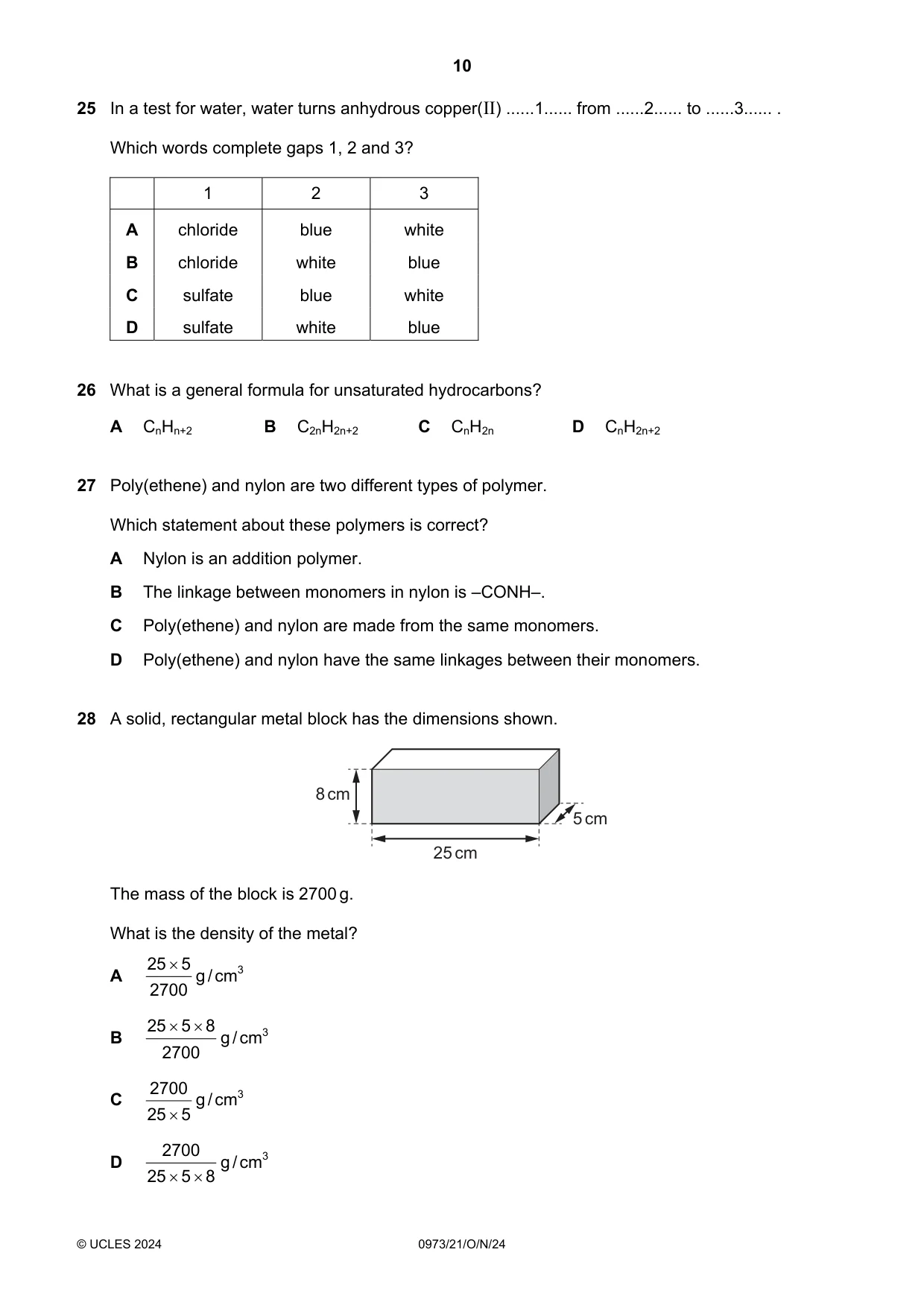
25 In a test for water, water turns anhydrous copper(II) ......1...... from ......2...... to ......3...... . Which words complete gaps 1, 2 and 3? 1 2 3 A chloride blue white B chloride white blue C sulfate blue white D sulfate white blue
Mark scheme: D
Q26 · What is a general formula for unsaturated hydrocarbons?
26 What is a general formula for unsaturated hydrocarbons? A CnHn+2 B C2nH2n+2 C CnH2n D CnH2n+2
Mark scheme: C
Q27 · Poly(ethene) and nylon are two different types of polymer
27 Poly(ethene) and nylon are two different types of polymer. Which statement about these polymers is correct? A Nylon is an addition polymer. B The linkage between monomers in nylon is –CONH–. C Poly(ethene) and nylon are made from the same monomers. D Poly(ethene) and nylon have the same linkages between their monomers.
Mark scheme: B
Q28 · A solid, rectangular metal block has the dimensions shown
28 A solid, rectangular metal block has the dimensions shown. 8 cm 5 cm 25 cm The mass of the block is 2700 g. What is the density of the metal? 25 5 A g / cm3 2700 25 5 8 B g / cm3 2700 2700 C g / cm3 25 5 2700 D g / cm3 25 5 8
Mark scheme: D
Q29 · The length of a spring changes when a force is applied to stretch the spring
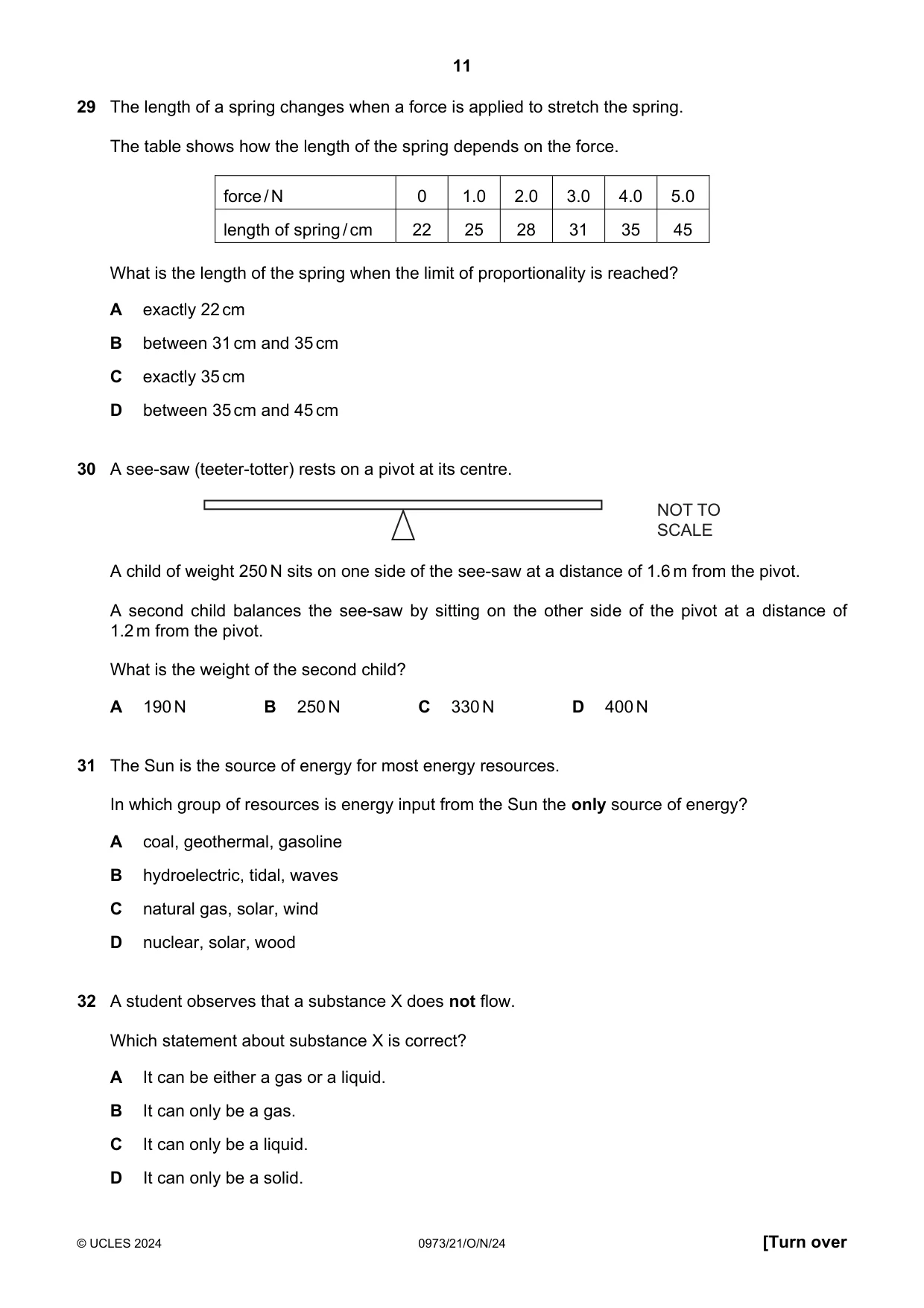
29 The length of a spring changes when a force is applied to stretch the spring. The table shows how the length of the spring depends on the force. force / N 0 1.0 2.0 3.0 4.0 5.0 length of spring / cm 22 25 28 31 35 45 What is the length of the spring when the limit of proportionality is reached? A exactly 22 cm B between 31 cm and 35 cm C exactly 35 cm D between 35 cm and 45 cm
Mark scheme: B
Q30 · A see-saw (teeter-totter) rests on a pivot at its centre
30 A see-saw (teeter-totter) rests on a pivot at its centre. NOT TO SCALE A child of weight 250 N sits on one side of the see-saw at a distance of 1.6 m from the pivot. A second child balances the see-saw by sitting on the other side of the pivot at a distance of 1.2 m from the pivot. What is the weight of the second child? A 190 N B 250 N C 330 N D 400 N
Mark scheme: C
Q31 · The Sun is the source of energy for most energy resources
31 The Sun is the source of energy for most energy resources. In which group of resources is energy input from the Sun the only source of energy? A coal, geothermal, gasoline B hydroelectric, tidal, waves C natural gas, solar, wind D nuclear, solar, wood
Mark scheme: C
Q32 · A student observes that a substance X does not flow
32 A student observes that a substance X does not flow. Which statement about substance X is correct? A It can be either a gas or a liquid. B It can only be a gas. C It can only be a liquid. D It can only be a solid.
Mark scheme: D
Q33 · A ray of light travels from glass into air
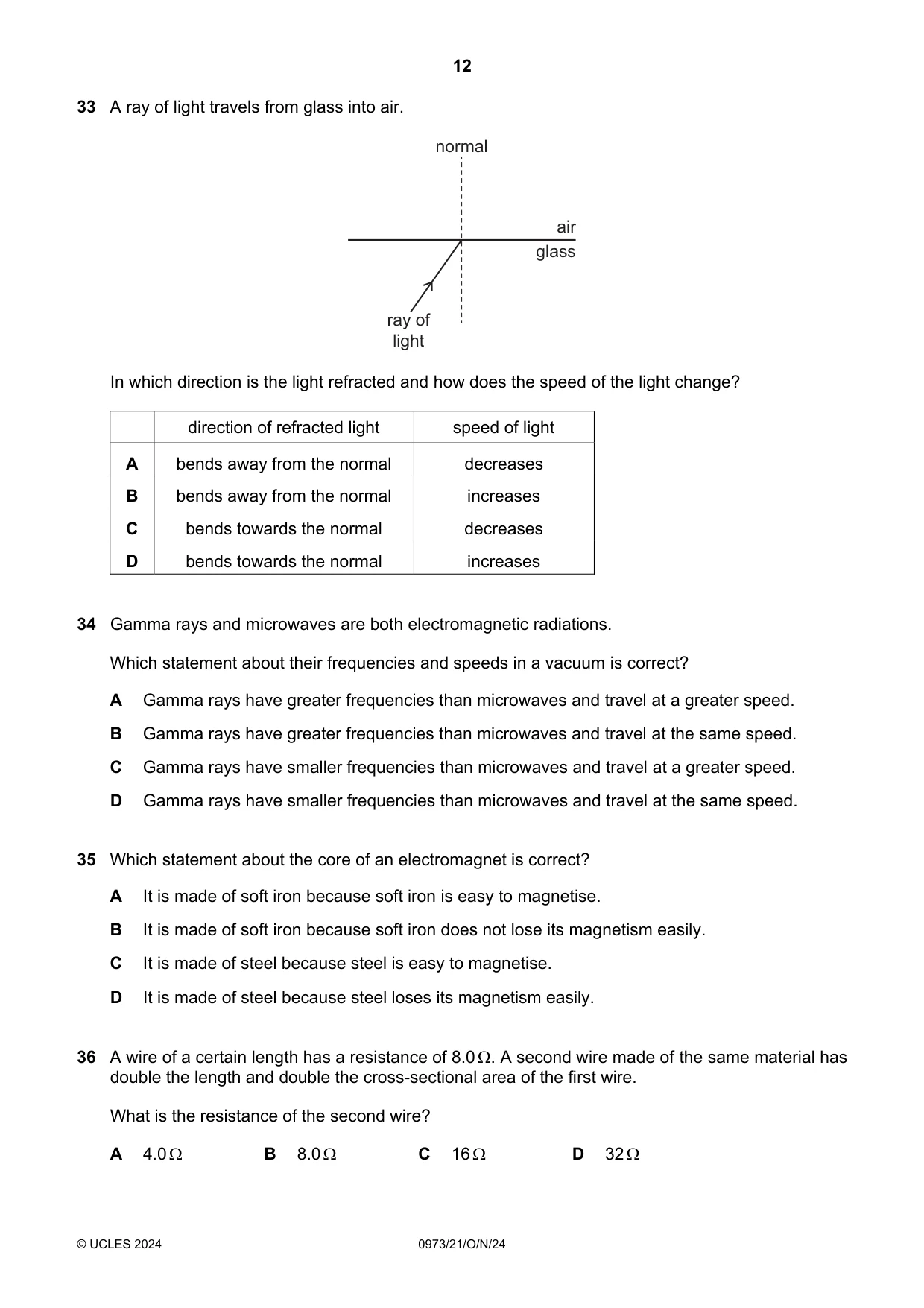
33 A ray of light travels from glass into air. normal air glass ray of light In which direction is the light refracted and how does the speed of the light change? direction of refracted light speed of light A bends away from the normal decreases B bends away from the normal increases C bends towards the normal decreases D bends towards the normal increases
Mark scheme: B
Q34 · Gamma rays and microwaves are both electromagnetic radiations
34 Gamma rays and microwaves are both electromagnetic radiations. Which statement about their frequencies and speeds in a vacuum is correct? A Gamma rays have greater frequencies than microwaves and travel at a greater speed. B Gamma rays have greater frequencies than microwaves and travel at the same speed. C Gamma rays have smaller frequencies than microwaves and travel at a greater speed. D Gamma rays have smaller frequencies than microwaves and travel at the same speed.
Mark scheme: B
Q35 · Which statement about the core of an electromagnet is correct?
35 Which statement about the core of an electromagnet is correct? A It is made of soft iron because soft iron is easy to magnetise. B It is made of soft iron because soft iron does not lose its magnetism easily. C It is made of steel because steel is easy to magnetise. D It is made of steel because steel loses its magnetism easily.
Mark scheme: A
Q36 · A wire of a certain length has a resistance of 8.0
36 A wire of a certain length has a resistance of 8.0 . A second wire made of the same material has double the length and double the cross-sectional area of the first wire. What is the resistance of the second wire? A 4.0 B 8.0 C 16 D 32
Mark scheme: B
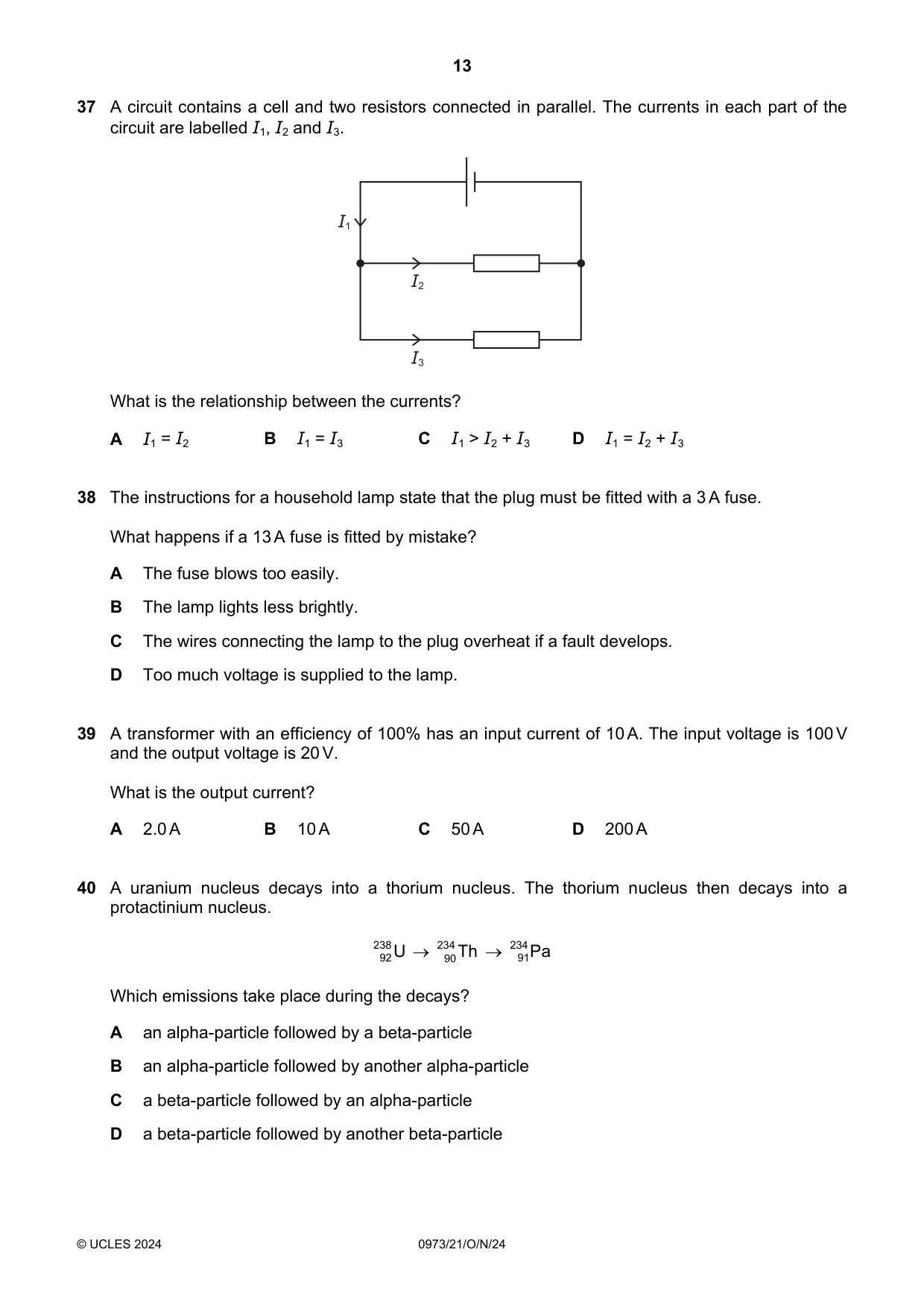
Q37 · A circuit contains a cell and two resistors connected in parallel
37 A circuit contains a cell and two resistors connected in parallel. The currents in each part of the circuit are labelled I1, I2 and I3. I1 I2 I3 What is the relationship between the currents? A I1 = I2 B I1 = I3 C I1 > I2 + I3 D I1 = I2 + I3
Mark scheme: D
Q38 · The instructions for a household lamp state that the plug must be fitted with a 3 A fuse
38 The instructions for a household lamp state that the plug must be fitted with a 3 A fuse. What happens if a 13 A fuse is fitted by mistake? A The fuse blows too easily. B The lamp lights less brightly. C The wires connecting the lamp to the plug overheat if a fault develops. D Too much voltage is supplied to the lamp.
Mark scheme: C
Q39 · A transformer with an efficiency of 100% has an input current of 10 A
39 A transformer with an efficiency of 100% has an input current of 10 A. The input voltage is 100 V and the output voltage is 20 V. What is the output current? A 2.0 A B 10 A C 50 A D 200 A
Mark scheme: C
Q40 · A uranium nucleus decays into a thorium nucleus
40 A uranium nucleus decays into a thorium nucleus. The thorium nucleus then decays into a protactinium nucleus. 238 U 234 Th 234 Pa 92 90 91 Which emissions take place during the decays? A an alpha-particle followed by a beta-particle B an alpha-particle followed by another alpha-particle C a beta-particle followed by an alpha-particle D a beta-particle followed by another beta-particle
Mark scheme: A
What was in this paper
The subtopics covered by these 40 questions, and how many questions each got. Open one in a new tab to see every Cambridge question on it.
2Gas exchange in humans2Alkenes1Atomic structure and the Periodic Table1Biological molecules1Carbon cycle1Characteristics of living organisms1Coordination and response1Density1Digestion1Electrical circuits1Electrical quantities1Electrical safety1Electrolysis1Electromagnetic effects1Electromagnetic spectrum1Energy, work and power1Enzymes1Exothermic and endothermic reactions1Experimental design1Extraction of metals1Food chains and food webs1Group VII properties1Identification of ions and gases1Ions and ionic bonds1Kinetic particle model of matter1Light1Monohybrid inheritance1Photosynthesis1Polymers1Preparation of salts1Radioactivity1Rate of reaction1Separation and purification1Sexual reproduction1Simple molecules and covalent bonds1Simple phenomena of magnetism1Transpiration1What you needed in this session
Cambridge’s own grade thresholds for 2024 Oct/Nov, Paper 2 · Variant 1. A higher threshold means an easier paper — the bar moves with how the cohort did.