Cambridge IGCSE Sciences - Co-ordinated (9-1) 0973 — 2025 Oct/Nov Paper 2 · Variant 1
0973/21/O/N/25 · 40 questions · 40 marks · 45 min
The question paper and its mark scheme, free to read here and free to download. This is Cambridge’s own paper, exactly as it was sat.
Question paper16 pages
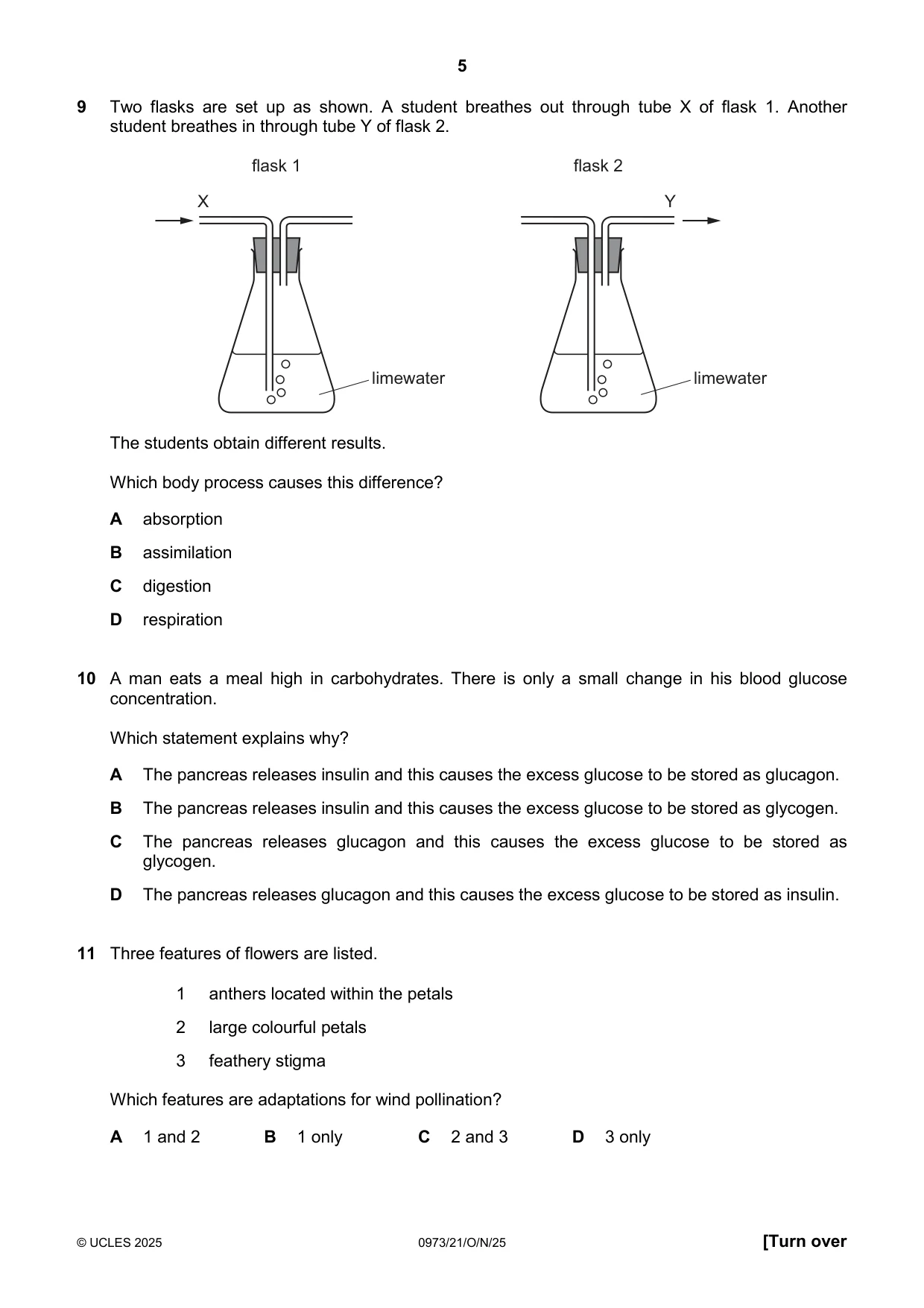
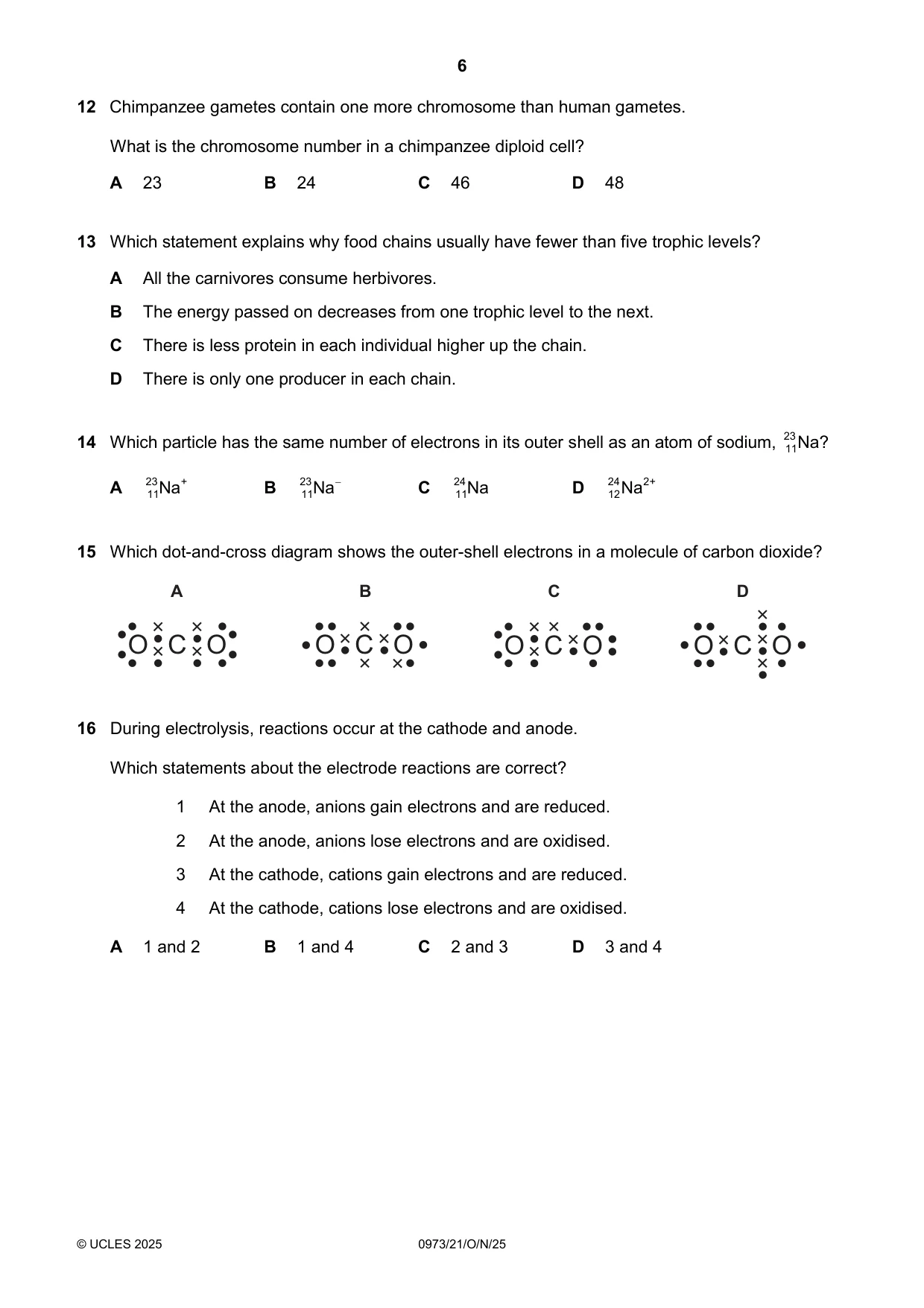
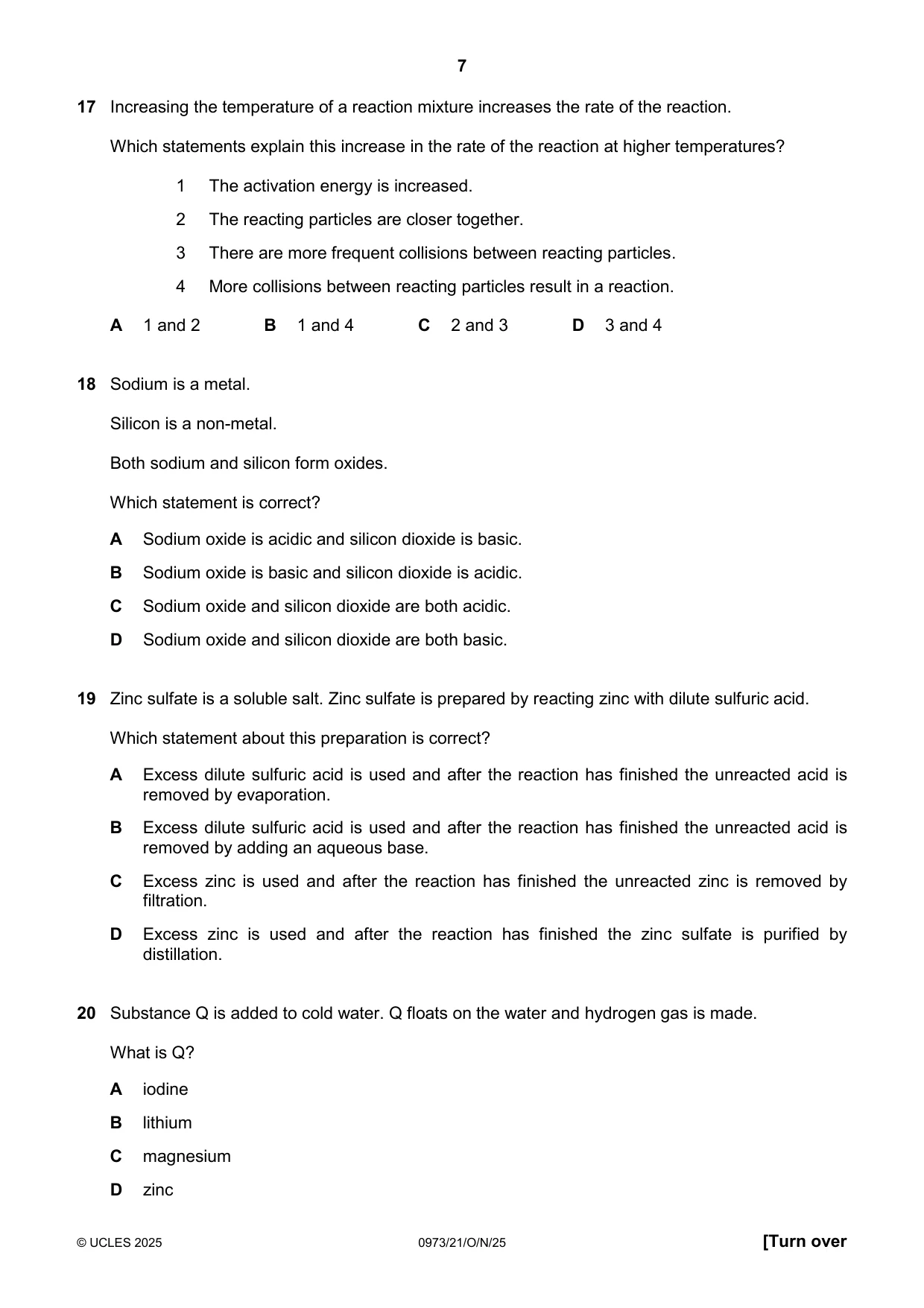
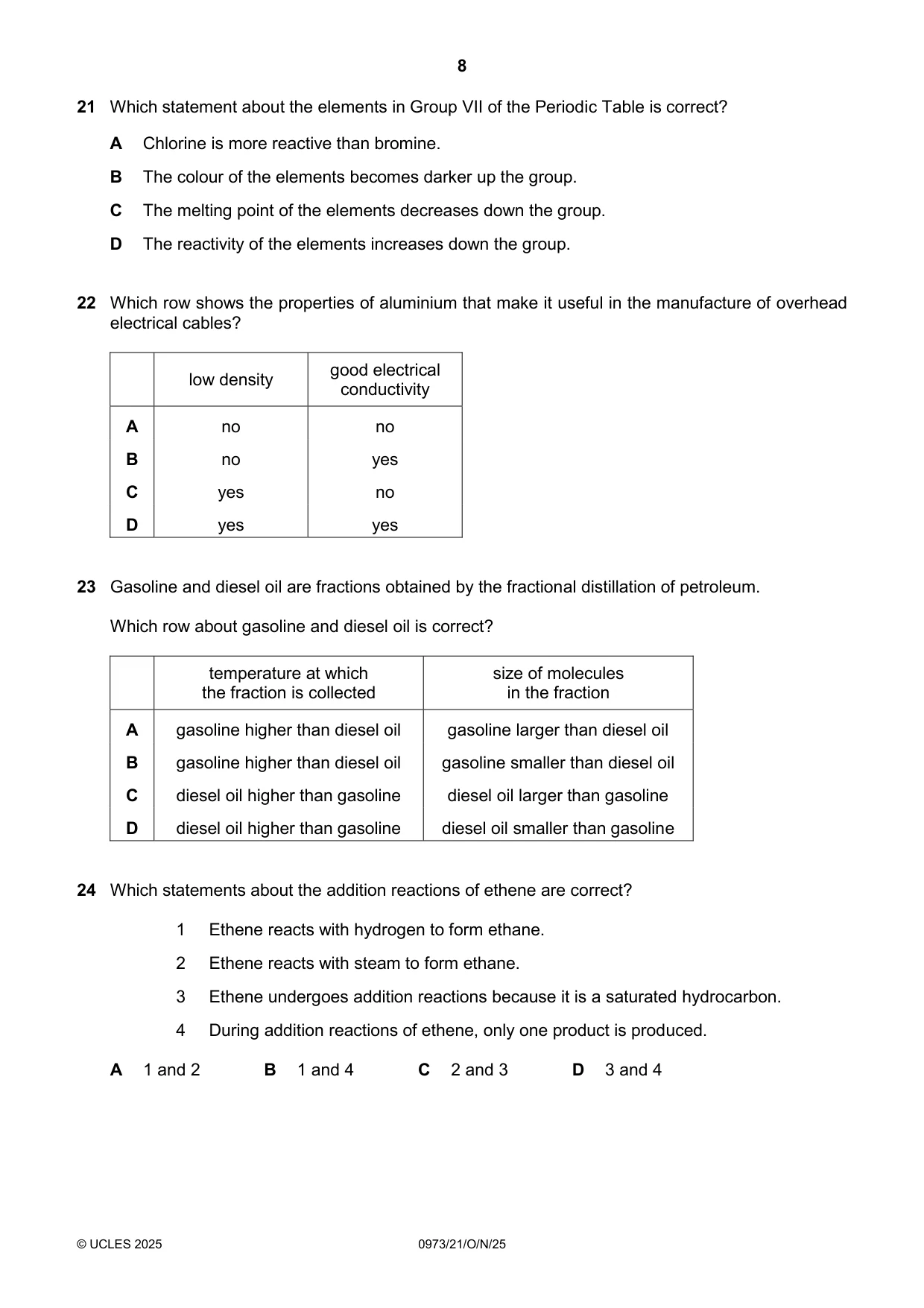
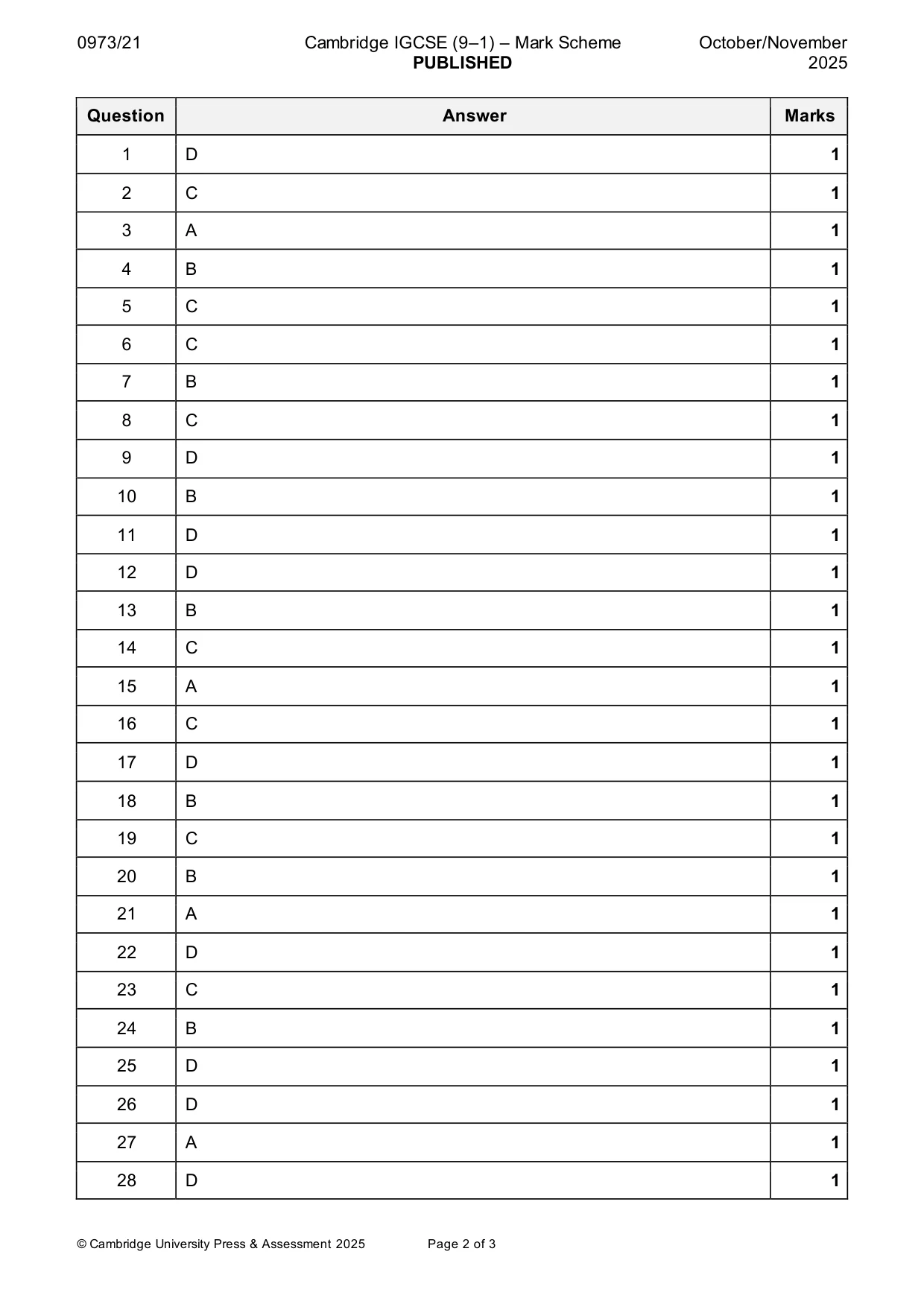
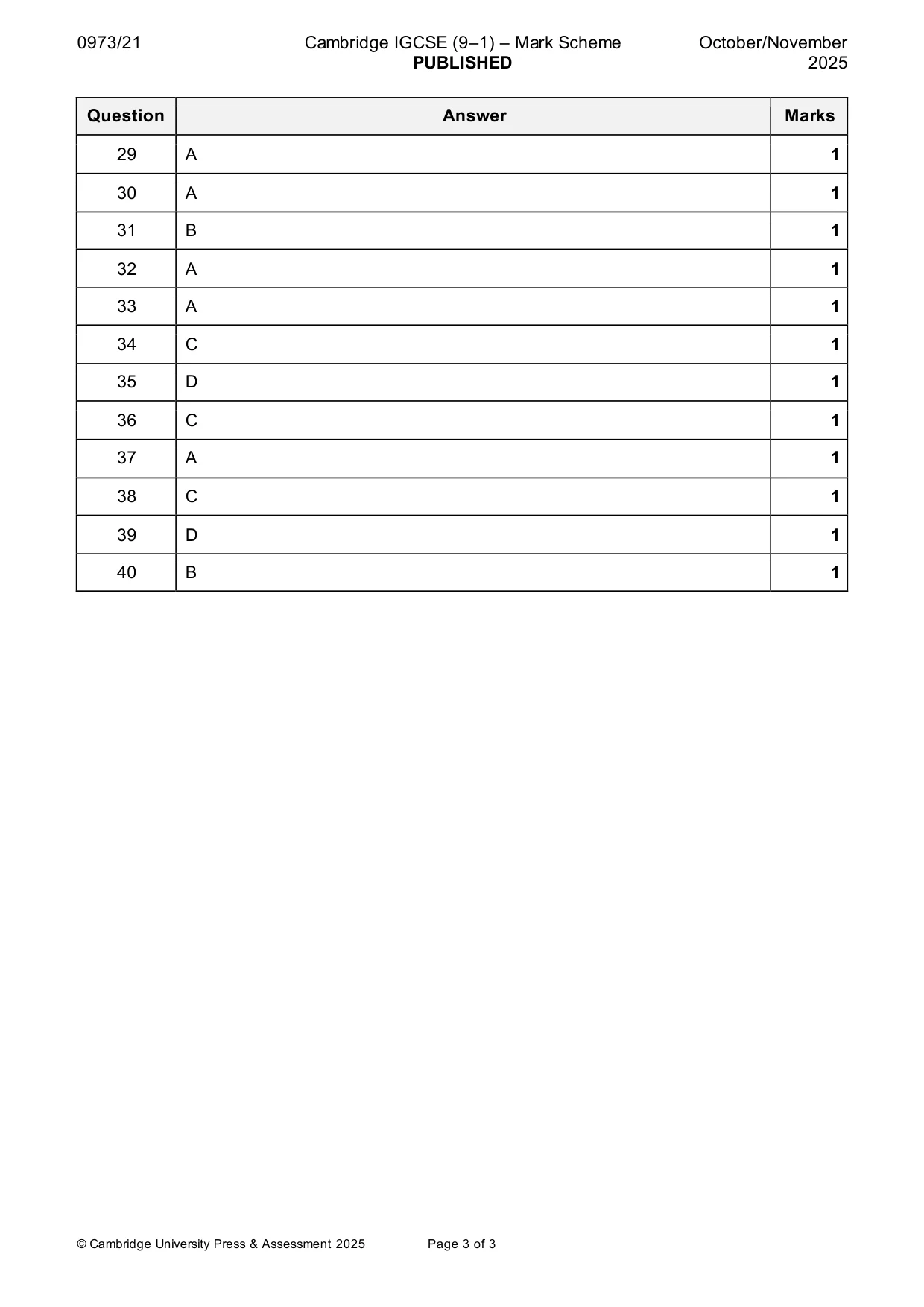
Mark scheme3 pages
Answers below. Sit the paper first if you are practising.
Questions as text
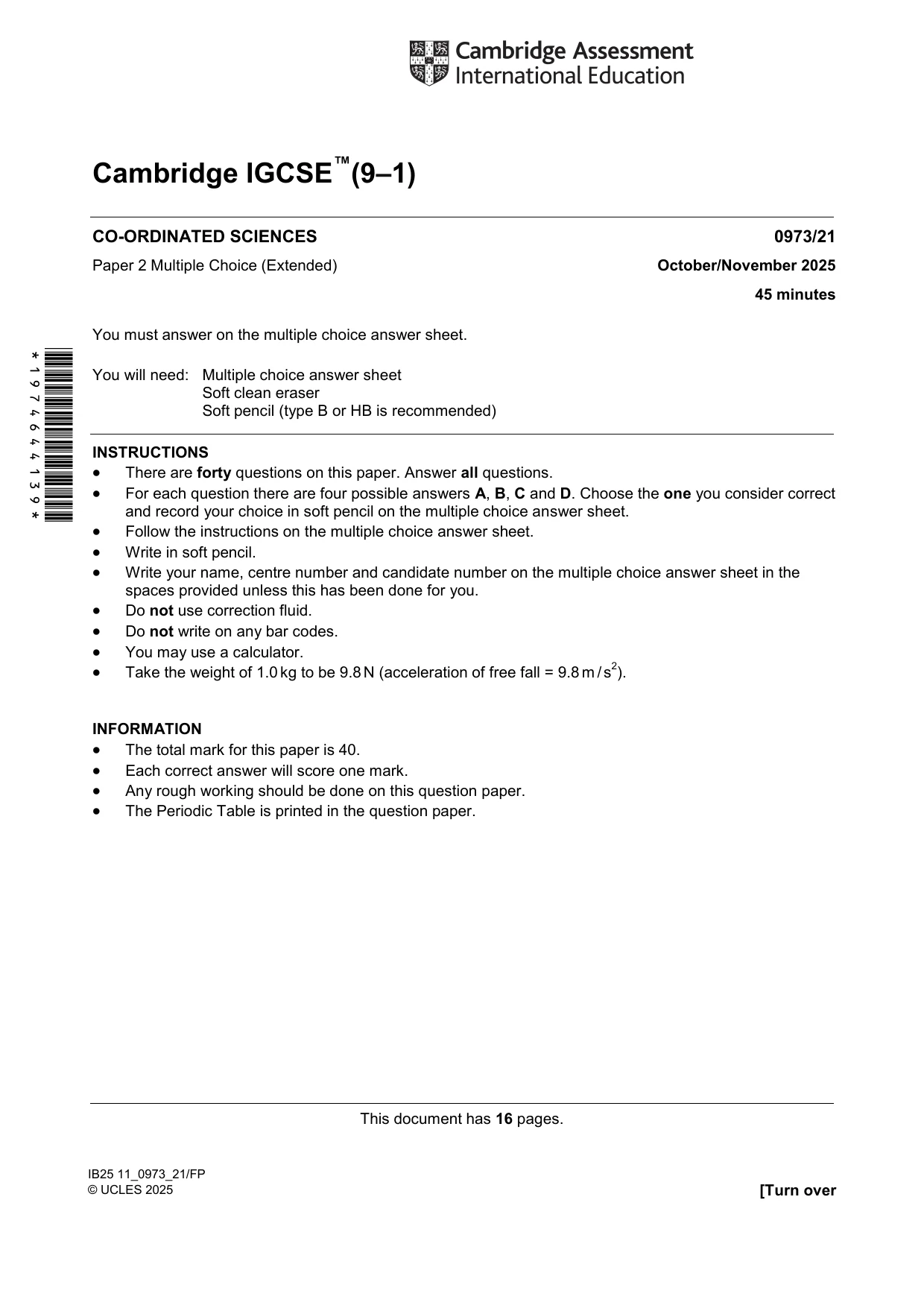
Q1 · When light shines from one direction only, a plant shoot bends towards the light
1 When light shines from one direction only, a plant shoot bends towards the light. light Which row gives the characteristics of living organisms shown by the plant shoot? growth movement sensitivity A no yes yes B yes yes no C yes no yes D yes yes yes
Mark scheme: D
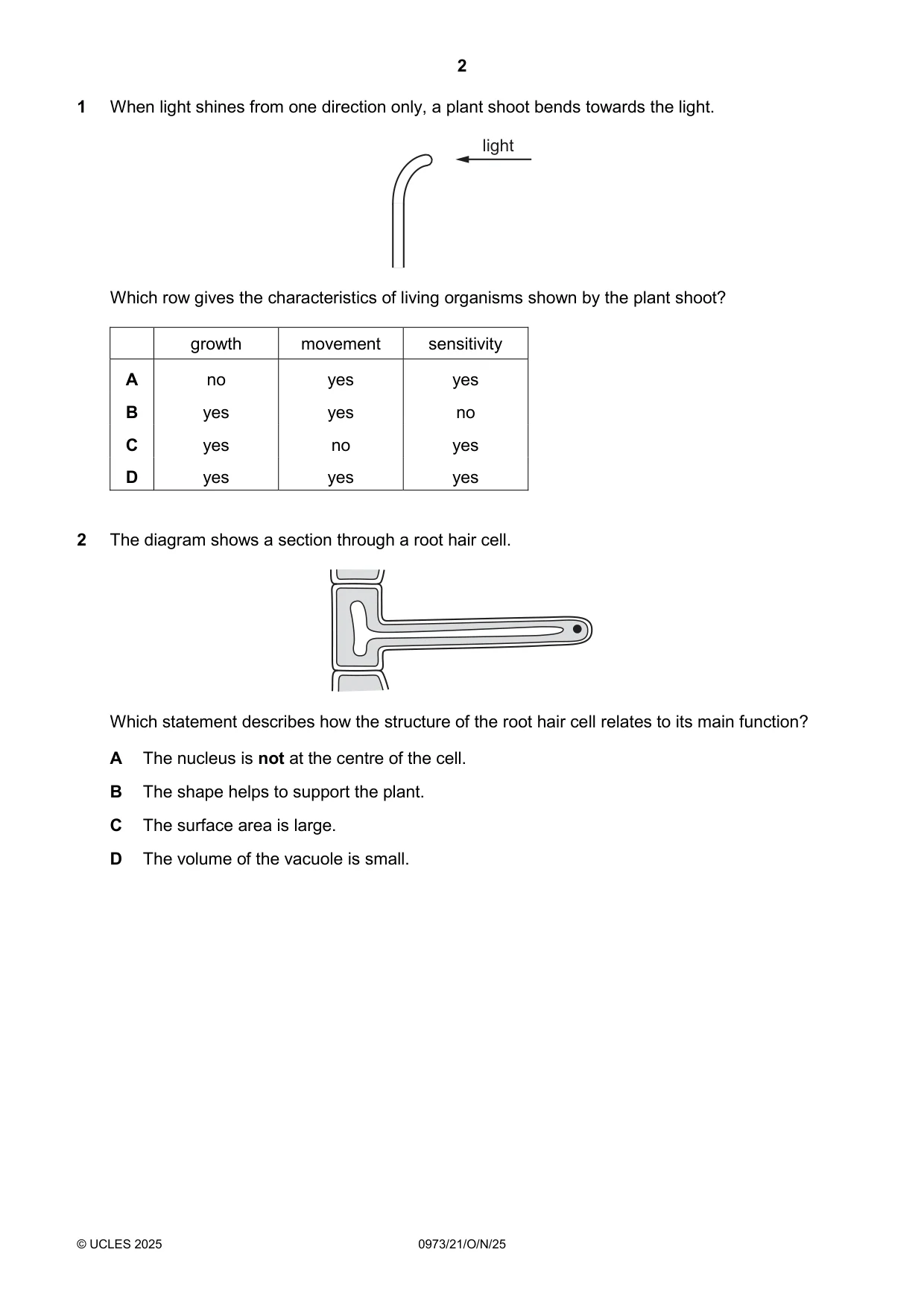
Q2 · The diagram shows a section through a root hair cell
2 The diagram shows a section through a root hair cell. Which statement describes how the structure of the root hair cell relates to its main function? A The nucleus is not at the centre of the cell. B The shape helps to support the plant. C The surface area is large. D The volume of the vacuole is small.
Mark scheme: C
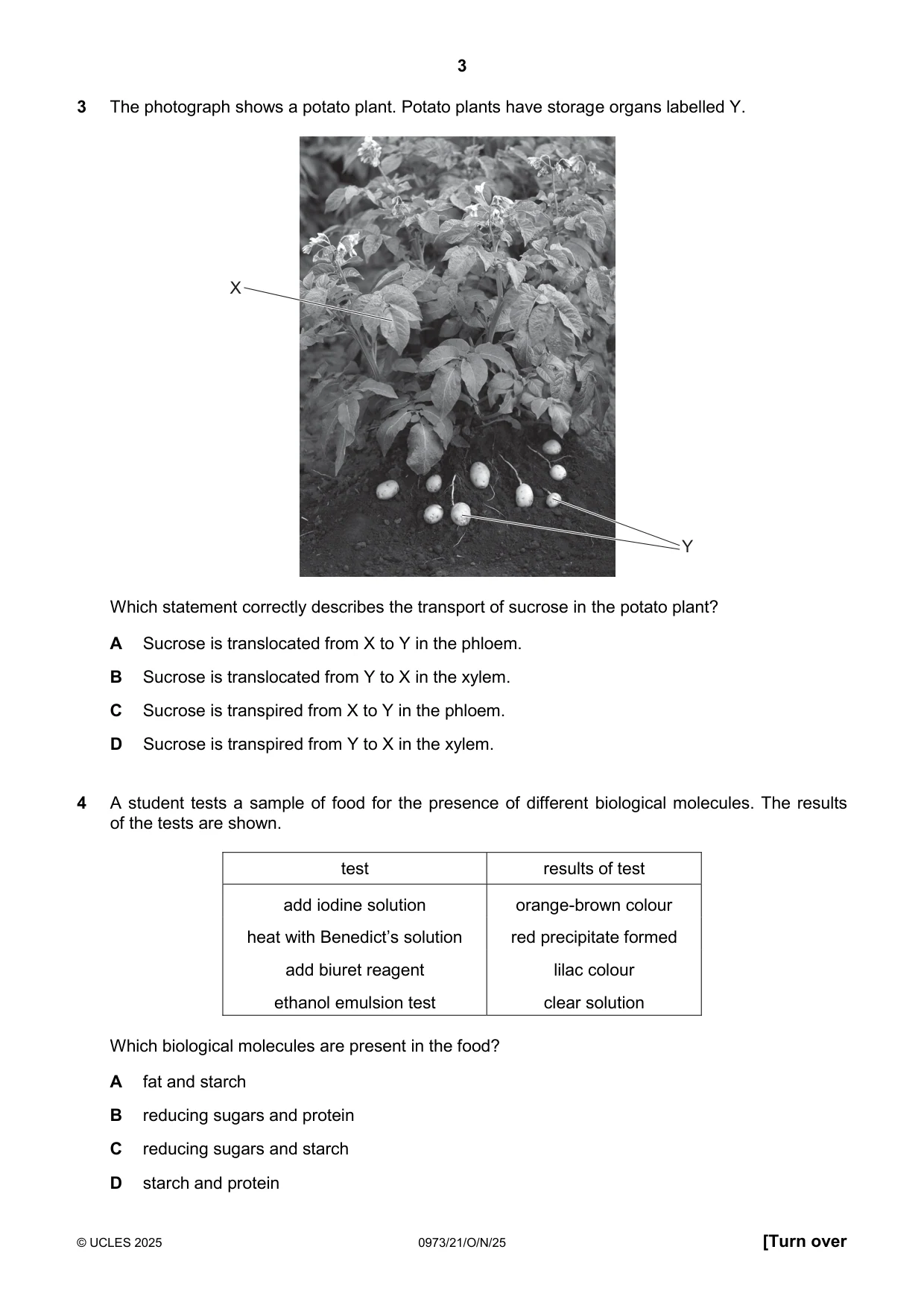
Q3 · The photograph shows a potato plant
3 The photograph shows a potato plant. Potato plants have storage organs labelled Y. X Y Which statement correctly describes the transport of sucrose in the potato plant? A Sucrose is translocated from X to Y in the phloem. B Sucrose is translocated from Y to X in the xylem. C Sucrose is transpired from X to Y in the phloem. D Sucrose is transpired from Y to X in the xylem.
Mark scheme: A
Q4 · A student tests a sample of food for the presence of different biological molecules
4 A student tests a sample of food for the presence of different biological molecules. The results of the tests are shown. test results of test add iodine solution orange-brown colour heat with Benedict’s solution red precipitate formed add biuret reagent lilac colour ethanol emulsion test clear solution Which biological molecules are present in the food? A fat and starch B reducing sugars and protein C reducing sugars and starch D starch and protein
Mark scheme: B
Q5 · Enzyme action stops due to denaturation
5 Enzyme action stops due to denaturation. What causes denaturation? A a change in shape of the active site of the enzyme that occurs at a temperature that is lower than the optimum temperature B a change in shape of the active site of the substrate that occurs at a temperature that is lower than the optimum temperature C a change in shape of the active site of the enzyme that occurs at a temperature that is higher than the optimum temperature D a change in shape of the active site of the substrate that occurs at a temperature that is higher than the optimum temperature
Mark scheme: C
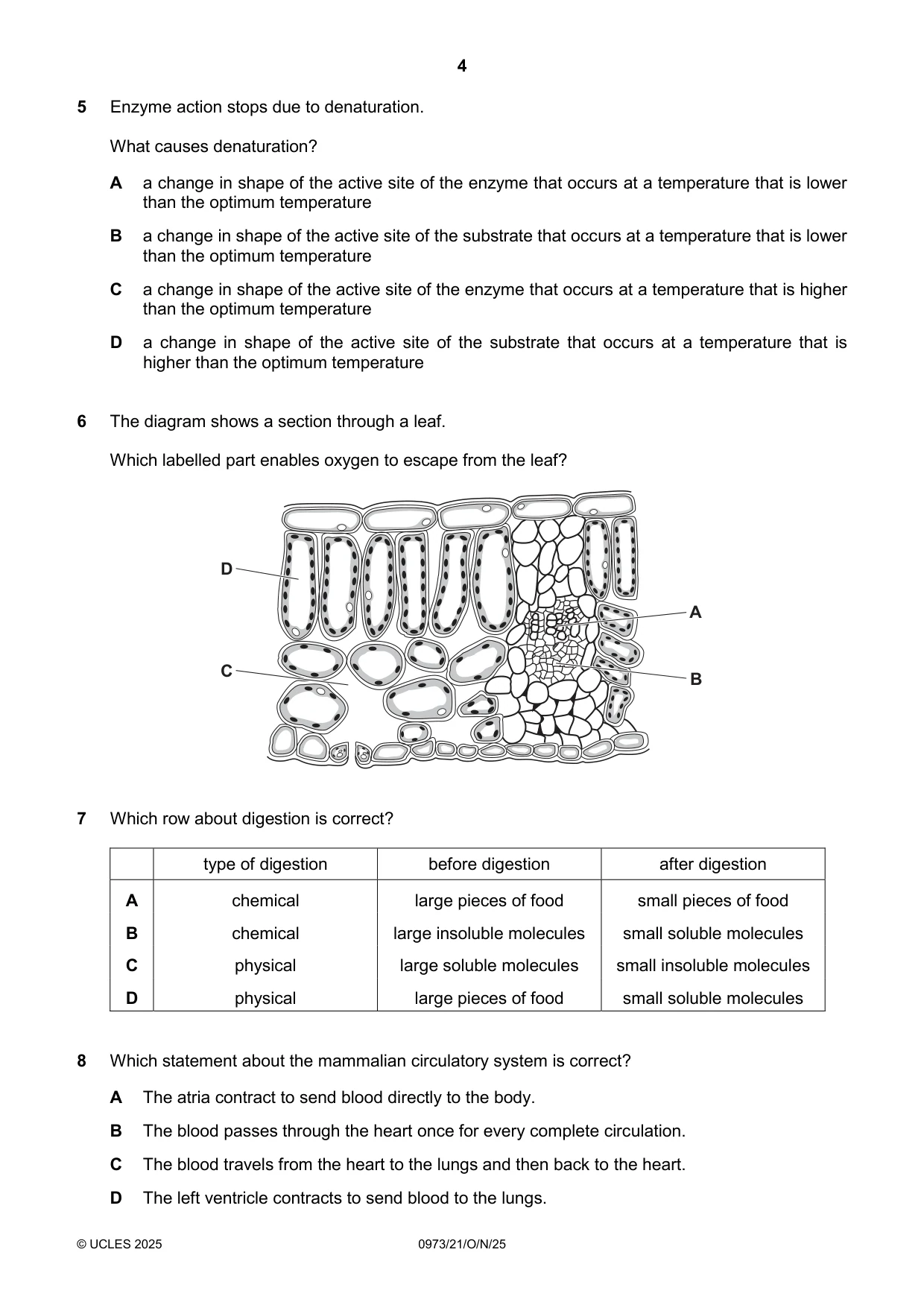
Q6 · The diagram shows a section through a leaf
6 The diagram shows a section through a leaf. Which labelled part enables oxygen to escape from the leaf? D A C B
Mark scheme: C
Q7 · Which row about digestion is correct?
7 Which row about digestion is correct? type of digestion before digestion after digestion A chemical large pieces of food small pieces of food B chemical large insoluble molecules small soluble molecules C physical large soluble molecules small insoluble molecules D physical large pieces of food small soluble molecules
Mark scheme: B
Q8 · Which statement about the mammalian circulatory system is correct?
8 Which statement about the mammalian circulatory system is correct? A The atria contract to send blood directly to the body. B The blood passes through the heart once for every complete circulation. C The blood travels from the heart to the lungs and then back to the heart. D The left ventricle contracts to send blood to the lungs.
Mark scheme: C
Q9 · Two flasks are set up as shown
9 Two flasks are set up as shown. A student breathes out through tube X of flask 1. Another student breathes in through tube Y of flask 2. flask 1 flask 2 X Y limewater limewater The students obtain different results. Which body process causes this difference? A absorption B assimilation C digestion D respiration
Mark scheme: D
Q10 · A man eats a meal high in carbohydrates
10 A man eats a meal high in carbohydrates. There is only a small change in his blood glucose concentration. Which statement explains why? A The pancreas releases insulin and this causes the excess glucose to be stored as glucagon. B The pancreas releases insulin and this causes the excess glucose to be stored as glycogen. C The pancreas releases glucagon and this causes the excess glucose to be stored as glycogen. D The pancreas releases glucagon and this causes the excess glucose to be stored as insulin.
Mark scheme: B
Q11 · Three features of flowers are listed
11 Three features of flowers are listed. 1 anthers located within the petals 2 large colourful petals 3 feathery stigma Which features are adaptations for wind pollination? A 1 and 2 B 1 only C 2 and 3 D 3 only
Mark scheme: D
Q12 · Chimpanzee gametes contain one more chromosome than human gametes
12 Chimpanzee gametes contain one more chromosome than human gametes. What is the chromosome number in a chimpanzee diploid cell? A 23 B 24 C 46 D 48
Mark scheme: D
Q13 · Which statement explains why food chains usually have fewer than five trophic levels?
13 Which statement explains why food chains usually have fewer than five trophic levels? A All the carnivores consume herbivores. B The energy passed on decreases from one trophic level to the next. C There is less protein in each individual higher up the chain. D There is only one producer in each chain.
Mark scheme: B
Q14 · Which particle has the same number of electrons in its outer shell as an atom of sodium…
14 Which particle has the same number of electrons in its outer shell as an atom of sodium, 23 Na? 11 A 23 11Na + B 23 11Na C 24 11Na D 24 12Na 2+
Mark scheme: C
Q15 · Which dot-and-cross diagram shows the outer-shell electrons in a molecule of carbon…
15 Which dot-and-cross diagram shows the outer-shell electrons in a molecule of carbon dioxide? A B C D O C O O C O O C O O C O
Mark scheme: A
Q16 · During electrolysis, reactions occur at the cathode and anode
16 During electrolysis, reactions occur at the cathode and anode. Which statements about the electrode reactions are correct? 1 At the anode, anions gain electrons and are reduced. 2 At the anode, anions lose electrons and are oxidised. 3 At the cathode, cations gain electrons and are reduced. 4 At the cathode, cations lose electrons and are oxidised. A 1 and 2 B 1 and 4 C 2 and 3 D 3 and 4
Mark scheme: C
Q17 · Increasing the temperature of a reaction mixture increases the rate of the reaction
17 Increasing the temperature of a reaction mixture increases the rate of the reaction. Which statements explain this increase in the rate of the reaction at higher temperatures? 1 The activation energy is increased. 2 The reacting particles are closer together. 3 There are more frequent collisions between reacting particles. 4 More collisions between reacting particles result in a reaction. A 1 and 2 B 1 and 4 C 2 and 3 D 3 and 4
Mark scheme: D
Q18 · Sodium is a metal
18 Sodium is a metal. Silicon is a non-metal. Both sodium and silicon form oxides. Which statement is correct? A Sodium oxide is acidic and silicon dioxide is basic. B Sodium oxide is basic and silicon dioxide is acidic. C Sodium oxide and silicon dioxide are both acidic. D Sodium oxide and silicon dioxide are both basic.
Mark scheme: B
Q19 · Zinc sulfate is a soluble salt
19 Zinc sulfate is a soluble salt. Zinc sulfate is prepared by reacting zinc with dilute sulfuric acid. Which statement about this preparation is correct? A Excess dilute sulfuric acid is used and after the reaction has finished the unreacted acid is removed by evaporation. B Excess dilute sulfuric acid is used and after the reaction has finished the unreacted acid is removed by adding an aqueous base. C Excess zinc is used and after the reaction has finished the unreacted zinc is removed by filtration. D Excess zinc is used and after the reaction has finished the zinc sulfate is purified by distillation.
Mark scheme: C
Q20 · Substance Q is added to cold water
20 Substance Q is added to cold water. Q floats on the water and hydrogen gas is made. What is Q? A iodine B lithium C magnesium D zinc
Mark scheme: B
Q21 · Which statement about the elements in Group VII of the Periodic Table is correct?
21 Which statement about the elements in Group VII of the Periodic Table is correct? A Chlorine is more reactive than bromine. B The colour of the elements becomes darker up the group. C The melting point of the elements decreases down the group. D The reactivity of the elements increases down the group.
Mark scheme: A
Q22 · Which row shows the properties of aluminium that make it useful in the manufacture of…
22 Which row shows the properties of aluminium that make it useful in the manufacture of overhead electrical cables? good electrical low density conductivity A no no B no yes C yes no D yes yes
Mark scheme: D
Q23 · Gasoline and diesel oil are fractions obtained by the fractional distillation of petroleum
23 Gasoline and diesel oil are fractions obtained by the fractional distillation of petroleum. Which row about gasoline and diesel oil is correct? temperature at which size of molecules the fraction is collected in the fraction A gasoline higher than diesel oil gasoline larger than diesel oil B gasoline higher than diesel oil gasoline smaller than diesel oil C diesel oil higher than gasoline diesel oil larger than gasoline D diesel oil higher than gasoline diesel oil smaller than gasoline
Mark scheme: C
Q24 · Which statements about the addition reactions of ethene are correct?
24 Which statements about the addition reactions of ethene are correct? 1 Ethene reacts with hydrogen to form ethane. 2 Ethene reacts with steam to form ethane. 3 Ethene undergoes addition reactions because it is a saturated hydrocarbon. 4 During addition reactions of ethene, only one product is produced. A 1 and 2 B 1 and 4 C 2 and 3 D 3 and 4
Mark scheme: B
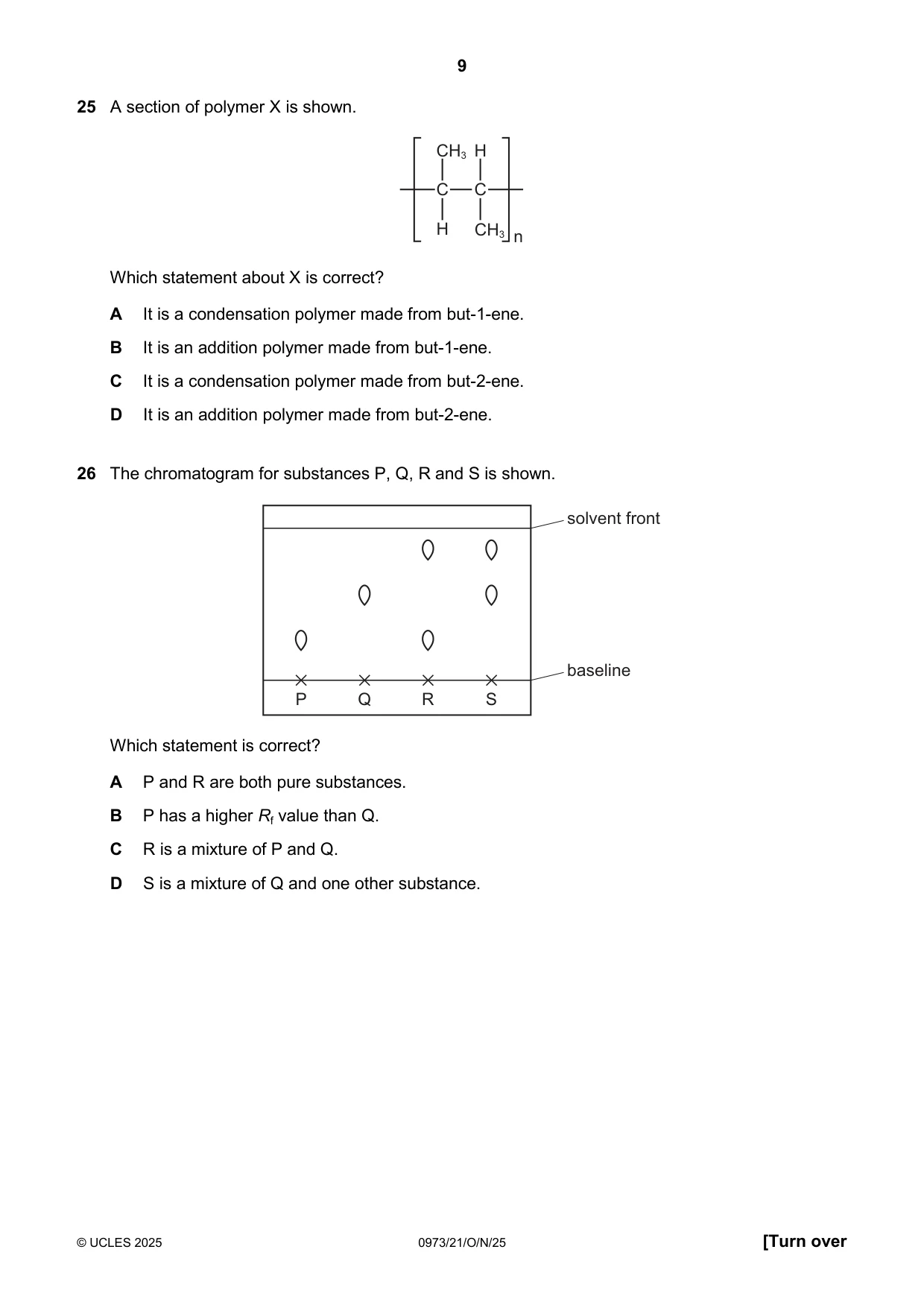
Q25 · A section of polymer X is shown
25 A section of polymer X is shown. CH3 H C C H CH3 n Which statement about X is correct? A It is a condensation polymer made from but-1-ene. B It is an addition polymer made from but-1-ene. C It is a condensation polymer made from but-2-ene. D It is an addition polymer made from but-2-ene.
Mark scheme: D
Q26 · The chromatogram for substances P, Q, R and S is shown
26 The chromatogram for substances P, Q, R and S is shown. solvent front baseline P Q R S Which statement is correct? A P and R are both pure substances. B P has a higher Rf value than Q. C R is a mixture of P and Q. D S is a mixture of Q and one other substance.
Mark scheme: D
Q27 · The results of tests on aqueous G are listed
27 The results of tests on aqueous G are listed. 1 Adding aqueous sodium hydroxide produces a white precipitate that is insoluble in excess. 2 Adding acidified aqueous silver nitrate produces a cream precipitate. What is G? A calcium bromide B calcium chloride C zinc bromide D zinc chloride
Mark scheme: A
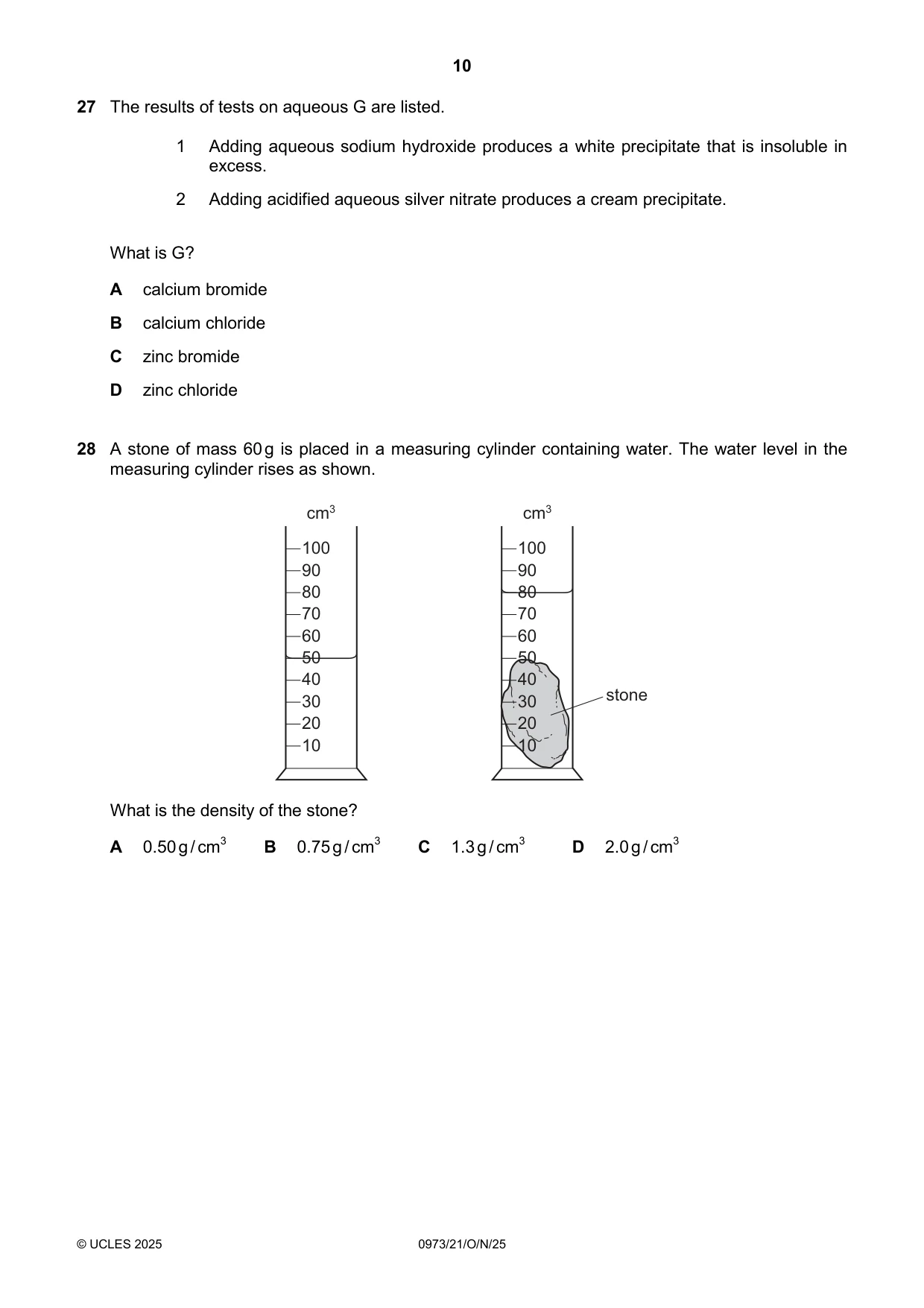
Q28 · A stone of mass 60 g is placed in a measuring cylinder containing water
28 A stone of mass 60 g is placed in a measuring cylinder containing water. The water level in the measuring cylinder rises as shown. cm3 cm3 100 100 90 90 80 80 70 70 60 60 50 50 40 40 30 30 stone 20 20 10 10 What is the density of the stone? A 0.50 g / cm3 B 0.75 g / cm3 C 1.3 g / cm3 D 2.0 g / cm3
Mark scheme: D
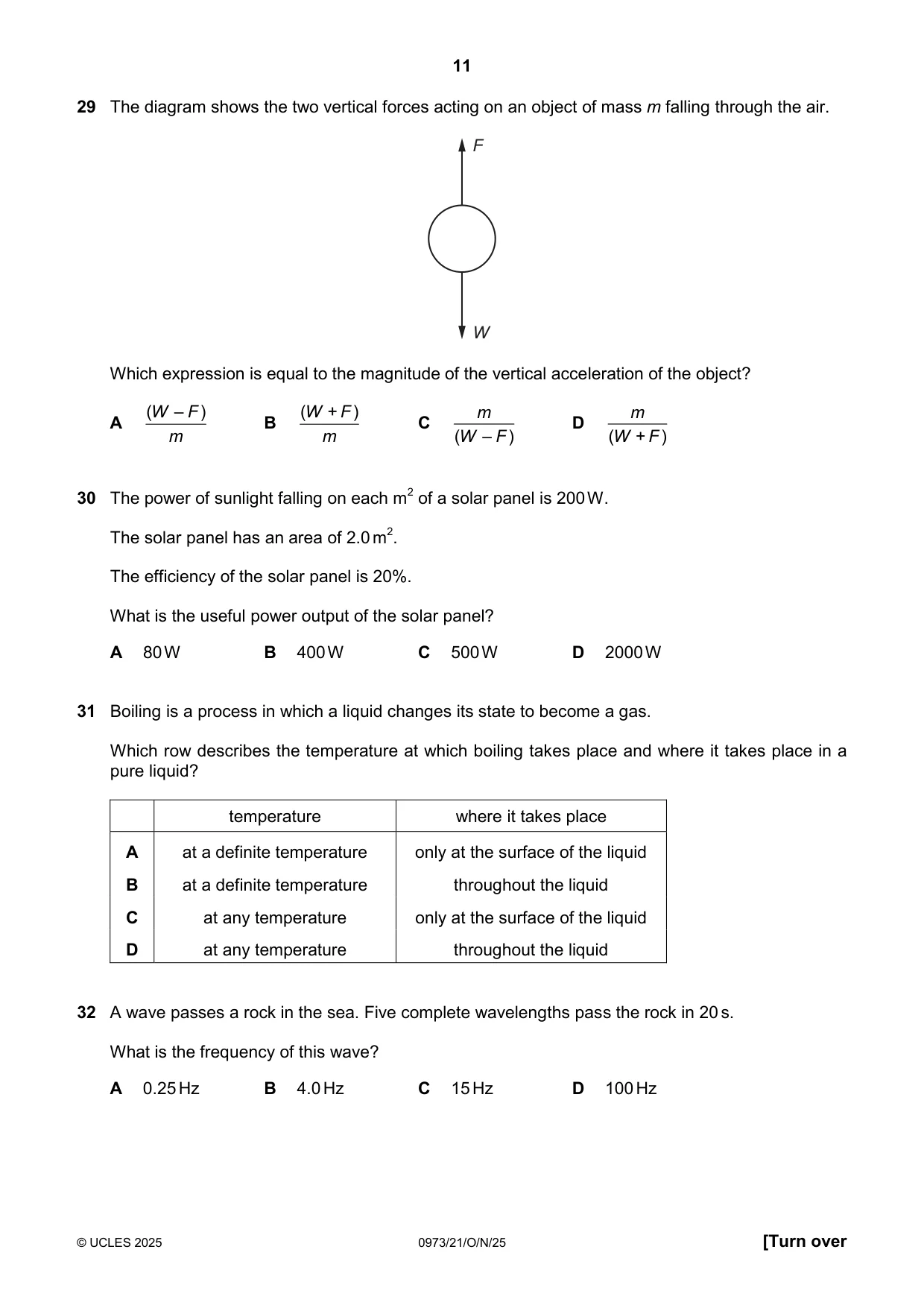
Q29 · The diagram shows the two vertical forces acting on an object of mass m falling through…
29 The diagram shows the two vertical forces acting on an object of mass m falling through the air. F W Which expression is equal to the magnitude of the vertical acceleration of the object? ( W – F ) ( W + F ) m m A B C F D F m m ( W – ) ( W + )
Mark scheme: A
Q30 · The power of sunlight falling on each m2 of a solar panel is 200 W
30 The power of sunlight falling on each m2 of a solar panel is 200 W. The solar panel has an area of 2.0 m2. The efficiency of the solar panel is 20%. What is the useful power output of the solar panel? A 80 W B 400 W C 500 W D 2000 W
Mark scheme: A
Q31 · Boiling is a process in which a liquid changes its state to become a gas
31 Boiling is a process in which a liquid changes its state to become a gas. Which row describes the temperature at which boiling takes place and where it takes place in a pure liquid? temperature where it takes place A at a definite temperature only at the surface of the liquid B at a definite temperature throughout the liquid C at any temperature only at the surface of the liquid D at any temperature throughout the liquid
Mark scheme: B
Q32 · A wave passes a rock in the sea
32 A wave passes a rock in the sea. Five complete wavelengths pass the rock in 20 s. What is the frequency of this wave? A 0.25 Hz B 4.0 Hz C 15 Hz D 100 Hz
Mark scheme: A
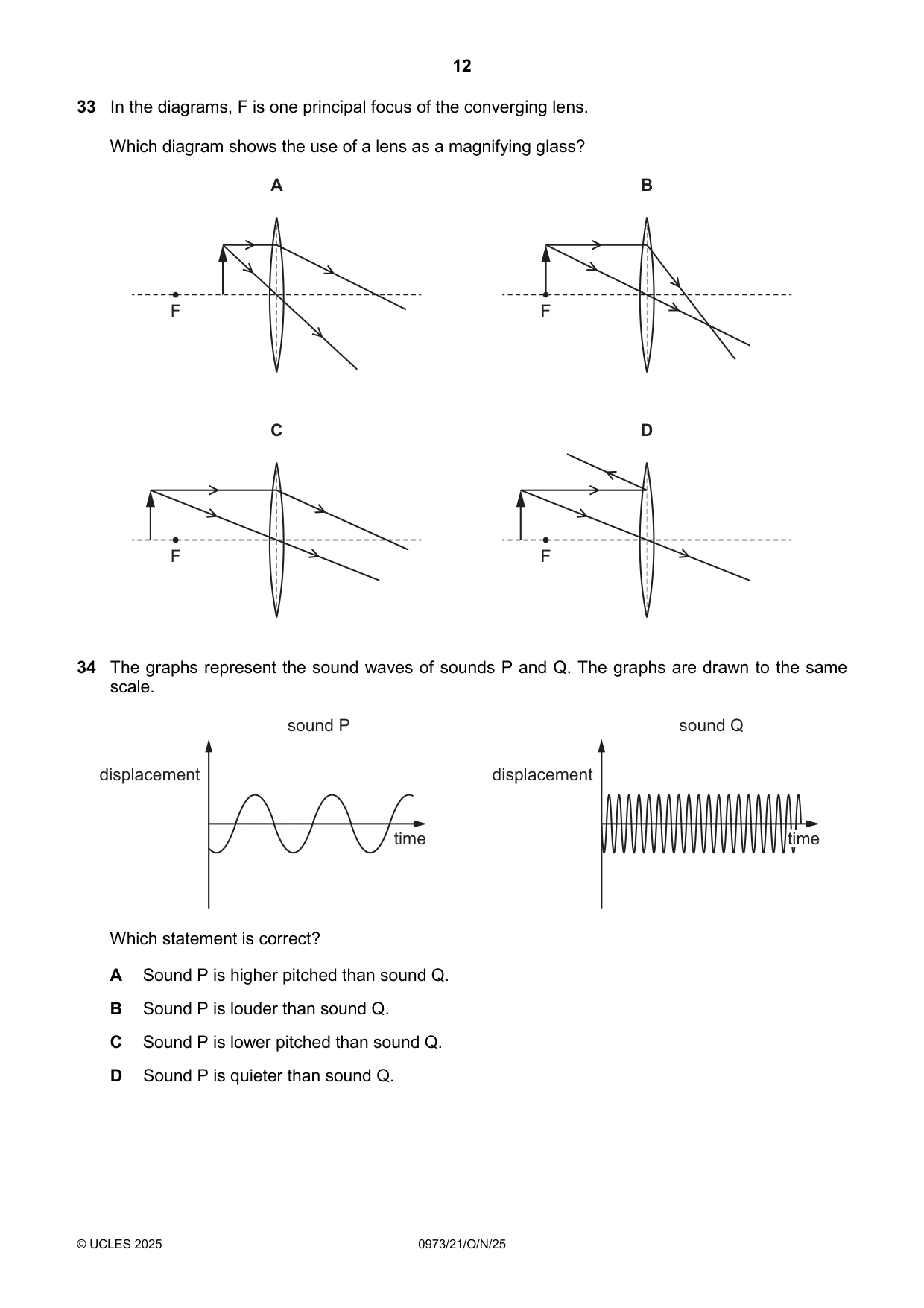
Q33 · In the diagrams, F is one principal focus of the converging lens
33 In the diagrams, F is one principal focus of the converging lens. Which diagram shows the use of a lens as a magnifying glass? A B F F C D F F
Mark scheme: A
Q34 · The graphs represent the sound waves of sounds P and Q
34 The graphs represent the sound waves of sounds P and Q. The graphs are drawn to the same scale. sound P sound Q displacement displacement time time time time Which statement is correct? A Sound P is higher pitched than sound Q. B Sound P is louder than sound Q. C Sound P is lower pitched than sound Q. D Sound P is quieter than sound Q.
Mark scheme: C
Q35 · A ray of light strikes the boundary between water and air
35 A ray of light strikes the boundary between water and air. Which statement describes when the angle of incidence is equal to the critical angle? A The light passes from air into water and no light is reflected. B The light passes from air into water and the angle of refraction is 90°. C The light passes from water into air and no light is reflected. D The light passes from water into air and the angle of refraction is 90°.
Mark scheme: D
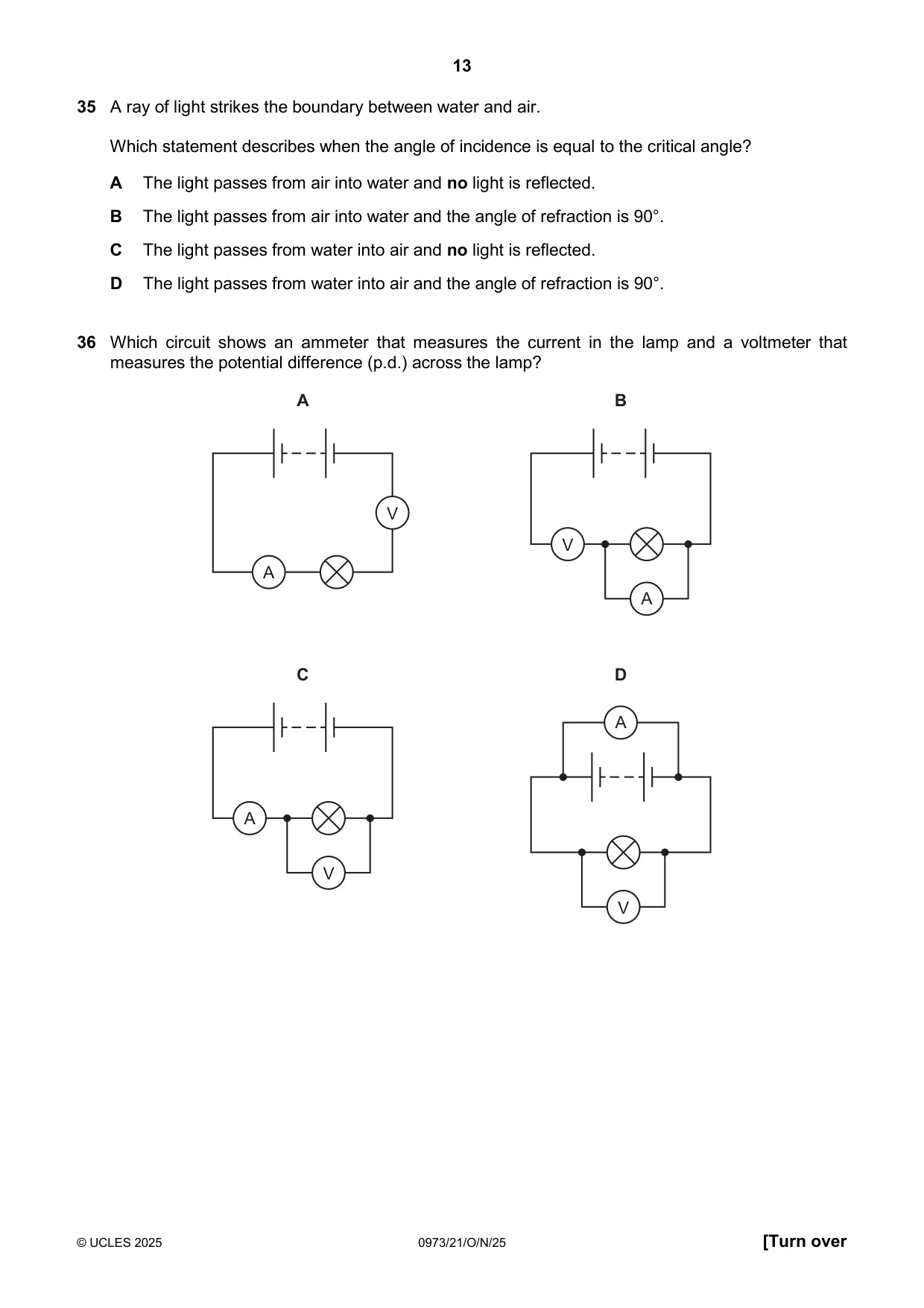
Q36 · Which circuit shows an ammeter that measures the current in the lamp and a voltmeter that…
36 Which circuit shows an ammeter that measures the current in the lamp and a voltmeter that measures the potential difference (p.d.) across the lamp? A B V V A A C D A A V V
Mark scheme: C
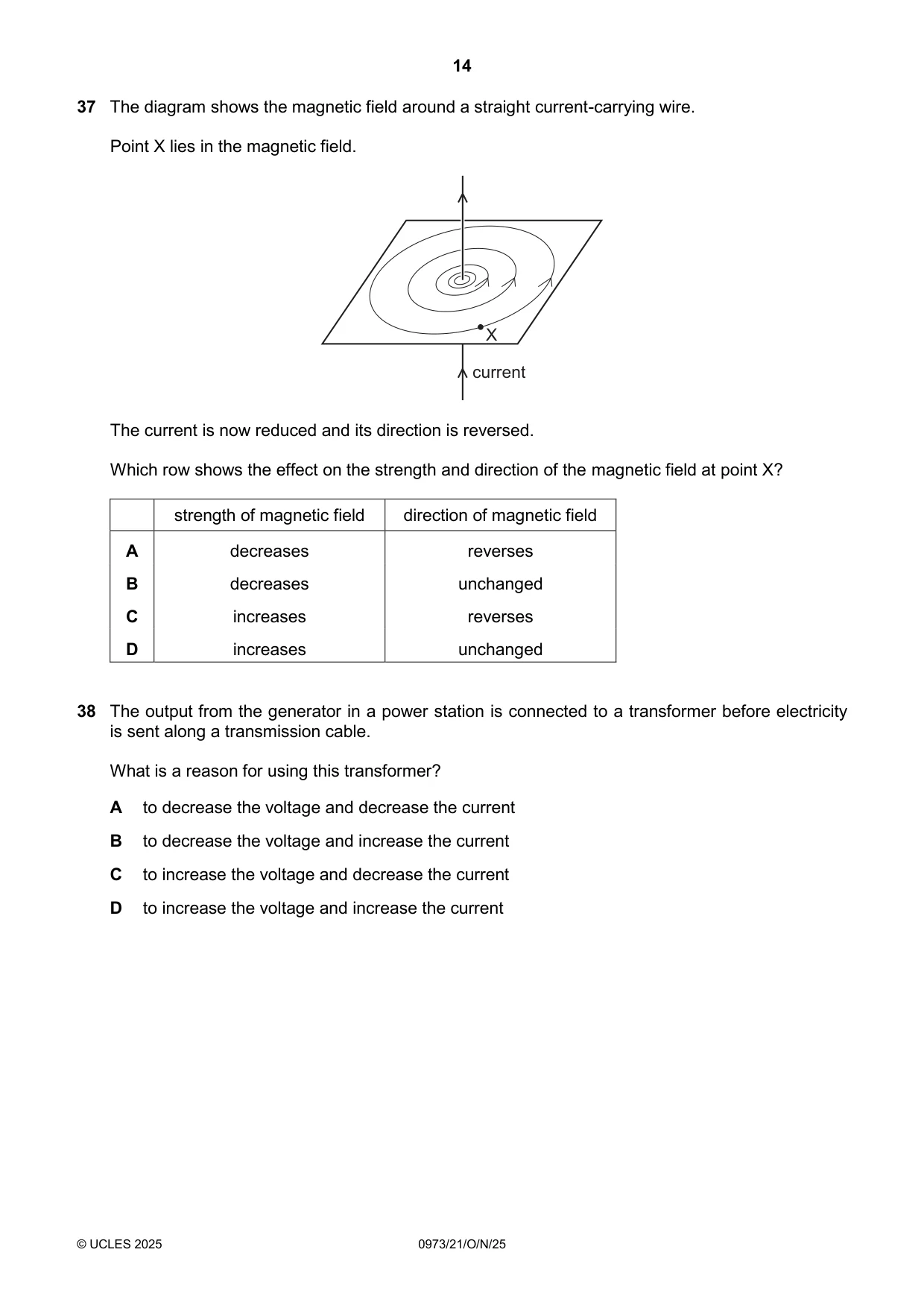
Q37 · The diagram shows the magnetic field around a straight current-carrying wire
37 The diagram shows the magnetic field around a straight current-carrying wire. Point X lies in the magnetic field. X current The current is now reduced and its direction is reversed. Which row shows the effect on the strength and direction of the magnetic field at point X? strength of magnetic field direction of magnetic field A decreases reverses B decreases unchanged C increases reverses D increases unchanged
Mark scheme: A
Q38 · The output from the generator in a power station is connected to a transformer before…
38 The output from the generator in a power station is connected to a transformer before electricity is sent along a transmission cable. What is a reason for using this transformer? A to decrease the voltage and decrease the current B to decrease the voltage and increase the current C to increase the voltage and decrease the current D to increase the voltage and increase the current
Mark scheme: C
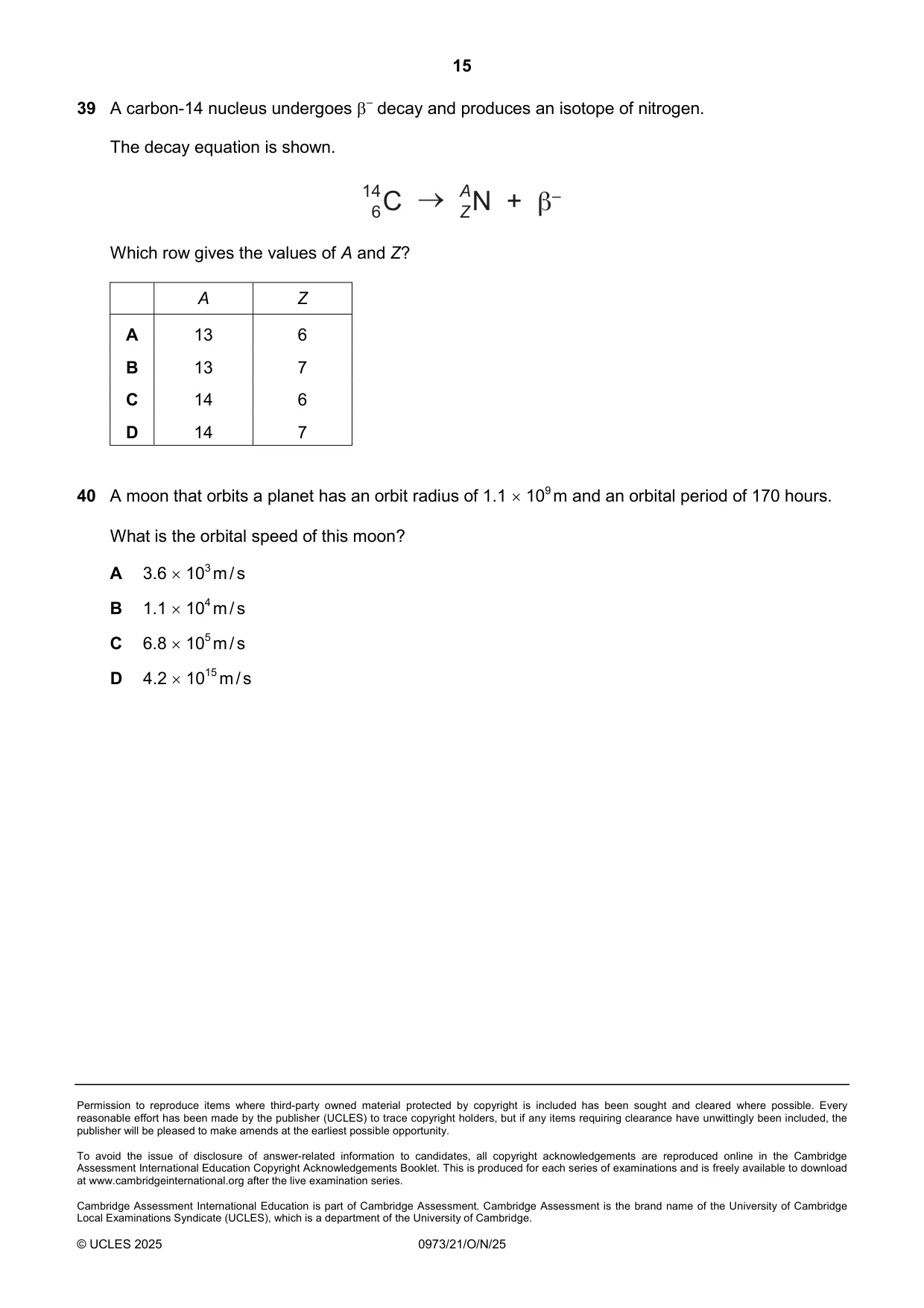
Q39 · A carbon-14 nucleus undergoes – decay and produces an isotope of nitrogen
39 A carbon-14 nucleus undergoes – decay and produces an isotope of nitrogen. The decay equation is shown. 14 6C A ZN + β– Which row gives the values of A and Z? A Z A 13 6 B 13 7 C 14 6 D 14 7
Mark scheme: D
Q40 · A moon that orbits a planet has an orbit radius of 1.1 109 m and an orbital period of…
40 A moon that orbits a planet has an orbit radius of 1.1 109 m and an orbital period of 170 hours. What is the orbital speed of this moon? A 3.6 103 m / s B 1.1 104 m / s C 6.8 105 m / s D 4.2 1015 m / s
Mark scheme: B
What was in this paper
The subtopics covered by these 40 questions, and how many questions each got. Open one in a new tab to see every Cambridge question on it.
2Light2Alkenes1Atomic structure and the Periodic Table1Biological molecules1Cell structure1Characteristics of living organisms1Chromatography1Chromosomes and genes1Circulatory systems1Density1Digestion1Electrical circuits1Electrolysis1Energy flow1Energy, work and power1Enzymes1Forces1Fuels1General properties of waves1Group I properties1Group VII properties1Hormones1Identification of ions and gases1Kinetic particle model of matter1Leaf structure1Motion1Oxides1Polymers1Preparation of salts1Properties of metals1Radioactivity1Rate of reaction1Respiration1Sexual reproduction in plants1Simple molecules and covalent bonds1Sound1Translocation1What you needed in this session
Cambridge’s own grade thresholds for 2025 Oct/Nov, Paper 2 · Variant 1. A higher threshold means an easier paper — the bar moves with how the cohort did.