Cambridge IGCSE Sciences - Co-ordinated (9-1) 0973 — 2022 Oct/Nov Paper 2 · Variant 1
0973/21/O/N/22 · 40 questions · 40 marks · ≈45 min
The question paper and its mark scheme, free to read here and free to download. This is Cambridge’s own paper, exactly as it was sat.
Question paper16 pages

Mark scheme3 pages
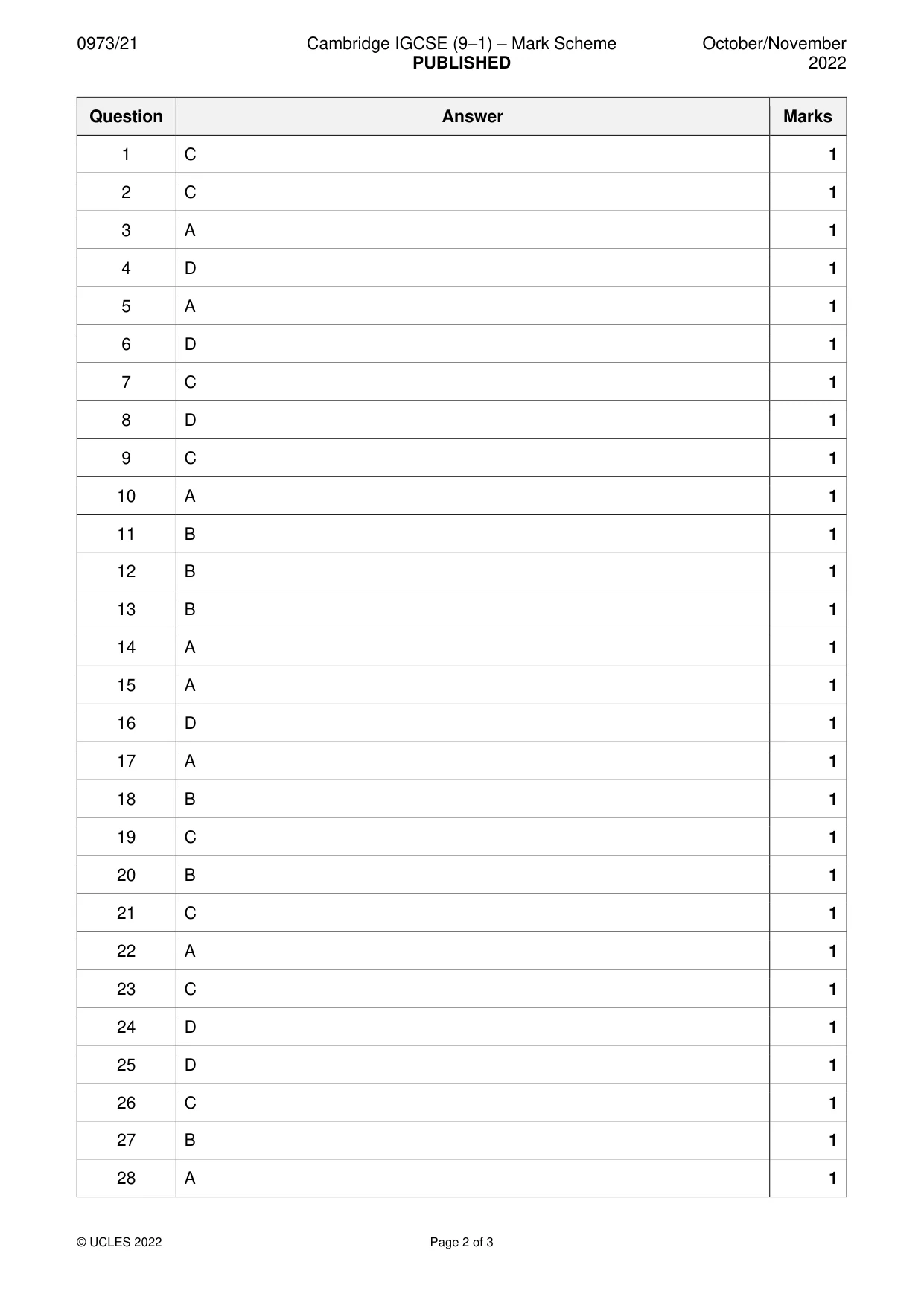
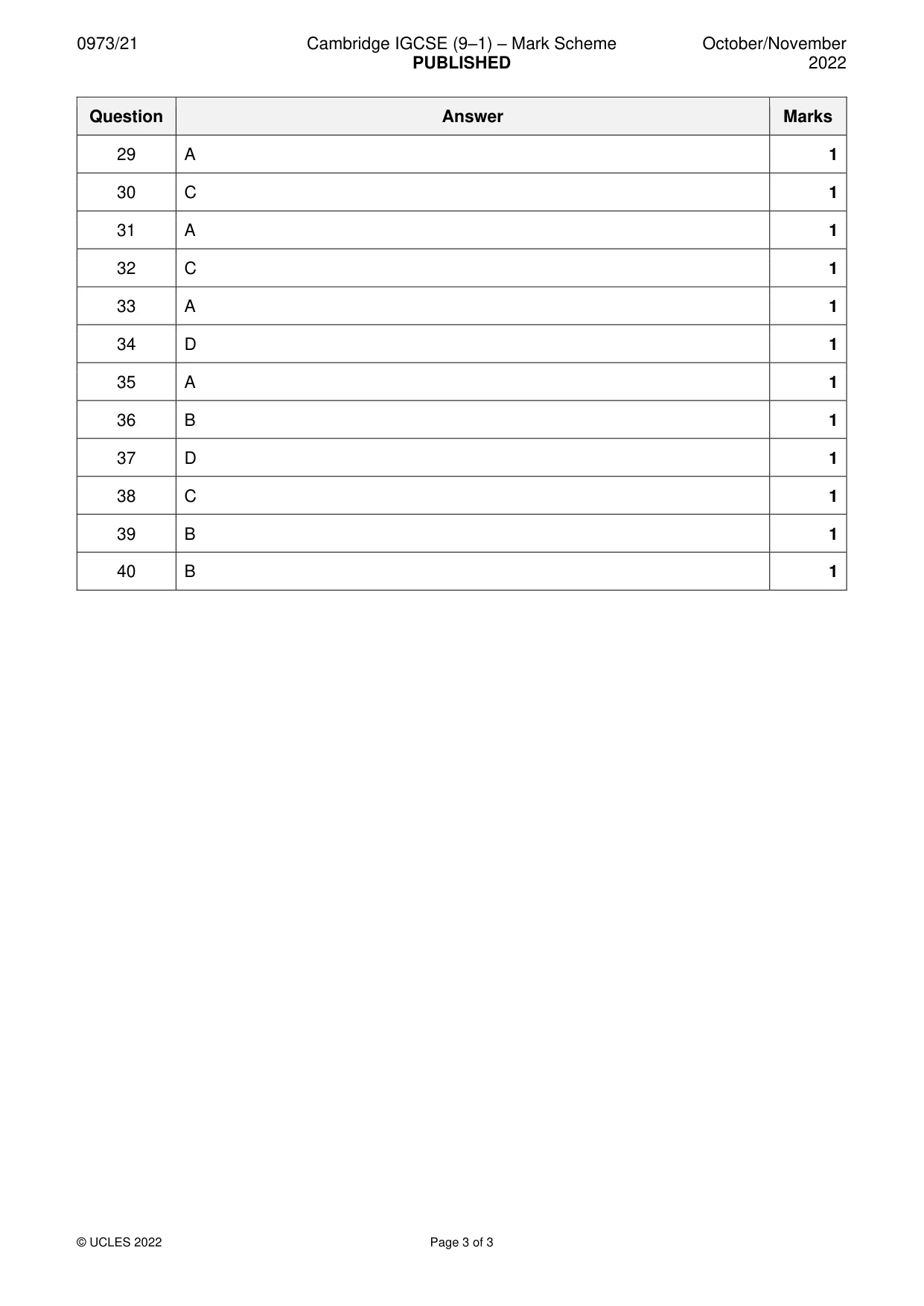
Answers below. Sit the paper first if you are practising.
Questions as text
Q1 · What do plants need for their nutrition?
1 What do plants need for their nutrition? A carbon dioxide, ions, organic compounds and light B carbon dioxide, ions, organic compounds and water C carbon dioxide, ions, light and water D carbon dioxide, organic compounds, light and water
Mark scheme: C
Q2 · Red onion cells are placed in distilled water
2 Red onion cells are placed in distilled water. Which statement is correct? A The cells plasmolyse; water moves into the cells from a high to a low water potential. B The cells plasmolyse; water moves out of the cells from a low to a high water potential. C The cells become turgid; water moves into the cells from a high to a low water potential. D The cells become turgid; water moves out of the cells from a low to a high water potential.
Mark scheme: C
Q3 · Glycerol is a component of which large molecules?
3 Glycerol is a component of which large molecules? A fats B glycogen C proteins D starch
Mark scheme: A
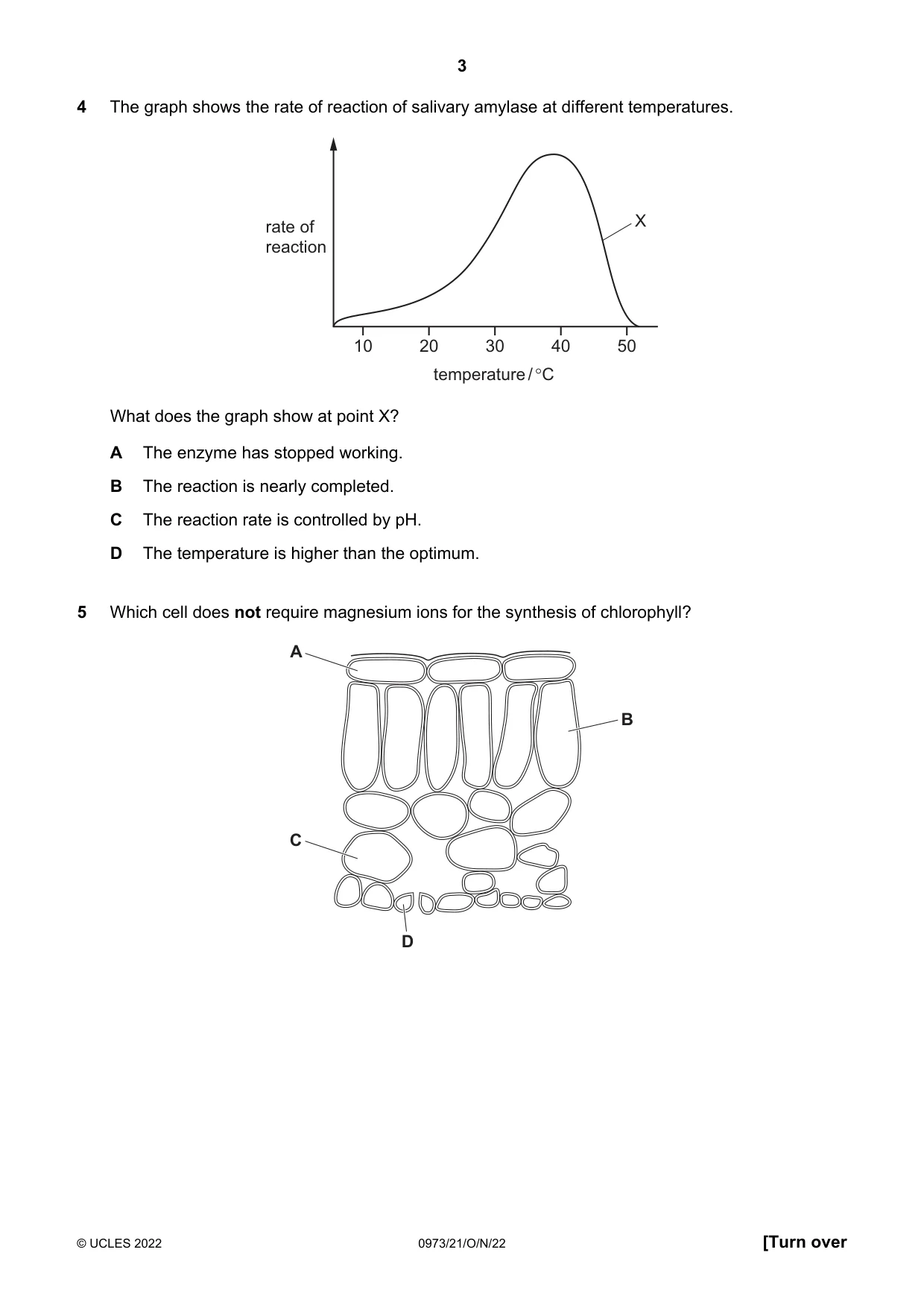
Q4 · The graph shows the rate of reaction of salivary amylase at different temperatures
4 The graph shows the rate of reaction of salivary amylase at different temperatures. rate of X reaction 10 20 30 40 50 temperature / °C What does the graph show at point X? A The enzyme has stopped working. B The reaction is nearly completed. C The reaction rate is controlled by pH. D The temperature is higher than the optimum.
Mark scheme: D
Q5 · Which cell does not require magnesium ions for the synthesis of chlorophyll?
5 Which cell does not require magnesium ions for the synthesis of chlorophyll? A B C D
Mark scheme: A
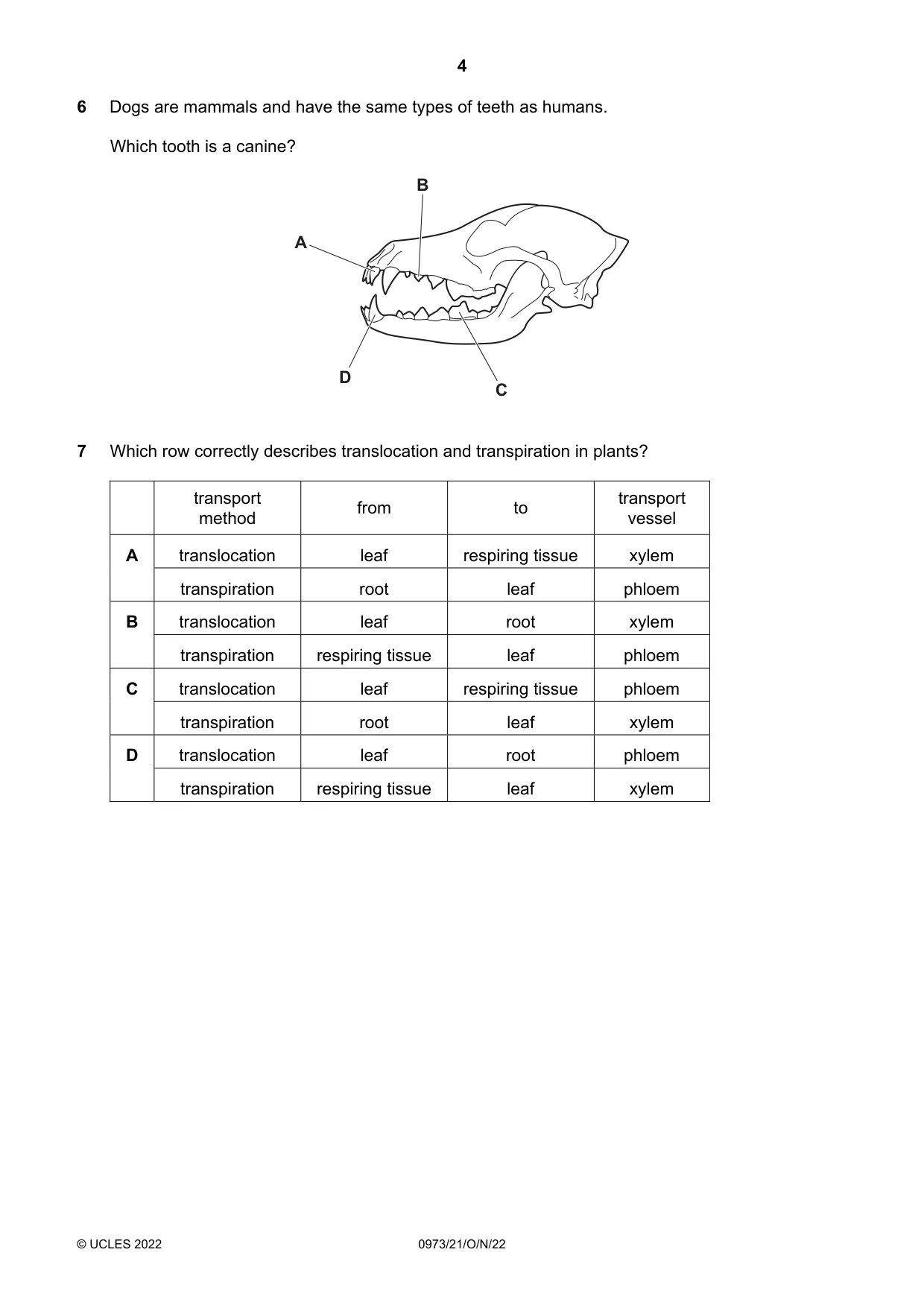
Q6 · Dogs are mammals and have the same types of teeth as humans
6 Dogs are mammals and have the same types of teeth as humans. Which tooth is a canine? B A D C
Mark scheme: D
Q7 · Which row correctly describes translocation and transpiration in plants?
7 Which row correctly describes translocation and transpiration in plants? transport transport from to method vessel A translocation leaf respiring tissue xylem transpiration root leaf phloem B translocation leaf root xylem transpiration respiring tissue leaf phloem C translocation leaf respiring tissue phloem transpiration root leaf xylem D translocation leaf root phloem transpiration respiring tissue leaf xylem
Mark scheme: C
Q8 · Which diagram gives the possible products of aerobic respiration and anaerobic…
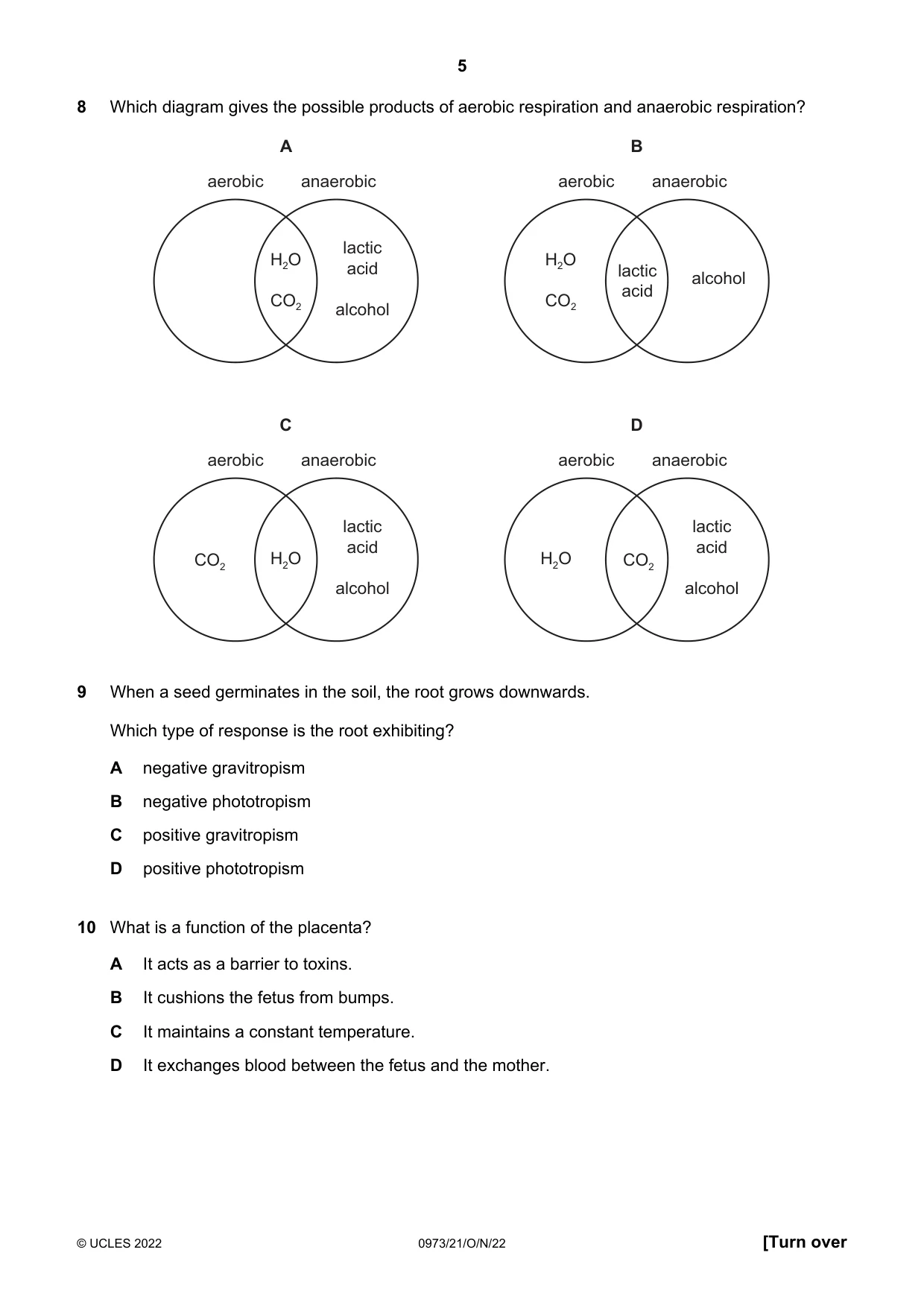
8 Which diagram gives the possible products of aerobic respiration and anaerobic respiration? A B aerobic anaerobic aerobic anaerobic lactic H2O H2O acid lactic alcohol acid CO2 CO2 alcohol C D aerobic anaerobic aerobic anaerobic lactic lactic acid acid CO2 H2O H2O CO2 alcohol alcohol
Mark scheme: D
Q9 · When a seed germinates in the soil, the root grows downwards
9 When a seed germinates in the soil, the root grows downwards. Which type of response is the root exhibiting? A negative gravitropism B negative phototropism C positive gravitropism D positive phototropism
Mark scheme: C
Q10 · What is a function of the placenta?
10 What is a function of the placenta? A It acts as a barrier to toxins. B It cushions the fetus from bumps. C It maintains a constant temperature. D It exchanges blood between the fetus and the mother.
Mark scheme: A
Q11 · The diagram shows the chromosomes present in a cell
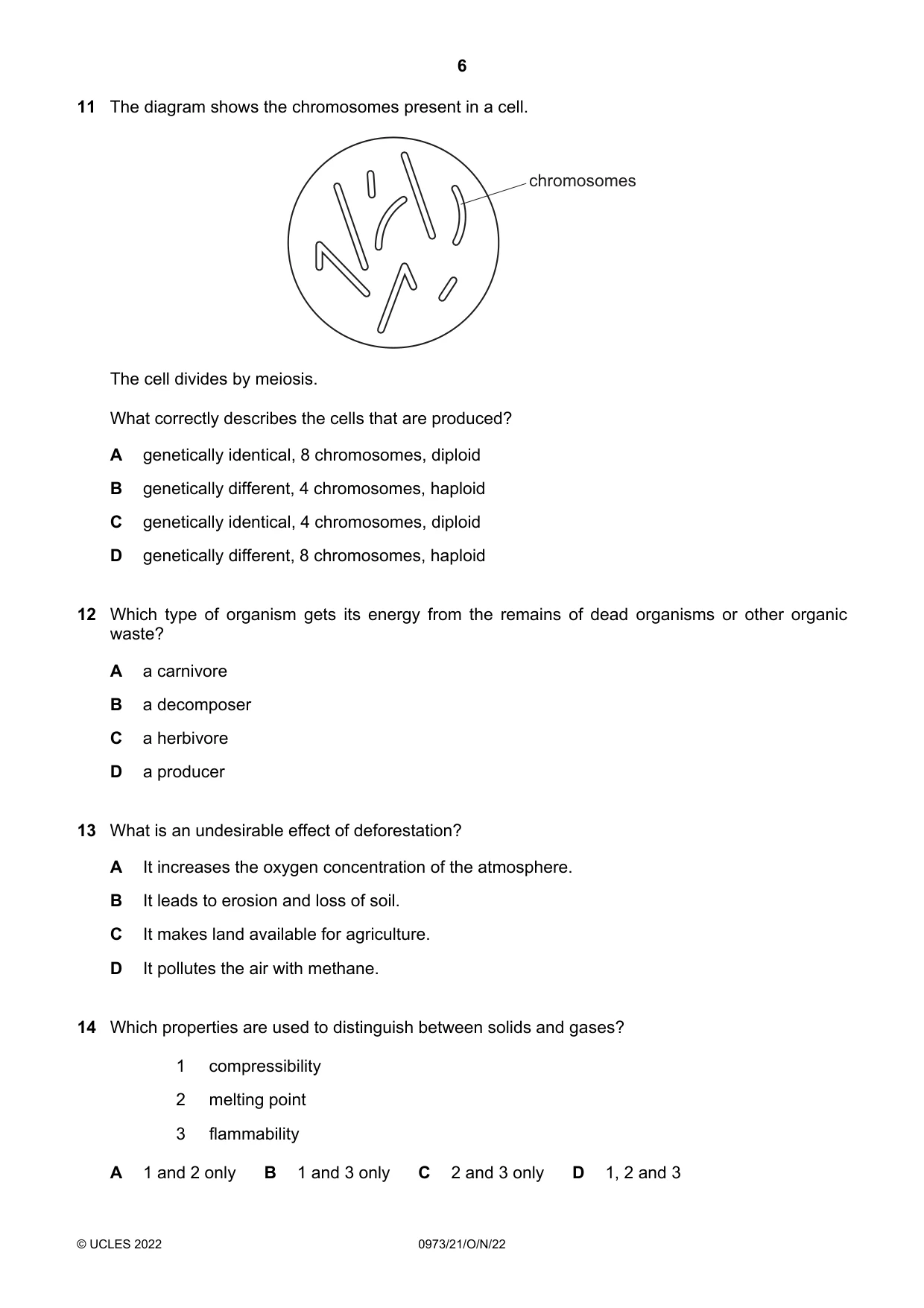
11 The diagram shows the chromosomes present in a cell. chromosomes The cell divides by meiosis. What correctly describes the cells that are produced? A genetically identical, 8 chromosomes, diploid B genetically different, 4 chromosomes, haploid C genetically identical, 4 chromosomes, diploid D genetically different, 8 chromosomes, haploid
Mark scheme: B
Q12 · Which type of organism gets its energy from the remains of dead organisms or other…
12 Which type of organism gets its energy from the remains of dead organisms or other organic waste? A a carnivore B a decomposer C a herbivore D a producer
Mark scheme: B
Q13 · What is an undesirable effect of deforestation?
13 What is an undesirable effect of deforestation? A It increases the oxygen concentration of the atmosphere. B It leads to erosion and loss of soil. C It makes land available for agriculture. D It pollutes the air with methane.
Mark scheme: B
Q14 · Which properties are used to distinguish between solids and gases?
14 Which properties are used to distinguish between solids and gases? 1 compressibility 2 melting point 3 flammability A 1 and 2 only B 1 and 3 only C 2 and 3 only D 1, 2 and 3
Mark scheme: A
Q15 · An atom of fluorine is represented by 19 9F
15 An atom of fluorine is represented by 19 9F. How many electrons does this atom contain? A 9 B 10 C 19 D 28
Mark scheme: A
Q16 · Which statement describes the lattice structure of sodium chloride, NaCl ?
16 Which statement describes the lattice structure of sodium chloride, NaCl ? A It is a random arrangement of equal numbers of sodium atoms and chlorine atoms. B It is a random arrangement of equal numbers of sodium ions and chloride ions. C It is a regular arrangement of alternating sodium atoms and chlorine atoms. D It is a regular arrangement of alternating sodium ions and chloride ions.
Mark scheme: D
Q17 · 1 g of hydrogen contains 6 1023 atoms
17 1 g of hydrogen contains 6 1023 atoms. The relative atomic mass of helium is 4. How many atoms does 1 g of helium contain? A 1.5 1023 B 3 1023 C 6 1023 D 2.4 1024
Mark scheme: A
Q18 · Copper(II) sulfate can be electrolysed using either carbon electrodes or copper electrodes
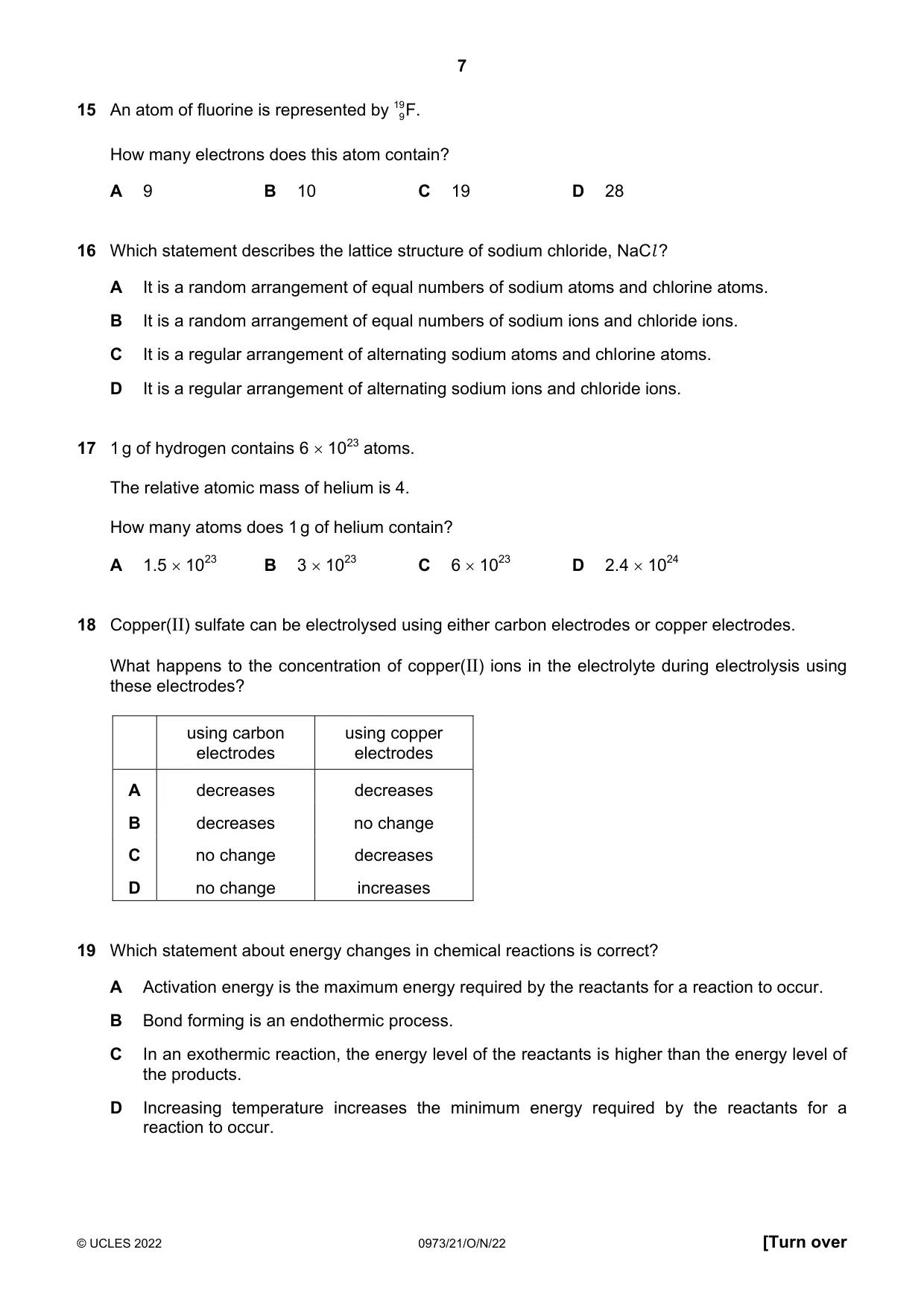
18 Copper(II) sulfate can be electrolysed using either carbon electrodes or copper electrodes. What happens to the concentration of copper(II) ions in the electrolyte during electrolysis using these electrodes? using carbon using copper electrodes electrodes A decreases decreases B decreases no change C no change decreases D no change increases
Mark scheme: B
Q19 · Which statement about energy changes in chemical reactions is correct?
19 Which statement about energy changes in chemical reactions is correct? A Activation energy is the maximum energy required by the reactants for a reaction to occur. B Bond forming is an endothermic process. C In an exothermic reaction, the energy level of the reactants is higher than the energy level of the products. D Increasing temperature increases the minimum energy required by the reactants for a reaction to occur.
Mark scheme: C
Q20 · The equation for the reaction of iron(III) oxide and aluminium is shown
20 The equation for the reaction of iron(III) oxide and aluminium is shown. 2Al + Fe2O3 Al 2O3 + 2Fe Which statements about this reaction are correct? 1 Iron(III) ions are reduced. 2 O atoms gain electrons. 3 Fe2O3 is a reducing agent. 4 Al atoms lose electrons. A 1 and 2 B 1 and 4 C 2 and 3 D 3 and 4
Mark scheme: B
Q21 · Which statement about the halogens is not correct?
21 Which statement about the halogens is not correct? A Iodine has a darker colour than chlorine. B They all exist as diatomic molecules. C They are all gases at room temperature. D They are all non-metals.
Mark scheme: C
Q22 · Filament lamps require an inert atmosphere
22 Filament lamps require an inert atmosphere. Which gas is used to fill these lamps? A argon B helium C hydrogen D oxygen
Mark scheme: A
Q23 · Alloys are formed by dissolving one metal in another
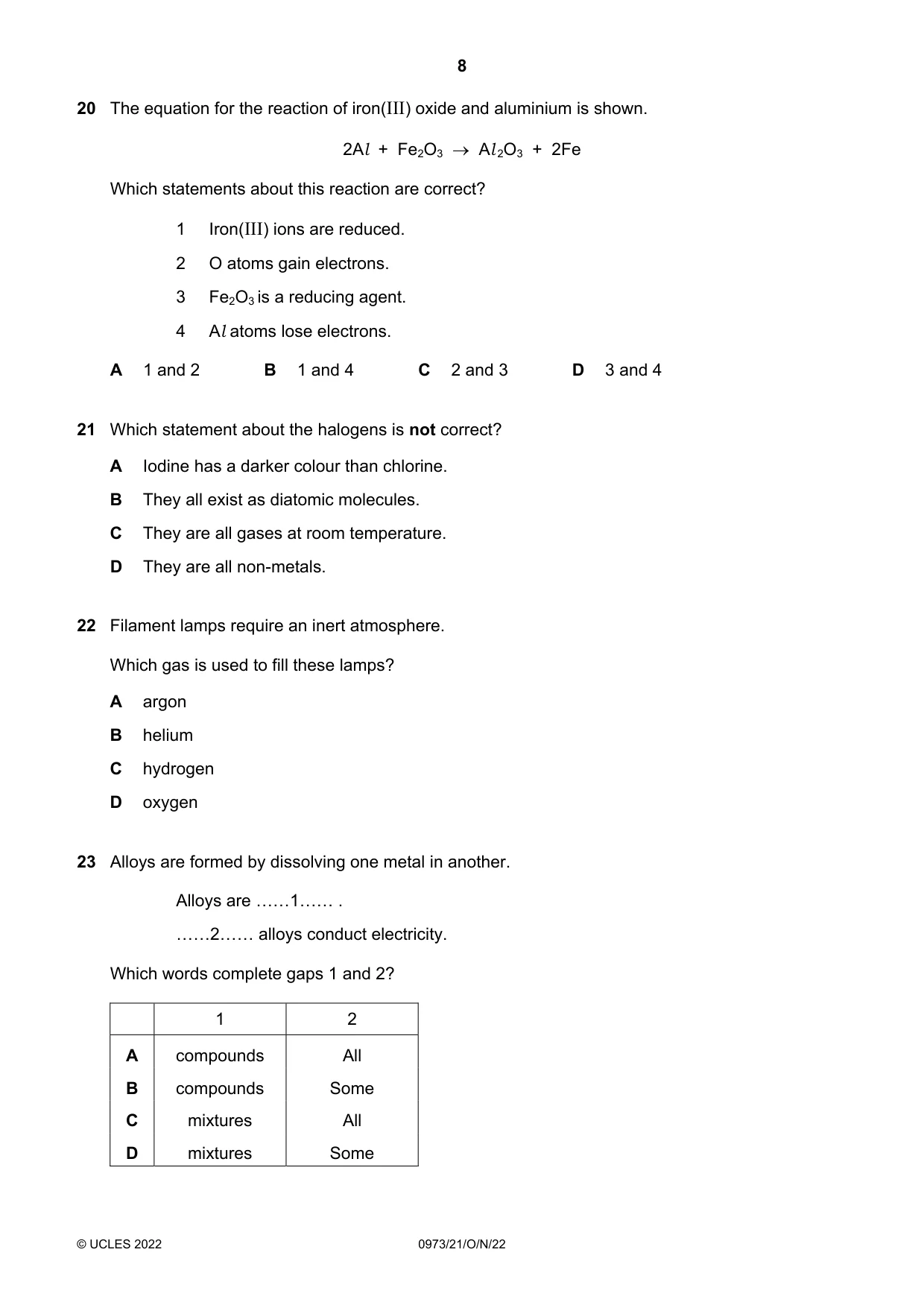
23 Alloys are formed by dissolving one metal in another. Alloys are ……1…… . ……2…… alloys conduct electricity. Which words complete gaps 1 and 2? 1 2 A compounds All B compounds Some C mixtures All D mixtures Some
Mark scheme: C
Q24 · Which statement about reactions of metals is correct?
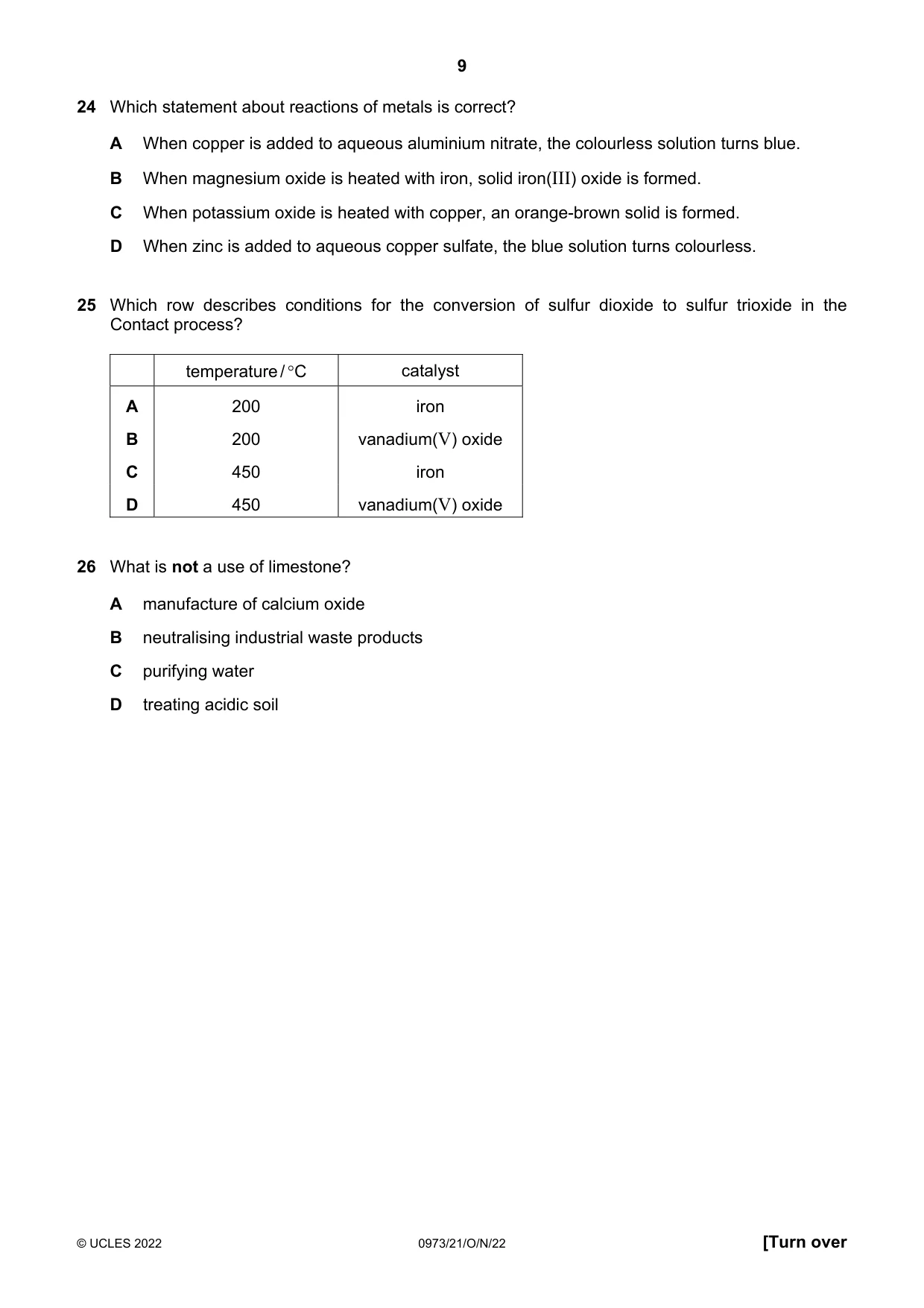
24 Which statement about reactions of metals is correct? A When copper is added to aqueous aluminium nitrate, the colourless solution turns blue. B When magnesium oxide is heated with iron, solid iron(III) oxide is formed. C When potassium oxide is heated with copper, an orange-brown solid is formed. D When zinc is added to aqueous copper sulfate, the blue solution turns colourless.
Mark scheme: D
Q25 · Which row describes conditions for the conversion of sulfur dioxide to sulfur trioxide in…
25 Which row describes conditions for the conversion of sulfur dioxide to sulfur trioxide in the Contact process? temperature / C catalyst A 200 iron B 200 vanadium(V) oxide C 450 iron D 450 vanadium(V) oxide
Mark scheme: D
Q26 · What is not a use of limestone?
26 What is not a use of limestone? A manufacture of calcium oxide B neutralising industrial waste products C purifying water D treating acidic soil
Mark scheme: C
More questions on The characteristic properties of acids and bases
Q27 · The structure of the monomer chloroethene is shown
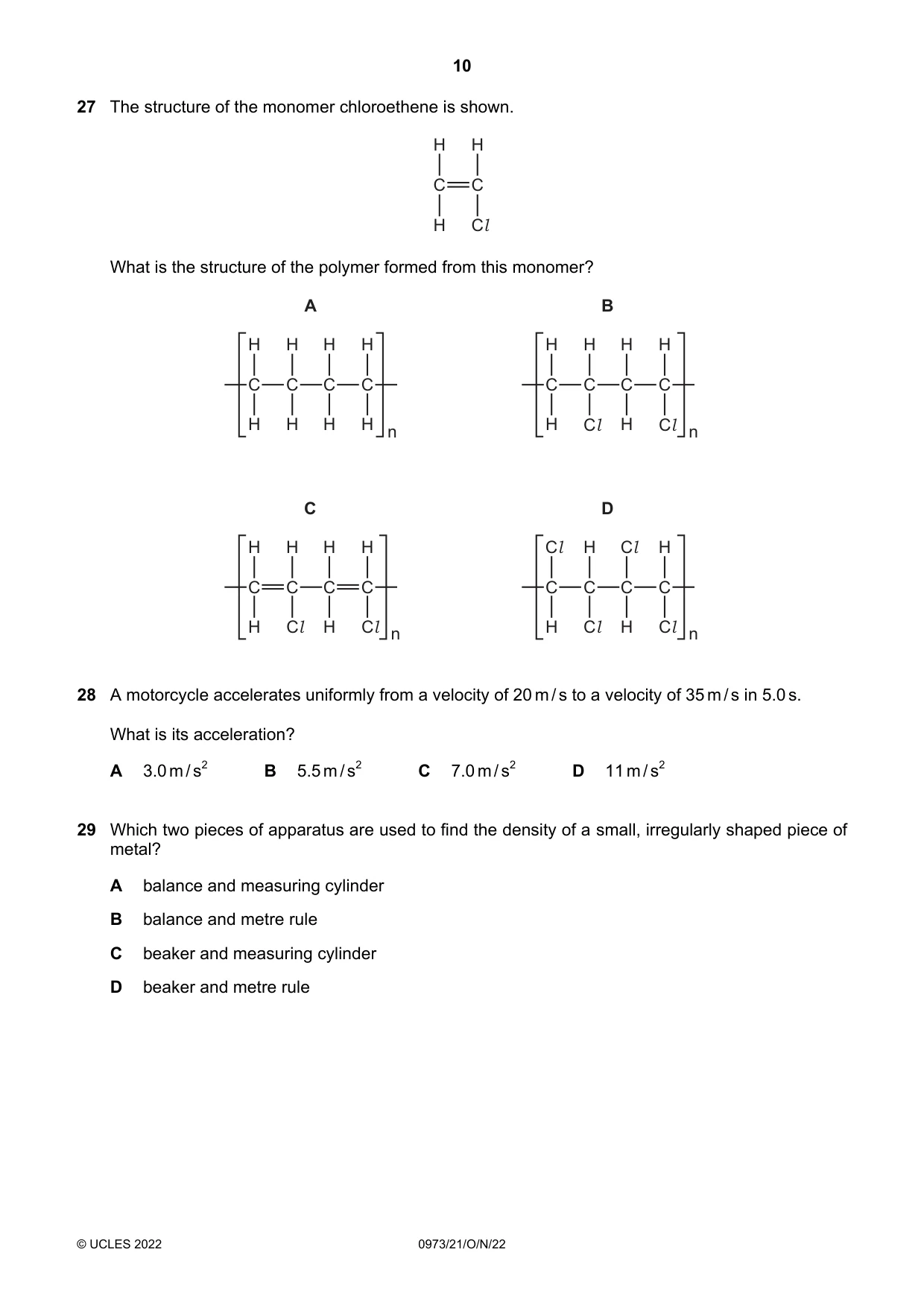
27 The structure of the monomer chloroethene is shown. H H C C H Cl What is the structure of the polymer formed from this monomer? A B H H H H H H H H C C C C C C C C H H H H n H Cl H Cl n C D H H H H Cl H Cl H C C C C C C C C H Cl H Cl n H Cl H Cl n
Mark scheme: B
Q28 · A motorcycle accelerates uniformly from a velocity of 20 m / s to a velocity of 35 m / s…
28 A motorcycle accelerates uniformly from a velocity of 20 m / s to a velocity of 35 m / s in 5.0 s. What is its acceleration? A 3.0 m / s2 B 5.5 m / s2 C 7.0 m / s2 D 11 m / s2
Mark scheme: A
Q29 · Which two pieces of apparatus are used to find the density of a small, irregularly shaped…
29 Which two pieces of apparatus are used to find the density of a small, irregularly shaped piece of metal? A balance and measuring cylinder B balance and metre rule C beaker and measuring cylinder D beaker and metre rule
Mark scheme: A
Q30 · An object of mass 2.0 kg is acted upon by a force of 3.0 N and a force of 7.0 N
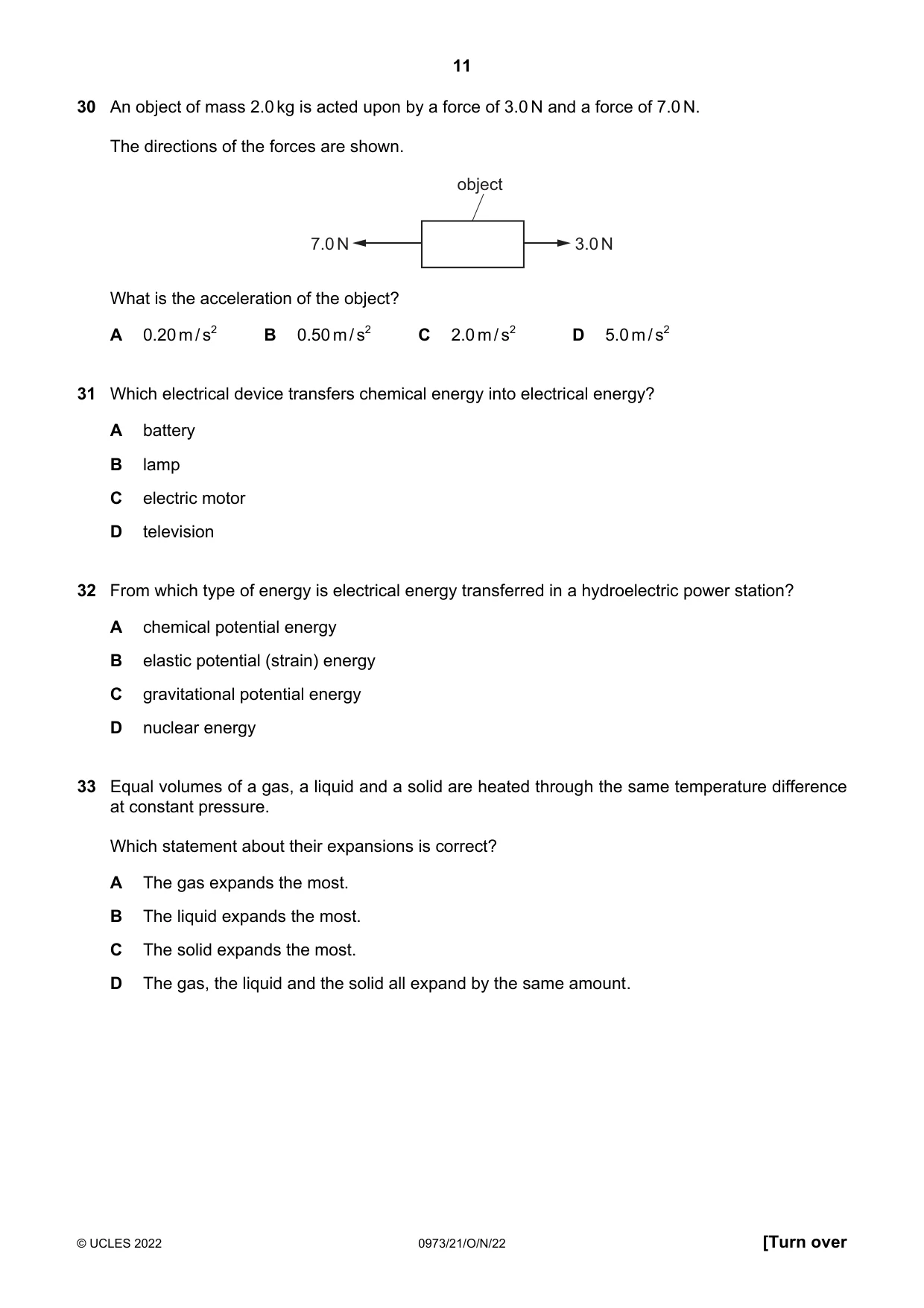
30 An object of mass 2.0 kg is acted upon by a force of 3.0 N and a force of 7.0 N. The directions of the forces are shown. object 7.0 N 3.0 N What is the acceleration of the object? A 0.20 m / s2 B 0.50 m / s2 C 2.0 m / s2 D 5.0 m / s2
Mark scheme: C
Q31 · Which electrical device transfers chemical energy into electrical energy?
31 Which electrical device transfers chemical energy into electrical energy? A battery B lamp C electric motor D television
Mark scheme: A
Q32 · From which type of energy is electrical energy transferred in a hydroelectric power…
32 From which type of energy is electrical energy transferred in a hydroelectric power station? A chemical potential energy B elastic potential (strain) energy C gravitational potential energy D nuclear energy
Mark scheme: C
Q33 · Equal volumes of a gas, a liquid and a solid are heated through the same temperature…
33 Equal volumes of a gas, a liquid and a solid are heated through the same temperature difference at constant pressure. Which statement about their expansions is correct? A The gas expands the most. B The liquid expands the most. C The solid expands the most. D The gas, the liquid and the solid all expand by the same amount.
Mark scheme: A
Q34 · The critical angle for diamond in air is 25
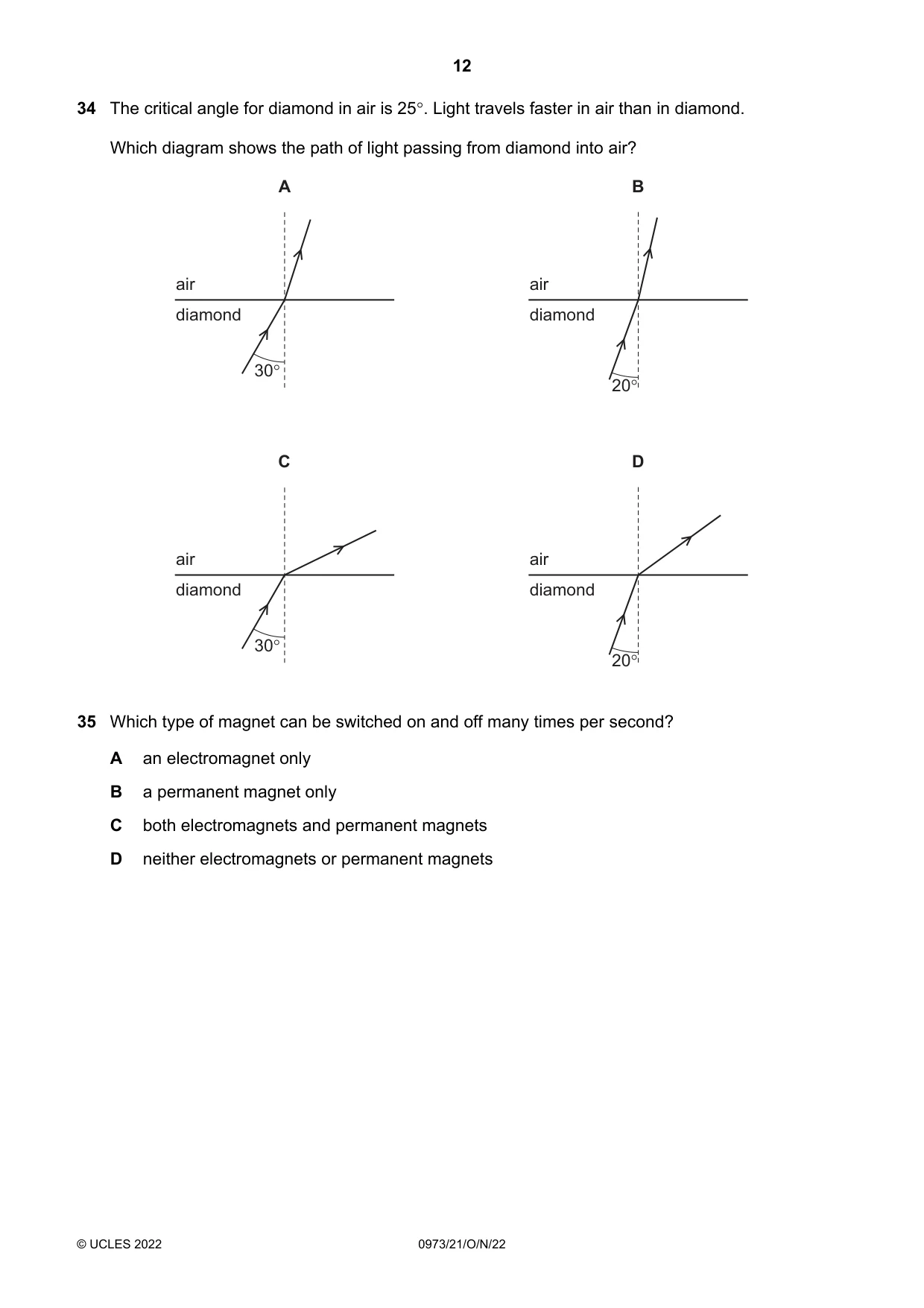
34 The critical angle for diamond in air is 25. Light travels faster in air than in diamond. Which diagram shows the path of light passing from diamond into air? A B air air diamond diamond 30° 20° C D air air diamond diamond 30° 20°
Mark scheme: D
Q35 · Which type of magnet can be switched on and off many times per second?
35 Which type of magnet can be switched on and off many times per second? A an electromagnet only B a permanent magnet only C both electromagnets and permanent magnets D neither electromagnets or permanent magnets
Mark scheme: A
Q36 · A resistance wire of cross-sectional area A and length l has resistance R
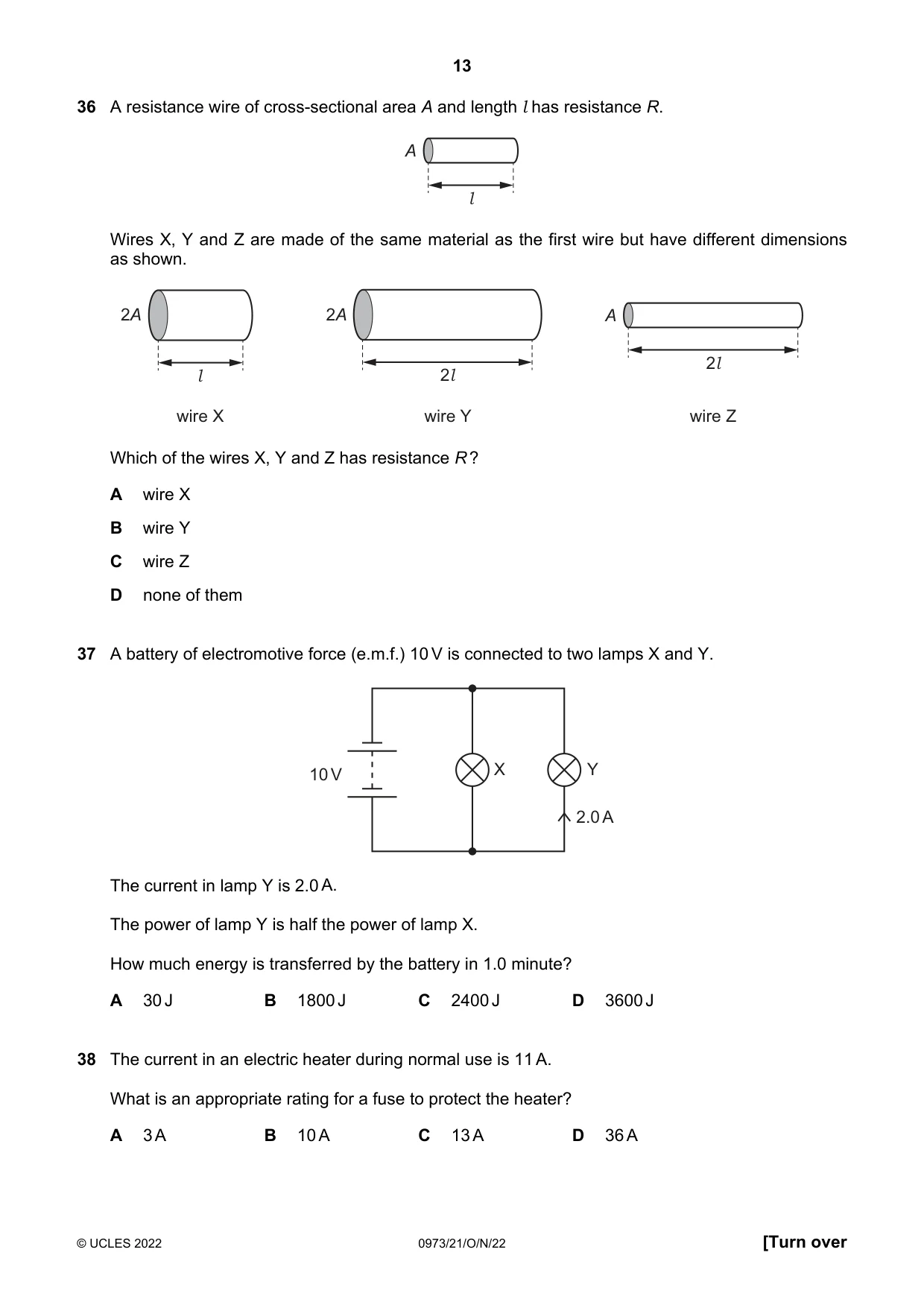
36 A resistance wire of cross-sectional area A and length l has resistance R. A l Wires X, Y and Z are made of the same material as the first wire but have different dimensions as shown. 2A 2A A 2l l 2l wire X wire Y wire Z Which of the wires X, Y and Z has resistance R ? A wire X B wire Y C wire Z D none of them
Mark scheme: B
Q37 · A battery of electromotive force (e.m.f.) 10 V is connected to two lamps X and Y
37 A battery of electromotive force (e.m.f.) 10 V is connected to two lamps X and Y. 10 V X Y 2.0 A The current in lamp Y is 2.0 A. The power of lamp Y is half the power of lamp X. How much energy is transferred by the battery in 1.0 minute? A 30 J B 1800 J C 2400 J D 3600 J
Mark scheme: D
Q38 · The current in an electric heater during normal use is 11 A
38 The current in an electric heater during normal use is 11 A. What is an appropriate rating for a fuse to protect the heater? A 3 A B 10 A C 13 A D 36 A
Mark scheme: C
Q39 · A current-carrying wire is placed between the poles of a magnet, as shown
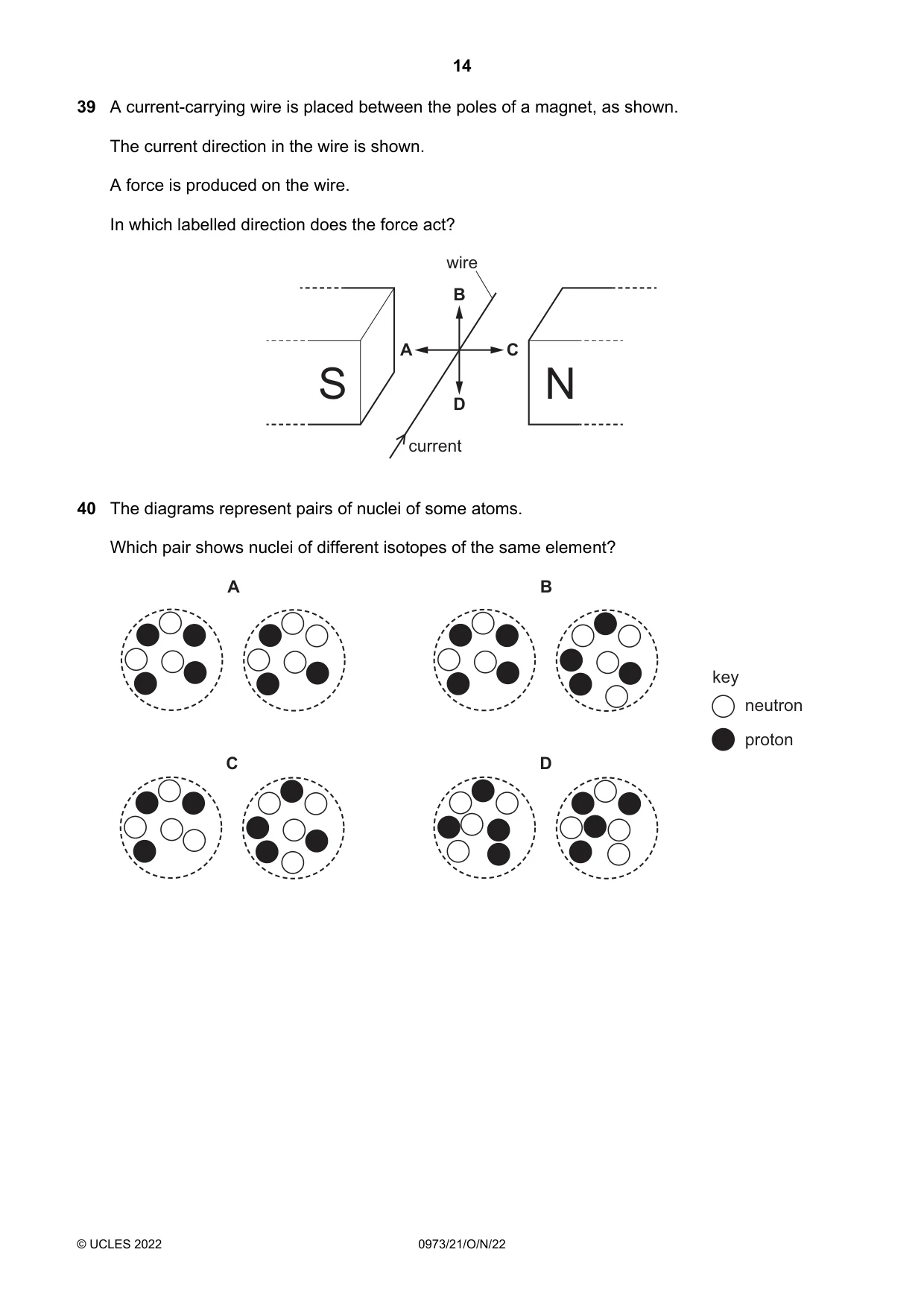
39 A current-carrying wire is placed between the poles of a magnet, as shown. The current direction in the wire is shown. A force is produced on the wire. In which labelled direction does the force act? wire B A C S N D current
Mark scheme: B
Q40 · The diagrams represent pairs of nuclei of some atoms
40 The diagrams represent pairs of nuclei of some atoms. Which pair shows nuclei of different isotopes of the same element? A B key neutron proton C D
Mark scheme: B
What was in this paper
The subtopics covered by these 40 questions, and how many questions each got. Open one in a new tab to see every Cambridge question on it.
2Air quality and climate1Alloys and their properties1Atomic structure and the Periodic Table1Biological molecules1Cell division1Coordination and response1Density1Digestive system1Electrical circuits1Electrical safety1Electrolysis1Electromagnetic effects1Energy, work and power1Enzymes1Exothermic and endothermic reactions1Food chains and food webs1Forces1Group VII properties1Habitat destruction1Ions and ionic bonds1Isotopes1Kinetic particle model of matter1Leaf structure1Light1Motion1Noble gases1Osmosis1Photosynthesis1Polymers1Reactivity series1Redox1Relative masses of atoms and molecules1Respiration1Sexual reproduction in humans1Simple phenomena of magnetism1Solids, liquids and gases1The characteristic properties of acids and bases1Transpiration1What you needed in this session
Cambridge’s own grade thresholds for 2022 Oct/Nov, Paper 2 · Variant 1. A higher threshold means an easier paper — the bar moves with how the cohort did.