Cambridge IGCSE Sciences - Co-ordinated (9-1) 0973 — 2022 May/June Paper 2 · Variant 1
0973/21/M/J/22 · 40 questions · 40 marks · ≈45 min
The question paper and its mark scheme, free to read here and free to download. This is Cambridge’s own paper, exactly as it was sat.
Question paper16 pages

Mark scheme3 pages
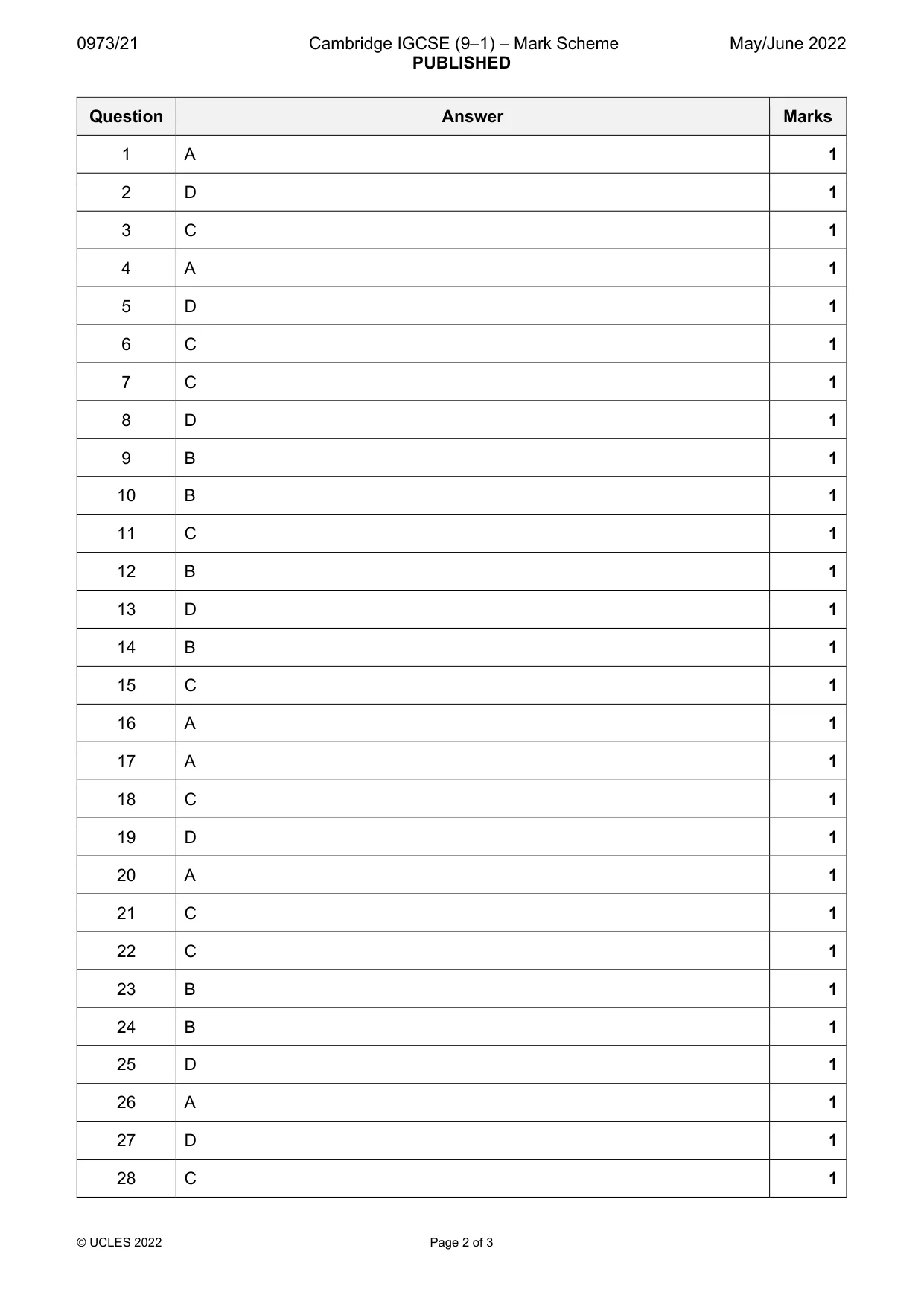
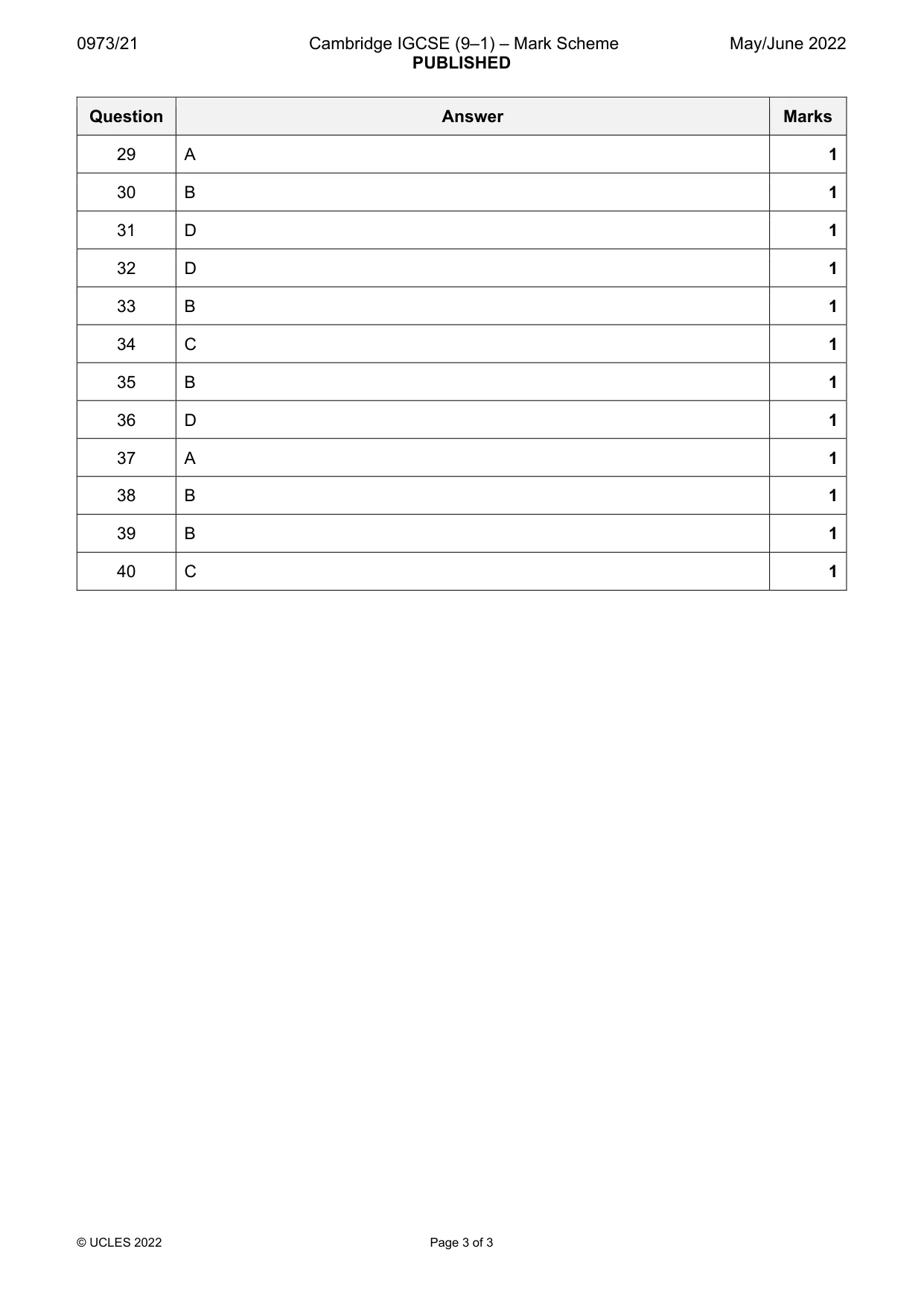
Answers below. Sit the paper first if you are practising.
Questions as text
Q1 · Which statement about one of the characteristics of living organisms is correct?
1 Which statement about one of the characteristics of living organisms is correct? A Excretion is the removal of excess substances and toxic materials. B Movement is the ability to detect and respond to changes in the environment. C Nutrition is the maintenance of a constant internal environment. D Respiration is the manufacture of nutrients from raw materials.
Mark scheme: A
Q2 · Which statement about cells is correct?
2 Which statement about cells is correct? A Cell membranes are found only in animal cells. B Cell membranes are found only in plant cells. C Cell walls are found only in animal cells. D Cell walls are found only in plant cells.
Mark scheme: D
Q3 · Which small molecules are joined together to make a starch molecule?
3 Which small molecules are joined together to make a starch molecule? A amino acids B fatty acids C glucose D glycerol
Mark scheme: C
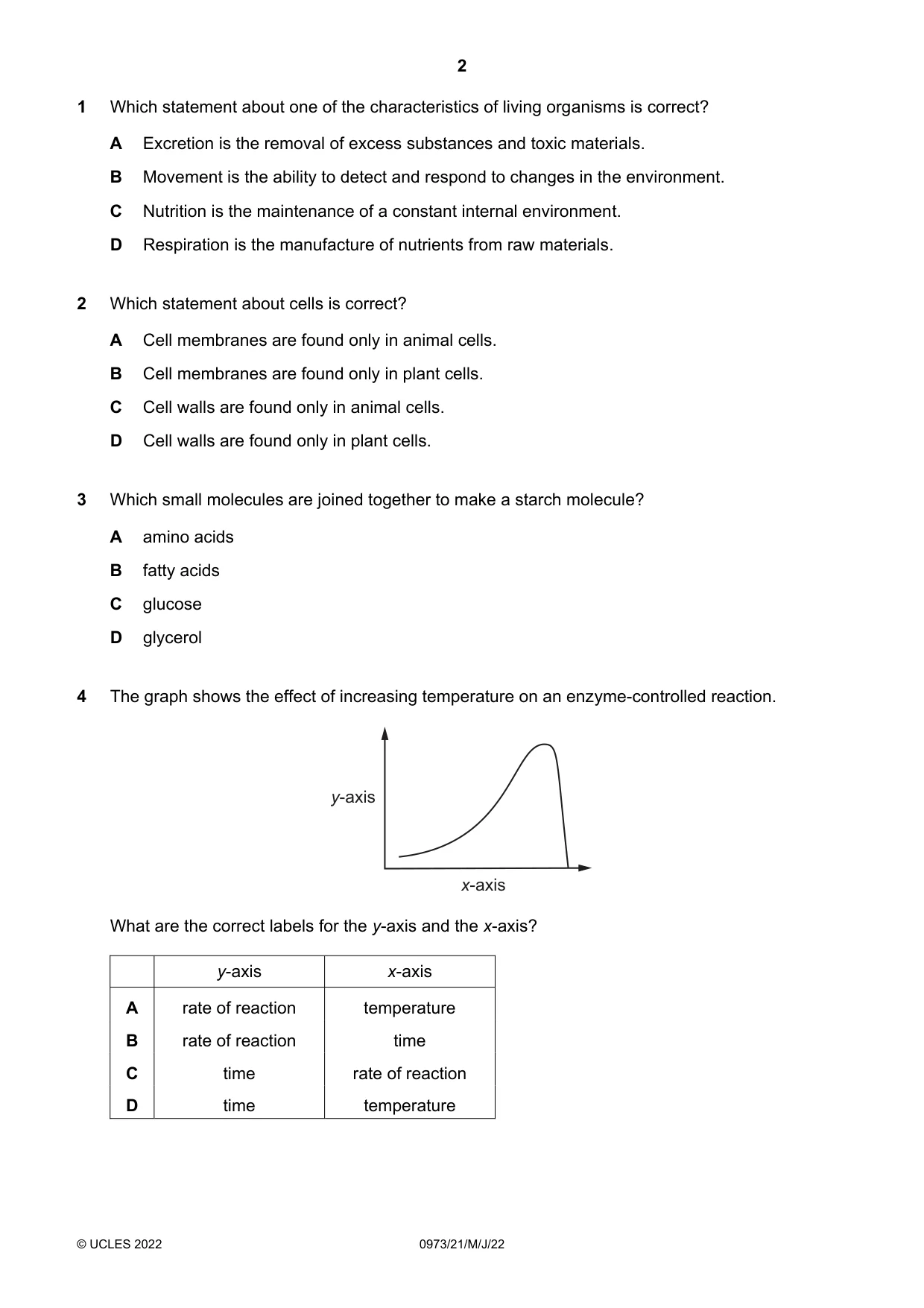
Q4 · The graph shows the effect of increasing temperature on an enzyme-controlled reaction
4 The graph shows the effect of increasing temperature on an enzyme-controlled reaction. y-axis x-axis What are the correct labels for the y-axis and the x-axis? y-axis x-axis A rate of reaction temperature B rate of reaction time C time rate of reaction D time temperature
Mark scheme: A
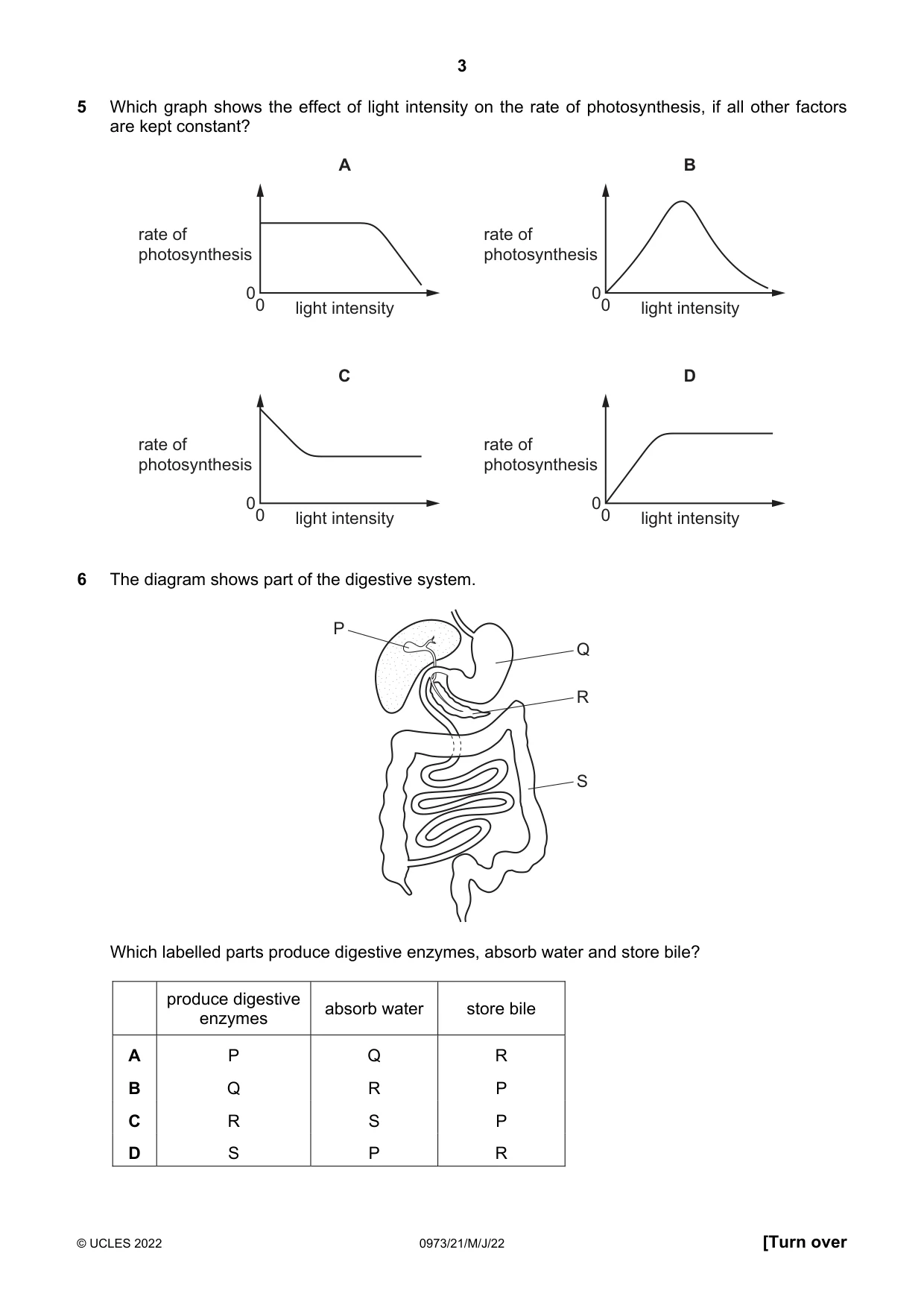
Q5 · Which graph shows the effect of light intensity on the rate of photosynthesis, if all…
5 Which graph shows the effect of light intensity on the rate of photosynthesis, if all other factors are kept constant? A B rate of rate of photosynthesis photosynthesis 0 0 0 light intensity 0 light intensity C D rate of rate of photosynthesis photosynthesis 0 0 0 light intensity 0 light intensity
Mark scheme: D
Q6 · The diagram shows part of the digestive system
6 The diagram shows part of the digestive system. P Q R S Which labelled parts produce digestive enzymes, absorb water and store bile? produce digestive absorb water store bile enzymes A P Q R B Q R P C R S P D S P R
Mark scheme: C
Q7 · Where does evaporation of water occur during transpiration?
7 Where does evaporation of water occur during transpiration? A from the air spaces through the stomata B from the phloem C from the surfaces of mesophyll cells D from the xylem
Mark scheme: C
Q8 · Which row is correct about the components of tobacco smoke and their effects?
8 Which row is correct about the components of tobacco smoke and their effects? component effect A carbon monoxide addictive B nicotine carcinogen C smoke particle addictive D tar carcinogen
Mark scheme: D
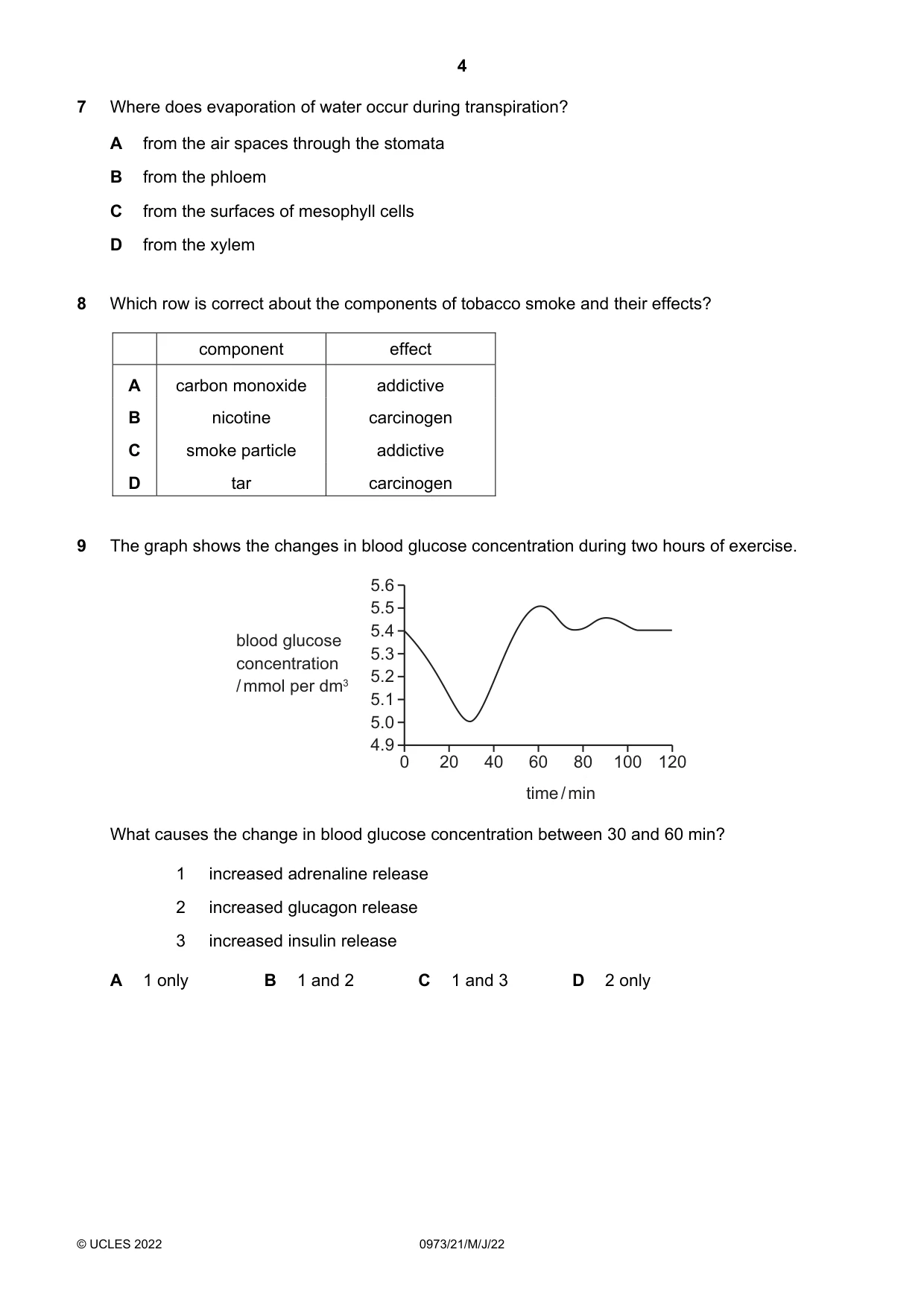
Q9 · The graph shows the changes in blood glucose concentration during two hours of exercise
9 The graph shows the changes in blood glucose concentration during two hours of exercise. 5.6 5.5 5.4 blood glucose 5.3 concentration 5.2 / mmol per dm3 5.1 5.0 4.9 0 20 40 60 80 100 120 time / min What causes the change in blood glucose concentration between 30 and 60 min? 1 increased adrenaline release 2 increased glucagon release 3 increased insulin release A 1 only B 1 and 2 C 1 and 3 D 2 only
Mark scheme: B
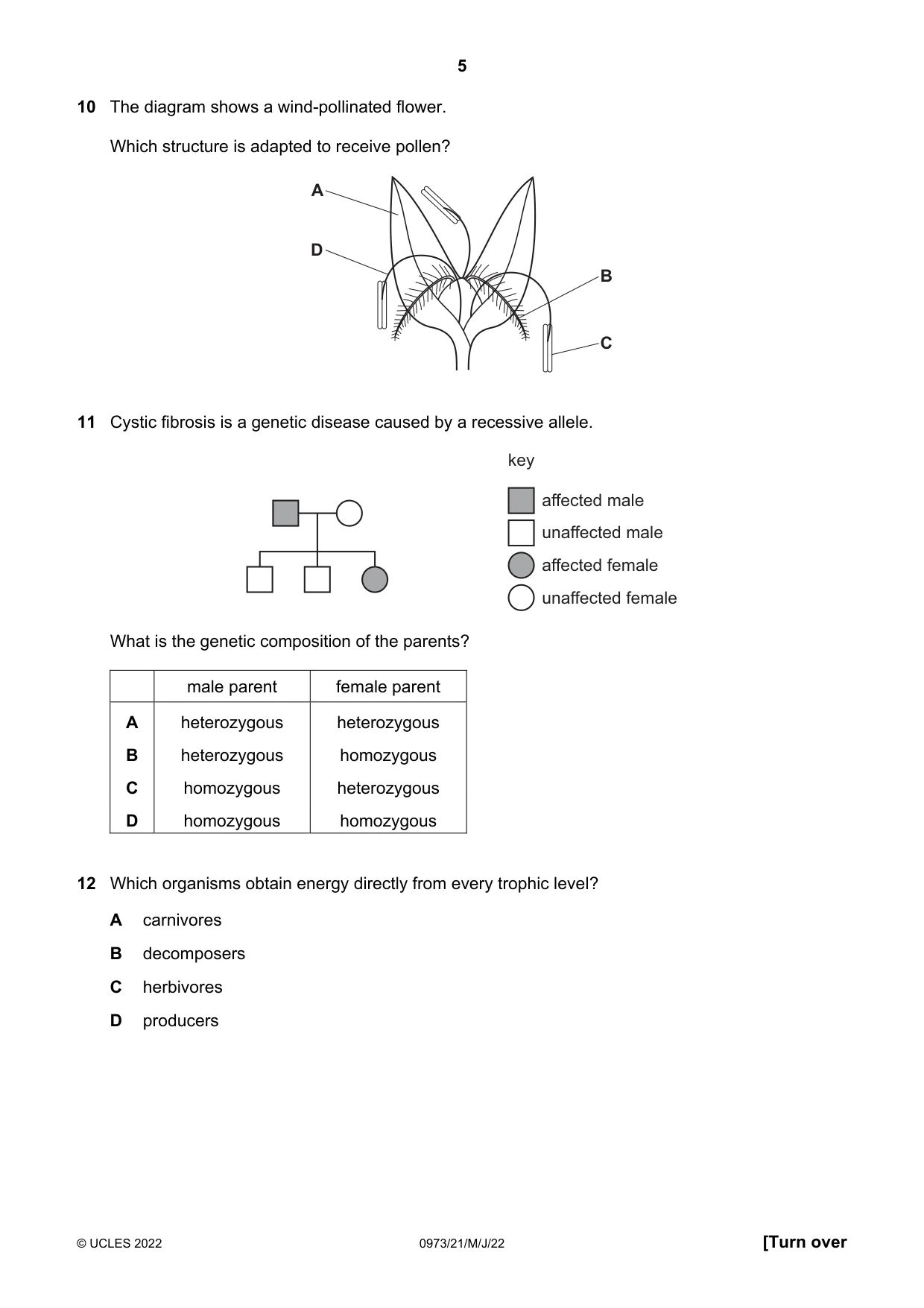
Q10 · The diagram shows a wind-pollinated flower
10 The diagram shows a wind-pollinated flower. Which structure is adapted to receive pollen? A D B C
Mark scheme: B
Q11 · Cystic fibrosis is a genetic disease caused by a recessive allele
11 Cystic fibrosis is a genetic disease caused by a recessive allele. key affected male unaffected male affected female unaffected female What is the genetic composition of the parents? male parent female parent A heterozygous heterozygous B heterozygous homozygous C homozygous heterozygous D homozygous homozygous
Mark scheme: C
Q12 · Which organisms obtain energy directly from every trophic level?
12 Which organisms obtain energy directly from every trophic level? A carnivores B decomposers C herbivores D producers
Mark scheme: B
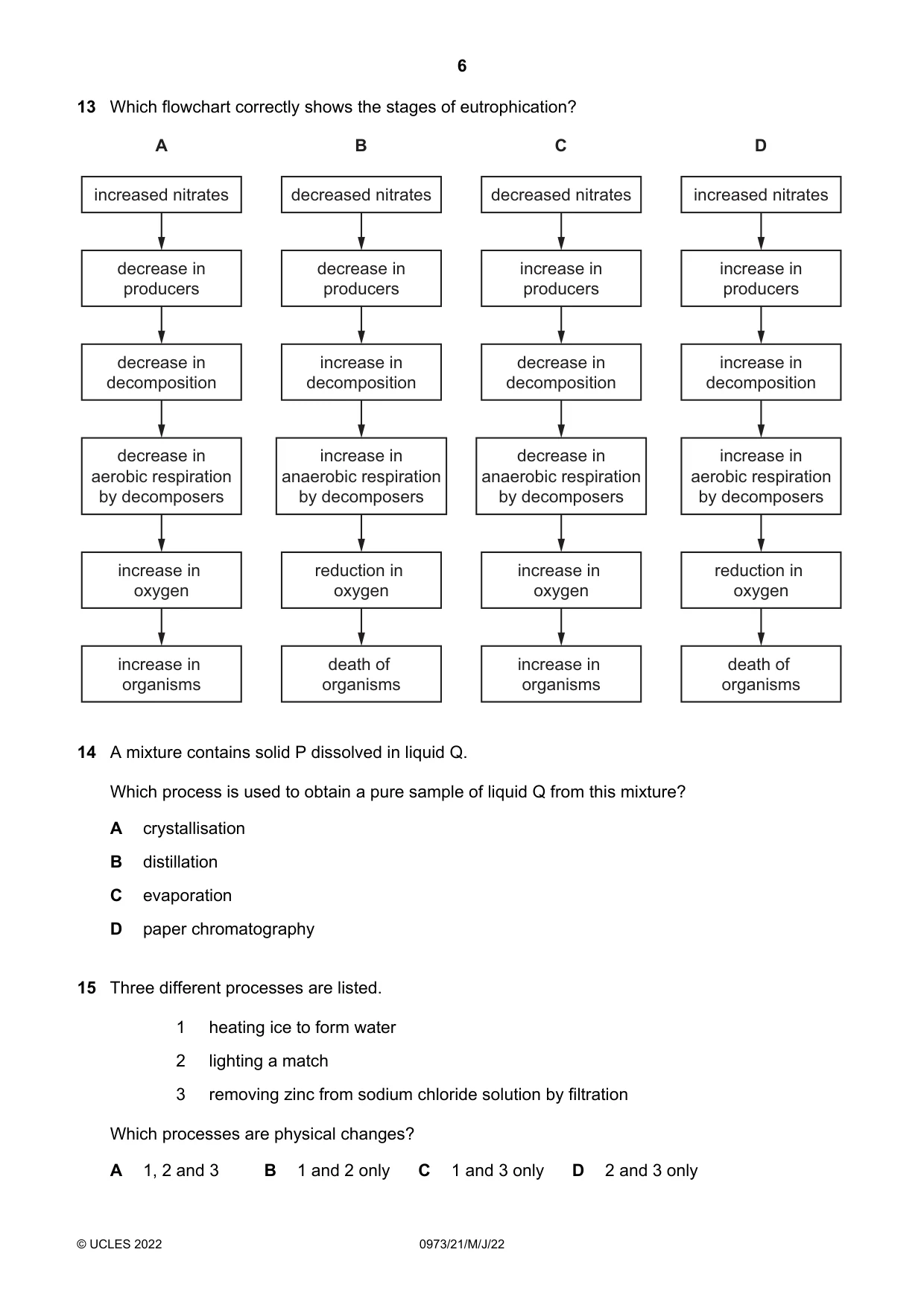
Q13 · Which flowchart correctly shows the stages of eutrophication?
13 Which flowchart correctly shows the stages of eutrophication? A B C D increased nitrates decreased nitrates decreased nitrates increased nitrates decrease in decrease in increase in increase in producers producers producers producers decrease in increase in decrease in increase in decomposition decomposition decomposition decomposition decrease in increase in decrease in increase in aerobic respiration anaerobic respiration anaerobic respiration aerobic respiration by decomposers by decomposers by decomposers by decomposers increase in reduction in increase in reduction in oxygen oxygen oxygen oxygen increase in death of increase in death of organisms organisms organisms organisms
Mark scheme: D
Q14 · A mixture contains solid P dissolved in liquid Q
14 A mixture contains solid P dissolved in liquid Q. Which process is used to obtain a pure sample of liquid Q from this mixture? A crystallisation B distillation C evaporation D paper chromatography
Mark scheme: B
Q15 · Three different processes are listed
15 Three different processes are listed. 1 heating ice to form water 2 lighting a match 3 removing zinc from sodium chloride solution by filtration Which processes are physical changes? A 1, 2 and 3 B 1 and 2 only C 1 and 3 only D 2 and 3 only
Mark scheme: C
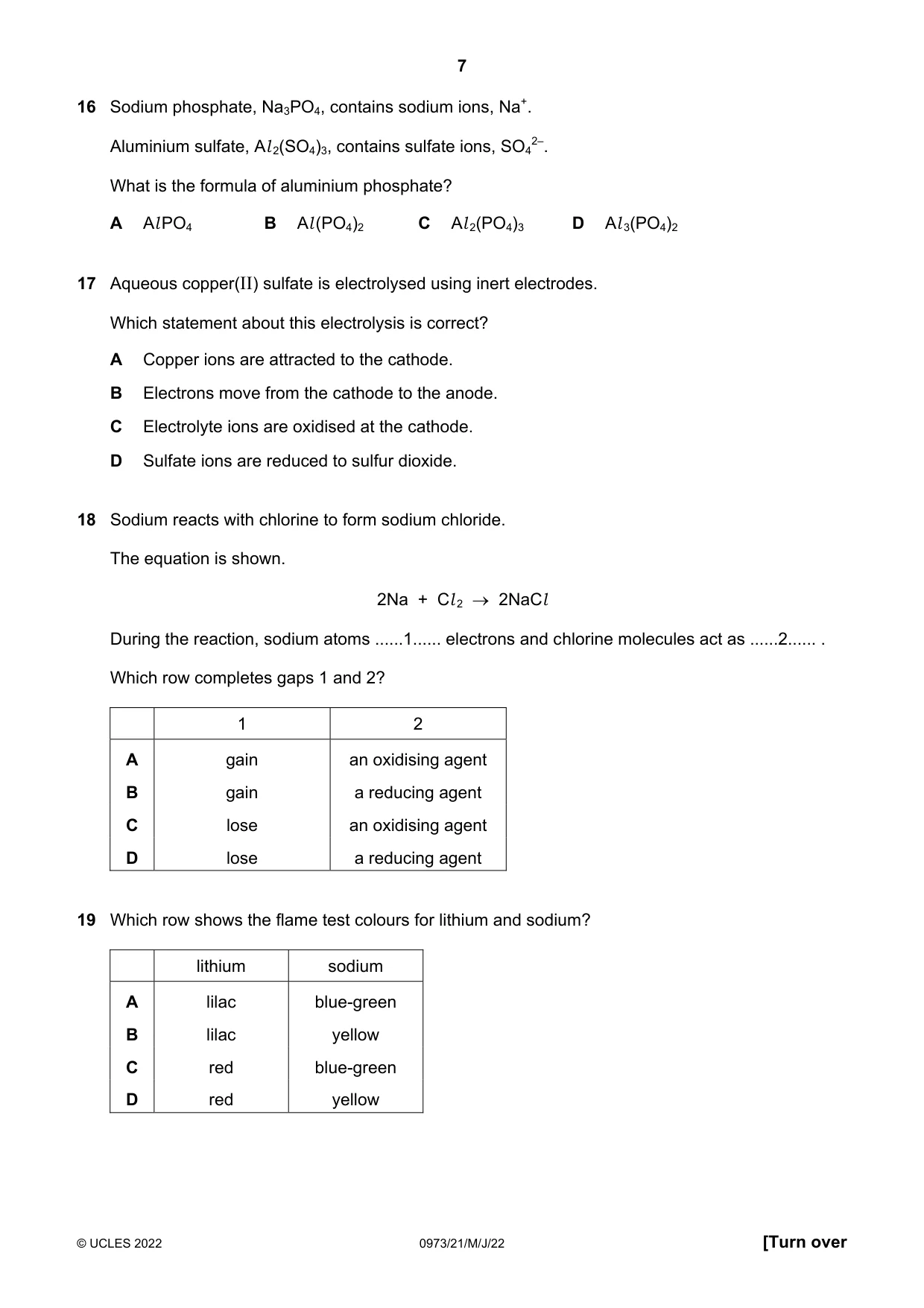
Q16 · Sodium phosphate, Na3PO4, contains sodium ions, Na+
16 Sodium phosphate, Na3PO4, contains sodium ions, Na+. Aluminium sulfate, Al 2(SO4)3, contains sulfate ions, SO4 2–. What is the formula of aluminium phosphate? A Al PO4 B Al (PO4)2 C Al 2(PO4)3 D Al 3(PO4)2
Mark scheme: A
Q17 · Aqueous copper(II) sulfate is electrolysed using inert electrodes
17 Aqueous copper(II) sulfate is electrolysed using inert electrodes. Which statement about this electrolysis is correct? A Copper ions are attracted to the cathode. B Electrons move from the cathode to the anode. C Electrolyte ions are oxidised at the cathode. D Sulfate ions are reduced to sulfur dioxide.
Mark scheme: A
Q18 · Sodium reacts with chlorine to form sodium chloride
18 Sodium reacts with chlorine to form sodium chloride. The equation is shown. 2Na + Cl 2 2NaCl During the reaction, sodium atoms ......1...... electrons and chlorine molecules act as ......2...... . Which row completes gaps 1 and 2? 1 2 A gain an oxidising agent B gain a reducing agent C lose an oxidising agent D lose a reducing agent
Mark scheme: C
Q19 · Which row shows the flame test colours for lithium and sodium?
19 Which row shows the flame test colours for lithium and sodium? lithium sodium A lilac blue-green B lilac yellow C red blue-green D red yellow
Mark scheme: D
Q20 · A gas is used in welding metals together at high temperatures
20 A gas is used in welding metals together at high temperatures. The gas is used to provide an inert atmosphere. What is the gas? A argon B carbon dioxide C fluorine D oxygen
Mark scheme: A
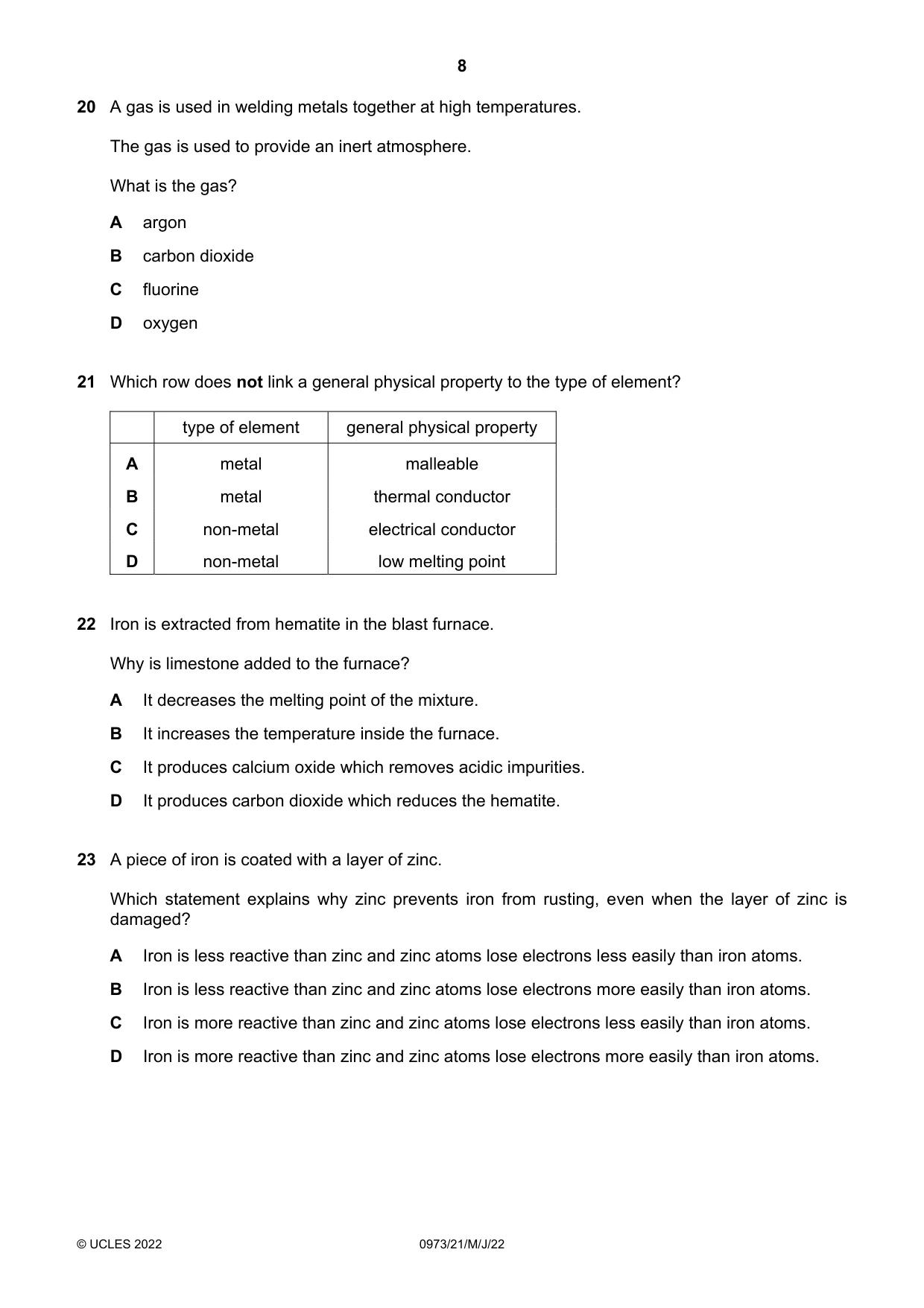
Q21 · Which row does not link a general physical property to the type of element?
21 Which row does not link a general physical property to the type of element? type of element general physical property A metal malleable B metal thermal conductor C non-metal electrical conductor D non-metal low melting point
Mark scheme: C
Q22 · Iron is extracted from hematite in the blast furnace
22 Iron is extracted from hematite in the blast furnace. Why is limestone added to the furnace? A It decreases the melting point of the mixture. B It increases the temperature inside the furnace. C It produces calcium oxide which removes acidic impurities. D It produces carbon dioxide which reduces the hematite.
Mark scheme: C
Q23 · A piece of iron is coated with a layer of zinc
23 A piece of iron is coated with a layer of zinc. Which statement explains why zinc prevents iron from rusting, even when the layer of zinc is damaged? A Iron is less reactive than zinc and zinc atoms lose electrons less easily than iron atoms. B Iron is less reactive than zinc and zinc atoms lose electrons more easily than iron atoms. C Iron is more reactive than zinc and zinc atoms lose electrons less easily than iron atoms. D Iron is more reactive than zinc and zinc atoms lose electrons more easily than iron atoms.
Mark scheme: B
Q24 · Sulfuric acid is produced in the Contact process
24 Sulfuric acid is produced in the Contact process. Which substances react together in a reversible reaction in the Contact process? A S and O2 B SO2 and O2 C H2SO4 and SO3 D H2S2O7 and H2O
Mark scheme: B
Q25 · Why do farmers add limestone to soil?
25 Why do farmers add limestone to soil? A It acts as a fertiliser. B It adds nitrogen to the soil. C It decreases the pH of the soil. D It increases the pH of the soil.
Mark scheme: D
More questions on The characteristic properties of acids and bases
Q26 · The same mass of five different alkanes are left to evaporate under identical conditions
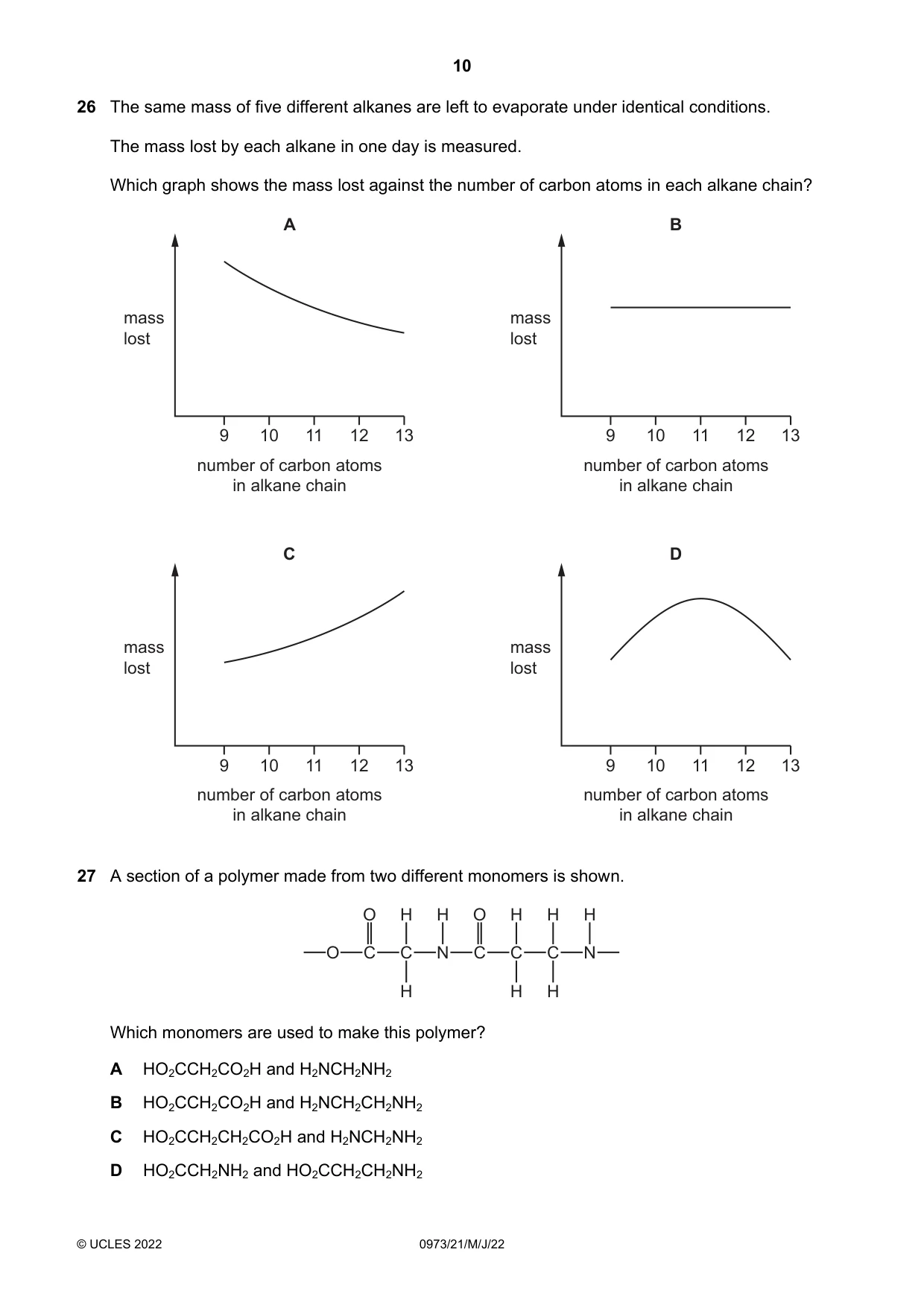
26 The same mass of five different alkanes are left to evaporate under identical conditions. The mass lost by each alkane in one day is measured. Which graph shows the mass lost against the number of carbon atoms in each alkane chain? A B mass mass lost lost 9 10 11 12 13 9 10 11 12 13 number of carbon atoms number of carbon atoms in alkane chain in alkane chain C D mass mass lost lost 9 10 11 12 13 9 10 11 12 13 number of carbon atoms number of carbon atoms in alkane chain in alkane chain
Mark scheme: A
Q27 · A section of a polymer made from two different monomers is shown
27 A section of a polymer made from two different monomers is shown. O H H O H H H O C C N C C C N H H H Which monomers are used to make this polymer? A HO2CCH2CO2H and H2NCH2NH2 B HO2CCH2CO2H and H2NCH2CH2NH2 C HO2CCH2CH2CO2H and H2NCH2NH2 D HO2CCH2NH2 and HO2CCH2CH2NH2
Mark scheme: D
Q28 · What is the difference between speed and velocity?
28 What is the difference between speed and velocity? A Speed has magnitude and direction; velocity has magnitude only. B Speed has magnitude and direction; velocity has direction only. C Speed has magnitude only; velocity has magnitude and direction. D Speed has magnitude only; velocity has direction only.
Mark scheme: C
Q29 · The diagram shows a car of mass 1000 kg travelling along a straight, horizontal road
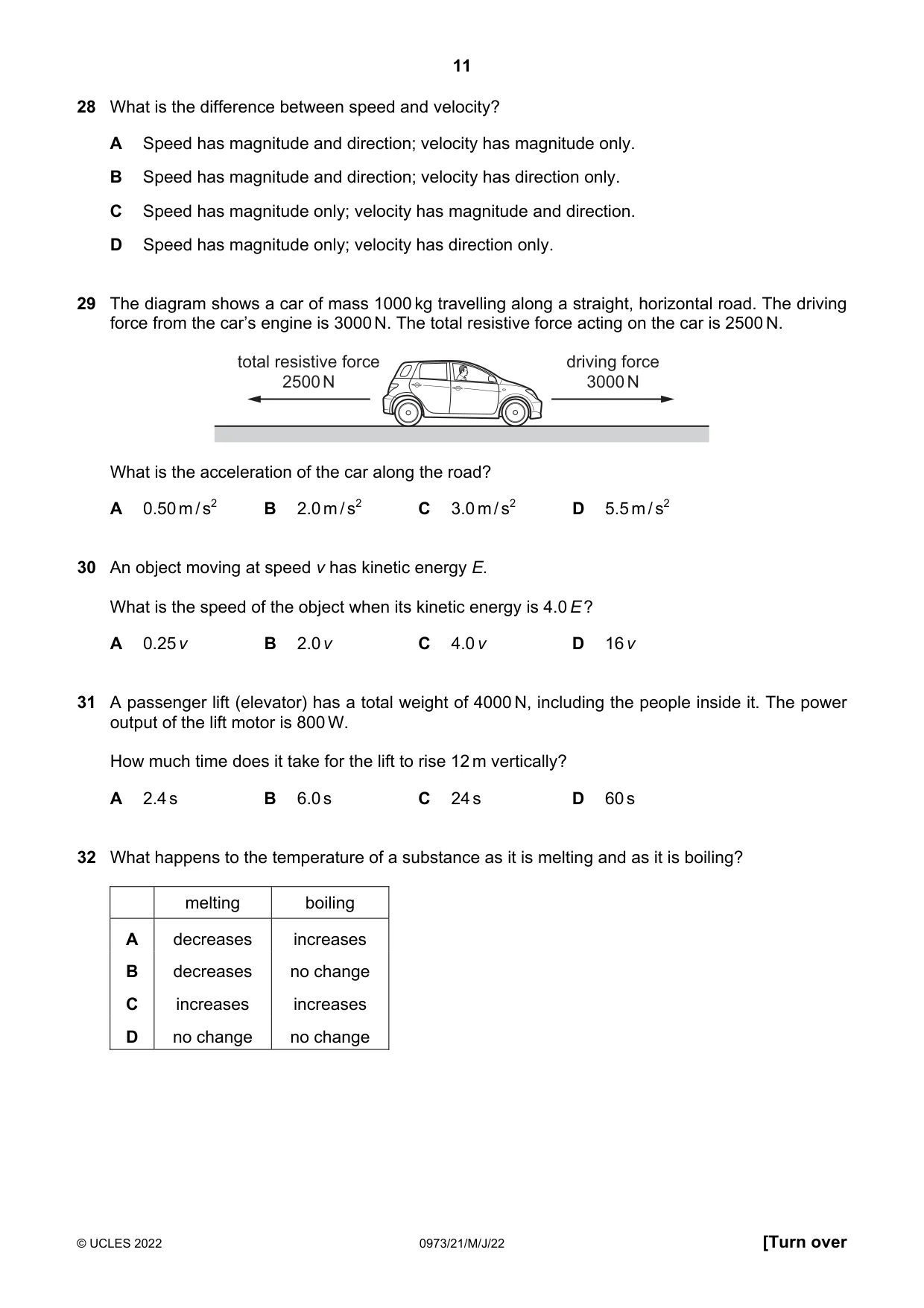
29 The diagram shows a car of mass 1000 kg travelling along a straight, horizontal road. The driving force from the car’s engine is 3000 N. The total resistive force acting on the car is 2500 N. total resistive force driving force 2500 N 3000 N What is the acceleration of the car along the road? A 0.50 m / s2 B 2.0 m / s2 C 3.0 m / s2 D 5.5 m / s2
Mark scheme: A
Q30 · An object moving at speed v has kinetic energy E
30 An object moving at speed v has kinetic energy E. What is the speed of the object when its kinetic energy is 4.0 E ? A 0.25 v B 2.0 v C 4.0 v D 16 v
Mark scheme: B
Q31 · A passenger lift (elevator) has a total weight of 4000 N, including the people inside it
31 A passenger lift (elevator) has a total weight of 4000 N, including the people inside it. The power output of the lift motor is 800 W. How much time does it take for the lift to rise 12 m vertically? A 2.4 s B 6.0 s C 24 s D 60 s
Mark scheme: D
Q32 · What happens to the temperature of a substance as it is melting and as it is boiling?
32 What happens to the temperature of a substance as it is melting and as it is boiling? melting boiling A decreases increases B decreases no change C increases increases D no change no change
Mark scheme: D
Q33 · The diagram shows how a thin, converging lens forms an image of an object
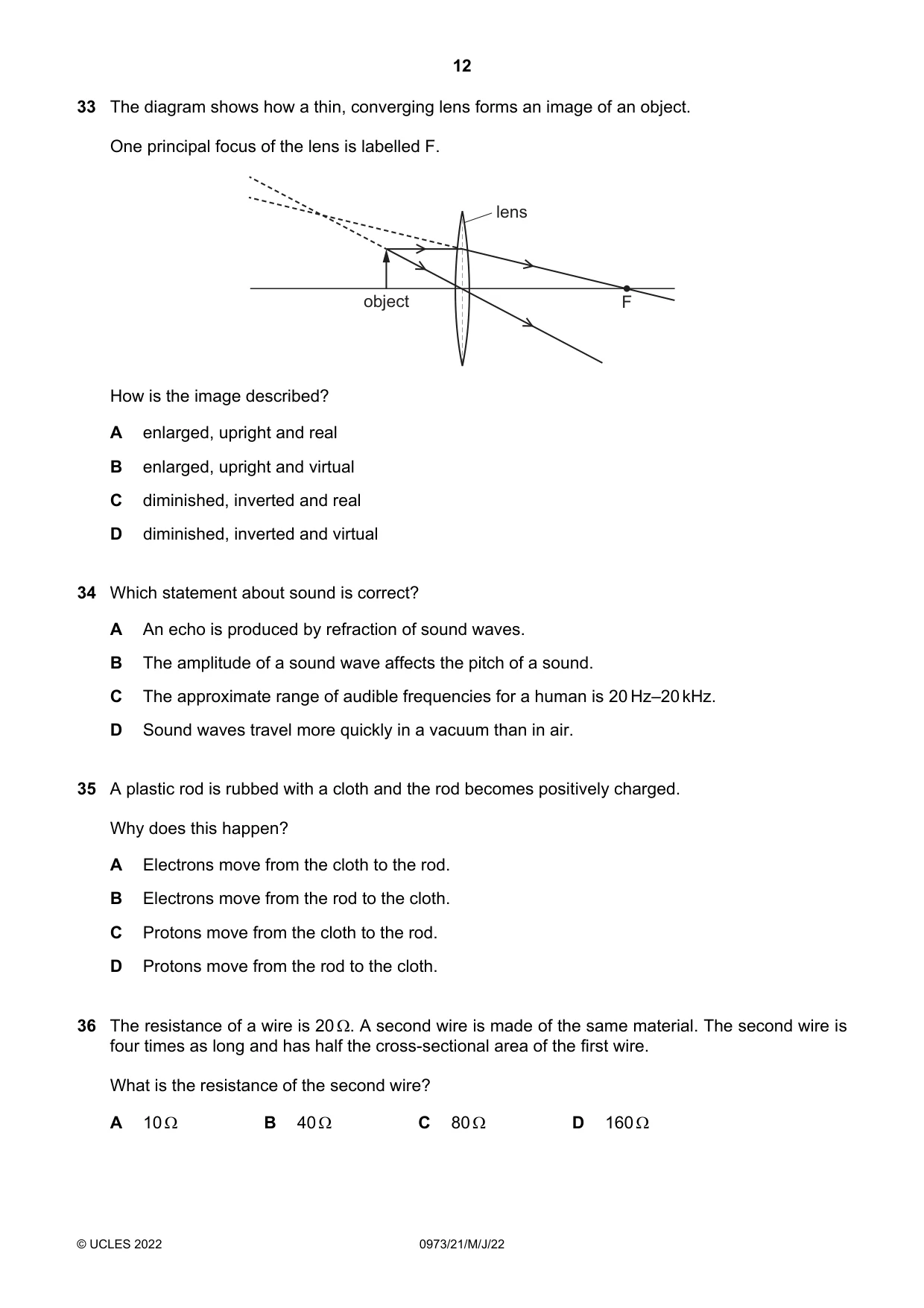
33 The diagram shows how a thin, converging lens forms an image of an object. One principal focus of the lens is labelled F. lens object F How is the image described? A enlarged, upright and real B enlarged, upright and virtual C diminished, inverted and real D diminished, inverted and virtual
Mark scheme: B
Q34 · Which statement about sound is correct?
34 Which statement about sound is correct? A An echo is produced by refraction of sound waves. B The amplitude of a sound wave affects the pitch of a sound. C The approximate range of audible frequencies for a human is 20 Hz–20 kHz. D Sound waves travel more quickly in a vacuum than in air.
Mark scheme: C
Q35 · A plastic rod is rubbed with a cloth and the rod becomes positively charged
35 A plastic rod is rubbed with a cloth and the rod becomes positively charged. Why does this happen? A Electrons move from the cloth to the rod. B Electrons move from the rod to the cloth. C Protons move from the cloth to the rod. D Protons move from the rod to the cloth.
Mark scheme: B
Q36 · The resistance of a wire is 20
36 The resistance of a wire is 20 . A second wire is made of the same material. The second wire is four times as long and has half the cross-sectional area of the first wire. What is the resistance of the second wire? A 10 B 40 C 80 D 160
Mark scheme: D
Q37 · Which row shows how lamps are connected in a lighting circuit in a house and gives an…
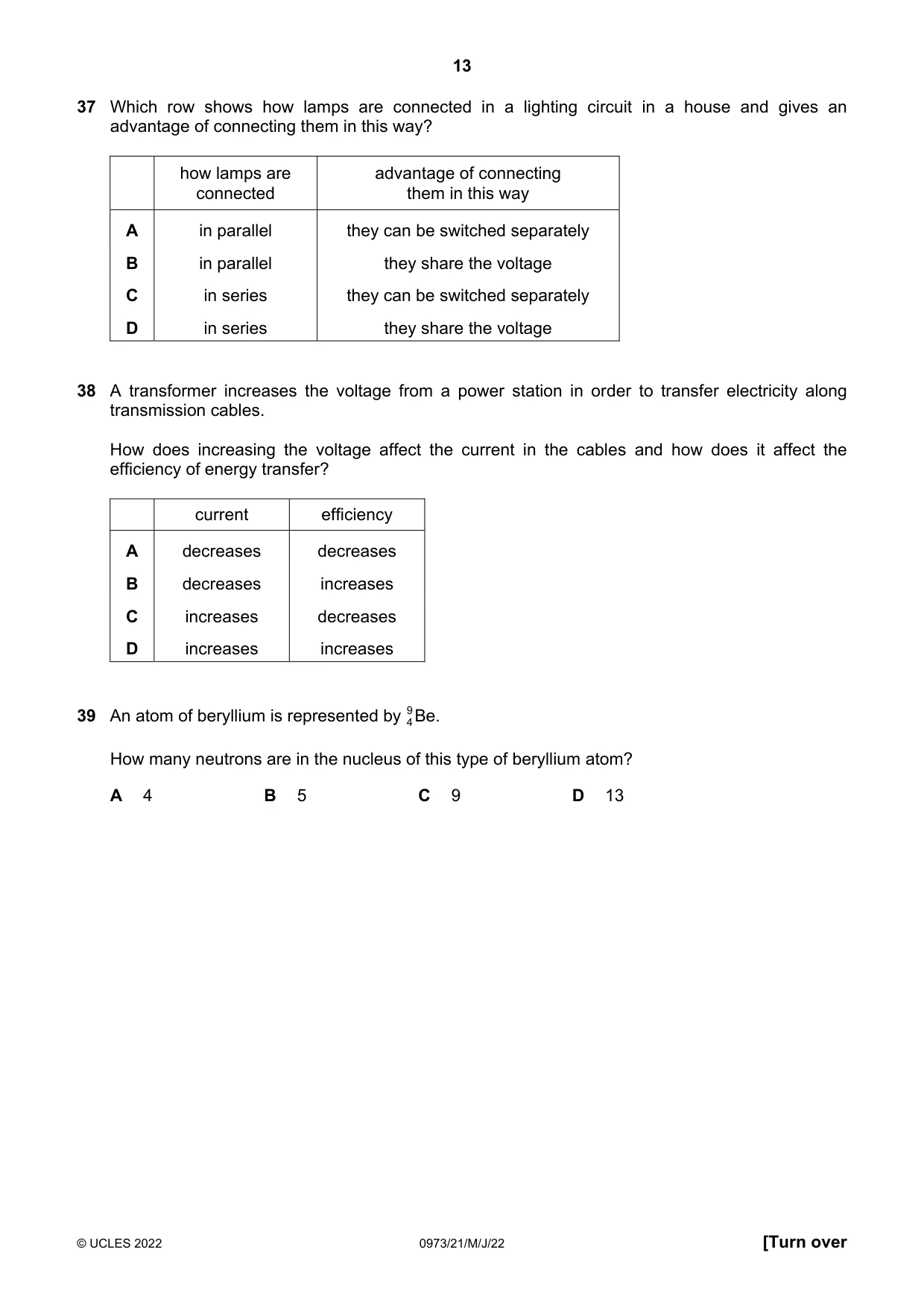
37 Which row shows how lamps are connected in a lighting circuit in a house and gives an advantage of connecting them in this way? how lamps are advantage of connecting connected them in this way A in parallel they can be switched separately B in parallel they share the voltage C in series they can be switched separately D in series they share the voltage
Mark scheme: A
Q38 · A transformer increases the voltage from a power station in order to transfer electricity…
38 A transformer increases the voltage from a power station in order to transfer electricity along transmission cables. How does increasing the voltage affect the current in the cables and how does it affect the efficiency of energy transfer? current efficiency A decreases decreases B decreases increases C increases decreases D increases increases
Mark scheme: B
Q39 · An atom of beryllium is represented by Be
39 An atom of beryllium is represented by Be. 9 4 How many neutrons are in the nucleus of this type of beryllium atom? A 4 B 5 C 9 D 13
Mark scheme: B
Q40 · A beam of -particles and -particles passes into an electric field between two…
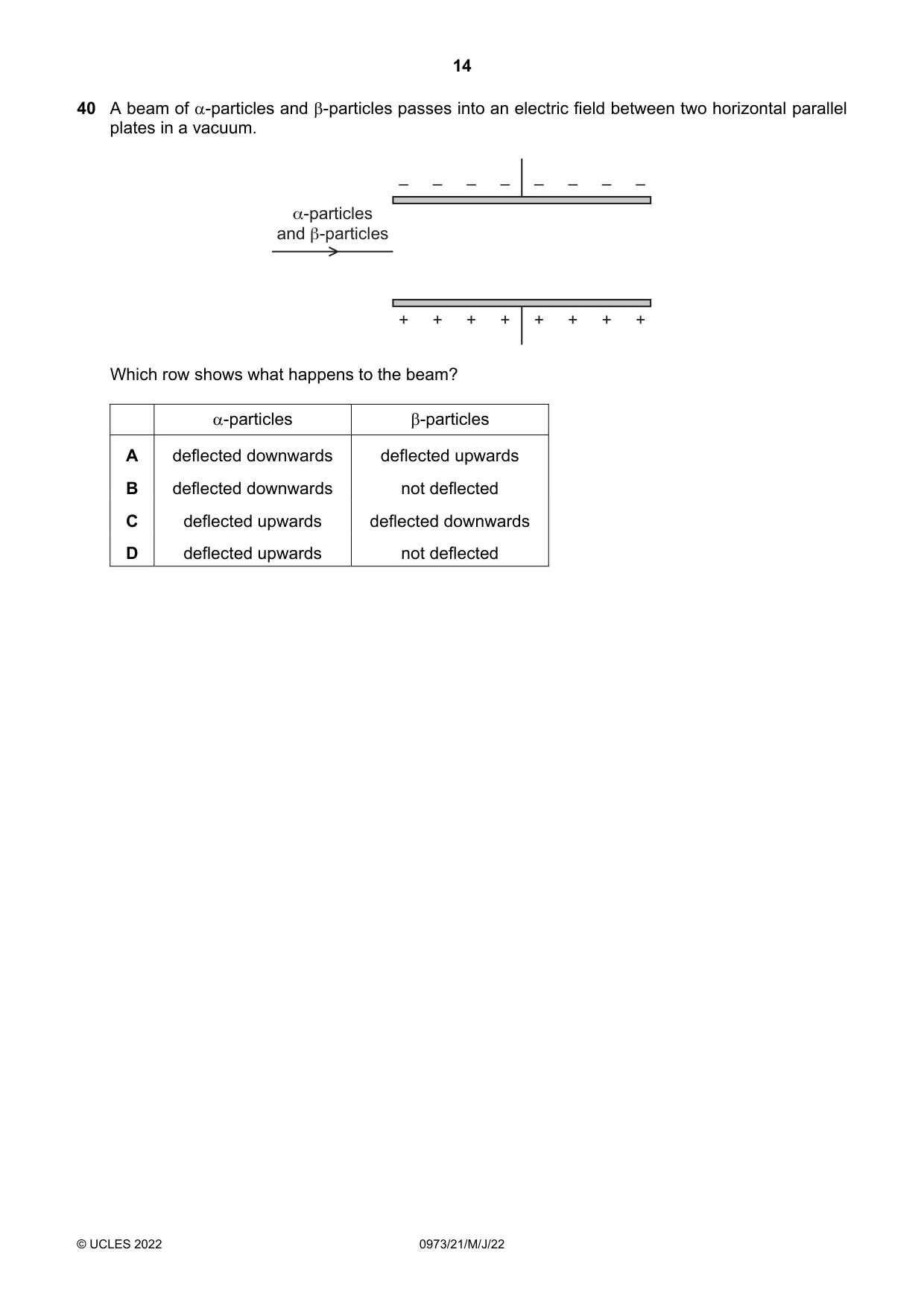
40 A beam of -particles and -particles passes into an electric field between two horizontal parallel plates in a vacuum. – – – – – – – – α-particles and β-particles + + + + + + + + Which row shows what happens to the beam? -particles -particles A deflected downwards deflected upwards B deflected downwards not deflected C deflected upwards deflected downwards D deflected upwards not deflected
Mark scheme: C
What was in this paper
The subtopics covered by these 40 questions, and how many questions each got. Open one in a new tab to see every Cambridge question on it.
2Alkanes1Atomic structure and the Periodic Table1Biological molecules1Cell structure1Characteristics of living organisms1Digestive system1Drugs1Electrical circuits1Electrical quantities1Electrolysis1Electromagnetic effects1Enzymes1Extraction of metals1Food chains and food webs1Forces1Habitat destruction1Homeostasis1Identification of ions and gases1Ions and ionic bonds1Kinetic particle model of matter1Light1Monohybrid inheritance1Motion1Noble gases1Photosynthesis1Physical and chemical changes1Polymers1Properties of metals1Radioactivity1Rate of reaction1Reactivity series1Redox1Separation and purification1Sexual reproduction in plants1Simple phenomena of magnetism1Sound1The characteristic properties of acids and bases1Transpiration1What you needed in this session
Cambridge’s own grade thresholds for 2022 May/June, Paper 2 · Variant 1. A higher threshold means an easier paper — the bar moves with how the cohort did.