Cambridge IGCSE Sciences - Co-ordinated (9-1) 0973 — 2023 Oct/Nov Paper 2 · Variant 1
0973/21/O/N/23 · 40 questions · 40 marks · ≈45 min
The question paper and its mark scheme, free to read here and free to download. This is Cambridge’s own paper, exactly as it was sat.
Question paper16 pages
Mark scheme3 pages
Answers below. Sit the paper first if you are practising.
Questions as text
Q1 · Which characteristic of a living organism releases energy for growth?
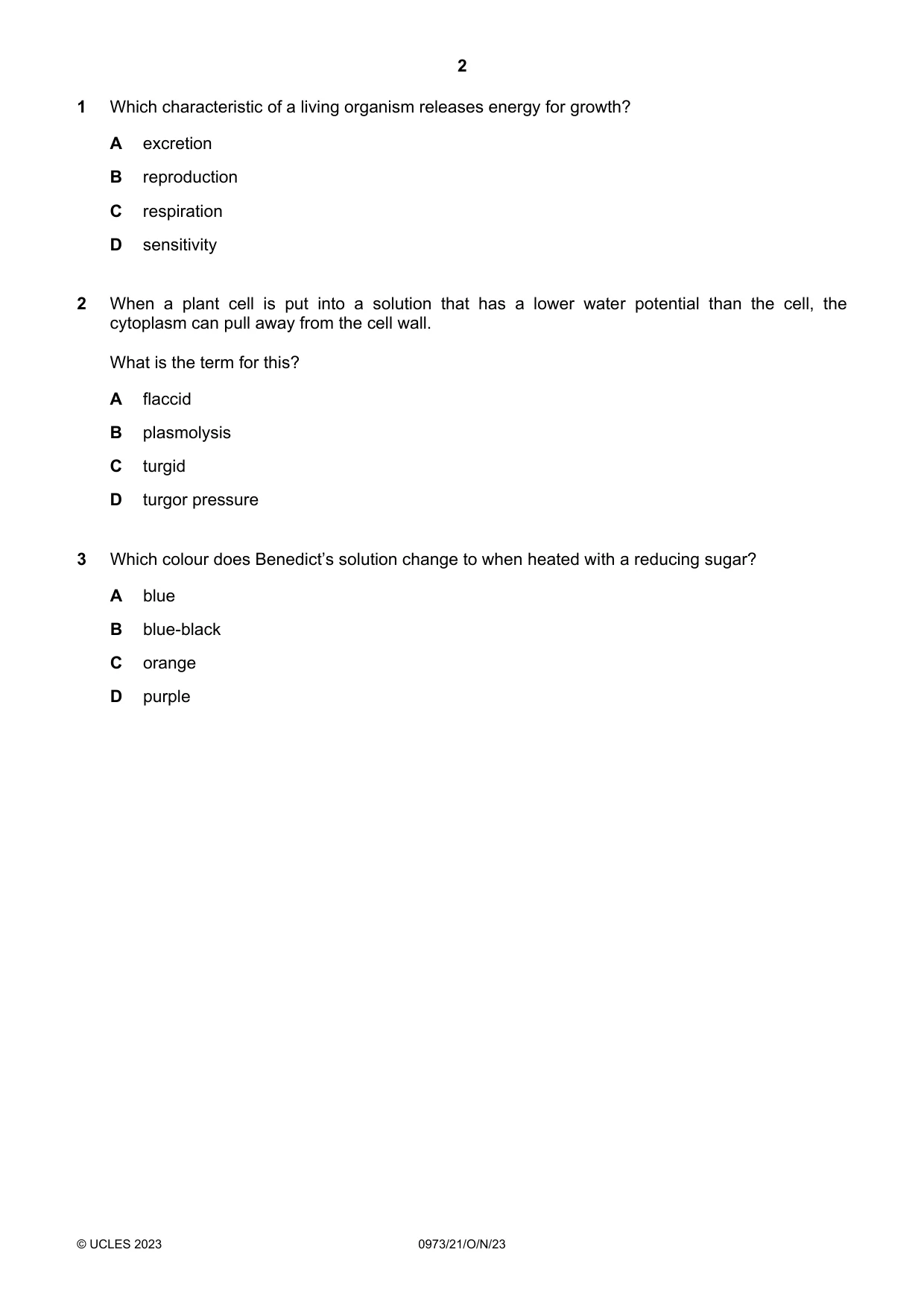
1 Which characteristic of a living organism releases energy for growth? A excretion B reproduction C respiration D sensitivity
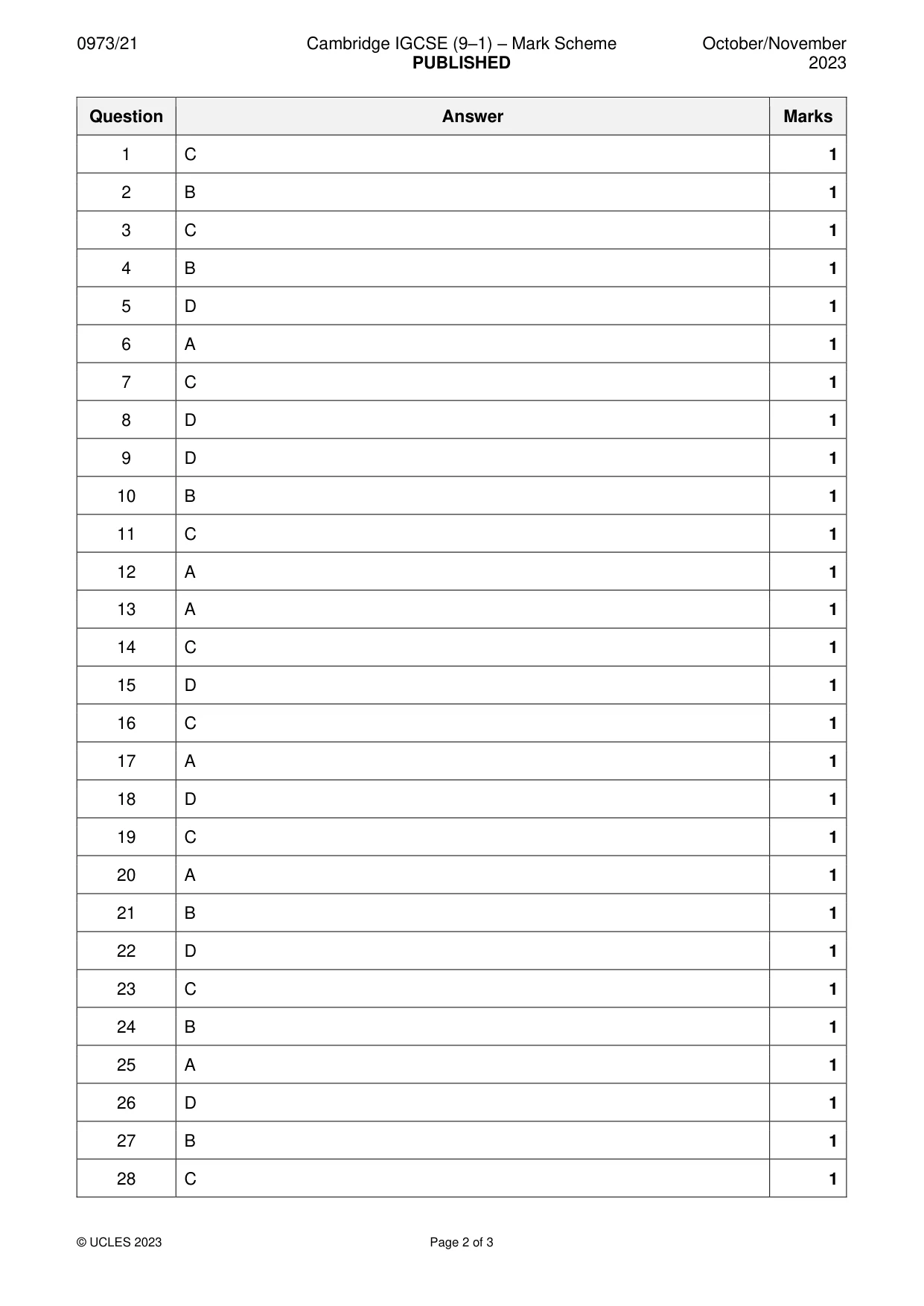
Mark scheme: C
Q2 · When a plant cell is put into a solution that has a lower water potential than the cell…
2 When a plant cell is put into a solution that has a lower water potential than the cell, the cytoplasm can pull away from the cell wall. What is the term for this? A flaccid B plasmolysis C turgid D turgor pressure
Mark scheme: B
Q3 · Which colour does Benedict’s solution change to when heated with a reducing sugar?
3 Which colour does Benedict’s solution change to when heated with a reducing sugar? A blue B blue-black C orange D purple
Mark scheme: C
Q4 · The graph shows the effect of increasing temperature on the time taken for amylase to…
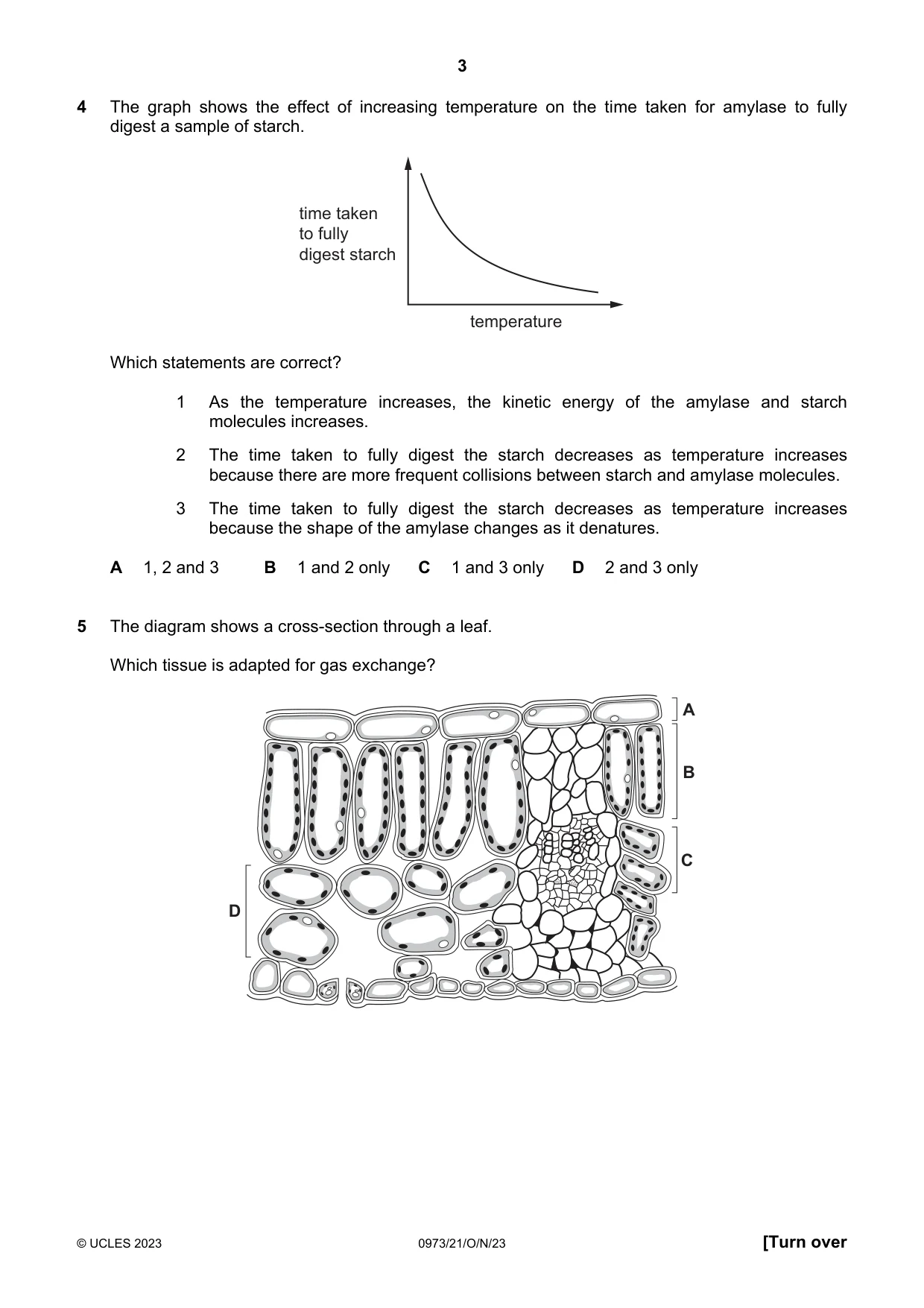
4 The graph shows the effect of increasing temperature on the time taken for amylase to fully digest a sample of starch. time taken to fully digest starch temperature Which statements are correct? 1 As the temperature increases, the kinetic energy of the amylase and starch molecules increases. 2 The time taken to fully digest the starch decreases as temperature increases because there are more frequent collisions between starch and amylase molecules. 3 The time taken to fully digest the starch decreases as temperature increases because the shape of the amylase changes as it denatures. A 1, 2 and 3 B 1 and 2 only C 1 and 3 only D 2 and 3 only
Mark scheme: B
Q5 · The diagram shows a cross-section through a leaf
5 The diagram shows a cross-section through a leaf. Which tissue is adapted for gas exchange? A B C D
Mark scheme: D
Q6 · Pancreatic insufficiency is a condition that occurs when the pancreas is unable to…
6 Pancreatic insufficiency is a condition that occurs when the pancreas is unable to produce enough enzymes. Which secretions are reduced due to this condition? A amylase, lipase and protease B amylase, lipase and bile C amylase, insulin and protease D glucagon, insulin and protease
Mark scheme: A
Q7 · Which label shows the position of the xylem in the cross-section of the root of a…
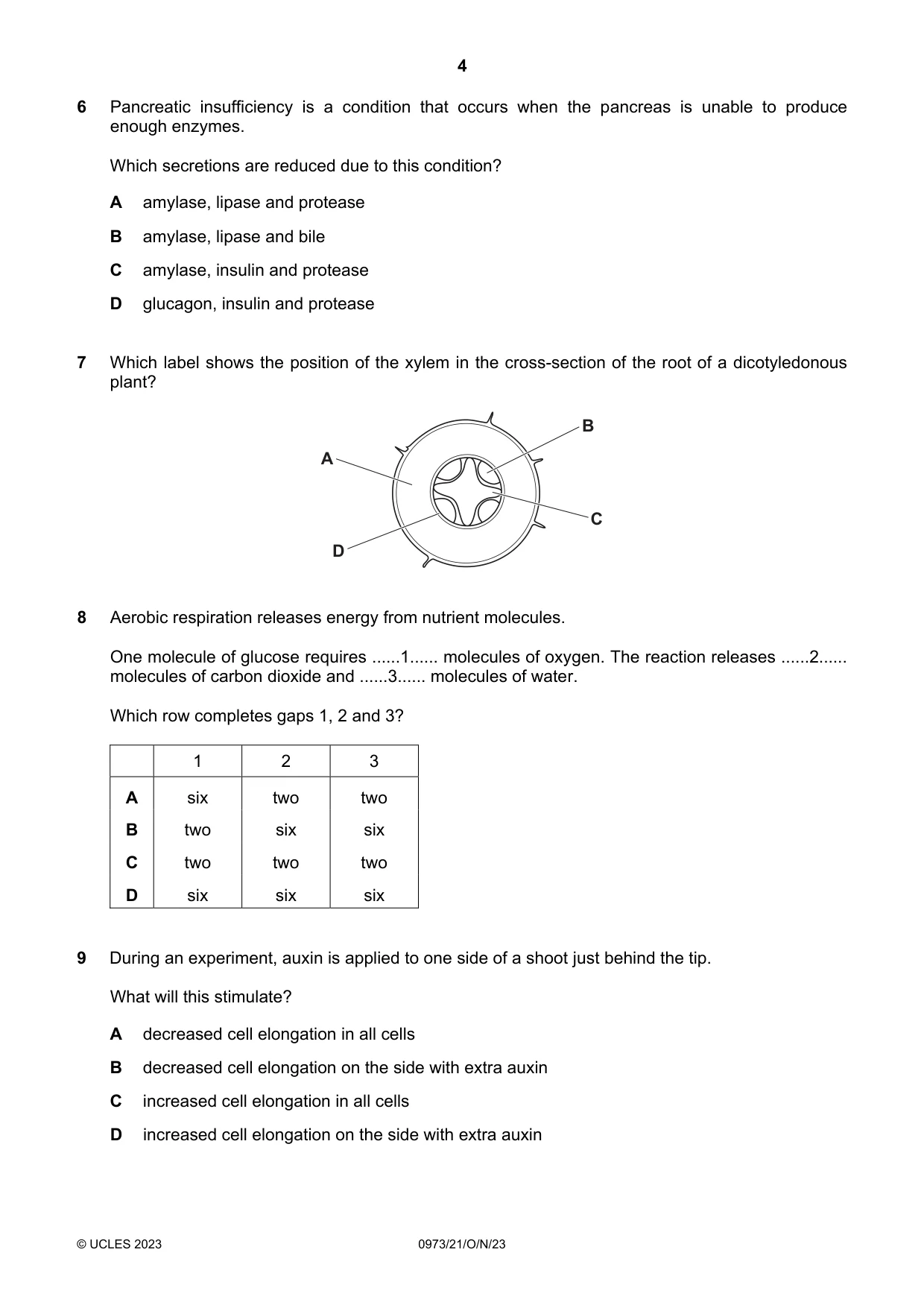
7 Which label shows the position of the xylem in the cross-section of the root of a dicotyledonous plant? B A C D
Mark scheme: C
Q8 · Aerobic respiration releases energy from nutrient molecules
8 Aerobic respiration releases energy from nutrient molecules. One molecule of glucose requires ......1...... molecules of oxygen. The reaction releases ......2...... molecules of carbon dioxide and ......3...... molecules of water. Which row completes gaps 1, 2 and 3? 1 2 3 A six two two B two six six C two two two D six six six
Mark scheme: D
Q9 · During an experiment, auxin is applied to one side of a shoot just behind the tip
9 During an experiment, auxin is applied to one side of a shoot just behind the tip. What will this stimulate? A decreased cell elongation in all cells B decreased cell elongation on the side with extra auxin C increased cell elongation in all cells D increased cell elongation on the side with extra auxin
Mark scheme: D
Q10 · Which part of the male reproductive system is correctly matched to its function?
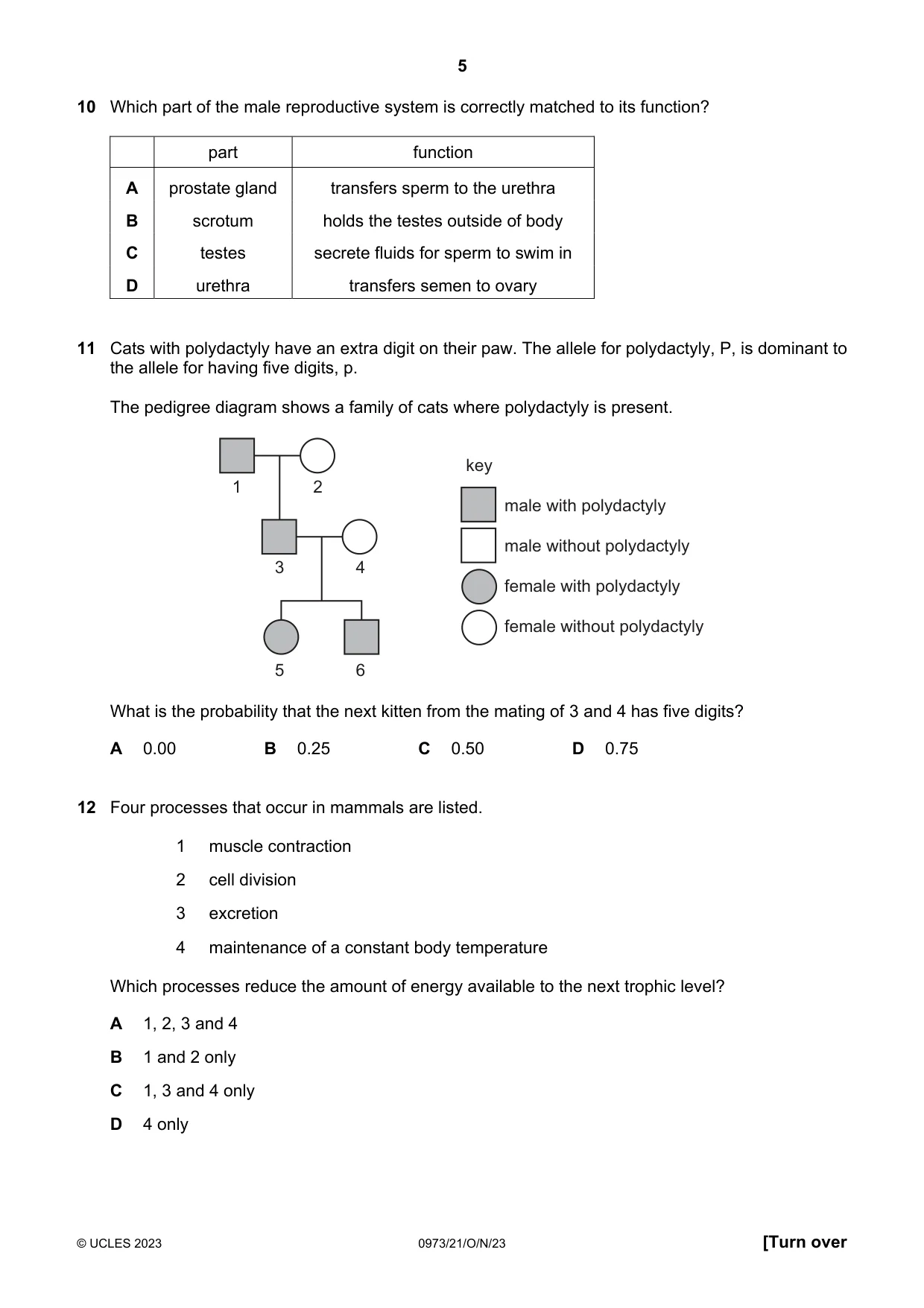
10 Which part of the male reproductive system is correctly matched to its function? part function A prostate gland transfers sperm to the urethra B scrotum holds the testes outside of body C testes secrete fluids for sperm to swim in D urethra transfers semen to ovary
Mark scheme: B
Q11 · Cats with polydactyly have an extra digit on their paw
11 Cats with polydactyly have an extra digit on their paw. The allele for polydactyly, P, is dominant to the allele for having five digits, p. The pedigree diagram shows a family of cats where polydactyly is present. key 1 2 male with polydactyly male without polydactyly 3 4 female with polydactyly female without polydactyly 5 6 What is the probability that the next kitten from the mating of 3 and 4 has five digits? A 0.00 B 0.25 C 0.50 D 0.75
Mark scheme: C
Q12 · Four processes that occur in mammals are listed
12 Four processes that occur in mammals are listed. 1 muscle contraction 2 cell division 3 excretion 4 maintenance of a constant body temperature Which processes reduce the amount of energy available to the next trophic level? A 1, 2, 3 and 4 B 1 and 2 only C 1, 3 and 4 only D 4 only
Mark scheme: A
Q13 · Forests are cut down and burnt in deforestation programmes
13 Forests are cut down and burnt in deforestation programmes. As a result of this, which gas in the atmosphere increases in concentration? A carbon dioxide B hydrogen C nitrogen D oxygen
Mark scheme: A
Q14 · Dye X is a mixture of different coloured substances
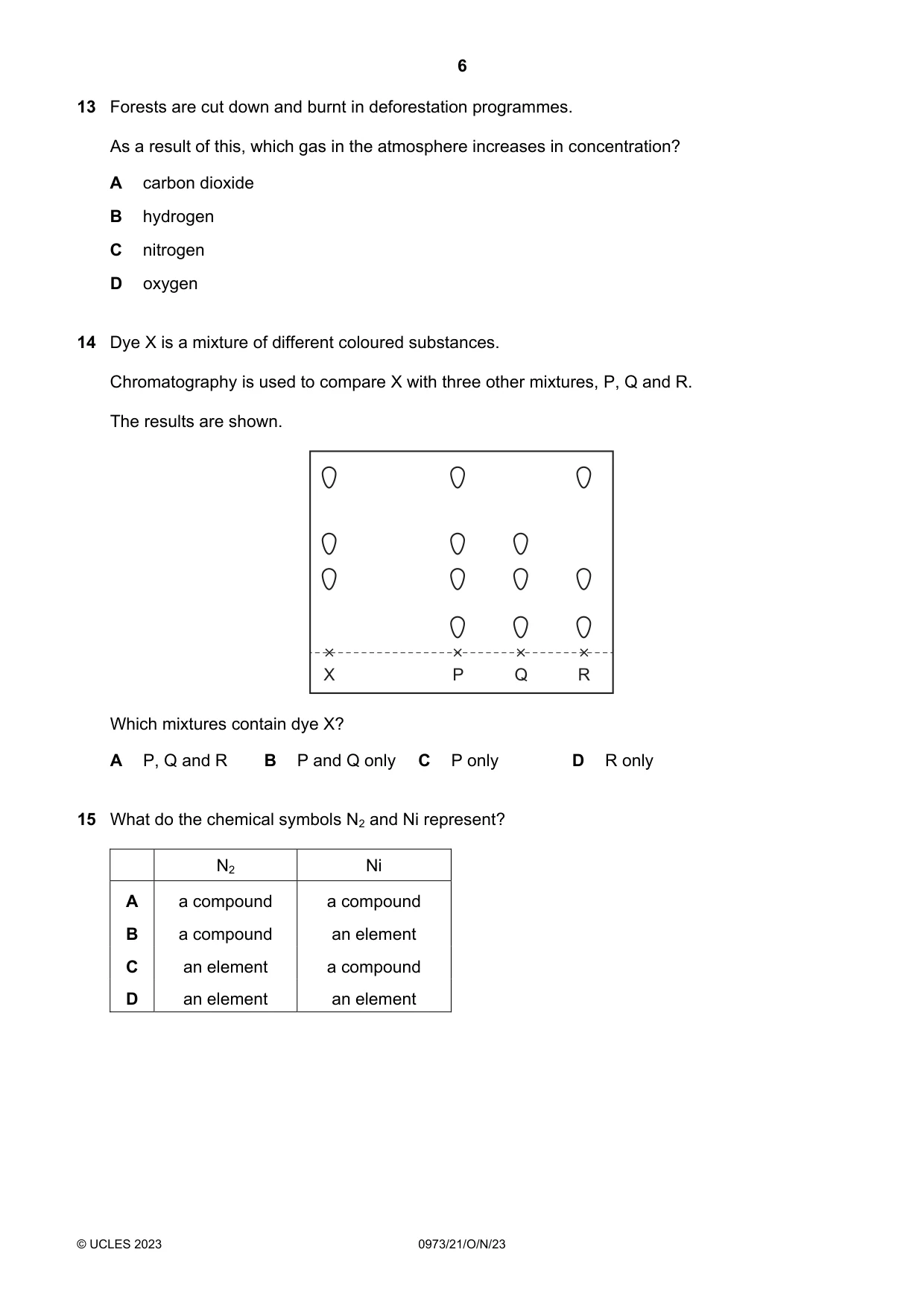
14 Dye X is a mixture of different coloured substances. Chromatography is used to compare X with three other mixtures, P, Q and R. The results are shown. X P Q R Which mixtures contain dye X? A P, Q and R B P and Q only C P only D R only
Mark scheme: C
Q15 · What do the chemical symbols N2 and Ni represent?
15 What do the chemical symbols N2 and Ni represent? N2 Ni A a compound a compound B a compound an element C an element a compound D an element an element
Mark scheme: D
Q16 · The nucleon number of a hydrogen atom is 1
16 The nucleon number of a hydrogen atom is 1. What is present inside the nucleus of this atom? A one proton and one electron B one proton and one neutron C one proton only D one neutron only
Mark scheme: C
Q17 · When magnesium carbonate reacts with dilute hydrochloric acid, carbon dioxide gas is…
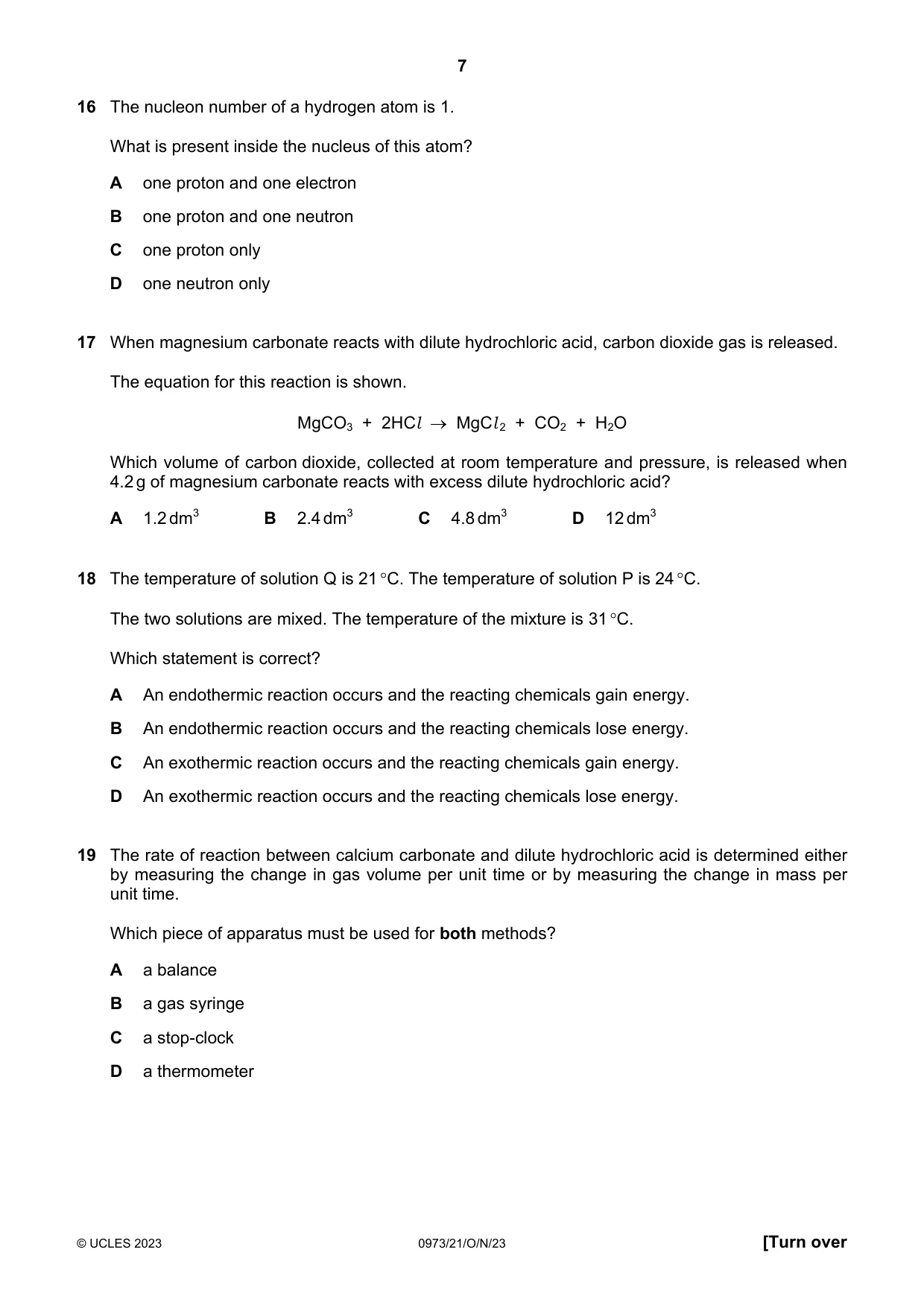
17 When magnesium carbonate reacts with dilute hydrochloric acid, carbon dioxide gas is released. The equation for this reaction is shown. MgCO3 + 2HCl MgCl 2 + CO2 + H2O Which volume of carbon dioxide, collected at room temperature and pressure, is released when 4.2 g of magnesium carbonate reacts with excess dilute hydrochloric acid? A 1.2 dm3 B 2.4 dm3 C 4.8 dm3 D 12 dm3
Mark scheme: A
Q18 · The temperature of solution Q is 21 C
18 The temperature of solution Q is 21 C. The temperature of solution P is 24 C. The two solutions are mixed. The temperature of the mixture is 31 C. Which statement is correct? A An endothermic reaction occurs and the reacting chemicals gain energy. B An endothermic reaction occurs and the reacting chemicals lose energy. C An exothermic reaction occurs and the reacting chemicals gain energy. D An exothermic reaction occurs and the reacting chemicals lose energy.
Mark scheme: D
Q19 · The rate of reaction between calcium carbonate and dilute hydrochloric acid is determined…
19 The rate of reaction between calcium carbonate and dilute hydrochloric acid is determined either by measuring the change in gas volume per unit time or by measuring the change in mass per unit time. Which piece of apparatus must be used for both methods? A a balance B a gas syringe C a stop-clock D a thermometer
Mark scheme: C
Q20 · The ionic equation for the reaction between iron(II) chloride and chlorine is shown
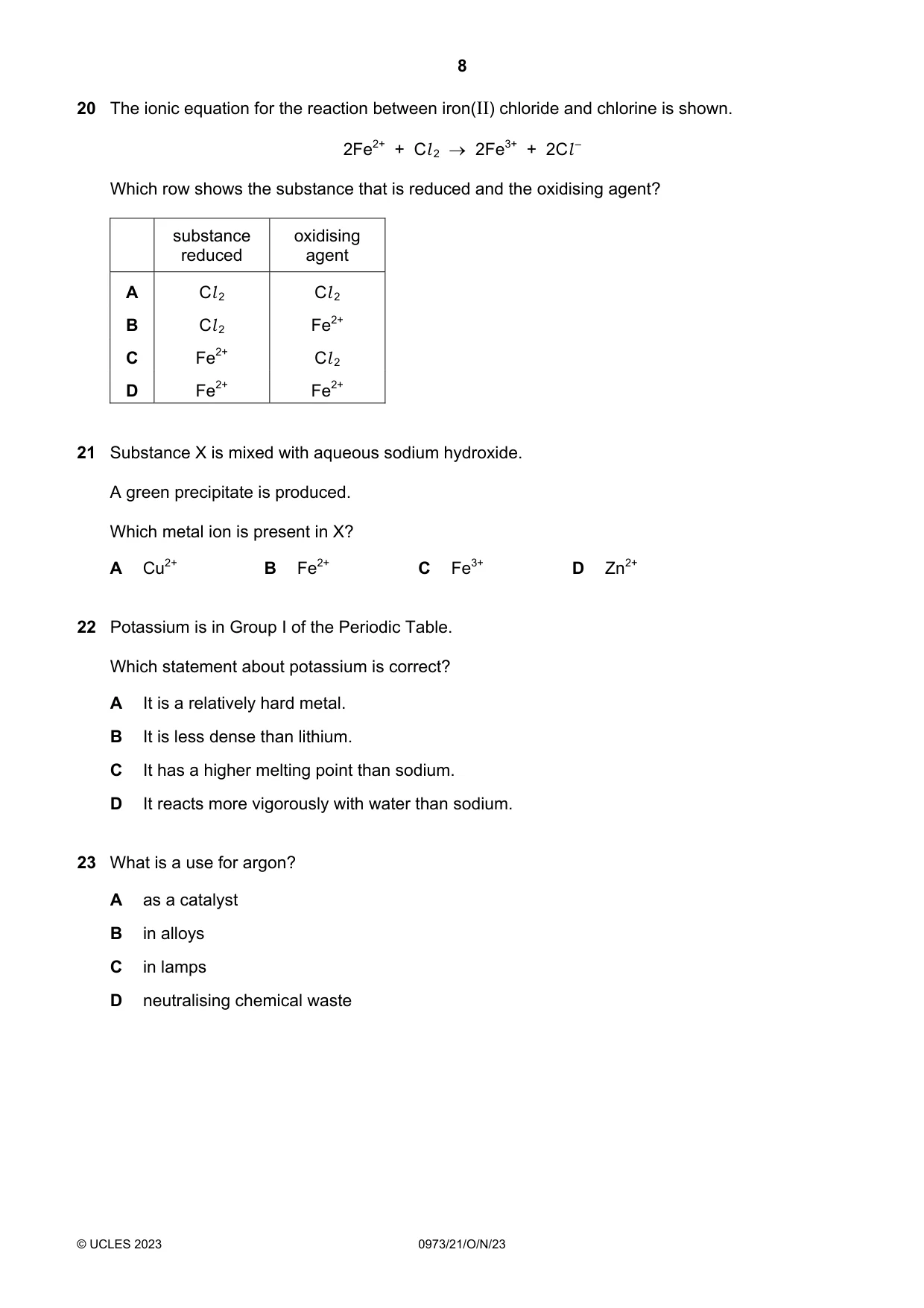
20 The ionic equation for the reaction between iron(II) chloride and chlorine is shown. 2Fe2+ + Cl 2 2Fe3+ + 2Cl – Which row shows the substance that is reduced and the oxidising agent? substance oxidising reduced agent A Cl 2 Cl 2 B Cl 2 Fe2+ C Fe2+ Cl 2 D Fe2+ Fe2+
Mark scheme: A
Q21 · Substance X is mixed with aqueous sodium hydroxide
21 Substance X is mixed with aqueous sodium hydroxide. A green precipitate is produced. Which metal ion is present in X? A Cu2+ B Fe2+ C Fe3+ D Zn2+
Mark scheme: B
Q22 · Potassium is in Group I of the Periodic Table
22 Potassium is in Group I of the Periodic Table. Which statement about potassium is correct? A It is a relatively hard metal. B It is less dense than lithium. C It has a higher melting point than sodium. D It reacts more vigorously with water than sodium.
Mark scheme: D
Q23 · What is a use for argon?
23 What is a use for argon? A as a catalyst B in alloys C in lamps D neutralising chemical waste
Mark scheme: C
Q24 · Silver oxide is reduced by heating with carbon more easily than copper oxide is reduced…
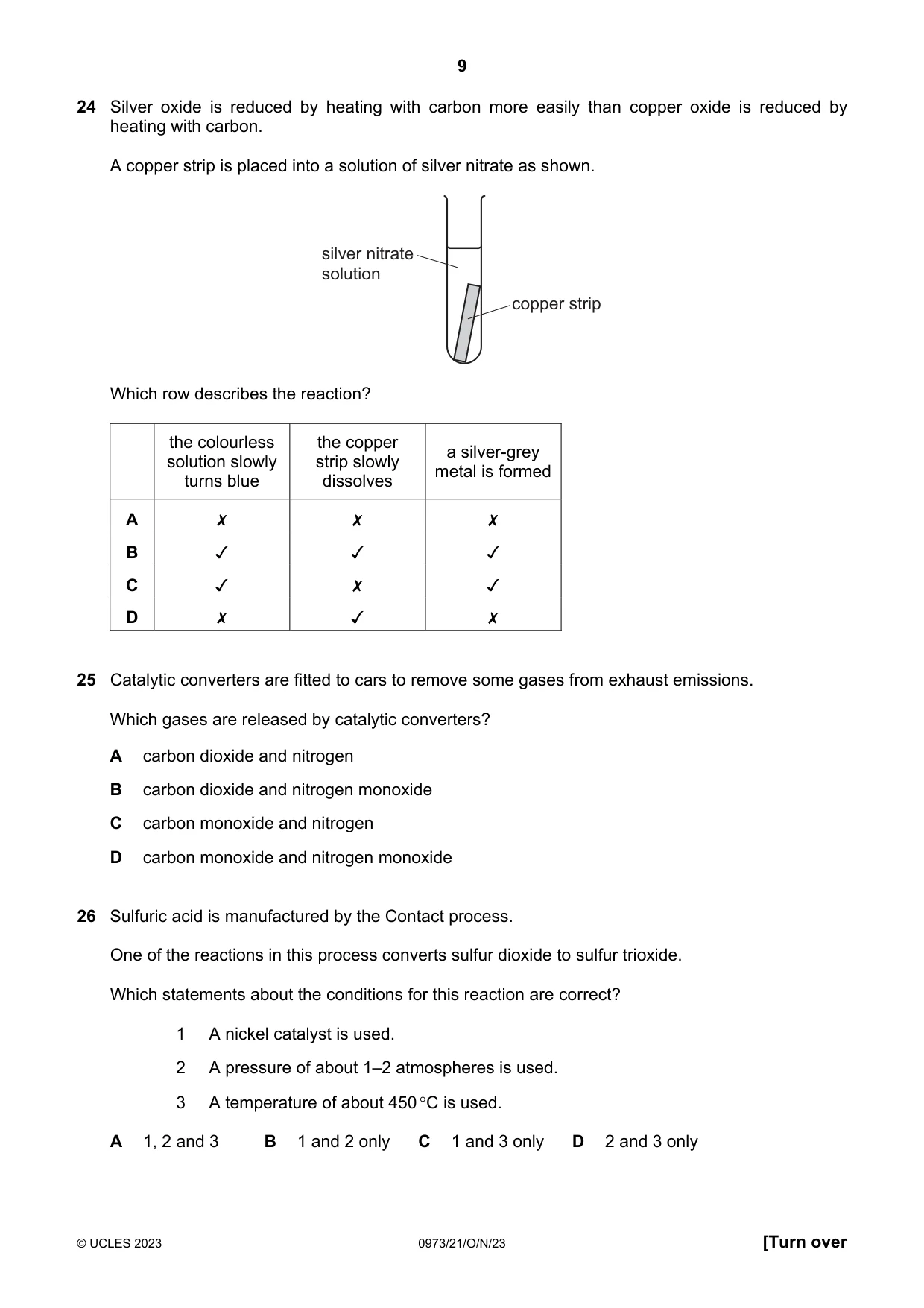
24 Silver oxide is reduced by heating with carbon more easily than copper oxide is reduced by heating with carbon. A copper strip is placed into a solution of silver nitrate as shown. silver nitrate solution copper strip Which row describes the reaction? the colourless the copper . solution slowly strip slowly a silver-grey ; metal is formed turns blue dissolves 0 OW > x \ \ x \ «MK \ x x \ \ x
Mark scheme: B
Q25 · Catalytic converters are fitted to cars to remove some gases from exhaust emissions
25 Catalytic converters are fitted to cars to remove some gases from exhaust emissions. Which gases are released by catalytic converters? A carbon dioxide and nitrogen B carbon dioxide and nitrogen monoxide C carbon monoxide and nitrogen D carbon monoxide and nitrogen monoxide
Mark scheme: A
Q26 · Sulfuric acid is manufactured by the Contact process
26 Sulfuric acid is manufactured by the Contact process. One of the reactions in this process converts sulfur dioxide to sulfur trioxide. Which statements about the conditions for this reaction are correct? 1 A nickel catalyst is used. 2 A pressure of about 1–2 atmospheres is used. 3 A temperature of about 450 C is used. A 1, 2 and 3 B 1 and 2 only C 1 and 3 only D 2 and 3 only
Mark scheme: D
Q27 · Which statements about monomers and polymers are correct?
27 Which statements about monomers and polymers are correct? 1 Different polymers can have different linkages between monomers. 2 An addition polymerisation reaction produces more than one type of polymer. 3 Addition polymers are made from saturated monomer molecules. 4 Nylon is a condensation polymer formed from two different monomers. A 1 and 2 B 1 and 4 C 2 and 3 D 3 and 4
Mark scheme: B
Q28 · The speed–time graph represents part of a car journey
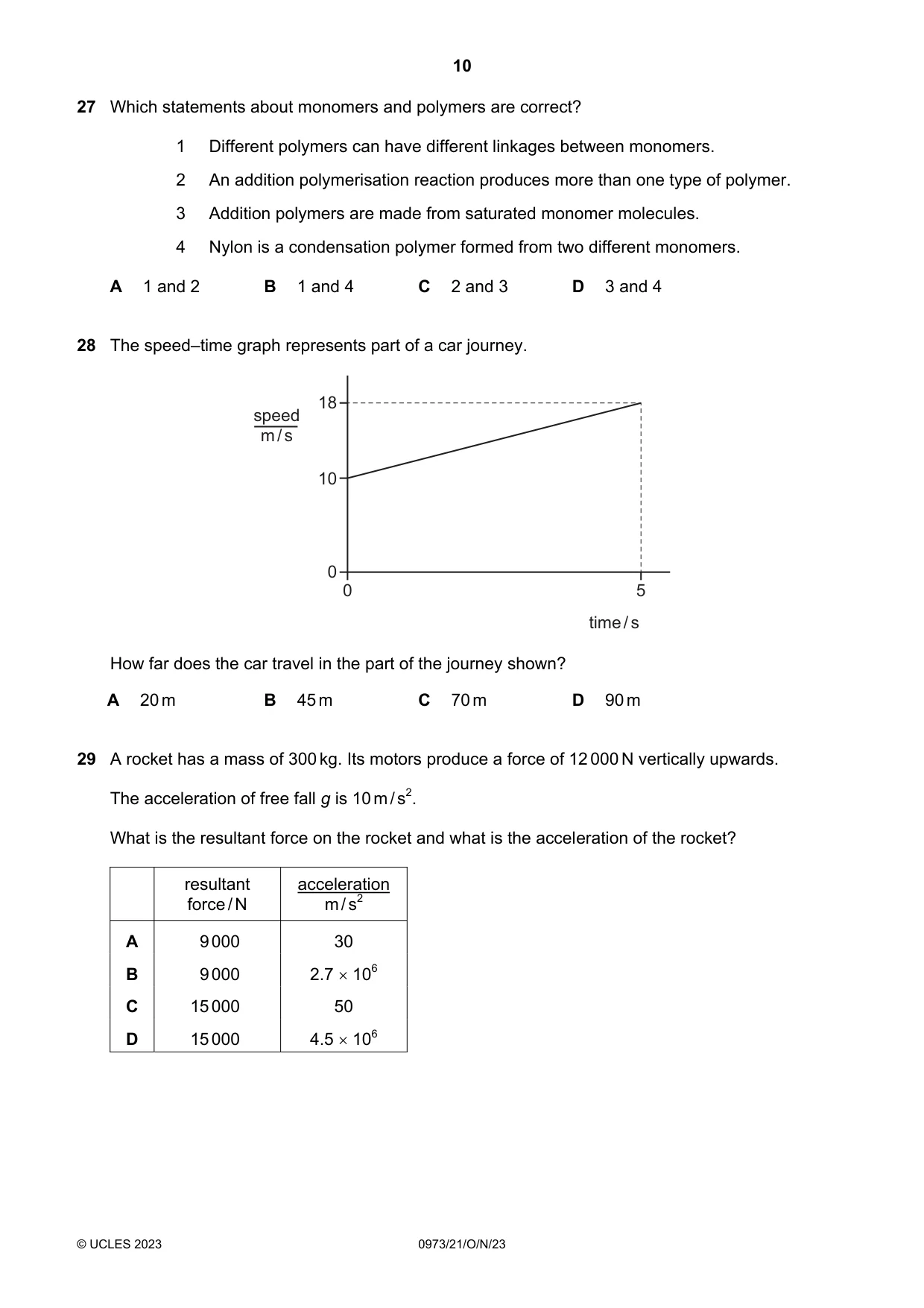
28 The speed–time graph represents part of a car journey. 18 speed m / s 10 0 0 5 time / s How far does the car travel in the part of the journey shown? A 20 m B 45 m C 70 m D 90 m
Mark scheme: C
Q29 · A rocket has a mass of 300 kg
29 A rocket has a mass of 300 kg. Its motors produce a force of 12 000 N vertically upwards. The acceleration of free fall g is 10 m / s2. What is the resultant force on the rocket and what is the acceleration of the rocket? resultant acceleration force / N m / s2 A 9 000 30 B 9 000 2.7 106 C 15 000 50 D 15 000 4.5 106
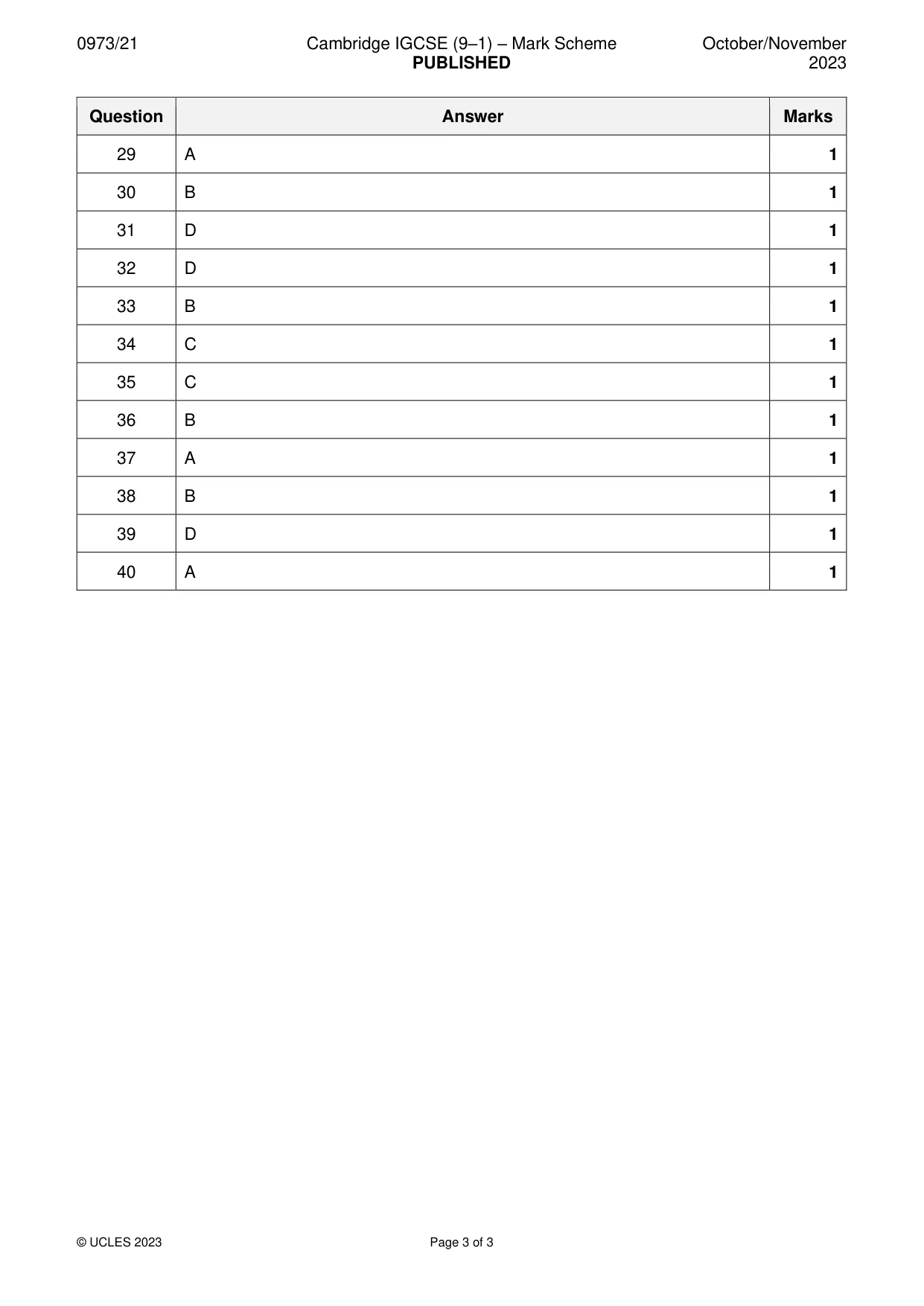
Mark scheme: A
Q30 · A uniform metre rule rests on a pivot at the 50 cm mark
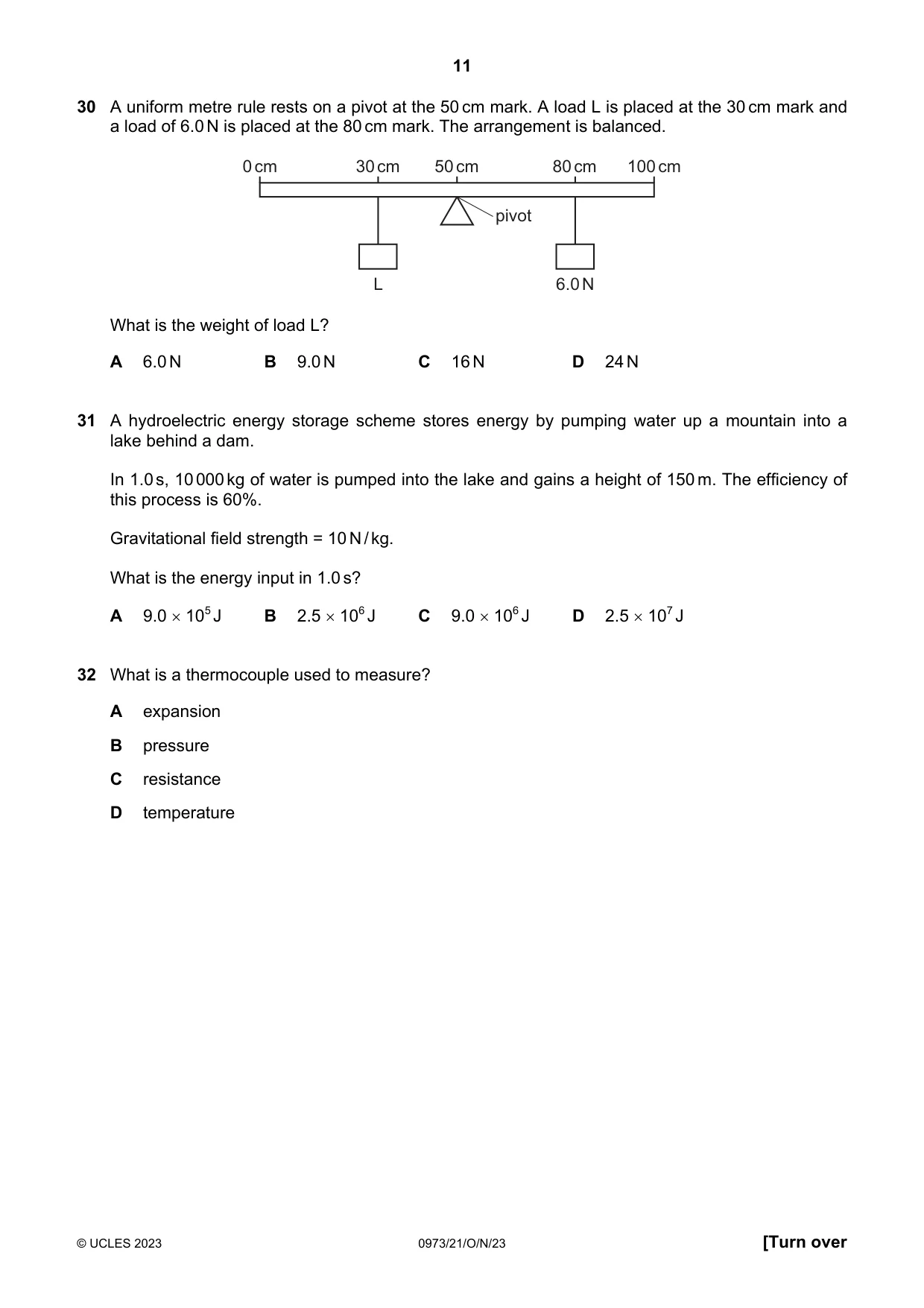
30 A uniform metre rule rests on a pivot at the 50 cm mark. A load L is placed at the 30 cm mark and a load of 6.0 N is placed at the 80 cm mark. The arrangement is balanced. 0 cm 30 cm 50 cm 80 cm 100 cm pivot L 6.0 N What is the weight of load L? A 6.0 N B 9.0 N C 16 N D 24 N
Mark scheme: B
Q31 · A hydroelectric energy storage scheme stores energy by pumping water up a mountain into a…
31 A hydroelectric energy storage scheme stores energy by pumping water up a mountain into a lake behind a dam. In 1.0 s, 10 000 kg of water is pumped into the lake and gains a height of 150 m. The efficiency of this process is 60%. Gravitational field strength = 10 N / kg. What is the energy input in 1.0 s? A 9.0 105 J B 2.5 106 J C 9.0 106 J D 2.5 107 J
Mark scheme: D
Q32 · What is a thermocouple used to measure?
32 What is a thermocouple used to measure? A expansion B pressure C resistance D temperature
Mark scheme: D
Q33 · A vacuum flask uses a vacuum between two shiny surfaces to keep a drink hot for a long…
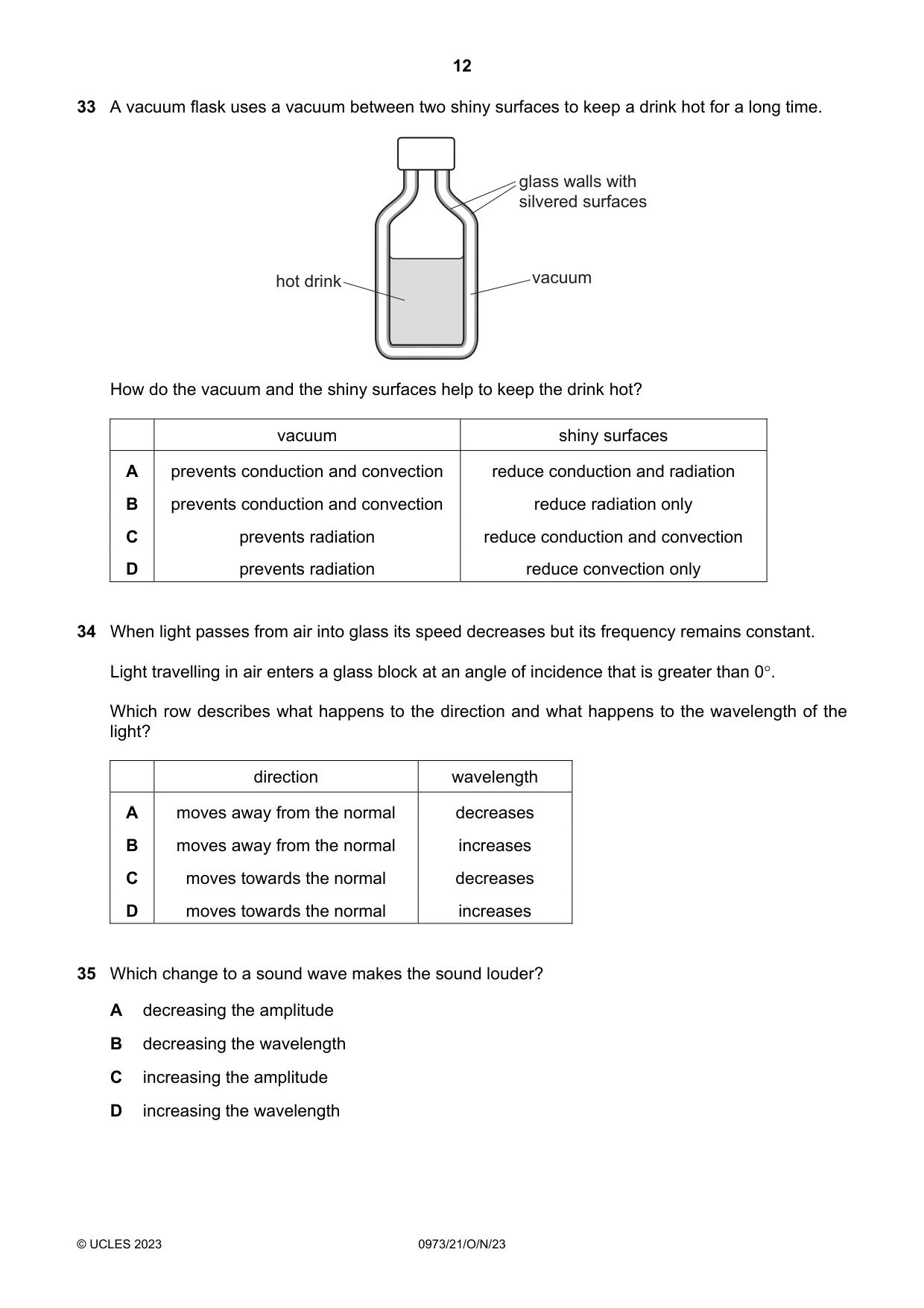
33 A vacuum flask uses a vacuum between two shiny surfaces to keep a drink hot for a long time. glass walls with silvered surfaces hot drink vacuum How do the vacuum and the shiny surfaces help to keep the drink hot? vacuum shiny surfaces A prevents conduction and convection reduce conduction and radiation B prevents conduction and convection reduce radiation only C prevents radiation reduce conduction and convection D prevents radiation reduce convection only
Mark scheme: B
Q34 · When light passes from air into glass its speed decreases but its frequency remains…
34 When light passes from air into glass its speed decreases but its frequency remains constant. Light travelling in air enters a glass block at an angle of incidence that is greater than 0. Which row describes what happens to the direction and what happens to the wavelength of the light? direction wavelength A moves away from the normal decreases B moves away from the normal increases C moves towards the normal decreases D moves towards the normal increases
Mark scheme: C
Q35 · Which change to a sound wave makes the sound louder?
35 Which change to a sound wave makes the sound louder? A decreasing the amplitude B decreasing the wavelength C increasing the amplitude D increasing the wavelength
Mark scheme: C
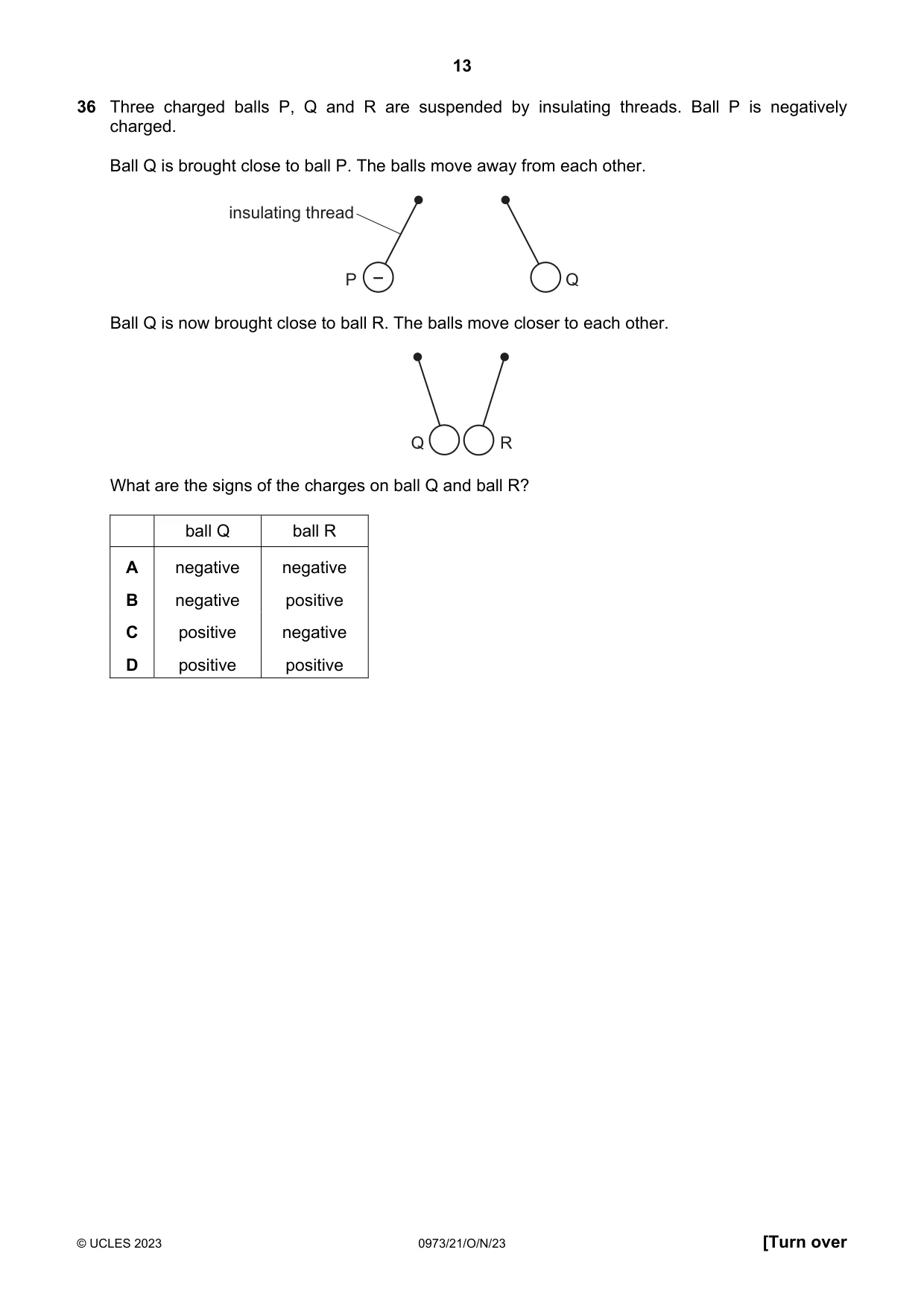
Q36 · Three charged balls P, Q and R are suspended by insulating threads
36 Three charged balls P, Q and R are suspended by insulating threads. Ball P is negatively charged. Ball Q is brought close to ball P. The balls move away from each other. insulating thread P – Q Ball Q is now brought close to ball R. The balls move closer to each other. Q R What are the signs of the charges on ball Q and ball R? ball Q ball R A negative negative B negative positive C positive negative D positive positive
Mark scheme: B
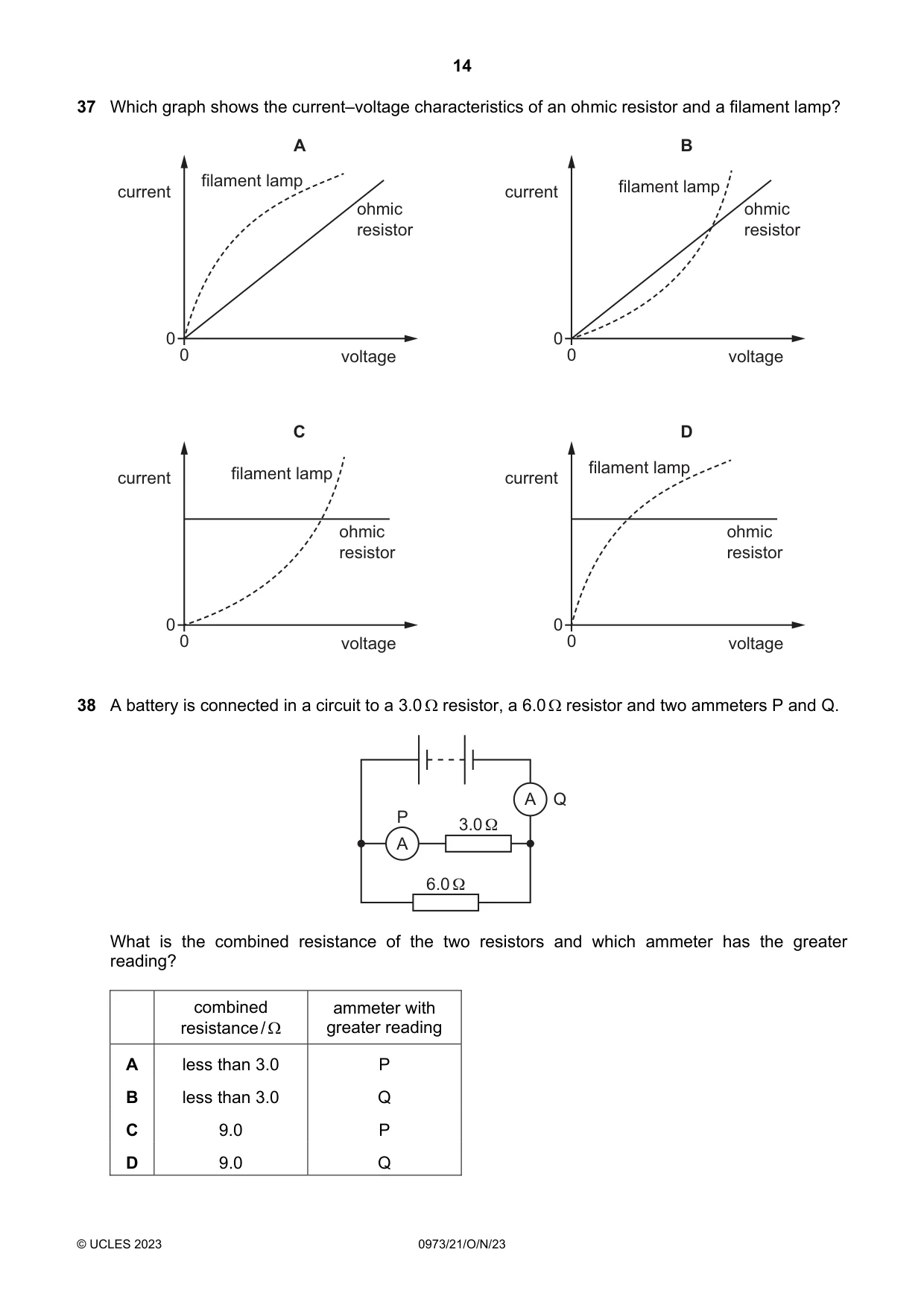
Q37 · Which graph shows the current–voltage characteristics of an ohmic resistor and a filament…
37 Which graph shows the current–voltage characteristics of an ohmic resistor and a filament lamp? A B filament lamp filament lamp current current ohmic ohmic resistor resistor 0 0 0 voltage 0 voltage C D filament lamp filament lamp current current ohmic ohmic resistor resistor 0 0 0 voltage 0 voltage
Mark scheme: A
Q38 · A battery is connected in a circuit to a 3.0 resistor, a 6.0 resistor and two…
38 A battery is connected in a circuit to a 3.0 resistor, a 6.0 resistor and two ammeters P and Q. A Q P 3.0 Ω A 6.0 Ω What is the combined resistance of the two resistors and which ammeter has the greater reading? combined ammeter with resistance / greater reading A less than 3.0 P B less than 3.0 Q C 9.0 P D 9.0 Q
Mark scheme: B
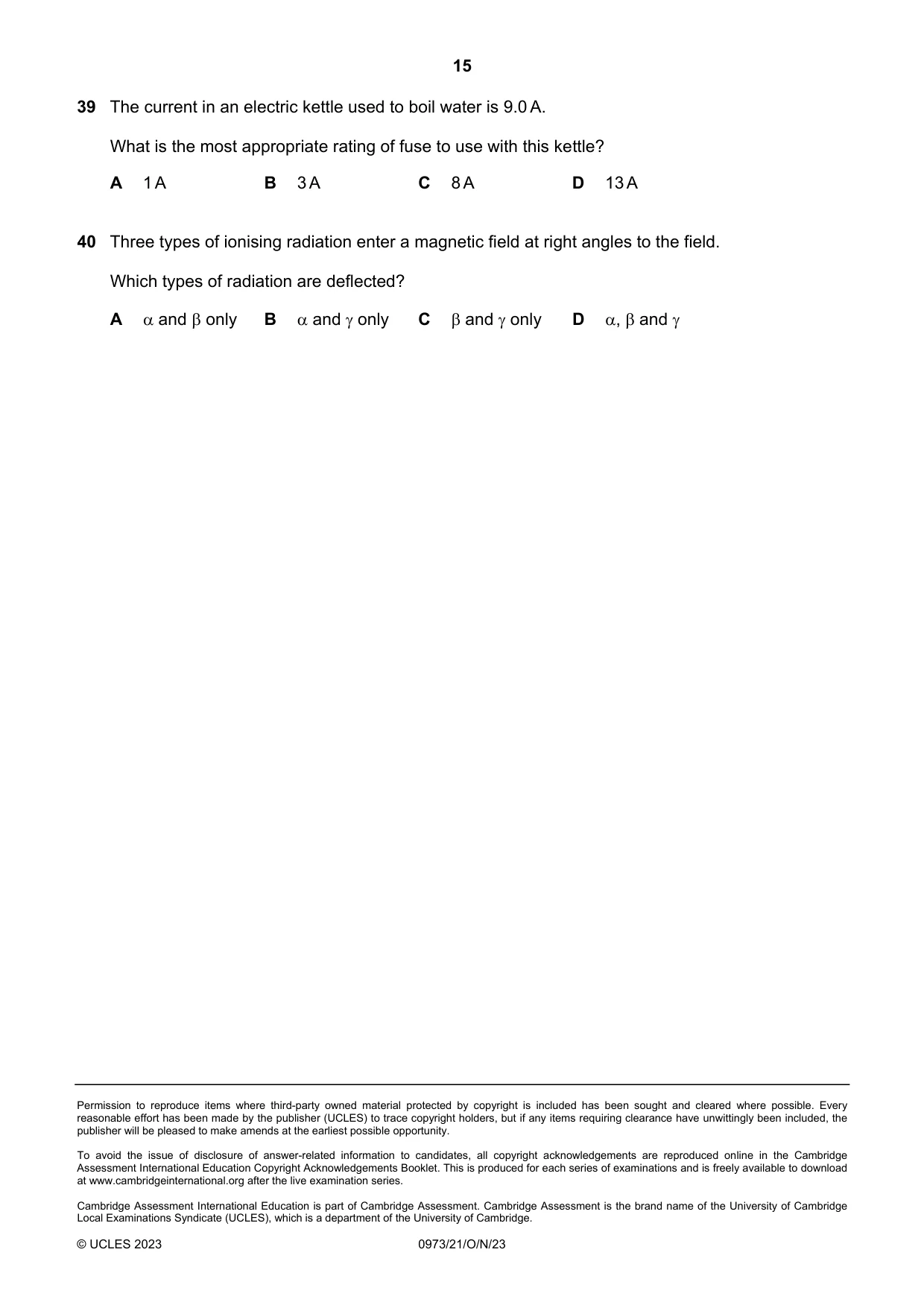
Q39 · The current in an electric kettle used to boil water is 9.0 A
39 The current in an electric kettle used to boil water is 9.0 A. What is the most appropriate rating of fuse to use with this kettle? A 1 A B 3 A C 8 A D 13 A
Mark scheme: D
Q40 · Three types of ionising radiation enter a magnetic field at right angles to the field
40 Three types of ionising radiation enter a magnetic field at right angles to the field. Which types of radiation are deflected? A and only B and only C and only D , and
Mark scheme: A
What was in this paper
The subtopics covered by these 40 questions, and how many questions each got. Open one in a new tab to see every Cambridge question on it.
2Forces2Rate of reaction2Respiration2Atomic structure and the Periodic Table1Biological molecules1Chromatography1Coordination and response1Digestion1Electrical circuits1Electrical quantities1Electrical safety1Elements, compounds and mixtures1Energy flow1Energy, work and power1Enzymes1Exothermic and endothermic reactions1Group I properties1Identification of ions and gases1Leaf structure1Light1Monohybrid inheritance1Motion1Noble gases1Osmosis1Polymers1Radioactivity1Reactivity series1Redox1Sexual reproduction in humans1Simple phenomena of magnetism1Sound1The mole and the Avogadro constant1Thermal properties and temperature1Transfer of thermal energy1Xylem and phloem1What you needed in this session
Cambridge’s own grade thresholds for 2023 Oct/Nov, Paper 2 · Variant 1. A higher threshold means an easier paper — the bar moves with how the cohort did.